EP3771628B1 - Adapter for a sprocket-carrying body for a bicycle rear wheel - Google Patents
Adapter for a sprocket-carrying body for a bicycle rear wheel Download PDFInfo
- Publication number
- EP3771628B1 EP3771628B1 EP20187782.6A EP20187782A EP3771628B1 EP 3771628 B1 EP3771628 B1 EP 3771628B1 EP 20187782 A EP20187782 A EP 20187782A EP 3771628 B1 EP3771628 B1 EP 3771628B1
- Authority
- EP
- European Patent Office
- Prior art keywords
- sprocket
- carrying
- carrying body
- adapter
- sprockets
- Prior art date
- Legal status (The legal status is an assumption and is not a legal conclusion. Google has not performed a legal analysis and makes no representation as to the accuracy of the status listed.)
- Active
Links
Images




Classifications
-
- B—PERFORMING OPERATIONS; TRANSPORTING
- B60—VEHICLES IN GENERAL
- B60B—VEHICLE WHEELS; CASTORS; AXLES FOR WHEELS OR CASTORS; INCREASING WHEEL ADHESION
- B60B27/00—Hubs
- B60B27/02—Hubs adapted to be rotatably arranged on axle
- B60B27/04—Hubs adapted to be rotatably arranged on axle housing driving means, e.g. sprockets
-
- B—PERFORMING OPERATIONS; TRANSPORTING
- B62—LAND VEHICLES FOR TRAVELLING OTHERWISE THAN ON RAILS
- B62M—RIDER PROPULSION OF WHEELED VEHICLES OR SLEDGES; POWERED PROPULSION OF SLEDGES OR SINGLE-TRACK CYCLES; TRANSMISSIONS SPECIALLY ADAPTED FOR SUCH VEHICLES
- B62M9/00—Transmissions characterised by use of an endless chain, belt, or the like
- B62M9/04—Transmissions characterised by use of an endless chain, belt, or the like of changeable ratio
- B62M9/06—Transmissions characterised by use of an endless chain, belt, or the like of changeable ratio using a single chain, belt, or the like
- B62M9/10—Transmissions characterised by use of an endless chain, belt, or the like of changeable ratio using a single chain, belt, or the like involving different-sized wheels, e.g. rear sprocket chain wheels selectively engaged by the chain, belt, or the like
-
- B—PERFORMING OPERATIONS; TRANSPORTING
- B60—VEHICLES IN GENERAL
- B60B—VEHICLE WHEELS; CASTORS; AXLES FOR WHEELS OR CASTORS; INCREASING WHEEL ADHESION
- B60B27/00—Hubs
- B60B27/02—Hubs adapted to be rotatably arranged on axle
- B60B27/023—Hubs adapted to be rotatably arranged on axle specially adapted for bicycles
-
- B—PERFORMING OPERATIONS; TRANSPORTING
- B62—LAND VEHICLES FOR TRAVELLING OTHERWISE THAN ON RAILS
- B62M—RIDER PROPULSION OF WHEELED VEHICLES OR SLEDGES; POWERED PROPULSION OF SLEDGES OR SINGLE-TRACK CYCLES; TRANSMISSIONS SPECIALLY ADAPTED FOR SUCH VEHICLES
- B62M9/00—Transmissions characterised by use of an endless chain, belt, or the like
-
- B—PERFORMING OPERATIONS; TRANSPORTING
- B62—LAND VEHICLES FOR TRAVELLING OTHERWISE THAN ON RAILS
- B62M—RIDER PROPULSION OF WHEELED VEHICLES OR SLEDGES; POWERED PROPULSION OF SLEDGES OR SINGLE-TRACK CYCLES; TRANSMISSIONS SPECIALLY ADAPTED FOR SUCH VEHICLES
- B62M9/00—Transmissions characterised by use of an endless chain, belt, or the like
- B62M9/04—Transmissions characterised by use of an endless chain, belt, or the like of changeable ratio
- B62M9/06—Transmissions characterised by use of an endless chain, belt, or the like of changeable ratio using a single chain, belt, or the like
- B62M9/10—Transmissions characterised by use of an endless chain, belt, or the like of changeable ratio using a single chain, belt, or the like involving different-sized wheels, e.g. rear sprocket chain wheels selectively engaged by the chain, belt, or the like
- B62M9/12—Transmissions characterised by use of an endless chain, belt, or the like of changeable ratio using a single chain, belt, or the like involving different-sized wheels, e.g. rear sprocket chain wheels selectively engaged by the chain, belt, or the like the chain, belt, or the like being laterally shiftable, e.g. using a rear derailleur
- B62M9/121—Rear derailleurs
-
- B—PERFORMING OPERATIONS; TRANSPORTING
- B62—LAND VEHICLES FOR TRAVELLING OTHERWISE THAN ON RAILS
- B62M—RIDER PROPULSION OF WHEELED VEHICLES OR SLEDGES; POWERED PROPULSION OF SLEDGES OR SINGLE-TRACK CYCLES; TRANSMISSIONS SPECIALLY ADAPTED FOR SUCH VEHICLES
- B62M9/00—Transmissions characterised by use of an endless chain, belt, or the like
- B62M9/04—Transmissions characterised by use of an endless chain, belt, or the like of changeable ratio
- B62M9/06—Transmissions characterised by use of an endless chain, belt, or the like of changeable ratio using a single chain, belt, or the like
- B62M9/10—Transmissions characterised by use of an endless chain, belt, or the like of changeable ratio using a single chain, belt, or the like involving different-sized wheels, e.g. rear sprocket chain wheels selectively engaged by the chain, belt, or the like
- B62M9/12—Transmissions characterised by use of an endless chain, belt, or the like of changeable ratio using a single chain, belt, or the like involving different-sized wheels, e.g. rear sprocket chain wheels selectively engaged by the chain, belt, or the like the chain, belt, or the like being laterally shiftable, e.g. using a rear derailleur
- B62M9/121—Rear derailleurs
- B62M9/128—Accessories, e.g. protectors
-
- F—MECHANICAL ENGINEERING; LIGHTING; HEATING; WEAPONS; BLASTING
- F16—ENGINEERING ELEMENTS AND UNITS; GENERAL MEASURES FOR PRODUCING AND MAINTAINING EFFECTIVE FUNCTIONING OF MACHINES OR INSTALLATIONS; THERMAL INSULATION IN GENERAL
- F16H—GEARING
- F16H55/00—Elements with teeth or friction surfaces for conveying motion; Worms, pulleys or sheaves for gearing mechanisms
- F16H55/02—Toothed members; Worms
- F16H55/30—Chain-wheels
-
- B—PERFORMING OPERATIONS; TRANSPORTING
- B62—LAND VEHICLES FOR TRAVELLING OTHERWISE THAN ON RAILS
- B62M—RIDER PROPULSION OF WHEELED VEHICLES OR SLEDGES; POWERED PROPULSION OF SLEDGES OR SINGLE-TRACK CYCLES; TRANSMISSIONS SPECIALLY ADAPTED FOR SUCH VEHICLES
- B62M9/00—Transmissions characterised by use of an endless chain, belt, or the like
- B62M2009/005—Details of transmission chains specially adapted for bicycles
Definitions
- the present invention relates to an adapter for a sprocket-carrying body of a freewheel group for a bicycle rear wheel.
- the spatial indications like in particular those of radial, axial and circumferential direction, will be given with reference to the rotation axis of the rear wheel of the bicycle, which coincides with the axis of the cogset, of the sprocket-carrying body, of the hub of the wheel and in general of all of the elements that rotate with the wheel.
- the axial direction with be indicated as outwards if directed away from the longitudinal mid-plane of the bicycle or away from the hub of the wheel, and vice-versa as inwards if directed towards such a mid-plane or towards the hub.
- the short indications outer and inner (or axially outer and axially inner) will also be used in the same way: outer thus equates to facing in the outward axial direction and inner equates to facing in the inward axial direction.
- a so-called sprocket-carrying body In order to mount a cogset on the hub of a bicycle rear wheel, a so-called sprocket-carrying body is normally used, which on one side is made to rotate as a unit with the sprockets through shape coupling, and on the other side is made to rotate as a unit - however in a unidirectional manner - with the hub through a set of ratchets or similar, commonly called freewheel.
- the transmission chain engaged with the various sprockets is capable of transmitting a torque to the hub in the advancing direction of the bicycle.
- the sprocket-carrying body essentially consists of a tubular body, that is mechanically coupled at the radially peripheral surface thereof with central mounting openings made in the sprockets.
- the radially peripheral surface of the sprocket-carrying body is shaped with substantially axial ribs and grooves, alternating in the circumferential direction, adapted for allowing the aforementioned shape coupling.
- the central mounting openings of the sprockets are provided with extensions or projections directed radially towards the rotation axis which couple with the grooves present on the sprocket-carrying body.
- the sprockets are thus mounted axially on the sprocket-carrying body in succession, from the sprocket having the largest diameter, so that when the sprocket-carrying body is mounted on the hub of the wheel of the bicycle the sprockets of larger diameter are located towards the inside, i.e. close to the rear wheel, whereas the sprockets of smaller diameter are located towards the outside.
- the ribs and grooves on the radially peripheral surface of the sprocket-carrying body also perform the function of providing a so-called mounting key, for the correct angular positioning of each sprocket.
- the expression mounting key is meant to indicate a particular profile of an axial portion of the radially peripheral surface of the sprocket-carrying body and a corresponding profile of the central mounting opening of each sprocket, wherein these profiles have a well-determined non-regularity in the circumferential direction that allows each sprocket to be mounted on the sprocket-carrying body only in a very precise angular position.
- the mounting key thus ensures that a predetermined mutual angular phasing is maintained between sprockets, which is necessary for the correct operation of the rear gearshift of the bicycle.
- a mounting key is obtained by providing for the grooves on the sprocket-carrying body to all be the same except for an odd one, and consequently shaping an odd one of the extensions of every sprocket: the coupling of the sprocket on the sprocket-carrying body can thus only take place with that angular position of the sprocket on the sprocket-carrying body that allows the engagement of the odd extension with the odd groove.
- two or more possible angular positions are provided (due to the repetitiveness in the circumferential direction of the shape features of the toothing), and consequently it is possible to provide two or more odd extensions.
- cogsets in which the smallest sprockets (typically the first three) are made as a unit with each other to form a monolithic group (also commonly called triplet, precisely because it groups together three sprockets), and the central opening for mounting on the sprocket-carrying body extends axially only at the largest sprocket of the group; the smallest sprockets extend more towards the rotation axis, but do not engage with the sprocket-carrying body, since it is ensured that they are set in motion by the fact that they form a unit with the largest sprocket of the group.
- the sprocket-carrying body In order to allow this type of coupling, it is however necessary for the sprocket-carrying body to have a shorter axial extension with respect to the cogset. In other words, in order to mount a cogset of this type, with the first sprockets very small and fixedly connected to one another to form a monolithic group, on the hub of the bicycle wheel, a special sprocket-carrying body, in particular a short sprocket-carrying body is necessary.
- EP 1342657 A2 discloses a sprocket-carrying set according to the preamble of claim 1.
- the problem at the basis of the present invention is that of allowing a flexibility of choice of the cogset without also forcing the replacement of the sprocket-carrying body.
- the invention concerns a sprocket-carrying set for a bicycle rear wheel comprising a sprocket-carrying body and an adapter, wherein the sprocket-carrying body is provided with grooves extending axially on the radially peripheral surface, and wherein the adapter comprises an annular body having outer diameter corresponding to that of the sprocket-carrying body and abutting at the sprocket-carrying body as an axial extension thereof in an axially outer direction, adapted to receive sprockets in a radially peripheral position, a coupling element formed on the annular body to establish a shape coupling with the sprocket-carrying body that makes the adapter rotate as a unit with the sprocket-carrying body, at least one sprocket-receiving seat formed on the annular body of the adapter and adapted for coupling with at least one sprocket, so as to make the adapter
- the sprocket-carrying body can be in particular a short sprocket-carrying body, of the type suitable for cogsets in which the smallest sprockets are grouped in a monolithic group; once coupled with the sprocket-carrying body, the adapter extends the axial extension thereof, thus making it possible to receive cogsets in which the sprockets are separated and can be mounted singularly on the sprocket-carrying set formed by the assembly of the sprocket-carrying body and the adapter.
- the coupling element comprises at least one front tooth projecting axially from the annular body, sized so as to be able to insert in a respective groove of the sprocket-carrying body.
- the coupling element comprises a plurality of front teeth projecting axially from the annular body, in particular four, sized so as to be able to insert in respective secondary grooves of the sprocket-carrying body.
- This number of front teeth not only allows an excellent balancing of the torque transmitted between adapter and sprocket-carrying body, but best exploits the unused secondary grooves of the sprocket-carrying body, which are normally indeed four.
- the front teeth are equally spaced in the circumferential direction.
- the coupling element comprises a mounting key, for ensuring a predetermined angular phasing of the adapter with respect to the sprocket-carrying body. This facilitates the correct mounting of the adapter on the sprocket-carrying body, avoiding possible angular positioning errors.
- the receiving seat comprises at least one axially-extending through groove along the radially peripheral surface of the annular body, intended to align with a respective primary groove in the sprocket-carrying body, and even more preferably the receiving seat comprises some - in a most preferred manner four - axially-extending through grooves along the radially peripheral surface of the annular body, intended to align with respective primary grooves in the sprocket-carrying body.
- grooves are normally provided on the sprocket-carrying body in a greater number with respect to the coupling requirements of the sprockets, for which reason there are some that are used (here called primary) and others that are not used (here called secondary); usually, there are eight grooves, four of which are primary. This means that the presence of the adapter does not in any way obstruct the insertion of the sprockets, even those of larger diameter that must be arranged first on the sprocket-carrying body, close to the hub: in insertion, which takes place in the axial direction, they are simply made to pass over the adapter until it is past.
- the grooves of the adapter are equally spaced in the circumferential direction.
- the receiving seat comprises a mounting key, for ensuring a predetermined angular phasing of the adapter with respect to the sprockets mounted on it. This facilitates the correct mounting of the cogset on the adapter, avoiding possible angular positioning errors.
- the annular body comprises a front annular surface adapted for abutting against the sprocket-carrying body and a rear annular surface axially opposite the front annular surface.
- the annular body comprises recesses formed in the rear annular surface, preferably four recesses formed in the rear annular surface at the four front teeth.
- a hub assembly 1 of a bicycle rear wheel (not shown) is represented, with a hub 10 mounted coaxially on a axle 11, by means of bearings 12; the hub 10 is thus free to rotate on the axle 11, whereas the latter is intended to be mounted fixed on the frame of the bicycle.
- the hub 10 should be deemed to be representative of any hub and will be described only as far as it is of interest for the purposes of the present invention, thus ignoring the features that are not in relation to the present invention.
- the hub 10 is coupled with a sprocket-carrying body 14, through a freewheel mechanism (not highlighted in the drawings) that ensures that the hub 10 is set in rotation by the sprocket-carrying body 14 only in the direction that determines an advancing of the bicycle, not in the opposite direction.
- the sprocket-carrying body 14 has an approximately tubular shape and is mounted free on the axle 11, by means of bearings 15.
- the sprocket-carrying body 14 is provided on its radially peripheral surface with grooves arranged in the axial direction, in particular with primary grooves 16, preferably four in number and equally spaced in the circumferential direction; the sprocket-carrying body 14 is also provided with four secondary grooves 17, arranged between the primary grooves 16 and equally spaced in the circumferential direction.
- One primary groove 16a and one secondary groove 17a are of odd shape with respect to the others, so as to provide a mounting key.
- the sprocket-carrying body 14 is provided close to the axially inner end thereof with an end stop 18, in the form of teeth projecting in the radial direction from the sprocket-carrying body 14; alternatively, a flange extending along the entire circumference of the sprocket-carrying body 14 may be provided as an end stop 18 instead of the teeth,.
- a cogset 20 is mounted on the sprocket-carrying body 14.
- the cogset 20 illustrated in figures 2-5 comprises 12 sprockets organized from the largest to the smallest as follows: the first three sprockets 21a, 21b, 21c are made as a unit with each other to form a monolithic group (or triplet) 21; the next three sprockets 22a, 22b, 22c are made as a unit with each other to form a monolithic group (or triplet) 22 ; the next three sprockets 23, 24, 25 are independent from one another; the last three sprockets 26a, 26b, 26c are made as a unit with each other to form a monolithic group (or triplet) 26.
- These elements are mounted peripherally on the sprocket-carrying body 14, with the triplet 21 rested axially on the end stop 18, the triplet 22 rested axially on the triplet 21, the sprocket 23 rested axially on the triplet 22, the sprocket 24 rested axially on the sprocket 23, the sprocket 25 rested axially on the sprocket 24, the triplet 26 rested axially on the sprocket 25.
- the triplets 21, 22 and 26 and the sprockets 23-25 have a central opening 31 shaped as shown in figure 14 , with four radial projections 32, three of which are the same as each other and of a shape matching the section of the primary grooves 16 on the sprocket-carrying body 14, one - indicated with 32a - is odd, of a shape matching the section of the odd primary groove 16a; in the triplet 26, as can be seen in figures 4 and 5 , the central opening 31 with the radial projections 32 engages only the innermost axial portion, in practice at only the sprocket 26a, whereas the axially outermost portion has a central opening 33 of smaller diameter than that of the central opening 31, due to the smaller number of teeth present on the sprockets 26b and 26c.
- the triplets 21, 22 and 26 and the sprockets 23-25 are slotted onto the sprocket-carrying body 14, constrained in rotation to the sprocket-carrying body 14 by means of the projections 32 engaged in the grooves 16 but substantially free in the axial direction.
- Towards the inside in the axial direction i.e.
- the triplets 21, 22 and 26 and the sprockets 23-25 are held by the end stop 18; towards the outside in the axial direction, the triplets 21, 22 and 26 and the sprockets 23-25 are held by a ring nut 28, inserted on the axle 11 and in the central opening 33 and screwed to the sprocket-carrying body 14, by means of an outer threaded portion 29 of the ring nut 28 and an inner threaded portion 30 of the sprocket-carrying body 14.
- the tightening of the ring nut 28 ensures that all of the triplets 21, 22 and 26 and the sprockets 23-25 are locked on the sprocket-carrying body 14.
- the triplet 26 can have an inner axial portion at the tooth 26a (which has 12 teeth) of dimensions such as to be able to have the central opening 31 suitable for engagement on the sprocket-carrying body 14.
- the sprocket-carrying body 14 has a shorter axial extension with respect to that which it should have to receive 12 single sprockets having axial dimension equal to that of the sprockets shown. This implies that if it is wished to mount a cogset with single sprockets in the hub assembly 1, the axial extension of the sprocket-carrying body 14 outwards would be insufficient to receive the eleventh and twelfth sprocket. Therefore, irrespective of the number of teeth of the smallest sprockets and thus of the dimensions thereof, a cogset with single sprockets could be mounted only by replacing the sprocket-carrying body 14 with a longer one.
- an adapter 50 according to the invention is illustrated, intended to be used in association with the sprocket-carrying body 14.
- the adapter 50 comprises an annular body 51, having outer diameter corresponding to that of the sprocket-carrying body 14 for which it is intended.
- the adapter 50 is provided with front teeth, preferably four front teeth 52, sized so as to be able to each insert in one of the secondary grooves 17 of the sprocket-carrying body 14.
- the front teeth 52 are equally spaced in the circumferential direction, like the secondary grooves 17 of the sprocket-carrying body 14 in which they are intended to insert.
- One of the front teeth, indicated with 52a, is odd, i.e.
- the front teeth 52, 52a as a whole determine a coupling element formed on the annular body 51 to establish a shape coupling between the annular body 51 and the sprocket-carrying body 14, thus making the adapter 50 rotate as a unit with the sprocket-carrying body 14.
- the adapter 50 is also provided with grooves 56, extending in the axial direction on the radially peripheral surface of the annular body 51; the grooves 56 are preferably four in number and are equally spaced in the circumferential direction, corresponding in number, angular position and shape (section) to the primary grooves 16 of the sprocket-carrying body 14 for which the adapter is intended.
- the grooves 56 pass through in the axial direction, i.e. they extend on the annular body 51 between a front annular surface 57 of the annular body 51 up to a rear annular surface 58, axially opposite the front annular surface 57.
- One of the grooves is an odd groove 56a, different from the other grooves, just as in the sprocket-carrying body 14 the odd primary groove 16a is different from the other primary grooves 16.
- the annular body 51 also comprises recesses 59, formed in the rear annular surface.
- the recesses 59 are four in number and are formed in angular positions corresponding to the angular positions of the front teeth 52.
- These recesses 59 are used to provide an alternative possibility of engagement to the smallest sprocket, as will be illustrated hereinafter; one of the recesses 59 is an odd recess 59a, having a different shape (section) from the others, to provide a mounting key.
- the grooves 56, 56a and the recesses 59, 59a as a whole determine a sprocket-receiving seat, formed on the annular body 51 of the adapter 50.
- the adapter 50 is intended for use with the sprocket-carrying body 14.
- the adapter 50 is applied to the sprocket-carrying body 14 as an axial extension thereof, towards the outside.
- the front annular surface 57 is axially abutted against the sprocket-carrying body 14, whereas the front teeth 52 engage in the secondary grooves 17; the odd front tooth 52a engages in the odd secondary groove 17a.
- the grooves 56 of the adapter 50 are exactly aligned in the axial direction with the primary grooves 16 of the sprocket-carrying body 14, with the odd groove 56a aligned with the odd primary groove 16a.
- the cogset 70 comprises 12 sprockets, organized from the largest to the smallest as follows: the first three sprockets 71a, 71b, 71c are made as a unit with one another to form a monolithic group (or triplet) 71; the next three sprockets 72a, 72b, 72c are made as a unit with one another to form a monolithic group (or triplet) 72; the next six sprockets 73, 74, 75, 76, 77, 78 are independent from one another.
- the triplets 71, 72 and the sprockets 73-77 have the same central opening 31 of the cogset 20, shaped as shown in figure 14 , with the four radial projections 32, three of which are the same as one another and have a shape matching the section of the primary grooves 16 on the sprocket-carrying body 14, and one - indicated with 32a - odd one, having a shape matching the section of the odd primary groove 16a.
- the cogset 70 Towards the inside in the axial direction (i.e. towards the hub 10), the cogset 70 is held by the end stop 18; towards the outside in the axial direction, the cogset 70 is held together with the adapter 50 by the ring nut 28, inserted on the axle 11 inside the annular body 51 and screwed to the sprocket-carrying body 14, by means of the outer threaded portion 29 of the ring nut 28 that engages with the inner threaded portion 30 of the sprocket-carrying body 14.
- the tightening of the ring nut 28 ensures that all of the triplets 71, 72 and the sprockets 73-78 are locked on the sprocket-carrying body 14, together with the adapter 50.
- the adapter 50 in the hub assembly 1 provided with the sprocket-carrying body 14 it is possible to mount both a cogset 20, i.e. of the type with small sprockets grouped in triplets, and a cogset 70, i.e. of the type with single small sprockets: in the first case, the cogset 20 is mounted directly on the sprocket-carrying body 14; in the second case, the adapter 50 is mounted first and then the cogset 70 is mounted; in any case, it is never necessary to dismount the sprocket-carrying body 14. In this way, it is quick and easy to replace one cogset with another, even if they are of different types.
Landscapes
- Engineering & Computer Science (AREA)
- Mechanical Engineering (AREA)
- Chemical & Material Sciences (AREA)
- Combustion & Propulsion (AREA)
- Transportation (AREA)
- General Engineering & Computer Science (AREA)
- Gears, Cams (AREA)
- Axle Suspensions And Sidecars For Cycles (AREA)
Description
- The present invention relates to an adapter for a sprocket-carrying body of a freewheel group for a bicycle rear wheel.
- Hereinafter, the spatial indications, like in particular those of radial, axial and circumferential direction, will be given with reference to the rotation axis of the rear wheel of the bicycle, which coincides with the axis of the cogset, of the sprocket-carrying body, of the hub of the wheel and in general of all of the elements that rotate with the wheel. Moreover, the axial direction with be indicated as outwards if directed away from the longitudinal mid-plane of the bicycle or away from the hub of the wheel, and vice-versa as inwards if directed towards such a mid-plane or towards the hub. The short indications outer and inner (or axially outer and axially inner) will also be used in the same way: outer thus equates to facing in the outward axial direction and inner equates to facing in the inward axial direction.
- In order to mount a cogset on the hub of a bicycle rear wheel, a so-called sprocket-carrying body is normally used, which on one side is made to rotate as a unit with the sprockets through shape coupling, and on the other side is made to rotate as a unit - however in a unidirectional manner - with the hub through a set of ratchets or similar, commonly called freewheel. In this way, the transmission chain engaged with the various sprockets is capable of transmitting a torque to the hub in the advancing direction of the bicycle.
- The sprocket-carrying body essentially consists of a tubular body, that is mechanically coupled at the radially peripheral surface thereof with central mounting openings made in the sprockets. The radially peripheral surface of the sprocket-carrying body is shaped with substantially axial ribs and grooves, alternating in the circumferential direction, adapted for allowing the aforementioned shape coupling. For this purpose, the central mounting openings of the sprockets are provided with extensions or projections directed radially towards the rotation axis which couple with the grooves present on the sprocket-carrying body.
- The sprockets are thus mounted axially on the sprocket-carrying body in succession, from the sprocket having the largest diameter, so that when the sprocket-carrying body is mounted on the hub of the wheel of the bicycle the sprockets of larger diameter are located towards the inside, i.e. close to the rear wheel, whereas the sprockets of smaller diameter are located towards the outside.
- The ribs and grooves on the radially peripheral surface of the sprocket-carrying body also perform the function of providing a so-called mounting key, for the correct angular positioning of each sprocket. The expression mounting key is meant to indicate a particular profile of an axial portion of the radially peripheral surface of the sprocket-carrying body and a corresponding profile of the central mounting opening of each sprocket, wherein these profiles have a well-determined non-regularity in the circumferential direction that allows each sprocket to be mounted on the sprocket-carrying body only in a very precise angular position. The mounting key thus ensures that a predetermined mutual angular phasing is maintained between sprockets, which is necessary for the correct operation of the rear gearshift of the bicycle. For example, a mounting key is obtained by providing for the grooves on the sprocket-carrying body to all be the same except for an odd one, and consequently shaping an odd one of the extensions of every sprocket: the coupling of the sprocket on the sprocket-carrying body can thus only take place with that angular position of the sprocket on the sprocket-carrying body that allows the engagement of the odd extension with the odd groove. Of course, for some sprockets it is possible that two or more possible angular positions are provided (due to the repetitiveness in the circumferential direction of the shape features of the toothing), and consequently it is possible to provide two or more odd extensions.
- In more modern bicycle gearshifts, particularly for bicycles intended for racing, there is a well-known tendency to increase the number of sprockets. When a cogset reaches 11, 12 or even more sprockets, it may be possible to do without the front gearshift; this simplifies and lightens the bicycle, which is undoubtedly advantageous to the cyclist, provided that this is not accompanied by a penalization in the availability of gear ratios.
- In order to allow this result, it is necessary to have a small sprocket with a very low number of teeth, for example 10 or 9, in the cogset. The small number of teeth, however, is clearly accompanied by a small diameter, which can become too small to allow mounting on normal sprocket-carrying bodies. It has thus become common to use cogsets in which the smallest sprockets (typically the first three) are made as a unit with each other to form a monolithic group (also commonly called triplet, precisely because it groups together three sprockets), and the central opening for mounting on the sprocket-carrying body extends axially only at the largest sprocket of the group; the smallest sprockets extend more towards the rotation axis, but do not engage with the sprocket-carrying body, since it is ensured that they are set in motion by the fact that they form a unit with the largest sprocket of the group.
- In order to allow this type of coupling, it is however necessary for the sprocket-carrying body to have a shorter axial extension with respect to the cogset. In other words, in order to mount a cogset of this type, with the first sprockets very small and fixedly connected to one another to form a monolithic group, on the hub of the bicycle wheel, a special sprocket-carrying body, in particular a short sprocket-carrying body is necessary.
- However, such a short sprocket-carrying body cannot allow the mounting of a conventional cogset, in which each sprocket must be individually coupled with the sprocket-carrying body: indeed, the smallest sprockets would be located in an axial position that the sprocket-carrying body does not reach.
- Consequently, the demanding cyclist or the professional athlete competing in cycling races, if he/she wishes to use different cogsets depending on the conditions (typically the altimetric profile) of the route that must be travelled, must resign himself/herself to replacing the sprocket-carrying body along with the cogset: indeed, in order to be able to use a cogset with very small sprockets (in particular fixedly connected in a monolithic group) he/she will have to mount a special short sprocket-carrying body on the hub, whereas in order to be able to use a more conventional cogset with not so small sprockets he/she must mount a long sprocket-carrying body.
-
EP 1342657 A2 discloses a sprocket-carrying set according to the preamble ofclaim 1. - The problem at the basis of the present invention is that of allowing a flexibility of choice of the cogset without also forcing the replacement of the sprocket-carrying body.
- In accordance with the invention, this problem is solved by a sprocket-carrying set for a bicycle rear wheel according to
claim 1; preferred features are indicated in the dependent claims. - More in particular, the invention concerns a sprocket-carrying set for a bicycle rear wheel comprising a sprocket-carrying body and an adapter, wherein the sprocket-carrying body is provided with grooves extending axially on the radially peripheral surface, and wherein the adapter comprises an annular body having outer diameter corresponding to that of the sprocket-carrying body and abutting at the sprocket-carrying body as an axial extension thereof in an axially outer direction, adapted to receive sprockets in a radially peripheral position, a coupling element formed on the annular body to establish a shape coupling with the sprocket-carrying body that makes the adapter rotate as a unit with the sprocket-carrying body, at least one sprocket-receiving seat formed on the annular body of the adapter and adapted for coupling with at least one sprocket, so as to make the adapter rotate as a unit with the sprocket.
- The sprocket-carrying body can be in particular a short sprocket-carrying body, of the type suitable for cogsets in which the smallest sprockets are grouped in a monolithic group; once coupled with the sprocket-carrying body, the adapter extends the axial extension thereof, thus making it possible to receive cogsets in which the sprockets are separated and can be mounted singularly on the sprocket-carrying set formed by the assembly of the sprocket-carrying body and the adapter.
- Therefore, to pass from the use of a cogset of one type to the use of a cogset of the other type it is sufficient to apply or remove the adapter, always leaving the short sprocket-carrying body in position.
- The coupling element comprises at least one front tooth projecting axially from the annular body, sized so as to be able to insert in a respective groove of the sprocket-carrying body. In this way, the coupling is particularly simple and does not require any adaptation or intervention, not even minimal, on the sprocket-carrying body: indeed, the same grooves already provided on the sprocket-carrying body for the coupling of the sprockets are exploited.
- Preferably, the coupling element comprises a plurality of front teeth projecting axially from the annular body, in particular four, sized so as to be able to insert in respective secondary grooves of the sprocket-carrying body. This number of front teeth not only allows an excellent balancing of the torque transmitted between adapter and sprocket-carrying body, but best exploits the unused secondary grooves of the sprocket-carrying body, which are normally indeed four.
- In order to have the best balancing, preferably, the front teeth are equally spaced in the circumferential direction.
- Preferably, the coupling element comprises a mounting key, for ensuring a predetermined angular phasing of the adapter with respect to the sprocket-carrying body. This facilitates the correct mounting of the adapter on the sprocket-carrying body, avoiding possible angular positioning errors.
- Preferably, the receiving seat comprises at least one axially-extending through groove along the radially peripheral surface of the annular body, intended to align with a respective primary groove in the sprocket-carrying body, and even more preferably the receiving seat comprises some - in a most preferred manner four - axially-extending through grooves along the radially peripheral surface of the annular body, intended to align with respective primary grooves in the sprocket-carrying body.
- It should be noted that grooves are normally provided on the sprocket-carrying body in a greater number with respect to the coupling requirements of the sprockets, for which reason there are some that are used (here called primary) and others that are not used (here called secondary); usually, there are eight grooves, four of which are primary. This means that the presence of the adapter does not in any way obstruct the insertion of the sprockets, even those of larger diameter that must be arranged first on the sprocket-carrying body, close to the hub: in insertion, which takes place in the axial direction, they are simply made to pass over the adapter until it is past.
- In order to have the best balancing, preferably, the grooves of the adapter are equally spaced in the circumferential direction.
- Preferably, the receiving seat comprises a mounting key, for ensuring a predetermined angular phasing of the adapter with respect to the sprockets mounted on it. This facilitates the correct mounting of the cogset on the adapter, avoiding possible angular positioning errors.
- Preferably, the annular body comprises a front annular surface adapted for abutting against the sprocket-carrying body and a rear annular surface axially opposite the front annular surface. This ensures that the adapter is fully rested against the sprocket-carrying body and thus ensures excellent stability of the assembly; moreover, the fixing of the adapter to the sprocket-carrying body can take place with the same ring nut that ensures that the cogset is fixed to the sprocket-carrying body.
- Preferably, the annular body comprises recesses formed in the rear annular surface, preferably four recesses formed in the rear annular surface at the four front teeth.
- Further features and advantages of the invention will become clearer from the following description of preferred embodiments thereof, made with reference to the attached drawings. In such drawings:
-
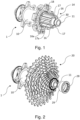
figure 1 is a perspective view of a hub of a bicycle rear wheel, with a respective axle and provided with a sprocket-carrying body forming part of a sprocket-carrying set according to the invention; -
figure 2 is a perspective view of the hub offigure 1 , on which a cogset with the three smallest sprockets formed in a monolithic body (triplet) has also been mounted and a fixing ring nut of the cogset is about to be mounted; -
figure 3 is a perspective view of the hub offigure 2 , in which the ring nut has been mounted; -
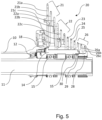
figure 4 is a section view of the hub offigure 3 ; -
figure 5 is an enlarged section view of part of the hub offigure 4 ; -
figure 6 is a perspective view of an adapter forming part of a sprocket-carrying set according to the invention; -
figure 7 is a perspective view of the adapter offigure 6 and of the sprocket-carrying body of the hub offigure 1 , aligned and oriented to be coupled; -
figure 8 is a perspective view that shows the adapter offigure 6 coupled with the sprocket-carrying body of the hub offigure 1 ; -
figure 9 is a front view of the adapter offigure 6 coupled with the sprocket-carrying body of the hub offigure 1 ; -
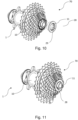
figure 10 is a perspective view of the hub offigure 1 , on which a cogset with the smallest sprockets not grouped in a monolithic body (without triplet) has also been mounted and the fixing ring nut of the cogset is about to be mounted; -
figure 11 is a perspective view of the hub offigure 10 , in which the ring nut has been mounted; -
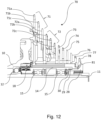
figure 12 is a section view of the hub offigure 11 ; -
figure 13 is a perspective section view of the hub offigure 10 , represented without the cogset; -
figure 14 is a front view of some sprockets of the cogset mounted on the hub offigures 2-5 or10-12 . - In
figures 1 to 5 , ahub assembly 1 of a bicycle rear wheel (not shown) is represented, with ahub 10 mounted coaxially on aaxle 11, by means ofbearings 12; thehub 10 is thus free to rotate on theaxle 11, whereas the latter is intended to be mounted fixed on the frame of the bicycle. Thehub 10 should be deemed to be representative of any hub and will be described only as far as it is of interest for the purposes of the present invention, thus ignoring the features that are not in relation to the present invention. - The
hub 10 is coupled with a sprocket-carryingbody 14, through a freewheel mechanism (not highlighted in the drawings) that ensures that thehub 10 is set in rotation by the sprocket-carryingbody 14 only in the direction that determines an advancing of the bicycle, not in the opposite direction. The sprocket-carryingbody 14 has an approximately tubular shape and is mounted free on theaxle 11, by means ofbearings 15. The sprocket-carryingbody 14 is provided on its radially peripheral surface with grooves arranged in the axial direction, in particular withprimary grooves 16, preferably four in number and equally spaced in the circumferential direction; the sprocket-carryingbody 14 is also provided with foursecondary grooves 17, arranged between theprimary grooves 16 and equally spaced in the circumferential direction. Oneprimary groove 16a and onesecondary groove 17a are of odd shape with respect to the others, so as to provide a mounting key. Moreover, the sprocket-carryingbody 14 is provided close to the axially inner end thereof with anend stop 18, in the form of teeth projecting in the radial direction from the sprocket-carryingbody 14; alternatively, a flange extending along the entire circumference of the sprocket-carryingbody 14 may be provided as anend stop 18 instead of the teeth,. - A
cogset 20 is mounted on the sprocket-carryingbody 14. Thecogset 20 illustrated infigures 2-5 comprises 12 sprockets organized from the largest to the smallest as follows: the first threesprockets sprockets sprockets sprockets body 14, with thetriplet 21 rested axially on theend stop 18, thetriplet 22 rested axially on thetriplet 21, thesprocket 23 rested axially on thetriplet 22, thesprocket 24 rested axially on thesprocket 23, thesprocket 25 rested axially on thesprocket 24, thetriplet 26 rested axially on thesprocket 25. Thetriplets central opening 31 shaped as shown infigure 14 , with fourradial projections 32, three of which are the same as each other and of a shape matching the section of theprimary grooves 16 on the sprocket-carryingbody 14, one - indicated with 32a - is odd, of a shape matching the section of the oddprimary groove 16a; in thetriplet 26, as can be seen infigures 4 and5 , thecentral opening 31 with theradial projections 32 engages only the innermost axial portion, in practice at only thesprocket 26a, whereas the axially outermost portion has a central opening 33 of smaller diameter than that of thecentral opening 31, due to the smaller number of teeth present on thesprockets radial projections 32 and they engage the fourprimary grooves 16, leaving thesecondary grooves 17 free, which actually only act as weight-reducers, without participating in the coupling between the cogset 20 and the sprocket-carryingbody 14. - The
triplets body 14, constrained in rotation to the sprocket-carryingbody 14 by means of theprojections 32 engaged in thegrooves 16 but substantially free in the axial direction. Towards the inside in the axial direction (i.e. towards the hub 10), thetriplets end stop 18; towards the outside in the axial direction, thetriplets ring nut 28, inserted on theaxle 11 and in the central opening 33 and screwed to the sprocket-carryingbody 14, by means of an outer threadedportion 29 of thering nut 28 and an inner threadedportion 30 of the sprocket-carryingbody 14. The tightening of thering nut 28 ensures that all of thetriplets body 14. - In this
hub assembly sprocket 26c, which has 10 teeth and that could not be mounted on the sprocket-carryingbody 14 without the provision of having grouped it in thetriplet 26. Indeed, if this sprocket with 10 teeth were single, it would be too small to be able to have a central opening that is wide enough to be slotted onto the sprocket-carryingbody 14; thetriplet 26, on the other hand, can have an inner axial portion at thetooth 26a (which has 12 teeth) of dimensions such as to be able to have thecentral opening 31 suitable for engagement on the sprocket-carryingbody 14. - In order to allow the mounting of the
triplet 26, the sprocket-carryingbody 14 has a shorter axial extension with respect to that which it should have to receive 12 single sprockets having axial dimension equal to that of the sprockets shown. This implies that if it is wished to mount a cogset with single sprockets in thehub assembly 1, the axial extension of the sprocket-carryingbody 14 outwards would be insufficient to receive the eleventh and twelfth sprocket. Therefore, irrespective of the number of teeth of the smallest sprockets and thus of the dimensions thereof, a cogset with single sprockets could be mounted only by replacing the sprocket-carryingbody 14 with a longer one. - In
figure 6 and in the following figures, anadapter 50 according to the invention is illustrated, intended to be used in association with the sprocket-carryingbody 14. Theadapter 50 comprises anannular body 51, having outer diameter corresponding to that of the sprocket-carryingbody 14 for which it is intended. Theadapter 50 is provided with front teeth, preferably fourfront teeth 52, sized so as to be able to each insert in one of thesecondary grooves 17 of the sprocket-carryingbody 14. Thefront teeth 52 are equally spaced in the circumferential direction, like thesecondary grooves 17 of the sprocket-carryingbody 14 in which they are intended to insert. One of the front teeth, indicated with 52a, is odd, i.e. it has a different shape and/or dimensions from the other front teeth so as to be able to insert in the oddsecondary groove 17a when theadapter 50 is coupled with the sprocket-carryingbody 14; a mounting key, i.e. in particular one and only one possibility of angular positioning of theadapter 50 with respect to the sprocket-carryingbody 14, is thus ensured. Thefront teeth annular body 51 to establish a shape coupling between theannular body 51 and the sprocket-carryingbody 14, thus making theadapter 50 rotate as a unit with the sprocket-carryingbody 14. - The
adapter 50 is also provided withgrooves 56, extending in the axial direction on the radially peripheral surface of theannular body 51; thegrooves 56 are preferably four in number and are equally spaced in the circumferential direction, corresponding in number, angular position and shape (section) to theprimary grooves 16 of the sprocket-carryingbody 14 for which the adapter is intended. Thegrooves 56 pass through in the axial direction, i.e. they extend on theannular body 51 between a front annular surface 57 of theannular body 51 up to a rear annular surface 58, axially opposite the front annular surface 57. One of the grooves is anodd groove 56a, different from the other grooves, just as in the sprocket-carryingbody 14 the oddprimary groove 16a is different from the otherprimary grooves 16. - The
annular body 51 also comprisesrecesses 59, formed in the rear annular surface. Preferably, therecesses 59 are four in number and are formed in angular positions corresponding to the angular positions of thefront teeth 52. Theserecesses 59 are used to provide an alternative possibility of engagement to the smallest sprocket, as will be illustrated hereinafter; one of therecesses 59 is anodd recess 59a, having a different shape (section) from the others, to provide a mounting key. - The
grooves recesses annular body 51 of theadapter 50. - The
adapter 50 is intended for use with the sprocket-carryingbody 14. In use, theadapter 50 is applied to the sprocket-carryingbody 14 as an axial extension thereof, towards the outside. The front annular surface 57 is axially abutted against the sprocket-carryingbody 14, whereas thefront teeth 52 engage in thesecondary grooves 17; the oddfront tooth 52a engages in the oddsecondary groove 17a. In this way, thegrooves 56 of theadapter 50 are exactly aligned in the axial direction with theprimary grooves 16 of the sprocket-carryingbody 14, with theodd groove 56a aligned with the oddprimary groove 16a. The result is in practice an extension of the sprocket-carryingbody 14 obtained through theadapter 50, i.e. a sprocket-carryingset 60 formed from the assembly of the sprocket-carryingbody 14 and theadapter 50 is obtained. - It is thus possible to mount a
cogset 70 in which the smallest sprockets are single, i.e. not grouped in a triplet, on the sprocket-carryingassembly 60. - As can be seen in
figures 10-12 , thecogset 70 comprises 12 sprockets, organized from the largest to the smallest as follows: the first threesprockets sprockets sprockets set 60, with thetriplet 71 rested axially on theend stop 18, thetriplet 72 rested axially on thetriplet 71, and the single sprockets 73-78 rested axially the first on thetriplet 72, the other on one another in succession. Thetriplets central opening 31 of thecogset 20, shaped as shown infigure 14 , with the fourradial projections 32, three of which are the same as one another and have a shape matching the section of theprimary grooves 16 on the sprocket-carryingbody 14, and one - indicated with 32a - odd one, having a shape matching the section of the oddprimary groove 16a. Only thesmallest sprocket 78, as normal in cogsets with a large number of sprockets (for example twelve), is coupled with the sprocket-carryingset 60 not through a central opening and radial projections, but rather throughteeth 81, projecting axially from thesprocket 78 so as to engage in therecesses 59 of theadapter 50; in order to ensure a mounting key, one of the teeth is an odd tooth 81a and it engages in theodd recess 59a. - Towards the inside in the axial direction (i.e. towards the hub 10), the
cogset 70 is held by theend stop 18; towards the outside in the axial direction, thecogset 70 is held together with theadapter 50 by thering nut 28, inserted on theaxle 11 inside theannular body 51 and screwed to the sprocket-carryingbody 14, by means of the outer threadedportion 29 of thering nut 28 that engages with the inner threadedportion 30 of the sprocket-carryingbody 14. The tightening of thering nut 28 ensures that all of thetriplets body 14, together with theadapter 50. - Thanks to the
adapter 50, in thehub assembly 1 provided with the sprocket-carryingbody 14 it is possible to mount both acogset 20, i.e. of the type with small sprockets grouped in triplets, and acogset 70, i.e. of the type with single small sprockets: in the first case, thecogset 20 is mounted directly on the sprocket-carryingbody 14; in the second case, theadapter 50 is mounted first and then thecogset 70 is mounted; in any case, it is never necessary to dismount the sprocket-carryingbody 14. In this way, it is quick and easy to replace one cogset with another, even if they are of different types.
Claims (11)
- Sprocket-carrying set for a bicycle rear wheel, comprising a sprocket-carrying body (14) and an adapter (50), wherein the sprocket-carrying body (14) is provided with grooves (16, 17) extending axially on the radially peripheral surface, and wherein the adapter (50) comprises:- an annular body (51) abutting at the sprocket-carrying body (14) as an axial extension thereof in an axially outer direction, adapted to receive sprockets (75-78) in a radially peripheral position,- a coupling element (52) formed on the annular body (51) to establish a shape coupling with the sprocket-carrying body (14) that makes the adapter rotate as a unit with the sprocket-carrying body (14),- at least one sprocket-receiving seat (56, 59) formed on the annular body (51) of the adapter and adapted for coupling with at least one sprocket (76, 77, 78), so as to make the adapter rotate as a unit with the sprocket (75-78),characterised in the annular body (51) having an outer diameter corresponding to that of the sprocket-carrying body (14), and the coupling element comprising at least one front tooth (52) projecting axially from the annular body (51), sized so as to be inserted in a respective groove (17) of the sprocket-carrying body (14).
- Sprocket-carrying set according to claim 1, wherein the coupling element comprises four front teeth (52) projecting axially from the annular body (51), sized so as to be able to insert in respective secondary grooves (17) of the sprocket-carrying body (14).
- Sprocket-carrying set according to claim 2, wherein the front teeth (52) are equally spaced in the circumferential direction.
- Sprocket-carrying set according to claim 1, wherein the coupling element comprises a mounting key (52a) for ensuring a predetermined angular phasing of the adapter with respect to the sprocket-carrying body (14).
- Sprocket-carrying set according to claim 1, wherein the receiving seat comprises at least one axially-extending through groove (56) along the radially peripheral surface of the annular body (51), aligned with a respective primary groove (16) in the sprocket-carrying body (14).
- Sprocket-carrying set according to claim 5, wherein the receiving seat comprises four axially-extending through grooves (56) along the radially peripheral surface of the annular body (51), aligned with respective primary grooves (16) in the sprocket-carrying body (14).
- Sprocket-carrying set according to claim 6, wherein the grooves (56) are equally spaced in the circumferential direction.
- Sprocket-carrying set according to claim 1, wherein the receiving seat comprises a mounting key (56a), for ensuring a predetermined angular phasing of the adapter with respect to the sprockets (76, 77, 78) mounted on it.
- Sprocket-carrying set according to claim 1, wherein the annular body (51) comprises a front annular surface (57) abutting against the sprocket-carrying body (14) and a rear annular surface (58) axially opposite the front annular surface (57).
- Sprocket-carrying set according to claim 11, wherein the annular body (51) comprises recesses (59) formed in the rear annular surface (58).
- Sprocket-carrying set according to claim 2, wherein the annular body (51) comprises four recesses (59) formed in a rear annular surface (58) at the four front teeth (52).
Applications Claiming Priority (1)
| Application Number | Priority Date | Filing Date | Title |
|---|---|---|---|
| IT102019000013287A IT201900013287A1 (en) | 2019-07-30 | 2019-07-30 | Adapter for a sprocket body for a bicycle rear wheel |
Publications (2)
| Publication Number | Publication Date |
|---|---|
| EP3771628A1 EP3771628A1 (en) | 2021-02-03 |
| EP3771628B1 true EP3771628B1 (en) | 2024-03-27 |
Family
ID=68653538
Family Applications (1)
| Application Number | Title | Priority Date | Filing Date |
|---|---|---|---|
| EP20187782.6A Active EP3771628B1 (en) | 2019-07-30 | 2020-07-24 | Adapter for a sprocket-carrying body for a bicycle rear wheel |
Country Status (5)
| Country | Link |
|---|---|
| US (1) | US11548318B2 (en) |
| EP (1) | EP3771628B1 (en) |
| CN (1) | CN112298444B (en) |
| IT (1) | IT201900013287A1 (en) |
| TW (1) | TWI839546B (en) |
Families Citing this family (3)
| Publication number | Priority date | Publication date | Assignee | Title |
|---|---|---|---|---|
| DE102020005373A1 (en) * | 2020-09-01 | 2022-03-03 | Sram Deutschland Gmbh | Multiple sprocket assembly for a rear wheel assembly for a bicycle and rear wheel assembly |
| EP3960606A1 (en) * | 2020-09-01 | 2022-03-02 | SRAM Deutschland GmbH | Multi-sprocket assembly and rear wheel assembly for bicycle with derailleur |
| US11767080B1 (en) * | 2022-07-15 | 2023-09-26 | Shimano Inc. | Rear sprocket assembly |
Family Cites Families (76)
| Publication number | Priority date | Publication date | Assignee | Title |
|---|---|---|---|---|
| JPS574558B2 (en) * | 1972-01-27 | 1982-01-26 | ||
| IT7923049U1 (en) * | 1979-11-07 | 1981-05-07 | Soc It Catene Calibrate Regina S P A | MULTIPLE FREEWHEEL IMPROVED FOR BICYCLE GEAR CHANGE. |
| DE8803900U1 (en) * | 1987-03-27 | 1988-08-25 | Blankenburg, Lothar, 1000 Berlin | Sprocket set for derailleur gears for bicycles |
| DE9408910U1 (en) * | 1994-05-31 | 1994-07-28 | Hsieh, Kinka, Feng Yuan City, Taichung Hsien | Composite shockproof sprocket assembly for a bicycle |
| US5704859A (en) * | 1996-10-16 | 1998-01-06 | National Science Council Of Republic Of China | Type of the compact freewheel body for bicycles |
| US6264575B1 (en) * | 1999-04-08 | 2001-07-24 | Shimano, Inc. | Freewheel for a bicycle |
| US6428437B1 (en) * | 1999-06-10 | 2002-08-06 | Raphael Schlanger | Power transmission assembly |
| US20030064844A1 (en) | 2001-10-01 | 2003-04-03 | Lin Chang Hui | Sprocket combination having an assembling structure |
| US7011592B2 (en) * | 2002-03-08 | 2006-03-14 | Shimano, Inc. | Sprocket assembly for a bicycle |
| US7044876B2 (en) * | 2003-01-17 | 2006-05-16 | Shimano, Inc. | Bicycle sprocket having lateral protrusions for use in a multiple sprocket assembly |
| JP2005029072A (en) * | 2003-07-09 | 2005-02-03 | Shimano Inc | Outer for bicycle hub and bicycle hub |
| EP1616781A1 (en) * | 2004-07-15 | 2006-01-18 | Campagnolo S.R.L. | Sprocket-carrying body for the rear wheel of a bicycle |
| US20060063624A1 (en) | 2004-09-20 | 2006-03-23 | Darrell Voss | Transmission systems and methods |
| US20080004143A1 (en) * | 2006-06-16 | 2008-01-03 | Shimano Inc. | Bicycle sprocket assembly |
| JP2008189254A (en) * | 2007-02-07 | 2008-08-21 | Shimano Inc | Rear sprocket assembly for bicycle, and sprocket |
| US9150280B2 (en) | 2007-03-21 | 2015-10-06 | Sram, Llc | Bicycle multi-gear cassette |
| US7959529B2 (en) * | 2007-03-21 | 2011-06-14 | Sram, Llc | Bicycle multi-gear cassette |
| US20080230344A1 (en) | 2007-03-21 | 2008-09-25 | Sram Corporation | Bicycle Multi-Gear Cassette |
| ITMI20071661A1 (en) | 2007-08-09 | 2009-02-10 | Campagnolo Srl | ASSEEME OF WHEELS TOOTHED FOR A BICYCLE |
| ITMI20071659A1 (en) | 2007-08-09 | 2009-02-10 | Campagnolo Srl | SPROCKET ASSEMBLY FOR A REAR BICYCLE WHEEL AND SPROCKET PACK INCLUDING SUCH ASSEMBLY |
| US7871347B2 (en) * | 2007-10-11 | 2011-01-18 | Shimano Inc. | Bicycle rear sprocket assembly |
| US8197371B2 (en) * | 2008-01-24 | 2012-06-12 | Specialized Bicycle Components, Inc. | Cogset assembly for a bicycle |
| US20100099530A1 (en) * | 2008-03-28 | 2010-04-22 | Douglas Chiang | Bicycle Cogset |
| US20100009794A1 (en) | 2008-07-10 | 2010-01-14 | Douglas Chiang | Sprocket assembly |
| DE102008048371A1 (en) * | 2008-09-22 | 2010-03-25 | Sram Deutschland Gmbh | Multiple pinion arrangement with hollow body |
| US9376165B2 (en) * | 2009-10-16 | 2016-06-28 | Shimano Inc. | Bicycle sprocket |
| US9193416B2 (en) * | 2009-11-30 | 2015-11-24 | Shimano Inc. | Bicycle sprocket support assembly |
| US20110168513A1 (en) | 2010-01-12 | 2011-07-14 | Filipe Luis A A | Freewheel structure |
| EP2526011B1 (en) * | 2010-01-21 | 2014-03-19 | Van Robertus Cornelius Wilhelmus Hoek | Sprocket mounting carrier for a bicycle |
| CN102275628B (en) * | 2010-06-10 | 2013-04-10 | 日驰企业股份有限公司 | Flywheel structure |
| DE102010053597B4 (en) | 2010-12-07 | 2021-12-02 | Sram Deutschland Gmbh | Multiple sprocket assembly for a bicycle |
| US8905878B2 (en) * | 2011-01-28 | 2014-12-09 | Shimano (Singapore) Pte., Ltd. | Bicycle sprocket assembly |
| DE102011010855B4 (en) | 2011-02-10 | 2021-04-01 | Sram Deutschland Gmbh | Multiple pinion arrangement with a damping device |
| US8696503B2 (en) * | 2011-03-01 | 2014-04-15 | Shimano Inc. | Bicycle sprocket assembly |
| US8663044B2 (en) * | 2011-03-21 | 2014-03-04 | De-Hsin Lin | Sprocket assembly that is worked easily and quickly |
| US20120244977A1 (en) * | 2011-03-23 | 2012-09-27 | Chia-Wei Liao | Bicycle cogset |
| US8968130B2 (en) * | 2011-03-23 | 2015-03-03 | Tien Hsin Industries Co., Ltd. | Bicycle cogset with support element |
| US20120322598A1 (en) * | 2011-06-17 | 2012-12-20 | Chang Hui Lin | Ratchet Structure of a freewheel and a hub |
| TWI657965B (en) | 2011-07-13 | 2019-05-01 | 矢倫德國股份有限公司 | Multi-sprocket-equipped transmission base body device for supporting bicycle transmission |
| US8956254B2 (en) * | 2011-08-04 | 2015-02-17 | Shimano Inc. | Bicycle sprocket assembly |
| DE102012016608B4 (en) | 2011-08-26 | 2025-12-18 | Dt Swiss Ag | drive hub |
| DE102012020563A1 (en) * | 2012-10-12 | 2014-04-17 | Sram Deutschland Gmbh | fastening device |
| DE102012020472A1 (en) * | 2012-10-18 | 2014-04-24 | Sram Deutschland Gmbh | Freewheel hub for a bicycle |
| US9533735B2 (en) * | 2013-07-19 | 2017-01-03 | Sram Deutschland Gmbh | Multiple-sprocket arrangement for a bicycle gearing |
| US20150133249A1 (en) * | 2013-11-08 | 2015-05-14 | Tien Hisn Industries Co., Ltd. | Bicycle drive chainwheel assembly |
| US9731550B2 (en) * | 2014-05-02 | 2017-08-15 | Shimano Inc. | Bicycle hub assembly |
| TW201604074A (en) * | 2014-07-25 | 2016-02-01 | 鋐光實業股份有限公司 | Chain wheel assembly and chain wheel device using it |
| US9446815B2 (en) * | 2014-09-19 | 2016-09-20 | Vp Components Co., Ltd | Chain wheel assembly and chain wheel device using it |
| US9604698B2 (en) * | 2014-10-22 | 2017-03-28 | Tien Hsin Industries Co., Ltd. | Bicycle cogset |
| DE102015017142B4 (en) * | 2014-12-15 | 2025-07-24 | Shimano Inc. | Bicycle multiple sprocket arrangement |
| EP3037336B1 (en) * | 2014-12-23 | 2017-04-12 | Campagnolo S.R.L. | Sprocket assembly for a bicycle |
| DE102015203709A1 (en) * | 2015-03-02 | 2016-09-08 | Sram Deutschland Gmbh | Pinion arrangement with adapter |
| US10900547B2 (en) | 2015-03-30 | 2021-01-26 | Sram Deutschland Gmbh | Drive arrangement for a bicycle and tool |
| TWI554413B (en) * | 2015-05-07 | 2016-10-21 | Chose Co Ltd | Combination of hub and flywheel |
| DE102015210503A1 (en) * | 2015-06-09 | 2016-12-15 | Sram Deutschland Gmbh | Rear sprocket assembly for a bicycle, especially a pedelec |
| EP3109062A1 (en) * | 2015-06-25 | 2016-12-28 | Chosen Co., Ltd. | Assembly of hub and freewheel |
| DE202015005643U1 (en) | 2015-08-13 | 2015-09-25 | Sram Deutschland Gmbh | Multiple sprocket arrangement for bicycles |
| US10562588B2 (en) | 2015-09-01 | 2020-02-18 | The Hive Global, Inc | Bicycle cassette with locking connection |
| US10093388B2 (en) * | 2016-06-28 | 2018-10-09 | Shimano Inc. | Bicycle rear sprocket assembly |
| US10112681B2 (en) * | 2016-07-21 | 2018-10-30 | Shimano Inc. | Bicycle sprocket supporting member and bicycle sprocket assembly |
| US9868491B1 (en) * | 2016-07-21 | 2018-01-16 | Shimano Inc. | Bicycle sprocket assembly |
| ES2656783B1 (en) | 2016-08-30 | 2018-12-11 | Rotor Componentes Tecnológicos,S.L. | BICYCLE SPROCKET SET |
| DE102017000855A1 (en) * | 2017-01-31 | 2018-08-02 | Sram Deutschland Gmbh | Multiple sprocket arrangement with welded joint |
| US10773772B2 (en) | 2017-04-12 | 2020-09-15 | Shimano Inc. | Bicycle sprocket assembly |
| US10774915B2 (en) | 2017-05-30 | 2020-09-15 | Shimano Inc. | Bicycle sprocket assembly |
| US10889353B2 (en) | 2018-01-24 | 2021-01-12 | Shimano Inc. | Bicycle rear sprocket assembly |
| US10625820B2 (en) | 2018-01-24 | 2020-04-21 | Shimano Inc. | Bicycle rear sprocket assembly |
| TWI868953B (en) * | 2017-05-30 | 2025-01-01 | 日商島野股份有限公司 | Bicycle rear hub assembly and sprocket support body |
| WO2019040340A1 (en) | 2017-08-21 | 2019-02-28 | The Hive Global, Inc. | Bicycle cassette with clamping connection |
| US10968998B2 (en) * | 2017-08-24 | 2021-04-06 | Shimano Inc. | Bicycle rear sprocket adapter |
| IT201700115411A1 (en) | 2017-10-13 | 2019-04-13 | Campagnolo Srl | Bodice for a rear wheel hub of a bicycle and sprocket set suitable for being mounted on the hub by means of this body |
| US11187285B2 (en) * | 2017-12-09 | 2021-11-30 | Icon Health & Fitness, Inc. | Systems and methods for selectively rotationally fixing a pedaled drivetrain |
| EP3533701B1 (en) | 2018-02-28 | 2021-01-20 | SRAM Deutschland GmbH | Rear wheel pinion assembly with two pieces for joint rotation of partial assemblies connected to each other |
| US11338886B2 (en) | 2018-05-24 | 2022-05-24 | Shimano Inc. | Bicycle multiple sprocket and bicycle sprocket |
| US11072203B2 (en) | 2018-08-22 | 2021-07-27 | Sram, Llc | Bicycle sprocket assembly |
| US11338887B2 (en) | 2019-02-21 | 2022-05-24 | Shimano Inc. | Bicycle rear sprocket |
-
2019
- 2019-07-30 IT IT102019000013287A patent/IT201900013287A1/en unknown
-
2020
- 2020-07-14 TW TW109123667A patent/TWI839546B/en active
- 2020-07-23 US US16/937,265 patent/US11548318B2/en active Active
- 2020-07-24 EP EP20187782.6A patent/EP3771628B1/en active Active
- 2020-07-29 CN CN202010744422.5A patent/CN112298444B/en active Active
Also Published As
| Publication number | Publication date |
|---|---|
| EP3771628A1 (en) | 2021-02-03 |
| TWI839546B (en) | 2024-04-21 |
| US20210031560A1 (en) | 2021-02-04 |
| CN112298444A (en) | 2021-02-02 |
| IT201900013287A1 (en) | 2021-01-30 |
| CN112298444B (en) | 2024-07-12 |
| US11548318B2 (en) | 2023-01-10 |
| TW202110704A (en) | 2021-03-16 |
Similar Documents
| Publication | Publication Date | Title |
|---|---|---|
| EP3771630B1 (en) | Cogset for a bicycle rear wheel and sub-assembly of sprocket-carrying body and such cogset | |
| EP3771628B1 (en) | Adapter for a sprocket-carrying body for a bicycle rear wheel | |
| US7044876B2 (en) | Bicycle sprocket having lateral protrusions for use in a multiple sprocket assembly | |
| US10093390B2 (en) | Multiple-sprocket arrangement for a bicycle gearing | |
| US6866604B2 (en) | Multiple level sprocket support for a bicycle | |
| EP2452865B2 (en) | Sprocket support structure | |
| EP1213158B1 (en) | Bicycle hub | |
| EP1995166B1 (en) | Bicycle sprocket assembley with chain protector | |
| EP3819201B1 (en) | Cogset-assembly for a bicycle rear wheel, ring nut for the assembly and method for fixing the cogset-assembly | |
| US20080231014A1 (en) | Bicycle Multi-Gear Cassette | |
| US11199252B2 (en) | Body for bicycle rear wheel hub and cassette adapted to be mounted on the hub by means of such a body | |
| US11052969B2 (en) | Cassette and body for mounting a cassette on a bicycle rear wheel hub | |
| US20200298619A1 (en) | Sprocket support body and bicycle hub assembly | |
| US20080230344A1 (en) | Bicycle Multi-Gear Cassette | |
| US12479534B2 (en) | Drive system comprising a drive shaft and a chainring |
Legal Events
| Date | Code | Title | Description |
|---|---|---|---|
| PUAI | Public reference made under article 153(3) epc to a published international application that has entered the european phase |
Free format text: ORIGINAL CODE: 0009012 |
|
| STAA | Information on the status of an ep patent application or granted ep patent |
Free format text: STATUS: THE APPLICATION HAS BEEN PUBLISHED |
|
| AK | Designated contracting states |
Kind code of ref document: A1 Designated state(s): AL AT BE BG CH CY CZ DE DK EE ES FI FR GB GR HR HU IE IS IT LI LT LU LV MC MK MT NL NO PL PT RO RS SE SI SK SM TR |
|
| AX | Request for extension of the european patent |
Extension state: BA ME |
|
| STAA | Information on the status of an ep patent application or granted ep patent |
Free format text: STATUS: REQUEST FOR EXAMINATION WAS MADE |
|
| 17P | Request for examination filed |
Effective date: 20210730 |
|
| RBV | Designated contracting states (corrected) |
Designated state(s): AL AT BE BG CH CY CZ DE DK EE ES FI FR GB GR HR HU IE IS IT LI LT LU LV MC MK MT NL NO PL PT RO RS SE SI SK SM TR |
|
| P01 | Opt-out of the competence of the unified patent court (upc) registered |
Effective date: 20230518 |
|
| RIC1 | Information provided on ipc code assigned before grant |
Ipc: B62M 9/128 20100101ALI20230707BHEP Ipc: B62M 9/10 20060101AFI20230707BHEP |
|
| GRAP | Despatch of communication of intention to grant a patent |
Free format text: ORIGINAL CODE: EPIDOSNIGR1 |
|
| STAA | Information on the status of an ep patent application or granted ep patent |
Free format text: STATUS: GRANT OF PATENT IS INTENDED |
|
| INTG | Intention to grant announced |
Effective date: 20231107 |
|
| GRAS | Grant fee paid |
Free format text: ORIGINAL CODE: EPIDOSNIGR3 |
|
| GRAA | (expected) grant |
Free format text: ORIGINAL CODE: 0009210 |
|
| STAA | Information on the status of an ep patent application or granted ep patent |
Free format text: STATUS: THE PATENT HAS BEEN GRANTED |
|
| AK | Designated contracting states |
Kind code of ref document: B1 Designated state(s): AL AT BE BG CH CY CZ DE DK EE ES FI FR GB GR HR HU IE IS IT LI LT LU LV MC MK MT NL NO PL PT RO RS SE SI SK SM TR |
|
| REG | Reference to a national code |
Ref country code: GB Ref legal event code: FG4D |
|
| REG | Reference to a national code |
Ref country code: CH Ref legal event code: EP |
|
| REG | Reference to a national code |
Ref country code: DE Ref legal event code: R096 Ref document number: 602020027803 Country of ref document: DE |
|
| REG | Reference to a national code |
Ref country code: IE Ref legal event code: FG4D |
|
| PG25 | Lapsed in a contracting state [announced via postgrant information from national office to epo] |
Ref country code: LT Free format text: LAPSE BECAUSE OF FAILURE TO SUBMIT A TRANSLATION OF THE DESCRIPTION OR TO PAY THE FEE WITHIN THE PRESCRIBED TIME-LIMIT Effective date: 20240327 |
|
| REG | Reference to a national code |
Ref country code: LT Ref legal event code: MG9D |
|
| PG25 | Lapsed in a contracting state [announced via postgrant information from national office to epo] |
Ref country code: GR Free format text: LAPSE BECAUSE OF FAILURE TO SUBMIT A TRANSLATION OF THE DESCRIPTION OR TO PAY THE FEE WITHIN THE PRESCRIBED TIME-LIMIT Effective date: 20240628 |
|
| PG25 | Lapsed in a contracting state [announced via postgrant information from national office to epo] |
Ref country code: HR Free format text: LAPSE BECAUSE OF FAILURE TO SUBMIT A TRANSLATION OF THE DESCRIPTION OR TO PAY THE FEE WITHIN THE PRESCRIBED TIME-LIMIT Effective date: 20240327 Ref country code: RS Free format text: LAPSE BECAUSE OF FAILURE TO SUBMIT A TRANSLATION OF THE DESCRIPTION OR TO PAY THE FEE WITHIN THE PRESCRIBED TIME-LIMIT Effective date: 20240627 |
|
| PG25 | Lapsed in a contracting state [announced via postgrant information from national office to epo] |
Ref country code: RS Free format text: LAPSE BECAUSE OF FAILURE TO SUBMIT A TRANSLATION OF THE DESCRIPTION OR TO PAY THE FEE WITHIN THE PRESCRIBED TIME-LIMIT Effective date: 20240627 Ref country code: NO Free format text: LAPSE BECAUSE OF FAILURE TO SUBMIT A TRANSLATION OF THE DESCRIPTION OR TO PAY THE FEE WITHIN THE PRESCRIBED TIME-LIMIT Effective date: 20240627 Ref country code: LT Free format text: LAPSE BECAUSE OF FAILURE TO SUBMIT A TRANSLATION OF THE DESCRIPTION OR TO PAY THE FEE WITHIN THE PRESCRIBED TIME-LIMIT Effective date: 20240327 Ref country code: HR Free format text: LAPSE BECAUSE OF FAILURE TO SUBMIT A TRANSLATION OF THE DESCRIPTION OR TO PAY THE FEE WITHIN THE PRESCRIBED TIME-LIMIT Effective date: 20240327 Ref country code: GR Free format text: LAPSE BECAUSE OF FAILURE TO SUBMIT A TRANSLATION OF THE DESCRIPTION OR TO PAY THE FEE WITHIN THE PRESCRIBED TIME-LIMIT Effective date: 20240628 Ref country code: FI Free format text: LAPSE BECAUSE OF FAILURE TO SUBMIT A TRANSLATION OF THE DESCRIPTION OR TO PAY THE FEE WITHIN THE PRESCRIBED TIME-LIMIT Effective date: 20240327 Ref country code: BG Free format text: LAPSE BECAUSE OF FAILURE TO SUBMIT A TRANSLATION OF THE DESCRIPTION OR TO PAY THE FEE WITHIN THE PRESCRIBED TIME-LIMIT Effective date: 20240327 |
|
| REG | Reference to a national code |
Ref country code: NL Ref legal event code: MP Effective date: 20240327 |
|
| PG25 | Lapsed in a contracting state [announced via postgrant information from national office to epo] |
Ref country code: SE Free format text: LAPSE BECAUSE OF FAILURE TO SUBMIT A TRANSLATION OF THE DESCRIPTION OR TO PAY THE FEE WITHIN THE PRESCRIBED TIME-LIMIT Effective date: 20240327 Ref country code: LV Free format text: LAPSE BECAUSE OF FAILURE TO SUBMIT A TRANSLATION OF THE DESCRIPTION OR TO PAY THE FEE WITHIN THE PRESCRIBED TIME-LIMIT Effective date: 20240327 |
|
| PG25 | Lapsed in a contracting state [announced via postgrant information from national office to epo] |
Ref country code: NL Free format text: LAPSE BECAUSE OF FAILURE TO SUBMIT A TRANSLATION OF THE DESCRIPTION OR TO PAY THE FEE WITHIN THE PRESCRIBED TIME-LIMIT Effective date: 20240327 |
|
| REG | Reference to a national code |
Ref country code: AT Ref legal event code: MK05 Ref document number: 1669678 Country of ref document: AT Kind code of ref document: T Effective date: 20240327 |
|
| PG25 | Lapsed in a contracting state [announced via postgrant information from national office to epo] |
Ref country code: NL Free format text: LAPSE BECAUSE OF FAILURE TO SUBMIT A TRANSLATION OF THE DESCRIPTION OR TO PAY THE FEE WITHIN THE PRESCRIBED TIME-LIMIT Effective date: 20240327 |
|
| PG25 | Lapsed in a contracting state [announced via postgrant information from national office to epo] |
Ref country code: IS Free format text: LAPSE BECAUSE OF FAILURE TO SUBMIT A TRANSLATION OF THE DESCRIPTION OR TO PAY THE FEE WITHIN THE PRESCRIBED TIME-LIMIT Effective date: 20240727 |
|
| PG25 | Lapsed in a contracting state [announced via postgrant information from national office to epo] |
Ref country code: PT Free format text: LAPSE BECAUSE OF FAILURE TO SUBMIT A TRANSLATION OF THE DESCRIPTION OR TO PAY THE FEE WITHIN THE PRESCRIBED TIME-LIMIT Effective date: 20240729 Ref country code: SM Free format text: LAPSE BECAUSE OF FAILURE TO SUBMIT A TRANSLATION OF THE DESCRIPTION OR TO PAY THE FEE WITHIN THE PRESCRIBED TIME-LIMIT Effective date: 20240327 |
|
| PG25 | Lapsed in a contracting state [announced via postgrant information from national office to epo] |
Ref country code: ES Free format text: LAPSE BECAUSE OF FAILURE TO SUBMIT A TRANSLATION OF THE DESCRIPTION OR TO PAY THE FEE WITHIN THE PRESCRIBED TIME-LIMIT Effective date: 20240327 |
|
| PG25 | Lapsed in a contracting state [announced via postgrant information from national office to epo] |
Ref country code: CZ Free format text: LAPSE BECAUSE OF FAILURE TO SUBMIT A TRANSLATION OF THE DESCRIPTION OR TO PAY THE FEE WITHIN THE PRESCRIBED TIME-LIMIT Effective date: 20240327 Ref country code: EE Free format text: LAPSE BECAUSE OF FAILURE TO SUBMIT A TRANSLATION OF THE DESCRIPTION OR TO PAY THE FEE WITHIN THE PRESCRIBED TIME-LIMIT Effective date: 20240327 |
|
| PG25 | Lapsed in a contracting state [announced via postgrant information from national office to epo] |
Ref country code: AT Free format text: LAPSE BECAUSE OF FAILURE TO SUBMIT A TRANSLATION OF THE DESCRIPTION OR TO PAY THE FEE WITHIN THE PRESCRIBED TIME-LIMIT Effective date: 20240327 |
|
| PG25 | Lapsed in a contracting state [announced via postgrant information from national office to epo] |
Ref country code: PL Free format text: LAPSE BECAUSE OF FAILURE TO SUBMIT A TRANSLATION OF THE DESCRIPTION OR TO PAY THE FEE WITHIN THE PRESCRIBED TIME-LIMIT Effective date: 20240327 |
|
| PG25 | Lapsed in a contracting state [announced via postgrant information from national office to epo] |
Ref country code: SK Free format text: LAPSE BECAUSE OF FAILURE TO SUBMIT A TRANSLATION OF THE DESCRIPTION OR TO PAY THE FEE WITHIN THE PRESCRIBED TIME-LIMIT Effective date: 20240327 |
|
| PG25 | Lapsed in a contracting state [announced via postgrant information from national office to epo] |
Ref country code: SM Free format text: LAPSE BECAUSE OF FAILURE TO SUBMIT A TRANSLATION OF THE DESCRIPTION OR TO PAY THE FEE WITHIN THE PRESCRIBED TIME-LIMIT Effective date: 20240327 Ref country code: SK Free format text: LAPSE BECAUSE OF FAILURE TO SUBMIT A TRANSLATION OF THE DESCRIPTION OR TO PAY THE FEE WITHIN THE PRESCRIBED TIME-LIMIT Effective date: 20240327 Ref country code: RO Free format text: LAPSE BECAUSE OF FAILURE TO SUBMIT A TRANSLATION OF THE DESCRIPTION OR TO PAY THE FEE WITHIN THE PRESCRIBED TIME-LIMIT Effective date: 20240327 Ref country code: PT Free format text: LAPSE BECAUSE OF FAILURE TO SUBMIT A TRANSLATION OF THE DESCRIPTION OR TO PAY THE FEE WITHIN THE PRESCRIBED TIME-LIMIT Effective date: 20240729 Ref country code: PL Free format text: LAPSE BECAUSE OF FAILURE TO SUBMIT A TRANSLATION OF THE DESCRIPTION OR TO PAY THE FEE WITHIN THE PRESCRIBED TIME-LIMIT Effective date: 20240327 Ref country code: IS Free format text: LAPSE BECAUSE OF FAILURE TO SUBMIT A TRANSLATION OF THE DESCRIPTION OR TO PAY THE FEE WITHIN THE PRESCRIBED TIME-LIMIT Effective date: 20240727 Ref country code: ES Free format text: LAPSE BECAUSE OF FAILURE TO SUBMIT A TRANSLATION OF THE DESCRIPTION OR TO PAY THE FEE WITHIN THE PRESCRIBED TIME-LIMIT Effective date: 20240327 Ref country code: EE Free format text: LAPSE BECAUSE OF FAILURE TO SUBMIT A TRANSLATION OF THE DESCRIPTION OR TO PAY THE FEE WITHIN THE PRESCRIBED TIME-LIMIT Effective date: 20240327 Ref country code: CZ Free format text: LAPSE BECAUSE OF FAILURE TO SUBMIT A TRANSLATION OF THE DESCRIPTION OR TO PAY THE FEE WITHIN THE PRESCRIBED TIME-LIMIT Effective date: 20240327 Ref country code: AT Free format text: LAPSE BECAUSE OF FAILURE TO SUBMIT A TRANSLATION OF THE DESCRIPTION OR TO PAY THE FEE WITHIN THE PRESCRIBED TIME-LIMIT Effective date: 20240327 |
|
| REG | Reference to a national code |
Ref country code: DE Ref legal event code: R097 Ref document number: 602020027803 Country of ref document: DE |
|
| PG25 | Lapsed in a contracting state [announced via postgrant information from national office to epo] |
Ref country code: DK Free format text: LAPSE BECAUSE OF FAILURE TO SUBMIT A TRANSLATION OF THE DESCRIPTION OR TO PAY THE FEE WITHIN THE PRESCRIBED TIME-LIMIT Effective date: 20240327 |
|
| PG25 | Lapsed in a contracting state [announced via postgrant information from national office to epo] |
Ref country code: DK Free format text: LAPSE BECAUSE OF FAILURE TO SUBMIT A TRANSLATION OF THE DESCRIPTION OR TO PAY THE FEE WITHIN THE PRESCRIBED TIME-LIMIT Effective date: 20240327 |
|
| PG25 | Lapsed in a contracting state [announced via postgrant information from national office to epo] |
Ref country code: MC Free format text: LAPSE BECAUSE OF FAILURE TO SUBMIT A TRANSLATION OF THE DESCRIPTION OR TO PAY THE FEE WITHIN THE PRESCRIBED TIME-LIMIT Effective date: 20240327 |
|
| PLBE | No opposition filed within time limit |
Free format text: ORIGINAL CODE: 0009261 |
|
| STAA | Information on the status of an ep patent application or granted ep patent |
Free format text: STATUS: NO OPPOSITION FILED WITHIN TIME LIMIT |
|
| REG | Reference to a national code |
Ref country code: CH Ref legal event code: PL |
|
| 26N | No opposition filed |
Effective date: 20250103 |
|
| PG25 | Lapsed in a contracting state [announced via postgrant information from national office to epo] |
Ref country code: LU Free format text: LAPSE BECAUSE OF NON-PAYMENT OF DUE FEES Effective date: 20240724 |
|
| GBPC | Gb: european patent ceased through non-payment of renewal fee |
Effective date: 20240724 |
|
| PG25 | Lapsed in a contracting state [announced via postgrant information from national office to epo] |
Ref country code: LU Free format text: LAPSE BECAUSE OF NON-PAYMENT OF DUE FEES Effective date: 20240724 |
|
| PG25 | Lapsed in a contracting state [announced via postgrant information from national office to epo] |
Ref country code: SI Free format text: LAPSE BECAUSE OF FAILURE TO SUBMIT A TRANSLATION OF THE DESCRIPTION OR TO PAY THE FEE WITHIN THE PRESCRIBED TIME-LIMIT Effective date: 20240327 Ref country code: CH Free format text: LAPSE BECAUSE OF NON-PAYMENT OF DUE FEES Effective date: 20240731 Ref country code: BE Free format text: LAPSE BECAUSE OF NON-PAYMENT OF DUE FEES Effective date: 20240731 |
|
| PG25 | Lapsed in a contracting state [announced via postgrant information from national office to epo] |
Ref country code: GB Free format text: LAPSE BECAUSE OF NON-PAYMENT OF DUE FEES Effective date: 20240724 |
|
| REG | Reference to a national code |
Ref country code: BE Ref legal event code: MM Effective date: 20240731 |
|
| PG25 | Lapsed in a contracting state [announced via postgrant information from national office to epo] |
Ref country code: IE Free format text: LAPSE BECAUSE OF NON-PAYMENT OF DUE FEES Effective date: 20240724 |
|
| PGFP | Annual fee paid to national office [announced via postgrant information from national office to epo] |
Ref country code: DE Payment date: 20250729 Year of fee payment: 6 |
|
| PGFP | Annual fee paid to national office [announced via postgrant information from national office to epo] |
Ref country code: IT Payment date: 20250721 Year of fee payment: 6 |
|
| PGFP | Annual fee paid to national office [announced via postgrant information from national office to epo] |
Ref country code: FR Payment date: 20250725 Year of fee payment: 6 |
|
| PG25 | Lapsed in a contracting state [announced via postgrant information from national office to epo] |
Ref country code: CY Free format text: LAPSE BECAUSE OF FAILURE TO SUBMIT A TRANSLATION OF THE DESCRIPTION OR TO PAY THE FEE WITHIN THE PRESCRIBED TIME-LIMIT; INVALID AB INITIO Effective date: 20200724 |
|
| PG25 | Lapsed in a contracting state [announced via postgrant information from national office to epo] |
Ref country code: HU Free format text: LAPSE BECAUSE OF FAILURE TO SUBMIT A TRANSLATION OF THE DESCRIPTION OR TO PAY THE FEE WITHIN THE PRESCRIBED TIME-LIMIT; INVALID AB INITIO Effective date: 20200724 |