EP3771213A1 - System and method to estimate blockiness in transform-based video encoding - Google Patents
System and method to estimate blockiness in transform-based video encoding Download PDFInfo
- Publication number
- EP3771213A1 EP3771213A1 EP19188067.3A EP19188067A EP3771213A1 EP 3771213 A1 EP3771213 A1 EP 3771213A1 EP 19188067 A EP19188067 A EP 19188067A EP 3771213 A1 EP3771213 A1 EP 3771213A1
- Authority
- EP
- European Patent Office
- Prior art keywords
- weighting
- transform
- blockiness
- matrix
- signal
- Prior art date
- Legal status (The legal status is an assumption and is not a legal conclusion. Google has not performed a legal analysis and makes no representation as to the accuracy of the status listed.)
- Withdrawn
Links
Images


Classifications
-
- H—ELECTRICITY
- H04—ELECTRIC COMMUNICATION TECHNIQUE
- H04N—PICTORIAL COMMUNICATION, e.g. TELEVISION
- H04N19/00—Methods or arrangements for coding, decoding, compressing or decompressing digital video signals
- H04N19/10—Methods or arrangements for coding, decoding, compressing or decompressing digital video signals using adaptive coding
- H04N19/102—Methods or arrangements for coding, decoding, compressing or decompressing digital video signals using adaptive coding characterised by the element, parameter or selection affected or controlled by the adaptive coding
- H04N19/124—Quantisation
- H04N19/126—Details of normalisation or weighting functions, e.g. normalisation matrices or variable uniform quantisers
-
- H—ELECTRICITY
- H04—ELECTRIC COMMUNICATION TECHNIQUE
- H04N—PICTORIAL COMMUNICATION, e.g. TELEVISION
- H04N19/00—Methods or arrangements for coding, decoding, compressing or decompressing digital video signals
- H04N19/10—Methods or arrangements for coding, decoding, compressing or decompressing digital video signals using adaptive coding
- H04N19/134—Methods or arrangements for coding, decoding, compressing or decompressing digital video signals using adaptive coding characterised by the element, parameter or criterion affecting or controlling the adaptive coding
- H04N19/154—Measured or subjectively estimated visual quality after decoding, e.g. measurement of distortion
-
- H—ELECTRICITY
- H04—ELECTRIC COMMUNICATION TECHNIQUE
- H04N—PICTORIAL COMMUNICATION, e.g. TELEVISION
- H04N19/00—Methods or arrangements for coding, decoding, compressing or decompressing digital video signals
- H04N19/10—Methods or arrangements for coding, decoding, compressing or decompressing digital video signals using adaptive coding
- H04N19/102—Methods or arrangements for coding, decoding, compressing or decompressing digital video signals using adaptive coding characterised by the element, parameter or selection affected or controlled by the adaptive coding
- H04N19/124—Quantisation
-
- H—ELECTRICITY
- H04—ELECTRIC COMMUNICATION TECHNIQUE
- H04N—PICTORIAL COMMUNICATION, e.g. TELEVISION
- H04N19/00—Methods or arrangements for coding, decoding, compressing or decompressing digital video signals
- H04N19/10—Methods or arrangements for coding, decoding, compressing or decompressing digital video signals using adaptive coding
- H04N19/169—Methods or arrangements for coding, decoding, compressing or decompressing digital video signals using adaptive coding characterised by the coding unit, i.e. the structural portion or semantic portion of the video signal being the object or the subject of the adaptive coding
- H04N19/18—Methods or arrangements for coding, decoding, compressing or decompressing digital video signals using adaptive coding characterised by the coding unit, i.e. the structural portion or semantic portion of the video signal being the object or the subject of the adaptive coding the unit being a set of transform coefficients
-
- H—ELECTRICITY
- H04—ELECTRIC COMMUNICATION TECHNIQUE
- H04N—PICTORIAL COMMUNICATION, e.g. TELEVISION
- H04N19/00—Methods or arrangements for coding, decoding, compressing or decompressing digital video signals
- H04N19/10—Methods or arrangements for coding, decoding, compressing or decompressing digital video signals using adaptive coding
- H04N19/169—Methods or arrangements for coding, decoding, compressing or decompressing digital video signals using adaptive coding characterised by the coding unit, i.e. the structural portion or semantic portion of the video signal being the object or the subject of the adaptive coding
- H04N19/184—Methods or arrangements for coding, decoding, compressing or decompressing digital video signals using adaptive coding characterised by the coding unit, i.e. the structural portion or semantic portion of the video signal being the object or the subject of the adaptive coding the unit being bits, e.g. of the compressed video stream
-
- H—ELECTRICITY
- H04—ELECTRIC COMMUNICATION TECHNIQUE
- H04N—PICTORIAL COMMUNICATION, e.g. TELEVISION
- H04N19/00—Methods or arrangements for coding, decoding, compressing or decompressing digital video signals
- H04N19/48—Methods or arrangements for coding, decoding, compressing or decompressing digital video signals using compressed domain processing techniques other than decoding, e.g. modification of transform coefficients, variable length coding [VLC] data or run-length data
-
- H—ELECTRICITY
- H04—ELECTRIC COMMUNICATION TECHNIQUE
- H04N—PICTORIAL COMMUNICATION, e.g. TELEVISION
- H04N19/00—Methods or arrangements for coding, decoding, compressing or decompressing digital video signals
- H04N19/60—Methods or arrangements for coding, decoding, compressing or decompressing digital video signals using transform coding
-
- H—ELECTRICITY
- H04—ELECTRIC COMMUNICATION TECHNIQUE
- H04N—PICTORIAL COMMUNICATION, e.g. TELEVISION
- H04N19/00—Methods or arrangements for coding, decoding, compressing or decompressing digital video signals
- H04N19/85—Methods or arrangements for coding, decoding, compressing or decompressing digital video signals using pre-processing or post-processing specially adapted for video compression
- H04N19/86—Methods or arrangements for coding, decoding, compressing or decompressing digital video signals using pre-processing or post-processing specially adapted for video compression involving reduction of coding artifacts, e.g. of blockiness
-
- H—ELECTRICITY
- H04—ELECTRIC COMMUNICATION TECHNIQUE
- H04N—PICTORIAL COMMUNICATION, e.g. TELEVISION
- H04N21/00—Selective content distribution, e.g. interactive television or video on demand [VOD]
- H04N21/20—Servers specifically adapted for the distribution of content, e.g. VOD servers; Operations thereof
- H04N21/23—Processing of content or additional data; Elementary server operations; Server middleware
- H04N21/234—Processing of video elementary streams, e.g. splicing of video streams or manipulating encoded video stream scene graphs
- H04N21/23418—Processing of video elementary streams, e.g. splicing of video streams or manipulating encoded video stream scene graphs involving operations for analysing video streams, e.g. detecting features or characteristics
-
- H—ELECTRICITY
- H04—ELECTRIC COMMUNICATION TECHNIQUE
- H04N—PICTORIAL COMMUNICATION, e.g. TELEVISION
- H04N21/00—Selective content distribution, e.g. interactive television or video on demand [VOD]
- H04N21/40—Client devices specifically adapted for the reception of or interaction with content, e.g. set-top-box [STB]; Operations thereof
- H04N21/43—Processing of content or additional data, e.g. demultiplexing additional data from a digital video stream; Elementary client operations, e.g. monitoring of home network or synchronising decoder's clock; Client middleware
- H04N21/44—Processing of video elementary streams, e.g. splicing a video clip retrieved from local storage with an incoming video stream or rendering scenes according to encoded video stream scene graphs
- H04N21/44008—Processing of video elementary streams, e.g. splicing a video clip retrieved from local storage with an incoming video stream or rendering scenes according to encoded video stream scene graphs involving operations for analysing video streams, e.g. detecting features or characteristics in the video stream
Definitions
- IPTV Internet Protocol TV
- VoD Video on Demand
- RTP real-time transport protocol
- HTTP HTTP Adaptive Streaming
- the overall quality of a received video stream may be degraded due to several factors, including improperly adapted or faulty video encoding and network effects like temporal network congestions, leading to high latency and packet loss, which might subsequently trigger lower throughput, reduction of the transmission bitrate or stalling and video artefacts.
- a video is stored and made available on the server side in different representations (e.g. differing in quality and resolution) aimed at delivery to clients with different bandwidth conditions.
- the client may choose the proper representation of the video based on its current network and playback buffer state.
- latency or packet loss on the network can result in video buffer depletion at the client side, which may lead to quality switches between representations, or, in the worst case, stalling (rebuffering) presented to the user - typically as a spinning loading indicator.
- the overall streaming quality - as judged by a consumer - is thus influenced by both audiovisual parameters as well as the occurrence of network-based events that trigger quality switches, stalling and packet losses.
- This invention focuses on quality issues that are induced by properties of the video itself and its encoding.
- a video bitstream (e.g., as specified in MPEG-4 Part 14).
- the objective measurement categories that can be used to produce the before mentioned MOS value may be derived from that container, for instance the used codec, bit rate, resolution, and the frame rate of the monitored video. These are in the following called container-based parameters.
- the perceived quality of compressed video is however not only dependent on the deployed video codecs, its setting during encoding, and other effects from the transmission chain, but is significantly influenced by properties of the video content itself which is only accessible through the elementary stream of the video. Therefore, using only container-level bitstream measures such as codec, bitrate, resolution, or frame rate can only result in a broad estimation of the quality that a decoded video might have, but cannot achieve high accuracy in predicting the MOS-values, the values with which humans would rate the same video. It is thus necessary to use more advanced and more low-level bitstream measures to better estimate the quality.
- blockiness because at particularly high values of QP, the underlying structure of the encoding algorithm, which consists of pixel-blocks of for instance 4x4 or 8x8 pixels, becomes visible. Since the human visual system is very sensitive concerning these (unnatural) horizontal and vertical contrast boundaries, which do not belong into the original picture content, blockiness is an additionally degrading effect, which is not covered by quality predicting formulae, if these formulae rely only on QP, as exemplified in (1).
- Blockiness is a typical result of "transform-coding", which is deployed in most available video encoders.
- transform-coding For transform coding, pixel blocks of 4x4 up to 32x32 are subjected to 2-dimensional transforms, which are typically discrete cosine transforms (DCTs) that transform content from the spatial domain into the frequency domain. Since lower frequencies usually have a much higher amplitude than higher frequencies, as a result of such transforms, values with significant amplitude are concentrated in the upper left corner of the transform matrix, which represents the lower frequency components and can make bitstream encoding much more efficient in the steps following transformation.
- DCTs discrete cosine transforms
- the values of the transform matrix are then quantized. If quantization is very coarse (QP is large), the usually small high frequency transform-coefficients are mainly quantized to zero. This means that the transformed and quantized block will mostly consist of low frequency components; in many cases only the DC-value in the upper left corner is present. In any case, the fewer high frequencies had been present, the less two neighbouring re-transformed blocks will "smoothly" fit together. In the extreme case that only the DC-values were coded, the re-transformed blocks have a single flat colour, and even the slightest difference in DC-coefficient amplitude will result in a visible edge between neighbouring blocks.
- the object of the present invention to provide a system and method to estimate blockiness in transform-based video encoding.
- the resulting indicator is considered as an addition to any bitstream-based method of quality estimation, in order to make its result more precise, or as a standalone metric to diagnose video quality encoding problems.
- the present invention is defined in the independent claims. The dependent claims describe preferred embodiments.
- the present invention relates to a method to estimate blockiness in a video frame of transform-based video encoding.
- the method comprises the following steps:
- the invention further relates to a data processing apparatus which comprises means for carrying out the method described above.
- the invention further relates to a system for estimating blockiness in a video frame of transform-based video encoding.
- the system comprises data processing means configured to obtain a bitstream of a transform coded video signal, the signal being partitioned into video frames. The coefficients constituting transforms encoded in the video frames are read.
- Averaging means are configured to average the bitstream of the transform coded video signal frames into averaged transform matrix per transform size i.
- Weighting means are configured to generate or compute weighting matrices or make weighting matrices available.
- the weighting means are further configured to compute intermediate weighted matrices by processing the averaged signal matrix with a corresponding weighting matrix.
- Computing means are configured to compute all members of the averaged transform matrices and intermediate weighted matrices into a single value per transform size i, to obtain an intermediate signal Bls[i].
- the computing means are further configured to compute a final] value by weighting the intermediate signal Bls[i] according to an area in the respective video frame to estimate the blockiness per video frame.
- the weighting of the Bls[i] may be chosen according to the area covered by the transforms represented in the Bls[i] within the respective video frame and where the weighted Bls[i] may be added up into one result to represent the intermediate blockiness value Bl 0 per video frame.
- system may be adapted to and comprise means configured to carry out the method steps described above.
- the invention suggests a method to estimate on a per-frame basis of a compressed video sequence, an indicator value which reflects the assumed blockiness in each frame.
- This indicator can serve conveniently as an addition to any bitstream-based method of quality estimation, to make its result more precise.
- the bitstream of a transform coded video signal is obtained (S1) as a first step and the signal is partitioned into video frames. For each video frame, the coded transform coefficients, which are part of the bitstream, are read.
- averaging of all the read transforms in a frame is performed (S2). For every transform size i, a distinct average value is calculated. Here, only the amplitudes of the coefficients (the absolute values) are taken into account. After this process, for every available transform size, there is one averaged coefficient matrix available. Intra-blocks in predicted frames are not taken into account, because they tend to have different statistical properties.
- weighting matrices of sizes i are made available (S3), again separately for the available transform sizes.
- weighting-algorithms are conceivable. Three different algorithms to create a possible weighting-table are described below. Other possibilities include predefined "hand-filled" or automatically optimized tables.
- coefficients with medium frequency are weighted stronger than with linear weighting.
- the weighting process takes place (S4).
- the averaged absolute coefficient-matrices (one for each transform size) are multiplied value by value with the corresponding weighting matrix values.
- a fifth step the members of the resulting weighted matrices are processed (S5) into one value Bls[i] per transform-size i.
- Bls[i] may be called an intermediate signal. Processing may be performed by combining all members of each averaged transform matrix and intermediate weighted matrix or by adding up the matrices into one value per transform-size i. For normalizing purposes, these results Bls[i] may then be divided by the number of nonzero coefficients in the corresponding averaged coefficient matrix.
- the intermediate results Bls[i] are then merged into one final result.
- the intermediate results Bls[i] are weighted (S6) according to the area they cover in the video frame, which is dependent on the number of transforms of a specific size in the examined frame, NTr[i], and the number of pixels each transform covers.
- Bl 0 Bls 4 ⁇ 4 * NTr 4 ⁇ 4 + 4 * Bls 8 ⁇ 8 * NTr 8 ⁇ 8 + 16 * Bls 16 ⁇ 16 * NTr 16 ⁇ 16
- the resulting Bl 0 is a good indicator for a lack of high frequency transform-coefficients and thus for blockiness. Still, as mentioned above, there is the possibility that even with relatively low values of QP, no high frequency coefficients need to be transmitted, without any visible blockiness.
- the result Bl 0 may be made more reliable. Since the probability of blockiness is reduced with a decreasing value of QP, this effect can be taken into account, by multiplying Bl 0 with a term C(QP) (S7), which is 1.0 for the maximum QP value, QP_Max, (with the maximum probability for blockiness) and which increases exponentially for lower values of QP.
- C exp 5.0 * QP_Max ⁇ QP / QP_Max
- Bl 1 Bl 0 * C
- Bl 1 is only marginally influenced by C(QP) for that range of QP, where blockiness has a high probability, but is increased significantly for small values of QP.
- Bl 1 is transformed (S8) in order to make it more convenient to be used.
- This final version of the blockiness measure, Bl is a real number and varies in the range of [0, 1], where 0 is the lowest blockiness and 1 is maximal blockiness. For higher picture quality, it quickly decreases to values close to zero.
- the present invention also relates to a system for carrying out the method described above. Furthermore, a data processing apparatus comprising means for carrying out the method described above is also encompassed by the invention.
Landscapes
- Engineering & Computer Science (AREA)
- Multimedia (AREA)
- Signal Processing (AREA)
- Compression Or Coding Systems Of Tv Signals (AREA)
- Compression, Expansion, Code Conversion, And Decoders (AREA)
Abstract
The present invention relates to a method to estimate blockiness in a video frame of transform-based video encoding. The method comprises the following steps. Obtaining the bitstream of a transform coded video signal, the signal being partitioned into video frames, and averaging the encoded transforms per frame. The averaged coefficients are stored in a distinct matrix per transform size i. For each transform size i a weighting matrix is provided, comprising weighting factors, and an intermediate weighted signal Bls[i] is computed by processing each averaged signal matrix with the corresponding weighting matrix and combining all members of the weighted matrix of size i into one value. A final weighted signal is computed by weighting the intermediate weighted signal Bls[i] according to an area in the respective video frame to estimate the blockiness, Bl<sub>0</sub>, per video frame. Bl<sub>0</sub> is further processed into a signal Bl<sub>1</sub>, in order to avoid false blockiness detection at low values of the averaged quantization parameter QP and Bl<sub>1</sub> is than inversed into the final result Bl in order to restrict the range of the value from zero (no blockiness) to 1 (maximal blockiness).
Description
- Among the numerous video- or TV distribution services, IPTV (Internet Protocol TV) and VoD (Video on Demand) are becoming increasingly important. They have mostly replaced analogue or non-packet-based transmission methods, by the use of the "real-time transport protocol" (RTP)-based streaming or HTTP Adaptive Streaming (HAS) protocols. It is a major responsibility of the Internet Service Provider towards both streaming content provider and customer to maintain the quality of its service.
- With the transmission of video streams over IPTV and VoD, the overall quality of a received video stream may be degraded due to several factors, including improperly adapted or faulty video encoding and network effects like temporal network congestions, leading to high latency and packet loss, which might subsequently trigger lower throughput, reduction of the transmission bitrate or stalling and video artefacts.
- For video streams transmitted through HAS, a video is stored and made available on the server side in different representations (e.g. differing in quality and resolution) aimed at delivery to clients with different bandwidth conditions. The client may choose the proper representation of the video based on its current network and playback buffer state. In HAS, latency or packet loss on the network can result in video buffer depletion at the client side, which may lead to quality switches between representations, or, in the worst case, stalling (rebuffering) presented to the user - typically as a spinning loading indicator.
- For video streams transmitted through RTP (over User Datagram Protocol, UDP), a video is often times live encoded at a single bitrate and resolution. Network congestion will easily lead to packet loss, since delayed UDP-packets can be deleted by the network. Losses might be answered with retransmission requests, but these would only be successful at rather low loss rates. If retransmission was not successful, losses can lead to very strong picture artefacts that may spread over most of the display for considerable periods of time. Stalling would only happen if the loss rate was so high, that the decoder on the client side loses synchronisation and has to restart again.
- The overall streaming quality - as judged by a consumer - is thus influenced by both audiovisual parameters as well as the occurrence of network-based events that trigger quality switches, stalling and packet losses. This invention focuses on quality issues that are induced by properties of the video itself and its encoding.
- In large IP networks, where millions of video streams are transmitted simultaneously, only fully automated quality monitoring probes that raise alarms in the case of the occurrence of degraded streaming quality, can fulfil the requirement of maintaining service quality for the consumer. Such "monitoring probes" need to be able to estimate the subjective quality that an end user would perceive when consuming the video content. Several models exist or are in development, that translate objective measurement results from a video stream into the subjective "mean opinion score" (MOS) values. These models may operate on the decoded video signal, or on the bitstream of a transmitted and/or received video. This invention focuses on the latter kind of model.
- For transmission, a video bitstream (elementary stream) is typically wrapped in a container (e.g., as specified in MPEG-4 Part 14). The objective measurement categories that can be used to produce the before mentioned MOS value may be derived from that container, for instance the used codec, bit rate, resolution, and the frame rate of the monitored video. These are in the following called container-based parameters.
- The perceived quality of compressed video is however not only dependent on the deployed video codecs, its setting during encoding, and other effects from the transmission chain, but is significantly influenced by properties of the video content itself which is only accessible through the elementary stream of the video. Therefore, using only container-level bitstream measures such as codec, bitrate, resolution, or frame rate can only result in a broad estimation of the quality that a decoded video might have, but cannot achieve high accuracy in predicting the MOS-values, the values with which humans would rate the same video. It is thus necessary to use more advanced and more low-level bitstream measures to better estimate the quality.
- Since container-level bitstream measures only have a limited meaning, one needs to access the video elementary bitstream itself to be able to access more meaningful data. For each coded video frame in a video stream, quality can be approximated well as an exponential function of the average quantization parameter (QP):

- This property is available on a per-slice- or per-frame-level of any video-frame and also - if QP was changed by the encoder within the frame - on a per-coding-unit/macroblock-level. When QP is increased, the video-frame loses its "crispness". Also, more artefacts can be seen, in particular in areas containing edges of high contrast. At very high values of QP, the video not only becomes very blurry, but another effect appears which is additionally degrading the subjective quality in a severe way.
- This effect is called "blockiness", because at particularly high values of QP, the underlying structure of the encoding algorithm, which consists of pixel-blocks of for instance 4x4 or 8x8 pixels, becomes visible. Since the human visual system is very sensitive concerning these (unnatural) horizontal and vertical contrast boundaries, which do not belong into the original picture content, blockiness is an additionally degrading effect, which is not covered by quality predicting formulae, if these formulae rely only on QP, as exemplified in (1).
- In order to be able to cover the effect of blockiness nevertheless, an additional measure that particularly detects blockiness in a video is needed. This measure can then be included in any formula translating objective measurement results into a quality Mean Opinion Score (MOS) estimation similar to formula (1), or can serve or as a standalone metric to diagnose video quality encoding problems.
- To find such a blockiness measure, one has to understand how blockiness arises in the first place. Blockiness is a typical result of "transform-coding", which is deployed in most available video encoders. For transform coding, pixel blocks of 4x4 up to 32x32 are subjected to 2-dimensional transforms, which are typically discrete cosine transforms (DCTs) that transform content from the spatial domain into the frequency domain. Since lower frequencies usually have a much higher amplitude than higher frequencies, as a result of such transforms, values with significant amplitude are concentrated in the upper left corner of the transform matrix, which represents the lower frequency components and can make bitstream encoding much more efficient in the steps following transformation.
- The values of the transform matrix are then quantized. If quantization is very coarse (QP is large), the usually small high frequency transform-coefficients are mainly quantized to zero. This means that the transformed and quantized block will mostly consist of low frequency components; in many cases only the DC-value in the upper left corner is present. In any case, the fewer high frequencies had been present, the less two neighbouring re-transformed blocks will "smoothly" fit together. In the extreme case that only the DC-values were coded, the re-transformed blocks have a single flat colour, and even the slightest difference in DC-coefficient amplitude will result in a visible edge between neighbouring blocks.
- Still, even large QP values do not necessarily generate blocking artefacts. There are situations with high QP and no blocking visible at all. These situations may, for instance, occur in scenes with a very small amount of motion, when a high-quality Intra- or key-frame was sent and the subsequent predicted frames - which reference that Intra-frame - can reach high quality, just from copying the original Intra-frame content. Since copying requires no residual coding and therefore no quantization, it does not even matter in this situation, which size the QP value has, since it is not used, at least not for the static parts of the video-frame. In general, the QP would be high though, since the encoder may want to avoid to just code noise (with a small QP).
- In contrast to this are scenes with very high and/or complex motion, where - at lower bit rates - most of the available bits are required for the coding of motion, so that the rate-control can only leave few bits for transform-coefficients. As a consequence, QP would be as large as possible and blockiness would usually be large as well.
- In practice, every video-frame is between these two extremes, but the value of QP can only inadequately specify the amount of blockiness. So, an additional blockiness measure could indeed enhance the precision of any video quality estimation model based on bitstream data.
- It is therefore the object of the present invention to provide a system and method to estimate blockiness in transform-based video encoding. The resulting indicator is considered as an addition to any bitstream-based method of quality estimation, in order to make its result more precise, or as a standalone metric to diagnose video quality encoding problems. The present invention is defined in the independent claims. The dependent claims describe preferred embodiments.
- The present invention relates to a method to estimate blockiness in a video frame of transform-based video encoding. The method comprises the following steps:
- obtaining a bitstream of a transform coded video signal, the signal being partitioned into video frames, wherein coefficients constituting transforms encoded in the video signal frames are read,
- averaging of the bitstream of the transform coded video signal frames into one averaged transform matrix per transform size i.
- generating weighting matrices or making predefined weighting matrices available, wherein the weighting matrices are of size i. The matrices may be designed in order to amplify high frequency coefficients and diminish low frequency coefficients. Matrices with logarithmic, linear or quadratic characteristics are possible solutions, which are exemplified below.
- Processing all members of the averaged transform matrices with weighting matrices of the same size i to provide an intermediate signal. In particular, at least one intermediate signal Bls[i] may be computed per transform size i, wherein processing may be performed by multiplying the matrices value by value and adding up the products into one value Bls[i]. The signal Bls[i] may also be called intermediate weighted signal.
- calculating a final value by weighting the intermediate signal Bls[i] according to an area in the respective video frame to estimate the blockiness per video frame and adding up the weighted Bls[i]. Hence, a sum Bl0 of all Bls[i] may be calculated, where the weighting may be according to the area that the transforms of size i cover in the current video frame, so that the weighting will be dependent on the number of transforms of a specific size in the examined frame and the number of pixels that each transform covers.
- The method may further comprise multiplying Bl0 with a QP-dependent term: Bl1 = Bl0*C(QP), where QP is the averaged quantization parameter of the video frame. This operation is performed in order to avoid false blockiness detection for low values of QP.
- Transforming Bl1 into a more convenient form, Bl, may be achieved by applying an inverse operation like Bl = 1 / (1 + Bl1), in order to restrict the range of Bl from zero, for no blockiness, to one for high blockiness.
- The invention further relates to a data processing apparatus which comprises means for carrying out the method described above.
- The invention further relates to a system for estimating blockiness in a video frame of transform-based video encoding. The system comprises data processing means configured to obtain a bitstream of a transform coded video signal, the signal being partitioned into video frames. The coefficients constituting transforms encoded in the video frames are read. Averaging means are configured to average the bitstream of the transform coded video signal frames into averaged transform matrix per transform size i. Weighting means are configured to generate or compute weighting matrices or make weighting matrices available. The weighting means are further configured to compute intermediate weighted matrices by processing the averaged signal matrix with a corresponding weighting matrix.
- Computing means are configured to compute all members of the averaged transform matrices and intermediate weighted matrices into a single value per transform size i, to obtain an intermediate signal Bls[i]. The computing means are further configured to compute a final] value by weighting the intermediate signal Bls[i] according to an area in the respective video frame to estimate the blockiness per video frame.
- The weighting of the Bls[i] may be chosen according to the area covered by the transforms represented in the Bls[i] within the respective video frame and where the weighted Bls[i] may be added up into one result to represent the intermediate blockiness value Bl0 per video frame. Processing means may be configured to multiply the intermediate blockiness value Bl0 with a term dependent on the averaged quantization parameter QP resulting in an intermediate Blockiness value Bl1, which avoids false blockiness detection at low values of QP, and finally applying an inverse operation like Bl = 1 / (1 + Bl1) to restrict the range of Bl to values from 0 for "no blockiness" to 1 for "high blockiness".
- Thus, the system may be adapted to and comprise means configured to carry out the method steps described above.
- The invention is described with reference to the following figures.
-
Fig. 1 shows a flow chart of the method steps according to an embodiment of the invention; -
Figs. 2A and 2B show two exemplary weighting matrices for linear weighting; -
Figs. 3A and 3B show two exemplary weighting matrices for quadratic weighting; and -
Figs. 4A and 4B show two exemplary weighting matrices for logarithmic weighting. - The invention suggests a method to estimate on a per-frame basis of a compressed video sequence, an indicator value which reflects the assumed blockiness in each frame. This indicator can serve conveniently as an addition to any bitstream-based method of quality estimation, to make its result more precise.
- As described in "Background of the Invention" blockiness is the consequence of a lack of high frequency coefficients of the transformed and quantized picture content. The proposed measure therefore relies on a weighted sum of the coefficients of averaged transform-blocks, where the weighting increases with the frequency the transform-coefficient is representing. If the result of such a weighted sum is very small or even zero, this is a sufficient sign that no or very few higher frequency coefficients are present in the transform, and therefore blockiness is likely to be observed.
- As shown in the embodiment of
Fig. 1 , the bitstream of a transform coded video signal is obtained (S1) as a first step and the signal is partitioned into video frames. For each video frame, the coded transform coefficients, which are part of the bitstream, are read. - In a second step, an averaging of all the read transforms in a frame is performed (S2). For every transform size i, a distinct average value is calculated. Here, only the amplitudes of the coefficients (the absolute values) are taken into account. After this process, for every available transform size, there is one averaged coefficient matrix available. Intra-blocks in predicted frames are not taken into account, because they tend to have different statistical properties.
- In a third step, weighting matrices of sizes i are made available (S3), again separately for the available transform sizes. For a convenient description, the elements of the averaged coefficient-matrix and the weighting matrix are indexed by the two indexes for the matrix-row r=1 ... sizer, and the matrix column c=1 ... sizec, where sizer and sizec are the size of the transform in vertical and horizontal direction. For the time being, both sizes have the possible values 4, 8, 16, and 32. Larger sizes are possible, but not yet used in any available video encoding algorithm. Consequently, the number sizemax=32 for now.
- In established video compression standards, like MPEG-2, H.264, HEVC or VP9, two dimensional transforms are defined as a square. Only the recently introduced AV1 uses a combination of different vertical and horizontal sizes.
- Apart from the rule that the higher the frequency of a coefficient, the higher the weighting, different weighting-algorithms are conceivable. Three different algorithms to create a possible weighting-table are described below. Other possibilities include predefined "hand-filled" or automatically optimized tables.
- a) Linear weighting: the weighting increases linearly with the frequency a coefficient represents.
Figures 2A and 2B show exemplary weighting matrices.
The weighting-factors W for the two-dimensional weighting-matrix are defined by:With this formula, the diagonal lines from top right to bottom left - which represent coefficients with similar frequency dependency - are assigned the same value, raising from 0.0 in the upper left corner to 1.0 in the bottom right corner. In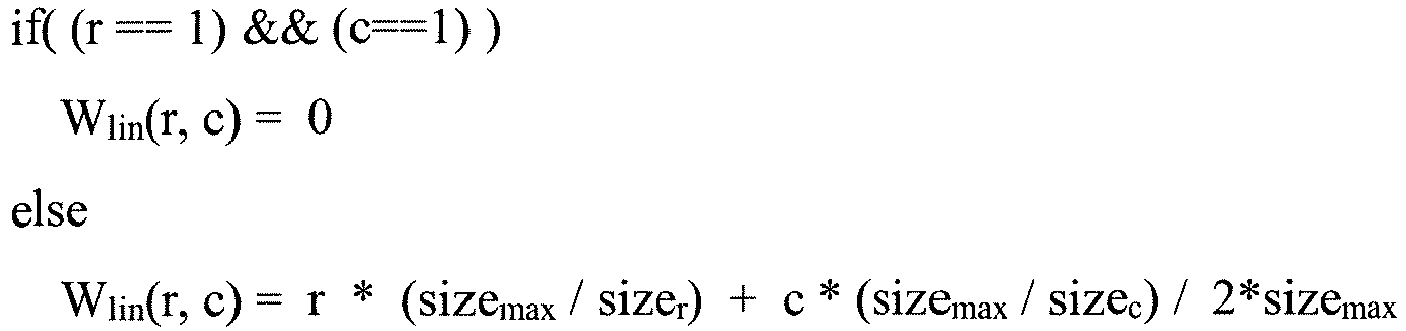
figures 2A and 2B this is exemplified for 4x4 and 8x8 matrices. - b) Quadratic Weighting:

Figures 3A and 3B exemplify this for 4x4 and 8x8 matrices. - c) Logarithmic weighting:

- As an example, in
Figures 4A and 4B , logarithmic weighting is exemplified for a=9 and b=2.3. Using logarithmic weighting, coefficients with medium frequency are weighted stronger than with linear weighting. - According to
Fig. 1 , in a fourth step, the weighting process takes place (S4). For this purpose, the averaged absolute coefficient-matrices (one for each transform size) are multiplied value by value with the corresponding weighting matrix values. - In a fifth step the members of the resulting weighted matrices are processed (S5) into one value Bls[i] per transform-size i. Bls[i] may be called an intermediate signal. Processing may be performed by combining all members of each averaged transform matrix and intermediate weighted matrix or by adding up the matrices into one value per transform-size i. For normalizing purposes, these results Bls[i] may then be divided by the number of nonzero coefficients in the corresponding averaged coefficient matrix.
- In a sixth step the intermediate results Bls[i], are then merged into one final result. For this process, the intermediate results Bls[i] are weighted (S6) according to the area they cover in the video frame, which is dependent on the number of transforms of a specific size in the examined frame, NTr[i], and the number of pixels each transform covers.

- The resulting Bl0 is a good indicator for a lack of high frequency transform-coefficients and thus for blockiness. Still, as mentioned above, there is the possibility that even with relatively low values of QP, no high frequency coefficients need to be transmitted, without any visible blockiness.
- In a seventh step the result Bl0 may be made more reliable. Since the probability of blockiness is reduced with a decreasing value of QP, this effect can be taken into account, by multiplying Bl0 with a term C(QP) (S7), which is 1.0 for the maximum QP value, QP_Max, (with the maximum probability for blockiness) and which increases exponentially for lower values of QP.


- As a consequence, Bl1 is only marginally influenced by C(QP) for that range of QP, where blockiness has a high probability, but is increased significantly for small values of QP.
- In a final step Bl1 is transformed (S8) in order to make it more convenient to be used. The measure Bl1 gets smaller and smaller, the fewer high frequency coefficients are present in a video frame. For a video frame with strong blockiness, it will generally be zero or very close to zero. For high-quality video it can reach values of several hundreds. This property makes the parameter unfavourable for any further use in a MOS-model. Therefore, Bl1 may be converted to

- This final version of the blockiness measure, Bl, is a real number and varies in the range of [0, 1], where 0 is the lowest blockiness and 1 is maximal blockiness. For higher picture quality, it quickly decreases to values close to zero.
- The present invention also relates to a system for carrying out the method described above. Furthermore, a data processing apparatus comprising means for carrying out the method described above is also encompassed by the invention.
- Other aspects, features, and advantages will be apparent from the summary above, as well as from the "description of preferred embodiments" of the invention that follows, including the figures and the claims.
- While the invention has been illustrated and described in detail in the drawings and foregoing description, such illustration and description are to be considered illustrative or exemplary and not restrictive. It will be understood that changes and modifications may be made by those of ordinary skill within the scope of the following claims. In particular, the present invention covers further embodiments with any combination of features from different embodiments described above and below.
- Furthermore, in the claims the word "comprising" does not exclude other elements or steps, and the indefinite article "a" or "an" does not exclude a plurality. A single unit may fulfil the functions of several features recited in the claims. The terms "essentially", "about", "approximately" and the like in connection with an attribute or a value particularly also define exactly the attribute or exactly the value, respectively. Any reference signs in the claims should not be construed as limiting the scope.
Claims (15)
- Method for estimating blockiness in a video frame of transform-based video encoding, the method comprising:- obtaining (S1) a bitstream of a transform coded video signal, the signal being partitioned into video frames, wherein coefficients constituting transforms encoded in the video signal frames are read,- averaging (S2) the bitstream of the transform coded video signal frames into one averaged transform matrix per transform size i,- generating or making available (S3) one weighting matrix per transform size i, comprising weighting factors,- computing intermediate weighted matrices by processing (S4) each averaged transform matrix with the corresponding weighting matrix,- processing (S5) all members of each averaged transform matrix and intermediate weighted matrix into a single value per transform size i, to obtain an intermediate signal Bls[i],- computing a final value by weighting (S6) the intermediate signal Bls[i] according to an area in the respective video frame to estimate the blockiness per video frame and adding up the weighted Bls[i].
- The method according to claim 1, wherein the weighting (S3) is performed using linear, quadratic or logarithmic weighting, or using predefined weighting matrices.
- The method according to claim 1 or 2, wherein the processing (S4) of each averaged transform matrix with the corresponding weighting matrix is performed by multiplying the matrices value by value, and
wherein preferably the processing (S5) of each averaged transform matrix with the intermediate weighting matrix to obtain the intermediate signal Bls[i] is performed by adding up the results. - The method according to any one of the preceding claims, wherein blockiness of the video frame is estimated in relation to the amount of high-frequency components in the final weighted signal.
- The method according to any one of the preceding claims, wherein the area is the area each final weighted signal matrix covers per video frame, wherein the area is dependent on the number of transforms of a specific size, NTr[i], in the examined frame and the number of pixels each transform covers, using the formula

- The method according to any one of the preceding claims, wherein blockiness is further estimated as Bl1 using a factor C(QP) dependent on a frame averaged quantisation parameter QP and a codec dependent maximum QP, QP_max, were C(QP) is defined as


- The method according to claim 6, wherein blockiness Bl is computed as

- A data processing apparatus comprising means for carrying out the method according to any one of the preceding claims.
- System for estimating blockiness in a video frame of transform-based video encoding, the system comprising:- data processing means configured to obtain a bitstream of a transform coded video signal, the signal being partitioned into video frames, wherein coefficients constituting transforms encoded in the video signal frames are read,- averaging means configured to average the bitstream of the transform coded video signal frames into one averaged transform matrix per transform size i,- weighting means configured to generate or make available weighting matrices comprising weighting factors,- wherein the weighting means are further configured to compute intermediate weighted matrices by processing each averaged transform matrix with the corresponding weighting matrix,- computing means configured to compute all members of each averaged transform matrix and intermediate weighted matrix into a single value per transform size i, to obtain an intermediate signal Bls[i],- computing means configured to compute a final value by weighting the intermediate signal Bls[i] according to an area in the respective video frame to estimate the blockiness per video frame.
- System according to claim 9, wherein the weighting means is configured to compute the intermediate weighting matrices using linear, quadratic or logarithmic weighting, or using predefined weighting matrices.
- System according to claim 9 or 10, wherein the weighting means is further configured to compute the matrices of the averaged signal matrix with the weighting matrix by multiplying the matrices value by value, and
wherein preferably the computing means is configured to compute the averaged transform matrix with the intermediate weighted matrix to obtain the intermediate signal Bls[i] by adding up the results. - System according to any one of claims 9, 10 or 11, wherein blockiness of the video frame is estimated in relation to the amount of high-frequency components in the final weighted signal.
- System according to any one of claims 9 to 12, wherein the area is the area the transforms in each averaged transform matrix cover per video frame, wherein the area is dependent on a number of transforms of a specific size, NTr[i], in the examined frame and a number of pixels each transform covers, using the formula

- System according to any one of claims 9 to 13, wherein blockiness is further estimated as Bl1 using a factor C(QP) dependent on a frame averaged quantisation parameter QP and a codec dependent maximum QP, QP_max, were C(QP) may for instance be defined as


- System according to claim 14, wherein blockiness Bl is computed as

Priority Applications (7)
| Application Number | Priority Date | Filing Date | Title |
|---|---|---|---|
| EP19188067.3A EP3771213A1 (en) | 2019-07-24 | 2019-07-24 | System and method to estimate blockiness in transform-based video encoding |
| KR1020227006173A KR102806633B1 (en) | 2019-07-24 | 2020-07-23 | System and method for estimating blockiness in transform-based video encoding |
| CN202080065390.4A CN114762345B (en) | 2019-07-24 | 2020-07-23 | System and method for estimating blocking artifacts in transform-based video coding |
| US17/629,481 US11943450B2 (en) | 2019-07-24 | 2020-07-23 | System and method to estimate blockiness in transform-based video encoding |
| EP20742292.4A EP4005217B1 (en) | 2019-07-24 | 2020-07-23 | System and method to estimate blockiness in transform-based video encoding |
| ES20742292T ES2948619T3 (en) | 2019-07-24 | 2020-07-23 | System and procedure for estimating pixelation in transformation-based video coding |
| PCT/EP2020/070834 WO2021013946A1 (en) | 2019-07-24 | 2020-07-23 | System and method to estimate blockiness in transform-based video encoding |
Applications Claiming Priority (1)
| Application Number | Priority Date | Filing Date | Title |
|---|---|---|---|
| EP19188067.3A EP3771213A1 (en) | 2019-07-24 | 2019-07-24 | System and method to estimate blockiness in transform-based video encoding |
Publications (1)
| Publication Number | Publication Date |
|---|---|
| EP3771213A1 true EP3771213A1 (en) | 2021-01-27 |
Family
ID=67438703
Family Applications (2)
| Application Number | Title | Priority Date | Filing Date |
|---|---|---|---|
| EP19188067.3A Withdrawn EP3771213A1 (en) | 2019-07-24 | 2019-07-24 | System and method to estimate blockiness in transform-based video encoding |
| EP20742292.4A Active EP4005217B1 (en) | 2019-07-24 | 2020-07-23 | System and method to estimate blockiness in transform-based video encoding |
Family Applications After (1)
| Application Number | Title | Priority Date | Filing Date |
|---|---|---|---|
| EP20742292.4A Active EP4005217B1 (en) | 2019-07-24 | 2020-07-23 | System and method to estimate blockiness in transform-based video encoding |
Country Status (6)
| Country | Link |
|---|---|
| US (1) | US11943450B2 (en) |
| EP (2) | EP3771213A1 (en) |
| KR (1) | KR102806633B1 (en) |
| CN (1) | CN114762345B (en) |
| ES (1) | ES2948619T3 (en) |
| WO (1) | WO2021013946A1 (en) |
Citations (1)
| Publication number | Priority date | Publication date | Assignee | Title |
|---|---|---|---|---|
| US20130128993A1 (en) * | 2011-11-08 | 2013-05-23 | Tektronix, Inc. | Evaluation of perceptual visual quality |
Family Cites Families (6)
| Publication number | Priority date | Publication date | Assignee | Title |
|---|---|---|---|---|
| EP2373033A3 (en) * | 2004-01-30 | 2011-11-30 | Panasonic Corporation | Picture coding and decoding method, apparatus, and program thereof |
| EP1675402A1 (en) | 2004-12-22 | 2006-06-28 | Thomson Licensing | Optimisation of a quantisation matrix for image and video coding |
| US7965900B2 (en) | 2007-09-26 | 2011-06-21 | Hewlett-Packard Development Company, L.P. | Processing an input image to reduce compression-related artifacts |
| KR101910502B1 (en) * | 2011-01-10 | 2018-10-22 | 삼성전자주식회사 | Method and apparatus for reducing blocking artifact based on transformed coefficient correction |
| US9071825B2 (en) * | 2012-04-24 | 2015-06-30 | Tektronix, Inc. | Tiling or blockiness detection based on spectral power signature |
| WO2017014585A1 (en) * | 2015-07-21 | 2017-01-26 | 엘지전자(주) | Method and device for processing video signal using graph-based transform |
-
2019
- 2019-07-24 EP EP19188067.3A patent/EP3771213A1/en not_active Withdrawn
-
2020
- 2020-07-23 CN CN202080065390.4A patent/CN114762345B/en active Active
- 2020-07-23 ES ES20742292T patent/ES2948619T3/en active Active
- 2020-07-23 US US17/629,481 patent/US11943450B2/en active Active
- 2020-07-23 WO PCT/EP2020/070834 patent/WO2021013946A1/en not_active Ceased
- 2020-07-23 EP EP20742292.4A patent/EP4005217B1/en active Active
- 2020-07-23 KR KR1020227006173A patent/KR102806633B1/en active Active
Patent Citations (1)
| Publication number | Priority date | Publication date | Assignee | Title |
|---|---|---|---|---|
| US20130128993A1 (en) * | 2011-11-08 | 2013-05-23 | Tektronix, Inc. | Evaluation of perceptual visual quality |
Non-Patent Citations (3)
| Title |
|---|
| BOVIK A C ET AL: "DCT-domain blind measurement of blocking artifacts in DCT-coded images", 2001 IEEE INTERNATIONAL CONFERENCE ON ACOUSTICS, SPEECH, AND SIGNAL PROCESSING. PROCEEDINGS. (ICASSP). SALT LAKE CITY, UT, MAY 7 - 11, 2001; [IEEE INTERNATIONAL CONFERENCE ON ACOUSTICS, SPEECH, AND SIGNAL PROCESSING (ICASSP)], NEW YORK, NY : IEEE, US, vol. 3, 7 May 2001 (2001-05-07), pages 1725 - 1728, XP010802872, ISBN: 978-0-7803-7041-8, DOI: 10.1109/ICASSP.2001.941272 * |
| WENFENG GAO ET AL: "A de-blocking algorithm and a blockiness metric for highly compressed images", IEEE TRANSACTIONS ON CIRCUITS AND SYSTEMS FOR VIDEO TECHNOLOGY, vol. 12, no. 12, 1 December 2002 (2002-12-01), US, pages 1150 - 1159, XP055575403, ISSN: 1051-8215, DOI: 10.1109/TCSVT.2002.806817 * |
| ZHU KONGFENG ET AL: "No-Reference Video Quality Assessment Based on Artifact Measurement and Statistical Analysis", IEEE TRANSACTIONS ON CIRCUITS AND SYSTEMS FOR VIDEO TECHNOLOGY, INSTITUTE OF ELECTRICAL AND ELECTRONICS ENGINEERS, US, vol. 25, no. 4, 1 April 2015 (2015-04-01), pages 533 - 546, XP011577260, ISSN: 1051-8215, [retrieved on 20150401], DOI: 10.1109/TCSVT.2014.2363737 * |
Also Published As
| Publication number | Publication date |
|---|---|
| EP4005217A1 (en) | 2022-06-01 |
| ES2948619T3 (en) | 2023-09-14 |
| US11943450B2 (en) | 2024-03-26 |
| EP4005217B1 (en) | 2023-05-24 |
| WO2021013946A1 (en) | 2021-01-28 |
| US20220295074A1 (en) | 2022-09-15 |
| KR20220038138A (en) | 2022-03-25 |
| CN114762345A (en) | 2022-07-15 |
| KR102806633B1 (en) | 2025-05-13 |
| CN114762345B (en) | 2024-06-11 |
Similar Documents
| Publication | Publication Date | Title |
|---|---|---|
| US9037743B2 (en) | Methods and apparatus for providing a presentation quality signal | |
| US9143776B2 (en) | No-reference video/image quality measurement with compressed domain features | |
| WO2008081185A2 (en) | Video signal encoding with iterated re-encoding | |
| US9426478B2 (en) | Resolution robust video quality metric | |
| US10182233B2 (en) | Quality metric for compressed video | |
| US20240340446A1 (en) | Encoding resolution control | |
| US20090060027A1 (en) | Compressed Signal Subjective Quality Ratings Prediction | |
| MX2011000692A (en) | Systems and methods for highly efficient video compression using selective retention of relevant visual detail. | |
| AU2011383036B2 (en) | Method and apparatus for video quality measurement | |
| Cheng et al. | A unified QoE prediction framework for HEVC encoded video streaming over wireless networks | |
| EP4005217B1 (en) | System and method to estimate blockiness in transform-based video encoding | |
| US9591304B2 (en) | Evaluation of perceptual visual quality | |
| Menkovski et al. | QoE for mobile streaming | |
| JP4309703B2 (en) | Coding error estimation device | |
| Garcia et al. | Video streaming | |
| WO2018041892A1 (en) | Method and apparatus for determining the perceptual video quality of a chunk of multimedia content | |
| Glavota et al. | Pixel-based statistical analysis of packet loss artifact features | |
| US20250343918A1 (en) | Changing quantization parameter values based on resolution change | |
| Jung | Comparison of video quality assessment methods | |
| CN104488265B (en) | For the video quality model that the content of video streaming services is relevant | |
| Menkovski | Objective QoE Models | |
| JP2005184260A (en) | Coding error estimation method and coding error estimation apparatus |
Legal Events
| Date | Code | Title | Description |
|---|---|---|---|
| PUAI | Public reference made under article 153(3) epc to a published international application that has entered the european phase |
Free format text: ORIGINAL CODE: 0009012 |
|
| STAA | Information on the status of an ep patent application or granted ep patent |
Free format text: STATUS: THE APPLICATION HAS BEEN PUBLISHED |
|
| AK | Designated contracting states |
Kind code of ref document: A1 Designated state(s): AL AT BE BG CH CY CZ DE DK EE ES FI FR GB GR HR HU IE IS IT LI LT LU LV MC MK MT NL NO PL PT RO RS SE SI SK SM TR |
|
| AX | Request for extension of the european patent |
Extension state: BA ME |
|
| STAA | Information on the status of an ep patent application or granted ep patent |
Free format text: STATUS: THE APPLICATION IS DEEMED TO BE WITHDRAWN |
|
| 18D | Application deemed to be withdrawn |
Effective date: 20210728 |