EP3770185A1 - Polyethylene and chlorinated polyethylene thereof - Google Patents
Polyethylene and chlorinated polyethylene thereof Download PDFInfo
- Publication number
- EP3770185A1 EP3770185A1 EP19853688.0A EP19853688A EP3770185A1 EP 3770185 A1 EP3770185 A1 EP 3770185A1 EP 19853688 A EP19853688 A EP 19853688A EP 3770185 A1 EP3770185 A1 EP 3770185A1
- Authority
- EP
- European Patent Office
- Prior art keywords
- polyethylene
- alkyl
- aryl
- alkenyl
- temperature
- Prior art date
- Legal status (The legal status is an assumption and is not a legal conclusion. Google has not performed a legal analysis and makes no representation as to the accuracy of the status listed.)
- Pending
Links
- -1 Polyethylene Polymers 0.000 title claims abstract description 147
- 239000004698 Polyethylene Substances 0.000 title claims abstract description 110
- 229920000573 polyethylene Polymers 0.000 title claims abstract description 110
- 239000004709 Chlorinated polyethylene Substances 0.000 title claims abstract description 31
- 239000013078 crystal Substances 0.000 claims abstract description 53
- 239000000460 chlorine Substances 0.000 claims abstract description 39
- 229910052801 chlorine Inorganic materials 0.000 claims abstract description 38
- ZAMOUSCENKQFHK-UHFFFAOYSA-N Chlorine atom Chemical compound [Cl] ZAMOUSCENKQFHK-UHFFFAOYSA-N 0.000 claims abstract description 32
- 238000009826 distribution Methods 0.000 claims abstract description 27
- 239000000126 substance Substances 0.000 claims description 45
- 150000001875 compounds Chemical class 0.000 claims description 43
- 125000003118 aryl group Chemical group 0.000 claims description 34
- 239000001257 hydrogen Substances 0.000 claims description 32
- 229910052739 hydrogen Inorganic materials 0.000 claims description 32
- 238000002844 melting Methods 0.000 claims description 29
- 230000008018 melting Effects 0.000 claims description 29
- 125000003837 (C1-C20) alkyl group Chemical group 0.000 claims description 28
- 239000012968 metallocene catalyst Substances 0.000 claims description 23
- 150000002431 hydrogen Chemical class 0.000 claims description 22
- 125000003710 aryl alkyl group Chemical group 0.000 claims description 19
- 229910052799 carbon Inorganic materials 0.000 claims description 19
- OKTJSMMVPCPJKN-UHFFFAOYSA-N Carbon Chemical compound [C] OKTJSMMVPCPJKN-UHFFFAOYSA-N 0.000 claims description 18
- 230000007704 transition Effects 0.000 claims description 17
- 125000003358 C2-C20 alkenyl group Chemical group 0.000 claims description 16
- 125000002877 alkyl aryl group Chemical group 0.000 claims description 16
- 125000004183 alkoxy alkyl group Chemical group 0.000 claims description 15
- 229910052736 halogen Inorganic materials 0.000 claims description 15
- 150000002367 halogens Chemical class 0.000 claims description 15
- VGGSQFUCUMXWEO-UHFFFAOYSA-N Ethene Chemical compound C=C VGGSQFUCUMXWEO-UHFFFAOYSA-N 0.000 claims description 13
- 239000005977 Ethylene Substances 0.000 claims description 13
- XUIMIQQOPSSXEZ-UHFFFAOYSA-N Silicon Chemical compound [Si] XUIMIQQOPSSXEZ-UHFFFAOYSA-N 0.000 claims description 13
- 230000000977 initiatory effect Effects 0.000 claims description 13
- 239000010703 silicon Substances 0.000 claims description 13
- 229910052710 silicon Inorganic materials 0.000 claims description 13
- ZSWFCLXCOIISFI-UHFFFAOYSA-N endo-cyclopentadiene Natural products C1C=CC=C1 ZSWFCLXCOIISFI-UHFFFAOYSA-N 0.000 claims description 10
- 229910052723 transition metal Inorganic materials 0.000 claims description 10
- 150000003624 transition metals Chemical class 0.000 claims description 10
- YBYIRNPNPLQARY-UHFFFAOYSA-N 1H-indene Natural products C1=CC=C2CC=CC2=C1 YBYIRNPNPLQARY-UHFFFAOYSA-N 0.000 claims description 9
- 125000000058 cyclopentadienyl group Chemical group C1(=CC=CC1)* 0.000 claims description 9
- 125000005843 halogen group Chemical group 0.000 claims description 9
- 125000003454 indenyl group Chemical group C1(C=CC2=CC=CC=C12)* 0.000 claims description 9
- 125000004104 aryloxy group Chemical group 0.000 claims description 8
- 229910052732 germanium Inorganic materials 0.000 claims description 8
- GNPVGFCGXDBREM-UHFFFAOYSA-N germanium atom Chemical compound [Ge] GNPVGFCGXDBREM-UHFFFAOYSA-N 0.000 claims description 8
- 125000006374 C2-C10 alkenyl group Chemical group 0.000 claims description 7
- 239000004215 Carbon black (E152) Substances 0.000 claims description 7
- 229930195733 hydrocarbon Natural products 0.000 claims description 7
- 150000002430 hydrocarbons Chemical group 0.000 claims description 7
- 230000000379 polymerizing effect Effects 0.000 claims description 7
- 125000000027 (C1-C10) alkoxy group Chemical group 0.000 claims description 6
- 125000003860 C1-C20 alkoxy group Chemical group 0.000 claims description 6
- 125000005055 alkyl alkoxy group Chemical group 0.000 claims description 6
- 125000001118 alkylidene group Chemical group 0.000 claims description 6
- 125000000304 alkynyl group Chemical group 0.000 claims description 6
- 125000005018 aryl alkenyl group Chemical group 0.000 claims description 6
- 125000002102 aryl alkyloxo group Chemical group 0.000 claims description 6
- 125000002924 primary amino group Chemical group [H]N([H])* 0.000 claims description 6
- 125000001072 heteroaryl group Chemical group 0.000 claims description 5
- OAICVXFJPJFONN-UHFFFAOYSA-N Phosphorus Chemical compound [P] OAICVXFJPJFONN-UHFFFAOYSA-N 0.000 claims description 4
- 125000002947 alkylene group Chemical group 0.000 claims description 4
- 229910052698 phosphorus Inorganic materials 0.000 claims description 4
- 239000011574 phosphorus Substances 0.000 claims description 4
- 125000005103 alkyl silyl group Chemical group 0.000 claims description 3
- BDHFUVZGWQCTTF-UHFFFAOYSA-M sulfonate Chemical compound [O-]S(=O)=O BDHFUVZGWQCTTF-UHFFFAOYSA-M 0.000 claims description 3
- 125000003368 amide group Chemical group 0.000 claims description 2
- 125000000592 heterocycloalkyl group Chemical group 0.000 claims description 2
- 229920001519 homopolymer Polymers 0.000 claims description 2
- 239000000155 melt Substances 0.000 claims description 2
- 125000000449 nitro group Chemical group [O-][N+](*)=O 0.000 claims description 2
- 125000000547 substituted alkyl group Chemical group 0.000 claims description 2
- 125000003107 substituted aryl group Chemical group 0.000 claims description 2
- 238000005660 chlorination reaction Methods 0.000 abstract description 39
- 239000002245 particle Substances 0.000 abstract description 24
- 230000008859 change Effects 0.000 abstract description 22
- VLKZOEOYAKHREP-UHFFFAOYSA-N n-Hexane Chemical compound CCCCCC VLKZOEOYAKHREP-UHFFFAOYSA-N 0.000 description 57
- 239000000243 solution Substances 0.000 description 42
- 238000000034 method Methods 0.000 description 33
- 239000003054 catalyst Substances 0.000 description 29
- YXFVVABEGXRONW-UHFFFAOYSA-N Toluene Chemical compound CC1=CC=CC=C1 YXFVVABEGXRONW-UHFFFAOYSA-N 0.000 description 27
- 238000002360 preparation method Methods 0.000 description 27
- 230000000052 comparative effect Effects 0.000 description 25
- 125000002496 methyl group Chemical group [H]C([H])([H])* 0.000 description 23
- 238000006243 chemical reaction Methods 0.000 description 17
- 229920000642 polymer Polymers 0.000 description 17
- 238000005227 gel permeation chromatography Methods 0.000 description 16
- MZRVEZGGRBJDDB-UHFFFAOYSA-N N-Butyllithium Chemical compound [Li]CCCC MZRVEZGGRBJDDB-UHFFFAOYSA-N 0.000 description 14
- WYURNTSHIVDZCO-UHFFFAOYSA-N Tetrahydrofuran Chemical compound C1CCOC1 WYURNTSHIVDZCO-UHFFFAOYSA-N 0.000 description 14
- 125000001997 phenyl group Chemical group [H]C1=C([H])C([H])=C(*)C([H])=C1[H] 0.000 description 14
- 238000004519 manufacturing process Methods 0.000 description 13
- 230000003247 decreasing effect Effects 0.000 description 12
- 230000008569 process Effects 0.000 description 12
- UFHFLCQGNIYNRP-UHFFFAOYSA-N Hydrogen Chemical compound [H][H] UFHFLCQGNIYNRP-UHFFFAOYSA-N 0.000 description 11
- 239000000843 powder Substances 0.000 description 11
- 238000005160 1H NMR spectroscopy Methods 0.000 description 10
- HEDRZPFGACZZDS-MICDWDOJSA-N Trichloro(2H)methane Chemical compound [2H]C(Cl)(Cl)Cl HEDRZPFGACZZDS-MICDWDOJSA-N 0.000 description 10
- 230000007423 decrease Effects 0.000 description 10
- 229920001903 high density polyethylene Polymers 0.000 description 10
- 239000004700 high-density polyethylene Substances 0.000 description 10
- PBKONEOXTCPAFI-UHFFFAOYSA-N 1,2,4-trichlorobenzene Chemical compound ClC1=CC=C(Cl)C(Cl)=C1 PBKONEOXTCPAFI-UHFFFAOYSA-N 0.000 description 9
- 238000001035 drying Methods 0.000 description 8
- 125000002887 hydroxy group Chemical group [H]O* 0.000 description 8
- GEJUFTHBORQCNQ-UHFFFAOYSA-N phenylalumane Chemical compound [AlH2]c1ccccc1 GEJUFTHBORQCNQ-UHFFFAOYSA-N 0.000 description 8
- XPPWLXNXHSNMKC-UHFFFAOYSA-N phenylboron Chemical compound [B]C1=CC=CC=C1 XPPWLXNXHSNMKC-UHFFFAOYSA-N 0.000 description 8
- 239000002904 solvent Substances 0.000 description 8
- 125000004169 (C1-C6) alkyl group Chemical group 0.000 description 7
- VYPSYNLAJGMNEJ-UHFFFAOYSA-N Silicium dioxide Chemical compound O=[Si]=O VYPSYNLAJGMNEJ-UHFFFAOYSA-N 0.000 description 7
- 125000001309 chloro group Chemical group Cl* 0.000 description 7
- 125000001495 ethyl group Chemical group [H]C([H])([H])C([H])([H])* 0.000 description 7
- 125000001449 isopropyl group Chemical group [H]C([H])([H])C([H])(*)C([H])([H])[H] 0.000 description 7
- 125000004108 n-butyl group Chemical group [H]C([H])([H])C([H])([H])C([H])([H])C([H])([H])* 0.000 description 7
- 238000006116 polymerization reaction Methods 0.000 description 7
- 125000001436 propyl group Chemical group [H]C([*])([H])C([H])([H])C([H])([H])[H] 0.000 description 7
- VSZWPYCFIRKVQL-UHFFFAOYSA-N selanylidenegallium;selenium Chemical compound [Se].[Se]=[Ga].[Se]=[Ga] VSZWPYCFIRKVQL-UHFFFAOYSA-N 0.000 description 7
- 239000002002 slurry Substances 0.000 description 7
- 238000003756 stirring Methods 0.000 description 7
- 125000000999 tert-butyl group Chemical group [H]C([H])([H])C(*)(C([H])([H])[H])C([H])([H])[H] 0.000 description 7
- GETQZCLCWQTVFV-UHFFFAOYSA-N trimethylamine Chemical compound CN(C)C GETQZCLCWQTVFV-UHFFFAOYSA-N 0.000 description 7
- GGSUCNLOZRCGPQ-UHFFFAOYSA-O diethyl(phenyl)azanium Chemical compound CC[NH+](CC)C1=CC=CC=C1 GGSUCNLOZRCGPQ-UHFFFAOYSA-O 0.000 description 6
- 230000000694 effects Effects 0.000 description 6
- 239000011148 porous material Substances 0.000 description 6
- IMFACGCPASFAPR-UHFFFAOYSA-O tributylazanium Chemical compound CCCC[NH+](CCCC)CCCC IMFACGCPASFAPR-UHFFFAOYSA-O 0.000 description 6
- XLYOFNOQVPJJNP-UHFFFAOYSA-N water Substances O XLYOFNOQVPJJNP-UHFFFAOYSA-N 0.000 description 6
- 125000004369 butenyl group Chemical group C(=CCC)* 0.000 description 5
- 125000004051 hexyl group Chemical group [H]C([H])([H])C([H])([H])C([H])([H])C([H])([H])C([H])([H])C([H])([H])* 0.000 description 5
- 239000003446 ligand Substances 0.000 description 5
- 125000001147 pentyl group Chemical group C(CCCC)* 0.000 description 5
- 239000000047 product Substances 0.000 description 5
- VXNZUUAINFGPBY-UHFFFAOYSA-N 1-Butene Chemical compound CCC=C VXNZUUAINFGPBY-UHFFFAOYSA-N 0.000 description 4
- BZLVMXJERCGZMT-UHFFFAOYSA-N Methyl tert-butyl ether Chemical compound COC(C)(C)C BZLVMXJERCGZMT-UHFFFAOYSA-N 0.000 description 4
- 239000004793 Polystyrene Substances 0.000 description 4
- 229910007928 ZrCl2 Inorganic materials 0.000 description 4
- 238000004458 analytical method Methods 0.000 description 4
- 125000003983 fluorenyl group Chemical group C1(=CC=CC=2C3=CC=CC=C3CC12)* 0.000 description 4
- 229910052735 hafnium Inorganic materials 0.000 description 4
- VBJZVLUMGGDVMO-UHFFFAOYSA-N hafnium atom Chemical compound [Hf] VBJZVLUMGGDVMO-UHFFFAOYSA-N 0.000 description 4
- 229920002223 polystyrene Polymers 0.000 description 4
- 150000003254 radicals Chemical class 0.000 description 4
- 150000003839 salts Chemical class 0.000 description 4
- 239000000377 silicon dioxide Substances 0.000 description 4
- 125000001424 substituent group Chemical group 0.000 description 4
- 239000010936 titanium Substances 0.000 description 4
- DBQOUEWUAIHCNY-UHFFFAOYSA-N (2,3,4,5,6-pentafluorophenyl)alumane Chemical compound Fc1c(F)c(F)c([AlH2])c(F)c1F DBQOUEWUAIHCNY-UHFFFAOYSA-N 0.000 description 3
- ZOICEQJZAWJHSI-UHFFFAOYSA-N (2,3,4,5,6-pentafluorophenyl)boron Chemical compound [B]C1=C(F)C(F)=C(F)C(F)=C1F ZOICEQJZAWJHSI-UHFFFAOYSA-N 0.000 description 3
- CLILMZOQZSMNTE-UHFFFAOYSA-N 1-chloro-6-[(2-methylpropan-2-yl)oxy]hexane Chemical compound CC(C)(C)OCCCCCCCl CLILMZOQZSMNTE-UHFFFAOYSA-N 0.000 description 3
- UHOVQNZJYSORNB-UHFFFAOYSA-N Benzene Chemical compound C1=CC=CC=C1 UHOVQNZJYSORNB-UHFFFAOYSA-N 0.000 description 3
- ZOXJGFHDIHLPTG-UHFFFAOYSA-N Boron Chemical compound [B] ZOXJGFHDIHLPTG-UHFFFAOYSA-N 0.000 description 3
- 125000000882 C2-C6 alkenyl group Chemical group 0.000 description 3
- YMWUJEATGCHHMB-UHFFFAOYSA-N Dichloromethane Chemical compound ClCCl YMWUJEATGCHHMB-UHFFFAOYSA-N 0.000 description 3
- HEMHJVSKTPXQMS-UHFFFAOYSA-M Sodium hydroxide Chemical compound [OH-].[Na+] HEMHJVSKTPXQMS-UHFFFAOYSA-M 0.000 description 3
- DXQXWMYUGOTNGJ-UHFFFAOYSA-N [4-(trifluoromethyl)phenyl]boron Chemical compound [B]C1=CC=C(C(F)(F)F)C=C1 DXQXWMYUGOTNGJ-UHFFFAOYSA-N 0.000 description 3
- 125000003342 alkenyl group Chemical group 0.000 description 3
- 125000000217 alkyl group Chemical group 0.000 description 3
- XAGFODPZIPBFFR-UHFFFAOYSA-N aluminium Chemical compound [Al] XAGFODPZIPBFFR-UHFFFAOYSA-N 0.000 description 3
- 229910052782 aluminium Inorganic materials 0.000 description 3
- 229910052796 boron Inorganic materials 0.000 description 3
- 125000000484 butyl group Chemical group [H]C([*])([H])C([H])([H])C([H])([H])C([H])([H])[H] 0.000 description 3
- 230000002542 deteriorative effect Effects 0.000 description 3
- 238000000113 differential scanning calorimetry Methods 0.000 description 3
- SMBQBQBNOXIFSF-UHFFFAOYSA-N dilithium Chemical class [Li][Li] SMBQBQBNOXIFSF-UHFFFAOYSA-N 0.000 description 3
- 239000002270 dispersing agent Substances 0.000 description 3
- 239000003995 emulsifying agent Substances 0.000 description 3
- RAXXELZNTBOGNW-UHFFFAOYSA-N imidazole Natural products C1=CNC=N1 RAXXELZNTBOGNW-UHFFFAOYSA-N 0.000 description 3
- 239000007788 liquid Substances 0.000 description 3
- 239000011777 magnesium Substances 0.000 description 3
- 238000005259 measurement Methods 0.000 description 3
- 238000006467 substitution reaction Methods 0.000 description 3
- ZMANZCXQSJIPKH-UHFFFAOYSA-O triethylammonium ion Chemical compound CC[NH+](CC)CC ZMANZCXQSJIPKH-UHFFFAOYSA-O 0.000 description 3
- YFTHZRPMJXBUME-UHFFFAOYSA-N tripropylamine Chemical compound CCCN(CCC)CCC YFTHZRPMJXBUME-UHFFFAOYSA-N 0.000 description 3
- 238000001291 vacuum drying Methods 0.000 description 3
- GWUXLTRGPPIDJA-UHFFFAOYSA-N (4-methylphenyl)alumane Chemical compound CC1=CC=C([AlH2])C=C1 GWUXLTRGPPIDJA-UHFFFAOYSA-N 0.000 description 2
- VKMQKNJWQNCEQV-UHFFFAOYSA-N (4-methylphenyl)boron Chemical compound [B]C1=CC=C(C)C=C1 VKMQKNJWQNCEQV-UHFFFAOYSA-N 0.000 description 2
- 239000004342 Benzoyl peroxide Substances 0.000 description 2
- OMPJBNCRMGITSC-UHFFFAOYSA-N Benzoylperoxide Chemical compound C=1C=CC=CC=1C(=O)OOC(=O)C1=CC=CC=C1 OMPJBNCRMGITSC-UHFFFAOYSA-N 0.000 description 2
- XQQRXHNPVOOXDK-UHFFFAOYSA-M CC(C)(C)OCCCCCC[Mg]Cl Chemical compound CC(C)(C)OCCCCCC[Mg]Cl XQQRXHNPVOOXDK-UHFFFAOYSA-M 0.000 description 2
- KZBUYRJDOAKODT-UHFFFAOYSA-N Chlorine Chemical compound ClCl KZBUYRJDOAKODT-UHFFFAOYSA-N 0.000 description 2
- 239000007818 Grignard reagent Substances 0.000 description 2
- IMNFDUFMRHMDMM-UHFFFAOYSA-N N-Heptane Chemical compound CCCCCCC IMNFDUFMRHMDMM-UHFFFAOYSA-N 0.000 description 2
- AFCARXCZXQIEQB-UHFFFAOYSA-N N-[3-oxo-3-(2,4,6,7-tetrahydrotriazolo[4,5-c]pyridin-5-yl)propyl]-2-[[3-(trifluoromethoxy)phenyl]methylamino]pyrimidine-5-carboxamide Chemical compound O=C(CCNC(=O)C=1C=NC(=NC=1)NCC1=CC(=CC=C1)OC(F)(F)F)N1CC2=C(CC1)NN=N2 AFCARXCZXQIEQB-UHFFFAOYSA-N 0.000 description 2
- 229910002651 NO3 Inorganic materials 0.000 description 2
- NHNBFGGVMKEFGY-UHFFFAOYSA-N Nitrate Chemical compound [O-][N+]([O-])=O NHNBFGGVMKEFGY-UHFFFAOYSA-N 0.000 description 2
- OFBQJSOFQDEBGM-UHFFFAOYSA-N Pentane Chemical compound CCCCC OFBQJSOFQDEBGM-UHFFFAOYSA-N 0.000 description 2
- SMWDFEZZVXVKRB-UHFFFAOYSA-N Quinoline Chemical compound N1=CC=CC2=CC=CC=C21 SMWDFEZZVXVKRB-UHFFFAOYSA-N 0.000 description 2
- 229910010068 TiCl2 Inorganic materials 0.000 description 2
- RTAQQCXQSZGOHL-UHFFFAOYSA-N Titanium Chemical compound [Ti] RTAQQCXQSZGOHL-UHFFFAOYSA-N 0.000 description 2
- 229910007932 ZrCl4 Inorganic materials 0.000 description 2
- 150000001336 alkenes Chemical class 0.000 description 2
- 125000003545 alkoxy group Chemical group 0.000 description 2
- TZCXTZWJZNENPQ-UHFFFAOYSA-L barium sulfate Chemical compound [Ba+2].[O-]S([O-])(=O)=O TZCXTZWJZNENPQ-UHFFFAOYSA-L 0.000 description 2
- UHOVQNZJYSORNB-MZWXYZOWSA-N benzene-d6 Chemical compound [2H]C1=C([2H])C([2H])=C([2H])C([2H])=C1[2H] UHOVQNZJYSORNB-MZWXYZOWSA-N 0.000 description 2
- 235000019400 benzoyl peroxide Nutrition 0.000 description 2
- 230000000903 blocking effect Effects 0.000 description 2
- 238000011088 calibration curve Methods 0.000 description 2
- 125000004956 cyclohexylene group Chemical group 0.000 description 2
- DIOQZVSQGTUSAI-UHFFFAOYSA-N decane Chemical compound CCCCCCCCCC DIOQZVSQGTUSAI-UHFFFAOYSA-N 0.000 description 2
- HPNMFZURTQLUMO-UHFFFAOYSA-O diethylammonium Chemical compound CC[NH2+]CC HPNMFZURTQLUMO-UHFFFAOYSA-O 0.000 description 2
- JGHYBJVUQGTEEB-UHFFFAOYSA-M dimethylalumanylium;chloride Chemical compound C[Al](C)Cl JGHYBJVUQGTEEB-UHFFFAOYSA-M 0.000 description 2
- IPZJQDSFZGZEOY-UHFFFAOYSA-N dimethylmethylene Chemical group C[C]C IPZJQDSFZGZEOY-UHFFFAOYSA-N 0.000 description 2
- ZUOUZKKEUPVFJK-UHFFFAOYSA-N diphenyl Chemical compound C1=CC=CC=C1C1=CC=CC=C1 ZUOUZKKEUPVFJK-UHFFFAOYSA-N 0.000 description 2
- SHGOGDWTZKFNSC-UHFFFAOYSA-N ethyl(dimethyl)alumane Chemical compound CC[Al](C)C SHGOGDWTZKFNSC-UHFFFAOYSA-N 0.000 description 2
- 239000000706 filtrate Substances 0.000 description 2
- 230000004927 fusion Effects 0.000 description 2
- 239000007789 gas Substances 0.000 description 2
- 150000004795 grignard reagents Chemical class 0.000 description 2
- 229910021482 group 13 metal Inorganic materials 0.000 description 2
- 125000003187 heptyl group Chemical group [H]C([*])([H])C([H])([H])C([H])([H])C([H])([H])C([H])([H])C([H])([H])C([H])([H])[H] 0.000 description 2
- 125000005842 heteroatom Chemical group 0.000 description 2
- 125000004435 hydrogen atom Chemical group [H]* 0.000 description 2
- AWJUIBRHMBBTKR-UHFFFAOYSA-N isoquinoline Chemical compound C1=NC=CC2=CC=CC=C21 AWJUIBRHMBBTKR-UHFFFAOYSA-N 0.000 description 2
- 239000000463 material Substances 0.000 description 2
- CPOFMOWDMVWCLF-UHFFFAOYSA-N methyl(oxo)alumane Chemical class C[Al]=O CPOFMOWDMVWCLF-UHFFFAOYSA-N 0.000 description 2
- 239000000203 mixture Substances 0.000 description 2
- 238000012986 modification Methods 0.000 description 2
- 230000004048 modification Effects 0.000 description 2
- 238000006386 neutralization reaction Methods 0.000 description 2
- NIHNNTQXNPWCJQ-UHFFFAOYSA-N o-biphenylenemethane Natural products C1=CC=C2CC3=CC=CC=C3C2=C1 NIHNNTQXNPWCJQ-UHFFFAOYSA-N 0.000 description 2
- JRZJOMJEPLMPRA-UHFFFAOYSA-N olefin Natural products CCCCCCCC=C JRZJOMJEPLMPRA-UHFFFAOYSA-N 0.000 description 2
- 150000007524 organic acids Chemical class 0.000 description 2
- 150000002902 organometallic compounds Chemical group 0.000 description 2
- BWHMMNNQKKPAPP-UHFFFAOYSA-L potassium carbonate Chemical compound [K+].[K+].[O-]C([O-])=O BWHMMNNQKKPAPP-UHFFFAOYSA-L 0.000 description 2
- 239000002244 precipitate Substances 0.000 description 2
- 125000005373 siloxane group Chemical group [SiH2](O*)* 0.000 description 2
- 239000011734 sodium Substances 0.000 description 2
- 229910052708 sodium Inorganic materials 0.000 description 2
- 239000007787 solid Substances 0.000 description 2
- 239000000725 suspension Substances 0.000 description 2
- YBRBMKDOPFTVDT-UHFFFAOYSA-N tert-butylamine Chemical compound CC(C)(C)N YBRBMKDOPFTVDT-UHFFFAOYSA-N 0.000 description 2
- 238000012360 testing method Methods 0.000 description 2
- 125000003718 tetrahydrofuranyl group Chemical group 0.000 description 2
- 125000001412 tetrahydropyranyl group Chemical group 0.000 description 2
- 229910052719 titanium Inorganic materials 0.000 description 2
- ZWYDDDAMNQQZHD-UHFFFAOYSA-L titanium(ii) chloride Chemical compound [Cl-].[Cl-].[Ti+2] ZWYDDDAMNQQZHD-UHFFFAOYSA-L 0.000 description 2
- SQBBHCOIQXKPHL-UHFFFAOYSA-N tributylalumane Chemical compound CCCC[Al](CCCC)CCCC SQBBHCOIQXKPHL-UHFFFAOYSA-N 0.000 description 2
- PPDADIYYMSXQJK-UHFFFAOYSA-N trichlorosilicon Chemical compound Cl[Si](Cl)Cl PPDADIYYMSXQJK-UHFFFAOYSA-N 0.000 description 2
- VOITXYVAKOUIBA-UHFFFAOYSA-N triethylaluminium Chemical compound CC[Al](CC)CC VOITXYVAKOUIBA-UHFFFAOYSA-N 0.000 description 2
- MCULRUJILOGHCJ-UHFFFAOYSA-N triisobutylaluminium Chemical compound CC(C)C[Al](CC(C)C)CC(C)C MCULRUJILOGHCJ-UHFFFAOYSA-N 0.000 description 2
- JLTRXTDYQLMHGR-UHFFFAOYSA-N trimethylaluminium Chemical compound C[Al](C)C JLTRXTDYQLMHGR-UHFFFAOYSA-N 0.000 description 2
- YWWDBCBWQNCYNR-UHFFFAOYSA-O trimethylphosphanium Chemical compound C[PH+](C)C YWWDBCBWQNCYNR-UHFFFAOYSA-O 0.000 description 2
- RIOQSEWOXXDEQQ-UHFFFAOYSA-O triphenylphosphanium Chemical compound C1=CC=CC=C1[PH+](C=1C=CC=CC=1)C1=CC=CC=C1 RIOQSEWOXXDEQQ-UHFFFAOYSA-O 0.000 description 2
- CNWZYDSEVLFSMS-UHFFFAOYSA-N tripropylalumane Chemical compound CCC[Al](CCC)CCC CNWZYDSEVLFSMS-UHFFFAOYSA-N 0.000 description 2
- 238000005406 washing Methods 0.000 description 2
- DUNKXUFBGCUVQW-UHFFFAOYSA-J zirconium tetrachloride Chemical compound Cl[Zr](Cl)(Cl)Cl DUNKXUFBGCUVQW-UHFFFAOYSA-J 0.000 description 2
- WCFQIFDACWBNJT-UHFFFAOYSA-N $l^{1}-alumanyloxy(2-methylpropyl)aluminum Chemical compound CC(C)C[Al]O[Al] WCFQIFDACWBNJT-UHFFFAOYSA-N 0.000 description 1
- 125000004191 (C1-C6) alkoxy group Chemical group 0.000 description 1
- 125000004209 (C1-C8) alkyl group Chemical group 0.000 description 1
- VNPQQEYMXYCAEZ-UHFFFAOYSA-N 1,2,3,4-tetramethylcyclopenta-1,3-diene Chemical compound CC1=C(C)C(C)=C(C)C1 VNPQQEYMXYCAEZ-UHFFFAOYSA-N 0.000 description 1
- JYEUMXHLPRZUAT-UHFFFAOYSA-N 1,2,3-triazine Chemical compound C1=CN=NN=C1 JYEUMXHLPRZUAT-UHFFFAOYSA-N 0.000 description 1
- RFFLAFLAYFXFSW-UHFFFAOYSA-N 1,2-dichlorobenzene Chemical compound ClC1=CC=CC=C1Cl RFFLAFLAYFXFSW-UHFFFAOYSA-N 0.000 description 1
- XSBHWHZJHSUCOI-UHFFFAOYSA-N 1-[(2-methylpropan-2-yl)oxy]hexane Chemical compound CCCCCCOC(C)(C)C XSBHWHZJHSUCOI-UHFFFAOYSA-N 0.000 description 1
- 238000001644 13C nuclear magnetic resonance spectroscopy Methods 0.000 description 1
- RNFJDJUURJAICM-UHFFFAOYSA-N 2,2,4,4,6,6-hexaphenoxy-1,3,5-triaza-2$l^{5},4$l^{5},6$l^{5}-triphosphacyclohexa-1,3,5-triene Chemical compound N=1P(OC=2C=CC=CC=2)(OC=2C=CC=CC=2)=NP(OC=2C=CC=CC=2)(OC=2C=CC=CC=2)=NP=1(OC=1C=CC=CC=1)OC1=CC=CC=C1 RNFJDJUURJAICM-UHFFFAOYSA-N 0.000 description 1
- SMZOUWXMTYCWNB-UHFFFAOYSA-N 2-(2-methoxy-5-methylphenyl)ethanamine Chemical compound COC1=CC=C(C)C=C1CCN SMZOUWXMTYCWNB-UHFFFAOYSA-N 0.000 description 1
- NIXOWILDQLNWCW-UHFFFAOYSA-N 2-Propenoic acid Natural products OC(=O)C=C NIXOWILDQLNWCW-UHFFFAOYSA-N 0.000 description 1
- YVSMQHYREUQGRX-UHFFFAOYSA-N 2-ethyloxaluminane Chemical compound CC[Al]1CCCCO1 YVSMQHYREUQGRX-UHFFFAOYSA-N 0.000 description 1
- FJRHTVXCOZJQFP-UHFFFAOYSA-N 2-methyl-N-[methyl-[6-[(2-methylpropan-2-yl)oxy]hexyl]-(1,2,3,4-tetramethylcyclopenta-2,4-dien-1-yl)silyl]propan-2-amine Chemical compound C[Si](NC(C)(C)C)(C1(C(=C(C(=C1)C)C)C)C)CCCCCCOC(C)(C)C FJRHTVXCOZJQFP-UHFFFAOYSA-N 0.000 description 1
- 125000003903 2-propenyl group Chemical group [H]C([*])([H])C([H])=C([H])[H] 0.000 description 1
- JNTPTNNCGDAGEJ-UHFFFAOYSA-N 6-chlorohexan-1-ol Chemical compound OCCCCCCCl JNTPTNNCGDAGEJ-UHFFFAOYSA-N 0.000 description 1
- ZCYVEMRRCGMTRW-UHFFFAOYSA-N 7553-56-2 Chemical compound [I] ZCYVEMRRCGMTRW-UHFFFAOYSA-N 0.000 description 1
- WKBOTKDWSSQWDR-UHFFFAOYSA-N Bromine atom Chemical compound [Br] WKBOTKDWSSQWDR-UHFFFAOYSA-N 0.000 description 1
- 239000007848 Bronsted acid Substances 0.000 description 1
- 125000004648 C2-C8 alkenyl group Chemical group 0.000 description 1
- PXGOKWXKJXAPGV-UHFFFAOYSA-N Fluorine Chemical compound FF PXGOKWXKJXAPGV-UHFFFAOYSA-N 0.000 description 1
- 238000003747 Grignard reaction Methods 0.000 description 1
- DGAQECJNVWCQMB-PUAWFVPOSA-M Ilexoside XXIX Chemical compound C[C@@H]1CC[C@@]2(CC[C@@]3(C(=CC[C@H]4[C@]3(CC[C@@H]5[C@@]4(CC[C@@H](C5(C)C)OS(=O)(=O)[O-])C)C)[C@@H]2[C@]1(C)O)C)C(=O)O[C@H]6[C@@H]([C@H]([C@@H]([C@H](O6)CO)O)O)O.[Na+] DGAQECJNVWCQMB-PUAWFVPOSA-M 0.000 description 1
- 239000004609 Impact Modifier Substances 0.000 description 1
- 239000002879 Lewis base Substances 0.000 description 1
- TWRXJAOTZQYOKJ-UHFFFAOYSA-L Magnesium chloride Chemical class [Mg+2].[Cl-].[Cl-] TWRXJAOTZQYOKJ-UHFFFAOYSA-L 0.000 description 1
- CERQOIWHTDAKMF-UHFFFAOYSA-N Methacrylic acid Chemical compound CC(=C)C(O)=O CERQOIWHTDAKMF-UHFFFAOYSA-N 0.000 description 1
- KKCBUQHMOMHUOY-UHFFFAOYSA-N Na2O Inorganic materials [O-2].[Na+].[Na+] KKCBUQHMOMHUOY-UHFFFAOYSA-N 0.000 description 1
- 239000004721 Polyphenylene oxide Substances 0.000 description 1
- GOOHAUXETOMSMM-UHFFFAOYSA-N Propylene oxide Chemical group CC1CO1 GOOHAUXETOMSMM-UHFFFAOYSA-N 0.000 description 1
- QAOWNCQODCNURD-UHFFFAOYSA-L Sulfate Chemical compound [O-]S([O-])(=O)=O QAOWNCQODCNURD-UHFFFAOYSA-L 0.000 description 1
- 229910010062 TiCl3 Inorganic materials 0.000 description 1
- 239000012190 activator Substances 0.000 description 1
- 238000004220 aggregation Methods 0.000 description 1
- 230000002776 aggregation Effects 0.000 description 1
- 150000001338 aliphatic hydrocarbons Chemical class 0.000 description 1
- 125000005370 alkoxysilyl group Chemical group 0.000 description 1
- 125000005234 alkyl aluminium group Chemical group 0.000 description 1
- PNEYBMLMFCGWSK-UHFFFAOYSA-N aluminium oxide Inorganic materials [O-2].[O-2].[O-2].[Al+3].[Al+3] PNEYBMLMFCGWSK-UHFFFAOYSA-N 0.000 description 1
- 239000007864 aqueous solution Substances 0.000 description 1
- 150000004945 aromatic hydrocarbons Chemical class 0.000 description 1
- 230000008901 benefit Effects 0.000 description 1
- 235000010290 biphenyl Nutrition 0.000 description 1
- 239000004305 biphenyl Substances 0.000 description 1
- GDTBXPJZTBHREO-UHFFFAOYSA-N bromine Substances BrBr GDTBXPJZTBHREO-UHFFFAOYSA-N 0.000 description 1
- 229910052794 bromium Inorganic materials 0.000 description 1
- 239000006227 byproduct Substances 0.000 description 1
- 125000000609 carbazolyl group Chemical group C1(=CC=CC=2C3=CC=CC=C3NC12)* 0.000 description 1
- 239000000969 carrier Substances 0.000 description 1
- 239000012018 catalyst precursor Substances 0.000 description 1
- 239000007795 chemical reaction product Substances 0.000 description 1
- 210000004081 cilia Anatomy 0.000 description 1
- 229910052681 coesite Inorganic materials 0.000 description 1
- 238000010960 commercial process Methods 0.000 description 1
- 238000013329 compounding Methods 0.000 description 1
- 238000007334 copolymerization reaction Methods 0.000 description 1
- 229910052906 cristobalite Inorganic materials 0.000 description 1
- 238000002425 crystallisation Methods 0.000 description 1
- 230000008025 crystallization Effects 0.000 description 1
- 238000010586 diagram Methods 0.000 description 1
- WFZSIVNWLIYDJZ-UHFFFAOYSA-N dichloro-methyl-[6-[(2-methylpropan-2-yl)oxy]hexyl]silane Chemical compound CC(C)(C)OCCCCCC[Si](C)(Cl)Cl WFZSIVNWLIYDJZ-UHFFFAOYSA-N 0.000 description 1
- MROCJMGDEKINLD-UHFFFAOYSA-N dichlorosilane Chemical compound Cl[SiH2]Cl MROCJMGDEKINLD-UHFFFAOYSA-N 0.000 description 1
- MYBJXSAXGLILJD-UHFFFAOYSA-N diethyl(methyl)alumane Chemical compound CC[Al](C)CC MYBJXSAXGLILJD-UHFFFAOYSA-N 0.000 description 1
- YNLAOSYQHBDIKW-UHFFFAOYSA-M diethylaluminium chloride Chemical compound CC[Al](Cl)CC YNLAOSYQHBDIKW-UHFFFAOYSA-M 0.000 description 1
- 125000000118 dimethyl group Chemical group [H]C([H])([H])* 0.000 description 1
- ISEJRLXHKSHKPM-UHFFFAOYSA-N dimethyl(2-methylpropyl)alumane Chemical compound CC(C)C[Al](C)C ISEJRLXHKSHKPM-UHFFFAOYSA-N 0.000 description 1
- MWNKMBHGMZHEMM-UHFFFAOYSA-N dimethylalumanylium;ethanolate Chemical compound CCO[Al](C)C MWNKMBHGMZHEMM-UHFFFAOYSA-N 0.000 description 1
- 230000001747 exhibiting effect Effects 0.000 description 1
- 238000001125 extrusion Methods 0.000 description 1
- 239000003063 flame retardant Substances 0.000 description 1
- RMBPEFMHABBEKP-UHFFFAOYSA-N fluorene Chemical compound C1=CC=C2C3=C[CH]C=CC3=CC2=C1 RMBPEFMHABBEKP-UHFFFAOYSA-N 0.000 description 1
- 229910052731 fluorine Inorganic materials 0.000 description 1
- 239000011737 fluorine Substances 0.000 description 1
- 125000002541 furyl group Chemical group 0.000 description 1
- 125000001188 haloalkyl group Chemical group 0.000 description 1
- 125000004836 hexamethylene group Chemical group [H]C([H])([*:2])C([H])([H])C([H])([H])C([H])([H])C([H])([H])C([H])([H])[*:1] 0.000 description 1
- 125000001183 hydrocarbyl group Chemical group 0.000 description 1
- 239000011261 inert gas Substances 0.000 description 1
- 229910052740 iodine Inorganic materials 0.000 description 1
- 239000011630 iodine Substances 0.000 description 1
- 230000001788 irregular Effects 0.000 description 1
- 239000010410 layer Substances 0.000 description 1
- HWSZZLVAJGOAAY-UHFFFAOYSA-L lead(II) chloride Chemical compound Cl[Pb]Cl HWSZZLVAJGOAAY-UHFFFAOYSA-L 0.000 description 1
- 229910003002 lithium salt Inorganic materials 0.000 description 1
- 159000000002 lithium salts Chemical class 0.000 description 1
- VMRZYTKLQVKYKQ-UHFFFAOYSA-N lithium;1,9-dihydrofluoren-1-ide Chemical compound [Li+].C1=C[C-]=C2CC3=CC=CC=C3C2=C1 VMRZYTKLQVKYKQ-UHFFFAOYSA-N 0.000 description 1
- 239000000395 magnesium oxide Substances 0.000 description 1
- CPLXHLVBOLITMK-UHFFFAOYSA-N magnesium oxide Inorganic materials [Mg]=O CPLXHLVBOLITMK-UHFFFAOYSA-N 0.000 description 1
- BQBCXNQILNPAPX-UHFFFAOYSA-N methoxy(dimethyl)alumane Chemical compound [O-]C.C[Al+]C BQBCXNQILNPAPX-UHFFFAOYSA-N 0.000 description 1
- 125000004184 methoxymethyl group Chemical group [H]C([H])([H])OC([H])([H])* 0.000 description 1
- 125000001624 naphthyl group Chemical group 0.000 description 1
- 230000007935 neutral effect Effects 0.000 description 1
- ZCYXXKJEDCHMGH-UHFFFAOYSA-N nonane Chemical compound CCCC[CH]CCCC ZCYXXKJEDCHMGH-UHFFFAOYSA-N 0.000 description 1
- BKIMMITUMNQMOS-UHFFFAOYSA-N normal nonane Natural products CCCCCCCCC BKIMMITUMNQMOS-UHFFFAOYSA-N 0.000 description 1
- 125000002347 octyl group Chemical group [H]C([*])([H])C([H])([H])C([H])([H])C([H])([H])C([H])([H])C([H])([H])C([H])([H])C([H])([H])[H] 0.000 description 1
- 239000003921 oil Substances 0.000 description 1
- 239000012044 organic layer Substances 0.000 description 1
- 125000001181 organosilyl group Chemical group [SiH3]* 0.000 description 1
- 125000002971 oxazolyl group Chemical group 0.000 description 1
- 125000006353 oxyethylene group Chemical group 0.000 description 1
- 125000002255 pentenyl group Chemical group C(=CCCC)* 0.000 description 1
- 125000001792 phenanthrenyl group Chemical group C1(=CC=CC=2C3=CC=CC=C3C=CC12)* 0.000 description 1
- 125000000951 phenoxy group Chemical group [H]C1=C([H])C([H])=C(O*)C([H])=C1[H] 0.000 description 1
- 239000002574 poison Substances 0.000 description 1
- 231100000614 poison Toxicity 0.000 description 1
- 229920000233 poly(alkylene oxides) Polymers 0.000 description 1
- 229920000570 polyether Polymers 0.000 description 1
- 239000002685 polymerization catalyst Substances 0.000 description 1
- 229920000193 polymethacrylate Polymers 0.000 description 1
- 229920000098 polyolefin Polymers 0.000 description 1
- 229910000027 potassium carbonate Inorganic materials 0.000 description 1
- 238000001556 precipitation Methods 0.000 description 1
- 238000012545 processing Methods 0.000 description 1
- 125000004368 propenyl group Chemical group C(=CC)* 0.000 description 1
- 125000004076 pyridyl group Chemical group 0.000 description 1
- 230000035484 reaction time Effects 0.000 description 1
- 238000009877 rendering Methods 0.000 description 1
- 239000012266 salt solution Substances 0.000 description 1
- 238000001878 scanning electron micrograph Methods 0.000 description 1
- 229920006126 semicrystalline polymer Polymers 0.000 description 1
- 238000001694 spray drying Methods 0.000 description 1
- 229910001220 stainless steel Inorganic materials 0.000 description 1
- 239000010935 stainless steel Substances 0.000 description 1
- 238000010561 standard procedure Methods 0.000 description 1
- 229910052682 stishovite Inorganic materials 0.000 description 1
- 150000003457 sulfones Chemical class 0.000 description 1
- 125000000335 thiazolyl group Chemical group 0.000 description 1
- 125000001544 thienyl group Chemical group 0.000 description 1
- YONPGGFAJWQGJC-UHFFFAOYSA-K titanium(iii) chloride Chemical compound Cl[Ti](Cl)Cl YONPGGFAJWQGJC-UHFFFAOYSA-K 0.000 description 1
- 150000003623 transition metal compounds Chemical class 0.000 description 1
- CMHHITPYCHHOGT-UHFFFAOYSA-N tributylborane Chemical compound CCCCB(CCCC)CCCC CMHHITPYCHHOGT-UHFFFAOYSA-N 0.000 description 1
- 229910052905 tridymite Inorganic materials 0.000 description 1
- LALRXNPLTWZJIJ-UHFFFAOYSA-N triethylborane Chemical compound CCB(CC)CC LALRXNPLTWZJIJ-UHFFFAOYSA-N 0.000 description 1
- WXRGABKACDFXMG-UHFFFAOYSA-N trimethylborane Chemical compound CB(C)C WXRGABKACDFXMG-UHFFFAOYSA-N 0.000 description 1
- JQPMDTQDAXRDGS-UHFFFAOYSA-N triphenylalumane Chemical compound C1=CC=CC=C1[Al](C=1C=CC=CC=1)C1=CC=CC=C1 JQPMDTQDAXRDGS-UHFFFAOYSA-N 0.000 description 1
- ZMPKTELQGVLZTD-UHFFFAOYSA-N tripropylborane Chemical compound CCCB(CCC)CCC ZMPKTELQGVLZTD-UHFFFAOYSA-N 0.000 description 1
- XDSSGQHOYWGIKC-UHFFFAOYSA-N tris(2-methylpropyl)borane Chemical compound CC(C)CB(CC(C)C)CC(C)C XDSSGQHOYWGIKC-UHFFFAOYSA-N 0.000 description 1
- WSITXTIRYQMZHM-UHFFFAOYSA-N tris(4-methylphenyl)alumane Chemical compound C1=CC(C)=CC=C1[Al](C=1C=CC(C)=CC=1)C1=CC=C(C)C=C1 WSITXTIRYQMZHM-UHFFFAOYSA-N 0.000 description 1
- 125000000391 vinyl group Chemical group [H]C([*])=C([H])[H] 0.000 description 1
- 239000003039 volatile agent Substances 0.000 description 1
Images

Classifications
-
- C—CHEMISTRY; METALLURGY
- C08—ORGANIC MACROMOLECULAR COMPOUNDS; THEIR PREPARATION OR CHEMICAL WORKING-UP; COMPOSITIONS BASED THEREON
- C08F—MACROMOLECULAR COMPOUNDS OBTAINED BY REACTIONS ONLY INVOLVING CARBON-TO-CARBON UNSATURATED BONDS
- C08F10/00—Homopolymers and copolymers of unsaturated aliphatic hydrocarbons having only one carbon-to-carbon double bond
- C08F10/02—Ethene
-
- C—CHEMISTRY; METALLURGY
- C08—ORGANIC MACROMOLECULAR COMPOUNDS; THEIR PREPARATION OR CHEMICAL WORKING-UP; COMPOSITIONS BASED THEREON
- C08F—MACROMOLECULAR COMPOUNDS OBTAINED BY REACTIONS ONLY INVOLVING CARBON-TO-CARBON UNSATURATED BONDS
- C08F110/00—Homopolymers of unsaturated aliphatic hydrocarbons having only one carbon-to-carbon double bond
- C08F110/02—Ethene
-
- C—CHEMISTRY; METALLURGY
- C08—ORGANIC MACROMOLECULAR COMPOUNDS; THEIR PREPARATION OR CHEMICAL WORKING-UP; COMPOSITIONS BASED THEREON
- C08F—MACROMOLECULAR COMPOUNDS OBTAINED BY REACTIONS ONLY INVOLVING CARBON-TO-CARBON UNSATURATED BONDS
- C08F2/00—Processes of polymerisation
- C08F2/38—Polymerisation using regulators, e.g. chain terminating agents, e.g. telomerisation
-
- C—CHEMISTRY; METALLURGY
- C08—ORGANIC MACROMOLECULAR COMPOUNDS; THEIR PREPARATION OR CHEMICAL WORKING-UP; COMPOSITIONS BASED THEREON
- C08F—MACROMOLECULAR COMPOUNDS OBTAINED BY REACTIONS ONLY INVOLVING CARBON-TO-CARBON UNSATURATED BONDS
- C08F4/00—Polymerisation catalysts
- C08F4/42—Metals; Metal hydrides; Metallo-organic compounds; Use thereof as catalyst precursors
- C08F4/44—Metals; Metal hydrides; Metallo-organic compounds; Use thereof as catalyst precursors selected from light metals, zinc, cadmium, mercury, copper, silver, gold, boron, gallium, indium, thallium, rare earths or actinides
- C08F4/60—Metals; Metal hydrides; Metallo-organic compounds; Use thereof as catalyst precursors selected from light metals, zinc, cadmium, mercury, copper, silver, gold, boron, gallium, indium, thallium, rare earths or actinides together with refractory metals, iron group metals, platinum group metals, manganese, rhenium technetium or compounds thereof
- C08F4/62—Refractory metals or compounds thereof
- C08F4/64—Titanium, zirconium, hafnium or compounds thereof
- C08F4/659—Component covered by group C08F4/64 containing a transition metal-carbon bond
- C08F4/65912—Component covered by group C08F4/64 containing a transition metal-carbon bond in combination with an organoaluminium compound
-
- C—CHEMISTRY; METALLURGY
- C08—ORGANIC MACROMOLECULAR COMPOUNDS; THEIR PREPARATION OR CHEMICAL WORKING-UP; COMPOSITIONS BASED THEREON
- C08F—MACROMOLECULAR COMPOUNDS OBTAINED BY REACTIONS ONLY INVOLVING CARBON-TO-CARBON UNSATURATED BONDS
- C08F4/00—Polymerisation catalysts
- C08F4/42—Metals; Metal hydrides; Metallo-organic compounds; Use thereof as catalyst precursors
- C08F4/44—Metals; Metal hydrides; Metallo-organic compounds; Use thereof as catalyst precursors selected from light metals, zinc, cadmium, mercury, copper, silver, gold, boron, gallium, indium, thallium, rare earths or actinides
- C08F4/60—Metals; Metal hydrides; Metallo-organic compounds; Use thereof as catalyst precursors selected from light metals, zinc, cadmium, mercury, copper, silver, gold, boron, gallium, indium, thallium, rare earths or actinides together with refractory metals, iron group metals, platinum group metals, manganese, rhenium technetium or compounds thereof
- C08F4/62—Refractory metals or compounds thereof
- C08F4/64—Titanium, zirconium, hafnium or compounds thereof
- C08F4/659—Component covered by group C08F4/64 containing a transition metal-carbon bond
- C08F4/6592—Component covered by group C08F4/64 containing a transition metal-carbon bond containing at least one cyclopentadienyl ring, condensed or not, e.g. an indenyl or a fluorenyl ring
- C08F4/65922—Component covered by group C08F4/64 containing a transition metal-carbon bond containing at least one cyclopentadienyl ring, condensed or not, e.g. an indenyl or a fluorenyl ring containing at least two cyclopentadienyl rings, fused or not
-
- C—CHEMISTRY; METALLURGY
- C08—ORGANIC MACROMOLECULAR COMPOUNDS; THEIR PREPARATION OR CHEMICAL WORKING-UP; COMPOSITIONS BASED THEREON
- C08F—MACROMOLECULAR COMPOUNDS OBTAINED BY REACTIONS ONLY INVOLVING CARBON-TO-CARBON UNSATURATED BONDS
- C08F4/00—Polymerisation catalysts
- C08F4/42—Metals; Metal hydrides; Metallo-organic compounds; Use thereof as catalyst precursors
- C08F4/44—Metals; Metal hydrides; Metallo-organic compounds; Use thereof as catalyst precursors selected from light metals, zinc, cadmium, mercury, copper, silver, gold, boron, gallium, indium, thallium, rare earths or actinides
- C08F4/60—Metals; Metal hydrides; Metallo-organic compounds; Use thereof as catalyst precursors selected from light metals, zinc, cadmium, mercury, copper, silver, gold, boron, gallium, indium, thallium, rare earths or actinides together with refractory metals, iron group metals, platinum group metals, manganese, rhenium technetium or compounds thereof
- C08F4/62—Refractory metals or compounds thereof
- C08F4/64—Titanium, zirconium, hafnium or compounds thereof
- C08F4/659—Component covered by group C08F4/64 containing a transition metal-carbon bond
- C08F4/6592—Component covered by group C08F4/64 containing a transition metal-carbon bond containing at least one cyclopentadienyl ring, condensed or not, e.g. an indenyl or a fluorenyl ring
- C08F4/65922—Component covered by group C08F4/64 containing a transition metal-carbon bond containing at least one cyclopentadienyl ring, condensed or not, e.g. an indenyl or a fluorenyl ring containing at least two cyclopentadienyl rings, fused or not
- C08F4/65927—Component covered by group C08F4/64 containing a transition metal-carbon bond containing at least one cyclopentadienyl ring, condensed or not, e.g. an indenyl or a fluorenyl ring containing at least two cyclopentadienyl rings, fused or not two cyclopentadienyl rings being mutually bridged
-
- C—CHEMISTRY; METALLURGY
- C08—ORGANIC MACROMOLECULAR COMPOUNDS; THEIR PREPARATION OR CHEMICAL WORKING-UP; COMPOSITIONS BASED THEREON
- C08F—MACROMOLECULAR COMPOUNDS OBTAINED BY REACTIONS ONLY INVOLVING CARBON-TO-CARBON UNSATURATED BONDS
- C08F8/00—Chemical modification by after-treatment
- C08F8/18—Introducing halogen atoms or halogen-containing groups
- C08F8/20—Halogenation
-
- C—CHEMISTRY; METALLURGY
- C08—ORGANIC MACROMOLECULAR COMPOUNDS; THEIR PREPARATION OR CHEMICAL WORKING-UP; COMPOSITIONS BASED THEREON
- C08F—MACROMOLECULAR COMPOUNDS OBTAINED BY REACTIONS ONLY INVOLVING CARBON-TO-CARBON UNSATURATED BONDS
- C08F8/00—Chemical modification by after-treatment
- C08F8/18—Introducing halogen atoms or halogen-containing groups
- C08F8/20—Halogenation
- C08F8/22—Halogenation by reaction with free halogens
-
- C—CHEMISTRY; METALLURGY
- C08—ORGANIC MACROMOLECULAR COMPOUNDS; THEIR PREPARATION OR CHEMICAL WORKING-UP; COMPOSITIONS BASED THEREON
- C08F—MACROMOLECULAR COMPOUNDS OBTAINED BY REACTIONS ONLY INVOLVING CARBON-TO-CARBON UNSATURATED BONDS
- C08F4/00—Polymerisation catalysts
- C08F4/42—Metals; Metal hydrides; Metallo-organic compounds; Use thereof as catalyst precursors
- C08F4/44—Metals; Metal hydrides; Metallo-organic compounds; Use thereof as catalyst precursors selected from light metals, zinc, cadmium, mercury, copper, silver, gold, boron, gallium, indium, thallium, rare earths or actinides
- C08F4/60—Metals; Metal hydrides; Metallo-organic compounds; Use thereof as catalyst precursors selected from light metals, zinc, cadmium, mercury, copper, silver, gold, boron, gallium, indium, thallium, rare earths or actinides together with refractory metals, iron group metals, platinum group metals, manganese, rhenium technetium or compounds thereof
- C08F4/62—Refractory metals or compounds thereof
- C08F4/64—Titanium, zirconium, hafnium or compounds thereof
- C08F4/659—Component covered by group C08F4/64 containing a transition metal-carbon bond
- C08F4/65916—Component covered by group C08F4/64 containing a transition metal-carbon bond supported on a carrier, e.g. silica, MgCl2, polymer
Definitions
- polyethylene having molecular weight distribution (Mw/Mn) of 2 to 10, tie molecule fraction of 3 % or more, crystal structure transition temperature of 108 °C or more, and endothermic initiation temperature of 125 °C or more is provided.
- polyethylene that has narrow particle size distribution and minimizes change in the crystal structure of the initial stage of a chlorination reaction, and thus, can prepare chlorinated polyethylene having excellent chlorination productivity and thermal stability, is provided.
- the polyethylene according to the present invention may be ethylene homopolymer that does not comprise comonomers.
- the polyethylene has molecular weight distribution (Mw/Mn) of 2 to 10, tie molecule fraction of 3 % or more, crystal structure transition temperature of 108 °C or more, and endothermic initiation temperature of 125 °C or more.
- chlorinated polyethylene is prepared by reacting polyethylene with chlorine, and it means polyethylene in which a part of hydrogen is substituted with chlorine. If hydrogen of polyethylene is substituted with chlorine, the properties of polyethylene change due to different atomic volumes of hydrogen and chlorine, and for example, since the crystal structure of polyethylene decreases, rigidity decreases and impact strength increases more. Particularly, as the entire size of chlorinated polyethylene particles is smaller and more uniform, chlorine more easily penetrates into the center of polyethylene particles, and thus, a chlorination substitution degree in the particles becomes uniform, thus exhibiting excellent properties. However, if a crystal structure decreases, the melting temperature of polyethylene may decrease, the surface structure of polyethylene particles may change during the chlorination reaction, or particles may be adhered to each other, and thus, the entire size of particles may increase.
- the polyethylene according to the present invention has narrow molecular weight distribution, and minimizes change in the polyethylene crystal structure of the initial stage of a chlorination reaction, and thus, can provide chlorinated polyethylene having more excellent chlorination productivity and thermal stability.
- the polyethylene according to the present invention has molecular weight distribution of about 2 to about 10, or about 2 to about 7, or about 3 to about 7, or about 3.4 to about 6.9, or about 3.4 to about 4.5. It means that the molecular weight distribution of polyethylene is narrow. If molecular weight distribution is wide, since molecular weight difference between polyethylene is large, chlorine content between polyethylene after a chlorination reaction may become different, and thus, it may be difficult for chlorine to be uniformly distributed. Further, if low molecular weight components are molten, due to high flowability, they may block the pores of polyethylene particles, thus deteriorating chlorination productivity. However, since the present invention has the above explained molecular weight distribution, molecular weight difference between polyethylene after a chlorination reaction is not large, and thus, chlorine may be uniformly distributed.
- the molecular weight distribution (Mw/Mn) of polyethylene can be calculated by measuring the weight average molecular weight (Mw) and number average molecular weight (Mn) of polymer using gel permeation chromatography (GPC, manufactured by Agilent Company), and dividing the weight average molecular weight by the number average molecular weight (Mw/Mn).
- Agilent PL-GPC220 may be used, and Polymer Laboratories PLgel MIX-B 300mm length column may be used.
- the measurement temperature may be 160 °C
- 1,2,4-trichlorobenzene may be used as a solvent
- the flow rate may be set to1 mL/min.
- a polyethylene sample may be pretreated by dissolving in 1,2,4-trichlorobenzene containing 0.0125 % BHT at 160 °C for 10 hours, and prepared at the concentration of 10 mg/10mL, and then, fed in the amount of 200 ⁇ L to measure using using GPC analysis instrument (PL-GP220).
- Mw and Mn can be derived.
- the polystyrene standard specimen 9 kinds having weight average molecular weight of 2000 g/mol, 10000 g/mol, 30000 g/mol, 70000 g/mol, 200000 g/mol, 700000 g/mol, 2000000 g/mol, 4000000 g/mol, 10000000 g/mol may be used.
- the polyethylene may have weight average molecular weight of about 50000 g/mol to about 250000 g/mol, or about 100000 g/mol to about 250000 g/mol, or about 160000 g/mol to about 250000 g/mol, or about 161000 g/mol to about 250000 g/mol, or about 163000 g/mol to about 250000 g/mol, or about 201000 g/mol to about 250000 g/mol. It means that the molecular weight of polyethylene is high and the content of high molecular weight components is high, which causes increase in tie molecule fraction as described below.
- the polyethylene according to the present invention is characterized in that a tie molecule fraction is increased and a crystal structure transition temperature is increased, so as to achieve the above explained narrow particle size distribution and minimize a change in the crystal structure.
- the 'tie molecule' means a molecule connecting between one lamellar crystal and another lamellar crystal in polyethylene.
- the polyethylene is semi-crystalline polymer in the form of spherulite that is formed by three-dimensional assembly of plural lamellae formed by bundling of folded polymer chains, and consists of crystalline parts and amorphous parts.
- the crystalline part means the inside of lamellar crystal
- the amorphous part means the outside of lamellar crystal.
- the amorphous part consists of i) cilia starting at the crystalline part and ending at the amorphous part, ii) a loose loop connecting one lamellar crystal, and iii) an inter-lamellar link connecting between two lamellar crystals, and among the inter-lamellar link, one molecule connecting between two lamellar crystals is called as a tie molecule.
- the polyethylene comprises a tie molecule connecting between one lamellar crystal and another lamellar crystal in the amorphous part.
- the content of the tie molecule is higher, bonding of the crystalline parts increases, a change in the crystal structure decreases, and the properties of the entire polymer can be improved.
- the present invention provides polyethylene that has narrow molecular weight distribution, and simultaneously, has increased fraction of tie molecules connecting lamellar crystal structures in the polyethylene, so as to minimize a change in the crystal structure of polyethylene.
- the tie molecule fraction increases, crystalline parts may be thoroughly bonded, and thus, a change in the properties of polyethylene, particularly, a change in the crystal structure of the initial stage of the chlorination reaction can be inhibited.
- the polyethylene according to the present invention has tie molecule fraction of about 3 % or more. If the polyethylene has tie molecule fraction less than 3 %, a change in the crystal structure may be generated during the chlorination reaction, and thus, the pores of the particle surface may be blocked or a morphology may change.
- the tie molecule fraction may be about 3.1 % or more, or about 3.2 % or more, or about 3.3 % or more, or about 3.4 % or more, or about 3.5 % or more.
- the tie molecule fraction of polyethylene may be about 6.0 % or less, or about 5.9 % or less, or about 5.8 % or less, or about 5.7 % or less, or about 5.3 % or less, or about 5.0 % or less, or about 4.5 % or less, or about 4.0 % or less, or about 3.8 % or less.
- the tie molecule fraction is greater than 6.0 %, although bonding of crystalline parts may increase, crystallinity and melting temperature may decrease, and thus, pores of the particle surface may be blocked and particles may be aggregated, thus deteriorating chlorination productivity.
- the tie molecule fraction of polyethylene can be measured through a tie molecule fraction distribution graph in which the x-axis is log Mw, and the y-axis is nPdM.
- the tie molecule fraction distribution graph can be obtained from the data of a GPC curve graph in which the x-axis is log Mw, and the y-axis is dw/dlogMw, and DSC measurement results.
- Mw means weight-average molecular weight
- w means a weight fraction.
- the log Mw of the x-axis is identical to the x-axis of the GPC curve graph.
- the y-axis of nPdM can be calculated from the data obtained in the GPC curve graph.
- n is the number of polymer having molecular weight M and can be calculated as (dw/dlog Mw)/M in the GPC curve data
- P is the probability of tie molecules being produced and can be calculated by the following Equation 1
- dM is dlogMw ⁇ x-axis data of GPC curve
- Xn> P 1 3 ⁇ 2 l c + l a ⁇ r 2 exp ⁇ b 2 r 2 dr ⁇ 0 ⁇ r 2 exp ⁇ b 2 r 2 dr
- T m 0 is 415K
- ⁇ e is 60.9 ⁇ 10 -3 JM -2
- ⁇ h m is 2.88 ⁇ 10 3 JM -3 .
- the polyethylene may have a melting temperature (Tm) of about 130°C or more, about 130°C to about 140°C, or about 135°C or more, or about 135 °C to about 140 °C, or about 135.6 °C or more, or about 135.6 °C to about 140 °C, or 136 °C or more, or about 136 °C to about 140 °C. It means that a temperature at which the crystal structure of polyethylene disappears is high, and thus, it is difficult to generate surface melting during a chlorination process.
- Tm melting temperature
- the melting temperature (Tm) can be measured using a differential scanning calorimeter (DSC, device name: Q20, manufacturing company: TA Instruments). Specifically, a temperature is increased to 190 °C to heat polyethylene, maintained at that temperature for 5 minutes, decreased to 50 °C, and then, increased again, and a temperature corresponding to the top of the DSC (Differential Scanning Calorimeter, manufactured by TA Instruments) curve is defined as the melting point (Tm).
- DSC differential Scanning Calorimeter
- the polyethylene may have crystallinity of about 55 % or more, or about 55.5 % or more, or about 55.8 % or more, or about 56 % or more, or about 56.5 % or more, or about 57 % or more. It means that the content of the crystal structure of polyethylene is high and dense, and thus, it is difficult for the crystal structure to change during a chlorination process.
- DSC differential scanning calorimeter
- the polyethylene according to the present invention is characterized by increased crystal structure transition temperature as well as increased tie molecule fraction as explained above.
- the crystal structure transition temperature of the polyethylene may be about 108 °C or more, or about 108.2 °C or more, or about 115 °C or more, or about 120 °C or more, or about 120.5 °C or more, or about 122 °C or more. Further, the crystal structure transition temperature of the polyethylene may be about 132 °C or less, or about 130 °C or less, or about 128 °C or less.
- the crystal structure transition temperature means a temperature at which crystal arrangement changes while a lamellar structure constituting crystal is maintained.
- the crystal structure transition temperature can be measured using a dynamic mechanical analyzer (DMA, device name: Q800, manufacturing company: TA Instruments).
- DMA dynamic mechanical analyzer
- a temperature is decreased to -60 °C, maintained at that temperature for 5 minutes, and then, increased to 140 °C, and the top of the tan ⁇ curve is measured as the crystal structure transition temperature.
- Fig. 1 polyethylene crystal arrangement changes before and after the crystal structure transition temperature.
- the crystal structure transition temperature of the polyethylene of the present invention is 108 °C or more, which is close to a melting temperature, meaning that a change in crystal arrangement occurs at higher temperature, and thus, it is difficult for the morphology of polyethylene particles to change during a chlorination process.
- the polyethylene may have endothermic initiation temperature of about 125 °C or more, or about 125 °C to about 134 °C, or about 126 °C or more, or about 126 °C to about 132 °C, or about 126.3 °C or more, or about 126.3 °C to about 132 °C, or about 126.5 °C or more, or about 126.5 °C to about 130 °C, or about 126.8 °C or more, or about 126.8 °C to about 130 °C.
- the endothermic initiation temperature of the polyethylene is a temperature at which polymer folding constituting lamellar begins to be unfolded, and is measured as a temperature at which the onset of a melting temperature peak occurs in DSC analysis result.
- Such endothermic initiation temperature represents a temperature at which melting begins to occur
- the endothermic initiation temperature of the polyethylene of the present invention is 125 °C or more, which is close to a melting temperature, meaning that melting occurs at higher temperature, and thus, it is difficult for surface melting to be generated during a chlorination process.
- the endothermic initiation temperature of the polyethylene may be about 134 °C or less, or about 132 °C or less, or about 130 °C or less.
- the endothermic initiation temperature can be measured using a differential scanning calorimeter (DSC, device name: Q20, manufacturing company: TA Instruments). Specifically, a temperature is increased to 190 °C to heat polyethylene, maintained at that temperature for 5 minutes, decreased to 50 °C, and then, increased again, and in the obtained DSC analysis result, a temperature at which the onset of a melting peak occurs in the second temperature increase section is defined as the endothermic initiation temperature.
- DSC differential scanning calorimeter
- the density of the polyethylene may be about 0.940 g/cm 3 or more, or about 0.940 g/cm 3 to about 0.960 g/cm 3 , or about 0.945 g/cm 3 or more, or about 0.945 g/cm 3 to about 0.960 g/cm 3 , or about 0.951 g/cm 3 or more, or about 0.951 g/cm 3 to about 0.960 g/cm 3 .
- the density can be measured by the method of ASTM (American Society for Testing Materials) D 1505.
- the melt index (MI) of the polyethylene namely, melt index measured under temperature of 230 °C and load of 5 kg according to the method of ASTM (American Society for Testing Materials) D 1238, may be about 0.1 g/10min to about 10 g/10min, or about 0.1 g/10min to about 5 g/10min, or about 0.1 g/10min to about 2 g/10min, or about 0.1 g/10min to about 0.95 g/10min. It means that the molecular weight of the polyethylene is high and the content of high molecular weight components is high, which increases the above explained tie molecule fraction.
- the polyethylene according to the present invention may be prepared by polymerizing ethylene in the presence of a metallocene catalyst comprising one or more selected from the group consisting of compounds represented by the following Chemical Formulas 1 to 4: [Chemical Formula 1] (Cp 1 R a ) n (Cp 2 R b )M 1 Z 1 3-n in the Chemical Formula 1,
- the C 1-20 alkyl includes linear or branched alkyl, and specifically, may include methyl, ethyl, propyl, isopropyl, n-butyl, tert-butyl, pentyl, hexyl, heptyl, octyl, and the like, but is not limited thereto.
- the C 2-20 alkenyl includes linear or branched alkenyl, and specifically, may include allyl, ethenyl, propenyl, butenyl, pentenyl, and the like, but is not limited thereto.
- the C 6-20 aryl includes monocyclic aryl or aryl of condensed ring, and specifically, may include phenyl, biphenyl, naphthyl, phenanthrenyl, fluorenyl, and the like, but is not limited thereto.
- the C 5-20 heteroaryl includes monocyclic heteroaryl or heteroaryl of condensed ring, and specifically, carbazolyl, pyridyl, quinoline, isoquinoline, thiophenyl, furanyl, imidazole, oxazolyl, thiazolyl, triazine, tetrahydropyranyl, tetrahydrofuranyl, and the like, but is not limited thereto.
- the C 1-20 alkoxy includes methoxy, ethoxy, isopropoxy, n-butoxy, tert-butoxy, cyclohexyloxy, and the like, but is not limited thereto.
- the C 6-10 aryloxy includes phenoxy, biphenoxy, naphthoxy, and the like, but is not limited thereto.
- Halogen may include fluorine (F), chlorine (CI), bromine (Br), iodine (I), and the like, but is not limited thereto.
- the Group 4 transition metal may include titanium (Ti), zirconium (Zr), hafnium (Hf), and the like, but is not limited thereto.
- substituents may be optionally substituted with one or more substituents selected from the group consisting of hydroxy; halogen; alkyl, alkenyl, aryl, alkoxy; alkyl, alkenyl, aryl, alkoxy including one or more heteroatoms selected from Group 14 to Group 16 heteroatoms; silyl; alkylsilyl or alkoxysilyl; phophine; phosphide; sulfonate; and sulfone, in the range within which the effects equal or similar to the aimed effects are obtained.
- substituents selected from the group consisting of hydroxy; halogen; alkyl, alkenyl, aryl, alkoxy; alkyl, alkenyl, aryl, alkoxy including one or more heteroatoms selected from Group 14 to Group 16 heteroatoms; silyl; alkylsilyl or alkoxysilyl; phophine; phosphide; sulfonate; and sulfone
- metallocene catalyst for conducting ethylene polymerization of the present invention those comprising one or more selected from the group consisting of compounds represented by the Chemical Formulas 1 to 4 as catalyst precursors may be used.
- M 1 may be zirconium (Zr) or hafnium (Hf), preferably zirconium (Zr).
- each of Cp 1 and Cp 2 may be cyclopentadienyl, indenyl, or fluorenyl.
- each of R a and R b may be hydrogen, C 1-6 alkyl, C 7-12 arylalkyl, C 2-12 alkoxyalkyl, C 6-12 aryl, or C 2-6 alkenyl, preferably, hydrogen, methyl, ethyl, propyl, isopropyl, n-butyl, tert-butyl, pentyl, hexyl, butenyl, phenyl, methyl substituted with phenyl, butyl substituted with phenyl, or tert-butoxyhexyl.
- each of Z 1 may be a halogen atom, preferably, chlorine (CI).
- n may be 1.
- Examples of the compound represented by the Chemical Formula 1 may include compounds represented one of the following Structural Formulas, but are not limited thereto.
- M 2 may be zirconium (Zr) or hafnium (Hf), preferably zirconium (Zr).
- B 1 may be a radical comprising carbon (C), germanium (Ge), or silicon (Si), preferably a radical comprising carbon (C) or silicon (Si), wherein the carbon (C) or silicon (Si) may be substituted with one or more selected from C 1-6 alkyl and C 2-12 alkoxyalkyl. More specifically, B 1 may be dimethylsilyl, diethylsilyl, methyl (tert-butoxyhexyl)silyl, dimethylmethylene, or cyclohexylene.
- ph denotes a phenyl group.
- R e may be hydrogen, C 1-6 alkyl, C 7-12 arylalkyl, C 2-12 alkoxyalkyl, C 6-12 aryl, or C 2-10 alkenyl, preferably hydrogen, methyl, ethyl, propyl, isopropyl, n-butyl, tert-butyl, pentyl, hexyl, butenyl, phenyl, methyl substituted with phenyl, butyl substituted with phenyl, or tert-butoxyhexyl.
- each of Z 3 may be a halogen atom, preferably chlorine (Cl).
- Examples of the compounds represented by the Chemical Formula 3 may include compounds represented by one of the following Structural Formulas, but are not limited thereto.
- the polyethylene may be prepared in the presence of the above explained metallocene catalyst, while introducing hydrogen gas.
- the hydrogen gas may be introduced in the content of about 60 ppm to about 150 ppm, or about 65 ppm to about 135 ppm, based on the weight of ethylene. Specifically, based on the introduction of 15 kg/hr of ethylene, the hydrogen gas may be introduced in the content of about 0.1 g/h to about 0.2 g/hr.
- the metallocene catalyst used in the present invention may be supported in a carrier together with a cocatalyst compound.
- the cocatalyst is not specifically limited as long as it is an organometallic compound including Group 13 metal and can be used when polymerizing ethylene in the presence of common metallocene catalysts
- the cocatalyst may be one or more selected from the group consisting of compounds represented by the following Chemical Formulas 5 to 7: [Chemical Formula 5] -[Al (R 18 )-O] c -
- those containing hydroxy groups on the surface may be used, and preferably, carriers having highly reactive hydroxy groups and siloxane groups, which are dried to remove moisture on the surface, may be used.
- the ethylene polymerization may be progressed using one continuous type slurry polymerization reactor, loop slurry reactor, gas phase reactor or solution reactor.
- a chlorination catalyst used in the art may be used, and for example, benzoyl peroxide may be used.
- the chlorine may be used alone, or it may be used in combination with inert gas.
- a ligand dilithium salt was synthesized at -78°C from n-BuLi and the ligand dimethyl (tetramethylcyclppentadienyl)tert-butylaminosilane in THF.
- TiCl 3 (THF) 3 10 mmol was quickly added.
- the reaction solution was stirred for 12 hours while slowly raising the temperature from -78 °C to a room temperature.
- PbCl 2 10 mmol was added to the reaction solution at a room temperature, and the solution was stirred for 12 hours to obtain a bluish black solution.
- THF was removed in the produced reaction solution, and then, hexane was added to filter the product.
- the prepared Grignard compound was added to a flask containing -30 °C (CH 3 )SiCl 3 (176.1 mL, 1.5 mol) and THF (2.0 mL), and the solution was stirred at a room temperature for more than 8 hours, and then, the filtrate was vacuum dried to obtain a compound of tert-butyl-O- (CH 2 ) 6 Si (CH 3 )Cl 2 (yield 92 %).
- Fluorene (Flu, 3.33 g, 20mmol), hexane (100mL) and MTBE (methyl tert-butyl ether, 1.2 mL, 10 mmol) were put in a reactor at -20 °C, and 8 mL of n-BuLi (2.5M in Hexane) was slowly added thereto, and the, the solution was stirred at a room temperature for 6 hours.
- a hybrid supported catalyst was prepared by the same method as Preparation Example 4, except that the metallocene compound of Preparation Example 3 was used instead of the metallocene compound of Preparation Example 2.
- High density polyethylene in the form of powder was prepared by the same method as Example 1, except that the supported catalyst prepared in Preparation Example 5 was used instead of the supported catalyst prepared in Preparation Example 4.
- High density polyethylene in the form of powder was prepared by the same method as Example 2, except that hydrogen input was 0.2 g/hr.
- High density polyethylene in the form of powder was prepared by the same method as Example 1, except that hydrogen input was 0.3 g/hr.
- High density polyethylene in the form of powder was prepared by the same method as Comparative Example 1, except that hydrogen input was 0.5 g/hr, and 1-butene input was 10 cc/min.
- High density polyethylene in the form of powder was prepared by the same method as Comparative Example 2, except that the reactor temperature was 83 °C.
- High density polyethylene in the form of powder was prepared by the same method as Example 1, except that ethylene input was 20 kg/hr, and hydrogen input was 1.0 g/hr.
- High density polyethylene in the form of powder was prepared by the same method as Example 1, except that hydrogen input was 0.2 g/hr, and 1-butene input was 10 cc/min.
- the density (g/cm 3 ) of polyethylene was measured by the method of ASTM D 1505.
- Melt index was measured at 230 °C under 5 kg load according to the method of ASTM D 1238, and expressed as the mass (g) of polymer that is molten and flows out for 10 minutes.
- GPC gel permeation chromatography
- Agilent PL-GPC220 was used, and Polymer Laboratories PLgel MIX-B 300mm length column was used.
- the measurement temperature was 160 °C
- 1,2,4-trichlorobenzene was used as a solvent
- flow rate was set to 1 mL/min.
- polystyrene standard specimen 9 kinds having weight average molecular weight of 2000 g/mol, 10000 g/mol, 30000 g/mol, 70000 g/mol, 200000 g/mol, 700000 g/mol, 2000000 g/mol, 4000000 g/mol, 10000000 g/mol were used.
- the melting point, melting temperature (Tm) of polyethylene was measured using a differential scanning calorimeter (DSC, device name: Q20, manufacturing company: TA Instruments). Specifically, the polymer was heated to 190 °C to heat polyethylene, maintained at that temperature for 5 minutes, the temperature was decreased to 50 °C, and then, the temperature was increased again, and a temperature corresponding to the top of the DSC (Differential Scanning Calorimeter, manufactured by TA Instruments) curve was defined as the melting temperature (Tm).
- DSC differential Scanning Calorimeter
- DSC differential scanning calorimeter
- Tie molecule fraction was calculated by the above explained Equation 4, using the GPC curve data and melting point measured as explained above.
- a temperature was decreased to - 60 °C, maintained at that temperature for 5 minutes, and then, increased to 140 °C, and the top of the tan ⁇ curve was measured as the crystal structure transition temperature.
- DMA dynamic mechanical analyzer
- Example Comparative Example 1 2 3 1 2 3 4 5 Density (g/cm 3 ) 0.951 0.951 0.955 0.951 0.948 0.950 0.950 0.945 MI (5kg, g/10min) 0.75 0.23 0.91 1.6 .3 2.5 0.63 1.0 Mw (X1000 g/mol) 161 201 163 126 50 143 223 159 Polydispersity index (Mw/Mn) 3.4 4.4 6.9 4.8 6.3 6.1 11.6 6.7 Melting temperature (Tm, °C) 135.8 136.3 135.6 133.4 132.8 133.0 132.6 131.5 Crystallinity (%) 55.8 57.2 56.7 53.7 51.1 50.3 56.0 55.1 Tie Molecule fraction (%) 3.2 3.5 3.1 1.6 4.2 3.9 6.3 5.8 Crystal structure transition temperature (°C) 108
- chlorinated polyethylene was prepared.
- Example 2 Into a reactor, 5000 L of water and 550 kg of high density polyethylene prepared in Example 1 were introduced, and then, sodium polymethacrylate as a dispersant, oxypropylene and oxyethylene copolyether as emulsifying agents, and benzoyl peroxide as a catalyst were introduced, and gas phase chlorine was introduced to progress chlorination at the final temperature of 132 °C for 3 hours.
- the chlorinated reaction product was introduced into NaOH to neutralize for 4 hours, and it was washed with flowing water for 4 hours, and then, finally dried at 120 °C to prepare chlorinated polyethylene in the form of powder.
- chlorinated polyethylene in the form of powder was respectively prepared by the same method as described above.
- Example Comparative Example 1 2 3 1 2 3 4 5 Blocking generation Not gener ated Not gener ated Not gener ated gener ated gener ated gener ated gener ated gener ated gener ated gener ated gener ated Rate of time required for 75 65 80 100 107 103 106 124 chlorination (%) Rate of CPE daily production (%) 144 167 120 100 94 97 94 81 The rate of time required for chlorination (%) and the rate of CPE daily production (%) are based on Comparative Example 1
- Examples 1 to 3 exhibited excellent effects of significantly reducing a time required for chlorination to about 65 % to about 80 %, and remarkably increasing CPE daily production to about 120 % to about 167 %, compared to Comparative Example 1.
- a time required for chlorination increased to about 103 % to about 124 %, and CPE daily production decreased to about 81 % to about 97 %, compared to Comparative Example 1.
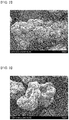
- Example 1 mostly has irregular shapes and rough surfaces.
- Comparative Example 1 has dent shapes and smooth surfaces. The reason is that in the case of Example 1, changes in particle surface and internal structure were small during the chlorination process. Meanwhile, in the case of Comparative Example 1, pores are blocked due to surface melting during the chlorination process, thus making the surface smooth, and moisture trapped in the particles is removed during the drying process, thus forming a dent shape.
Landscapes
- Chemical & Material Sciences (AREA)
- Health & Medical Sciences (AREA)
- Chemical Kinetics & Catalysis (AREA)
- Medicinal Chemistry (AREA)
- Polymers & Plastics (AREA)
- Organic Chemistry (AREA)
- Crystallography & Structural Chemistry (AREA)
- Engineering & Computer Science (AREA)
- Materials Engineering (AREA)
- General Chemical & Material Sciences (AREA)
- Addition Polymer Or Copolymer, Post-Treatments, Or Chemical Modifications (AREA)
- Transition And Organic Metals Composition Catalysts For Addition Polymerization (AREA)
Abstract
Description
- This application claims the benefit of Korean Patent Application No.
10-2018-0102925 filed on August 30, 2018 10-2019-0105962 filed on August 28, 2019 - The present invention relates to polyethylene that has narrow particle size distribution and can minimize a change in the crystal structure, and thus, can prepare chlorinated polyethylene having excellent chlorination productivity and thermal stability, and chlorinated polyethylene thereof.
- Olefin polymerization catalyst system is classified into Zeigler-Natta and metallocene catalyst systems, and these high activity catalyst systems have been developed according to each characteristic. Although a Zeigler-Natta catalyst has been widely applied for the existing commercial processes since it was invented in 1950's, because it is a multi site catalyst having a plurality of active sites, the molecular weight distribution of the prepared polymer is wide, and the composition distribution of comonomers is not uniform, and thus, it has a limitation in securing desired properties.
- Meanwhile, a metallocene catalyst consists of a main catalyst including a transition metal compound as a main component and a cocatalyst of an organometal compound including aluminum as a main component, and such a catalyst is a homogeneous complex catalyst and a single site catalyst, and thus, a polymer having narrow molecular weight distribution and uniform composition distribution of comonomers is obtained due to the properties of a single site, and the stereoregularity, copolymerization properties, molecular weight, crystallization degree and the like may be changed by modifying the ligand structure of the catalyst and changing polymerization conditions.
-
US Patent No. 5,914,289 describes a method of controlling the molecular weight and the molecular weight distribution of polymer using a metallocene catalyst supported in each carrier. However, a large amount of the catalyst is used for preparing the supported catalyst and the preparation takes long time, and the metallocene catalyst used should be respectively supported in a carrier, which is cumbersome. - Korean Patent Application No.
2003-12308 - Thus, in order to solve the above disadvantages, there is a continued demand for a method for preparing olefin polymer having desired properties by conveniently preparing a hybrid supported metallocene catalyst having excellent activity.
- Meanwhile, it is known that chlorinated polyethylene prepared by reacting polyethylene with chlorine has further improved physical mechanical properties compared to polyethylene, and particularly, since it can withstand severe external environment and chemicals, it is used as PVC impact modifier, flame retardant for ABS, cable sheath, oil hose, and the like.
- Chlorinated polyethylene is generally prepared by making polyethylene in the state of a suspension, and then, reacting it with chlorine, or by putting polyethylene in a HCI aqueous solution and reacting it with chlorine, thus substituting hydrogen of polyethylene with chlorine.
- In order to sufficiently exhibit the properties of chlorinated polyethylene, polyethylene should be uniformly substituted with chlorine, which is influenced by the properties of polyethylene reacting with chlorine. Particularly, it is influenced by the polymer structure and heat resistance of polyethylene, and if a crystal structure changes a lot according to the polymer structure or heat resistance is lowered, polyethylene particles may be aggregated to increase the entire particle diameter, and the reaction efficiency with chlorine may be lowered, thus rendering uniform chlorine substitution difficult. If such aggregation is generated, it may be difficult for chlorine to penetrate into the center of polyethylene particles, and thus, a time required for achieving desired chlorine substitution degree may increase. Further, if thermal deformation such as morphology change due to surface melting or change in the crystal structure is generated to narrow or block the pores of polyethylene particles, a time required for deacidification, neutralization and washing processes for the removal of chlorine generated as by-products during the chlorination process, or a drying process for the removal of moisture, and the like, increases, thus deteriorating chlorination productivity.
- Under these circumstances, it is further required to develop polyethylene with balanced properties and processability so as to secure excellent chlorination productivity and thermal stability.
- It is an object of the present invention to provide polyethylene that has narrow particle size distribution and minimizes a change in the crystal structure, and thus, can prepare chlorinated polyethylene having excellent chlorination productivity and thermal stability.
- According to one embodiment of the invention, polyethylene having molecular weight distribution (Mw/Mn) of 2 to 10, tie molecule fraction of 3 % or more, crystal structure transition temperature of 108 °C or more, and endothermic initiation temperature of 125 °C or more, is provided.
- The present invention also provides chlorinated polyethylene prepared by reacting the polyethylene with chlorine.
- Polyethylene according to the present invention has narrow particle size distribution and minimizes a change in the crystal structure, and thus, it can be reacted with chlorine to prepare chlorinated polyethylene having excellent chlorination productivity and thermal stability.
-
-
Fig. 1 is a mimetic diagram showing change in polyethylene crystal arrangement before and after crystal structure transition temperature in the present invention. -
Fig. 2 is an SEM photograph of the surface after completing a chlorination process using the polyethylene of Example 1 according to one embodiment of the invention. -
Fig. 3 is an SEM photograph of the surface after completing a chlorination process using the polyethylene of Comparative Example 1 having inferior chlorination productivity. - As used herein, terms "a first", "a second" and the like are used to explain various constructional elements, and they are used only to distinguish one constructional element from other constructional elements.
- Further, the terms used herein are only to explain specific embodiments, and are not intended to limit the present invention. A singular expression includes a plural expression thereof, unless it is expressly stated or obvious from the context that such is not intended. As used herein, the terms "comprise" or "have", etc. are intended to designate the existence of practiced characteristic, number, step, constructional element or combinations thereof, and they are not intended to preclude the possibility of existence or addition of one or more other characteristics, numbers, steps, constructional elements or combinations thereof.
- Although various modifications can be made to the present invention and the present invention may have various forms, specific examples will be illustrated and explained in detail below. However, it should be understood that these are not intended to limit the present invention to specific disclosure, and that the present invention includes all the modifications, equivalents or replacements thereof without departing from the spirit and technical scope of the invention.
- Hereinafter, the present invention will be explained in detail.
- According to one embodiment of the invention, polyethylene that has narrow particle size distribution and minimizes change in the crystal structure of the initial stage of a chlorination reaction, and thus, can prepare chlorinated polyethylene having excellent chlorination productivity and thermal stability, is provided.
- The polyethylene according to the present invention may be ethylene homopolymer that does not comprise comonomers.
- The polyethylene has molecular weight distribution (Mw/Mn) of 2 to 10, tie molecule fraction of 3 % or more, crystal structure transition temperature of 108 °C or more, and endothermic initiation temperature of 125 °C or more.
- In general, chlorinated polyethylene is prepared by reacting polyethylene with chlorine, and it means polyethylene in which a part of hydrogen is substituted with chlorine. If hydrogen of polyethylene is substituted with chlorine, the properties of polyethylene change due to different atomic volumes of hydrogen and chlorine, and for example, since the crystal structure of polyethylene decreases, rigidity decreases and impact strength increases more. Particularly, as the entire size of chlorinated polyethylene particles is smaller and more uniform, chlorine more easily penetrates into the center of polyethylene particles, and thus, a chlorination substitution degree in the particles becomes uniform, thus exhibiting excellent properties. However, if a crystal structure decreases, the melting temperature of polyethylene may decrease, the surface structure of polyethylene particles may change during the chlorination reaction, or particles may be adhered to each other, and thus, the entire size of particles may increase.
- The polyethylene according to the present invention has narrow molecular weight distribution, and minimizes change in the polyethylene crystal structure of the initial stage of a chlorination reaction, and thus, can provide chlorinated polyethylene having more excellent chlorination productivity and thermal stability.
- The polyethylene according to the present invention has molecular weight distribution of about 2 to about 10, or about 2 to about 7, or about 3 to about 7, or about 3.4 to about 6.9, or about 3.4 to about 4.5. It means that the molecular weight distribution of polyethylene is narrow. If molecular weight distribution is wide, since molecular weight difference between polyethylene is large, chlorine content between polyethylene after a chlorination reaction may become different, and thus, it may be difficult for chlorine to be uniformly distributed. Further, if low molecular weight components are molten, due to high flowability, they may block the pores of polyethylene particles, thus deteriorating chlorination productivity. However, since the present invention has the above explained molecular weight distribution, molecular weight difference between polyethylene after a chlorination reaction is not large, and thus, chlorine may be uniformly distributed.
- For example, the molecular weight distribution (Mw/Mn) of polyethylene can be calculated by measuring the weight average molecular weight (Mw) and number average molecular weight (Mn) of polymer using gel permeation chromatography (GPC, manufactured by Agilent Company), and dividing the weight average molecular weight by the number average molecular weight (Mw/Mn).
- Specifically, as GPC equipment, Agilent PL-GPC220 may be used, and Polymer Laboratories PLgel MIX-B 300mm length column may be used. Here, the measurement temperature may be 160 °C, 1,2,4-trichlorobenzene may be used as a solvent, and the flow rate may be set to1 mL/min. A polyethylene sample may be pretreated by dissolving in 1,2,4-trichlorobenzene containing 0.0125 % BHT at 160 °C for 10 hours, and prepared at the concentration of 10 mg/10mL, and then, fed in the amount of 200 µL to measure using using GPC analysis instrument (PL-GP220). Using a calibration curve formed using a polystyrene standard specimen, Mw and Mn can be derived. Here, as the polystyrene standard specimen, 9 kinds having weight average molecular weight of 2000 g/mol, 10000 g/mol, 30000 g/mol, 70000 g/mol, 200000 g/mol, 700000 g/mol, 2000000 g/mol, 4000000 g/mol, 10000000 g/mol may be used.
- The polyethylene may have weight average molecular weight of about 50000 g/mol to about 250000 g/mol, or about 100000 g/mol to about 250000 g/mol, or about 160000 g/mol to about 250000 g/mol, or about 161000 g/mol to about 250000 g/mol, or about 163000 g/mol to about 250000 g/mol, or about 201000 g/mol to about 250000 g/mol. It means that the molecular weight of polyethylene is high and the content of high molecular weight components is high, which causes increase in tie molecule fraction as described below.
- Further, the polyethylene according to the present invention is characterized in that a tie molecule fraction is increased and a crystal structure transition temperature is increased, so as to achieve the above explained narrow particle size distribution and minimize a change in the crystal structure.
- The 'tie molecule' means a molecule connecting between one lamellar crystal and another lamellar crystal in polyethylene. More specifically, the polyethylene is semi-crystalline polymer in the form of spherulite that is formed by three-dimensional assembly of plural lamellae formed by bundling of folded polymer chains, and consists of crystalline parts and amorphous parts. Here, the crystalline part means the inside of lamellar crystal, and the amorphous part means the outside of lamellar crystal. Further, the amorphous part consists of i) cilia starting at the crystalline part and ending at the amorphous part, ii) a loose loop connecting one lamellar crystal, and iii) an inter-lamellar link connecting between two lamellar crystals, and among the inter-lamellar link, one molecule connecting between two lamellar crystals is called as a tie molecule.
- Thus, the polyethylene comprises a tie molecule connecting between one lamellar crystal and another lamellar crystal in the amorphous part. As the content of the tie molecule is higher, bonding of the crystalline parts increases, a change in the crystal structure decreases, and the properties of the entire polymer can be improved.
- Accordingly, the present invention provides polyethylene that has narrow molecular weight distribution, and simultaneously, has increased fraction of tie molecules connecting lamellar crystal structures in the polyethylene, so as to minimize a change in the crystal structure of polyethylene. Specifically, in case the tie molecule fraction increases, crystalline parts may be thoroughly bonded, and thus, a change in the properties of polyethylene, particularly, a change in the crystal structure of the initial stage of the chlorination reaction can be inhibited.
- In this respect, the polyethylene according to the present invention has tie molecule fraction of about 3 % or more. If the polyethylene has tie molecule fraction less than 3 %, a change in the crystal structure may be generated during the chlorination reaction, and thus, the pores of the particle surface may be blocked or a morphology may change. Specifically, the tie molecule fraction may be about 3.1 % or more, or about 3.2 % or more, or about 3.3 % or more, or about 3.4 % or more, or about 3.5 % or more. However, in order to prevent lowering of the crystallinity and melting temperature of polyethylene, the tie molecule fraction of polyethylene may be about 6.0 % or less, or about 5.9 % or less, or about 5.8 % or less, or about 5.7 % or less, or about 5.3 % or less, or about 5.0 % or less, or about 4.5 % or less, or about 4.0 % or less, or about 3.8 % or less. For example, if the tie molecule fraction is greater than 6.0 %, although bonding of crystalline parts may increase, crystallinity and melting temperature may decrease, and thus, pores of the particle surface may be blocked and particles may be aggregated, thus deteriorating chlorination productivity.
- Here, the tie molecule fraction of polyethylene can be measured through a tie molecule fraction distribution graph in which the x-axis is log Mw, and the y-axis is nPdM.
- The tie molecule fraction distribution graph can be obtained from the data of a GPC curve graph in which the x-axis is log Mw, and the y-axis is dw/dlogMw, and DSC measurement results. Here, Mw means weight-average molecular weight, and w means a weight fraction. Specifically, in the tie molecule fraction distribution graph, the log Mw of the x-axis is identical to the x-axis of the GPC curve graph. Further, in the tie molecule fraction distribution graph, the y-axis of nPdM can be calculated from the data obtained in the GPC curve graph. In the nPdM, n is the number of polymer having molecular weight M and can be calculated as (dw/dlog Mw)/M in the GPC curve data, P is the probability of tie molecules being produced and can be calculated by the following Equation 1, and dM is dlogMw<x-axis data of GPC curve, X n+1> - dlogMw<x-axis data of GPC curve. Xn>

- In the Equation 1,
- r is an end-to-end distance of a random coil,
- b2 is 3/2<r>2,
- lc is a crystal thickness, and
- la is an amorphous layer thickness.
- In the Equation 1, lc can be calculated from the following Equation 2, wherein Tm is the melting temperature of polyethyhlene.

- In the Equation 2,
Tm 0 is 415K, σe is 60.9×10⁻³JM-2, Δhm is 2.88×10³JM-3. - Further, in the Equation 1, la can be calculated from the following Equation 3.

- In the Equation 3,
- ρc is the density of crystalline, and 1000 kg/m3,
- ρa is the density of amorphous phase, and 852 kg/m3, and
- ωc is weight fraction crystallinity, and can be measured with DSC.
- A tie molecule fraction (
P̅ ) can be calculated by the following Equation 4, from the P value calculated from the Equation 1,
- In the Equation 4,
- nPdM is as explained in the Equation 1, and
- P is a value calculated by the Equation 1.
- The polyethylene may have a melting temperature (Tm) of about 130°C or more, about 130°C to about 140°C, or about 135°C or more, or about 135 °C to about 140 °C, or about 135.6 °C or more, or about 135.6 °C to about 140 °C, or 136 °C or more, or about 136 °C to about 140 °C. It means that a temperature at which the crystal structure of polyethylene disappears is high, and thus, it is difficult to generate surface melting during a chlorination process.
- In the present invention, the melting temperature (Tm) can be measured using a differential scanning calorimeter (DSC, device name: Q20, manufacturing company: TA Instruments). Specifically, a temperature is increased to 190 °C to heat polyethylene, maintained at that temperature for 5 minutes, decreased to 50 °C, and then, increased again, and a temperature corresponding to the top of the DSC (Differential Scanning Calorimeter, manufactured by TA Instruments) curve is defined as the melting point (Tm). Here, temperature increase and decrease rates are respectively 10 °C/min, and the melting temperature is the result measured in the second temperature increase section.
- Further, the polyethylene may have crystallinity of about 55 % or more, or about 55.5 % or more, or about 55.8 % or more, or about 56 % or more, or about 56.5 % or more, or about 57 % or more. It means that the content of the crystal structure of polyethylene is high and dense, and thus, it is difficult for the crystal structure to change during a chlorination process.
- Specifically, the crystallinity can be measured using a differential scanning calorimeter (DSC, device name: Q20, manufacturing company: TA Instruments). Specifically, a temperature is increased to 190 °C to heat polyethylene, maintained at that temperature for 5 minutes, decreased to 50 °C, and then, increased again, and in the obtained DSC (Differential Scanning Calorimeter, manufactured by TA Instruments) analysis result, the area of the melting peak in the second temperature increase section is calculated as heat of fusion ΔHm, which is divided by a theoretical value H0m = 293.6 J/g at crystallinity of 100 %, thus calculating crystallinity.
- Meanwhile, the polyethylene according to the present invention is characterized by increased crystal structure transition temperature as well as increased tie molecule fraction as explained above. The crystal structure transition temperature of the polyethylene may be about 108 °C or more, or about 108.2 °C or more, or about 115 °C or more, or about 120 °C or more, or about 120.5 °C or more, or about 122 °C or more. Further, the crystal structure transition temperature of the polyethylene may be about 132 °C or less, or about 130 °C or less, or about 128 °C or less.
- Here, the crystal structure transition temperature means a temperature at which crystal arrangement changes while a lamellar structure constituting crystal is maintained. Specifically, the crystal structure transition temperature can be measured using a dynamic mechanical analyzer (DMA, device name: Q800, manufacturing company: TA Instruments). For example, using a dynamic mechanical analyzer (DMA), a temperature is decreased to -60 °C, maintained at that temperature for 5 minutes, and then, increased to 140 °C, and the top of the tanδ curve is measured as the crystal structure transition temperature. Specifically, as shown in
Fig. 1 , polyethylene crystal arrangement changes before and after the crystal structure transition temperature. Thus, the crystal structure transition temperature of the polyethylene of the present invention is 108 °C or more, which is close to a melting temperature, meaning that a change in crystal arrangement occurs at higher temperature, and thus, it is difficult for the morphology of polyethylene particles to change during a chlorination process. - Further, the polyethylene may have endothermic initiation temperature of about 125 °C or more, or about 125 °C to about 134 °C, or about 126 °C or more, or about 126 °C to about 132 °C, or about 126.3 °C or more, or about 126.3 °C to about 132 °C, or about 126.5 °C or more, or about 126.5 °C to about 130 °C, or about 126.8 °C or more, or about 126.8 °C to about 130 °C. Here, the endothermic initiation temperature of the polyethylene is a temperature at which polymer folding constituting lamellar begins to be unfolded, and is measured as a temperature at which the onset of a melting temperature peak occurs in DSC analysis result. Such endothermic initiation temperature represents a temperature at which melting begins to occur, and the endothermic initiation temperature of the polyethylene of the present invention is 125 °C or more, which is close to a melting temperature, meaning that melting occurs at higher temperature, and thus, it is difficult for surface melting to be generated during a chlorination process. Further, the endothermic initiation temperature of the polyethylene may be about 134 °C or less, or about 132 °C or less, or about 130 °C or less.
- Specifically, the endothermic initiation temperature can be measured using a differential scanning calorimeter (DSC, device name: Q20, manufacturing company: TA Instruments). Specifically, a temperature is increased to 190 °C to heat polyethylene, maintained at that temperature for 5 minutes, decreased to 50 °C, and then, increased again, and in the obtained DSC analysis result, a temperature at which the onset of a melting peak occurs in the second temperature increase section is defined as the endothermic initiation temperature.
- Preferably, the density of the polyethylene may be about 0.940 g/cm3 or more, or about 0.940 g/cm3 to about 0.960 g/cm3, or about 0.945 g/cm3 or more, or about 0.945 g/cm3 to about 0.960 g/cm3, or about 0.951 g/cm3 or more, or about 0.951 g/cm3 to about 0.960 g/cm3. It means that the content of the crystal structure of the polyethylene is high and dense, and thus, it is difficult for the crystal structure to change during a chlorination process. Specifically, the density can be measured by the method of ASTM (American Society for Testing Materials) D 1505.
- Preferably, the melt index (MI) of the polyethylene, namely, melt index measured under temperature of 230 °C and load of 5 kg according to the method of ASTM (American Society for Testing Materials) D 1238, may be about 0.1 g/10min to about 10 g/10min, or about 0.1 g/10min to about 5 g/10min, or about 0.1 g/10min to about 2 g/10min, or about 0.1 g/10min to about 0.95 g/10min. It means that the molecular weight of the polyethylene is high and the content of high molecular weight components is high, which increases the above explained tie molecule fraction.
- The polyethylene according to the present invention may be prepared by polymerizing ethylene in the presence of a metallocene catalyst comprising one or more selected from the group consisting of compounds represented by the following Chemical Formulas 1 to 4:
[Chemical Formula 1] (Cp1Ra)n(Cp2Rb)M1Z1 3-n
in the Chemical Formula 1, - M1 is Group 4 transition metal;
- Cp1 and Cp2 are identical to or different from each other, and are each independently one selected from the group consisting of cyclopentadienyl, indenyl, 4,5,6,7-tetrahydro-1-indenyl, and fluorenyl radicals, which may be substituted with hydrocarbon having a carbon number of 1 to 20;
- Ra and Rb are identical to or different from each other, and are each independently hydrogen, C1-20 alkyl, C1-10 alkoxy, C2-20 alkoxyalkyl, C6-20 aryl, C6-10 aryloxy, C2-20 alkenyl, C7-40 alkylaryl, C7-40 arylalkyl, C8-40 arylalkenyl, or C2-10 alkynyl;
- Z1 is a halogen atom, C1-20 alkyl, C2-10 alkenyl, C7-40 alkylaryl, C7-40 arylalkyl, C6-20 aryl, substituted or unsubstituted C1-20 alkylidene, or substituted or unsubstituted amino, C2-20 alkylalkoxy, or C7-40 arylalkoxy;
- n is 1 or 0;
- M2 is Group 4 transition metal;
- Cp3 and Cp4 are identical to or different from each other, and are each independently one selected from the group consisting of cyclopentadienyl, indenyl, 4,5,6,7-tetrahydro-1-indenyl and fluorenyl radicals, which may be substituted with hydrocarbon having a carbon number of 1 to 20;
- Rc and Rd are identical to or different from each other, and are each independently hydrogen, C1-20 alkyl, C1-10 alkoxy, C2-20 alkoxyalkyl, C6-20 aryl, C6-10 aryloxy, C2-20 alkenyl, C7-40 alkylaryl, C7-40 arylalkyl, C8-40 arylalkenyl, or C2-10 alkynyl;
- Z2 is a halogen atom, C1-20 alkyl, C2-10 alkenyl, C7-40 alkylaryl, C7-40 arylalkyl, C6-20 aryl, substituted or unsubstituted C1-20 alkylidene, or substituted or unsubstituted amino, C2-20 alkylalkoxy, or C7-40 arylalkoxy;
- B1 is carbon, germanium, silicon, phosphorus or nitrogen-containing radicals, or a combination thereof, which crosslinks a Cp3Rc ring with a Cp4Rd ring, or crosslinks one Cp4Rd ring to M2;
- m is 1 or 0;
- M3 is Group 4 transition metal;
- Cp5 is one selected from the group consisting of cyclopentadienyl, indenyl, 4,5,6,7-tetrahydro-1-indenyl and fluorenyl radicals, which may be substituted with hydrocarbon having a carbon number of 1 to 20;
- Re is hydrogen, C1-20 alkyl, C1-10 alkoxy, C2-20 alkoxyalkyl, C6-20 aryl, C6-10 aryloxy, C2-20 alkenyl, C7-40 alkylaryl, C7-40 arylalkyl, C8-40 arylalkenyl, or C2-10 alkynyl;
- Z3 is a halogen atom, C1-20 alkyl, C2-10 alkenyl, C7-40 alkylaryl, C7-40 arylalkyl, C6-20 aryl, substituted or unsubstituted C1-20 alkylidene, substituted or unsubstituted amino, C2-20 alkylalkoxy, or C7-40 arylalkoxy;
- B2 is carbon, germanium, silicon, phosphorus or nitrogen-containing radicals or a combination thereof, which crosslinks a Cp5Re ring with J; and
- J is one selected from the group consisting of NRf, O, PRf and S, wherein Rf is C1-20 alkyl, aryl, substituted alkyl, or substituted aryl.
- R1 to R17 are identical to or different from each other, and each independently, hydrogen, halogen, C1-20 alkyl, C2-20 alkenyl, C6-20 aryl, C7-20 alkylaryl, or C7-20 arylalkyl;
- L is C1-10 linear or branched alkylene;
- D is -O-, -S-, -N (R)- or -Si (R) (R')-, wherein R and R' are identical to or different from each other, and each independently, hydrogen, halogen, C1-20 alkyl, C2-20 alkenyl, or C6-20 aryl;
- A is hydrogen, halogen, C1-20 alkyl, C2-20 alkenyl, C6-20 aryl, C7-20 alkylaryl, C7-20 arylalkyl, C1-20 alkoxy, C2-20 alkoxyalkyl, C2-20 heterocycloalkyl, or C5-20 heteroaryl;
- Q is carbon, silicon or germanium;
- M4 is Group 4 transition metal;
- X1 and X2 are identical to or different from each other, and each independently, halogen, C1-20 alkyl, C2-20 alkenyl, C6-20 aryl, nitro, amido, C1-20 alkylsilyl, C1-20 alkoxy, or C1-20 sulfonate.
- Hereinafter, the above substituents will be explained in more detail.
- The C1-20 alkyl includes linear or branched alkyl, and specifically, may include methyl, ethyl, propyl, isopropyl, n-butyl, tert-butyl, pentyl, hexyl, heptyl, octyl, and the like, but is not limited thereto.
- The C2-20 alkenyl includes linear or branched alkenyl, and specifically, may include allyl, ethenyl, propenyl, butenyl, pentenyl, and the like, but is not limited thereto.
- The C6-20 aryl includes monocyclic aryl or aryl of condensed ring, and specifically, may include phenyl, biphenyl, naphthyl, phenanthrenyl, fluorenyl, and the like, but is not limited thereto.
- The C5-20 heteroaryl includes monocyclic heteroaryl or heteroaryl of condensed ring, and specifically, carbazolyl, pyridyl, quinoline, isoquinoline, thiophenyl, furanyl, imidazole, oxazolyl, thiazolyl, triazine, tetrahydropyranyl, tetrahydrofuranyl, and the like, but is not limited thereto.
- The C1-20 alkoxy includes methoxy, ethoxy, isopropoxy, n-butoxy, tert-butoxy, cyclohexyloxy, and the like, but is not limited thereto.
- The C6-10 aryloxy includes phenoxy, biphenoxy, naphthoxy, and the like, but is not limited thereto.
- Halogen may include fluorine (F), chlorine (CI), bromine (Br), iodine (I), and the like, but is not limited thereto.
- The Group 4 transition metal may include titanium (Ti), zirconium (Zr), hafnium (Hf), and the like, but is not limited thereto.
- The above substituents may be optionally substituted with one or more substituents selected from the group consisting of hydroxy; halogen; alkyl, alkenyl, aryl, alkoxy; alkyl, alkenyl, aryl, alkoxy including one or more heteroatoms selected from Group 14 to Group 16 heteroatoms; silyl; alkylsilyl or alkoxysilyl; phophine; phosphide; sulfonate; and sulfone, in the range within which the effects equal or similar to the aimed effects are obtained.
- As the metallocene catalyst for conducting ethylene polymerization of the present invention, those comprising one or more selected from the group consisting of compounds represented by the Chemical Formulas 1 to 4 as catalyst precursors may be used.
- Specifically, in the Chemical Formula 1, M1 may be zirconium (Zr) or hafnium (Hf), preferably zirconium (Zr). Further, each of Cp1 and Cp2 may be cyclopentadienyl, indenyl, or fluorenyl. Further, each of Ra and Rb may be hydrogen, C1-6 alkyl, C7-12 arylalkyl, C2-12 alkoxyalkyl, C6-12 aryl, or C2-6 alkenyl, preferably, hydrogen, methyl, ethyl, propyl, isopropyl, n-butyl, tert-butyl, pentyl, hexyl, butenyl, phenyl, methyl substituted with phenyl, butyl substituted with phenyl, or tert-butoxyhexyl. Further, each of Z1 may be a halogen atom, preferably, chlorine (CI). Further, n may be 1.
- Examples of the compound represented by the Chemical Formula 1 may include compounds represented one of the following Structural Formulas, but are not limited thereto.


- In the above Structural Formulas, ph denotes a phenyl group.
- Meanwhile, the Chemical Formula 2 wherein m is 1 means the structure of a bridged compound wherein the Cp3Rc ring and the Cp4Rd ring, or the Cp4Rd ring and M2 are crosslinked by B1, and the Chemical Formula 2 wherein m is 0 means the structure of a non-crosslinked compound.
- Specifically, in the Chemical Formula 2, M2 may be zirconium (Zr) or hafnium (Hf), preferably zirconium (Zr). Further, B1 may be a radical comprising carbon (C), germanium (Ge), or silicon (Si), preferably a radical comprising carbon (C) or silicon (Si), wherein the carbon (C) or silicon (Si) may be substituted with one or more selected from C1-6 alkyl and C2-12 alkoxyalkyl. More specifically, B1 may be dimethylsilyl, diethylsilyl, methyl (tert-butoxyhexyl)silyl, dimethylmethylene, or cyclohexylene. Further, each of Cp3 and Cp4 may be cyclopentadienyl, indenyl, or fluorenyl. Further, each of Rc and Rd may be hydrogen, C1-6 alkyl, C7-12 arylalkyl, C2-12 alkoxyalkyl, C6-12 aryl, or C2-6 alkenyl, preferably hydrogen, methyl, ethyl, propyl, isopropyl, n-butyl, tert-butyl, pentyl, hexyl, butenyl, phenyl, methyl substituted with phenyl, butyl substituted with phenyl, or tert-butoxyhexyl. Further, each of Z2 may be a halogen atom, preferably chlorine (CI). Further, m may be 1.
- Examples of the compounds represented by the Chemical Formula 2 may include compounds represented by one of the following Structural Formulas, but are not limited thereto.


- In the above Structural Formulas, ph denotes a phenyl group.
- Specifically, in the Chemical Formula 3, M3 may be titanium (Ti). Further, B2 may be a radical comprising carbon (C), germanium (Ge), or silicon (Si), preferably a radical comprising carbon (C) or silicon (Si), wherein the carbon (C) or silicon (Si) may be substituted with one or more selected from C1-6 alkyl and C2-12 alkoxyalkyl. More specifically, B2 may be dimethylsilyl, diethylsilyl, methyl (tert-butoxyhexyl)silyl, dimethylmethylene, or cyclohexylene. Further, J may be NRf, wherein Rf may be C1-6 alkyl, C6-12 aryl, C2-6 alkenyl, or C2-12 alkoxyalkyl, preferably, methyl, ethyl, propyl, isopropyl, n-butyl, tert-butyl, butenyl, phenyl, or tert-butoxyhexyl. Further, Cp5 may be cyclopentadienyl, indenyl, or fluorenyl. Further, Re may be hydrogen, C1-6 alkyl, C7-12 arylalkyl, C2-12 alkoxyalkyl, C6-12 aryl, or C2-10 alkenyl, preferably hydrogen, methyl, ethyl, propyl, isopropyl, n-butyl, tert-butyl, pentyl, hexyl, butenyl, phenyl, methyl substituted with phenyl, butyl substituted with phenyl, or tert-butoxyhexyl. Further, each of Z3 may be a halogen atom, preferably chlorine (Cl).
- Examples of the compounds represented by the Chemical Formula 3 may include compounds represented by one of the following Structural Formulas, but are not limited thereto.


- Specifically, in the Chemical Formula 4, M4 may be zirconium (Zr) or hafnium (Hf), preferably zirconium (Zr). Further, Q may be silicon (Si). Further, each of R1 to R17 may be hydrogen, C1-8 alkyl, C2-8 alkenyl, or C6-12 aryl, preferably methyl, ethyl, propyl, isopropyl, n-butyl, tert-butyl, pentyl, hexyl, heptyl, ocyl, or phenyl, but is not limited thereto. Further, it is more preferable that L is C4-8 linear or branched alkylene, but is not limited thereto. Further, the alkylene group may be unsubstituted or substituted with C1-20 alkyl, C2-20 alkenyl, or C6-20 aryl. Preferably, L may be hexylene. Further, D may be -O-. Further, A may be hydrogen, C1-6 alkyl, C1-6 alkoxy, C2-12 alkoxyalkyl, or C5-12 heteroaryl, but is not limited thereto. Preferably, A may be hydrogen, methyl, ethyl, propyl, isopropyl, n-butyl, tert-butyl, methoxymethyl, tert-butoxymethyl, 1-ethoxyethyl, 1-methyl-1-methoxyethyl, tetrahydropyranyl, or tetrahydrofuranyl. Further, each of X1 and X2 may be halogen, preferably chlorine (CI).
- Examples of the compounds represented by the Chemical Formula 4 may include compounds represented by one of the following Structural Formulas, but are not limited thereto.

- A method for preparing the metallocene compounds will be described in detail in Examples below.
- Particularly, the polylethylene according to the present invention may be prepared by polymerizing ethylene in the presence of one or more first metallocene compounds represented by the Chemical Formula 1; and one or more second metallocene compounds selected from the compounds represented by the Chemical Formulas 2 to 4.
- For example, the polyethylene may be prepared in the presence of a hybrid supported catalyst in which one or more first metallocene compounds represented by the Chemical Formula 1 and one or more second metallocene compounds represented by the Chemical Formula 2 are supported together, or may be prepared in the presence of a hybrid supported catalyst in which one or more first metallocene compounds represented by the Chemical Formula 1 and one or more second metallocene compounds represented by the Chemical Formula 4 are supported together.
- Further, the polyethylene may be prepared in the presence of the above explained metallocene catalyst, while introducing hydrogen gas.
- Here, the hydrogen gas may be introduced in the content of about 60 ppm to about 150 ppm, or about 65 ppm to about 135 ppm, based on the weight of ethylene. Specifically, based on the introduction of 15 kg/hr of ethylene, the hydrogen gas may be introduced in the content of about 0.1 g/h to about 0.2 g/hr.
- The metallocene catalyst used in the present invention may be supported in a carrier together with a cocatalyst compound.
- Further, the supported metallocene catalyst may induce the production of LCB (Long Chain Branch) in the prepared polyethylene.
- In the supported metallocene catalyst according to the present invention, the cocatalyst supported together so as to activate the metallocene compound is not specifically limited as long as it is an organometallic compound including Group 13 metal and can be used when polymerizing olefin in the presence of common metallocene catalysts
- The cocatalyst is not specifically limited as long as it is an organometallic compound including Group 13 metal and can be used when polymerizing ethylene in the presence of common metallocene catalysts
- Specifically, the cocatalyst may be one or more selected from the group consisting of compounds represented by the following Chemical Formulas 5 to 7:
[Chemical Formula 5] -[Al (R18)-O]c-
- In the Chemical Formula 5,
- R18 may be each independently, halogen, C1-20 alkyl or C1-20 haloalkyl,
- c is an integer equal to or greater than 2,
- In the Chemical Formula 6,
- D is aluminum or boron,
- R19 are each independently, hydrogen, halogen, C1-20 hydrocaryl, or C1-20 hydrocarbyl substituted with halogen,
- In the Chemical Formula 7,
- L is neutral or cationic Lewis base,
- [L-H]+ is Bronsted acid,
- Q is Br3+ or Al3+,
- E's are each independently, C6-20 aryl or C1-20 alkyl, wherein the C6-20 aryl or C1-20 alkyl may be unsubstituted or substituted with one or more substituents selected from the group consisting of halogen, C1-20 alkyl, C1-20 alkoxy and C6-20 aryloxy.
- Examples of the compounds represented by the Chemical Formula 5 may include alkylaluminoxane such as modified methylaluminoxane (MMAO), methylalulminoxane (MAO), ethylaluminoxane, isobutylaluminoxane, butylaluminoxane, and the like.
- Examples of the alkyl metal compound represented by the Chemical Formula 6 may include trimethylaluminum, triethylaluminum, triisobutylaluminum, tripropylaluminum, tributylaluminum, dimethylchloroaluminum, dimethylisobutylaluminum, dimethylethylaluminum, diethylchloroaluminum, trimethylaluminum, triethylaluminum, triisobutylaluminum, tripropylaluminum, tributylaluminum, dimethylchloroaluminum, ethyldimethylaluminum, methyldiethylaluminum, triphenylaluminum, tri-p-tolylaluminum, dimethylaluminum methoxide, dimethylaluminum ethoxide, trimethylboron, triethylboron, triisobutylboron, tripropylboron, tributylboron, and the like.
- Examples of the compound represented by the Chemical Formula 7 may include triethylammonium tetra (phenyl)boron, tributylammonium tetra (phenyl)boron, trimethylammonium tetra (phenyl)boron, tripropylammonium tetra (phenyl)boron, trimethylammonium tetra (p-tolyl) boron, tripropylammoniumtetra (p-tolyl)boron, triethylammoniumtetra (o,p-dimehylphenyl)boron, trimethylammonium tetra (o,p-dimethylphenyl)boron, tributylammonium tetra (p-trifluoromethylphenyl)boron, trimethylammonium tetra (p-trifluoromethylphenyl)boron, tributylammonium tetra (pentafluorophenyl)boron, N,N-diethylanilinium tetra (phenyl)boron, N,N-diethylanilinium tetra (phenyl)boron, N,N-diethylanilinium tetra (pentafluorophenyl)boron, diethylammonium tetra (pentafluorophenyl)boron, triphenylphosphonium tetra (phenyl)boron, trimethylphosphonium tetra (phenyl)boron, triethylammonium tetra (phenyl)aluminum, tributylammonium tetra (phenyl)aluminum, trimethylammonium tetra (phenyl)aluminum, tripropylammonium tetra (phenyl)aluminum, trimethylammonium tetra (p-tolyl)aluminum, tripropylammonium tetra (p-tolyl)aluminum, triethylammonium tetra (o,p-dimethylphenyl)aluminum, tributylammonium tetra (p-trifluoromethylphenyl)aluminum, trimethylammonium tetra (p-trifluoromethylphenyl)aluminum, tributylammonium tetra (pentafluorophenyl)aluminum, N,N-diethylanilinium tetra (phenyl)aluminum, N,N-diethylanilinium tetra (phenyl)aluminum, N,N-diethylanilinium tetra (pentafluorophenyl)aluminum, diethylammonium tetra (pentafluorophenyl)aluminum, triphenylphosphonium tetra (phenyl)aluminum, trimethylphosphonium tetra (phenyl)aluminum, triphenylcarbonium tetraphenylboron, triphenylcarbonium tetraphenylaluminum, triphenylcarbonium tetra (p-trifluoromethylphenyl)boron, triphenylcarbonium tetrapentafluorophenylboron, and the like.
- The support amount of the cocatalyst may be 5 mmol to 20 mmol, based on 1 g of the carrier.
- In the supported metallocene catalyst according to the present invention, as the carrier, those containing hydroxy groups on the surface may be used, and preferably, carriers having highly reactive hydroxy groups and siloxane groups, which are dried to remove moisture on the surface, may be used.
- For example, silica, silica-alumina, and silica-magnesia, and the like, which is dried at high temperature, may be used, and they may commonly contain oxide, catrbonate, sulfate, and nitrate components such as Na2O, K2CO3, BaSO4, and Mg (NO3)2, and the like.
- The drying temperature of the carrier may be preferably 200 °C to 800 °C, more preferably 300 °C to 600 °C, and most preferably 300 °C to 400 °C. If the drying temperature of the carrier is less than 200 °C, due to much moisture, a cocatalyst may react with surface moisture, and if it is greater than 800 °C, pores of the carrier surface may be coalesced to decrease the surface area, and a lot of surface hydroxyl groups may disappear and only siloxane groups may remain, thus decreasing reaction sites with a cocatalyst.
- The amount of hydroxyl groups on the carrier surface may be preferably 0.1 mmol/g to 10 mmol/g, more preferably 0.5 mmol/g to 5 mmol/g. The amount of hydroxyl groups on the carrier surface may be controlled by the preparation method and conditions or drying conditions of the carrier, for example, temperature, time, vacuum or spray drying, and the like.
- If the amount of hydroxyl groups is less than 0.1 mmol/g, reaction sites with a cocatalyst may be small, and if it is greater than 10 mmol/g, they may be derived from moisture other than hydroxyl groups existing on the carrier particle surface, which is not preferable.
- In the metallocene catalyst according to the present invention, the mass ratio of the transition metal included in the metallocene catalyst to the carrier may be 1 : 10 to 1 : 1000. When the carrier and the metallocene catalyst compound are included at the above mass ratio, optimum shape may be exhibited. Further, the mass ratio of the cocatalyst compound to the carrier may be 1 : 1 to 1 : 100.
- Meanwhile, the chlorinated polyethylene according to the present invention may be prepared by polymerizing ethylene in the presence of the above explained supported metallocene catalyst, and then, reacting it with chlorine.
- The ethylene polymerization may be progressed using one continuous type slurry polymerization reactor, loop slurry reactor, gas phase reactor or solution reactor.
- Further, the polymerization temperature may be about 25 °C to about 500 °C, preferably about 25 °C to about 200 °C, more preferably about 50 °C to about 150 °C or about 80 °C to about 150 °C. Further, the polymerization pressure may be about 1 kgf/cm2 to about 100 kgf/cm2, preferably about 1 kgf/cm2 to about 50 kgf/cm2, more preferably about 5 kgf/cm2 to about 30 kgf/cm2.
- The supported metallocene catalyst may be dissolved or diluted in a C5-12 aliphatic hydrocarbon solvent such as pentane, hexane, heptane, nonane, decane, and isomers thereof, an aromatic hydrocarbon solvent such as toluene, benzene, or a hydrocarbon solvent substituted with a chlorine atom such as dichloromethane, dichlorbenzene, and the like, and introduced. It is preferable that the solvent used may be treated with a small amount of alkyl aluminum to remove a small amount of water or air acting as a catalyst poison, and a cocatalyst may be additionally used.
- The reaction with chlorine may be conducted by dispersing the above prepared polyethylene with water, an emulsifying agent and a dispersant, and then, introducing a catalyst and chlorine.
- As the emulsifying agent, polyether or polyalkyleneoxide may be used. As the dispersant, a polymer salt or an organic acid polymer salt may be used, and as the organic acid, methacrylic acid or acrylic acid may be used.
- As the catalyst, a chlorination catalyst used in the art may be used, and for example, benzoyl peroxide may be used. The chlorine may be used alone, or it may be used in combination with inert gas.
- It is preferable that the reaction is conducted at 60 °C to about 150 °C or about 100 °C to about 140 °C, and the reaction time is about 10 minutes to about 10 hours, or about 30 minutes to about 8 hours.
- The chlorinated polyethylene prepared by the above reaction may be additionally subjected to a neutralization process, a washing process and/or a drying process, and thus, may be obtained in powder form.
- Further, a method for preparing a molded product with the chlorinated polyethylene according to the present invention may use a common method in the art. For example, a molded product may be prepared by roll-mill compounding of the chlorinated polyethylene, followed by extrusion processing.
- Hereinafter, preferable examples will be presented for better understating of the invention. However, these examples are presented only as the illustrations of the invention, and the present invention is not limited thereby.
- t-butyl-O- (CH2)6-Cl was prepared using 6-chlorohexanol by a method described in the document (Tetrahedron Lett. 2951, 1988), and was reacted with sodium cyclopentadienyl (NaCp) to obtain t-butyl-O- (CH2)6-C5H5 (yield 60 %, b.p. 80 °C /0.1 mmHg).
- Further, the t-butyl-O- (CH2)6-C5H5 was dissolved in tetrahydrofurane (THF) at - 78 °C and n-butyl lithium (n-BuLi) was slowly added thereto, and then, the temperature was raised to a room temperature, and the solution was reacted for 8 hours. The synthesized lithium salt solution was slowly added to a suspension of ZrCl4 (THF)2 (170 g, 4.50 mmol)/THF (30 mL) at -78 °C, and the solution was additionally reacted at a room temperature for 6 hours. All the volatiles were removed by vacuum drying, and hexane was added to the obtained oily liquid substance to filter. After vacuum drying the filtered solution, hexane was added to induce precipitation at low temperature (-20 °C). The obtained precipitate was filtered at a room temperature to obtain [tert-butyl-O-(CH2)6-C5H412ZrCl2] in the form of white solid (yield 92 %).
1H-NMR (300 MHz, CDCl3): 6.28 (t, J=2.6 Hz, 2H), 6.19 (t, J=2.6 Hz, 2H), 3.31 (t, 6.6 Hz, 2H), 2.62 (t, J=8 Hz), 1.7-1.3 (m, 8H), 1.17 (s, 9H)
13C-NMR (CDCl3): 135.09, 116.66, 112.28, 72.42, 61.52, 30.66, 30.31, 30.14, 29.18, 27.58, 26.00 - To a 10 L reactor, 50 g of Mg (s) was added at a room temperature, and then, 300 mL of THF was added. 0.5 g of I2 was added, and then, the temperature of the reactor was maintained at 50 °C. After the temperature of the reactor was stabilized, 250 g of 6-t-butoxyhexylchloride was added to the reactor at 5 mL/min using a feeding pump. It was observed that the temperature of the reactor increased by 4 °C to 5 °C as 6-t-butoxyhexylchloride was added. Continuously, while adding 6-t-butoxyhexylchloride, the solution was stirred for 12 hours to obtain a black reaction solution. 2 mL of the produced black solution was taken, and then, water was added to obtain an organic layer, which was confirmed to be 6-t-butoxyhexane through 1H-NMR, thus confirming that a Grignard reaction progressed well. Therefrom, 6- (tert-butoxy)hexyl magnesium chloride was synthesized.
- 500 g of (CH3)SiCl3 and 1 L of THF were added to a reactor, and the temperature of the reactor was decreased to -20 °C. 560 g of the above synthesized 6-t-butoxyhexyl magnesium chloride was added to the reactor at 5 mL/min using a feeding pump. After the feeding of Grignard reagent was finished, the solution was stirred for 12 hours while slowly raising the temperature of the reactor to a room temperature, to produce white MgCl2 salt. 4 L of hexane was added and the salt was removed through labdori to obtain a filtered solution. The obtained filtered solution was added to a reactor, and then, hexane was removed at 70 °C to obtain a pale yellow liquid. The obtained liquid was confirmed to be [methyl (6-t-butoxyhexyl)dichlorosilane] through 1H-NMR.
1H-NMR (CDCl3): 3.3 (t, 2H), 1.5 (m, 3H), 1.3 (m, 5H), 1.2 (s, 9H), 1.1 (m, 2H), 0.7 (s, 3H) - 1.2 mol (150 g) of tetramethylcyclopentadiene and 2.4 L of THF were added to a reactor, and then, the reactor was cooled to -20 °C. 480 mL of n-BuLi was added to the reactor at 5 mL/min using a feeding pump. After adding n-BuLi, the solution was stirred for 12 hours while slowly raising the temperature to a room temperature. Subsequently, an equivalent of methyl (6-t-butoxyhexyl)dichlorosilane (326 g, 350 mL) was quickly added to the reactor. While raising the temperature of the reactor to a room temperature, the solution was stirred for 12 hours, and then, the reactor was cooled to 0 °C again, and then, 2 equivalents of tert-butyl amine (t-BuNH2) were added. While slowly raising the temperature of the reactor to a room temperature, the solution was stirred for 12 hours. Subsequently, THF was removed, 4 L of hexane was added, and the salt was removed through labdori to obtain a filtered solution. After adding the filtered solution to a reactor again, hexane was removed at 70 °C to obtain a yellow solution. It was confirmed to be methyl (6- (tert-butoxy)hexyl) (tetramethylcyclopentadienyl)tert-butylaminosilane through 1H-NMR.
- A ligand dilithium salt was synthesized at -78°C from n-BuLi and the ligand dimethyl (tetramethylcyclppentadienyl)tert-butylaminosilane in THF. To the ligand dilithium salt, TiCl3 (THF)3 (10 mmol) was quickly added. The reaction solution was stirred for 12 hours while slowly raising the temperature from -78 °C to a room temperature. Subsequently, an equivalent of PbCl2 (10 mmol) was added to the reaction solution at a room temperature, and the solution was stirred for 12 hours to obtain a bluish black solution. THF was removed in the produced reaction solution, and then, hexane was added to filter the product. Further, hexane was removed from the obtained filtrate, and the product was confirmed to be tert-butoxy- (CH2)6] (CH3)Si (Cs (CH3)4) (tert-butyl-N)TiCl2 by 1H-NMR.
1H-NMR (CDCl3): 3.3 (s, 4H), 2.2 (s, 6H), 2.1 (s, 6H), 1.8 - 0.8 (m), 1.4 (s, 9H), 1.2 (s, 9H), 0.7 (s, 3H) - 1.0 mole of a tert-butyl-O- (CH2)6MgCl, which is a Grignard reagent, was obtained by the reaction of a tert-butyl-O- (CH2)6Cl compound and Mg (O) under a THF solvent. The prepared Grignard compound was added to a flask containing -30 °C (CH3)SiCl3 (176.1 mL, 1.5 mol) and THF (2.0 mL), and the solution was stirred at a room temperature for more than 8 hours, and then, the filtrate was vacuum dried to obtain a compound of tert-butyl-O- (CH2)6Si (CH3)Cl2 (yield 92 %).
- Fluorene (Flu, 3.33 g, 20mmol), hexane (100mL) and MTBE (methyl tert-butyl ether, 1.2 mL, 10 mmol) were put in a reactor at -20 °C, and 8 mL of n-BuLi (2.5M in Hexane) was slowly added thereto, and the, the solution was stirred at a room temperature for 6 hours. After the stirring was completed, the reactor was cooled to - 30 °C, and the prepared fluorenyl lithium solution was slowly added to the solution of tert-butyl-O- (CH2)6Si (CH3)Cl2 (2.7 g, 10mmol) dissolved in hexane (100 mL) at -30 °C over 1 hour. After stirring at a room temperature for more than 8 hours, water was added to extract, and the product was dried to obtain a compound of (tert-butyl-O-(CH2)6) (CH3)Si (9-C13H10)2 (5.3g, yield 100 %). The structure of the ligand was confirmed through 1H-NMR.
1H NMR (500 MHz, CDCl3) : -0.35 (CH3Si, 3H, s), 0.26 (Si-CH2, 2H, m), 0.58 (CH2, 2H, m), 0.95 (CH2, 4H, m), 1.17 (tert-butyl-O, 9H, s), 1.29 (CH2, 2H, m), 3.21 (tert-butyl-O-CH2, 2H, t), 4.10 (Flu-9H, 2H, s), 7.25 (Flu-H, 4H, m), 7.35 (Flu-H, 4H, m), 7.40 (Flu-H, 4H, m), 7.85 (Flu-H, 4H, d). - 4.8 mL of n-BuLi (2.5M in Hexane) was slowly added to the solution of (tert-butyl-O- (CH2)6) (CH3)Si (9-C13H10)2 (3.18 g, 6mmol)/MTBE (20mL) at -20 °C, and reacted for more than 8 hours while raising the temperature to a room temperature, and then, the above prepared slurry solution of dilithium salt was slowly added to the slurry solution of ZrCl4 (THF)2 (2.26 g, 6mmol)/hexane (20mL) at -20 °C and additionally reacted at a room temperature for 8 hours. The precipitate was filtered and washed with hexane several times to obtain a compound of (tert-butyl-O- (CH2)6) (CH3)Si (9-C13H9)2ZrCl2 in the form of red solid (4.3 g, yield 94.5 %).
1H NMR (500 MHz, C6D6) : 1.15 (tert-butyl-O, 9H, s), 1.26 (CH3Si, 3H, s), 1.58 (Si-CH2, 2H, m), 1.66 (CH2, 4H, m), 1.91 (CH2, 4H, m), 3.32 (tert-butyl-O-CH2, 2H, t), 6.86 (Flu-H, 2H, t), 6.90 (Flu-H, 2H, t), 7.15 (Flu-H, 4H, m), 7.60 (Flu-H, 4H, dd), 7.64 (Flu-H, 2H, d), 7.77 (Flu-H, 2H, d) - Into a high pressure reactor made of stainless steel (sus) with a capacity of 20 L, 5.0 kg of a toluene solution was put, and the temperature of the reactor was maintained at 40 °C. 1000 g of silica (manufactured by Grace Davison Company, SP2212) dehydrated by applying vacuum at 600 °C for 12 hours was introduced into the reactor, the silica was sufficiently dispersed, and then, 80 g of the metallocene compound of Preparation Example 1 dissolved in toluene was introduced, and the reaction solution was stirred at 40 °C at 200 rpm for 2 hours to react. Thereafter, the stirring was stopped, the reaction solution was settled for 30 minutes and decanted.
- Into the reactor, 2.5 kg of toluene was introduced, 9.4 kg of 10 wt % methylaluminoxane (MAO)/toluene solution was introduced, and then, the solution was stirred at 40 °C at 200 rpm for 12 hours. After the reaction, the stirring was stopped, the reaction solution was settled for 30 minutes and decanted. 3.0 kg of toluene was introduced and stirred for 10 minutes, and then, the stirring was stopped, the solution was settled for 30 minutes and decanted.
- Into the reactor, 3.0 kg of toluene was introduced, and 236 mL of 29.2 wt % metallocene compound of Preparation Example 2/toluene solution was introduced, and the solution was stirred at 40 °C at 200 rpm for 2 hours to react. The temperature of the reactor was decreased to a room temperature, and then, the stirring was stopped, and the reaction solution was settled for 30 minutes and decanted.
- Into the reactor, 2.0 kg of toluene was introduced, the solution was stirred for 10 minutes, and then, the stirring was stopped, and the reaction solution was settled for 30 minutes and decanted.
- Into the reactor, 3.0 kg of hexane was introduced, the hexane slurry was transferred to a filter drier, and the hexane solution was filtered. By drying under reduced pressure at 40 °C for 4 hours, 910 g-SiO2 hybrid supported catalyst was prepared.
- A hybrid supported catalyst was prepared by the same method as Preparation Example 4, except that the metallocene compound of Preparation Example 3 was used instead of the metallocene compound of Preparation Example 2.
- Into a 220 L reactor of pilot plant, the supported catalyst prepared in Preparation Example 4 was introduced in a single slurry polymerization process to prepare high density polyethylene according to a standard method. 15 kg/hr of ethylene and 0.1 g/hr of hydrogen were continuously reacted at the reactor temperature of 82 °C in the state of hexane slurry, followed by removal of the solvent and drying to obtain high density polyethylene in the form of powder.
- High density polyethylene in the form of powder was prepared by the same method as Example 1, except that the supported catalyst prepared in Preparation Example 5 was used instead of the supported catalyst prepared in Preparation Example 4.
- High density polyethylene in the form of powder was prepared by the same method as Example 2, except that hydrogen input was 0.2 g/hr.
- High density polyethylene in the form of powder was prepared by the same method as Example 1, except that hydrogen input was 0.3 g/hr.
- High density polyethylene in the form of powder was prepared by the same method as Comparative Example 1, except that hydrogen input was 0.5 g/hr, and 1-butene input was 10 cc/min.
- High density polyethylene in the form of powder was prepared by the same method as Comparative Example 2, except that the reactor temperature was 83 °C.
- High density polyethylene in the form of powder was prepared by the same method as Example 1, except that ethylene input was 20 kg/hr, and hydrogen input was 1.0 g/hr.
- High density polyethylene in the form of powder was prepared by the same method as Example 1, except that hydrogen input was 0.2 g/hr, and 1-butene input was 10 cc/min.
- For the polyethylene prepared in Examples and Comparative Examples, the properties were measured as follows, and the results were shown in the following Table 1.
- The density (g/cm3) of polyethylene was measured by the method of ASTM D 1505.
- Melt index was measured at 230 °C under 5 kg load according to the method of ASTM D 1238, and expressed as the mass (g) of polymer that is molten and flows out for 10 minutes.
- Using GPC (gel permeation chromatography, manufactured by Agilent), the weight average molecular weight (Mw) and number average molecular weight (Mn) of the polymer were measured, and the weight average molecular weight was divided by the number average molecular weight to calculate polydispersity index (PDI).
- Specifically, as gel permeation chromatography (GPC) device, Agilent PL-GPC220 was used, and Polymer Laboratories PLgel MIX-B 300mm length column was used. Here, the measurement temperature was 160 °C, 1,2,4-trichlorobenzene was used as a solvent, and flow rate was set to 1 mL/min. Each polyethylene sample obtained using the metallocene supported catalysts of Preparation Examples 1 to 2 and Comparative Preparation Example 1 using the metallocene compounds prepared in Examples and Comparative Examples was pretreated by dissolving in 1,2,4-trichlocobenzene containing 0.0125 % BHT at 160 °C for 10 hours, and prepared at the concentration of 10 mg/10mL, and then, fed in the amount of 200 µL, using GPC analysis equipment (PL-GP220).. Mw and Mn were derived from a calibration curve formed using a polystyrene standard specimen. As the polystyrene standard specimen, 9 kinds having weight average molecular weight of 2000 g/mol, 10000 g/mol, 30000 g/mol, 70000 g/mol, 200000 g/mol, 700000 g/mol, 2000000 g/mol, 4000000 g/mol, 10000000 g/mol were used.
- The melting point, melting temperature (Tm) of polyethylene was measured using a differential scanning calorimeter (DSC, device name: Q20, manufacturing company: TA Instruments). Specifically, the polymer was heated to 190 °C to heat polyethylene, maintained at that temperature for 5 minutes, the temperature was decreased to 50 °C, and then, the temperature was increased again, and a temperature corresponding to the top of the DSC (Differential Scanning Calorimeter, manufactured by TA Instruments) curve was defined as the melting temperature (Tm). Here, temperature increase and decrease rates are respectively 10 °C/min, and as the melting temperature, the result measured in the second temperature increase/decrease section was used.
- The crystallinity of polyethylene was measured using a differential scanning calorimeter (DSC, device name: Q20, manufacturing company: TA Instruments). Specifically, a temperature was increased to 190 °C to heat polyethylene, maintained at that temperature for 5 minutes, decreased to 50 °C, and then, increased again, and in the obtained DSC (Differential Scanning Calorimeter, manufactured by TA Instruments) analysis result, the area of the melting peak in the second temperature increase section was calculated as heat of fusion ΔHm, which was divided by a theoretical value H0m = 293.6 J/g at crystallinity of 100 %, thus calculating crystallinity.
- Tie molecule fraction was calculated by the above explained Equation 4, using the GPC curve data and melting point measured as explained above.
- Using a dynamic mechanical analyzer (DMA), a temperature was decreased to - 60 °C, maintained at that temperature for 5 minutes, and then, increased to 140 °C, and the top of the tanδ curve was measured as the crystal structure transition temperature.
- In the above explained DSC analysis result, a temperature at which the onset of a melting peak occurs in the second temperature increase section was measured as the endothermic initiation temperature.
[Table 1] Example Comparative Example 1 2 3 1 2 3 4 5 Density (g/cm3) 0.951 0.951 0.955 0.951 0.948 0.950 0.950 0.945 MI (5kg, g/10min) 0.75 0.23 0.91 1.6 .3 2.5 0.63 1.0 Mw (X1000 g/mol) 161 201 163 126 50 143 223 159 Polydispersity index (Mw/Mn) 3.4 4.4 6.9 4.8 6.3 6.1 11.6 6.7 Melting temperature (Tm, °C) 135.8 136.3 135.6 133.4 132.8 133.0 132.6 131.5 Crystallinity (%) 55.8 57.2 56.7 53.7 51.1 50.3 56.0 55.1 Tie Molecule fraction (%) 3.2 3.5 3.1 1.6 4.2 3.9 6.3 5.8 Crystal structure transition temperature (°C) 108.2 122.1 120.9 105.4 107.8 103.2 108.5 101.7 Endothermic initiation temperature (°C) 126.4 126.8 126.3 124.5 122.3 123.1 121.8 122.1 - As shown in Table 1, it can be confirmed that in Examples, crystal structure transition temperatures and tie molecule fractions are high, compared to Comparative Examples.
- Using the polyethylene prepared in Examples and Comparative Examples, chlorinated polyethylene was prepared.
- Into a reactor, 5000 L of water and 550 kg of high density polyethylene prepared in Example 1 were introduced, and then, sodium polymethacrylate as a dispersant, oxypropylene and oxyethylene copolyether as emulsifying agents, and benzoyl peroxide as a catalyst were introduced, and gas phase chlorine was introduced to progress chlorination at the final temperature of 132 °C for 3 hours. The chlorinated reaction product was introduced into NaOH to neutralize for 4 hours, and it was washed with flowing water for 4 hours, and then, finally dried at 120 °C to prepare chlorinated polyethylene in the form of powder.
- Further, using the polyethylene prepared in Examples 2 to 3 and Comparative Examples 1 to 3, chlorinated polyethylene in the form of powder was respectively prepared by the same method as described above.
- In the preparation process of chlorinated polyethylene as explained above, the total chlorination time and daily production amount according to the use of polyethylene prepared in Examples and Comparative Examples were measured, and the results were shown in the following Table 2.
[Table 2] Example Comparative Example 1 2 3 1 2 3 4 5 Blocking generation Not gener ated Not gener ated Not gener ated gener ated gener ated gener ated gener ated gener ated Rate of time required for 75 65 80 100 107 103 106 124 chlorination (%) Rate of CPE daily production (%) 144 167 120 100 94 97 94 81 The rate of time required for chlorination (%) and the rate of CPE daily production (%) are based on Comparative Example 1 - As shown in Table 2, it can be confirmed that compared to Comparative Examples, in Examples, blocking was not generated during chlorination, a time required for chlorination decreased, and CPE daily production increased.
- Particularly, it can be seen that Examples 1 to 3 exhibited excellent effects of significantly reducing a time required for chlorination to about 65 % to about 80 %, and remarkably increasing CPE daily production to about 120 % to about 167 %, compared to Comparative Example 1. To the contrary, it can be seen that in Comparative Examples 2 to 5, a time required for chlorination increased to about 103 % to about 124 %, and CPE daily production decreased to about 81 % to about 97 %, compared to Comparative Example 1.
- Meanwhile, after completing the chlorination process using polyethylene according to Example 1 and Comparative Example 1, SEM images were analyzed so as to compare the morphology of chlorinated polyethylene, and the results were respectively shown in
Fig. 2 and Fig. 3 . As shown inFig. 2 , it can be seen that Example 1 mostly has irregular shapes and rough surfaces. To the contrary, it can be confirmed that Comparative Example 1 has dent shapes and smooth surfaces. The reason is that in the case of Example 1, changes in particle surface and internal structure were small during the chlorination process. Meanwhile, in the case of Comparative Example 1, pores are blocked due to surface melting during the chlorination process, thus making the surface smooth, and moisture trapped in the particles is removed during the drying process, thus forming a dent shape. - Thus, it can be confirmed that the morphology of chlorinated polyethylene according to the present invention is more excellent.
[Chemical Formula 2] (Cp3Rc)mB1(Cp4Rd)M2Z2 3-m
in the Chemical Formula 2,
[Chemical Formula 3] (Cp5Re)B2 (J)M3Z3 2
in the Chemical Formula 3,

[Chemical Formula 6] D (R19)3
Claims (9)
- Polyethylene having a molecular weight distribution (Mw/Mn) of 2 to 10,
a tie molecule fraction of 3 % or more,
a crystal structure transition temperature of 108 °C or more, and
an endothermic initiation temperature of 125 °C or more. - The polyethylene according to Claim 1, wherein the polyethylene is ethylene homopolymer.
- The polyethylene according to Claim 1, wherein the polyethylene has a weight average molecular weight of 50000 g/mol to 250000 g/mol.
- The polyethylene according to Claim 1, wherein the polyethylene has a crystallinity of 55 % or more.
- The polyethylene according to Claim 1, wherein the polyethylene has a melting temperature of 130 °C or more.
- The polyethylene according to Claim 1, wherein the polyethylene has a density of 0.940 g/cm3 or more.
- The polyethylene according to Claim 1, which has a melt index of 0.1 g/10min to 10 g/10min measured under temperature of 230 °C and load of 5 kg according to ASTM D1238.
- The polyethylene according to Claim 1, wherein the polyethylene is prepared by polymerizing ethylene in the presence of a metallocene catalyst comprising at least one selected from the group consisting of compounds represented by the following Chemical Formulas 1 to 4:
[Chemical Formula 1] (Cp1Ra)n(Cp2Rb)M1Z1 3-n
in the Chemical Formula 1,M1 is Group 4 transition metal;Cp1 and Cp2 are identical to or different from each other, and are each independently, one selected from the group consisting of cyclopentadienyl, indenyl, 4,5,6,7-tetrahydro-1-indenyl, and fluorenyl radicals, each of which is optionally substituted with hydrocarbon having a carbon number of 1 to 20;Ra and Rb are identical to or different from each other, and are each independently, hydrogen, C1-20 alkyl, C1-10 alkoxy, C2-20 alkoxyalkyl, C6-20 aryl, C6-10 aryloxy, C2-20 alkenyl, C7-40 alkylaryl, C7-40 arylalkyl, C8-40 arylalkenyl, or C2-10 alkynyl;Z1 is a halogen atom, C1-20 alkyl, C2-10 alkenyl, C7-40 alkylaryl, C7-40 arylalkyl, C6-20 aryl, substituted or unsubstituted C1-20 alkylidene, or substituted or unsubstituted amino, C2-20 alkylalkoxy, or C7-40 arylalkoxy;n is 1 or 0;
[Chemical Formula 2] (Cp3Rc)mB1(Cp4Rd)M2Z2 3-m
in the Chemical Formula 2,M2 is Group 4 transition metal;Cp3 and Cp4 are identical to or different from each other, and are each independently, one selected from the group consisting of cyclopentadienyl, indenyl, 4,5,6,7-tetrahydro-1-indenyl and fluorenyl radicals, each of which is optionally substituted with hydrocarbon having a carbon number of 1 to 20;Rc and Rd are identical to or different from each other, and are each independently, hydrogen, C1-20 alkyl, C1-10 alkoxy, C2-20 alkoxyalkyl, C6-20 aryl, C6-10 aryloxy, C2-20 alkenyl, C7-40 alkylaryl, C7-40 arylalkyl, C8-40 arylalkenyl, or C2-10 alkynyl;Z2 is a halogen atom, C1-20 alkyl, C2-10 alkenyl, C7-40 alkylaryl, C7-40 arylalkyl, C6-20 aryl, substituted or unsubstituted C1-20 alkylidene, or substituted or unsubstituted amino, C2-20 alkylalkoxy, or C7-40 arylalkoxy;B1 is carbon, germanium, silicon, phosphorus or nitrogen-containing radicals, or a combination thereof, which crosslinks the Cp3Rc ring and the Cp4Rd ring, or crosslinks the Cp4Rd ring and M2;m is 1 or 0;
[Chemical Formula 3] (Cp5Re)B2(J)M3Z3 2
in the Chemical Formula 3,M3 is Group 4 transition metal;Cp5 is one selected from the group consisting of cyclopentadienyl, indenyl, 4,5,6,7-tetrahydro-1-indenyl and fluorenyl radicals, each of which is optionally substituted with hydrocarbon having a carbon number of 1 to 20;Re is hydrogen, C1-20 alkyl, C1-10 alkoxy, C2-20 alkoxyalkyl, C6-20 aryl, C6-10 aryloxy, C2-20 alkenyl, C7-40 alkylaryl, C7-40 arylalkyl, C8-40 arylalkenyl, or C2-10 alkynyl;Z3 is a halogen atom, C1-20 alkyl, C2-10 alkenyl, C7-40 alkylaryl, C7-40 arylalkyl, C6-20 aryl, substituted or unsubstituted C1-20 alkylidene, substituted or unsubstituted amino, C2-20 alkylalkoxy, or C7-40 arylalkoxy;B2 is carbon, germanium, silicon, phosphorus or nitrogen-containing radicals or a combination thereof, which crosslinks the Cp5Re ring and J; andJ is one selected from the group consisting of NRf, O, PRf and S, wherein Rf is C1-20 alkyl, aryl, substituted alkyl, or substituted aryl;
 R1 to R17 are identical to or different from each other, and each independently, hydrogen, halogen, C1-20 alkyl, C2-20 alkenyl, C6-20 aryl, C7-20 alkylaryl, or C7-20 arylalkyl;L is C1-10 linear or branched alkylene;D is -O-, -S-, -N (R)- or -Si (R) (R')-, wherein R and R' are identical to or different from each other, and each independently, hydrogen, halogen, C1-20 alkyl, C2-20 alkenyl, or C6-20 aryl;A is hydrogen, halogen, C1-20 alkyl, C2-20 alkenyl, C6-20 aryl, C7-20 alkylaryl, C7-20 arylalkyl, C1-20 alkoxy, C2-20 alkoxyalkyl, C2-20 heterocycloalkyl, or C5-20 heteroaryl;Q is carbon, silicon or germanium;M4 is Group 4 transition metal;X1 and X2 are identical to or different from each other, and each independently, halogen, C1-20 alkyl, C2-20 alkenyl, C6-20 aryl, nitro, amido, C1-20 alkylsilyl, C1-20 alkoxy, or C1-20 sulfonate.
 - Chlorinated polyethylene prepared by reacting the polyethyhlene according to any one of Claims 1 to 8 with chlorine.
Applications Claiming Priority (3)
| Application Number | Priority Date | Filing Date | Title |
|---|---|---|---|
| KR20180102925 | 2018-08-30 | ||
| KR1020190105962A KR102219312B1 (en) | 2018-08-30 | 2019-08-28 | Polyethylene and its chlorinated polyethylene |
| PCT/KR2019/011171 WO2020046051A1 (en) | 2018-08-30 | 2019-08-30 | Polyethylene and chlorinated polyethylene thereof |
Publications (2)
| Publication Number | Publication Date |
|---|---|
| EP3770185A1 true EP3770185A1 (en) | 2021-01-27 |
| EP3770185A4 EP3770185A4 (en) | 2021-09-15 |
Family
ID=69801204
Family Applications (1)
| Application Number | Title | Priority Date | Filing Date |
|---|---|---|---|
| EP19853688.0A Pending EP3770185A4 (en) | 2018-08-30 | 2019-08-30 | Polyethylene and chlorinated polyethylene thereof |
Country Status (4)
| Country | Link |
|---|---|
| US (1) | US11702488B2 (en) |
| EP (1) | EP3770185A4 (en) |
| KR (1) | KR102219312B1 (en) |
| CN (1) | CN112105653B (en) |
Cited By (4)
| Publication number | Priority date | Publication date | Assignee | Title |
|---|---|---|---|---|
| EP3778663A4 (en) * | 2018-12-10 | 2021-07-28 | Lg Chem, Ltd. | ASSOCIATED POLYETHYLENE AND CHLORINATED POLYETHYLENE |
| US11643483B2 (en) | 2018-12-10 | 2023-05-09 | Lg Chem, Ltd. | Polyethylene and chlorinated polyethylene thereof |
| US11905345B2 (en) | 2018-12-10 | 2024-02-20 | Lg Chem, Ltd. | Polyethylene and chlorinated polyethylene thereof |
| EP4015542B1 (en) * | 2020-06-10 | 2025-11-12 | LG Chem, Ltd. | Polyethylene and chlorinated polyethylene thereof |
Families Citing this family (4)
| Publication number | Priority date | Publication date | Assignee | Title |
|---|---|---|---|---|
| EP3733371B1 (en) * | 2017-12-26 | 2024-07-10 | Braskem, S.A. | Composition for use in rotational moulding processes and use of the composition |
| KR102831534B1 (en) * | 2020-04-16 | 2025-07-07 | 주식회사 엘지에너지솔루션 | Method for measuring the shutdown temperature of a separator |
| US12365748B2 (en) | 2020-06-10 | 2025-07-22 | Lg Chem, Ltd. | Polyethylene and chlorinated polyethylene thereof |
| WO2022071738A1 (en) | 2020-09-29 | 2022-04-07 | 주식회사 엘지화학 | Polyethylene and method for preparing same |
Family Cites Families (25)
| Publication number | Priority date | Publication date | Assignee | Title |
|---|---|---|---|---|
| JPH05186519A (en) * | 1992-01-17 | 1993-07-27 | Sekisui Chem Co Ltd | Production of chlorinated polyolefin |
| JP3167190B2 (en) | 1992-09-10 | 2001-05-21 | 積水化学工業株式会社 | Method for producing chlorinated polyolefin |
| JPH0762020A (en) | 1993-08-23 | 1995-03-07 | Tokuyama Sekisui Ind Corp | Production of chlorinated vinyl chloride resin |
| JP3134644B2 (en) | 1993-12-27 | 2001-02-13 | 富士ゼロックス株式会社 | Inkjet recording paper |
| US5914289A (en) | 1996-02-19 | 1999-06-22 | Fina Research, S.A. | Supported metallocene-alumoxane catalysts for the preparation of polyethylene having a broad monomodal molecular weight distribution |
| JP2004131718A (en) | 2002-09-18 | 2004-04-30 | Showa Denko Kk | Chlorinated polyolefin and method for producing the same |
| KR20040076965A (en) | 2003-02-27 | 2004-09-04 | 호남석유화학 주식회사 | A supported multinuclear metallocene catalysts for olefin polymerization and a process for preparing the same |
| WO2008136621A1 (en) | 2007-05-02 | 2008-11-13 | Lg Chem, Ltd. | Polyolefin and preparation method thereof |
| KR101307493B1 (en) * | 2010-04-23 | 2013-09-11 | 주식회사 엘지화학 | Olefin polymer having an excellent heat resistance and elasticity, and a process of preparing for the same |
| CN102627710B (en) | 2012-04-16 | 2017-12-29 | 华东理工大学 | A kind of preparation method and application of the double Central Composite polyethylene catalysts of support type |
| CN104661751B (en) * | 2012-09-24 | 2017-02-22 | 埃克森美孚化学专利公司 | Production of vinyl terminated polyethylene |
| KR101603407B1 (en) | 2013-04-19 | 2016-03-21 | 주식회사 엘지화학 | Low particle size polyethylene, its chlorinated polyethylene and pvc composition containing the same |
| KR101597421B1 (en) | 2013-04-19 | 2016-02-24 | 주식회사 엘지화학 | Wax content controlled polyethylene, its chlorinated polyethylene and product thereof |
| KR101763371B1 (en) * | 2014-10-17 | 2017-07-31 | 주식회사 엘지화학 | Polyethylene and its chlorinated polyethylene |
| GB2533770B (en) * | 2014-12-22 | 2021-02-10 | Norner Verdandi As | Polyethylene for pipes |
| KR20160121940A (en) * | 2015-04-13 | 2016-10-21 | 주식회사 엘지화학 | Ethylene/alpha-olefin copolymer having an excellent environmental stress crack resistance |
| KR101850984B1 (en) * | 2015-06-15 | 2018-04-20 | 주식회사 엘지화학 | Polyolefin for preparing fiber and fiber comprising the same |
| US9688836B2 (en) * | 2015-07-10 | 2017-06-27 | King Fahd University Of Petroleum And Minerals | High-density polyethylene preparation methods |
| JP6386006B2 (en) | 2016-10-25 | 2018-09-05 | 旭化成株式会社 | Polyethylene resin composition, pipe, and joint |
| KR102228534B1 (en) | 2016-10-27 | 2021-03-15 | 주식회사 엘지화학 | Ethylene/alpha-olefin copolymer having an excellent environmental stress crack resistance |
| KR101958015B1 (en) | 2016-11-08 | 2019-07-04 | 주식회사 엘지화학 | Ethylene/alpha-olefin copolymer |
| KR102097132B1 (en) * | 2016-11-24 | 2020-04-03 | 주식회사 엘지화학 | Assessment method for polyethylene resin |
| KR102363189B1 (en) * | 2018-01-11 | 2022-02-15 | 주식회사 엘지화학 | Preparation method of polyolefin using a supported hybrid metallocene catalyst |
| KR102342780B1 (en) * | 2018-02-08 | 2021-12-23 | 주식회사 엘지화학 | Preparation method of supported hybrid metallocene catalyst |
| KR102308710B1 (en) * | 2018-03-21 | 2021-10-05 | 주식회사 엘지화학 | Polyolefin resin composition and stretch film using the same |
-
2019
- 2019-08-28 KR KR1020190105962A patent/KR102219312B1/en active Active
- 2019-08-30 EP EP19853688.0A patent/EP3770185A4/en active Pending
- 2019-08-30 US US17/052,726 patent/US11702488B2/en active Active
- 2019-08-30 CN CN201980030726.0A patent/CN112105653B/en active Active
Cited By (5)
| Publication number | Priority date | Publication date | Assignee | Title |
|---|---|---|---|---|
| EP3778663A4 (en) * | 2018-12-10 | 2021-07-28 | Lg Chem, Ltd. | ASSOCIATED POLYETHYLENE AND CHLORINATED POLYETHYLENE |
| US11643483B2 (en) | 2018-12-10 | 2023-05-09 | Lg Chem, Ltd. | Polyethylene and chlorinated polyethylene thereof |
| US11905345B2 (en) | 2018-12-10 | 2024-02-20 | Lg Chem, Ltd. | Polyethylene and chlorinated polyethylene thereof |
| US12304976B2 (en) | 2018-12-10 | 2025-05-20 | Lg Chem, Ltd. | Polyethylene and chlorinated polyethylene thereof |
| EP4015542B1 (en) * | 2020-06-10 | 2025-11-12 | LG Chem, Ltd. | Polyethylene and chlorinated polyethylene thereof |
Also Published As
| Publication number | Publication date |
|---|---|
| CN112105653A (en) | 2020-12-18 |
| KR102219312B1 (en) | 2021-02-24 |
| US11702488B2 (en) | 2023-07-18 |
| CN112105653B (en) | 2023-09-19 |
| KR20200026125A (en) | 2020-03-10 |
| EP3770185A4 (en) | 2021-09-15 |
| US20210230324A1 (en) | 2021-07-29 |
Similar Documents
| Publication | Publication Date | Title |
|---|---|---|
| EP3770185A1 (en) | Polyethylene and chlorinated polyethylene thereof | |
| EP3168243B1 (en) | Olefin-based polymer with excellent processability | |
| EP3778665B1 (en) | Polyethylene and chlorinated polyethylene thereof | |
| EP3037167B1 (en) | Hybrid-supported metallocene catalyst | |
| EP3106474B1 (en) | Method of preparing a polyolefin | |
| EP3040124B1 (en) | Method for producing hybrid-supported metallocene catalyst | |
| EP3219718B1 (en) | Ligand compound, transition metal compound, and catalyst composition containing compounds | |
| EP3812406A1 (en) | Polyolefin | |
| KR101658172B1 (en) | Supported hybrid metallocene catalyst and method for preparing of olefin based polymer using the same | |
| US10774160B2 (en) | Supported hybrid catalyst system for ethylene slurry polymerization and method for preparing ethylene polymer with the catalyst system | |
| EP3225638B1 (en) | Ethylene/ -olefin copolymer having excellent processability and surface characteristics | |
| KR101763371B1 (en) | Polyethylene and its chlorinated polyethylene | |
| EP3770187A1 (en) | Polyethylene and chlorinated polyethylene thereof | |
| KR20150062924A (en) | Olefin based polymer having excellent processibility | |
| EP3184556B1 (en) | Metallocene-supported catalyst and method of preparing polyolefin using the same | |
| EP3476870B1 (en) | Method for preparing an olefin polymer | |
| EP3418311B1 (en) | Hybrid supported catalyst | |
| JP2022517077A (en) | Transition metal compounds, catalyst compositions and polypropylene production methods using them | |
| KR20200050844A (en) | Novel transition metal compound and method for preparing polypropylene with the same | |
| KR102693458B1 (en) | Polyethylene and its chlorinated polyethylene | |
| EP3339332A1 (en) | Supported metallocene catalyst and method for preparing polyolefin by using same | |
| EP3330296B1 (en) | Method for preparing supported metallocene catalyst | |
| KR102779863B1 (en) | Novel transition metal compound and method for preparing polyethlene using the same | |
| EP4015542B1 (en) | Polyethylene and chlorinated polyethylene thereof | |
| EP3936541A1 (en) | Polyethylene and chlorinated polyethylene thereof |
Legal Events
| Date | Code | Title | Description |
|---|---|---|---|
| STAA | Information on the status of an ep patent application or granted ep patent |
Free format text: STATUS: THE INTERNATIONAL PUBLICATION HAS BEEN MADE |
|
| PUAI | Public reference made under article 153(3) epc to a published international application that has entered the european phase |
Free format text: ORIGINAL CODE: 0009012 |
|
| STAA | Information on the status of an ep patent application or granted ep patent |
Free format text: STATUS: REQUEST FOR EXAMINATION WAS MADE |
|
| 17P | Request for examination filed |
Effective date: 20201019 |
|
| AK | Designated contracting states |
Kind code of ref document: A1 Designated state(s): AL AT BE BG CH CY CZ DE DK EE ES FI FR GB GR HR HU IE IS IT LI LT LU LV MC MK MT NL NO PL PT RO RS SE SI SK SM TR |
|
| AX | Request for extension of the european patent |
Extension state: BA ME |
|
| A4 | Supplementary search report drawn up and despatched |
Effective date: 20210817 |
|
| RIC1 | Information provided on ipc code assigned before grant |
Ipc: C08F 4/6592 20060101ALI20210811BHEP Ipc: C08F 2/38 20060101ALI20210811BHEP Ipc: C08F 8/20 20060101ALI20210811BHEP Ipc: C08F 10/02 20060101AFI20210811BHEP |
|
| DAV | Request for validation of the european patent (deleted) | ||
| DAX | Request for extension of the european patent (deleted) | ||
| STAA | Information on the status of an ep patent application or granted ep patent |
Free format text: STATUS: EXAMINATION IS IN PROGRESS |
|
| 17Q | First examination report despatched |
Effective date: 20240718 |