EP3770024B1 - A protection system for a heat exchanger - Google Patents
A protection system for a heat exchanger Download PDFInfo
- Publication number
- EP3770024B1 EP3770024B1 EP19461560.5A EP19461560A EP3770024B1 EP 3770024 B1 EP3770024 B1 EP 3770024B1 EP 19461560 A EP19461560 A EP 19461560A EP 3770024 B1 EP3770024 B1 EP 3770024B1
- Authority
- EP
- European Patent Office
- Prior art keywords
- pair
- net
- heat exchanger
- protection system
- exchanger core
- Prior art date
- Legal status (The legal status is an assumption and is not a legal conclusion. Google has not performed a legal analysis and makes no representation as to the accuracy of the status listed.)
- Active
Links
Images




Classifications
-
- B—PERFORMING OPERATIONS; TRANSPORTING
- B60—VEHICLES IN GENERAL
- B60R—VEHICLES, VEHICLE FITTINGS, OR VEHICLE PARTS, NOT OTHERWISE PROVIDED FOR
- B60R19/00—Wheel guards; Radiator guards, e.g. grilles; Obstruction removers; Fittings damping bouncing force in collisions
- B60R19/52—Radiator or grille guards ; Radiator grilles
-
- B—PERFORMING OPERATIONS; TRANSPORTING
- B60—VEHICLES IN GENERAL
- B60R—VEHICLES, VEHICLE FITTINGS, OR VEHICLE PARTS, NOT OTHERWISE PROVIDED FOR
- B60R19/00—Wheel guards; Radiator guards, e.g. grilles; Obstruction removers; Fittings damping bouncing force in collisions
- B60R19/52—Radiator or grille guards ; Radiator grilles
- B60R2019/525—Radiator grilles
-
- F—MECHANICAL ENGINEERING; LIGHTING; HEATING; WEAPONS; BLASTING
- F28—HEAT EXCHANGE IN GENERAL
- F28D—HEAT-EXCHANGE APPARATUS, NOT PROVIDED FOR IN ANOTHER SUBCLASS, IN WHICH THE HEAT-EXCHANGE MEDIA DO NOT COME INTO DIRECT CONTACT
- F28D21/00—Heat-exchange apparatus not covered by any of the groups F28D1/00 - F28D20/00
- F28D2021/0019—Other heat exchangers for particular applications; Heat exchange systems not otherwise provided for
- F28D2021/008—Other heat exchangers for particular applications; Heat exchange systems not otherwise provided for for vehicles
- F28D2021/0082—Charged air coolers
-
- F—MECHANICAL ENGINEERING; LIGHTING; HEATING; WEAPONS; BLASTING
- F28—HEAT EXCHANGE IN GENERAL
- F28D—HEAT-EXCHANGE APPARATUS, NOT PROVIDED FOR IN ANOTHER SUBCLASS, IN WHICH THE HEAT-EXCHANGE MEDIA DO NOT COME INTO DIRECT CONTACT
- F28D21/00—Heat-exchange apparatus not covered by any of the groups F28D1/00 - F28D20/00
- F28D2021/0019—Other heat exchangers for particular applications; Heat exchange systems not otherwise provided for
- F28D2021/008—Other heat exchangers for particular applications; Heat exchange systems not otherwise provided for for vehicles
- F28D2021/0091—Radiators
- F28D2021/0094—Radiators for recooling the engine coolant
-
- F—MECHANICAL ENGINEERING; LIGHTING; HEATING; WEAPONS; BLASTING
- F28—HEAT EXCHANGE IN GENERAL
- F28F—DETAILS OF HEAT-EXCHANGE AND HEAT-TRANSFER APPARATUS, OF GENERAL APPLICATION
- F28F2265/00—Safety or protection arrangements; Arrangements for preventing malfunction
- F28F2265/02—Safety or protection arrangements; Arrangements for preventing malfunction in the form of screens or covers
Definitions
- the present disclosure relates to a heat exchanger system, particularly, the present disclosure relates to a protection system for protecting a heat exchanger of a vehicle against impact from heavier articles such as stones, gravel, and the likes.
- FR 3 066 012 Al discloses a protection system for protecting a heat exchanger of a vehicle.
- an engine cooling system of a vehicle includes a heat exchanger in form of a radiator to facilitate cooling of an engine of the vehicle.
- a coolant in form of glycol or water-glycol mixture is passed through the engine, from where the coolant absorbs heat and becomes hot.
- the hot coolant is then fed into an inlet tank of the radiator that is located either on top of the radiator or along one side of the radiator, from the inlet tank the hot coolant is distributed across a radiator core through radiator tubes to another tank on an opposite end of the radiator.
- the coolant transfers heat to the radiator tubes of the radiator core, which in turn, transfers the heat to fins that are lodged between each row of radiator tubes.
- the radiator core is disposed behind a front grill of the vehicle, wherein the front grill is disposed between a front hood and a front bumper of the vehicle such that the ram air impinges on the front grille of the vehicle as the vehicle moves in forward direction.
- the engine cooling system often incorporates one or more fans disposed behind the radiator core to generate a forced draft of air that facilities passage of air through the radiator core.
- the forced draft generated by the fans improves the performance and efficiency of the radiator by improving the air flow rate through the radiator by increasing the air speed.
- the radiator may be disposed either alone or in series with other heat exchange elements such as for example, a condenser, a chiller or any other heat exchanger that require draft of air for efficient operation thereof.
- the sequence in which the radiator, condenser, chillers or any other heat exchanger are disposed may vary, for example, sometimes the radiator is at the front to first receive the ram air and in other cases the condenser is at the front to first receive the ram air.
- the position of the radiator and the condenser can interchange.
- Conditions such as dropping of heat exchange fluid levels in the heat exchanger, for example radiator below critical level may render the radiator inefficient, thereby resulting in engine seizure due to excessive heat.
- the cracks may also act as points of stress concentration, thereby may cause mechanical failure of the radiator.
- the fin elements may get damaged and not function as per design, thereby deteriorating efficiency and performance of the heat exchanger.
- lighter articles such as paper, empty polythene bags, leaves and the likes carried with the ram air may get accumulated at the front face of the heat exchanger core, causing hindrance to air flow and preventing ram air from reaching and moving across the radiator or condenser core, thereby deteriorating efficiency and performance of the radiator or condenser.
- a protection system that not only protects the heat exchanger core such as radiator and/or condenser core against impact of heavier articles such as stones, gravel, and the likes but also maintains efficiency and performance of the radiator and/or condenser. Further, there is a need for protection system that is adjustable and that can be applied on different sized heat exchanger cores for protection thereof. Still further, there is a need for a protection system that acts as a barrier in front of the radiator or condenser core and prevents heavier article such as stones, gravel, and the likes from impacting and damaging the radiator and/or condenser core, while still not compromising air flow through the radiator or condenser core.
- Still another object of the present invention is to provide a protection system that enhances service life and reliability of the heat exchanger core. Yet another object of the present invention is to provide a protection system that is easily replaceable and requires less maintenance. Still another object of the present invention is to provide a protection system that effectively dissipates high impact energy of the heavier article before the heavier article incase hits the heat exchanger core.
- An object of the present invention is to provide a protection system that acts as a barrier to protect a heat exchanger core, particularly, a radiator core and/or condenser core against damage from impact of heavier articles such as stones, gravel, and the likes, while still not compromising air flow through the radiator or condenser core.
- An object of the present invention is to provide a protection system that can be mounted on different sized heat exchanger cores for protecting the different sized heat exchanger cores.
- Still another object of the present invention is to provide a protection system that can be easily retrofitted over current radiators and /or condensers without requiring any modifications in the current radiators and /or condensers and without requiring dedicated tools for the assembly.
- Another object of the present invention is to provide a protection system that can be maintained in a spaced configuration with respect to the heat exchanger core, thereby preventing noise generation caused by hard to hard contact during vibrations and also effectively dissipating high impact energy of the heavier article before the heavier article incase hits the heat exchanger core.
- Another object of the present invention is to provide a protection system that enhances service life of a heat exchanger such as a radiator and/or condenser and reduces maintenance thereof.
- Yet another object of the present invention is to provide a protection system that is inexpensive and also convenient to manufacture, assemble and use.
- Still another object of the present invention is to provide a protective system that prevents lighter articles such as paper, polythene bags and leaves from getting in to path of ram air approaching a heat exchanger core such as for example, a radiator core and /or condenser core.
- some elements or parameters may be indexed, such as a first element and a second element.
- this indexation is only meant to differentiate and name elements which are similar but not identical. No idea of priority should be inferred from such indexation, as these terms may be switched without betraying the invention. Additionally, this indexation does not imply any order in mounting or use of the elements of the invention.
- a protection system for a heat exchanger is disclosed in accordance with an embodiment of the present invention.
- the protection system includes at least one net defined by a first pair of opposite sides and a second pair of opposite sides.
- the at least one net is deployed over at least one heat exchanger core to cover at least a portion of the at least one heat exchanger core, wherein the at least one net is secured to either one of a pair of side plates of the at least one heat exchanger core and a pair of opposite headers of the heat exchanger by a metal joining process to deploy the at least one net over the at least one heat exchanger core.
- the first pair of opposite sides of the at least one net is secured to the pair of side plates of the at least one heat exchanger core.
- the at least one net is of metal and the first pair of opposite sides of the at least one net is crimped to the pair of side plates of the at least one heat exchanger core.
- the at least one net is of metal and the first pair of opposite sides of the at least one net is brazed to the pair of side plates of the at least one heat exchanger core.
- the second pair of opposite sides of the at least one net is secured to the pair of opposite headers of the heat exchanger to deploy the at least one net over the at least one heat exchanger core.
- the at least one net is of metal and the second pair of opposite sides of the at least one net is brazed to the pair of opposite headers of the heat exchanger.
- At least one net is of metal and the second pair of opposite sides of the at least one net is crimped to the pair of opposite headers of the heat exchanger.
- the at least one net includes a pair of first frame elements of metal integrally formed on the first pair of opposites sides thereof and crimped on the pair of side plates.
- the at least one net is of flexible material and the pair of first frame elements of metal is secured on the first pair of opposites sides of the at least one net by stamping and pressing, the pair of first frame elements is crimped on the pair of side plates.
- At least one net includes a pair of second frame elements of metal integrally formed on the second pair of opposite sides thereof and crimped on the pair of opposite headers of the heat exchanger.
- the at least one net is of flexible material and the pair of second frame elements of metal is secured on the second pair of opposite sides of the at least one net by stamping and pressing, the pair of second frame elements is crimped on the pair of opposite headers of the heat exchanger.
- the at least one net is of either one of Kevlar ® and glass fibre material coated with Poly-tetra-fluoro-ethylene (PTFE) material.
- PTFE Poly-tetra-fluoro-ethylene
- the at least one net is configured with plurality of spacers to maintain at least one net in a spaced apart with respect to the at least one heat exchanger core when the at least one net is deployed on the at least one heat exchanger core.
- the at least one net is able to be joined to one of the side plates of the pair of side plates and one of the headers of the pair of headers to deploy the at least one net over the at least one heat exchanger core.
- the present invention envisages a protection system that includes at least one net with a first pair of opposite sides thereof crimped to a pair of opposite side plates of at least one heat exchanger core, simply referred to as heat exchanger core to securely deploy the at least one net over the heat exchanger core to cover and protect the heat exchanger core against impact of heavier articles such as stones, gravel, and the likes.
- a second pair of opposite sides of the at least one net is brazed to a pair of opposite headers of a heat exchanger to securely deploy the at least one net over the heat exchanger core to cover and protect the heat exchanger core against impact of heavier articles such as stones, gravel, and the likes.
- the protection system covers and provides protection to the at least one heat exchanger core of a vehicle, such as for example, a radiator core and/or a condenser core against impact from heavier articles such as stones, gravel, and the likes.
- the protection system of the present invention is used in heat exchangers, such as radiators, condensers and evaporators that are used in vehicles, however, the protection system of the present invention is also applicable to be deployed on any other heat exchangers or delicate elements used in vehicular and nonvehicular applications and that require protection against impact of heavier articles such as stones and gravels striking such elements.
- FIG. 1 illustrates a front view of a heat exchanger 100 depicting a heat exchanger core 102 on which a protection system 10 is to be deployed for protecting the heat exchanger core 102 against damage from impact of heavier articles.
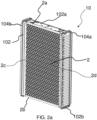
- FIG. 2a illustrates an isometric view of the protection system 10 in accordance with an embodiment of the present invention, wherein at least one net 2 of metal is deployed over the heat exchanger core 102 to cover and protect the heat exchanger core 102 against damage from impact of heavier articles, such as for example stones.
- the at least one net 2 is of meshed configuration and a first pair of opposite sides 2a, 2b and a second pair of opposite sides 2c, 2d define the boundary of the at least one net 2.
- the at least one net 2 is secured to either one of a pair of opposite side plates 102a, 102b of the heat exchanger core 102 and a pair of opposite headers 104a, 104b of the heat exchanger by a metal joining process such as for example brazing or crimping to deploy the at least one net 2 over the heat exchanger core 102.
- the first pair of opposite sides 2a, 2b of at least one net 2 is crimped to the pair of side plates, particularly, the pair of opposite side plates 102a, 102b of the heat exchanger core 102 as illustrated in FIG.2b and FIG. 2c .
- FIG. 2c illustrates a sectional view of the protection system 10 along section line AA, wherein one of the first pair of opposite sides 2a, 2b is depicted crimped on one of the opposite side plates 102a, 102b.
- tabs 2e, 2f on one of the first pair of opposite sides 2a, 2b are depicted in the crimped configuration for securing the one of the opposite sides 2a, 2b of the at least one net 2 to one of the opposite side plates 102a, 102b of the heat exchanger core 102.
- the first pair of opposite sides 2a, 2b of the at least one net 2 is brazed to the opposite side plates 102a, 102b of the heat exchanger core 102.
- the first pair of opposite sides 2a, 2b of the at least one net 2 can be secured to the pair of opposite side plates 102a, 102b of the heat exchanger core 102 by any joining process, particularly, a metal joining process.
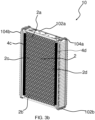
- the at least one net 2 can be mounted over the opposite side plates 102a, 102b via a pair of first frame elements 4a, 4b as illustrated in FIG. 3a .
- the pair of first frame elements 4a, 4b of metal is integrally formed along the first pair of opposite sides 2a, 2b of the at least one net 2 and the first pair of frame elements is either crimped to or brazed on the pair of opposite side plates 102a, 102b.
- first frame elements 4a, 4b integrally formed with the one side of the first pair of opposite sides 2a, 2b of the at least one net 2 is crimped to one of the opposite side plates 102a, 102b.
- the other of first frame elements 4a, 4b integrally formed with the other remaining side 2a, 2b of the at least one net 2 is either crimped to or brazed on the remaining of the opposite side plates 102a, 102b for deploying the at least one net 2 over the heat exchanger core 102.
- the first pair of opposite sides 2a, 2b of the at least one net 2 or the pair of first frame elements 4a, 4b integrally formed along the first pair of the opposite sides 2a, 2b or the pair of frame elements 4a, 4b secured along the first pair of the opposite sides 2a, 2b can be crimped to the pair of opposite side plates 102a, 102b, particularly, to the edges of the pair of opposite side plates 102a, 102b before or after tanks 103a, 103b are assembled onto brazed heat exchanger core 102.
- Such configuration of the metal nets 2 crimped over the pair of opposite side plates 102a, 102b of the heat exchanger core 102 is simple and such method for securing the at least one net 2 over the heat exchanger core 102 is convenient and quick. Further, such metal nets are easily replaceable with new net in case of damage. Still further, as the metal nets are produced in coils or sheets, the metal nets can be conveniently cut as per different dimensions of the heat exchanger core 102.
- the second pair of opposite sides 2c, 2d of the at least one net 2 is secured to the pair of headers 104a, 104b, particularly, the pair of opposite headers 104a, 104b of the heat exchanger by either one of crimping and brazing for deploying the at least one net 2 over the heat exchanger core 102 to cover and protect the heat exchanger core 102 against damage from impact of heavier articles, such as stones.
- the second pair of opposite sides 2c, 2d of the at least one net 2 is brazed to the pair of opposite headers 104a, 104b of the heat exchanger 100.
- the second pair of opposite sides 2c, 2d of the at least one net 2 is crimped to the pair of opposite headers 104a, 104b of the heat exchanger 100.
- the at least one net 2 can also extend beyond the pair of opposite headers 104a, 104b to provide protection to the corresponding pair of tanks 103a, 103b as well along with the heat exchanger core 102.
- the at least one net 2 can be mounted over the opposite headers 104a, 104b via a pair of second frame elements 4c, 4d as illustrated in FIG. 3b .
- the pair second frame elements 4c, 4d of metal integrally formed along the second pair of opposites sides 2c, 2d of the at least one net 2 is either brazed or crimped on the pair of opposite headers 104a, 104b.
- one of the second frame elements 4c, 4d of metal integrally formed with the one side of the second pair of opposite sides 2c, 2d of the at least one net 2 is crimped on the pair of opposite headers 104a, 104b.
- the other of second frame elements 4c, 4d of metal integrally formed on the other, remaining side of the second pair of opposite sides 2c, 2d of the at least one net 2 is crimped to the remaining of the opposite headers 104a, 104b of the heat exchanger 100 for deploying the at least one net 2 over the heat exchanger core 102.
- the net 2 can also extend beyond the pair of opposite headers 104a, 104b to provide protection to the corresponding pair of tanks 103a, 103b of the heat exchanger 100.
- the at least one net or grid 2 is of aluminum or steel.
- the protection system 10 of such configuration utilizing at least one grid or net 2 of metal is robust in construction as the metal net exhibits comparatively better endurance as compared to plastic net.
- the metal net or grid is stronger, comparatively more or bigger holes can be configured on the metal net, that in turn prevents drawbacks associated with barrier to air flow caused by the plastic net having smaller holes disposed in front of the radiator.
- Further metal net or grids provide better thermal stability as compared to the plastic net.
- such configuration of the protection system 10 eliminates the need for configuring additional engagement elements anywhere on the heat exchanger.
- the protection system 10 can be easily configured on or retrofitted over current heat exchangers, particularly, current radiators and /or condensers without requiring any modifications in the current radiators and /or condensers already configured on the vehicle.
- at least one the net 2 being formed of metal only metal joining process can be used for securing at least one of the pair of opposite sides of the at least one net 2 to either one of the pair of opposite side plates 102a, 102b and the pair of headers 104a, 104b as such the connection between the at least one net 2 of metal and either one of the pair of opposite side plates 102a, 102b and the pair of opposite headers 104a, 104b is rigid imparting reliability to the protection system 10.
- the at least one net 2 can be formed of a flexible material and the pair of first frame elements 4a, 4b of metal can be secured along the first pair of opposites sides 2a, 2b of the at least one net 2 by stamping and pressing and the pair of first frame elements 4a, 4b is either crimped on or brazed to the pair of opposite side plates 102a, 102b.
- the present invention is not limited to any particular configuration of the first frame elements 4a, 4b and method for securing the first frame elements 4a, 4b along the first pair of opposites sides 2a, 2b of the at least one net 2 as far as the connection between the first frame elements 4a, 4b and the at least one net 2 is secure.
- one of the first frame elements 4a, 4b secured to and forming a continuous connection with the one side of the first pair of opposite sides 2a, 2b of the at least one net 2 is either crimped on or brazed to one of the opposite side plates 102a, 102b.
- the other of the first frame elements 4a, 4b secured to and forming a continuous connection with the other, remaining side of the first pair of opposite sides 2a, 2b of the at least one net 2 is either crimped on or brazed to the remaining of the opposite side plates 102a, 102b for deploying the at least one net 2 over the heat exchanger core 102.
- the pair of second frame elements 4c, 4d of metal is secured on the second pair of opposite sides 2c, 2d of the at least one net 2 by stamping and pressing and the pair of second frame elements 4c, 4d is either crimped on or brazed to the pair of opposite headers 104a, 104b.
- the present invention is not limited to any particular configuration of the second frame elements 4c, 4d and method for securing the second frame elements 4c, 4d along the second pair of opposites sides 2c, 2d of the at least one net 2 as far as the connection between the second frame elements 4c, 4d and the at least one net 2 is secure.
- one of the second frame elements 4c, 4d secured to and forming continuous connection with one side of the second pair of opposite sides 2c, 2d of the at least one net 2 is either crimped on or brazed to one of the opposite headers of the pair of opposite headers 104a, 104b.
- the other of the second frame elements 4c, 4d secured to and forming continuous connection with the other remaining side of the second pair of opposite sides 2c, 2d of the at least one net 2 is either crimped on or brazed to the remaining of the opposite header of the pair of opposite headers 104a, 104b for deploying the at least one net 2 over the heat exchanger core 102.
- the at least one net 2 can be joined to one of the side plates of the pair of opposite side plates 102a, 102b and one of the headers of the pair of headers 104a, 104b to deploy the at least one net 2 over the heat exchanger core 102.
- the present invention is not limited to a particular configuration of the at least one net 2 and method for securing the at least one net 2 anywhere over the heat exchanger 100 unless the at least one net 2 is capable of being deployed over the heat exchanger core 102 to cover and protect the heat exchanger core 102 against impact of heavier articles such as stones.
- the at least one net 2 of flexible material with metal frames on either one of the first pair of opposite sides 2a, 2b and the second pair of opposite sides 2c, 2d for being either crimped on or brazed to either one of the pair of opposite headers 104a, 104b or the pair of opposite side plates 102a, 102b for deploying the at least one net 2 of flexible material over the heat exchanger core 102
- the at least one net 2 being flexible is adjustably mounted on different heat exchanger cores 102 having slight variation in sizes to define the deployed configuration of the at least one net 2 over the different heat exchanger cores 102.
- the at least one net 2 In the deployed configuration of the at least one net 2 of flexible material over the heat exchanger core 102, the at least one net 2 is in tension and covers at least a portion of the heat exchanger core 102. As the at least one net 2 is in tension, the heavier articles such as stones, gravel, and the likes striking the at least one net 2 bounce back away from the heat exchanger core 102, thereby protecting the heat exchanger core 102 against the impact of the heavier articles such as stones, gravel.
- the at least one net 2 is of metal and is configured by at least one of stamping and pressing operations.
- the at least one net 2 is of either one of Kevlar ® and glass fibre material coated with Poly-tetra-fluoro-ethylene (PTFE) material and acts as a tough barrier to impacting articles.
- PTFE Poly-tetra-fluoro-ethylene
- the coating of Poly-tetra-fluoro-ethylene (PTFE) material imparts flexibility to the at least one net 2.
- the coating of Poly-tetra-fluoro-ethylene (PTFE) material also imparts wear resistance and abrasion resistance to the at least one net 2, thereby extending the service life of the protection system 10.
- the at least one net 2 of Kevlar ® and glass fibre material imparts high strength, high modulus, and toughness along with the thermal stability that renders the at least one net 2 suitable for such applications in which the at least one net 2 may be disposed near a heated surface of the radiator core and still exhibit high strength to withstand heavy impacts of high speed articles.
- the at least one net 2 is configured of strands that are arranged in a criss-crossing manner with respect to each other for configuring a pattern of square shaped apertures or any other pattern as far as the apertures so configured are capable of preventing passage of an article of pre-determined size there through.
- the present invention is not limited to any particular configuration of the at least one net 2 and any particular material for configuring the at least one net 2 as far as the at least one net 2 acts as a strong barrier against impacting articles.
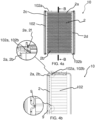
- FIG. 4a - FIG. 4b illustrate the protection system 10 in accordance with another embodiment of the present invention, wherein the least one net 2 of the protection system 10 is configured with a plurality of spacers 9 that maintains the at least one net 2 in spaced apart configuration with respect to the heat exchanger core 102, when the at least one net 2 is deployed over the heat exchanger core 102.
- the predetermined spacing is such that in all conditions the at least one net 2 remains away from the heat exchanger core 102 disposed behind the at least one net 2 and the impact energy of the heavier article cannot deform the at least one net 2 to an extent to cause the at least one net 2 to strike the heat exchanger core 102 and cause damage to the heat exchanger core 102.
- the spacers 9 extend parallel to and along the length of either one of the first pair of opposite sides 2a, 2b or either one of the second pair of opposite sides 2c, 2d.
- the spacers 9 are configured by embossing, however, the present invention is not limited to any particular configuration of the spacers 9, the placement and number of the spacers 9 and method of configuring the spacers 9, as far as the spacers 9 are able of maintain the predetermined spacing between the at least one net 2 and the heat exchanger core 102, when the at least one net 2 is deployed over the heat exchanger core 102.
- FIG. 4b illustrates a sectional view of the protection system 10 along section line BB depicted in FIG. 4a .
- FIGS. an enlarged view crimping connection between one side of the first pair of opposite sides 2a, 2a of the at least one net 02 and one side plate of the pair of opposite side plates 102a, 102b of the heat exchanger core 102. Also, is depicted an enlarged view depicting the spacer 9 configured on the at least one net 2 to maintain the at least one net 2 in spaced apart configuration with respect to the heat exchanger core 102.
- FIG. 5 illustrates an isometric view of the at least one net 2 of the protection system 10 configured with the spaced apart spacers 9.
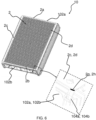
- FIG. 6 illustrates an isometric view of the protection system 10 in accordance to still another embodiment of the present invention.
- the protection system 10 includes at least one net 2, wherein the second pair of opposite sides 2c, 2d of the at least one net 2 is brazed to the pair of opposite headers 104a, 104b of the heat exchanger 100 along brazing sites 2g, 2h to configure secure connection between the second pair of opposite sides 2c, 2d of the at least one net 2 and the pair of headers 104a, 104b to deploy the at least one net 2 over the heat exchanger core 102.
- the second pair of opposite sides 2c, 2d of the at least one net 2 is so aligned and arranged over the pair of opposite headers 104a, 104b that the brazing sites 2g, 2h are disposed between the second pair of opposite sides 2b, 2c of the at least one net 2 and the pair of opposite headers 104a, 104b of the heat exchanger 100 and brazing occurs at the brazing sites 2g, 2h when subjected to heat in brazing furnace to configure brazing joint between the second pair of opposite sides 2c, 2d of the at least one net 2 and the pair of opposite headers 104a, 104b of the heat exchanger 100.
- the brazing joint between the pair of opposite headers 104a, 104b and the second pair of the opposite sides 2c, 2d of the at least one net 2 is formed along with the brazing between the heat exchange tubes and the fins, the pair of opposite headers 104a, 104b and the pair of opposite side plates 102a, 102b of the heat exchanger core 102 and other elements configuring the heat exchanger 100, when these elements are subjected to heat inside the brazing furnace, so that after the brazing process, the pair of opposite headers 104a, 104b is secured to the heat exchanger core 102, the pair of opposite side plates 102a, 102b are secured to the pair of opposite headers 104a, 104b and the at least one net 2 is secured to the pair of opposite headers 104a, 104b in a single step to form a one piece construction of at least one net 2 secured to and covering the heating exchanger core 102 with the pair of opposite side plates 102a, 102b secured to the pair of opposite headers
- the protection system includes at least one net defined by a first pair of opposite sides and a second pair of opposite sides.
- the at least one net is deployed over at least one heat exchanger core to cover at least a portion of the at least one heat exchanger core, wherein the at least one net is secured to either one of a pair of side plates of the at least one heat exchanger core and a pair of opposite headers of the heat exchanger by a metal joining process to deploy the at least one net over the at least one heat exchanger core
Landscapes
- Engineering & Computer Science (AREA)
- Mechanical Engineering (AREA)
- Heat-Exchange Devices With Radiators And Conduit Assemblies (AREA)
Description
- The present disclosure relates to a heat exchanger system, particularly, the present disclosure relates to a protection system for protecting a heat exchanger of a vehicle against impact from heavier articles such as stones, gravel, and the likes.
-
FR 3 066 012 - A vehicle includes several heat exchanger elements. Conventionally, an engine cooling system of a vehicle includes a heat exchanger in form of a radiator to facilitate cooling of an engine of the vehicle. Specifically, a coolant in form of glycol or water-glycol mixture is passed through the engine, from where the coolant absorbs heat and becomes hot. The hot coolant is then fed into an inlet tank of the radiator that is located either on top of the radiator or along one side of the radiator, from the inlet tank the hot coolant is distributed across a radiator core through radiator tubes to another tank on an opposite end of the radiator. As the hot coolant passes through the radiator tubes to the opposite tank, the coolant transfers heat to the radiator tubes of the radiator core, which in turn, transfers the heat to fins that are lodged between each row of radiator tubes. The fins then release the heat to the ambient air that flows across the radiator core. For effective and efficient performance of the radiator, there should be unhindered supply of ambient air to the radiator core. In order to save the power consumption in the vehicle, natural draft of air across the radiator core is utilized. For achieving natural draft of air across the radiator core, the radiator core is disposed behind a front grill of the vehicle, wherein the front grill is disposed between a front hood and a front bumper of the vehicle such that the ram air impinges on the front grille of the vehicle as the vehicle moves in forward direction. Such strategic placement of the radiator core enables the ram air to impinge on and pass through the radiator core disposed behind the front grille, thereby creating natural draft of air across the radiator core as the vehicle moves ahead in the forward direction. The engine cooling system often incorporates one or more fans disposed behind the radiator core to generate a forced draft of air that facilities passage of air through the radiator core. The forced draft generated by the fans improves the performance and efficiency of the radiator by improving the air flow rate through the radiator by increasing the air speed. The radiator may be disposed either alone or in series with other heat exchange elements such as for example, a condenser, a chiller or any other heat exchanger that require draft of air for efficient operation thereof. Also, the sequence in which the radiator, condenser, chillers or any other heat exchanger are disposed may vary, for example, sometimes the radiator is at the front to first receive the ram air and in other cases the condenser is at the front to first receive the ram air. The position of the radiator and the condenser can interchange.
- However, when the vehicle is travelling in off-road conditions or over a rough terrain, heavier articles such as stones, gravel, and the likes may approach the vehicle, cross the front grill through gaps between elements of the front grill and strike a front face of the heat exchanger core, such as for example, radiator core or condenser core. As a result, the heavier article may cause damage to, particularly, may cause cracks in the heat exchange tubes carrying heat exchange fluid there through. The cracks may cause leakage of the heat exchange fluid through the tubes. The continuous leakage of the heat exchange fluid from the heat exchange tubes may result in problems such as pressure loss inside the heat exchanger tubes, heat exchanger tank requiring frequent refilling and inefficient operation of the heat exchanger due to insufficient heat exchange fluid. Conditions such as dropping of heat exchange fluid levels in the heat exchanger, for example radiator below critical level may render the radiator inefficient, thereby resulting in engine seizure due to excessive heat. The cracks may also act as points of stress concentration, thereby may cause mechanical failure of the radiator. In case the heavier articles strike the delicate fin elements disposed between adjacent tubular elements, the fin elements may get damaged and not function as per design, thereby deteriorating efficiency and performance of the heat exchanger. Further, lighter articles such as paper, empty polythene bags, leaves and the likes carried with the ram air may get accumulated at the front face of the heat exchanger core, causing hindrance to air flow and preventing ram air from reaching and moving across the radiator or condenser core, thereby deteriorating efficiency and performance of the radiator or condenser.
- Accordingly, there is a need for a protection system that not only protects the heat exchanger core such as radiator and/or condenser core against impact of heavier articles such as stones, gravel, and the likes but also maintains efficiency and performance of the radiator and/or condenser. Further, there is a need for protection system that is adjustable and that can be applied on different sized heat exchanger cores for protection thereof. Still further, there is a need for a protection system that acts as a barrier in front of the radiator or condenser core and prevents heavier article such as stones, gravel, and the likes from impacting and damaging the radiator and/or condenser core, while still not compromising air flow through the radiator or condenser core. Still further, there is a need for a protective system that prevents lighter articles from causing hindrance to air flow to radiator or condenser while still maintaining the efficiency and performance of the radiator or condenser. Still further, there is a need for a protective system that is stably held in place away from the radiator or condenser and prevents noise generation due to vibrations or hard to hard contact between the elements of the protective system and the radiator or the condenser. Yet another object of the present invention is to provide a protection system that can be conveniently and quickly configured or assembled or retrofitted on the heat exchanger without requiring any dedicated tools for configuring the assembly. Yet another object of the present invention is to provide a protection system that forms a secure connection with the heat exchanger core. Still another object of the present invention is to provide a protection system that enhances service life and reliability of the heat exchanger core. Yet another object of the present invention is to provide a protection system that is easily replaceable and requires less maintenance. Still another object of the present invention is to provide a protection system that effectively dissipates high impact energy of the heavier article before the heavier article incase hits the heat exchanger core.
- An object of the present invention is to provide a protection system that acts as a barrier to protect a heat exchanger core, particularly, a radiator core and/or condenser core against damage from impact of heavier articles such as stones, gravel, and the likes, while still not compromising air flow through the radiator or condenser core.
- An object of the present invention is to provide a protection system that can be mounted on different sized heat exchanger cores for protecting the different sized heat exchanger cores.
- Still another object of the present invention is to provide a protection system that can be easily retrofitted over current radiators and /or condensers without requiring any modifications in the current radiators and /or condensers and without requiring dedicated tools for the assembly.
- Another object of the present invention is to provide a protection system that can be maintained in a spaced configuration with respect to the heat exchanger core, thereby preventing noise generation caused by hard to hard contact during vibrations and also effectively dissipating high impact energy of the heavier article before the heavier article incase hits the heat exchanger core.
- Another object of the present invention is to provide a protection system that enhances service life of a heat exchanger such as a radiator and/or condenser and reduces maintenance thereof.
- Yet another object of the present invention is to provide a protection system that is inexpensive and also convenient to manufacture, assemble and use.
- Still another object of the present invention is to provide a protective system that prevents lighter articles such as paper, polythene bags and leaves from getting in to path of ram air approaching a heat exchanger core such as for example, a radiator core and /or condenser core.
- In the present description, some elements or parameters may be indexed, such as a first element and a second element. In this case, unless stated otherwise, this indexation is only meant to differentiate and name elements which are similar but not identical. No idea of priority should be inferred from such indexation, as these terms may be switched without betraying the invention. Additionally, this indexation does not imply any order in mounting or use of the elements of the invention.
- A protection system for a heat exchanger is disclosed in accordance with an embodiment of the present invention. The protection system includes at least one net defined by a first pair of opposite sides and a second pair of opposite sides. The at least one net is deployed over at least one heat exchanger core to cover at least a portion of the at least one heat exchanger core, wherein the at least one net is secured to either one of a pair of side plates of the at least one heat exchanger core and a pair of opposite headers of the heat exchanger by a metal joining process to deploy the at least one net over the at least one heat exchanger core.
- Generally, the first pair of opposite sides of the at least one net is secured to the pair of side plates of the at least one heat exchanger core.
- Specifically, the at least one net is of metal and the first pair of opposite sides of the at least one net is crimped to the pair of side plates of the at least one heat exchanger core.
- Alternatively, the at least one net is of metal and the first pair of opposite sides of the at least one net is brazed to the pair of side plates of the at least one heat exchanger core.
- In accordance with an embodiment of the present invention, the second pair of opposite sides of the at least one net is secured to the pair of opposite headers of the heat exchanger to deploy the at least one net over the at least one heat exchanger core.
- Specifically, the at least one net is of metal and the second pair of opposite sides of the at least one net is brazed to the pair of opposite headers of the heat exchanger.
- Alternatively, at least one net is of metal and the second pair of opposite sides of the at least one net is crimped to the pair of opposite headers of the heat exchanger.
- In accordance with the invention of the present invention, the at least one net includes a pair of first frame elements of metal integrally formed on the first pair of opposites sides thereof and crimped on the pair of side plates.
- Additionally, the at least one net is of flexible material and the pair of first frame elements of metal is secured on the first pair of opposites sides of the at least one net by stamping and pressing, the pair of first frame elements is crimped on the pair of side plates.
- In accordance with an embodiment, at least one net includes a pair of second frame elements of metal integrally formed on the second pair of opposite sides thereof and crimped on the pair of opposite headers of the heat exchanger.
- In this embodiment, optionally the at least one net is of flexible material and the pair of second frame elements of metal is secured on the second pair of opposite sides of the at least one net by stamping and pressing, the pair of second frame elements is crimped on the pair of opposite headers of the heat exchanger.
- In accordance with an embodiment which does not form part of the present invention, the at least one net is of either one of Kevlar® and glass fibre material coated with Poly-tetra-fluoro-ethylene (PTFE) material.
- Preferably, the at least one net is configured with plurality of spacers to maintain at least one net in a spaced apart with respect to the at least one heat exchanger core when the at least one net is deployed on the at least one heat exchanger core.
- In accordance with another embodiment of the present invention, the at least one net is able to be joined to one of the side plates of the pair of side plates and one of the headers of the pair of headers to deploy the at least one net over the at least one heat exchanger core.
- Other characteristics, details and advantages of the invention can be inferred from the description of the invention hereunder. A more complete appreciation of the invention and many of the attendant advantages thereof will be readily obtained as the same becomes better understood by reference to the following detailed description when considered in connection with the accompanying figures, wherein:
-
FIG. 1 illustrates a front view of a heat exchanger depicting a heat exchanger core on which a protection system is to be deployed for protecting the heat exchanger core against damage from impact of heavier articles; -
FIG. 2a an isometric view of a protection system in accordance with an embodiment of the present invention, wherein a first pair of opposite sides of at least one net are crimped to a pair of opposite side plates of the heat exchanger core of heat exchanger ofFIG. 1 ; -
FIG. 2b illustrates a front view of the protection system ofFIG. 2a ; -
FIG. 2c illustrates a sectional view of the protection system along section line AA ofFIG. 2b ; -
FIG. 3a illustrates an isometric view of a protection system in accordance with another embodiment of the present invention, wherein a pair of first frame elements is integrally formed on the first pair of opposites sides of at least one net ofFIG. 2a and is crimped to a pair of opposite side plates of a heat exchanger core; -
FIG. 3b illustrates an isometric view of a protection system in accordance with still another embodiment of the present invention, wherein a second pair of frame elements is integrally formed on the second pair of opposite sides of the at least one net ofFIG. 2a and is crimped to a pair of opposite headers of a heat exchanger; -
FIG. 4a illustrates a schematic representation of a protection system in accordance with yet another embodiment of the present invention, wherein at least one net of the protection system is configured with a plurality of spacers for maintaining the at least one net at a distance from a heat exchanger core; -
FIG. 4b illustrates a sectional view of the protection system along section line B-B ofFIG. 4a , also is illustrated an enlarged view depicting crimping connection between a side of a first pair of opposite sides of at least one net and a side plate of a pair of opposite side plates of a heat exchanger core, further is illustrated an enlarged view of a spacer configured on the at least one net; -
FIG. 5 illustrates an isometric view of the at least one net of the protection system ofFIG. 4a and FIG. 4b configured with the spaced apart spacers in accordance with an embodiment of the present invention; and -
FIG. 6 illustrates an isometric view of a protection system in accordance with still another embodiment of the present invention, wherein second pair of opposite sides of at least one net is brazed to a pair of headers of a heat exchanger, also is illustrated an enlarged view of a brazed connection. - The present invention envisages a protection system that includes at least one net with a first pair of opposite sides thereof crimped to a pair of opposite side plates of at least one heat exchanger core, simply referred to as heat exchanger core to securely deploy the at least one net over the heat exchanger core to cover and protect the heat exchanger core against impact of heavier articles such as stones, gravel, and the likes. In accordance with an alternate embodiment of the present invention, a second pair of opposite sides of the at least one net is brazed to a pair of opposite headers of a heat exchanger to securely deploy the at least one net over the heat exchanger core to cover and protect the heat exchanger core against impact of heavier articles such as stones, gravel, and the likes. There could be other ways of deploying the at least on net over the heat exchanger core other than crimping or brazing the net to either one of the pair of side plates and the pair of headers. The protection system covers and provides protection to the at least one heat exchanger core of a vehicle, such as for example, a radiator core and/or a condenser core against impact from heavier articles such as stones, gravel, and the likes. Although, the protection system of the present invention is used in heat exchangers, such as radiators, condensers and evaporators that are used in vehicles, however, the protection system of the present invention is also applicable to be deployed on any other heat exchangers or delicate elements used in vehicular and nonvehicular applications and that require protection against impact of heavier articles such as stones and gravels striking such elements.
-
FIG. 1 illustrates a front view of a heat exchanger 100 depicting aheat exchanger core 102 on which aprotection system 10 is to be deployed for protecting theheat exchanger core 102 against damage from impact of heavier articles.FIG. 2a , illustrates an isometric view of theprotection system 10 in accordance with an embodiment of the present invention, wherein at least onenet 2 of metal is deployed over theheat exchanger core 102 to cover and protect theheat exchanger core 102 against damage from impact of heavier articles, such as for example stones. The at least one net 2 is of meshed configuration and a first pair ofopposite sides opposite sides net 2. For deploying the at least one net 2 over theheat exchanger core 102, the at least one net 2 is secured to either one of a pair ofopposite side plates heat exchanger core 102 and a pair ofopposite headers heat exchanger core 102. The first pair ofopposite sides opposite side plates heat exchanger core 102 as illustrated inFIG.2b and FIG. 2c . Specifically, one of the first pair ofopposite sides opposite side plates opposite sides opposite side plates heat exchanger core 102.FIG. 2c illustrates a sectional view of theprotection system 10 along section line AA, wherein one of the first pair ofopposite sides opposite side plates tabs opposite sides opposite sides opposite side plates heat exchanger core 102. In accordance with another embodiment, the first pair ofopposite sides opposite side plates heat exchanger core 102. However, the first pair ofopposite sides opposite side plates heat exchanger core 102 by any joining process, particularly, a metal joining process. - Instead of the at least one net 2 being directly mounted on the
opposite side plates heat exchanger core 102, the at least one net 2 can be mounted over theopposite side plates first frame elements FIG. 3a . Specifically, the pair offirst frame elements opposite sides opposite side plates first frame elements opposite sides opposite side plates first frame elements side opposite side plates heat exchanger core 102. - The first pair of
opposite sides first frame elements opposite sides frame elements opposite sides opposite side plates opposite side plates tanks heat exchanger core 102. Such configuration of themetal nets 2 crimped over the pair ofopposite side plates heat exchanger core 102 is simple and such method for securing the at least one net 2 over theheat exchanger core 102 is convenient and quick. Further, such metal nets are easily replaceable with new net in case of damage. Still further, as the metal nets are produced in coils or sheets, the metal nets can be conveniently cut as per different dimensions of theheat exchanger core 102. - In accordance with another embodiment, the second pair of
opposite sides headers opposite headers heat exchanger core 102 to cover and protect theheat exchanger core 102 against damage from impact of heavier articles, such as stones. In one embodiment, the second pair ofopposite sides opposite headers opposite sides opposite headers opposite headers tanks heat exchanger core 102. - Instead of the at least one net 2 being directly mounted on the pair of
opposite headers opposite headers second frame elements FIG. 3b . Specifically, the pairsecond frame elements opposite headers second frame elements opposite sides opposite headers second frame elements opposite sides opposite headers heat exchanger core 102. The net 2 can also extend beyond the pair ofopposite headers tanks - The at least one net or
grid 2 is of aluminum or steel. There are several advantages of using at least onenet 2 of metal. Specifically, theprotection system 10 of such configuration utilizing at least one grid ornet 2 of metal is robust in construction as the metal net exhibits comparatively better endurance as compared to plastic net. Further as the metal net or grid is stronger, comparatively more or bigger holes can be configured on the metal net, that in turn prevents drawbacks associated with barrier to air flow caused by the plastic net having smaller holes disposed in front of the radiator. Further metal net or grids provide better thermal stability as compared to the plastic net. Further, such configuration of theprotection system 10 eliminates the need for configuring additional engagement elements anywhere on the heat exchanger. As such theprotection system 10 can be easily configured on or retrofitted over current heat exchangers, particularly, current radiators and /or condensers without requiring any modifications in the current radiators and /or condensers already configured on the vehicle. Also, at least one thenet 2 being formed of metal, only metal joining process can be used for securing at least one of the pair of opposite sides of the at least one net 2 to either one of the pair ofopposite side plates headers net 2 of metal and either one of the pair ofopposite side plates opposite headers protection system 10. - However, instead of the at least one net 2 being formed of metal, the at least one net 2 can be formed of a flexible material and the pair of
first frame elements opposites sides first frame elements opposite side plates first frame elements first frame elements opposites sides first frame elements first frame elements opposite sides opposite side plates first frame elements opposite sides opposite side plates heat exchanger core 102. - Alternatively, in case the at least one net 2 is of flexible material, the pair of
second frame elements opposite sides second frame elements opposite headers second frame elements second frame elements second frame elements second frame elements opposite sides opposite headers second frame elements opposite sides opposite headers heat exchanger core 102. - Apart from above mentioned configurations of the at least one net 2 and method for deploying the at least one net 2 over the
heat exchanger core 102, there could be different configurations of the at least one net 2 and methods for securely deploying the at least one net 2 over theheat exchanger core 102. For example, instead of the at least one net 2 being joined to either one of the pair ofopposite side plates opposite headers opposite side plates headers heat exchanger core 102. Particularly, the present invention is not limited to a particular configuration of the at least one net 2 and method for securing the at least one net 2 anywhere over the heat exchanger 100 unless the at least one net 2 is capable of being deployed over theheat exchanger core 102 to cover and protect theheat exchanger core 102 against impact of heavier articles such as stones. - Also, there are advantages associated with using the at least one
net 2 of flexible material with metal frames on either one of the first pair ofopposite sides opposite sides opposite headers opposite side plates net 2 of flexible material over theheat exchanger core 102, for example, the at least one net 2 being flexible is adjustably mounted on differentheat exchanger cores 102 having slight variation in sizes to define the deployed configuration of the at least one net 2 over the differentheat exchanger cores 102. In the deployed configuration of the at least onenet 2 of flexible material over theheat exchanger core 102, the at least one net 2 is in tension and covers at least a portion of theheat exchanger core 102. As the at least one net 2 is in tension, the heavier articles such as stones, gravel, and the likes striking the at least one net 2 bounce back away from theheat exchanger core 102, thereby protecting theheat exchanger core 102 against the impact of the heavier articles such as stones, gravel. In accordance with another embodiment of the present invention, the at least one net 2 is of metal and is configured by at least one of stamping and pressing operations. In accordance with still another embodiment which does not form part of the present invention, the at least one net 2 is of either one of Kevlar® and glass fibre material coated with Poly-tetra-fluoro-ethylene (PTFE) material and acts as a tough barrier to impacting articles. The coating of Poly-tetra-fluoro-ethylene (PTFE) material imparts flexibility to the at least onenet 2. The coating of Poly-tetra-fluoro-ethylene (PTFE) material also imparts wear resistance and abrasion resistance to the at least one net 2, thereby extending the service life of theprotection system 10. Such configuration of the at least onenet 2 of Kevlar® and glass fibre material imparts high strength, high modulus, and toughness along with the thermal stability that renders the at least one net 2 suitable for such applications in which the at least one net 2 may be disposed near a heated surface of the radiator core and still exhibit high strength to withstand heavy impacts of high speed articles. In accordance with another embodiment, the at least one net 2 is configured of strands that are arranged in a criss-crossing manner with respect to each other for configuring a pattern of square shaped apertures or any other pattern as far as the apertures so configured are capable of preventing passage of an article of pre-determined size there through. However, the present invention is not limited to any particular configuration of the at least one net 2 and any particular material for configuring the at least one net 2 as far as the at least one net 2 acts as a strong barrier against impacting articles. -
FIG. 4a - FIG. 4b , illustrate theprotection system 10 in accordance with another embodiment of the present invention, wherein the least onenet 2 of theprotection system 10 is configured with a plurality ofspacers 9 that maintains the at least one net 2 in spaced apart configuration with respect to theheat exchanger core 102, when the at least one net 2 is deployed over theheat exchanger core 102. The predetermined spacing is such that in all conditions the at least one net 2 remains away from theheat exchanger core 102 disposed behind the at least one net 2 and the impact energy of the heavier article cannot deform the at least one net 2 to an extent to cause the at least one net 2 to strike theheat exchanger core 102 and cause damage to theheat exchanger core 102. Thespacers 9 extend parallel to and along the length of either one of the first pair ofopposite sides opposite sides spacers 9 are configured by embossing, however, the present invention is not limited to any particular configuration of thespacers 9, the placement and number of thespacers 9 and method of configuring thespacers 9, as far as thespacers 9 are able of maintain the predetermined spacing between the at least one net 2 and theheat exchanger core 102, when the at least one net 2 is deployed over theheat exchanger core 102.FIG. 4b illustrates a sectional view of theprotection system 10 along section line BB depicted inFIG. 4a . Also are depicted in the FIGS., an enlarged view crimping connection between one side of the first pair ofopposite sides opposite side plates heat exchanger core 102. Also, is depicted an enlarged view depicting thespacer 9 configured on the at least one net 2 to maintain the at least one net 2 in spaced apart configuration with respect to theheat exchanger core 102.FIG. 5 illustrates an isometric view of the at least onenet 2 of theprotection system 10 configured with the spaced apartspacers 9. -
FIG. 6 illustrates an isometric view of theprotection system 10 in accordance to still another embodiment of the present invention. Theprotection system 10 includes at least one net 2, wherein the second pair ofopposite sides opposite headers opposite sides headers heat exchanger core 102. Also, is illustrated an enlarged view of a brazed connection between one side of the second pair ofopposite sides opposite sides opposite headers opposite sides opposite headers opposite sides opposite headers opposite headers opposite sides opposite headers opposite side plates heat exchanger core 102 and other elements configuring the heat exchanger 100, when these elements are subjected to heat inside the brazing furnace, so that after the brazing process, the pair ofopposite headers heat exchanger core 102, the pair ofopposite side plates opposite headers opposite headers heating exchanger core 102 with the pair ofopposite side plates opposite headers - Several modifications and improvement might be applied by the person skilled in the art to the protection system as defined above and such modifications and improvements will still be considered within the scope of the present invention, as long as it includes at least one net defined by a first pair of opposite sides and a second pair of opposite sides. The at least one net is deployed over at least one heat exchanger core to cover at least a portion of the at least one heat exchanger core, wherein the at least one net is secured to either one of a pair of side plates of the at least one heat exchanger core and a pair of opposite headers of the heat exchanger by a metal joining process to deploy the at least one net over the at least one heat exchanger core
- In any case, the invention cannot and should not be limited to the embodiments specifically described in this document, as other embodiments might exist. The invention shall spread to any equivalent means and any technically operating combination of means.
Claims (10)
- A protection system (10) for a heat exchanger (100), said protection system (10) comprising at least one net (2) defined by a first pair of opposite sides (2a, 2b) and a second pair of opposite sides (2c, 2d), said at least one net (2) adapted to be deployed over at least one heat exchanger core (102) to cover at least a portion of the at least one heat exchanger core (102), wherein said at least one net (2) is adapted to be secured to either one of a pair of side plates (102a, 102b) of said at least one heat exchanger core (102) and a pair of headers (104a, 104b) of said heat exchanger (100) by a metal joining process to deploy said at least one net (2) over said at least one heat exchanger core (102), wherein said at least one net (2) is of metal and said second pair of opposite sides (2c, 2d) of the at least one net (2) is adapted to be crimped to the pair of headers (104a, 104b) of the heat exchanger (100), characterized in that said at least one net (2) comprises a pair of first frame elements (4a, 4b) of metal integrally formed on said first pair of opposite sides (2a, 2b) thereof and adapted to be crimped on said pair of side plates (102a, 102b), wherein said at least one net (2) is of flexible material and said pair of first frame elements (4a, 4b) of metal is secured on said first pair of opposites sides (2a, 2b) of said at least one net (2) by stamping and pressing, said pair of first frame elements (4a, 4b) is adapted to be crimped on said pair of side plates (102a, 102b).
- The protection system (10) as claimed in the previous claim, wherein said first pair of opposite sides (2a, 2b) of said at least one net (2) is adapted to be secured to said pair of side plates (102a, 102b) of said at least one heat exchanger core (102).
- The protection system (10) as claimed in any of the preceding claims, wherein said at least one net (2) is of metal and said first pair of opposite sides (2a, 2b) of the at least one net (2) is adapted to be crimped to said pair of side plates (102a, 102b) of said at least one heat exchanger core (102).
- The protection system (10) as claimed in claim 1 or 2, wherein said at least one net (2) is of metal and said first pair of opposite sides (2a, 2b) of the at least one net (2) is adapted to be brazed to said pair of side plates (102a, 102b) of said at least one heat exchanger core (102).
- The protection system (10) as claimed in any of the preceding claims, wherein said second pair of opposite sides (2c, 2d) of said at least one net (2) is adapted to be secured to said pair of headers (104a, 104b) of said heat exchanger (102) to deploy said at least one net (2) over said at least one heat exchanger core (102).
- The protection system (10) as claimed in any of the preceding claims, wherein said at least one net (2) is of metal and said second pair of opposite sides (2c, 2d) of the at least one net (2) is adapted to be brazed to the pair of headers (104a, 104b) of the heat exchanger (100).
- The protection system (10) as claimed in the any of the preceding claims, wherein said at least one net (2) comprising a pair of second frame elements (4c, 4d) of metal integrally formed on said second pair of opposites sides (2c, 2d) thereof and adapted to be crimped on said pair of headers (104a, 104b) of the heat exchanger (100).
- The protection system (10) as claimed in the claim 8, wherein said at least one net (2) is of flexible material and said pair of second frame elements (4c, 4d) of metal is secured on said second pair of opposite sides (2c, 2d) of said at least one net (2) by stamping and pressing, said pair of second frame elements (4c, 4d) is adapted to be crimped on said pair of headers (104a, 104b) of the heat exchanger (100).
- The protection system (10) as claimed in any of the preceding claims, wherein said at least one net (2) is configured with plurality of spacers (9) adapted to maintain at least one net (2) in a spaced apart configuration with respect to said at least one heat exchanger core (102), when the at least one net (2) is deployed on said at least one heat exchanger core (102).
- The protection system (10) as claimed in any of the preceding claims, wherein said at least one net (2) being able to be joined to one of said side plates of said pair of side plates (102a, 102b) and one of said headers of said pair of headers (104a, 104b) to deploy said at least one at least one net (2) over said heat exchanger core (102).
Priority Applications (1)
| Application Number | Priority Date | Filing Date | Title |
|---|---|---|---|
| EP19461560.5A EP3770024B1 (en) | 2019-07-23 | 2019-07-23 | A protection system for a heat exchanger |
Applications Claiming Priority (1)
| Application Number | Priority Date | Filing Date | Title |
|---|---|---|---|
| EP19461560.5A EP3770024B1 (en) | 2019-07-23 | 2019-07-23 | A protection system for a heat exchanger |
Publications (2)
| Publication Number | Publication Date |
|---|---|
| EP3770024A1 EP3770024A1 (en) | 2021-01-27 |
| EP3770024B1 true EP3770024B1 (en) | 2024-04-24 |
Family
ID=67438779
Family Applications (1)
| Application Number | Title | Priority Date | Filing Date |
|---|---|---|---|
| EP19461560.5A Active EP3770024B1 (en) | 2019-07-23 | 2019-07-23 | A protection system for a heat exchanger |
Country Status (1)
| Country | Link |
|---|---|
| EP (1) | EP3770024B1 (en) |
Family Cites Families (3)
| Publication number | Priority date | Publication date | Assignee | Title |
|---|---|---|---|---|
| FR3066012A1 (en) * | 2017-05-02 | 2018-11-09 | Valeo Systemes Thermiques | HEAT EXCHANGE DEVICE FOR MOTOR VEHICLE |
| FR3079453B1 (en) * | 2017-05-02 | 2021-03-05 | Valeo Systemes Thermiques | HEAT EXCHANGE DEVICE INCLUDING A PROTECTION NET |
| CN208952713U (en) * | 2018-09-18 | 2019-06-07 | 北京朝阳新兴制冷设备厂 | Condenser with safeguard function |
-
2019
- 2019-07-23 EP EP19461560.5A patent/EP3770024B1/en active Active
Also Published As
| Publication number | Publication date |
|---|---|
| EP3770024A1 (en) | 2021-01-27 |
Similar Documents
| Publication | Publication Date | Title |
|---|---|---|
| JP5473656B2 (en) | Protection device for vehicle heat exchanger | |
| EP2727756B1 (en) | Vehicle cooling system | |
| EP2645041A2 (en) | Heat exchanger tube and heat exchanger | |
| US11346608B2 (en) | Heat exchanger with improved plugging resistance | |
| US20030141046A1 (en) | Heat exchanger | |
| US20100089546A1 (en) | Vehicle heat exchangers having shielding channels | |
| US10545000B2 (en) | Reinforcing clip and heat exchanger | |
| EP3591328B1 (en) | A heat exchanger module with protective grid for directing and distributing air | |
| EP3770024B1 (en) | A protection system for a heat exchanger | |
| CN109661553B (en) | Fin Enhancement for Low Reynolds Number Airflow | |
| JP2006078035A (en) | Heat exchanger | |
| JP2007291937A (en) | Protective member structure of heat exchanger for vehicles | |
| US20220252362A1 (en) | A protection system for a heat exchanger | |
| EP3671099A1 (en) | A protection grid for a heat exchanger module | |
| KR20010012282A (en) | Device for protecting the radiator of a motor vehicle against projected particle | |
| EP3943865A1 (en) | A heat exchanger assembly | |
| US6237678B1 (en) | Heat exchanger | |
| EP3590771B1 (en) | A protective grid system with sealing elements | |
| US6729382B2 (en) | Condenser for vehicle air-conditioning systems | |
| JP2020143873A (en) | Heat exchanger manufacturing method and heat exchanger | |
| JP2017101842A (en) | Heat exchanger | |
| EP0061873A2 (en) | Damage resistant heat exchanger | |
| JP4200857B2 (en) | Dust-proof net for heat exchanger | |
| CN110998212A (en) | Heat exchanger with protection device and relative manufacturing method | |
| JP4062119B2 (en) | Heat exchanger |
Legal Events
| Date | Code | Title | Description |
|---|---|---|---|
| PUAI | Public reference made under article 153(3) epc to a published international application that has entered the european phase |
Free format text: ORIGINAL CODE: 0009012 |
|
| STAA | Information on the status of an ep patent application or granted ep patent |
Free format text: STATUS: THE APPLICATION HAS BEEN PUBLISHED |
|
| AK | Designated contracting states |
Kind code of ref document: A1 Designated state(s): AL AT BE BG CH CY CZ DE DK EE ES FI FR GB GR HR HU IE IS IT LI LT LU LV MC MK MT NL NO PL PT RO RS SE SI SK SM TR |
|
| AX | Request for extension of the european patent |
Extension state: BA ME |
|
| STAA | Information on the status of an ep patent application or granted ep patent |
Free format text: STATUS: REQUEST FOR EXAMINATION WAS MADE |
|
| 17P | Request for examination filed |
Effective date: 20210706 |
|
| RBV | Designated contracting states (corrected) |
Designated state(s): AL AT BE BG CH CY CZ DE DK EE ES FI FR GB GR HR HU IE IS IT LI LT LU LV MC MK MT NL NO PL PT RO RS SE SI SK SM TR |
|
| STAA | Information on the status of an ep patent application or granted ep patent |
Free format text: STATUS: EXAMINATION IS IN PROGRESS |
|
| 17Q | First examination report despatched |
Effective date: 20230321 |
|
| P01 | Opt-out of the competence of the unified patent court (upc) registered |
Effective date: 20230528 |
|
| GRAP | Despatch of communication of intention to grant a patent |
Free format text: ORIGINAL CODE: EPIDOSNIGR1 |
|
| STAA | Information on the status of an ep patent application or granted ep patent |
Free format text: STATUS: GRANT OF PATENT IS INTENDED |
|
| INTG | Intention to grant announced |
Effective date: 20231120 |
|
| GRAS | Grant fee paid |
Free format text: ORIGINAL CODE: EPIDOSNIGR3 |
|
| GRAA | (expected) grant |
Free format text: ORIGINAL CODE: 0009210 |
|
| STAA | Information on the status of an ep patent application or granted ep patent |
Free format text: STATUS: THE PATENT HAS BEEN GRANTED |
|
| AK | Designated contracting states |
Kind code of ref document: B1 Designated state(s): AL AT BE BG CH CY CZ DE DK EE ES FI FR GB GR HR HU IE IS IT LI LT LU LV MC MK MT NL NO PL PT RO RS SE SI SK SM TR |
|
| REG | Reference to a national code |
Ref country code: GB Ref legal event code: FG4D |
|
| REG | Reference to a national code |
Ref country code: CH Ref legal event code: EP |
|
| REG | Reference to a national code |
Ref country code: DE Ref legal event code: R096 Ref document number: 602019050808 Country of ref document: DE |
|
| REG | Reference to a national code |
Ref country code: IE Ref legal event code: FG4D |
|
| REG | Reference to a national code |
Ref country code: LT Ref legal event code: MG9D |
|
| REG | Reference to a national code |
Ref country code: NL Ref legal event code: MP Effective date: 20240424 |
|
| REG | Reference to a national code |
Ref country code: AT Ref legal event code: MK05 Ref document number: 1679268 Country of ref document: AT Kind code of ref document: T Effective date: 20240424 |
|
| PG25 | Lapsed in a contracting state [announced via postgrant information from national office to epo] |
Ref country code: NL Free format text: LAPSE BECAUSE OF FAILURE TO SUBMIT A TRANSLATION OF THE DESCRIPTION OR TO PAY THE FEE WITHIN THE PRESCRIBED TIME-LIMIT Effective date: 20240424 |
|
| PG25 | Lapsed in a contracting state [announced via postgrant information from national office to epo] |
Ref country code: NL Free format text: LAPSE BECAUSE OF FAILURE TO SUBMIT A TRANSLATION OF THE DESCRIPTION OR TO PAY THE FEE WITHIN THE PRESCRIBED TIME-LIMIT Effective date: 20240424 |
|
| PG25 | Lapsed in a contracting state [announced via postgrant information from national office to epo] |
Ref country code: IS Free format text: LAPSE BECAUSE OF FAILURE TO SUBMIT A TRANSLATION OF THE DESCRIPTION OR TO PAY THE FEE WITHIN THE PRESCRIBED TIME-LIMIT Effective date: 20240824 |
|
| PG25 | Lapsed in a contracting state [announced via postgrant information from national office to epo] |
Ref country code: BG Free format text: LAPSE BECAUSE OF FAILURE TO SUBMIT A TRANSLATION OF THE DESCRIPTION OR TO PAY THE FEE WITHIN THE PRESCRIBED TIME-LIMIT Effective date: 20240424 |
|
| PG25 | Lapsed in a contracting state [announced via postgrant information from national office to epo] |
Ref country code: HR Free format text: LAPSE BECAUSE OF FAILURE TO SUBMIT A TRANSLATION OF THE DESCRIPTION OR TO PAY THE FEE WITHIN THE PRESCRIBED TIME-LIMIT Effective date: 20240424 Ref country code: FI Free format text: LAPSE BECAUSE OF FAILURE TO SUBMIT A TRANSLATION OF THE DESCRIPTION OR TO PAY THE FEE WITHIN THE PRESCRIBED TIME-LIMIT Effective date: 20240424 |
|
| PG25 | Lapsed in a contracting state [announced via postgrant information from national office to epo] |
Ref country code: GR Free format text: LAPSE BECAUSE OF FAILURE TO SUBMIT A TRANSLATION OF THE DESCRIPTION OR TO PAY THE FEE WITHIN THE PRESCRIBED TIME-LIMIT Effective date: 20240725 |
|
| PG25 | Lapsed in a contracting state [announced via postgrant information from national office to epo] |
Ref country code: PT Free format text: LAPSE BECAUSE OF FAILURE TO SUBMIT A TRANSLATION OF THE DESCRIPTION OR TO PAY THE FEE WITHIN THE PRESCRIBED TIME-LIMIT Effective date: 20240826 |
|
| PG25 | Lapsed in a contracting state [announced via postgrant information from national office to epo] |
Ref country code: ES Free format text: LAPSE BECAUSE OF FAILURE TO SUBMIT A TRANSLATION OF THE DESCRIPTION OR TO PAY THE FEE WITHIN THE PRESCRIBED TIME-LIMIT Effective date: 20240424 |
|
| PG25 | Lapsed in a contracting state [announced via postgrant information from national office to epo] |
Ref country code: AT Free format text: LAPSE BECAUSE OF FAILURE TO SUBMIT A TRANSLATION OF THE DESCRIPTION OR TO PAY THE FEE WITHIN THE PRESCRIBED TIME-LIMIT Effective date: 20240424 |
|
| PG25 | Lapsed in a contracting state [announced via postgrant information from national office to epo] |
Ref country code: PL Free format text: LAPSE BECAUSE OF FAILURE TO SUBMIT A TRANSLATION OF THE DESCRIPTION OR TO PAY THE FEE WITHIN THE PRESCRIBED TIME-LIMIT Effective date: 20240424 |
|
| PG25 | Lapsed in a contracting state [announced via postgrant information from national office to epo] |
Ref country code: LV Free format text: LAPSE BECAUSE OF FAILURE TO SUBMIT A TRANSLATION OF THE DESCRIPTION OR TO PAY THE FEE WITHIN THE PRESCRIBED TIME-LIMIT Effective date: 20240424 |
|
| PG25 | Lapsed in a contracting state [announced via postgrant information from national office to epo] |
Ref country code: PT Free format text: LAPSE BECAUSE OF FAILURE TO SUBMIT A TRANSLATION OF THE DESCRIPTION OR TO PAY THE FEE WITHIN THE PRESCRIBED TIME-LIMIT Effective date: 20240826 Ref country code: PL Free format text: LAPSE BECAUSE OF FAILURE TO SUBMIT A TRANSLATION OF THE DESCRIPTION OR TO PAY THE FEE WITHIN THE PRESCRIBED TIME-LIMIT Effective date: 20240424 Ref country code: NO Free format text: LAPSE BECAUSE OF FAILURE TO SUBMIT A TRANSLATION OF THE DESCRIPTION OR TO PAY THE FEE WITHIN THE PRESCRIBED TIME-LIMIT Effective date: 20240724 Ref country code: LV Free format text: LAPSE BECAUSE OF FAILURE TO SUBMIT A TRANSLATION OF THE DESCRIPTION OR TO PAY THE FEE WITHIN THE PRESCRIBED TIME-LIMIT Effective date: 20240424 Ref country code: IS Free format text: LAPSE BECAUSE OF FAILURE TO SUBMIT A TRANSLATION OF THE DESCRIPTION OR TO PAY THE FEE WITHIN THE PRESCRIBED TIME-LIMIT Effective date: 20240824 Ref country code: HR Free format text: LAPSE BECAUSE OF FAILURE TO SUBMIT A TRANSLATION OF THE DESCRIPTION OR TO PAY THE FEE WITHIN THE PRESCRIBED TIME-LIMIT Effective date: 20240424 Ref country code: GR Free format text: LAPSE BECAUSE OF FAILURE TO SUBMIT A TRANSLATION OF THE DESCRIPTION OR TO PAY THE FEE WITHIN THE PRESCRIBED TIME-LIMIT Effective date: 20240725 Ref country code: FI Free format text: LAPSE BECAUSE OF FAILURE TO SUBMIT A TRANSLATION OF THE DESCRIPTION OR TO PAY THE FEE WITHIN THE PRESCRIBED TIME-LIMIT Effective date: 20240424 Ref country code: ES Free format text: LAPSE BECAUSE OF FAILURE TO SUBMIT A TRANSLATION OF THE DESCRIPTION OR TO PAY THE FEE WITHIN THE PRESCRIBED TIME-LIMIT Effective date: 20240424 Ref country code: BG Free format text: LAPSE BECAUSE OF FAILURE TO SUBMIT A TRANSLATION OF THE DESCRIPTION OR TO PAY THE FEE WITHIN THE PRESCRIBED TIME-LIMIT Effective date: 20240424 Ref country code: AT Free format text: LAPSE BECAUSE OF FAILURE TO SUBMIT A TRANSLATION OF THE DESCRIPTION OR TO PAY THE FEE WITHIN THE PRESCRIBED TIME-LIMIT Effective date: 20240424 Ref country code: RS Free format text: LAPSE BECAUSE OF FAILURE TO SUBMIT A TRANSLATION OF THE DESCRIPTION OR TO PAY THE FEE WITHIN THE PRESCRIBED TIME-LIMIT Effective date: 20240724 |
|
| PG25 | Lapsed in a contracting state [announced via postgrant information from national office to epo] |
Ref country code: DK Free format text: LAPSE BECAUSE OF FAILURE TO SUBMIT A TRANSLATION OF THE DESCRIPTION OR TO PAY THE FEE WITHIN THE PRESCRIBED TIME-LIMIT Effective date: 20240424 |
|
| PG25 | Lapsed in a contracting state [announced via postgrant information from national office to epo] |
Ref country code: EE Free format text: LAPSE BECAUSE OF FAILURE TO SUBMIT A TRANSLATION OF THE DESCRIPTION OR TO PAY THE FEE WITHIN THE PRESCRIBED TIME-LIMIT Effective date: 20240424 |
|
| PG25 | Lapsed in a contracting state [announced via postgrant information from national office to epo] |
Ref country code: CZ Free format text: LAPSE BECAUSE OF FAILURE TO SUBMIT A TRANSLATION OF THE DESCRIPTION OR TO PAY THE FEE WITHIN THE PRESCRIBED TIME-LIMIT Effective date: 20240424 |
|
| PG25 | Lapsed in a contracting state [announced via postgrant information from national office to epo] |
Ref country code: SK Free format text: LAPSE BECAUSE OF FAILURE TO SUBMIT A TRANSLATION OF THE DESCRIPTION OR TO PAY THE FEE WITHIN THE PRESCRIBED TIME-LIMIT Effective date: 20240424 Ref country code: RO Free format text: LAPSE BECAUSE OF FAILURE TO SUBMIT A TRANSLATION OF THE DESCRIPTION OR TO PAY THE FEE WITHIN THE PRESCRIBED TIME-LIMIT Effective date: 20240424 |
|
| REG | Reference to a national code |
Ref country code: DE Ref legal event code: R097 Ref document number: 602019050808 Country of ref document: DE |
|
| PG25 | Lapsed in a contracting state [announced via postgrant information from national office to epo] |
Ref country code: SM Free format text: LAPSE BECAUSE OF FAILURE TO SUBMIT A TRANSLATION OF THE DESCRIPTION OR TO PAY THE FEE WITHIN THE PRESCRIBED TIME-LIMIT Effective date: 20240424 |
|
| PG25 | Lapsed in a contracting state [announced via postgrant information from national office to epo] |
Ref country code: SM Free format text: LAPSE BECAUSE OF FAILURE TO SUBMIT A TRANSLATION OF THE DESCRIPTION OR TO PAY THE FEE WITHIN THE PRESCRIBED TIME-LIMIT Effective date: 20240424 Ref country code: SK Free format text: LAPSE BECAUSE OF FAILURE TO SUBMIT A TRANSLATION OF THE DESCRIPTION OR TO PAY THE FEE WITHIN THE PRESCRIBED TIME-LIMIT Effective date: 20240424 Ref country code: RO Free format text: LAPSE BECAUSE OF FAILURE TO SUBMIT A TRANSLATION OF THE DESCRIPTION OR TO PAY THE FEE WITHIN THE PRESCRIBED TIME-LIMIT Effective date: 20240424 Ref country code: EE Free format text: LAPSE BECAUSE OF FAILURE TO SUBMIT A TRANSLATION OF THE DESCRIPTION OR TO PAY THE FEE WITHIN THE PRESCRIBED TIME-LIMIT Effective date: 20240424 Ref country code: DK Free format text: LAPSE BECAUSE OF FAILURE TO SUBMIT A TRANSLATION OF THE DESCRIPTION OR TO PAY THE FEE WITHIN THE PRESCRIBED TIME-LIMIT Effective date: 20240424 Ref country code: CZ Free format text: LAPSE BECAUSE OF FAILURE TO SUBMIT A TRANSLATION OF THE DESCRIPTION OR TO PAY THE FEE WITHIN THE PRESCRIBED TIME-LIMIT Effective date: 20240424 |
|
| PG25 | Lapsed in a contracting state [announced via postgrant information from national office to epo] |
Ref country code: MC Free format text: LAPSE BECAUSE OF FAILURE TO SUBMIT A TRANSLATION OF THE DESCRIPTION OR TO PAY THE FEE WITHIN THE PRESCRIBED TIME-LIMIT Effective date: 20240424 |
|
| PLBE | No opposition filed within time limit |
Free format text: ORIGINAL CODE: 0009261 |
|
| REG | Reference to a national code |
Ref country code: CH Ref legal event code: PL |
|
| STAA | Information on the status of an ep patent application or granted ep patent |
Free format text: STATUS: NO OPPOSITION FILED WITHIN TIME LIMIT |
|
| PG25 | Lapsed in a contracting state [announced via postgrant information from national office to epo] |
Ref country code: LU Free format text: LAPSE BECAUSE OF NON-PAYMENT OF DUE FEES Effective date: 20240723 |
|
| GBPC | Gb: european patent ceased through non-payment of renewal fee |
Effective date: 20240724 |
|
| PG25 | Lapsed in a contracting state [announced via postgrant information from national office to epo] |
Ref country code: LU Free format text: LAPSE BECAUSE OF NON-PAYMENT OF DUE FEES Effective date: 20240723 |
|
| 26N | No opposition filed |
Effective date: 20250127 |
|
| PG25 | Lapsed in a contracting state [announced via postgrant information from national office to epo] |
Ref country code: BE Free format text: LAPSE BECAUSE OF NON-PAYMENT OF DUE FEES Effective date: 20240731 Ref country code: CH Free format text: LAPSE BECAUSE OF NON-PAYMENT OF DUE FEES Effective date: 20240731 Ref country code: SI Free format text: LAPSE BECAUSE OF FAILURE TO SUBMIT A TRANSLATION OF THE DESCRIPTION OR TO PAY THE FEE WITHIN THE PRESCRIBED TIME-LIMIT Effective date: 20240424 |
|
| PG25 | Lapsed in a contracting state [announced via postgrant information from national office to epo] |
Ref country code: GB Free format text: LAPSE BECAUSE OF NON-PAYMENT OF DUE FEES Effective date: 20240724 |
|
| REG | Reference to a national code |
Ref country code: BE Ref legal event code: MM Effective date: 20240731 |
|
| PG25 | Lapsed in a contracting state [announced via postgrant information from national office to epo] |
Ref country code: IE Free format text: LAPSE BECAUSE OF NON-PAYMENT OF DUE FEES Effective date: 20240723 |
|
| PG25 | Lapsed in a contracting state [announced via postgrant information from national office to epo] |
Ref country code: SE Free format text: LAPSE BECAUSE OF FAILURE TO SUBMIT A TRANSLATION OF THE DESCRIPTION OR TO PAY THE FEE WITHIN THE PRESCRIBED TIME-LIMIT Effective date: 20240424 |
|
| PGFP | Annual fee paid to national office [announced via postgrant information from national office to epo] |
Ref country code: DE Payment date: 20250711 Year of fee payment: 7 |
|
| PGFP | Annual fee paid to national office [announced via postgrant information from national office to epo] |
Ref country code: FR Payment date: 20250730 Year of fee payment: 7 |
|
| PG25 | Lapsed in a contracting state [announced via postgrant information from national office to epo] |
Ref country code: IT Free format text: LAPSE BECAUSE OF FAILURE TO SUBMIT A TRANSLATION OF THE DESCRIPTION OR TO PAY THE FEE WITHIN THE PRESCRIBED TIME-LIMIT Effective date: 20240424 Ref country code: CY Free format text: LAPSE BECAUSE OF FAILURE TO SUBMIT A TRANSLATION OF THE DESCRIPTION OR TO PAY THE FEE WITHIN THE PRESCRIBED TIME-LIMIT; INVALID AB INITIO Effective date: 20190723 |
|
| PG25 | Lapsed in a contracting state [announced via postgrant information from national office to epo] |
Ref country code: HU Free format text: LAPSE BECAUSE OF FAILURE TO SUBMIT A TRANSLATION OF THE DESCRIPTION OR TO PAY THE FEE WITHIN THE PRESCRIBED TIME-LIMIT; INVALID AB INITIO Effective date: 20190723 |