EP3769993B1 - Work vehicle - Google Patents
Work vehicle Download PDFInfo
- Publication number
- EP3769993B1 EP3769993B1 EP19771631.9A EP19771631A EP3769993B1 EP 3769993 B1 EP3769993 B1 EP 3769993B1 EP 19771631 A EP19771631 A EP 19771631A EP 3769993 B1 EP3769993 B1 EP 3769993B1
- Authority
- EP
- European Patent Office
- Prior art keywords
- tank
- fuel
- vehicle body
- opening
- enable
- Prior art date
- Legal status (The legal status is an assumption and is not a legal conclusion. Google has not performed a legal analysis and makes no representation as to the accuracy of the status listed.)
- Active
Links
Images



Classifications
-
- B—PERFORMING OPERATIONS; TRANSPORTING
- B60—VEHICLES IN GENERAL
- B60K—ARRANGEMENT OR MOUNTING OF PROPULSION UNITS OR OF TRANSMISSIONS IN VEHICLES; ARRANGEMENT OR MOUNTING OF PLURAL DIVERSE PRIME-MOVERS IN VEHICLES; AUXILIARY DRIVES FOR VEHICLES; INSTRUMENTATION OR DASHBOARDS FOR VEHICLES; ARRANGEMENTS IN CONNECTION WITH COOLING, AIR INTAKE, GAS EXHAUST OR FUEL SUPPLY OF PROPULSION UNITS IN VEHICLES
- B60K15/00—Arrangement in connection with fuel supply of combustion engines or other fuel consuming energy converters, e.g. fuel cells; Mounting or construction of fuel tanks
- B60K15/03—Fuel tanks
- B60K15/063—Arrangement of tanks
-
- B—PERFORMING OPERATIONS; TRANSPORTING
- B60—VEHICLES IN GENERAL
- B60K—ARRANGEMENT OR MOUNTING OF PROPULSION UNITS OR OF TRANSMISSIONS IN VEHICLES; ARRANGEMENT OR MOUNTING OF PLURAL DIVERSE PRIME-MOVERS IN VEHICLES; AUXILIARY DRIVES FOR VEHICLES; INSTRUMENTATION OR DASHBOARDS FOR VEHICLES; ARRANGEMENTS IN CONNECTION WITH COOLING, AIR INTAKE, GAS EXHAUST OR FUEL SUPPLY OF PROPULSION UNITS IN VEHICLES
- B60K15/00—Arrangement in connection with fuel supply of combustion engines or other fuel consuming energy converters, e.g. fuel cells; Mounting or construction of fuel tanks
- B60K15/03—Fuel tanks
- B60K15/077—Fuel tanks with means modifying or controlling distribution or motion of fuel, e.g. to prevent noise, surge, splash or fuel starvation
-
- B—PERFORMING OPERATIONS; TRANSPORTING
- B60—VEHICLES IN GENERAL
- B60K—ARRANGEMENT OR MOUNTING OF PROPULSION UNITS OR OF TRANSMISSIONS IN VEHICLES; ARRANGEMENT OR MOUNTING OF PLURAL DIVERSE PRIME-MOVERS IN VEHICLES; AUXILIARY DRIVES FOR VEHICLES; INSTRUMENTATION OR DASHBOARDS FOR VEHICLES; ARRANGEMENTS IN CONNECTION WITH COOLING, AIR INTAKE, GAS EXHAUST OR FUEL SUPPLY OF PROPULSION UNITS IN VEHICLES
- B60K15/00—Arrangement in connection with fuel supply of combustion engines or other fuel consuming energy converters, e.g. fuel cells; Mounting or construction of fuel tanks
- B60K15/03—Fuel tanks
-
- E—FIXED CONSTRUCTIONS
- E01—CONSTRUCTION OF ROADS, RAILWAYS, OR BRIDGES
- E01C—CONSTRUCTION OF, OR SURFACES FOR, ROADS, SPORTS GROUNDS, OR THE LIKE; MACHINES OR AUXILIARY TOOLS FOR CONSTRUCTION OR REPAIR
- E01C19/00—Machines, tools or auxiliary devices for preparing or distributing paving materials, for working the placed materials, or for forming, consolidating, or finishing the paving
- E01C19/22—Machines, tools or auxiliary devices for preparing or distributing paving materials, for working the placed materials, or for forming, consolidating, or finishing the paving for consolidating or finishing laid-down unset materials
- E01C19/23—Rollers therefor; Such rollers usable also for compacting soil
- E01C19/26—Rollers therefor; Such rollers usable also for compacting soil self-propelled or fitted to road vehicles
-
- E—FIXED CONSTRUCTIONS
- E01—CONSTRUCTION OF ROADS, RAILWAYS, OR BRIDGES
- E01C—CONSTRUCTION OF, OR SURFACES FOR, ROADS, SPORTS GROUNDS, OR THE LIKE; MACHINES OR AUXILIARY TOOLS FOR CONSTRUCTION OR REPAIR
- E01C19/00—Machines, tools or auxiliary devices for preparing or distributing paving materials, for working the placed materials, or for forming, consolidating, or finishing the paving
- E01C19/22—Machines, tools or auxiliary devices for preparing or distributing paving materials, for working the placed materials, or for forming, consolidating, or finishing the paving for consolidating or finishing laid-down unset materials
- E01C19/23—Rollers therefor; Such rollers usable also for compacting soil
- E01C19/28—Vibrated rollers or rollers subjected to impacts, e.g. hammering blows
-
- F—MECHANICAL ENGINEERING; LIGHTING; HEATING; WEAPONS; BLASTING
- F02—COMBUSTION ENGINES; HOT-GAS OR COMBUSTION-PRODUCT ENGINE PLANTS
- F02M—SUPPLYING COMBUSTION ENGINES IN GENERAL WITH COMBUSTIBLE MIXTURES OR CONSTITUENTS THEREOF
- F02M37/00—Apparatus or systems for feeding liquid fuel from storage containers to carburettors or fuel-injection apparatus; Arrangements for purifying liquid fuel specially adapted for, or arranged on, internal-combustion engines
- F02M37/0047—Layout or arrangement of systems for feeding fuel
-
- F—MECHANICAL ENGINEERING; LIGHTING; HEATING; WEAPONS; BLASTING
- F02—COMBUSTION ENGINES; HOT-GAS OR COMBUSTION-PRODUCT ENGINE PLANTS
- F02M—SUPPLYING COMBUSTION ENGINES IN GENERAL WITH COMBUSTIBLE MIXTURES OR CONSTITUENTS THEREOF
- F02M37/00—Apparatus or systems for feeding liquid fuel from storage containers to carburettors or fuel-injection apparatus; Arrangements for purifying liquid fuel specially adapted for, or arranged on, internal-combustion engines
- F02M37/0047—Layout or arrangement of systems for feeding fuel
- F02M37/0052—Details on the fuel return circuit; Arrangement of pressure regulators
-
- F—MECHANICAL ENGINEERING; LIGHTING; HEATING; WEAPONS; BLASTING
- F02—COMBUSTION ENGINES; HOT-GAS OR COMBUSTION-PRODUCT ENGINE PLANTS
- F02M—SUPPLYING COMBUSTION ENGINES IN GENERAL WITH COMBUSTIBLE MIXTURES OR CONSTITUENTS THEREOF
- F02M37/00—Apparatus or systems for feeding liquid fuel from storage containers to carburettors or fuel-injection apparatus; Arrangements for purifying liquid fuel specially adapted for, or arranged on, internal-combustion engines
- F02M37/0047—Layout or arrangement of systems for feeding fuel
- F02M37/007—Layout or arrangement of systems for feeding fuel characterised by its use in vehicles, in stationary plants or in small engines, e.g. hand held tools
-
- F—MECHANICAL ENGINEERING; LIGHTING; HEATING; WEAPONS; BLASTING
- F02—COMBUSTION ENGINES; HOT-GAS OR COMBUSTION-PRODUCT ENGINE PLANTS
- F02M—SUPPLYING COMBUSTION ENGINES IN GENERAL WITH COMBUSTIBLE MIXTURES OR CONSTITUENTS THEREOF
- F02M37/00—Apparatus or systems for feeding liquid fuel from storage containers to carburettors or fuel-injection apparatus; Arrangements for purifying liquid fuel specially adapted for, or arranged on, internal-combustion engines
- F02M37/0076—Details of the fuel feeding system related to the fuel tank
-
- F—MECHANICAL ENGINEERING; LIGHTING; HEATING; WEAPONS; BLASTING
- F02—COMBUSTION ENGINES; HOT-GAS OR COMBUSTION-PRODUCT ENGINE PLANTS
- F02M—SUPPLYING COMBUSTION ENGINES IN GENERAL WITH COMBUSTIBLE MIXTURES OR CONSTITUENTS THEREOF
- F02M37/00—Apparatus or systems for feeding liquid fuel from storage containers to carburettors or fuel-injection apparatus; Arrangements for purifying liquid fuel specially adapted for, or arranged on, internal-combustion engines
- F02M37/0076—Details of the fuel feeding system related to the fuel tank
- F02M37/0088—Multiple separate fuel tanks or tanks being at least partially partitioned
-
- B—PERFORMING OPERATIONS; TRANSPORTING
- B60—VEHICLES IN GENERAL
- B60K—ARRANGEMENT OR MOUNTING OF PROPULSION UNITS OR OF TRANSMISSIONS IN VEHICLES; ARRANGEMENT OR MOUNTING OF PLURAL DIVERSE PRIME-MOVERS IN VEHICLES; AUXILIARY DRIVES FOR VEHICLES; INSTRUMENTATION OR DASHBOARDS FOR VEHICLES; ARRANGEMENTS IN CONNECTION WITH COOLING, AIR INTAKE, GAS EXHAUST OR FUEL SUPPLY OF PROPULSION UNITS IN VEHICLES
- B60K15/00—Arrangement in connection with fuel supply of combustion engines or other fuel consuming energy converters, e.g. fuel cells; Mounting or construction of fuel tanks
- B60K15/03—Fuel tanks
- B60K2015/03118—Multiple tanks, i.e. two or more separate tanks
-
- B—PERFORMING OPERATIONS; TRANSPORTING
- B60—VEHICLES IN GENERAL
- B60K—ARRANGEMENT OR MOUNTING OF PROPULSION UNITS OR OF TRANSMISSIONS IN VEHICLES; ARRANGEMENT OR MOUNTING OF PLURAL DIVERSE PRIME-MOVERS IN VEHICLES; AUXILIARY DRIVES FOR VEHICLES; INSTRUMENTATION OR DASHBOARDS FOR VEHICLES; ARRANGEMENTS IN CONNECTION WITH COOLING, AIR INTAKE, GAS EXHAUST OR FUEL SUPPLY OF PROPULSION UNITS IN VEHICLES
- B60K15/00—Arrangement in connection with fuel supply of combustion engines or other fuel consuming energy converters, e.g. fuel cells; Mounting or construction of fuel tanks
- B60K15/03—Fuel tanks
- B60K2015/03118—Multiple tanks, i.e. two or more separate tanks
- B60K2015/03125—Suction lines for dual tanks
-
- B—PERFORMING OPERATIONS; TRANSPORTING
- B60—VEHICLES IN GENERAL
- B60K—ARRANGEMENT OR MOUNTING OF PROPULSION UNITS OR OF TRANSMISSIONS IN VEHICLES; ARRANGEMENT OR MOUNTING OF PLURAL DIVERSE PRIME-MOVERS IN VEHICLES; AUXILIARY DRIVES FOR VEHICLES; INSTRUMENTATION OR DASHBOARDS FOR VEHICLES; ARRANGEMENTS IN CONNECTION WITH COOLING, AIR INTAKE, GAS EXHAUST OR FUEL SUPPLY OF PROPULSION UNITS IN VEHICLES
- B60K15/00—Arrangement in connection with fuel supply of combustion engines or other fuel consuming energy converters, e.g. fuel cells; Mounting or construction of fuel tanks
- B60K15/03—Fuel tanks
- B60K2015/03118—Multiple tanks, i.e. two or more separate tanks
- B60K2015/03144—Fluid connections between the tanks
-
- B—PERFORMING OPERATIONS; TRANSPORTING
- B60—VEHICLES IN GENERAL
- B60K—ARRANGEMENT OR MOUNTING OF PROPULSION UNITS OR OF TRANSMISSIONS IN VEHICLES; ARRANGEMENT OR MOUNTING OF PLURAL DIVERSE PRIME-MOVERS IN VEHICLES; AUXILIARY DRIVES FOR VEHICLES; INSTRUMENTATION OR DASHBOARDS FOR VEHICLES; ARRANGEMENTS IN CONNECTION WITH COOLING, AIR INTAKE, GAS EXHAUST OR FUEL SUPPLY OF PROPULSION UNITS IN VEHICLES
- B60K15/00—Arrangement in connection with fuel supply of combustion engines or other fuel consuming energy converters, e.g. fuel cells; Mounting or construction of fuel tanks
- B60K15/03—Fuel tanks
- B60K2015/03236—Fuel tanks characterised by special filters, the mounting thereof
-
- B—PERFORMING OPERATIONS; TRANSPORTING
- B60—VEHICLES IN GENERAL
- B60K—ARRANGEMENT OR MOUNTING OF PROPULSION UNITS OR OF TRANSMISSIONS IN VEHICLES; ARRANGEMENT OR MOUNTING OF PLURAL DIVERSE PRIME-MOVERS IN VEHICLES; AUXILIARY DRIVES FOR VEHICLES; INSTRUMENTATION OR DASHBOARDS FOR VEHICLES; ARRANGEMENTS IN CONNECTION WITH COOLING, AIR INTAKE, GAS EXHAUST OR FUEL SUPPLY OF PROPULSION UNITS IN VEHICLES
- B60K15/00—Arrangement in connection with fuel supply of combustion engines or other fuel consuming energy converters, e.g. fuel cells; Mounting or construction of fuel tanks
- B60K15/03—Fuel tanks
- B60K15/035—Fuel tanks characterised by venting means
- B60K2015/03523—Arrangements of the venting tube
- B60K2015/03528—Mounting of venting tubes
-
- B—PERFORMING OPERATIONS; TRANSPORTING
- B60—VEHICLES IN GENERAL
- B60K—ARRANGEMENT OR MOUNTING OF PROPULSION UNITS OR OF TRANSMISSIONS IN VEHICLES; ARRANGEMENT OR MOUNTING OF PLURAL DIVERSE PRIME-MOVERS IN VEHICLES; AUXILIARY DRIVES FOR VEHICLES; INSTRUMENTATION OR DASHBOARDS FOR VEHICLES; ARRANGEMENTS IN CONNECTION WITH COOLING, AIR INTAKE, GAS EXHAUST OR FUEL SUPPLY OF PROPULSION UNITS IN VEHICLES
- B60K15/00—Arrangement in connection with fuel supply of combustion engines or other fuel consuming energy converters, e.g. fuel cells; Mounting or construction of fuel tanks
- B60K15/03—Fuel tanks
- B60K15/077—Fuel tanks with means modifying or controlling distribution or motion of fuel, e.g. to prevent noise, surge, splash or fuel starvation
- B60K2015/0777—Fuel tanks with means modifying or controlling distribution or motion of fuel, e.g. to prevent noise, surge, splash or fuel starvation in-tank reservoirs or baffles integrally manufactured with the fuel Tank
-
- B—PERFORMING OPERATIONS; TRANSPORTING
- B60—VEHICLES IN GENERAL
- B60Y—INDEXING SCHEME RELATING TO ASPECTS CROSS-CUTTING VEHICLE TECHNOLOGY
- B60Y2200/00—Type of vehicle
- B60Y2200/40—Special vehicles
- B60Y2200/41—Construction vehicles, e.g. graders, excavators
-
- F—MECHANICAL ENGINEERING; LIGHTING; HEATING; WEAPONS; BLASTING
- F02—COMBUSTION ENGINES; HOT-GAS OR COMBUSTION-PRODUCT ENGINE PLANTS
- F02M—SUPPLYING COMBUSTION ENGINES IN GENERAL WITH COMBUSTIBLE MIXTURES OR CONSTITUENTS THEREOF
- F02M37/00—Apparatus or systems for feeding liquid fuel from storage containers to carburettors or fuel-injection apparatus; Arrangements for purifying liquid fuel specially adapted for, or arranged on, internal-combustion engines
- F02M37/0076—Details of the fuel feeding system related to the fuel tank
- F02M37/0082—Devices inside the fuel tank other than fuel pumps or filters
Definitions
- the present invention relates to a work vehicle, and particularly to a technology for improving maintainability when a drive device mounted on a work vehicle is maintained from below a vehicle body.
- a so-called earthwork vibration roller is used in order to equalize flatness of the ground before construction of asphalt.
- a fuel tank for storing fuel supplied to the engine is generally disposed below a drive device.
- the operator sometimes desirably maintains the drive device such as the engine from below the vehicle body more than from above the vehicle body.
- Patent Document 1 A technology capable of easily maintaining a drive device from below a vehicle body by an operator by easily detaching a fuel tank from below the vehicle body is developed (Patent Document 1).
- Patent Document 2 describes a vehicle which has a main tank for liquid storage at substantially the center of the vehicle and an auxiliary tank for liquid storage on a front side of the vehicle, respectively.
- the present invention has been made in view of such a problem, and an object of the present invention is to provide a work vehicle capable of improving maintainability when a drive device mounted on the work vehicle is maintained from below a vehicle body.
- a work vehicle includes: a drive device that has an internal combustion engine for driving a vehicle body; a first tank for storing fuel to be supplied to the internal combustion engine; and a second tank for storing fuel to be supplied to the internal combustion engine, wherein the first tank is disposed in front of or behind the drive device, and the second tank is disposed below the drive device so as to be separated from the first tank by a predetermined distance.
- the second tank is disposed below the drive device so as to be separated from the first tank disposed in front of or behind the drive device by the predetermined distance, so that it is possible to maintain the drive device from between the first tank and the second tank.
- the first aspect it is possible to improve maintainability when the drive device mounted on the work vehicle is maintained from below the vehicle body.
- a work vehicle further includes: a lower panel disposed below the first tank and the second tank, and provided with an opening at a position corresponding to a portion between the first tank and the second tank; and a detachable protective member mounted on the lower panel to close the opening.
- the lower panel is provided below the first tank and the second tank, the opening is provided at the position corresponding to the portion between the first tank and the second tank in the lower panel, and the protective member is further provided on the opening detachably, so that the lower parts of the first tank and the second tank can be protected by the lower panel, the drive device can be maintained from the position corresponding to the portion between the first tank and the second tank by the opening, and the opening is closed by the protective member in other cases except maintenance or the like, so that the drive device can be prevented from being damaged by gravel or the like entering from the opening.
- a work vehicle includes a piping member having a first end connected to the first tank so as to enable the fuel to flow, and a second end connected to the second tank so as to enable the fuel to flow. Consequently, the piping member is connected to the first tank and the second tank so as to enable the fuel to flow, so that the fuel can be replenished to one of either the first tank or the second tank, and the fuel can be stored in the other of either the first tank or the second tank.
- a work vehicle includes: a first breather hose having a first end connected to an upper part of the first tank so as to enable ventilation; and a second breather hose having a first end connected to an upper part of the second tank so as to enable ventilation, wherein respective second ends of the first breather hose and the second breather hose are connected to each other so as to enable ventilation.
- first ends of the first breather hose and the second breather hose are connected to the upper parts of the first tank and the second tank, respectively so as to enable ventilation, and the respective second ends of the first breather hose and the second breather hose are connected to each other so as to enable ventilation, so that it is possible to uniformize the pressure in the first tank and the pressure in the second tank.
- a work vehicle includes: a supply member that has a supply opening extending and opened inside the second tank, and supplies the fuel stored in the second tank from the second tank to the internal combustion engine: and a hollow tube member having a first end connected to the second end of the piping member so as to enable the fuel to flow, and a second end extending in a direction away from the first tank, and having a hollow tube opening opened so as to enable the fuel to flow at a position further separated from the first tank than the supply opening.
- the hollow tube member having the first end provided in the piping member, and having the hollow tube opening at the position further separated from the first tank than the supply opening in the second end extending in the direction away from the first tank is provided in the second tank, so that for example, when the rolling machine is inclined at the predetermined angle such that the first tank lowers in the gravity direction, even in a case where the fuel is biased to the side close to the first tank of the second tank, the fuel stored in the second tank is stored on the lower side in the gravity direction with respect to the hollow tube opening provided on the second end of the hollow tube member, and therefore the fuel can be supplied to the internal combustion engine from the second tank through the supply opening of the supply member regardless of the inclination angle of the rolling machine.
- a work vehicle of the present invention it is possible to improve maintainability when a drive device mounted on a work vehicle is maintained from below a vehicle body.
- FIG. 1 a schematic configuration diagram of a vehicle body 1 of a rolling machine (work vehicle) according to the first embodiment is illustrated.
- the vehicle body 1 is a so-called earthwork vibration roller having front wheels 3 which are iron wheels, and capable of compacting the ground before construction of asphalt by vibrating the front wheels 3 by an eccentric weight (not illustrated) provided in the front wheels 3 while moving forward and rearward the vehicle body 1 by driving rubber rear wheels 5, for example.
- This vehicle body 1 is mounted with a drive device 10 and a fuel tank unit 30.
- the drive device 10 includes an engine (internal combustion engine) 12 and a cooling device 20.
- the engine 12 is an internal combustion engine that burns fuel 9 supplied from the fuel tank unit 30 to generate driving force, and is mounted on the front side with respect to the center of an engine room 7 provided in a rear part in the front-rear direction of the vehicle body 1. That is, the drive device 10 can move forward and rearward the vehicle body 1 by driving the front wheels 3 and the rear wheels 5 by using the driving force operated and generated by the engine 12.
- the cooling device 20 is a so-called heat exchanger provided on the rear side in the front-rear direction of the vehicle body 1 with respect to the engine 12.
- the cooling device 20 is connected to the engine 12 by a high-temperature pipe 22 and a low-temperature pipe 24 so as to enable cooling water to flow. More specifically, cooling water that flows through a water jacket (not illustrated) provided in the engine 12 is heated by heat generated by operation of the engine 12, and the high-temperature cooling water flows through the cooling device 20 through the high-temperature pipe 22. This high-temperature cooling water is cooled by the cooling device 20 to flows through the engine 12 through the low-temperature pipe 24. Consequently, in the engine 12, excessive rise of the internal temperature is suppressed.
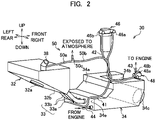
- FIG. 2 a perspective view of the fuel tank unit 30 viewed from the obliquely right rear side of the vehicle body 1 according to the first embodiment is illustrated.
- FIG. 3 a perspective view of the fuel tank unit 30 viewed from the obliquely right front side of the vehicle body 1 according to the first embodiment is illustrated.
- the fuel tank unit 30 includes a first tank 32, a second tank 34, a piping member 33, a filter device 46, a pump 48, and a breather unit 50.
- the first tank 32 is a tank disposed behind the drive device 10, and capable of storing the fuel 9.
- An oil filling port 38 for supplying the fuel 9 to the first tank 32 is provided on the right in the right-left direction of the vehicle body 1 at the upper part of this first tank 32.
- a lower surface 32b of the first tank 32 is formed in a shape inclined at a predetermined angle so as to lower toward the front direction of the vehicle body 1 from a rear end to a front end.
- a first cleaning window 32a is provided in the lower surface 32b of the first tank 32.
- the first cleaning window 32a is a window for cleaning the first tank 32 when an operator wrongly supplies liquid medicine other than the fuel 9 such as a reducing agent from the oil filling port 38 to the first tank 32, for example, the window being openable from a first opening 2a provided in a lower panel 2 disposed below the first tank 32 and the second tank 34.
- the second tank 34 is a tank disposed below the drive device 10 so as to be separated from the first tank 32 by a predetermined distance, and capable of storing the fuel 9.
- a recess 34a for avoiding interference with the cooling device 20 is formed in a rear upper part
- a groove 34b for avoiding interference with the engine 12 is formed at a center in the right-left direction in a front upper part.
- a second cleaning window 34c is provided in a front end of the second tank 34. This second cleaning window 34c is a window for cleaning the second tank 34 similarly to the first cleaning window 32a.
- a first tube 41 and a fourth tube 44 are connected to the second tank 34.
- the fourth tube 44 has a first end connected to a rear end surface 34e of the second tank 34 so as to be able to supply the fuel 9, and a second end connected to the engine 12.
- the first tube 41 is connected to a sucking-out part 49 described below, and has a second end connected to the filter device 46 so as to enable the fuel 9 to flow.
- the filter device 46 is a filter capable of purifying the fuel 9 by removing fine dust or the like included in the fuel 9.
- the second end of the first tube 41 is connected to an introduction part 46a so as to enable the fuel 9 to flow
- a first end of a second tube 42 is connected to a discharge part 46b as to enable the fuel 9 to flow.
- the second tube 42 has the first end connected to the discharge part 46b of the filter device 46 so as to enable the fuel 9 to flow, and a second end connected to an introduction part 48a of the pump 48 so as to enable the fuel 9 to flow.
- the pump 48 is, for example, a trochoid type pump, sucks the fuel 9 from the second tube 42 through the introduction part 48a, and discharges the fuel 9 to a third tube 43 having a first end connected so as to enable the fuel 9 to flow from a discharge part 48b.
- the third tube 43 has the first end connected to the discharge part 48b of the pump 48 so as to enable the fuel 9 to flow, and a second end connected to the engine 12 so as to enable the fuel 9 to flow.
- the fuel 9 stored in the second tank 34 is introduced in the filter device 46 through the first tube 41 to be purified, and thereafter is sucked in the pump 48 through the second tube 42, and is supplied to the engine 12 through the third tube 43.
- the engine 12 operates by burning the fuel 9 supplied as described above. At this time, the fuel 9 that is not used for combustion and remains, out of the fuel 9 supplied to the engine 12, returns to the second tank 34 through the fourth tube 44.
- the first tube 41 is connected so as to be able to supply the fuel 9 to the sucking-out part (supply member) 49 provided to penetrate the rear end surface 34e of the second tank 34.
- This sucking-out part 49 is a hollow tubular member extending to the front side of the vehicle body 1 from the rear end surface 34e, in other words, in the direction away from the first tank 32, and is provided with an opening (supply opening) 49a at an end on the front side.
- the first tank 32 and the second tank 34 are connected through the piping member 33 so as to enable the fuel 9 to flow.
- the piping member 33 includes a first pipe 33a and second pipes 33b.
- the first pipe 33a is a flexible pipe having a first end connected to the first tank 32 so as to enable the fuel 9 to flow, and a second end connected to the second tank 34 so as to enable the fuel 9 to flow.
- Each of the second pipes 33b is a flexible pipe that has a first end connected to the first tank 32 so as to enable the fuel 9 to flow, and a second end connected to the second tank 34 so as to enable the fuel 9 to flow, and that is thinner than the first pipe 33a.
- the two second pipes 33b are disposed at positions further separated from the oil filling port 38 than the first pipe 33a.
- the first pipe 33a has a larger inner diameter than the second pipes 33b, and therefore a circulation possible amount of the fuel 9 per predetermined time can be increased compared to the second pipes 33b. Consequently, the first pipe 33a is closer to the oil filling port 38 than the second pipes 33b, and therefore the fuel 9 replenished from the oil filling port 38 can be satisfactorily replenished to the second tank 34.
- FIG. 4 a bottom view of a rear part of the vehicle body 1 according to the first embodiment is illustrated.
- a second opening (opening) 2b is provided at a position corresponding a portion between the first tank 32 and the second tank 34 in the lower panel 2. Consequently, an operator can perform maintenance of the drive device 10 of the cooling device 20 from below the vehicle body 1.
- a protective plate (protective member) 2c is a plate member formed in a shape corresponding to an inner peripheral edge of the second opening 2b.
- This protective plate 2c is detachably mounted on the lower panel 2 by, for example, bolts so as to close the second opening 2b. That is, in other cases except maintenance or the like, in the lower panel 2, the second opening 2b is closed by the protective plate 2c.
- the protective plate 2c is detachably mounted, so that an operator can detach the protective plate 2c from the lower panel 2 to perform maintenance of a lower part of the drive device 10 from below the vehicle body 1.
- the breather unit 50 is connected to the first tank 32 and the second tank 34.
- the breather unit 50 includes a first breather hose 50a, a second breather hose 50b, and a third breather hose 50c.
- the first breather hose 50a has a first end connected to the oil filling port 38 provided in an upper part of the first tank 32 so as to enable ventilation, and has a second end connected to a lower end of the third breather hose 50c so as to enable ventilation.
- the second breather hose 50b has a first end connected to an upper end of the second tank 34 so as to enable ventilation, and a second end connected to the lower end of the third breather hose 50c so as to enable ventilation.
- the third breather hose 50c has the lower end connected to the first breather hose 50a and the second breather hose 50b so as to enable ventilation, and an upper end connected to a canister (not illustrated) so as to enable ventilation.
- Pressure is sometimes generated in the upper part of the first tank 32 and an upper part of the second tank 34 by volatilization of the stored fuel 9. That is, the canister is connected to the upper end of the third breather hose 50c, so that the pressure generated in each of the upper parts of the first tank 32 and the second tank 34 can be opened to the atmosphere after the volatilized fuel 9 is extracted.
- the breather unit 50 the second end of the first breather hose 50a and the second end of the second breather hose 50b are connected to each other so as to enable ventilation. That is, the first breather hose 50a and the second breather hose 50b are connected to each other so as to enable ventilation, so that the breather unit 50 can lower the pressure while uniformizing the pressure generated in the first tank 32 and the pressure generated in the second tank 34. Therefore, when the fuel 9 flows through the first tank 32 and the second tank 34, for example, when the vehicle body 1 inclines such that the front part of the vehicle body 1 lowers and rises, the atmospheric pressure in the first tank 32 and the atmospheric pressure in the second tank 34 are uniformized, so that the fuel 9 can satisfactorily flow.
- the vehicle body 1 includes the drive device 10 that has the engine 12 for driving the vehicle body 1, the first tank 32 for storing the fuel 9 to be supplied to the engine 12, and the second tank 34 for storing the fuel 9 to be supplied to the engine 12, the first tank 32 is disposed behind the drive device 10, and the second tank 34 is disposed below the drive device 10 so as to be separated from the first tank 32 by the predetermined distance.
- the second tank 34 is disposed below the drive device 10 so as to be separated from the first tank 32 disposed behind the drive device 10 by the predetermined distance, and therefore it is possible to maintain the drive device 10 from between the first tank 32 and the second tank 34.
- the fuel 9 is divided to be stored in the first tank 32 and the second tank 34, so that the first tank 32 and the second tank 34 are mounted by using a clearance in the engine room 7, so that it is possible to increase a possible amount of the fuel 9 to be replenished to the vehicle body 1.
- the vehicle body includes the piping member 33 having the first end connected to the first tank 32 so as to enable the fuel 9 to flow, the second end connected to the second tank 34 so as to enable the fuel 9 to flow, so that the fuel 9 can be replenished to one of either the first tank 32 or the second tank 34, and the fuel 9 can be stored in the other of either the first tank 32 or the second tank 34.
- the vehicle body includes the lower panel 2 disposed below the first tank 32 and the second tank 34, and provided with the second opening 2b at the position corresponding to the portion between the first tank 32 and the second tank 34, and the detachable protective plate 2c mounted on the lower panel 2 to close the second opening 2b.
- the vehicle body includes the lower panel 2 below the first tank 32 and the second tank 34, is provided with the second opening 2b at the position corresponding to the portion between the first tank 32 and the second tank 34 in the lower panel 2, and further includes the protective plate 2c detachably, and therefore the lower parts of the first tank 32 and the second tank 34 can be protected by the lower panel 2, the drive device 10 can be maintained from the position corresponding to the portion between the first tank 32 and the second tank 34 by the second opening 2b, and the second opening 2b is closed by the protective plate 2c in other cases except maintenance or the like, so that the drive device 10 can be prevented from being damaged by gravel or the like entering from the second opening 2b.
- the vehicle body includes the first breather hose 50a having the first end connected to the upper part of the first tank 32 so as to enable ventilation, and the second breather hose 50b having the first end connected to the upper part of the second tank 34 so as to enable ventilation, and the respective second ends of the first breather hose 50a and the second breather hose 50b are connected to each other so as to enable ventilation, and therefore it is possible to uniformize the pressure in the first tank 32 and the pressure in the second tank 34.
- FIG. 5 a perspective view of a fuel tank unit 30 viewed from the obliquely right front side of a vehicle body 1 according to the second embodiment is illustrated.
- a second tank 134 of the fuel tank unit 30 includes a fuel retaining member 152, a first tubular member (hollow tube member) 160, and a second tubular member (hollow tube member) 164.
- the fuel retaining member 152 includes a front wall 152a and side walls 152b.
- the front wall 152a is formed to extend upward from a bottom 134d of the second tank 134 such that an upper end is disposed above an opening 49a of a sucking-out part 49.
- the two side walls 152b are formed so as to extend upward from the bottom 134d of the second tank 134 similarly to the front wall 152a, have upper ends formed to be inclined to the bottom 134d side from an upper end of the front wall 152a toward the rear side in the front-rear direction of the vehicle body 1, and are disposed at right and left ends of the front wall 152a. That is, the front wall 152a and the side walls 152b are disposed so as to surround the front side and the sides in the right-left direction of the opening 49a.
- the first tubular member 160 has a first end opened on a rear end surface 34e so as to enable the fuel 9 to flow with a first pipe 33a of a piping member 33. Additionally, the first tubular member 160 is a hollow tubular member having a second end extending in the direction away from the first tank to penetrate the front wall 152a of the fuel retaining member 152. An opening (hollow tube opening) 162 opened so as to enable the fuel 9 to flow through the second tank 134 is provided in the second end of this first tubular member 160. This opening 162 is provided at a position separated from the first tank 32 with respect to the opening 49a of the sucking-out part 49.
- each first end of the second tubular members 164 is provided on the rear end surface 34e so as to enable the fuel 9 to flow from a second pipe 33b of the piping member 33.
- each second tubular member 164 is a hollow tubular member having a second end extending in the direction away from the first tank 32 to penetrate the front wall 152a of the fuel retaining member 152, and having a smaller diameter than the first tubular member 160.
- An opening (hollow tube opening) 166 opened so as to enable the fuel 9 to flow through the second tank 134 is provided on the second end of each second tubular member 164.
- This opening 166 is provided at a position separated from the first tank 32 with respect to the opening 49a of the sucking-out part 49.
- the two second tubular members 164 are disposed side by side on the left of the vehicle body 1 that is the direction away from the oil filling port 38 compared to the first tubular member 160.
- the first tubular member 160 has a larger inner diameter than the second tubular members 164, and therefore a circulation possible amount of the fuel 9 per predetermined time can be increased compared to the second tubular members 164. Additionally, the first tubular member 160 is closer to the oil filling port 38 than the second tubular members 164, and therefore the fuel 9 replenished from the oil filling port 38 can be satisfactorily replenished to the second tank 134.
- FIG. 6 an explanatory diagram illustrating a state of the fuel 9 when the vehicle body 1 according to the second embodiment is located on a flat ground is illustrated.
- the fuel 9 When the fuel 9 is supplied from the oil filling port 38 to the first tank 32 of the fuel tank unit 30, the fuel 9 is supplied to the second tank 134 through the piping member 33, the first tubular member 160 and the second tubular members 164. More specifically, the fuel 9 supplied to the first tank 32 flows downward along the lower surface 32b by gravity, and passes through the piping member 33 to reach the rear end surface 34e.
- the first tubular member 160 and the second tubular members 164 are provided in the rear end surface 34e so as to enable the fuel 9 to flow, and therefore the fuel 9 passes through the first tubular member 160 and the second tubular members 164 to be supplied to the second tank 134.
- FIG. 7 an explanatory diagram illustrating a state of the fuel 9 when the vehicle body 1 according to the second embodiment is inclined at a predetermined angle such that a front part of the vehicle body 1 lowers is illustrated.
- the fuel 9 is biased to be stored on the side separated from the first tank 32 of the second tank 134, and in the fuel retaining member 152.
- the fuel 9 stored in the first tank 32 flows in the direction away from the first tank 32 of the second tank 134 through the piping member 33, the first tubular member 160 and the second tubular members 164 by gravity.
- a part of the fuel 9 stored in the second tank 134 is prevented from flowing toward the side separated from the first tank 32 of the second tank 134 by the fuel retaining member 152, and is stored in the fuel retaining member 152.
- the fuel 9 is stored in the fuel retaining member 152, so that the fuel 9 can be supplied to the engine 12 from the sucking-out part 49 through the filter device 46 and the pump 48.
- FIG. 8 an explanatory diagram illustrating a state of the fuel 9 when the vehicle body 1 according to the second embodiment is inclined at a predetermined angle such that the front part of the vehicle body 1 rises is illustrated.
- the fuel 9 is biased to be stored near the lower surface 32b of the first tank 32, and on the side close to the first tank 32 of the second tank 134.
- the fuel 9 stored in the second tank 134 flows toward the first tank 32 through the first tubular member 160, the second tubular members 164, and the first pipe 33a and the second pipes 33b of the piping member 33 by gravity.
- the first tubular member 160 and the second tubular members 164 extend toward the front side of the vehicle body 1 from the rear end surface 34e, and the opening 162 and the openings 166 are provided at positions further separated from the first tank than the opening 49a of the sucking-out part 49, so that the fuel 9 below the opening 162 and the openings 166 as viewed in the gravity direction, out of the fuel 9 stored in the second tank 134, is biased to be stored on the side close to the first tank 32 of the second tank 134 without flowing in the first tank 32.
- the first tubular member 160 and the second tubular members 164 extend toward the front side of the vehicle body 1 from the rear end surface 34e, so that when the vehicle body 1 is inclined at the predetermined angle such that the front part of the vehicle body 1 rises, the fuel 9 can be stored on the side separated from the first tank 32 of the second tank 134, and therefore it is possible to supply the fuel 9 from the sucking-out part 49 to the engine 12 through the filter device 46 and the pump 48.
- the first end of the fourth tube 44 is connected to the second tank 134 from the rear end surface 34e, so that the fuel 9 that is not used for combustion in the engine 12 and remains returns to the second tank 134 through the fourth tube 44, and therefore even when the vehicle body 1 is inclined at the predetermined angle such that the front part of the vehicle body 1 rises, it is possible to store the fuel 9 on the side separated from the first tank 32 of the second tank 134.
- the fuel tank unit 30 can supply the fuel 9 to the engine 12.
- the vehicle body 1 includes: the sucking-out part 49 that has the first end with the opening 49a opened on the second tank 134, and supplies the fuel 9 stored in the second tank 134 from the second tank 134 to the engine 12; and the first tubular member 160 and the second tubular members 164 having the first ends each provided in the second end of the piping member 33, and the first tubular member 160 and the second tubular members 164 have the second ends extending in the direction away from the first tank 32, and are provided with the opening 162 and the openings 166 opened so as to enable the fuel 9 to flow through the second tank 134 at the positions further separated from the first tank 32 than the opening 49a.
- first tubular member 160 and the second tubular members 164 that have the first ends opened and provided on the piping member 33, and have the opening 162 and the openings 166 at the positions further separated from the first tank 32 than the opening 49a in the second end extending in the direction away from the first tank 32 are provided in the second tank 134.
- the fuel 9 stored in the second tank 134 is stored on the lower side in the gravity direction with respect to the opening 162 provided on the second end of the first tubular member 160 and the openings 166, and therefore the fuel 9 can be supplied to the engine 12 from the second tank 134 through the opening 49a of the sucking-out part 49 regardless of the inclination angle of the vehicle body 1.
- the work vehicle is described as an earthwork vibration roller which is one of rolling machines in the embodiments, but the work vehicle may be a so-called tire roller that compacts asphalt before solidification.
- the sucking-out part 49 is provided in the second tank 34, and the fuel 9 is sucked out only from the second tank 34.
- a sucking-out part may be similarly provided also in the first tank 32, and suck out the fuel 9 also from the first tank 32.
- the piping member 33 includes the first pipe 33a and the second pipes 33b.
- the number of pipes composing the piping member 33 may be one, or may be four or more.
- the oil filling port 38 is provided in the upper part of the first tank 32, but may be provided in an upper part of the second tank 34, 134. In this case, an upper end of the oil filling port 38 is desirably located above an upper end of the first tank 32.
Landscapes
- Engineering & Computer Science (AREA)
- Chemical & Material Sciences (AREA)
- Combustion & Propulsion (AREA)
- Mechanical Engineering (AREA)
- General Engineering & Computer Science (AREA)
- Sustainable Development (AREA)
- Life Sciences & Earth Sciences (AREA)
- Sustainable Energy (AREA)
- Transportation (AREA)
- Civil Engineering (AREA)
- Structural Engineering (AREA)
- Architecture (AREA)
- Cooling, Air Intake And Gas Exhaust, And Fuel Tank Arrangements In Propulsion Units (AREA)
Description
- The present invention relates to a work vehicle, and particularly to a technology for improving maintainability when a drive device mounted on a work vehicle is maintained from below a vehicle body.
- Generally, in road pavement work, a so-called earthwork vibration roller is used in order to equalize flatness of the ground before construction of asphalt.
- In this earthwork vibration roller, an operator often maintains an engine and the like from above a vehicle body, and therefore a fuel tank for storing fuel supplied to the engine is generally disposed below a drive device.
- However, the operator sometimes desirably maintains the drive device such as the engine from below the vehicle body more than from above the vehicle body.
- A technology capable of easily maintaining a drive device from below a vehicle body by an operator by easily detaching a fuel tank from below the vehicle body is developed (Patent Document 1).
Patent Document 2 describes a vehicle which has a main tank for liquid storage at substantially the center of the vehicle and an auxiliary tank for liquid storage on a front side of the vehicle, respectively. -
- Patent Document 1:
Japanese Patent Laid-Open No. 2006-169853 - Patent Document 2: Japanese Patent Laid-Open No.
JP H10 67214 A - However, in the technology disclosed in the aforementioned Patent Document 1, when the fuel tank is not detached, the operator cannot maintain the drive device such as the engine from below the vehicle body, and therefore there is room for further improvement.
- The present invention has been made in view of such a problem, and an object of the present invention is to provide a work vehicle capable of improving maintainability when a drive device mounted on the work vehicle is maintained from below a vehicle body.
- The above object is achieved by the subjectmatter as set forth in the appended claims.
- A work vehicle according to a first aspect of the present invention includes: a drive device that has an internal combustion engine for driving a vehicle body; a first tank for storing fuel to be supplied to the internal combustion engine; and a second tank for storing fuel to be supplied to the internal combustion engine, wherein the first tank is disposed in front of or behind the drive device, and the second tank is disposed below the drive device so as to be separated from the first tank by a predetermined distance.
- In the first embodiment of the present invention, the second tank is disposed below the drive device so as to be separated from the first tank disposed in front of or behind the drive device by the predetermined distance, so that it is possible to maintain the drive device from between the first tank and the second tank.
- From the above, in the first aspect, it is possible to improve maintainability when the drive device mounted on the work vehicle is maintained from below the vehicle body.
- A work vehicle according to the first aspect of the present invention further includes: a lower panel disposed below the first tank and the second tank, and provided with an opening at a position corresponding to a portion between the first tank and the second tank; and a detachable protective member mounted on the lower panel to close the opening. Consequently, the lower panel is provided below the first tank and the second tank, the opening is provided at the position corresponding to the portion between the first tank and the second tank in the lower panel, and the protective member is further provided on the opening detachably, so that the lower parts of the first tank and the second tank can be protected by the lower panel, the drive device can be maintained from the position corresponding to the portion between the first tank and the second tank by the opening, and the opening is closed by the protective member in other cases except maintenance or the like, so that the drive device can be prevented from being damaged by gravel or the like entering from the opening.
- A work vehicle according to a second aspect of the present invention includes a piping member having a first end connected to the first tank so as to enable the fuel to flow, and a second end connected to the second tank so as to enable the fuel to flow. Consequently, the piping member is connected to the first tank and the second tank so as to enable the fuel to flow, so that the fuel can be replenished to one of either the first tank or the second tank, and the fuel can be stored in the other of either the first tank or the second tank.
- A work vehicle according to a third aspect of the present invention includes: a first breather hose having a first end connected to an upper part of the first tank so as to enable ventilation; and a second breather hose having a first end connected to an upper part of the second tank so as to enable ventilation, wherein respective second ends of the first breather hose and the second breather hose are connected to each other so as to enable ventilation. Consequently, the first ends of the first breather hose and the second breather hose are connected to the upper parts of the first tank and the second tank, respectively so as to enable ventilation, and the respective second ends of the first breather hose and the second breather hose are connected to each other so as to enable ventilation, so that it is possible to uniformize the pressure in the first tank and the pressure in the second tank.
- A work vehicle according to a fourth aspect of the present invention includes: a supply member that has a supply opening extending and opened inside the second tank, and supplies the fuel stored in the second tank from the second tank to the internal combustion engine: and a hollow tube member having a first end connected to the second end of the piping member so as to enable the fuel to flow, and a second end extending in a direction away from the first tank, and having a hollow tube opening opened so as to enable the fuel to flow at a position further separated from the first tank than the supply opening. Consequently, the hollow tube member having the first end provided in the piping member, and having the hollow tube opening at the position further separated from the first tank than the supply opening in the second end extending in the direction away from the first tank is provided in the second tank, so that for example, when the rolling machine is inclined at the predetermined angle such that the first tank lowers in the gravity direction, even in a case where the fuel is biased to the side close to the first tank of the second tank, the fuel stored in the second tank is stored on the lower side in the gravity direction with respect to the hollow tube opening provided on the second end of the hollow tube member, and therefore the fuel can be supplied to the internal combustion engine from the second tank through the supply opening of the supply member regardless of the inclination angle of the rolling machine.
- According to a work vehicle of the present invention, it is possible to improve maintainability when a drive device mounted on a work vehicle is maintained from below a vehicle body.
-
-
FIG. 1 is a schematic configuration diagram of a vehicle body mounted with a fuel tank unit according to a first embodiment. -
FIG. 2 is a perspective view of a fuel tank unit viewed from the obliquely right rear side of the vehicle body according to the first embodiment. -
FIG. 3 is a perspective view of the fuel tank unit viewed from the obliquely right front side of the vehicle body according to the first embodiment. -
FIG. 4 is a bottom view of a vehicle body rear part according to the first embodiment. -
FIG. 5 is a perspective view of a fuel tank unit viewed from the obliquely right front side of a vehicle body according to a second embodiment. -
FIG. 6 is an explanatory diagram illustrating a state of fuel when the vehicle body according to the second embodiment is located on a flat ground. -
FIG. 7 is an explanatory diagram illustrating a state of fuel when the vehicle body according to the second embodiment is inclined at a predetermined angle such that a front part of the vehicle body lowers. -
FIG. 8 is an explanatory diagram illustrating a state of fuel when the vehicle body according to the second embodiment is inclined at a predetermined angle such that the front part of the vehicle body rises. - Hereinafter, a first embodiment of the present invention will be described with reference to the drawings.
- Referring to
FIG. 1 , a schematic configuration diagram of a vehicle body 1 of a rolling machine (work vehicle) according to the first embodiment is illustrated. The vehicle body 1 is a so-called earthwork vibration roller havingfront wheels 3 which are iron wheels, and capable of compacting the ground before construction of asphalt by vibrating thefront wheels 3 by an eccentric weight (not illustrated) provided in thefront wheels 3 while moving forward and rearward the vehicle body 1 by driving rubberrear wheels 5, for example. This vehicle body 1 is mounted with adrive device 10 and afuel tank unit 30. - The
drive device 10 includes an engine (internal combustion engine) 12 and acooling device 20. Theengine 12 is an internal combustion engine that burnsfuel 9 supplied from thefuel tank unit 30 to generate driving force, and is mounted on the front side with respect to the center of anengine room 7 provided in a rear part in the front-rear direction of the vehicle body 1. That is, thedrive device 10 can move forward and rearward the vehicle body 1 by driving thefront wheels 3 and therear wheels 5 by using the driving force operated and generated by theengine 12. Thecooling device 20 is a so-called heat exchanger provided on the rear side in the front-rear direction of the vehicle body 1 with respect to theengine 12. - The
cooling device 20 is connected to theengine 12 by a high-temperature pipe 22 and a low-temperature pipe 24 so as to enable cooling water to flow. More specifically, cooling water that flows through a water jacket (not illustrated) provided in theengine 12 is heated by heat generated by operation of theengine 12, and the high-temperature cooling water flows through thecooling device 20 through the high-temperature pipe 22. This high-temperature cooling water is cooled by thecooling device 20 to flows through theengine 12 through the low-temperature pipe 24. Consequently, in theengine 12, excessive rise of the internal temperature is suppressed. - Referring to
FIG. 2 , a perspective view of thefuel tank unit 30 viewed from the obliquely right rear side of the vehicle body 1 according to the first embodiment is illustrated. Referring toFIG. 3 , a perspective view of thefuel tank unit 30 viewed from the obliquely right front side of the vehicle body 1 according to the first embodiment is illustrated. - The
fuel tank unit 30 includes afirst tank 32, asecond tank 34, apiping member 33, afilter device 46, apump 48, and abreather unit 50. - The
first tank 32 is a tank disposed behind thedrive device 10, and capable of storing thefuel 9. Anoil filling port 38 for supplying thefuel 9 to thefirst tank 32 is provided on the right in the right-left direction of the vehicle body 1 at the upper part of thisfirst tank 32. Alower surface 32b of thefirst tank 32 is formed in a shape inclined at a predetermined angle so as to lower toward the front direction of the vehicle body 1 from a rear end to a front end. - A
first cleaning window 32a is provided in thelower surface 32b of thefirst tank 32. Thefirst cleaning window 32a is a window for cleaning thefirst tank 32 when an operator wrongly supplies liquid medicine other than thefuel 9 such as a reducing agent from theoil filling port 38 to thefirst tank 32, for example, the window being openable from a first opening 2a provided in alower panel 2 disposed below thefirst tank 32 and thesecond tank 34. - The
second tank 34 is a tank disposed below thedrive device 10 so as to be separated from thefirst tank 32 by a predetermined distance, and capable of storing thefuel 9. In thesecond tank 34, arecess 34a for avoiding interference with thecooling device 20 is formed in a rear upper part, and agroove 34b for avoiding interference with theengine 12 is formed at a center in the right-left direction in a front upper part. Furthermore, asecond cleaning window 34c is provided in a front end of thesecond tank 34. Thissecond cleaning window 34c is a window for cleaning thesecond tank 34 similarly to thefirst cleaning window 32a. - A
first tube 41 and afourth tube 44 are connected to thesecond tank 34. Thefourth tube 44 has a first end connected to arear end surface 34e of thesecond tank 34 so as to be able to supply thefuel 9, and a second end connected to theengine 12. Thefirst tube 41 is connected to a sucking-outpart 49 described below, and has a second end connected to thefilter device 46 so as to enable thefuel 9 to flow. - The
filter device 46 is a filter capable of purifying thefuel 9 by removing fine dust or the like included in thefuel 9. In thefilter device 46, the second end of thefirst tube 41 is connected to anintroduction part 46a so as to enable thefuel 9 to flow, and a first end of asecond tube 42 is connected to adischarge part 46b as to enable thefuel 9 to flow. - The
second tube 42 has the first end connected to thedischarge part 46b of thefilter device 46 so as to enable thefuel 9 to flow, and a second end connected to anintroduction part 48a of thepump 48 so as to enable thefuel 9 to flow. Thepump 48 is, for example, a trochoid type pump, sucks thefuel 9 from thesecond tube 42 through theintroduction part 48a, and discharges thefuel 9 to athird tube 43 having a first end connected so as to enable thefuel 9 to flow from adischarge part 48b. - The
third tube 43 has the first end connected to thedischarge part 48b of thepump 48 so as to enable thefuel 9 to flow, and a second end connected to theengine 12 so as to enable thefuel 9 to flow. Thus, thefuel 9 stored in thesecond tank 34 is introduced in thefilter device 46 through thefirst tube 41 to be purified, and thereafter is sucked in thepump 48 through thesecond tube 42, and is supplied to theengine 12 through thethird tube 43. - The
engine 12 operates by burning thefuel 9 supplied as described above. At this time, thefuel 9 that is not used for combustion and remains, out of thefuel 9 supplied to theengine 12, returns to thesecond tank 34 through thefourth tube 44. - The
first tube 41 is connected so as to be able to supply thefuel 9 to the sucking-out part (supply member) 49 provided to penetrate therear end surface 34e of thesecond tank 34. This sucking-outpart 49 is a hollow tubular member extending to the front side of the vehicle body 1 from therear end surface 34e, in other words, in the direction away from thefirst tank 32, and is provided with an opening (supply opening) 49a at an end on the front side. - The
first tank 32 and thesecond tank 34 are connected through the pipingmember 33 so as to enable thefuel 9 to flow. The pipingmember 33 includes afirst pipe 33a andsecond pipes 33b. Thefirst pipe 33a is a flexible pipe having a first end connected to thefirst tank 32 so as to enable thefuel 9 to flow, and a second end connected to thesecond tank 34 so as to enable thefuel 9 to flow. - Each of the
second pipes 33b is a flexible pipe that has a first end connected to thefirst tank 32 so as to enable thefuel 9 to flow, and a second end connected to thesecond tank 34 so as to enable thefuel 9 to flow, and that is thinner than thefirst pipe 33a. The twosecond pipes 33b are disposed at positions further separated from theoil filling port 38 than thefirst pipe 33a. - In other words, the
first pipe 33a has a larger inner diameter than thesecond pipes 33b, and therefore a circulation possible amount of thefuel 9 per predetermined time can be increased compared to thesecond pipes 33b. Consequently, thefirst pipe 33a is closer to theoil filling port 38 than thesecond pipes 33b, and therefore thefuel 9 replenished from theoil filling port 38 can be satisfactorily replenished to thesecond tank 34. - Referring to
FIG. 4 , a bottom view of a rear part of the vehicle body 1 according to the first embodiment is illustrated. A second opening (opening) 2b is provided at a position corresponding a portion between thefirst tank 32 and thesecond tank 34 in thelower panel 2. Consequently, an operator can perform maintenance of thedrive device 10 of thecooling device 20 from below the vehicle body 1. - A protective plate (protective member) 2c is a plate member formed in a shape corresponding to an inner peripheral edge of the
second opening 2b. Thisprotective plate 2c is detachably mounted on thelower panel 2 by, for example, bolts so as to close thesecond opening 2b. That is, in other cases except maintenance or the like, in thelower panel 2, thesecond opening 2b is closed by theprotective plate 2c. Theprotective plate 2c is detachably mounted, so that an operator can detach theprotective plate 2c from thelower panel 2 to perform maintenance of a lower part of thedrive device 10 from below the vehicle body 1. - Returning to
FIG. 2 , thebreather unit 50 is connected to thefirst tank 32 and thesecond tank 34. Thebreather unit 50 includes afirst breather hose 50a, asecond breather hose 50b, and athird breather hose 50c. Thefirst breather hose 50a has a first end connected to theoil filling port 38 provided in an upper part of thefirst tank 32 so as to enable ventilation, and has a second end connected to a lower end of thethird breather hose 50c so as to enable ventilation. - The
second breather hose 50b has a first end connected to an upper end of thesecond tank 34 so as to enable ventilation, and a second end connected to the lower end of thethird breather hose 50c so as to enable ventilation. Thethird breather hose 50c has the lower end connected to thefirst breather hose 50a and thesecond breather hose 50b so as to enable ventilation, and an upper end connected to a canister (not illustrated) so as to enable ventilation. - Pressure is sometimes generated in the upper part of the
first tank 32 and an upper part of thesecond tank 34 by volatilization of the storedfuel 9. That is, the canister is connected to the upper end of thethird breather hose 50c, so that the pressure generated in each of the upper parts of thefirst tank 32 and thesecond tank 34 can be opened to the atmosphere after the volatilizedfuel 9 is extracted. - In the
breather unit 50, the second end of thefirst breather hose 50a and the second end of thesecond breather hose 50b are connected to each other so as to enable ventilation. That is, thefirst breather hose 50a and thesecond breather hose 50b are connected to each other so as to enable ventilation, so that thebreather unit 50 can lower the pressure while uniformizing the pressure generated in thefirst tank 32 and the pressure generated in thesecond tank 34. Therefore, when thefuel 9 flows through thefirst tank 32 and thesecond tank 34, for example, when the vehicle body 1 inclines such that the front part of the vehicle body 1 lowers and rises, the atmospheric pressure in thefirst tank 32 and the atmospheric pressure in thesecond tank 34 are uniformized, so that thefuel 9 can satisfactorily flow. - As described above, the vehicle body 1 according to the first embodiment includes the
drive device 10 that has theengine 12 for driving the vehicle body 1, thefirst tank 32 for storing thefuel 9 to be supplied to theengine 12, and thesecond tank 34 for storing thefuel 9 to be supplied to theengine 12, thefirst tank 32 is disposed behind thedrive device 10, and thesecond tank 34 is disposed below thedrive device 10 so as to be separated from thefirst tank 32 by the predetermined distance. - Accordingly, the
second tank 34 is disposed below thedrive device 10 so as to be separated from thefirst tank 32 disposed behind thedrive device 10 by the predetermined distance, and therefore it is possible to maintain thedrive device 10 from between thefirst tank 32 and thesecond tank 34. - The
fuel 9 is divided to be stored in thefirst tank 32 and thesecond tank 34, so that thefirst tank 32 and thesecond tank 34 are mounted by using a clearance in theengine room 7, so that it is possible to increase a possible amount of thefuel 9 to be replenished to the vehicle body 1. - Particularly, the vehicle body includes the piping
member 33 having the first end connected to thefirst tank 32 so as to enable thefuel 9 to flow, the second end connected to thesecond tank 34 so as to enable thefuel 9 to flow, so that thefuel 9 can be replenished to one of either thefirst tank 32 or thesecond tank 34, and thefuel 9 can be stored in the other of either thefirst tank 32 or thesecond tank 34. - The vehicle body includes the
lower panel 2 disposed below thefirst tank 32 and thesecond tank 34, and provided with thesecond opening 2b at the position corresponding to the portion between thefirst tank 32 and thesecond tank 34, and the detachableprotective plate 2c mounted on thelower panel 2 to close thesecond opening 2b. - Therefore, the vehicle body includes the
lower panel 2 below thefirst tank 32 and thesecond tank 34, is provided with thesecond opening 2b at the position corresponding to the portion between thefirst tank 32 and thesecond tank 34 in thelower panel 2, and further includes theprotective plate 2c detachably, and therefore the lower parts of thefirst tank 32 and thesecond tank 34 can be protected by thelower panel 2, thedrive device 10 can be maintained from the position corresponding to the portion between thefirst tank 32 and thesecond tank 34 by thesecond opening 2b, and thesecond opening 2b is closed by theprotective plate 2c in other cases except maintenance or the like, so that thedrive device 10 can be prevented from being damaged by gravel or the like entering from thesecond opening 2b. - The vehicle body includes the
first breather hose 50a having the first end connected to the upper part of thefirst tank 32 so as to enable ventilation, and thesecond breather hose 50b having the first end connected to the upper part of thesecond tank 34 so as to enable ventilation, and the respective second ends of thefirst breather hose 50a and thesecond breather hose 50b are connected to each other so as to enable ventilation, and therefore it is possible to uniformize the pressure in thefirst tank 32 and the pressure in thesecond tank 34. - Hereinafter, a second embodiment will be described with reference to
FIGS. 5 to 8 . - Description of a configuration common with the configuration of the aforementioned first embodiment will be omitted, and different portions from the first embodiment will be herein described.
- Referring to
FIG. 5 , a perspective view of afuel tank unit 30 viewed from the obliquely right front side of a vehicle body 1 according to the second embodiment is illustrated. - A
second tank 134 of thefuel tank unit 30 according to the second embodiment includes afuel retaining member 152, a first tubular member (hollow tube member) 160, and a second tubular member (hollow tube member) 164. - The
fuel retaining member 152 includes afront wall 152a andside walls 152b. Thefront wall 152a is formed to extend upward from a bottom 134d of thesecond tank 134 such that an upper end is disposed above anopening 49a of a sucking-outpart 49. - The two
side walls 152b are formed so as to extend upward from the bottom 134d of thesecond tank 134 similarly to thefront wall 152a, have upper ends formed to be inclined to thebottom 134d side from an upper end of thefront wall 152a toward the rear side in the front-rear direction of the vehicle body 1, and are disposed at right and left ends of thefront wall 152a. That is, thefront wall 152a and theside walls 152b are disposed so as to surround the front side and the sides in the right-left direction of theopening 49a. - The first
tubular member 160 has a first end opened on arear end surface 34e so as to enable thefuel 9 to flow with afirst pipe 33a of a pipingmember 33. Additionally, the firsttubular member 160 is a hollow tubular member having a second end extending in the direction away from the first tank to penetrate thefront wall 152a of thefuel retaining member 152. An opening (hollow tube opening) 162 opened so as to enable thefuel 9 to flow through thesecond tank 134 is provided in the second end of this firsttubular member 160. Thisopening 162 is provided at a position separated from thefirst tank 32 with respect to theopening 49a of the sucking-outpart 49. - Similarly to the first
tubular member 160, each first end of the secondtubular members 164 is provided on therear end surface 34e so as to enable thefuel 9 to flow from asecond pipe 33b of the pipingmember 33. Additionally, each secondtubular member 164 is a hollow tubular member having a second end extending in the direction away from thefirst tank 32 to penetrate thefront wall 152a of thefuel retaining member 152, and having a smaller diameter than the firsttubular member 160. - An opening (hollow tube opening) 166 opened so as to enable the
fuel 9 to flow through thesecond tank 134 is provided on the second end of each secondtubular member 164. Thisopening 166 is provided at a position separated from thefirst tank 32 with respect to theopening 49a of the sucking-outpart 49. The two secondtubular members 164 are disposed side by side on the left of the vehicle body 1 that is the direction away from theoil filling port 38 compared to the firsttubular member 160. - In other words, the first
tubular member 160 has a larger inner diameter than the secondtubular members 164, and therefore a circulation possible amount of thefuel 9 per predetermined time can be increased compared to the secondtubular members 164. Additionally, the firsttubular member 160 is closer to theoil filling port 38 than the secondtubular members 164, and therefore thefuel 9 replenished from theoil filling port 38 can be satisfactorily replenished to thesecond tank 134. - Referring to
FIG. 6 , an explanatory diagram illustrating a state of thefuel 9 when the vehicle body 1 according to the second embodiment is located on a flat ground is illustrated. - When the
fuel 9 is supplied from theoil filling port 38 to thefirst tank 32 of thefuel tank unit 30, thefuel 9 is supplied to thesecond tank 134 through the pipingmember 33, the firsttubular member 160 and the secondtubular members 164. More specifically, thefuel 9 supplied to thefirst tank 32 flows downward along thelower surface 32b by gravity, and passes through the pipingmember 33 to reach therear end surface 34e. The firsttubular member 160 and the secondtubular members 164 are provided in therear end surface 34e so as to enable thefuel 9 to flow, and therefore thefuel 9 passes through the firsttubular member 160 and the secondtubular members 164 to be supplied to thesecond tank 134. - Referring to
FIG. 7 , an explanatory diagram illustrating a state of thefuel 9 when the vehicle body 1 according to the second embodiment is inclined at a predetermined angle such that a front part of the vehicle body 1 lowers is illustrated. - When the vehicle body 1 is inclined at the predetermined angle such that the front part of the vehicle body 1 lowers, the
fuel 9 is biased to be stored on the side separated from thefirst tank 32 of thesecond tank 134, and in thefuel retaining member 152. - More specifically, the
fuel 9 stored in thefirst tank 32 flows in the direction away from thefirst tank 32 of thesecond tank 134 through the pipingmember 33, the firsttubular member 160 and the secondtubular members 164 by gravity. On the other hand, a part of thefuel 9 stored in thesecond tank 134 is prevented from flowing toward the side separated from thefirst tank 32 of thesecond tank 134 by thefuel retaining member 152, and is stored in thefuel retaining member 152. - Consequently, in the
fuel tank unit 30, when the vehicle body 1 is inclined at the predetermined angle such that the front part of the vehicle body 1 lowers, thefuel 9 is stored in thefuel retaining member 152, so that thefuel 9 can be supplied to theengine 12 from the sucking-outpart 49 through thefilter device 46 and thepump 48. - Referring to
FIG. 8 , an explanatory diagram illustrating a state of thefuel 9 when the vehicle body 1 according to the second embodiment is inclined at a predetermined angle such that the front part of the vehicle body 1 rises is illustrated. - When the vehicle body 1 is inclined at the predetermined angle such that the front part of the vehicle body 1 rises, the
fuel 9 is biased to be stored near thelower surface 32b of thefirst tank 32, and on the side close to thefirst tank 32 of thesecond tank 134. - More specifically, the
fuel 9 stored in thesecond tank 134 flows toward thefirst tank 32 through the firsttubular member 160, the secondtubular members 164, and thefirst pipe 33a and thesecond pipes 33b of the pipingmember 33 by gravity. At this time, the firsttubular member 160 and the secondtubular members 164 extend toward the front side of the vehicle body 1 from therear end surface 34e, and theopening 162 and theopenings 166 are provided at positions further separated from the first tank than theopening 49a of the sucking-outpart 49, so that thefuel 9 below theopening 162 and theopenings 166 as viewed in the gravity direction, out of thefuel 9 stored in thesecond tank 134, is biased to be stored on the side close to thefirst tank 32 of thesecond tank 134 without flowing in thefirst tank 32. - Thus, in the
fuel tank unit 30, the firsttubular member 160 and the secondtubular members 164 extend toward the front side of the vehicle body 1 from therear end surface 34e, so that when the vehicle body 1 is inclined at the predetermined angle such that the front part of the vehicle body 1 rises, thefuel 9 can be stored on the side separated from thefirst tank 32 of thesecond tank 134, and therefore it is possible to supply thefuel 9 from the sucking-outpart 49 to theengine 12 through thefilter device 46 and thepump 48. - The first end of the
fourth tube 44 is connected to thesecond tank 134 from therear end surface 34e, so that thefuel 9 that is not used for combustion in theengine 12 and remains returns to thesecond tank 134 through thefourth tube 44, and therefore even when the vehicle body 1 is inclined at the predetermined angle such that the front part of the vehicle body 1 rises, it is possible to store thefuel 9 on the side separated from thefirst tank 32 of thesecond tank 134. - With such a configuration, even in any of the state in which the vehicle body 1 is disposed on the flat ground, the state in which the vehicle body 1 is inclined at the predetermined angle such that the front part lowers, and the state in which the vehicle body 1 is inclined at the predetermined angle such that the front part rises, the
fuel tank unit 30 according to the second embodiment can supply thefuel 9 to theengine 12. - As described above, the vehicle body 1 according to the second embodiment includes: the sucking-out
part 49 that has the first end with theopening 49a opened on thesecond tank 134, and supplies thefuel 9 stored in thesecond tank 134 from thesecond tank 134 to theengine 12; and the firsttubular member 160 and the secondtubular members 164 having the first ends each provided in the second end of the pipingmember 33, and the firsttubular member 160 and the secondtubular members 164 have the second ends extending in the direction away from thefirst tank 32, and are provided with theopening 162 and theopenings 166 opened so as to enable thefuel 9 to flow through thesecond tank 134 at the positions further separated from thefirst tank 32 than theopening 49a. - Therefore, the first
tubular member 160 and the secondtubular members 164 that have the first ends opened and provided on the pipingmember 33, and have theopening 162 and theopenings 166 at the positions further separated from thefirst tank 32 than theopening 49a in the second end extending in the direction away from thefirst tank 32 are provided in thesecond tank 134. Therefore, for example, when the vehicle body 1 is inclined at the predetermined angle such that thefirst tank 32 lowers in the gravity direction, even in a case where thefuel 9 is biased to the side close to thefirst tank 32 of thesecond tank 134, thefuel 9 stored in thesecond tank 134 is stored on the lower side in the gravity direction with respect to theopening 162 provided on the second end of the firsttubular member 160 and theopenings 166, and therefore thefuel 9 can be supplied to theengine 12 from thesecond tank 134 through theopening 49a of the sucking-outpart 49 regardless of the inclination angle of the vehicle body 1. - The description of the rolling machine according to the present invention will be finished. The present invention is not limited to the aforementioned embodiments, and can be changed without departing from the scope of the appended claims.
- For example, the work vehicle is described as an earthwork vibration roller which is one of rolling machines in the embodiments, but the work vehicle may be a so-called tire roller that compacts asphalt before solidification.
- In this embodiment, the sucking-out
part 49 is provided in thesecond tank 34, and thefuel 9 is sucked out only from thesecond tank 34. However, a sucking-out part may be similarly provided also in thefirst tank 32, and suck out thefuel 9 also from thefirst tank 32. - In this embodiment, the piping
member 33 includes thefirst pipe 33a and thesecond pipes 33b. However, the number of pipes composing the pipingmember 33 may be one, or may be four or more. - In this embodiment, the
oil filling port 38 is provided in the upper part of thefirst tank 32, but may be provided in an upper part of thesecond tank oil filling port 38 is desirably located above an upper end of thefirst tank 32. -
- 1
- vehicle body
- 2b
- second opening (opening)
- 2c
- protective plate (protective member)
- 10
- drive device
- 12
- engine (internal combustion engine)
- 20
- cooling device
- 32
- first tank
- 33, 133
- piping member
- 34, 134
- second tank
- 49
- sucking-out part (supply member)
- 49a
- opening (supply opening)
- 50a
- first breather hose
- 50b
- second breather hose
- 160
- first tubular member (hollow tube member)
- 162
- opening (hollow tube opening)
- 164
- second tubular member (hollow tube member)
- 166
- opening (hollow tube opening)
Claims (4)
- A work vehicle comprising:a drive device (10) that has an internal combustion engine (12) for driving a vehicle body (1);a first tank (32) for storing fuel (9) to be supplied to the internal combustion engine (12); anda second tank (34,134) for storing fuel to be supplied to the internal combustion engine (12),a lower panel (2) disposed below the first tank (32) and the second tank (34,134); anda protective member (2c) detachably mounted on the lower panel (2), whereinthe first tank (32) is disposed in front of or behind the drive device (10), andthe second tank (34,134) is disposed below the drive device (10) so as to be separated from the first tank (32) by a predetermined distance,characterized in thatthe lower panel (2) is provided with an opening (2b) at a position corresponding to a portion between the first tank (32) and the second tank (34,134), andthe detachable protective member (2c) is mounted on the lower panel (2) to close the opening (2b).
- The work vehicle according to claim 1, comprising
a piping member (33,133) having a first end connected to the first tank (32) so as to enable the fuel to flow, and a second end connected to the second tank (34,134) so as to enable the fuel to flow. - The work vehicle according to claim 1, comprising:a first breather hose (50a) having a first end connected to an upper part of the first tank (32) so as to enable ventilation; anda second breather hose (50b) having a first end connected to an upper part of the second tank (34,134) so as to enable ventilation, whereinrespective second ends of the first breather hose (50a) and the second breather hose (50b) are connected to each other so as to enable ventilation.
- The work vehicle according to claim 2, the second tank comprises:a supply member (49) that has a supply opening (49a) extending and opened inside the second tank (34,134), and supplies the fuel stored in the second tank (34,134) from the second tank (34,134) to the internal combustion engine (12): anda hollow tube member (160,164) having a first end connected to the second end of the piping member (33,133) so as to enable the fuel to flow, and a second end extending in a direction away from the first tank (32), and having a hollow tube opening (162,166) opened so as to enable the fuel to flow at a position further separated from the first tank (32) than the supply opening.
Applications Claiming Priority (2)
| Application Number | Priority Date | Filing Date | Title |
|---|---|---|---|
| JP2018056737A JP6752248B2 (en) | 2018-03-23 | 2018-03-23 | Work vehicle |
| PCT/JP2019/005597 WO2019181307A1 (en) | 2018-03-23 | 2019-02-15 | Work vehicle |
Publications (3)
| Publication Number | Publication Date |
|---|---|
| EP3769993A1 EP3769993A1 (en) | 2021-01-27 |
| EP3769993A4 EP3769993A4 (en) | 2021-11-03 |
| EP3769993B1 true EP3769993B1 (en) | 2022-11-16 |
Family
ID=67988345
Family Applications (1)
| Application Number | Title | Priority Date | Filing Date |
|---|---|---|---|
| EP19771631.9A Active EP3769993B1 (en) | 2018-03-23 | 2019-02-15 | Work vehicle |
Country Status (4)
| Country | Link |
|---|---|
| US (1) | US11312230B2 (en) |
| EP (1) | EP3769993B1 (en) |
| JP (1) | JP6752248B2 (en) |
| WO (1) | WO2019181307A1 (en) |
Cited By (1)
| Publication number | Priority date | Publication date | Assignee | Title |
|---|---|---|---|---|
| EP4458625A1 (en) * | 2023-05-04 | 2024-11-06 | Volvo Car Corporation | Fluid supply system |
Families Citing this family (2)
| Publication number | Priority date | Publication date | Assignee | Title |
|---|---|---|---|---|
| KR102653293B1 (en) | 2020-05-28 | 2024-04-02 | 히다찌 겐끼 가부시키가이샤 | voltage machine |
| JP7397758B2 (en) * | 2020-05-29 | 2023-12-13 | 日立建機株式会社 | compaction machine |
Family Cites Families (50)
| Publication number | Priority date | Publication date | Assignee | Title |
|---|---|---|---|---|
| US2530819A (en) * | 1947-05-27 | 1950-11-21 | Jolene Corp | Saddle tank for motor vehicles |
| GB842590A (en) * | 1958-01-31 | 1960-07-27 | Marshall Sons And Company Ltd | Improvements in self-propelling road rollers |
| US3311183A (en) * | 1963-05-13 | 1967-03-28 | Massey Ferguson Inc | Tractor having saddle gas tanks |
| US3586363A (en) * | 1969-09-18 | 1971-06-22 | Gary M Wolverton | Expanded fuel supply system for pickup trucks |
| US4288086A (en) * | 1980-01-22 | 1981-09-08 | International Harvester Company | Fuel tank arrangement for a tractor |
| US4852892A (en) * | 1984-08-07 | 1989-08-01 | Reid Richard M | Convenient dual fuel tank system |
| JPS61287822A (en) * | 1985-06-17 | 1986-12-18 | Nissan Shatai Co Ltd | Fuel tank for vehicle |
| US4664144A (en) * | 1986-04-14 | 1987-05-12 | Deere & Company | Fuel recovery system for dual tanks |
| JPH0776231A (en) | 1993-06-18 | 1995-03-20 | Seirei Ind Co Ltd | Fuel tank of traveling agricultural machine |
| US5658013A (en) * | 1995-09-20 | 1997-08-19 | The Babcock & Wilcox Company | Fuel tank for vehicles for holding and dispensing both a liquid and gaseous fuel therein |
| JPH1035299A (en) * | 1996-07-22 | 1998-02-10 | Kubota Corp | Work tank fuel tank structure |
| JP3199643B2 (en) * | 1996-08-29 | 2001-08-20 | 大淀小松株式会社 | Vehicle with movable center of gravity |
| US5983932A (en) * | 1997-10-29 | 1999-11-16 | General Motors Corporation | Dual tank fuel system |
| JPH11245677A (en) | 1998-03-05 | 1999-09-14 | Hitachi Constr Mach Co Ltd | Fuel tank device for construction machine |
| JP2000142127A (en) | 1998-11-10 | 2000-05-23 | Hitachi Constr Mach Co Ltd | Fuel tank device of construction machine |
| JP4116173B2 (en) * | 1998-12-25 | 2008-07-09 | 株式会社加藤製作所 | Construction machinery fuel tank |
| JP3735489B2 (en) * | 1999-06-29 | 2006-01-18 | 株式会社クボタ | Fuel supply device for engine for work equipment |
| US6550811B1 (en) * | 2000-06-30 | 2003-04-22 | Caterpillar Inc | Dual fuel tank system for an earthmoving vehicle |
| JP2002059750A (en) | 2000-08-21 | 2002-02-26 | Iseki & Co Ltd | Passenger farm work body |
| DE10055355C2 (en) | 2000-11-08 | 2003-07-10 | Kautex Textron Gmbh & Co Kg | Fuel tank |
| KR100412593B1 (en) * | 2001-05-03 | 2003-12-31 | 현대자동차주식회사 | Fuel stalling prevention device of sub-fuel tank as driving in slope way |
| KR100534789B1 (en) * | 2003-10-24 | 2005-12-07 | 기아자동차주식회사 | Fuel tank system of vehicle |
| JP2006027316A (en) * | 2004-07-12 | 2006-02-02 | Komatsu Ltd | Work vehicle |
| US7270209B2 (en) * | 2004-08-10 | 2007-09-18 | General Motors Corporation | Modular fuel storage system for a vehicle |
| JP4418742B2 (en) | 2004-12-17 | 2010-02-24 | キャタピラージャパン株式会社 | Wheel loader |
| JP2006341719A (en) | 2005-06-09 | 2006-12-21 | Tcm Corp | Fuel tank of working vehicle |
| GB2434347A (en) * | 2006-01-18 | 2007-07-25 | Cnh Uk Ltd | Auxiliary fuel tank system for agricultural vehicles |
| KR100772060B1 (en) * | 2006-06-28 | 2007-11-01 | 볼보 컨스트럭션 이키프먼트 홀딩 스웨덴 에이비 | Fuel supply system for construction or forest heavy equipment |
| JP2008025207A (en) * | 2006-07-21 | 2008-02-07 | Shin Caterpillar Mitsubishi Ltd | Fuel tank arrangement structure of wheel loader |
| JP4980936B2 (en) | 2008-01-10 | 2012-07-18 | トヨタ自動車株式会社 | Fuel tank structure |
| BRPI0823369B1 (en) * | 2008-12-12 | 2020-02-04 | Volvo Lastvagnar Ab | tank and vehicle layout with a tank layout |
| DE102011005275A1 (en) * | 2011-03-09 | 2012-09-13 | Hamm Ag | Self-propelled construction equipment, in particular soil compactors |
| US10086694B2 (en) * | 2011-09-16 | 2018-10-02 | Gaseous Fuel Systems, Corp. | Modification of an industrial vehicle to include a containment area and mounting assembly for an alternate fuel |
| EP2679430A1 (en) * | 2012-06-27 | 2014-01-01 | Caterpillar Inc. | Fuel tanks for construction machines |
| EP2679429B9 (en) * | 2012-06-27 | 2016-08-17 | Caterpillar Inc. | Construction machines and fuel tanks for construction machines |
| JP5941418B2 (en) * | 2013-01-29 | 2016-06-29 | 日立建機株式会社 | Work vehicle |
| DE102013106962A1 (en) * | 2013-07-03 | 2015-01-22 | CLAAS Tractor S.A.S | Agricultural vehicle |
| KR101641421B1 (en) | 2014-01-31 | 2016-07-20 | 가부시끼 가이샤 구보다 | Work vehicle |
| US9207157B2 (en) * | 2014-03-17 | 2015-12-08 | Caterpillar Paving Products Inc. | System and method for determining a state of compaction |
| JP6218674B2 (en) | 2014-05-28 | 2017-10-25 | 株式会社クボタ | Work vehicle |
| JP6230515B2 (en) * | 2014-09-26 | 2017-11-15 | 株式会社クボタ | Work vehicle |
| DE202014010518U1 (en) * | 2014-12-18 | 2015-11-09 | Hamm Ag | Soil preparation machine, in particular soil compactor |
| JP6495082B2 (en) * | 2015-04-17 | 2019-04-03 | 日立建機株式会社 | Construction machinery |
| JP6588239B2 (en) * | 2015-06-03 | 2019-10-09 | 日立建機株式会社 | Construction machinery |
| US20170113543A1 (en) * | 2015-10-23 | 2017-04-27 | Caterpillar Paving Products Inc. | DEF Tank Constraint Using Flexible Medium |
| KR101755895B1 (en) * | 2015-11-24 | 2017-07-07 | 현대자동차주식회사 | Fuel auxiliary tank for flexible fuel vehicle |
| JP2017136875A (en) * | 2016-02-01 | 2017-08-10 | 三菱マヒンドラ農機株式会社 | Working vehicle |
| JP6801997B2 (en) * | 2016-08-02 | 2020-12-16 | ヤンマーパワーテクノロジー株式会社 | combine |
| JP6708685B2 (en) * | 2018-03-23 | 2020-06-10 | 日立建機株式会社 | Work vehicle tank |
| JP7059154B2 (en) * | 2018-09-21 | 2022-04-25 | 日立建機株式会社 | Rolling machine |
-
2018
- 2018-03-23 JP JP2018056737A patent/JP6752248B2/en active Active
-
2019
- 2019-02-15 US US16/644,855 patent/US11312230B2/en active Active
- 2019-02-15 WO PCT/JP2019/005597 patent/WO2019181307A1/en not_active Ceased
- 2019-02-15 EP EP19771631.9A patent/EP3769993B1/en active Active
Cited By (2)
| Publication number | Priority date | Publication date | Assignee | Title |
|---|---|---|---|---|
| EP4458625A1 (en) * | 2023-05-04 | 2024-11-06 | Volvo Car Corporation | Fluid supply system |
| WO2024227814A1 (en) * | 2023-05-04 | 2024-11-07 | Volvo Car Corporation | Fluid supply system |
Also Published As
| Publication number | Publication date |
|---|---|
| WO2019181307A1 (en) | 2019-09-26 |
| JP2019167004A (en) | 2019-10-03 |
| EP3769993A4 (en) | 2021-11-03 |
| JP6752248B2 (en) | 2020-09-09 |
| US20210070166A1 (en) | 2021-03-11 |
| US11312230B2 (en) | 2022-04-26 |
| EP3769993A1 (en) | 2021-01-27 |
Similar Documents
| Publication | Publication Date | Title |
|---|---|---|
| EP3769993B1 (en) | Work vehicle | |
| JP6454142B2 (en) | Construction machinery | |
| US10703195B2 (en) | Working machine | |
| EP3808967B1 (en) | Work vehicle | |
| CN103620123B (en) | Wheel loader | |
| US10415211B2 (en) | Hydraulic excavator having handrail and camera | |
| CN104428470A (en) | Bulldozer | |
| US11325465B2 (en) | Work vehicle | |
| CN106661865A (en) | work vehicle | |
| US9453482B2 (en) | Construction machine | |
| JP2006169853A (en) | Wheel loader | |
| JP2002364363A (en) | Reserve tank for internal combustion engine | |
| JP7091705B2 (en) | vehicle | |
| JP5091772B2 (en) | Work vehicle | |
| JP3333987B2 (en) | Engine oil filler for hydraulic excavator | |
| JP2005219668A (en) | Saddle-ride type automobile | |
| JP2022052482A (en) | Work vehicle | |
| JP2004137884A (en) | Turning working vehicle | |
| JP2004156435A (en) | Revolving work vehicle |
Legal Events
| Date | Code | Title | Description |
|---|---|---|---|
| STAA | Information on the status of an ep patent application or granted ep patent |
Free format text: STATUS: THE INTERNATIONAL PUBLICATION HAS BEEN MADE |
|
| PUAI | Public reference made under article 153(3) epc to a published international application that has entered the european phase |
Free format text: ORIGINAL CODE: 0009012 |
|
| STAA | Information on the status of an ep patent application or granted ep patent |
Free format text: STATUS: REQUEST FOR EXAMINATION WAS MADE |
|
| 17P | Request for examination filed |
Effective date: 20201023 |
|
| AK | Designated contracting states |
Kind code of ref document: A1 Designated state(s): AL AT BE BG CH CY CZ DE DK EE ES FI FR GB GR HR HU IE IS IT LI LT LU LV MC MK MT NL NO PL PT RO RS SE SI SK SM TR |
|
| AX | Request for extension of the european patent |
Extension state: BA ME |
|
| RIN1 | Information on inventor provided before grant (corrected) |
Inventor name: ABE, YUUTO Inventor name: TANAKA, MASAMICHI Inventor name: KIRITA KATSUYUKI |
|
| DAV | Request for validation of the european patent (deleted) | ||
| DAX | Request for extension of the european patent (deleted) | ||
| A4 | Supplementary search report drawn up and despatched |
Effective date: 20211004 |
|
| RIC1 | Information provided on ipc code assigned before grant |
Ipc: F02M 37/00 20060101ALI20210928BHEP Ipc: E01C 19/26 20060101ALI20210928BHEP Ipc: B60K 15/063 20060101ALI20210928BHEP Ipc: B60K 15/035 20060101ALI20210928BHEP Ipc: B60K 15/03 20060101AFI20210928BHEP |
|
| GRAP | Despatch of communication of intention to grant a patent |
Free format text: ORIGINAL CODE: EPIDOSNIGR1 |
|
| STAA | Information on the status of an ep patent application or granted ep patent |
Free format text: STATUS: GRANT OF PATENT IS INTENDED |
|
| INTG | Intention to grant announced |
Effective date: 20220725 |
|
| RIN1 | Information on inventor provided before grant (corrected) |
Inventor name: ABE, YUUTO Inventor name: TANAKA, MASAMICHI Inventor name: KIRITA KATSUYUKI |
|
| GRAS | Grant fee paid |
Free format text: ORIGINAL CODE: EPIDOSNIGR3 |
|
| GRAA | (expected) grant |
Free format text: ORIGINAL CODE: 0009210 |
|
| STAA | Information on the status of an ep patent application or granted ep patent |
Free format text: STATUS: THE PATENT HAS BEEN GRANTED |
|
| AK | Designated contracting states |
Kind code of ref document: B1 Designated state(s): AL AT BE BG CH CY CZ DE DK EE ES FI FR GB GR HR HU IE IS IT LI LT LU LV MC MK MT NL NO PL PT RO RS SE SI SK SM TR |
|
| REG | Reference to a national code |
Ref country code: GB Ref legal event code: FG4D |
|
| REG | Reference to a national code |
Ref country code: CH Ref legal event code: EP |
|
| REG | Reference to a national code |
Ref country code: IE Ref legal event code: FG4D |
|
| REG | Reference to a national code |
Ref country code: DE Ref legal event code: R096 Ref document number: 602019022021 Country of ref document: DE |
|
| REG | Reference to a national code |
Ref country code: AT Ref legal event code: REF Ref document number: 1531566 Country of ref document: AT Kind code of ref document: T Effective date: 20221215 |
|
| REG | Reference to a national code |
Ref country code: LT Ref legal event code: MG9D |
|
| REG | Reference to a national code |
Ref country code: NL Ref legal event code: MP Effective date: 20221116 |
|
| REG | Reference to a national code |
Ref country code: AT Ref legal event code: MK05 Ref document number: 1531566 Country of ref document: AT Kind code of ref document: T Effective date: 20221116 |
|
| PG25 | Lapsed in a contracting state [announced via postgrant information from national office to epo] |
Ref country code: SE Free format text: LAPSE BECAUSE OF FAILURE TO SUBMIT A TRANSLATION OF THE DESCRIPTION OR TO PAY THE FEE WITHIN THE PRESCRIBED TIME-LIMIT Effective date: 20221116 Ref country code: PT Free format text: LAPSE BECAUSE OF FAILURE TO SUBMIT A TRANSLATION OF THE DESCRIPTION OR TO PAY THE FEE WITHIN THE PRESCRIBED TIME-LIMIT Effective date: 20230316 Ref country code: NO Free format text: LAPSE BECAUSE OF FAILURE TO SUBMIT A TRANSLATION OF THE DESCRIPTION OR TO PAY THE FEE WITHIN THE PRESCRIBED TIME-LIMIT Effective date: 20230216 Ref country code: LT Free format text: LAPSE BECAUSE OF FAILURE TO SUBMIT A TRANSLATION OF THE DESCRIPTION OR TO PAY THE FEE WITHIN THE PRESCRIBED TIME-LIMIT Effective date: 20221116 Ref country code: FI Free format text: LAPSE BECAUSE OF FAILURE TO SUBMIT A TRANSLATION OF THE DESCRIPTION OR TO PAY THE FEE WITHIN THE PRESCRIBED TIME-LIMIT Effective date: 20221116 Ref country code: ES Free format text: LAPSE BECAUSE OF FAILURE TO SUBMIT A TRANSLATION OF THE DESCRIPTION OR TO PAY THE FEE WITHIN THE PRESCRIBED TIME-LIMIT Effective date: 20221116 Ref country code: AT Free format text: LAPSE BECAUSE OF FAILURE TO SUBMIT A TRANSLATION OF THE DESCRIPTION OR TO PAY THE FEE WITHIN THE PRESCRIBED TIME-LIMIT Effective date: 20221116 |
|
| PG25 | Lapsed in a contracting state [announced via postgrant information from national office to epo] |
Ref country code: RS Free format text: LAPSE BECAUSE OF FAILURE TO SUBMIT A TRANSLATION OF THE DESCRIPTION OR TO PAY THE FEE WITHIN THE PRESCRIBED TIME-LIMIT Effective date: 20221116 Ref country code: PL Free format text: LAPSE BECAUSE OF FAILURE TO SUBMIT A TRANSLATION OF THE DESCRIPTION OR TO PAY THE FEE WITHIN THE PRESCRIBED TIME-LIMIT Effective date: 20221116 Ref country code: LV Free format text: LAPSE BECAUSE OF FAILURE TO SUBMIT A TRANSLATION OF THE DESCRIPTION OR TO PAY THE FEE WITHIN THE PRESCRIBED TIME-LIMIT Effective date: 20221116 Ref country code: IS Free format text: LAPSE BECAUSE OF FAILURE TO SUBMIT A TRANSLATION OF THE DESCRIPTION OR TO PAY THE FEE WITHIN THE PRESCRIBED TIME-LIMIT Effective date: 20230316 Ref country code: HR Free format text: LAPSE BECAUSE OF FAILURE TO SUBMIT A TRANSLATION OF THE DESCRIPTION OR TO PAY THE FEE WITHIN THE PRESCRIBED TIME-LIMIT Effective date: 20221116 Ref country code: GR Free format text: LAPSE BECAUSE OF FAILURE TO SUBMIT A TRANSLATION OF THE DESCRIPTION OR TO PAY THE FEE WITHIN THE PRESCRIBED TIME-LIMIT Effective date: 20230217 |
|
| PG25 | Lapsed in a contracting state [announced via postgrant information from national office to epo] |
Ref country code: NL Free format text: LAPSE BECAUSE OF FAILURE TO SUBMIT A TRANSLATION OF THE DESCRIPTION OR TO PAY THE FEE WITHIN THE PRESCRIBED TIME-LIMIT Effective date: 20221116 |
|
| PG25 | Lapsed in a contracting state [announced via postgrant information from national office to epo] |
Ref country code: SM Free format text: LAPSE BECAUSE OF FAILURE TO SUBMIT A TRANSLATION OF THE DESCRIPTION OR TO PAY THE FEE WITHIN THE PRESCRIBED TIME-LIMIT Effective date: 20221116 Ref country code: RO Free format text: LAPSE BECAUSE OF FAILURE TO SUBMIT A TRANSLATION OF THE DESCRIPTION OR TO PAY THE FEE WITHIN THE PRESCRIBED TIME-LIMIT Effective date: 20221116 Ref country code: EE Free format text: LAPSE BECAUSE OF FAILURE TO SUBMIT A TRANSLATION OF THE DESCRIPTION OR TO PAY THE FEE WITHIN THE PRESCRIBED TIME-LIMIT Effective date: 20221116 Ref country code: DK Free format text: LAPSE BECAUSE OF FAILURE TO SUBMIT A TRANSLATION OF THE DESCRIPTION OR TO PAY THE FEE WITHIN THE PRESCRIBED TIME-LIMIT Effective date: 20221116 Ref country code: CZ Free format text: LAPSE BECAUSE OF FAILURE TO SUBMIT A TRANSLATION OF THE DESCRIPTION OR TO PAY THE FEE WITHIN THE PRESCRIBED TIME-LIMIT Effective date: 20221116 |
|
| REG | Reference to a national code |
Ref country code: DE Ref legal event code: R097 Ref document number: 602019022021 Country of ref document: DE |
|
| PG25 | Lapsed in a contracting state [announced via postgrant information from national office to epo] |
Ref country code: SK Free format text: LAPSE BECAUSE OF FAILURE TO SUBMIT A TRANSLATION OF THE DESCRIPTION OR TO PAY THE FEE WITHIN THE PRESCRIBED TIME-LIMIT Effective date: 20221116 Ref country code: AL Free format text: LAPSE BECAUSE OF FAILURE TO SUBMIT A TRANSLATION OF THE DESCRIPTION OR TO PAY THE FEE WITHIN THE PRESCRIBED TIME-LIMIT Effective date: 20221116 |
|
| PLBE | No opposition filed within time limit |
Free format text: ORIGINAL CODE: 0009261 |
|
| STAA | Information on the status of an ep patent application or granted ep patent |
Free format text: STATUS: NO OPPOSITION FILED WITHIN TIME LIMIT |
|
| PG25 | Lapsed in a contracting state [announced via postgrant information from national office to epo] |
Ref country code: MC Free format text: LAPSE BECAUSE OF FAILURE TO SUBMIT A TRANSLATION OF THE DESCRIPTION OR TO PAY THE FEE WITHIN THE PRESCRIBED TIME-LIMIT Effective date: 20221116 |
|
| REG | Reference to a national code |
Ref country code: CH Ref legal event code: PL |
|
| REG | Reference to a national code |
Ref country code: BE Ref legal event code: MM Effective date: 20230228 |
|
| 26N | No opposition filed |
Effective date: 20230817 |
|
| GBPC | Gb: european patent ceased through non-payment of renewal fee |
Effective date: 20230216 |
|
| PG25 | Lapsed in a contracting state [announced via postgrant information from national office to epo] |
Ref country code: LU Free format text: LAPSE BECAUSE OF NON-PAYMENT OF DUE FEES Effective date: 20230215 Ref country code: LI Free format text: LAPSE BECAUSE OF NON-PAYMENT OF DUE FEES Effective date: 20230228 Ref country code: CH Free format text: LAPSE BECAUSE OF NON-PAYMENT OF DUE FEES Effective date: 20230228 |
|
| PG25 | Lapsed in a contracting state [announced via postgrant information from national office to epo] |
Ref country code: SI Free format text: LAPSE BECAUSE OF FAILURE TO SUBMIT A TRANSLATION OF THE DESCRIPTION OR TO PAY THE FEE WITHIN THE PRESCRIBED TIME-LIMIT Effective date: 20221116 |
|
| REG | Reference to a national code |
Ref country code: IE Ref legal event code: MM4A |
|
| PG25 | Lapsed in a contracting state [announced via postgrant information from national office to epo] |
Ref country code: GB Free format text: LAPSE BECAUSE OF NON-PAYMENT OF DUE FEES Effective date: 20230216 |
|
| PG25 | Lapsed in a contracting state [announced via postgrant information from national office to epo] |
Ref country code: IE Free format text: LAPSE BECAUSE OF NON-PAYMENT OF DUE FEES Effective date: 20230215 Ref country code: GB Free format text: LAPSE BECAUSE OF NON-PAYMENT OF DUE FEES Effective date: 20230216 Ref country code: FR Free format text: LAPSE BECAUSE OF NON-PAYMENT OF DUE FEES Effective date: 20230228 |
|
| PG25 | Lapsed in a contracting state [announced via postgrant information from national office to epo] |
Ref country code: BE Free format text: LAPSE BECAUSE OF NON-PAYMENT OF DUE FEES Effective date: 20230228 |
|
| PG25 | Lapsed in a contracting state [announced via postgrant information from national office to epo] |
Ref country code: IT Free format text: LAPSE BECAUSE OF FAILURE TO SUBMIT A TRANSLATION OF THE DESCRIPTION OR TO PAY THE FEE WITHIN THE PRESCRIBED TIME-LIMIT Effective date: 20221116 |
|
| PG25 | Lapsed in a contracting state [announced via postgrant information from national office to epo] |
Ref country code: BG Free format text: LAPSE BECAUSE OF FAILURE TO SUBMIT A TRANSLATION OF THE DESCRIPTION OR TO PAY THE FEE WITHIN THE PRESCRIBED TIME-LIMIT Effective date: 20221116 |
|
| PG25 | Lapsed in a contracting state [announced via postgrant information from national office to epo] |
Ref country code: BG Free format text: LAPSE BECAUSE OF FAILURE TO SUBMIT A TRANSLATION OF THE DESCRIPTION OR TO PAY THE FEE WITHIN THE PRESCRIBED TIME-LIMIT Effective date: 20221116 |
|
| PG25 | Lapsed in a contracting state [announced via postgrant information from national office to epo] |
Ref country code: CY Free format text: LAPSE BECAUSE OF FAILURE TO SUBMIT A TRANSLATION OF THE DESCRIPTION OR TO PAY THE FEE WITHIN THE PRESCRIBED TIME-LIMIT; INVALID AB INITIO Effective date: 20190215 |
|
| PG25 | Lapsed in a contracting state [announced via postgrant information from national office to epo] |
Ref country code: HU Free format text: LAPSE BECAUSE OF FAILURE TO SUBMIT A TRANSLATION OF THE DESCRIPTION OR TO PAY THE FEE WITHIN THE PRESCRIBED TIME-LIMIT; INVALID AB INITIO Effective date: 20190215 |
|
| PG25 | Lapsed in a contracting state [announced via postgrant information from national office to epo] |
Ref country code: TR Free format text: LAPSE BECAUSE OF FAILURE TO SUBMIT A TRANSLATION OF THE DESCRIPTION OR TO PAY THE FEE WITHIN THE PRESCRIBED TIME-LIMIT Effective date: 20221116 |
|
| PGFP | Annual fee paid to national office [announced via postgrant information from national office to epo] |
Ref country code: DE Payment date: 20251230 Year of fee payment: 8 |