EP3768490B1 - Verfahren und vorrichtung zur kühlung - Google Patents
Verfahren und vorrichtung zur kühlung Download PDFInfo
- Publication number
- EP3768490B1 EP3768490B1 EP19772342.2A EP19772342A EP3768490B1 EP 3768490 B1 EP3768490 B1 EP 3768490B1 EP 19772342 A EP19772342 A EP 19772342A EP 3768490 B1 EP3768490 B1 EP 3768490B1
- Authority
- EP
- European Patent Office
- Prior art keywords
- flow
- lip
- film bubble
- molten film
- middle lip
- Prior art date
- Legal status (The legal status is an assumption and is not a legal conclusion. Google has not performed a legal analysis and makes no representation as to the accuracy of the status listed.)
- Active
Links
Images


Classifications
-
- B—PERFORMING OPERATIONS; TRANSPORTING
- B29—WORKING OF PLASTICS; WORKING OF SUBSTANCES IN A PLASTIC STATE IN GENERAL
- B29C—SHAPING OR JOINING OF PLASTICS; SHAPING OF MATERIAL IN A PLASTIC STATE, NOT OTHERWISE PROVIDED FOR; AFTER-TREATMENT OF THE SHAPED PRODUCTS, e.g. REPAIRING
- B29C48/00—Extrusion moulding, i.e. expressing the moulding material through a die or nozzle which imparts the desired form; Apparatus therefor
- B29C48/25—Component parts, details or accessories; Auxiliary operations
- B29C48/88—Thermal treatment of the stream of extruded material, e.g. cooling
- B29C48/89—Internal treatment, e.g. by applying an internal cooling fluid stream
-
- B—PERFORMING OPERATIONS; TRANSPORTING
- B29—WORKING OF PLASTICS; WORKING OF SUBSTANCES IN A PLASTIC STATE IN GENERAL
- B29C—SHAPING OR JOINING OF PLASTICS; SHAPING OF MATERIAL IN A PLASTIC STATE, NOT OTHERWISE PROVIDED FOR; AFTER-TREATMENT OF THE SHAPED PRODUCTS, e.g. REPAIRING
- B29C48/00—Extrusion moulding, i.e. expressing the moulding material through a die or nozzle which imparts the desired form; Apparatus therefor
- B29C48/25—Component parts, details or accessories; Auxiliary operations
- B29C48/88—Thermal treatment of the stream of extruded material, e.g. cooling
- B29C48/885—External treatment, e.g. by using air rings for cooling tubular films
-
- B—PERFORMING OPERATIONS; TRANSPORTING
- B29—WORKING OF PLASTICS; WORKING OF SUBSTANCES IN A PLASTIC STATE IN GENERAL
- B29C—SHAPING OR JOINING OF PLASTICS; SHAPING OF MATERIAL IN A PLASTIC STATE, NOT OTHERWISE PROVIDED FOR; AFTER-TREATMENT OF THE SHAPED PRODUCTS, e.g. REPAIRING
- B29C2791/00—Shaping characteristics in general
-
- B—PERFORMING OPERATIONS; TRANSPORTING
- B29—WORKING OF PLASTICS; WORKING OF SUBSTANCES IN A PLASTIC STATE IN GENERAL
- B29C—SHAPING OR JOINING OF PLASTICS; SHAPING OF MATERIAL IN A PLASTIC STATE, NOT OTHERWISE PROVIDED FOR; AFTER-TREATMENT OF THE SHAPED PRODUCTS, e.g. REPAIRING
- B29C2791/00—Shaping characteristics in general
- B29C2791/004—Shaping under special conditions
- B29C2791/007—Using fluid under pressure
-
- B—PERFORMING OPERATIONS; TRANSPORTING
- B29—WORKING OF PLASTICS; WORKING OF SUBSTANCES IN A PLASTIC STATE IN GENERAL
- B29C—SHAPING OR JOINING OF PLASTICS; SHAPING OF MATERIAL IN A PLASTIC STATE, NOT OTHERWISE PROVIDED FOR; AFTER-TREATMENT OF THE SHAPED PRODUCTS, e.g. REPAIRING
- B29C48/00—Extrusion moulding, i.e. expressing the moulding material through a die or nozzle which imparts the desired form; Apparatus therefor
- B29C48/001—Combinations of extrusion moulding with other shaping operations
- B29C48/0018—Combinations of extrusion moulding with other shaping operations combined with shaping by orienting, stretching or shrinking, e.g. film blowing
-
- B—PERFORMING OPERATIONS; TRANSPORTING
- B29—WORKING OF PLASTICS; WORKING OF SUBSTANCES IN A PLASTIC STATE IN GENERAL
- B29C—SHAPING OR JOINING OF PLASTICS; SHAPING OF MATERIAL IN A PLASTIC STATE, NOT OTHERWISE PROVIDED FOR; AFTER-TREATMENT OF THE SHAPED PRODUCTS, e.g. REPAIRING
- B29C48/00—Extrusion moulding, i.e. expressing the moulding material through a die or nozzle which imparts the desired form; Apparatus therefor
- B29C48/001—Combinations of extrusion moulding with other shaping operations
- B29C48/0019—Combinations of extrusion moulding with other shaping operations combined with shaping by flattening, folding or bending
-
- B—PERFORMING OPERATIONS; TRANSPORTING
- B29—WORKING OF PLASTICS; WORKING OF SUBSTANCES IN A PLASTIC STATE IN GENERAL
- B29C—SHAPING OR JOINING OF PLASTICS; SHAPING OF MATERIAL IN A PLASTIC STATE, NOT OTHERWISE PROVIDED FOR; AFTER-TREATMENT OF THE SHAPED PRODUCTS, e.g. REPAIRING
- B29C48/00—Extrusion moulding, i.e. expressing the moulding material through a die or nozzle which imparts the desired form; Apparatus therefor
- B29C48/03—Extrusion moulding, i.e. expressing the moulding material through a die or nozzle which imparts the desired form; Apparatus therefor characterised by the shape of the extruded material at extrusion
- B29C48/09—Articles with cross-sections having partially or fully enclosed cavities, e.g. pipes or channels
- B29C48/10—Articles with cross-sections having partially or fully enclosed cavities, e.g. pipes or channels flexible, e.g. blown foils
-
- B—PERFORMING OPERATIONS; TRANSPORTING
- B29—WORKING OF PLASTICS; WORKING OF SUBSTANCES IN A PLASTIC STATE IN GENERAL
- B29C—SHAPING OR JOINING OF PLASTICS; SHAPING OF MATERIAL IN A PLASTIC STATE, NOT OTHERWISE PROVIDED FOR; AFTER-TREATMENT OF THE SHAPED PRODUCTS, e.g. REPAIRING
- B29C48/00—Extrusion moulding, i.e. expressing the moulding material through a die or nozzle which imparts the desired form; Apparatus therefor
- B29C48/14—Extrusion moulding, i.e. expressing the moulding material through a die or nozzle which imparts the desired form; Apparatus therefor characterised by the particular extruding conditions, e.g. in a modified atmosphere or by using vibration
- B29C48/147—Extrusion moulding, i.e. expressing the moulding material through a die or nozzle which imparts the desired form; Apparatus therefor characterised by the particular extruding conditions, e.g. in a modified atmosphere or by using vibration after the die nozzle
- B29C48/1474—Extrusion moulding, i.e. expressing the moulding material through a die or nozzle which imparts the desired form; Apparatus therefor characterised by the particular extruding conditions, e.g. in a modified atmosphere or by using vibration after the die nozzle at a calibration zone
-
- B—PERFORMING OPERATIONS; TRANSPORTING
- B29—WORKING OF PLASTICS; WORKING OF SUBSTANCES IN A PLASTIC STATE IN GENERAL
- B29C—SHAPING OR JOINING OF PLASTICS; SHAPING OF MATERIAL IN A PLASTIC STATE, NOT OTHERWISE PROVIDED FOR; AFTER-TREATMENT OF THE SHAPED PRODUCTS, e.g. REPAIRING
- B29C48/00—Extrusion moulding, i.e. expressing the moulding material through a die or nozzle which imparts the desired form; Apparatus therefor
- B29C48/25—Component parts, details or accessories; Auxiliary operations
- B29C48/256—Exchangeable extruder parts
-
- B—PERFORMING OPERATIONS; TRANSPORTING
- B29—WORKING OF PLASTICS; WORKING OF SUBSTANCES IN A PLASTIC STATE IN GENERAL
- B29C—SHAPING OR JOINING OF PLASTICS; SHAPING OF MATERIAL IN A PLASTIC STATE, NOT OTHERWISE PROVIDED FOR; AFTER-TREATMENT OF THE SHAPED PRODUCTS, e.g. REPAIRING
- B29C48/00—Extrusion moulding, i.e. expressing the moulding material through a die or nozzle which imparts the desired form; Apparatus therefor
- B29C48/25—Component parts, details or accessories; Auxiliary operations
- B29C48/30—Extrusion nozzles or dies
- B29C48/32—Extrusion nozzles or dies with annular openings, e.g. for forming tubular articles
-
- B—PERFORMING OPERATIONS; TRANSPORTING
- B29—WORKING OF PLASTICS; WORKING OF SUBSTANCES IN A PLASTIC STATE IN GENERAL
- B29C—SHAPING OR JOINING OF PLASTICS; SHAPING OF MATERIAL IN A PLASTIC STATE, NOT OTHERWISE PROVIDED FOR; AFTER-TREATMENT OF THE SHAPED PRODUCTS, e.g. REPAIRING
- B29C48/00—Extrusion moulding, i.e. expressing the moulding material through a die or nozzle which imparts the desired form; Apparatus therefor
- B29C48/25—Component parts, details or accessories; Auxiliary operations
- B29C48/88—Thermal treatment of the stream of extruded material, e.g. cooling
- B29C48/911—Cooling
- B29C48/9115—Cooling of hollow articles
- B29C48/912—Cooling of hollow articles of tubular films
Definitions
- Embodiments of the present disclosure present a method and apparatus for blown film. Embodiments of the present disclosure more particularly present a method and apparatus for blown film with an air ring.
- thermoplastic blown films are well known in the plastics art.
- a blown film extrusion line consists of an extruder, which is used to create a pressurized melt stream that is fed into an annular die forming an annular melt stream.
- the annular melt stream passes through a cooling system consisting of one or more air rings that inflate and form a blown film bubble of a desired dimension and cool the annular melt stream until solidification at a frost line, where it then is laid flat and carried off as "lay-flat" through motorized squeeze rollers for further processing.
- cooling systems are used, both external and internal to the tube, which apply cooling gas, most typically air, through what is commonly referred to an as "air ring", to flow generally along the surface of the molten film bubble and to create holding forces on the molten film bubble, providing for both stability and cooling of the molten film bubble.
- Blown film cooling systems employ motorized blowers to provide a source of pressurized air to an associated air ring. These air rings, generally annularly surround or are contained inside of the molten blown film bubble and provide one, or commonly more than one pressurized flow of air, each exiting the cooling system to flow alongside and cool the molten film bubble.
- GB2028217 discloses the preamble of claim 1 or a blow head for the manufacture of tubular films by extrusion.
- the present invention provides an apparatus and method as claimed.
- the present disclosure presents an apparatus for cooling.
- the apparatus includes an annular cooling ring operable for receiving a flow of a molten film bubble and expelling a flow of cooling gas, the annular cooling ring comprising a middle lip and an adjacent radially spaced apart outer lip, the middle lip having an extended length longer than the outer lip, a radially inner surface of the outer lip and a radially outer surface of the middle lip define a channel operable to allow the flow of cooling gas along the radially outer surface of the middle lip, wherein the middle lip is located radially intermediate the channel and the molten film bubble, and wherein the middle lip isolates the molten film bubble from the flow of cooling gas until the flow of cooling gas passes beyond the extended length of the middle lip.
- the apparatus further includs an open air zone defined by a portion of the extended length of the middle lip that extends beyond a length of the outer lip and an area radially outward from the radially outer surface of the middle lip.
- the open air zone allows the flow of cooling gas to flow along only the middle lip.
- the outer lip and middle lip are adjustable to increase and decrease the extended length.
- the present disclosure includes an apparatus wherein the outer lip and middle lip are adjustable to increase and decrease a length of the channel.
- the present disclosure includes an apparatus further including an inner lip located inwardly radially spaced from the middle lip, the inner lip and the middle lip defining an inner channel operable to expel a flow of lubricating cooling gas between the middle lip and the molten film bubble.
- the present disclosure includes an apparatus further including an annular collar removeably attached to the annular cooling ring, the annular collar spaced from the middle lip and outwardly radially adjacent the middle lip.
- the present disclosure includes an apparatus wherein an area between the radially outer surface of the extended length of the middle lip, the outer lip, and annular collar define an induction zone.
- the present disclosure includes an apparatus wherein the induction zone allows the flow of cooling gas from the channel to interact with only the radially outer surface of the middle lip.
- the present disclosure includes an apparatus wherein an annular gap formed between the annular collar and the middle lip define an induction gap to allow the flow of cooling gas.
- the present disclosure includes an apparatus wherein the flow of cooling gas passing through the induction gap is operable to create a venturi effect to cause the flow of cooling gas and a flow of gas from the induction zone to pass through the induction gap.
- the present disclosure presents an apparatus wherein an angle of the middle lip relative to the molten film bubble is adjustable to allow for different molten film bubble shapes and variable cooling air flow gaps.
- the present disclosure presents an apparatus wherein the middle lip is used on a height adjustable cooling system, incorporating variable air flows with variable speed cooling air supply blowers.
- the present disclosure presents an apparatus wherein the middle lip and the annular collar are adjustable to selectively adjust the induction gap and induction zone to alter a thickness of the molten film bubble.
- the present disclosure presents an apparatus wherein the induction gap is operable to receive heat to alter a thickness of the molten film bubble.
- the present disclosure presents a method of forming.
- the method includes forming an annular cooling ring operable for receiving a flow of a molten film bubble and expelling a flow of cooling gas, the annular cooling ring comprising a middle lip and an adjacent radially spaced apart outer lip, the middle lip having an extended length longer than the outer lip, a radially inner surface of the outer lip and a radially outer surface of the middle lip define a channel operable to allow the flow of cooling gas along the radially outer surface of the middle lip, wherein the middle lip is located radially intermediate the channel and the molten film bubble, and wherein the middle lip isolates the molten film bubble from the flow of cooling gas until the flow of cooling gas passes beyond the extended length of the middle lip.
- Embodiments of the present disclosure provide an improved cooling system that significantly increases blown film production rate, aerodynamic holding forces, and stability by maximizing velocity and providing a large enough volumetric flow of air to maintain the temperature of the boundary layer temperature as low as possible. Embodiments further create sufficient turbulence to facilitate heat transfer from the blown film bubble, through the air flow boundary layer and into the bulk volume flow of cooling air, balanced by the need for maintaining bubble stability. Further, embodiments provide an improved cooling system operable to adjust physical properties of a flow of a molten film bubble such as film thickness to the advantage of processors.
- Exemplary embodiments of the present disclosure relate to an annular cooling device for a molten film bubble produced by a blown film tubular extrusion process providing increased throughput rate at high quality.
- Embodiments provide an annular cooling device operable to cool a molten film bubble having a throughput rate of between 2.3 kg and 23 Kg (5 and 50 pounds) per hour per linear 22mm (1 inch) of circumference at the exit point from the die.
- Embodiments of the annular cooling device are operable to expel cooling gas, such as air, and/or cryogenic gas, and optionally water, from an outer lip, a middle lip, and optionally from an inner lip, that is operable to improve holding forces, cooling efficiency and stability of a molten film bubble, allowing for increased throughput rate of the molten film bubble.
- Embodiments include an induction collar positioned radially adjacent the middle lip. The induction collar is operable to induce additional air flow into the flow of cooling gas and to aid in holding forces on the molten film bubble, and efficiency and stability of the molten film bubble.
- Embodiments include an annular cooling device having adjustable or extendible lips to modify the air flow channels associated with the middle lip and the induction collar to allow for localized modification of molten film bubble properties, such as thickness of the molten film bubble.
- Embodiments provide significant increases in production speeds with improved film quality over an increased range of tubular film sizes.
- Embodiments provide an annular cooling device with a middle lip having a length that extends beyond an outer lip.
- the middle lip can have a length of at least 12.7mm (1/2 inch) greater than an outer lip to provide improved molten film bubble flow rate performance.
- Embodiments include an annular cooling device with a middle lip having a length or extended length between 12.7mm and 203mm (1/2 and 8 inches) greater than or that extends beyond the outer lip.
- cooling gas can be any gas, however it normally is air. Therefore, it will be referred to as air herein, and it is understood that it can be any suitable cooling gas medium, such air, gas, and/or cryogenic gas.
- blown film extrusion lines described herein are oriented in a vertical orientation. However, any other orientations such as horizontal or downward are contemplated herein. As such, it is understood that embodiments of this disclosure incorporate all orientations and location descriptions would change accordingly.
- cooling air flow can be applied in a direction including in the same direction as the flow of molten film bubble or opposite the direction of the flow of the molten film bubble. Additionally, it is understood that embodiments described herein can be applied simultaneously in both directions. Further, it is understood that the disclosed embodiments equally apply to any shape (or material) used to produce a blown film bubble, such as in the pocket, high stalk, or anywhere in between, such as are commonly known in the industry.
- all thin arrows indicating a direction are for illustrative purposes only, labeled for example as AF, and indicate a direction flow of a fluid (e.g. cooling gas, normally air).
- thick arrows indicating a direction are for illustrative purposes only, labeled for example as MF, and indicate a direction flow of a plastic film material (e.g. molten film bubble).
- all double line arrows indicating direction are for illustrative purposes only, labeled for example as PA, and indicate an adjustable dimension or position of a mechanical part.
- all thin broken lines in the form of a circle or oval enclose areas that represent a grouping of components as labeled.
- FIG. 1 shows a cross sectional view of blown film bubble employing an exemplary annular cooling device in accordance with embodiments of this disclosure.
- thermoplastic resin is introduced through feed hopper 2 into extruder 4 where the resin is melted, mixed and pressurized. Molten resin is conveyed through melt pipe 6 into a die means 8 that forms it into an annular molten flow that exits generally from the top surface of die means 8 as a molten film bubble 12.
- Internal air supply conduit 9 operably provides an internal cooling/inflating air through die means 8 exiting through internal cooling system 10 to the interior of molten film bubble 12 and solidified film bubble 16.
- Internal air exhaust conduit 7 operably removes internal cooling/inflating air through die means 8 as required to maintain a desired trapped tube volume of air inside molten film bubble 12 and solidified film bubble 16, further contained by nip rollers 20.
- Air flow through internal air supply conduit 9 and internal air exhaust conduit 7 are controlled by blower, vacuum and/or suction devices (not shown).
- Embodiments include internal cooling system 10 alternately being removed, such that air is only (without intentional cooling) provided as required to inflate molten film bubble 12 to the desired dimension.
- Molten film bubble 12 passes through annular cooling ring 100, where it is cooled by cooling air expelled by annular cooling ring 100. Upon exiting the influence of annular cooling ring 100, molten film bubble 12 is free to either expand or contract as needed to reach the required product dimension around the trapped tube volume of air and is drawn upwardly by nip rollers 20 while being cooled to solidify at freeze line 14 forming solidified film bubble 16.
- the longitudinal axis of molten film bubble 12 and solidified film bubble 16 is indicated by arrow 104.
- the radial direction of molten film bubble 12 and solidified film bubble 16 is indicated by arrow 106.
- Solidified film bubble 16 typically passes through a stabilizing cage 17 and is collapsed by flattening guides 18 before passing through nip rollers 20 forming lay-flat film 22.
- Lay-flat film 22 is then conveyed to downstream equipment for conversion into usable products as desired.
- Cooling system area 24 and final lip area 26 are generally annular portions of annular cooling ring 100, arranged coaxial with molten film bubble 12, and supplied with cooling air from a suitable external source, fed in general through air ring plenum 28, although many implementations feed cooling air through multiple air ring plenums (not shown).
- Annular cooling ring 100 directs cooling air alongside molten film bubble 12, generally in the same and/or opposite direction to the flow of molten film bubble 12, acting to stabilize and cool molten film bubble 12.
- Annular cooling ring 100 can be implemented in any of the several commonly used configurations found within the industry, such as (i) raised or stacked up above the die (i.e., spaced apart from and above the die in the configuration where the bubble moves upward from the die), or down on the die (i.e., closely spaced above and directly adjacent to the die in the configuration that the bubble moves upward from the die), (ii) height adjustable with respect to the die such that the distance between the die and the annular cooling ring 100 can be changed, and/or (iii) inside or outside (or both) of molten film bubble 12 as desired.
- FIG. 2 is a close-up view of an exemplary annular cooling ring 100 suitable for practicing exemplary embodiments of this disclosure. Shown is annular cooling ring 100 having an air ring plenum 28, a middle lip 30, and an outer lip 31. Annular cooling ring 100 further includes channel 102 defined by the space between the radially outer surface of the middle lip 30b and a radially inner surface of the outer lip 31a. Main air flow 27 supplied through air ring plenum 28, to flow through channel 102 between middle lip 30 and outer lip 31 and is influenced by two flow surfaces, the radially outer surface of the middle lip 30b and the radially inner surface of the outer lip 31a.
- Middle lip 30 has a length or extended length that is arranged to extend beyond outer lip 31, in the direction of flow of main air flow 27, such that main air flow 27 leaves the influence (or is no longer in contact) of main lip 31, creating open air zone 40.
- main air flow 27 flows through channel 102 past the outer lip 31 and continues to flow along the portion of middle lip 30 that extends beyond the height of outer lip 31.
- the main air flow 27 will continue along the radially outer surface of the middle lip 30b until the terminal end (or tip 30c) of middle lip 30 at which point the air flow will contact or influence the molten film bubble 12.
- Embodiments of middle lip 30 include middle lip 30 having a fixed length.
- Embodiments of middle lip 30 include middle lip 30 being adjustable such that it can extend or retract in length with respect to air ring plenum 28.
- Open air zone 40 is defined by a portion of middle lip 30 that extends beyond the length of outer lip 31 and the area radially outward from the radially outer surface of the middle lip 30b. Open air zone 40 allows main air flow 27 to flow along only the middle lip 30.
- the portion of middle lip 30 radially adjacent to the open air zone 40 acts to shield molten film bubble 12 from the effects (e.g., aerodynamic and cooling effects) of main air flow 27. Further, the radially outer surface of the middle lip 30b contained within open air zone 40 interacts with main air flow 27.
- Outer lip 31 and middle lip 30 can be of any length with any aerodynamic shape, angled inward, outward, or straight up, provided middle lip 30 extends beyond outer lip 31 creating an open air zone 40. In the embodiment shown in FIG.
- middle lip 30 includes a flat portion 30d (i.e., not angled away or toward the molten film bubble 12) located adjacent and above die means 8 extending upward.
- the flat portion 30d is followed by and connected to a curved portion of middle lip 30 that is curved away from the molten film bubble 12 such that tip 30c is angled or directed away from molten film bubble 12.
- middle lip 30 does not include a curved portion. Rather, middle lip 30 is substantially flat throughout its length or height.
- Cooling system area 24 is depicted in FIG. 2 with no cooling air exiting that acts upon molten film bubble 12.
- Main air flow 27, exiting from channel 102 is the only flow of cooling air exiting from annular cooling ring 100 that acts upon molten film bubble 12.
- the configuration depicted in FIG. 2 of an annular ring having a middle lip having a length greater than an outer lip defining a channel there between will be referred to herein as an extended middle lip configuration.
- annular cooling ring 300 having a middle lip 30, outer lip 31, and an inner lip 302. All components shown in FIG. 3 function the same as described in FIG. 2 , with the addition of a gap formed between middle lip 30 and inner lip 302 that defines an inner channel 304 operable to allow a flow of cooling air (i.e., lubricating air flow 25a) to flow there through.
- inner lip 302 is located radially inward from middle lip 30 and overlaps or is coextensive with a bottom portion of middle lip 30.
- Inner lip 302 extends upward from adjacent the die means 8 thereby directing the flow of cooling air from inner channel 304 generally upward with the direction of the flow of molten film bubble 12.
- Inner lip 302 includes a flat bubble interface 302a which is radially outward and adjacent to molten film bubble 12.
- Flat bubble interface 302a extends upward above die means 8 and is substantially parallel to inner surface of middle lip 30a.
- embodiments of inner lip 302 include inner lip 302 being angled such that inner lip 302 is not parallel with middle lip 30, but such that the terminal end 302b of inner lip 302 pointed towards or away from middle lip 30.
- inner channel 302 directs the flow of cooling air either upward and toward the molten film bubble 12 or toward the radially inner surface of middle lip 30a.
- annular cooling ring 300 are operable to expel cooling fluid through one or both inner channel 304 and channel 102.
- Embodiments of cooling fluid include water and/or cryogenic gas.
- Lubrication air flow 25a exits from inner channel 304, to flow between a radially inner surface of the middle lip 30a and the outside surface of the molten film bubble 12.
- Lubrication air flow 25a is operable to prevent molten film bubble 12 from contacting middle lip 30 to provide enhanced stability and cooling of molten film bubble 12.
- Air flow 42 and lubrication air flow 25a combine together to cool molten film bubble 12 after passing over the tip 30c of middle lip 30.
- Embodiments of outer lip 31 provide that outer lip 31 is operably affixed to air ring plenum 28 and the dimension and/or position of outer lip 31 extends and retracts in the direction shown as arrow PA in FIGs. 2-3 .
- Embodiments of outer lip 31 are also fixed in length. In this regard, outer lip 31 remains affixed to air ring plenum 28 while the terminal end 31b of outer lip 31 extends or retracts its position with respect to air ring plenum 28.
- Embodiments include outer lip 31 being operable to extend and retract by 6.35mm (1 ⁇ 4 inch) or more provided that outer lip 31 does not extend further than the length of middle lip 30.
- annular cooling ring 300 includes the annular cooling ring 100 with the addition of a single flow of cooling gas from channel 304.
- FIG. 4 is a close up view of an exemplary device shown in FIG. 3 with an induction collar suitable for use in practicing exemplary embodiments of this disclosure.
- annular cooling ring 300 with induction collar 44.
- Induction collar 44 encircles molten film bubble 12 and is located radially outwardly spaced from middle lip 30.
- Induction collar 44 can be fixedly or removeably affixed to annular cooling ring 300.
- open air zone 40 terminates at the bottom surface of induction collar 44.
- induction collar 44 Due to the location of induction collar 44, main flow 27 causes a venturi effect through open air zone 40 (also referred to herein as an induction zone), which draws, pulls, or induces air flow 46 to flow together with main flow 27 through an induction gap 43 formed between the radially inner surface of induction collar 44 and the radially outer surface of the middle lip 30b, then continuing to flow as a combined air flow past middle lip 30, now as air flow 42 and air flow 46.
- Embodiments of induction collar 44 can be positioned at any location along the long axis of middle lip 30 provided induction collar 44 is outwardly radially spaced apart from middle lip 30.
- Embodiments include induction collar 44 being located above outer lip 31, so long as an open air zone 40 exists.
- Embodiments of induction collar 44 can be of any length, with any reasonable aerodynamic shape, angled inward, outward, or straight up, beginning and ending above or below the extent of middle lip 30.
- Embodiments of induction collar 44 have a size (including a length) that is fixed.
- Embodiments of induction collar 44 are further adjustable (as indicated by arrows PA in FIG. 4 ) to extend or retract such that the longitudinal length of induction collar 44 can be increased or decreased thereby increasing or decreasing the size of the open air zone 40.
- Induction collar 44 is also moveable in its longitudinal location with respect to middle lip 30. In this regard induction collar 44 is operable to move along the longitudinal axis of the molten film bubble 12 such that it can be fixed at a specified location during use.
- Induction collar 44 is further radially moveable with respect to middle lip 30 and molten film bubble 12, for example by incorporating angles into the induction gap 43 flow surfaces, where longitudinal movement of the induction collar 44 acts to increase or decrease the radial distance between induction collar 44 and molten film bubble 12 such that it can be fixed at a specified radial location during use.
- Embodiments of induction collar 44 include a radial inner surface 44a that is radially spaced outward from middle lip 30.
- Induction collar 44 also includes a bottom surface 44b that is longitudinally spaced above outer lip 31.
- Induction gap 43 is defined by the radial inner surface 44a of induction collar 44 and the radial outer surface of middle lip 30b.
- open air zone 40 is defined by the terminal end 31b of outer lip 31, the bottom surface 44b of induction collar 44 and the radially outer surface of middle lip 30b.
- air flow 42, lubricating air flow 25a, and induced air flow 46 all combine together to form combined cooling flow 50, which flows alongside and cools molten film bubble 12.
- the annular cooling ring 300 as depicted in FIG. 4 includes an annular cooling ring 100 with an additional single flow of cooling gas from channel 304, and an induction collar 44.
- FIG. 5 shows a close-up view of an exemplary device downwardly directed in combination with two flows upwardly directed suitable for use in practicing exemplary embodiments of this disclosure.
- annular cooling ring 500 Shown in FIG. 5 is annular cooling ring 500 having middle lip 30, outer lip 31, induction collar 44, optional center lip 504, middle lip 30u, outer lip 32, and air collar 33.
- cooling system area 24 functions the same as annular cooling ring 300 and induction collar 44 depicted in FIG. 4 , except the upward and downward terminology is reversed.
- FIG. 5 shows a close-up view of an exemplary device downwardly directed in combination with two flows upwardly directed suitable for use in practicing exemplary embodiments of this disclosure.
- annular cooling ring 500 having middle lip 30, outer lip 31, induction collar 44, optional center lip 504, middle lip 30u, outer lip 32, and air collar 33.
- cooling system area 24 functions the same as annular cooling ring 300 and induction collar 44 depicted in FIG. 4 , except the upward and downward terminology is reversed.
- cooling system area 24 also includes optional center lip 504, which acts to prevent air flow directly against molten film bubble 12 and provides a first air flow portion flowing downwardly through gap 506 between middle lip 30 and the molten film bubble 12 as lubrication air flow 25a and a second air flow portion flowing upwardly through gap 508 between middle lip 30u along the radially inner surface of the middle lip 30u2 and the radially outer surface of the molten film bubble 12 as lubrication air flow 25u.
- Lubrication air flow 25a and 25u act to prevent instability in molten film bubble 12 and to prevent molten film bubble 12 contact with middle lip 30 and middle lip 30u, respectively.
- Main air flow 27u flows between radially outer surface of the middle lip 30u1 and radially inner surface of the outer lip 32a.
- Outer lip 32 has a length that extends equal to or beyond middle lip 30u.
- Outer lip 32 and middle lip 30u define a channel 502 which allows the main air flow 27u to flow there through.
- Main air flow 27u exits from channel 502 and combines with lubricating air flow 25u after passing the terminal end of middle lip 30 to cool and stabilize molten film bubble 12.
- Embodiments of outer lip 32 have a length that is fixed.
- Embodiments of outer lip 32 are operable to be adjustable to extend or retract in length (as indicated by arrows PA) by 6.35mm (1 ⁇ 4 inch) or more to adjust internal gaps within air ring plenum 28 to adjust the flow volume and/or balance between main air flow 27u and lubrication air flow 25b.
- outer lip 32 is operable to extend or retract in length thereby also increasing or decreasing the length of channel 502.
- outer lip 32 has a length that is substantially the same as middle lip 30u, however, embodiments of outer lip 32 include outer lip 32 having a length that is shorter than middle lip 30u or longer than middle lip 30u.
- outer lip 32 In the embodiment in which outer lip 32 is longer than middle lip 30u, the top portion of the radial inner surface 32a of outer lip 32 that extends farther than middle lip 30u will be spaced and adjacent to molten film bubble 12. In other words, the top portion of the radial inner surface 32a of outer lip 32 and the molten film bubble 12 will not be separated by middle lip 30u.
- Outer lip 32 also includes a curved portion 32b located adjacent the top of outer lip 32 such that the radial inner surface 32a of outer lip 32 mirrors the curve of middle lip 30u and is curved away from middle lip 30u. It should be appreciated that embodiments of outer lip 32 include it not having a curved portion 32b, but rather having a flat radial inner surface 32a (i.e., not angled inward or outward with respect to the molten film bubble 12).
- Air collar 33 circumscribes the radially outer wall of outer lip 32 and extends upward above outer lip 32 and middle lip 30u. Further, air collar 33 is radially spaced apart from molten film bubble 12. In practice, main air flow 27u flows between air collar 33 and molten film bubble 12, acting to assist in pulling outward on molten film bubble 12 to enhance cooling and stability.
- air collar 33 includes one or more holes (shown by line AF) that extend radially through air collar 33. In other words, the one or more holes extend from the radially inner surface of air collar 33 to the radially outer surface of air collar 33.
- Embodiments of the one or more holes aid in adjusting the intensity of air pulling forces from the flow of cooling air acting on molten film bubble 12.
- Embodiments of air collar 33 have a size and location that are fixed with respect to middle lip 30. Further, embodiments include air collar 33, operable to be adjustable to extend or retract in position and/or length along the longitudinal axis (as indicated by arrows PA) by 6.35mm (1 ⁇ 4 inch) or more to adjust the shape of the molten film bubble 12 to allow for a greater range of sizes.
- embodiments contemplate additional optional air collars similar to air collar 33, being stacked and further adjustable above or below the devices shown in FIGs. 4 and 5 . Also shown in FIG. 5 is internal cooling system 10 and internal air exhaust conduit 7.
- Internal cooling system 10 is operable to expel air along the interior of molten film bubble 12 adjacent and above die means 8. As shown, internal cooling system 10 is operable to expel air through channel 10a toward the interior surface of molten film bubble 12. In the embodiment shown in FIG. 5 , channel 10 directs air perpendicular to the interior surface of molten film bubble 12. Other embodiments of channel 10 can direct air in the direction of the flow of the molten film bubble 12 or opposite the direction of the flow of the molten film bubble 12.
- Internal air exhaust conduit 7 is operable to remove air from the interior of molten film bubble 12. Embodiments of internal cooling system 10 and internal air exhaust conduit 7 operate in conjunction with one another such that the internal pressure within the molten film bubble 12 is controlled as desired and therefore the diameter of the molten film bubble 12 is controlled to a desired size.
- the annular cooling ring 500 as depicted in FIG. 5 is shown as being spaced above die means 8. This configuration can increase the surface area of molten film bubble 12 cooled by expelled cooling air from air flow 50.
- the height above die means 8 is adjustable as depicted, although it can also be fixed in height above die means 8 without constraint. Additionally, embodiments described within cooling system area 26 of FIG. 5 can selectively be replaced by a similar cooling system area contained within one of a commonly available single flow air ring, dual flow air ring, triple lip air ring, or multi-flow air ring. It should be appreciated that annular cooling ring 500 is annular cooling ring 100 with three additional channels operable to allow three additional flows of cooling gas.
- FIG. 5a shows a close-up view of an exemplary device upwardly directed in combination with two flows downwardly directed suitable for use in practicing exemplary embodiments of this disclosure.
- annular cooling ring 550 Shown in FIG. 5a is annular cooling ring 550 having middle lip 30, outer lip 31, induction collar 44, downward middle lip 555, and downward outer lip 556.
- Cooling system area 26 functions the same as cooling system area 26 of annular cooling ring 300 depicted in FIG. 4 .
- FIG. 5a shows a close-up view of an exemplary device upwardly directed in combination with two flows downwardly directed suitable for use in practicing exemplary embodiments of this disclosure.
- annular cooling ring 550 Shown in FIG. 5a is shown in FIG. 5a is annular cooling ring 550 having middle lip 30, outer lip 31, induction collar 44, downward middle lip 555, and downward outer lip 556.
- Cooling system area 26 functions the same as cooling system area 26 of annular cooling ring 300 depicted in FIG. 4 .
- cooling system area 24 does not include the optional center lip 504
- annular cooling ring 550 includes annular gap 554 that delivers air flow generally against and substantially perpendicular to molten film bubble 12, where it divides into a first air flow portion flowing upwardly between middle lip 30 and the molten film bubble 12 as lubrication air flow 25a and a second air flow portion flowing downwardly between downward middle lip 555 and the molten film bubble 12 as lubrication air flow 25b.
- Annular gap 554 is defined by the space between middle lip 30 and downward middle lip 555 generally along the longitudinal axis.
- lubrication air flow 25a and 25b act to prevent instability in molten film bubble 12 and to prevent molten film bubble 12 contact with middle lip 30 and downward middle lip 555 respectively.
- Downward outer lip 556 has a length that extends equal to or beyond downward middle lip 555.
- Downward outer lip 556 and downward middle lip 555 define a channel 558 which allows a main air flow 27b to flow there through.
- Main air flow 27b exits from channel 558 after passing the terminal end of downward middle lip 555, and combines with lubricating air flow 25b to form combined air flow 50d acting to cool and stabilize molten film bubble 12.
- cooling ring 550 include downward middle lip 555 and/or downward outer lip outer 556 operable to be adjustable to extend or retract with respect to air ring plenum 28 (as indicated by arrows PA) by 6.35mm (1 ⁇ 4 inch) or more to adjust internal gaps within air ring plenum 28 to adjust the volume of main air flow 27b and/or lubrication air flow 25b.
- Embodiments of downward middle lip 555 have a size that is fixed.
- the annular cooling ring 550 as depicted in FIG. 5a is shown as being spaced above die means 8 to increase the surface area of molten film bubble 12 cooled by expelled cooling air from air flow 50b.
- the height above die means 8 is adjustable as depicted, although it can also be fixed in height above die means 8 without constraint. Further, embodiments described within cooling system area 24 of FIG. 5a can selectively be replaced by a similar cooling system area contained within one of a commonly available dual flow air ring (similar to FIG. 4 , but now raised up), triple flow air ring, or multi-flow air ring. It should be appreciated that annular cooling ring 550 is annular cooling ring 100 with three additional flows of cooling gas from three additional channels.
- FIG. 6 is a three dimensional perspective view of annular cooling ring 300 shown in FIG. 3 suitable for use in practicing exemplary embodiments of the present disclosure.
- FIG. 6 includes sensor 60 located along an outside surface of the molten film bubble 16.
- Sensor 60 is operable to scan the solidified film bubble 16 to generate a film physical property profile, for example a thickness profile.
- sensor 60 can be located within flattening guides 18 or anywhere along lay-flat film 22 (shown in FIG. 1 ). Also shown in FIG.
- adjustable flow barriers 62 are one or more adjustable flow barriers 62 (one shown) positioned to locally block a portion of induced air flow 46 from open air zone 40 acting to locally affect the physical properties of the molten film bubble 12, such as thickness.
- Embodiments of the one or more flow barriers 62 are operable to have a location that can be selectively fixed.
- the one or more adjustable flow barriers 62 can be positioned to locally adjust induction gap 43, acting to locally affect both main air flow 27 and induced air flow 46 that passes through induction gap 43 and change the localized physical properties of the molten film bubble 12, such as thickness.
- Sensor 60 is operably coupled to a controller having at least one processor and at least one memory to interpret and determine the sensed physical property profiles such as thickness profiles generated by sensor 60.
- the controller is operable to control the position of the one or more adjustable flow barriers 62 with respect to angular position around molten film bubble 12 and to annular cooling ring 300 to obtain a desire physical property profile, such as thickness, around molten film bubble 12 and solidified film bubble 16.
- the controller is operable to automatically adjust and/or move the one or more adjustable flow barriers 62 to create uniform a thickness profile in the molten film bubble 16 to improve the quality of solidified film bubble 16.
- controller with sensor 60 are operable create a non-uniform thickness profile.
- the one or more adjustable flow barriers 62 can be replaced by one or more localized heating elements (not shown), which are operable to affect induced air flow 46 (or alternately air flow 42) and thus film physical properties, such as the localized thickness of solidified film bubble 16. Additionally, the one or more adjustable flow barriers 62 (or heaters) can be can be made to orbit about molten film bubble 12. As depicted in FIG. 6 , the one or more adjustable flow barriers 62 (or heaters) are attached to induction collar 44 or alternately attached to main lip 31 (not shown).
- Embodiments include both collar 44 (or main lip 31) and/or the one or more adjustable flow barriers 62 being operable to rotate and selectively be synchronized with the position of other components on the blown film line that also rotate, such as orienting machines (not shown) or oscillating versions of nip rollers 20.
- the one or more adjustable flow barriers 62 (or heaters) are rotated and positioned as required to intentionally create a non-uniform thickness of the molten film bubble 12 such that after further processing the thick or thin portions of the molten film bubble 16 are combined or stretched such that the lay-flat film 22 will have a uniform thickness.
- the one or more adjustable flow barriers 62 are rotated and positioned as required to intentionally create a non-uniform thickness of the molten film bubble 12 such that after further processing the thick or thin portions of the molten film bubble 16 remain, to create what is called "thick - thin" film.
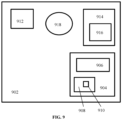
- FIG. 9 illustrates a simplified block diagram of the various elements of a device 902 suitable for use in practicing exemplary embodiments of this disclosure.
- Shown in FIG. 9 is an annular cooling ring (device 902) suitable to cool a molten film bubble 12.
- Device 902 includes processing means such as a controller 904, which includes at least one data processor 906, storing means such as at least one computer-readable memory 908 storing at least one computer program 910.
- Controller 904 the at least one data processor 906, and the at least one computer-readable memory 908 with the at least computer program 910 provide a mechanism to interpret and determine physical properties of a molten film bubble 12 and to adjust elements of annular cooling ring.
- the device 902 also includes at least one sensor 912 for sensing the physical properties of a molten film bubble 12 (e.g., film thickness). Sensor 912 is operably connected to controller 904 such that sensor 912 is able to transmit its sensed information to controller 904 and data processor 906.
- Device 902 includes an annular cooling gaps 918 operable to expel cooling air on a molten film bubble.
- Device 902 further includes induction collar 914 with one or more flow barriers 916. Induction collar 914 is operably coupled to flow barriers 916 such that induction collar 914 can cause flow barriers 916 to move rotatably around the circumference of molten film bubble 12.
- Flow barriers 916 and induction collar 914 are operably connected to controller 904 such that they can receive instructions from controller 904 to move flow barriers 916 to specified positions and to rotatably move both flow barriers 904 together with induction collar 914 around the circumference of molten film bubble 12.
- the at least one computer program 910 in device 902 in exemplary embodiments is a set of program instructions that, when executed by the associated data processor 906, enable the device 902 to operate in accordance with the exemplary embodiments of this disclosure, as detailed herein.
- the exemplary embodiments of this disclosure may be implemented at least in part by a computer software stored in computer-readable memory 908, which is executable by the data processor 906.
- Devices 906 implementing these aspects of this disclosure need not be the entire devices as depicted in FIG. 9 or may be one or more components of the above described tangibly stored software, hardware, and data processor.
- FIG. 7 is a cross sectional view of yet another device suitable for use in practicing multiple exemplary embodiments of this disclosure from the outside, both upward and downward, as well as from the inside of the blown film bubble.
- Shown in FIG. 7 is optional cooler 70 operably spaced along the long axis of the molten film bubble 12 from annular cooling ring 700.
- internal cooling system 10 including an internal cooling ring 702, which now includes middle lip 30i having a length that extends beyond an inner lip 31i.
- Internal cooling system 10 includes components similar to that found in annular cooling ring 300 from FIG. 4 , except the inside and outside terminology is reversed, and components are now mirror imaged to be within molten film bubble 12 and designated similarly with the suffix "i".
- FIG. 7 shows the inside cooling system located down adjacent to die means 8, but it should be appreciated that embodiments include internal cooling system 10 spaced from die means 8.
- Cooling system area 24 functions the same as annular cooling ring 300 with an induction collar 44 shown in FIG. 4 , except the upward and downward terminology is reversed and similar components are now designated with the suffix "b".
- Optional cooler 70 is operable to expel cooling air along the outside surface of the molten film bubble 12 in the direction of the flow of the molten film bubble 12.
- Optional cooler 70 when provided, adds additional cooling to that provided by cooling flow 50b, now acting in concert to cool the molten film bubble 12.
- optional cooler 70 can be one or more stacked cooling devices (e.g., single lip, dual lip, triple lip, multi lip, etc.) located above or below any of the annular cooling rings disclosed herein.
- final lip area 26 is depicted and functions similar to FIG.
- FIG. 4 can selectively be replaced by outer lip 32 as is described in FIG. 5 .
- Multiple of the embodiments described in FIG. 4 can be applied in one or more location, inside or outside of the bubble, in an upward or downward direction, or in any desired combination, to act in concert to cool the molten film bubble 12.
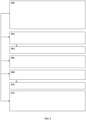
- Block 800 presents forming an annular cooling ring operable for receiving a flow of a molten film bubble and expelling a flow of cooling air, the annular cooling ring comprising a middle lip and an adjacent radially spaced apart outer lip, the middle lip having an extended length longer than the outer lip, a radially inner surface of the outer lip and a radially outer surface of the middle lip define a channel operable to allow the flow of cooling air along the radially outer surface of the middle lip, wherein the middle lip is located radially intermediate the channel and the molten film bubble, and wherein the middle lip isolates the molten film bubble from the flow of cooling air until the flow of cooling air passes beyond the extended length of the middle lip.
- Block 802 then relates to wherein the annular cooling ring comprises an open air zone defined by a portion of the extended length of the middle lip that extends beyond a length of the outer lip and an area radially outward from the radially outer surface of the middle lip.
- Block 804 wherein the open air zone allows the flow of cooling gas to flow along only the middle lip.
- block 806 specifies the method further comprising forming an inner lip located inwardly radially spaced from the middle lip, the inner lip and the middle lip defining an inner channel operable to expel the flow of cooling gas directed to flow between the middle lip and the molten film bubble.
- block 808 indicates the method further comprising forming an annular collar removeably attached to the annular cooling ring, the annular collar spaced from the middle lip and outwardly radially adjacent the middle lip.
- Block 810 relates to wherein an area between the radially outer surface of the extended length of the middle lip, the outer lip, and annular collar define an induction zone.
- block 812 states wherein the annular cooling ring is operable to expel the flow of cooling gas on at least one of (i) a radially exterior surface of the molten film bubble with the flow of the molten film bubble, (ii) the radially exterior surface of the molten film bubble against the flow of the molten film bubble, (iii) a radially interior surface of the molten film bubble with the flow of the molten film bubble, and (iv) a radially interior surface of the molten film bubble against the flow of the molten film bubble.
- the logic diagram of FIG. 8 may be considered to illustrate the operation of a method of forming or a method of manufacture.
- the logic diagram of FIG. 8 may also be considered a specific manner in which components of a device are configured to cause a device to be formed, whether such a device is an annular cooling element, or one or more components thereof.
Landscapes
- Physics & Mathematics (AREA)
- Thermal Sciences (AREA)
- Engineering & Computer Science (AREA)
- Mechanical Engineering (AREA)
- Extrusion Moulding Of Plastics Or The Like (AREA)
- Shaping By String And By Release Of Stress In Plastics And The Like (AREA)
Claims (12)
- Vorrichtung zum Kühlen, wobei die Vorrichtung umfasst:
einen ringförmigen Kühlring (300), der dazu dient, einen Strom einer Schmelzfilmblase (12) aufzunehmen und einen Kühlgasstrom auszustoßen, wobei der ringförmige Kühlring (300) eine Mittellippe (30) und eine benachbarte radial beabstandete Außenlippe (31) umfasst, wobei die Mittellippe (30) eine längere Ausdehnung aufweist als die Außenlippe (31), eine radial innere Oberfläche der Außenlippe (31) und eine radial äußere Oberfläche der Mittellippe (30) einen Kanal (102) definieren, der dazu dient, den Kühlgasstrom entlang der radial äußeren Oberfläche der Mittellippe (30) zu ermöglichen, wobei die Mittellippe (30) radial zwischen dem Kanal (102) und der Schmelzfilmblase (12) angeordnet ist, und wobei die Mittellippe (30) die Schmelzfilmblase (12) vom Kühlgasstrom isoliert, bis der Kühlgasstrom über die Ausdehnung der Mittellippe (30) hinausgeht, wobei die Vorrichtung ferner eine Freiluftzone (40) umfasst, die durch einen Teil der Ausdehnung der Mittellippe definiert ist (30), die sich über eine Länge der Außenlippe (31) und einen Bereich radial nach außen von der radial äußeren Oberfläche der Mittellippe (30) hinaus erstreckt, wobei optional die Freiluftzone (40) es dem Kühlgasstrom ermöglicht, nur entlang der Mittellippe (30) zu strömen,
dadurch gekennzeichnet, dass die Außenlippe (31) und die Mittellippe (30) einstellbar sind, um die verlängerte Länge zu vergrößern und zu verkleinern. - Vorrichtung nach Anspruch 1, wobei die Vorrichtung ferner eine Innenlippe (302) umfasst, die radial nach innen von der Mittellippe (30) beabstandet angeordnet ist, wobei die Innenlippe (302) und die Mittellippe (30) einen Innenkanal (304) definieren, der dazu dient, einen Strom von schmierendem Kühlgas zwischen der Mittellippe (30) und der Schmelzfilmblase (12) auszustoßen, wobei wahlweise mindestens eines von dem Kanal (102) und dem Innenkanal (304) dazu dient, eine Kühlflüssigkeit auszustoßen, wobei wahlweise die Kühlflüssigkeit Wasser oder kryogenes Gas ist.
- Vorrichtung nach Anspruch 1, wobei die Vorrichtung ferner einen ringförmigen Kragen umfasst, der abnehmbar an dem ringförmigen Kühlring (300) angebracht ist, wobei der ringförmige Kragen von der Mittellippe (30) beabstandet ist und radial nach außen an die Mittellippe (30) angrenzt.
- Vorrichtung nach Anspruch 3, wobei ein Bereich zwischen der radial äußeren Oberfläche der verlängerten Länge der Mittellippe (30), der Außenlippe (31) und dem ringförmigen Kragen eine Induktionszone definiert, wobei ein ringförmiger Spalt, der zwischen dem ringförmigen Kragen und der Mittellippe (30) gebildet wird,
einen Induktionsspalt (43) zum Durchströmenlassen des Kühlgases definiert, wahlweise:wobei die Induktionszone ermöglicht, dass der Kühlgasstrom aus dem Kanal nur mit der radial äußeren Oberfläche der Mittellippe (30) interagiert; oder wobei der ringförmige Kragen und die Mittellippe (30) einstellbar sind, um eine Größe der Induktionszone und des Induktionsspalts (43) zu vergrößern oder zu verkleinern, wobei optional der durch den Induktionsspalt (43) strömende Kühlgasstrom einen Venturi-Effekt erzeugen kann, um den Kühlgasstrom und einen Gasstrom aus der Induktionszone durch den Induktionsspalt (43) strömen zu lassen; oderwobei eine Position des ringförmigen Kragens entlang einer Längsachse der Schmelzfilmblase (12) relativ zum ringförmigen Kühlring (300) einstellbar ist. - Vorrichtung nach Anspruch 1, wobei der ringförmige Kühlring (300) dazu dient, den Kühlgasstrom auf mindestens eine der folgenden Stellen auszustoßen: (i) eine radial äußere Oberfläche der Schmelzfilmblase (12) mit dem Strom der Schmelzfilmblase (12), (ii) die radial äußere Oberfläche der Schmelzfilmblase (12) gegen den Strom der Schmelzfilmblase (12), (iii) eine radial innere Oberfläche der Schmelzfilmblase (12) mit dem Strom der Schmelzfilmblase (12) und (iv) eine radial innere Oberfläche der Schmelzfilmblase (12) gegen den Strom der Schmelzfilmblase (12).
- Vorrichtung nach Anspruch 1, wobei sich der ringförmige Kühlring (300) entweder (i) außerhalb der Schmelzfilmblase (12) oder (ii) innerhalb der Schmelzfilmblase (12) befindet.
- Vorrichtung nach Anspruch 1, wobei der ringförmige Kühlring (300) ferner mindestens einen zusätzlichen einzelnen Kühlgasstrom, einen doppelten Kühlgasstrom, einen dreifachen Kühlgasstrom und einen multiplen Kühlgasstrom umfasst.
- Vorrichtung nach Anspruch 1, wobei eine Position des ringförmigen Kühlrings (300) entlang einer Längsachse der Schmelzfilmblase (12) einstellbar ist.
- Verfahren zum Bilden, wobei das Verfahren umfasst:
Bilden eines ringförmigen Kühlrings (300), der dazu dient, einen Strom einer Schmelzfilmblase (12) aufzunehmen und einen Kühlgasstrom auszustoßen, wobei der ringförmige Kühlring (300) eine Mittellippe (30) und eine benachbarte radial beabstandete Außenlippe (31) umfasst, wobei die Mittellippe (30) eine längere Ausdehnung aufweist als die Außenlippe (31), eine radial innere Oberfläche der Außenlippe (31) und eine radial äußere Oberfläche der Mittellippe (30) einen Kanal (103) definieren, der dazu dient, den Kühlgasstrom entlang der radial äußeren Oberfläche der Mittellippe (30) zu ermöglichen, wobei die Mittellippe (30) radial zwischen dem Kanal (103) und der Schmelzfilmblase (12) angeordnet ist, und wobei die Mittellippe (30) die Schmelzfilmblase (12) von dem Kühlgasstrom isoliert, bis der Kühlgasstrom über die ausgedehnte Länge der Mittellippe (30) hinausgeht, wobei der Kühlring (300) ferner eine Freiluftzone (40) umfasst, die durch einen Teil der ausgedehnten Länge der Mittellippe (30), die über eine Länge der Außenlippe (31) und einen Bereich radial nach außen von der radial äußeren Oberfläche der Mittellippe (30) hinausragt, wobei optional die Freiluftzone (40) es dem Kühlgasstrom ermöglicht, nur entlang der Mittellippe (30) zu strömen, und wobei die Außenlippe (31) und die Mittellippe (30) einstellbar sind, um die verlängerte Länge zu vergrößern und zu verkleinern. - Verfahren nach Anspruch 9, wobei das Verfahren ferner das Bilden einer Innenlippe (302) umfasst, die radial nach innen von der Mittellippe (30) beabstandet angeordnet ist, wobei die Innenlippe (302) und die Mittellippe (30) einen Innenkanal (304) definieren, der dazu dient, den Kühlgasstrom auszustoßen, der zwischen der Mittellippe (30) und der Schmelzfilmblase (12) strömen soll.
- Verfahren nach Anspruch 9, wobei das Verfahren ferner das Bilden eines ringförmigen Kragens umfasst, der abnehmbar an dem ringförmigen Kühlring (300) angebracht ist, wobei der ringförmige Kragen von der Mittellippe (30) beabstandet ist und radial nach außen an die Mittellippe (30) angrenzt, wobei optional ein Bereich zwischen der radial äußeren Oberfläche der erweiterten Länge der Mittellippe (30), der Außenlippe (31) und dem ringförmigen Kragen eine Induktionszone definiert.
- Verfahren nach Anspruch 9, wobei der ringförmige Kühlring (300) dazu dient, den Kühlgasstrom auf mindestens eine der folgenden Stellen auszustoßen: (i) eine radial äußere Oberfläche der Schmelzfilmblase (12) mit dem Strom der Schmelzfilmblase (12), (ii) die radial äußere Oberfläche der Schmelzfilmblase (12) gegen den Strom der Schmelzfilmblase (12), (iii) eine radial innere Oberfläche der Schmelzfilmblase mit dem Strom der Schmelzfilmblase (12) und (iv) eine radial innere Oberfläche der Schmelzfilmblase (12) gegen den Strom der Schmelzfilmblase (12).
Applications Claiming Priority (4)
| Application Number | Priority Date | Filing Date | Title |
|---|---|---|---|
| US201862647458P | 2018-03-23 | 2018-03-23 | |
| US201862658184P | 2018-04-16 | 2018-04-16 | |
| US15/953,966 US11458666B2 (en) | 2018-03-23 | 2018-04-16 | Method and apparatus for cooling |
| PCT/US2019/023606 WO2019183487A1 (en) | 2018-03-23 | 2019-03-22 | Method and apparatus for cooling |
Publications (3)
| Publication Number | Publication Date |
|---|---|
| EP3768490A1 EP3768490A1 (de) | 2021-01-27 |
| EP3768490A4 EP3768490A4 (de) | 2021-12-01 |
| EP3768490B1 true EP3768490B1 (de) | 2024-08-14 |
Family
ID=67987577
Family Applications (1)
| Application Number | Title | Priority Date | Filing Date |
|---|---|---|---|
| EP19772342.2A Active EP3768490B1 (de) | 2018-03-23 | 2019-03-22 | Verfahren und vorrichtung zur kühlung |
Country Status (3)
| Country | Link |
|---|---|
| EP (1) | EP3768490B1 (de) |
| CA (1) | CA3079442C (de) |
| WO (1) | WO2019183487A1 (de) |
Families Citing this family (1)
| Publication number | Priority date | Publication date | Assignee | Title |
|---|---|---|---|---|
| CN114770914B (zh) * | 2022-03-24 | 2025-03-14 | 广州市普同实验分析仪器有限公司 | 膜泡定型装置 |
Family Cites Families (9)
| Publication number | Priority date | Publication date | Assignee | Title |
|---|---|---|---|---|
| GB1560030A (en) * | 1976-12-06 | 1980-01-30 | Cole R J | Air ring for the production of blown extruded film |
| DE2836808A1 (de) * | 1978-08-23 | 1980-03-06 | Demag Kunststofftech | Blaskopf zur herstellung von schlauchfolien im extrusionsverfahren |
| US4330501A (en) * | 1980-06-30 | 1982-05-18 | Union Carbide Corporation | Method and apparatus for cooling film bubble of low strain hardening polymers |
| US4447387A (en) * | 1982-09-30 | 1984-05-08 | Union Carbide Corporation | Process for manufacture of tubular film |
| US4826414A (en) * | 1988-08-22 | 1989-05-02 | Mirek Planeta | Air rings for production of blown plastic film |
| JPH0760833A (ja) * | 1993-08-23 | 1995-03-07 | Mitsubishi Chem Corp | インフレーション樹脂フィルムの成形方法 |
| CA2340812A1 (en) * | 2001-03-15 | 2002-09-15 | Robert D. Krycki | Outside bubble air cooling ring for blown plastic film |
| CA2629990C (en) * | 2007-04-17 | 2011-07-19 | Kdesign Gmbh | A method of and device for cooling blown film during the production of blown film |
| US10350806B2 (en) * | 2016-03-21 | 2019-07-16 | Poly-America, L.P. | Apparatus and method for forming a polymeric web |
-
2019
- 2019-03-22 CA CA3079442A patent/CA3079442C/en active Active
- 2019-03-22 WO PCT/US2019/023606 patent/WO2019183487A1/en not_active Ceased
- 2019-03-22 EP EP19772342.2A patent/EP3768490B1/de active Active
Also Published As
| Publication number | Publication date |
|---|---|
| CA3079442A1 (en) | 2019-09-26 |
| CA3079442C (en) | 2022-08-30 |
| EP3768490A1 (de) | 2021-01-27 |
| EP3768490A4 (de) | 2021-12-01 |
| WO2019183487A1 (en) | 2019-09-26 |
Similar Documents
| Publication | Publication Date | Title |
|---|---|---|
| US20230158727A1 (en) | Method and apparatus for cooling | |
| US9457526B2 (en) | Calibration device for calibrating an extruded film tube | |
| CN106163766B (zh) | 厚度不均调整型气环 | |
| US11919219B2 (en) | Controlled pressure enclosure | |
| US20070187856A1 (en) | Multi-layered blown film forming apparatus and multi-layered blown film forming method | |
| US4938903A (en) | Highly intensive cooling process and apparatus for the production of biaxially oriented films of high- and medium-molecular-weight thermoplastics | |
| US11186026B2 (en) | High performance cooling element | |
| CA1271606A (en) | Air cooling ring for plastic film | |
| CA3009079C (en) | Apparatus with unidirectional cooling element for blown film cooling | |
| EP3768490B1 (de) | Verfahren und vorrichtung zur kühlung | |
| US4834924A (en) | Extrusion apparatus for tubular thermoplastic films including two (tandem) spaced air rings for controlling cooling rate and production speeds | |
| CA2438493C (en) | Film die for the production of tubular film | |
| US20240173910A1 (en) | High performance cooling element | |
| US20250135702A1 (en) | Uniform distribution of cooling gas plenum | |
| WO2012102684A1 (en) | Apparatus and process for controlling the temperature of an extruded plastic blown film | |
| US20060202374A1 (en) | Method and apparatus for cooling extruded plastic foil hoses | |
| JP2005231266A (ja) | 多層フィルムインフレーション成形機、及び、多層フィルムインフレーション成形方法 | |
| CN101022938A (zh) | 用于生产挤出塑料薄膜软管的设备和方法 | |
| JPH0312532B2 (de) | ||
| JPH0312534B2 (de) |
Legal Events
| Date | Code | Title | Description |
|---|---|---|---|
| STAA | Information on the status of an ep patent application or granted ep patent |
Free format text: STATUS: THE INTERNATIONAL PUBLICATION HAS BEEN MADE |
|
| PUAI | Public reference made under article 153(3) epc to a published international application that has entered the european phase |
Free format text: ORIGINAL CODE: 0009012 |
|
| STAA | Information on the status of an ep patent application or granted ep patent |
Free format text: STATUS: REQUEST FOR EXAMINATION WAS MADE |
|
| 17P | Request for examination filed |
Effective date: 20200421 |
|
| AK | Designated contracting states |
Kind code of ref document: A1 Designated state(s): AL AT BE BG CH CY CZ DE DK EE ES FI FR GB GR HR HU IE IS IT LI LT LU LV MC MK MT NL NO PL PT RO RS SE SI SK SM TR |
|
| AX | Request for extension of the european patent |
Extension state: BA ME |
|
| DAV | Request for validation of the european patent (deleted) | ||
| DAX | Request for extension of the european patent (deleted) | ||
| A4 | Supplementary search report drawn up and despatched |
Effective date: 20211104 |
|
| RIC1 | Information provided on ipc code assigned before grant |
Ipc: B29C 48/88 20190101AFI20211028BHEP |
|
| STAA | Information on the status of an ep patent application or granted ep patent |
Free format text: STATUS: EXAMINATION IS IN PROGRESS |
|
| 17Q | First examination report despatched |
Effective date: 20230214 |
|
| GRAP | Despatch of communication of intention to grant a patent |
Free format text: ORIGINAL CODE: EPIDOSNIGR1 |
|
| STAA | Information on the status of an ep patent application or granted ep patent |
Free format text: STATUS: GRANT OF PATENT IS INTENDED |
|
| INTG | Intention to grant announced |
Effective date: 20240307 |
|
| GRAS | Grant fee paid |
Free format text: ORIGINAL CODE: EPIDOSNIGR3 |
|
| GRAA | (expected) grant |
Free format text: ORIGINAL CODE: 0009210 |
|
| STAA | Information on the status of an ep patent application or granted ep patent |
Free format text: STATUS: THE PATENT HAS BEEN GRANTED |
|
| AK | Designated contracting states |
Kind code of ref document: B1 Designated state(s): AL AT BE BG CH CY CZ DE DK EE ES FI FR GB GR HR HU IE IS IT LI LT LU LV MC MK MT NL NO PL PT RO RS SE SI SK SM TR |
|
| P01 | Opt-out of the competence of the unified patent court (upc) registered |
Free format text: CASE NUMBER: APP_39858/2024 Effective date: 20240704 |
|
| REG | Reference to a national code |
Ref country code: GB Ref legal event code: FG4D |
|
| REG | Reference to a national code |
Ref country code: CH Ref legal event code: EP |
|
| REG | Reference to a national code |
Ref country code: DE Ref legal event code: R096 Ref document number: 602019057026 Country of ref document: DE |
|
| REG | Reference to a national code |
Ref country code: IE Ref legal event code: FG4D |
|
| REG | Reference to a national code |
Ref country code: LT Ref legal event code: MG9D |
|
| REG | Reference to a national code |
Ref country code: NL Ref legal event code: MP Effective date: 20240814 |
|
| PG25 | Lapsed in a contracting state [announced via postgrant information from national office to epo] |
Ref country code: NO Free format text: LAPSE BECAUSE OF FAILURE TO SUBMIT A TRANSLATION OF THE DESCRIPTION OR TO PAY THE FEE WITHIN THE PRESCRIBED TIME-LIMIT Effective date: 20241114 |
|
| REG | Reference to a national code |
Ref country code: AT Ref legal event code: MK05 Ref document number: 1712891 Country of ref document: AT Kind code of ref document: T Effective date: 20240814 |
|
| PG25 | Lapsed in a contracting state [announced via postgrant information from national office to epo] |
Ref country code: FI Free format text: LAPSE BECAUSE OF FAILURE TO SUBMIT A TRANSLATION OF THE DESCRIPTION OR TO PAY THE FEE WITHIN THE PRESCRIBED TIME-LIMIT Effective date: 20240814 Ref country code: GR Free format text: LAPSE BECAUSE OF FAILURE TO SUBMIT A TRANSLATION OF THE DESCRIPTION OR TO PAY THE FEE WITHIN THE PRESCRIBED TIME-LIMIT Effective date: 20241115 Ref country code: NL Free format text: LAPSE BECAUSE OF FAILURE TO SUBMIT A TRANSLATION OF THE DESCRIPTION OR TO PAY THE FEE WITHIN THE PRESCRIBED TIME-LIMIT Effective date: 20240814 Ref country code: PL Free format text: LAPSE BECAUSE OF FAILURE TO SUBMIT A TRANSLATION OF THE DESCRIPTION OR TO PAY THE FEE WITHIN THE PRESCRIBED TIME-LIMIT Effective date: 20240814 Ref country code: PT Free format text: LAPSE BECAUSE OF FAILURE TO SUBMIT A TRANSLATION OF THE DESCRIPTION OR TO PAY THE FEE WITHIN THE PRESCRIBED TIME-LIMIT Effective date: 20241216 |
|
| PG25 | Lapsed in a contracting state [announced via postgrant information from national office to epo] |
Ref country code: BG Free format text: LAPSE BECAUSE OF FAILURE TO SUBMIT A TRANSLATION OF THE DESCRIPTION OR TO PAY THE FEE WITHIN THE PRESCRIBED TIME-LIMIT Effective date: 20240814 |
|
| PG25 | Lapsed in a contracting state [announced via postgrant information from national office to epo] |
Ref country code: LV Free format text: LAPSE BECAUSE OF FAILURE TO SUBMIT A TRANSLATION OF THE DESCRIPTION OR TO PAY THE FEE WITHIN THE PRESCRIBED TIME-LIMIT Effective date: 20240814 |
|
| PG25 | Lapsed in a contracting state [announced via postgrant information from national office to epo] |
Ref country code: IS Free format text: LAPSE BECAUSE OF FAILURE TO SUBMIT A TRANSLATION OF THE DESCRIPTION OR TO PAY THE FEE WITHIN THE PRESCRIBED TIME-LIMIT Effective date: 20241214 Ref country code: AT Free format text: LAPSE BECAUSE OF FAILURE TO SUBMIT A TRANSLATION OF THE DESCRIPTION OR TO PAY THE FEE WITHIN THE PRESCRIBED TIME-LIMIT Effective date: 20240814 |
|
| PG25 | Lapsed in a contracting state [announced via postgrant information from national office to epo] |
Ref country code: HR Free format text: LAPSE BECAUSE OF FAILURE TO SUBMIT A TRANSLATION OF THE DESCRIPTION OR TO PAY THE FEE WITHIN THE PRESCRIBED TIME-LIMIT Effective date: 20240814 |
|
| PG25 | Lapsed in a contracting state [announced via postgrant information from national office to epo] |
Ref country code: RS Free format text: LAPSE BECAUSE OF FAILURE TO SUBMIT A TRANSLATION OF THE DESCRIPTION OR TO PAY THE FEE WITHIN THE PRESCRIBED TIME-LIMIT Effective date: 20241114 Ref country code: ES Free format text: LAPSE BECAUSE OF FAILURE TO SUBMIT A TRANSLATION OF THE DESCRIPTION OR TO PAY THE FEE WITHIN THE PRESCRIBED TIME-LIMIT Effective date: 20240814 |
|
| PG25 | Lapsed in a contracting state [announced via postgrant information from national office to epo] |
Ref country code: RS Free format text: LAPSE BECAUSE OF FAILURE TO SUBMIT A TRANSLATION OF THE DESCRIPTION OR TO PAY THE FEE WITHIN THE PRESCRIBED TIME-LIMIT Effective date: 20241114 Ref country code: PT Free format text: LAPSE BECAUSE OF FAILURE TO SUBMIT A TRANSLATION OF THE DESCRIPTION OR TO PAY THE FEE WITHIN THE PRESCRIBED TIME-LIMIT Effective date: 20241216 Ref country code: PL Free format text: LAPSE BECAUSE OF FAILURE TO SUBMIT A TRANSLATION OF THE DESCRIPTION OR TO PAY THE FEE WITHIN THE PRESCRIBED TIME-LIMIT Effective date: 20240814 Ref country code: NO Free format text: LAPSE BECAUSE OF FAILURE TO SUBMIT A TRANSLATION OF THE DESCRIPTION OR TO PAY THE FEE WITHIN THE PRESCRIBED TIME-LIMIT Effective date: 20241114 Ref country code: NL Free format text: LAPSE BECAUSE OF FAILURE TO SUBMIT A TRANSLATION OF THE DESCRIPTION OR TO PAY THE FEE WITHIN THE PRESCRIBED TIME-LIMIT Effective date: 20240814 Ref country code: LV Free format text: LAPSE BECAUSE OF FAILURE TO SUBMIT A TRANSLATION OF THE DESCRIPTION OR TO PAY THE FEE WITHIN THE PRESCRIBED TIME-LIMIT Effective date: 20240814 Ref country code: IS Free format text: LAPSE BECAUSE OF FAILURE TO SUBMIT A TRANSLATION OF THE DESCRIPTION OR TO PAY THE FEE WITHIN THE PRESCRIBED TIME-LIMIT Effective date: 20241214 Ref country code: HR Free format text: LAPSE BECAUSE OF FAILURE TO SUBMIT A TRANSLATION OF THE DESCRIPTION OR TO PAY THE FEE WITHIN THE PRESCRIBED TIME-LIMIT Effective date: 20240814 Ref country code: GR Free format text: LAPSE BECAUSE OF FAILURE TO SUBMIT A TRANSLATION OF THE DESCRIPTION OR TO PAY THE FEE WITHIN THE PRESCRIBED TIME-LIMIT Effective date: 20241115 Ref country code: FI Free format text: LAPSE BECAUSE OF FAILURE TO SUBMIT A TRANSLATION OF THE DESCRIPTION OR TO PAY THE FEE WITHIN THE PRESCRIBED TIME-LIMIT Effective date: 20240814 Ref country code: ES Free format text: LAPSE BECAUSE OF FAILURE TO SUBMIT A TRANSLATION OF THE DESCRIPTION OR TO PAY THE FEE WITHIN THE PRESCRIBED TIME-LIMIT Effective date: 20240814 Ref country code: BG Free format text: LAPSE BECAUSE OF FAILURE TO SUBMIT A TRANSLATION OF THE DESCRIPTION OR TO PAY THE FEE WITHIN THE PRESCRIBED TIME-LIMIT Effective date: 20240814 Ref country code: AT Free format text: LAPSE BECAUSE OF FAILURE TO SUBMIT A TRANSLATION OF THE DESCRIPTION OR TO PAY THE FEE WITHIN THE PRESCRIBED TIME-LIMIT Effective date: 20240814 |
|
| PGFP | Annual fee paid to national office [announced via postgrant information from national office to epo] |
Ref country code: DE Payment date: 20241231 Year of fee payment: 7 |
|
| PG25 | Lapsed in a contracting state [announced via postgrant information from national office to epo] |
Ref country code: DK Free format text: LAPSE BECAUSE OF FAILURE TO SUBMIT A TRANSLATION OF THE DESCRIPTION OR TO PAY THE FEE WITHIN THE PRESCRIBED TIME-LIMIT Effective date: 20240814 Ref country code: RO Free format text: LAPSE BECAUSE OF FAILURE TO SUBMIT A TRANSLATION OF THE DESCRIPTION OR TO PAY THE FEE WITHIN THE PRESCRIBED TIME-LIMIT Effective date: 20240814 Ref country code: SM Free format text: LAPSE BECAUSE OF FAILURE TO SUBMIT A TRANSLATION OF THE DESCRIPTION OR TO PAY THE FEE WITHIN THE PRESCRIBED TIME-LIMIT Effective date: 20240814 |
|
| PG25 | Lapsed in a contracting state [announced via postgrant information from national office to epo] |
Ref country code: EE Free format text: LAPSE BECAUSE OF FAILURE TO SUBMIT A TRANSLATION OF THE DESCRIPTION OR TO PAY THE FEE WITHIN THE PRESCRIBED TIME-LIMIT Effective date: 20240814 |
|
| PG25 | Lapsed in a contracting state [announced via postgrant information from national office to epo] |
Ref country code: CZ Free format text: LAPSE BECAUSE OF FAILURE TO SUBMIT A TRANSLATION OF THE DESCRIPTION OR TO PAY THE FEE WITHIN THE PRESCRIBED TIME-LIMIT Effective date: 20240814 |
|
| PG25 | Lapsed in a contracting state [announced via postgrant information from national office to epo] |
Ref country code: SK Free format text: LAPSE BECAUSE OF FAILURE TO SUBMIT A TRANSLATION OF THE DESCRIPTION OR TO PAY THE FEE WITHIN THE PRESCRIBED TIME-LIMIT Effective date: 20240814 |
|
| PGFP | Annual fee paid to national office [announced via postgrant information from national office to epo] |
Ref country code: IT Payment date: 20250211 Year of fee payment: 7 |
|
| REG | Reference to a national code |
Ref country code: DE Ref legal event code: R097 Ref document number: 602019057026 Country of ref document: DE |
|
| PLBE | No opposition filed within time limit |
Free format text: ORIGINAL CODE: 0009261 |
|
| STAA | Information on the status of an ep patent application or granted ep patent |
Free format text: STATUS: NO OPPOSITION FILED WITHIN TIME LIMIT |
|
| 26N | No opposition filed |
Effective date: 20250515 |
|
| PG25 | Lapsed in a contracting state [announced via postgrant information from national office to epo] |
Ref country code: SE Free format text: LAPSE BECAUSE OF FAILURE TO SUBMIT A TRANSLATION OF THE DESCRIPTION OR TO PAY THE FEE WITHIN THE PRESCRIBED TIME-LIMIT Effective date: 20240814 |
|
| PG25 | Lapsed in a contracting state [announced via postgrant information from national office to epo] |
Ref country code: MC Free format text: LAPSE BECAUSE OF FAILURE TO SUBMIT A TRANSLATION OF THE DESCRIPTION OR TO PAY THE FEE WITHIN THE PRESCRIBED TIME-LIMIT Effective date: 20240814 |
|
| REG | Reference to a national code |
Ref country code: CH Ref legal event code: H13 Free format text: ST27 STATUS EVENT CODE: U-0-0-H10-H13 (AS PROVIDED BY THE NATIONAL OFFICE) Effective date: 20251024 |
|
| PG25 | Lapsed in a contracting state [announced via postgrant information from national office to epo] |
Ref country code: LU Free format text: LAPSE BECAUSE OF NON-PAYMENT OF DUE FEES Effective date: 20250322 |
|
| GBPC | Gb: european patent ceased through non-payment of renewal fee |
Effective date: 20250322 |