EP3767477B1 - Künstlicher intelligenzprozessor und verfahren zur durchführung des betriebs von neuronalem netz davon - Google Patents
Künstlicher intelligenzprozessor und verfahren zur durchführung des betriebs von neuronalem netz davon Download PDFInfo
- Publication number
- EP3767477B1 EP3767477B1 EP20182359.8A EP20182359A EP3767477B1 EP 3767477 B1 EP3767477 B1 EP 3767477B1 EP 20182359 A EP20182359 A EP 20182359A EP 3767477 B1 EP3767477 B1 EP 3767477B1
- Authority
- EP
- European Patent Office
- Prior art keywords
- neural network
- image data
- image
- data
- network operators
- Prior art date
- Legal status (The legal status is an assumption and is not a legal conclusion. Google has not performed a legal analysis and makes no representation as to the accuracy of the status listed.)
- Active
Links
Images





Classifications
-
- G—PHYSICS
- G06—COMPUTING OR CALCULATING; COUNTING
- G06F—ELECTRIC DIGITAL DATA PROCESSING
- G06F12/00—Accessing, addressing or allocating within memory systems or architectures
- G06F12/02—Addressing or allocation; Relocation
- G06F12/0223—User address space allocation, e.g. contiguous or non contiguous base addressing
- G06F12/0284—Multiple user address space allocation, e.g. using different base addresses
-
- G—PHYSICS
- G06—COMPUTING OR CALCULATING; COUNTING
- G06N—COMPUTING ARRANGEMENTS BASED ON SPECIFIC COMPUTATIONAL MODELS
- G06N3/00—Computing arrangements based on biological models
- G06N3/02—Neural networks
- G06N3/06—Physical realisation, i.e. hardware implementation of neural networks, neurons or parts of neurons
- G06N3/063—Physical realisation, i.e. hardware implementation of neural networks, neurons or parts of neurons using electronic means
-
- G—PHYSICS
- G06—COMPUTING OR CALCULATING; COUNTING
- G06F—ELECTRIC DIGITAL DATA PROCESSING
- G06F12/00—Accessing, addressing or allocating within memory systems or architectures
- G06F12/02—Addressing or allocation; Relocation
- G06F12/0207—Addressing or allocation; Relocation with multidimensional access, e.g. row/column, matrix
-
- G—PHYSICS
- G06—COMPUTING OR CALCULATING; COUNTING
- G06N—COMPUTING ARRANGEMENTS BASED ON SPECIFIC COMPUTATIONAL MODELS
- G06N3/00—Computing arrangements based on biological models
- G06N3/02—Neural networks
- G06N3/04—Architecture, e.g. interconnection topology
- G06N3/045—Combinations of networks
-
- G—PHYSICS
- G06—COMPUTING OR CALCULATING; COUNTING
- G06N—COMPUTING ARRANGEMENTS BASED ON SPECIFIC COMPUTATIONAL MODELS
- G06N3/00—Computing arrangements based on biological models
- G06N3/02—Neural networks
- G06N3/04—Architecture, e.g. interconnection topology
- G06N3/0464—Convolutional networks [CNN, ConvNet]
-
- G—PHYSICS
- G06—COMPUTING OR CALCULATING; COUNTING
- G06N—COMPUTING ARRANGEMENTS BASED ON SPECIFIC COMPUTATIONAL MODELS
- G06N3/00—Computing arrangements based on biological models
- G06N3/02—Neural networks
- G06N3/08—Learning methods
-
- G—PHYSICS
- G06—COMPUTING OR CALCULATING; COUNTING
- G06F—ELECTRIC DIGITAL DATA PROCESSING
- G06F2212/00—Indexing scheme relating to accessing, addressing or allocation within memory systems or architectures
- G06F2212/10—Providing a specific technical effect
- G06F2212/1028—Power efficiency
-
- G—PHYSICS
- G06—COMPUTING OR CALCULATING; COUNTING
- G06N—COMPUTING ARRANGEMENTS BASED ON SPECIFIC COMPUTATIONAL MODELS
- G06N3/00—Computing arrangements based on biological models
- G06N3/02—Neural networks
- G06N3/04—Architecture, e.g. interconnection topology
- G06N3/048—Activation functions
-
- H—ELECTRICITY
- H04—ELECTRIC COMMUNICATION TECHNIQUE
- H04N—PICTORIAL COMMUNICATION, e.g. TELEVISION
- H04N19/00—Methods or arrangements for coding, decoding, compressing or decompressing digital video signals
- H04N19/50—Methods or arrangements for coding, decoding, compressing or decompressing digital video signals using predictive coding
- H04N19/59—Methods or arrangements for coding, decoding, compressing or decompressing digital video signals using predictive coding involving spatial sub-sampling or interpolation, e.g. alteration of picture size or resolution
-
- Y—GENERAL TAGGING OF NEW TECHNOLOGICAL DEVELOPMENTS; GENERAL TAGGING OF CROSS-SECTIONAL TECHNOLOGIES SPANNING OVER SEVERAL SECTIONS OF THE IPC; TECHNICAL SUBJECTS COVERED BY FORMER USPC CROSS-REFERENCE ART COLLECTIONS [XRACs] AND DIGESTS
- Y02—TECHNOLOGIES OR APPLICATIONS FOR MITIGATION OR ADAPTATION AGAINST CLIMATE CHANGE
- Y02D—CLIMATE CHANGE MITIGATION TECHNOLOGIES IN INFORMATION AND COMMUNICATION TECHNOLOGIES [ICT], I.E. INFORMATION AND COMMUNICATION TECHNOLOGIES AIMING AT THE REDUCTION OF THEIR OWN ENERGY USE
- Y02D10/00—Energy efficient computing, e.g. low power processors, power management or thermal management
Definitions
- the disclosure relates to image processing, and f, to an artificial intelligence (Al) processor for performing image processing and image processing using the Al processor.
- Al artificial intelligence
- the Al technology has been widely applied to image processing, and technology for performing image processing using an artificial neural network having a multilayer structure has been continuously developed.
- technologies for performing various image processing operations have been developed, such as improving image quality, enlarging the size of an image, or predicting and reconstructing an area missing from an image, using an artificial neural network.
- an artificial neural network When an artificial neural network is used in an image processing field, a large amount of computation is required for image processing using the artificial neural network. In particular, when the size of an image gradually increases or the image needs to be processed in real time, resource and power consumption of hardware for processing the image may further increase. In addition, when image processing is performed in an on-device environment of a terminal device other than a server, technology for reducing the resource and the power consumption of hardware of the terminal device becomes more important.
- WO2019009490 discloses an image compressing method comprising: performing downsampling by means of a DNN with respect to an image and thus determining a compressed image; performing prediction on the basis of the compressed image and thus determining a prediction signal; determining a residual signal on the basis of the compressed image and the prediction signal; and generating a bitstream comprising information relating to the residual signal, wherein the DNN has a network structure determined by means of learning of a downsampling process using information generated in an upsampling process.
- WO 2018/189613 A1 discloses a distributed processing architecture configured to compress image data, and implementing a neural network (autoencoder), for image compression/decompression.
- GB 2 548 749 A discloses means for image downscaling/upscaling using a Convolutional Neural Network (CNN).
- CNN Convolutional Neural Network
- WO 2019/085655 A1 discloses a CNN processing being distributed over nodes of an on-chip network, wherein data is distributed based on a fractal tree structure comprising: a central node, which is a communication data center of the on-chip network, configured to broadcast or multicast data to a plurality of leaf nodes; a plurality of leaf nodes, which are communication data nodes of the on-chip network, for transmitting data to the central leaf node; a repeater module, configured to connect the central node and the plurality of leaf nodes, and the data is forwarded by the forwarding module.
- US 2017/103040 A1 discloses a Neural Processing Unit (NPU) comprising a clock reduction logic programmed via a relax parameter.
- NPU Neural Processing Unit
- US 2009/175548 A1 discloses means for transmitting image data with high quality and low delay by encoding image data using a reversible method that can restore the original data and to transmit the image data with low delay, by means of a distributed processing architecture.
- US 2015/106306 A1 discloses a visualization tool for a Neuroscience-inspired Dynamic Architecture (NIDA) / Dynamic Adaptive Neural Network Array (DANNA) to gain insights into neural pathways for solving specific problems that are not used in solving different problems.
- NIDA Neuroscience-inspired Dynamic Architecture
- DANNA Dynamic Adaptive Neural Network Array
- Embodiments of the disclosure provide an artificial intelligence (Al) processor and a method of performing a neural network operation thereof to reduce resource or power consumption of hardware of a terminal device required for image processing.
- Al artificial intelligence
- embodiments of the disclosure provide an Al processor capable of adaptively operating with respect to various image sizes, a method of performing a neural network operation, and a neural network operation platform.
- an artificial intelligence (Al) processor as set out in claim 1.
- Optional features are this aspect are set out in claims 2 to 11
- one component is “connected” or “coupled” to another component herein, although the one component may be directly connected or directly coupled to the other component, it is to be understood that unless otherwise specifically described, the one component may be connected or coupled to the other component via another component therebetween.
- two or more components may be combined into one component or one component may be divided into two or more components for each subdivided function.
- each component to be described below may additionally perform some or all of functions of other components in addition to main functions of each component, and some of the main functions of each component may be performed by the other components.
- the expression "at least one of a, b or c" indicates only a, only b, only c, both a and b, both a and c, both b and c, all of a, b, and c, or variations thereof.
- an 'image' may, for example, and without limitation, represent a still image (or an image frame) of a video, a moving image including a plurality of continuous still images, a video, etc.
- FIG. 1 is a diagram illustrating an example artificial intelligence (Al) encoding process and an AI decoding process according to an embodiment of the disclosure.
- an original image 105 (e.g., an 8K image) of a high resolution may be Al downscaled 110 and a first image 115 (e.g., a 4K image) may be generated.
- a processed bit rate may be greatly reduced compared to a case where the first encoding 120 and the first decoding 130 are performed on the original image 105.
- the original image 105 may be Al downscaled 110 to generate the first image 115 and the first encoding 120 is performed on the generated first image 115.
- AI encoding data including AI data generated as a result of AI encoding and image data may be received, and a second image 135 (e.g., a 4K image) may be generated through the first decoding 130 and may be Al upscaled 140 and a third image 145 (e.g., an 8K image) may be generated.
- a second image 135 e.g., a 4K image
- a third image 145 e.g., an 8K image
- the original image 105 when the original image 105 is received, the original image 105 may be AI downscaled 110 to generate the first image 115 of a predetermined resolution or a predetermined image quality.
- the AI downscaling 110 may be performed on an AI basis, and AI for the AI downscaling 110 may be trained connectively with AI for the AI upscaling 140 of the second image 135. This is because a difference between the original image 105 that is an AI encoding target and the third image 145 reconstructed through AI decoding increases when the AI for the AI downscaling 110 and the AI for the AI upscaling 140 may be trained separately.
- AI data may be used.
- the AI data generated through the Al encoding process may include information representing an upscale target.
- the second image 135 may be AI upscaled 140 according to the upscale target confirmed based on the AI data in the AI decoding process.
- the AI for the AI downscaling 110 and the AI for the AI upscaling 140 may be implemented in a neural network model (e.g., a deep neural network (DNN)). Because a neural network model used for the AI downscaling 110 and a neural network model used for the AI upscaling 140 are trained connectively through sharing of loss information under a predetermined target, an AI encoding device may provide target information used during connection training, and an AI decoding device may AI upscale 140 the second image 135 to a targeted resolution based on the provided target information.
- a neural network model e.g., a deep neural network (DNN)
- an amount of information of the first image 115 that is AI downscaled 110 from the original image 105 may be reduced through the first encoding 120.
- the first encoding 120 may include processes of predicting the first image 115 to generate prediction data, generating residual data corresponding to a difference between the first image 115 and the prediction data, transforming the residual data that is a spatial domain component into a frequency domain component, quantizing the residual data transformed into the frequency domain component, entropy encoding the quantized residual data, etc.
- the first encoding 120 may be implemented through an of various image compression methods using a frequency transformation such as, for example, and without limitation, MPEG-2, H.264, Advanced Video Coding (AVC), MPEG-4, High Efficiency Video Coding (HEVC), VC-1, VP8, VP9 and AOMedia Video 1 (AV1), etc.
- a frequency transformation such as, for example, and without limitation, MPEG-2, H.264, Advanced Video Coding (AVC), MPEG-4, High Efficiency Video Coding (HEVC), VC-1, VP8, VP9 and AOMedia Video 1 (AV1), etc.
- the second image 135 corresponding to the first image 115 may be reconstructed through the first decoding 130 of the image data.
- the first decoding 130 may include, for example, and without limitation, processes of entropy decoding the image data to generate the quantized residual data, dequantizing the quantized residual data, transforming the residual data of the frequency domain component to the spatial domain component, generating the prediction data, reconstructing the first image 135 using the prediction data and the residual data, etc.
- the first decoding 130 may be implemented through an image reconstruction method corresponding to any image compression method using the frequency transformation such as, for example, and without limitation, MPEG-2, H.264, MPEG-4, HEVC, VC-1, VP8, VP9, AV1, etc.
- the AI encoding data generated through the AI encoding process may include encoding data generated as a result of the first encoding 120 of the first image 115 and AI data related to the AI downscaling 110 of the original image 105.
- the encoding data may be used in the first decoding 130, and the AI data may be used in the AI upscaling 140.
- the encoding data may, for example, be transmitted in the form of a bitstream.
- the encoding data may include data generated based on pixel values in the first image 115, for example, the residual data that is a difference between the first image 115 and the prediction data of the first image 115.
- the encoding data may include information used in the first encoding 120 of the first image 115.
- the encoding data may include mode information (e.g., prediction mode information, motion information, etc.) used for the first encoding 120 of the first image 115, and quantization parameter related information used in the first encoding 120, etc.
- the encoding data may be generated according to a rule, for example, syntax, of an image compression method used in the first encoding 120 among the image compression methods using the frequency transformation such as, for example, and without limitation, MPEG-2, H. 264 AVC, MPEG-4, HEVC, VC-1, VP8, VP9, AV1, etc.
- a rule for example, syntax, of an image compression method used in the first encoding 120 among the image compression methods using the frequency transformation such as, for example, and without limitation, MPEG-2, H. 264 AVC, MPEG-4, HEVC, VC-1, VP8, VP9, AV1, etc.
- the AI data may be used for the AI upscaling 140 based on a neural network operation.
- the AI data may include information for accurately enabling the AI upscaling 140 of the second image 135.
- the second image 135 may be AI upscaled 140 to a targeted resolution or image quality based on the AI data.
- the AI data may be transmitted together with the encoding data in the form of a bitstream.
- the AI data may be transmitted separately from the encoding data in the form of a frame or a packet.
- the encoding data and the AI data generated as a result of AI encoding may be transmitted through a homogeneous network or a heterogeneous network.
- FIG. 2 is a block diagram illustrating an example configuration of an AI decoding apparatus 200 according to an embodiment of the disclosure.
- the AI decoding apparatus 200 may include a communicator (e.g., including communication circuitry) 212, a parser (e.g., including parsing circuitry) 214, and an AI decoder (e.g., including processing circuitry and/or executable program elements) 220.
- the AI decoder 220 may include a first decoder 222 and an AI upscaler 224.
- the communicator 212 may include various communication circuitry and receive AI encoding data generated as a result of AI encoding through a network.
- the AI encoding data generated as a result of AI encoding may include encoding data and AI data described above.
- the encoding data and the AI data may be received through a homogeneous network or a heterogeneous network.
- the parser 214 may include various parsing circuitry and/or executable program elements and receive AI encoding data through the communicator 212 and parse and divide the AI encoding data into the encoding data and the AI data. For example, the parser 214 may read a header of data obtained from the communicator 212 to determine whether the data is the encoding data or the AI data. For example, the parser 214 may divide the data received through the communicator 212 into the encoding data and the AI data through the header of the data and transmit the encoding data and the AI data to the first decoder 222 and the AI upscaler 224, respectively..
- the AI encoding data parsed by the parser 214 may be obtained from a storage medium, and is not limited to that received through the communicator 212.
- the AI encoding data may be obtained from a data storage medium including magnetic media such as a hard disk, a floppy disk and a magnetic tape, optical recording media such as a CD-ROM and a DVD, magneto-optical media such as a floptical disk, etc.
- the first decoder 222 may reconstruct the second image 135 corresponding to the first image 115 based on the encoding data.
- the second image 135 generated by the first decoder 222 may be provided to the AI upscaler 224.
- first decoding related information such as mode information MODE INFORMATION (e.g., prediction mode information, motion information, etc.), quantization parameter information QP INFORMATION, etc. included in the encoding data may be further provided to the AI upscaler 224.
- the AI upscaler 224 receiving the AI data may AI upscale the second image 135 based on the AI data.
- the AI upscaler 224 may AI upscale the second image 135 by further using the first decoding related information such as the mode information MODE INFORMATION, the quantization parameter information QP INFORMATION, etc. included in the encoding data.
- the AI data provided to the AI upscaler 224 may include a plurality of pieces of information for enabling AI upscaling of the second image 135.
- An example of the information included in the AI data may include at least one of difference information between resolution of the original image 105 and a resolution of the first image 115 or information related to the first image 115.
- the difference information may be expressed as information (e.g., resolution conversion rate information) about a degree of resolution conversion of the first image 115 compared to the original image 105.
- the difference information may be expressed by the resolution information of the original image 105.
- the resolution information may be expressed in the horizontal/vertical size of an image, or may be expressed in a ratio (16:9, 4:3, etc.) and size of one axis.
- the resolution information may be expressed in the form of an index or a flag.
- the information related to the first image 115 may include at least one of a bit rate of the encoding data generated as a result of first encoding of the first image 115, a codec type used in the first encoding of the first image 115 or on/off flag information of the Al upscaler 224.
- the difference information and the information related to the first image 115 may be transmitted as one Al data or may be separately transmitted and processed as needed.
- the Al upscaler 224 may determine an upscale target of the second image 135 based on at least one of the difference information or the information related to the first image 115 included in the AI data.
- the upscale target may indicate, for example, to what degree of resolution the second image 135 needs to be upscaled.
- the AI upscaler 224 may AI upscale the second image 135 using a neural network operation to generate a third image 145 corresponding to the upscale target.
- the communicator 212, the parser 214, and the Al decoder 220 are described as separate devices, but may be implemented through one processor.
- the communicator 212, the parser 214, and the Al decoder 220 may be implemented as a dedicated processor, or may be implemented through a combination of a general purpose processor such as an application processor (AP), a central processing unit (CPU), and a graphics processing unit (GPU) and software.
- AP application processor
- CPU central processing unit
- GPU graphics processing unit
- the communicator 212, the parser 214, and the AI decoder 220 may be configured as one or more processors.
- the communicator 212, the parser 214, and the AI decoder 220 may be implemented as a combination of dedicated processors, or may be implemented through a combination of a plurality of general purpose processors such as an AP, a CPU, and a GPU and software.
- the AI upscaler 224 and the first decoder 222 may be implemented through one processor or may be implemented in different processors.
- FIG. 3 is a block diagram illustrating an example configuration of a display device 300 according to an embodiment of the disclosure.
- the AI decoding apparatus 200 of FIG. 2 described above may be the display device 300 of FIG. 3 .
- the display device 300 may receive an image from an image supply device 100.
- the image supply device 100 may include, for example, various servers such as a broadcasting station, a media service provider, a service company, a system integrator (SI) company, an application market, a web site, etc.
- Types of images supplied by the image supply device 100 may include, for example, broadcast content, media content, applications, etc.
- the media content may be provided as a video stream in the form of a file according to real time streaming through a network in the form of a voice of demand (VOD) service.
- VOD voice of demand
- the display device 300 may decode AI encoding data received from the image supply device 100 to display a reconstructed image.
- the display device 300 may be a television (TV) that processes at least one of a broadcast signal, broadcast information, or broadcast data received from transmission equipment of a broadcast station..
- TV television
- the display device 300 may include a control processor (e.g., including processing circuitry) 310, a video processor (e.g., including video processing circuitry) 320, a display 330, a communicator (e.g., including communication circuitry) 340, a user input interface (e.g., including user input interface circuitry) 350, and a memory 360, but the configuration of the display device 300 is not limited to that shown.
- a control processor e.g., including processing circuitry
- a video processor e.g., including video processing circuitry
- a display 330 e.g., a display 330
- a communicator e.g., including communication circuitry
- a user input interface e.g., including user input interface circuitry
- the control processor 310 may include various processing circuitry and perform control for operating all the components of the display device 300.
- the control processor 310 may include at least one general purpose processor that loads at least a part of a control program from a nonvolatile memory in which the control program is installed into a volatile memory and executes the loaded control program.
- the control processor 310 may be implemented, for example, and without limitation, as a CPU, an AP, a microprocessor, or the like.
- the control processor 310 may be mounted with one or more cores including a single core, dual cores, quad cores, or multiples thereof.
- the control processor 310 may include a plurality of processors.
- the control processor 310 may include a main processor and a sub processor operating in a sleep mode (e.g., a mode in which only standby power is supplied to the display device 300 and the display device 300 does not operate as a display device).
- the video processor 320 may include various video processing circuitry and perform various preset image processing operations on image data.
- the video processor 320 may output an output signal generated or combined by performing such image processing to the display 330 such that an image corresponding to the image data is displayed on the display 330.
- the video processor 320 may include the first decoder 222 and the AI upscaler 224.
- the first decoder 222 and the Al upscaler 224 may correspond to the first decoder 222 and the AI upscaler 224 of FIG. 2 , respectively.
- the video processor 320 may include, for example, at least one module including circuitry and/or executable program elements for performing various image processing operations such as de-interlacing for changing an interlaced broadcast signal to a progressive broadcast signal, noise reduction for improving image quality, detail enhancement, frame refresh rate conversion, line scanning, or the like.
- the video processor 320 may be implemented as a dedicated processor such as a GPU, or may be implemented through a combination of a general purpose processor such as a CPU or an AP and software.
- the first decoder 222 and the AI upscaler 224 may be implemented as different processors.
- the dedicated processor may be implemented to operate as an on-device based AI.
- the dedicated processor that performs a function of the Al upscaler 224 is referred to as an AI processor.
- the configuration of the AI processor will be described in detail later with reference to FIG. 4 .
- the image signal processed by the video processor 320 may be output to the display 330.
- the display 330 may display an image corresponding to the image signal received from the video processor 320.
- a method of implementing the display 330 is not limited and the display 330 may be implemented using various display methods such as, for example, and without limitation, liquid crystal, plasma, light-emitting diode, organic light-emitting diode, surface-conduction electron-emitter, carbon nano-tube, nano-crystal, etc.
- the display 330 may include a display panel for displaying an image, and may further include an additional configuration, for example, a driver, according to the implementation method thereof.
- the communicator 340 may include various communication circuitry and communicate with at least one external device using a wired or wireless communication method.
- the communicator 340 may be implemented as communication circuitry including a wired and/or wireless communication module (a software module, a chip, etc.) corresponding to a predetermined communication protocol.
- the communicator 340 may include a tuner 342, a connector 344, and a network unit 346.
- the communicator 340 may receive an image signal from the outside.
- the communicator 340 may receive an image signal corresponding to the Al encoding data of FIG. 2 .
- the specification of the received image signal may be configured in various ways corresponding to an implementation form of the display device 300.
- the communicator 340 may wirelessly receive an RF signal transmitted from a broadcasting station.
- the communicator 340 may include a tuner 342 for tuning a broadcast signal transmitted from the broadcasting station for each channel.
- the tuner 342 may include a demodulator for demodulating the tuned broadcast signal of a specific channel and outputting the demodulated broadcast signal as a signal in the form of a transport stream.
- the tuner 342 and demodulator may be designed as an integrated single chip or two separate chips.
- the communicator 340 may receive a signal based on a composite video, a component video, a super video, a SCART, a HDMI, a display port (DP) standard, etc. by wired.
- the communicator 340 may include the connector 344 for connecting the display device 300 to an external image source by wired.
- the connector 344 may be connected to the image source through, for example, an HDMI cable.
- the display device 300 may receive an image signal related to content from the image source such as a set-top box through the connector 344.
- the connector 344 basically receives a signal from the image source, the connector 344 may be provided to transmit and receive the signal in both directions.
- the display device 300 may be connected to a mobile device as well as the set-top box by wired through the connector 344 to receive the image signal.
- the communicator 340 may be connected to various peripheral devices to receive an image signal resulting from data received through a network such as the Internet.
- the communicator 340 may receive the image signal through the network unit 346.
- the network unit 346 may include various circuitry configured as one or a combination of two or more of a WLAN unit, a wireless communication module, and a wired communication module.
- the WLAN unit may wirelessly communicate with at least one external device through an access point (AP) under the control of the control processor 310.
- the WLAN unit may include a Wi-Fi communication module.
- the wireless communication module may directly perform wireless communication between the display device 300 and at least one external device wirelessly without an AP.
- a direct communication module may include a communication module such as Bluetooth, Bluetooth low energy, radio frequency (RF) communication, Wi-Fi Direct, Zigbee, Ultra Wideband (UWB), Near Field Communication (NFC), infrared data association (IrDA), etc.
- the communicator 340 may further include a wired communication module such as Ethernet.
- the user input interface 350 may include various user input interface circuitry and receive a user input.
- the user input interface 350 may be installed in one area of the front, side, or rear of the display device 300 and implemented as a keypad (or an input panel) including a power key, a menu key, etc., a touch pad, a touch screen, a jog, a dial, a trackball, etc. to receive the user input.
- the user input interface 350 may further include a communication circuit for receiving command/data/information /signal from a remote control device (e.g., a remote controller, a mouse, a keyboard, a smart phone installed with an application capable of remotely controlling the display device 300, etc.) or a speech input interface for receiving speech spoken by a user and sound such as a microphone.
- a remote control device e.g., a remote controller, a mouse, a keyboard, a smart phone installed with an application capable of remotely controlling the display device 300, etc.
- a speech input interface for receiving speech spoken by a user and sound such as a microphone.
- the memory 360 may be configured to store various pieces of data of the display device 300.
- the memory 360 may be provided as a writable nonvolatile memory that retains data and reflects changes even when power supplied to the display device 300 is cut off.
- the memory 360 may include at least one of a hard disk (HDD), flash memory, EPROM, or EEPROM.
- the memory 360 may be provided as a volatile memory such as RAM.
- the volatile memory may include DRAM or SRAM which is faster in a read or write speed of the display device 300 than that of the nonvolatile memory.
- the data stored in the memory 360 may include, for example, an operating system for driving the display device 300, various applications executable on the operating system, image data, additional data, etc.
- the memory 360 may store input/output signals or data corresponding to an operation of each component under the control of the control processor 310.
- the memory 360 may store a program for controlling the display device 300, a UI related to an application provided by a manufacturer or downloaded from the outside, images for providing the UI, user information, documents, databases, or related data.
- the application stored in the memory 360 may include a machine learning application or a deep learning application that operates based on previously performed training.
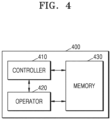
- FIG. 4 is a block diagram illustrating an example configuration of an AI processor 400 according to an embodiment of the disclosure.
- FIG. 4 illustrates the AI processor 400 that performs a function of the AI upscaler 224 of FIG. 3 described above.
- the AI processor 400 may be implemented, for example, and without limitation, as a general purpose processor, a digital signal processor (DSP), an application specific integrated circuit (ASIC), a field programmable gate array (FPGA), another programmable logic device (PLD), an individual gate or a transistor logic, an individual hardware component, a software module executed by a processor, or the like, or a combination thereof.
- the AI processor 400 may be implemented as a special purpose logic circuit in the form of a chipset, for example, a dedicated ASIC, a dedicated FPGA, a combination of a dedicated logic circuit and a general purpose processor, or the like, but is not limited to the implementation method described above.
- the AI processor 400 performs image processing on image data input by a neural network model.
- the AI processor 400 may receive image data of the second image 135 and perform a neural network operation to output image data of the upscaled third image 145.
- the AI processor 400 includes a controller (or a processor controller) 410, an operator 420, and a memory 430.
- the controller 410 includes various processing circuitry and serve to set a parameter required for an operation of the operator 420.
- the operator 420 includes various processing circuitry and/or executable program elements and perform the neural network operation based on the set parameter.
- the 'parameter' may include a plurality of weight values used in an operation process of each neural network layer.
- the parameter may be expressed in the form of a matrix.
- the parameter is a value set as a result of training and may be updated through separate training data as necessary.
- the controller 410 may be provided with a parameter identifier representative of the parameter including the plurality of weight values.
- the controller 410 may obtain the weight values included in the parameter based on the provided parameter identifier.
- the controller 410 may obtain weight values based on the parameter identifier from the memory 360 outside the AI processor 400, or may obtain weight values based on the parameter identifier from the memory 430 of the Al processor 400.
- the controller 410 may register the obtained weight values in registers corresponding to the respective neural network operators included in the operator 420. For example, when one neural network operator performs convolution processing on image data using 3*3*8 filter kernels, 3*3*8 weight values may be registered in a register corresponding to the one neural network operator.
- the operator 420 may include a plurality of neural network operators (e.g., including various processing circuitry and/or executable program elements), and may perform the neural network operation on the image data using at least some of the plurality of neural network operators under the control of the controller 410.
- one neural network operator may perform convolution processing on the image data using a filter kernel to which the weight values registered in the register are applied. A process in which the operator 420 performs the neural network operation will be described in greater detail below with reference to FIG. 5 .
- the memory 430 may include a plurality of N line- memories.
- the N-line memory is a memory for temporarily storing image data in units of pixel columns (lines) in a horizontal direction of an image, and may be implemented as, for example, an SRAM.
- the N-line memory may be configured as one or more line memories to temporarily record the image data of one or more pixel columns.
- the memory 430 may include the plurality of N-line memories respectively corresponding to the plurality of neural network operators included in the operator 420, and store at least one of an operation value necessary for the neural network operation of the plurality of neural network operators, an intermediate value of the operation, or a final value thereof.
- the memory 430 may include N-line memories that receive the image data and distribute the image data to the plurality of neural network operators, or serve as a buffer for collecting the image data on which image processing is performed from the plurality of neural network operators.
- the controller 410 of the Al processor 400 may control input image data to be stored in the memory 430.
- the controller 410 may control some of the plurality of neural network operators to perform the neural network operation on image data split based on the size of the image and the data processing capabilities of the plurality of neural network operators and output upscaled image data.
- the controller 410 may deactivate some other neural network operators that do not perform the neural network operation on the split image data.
- the controller 410 may split the image data based on the horizontal size of the image and data processing units of the plurality of neural network operators.
- the controller 410 may control the plurality of neural network operators to perform the neural network operation on the image data split based on the size of the image and the number of the plurality of neural network operators and output the upscaled image data.
- the controller 410 may convert speed of clock frequencies of the plurality of neural network operators based on the size of the image.
- the controller 410 may determine whether to split the image data based on the data processing capabilities of the plurality of neural network operators or based on the number of the plurality of neural network operators, based on the estimated power consumption required for the neural network operation of the image data.
- the data processing capabilities of the plurality of neural network operators represent a maximum data size that may be processed by each neural network operator for a predetermined clock.
- the controller 410 may obtain a parameter corresponding to a frame of an image and register the parameter in a register corresponding to each of the plurality of neural network operators.
- the controller 410 may apply different parameters for each frame of the image to perform the neural network operation on the image data.
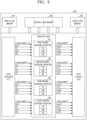
- FIG. 5 is a block diagram illustrating an example configuration of the Al processor 400 including a plurality of neural network operators (e.g., including processing circuitry and/or executable program elements) 421, 422, 423, and 424 according to an embodiment of the disclosure.
- neural network operators e.g., including processing circuitry and/or executable program elements
- FIG. 5 is a part of the Al processor 400 and includes a configuration for the neural network operation on image data.
- the Al processor 400 may include a data unpacker DATA_UNPACKER 411, the plurality of neural network operators 421, 422, 423, and 424, a data packer DATA_PACKER 412, and a plurality of N-line memories 431, 432 and 433.
- the data unpacker 411 and the data packer 412 may be included in the controller 410 of FIG. 4
- the plurality of neural network operators 421, 422, 423, and 424 may be included in the operator 420 of FIG. 4 .
- the first N-line memory 431 may, for example, be a memory corresponding to the data unpacker 411.
- the first N-line memory 431 may serve as a buffer for receiving image data according to a raster method from the outside and distributing the image data to the plurality of neural network operators 421, 422, 423, and 424.
- the first N-line memory 431 may have about twice the storage capacity of the input image data.
- the second N-line memory 432 may, for example, include a plurality of N-line memories respectively corresponding to the plurality of neural network operators 421, 422, 423, and 424.
- the second N-line memory 432 may store at least one of an input value necessary for the neural network operation, an intermediate value of the operation, or a final value thereof.
- the third N-line memory 433 may, for example, be a memory corresponding to the data packer 412 and may serve as a buffer for collecting operation results of the plurality of neural network operators 421, 422, 423, and 424 and outputting data to the outside.
- the third N-line memory 433 may have about twice the storage capacity of the output image data.
- the first N-line memory 431, the second N-line memory 432, and the third N-line memory 433 may be allocated in the memory 430.
- the controller 410 may allocate storage spaces corresponding to the first N-line memory 431, the second N-line memory 432, and the third N-line memory 433 in the memory 430.
- the controller 410 may determine the size of the storage space of each of the first N-line memory 431, the second N-line memory 432, and the third N-line memory 433 based on the size of an input image or the size of split image data.
- the data unpacker 411 may unpack the input image data to split the image data such that the split image data may be distributed to each of the plurality of neural network operators 421, 422, 423, and 424.
- the data unpacker 411 may provide each of a plurality of pieces of sub image data to each of the plurality of neural network operators 421, 422, 423, and 424 as the split image data (hereinafter, the split image data may be referred to as the plurality of pieces of sub image data).
- Each of the neural network operators 421, 422, 423, and 424 may perform image processing according to a neural network operation on the provided sub image data.
- the data packer 412 may collect results of image processing performed on each of the sub image data to output upscaled image data.
- the data unpacker 411 may read the image data corresponding to one line pixel and provide the read image data to the first N-line memory 431, to split and provide the image data to the plurality of neural network operators 421, 422, 423, and 424.
- the data unpacker 411 may read image data corresponding to 3840*1 pixels and record the read image data onto the first N-line memory 431, to upscale the 3840*1 pixels that are one line of an image frame.
- the data unpacker 411 may split the image data corresponding to the 3840*1 pixels stored in the memory 430 based on the size of the image and the data processing capabilities of the plurality of neural network operators 421, 422, 423, and 424.
- the processing unit of each of the plurality of neural network operators 421, 422, 423 and 424 may be image data corresponding to 960*1 pixels
- the data unpacker 411 may split the image data into four pieces of sub image data that are results of (3840)/(960) and provide each of the four pieces of sub image data to the second N-line memory 432 corresponding to each of the plurality of neural network operators 421, 422, 423, and 424.
- the data unpacker 411 may further obtain image data corresponding to a boundary region of the split image data in consideration of the size of a filter kernel used by the neural network operators 421, 422, 423, and 424 and provide the obtained image data to the second N-line memory 432 corresponding to each of the plurality of neural network operators 421, 422, 423, and 424.
- Each of the plurality of neural network operators 421, 422, 423, and 424 performs upscaling image processing on the sub image data stored in the second N-line memory 432.
- one neural network operator may perform a convolution operation, a non-linear operation, and an upscale operation on provided sub image data.
- each of the plurality of neural network operators 421, 422, 423, and 424 may perform upscale image processing on each of Y, Cb, and Cr representing a pixel.
- each of the plurality of neural network operators 421, 422, 423, and 424 may perform the convolution operation, the non-linear operation, and the upscale operation on a luma component Y, and may perform the upscale operation (e.g., bicubic scale) on chroma components Cb and Cr.
- FIG. 6 is a diagram illustrating an example neural network operation according to an embodiment of the disclosure.
- FIG. 6 illustrates an example of an operation of a neural network operator.
- Each of processing blocks (e.g., including processing circuitry and/or executable program elements) 612, 614, 616, 618, 620, 622, and 624 of FIG. 6 may correspond to at least one layer or at least one node of an artificial neural network model.
- Each of processing block 612, 614, 616, 618, 620, 622, and 624 may correspond to at least one of at least one register, a processor, or a memory allocated to the neural network operator or a combination thereof.
- a neural network operator may split input data 601 into connection data and inference data to perform a convolution operation, a nonlinear operations, and an upscale operation on the connection data, and perform the upscale operation on the inference data.
- the connection data may be data from connected training between Al for Al based Al downscaling and Al for Al based Al upscaling, and the inference data may be data that is not trained connectively.
- the neural network operator may input the connection data of the sub image data 601 to the first convolution layer 612 to perform convolution processing.
- the neural network operator may perform convolution processing on the sub image data using 8 filter kernels of a size of 3*3.
- the neural network operator may input 8 feature maps generated by the 8 filter kernels to the first activation layer 614 as a result of convolution processing.
- the first activation layer 614 may give a non-linear characteristic to each feature map.
- the first activation layer 614 may include a sigmoid function, a tanh function, a rectified linear unit (ReLU) function, etc, but is not limited thereto. That the first activation layer 614 gives the non-linear characteristic may refer, for example, to changing and outputting some sample values of the feature map which are outputs through the first convolution layer 612. Changing may be performed by applying the non-linear characteristic.
- the neural network operator may input an output of the first activation layer 614 to the second convolution layer 616.
- the neural network operator may perform convolution processing on the input data using the 8 filter kernels of the size of 3*3.
- An output of the second convolution layer 616 may be input to the second activation layer 618.
- the second activation layer 618 may give the non-linear characteristics to the input data.
- the neural network operator may perform operation on an output of the second activation layer 618 by the scaler 620.
- the neural network operator may perform the scaler 620 on an output of at least one scale operation of a bilinear scale, a bicubic scale, a lanczos scale, or a stair step scale.
- the neural network operator may input an output of the scaler 620 to the third convolution layer 622 to perform convolution processing for generating one output image using one filter kernel of a size of 3 ⁇ 3.
- An output of the third convolution layer 622 may be input to the third activation layer 624, and the third activation layer 624 may give the non-linear characteristic to the input data to obtain upscaled connection data.
- the neural network operator may perform the operation on the inference data among the sub image data 601 by a scaler (e.g., including processing circuitry and/or executable program elements) 630 to obtain upscaled inference data.
- the neural network operator may perform the scaler 630 by at least one scale operation of the bilinear scale, the bicubic scale, the lanczos scale, or the stair step scale.
- the neural network operator may combine the upscaled connection data and the upscaled inference data to obtain upscaled sub image data as output data 602.
- one neural network model includes the three convolution layers 612, 616, and 622, the three activation layers 614, 618, and 624, and the scaler 620, but this is an example.
- the number of convolution layers and activation layers may vary according to an implementation example.
- the neural network operator may be implemented through not only a deep neural network (DNN) but also a recurrent neural network (RNN), buy the disclosure is not limited thereto.
- DNN deep neural network
- RNN recurrent neural network
- the data packer 412 of FIG. 5 may collect upscaled sub image data from each of the plurality of neural network operators 421, 422, 423, and 424 and finally output the upscaled image data corresponding to the input image data.
- the data packer 412 may output the upscaled image data corresponding to 3840*2 pixels as a result of upscaling 3840*1 pixels which is one line of the image frame.
- FIG. 7 is a diagram illustrating an example process of performing a neural network operation based on the size of an image according to an embodiment of the disclosure.
- the AI processor 400 may determine 712 the size of the input image. For example, the AI processor 400 may analyze the image data to determine the size of the image or receive information about the size of the image from the outside. In this case, the information about the size of the image may be included in AI data or encoding data described above with reference to FIG. 1 and transmitted.
- the size of the image may generally be the horizontal size of one frame, but is not limited to the above example, and may be resolution information of the image, ratio information of the image, or the vertical size of one frame.
- the AI processor 400 splits the image data to allocate 714 the split image data to a plurality of neural network operators based on the size of the image and the data processing capabilities of the plurality of neural network operators. Each of the plurality of neural network operators performs neural network operation processing 716 on allocated sub image data.
- the AI processor 400 may collect 718 image data in units of lines as a result of neural network operation by each of the plurality of neural network operators, and output upscaled image data as output data 702. For example, the AI processor 400 may merge the image data in units of lines output from the plurality of neural network operators and output the merged image data according to a sequential scanning method.
- Each of processing blocks 712, 714, 716, and 718 in FIG. 7 may correspond to a software processing unit performed by at least one computer program command, and/or may correspond to a hardware resource (a processor, a register, a memory, etc.) allocated to a predetermined operation.
- operations of determining 712 the size of the image, allocating 714 the split image data, and collecting 718 the line image data may be performed by the controller 410, and neural network operation processing 716 may be performed through the plurality of neural network operators of the operator 420.
- FIG. 8 is a block diagram illustrating an example AI processor 400 for performing a neural network operation based on the size of an image according to an embodiment of the disclosure.
- the Al processor 400 may include an input data controller (e.g., including control circuitry) 812, a plurality of neural network operators 822, 824 and 826, a plurality of N-line memories 832, 834 and 836 corresponding to the plurality of neural network operators 822, 824 and 826, respectively, and an output data controller (e.g., including control circuitry) 842.
- the input data controller 812 and the output data controller 842 may be included in the controller 410 of FIG. 4 .
- the input data controller 812 may correspond to the data unpacker 411 of FIG. 5
- the output data controller 842 may correspond to the data packer 412 of FIG. 5 .
- the input data controller 812 may receive image data corresponding to pixels of the image and information about the size (e.g., the horizontal size of the image) of the image. For another example, the input data controller 812 may analyze the image data to determine the size of the image.
- the input data controller 812 splits the image data and simultaneously transmits at least some of each of sub image data that is the split image data to at least one of the neural network operators 822, 824, and 826, based on the size of the image and the data processing capabilities of the plurality of neural network operators 822, 824, and 826.
- the at least one neural network operator performs the neural network operation on the provided image data and output a result of the operation.
- the plurality of neural network operators 822, 824, and 826 operate in parallel. Further, according to a resource allocated between the plurality of N-line memories 832, 834, and 836 and the plurality of neural network operators 822, 824, and 826, the split image data may be transmitted in series or in parallel between the plurality of N-line memories 832, 834, and 836 and the plurality of neural network operators 822, 824, and 826.
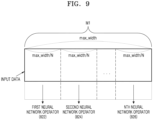
- FIG. 9 is a diagram illustrating an example process in which the plurality of neural network operators 822, 824, and 826 process image data split according to the size of image data, according to an embodiment of the disclosure.
- the Al processor 400 includes the plurality of N (N being a natural number) neural network operators 822, 824, and 826, a maximum processing unit of the plurality of neural network operators 822, 824, and 826 is max_width, and a processing unit of each of the plurality of neural network operators 822, 824, and 826 is max_width/N.
- the processing unit of each of the plurality of neural network operators 822, 824, and 826 may be defined, for example, as the number of pixels, the data size (bit, byte, etc.)
- the input data controller 812 splits the input image data into the processing unit of each of the plurality of neural network operators 822, 824, and 826.
- the size of the image data of the input image may be M1
- the processing unit of the image data of the plurality of neural network operators 822, 824, and 826 may be max_width/N.
- the input data controller 812 may transmit the N split image data to each of the plurality of neural network operators 822, 824, and 826.
- Each of the plurality of neural network operators 822, 824, and 826 may perform a neural network operation on the equally split image data.
- an operation time length for each of the neural network operators 822, 824, and 826 to process the split image data may be the same, and each of the neural network operators 822, 824, and 826 may perform Al upscaling at the same time to output t upscaling image data.
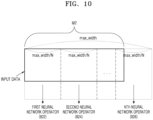
- FIG. 10 is a diagram illustrating an example process in which the plurality of neural network operators 822, 824, and 826 process image data split according to the size of image data, according to another embodiment of the disclosure.
- the size of the image data may be M2
- the processing unit of the image data of the plurality of neural network operators 822, 824, and 826 may be max_width/N.
- the input data controller 812 may split the image data into N pieces.
- the size of N-th image data may be smaller than the size of other image data. Accordingly, the operation time of the N-th neural network operator 826 that processes the N-th image data may be shorter than that of the other neural network operators 822 and 824.
- the N-th neural network operator 826 that processes the N-th image data may first process the image data allocated to the N-th neural network operator 826 and wait while the other neural network operators 822 and 824 process the image data or perform other operations during idle time after processing of the image data.
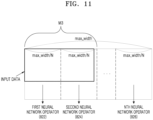
- FIG. 11 is a diagram illustrating an example process in which the plurality of neural network operators 822, 824, and 826 process image data split according to the size of image data, according to another embodiment of the disclosure.
- the size of the image data may be M3, and the processing unit of the image data of the plurality of neural network operators 822, 824, and 826 may be max_width/N.
- the size M3 of the image data may be smaller than the image data processing unit of some neural network operators 822, 824 among the plurality of neural network operators 822, 824, and 826.
- the input data controller 812 may split the image data into image data processing units so as to process the image data using only the minimum number of neural network operators.
- the input data controller 812 may split the image data into two pieces so as to use only some neural network operators 822 and 824.
- the input data controller 812 may deactivate the N-th neural network operator 826 that does not perform neural network operation processing on the image data among the plurality of neural network operators 822, 824, and 826.
- Deactivating the neural network operator may include turning off the neural network operator such that power is not applied, not applying an activation signal (an enable signal, a trigger signal, etc.), not applying a clock frequency, or converting the neural network operator into a standby state or sleep mode.
- an activation signal an enable signal, a trigger signal, etc.
- power consumption of the Al processor 400 may be greatly reduced.
- the output data controller 842 collects upscaled split data that are results of operation from each neural network operator that performs the neural network operation. When the upscaled split data are collected, the output data controller 842 outputs the upscaled image data as the output data 802.
- the input data controller 812 may split the image data based on the size of the image and the number of the neural network operators 822, 824, and 826.
- the input data controller 812 may transmit each of sub image data which is the split image data to each of the plurality of neural network operators 822, 824, and 826.
- the input data controller 812 may split the image data of the input image into N sub-image data of the same size of M4/N.
- the input data controller 812 may respectively transmit the N split image data to the plurality of neural network operators 822, 824, and 826.
- Each of the plurality of neural network operators 822, 824, and 826 may perform the neural network operation on the image data of the same size.
- Each of the plurality of neural network operators 822, 824, and 826 may perform Al upscaling processing on the split image data to output upscaling image data.
- the AI processor 400 may operate based on a clock frequency that is an operating speed of the AI processor 400.
- the AI processor 400 may commonly use a specific clock frequency with respect to each module constituting the AI processor 400 or may use a different clock frequency for each module.
- the clock frequency may be, for example, one or more values between 100 MHz and 800 MHz, but is not limited to the above-described range.
- the AI processor 400 may convert speed of clock frequencies of the plurality of neural network operators 822, 824, and 826 based on the size of the image. For example, when the size of the image is small, the plurality of neural network operators 822, 824, and 826 may perform the neural network operation using a clock frequency of a low speed. When the size of the image is large, the neural network operators 822, 824, and 826 may perform the neural network operation using a clock frequency of a high speed. According to the embodiment of the disclosure, the AI processor 400 may adjust the clock frequencies of the neural network operators 822, 824, and 826 according to the size of the input image, thereby reducing power consumption when the size of the input image is small.
- the AI processor 400 may determine whether to split the image data based on the data processing capabilities of the plurality of neural network operators 822, 824, and 826 or based on the number of the plurality of neural network operators 822, 824, and 826, based on an amount of expected power consumption required for the neural network operation of the image data.
- the power consumed by the neural network operators 822, 824, and 826 may include dynamic power consumed when the clock frequency is applied and static power consumed when the clock frequency is not applied.
- the static power may refer to leakage power that leaks because the Al processor 400 serves as a capacitance even when the clock frequency is not applied.
- the Al processor 400 may predict which policy is more effective for power consumption between a policy that reduces the static power itself by turning off some neural network operators in a situation where the image data is processed based on the size of the image data of the input image and the data processing capabilities of the plurality of neural network operators 822, 824, and 826 and a policy that reduces the dynamic power by changing the clock frequency in a situation where the image data is processed based on the size of the image data and the number of the plurality of neural network operators 822, 824, and 826.
- the Al processor 400 may select the policy that turns off some neural network operators when contribution of the static power is high in the power consumption, and select the policy that reduces the dynamic power by changing the clock frequency when the contribution of the static power is low.
- the Al processor 400 may select the policy that turns off some neural network operators when the size of the image data of the input image is less than or equal to a predetermined size, and select the policy that changes the clock frequency when the size of the image data exceeds the predetermined size.
- the Al processor 400 may determine a policy based on at least one of the clock frequency, a voltage, a current, the size of a chip cell, or a characteristic of the chip cell, and when the policy effective for power consumption is determined, may perform the neural network operation on the image data using at least one of the plurality of neural network operators 822, 824, and 826 according to the determined policy.
- FIG. 12 is a flowchart illustrating an example method, performed by the Al processor 400, of performing a neural network operation according to an embodiment of the disclosure.
- Each operation of the method of performing the neural network operation of the disclosure may be performed by various types of electronic devices including, for example, a processor and a memory and using an artificial neural network model.
- An embodiment of the disclosure in which a device including the AI processor 400 according to embodiments of the disclosure performs the method of performing the neural network operation will be described here. Accordingly, the embodiments of the disclosure described with respect to the AI processor 400 may be applicable to embodiments of the disclosure of the method of performing the neural network operation, and conversely, the embodiments of the disclosure described with respect to the method of performing the neural network operation may be applicable to the embodiments of the disclosure of the AI processor 400.
- the method of performing the neural network operation according to the embodiments of the disclosure is not limited to an embodiment of the disclosure in which the method is performed by the AI processor 400 disclosed herein, and may be performed by various types of electronic devices.
- the AI processor 400 may receive image data of an input image and store the image data in at least one memory.
- the AI processor 400 may split the image data stored in the memory based on the size of the image and the data processing capabilities of a plurality of neural network operators. For example, the AI processor 400 may split the image data based on the horizontal size of the image and data processing units of the plurality of neural network operators.
- the AI processor 400 may perform the neural network operation on the split image data through at least some of the plurality of neural network operators.
- the AI processor 400 may use some or all of the plurality of neural network operators.
- the AI processor 400 may adjust the number of the used neural network operators according to an embodiment of the disclosure. In this case, the AI processor 400 may deactivate some other neural network operators that do not perform neural network operation processing on the split image data among the plurality of neural network operators.
- the AI processor 400 may output upscaled image data as a result of performing the neural network operation through some neural network operators.
- the AI processor 400 may split the image data based on the size of the image and the number of the neural network operators.
- the AI processor 400 may perform the neural network operation on the split image data through the plurality of neural network operators.
- the AI processor 400 may convert the speed of clock frequencies of the plurality of neural network operators based on the size of the image.
- the AI processor 400 may determine whether to split the image data based on the data processing capabilities of the plurality of neural network operators or based on the number of the plurality of neural network operators, based on an amount of expected power consumption required for the neural network operation of the image data.
- the various example embodiments of the disclosure described above may be written as a program or an instruction executable on a computer, and the program or the instruction may be stored in a medium.
- the media may continuously store a non-transitory computer-executable program or instruction or temporarily store the non-transitory computer-executable program or instruction for execution or downloading.
- the medium may include a variety of recording means or storage means in the form of single hardware or a combination of several hardware and not limited to a medium directly connected to any computer system but may be distributed on a network. Examples of the medium may include a magnetic medium such as hard disk, floppy disk and magnetic tape, an optical recording medium such as CD-ROM and DVD, a magneto-optical medium such as floptical disk, ROM, RAM, flash memory, etc. and be configured to store program instructions. In addition, other examples of the medium may include a recording medium or a storage medium managed by an app store that distributes an application, a site that supplies or distributes various software, a server, etc.
- the neural network model described above may be implemented as a software module.
- a DNN model may be stored on a non-transitory computer readable recording medium.
- the neural network model may be integrated in the form of a hardware chip to be a part of the Al decoding apparatus 200 or the display device 300 described above.
- the neural network model may be manufactured in the form of a dedicated hardware chip for Al, or as part of an existing general purpose processor (e.g., a CPU or an application processor) or a graphics dedicated processor (e.g., a GPU).
- the neural network model may be provided in the form of downloadable software.
- a computer program product may include a product (e.g., a downloadable application) in the form of a software program distributed electronically through a manufacturer or an electronic market. For electronic distribution, at least a part of the software program may be stored on a storage medium or temporarily generated.
- the storage medium may be a server of the manufacturer or the electronic market, or a storage medium of a relay server.
- An Al processor may perform a neural network operation on image data using some of a plurality of neural network operators according to the size of an image, thereby reducing power consumption required for the neural network operation of the Al processor.
- the Al processor may convert clock frequencies of the plurality of neural network operators according to the size of the image, thereby reducing power consumption required for the neural network operation of the Al processor.
- the Al processor may adaptively operate the plurality of neural network operators for 8K, 4K, 2K, etc., other than an image of a predetermined size, and thus a neural network operation platform may be recycled with respect to various sizes of the image.
Landscapes
- Engineering & Computer Science (AREA)
- Physics & Mathematics (AREA)
- Theoretical Computer Science (AREA)
- General Physics & Mathematics (AREA)
- General Engineering & Computer Science (AREA)
- Health & Medical Sciences (AREA)
- Life Sciences & Earth Sciences (AREA)
- Biomedical Technology (AREA)
- Biophysics (AREA)
- Mathematical Physics (AREA)
- Evolutionary Computation (AREA)
- Software Systems (AREA)
- Computational Linguistics (AREA)
- General Health & Medical Sciences (AREA)
- Molecular Biology (AREA)
- Computing Systems (AREA)
- Artificial Intelligence (AREA)
- Data Mining & Analysis (AREA)
- Neurology (AREA)
- Image Processing (AREA)
- Controls And Circuits For Display Device (AREA)
- Databases & Information Systems (AREA)
- Computer Vision & Pattern Recognition (AREA)
- Multimedia (AREA)
Claims (14)
- Prozessor für künstliche Intelligenz, AI-Prozessor, (400), umfassend:mindestens einen Speicher (430);eine Vielzahl von Operatoren (421, 422, 423, 424) eines neuronalen Netzes, die jeweils eine Verarbeitungsschaltung umfassen, die zum Verarbeiten eines Bilds konfiguriert ist, undeine Steuerung (410), die dazu konfiguriert ist, den mindestens einen Speicher und die Vielzahl von Operatoren (421, 422, 423, 424) eines neuronalen Netzes zu steuern,wobei die Steuerung (410) ferner zu Folgendem konfiguriert ist:Steuereingangsbilddaten eines Bilds, die auf dem mindestens einen Speicher zu speichern sind;Erhalten einer Vielzahl von Teilbilddatenelementen aus den Bilddaten durch Aufteilen der auf dem mindestens einen Speicher gespeicherten Bilddaten in die Vielzahl von Teilbilddatenelementen auf Grundlage einer Größe eines Bilds, das den Bilddaten und jeweiligen Datenverarbeitungsfähigkeiten jedes der Vielzahl von Operatoren (421, 422, 423, 424) eines neuronalen Netzes entspricht, und Übertragen mindestens einiger von jeden der Elemente der Teilbilddaten an mindestens einen der Operatoren eines neuronalen Netzes,Steuern eines jeweiligen Teilbilddatenelements der Vielzahl von Teilbilddatenelementen, um einem entsprechenden Operator eines neuronalen Netzes von mindestens einem Teil der Vielzahl von Operatoren eines neuronalen Netzes zugewiesen zu werden;Steuern des jeweiligen Operatoren (421, 422, 423, 424) eines neuronalen Netzes, um gemäß den jeweiligen Datenverarbeitungsfähigkeiten eine Operation eines neuronalen Netzes an den jeweiligen Teilbilddatenelementen durchzuführen, um ein hochskaliertes Teilbilddatenelement zu generieren;Sammeln der hochskalierten Teilbilddatenelemente von mindestens einem Teil der Operatoren eines neuronalen Netzes, um hochskalierte Bilddaten zu bilden; undAusgeben der hochskalierten Bilddaten.
- AI-Prozessor nach Anspruch 1, wobei die Steuerung (410) ferner dazu konfiguriert ist, Operatoren (421, 422, 423, 424) eines neuronalen Netzes zu deaktivieren, die keine Operationsverarbeitung eines neuronalen Netzes an den aufgeteilten Bilddaten durchführen.
- AI-Prozessor nach Anspruch 1, wobei die Steuerung (410) ferner dazu konfiguriert ist, die Bilddaten auf Grundlage einer horizontalen Größe des Bilds und einer Datenverarbeitungseinheit der Vielzahl von Operatoren (421, 422, 423, 424) eines neuronalen Netzes aufzuteilen.
- AI-Prozessor nach Anspruch 1, wobei der mindestens eine Speicher eine Vielzahl von N-Zeilen-Speicher (431, 432, 433) umfasst, die jeweils der Vielzahl von Operatoren (421, 422, 423, 424) eines neuronalen Netzes entsprechen,
wobei die Vielzahl von N-Zeilen-Speichern (431, 432, 433) mindestens einen Betriebswert, der für die Operation eines neuronalen Netzes der Vielzahl von Operatoren (421, 422, 423, 424) eines neuronalen Netzes erforderlich ist, einen Zwischenwert der Operation eines neuronalen Netzes oder einen Endwert umfasst. - AI-Prozessor nach Anspruch 1, wobei die Steuerung (410) ferner dazu konfiguriert ist, auf Grundlage der Größe des Bilds eine Geschwindigkeit von Taktfrequenzen der Vielzahl von Operatoren (421, 422, 423, 424) eines neuronalen Netzes umzuwandeln.
- AI-Prozessor nach Anspruch 1, wobei die Steuerung (410) ferner dazu konfiguriert ist, auf Grundlage der Datenverarbeitungsfähigkeiten der Vielzahl von Operatoren (421, 422, 423, 424) eines neuronalen Netzes oder auf Grundlage der Anzahl der Vielzahl von Operatoren (421, 422, 423, 424) eines neuronalen Netzes, auf Grundlage eines Betrags des erwarteten Stromverbrauchs, der für die an den Bilddaten durchgeführte Operation eines neuronalen Netzes erforderlich ist, zu bestimmen, ob die Bilddaten aufzuteilen sind.
- AI-Prozessor nach Anspruch 1, wobei die Vielzahl von Operatoren (421, 422, 423, 424) eines neuronalen Netzes dazu konfiguriert ist, eine Faltungsoperation eines neuronalen Netzes, eine nichtlineare Operation und eine Upscaler-Operation durchzuführen.
- AI-Prozessor nach Anspruch 1, wobei die Bilddaten Verbindungsdaten aus dem verbundenen Training zwischen AI für AI-Downscaling und AI für Al-Upscaling umfassen.
- AI-Prozessor nach Anspruch 1, wobei die Steuerung (410) ferner dazu konfiguriert ist, einen Parameter zu erhalten, der einem Frame des Bilds entspricht, und den Parameter in einem Verzeichnung aufzuzeichnen, das jedem der Vielzahl von Operatoren (421, 422, 423, 424) eines neuronalen Netzes entspricht.
- AI-Prozessor nach Anspruch 1, wobei die Vielzahl von Operatoren (421, 422, 423, 424) eines neuronalen Netzes dazu konfiguriert ist, für jeden Frame des Bilds unterschiedliche Parameter anzuwenden, um die Operation eines neuronalen Netzes an den Bilddaten durchzuführen.
- Al-Prozessor nach Anspruch 1, wobei die Bilddaten auf Grundlage davon, dass es sich bei dem Bild um einen Frame handelt, Bilddaten umfassen, die Pixeln einer Zeile des Frames entsprechen.
- Verfahren zur Durchführung einer Operation eines neuronalen Netzes durch einen Prozessor für künstliche Intelligenz, Al-Prozessor, (400), umfassend:- mindestens einen Speicher (430);- eine Vielzahl von Operatoren (421, 422, 423, 424) eines neuronalen Netzes, die jeweils eine Verarbeitungsschaltung umfassen, die zum Verarbeiten eines Bilds konfiguriert ist, und- eine Steuerung (410), die dazu konfiguriert ist, den mindestens einen Speicher und die Vielzahl von Operatoren (421,422, 423, 424) eines neuronalen Netzes zu steuern,wobei das Verfahren Folgendes umfasst:Empfangen (1201) von Bilddaten eines Bilds durch die Steuerung (410) und Speichern der Bilddaten auf mindestens einem Speicher;Erhalten einer Vielzahl von Teilbilddatenelementen aus Bilddaten durch die Steuerung (410) durch Aufteilen (1203) der auf dem mindestens einen Speicher gespeicherten Bilddaten in eine Vielzahl von Teilbilddatenelementen auf Grundlage einer Größe des Bilds, die den Bilddaten und den jeweiligen Datenverarbeitungsfähigkeiten jedes einer Vielzahl von Operatoren (421, 422, 423, 424) eines neuronalen Netzes entspricht, und Übertragen mindestens einiger von jeden der Elemente der Teilbilddaten an mindestens einen der Operatoren eines neuronalen Netzes, Zuweisen eines jeweiligen Teilbilddatenelements der Vielzahl von Teilbilddatenelemente zu einem jeweiligen Operator eines neuronalen Netzes von mindestens einem Teil der Vielzahl von Operatoren eines neuronalen Netzes durch die Steuerung (410);Steuern des jeweiligen Operators (421, 422, 423, 424) eines neuronalen Netzes durch die Steuerung (410), um die Operation eines neuronalen Netzes gemäß den jeweiligen Datenverarbeitungsfähigkeiten an dem jeweiligen Teilbilddatenelement durchzuführen (1205), um ein hochskaliertes Teilbilddatenelement zu generieren;Sammeln der hochskalierten Teilbilddatenelemente von dem mindestens einen Teil der Operatoren eines neuronalen Netzes werden gesammelt durch die Steuerung (410), um hochskalierte Bilddaten zu bilden; und Ausgeben (1207) der hochskalierten Bilddaten durch die Steuerung (410) als Ergebnis der Durchführung der Operation eines neuronalen Netzes durch den mindestens einen Operator (421, 422, 423, 424) eines neuronalen Netzes.
- Verfahren nach Anspruch 12, ferner umfassend Deaktivieren von Operatoren (421, 422, 423, 424) eines neuronalen Netzes, die keine Operationsverarbeitung eines neuronalen Netzes an den geteilten Bilddaten durchführen.
- Verfahren nach Anspruch 12, wobei das Aufteilen der auf dem mindestens einen Speicher gespeicherten Bilddaten Aufteilen der Bilddaten auf Grundlage einer horizontalen Größe des Bilds und einer Datenverarbeitungseinheit der Vielzahl von Operatoren (421, 422, 423, 424) eines neuronalen Netzes umfasst.
Applications Claiming Priority (1)
| Application Number | Priority Date | Filing Date | Title |
|---|---|---|---|
| KR1020190081524A KR20210004702A (ko) | 2019-07-05 | 2019-07-05 | Ai 프로세서 및 이의 신경망 연산 수행 방법 |
Publications (3)
| Publication Number | Publication Date |
|---|---|
| EP3767477A1 EP3767477A1 (de) | 2021-01-20 |
| EP3767477C0 EP3767477C0 (de) | 2023-12-27 |
| EP3767477B1 true EP3767477B1 (de) | 2023-12-27 |
Family
ID=71170339
Family Applications (1)
| Application Number | Title | Priority Date | Filing Date |
|---|---|---|---|
| EP20182359.8A Active EP3767477B1 (de) | 2019-07-05 | 2020-06-25 | Künstlicher intelligenzprozessor und verfahren zur durchführung des betriebs von neuronalem netz davon |
Country Status (5)
| Country | Link |
|---|---|
| US (1) | US11495037B2 (de) |
| EP (1) | EP3767477B1 (de) |
| KR (1) | KR20210004702A (de) |
| CN (1) | CN112183736B (de) |
| WO (1) | WO2021006484A1 (de) |
Families Citing this family (8)
| Publication number | Priority date | Publication date | Assignee | Title |
|---|---|---|---|---|
| CN113010119B (zh) * | 2021-04-27 | 2022-09-30 | 宏图智能物流股份有限公司 | 一种通过主备方式实现语音数据分布式存储的方法 |
| CN113052751B (zh) * | 2021-04-27 | 2023-05-30 | 浙江水科文化集团有限公司 | 人工智能处理方法 |
| CN116982300A (zh) * | 2021-07-12 | 2023-10-31 | Oppo广东移动通信有限公司 | 信号处理的方法及接收机 |
| CN116897537A (zh) * | 2022-02-08 | 2023-10-17 | 辉达公司 | 使用神经网络的图像生成 |
| CN115629859A (zh) * | 2022-10-20 | 2023-01-20 | 星宸微电子(深圳)有限公司 | 适用于智能处理器的任务处理系统与其任务处理方法 |
| US12250454B2 (en) * | 2023-02-06 | 2025-03-11 | Qualcomm Incorporated | Camera dynamic voting to optimize fast sensor mode power |
| CN117077161B (zh) * | 2023-07-31 | 2024-05-03 | 上海交通大学 | 基于动态规划求解的隐私保护深度模型构建方法与系统 |
| KR20250041871A (ko) * | 2023-09-19 | 2025-03-26 | 주식회사 딥엑스 | 가변 주파수를 이용하여 신경 프로세싱 유닛의 파워를 낮추는 기술 |
Citations (2)
| Publication number | Priority date | Publication date | Assignee | Title |
|---|---|---|---|---|
| US20090175548A1 (en) * | 2007-05-17 | 2009-07-09 | Sony Corporation | Information processing device and method |
| US20150106306A1 (en) * | 2013-10-16 | 2015-04-16 | University Of Tennessee Research Foundation | Method and apparatus for constructing a neuroscience-inspired artificial neural network with visualization of neural pathways |
Family Cites Families (21)
| Publication number | Priority date | Publication date | Assignee | Title |
|---|---|---|---|---|
| KR101499498B1 (ko) | 2008-10-08 | 2015-03-06 | 삼성전자주식회사 | 초고해상도 비디오 처리 장치 및 방법 |
| KR102166335B1 (ko) * | 2013-04-19 | 2020-10-15 | 삼성전자주식회사 | Sao 파라미터를 시그널링하는 비디오 부호화 방법 및 그 장치, 비디오 복호화 방법 및 그 장치 |
| GB2548749B (en) | 2015-02-19 | 2017-12-13 | Magic Pony Tech Limited | Online training of hierarchical algorithms |
| DE202016009089U1 (de) * | 2015-02-19 | 2022-02-10 | Magic Pony Technology Limited | Online-Training von hierarchischen Algorithmen |
| US10671564B2 (en) | 2015-10-08 | 2020-06-02 | Via Alliance Semiconductor Co., Ltd. | Neural network unit that performs convolutions using collective shift register among array of neural processing units |
| KR101974261B1 (ko) | 2016-06-24 | 2019-04-30 | 한국과학기술원 | Cnn 기반 인루프 필터를 포함하는 부호화 방법과 장치 및 복호화 방법과 장치 |
| US10546211B2 (en) * | 2016-07-01 | 2020-01-28 | Google Llc | Convolutional neural network on programmable two dimensional image processor |
| CN106373112B (zh) * | 2016-08-31 | 2020-08-04 | 北京比特大陆科技有限公司 | 图像处理方法、装置和电子设备 |
| JP6848071B2 (ja) * | 2017-02-24 | 2021-03-24 | ディープマインド テクノロジーズ リミテッド | ニューラルネットワークを使用した繰り返しマルチスケール画像生成 |
| KR20180100976A (ko) | 2017-03-03 | 2018-09-12 | 한국전자통신연구원 | 딥 신경망 기반 블러 영상 학습을 이용한 영상 부호화/복호화 방법 및 장치 |
| JP7179718B2 (ja) | 2017-04-11 | 2022-11-29 | 株式会社半導体エネルギー研究所 | 半導体装置、撮像装置及び表示システム |
| US11775313B2 (en) | 2017-05-26 | 2023-10-03 | Purdue Research Foundation | Hardware accelerator for convolutional neural networks and method of operation thereof |
| CN107358575A (zh) * | 2017-06-08 | 2017-11-17 | 清华大学 | 一种基于深度残差网络的单幅图像超分辨率重建方法 |
| US11190784B2 (en) | 2017-07-06 | 2021-11-30 | Samsung Electronics Co., Ltd. | Method for encoding/decoding image and device therefor |
| CN109493347B (zh) * | 2017-09-12 | 2021-03-23 | 深圳科亚医疗科技有限公司 | 在图像中对稀疏分布的对象进行分割的方法和系统 |
| CN109034382A (zh) | 2017-10-30 | 2018-12-18 | 上海寒武纪信息科技有限公司 | 场景或物体的识别方法及相关产品 |
| CN108305214B (zh) * | 2017-12-28 | 2019-09-17 | 腾讯科技(深圳)有限公司 | 图像数据处理方法、装置、存储介质和计算机设备 |
| CN108062780B (zh) * | 2017-12-29 | 2019-08-09 | 百度在线网络技术(北京)有限公司 | 图像压缩方法和装置 |
| CN110087084B (zh) * | 2018-01-25 | 2022-03-18 | 联咏科技股份有限公司 | 视频处理装置及视频处理方法 |
| CN108830377B (zh) * | 2018-06-21 | 2020-12-15 | 瑞芯微电子股份有限公司 | 一种神经网络电路及其自循环多级迭代方法 |
| CN109360154B (zh) * | 2018-10-29 | 2022-09-20 | 厦门美图之家科技有限公司 | 一种卷积神经网络生成方法及图像的超分辨率方法 |
-
2019
- 2019-07-05 KR KR1020190081524A patent/KR20210004702A/ko active Pending
-
2020
- 2020-06-03 WO PCT/KR2020/007185 patent/WO2021006484A1/en not_active Ceased
- 2020-06-04 US US16/892,357 patent/US11495037B2/en active Active
- 2020-06-25 EP EP20182359.8A patent/EP3767477B1/de active Active
- 2020-06-28 CN CN202010600420.9A patent/CN112183736B/zh active Active
Patent Citations (2)
| Publication number | Priority date | Publication date | Assignee | Title |
|---|---|---|---|---|
| US20090175548A1 (en) * | 2007-05-17 | 2009-07-09 | Sony Corporation | Information processing device and method |
| US20150106306A1 (en) * | 2013-10-16 | 2015-04-16 | University Of Tennessee Research Foundation | Method and apparatus for constructing a neuroscience-inspired artificial neural network with visualization of neural pathways |
Also Published As
| Publication number | Publication date |
|---|---|
| EP3767477A1 (de) | 2021-01-20 |
| CN112183736A (zh) | 2021-01-05 |
| EP3767477C0 (de) | 2023-12-27 |
| CN112183736B (zh) | 2024-07-05 |
| WO2021006484A1 (en) | 2021-01-14 |
| KR20210004702A (ko) | 2021-01-13 |
| US20210004653A1 (en) | 2021-01-07 |
| US11495037B2 (en) | 2022-11-08 |
Similar Documents
| Publication | Publication Date | Title |
|---|---|---|
| EP3767477B1 (de) | Künstlicher intelligenzprozessor und verfahren zur durchführung des betriebs von neuronalem netz davon | |
| KR102500761B1 (ko) | 영상의 ai 부호화 및 ai 복호화 방법, 및 장치 | |
| CN112889283B (zh) | 编码方法及其设备以及解码方法及其设备 | |
| EP4498672A2 (de) | Übertragung von bildern und videos unter verwendung von modelllen mit künstlicher intelligenz | |
| AU2017201760B2 (en) | Method, apparatus and system for encoding and decoding video data | |
| JP6528765B2 (ja) | 画像復号装置および方法 | |
| US20160275919A1 (en) | Static frame image quality improvement for sink displays | |
| US10999599B2 (en) | System and method for non-uniform video coding | |
| US9369732B2 (en) | Lossless intra-prediction video coding | |
| KR102739616B1 (ko) | 디스플레이장치, 영상공급장치, 및 그 제어방법 | |
| US11825157B2 (en) | Display apparatus and operating method thereof | |
| US8611414B2 (en) | Video signal processing and encoding | |
| US20170223363A1 (en) | Systems and Methods for Improving Video Compression Efficiency | |
| WO2021056575A1 (zh) | 一种低延迟信源信道联合编码方法及相关设备 | |
| WO2025130738A1 (zh) | 图像块压缩处理方法、装置及电子设备 | |
| WO2024049627A1 (en) | Video compression for both machine and human consumption using a hybrid framework | |
| TWI892980B (zh) | 網路節點及用於該節點之方法 | |
| US20250086844A1 (en) | Electronic device for processing image by using ai encoding/decoding, and method for controlling same | |
| US20250069277A1 (en) | Electronic device processing image using ai encoding/decoding, and method for controlling same | |
| CN119999196A (zh) | 使用插值过滤器重新缩放特征数据的张量的方法或装置 | |
| WO2025140072A1 (zh) | 视频压缩处理方法、装置及电子设备 | |
| CN120677486A (zh) | 在分割点范围架构中训练决策模块模型的方法 | |
| Awaghad et al. | Maintaining image quality on wireless network standard using JPEG2000 transcoding and DWT |
Legal Events
| Date | Code | Title | Description |
|---|---|---|---|
| PUAI | Public reference made under article 153(3) epc to a published international application that has entered the european phase |
Free format text: ORIGINAL CODE: 0009012 |
|
| STAA | Information on the status of an ep patent application or granted ep patent |
Free format text: STATUS: THE APPLICATION HAS BEEN PUBLISHED |
|
| AK | Designated contracting states |
Kind code of ref document: A1 Designated state(s): AL AT BE BG CH CY CZ DE DK EE ES FI FR GB GR HR HU IE IS IT LI LT LU LV MC MK MT NL NO PL PT RO RS SE SI SK SM TR |
|
| AX | Request for extension of the european patent |
Extension state: BA ME |
|
| STAA | Information on the status of an ep patent application or granted ep patent |
Free format text: STATUS: REQUEST FOR EXAMINATION WAS MADE |
|
| 17P | Request for examination filed |
Effective date: 20210331 |
|
| RBV | Designated contracting states (corrected) |
Designated state(s): AL AT BE BG CH CY CZ DE DK EE ES FI FR GB GR HR HU IE IS IT LI LT LU LV MC MK MT NL NO PL PT RO RS SE SI SK SM TR |
|
| STAA | Information on the status of an ep patent application or granted ep patent |
Free format text: STATUS: EXAMINATION IS IN PROGRESS |
|
| 17Q | First examination report despatched |
Effective date: 20220531 |
|
| GRAP | Despatch of communication of intention to grant a patent |
Free format text: ORIGINAL CODE: EPIDOSNIGR1 |
|
| STAA | Information on the status of an ep patent application or granted ep patent |
Free format text: STATUS: GRANT OF PATENT IS INTENDED |
|
| RIC1 | Information provided on ipc code assigned before grant |
Ipc: H04N 19/59 20140101ALN20230711BHEP Ipc: G06N 3/048 20230101ALN20230711BHEP Ipc: G06N 3/045 20230101ALI20230711BHEP Ipc: G06N 3/08 20060101ALI20230711BHEP Ipc: G06N 3/063 20060101ALI20230711BHEP Ipc: G06N 3/04 20060101ALI20230711BHEP Ipc: G06F 12/02 20060101AFI20230711BHEP |
|
| INTG | Intention to grant announced |
Effective date: 20230725 |
|
| RIC1 | Information provided on ipc code assigned before grant |
Ipc: H04N 19/59 20140101ALN20230717BHEP Ipc: G06N 3/048 20230101ALN20230717BHEP Ipc: G06N 3/045 20230101ALI20230717BHEP Ipc: G06N 3/08 20060101ALI20230717BHEP Ipc: G06N 3/063 20060101ALI20230717BHEP Ipc: G06N 3/04 20060101ALI20230717BHEP Ipc: G06F 12/02 20060101AFI20230717BHEP |
|
| RIN1 | Information on inventor provided before grant (corrected) |
Inventor name: LEE, SANGJO Inventor name: PARK, TAEJUN Inventor name: SUNG, MINYONG Inventor name: KIM, DOOHYUN |
|
| GRAS | Grant fee paid |
Free format text: ORIGINAL CODE: EPIDOSNIGR3 |
|
| GRAA | (expected) grant |
Free format text: ORIGINAL CODE: 0009210 |
|
| STAA | Information on the status of an ep patent application or granted ep patent |
Free format text: STATUS: THE PATENT HAS BEEN GRANTED |
|
| AK | Designated contracting states |
Kind code of ref document: B1 Designated state(s): AL AT BE BG CH CY CZ DE DK EE ES FI FR GB GR HR HU IE IS IT LI LT LU LV MC MK MT NL NO PL PT RO RS SE SI SK SM TR |
|
| REG | Reference to a national code |
Ref country code: GB Ref legal event code: FG4D |
|
| REG | Reference to a national code |
Ref country code: CH Ref legal event code: EP |
|
| REG | Reference to a national code |
Ref country code: DE Ref legal event code: R096 Ref document number: 602020023285 Country of ref document: DE |
|
| REG | Reference to a national code |
Ref country code: NL Ref legal event code: FP Ref country code: IE Ref legal event code: FG4D |
|
| U01 | Request for unitary effect filed |
Effective date: 20231227 |
|
| U07 | Unitary effect registered |
Designated state(s): AT BE BG DE DK EE FI FR IT LT LU LV MT NL PT SE SI Effective date: 20240109 |
|
| PG25 | Lapsed in a contracting state [announced via postgrant information from national office to epo] |
Ref country code: GR Free format text: LAPSE BECAUSE OF FAILURE TO SUBMIT A TRANSLATION OF THE DESCRIPTION OR TO PAY THE FEE WITHIN THE PRESCRIBED TIME-LIMIT Effective date: 20240328 |
|
| PG25 | Lapsed in a contracting state [announced via postgrant information from national office to epo] |
Ref country code: ES Free format text: LAPSE BECAUSE OF FAILURE TO SUBMIT A TRANSLATION OF THE DESCRIPTION OR TO PAY THE FEE WITHIN THE PRESCRIBED TIME-LIMIT Effective date: 20231227 |
|
| PG25 | Lapsed in a contracting state [announced via postgrant information from national office to epo] |
Ref country code: GR Free format text: LAPSE BECAUSE OF FAILURE TO SUBMIT A TRANSLATION OF THE DESCRIPTION OR TO PAY THE FEE WITHIN THE PRESCRIBED TIME-LIMIT Effective date: 20240328 Ref country code: ES Free format text: LAPSE BECAUSE OF FAILURE TO SUBMIT A TRANSLATION OF THE DESCRIPTION OR TO PAY THE FEE WITHIN THE PRESCRIBED TIME-LIMIT Effective date: 20231227 |
|
| PG25 | Lapsed in a contracting state [announced via postgrant information from national office to epo] |
Ref country code: RS Free format text: LAPSE BECAUSE OF FAILURE TO SUBMIT A TRANSLATION OF THE DESCRIPTION OR TO PAY THE FEE WITHIN THE PRESCRIBED TIME-LIMIT Effective date: 20231227 Ref country code: NO Free format text: LAPSE BECAUSE OF FAILURE TO SUBMIT A TRANSLATION OF THE DESCRIPTION OR TO PAY THE FEE WITHIN THE PRESCRIBED TIME-LIMIT Effective date: 20240327 Ref country code: HR Free format text: LAPSE BECAUSE OF FAILURE TO SUBMIT A TRANSLATION OF THE DESCRIPTION OR TO PAY THE FEE WITHIN THE PRESCRIBED TIME-LIMIT Effective date: 20231227 |
|
| U20 | Renewal fee for the european patent with unitary effect paid |
Year of fee payment: 5 Effective date: 20240522 |
|
| PG25 | Lapsed in a contracting state [announced via postgrant information from national office to epo] |
Ref country code: IS Free format text: LAPSE BECAUSE OF FAILURE TO SUBMIT A TRANSLATION OF THE DESCRIPTION OR TO PAY THE FEE WITHIN THE PRESCRIBED TIME-LIMIT Effective date: 20240427 |
|
| PG25 | Lapsed in a contracting state [announced via postgrant information from national office to epo] |
Ref country code: CZ Free format text: LAPSE BECAUSE OF FAILURE TO SUBMIT A TRANSLATION OF THE DESCRIPTION OR TO PAY THE FEE WITHIN THE PRESCRIBED TIME-LIMIT Effective date: 20231227 |
|
| PG25 | Lapsed in a contracting state [announced via postgrant information from national office to epo] |
Ref country code: SK Free format text: LAPSE BECAUSE OF FAILURE TO SUBMIT A TRANSLATION OF THE DESCRIPTION OR TO PAY THE FEE WITHIN THE PRESCRIBED TIME-LIMIT Effective date: 20231227 |
|
| PG25 | Lapsed in a contracting state [announced via postgrant information from national office to epo] |
Ref country code: SM Free format text: LAPSE BECAUSE OF FAILURE TO SUBMIT A TRANSLATION OF THE DESCRIPTION OR TO PAY THE FEE WITHIN THE PRESCRIBED TIME-LIMIT Effective date: 20231227 Ref country code: SK Free format text: LAPSE BECAUSE OF FAILURE TO SUBMIT A TRANSLATION OF THE DESCRIPTION OR TO PAY THE FEE WITHIN THE PRESCRIBED TIME-LIMIT Effective date: 20231227 Ref country code: RO Free format text: LAPSE BECAUSE OF FAILURE TO SUBMIT A TRANSLATION OF THE DESCRIPTION OR TO PAY THE FEE WITHIN THE PRESCRIBED TIME-LIMIT Effective date: 20231227 Ref country code: IS Free format text: LAPSE BECAUSE OF FAILURE TO SUBMIT A TRANSLATION OF THE DESCRIPTION OR TO PAY THE FEE WITHIN THE PRESCRIBED TIME-LIMIT Effective date: 20240427 Ref country code: CZ Free format text: LAPSE BECAUSE OF FAILURE TO SUBMIT A TRANSLATION OF THE DESCRIPTION OR TO PAY THE FEE WITHIN THE PRESCRIBED TIME-LIMIT Effective date: 20231227 |
|
| PG25 | Lapsed in a contracting state [announced via postgrant information from national office to epo] |
Ref country code: PL Free format text: LAPSE BECAUSE OF FAILURE TO SUBMIT A TRANSLATION OF THE DESCRIPTION OR TO PAY THE FEE WITHIN THE PRESCRIBED TIME-LIMIT Effective date: 20231227 |
|
| PG25 | Lapsed in a contracting state [announced via postgrant information from national office to epo] |
Ref country code: PL Free format text: LAPSE BECAUSE OF FAILURE TO SUBMIT A TRANSLATION OF THE DESCRIPTION OR TO PAY THE FEE WITHIN THE PRESCRIBED TIME-LIMIT Effective date: 20231227 |
|
| REG | Reference to a national code |
Ref country code: DE Ref legal event code: R097 Ref document number: 602020023285 Country of ref document: DE |
|
| PLBE | No opposition filed within time limit |
Free format text: ORIGINAL CODE: 0009261 |
|
| STAA | Information on the status of an ep patent application or granted ep patent |
Free format text: STATUS: NO OPPOSITION FILED WITHIN TIME LIMIT |
|
| 26N | No opposition filed |
Effective date: 20240930 |
|
| PG25 | Lapsed in a contracting state [announced via postgrant information from national office to epo] |
Ref country code: MC Free format text: LAPSE BECAUSE OF FAILURE TO SUBMIT A TRANSLATION OF THE DESCRIPTION OR TO PAY THE FEE WITHIN THE PRESCRIBED TIME-LIMIT Effective date: 20231227 |
|
| REG | Reference to a national code |
Ref country code: CH Ref legal event code: PL |
|
| PG25 | Lapsed in a contracting state [announced via postgrant information from national office to epo] |
Ref country code: IE Free format text: LAPSE BECAUSE OF NON-PAYMENT OF DUE FEES Effective date: 20240625 |
|
| PG25 | Lapsed in a contracting state [announced via postgrant information from national office to epo] |
Ref country code: CH Free format text: LAPSE BECAUSE OF NON-PAYMENT OF DUE FEES Effective date: 20240630 |
|
| PGFP | Annual fee paid to national office [announced via postgrant information from national office to epo] |
Ref country code: GB Payment date: 20250520 Year of fee payment: 6 |
|
| U20 | Renewal fee for the european patent with unitary effect paid |
Year of fee payment: 6 Effective date: 20250624 |
|
| PG25 | Lapsed in a contracting state [announced via postgrant information from national office to epo] |
Ref country code: CY Free format text: LAPSE BECAUSE OF FAILURE TO SUBMIT A TRANSLATION OF THE DESCRIPTION OR TO PAY THE FEE WITHIN THE PRESCRIBED TIME-LIMIT; INVALID AB INITIO Effective date: 20200625 |