EP3765549B1 - Polysiloxane composition - Google Patents
Polysiloxane composition Download PDFInfo
- Publication number
- EP3765549B1 EP3765549B1 EP18918577.0A EP18918577A EP3765549B1 EP 3765549 B1 EP3765549 B1 EP 3765549B1 EP 18918577 A EP18918577 A EP 18918577A EP 3765549 B1 EP3765549 B1 EP 3765549B1
- Authority
- EP
- European Patent Office
- Prior art keywords
- polysiloxane composition
- ingredient
- carbon atoms
- hydrocarbon group
- starting materials
- Prior art date
- Legal status (The legal status is an assumption and is not a legal conclusion. Google has not performed a legal analysis and makes no representation as to the accuracy of the status listed.)
- Active
Links
Classifications
-
- C—CHEMISTRY; METALLURGY
- C08—ORGANIC MACROMOLECULAR COMPOUNDS; THEIR PREPARATION OR CHEMICAL WORKING-UP; COMPOSITIONS BASED THEREON
- C08F—MACROMOLECULAR COMPOUNDS OBTAINED BY REACTIONS ONLY INVOLVING CARBON-TO-CARBON UNSATURATED BONDS
- C08F283/00—Macromolecular compounds obtained by polymerising monomers on to polymers provided for in subclass C08G
- C08F283/12—Macromolecular compounds obtained by polymerising monomers on to polymers provided for in subclass C08G on to polysiloxanes
- C08F283/122—Macromolecular compounds obtained by polymerising monomers on to polymers provided for in subclass C08G on to polysiloxanes on to saturated polysiloxanes containing hydrolysable groups, e.g. alkoxy-, thio-, hydroxy-
-
- C—CHEMISTRY; METALLURGY
- C08—ORGANIC MACROMOLECULAR COMPOUNDS; THEIR PREPARATION OR CHEMICAL WORKING-UP; COMPOSITIONS BASED THEREON
- C08K—Use of inorganic or non-macromolecular organic substances as compounding ingredients
- C08K3/00—Use of inorganic substances as compounding ingredients
- C08K3/01—Use of inorganic substances as compounding ingredients characterized by their specific function
- C08K3/013—Fillers, pigments or reinforcing additives
-
- C—CHEMISTRY; METALLURGY
- C08—ORGANIC MACROMOLECULAR COMPOUNDS; THEIR PREPARATION OR CHEMICAL WORKING-UP; COMPOSITIONS BASED THEREON
- C08K—Use of inorganic or non-macromolecular organic substances as compounding ingredients
- C08K3/00—Use of inorganic substances as compounding ingredients
- C08K3/18—Oxygen-containing compounds, e.g. metal carbonyls
- C08K3/24—Acids; Salts thereof
- C08K3/26—Carbonates; Bicarbonates
-
- C—CHEMISTRY; METALLURGY
- C08—ORGANIC MACROMOLECULAR COMPOUNDS; THEIR PREPARATION OR CHEMICAL WORKING-UP; COMPOSITIONS BASED THEREON
- C08K—Use of inorganic or non-macromolecular organic substances as compounding ingredients
- C08K3/00—Use of inorganic substances as compounding ingredients
- C08K3/34—Silicon-containing compounds
- C08K3/36—Silica
-
- C—CHEMISTRY; METALLURGY
- C08—ORGANIC MACROMOLECULAR COMPOUNDS; THEIR PREPARATION OR CHEMICAL WORKING-UP; COMPOSITIONS BASED THEREON
- C08K—Use of inorganic or non-macromolecular organic substances as compounding ingredients
- C08K5/00—Use of organic ingredients
- C08K5/0091—Complexes with metal-heteroatom-bonds
-
- C—CHEMISTRY; METALLURGY
- C08—ORGANIC MACROMOLECULAR COMPOUNDS; THEIR PREPARATION OR CHEMICAL WORKING-UP; COMPOSITIONS BASED THEREON
- C08K—Use of inorganic or non-macromolecular organic substances as compounding ingredients
- C08K5/00—Use of organic ingredients
- C08K5/54—Silicon-containing compounds
- C08K5/541—Silicon-containing compounds containing oxygen
- C08K5/5415—Silicon-containing compounds containing oxygen containing at least one Si—O bond
-
- C—CHEMISTRY; METALLURGY
- C08—ORGANIC MACROMOLECULAR COMPOUNDS; THEIR PREPARATION OR CHEMICAL WORKING-UP; COMPOSITIONS BASED THEREON
- C08K—Use of inorganic or non-macromolecular organic substances as compounding ingredients
- C08K5/00—Use of organic ingredients
- C08K5/54—Silicon-containing compounds
- C08K5/541—Silicon-containing compounds containing oxygen
- C08K5/5435—Silicon-containing compounds containing oxygen containing oxygen in a ring
-
- C—CHEMISTRY; METALLURGY
- C08—ORGANIC MACROMOLECULAR COMPOUNDS; THEIR PREPARATION OR CHEMICAL WORKING-UP; COMPOSITIONS BASED THEREON
- C08K—Use of inorganic or non-macromolecular organic substances as compounding ingredients
- C08K5/00—Use of organic ingredients
- C08K5/54—Silicon-containing compounds
- C08K5/544—Silicon-containing compounds containing nitrogen
-
- C—CHEMISTRY; METALLURGY
- C08—ORGANIC MACROMOLECULAR COMPOUNDS; THEIR PREPARATION OR CHEMICAL WORKING-UP; COMPOSITIONS BASED THEREON
- C08K—Use of inorganic or non-macromolecular organic substances as compounding ingredients
- C08K5/00—Use of organic ingredients
- C08K5/56—Organo-metallic compounds, i.e. organic compounds containing a metal-to-carbon bond
-
- C—CHEMISTRY; METALLURGY
- C08—ORGANIC MACROMOLECULAR COMPOUNDS; THEIR PREPARATION OR CHEMICAL WORKING-UP; COMPOSITIONS BASED THEREON
- C08L—COMPOSITIONS OF MACROMOLECULAR COMPOUNDS
- C08L83/00—Compositions of macromolecular compounds obtained by reactions forming in the main chain of the macromolecule a linkage containing silicon with or without sulfur, nitrogen, oxygen or carbon only; Compositions of derivatives of such polymers
- C08L83/04—Polysiloxanes
-
- C—CHEMISTRY; METALLURGY
- C08—ORGANIC MACROMOLECULAR COMPOUNDS; THEIR PREPARATION OR CHEMICAL WORKING-UP; COMPOSITIONS BASED THEREON
- C08L—COMPOSITIONS OF MACROMOLECULAR COMPOUNDS
- C08L83/00—Compositions of macromolecular compounds obtained by reactions forming in the main chain of the macromolecule a linkage containing silicon with or without sulfur, nitrogen, oxygen or carbon only; Compositions of derivatives of such polymers
- C08L83/04—Polysiloxanes
- C08L83/06—Polysiloxanes containing silicon bound to oxygen-containing groups
-
- C—CHEMISTRY; METALLURGY
- C08—ORGANIC MACROMOLECULAR COMPOUNDS; THEIR PREPARATION OR CHEMICAL WORKING-UP; COMPOSITIONS BASED THEREON
- C08G—MACROMOLECULAR COMPOUNDS OBTAINED OTHERWISE THAN BY REACTIONS ONLY INVOLVING UNSATURATED CARBON-TO-CARBON BONDS
- C08G77/00—Macromolecular compounds obtained by reactions forming a linkage containing silicon with or without sulfur, nitrogen, oxygen or carbon in the main chain of the macromolecule
- C08G77/04—Polysiloxanes
- C08G77/14—Polysiloxanes containing silicon bound to oxygen-containing groups
- C08G77/16—Polysiloxanes containing silicon bound to oxygen-containing groups to hydroxy groups
-
- C—CHEMISTRY; METALLURGY
- C08—ORGANIC MACROMOLECULAR COMPOUNDS; THEIR PREPARATION OR CHEMICAL WORKING-UP; COMPOSITIONS BASED THEREON
- C08K—Use of inorganic or non-macromolecular organic substances as compounding ingredients
- C08K3/00—Use of inorganic substances as compounding ingredients
- C08K3/18—Oxygen-containing compounds, e.g. metal carbonyls
- C08K3/24—Acids; Salts thereof
- C08K3/26—Carbonates; Bicarbonates
- C08K2003/265—Calcium, strontium or barium carbonate
Definitions
- the present invention relates to a polysiloxane composition, and particularly to an alkoxy-curing polysiloxane composition that can cure at room temperature and reduce or eliminate viscosity peaks during the preparation process.
- Alkoxy-curing one-component room temperature vulcanized (RTV-1) silicone rubbers are usually formulated with ⁇ , ⁇ -dihydroxypolydimethylsitoxane as a base polymer, methyltrimethoxysilane as a cross-linking agent, organotitanium as a catalyst, and optionally fillers and additives.
- an alkoxy-terminated polydimethylsiloxane is used as the base polymer, which is typical prepared by reacting a hydroxyl-terminated polydimethylsiloxane with an alkoxysilane in the presence of a catalyst.
- This method however requires the preparation of the polymer in advance, being a complicated process at high cost.
- the first aspect of the present invention provides a polysiloxane composition comprising the following ingredients:
- ingredient (a) is used as a base polymer, which can be selected from among various hydroxyl-terminated polyorganosiloxanes or mixtures thereof conventionally used in the art for preparing RTV-1 silicone rubbers, generally being one or more ⁇ , ⁇ -dihydroxypolydimethylsiloxanes with a kinematic viscosity at 25 °C of from 500 to 350,000 mm 2 /s, preferably containing at least one ⁇ , ⁇ -dihydroxypolydimethylsiloxane with a kinematic viscosity at 25 °C of from 1,000 to 100,000 mm 2 /s for example from 20,000 to 100,000 mm 2 /s.
- a base polymer which can be selected from among various hydroxyl-terminated polyorganosiloxanes or mixtures thereof conventionally used in the art for preparing RTV-1 silicone rubbers, generally being one or more ⁇ , ⁇ -dihydroxypolydimethylsiloxanes with a kinematic viscosity
- kinematic viscosity is measured according to DIN 51562, unless otherwise specified. The higher the kinematic viscosity of the hydroxyl-terminated polyorganosiloxane, the lower its hydroxyl content.
- the commonly used ⁇ , ⁇ -dihydroxypolydimethylsiloxane has a hydroxyl content in the range of from 0.01 wt% to 0.2 wt%, based on the mass of the ⁇ , ⁇ -dihydroxypolydimethylsiloxane.
- ingredient (a) is usually used in an amount of from 10 wt% to 85 wt%, for example, from 30 wt% to 85 wt%, based on the total weight of the starting materials of the polysiloxane composition.
- ingredient (b) serves as a crosslinking agent, which can be selected from among various multifunctional alkoxysilane crosslinking agents having a functionality ⁇ 3 that are conventionally used in the art for preparing alkoxy-curing RTV-1 silicone rubbers.
- suitable multifunctional alkoxysilanes include methyltrimethoxysilane, methyltriethoxysilane, vinyltrimethoxysilane, vinyltriethoxysilane, tetramethoxysilane, tetraethoxyoxysilane, phenyltrimethoxysilane, phenyltriethoxysilane, but not limited thereto.
- ingredient (b) is preferably a vinyl group-containing multifunctional alkoxysilane.
- the amount of ingredient (b) can be specified by those skilled in the art according to the formulation of conventional alkoxy-curing RTV-1 silicone rubbers, depending on the amount of the silanol groups in ingredient (a).
- ingredient (b) is used in an amount of from 0.5 wt% to 5 wt%, based on the total weight of the starting materials of the polysiloxane composition.
- ingredient (a) is used in an amount of from 10 to 85 parts, preferably from 30 to 85 parts, while ingredient (b) is used in an amount of from 0.5 to 5 parts, preferably from 0.5 to 4.5 parts, based on 100 parts by weight of total starting materials of the polysiloxane composition.
- ingredient (c) can cause complete or almost complete reaction of the terminal hydroxyl groups in ingredient (a) so as to reduce or eliminate sharp viscosity increase or even gelling of the system after the addition of the organotitanium catalyst to ingredient (a), without affecting the crosslinking of ingredients (a) and (b).
- n is preferably an arbitrary integer between 2 and 4, for example 2, 3 or 4.
- R 1 is preferably a saturated monovalent hydrocarbon group having from 1 to 10 carbon atoms, more preferably from 1 to 6 carbon atoms, such as methyl, ethyl, n-propyl, isopropyl, n-butyl, isobutyl, t-butyl, n-pentyl, isopentyl, t-pentyl, n-hexyl, isohexyl and t-hexyl, particularly preferably a saturated monovalent hydrocarbon group having from 2 to 4 for example 3 carbon atoms, such as n-propyl.
- R 2 is preferably a saturated divalent hydrocarbon group having from 1 to 10 carbon atoms, more preferably from 1 to 6 carbon atoms, such as -CH 2 -, - (CH 2 ) 2 -, -(CH 2 ) 3 -, -CH(CH 3 )-CH 2 -, -(CH 2 ) 4 -, -CH(CH 3 )-(CH 2 ) 2 -, -CH 2 CH(CH 3 )-CH 2 -, - CH(CH 2 CH 3 )-CH 2 -, -(CH 2 ) 5 -, -CH(CH 3 )-(CH 2 ) 3 -, -CH(CH 2 CH 3 )-(CH 2 ) 2 -, -(CH 2 ) 6 -, - CH(CH 3 )-(CH 2 ) 4 -, -CH(CH 2 CH 3 )-(CH 2 ) 3 -, particularly preferably a saturated divalent hydrocarbon group having from 3 to
- R 3 is preferably a saturated monovalent hydrocarbon group having from 1 to 20 carbon atoms, more preferably having from 1 to 12 carbon atoms, such as butyl, pentyl, hexyl, heptyl, octyl, etc..
- m is preferably 3 or 4
- R 4 is identical to R 1
- R 5 is identical to R 2
- R 6 is preferably a saturated monovalent hydrocarbon group having from 4 to 20 carbon atoms, more preferably having from 6 to 12 carbon atoms, such as hexyl, heptyl, octyl, etc..
- the amount of ingredient (c) is mainly determined by that of ingredient (a).
- ingredient (a) is used in an amount of from 10 to 85 parts, preferably from 30 to 85 parts, while ingredient (c) is used in an amount of from 0.01 to 2 parts, preferably from 0.05 to 1.5 parts, based on 100 parts by weight of total starting materials of the polysiloxane composition. If the amount of ingredient (c) is lower than the above range, the silanol groups in ingredient (a) cannot be completely consumed in the reaction, and after the addition of the organotitanium catalyst to ingredient (a), the viscosity of the system still increases significantly. If the amount of ingredient (c) is higher than the above range, the tack-free time of the product will be affected.
- the catalyst can be selected from among various organotitanium catalysts (d1) or organotin catalysts (d2) conventionally used in the art.
- suitable organotitanium catalysts include tetra-n-butyl titanate (Tn-BT), tetraisobutyl titanate (Ti-BT), tetra-t-butyl titanate (Tt-BT), tetraisopropyl titanate (Ti-PT), tetraisooctyl titanate (TOT), diisobutyl bis(acetylacetonate) titanate (DIBAT), diisopropyl bis(acetylacetonate) titanate (DIPAT), diisopropyl bis(ethyl acetoacetate) titanate, dibutyl bis(ethyl acetoacetate) titanate, but not limited thereto.
- organotin catalysts include dibutyltin dilaurate, dioctyltin dilaurate, dibutyltin maleate, dibutyltin diacetate, dibutyltin dioctoate, dibutyltin diacetyl acetonate, dibutyltin oxide and dioctyltin oxide, but not limited thereto.
- the amount of the ingredient (d) can be specified by those skilled in the art according to its type and the expected curing speed, generally in the range of from 0.01 wt% to 5 wt% based on the total weight of the starting materials of the polysiloxane composition.
- ingredient (c) is used in an amount of from 0.01 to 2 parts, preferably from 0.05 to 1.5 parts, while ingredient (d1) is used in an amount of from 0.1 to 5 parts, preferably from 0.5 to 3 parts, based on 100 parts by weight of total starting materials of the polysiloxane composition.
- a polysiloxane composition containing ingredient (d) is a product that cures at room temperature and can be directly used as sealants, adhesives, and coating materials for the applications in construction, electronics, electrical and automobile sectors. Where ingredient (d) is not contained, the composition is a non-curable product that can be mixed with ingredient (d) before use.
- the polysiloxane composition can further comprise a filler (e) to reinforce and to adjust the viscosity.
- the filler can be selected from among various fillers conventionally used in the art, for example filler (e1), containing fumed silica (including hydrophobic or hydrophilic pyrogenic silica, and hydrophobic or hydrophilic precipitated silica), and filler (e2), not containing fumed silica, such as calcium carbonate (including precipitated calcium carbonate, ground calcium carbonate, and activated calcium carbonate), fine ground silica, diatomaceous earth, talc, titanium dioxide, alumina, quartz powder, clay minerals, bentonite and kaolin, but not limited thereto.
- the filler is preferably one containing fumed silica, or calcium carbonate.
- ingredient (e) is generally used in an amount of less than 70 wt%, for example, from 10 wt% to 50 wt%, based on the total weight of the starting materials of the polysiloxane composition.
- the filler is filler (e1) used in an amount of from 1 wt% to 20 wt%, based on the total weight of the starting materials of the polysiloxane composition. In other embodiments of the present invention, the filler is filler (e2) used in an amount of from 10 wt% to 60 wt%, based on the total weight of the starting materials of the polysiloxane composition.
- the polysiloxane composition can further comprise an adhesion promoter (f) to further improve the adhesion properties.
- the adhesion promoter can be selected from among various adhesion promoters conventionally used in the art, for example, ⁇ -aminopropyltrimethoxysilane, ⁇ -aminopropylmethyldimethoxysilane, N- ⁇ - (aminoethyl)- ⁇ -aminopropyltrimethoxysilane, N- ⁇ -(aminoethyl)- ⁇ -aminopropylmethyldimethoxysilane, N-phenyl- ⁇ -aminopropyl trimethoprimoxysilane, N-cyclohexylaminomethyltrimethoxysilane, ⁇ -glycidyloxypropyltrimethoxysilane, mercaptopropyltrimethoxysilane, 2,3-glycidoxypropyltrimethoxysilane,
- ingredient (d) is an organotitanium catalyst (d1) and, in order to avoid catalyst poisoning, the adhesion promoter is preferably an epoxy silane, suitable examples being listed in the previous paragraph.
- ingredient (d) is an organotin catalyst (d2) and, in order to enhance adhesion, the adhesion promoter is preferably an aminosilane, suitable examples being listed the previous paragraph.
- ingredient (f) is generally used in an amount of less than 3 wt%, for example, from 0.1 wt% to 3 wt%, based on the total weight of the starting materials of the polysiloxane composition.
- the polysiloxane composition of the present invention can also optionally comprise other conventional aids and additives, such as diluents and plasticizers (e.g. dimethyl silicone oils with a dynamic viscosity of from 10 to 5000 mPa ⁇ s at 25 °C, and mineral oils with a dynamic viscosity of from 10 to 100 mPa ⁇ s at 25 °C), UV absorbers (e.g. salicylic acid ester, benzophenone, benzotriazole, substituted acrylonitrile and triazine UV absorbers), and UV stabilizers (e.g. hindered amine light stabilizers), but are not limited thereto.
- diluents and plasticizers e.g. dimethyl silicone oils with a dynamic viscosity of from 10 to 5000 mPa ⁇ s at 25 °C, and mineral oils with a dynamic viscosity of from 10 to 100 mPa ⁇ s at 25 °C
- UV absorbers e.g. sal
- the polysiloxane composition of the present invention can be a one-component system more specially an alkoxy-curing one-component room temperature vulcanized silicone rubber system (RTV-1 type), or a two-component system more specially an alkoxy-curing two-component room temperature vulcanized silicone rubber system (RTV-2 type) where ingredient (d) and ingredient (a) are not incorporated in the same component.
- RTV-1 type alkoxy-curing one-component room temperature vulcanized silicone rubber system
- RTV-2 type alkoxy-curing two-component room temperature vulcanized silicone rubber system
- the present invention also provides a polysiloxane composition comprising the following ingredients:
- the second aspect of the present invention provides a method for preparing the polysiloxane composition according to the first aspect of the present invention, which comprises:
- polysiloxane composition comprises ingredients (e) and (f) and other aids or additives
- these ingredients can optionally be added all together while ingredients (a)-(c) are being mixed, or after the silanol groups in ingredient (a) substantially disappear.
- the wording "the silanol groups in ingredient (a) substantially disappear” means that the silanol groups in ingredient (a) are almost completely converted to other groups, and no silanol groups can be detected by a common test method.
- tetrabutyl titanate (TBT) as a detection reagent is mixed with the reaction products of ingredients (a)-(c) at an appropriate ratio, for example, 1 : 50, and continuously stirred for 5-10 minutes to observe if there is a gel-thickening phenomenon. If no gel-thickening with continued stirring, it is considered that the silanol groups in ingredient (a) have substantially disappeared.
- the third aspect of the present invention provides an elastomer obtained by curing ingredients (a)-(d) and optionally other ingredients as described in the first aspect of the present invention.
- the viscosity change during the preparation of the polysiloxane composition of the present invention is characterized by observing whether the viscosity of the mixture significantly rise, typically by observing whether the Weissenberg effect occurs.
- no Weissenberg effect occurring is that when, in a reaction vessel with 1/2 - 2/3 vessel volume filled with the starting materials of the polysiloxane composition, the reaction takes place while stirring at a rate of 200-1,000 r/min with the stirring rod inserted below the initial liquid surface, the part of the stirring rod above the initial liquid surface has always less than 50% along the axial direction (measured from the initial liquid surface) adhered by the material, and the paddle can still stir the liquid properly.
- a typical example of "Weissenberg effect occurring" is that when, in a reaction vessel with 1/2 - 2/3 vessel volume filled with the starting materials of the polysiloxane composition, the reaction takes place while stirring at a rate of 200-1,000 r/min with the stirring rod inserted below the initial liquid surface, the part of the stirring rod above the initial liquid surface has more than 50% along the axial direction (measured from the initial liquid surface) adhered by the material, causing the paddle cannot properly stir the liquid, and in the extreme case, the starting materials become a mass adhering to and rotating along with the paddle.
- the Shore A hardness of the cured polysiloxane composition (hereinafter referred to as "elastomer”) of the present invention is determined in accordance with ISO 7619-1:2004 (or Chinese Standard GB/T531.1-2008).
- the tensile strength, elongation at break, and 100% modulus of the elastomer of the present invention are measured in accordance with ISO 37-2011 (or Chinese Standard GB/T 528-2009).
- Comparative Examples 1-5 were prepared with the same method as in Examples 1-4, except that Comparative Example 1 did not contain substance B, Comparative Example 2 did not contain organotitanium compound 1, Comparative Example 3 used TOT instead of organotitanium compound 1, and Comparative Example 4 had the individual ingredients of substance B and substance A mixed together.
- WACKER ® POLYMER FD 80 an ⁇ , ⁇ -dihydroxypolydimethylsiloxane, having a dynamic viscosity of about 75,000 mPa s, as measured at 23 °C according to DIN 53019, supplied by Wacker Chemicals.
- WACKER ® OH-POLYMER 1000 an ⁇ , ⁇ -dihydroxypolydimethylsiloxane, having a dynamic viscosity of about 1000 mPa s, as measured at 23 °C according to DIN 53019, supplied by Wacker Chemicals.
- WACKER ® AK 100 a polydimethylsiloxane, having a dynamic viscosity of 95-105 mPa s, as measured at 25 °C according to DIN 53019, supplied by Wacker Chemicals.
- HDK ® H15 a hydrophobic pyrogenic silica, supplied by Wacker Chemicals.
- PFLEX a precipitated calcium carbonate, supplied by the U.S. Specialty Minerals Inc.
- GENIOSIL ® XL 10 a vinyltrimethoxysilane, supplied by Wacker Chemicals.
- Table 2 shows the viscosity change and the reaction time of silanol groups during the preparation of the respective Examples and Comparative Examples. As can be seen from the Table, Weissengerg effect did not occur during the preparation of the polysiloxane compositions of Examples 1-4 and Comparative Example 5, while it did during the preparation of the compositions of Comparative Examples 1-4.. In addition, the time required was short for the reaction between the silanol groups of ⁇ , ⁇ -dihydroxypolydimethylsiloxane and organotitanium compound 1.
- Table 3 shows the tack-free time of the polysiloxane composition and the results of performance tests for Shore A hardness, tensile strength, elongation at break and 100 % modulus of the elastomer obtained in Example 1.
- Examples 2-4 have results equivalent to those of Example 1.
- the composition of Comparative Example 1 remained uncured after 48 hours.
- the compositions of Comparative Examples 2-4 were not tested for product properties due to a apparent increase in viscosity during the preparation.
- the tack-free time of the composition of Comparative Example 5 was greatly extended, which means that too much organotitanium compound 1 will affect the dry tack and is not conducive to use in actual production.
Landscapes
- Chemical & Material Sciences (AREA)
- Health & Medical Sciences (AREA)
- Chemical Kinetics & Catalysis (AREA)
- Medicinal Chemistry (AREA)
- Polymers & Plastics (AREA)
- Organic Chemistry (AREA)
- Compositions Of Macromolecular Compounds (AREA)
Description
- The present invention relates to a polysiloxane composition, and particularly to an alkoxy-curing polysiloxane composition that can cure at room temperature and reduce or eliminate viscosity peaks during the preparation process.
- Alkoxy-curing one-component room temperature vulcanized (RTV-1) silicone rubbers are usually formulated with α,ω-dihydroxypolydimethylsitoxane as a base polymer, methyltrimethoxysilane as a cross-linking agent, organotitanium as a catalyst, and optionally fillers and additives. In the production of alkoxy-curing RTV-1 rubbers, following the addition of organotitanium catalyst to α,ω-dihydroxypolydimethylsiloxane, the reaction between the hydroxyl groups in the polymer and the organotitanium usually leads to a viscosity increase or even gelling of the system - this phenomenon is also known as "viscosity peak." The common solution to this issue is to reduce the viscosity of rubber compounds by high-speed shearing and letting stand for a period of time. This however is not so effective, especially for alkoxy-curing RTV-1 silicone rubber systems without fillers or with fumed silica as filler, and also brings great inconvenience to production.
- To avoid viscosity peaks during mixing the polymer with the organotitanium catalyst, an alkoxy-terminated polydimethylsiloxane is used as the base polymer, which is typical prepared by reacting a hydroxyl-terminated polydimethylsiloxane with an alkoxysilane in the presence of a catalyst. This method however requires the preparation of the polymer in advance, being a complicated process at high cost.
- In order to reduce or eliminate viscosity peaks during the production of alkoxy-curing RTV-1 silicone rubbers without impairing subsequent curing, the first aspect of the present invention provides a polysiloxane composition comprising the following ingredients:
- (a) a hydroxyl-terminated polyorganosiloxane;
- (b) a multifunctional alkoxysilane; and
- (c) an organotitanium compound having the following general formula I or II, or a multipolymer thereof having a degree of polymerization of from 2 to 10,
- (i) an organotitanium compound I with the following general formula I,

- R1 is a saturated monovalent hydrocarbon group having from 1 to 16 carbon atoms,
- R2 is a saturated divalent hydrocarbon group having from 1 to 16 carbon atoms,
- R3 is a saturated monovalent hydrocarbon group having from 1 to 32 carbon atoms,
- wherein the hydrocarbon groups include both linear and branched ones;
- (ii) an organotitanium compound II with the following general formula II,
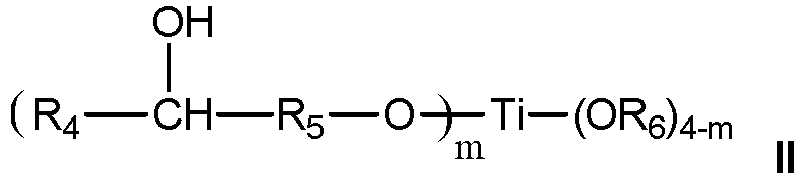
- R4 is a saturated monovalent hydrocarbon group having from 1 to 16 carbon atoms,
- R5 is a saturated divalent hydrocarbon group having from 1 to 16 carbon atoms,
- R6 is a saturated monovalent hydrocarbon group having from 4 to 32 carbon atoms,
- wherein the hydrocarbon groups include both linear and branched ones;
further comprising a catalyst (d).
- (i) an organotitanium compound I with the following general formula I,
- According to the present invention, ingredient (a) is used as a base polymer, which can be selected from among various hydroxyl-terminated polyorganosiloxanes or mixtures thereof conventionally used in the art for preparing RTV-1 silicone rubbers, generally being one or more α,ω-dihydroxypolydimethylsiloxanes with a kinematic viscosity at 25 °C of from 500 to 350,000 mm2/s, preferably containing at least one α,ω-dihydroxypolydimethylsiloxane with a kinematic viscosity at 25 °C of from 1,000 to 100,000 mm2/s for example from 20,000 to 100,000 mm2/s. As used herein, the term "kinematic viscosity" is measured according to DIN 51562, unless otherwise specified. The higher the kinematic viscosity of the hydroxyl-terminated polyorganosiloxane, the lower its hydroxyl content. The commonly used α,ω-dihydroxypolydimethylsiloxane has a hydroxyl content in the range of from 0.01 wt% to 0.2 wt%, based on the mass of the α,ω-dihydroxypolydimethylsiloxane.
- According to the present invention, ingredient (a) is usually used in an amount of from 10 wt% to 85 wt%, for example, from 30 wt% to 85 wt%, based on the total weight of the starting materials of the polysiloxane composition.
- According to the present invention, ingredient (b) serves as a crosslinking agent, which can be selected from among various multifunctional alkoxysilane crosslinking agents having a functionality ≥ 3 that are conventionally used in the art for preparing alkoxy-curing RTV-1 silicone rubbers. Examples of suitable multifunctional alkoxysilanes include methyltrimethoxysilane, methyltriethoxysilane, vinyltrimethoxysilane, vinyltriethoxysilane, tetramethoxysilane, tetraethoxyoxysilane, phenyltrimethoxysilane, phenyltriethoxysilane, but not limited thereto. In order to shorten the reaction time of the silanol groups in ingredient (a), ingredient (b) is preferably a vinyl group-containing multifunctional alkoxysilane.
- According to the present invention, the amount of ingredient (b) can be specified by those skilled in the art according to the formulation of conventional alkoxy-curing RTV-1 silicone rubbers, depending on the amount of the silanol groups in ingredient (a). In general, ingredient (b) is used in an amount of from 0.5 wt% to 5 wt%, based on the total weight of the starting materials of the polysiloxane composition.
- In some embodiments of the present invention, ingredient (a) is used in an amount of from 10 to 85 parts, preferably from 30 to 85 parts, while ingredient (b) is used in an amount of from 0.5 to 5 parts, preferably from 0.5 to 4.5 parts, based on 100 parts by weight of total starting materials of the polysiloxane composition.
- According to the present invention, ingredient (c) can cause complete or almost complete reaction of the terminal hydroxyl groups in ingredient (a) so as to reduce or eliminate sharp viscosity increase or even gelling of the system after the addition of the organotitanium catalyst to ingredient (a), without affecting the crosslinking of ingredients (a) and (b).
- In the general formula of the organotitanium compound I, n is preferably an arbitrary integer between 2 and 4, for example 2, 3 or 4. R1 is preferably a saturated monovalent hydrocarbon group having from 1 to 10 carbon atoms, more preferably from 1 to 6 carbon atoms, such as methyl, ethyl, n-propyl, isopropyl, n-butyl, isobutyl, t-butyl, n-pentyl, isopentyl, t-pentyl, n-hexyl, isohexyl and t-hexyl, particularly preferably a saturated monovalent hydrocarbon group having from 2 to 4 for example 3 carbon atoms, such as n-propyl. R2 is preferably a saturated divalent hydrocarbon group having from 1 to 10 carbon atoms, more preferably from 1 to 6 carbon atoms, such as -CH2-, - (CH2)2-, -(CH2)3-, -CH(CH3)-CH2-, -(CH2)4-, -CH(CH3)-(CH2)2-, -CH2CH(CH3)-CH2-, - CH(CH2CH3)-CH2-, -(CH2)5-, -CH(CH3)-(CH2)3-, -CH(CH2CH3)-(CH2)2-, -(CH2)6-, - CH(CH3)-(CH2)4-, -CH(CH2CH3)-(CH2)3-, particularly preferably a saturated divalent hydrocarbon group having from 3 to 5 for example 4 carbon atoms, such as - CH(CH2CH3)-CH2-. R3 is preferably a saturated monovalent hydrocarbon group having from 1 to 20 carbon atoms, more preferably having from 1 to 12 carbon atoms, such as butyl, pentyl, hexyl, heptyl, octyl, etc..
- In the general formula of the organotitanium compound II, m is preferably 3 or 4, R4 is identical to R1, R5 is identical to R2, R6 is preferably a saturated monovalent hydrocarbon group having from 4 to 20 carbon atoms, more preferably having from 6 to 12 carbon atoms, such as hexyl, heptyl, octyl, etc..
- The structural formula of the multipolymer of organotitanium compound is determined by that of the compound. For example, if the structural formula of compound I is


- According to the present invention, the amount of ingredient (c) is mainly determined by that of ingredient (a). In some embodiments of the present invention, ingredient (a) is used in an amount of from 10 to 85 parts, preferably from 30 to 85 parts, while ingredient (c) is used in an amount of from 0.01 to 2 parts, preferably from 0.05 to 1.5 parts, based on 100 parts by weight of total starting materials of the polysiloxane composition. If the amount of ingredient (c) is lower than the above range, the silanol groups in ingredient (a) cannot be completely consumed in the reaction, and after the addition of the organotitanium catalyst to ingredient (a), the viscosity of the system still increases significantly. If the amount of ingredient (c) is higher than the above range, the tack-free time of the product will be affected.
- According to the present invention, the catalyst can be selected from among various organotitanium catalysts (d1) or organotin catalysts (d2) conventionally used in the art. Examples of suitable organotitanium catalysts include tetra-n-butyl titanate (Tn-BT), tetraisobutyl titanate (Ti-BT), tetra-t-butyl titanate (Tt-BT), tetraisopropyl titanate (Ti-PT), tetraisooctyl titanate (TOT), diisobutyl bis(acetylacetonate) titanate (DIBAT), diisopropyl bis(acetylacetonate) titanate (DIPAT), diisopropyl bis(ethyl acetoacetate) titanate, dibutyl bis(ethyl acetoacetate) titanate, but not limited thereto. Examples of suitable organotin catalysts include dibutyltin dilaurate, dioctyltin dilaurate, dibutyltin maleate, dibutyltin diacetate, dibutyltin dioctoate, dibutyltin diacetyl acetonate, dibutyltin oxide and dioctyltin oxide, but not limited thereto.
- According to the present invention, the amount of the ingredient (d) can be specified by those skilled in the art according to its type and the expected curing speed, generally in the range of from 0.01 wt% to 5 wt% based on the total weight of the starting materials of the polysiloxane composition.
- In some embodiments of the present invention, ingredient (c) is used in an amount of from 0.01 to 2 parts, preferably from 0.05 to 1.5 parts, while ingredient (d1) is used in an amount of from 0.1 to 5 parts, preferably from 0.5 to 3 parts, based on 100 parts by weight of total starting materials of the polysiloxane composition.
- According to the present invention, a polysiloxane composition containing ingredient (d) is a product that cures at room temperature and can be directly used as sealants, adhesives, and coating materials for the applications in construction, electronics, electrical and automobile sectors. Where ingredient (d) is not contained, the composition is a non-curable product that can be mixed with ingredient (d) before use.
- According to the present invention, the polysiloxane composition can further comprise a filler (e) to reinforce and to adjust the viscosity. The filler can be selected from among various fillers conventionally used in the art, for example filler (e1), containing fumed silica (including hydrophobic or hydrophilic pyrogenic silica, and hydrophobic or hydrophilic precipitated silica), and filler (e2), not containing fumed silica, such as calcium carbonate (including precipitated calcium carbonate, ground calcium carbonate, and activated calcium carbonate), fine ground silica, diatomaceous earth, talc, titanium dioxide, alumina, quartz powder, clay minerals, bentonite and kaolin, but not limited thereto. According to the present invention, the filler is preferably one containing fumed silica, or calcium carbonate.
- According to the present invention, ingredient (e) is generally used in an amount of less than 70 wt%, for example, from 10 wt% to 50 wt%, based on the total weight of the starting materials of the polysiloxane composition.
- In some embodiments of the present invention, the filler is filler (e1) used in an amount of from 1 wt% to 20 wt%, based on the total weight of the starting materials of the polysiloxane composition. In other embodiments of the present invention, the filler is filler (e2) used in an amount of from 10 wt% to 60 wt%, based on the total weight of the starting materials of the polysiloxane composition.
- According to the present invention, the polysiloxane composition can further comprise an adhesion promoter (f) to further improve the adhesion properties. The adhesion promoter can be selected from among various adhesion promoters conventionally used in the art, for example, γ-aminopropyltrimethoxysilane, γ-aminopropylmethyldimethoxysilane, N-β- (aminoethyl)-γ-aminopropyltrimethoxysilane, N-β-(aminoethyl)-γ-aminopropylmethyldimethoxysilane, N-phenyl-γ-aminopropyl trimethoprimoxysilane, N-cyclohexylaminomethyltrimethoxysilane, γ-glycidyloxypropyltrimethoxysilane, mercaptopropyltrimethoxysilane, 2,3-glycidoxypropyltrimethoxysilane, β-(3,4-epoxycyclohexyl)-ethyltrimethoxysilane, but not limited thereto.
- In some embodiments of the present invention, ingredient (d) is an organotitanium catalyst (d1) and, in order to avoid catalyst poisoning, the adhesion promoter is preferably an epoxy silane, suitable examples being listed in the previous paragraph. In other embodiments of the present invention, ingredient (d) is an organotin catalyst (d2) and, in order to enhance adhesion, the adhesion promoter is preferably an aminosilane, suitable examples being listed the previous paragraph.
- According to the present invention, ingredient (f) is generally used in an amount of less than 3 wt%, for example, from 0.1 wt% to 3 wt%, based on the total weight of the starting materials of the polysiloxane composition.
- The polysiloxane composition of the present invention can also optionally comprise other conventional aids and additives, such as diluents and plasticizers (e.g. dimethyl silicone oils with a dynamic viscosity of from 10 to 5000 mPa·s at 25 °C, and mineral oils with a dynamic viscosity of from 10 to 100 mPa·s at 25 °C), UV absorbers (e.g. salicylic acid ester, benzophenone, benzotriazole, substituted acrylonitrile and triazine UV absorbers), and UV stabilizers (e.g. hindered amine light stabilizers), but are not limited thereto.
- The polysiloxane composition of the present invention can be a one-component system more specially an alkoxy-curing one-component room temperature vulcanized silicone rubber system (RTV-1 type), or a two-component system more specially an alkoxy-curing two-component room temperature vulcanized silicone rubber system (RTV-2 type) where ingredient (d) and ingredient (a) are not incorporated in the same component.
- In some embodiments, the present invention also provides a polysiloxane composition comprising the following ingredients:
- the ingredient (a) as previously described, and
- the ingredient (c) as previously described;
- optionally, further comprising the ingredient (b) as previously described;
- further optionally, comprising the ingredient (d) as previously described;
- still further optionally, comprising the ingredient (e), (f) and/or other optional ingredients as previously described.
- The second aspect of the present invention provides a method for preparing the polysiloxane composition according to the first aspect of the present invention, which comprises:
- step 1: mixing ingredients (a)-(c) to react until the silanol groups in ingredient (a) substantially disappear;
- and optionally step 2: adding ingredient (d) after the silanol groups in ingredient (a) substantially disappear.
- Where the polysiloxane composition comprises ingredients (e) and (f) and other aids or additives, these ingredients can optionally be added all together while ingredients (a)-(c) are being mixed, or after the silanol groups in ingredient (a) substantially disappear.
- As used herein, the wording "the silanol groups in ingredient (a) substantially disappear" means that the silanol groups in ingredient (a) are almost completely converted to other groups, and no silanol groups can be detected by a common test method. In a typical test method, tetrabutyl titanate (TBT) as a detection reagent is mixed with the reaction products of ingredients (a)-(c) at an appropriate ratio, for example, 1 : 50, and continuously stirred for 5-10 minutes to observe if there is a gel-thickening phenomenon. If no gel-thickening with continued stirring, it is considered that the silanol groups in ingredient (a) have substantially disappeared.
- The third aspect of the present invention provides an elastomer obtained by curing ingredients (a)-(d) and optionally other ingredients as described in the first aspect of the present invention.
- The invention is further illustrated by the following examples, but is not limited to the scope thereof. Any experimental methods with no conditions specified in the following examples are selected according to the conventional methods and conditions, or product specifications.
- The viscosity change during the preparation of the polysiloxane composition of the present invention is characterized by observing whether the viscosity of the mixture significantly rise, typically by observing whether the Weissenberg effect occurs.
- If no Weissenberg effect occurs during the preparation of the polysiloxane composition, it indicates there is no significant increase in viscosity; if the Weissenberg effect occurs, it indicates a significant increase in viscosity. A typical example of "no Weissenberg effect occurring" is that when, in a reaction vessel with 1/2 - 2/3 vessel volume filled with the starting materials of the polysiloxane composition, the reaction takes place while stirring at a rate of 200-1,000 r/min with the stirring rod inserted below the initial liquid surface, the part of the stirring rod above the initial liquid surface has always less than 50% along the axial direction (measured from the initial liquid surface) adhered by the material, and the paddle can still stir the liquid properly. A typical example of "Weissenberg effect occurring" is that when, in a reaction vessel with 1/2 - 2/3 vessel volume filled with the starting materials of the polysiloxane composition, the reaction takes place while stirring at a rate of 200-1,000 r/min with the stirring rod inserted below the initial liquid surface, the part of the stirring rod above the initial liquid surface has more than 50% along the axial direction (measured from the initial liquid surface) adhered by the material, causing the paddle cannot properly stir the liquid, and in the extreme case, the starting materials become a mass adhering to and rotating along with the paddle.
- Here, the typical examples of "no Weissenberg effect occurring" and "Weissenberg effect occurring" are specifically for a stirring system with a rod. As for a stirring system without a rod, or a screw extrusion system, the method for evaluating viscosity change during the preparation of the polysiloxane composition can be referred to the stirring system with a rod as described above.
- The reaction time of silanol groups in the present invention refers to the elapsed time from the start of mixing ingredients (a)-(c) to the substantial disappearance of silanol groups in ingredient (a). The method to determine whether the silanol groups substantially disappear has been described above.
- The tack-free time of the polysiloxane composition herein is determined at 23 ± 2 °C and 50 ± 10 % relative humidity.
- The Shore A hardness of the cured polysiloxane composition (hereinafter referred to as "elastomer") of the present invention is determined in accordance with ISO 7619-1:2004 (or Chinese Standard GB/T531.1-2008).
- The tensile strength, elongation at break, and 100% modulus of the elastomer of the present invention are measured in accordance with ISO 37-2011 (or Chinese Standard GB/T 528-2009).
- Here's how to prepare:
The ingredients of substance A were mixed in their individual amounts specified in Table 1 and stirred to enable reaction. After the silanol groups in the α,ω-dihydroxypolydimethylsiloxane substantially disappear, the substance B was added and mixed to obtain the product. - Comparative Examples 1-5 were prepared with the same method as in Examples 1-4, except that Comparative Example 1 did not contain substance B, Comparative Example 2 did not contain organotitanium compound 1, Comparative Example 3 used TOT instead of organotitanium compound 1, and Comparative Example 4 had the individual ingredients of substance B and substance A mixed together.
- Table 1 shows the ingredients of Examples and Comparative Examples and amounts thereof. The amounts in Table 1 are, unless otherwise specified, in parts by weight.
- WACKER® POLYMER FD 80, an α, ω-dihydroxypolydimethylsiloxane, having a dynamic viscosity of about 75,000 mPa s, as measured at 23 °C according to DIN 53019, supplied by Wacker Chemicals.
- WACKER® OH-POLYMER 1000, an α, ω-dihydroxypolydimethylsiloxane, having a dynamic viscosity of about 1000 mPa s, as measured at 23 °C according to DIN 53019, supplied by Wacker Chemicals.
- WACKER® AK 100, a polydimethylsiloxane, having a dynamic viscosity of 95-105 mPa s, as measured at 25 °C according to DIN 53019, supplied by Wacker Chemicals.
- HDK® H15, a hydrophobic pyrogenic silica, supplied by Wacker Chemicals.
- PFLEX, a precipitated calcium carbonate, supplied by the U.S. Specialty Minerals Inc.
- GENIOSIL® XL 10, a vinyltrimethoxysilane, supplied by Wacker Chemicals.
- GENIOSIL® GF 80, 3-(2,3-Epoxypropoxy)propyltrimethoxysilane, supplied by Wacker Chemicals;
- Organotitanium compound 1, with chemical formula being

- Other ingredients and reagents are all commercially available.
- Table 2 shows the viscosity change and the reaction time of silanol groups during the preparation of the respective Examples and Comparative Examples. As can be seen from the Table, Weissengerg effect did not occur during the preparation of the polysiloxane compositions of Examples 1-4 and Comparative Example 5, while it did during the preparation of the compositions of Comparative Examples 1-4.. In addition, the time required was short for the reaction between the silanol groups of α,ω-dihydroxypolydimethylsiloxane and organotitanium compound 1.
- Table 3 shows the tack-free time of the polysiloxane composition and the results of performance tests for Shore A hardness, tensile strength, elongation at break and 100 % modulus of the elastomer obtained in Example 1. Examples 2-4 have results equivalent to those of Example 1. The composition of Comparative Example 1 remained uncured after 48 hours. The compositions of Comparative Examples 2-4 were not tested for product properties due to a apparent increase in viscosity during the preparation. The tack-free time of the composition of Comparative Example 5 was greatly extended, which means that too much organotitanium compound 1 will affect the dry tack and is not conducive to use in actual production.
Table 1 Substance Composition Example 1 Example 2 Example 3 Example 4 Comparative Example 1 Comparative Example 2 Comparative Example 3 Comparative Example 4 Comparative Example 5 A WACKER® POLYMER FD 80 50 50.35 49.5 30 52 50.5 50 50 47.5 WACKER® OH-POLYMER 1000 30 30 30 / 30 30 30 30 30 WACKER® AK100 / / / 15.5 / / / / / HDK® H15 13 13 13 / 13 13 13 13 13 PFLEX / / / 50 / / / / / GENIOSIL® XL 10 4 4 4 2 4 4 4 4 4 GENIOSIL® GF 80 0.5 0.5 0.5 / 0.5 0.5 0.5 0.5 0.5 Organotitanium compound 1 0.5 0.15 1 0.5 0.5 / / 0.5 3 TOT / / / / / / 0.5 / / B TBT 2 2 2 2 / 2 / 2 2 Table 2 Example 1 Example 2 Example 3 Example 4 Comparative Example 1 Comparative Example 2 Comparative Example 3 Comparative Example 4 Comparative Example 5 Viscosity change No Weissenberg effect occurring No Weissenberg effect occurring No Weissenberg effect occurring No Weissenberg effect occurring Weissenberg effect occurring Weissenberg effect occurring Weissenberg effect occurring Weissenberg effect occurring No Weissenberg effect occurring Reaction time of silanol groups 45 min 2.5 h 30 min 30 min N/A N/A N/A N/A 20min Table 3 Indicator Example 1 Tack-free time (min) 12 Shore A hardness 28 Tensile strength (MPa) 3.34 Elongation at break (%) 389.56 100% modulus (MPa) 0.63
Claims (15)
- A polysiloxane composition comprising the following ingredients:(a) a hydroxyl-terminated polyorganosiloxane;(b) a multifunctional alkoxysilane; and(c) an organotitanium compound having the following general formula I or II, or a multipolymer thereof having a degree of polymerization of from 2 to 10,optionally,(i) an organotitanium compound I with the following general formula I,
 where n is an arbitrary integer between 1 and 4,R1 is a saturated monovalent hydrocarbon group having from 1 to 16 carbon atoms,R2 is a saturated divalent hydrocarbon group having from 1 to 16 carbon atoms,R3 is a saturated monovalent hydrocarbon group having from 1 to 32 carbon atoms,wherein the hydrocarbon groups include both linear and branched ones;(ii) an organotitanium compound II with the following general formula II,
 where m is an arbitrary integer between 2 and 4,R4 is a saturated monovalent hydrocarbon group having from 1 to 16 carbon atoms,R5 is a saturated divalent hydrocarbon group having from 1 to 16 carbon atoms,R6 is a saturated monovalent hydrocarbon group having from 4 to 32 carbon atoms,wherein the hydrocarbon groups include both linear and branched ones;
further comprising a catalyst (d). - The polysiloxane composition of Claim 1, characterized in that ingredient (a) is used in an amount of from 10 wt% to 85 wt% and ingredient (c) from 0.01 wt% to 2 wt%, based on the total weight of the starting materials of the polysiloxane composition.
- The polysiloxane composition of Claim 1 or 2, characterized in that ingredient (b) is used in an amount of from 0.5 wt% to 5 wt% and ingredient (c) from 0.01 wt% to 2 wt%, based on the total weight of the starting materials of the polysiloxane composition.
- The polysiloxane composition of any one of Claims 1-3, characterized in that ingredient (a) contains at least one hydroxyl-terminated polyorganosiloxane having a kinematic viscosity at 25 °C ranging from 1,000 to 100,000 mm2/s.
- The polysiloxane composition of Claim 4, characterized in that ingredient (a) is used in an amount of from 50 wt% to 85 wt%, based on the total weight of the starting materials of the polysiloxane composition.
- The polysiloxane composition of any one of Claims 1-5, characterized in that ingredient (b) is a vinyl group-containing multifunctional alkoxysilane.
- The polysiloxane composition of any one of Claims 1-6, characterized in that the organotitanium compound has a general formula I or II, where R1 or R4 is a saturated monovalent hydrocarbon group having from 2 to 4 carbon atoms.
- The polysiloxane composition of any one of Claims 1-7, characterized in that the organotitanium compound has a general formula I or II, where R2 or R5 is a saturated divalent hydrocarbon group having from 3 to 5 carbon atoms.
- The polysiloxane composition of Claim 1, characterized in that ingredient (d) is selected from among an organotitanium catalyst (d1) or an organotin catalyst (d2).
- The polysiloxane composition of Claim 9, characterized in that ingredient (c) is used in an amount of from 0.01 wt% to 2 wt% and ingredient (d1) from 0.1 wt% to 5 wt%, based on the total weight of the starting materials of the polysiloxane composition.
- The polysiloxane composition of any one of Claims 1-10, characterized in that it can further comprise a filler (e1), which contains fumed silica and is used in an amount of from 1 wt% to 20 wt%, based on the total weight of the starting materials of the polysiloxane composition.
- The polysiloxane composition of any one of Claims 1-10, characterized in that it can further comprises a filler (e2), which contains no fumed silica and is used in an amount of from 10 wt% to 60 wt%, based on the total weight of the starting materials of the polysiloxane composition.
- The polysiloxane composition of any one of Claims 1-12, characterized in that it can further comprise an adhesion promoter (f).
- The polysiloxane composition of Claim 13, characterized in that ingredient (f) is an epoxy silane, provided that the polysiloxane composition comprises an organotitanium catalyst (d1), or
an aminosilane, provided that the polysiloxane composition comprises an organotin catalyst (d2). - A method for preparing the polysiloxane composition of any one of Claims 1-14, comprising:step 1:mixing ingredients (a)-(c) to react until the silanol groups in ingredient (a) substantially disappear; andoptionally, step 2: adding ingredient (d) after the silanol groups in ingredient (a) substantially disappear.
Applications Claiming Priority (1)
| Application Number | Priority Date | Filing Date | Title |
|---|---|---|---|
| PCT/CN2018/087419 WO2019218330A1 (en) | 2018-05-18 | 2018-05-18 | Polysiloxane composition |
Publications (3)
| Publication Number | Publication Date |
|---|---|
| EP3765549A1 EP3765549A1 (en) | 2021-01-20 |
| EP3765549A4 EP3765549A4 (en) | 2021-06-02 |
| EP3765549B1 true EP3765549B1 (en) | 2024-09-11 |
Family
ID=68539331
Family Applications (1)
| Application Number | Title | Priority Date | Filing Date |
|---|---|---|---|
| EP18918577.0A Active EP3765549B1 (en) | 2018-05-18 | 2018-05-18 | Polysiloxane composition |
Country Status (9)
| Country | Link |
|---|---|
| US (1) | US11339291B2 (en) |
| EP (1) | EP3765549B1 (en) |
| JP (1) | JP7091481B2 (en) |
| KR (1) | KR102541720B1 (en) |
| CN (1) | CN112166142B (en) |
| DK (1) | DK3765549T3 (en) |
| ES (1) | ES2996217T3 (en) |
| PL (1) | PL3765549T3 (en) |
| WO (1) | WO2019218330A1 (en) |
Family Cites Families (19)
| Publication number | Priority date | Publication date | Assignee | Title |
|---|---|---|---|---|
| JP2548242B2 (en) * | 1987-11-09 | 1996-10-30 | 旭化成工業株式会社 | Polyester fiber and method for producing the same |
| US5908909A (en) * | 1995-06-08 | 1999-06-01 | Dow Corning S. A. | Organosiloxane compositions |
| US5948854A (en) | 1997-09-25 | 1999-09-07 | Dow Corning S.A. | Alkoxy-functional RTV compositions with increased green strength and increased storage stability |
| US6008284A (en) * | 1997-12-23 | 1999-12-28 | Dow Corning Corporation | Fast curing alkoxy-functional RTV compositions |
| DE19957336A1 (en) * | 1999-11-29 | 2001-07-12 | Wacker Chemie Gmbh | Crosslinkable organopolysiloxane compositions |
| EP1248819A1 (en) * | 1999-12-10 | 2002-10-16 | General Electric Company | Room temperature curable silicone sealant |
| US20080039565A1 (en) * | 2002-08-29 | 2008-02-14 | Amber Chemical Company | Thixotropic/non-slump room temperature curable organopolysiloxane compositions |
| US7754800B2 (en) * | 2005-04-06 | 2010-07-13 | Dow Corning Europe Sa | Organosiloxane compositions |
| JP4766248B2 (en) * | 2006-02-01 | 2011-09-07 | 信越化学工業株式会社 | Organopolysiloxane composition for adhering magnesium alloys with excellent chemical resistance |
| EP1923361A1 (en) | 2006-11-20 | 2008-05-21 | Sika Technology AG | Low temperature primer coating composition |
| JP5359406B2 (en) | 2009-03-12 | 2013-12-04 | 信越化学工業株式会社 | Room temperature curable organopolysiloxane composition, method for producing the same, and automobile oil seal |
| US20110143148A1 (en) * | 2009-12-13 | 2011-06-16 | General Electric Company | Articles comprising a weather resistant silicone coating |
| DE102010041676A1 (en) * | 2010-09-29 | 2012-03-29 | Wacker Chemie Ag | Crosslinkable organopolysiloxane composition |
| CN102757647A (en) * | 2012-07-11 | 2012-10-31 | 东莞兆舜有机硅新材料科技有限公司 | A kind of one-component catalytic dealcoholization type RTV silicone rubber sealant and preparation method thereof |
| CN102898839B (en) | 2012-11-08 | 2014-09-03 | 广州市回天精细化工有限公司 | Dealcoholization type room-temperature silicon sulfide rubber composite |
| CN103408941A (en) * | 2013-08-23 | 2013-11-27 | 山东永安胶业有限公司 | Transparent dealcoholized single-component room temperature vulcanized silicone rubber and preparation method thereof |
| KR102508396B1 (en) | 2015-04-03 | 2023-03-09 | 신에쓰 가가꾸 고교 가부시끼가이샤 | Room-temperature curable organopolysiloxane composition and a molded article that is a cured product of the composition |
| CN105273679A (en) | 2015-08-06 | 2016-01-27 | 南京艾布纳密封技术有限公司 | One-component room temperature vulcanization organosilicone adhesive |
| DE102016200704A1 (en) | 2016-01-20 | 2017-07-20 | Bona Gmbh Deutschland | A method for increasing the safety of use and the aging resistance of adhesives and other products containing silane-functionalized prepolymers |
-
2018
- 2018-05-18 PL PL18918577.0T patent/PL3765549T3/en unknown
- 2018-05-18 DK DK18918577.0T patent/DK3765549T3/en active
- 2018-05-18 JP JP2020564555A patent/JP7091481B2/en active Active
- 2018-05-18 EP EP18918577.0A patent/EP3765549B1/en active Active
- 2018-05-18 KR KR1020207036451A patent/KR102541720B1/en active Active
- 2018-05-18 ES ES18918577T patent/ES2996217T3/en active Active
- 2018-05-18 US US17/056,576 patent/US11339291B2/en active Active
- 2018-05-18 CN CN201880093513.8A patent/CN112166142B/en active Active
- 2018-05-18 WO PCT/CN2018/087419 patent/WO2019218330A1/en not_active Ceased
Also Published As
| Publication number | Publication date |
|---|---|
| KR20210011011A (en) | 2021-01-29 |
| US11339291B2 (en) | 2022-05-24 |
| EP3765549A4 (en) | 2021-06-02 |
| WO2019218330A1 (en) | 2019-11-21 |
| KR102541720B1 (en) | 2023-06-12 |
| ES2996217T3 (en) | 2025-02-12 |
| US20210179850A1 (en) | 2021-06-17 |
| DK3765549T3 (en) | 2024-12-02 |
| JP2021523969A (en) | 2021-09-09 |
| PL3765549T3 (en) | 2025-02-03 |
| CN112166142A (en) | 2021-01-01 |
| JP7091481B2 (en) | 2022-06-27 |
| CN112166142B (en) | 2022-08-30 |
| EP3765549A1 (en) | 2021-01-20 |
Similar Documents
| Publication | Publication Date | Title |
|---|---|---|
| EP3700978B1 (en) | Polysiloxane composition | |
| US4546017A (en) | Organopolysiloxane composition curable to an elastomer and use thereof | |
| EP1519993B1 (en) | Room temperature curable organopolysiloxane compositions | |
| KR0139811B1 (en) | Silicone sealants having reduced color | |
| US11104803B2 (en) | Low modulus silylated mastic composition | |
| US5948854A (en) | Alkoxy-functional RTV compositions with increased green strength and increased storage stability | |
| EP0368455A1 (en) | Modulus control in silicone sealant | |
| EP3087143B1 (en) | Room-temperature-curable silicone rubber composition, the use thereof, and method for repairing electronic device | |
| KR20100059716A (en) | Room temperature curable organopolysiloxane composition | |
| US20080039565A1 (en) | Thixotropic/non-slump room temperature curable organopolysiloxane compositions | |
| JP2011178955A (en) | Curable composition | |
| WO2021073864A1 (en) | One-component moisture-curable silicone compositions | |
| AU719071B2 (en) | Process for the production of poly(diorganosiloxanes) with diorganyloxyorganylsilyl or thiorganyloxysilyl end groups, crosslinkable mixtures containing them and use thereof | |
| EP0926206A2 (en) | Fast curing alkoxy-functional RTV compositions | |
| US7049384B1 (en) | Condensation cross-linking polysiloxane masses, a process for preparing the same and surface-modified fillers | |
| EP3323844A1 (en) | Curable compositions based on silicon-containing polymers using phosphazenes as catalysts | |
| JP4912746B2 (en) | Room temperature curable organopolysiloxane composition | |
| JP3419273B2 (en) | Room temperature curable organopolysiloxane composition | |
| US11339291B2 (en) | Polysiloxane composition | |
| WO2009047580A1 (en) | Thixotropic/non-slump room temperature curable organopolysiloxane compositions | |
| US5026812A (en) | Organopolysiloxane composition curable to an elastomer and use thereof | |
| GB2309460A (en) | One component room temperature vulcanizable silicone sealant | |
| JP5008913B2 (en) | Room temperature curable polyorganosiloxane composition | |
| JPS60215058A (en) | Moisture-curing composition | |
| JP2007204502A (en) | Curable silicone resin composition |
Legal Events
| Date | Code | Title | Description |
|---|---|---|---|
| STAA | Information on the status of an ep patent application or granted ep patent |
Free format text: STATUS: THE INTERNATIONAL PUBLICATION HAS BEEN MADE |
|
| PUAI | Public reference made under article 153(3) epc to a published international application that has entered the european phase |
Free format text: ORIGINAL CODE: 0009012 |
|
| STAA | Information on the status of an ep patent application or granted ep patent |
Free format text: STATUS: REQUEST FOR EXAMINATION WAS MADE |
|
| 17P | Request for examination filed |
Effective date: 20201014 |
|
| AK | Designated contracting states |
Kind code of ref document: A1 Designated state(s): AL AT BE BG CH CY CZ DE DK EE ES FI FR GB GR HR HU IE IS IT LI LT LU LV MC MK MT NL NO PL PT RO RS SE SI SK SM TR |
|
| AX | Request for extension of the european patent |
Extension state: BA ME |
|
| REG | Reference to a national code |
Ipc: C08K0003013000 Ref country code: DE Ref legal event code: R079 Ref document number: 602018074404 Country of ref document: DE Free format text: PREVIOUS MAIN CLASS: C08G0077180000 |
|
| A4 | Supplementary search report drawn up and despatched |
Effective date: 20210506 |
|
| RIC1 | Information provided on ipc code assigned before grant |
Ipc: C08K 3/013 20180101AFI20210429BHEP Ipc: C08K 3/36 20060101ALI20210429BHEP Ipc: C08K 5/00 20060101ALI20210429BHEP Ipc: C08K 5/5435 20060101ALI20210429BHEP Ipc: C08K 5/544 20060101ALI20210429BHEP Ipc: C08L 83/04 20060101ALI20210429BHEP Ipc: C08L 83/06 20060101ALI20210429BHEP Ipc: C08G 77/16 20060101ALI20210429BHEP Ipc: C08G 77/18 20060101ALI20210429BHEP |
|
| DAV | Request for validation of the european patent (deleted) | ||
| DAX | Request for extension of the european patent (deleted) | ||
| P01 | Opt-out of the competence of the unified patent court (upc) registered |
Effective date: 20230522 |
|
| GRAP | Despatch of communication of intention to grant a patent |
Free format text: ORIGINAL CODE: EPIDOSNIGR1 |
|
| STAA | Information on the status of an ep patent application or granted ep patent |
Free format text: STATUS: GRANT OF PATENT IS INTENDED |
|
| INTG | Intention to grant announced |
Effective date: 20240513 |
|
| GRAS | Grant fee paid |
Free format text: ORIGINAL CODE: EPIDOSNIGR3 |
|
| RAP3 | Party data changed (applicant data changed or rights of an application transferred) |
Owner name: WACKER CHEMIE AG |
|
| GRAA | (expected) grant |
Free format text: ORIGINAL CODE: 0009210 |
|
| STAA | Information on the status of an ep patent application or granted ep patent |
Free format text: STATUS: THE PATENT HAS BEEN GRANTED |
|
| AK | Designated contracting states |
Kind code of ref document: B1 Designated state(s): AL AT BE BG CH CY CZ DE DK EE ES FI FR GB GR HR HU IE IS IT LI LT LU LV MC MK MT NL NO PL PT RO RS SE SI SK SM TR |
|
| REG | Reference to a national code |
Ref country code: GB Ref legal event code: FG4D |
|
| REG | Reference to a national code |
Ref country code: CH Ref legal event code: EP |
|
| REG | Reference to a national code |
Ref country code: DE Ref legal event code: R096 Ref document number: 602018074404 Country of ref document: DE |
|
| REG | Reference to a national code |
Ref country code: IE Ref legal event code: FG4D |
|
| REG | Reference to a national code |
Ref country code: DK Ref legal event code: T3 Effective date: 20241127 |
|
| REG | Reference to a national code |
Ref country code: NL Ref legal event code: FP |
|
| REG | Reference to a national code |
Ref country code: LT Ref legal event code: MG9D |
|
| PG25 | Lapsed in a contracting state [announced via postgrant information from national office to epo] |
Ref country code: NO Free format text: LAPSE BECAUSE OF FAILURE TO SUBMIT A TRANSLATION OF THE DESCRIPTION OR TO PAY THE FEE WITHIN THE PRESCRIBED TIME-LIMIT Effective date: 20241211 |
|
| PG25 | Lapsed in a contracting state [announced via postgrant information from national office to epo] |
Ref country code: FI Free format text: LAPSE BECAUSE OF FAILURE TO SUBMIT A TRANSLATION OF THE DESCRIPTION OR TO PAY THE FEE WITHIN THE PRESCRIBED TIME-LIMIT Effective date: 20240911 Ref country code: GR Free format text: LAPSE BECAUSE OF FAILURE TO SUBMIT A TRANSLATION OF THE DESCRIPTION OR TO PAY THE FEE WITHIN THE PRESCRIBED TIME-LIMIT Effective date: 20241212 |
|
| PG25 | Lapsed in a contracting state [announced via postgrant information from national office to epo] |
Ref country code: BG Free format text: LAPSE BECAUSE OF FAILURE TO SUBMIT A TRANSLATION OF THE DESCRIPTION OR TO PAY THE FEE WITHIN THE PRESCRIBED TIME-LIMIT Effective date: 20240911 |
|
| PG25 | Lapsed in a contracting state [announced via postgrant information from national office to epo] |
Ref country code: LV Free format text: LAPSE BECAUSE OF FAILURE TO SUBMIT A TRANSLATION OF THE DESCRIPTION OR TO PAY THE FEE WITHIN THE PRESCRIBED TIME-LIMIT Effective date: 20240911 |
|
| PG25 | Lapsed in a contracting state [announced via postgrant information from national office to epo] |
Ref country code: HR Free format text: LAPSE BECAUSE OF FAILURE TO SUBMIT A TRANSLATION OF THE DESCRIPTION OR TO PAY THE FEE WITHIN THE PRESCRIBED TIME-LIMIT Effective date: 20240911 |
|
| PG25 | Lapsed in a contracting state [announced via postgrant information from national office to epo] |
Ref country code: RS Free format text: LAPSE BECAUSE OF FAILURE TO SUBMIT A TRANSLATION OF THE DESCRIPTION OR TO PAY THE FEE WITHIN THE PRESCRIBED TIME-LIMIT Effective date: 20241211 |
|
| PG25 | Lapsed in a contracting state [announced via postgrant information from national office to epo] |
Ref country code: RS Free format text: LAPSE BECAUSE OF FAILURE TO SUBMIT A TRANSLATION OF THE DESCRIPTION OR TO PAY THE FEE WITHIN THE PRESCRIBED TIME-LIMIT Effective date: 20241211 Ref country code: NO Free format text: LAPSE BECAUSE OF FAILURE TO SUBMIT A TRANSLATION OF THE DESCRIPTION OR TO PAY THE FEE WITHIN THE PRESCRIBED TIME-LIMIT Effective date: 20241211 Ref country code: LV Free format text: LAPSE BECAUSE OF FAILURE TO SUBMIT A TRANSLATION OF THE DESCRIPTION OR TO PAY THE FEE WITHIN THE PRESCRIBED TIME-LIMIT Effective date: 20240911 Ref country code: HR Free format text: LAPSE BECAUSE OF FAILURE TO SUBMIT A TRANSLATION OF THE DESCRIPTION OR TO PAY THE FEE WITHIN THE PRESCRIBED TIME-LIMIT Effective date: 20240911 Ref country code: GR Free format text: LAPSE BECAUSE OF FAILURE TO SUBMIT A TRANSLATION OF THE DESCRIPTION OR TO PAY THE FEE WITHIN THE PRESCRIBED TIME-LIMIT Effective date: 20241212 Ref country code: FI Free format text: LAPSE BECAUSE OF FAILURE TO SUBMIT A TRANSLATION OF THE DESCRIPTION OR TO PAY THE FEE WITHIN THE PRESCRIBED TIME-LIMIT Effective date: 20240911 Ref country code: BG Free format text: LAPSE BECAUSE OF FAILURE TO SUBMIT A TRANSLATION OF THE DESCRIPTION OR TO PAY THE FEE WITHIN THE PRESCRIBED TIME-LIMIT Effective date: 20240911 |
|
| REG | Reference to a national code |
Ref country code: ES Ref legal event code: FG2A Ref document number: 2996217 Country of ref document: ES Kind code of ref document: T3 Effective date: 20250212 |
|
| REG | Reference to a national code |
Ref country code: AT Ref legal event code: MK05 Ref document number: 1722649 Country of ref document: AT Kind code of ref document: T Effective date: 20240911 |
|
| PG25 | Lapsed in a contracting state [announced via postgrant information from national office to epo] |
Ref country code: IS Free format text: LAPSE BECAUSE OF FAILURE TO SUBMIT A TRANSLATION OF THE DESCRIPTION OR TO PAY THE FEE WITHIN THE PRESCRIBED TIME-LIMIT Effective date: 20250111 Ref country code: PT Free format text: LAPSE BECAUSE OF FAILURE TO SUBMIT A TRANSLATION OF THE DESCRIPTION OR TO PAY THE FEE WITHIN THE PRESCRIBED TIME-LIMIT Effective date: 20250113 |
|
| PG25 | Lapsed in a contracting state [announced via postgrant information from national office to epo] |
Ref country code: SM Free format text: LAPSE BECAUSE OF FAILURE TO SUBMIT A TRANSLATION OF THE DESCRIPTION OR TO PAY THE FEE WITHIN THE PRESCRIBED TIME-LIMIT Effective date: 20240911 Ref country code: RO Free format text: LAPSE BECAUSE OF FAILURE TO SUBMIT A TRANSLATION OF THE DESCRIPTION OR TO PAY THE FEE WITHIN THE PRESCRIBED TIME-LIMIT Effective date: 20240911 |
|
| PG25 | Lapsed in a contracting state [announced via postgrant information from national office to epo] |
Ref country code: AT Free format text: LAPSE BECAUSE OF FAILURE TO SUBMIT A TRANSLATION OF THE DESCRIPTION OR TO PAY THE FEE WITHIN THE PRESCRIBED TIME-LIMIT Effective date: 20240911 Ref country code: EE Free format text: LAPSE BECAUSE OF FAILURE TO SUBMIT A TRANSLATION OF THE DESCRIPTION OR TO PAY THE FEE WITHIN THE PRESCRIBED TIME-LIMIT Effective date: 20240911 |
|
| PG25 | Lapsed in a contracting state [announced via postgrant information from national office to epo] |
Ref country code: CZ Free format text: LAPSE BECAUSE OF FAILURE TO SUBMIT A TRANSLATION OF THE DESCRIPTION OR TO PAY THE FEE WITHIN THE PRESCRIBED TIME-LIMIT Effective date: 20240911 |
|
| PG25 | Lapsed in a contracting state [announced via postgrant information from national office to epo] |
Ref country code: SK Free format text: LAPSE BECAUSE OF FAILURE TO SUBMIT A TRANSLATION OF THE DESCRIPTION OR TO PAY THE FEE WITHIN THE PRESCRIBED TIME-LIMIT Effective date: 20240911 |
|
| REG | Reference to a national code |
Ref country code: DE Ref legal event code: R097 Ref document number: 602018074404 Country of ref document: DE |
|
| PGFP | Annual fee paid to national office [announced via postgrant information from national office to epo] |
Ref country code: NL Payment date: 20250521 Year of fee payment: 8 |
|
| PGFP | Annual fee paid to national office [announced via postgrant information from national office to epo] |
Ref country code: PL Payment date: 20250509 Year of fee payment: 8 Ref country code: DE Payment date: 20250521 Year of fee payment: 8 |
|
| PGFP | Annual fee paid to national office [announced via postgrant information from national office to epo] |
Ref country code: DK Payment date: 20250526 Year of fee payment: 8 |
|
| PGFP | Annual fee paid to national office [announced via postgrant information from national office to epo] |
Ref country code: BE Payment date: 20250521 Year of fee payment: 8 Ref country code: IT Payment date: 20250527 Year of fee payment: 8 |
|
| PGFP | Annual fee paid to national office [announced via postgrant information from national office to epo] |
Ref country code: FR Payment date: 20250528 Year of fee payment: 8 |
|
| PLBE | No opposition filed within time limit |
Free format text: ORIGINAL CODE: 0009261 |
|
| STAA | Information on the status of an ep patent application or granted ep patent |
Free format text: STATUS: NO OPPOSITION FILED WITHIN TIME LIMIT |
|
| PGFP | Annual fee paid to national office [announced via postgrant information from national office to epo] |
Ref country code: TR Payment date: 20250512 Year of fee payment: 8 |
|
| 26N | No opposition filed |
Effective date: 20250612 |
|
| PG25 | Lapsed in a contracting state [announced via postgrant information from national office to epo] |
Ref country code: SE Free format text: LAPSE BECAUSE OF FAILURE TO SUBMIT A TRANSLATION OF THE DESCRIPTION OR TO PAY THE FEE WITHIN THE PRESCRIBED TIME-LIMIT Effective date: 20240911 |
|
| PGFP | Annual fee paid to national office [announced via postgrant information from national office to epo] |
Ref country code: ES Payment date: 20250630 Year of fee payment: 8 |
|
| REG | Reference to a national code |
Ref country code: CH Ref legal event code: H13 Free format text: ST27 STATUS EVENT CODE: U-0-0-H10-H13 (AS PROVIDED BY THE NATIONAL OFFICE) Effective date: 20251223 |
|
| PG25 | Lapsed in a contracting state [announced via postgrant information from national office to epo] |
Ref country code: LU Free format text: LAPSE BECAUSE OF NON-PAYMENT OF DUE FEES Effective date: 20250518 |
|
| PG25 | Lapsed in a contracting state [announced via postgrant information from national office to epo] |
Ref country code: CH Free format text: LAPSE BECAUSE OF NON-PAYMENT OF DUE FEES Effective date: 20250531 |
|
| PG25 | Lapsed in a contracting state [announced via postgrant information from national office to epo] |
Ref country code: MC Free format text: LAPSE BECAUSE OF FAILURE TO SUBMIT A TRANSLATION OF THE DESCRIPTION OR TO PAY THE FEE WITHIN THE PRESCRIBED TIME-LIMIT Effective date: 20240911 |
|
| PGFP | Annual fee paid to national office [announced via postgrant information from national office to epo] |
Ref country code: GB Payment date: 20260306 Year of fee payment: 9 |
|
| PG25 | Lapsed in a contracting state [announced via postgrant information from national office to epo] |
Ref country code: IE Free format text: LAPSE BECAUSE OF NON-PAYMENT OF DUE FEES Effective date: 20250518 |