EP3764896B1 - Verfahren und vorrichtung zur überwachung eines menschen oder tieres - Google Patents
Verfahren und vorrichtung zur überwachung eines menschen oder tieres Download PDFInfo
- Publication number
- EP3764896B1 EP3764896B1 EP19701735.3A EP19701735A EP3764896B1 EP 3764896 B1 EP3764896 B1 EP 3764896B1 EP 19701735 A EP19701735 A EP 19701735A EP 3764896 B1 EP3764896 B1 EP 3764896B1
- Authority
- EP
- European Patent Office
- Prior art keywords
- measurement data
- frequency
- expansion
- dominant frequency
- subset
- Prior art date
- Legal status (The legal status is an assumption and is not a legal conclusion. Google has not performed a legal analysis and makes no representation as to the accuracy of the status listed.)
- Active
Links
Images




Classifications
-
- A—HUMAN NECESSITIES
- A61—MEDICAL OR VETERINARY SCIENCE; HYGIENE
- A61B—DIAGNOSIS; SURGERY; IDENTIFICATION
- A61B5/00—Measuring for diagnostic purposes; Identification of persons
- A61B5/08—Measuring devices for evaluating the respiratory organs
- A61B5/0816—Measuring devices for examining respiratory frequency
-
- A—HUMAN NECESSITIES
- A61—MEDICAL OR VETERINARY SCIENCE; HYGIENE
- A61B—DIAGNOSIS; SURGERY; IDENTIFICATION
- A61B5/00—Measuring for diagnostic purposes; Identification of persons
- A61B5/72—Signal processing specially adapted for physiological signals or for diagnostic purposes
- A61B5/7203—Signal processing specially adapted for physiological signals or for diagnostic purposes for noise prevention, reduction or removal
-
- A—HUMAN NECESSITIES
- A61—MEDICAL OR VETERINARY SCIENCE; HYGIENE
- A61B—DIAGNOSIS; SURGERY; IDENTIFICATION
- A61B5/00—Measuring for diagnostic purposes; Identification of persons
- A61B5/72—Signal processing specially adapted for physiological signals or for diagnostic purposes
- A61B5/7221—Determining signal validity, reliability or quality
-
- A—HUMAN NECESSITIES
- A61—MEDICAL OR VETERINARY SCIENCE; HYGIENE
- A61B—DIAGNOSIS; SURGERY; IDENTIFICATION
- A61B5/00—Measuring for diagnostic purposes; Identification of persons
- A61B5/72—Signal processing specially adapted for physiological signals or for diagnostic purposes
- A61B5/7235—Details of waveform analysis
- A61B5/7246—Details of waveform analysis using correlation, e.g. template matching or determination of similarity
-
- A—HUMAN NECESSITIES
- A61—MEDICAL OR VETERINARY SCIENCE; HYGIENE
- A61B—DIAGNOSIS; SURGERY; IDENTIFICATION
- A61B5/00—Measuring for diagnostic purposes; Identification of persons
- A61B5/72—Signal processing specially adapted for physiological signals or for diagnostic purposes
- A61B5/7235—Details of waveform analysis
- A61B5/7253—Details of waveform analysis characterised by using transforms
- A61B5/7257—Details of waveform analysis characterised by using transforms using Fourier transforms
-
- A—HUMAN NECESSITIES
- A61—MEDICAL OR VETERINARY SCIENCE; HYGIENE
- A61B—DIAGNOSIS; SURGERY; IDENTIFICATION
- A61B2562/00—Details of sensors; Constructional details of sensor housings or probes; Accessories for sensors
- A61B2562/02—Details of sensors specially adapted for in-vivo measurements
- A61B2562/0219—Inertial sensors, e.g. accelerometers, gyroscopes, tilt switches
-
- A—HUMAN NECESSITIES
- A61—MEDICAL OR VETERINARY SCIENCE; HYGIENE
- A61B—DIAGNOSIS; SURGERY; IDENTIFICATION
- A61B5/00—Measuring for diagnostic purposes; Identification of persons
- A61B5/103—Measuring devices for testing the shape, pattern, colour, size or movement of the body or parts thereof, for diagnostic purposes
- A61B5/11—Measuring movement of the entire body or parts thereof, e.g. head or hand tremor or mobility of a limb
- A61B5/113—Measuring movement of the entire body or parts thereof, e.g. head or hand tremor or mobility of a limb occurring during breathing
-
- G—PHYSICS
- G06—COMPUTING OR CALCULATING; COUNTING
- G06F—ELECTRIC DIGITAL DATA PROCESSING
- G06F2218/00—Aspects of pattern recognition specially adapted for signal processing
- G06F2218/02—Preprocessing
- G06F2218/04—Denoising
-
- G—PHYSICS
- G06—COMPUTING OR CALCULATING; COUNTING
- G06F—ELECTRIC DIGITAL DATA PROCESSING
- G06F2218/00—Aspects of pattern recognition specially adapted for signal processing
- G06F2218/08—Feature extraction
- G06F2218/10—Feature extraction by analysing the shape of a waveform, e.g. extracting parameters relating to peaks
Definitions
- the invention relates to monitoring a subject, particularly for extracting a frequency of a periodic physiological process such as a respiration rate.
- RR is currently measured in hospitals by manual counting of breaths, conventional impedance pneumography (IP) or via an optical technique called end-tidal carbon dioxide (et-CO2).
- IP impedance pneumography
- et-CO2 end-tidal carbon dioxide
- Acceleration signals have been used for many motion analysis applications such as gait, posture, and balance analysis.
- the use of accelerometers for motion analysis has significantly increased due to their ease of use, portability, and ability to be integrated in low-power wireless embedded platforms. It has been proposed to using acceleration signals to monitor RR.
- a low-pass or band-pass filtering is typically applied to each axis separately.
- a frequency in the range of 0.05 Hz to 1 Hz with maximum peak amplitude in the spectral domain can then be selected to calculate the breaths per minute (bpm).
- a number of studies [1], [2], [3], [4] have investigated the estimation of respiratory rate from acceleration signals.
- a gas pressure system has been used to validate estimation of respiratory rate from accelerometers placed on the subject's sternum [5].
- a relative mean error of -0.15 bpm has been reported.
- chest worn accelerometers were used to estimate respiratory rate and showed high correlation to flow rate measurements from a nasal cannula.
- a single chest patch sensor containing ECG and accelerometers has been used in [7] to compare fusion of three respiratory rate estimates, one estimate from accelerometer and two estimates using ECG from respiratory sinus arrhythmia and QRS modulation, to a capnography derived reference [8].
- US 2017/325779A1 discloses a system and method capable of indirectly monitoring respiratory and cardiac variables.
- a decomposition technique on time-series of features extracted from the chest audio signal ⁇ (t) is proposed.
- the proposed monitoring system may acquire the acoustic signal on the chest of a subject by means of a wearable transducer.
- WO 2017/194915 A1 discloses systems for determining the frequency of a periodic physiological process of a subject, particularly respiration rate or heart rate.
- plural time windows of physiological data are obtained.
- Reference features corresponding to modulation modes are identified.
- Modulations of the reference features are extracted.
- Quality parameters are obtained by processing the extracted modulations.
- the quality parameters represent how strongly the extracted modulation exhibits a waveform of the periodic physiological process.
- the extracted modulations are processed to calculate the frequency of the periodic physiological process of the subject.
- FOAD GHADERI ET AL "Localizing Heart Sounds in Respiratory Signals Using Singular Spectrum Analysis", IEEE TRANSACTIONS ON BIOMEDICAL ENGINEERING, IEEE SERVICE CENTER, PISCATAWAY, NJ, USA, (20111201), vol. 58, no. 12, doi:10.1109/TBME.2011.2162728, ISSN 0018-9294, pages 3360 - 3367 discloses use of singular spectrum analysis (SSA).
- SSA singular spectrum analysis
- WO 2017/140696 A1 discloses a device having a signal input for obtaining one or more sensor signals representing orientation changes and/or motion of a sensor.
- the device comprises a selector for determining combination values of said one or more sensor signals and for selecting one or more of said sensor signals either having the most extreme combination values or that most likely coincide with the direction of a breathing motion, a converter for converting the selected one or more sensor signals into the frequency domain to obtain one or more frequency-domain sensor signals, and a peak detector for performing maximum peak detection in said one or more frequency-domain sensor signals within a predetermined frequency range and selecting the frequency corresponding to the detected maximum peak as breathing rate.
- WO 2017/140663 A1 discloses a data processing device that determines heart rate information regarding a subject of interest from time-dependent sensor data that includes physiological sensor data comprising a heartbeat component and at least one motion artifact component, and that further includes motion sensor data.
- a reconstruction unit receives artifact-removed physiological sensor data and decomposes it into a plurality of artifact- removed physiological sensor data components with associated component amplitudes, and provides reconstructed heartbeat component data as a combination of a component subset of at least two of the artifact-removed physiological sensor data components of highest component amplitudes.
- a beat analysis unit receives the reconstructed heartbeat component data and determines an interbeat interval from the heartbeat component data as the heart rate information, and provides a heart rate information signal based on the determined heart rate information.
- US 2017/071547 A1 discloses a data processing device for extracting a desired vital signal containing a physiological information component from sensor data that includes time-dependent first sensor data comprising the physiological information component and at least one motion artifact component, and that includes time-dependent second sensor data that is indicative of a position, a velocity or an acceleration of the sensed region as a function of time.
- a decomposition unit decomposes the second sensor data into at least two components of decomposed sensor data and, based on the decomposed second sensor data, provides at least two different sets of motion reference data in at least two different motion reference data channels.
- An artifact removal unit determines the vital signal formed from a linear combination of the first sensor data and the motion reference data of at least one two of the motion reference data channels.
- a method in which dominant frequencies from multiple different partial reconstructions of measurement data are used to provide an output of a frequency of a periodic physiological process.
- the inventors have found that this approach allows the frequency to be obtained reliably, particularly when the measurement data is contaminated with low-frequency noise that is potentially close to the frequency of the physiological process of interest.
- By comparing different dominant frequencies for consistency it is possible to automatically identify situations in which the measurement data will not yield a reliable estimation of the frequency of the periodic physiological process. Output of an estimation using that measurement data can thus be discarded and the method can move on to consider a subsequent segment of measurement data. The number of invalid estimations output in a given measurement period (containing multiple units of the measurement data) can thus be reduced.
- the sensor system comprises one or more accelerometers.
- the inventors have found that the methodology is particularly beneficial in this context, due to the vulnerability of accelerometers to contamination by low frequency noise, caused for example by movement of a subject being monitored that is not related to the physiological process of interest.
- the low frequency noise can comprise low frequency edges in the spectra of measurement data, which can be difficult to tell apart from a signal of interest (e.g. RR).
- the frequency of the periodic physiological process comprises a respiration rate (RR).
- RR respiration rate
- the method allows reliable measurements of RR to be achieved using comfortable wearable devices (in contrast to the alternative techniques mentioned in the introductory part of the description, which achieve significantly lower patient compliance).
- the methodology can be implemented in a computationally efficient manner, which makes it possible for the wearable devices and/or computers with which the wearable devices communicate, to be implemented with minimal computational resources.
- Sensitivity is high enough to allow accelerometers to be positioned in a variety of locations without compromising the ability to measure RR reliably. This provides greater flexibility for creating wearable devices, facilitates patient comfort and allows accelerometer-based measurements of RR to be made even where it is not possible to position accelerometers on the chest (for example).
- the method works well for example where accelerometers are worn comfortably on the arm.
- the apparatus for monitoring a human or animal subject of claim 15 is provided.
- the computer may comprise various combinations of computer hardware, including for example CPUs, RAM, SSDs, motherboards, network connections, firmware, software, and/or other elements known in the art that allow the computer hardware to perform the required computing operations.
- the required computing operations may be defined by one or more computer programs.
- the one or more computer programs may be provided in the form of media, optionally non-transitory media, storing computer readable instructions.
- the computer When the computer readable instructions are read by the computer, the computer performs the required method steps.
- the computer may consist of a self-contained unit, such as a general-purpose desktop computer, laptop, tablet, mobile telephone, smart device (e.g. smart TV), etc.
- the computer may consist of a distributed computing system having plural different computers connected to each other via a network such as the internet or an intranet.
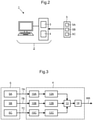
- Figure 1 schematically depicts a framework for methods of monitoring a human or animal subject according to embodiments of the disclosure. The methods may be performed by an apparatus 1 for monitoring a human or animal subject as depicted in Figure 2 .
- the terms "human or animal subject” or “subject” may be used interchangeably with the term “patient” in the following description.
- the method comprises a step S1 of performing physiological measurements on a subject to obtain measurement data.
- the physiological measurements may be performed using a sensor system 5 as depicted schematically in Figure 2 .
- the sensor system 5 comprises a plurality of sensors, each sensor capable of obtaining measurement data using a different measurement mode.
- the measurement data may thus comprise plural channels 7A-C, each channel 7A-7C representing measurements made using a different measurement mode.
- the different measurement modes respectively comprise measurements of acceleration relative to a different respective axis.
- the sensor system 5 may thus comprise plural accelerometers, for example three accelerometers 5A-C.
- Each accelerometer 5A-C may be configured to detect acceleration relative to a respective one of three different orthogonal axes. In examples described below, these axes are referred to respectively as "lateral", “vertical” and “longitudinal”.
- step S2 measurement data obtained by performing the physiological measurements in step S1 is received by a data receiving unit 3.
- the data receiving unit 3 may form part of a computing system 2 (e.g. laptop computer, desktop computer, smart device, wearable smart device, etc.).
- the computing system 2 may further comprise a data processing unit 4 configured to carry out steps of the method.
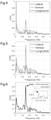
- Figure 3 depicts functional modules that may be implemented by the computing system 2 when performing the method.
- the measurement data is filtered to at least partially remove noise from the measurement data.
- the filtering may comprise applying a band-pass filter or low-pass filter.
- an adaptive line enhancer ALE
- the filtering may be applied separately to each channel 7A-C of the measurement data via respective filter modules 10A-C.
- step S4 a signal-to-noise ratio of the filtered measurement data in each channel 7A-C is obtained.
- the signal-to-noise ratios are determined by respective signal-to-noise ratio modules 12A-C.
- the determined signal-to-noise ratios are used (in selection module 13 of Figure 3 ) to select one of the channels 7A-C to use in subsequent steps to provide the output representing the frequency of the periodic physiological process.
- the channel 7A-C with the highest signal-to-noise ratio is selected for subsequent processing.
- the method may be implemented in such a way as to repeatedly output a measurement of the frequency of the periodic physiological process.
- the windows may overlap with each other or may not overlap with each other.
- the windows may be referred to as segments.
- the selection of the best channel 7A-C may be different for different windows.
- the selection of the best channel 7A-C may be dynamically updated in time, switching continuously between different channels for different windows (units of measurement data) according to whichever has the highest signal-to-noise ratio at the time.
- step S5 spectral analysis is performed to extract a frequency of a periodic physiological process of interest.
- the frequency of the periodic physiological process comprises a respiration rate (RR). Further details about the spectral analysis are given below.
- step S6 a determination is made based on the spectral analysis of step S5 about whether the received measurement data is such as to allow a reliable estimate of the frequency of the periodic physiological process to be obtained. If yes, the method continues to step S7, an output is provided representing the extracted frequency of the periodic physiological process for the received measurement data, and the method loops back to step S2 to receive a next unit of measurement data to be processed. If no, the method loops straight back to step S2 to receive a next unit of measurement data to be processed, without providing any output.
- This methodology thus advantageously reduces the extent to which unreliable readings of the frequency of the periodic physiological process are output.
- an adaptive line enhancer (ALE) is used to at least partially remove noise from measurement data. This process is now described in further detail.
- the ALE introduced in [8] has been used in many applications [9] for separation of a low level sinusoid or a narrow-band oscillation from broad-band noise.
- the core concept of the ALE is based on linear prediction where the nearly-periodic signal is believed to be perfectly predicted based on the past samples while a non-periodic signal cannot be predicted.
- a delayed version of the input signal is used as a reference signal into a least-mean-square (LMS) adaptive filter and the desired signal is considered as the original signal.
- LMS least-mean-square
- An error signal of the LMS filter provides an estimate of the noise in the input signal and the output signal corresponds to the desired separated signal (i.e. separated from the noise).
- the ALE can be applied to each accelerometer axis separately.
- the ratio of the power of signal to the power of noise provides a signal-to-noise ratio (SNR).
- SNR can be used, as described above, to select an accelerometer axis to use in subsequent processing steps (e.g. an axis with the highest SNR is selected).
- FFT Fast Fourier Transform
- the spectral analysis of step S5 comprises processing the measurement data to represent the measurement data as a mathematical expansion.
- the measurement data may thus be transformed by the processing of the measurement data, the transformation resulting in the measurement data being represented as a mathematical expansion.
- the mathematical expansion comprises a plurality of expansion components and a corresponding plurality of expansion coefficients.
- Each expansion coefficient represents the respective strength of each expansion component in the mathematical expansion.
- each expansion component comprises an eigenvector and each expansion coefficient comprises an eigenvalue.
- the eigenvectors and eigenvalues are determined using singular spectrum analysis (SSA)
- the inventors have found that by performing partial reconstructions of the measurement data using different combinations of the eigenvectors mentioned above, it is possible to extract the frequency of the physiological process being monitored more accurately and/or identify segments of measurement data from which it is not possible to obtain a reliable estimate of the frequency of the physiological process.
- a first partial reconstruction of the measurement data is formed using a first subset of the expansion components (e.g. eigenvectors) and corresponding expansion coefficients (e.g. eigenvalues).
- a second partial reconstruction of the measurement data is formed using a second subset of the expansion components (e.g. eigenvectors) and corresponding expansion coefficients (e.g. eigenvalues). The second subset is different from the first subset.
- a first spectral analysis (e.g. using a fast Fourier transform, FFT) is then performed on the first partial reconstruction to determine a first dominant frequency.
- the first dominant frequency represents a frequency component of largest amplitude in the first partial reconstruction.
- a second spectral analysis (e.g. using a fast Fourier transform, FFT) is performed on the second partial reconstruction to determine a second dominant frequency.
- the second dominant frequency represents a frequency component of largest amplitude in the second partial reconstruction.
- the first and second partial reconstructions may be referred to respectively as sub-band 1 and sub-band2.
- the provision of an output representing a frequency of a periodic physiological process of step S7 can be performed based on either or both of the first dominant frequency and the second dominant frequency.
- the first dominant frequency and the second dominant frequency should both correspond closely to the physiological frequency (and not some other artefactual frequency present in the measurement data).
- the output may be obtained for example by taking an average of the first dominant frequency and the second dominant frequency, or simply by taking one or the other of the first dominant frequency and the second dominant frequency (as they are both similar).
- the inventors have found that in cases where the measurement data is unable to yield a reliable value for the physiological frequency of interest, for example because there are several spectral peaks in the frequency range of interest, the situation can be detected automatically and reliably by detecting when the first dominant frequency and the second dominant frequency differ from each other to a significant extent (e.g. by more than a predetermined threshold amount).
- a degree of similarity between the first dominant frequency and the second dominant frequency is determined and the output representing the frequency of the periodic physiological process is selectively provided (i.e. provided or not provided) in step S7 depending on the determined degree of similarity. For example, the output is provided if the degree of similarity is determined to be higher than a predetermined threshold.
- the first subset of expansion components (corresponding to sub-bandl) comprises the N components respectively having the N largest expansion coefficients.
- N may satisfy the following inequality: 2 ⁇ N ⁇ 5.
- N 3.
- the second subset of expansion components (corresponding to sub-band2) does not comprise the expansion component having the largest expansion coefficient.
- the second subset of expansion components comprises the expansion components corresponding to the N largest expansion coefficients except the largest expansion coefficient.
- the second subset of expansion components comprises the 2 nd and 3 rd largest.
- step S5 the spectral analysis of step S5 was performed on measurement data to which ALE had been applied in step S3 and to an accelerometer axis selected using the ALE output in step S4 to decompose the measurement data into corresponding eigenvectors and eigenvalues.
- the eigenvectors were sorted in descending order of associated eigenvalues and grouped using a set of indices as ⁇ 1,2,3 ⁇ (denoting eigenvectors related to first, second, and third largest eigenvalues) and ⁇ 2,3 ⁇ (denoting eigenvectors related to the second and third largest eigenvalues).
- a final elementary matrix was formed by summation of all elementary matrices in each group. Diagonal averaging was applied to the final elementary matrix and a resulting signal formed for each group. For each sub-band, one narrowband signal was reconstructed (an example of the partial reconstruction referred to above). An FFT algorithm was then applied to each narrowband signal to estimate and compare the frequency spectrum for the two selected sub-bands.
- the FFT was applied to each reconstructed signal corresponding to the sub-bands and the frequency with maximum peak amplitude was considered as a potential respiratory component. Then, for each sub-band, the RR was calculated as breaths per minute (based on the maximum peak). If the absolute difference in estimated RR from the two sub-bands was less than 4 bpm (an example of the predetermined threshold mentioned above), an average RR was used as the final estimated RR, otherwise, it was determined that a reliable RR could not be obtained from the measurement data (the "no" loop in Figure 1 ). The threshold of 4 bpm was found appropriate for the particular dataset being considered. It is expected that a lower threshold could be used by increasing the frequency resolution.
- Waveform data were collected from voluntary participants in the Post Intensive Care Risk Alerting and Monitoring (PICRAM) - II trial. This waveform data was collected using continuous monitoring equipment provided by Hidalgo Ltd. with an attached transmittance photoplethysmograph sensor provided by Nonin Medical Inc. The data was collected at both the John Radcliffe and the Reading Berkshire hospital. In this research only the data collected at Oxford John Radcliffe was used for analysis.
- PICRAM Post Intensive Care Risk Alerting and Monitoring
- Ten patients were selected from a larger dataset. These selected patients' age range was from 45 to 77 years old at the time of discharge from the ICU. The select patients' mean age was calculated as 63.7 years old. The length of their stay at the ICU ranged from 1 day to 15 days. The hospital length of stay for these patients ranged from 7 days to 47 days. All patients were white except one with black/British black ethnicity.
- the ALE was applied to each axis of the accelerometer signal to separate the oscillatory and noise component of the accelerometer axes.
- a delay ( ⁇ ) of 10 samples was used to generate the reference signal for the adaptive filter.
- Units of measurement data were obtained by forming 64-second windowed data segments and discarding the first 16 seconds of each data segment. Each resulting 48-seconds long data segment corresponded to one unit of measurement data to be processed. A reduced window size of 48-seconds promotes convergence of the NLMS.
- the ALE separates the noise and signal component of each accelerometer axis.
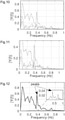
- Figures 4-6 compare the processed signal for each accelerometer axis in the spectral domain using FFT for an example unit of measurement data.
- the SNR as the power of signal to the power of noise was calculated as 0.19, 0.11 and 0.32 for axis 1 (lateral), 2 (vertical), and 3 (longitudinal) respectively.
- the highest SNR corresponded to axis 3 (longitudinal axis). This axis was selected for further analysis to estimate RR.
- Figure 4 shows the result of applying an FFT to the measurement data for each accelerometer axis after a low-pass filter is applied in step S3 of the method.
- the low-pass filtered spectrum shows a similar maximum peak (considering frequencies more than 0.1Hz) for each of the three accelerometer axes.
- Figure 5 shows the result of applying the FFT to the measurement data for each accelerometer axis after an ALE is applied in step S3 of the method.
- the resulting spectra are visibly enhanced relative to Figure 4 .
- the selected accelerometer axis with the largest SNR was further subjected to the spectral sub-band decomposition procedure using SSA, with the results being shown in Figure 6 .
- This procedure improves analysis of the acceleration signals, particularly where, for example, a sharp change of amplitudes in the acceleration signal creates a low frequency in the spectral domain that is not related to the respiratory component.
- two new signals are reconstructed in sub-band1 and sub-band2.
- FFT is applied to output an estimated RR where the difference of estimated RR in the two specified sub-bands is less than 4bpm.
- a manual observation of RR as 19 bpm was recorded.
- a manual observation of RR as 22 bpm was recorded.
- the maximum, minimum and mean recorded RR was obtained as 22 bpm, 18 bpm and 19.92 bpm.
- the selection of this patient is based on low variability of the manual observations to demonstrate cases where applying FFT alone to the accelerometer axes is not effective.
- applying SSA sub-band decomposition to select an appropriate frequency band to estimate RR is necessary.
- FIG. 6 shows the result of applying the FFT to each sub-band using SSA, where the first sub-band related to grouping ⁇ 1,2,3 ⁇ eigenvectors has greater peak amplitude comparing to the second sub-band ⁇ 2,3 ⁇ . In both sub-bands the maximum spectral peaks are in close agreement.
- the estimated RR was obtained as 17.62 bpm at June.06.2013 14:03:23. The closest manual observation was recorded as 19 bpm at June.06.2013 13:50:00.
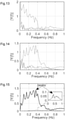
- Example 1 Figures 7-9 show that all three accelerometer axes provide measurement data containing a dominant low frequency peak around a frequency of ⁇ 0.35Hz ( ⁇ 21 bpm), both when processing is based on low pass filtering in step S3 ( Figure 7 ) and when processing is based on ALE in step S3 ( Figure 8 ).
- the segmented window corresponding to the measurement data for Example 1 starts at Jun.06.2013 19:30:28 where a manual RR of 22 was recorded at Jun.06.2013 19:30:00.
- the estimated RR using the proposed method was calculated as 21.39 bpm.
- the maximum spectral peak is in a good agreement to the recorded manual observation.
- Example 2 Figures 10-12 show results for an example in which two of the accelerometer axes demonstrate a dominant spectral peak around a frequency of 0.38Hz (22.8 bpm), while the other axis shows a maximum peak around 0.3Hz (15 bpm). This example shows that selection of the best accelerometer axis is advantageous.
- the ALE can be used to find the best axis using SNR information, as described above.
- FIGS 13-15 show results for an example in which there is a strong low frequency component which has affected the results after low-pass filtering.
- This example shows that FFT applied to raw acceleration produces a maximum peak in frequencies of less than 0.2 Hz ( Figure 13 - relating to a respiratory rate of about 12 bpm).
- a band-pass filter with lower and upper cut-off frequencies as 0.05 Hz and 1 Hz, can also been applied to raw acceleration where the maximum peak happens before 0.2 Hz.
- the output of the ALE producing the spectrum of Figure 14 yields SNRs of 0.31, 0.17, 1.46 for axis 1 (lateral), 2 (vertical), and 3 (longitudinal) respectively.
- the FFT applied to the third axis (which has the highest SNR) produced a spectral peak around 0.4Hz after applying FFT to the signal ALE output (see Figure 14 ).
- the sub-band decomposition of the ALE signal output of the third axis is shown in Figure 15 , where the largest peaks in both sub-bands are in close agreement, thereby indicating that an RR estimate based on the largest peaks is reliable. The average of these peaks was used to estimate the final RR. For this segment of measurement data, the estimated RR was 23.91 bpm at Jun.06.2013 19:33:36, where the closest bpm observed manually was 22 bpm at Jun.06.2013 19:30:00.
- FIGS 16-18 show results for an example in which a low frequency edge is present in the measurement data, which can produce uncertainty in the RR estimation.
- an edge frequency of about ⁇ 0.2Hz ( ⁇ 12 bpm) will be picked after applying low-pass filtering and also the SSA algorithm - sub-bandl - as the maximal spectral peak (see arrows), while there is also a dominant frequency at ⁇ 0.38Hz ( ⁇ 22.8 bpm), which appeared in sub-band2 as well.
- the frequency of about 0.38 (22.8 bpm) is the actual RR related frequency. For this example, our method thus failed to select the correct peak corresponding to the RR.
- Uniform acceleration signals are expected to provide clear spectra. By detailed examination of the acceleration signals, it is found that many types of motions, especially transient motion interferences not related to respiration, provide low frequency edges or artefacts in the accelerometer spectra. Examples of spectra containing such low frequency artefacts are shown in Examples 3 and 4 and it is described how our method provides sufficient sensitivity to extract the correct RR values and/or reliably recognise when a reading is probably invalid.
- Figures 19(a)-(c) depict the results of measuring respiration rate using a series of segments (units) of measurement data from accelerometers applied to subject #27.
- Figure 19(a) depicts the result of applying an FFT to segments of measurement data to which a band pass filter in the range of [0.1Hz-1Hz] has been applied (compared to manual observations and measurements using PPG).
- Figure 19(b) depicts the result of applying an FFT to segments of measurement data to which a band pass filter in the range of [0.2Hz-1Hz] has been applied (compared to manual observations and measurements using PPG).
- a maximum spectral peak in the low-frequency range of [0.08Hz-0.5Hz] among all the axes after applying FFT was used to estimate RR.
- Figure 19(c) depicts the result of using a method according to an embodiment to determine RR.
- the method included use of an ALE in step S3 and SSA in step S5. It is evident from Figures 19(a)-(c) that the estimated RR does vary continuously from 10 to 20.
- transient motion induced quantities affect the signal spectrum in the low frequency domain, creating (invalid) RR readings of ⁇ 10 bpm related to a picked frequency edge.
- RRs of around 20 bpm were re-calculated.
- the time-stamps have been used to compare the errors of pairwise estimated RRs where both PPG and accelerometer-based RR estimates are available.
- the mean absolute error (MAE) is shown in the last column of Table I. As it can be seen from Table I, all the resulted MAEs are less than 2.60 bpm. It should be noted that the sample size to calculate the MAE is not the same for all the subjects. Meanwhile, very good MAEs have been achieved for most subjects (less than 2 bpm).
- the accelerometers have been able to produce RR estimates for about 70 hours of the continuous data while this has been recorded for about 27 hours of PPG data. Although after data fusion, for error measurements, the number of segments are reduced to consider highly reliable RR outputs of the algorithms.
Landscapes
- Health & Medical Sciences (AREA)
- Life Sciences & Earth Sciences (AREA)
- Engineering & Computer Science (AREA)
- Physics & Mathematics (AREA)
- Surgery (AREA)
- Public Health (AREA)
- Pathology (AREA)
- Physiology (AREA)
- Biomedical Technology (AREA)
- Heart & Thoracic Surgery (AREA)
- Medical Informatics (AREA)
- Molecular Biology (AREA)
- Veterinary Medicine (AREA)
- Animal Behavior & Ethology (AREA)
- General Health & Medical Sciences (AREA)
- Biophysics (AREA)
- Signal Processing (AREA)
- Artificial Intelligence (AREA)
- Computer Vision & Pattern Recognition (AREA)
- Psychiatry (AREA)
- Pulmonology (AREA)
- Mathematical Physics (AREA)
- Measuring And Recording Apparatus For Diagnosis (AREA)
- Measurement Of The Respiration, Hearing Ability, Form, And Blood Characteristics Of Living Organisms (AREA)
- Measuring Pulse, Heart Rate, Blood Pressure Or Blood Flow (AREA)
Claims (15)
- Computer-implementiertes Verfahren zur Überwachung eines menschlichen oder tierischen Subjekts, wobei das Verfahren Folgendes umfasst:(a) Empfangen von Messdaten, die eine Zeitreihe von Messungen an einem Subjekt darstellen, die von einem Sensorsystem (5) durchgeführt werden;(b) Verarbeiten der Messdaten, um die Messdaten als eine mathematische Expansion darzustellen, die eine Vielzahl von Expansionskomponenten und eine entsprechende Vielzahl von Expansionskoeffizienten umfasst, die die jeweilige Stärke jeder Expansionskomponente darstellen;(c1) Bilden einer ersten Teilrekonstruktion der Messdaten unter Verwendung einer ersten Teilmenge der Expansionskomponenten und der entsprechenden Expansionskoeffizienten;(c2) Bilden einer zweiten Teilrekonstruktion der Messdaten unter Verwendung einer zweiten Teilmenge der Expansionskomponenten und der entsprechenden Expansionskoeffizienten, wobei die zweite Teilmenge von der ersten Teilmenge verschieden ist;(d1) Durchführen einer ersten Spektralanalyse an der ersten Teilrekonstruktion, um eine erste dominante Frequenz zu bestimmen, wobei die erste dominante Frequenz eine Frequenzkomponente mit der größten Amplitude in der ersten Teilrekonstruktion darstellt;(d2) Durchführen einer zweiten Spektralanalyse an der zweiten Teilrekonstruktion, um eine zweite dominante Frequenz zu bestimmen, wobei die zweite dominante Frequenz eine Frequenzkomponente mit der größten Amplitude in der zweiten Teilrekonstruktion darstellt; und(e) Bereitstellen einer Ausgabe, die eine Frequenz eines periodischen physiologischen Prozesses darstellt, basierend auf der ersten dominanten Frequenz oder der zweiten dominanten Frequenz oder beidem, wobei:das Verfahren ferner die Bestimmung eines Ähnlichkeitsgrades zwischen der ersten dominanten Frequenz und der zweiten dominanten Frequenz umfasst; unddie Ausgabe, die die Frequenz des periodischen physiologischen Prozesses darstellt, selektiv in Abhängigkeit von dem bestimmten Ähnlichkeitsgrad bereitgestellt wird.
- Verfahren nach Anspruch 1, wobei das Sensorsystem (5) einen oder mehrere Beschleunigungsmesser umfasst.
- Verfahren nach Anspruch 1 oder 2, wobei die Frequenz des periodischen physiologischen Prozesses eine Atmungsrate umfasst.
- Verfahren nach einem der vorhergehenden Ansprüche, wobei die Schritte (a) bis (d2) für mehrere Einheiten der Messdaten wiederholt werden und Schritt (e) die Ausgabe der Frequenz des periodischen physiologischen Prozesses nur für Einheiten der Messdaten ausgibt, für die der ermittelte Ähnlichkeitsgrad zwischen der ersten dominanten Frequenz und der zweiten dominanten Frequenz über einem vorgegebenen Schwellenwert liegt.
- Verfahren nach einem der vorhergehenden Ansprüche, wobei jede Expansionskomponente einen Eigenvektor und jeder Expansionskoeffizient einen Eigenwert umfasst.
- Verfahren nach Anspruch 5, wobei die Eigenvektoren und Eigenwerte unter Verwendung der Singulärspektrumanalyse bestimmt werden.
- Verfahren nach einem der vorhergehenden Ansprüche, wobei die erste Teilmenge von Expansionskomponenten die N Komponenten mit den jeweils N größten Expansionskoeffizienten umfasst, wobei vorzugsweise 2 ≥ N ≥ 5.
- Verfahren nach Anspruch 7, wobei die zweite Teilmenge von Expansionskomponenten nicht die Expansionskomponente mit dem größten Expansionskoeffizienten umfasst.
- Verfahren nach Anspruch 8, wobei die zweite Teilmenge von Expansionskomponenten die Expansionskomponenten umfasst, die den N größten Expansionskoeffizienten mit Ausnahme des größten Expansionskoeffizienten entsprechen.
- Verfahren nach einem der vorhergehenden Ansprüche, wobei die Messdaten verarbeitet werden, um zumindest teilweise Rauschen aus den Messdaten in einem Filterungsschritt vor der Verarbeitung zu entfernen, um die Messdaten als eine mathematische Expansion darzustellen, wobei der Filterungsschritt vorzugsweise die Anwendung eines Tiefpassfilters oder eines adaptiven Linienverstärkers umfasst.
- Verfahren nach Anspruch 10, wobei:die Messdaten mehrere Kanäle umfassen, wobei jeder Kanal Messungen darstellt, die unter Verwendung eines anderen Messmodus durchgeführt wurden; unddas Verfahren das Bestimmen eines Signal-Rausch-Verhältnisses der Messdaten in jedem Kanal nach dem Filterungsschritt und das Verwenden des bestimmten Signal-Rausch-Verhältnisses umfasst, um einen der Kanäle auszuwählen, der in den nachfolgenden Schritten zu verwenden ist, um die Ausgabe bereitzustellen, die die Frequenz des periodischen physiologischen Prozesses darstellt.
- Verfahren nach Anspruch 11, wobei die verschiedenen Messmodi jeweils Messungen der Beschleunigung relativ zu einer anderen jeweiligen Achse umfassen.
- Computerprogramm mit computerlesbaren Anweisungen, die einen Computer veranlassen, das Verfahren nach einem der vorhergehenden Ansprüche auszuführen.
- Computerlesbares Medium, das das Computerprogramm nach Anspruch 13 speichert.
- Vorrichtung (1) zur Überwachung eines menschlichen oder tierischen Subjekts, wobei die Vorrichtung Folgendes umfasst:eine Datenempfangseinheit (3), die dafür konfiguriert ist, Messdaten zu empfangen, die eine Zeitreihe von Messungen an einem Subjekt darstellen, die von einem Sensorsystem (5) durchgeführt werden;eine Datenverarbeitungseinheit (4), die für Folgendes konfiguriert ist:Verarbeiten der Messdaten, um die Messdaten als eine mathematische Expansion darzustellen, die eine Vielzahl von Expansionskomponenten und eine entsprechende Vielzahl von Expansionskoeffizienten umfasst, die die jeweilige Stärke jeder Expansionskomponente darstellen;Bilden einer ersten Teilrekonstruktion der Messdaten unter Verwendung einer ersten Teilmenge der Expansionskomponenten und der entsprechenden Expansionskoeffizienten;Bilden einer zweiten Teilrekonstruktion der Messdaten unter Verwendung einer zweiten Teilmenge der Expansionskomponenten und der entsprechenden Expansionskoeffizienten, wobei die zweite Teilmenge von der ersten Teilmenge verschieden ist;Durchführen einer ersten Spektralanalyse an der ersten Teilrekonstruktion, um eine erste dominante Frequenz zu bestimmen, wobei die erste dominante Frequenz eine Frequenzkomponente mit der größten Amplitude in der ersten Teilrekonstruktion darstellt;Durchführen einer zweiten Spektralanalyse an der zweiten Teilrekonstruktion, um eine zweite dominante Frequenz zu bestimmen, wobei die zweite dominante Frequenz eine Frequenzkomponente mit der größten Amplitude in der zweiten Teilrekonstruktion darstellt; undBereitstellen einer Ausgabe, die eine Frequenz eines periodischen physiologischen Prozesses darstellt, basierend auf der ersten dominanten Frequenz oder der zweiten dominanten Frequenz oder beidem, wobei:die Datenverarbeitungseinheit (4) ferner dafür konfiguriert ist, einen Grad der Ähnlichkeit zwischen der ersten dominanten Frequenz und der zweiten dominanten Frequenz zu bestimmen; unddie Datenverarbeitungseinheit (4) ferner dafür konfiguriert ist, die Ausgabe, die die Frequenz des periodischen physiologischen Prozesses darstellt, in Abhängigkeit von dem bestimmten Ähnlichkeitsgrad selektiv bereitzustellen.
Applications Claiming Priority (2)
| Application Number | Priority Date | Filing Date | Title |
|---|---|---|---|
| GBGB1803994.1A GB201803994D0 (en) | 2018-03-13 | 2018-03-13 | Method and apparatus for monitoring a human or animal subject |
| PCT/GB2019/050164 WO2019175529A1 (en) | 2018-03-13 | 2019-01-22 | Method and apparatus for monitoring a human or animal subject |
Publications (2)
| Publication Number | Publication Date |
|---|---|
| EP3764896A1 EP3764896A1 (de) | 2021-01-20 |
| EP3764896B1 true EP3764896B1 (de) | 2022-03-16 |
Family
ID=61972975
Family Applications (1)
| Application Number | Title | Priority Date | Filing Date |
|---|---|---|---|
| EP19701735.3A Active EP3764896B1 (de) | 2018-03-13 | 2019-01-22 | Verfahren und vorrichtung zur überwachung eines menschen oder tieres |
Country Status (4)
| Country | Link |
|---|---|
| US (1) | US20210000384A1 (de) |
| EP (1) | EP3764896B1 (de) |
| GB (1) | GB201803994D0 (de) |
| WO (1) | WO2019175529A1 (de) |
Families Citing this family (3)
| Publication number | Priority date | Publication date | Assignee | Title |
|---|---|---|---|---|
| US11717181B2 (en) * | 2020-06-11 | 2023-08-08 | Samsung Electronics Co., Ltd. | Adaptive respiratory condition assessment |
| EP4140397A1 (de) * | 2021-08-31 | 2023-03-01 | Starkey Laboratories, Inc. | Am ohr tragbare elektronische vorrichtung mit einem sensor im ohr zur messung der atemfrequenz |
| CN114732391B (zh) * | 2022-06-13 | 2022-08-23 | 亿慧云智能科技(深圳)股份有限公司 | 基于微波雷达的睡眠状态下的心率监测方法、装置及系统 |
Family Cites Families (6)
| Publication number | Priority date | Publication date | Assignee | Title |
|---|---|---|---|---|
| JP2015149690A (ja) * | 2014-02-10 | 2015-08-20 | ソニー株式会社 | 信号処理装置および方法 |
| WO2015180986A1 (en) * | 2014-05-28 | 2015-12-03 | Koninklijke Philips N.V. | Motion artifact reduction using multi-channel ppg signals |
| EP3229692B1 (de) * | 2014-12-12 | 2019-06-12 | Koninklijke Philips N.V. | Akustisches überwachungssystem, überwachungsverfahren und überwachungscomputerprogramm |
| US20190008458A1 (en) * | 2016-02-15 | 2019-01-10 | Koninklijke Philips N.V. | Device and method for extracting heart rate information |
| WO2017140696A1 (en) * | 2016-02-15 | 2017-08-24 | Koninklijke Philips N.V. | Device, system and method for determining a subject's breathing rate |
| GB201608170D0 (en) * | 2016-05-10 | 2016-06-22 | Isis Innovation | A method of determining the frequency of a periodic physiological process of a subject, and a device and system for determining the frequency |
-
2018
- 2018-03-13 GB GBGB1803994.1A patent/GB201803994D0/en not_active Ceased
-
2019
- 2019-01-22 EP EP19701735.3A patent/EP3764896B1/de active Active
- 2019-01-22 WO PCT/GB2019/050164 patent/WO2019175529A1/en not_active Ceased
- 2019-01-22 US US16/978,286 patent/US20210000384A1/en not_active Abandoned
Also Published As
| Publication number | Publication date |
|---|---|
| US20210000384A1 (en) | 2021-01-07 |
| GB201803994D0 (en) | 2018-04-25 |
| WO2019175529A1 (en) | 2019-09-19 |
| EP3764896A1 (de) | 2021-01-20 |
Similar Documents
| Publication | Publication Date | Title |
|---|---|---|
| AU2021203784B2 (en) | Multivariate residual-based health index for human health monitoring | |
| US20240268712A1 (en) | Method and apparatus for processing a cyclic physiological signal | |
| Jarchi et al. | Accelerometry-based estimation of respiratory rate for post-intensive care patient monitoring | |
| US7578793B2 (en) | Sleep staging based on cardio-respiratory signals | |
| US7862515B2 (en) | Apparatus for detecting sleep apnea using electrocardiogram signals | |
| EP3618700B1 (de) | Vorrichtung und verfahren zur bestimmung eines blutdrucks einer person | |
| EP4154805B1 (de) | Vorrichtung zur überwachung der herzfrequenz und atmung | |
| KR20190121237A (ko) | 움직임 센서를 위한 체계화 장치 및 광학 센서 기반의 심장 부정맥 분류 | |
| US20070260151A1 (en) | Method and device for filtering, segmenting, compressing and classifying oscillatory signals | |
| US20130345569A1 (en) | Determining cardiac arrhythmia from a video of a subject being monitored for cardiac function | |
| US20240324950A1 (en) | Systems and Methods for Remote Patient Screening and Triage | |
| US12329497B1 (en) | Processing and analyzing biometric data | |
| CN104144636A (zh) | 处理表示生理节律的信号的方法 | |
| EP3764896B1 (de) | Verfahren und vorrichtung zur überwachung eines menschen oder tieres | |
| US12178552B1 (en) | Systems and processes for detecting oxygen saturation and compensating for skin tone variation | |
| CN106073784A (zh) | 一种呼吸率提取方法及装置 | |
| Bekele et al. | Real-time neonatal respiratory rate estimation using a pressure-sensitive mat | |
| Reddy et al. | Automated hilbert envelope based respiration rate measurement from PPG signal for wearable vital signs monitoring devices | |
| CN116473539A (zh) | 一种基于心电信号的复合经验模态分解呼吸提取方法及系统 | |
| Ganeshmurthy et al. | Toward accurate estimation of respiratory rate from the photoplethysmogram: effect of different window period of PPG signals | |
| Chyliński et al. | The way of ECG signal obtaining from the respiratory wave by Savitzky-Golay filtration | |
| US12575741B1 (en) | Systems and processes for detecting oxygen saturation and compensating for skin tone variation | |
| Kumar et al. | Fourier Analysis Based Respiration Rate Estimation Using Corrupted Photoplethysmogram Signal | |
| Kumar et al. | Estimation of respiratory rate from a corrupted PPG signal using time-frequency spectrogram | |
| Singha et al. | Effect of Posture on the Respiratory Modulation of Cardiomechanical Signals |
Legal Events
| Date | Code | Title | Description |
|---|---|---|---|
| STAA | Information on the status of an ep patent application or granted ep patent |
Free format text: STATUS: UNKNOWN |
|
| STAA | Information on the status of an ep patent application or granted ep patent |
Free format text: STATUS: THE INTERNATIONAL PUBLICATION HAS BEEN MADE |
|
| PUAI | Public reference made under article 153(3) epc to a published international application that has entered the european phase |
Free format text: ORIGINAL CODE: 0009012 |
|
| STAA | Information on the status of an ep patent application or granted ep patent |
Free format text: STATUS: REQUEST FOR EXAMINATION WAS MADE |
|
| 17P | Request for examination filed |
Effective date: 20200903 |
|
| AK | Designated contracting states |
Kind code of ref document: A1 Designated state(s): AL AT BE BG CH CY CZ DE DK EE ES FI FR GB GR HR HU IE IS IT LI LT LU LV MC MK MT NL NO PL PT RO RS SE SI SK SM TR |
|
| AX | Request for extension of the european patent |
Extension state: BA ME |
|
| DAV | Request for validation of the european patent (deleted) | ||
| DAX | Request for extension of the european patent (deleted) | ||
| GRAP | Despatch of communication of intention to grant a patent |
Free format text: ORIGINAL CODE: EPIDOSNIGR1 |
|
| STAA | Information on the status of an ep patent application or granted ep patent |
Free format text: STATUS: GRANT OF PATENT IS INTENDED |
|
| INTG | Intention to grant announced |
Effective date: 20220111 |
|
| RIC1 | Information provided on ipc code assigned before grant |
Ipc: A61B 5/113 20060101ALN20211217BHEP Ipc: G06K 9/00 20060101ALI20211217BHEP Ipc: A61B 5/00 20060101ALI20211217BHEP Ipc: A61B 5/08 20060101AFI20211217BHEP |
|
| RIN1 | Information on inventor provided before grant (corrected) |
Inventor name: TARASSENKO, LIONEL Inventor name: CLIFTON, DAVID Inventor name: JARCHI, DELARAM |
|
| GRAS | Grant fee paid |
Free format text: ORIGINAL CODE: EPIDOSNIGR3 |
|
| GRAA | (expected) grant |
Free format text: ORIGINAL CODE: 0009210 |
|
| STAA | Information on the status of an ep patent application or granted ep patent |
Free format text: STATUS: THE PATENT HAS BEEN GRANTED |
|
| AK | Designated contracting states |
Kind code of ref document: B1 Designated state(s): AL AT BE BG CH CY CZ DE DK EE ES FI FR GB GR HR HU IE IS IT LI LT LU LV MC MK MT NL NO PL PT RO RS SE SI SK SM TR |
|
| REG | Reference to a national code |
Ref country code: GB Ref legal event code: FG4D |
|
| REG | Reference to a national code |
Ref country code: CH Ref legal event code: EP Ref country code: DE Ref legal event code: R096 Ref document number: 602019012594 Country of ref document: DE |
|
| REG | Reference to a national code |
Ref country code: IE Ref legal event code: FG4D |
|
| REG | Reference to a national code |
Ref country code: AT Ref legal event code: REF Ref document number: 1475316 Country of ref document: AT Kind code of ref document: T Effective date: 20220415 |
|
| REG | Reference to a national code |
Ref country code: LT Ref legal event code: MG9D |
|
| REG | Reference to a national code |
Ref country code: NL Ref legal event code: MP Effective date: 20220316 |
|
| PG25 | Lapsed in a contracting state [announced via postgrant information from national office to epo] |
Ref country code: SE Free format text: LAPSE BECAUSE OF FAILURE TO SUBMIT A TRANSLATION OF THE DESCRIPTION OR TO PAY THE FEE WITHIN THE PRESCRIBED TIME-LIMIT Effective date: 20220316 Ref country code: RS Free format text: LAPSE BECAUSE OF FAILURE TO SUBMIT A TRANSLATION OF THE DESCRIPTION OR TO PAY THE FEE WITHIN THE PRESCRIBED TIME-LIMIT Effective date: 20220316 Ref country code: NO Free format text: LAPSE BECAUSE OF FAILURE TO SUBMIT A TRANSLATION OF THE DESCRIPTION OR TO PAY THE FEE WITHIN THE PRESCRIBED TIME-LIMIT Effective date: 20220616 Ref country code: LT Free format text: LAPSE BECAUSE OF FAILURE TO SUBMIT A TRANSLATION OF THE DESCRIPTION OR TO PAY THE FEE WITHIN THE PRESCRIBED TIME-LIMIT Effective date: 20220316 Ref country code: HR Free format text: LAPSE BECAUSE OF FAILURE TO SUBMIT A TRANSLATION OF THE DESCRIPTION OR TO PAY THE FEE WITHIN THE PRESCRIBED TIME-LIMIT Effective date: 20220316 Ref country code: BG Free format text: LAPSE BECAUSE OF FAILURE TO SUBMIT A TRANSLATION OF THE DESCRIPTION OR TO PAY THE FEE WITHIN THE PRESCRIBED TIME-LIMIT Effective date: 20220616 |
|
| REG | Reference to a national code |
Ref country code: AT Ref legal event code: MK05 Ref document number: 1475316 Country of ref document: AT Kind code of ref document: T Effective date: 20220316 |
|
| PG25 | Lapsed in a contracting state [announced via postgrant information from national office to epo] |
Ref country code: LV Free format text: LAPSE BECAUSE OF FAILURE TO SUBMIT A TRANSLATION OF THE DESCRIPTION OR TO PAY THE FEE WITHIN THE PRESCRIBED TIME-LIMIT Effective date: 20220316 Ref country code: GR Free format text: LAPSE BECAUSE OF FAILURE TO SUBMIT A TRANSLATION OF THE DESCRIPTION OR TO PAY THE FEE WITHIN THE PRESCRIBED TIME-LIMIT Effective date: 20220617 Ref country code: FI Free format text: LAPSE BECAUSE OF FAILURE TO SUBMIT A TRANSLATION OF THE DESCRIPTION OR TO PAY THE FEE WITHIN THE PRESCRIBED TIME-LIMIT Effective date: 20220316 |
|
| PG25 | Lapsed in a contracting state [announced via postgrant information from national office to epo] |
Ref country code: NL Free format text: LAPSE BECAUSE OF FAILURE TO SUBMIT A TRANSLATION OF THE DESCRIPTION OR TO PAY THE FEE WITHIN THE PRESCRIBED TIME-LIMIT Effective date: 20220316 |
|
| PG25 | Lapsed in a contracting state [announced via postgrant information from national office to epo] |
Ref country code: SM Free format text: LAPSE BECAUSE OF FAILURE TO SUBMIT A TRANSLATION OF THE DESCRIPTION OR TO PAY THE FEE WITHIN THE PRESCRIBED TIME-LIMIT Effective date: 20220316 Ref country code: SK Free format text: LAPSE BECAUSE OF FAILURE TO SUBMIT A TRANSLATION OF THE DESCRIPTION OR TO PAY THE FEE WITHIN THE PRESCRIBED TIME-LIMIT Effective date: 20220316 Ref country code: RO Free format text: LAPSE BECAUSE OF FAILURE TO SUBMIT A TRANSLATION OF THE DESCRIPTION OR TO PAY THE FEE WITHIN THE PRESCRIBED TIME-LIMIT Effective date: 20220316 Ref country code: PT Free format text: LAPSE BECAUSE OF FAILURE TO SUBMIT A TRANSLATION OF THE DESCRIPTION OR TO PAY THE FEE WITHIN THE PRESCRIBED TIME-LIMIT Effective date: 20220718 Ref country code: ES Free format text: LAPSE BECAUSE OF FAILURE TO SUBMIT A TRANSLATION OF THE DESCRIPTION OR TO PAY THE FEE WITHIN THE PRESCRIBED TIME-LIMIT Effective date: 20220316 Ref country code: EE Free format text: LAPSE BECAUSE OF FAILURE TO SUBMIT A TRANSLATION OF THE DESCRIPTION OR TO PAY THE FEE WITHIN THE PRESCRIBED TIME-LIMIT Effective date: 20220316 Ref country code: CZ Free format text: LAPSE BECAUSE OF FAILURE TO SUBMIT A TRANSLATION OF THE DESCRIPTION OR TO PAY THE FEE WITHIN THE PRESCRIBED TIME-LIMIT Effective date: 20220316 Ref country code: AT Free format text: LAPSE BECAUSE OF FAILURE TO SUBMIT A TRANSLATION OF THE DESCRIPTION OR TO PAY THE FEE WITHIN THE PRESCRIBED TIME-LIMIT Effective date: 20220316 |
|
| PG25 | Lapsed in a contracting state [announced via postgrant information from national office to epo] |
Ref country code: PL Free format text: LAPSE BECAUSE OF FAILURE TO SUBMIT A TRANSLATION OF THE DESCRIPTION OR TO PAY THE FEE WITHIN THE PRESCRIBED TIME-LIMIT Effective date: 20220316 Ref country code: IS Free format text: LAPSE BECAUSE OF FAILURE TO SUBMIT A TRANSLATION OF THE DESCRIPTION OR TO PAY THE FEE WITHIN THE PRESCRIBED TIME-LIMIT Effective date: 20220716 Ref country code: AL Free format text: LAPSE BECAUSE OF FAILURE TO SUBMIT A TRANSLATION OF THE DESCRIPTION OR TO PAY THE FEE WITHIN THE PRESCRIBED TIME-LIMIT Effective date: 20220316 |
|
| REG | Reference to a national code |
Ref country code: DE Ref legal event code: R097 Ref document number: 602019012594 Country of ref document: DE |
|
| PLBE | No opposition filed within time limit |
Free format text: ORIGINAL CODE: 0009261 |
|
| STAA | Information on the status of an ep patent application or granted ep patent |
Free format text: STATUS: NO OPPOSITION FILED WITHIN TIME LIMIT |
|
| PG25 | Lapsed in a contracting state [announced via postgrant information from national office to epo] |
Ref country code: DK Free format text: LAPSE BECAUSE OF FAILURE TO SUBMIT A TRANSLATION OF THE DESCRIPTION OR TO PAY THE FEE WITHIN THE PRESCRIBED TIME-LIMIT Effective date: 20220316 |
|
| 26N | No opposition filed |
Effective date: 20221219 |
|
| PG25 | Lapsed in a contracting state [announced via postgrant information from national office to epo] |
Ref country code: SI Free format text: LAPSE BECAUSE OF FAILURE TO SUBMIT A TRANSLATION OF THE DESCRIPTION OR TO PAY THE FEE WITHIN THE PRESCRIBED TIME-LIMIT Effective date: 20220316 |
|
| PG25 | Lapsed in a contracting state [announced via postgrant information from national office to epo] |
Ref country code: IT Free format text: LAPSE BECAUSE OF FAILURE TO SUBMIT A TRANSLATION OF THE DESCRIPTION OR TO PAY THE FEE WITHIN THE PRESCRIBED TIME-LIMIT Effective date: 20220316 |
|
| REG | Reference to a national code |
Ref country code: DE Ref legal event code: R119 Ref document number: 602019012594 Country of ref document: DE |
|
| REG | Reference to a national code |
Ref country code: CH Ref legal event code: PL |
|
| GBPC | Gb: european patent ceased through non-payment of renewal fee |
Effective date: 20230122 |
|
| PG25 | Lapsed in a contracting state [announced via postgrant information from national office to epo] |
Ref country code: LU Free format text: LAPSE BECAUSE OF NON-PAYMENT OF DUE FEES Effective date: 20230122 |
|
| REG | Reference to a national code |
Ref country code: BE Ref legal event code: MM Effective date: 20230131 |
|
| PG25 | Lapsed in a contracting state [announced via postgrant information from national office to epo] |
Ref country code: LI Free format text: LAPSE BECAUSE OF NON-PAYMENT OF DUE FEES Effective date: 20230131 Ref country code: GB Free format text: LAPSE BECAUSE OF NON-PAYMENT OF DUE FEES Effective date: 20230122 Ref country code: DE Free format text: LAPSE BECAUSE OF NON-PAYMENT OF DUE FEES Effective date: 20230801 Ref country code: CH Free format text: LAPSE BECAUSE OF NON-PAYMENT OF DUE FEES Effective date: 20230131 |
|
| PG25 | Lapsed in a contracting state [announced via postgrant information from national office to epo] |
Ref country code: FR Free format text: LAPSE BECAUSE OF NON-PAYMENT OF DUE FEES Effective date: 20230131 Ref country code: BE Free format text: LAPSE BECAUSE OF NON-PAYMENT OF DUE FEES Effective date: 20230131 |
|
| PG25 | Lapsed in a contracting state [announced via postgrant information from national office to epo] |
Ref country code: IE Free format text: LAPSE BECAUSE OF NON-PAYMENT OF DUE FEES Effective date: 20230122 |
|
| PG25 | Lapsed in a contracting state [announced via postgrant information from national office to epo] |
Ref country code: MC Free format text: LAPSE BECAUSE OF FAILURE TO SUBMIT A TRANSLATION OF THE DESCRIPTION OR TO PAY THE FEE WITHIN THE PRESCRIBED TIME-LIMIT Effective date: 20220316 |
|
| PG25 | Lapsed in a contracting state [announced via postgrant information from national office to epo] |
Ref country code: MC Free format text: LAPSE BECAUSE OF FAILURE TO SUBMIT A TRANSLATION OF THE DESCRIPTION OR TO PAY THE FEE WITHIN THE PRESCRIBED TIME-LIMIT Effective date: 20220316 |
|
| PG25 | Lapsed in a contracting state [announced via postgrant information from national office to epo] |
Ref country code: CY Free format text: LAPSE BECAUSE OF FAILURE TO SUBMIT A TRANSLATION OF THE DESCRIPTION OR TO PAY THE FEE WITHIN THE PRESCRIBED TIME-LIMIT; INVALID AB INITIO Effective date: 20190122 |
|
| PG25 | Lapsed in a contracting state [announced via postgrant information from national office to epo] |
Ref country code: HU Free format text: LAPSE BECAUSE OF FAILURE TO SUBMIT A TRANSLATION OF THE DESCRIPTION OR TO PAY THE FEE WITHIN THE PRESCRIBED TIME-LIMIT; INVALID AB INITIO Effective date: 20190122 |
|
| PG25 | Lapsed in a contracting state [announced via postgrant information from national office to epo] |
Ref country code: TR Free format text: LAPSE BECAUSE OF FAILURE TO SUBMIT A TRANSLATION OF THE DESCRIPTION OR TO PAY THE FEE WITHIN THE PRESCRIBED TIME-LIMIT Effective date: 20220316 |