EP3764626B1 - Security latch for user interface housing - Google Patents
Security latch for user interface housing Download PDFInfo
- Publication number
- EP3764626B1 EP3764626B1 EP20184968.4A EP20184968A EP3764626B1 EP 3764626 B1 EP3764626 B1 EP 3764626B1 EP 20184968 A EP20184968 A EP 20184968A EP 3764626 B1 EP3764626 B1 EP 3764626B1
- Authority
- EP
- European Patent Office
- Prior art keywords
- user interface
- locking body
- interface housing
- projections
- shelf
- Prior art date
- Legal status (The legal status is an assumption and is not a legal conclusion. Google has not performed a legal analysis and makes no representation as to the accuracy of the status listed.)
- Active
Links
Images




Classifications
-
- A—HUMAN NECESSITIES
- A61—MEDICAL OR VETERINARY SCIENCE; HYGIENE
- A61G—TRANSPORT, PERSONAL CONVEYANCES, OR ACCOMMODATION SPECIALLY ADAPTED FOR PATIENTS OR DISABLED PERSONS; OPERATING TABLES OR CHAIRS; CHAIRS FOR DENTISTRY; FUNERAL DEVICES
- A61G7/00—Beds specially adapted for nursing; Devices for lifting patients or disabled persons
- A61G7/05—Parts, details or accessories of beds
- A61G7/0503—Holders, support devices for receptacles, e.g. for drainage or urine bags
-
- A—HUMAN NECESSITIES
- A61—MEDICAL OR VETERINARY SCIENCE; HYGIENE
- A61G—TRANSPORT, PERSONAL CONVEYANCES, OR ACCOMMODATION SPECIALLY ADAPTED FOR PATIENTS OR DISABLED PERSONS; OPERATING TABLES OR CHAIRS; CHAIRS FOR DENTISTRY; FUNERAL DEVICES
- A61G13/00—Operating tables; Auxiliary appliances therefor
- A61G13/10—Parts, details or accessories
- A61G13/101—Clamping means for connecting accessories to the operating table
-
- B—PERFORMING OPERATIONS; TRANSPORTING
- B60—VEHICLES IN GENERAL
- B60R—VEHICLES, VEHICLE FITTINGS, OR VEHICLE PARTS, NOT OTHERWISE PROVIDED FOR
- B60R11/00—Arrangements for holding or mounting articles, not otherwise provided for
- B60R11/02—Arrangements for holding or mounting articles, not otherwise provided for for radio sets, television sets, telephones, or the like; Arrangement of controls thereof
- B60R11/0252—Arrangements for holding or mounting articles, not otherwise provided for for radio sets, television sets, telephones, or the like; Arrangement of controls thereof for personal computers, e.g. laptops, notebooks
-
- F—MECHANICAL ENGINEERING; LIGHTING; HEATING; WEAPONS; BLASTING
- F16—ENGINEERING ELEMENTS AND UNITS; GENERAL MEASURES FOR PRODUCING AND MAINTAINING EFFECTIVE FUNCTIONING OF MACHINES OR INSTALLATIONS; THERMAL INSULATION IN GENERAL
- F16M—FRAMES, CASINGS OR BEDS OF ENGINES, MACHINES OR APPARATUS, NOT SPECIFIC TO ENGINES, MACHINES OR APPARATUS PROVIDED FOR ELSEWHERE; STANDS; SUPPORTS
- F16M11/00—Stands or trestles as supports for apparatus or articles placed thereon ; Stands for scientific apparatus such as gravitational force meters
- F16M11/02—Heads
- F16M11/04—Means for attachment of apparatus; Means allowing adjustment of the apparatus relatively to the stand
- F16M11/041—Allowing quick release of the apparatus
-
- F—MECHANICAL ENGINEERING; LIGHTING; HEATING; WEAPONS; BLASTING
- F16—ENGINEERING ELEMENTS AND UNITS; GENERAL MEASURES FOR PRODUCING AND MAINTAINING EFFECTIVE FUNCTIONING OF MACHINES OR INSTALLATIONS; THERMAL INSULATION IN GENERAL
- F16M—FRAMES, CASINGS OR BEDS OF ENGINES, MACHINES OR APPARATUS, NOT SPECIFIC TO ENGINES, MACHINES OR APPARATUS PROVIDED FOR ELSEWHERE; STANDS; SUPPORTS
- F16M13/00—Other supports for positioning apparatus or articles; Means for steadying hand-held apparatus or articles
- F16M13/02—Other supports for positioning apparatus or articles; Means for steadying hand-held apparatus or articles for supporting on, or attaching to, an object, e.g. tree, gate, window-frame, cycle
- F16M13/022—Other supports for positioning apparatus or articles; Means for steadying hand-held apparatus or articles for supporting on, or attaching to, an object, e.g. tree, gate, window-frame, cycle repositionable
-
- H—ELECTRICITY
- H04—ELECTRIC COMMUNICATION TECHNIQUE
- H04M—TELEPHONIC COMMUNICATION
- H04M1/00—Substation equipment, e.g. for use by subscribers
- H04M1/02—Constructional features of telephone sets
- H04M1/04—Supports for telephone transmitters or receivers
-
- A—HUMAN NECESSITIES
- A61—MEDICAL OR VETERINARY SCIENCE; HYGIENE
- A61B—DIAGNOSIS; SURGERY; IDENTIFICATION
- A61B2560/00—Constructional details of operational features of apparatus; Accessories for medical measuring apparatus
- A61B2560/04—Constructional details of apparatus
- A61B2560/0456—Apparatus provided with a docking unit
-
- A—HUMAN NECESSITIES
- A61—MEDICAL OR VETERINARY SCIENCE; HYGIENE
- A61G—TRANSPORT, PERSONAL CONVEYANCES, OR ACCOMMODATION SPECIALLY ADAPTED FOR PATIENTS OR DISABLED PERSONS; OPERATING TABLES OR CHAIRS; CHAIRS FOR DENTISTRY; FUNERAL DEVICES
- A61G2203/00—General characteristics of devices
- A61G2203/10—General characteristics of devices characterised by specific control means, e.g. for adjustment or steering
- A61G2203/20—Displays or monitors
-
- A—HUMAN NECESSITIES
- A61—MEDICAL OR VETERINARY SCIENCE; HYGIENE
- A61G—TRANSPORT, PERSONAL CONVEYANCES, OR ACCOMMODATION SPECIALLY ADAPTED FOR PATIENTS OR DISABLED PERSONS; OPERATING TABLES OR CHAIRS; CHAIRS FOR DENTISTRY; FUNERAL DEVICES
- A61G2203/00—General characteristics of devices
- A61G2203/70—General characteristics of devices with special adaptations, e.g. for safety or comfort
-
- A—HUMAN NECESSITIES
- A61—MEDICAL OR VETERINARY SCIENCE; HYGIENE
- A61G—TRANSPORT, PERSONAL CONVEYANCES, OR ACCOMMODATION SPECIALLY ADAPTED FOR PATIENTS OR DISABLED PERSONS; OPERATING TABLES OR CHAIRS; CHAIRS FOR DENTISTRY; FUNERAL DEVICES
- A61G2203/00—General characteristics of devices
- A61G2203/70—General characteristics of devices with special adaptations, e.g. for safety or comfort
- A61G2203/78—General characteristics of devices with special adaptations, e.g. for safety or comfort for clamping
-
- A—HUMAN NECESSITIES
- A61—MEDICAL OR VETERINARY SCIENCE; HYGIENE
- A61M—DEVICES FOR INTRODUCING MEDIA INTO, OR ONTO, THE BODY; DEVICES FOR TRANSDUCING BODY MEDIA OR FOR TAKING MEDIA FROM THE BODY; DEVICES FOR PRODUCING OR ENDING SLEEP OR STUPOR
- A61M5/00—Devices for bringing media into the body in a subcutaneous, intra-vascular or intramuscular way; Accessories therefor, e.g. filling or cleaning devices, arm-rests
- A61M5/14—Infusion devices, e.g. infusing by gravity; Blood infusion; Accessories therefor
- A61M5/1414—Hanging-up devices
- A61M5/1418—Clips, separators or the like for supporting tubes or leads
-
- B—PERFORMING OPERATIONS; TRANSPORTING
- B60—VEHICLES IN GENERAL
- B60R—VEHICLES, VEHICLE FITTINGS, OR VEHICLE PARTS, NOT OTHERWISE PROVIDED FOR
- B60R11/00—Arrangements for holding or mounting articles, not otherwise provided for
- B60R11/02—Arrangements for holding or mounting articles, not otherwise provided for for radio sets, television sets, telephones, or the like; Arrangement of controls thereof
-
- F—MECHANICAL ENGINEERING; LIGHTING; HEATING; WEAPONS; BLASTING
- F16—ENGINEERING ELEMENTS AND UNITS; GENERAL MEASURES FOR PRODUCING AND MAINTAINING EFFECTIVE FUNCTIONING OF MACHINES OR INSTALLATIONS; THERMAL INSULATION IN GENERAL
- F16B—DEVICES FOR FASTENING OR SECURING CONSTRUCTIONAL ELEMENTS OR MACHINE PARTS TOGETHER, e.g. NAILS, BOLTS, CIRCLIPS, CLAMPS, CLIPS OR WEDGES; JOINTS OR JOINTING
- F16B2/00—Friction-grip releasable fastenings
- F16B2/02—Clamps, i.e. with gripping action effected by positive means other than the inherent resistance to deformation of the material of the fastening
- F16B2/18—Clamps, i.e. with gripping action effected by positive means other than the inherent resistance to deformation of the material of the fastening using cams, levers, eccentrics, or toggles
-
- F—MECHANICAL ENGINEERING; LIGHTING; HEATING; WEAPONS; BLASTING
- F16—ENGINEERING ELEMENTS AND UNITS; GENERAL MEASURES FOR PRODUCING AND MAINTAINING EFFECTIVE FUNCTIONING OF MACHINES OR INSTALLATIONS; THERMAL INSULATION IN GENERAL
- F16M—FRAMES, CASINGS OR BEDS OF ENGINES, MACHINES OR APPARATUS, NOT SPECIFIC TO ENGINES, MACHINES OR APPARATUS PROVIDED FOR ELSEWHERE; STANDS; SUPPORTS
- F16M2200/00—Details of stands or supports
- F16M2200/02—Locking means
- F16M2200/025—Locking means for translational movement
- F16M2200/028—Locking means for translational movement by positive interaction, e.g. male-female connections
Definitions
- the present disclosure generally relates to a user interface housing for a patient support apparatus, and more specifically to a security latch for a user interface housing.
- a security latch for a user interface housing.
- One such known latch is disclosed in U.S. Patent Publication 2010/0264182 , which discloses a cell phone holder having a slider with pawl arms with gripper portions adapted to be squeezed together to move the pawls inward and away from ratchet teeth, where the slider moves vertically along posts to clamp different height phones.
- a user interface housing for a patient support apparatus includes a body that has an upper portion and a lower portion.
- First and second ribs extend between the upper portion and the lower portion.
- the first and second ribs define first and second channels, respectively, that each include a plurality of vertically spaced teeth and each tooth including a sloped surface and a sloped edge.
- a locking body is slidably disposed between the first and second ribs.
- the locking body includes a latch mechanism configured to secure the locking body in position.
- the locking body defines first and second apertures adjacent to the first and second channels.
- a latch actuator is operably coupled with the latch mechanism for selectively releasing the locking body to slide within the first and second channels.
- the locking body defines an access notch positioned on an upper end of a rear side thereof and which is configured to receive a tool for applying a predetermined force to the latch mechanism to adjust the latch mechanism from an extended position to a retracted position.
- the latch mechanism includes a flexible body with first and second body positions laterally spaced from one another and extending along a height of the rear side of the locking body, first and second projections, and a connecting portion including first and second arcs coupled to the first and second body portions, respectively.
- the first and second projections are laterally spaced from one another on opposing sides of the locking body and extend outward from the first and second body portions and toward the first and second apertures, respectively.
- the first and second projections have angled edges that engage the sloped surfaces of the teeth to form a pawl. In the extended position, the first and second projections extend outwardly from the first and second apertures to engage the teeth and catch on the sloped edges to prevent motion toward the upper portion of the body.
- the connecting portion is configured to be engaged by the tool to, consequently, withdraw the first and second projections to the retracted position.
- the terms “upper,” “lower,” “right,” “left,” “rear,” “front,” “vertical,” “horizontal,” and derivatives thereof shall relate to the disclosure as oriented in FIG. 1 .
- the term “front” shall refer to a surface of the device closest to an intended viewer
- the term “rear” shall refer to a surface of the device furthest from the intended viewer.
- the disclosure may assume various alternative orientations, except where expressly specified to the contrary.
- the specific devices and processes illustrated in the attached drawings, and described in the following specification are simply exemplary embodiments of the inventive concepts defined in the appended claims. Hence, specific dimensions and other physical characteristics relating to the embodiments disclosed herein are not to be considered as limiting, unless the claims expressly state otherwise.
- reference numeral 10 generally designates a user interface housing for a patient support apparatus 14.
- the user interface housing 10 includes a body 18 having an upper portion 22 and a lower portion 26.
- First and second ribs 30, 34 extend from the upper portion 22 towards the lower portion 26 and the first and second ribs 30, 34 define first and second channels 38, 42, respectively.
- a locking body 46 is slidably disposed between the first and second ribs 30, 34.
- the locking body 46 includes a latch mechanism 50 configured to secure the locking body 46 in position.
- the patient support apparatus 14 may include a hospital bed. While described as the patient support apparatus 14, it is within the scope of the disclosure that the patient support apparatus 14 may include a bed frame, a mattress, or any suitable structure for supporting a patient, including, but not limited to: other types of beds, surgical tables, examination tables, stretchers, recliners, and the like.
- the patient support apparatus 14 may include a frame, which may be in the form of a base frame 54.
- An upper frame 58 may be coupled with the base frame 54.
- the upper frame 58 may be operable between raised, lowered, and tilted positions relative to the base frame 54.
- the patient support apparatus 14 may include a surface, such as a mattress 62 supported by one of the base frame 54 and the upper frame 58.
- the mattress 62 may be in the form of a cushion including a foam base and multiple layers.
- the patient support apparatus 14 includes a head end 66 and a foot end 70.
- a headboard 74 is provided at the head end 66 and a footboard 78 is provided at the foot end 70.
- the patient support apparatus 14 may include a pair of head siderail assemblies 82 and a pair of foot siderail assemblies 86.
- an interface 90 which may be a graphical user interface, may be coupled to an external side of at least one siderail of the head and foot siderail assemblies 82, 86.
- a support arm 94 is coupled with the head end 66 of the patient support apparatus 14.
- the support arm 94 may be coupled with of at least one siderail of the head and foot siderail assemblies 82, 86, or with one of the base frame 54 and the upper frame 58, but is not limited to such examples.
- the support arm 94 generally includes a fixed portion 98 and a pivotable portion 102.
- the pivotable portion 102 extends laterally from the fixed portion 98 and is configured to rotate relative to the fixed portion 98.
- a strand, or cord 106 may depend from the pivotable portion 102 and may be repositioned to a variety of locations about the patient support apparatus 14.
- the user interface housing 10 may be coupled with the cord 106.
- the pivotable portion 102 and/or the cord 106 generally has exceptional flexibility to provide support for accessing the user interface housing 10 at different angles and positions relative to the patient support apparatus 14.
- the user interface housing 10 may be integrated with any suitable component of the patient support apparatus 14.
- a user interface 108 is secured to the user interface housing 10, which may be used by a caregiver or a patient.
- the user interface 108 may be in the form of a touch screen tablet computer, a smartphone, and the like, which may be generally rectangular in shape. However, it is also contemplated that the user interface 108 may be of various shapes, which can be secured to the user interface housing 10.
- the body 18 of the illustrated user interface housing 10 includes at least one gripping surface 110, which may include one or more handles 110.
- the user interface housing 10 includes two handles 110 that each extend from the upper portion 22 to the lower portion 26 of the body 18.
- the handles 110 may be covered in a material, such as a soft, silicone to provide an enhanced gripping surface and which is easily cleanable.
- the handles 110 extend outwardly from the body 18 to define apertures 114.
- the apertures 114 are generally oval, elliptical, or lanceolate shaped and may be dimensioned such that a hand of a user can reach at least partially through one of the apertures 114, which may be beneficial for grasping the body 18 or one of the handles 110.
- the first and second ribs 30, 34 defining the first and second channels 38, 42 are disposed on a middle portion 118 of the body 18, which may be located between the apertures 114.
- the user interface housing 10 to include alternative gripping arrangements, which may or may not include the apertures 114.
- one or more handlebars, cup handles, pull handles, or knobs, etc. may extend from the body 18 to facilitate moving and gripping of the user interface housing 10.
- a latch actuator 122 is operably coupled with the latch mechanism 50 for selectively releasing the locking body 46, which enables the locking body 46 to be slidable within the first and second channels 38, 42. At least a portion of the latch mechanism 50 may be disposed within an interior of an upper end 124 of the locking body 46.
- the upper end 124 may be in the form of a curved body that extends outwardly from a planar portion 126 of the locking body 46.
- the upper end 124 may be any suitable shape, which may be rectangular or flat and may include a non-slip cleanable surface.
- the latch actuator 122 includes a button 128, which may be generally flush with the upper end 124.
- the button 128 generally includes a shape complementary to the shape of the upper end 124.
- molding the button 128 in the same color as the locking body 46 may provide the aesthetically pleasing appearance of a seamless interface between the button 128 and the locking body 46.
- the button 128 generally has a continuously arcuate outer surface, which contributes to the seamless interface between the button 128 and the locking body 46.
- the latch actuator 122 may include any suitable component for actuating the latch mechanism 50, which may include, but not limited to: a tab, a handle, a push-button, a toggle, etc.
- a shelf 130 is coupled with the lower portion 26 of the body 18, which is dimensioned to receive an edge, which may be a lower edge, of the user interface 108 ( FIG. 1 ).
- the shelf 130 includes a first shelf portion 134 and a second shelf portion 138, which extend upwards to retain the edge of the user interface 108.
- the shelf 130 may be in any suitable configuration that provides a surface for the user interface 108, which may include a single, continuous portion and may or may not extend upwardly.
- the locking body 46 includes a flange 142, which extends downwardly from the latch actuator 122 thereby defining a recess 146 ( FIG. 4 ).
- the recess 146 is dimensioned to receive another edge of the user interface 108, which may be an upper edge.
- the height, or position, of the flange 142 and the recess 146 is adjusted by repositioning the locking body 46.
- the user interface 108 is secured to the user interface housing 10 in a clamping manner by way of the shelf 130 and the flange 142. In this way, the user interface housing 10 accommodates a user interface 108 of a variety of sizes.
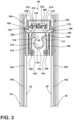
- FIG. 3 is a cross-sectional view of the latch mechanism 50 along line III-III of FIG. 2 , more clearly illustrating the first and second channels 38, 42.
- the latch mechanism 50 includes a flexible body 150 coupled to a rear side 154 of the locking body 46.
- the flexible body 150 may be made of any suitable material configured to be deformed elastically.
- the flexible body 150 is fastened to the rear side 154 via first and second molded bosses 158, 159.
- the flexible body 150 includes first and second loops 162, 163 configured to stretch over the first and second bosses 158, 159, respectively, to form a taut connection.
- the flexible body 150 it is within the scope of this disclosure for the flexible body 150 to be coupled to the locking body 46 via any suitable fastening technique including adhesives, co-molding, fasteners, and the like.
- the flexible body 150 generally includes a first body portion 166 laterally spaced from a second body portion 170, which is coupled to one another with a connecting portion 174.
- the connecting portion 174 includes first and second arcs 176, 177 coupled with the first and second body portions 166, 170.
- the first and second arcs 176, 177 may be coupled via a bight portion 179, which may be generally concave up while the first and second arcs 176, 177 may be generally concave down.
- the bight portion 179 may include a larger perimeterthan each of the first and second arcs 176, 177.
- the arcuate construction of these features allows for increased flexibility resulting in a robust system that can be locked and unlocked over many cycles.
- the connecting portion 174 may be generally U-shaped. However, the connecting portion 174 may be generally horizontal, V-shaped, etc.
- the first and second body portions 166, 170 extend substantially along the height of the rear side 154 of the locking body 46. Furthermore, the first and second body portions 166, 170 include first and second projections 178, 182, respectively. The first and second projections 178, 182 extend from the first and second body portions 166, 170 towards first and second apertures 186, 190 on the locking body 46, respectively. Accordingly, the first and second projections are laterally spaced from one another on opposing sides of the locking body 46 and generally extend outward, away from one another. The first and second apertures 186, 190 are positioned on the side of the locking body 46 adjacent the channels 38, 42, respectively.
- the first and second channels 38, 42 each include a ratcheting mechanism, which includes a plurality of vertically spaced teeth 194.
- Each tooth 194 defines a tooth surface, which is in the form of a sloped surface.
- the first and second projections 178, 182 terminate in angled edges 198, 202, respectively, which are generally complementary to the surface of each tooth 194, thereby forming a pawl.
- the first and second projections 178, 182 extend outwardly from the first and second apertures 186, 190, and engage at least one tooth surface.
- the first and second projections 178, 182 catch against a steeply sloped edge of the engaged teeth 194 and prevent any further motion in an upward direction.
- the locking body 46 may be pushed downwardly in the locked position to secure the user interface 108 between the shelf 130 and the recess 146. In this way, the locking body 46 may be pushed downwards until the upper edge of the user interface 108 contacts the locking body 46 within the recess 146 and prevents further downward movement.
- the flexible body 150 further includes a first flexible tab 206 and a second flexible tab 210 coupled with the first and second projections 178, 182, respectively.
- the first and second flexible tabs 206, 210 are angled inwardly such that first and second flexible tabs 206, 210 extend towards each other.
- the latch actuator 122 is operably coupled with a first shaft 214 and a second shaft 218 disposed adjacent to the first and second flexible tabs 206, 210 respectively.
- the first and second shafts 214, 218 are generally disposed outward from the first and second flexible tabs 206, 210 with the first and second flexible tabs 206, 210 extending at least partially between the first and second shafts 214, 218. In the locked, or extended position, the first and second shafts 214, 218 may be adjacent, or in contact with, the first and second flexible tabs 206, 210.
- the latch actuator 122 includes a first rib 216 and a second rib 220 disposed within an aperture 222 defined by the locking body 46.
- the ribs 216, 220 may be sized to extend substantially the height of the aperture 222 to limit or prevent up/down movement of the button 128.
- the first and second ribs 216, 220 are laterally spaced from one another and are generally positioned at opposing side edges of the aperture 222. Accordingly, the first and second shafts 214, 218 are each disposed between the first and second ribs 216, 220.
- the first and second ribs 216, 220 at least partially prevent movement of the first and second shafts 214, 218.
- the latch actuator 122 may be shifted upwardly, which may in turn shift the first and second shafts 214, 218 downward.
- the first and second shafts 214, 218 may contact and push down on the first and second flexible tabs 206, 210, such that the first and second flexible tabs 206, 210 are pressed more closely towards each other against a biasing force of the flexible body 150. In this way, a space between the first and second flexible tabs 206, 210 is decreased.
- the first and second projections 178, 182 can be pulled inwards upon movement of the first and second flexible tabs 206, 210 inwards. Thus, upon sufficient movement inwards, the first and second projections 178, 182 do not engage the tooth 194 and the locking body 46 may slide unrestricted between the upper portion 22 and the lower portion 26 of the body 18.
- the button 128 may include a column 226 defining a channel 230 positioned on a rear side 234 thereof.
- the channel 230 is sized to receive a shaft 238 coupled with the latch mechanism 50 in order to couple the button 128 to the latch mechanism 50.
- the shaft 238 includes a keyed portion 240 complementary to the shape of the channel 230 to facilitate proper insertion of the button 128.
- the button 128 may be coupled with the latch mechanism 50 in any suitable configuration, which may include fasteners, clasps, snaps, magnets, etc. in order to form a non-permanent or permanent joint.
- At least a portion of the latch mechanism 50 may be pivotable within the aperture 222 on the locking body 46.
- a spring 244 FIG. 5A ) facilitates pivoting of at least a portion of the latch mechanism 50.
- the ribs 216, 220 provided on the rear side 234 of the button 128 generally prevent the button 128 from sliding movement, thereby preventing pivoting of at least a portion of the latch mechanism 50.
- the button 128 may restrict pivoting of the latch mechanism 50 and, consequently, restricting or limiting movement of the locking body 46.
- the use of the button 128 may be beneficial in applications where locking/releasing the user interface 108 requires additional safeguarding.
- FIGS. 5A and 5B illustrate an alternative technique for transitioning the locking body 46 from the locked position to the released position, which may be beneficial when the button 128 is coupled with the latch mechanism 50.
- the locking body 46 defines a recess, or an access notch 250 located on the rear side 154 at the upper end 124.
- the access notch 250 is configured to receive or allow a tool 254, such as a screwdriver, to access the rear side 154 of the locking body 46 when mounted to the user interface housing 10.
- the tool 254 may be any suitable tool configured to access the rear side 154, which may include a tool having a sufficient length and width to fit through the access notch 250 and reach the connecting portion 174.
- FIG. 5A illustrates the flexible body 150 in the extended position where the first and second projections 178, 182 extend outwardly from the first and second apertures 186, 190.
- FIG. 5B illustrates the flexible body 150 in the retracted position.
- Application of a predetermined force, F D by the tool 254 adjusts the latch mechanism 50 from the extended position to the retracted position.
- Application of the predetermined force, F D on the connecting portion 174 forces the connecting portion 174 downward, away from the first and second apertures 186, 190.
- the first projection 178 is rotated inwardly about the first boss 158 towards the connecting portion 174 such that the first projection 178 is withdrawn and no longer disposed within the first aperture 186.
- the tool 254 on the connecting portion 174 rotates the second projection 182 inwardly about the second boss 159 towards the connecting portion 174, such that the second projection 182 is withdrawn and no longer disposed within the second aperture 190.
- the force, F D may be applied to the bight portion 179 of the connecting portion 174, which causes deformation of the bight portion 179 and the first and second arcs 176, 177. In this way, the bight portion 179 and the first and second arcs 176, 177 flex in order to draw in the first and second projections 178, 182.
- the user interface housing 10 is illustrated with an additional or alternative configuration of a shelf 330.
- the shelf 330 includes a first shelf portion 334 and a second shelf portion 338, which extend upwards to retain the edge, which may be a lower portion, of the user interface 108.
- the shelf portions 334, 338 may have a greater length to generate a wider shelf area.
- the shelf 130 or shelf 330 includes a material 342, such as a soft silicone, to provide a grip surface for an edge of the user interface 108.
- the shelf 330 may further include stoppers, which are illustrated in the form of vertically extending edge pieces 346.
- the edge pieces 346 are sized and positioned within the shelf 330 to prevent the user interface 108 from sliding out of the user interface housing 10 horizontally.
- the position of the edge pieces 346 may be adjusted to accommodate various widths of user interfaces 108. Accordingly, the edge pieces 346 are adjustable along a horizontal plane to define different widths for retaining different user interfaces 108.
- the edge pieces 346 may be dropped in and pivoted into a locked position on the shelf 330.
- the shelf 330 may include a plurality of indentations sized to receive the edge pieces 346 to lock the edge pieces 346 into position on the shelf 330.
- edge pieces 346 may be slidably coupled with the shelf and locked into position with a fastener. Even further, the edge pieces 346 may be fixed and secured into position on the ends of the shelf 330.
- the edge pieces 346 may be molded as an integral piece with the shelf 330.
- first shelf portion 334 and the second shelf portion 338 may be adjustable along a horizontal plane to define different widths to accommodate electronic devices of varying dimensions.
- the body 18 of the user interface housing 10 may include a groove, a track, a slide, or a similar feature that engages the first shelf portion 334 and the second shelf portion 338.
- the first and second shelf portions 334, 338 define a first width when in a first position and a different second width when in a second position to accommodate user interfaces 108 having differing widths.
- the first and second shelf portions 334, 338 and/or the edge pieces 346 may be adjusted to minimize horizontal movement of the user interface 108 on the shelf 330, and thereby prevent removal of the user interface 108 from the user interface housing 10.
- the first and second projections 178, 182 each engage a sloped surface of the teeth 194.
- the sloped surface provides for downward movement of the locking body 46 while preventing upward movement.
- the button 128 includes the first and second ribs 216, 220 that extend into the aperture 222 defined by the locking body 46.
- the first and second ribs 216, 220 prevent sliding movement of the button 128, and consequently, at least partially prevent pivoting of the latch mechanism 50. Limiting the pivoting of the latch mechanism 50 prevents the locking body 46 from moving toward the upper portion 22 of the body 18 of the user interface housing 10 while allowing movement toward the lower portion 26.
- the button 128 has a continuous arcuate surface that defines a shape complementary to the shape of the upper end 124 of the latch mechanism 50. The continuous arcuate surface reduces the ability of a user to grasp and move the button 128, providing further security for retaining the user interface 108.
- the upper end 124 of the locking body 46 defines the access notch 250 for receiving the tool 254. In such examples, the locking body 46 is adjusted toward the upper portion 22 of the body 18 in response to force being applied to the flexible body 150 by the tool 254.
- the user interface housing 10 provides security for the user interface 108.
Landscapes
- Engineering & Computer Science (AREA)
- Health & Medical Sciences (AREA)
- General Engineering & Computer Science (AREA)
- Mechanical Engineering (AREA)
- General Health & Medical Sciences (AREA)
- Animal Behavior & Ethology (AREA)
- Life Sciences & Earth Sciences (AREA)
- Public Health (AREA)
- Veterinary Medicine (AREA)
- Signal Processing (AREA)
- Nursing (AREA)
- Biomedical Technology (AREA)
- Accommodation For Nursing Or Treatment Tables (AREA)
- Infusion, Injection, And Reservoir Apparatuses (AREA)
Description
- The present disclosure generally relates to a user interface housing for a patient support apparatus, and more specifically to a security latch for a user interface housing. One such known latch is disclosed in
U.S. Patent Publication 2010/0264182 , which discloses a cell phone holder having a slider with pawl arms with gripper portions adapted to be squeezed together to move the pawls inward and away from ratchet teeth, where the slider moves vertically along posts to clamp different height phones. - According to the present disclosure, a user interface housing for a patient support apparatus includes a body that has an upper portion and a lower portion. First and second ribs extend between the upper portion and the lower portion. The first and second ribs define first and second channels, respectively, that each include a plurality of vertically spaced teeth and each tooth including a sloped surface and a sloped edge. A locking body is slidably disposed between the first and second ribs. The locking body includes a latch mechanism configured to secure the locking body in position. The locking body defines first and second apertures adjacent to the first and second channels. A latch actuator is operably coupled with the latch mechanism for selectively releasing the locking body to slide within the first and second channels. The locking body defines an access notch positioned on an upper end of a rear side thereof and which is configured to receive a tool for applying a predetermined force to the latch mechanism to adjust the latch mechanism from an extended position to a retracted position. The latch mechanism includes a flexible body with first and second body positions laterally spaced from one another and extending along a height of the rear side of the locking body, first and second projections, and a connecting portion including first and second arcs coupled to the first and second body portions, respectively. The first and second projections are laterally spaced from one another on opposing sides of the locking body and extend outward from the first and second body portions and toward the first and second apertures, respectively. The first and second projections have angled edges that engage the sloped surfaces of the teeth to form a pawl. In the extended position, the first and second projections extend outwardly from the first and second apertures to engage the teeth and catch on the sloped edges to prevent motion toward the upper portion of the body. The connecting portion is configured to be engaged by the tool to, consequently, withdraw the first and second projections to the retracted position..
- The invention will now be further described by way of example with reference to the accompanying drawings, in which:
-
FIG. 1 is a top perspective view of a patient support apparatus, according to various aspects described herein; -
FIG. 2 is a front elevational view of a user interface housing, according to various aspects described herein; -
FIG. 3 is a front elevational cross-sectional view of a latch mechanism along line III-III ofFIG. 2 , according to various aspects described herein; -
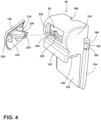
FIG. 4 is a top perspective view of a button separated from a locking body, according to various aspects described herein; -
FIG. 5A is a rear perspective view of the locking body ofFIG. 4 , according to various aspects described herein; -
FIG. 5B is a rear perspective view of the locking body ofFIG. 4 , according to various aspects described herein; and -
FIG. 6 is a front perspective view of a user interface housing, according to various aspects described herein. - For purposes of description herein, the terms "upper," "lower," "right," "left," "rear," "front," "vertical," "horizontal," and derivatives thereof shall relate to the disclosure as oriented in
FIG. 1 . Unless stated otherwise, the term "front" shall refer to a surface of the device closest to an intended viewer, and the term "rear" shall refer to a surface of the device furthest from the intended viewer. However, it is to be understood that the disclosure may assume various alternative orientations, except where expressly specified to the contrary. It is also to be understood that the specific devices and processes illustrated in the attached drawings, and described in the following specification are simply exemplary embodiments of the inventive concepts defined in the appended claims. Hence, specific dimensions and other physical characteristics relating to the embodiments disclosed herein are not to be considered as limiting, unless the claims expressly state otherwise. - The terms "including," "comprises," "comprising," or any other variation thereof, are intended to cover a non-exclusive inclusion, such that a process, method, article, or apparatus that comprises a list of elements does not include only those elements but may include other elements not expressly listed or inherent to such process, method, article, or apparatus. An element preceded by "comprises a . . . " does not, without more constraints, preclude the existence of additional identical elements in the process, method, article, or apparatus that comprises the element.
- Referring to
FIGS. 1-6 ,reference numeral 10 generally designates a user interface housing for apatient support apparatus 14. Theuser interface housing 10 includes abody 18 having anupper portion 22 and alower portion 26. First andsecond ribs upper portion 22 towards thelower portion 26 and the first andsecond ribs second channels locking body 46 is slidably disposed between the first andsecond ribs locking body 46 includes alatch mechanism 50 configured to secure thelocking body 46 in position. - Referring now to
FIG. 1 , thepatient support apparatus 14 may include a hospital bed. While described as thepatient support apparatus 14, it is within the scope of the disclosure that thepatient support apparatus 14 may include a bed frame, a mattress, or any suitable structure for supporting a patient, including, but not limited to: other types of beds, surgical tables, examination tables, stretchers, recliners, and the like. - The
patient support apparatus 14 may include a frame, which may be in the form of abase frame 54. Anupper frame 58 may be coupled with thebase frame 54. Theupper frame 58 may be operable between raised, lowered, and tilted positions relative to thebase frame 54. Thepatient support apparatus 14 may include a surface, such as amattress 62 supported by one of thebase frame 54 and theupper frame 58. Themattress 62 may be in the form of a cushion including a foam base and multiple layers. - The
patient support apparatus 14 includes ahead end 66 and afoot end 70. Aheadboard 74 is provided at thehead end 66 and afootboard 78 is provided at thefoot end 70. Thepatient support apparatus 14 may include a pair ofhead siderail assemblies 82 and a pair offoot siderail assemblies 86. In some examples, aninterface 90, which may be a graphical user interface, may be coupled to an external side of at least one siderail of the head andfoot siderail assemblies - As illustrated in
FIG. 1 , asupport arm 94 is coupled with thehead end 66 of thepatient support apparatus 14. Alternatively, thesupport arm 94 may be coupled with of at least one siderail of the head andfoot siderail assemblies base frame 54 and theupper frame 58, but is not limited to such examples. Thesupport arm 94 generally includes a fixedportion 98 and apivotable portion 102. Thepivotable portion 102 extends laterally from thefixed portion 98 and is configured to rotate relative to thefixed portion 98. - A strand, or
cord 106, may depend from thepivotable portion 102 and may be repositioned to a variety of locations about thepatient support apparatus 14. Theuser interface housing 10 may be coupled with thecord 106. Thepivotable portion 102 and/or thecord 106 generally has exceptional flexibility to provide support for accessing theuser interface housing 10 at different angles and positions relative to thepatient support apparatus 14. However, theuser interface housing 10 may be integrated with any suitable component of thepatient support apparatus 14. - A
user interface 108 is secured to theuser interface housing 10, which may be used by a caregiver or a patient. Theuser interface 108 may be in the form of a touch screen tablet computer, a smartphone, and the like, which may be generally rectangular in shape. However, it is also contemplated that theuser interface 108 may be of various shapes, which can be secured to theuser interface housing 10. - Referring now to
FIG. 2 , theuser interface housing 10 is illustrated without theuser interface 108. Thebody 18 of the illustrateduser interface housing 10 includes at least onegripping surface 110, which may include one ormore handles 110. As illustrated, theuser interface housing 10 includes twohandles 110 that each extend from theupper portion 22 to thelower portion 26 of thebody 18. Thehandles 110 may be covered in a material, such as a soft, silicone to provide an enhanced gripping surface and which is easily cleanable. - In some examples, as illustrated in
FIG. 2 , thehandles 110 extend outwardly from thebody 18 to defineapertures 114. Theapertures 114 are generally oval, elliptical, or lanceolate shaped and may be dimensioned such that a hand of a user can reach at least partially through one of theapertures 114, which may be beneficial for grasping thebody 18 or one of thehandles 110. The first andsecond ribs second channels middle portion 118 of thebody 18, which may be located between theapertures 114. However, it is within the scope of this disclosure for theuser interface housing 10 to include alternative gripping arrangements, which may or may not include theapertures 114. For example, one or more handlebars, cup handles, pull handles, or knobs, etc. may extend from thebody 18 to facilitate moving and gripping of theuser interface housing 10. - Still referring to
FIG. 2 , alatch actuator 122 is operably coupled with thelatch mechanism 50 for selectively releasing the lockingbody 46, which enables the lockingbody 46 to be slidable within the first andsecond channels latch mechanism 50 may be disposed within an interior of anupper end 124 of the lockingbody 46. Theupper end 124 may be in the form of a curved body that extends outwardly from aplanar portion 126 of the lockingbody 46. Alternatively, theupper end 124 may be any suitable shape, which may be rectangular or flat and may include a non-slip cleanable surface. - In various examples, the
latch actuator 122 includes abutton 128, which may be generally flush with theupper end 124. Thus, thebutton 128 generally includes a shape complementary to the shape of theupper end 124. In addition to thebutton 128 being flush with theupper end 124, molding thebutton 128 in the same color as the lockingbody 46 may provide the aesthetically pleasing appearance of a seamless interface between thebutton 128 and the lockingbody 46. Moreover, thebutton 128 generally has a continuously arcuate outer surface, which contributes to the seamless interface between thebutton 128 and the lockingbody 46. While illustrated as thebutton 128, thelatch actuator 122 may include any suitable component for actuating thelatch mechanism 50, which may include, but not limited to: a tab, a handle, a push-button, a toggle, etc. - As shown in
FIG. 2 , ashelf 130 is coupled with thelower portion 26 of thebody 18, which is dimensioned to receive an edge, which may be a lower edge, of the user interface 108 (FIG. 1 ). Theshelf 130 includes afirst shelf portion 134 and asecond shelf portion 138, which extend upwards to retain the edge of theuser interface 108. However, theshelf 130 may be in any suitable configuration that provides a surface for theuser interface 108, which may include a single, continuous portion and may or may not extend upwardly. - Additionally, the locking
body 46 includes aflange 142, which extends downwardly from thelatch actuator 122 thereby defining a recess 146 (FIG. 4 ). Therecess 146 is dimensioned to receive another edge of theuser interface 108, which may be an upper edge. The height, or position, of theflange 142 and therecess 146 is adjusted by repositioning the lockingbody 46. Thus, theuser interface 108 is secured to theuser interface housing 10 in a clamping manner by way of theshelf 130 and theflange 142. In this way, theuser interface housing 10 accommodates auser interface 108 of a variety of sizes. -
FIG. 3 is a cross-sectional view of thelatch mechanism 50 along line III-III ofFIG. 2 , more clearly illustrating the first andsecond channels latch mechanism 50 includes aflexible body 150 coupled to arear side 154 of the lockingbody 46. Theflexible body 150 may be made of any suitable material configured to be deformed elastically. Theflexible body 150 is fastened to therear side 154 via first and second moldedbosses flexible body 150 includes first andsecond loops second bosses flexible body 150 to be coupled to the lockingbody 46 via any suitable fastening technique including adhesives, co-molding, fasteners, and the like. - The
flexible body 150 generally includes afirst body portion 166 laterally spaced from asecond body portion 170, which is coupled to one another with a connectingportion 174. The connectingportion 174 includes first andsecond arcs second body portions second arcs bight portion 179, which may be generally concave up while the first andsecond arcs bight portion 179 may include a larger perimeterthan each of the first andsecond arcs portion 174 may be generally U-shaped. However, the connectingportion 174 may be generally horizontal, V-shaped, etc. - Still referring to
FIG. 3 , the first andsecond body portions rear side 154 of the lockingbody 46. Furthermore, the first andsecond body portions second projections second projections second body portions second apertures body 46, respectively. Accordingly, the first and second projections are laterally spaced from one another on opposing sides of the lockingbody 46 and generally extend outward, away from one another. The first andsecond apertures body 46 adjacent thechannels second channels teeth 194. Eachtooth 194 defines a tooth surface, which is in the form of a sloped surface. The first andsecond projections angled edges tooth 194, thereby forming a pawl. - In a locked or extended position, as illustrated in
FIG. 3 , the first andsecond projections second apertures second projections teeth 194 and prevent any further motion in an upward direction. However, the lockingbody 46 may be pushed downwardly in the locked position to secure theuser interface 108 between theshelf 130 and therecess 146. In this way, the lockingbody 46 may be pushed downwards until the upper edge of theuser interface 108 contacts the lockingbody 46 within therecess 146 and prevents further downward movement. - The
flexible body 150 further includes a firstflexible tab 206 and a secondflexible tab 210 coupled with the first andsecond projections flexible tabs flexible tabs latch actuator 122 is operably coupled with afirst shaft 214 and asecond shaft 218 disposed adjacent to the first and secondflexible tabs second shafts flexible tabs flexible tabs second shafts second shafts flexible tabs - The
latch actuator 122 includes afirst rib 216 and asecond rib 220 disposed within anaperture 222 defined by the lockingbody 46. Theribs aperture 222 to limit or prevent up/down movement of thebutton 128. The first andsecond ribs aperture 222. Accordingly, the first andsecond shafts second ribs second ribs second shafts - In examples where the
ribs latch actuator 122, to transition from the locked position to a released, or retracted position, thelatch actuator 122 may be shifted upwardly, which may in turn shift the first andsecond shafts second shafts flexible tabs flexible tabs flexible body 150. In this way, a space between the first and secondflexible tabs flexible body 150, the first andsecond projections flexible tabs second projections tooth 194 and the lockingbody 46 may slide unrestricted between theupper portion 22 and thelower portion 26 of thebody 18. - Referring now to
FIG. 4 , the lockingbody 46 and thestationary button 128 are more clearly illustrated. In some examples, thebutton 128 may include acolumn 226 defining achannel 230 positioned on arear side 234 thereof. Thechannel 230 is sized to receive ashaft 238 coupled with thelatch mechanism 50 in order to couple thebutton 128 to thelatch mechanism 50. Theshaft 238 includes a keyedportion 240 complementary to the shape of thechannel 230 to facilitate proper insertion of thebutton 128. However, thebutton 128 may be coupled with thelatch mechanism 50 in any suitable configuration, which may include fasteners, clasps, snaps, magnets, etc. in order to form a non-permanent or permanent joint. - At least a portion of the
latch mechanism 50 may be pivotable within theaperture 222 on the lockingbody 46. A spring 244 (FIG. 5A ) facilitates pivoting of at least a portion of thelatch mechanism 50. Theribs rear side 234 of thebutton 128 generally prevent thebutton 128 from sliding movement, thereby preventing pivoting of at least a portion of thelatch mechanism 50. For example, as theribs aperture 222 on the lockingbody 46, theribs button 128. Therefore, thebutton 128 may restrict pivoting of thelatch mechanism 50 and, consequently, restricting or limiting movement of the lockingbody 46. The use of thebutton 128 may be beneficial in applications where locking/releasing theuser interface 108 requires additional safeguarding. -
FIGS. 5A and 5B illustrate an alternative technique for transitioning the lockingbody 46 from the locked position to the released position, which may be beneficial when thebutton 128 is coupled with thelatch mechanism 50. The lockingbody 46 defines a recess, or anaccess notch 250 located on therear side 154 at theupper end 124. Theaccess notch 250 is configured to receive or allow atool 254, such as a screwdriver, to access therear side 154 of the lockingbody 46 when mounted to theuser interface housing 10. Thetool 254 may be any suitable tool configured to access therear side 154, which may include a tool having a sufficient length and width to fit through theaccess notch 250 and reach the connectingportion 174.FIG. 5A illustrates theflexible body 150 in the extended position where the first andsecond projections second apertures -
FIG. 5B illustrates theflexible body 150 in the retracted position. Application of a predetermined force, FD, by thetool 254 adjusts thelatch mechanism 50 from the extended position to the retracted position. Application of the predetermined force, FD on the connectingportion 174 forces the connectingportion 174 downward, away from the first andsecond apertures first projection 178 is rotated inwardly about thefirst boss 158 towards the connectingportion 174 such that thefirst projection 178 is withdrawn and no longer disposed within thefirst aperture 186. Likewise, application of the predetermined force, FD, by thetool 254 on the connectingportion 174 rotates thesecond projection 182 inwardly about thesecond boss 159 towards the connectingportion 174, such that thesecond projection 182 is withdrawn and no longer disposed within thesecond aperture 190. The force, FD, may be applied to thebight portion 179 of the connectingportion 174, which causes deformation of thebight portion 179 and the first andsecond arcs bight portion 179 and the first andsecond arcs second projections - Referring now to
FIG. 6 , theuser interface housing 10 is illustrated with an additional or alternative configuration of ashelf 330. Similarly to theshelf 130, theshelf 330 includes afirst shelf portion 334 and asecond shelf portion 338, which extend upwards to retain the edge, which may be a lower portion, of theuser interface 108. However, theshelf portions shelf 130 orshelf 330 includes amaterial 342, such as a soft silicone, to provide a grip surface for an edge of theuser interface 108. - The
shelf 330 may further include stoppers, which are illustrated in the form of vertically extendingedge pieces 346. Theedge pieces 346 are sized and positioned within theshelf 330 to prevent theuser interface 108 from sliding out of theuser interface housing 10 horizontally. The position of theedge pieces 346 may be adjusted to accommodate various widths ofuser interfaces 108. Accordingly, theedge pieces 346 are adjustable along a horizontal plane to define different widths for retainingdifferent user interfaces 108. In some examples, theedge pieces 346 may be dropped in and pivoted into a locked position on theshelf 330. Furthermore, theshelf 330 may include a plurality of indentations sized to receive theedge pieces 346 to lock theedge pieces 346 into position on theshelf 330. Alternatively, theedge pieces 346 may be slidably coupled with the shelf and locked into position with a fastener. Even further, theedge pieces 346 may be fixed and secured into position on the ends of theshelf 330. For example, theedge pieces 346 may be molded as an integral piece with theshelf 330. - One or both of the
first shelf portion 334 and thesecond shelf portion 338, including theedge pieces 346, may be adjustable along a horizontal plane to define different widths to accommodate electronic devices of varying dimensions. For example, thebody 18 of theuser interface housing 10 may include a groove, a track, a slide, or a similar feature that engages thefirst shelf portion 334 and thesecond shelf portion 338. The first andsecond shelf portions user interfaces 108 having differing widths. The first andsecond shelf portions edge pieces 346 may be adjusted to minimize horizontal movement of theuser interface 108 on theshelf 330, and thereby prevent removal of theuser interface 108 from theuser interface housing 10. - Use of the present device may provide for a variety of advantages. For example, the first and
second projections teeth 194. The sloped surface provides for downward movement of the lockingbody 46 while preventing upward movement. Additionally, thebutton 128 includes the first andsecond ribs aperture 222 defined by the lockingbody 46. The first andsecond ribs button 128, and consequently, at least partially prevent pivoting of thelatch mechanism 50. Limiting the pivoting of thelatch mechanism 50 prevents the lockingbody 46 from moving toward theupper portion 22 of thebody 18 of theuser interface housing 10 while allowing movement toward thelower portion 26. This one directional movement secures theuser interface 108 in theuser interface housing 10 while preventing unwanted removal of theuser interface 108 from theuser interface housing 10. Further, thebutton 128 has a continuous arcuate surface that defines a shape complementary to the shape of theupper end 124 of thelatch mechanism 50. The continuous arcuate surface reduces the ability of a user to grasp and move thebutton 128, providing further security for retaining theuser interface 108. Moreover, theupper end 124 of the lockingbody 46 defines theaccess notch 250 for receiving thetool 254. In such examples, the lockingbody 46 is adjusted toward theupper portion 22 of thebody 18 in response to force being applied to theflexible body 150 by thetool 254. Moreover, theuser interface housing 10 provides security for theuser interface 108. These and other advantages may be realized and/or achieved.
Claims (11)
- A user interface housing (10) for a patient support apparatus (14) comprising:a body (18) including an upper portion (22) and a lower portion (26);a locking body (46), the locking body (46) including a latch mechanism (50) configured to secure the locking body (46) in position, characterized in that the user interface housing further comprises:first and second ribs (30, 34) extending between the upper portion (22) and the lower portion (26), the first and second ribs (30, 34) defining first and second channels (38, 42), respectively, that each include a plurality of vertically spaced teeth (194), each tooth (194) including a sloped surface and a sloped edge;the locking body (46) slidably disposed between the first and second ribs (30, 34), wherein the locking body (46) defines first and second apertures (186, 190) adjacent to the first and second channels (38, 42); anda latch actuator (122) operably coupled with the latch mechanism (50) for selectively releasing the locking body (46) to slide within the first and second channels (38, 42), wherein the locking body (46) defines an access notch (250) positioned on an upper end (124) of a rear side (154) thereof and which is configured to receive a tool (254) for accessing the rear side (154) of the locking body (46) when mounted to the body (18) and for applying a predetermined force (FD) to the latch mechanism (50) to adjust the latch mechanism (50) from an extended position to a retracted position, and wherein the latch mechanism (50) includes a flexible body (150) coupled the rear side (154) of the locking body (46) and including:first and second body portions (166, 170) laterally spaced from one another and extending along the rear side (154) of the locking body (46);first and second projections (178, 182) laterally spaced from one another on opposing sides of the locking body (46) and extending outward from the first and second body portions (166, 170) and toward the first and second apertures (186, 190), respectively, wherein the first and second projections (178, 182) have angled edges (198, 202) that engage the sloped surfaces of the teeth (194) to form a pawl, and wherein, in the extended position, the first and second projections (178, 182) extend outwardly from the first and second apertures (186, 190) to engage the teeth (194) and catch on the sloped edges to prevent motion toward the upper portion (22) of the body (18); anda connecting portion (174) including first and second arcs (176, 177) coupled to the first and second body portions (166, 170), respectively, the connecting portion (174) configured to be engaged by the tool (254) to, consequently, withdraw the first and second projections (178, 182) from the apertures (186, 190) to the retracted position.
- The user interface housing (10) claim 1, wherein the locking body (46) includes a flange (142) defining a recess (146) configured to retain an upper edge of a user interface (108).
- The user interface housing (10) of any of claims 1-2, wherein the first and second projections (178, 182) are adapted to move to the retracted position relative to the first and second apertures (186, 190), respectively, upon downward movement of the connecting portion (174).
- The user interface housing (10) of any of claims 1-3, wherein the locking body (46) is configured to slide between the upper portion (22) and the lower portion (26) when the first and second projections (178, 182) are in the retracted position.
- The user interface housing (10) of any of claims 1-4, further comprising:
a button (128) defining a first rib (216) and a second rib (220) that extend from a rear side (234) thereof, the first and second ribs (216, 220) extending through an aperture (222) defined by the locking body (46). - The user interface housing (10) of claim 5, wherein the button (128) is operably coupled to first and second shafts (214, 218), each of the first and second shafts (214, 218) is disposed between the first and second ribs (216, 220).
- The user interface housing (10) of claim 6, wherein the flexible body (150) includes first and second flexible tabs (206, 210) operably coupled with the first and second shafts (214, 218), respectively, each of the first and second flexible tabs (206, 210) extends at least partially between the first and second shafts (214, 218).
- The user interface housing (10) of any of claims 5-7, wherein the upper end (124) of the locking body (46) is curved and extends outwardly from a planar portion (126), the button (128) defining a shape complementary to the upper end (124), and wherein the button (128) has a continuously arcuate outer surface.
- The user interface housing (10) of any of claims 1-8, further comprising:a shelf (330) disposed at the lower portion (26) of the body (18); andfirst and second stoppers (346) operably coupled with the shelf (330), wherein the first and second stoppers (346) are configured to retain a lower edge of a user interface (108) within the shelf (330).
- The user interface housing (10) of claim 9, wherein the first and second stoppers (346) are adjustable on the shelf (330) along a horizontal plane to define different widths.
- A patient support apparatus (14) comprising the user interface housing (10) of any of claims 1-10.
Priority Applications (1)
| Application Number | Priority Date | Filing Date | Title |
|---|---|---|---|
| EP23198744.7A EP4273436A3 (en) | 2019-07-10 | 2020-07-09 | Security latch for user interface housing |
Applications Claiming Priority (2)
| Application Number | Priority Date | Filing Date | Title |
|---|---|---|---|
| US201962872297P | 2019-07-10 | 2019-07-10 | |
| US16/923,341 US11723822B2 (en) | 2019-07-10 | 2020-07-08 | Security latch for user interface housing |
Related Child Applications (1)
| Application Number | Title | Priority Date | Filing Date |
|---|---|---|---|
| EP23198744.7A Division EP4273436A3 (en) | 2019-07-10 | 2020-07-09 | Security latch for user interface housing |
Publications (2)
| Publication Number | Publication Date |
|---|---|
| EP3764626A1 EP3764626A1 (en) | 2021-01-13 |
| EP3764626B1 true EP3764626B1 (en) | 2023-10-04 |
Family
ID=71575018
Family Applications (2)
| Application Number | Title | Priority Date | Filing Date |
|---|---|---|---|
| EP20184968.4A Active EP3764626B1 (en) | 2019-07-10 | 2020-07-09 | Security latch for user interface housing |
| EP23198744.7A Pending EP4273436A3 (en) | 2019-07-10 | 2020-07-09 | Security latch for user interface housing |
Family Applications After (1)
| Application Number | Title | Priority Date | Filing Date |
|---|---|---|---|
| EP23198744.7A Pending EP4273436A3 (en) | 2019-07-10 | 2020-07-09 | Security latch for user interface housing |
Country Status (3)
| Country | Link |
|---|---|
| US (2) | US11723822B2 (en) |
| EP (2) | EP3764626B1 (en) |
| CN (1) | CN214231804U (en) |
Families Citing this family (3)
| Publication number | Priority date | Publication date | Assignee | Title |
|---|---|---|---|---|
| US11103398B2 (en) * | 2017-05-17 | 2021-08-31 | Hill-Rom Services, Inc. | Flexible overhead arm |
| US11890118B2 (en) | 2021-03-24 | 2024-02-06 | Stryker Corporation | Patient support apparatus with support assembly for medical device |
| CN119173236A (en) * | 2022-05-12 | 2024-12-20 | 希尔-罗姆服务公司 | Patient support with wireless charging of electronic devices |
Family Cites Families (13)
| Publication number | Priority date | Publication date | Assignee | Title |
|---|---|---|---|---|
| US5542138A (en) | 1995-02-06 | 1996-08-06 | Williams; Terry N. | Bedside control unit for a hospital bed |
| US6959899B2 (en) * | 2003-03-21 | 2005-11-01 | Ta Kuang Yeh | Attachment assembly for personal digital assistant |
| GB0814679D0 (en) | 2008-08-11 | 2008-09-17 | Tempus Computers Ltd | Docking station |
| US20100264182A1 (en) * | 2009-04-21 | 2010-10-21 | Goldperl, Llc | Cell Phone Holder |
| US8561863B2 (en) | 2011-06-09 | 2013-10-22 | Superior Communications, Inc. | Universal electronic device holder attachable to headrest bars |
| US8929065B2 (en) * | 2011-08-23 | 2015-01-06 | L&P Property Management Company | Docking station with ruggedized case |
| BR112016016190A2 (en) | 2014-01-13 | 2017-08-08 | Ferno Washington | ACCESSORY CLIP AND METHOD FOR USING AN ACCESSORY CLIP |
| US10363182B2 (en) | 2014-07-14 | 2019-07-30 | Hill-Rom Services, Inc. | Patient control arm with phone dock and head of bed lockout |
| AU2016270661B2 (en) | 2015-05-29 | 2021-04-22 | Hill-Rom Services, Inc. | Patient support apparatus |
| US10504353B2 (en) | 2015-07-27 | 2019-12-10 | Hill-Rom Services, Inc. | Customized bed exit warnings to modify patient behavior |
| US10716726B2 (en) * | 2015-11-09 | 2020-07-21 | Corindus, Inc. | System and apparatus for reacting moments on a bed rail |
| US10028875B2 (en) | 2016-12-06 | 2018-07-24 | Hatchmed Corporation | Electronic device mount for releasably attaching to equipment in a hospital room |
| US11103398B2 (en) | 2017-05-17 | 2021-08-31 | Hill-Rom Services, Inc. | Flexible overhead arm |
-
2020
- 2020-07-08 US US16/923,341 patent/US11723822B2/en active Active
- 2020-07-09 EP EP20184968.4A patent/EP3764626B1/en active Active
- 2020-07-09 EP EP23198744.7A patent/EP4273436A3/en active Pending
- 2020-07-10 CN CN202021353025.7U patent/CN214231804U/en active Active
-
2023
- 2023-06-19 US US18/211,368 patent/US12115115B2/en active Active
Also Published As
| Publication number | Publication date |
|---|---|
| US11723822B2 (en) | 2023-08-15 |
| EP4273436A3 (en) | 2024-01-10 |
| US20210007920A1 (en) | 2021-01-14 |
| US12115115B2 (en) | 2024-10-15 |
| CN214231804U (en) | 2021-09-21 |
| EP3764626A1 (en) | 2021-01-13 |
| US20230329934A1 (en) | 2023-10-19 |
| EP4273436A2 (en) | 2023-11-08 |
Similar Documents
| Publication | Publication Date | Title |
|---|---|---|
| US12115115B2 (en) | Security latch for user interface housing | |
| US20080121771A1 (en) | Adjusting device for positioning shower head | |
| US7651161B2 (en) | Table seat with rotatable sitting portion | |
| EP2676566A1 (en) | Carry-bag and stopper for carry-bag handle | |
| CA2780517C (en) | Ring binder mechanism with self-locking actuator | |
| US11284710B1 (en) | Adjustment device that controls a tilting angle of a table top | |
| JP5026126B2 (en) | Lumber support device in chair | |
| EP4018989B1 (en) | Armboard assemblies for supporting and positioning a limb relative to a mounting structure | |
| US12569384B2 (en) | Mounting system | |
| US9228679B2 (en) | Holding a flexible elongate object | |
| JP6009627B2 (en) | Chair and its outer shell | |
| JP4128122B2 (en) | Shower folding chair | |
| JP2015171652A5 (en) | ||
| JP4819955B2 (en) | Lip opening device | |
| GB2507167A (en) | Apparatus for fitting a duvet cover | |
| JP4447089B2 (en) | Wiring reception at the desk | |
| US20050125960A1 (en) | Baby blanket clip | |
| JP2003164358A (en) | Bed equipment | |
| CN214484766U (en) | Medical special infant braces | |
| JP6103870B2 (en) | Attaching method and structure of lever to pivot, and furniture and chair provided with the structure | |
| US12433419B2 (en) | Bed sheet retention systems, system components, and methods of making and using the same | |
| JP2004313629A (en) | Baby crib | |
| CN215779018U (en) | Prevent scratching restraint gloves | |
| JP7657758B2 (en) | Bed Equipment | |
| GB2385628A (en) | A clip for a puschair |
Legal Events
| Date | Code | Title | Description |
|---|---|---|---|
| PUAI | Public reference made under article 153(3) epc to a published international application that has entered the european phase |
Free format text: ORIGINAL CODE: 0009012 |
|
| STAA | Information on the status of an ep patent application or granted ep patent |
Free format text: STATUS: THE APPLICATION HAS BEEN PUBLISHED |
|
| AK | Designated contracting states |
Kind code of ref document: A1 Designated state(s): AL AT BE BG CH CY CZ DE DK EE ES FI FR GB GR HR HU IE IS IT LI LT LU LV MC MK MT NL NO PL PT RO RS SE SI SK SM TR |
|
| AX | Request for extension of the european patent |
Extension state: BA ME |
|
| STAA | Information on the status of an ep patent application or granted ep patent |
Free format text: STATUS: REQUEST FOR EXAMINATION WAS MADE |
|
| 17P | Request for examination filed |
Effective date: 20210709 |
|
| RBV | Designated contracting states (corrected) |
Designated state(s): AL AT BE BG CH CY CZ DE DK EE ES FI FR GB GR HR HU IE IS IT LI LT LU LV MC MK MT NL NO PL PT RO RS SE SI SK SM TR |
|
| STAA | Information on the status of an ep patent application or granted ep patent |
Free format text: STATUS: EXAMINATION IS IN PROGRESS |
|
| 17Q | First examination report despatched |
Effective date: 20220420 |
|
| GRAP | Despatch of communication of intention to grant a patent |
Free format text: ORIGINAL CODE: EPIDOSNIGR1 |
|
| STAA | Information on the status of an ep patent application or granted ep patent |
Free format text: STATUS: GRANT OF PATENT IS INTENDED |
|
| INTG | Intention to grant announced |
Effective date: 20230418 |
|
| GRAS | Grant fee paid |
Free format text: ORIGINAL CODE: EPIDOSNIGR3 |
|
| GRAA | (expected) grant |
Free format text: ORIGINAL CODE: 0009210 |
|
| STAA | Information on the status of an ep patent application or granted ep patent |
Free format text: STATUS: THE PATENT HAS BEEN GRANTED |
|
| AK | Designated contracting states |
Kind code of ref document: B1 Designated state(s): AL AT BE BG CH CY CZ DE DK EE ES FI FR GB GR HR HU IE IS IT LI LT LU LV MC MK MT NL NO PL PT RO RS SE SI SK SM TR |
|
| REG | Reference to a national code |
Ref country code: GB Ref legal event code: FG4D |
|
| REG | Reference to a national code |
Ref country code: CH Ref legal event code: EP |
|
| REG | Reference to a national code |
Ref country code: IE Ref legal event code: FG4D |
|
| REG | Reference to a national code |
Ref country code: DE Ref legal event code: R096 Ref document number: 602020018490 Country of ref document: DE |
|
| REG | Reference to a national code |
Ref country code: LT Ref legal event code: MG9D |
|
| REG | Reference to a national code |
Ref country code: NL Ref legal event code: MP Effective date: 20231004 |
|
| REG | Reference to a national code |
Ref country code: AT Ref legal event code: MK05 Ref document number: 1619012 Country of ref document: AT Kind code of ref document: T Effective date: 20231004 |
|
| PG25 | Lapsed in a contracting state [announced via postgrant information from national office to epo] |
Ref country code: NL Free format text: LAPSE BECAUSE OF FAILURE TO SUBMIT A TRANSLATION OF THE DESCRIPTION OR TO PAY THE FEE WITHIN THE PRESCRIBED TIME-LIMIT Effective date: 20231004 |
|
| PG25 | Lapsed in a contracting state [announced via postgrant information from national office to epo] |
Ref country code: GR Free format text: LAPSE BECAUSE OF FAILURE TO SUBMIT A TRANSLATION OF THE DESCRIPTION OR TO PAY THE FEE WITHIN THE PRESCRIBED TIME-LIMIT Effective date: 20240105 |
|
| PG25 | Lapsed in a contracting state [announced via postgrant information from national office to epo] |
Ref country code: IS Free format text: LAPSE BECAUSE OF FAILURE TO SUBMIT A TRANSLATION OF THE DESCRIPTION OR TO PAY THE FEE WITHIN THE PRESCRIBED TIME-LIMIT Effective date: 20240204 |
|
| PG25 | Lapsed in a contracting state [announced via postgrant information from national office to epo] |
Ref country code: LT Free format text: LAPSE BECAUSE OF FAILURE TO SUBMIT A TRANSLATION OF THE DESCRIPTION OR TO PAY THE FEE WITHIN THE PRESCRIBED TIME-LIMIT Effective date: 20231004 |
|
| PG25 | Lapsed in a contracting state [announced via postgrant information from national office to epo] |
Ref country code: AT Free format text: LAPSE BECAUSE OF FAILURE TO SUBMIT A TRANSLATION OF THE DESCRIPTION OR TO PAY THE FEE WITHIN THE PRESCRIBED TIME-LIMIT Effective date: 20231004 |
|
| PG25 | Lapsed in a contracting state [announced via postgrant information from national office to epo] |
Ref country code: ES Free format text: LAPSE BECAUSE OF FAILURE TO SUBMIT A TRANSLATION OF THE DESCRIPTION OR TO PAY THE FEE WITHIN THE PRESCRIBED TIME-LIMIT Effective date: 20231004 |
|
| PG25 | Lapsed in a contracting state [announced via postgrant information from national office to epo] |
Ref country code: LT Free format text: LAPSE BECAUSE OF FAILURE TO SUBMIT A TRANSLATION OF THE DESCRIPTION OR TO PAY THE FEE WITHIN THE PRESCRIBED TIME-LIMIT Effective date: 20231004 Ref country code: IS Free format text: LAPSE BECAUSE OF FAILURE TO SUBMIT A TRANSLATION OF THE DESCRIPTION OR TO PAY THE FEE WITHIN THE PRESCRIBED TIME-LIMIT Effective date: 20240204 Ref country code: GR Free format text: LAPSE BECAUSE OF FAILURE TO SUBMIT A TRANSLATION OF THE DESCRIPTION OR TO PAY THE FEE WITHIN THE PRESCRIBED TIME-LIMIT Effective date: 20240105 Ref country code: ES Free format text: LAPSE BECAUSE OF FAILURE TO SUBMIT A TRANSLATION OF THE DESCRIPTION OR TO PAY THE FEE WITHIN THE PRESCRIBED TIME-LIMIT Effective date: 20231004 Ref country code: BG Free format text: LAPSE BECAUSE OF FAILURE TO SUBMIT A TRANSLATION OF THE DESCRIPTION OR TO PAY THE FEE WITHIN THE PRESCRIBED TIME-LIMIT Effective date: 20240104 Ref country code: AT Free format text: LAPSE BECAUSE OF FAILURE TO SUBMIT A TRANSLATION OF THE DESCRIPTION OR TO PAY THE FEE WITHIN THE PRESCRIBED TIME-LIMIT Effective date: 20231004 Ref country code: PT Free format text: LAPSE BECAUSE OF FAILURE TO SUBMIT A TRANSLATION OF THE DESCRIPTION OR TO PAY THE FEE WITHIN THE PRESCRIBED TIME-LIMIT Effective date: 20240205 |
|
| PG25 | Lapsed in a contracting state [announced via postgrant information from national office to epo] |
Ref country code: SE Free format text: LAPSE BECAUSE OF FAILURE TO SUBMIT A TRANSLATION OF THE DESCRIPTION OR TO PAY THE FEE WITHIN THE PRESCRIBED TIME-LIMIT Effective date: 20231004 Ref country code: RS Free format text: LAPSE BECAUSE OF FAILURE TO SUBMIT A TRANSLATION OF THE DESCRIPTION OR TO PAY THE FEE WITHIN THE PRESCRIBED TIME-LIMIT Effective date: 20231004 Ref country code: PL Free format text: LAPSE BECAUSE OF FAILURE TO SUBMIT A TRANSLATION OF THE DESCRIPTION OR TO PAY THE FEE WITHIN THE PRESCRIBED TIME-LIMIT Effective date: 20231004 Ref country code: NO Free format text: LAPSE BECAUSE OF FAILURE TO SUBMIT A TRANSLATION OF THE DESCRIPTION OR TO PAY THE FEE WITHIN THE PRESCRIBED TIME-LIMIT Effective date: 20240104 Ref country code: LV Free format text: LAPSE BECAUSE OF FAILURE TO SUBMIT A TRANSLATION OF THE DESCRIPTION OR TO PAY THE FEE WITHIN THE PRESCRIBED TIME-LIMIT Effective date: 20231004 Ref country code: HR Free format text: LAPSE BECAUSE OF FAILURE TO SUBMIT A TRANSLATION OF THE DESCRIPTION OR TO PAY THE FEE WITHIN THE PRESCRIBED TIME-LIMIT Effective date: 20231004 |
|
| REG | Reference to a national code |
Ref country code: DE Ref legal event code: R097 Ref document number: 602020018490 Country of ref document: DE |
|
| PG25 | Lapsed in a contracting state [announced via postgrant information from national office to epo] |
Ref country code: DK Free format text: LAPSE BECAUSE OF FAILURE TO SUBMIT A TRANSLATION OF THE DESCRIPTION OR TO PAY THE FEE WITHIN THE PRESCRIBED TIME-LIMIT Effective date: 20231004 |
|
| PG25 | Lapsed in a contracting state [announced via postgrant information from national office to epo] |
Ref country code: CZ Free format text: LAPSE BECAUSE OF FAILURE TO SUBMIT A TRANSLATION OF THE DESCRIPTION OR TO PAY THE FEE WITHIN THE PRESCRIBED TIME-LIMIT Effective date: 20231004 |
|
| PG25 | Lapsed in a contracting state [announced via postgrant information from national office to epo] |
Ref country code: SK Free format text: LAPSE BECAUSE OF FAILURE TO SUBMIT A TRANSLATION OF THE DESCRIPTION OR TO PAY THE FEE WITHIN THE PRESCRIBED TIME-LIMIT Effective date: 20231004 |
|
| PG25 | Lapsed in a contracting state [announced via postgrant information from national office to epo] |
Ref country code: SM Free format text: LAPSE BECAUSE OF FAILURE TO SUBMIT A TRANSLATION OF THE DESCRIPTION OR TO PAY THE FEE WITHIN THE PRESCRIBED TIME-LIMIT Effective date: 20231004 Ref country code: SK Free format text: LAPSE BECAUSE OF FAILURE TO SUBMIT A TRANSLATION OF THE DESCRIPTION OR TO PAY THE FEE WITHIN THE PRESCRIBED TIME-LIMIT Effective date: 20231004 Ref country code: RO Free format text: LAPSE BECAUSE OF FAILURE TO SUBMIT A TRANSLATION OF THE DESCRIPTION OR TO PAY THE FEE WITHIN THE PRESCRIBED TIME-LIMIT Effective date: 20231004 Ref country code: IT Free format text: LAPSE BECAUSE OF FAILURE TO SUBMIT A TRANSLATION OF THE DESCRIPTION OR TO PAY THE FEE WITHIN THE PRESCRIBED TIME-LIMIT Effective date: 20231004 Ref country code: EE Free format text: LAPSE BECAUSE OF FAILURE TO SUBMIT A TRANSLATION OF THE DESCRIPTION OR TO PAY THE FEE WITHIN THE PRESCRIBED TIME-LIMIT Effective date: 20231004 Ref country code: DK Free format text: LAPSE BECAUSE OF FAILURE TO SUBMIT A TRANSLATION OF THE DESCRIPTION OR TO PAY THE FEE WITHIN THE PRESCRIBED TIME-LIMIT Effective date: 20231004 Ref country code: CZ Free format text: LAPSE BECAUSE OF FAILURE TO SUBMIT A TRANSLATION OF THE DESCRIPTION OR TO PAY THE FEE WITHIN THE PRESCRIBED TIME-LIMIT Effective date: 20231004 |
|
| PLBE | No opposition filed within time limit |
Free format text: ORIGINAL CODE: 0009261 |
|
| STAA | Information on the status of an ep patent application or granted ep patent |
Free format text: STATUS: NO OPPOSITION FILED WITHIN TIME LIMIT |
|
| 26N | No opposition filed |
Effective date: 20240705 |
|
| PG25 | Lapsed in a contracting state [announced via postgrant information from national office to epo] |
Ref country code: SI Free format text: LAPSE BECAUSE OF FAILURE TO SUBMIT A TRANSLATION OF THE DESCRIPTION OR TO PAY THE FEE WITHIN THE PRESCRIBED TIME-LIMIT Effective date: 20231004 |
|
| PG25 | Lapsed in a contracting state [announced via postgrant information from national office to epo] |
Ref country code: SI Free format text: LAPSE BECAUSE OF FAILURE TO SUBMIT A TRANSLATION OF THE DESCRIPTION OR TO PAY THE FEE WITHIN THE PRESCRIBED TIME-LIMIT Effective date: 20231004 |
|
| PG25 | Lapsed in a contracting state [announced via postgrant information from national office to epo] |
Ref country code: MC Free format text: LAPSE BECAUSE OF FAILURE TO SUBMIT A TRANSLATION OF THE DESCRIPTION OR TO PAY THE FEE WITHIN THE PRESCRIBED TIME-LIMIT Effective date: 20231004 |
|
| REG | Reference to a national code |
Ref country code: CH Ref legal event code: PL |
|
| PG25 | Lapsed in a contracting state [announced via postgrant information from national office to epo] |
Ref country code: LU Free format text: LAPSE BECAUSE OF NON-PAYMENT OF DUE FEES Effective date: 20240709 |
|
| PG25 | Lapsed in a contracting state [announced via postgrant information from national office to epo] |
Ref country code: LU Free format text: LAPSE BECAUSE OF NON-PAYMENT OF DUE FEES Effective date: 20240709 |
|
| PG25 | Lapsed in a contracting state [announced via postgrant information from national office to epo] |
Ref country code: CH Free format text: LAPSE BECAUSE OF NON-PAYMENT OF DUE FEES Effective date: 20240731 Ref country code: BE Free format text: LAPSE BECAUSE OF NON-PAYMENT OF DUE FEES Effective date: 20240731 |
|
| REG | Reference to a national code |
Ref country code: BE Ref legal event code: MM Effective date: 20240731 |
|
| PGFP | Annual fee paid to national office [announced via postgrant information from national office to epo] |
Ref country code: GB Payment date: 20250619 Year of fee payment: 6 |
|
| PGFP | Annual fee paid to national office [announced via postgrant information from national office to epo] |
Ref country code: FR Payment date: 20250620 Year of fee payment: 6 |
|
| PG25 | Lapsed in a contracting state [announced via postgrant information from national office to epo] |
Ref country code: IE Free format text: LAPSE BECAUSE OF NON-PAYMENT OF DUE FEES Effective date: 20240709 |
|
| PG25 | Lapsed in a contracting state [announced via postgrant information from national office to epo] |
Ref country code: FI Free format text: LAPSE BECAUSE OF FAILURE TO SUBMIT A TRANSLATION OF THE DESCRIPTION OR TO PAY THE FEE WITHIN THE PRESCRIBED TIME-LIMIT Effective date: 20231004 |
|
| PGFP | Annual fee paid to national office [announced via postgrant information from national office to epo] |
Ref country code: DE Payment date: 20250620 Year of fee payment: 6 |
|
| PG25 | Lapsed in a contracting state [announced via postgrant information from national office to epo] |
Ref country code: CY Free format text: LAPSE BECAUSE OF FAILURE TO SUBMIT A TRANSLATION OF THE DESCRIPTION OR TO PAY THE FEE WITHIN THE PRESCRIBED TIME-LIMIT; INVALID AB INITIO Effective date: 20200709 |
|
| PG25 | Lapsed in a contracting state [announced via postgrant information from national office to epo] |
Ref country code: HU Free format text: LAPSE BECAUSE OF FAILURE TO SUBMIT A TRANSLATION OF THE DESCRIPTION OR TO PAY THE FEE WITHIN THE PRESCRIBED TIME-LIMIT; INVALID AB INITIO Effective date: 20200709 |