EP3764540A1 - Method and device for estimating equivalent temperature in photovoltaic modules - Google Patents
Method and device for estimating equivalent temperature in photovoltaic modules Download PDFInfo
- Publication number
- EP3764540A1 EP3764540A1 EP19733091.3A EP19733091A EP3764540A1 EP 3764540 A1 EP3764540 A1 EP 3764540A1 EP 19733091 A EP19733091 A EP 19733091A EP 3764540 A1 EP3764540 A1 EP 3764540A1
- Authority
- EP
- European Patent Office
- Prior art keywords
- photovoltaic module
- temperature
- test conditions
- current intensity
- test
- Prior art date
- Legal status (The legal status is an assumption and is not a legal conclusion. Google has not performed a legal analysis and makes no representation as to the accuracy of the status listed.)
- Withdrawn
Links
Images
Classifications
-
- H—ELECTRICITY
- H02—GENERATION; CONVERSION OR DISTRIBUTION OF ELECTRIC POWER
- H02S—GENERATION OF ELECTRIC POWER BY CONVERSION OF INFRARED RADIATION, VISIBLE LIGHT OR ULTRAVIOLET LIGHT, e.g. USING PHOTOVOLTAIC [PV] MODULES
- H02S50/00—Monitoring or testing of PV systems, e.g. load balancing or fault identification
- H02S50/10—Testing of PV devices, e.g. of PV modules or single PV cells
-
- G—PHYSICS
- G01—MEASURING; TESTING
- G01K—MEASURING TEMPERATURE; MEASURING QUANTITY OF HEAT; THERMALLY-SENSITIVE ELEMENTS NOT OTHERWISE PROVIDED FOR
- G01K7/00—Measuring temperature based on the use of electric or magnetic elements directly sensitive to heat ; Power supply therefor, e.g. using thermoelectric elements
- G01K7/01—Measuring temperature based on the use of electric or magnetic elements directly sensitive to heat ; Power supply therefor, e.g. using thermoelectric elements using semiconducting elements having PN junctions
-
- H—ELECTRICITY
- H10—SEMICONDUCTOR DEVICES; ELECTRIC SOLID-STATE DEVICES NOT OTHERWISE PROVIDED FOR
- H10P—GENERIC PROCESSES OR APPARATUS FOR THE MANUFACTURE OR TREATMENT OF DEVICES COVERED BY CLASS H10
- H10P72/00—Handling or holding of wafers, substrates or devices during manufacture or treatment thereof
- H10P72/06—Apparatus for monitoring, sorting, marking, testing or measuring
- H10P72/0602—Temperature monitoring
-
- H—ELECTRICITY
- H10—SEMICONDUCTOR DEVICES; ELECTRIC SOLID-STATE DEVICES NOT OTHERWISE PROVIDED FOR
- H10P—GENERIC PROCESSES OR APPARATUS FOR THE MANUFACTURE OR TREATMENT OF DEVICES COVERED BY CLASS H10
- H10P74/00—Testing or measuring during manufacture or treatment of wafers, substrates or devices
- H10P74/20—Testing or measuring during manufacture or treatment of wafers, substrates or devices characterised by the properties tested or measured, e.g. structural or electrical properties
- H10P74/203—Structural properties, e.g. testing or measuring thicknesses, line widths, warpage, bond strengths or physical defects
-
- Y—GENERAL TAGGING OF NEW TECHNOLOGICAL DEVELOPMENTS; GENERAL TAGGING OF CROSS-SECTIONAL TECHNOLOGIES SPANNING OVER SEVERAL SECTIONS OF THE IPC; TECHNICAL SUBJECTS COVERED BY FORMER USPC CROSS-REFERENCE ART COLLECTIONS [XRACs] AND DIGESTS
- Y02—TECHNOLOGIES OR APPLICATIONS FOR MITIGATION OR ADAPTATION AGAINST CLIMATE CHANGE
- Y02E—REDUCTION OF GREENHOUSE GAS [GHG] EMISSIONS, RELATED TO ENERGY GENERATION, TRANSMISSION OR DISTRIBUTION
- Y02E10/00—Energy generation through renewable energy sources
- Y02E10/50—Photovoltaic [PV] energy
Definitions
- the present invention relates to a method for estimating equivalent temperature in photovoltaic modules for the characterization thereof in real sunlight with low uncertainty, in its own location thereof.
- the present invention also relates to the device for estimating equivalent temperature in photovoltaic modules by means of which the aforementioned method can be implemented.
- the method and the device for estimating equivalent temperature in photovoltaic modules object of the present invention are applicable to the field of the industry dedicated to the design, management and maintenance of photovoltaic panels.
- Photovoltaic generators are made up of multiple photovoltaic modules connected in series and in parallel, in order to achieve the power, voltage and current levels required by the applications for which they provide electrical energy.
- STC Standard Test Conditions
- the electrical response is understood as the I-V curve (current intensity vs. voltage) in the first quadrant (positive voltages and current), and the most relevant characteristics, such as the short-circuit current, the open-circuit voltage and the power at the maximum power point, are derived from this response.
- the standard method for measuring the I-V curve at STC consists of using solar simulators, which are sets of equipment able to precisely impose the STC conditions, such that if they are calibrated correctly, they produce results with low uncertainty.
- Module manufacturing plants as well as labs specialised in photovoltaic technology have solar simulators among their equipment. From the I-V curve thus measured, the characteristic values of some particularly relevant parameters are determined, such as the maximum power delivered by the module at STC, which shall be called P M ⁇ , wherein "M” indicates maximum and “*” indicates standard test conditions (STC).
- P M ⁇ the maximum power delivered by the module at STC
- Another way to obtain the electrical characteristic at STC of a photovoltaic module starting from measurements in real sunlight, this time without needing to use a reference module, consists of directly correcting the I-V curve measured in the module to be characterised by means of a mathematical process such as, for example, the one prescribed in standard IEC 60891.
- the temperature of the module is not homogeneous, neither throughout one same module (the temperature varies from one cell of the module to another) nor throughout one same generator (which makes it so there is no one point where a representative temperature of the thermal behaviour of the assembly of the module can be measured) and, moreover, the encapsulation itself of the photovoltaic modules hinders measuring that temperature directly.
- the objective technical problem presented is that of providing a method and means for measuring in order to characterize the electrical behaviour at STC of a photovoltaic module (or group of modules), starting from measurements in real sunlight, without needing to disassemble it at its original location such that the resulting uncertainty is as low as the one corresponding to measurements performed in solar simulators.
- the method for estimating equivalent temperature in photovoltaic modules object of the present invention comprises the following steps:
- deriving the temperature of the module from the open-circuit voltage thereof is a way of compensating the temperature dispersion throughout the very module and results, for this reason, in lower uncertainty than directly measuring the temperature at one point.
- the difference in temperature between areas enables the temperature dispersion throughout the generator to be compensated which translates into minimising uncertainty.
- the method for estimating equivalent temperature in photovoltaic modules comprises using at least one infrared-pointer temperature sensor to measure the temperature of a specific area of the reference photovoltaic module and of the at least one first test photovoltaic module.
- the method of the invention comprises focusing, respectively, each of the mentioned infrared pointers on the centre of the rear face of each photovoltaic module.
- the specific area of the reference photovoltaic module and of the at least one first test photovoltaic module where the temperature is measured is an area of said photovoltaic modules that is accessible and free of obstacles in a permanent work location of said modules.
- the method of the invention comprises associating an effective solar irradiance value to the estimated equivalent temperatures of the reference photovoltaic module and of the at least one first test photovoltaic module.
- the present invention also relates to a device for estimating equivalent temperature in photovoltaic modules.
- the device for estimating equivalent temperature in photovoltaic modules object of the present invention includes:
- the sets of equipment for tracing current intensity vs. voltage curves have capacitive loads, optionally with the same load capacity as each other.
- the synchronisation means can include a button, configured to send a simultaneous firing signal to the modules for registering current intensity vs. voltage curves.
- the processing means are configured to calculate an effective solar irradiance value associated with the estimated equivalent temperatures of the reference photovoltaic module and of the at least one first test photovoltaic module.
- the processing means are configured to calculate the electrical characteristics of the at least one first test photovoltaic module at standard test conditions, starting from the current intensity vs. voltage curve obtained (at the mentioned random test conditions)of said at least one first test photovoltaic module and starting from the estimated equivalent temperature (at the mentioned random test conditions) of said at least one first test photovoltaic module.
- the processing means are configured to calculate the electrical characteristics of the at least one first test photovoltaic module at standard test conditions, being based on the effective solar irradiance value associated with the estimated equivalent temperature of the test photovoltaic module.
- the electrical characteristics of the at least one first test photovoltaic module can be obtained as prescribed in standard IEC 60891.
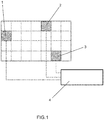
- Figure 1 Shows a set of photovoltaic modules arranged in one same plane, which make up a photovoltaic generator, and with a device for simultaneously measuring the I-V curves of three modules and of the temperatures of the centre of the rear face thereof.
- the present invention relates, as mentioned previously, to a method and a device for estimating equivalent temperature in photovoltaic modules.
- Figure 1 shows a diagram of a photovoltaic generator made up of multiple modules, including a reference photovoltaic module (1), the characteristics of which at standard test conditions (STC) are well-known beforehand and which will act as a reference, and a first test photovoltaic module (2) and a second test photovoltaic module (3), the characteristics of which at STC are to be determined.
- STC standard test conditions
- the operations of the generator are interrupted, such that current does not circulate through it, and the connections to the three photovoltaic modules (1, 2, 3) are opened, such that the respective poles (positive and negative poles of each module) can be accessed.
- the measuring device (4) (represented only by a box in Figure 1 ) is made up of three identical I-V curve tracers (current intensity vs. voltage curves) (for example, capacitive loads with the same load capacity) which are connected to the respective modules thereof, and three temperature sensors (for example, infrared (IR) pointers which are each focused on the centre of the rear face of each of the modules).
- I-V curve tracers current intensity vs. voltage curves
- IR infrared
- the measuring device (4) also includes synchronisation means (for example, a button which sends a single firing signal to the switches of the three capacitive loads) which enables both the I-V curves of the three photovoltaic modules (1, 2, 3) and the temperatures observed in the respective centres of the rear faces thereof to be registered simultaneously.
- synchronisation means for example, a button which sends a single firing signal to the switches of the three capacitive loads
- the device (4) includes processing means (a microprocessor or similar device) wherein the algorithm/method is implemented for estimating with low uncertainty the equivalent temperature of the photovoltaic modules (1, 2, 3) to be measured.
- processing means a microprocessor or similar device
- the overall method thereof includes the following steps:
Landscapes
- Physics & Mathematics (AREA)
- General Physics & Mathematics (AREA)
- Photovoltaic Devices (AREA)
- Testing Of Individual Semiconductor Devices (AREA)
Abstract
Description
- The present invention relates to a method for estimating equivalent temperature in photovoltaic modules for the characterization thereof in real sunlight with low uncertainty, in its own location thereof.
- The present invention also relates to the device for estimating equivalent temperature in photovoltaic modules by means of which the aforementioned method can be implemented.
- The method and the device for estimating equivalent temperature in photovoltaic modules object of the present invention are applicable to the field of the industry dedicated to the design, management and maintenance of photovoltaic panels.
- Photovoltaic generators are made up of multiple photovoltaic modules connected in series and in parallel, in order to achieve the power, voltage and current levels required by the applications for which they provide electrical energy.
- The electrical behaviour of the generators and of the modules that form them is characterised by their electrical response to the so-called Standard Test Conditions (STC).
- These Standard Test Conditions are equivalent to:
- Irradiance: 1,000 W/m2;
- Spectral distribution: AM 1.5;
- Angle of incidence of solar rays: perpendicular to the surface of the module;
- Cell temperature: 25 °C.
- Normally, the electrical response is understood as the I-V curve (current intensity vs. voltage) in the first quadrant (positive voltages and current), and the most relevant characteristics, such as the short-circuit current, the open-circuit voltage and the power at the maximum power point, are derived from this response.
- The standard method for measuring the I-V curve at STC consists of using solar simulators, which are sets of equipment able to precisely impose the STC conditions, such that if they are calibrated correctly, they produce results with low uncertainty.
- Module manufacturing plants as well as labs specialised in photovoltaic technology have solar simulators among their equipment. From the I-V curve thus measured, the characteristic values of some particularly relevant parameters are determined, such as the maximum power delivered by the module at STC, which shall be called

- Alternatively to provoking the standard test conditions (STC) by means of solar simulators, in principle it is also possible to measure the electrical response in real sunlight, meaning, in any operating condition (irradiance ≠ 1,000 W/m2; spectrum ≠ AM 1.5; angle of incidence other than perpendicular and a cell temperature different than 25 °C) and subsequently correcting the response thus measured at STC. A particularly simple way to do this consists of simultaneously measuring the I-V curves of the module to be characterised and of another module with electrical response characteristics at STC which are well-known beforehand (for example, because they have been previously measured in a solar simulator) and which act as a reference, taking care that both modules are coplanar. Therefore, starting from the assumption that both modules receive the same solar irradiance and that both work at the same temperature, the electrical characteristics at STC of the first module can be estimated. For example, limiting ourselves to the power, these assumptions are translated into:

- Wherein the subscripts "C" and "R" indicate, respectively, the module to be characterised and the module acting as a reference.
- Another way to obtain the electrical characteristic at STC of a photovoltaic module starting from measurements in real sunlight, this time without needing to use a reference module, consists of directly correcting the I-V curve measured in the module to be characterised by means of a mathematical process such as, for example, the one prescribed in standard IEC 60891.
- However, and completely independent of the manner chosen, this way of measuring in real sunlight always involves additional uncertainty due to the difficulties of estimating the operating conditions in real sunlight which, in one way or another, are always present in that correction.
- For the purpose of estimating the equivalent operating temperature of the photovoltaic module in real sunlight, it must be noted that, on one hand, the temperature of the module is not homogeneous, neither throughout one same module (the temperature varies from one cell of the module to another) nor throughout one same generator (which makes it so there is no one point where a representative temperature of the thermal behaviour of the assembly of the module can be measured) and, moreover, the encapsulation itself of the photovoltaic modules hinders measuring that temperature directly.
- Thus the elevated uncertainty of direct measurements in real sunlight and subsequent correction at STC makes it so that, currently, periodic measurement campaigns of samples of modules, envisaged in many processes for ensuring technical quality of the photovoltaic plants, are mostly performed with solar simulators. This either requires the modules to be moved to a specialised laboratory equipped with said equipment, or a portable solar simulator must be moved to the photovoltaic plant like the one described in
WO 2014/083212 A1 . In both cases, this manner of measuring requires disassembling the modules of the location where they normally operate, before they are carried to the simulator, and reassembling them once they have been measured. This handling is frankly inconvenient since, in addition to being expensive in time and labour, they represent a significant risk for the physical integrity of the modules. More specifically, this handling is likely to create cracks in the solar cells which, in turn, can turn into hot points which affect the lifespan of the modules. - The objective technical problem presented, therefore, is that of providing a method and means for measuring in order to characterize the electrical behaviour at STC of a photovoltaic module (or group of modules), starting from measurements in real sunlight, without needing to disassemble it at its original location such that the resulting uncertainty is as low as the one corresponding to measurements performed in solar simulators.
- With the object of providing a solution to the aforementioned problems, the following method and device for estimating equivalent temperature in photovoltaic modules are presented.
- The method for estimating equivalent temperature in photovoltaic modules object of the present invention comprises the following steps:
- performing, simultaneously and at random test conditions, the following measurements:
- ∘ current intensity vs. voltage curve of a reference photovoltaic module, of which the current intensity vs. voltage curve thereof is known at standard test conditions;
- ∘ current intensity vs. voltage curve of at least one first test photovoltaic module, from which the electrical characteristics thereof at standard test conditions are to be obtained;
- ∘ temperature of a specific area of the reference photovoltaic module and of the at least one first test photovoltaic module;
- estimating the equivalent temperature of the reference photovoltaic module by means of the following expression:

- Teq,R is the equivalent temperature of the reference photovoltaic module at the mentioned random test conditions;
-

- V 0 R is the open-circuit voltage of the reference photovoltaic module obtained from the current intensity vs. voltage curve at the mentioned random test conditions;
-


- β is a predetermined temperature coefficient of the reference photovoltaic module (typically associated with

- Thus, deriving the temperature of the module from the open-circuit voltage thereof is a way of compensating the temperature dispersion throughout the very module and results, for this reason, in lower uncertainty than directly measuring the temperature at one point.
- estimating the equivalent temperature of the at least one first test photovoltaic module by means of the following expression:

- T eq,C is the equivalent temperature of the at least one first test photovoltaic module at the mentioned random test conditions;
- T Z,C is the temperature measured from a specific area of the at least one first test photovoltaic module;
- T Z,R is the temperature measured from a specific area of the reference photovoltaic module.
- The difference in temperature between areas enables the temperature dispersion throughout the generator to be compensated which translates into minimising uncertainty.
- Preferably, the method for estimating equivalent temperature in photovoltaic modules comprises using at least one infrared-pointer temperature sensor to measure the temperature of a specific area of the reference photovoltaic module and of the at least one first test photovoltaic module.
- More preferably, the method of the invention comprises focusing, respectively, each of the mentioned infrared pointers on the centre of the rear face of each photovoltaic module.
- In any case, preferably, the specific area of the reference photovoltaic module and of the at least one first test photovoltaic module where the temperature is measured, is an area of said photovoltaic modules that is accessible and free of obstacles in a permanent work location of said modules.
- According to a possible embodiment, the method of the invention comprises associating an effective solar irradiance value to the estimated equivalent temperatures of the reference photovoltaic module and of the at least one first test photovoltaic module.
- Said effective solar irradiance is calculated starting from the current intensity vs. voltage curve of the reference photovoltaic module at the mentioned random test conditions, and depending on the current intensity vs. voltage curve of the reference photovoltaic module at the standard test conditions, by means of the following expression:

- G is the effective solar irradiance to be associated with the estimated equivalent temperatures of the reference photovoltaic module and of the at least one first test photovoltaic module;
- G* is the effective solar irradiance associated with the standard test conditions;
-

- I SC,R is the short-circuit current intensity of the reference photovoltaic module obtained from the current intensity vs. voltage curve at the mentioned random test conditions.
- As mentioned, the present invention also relates to a device for estimating equivalent temperature in photovoltaic modules.
- The device for estimating equivalent temperature in photovoltaic modules object of the present invention includes:
- a first set of equipment for tracing current intensity vs. voltage curves, configured to measure the current intensity vs. voltage curve of a reference photovoltaic module at random test conditions;
- at least one second set of equipment for tracing current intensity vs. voltage curves, configured to measure the current intensity vs. voltage curve of at least one first test photovoltaic module at random test conditions;
- a first device for measuring temperature, configured to measure a temperature in an area of the reference photovoltaic module;
- at least one second device for measuring temperature, configured to measure a temperature in an area of the at least one first test photovoltaic module;
- synchronisation means of the sets of equipment for tracing current intensity vs. voltage curves, and;
- processing means configured to estimate the equivalent temperature of the reference photovoltaic module and of the at least one first test photovoltaic module at the mentioned random test conditions. Preferably, at least one of the two devices for measuring temperature is an infrared-pointer temperature sensor.
- According to a possible embodiment, the sets of equipment for tracing current intensity vs. voltage curves have capacitive loads, optionally with the same load capacity as each other.
- Likewise, the synchronisation means can include a button, configured to send a simultaneous firing signal to the modules for registering current intensity vs. voltage curves.
- According to a specific embodiment of the device of the invention, the processing means are configured to calculate an effective solar irradiance value associated with the estimated equivalent temperatures of the reference photovoltaic module and of the at least one first test photovoltaic module.
- Additionally, according to a possible embodiment of the device, the processing means are configured to calculate the electrical characteristics of the at least one first test photovoltaic module at standard test conditions, starting from the current intensity vs. voltage curve obtained (at the mentioned random test conditions)of said at least one first test photovoltaic module and starting from the estimated equivalent temperature (at the mentioned random test conditions) of said at least one first test photovoltaic module.
- Likewise, according to a possible embodiment, the processing means are configured to calculate the electrical characteristics of the at least one first test photovoltaic module at standard test conditions, being based on the effective solar irradiance value associated with the estimated equivalent temperature of the test photovoltaic module.
- Once the current intensity vs. voltage curve has been obtained at the random test conditions and once the equivalent temperature of the at least one first test photovoltaic module is obtained at the random test conditions, the electrical characteristics of the at least one first test photovoltaic module can be obtained as prescribed in standard IEC 60891.
- Alternatively, the electrical characteristics of the at least one first test photovoltaic module can be obtained starting from [Equation 1] indicated above, but adding a correction factor to it which takes into account the described manner of calculating the equivalent temperature of the photovoltaic module, as described by the following equation:


- As a part of the explanation of at least one preferred embodiment of the method and the device for estimating equivalent temperature in photovoltaic modules, the following figure has been included, which by way of illustration and not limitation represents the following.
-
Figure 1 : Shows a set of photovoltaic modules arranged in one same plane, which make up a photovoltaic generator, and with a device for simultaneously measuring the I-V curves of three modules and of the temperatures of the centre of the rear face thereof. - The present invention relates, as mentioned previously, to a method and a device for estimating equivalent temperature in photovoltaic modules.
-
Figure 1 shows a diagram of a photovoltaic generator made up of multiple modules, including a reference photovoltaic module (1), the characteristics of which at standard test conditions (STC) are well-known beforehand and which will act as a reference, and a first test photovoltaic module (2) and a second test photovoltaic module (3), the characteristics of which at STC are to be determined. - Beforehand, the operations of the generator are interrupted, such that current does not circulate through it, and the connections to the three photovoltaic modules (1, 2, 3) are opened, such that the respective poles (positive and negative poles of each module) can be accessed.
- The measuring device (4) (represented only by a box in
Figure 1 ) is made up of three identical I-V curve tracers (current intensity vs. voltage curves) (for example, capacitive loads with the same load capacity) which are connected to the respective modules thereof, and three temperature sensors (for example, infrared (IR) pointers which are each focused on the centre of the rear face of each of the modules). - Generally, there are as many curve tracers and as many temperature sensors as test photovoltaic modules plus one (for the reference photovoltaic module).
- The measuring device (4) also includes synchronisation means (for example, a button which sends a single firing signal to the switches of the three capacitive loads) which enables both the I-V curves of the three photovoltaic modules (1, 2, 3) and the temperatures observed in the respective centres of the rear faces thereof to be registered simultaneously.
- Finally, the device (4) includes processing means (a microprocessor or similar device) wherein the algorithm/method is implemented for estimating with low uncertainty the equivalent temperature of the photovoltaic modules (1, 2, 3) to be measured.
- The application of this algorithm is followed by the application of another algorithm (for example, the one described by [Equation 5], the one prescribed in standard IEC 60891 or any other one with the same purpose) to transfer the measured I-V curves of the test photovoltaic modules (2, 3) at STC, which is the context wherein the algorithm for estimating temperature object of the present invention shows the utility thereof, by minimising the uncertainty associated with the transfer.
- The overall method thereof includes the following steps:
- Determining the effective irradiance on the reference photovoltaic module (1) starting from the value of the short-circuit current obtained from the I-V curve of this module. Supposing that this irradiance is the same as that of the first test photovoltaic module (2) to be characterised. By way of example, the method for determining the effective irradiance can be described by [Equation 4].
- Determining the equivalent temperatures T eq,R , T eq,C , of the reference photovoltaic module (1) and of the first test photovoltaic module (2). To do so:
- ∘ Determining the equivalent temperature, T eq,R , of the reference photovoltaic module (1) starting from the open-circuit voltage, V 0 R , obtained from the I-V curve of this module, for example, by means of [Equation 2].
- ∘ Determining the equivalent temperature, T eq,C , of the first test photovoltaic module (2) by supposing that the equivalent temperature results from correcting that of the reference photovoltaic module (1) with the difference between the temperatures observed in the centres of the back faces of the reference photovoltaic module (1) and of the first test photovoltaic module (2) according to [Equation 3].
- Correcting the I-V curve of the first test photovoltaic module (2) at STC, following the provisions of standard IEC 60891 or any other similar method, taking the temperature calculated in the previous step as the equivalent temperature.
- Extracting the characteristics at STC of the first test photovoltaic module (2) (maximum power, short-circuit current and open-circuit voltage) starting from the curve corrected in this manner. By way of example, [Equation 5] enables this step and the previous one to be performed together.
- Repeating the method described in the previous points for the second test photovoltaic module (3).
Claims (13)
- A method for estimating equivalent temperature in photovoltaic modules that comprises:- performing, simultaneously and at random test conditions, the following measurements:∘ current intensity vs. voltage curve of a reference photovoltaic module (1), of which the current intensity vs. voltage curve thereof is known at standard test conditions;∘ current intensity vs. voltage curve of at least one first test photovoltaic module (2), from which the electrical characteristics thereof at standard test conditions are to be obtained;∘ temperature of a specific area of the reference photovoltaic module (1) and of the at least one first test photovoltaic module (2);- estimating the equivalent temperature of the reference photovoltaic module (1) by means of the following expression:
 T eq,R is the equivalent temperature of the reference photovoltaic module (1) at the mentioned random test conditions;
 V 0 R is the open-circuit voltage of the reference photovoltaic module (1) obtained from the current intensity vs. voltage curve at the mentioned random test conditions;
 β is a predetermined temperature coefficient of the reference photovoltaic module (1);
characterized in that it comprises- estimating the equivalent temperature of the at least one first test photovoltaic module (2) by means of the following expression: T eq,C is the equivalent temperature of the at least one first test photovoltaic module (2) at the mentioned random test conditions;T Z,C is the measured temperature of a specific area of the at least one first test photovoltaic module (2);T Z,R is the measured temperature of a specific area of the reference photovoltaic module (1).
 - The method for estimating equivalent temperature in photovoltaic modules according to claim 1, wherein it comprises using at least one infrared-pointer temperature sensor to measure the temperature of a specific area of the reference photovoltaic module (1) and of the at least one first test photovoltaic module (2).
- The method for estimating equivalent temperature in photovoltaic modules according to claim 2, wherein it comprises focusing, respectively, each of the infrared pointers on the centre of the back face of each photovoltaic module.
- The method for estimating equivalent temperature in photovoltaic modules according to any of the preceding claims, wherein the specific area of the reference photovoltaic module (1) and of the at least one first test photovoltaic module (2) where the temperature is measured, is an area of said photovoltaic modules that is accessible and free of obstacles in a permanent work location of said modules.
- The method for estimating equivalent temperature in photovoltaic modules according to any of the preceding claims, wherein it comprises associating an effective solar irradiance with the estimated equivalent temperatures of the reference photovoltaic module (1) and of the at least one first test photovoltaic module (2), wherein said effective solar irradiance is calculated starting from the current intensity vs. voltage curve of the reference photovoltaic module (1) at the mentioned random test conditions, and depending on the current intensity vs. voltage curve of the reference photovoltaic module (1) at standard test conditions, by means of the following expression:
 G is the effective solar irradiance to be associated with the estimated equivalent temperatures of the reference photovoltaic module (1) and of the at least one first test photovoltaic module (2);G* is the effective solar irradiance associated with the standard test conditions;
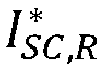 I SC,R is the short-circuit current intensity of the reference photovoltaic module (1) obtained from the current intensity vs. voltage curve at the mentioned random test conditions.
 - A device (4) for estimating equivalent temperature in photovoltaic modules characterised in that it comprises:- a first set of equipment for tracing current intensity vs. voltage curves, configured to measure the current intensity vs. voltage curve of a reference photovoltaic module (1) at random test conditions;- at least one second set of equipment for tracing current intensity vs. voltage curves, configured to measure the current intensity vs. voltage curve of at least one first test photovoltaic module (2) at random test conditions;- a first device for measuring temperature, configured to measure a temperature in an area of the reference photovoltaic module (1);- at least one second device for measuring temperature, configured to measure a temperature in an area of the at least one first test photovoltaic module (2);- synchronisation means of the modules for registering current intensity vs. voltage curves, and;- processing means configured to estimate the equivalent temperature of the reference photovoltaic module (1) and of the at least one first test photovoltaic module (2) at the mentioned random test conditions.
- The device for estimating equivalent temperature in photovoltaic modules according to claim 5, wherein at least one of the modules for measuring temperature is an infrared-pointer temperature sensor.
- The device for estimating equivalent temperature in photovoltaic modules according to any of claims 6 or 7, wherein the modules for registering current intensity vs. voltage curves are capacitive loads.
- The device for estimating equivalent temperature in photovoltaic modules according to any of claims 6 to 8, wherein the synchronisation means comprise a button, configured to send a simultaneous firing signal to the sets of equipment for tracing current intensity vs. voltage curves.
- The device for estimating equivalent temperature in photovoltaic modules according to any of claims 6 to 9, wherein the processing means are configured to estimate the equivalent temperature of the reference photovoltaic module (1), by means of the following expression:
 T eq,R is the equivalent temperature of the reference photovoltaic module at the mentioned random test conditions;
 V 0 R is the open-circuit voltage of the reference photovoltaic module obtained from the current intensity vs. voltage curve at the mentioned random test conditions;
 β is a predetermined temperature coefficient of the reference photovoltaic module (1);and wherein the processing means are configured to estimate the equivalent temperature of the at least one first test photovoltaic module (2) by means of the following expression:
 T eq,C is the equivalent temperature of the at least one first test photovoltaic module at the mentioned random test conditions;T Z,C is the temperature measured from a specific area of the at least one first test photovoltaic module (2);T Z,R is the temperature measured from a specific area of the reference photovoltaic module (1).
 - The device for estimating equivalent temperature in photovoltaic modules according to any of claims 6 to 10, wherein the processing means are configured to calculate an effective solar irradiance value associated with the estimated equivalent temperatures of the reference photovoltaic module (1) and of the at least one first test photovoltaic module (2), wherein said calculation is made by means of the following expression:
 G is the effective solar irradiance to be associated with the estimated equivalent temperatures of the reference photovoltaic module (1) and of the at least one first test photovoltaic module (2);G* is the effective solar irradiance associated with the standard test conditions;
 I SC,R is the short-circuit current intensity of the reference photovoltaic module (1) obtained from the current intensity vs. voltage curve at the mentioned random test conditions.
 - The device for estimating equivalent temperature in photovoltaic modules according to any of claims 6 to 11, wherein the processing means are configured to calculate the electrical characteristics of the at least one first test photovoltaic module (2) at standard test conditions, starting from the current intensity vs. voltage curve of said first test photovoltaic module (2) at the mentioned random test conditions and starting from the estimated equivalent temperature of said at least one first test photovoltaic module (2) at the mentioned random test conditions, wherein said calculation is made by means of the following expression:
 wherein
 wherein
- The device for estimating equivalent temperature in photovoltaic modules according to claims 11 and 12, wherein the processing means are configured to calculate the electrical characteristics of the at least one first test photovoltaic module (2) at standard test conditions, being based on the effective solar irradiance value associated with the estimated equivalent temperature of the test photovoltaic module (2).
Applications Claiming Priority (2)
| Application Number | Priority Date | Filing Date | Title |
|---|---|---|---|
| ES201830221A ES2665811B2 (en) | 2018-03-07 | 2018-03-07 | Procedure and device for estimating the equivalent temperature in photovoltaic modules |
| PCT/ES2019/070133 WO2019170949A1 (en) | 2018-03-07 | 2019-03-06 | Method and device for estimating equivalent temperature in photovoltaic modules |
Publications (1)
| Publication Number | Publication Date |
|---|---|
| EP3764540A1 true EP3764540A1 (en) | 2021-01-13 |
Family
ID=61985186
Family Applications (1)
| Application Number | Title | Priority Date | Filing Date |
|---|---|---|---|
| EP19733091.3A Withdrawn EP3764540A1 (en) | 2018-03-07 | 2019-03-06 | Method and device for estimating equivalent temperature in photovoltaic modules |
Country Status (3)
| Country | Link |
|---|---|
| EP (1) | EP3764540A1 (en) |
| ES (1) | ES2665811B2 (en) |
| WO (1) | WO2019170949A1 (en) |
Family Cites Families (11)
| Publication number | Priority date | Publication date | Assignee | Title |
|---|---|---|---|---|
| ES2382796B2 (en) * | 2009-10-07 | 2012-09-27 | Universidad Politécnica de Madrid | SYSTEM AND PROCEDURE FOR THE ELECTRICAL CHARACTERIZATION OF PHOTOVOLTAIC POWER PLANTS CONNECTED TO THE NETWORK. |
| CN103250260A (en) * | 2010-12-02 | 2013-08-14 | 陶氏环球技术有限责任公司 | Photovoltaic device for measuring irradiance and temperature |
| JP5732873B2 (en) * | 2011-01-31 | 2015-06-10 | 株式会社日立製作所 | Method for calculating characteristics of solar cell and photovoltaic power generation system |
| US8952715B2 (en) * | 2012-11-14 | 2015-02-10 | Stratasense LLC | Wireless current-voltage tracer with uninterrupted bypass system and method |
| WO2014083212A1 (en) | 2012-11-29 | 2014-06-05 | Enertis Solar, S.L. | Test laboratory comprising photovoltaic modules |
| WO2014144337A1 (en) * | 2013-03-15 | 2014-09-18 | On Behalf Of The Regents Of The University Of Colorado, A Body Corporate, | Neural network solar irradiance sensor |
| US10784815B2 (en) * | 2013-04-13 | 2020-09-22 | Sigmagen, Inc. | Solar photovoltaic module remote access module switch and real-time temperature monitoring |
| CN106685358A (en) * | 2015-11-10 | 2017-05-17 | 华电电力科学研究院 | Auxiliary platform for photovoltaic power station assembly I-V performance test |
| CN105897161B (en) * | 2016-06-06 | 2018-05-22 | 河海大学常州校区 | A kind of test method of the outdoor photovoltaic module detecting system based on dynamic capacity charge and discharge |
| US10985694B2 (en) * | 2016-07-15 | 2021-04-20 | Enphase Energy, Inc. | Method and apparatus for determining key performance photovoltaic characteristics using sensors from module-level power electronics |
| CN106597151B (en) * | 2016-12-02 | 2021-01-15 | 中国电力科学研究院有限公司 | Photovoltaic power station switched inverter tracking efficiency testing method and system |
-
2018
- 2018-03-07 ES ES201830221A patent/ES2665811B2/en not_active Expired - Fee Related
-
2019
- 2019-03-06 WO PCT/ES2019/070133 patent/WO2019170949A1/en not_active Ceased
- 2019-03-06 EP EP19733091.3A patent/EP3764540A1/en not_active Withdrawn
Also Published As
| Publication number | Publication date |
|---|---|
| WO2019170949A1 (en) | 2019-09-12 |
| ES2665811A1 (en) | 2018-04-27 |
| ES2665811B2 (en) | 2020-06-01 |
Similar Documents
| Publication | Publication Date | Title |
|---|---|---|
| Mermoud et al. | Performance assessment of a simulation model for PV modules of any available technology | |
| Ma et al. | Development of a model to simulate the performance characteristics of crystalline silicon photovoltaic modules/strings/arrays | |
| Chaibi et al. | Solar irradiance and temperature influence on the photovoltaic cell equivalent-circuit models | |
| Martínez‐Moreno et al. | On the testing of large PV arrays | |
| Fébba et al. | Impacts of temperature and irradiance on polycrystalline silicon solar cells parameters | |
| De Blas et al. | Selecting a suitable model for characterizing photovoltaic devices | |
| Whitaker et al. | Application and validation of a new PV performance characterization method | |
| Tossa et al. | A new approach to estimate the performance and energy productivity of photovoltaic modules in real operating conditions | |
| Makrides et al. | Energy yield prediction errors and uncertainties of different photovoltaic models | |
| Silvestre et al. | Automatic fault detection in grid connected PV systems | |
| Marion et al. | Current–voltage curve translation by bilinear interpolation | |
| Lappalainen et al. | Experimental comparison between various fitting approaches based on RMSE minimization for photovoltaic module parametric identification | |
| Dubey et al. | Measurement of temperature coefficient of photovoltaic modules in field and comparison with laboratory measurements | |
| Saetre et al. | A new analytical solar cell I–V curve model | |
| Muñoz et al. | DC energy yield prediction in large monocrystalline and polycrystalline PV plants: Time-domain integration of Osterwald's model | |
| CN107786164A (en) | A kind of method for assessing photovoltaic power station component decay | |
| JP6806325B2 (en) | Photovoltaic system evaluation device, evaluation method, and program for evaluation device | |
| CN106803742A (en) | A kind of detection method for photovoltaic plant scene photovoltaic group string uniformity and efficiency | |
| JPH1131829A (en) | Solar cell quality judgment method | |
| Garcia-Marrero et al. | Challenges in photovoltaic parameter identification under mismatching conditions | |
| Golive et al. | Investigation of accuracy of various STC correction procedures for IV characteristics of PV modules measured at different temperature and irradiances | |
| CN204788900U (en) | Solar simulator irradiance, irradiation homogeneity and stable detection device | |
| CN104253586A (en) | Online measurement and evaluation device and method for electrical parameters of solar cell panel | |
| Ma et al. | Online extraction of physical parameters of photovoltaic modules in a building-integrated photovoltaic system | |
| BILLEWICZ et al. | Laboratory Stand for Examining the Influence of Environmental Conditions on Electrical Parameters of Photovoltaic Cells. |
Legal Events
| Date | Code | Title | Description |
|---|---|---|---|
| STAA | Information on the status of an ep patent application or granted ep patent |
Free format text: STATUS: UNKNOWN |
|
| STAA | Information on the status of an ep patent application or granted ep patent |
Free format text: STATUS: THE INTERNATIONAL PUBLICATION HAS BEEN MADE |
|
| PUAI | Public reference made under article 153(3) epc to a published international application that has entered the european phase |
Free format text: ORIGINAL CODE: 0009012 |
|
| STAA | Information on the status of an ep patent application or granted ep patent |
Free format text: STATUS: REQUEST FOR EXAMINATION WAS MADE |
|
| 17P | Request for examination filed |
Effective date: 20200922 |
|
| AK | Designated contracting states |
Kind code of ref document: A1 Designated state(s): AL AT BE BG CH CY CZ DE DK EE ES FI FR GB GR HR HU IE IS IT LI LT LU LV MC MK MT NL NO PL PT RO RS SE SI SK SM TR |
|
| AX | Request for extension of the european patent |
Extension state: BA ME |
|
| RIN1 | Information on inventor provided before grant (corrected) |
Inventor name: LORENZO PIGUEIRAS, EDUARDO Inventor name: CARRILLO SALINAS, JOSE MANUEL Inventor name: NARVARTE FERNANDEZ, LUIS Inventor name: MARTINEZ MORENO, FRANCISCO |
|
| DAV | Request for validation of the european patent (deleted) | ||
| DAX | Request for extension of the european patent (deleted) | ||
| GRAP | Despatch of communication of intention to grant a patent |
Free format text: ORIGINAL CODE: EPIDOSNIGR1 |
|
| STAA | Information on the status of an ep patent application or granted ep patent |
Free format text: STATUS: GRANT OF PATENT IS INTENDED |
|
| INTG | Intention to grant announced |
Effective date: 20220209 |
|
| STAA | Information on the status of an ep patent application or granted ep patent |
Free format text: STATUS: THE APPLICATION IS DEEMED TO BE WITHDRAWN |
|
| 18D | Application deemed to be withdrawn |
Effective date: 20220621 |