EP3763779A1 - Lubricant composition and method of preparing copolymer using the same - Google Patents
Lubricant composition and method of preparing copolymer using the same Download PDFInfo
- Publication number
- EP3763779A1 EP3763779A1 EP20182730.0A EP20182730A EP3763779A1 EP 3763779 A1 EP3763779 A1 EP 3763779A1 EP 20182730 A EP20182730 A EP 20182730A EP 3763779 A1 EP3763779 A1 EP 3763779A1
- Authority
- EP
- European Patent Office
- Prior art keywords
- lubricant composition
- polymerization
- based compound
- composition according
- monomer
- Prior art date
- Legal status (The legal status is an assumption and is not a legal conclusion. Google has not performed a legal analysis and makes no representation as to the accuracy of the status listed.)
- Granted
Links
- 0 *c1c(*)c(O*)c(*)c(*)c1O Chemical compound *c1c(*)c(O*)c(*)c(*)c1O 0.000 description 1
Images

Classifications
-
- C—CHEMISTRY; METALLURGY
- C08—ORGANIC MACROMOLECULAR COMPOUNDS; THEIR PREPARATION OR CHEMICAL WORKING-UP; COMPOSITIONS BASED THEREON
- C08F—MACROMOLECULAR COMPOUNDS OBTAINED BY REACTIONS ONLY INVOLVING CARBON-TO-CARBON UNSATURATED BONDS
- C08F2/00—Processes of polymerisation
- C08F2/38—Polymerisation using regulators, e.g. chain terminating agents, e.g. telomerisation
- C08F2/42—Polymerisation using regulators, e.g. chain terminating agents, e.g. telomerisation using short-stopping agents
-
- C—CHEMISTRY; METALLURGY
- C10—PETROLEUM, GAS OR COKE INDUSTRIES; TECHNICAL GASES CONTAINING CARBON MONOXIDE; FUELS; LUBRICANTS; PEAT
- C10M—LUBRICATING COMPOSITIONS; USE OF CHEMICAL SUBSTANCES EITHER ALONE OR AS LUBRICATING INGREDIENTS IN A LUBRICATING COMPOSITION
- C10M169/00—Lubricating compositions characterised by containing as components a mixture of at least two types of ingredient selected from base-materials, thickeners or additives, covered by the preceding groups, each of these compounds being essential
- C10M169/04—Mixtures of base-materials and additives
-
- C—CHEMISTRY; METALLURGY
- C08—ORGANIC MACROMOLECULAR COMPOUNDS; THEIR PREPARATION OR CHEMICAL WORKING-UP; COMPOSITIONS BASED THEREON
- C08F—MACROMOLECULAR COMPOUNDS OBTAINED BY REACTIONS ONLY INVOLVING CARBON-TO-CARBON UNSATURATED BONDS
- C08F110/00—Homopolymers of unsaturated aliphatic hydrocarbons having only one carbon-to-carbon double bond
- C08F110/02—Ethene
-
- C—CHEMISTRY; METALLURGY
- C08—ORGANIC MACROMOLECULAR COMPOUNDS; THEIR PREPARATION OR CHEMICAL WORKING-UP; COMPOSITIONS BASED THEREON
- C08F—MACROMOLECULAR COMPOUNDS OBTAINED BY REACTIONS ONLY INVOLVING CARBON-TO-CARBON UNSATURATED BONDS
- C08F2/00—Processes of polymerisation
- C08F2/002—Scale prevention in a polymerisation reactor or its auxiliary parts
- C08F2/005—Scale prevention in a polymerisation reactor or its auxiliary parts by addition of a scale inhibitor to the polymerisation medium
-
- C—CHEMISTRY; METALLURGY
- C08—ORGANIC MACROMOLECULAR COMPOUNDS; THEIR PREPARATION OR CHEMICAL WORKING-UP; COMPOSITIONS BASED THEREON
- C08F—MACROMOLECULAR COMPOUNDS OBTAINED BY REACTIONS ONLY INVOLVING CARBON-TO-CARBON UNSATURATED BONDS
- C08F210/00—Copolymers of unsaturated aliphatic hydrocarbons having only one carbon-to-carbon double bond
- C08F210/02—Ethene
-
- C—CHEMISTRY; METALLURGY
- C08—ORGANIC MACROMOLECULAR COMPOUNDS; THEIR PREPARATION OR CHEMICAL WORKING-UP; COMPOSITIONS BASED THEREON
- C08F—MACROMOLECULAR COMPOUNDS OBTAINED BY REACTIONS ONLY INVOLVING CARBON-TO-CARBON UNSATURATED BONDS
- C08F220/00—Copolymers of compounds having one or more unsaturated aliphatic radicals, each having only one carbon-to-carbon double bond, and only one being terminated by only one carboxyl radical or a salt, anhydride ester, amide, imide or nitrile thereof
- C08F220/02—Monocarboxylic acids having less than ten carbon atoms; Derivatives thereof
- C08F220/04—Acids; Metal salts or ammonium salts thereof
- C08F220/06—Acrylic acid; Methacrylic acid; Metal salts or ammonium salts thereof
-
- C—CHEMISTRY; METALLURGY
- C08—ORGANIC MACROMOLECULAR COMPOUNDS; THEIR PREPARATION OR CHEMICAL WORKING-UP; COMPOSITIONS BASED THEREON
- C08F—MACROMOLECULAR COMPOUNDS OBTAINED BY REACTIONS ONLY INVOLVING CARBON-TO-CARBON UNSATURATED BONDS
- C08F220/00—Copolymers of compounds having one or more unsaturated aliphatic radicals, each having only one carbon-to-carbon double bond, and only one being terminated by only one carboxyl radical or a salt, anhydride ester, amide, imide or nitrile thereof
- C08F220/02—Monocarboxylic acids having less than ten carbon atoms; Derivatives thereof
- C08F220/10—Esters
- C08F220/12—Esters of monohydric alcohols or phenols
- C08F220/16—Esters of monohydric alcohols or phenols of phenols or of alcohols containing two or more carbon atoms
- C08F220/18—Esters of monohydric alcohols or phenols of phenols or of alcohols containing two or more carbon atoms with acrylic or methacrylic acids
-
- C—CHEMISTRY; METALLURGY
- C08—ORGANIC MACROMOLECULAR COMPOUNDS; THEIR PREPARATION OR CHEMICAL WORKING-UP; COMPOSITIONS BASED THEREON
- C08K—Use of inorganic or non-macromolecular organic substances as compounding ingredients
- C08K5/00—Use of organic ingredients
- C08K5/04—Oxygen-containing compounds
- C08K5/13—Phenols; Phenolates
-
- C—CHEMISTRY; METALLURGY
- C08—ORGANIC MACROMOLECULAR COMPOUNDS; THEIR PREPARATION OR CHEMICAL WORKING-UP; COMPOSITIONS BASED THEREON
- C08K—Use of inorganic or non-macromolecular organic substances as compounding ingredients
- C08K5/00—Use of organic ingredients
- C08K5/36—Sulfur-, selenium-, or tellurium-containing compounds
- C08K5/45—Heterocyclic compounds having sulfur in the ring
- C08K5/46—Heterocyclic compounds having sulfur in the ring with oxygen or nitrogen in the ring
-
- C—CHEMISTRY; METALLURGY
- C08—ORGANIC MACROMOLECULAR COMPOUNDS; THEIR PREPARATION OR CHEMICAL WORKING-UP; COMPOSITIONS BASED THEREON
- C08L—COMPOSITIONS OF MACROMOLECULAR COMPOUNDS
- C08L33/00—Compositions of homopolymers or copolymers of compounds having one or more unsaturated aliphatic radicals, each having only one carbon-to-carbon double bond, and only one being terminated by only one carboxyl radical, or of salts, anhydrides, esters, amides, imides or nitriles thereof; Compositions of derivatives of such polymers
- C08L33/02—Homopolymers or copolymers of acids; Metal or ammonium salts thereof
-
- C—CHEMISTRY; METALLURGY
- C10—PETROLEUM, GAS OR COKE INDUSTRIES; TECHNICAL GASES CONTAINING CARBON MONOXIDE; FUELS; LUBRICANTS; PEAT
- C10M—LUBRICATING COMPOSITIONS; USE OF CHEMICAL SUBSTANCES EITHER ALONE OR AS LUBRICATING INGREDIENTS IN A LUBRICATING COMPOSITION
- C10M101/00—Lubricating compositions characterised by the base-material being a mineral or fatty oil
- C10M101/02—Petroleum fractions
-
- C—CHEMISTRY; METALLURGY
- C10—PETROLEUM, GAS OR COKE INDUSTRIES; TECHNICAL GASES CONTAINING CARBON MONOXIDE; FUELS; LUBRICANTS; PEAT
- C10M—LUBRICATING COMPOSITIONS; USE OF CHEMICAL SUBSTANCES EITHER ALONE OR AS LUBRICATING INGREDIENTS IN A LUBRICATING COMPOSITION
- C10M129/00—Lubricating compositions characterised by the additive being an organic non-macromolecular compound containing oxygen
- C10M129/02—Lubricating compositions characterised by the additive being an organic non-macromolecular compound containing oxygen having a carbon chain of less than 30 atoms
- C10M129/04—Hydroxy compounds
- C10M129/10—Hydroxy compounds having hydroxy groups bound to a carbon atom of a six-membered aromatic ring
-
- C—CHEMISTRY; METALLURGY
- C10—PETROLEUM, GAS OR COKE INDUSTRIES; TECHNICAL GASES CONTAINING CARBON MONOXIDE; FUELS; LUBRICANTS; PEAT
- C10M—LUBRICATING COMPOSITIONS; USE OF CHEMICAL SUBSTANCES EITHER ALONE OR AS LUBRICATING INGREDIENTS IN A LUBRICATING COMPOSITION
- C10M129/00—Lubricating compositions characterised by the additive being an organic non-macromolecular compound containing oxygen
- C10M129/02—Lubricating compositions characterised by the additive being an organic non-macromolecular compound containing oxygen having a carbon chain of less than 30 atoms
- C10M129/04—Hydroxy compounds
- C10M129/10—Hydroxy compounds having hydroxy groups bound to a carbon atom of a six-membered aromatic ring
- C10M129/14—Hydroxy compounds having hydroxy groups bound to a carbon atom of a six-membered aromatic ring containing at least 2 hydroxy groups
-
- C—CHEMISTRY; METALLURGY
- C10—PETROLEUM, GAS OR COKE INDUSTRIES; TECHNICAL GASES CONTAINING CARBON MONOXIDE; FUELS; LUBRICANTS; PEAT
- C10M—LUBRICATING COMPOSITIONS; USE OF CHEMICAL SUBSTANCES EITHER ALONE OR AS LUBRICATING INGREDIENTS IN A LUBRICATING COMPOSITION
- C10M129/00—Lubricating compositions characterised by the additive being an organic non-macromolecular compound containing oxygen
- C10M129/02—Lubricating compositions characterised by the additive being an organic non-macromolecular compound containing oxygen having a carbon chain of less than 30 atoms
- C10M129/16—Ethers
-
- C—CHEMISTRY; METALLURGY
- C10—PETROLEUM, GAS OR COKE INDUSTRIES; TECHNICAL GASES CONTAINING CARBON MONOXIDE; FUELS; LUBRICANTS; PEAT
- C10M—LUBRICATING COMPOSITIONS; USE OF CHEMICAL SUBSTANCES EITHER ALONE OR AS LUBRICATING INGREDIENTS IN A LUBRICATING COMPOSITION
- C10M135/00—Lubricating compositions characterised by the additive being an organic non-macromolecular compound containing sulfur, selenium or tellurium
- C10M135/32—Heterocyclic sulfur, selenium or tellurium compounds
- C10M135/36—Heterocyclic sulfur, selenium or tellurium compounds the ring containing sulfur and carbon with nitrogen or oxygen
-
- C—CHEMISTRY; METALLURGY
- C08—ORGANIC MACROMOLECULAR COMPOUNDS; THEIR PREPARATION OR CHEMICAL WORKING-UP; COMPOSITIONS BASED THEREON
- C08J—WORKING-UP; GENERAL PROCESSES OF COMPOUNDING; AFTER-TREATMENT NOT COVERED BY SUBCLASSES C08B, C08C, C08F, C08G or C08H
- C08J3/00—Processes of treating or compounding macromolecular substances
- C08J3/005—Processes for mixing polymers
-
- C—CHEMISTRY; METALLURGY
- C08—ORGANIC MACROMOLECULAR COMPOUNDS; THEIR PREPARATION OR CHEMICAL WORKING-UP; COMPOSITIONS BASED THEREON
- C08K—Use of inorganic or non-macromolecular organic substances as compounding ingredients
- C08K2201/00—Specific properties of additives
- C08K2201/014—Additives containing two or more different additives of the same subgroup in C08K
-
- C—CHEMISTRY; METALLURGY
- C10—PETROLEUM, GAS OR COKE INDUSTRIES; TECHNICAL GASES CONTAINING CARBON MONOXIDE; FUELS; LUBRICANTS; PEAT
- C10M—LUBRICATING COMPOSITIONS; USE OF CHEMICAL SUBSTANCES EITHER ALONE OR AS LUBRICATING INGREDIENTS IN A LUBRICATING COMPOSITION
- C10M2207/00—Organic non-macromolecular hydrocarbon compounds containing hydrogen, carbon and oxygen as ingredients in lubricant compositions
- C10M2207/02—Hydroxy compounds
- C10M2207/023—Hydroxy compounds having hydroxy groups bound to carbon atoms of six-membered aromatic rings
-
- C—CHEMISTRY; METALLURGY
- C10—PETROLEUM, GAS OR COKE INDUSTRIES; TECHNICAL GASES CONTAINING CARBON MONOXIDE; FUELS; LUBRICANTS; PEAT
- C10M—LUBRICATING COMPOSITIONS; USE OF CHEMICAL SUBSTANCES EITHER ALONE OR AS LUBRICATING INGREDIENTS IN A LUBRICATING COMPOSITION
- C10M2207/00—Organic non-macromolecular hydrocarbon compounds containing hydrogen, carbon and oxygen as ingredients in lubricant compositions
- C10M2207/02—Hydroxy compounds
- C10M2207/023—Hydroxy compounds having hydroxy groups bound to carbon atoms of six-membered aromatic rings
- C10M2207/024—Hydroxy compounds having hydroxy groups bound to carbon atoms of six-membered aromatic rings having at least two phenol groups but no condensed ring
-
- C—CHEMISTRY; METALLURGY
- C10—PETROLEUM, GAS OR COKE INDUSTRIES; TECHNICAL GASES CONTAINING CARBON MONOXIDE; FUELS; LUBRICANTS; PEAT
- C10M—LUBRICATING COMPOSITIONS; USE OF CHEMICAL SUBSTANCES EITHER ALONE OR AS LUBRICATING INGREDIENTS IN A LUBRICATING COMPOSITION
- C10M2219/00—Organic non-macromolecular compounds containing sulfur, selenium or tellurium as ingredients in lubricant compositions
- C10M2219/10—Heterocyclic compounds containing sulfur, selenium or tellurium compounds in the ring
- C10M2219/104—Heterocyclic compounds containing sulfur, selenium or tellurium compounds in the ring containing sulfur and carbon with nitrogen or oxygen in the ring
- C10M2219/108—Phenothiazine
Definitions
- the present invention relates to a lubricant composition and a method of preparing a copolymer using the same. More particularly, the present invention relates to a lubricant composition including a base oil and an additive and a method of preparing a copolymer using the same.
- an ethylene-carboxylic acid copolymer such as an ethylene-acrylic acid copolymer is utilized for various applications such as a sealant, an adhesive, a packing material, an optical film, etc.
- the ethylene-carboxylic acid copolymer may be prepared by polymerizing ethylene and a carboxylic acid-based compound (e.g., acrylic acid, methacrylic acid, etc.) as a comonomer in a continuous reactor.
- a carboxylic acid-based compound e.g., acrylic acid, methacrylic acid, etc.
- the carboxylic acid-based compound may have a self-reactivity higher than that of ethylene, and thus may be self-polymerized when exposed to a high temperature in a supply through a flow path, a pump, a compressor, etc.
- defects such as a clogging, a flow blocking in aforementioned equipment such as the pump, the compressor, the flow path, etc., may be caused, and thus a production yield of the copolymer may be degraded and a constant repetition of the polymerization process may not be performed.
- a lubricant composition providing improved process reliability and polymerization efficiency.
- a lubricant composition according to exemplary embodiments includes a base oil, a phenothiazine-based polymerization inhibitor, and a polymerization inhibitory accelerator including a hindered phenol-based compound and a hydroquinone-based compound.
- the polymerization inhibitor may include a compound represented by Chemical Formula 1:
- R 1 to R 8 are each independently hydrogen, a C1 to C5 alkyl group or a C1 to C5 alkoxy group.
- an amount of the polymerization inhibitor may be from 1 ppm to 2,000 ppm relative to a weight of the base oil.
- the amount of the polymerization inhibitor may be from 1 ppm to 10 ppm relative to the weight of the base oil.
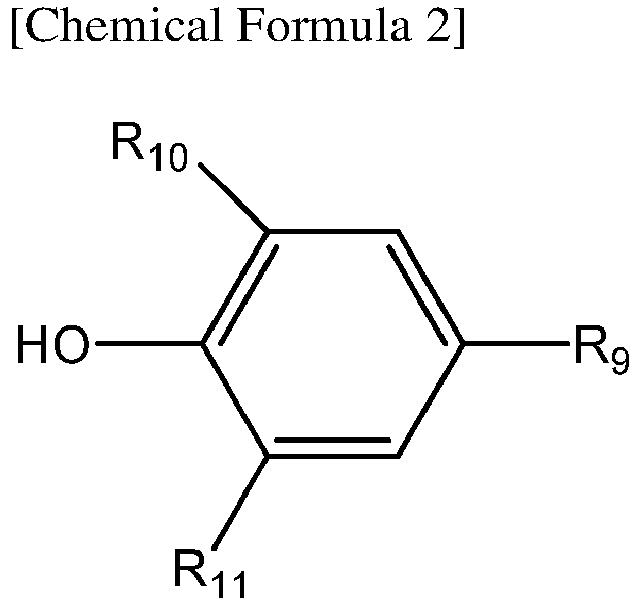
- the hindered phenol-based compound may be represented by Chemical Formula 2:
- R 9 to R 11 are each a C1-C5 alkyl group.
- the hindered phenol-based compound may be butylated hydroxytoluene (BHT).
- BHT butylated hydroxytoluene
- the hydroquinone-based compound may be represented by Chemical Formula 3:
- R 12 to R 16 are each hydrogen or a C1 to C5 alkyl group.
- the hydroquinone-based compound may be hydroquinone monomethyl ether (MeHQ)
- an amount of the polymerization inhibitory accelerator may be from 1 wt% to 10 wt% based on a weight of the base oil.
- the lubricant composition may further include a polar non-aromatic compound.
- the polar non-aromatic compound includes a fatty acid-based compound.
- an amount of the polar non-aromatic compound exceeds 1 wt% and is less than or equal to 10 wt%.
- the lubricant composition is injected into a discharge unit.
- a first monomer that includes a carboxylic acid-based monomer is discharged via the discharge unit.
- the discharged first monomer is reacted with a second monomer.
- the second monomer may be an ethylene-based polymerizable monomer.
- an injection rate of the lubricant composition into the discharge unit may be in a range from 25 kg/hr to 130 kg/hr.
- a temperature in the discharge unit is in a range from 20 °C to 120 °C, and a discharge pressure from the discharge unit is in a range from 1,100 bar to 2,500 bar.
- a polymerization inhibitor such as a phenothiazine-based compound may be added in a lubricant oil of a pump discharging, e.g., a carboxylic acid-based monomer, and a polymerization inhibitory accelerator including a hindered phenol-based compound and a hydroquinone-based compound may be also added.
- the polymerization inhibitory accelerator may regenerate a radicalized phenothiazine-based compound to activate a polymerization inhibiting mechanism.
- a suppression of a self-polymerization of the carboxylic acid-based monomer may be maintained for a long period even by a small amount of the polymerization inhibitor to improve a production yield of a copolymer and prevent a blocking of polymerization equipment.
- the lubricant composition may further include a polar non-aromatic compound.
- the polar non-aromatic compound may increase a solubility of the hindered phenol-based compound and may additionally promote a regeneration of the phenothiazine-based compound.
- FIG. 1 is a process diagram schematically illustrating a method of preparing a copolymer in accordance with exemplary embodiments.
- a lubricant composition including a polymerization inhibitor, a polymerization inhibitory accelerator including a hindered phenol-based compound and a hydroquinone-based compound, and a base oil is provided.
- a method of preparing a copolymer using the lubricant composition and effectively suppressing a self-polymerization of a monomer is also provided.
- a lubricant composition according to exemplary embodiments may include a base oil, a polymerization inhibitor and a polymerization inhibitory accelerator.
- the lubricant composition may further include a polar non-aromatic compound.
- the base oil may be included as a base solvent, a diluent or a media of the lubricant composition.
- a type of the base oil is not particularly limited, and a lubricating oil used in a polymerization equipment, a petrochemical equipment, etc., may be used.
- a mineral oil can be used as the base oil.
- the base oil may be included as a residual amount of the lubricant composition excluding components described below.
- residual amount used herein is to be understood as a variable amount that may be adjusted according to amounts of other ingredients.
- the polymerization inhibitor may be included, e.g., as a component for inhibiting a self-polymerization of a carboxylic acid-based monomer.
- the polymerization inhibitor may include a phenothiazine-based compound represented by Chemical Formula 1 below.
- R 1 to R 8 may each independently be hydrogen, a C1 to C5 alkyl group or a C1 to C5 alkoxy group.
- an amount of the polymerization inhibitor may be about 2,000 ppm or less based on a weight of the base oil.
- an environmental issue may be caused due to an excessive increase of a radical-based active material, and a copolymer yield may be also degraded.
- the amount of the polymerization inhibitor may be about 1,000 ppm or less, more preferably in a range from about 1 ppm to about 10 ppm, based on the weight of the base oil.
- a regeneration mechanism by a polymerization inhibitory accelerator described below may be more easily implemented.
- the polymerization inhibitory accelerator may be used together with the polymerization inhibitor described above.
- the polymerization inhibitory accelerator may include a hindered phenol-based compound and a hydroquinone-based compound.
- the hindered phenol-based compound may be represented by Chemical Formula 2 below.
- R 8 to R 11 may each be a C1-C5 alkyl group.
- R 9 may be a normal alkyl (n-alkyl) group
- R 10 and R 11 may each independently be a secondary (sec)-alkyl group, an iso-alkyl group, or a tert-alkyl group.
- R 10 and R 11 may each include a tert-alkyl group, and in one embodiment, the hindered phenol-based compound may be butylated hydroxytoluene (BHT) represented by the following Chemical Formula 2-1.
- BHT butylated hydroxytoluene
- the hydroquinone-based compound may be represented by Chemical Formula 3 below.
- R 12 to R 16 may each be hydrogen or a C1 to C5 alkyl group.
- the hydroquinone-based compound may be hydroquinone monomethyl ether (MeHQ) represented by Chemical Formula 3-1 below.
- An acidic hydrogen contained in a hydroxyl group included in the above-mentioned hindered phenol-based compound may be transferred to the phenothiazine-based compound (the polymerization inhibitor), and the radicalized phenothiazine-based compound may be regenerated.
- life-span of the phenothiazine-based compound may be increased so that self-polymerization inhibition of the carboxylic acid-based monomer may be effectively maintained even with a small amount of polymerization inhibitor.
- an acidity of hydrogen included in the hydroxyl group may be increased by a relatively bulky alkyl group (R 10 , R 11 , e.g., a tert-butyl group) included in the hindered phenol-based compound so that the hydrogen transfer may easily occur.
- a relatively bulky alkyl group R 10 , R 11 , e.g., a tert-butyl group
- a solubility with respect to the base oil may be also enhanced by the relatively bulky alkyl group so that the regeneration of the polymerization inhibitor by the hindered phenol-based compound may be constantly maintained.
- the hindered phenol-based compound may have a relatively low solubility with respect to the carboxylic acid-based monomer (e.g., an acrylic acid).
- the hydroquinone-based compound having a high solubility in a carboxylic acid-based monomer solution may be used together with the hindered phenol-based compound.
- the improved polymerization inhibitory effect and polymerization inhibitor regeneration effect may be constantly maintained.
- an amount of the polymerization inhibitory accelerator including the hindered phenol-based compound and the hydroquinone-based compound may be in a range from about 1 wt% to 20 wt% based on a total weight of the base oil. Within the above range, reduction of solubility in the polymerization system may be prevented while achieving the sufficient regeneration of the polymerization inhibitor.
- the amount of the polymerization inhibitory accelerator may be in a range from about 1 wt% to about 10 wt% based on the total weight of the base oil.
- an amount of the hindered phenol-based compound in the polymerization inhibitory accelerator may be from about 1 wt% to 6 wt% based on the total weight of the base oil. If the amount of the hindered phenol-based compound exceeds about 6 wt%, an oxidation of the base oil or the lubricant composition may be caused to result in an oil discoloration.
- the amount of the hindered phenol-based compound in the polymerization inhibitory accelerator may be greater than the amount of the hydroquinone-based compound. In this case, a sufficient polymerization inhibitor regeneration effect may be easily implemented in the lubricant composition.
- the lubricant composition may further include a polar non-aromatic compound.
- the polar non-aromatic compound may serve as a diluent or corrosion inhibitor of the polymerization inhibitory accelerator (e.g., the hindered phenol-based compound) as described above. Additionally, the polar non-aromatic compound may provide an intermediate medium or an intermediate path of the polymerization inhibitor regeneration mechanism.
- the polar non-aromatic compound may include a C10 to C30 fatty acid (e.g., an oleic acid)-based compound.
- the polar non-aromatic compound may be added together with the hindered phenol-based compound (e.g., BHT) as described above so that a regeneration cycle of the polymerization inhibitor (e.g., phenothiazine) may be repeated.
- BHT hindered phenol-based compound
- a regeneration cycle of the polymerization inhibitor e.g., phenothiazine
- hydrogen bonded to a nitrogen atom of phenothiazine may be released and transferred to a radicalized fatty acid to generate an activated phenothiazine radical.
- the activated phenothiazine radical may be regenerated into phenothiazine by receiving hydrogen from the hydroxyl group contained in the hindered phenol-based compound.
- the above-mentioned cycle may be repeated so that an activation of the polymerization inhibitor may be repeatedly regenerated in a polymerization system.
- the self-polymerization inhibitory effect of the carboxylic acid-based monomer may be implemented for a long period even with a small amount of the polymerization inhibitor.
- an amount of the polar non-aromatic compound may exceed 1 wt% based on a total weight of the base oil. In this case, solubility of the hindered phenol-based compound may be sufficiently obtained, and the polymerization inhibitor regeneration cycle may be easily initiated. In an embodiment, the amount of the polar non-aromatic compound may be 10 wt% or less, preferably 5 wt% less while exceeding 1 wt%.
- FIG. 1 is a process diagram schematically illustrating a method of preparing a copolymer in accordance with exemplary embodiments.
- a first monomer including a carboxylic acid-based monomer may be provided from a first monomer supply unit 10.
- the carboxylic acid-based monomer may include an unsaturated carboxylic acid capable of participating in chain polymerization reaction.
- (meth)acrylic acid or an ester thereof e.g., (meth)acrylate
- (meth)acrylic acid used herein is used to encompass methacrylic acid and acrylic acid.
- the carboxylic acid-based monomer may be transferred from the first monomer supply unit 10 such as a storage tank to a discharge unit 30 through a first flow path 20.
- one or more additives such as a polymerization initiator, a reaction inhibitor, an antioxidant, etc., may be also supplied.
- the polymerization initiator may include initiators widely known in the polymer polymerization field.
- a peroxide or peroxy-based compound, an azobis-based compound, or the like may be used as the polymerization initiator.
- the carboxylic acid-based monomer may be transferred to the discharge unit 30 and may be discharged for a copolymerization with, e.g., an ethylene-based polymerizable monomer through a discharge flow path 40.
- the discharge unit 30 may include a discharge equipment, e.g., a pump, a compressor, or the like.
- a discharge equipment e.g., a pump, a compressor, or the like.
- the above-described lubricant composition may be injected into the discharge unit 30.
- the discharge unit 30 may include a piston and a cylinder structure such as a bushing surrounding the piston, and the lubricant composition according to the exemplary embodiments may be injected into a gap between the piston and the cylinder structure.
- a friction may repeatedly occur between the piston and the cylinder structure in the gap, and thus a local temperature rise may be caused by a frictional heat. Accordingly, a self-polymerized polymer such as polyacrylic acid (PAA) may be generated when exceeding the temperature at the carboxylic acid-based monomer is self-polymerized. In this case, a clogging of the gap may be caused to shorten an exchange cycle or a cleaning cycle of the discharge unit 30, thereby reducing a process efficiency, and a desired copolymer yield may also be deteriorated.
- PAA polyacrylic acid
- the above-described lubricant composition may include the hindered phenol/hydroquinone-based polymerization inhibitory accelerator together with the polymerization inhibitor such as phenothiazine so that the regeneration mechanism of the polymerization inhibitor may be remarkably activated.
- a use cycle of the discharge unit 30 may be increased, and the formation of self-polymerized polymer such as PAA may be suppressed to improve process reliability.
- an injection rate of the lubricant composition into the discharge unit 30 may be 20 kg/hr or more, and may be preferably adjusted in a range of 25 kg/hr to 130 kg/hr. Within the above range, the self-polymerization may be effectively suppressed through a uniform contact with the carboxylic acid-based monomer supplied to the discharge unit 30.
- the second monomer stored in a second monomer supply unit 50 may be moved through a second flow path 55 to contact the carboxylic acid-based monomer supplied through the discharge flow path 40, and may be copolymerized in a reactor 60.
- the second monomer may include an ethylene-based polymerizable monomer.
- the copolymerization of the carboxylic acid-based monomer and ethylene in the reactor 60 may proceed to produce an ethylene-carboxylic acid copolymer (e.g., EAA copolymer).
- EAA copolymer ethylene-carboxylic acid copolymer
- the polymerization initiator as described above may be also introduced into the reactor 60 through the second flow path 55 or through an additional flow path.
- the self-polymerization of the carboxylic acid-based monomer may be prevented from being accelerated in advance by the polymerization initiator.
- a chain transfer agent may be introduced through, e.g., the second flow path 55 during the polymerization process.
- a molecular weight and a molecular weight distribution of the polymer product may be easily controlled in a desired range by a chain transfer agent.
- the chain transfer agents may include, e.g., a non-polar organic compound such as isobutane, propene, etc., or a polar organic compound such as methyl ethyl ketone, isopropyl aldehyde, vinyl acetate, etc.
- a non-polar organic compound such as isobutane, propene, etc.
- a polar organic compound such as methyl ethyl ketone, isopropyl aldehyde, vinyl acetate, etc.
- Process conditions in the discharge unit 30 and the reactor 60 may be adjusted in consideration of the self-polymerization prevention of the carboxylic acid-based monomer and an efficiency of a copolymer production.
- a temperature in the discharge unit 30 may be lower than a temperature in the reactor 60.
- the temperature in the discharge unit 30 may be from about 20 °C to about 120 °C, and the temperature in the reactor 60 may be from about 150 °C to about 270 °C.
- a pressure in the discharge unit 30 and the reactor 60 may be in a range from 1100 bar to 2500 bar, preferably from 1300 bar to 2300 bar. In one embodiment, a discharge pressure in the discharge unit 30 may be greater than a copolymerization pressure in the reactor 60.
- Example 4 the lubricant composition of Example 4 was prepared by the same manner as that in Example 3 except that BHT was included in 8 wt%. In the case of Example 4, a similar level of the polymerization time as that in Example 3 was measured, but yellowing of the lubricant composition occurred.
Landscapes
- Chemical & Material Sciences (AREA)
- Chemical Kinetics & Catalysis (AREA)
- Organic Chemistry (AREA)
- Health & Medical Sciences (AREA)
- Medicinal Chemistry (AREA)
- Polymers & Plastics (AREA)
- Oil, Petroleum & Natural Gas (AREA)
- General Chemical & Material Sciences (AREA)
- Engineering & Computer Science (AREA)
- Lubricants (AREA)
- Polymerisation Methods In General (AREA)
- Addition Polymer Or Copolymer, Post-Treatments, Or Chemical Modifications (AREA)
Abstract
Description
- This application claims priority to Korean Patent Applications No.
10-2019-0082484 filed on July 9, 2019 - The present invention relates to a lubricant composition and a method of preparing a copolymer using the same. More particularly, the present invention relates to a lubricant composition including a base oil and an additive and a method of preparing a copolymer using the same.
- For example, an ethylene-carboxylic acid copolymer such as an ethylene-acrylic acid copolymer is utilized for various applications such as a sealant, an adhesive, a packing material, an optical film, etc.
- The ethylene-carboxylic acid copolymer may be prepared by polymerizing ethylene and a carboxylic acid-based compound (e.g., acrylic acid, methacrylic acid, etc.) as a comonomer in a continuous reactor.
- The carboxylic acid-based compound may have a self-reactivity higher than that of ethylene, and thus may be self-polymerized when exposed to a high temperature in a supply through a flow path, a pump, a compressor, etc.
- In this case, defects such as a clogging, a flow blocking in aforementioned equipment such as the pump, the compressor, the flow path, etc., may be caused, and thus a production yield of the copolymer may be degraded and a constant repetition of the polymerization process may not be performed.
- Thus, methods of using additives for suppressing the self-polymerization in addition to the monomers for the synthesis of the copolymer are being researched. However, development of a composition applied to the equipment such as a lubricant may be also needed for directly suppressing the above-mentioned equipment defects.
- For example, International Published Patent Application
WO2016/172076 discloses a polymerization inhibitor for preventing a fouling in a polymerization reaction, but fails to suggest a construction for preventing the self-polymerization in the equipment and process unit. - According to an aspect of the present invention, there is provided a lubricant composition providing improved process reliability and polymerization efficiency.
- According to an aspect of the present invention, there is provided a method of preparing a copolymer using the lubricant composition.
- A lubricant composition according to exemplary embodiments includes a base oil, a phenothiazine-based polymerization inhibitor, and a polymerization inhibitory accelerator including a hindered phenol-based compound and a hydroquinone-based compound.
- In some embodiments, the polymerization inhibitor may include a compound represented by Chemical Formula 1:

- In Chemical Formula 1, R1 to R8 are each independently hydrogen, a C1 to C5 alkyl group or a C1 to C5 alkoxy group.
- In some embodiments, an amount of the polymerization inhibitor may be from 1 ppm to 2,000 ppm relative to a weight of the base oil.
- In some embodiments, the amount of the polymerization inhibitor may be from 1 ppm to 10 ppm relative to the weight of the base oil.
- In some embodiments, the hindered phenol-based compound may be represented by Chemical Formula 2:
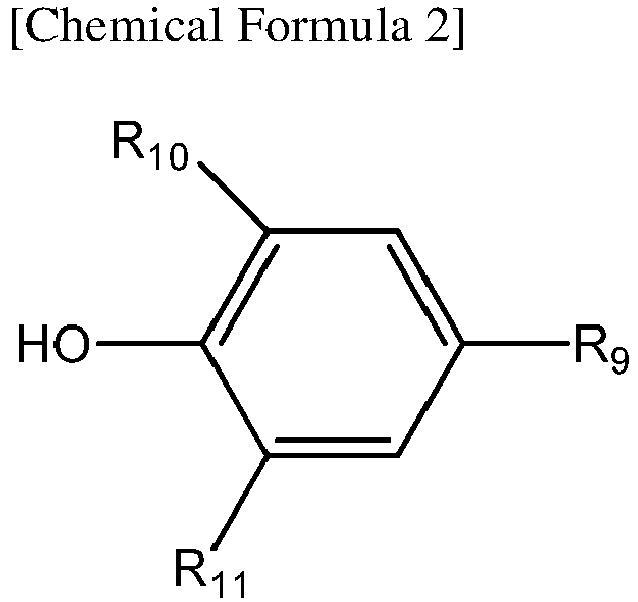
- In Chemical Formula 2, R9 to R11 are each a C1-C5 alkyl group.
- In some embodiments, the hindered phenol-based compound may be butylated hydroxytoluene (BHT).
- In some embodiments, the hydroquinone-based compound may be represented by Chemical Formula 3:

- In Chemical Formula 3, R12 to R16 are each hydrogen or a C1 to C5 alkyl group. In some embodiments, the hydroquinone-based compound may be hydroquinone monomethyl ether (MeHQ)
- In some embodiments, an amount of the polymerization inhibitory accelerator may be from 1 wt% to 10 wt% based on a weight of the base oil.
- In some embodiments, the lubricant composition may further include a polar non-aromatic compound.
- In some embodiments, the polar non-aromatic compound includes a fatty acid-based compound.
- In some embodiments, an amount of the polar non-aromatic compound exceeds 1 wt% and is less than or equal to 10 wt%.
- In a method of preparing a copolymer, the lubricant composition is injected into a discharge unit. A first monomer that includes a carboxylic acid-based monomer is discharged via the discharge unit. The discharged first monomer is reacted with a second monomer.
- In some embodiments, the second monomer may be an ethylene-based polymerizable monomer.
- In some embodiments, an injection rate of the lubricant composition into the discharge unit may be in a range from 25 kg/hr to 130 kg/hr.
- In some embodiments, a temperature in the discharge unit is in a range from 20 °C to 120 °C, and a discharge pressure from the discharge unit is in a range from 1,100 bar to 2,500 bar.
- According to exemplary embodiments of the present invention, a polymerization inhibitor such as a phenothiazine-based compound may be added in a lubricant oil of a pump discharging, e.g., a carboxylic acid-based monomer, and a polymerization inhibitory accelerator including a hindered phenol-based compound and a hydroquinone-based compound may be also added.
- The polymerization inhibitory accelerator may regenerate a radicalized phenothiazine-based compound to activate a polymerization inhibiting mechanism. Thus, a suppression of a self-polymerization of the carboxylic acid-based monomer may be maintained for a long period even by a small amount of the polymerization inhibitor to improve a production yield of a copolymer and prevent a blocking of polymerization equipment.
- In some embodiments, the lubricant composition may further include a polar non-aromatic compound. The polar non-aromatic compound may increase a solubility of the hindered phenol-based compound and may additionally promote a regeneration of the phenothiazine-based compound.
-
FIG. 1 is a process diagram schematically illustrating a method of preparing a copolymer in accordance with exemplary embodiments. - According to exemplary embodiments of the present invention, a lubricant composition including a polymerization inhibitor, a polymerization inhibitory accelerator including a hindered phenol-based compound and a hydroquinone-based compound, and a base oil is provided. According to exemplary embodiments of the present invention, a method of preparing a copolymer using the lubricant composition and effectively suppressing a self-polymerization of a monomer is also provided
- Hereinafter, the present invention will be described in detail with reference to specific experimental examples and the accompanying drawings. However, those skilled in the art will appreciate that such embodiments described with reference to the examples and the accompanying drawings are provided to further understand the spirit of the present invention and do not limit subject matters to be protected as disclosed in the detailed description and appended claims.
- A lubricant composition according to exemplary embodiments may include a base oil, a polymerization inhibitor and a polymerization inhibitory accelerator. In some embodiments, the lubricant composition may further include a polar non-aromatic compound.
- The base oil may be included as a base solvent, a diluent or a media of the lubricant composition. A type of the base oil is not particularly limited, and a lubricating oil used in a polymerization equipment, a petrochemical equipment, etc., may be used. For example, a mineral oil can be used as the base oil.
- The base oil may be included as a residual amount of the lubricant composition excluding components described below. The term "residual amount" used herein is to be understood as a variable amount that may be adjusted according to amounts of other ingredients.
- The polymerization inhibitor may be included, e.g., as a component for inhibiting a self-polymerization of a carboxylic acid-based monomer. In exemplary embodiments, the polymerization inhibitor may include a phenothiazine-based compound represented by Chemical Formula 1 below.

- In the Chemical Formula 1 above, R1 to R8 may each independently be hydrogen, a C1 to C5 alkyl group or a C1 to C5 alkoxy group.
- In some embodiments, an amount of the polymerization inhibitor may be about 2,000 ppm or less based on a weight of the base oil. When the amount of the polymerization inhibitor exceeds about 2,000 ppm, an environmental issue may be caused due to an excessive increase of a radical-based active material, and a copolymer yield may be also degraded.
- Preferably, the amount of the polymerization inhibitor may be about 1,000 ppm or less, more preferably in a range from about 1 ppm to about 10 ppm, based on the weight of the base oil. Within the above range, a regeneration mechanism by a polymerization inhibitory accelerator described below may be more easily implemented.
- In exemplary embodiments, the polymerization inhibitory accelerator may be used together with the polymerization inhibitor described above. The polymerization inhibitory accelerator may include a hindered phenol-based compound and a hydroquinone-based compound.
- The hindered phenol-based compound may be represented by Chemical Formula 2 below.

- In the Chemical Formula 2 above, R8 to R11 may each be a C1-C5 alkyl group. In a preferable embodiment, R9 may be a normal alkyl (n-alkyl) group, and R10 and R11 may each independently be a secondary (sec)-alkyl group, an iso-alkyl group, or a tert-alkyl group. Preferably, R10 and R11 may each include a tert-alkyl group, and in one embodiment, the hindered phenol-based compound may be butylated hydroxytoluene (BHT) represented by the following Chemical Formula 2-1.

- The hydroquinone-based compound may be represented by Chemical Formula 3 below.

- In the Chemical Formula 3 above, R12 to R16 may each be hydrogen or a C1 to C5 alkyl group. In some embodiments, the hydroquinone-based compound may be hydroquinone monomethyl ether (MeHQ) represented by Chemical Formula 3-1 below.

- An acidic hydrogen contained in a hydroxyl group included in the above-mentioned hindered phenol-based compound may be transferred to the phenothiazine-based compound (the polymerization inhibitor), and the radicalized phenothiazine-based compound may be regenerated. Thus, life-span of the phenothiazine-based compound may be increased so that self-polymerization inhibition of the carboxylic acid-based monomer may be effectively maintained even with a small amount of polymerization inhibitor.
- Further, an acidity of hydrogen included in the hydroxyl group may be increased by a relatively bulky alkyl group (R10, R11, e.g., a tert-butyl group) included in the hindered phenol-based compound so that the hydrogen transfer may easily occur.
- A solubility with respect to the base oil may be also enhanced by the relatively bulky alkyl group so that the regeneration of the polymerization inhibitor by the hindered phenol-based compound may be constantly maintained.
- The hindered phenol-based compound may have a relatively low solubility with respect to the carboxylic acid-based monomer (e.g., an acrylic acid). In exemplary embodiments, the hydroquinone-based compound having a high solubility in a carboxylic acid-based monomer solution may be used together with the hindered phenol-based compound. Thus, in a polymerization system in which both the monomer solution and the lubricant composition are co-present, the improved polymerization inhibitory effect and polymerization inhibitor regeneration effect may be constantly maintained.
- In some embodiments, an amount of the polymerization inhibitory accelerator including the hindered phenol-based compound and the hydroquinone-based compound may be in a range from about 1 wt% to 20 wt% based on a total weight of the base oil. Within the above range, reduction of solubility in the polymerization system may be prevented while achieving the sufficient regeneration of the polymerization inhibitor.
- In an embodiment, the amount of the polymerization inhibitory accelerator may be in a range from about 1 wt% to about 10 wt% based on the total weight of the base oil. For example, an amount of the hindered phenol-based compound in the polymerization inhibitory accelerator may be from about 1 wt% to 6 wt% based on the total weight of the base oil. If the amount of the hindered phenol-based compound exceeds about 6 wt%, an oxidation of the base oil or the lubricant composition may be caused to result in an oil discoloration.
- In an embodiment, the amount of the hindered phenol-based compound in the polymerization inhibitory accelerator may be greater than the amount of the hydroquinone-based compound. In this case, a sufficient polymerization inhibitor regeneration effect may be easily implemented in the lubricant composition.
- In some embodiments, the lubricant composition may further include a polar non-aromatic compound. The polar non-aromatic compound may serve as a diluent or corrosion inhibitor of the polymerization inhibitory accelerator (e.g., the hindered phenol-based compound) as described above. Additionally, the polar non-aromatic compound may provide an intermediate medium or an intermediate path of the polymerization inhibitor regeneration mechanism.
- In exemplary embodiments, the polar non-aromatic compound may include a C10 to C30 fatty acid (e.g., an oleic acid)-based compound.
- The polar non-aromatic compound may be added together with the hindered phenol-based compound (e.g., BHT) as described above so that a regeneration cycle of the polymerization inhibitor (e.g., phenothiazine) may be repeated.
- For example, hydrogen bonded to a nitrogen atom of phenothiazine may be released and transferred to a radicalized fatty acid to generate an activated phenothiazine radical. The activated phenothiazine radical may be regenerated into phenothiazine by receiving hydrogen from the hydroxyl group contained in the hindered phenol-based compound.
- The above-mentioned cycle may be repeated so that an activation of the polymerization inhibitor may be repeatedly regenerated in a polymerization system. Thus, the self-polymerization inhibitory effect of the carboxylic acid-based monomer may be implemented for a long period even with a small amount of the polymerization inhibitor.
- In an embodiment, an amount of the polar non-aromatic compound may exceed 1 wt% based on a total weight of the base oil. In this case, solubility of the hindered phenol-based compound may be sufficiently obtained, and the polymerization inhibitor regeneration cycle may be easily initiated. In an embodiment, the amount of the polar non-aromatic compound may be 10 wt% or less, preferably 5 wt% less while exceeding 1 wt%.
-
FIG. 1 is a process diagram schematically illustrating a method of preparing a copolymer in accordance with exemplary embodiments. - Referring to
FIG. 1 , a first monomer including a carboxylic acid-based monomer may be provided from a firstmonomer supply unit 10. - The carboxylic acid-based monomer may include an unsaturated carboxylic acid capable of participating in chain polymerization reaction. In exemplary embodiments, (meth)acrylic acid or an ester thereof (e.g., (meth)acrylate) may be used as the carboxylic acid-based monomer. The term "(meth)acrylic acid" used herein is used to encompass methacrylic acid and acrylic acid.
- For example, the carboxylic acid-based monomer may be transferred from the first
monomer supply unit 10 such as a storage tank to adischarge unit 30 through afirst flow path 20. - For example, one or more additives such as a polymerization initiator, a reaction inhibitor, an antioxidant, etc., may be also supplied.
- For example, the polymerization initiator may include initiators widely known in the polymer polymerization field. For example, a peroxide or peroxy-based compound, an azobis-based compound, or the like, may be used as the polymerization initiator.
- The carboxylic acid-based monomer may be transferred to the
discharge unit 30 and may be discharged for a copolymerization with, e.g., an ethylene-based polymerizable monomer through adischarge flow path 40. - The
discharge unit 30 may include a discharge equipment, e.g., a pump, a compressor, or the like. In exemplary embodiments, the above-described lubricant composition may be injected into thedischarge unit 30. - For example, the
discharge unit 30 may include a piston and a cylinder structure such as a bushing surrounding the piston, and the lubricant composition according to the exemplary embodiments may be injected into a gap between the piston and the cylinder structure. - A friction may repeatedly occur between the piston and the cylinder structure in the gap, and thus a local temperature rise may be caused by a frictional heat. Accordingly, a self-polymerized polymer such as polyacrylic acid (PAA) may be generated when exceeding the temperature at the carboxylic acid-based monomer is self-polymerized. In this case, a clogging of the gap may be caused to shorten an exchange cycle or a cleaning cycle of the
discharge unit 30, thereby reducing a process efficiency, and a desired copolymer yield may also be deteriorated. - However, the above-described lubricant composition may include the hindered phenol/hydroquinone-based polymerization inhibitory accelerator together with the polymerization inhibitor such as phenothiazine so that the regeneration mechanism of the polymerization inhibitor may be remarkably activated.
- Thus, a use cycle of the
discharge unit 30 may be increased, and the formation of self-polymerized polymer such as PAA may be suppressed to improve process reliability. - In some embodiments, an injection rate of the lubricant composition into the
discharge unit 30 may be 20 kg/hr or more, and may be preferably adjusted in a range of 25 kg/hr to 130 kg/hr. Within the above range, the self-polymerization may be effectively suppressed through a uniform contact with the carboxylic acid-based monomer supplied to thedischarge unit 30. - The second monomer stored in a second
monomer supply unit 50 may be moved through asecond flow path 55 to contact the carboxylic acid-based monomer supplied through thedischarge flow path 40, and may be copolymerized in areactor 60. In exemplary embodiments, the second monomer may include an ethylene-based polymerizable monomer. - If ethylene is used as the second monomer, the copolymerization of the carboxylic acid-based monomer and ethylene in the
reactor 60 may proceed to produce an ethylene-carboxylic acid copolymer (e.g., EAA copolymer). - In some embodiments, the polymerization initiator as described above may be also introduced into the
reactor 60 through thesecond flow path 55 or through an additional flow path. In this case, the self-polymerization of the carboxylic acid-based monomer may be prevented from being accelerated in advance by the polymerization initiator. - In some embodiments, a chain transfer agent may be introduced through, e.g., the
second flow path 55 during the polymerization process. A molecular weight and a molecular weight distribution of the polymer product may be easily controlled in a desired range by a chain transfer agent. - The chain transfer agents may include, e.g., a non-polar organic compound such as isobutane, propene, etc., or a polar organic compound such as methyl ethyl ketone, isopropyl aldehyde, vinyl acetate, etc.
- Process conditions in the
discharge unit 30 and thereactor 60 may be adjusted in consideration of the self-polymerization prevention of the carboxylic acid-based monomer and an efficiency of a copolymer production. - In some embodiments, a temperature in the
discharge unit 30 may be lower than a temperature in thereactor 60. For example, the temperature in thedischarge unit 30 may be from about 20 °C to about 120 °C, and the temperature in thereactor 60 may be from about 150 °C to about 270 °C. - In some embodiments, a pressure in the
discharge unit 30 and thereactor 60 may be in a range from 1100 bar to 2500 bar, preferably from 1300 bar to 2300 bar. In one embodiment, a discharge pressure in thedischarge unit 30 may be greater than a copolymerization pressure in thereactor 60. - Hereinafter, preferred embodiments are proposed to more concretely describe the present invention. However, the following examples are only given for illustrating the present invention and those skilled in the related art will obviously understand that various alterations and modifications are possible within the scope and spirit of the present invention. Such alterations and modifications are duly included in the appended claims.
- In a nitrogen atmosphere treated 1L reactor, acrylic acid (AA) (99% purity, manufactured by Sigma Aldrich) and lubricant compositions were mixed and sealed with contents shown in Table 1 below. The reactor was heated to 120 °C and the generation of self-polymerized polymer (PAA) was observed every 10 minutes. When PAA was observed by the naked eye, the experiment was stopped and a polymerization time was recorded. Measured results of the polymerization time are shown in Table 1 below.
- In Table 1, amounts of PTZ and MeHQ are listed as ppm relative to a mineral oil of the lubricant composition, amounts of BHT are listed as weight percents relative to the mineral oil.
[Table 1] Acrylic Acid (AA)(g) Lubricant Composition Polymerization Time PTZ (ppm) BHT (wt%) MeHQ (ppm) Mineral Oil (g) Comparative Example 1 5 0 0 0 5 Immediately Comparative Example 2 5 50 0 0 5 Immediately Comparative Example 3 5 100 0 0 5 Immediately Comparative Example 4 5 300 0 0 5 Immediately Comparative Example 5 5 500 0 0 5 2 minutes Comparative Example 6 5 700 0 0 5 48 minutes Comparative Example 7 5 0 6 170 5 34 minutes Example 1 5 1 6 170 5 More than 2 weeks Example 2 5 2 6 170 5 More than 2 weeks Example 3 5 5 6 170 5 More than 2 weeks PTZ: Phenothiazine (Sigma Aldrich) BHT: Butylated hydroxy toluene (Sigma Aldrich) MeHQ: 4-methoxy phenol (Sigma Aldrich) Mineral Oil: SK lubricants - Referring to Table 1, when PTZ was solely used as the polymerization inhibitor in the lubricant composition, the inhibition of PAA production was not effectively achieved. Additionally, when the amount of PTZ that is environmentally hazardous due to a radical activity was significantly increased, an effective polymerization inhibition time was obtained as shown in Comparative Example 6.
- However, when BHT and MeHQ were used together as the polymerization inhibitor, the polymerization delay time was rapidly increased even with a small amount of PTZ.
- Further, the lubricant composition of Example 4 was prepared by the same manner as that in Example 3 except that BHT was included in 8 wt%. In the case of Example 4, a similar level of the polymerization time as that in Example 3 was measured, but yellowing of the lubricant composition occurred.
- Similarly to Experimental Example 1, the self-polymerization time of acrylic acid was measured using samples of a lubricant composition including a mineral oil, PTZ and a diluent. Diluents manufactured by Sigma Aldrich were used.
- Measurement results are shown in Table 2 below.
[Table 2] Acrylic Acid (AA)(g) Lubricant Composition Polymerization Time PTZ (ppm) Mineral Oil (g) Diluent (wt% relative to mineral oil) Sample 1 5 0 5 Di(propylene glycol)methyl ether 1 Immediately Sample 2 5 0 5 Di(propylene glycol)methyl ether 5 Immediately Sample 3 5 50 5 Di(propylene glycol)methyl ether 5 Immediately Sample 4 5 0 5 Poly(ethylene glycol) 1 Immediately Sample 5 5 0 5 Poly(ethylene glycol) 5 Immediately Sample 6 5 50 5 Poly(ethylene glycol) 5 Immediately Sample 7 5 0 5 Xylene 1 Immediately Sample 8 5 0 5 Xylene 5 Immediately Sample 9 5 50 5 Xylene 5 Immediately Sample 10 5 0 5 Oleic Acid 1 Immediately Sample 11 5 0 5 Oleic Acid 5 Immediately Sample 12 5 50 5 Oleic Acid 1 Immediately Sample 13 5 50 5 Oleic Acid 2 2hour 5 minutes Sample 14 5 50 5 Oleic Acid 5 5hour 36minutes PTZ: Phenothiazine (Sigma Aldrich) BHT: Butylated hydroxy toluene (Sigma Aldrich) MeHQ: 4-methoxy phenol (Sigma Aldrich) Mineral Oil: SK lubricants - Referring to Table. 2, when the diluent such as a glycol-based compound or a non-polar aromatic compound such as xylene was added to PTZ, the polymerization inhibitory effect was not substantially implemented.
- In Samples 10-14 in which a fatty acid-based polar non-aromatic compound such as oleic acid was included as the diluent in the lubricant composition together with PTZ, the polymerization inhibition time was remarkably increased when the amount of the oleic acid exceeded 1 wt%.
Claims (15)
- A lubricant composition, comprising:a base oil;a phenothiazine-based polymerization inhibitor; anda polymerization inhibitory accelerator including a hindered phenol-based compound and a hydroquinone-based compound.
- The lubricant composition according to claim 1, wherein the polymerization inhibitor includes a compound represented by Chemical Formula 1:

- The lubricant composition according to claim 1, wherein an amount of the polymerization inhibitor is from 1 ppm to 2,000 ppm relative to a weight of the base oil.
- The lubricant composition according to claim 3, wherein the amount of the polymerization inhibitor is from 1 ppm to 10 ppm relative to the weight of the base oil.
- The lubricant composition according to claim 1, wherein the hindered phenol-based compound is represented by Chemical Formula 2:
- The lubricant composition according to claim 5, wherein the hindered phenol-based compound is butylated hydroxytoluene (BHT).
- The lubricant composition according to claim 1, wherein the hydroquinone-based compound is represented by Chemical Formula 3:

- The lubricant composition according to claim 7, wherein the hydroquinone-based compound is hydroquinone monomethyl ether (MeHQ)
- The lubricant composition according to claim 1, wherein an amount of the polymerization inhibitory accelerator is from 1 wt% to 10 wt% based on a weight of the base oil.
- The lubricant composition according to claim 1, further comprising a polar non-aromatic compound.
- The lubricant composition according to claim 10, wherein the polar non-aromatic compound includes a fatty acid-based compound.
- The lubricant composition according to claim 10, wherein an amount of the polar non-aromatic compound exceeds 1 wt% and is less than or equal to 10 wt%.
- A method of preparing a copolymer, comprising:injecting the lubricant composition into a discharge unit;discharging a first monomer that includes a carboxylic acid-based monomer via the discharge unit; andreacting the discharged first monomer with a second monomer.
- The method according to claim 13, wherein the second monomer is an ethylene-based polymerizable monomer.
- The method according to claim 13, wherein an injection rate of the lubricant composition into the discharge unit is in a range from 25 kg/hr to 130 kg/hr,
wherein temperature in the discharge unit is in a range from 20 °C to 120 °C, and a discharge pressure from the discharge unit is in a range from 1,100 bar to 2,500 bar.
Applications Claiming Priority (1)
| Application Number | Priority Date | Filing Date | Title |
|---|---|---|---|
| KR1020190082484A KR102803771B1 (en) | 2019-07-09 | 2019-07-09 | Lubricant composition and method of preparing copolymer using the same |
Publications (2)
| Publication Number | Publication Date |
|---|---|
| EP3763779A1 true EP3763779A1 (en) | 2021-01-13 |
| EP3763779B1 EP3763779B1 (en) | 2023-08-30 |
Family
ID=71266404
Family Applications (1)
| Application Number | Title | Priority Date | Filing Date |
|---|---|---|---|
| EP20182730.0A Active EP3763779B1 (en) | 2019-07-09 | 2020-06-26 | Lubricant composition and method of preparing copolymer using the same |
Country Status (6)
| Country | Link |
|---|---|
| US (1) | US11118129B2 (en) |
| EP (1) | EP3763779B1 (en) |
| JP (1) | JP2021014576A (en) |
| KR (1) | KR102803771B1 (en) |
| CN (1) | CN112210024B (en) |
| ES (1) | ES2964214T3 (en) |
Cited By (3)
| Publication number | Priority date | Publication date | Assignee | Title |
|---|---|---|---|---|
| EP4012008A3 (en) * | 2020-12-08 | 2022-09-21 | SK Innovation Co., Ltd. | Lubricating composition for inhibiting plugging and method of inhibiting plugging using the same |
| EP4596660A1 (en) * | 2024-01-31 | 2025-08-06 | SK innovation Co., Ltd. | Lubricant composition for preparing ethylene-based polymer and method of preparing ethylene-based polymer using the same |
| EP4596591A1 (en) * | 2024-02-01 | 2025-08-06 | SK innovation Co., Ltd. | Method of producing ethylene-based copolymer |
Families Citing this family (1)
| Publication number | Priority date | Publication date | Assignee | Title |
|---|---|---|---|---|
| CN113652289B (en) * | 2021-09-13 | 2023-01-24 | 贝莱纳新能源科技(上海)有限公司 | Compressor lubricating composition and method of making the same |
Citations (7)
| Publication number | Priority date | Publication date | Assignee | Title |
|---|---|---|---|---|
| GB1603535A (en) * | 1978-04-14 | 1981-11-25 | Mobil Oil Corp | Lubricant compositions |
| US5034156A (en) * | 1988-04-18 | 1991-07-23 | Mallinckrodt Specialty Chemicals Company | Method for inhibiting the polymerization of acrylic acid |
| US6025515A (en) * | 1995-06-07 | 2000-02-15 | Baker Hughes Incorporated | Use of substituted phenols to inhibit polymer formation during the manufacture of acrylonitrile |
| US20090234161A1 (en) * | 2004-10-26 | 2009-09-17 | Arkema France | method for the production of (meth)acrylic anhydride |
| US8664415B2 (en) * | 2009-11-27 | 2014-03-04 | Basf Se | Process for preparing (meth)acrylates of C17-alcohol mixtures |
| WO2016172076A1 (en) | 2015-04-20 | 2016-10-27 | Ecolab Usa Inc. | Sterically hindered hydroquinones as antifoulants for unsaturated monomers |
| WO2017041204A1 (en) * | 2015-09-07 | 2017-03-16 | Rhodia Operations | Use of polymerization inhibitor compositions |
Family Cites Families (10)
| Publication number | Priority date | Publication date | Assignee | Title |
|---|---|---|---|---|
| JPS5855964B2 (en) * | 1975-09-11 | 1983-12-13 | 住友化学工業株式会社 | Method for producing ethylene polymer or copolymer |
| JP2516003B2 (en) * | 1987-01-29 | 1996-07-10 | 日本石油化学株式会社 | Method for producing ethylene copolymer |
| US4853446A (en) | 1987-07-30 | 1989-08-01 | Occidental Chemical Corporation | Phenothiazine composition for use in reactor scale prevention |
| US20070161522A1 (en) | 2005-12-02 | 2007-07-12 | Cholli Ashok L | Lubricant oil compositions |
| JP2010016149A (en) * | 2008-07-03 | 2010-01-21 | Fujifilm Corp | Curable composition for nanoimprint, cured product and method of manufacturing the same, and member for liquid-crystal dispplay apparatus |
| JP2012184191A (en) * | 2011-03-04 | 2012-09-27 | Idemitsu Kosan Co Ltd | Composition containing acrylic compound and molding thereof |
| JP2012207003A (en) * | 2011-03-30 | 2012-10-25 | Idemitsu Kosan Co Ltd | Composition containing acrylic compound and molded body |
| WO2016077512A2 (en) * | 2014-11-13 | 2016-05-19 | Dow Global Technologies Llc | Lubricant compositions for improved high pressure free-radical polymerizations |
| US20170009174A1 (en) * | 2015-07-07 | 2017-01-12 | Exxonmobil Research And Engineering Company | Multifunctional lubricating oil base stocks and processes for preparing same |
| US11078441B2 (en) * | 2016-09-28 | 2021-08-03 | Dow Global Technologies Llc | Lubricant treatments for free-radical polymerizations |
-
2019
- 2019-07-09 KR KR1020190082484A patent/KR102803771B1/en active Active
-
2020
- 2020-06-26 EP EP20182730.0A patent/EP3763779B1/en active Active
- 2020-06-26 ES ES20182730T patent/ES2964214T3/en active Active
- 2020-07-02 CN CN202010634664.9A patent/CN112210024B/en active Active
- 2020-07-06 JP JP2020116352A patent/JP2021014576A/en active Pending
- 2020-07-08 US US16/923,202 patent/US11118129B2/en active Active
Patent Citations (7)
| Publication number | Priority date | Publication date | Assignee | Title |
|---|---|---|---|---|
| GB1603535A (en) * | 1978-04-14 | 1981-11-25 | Mobil Oil Corp | Lubricant compositions |
| US5034156A (en) * | 1988-04-18 | 1991-07-23 | Mallinckrodt Specialty Chemicals Company | Method for inhibiting the polymerization of acrylic acid |
| US6025515A (en) * | 1995-06-07 | 2000-02-15 | Baker Hughes Incorporated | Use of substituted phenols to inhibit polymer formation during the manufacture of acrylonitrile |
| US20090234161A1 (en) * | 2004-10-26 | 2009-09-17 | Arkema France | method for the production of (meth)acrylic anhydride |
| US8664415B2 (en) * | 2009-11-27 | 2014-03-04 | Basf Se | Process for preparing (meth)acrylates of C17-alcohol mixtures |
| WO2016172076A1 (en) | 2015-04-20 | 2016-10-27 | Ecolab Usa Inc. | Sterically hindered hydroquinones as antifoulants for unsaturated monomers |
| WO2017041204A1 (en) * | 2015-09-07 | 2017-03-16 | Rhodia Operations | Use of polymerization inhibitor compositions |
Cited By (4)
| Publication number | Priority date | Publication date | Assignee | Title |
|---|---|---|---|---|
| EP4012008A3 (en) * | 2020-12-08 | 2022-09-21 | SK Innovation Co., Ltd. | Lubricating composition for inhibiting plugging and method of inhibiting plugging using the same |
| US12043812B2 (en) | 2020-12-08 | 2024-07-23 | Sk Innovation Co., Ltd. | Lubricating composition for inhibiting plugging and method of inhibiting plugging using the same |
| EP4596660A1 (en) * | 2024-01-31 | 2025-08-06 | SK innovation Co., Ltd. | Lubricant composition for preparing ethylene-based polymer and method of preparing ethylene-based polymer using the same |
| EP4596591A1 (en) * | 2024-02-01 | 2025-08-06 | SK innovation Co., Ltd. | Method of producing ethylene-based copolymer |
Also Published As
| Publication number | Publication date |
|---|---|
| CN112210024B (en) | 2024-04-05 |
| ES2964214T3 (en) | 2024-04-04 |
| KR102803771B1 (en) | 2025-05-02 |
| JP2024155965A (en) | 2024-10-31 |
| JP2021014576A (en) | 2021-02-12 |
| KR20210006634A (en) | 2021-01-19 |
| US11118129B2 (en) | 2021-09-14 |
| CN112210024A (en) | 2021-01-12 |
| EP3763779B1 (en) | 2023-08-30 |
| US20210009919A1 (en) | 2021-01-14 |
Similar Documents
| Publication | Publication Date | Title |
|---|---|---|
| EP3763779B1 (en) | Lubricant composition and method of preparing copolymer using the same | |
| CN108752502A (en) | NO free radical azanol and phenylenediamine as the polymerization inhibitor for ethylenically unsaturated monomers technique combine | |
| EP1556329B1 (en) | Use of antifoulant polymers in (meth)acrylic acid processes | |
| JP7227898B2 (en) | Lubricant treatment for free radical polymerization | |
| EP4012008B1 (en) | Use of a lubricating composition for inhibiting plugging | |
| KR102859381B1 (en) | Method of producing ethylene-carboxylic acid compolymer | |
| EP0632121A2 (en) | An antifoulant for petrochemical processes | |
| EP3830204B1 (en) | Anaerobically curable compositions containing alpha-methylene-lactones | |
| JPS5855964B2 (en) | Method for producing ethylene polymer or copolymer | |
| US12600804B2 (en) | Synergistic combination for inhibiting polymerization | |
| EP3868792A1 (en) | Method of producing ethylene-carboxylic acid compolymer | |
| EP4628564A2 (en) | Lubricant composition and method of preparing ethylene-based polymer using the same | |
| US20250250367A1 (en) | Method of producing ethylene-based copolymer | |
| EP1751083B1 (en) | Use of polyalkenyl succinimides in acrylic acid production | |
| CN120399784A (en) | Lubricating composition for producing ethylene polymer and method for producing ethylene polymer using the same | |
| JPH07118307A (en) | Method for inhibiting (meth)acrylic ester polymerization | |
| JP2022518828A (en) | Method for Producing Ethylene-Carboxylic Acid Copolymer |
Legal Events
| Date | Code | Title | Description |
|---|---|---|---|
| PUAI | Public reference made under article 153(3) epc to a published international application that has entered the european phase |
Free format text: ORIGINAL CODE: 0009012 |
|
| STAA | Information on the status of an ep patent application or granted ep patent |
Free format text: STATUS: REQUEST FOR EXAMINATION WAS MADE |
|
| 17P | Request for examination filed |
Effective date: 20200626 |
|
| AK | Designated contracting states |
Kind code of ref document: A1 Designated state(s): AL AT BE BG CH CY CZ DE DK EE ES FI FR GB GR HR HU IE IS IT LI LT LU LV MC MK MT NL NO PL PT RO RS SE SI SK SM TR |
|
| AX | Request for extension of the european patent |
Extension state: BA ME |
|
| RAP3 | Party data changed (applicant data changed or rights of an application transferred) |
Owner name: SK GEO CENTRIC CO., LTD. Owner name: SK INNOVATION CO., LTD. |
|
| GRAP | Despatch of communication of intention to grant a patent |
Free format text: ORIGINAL CODE: EPIDOSNIGR1 |
|
| STAA | Information on the status of an ep patent application or granted ep patent |
Free format text: STATUS: GRANT OF PATENT IS INTENDED |
|
| RIC1 | Information provided on ipc code assigned before grant |
Ipc: C08F 220/06 20060101ALI20230321BHEP Ipc: C08L 33/02 20060101ALI20230321BHEP Ipc: C08K 5/46 20060101ALI20230321BHEP Ipc: C08K 5/13 20060101AFI20230321BHEP |
|
| INTG | Intention to grant announced |
Effective date: 20230403 |
|
| GRAS | Grant fee paid |
Free format text: ORIGINAL CODE: EPIDOSNIGR3 |
|
| GRAA | (expected) grant |
Free format text: ORIGINAL CODE: 0009210 |
|
| STAA | Information on the status of an ep patent application or granted ep patent |
Free format text: STATUS: THE PATENT HAS BEEN GRANTED |
|
| P01 | Opt-out of the competence of the unified patent court (upc) registered |
Effective date: 20230622 |
|
| AK | Designated contracting states |
Kind code of ref document: B1 Designated state(s): AL AT BE BG CH CY CZ DE DK EE ES FI FR GB GR HR HU IE IS IT LI LT LU LV MC MK MT NL NO PL PT RO RS SE SI SK SM TR |
|
| REG | Reference to a national code |
Ref country code: GB Ref legal event code: FG4D |
|
| REG | Reference to a national code |
Ref country code: CH Ref legal event code: EP |
|
| REG | Reference to a national code |
Ref country code: DE Ref legal event code: R096 Ref document number: 602020016530 Country of ref document: DE |
|
| REG | Reference to a national code |
Ref country code: IE Ref legal event code: FG4D |
|
| REG | Reference to a national code |
Ref country code: LT Ref legal event code: MG9D |
|
| REG | Reference to a national code |
Ref country code: NL Ref legal event code: MP Effective date: 20230830 |
|
| REG | Reference to a national code |
Ref country code: AT Ref legal event code: MK05 Ref document number: 1605408 Country of ref document: AT Kind code of ref document: T Effective date: 20230830 |
|
| PG25 | Lapsed in a contracting state [announced via postgrant information from national office to epo] |
Ref country code: GR Free format text: LAPSE BECAUSE OF FAILURE TO SUBMIT A TRANSLATION OF THE DESCRIPTION OR TO PAY THE FEE WITHIN THE PRESCRIBED TIME-LIMIT Effective date: 20231201 |
|
| PG25 | Lapsed in a contracting state [announced via postgrant information from national office to epo] |
Ref country code: IS Free format text: LAPSE BECAUSE OF FAILURE TO SUBMIT A TRANSLATION OF THE DESCRIPTION OR TO PAY THE FEE WITHIN THE PRESCRIBED TIME-LIMIT Effective date: 20231230 |
|
| PG25 | Lapsed in a contracting state [announced via postgrant information from national office to epo] |
Ref country code: SE Free format text: LAPSE BECAUSE OF FAILURE TO SUBMIT A TRANSLATION OF THE DESCRIPTION OR TO PAY THE FEE WITHIN THE PRESCRIBED TIME-LIMIT Effective date: 20230830 Ref country code: RS Free format text: LAPSE BECAUSE OF FAILURE TO SUBMIT A TRANSLATION OF THE DESCRIPTION OR TO PAY THE FEE WITHIN THE PRESCRIBED TIME-LIMIT Effective date: 20230830 Ref country code: NO Free format text: LAPSE BECAUSE OF FAILURE TO SUBMIT A TRANSLATION OF THE DESCRIPTION OR TO PAY THE FEE WITHIN THE PRESCRIBED TIME-LIMIT Effective date: 20231130 Ref country code: LV Free format text: LAPSE BECAUSE OF FAILURE TO SUBMIT A TRANSLATION OF THE DESCRIPTION OR TO PAY THE FEE WITHIN THE PRESCRIBED TIME-LIMIT Effective date: 20230830 Ref country code: LT Free format text: LAPSE BECAUSE OF FAILURE TO SUBMIT A TRANSLATION OF THE DESCRIPTION OR TO PAY THE FEE WITHIN THE PRESCRIBED TIME-LIMIT Effective date: 20230830 Ref country code: IS Free format text: LAPSE BECAUSE OF FAILURE TO SUBMIT A TRANSLATION OF THE DESCRIPTION OR TO PAY THE FEE WITHIN THE PRESCRIBED TIME-LIMIT Effective date: 20231230 Ref country code: HR Free format text: LAPSE BECAUSE OF FAILURE TO SUBMIT A TRANSLATION OF THE DESCRIPTION OR TO PAY THE FEE WITHIN THE PRESCRIBED TIME-LIMIT Effective date: 20230830 Ref country code: GR Free format text: LAPSE BECAUSE OF FAILURE TO SUBMIT A TRANSLATION OF THE DESCRIPTION OR TO PAY THE FEE WITHIN THE PRESCRIBED TIME-LIMIT Effective date: 20231201 Ref country code: FI Free format text: LAPSE BECAUSE OF FAILURE TO SUBMIT A TRANSLATION OF THE DESCRIPTION OR TO PAY THE FEE WITHIN THE PRESCRIBED TIME-LIMIT Effective date: 20230830 Ref country code: AT Free format text: LAPSE BECAUSE OF FAILURE TO SUBMIT A TRANSLATION OF THE DESCRIPTION OR TO PAY THE FEE WITHIN THE PRESCRIBED TIME-LIMIT Effective date: 20230830 |
|
| PG25 | Lapsed in a contracting state [announced via postgrant information from national office to epo] |
Ref country code: PL Free format text: LAPSE BECAUSE OF FAILURE TO SUBMIT A TRANSLATION OF THE DESCRIPTION OR TO PAY THE FEE WITHIN THE PRESCRIBED TIME-LIMIT Effective date: 20230830 Ref country code: NL Free format text: LAPSE BECAUSE OF FAILURE TO SUBMIT A TRANSLATION OF THE DESCRIPTION OR TO PAY THE FEE WITHIN THE PRESCRIBED TIME-LIMIT Effective date: 20230830 |
|
| REG | Reference to a national code |
Ref country code: ES Ref legal event code: FG2A Ref document number: 2964214 Country of ref document: ES Kind code of ref document: T3 Effective date: 20240404 |
|
| PG25 | Lapsed in a contracting state [announced via postgrant information from national office to epo] |
Ref country code: SM Free format text: LAPSE BECAUSE OF FAILURE TO SUBMIT A TRANSLATION OF THE DESCRIPTION OR TO PAY THE FEE WITHIN THE PRESCRIBED TIME-LIMIT Effective date: 20230830 Ref country code: RO Free format text: LAPSE BECAUSE OF FAILURE TO SUBMIT A TRANSLATION OF THE DESCRIPTION OR TO PAY THE FEE WITHIN THE PRESCRIBED TIME-LIMIT Effective date: 20230830 Ref country code: EE Free format text: LAPSE BECAUSE OF FAILURE TO SUBMIT A TRANSLATION OF THE DESCRIPTION OR TO PAY THE FEE WITHIN THE PRESCRIBED TIME-LIMIT Effective date: 20230830 Ref country code: DK Free format text: LAPSE BECAUSE OF FAILURE TO SUBMIT A TRANSLATION OF THE DESCRIPTION OR TO PAY THE FEE WITHIN THE PRESCRIBED TIME-LIMIT Effective date: 20230830 Ref country code: CZ Free format text: LAPSE BECAUSE OF FAILURE TO SUBMIT A TRANSLATION OF THE DESCRIPTION OR TO PAY THE FEE WITHIN THE PRESCRIBED TIME-LIMIT Effective date: 20230830 Ref country code: SK Free format text: LAPSE BECAUSE OF FAILURE TO SUBMIT A TRANSLATION OF THE DESCRIPTION OR TO PAY THE FEE WITHIN THE PRESCRIBED TIME-LIMIT Effective date: 20230830 Ref country code: PT Free format text: LAPSE BECAUSE OF FAILURE TO SUBMIT A TRANSLATION OF THE DESCRIPTION OR TO PAY THE FEE WITHIN THE PRESCRIBED TIME-LIMIT Effective date: 20240102 |
|
| PG25 | Lapsed in a contracting state [announced via postgrant information from national office to epo] |
Ref country code: IT Free format text: LAPSE BECAUSE OF FAILURE TO SUBMIT A TRANSLATION OF THE DESCRIPTION OR TO PAY THE FEE WITHIN THE PRESCRIBED TIME-LIMIT Effective date: 20230830 |
|
| REG | Reference to a national code |
Ref country code: DE Ref legal event code: R097 Ref document number: 602020016530 Country of ref document: DE |
|
| PLBE | No opposition filed within time limit |
Free format text: ORIGINAL CODE: 0009261 |
|
| STAA | Information on the status of an ep patent application or granted ep patent |
Free format text: STATUS: NO OPPOSITION FILED WITHIN TIME LIMIT |
|
| PG25 | Lapsed in a contracting state [announced via postgrant information from national office to epo] |
Ref country code: SI Free format text: LAPSE BECAUSE OF FAILURE TO SUBMIT A TRANSLATION OF THE DESCRIPTION OR TO PAY THE FEE WITHIN THE PRESCRIBED TIME-LIMIT Effective date: 20230830 |
|
| 26N | No opposition filed |
Effective date: 20240603 |
|
| PG25 | Lapsed in a contracting state [announced via postgrant information from national office to epo] |
Ref country code: BG Free format text: LAPSE BECAUSE OF FAILURE TO SUBMIT A TRANSLATION OF THE DESCRIPTION OR TO PAY THE FEE WITHIN THE PRESCRIBED TIME-LIMIT Effective date: 20230830 |
|
| PG25 | Lapsed in a contracting state [announced via postgrant information from national office to epo] |
Ref country code: BG Free format text: LAPSE BECAUSE OF FAILURE TO SUBMIT A TRANSLATION OF THE DESCRIPTION OR TO PAY THE FEE WITHIN THE PRESCRIBED TIME-LIMIT Effective date: 20230830 |
|
| PG25 | Lapsed in a contracting state [announced via postgrant information from national office to epo] |
Ref country code: MC Free format text: LAPSE BECAUSE OF FAILURE TO SUBMIT A TRANSLATION OF THE DESCRIPTION OR TO PAY THE FEE WITHIN THE PRESCRIBED TIME-LIMIT Effective date: 20230830 |
|
| REG | Reference to a national code |
Ref country code: CH Ref legal event code: PL |
|
| PG25 | Lapsed in a contracting state [announced via postgrant information from national office to epo] |
Ref country code: LU Free format text: LAPSE BECAUSE OF NON-PAYMENT OF DUE FEES Effective date: 20240626 |
|
| GBPC | Gb: european patent ceased through non-payment of renewal fee |
Effective date: 20240626 |
|
| PG25 | Lapsed in a contracting state [announced via postgrant information from national office to epo] |
Ref country code: IE Free format text: LAPSE BECAUSE OF NON-PAYMENT OF DUE FEES Effective date: 20240626 |
|
| PG25 | Lapsed in a contracting state [announced via postgrant information from national office to epo] |
Ref country code: BE Free format text: LAPSE BECAUSE OF NON-PAYMENT OF DUE FEES Effective date: 20240630 Ref country code: CH Free format text: LAPSE BECAUSE OF NON-PAYMENT OF DUE FEES Effective date: 20240630 |
|
| PG25 | Lapsed in a contracting state [announced via postgrant information from national office to epo] |
Ref country code: GB Free format text: LAPSE BECAUSE OF NON-PAYMENT OF DUE FEES Effective date: 20240626 |
|
| REG | Reference to a national code |
Ref country code: BE Ref legal event code: MM Effective date: 20240630 |
|
| PGFP | Annual fee paid to national office [announced via postgrant information from national office to epo] |
Ref country code: DE Payment date: 20250320 Year of fee payment: 6 |
|
| PGFP | Annual fee paid to national office [announced via postgrant information from national office to epo] |
Ref country code: ES Payment date: 20250714 Year of fee payment: 6 |
|
| PG25 | Lapsed in a contracting state [announced via postgrant information from national office to epo] |
Ref country code: CY Free format text: LAPSE BECAUSE OF FAILURE TO SUBMIT A TRANSLATION OF THE DESCRIPTION OR TO PAY THE FEE WITHIN THE PRESCRIBED TIME-LIMIT; INVALID AB INITIO Effective date: 20200626 |
|
| PG25 | Lapsed in a contracting state [announced via postgrant information from national office to epo] |
Ref country code: HU Free format text: LAPSE BECAUSE OF FAILURE TO SUBMIT A TRANSLATION OF THE DESCRIPTION OR TO PAY THE FEE WITHIN THE PRESCRIBED TIME-LIMIT; INVALID AB INITIO Effective date: 20200626 |
|
| PGFP | Annual fee paid to national office [announced via postgrant information from national office to epo] |
Ref country code: FR Payment date: 20260323 Year of fee payment: 7 |