EP3761515A1 - Near field communication device and method of operating the same - Google Patents
Near field communication device and method of operating the same Download PDFInfo
- Publication number
- EP3761515A1 EP3761515A1 EP19184273.1A EP19184273A EP3761515A1 EP 3761515 A1 EP3761515 A1 EP 3761515A1 EP 19184273 A EP19184273 A EP 19184273A EP 3761515 A1 EP3761515 A1 EP 3761515A1
- Authority
- EP
- European Patent Office
- Prior art keywords
- nfc
- processing unit
- data frame
- transactions
- end circuit
- Prior art date
- Legal status (The legal status is an assumption and is not a legal conclusion. Google has not performed a legal analysis and makes no representation as to the accuracy of the status listed.)
- Withdrawn
Links
Images



Classifications
-
- H—ELECTRICITY
- H04—ELECTRIC COMMUNICATION TECHNIQUE
- H04W—WIRELESS COMMUNICATION NETWORKS
- H04W4/00—Services specially adapted for wireless communication networks; Facilities therefor
- H04W4/80—Services using short range communication, e.g. near-field communication [NFC], radio-frequency identification [RFID] or low energy communication
-
- H—ELECTRICITY
- H04—ELECTRIC COMMUNICATION TECHNIQUE
- H04B—TRANSMISSION
- H04B5/00—Near-field transmission systems, e.g. inductive or capacitive transmission systems
- H04B5/70—Near-field transmission systems, e.g. inductive or capacitive transmission systems specially adapted for specific purposes
- H04B5/77—Near-field transmission systems, e.g. inductive or capacitive transmission systems specially adapted for specific purposes for interrogation
-
- G—PHYSICS
- G06—COMPUTING OR CALCULATING; COUNTING
- G06Q—INFORMATION AND COMMUNICATION TECHNOLOGY [ICT] SPECIALLY ADAPTED FOR ADMINISTRATIVE, COMMERCIAL, FINANCIAL, MANAGERIAL OR SUPERVISORY PURPOSES; SYSTEMS OR METHODS SPECIALLY ADAPTED FOR ADMINISTRATIVE, COMMERCIAL, FINANCIAL, MANAGERIAL OR SUPERVISORY PURPOSES, NOT OTHERWISE PROVIDED FOR
- G06Q20/00—Payment architectures, schemes or protocols
- G06Q20/30—Payment architectures, schemes or protocols characterised by the use of specific devices or networks
- G06Q20/32—Payment architectures, schemes or protocols characterised by the use of specific devices or networks using wireless devices
- G06Q20/327—Short range or proximity payments by means of M-devices
- G06Q20/3278—RFID or NFC payments by means of M-devices
-
- H—ELECTRICITY
- H04—ELECTRIC COMMUNICATION TECHNIQUE
- H04B—TRANSMISSION
- H04B5/00—Near-field transmission systems, e.g. inductive or capacitive transmission systems
- H04B5/20—Near-field transmission systems, e.g. inductive or capacitive transmission systems characterised by the transmission technique; characterised by the transmission medium
-
- H—ELECTRICITY
- H04—ELECTRIC COMMUNICATION TECHNIQUE
- H04B—TRANSMISSION
- H04B5/00—Near-field transmission systems, e.g. inductive or capacitive transmission systems
- H04B5/70—Near-field transmission systems, e.g. inductive or capacitive transmission systems specially adapted for specific purposes
Definitions
- the present disclosure relates to a near field communication (NFC) device. Furthermore, the present disclosure relates to a corresponding method of operating an NFC device, and to a corresponding computer program.
- NFC near field communication
- NFC Near field communication
- the communication range of NFC is typically in the order of centimeters (e.g., 10 centimeters or less).
- NFC technology can be used to carry out various transactions, such as transactions for accessing buildings, transactions for accessing public transportation sites or vehicles, and payment transactions.
- physical NFC-enabled transaction cards are often used.
- Such transaction cards are often referred to as smart cards.
- different types of transaction cards exist, such as access cards, transit cards and payment cards.
- NFC-enabled mobile devices such as smart phones may be used to carry out similar transactions.
- digital representations of physical transaction cards are typically loaded into the mobile devices. These digital representations may be referred to as emulated cards or embedded cards.
- a near field communication (NFC) device comprising: an NFC front-end circuit configured to perform a communication with an external device; at least one processing unit configured to process one or more transactions between the NFC device and the external device; an NFC controller configured to control the NFC front-end circuit; wherein the NFC controller is configured to block a current data frame, which is being received by the NFC front-end circuit, if the processing unit has not fully processed a previous data frame.
- NFC near field communication
- the NFC controller is further configured to block a response received from the processing unit if the NFC front-end circuit receives or has received the current data frame.
- the response received from the processing unit is a response to the previous data frame.
- the NFC controller is further configured to accept the current data frame if the processing unit has fully processed the previous data frame.
- a timeout condition of the processing unit triggers that the NFC controller blocks the current data frame.
- processing the transactions between the NFC device and the external device includes processing transactions between a plurality of processing units of the NFC device and said external device, wherein said processing units are coupled to the NFC controller through different interfaces.
- the current data frame includes a command.
- the NFC controller is configured to block the command if the processing unit has not fully processed the previous data frame.
- the processing unit is a secure element.
- the NFC device is a mobile phone or a portable computer, such as a tablet.
- the transactions include payment transactions and/or transit transactions.
- a method of operating a near field communication (NFC) device comprising: an NFC front-end circuit performs a communication with an external device; at least one processing unit processes one or more transactions between the NFC device and the external device; an NFC controller controls the NFC front-end circuit; wherein the NFC controller blocks a current data frame, which is being received by the NFC front-end circuit, if the processing unit has not fully processed a previous data frame.
- NFC near field communication
- a computer program comprising computer-executable instructions which, when executed, carry out or control a method of the kind set forth.
- a non-transitory computer-readable medium comprises a computer program of the kind set forth.
- NFC Near field communication
- the communication range of NFC is typically in the order of centimeters (e.g., 10 centimeters or less).
- NFC technology can be used to carry out various transactions, such as transactions for accessing buildings, transactions for accessing public transportation sites or vehicles, and payment transactions.
- physical NFC-enabled transaction cards are often used.
- Such transaction cards are often referred to as smart cards.
- different types of transaction cards exist, such as access cards, transit cards and payment cards.
- NFC-enabled mobile devices such as smart phones may be used to carry out similar transactions.
- digital representations of physical transaction cards are typically loaded into the mobile devices. These digital representations may be referred to as emulated cards or embedded cards.
- NFC-enabled mobile devices may contain a plurality of emulated cards, and a processing unit which contains and executes those cards (e.g, a secure element) typically needs more time to process data received from a reader.
- a secure element SE may be a tamper-resistant integrated circuit with installed or pre-installed smart-card-grade applications, for instance payment applications, which have a prescribed functionality and a prescribed level of security.
- a secure element may implement security functions, such as cryptographic functions and authentication functions.
- NFC-enabled mobile devices may contain further processing units, such as embedded universal integrated circuit cards (eUICCs), for initiating and performing additional functions and transactions of the NFC-enabled device, and/or a plurality of logical interfaces for supporting different types of functions and transactions.
- eUICCs embedded universal integrated circuit cards
- the increased complexity of such an NFC system may lead to transaction failures. This, in turn, has a negative impact on the user experience, because the user may have to reinitiate a transaction multiple times.
- Fig. 1A shows an illustrative embodiment of an NFC device 100.
- the NFC device 100 comprises a contactless front-end 104 and a processing unit 102.
- the contactless front-end 104 comprises an NFC controller 106 and an NFC front-end circuit 108.
- the NFC front-end circuit 108 is configured to perform a communication with an external device (not shown).
- the processing unit is configured to process one or more transactions between the NFC device 100 and the external device.
- the NFC controller 106 is configured to control the NFC front-end circuit, wherein the NFC controller is configured to block a current data frame, which is being received by the NFC front-end circuit 108, if the processing unit 102 has not fully processed a previous data frame. In this way, it can be avoided that the processing unit receives another frame to process, before a response to the previous frame has been generated. Thus, the risk of a transaction failure is reduced.
- blocking of the current data frame may be done by refraining from forwarding the current data frame to the processing unit.
- the current data frame may be dropped by the NFC controller.
- the data frame may be removed from the internal buffer of the NFC controller, for example.
- the processing of the previous data frame may be delayed for various reasons, for example because the processing unit 102 is performing concurrent tasks. Furthermore, as shown in Fig. 1B , the processing of the previous data frame may be delayed because the response generated by the corresponding processing unit may not be received in time by the NFC controller 106, due to the fact that other processing units are communicating with the NFC controller 106 through their respective interfaces. In other words, the processing of the previous data frame may be delayed due to concurrent accesses to the NFC controller 106 by different processing units. Alternatively, or in addition, a single processing unit may have different logical interfaces to the NFC controller (as shown in Fig. 1C ), which may also cause delays due to concurrent accesses to the NFC controller through said different logical interfaces.
- the NFC controller 106 is further configured to block a response received from the processing unit 102 if the NFC front-end circuit 108 receives or has received the current data frame. In this way, it can be prevented that the reader receives a wrong response. More specifically, since the reader may expect a response to the current data frame instead of the previous data frame, the delayed response to the previous data frame may be the wrong response. By blocking this response, this can be prevented. Thus, the risk of a transaction failure is further reduced. Again, said blocking may be realized by dropping the response and removing it from an internal buffer, for example.
- the NFC controller 106 is further configured to accept the current data frame is the processing unit 102 has fully processed the previous data frame. In other words, if the processing unit 102 has fully processed the previous data frame, the current data frame may be forwarded to the processing unit 102 for further processing. In this way, unnecessary delays in the processing of transactions can be avoided.
- a timeout condition of the processing unit 102 triggers that the NFC controller 106 blocks the current data frame. This results in a practical and effective implementation.
- Fig. 1B shows another illustrative embodiment of an NFC device 110.
- processing the transactions between the NFC device 110 and the external device includes processing transactions between a plurality of processing units 112, 114, 116 of the NFC device and said external device, wherein said processing units 112, 114, 116 are coupled to the NFC controller 106 through different interfaces.
- blocking a current data frame if one or more of the processing units 112, 114, 116 have not fully processed a previous data frame may be particularly advantageous.
- different processing units 112, 114, 116 - such as an embedded secure element (eSE) and an embedded universal integrated circuit card (eUICC) - may execute different transactions with an external device.
- eSE embedded secure element
- eUICC embedded universal integrated circuit card
- the NFC controller 106 is configured to block data frames if one or more of the processing units have not fully processed a previous data frame, so that they will not reach the processing units responsible for carrying out the transactions.
- the different processing units may be coupled to the NFC controller through distinct interfaces, such as a serial peripheral interface (SPI) and a single wire protocol (SWP) interface.
- SPI serial peripheral interface
- SWP single wire protocol
- Fig. 1C shows a further illustrative embodiment of an NFC device 118.
- the processing unit 102 has different logical interfaces to the NFC controller 106.
- the NFC controller 102 is configured to block a current data frame if the processing unit 102 has not fully processed a previous data frame. As mentioned above, this may be advantageous in case of concurrent accesses to the NFC controller through the different logical interfaces.
- the current data frame includes a command.
- Commands typically require a response from the processing unit.
- the NFC controller 106 is configured to block the command if the processing unit 102 has not fully processed the previous data frame.
- Fig. 2 shows an illustrative embodiment of a method 200 of operating an NFC device.
- the method 200 comprises the following steps.
- the NFC front-end circuit performs a communication with an external device.
- the processing unit processes one or more transactions between the NFC device and the external device.
- the NFC controller controls the NFC front-end circuit, wherein the NFC controller blocks a current data frame which is being received by the NFC front-end circuit if the processing unit has not fully processed a previous data frame. In this way, it can be avoided that the processing unit receives another frame to process, before a response to the previous frame has been generated. Thus, the risk of a transaction failure is reduced.
- Fig. 3 shows an example of a communication diagram 300.
- Fig. 3 shows an example of a typical communication between a processing unit 302, an NFC controller 304 and an external NFC reader 306.
- the NFC reader 306 transmits a first command CMD1 to the NFC controller 304, through the NFC front-end circuit (not shown).
- the NFC controller 304 forwards the first command CMD1 to the processing unit 302.
- the processing unit 302 starts processing the first command CMD1, which takes an amount of time shown as block 308 in Fig. 3 .
- the amount of time 308 exceeds a response time-out 310, i.e.
- the NFC controller 304 transmits a second command CMD2 to the NFC controller 304, again through the NFC front-end circuit. Since the time-out has already elapsed, the NFC controller 304 transmits also this second command CMD2 to the processing unit 302, while the first command CMD1 is still being processed. Subsequently, the processing unit 302 returns a response RESP_CMD1 back to the NFC controller 304. Then, the NFC controller 304 transmits the response RESP_CMD1 to the NFC reader 306.
- the response RESP_CMD1 - which is a response to the first command CMD1 - may not be the response expected by the NFC reader 306. Thus, a transaction failure may occur.
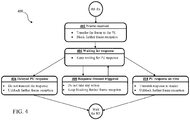
- Fig. 4 shows an illustrative embodiment of a state diagram 400.
- the NFC controller may enter the state "Frame received" 402 if it receives an data frame. In this state, it transfers the frame to the processing unit, and it blocks any further frames transmitted by the NFC reader. Subsequently, the NFC controller enters the state "Waiting for response" 404. In this state, the NFC controller waits for a response from the processing unit. If a time-out has elapsed without a response from the processing unit, the NFC controller enters the state "Response timeout triggered" 408. In this state, the NFC controller does not take any further action and it keeps blocking further frame reception.
- the NFC controller may also return to the state "Waiting for response" 404. If the NFC controller receives a delayed response from the processing unit, it enters the state "Delayed PU response" 406. In this state, it does not transmit the response to the NFC reader, and it unblocks further frame reception. However, if the NFC controller receives a response from the NFC controller on time, then it transmits said response to the NFC reader, and it unblocks further frame reception (i.e., it forwards newly received frames to the processing unit again). In this way, the risk of transaction failures is reduced.
- Fig. 5 shows an illustrative embodiment of a communication diagram 500.
- Fig. 5 shows an example of a communication between a processing unit 302, an NFC controller 304 and an external NFC reader 306, in which frames transmitted by the NFC reader 306 are blocked 502 by the NFC controller 304 if a response time-out 310 has elapsed without having received a response to a first command CMD1 from the processing unit 302.
- a second command CMD2 transmitted by the NFC reader 306 is not forwarded to the processing unit 302.
- the delayed response RESP CMD 1 to the first command CMD1 which is transmitted from the processing unit 302 to the NFC controller 304 after the time-out has elapsed, is not transmitted to the NFC reader 306.
- the response is effectively blocked 504. In this way, the risk of transaction failures is further reduced.
- the systems and methods described herein may at least partially be embodied by a computer program - i.e., a software application or "application” in short - or a plurality of computer programs, which may exist in a variety of forms both active and inactive in a single computer system or across multiple computer systems.
- a computer program i.e., a software application or "application” in short - or a plurality of computer programs, which may exist in a variety of forms both active and inactive in a single computer system or across multiple computer systems.
- they may exist as software program(s) comprised of program instructions in source code, object code, executable code or other formats for performing some of the steps.
- Any of the above may be embodied on a computer-readable medium, which may include storage devices and signals, in compressed or uncompressed form.
- the term "computer” refers to any electronic device comprising a processor, such as a general-purpose central processing unit (CPU), a specific-purpose processor or a microcontroller.
- a computer is capable of receiving data (an input), of performing a sequence of predetermined operations thereupon, and of producing thereby a result in the form of information or signals (an output).
- the term "computer” will mean either a processor in particular or more generally a processor in association with an assemblage of interrelated elements contained within a single case or housing.
- processor or “processing unit” refers to a data processing circuit that may be a microprocessor, a co-processor, a microcontroller, a microcomputer, a central processing unit, a field programmable gate array (FPGA), a programmable logic circuit, and/or any circuit that manipulates signals (analog or digital) based on operational instructions that are stored in a memory.
- memory refers to a storage circuit or multiple storage circuits such as read-only memory, random access memory, volatile memory, non-volatile memory, static memory, dynamic memory, Flash memory, cache memory, and/or any circuit that stores digital information.
- an interface may refer to a connection between electronic components or logical units.
- an interface may be defined as a shared boundary across which two or more separate components of a computer system exchange information. The exchange can be between software, computer hardware, peripheral devices, humans, and combinations of these.
- an interface may refer to a physical interface, e.g. a physical connection between a processing unit and an NFC controller, and/or to a logical interface, e.g. one out of multiple interface protocols defined for a physical connection between a processing unit and an NFC controller.
- a "computer-readable medium” or “storage medium” may be any means that can contain, store, communicate, propagate, or transport a computer program for use by or in connection with the instruction execution system, apparatus, or device.
- the computer-readable medium may be, for example but not limited to, an electronic, magnetic, optical, electromagnetic, infrared, or semiconductor system, apparatus, device, or propagation medium.
- the computer-readable medium may include the following: an electrical connection having one or more wires, a portable computer diskette, a random access memory (RAM), a read-only memory (ROM), an erasable programmable read-only memory (EPROM or Flash memory), an optical fiber, a portable compact disc read-only memory (CDROM), a digital versatile disc (DVD), a Blu-ray disc (BD), and a memory card.
- RAM random access memory
- ROM read-only memory
- EPROM or Flash memory erasable programmable read-only memory
- CDROM compact disc read-only memory
- DVD digital versatile disc
- BD Blu-ray disc
Landscapes
- Engineering & Computer Science (AREA)
- Computer Networks & Wireless Communication (AREA)
- Signal Processing (AREA)
- Business, Economics & Management (AREA)
- Accounting & Taxation (AREA)
- Strategic Management (AREA)
- Physics & Mathematics (AREA)
- General Business, Economics & Management (AREA)
- General Physics & Mathematics (AREA)
- Theoretical Computer Science (AREA)
- Telephone Function (AREA)
- Mobile Radio Communication Systems (AREA)
Abstract
Description
- The present disclosure relates to a near field communication (NFC) device. Furthermore, the present disclosure relates to a corresponding method of operating an NFC device, and to a corresponding computer program.
- Near field communication (NFC) refers to a set of communication protocols that enable two electronic devices to establish communication by bringing them within proximity of each other. The communication range of NFC is typically in the order of centimeters (e.g., 10 centimeters or less). NFC technology can be used to carry out various transactions, such as transactions for accessing buildings, transactions for accessing public transportation sites or vehicles, and payment transactions. For these purposes, physical NFC-enabled transaction cards are often used. Such transaction cards are often referred to as smart cards. Accordingly, different types of transaction cards exist, such as access cards, transit cards and payment cards. Nowadays, NFC-enabled mobile devices such as smart phones may be used to carry out similar transactions. For this purpose, digital representations of physical transaction cards are typically loaded into the mobile devices. These digital representations may be referred to as emulated cards or embedded cards.
- In accordance with a first aspect of the present disclosure, a near field communication (NFC) device is provided, comprising: an NFC front-end circuit configured to perform a communication with an external device; at least one processing unit configured to process one or more transactions between the NFC device and the external device; an NFC controller configured to control the NFC front-end circuit; wherein the NFC controller is configured to block a current data frame, which is being received by the NFC front-end circuit, if the processing unit has not fully processed a previous data frame.
- In an embodiment, the NFC controller is further configured to block a response received from the processing unit if the NFC front-end circuit receives or has received the current data frame.
- In an embodiment, the response received from the processing unit is a response to the previous data frame.
- In an embodiment, the NFC controller is further configured to accept the current data frame if the processing unit has fully processed the previous data frame.
- In an embodiment, a timeout condition of the processing unit triggers that the NFC controller blocks the current data frame.
- In an embodiment, processing the transactions between the NFC device and the external device includes processing transactions between a plurality of processing units of the NFC device and said external device, wherein said processing units are coupled to the NFC controller through different interfaces.
- In an embodiment, the current data frame includes a command.
- In an embodiment, the NFC controller is configured to block the command if the processing unit has not fully processed the previous data frame.
- In an embodiment, the processing unit is a secure element.
- In an embodiment, the NFC device is a mobile phone or a portable computer, such as a tablet.
- In an embodiment, the transactions include payment transactions and/or transit transactions.
- In accordance with a second aspect of the present disclosure, a method of operating a near field communication (NFC) device is conceived, comprising: an NFC front-end circuit performs a communication with an external device; at least one processing unit processes one or more transactions between the NFC device and the external device; an NFC controller controls the NFC front-end circuit; wherein the NFC controller blocks a current data frame, which is being received by the NFC front-end circuit, if the processing unit has not fully processed a previous data frame.
- In accordance with a third aspect of the present disclosure, a computer program is provided, comprising computer-executable instructions which, when executed, carry out or control a method of the kind set forth.
- In an embodiment, a non-transitory computer-readable medium comprises a computer program of the kind set forth.
- Embodiments will be described in more detail with reference to the appended drawings, in which:
- Fig. 1A
- shows an illustrative embodiment of an NFC device;
- Fig. 1B
- shows another illustrative embodiment an NFC device;
- Fig. 1C
- shows a further illustrative embodiment of an NFC device;
- Fig. 2
- shows an illustrative embodiment of a method of operating an NFC device;
- Fig. 3
- shows an example of a communication diagram;
- Fig. 4
- shows an illustrative embodiment of a state diagram;
- Fig. 5
- shows an illustrative embodiment of a communication diagram.
- Near field communication (NFC) refers to a set of communication protocols that enable two electronic devices to establish communication by bringing them within proximity of each other. The communication range of NFC is typically in the order of centimeters (e.g., 10 centimeters or less). NFC technology can be used to carry out various transactions, such as transactions for accessing buildings, transactions for accessing public transportation sites or vehicles, and payment transactions. For these purposes, physical NFC-enabled transaction cards are often used. Such transaction cards are often referred to as smart cards. Accordingly, different types of transaction cards exist, such as access cards, transit cards and payment cards. Nowadays, NFC-enabled mobile devices such as smart phones may be used to carry out similar transactions. For this purpose, digital representations of physical transaction cards are typically loaded into the mobile devices. These digital representations may be referred to as emulated cards or embedded cards.
- Near field communication infrastructures are often designed and built for transaction sequences based on physical smart cards, in which fast transactions can be carried out between terminals and single physical smart cards. For this purpose, the terminals include an NFC reader. Transaction failures do not often occur, because the communication between an NFC reader and a single physical smart card is mostly reliable. However, NFC-enabled mobile devices may contain a plurality of emulated cards, and a processing unit which contains and executes those cards (e.g, a secure element) typically needs more time to process data received from a reader. It is noted that a secure element (SE) may be a tamper-resistant integrated circuit with installed or pre-installed smart-card-grade applications, for instance payment applications, which have a prescribed functionality and a prescribed level of security. Furthermore, a secure element may implement security functions, such as cryptographic functions and authentication functions. In addition, NFC-enabled mobile devices may contain further processing units, such as embedded universal integrated circuit cards (eUICCs), for initiating and performing additional functions and transactions of the NFC-enabled device, and/or a plurality of logical interfaces for supporting different types of functions and transactions. The increased complexity of such an NFC system may lead to transaction failures. This, in turn, has a negative impact on the user experience, because the user may have to reinitiate a transaction multiple times.
-
Fig. 1A shows an illustrative embodiment of anNFC device 100. TheNFC device 100 comprises a contactless front-end 104 and aprocessing unit 102. The contactless front-end 104 comprises anNFC controller 106 and an NFC front-end circuit 108. In accordance with the present disclosure, the NFC front-end circuit 108 is configured to perform a communication with an external device (not shown). Furthermore, the processing unit is configured to process one or more transactions between theNFC device 100 and the external device. Furthermore, theNFC controller 106 is configured to control the NFC front-end circuit, wherein the NFC controller is configured to block a current data frame, which is being received by the NFC front-end circuit 108, if theprocessing unit 102 has not fully processed a previous data frame. In this way, it can be avoided that the processing unit receives another frame to process, before a response to the previous frame has been generated. Thus, the risk of a transaction failure is reduced. - It is noted that blocking of the current data frame may be done by refraining from forwarding the current data frame to the processing unit. In other words, the current data frame may be dropped by the NFC controller. Furthermore, the data frame may be removed from the internal buffer of the NFC controller, for example.
- Furthermore, it is noted that the processing of the previous data frame may be delayed for various reasons, for example because the
processing unit 102 is performing concurrent tasks. Furthermore, as shown inFig. 1B , the processing of the previous data frame may be delayed because the response generated by the corresponding processing unit may not be received in time by theNFC controller 106, due to the fact that other processing units are communicating with theNFC controller 106 through their respective interfaces. In other words, the processing of the previous data frame may be delayed due to concurrent accesses to theNFC controller 106 by different processing units. Alternatively, or in addition, a single processing unit may have different logical interfaces to the NFC controller (as shown inFig. 1C ), which may also cause delays due to concurrent accesses to the NFC controller through said different logical interfaces. - In an embodiment, the
NFC controller 106 is further configured to block a response received from theprocessing unit 102 if the NFC front-end circuit 108 receives or has received the current data frame. In this way, it can be prevented that the reader receives a wrong response. More specifically, since the reader may expect a response to the current data frame instead of the previous data frame, the delayed response to the previous data frame may be the wrong response. By blocking this response, this can be prevented. Thus, the risk of a transaction failure is further reduced. Again, said blocking may be realized by dropping the response and removing it from an internal buffer, for example. - In an embodiment, the
NFC controller 106 is further configured to accept the current data frame is theprocessing unit 102 has fully processed the previous data frame. In other words, if theprocessing unit 102 has fully processed the previous data frame, the current data frame may be forwarded to theprocessing unit 102 for further processing. In this way, unnecessary delays in the processing of transactions can be avoided. In an embodiment, a timeout condition of theprocessing unit 102 triggers that theNFC controller 106 blocks the current data frame. This results in a practical and effective implementation. -
Fig. 1B shows another illustrative embodiment of anNFC device 110. In this embodiment, processing the transactions between theNFC device 110 and the external device includes processing transactions between a plurality ofprocessing units processing units NFC controller 106 through different interfaces. In such a system, blocking a current data frame if one or more of theprocessing units different processing units NFC controller 106 is configured to block data frames if one or more of the processing units have not fully processed a previous data frame, so that they will not reach the processing units responsible for carrying out the transactions. The different processing units may be coupled to the NFC controller through distinct interfaces, such as a serial peripheral interface (SPI) and a single wire protocol (SWP) interface. -
Fig. 1C shows a further illustrative embodiment of anNFC device 118. In this embodiment, theprocessing unit 102 has different logical interfaces to theNFC controller 106. TheNFC controller 102 is configured to block a current data frame if theprocessing unit 102 has not fully processed a previous data frame. As mentioned above, this may be advantageous in case of concurrent accesses to the NFC controller through the different logical interfaces. - In an embodiment, the current data frame includes a command. Commands typically require a response from the processing unit. Thus, by blocking a command, it can be prevented that the
processing unit 102 is triggered to generate another response, while it is processing previously received data. In a practical and effective implementation, theNFC controller 106 is configured to block the command if theprocessing unit 102 has not fully processed the previous data frame. -
Fig. 2 shows an illustrative embodiment of amethod 200 of operating an NFC device. Themethod 200 comprises the following steps. At 202, the NFC front-end circuit performs a communication with an external device. At 204, the processing unit processes one or more transactions between the NFC device and the external device. Furthermore, at 206, the NFC controller controls the NFC front-end circuit, wherein the NFC controller blocks a current data frame which is being received by the NFC front-end circuit if the processing unit has not fully processed a previous data frame. In this way, it can be avoided that the processing unit receives another frame to process, before a response to the previous frame has been generated. Thus, the risk of a transaction failure is reduced. -
Fig. 3 shows an example of a communication diagram 300. In particular,Fig. 3 shows an example of a typical communication between aprocessing unit 302, anNFC controller 304 and anexternal NFC reader 306. In the situation shown inFig. 3 , theNFC reader 306 transmits a first command CMD1 to theNFC controller 304, through the NFC front-end circuit (not shown). Then, theNFC controller 304 forwards the first command CMD1 to theprocessing unit 302. Theprocessing unit 302 starts processing the first command CMD1, which takes an amount of time shown asblock 308 inFig. 3 . However, the amount oftime 308 exceeds a response time-out 310, i.e. an amount of time within which theNFC controller 304 expects a response to the first command CMD1. In the meantime, theNFC reader 306 transmits a second command CMD2 to theNFC controller 304, again through the NFC front-end circuit. Since the time-out has already elapsed, theNFC controller 304 transmits also this second command CMD2 to theprocessing unit 302, while the first command CMD1 is still being processed. Subsequently, theprocessing unit 302 returns a response RESP_CMD1 back to theNFC controller 304. Then, theNFC controller 304 transmits the response RESP_CMD1 to theNFC reader 306. However, since theNFC reader 306 had already transmitted a second command CMD2, the response RESP_CMD1 - which is a response to the first command CMD1 - may not be the response expected by theNFC reader 306. Thus, a transaction failure may occur. -
Fig. 4 shows an illustrative embodiment of a state diagram 400. In this embodiment, the NFC controller may enter the state "Frame received" 402 if it receives an data frame. In this state, it transfers the frame to the processing unit, and it blocks any further frames transmitted by the NFC reader. Subsequently, the NFC controller enters the state "Waiting for response" 404. In this state, the NFC controller waits for a response from the processing unit. If a time-out has elapsed without a response from the processing unit, the NFC controller enters the state "Response timeout triggered" 408. In this state, the NFC controller does not take any further action and it keeps blocking further frame reception. The NFC controller may also return to the state "Waiting for response" 404. If the NFC controller receives a delayed response from the processing unit, it enters the state "Delayed PU response" 406. In this state, it does not transmit the response to the NFC reader, and it unblocks further frame reception. However, if the NFC controller receives a response from the NFC controller on time, then it transmits said response to the NFC reader, and it unblocks further frame reception (i.e., it forwards newly received frames to the processing unit again). In this way, the risk of transaction failures is reduced. -
Fig. 5 shows an illustrative embodiment of a communication diagram 500. In particular,Fig. 5 shows an example of a communication between aprocessing unit 302, anNFC controller 304 and anexternal NFC reader 306, in which frames transmitted by theNFC reader 306 are blocked 502 by theNFC controller 304 if a response time-out 310 has elapsed without having received a response to a first command CMD1 from theprocessing unit 302. Thus, a second command CMD2 transmitted by theNFC reader 306 is not forwarded to theprocessing unit 302. Furthermore, the delayed response RESP CMD 1 to the first command CMD1, which is transmitted from theprocessing unit 302 to theNFC controller 304 after the time-out has elapsed, is not transmitted to theNFC reader 306. Thus, the response is effectively blocked 504. In this way, the risk of transaction failures is further reduced. - The systems and methods described herein may at least partially be embodied by a computer program - i.e., a software application or "application" in short - or a plurality of computer programs, which may exist in a variety of forms both active and inactive in a single computer system or across multiple computer systems. For example, they may exist as software program(s) comprised of program instructions in source code, object code, executable code or other formats for performing some of the steps. Any of the above may be embodied on a computer-readable medium, which may include storage devices and signals, in compressed or uncompressed form.
- As used herein, the term "computer" refers to any electronic device comprising a processor, such as a general-purpose central processing unit (CPU), a specific-purpose processor or a microcontroller. A computer is capable of receiving data (an input), of performing a sequence of predetermined operations thereupon, and of producing thereby a result in the form of information or signals (an output). Depending on the context, the term "computer" will mean either a processor in particular or more generally a processor in association with an assemblage of interrelated elements contained within a single case or housing.
- The term "processor" or "processing unit" refers to a data processing circuit that may be a microprocessor, a co-processor, a microcontroller, a microcomputer, a central processing unit, a field programmable gate array (FPGA), a programmable logic circuit, and/or any circuit that manipulates signals (analog or digital) based on operational instructions that are stored in a memory. The term "memory" refers to a storage circuit or multiple storage circuits such as read-only memory, random access memory, volatile memory, non-volatile memory, static memory, dynamic memory, Flash memory, cache memory, and/or any circuit that stores digital information.
- In general, the term "interface" may refer to a connection between electronic components or logical units. In computing, an interface may be defined as a shared boundary across which two or more separate components of a computer system exchange information. The exchange can be between software, computer hardware, peripheral devices, humans, and combinations of these. As used herein, an interface may refer to a physical interface, e.g. a physical connection between a processing unit and an NFC controller, and/or to a logical interface, e.g. one out of multiple interface protocols defined for a physical connection between a processing unit and an NFC controller.
- As used herein, a "computer-readable medium" or "storage medium" may be any means that can contain, store, communicate, propagate, or transport a computer program for use by or in connection with the instruction execution system, apparatus, or device. The computer-readable medium may be, for example but not limited to, an electronic, magnetic, optical, electromagnetic, infrared, or semiconductor system, apparatus, device, or propagation medium. More specific examples (non-exhaustive list) of the computer-readable medium may include the following: an electrical connection having one or more wires, a portable computer diskette, a random access memory (RAM), a read-only memory (ROM), an erasable programmable read-only memory (EPROM or Flash memory), an optical fiber, a portable compact disc read-only memory (CDROM), a digital versatile disc (DVD), a Blu-ray disc (BD), and a memory card.
- It is noted that the embodiments above have been described with reference to different subject-matters. In particular, some embodiments may have been described with reference to method-type claims whereas other embodiments may have been described with reference to apparatus-type claims. However, a person skilled in the art will gather from the above that, unless otherwise indicated, in addition to any combination of features belonging to one type of subject-matter also any combination of features relating to different subject-matters, in particular a combination of features of the method-type claims and features of the apparatus-type claims, is considered to be disclosed with this document.
- Furthermore, it is noted that the drawings are schematic. In different drawings, similar or identical elements are provided with the same reference signs. Furthermore, it is noted that in an effort to provide a concise description of the illustrative embodiments, implementation details which fall into the customary practice of the skilled person may not have been described. It should be appreciated that in the development of any such implementation, as in any engineering or design project, numerous implementation-specific decisions must be made in order to achieve the developers' specific goals, such as compliance with system-related and business-related constraints, which may vary from one implementation to another. Moreover, it should be appreciated that such a development effort might be complex and time consuming, but would nevertheless be a routine undertaking of design, fabrication, and manufacture for those of ordinary skill.
- Finally, it is noted that the skilled person will be able to design many alternative embodiments without departing from the scope of the appended claims. In the claims, any reference sign placed between parentheses shall not be construed as limiting the claim. The word "comprise(s)" or "comprising" does not exclude the presence of elements or steps other than those listed in a claim. The word "a" or "an" preceding an element does not exclude the presence of a plurality of such elements. Measures recited in the claims may be implemented by means of hardware comprising several distinct elements and/or by means of a suitably programmed processor. In a device claim enumerating several means, several of these means may be embodied by one and the same item of hardware. The mere fact that certain measures are recited in mutually different dependent claims does not indicate that a combination of these measures cannot be used to advantage.
-
- 100
- NFC device
- 102
- processing unit
- 104
- contactless front-end
- 106
- NFC controller
- 108
- NFC front-end circuit
- 110
- NFC device
- 112
- processing unit
- 114
- processing unit
- 116
- processing unit
- 118
- NFC device
- 200
- method of operating an NFC device
- 202
- NFC front-end circuit performs a communication with an external device
- 204
- processing unit processes one or more transactions between the NFC device and the external device
- 206
- NFC controller controls the NFC front-end circuit, wherein the NFC controller blocks a current data frame which is being received by the NFC front-end circuit if the processing unit has not fully processed a previous data frame
- 300
- communication diagram
- 302
- processing unit
- 304
- NFC controller
- 306
- NFC reader
- 308
- processing of CMD1
- 310
- response time-out
- 400
- state diagram
- 402
- frame received
- 404
- waiting for response
- 406
- delayed PU response
- 408
- response timeout triggered
- 410
- PU response on time
- 500
- communication diagram
- 502
- frame blocking
- 504
- response blocked
Claims (14)
- A near field communication, NFC, device, comprising:an NFC front-end circuit configured to perform a communication with an external device;at least one processing unit configured to process one or more transactions between the NFC device and the external device;an NFC controller configured to control the NFC front-end circuit;wherein the NFC controller is configured to block a current data frame, which is being received by the NFC front-end circuit, if the processing unit has not fully processed a previous data frame.
- The NFC device of claim 1, wherein the NFC controller is further configured to block a response received from the processing unit if the NFC front-end circuit receives or has received the current data frame.
- The NFC device of claim 2, wherein the response received from the processing unit is a response to the previous data frame.
- The NFC device of any preceding claim, wherein the NFC controller is further configured to accept the current data frame if the processing unit has fully processed the previous data frame.
- The NFC device of any preceding claim, wherein a timeout condition of the processing unit triggers that the NFC controller blocks the current data frame.
- The NFC device of any preceding claim, wherein processing the transactions between the NFC device and the external device includes processing transactions between a plurality of processing units of the NFC device and said external device, wherein said processing units are coupled to the NFC controller through different interfaces.
- The NFC device of any preceding claim, wherein the current data frame includes a command.
- The NFC device of claim 7, wherein the NFC controller is configured to block the command if the processing unit has not fully processed the previous data frame.
- The NFC device of any preceding claim, wherein the processing unit is a secure element.
- The NFC device of any preceding claim, being a mobile phone or a portable computer, such as a tablet.
- The NFC device of any preceding claim, wherein the transactions include payment transactions and/or transit transactions.
- A method of operating a near field communication, NFC, device, comprising:an NFC front-end circuit performs a communication with an external device;at least one processing unit processes one or more transactions between the NFC device and the external device;an NFC controller controls the NFC front-end circuit;wherein the NFC controller blocks a current data frame, which is being received by the NFC front-end circuit, if the processing unit has not fully processed a previous data frame.
- A computer program comprising computer-executable instructions which, when executed, carry out or control the method of claim 12.
- A non-transitory computer-readable medium comprising the computer program of claim 13.
Priority Applications (2)
| Application Number | Priority Date | Filing Date | Title |
|---|---|---|---|
| EP19184273.1A EP3761515A1 (en) | 2019-07-03 | 2019-07-03 | Near field communication device and method of operating the same |
| US16/905,214 US11330415B2 (en) | 2019-07-03 | 2020-06-18 | Near field communication device and method of operating the same |
Applications Claiming Priority (1)
| Application Number | Priority Date | Filing Date | Title |
|---|---|---|---|
| EP19184273.1A EP3761515A1 (en) | 2019-07-03 | 2019-07-03 | Near field communication device and method of operating the same |
Publications (1)
| Publication Number | Publication Date |
|---|---|
| EP3761515A1 true EP3761515A1 (en) | 2021-01-06 |
Family
ID=67184790
Family Applications (1)
| Application Number | Title | Priority Date | Filing Date |
|---|---|---|---|
| EP19184273.1A Withdrawn EP3761515A1 (en) | 2019-07-03 | 2019-07-03 | Near field communication device and method of operating the same |
Country Status (2)
| Country | Link |
|---|---|
| US (1) | US11330415B2 (en) |
| EP (1) | EP3761515A1 (en) |
Citations (3)
| Publication number | Priority date | Publication date | Assignee | Title |
|---|---|---|---|---|
| US20160007283A1 (en) * | 2014-07-03 | 2016-01-07 | Solomon Trainin | Techniques for conserving power for communication between wireless devices |
| US20170188262A1 (en) * | 2014-07-17 | 2017-06-29 | Sony Corporation | Electronic device, controller and control method for nfc |
| EP3291156A1 (en) * | 2005-03-07 | 2018-03-07 | Nokia Technologies Oy | Method and mobile terminal device including smartcard module and near field communications means |
Family Cites Families (3)
| Publication number | Priority date | Publication date | Assignee | Title |
|---|---|---|---|---|
| US7809012B2 (en) | 2007-02-16 | 2010-10-05 | Nokia Corporation | Managing low-power wireless mediums in multiradio devices |
| EP2584769B1 (en) | 2011-10-21 | 2020-04-01 | BlackBerry Limited | Mobile communications device providing NFC applet compatibility features and related methods |
| US9400888B1 (en) * | 2015-02-27 | 2016-07-26 | Qualcomm Incorporated | Systems and methods for mitigating effects of an unresponsive secure element during link establishment |
-
2019
- 2019-07-03 EP EP19184273.1A patent/EP3761515A1/en not_active Withdrawn
-
2020
- 2020-06-18 US US16/905,214 patent/US11330415B2/en active Active
Patent Citations (3)
| Publication number | Priority date | Publication date | Assignee | Title |
|---|---|---|---|---|
| EP3291156A1 (en) * | 2005-03-07 | 2018-03-07 | Nokia Technologies Oy | Method and mobile terminal device including smartcard module and near field communications means |
| US20160007283A1 (en) * | 2014-07-03 | 2016-01-07 | Solomon Trainin | Techniques for conserving power for communication between wireless devices |
| US20170188262A1 (en) * | 2014-07-17 | 2017-06-29 | Sony Corporation | Electronic device, controller and control method for nfc |
Also Published As
| Publication number | Publication date |
|---|---|
| US11330415B2 (en) | 2022-05-10 |
| US20210006957A1 (en) | 2021-01-07 |
Similar Documents
| Publication | Publication Date | Title |
|---|---|---|
| EP3716671B1 (en) | Payment assistance methods and devices | |
| US11954204B2 (en) | Artificial intelligence AI processing method and AI processing apparatus | |
| US10091652B2 (en) | Relay device | |
| KR102205836B1 (en) | Task Scheduling Method and Apparatus | |
| US20210357903A1 (en) | Systems and methods for providing near field communications | |
| US12039518B2 (en) | Method for implementing middleware based on EMV and terminal device | |
| US11853767B2 (en) | Inter-core data processing method, system on chip and electronic device | |
| KR102474986B1 (en) | Server that supports allocating virtual machine resource on the cloud and controlling method thereof | |
| US9665414B2 (en) | Communication protocol bridge for card computing devices | |
| US20160103716A1 (en) | Method for using shared device in apparatus capable of operating two operating systems | |
| KR102777923B1 (en) | Method for controlling sim card and sd card and electronic device implementing the same | |
| CN105938596B (en) | Apparatus and method for facilitating transactions | |
| KR102720005B1 (en) | Application optimizing method and electronic device supporting the same | |
| CN111586651B (en) | Method, electronic device and communication system for managing priority in context | |
| CN108874698A (en) | External equipment connection method, device, storage medium and electronic equipment | |
| EP3016342B1 (en) | Mobile device, method for facilitating a transaction, computer program, article of manufacture | |
| EP3937569A1 (en) | System and method for collision handling with cross carrier scheduling | |
| US11330415B2 (en) | Near field communication device and method of operating the same | |
| CN107155164B (en) | NFC power management device and method | |
| US10956620B2 (en) | Method of managing a secure element | |
| WO2022204873A1 (en) | Electronic apparatus, system on chip, and physical core allocation method | |
| US11652512B2 (en) | Fast NFC processing | |
| US20180270112A1 (en) | Nfc device and initialization method | |
| EP2976899B1 (en) | Method and apparatus for providing an interface between a uicc and a processor in an access terminal that supports asynchronous command processing by the uicc | |
| CN107274589B (en) | Access method and system of financial self-service terminal hardware equipment and terminal equipment |
Legal Events
| Date | Code | Title | Description |
|---|---|---|---|
| PUAI | Public reference made under article 153(3) epc to a published international application that has entered the european phase |
Free format text: ORIGINAL CODE: 0009012 |
|
| STAA | Information on the status of an ep patent application or granted ep patent |
Free format text: STATUS: THE APPLICATION HAS BEEN PUBLISHED |
|
| AK | Designated contracting states |
Kind code of ref document: A1 Designated state(s): AL AT BE BG CH CY CZ DE DK EE ES FI FR GB GR HR HU IE IS IT LI LT LU LV MC MK MT NL NO PL PT RO RS SE SI SK SM TR |
|
| AX | Request for extension of the european patent |
Extension state: BA ME |
|
| STAA | Information on the status of an ep patent application or granted ep patent |
Free format text: STATUS: REQUEST FOR EXAMINATION WAS MADE |
|
| 17P | Request for examination filed |
Effective date: 20210706 |
|
| RBV | Designated contracting states (corrected) |
Designated state(s): AL AT BE BG CH CY CZ DE DK EE ES FI FR GB GR HR HU IE IS IT LI LT LU LV MC MK MT NL NO PL PT RO RS SE SI SK SM TR |
|
| STAA | Information on the status of an ep patent application or granted ep patent |
Free format text: STATUS: EXAMINATION IS IN PROGRESS |
|
| 17Q | First examination report despatched |
Effective date: 20230214 |
|
| STAA | Information on the status of an ep patent application or granted ep patent |
Free format text: STATUS: THE APPLICATION IS DEEMED TO BE WITHDRAWN |
|
| 18D | Application deemed to be withdrawn |
Effective date: 20250103 |