EP3760580B1 - Method of making high capacity electrode material - Google Patents
Method of making high capacity electrode material Download PDFInfo
- Publication number
- EP3760580B1 EP3760580B1 EP19215229.6A EP19215229A EP3760580B1 EP 3760580 B1 EP3760580 B1 EP 3760580B1 EP 19215229 A EP19215229 A EP 19215229A EP 3760580 B1 EP3760580 B1 EP 3760580B1
- Authority
- EP
- European Patent Office
- Prior art keywords
- lmop
- suspended
- holding temperature
- gaseous mixture
- lithium
- Prior art date
- Legal status (The legal status is an assumption and is not a legal conclusion. Google has not performed a legal analysis and makes no representation as to the accuracy of the status listed.)
- Active
Links
Images


Classifications
-
- H—ELECTRICITY
- H01—ELECTRIC ELEMENTS
- H01M—PROCESSES OR MEANS, e.g. BATTERIES, FOR THE DIRECT CONVERSION OF CHEMICAL ENERGY INTO ELECTRICAL ENERGY
- H01M4/00—Electrodes
- H01M4/02—Electrodes composed of, or comprising, active material
- H01M4/13—Electrodes for accumulators with non-aqueous electrolyte, e.g. for lithium-accumulators; Processes of manufacture thereof
- H01M4/139—Processes of manufacture
- H01M4/1391—Processes of manufacture of electrodes based on mixed oxides or hydroxides, or on mixtures of oxides or hydroxides, e.g. LiCoOx
-
- C—CHEMISTRY; METALLURGY
- C01—INORGANIC CHEMISTRY
- C01B—NON-METALLIC ELEMENTS; COMPOUNDS THEREOF; METALLOIDS OR COMPOUNDS THEREOF NOT COVERED BY SUBCLASS C01C
- C01B21/00—Nitrogen; Compounds thereof
- C01B21/06—Binary compounds of nitrogen with metals, with silicon, or with boron, or with carbon, i.e. nitrides; Compounds of nitrogen with more than one metal, silicon or boron
- C01B21/0607—Binary compounds of nitrogen with metals, with silicon, or with boron, or with carbon, i.e. nitrides; Compounds of nitrogen with more than one metal, silicon or boron with alkali metals
- C01B21/061—Binary compounds of nitrogen with metals, with silicon, or with boron, or with carbon, i.e. nitrides; Compounds of nitrogen with more than one metal, silicon or boron with alkali metals with lithium
-
- B—PERFORMING OPERATIONS; TRANSPORTING
- B01—PHYSICAL OR CHEMICAL PROCESSES OR APPARATUS IN GENERAL
- B01J—CHEMICAL OR PHYSICAL PROCESSES, e.g. CATALYSIS OR COLLOID CHEMISTRY; THEIR RELEVANT APPARATUS
- B01J8/00—Chemical or physical processes in general, conducted in the presence of fluids and solid particles; Apparatus for such processes
- B01J8/18—Chemical or physical processes in general, conducted in the presence of fluids and solid particles; Apparatus for such processes with fluidised particles
-
- B—PERFORMING OPERATIONS; TRANSPORTING
- B01—PHYSICAL OR CHEMICAL PROCESSES OR APPARATUS IN GENERAL
- B01J—CHEMICAL OR PHYSICAL PROCESSES, e.g. CATALYSIS OR COLLOID CHEMISTRY; THEIR RELEVANT APPARATUS
- B01J8/00—Chemical or physical processes in general, conducted in the presence of fluids and solid particles; Apparatus for such processes
- B01J8/18—Chemical or physical processes in general, conducted in the presence of fluids and solid particles; Apparatus for such processes with fluidised particles
- B01J8/1809—Controlling processes
-
- C—CHEMISTRY; METALLURGY
- C01—INORGANIC CHEMISTRY
- C01B—NON-METALLIC ELEMENTS; COMPOUNDS THEREOF; METALLOIDS OR COMPOUNDS THEREOF NOT COVERED BY SUBCLASS C01C
- C01B21/00—Nitrogen; Compounds thereof
- C01B21/06—Binary compounds of nitrogen with metals, with silicon, or with boron, or with carbon, i.e. nitrides; Compounds of nitrogen with more than one metal, silicon or boron
- C01B21/0612—Binary compounds of nitrogen with metals, with silicon, or with boron, or with carbon, i.e. nitrides; Compounds of nitrogen with more than one metal, silicon or boron with alkaline-earth metals, beryllium or magnesium
-
- C—CHEMISTRY; METALLURGY
- C01—INORGANIC CHEMISTRY
- C01G—COMPOUNDS CONTAINING METALS NOT COVERED BY SUBCLASSES C01D OR C01F
- C01G45/00—Compounds of manganese
- C01G45/20—Compounds containing manganese, with or without oxygen or hydrogen, and containing one or more other elements
- C01G45/22—Compounds containing manganese, with or without oxygen or hydrogen, and containing two or more other elements
-
- C—CHEMISTRY; METALLURGY
- C01—INORGANIC CHEMISTRY
- C01G—COMPOUNDS CONTAINING METALS NOT COVERED BY SUBCLASSES C01D OR C01F
- C01G51/00—Compounds of cobalt
- C01G51/80—Compounds containing cobalt, with or without oxygen or hydrogen, and containing one or more other elements
- C01G51/82—Compounds containing cobalt, with or without oxygen or hydrogen, and containing two or more other elements
-
- C—CHEMISTRY; METALLURGY
- C01—INORGANIC CHEMISTRY
- C01G—COMPOUNDS CONTAINING METALS NOT COVERED BY SUBCLASSES C01D OR C01F
- C01G53/00—Compounds of nickel
- C01G53/80—Compounds containing nickel, with or without oxygen or hydrogen, and containing one or more other elements
- C01G53/82—Compounds containing nickel, with or without oxygen or hydrogen, and containing two or more other elements
-
- H—ELECTRICITY
- H01—ELECTRIC ELEMENTS
- H01M—PROCESSES OR MEANS, e.g. BATTERIES, FOR THE DIRECT CONVERSION OF CHEMICAL ENERGY INTO ELECTRICAL ENERGY
- H01M4/00—Electrodes
- H01M4/02—Electrodes composed of, or comprising, active material
- H01M4/04—Processes of manufacture in general
- H01M4/0471—Processes of manufacture in general involving thermal treatment, e.g. firing, sintering, backing particulate active material, thermal decomposition, pyrolysis
-
- H—ELECTRICITY
- H01—ELECTRIC ELEMENTS
- H01M—PROCESSES OR MEANS, e.g. BATTERIES, FOR THE DIRECT CONVERSION OF CHEMICAL ENERGY INTO ELECTRICAL ENERGY
- H01M4/00—Electrodes
- H01M4/02—Electrodes composed of, or comprising, active material
- H01M4/13—Electrodes for accumulators with non-aqueous electrolyte, e.g. for lithium-accumulators; Processes of manufacture thereof
- H01M4/136—Electrodes based on inorganic compounds other than oxides or hydroxides, e.g. sulfides, selenides, tellurides, halogenides or LiCoFy
-
- H—ELECTRICITY
- H01—ELECTRIC ELEMENTS
- H01M—PROCESSES OR MEANS, e.g. BATTERIES, FOR THE DIRECT CONVERSION OF CHEMICAL ENERGY INTO ELECTRICAL ENERGY
- H01M4/00—Electrodes
- H01M4/02—Electrodes composed of, or comprising, active material
- H01M4/13—Electrodes for accumulators with non-aqueous electrolyte, e.g. for lithium-accumulators; Processes of manufacture thereof
- H01M4/139—Processes of manufacture
- H01M4/1395—Processes of manufacture of electrodes based on metals, Si or alloys
-
- H—ELECTRICITY
- H01—ELECTRIC ELEMENTS
- H01M—PROCESSES OR MEANS, e.g. BATTERIES, FOR THE DIRECT CONVERSION OF CHEMICAL ENERGY INTO ELECTRICAL ENERGY
- H01M4/00—Electrodes
- H01M4/02—Electrodes composed of, or comprising, active material
- H01M4/36—Selection of substances as active materials, active masses, active liquids
- H01M4/58—Selection of substances as active materials, active masses, active liquids of inorganic compounds other than oxides or hydroxides, e.g. sulfides, selenides, tellurides, halogenides or LiCoFy; of polyanionic structures, e.g. phosphates, silicates or borates
-
- B—PERFORMING OPERATIONS; TRANSPORTING
- B01—PHYSICAL OR CHEMICAL PROCESSES OR APPARATUS IN GENERAL
- B01J—CHEMICAL OR PHYSICAL PROCESSES, e.g. CATALYSIS OR COLLOID CHEMISTRY; THEIR RELEVANT APPARATUS
- B01J2208/00—Processes carried out in the presence of solid particles; Reactors therefor
- B01J2208/00008—Controlling the process
- B01J2208/00017—Controlling the temperature
- B01J2208/00026—Controlling or regulating the heat exchange system
- B01J2208/00035—Controlling or regulating the heat exchange system involving measured parameters
- B01J2208/00044—Temperature measurement
- B01J2208/00061—Temperature measurement of the reactants
-
- Y—GENERAL TAGGING OF NEW TECHNOLOGICAL DEVELOPMENTS; GENERAL TAGGING OF CROSS-SECTIONAL TECHNOLOGIES SPANNING OVER SEVERAL SECTIONS OF THE IPC; TECHNICAL SUBJECTS COVERED BY FORMER USPC CROSS-REFERENCE ART COLLECTIONS [XRACs] AND DIGESTS
- Y02—TECHNOLOGIES OR APPLICATIONS FOR MITIGATION OR ADAPTATION AGAINST CLIMATE CHANGE
- Y02E—REDUCTION OF GREENHOUSE GAS [GHG] EMISSIONS, RELATED TO ENERGY GENERATION, TRANSMISSION OR DISTRIBUTION
- Y02E60/00—Enabling technologies; Technologies with a potential or indirect contribution to GHG emissions mitigation
- Y02E60/10—Energy storage using batteries
Definitions
- the present disclosure relates to a method of making electrode material, and more particularly to a method of making electrode material using commercially available stock.
- LiB lithium-ion batteries
- LiB Lithium-transition-metal-nitrides
- typical production methods are small-scale, time consuming, and yield low surface area materials.
- LTMN powders are typically prepared by mixing and grinding Li 3 N and metal powders, pressing the mixture into a pellet, and heating in a nitrogen donating gas for at least 12 hours to 5 days. The product then has to be ground and mechanically milled. The process is lengthy and dangerous. The processes require highly flammable and reactant ingredients, specifically the lithium nitrides.
- LiBs When compared to traditional rechargeable battery systems, rechargeable lithium-ion batteries (LiBs) have been identified as attractive alternative power sources for numerous applications such as electrical vehicles (EVs), hybrid electrical vehicles (HEVs), and stationary energy systems.
- EVs electrical vehicles
- HEVs hybrid electrical vehicles
- a typical LiB is composed of several electrochemical cells either connected in series and/or parallel to provide the desired voltage and capacity. Each cell is comprised of a positive (cathode) and negative (anode) electrode which are separated by an electrolyte solution containing dissociated salts which allows ion transfer between the two electrodes.
- the typically used method for preparing lithiated transition metal nitride powders involves mixing Li 3 N and the desired metal powder in the appropriate quantities, followed by grinding.
- the powder mixture is then pressed into a pellet, and heated under nitrogen donating atmosphere (typically N 2 ) for 12 hours to 5 days.
- nitrogen donating atmosphere typically N 2
- the products are then ground in a glove box and further treated by high-energy mechanical milling (HEMM).
- HEMM high-energy mechanical milling
- a method of manufacturing lithium-metal nitride includes suspending a lithium-metal-oxide-powder (LMOP) within a gaseous mixture, incrementally heating the suspended LMOP to a holding temperature of between 400 and 800 degrees Celsius such that the LMOP reaches the holding temperature, and maintaining the LMOP at the holding temperature for a time period in order for the gaseous mixture and the LMOP to react to form a lithium-metal nitride powder (LMNP) and forming a battery electrode from the lithium-metal nitride powder.
- LMOP lithium-metal-oxide-powder
- the method can include cooling the suspended LMOP to an ambient temperature from the holding temperature.
- Degassing can include flowing an inert gas over the suspended LMOP, wherein the inert gas includes Argon or Helium, but does not include Nitrogen.
- Suspending the LMOP within the gaseous mixture can include feeding the gaseous mixture to a reaction chamber, wherein the reaction chamber includes an outer wall containing an annular gas path therein surrounding an internal chamber configured to enclose the LMOP.
- the gaseous mixture can be fed through a porous media located in a bottom portion of the internal chamber in order to suspend the LMOP. Degassing the suspended LMOP can take place within the internal chamber.
- the suspended LMOP can be incrementally heated, predominantly by convection, ramping to 200 degrees Celsius at 5 degrees/minute and then ramping to the holding temperature at a rate of between 10°C/min and 15°C/min, and then held at that temperature for between 1 and 10 hours.
- the LMOP can consist of a commercially available powder and be selected from a group consisting of LiMn 2 O 4 , LiMnO 2 , LiNi 0.8 Co 0.15 Al 0.05 O 2 , LiM 1.5 Ni 0.5 O 4 , or a combination thereof.
- the LMNP can be selected from a group consisting of Li x Mn y-x N, Li x Mn y-x Ni n N, LiMn y-x Ni z N, or a combination thereof or specifically, Li 7.9 MnN 3.2 O 1.6 , Li 7 MnN 4 , Li 2.6 Co 0.2 Cu 0.2 N, Li 2.6 Co 0.4 N, Li 2:5 CO 0:2 Cu 0:1 Ni 0:1 N, or a combination thereof.
- the gaseous mixture can include gas selected from a group consisting of N 2 , H 2 , He, NH 3 , Ar, or a combination thereof.
- Fig. 1 a partial view of an exemplary embodiment of a reactor in accordance with the disclosure is shown in Fig. 1 and is designated generally by reference character 100.
- Other steps of the disclosure are provided in Figs. 2-4 , as will be described.
- the methods of the disclosure can be used to produce lithium-metal nitride powder using safe commercial lithium metal oxide powders while reducing handling risks and process times, and increasing efficiency.
- Fig. 1 shows a reactor 100 used for producing lithium-metal nitride powder (LMNP).
- Lithium-metal-oxide-powder (LMOP) 122 is shown with an internal chamber or fluidized bed 106.
- LMOP consists of a commercially available powder, such as LiMn 2 O 4 , LiMnO 2 , LiNi 0.8 Co 0.15 Al 0.05 O 2 , or LiM 1.5 Ni 0.5 O 4 .
- the reactor 100 includes a gas source 102, a mass flow controller 104, and a fluidized bed reactor 106 for holding the initial powder, mixing the powder with various gasses, and heating the mixture.
- the fluidized bed reactor 106 can include a series of individual heating zones 108, which ensure that the fluidized bed reactor 106 evenly heated.
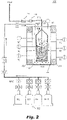
- Fig. 2 shows a gaseous mixture, such as N 2 , H 2 , He, NH 3 , Ar, or a combination there of, flowing from the gas source 102 and suspending the LMOP within a gaseous mixture.
- the gaseous mixture is fed to the reaction chamber 101, wherein the reaction chamber 101 includes an outer wall 103, an inner wall 113, and the annular gas path 110 therein surrounding the internal chamber 106.
- the gaseous mixture is fed through the porous media 114 located in a bottom portion of the internal chamber 106 in order to suspend the LMOP. Gasses can then be vented through a venting system 116 located opposite the porous media 114, which includes a particulate trap 118 and moisture trap 120.
- Fig. 3 shows the suspended LMOP being incrementally heated using a series of individual heating zones 108 to a holding temperature of between 400 and 800 degrees Celsius, preferably 700 degrees Celsius and maintaining the LMOP at the holding temperature for a given time period in order for the gaseous mixture and the LMOP to react.
- LMOP is incrementally heated, predominantly by convection, ramping to approximately 200 degrees Celsius at approximately 5 degrees/minute and then ramping to the holding temperature at a rate of between 10C/min and 15C/min, and then held at that temperature for between 1 and 10 hours.
- the temperature and time depends on the bulk powder LMOP, specifically, the density, metal content, and powder composition.
- the powder After reacting and forming LMNP, such as Li x Mn y-x N, Li x Mn y-x Ni n N, LiMn y-x Ni z N, the powder is cooled to an ambient temperature.
- the ambient temperature can be approximately room temperature.
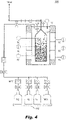
- Fig. 4 shows a formed a lithium-metal nitride powder 124 (LMNP) within the fluidized bed 106.
- the formed LMNP 124 can be degassed from the gas source 102 using an inert gas.
- the inert gas includes Argon or Helium, and specifically excludes Nitrogen in order to preclude any further reaction.
- the LMNP 124 can further be coated within the fluidized bed 106.
- the coating can consist of an appropriately selected polymer, such as polyvinylidene fluoride (PVDF) which can aid in ensuring proper operation of the Li-ion batteries.
- Binders function as a polymeric matrix that connects active materials to one another and to the current collector in a composite Li-ion battery electrode.
- the binder also accommodates volume changes due to de-/lithiation of active materials during battery operation.
- High binding strength, favorable mechanical properties to accommodate volume changes, high electronic conductivity, porous structure for high ionic conductivity, and chemical inertness are key characteristics of a quality binder.
- electroactive polymers such as polyaniline and polypyrrole can be used instead of PVDF. Both improve the rate capability and cycle life of intrinsically poor electronic conductivity (as in LiFePO 4 ) while the polyaniline binder improves irreversible capacity loss during the first cycle in a graphite anode.
- This use of LMNP in powder form allows the coating to cover a larger surface area to coated surface area ratio than traditional methods, which coat material in pellet form.
Landscapes
- Chemical & Material Sciences (AREA)
- Engineering & Computer Science (AREA)
- Organic Chemistry (AREA)
- Chemical Kinetics & Catalysis (AREA)
- Inorganic Chemistry (AREA)
- Electrochemistry (AREA)
- General Chemical & Material Sciences (AREA)
- Materials Engineering (AREA)
- Manufacturing & Machinery (AREA)
- Combustion & Propulsion (AREA)
- Life Sciences & Earth Sciences (AREA)
- General Life Sciences & Earth Sciences (AREA)
- Geology (AREA)
- Battery Electrode And Active Subsutance (AREA)
Description
- The present disclosure relates to a method of making electrode material, and more particularly to a method of making electrode material using commercially available stock.
- Aircraft systems use lithium-ion batteries (LiB) for backup and auxiliary power, engine-startup, etc. due to their quick recharging capabilities, high voltage and current capabilities, and power quality. Graphite, the most widely used LiB anode material has high reversibility, but low specific capacity. Lithium-transition-metal-nitrides (LTMN) are great alternatives to LiB with high, stable, and reversible capacities and a longer cycle life, but typical production methods are small-scale, time consuming, and yield low surface area materials. Additionally, LTMN powders are typically prepared by mixing and grinding Li3N and metal powders, pressing the mixture into a pellet, and heating in a nitrogen donating gas for at least 12 hours to 5 days. The product then has to be ground and mechanically milled. The process is lengthy and dangerous. The processes require highly flammable and reactant ingredients, specifically the lithium nitrides.
- When compared to traditional rechargeable battery systems, rechargeable lithium-ion batteries (LiBs) have been identified as attractive alternative power sources for numerous applications such as electrical vehicles (EVs), hybrid electrical vehicles (HEVs), and stationary energy systems. A typical LiB is composed of several electrochemical cells either connected in series and/or parallel to provide the desired voltage and capacity. Each cell is comprised of a positive (cathode) and negative (anode) electrode which are separated by an electrolyte solution containing dissociated salts which allows ion transfer between the two electrodes.
- To date, the typically used method for preparing lithiated transition metal nitride powders involves mixing Li3N and the desired metal powder in the appropriate quantities, followed by grinding. The powder mixture is then pressed into a pellet, and heated under nitrogen donating atmosphere (typically N2) for 12 hours to 5 days. In some instances, the products are then ground in a glove box and further treated by high-energy mechanical milling (HEMM). This approach is very time consuming with many separate steps as well as very energy intensive. In addition, the final materials are typically, low surface area and very sensitive to air exposure.
- Therefore, there is still a need in the art for a method of manufacturing lithium-ion batteries having improved using safer, and less reactant methods, specifically a need for Li-ion battery anode materials with larger reversible capacity and higher stability and cycle life and a need for a more efficient method for preparing lithium transition metal nitride nanopowders. There also remains a need in the art for such methods that are economically viable. The present disclosure may provide a solution for at least one of these remaining challenges.
US 2010/297504 relates to a method of producing a nitrided lithium-transition metal compound oxide. - A method of manufacturing lithium-metal nitride is provided in claim 1 and includes suspending a lithium-metal-oxide-powder (LMOP) within a gaseous mixture, incrementally heating the suspended LMOP to a holding temperature of between 400 and 800 degrees Celsius such that the LMOP reaches the holding temperature, and maintaining the LMOP at the holding temperature for a time period in order for the gaseous mixture and the LMOP to react to form a lithium-metal nitride powder (LMNP) and forming a battery electrode from the lithium-metal nitride powder.
- The method can include cooling the suspended LMOP to an ambient temperature from the holding temperature. Degassing can include flowing an inert gas over the suspended LMOP, wherein the inert gas includes Argon or Helium, but does not include Nitrogen.
- Suspending the LMOP within the gaseous mixture can include feeding the gaseous mixture to a reaction chamber, wherein the reaction chamber includes an outer wall containing an annular gas path therein surrounding an internal chamber configured to enclose the LMOP. The gaseous mixture can be fed through a porous media located in a bottom portion of the internal chamber in order to suspend the LMOP. Degassing the suspended LMOP can take place within the internal chamber.
- The suspended LMOP can be incrementally heated, predominantly by convection, ramping to 200 degrees Celsius at 5 degrees/minute and then ramping to the holding temperature at a rate of between 10°C/min and 15°C/min, and then held at that temperature for between 1 and 10 hours.
- The LMOP can consist of a commercially available powder and be selected from a group consisting of LiMn2O4, LiMnO2, LiNi0.8Co0.15Al0.05O2, LiM1.5Ni0.5O4, or a combination thereof. The LMNP can be selected from a group consisting of LixMny-xN, LixMny-xNinN, LiMny-xNizN, or a combination thereof or specifically, Li7.9MnN3.2O1.6, Li7MnN4, Li2.6Co0.2Cu0.2N, Li2.6Co0.4N, Li2:5CO0:2Cu0:1Ni0:1N, or a combination thereof. The gaseous mixture can include gas selected from a group consisting of N2, H2, He, NH3, Ar, or a combination thereof.
- These and other features of the methods of the subject disclosure will become more readily apparent to those skilled in the art from the following detailed description of the preferred embodiments taken in conjunction with the drawings.
- So that those skilled in the art to which the subject invention appertains will readily understand how to make and use the devices and methods of the subject invention without undue experimentation, preferred embodiments thereof will be described in detail herein below with reference to certain figures, wherein:
-
Fig. 1 is a schematic view of a reactor including lithium-metal-oxide-powder; -
Fig. 2 is a schematic view of a reactor ofFig. 1 , showing a flowing gaseous mixture; -
Fig. 3 is a schematic view of a reactor ofFig. 1 , showing a heated suspension; and -
Fig. 4 is a schematic view of a reactor ofFig. 1 , showing a resultant lithium-metal nitride. - Reference will now be made to the drawings wherein like reference numerals identify similar structural features or aspects of the subject invention. For purposes of explanation and illustration, and not limitation, a partial view of an exemplary embodiment of a reactor in accordance with the disclosure is shown in
Fig. 1 and is designated generally byreference character 100. Other steps of the disclosure are provided inFigs. 2-4 , as will be described. The methods of the disclosure can be used to produce lithium-metal nitride powder using safe commercial lithium metal oxide powders while reducing handling risks and process times, and increasing efficiency. -
Fig. 1 shows areactor 100 used for producing lithium-metal nitride powder (LMNP). Lithium-metal-oxide-powder (LMOP) 122 is shown with an internal chamber or fluidizedbed 106. LMOP consists of a commercially available powder, such as LiMn2O4, LiMnO2, LiNi0.8Co0.15Al0.05O2, or LiM1.5Ni0.5O4. Thereactor 100 includes agas source 102, amass flow controller 104, and a fluidizedbed reactor 106 for holding the initial powder, mixing the powder with various gasses, and heating the mixture. The fluidizedbed reactor 106 can include a series ofindividual heating zones 108, which ensure that the fluidizedbed reactor 106 evenly heated. -
Fig. 2 shows a gaseous mixture, such as N2, H2, He, NH3, Ar, or a combination there of, flowing from thegas source 102 and suspending the LMOP within a gaseous mixture. The gaseous mixture is fed to thereaction chamber 101, wherein thereaction chamber 101 includes anouter wall 103, aninner wall 113, and theannular gas path 110 therein surrounding theinternal chamber 106. The gaseous mixture is fed through theporous media 114 located in a bottom portion of theinternal chamber 106 in order to suspend the LMOP. Gasses can then be vented through aventing system 116 located opposite theporous media 114, which includes aparticulate trap 118 andmoisture trap 120. -
Fig. 3 shows the suspended LMOP being incrementally heated using a series ofindividual heating zones 108 to a holding temperature of between 400 and 800 degrees Celsius, preferably 700 degrees Celsius and maintaining the LMOP at the holding temperature for a given time period in order for the gaseous mixture and the LMOP to react. LMOP is incrementally heated, predominantly by convection, ramping to approximately 200 degrees Celsius at approximately 5 degrees/minute and then ramping to the holding temperature at a rate of between 10C/min and 15C/min, and then held at that temperature for between 1 and 10 hours. The temperature and time depends on the bulk powder LMOP, specifically, the density, metal content, and powder composition. After reacting and forming LMNP, such as LixMny-xN, LixMny-xNinN, LiMny-xNizN, the powder is cooled to an ambient temperature. The ambient temperature can be approximately room temperature. -
Fig. 4 shows a formed a lithium-metal nitride powder 124 (LMNP) within the fluidizedbed 106. The formed LMNP 124 can be degassed from thegas source 102 using an inert gas. Specifically, the inert gas includes Argon or Helium, and specifically excludes Nitrogen in order to preclude any further reaction. At this point, the LMNP 124 can further be coated within the fluidizedbed 106. The coating can consist of an appropriately selected polymer, such as polyvinylidene fluoride (PVDF) which can aid in ensuring proper operation of the Li-ion batteries. Binders function as a polymeric matrix that connects active materials to one another and to the current collector in a composite Li-ion battery electrode. The binder also accommodates volume changes due to de-/lithiation of active materials during battery operation. High binding strength, favorable mechanical properties to accommodate volume changes, high electronic conductivity, porous structure for high ionic conductivity, and chemical inertness are key characteristics of a quality binder. Several different electroactive polymers such as polyaniline and polypyrrole can be used instead of PVDF. Both improve the rate capability and cycle life of intrinsically poor electronic conductivity (as in LiFePO4) while the polyaniline binder improves irreversible capacity loss during the first cycle in a graphite anode. This use of LMNP in powder form allows the coating to cover a larger surface area to coated surface area ratio than traditional methods, which coat material in pellet form. - The methods of the present disclosure, as described above and shown in the drawings, provide for lithium-metal nitride powder production methods with superior properties including increased safety and reduced cost and complexity.
Claims (14)
- A method of manufacturing lithium-metal nitride comprising:suspending a lithium-metal-oxide-powder (LMOP) within a gaseous mixture;incrementally heating the suspended LMOP to a holding temperature of between 400 and 800 degrees Celsius such that the LMOP reaches the holding temperature;maintaining the LMOP at the holding temperature for a time period in order for the gaseous mixture and the LMOP to react to form a lithium-metal nitride powder (LMNP); anddegassing the suspended LMOP.
- The method of claim 1, further comprising cooling the suspended LMOP to an ambient temperature from the holding temperature.
- The method of claim 1, wherein degassing flowing an inert gas over the suspended LMOP.
- The method of claim 3, wherein the inert gas includes Argon or Helium, and wherein the inert gas does not include Nitrogen.
- The method of any preceding claim, wherein suspending the LMOP within the gaseous mixture includes feeding the gaseous mixture to a reaction chamber, wherein the reaction chamber includes an outer wall containing an annular gas path therein surrounding an internal chamber configured to enclose the LMOP.
- The method of claim 5, further comprising feeding, the gaseous mixture is fed through a porous media located in a bottom portion of the internal chamber in order to suspend the LMOP.
- The method of claim 5, further comprising degassing the suspended LMOP within the internal chamber.
- The method of any preceding claim, further comprising heating the suspended LMOP at a rate of 5 degrees Celsius per minute to 200 degrees Celsius and then 10 to 15 degrees per minute to the holding temperature, and preferably further comprising incrementally heating the suspended LMOP to the holding temperature predominantly by convection.
- The method of any preceding claim, further comprising maintaining the holding temperature for between 1 and 10 hours, inclusive.
- The method of any preceding claim, wherein the LMOP consists of a commercially available powder.
- The method of any preceding claim, wherein the LMOP is selected from a group consisting of LiMn2O4, LiMnO2, LiNi0.8Co0.15Al0.05O2, LiMn1.5Ni0.5O4, or a combination thereof.
- The method of any preceding claim, wherein the LMNP is selected from a group consisting of LixMny-xN, LixMny-xNinN, LiMny-xNizN, or a combination thereof, and preferably wherein the LMNP is selected from a group consisting of [Li7.9MnN3.2O1.6, Li7MnN4, Li2.6Co0.2Cu0.2N, Li2.6Co0.4N, Li2:5Co0:2Cu0:1Ni0:1N, or a combination thereof.
- The method of any preceding claim, wherein the gaseous mixture includes gas selected from a group consisting of N2, H2, He, NH3, Ar, or a combination thereof.
- A method of forming a battery electrode comprising:the method as claimed in claim 1; andforming a battery electrode using the LMNP
Applications Claiming Priority (1)
| Application Number | Priority Date | Filing Date | Title |
|---|---|---|---|
| US16/460,608 US11094923B2 (en) | 2019-07-02 | 2019-07-02 | Method of making high capacity electrode material |
Publications (2)
| Publication Number | Publication Date |
|---|---|
| EP3760580A1 EP3760580A1 (en) | 2021-01-06 |
| EP3760580B1 true EP3760580B1 (en) | 2022-08-10 |
Family
ID=68886825
Family Applications (1)
| Application Number | Title | Priority Date | Filing Date |
|---|---|---|---|
| EP19215229.6A Active EP3760580B1 (en) | 2019-07-02 | 2019-12-11 | Method of making high capacity electrode material |
Country Status (2)
| Country | Link |
|---|---|
| US (2) | US11094923B2 (en) |
| EP (1) | EP3760580B1 (en) |
Families Citing this family (1)
| Publication number | Priority date | Publication date | Assignee | Title |
|---|---|---|---|---|
| EP3998654A1 (en) * | 2021-02-19 | 2022-05-18 | Lilium eAircraft GmbH | Hybrid electrode |
Family Cites Families (7)
| Publication number | Priority date | Publication date | Assignee | Title |
|---|---|---|---|---|
| US5702843A (en) | 1995-05-24 | 1997-12-30 | Sharp Kabushiki Kaisha | Nonaqueous secondary battery |
| US6482374B1 (en) * | 1999-06-16 | 2002-11-19 | Nanogram Corporation | Methods for producing lithium metal oxide particles |
| JP5671831B2 (en) * | 2009-05-21 | 2015-02-18 | トヨタ自動車株式会社 | Method for producing lithium nitride-transition metal composite oxide, lithium nitride-transition metal composite oxide, and lithium battery |
| KR102014984B1 (en) | 2011-12-02 | 2019-08-28 | 삼성전자주식회사 | Anode active material for lithium rechargeable battery, its preparation and lithium battery using same |
| US20140099547A1 (en) | 2012-10-05 | 2014-04-10 | Ut-Battelle, Llc | Surface modifications for electrode compositions and their methods of making |
| US10044038B2 (en) | 2013-09-03 | 2018-08-07 | Ut-Battelle, Llc | Nitride- and oxide-modified electrode compositions and their methods of making |
| KR102273769B1 (en) * | 2013-12-30 | 2021-07-07 | 삼성에스디아이 주식회사 | Lithium transition metal phosphates, preparing method thereof and lithium secondary battery manufactured using the same |
-
2019
- 2019-07-02 US US16/460,608 patent/US11094923B2/en active Active
- 2019-12-11 EP EP19215229.6A patent/EP3760580B1/en active Active
-
2021
- 2021-07-16 US US17/378,609 patent/US11682756B2/en active Active
Also Published As
| Publication number | Publication date |
|---|---|
| US20210005885A1 (en) | 2021-01-07 |
| US20210344000A1 (en) | 2021-11-04 |
| US11094923B2 (en) | 2021-08-17 |
| US11682756B2 (en) | 2023-06-20 |
| EP3760580A1 (en) | 2021-01-06 |
Similar Documents
| Publication | Publication Date | Title |
|---|---|---|
| Wulandari et al. | Lithium‐based batteries, history, current status, challenges, and future perspectives | |
| JP7254875B2 (en) | Positive electrode active material for lithium secondary battery and lithium secondary battery containing the same | |
| CN111095624B (en) | Composite anode material comprising surface stabilized active material particles and method of making same | |
| CN108025925B (en) | Nickel-manganese-containing composite hydroxide and method for producing the same | |
| JP4531762B2 (en) | SiO powder for secondary battery and method for producing the same | |
| KR102682363B1 (en) | Anode active material for lithium secondary batteries and Lithium secondary batteries comprising the same | |
| CN104428253B (en) | The nickelate compound of doping | |
| CN114566646B (en) | A kind of nickel-doped lithium iron manganese phosphate cathode material and its preparation method and application | |
| CN107534143B (en) | Positive electrode active material, method for producing same, and nonaqueous electrolyte secondary battery | |
| CN104428254A (en) | Doped nickelate compounds | |
| JP2015201388A (en) | Cathode active material for non-aqueous secondary battery and method for producing the same | |
| JP7042426B2 (en) | Solid electrolytes and batteries | |
| US20240079587A1 (en) | Composite cathodes for li-ion batteries | |
| CN108140879A (en) | Passive voltage-controlled method in sodium-ion battery | |
| EP0779669A1 (en) | Lithium manganese oxide compound and method of preparation | |
| US8236447B2 (en) | Electrode active material for non-aqueous secondary batteries | |
| US11682756B2 (en) | Method of making high capacity electrode material | |
| CN107565099B (en) | Positive active material, preparation method thereof and lithium ion battery | |
| JP5473969B2 (en) | Secondary battery positive electrode and secondary battery equipped with the same | |
| EP3033795B1 (en) | Lithium sulfur cell and preparation method | |
| CN117199366A (en) | Lithium supplement additive and its preparation method and application | |
| CN117581397A (en) | Lithium nickel manganate cathode active material, preparation method thereof, and secondary battery using same | |
| CN110265628B (en) | Positive electrode and lithium ion secondary battery | |
| KR102928889B1 (en) | Positive active materials for lithium secondary battery, manufacturing method thereof, and lithium secondary battery containing the same | |
| CN112174154A (en) | Negative active material, negative pole piece and lithium ion secondary battery manufacturing method |
Legal Events
| Date | Code | Title | Description |
|---|---|---|---|
| PUAI | Public reference made under article 153(3) epc to a published international application that has entered the european phase |
Free format text: ORIGINAL CODE: 0009012 |
|
| STAA | Information on the status of an ep patent application or granted ep patent |
Free format text: STATUS: THE APPLICATION HAS BEEN PUBLISHED |
|
| AK | Designated contracting states |
Kind code of ref document: A1 Designated state(s): AL AT BE BG CH CY CZ DE DK EE ES FI FR GB GR HR HU IE IS IT LI LT LU LV MC MK MT NL NO PL PT RO RS SE SI SK SM TR |
|
| AX | Request for extension of the european patent |
Extension state: BA ME |
|
| STAA | Information on the status of an ep patent application or granted ep patent |
Free format text: STATUS: REQUEST FOR EXAMINATION WAS MADE |
|
| 17P | Request for examination filed |
Effective date: 20210702 |
|
| RBV | Designated contracting states (corrected) |
Designated state(s): AL AT BE BG CH CY CZ DE DK EE ES FI FR GB GR HR HU IE IS IT LI LT LU LV MC MK MT NL NO PL PT RO RS SE SI SK SM TR |
|
| GRAP | Despatch of communication of intention to grant a patent |
Free format text: ORIGINAL CODE: EPIDOSNIGR1 |
|
| STAA | Information on the status of an ep patent application or granted ep patent |
Free format text: STATUS: GRANT OF PATENT IS INTENDED |
|
| RIC1 | Information provided on ipc code assigned before grant |
Ipc: B01J 8/18 20060101ALI20220128BHEP Ipc: H01M 4/58 20100101ALI20220128BHEP Ipc: H01M 4/136 20100101ALI20220128BHEP Ipc: B01J 8/00 20060101ALI20220128BHEP Ipc: C01G 53/00 20060101ALI20220128BHEP Ipc: C01G 51/00 20060101ALI20220128BHEP Ipc: C01G 45/00 20060101ALI20220128BHEP Ipc: C01B 21/06 20060101AFI20220128BHEP |
|
| INTG | Intention to grant announced |
Effective date: 20220223 |
|
| GRAS | Grant fee paid |
Free format text: ORIGINAL CODE: EPIDOSNIGR3 |
|
| GRAA | (expected) grant |
Free format text: ORIGINAL CODE: 0009210 |
|
| STAA | Information on the status of an ep patent application or granted ep patent |
Free format text: STATUS: THE PATENT HAS BEEN GRANTED |
|
| AK | Designated contracting states |
Kind code of ref document: B1 Designated state(s): AL AT BE BG CH CY CZ DE DK EE ES FI FR GB GR HR HU IE IS IT LI LT LU LV MC MK MT NL NO PL PT RO RS SE SI SK SM TR |
|
| REG | Reference to a national code |
Ref country code: AT Ref legal event code: REF Ref document number: 1510432 Country of ref document: AT Kind code of ref document: T Effective date: 20220815 Ref country code: CH Ref legal event code: EP |
|
| REG | Reference to a national code |
Ref country code: DE Ref legal event code: R096 Ref document number: 602019018067 Country of ref document: DE |
|
| REG | Reference to a national code |
Ref country code: IE Ref legal event code: FG4D |
|
| REG | Reference to a national code |
Ref country code: NL Ref legal event code: MP Effective date: 20220810 |
|
| REG | Reference to a national code |
Ref country code: LT Ref legal event code: MG9D |
|
| PG25 | Lapsed in a contracting state [announced via postgrant information from national office to epo] |
Ref country code: SE Free format text: LAPSE BECAUSE OF FAILURE TO SUBMIT A TRANSLATION OF THE DESCRIPTION OR TO PAY THE FEE WITHIN THE PRESCRIBED TIME-LIMIT Effective date: 20220810 Ref country code: RS Free format text: LAPSE BECAUSE OF FAILURE TO SUBMIT A TRANSLATION OF THE DESCRIPTION OR TO PAY THE FEE WITHIN THE PRESCRIBED TIME-LIMIT Effective date: 20220810 Ref country code: PT Free format text: LAPSE BECAUSE OF FAILURE TO SUBMIT A TRANSLATION OF THE DESCRIPTION OR TO PAY THE FEE WITHIN THE PRESCRIBED TIME-LIMIT Effective date: 20221212 Ref country code: NO Free format text: LAPSE BECAUSE OF FAILURE TO SUBMIT A TRANSLATION OF THE DESCRIPTION OR TO PAY THE FEE WITHIN THE PRESCRIBED TIME-LIMIT Effective date: 20221110 Ref country code: NL Free format text: LAPSE BECAUSE OF FAILURE TO SUBMIT A TRANSLATION OF THE DESCRIPTION OR TO PAY THE FEE WITHIN THE PRESCRIBED TIME-LIMIT Effective date: 20220810 Ref country code: LV Free format text: LAPSE BECAUSE OF FAILURE TO SUBMIT A TRANSLATION OF THE DESCRIPTION OR TO PAY THE FEE WITHIN THE PRESCRIBED TIME-LIMIT Effective date: 20220810 Ref country code: LT Free format text: LAPSE BECAUSE OF FAILURE TO SUBMIT A TRANSLATION OF THE DESCRIPTION OR TO PAY THE FEE WITHIN THE PRESCRIBED TIME-LIMIT Effective date: 20220810 Ref country code: FI Free format text: LAPSE BECAUSE OF FAILURE TO SUBMIT A TRANSLATION OF THE DESCRIPTION OR TO PAY THE FEE WITHIN THE PRESCRIBED TIME-LIMIT Effective date: 20220810 |
|
| REG | Reference to a national code |
Ref country code: AT Ref legal event code: MK05 Ref document number: 1510432 Country of ref document: AT Kind code of ref document: T Effective date: 20220810 |
|
| PG25 | Lapsed in a contracting state [announced via postgrant information from national office to epo] |
Ref country code: PL Free format text: LAPSE BECAUSE OF FAILURE TO SUBMIT A TRANSLATION OF THE DESCRIPTION OR TO PAY THE FEE WITHIN THE PRESCRIBED TIME-LIMIT Effective date: 20220810 Ref country code: IS Free format text: LAPSE BECAUSE OF FAILURE TO SUBMIT A TRANSLATION OF THE DESCRIPTION OR TO PAY THE FEE WITHIN THE PRESCRIBED TIME-LIMIT Effective date: 20221210 Ref country code: HR Free format text: LAPSE BECAUSE OF FAILURE TO SUBMIT A TRANSLATION OF THE DESCRIPTION OR TO PAY THE FEE WITHIN THE PRESCRIBED TIME-LIMIT Effective date: 20220810 Ref country code: GR Free format text: LAPSE BECAUSE OF FAILURE TO SUBMIT A TRANSLATION OF THE DESCRIPTION OR TO PAY THE FEE WITHIN THE PRESCRIBED TIME-LIMIT Effective date: 20221111 |
|
| PG25 | Lapsed in a contracting state [announced via postgrant information from national office to epo] |
Ref country code: SM Free format text: LAPSE BECAUSE OF FAILURE TO SUBMIT A TRANSLATION OF THE DESCRIPTION OR TO PAY THE FEE WITHIN THE PRESCRIBED TIME-LIMIT Effective date: 20220810 Ref country code: RO Free format text: LAPSE BECAUSE OF FAILURE TO SUBMIT A TRANSLATION OF THE DESCRIPTION OR TO PAY THE FEE WITHIN THE PRESCRIBED TIME-LIMIT Effective date: 20220810 Ref country code: ES Free format text: LAPSE BECAUSE OF FAILURE TO SUBMIT A TRANSLATION OF THE DESCRIPTION OR TO PAY THE FEE WITHIN THE PRESCRIBED TIME-LIMIT Effective date: 20220810 Ref country code: DK Free format text: LAPSE BECAUSE OF FAILURE TO SUBMIT A TRANSLATION OF THE DESCRIPTION OR TO PAY THE FEE WITHIN THE PRESCRIBED TIME-LIMIT Effective date: 20220810 Ref country code: CZ Free format text: LAPSE BECAUSE OF FAILURE TO SUBMIT A TRANSLATION OF THE DESCRIPTION OR TO PAY THE FEE WITHIN THE PRESCRIBED TIME-LIMIT Effective date: 20220810 Ref country code: AT Free format text: LAPSE BECAUSE OF FAILURE TO SUBMIT A TRANSLATION OF THE DESCRIPTION OR TO PAY THE FEE WITHIN THE PRESCRIBED TIME-LIMIT Effective date: 20220810 |
|
| REG | Reference to a national code |
Ref country code: DE Ref legal event code: R097 Ref document number: 602019018067 Country of ref document: DE |
|
| PG25 | Lapsed in a contracting state [announced via postgrant information from national office to epo] |
Ref country code: SK Free format text: LAPSE BECAUSE OF FAILURE TO SUBMIT A TRANSLATION OF THE DESCRIPTION OR TO PAY THE FEE WITHIN THE PRESCRIBED TIME-LIMIT Effective date: 20220810 Ref country code: EE Free format text: LAPSE BECAUSE OF FAILURE TO SUBMIT A TRANSLATION OF THE DESCRIPTION OR TO PAY THE FEE WITHIN THE PRESCRIBED TIME-LIMIT Effective date: 20220810 |
|
| PLBE | No opposition filed within time limit |
Free format text: ORIGINAL CODE: 0009261 |
|
| STAA | Information on the status of an ep patent application or granted ep patent |
Free format text: STATUS: NO OPPOSITION FILED WITHIN TIME LIMIT |
|
| PG25 | Lapsed in a contracting state [announced via postgrant information from national office to epo] |
Ref country code: AL Free format text: LAPSE BECAUSE OF FAILURE TO SUBMIT A TRANSLATION OF THE DESCRIPTION OR TO PAY THE FEE WITHIN THE PRESCRIBED TIME-LIMIT Effective date: 20220810 |
|
| P01 | Opt-out of the competence of the unified patent court (upc) registered |
Effective date: 20230603 |
|
| 26N | No opposition filed |
Effective date: 20230511 |
|
| REG | Reference to a national code |
Ref country code: CH Ref legal event code: PL |
|
| REG | Reference to a national code |
Ref country code: BE Ref legal event code: MM Effective date: 20221231 |
|
| PG25 | Lapsed in a contracting state [announced via postgrant information from national office to epo] |
Ref country code: SI Free format text: LAPSE BECAUSE OF FAILURE TO SUBMIT A TRANSLATION OF THE DESCRIPTION OR TO PAY THE FEE WITHIN THE PRESCRIBED TIME-LIMIT Effective date: 20220810 Ref country code: LU Free format text: LAPSE BECAUSE OF NON-PAYMENT OF DUE FEES Effective date: 20221211 |
|
| PG25 | Lapsed in a contracting state [announced via postgrant information from national office to epo] |
Ref country code: LI Free format text: LAPSE BECAUSE OF NON-PAYMENT OF DUE FEES Effective date: 20221231 Ref country code: IE Free format text: LAPSE BECAUSE OF NON-PAYMENT OF DUE FEES Effective date: 20221211 Ref country code: CH Free format text: LAPSE BECAUSE OF NON-PAYMENT OF DUE FEES Effective date: 20221231 |
|
| PG25 | Lapsed in a contracting state [announced via postgrant information from national office to epo] |
Ref country code: BE Free format text: LAPSE BECAUSE OF NON-PAYMENT OF DUE FEES Effective date: 20221231 |
|
| PG25 | Lapsed in a contracting state [announced via postgrant information from national office to epo] |
Ref country code: CY Free format text: LAPSE BECAUSE OF FAILURE TO SUBMIT A TRANSLATION OF THE DESCRIPTION OR TO PAY THE FEE WITHIN THE PRESCRIBED TIME-LIMIT Effective date: 20220810 |
|
| PG25 | Lapsed in a contracting state [announced via postgrant information from national office to epo] |
Ref country code: MK Free format text: LAPSE BECAUSE OF FAILURE TO SUBMIT A TRANSLATION OF THE DESCRIPTION OR TO PAY THE FEE WITHIN THE PRESCRIBED TIME-LIMIT Effective date: 20220810 Ref country code: IT Free format text: LAPSE BECAUSE OF FAILURE TO SUBMIT A TRANSLATION OF THE DESCRIPTION OR TO PAY THE FEE WITHIN THE PRESCRIBED TIME-LIMIT Effective date: 20220810 Ref country code: HU Free format text: LAPSE BECAUSE OF FAILURE TO SUBMIT A TRANSLATION OF THE DESCRIPTION OR TO PAY THE FEE WITHIN THE PRESCRIBED TIME-LIMIT; INVALID AB INITIO Effective date: 20191211 |
|
| PG25 | Lapsed in a contracting state [announced via postgrant information from national office to epo] |
Ref country code: MC Free format text: LAPSE BECAUSE OF FAILURE TO SUBMIT A TRANSLATION OF THE DESCRIPTION OR TO PAY THE FEE WITHIN THE PRESCRIBED TIME-LIMIT Effective date: 20220810 |
|
| PG25 | Lapsed in a contracting state [announced via postgrant information from national office to epo] |
Ref country code: MC Free format text: LAPSE BECAUSE OF FAILURE TO SUBMIT A TRANSLATION OF THE DESCRIPTION OR TO PAY THE FEE WITHIN THE PRESCRIBED TIME-LIMIT Effective date: 20220810 |
|
| PG25 | Lapsed in a contracting state [announced via postgrant information from national office to epo] |
Ref country code: BG Free format text: LAPSE BECAUSE OF FAILURE TO SUBMIT A TRANSLATION OF THE DESCRIPTION OR TO PAY THE FEE WITHIN THE PRESCRIBED TIME-LIMIT Effective date: 20220810 |
|
| PG25 | Lapsed in a contracting state [announced via postgrant information from national office to epo] |
Ref country code: MT Free format text: LAPSE BECAUSE OF FAILURE TO SUBMIT A TRANSLATION OF THE DESCRIPTION OR TO PAY THE FEE WITHIN THE PRESCRIBED TIME-LIMIT Effective date: 20220810 |
|
| PG25 | Lapsed in a contracting state [announced via postgrant information from national office to epo] |
Ref country code: TR Free format text: LAPSE BECAUSE OF FAILURE TO SUBMIT A TRANSLATION OF THE DESCRIPTION OR TO PAY THE FEE WITHIN THE PRESCRIBED TIME-LIMIT Effective date: 20220810 |
|
| PGFP | Annual fee paid to national office [announced via postgrant information from national office to epo] |
Ref country code: DE Payment date: 20251126 Year of fee payment: 7 |
|
| PGFP | Annual fee paid to national office [announced via postgrant information from national office to epo] |
Ref country code: GB Payment date: 20251120 Year of fee payment: 7 |
|
| PGFP | Annual fee paid to national office [announced via postgrant information from national office to epo] |
Ref country code: FR Payment date: 20251119 Year of fee payment: 7 |