EP3758429B1 - Drahtlos-backhaul unter verwendung von relaisknoten in einem mobilfunknetz - Google Patents
Drahtlos-backhaul unter verwendung von relaisknoten in einem mobilfunknetz Download PDFInfo
- Publication number
- EP3758429B1 EP3758429B1 EP20177597.0A EP20177597A EP3758429B1 EP 3758429 B1 EP3758429 B1 EP 3758429B1 EP 20177597 A EP20177597 A EP 20177597A EP 3758429 B1 EP3758429 B1 EP 3758429B1
- Authority
- EP
- European Patent Office
- Prior art keywords
- node
- relay
- nodes
- relay nodes
- wired
- Prior art date
- Legal status (The legal status is an assumption and is not a legal conclusion. Google has not performed a legal analysis and makes no representation as to the accuracy of the status listed.)
- Active
Links
Images

Classifications
-
- H—ELECTRICITY
- H04—ELECTRIC COMMUNICATION TECHNIQUE
- H04W—WIRELESS COMMUNICATION NETWORKS
- H04W28/00—Network traffic management; Network resource management
- H04W28/16—Central resource management; Negotiation of resources or communication parameters, e.g. negotiating bandwidth or QoS [Quality of Service]
-
- H—ELECTRICITY
- H04—ELECTRIC COMMUNICATION TECHNIQUE
- H04B—TRANSMISSION
- H04B7/00—Radio transmission systems, i.e. using radiation field
- H04B7/02—Diversity systems; Multi-antenna system, i.e. transmission or reception using multiple antennas
- H04B7/022—Site diversity; Macro-diversity
- H04B7/026—Co-operative diversity, e.g. using fixed or mobile stations as relays
-
- H—ELECTRICITY
- H04—ELECTRIC COMMUNICATION TECHNIQUE
- H04B—TRANSMISSION
- H04B7/00—Radio transmission systems, i.e. using radiation field
- H04B7/24—Radio transmission systems, i.e. using radiation field for communication between two or more posts
- H04B7/26—Radio transmission systems, i.e. using radiation field for communication between two or more posts at least one of which is mobile
- H04B7/2603—Arrangements for wireless physical layer control
- H04B7/2606—Arrangements for base station coverage control, e.g. by using relays in tunnels
-
- H—ELECTRICITY
- H04—ELECTRIC COMMUNICATION TECHNIQUE
- H04W—WIRELESS COMMUNICATION NETWORKS
- H04W76/00—Connection management
- H04W76/10—Connection setup
- H04W76/15—Setup of multiple wireless link connections
-
- H—ELECTRICITY
- H04—ELECTRIC COMMUNICATION TECHNIQUE
- H04W—WIRELESS COMMUNICATION NETWORKS
- H04W88/00—Devices specially adapted for wireless communication networks, e.g. terminals, base stations or access point devices
- H04W88/02—Terminal devices
- H04W88/04—Terminal devices adapted for relaying to or from another terminal or user
-
- H—ELECTRICITY
- H04—ELECTRIC COMMUNICATION TECHNIQUE
- H04W—WIRELESS COMMUNICATION NETWORKS
- H04W84/00—Network topologies
- H04W84/02—Hierarchically pre-organised networks, e.g. paging networks, cellular networks, WLAN [Wireless Local Area Network] or WLL [Wireless Local Loop]
- H04W84/04—Large scale networks; Deep hierarchical networks
- H04W84/042—Public Land Mobile systems, e.g. cellular systems
- H04W84/047—Public Land Mobile systems, e.g. cellular systems using dedicated repeater stations
-
- H—ELECTRICITY
- H04—ELECTRIC COMMUNICATION TECHNIQUE
- H04W—WIRELESS COMMUNICATION NETWORKS
- H04W84/00—Network topologies
- H04W84/18—Self-organising networks, e.g. ad-hoc networks or sensor networks
Definitions
- Cellular service providers can use wired backhauls to provide backhaul for broadband cellular services and to support the addition of new cell sites to provide additional bandwidth and/or additional wireless coverage.
- US 2018/092139 A1 describes the establishment of integrated links comprising integrated wireless backhaul communications links and access communications links by transmitting multiplexed sync signals to enable synchronization between the relay transmission point devices, and using a random access channel procedure to complete the establishment.
- Backhaul communications between relay transmission points, rTPs, and access communications between user equipment (UE) and rTPs can be integrated.
- these communications can be multiplexed in the scheduler of an rTP, wherein the scheduler can be operable to determine resource assignments for transmissions between UEs and rTPs, and between rTPs.
- schedulers will assign resources based upon numerous criteria (e.g., base station throughput, user latency, fairness, etc.).
- Described herein are techniques and systems for providing wireless backhaul using relay nodes in a cellular network, such as a 5G network.
- a cellular network such as a 5G network.
- the need for cellular backhaul has increased dramatically as the number of mobile devices and the use of cellular data services has increased.
- cell towers may include a wired connection to provide backhaul links.
- a cell tower may be connected to the core network using fiber optic, coaxial, or other wired connections. Deploying fiber, copper or microwave point-to-point for backhaul, however, can be expensive and time consuming.
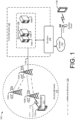
- the user equipment 110A and 110B are computing devices that may be a smart phone, a personal digital assistant, a netbook, a laptop computer, and/or another electronic that is capable of sending and/or receiving voice or data using a cellular access network 122, and/or over a Wi-Fi network, or some other type of network.
- the computing devices 110A and 110B can be configured to send and receive data using any wired or wireless protocols.
- one or more of the service nodes 106 may be configured as one or more application servers that provide support for one more applications, such as application 111.
- Some example applications include, but are not limited to browser applications, messaging applications, voice applications (e.g., Voice over Internet Protocol "VoIP" applications), video applications, and the like.
- VoIP Voice over Internet Protocol
- the service nodes 106 are illustrated within the core network 120, one or more other computing devices may be located outside of the core network 120.
- an application server, or some other server or device may be connected to the core network 120 via one or more external packet switched networks, such as the Internet.
- one or more of the service nodes 106 may determine the identity of the originating computing device for the communication (e.g., using a telephone number, IMEI, IMSI, IP address) as well as the identity of the computing devices to send the communication.
- a UE 110B may connect to the service nodes 106, or some other component such as an application server, via the Internet 112. In such instances, the UE 110B may connect to the Internet 112 via Wi-Fi access point 114. Accordingly, data traffic from the UE 110B may be routed to the service nodes 106 by the gateway 116 of the network 120.
- a wireless service provider may utilize alternative access vendor (AAV) networks, for example, which utilize Ethernet networks to provide a wired connection, such as wired connection 108, to provide at least a portion of backhaul for broadband cellular services, such as 5G networks.
- AAV alternative access vendor
- the wireless service provider may deploy its own wired connections.
- the access network 122 can be any sort of access network, such as a GSM or UMTS network.
- the access network 108 can include any aspects of one or more of second, third, fourth generation, and fifth generation (2G, 3G, 4G, and 5G) cellular-wireless access technologies.
- the access network 122 can also be referred to as a universal terrestrial radio network (UTRAN) or a GSM EDGE radio access network (GERAN) and can include one or base stations, as well as a radio network controller (RNC).
- UTRAN universal terrestrial radio network
- GERAN GSM EDGE radio access network
- RNC radio network controller
- Examples of the user equipment (UE) 110 can include, but are not limited to, smart phones, mobile phones, cell phones, tablet computers, portable computers, laptop computers, personal digital assistants (PDAs), electronic book devices, or any other portable electronic devices that can generate, request, receive, transmit, or exchange voice, video, and/or digital data over a network. Additional examples of the UE 110 include, but are not limited to, smart devices such as televisions, music players, or any other electronic appliances that can generate, request, receive, transmit, or exchange voice, video, and/or digital data over a network.
- PDAs personal digital assistants
- electronic book devices or any other portable electronic devices that can generate, request, receive, transmit, or exchange voice, video, and/or digital data over a network.
- mesh networking technology can be used to connect different nodes within the access network 122.
- Geographic Information Services GIS
- other terrain and location information systems can be used to determine nodes to provide a connection between one or more non-connected sites 102 and a network 120.
- GIS Geographic Information Services
- different techniques can be utilized to determine backhaul paths and access paths between the nodes 102 and 104.
- the allocation and scheduling of bandwidth between the different nodes 102, 104 may be determined using one or more of the relay nodes 102 and/or the wired nodes 104.
- a wired node 104 can be configured to determine how to allocate and schedule bandwidth to the connected relay nodes 102, whereas the relay nodes 102 may determine how to allocate bandwidth to user equipment (UE) that is connected to the relay node.
- UE user equipment
- the wired node may determine the allocation and scheduling for each of the relay nodes 102.
- the distribution of allocating and/or scheduling the available bandwidth can be split differently among the nodes.
- the allocation of bandwidth and/or routing the data through the nodes 102, 104 can be determined using different techniques.
- MST Minimum Spanning Tree
- AG-MST Adaptive Graph Minimum Spanning Tree Algorithm
- MST or AG-MST can be utilized by one or more of the nodes 102, 104 to select the nodes to utilize for wireless access links 124 and wireless backhaul links 126 between the UE 110A and the wire node 104A.
- the nodes of the graph utilized in MST and/or AG-MST can be represented by the different nodes 102, 104 within environment 100. Some of the paths between the nodes 102, 104 be considered more expensive, because they are longer, do not have as much available bandwidth, and the like. These paths may be represented by edges with larger weights.
- a spanning tree for the graph which includes the vertices of the graph, with the minimum possible number of edges.
- a graph may have several spanning trees.
- a minimum spanning tree is the route between the nodes with the lowest total cost. This information can be used to identify and select the different relay nodes 102 that can act as relays to the wired connection 104.
- the wired node 104 identifies the relay nodes 102 that are coupled to the wired node and the UEs 110 that are coupled to the relay nodes.
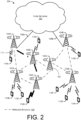
- a relay node 102 may determine and provide the number of UEs 110 that are connected to it to the wired node 104. For instance, relay node 102B may transmit to wired node 104A that one UE 110A is connected. This data may be utilized to assist in determining how much available bandwidth is available to provide wireless backhaul links 126 and access links by a particular relay node. More details are provided below with regard to FIGs. 2-6 .
- the different techniques to determine the path through the mesh can be selected based on available bandwidth of a link, forecasted usage of the link, and the like.
- the wired node 104A selected relay nodes 102B and 102C to provide wireless backhaul 126 for UE 110D.
- the selection of the relay nodes utilized may change over time depending on network conditions, and other factors. For example, if more UEs 110 connected to relay node 102B, and/or 102C, a different path using one or more different relay nodes 102 may be selected.
- one or more nodes determines how to allocate the available bandwidth between the wireless backhaul links 126 and the wireless access links 124. For instance, the determination can be based on past usage of the wireless channel, current usage of the wireless channel, and/or future usage of the wireless channel.
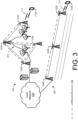
- FIG. 3 is a diagram showing illustrative arrangements of relay nodes for providing wireless backhaul in a cellular network. As illustrated, FIG. 3 shows a first configuration 310 of relay nodes 102A, 102B, 102C coupled to a wired node 104A, and a second configuration 320 of relay nodes 102D, and 102E coupled to wired node 104B.
- the signals of the microwave and millimeter bands associated with 5G networks travel along sight lines, but also spread as they propagate.
- both the linear, or visual, line-of-sight (LoS) and the area covered by the signal are of significance.
- the area that the signal covers as it spreads out is referred to as the Fresnel zone, which is generally required to be clear and free of obstructions to be considered true LoS.
- pathways between the nodes 102, 104 may be selected to minimize obstructions.
- the obstructions can be, for example, trees, mountains, buildings, or other large objects that substantially block the propagation of a signal.
- a relay node 102 may be positioned such that LoS locations have both an unobstructed linear pathway between nodes and an unobstructed Fresnel zone. In other examples, it may not be possible to position relay nodes 102 to avoid at least some of the obstructions. For example, some relay nodes 102 may have an unobstructed linear pathway, but a Fresnel zone that is at least partially obstructed.
- One or more relay nodes 102 can be located on third-party infrastructure, such as, for example, third-party buildings, towers, and trees.
- the relay nodes may be positioned to improve the LoS.
- more than one relay node 102 can be installed at a same location.
- configuration 310 illustrates a mesh of relay nodes 102A, 102B and 102C at different locations relative to a hill 312 and wired node 104A.
- UE 110A may be coupled to wired node 104A using a combination of relay node 102C, 102A and/or 102B.
- more than one path through the relay nodes 102 may be utilized to provide access links 124 and/or wireless backhaul links 126.
- the network 406 can include one or more core network(s) 120 connected to nodes 102, 104 via one or more access network(s), such as access network 122.
- Example access networks include 5G NR, LTE, WIFI, GSM Enhanced Data Rates for GSM Evolution (EDGE) Radio Access Network (GERAN), UTRAN, and other cellular access networks.
- EDGE GSM Enhanced Data Rates for GSM Evolution
- GERAN GSM Enhanced Data Rates for GSM Evolution
- UTRAN UTRAN
- Message transmission, reception, fallback, and deduplication as described herein can be performed, e.g., via 3G, 4G, 5G, WIFI, or other networks.
- the cellular network 408 can provide wide-area wireless coverage using a technology such as GSM, Code Division Multiple Access (CDMA), UMTS, LTE, 5G NR, or the like.
- Example networks include Time Division Multiple Access (TDMA), Evolution-Data Optimized (EVDO), Advanced LTE (LTE+), Generic Access Network (GAN), Unlicensed Mobile Access (UMA), Orthogonal Frequency Division Multiple Access (OFDM), GPRS, EDGE, Advanced Mobile Phone System (AMPS), High Speed Packet Access (HSPA), evolved HSPA (HSPA+), VoIP, VoLTE, IEEE 802.1x protocols, wireless microwave access (WIMAX), WIFI, and/or any future IP-based network technology or evolution of an existing IP-based network technology.
- TDMA Time Division Multiple Access
- EVDO Evolution-Data Optimized
- LTE+ Generic Access Network
- UMA Unlicensed Mobile Access
- OFDM Orthogonal Frequency Division Multiple Access
- GPRS General Packet Access
- EDGE Advanced Mobile
- the data network 410 can include various types of networks for transmitting and receiving data (e.g., data packets), including networks using technologies such as WIFI, IEEE 802.15.1 ("BLUETOOTH"), Asynchronous Transfer Mode (ATM), WIMAX, and other network technologies, e.g., configured to transport IP packets.
- the computing device 404 includes or is communicatively connected with an IWF or other device bridging networks, e.g., 5G, LTE, 3G, and POTS networks.
- the computing device 404 can bridge SS7 traffic from the PSTN into the network 406, e.g., permitting PSTN customers to place calls to cellular customers and vice versa.
- the cellular network 408 and the data network 410 can carry voice or data.
- the data network 410 can carry voice traffic using VoIP or other technologies as well as data traffic, or the cellular network 408 can carry data packets using HSPA, LTE, 5G NR, or other technologies as well as voice traffic.
- Some cellular networks 408 carry both data and voice in a packet-switch (PS) format.
- PS packet-switch
- many LTE networks carry voice traffic in data packets according to the VoLTE standard.
- Various examples herein provide origination and termination of, e.g., carrier-grade voice calls on, e.g., networks 406 using circuit-switching (CS) transports or mixed VoLTE/3G transports, or on computing device 402 including OEM handsets and non-OEM handsets.
- CS circuit-switching
- the computing device 402 can include one or more processors 412, e.g., one or more processor devices such as microprocessors, microcontrollers, field-programmable gate arrays (FPGAs), application-specific integrated circuits (ASICs), programmable logic devices (PLDs), programmable logic arrays (PLAs), programmable array logic devices (PALs), or digital signal processors (DSPs), and one or more computer readable media (CRM) 414, such as memory (e.g., random access memory (RAM), solid state drives (SSDs), or the like), disk drives (e.g., platter-based hard drives), another type of computer-readable media, or any combination thereof.
- processors 412 e.g., one or more processor devices such as microprocessors, microcontrollers, field-programmable gate arrays (FPGAs), application-specific integrated circuits (ASICs), programmable logic devices (PLDs), programmable logic arrays (PLAs), programmable array logic devices (PALs),
- the CRM 414 can include processor-executable instructions of a bandwidth allocation/scheduling module 432B.
- the bandwidth allocation/scheduling module 432B can be configured to perform functionality relating to providing wireless backhaul in a cellular network, such as a 5G network.
- the CRM 414 can also store other modules 422 configured to perform other functionality.
- the computing device 404 can include one or more processors 428 and one or more CRM 430.
- the CRM 430 can be used to store processor-executable instructions of a bandwidth allocation/scheduling module 432A, as well as one or more other components 434.
- the computing device 404 can be configured as a service node 106, some other service node, and the like.
- the processor-executable instructions can be executed by the one or more processors 428 to perform various functions described herein, e.g., with reference to FIGS. 1 - 4 .
- computing device 404 can communicate with (e.g., is communicatively connectable with) computing device 402 or other devices via one or more communications interface(s) 436, e.g., network transceivers for wired or wireless networks, or memory interfaces.
- Example communications interface(s) 436 can include ETHERNET or FIBRE CHANNEL transceivers, WIFI radios, or DDR memory-bus controllers (e.g., for DMA transfers to a network card installed in a physical server 204).
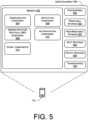
- the memory 502 is volatile (such as RAM), non-volatile (such as ROM, flash memory, etc.) or some combination of the two.
- the communication component 504, the SIP component 506, the application component 508, the authentication component 510, and the other components 512 stored in the memory 502 can comprise methods, threads, processes, applications, or any other sort of executable instructions.
- the communication component 504, the SIP component 506, the application component 508, the authentication component 510, and the other components 512 can also include files and databases.
- the communication component 504 may include functionality to send and receive communication (e.g., a voice call, an SMS, or an MMS) and/or perform other operations. In some examples, the communication component 504 may perform a number of functions, such as interfacing with the transceiver(s) 530, preparing the user equipment 500 to receive or handover a call, tuning the transceiver(s) 530, receiving and processing an invitation message such as a SIP Message received via the transceiver(s) 530, transmitting other messages via the transceiver(s) 530, detecting a failure condition, and the like.
- a number of functions such as interfacing with the transceiver(s) 530, preparing the user equipment 500 to receive or handover a call, tuning the transceiver(s) 530, receiving and processing an invitation message such as a SIP Message received via the transceiver(s) 530, transmitting other messages via the transceiver(s) 530, detecting a failure condition, and
- the authentication component 510 may perform various types of authentication.
- the authentication component 510 may interact with the database(s) to store, retrieve, and update the database(s) containing user subscription information, including items such as user identification and addressing (e.g., the IMSI (International Mobile Subscriber Identity) and MSISDN (Mobile Subscriber ISDN Number)), user profile information (e.g., subscription data).
- the authentication component 310 may also be configured to perform other operations.
- the UE 500 also includes additional data storage devices (removable and/or non-removable) such as, for example, magnetic disks, optical disks, or tape. Such additional storage is illustrated in FIG. 5 by removable storage 522 and non-removable storage 524.
- Tangible computer-readable media can include volatile and nonvolatile, removable and non-removable media implemented in any method or technology for storage of information, such as computer readable instructions, data structures, program modules, or other data.
- the memory 502, the removable storage 522 and the non-removable storage 524 are all examples of computer-readable storage media.
- Computer-readable storage media include, but are not limited to, RAM, ROM, EEPROM, flash memory or other memory technology, CD-ROM, digital versatile discs (DVD) or other optical storage, magnetic cassettes, magnetic tape, magnetic disk storage or other magnetic storage devices, or any other medium which can be used to store the desired information, and which can be accessed by the UE 300. Any such tangible computer-readable media can be part of the UE 300.
- the UE 500 can include one or more wired or wireless transceiver(s) 530.
- the transceiver(s) 530 can utilize multiple-input/multiple-output (MIMO) technology.
- MIMO multiple-input/multiple-output
- the transceiver(s) 530 can be any sort of wireless transceivers capable of engaging in wireless, radio frequency (RF) communication, as discussed herein.
- the transceiver(s) 530 can also include other wireless modems, such as a modem for engaging in Wi-Fi, WiMAX, Bluetooth, infrared communication, or the like.
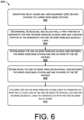
- FIG. 6 illustrates an example process for using relay nodes to provide wireless backhaul in a cellular network.
- the example process 600 can be performed by one or more of the relay nodes 102, the wired nodes 104, the computing device 402, computing device 404, the service nodes 106, or one or more other components, in connection with other components discussed herein. Some or all of the process 600 can be performed by one or more devices, equipment, or components illustrated in FIGS. 1-5 , for example.
- the allocation of bandwidth between access links 124 and backhaul links 126 is determined.
- different techniques can be utilized to determine the allocation and scheduling.
- a MST can be utilized to determine a path using the available relay nodes 102.
- the techniques are utilized to select the relay nodes 102 to couple a UE 110 to a wired node 104.
- the one or more wireless access links between the wired node and one or more of the UE devices are established.
- different relay nodes 102 can be utilized to provide the backhaul links 126 between the UE 110 and a wired node 104.
- the one or more wireless access links 124 and the one or more backhaul links 126 are utilized to communicate with a UE device 110.
- the links may change over time depending on various network conditions and/or other criteria.
Landscapes
- Engineering & Computer Science (AREA)
- Computer Networks & Wireless Communication (AREA)
- Signal Processing (AREA)
- Quality & Reliability (AREA)
- Mobile Radio Communication Systems (AREA)
Claims (12)
- System (400), umfassend:einen oder mehrere Prozessoren (428) einer Basisstation der fünften Generation, 5G, die zur Kommunikation ein Zentimeterwellenband und/oder Millimeterwellenband verwendet; undProgrammieranweisungen (432), die konfiguriert sind, um von einem oder mehreren Prozessoren ausgeführt werden, um folgende Operationen auszuführen:Identifizieren von Relaisknoten (102) und Benutzerausrüstungsvorrichtungen, UE-Vorrichtungen, (110), die drahtlos mit der 5G-Basisstation (104) gekoppelt sind, wobei ein erster Relaisknoten (102A, 102D, 102E) der Relaisknoten mit der 5G-Basisstation verbunden ist und ein zweiter Relaisknoten (102B, 102C) der Relaisknoten mit dem ersten Relaisknoten verbunden ist;Zuweisen, mindestens teilweise basierend auf der Identifizierung der Relaisknoten und der UE-Vorrichtungen, eines ersten Teils der Bandbreite für jeweilige drahtlose Zugangsverbindungen zwischen der 5G-Basisstation und den UE-Vorrichtungen und eines zweiten Teils der Bandbreite für jeweilige drahtlose Backhaul-Verbindungen zwischen der 5G-Basisstation und dem ersten Relaisknoten und zwischen dem ersten Relaisknoten und dem zweiten Relaisknoten;Herstellen der jeweiligen drahtlosen Zugangsverbindungen (124) zwischen der 5G-Basisstation und einer oder mehreren UE-Vorrichtungen;Herstellen der jeweiligen drahtlosen Backhaul-Verbindungen (126) zwischen der 5G-Basisstation und dem ersten Relaisknoten und zwischen dem ersten Relaisknoten und dem zweiten Relaisknoten; undVerwenden der jeweiligen drahtlosen Zugangsverbindungen zur Kommunikation mit einer oder mehreren UE-Vorrichtungen und der Backhaul-Verbindungen zur Kommunikation mit dem ersten und dem zweiten Relaisknoten;wobei mindestens ein Teil der Relaisknoten ein Maschennetzwerk bildet; undwobei das Identifizieren von Relaisknoten das Bestimmen eines Pfads von der 5G-Basisstation durch das Maschennnetzwerk von Relaisknoten umfasst und der zweite Teil der Bandbreite den drahtlosen Backhaul-Verbindungen des Pfads zugewiesen wird.
- System nach Anspruch 1, wobei die 5G-Basisstation ein gNodeB ist, der ein kabelgebundenes Backhaul (108) zu einem Kernnetzwerk (120) einschließt, und die Relaisknoten Integrated Access Backhaul-Knoten, IAB-Knoten, sind.
- System nach Anspruch 1 oder 2, wobei die Zuweisung des ersten Teils der Bandbreite für die drahtlosen Zugangsverbindungen und des zweiten Teils der Bandbreite für die drahtlosen Backhaul-Verbindungen mindestens teilweise auf einer Anzahl der UE-Vorrichtungen basiert.
- System nach einem der vorstehenden Ansprüche, wobei das Herstellen der jeweiligen drahtlosen Backhaul-Verbindungen zwischen der 5G-Basisstation und einem oder mehreren der Relaisknoten das Bestimmen einer oder mehrerer Routen für die drahtlosen Backhaul-Verbindungen umfasst.
- System nach einem der vorstehenden Ansprüche, wobei mindestens eine der drahtlosen Zugangsverbindungen und mindestens eine der drahtlosen Backhaul-Verbindungen dieselbe Frequenz verwenden.
- Computerimplementiertes Verfahren (600), das durch einen oder mehrere Prozessoren durchgeführt wird, die mit spezifischen Anweisungen konfiguriert sind, wobei das computerimplementierte Verfahren umfasst:Identifizieren (602) von Relaisknoten, die ein oder mehrere Zentimeterwellenbänder und Millimeterwellenbänder verwenden, und von Benutzerausrüstungsvorrichtungen, UE-Vorrichtungen, die mit einem drahtgebundenen Knoten gekoppelt sind, wobei ein erster Relaisknoten der Relaisknoten mit dem drahtgebundenen Knoten verbunden ist und ein zweiter Relaisknoten der Relaisknoten mit dem ersten Relaisknoten verbunden ist;Zuweisen (604), mindestens teilweise auf Grundlage der Identifizierung der Relaisknoten und der UE-Vorrichtungen, eines ersten Teils der Bandbreite für jeweilige drahtlose Zugriffsverbindungen zwischen dem drahtgebundenen Knoten und den UE-Vorrichtungen und eines zweiten Teils der Bandbreite für jeweilige drahtlose Backhaul-Verbindungen zwischen dem drahtgebundenen Knoten und dem ersten Relaisknoten und zwischen dem ersten Relaisknoten und dem zweiten Relaisknoten;Herstellen (606) der jeweiligen drahtlosen Zugriffsverbindungen zwischen dem kabelgebundenen Knoten und einem oder mehreren UE-Vorrichtungen;Herstellen (608) der jeweiligen drahtlosen Backhaul-Verbindungen zwischen dem drahtgebundenen Knoten und dem ersten Relaisknoten und zwischen dem ersten Relaisknoten und dem zweiten Relaisknoten; undVerwenden (610) der jeweiligen drahtlosen Zugangsverbindungen zum Kommunizieren mit einem oder mehreren UE-Vorrichtungen und der Backhaul-Verbindungen zum Kommunizieren mit dem ersten und dem zweiten Relaisknoten;wobei mindestens ein Teil der Relaisknoten ein Maschennetzwerk bildet; undwobei das Identifizieren von Relaisknoten das Bestimmen eines Pfads vom drahtgebundenen Knoten durch das Maschennetzwerk von Relaisknoten umfasst und der zweite Teil der Bandbreite den drahtlosen Backhaul-Verbindungen des Pfads zugewiesen wird.
- Computerimplementiertes Verfahren nach Anspruch 6, wobei der kabelgebundene Knoten ein gNodeB ist, der ein kabelgebundenes Backhaul zu einem Kernnetzwerk einschließt, und die Relaisknoten Integrated Access Backhaul-Knoten, IAB-Knoten, sind.
- Computerimplementiertes Verfahren nach Anspruch 7, wobei die Zuweisung durch den gNodeB durchgeführt wird.
- Computerimplementiertes Verfahren nach einem der Ansprüche 6 bis 8, wobei die Zuweisung des ersten Teils der Bandbreite für die drahtlosen Zugangsverbindungen und des zweiten Teils der Bandbreite für die drahtlosen Backhaul-Verbindungen mindestens teilweise auf einer Anzahl der UE-Vorrichtungen basiert.
- Computerimplementiertes Verfahren nach einem der Ansprüche 6 bis 9, wobei das Herstellen der jeweiligen drahtlosen Backhaul-Verbindungen zwischen dem drahtgebundenen Knoten und einem oder mehreren der Relaisknoten das Bestimmen einer oder mehrerer Routen für die eine oder mehrere drahtlosen Backhaul-Verbindungen umfasst.
- Computerimplementiertes Verfahren nach einem der Ansprüche 6 bis 10, wobei mindestens eine der drahtlosen Zugangsverbindungen und mindestens eine der drahtlosen Backhaul-Verbindungen dieselbe Frequenz verwenden.
- Computerprogramm, das, wenn es ausgeführt wird, einen oder mehrere Prozessoren einer Rechenvorrichtung veranlasst, das Verfahren nach einem der Ansprüche 6 bis 11 durchzuführen.
Applications Claiming Priority (1)
| Application Number | Priority Date | Filing Date | Title |
|---|---|---|---|
| US16/457,777 US10979103B2 (en) | 2019-06-28 | 2019-06-28 | Wireless backhaul using relay nodes in a cellular network |
Publications (3)
| Publication Number | Publication Date |
|---|---|
| EP3758429A1 EP3758429A1 (de) | 2020-12-30 |
| EP3758429C0 EP3758429C0 (de) | 2025-04-09 |
| EP3758429B1 true EP3758429B1 (de) | 2025-04-09 |
Family
ID=70975693
Family Applications (1)
| Application Number | Title | Priority Date | Filing Date |
|---|---|---|---|
| EP20177597.0A Active EP3758429B1 (de) | 2019-06-28 | 2020-05-29 | Drahtlos-backhaul unter verwendung von relaisknoten in einem mobilfunknetz |
Country Status (2)
| Country | Link |
|---|---|
| US (1) | US10979103B2 (de) |
| EP (1) | EP3758429B1 (de) |
Families Citing this family (3)
| Publication number | Priority date | Publication date | Assignee | Title |
|---|---|---|---|---|
| WO2020169185A1 (en) * | 2019-02-19 | 2020-08-27 | Nokia Solutions And Networks Oy | Apparatus, method, and computer program |
| US11375352B2 (en) * | 2020-03-25 | 2022-06-28 | Intel Corporation | Devices and methods for updating maps in autonomous driving systems in bandwidth constrained networks |
| FR3139424B1 (fr) * | 2022-09-01 | 2025-05-23 | Sagemcom Broadband Sas | Procede et dispositif de selection d’un nœud dans un reseau local |
Family Cites Families (11)
| Publication number | Priority date | Publication date | Assignee | Title |
|---|---|---|---|---|
| US8275118B2 (en) | 2009-08-28 | 2012-09-25 | Rockstar Bidco, L.P. | Method and system for controlling establishment of communication channels in a contact centre |
| WO2011051921A2 (en) | 2009-10-30 | 2011-05-05 | Nokia Corporation | Optimized backhaul communications for a relay-enhanced packet-based wireless communication system |
| JP2012044333A (ja) | 2010-08-16 | 2012-03-01 | Ntt Docomo Inc | 無線基地局装置及びリソース割り当て方法 |
| US9232516B1 (en) | 2014-01-03 | 2016-01-05 | Sprint Spectrum L.P. | Managing allocation of frequency bandwidth between donor access link and relay backhaul link |
| US10206232B2 (en) | 2016-09-29 | 2019-02-12 | At&T Intellectual Property I, L.P. | Initial access and radio resource management for integrated access and backhaul (IAB) wireless networks |
| US11477836B2 (en) * | 2017-03-30 | 2022-10-18 | Lg Electronics Inc. | Method for performing path reselection in wireless communication system and apparatus therefor |
| CN109219102B (zh) * | 2017-06-30 | 2021-08-03 | 华为技术有限公司 | 一种数据转发方法和装置 |
| US10637563B2 (en) * | 2018-08-06 | 2020-04-28 | At&T Intellectual Property I, L.P. | Dynamic adjustment of integrated access and backhaul link partition for emergency communications |
| US11057791B2 (en) * | 2018-10-30 | 2021-07-06 | At&T Intellectual Property I, L.P. | Configuration and reconfiguration of aggregated backhaul bearers in a multi-hop integrated access backhaul network for 5G or other next generation network |
| US11115848B2 (en) * | 2018-11-05 | 2021-09-07 | Nokia Technologies Oy | Apparatus, method and computer program |
| US11349557B2 (en) * | 2018-11-30 | 2022-05-31 | At&T Intellectual Property I, L.P. | System model and architecture for mobile integrated access and backhaul in advanced networks |
-
2019
- 2019-06-28 US US16/457,777 patent/US10979103B2/en active Active
-
2020
- 2020-05-29 EP EP20177597.0A patent/EP3758429B1/de active Active
Also Published As
| Publication number | Publication date |
|---|---|
| EP3758429C0 (de) | 2025-04-09 |
| US10979103B2 (en) | 2021-04-13 |
| EP3758429A1 (de) | 2020-12-30 |
| US20200412414A1 (en) | 2020-12-31 |
Similar Documents
| Publication | Publication Date | Title |
|---|---|---|
| US10609608B2 (en) | Method for changing connection mode in base station, and base station therefor, and method for changing connection mode in user equipment, and user equipment thereof | |
| EP3328155B1 (de) | Verfahren, basisstation und benutzergerät zur implementierung von trägeraggregation | |
| US12324008B2 (en) | Selection of open radio access network (RAN) components | |
| US11234157B2 (en) | Network latency aware mobile edge computing routing | |
| EP3338485B1 (de) | Benutzergerat, basisstation und zugehörige methoden | |
| US10735949B1 (en) | Systems and methods for updating preferred nodes lists for wireless devices in a wireless network | |
| EP4027566B1 (de) | Dynamisches ändern der primärzelle (pcell) für die trägeraggregation der fünften generation (5g) | |
| US11611927B2 (en) | Selection of user plane functions and handover of subscriber sessions | |
| EP3758429B1 (de) | Drahtlos-backhaul unter verwendung von relaisknoten in einem mobilfunknetz | |
| US11864260B2 (en) | Switching between new radio dual connectivity and carrier aggregation in cellular networks | |
| US9854457B2 (en) | Management of communications with multiple access points based on inter-access point communications | |
| US10051525B1 (en) | Controlling relay-UE operation based on bearer content type | |
| US11930546B2 (en) | Mobile nodes in an integrated access backhaul network | |
| US11329757B2 (en) | Transmitting application data using different QoS specifications | |
| EP4109970B1 (de) | Mobilitätsverwaltung für kantennahe berechnung mobiler vorrichtungen | |
| EP3565372A1 (de) | Verbindungsaufbauverfahren und -vorrichtung | |
| US9560545B1 (en) | Systems and methods for managing communication between an access node and a relay node | |
| US11223977B2 (en) | Service-based data rate control to enhance network performance | |
| CN103517447B (zh) | 传输数据的方法和装置 | |
| US10542451B1 (en) | Systems and methods for managing conflicts between access node protocols | |
| US11546915B2 (en) | Selecting wireless band to use | |
| KR20150023156A (ko) | 서비스 품질 정보 갱신 방법 및 장치 | |
| CN106470451A (zh) | 一种高速移动中的无线传输方法和装置 |
Legal Events
| Date | Code | Title | Description |
|---|---|---|---|
| PUAI | Public reference made under article 153(3) epc to a published international application that has entered the european phase |
Free format text: ORIGINAL CODE: 0009012 |
|
| STAA | Information on the status of an ep patent application or granted ep patent |
Free format text: STATUS: THE APPLICATION HAS BEEN PUBLISHED |
|
| AK | Designated contracting states |
Kind code of ref document: A1 Designated state(s): AL AT BE BG CH CY CZ DE DK EE ES FI FR GB GR HR HU IE IS IT LI LT LU LV MC MK MT NL NO PL PT RO RS SE SI SK SM TR |
|
| AX | Request for extension of the european patent |
Extension state: BA ME |
|
| STAA | Information on the status of an ep patent application or granted ep patent |
Free format text: STATUS: REQUEST FOR EXAMINATION WAS MADE |
|
| 17P | Request for examination filed |
Effective date: 20210625 |
|
| RBV | Designated contracting states (corrected) |
Designated state(s): AL AT BE BG CH CY CZ DE DK EE ES FI FR GB GR HR HU IE IS IT LI LT LU LV MC MK MT NL NO PL PT RO RS SE SI SK SM TR |
|
| STAA | Information on the status of an ep patent application or granted ep patent |
Free format text: STATUS: EXAMINATION IS IN PROGRESS |
|
| 17Q | First examination report despatched |
Effective date: 20221017 |
|
| REG | Reference to a national code |
Ref country code: DE Free format text: PREVIOUS MAIN CLASS: H04W0072040000 Ref country code: DE Ref legal event code: R079 Ref document number: 602020048995 Country of ref document: DE Free format text: PREVIOUS MAIN CLASS: H04W0072040000 Ipc: H04B0007260000 |
|
| RIC1 | Information provided on ipc code assigned before grant |
Ipc: H04W 84/04 20090101ALN20241024BHEP Ipc: H04W 28/16 20090101ALI20241024BHEP Ipc: H04B 7/26 20060101AFI20241024BHEP |
|
| GRAP | Despatch of communication of intention to grant a patent |
Free format text: ORIGINAL CODE: EPIDOSNIGR1 |
|
| STAA | Information on the status of an ep patent application or granted ep patent |
Free format text: STATUS: GRANT OF PATENT IS INTENDED |
|
| INTG | Intention to grant announced |
Effective date: 20241129 |
|
| GRAS | Grant fee paid |
Free format text: ORIGINAL CODE: EPIDOSNIGR3 |
|
| GRAA | (expected) grant |
Free format text: ORIGINAL CODE: 0009210 |
|
| STAA | Information on the status of an ep patent application or granted ep patent |
Free format text: STATUS: THE PATENT HAS BEEN GRANTED |
|
| AK | Designated contracting states |
Kind code of ref document: B1 Designated state(s): AL AT BE BG CH CY CZ DE DK EE ES FI FR GB GR HR HU IE IS IT LI LT LU LV MC MK MT NL NO PL PT RO RS SE SI SK SM TR |
|
| REG | Reference to a national code |
Ref country code: GB Ref legal event code: FG4D |
|
| REG | Reference to a national code |
Ref country code: CH Ref legal event code: EP |
|
| REG | Reference to a national code |
Ref country code: DE Ref legal event code: R096 Ref document number: 602020048995 Country of ref document: DE |
|
| REG | Reference to a national code |
Ref country code: IE Ref legal event code: FG4D |
|
| U01 | Request for unitary effect filed |
Effective date: 20250422 |
|
| U07 | Unitary effect registered |
Designated state(s): AT BE BG DE DK EE FI FR IT LT LU LV MT NL PT RO SE SI Effective date: 20250425 |
|
| U20 | Renewal fee for the european patent with unitary effect paid |
Year of fee payment: 6 Effective date: 20250428 |
|
| PG25 | Lapsed in a contracting state [announced via postgrant information from national office to epo] |
Ref country code: ES Free format text: LAPSE BECAUSE OF FAILURE TO SUBMIT A TRANSLATION OF THE DESCRIPTION OR TO PAY THE FEE WITHIN THE PRESCRIBED TIME-LIMIT Effective date: 20250409 |
|
| PG25 | Lapsed in a contracting state [announced via postgrant information from national office to epo] |
Ref country code: NO Free format text: LAPSE BECAUSE OF FAILURE TO SUBMIT A TRANSLATION OF THE DESCRIPTION OR TO PAY THE FEE WITHIN THE PRESCRIBED TIME-LIMIT Effective date: 20250709 Ref country code: GR Free format text: LAPSE BECAUSE OF FAILURE TO SUBMIT A TRANSLATION OF THE DESCRIPTION OR TO PAY THE FEE WITHIN THE PRESCRIBED TIME-LIMIT Effective date: 20250710 |
|
| PG25 | Lapsed in a contracting state [announced via postgrant information from national office to epo] |
Ref country code: PL Free format text: LAPSE BECAUSE OF FAILURE TO SUBMIT A TRANSLATION OF THE DESCRIPTION OR TO PAY THE FEE WITHIN THE PRESCRIBED TIME-LIMIT Effective date: 20250409 |
|
| PG25 | Lapsed in a contracting state [announced via postgrant information from national office to epo] |
Ref country code: HR Free format text: LAPSE BECAUSE OF FAILURE TO SUBMIT A TRANSLATION OF THE DESCRIPTION OR TO PAY THE FEE WITHIN THE PRESCRIBED TIME-LIMIT Effective date: 20250409 |
|
| PG25 | Lapsed in a contracting state [announced via postgrant information from national office to epo] |
Ref country code: RS Free format text: LAPSE BECAUSE OF FAILURE TO SUBMIT A TRANSLATION OF THE DESCRIPTION OR TO PAY THE FEE WITHIN THE PRESCRIBED TIME-LIMIT Effective date: 20250709 |
|
| PG25 | Lapsed in a contracting state [announced via postgrant information from national office to epo] |
Ref country code: IS Free format text: LAPSE BECAUSE OF FAILURE TO SUBMIT A TRANSLATION OF THE DESCRIPTION OR TO PAY THE FEE WITHIN THE PRESCRIBED TIME-LIMIT Effective date: 20250809 |
|
| REG | Reference to a national code |
Ref country code: CH Ref legal event code: H13 Free format text: ST27 STATUS EVENT CODE: U-0-0-H10-H13 (AS PROVIDED BY THE NATIONAL OFFICE) Effective date: 20251223 |
|
| PG25 | Lapsed in a contracting state [announced via postgrant information from national office to epo] |
Ref country code: SM Free format text: LAPSE BECAUSE OF FAILURE TO SUBMIT A TRANSLATION OF THE DESCRIPTION OR TO PAY THE FEE WITHIN THE PRESCRIBED TIME-LIMIT Effective date: 20250409 |
|
| PG25 | Lapsed in a contracting state [announced via postgrant information from national office to epo] |
Ref country code: CH Free format text: LAPSE BECAUSE OF NON-PAYMENT OF DUE FEES Effective date: 20250531 |
|
| PG25 | Lapsed in a contracting state [announced via postgrant information from national office to epo] |
Ref country code: CZ Free format text: LAPSE BECAUSE OF FAILURE TO SUBMIT A TRANSLATION OF THE DESCRIPTION OR TO PAY THE FEE WITHIN THE PRESCRIBED TIME-LIMIT Effective date: 20250409 |
|
| PG25 | Lapsed in a contracting state [announced via postgrant information from national office to epo] |
Ref country code: SK Free format text: LAPSE BECAUSE OF FAILURE TO SUBMIT A TRANSLATION OF THE DESCRIPTION OR TO PAY THE FEE WITHIN THE PRESCRIBED TIME-LIMIT Effective date: 20250409 |
|
| PG25 | Lapsed in a contracting state [announced via postgrant information from national office to epo] |
Ref country code: MC Free format text: LAPSE BECAUSE OF FAILURE TO SUBMIT A TRANSLATION OF THE DESCRIPTION OR TO PAY THE FEE WITHIN THE PRESCRIBED TIME-LIMIT Effective date: 20250409 |
|
| PLBE | No opposition filed within time limit |
Free format text: ORIGINAL CODE: 0009261 |
|
| STAA | Information on the status of an ep patent application or granted ep patent |
Free format text: STATUS: NO OPPOSITION FILED WITHIN TIME LIMIT |
|
| REG | Reference to a national code |
Ref country code: CH Ref legal event code: L10 Free format text: ST27 STATUS EVENT CODE: U-0-0-L10-L00 (AS PROVIDED BY THE NATIONAL OFFICE) Effective date: 20260218 |
|
| 26N | No opposition filed |
Effective date: 20260112 |
|
| GBPC | Gb: european patent ceased through non-payment of renewal fee |
Effective date: 20250709 |