EP3757909B1 - Verfahren und system zum entwerfen formulierter produkte - Google Patents
Verfahren und system zum entwerfen formulierter produkte Download PDFInfo
- Publication number
- EP3757909B1 EP3757909B1 EP20181892.9A EP20181892A EP3757909B1 EP 3757909 B1 EP3757909 B1 EP 3757909B1 EP 20181892 A EP20181892 A EP 20181892A EP 3757909 B1 EP3757909 B1 EP 3757909B1
- Authority
- EP
- European Patent Office
- Prior art keywords
- parameters
- functional
- dataset
- functional parameter
- key input
- Prior art date
- Legal status (The legal status is an assumption and is not a legal conclusion. Google has not performed a legal analysis and makes no representation as to the accuracy of the status listed.)
- Active
Links
Images



Classifications
-
- G—PHYSICS
- G06—COMPUTING OR CALCULATING; COUNTING
- G06N—COMPUTING ARRANGEMENTS BASED ON SPECIFIC COMPUTATIONAL MODELS
- G06N20/00—Machine learning
- G06N20/20—Ensemble learning
-
- G—PHYSICS
- G06—COMPUTING OR CALCULATING; COUNTING
- G06F—ELECTRIC DIGITAL DATA PROCESSING
- G06F16/00—Information retrieval; Database structures therefor; File system structures therefor
- G06F16/20—Information retrieval; Database structures therefor; File system structures therefor of structured data, e.g. relational data
- G06F16/24—Querying
- G06F16/242—Query formulation
-
- G—PHYSICS
- G06—COMPUTING OR CALCULATING; COUNTING
- G06F—ELECTRIC DIGITAL DATA PROCESSING
- G06F16/00—Information retrieval; Database structures therefor; File system structures therefor
- G06F16/20—Information retrieval; Database structures therefor; File system structures therefor of structured data, e.g. relational data
- G06F16/24—Querying
- G06F16/245—Query processing
- G06F16/2453—Query optimisation
-
- G—PHYSICS
- G06—COMPUTING OR CALCULATING; COUNTING
- G06F—ELECTRIC DIGITAL DATA PROCESSING
- G06F18/00—Pattern recognition
- G06F18/20—Analysing
- G06F18/21—Design or setup of recognition systems or techniques; Extraction of features in feature space; Blind source separation
- G06F18/214—Generating training patterns; Bootstrap methods, e.g. bagging or boosting
-
- G—PHYSICS
- G06—COMPUTING OR CALCULATING; COUNTING
- G06N—COMPUTING ARRANGEMENTS BASED ON SPECIFIC COMPUTATIONAL MODELS
- G06N3/00—Computing arrangements based on biological models
- G06N3/004—Artificial life, i.e. computing arrangements simulating life
- G06N3/006—Artificial life, i.e. computing arrangements simulating life based on simulated virtual individual or collective life forms, e.g. social simulations or particle swarm optimisation [PSO]
-
- G—PHYSICS
- G06—COMPUTING OR CALCULATING; COUNTING
- G06N—COMPUTING ARRANGEMENTS BASED ON SPECIFIC COMPUTATIONAL MODELS
- G06N5/00—Computing arrangements using knowledge-based models
-
- G—PHYSICS
- G06—COMPUTING OR CALCULATING; COUNTING
- G06N—COMPUTING ARRANGEMENTS BASED ON SPECIFIC COMPUTATIONAL MODELS
- G06N5/00—Computing arrangements using knowledge-based models
- G06N5/04—Inference or reasoning models
-
- G—PHYSICS
- G06—COMPUTING OR CALCULATING; COUNTING
- G06Q—INFORMATION AND COMMUNICATION TECHNOLOGY [ICT] SPECIALLY ADAPTED FOR ADMINISTRATIVE, COMMERCIAL, FINANCIAL, MANAGERIAL OR SUPERVISORY PURPOSES; SYSTEMS OR METHODS SPECIALLY ADAPTED FOR ADMINISTRATIVE, COMMERCIAL, FINANCIAL, MANAGERIAL OR SUPERVISORY PURPOSES, NOT OTHERWISE PROVIDED FOR
- G06Q30/00—Commerce
- G06Q30/02—Marketing; Price estimation or determination; Fundraising
- G06Q30/0283—Price estimation or determination
-
- G—PHYSICS
- G06—COMPUTING OR CALCULATING; COUNTING
- G06Q—INFORMATION AND COMMUNICATION TECHNOLOGY [ICT] SPECIALLY ADAPTED FOR ADMINISTRATIVE, COMMERCIAL, FINANCIAL, MANAGERIAL OR SUPERVISORY PURPOSES; SYSTEMS OR METHODS SPECIALLY ADAPTED FOR ADMINISTRATIVE, COMMERCIAL, FINANCIAL, MANAGERIAL OR SUPERVISORY PURPOSES, NOT OTHERWISE PROVIDED FOR
- G06Q30/00—Commerce
- G06Q30/06—Buying, selling or leasing transactions
- G06Q30/0601—Electronic shopping [e-shopping]
- G06Q30/0621—Electronic shopping [e-shopping] by configuring or customising goods or services
-
- G—PHYSICS
- G06—COMPUTING OR CALCULATING; COUNTING
- G06Q—INFORMATION AND COMMUNICATION TECHNOLOGY [ICT] SPECIALLY ADAPTED FOR ADMINISTRATIVE, COMMERCIAL, FINANCIAL, MANAGERIAL OR SUPERVISORY PURPOSES; SYSTEMS OR METHODS SPECIALLY ADAPTED FOR ADMINISTRATIVE, COMMERCIAL, FINANCIAL, MANAGERIAL OR SUPERVISORY PURPOSES, NOT OTHERWISE PROVIDED FOR
- G06Q30/00—Commerce
- G06Q30/06—Buying, selling or leasing transactions
- G06Q30/0601—Electronic shopping [e-shopping]
- G06Q30/0631—Recommending goods or services
-
- Y—GENERAL TAGGING OF NEW TECHNOLOGICAL DEVELOPMENTS; GENERAL TAGGING OF CROSS-SECTIONAL TECHNOLOGIES SPANNING OVER SEVERAL SECTIONS OF THE IPC; TECHNICAL SUBJECTS COVERED BY FORMER USPC CROSS-REFERENCE ART COLLECTIONS [XRACs] AND DIGESTS
- Y10—TECHNICAL SUBJECTS COVERED BY FORMER USPC
- Y10S—TECHNICAL SUBJECTS COVERED BY FORMER USPC CROSS-REFERENCE ART COLLECTIONS [XRACs] AND DIGESTS
- Y10S707/00—Data processing: database and file management or data structures
- Y10S707/912—Applications of a database
-
- Y—GENERAL TAGGING OF NEW TECHNOLOGICAL DEVELOPMENTS; GENERAL TAGGING OF CROSS-SECTIONAL TECHNOLOGIES SPANNING OVER SEVERAL SECTIONS OF THE IPC; TECHNICAL SUBJECTS COVERED BY FORMER USPC CROSS-REFERENCE ART COLLECTIONS [XRACs] AND DIGESTS
- Y10—TECHNICAL SUBJECTS COVERED BY FORMER USPC
- Y10S—TECHNICAL SUBJECTS COVERED BY FORMER USPC CROSS-REFERENCE ART COLLECTIONS [XRACs] AND DIGESTS
- Y10S707/00—Data processing: database and file management or data structures
- Y10S707/912—Applications of a database
- Y10S707/944—Business related
- Y10S707/948—Product or catalog
-
- Y—GENERAL TAGGING OF NEW TECHNOLOGICAL DEVELOPMENTS; GENERAL TAGGING OF CROSS-SECTIONAL TECHNOLOGIES SPANNING OVER SEVERAL SECTIONS OF THE IPC; TECHNICAL SUBJECTS COVERED BY FORMER USPC CROSS-REFERENCE ART COLLECTIONS [XRACs] AND DIGESTS
- Y10—TECHNICAL SUBJECTS COVERED BY FORMER USPC
- Y10S—TECHNICAL SUBJECTS COVERED BY FORMER USPC CROSS-REFERENCE ART COLLECTIONS [XRACs] AND DIGESTS
- Y10S707/00—Data processing: database and file management or data structures
- Y10S707/99931—Database or file accessing
-
- Y—GENERAL TAGGING OF NEW TECHNOLOGICAL DEVELOPMENTS; GENERAL TAGGING OF CROSS-SECTIONAL TECHNOLOGIES SPANNING OVER SEVERAL SECTIONS OF THE IPC; TECHNICAL SUBJECTS COVERED BY FORMER USPC CROSS-REFERENCE ART COLLECTIONS [XRACs] AND DIGESTS
- Y10—TECHNICAL SUBJECTS COVERED BY FORMER USPC
- Y10S—TECHNICAL SUBJECTS COVERED BY FORMER USPC CROSS-REFERENCE ART COLLECTIONS [XRACs] AND DIGESTS
- Y10S707/00—Data processing: database and file management or data structures
- Y10S707/99931—Database or file accessing
- Y10S707/99933—Query processing, i.e. searching
Definitions
- the present disclosure herein generally relates to the field of formulated products, and, more particularly, to a method, a system and a computer program product for designing the formulated products.
- Formulated products such as personal care, detergents, paints, lubricants, pharmaceutical products and so on are used ubiquitously in everyday life.
- Each formulated product has a unique and complex formulation comprising of a mixture of ingredients.
- the ingredients may add functional attributes as well as sensorial attributes to such formulated products. Desired properties of the formulated products are very difficult to predict a priori.
- LINDSAY BASSMAN ET AL "Active learning for accelerated design of layered materials" DOI: 10.1038/s41524-018-0129-0 , discusses a method for active learning for accelerated design of layered materials, in particular for optoelectronic and thermoelectric devices.
- WO 2018/098588 A1 discloses computer systems and methods for the identification of non-elemental materials having defined material properties.
- the computer systems and methods may permit the identification of non-elemental materials having one or more desired material properties which may be specified in the form of user input.
- the materials identified may be known or predicted by the computer systems and the methods to exhibit the desired material properties.
- US 2012/232685 A1 discloses a method and system for optimizing a simulated casting of a light weight alloy component.
- the simulation includes passing component design data through various computational modules relating to casting designs, process modeling and optimization, material microstructure and defects and product performance.
- Embodiments of the present disclosure present technological improvements as solutions to one or more of the above-mentioned technical problems recognized by the inventors in conventional systems.
- Designing formulated products, especially customized or personalized formulated products based on user requirements is a key focus area for formulated product companies to satisfy market demand.
- effective capture, analysis and assimilation of the user requirements and mapping the user requirement to extract functional requirements are limited and making such techniques and related tools are quite challenging.
- the conventional techniques to design the personalized formulated products, based on the requirement of the user are limited, labor intensive and time consuming.
- the present disclosure herein provides method and system that solve the technical problem of mapping the user requirements to extract the functional requirement and designing the customized formulated products based on the functional requirement of the user.
- the functional requirements are extracted based on the user requirements, by establishing a continuous conversation with the user.
- An optimal prediction function for each functional requirement is determined by using a plurality of prediction models.
- An objective function is defined based on the optimal prediction function of each functional requirement.
- An optimization technique along with the objective function is employed to determine optimized solutions comprising a list of ingredients, possible composition/concentration of each ingredient, process parameters, and operating parameters for obtaining the desired formulation based on the user requirement.
- FIG.1 through FIG.4 where similar reference characters denote corresponding features consistently throughout the figures, there are shown preferred embodiments and these embodiments are described in the context of the following exemplary systems and/or methods.
- FIG. 1 illustrates an exemplary block diagram of a system 100 for designing the formulated products, in accordance with some embodiments of the present disclosure.
- the system 100 includes or is otherwise in communication with one or more hardware processors 104, communication interface device(s) or input/output (I/O) interface(s) 106, and one or more data storage devices or memory 102 operatively coupled to the one or more hardware processors 104.
- the one or more hardware processors 104, the memory 102, and the I/O interface(s) 106 may be coupled to a system bus 108 or a similar mechanism.
- the I/O interface(s) 106 may include a variety of software and hardware interfaces, for example, a web interface, a graphical user interface, and the like.
- the I/O interface(s) 106 may include a variety of software and hardware interfaces, for example, interfaces for peripheral device(s), such as a keyboard, a mouse, an external memory, a plurality of sensor devices, a printer and the like. Further, the I/O interface(s) 106 may enable the system 100 to communicate with other devices, such as web servers and external databases.
- the I/O interface(s) 106 can facilitate multiple communications within a wide variety of networks and protocol types, including wired networks, for example, local area network (LAN), cable, etc., and wireless networks, such as Wireless LAN (WLAN), cellular, or satellite.
- the I/O interface(s) 106 include one or more ports for connecting a number of computing systems with one another or to another server computer. Further, the I/O interface(s) 106 includes one or more ports for connecting a number of devices to one another or to another server.
- the one or more hardware processors 104 is implemented as one or more microprocessors, microcomputers, microcontrollers, digital signal processors, central processing units, state machines, logic circuitries, and/or any devices that manipulate signals based on operational instructions.
- the one or more hardware processors 104 are configured to fetch and execute computer-readable instructions stored in the memory 102.
- the expressions 'processors' and 'hardware processors' may be used interchangeably.
- the system 100 can be implemented in a variety of computing systems, such as laptop computers, portable computer, notebooks, hand-held devices, workstations, mainframe computers, servers, a network cloud and the like.
- the memory 102 includes any computer-readable medium known in the art including, for example, volatile memory, such as static random access memory (SRAM) and dynamic random access memory (DRAM), and/or non-volatile memory, such as read only memory (ROM), erasable programmable ROM, flash memories, hard disks, optical disks, and magnetic tapes.
- volatile memory such as static random access memory (SRAM) and dynamic random access memory (DRAM)
- non-volatile memory such as read only memory (ROM), erasable programmable ROM, flash memories, hard disks, optical disks, and magnetic tapes.
- the memory 102 includes a plurality of modules 102A and a repository 102B for storing data processed, received, and generated by one or more of the plurality of modules 102A.
- the plurality of modules 102A includes routines, programs, objects, components, data structures, and so on, which perform particular tasks or implement particular abstract data types.
- the plurality of modules 102A includes programs or computer-readable instructions or coded instructions that supplement applications or functions performed by the system 100.
- the plurality of modules 102A may also be used as, signal processor(s), state machine(s), logic circuitries, and/or any other device or component that manipulates signals based on operational instructions.
- the plurality of modules 102A can be used by hardware, by computer-readable instructions executed by the one or more hardware processors 104, or by a combination thereof.
- the plurality of modules 102A can include various sub-modules (not shown in FIG.1 ).
- the memory 102 may include information pertaining to input(s)/output(s) of each step performed by the processor(s) 104 of the system 100 and methods of the present disclosure.
- the repository 102B may include a database or a data engine. Further, the repository 102B amongst other things, may serve as a database or includes a plurality of databases for storing the data that is processed, received, or generated as a result of the execution of the plurality of modules 102A. Although the repository 102B is shown internal to the system 100, it will be noted that, in alternate embodiments, the repository 102B can also be implemented external to the system 100, where the repository 102B may be stored within an external database (not shown in FIG. 1 ) communicatively coupled to the system 100. The data contained within such external database may be periodically updated.
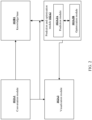
- FIG.2 is an exemplary block diagram illustrating modules of a system of FIG.1 for designing the formulated products, in accordance with some embodiments of the present disclosure.
- the modules include a conversation module 102A1, a knowledge base 102B1, a prediction and optimization module 102A2 and a visualization module 102A3.
- the prediction and optimization module 102A2 further include a prediction module 102A2A and an optimization module 102A2B.
- the modules including the conversation module 102A1, the prediction and optimization module 102A2 and the visualization module 102A3 may be stored in the plurality of modules 102A comprised in the memory 102 of the system 100.
- the knowledge base 102B1 may be stored in the repository 102B comprised in the memory 102 of the system 100.
- the conversation module 102A1, the prediction and optimization module 102A2, the visualization module 102A3 and the knowledge base 102B1 may be cascaded in an integrated platform for designing the formulated products.
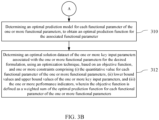
- FIG.3A and FIG.3B illustrates exemplary flow diagrams of a processor-implemented method 300 for designing the formulated products, in accordance with some embodiments of the present disclosure.
- steps of the method 300 including process steps, method steps, techniques or the like may be described in a sequential order, such processes, methods and techniques may be configured to work in alternate orders. In other words, any sequence or order of steps that may be described does not necessarily indicate a requirement that the steps be performed in that order.
- the steps of processes described herein may be performed in any practical order. Further, some steps may be performed simultaneously, or some steps may be performed alone or independently.
- the one or more hardware processors 104 of the system 100 are configured to receive an intent associated with the desired formulation of a target formulated product, from a user.
- the intent is associated with functional requirements of the desired formulation and with performance indicator requirements of the desired formulation.
- the performance indicator requirements includes a cost of the desired formulation, type of functional materials such as green, non-toxic or user-friendly that should be present in the desired formulation, environment friendly production process of the desired formulation, and so on.
- the functional requirements of the desired formulation includes the performance indicator requirements of the desired formulation.
- the user is an end user who require the desired formulation in the target formulated product, a design engineer or a manufacturer who wants to design or produce the desired formulation, a researcher who wants to explore more on the desired formulation, and so on.
- the desired formulation is associated with the list of ingredients, the possible composition/concentration of each ingredient, the process parameters, and the operating parameters for obtaining the desired formulation based on the user requirement.
- the target formulated product is the product produced with the desired formulation, based on the user requirements.
- the formulated products include but are not limited to home and industrial related products, personal care products, pharma products, health care products, agro products, plant protection products, coatings, inks, lubricants, adhesives, foodproducts, and feed related products.
- the received intent from the user is in the form of a fuzzy statement having a question specific to the desired formulation.
- the fuzzy statement is a natural language statement which may be received either in the form of a text or through a speech input.
- the intent in the form of fuzzy statement may be 'Need to avoid the problem of accumulation of dust on the solar panels', 'Need anti-scratch coating on the solar panels', 'Need super-hydrophobic, anti-scratch, and transparent coating on the solar panels', and so on.
- the one or more hardware processors 104 of the system 100 are configured to extract one or more functional parameters and one or more performance indicators of the desired formulation, through the conversation module 102A1, based on the received intent.
- the one or more functional parameters and the one or more performance indicators contains a technical specification of the desired formulation.
- the one or more functional parameters and the one or more performance indicators of the desired formulation are extracted based on the received intent, by establishing continuous conversation with the user.
- one or more conversational agents such as chat-bots are used for extracting the one or more functional parameters and the one or more performance indicators of the desired formulation.
- the chat-bots include text-based chat-bots and speech-input based chat-bots.
- the one or more conversational agents are pre-trained with domain knowledge associated with the received intent of the user.
- the domain knowledge are pre-processed in the form of intent-action mechanism and the one or more conversational agents is trained with the intent-action mechanism based training dataset.
- the one or more conversational agents initiates the continuous conversation with the user, by posing a plurality of questions, a plurality of subsequent questions based on one or more previous questions associated with the intent of the user.
- the intent-action mechanism based training dataset is built based on intent-action dialogue framework, where the training dataset has column headers including ⁇ intent identification number (ID), question, action ⁇ .
- ID intent identification number
- the intent ID is associated with either the functional requirements of the desired formulation or with the performance indicator requirements of the desired formulation.
- the functional requirements is presented in the form of one or more intent IDs
- the performance indicator requirements is presented in the form of one or more intent IDs ( ⁇ s 1 , s 2 , s 3 , ....s i ⁇ ).
- the actions are further directed to one or more sub-sequent questions and their respective answers.
- the one or more conversational agents are generated by training one or more machine learning models with the intent-action mechanism based training dataset.
- FIG. 4 is a flow diagram depicting an exemplary conversation to extract one or more functional parameters and one or more performance indicators, through an intent of a user, for designing the formulated products, in accordance with some embodiments of the present disclosure.
- the exemplary intent having the fuzzy statement of the user is: 'Need to avoid the problem of accumulation of dust and scratches on the solar panels'. If the user selects the option of anti-scratch coating in order to avoid the accumulation of dust, then the one or more conversational agents poses sub-sequent question such as 'What is the base material/surface on which the anti-scratch coating is required?'.
- the one or more conversational agents further asks sub-sequent questions during the conversation, such as 'What is the desired level of transmittance and scratch hardness of the coated surface?'.
- the one or more conversational agents extracts that the one or more functional parameters as scratch hardness (Y 1 ) and transmittance (Y 2 ), and the user need the coating to be applied on the glass surface where the desired formulation exhibits very hard scratch hardness (Y 1 ) and high transmittance (Y 2 ).
- the one or more performance indicators are not present in the mentioned exemplary intent having the fuzzy statement of the user.
- the knowledge base 102B1 includes a product database 102B1A (not shown in FIG.2 ), a physical and chemical property database 102B1B (not shown in FIG.2 ), a market standards database 102B1C (not shown in FIG.2 ), a plurality of input datasets 102B1D (not shown in FIG.2 ) and a conversion look-up table database 102B1E (not shown in FIG.2 ).
- the product database 102B1A includes information related to the list of formulated products.
- the information related to list of formulated products includes one or more ingredients associated with the functional materials, along with their concentration levels (composition levels) for the formulated product.
- the one or more ingredients associated with the functional materials includes one or more active ingredients and one or more inactive ingredients.
- the physical and chemical property database 102B1B include physical and chemical properties of each ingredient of the plurality of ingredients present in the product database 102B1A.
- the market standards database 102B1C comprises list of standards related to each ingredient of the plurality of ingredients present in the product database 102B1A with respective to associated physical and chemical properties present in the physical and chemical property database 102B1B.
- the market standards database 102B1C also includes standard operating parameters and the standard process parameters. The list of standards are used for determining the concentration levels of the one or more ingredients required for designing the formulated product.
- the conversion look-up table database 102B1E includes one or more conversion look-up tables for each functional parameter of the plurality of functional parameters. The one or more conversion look-up tables is created based on the list of standards present in the market standards database 102B1C.
- Each input dataset of the plurality of input datasets 102B1D include a plurality of data elements for each of: (i) one or more process parameters (ii) one or more operating condition parameters, (iii) one or more ingredients, and (iv) one or more parameters associated with the one or more ingredients.
- the one or more process parameters include the parameters related to manufacturing process (for example, coating).
- the one or more operating condition parameters include the parameters of the operating equipment (for example coating equipment) used in the manufacturing process.
- the one or more ingredients are the ingredients present in the product database 102B1A.
- the one or more parameters associated with the one or more ingredients include the concentration level of each ingredient in the product database 102B1A and the physical and chemical properties of each ingredient present in the physical and chemical property database 102B1B.
- the plurality of input datasets 102B1D are created based on the experimental results that are carried out for each functional parameters.
- the one or more hardware processors 104 of the system 100 are configured to obtain a quantitative value for each functional parameter of the one or more functional parameters extracted at step 304 of the method 300.
- the one or more qualitative functional parameters extracted at step 304 of the method 300 are to be converted to get the associated quantitative values.
- the quantitative value for each functional parameter indicates a minimum permissible quantitative value of the associated functional parameter that exhibit the functional requirement in the desired formulation.
- the quantitative value for each functional parameter of the one or more functional parameters is obtained using the conversion look-up table present in the conversion look-up table database 102B1E.
- Table 1 is an exemplary conversion look-up table showing quantitative values for the qualitative functional parameters including the scratch hardness (Y 1 ) and the transmittance (Y 2 ).
- the scratch hardness (Y 1 ) is measured in grams (g) and the transmittance (Y 2 ) is measured in percentage (%).
- the conversion look-up table also includes quantitative values for other qualitative functional parameters that are associated with the anti-scratch coating.
- the other qualitative functional parameters is a thickness and a durability.
- the quantitative value of very hard scratch hardness (Y 1 ) is greater than or equal to 450 g.
- the quantitative value for the high transmittance (Y 2 ) is greater than or equal to 90 % but lesser than or equal to 95 %.
- the desired coating formulation according to the example should have the scratch hardness (Y 1 ) greater than or equal to 450 g and the transmittance (Y 2 ) greater than or equal to 90 % but lesser than or equal to 95 %.
- the one or more hardware processors 104 of the system 100 are configured to identify one or more key input parameters associated with the one or more functional parameters of the desired formulation extracted at step 304 of the method 300.
- the one or more key input parameters are identified based on the one or more performance indicators extracted at step 304 of the method 300.
- the one or more key input parameters include (i) one or more process parameters, (ii) one or more operating condition parameters, (iii) one or more ingredients, and (iv) one or more parameters associated with the one or more ingredients
- the one or more process parameters include the parameters related to manufacturing process (for example, coating) to obtain the desired formulation.
- the one or more operating condition parameters include the parameters of the operating equipment (for example coating equipment) used in the manufacturing process to obtain the desired formulation.
- the one or more ingredients are the ingredients that are required for designing the desired formulation.
- the one or more parameters associated with the one or more ingredients include the concentration level of each ingredient and the physical and chemical properties of each ingredient that are required for designing the desired formulation.
- the one or more key input parameters associated with the one or more functional parameters and the one or more performance indicators of the desired formulation may be obtained from the knowledge base 102B1.
- the one or more functional parameters are mapped to the product database 102B1A, the physical and chemical property database 102B1B, and the market standards database 102B1C, to identify the one or more key input parameters, based on the one or more performance indicators.
- the one or more key input parameters identified are: refractive index of nanoparticles (X 1 ), solvent to resin ratio (X 2 ), concentration (%) of the nanoparticle (X 3 ) and a lifting speed (X 4 ).
- These set of identified key input parameters (X 1 , X 2 , X 3 , X 4 ) may be used for designing the formulation based on the intent of the user.
- the one or more hardware processors 104 of the system 100 are configured to determine an optimal prediction model for each functional parameter of the one or more functional parameters, through the prediction module 102A2A of the prediction and optimization module 102A2.
- the optimal prediction model for each functional parameter may be determined to obtain an optimal prediction function for the associated functional parameter.
- the optimal prediction function may define an optimal relation between the (i) the associated functional parameter and (ii) the identified key input parameters (X 1 , X 2 , X 3 , X 4 ) mentioned at step 308 of the method 300.
- the optimal prediction model for each functional parameter may be determined by using an input dataset associated with the one or more key input parameters and the one or more functional parameters of the desired formulation.
- the input dataset may be obtained from the plurality of input datasets 102B1D present in the knowledge base 102B1.
- the input dataset includes a plurality of data elements for each of the one or more key input parameters and each of the one or more functional parameters.
- An exemplary input dataset for the scratch hardness (Y 1 ) and the transmittance (Y 2 ), the refractive index of nanoparticles (X 1 ), the solvent to resin ratio (X 2 ), the concentration (%) of the nanoparticle (X 3 ) and the lifting speed (X 4 ) is mentioned below in table 2.
- the concentration (%) of the nanoparticle (X 3 ) may be measured in percentages (%) and the lifting speed (X 4 ) may be measured in rotations per minute (rpm).
- Each dataset of (X 1 , X 2 , X 3 , X 4 ) may indicate a probable solution of the desired formulation for the associated functional parameters dataset (Y 1 , Y 2 ). We may observe that some of the data elements are missing in the table 2.
- a sub-input dataset of each functional parameter is obtained from the input dataset.
- the sub-input dataset of each functional parameter includes the data elements for the one or more key input parameters and the associated functional parameter.
- Exemplary sub-input datasets for the scratch hardness (Y 1 ) and the transmittance (Y 2 ), extracted from the exemplary input dataset are shown in table 3A and table 3B respectively.
- Table 3A X 1 X 2 X 3 X 4 Y 1 2.874 0.5 2 50 40 0.33 2 20 70 2.874 0.25 3 20 90 1.77 0.5 1 200 0.5 2 20 1.77 0.5 3 20 500 1.77 3 20 90 1.457 0.5 2 60 0.25 2 50 1.457 0.25 3 70 200
- Table 3B X 1 X 2 X 3 X 4 Y 2 2.874 0.5 2 50 90.4 0.33 2 20 2.874 0.25 3 20 77.97 1.77 0.5 1 98.4 0.5 2 20 1.77 0.5 3 20 97.5 1.77 3 20 90.1 1.457 0.5 2 0.25 2 50 98.6 1.457 0.25 3 70 95.1
- the sub-input dataset is pre-processed to obtain a pre-processed dataset of each functional parameter.
- the pre-processed dataset includes the pre-processed data elements for each of the one or more key input parameters and the associated functional parameter.
- the pre-processing of the sub-input dataset to obtain the pre-processed dataset of each functional parameter includes imputing missing data, outlier removal and high correlation coefficient data removal.
- the missing data elements of the one or more key input parameters and the associated functional parameter are imputed using a multivariate imputation method.
- the multivariate imputation method predicts the missing data fields for each parameter (present in the one or more key input parameters and the associated functional parameter) at a time.
- the data elements of the one or more key input parameters and the associated functional parameter, that are identified as outliers may be removed.
- either a box plot tool or a scatter plot tool may be used for the outlier removal.
- the pre-processing steps of imputing missing data, outlier removal and high correlation coefficient data removal are may be performed in a sequential order. In an embodiment, some of the pre-processing steps from imputing missing data, outlier removal and high correlation coefficient data removal, may be ignored during the pre-processing.
- Table 4A Exemplary pre-processed dataset for the scratch hardness (Y 1 ) and the transmittance (Y 2 ), obtained after the pre-processing is shown in the below table 4A and table 4B respectively.
- Table 4A X 1 X 2 X 3 X 4 Y 1 2.874 0.5 2 50 40 2.874 0.33 2 20 70 2.874 0.25 3 20 90 1.77 0.5 1 20 200 1.77 0.5 2 20 300 1.77 0.5 3 20 500 1.77 0.25 3 20 90 1.457 0.5 2 20 60 1.457 0.25 2 50 100 1.457 0.25 3 70 200
- Table 4B X 1 X 2 X 3 X 4 Y 2 2.874 0.5 2 50 90.4 2.874 0.33 2 20 91.3 2.874 0.25 3 20 77.97 1.77 0.5 1 20 98.4 1.77 0.5 2 20 98.9 1.77 0.5 3 20 97.5 1.77 0.25 3 20 90.1 1.457 0.5 2 20 88.2 1.457 0.25 2 50 98.
- the pre-processed dataset of each functional parameter obtained after the pre-processing is divided into a training dataset and a testing dataset, based on a predefined ratio.
- the predefined ratio may be 80%:20%.
- Table 5A An exemplary training dataset and an exemplary testing dataset for the transmittance (Y 2 ) is shown below in table 5A and table 5B respectively, after the pre-processing.
- Table 5A X 1 X 2 X 3 X 4 Y 2 2.874 0.5 2 50 90.4 2.874 0.33 2 20 91.3 2.874 0.25 3 20 77.97 1.77 0.5 1 20 98.4 1.77 0.5 2 20 98.9 1.77 0.5 3 20 97.5 1.77 0.25 3 20 90.1 1.457 0.25 2 50 98.6
- Table 5B X 1 X 2 X 3 X 4 Y 2 1.457 0.5 2 20 88.2 1.457 0.25 3 70 95.1
- the training dataset of each functional parameter is scaled based on a scaling operation, to obtain a scaled training dataset.
- the scaling operation is performed by using a tool such as a preprocess tool that is available in caret library.
- a mean value and a standard deviation value are calculated based on data elements present each column of the training dataset.
- the calculated mean value will be subtracted from each data element of the associated column and the calculated standard deviation value divides each data element of the associated column to obtain the scaled training dataset.
- testing dataset of each functional parameter is scaled based on the scaling operation as mentioned above, to obtain a scaled testing dataset. Only difference is the mean value and the standard deviation value calculated while obtaining the scaled training dataset are used in the scaling operation to obtain the scaled testing dataset.
- one or more prediction models for each functional parameter are obtained using the associated scaled training dataset.
- a plurality of machine learning models present in the prediction module 102A2A of the prediction and optimization module 102A2 are utilized to generate the one or more prediction models for each functional parameter.
- the plurality of machine learning models includes a plurality of classification models and a plurality of regression models. Some of the plurality of machine learning models include but are not limited to a support vector machine (SVM) model, an artificial neural network (ANN) model and a random forest (RF) model.
- SVM support vector machine
- ANN artificial neural network
- RF random forest
- An exemplary scaled training dataset to generate the one or more prediction models for the transmittance (Y 2 ) is shown below in table 6A.
- each prediction model is generated by taking (X 1 , X 2 , X 3 , X 4 ) as input variables and Y 2 as output variable.
- Table 6A X 1 X 2 X 3 X 4 Y 2 1.18949 0.91489 -0.3536 1.62019 -0.3484 1.18949 -0.4376 -0.3536 -0.5401 -0.2228 1.18949 -1.074 1.06066 -0.5401 -2.0829 -0.6116 0.91489 -1.7678 -0.5401 0.76804 -0.6116 0.91489 -0.3536 -0.5401 0.83782 -0.6116 0.91489 1.06066 -0.5401 0.64245 -0.6116 -1.074 1.06066 -0.5401 -0.3902 -1.1222 -1.074 -0.3536 1.62019 0.7959595
- Each prediction model of the generated one or more prediction models for each functional parameter is validated using the associated scaled testing dataset.
- the generated prediction model should predict the transmittance (Y 2 ) based on the scaled testing dataset during the validation.
- An exemplary scaled testing dataset to validate each prediction model for the transmittance (Y 2 ) is shown below in table 6B.
- Table 6B X 1 X 2 X 3 X 4 -1.12219 0.91489 -0.35355 -0.54006 -1.12219 -1.07400 1.06066 3.06035
- a re-scaling operation may be performed based on the mean value and the standard deviation value calculated while obtaining the scaled training dataset to obtain the validation dataset.
- An exemplary validation dataset is mentioned in below table 6D. Table 6D X 1 X 2 X 3 X 4 Y 2 Actual Y 2 Predicted 1.457 0.5 2 20 88.2 91.4 1.457 0.25 3 70 95.1 98.4
- the predicted data elements by each prediction model of the one or more prediction models are compared with the actual data elements of the associated functional parameter, using one of performance metric from the list of performance metrics to determine a performance error for the prediction model.
- the list of performance metrics includes mean square error (MSE), root mean square error (RMSE) and mean absolute error (MAE).
- MSE mean square error
- RMSE root mean square error
- MAE mean absolute error
- the prediction model having the least performance error out of the one or more prediction models is determined for each functional parameter.
- An optimal prediction function for each functional parameter is obtained from the optimal prediction model of the associated functional parameter.
- the optimal prediction function of the functional parameter indicates an optimal relation between the associated functional parameter (for example Y 2 ) and the one or more key input parameters (for example, (X 1 , X 2 , X 3 , X 4 )).
- the optimal prediction function of each functional parameter may provide an improved solution space having an improved data elements of the associated one or more key input parameters.
- the optimal prediction function of each functional parameter may be plotted in the form of charts or graphs to see further insights in the associated one or more key input parameters.
- the one or more hardware processors 104 of the system 100 are configured to determine an optimal solution dataset of the one or more key input parameters associated with the one or more functional parameters for the desired formulation.
- the optimal solution dataset is determined by using an optimization technique present in the optimization module 102A2B of the prediction and optimization module 102A2, based on an objective function.
- the objective function is defined as a weighted sum of the optimal prediction function for each functional parameter of the one or more functional parameters.
- the one or more constraints include (i) the quantitative value for each functional parameter of the one or more functional parameters obtained at step 306 of the method 300 (ii) lower bound values and upper bound values of the one or more key input parameters, and (iii) the one or more performance indicators that are extracted at step 304 of the method 300.
- the lower bound values and upper bound values of the one or more key input parameters may be obtained from the input dataset mentioned at step 310 of the method 300.
- the lower bound value for each key input parameters is a lowest data element of the associated key input parameter that is present in the pre-processed dataset (for example table 4A or table 4B).
- the upper bound value for each key input parameters is a highest data element of the associated key input parameter that is present in the pre-processed dataset (for example table 4A or table 4B).
- the lower bound value and the upper bound value of X 1 from table 4A or table 4B are 1.457 and 2.874 respectively.
- the objective function may be maximized or minimized during the optimization based on the intent of the user having one or more functional parameters.
- the objective function may be a single objective function or a multi-objective function that is decided based on the number of the functional parameters obtained at step 304 of the method 300. If the number of the functional parameters is more than one (1), then the objective function is the multi-objective function.
- n indicates a number of the functional parameters
- f 1 , f 2 , t 3 ... . f n indicate the optimal prediction function of each functional parameter
- X m indicate number of one or more key input parameters associated with the functional parameter
- a particle swarm optimization technique with crowd distance may be employed as the optimization technique, however the scope of the present disclosure is not limited to the particle swarm optimization technique.
- the particle swarm optimization technique with crowd distance may take the lower bound value as an initial value for each key input parameter and predict a set of optimal values of the associated key input parameters, based on the objective function, provided the one or more constraints are satisfied.
- the set of optimal values of the associated key input parameters may be in between the associated lower bound value and the associated upper bound value.
- the particle swarm optimization technique with crowd distance may be performed either with a predefined number of iterations or the upper bound value for each key input parameter of the one or more key input parameters are met.
- the predefined number of iterations may be 100.
- the set of optimal values predicted for each of the key input parameters may form the optimal solution dataset of the one or more key input parameters associated with the one or more functional parameters for the desired formulation.
- the optimal solution dataset may include a plurality of optimal datasets.
- Each optimal dataset (for example, (X 1 , X 2 , X 3 , X 4 )) indicates the specification of the desired formulation for the one or more functional parameters (for example, (Y 1 , Y 2 )) and the one or more performance indicators.
- An exemplary optimal solution dataset after the optimization is mentioned below in table 7: Table 7 X 1 X 2 X 3 X 4 Y 1 Y 2 2.034 0.440 2.600 29.760 471.740 94.930 2.034 0.470 2.600 52.280 500.000 92.050 2.034 0.450 2.560 27.530 492.830 94.500 2.034 0.440 2.570 28.440 477.410 94.880
- the one or more hardware processors 104 of the system 100 are further configured to display the optimal solution dataset of the one or more key input parameters associated with the one or more functional parameters and the one or more performance indicators of the desired formulation, through the visualization module 102A3.
- the visualization module 102A3 may include a plurality of visualization tools such as multi-dimensional plot tools.
- the visualization tools may help in analyzing the optimal solution dataset of the one or more key input parameters further, such that the enhanced optimal solution for the desired formulation of the user may be obtained.
- the visualization tools may further be used for visualizing the solution space to gain better insights and interpret the results to obtain the desired formulation based on the user requirements.
- the method and system reduces the challenges arising due to disparities in scientific terminology through the development of the continuous conversation with the user to extract functional requirement associated with the desired formulation, based on the intent of the user. This helps in reduction of time and effort involved in the product design and conceptualization phase and increases the accuracy in mapping the user requirement to the technical functional requirements.
- the method and system determine the optimal prediction model that best define the relation between the one or more functional parameters and the one or more key input parameters.
- the optimization technique may accurately determine the optimal solution dataset having the or more key parameters including the ingredients and the associated concentration levels (compositions), the operating parameters and the process parameters, based on the functional requirements.
- the determined optimal solution dataset maybe effectively used to design the desired formulated products, from the vast solution space.
- the method and system enable to capture and understand the user requirements of the desired formulation at the design phase itself.
- the desired functional properties of the target formulated product may be predicted in priory using the optimal prediction models by visualizing the optimal solution space. Hence designing the formulated products even with the complex formulations may be effectively achieved.
- the hardware device can be any kind of device which can be programmed including e.g. any kind of computer like a server or a personal computer, or the like, or any combination thereof.
- the device may also include means which could be e.g. hardware means like e.g. an application-specific integrated circuit (ASIC), a field-programmable gate array (FPGA), or a combination of hardware and software means, e.g.
- ASIC application-specific integrated circuit
- FPGA field-programmable gate array
- the means can include both hardware means and software means.
- the method embodiments described herein could be implemented in hardware and software.
- the device may also include software means.
- the embodiments may be implemented on different hardware devices, e.g. using a plurality of CPUs.
- the embodiments herein can comprise hardware and software elements.
- the embodiments that are implemented in software include but are not limited to, firmware, resident software, microcode, etc.
- the functions performed by various modules described herein may be implemented in other modules or combinations of other modules.
- a computer-usable or computer readable medium can be any apparatus that can comprise, store, communicate, propagate, or transport the program for use by or in connection with the instruction execution system, apparatus, or device.
- a computer-readable storage medium refers to any type of physical memory on which information or data readable by a processor may be stored.
- a computer-readable storage medium may store instructions for execution by one or more processors, including instructions for causing the processor(s) to perform steps or stages consistent with the embodiments described herein.
- the term "computer-readable medium” should be understood to include tangible items and exclude carrier waves and transient signals, i.e., be non-transitory. Examples include random access memory (RAM), read-only memory (ROM), volatile memory, nonvolatile memory, hard drives, CD ROMs, DVDs, flash drives, disks, and any other known physical storage media.
Landscapes
- Engineering & Computer Science (AREA)
- Theoretical Computer Science (AREA)
- Physics & Mathematics (AREA)
- General Physics & Mathematics (AREA)
- Business, Economics & Management (AREA)
- Data Mining & Analysis (AREA)
- General Engineering & Computer Science (AREA)
- Software Systems (AREA)
- Finance (AREA)
- Accounting & Taxation (AREA)
- Mathematical Physics (AREA)
- Evolutionary Computation (AREA)
- Artificial Intelligence (AREA)
- Development Economics (AREA)
- Computational Linguistics (AREA)
- Computing Systems (AREA)
- Strategic Management (AREA)
- General Business, Economics & Management (AREA)
- Economics (AREA)
- Marketing (AREA)
- Computer Vision & Pattern Recognition (AREA)
- Databases & Information Systems (AREA)
- Life Sciences & Earth Sciences (AREA)
- Medical Informatics (AREA)
- Entrepreneurship & Innovation (AREA)
- Game Theory and Decision Science (AREA)
- Bioinformatics & Cheminformatics (AREA)
- Bioinformatics & Computational Biology (AREA)
- Evolutionary Biology (AREA)
- Health & Medical Sciences (AREA)
- Biomedical Technology (AREA)
- Biophysics (AREA)
- General Health & Medical Sciences (AREA)
- Molecular Biology (AREA)
- Management, Administration, Business Operations System, And Electronic Commerce (AREA)
Claims (11)
- Prozessorimplementiertes Verfahren (300), das die folgenden Schritte umfasst:Empfangen, über einen oder mehrere Hardwareprozessoren, einer Absicht, die einer gewünschten Formulierung eines formulierten Zielprodukts zugeordnet ist, von einem Benutzer (302), wobei das formulierte Zielprodukt mit der gewünschten Formulierung hergestellt wird und eines von einem Körperpflegeprodukt, einem Pharmaprodukt, einem Gesundheitspflegeprodukt, einem Agrarprodukt, einem Pflanzenschutzprodukt, einer Beschichtung, einer Tinte, einem Schmiermittel, einem Klebstoff und einem Lebensmittelprodukt ist;Extrahieren, über den einen oder die mehreren Hardwareprozessoren, eines oder mehrerer funktionaler Parameter und eines oder mehrerer Leistungsindikatoren der gewünschten Formulierung basierend auf der empfangenen Absicht (304), wobei ein oder mehrere Konversationsagenten mit Domänenwissen, das der empfangenen Absicht des Benutzers zugeordnet ist, vortrainiert sind und das Domänenwissen in Form eines Absichtsaktionsmechanismus vorverarbeiten, wobei der eine oder die mehreren Konversationsagenten durch Trainieren eines oder mehrerer Maschinenlernmodelle mit dem auf dem Absichtsaktionsmechanismus basierenden Trainingsdatensatz erzeugt werden und wobei der Trainingsdatensatz Spaltenkopfzeilen enthält, wobei die Spaltenkopfzeilen Absichtsidentifikationsnummer (ID), Frage und Aktion umfassen, und wobei der eine oder die mehreren Konversationsagenten verwendet werden, um den einen oder die mehreren funktionalen Parameter und den einen oder die mehreren Leistungsindikatoren der gewünschten Formulierung zu extrahieren;Erhalten, über den einen oder die mehreren Hardwareprozessoren, eines quantitativen Werts für jeden funktionalen Parameter des einen oder der mehreren funktionalen Parameter unter Verwendung einer Umwandlungsnachschlagetabelle (306), um beliebige qualitative funktionale Parameter umzuwandeln, um die zugeordneten quantitativen Werte zu erhalten;Identifizieren, über den einen oder die mehreren Hardwareprozessoren, eines oder mehrerer Schlüsseleingabeparameter, die dem einen oder den mehreren funktionalen Parametern und dem einen oder den mehreren Leistungsindikatoren zugeordnet sind, unter Verwendung einer Wissensbasis, wobei der eine oder die mehreren Schlüsseleingabeparameter (i) einen oder mehrere Prozessparameter, die Parameter enthalten, die sich auf einen Herstellungsprozess beziehen, um die gewünschte Formulierung zu erhalten, (ii) einen oder mehrere Betriebsbedingungsparameter, die Parameter von Betriebsgeräten enthalten, die in dem Herstellungsprozess verwendet werden, um die gewünschte Formulierung zu erhalten, (iii) einen oder mehrere Bestandteile und (iv) einen oder mehrere Parameter, die dem einen oder den mehreren Bestandteilen zugeordnet sind, enthalten (308);Bestimmen, über den einen oder die mehreren Hardwareprozessoren, eines optimalen Vorhersagemodells für jeden funktionalen Parameter des einen oder der mehreren funktionalen Parameter, um eine optimale Vorhersagefunktion für den zugeordneten funktionalen Parameter zu erhalten (310), wobei das optimale Vorhersagemodell für jeden funktionalen Parameter unter Verwendung eines Eingabedatensatzes, der dem einen oder den mehreren Schlüsseleingabeparametern und dem einen oder den mehreren funktionalen Parametern der gewünschten Formulierung zugeordnet ist, bestimmt wird und wobei die optimale Vorhersagefunktion eine optimale Beziehung zwischen (i) dem zugeordneten funktionalen Parameter und (ii) den identifizierten Schlüsseleingabeparametern definiert; undBestimmen, über den einen oder die mehreren Hardwareprozessoren, eines optimalen Lösungsdatensatzes des einen oder der mehreren Schlüsseleingabeparameter, die dem einen oder den mehreren funktionalen Parametern für die gewünschte Formulierung zugeordnet sind, unter Verwendung einer Optimierungstechnik, die auf einer Zielfunktion und einer oder mehreren Beschränkungen basiert, die (i) den quantitativen Wert für jeden funktionalen Parameter des einen oder der mehreren funktionalen Parameter, (ii) untere Grenzwerte und obere Grenzwerte des einen oder der mehreren Schlüsseleingabeparameter und (iii) den einen oder die mehreren Leistungsindikatoren umfassen, wobei die Zielfunktion als eine gewichtete Summe der optimalen Vorhersagefunktion für jeden funktionalen Parameter des einen oder der mehreren funktionalen Parameter definiert ist (312).
- Verfahren nach Anspruch 1, das ferner das Anzeigen, über den einen oder die mehreren Hardwareprozessoren, des optimalen Lösungsdatensatzes des einen oder der mehreren Schlüsseleingabeparameter, die dem einen oder den mehreren funktionalen Parametern der gewünschten Formulierung zugeordnet sind, auf Visualisierungswerkzeugen umfasst.
- Verfahren nach Anspruch 1, wobei der eine oder die mehreren funktionalen Parameter basierend auf der empfangenen Absicht durch Herstellen einer kontinuierlichen Konversation mit dem Benutzer unter Verwendung des einen oder der mehreren Konversationsagenten, die mit dem auf dem Absichtsaktionsmechanismus basierenden Trainingsdatensatz trainiert sind, extrahiert werden.
- Verfahren nach Anspruch 1, wobei das Bestimmen des optimalen Vorhersagemodells für jeden funktionalen Parameter des einen oder der mehreren funktionalen Parameter Folgendes umfasst:Erhalten eines Eingabedatensatzes, der dem einen oder den mehreren Schlüsseleingabeparametern und dem einen oder den mehreren funktionalen Parametern der gewünschten Formulierung zugeordnet ist, wobei der Eingabedatensatz Datenelemente für den einen oder die mehreren Schlüsseleingabeparameter und den einen oder die mehreren funktionalen Parameter umfasst;Extrahieren eines Untereingabedatensatzes jedes funktionalen Parameters aus dem Eingabedatensatz, wobei der Untereingabedatensatz die Datenelemente für den einen oder die mehreren Schlüsseleingabeparameter und den zugeordneten funktionalen Parameter umfasst;Vorverarbeiten des Untereingabedatensatzes, um einen vorverarbeiteten Datensatz jedes funktionalen Parameters zu erhalten, wobei der vorverarbeitete Datensatz vorverarbeitete Datenelemente für den einen oder die mehreren Schlüsseleingabeparameter und den zugeordneten funktionalen Parameter umfasst;Unterteilen des vorverarbeiteten Datensatzes jedes funktionalen Parameters in einen Trainingsdatensatz und einen Testdatensatz basierend auf einem vordefinierten Verhältnis;Skalieren des Trainingsdatensatzes jedes funktionalen Parameters, um einen skalierten Trainingsdatensatz zu erhalten;Skalieren des Testdatensatzes jedes funktionalen Parameters, um einen skalierten Testdatensatz zu erhalten;Erzeugen eines oder mehrerer Vorhersagemodelle jedes funktionalen Parameters unter Verwendung des skalierten Trainingsdatensatzes;Validieren des einen oder der mehreren erzeugten Vorhersagemodelle jedes funktionalen Parameters unter Verwendung des skalierten Testdatensatzes;Bestimmen des optimalen Vorhersagemodells für jeden funktionalen Parameter aus dem einen oder den mehreren erzeugten Vorhersagemodellen basierend auf der Validierung; undErhalten der optimalen Vorhersagefunktion für den zugeordneten funktionalen Parameter aus dem optimalen Vorhersagemodell.
- Verfahren nach Anspruch 4, wobei das Vorverarbeiten des Untereingabedatensatzes, um den vorverarbeiteten Datensatz jedes funktionalen Parameters zu erhalten, das Imputieren fehlender Daten, das Entfernen von Ausreißern und das Entfernen von Daten mit hohem Korrelationskoeffizienten umfasst.
- System (100), das Folgendes umfasst:einen Speicher (102), der Anweisungen speichert;eine oder mehrere Eingabe/Ausgabe-, E/A-, Schnittstellen (106); undeinen oder mehrere Hardwareprozessoren (104), die über die eine oder die mehreren E/A-Schnittstellen (106) mit dem Speicher (102) gekoppelt sind, wobei der eine oder die mehreren Hardwareprozessoren (104) durch die Anweisungen konfiguriert sind zum:Empfangen einer Absicht, die einer gewünschten Formulierung eines formulierten Zielprodukts zugeordnet ist, von einem Benutzer, wobei das formulierte Zielprodukt mit der gewünschten Formulierung hergestellt wird und eines von einem Körperpflegeprodukt, einem Pharmaprodukt, einem Gesundheitspflegeprodukt, einem Agrarprodukt, einem Pflanzenschutzprodukt, einer Beschichtung, einer Tinte, einem Schmiermittel, einem Klebstoff und einem Lebensmittelprodukt ist;Extrahieren eines oder mehrerer funktionaler Parameter und eines oder mehrerer Leistungsindikatoren der gewünschten Formulierung basierend auf der empfangenen Absicht, wobei ein oder mehrere Konversationsagenten mit Domänenwissen, das der empfangenen Absicht des Benutzers zugeordnet ist, vortrainiert sind und das Domänenwissen in Form eines Absichtsaktionsmechanismus vorverarbeiten, wobei der eine oder die mehreren Konversationsagenten durch Trainieren eines oder mehrerer Maschinenlernmodelle mit dem auf dem Absichtsaktionsmechanismus basierenden Trainingsdatensatz erzeugt werden und wobei der Trainingsdatensatz Spaltenkopfzeilen enthält, wobei die Spaltenkopfzeilen Absichtsidentifikationsnummer (ID), Frage und Aktion umfassen, und wobei der eine oder die mehreren Konversationsagenten verwendet werden, um den einen oder die mehreren funktionalen Parameter und den einen oder die mehreren Leistungsindikatoren der gewünschten Formulierung zu extrahieren;Erhalten eines quantitativen Werts für jeden funktionalen Parameter des einen oder der mehreren funktionalen Parameter unter Verwendung einer Umwandlungsnachschlagetabelle, um beliebige qualitative funktionale Parameter umzuwandeln, um die zugeordneten quantitativen Werte zu erhalten;Identifizieren eines oder mehrerer Schlüsseleingabeparameter, die von dem einen oder den mehreren Schlüsseleingabeparametern, die dem einen oder den mehreren funktionalen Parametern und dem einen oder den mehreren Leistungsindikatoren zugeordnet sind, abgeleitet sind, unter Verwendung einer Wissensbasis, wobei der eine oder die mehreren Schlüsseleingabeparameter (i) einen oder mehrere Prozessparameter, die Parameter enthalten, die sich auf einen Herstellungsprozess beziehen, um die gewünschte Formulierung zu erhalten, (ii) einen oder mehrere Betriebsbedingungsparameter, die Parameter der Betriebsgeräte enthalten, die in dem Herstellungsprozess verwendet werden, um die gewünschte Formulierung zu erhalten, (iii) einen oder mehrere Bestandteile und (iv) einen oder mehrere Parameter, die dem einen oder den mehreren Bestandteilen zugeordnet sind, enthalten;Bestimmen eines optimalen Vorhersagemodells für jeden funktionalen Parameter des einen oder der mehreren funktionalen Parameter, um eine optimale Vorhersagefunktion für den zugeordneten funktionalen Parameter zu erhalten, wobei das optimale Vorhersagemodell für jeden funktionalen Parameter unter Verwendung eines Eingabedatensatzes, der dem einen oder den mehreren Schlüsseleingabeparametern und dem einen oder den mehreren funktionalen Parametern der gewünschten Formulierung zugeordnet ist, bestimmt wird und wobei die optimale Vorhersagefunktion eine optimale Beziehung zwischen (i) dem zugeordneten funktionalen Parameter und (ii) den identifizierten Schlüsseleingabeparametern definiert; undBestimmen eines optimalen Lösungsdatensatzes des einen oder der mehreren Schlüsseleingabeparameter, die dem einen oder den mehreren funktionalen Parametern für die gewünschte Formulierung zugeordnet sind, unter Verwendung einer Optimierungstechnik, die auf einer Zielfunktion und einer oder mehreren Beschränkungen basiert, die (i) den quantitativen Wert für jeden funktionalen Parameter des einen oder der mehreren funktionalen Parameter, (ii) untere Grenzwerte und obere Grenzwerte des einen oder der mehreren Schlüsseleingabeparameter und (iii) den einen oder die mehreren Leistungsindikatoren umfassen, wobei die Zielfunktion als eine gewichtete Summe der optimalen Vorhersagefunktion für jeden funktionalen Parameter des einen oder der mehreren funktionalen Parameter definiert ist (312).
- System nach Anspruch 6, wobei der eine oder die mehreren Hardwareprozessoren (104) ferner konfiguriert sind, um den optimalen Lösungsdatensatz des einen oder der mehreren Schlüsseleingabeparameter, die dem einen oder den mehreren funktionalen Parametern der gewünschten Formulierung zugeordnet sind, auf Visualisierungswerkzeugen anzuzeigen.
- System nach Anspruch 6, wobei der eine oder die mehreren Hardwareprozessoren (104) ferner konfiguriert sind, um den einen oder die mehreren funktionalen Parameter und den einen oder die mehreren Leistungsindikatoren der gewünschten Formulierung durch Herstellen einer kontinuierlichen Konversation mit dem Benutzer basierend auf der empfangenen Absicht unter Verwendung eines oder mehrerer Konversationsagenten, die mit einem auf dem Absichtsaktionsmechanismus basierenden Trainingsdatensatz trainiert sind, zu extrahieren.
- System nach Anspruch 6, wobei der eine oder die mehreren Hardwareprozessoren (104) ferner konfiguriert sind, um das optimale Vorhersagemodell für jeden funktionalen Parameter des einen oder der mehreren funktionalen Parameter zu bestimmen durch:Erhalten eines Eingabedatensatzes, der dem einen oder den mehreren Schlüsseleingabeparametern und dem einen oder den mehreren funktionalen Parametern der gewünschten Formulierung zugeordnet ist, wobei der Eingabedatensatz Datenelemente für den einen oder die mehreren Schlüsseleingabeparameter und den einen oder die mehreren funktionalen Parameter umfasst;Extrahieren eines Untereingabedatensatzes jedes funktionalen Parameters aus dem Eingabedatensatz, wobei der Untereingabedatensatz die Datenelemente für den einen oder die mehreren Schlüsseleingabeparameter und den zugeordneten funktionalen Parameter umfasst;Vorverarbeiten des Untereingabedatensatzes, um einen vorverarbeiteten Datensatz jedes funktionalen Parameters zu erhalten, wobei der vorverarbeitete Datensatz vorverarbeitete Datenelemente für den einen oder die mehreren Schlüsseleingabeparameter und den zugeordneten funktionalen Parameter umfasst;Unterteilen des vorverarbeiteten Datensatzes jedes funktionalen Parameters in einen Trainingsdatensatz und einen Testdatensatz basierend auf einem vordefinierten Verhältnis;Skalieren des Trainingsdatensatzes jedes funktionalen Parameters, um einen skalierten Trainingsdatensatz zu erhalten;Skalieren des Testdatensatzes jedes funktionalen Parameters, um einen skalierten Testdatensatz zu erhalten;Erzeugen eines oder mehrerer Vorhersagemodelle jedes funktionalen Parameters unter Verwendung des skalierten Trainingsdatensatzes;Validieren des einen oder der mehreren erzeugten Vorhersagemodelle jedes funktionalen Parameters unter Verwendung des skalierten Testdatensatzes;Bestimmen des optimalen Vorhersagemodells für jeden funktionalen Parameter aus dem einen oder den mehreren erzeugten Vorhersagemodellen basierend auf der Validierung; undErhalten der optimalen Vorhersagefunktion für den zugeordneten funktionalen Parameter aus dem optimalen Vorhersagemodell.
- System nach Anspruch 9, wobei das Vorverarbeiten des Untereingabedatensatzes, um den vorverarbeiteten Datensatz jedes funktionalen Parameters zu erhalten, das Imputieren fehlender Daten, das Entfernen von Ausreißern und das Entfernen von Daten mit hohem Korrelationskoeffizienten umfasst.
- Computerprogrammprodukt, das ein nichtflüchtiges computerlesbares Medium umfasst, in dem ein computerlesbares Programm verkörpert ist, wobei das computerlesbare Programm, wenn es auf einer Rechenvorrichtung ausgeführt wird, die Rechenvorrichtung zu Folgendem veranlasst:Empfangen einer Absicht, die einer gewünschten Formulierung eines formulierten Zielprodukts zugeordnet ist, von einem Benutzer, wobei das formulierte Zielprodukt mit der gewünschten Formulierung hergestellt wird und eines von einem Körperpflegeprodukt, einem Pharmaprodukt, einem Gesundheitspflegeprodukt, einem Agrarprodukt, einem Pflanzenschutzprodukt, einer Beschichtung, einer Tinte, einem Schmiermittel, einem Klebstoff und einem Lebensmittelprodukt ist;Extrahieren eines oder mehrerer funktionaler Parameter und eines oder mehrerer Leistungsindikatoren der gewünschten Formulierung basierend auf der empfangenen Absicht, ein oder mehrere Konversationsagenten mit Domänenwissen, das der empfangenen Absicht des Benutzers zugeordnet ist, vortrainiert sind und das Domänenwissen in Form eines Absichtsaktionsmechanismus vorverarbeiten, wobei der eine oder die mehreren Konversationsagenten durch Trainieren eines oder mehrerer Maschinenlernmodelle mit dem auf dem Absichtsaktionsmechanismus basierenden Trainingsdatensatz erzeugt werden und wobei der Trainingsdatensatz Spaltenkopfzeilen enthält, wobei die Spaltenkopfzeilen Absichtsidentifikationsnummer (ID), Frage und Aktion umfassen, und wobei der eine oder die mehreren Konversationsagenten verwendet werden, um den einen oder die mehreren funktionalen Parameter und den einen oder die mehreren Leistungsindikatoren der gewünschten Formulierung zu extrahieren;Erhalten eines quantitativen Werts für jeden funktionalen Parameter des einen oder der mehreren funktionalen Parameter unter Verwendung einer Umwandlungsnachschlagetabelle, um beliebige qualitative funktionale Parameter umzuwandeln, um die zugeordneten quantitativen Werte zu erhalten;Identifizieren eines oder mehrerer Schlüsseleingabeparameter, die dem einen oder den mehreren funktionalen Parametern und dem einen oder den mehreren Leistungsindikatoren zugeordnet sind, unter Verwendung einer Wissensbasis, wobei der eine oder die mehreren Schlüsseleingabeparameter (i) einen oder mehrere Prozessparameter, die Parameter enthalten, die sich auf einen Herstellungsprozess beziehen, um die gewünschte Formulierung zu erhalten, (ii) einen oder mehrere Betriebsbedingungsparameter, die Parameter von Betriebsgeräten enthalten, die in dem Herstellungsprozess verwendet werden, um die gewünschte Formulierung zu erhalten, (iii) einen oder mehrere Bestandteile und (i) einen oder mehrere Parameter, die dem einen oder den mehreren Bestandteilen zugeordnet sind, enthalten;Bestimmen eines optimalen Vorhersagemodells für jeden funktionalen Parameter des einen oder der mehreren funktionalen Parameter, um eine optimale Vorhersagefunktion für den zugeordneten funktionalen Parameter zu erhalten, wobei das optimale Vorhersagemodell für jeden funktionalen Parameter unter Verwendung eines Eingabedatensatzes, der dem einen oder den mehreren Schlüsseleingabeparametern und dem einen oder den mehreren funktionalen Parametern der gewünschten Formulierung zugeordnet ist, bestimmt wird und wobei die optimale Vorhersagefunktion eine optimale Beziehung zwischen (i) dem zugeordneten funktionalen Parameter und (ii) den identifizierten Schlüsseleingabeparametern definiert; undBestimmen eines optimalen Lösungsdatensatzes des einen oder der mehreren Schlüsseleingabeparameter, die dem einen oder den mehreren funktionalen Parametern für die gewünschte Formulierung zugeordnet sind, unter Verwendung einer Optimierungstechnik, die auf einer Zielfunktion und einer oder mehreren Beschränkungen basiert, die (i) den quantitativen Wert für jeden funktionalen Parameter des einen oder der mehreren funktionalen Parameter, (ii) untere Grenzwerte und obere Grenzwerte des einen oder der mehreren Schlüsseleingabeparameter und (iii) den einen oder die mehreren Leistungsindikatoren umfassen, wobei die Zielfunktion als eine gewichtete Summe der optimalen Vorhersagefunktion für jeden funktionalen Parameter des einen oder der mehreren funktionalen Parameter definiert ist (312).
Applications Claiming Priority (1)
| Application Number | Priority Date | Filing Date | Title |
|---|---|---|---|
| IN201921025038 | 2019-06-24 |
Publications (3)
| Publication Number | Publication Date |
|---|---|
| EP3757909A1 EP3757909A1 (de) | 2020-12-30 |
| EP3757909C0 EP3757909C0 (de) | 2025-01-15 |
| EP3757909B1 true EP3757909B1 (de) | 2025-01-15 |
Family
ID=71170248
Family Applications (1)
| Application Number | Title | Priority Date | Filing Date |
|---|---|---|---|
| EP20181892.9A Active EP3757909B1 (de) | 2019-06-24 | 2020-06-24 | Verfahren und system zum entwerfen formulierter produkte |
Country Status (2)
| Country | Link |
|---|---|
| US (1) | US11488226B2 (de) |
| EP (1) | EP3757909B1 (de) |
Families Citing this family (7)
| Publication number | Priority date | Publication date | Assignee | Title |
|---|---|---|---|---|
| WO2020062392A1 (zh) * | 2018-09-28 | 2020-04-02 | 上海寒武纪信息科技有限公司 | 信号处理装置、信号处理方法及相关产品 |
| US12362070B2 (en) * | 2022-04-06 | 2025-07-15 | BData, Inc. | Systems and methods for predicting outcomes of burn patients |
| US12587274B2 (en) | 2023-03-28 | 2026-03-24 | Quantum Generative Materials Llc | Satellite optimization management system based on natural language input and artificial intelligence |
| US12368503B2 (en) | 2023-12-27 | 2025-07-22 | Quantum Generative Materials Llc | Intent-based satellite transmit management based on preexisting historical location and machine learning |
| US12627372B2 (en) | 2023-12-27 | 2026-05-12 | Quantum Generative Materials Llc | Advanced mission control predictive systems for low earth orbit semi-autonomous satellites |
| US12603701B2 (en) | 2023-12-27 | 2026-04-14 | Quantum Generative Materials Llc | Distributed satellite constellation management and control system |
| CN120220853B (zh) * | 2025-03-05 | 2025-10-03 | 萍乡高恒材料科技有限公司 | 一种聚氨酯压敏胶组合物的成分配比优化方法 |
Family Cites Families (7)
| Publication number | Priority date | Publication date | Assignee | Title |
|---|---|---|---|---|
| ATE326205T1 (de) * | 2000-01-31 | 2006-06-15 | Engelhard Corp | Tensidfreietopische zusammensetzungen und verfahren zur schnelle herstellung davon |
| US6757667B1 (en) | 2000-04-12 | 2004-06-29 | Unilever Home & Personal Care Usa, Division Of Conopco, Inc. | Method for optimizing formulations |
| US8655476B2 (en) * | 2011-03-09 | 2014-02-18 | GM Global Technology Operations LLC | Systems and methods for computationally developing manufacturable and durable cast components |
| WO2013155619A1 (en) | 2012-04-20 | 2013-10-24 | Sam Pasupalak | Conversational agent |
| WO2018098588A1 (en) * | 2016-12-02 | 2018-06-07 | Lumiant Corporation | Computer systems for and methods of identifying non-elemental materials based on atomistic properties |
| WO2019148116A1 (en) | 2018-01-29 | 2019-08-01 | Atolla Skin Health, Inc. | Systems and methods for formulating personalized skincare products |
| US10847265B2 (en) * | 2018-04-06 | 2020-11-24 | Curai, Inc. | Systems and methods for responding to healthcare inquiries |
-
2020
- 2020-06-23 US US16/909,845 patent/US11488226B2/en active Active
- 2020-06-24 EP EP20181892.9A patent/EP3757909B1/de active Active
Non-Patent Citations (1)
| Title |
|---|
| LEE C K H ET AL: "A knowledge-based ingredient formulation system for chemical product development in the personal care industry", COMPUTERS & CHEMICAL ENGINEERING, PERGAMON PRESS, OXFORD, GB, vol. 65, 19 March 2014 (2014-03-19), pages 40 - 53, XP028641126, ISSN: 0098-1354, DOI: 10.1016/J.COMPCHEMENG.2014.03.004 * |
Also Published As
| Publication number | Publication date |
|---|---|
| US11488226B2 (en) | 2022-11-01 |
| EP3757909C0 (de) | 2025-01-15 |
| US20200401917A1 (en) | 2020-12-24 |
| EP3757909A1 (de) | 2020-12-30 |
Similar Documents
| Publication | Publication Date | Title |
|---|---|---|
| US11488226B2 (en) | Method and system for designing formulated products | |
| Paigude et al. | Potential of artificial intelligence in boosting employee retention in the human resource industry | |
| Ljepava | AI-enabled marketing solutions in marketing decision making: AI application in different stages of marketing process | |
| Kotu et al. | Predictive analytics and data mining: concepts and practice with rapidminer | |
| Dahal et al. | A comparative study on effect of news sentiment on stock price prediction with deep learning architecture | |
| Begum et al. | Software defects identification: Results using machine learning and explainable artificial intelligence techniques | |
| CN114127803A (zh) | 用于最优预测模型选择的多方法系统 | |
| US20230351421A1 (en) | Customer-intelligence predictive model | |
| Asadabadi | A Markovian-QFD approach in addressing the changing priorities of the customer needs | |
| Adeniran et al. | Advancements in predictive modelling for insurance pricing: Enhancing risk assessment and customer segmentation | |
| Faisal et al. | Development of a readiness model for industry 4.0 using Analytical Hierarchy process and fuzzy inference system: Bangladesh perspective | |
| Chou et al. | Forecasting enterprise resource planning software effort using evolutionary support vector machine inference model | |
| Tripathi et al. | Improvement in shop floor management using ANN coupled with VSM: a case study | |
| Yuan et al. | TRiP: a transfer learning based rice disease phenotype recognition platform using SENet and microservices | |
| Romanenkov | Criterion for Ranking Interval Alternatives in aDecision-Making Task | |
| Victor | Analyzing Stock Market Trends using Social Media user Moods and Social Influence using Lightweight BERT-BiGRU-A Model | |
| US20250124505A1 (en) | Machine learning models for qualitative domains | |
| Upreti et al. | Artificial intelligence and its effect on employment and skilling | |
| Al-Ahmari | A methodology for selection and evaluation of advanced manufacturing technologies | |
| Varuna et al. | Trend prediction of github using time series analysis | |
| Abdelhay | The role of Generative AI (ChatGPT) in optimizing the recruitment process in the organizations (the mediating role of level of position and organization size). | |
| WO2021186338A1 (en) | System and method for determining solution for problem in organization | |
| Dahish | The impact of conversational AI on business intelligence transforming data interaction and decision-making | |
| Khalimonchuk et al. | The role of machine learning and artificial intelligence in optimizing costs and increasing revenues of technological companies | |
| Ali et al. | Assessing AI techniques for precision in property valuation: A systematic review of the four valuation methods |
Legal Events
| Date | Code | Title | Description |
|---|---|---|---|
| PUAI | Public reference made under article 153(3) epc to a published international application that has entered the european phase |
Free format text: ORIGINAL CODE: 0009012 |
|
| STAA | Information on the status of an ep patent application or granted ep patent |
Free format text: STATUS: THE APPLICATION HAS BEEN PUBLISHED |
|
| AK | Designated contracting states |
Kind code of ref document: A1 Designated state(s): AL AT BE BG CH CY CZ DE DK EE ES FI FR GB GR HR HU IE IS IT LI LT LU LV MC MK MT NL NO PL PT RO RS SE SI SK SM TR |
|
| AX | Request for extension of the european patent |
Extension state: BA ME |
|
| STAA | Information on the status of an ep patent application or granted ep patent |
Free format text: STATUS: REQUEST FOR EXAMINATION WAS MADE |
|
| 17P | Request for examination filed |
Effective date: 20210629 |
|
| RBV | Designated contracting states (corrected) |
Designated state(s): AL AT BE BG CH CY CZ DE DK EE ES FI FR GB GR HR HU IE IS IT LI LT LU LV MC MK MT NL NO PL PT RO RS SE SI SK SM TR |
|
| STAA | Information on the status of an ep patent application or granted ep patent |
Free format text: STATUS: EXAMINATION IS IN PROGRESS |
|
| 17Q | First examination report despatched |
Effective date: 20230201 |
|
| REG | Reference to a national code |
Ref country code: DE Ref legal event code: R079 Ipc: G06N0003006000 Ref country code: DE Ref legal event code: R079 Ref document number: 602020044717 Country of ref document: DE Free format text: PREVIOUS MAIN CLASS: G06N0005040000 Ipc: G06N0003006000 |
|
| GRAP | Despatch of communication of intention to grant a patent |
Free format text: ORIGINAL CODE: EPIDOSNIGR1 |
|
| STAA | Information on the status of an ep patent application or granted ep patent |
Free format text: STATUS: GRANT OF PATENT IS INTENDED |
|
| RIC1 | Information provided on ipc code assigned before grant |
Ipc: G06N 20/20 20190101ALI20241023BHEP Ipc: G06N 5/04 20060101ALI20241023BHEP Ipc: G06N 3/006 20230101AFI20241023BHEP |
|
| GRAS | Grant fee paid |
Free format text: ORIGINAL CODE: EPIDOSNIGR3 |
|
| GRAA | (expected) grant |
Free format text: ORIGINAL CODE: 0009210 |
|
| STAA | Information on the status of an ep patent application or granted ep patent |
Free format text: STATUS: THE PATENT HAS BEEN GRANTED |
|
| INTG | Intention to grant announced |
Effective date: 20241115 |
|
| RIN1 | Information on inventor provided before grant (corrected) |
Inventor name: BASAVARSU, PURUSHOTTHAM GAUTHAM Inventor name: MALHOTRA, CHETAN PREMKUMAR Inventor name: SINGH, UMESH Inventor name: BHOWMIK, AMIT Inventor name: RAI, BEENA Inventor name: KUMAR, DHARMENDRA Inventor name: BANDI, PALLAVI Inventor name: GUPTA, SHALLY Inventor name: KAUSLEY, SHANKAR BALAJIRAO Inventor name: JAIN, DEEPAK SHYAMSUNDER Inventor name: CHAKO, RINU Inventor name: DAWARE, SANTOSH VASANT |
|
| AK | Designated contracting states |
Kind code of ref document: B1 Designated state(s): AL AT BE BG CH CY CZ DE DK EE ES FI FR GB GR HR HU IE IS IT LI LT LU LV MC MK MT NL NO PL PT RO RS SE SI SK SM TR |
|
| REG | Reference to a national code |
Ref country code: CH Ref legal event code: EP Ref country code: GB Ref legal event code: FG4D |
|
| REG | Reference to a national code |
Ref country code: DE Ref legal event code: R096 Ref document number: 602020044717 Country of ref document: DE |
|
| REG | Reference to a national code |
Ref country code: IE Ref legal event code: FG4D |
|
| U01 | Request for unitary effect filed |
Effective date: 20250115 |
|
| U07 | Unitary effect registered |
Designated state(s): AT BE BG DE DK EE FI FR IT LT LU LV MT NL PT RO SE SI Effective date: 20250121 |
|
| PG25 | Lapsed in a contracting state [announced via postgrant information from national office to epo] |
Ref country code: RS Free format text: LAPSE BECAUSE OF FAILURE TO SUBMIT A TRANSLATION OF THE DESCRIPTION OR TO PAY THE FEE WITHIN THE PRESCRIBED TIME-LIMIT Effective date: 20250415 |
|
| PG25 | Lapsed in a contracting state [announced via postgrant information from national office to epo] |
Ref country code: PL Free format text: LAPSE BECAUSE OF FAILURE TO SUBMIT A TRANSLATION OF THE DESCRIPTION OR TO PAY THE FEE WITHIN THE PRESCRIBED TIME-LIMIT Effective date: 20250115 |
|
| PG25 | Lapsed in a contracting state [announced via postgrant information from national office to epo] |
Ref country code: ES Free format text: LAPSE BECAUSE OF FAILURE TO SUBMIT A TRANSLATION OF THE DESCRIPTION OR TO PAY THE FEE WITHIN THE PRESCRIBED TIME-LIMIT Effective date: 20250115 |
|
| PGFP | Annual fee paid to national office [announced via postgrant information from national office to epo] |
Ref country code: GB Payment date: 20250617 Year of fee payment: 6 |
|
| PG25 | Lapsed in a contracting state [announced via postgrant information from national office to epo] |
Ref country code: IS Free format text: LAPSE BECAUSE OF FAILURE TO SUBMIT A TRANSLATION OF THE DESCRIPTION OR TO PAY THE FEE WITHIN THE PRESCRIBED TIME-LIMIT Effective date: 20250515 Ref country code: NO Free format text: LAPSE BECAUSE OF FAILURE TO SUBMIT A TRANSLATION OF THE DESCRIPTION OR TO PAY THE FEE WITHIN THE PRESCRIBED TIME-LIMIT Effective date: 20250415 |
|
| PG25 | Lapsed in a contracting state [announced via postgrant information from national office to epo] |
Ref country code: HR Free format text: LAPSE BECAUSE OF FAILURE TO SUBMIT A TRANSLATION OF THE DESCRIPTION OR TO PAY THE FEE WITHIN THE PRESCRIBED TIME-LIMIT Effective date: 20250115 |
|
| PG25 | Lapsed in a contracting state [announced via postgrant information from national office to epo] |
Ref country code: GR Free format text: LAPSE BECAUSE OF FAILURE TO SUBMIT A TRANSLATION OF THE DESCRIPTION OR TO PAY THE FEE WITHIN THE PRESCRIBED TIME-LIMIT Effective date: 20250416 |
|
| U20 | Renewal fee for the european patent with unitary effect paid |
Year of fee payment: 6 Effective date: 20250624 |
|
| PG25 | Lapsed in a contracting state [announced via postgrant information from national office to epo] |
Ref country code: SM Free format text: LAPSE BECAUSE OF FAILURE TO SUBMIT A TRANSLATION OF THE DESCRIPTION OR TO PAY THE FEE WITHIN THE PRESCRIBED TIME-LIMIT Effective date: 20250115 |
|
| PGFP | Annual fee paid to national office [announced via postgrant information from national office to epo] |
Ref country code: CH Payment date: 20250701 Year of fee payment: 6 |
|
| PG25 | Lapsed in a contracting state [announced via postgrant information from national office to epo] |
Ref country code: CZ Free format text: LAPSE BECAUSE OF FAILURE TO SUBMIT A TRANSLATION OF THE DESCRIPTION OR TO PAY THE FEE WITHIN THE PRESCRIBED TIME-LIMIT Effective date: 20250115 |
|
| PG25 | Lapsed in a contracting state [announced via postgrant information from national office to epo] |
Ref country code: SK Free format text: LAPSE BECAUSE OF FAILURE TO SUBMIT A TRANSLATION OF THE DESCRIPTION OR TO PAY THE FEE WITHIN THE PRESCRIBED TIME-LIMIT Effective date: 20250115 |
|
| PLBE | No opposition filed within time limit |
Free format text: ORIGINAL CODE: 0009261 |
|
| STAA | Information on the status of an ep patent application or granted ep patent |
Free format text: STATUS: NO OPPOSITION FILED WITHIN TIME LIMIT |
|
| 26N | No opposition filed |
Effective date: 20251016 |
|
| PG25 | Lapsed in a contracting state [announced via postgrant information from national office to epo] |
Ref country code: MC Free format text: LAPSE BECAUSE OF FAILURE TO SUBMIT A TRANSLATION OF THE DESCRIPTION OR TO PAY THE FEE WITHIN THE PRESCRIBED TIME-LIMIT Effective date: 20250115 |
|
| PG25 | Lapsed in a contracting state [announced via postgrant information from national office to epo] |
Ref country code: IE Free format text: LAPSE BECAUSE OF NON-PAYMENT OF DUE FEES Effective date: 20250624 |