EP3756399B1 - New-radio-unlizenzierte (nr-u) zeilensprungbasierte ressourcenzuweisungen - Google Patents
New-radio-unlizenzierte (nr-u) zeilensprungbasierte ressourcenzuweisungen Download PDFInfo
- Publication number
- EP3756399B1 EP3756399B1 EP19708708.3A EP19708708A EP3756399B1 EP 3756399 B1 EP3756399 B1 EP 3756399B1 EP 19708708 A EP19708708 A EP 19708708A EP 3756399 B1 EP3756399 B1 EP 3756399B1
- Authority
- EP
- European Patent Office
- Prior art keywords
- frequency
- frequency resources
- interlaced
- interlace
- configuration
- Prior art date
- Legal status (The legal status is an assumption and is not a legal conclusion. Google has not performed a legal analysis and makes no representation as to the accuracy of the status listed.)
- Active
Links
Images





Classifications
-
- H—ELECTRICITY
- H04—ELECTRIC COMMUNICATION TECHNIQUE
- H04W—WIRELESS COMMUNICATION NETWORKS
- H04W72/00—Local resource management
- H04W72/04—Wireless resource allocation
- H04W72/044—Wireless resource allocation based on the type of the allocated resource
- H04W72/0453—Resources in frequency domain, e.g. a carrier in FDMA
-
- H—ELECTRICITY
- H04—ELECTRIC COMMUNICATION TECHNIQUE
- H04W—WIRELESS COMMUNICATION NETWORKS
- H04W52/00—Power management, e.g. Transmission Power Control [TPC] or power classes
- H04W52/04—Transmission power control [TPC]
- H04W52/30—Transmission power control [TPC] using constraints in the total amount of available transmission power
- H04W52/36—Transmission power control [TPC] using constraints in the total amount of available transmission power with a discrete range or set of values, e.g. step size, ramping or offsets
-
- H—ELECTRICITY
- H04—ELECTRIC COMMUNICATION TECHNIQUE
- H04W—WIRELESS COMMUNICATION NETWORKS
- H04W72/00—Local resource management
- H04W72/20—Control channels or signalling for resource management
- H04W72/23—Control channels or signalling for resource management in the downlink direction of a wireless link, i.e. towards a terminal
-
- H—ELECTRICITY
- H04—ELECTRIC COMMUNICATION TECHNIQUE
- H04W—WIRELESS COMMUNICATION NETWORKS
- H04W16/00—Network planning, e.g. coverage or traffic planning tools; Network deployment, e.g. resource partitioning or cells structures
- H04W16/14—Spectrum sharing arrangements between different networks
Definitions
- This application relates to wireless communication systems, and more particularly to communicating in a frequency spectrum using interlaced frequency resources.
- a wireless multiple-access communications system may include a number of base stations (BSs), each simultaneously supporting communications for multiple communication devices, which may be otherwise known as user equipment (UE).
- BSs base stations
- UE user equipment
- NR next generation new radio
- NR may provision for dynamic medium sharing among network operators in a licensed spectrum, a shared spectrum, and/or an unlicensed spectrum.
- shared spectrums and/or unlicensed spectrums may include frequency bands at about 3.5 gigahertz (GHz), about 6 GHz, and about 60 GHz.
- This disclosure relates generally to providing or participating in authorized shared access between two or more wireless communications systems, also referred to as wireless communications networks.
- the techniques and apparatus may be used for wireless communication networks such as code division multiple access (CDMA) networks, time division multiple access (TDMA) networks, frequency division multiple access (FDMA) networks, orthogonal FDMA (OFDMA) networks, single-carrier FDMA (SC-FDMA) networks, LTE networks, GSM networks, 5 th Generation (5G) or new radio (NR) networks, as well as other communications networks.
- CDMA code division multiple access
- TDMA time division multiple access
- FDMA frequency division multiple access
- OFDMA orthogonal FDMA
- SC-FDMA single-carrier FDMA
- LTE long-term evolution
- GSM Global System for Mobile communications
- 5G 5 th Generation
- NR new radio
- An OFDMA network may implement a radio technology such as evolved UTRA (E-UTRA), IEEE 802.11, IEEE 802.16, IEEE 802.20, flash-OFDM and the like.
- E-UTRA evolved UTRA
- GSM Global System for Mobile Communications
- LTE long term evolution
- UTRA, E-UTRA, GSM, UMTS and LTE are described in documents provided from an organization named "3rd Generation Partnership Project” (3GPP), and cdma2000 is described in documents from an organization named "3rd Generation Partnership Project 2" (3GPP2).
- 3GPP 3rd Generation Partnership Project
- 3GPP long term evolution LTE
- UMTS universal mobile telecommunications system
- the 3GPP may define specifications for the next generation of mobile networks, mobile systems, and mobile devices.
- the present disclosure is concerned with the evolution of wireless technologies from LTE, 4G, 5G, NR, and beyond with shared access to wireless spectrum between networks using a collection of new and different radio access technologies or radio air interfaces.
- 5G networks contemplate diverse deployments, diverse spectrum, and diverse services and devices that may be implemented using an OFDM-based unified, air interface.
- further enhancements to LTE and LTE-A are considered in addition to development of the new radio technology for 5G NR networks.
- the 5G NR will be capable of scaling to provide coverage (1) to a massive Internet of things (IoTs) with a ULtra-high density (e.g., ⁇ 1M nodes/km 2 ), ultra-low complexity (e.g., ⁇ 10s of bits/sec), ultra-low energy (e.g., ⁇ 10+ years of battery life), and deep coverage with the capability to reach challenging locations; (2) including mission-critical control with strong security to safeguard sensitive personal, financial, or classified information, ultra-high reliability (e.g., -99.9999% reliability), ultra-low latency (e.g., ⁇ 1 ms), and users with wide ranges of mobility or lack thereof; and (3) with enhanced mobile broadband including extreme high capacity (e.g., ⁇ 10 Tbps/km 2 ), extreme data rates (e.g., multi-Gbps rate, 100+ Mbps user experienced rates), and deep awareness with advanced discovery and optimizations.
- IoTs Internet of things
- ultra-low complexity e.g., ⁇ 10s of bits
- the 5G NR may be implemented to use optimized OFDM-based waveforms with scalable numerology and transmission time interval (TTI); having a common, flexible framework to efficiently multiplex services and features with a dynamic, low-latency time division duplex (TDD)/frequency division duplex (FDD) design; and with advanced wireless technologies, such as massive multiple input, multiple output (MIMO), robust millimeter wave (mmWave) transmissions, advanced channel coding, and device-centric mobility.
- TTI numerology and transmission time interval
- subcarrier spacing may occur with 15 kHz, for example over 1, 5, 10, 20 MHz, and the like bandwidth.
- subcarrier spacing may occur with 30 kHz over 80/100 MHz bandwidth.
- the subcarrier spacing may occur with 60 kHz over a 160 MHz bandwidth.
- subcarrier spacing may occur with 120 kHz over a 500MHz bandwidth.
- the scalable numerology of the 5G NR facilitates scalable TTI for diverse latency and quality of service (QoS) requirements. For example, shorter TTI may be used for low latency and high reliability, while longer TTI may be used for higher spectral efficiency.
- QoS quality of service
- 5G NR also contemplates a self-contained integrated subframe design with uplink/downlink scheduling information, data, and acknowledgement in the same subframe.
- the self-contained integrated subframe supports communications in unlicensed or contention-based shared spectrum, adaptive uplink/downlink that may be flexibly configured on a per-cell basis to dynamically switch between uplink and downlink to meet the current traffic needs.
- an aspect disclosed herein may be implemented independently of any other aspects and that two or more of these aspects may be combined in various ways.
- an apparatus may be implemented or a method may be practiced using any number of the aspects set forth herein.
- such an apparatus may be implemented or such a method may be practiced using other structure, functionality, or structure and functionality in addition to or other than one or more of the aspects set forth herein.
- a method may be implemented as part of a system, device, apparatus, and/or as instructions stored on a computer readable medium for execution on a processor or computer.
- an aspect may comprise at least one element of a claim.
- a certain frequency band may allow a maximum power spectral density (PSD) of about 10 decibel milliwatts per megahertz (dBm/MHz) for any transmission in the frequency band.
- PSD power spectral density
- a transmitter may be capable of transmitting at a higher power.
- One approach to allowing for a higher total transmit power while meeting a PSD requirement is to spread the frequency occupancy of a transmission signal over a wider bandwidth.
- a UE may be allocated with dis-contiguous blocks of frequencies within a bandwidth, where adjacent frequency blocks are separated by more than 1 MHz to allow the UE to transmit at a higher power up to the PSD limit (e.g., at about 10 dBm) in each frequency block.
- the PSD limit e.g., at about 10 dBm
- a frequency band may be partitioned into multiple sets of interlaced frequency resources.
- a transmission signal may be transmitted using a set of interlaced frequency resources spaced apart from each other and interlaced with another set of interlaced frequency resources.
- the distribution of the transmission signal in a frequency domain can reduce the transmit PSD of the signal.
- Each set of interlaced frequency resources may be referred to as a frequency interlace.
- a BS may configure interlaced frequency resources in a frequency band.
- the configuration may include determining a number of frequency interlaces in the frequency band, an interlace-spacing (e.g., the frequency separation among interlaced frequency resources within a frequency interlace), and/or a frequency interlace size (e.g., the number of interlaced frequency resources within a frequency interlace).
- the BS may allocate resources in units of frequency interlaces.
- a frequency band may be configured with frequency interlaces of equal sizes in a frequency band. In some other embodiments, a frequency band may be configured with frequency interlaces of multiple sizes.
- An allocation may include one or more frequency interlaces, for example, depending on an allocation capacity requirement or a UE capability. Some frequency resources may be excluded from an allocation to meet a frequency interlace size constraint and/or a uniform frequency distribution constraint.
- a frequency band may be configured with frequency interlaces of different subcarrier spacings (SCSs) based on a hierarchical tree structure, where a frequency interlace of a higher SCS (e.g., of about 30 kHz) may be configured by combining a number of frequency interlaces of a lower SCS (e.g., of about 15 kHz).
- SCSs subcarrier spacings
- the different SCS configurations may have the same interlace-spacing or the same number of frequency interlaces.
- certain frequency resources may be excluded to align frequency interlaces of different SCSs and/or to meet various constraints.
- a frequency band may be configured with frequency interlaces of different subcarrier spacings (SCSs) by maintaining the same frequency interlace structure across the different SCS configurations.
- a BS may schedule one UE with a first frequency interlace of a higher SCS and another with a second frequency interlace of a lower SCS in the same time period.
- a BS may broadcast frequency interlace configurations and/or frequency resource exclusion rules in a network to facilitate resource scheduling in the network.
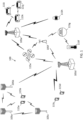
- FIG. 1 illustrates a wireless communication network 100 according to some embodiments of the present disclosure.
- the network 100 may be a 5G network.
- the network 100 includes a number of base stations (BSs) 105 and other network entities.
- a BS 105 may be a station that communicates with UEs 115 and may also be referred to as an evolved node B (eNB), a next generation eNB (gNB), an access point, and the like.
- eNB evolved node B
- gNB next generation eNB
- Each BS 105 may provide communication coverage for a particular geographic area.
- the term "cell" can refer to this particular geographic coverage area of a BS 105 and/or a BS subsystem serving the coverage area, depending on the context in which the term is used.
- a BS 105 may provide communication coverage for a macro cell or a small cell, such as a pico cell or a femto cell, and/or other types of cell.
- a macro cell generally covers a relatively large geographic area (e.g., several kilometers in radius) and may allow unrestricted access by UEs with service subscriptions with the network provider.
- a small cell such as a pico cell, would generally cover a relatively smaller geographic area and may allow unrestricted access by UEs with service subscriptions with the network provider.
- a small cell such as a femto cell, would also generally cover a relatively small geographic area (e.g., a home) and, in addition to unrestricted access, may also provide restricted access by UEs having an association with the femto cell (e.g., UEs in a closed subscriber group (CSG), UEs for users in the home, and the like).
- a BS for a macro cell may be referred to as a macro BS.
- a BS for a small cell may be referred to as a small cell BS, a pico BS, a femto BS or a home BS. In the example shown in FIG.
- the BSs 105d and 105e may be regular macro BSs, while the BSs 105a-105c may be macro BSs enabled with one of 3 dimension (3D), full dimension (FD), or massive MIMO.
- the BSs 105a-105c may take advantage of their higher dimension MIMO capabilities to exploit 3D beamforming in both elevation and azimuth beamforming to increase coverage and capacity.
- the BS 105f may be a small cell BS which may be a home node or portable access point.
- a BS 105 may support one or multiple (e.g., two, three, four, and the like) cells.
- the network 100 may support synchronous or asynchronous operation.
- the BSs may have similar frame timing, and transmissions from different BSs may be approximately aligned in time.
- the BSs may have different frame timing, and transmissions from different BSs may not be aligned in time.
- the UEs 115 are dispersed throughout the wireless network 100, and each UE 115 may be stationary or mobile.
- a UE 115 may also be referred to as a terminal, a mobile station, a subscriber unit, a station, or the like.
- a UE 115 may be a cellular phone, a personal digital assistant (PDA), a wireless modem, a wireless communication device, a handheld device, a tablet computer, a laptop computer, a cordless phone, a wireless local loop (WLL) station, or the like.
- PDA personal digital assistant
- WLL wireless local loop
- a UE 115 may be a device that includes a Universal Integrated Circuit Card (UICC).
- a UE may be a device that does not include a UICC.
- UICC Universal Integrated Circuit Card
- the UEs 115 that do not include UICCs may also be referred to as internet of everything (IoE) devices.
- the UEs 115a-115d are examples of mobile smart phone-type devices accessing network 100
- a UE 115 may also be a machine specifically configured for connected communication, including machine type communication (MTC), enhanced MTC (eMTC), narrowband IoT (NB-IoT) and the like.
- MTC machine type communication
- eMTC enhanced MTC
- NB-IoT narrowband IoT
- the UEs 115e-115k are examples of various machines configured for communication that access the network 100.
- a UE 115 may be able to communicate with any type of the BSs, whether macro BS, small cell, or the like. In FIG.
- a lightning bolt (e.g., communication links) indicates wireless transmissions between a UE 115 and a serving BS 105, which is a BS designated to serve the UE 115 on the downlink and/or uplink, or desired transmission between BSs, and backhaul transmissions between BSs.
- the BSs 105a-105c may serve the UEs 115a and 115b using 3D beamforming and coordinated spatial techniques, such as coordinated multipoint (CoMP) or multi-connectivity.
- the macro BS 105d may perform backhaul communications with the BSs 105a-105c, as well as small cell, the BS 105f.
- the macro BS 105d may also transmits multicast services which are subscribed to and received by the UEs 115c and 115d.
- Such multicast services may include mobile television or stream video, or may include other services for providing community information, such as weather emergencies or alerts, such as Amber alerts or gray alerts.
- the network 100 may also support mission critical communications with ultra-reliable and redundant links for mission critical devices, such as the UE 115e, which may be a drone. Redundant communication links with the UE 115e may include links from the macro BSs 105d and 105e, as well as links from the small cell BS 105f.
- UE 115f e.g., a thermometer
- UE 115g e.g., smart meter
- UE 115h e.g., wearable device
- the network 100 may also provide additional network efficiency through dynamic, low-latency TDD/FDD communications, such as in a vehicle-to-vehicle (V2V)
- V2V vehicle-to-vehicle
- the network 100 utilizes OFDM-based waveforms for communications.
- An OFDM-based system may partition the system bandwidth into multiple (K) orthogonal subcarriers, which are also commonly referred to as subcarriers, tones, bins, or the like. Each subcarrier may be modulated with data.
- K the total number of subcarriers
- the system bandwidth may also be partitioned into subbands.
- the subcarrier spacing and/or the duration of TTIs may be scalable.
- the BSs 105 can assign or schedule transmission resources (e.g., in the form of time-frequency resource blocks (RB)) for downlink (DL) and uplink (UL) transmissions in the network 100.
- DL refers to the transmission direction from a BS 105 to a UE 115
- UL refers to the transmission direction from a UE 115 to a BS 105.
- the communication can be in the form of radio frames.
- a radio frame may be divided into a plurality of subframes, for example, about 10.
- Each subframe can be divided into slots, for example, about 2.
- Each slot may be further divided into mini-slots.
- each subframe includes a UL subframe in a UL frequency band and a DL subframe in a DL frequency band.
- TDD time-division duplexing
- UL and DL transmissions occur at different time periods using the same frequency band.
- a subset of the subframes (e.g., DL subframes) in a radio frame may be used for DL transmissions and another subset of the subframes (e.g., UL subframes) in the radio frame may be used for UL transmissions.
- each DL or UL subframe may have pre-defined regions for transmissions of reference signals, control information, and data.
- Reference signals are predetermined signals that facilitate the communications between the BSs 105 and the UEs 115.
- a reference signal can have a particular pilot pattern or structure, where pilot tones may span across an operational bandwidth or frequency band, each positioned at a pre-defined time and a pre-defined frequency.
- a BS 105 may transmit cell specific reference signals (CRSs) and/or channel state information -reference signals (CSI-RSs) to enable a UE 115 to estimate a DL channel.
- CRSs cell specific reference signals
- CSI-RSs channel state information -reference signals
- a UE 115 may transmit sounding reference signals (SRSs) to enable a BS 105 to estimate a UL channel.
- Control information may include resource assignments and protocol controls.
- Data may include protocol data and/or operational data.
- the BSs 105 and the UEs 115 may communicate using self-contained subframes.
- a self-contained subframe may include a portion for DL communication and a portion for UL communication.
- a self-contained subframe can be DL-centric or UL-centric.
- a DL-centric subframe may include a longer duration for DL communication tha UL communication.
- a UL-centric subframe may include a longer duration for UL communication tha UL communication.
- the network 100 may be an NR network deployed over a licensed spectrum.
- the BSs 105 can transmit synchronization signals (e.g., including a primary synchronization signal (PSS) and a secondary synchronization signal (SSS)) in the network 100 to facilitate synchronization.
- the BSs 105 can broadcast system information associated with the network 100 (e.g., including a master information block (MIB), remaining minimum system information (RMSI), and other system information (OSI)) to facilitate initial network access.
- MIB master information block
- RMSI remaining minimum system information
- OSI system information
- the BSs 105 may broadcast the PSS, the SSS, the MIB, the RMSI, and/or the OSI in the form of synchronization signal blocks (SSBs).
- SSBs synchronization signal blocks
- a UE 115 attempting to access the network 100 may perform an initial cell search by detecting a PSS from a BS 105.
- the PSS may enable synchronization of period timing and may indicate a physical layer identity value.
- the UE 115 may then receive a SSS.
- the SSS may enable radio frame synchronization, and may provide a cell identity value, which may be combined with the physical layer identity value to identify the cell.
- the SSS may also enable detection of a duplexing mode and a cyclic prefix length.
- Some systems, such as TDD systems may transmit an SSS but not a PSS. Both the PSS and the SSS may be located in a central portion of a carrier, respectively.
- the UE 115 may receive a MIB, which may be transmitted in the physical broadcast channel (PBCH).
- the MIB may include system information for initial network access and scheduling information for RMSI and/or OSI.
- the UE 115 may receive RMSI and/or OSI.
- the RMSI and/or OSI may include radio resource configuration (RRC) configuration information related to random access channel (RACH) procedures, paging, physical uplink control channel (PUCCH), physical uplink shared channel (PUSCH), power control, SRS, and cell barring.
- RRC radio resource configuration
- the UE 115 can perform a random access procedure to establish a connection with the BS 105.
- the UE 115 and the BS 105 can enter a normal operation stage, where operational data may be exchanged.
- the network 100 may operate over a frequency spectrum including a PSD requirement, limit, or constraint.
- a PSD requirement may include a maximum transmit PSD level, a range of allowable transmit PSD levels, a target transmit PSD level, and/or a power utilization factor of a transmitter.
- a transmitter e.g., the BSs 105 and the UEs 115
- a transmitter may transmit a signal over multiple narrow frequency bands spaced apart from each other in a frequency bandwidth at a higher power than transmitting the signal over contiguous frequencies.
- a BS 105 may allocate resources in units of frequency interlaces.
- the frequency spectrum may be divided into multiple frequency interlaces.
- Each frequency interlace may include a set of frequency resources or interlace elements spaced apart from each other by frequency resources of another frequency interlace.
- the frequency interlaces can be of equal sizes (e.g., including the same number of frequency resources) or different sizes (e.g., including different number of frequency resources).
- the frequency interlaces can be based on the same SCS or different SCSs.
- a BS 105 may communicate with one UE 115 using one frequency interlace of a first SCS and communicate with another UE 115 using another frequency interlace of a second, different SCS.
- the BS 105 may communicate with one UE 115 using an OFDM waveform and communicate with another UE 115 using a discrete Fourier transform-spread-OFDM (DFT-s-OFDM) waveform (e.g., single carrier-frequency division multiplexing (SC-FDM)).
- DFT-s-OFDM discrete Fourier transform-spread-OFDM
- a BS 105 may configure a UE 115 with certain rules for excluding or dropping certain frequency resources from a frequency interlace for communications to meet a certain frequency interlace size constraint or a certain frequency interlace pattern.
- a BS 105 may configure a UE 115 with certain rules for excluding or dropping certain frequency resources from a frequency interlace for communications to meet a certain frequency interlace size constraint or a certain frequency interlace pattern.
- FIG. 2 illustrates a frequency interlaced-based resource allocation scheme 200 according to some embodiments of the present disclosure.
- the scheme 200 may be employed by the network 100.
- BSs such as the BSs 105 and UEs such as the UEs 115 may communicate with each other using the scheme 200.
- the x-axis represents time in some constant units and the y-axis represents frequency in some constant units.
- a BS may communicate with a UE over a frequency band 202.
- the frequency band 202 may be located at any suitable frequencies. In some embodiments, the frequency band 202 may be at about 3.5 GHz, 6 GHz, or 60 GHz.
- the frequency band 202 may be partitioned into resource blocks (RBs) 206.
- Each RB 206 may span about twelve contiguous subcarriers 212 in frequency and a time period 214.
- the subcarriers 212 are indexed from 0 to 11.
- the time period 214 may span any suitable number of OFDM symbols 216.
- the time period 214 may correspond to one transmission time interval (TTI), which may include about 14 OFDM symbols 216.
- TTI transmission time interval
- the number of RBs 206 in the frequency band 202 may vary depending on the bandwidth of the frequency band 202 and the SCS of the subcarriers 212.
- the bandwidth and the SCS of the frequency band 202 may vary depending on the embodiments, for example, based on a network configuration and/or the frequency locations of the frequency band 202.
- the frequency band 202 may correspond to a network system bandwidth (e.g., about 10 MHz, about 20 MHz, about 100 MHz or more).
- the frequency band 202 may correspond to a bandwidth part (BWP) (e.g. a portion) within the network system bandwidth.
- BWP bandwidth part
- a network system bandwidth may be partitioned into about 4 BWPs and a BS may assign a UE with a certain BWP and communicate with the UE within the assigned BWP.
- the SCS can be about 15 kHz, about 30 kHz, about 60 kHz, or about 120 kHz.
- the scheme 200 allocates resources in units of frequency interlaces 208.
- the scheme 200 configures interlaced frequency resources 210 at a granularity level of an RB 206.
- each interlaced frequency resource 210 may correspond to one RB 206.
- the scheme 200 may configure a plurality of non-overlapping frequency interlaces 208 in the frequency band 202.
- Each frequency interlace 208 may include a set of interlaced frequency resources 210 spaced apart from each other by one or more other interlaced frequency resources 210 in the frequency band 202.
- Each interlaced frequency resource 210 may be referred to as an interlace element.
- Adjacent interlaced frequency resources 210 within a frequency interlace 208 may be separated by an interlace-spacing 204.
- the interlace-spacing 204 can be selected based on a PSD requirement in the frequency band 202.
- the interlace-spacing 204 may determine the number of frequency interlaces 210 in the frequency band 202.
- the frequency band 202 may have a bandwidth of about 20 MHz with an SCS of about 15 kHz.
- the frequency band 202 may be partitioned into about 100 RBs 206 indexed from 0 to 99.
- a BS may select an interlace-spacing 204 that is above a certain threshold associated with a PSD requirement in the frequency band 202.
- the frequency band 202 may have a PSD limit of about 10 dBm/MHz.
- the threshold can be about 960 kHz or 1 MHz.
- the BS may select an interlace-spacing 204 of about 2 MHz, which may allow for about 10 frequency interlaces 208 in the frequency band 202.
- the frequency interlaces 208 are shown as 208 I(0) to 208 I(9) .
- Each frequency interlace 208 may have a size of about 10 interlaced frequency resources 210 or 10 RBs 206 interlacing with interlaced frequency resources 210 of another frequency interlace 208.
- a frequency interlace 208 I(0) may include interlaced frequency resources 210 corresponding to RBs 206 indexed 0, 10, ...., 90, shown as pattern-filled boxes.
- a BS may allocate the frequency interlace 208 I(0) to one UE and allcoate the frequency interlace 208 I(1) to another UE.
- the frequency band 202 may have a maximum allowable PSD level of about 10 dBm/MHz and a transmitter (e.g., the UEs 115) may have a power amplifier (PA) capable of transmitting at about 23 decibel milliwatt (dBm).
- PA power amplifier
- the UE may transmit at a maximum power of about 16 dBm to meet the PSD limit of about 10 dBm/MHz.
- the UE may transmit at the full power of about 23 dBm yet still maintaining a PSD level of about 10 dBm/MHz.
- the use of frequency interlacing can provide better power utilization.
- a frequency band may be configured differently.
- a BS may consider waveform types, frequency interlace sizes, and/or resource distribution patterns for an interlace configuration, as described in greater detail herein.
- FIG. 3 is a block diagram of an exemplary UE 300 according to embodiments of the present disclosure.
- the UE 300 may be a UE 115 as discussed above.
- the UE 300 may include a processor 302, a memory 304, a frequency interlace-based communication module 308, a transceiver 310 including a modem subsystem 312 and a radio frequency (RF) unit 314, and one or more antennas 316.
- RF radio frequency
- the processor 302 may include a central processing unit (CPU), a digital signal processor (DSP), an application specific integrated circuit (ASIC), a controller, a field programmable gate array (FPGA) device, another hardware device, a firmware device, or any combination thereof configured to perform the operations described herein.
- the processor 302 may also be implemented as a combination of computing devices, e.g., a combination of a DSP and a microprocessor, a plurality of microprocessors, one or more microprocessors in conjunction with a DSP core, or any other such configuration.
- the memory 304 may include a cache memory (e.g., a cache memory of the processor 302), random access memory (RAM), magnetoresistive RAM (MRAM), read-only memory (ROM), programmable read-only memory (PROM), erasable programmable read only memory (EPROM), electrically erasable programmable read only memory (EEPROM), flash memory, solid state memory device, hard disk drives, other forms of volatile and non-volatile memory, or a combination of different types of memory.
- the memory 304 includes a non-transitory computer-readable medium.
- the memory 304 may store instructions 306.
- the instructions 306 may include instructions that, when executed by the processor 302, cause the processor 302 to perform the operations described herein with reference to the UEs 115 in connection with embodiments of the present disclosure, for example, aspects of FIGS. 5-14 . Instructions 306 may also be referred to as code.
- the terms "instructions” and “code” should be interpreted broadly to include any type of computer-readable statement(s). For example, the terms “instructions” and “code” may refer to one or more programs, routines, sub-routines, functions, procedures, etc. "Instructions" and “code” may include a single computer-readable statement or many computer-readable statements.
- the frequency interlace-based communication module 308 may be implemented via hardware, software, or combinations thereof.
- the frequency interlace-based communication module 308 may be implemented as a processor, circuit, and/or instructions 306 stored in the memory 304 and executed by the processor 302.
- the frequency interlace-based communication module 308 may be used for various aspects of the present disclosure, for example, aspects of FIGS. 5-14 .
- the frequency interlace-based communication module 308 is configured to receive frequency interlace-based allocations and frequency resource exclusion rules and/or configurations from a BS (e.g., the BSs 105), determine whether to exclude certain frequency resources from the received allocations based on the exclusion rules and/or configurations, and/or communicate with the BS based on the allocations after applying the exclusion rules.
- the exclusion rules can be dependent on a communication signal waveform, a frequency interlace size constraint, and/or a frequency resource distribution pattern.
- the transceiver 310 may include the modem subsystem 312 and the RF unit 314.
- the transceiver 310 can be configured to communicate bi-directionally with other devices, such as the BSs 105.
- the modem subsystem 312 may be configured to modulate and/or encode the data from the memory 304, and/or the frequency interlace-based communication module 308 according to a modulation and coding scheme (MCS), e.g., a low-density parity check (LDPC) coding scheme, a turbo coding scheme, a convolutional coding scheme, a digital beamforming scheme, etc.
- MCS modulation and coding scheme
- LDPC low-density parity check
- the RF unit 314 may be configured to process (e.g., perform analog to digital conversion or digital to analog conversion, etc.) modulated/encoded data from the modem subsystem 312 (on outbound transmissions) or of transmissions originating from another source such as a UE 115 or a BS 105.
- the RF unit 314 may be further configured to perform analog beamforming in conjunction with the digital beamforming.
- the modem subsystem 312 and the RF unit 314 may be separate devices that are coupled together at the UE 115 to enable the UE 115 to communicate with other devices.
- the RF unit 314 may provide the modulated and/or processed data, e.g. data packets (or, more generally, data messages that may contain one or more data packets and other information), to the antennas 316 for transmission to one or more other devices.
- the antennas 316 may further receive data messages transmitted from other devices.
- the antennas 316 may provide the received data messages for processing and/or demodulation at the transceiver 310.
- the antennas 316 may include multiple antennas of similar or different designs in order to sustain multiple transmission links.
- the RF unit 314 may configure the antennas 316.
- FIG. 4 is a block diagram of an exemplary BS 400 according to embodiments of the present disclosure.
- the BS 400 may be a BS 105 as discussed above.
- the BS 400 may include a processor 402, a memory 404, a frequency interlace-based communication module 408, a transceiver 410 including a modem subsystem 412 and a RF unit 414, and one or more antennas 416. These elements may be in direct or indirect communication with each other, for example via one or more buses.
- the processor 402 may have various features as a specific-type processor. For example, these may include a CPU, a DSP, an ASIC, a controller, a FPGA device, another hardware device, a firmware device, or any combination thereof configured to perform the operations described herein.
- the processor 402 may also be implemented as a combination of computing devices, e.g., a combination of a DSP and a microprocessor, a plurality of microprocessors, one or more microprocessors in conjunction with a DSP core, or any other such configuration.
- the memory 404 may include a cache memory (e.g., a cache memory of the processor 402), RAM, MRAM, ROM, PROM, EPROM, EEPROM, flash memory, a solid state memory device, one or more hard disk drives, memristor-based arrays, other forms of volatile and non-volatile memory, or a combination of different types of memory.
- the memory 404 may include a non-transitory computer-readable medium.
- the memory 404 may store instructions 406.
- the instructions 406 may include instructions that, when executed by the processor 402, cause the processor 402 to perform operations described herein, for example, aspects of FIGS. 5-14 . Instructions 406 may also be referred to as code, which may be interpreted broadly to include any type of computer-readable statement(s) as discussed above with respect to FIG. 3 .
- the frequency interlace-based communication module 408 may be implemented via hardware, software, or combinations thereof.
- the frequency interlace-based communication module 408 may be implemented as a processor, circuit, and/or instructions 406 stored in the memory 404 and executed by the processor 402.
- the frequency interlace-based communication module 408 may be used for various aspects of the present disclosure, for example, aspects of FIGS. 5-14 .
- the frequency interlace-based communication module 408 is configured to configure frequency interlaces in a frequency band to meet a PSD requirement of the frequency band, determine frequency interlace-based allocations for UEs (e.g., the UEs 115 and 300), transmit indicates of the allocations to the UEs, broadcast frequency resource exclusion rules and/or configurations to UEs in the network, and/or communicate with the UEs based on the allocations and/or the exclusion rules and/or configurations.
- the exclusion rules can be dependent on a communication signal waveform, a frequency interlace size constraint, and/or a frequency resource distribution pattern.
- the transceiver 410 may include the modem subsystem 412 and the RF unit 414.
- the transceiver 410 can be configured to communicate bi-directionally with other devices, such as the UEs 115 and/or another core network element.
- the modem subsystem 412 may be configured to modulate and/or encode data according to a MCS, e.g., a LDPC coding scheme, a turbo coding scheme, a convolutional coding scheme, a digital beamforming scheme, etc.
- the RF unit 414 may be configured to process (e.g., perform analog to digital conversion or digital to analog conversion, etc.) modulated/encoded data from the modem subsystem 412 (on outbound transmissions) or of transmissions originating from another source such as a UE 115 or 300.
- the RF unit 414 may be further configured to perform analog beamforming in conjunction with the digital beamforming.
- the modem subsystem 412 and the RF unit 414 may be separate devices that are coupled together at the BS 105 to enable the BS 105 to communicate with other devices.
- the RF unit 414 may provide the modulated and/or processed data, e.g. data packets (or, more generally, data messages that may contain one or more data packets and other information), to the antennas 416 for transmission to one or more other devices.
- the antennas 416 may further receive data messages transmitted from other devices and provide the received data messages for processing and/or demodulation at the transceiver 410.
- the antennas 416 may include multiple antennas of similar or different designs in order to sustain multiple transmission links.
- FIG. 5 illustrates a frequency interlaced-based resource allocation scheme 500 according to some embodiments of the present disclosure.
- the scheme 500 may be employed by UEs such as the UEs 115 and 300 and BSs such as the BSs 105 and 400 in a network such as the network 100.
- the scheme 500 may include a substantially similar frequency resource configuration as in the scheme 200 and may allocate resources in units of frequency interlaces 508.
- the scheme 500 may configure frequency interlaces 508 with considerations for frequency interlace sizes, frequency interlace distribution patterns, and/or communication waveform types.
- a frequency band 502 may include about 105 interlaced frequency resources 210 indexed 0 to 104.
- the scheme 500 may select an interlace-spacing 504 that is greater than a threshold, for example, about 1 MHz or about 960 kHz based on a PSD limit in the frequency band 502.
- the scheme 500 may configure M number of frequency interlaces 508 in the frequency band 502 based on the interlace-spacing 504, where M is a positive integer.
- the scheme 500 configures frequency interlaces 508 of equal sizes, denoted as N, where N is a positive integer.
- the scheme 500 may determine a number of interlaced frequency resources 210 for the frequency interlaces 508 based on the bandwidth of the frequency band 502 and the interlace-spacing 504.
- the scheme 500 may exclude some interlaced frequency resources 210 from the configuration.
- the scheme 500 may consider signal waveform types during the configuration.
- the scheme 500 may configure the frequency interlaces 508 for communications with an OFDM waveform and/or a DFT-s-OFDM waveform.
- An allocation for a communication signal with a DFT-s-OFDM waveform may require a number of interlaced frequency resources 210 in the allocation to be a multiple of the numbers 2, 3, or 5.
- the number of allocated frequency resources 210 or the allocation size can be expressed in the form of (2 ⁇ ⁇ 3 ⁇ ⁇ 5 ⁇ ).
- Such an allocation size condition may be referred to as an integer multiple size constraint.
- an allocation for a communication signal with an OFDM waveform may not require such an integer multiple size constraint.
- the scheme 500 may further select the frequency interlace size N such that N is the largest number with factors 2, 3 or 5 only, such that N times the interlace spacing is not greater than the bandwidth of the frequency band.
- the scheme 500 may exclude some interlaced frequency resources 210 from the configuration to satisfy the integer multiple size constraint.
- the scheme 500 may consider a frequency distribution pattern of the frequency interlaces 508 during the configuration. For example, a frequency interlace 508 including interlaced frequency resources 210 evenly spaced in the frequency band 502 may provide a lower peak-to-average power ratio (PAPR) than a frequency interlace 508 with a non-uniform frequency distribution pattern. Thus, the scheme 500 may exclude some interlaced frequency resources 210 from the configuration to satisfy the uniform pattern constraint. For example, the scheme 500 may exclude some frequency resources at edges of the frequency band 502.
- PAPR peak-to-average power ratio
- the scheme 500 illustrates two configurations 506a and 506b.
- the scheme 500 may determine an interlace-spacing 504a for the configuration 506a and a greater interlace-spacing 504b to satisfy the threshold.
- the scheme 500 may select the greater interlace-spacing 504b to provide a particular allocation capacity and/or to support a particular UE capability or a particular power utilization factor.
- the frequency interlaces 508a are shown as 508a I(0) to 508a I(6) .
- a BS may allocate the frequency interlace 508a I(0) to one UE and the frequency interlace 508a I(6) to another UE.
- the frequency interlaces 508b are shown as 508b I(0) to 508b I(9) .
- a BS may allocate the frequency interlace 508b I(0) to one UE and the frequency interlace 508b I(9) to another UE.
- the scheme 500 can exclude unused frequency resources 210 from the other edge (e.g., low frequencies) of the frequency band 502 or from both edges of the frequency band 502.
- the configuration 506b can exclude frequency resources 210 indexed 0 to 4 from the other edge.
- the configuration 506b can exclude frequency resources 210 indexed 0 and 1 at one edge and frequency resources 210 indexed 102 to 104 at the other edge.
- a BS may broadcast frequency interlace configurations and/or frequency resource exclusion rules to facilitate resource allocations in the network, as described in greater detail herein.
- FIG. 6 illustrates a frequency interlaced-based resource allocation scheme 600 according to some embodiments of the present disclosure.
- the scheme 600 may be employed by UEs such as the UEs 115 and 300 and BSs such as the BSs 105 and 400 in a network such as the network 100.
- the scheme 600 may be substantially similar to the scheme 500, but may configure frequency interlaces 608 with different sizes.
- a frequency band 602 includes about 55 interlaced frequency resources 210 indexed 0 to 54.
- the scheme 600 may select an interlace-spacing 604 that is greater than a threshold, for example, about 1 MHz or about 960 kHz based on a PSD limit in the frequency band 602.
- the scheme 600 may configure M number of frequency interlaces 508 in the frequency band 502 based on the interlace-spacing 504, where M is a positive integer.
- M1 frequency interlaces 608 may have a size of (N+1) and (M-M1) frequency interlaces 608 may have a size of N, where M1 is a positive integer.
- the frequency interlaces 608 are shown as 608 I(0) to 608 I(9) .
- the frequency interlaces 608 I(0) to 608 I(4) may each include a size of 6 as shown by the pattern-filled boxes.
- the frequency interlaces 608 I(5) to 608 I(9) may each include a size of 5 as shown by the empty-filled boxes.
- N is 5
- M1 is 5.
- the scheme 600 may schedule or allocate one or more frequency interlaces to a UE. Similar to the scheme 500, the scheme 600 may consider the integer multiple size constraint and/or the uniform pattern constraint during resource scheduling. When an allocation includes one frequency interlace 608 with a size of N and another frequency interlace 608 with a size of (N+1), with each N and N+1 satisfying the integer multiple constraint individually, the scheme 600 may exclude one interlaced frequency resource 210 from the frequency interlace 608 with size (N+1) to get a total allocation size of 2N which satisfies the integer multiple size constraint. In some embodiments, the scheme 600 may not maintain the integer multiple size constraint when the allocation is for an OFDM signal communication.
- an allocation 620 may include the frequency interlaces 608 I(0) and 608 I(5) as shown by the pattern-filled boxes.
- the frequency interlace 608 I(0) includes 6 (e.g., a size of (N+1)) interlaced frequency resources 210 and the frequency interlace 608 I(5) includes 5 (e.g., a size of N and an integer multiple of 5) interlaced frequency resources 210.
- the allocation 620 excludes an interlaced frequency resource 210 indexed 50 at the edge of the frequency band 602 from the frequency interlace 608 I(0) (e.g., with size (N+1)) as shown by the cross.
- an allocation 630 may include the frequency interlaces 608 I(4) , 608 I(5) , and 608 I(6) as shown by the pattern-filled boxes.
- the frequency interlace 608 I(4) includes 6 (e.g., a size of (N+1)) interlaced frequency resources 210 and the frequency interlace 608 I(5) and 608 I(6) each includes 5 (e.g., a size of N and an integer multiple of 5) interlaced frequency resources 210.
- the allocation 630 excludes interlaced frequency resources 210 indexed 54 at the edge of the frequency band 602 from the frequency interlace 608 I(4) as shown by the cross.
- the allocation 630 includes groups 622 of interlaced frequency resources 210 evenly spaced in the frequency band 602.
- the scheme 600 may exclude unused frequency resources 210 from a high-frequency edge and/or a low-frequency edge of the frequency band 602.
- a BS may broadcast frequency interlace configurations and/or frequency resource exclusion rules to facilitate resource allocations in the network, as described in greater detail herein.
- the first SCS may be about 15 kHz and the second SCS may be about 30 kHz.
- the first SCS may be about 30 kHz and the second SCS may be about 60 kHz.
- the first SCS may be about 60 kHz and the second SCS may be about 120 kHz.
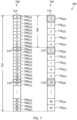
- FIG. 7 illustrates a frequency interlaced-based resource allocation scheme 700 according to some embodiments of the present disclosure.
- the scheme 700 may be employed by UEs such as the UEs 115 and 300 and BSs such as the BSs 105 and 400 in a network such as the network 100.
- the scheme 700 may be substantially similar to the schemes 500 and 600.
- the scheme 700 supports multiple interlace configurations with different SCSs in a frequency band 702.
- the scheme 700 may include a configuration 706 for the first SCS, f scs1 , and a configuration 720 for the second SCS, f scs2 .
- each frequency interlace 708 includes about 10 interlaced frequency resources 210 spaced apart in the frequency band 702 satisfying the integer multiple size constraint and the uniform pattern constraint.
- Each frequency interlace 718 includes about 10 interlaced frequency resources 210 spaced apart in the frequency band 702 satisfying the integer multiple size constraint and the uniform pattern constraint.
- each frequency interlace 718 of the second SCS, f scs2 may correspond to two frequency interlaces 708 of the first SCS, f scs1 , and are aligned to the even numbered frequency interlaces 708.
- the frequency interlace 718 I(0) corresponds to the frequency interlaces 708 I(0) and 708 I(1) .
- the frequency interlace 718 I(1) corresponds to the frequency interlaces 708 I(2) and 708 I(3) .
- a BS may allocate a frequency interlace 708 I(0) to a UE from the configuration 706 for a communication using the first SCS and may allocate a frequency interlace 718 I(1) from the configuration 720 to another UE for a communication using the second SCS.
- the first communication and the second communication may occur simultaneously in a TTI (e.g., the time period 214) since the allocated frequency interlaces 708 I(0) and 718 I(1) are non-overlapping.
- FIG. 8 illustrates a frequency interlaced-based resource allocation scheme 800 according to some embodiments of the present disclosure.
- the scheme 800 may be employed by UEs such as the UEs 115 and 300 and BSs such as the BSs 105 and 400 in a network such as the network 100.
- the scheme 800 is substantially similar to the scheme 700, but illustrates an example when a configuration 806 of the lower first SCS (e.g., f scs1 ) includes an odd number of frequency interlaces 808 in a frequency band 802.
- a configuration 806 of the lower first SCS e.g., f scs1
- the configuration 806 includes about 106 interlaced frequency resources 210 indexed 0 to 105.
- the configuration 806 includes about 7 frequency interlaces 808, for example, based on an interlace-spacing 804.
- the configuration 806 excludes the interlaced frequency resource 210 indexed 105 as shown by the cross such that each frequency interlace 808 includes a size of about 15 satisfying the integer multiple size constraint and a distribution satisfying the uniform pattern constraint.
- the frequency interlaces 808 are shown as 808 I(0) and 808 I(6) .
- the configurations 820 and 830 illustrate example configurations for the second SCS (e.g., f scs2 ).
- the configuration 820 includes about 3 frequency interlaces 818 aligned to the even numbered frequency interlaces 808 with an offset 822 corresponding to the frequency interlace 808 with the highest frequencies (e.g., the frequency interlace 808 I(6) ).
- the frequency interlaces 818 are aligned to the frequency interlaces 808 with an offset of 0.
- the frequency interlace 818 I(0) corresponds to the frequency interlaces 808 I(0) and 808 I(1) .
- the frequency interlace 818 I(1) corresponds to the frequency interlaces 808 I(2) and 808 I(3) .
- the offset 822 and unused frequencies are shown by the crosses.
- the configuration 830 includes about 3 frequency interlaces 828 aligned to odd numbered frequency interlaces 808 with an offset 832 corresponding to the frequency interlace 808 with the lowest frequencies (e.g., the frequency interlace 808 I(0) ).
- the frequency interlaces 828 are aligned to the frequency interlaces 808 with an offset of 1.
- the frequency interlace 828 I(0) corresponds to the frequency interlaces 808 I(1) and 808 I(2) .
- the frequency interlace 828 I(1) corresponds to the frequency interlaces 808 I(3) and 808 I(4) .
- the offset 832 and unused frequencies are shown by the crosses.
- a BS may allocate a frequency interlace 808 I(0) to a UE from the configuration 806 for a communication using the first SCS and may allocate a frequency interlace 818 I(1) from the configuration 820 to another UE for a communication using the second SCS.
- the first communication and the second communication may occur simultaneously in a TTI (e.g., the time period 214) since the allocated frequency interlaces 808 I(0) and 818 I(1) are non-overlapping.
- a BS may allocate a frequency interlace 808 I(0) to a UE from the configuration 806 for a communication using the first SCS and may allocate a frequency interlace 828 I(0) from the configuration 820 to another UE for a communication using the second SCS.
- the first communication and the second communication may occur simultaneously in a TTI (e.g., the time period 214) since the allocated frequency interlaces 808 I(0) and 828 I(0) are non-overlapping.
- the number of frequency interlaces decreases.
- the number of frequency interlaces may reduce from about M to about ⁇ M K ⁇ , where K is a positive integer.
- the frequency interlaces across different SCS configurations may have the same size.
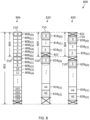
- FIG. 9 illustrates a frequency interlaced-based resource allocation scheme 900 according to some embodiments of the present disclosure.
- the scheme 900 may be employed by UEs such as the UEs 115 and 300 and BSs such as the BSs 105 and 400 in a network such as the network 100. Similar to the schemes 700 and 800, the scheme 900 may maintain the same number of subcarriers per interlaced frequency resource across configurations with different SCSs. However, the scheme 900 may scale the interlace-spacing based on the SCS instead of maintaining the same interlace-spacing as in the schemes 700 and 800.
- the scheme 900 is illustrated using the same configuration 706 for the first SCS (e.g., f scs1 ) as in the scheme 700.
- the configuration 920 illustrates an example configuration for the second SCS (e.g., f scs2 ) in the frequency band 702.
- the configuration 920 includes an interlace-spacing 914, which may be about doubled the interlace-spacing 704 since the second SCS, f scs2 , is about twice the first SCS, f scs1 .
- the configuration 920 includes about 10 frequency interlaces 918 in the frequency band 702, each including about 5 interlaced frequency resources 710 spaced apart in the frequency band 702 satisfying the integer multiple size constraint and the uniform pattern constraint.
- the frequency interlaces 918 are shown as 918 I(0) and 918 I(9) .
- the configuration 720 includes the same the number frequency interlaces as in the configuration 706, but the frequency interlace size is reduced.
- a BS may allocate a frequency interlace 708 I(0) to a UE from the configuration 706 for a communication using the first SCS and may allocate a frequency interlace 918 I(1) from the configuration 920 to another UE for a communication using the second SCS.
- the first communication and the second communication may occur simultaneously in a TTI (e.g., the time period 214) since the allocated frequency interlaces 708 I(0) and 918 I(1) are non-overlapping.
- FIG. 10 illustrates a frequency interlaced-based resource allocation scheme 1000 according to some embodiments of the present disclosure.
- the scheme 1000 may be employed by UEs such as the UEs 115 and 300 and BSs such as the BSs 105 and 400 in a network such as the network 100.
- the scheme 1000 is substantially similar to the scheme 900, but illustrates an example when a configuration at the lower first SCS (e.g., f scs1 ) includes an odd number of frequency interlaces.
- the scheme 1000 is illustrated using the same configuration 806 for the first SCS (e.g., f scs1 ) as in the scheme 800.
- the configuration 1020 illustrates an example configuration for the second SCS (e.g., f scs2 ) in the frequency band 802.
- the configuration 1020 includes an interlace-spacing 1014, which may be about doubled the interlace-spacing 804.
- the configuration 1020 includes about 7 frequency interlaces 1018 in the frequency band 802.
- the frequency interlaces 918 are shown as 1018 I(0) and 1018 I(6) .
- the frequency interlaces 1018 I(0) and 1018 I(3) may each include about 8 interlaced frequency resources 710 spaced apart in the frequency band 802.
- the frequency interlaces 1018 I(4) and 1018 I(6) may each include about 7 interlaced frequency resources 710 spaced apart in the frequency band 802.
- a BS may allocate a frequency interlace 808 I(0) to a UE from the configuration 806 for a communication using the first SCS and may allocate frequency interlace 1018 I(1) and 1018 I(4) from the configuration 1020 to another UE for a communication using the second SCS.
- the first communication and the second communication may occur simultaneously in a TTI (e.g., the time period 214) since the allocated frequency interlaces 808 I(0) is non-overlapping with the frequency interlaces 1018 I(1) and 1018 I(4)s .
- the frequency interlace size decreases.
- the frequency interlace sizes may reduce by a factor of K, where K is a positive integer.
- K is a positive integer.
- some frequency interlaces at the higher SCS may have a size ⁇ N K ⁇ and some frequency interlaces may have a size ⁇ N K ⁇ .
- the number of frequency interlaces across different SCS configurations may be the same.
- the schemes 700 to 1000 may combine or merge frequency interlaces of a lower SCS to create a frequency interlace of a higher SCS.
- the frequency interlaces of the lower SCS being merged have different number of frequency resources 210, one or more frequency resources from the lower SCS frequency interlace with the larger number of frequency resources may be excluded.
- one frequency resource may be excluded from the second lower-SCS frequency interlace.
- FIG. 11 illustrates a frequency interlaced-based resource allocation scheme 1100 according to some embodiments of the present disclosure.
- the scheme 1100 may be employed by UEs such as the UEs 115 and 300 and BSs such as the BSs 105 and 400 in a network such as the network 100.
- the scheme 1100 configures frequency interlaces of different SCSs independently.
- the scheme 1100 is illustrated using the same configuration 806 for the first SCS (e.g., f scs1 ) as in the scheme 800.
- the configuration 1120 illustrates an example configuration for the second SCS (e.g., f scs2 ) in the frequency band 802.
- the configuration 1120 includes an interlace-spacing 1114 independent of the interlace-spacing 804.
- the configuration 1120 includes about 3 frequency interlaces 1118, each including about 15 interlaced frequency resources 710 spaced apart in the frequency band 802.
- the frequency interlaces 1118 are shown as 1118 I(0) and 1118 I
- the frequency interlace 1118 I(0) includes one frequency resource 710 indexed 0 overlapping with the frequency interlaces 808 I(0) and 808 I(1) and another frequency resource 710 indexed 3 overlapping with the frequency interlaces 808 I(0) and 808 I(0) .
- scheduling UEs to communicate with different SCSs in the same TTI may require a BS to consider each frequency location to ensure a scheduled low-SCS frequency interlace 808 is non-overlapping with a scheduled high-SCS frequency interlace 1118.
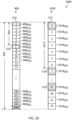
- FIG. 12 illustrates a frequency interlaced-based resource allocation scheme 1200 according to some embodiments of the present disclosure.
- the scheme 1200 may be employed by UEs such as the UEs 115 and 300 and BSs such as the BSs 105 and 400 in a network such as the network 100. Similar to the schemes 700-1100, the scheme 1200 may allow for frequency interlaces with different SCSs in a frequency band. However, the scheme 1200 may reduce the number of subcarriers (e.g., the subcarriers 212) per interlaced frequency resource in a higher SCS configuration to match a frequency resource bandwidth 1202 in a lower SCS configuration. Thus, the scheme 1200 may maintain the same number of frequency interlaces and the same frequency interlace sizes across different SCS configurations. In other words, the scheme 1200 maintains the frequency interlaced structure across different SCS configurations.
- subcarriers e.g., the subcarriers 212
- the scheme 1200 is illustrated using the same configuration 806 for the first SCS (e.g., f scs1 ) as in the scheme 800.
- the configuration 1220 illustrates an example configuration for the second SCS (e.g., f scs2 ) in the frequency band 802.
- the configuration 1220 includes the same interlace-spacing 804 as in the configuration 806.
- the configuration 1220 includes interlaced frequency resources 1210 aligned to the interlaced frequency resources 210 in the configuration 806.
- each interlaced frequency resources 1210 may include half the number of subcarriers compared to an interlaced frequency resource 210 since the second SCS, f scs2 , is about twice the first SCS, f scs1 .
- each interlaced frequency resources 1210 may include about 6 subcarriers at the second SCS, f scs2 .
- the configuration 1220 includes about 7 frequency interlaces 1218 aligned to the frequency interlaces 808 in the configuration 806.
- the frequency interlaces 1218 are shown as 1218 I(0) and 1218 I(6) .
- the scheme 1200 may allow a UE to transmit about 3 dB higher power compared to the schemes 700-1100.
- a BS may employ any suitable combinations of the schemes 500-1200 described above with respect to FIGS. 5-12 , respectively, to configure frequency interlaces (e.g., the frequency interlaces 508, 608, 708, 718, 808, 818, 828, 918, 1018, 1118, and 1218) in a network system band or a certain BWP within a network system band.
- a BS may employ the schemes 700 and 800 for configuring frequency interlaces with 15 kHz and 30 kHz SCSs and employ the schemes 1200 for configuring frequency interlaces with 30 kHz and 60 kHz SCSs.
- the BS may schedule one or more frequency interlaces of the same SCS for communicating with a particular UE.
- the BS may schedule one or more frequency interlaces of one SCS for communicating with a first UE and schedule one or more frequency interlaces of another SCS for communicating with a second UE within the same time period.
- FIG. 13 is a signaling diagram of a frequency interlace-based communication method 1300 according to some embodiments of the present disclosure.
- the method 1300 is implemented by a BS (e.g., the BSs 105 and 400), a UE A and a UE B (e.g., the UEs 115 and 300) in a network (e.g., the network 100).
- Steps of the method 1300 can be executed by computing devices (e.g., a processor, processing circuit, and/or other suitable component) of the BS and the UE.
- the method 1300 includes a number of enumerated steps, but embodiments of the method 1300 may include additional steps before, after, and in between the enumerated steps. In some embodiments, one or more of the enumerated steps may be omitted or performed in a different order.
- the BS determines an interlace configuration and a frequency resource exclusion configuration.
- the interlace configurations may be similar to the interlace configurations 506a, 506b, 606, 706, 720, 806, 820, 830, 920, 1020, 1120, and 1220.
- the interlace configurations may include information such as an interlace-spacing (e.g., the interlace-spacing 504, 604, 704, 804, 914, 1014, 1114, and 1214), a number of frequency interlaces (e.g., M), frequency interlace sizes (e.g., N and N+1), SCSs (e.g., f scs1 and f scs2 ), resource offsets (e.g., the offsets 822 and 832), and/or frequency resource bandwidths (e.g., the bandwidth 1202).
- an interlace-spacing e.g., the interlace-spacing 504, 604, 704, 804, 914, 1014, 1114, and 1214
- M frequency interlace sizes
- SCSs e.g., f scs1 and f scs2
- resource offsets e.g., the offsets 822 and 832
- frequency resource bandwidths e.g., the bandwidth 1202
- the frequency resource exclusion configuration may include exclusion rules that are based on a frequency interlace size constraint (e.g., integer multiples of 2, 3, or 5), a uniform frequency distribution pattern constraint, and/or waveform types.
- the frequency resource exclusion configuration may include different rules for different waveforms (e.g., OFDM and DFT-s-OFDM).
- the frequency resource exclusion configuration may indicate exclusions from a particular frequency range (e.g., a low-frequency band edge, a high-frequency band edge, or both band edges).
- the BS may use any suitable combinations of the schemes 500-1200 for the configurations.
- the BS transmits the interlace configuration to the UE A and the UE B.
- the BS transmits the frequency resource exclusion configuration to the UE A and the UE B.
- the BS may transmit the interlace configuration and the frequency resource exclusion configuration via higher layer signaling (e.g., above a media access control (MAC) layer) or physical layer signaling (e.g., in a physical downlink control channel (PDCCH)).
- higher layer signaling e.g., above a media access control (MAC) layer
- physical layer signaling e.g., in a physical downlink control channel (PDCCH)
- RRC message may be used for a higher layer signaling
- DCI downlink control information
- the BS may broadcast the interlace configuration and the frequency resource exclusion configuration in the network.
- the BS schedules one or more first frequency interlaces for the UE A and one or more second frequency interlaces for the UE B based on the interlace configuration.
- the BS may exclude resources from first frequency interlaces and/or the second frequency interlaces based on the frequency resource exclusion configuration.
- the BS transmits a first UL grant to the UE A.
- the first UL grant may indicate the one or more first frequency interlaces.
- the UE A transmits a first UL communication signal based on the first UL grant.
- the BS transmits a second UL grant to the UE B.
- the second UL grant may indicate the one or more second frequency interlaces.
- the UE B transmits a second UL communication signal based on the second UL grant.
- the BS may schedule both the UE A and the UE B to transmit in the same TTI.
- the one or more first frequency interlaces may not overlapped with the one or more second frequency interlaces.
- the one or more first frequency interlaces may include a higher SCS than the one or more second frequency interlaces.
- the BS transmits an exclusion disable message to the UE A and the UE B to disable the exclusion rules in the frequency resource exclusion configuration. Subsequently, the BS may communicate with the UEA and the UE B disregarding the exclusion rules. The BS may dynamically determine to disable the exclusion rules, for example, based on a network traffic load, a channel condition, and/or a UE capability.
- a UE when a UE receives an allocation including one or more frequency interlaces that fail to meet a certain size constraint (e.g., a certain integer multiple size constraint) or a certain frequency distribution pattern constraint (e.g., a uniform pattern constraint), the UE may disregard the allocation without transmitting using allocation.
- a certain size constraint e.g., a certain integer multiple size constraint
- a certain frequency distribution pattern constraint e.g., a uniform pattern constraint
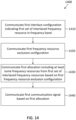
- FIG. 14 is a flow diagram of a frequency interlace-based communication method 1400 according to embodiments of the present disclosure. Steps of the method 1400 can be executed by a computing device (e.g., a processor, processing circuit, and/or other suitable component) of a wireless communication device or other suitable means for performing the steps.
- a wireless communication device such as the BS 105 or the BS 400, may utilize one or more components, such as the processor 402, the memory 404, the frequency interlace-based communication module 408, the transceiver 410, the modem 412, and the one or more antennas 416, to execute the steps of method 1400.
- a wireless communication device such as the UE 115 or the UE 300, may utilize one or more components, such as the processor 302, the memory 304, the frequency interlace-based communication module 308, the transceiver 310, the modem 312, and the one or more antennas 316, to execute the steps of method 1400.
- the method 1400 may employ similar mechanisms as in the schemes 500, 600, 700, 800, 900, 1000, 1100, 1200, and/or the method 1300 described with respect to FIGS. 5 , 6 , 7 , 8 , 9 , 10 , 10 , 11 , 12 , and/or 13, respectively.
- the method 1400 includes a number of enumerated steps, but embodiments of the method 1400 may include additional steps before, after, and in between the enumerated steps. In some embodiments, one or more of the enumerated steps may be omitted or performed in a different order.
- the method 1400 includes communicating, by a first wireless communication device (being the BS 105, or the BS 400) with a second wireless communication device (being the UE 115, or the UE 300), a first interlace configuration indicating a first set of interlaced frequency resources in a frequency band.
- the first interlace configuration may be similar to the configurations 506a, 506b, 606, 706, 720, 806, 820, 830, 920, 1020, 1120, and 1220.
- the first set of interlaced frequency resources may be similar to the frequency interlaces 208, 508a, 508b, 608, 708, 718, 808, 818, 828, 918, 1018, 1118, and 1218.
- the frequency band may be similar to the frequency bands 202, 502, 602, 702, and 802.
- the first wireless communication device may correspond to a BS and the second wireless communication device may correspond to a UE.
- the first wireless communication device may correspond to a UE and the second wireless communication device may correspond to a BS.
- the method 1400 includes communicating, by the first wireless communication device with the second wireless communication device, a first frequency resource exclusion configuration.
- the exclusion configuration can be dependent on a communication signal waveform, a frequency interlace size constraint, and/or a frequency resource distribution pattern as described herein above.
- the method 1400 includes communicating, by the first wireless communication device with the second wireless communication device, a first allocation including at least some frequency resources (e.g., the frequency resources 210, 510, and 710) from the first set of interlaced frequency resources based on the first frequency resource exclusion configuration.
- a first allocation including at least some frequency resources e.g., the frequency resources 210, 510, and 710 from the first set of interlaced frequency resources based on the first frequency resource exclusion configuration.
- the method 1400 includes communicating, by the first wireless communication device with the second wireless communication device, a first communication signal based on the first allocation.
- the frequency band includes multiple sets of interlaced frequency resources including at least the first set of interlaced frequency resources and a second set of interlaced frequency resources.
- the first set of interlaced frequency resources and the second set of interlaced frequency resources are non-overlapping.
- each set of the multiple sets of interlaced frequency resources may include a same number of interlaced frequency resources, for example, similar to the scheme 500.
- the first set of interlaced frequency resources e.g., the frequency interlace 608 I(0)
- the second set of interlaced frequency resources e.g., the frequency interlace 608 I(5)
- the first allocation may further include the second set of interlaced frequency resources.
- the first allocation may be similar to the allocations 620 and 630.
- the first wireless communication device also excludes one or more interlaced frequency resources (e.g., the frequency resources 210, 710, or offsets 822 and 832) from the first allocation based on the first frequency resource exclusion configuration.
- the first wireless communication device then communicates the first communication signal with the second wireless communication device using remaining frequency resources in the first allocation, with reference to the step 1440.
- the exclusion can be based on a size constraint in the first frequency resource exclusion configuration such that the number of remaining interlaced frequency resources is of a predetermined integer multiple (e.g., an integer multiple of 2, 3, or 5).
- the exclusion can be based on a uniform pattern constraint in the first frequency resource exclusion configuration such that the remaining interlaced frequency resources include a uniform frequency distribution pattern.
- the first wireless communication device may determine whether the first communication signal includes a first waveform type associated with a first rule in the first frequency resource exclusion configuration or a second waveform type associated with a second rule in the first frequency resource exclusion configuration. The exclusion may be based on the first rule when determining that the first communication signal includes the first waveform type.
- the first wireless communication device may communicate a second interlace configuration indicating a second set of interlaced frequency resources in the frequency band with a third wireless communication device.
- the first wireless communication device may communicate a second frequency resource exclusion configuration with the third wireless communication device.
- the first wireless communication device may communicate a second allocation with the third wireless communication device.
- the second allocation may include at least some frequency resources from the second set of interlaced frequency resources based on the second frequency resource exclusion configuration.
- the first wireless communication device may communicate a second communication signal with the third wireless communication device based on the second resource allocation.
- the first set of interlaced frequency resources may include a first SCS (e.g., f scs1 ).
- the second set of interlaced frequency resources may include a second SCS (e.g., f scs1 ) greater than the first SCS.
- the second set of interlaced frequency resources may have a greater SCS than the first set of interlaced frequency resource.
- a frequency resource (e.g., the interlaced frequency resource 210) in the first set of interlaced frequency resources may include a same number of subcarriers (e.g., the subcarriers 212) as a frequency resource (e.g., the interlaced frequency resource 710) in the second set of interlaced frequency resources.
- the first set of interlaced frequency resources may include a same interlace-spacing (e.g., the interlace-spacing 704 and 804) as the second set of interlaced frequency resources, for example, as shown in the schemes 700 and 800.
- the second set of interlaced frequency resources may have a greater SCS than the first set of interlaced frequency resource.
- the second set of interlaced frequency resources e.g., the frequency interlace may be offset from a third set of interlaced frequency resources in the frequency band by the first set of interlaced frequency resources (e.g., the offsets 822 and 832), the third set of interlaced frequency resources including the second subcarrier spacing, for example, as shown in the scheme 800.
- the second set of interlaced frequency resources may have a greater SCS than the first set of interlaced frequency resource.
- a frequency resource (e.g., the interlaced frequency resource 210) in the first set of interlaced frequency resources may include a same number of subcarriers as a frequency resource (e.g., the interlaced frequency resource 710) in the second set of interlaced frequency resources.
- the first set of interlaced frequency resources may be spaced apart by a smaller interlace-spacing than the second set of interlaced frequency resources, for example, as shown in the schemes 900 and 1000.
- the second set of interlaced frequency resources may have a greater SCS than the first set of interlaced frequency resource.
- a frequency resource (e.g., the interlaced frequency resource 210) in the first set of interlaced frequency resources may occupy a same bandwidth (e.g., the bandwidth 1202) as a frequency resource (e.g., the interlaced frequency resource 1210) in the second set of interlaced frequency resources, for example, as shown in the schemes 1200.
- Information and signals may be represented using any of a variety of different technologies and techniques.
- data, instructions, commands, information, signals, bits, symbols, and chips that may be referenced throughout the above description may be represented by voltages, currents, electromagnetic waves, magnetic fields or particles, optical fields or particles, or any combination thereof.
- a general-purpose processor may be a microprocessor, but in the alternative, the processor may be any conventional processor, controller, microcontroller, or state machine.
- a processor may also be implemented as a combination of computing devices (e.g ., a combination of a DSP and a microprocessor, multiple microprocessors, one or more microprocessors in conjunction with a DSP core, or any other such configuration).
- the functions described herein may be implemented in hardware, software executed by a processor, firmware, or any combination thereof. If implemented in software executed by a processor, the functions may be stored on or transmitted over as one or more instructions or code on a computer-readable medium. Other examples and implementations are within the scope of the disclosure and appended claims. For example, due to the nature of software, functions described above can be implemented using software executed by a processor, hardware, firmware, hardwiring, or combinations of any of these. Features implementing functions may also be physically located at various positions, including being distributed such that portions of functions are implemented at different physical locations.
Landscapes
- Engineering & Computer Science (AREA)
- Computer Networks & Wireless Communication (AREA)
- Signal Processing (AREA)
- Mobile Radio Communication Systems (AREA)
Claims (14)
- Ein Verfahren (1400) zur drahtlosen Kommunikation, das von einer Basisstation durchgeführt wird, das umfasst:Kommunizieren (1410), mit einer Benutzereinrichtung bzw. UE (user equipment), einer ersten Interlace-Konfiguration, die einen ersten Satz von Interlaced-Frequenzressourcen in einem Frequenzband basierend auf einem Leistungsspektraldichte- bzw. PSD(power spectral density)-Parameter angibt, wobei der erste Satz von Interlaced-Frequenzressourcen eine vorgegebene Anzahl von Frequenzressourcen basierend auf einem Unterträgerabstand des ersten Satzes von Interlaced-Frequenzressourcen umfasst;Kommunizieren (1420), mit der UE, einer ersten Frequenzressourcen-Ausschluss-Konfiguration;Kommunizieren (1430), mit der UE, einer ersten Zuweisung, die eine Vielzahl von Frequenzressourcen aus dem ersten Satz von Interlaced-Frequenzressourcen basierend auf der ersten Frequenzressourcen-Ausschluss-Konfiguration umfasst;Ausschließen einer oder mehrerer Interlaced-Frequenzressourcen aus der ersten Zuweisung basierend auf der ersten Frequenzressourcen-Ausschluss-Konfiguration, so dass eine Anzahl von verbleibenden Frequenzressourcen in der ersten Zuweisung ein vorgegebenes ganzzahliges Vielfaches basierend auf der ersten Frequenzressourcen-Ausschluss-Konfiguration ist; undKommunizieren (1440), mit der UE, eines ersten Kommunikationssignals basierend auf der ersten Zuweisung unter Verwendung der verbleibenden Frequenzressourcen in der ersten Zuweisung.
- Das Verfahren gemäß Anspruch 1, wobei das Frequenzband mehrere Sätze von Interlaced-Frequenzressourcen umfasst, einschließlich zumindest:der erste Satz von Interlaced-Frequenzressourcen, die voneinander um zumindest eine Interlaced-Frequenzressource eines dritten Satzes der mehreren Sätze von Interlaced-Frequenzressourcen beabstandet sind; undein zweiter Satz von Interlaced-Frequenzressourcen, die voneinander um zumindest eine Interlaced-Frequenzressource eines vierten Satzes der mehreren Sätze von Interlaced-Frequenzressourcen beabstandet sind,wobei der erste Satz von Interlaced-Frequenzressourcen und der zweite Satz von Interlaced-Frequenzressourcen sich nicht überlappen, undwobei die erste Zuweisung weiter den zweiten Satz von Interlaced-Frequenzressourcen umfasst.
- Das Verfahren gemäß Anspruch 2, wobei jeder Satz der mehreren Sätze von Interlaced-Frequenzressourcen eine gleiche Anzahl von Interlaced-Frequenzressourcen umfasst.
- Das Verfahren gemäß Anspruch 2, wobei der erste Satz von Interlaced-Frequenzressourcen eine andere Anzahl von Interlaced-Frequenzressourcen als der zweite Satz von Interlaced-Frequenzressourcen umfasst.
- Das Verfahren gemäß Anspruch 1, wobei die verbleibenden Interlaced-Frequenzressourcen in der ersten Zuweisung in dem Frequenzband in einem einheitlichen Muster basierend auf der ersten Frequenzressourcen-Ausschluss-Konfiguration voneinander beabstandet sind.
- Das Verfahren gemäß Anspruch 1, das weiter umfasst:
Bestimmen, ob das erste Kommunikationssignal einen ersten Wellenformtyp umfasst, der mit einer ersten Regel in der ersten Frequenzressourcen-Ausschluss-Konfiguration assoziiert ist, oder einen zweiten Wellenformtyp, der mit einer zweiten Regel in der ersten Frequenzressourcen-Ausschluss-Konfiguration assoziiert ist, wobei das Ausschließen der einen oder mehreren Interlaced-Frequenzressourcen ein Ausschließen der einen oder mehreren Interlaced-Frequenzressourcen aus der ersten Zuweisung in Reaktion auf ein Bestimmen umfasst, dass das erste Kommunikationssignal den ersten Wellenformtyp umfasst. - Das Verfahren gemäß Anspruch 1, das weiter umfasst:Kommunizieren, mit einer dritten drahtlosen Kommunikationsvorrichtung, einer zweiten Interlace-Konfiguration, die einen zweiten Satz von Interlaced-Frequenzressourcen in dem Frequenzband angibt;Kommunizieren, mit der dritten drahtlosen Kommunikationsvorrichtung, einer zweiten Frequenzressourcen-Ausschluss-Konfiguration;Kommunizieren, mit der dritten drahtlosen Kommunikationsvorrichtung, einer zweiten Ressourcenzuweisung, die zumindest einige Frequenzressourcen aus dem zweiten Satz von Interlaced-Frequenzressourcen basierend auf der zweiten Frequenzressourcen-Ausschluss-Konfiguration umfasst; undKommunizieren, mit der dritten drahtlosen Kommunikationsvorrichtung, eines zweiten Kommunikationssignals basierend auf der zweiten Ressourcenzuweisung,wobei der erste Satz von Interlaced-Frequenzressourcen einen ersten Unterträgerabstand umfasst, undwobei der zweite Satz von Interlaced-Frequenzressourcen einen zweiten Unterträgerabstand umfasst, der größer als der erste Unterträgerabstand ist.
- Das Verfahren gemäß Anspruch 7, wobei eine Frequenzressource in dem ersten Satz von Interlaced-Frequenzressourcen dieselbe Anzahl von Unterträgern wie eine Frequenzressource in dem zweiten Satz von Interlaced-Frequenzressourcen umfasst und wobei der erste Satz von Interlaced-Frequenzressourcen denselben Interlace-Abstand wie der zweite Satz von Interlaced-Frequenzressourcen umfasst.
- Das Verfahren gemäß Anspruch 7, wobei die zweite Frequenzressourcen-Ausschluss-Konfiguration angibt, dass der zweite Satz von Interlaced-Frequenzressourcen von einem dritten Satz von Interlaced-Frequenzressourcen in dem Frequenzband um den ersten Satz von Interlaced-Frequenzressourcen versetzt ist, wobei der dritte Satz von Interlaced-Frequenzressourcen den zweiten Unterträgerabstand umfasst; oder
wobei die zweite Frequenzressourcen-Ausschluss-Konfiguration angibt, dass eine Frequenzressource in dem ersten Satz von Interlaced-Frequenzressourcen dieselbe Anzahl von Unterträgern wie eine Frequenzressource in dem zweiten Satz von Interlaced-Frequenzressourcen umfasst, und wobei der erste Satz von Interlaced-Frequenzressourcen um einen kleineren Interlace-Abstand voneinander beabstandet sind als der zweite Satz von Interlaced-Frequenzressourcen. - Das Verfahren gemäß Anspruch 7, wobei eine Frequenzressource in dem ersten Satz von Interlaced-Frequenzressourcen dieselbe Bandbreite belegt wie eine Frequenzressource in dem zweiten Satz von Interlaced-Frequenzressourcen.
- Das Verfahren gemäß Anspruch 1, das weiter umfasst:Kommunizieren einer Nachricht mit der UE, die die erste Frequenzressourcen-Ausschluss-Konfiguration deaktiviert;Kommunizieren einer zweiten Zuweisung mit der UE, die die erste Frequenzressourcen-Ausschluss-Konfiguration nicht beachtet; undKommunizieren, mit der UE, eines zweiten Kommunikationssignals basierend auf der zweiten Zuweisung.
- Das Verfahren gemäß Anspruch 1, wobei die zumindest eine der ersten Interlace-Konfiguration oder der ersten Frequenzressourcen-Ausschluss-Konfiguration über eine Funkressourcensteuerungs- bzw. RRC(radio resource control)-Nachricht oder eine Abwärtsstrecke- bzw. Downlink-Steuerungsinformation bzw. DCI (downlink control information) kommuniziert wird.
- Eine Basisstation (105, 400), die umfasst:einen Prozessor (402);einen Speicher (404), der kommunikativ mit dem Prozessor gekoppelt ist; undausführbare Anweisungen (406), die ausgebildet sind, in dem Speicher gespeichert zu werden, die bei Ausführung durch den Prozessor den Prozessor veranlassen zum:Kommunizieren (408), mit einer Benutzereinrichtung bzw. UE (user equipment), einer ersten Interlace-Konfiguration, die einen ersten Satz von Interlaced-Frequenzressourcen in einem Frequenzband basierend auf einem Leistungsspektraldichte- bzw. PSD(power spectral density)-Parameter angibt, wobei der erste Satz von Interlaced-Frequenzressourcen eine vorgegebene Anzahl von Frequenzressourcen basierend auf einem Unterträgerabstand des ersten Satzes von Interlaced-Frequenzressourcen umfasst;Kommunizieren (408), mit der UE, einer ersten Frequenzressourcen-Ausschluss-Konfiguration;Kommunizieren (408), mit der UE, einer ersten Zuweisung, die eine Vielzahl von Frequenzressourcen aus dem ersten Satz von Interlaced-Frequenzressourcen basierend auf der ersten Frequenzressourcen-Ausschluss-Konfiguration umfasst;Ausschließen einer oder mehrerer Interlaced-Frequenzressourcen aus der ersten Zuweisung basierend auf der ersten Frequenzressourcen-Ausschluss-Konfiguration, so dass eine Anzahl von verbleibenden Frequenzressourcen in der ersten Zuweisung ein vorgegebenes ganzzahliges Vielfaches basierend auf der ersten Frequenzressourcen-Ausschluss-Konfiguration ist; undKommunizieren (408), mit der UE, eines ersten Kommunikationssignals basierend auf der ersten Zuweisung unter Verwendung der verbleibenden Frequenzressourcen in der ersten Zuweisung.
- Ein nicht-flüchtiges computerlesbares Medium mit darauf aufgezeichnetem Programmcode, wobei der Programmcode bei Ausführung durch einen Prozessor einer Basisstation den Prozessor veranlasst, das Verfahren gemäß einem der Ansprüche 1 bis 12 auszuführen.
Applications Claiming Priority (3)
| Application Number | Priority Date | Filing Date | Title |
|---|---|---|---|
| IN201841006937 | 2018-02-23 | ||
| US16/269,992 US10897764B2 (en) | 2018-02-23 | 2019-02-07 | Radio-unlicensed (NR-U) interlace-based resource allocations |
| PCT/US2019/017252 WO2019164685A1 (en) | 2018-02-23 | 2019-02-08 | New radio-unlicensed (nr-u) interlace-based resource allocations |
Publications (2)
| Publication Number | Publication Date |
|---|---|
| EP3756399A1 EP3756399A1 (de) | 2020-12-30 |
| EP3756399B1 true EP3756399B1 (de) | 2024-10-02 |
Family
ID=67685250
Family Applications (1)
| Application Number | Title | Priority Date | Filing Date |
|---|---|---|---|
| EP19708708.3A Active EP3756399B1 (de) | 2018-02-23 | 2019-02-08 | New-radio-unlizenzierte (nr-u) zeilensprungbasierte ressourcenzuweisungen |
Country Status (4)
| Country | Link |
|---|---|
| US (1) | US10897764B2 (de) |
| EP (1) | EP3756399B1 (de) |
| CN (1) | CN111742597B (de) |
| WO (1) | WO2019164685A1 (de) |
Families Citing this family (16)
| Publication number | Priority date | Publication date | Assignee | Title |
|---|---|---|---|---|
| US10868629B2 (en) * | 2018-04-06 | 2020-12-15 | Mediatek Inc. | Channel multiplexing within interlace for new radio unlicensed spectrum operation |
| WO2020000356A1 (en) * | 2018-06-29 | 2020-01-02 | Panasonic Intellectual Property Corporation Of America | Transmission apparatus, reception apparatus, transmission method, and reception method |
| KR20210087089A (ko) | 2018-11-27 | 2021-07-09 | 엑스콤 랩스 인코퍼레이티드 | 넌-코히어런트 협력 다중 입출력 통신 |
| US11411778B2 (en) | 2019-07-12 | 2022-08-09 | XCOM Labs, Inc. | Time-division duplex multiple input multiple output calibration |
| US11411779B2 (en) | 2020-03-31 | 2022-08-09 | XCOM Labs, Inc. | Reference signal channel estimation |
| US12088499B2 (en) | 2020-04-15 | 2024-09-10 | Virewirx, Inc. | System and method for reducing data packet processing false alarms |
| US11849407B2 (en) * | 2020-05-12 | 2023-12-19 | Intel Corporation | Power spectral density limit for 6 GHz |
| KR20230015932A (ko) | 2020-05-26 | 2023-01-31 | 엑스콤 랩스 인코퍼레이티드 | 간섭-인식 빔포밍 |
| US11563503B2 (en) * | 2020-09-15 | 2023-01-24 | Ford Global Technologies, Llc | Vehicle Wi-Fi access point detection and mitigation |
| US11991688B2 (en) * | 2020-10-09 | 2024-05-21 | Qualcomm Incorporated | In-band interleaved uplink and downlink communication in full-duplex operation |
| CA3195885A1 (en) | 2020-10-19 | 2022-04-28 | XCOM Labs, Inc. | Reference signal for wireless communication systems |
| WO2022093988A1 (en) | 2020-10-30 | 2022-05-05 | XCOM Labs, Inc. | Clustering and/or rate selection in multiple-input multiple-output communication systems |
| CN116648867A (zh) | 2020-12-16 | 2023-08-25 | 艾斯康实验室公司 | 具有准全向波束和定向波束的无线通信 |
| EP4315697A1 (de) * | 2021-03-23 | 2024-02-07 | Nokia Technologies Oy | Ressourcenelementzuweisung in einem zellularen system |
| WO2022241436A1 (en) | 2021-05-14 | 2022-11-17 | XCOM Labs, Inc. | Scrambling identifiers for wireless communication systems |
| EP4510731A4 (de) * | 2022-04-14 | 2025-06-18 | Beijing Xiaomi Mobile Software Co., Ltd. | Ressourcenkonfigurationsverfahren und vorrichtung dafür |
Family Cites Families (9)
| Publication number | Priority date | Publication date | Assignee | Title |
|---|---|---|---|---|
| US8276025B2 (en) * | 2008-06-06 | 2012-09-25 | Maxim Integrated Products, Inc. | Block interleaving scheme with configurable size to achieve time and frequency diversity |
| US10129857B2 (en) * | 2014-11-06 | 2018-11-13 | Qualcomm Incorporated | Band occupancy techniques for transmissions in unlicensed spectrum |
| EP3387778B1 (de) | 2015-12-08 | 2020-11-04 | Telefonaktiebolaget LM Ericsson (PUBL) | Verschachtelungsmusterauswahl für low-cm/papr-übertragung |
| US11419134B2 (en) * | 2016-03-25 | 2022-08-16 | Lg Electronics Inc. | Method for transmitting and receiving uplink signal in wireless communication system supporting non-licensed band, and apparatus for supporting same |
| WO2017166246A1 (en) * | 2016-03-31 | 2017-10-05 | Lenovo Innovations Limited (Hong Kong) | Interlace determination for device |
| US11057931B2 (en) * | 2016-03-31 | 2021-07-06 | Ntt Docomo, Inc. | User terminal, radio base station and radio communication method |
| US10506596B2 (en) * | 2016-10-28 | 2019-12-10 | Qualcomm Incorporated | Coexistence of interleaved and contiguous uplink transmissions |
| US10932293B2 (en) * | 2018-01-10 | 2021-02-23 | Telefonaktiebolaget Lm Ericsson (Publ) | Methods for efficient use of unlicensed spectrum |
| JP2020521365A (ja) * | 2018-02-14 | 2020-07-16 | エルジー エレクトロニクス インコーポレイティド | 非免許帯域を支援する無線通信システムにおいて端末と基地局の間の上りリンク信号を送受信する方法及びそれを支援する装置 |
-
2019
- 2019-02-07 US US16/269,992 patent/US10897764B2/en active Active
- 2019-02-08 EP EP19708708.3A patent/EP3756399B1/de active Active
- 2019-02-08 CN CN201980014574.5A patent/CN111742597B/zh active Active
- 2019-02-08 WO PCT/US2019/017252 patent/WO2019164685A1/en not_active Ceased
Also Published As
| Publication number | Publication date |
|---|---|
| EP3756399A1 (de) | 2020-12-30 |
| US10897764B2 (en) | 2021-01-19 |
| CN111742597B (zh) | 2024-05-14 |
| WO2019164685A1 (en) | 2019-08-29 |
| US20190268907A1 (en) | 2019-08-29 |
| CN111742597A (zh) | 2020-10-02 |
Similar Documents
| Publication | Publication Date | Title |
|---|---|---|
| EP3756399B1 (de) | New-radio-unlizenzierte (nr-u) zeilensprungbasierte ressourcenzuweisungen | |
| US11678367B2 (en) | Bandwidth part (BWP) configuration for subband access in new radio-unlicensed (NR-U) | |
| US11696315B2 (en) | Uplink cancellation indication configuration for wireless communications network | |
| US11582781B2 (en) | SPS support for multi-TRP | |
| CN114365570A (zh) | 用于新无线电未许可(nr-u)中的侧行链路的波形设计 | |
| US11895699B2 (en) | Listen-before-talk (LBT) type and gap signaling for back-to-back grants and multi-transmission time interval (multi-TTI) grants | |
| WO2022072248A1 (en) | Control channel decoding configurations for cross-carrier scheduling | |
| WO2021263170A1 (en) | Techniques for pdcch monitoring aggregation | |
| US12457068B2 (en) | NR-U for 6GHz band: PAPR reduction for cross CC transmission | |
| EP4487643A1 (de) | Kontinuierliche übertragungsgenehmigungen in sidelink-kommunikationsnetzwerken | |
| WO2021109060A1 (en) | Control resource set (coreset) design for subbands in a multi-carrier system | |
| US12396019B2 (en) | Radio frequency emission reduction with interference cancellation | |
| US20240340823A1 (en) | Sidelink synchronization signal block repetition in wideband communications | |
| WO2022061730A1 (en) | Sounding reference signal (srs) uplink power control with partial frequency sounding |
Legal Events
| Date | Code | Title | Description |
|---|---|---|---|
| STAA | Information on the status of an ep patent application or granted ep patent |
Free format text: STATUS: UNKNOWN |
|
| STAA | Information on the status of an ep patent application or granted ep patent |
Free format text: STATUS: THE INTERNATIONAL PUBLICATION HAS BEEN MADE |
|
| PUAI | Public reference made under article 153(3) epc to a published international application that has entered the european phase |
Free format text: ORIGINAL CODE: 0009012 |
|
| STAA | Information on the status of an ep patent application or granted ep patent |
Free format text: STATUS: REQUEST FOR EXAMINATION WAS MADE |
|
| 17P | Request for examination filed |
Effective date: 20200814 |
|
| AK | Designated contracting states |
Kind code of ref document: A1 Designated state(s): AL AT BE BG CH CY CZ DE DK EE ES FI FR GB GR HR HU IE IS IT LI LT LU LV MC MK MT NL NO PL PT RO RS SE SI SK SM TR |
|
| AX | Request for extension of the european patent |
Extension state: BA ME |
|
| DAV | Request for validation of the european patent (deleted) | ||
| DAX | Request for extension of the european patent (deleted) | ||
| STAA | Information on the status of an ep patent application or granted ep patent |
Free format text: STATUS: EXAMINATION IS IN PROGRESS |
|
| 17Q | First examination report despatched |
Effective date: 20220929 |
|
| REG | Reference to a national code |
Ref legal event code: R079 Free format text: PREVIOUS MAIN CLASS: H04W0072040000 Ref country code: DE Ref legal event code: R079 Ref document number: 602019059695 Country of ref document: DE Free format text: PREVIOUS MAIN CLASS: H04W0072040000 Ipc: H04W0072045300 |
|
| GRAP | Despatch of communication of intention to grant a patent |
Free format text: ORIGINAL CODE: EPIDOSNIGR1 |
|
| STAA | Information on the status of an ep patent application or granted ep patent |
Free format text: STATUS: GRANT OF PATENT IS INTENDED |
|
| RIC1 | Information provided on ipc code assigned before grant |
Ipc: H04W 16/14 20090101ALN20240405BHEP Ipc: H04W 72/0453 20230101AFI20240405BHEP |
|
| INTG | Intention to grant announced |
Effective date: 20240426 |
|
| RIC1 | Information provided on ipc code assigned before grant |
Ipc: H04W 16/14 20090101ALN20240416BHEP Ipc: H04W 72/0453 20230101AFI20240416BHEP |
|
| GRAS | Grant fee paid |
Free format text: ORIGINAL CODE: EPIDOSNIGR3 |
|
| GRAA | (expected) grant |
Free format text: ORIGINAL CODE: 0009210 |
|
| STAA | Information on the status of an ep patent application or granted ep patent |
Free format text: STATUS: THE PATENT HAS BEEN GRANTED |
|
| AK | Designated contracting states |
Kind code of ref document: B1 Designated state(s): AL AT BE BG CH CY CZ DE DK EE ES FI FR GB GR HR HU IE IS IT LI LT LU LV MC MK MT NL NO PL PT RO RS SE SI SK SM TR |
|
| REG | Reference to a national code |
Ref country code: GB Ref legal event code: FG4D |
|
| REG | Reference to a national code |
Ref country code: CH Ref legal event code: EP |
|
| REG | Reference to a national code |
Ref country code: IE Ref legal event code: FG4D |
|
| REG | Reference to a national code |
Ref country code: DE Ref legal event code: R096 Ref document number: 602019059695 Country of ref document: DE |
|
| REG | Reference to a national code |
Ref country code: LT Ref legal event code: MG9D |
|
| REG | Reference to a national code |
Ref country code: NL Ref legal event code: MP Effective date: 20241002 |
|
| REG | Reference to a national code |
Ref country code: AT Ref legal event code: MK05 Ref document number: 1729404 Country of ref document: AT Kind code of ref document: T Effective date: 20241002 |
|
| PG25 | Lapsed in a contracting state [announced via postgrant information from national office to epo] |
Ref country code: NL Free format text: LAPSE BECAUSE OF FAILURE TO SUBMIT A TRANSLATION OF THE DESCRIPTION OR TO PAY THE FEE WITHIN THE PRESCRIBED TIME-LIMIT Effective date: 20241002 |
|
| PG25 | Lapsed in a contracting state [announced via postgrant information from national office to epo] |
Ref country code: NL Free format text: LAPSE BECAUSE OF FAILURE TO SUBMIT A TRANSLATION OF THE DESCRIPTION OR TO PAY THE FEE WITHIN THE PRESCRIBED TIME-LIMIT Effective date: 20241002 |
|
| PG25 | Lapsed in a contracting state [announced via postgrant information from national office to epo] |
Ref country code: IS Free format text: LAPSE BECAUSE OF FAILURE TO SUBMIT A TRANSLATION OF THE DESCRIPTION OR TO PAY THE FEE WITHIN THE PRESCRIBED TIME-LIMIT Effective date: 20250202 Ref country code: PT Free format text: LAPSE BECAUSE OF FAILURE TO SUBMIT A TRANSLATION OF THE DESCRIPTION OR TO PAY THE FEE WITHIN THE PRESCRIBED TIME-LIMIT Effective date: 20250203 Ref country code: HR Free format text: LAPSE BECAUSE OF FAILURE TO SUBMIT A TRANSLATION OF THE DESCRIPTION OR TO PAY THE FEE WITHIN THE PRESCRIBED TIME-LIMIT Effective date: 20241002 |
|
| PG25 | Lapsed in a contracting state [announced via postgrant information from national office to epo] |
Ref country code: FI Free format text: LAPSE BECAUSE OF FAILURE TO SUBMIT A TRANSLATION OF THE DESCRIPTION OR TO PAY THE FEE WITHIN THE PRESCRIBED TIME-LIMIT Effective date: 20241002 |
|
| PG25 | Lapsed in a contracting state [announced via postgrant information from national office to epo] |
Ref country code: BG Free format text: LAPSE BECAUSE OF FAILURE TO SUBMIT A TRANSLATION OF THE DESCRIPTION OR TO PAY THE FEE WITHIN THE PRESCRIBED TIME-LIMIT Effective date: 20241002 |
|
| PG25 | Lapsed in a contracting state [announced via postgrant information from national office to epo] |
Ref country code: ES Free format text: LAPSE BECAUSE OF FAILURE TO SUBMIT A TRANSLATION OF THE DESCRIPTION OR TO PAY THE FEE WITHIN THE PRESCRIBED TIME-LIMIT Effective date: 20241002 |
|
| PG25 | Lapsed in a contracting state [announced via postgrant information from national office to epo] |
Ref country code: NO Free format text: LAPSE BECAUSE OF FAILURE TO SUBMIT A TRANSLATION OF THE DESCRIPTION OR TO PAY THE FEE WITHIN THE PRESCRIBED TIME-LIMIT Effective date: 20250102 |
|
| PG25 | Lapsed in a contracting state [announced via postgrant information from national office to epo] |
Ref country code: AT Free format text: LAPSE BECAUSE OF FAILURE TO SUBMIT A TRANSLATION OF THE DESCRIPTION OR TO PAY THE FEE WITHIN THE PRESCRIBED TIME-LIMIT Effective date: 20241002 Ref country code: GR Free format text: LAPSE BECAUSE OF FAILURE TO SUBMIT A TRANSLATION OF THE DESCRIPTION OR TO PAY THE FEE WITHIN THE PRESCRIBED TIME-LIMIT Effective date: 20250103 Ref country code: LV Free format text: LAPSE BECAUSE OF FAILURE TO SUBMIT A TRANSLATION OF THE DESCRIPTION OR TO PAY THE FEE WITHIN THE PRESCRIBED TIME-LIMIT Effective date: 20241002 |
|
| PG25 | Lapsed in a contracting state [announced via postgrant information from national office to epo] |
Ref country code: CZ Free format text: LAPSE BECAUSE OF FAILURE TO SUBMIT A TRANSLATION OF THE DESCRIPTION OR TO PAY THE FEE WITHIN THE PRESCRIBED TIME-LIMIT Effective date: 20241002 Ref country code: PL Free format text: LAPSE BECAUSE OF FAILURE TO SUBMIT A TRANSLATION OF THE DESCRIPTION OR TO PAY THE FEE WITHIN THE PRESCRIBED TIME-LIMIT Effective date: 20241002 |
|
| PG25 | Lapsed in a contracting state [announced via postgrant information from national office to epo] |
Ref country code: RS Free format text: LAPSE BECAUSE OF FAILURE TO SUBMIT A TRANSLATION OF THE DESCRIPTION OR TO PAY THE FEE WITHIN THE PRESCRIBED TIME-LIMIT Effective date: 20250102 |
|
| PG25 | Lapsed in a contracting state [announced via postgrant information from national office to epo] |
Ref country code: SM Free format text: LAPSE BECAUSE OF FAILURE TO SUBMIT A TRANSLATION OF THE DESCRIPTION OR TO PAY THE FEE WITHIN THE PRESCRIBED TIME-LIMIT Effective date: 20241002 |
|
| REG | Reference to a national code |
Ref country code: DE Ref legal event code: R097 Ref document number: 602019059695 Country of ref document: DE |
|
| PG25 | Lapsed in a contracting state [announced via postgrant information from national office to epo] |
Ref country code: DK Free format text: LAPSE BECAUSE OF FAILURE TO SUBMIT A TRANSLATION OF THE DESCRIPTION OR TO PAY THE FEE WITHIN THE PRESCRIBED TIME-LIMIT Effective date: 20241002 |
|
| PG25 | Lapsed in a contracting state [announced via postgrant information from national office to epo] |
Ref country code: EE Free format text: LAPSE BECAUSE OF FAILURE TO SUBMIT A TRANSLATION OF THE DESCRIPTION OR TO PAY THE FEE WITHIN THE PRESCRIBED TIME-LIMIT Effective date: 20241002 |
|
| PG25 | Lapsed in a contracting state [announced via postgrant information from national office to epo] |
Ref country code: RO Free format text: LAPSE BECAUSE OF FAILURE TO SUBMIT A TRANSLATION OF THE DESCRIPTION OR TO PAY THE FEE WITHIN THE PRESCRIBED TIME-LIMIT Effective date: 20241002 |
|
| PG25 | Lapsed in a contracting state [announced via postgrant information from national office to epo] |
Ref country code: SK Free format text: LAPSE BECAUSE OF FAILURE TO SUBMIT A TRANSLATION OF THE DESCRIPTION OR TO PAY THE FEE WITHIN THE PRESCRIBED TIME-LIMIT Effective date: 20241002 |
|
| PG25 | Lapsed in a contracting state [announced via postgrant information from national office to epo] |
Ref country code: IT Free format text: LAPSE BECAUSE OF FAILURE TO SUBMIT A TRANSLATION OF THE DESCRIPTION OR TO PAY THE FEE WITHIN THE PRESCRIBED TIME-LIMIT Effective date: 20241002 |
|
| PLBE | No opposition filed within time limit |
Free format text: ORIGINAL CODE: 0009261 |
|
| STAA | Information on the status of an ep patent application or granted ep patent |
Free format text: STATUS: NO OPPOSITION FILED WITHIN TIME LIMIT |
|
| PG25 | Lapsed in a contracting state [announced via postgrant information from national office to epo] |
Ref country code: SE Free format text: LAPSE BECAUSE OF FAILURE TO SUBMIT A TRANSLATION OF THE DESCRIPTION OR TO PAY THE FEE WITHIN THE PRESCRIBED TIME-LIMIT Effective date: 20241002 |
|
| 26N | No opposition filed |
Effective date: 20250703 |
|
| PG25 | Lapsed in a contracting state [announced via postgrant information from national office to epo] |
Ref country code: MC Free format text: LAPSE BECAUSE OF FAILURE TO SUBMIT A TRANSLATION OF THE DESCRIPTION OR TO PAY THE FEE WITHIN THE PRESCRIBED TIME-LIMIT Effective date: 20241002 |
|
| REG | Reference to a national code |
Ref country code: CH Ref legal event code: PL |
|
| PG25 | Lapsed in a contracting state [announced via postgrant information from national office to epo] |
Ref country code: LU Free format text: LAPSE BECAUSE OF NON-PAYMENT OF DUE FEES Effective date: 20250208 |
|
| PG25 | Lapsed in a contracting state [announced via postgrant information from national office to epo] |
Ref country code: CH Free format text: LAPSE BECAUSE OF NON-PAYMENT OF DUE FEES Effective date: 20250228 |
|
| REG | Reference to a national code |
Ref country code: BE Ref legal event code: MM Effective date: 20250228 |
|
| PG25 | Lapsed in a contracting state [announced via postgrant information from national office to epo] |
Ref country code: BE Free format text: LAPSE BECAUSE OF NON-PAYMENT OF DUE FEES Effective date: 20250228 |
|
| PG25 | Lapsed in a contracting state [announced via postgrant information from national office to epo] |
Ref country code: IE Free format text: LAPSE BECAUSE OF NON-PAYMENT OF DUE FEES Effective date: 20250208 |
|
| PGFP | Annual fee paid to national office [announced via postgrant information from national office to epo] |
Ref country code: GB Payment date: 20260113 Year of fee payment: 8 |
|
| PGFP | Annual fee paid to national office [announced via postgrant information from national office to epo] |
Ref country code: DE Payment date: 20260115 Year of fee payment: 8 |
|
| PGFP | Annual fee paid to national office [announced via postgrant information from national office to epo] |
Ref country code: FR Payment date: 20260109 Year of fee payment: 8 |