EP3754983B1 - Frühe intracodierungsentscheidung - Google Patents
Frühe intracodierungsentscheidung Download PDFInfo
- Publication number
- EP3754983B1 EP3754983B1 EP20166692.2A EP20166692A EP3754983B1 EP 3754983 B1 EP3754983 B1 EP 3754983B1 EP 20166692 A EP20166692 A EP 20166692A EP 3754983 B1 EP3754983 B1 EP 3754983B1
- Authority
- EP
- European Patent Office
- Prior art keywords
- block
- blocks
- dct coefficients
- video
- calculating
- Prior art date
- Legal status (The legal status is an assumption and is not a legal conclusion. Google has not performed a legal analysis and makes no representation as to the accuracy of the status listed.)
- Active
Links
Images



Classifications
-
- H—ELECTRICITY
- H04—ELECTRIC COMMUNICATION TECHNIQUE
- H04N—PICTORIAL COMMUNICATION, e.g. TELEVISION
- H04N19/00—Methods or arrangements for coding, decoding, compressing or decompressing digital video signals
- H04N19/10—Methods or arrangements for coding, decoding, compressing or decompressing digital video signals using adaptive coding
- H04N19/102—Methods or arrangements for coding, decoding, compressing or decompressing digital video signals using adaptive coding characterised by the element, parameter or selection affected or controlled by the adaptive coding
- H04N19/103—Selection of coding mode or of prediction mode
- H04N19/107—Selection of coding mode or of prediction mode between spatial and temporal predictive coding, e.g. picture refresh
-
- H—ELECTRICITY
- H04—ELECTRIC COMMUNICATION TECHNIQUE
- H04N—PICTORIAL COMMUNICATION, e.g. TELEVISION
- H04N19/00—Methods or arrangements for coding, decoding, compressing or decompressing digital video signals
- H04N19/10—Methods or arrangements for coding, decoding, compressing or decompressing digital video signals using adaptive coding
- H04N19/134—Methods or arrangements for coding, decoding, compressing or decompressing digital video signals using adaptive coding characterised by the element, parameter or criterion affecting or controlling the adaptive coding
- H04N19/157—Assigned coding mode, i.e. the coding mode being predefined or preselected to be further used for selection of another element or parameter
- H04N19/159—Prediction type, e.g. intra-frame, inter-frame or bidirectional frame prediction
-
- H—ELECTRICITY
- H04—ELECTRIC COMMUNICATION TECHNIQUE
- H04N—PICTORIAL COMMUNICATION, e.g. TELEVISION
- H04N19/00—Methods or arrangements for coding, decoding, compressing or decompressing digital video signals
- H04N19/10—Methods or arrangements for coding, decoding, compressing or decompressing digital video signals using adaptive coding
- H04N19/102—Methods or arrangements for coding, decoding, compressing or decompressing digital video signals using adaptive coding characterised by the element, parameter or selection affected or controlled by the adaptive coding
- H04N19/103—Selection of coding mode or of prediction mode
- H04N19/11—Selection of coding mode or of prediction mode among a plurality of spatial predictive coding modes
-
- H—ELECTRICITY
- H04—ELECTRIC COMMUNICATION TECHNIQUE
- H04N—PICTORIAL COMMUNICATION, e.g. TELEVISION
- H04N19/00—Methods or arrangements for coding, decoding, compressing or decompressing digital video signals
- H04N19/10—Methods or arrangements for coding, decoding, compressing or decompressing digital video signals using adaptive coding
- H04N19/102—Methods or arrangements for coding, decoding, compressing or decompressing digital video signals using adaptive coding characterised by the element, parameter or selection affected or controlled by the adaptive coding
- H04N19/12—Selection from among a plurality of transforms or standards, e.g. selection between discrete cosine transform [DCT] and sub-band transform or selection between H.263 and H.264
- H04N19/122—Selection of transform size, e.g. 8x8 or 2x4x8 DCT; Selection of sub-band transforms of varying structure or type
-
- H—ELECTRICITY
- H04—ELECTRIC COMMUNICATION TECHNIQUE
- H04N—PICTORIAL COMMUNICATION, e.g. TELEVISION
- H04N19/00—Methods or arrangements for coding, decoding, compressing or decompressing digital video signals
- H04N19/10—Methods or arrangements for coding, decoding, compressing or decompressing digital video signals using adaptive coding
- H04N19/134—Methods or arrangements for coding, decoding, compressing or decompressing digital video signals using adaptive coding characterised by the element, parameter or criterion affecting or controlling the adaptive coding
- H04N19/136—Incoming video signal characteristics or properties
- H04N19/14—Coding unit complexity, e.g. amount of activity or edge presence estimation
-
- H—ELECTRICITY
- H04—ELECTRIC COMMUNICATION TECHNIQUE
- H04N—PICTORIAL COMMUNICATION, e.g. TELEVISION
- H04N19/00—Methods or arrangements for coding, decoding, compressing or decompressing digital video signals
- H04N19/10—Methods or arrangements for coding, decoding, compressing or decompressing digital video signals using adaptive coding
- H04N19/169—Methods or arrangements for coding, decoding, compressing or decompressing digital video signals using adaptive coding characterised by the coding unit, i.e. the structural portion or semantic portion of the video signal being the object or the subject of the adaptive coding
- H04N19/17—Methods or arrangements for coding, decoding, compressing or decompressing digital video signals using adaptive coding characterised by the coding unit, i.e. the structural portion or semantic portion of the video signal being the object or the subject of the adaptive coding the unit being an image region, e.g. an object
- H04N19/176—Methods or arrangements for coding, decoding, compressing or decompressing digital video signals using adaptive coding characterised by the coding unit, i.e. the structural portion or semantic portion of the video signal being the object or the subject of the adaptive coding the unit being an image region, e.g. an object the region being a block, e.g. a macroblock
-
- H—ELECTRICITY
- H04—ELECTRIC COMMUNICATION TECHNIQUE
- H04N—PICTORIAL COMMUNICATION, e.g. TELEVISION
- H04N19/00—Methods or arrangements for coding, decoding, compressing or decompressing digital video signals
- H04N19/10—Methods or arrangements for coding, decoding, compressing or decompressing digital video signals using adaptive coding
- H04N19/169—Methods or arrangements for coding, decoding, compressing or decompressing digital video signals using adaptive coding characterised by the coding unit, i.e. the structural portion or semantic portion of the video signal being the object or the subject of the adaptive coding
- H04N19/18—Methods or arrangements for coding, decoding, compressing or decompressing digital video signals using adaptive coding characterised by the coding unit, i.e. the structural portion or semantic portion of the video signal being the object or the subject of the adaptive coding the unit being a set of transform coefficients
-
- H—ELECTRICITY
- H04—ELECTRIC COMMUNICATION TECHNIQUE
- H04N—PICTORIAL COMMUNICATION, e.g. TELEVISION
- H04N19/00—Methods or arrangements for coding, decoding, compressing or decompressing digital video signals
- H04N19/42—Methods or arrangements for coding, decoding, compressing or decompressing digital video signals characterised by implementation details or hardware specially adapted for video compression or decompression, e.g. dedicated software implementation
- H04N19/436—Methods or arrangements for coding, decoding, compressing or decompressing digital video signals characterised by implementation details or hardware specially adapted for video compression or decompression, e.g. dedicated software implementation using parallelised computational arrangements
-
- H—ELECTRICITY
- H04—ELECTRIC COMMUNICATION TECHNIQUE
- H04N—PICTORIAL COMMUNICATION, e.g. TELEVISION
- H04N19/00—Methods or arrangements for coding, decoding, compressing or decompressing digital video signals
- H04N19/60—Methods or arrangements for coding, decoding, compressing or decompressing digital video signals using transform coding
-
- H—ELECTRICITY
- H04—ELECTRIC COMMUNICATION TECHNIQUE
- H04N—PICTORIAL COMMUNICATION, e.g. TELEVISION
- H04N19/00—Methods or arrangements for coding, decoding, compressing or decompressing digital video signals
- H04N19/60—Methods or arrangements for coding, decoding, compressing or decompressing digital video signals using transform coding
- H04N19/625—Methods or arrangements for coding, decoding, compressing or decompressing digital video signals using transform coding using discrete cosine transform [DCT]
Definitions
- the present disclosure relates to intrablock coding/decoding in video compression systems in computer devices or systems.
- Transmission of moving pictures in real time is employed in several applications such as, but not limited to, video conferencing, net meetings, television (TV) broadcasting, and video telephony.
- Representing moving pictures requires bulk information as digital video typically is described by representing each pixel in a picture with 8 bits, which is equal to 1 byte.
- Such uncompressed video data results in large bit volumes and cannot be transferred over conventional communication networks and transmission lines in real time due to limited bandwidth.
- the prediction process reduces the number of bits required for each picture in a video sequence to be transferred.
- the process takes advantage of the similarity of parts of the sequence with other parts of the sequence. Since the predictor part is known to both encoder and decoder, only the difference must be transferred. This difference typically requires much less capacity for its representation.
- the prediction is mainly based on vectors representing movements.
- the prediction process is conventionally performed on square block sizes (e.g., 16 ⁇ 16 pixels or 64x64 pixels). In some cases, predictions of pixels based on adjacent pixels in the same picture, rather than pixels of preceding pictures, are used. This is referred to as intra prediction or intra-frame coding. Intra-frame coding is used in video coding (compression).
- Intra-frame prediction exploits spatial redundancy, i.e. correlation among pixels within one frame, by calculating prediction values through extrapolation from already coded pixels for effective delta coding. It is one of the two classes of predictive coding methods in video coding. Its counterpart is inter-frame prediction which exploits temporal redundancy. Temporally independently coded so-called intra frames use only intra coding. The temporally coded predicted frames (e.g. MPEG's P- and B-frames) may use intra- as well as inter-frame prediction.
- MPEG's P- and B-frames may use intra- as well as inter-frame prediction.
- Block-based (frequency transform) formats prefill whole blocks with prediction values extrapolated from usually one or two straight lines of pixels that run along their top and left borders.
- intra-frame coding refers to the fact that the various lossless and lossy compression techniques are performed relative to information that is contained only within the current frame, and not relative to any other frame in the video sequence. In other words, no temporal processing is performed outside of the current picture or frame.
- the residual represented as a block of data still contains internal correlation.
- a conventional method which takes advantage of this and performs a two-dimensional block transform.
- an integer-type transform is used, and in other standards a Discrete Cosine Transform (DCT) is used.
- the dimension (N ⁇ N) of the blocks may vary, but in e.g. VP9, 4x4, 8x8, 16x16 and 32x32 DCT transforms may be used.
- This transforms N ⁇ N pixels into N ⁇ N transform coefficients which can usually be represented by fewer bits than the pixel representation.
- Transform of a N ⁇ N array of pixels with internal correlation may result in a N ⁇ N block of transform coefficients with much fewer nonzero values than the original N ⁇ N pixel block.
- Video encoding for HD formats increases the demands for memory and data processing and requires efficient and high bandwidth memory organizations coupled with compute intensive capabilities. Due to these multiple demands, a flexible parallel processing approach must be found to meet the demands in a cost-effective manner.
- Intra-frame coding is normally a more costly coding technique in terms of data processing than inter-frame coding.
- inter-frame may in some cases have a negative impact on the visual quality of the decoded video image. E.g. in uniform regions of the video picture that still do not have the same color and/or brightness consistently through the region, will be perceived as "flat" and unnaturally by a viewer. The same would be the case on the background of moving objects, where viewers would actually be able to see remains of frames of the inter coding blocks after an object has passed - trailing artifacts - which would be perceived as visual noise.
- an object of the present disclosure is to overcome or at least mitigate drawbacks of prior art video conferencing systems.
- a method of video coding is provided as set out in claim 1, and a video processor device is provided as set out in claim 7.
- Figure 1 illustrates an MxM camera block divided into NxN blocks, that is a 64 ⁇ 64 camera block divided into 64 8x8 blocks which means 64 pixels in each 8x8 block.
- This division/grouping of pixels which complies with the above-mentioned VP9, AV1 and H.265 standard, will be referred to in the following description.
- the basic idea of the present invention is to use large intra blocks for uniform regions of the video making early decision of intra block coding based on DCT and DC calculations. This will increase the visual quality at a moderate cost since further investigations, mode decision, motions search and so on can be avoided by utilizing parallel calculation.
- this is achieved by a first step calculating the DCT of each 8x8 block and then possibly using the DC value to calculate the residual.
- the coefficients of the corresponding DCT are compared with a first predefined threshold. When all these coefficients are below a certain threshold, that DC prediction is considered as being a good choice for the 8x8 block. It will be apparent in the following discussion that DC prediction as a good choice would mean selecting intra coding.
- MMX 64bit Intel vector instruction set.
- MMX is a single instruction, multiple data (SIMD) instruction set designed by Intel, introduced in 1997 with its P5-based Pentium line of microprocessors, designated as "Pentium with MMX Technology". It developed out of a similar unit introduced on the Intel i860, and earlier the Intel i750 video pixel processor.
- MMX is a processor supplementary capability that is supported on recent IA-32 processors by Intel and other vendors. MMX defines eight registers, called MM0 through MM7, and operations that operate on them.
- Each register is 64 bits wide and can be used to hold either 64-bit integers, or multiple smaller integers in a "packed" format: a single instruction can then be applied to two 32-bit integers, four 16-bit integers, or eight 8-bit integers at once.
- the MMX set will be referred to as the MMX 64bit Intel vector instruction-set or any other vector instruction set with the similar characteristics and performance.
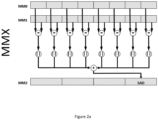
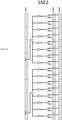
- the AVX512 64bit instruction set allows for calculating the DCT value of 8 8x8 blocks in parallel using e.g. the 64bit _mm512_sad_epu8 instruction.
- the outcome of the 8x8 DCT can be stored in a first 64bit bitmask, since an 8x8 block have 64 pixels and the DCT of the 8x8 block has 64 coefficients.
- a "1" means that the coefficient is above the first predefined threshold, and "0" means that the coefficient is below the first predefined threshold. If all the 64 coefficients are zero, then the 64bit bitmask is zero and the DC prediction of the 8x8 block is a good choice.
- a 64x64 block there are all together 64 8x8 blocks.
- a "1" is set if at least one coefficient is nonzero and a "0" if all coefficients are zero, resulting in a second 64bit bit mask on a higher level, this one for all the 64 8x8 blocks in the 64x64 block. If all the 64 coefficients are zero, then the 64bit bitmask is zero, and the DC prediction of the 64x64 block may be a good choice.
- the inventor suggests calculating a third 64bit bitmask. This is done by calculating the DCT of the DCs of the 64 8x8 block already being calculated. This require that the DC values of each 8x8 block of the entire 64x64 block are stored in an 8x8 block, where each "pixel" contains the DC value of one 8x8 block. The DCT of this 8x8 block is then calculated, then each coefficient in the 8x8 block of "DCT of DCs" is compared with a second predefined threshold value.
- the second predefined threshold should be somewhat lower than the first predefined threshold.
- both the second and third (and implicitly the first) 64bit bitmask are zero, then the probability that the picture content of the 64x64 camera block is uniform, and not chessboard-like, is considered to be high. Then the criterion for intra block encoding according to the present invention is satisfied, and intra block encoding would be selected.
- the upper line of the 64x64 block includes 8 respective upper lines of the 8 uppermost 8x8 blocks in the 64x64 block.
- the basic operation is to calculate the sum of the pixel values.
- each summation is done in parallel for all the 8 8x8 blocks in the 64x64 block. This is possible since the SAD instruction of 512bit AVX512 returns as already mentioned the absolute sum in chunks of 8 pixels. 512 divided by 8 is 64, so 8 lines of 8 8x8 blocks can be summed in parallel.
- vp9_avx512_block_average which e.g. calculates the 64 DC values of the 8 8x8 blocks in a 64x64 block using the 512bit SAD instruction. According to measurements this function uses approximately only 0,1% of the CPU load of the VP9 encoder.
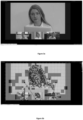
- fig 3b shows an encoded/decoded video image of fig 3a with block type information.
- the light grey blocks pointed out with arrows are decided to be encoded as 64 ⁇ 64 intra according to the present invention in contrast to what would have been done according to standard encoding/decoding, e.g. VP9 without without using the decision according to the present invention.
- VP9 or similar standard uses 64 ⁇ 64 intra much less frequently on uniform areas, resulting in more visual distortion in these areas.
- the embodiments herein may be implemented in a plurality of physical entities, such as an arrangement comprising said one or more physical entities, i.e. the embodiments may be implemented in a distributed manner, such as on a cloud system, which may comprise a set of server machines.
Landscapes
- Engineering & Computer Science (AREA)
- Multimedia (AREA)
- Signal Processing (AREA)
- Physics & Mathematics (AREA)
- Discrete Mathematics (AREA)
- General Physics & Mathematics (AREA)
- Computing Systems (AREA)
- Theoretical Computer Science (AREA)
- Compression Or Coding Systems Of Tv Signals (AREA)
- Compression, Expansion, Code Conversion, And Decoders (AREA)
Claims (12)
- Verfahren zum Videocodieren, das in einer Prozessorvorrichtung umgesetzt ist, um ein Bestimmen, ob ein MxM-Pixelblock in einem Videobild, der in eine ganze Zahl von NxN-Blöcken aufgeteilt werden kann, mithilfe von Intracodieren codiert werden sollte, vorzubereiten, umfassend die folgenden Schritte:- a) Berechnen von DCT-Koeffizienten der NxN-Blöcke durch Durchführen einer ersten DCT-Transformation,- b) Berechnen von DC-Werten der DCT-Koeffizienten der NxN-Blöcke,- c) Vergleichen der DCT-Koeffizienten der NxN-Blöcke mit einem vordefinierten ersten Schwellenwert,- d) wenn alle der DCT-Koeffizienten der NxN-Blöcke unter einem vordefinierten ersten Schwellenwert liegen, Zuweisen einer "0", wenn nicht, Zuweisen einer "1", was zu einer entsprechenden ersten Zuweisung für einen ersten (M/N)x(M/N)-Block führt,gekennzeichnet durch- e) Speichern aller DC-Koeffizientenwerte der transformierten NxN-Blöcke in einem zweiten (M/N)x(M/N)-Block, wobei jede Position in dem zweiten (M/N)x(M/N)-Block den DC-Wert eines entsprechenden NxN-Blocks enthält,- f) Berechnen von DCT-Koeffizienten des zweiten (M/N)x(M/N)-Blocks durch Durchführen einer zweiten DCT-Transformation,- g) wenn alle der DCT-Koeffizienten des transformierten zweiten (M/N)x(M/N)-Blocks unter einem vordefinierten zweiten Schwellenwert liegen, Zuweisen einer "0", wenn nicht, Zuweisen einer "1", was zu einer entsprechenden zweiten Zuweisung für den zweiten (M/N)x(M/N)-Block führt, und- h) wenn die erste Zuweisung für den ersten (M/N)x(M/N)-Block und die entsprechende zweite Zuweisung für den zweiten (M/N)x(M/N)-Block null sind, wird bestimmt, dass der MxM-Pixelblock mithilfe von Intracodieren codiert wird.
- Verfahren nach Anspruch 1, dadurch gekennzeichnet, dass die DCT-Koeffizienten der jeweiligen NxN-Blöcke in einer ersten 64-Bit-Bitmaske gespeichert werden.
- Verfahren nach Anspruch 1, dadurch gekennzeichnet, dass die jeweiligen (M/N)x(M/N)-Blöcke in einer zweiten 64-Bit-Bitmaske gespeichert werden.
- Verfahren nach Anspruch 1, dadurch gekennzeichnet, dass: M=128, M=64 oder M=32.
- Verfahren nach Anspruch 1, dadurch gekennzeichnet, dass N=4, N=8, N=16 oder N=32.
- Verfahren nach Anspruch 1, dadurch gekennzeichnet, dass die Schritte des Berechnens durch die SAD-Anweisungen von AVX512 von 512 Bits umgesetzt werden.
- Videoprozessorvorrichtung zum Videocodieren, die eingestellt ist, um zu bestimmen, ob ein MxM-Pixelblock in einem Videobild, der in eine ganze Zahl von NxN-Blöcken aufgeteilt werden kann, mithilfe von Intracodieren codiert werden sollte, wobei die Videoprozessorvorrichtung dazu eingestellt ist, die folgenden Schritte umzusetzen:- a) Berechnen von DCT-Koeffizienten der NxN-Blöcke durch Durchführen einer ersten DCT-Transformation,- b) Berechnen von DC-Werten der DCT-Koeffizienten der NxN-Blöcke,- c) Vergleichen der DCT-Koeffizienten der NxN-Blöcke mit einem vordefinierten ersten Schwellenwert,- d) wenn alle der DCT-Koeffizienten der NxN-Blöcke unter einem vordefinierten ersten Schwellenwert liegen, Zuweisen einer "0", wenn nicht, Zuweisen einer "1", was zu einer entsprechenden ersten Zuweisung für den ersten (M/N)x(M/N)-Block führt,dadurch gekennzeichnet, dass die Videoprozessorvorrichtung ferner dazu eingestellt ist, die folgenden Schritte umzusetzen:- e) Speichern aller DC-Koeffizientenwerte der transformierten NxN-Blöcke in einem zweiten (M/N)x(M/N)-Block, wobei jede Position in dem zweiten (M/N)x(M/N)-Block den DC-Wert eines entsprechenden NxN-Blocks enthält,- f) Berechnen von DCT-Koeffizienten des zweiten (M/N)x(M/N)-Blocks durch Durchführen einer zweiten DCT-Transformation,- g) wenn alle der DCT-Koeffizienten des transformierten zweiten (M/N)x(M/N)-Blocks unter einem vordefinierten zweiten Schwellenwert liegen, Zuweisen einer "0", wenn nicht, Zuweisen einer "1", was zu einer entsprechenden zweiten Zuweisung für den ersten (M/N)x(M/N)-Block führt, und- h) wenn die erste Zuweisung für den ersten (M/N)x(M/N)-Block und die entsprechende zweite Zuweisung für den zweiten (M/N)x(M/N)-Block null sind, wird bestimmt, dass der MxM-Pixelblock mithilfe von Intracodieren codiert wird.
- Videoprozessorvorrichtung nach Anspruch 7, dadurch gekennzeichnet, dass DCT-Koeffizienten der jeweiligen NxN-Blöcke in einer ersten 64-Bit-Bitmaske gespeichert werden.
- Videoprozessorvorrichtung nach Anspruch 7, dadurch gekennzeichnet, dass die jeweiligen (M/N)x(M/N)-Blöcke in einer zweiten 64-Bit-Bitmaske gespeichert werden.
- Videoprozessorvorrichtung nach Anspruch 7, dadurch gekennzeichnet, dass: M=128, M=64 oder M=32.
- Videoprozessorvorrichtung nach Anspruch 7, dadurch gekennzeichnet, dass N=4, N=8, N=16 oder N=32.
- Videoprozessorvorrichtung nach Anspruch 7, dadurch gekennzeichnet, dass die Schritte des Berechnens durch die SAD-Anweisungen von AVX512 von 512 Bits umgesetzt werden.
Applications Claiming Priority (1)
| Application Number | Priority Date | Filing Date | Title |
|---|---|---|---|
| NO20190764A NO344797B1 (en) | 2019-06-20 | 2019-06-20 | Early intra coding decision |
Publications (2)
| Publication Number | Publication Date |
|---|---|
| EP3754983A1 EP3754983A1 (de) | 2020-12-23 |
| EP3754983B1 true EP3754983B1 (de) | 2023-10-04 |
Family
ID=68211165
Family Applications (1)
| Application Number | Title | Priority Date | Filing Date |
|---|---|---|---|
| EP20166692.2A Active EP3754983B1 (de) | 2019-06-20 | 2020-03-30 | Frühe intracodierungsentscheidung |
Country Status (4)
| Country | Link |
|---|---|
| US (1) | US10873745B1 (de) |
| EP (1) | EP3754983B1 (de) |
| ES (1) | ES2964763T3 (de) |
| NO (1) | NO344797B1 (de) |
Families Citing this family (1)
| Publication number | Priority date | Publication date | Assignee | Title |
|---|---|---|---|---|
| NO346137B1 (en) * | 2020-06-17 | 2022-03-14 | Pexip AS | Method, computer program and system for detecting changes and moving objects in a video view |
Family Cites Families (10)
| Publication number | Priority date | Publication date | Assignee | Title |
|---|---|---|---|---|
| JP3002019B2 (ja) * | 1991-07-04 | 2000-01-24 | 富士通株式会社 | セル廃棄補償機能を有する画像符号化伝送方式 |
| GB0229354D0 (en) * | 2002-12-18 | 2003-01-22 | Robert Gordon The University | Video encoding |
| US20050175099A1 (en) * | 2004-02-06 | 2005-08-11 | Nokia Corporation | Transcoder and associated system, method and computer program product for low-complexity reduced resolution transcoding |
| AU2015249109B2 (en) * | 2011-03-08 | 2017-08-24 | Qualcomm Incorporated | Coding of transform coefficients for video coding |
| US10397577B2 (en) * | 2011-03-08 | 2019-08-27 | Velos Media, Llc | Inverse scan order for significance map coding of transform coefficients in video coding |
| EP3598760A1 (de) * | 2015-06-11 | 2020-01-22 | Intellectual Discovery Co., Ltd. | Verfahren zur codierung und decodierung eines bildes unter verwendung adaptiver deblockierender filtrierung und vorrichtung dafür |
| US10136132B2 (en) * | 2015-07-21 | 2018-11-20 | Microsoft Technology Licensing, Llc | Adaptive skip or zero block detection combined with transform size decision |
| KR101790671B1 (ko) * | 2016-01-05 | 2017-11-20 | 한국전자통신연구원 | 하다마드-양자화 비용에 기반하여 율-왜곡 최적화를 수행하는 장치 및 방법 |
| US20190089952A1 (en) * | 2017-09-19 | 2019-03-21 | Futurewei Technologies, Inc. | Bidirectional Weighted Intra Prediction |
| US10567801B2 (en) * | 2018-03-07 | 2020-02-18 | Tencent America LLC | Method and apparatus for video coding with primary and secondary transforms |
-
2019
- 2019-06-20 NO NO20190764A patent/NO344797B1/en unknown
-
2020
- 2020-02-25 US US16/799,983 patent/US10873745B1/en active Active
- 2020-03-30 ES ES20166692T patent/ES2964763T3/es active Active
- 2020-03-30 EP EP20166692.2A patent/EP3754983B1/de active Active
Also Published As
| Publication number | Publication date |
|---|---|
| EP3754983A1 (de) | 2020-12-23 |
| ES2964763T3 (es) | 2024-04-09 |
| NO20190764A1 (de) | 2020-05-04 |
| US10873745B1 (en) | 2020-12-22 |
| NO344797B1 (en) | 2020-05-04 |
| US20200404259A1 (en) | 2020-12-24 |
Similar Documents
| Publication | Publication Date | Title |
|---|---|---|
| US11438618B2 (en) | Method and apparatus for residual sign prediction in transform domain | |
| US11876979B2 (en) | Image encoding device, image decoding device, image encoding method, image decoding method, and image prediction device | |
| US8023562B2 (en) | Real-time video coding/decoding | |
| CN102792688B (zh) | 用于视频的数据压缩 | |
| US20120076203A1 (en) | Video encoding device, video decoding device, video encoding method, and video decoding method | |
| JP3836559B2 (ja) | ディジタルビデオ符号化器における動き推定方法 | |
| HK1080653A1 (zh) | 图像编码方法和图像编码器 | |
| WO2008020687A1 (en) | Image encoding/decoding method and apparatus | |
| EP1992171A1 (de) | Verfahren und vorrichtung zur video-intraprädiktionscodierung/-decodierung | |
| US20120087411A1 (en) | Internal bit depth increase in deblocking filters and ordered dither | |
| EP3754983B1 (de) | Frühe intracodierungsentscheidung | |
| US20060146932A1 (en) | Method and apparatus for providing motion estimation with weight prediction | |
| EP1941742A2 (de) | Videocodierungsverfahren zur ermöglichung einer hocheffizienten teilweisen decodierung von h.264 und anderen transformationscodierten informationen | |
| JP2003299104A (ja) | 符号化装置、および符号化方法 | |
| JP2008526151A (ja) | ビデオデータ・ストリームをエンコードする方法および装置 |
Legal Events
| Date | Code | Title | Description |
|---|---|---|---|
| PUAI | Public reference made under article 153(3) epc to a published international application that has entered the european phase |
Free format text: ORIGINAL CODE: 0009012 |
|
| STAA | Information on the status of an ep patent application or granted ep patent |
Free format text: STATUS: THE APPLICATION HAS BEEN PUBLISHED |
|
| AK | Designated contracting states |
Kind code of ref document: A1 Designated state(s): AL AT BE BG CH CY CZ DE DK EE ES FI FR GB GR HR HU IE IS IT LI LT LU LV MC MK MT NL NO PL PT RO RS SE SI SK SM TR |
|
| AX | Request for extension of the european patent |
Extension state: BA ME |
|
| STAA | Information on the status of an ep patent application or granted ep patent |
Free format text: STATUS: REQUEST FOR EXAMINATION WAS MADE |
|
| 17P | Request for examination filed |
Effective date: 20210622 |
|
| RBV | Designated contracting states (corrected) |
Designated state(s): AL AT BE BG CH CY CZ DE DK EE ES FI FR GB GR HR HU IE IS IT LI LT LU LV MC MK MT NL NO PL PT RO RS SE SI SK SM TR |
|
| GRAP | Despatch of communication of intention to grant a patent |
Free format text: ORIGINAL CODE: EPIDOSNIGR1 |
|
| STAA | Information on the status of an ep patent application or granted ep patent |
Free format text: STATUS: GRANT OF PATENT IS INTENDED |
|
| INTG | Intention to grant announced |
Effective date: 20230502 |
|
| GRAS | Grant fee paid |
Free format text: ORIGINAL CODE: EPIDOSNIGR3 |
|
| GRAA | (expected) grant |
Free format text: ORIGINAL CODE: 0009210 |
|
| STAA | Information on the status of an ep patent application or granted ep patent |
Free format text: STATUS: THE PATENT HAS BEEN GRANTED |
|
| AK | Designated contracting states |
Kind code of ref document: B1 Designated state(s): AL AT BE BG CH CY CZ DE DK EE ES FI FR GB GR HR HU IE IS IT LI LT LU LV MC MK MT NL NO PL PT RO RS SE SI SK SM TR |
|
| REG | Reference to a national code |
Ref country code: GB Ref legal event code: FG4D |
|
| REG | Reference to a national code |
Ref country code: CH Ref legal event code: EP |
|
| REG | Reference to a national code |
Ref country code: IE Ref legal event code: FG4D |
|
| REG | Reference to a national code |
Ref country code: DE Ref legal event code: R096 Ref document number: 602020018476 Country of ref document: DE |
|
| P01 | Opt-out of the competence of the unified patent court (upc) registered |
Effective date: 20230926 |
|
| REG | Reference to a national code |
Ref country code: LT Ref legal event code: MG9D |
|
| REG | Reference to a national code |
Ref country code: NL Ref legal event code: MP Effective date: 20231004 |
|
| REG | Reference to a national code |
Ref country code: AT Ref legal event code: MK05 Ref document number: 1619024 Country of ref document: AT Kind code of ref document: T Effective date: 20231004 |
|
| PG25 | Lapsed in a contracting state [announced via postgrant information from national office to epo] |
Ref country code: NL Free format text: LAPSE BECAUSE OF FAILURE TO SUBMIT A TRANSLATION OF THE DESCRIPTION OR TO PAY THE FEE WITHIN THE PRESCRIBED TIME-LIMIT Effective date: 20231004 |
|
| PG25 | Lapsed in a contracting state [announced via postgrant information from national office to epo] |
Ref country code: GR Free format text: LAPSE BECAUSE OF FAILURE TO SUBMIT A TRANSLATION OF THE DESCRIPTION OR TO PAY THE FEE WITHIN THE PRESCRIBED TIME-LIMIT Effective date: 20240105 |
|
| PG25 | Lapsed in a contracting state [announced via postgrant information from national office to epo] |
Ref country code: IS Free format text: LAPSE BECAUSE OF FAILURE TO SUBMIT A TRANSLATION OF THE DESCRIPTION OR TO PAY THE FEE WITHIN THE PRESCRIBED TIME-LIMIT Effective date: 20240204 |
|
| REG | Reference to a national code |
Ref country code: ES Ref legal event code: FG2A Ref document number: 2964763 Country of ref document: ES Kind code of ref document: T3 Effective date: 20240409 |
|
| PG25 | Lapsed in a contracting state [announced via postgrant information from national office to epo] |
Ref country code: LT Free format text: LAPSE BECAUSE OF FAILURE TO SUBMIT A TRANSLATION OF THE DESCRIPTION OR TO PAY THE FEE WITHIN THE PRESCRIBED TIME-LIMIT Effective date: 20231004 |
|
| PG25 | Lapsed in a contracting state [announced via postgrant information from national office to epo] |
Ref country code: AT Free format text: LAPSE BECAUSE OF FAILURE TO SUBMIT A TRANSLATION OF THE DESCRIPTION OR TO PAY THE FEE WITHIN THE PRESCRIBED TIME-LIMIT Effective date: 20231004 |
|
| PG25 | Lapsed in a contracting state [announced via postgrant information from national office to epo] |
Ref country code: LT Free format text: LAPSE BECAUSE OF FAILURE TO SUBMIT A TRANSLATION OF THE DESCRIPTION OR TO PAY THE FEE WITHIN THE PRESCRIBED TIME-LIMIT Effective date: 20231004 Ref country code: IS Free format text: LAPSE BECAUSE OF FAILURE TO SUBMIT A TRANSLATION OF THE DESCRIPTION OR TO PAY THE FEE WITHIN THE PRESCRIBED TIME-LIMIT Effective date: 20240204 Ref country code: GR Free format text: LAPSE BECAUSE OF FAILURE TO SUBMIT A TRANSLATION OF THE DESCRIPTION OR TO PAY THE FEE WITHIN THE PRESCRIBED TIME-LIMIT Effective date: 20240105 Ref country code: BG Free format text: LAPSE BECAUSE OF FAILURE TO SUBMIT A TRANSLATION OF THE DESCRIPTION OR TO PAY THE FEE WITHIN THE PRESCRIBED TIME-LIMIT Effective date: 20240104 Ref country code: AT Free format text: LAPSE BECAUSE OF FAILURE TO SUBMIT A TRANSLATION OF THE DESCRIPTION OR TO PAY THE FEE WITHIN THE PRESCRIBED TIME-LIMIT Effective date: 20231004 Ref country code: PT Free format text: LAPSE BECAUSE OF FAILURE TO SUBMIT A TRANSLATION OF THE DESCRIPTION OR TO PAY THE FEE WITHIN THE PRESCRIBED TIME-LIMIT Effective date: 20240205 |
|
| PG25 | Lapsed in a contracting state [announced via postgrant information from national office to epo] |
Ref country code: SE Free format text: LAPSE BECAUSE OF FAILURE TO SUBMIT A TRANSLATION OF THE DESCRIPTION OR TO PAY THE FEE WITHIN THE PRESCRIBED TIME-LIMIT Effective date: 20231004 Ref country code: RS Free format text: LAPSE BECAUSE OF FAILURE TO SUBMIT A TRANSLATION OF THE DESCRIPTION OR TO PAY THE FEE WITHIN THE PRESCRIBED TIME-LIMIT Effective date: 20231004 Ref country code: PL Free format text: LAPSE BECAUSE OF FAILURE TO SUBMIT A TRANSLATION OF THE DESCRIPTION OR TO PAY THE FEE WITHIN THE PRESCRIBED TIME-LIMIT Effective date: 20231004 Ref country code: NO Free format text: LAPSE BECAUSE OF FAILURE TO SUBMIT A TRANSLATION OF THE DESCRIPTION OR TO PAY THE FEE WITHIN THE PRESCRIBED TIME-LIMIT Effective date: 20240104 Ref country code: LV Free format text: LAPSE BECAUSE OF FAILURE TO SUBMIT A TRANSLATION OF THE DESCRIPTION OR TO PAY THE FEE WITHIN THE PRESCRIBED TIME-LIMIT Effective date: 20231004 Ref country code: HR Free format text: LAPSE BECAUSE OF FAILURE TO SUBMIT A TRANSLATION OF THE DESCRIPTION OR TO PAY THE FEE WITHIN THE PRESCRIBED TIME-LIMIT Effective date: 20231004 |
|
| REG | Reference to a national code |
Ref country code: DE Ref legal event code: R097 Ref document number: 602020018476 Country of ref document: DE |
|
| PG25 | Lapsed in a contracting state [announced via postgrant information from national office to epo] |
Ref country code: DK Free format text: LAPSE BECAUSE OF FAILURE TO SUBMIT A TRANSLATION OF THE DESCRIPTION OR TO PAY THE FEE WITHIN THE PRESCRIBED TIME-LIMIT Effective date: 20231004 |
|
| PG25 | Lapsed in a contracting state [announced via postgrant information from national office to epo] |
Ref country code: CZ Free format text: LAPSE BECAUSE OF FAILURE TO SUBMIT A TRANSLATION OF THE DESCRIPTION OR TO PAY THE FEE WITHIN THE PRESCRIBED TIME-LIMIT Effective date: 20231004 |
|
| PG25 | Lapsed in a contracting state [announced via postgrant information from national office to epo] |
Ref country code: SK Free format text: LAPSE BECAUSE OF FAILURE TO SUBMIT A TRANSLATION OF THE DESCRIPTION OR TO PAY THE FEE WITHIN THE PRESCRIBED TIME-LIMIT Effective date: 20231004 |
|
| PG25 | Lapsed in a contracting state [announced via postgrant information from national office to epo] |
Ref country code: SM Free format text: LAPSE BECAUSE OF FAILURE TO SUBMIT A TRANSLATION OF THE DESCRIPTION OR TO PAY THE FEE WITHIN THE PRESCRIBED TIME-LIMIT Effective date: 20231004 Ref country code: SK Free format text: LAPSE BECAUSE OF FAILURE TO SUBMIT A TRANSLATION OF THE DESCRIPTION OR TO PAY THE FEE WITHIN THE PRESCRIBED TIME-LIMIT Effective date: 20231004 Ref country code: RO Free format text: LAPSE BECAUSE OF FAILURE TO SUBMIT A TRANSLATION OF THE DESCRIPTION OR TO PAY THE FEE WITHIN THE PRESCRIBED TIME-LIMIT Effective date: 20231004 Ref country code: IT Free format text: LAPSE BECAUSE OF FAILURE TO SUBMIT A TRANSLATION OF THE DESCRIPTION OR TO PAY THE FEE WITHIN THE PRESCRIBED TIME-LIMIT Effective date: 20231004 Ref country code: EE Free format text: LAPSE BECAUSE OF FAILURE TO SUBMIT A TRANSLATION OF THE DESCRIPTION OR TO PAY THE FEE WITHIN THE PRESCRIBED TIME-LIMIT Effective date: 20231004 Ref country code: DK Free format text: LAPSE BECAUSE OF FAILURE TO SUBMIT A TRANSLATION OF THE DESCRIPTION OR TO PAY THE FEE WITHIN THE PRESCRIBED TIME-LIMIT Effective date: 20231004 Ref country code: CZ Free format text: LAPSE BECAUSE OF FAILURE TO SUBMIT A TRANSLATION OF THE DESCRIPTION OR TO PAY THE FEE WITHIN THE PRESCRIBED TIME-LIMIT Effective date: 20231004 |
|
| PLBE | No opposition filed within time limit |
Free format text: ORIGINAL CODE: 0009261 |
|
| STAA | Information on the status of an ep patent application or granted ep patent |
Free format text: STATUS: NO OPPOSITION FILED WITHIN TIME LIMIT |
|
| 26N | No opposition filed |
Effective date: 20240705 |
|
| PG25 | Lapsed in a contracting state [announced via postgrant information from national office to epo] |
Ref country code: SI Free format text: LAPSE BECAUSE OF FAILURE TO SUBMIT A TRANSLATION OF THE DESCRIPTION OR TO PAY THE FEE WITHIN THE PRESCRIBED TIME-LIMIT Effective date: 20231004 |
|
| PG25 | Lapsed in a contracting state [announced via postgrant information from national office to epo] |
Ref country code: SI Free format text: LAPSE BECAUSE OF FAILURE TO SUBMIT A TRANSLATION OF THE DESCRIPTION OR TO PAY THE FEE WITHIN THE PRESCRIBED TIME-LIMIT Effective date: 20231004 |
|
| REG | Reference to a national code |
Ref country code: CH Ref legal event code: PL |
|
| PG25 | Lapsed in a contracting state [announced via postgrant information from national office to epo] |
Ref country code: LU Free format text: LAPSE BECAUSE OF NON-PAYMENT OF DUE FEES Effective date: 20240330 |
|
| PG25 | Lapsed in a contracting state [announced via postgrant information from national office to epo] |
Ref country code: MC Free format text: LAPSE BECAUSE OF FAILURE TO SUBMIT A TRANSLATION OF THE DESCRIPTION OR TO PAY THE FEE WITHIN THE PRESCRIBED TIME-LIMIT Effective date: 20231004 |
|
| PG25 | Lapsed in a contracting state [announced via postgrant information from national office to epo] |
Ref country code: MC Free format text: LAPSE BECAUSE OF FAILURE TO SUBMIT A TRANSLATION OF THE DESCRIPTION OR TO PAY THE FEE WITHIN THE PRESCRIBED TIME-LIMIT Effective date: 20231004 Ref country code: LU Free format text: LAPSE BECAUSE OF NON-PAYMENT OF DUE FEES Effective date: 20240330 |
|
| REG | Reference to a national code |
Ref country code: BE Ref legal event code: MM Effective date: 20240331 |
|
| PG25 | Lapsed in a contracting state [announced via postgrant information from national office to epo] |
Ref country code: BE Free format text: LAPSE BECAUSE OF NON-PAYMENT OF DUE FEES Effective date: 20240331 |
|
| PG25 | Lapsed in a contracting state [announced via postgrant information from national office to epo] |
Ref country code: IE Free format text: LAPSE BECAUSE OF NON-PAYMENT OF DUE FEES Effective date: 20240330 |
|
| PG25 | Lapsed in a contracting state [announced via postgrant information from national office to epo] |
Ref country code: IE Free format text: LAPSE BECAUSE OF NON-PAYMENT OF DUE FEES Effective date: 20240330 Ref country code: BE Free format text: LAPSE BECAUSE OF NON-PAYMENT OF DUE FEES Effective date: 20240331 Ref country code: CH Free format text: LAPSE BECAUSE OF NON-PAYMENT OF DUE FEES Effective date: 20240331 |
|
| PGFP | Annual fee paid to national office [announced via postgrant information from national office to epo] |
Ref country code: DE Payment date: 20250312 Year of fee payment: 6 |
|
| PGFP | Annual fee paid to national office [announced via postgrant information from national office to epo] |
Ref country code: FR Payment date: 20250217 Year of fee payment: 6 |
|
| PGFP | Annual fee paid to national office [announced via postgrant information from national office to epo] |
Ref country code: GB Payment date: 20250310 Year of fee payment: 6 |
|
| PGFP | Annual fee paid to national office [announced via postgrant information from national office to epo] |
Ref country code: ES Payment date: 20250409 Year of fee payment: 6 |
|
| PG25 | Lapsed in a contracting state [announced via postgrant information from national office to epo] |
Ref country code: CY Free format text: LAPSE BECAUSE OF FAILURE TO SUBMIT A TRANSLATION OF THE DESCRIPTION OR TO PAY THE FEE WITHIN THE PRESCRIBED TIME-LIMIT; INVALID AB INITIO Effective date: 20200330 |
|
| PG25 | Lapsed in a contracting state [announced via postgrant information from national office to epo] |
Ref country code: HU Free format text: LAPSE BECAUSE OF FAILURE TO SUBMIT A TRANSLATION OF THE DESCRIPTION OR TO PAY THE FEE WITHIN THE PRESCRIBED TIME-LIMIT; INVALID AB INITIO Effective date: 20200330 |
|
| PG25 | Lapsed in a contracting state [announced via postgrant information from national office to epo] |
Ref country code: FI Free format text: LAPSE BECAUSE OF FAILURE TO SUBMIT A TRANSLATION OF THE DESCRIPTION OR TO PAY THE FEE WITHIN THE PRESCRIBED TIME-LIMIT Effective date: 20231004 |
|
| PG25 | Lapsed in a contracting state [announced via postgrant information from national office to epo] |
Ref country code: TR Free format text: LAPSE BECAUSE OF FAILURE TO SUBMIT A TRANSLATION OF THE DESCRIPTION OR TO PAY THE FEE WITHIN THE PRESCRIBED TIME-LIMIT Effective date: 20231004 |