EP3754743A1 - Battery module - Google Patents
Battery module Download PDFInfo
- Publication number
- EP3754743A1 EP3754743A1 EP18906541.0A EP18906541A EP3754743A1 EP 3754743 A1 EP3754743 A1 EP 3754743A1 EP 18906541 A EP18906541 A EP 18906541A EP 3754743 A1 EP3754743 A1 EP 3754743A1
- Authority
- EP
- European Patent Office
- Prior art keywords
- module
- battery
- middle plate
- battery cells
- module case
- Prior art date
- Legal status (The legal status is an assumption and is not a legal conclusion. Google has not performed a legal analysis and makes no representation as to the accuracy of the status listed.)
- Withdrawn
Links
- 238000010030 laminating Methods 0.000 claims description 5
- 239000000203 mixture Substances 0.000 description 25
- 239000000463 material Substances 0.000 description 18
- -1 aluminum ion Chemical class 0.000 description 9
- 229920001971 elastomer Polymers 0.000 description 9
- 239000003792 electrolyte Substances 0.000 description 9
- HBBGRARXTFLTSG-UHFFFAOYSA-N Lithium ion Chemical compound [Li+] HBBGRARXTFLTSG-UHFFFAOYSA-N 0.000 description 8
- 229910052782 aluminium Inorganic materials 0.000 description 8
- 229910001416 lithium ion Inorganic materials 0.000 description 8
- 238000003860 storage Methods 0.000 description 8
- XAGFODPZIPBFFR-UHFFFAOYSA-N aluminium Chemical compound [Al] XAGFODPZIPBFFR-UHFFFAOYSA-N 0.000 description 7
- 239000007784 solid electrolyte Substances 0.000 description 7
- PXHVJJICTQNCMI-UHFFFAOYSA-N Nickel Chemical compound [Ni] PXHVJJICTQNCMI-UHFFFAOYSA-N 0.000 description 6
- RYGMFSIKBFXOCR-UHFFFAOYSA-N Copper Chemical compound [Cu] RYGMFSIKBFXOCR-UHFFFAOYSA-N 0.000 description 5
- 239000010935 stainless steel Substances 0.000 description 5
- 229910001220 stainless steel Inorganic materials 0.000 description 5
- 229910052751 metal Inorganic materials 0.000 description 4
- 239000002184 metal Substances 0.000 description 4
- 229920001707 polybutylene terephthalate Polymers 0.000 description 4
- 239000002904 solvent Substances 0.000 description 4
- RTZKZFJDLAIYFH-UHFFFAOYSA-N Diethyl ether Chemical compound CCOCC RTZKZFJDLAIYFH-UHFFFAOYSA-N 0.000 description 3
- 239000004743 Polypropylene Substances 0.000 description 3
- RTAQQCXQSZGOHL-UHFFFAOYSA-N Titanium Chemical compound [Ti] RTAQQCXQSZGOHL-UHFFFAOYSA-N 0.000 description 3
- 238000000576 coating method Methods 0.000 description 3
- 239000002131 composite material Substances 0.000 description 3
- 229910052802 copper Inorganic materials 0.000 description 3
- 239000010949 copper Substances 0.000 description 3
- 229910052744 lithium Inorganic materials 0.000 description 3
- 229910003002 lithium salt Inorganic materials 0.000 description 3
- 159000000002 lithium salts Chemical class 0.000 description 3
- 238000000034 method Methods 0.000 description 3
- 239000012982 microporous membrane Substances 0.000 description 3
- 229910052759 nickel Inorganic materials 0.000 description 3
- 229920001155 polypropylene Polymers 0.000 description 3
- 230000001105 regulatory effect Effects 0.000 description 3
- 229920005989 resin Polymers 0.000 description 3
- 239000011347 resin Substances 0.000 description 3
- YEJRWHAVMIAJKC-UHFFFAOYSA-N 4-Butyrolactone Chemical compound O=C1CCCO1 YEJRWHAVMIAJKC-UHFFFAOYSA-N 0.000 description 2
- OIFBSDVPJOWBCH-UHFFFAOYSA-N Diethyl carbonate Chemical compound CCOC(=O)OCC OIFBSDVPJOWBCH-UHFFFAOYSA-N 0.000 description 2
- KMTRUDSVKNLOMY-UHFFFAOYSA-N Ethylene carbonate Chemical compound O=C1OCCO1 KMTRUDSVKNLOMY-UHFFFAOYSA-N 0.000 description 2
- XECAHXYUAAWDEL-UHFFFAOYSA-N acrylonitrile butadiene styrene Chemical compound C=CC=C.C=CC#N.C=CC1=CC=CC=C1 XECAHXYUAAWDEL-UHFFFAOYSA-N 0.000 description 2
- 229920000122 acrylonitrile butadiene styrene Polymers 0.000 description 2
- 239000004676 acrylonitrile butadiene styrene Substances 0.000 description 2
- 239000011248 coating agent Substances 0.000 description 2
- 238000001816 cooling Methods 0.000 description 2
- 239000011889 copper foil Substances 0.000 description 2
- 230000000694 effects Effects 0.000 description 2
- 238000000605 extraction Methods 0.000 description 2
- 239000011888 foil Substances 0.000 description 2
- 230000017525 heat dissipation Effects 0.000 description 2
- 238000003780 insertion Methods 0.000 description 2
- 230000037431 insertion Effects 0.000 description 2
- 150000002500 ions Chemical class 0.000 description 2
- VDVLPSWVDYJFRW-UHFFFAOYSA-N lithium;bis(fluorosulfonyl)azanide Chemical compound [Li+].FS(=O)(=O)[N-]S(F)(=O)=O VDVLPSWVDYJFRW-UHFFFAOYSA-N 0.000 description 2
- 239000007773 negative electrode material Substances 0.000 description 2
- 239000011255 nonaqueous electrolyte Substances 0.000 description 2
- 229920001343 polytetrafluoroethylene Polymers 0.000 description 2
- 239000004810 polytetrafluoroethylene Substances 0.000 description 2
- 239000007774 positive electrode material Substances 0.000 description 2
- 239000002002 slurry Substances 0.000 description 2
- 239000010936 titanium Substances 0.000 description 2
- 229910052719 titanium Inorganic materials 0.000 description 2
- PYOKUURKVVELLB-UHFFFAOYSA-N trimethyl orthoformate Chemical compound COC(OC)OC PYOKUURKVVELLB-UHFFFAOYSA-N 0.000 description 2
- ZZXUZKXVROWEIF-UHFFFAOYSA-N 1,2-butylene carbonate Chemical compound CCC1COC(=O)O1 ZZXUZKXVROWEIF-UHFFFAOYSA-N 0.000 description 1
- WNXJIVFYUVYPPR-UHFFFAOYSA-N 1,3-dioxolane Chemical compound C1COCO1 WNXJIVFYUVYPPR-UHFFFAOYSA-N 0.000 description 1
- KXGFMDJXCMQABM-UHFFFAOYSA-N 2-methoxy-6-methylphenol Chemical compound [CH]OC1=CC=CC([CH])=C1O KXGFMDJXCMQABM-UHFFFAOYSA-N 0.000 description 1
- BHPQYMZQTOCNFJ-UHFFFAOYSA-N Calcium cation Chemical compound [Ca+2] BHPQYMZQTOCNFJ-UHFFFAOYSA-N 0.000 description 1
- 229910020680 Co—Ni—Mn Inorganic materials 0.000 description 1
- 229910008035 Li-La-Zr-O Inorganic materials 0.000 description 1
- 229910009297 Li2S-P2S5 Inorganic materials 0.000 description 1
- 229910009228 Li2S—P2S5 Inorganic materials 0.000 description 1
- 229910000552 LiCF3SO3 Inorganic materials 0.000 description 1
- 229910013733 LiCo Inorganic materials 0.000 description 1
- 229910010941 LiFSI Inorganic materials 0.000 description 1
- 229910010701 LiFeP Inorganic materials 0.000 description 1
- 229910015645 LiMn Inorganic materials 0.000 description 1
- 229910016168 LiMn1-xFexPO4 Inorganic materials 0.000 description 1
- 229910000668 LiMnPO4 Inorganic materials 0.000 description 1
- 229910013716 LiNi Inorganic materials 0.000 description 1
- 229910001290 LiPF6 Inorganic materials 0.000 description 1
- WHXSMMKQMYFTQS-UHFFFAOYSA-N Lithium Chemical compound [Li] WHXSMMKQMYFTQS-UHFFFAOYSA-N 0.000 description 1
- 229910006268 Li—La—Zr—O Inorganic materials 0.000 description 1
- JLVVSXFLKOJNIY-UHFFFAOYSA-N Magnesium ion Chemical compound [Mg+2] JLVVSXFLKOJNIY-UHFFFAOYSA-N 0.000 description 1
- 239000004698 Polyethylene Substances 0.000 description 1
- 229910000676 Si alloy Inorganic materials 0.000 description 1
- FKNQFGJONOIPTF-UHFFFAOYSA-N Sodium cation Chemical compound [Na+] FKNQFGJONOIPTF-UHFFFAOYSA-N 0.000 description 1
- 229910000831 Steel Inorganic materials 0.000 description 1
- UCKMPCXJQFINFW-UHFFFAOYSA-N Sulphide Chemical compound [S-2] UCKMPCXJQFINFW-UHFFFAOYSA-N 0.000 description 1
- HCHKCACWOHOZIP-UHFFFAOYSA-N Zinc Chemical compound [Zn] HCHKCACWOHOZIP-UHFFFAOYSA-N 0.000 description 1
- 230000002411 adverse Effects 0.000 description 1
- 229910000147 aluminium phosphate Inorganic materials 0.000 description 1
- 229910003481 amorphous carbon Inorganic materials 0.000 description 1
- 229910001424 calcium ion Inorganic materials 0.000 description 1
- 239000003575 carbonaceous material Substances 0.000 description 1
- 238000005253 cladding Methods 0.000 description 1
- 239000006258 conductive agent Substances 0.000 description 1
- 230000007797 corrosion Effects 0.000 description 1
- 238000005260 corrosion Methods 0.000 description 1
- IEJIGPNLZYLLBP-UHFFFAOYSA-N dimethyl carbonate Chemical compound COC(=O)OC IEJIGPNLZYLLBP-UHFFFAOYSA-N 0.000 description 1
- 238000007598 dipping method Methods 0.000 description 1
- 238000007606 doctor blade method Methods 0.000 description 1
- 239000011883 electrode binding agent Substances 0.000 description 1
- 239000000284 extract Substances 0.000 description 1
- 239000011245 gel electrolyte Substances 0.000 description 1
- 239000003365 glass fiber Substances 0.000 description 1
- 238000002347 injection Methods 0.000 description 1
- 239000007924 injection Substances 0.000 description 1
- 239000010954 inorganic particle Substances 0.000 description 1
- 238000009413 insulation Methods 0.000 description 1
- 230000002452 interceptive effect Effects 0.000 description 1
- 239000002608 ionic liquid Substances 0.000 description 1
- 239000005001 laminate film Substances 0.000 description 1
- 239000007788 liquid Substances 0.000 description 1
- DEUISMFZZMAAOJ-UHFFFAOYSA-N lithium dihydrogen borate oxalic acid Chemical compound B([O-])(O)O.C(C(=O)O)(=O)O.C(C(=O)O)(=O)O.[Li+] DEUISMFZZMAAOJ-UHFFFAOYSA-N 0.000 description 1
- 229910001547 lithium hexafluoroantimonate(V) Inorganic materials 0.000 description 1
- 229910001540 lithium hexafluoroarsenate(V) Inorganic materials 0.000 description 1
- MHCFAGZWMAWTNR-UHFFFAOYSA-M lithium perchlorate Chemical compound [Li+].[O-]Cl(=O)(=O)=O MHCFAGZWMAWTNR-UHFFFAOYSA-M 0.000 description 1
- 229910001486 lithium perchlorate Inorganic materials 0.000 description 1
- 229910001496 lithium tetrafluoroborate Inorganic materials 0.000 description 1
- HSFDLPWPRRSVSM-UHFFFAOYSA-M lithium;2,2,2-trifluoroacetate Chemical compound [Li+].[O-]C(=O)C(F)(F)F HSFDLPWPRRSVSM-UHFFFAOYSA-M 0.000 description 1
- 229910001425 magnesium ion Inorganic materials 0.000 description 1
- 238000004519 manufacturing process Methods 0.000 description 1
- 238000012986 modification Methods 0.000 description 1
- 230000004048 modification Effects 0.000 description 1
- 229910021382 natural graphite Inorganic materials 0.000 description 1
- 229920000620 organic polymer Polymers 0.000 description 1
- 229920001568 phenolic resin Polymers 0.000 description 1
- 239000005011 phenolic resin Substances 0.000 description 1
- NBIIXXVUZAFLBC-UHFFFAOYSA-N phosphoric acid Substances OP(O)(O)=O NBIIXXVUZAFLBC-UHFFFAOYSA-N 0.000 description 1
- 238000007747 plating Methods 0.000 description 1
- 229920000573 polyethylene Polymers 0.000 description 1
- 229920000642 polymer Polymers 0.000 description 1
- 229920000098 polyolefin Polymers 0.000 description 1
- RUOJZAUFBMNUDX-UHFFFAOYSA-N propylene carbonate Chemical compound CC1COC(=O)O1 RUOJZAUFBMNUDX-UHFFFAOYSA-N 0.000 description 1
- 230000003252 repetitive effect Effects 0.000 description 1
- 150000003839 salts Chemical class 0.000 description 1
- 230000035939 shock Effects 0.000 description 1
- 229910001415 sodium ion Inorganic materials 0.000 description 1
- 229910021384 soft carbon Inorganic materials 0.000 description 1
- 239000000243 solution Substances 0.000 description 1
- 239000007921 spray Substances 0.000 description 1
- 239000010959 steel Substances 0.000 description 1
- HXJUTPCZVOIRIF-UHFFFAOYSA-N sulfolane Chemical compound O=S1(=O)CCCC1 HXJUTPCZVOIRIF-UHFFFAOYSA-N 0.000 description 1
- 229910052725 zinc Inorganic materials 0.000 description 1
- 239000011701 zinc Substances 0.000 description 1
Images



Classifications
-
- H—ELECTRICITY
- H01—ELECTRIC ELEMENTS
- H01M—PROCESSES OR MEANS, e.g. BATTERIES, FOR THE DIRECT CONVERSION OF CHEMICAL ENERGY INTO ELECTRICAL ENERGY
- H01M50/00—Constructional details or processes of manufacture of the non-active parts of electrochemical cells other than fuel cells, e.g. hybrid cells
- H01M50/20—Mountings; Secondary casings or frames; Racks, modules or packs; Suspension devices; Shock absorbers; Transport or carrying devices; Holders
- H01M50/289—Mountings; Secondary casings or frames; Racks, modules or packs; Suspension devices; Shock absorbers; Transport or carrying devices; Holders characterised by spacing elements or positioning means within frames, racks or packs
- H01M50/291—Mountings; Secondary casings or frames; Racks, modules or packs; Suspension devices; Shock absorbers; Transport or carrying devices; Holders characterised by spacing elements or positioning means within frames, racks or packs characterised by their shape
-
- H—ELECTRICITY
- H01—ELECTRIC ELEMENTS
- H01M—PROCESSES OR MEANS, e.g. BATTERIES, FOR THE DIRECT CONVERSION OF CHEMICAL ENERGY INTO ELECTRICAL ENERGY
- H01M50/00—Constructional details or processes of manufacture of the non-active parts of electrochemical cells other than fuel cells, e.g. hybrid cells
- H01M50/20—Mountings; Secondary casings or frames; Racks, modules or packs; Suspension devices; Shock absorbers; Transport or carrying devices; Holders
- H01M50/289—Mountings; Secondary casings or frames; Racks, modules or packs; Suspension devices; Shock absorbers; Transport or carrying devices; Holders characterised by spacing elements or positioning means within frames, racks or packs
-
- H—ELECTRICITY
- H01—ELECTRIC ELEMENTS
- H01M—PROCESSES OR MEANS, e.g. BATTERIES, FOR THE DIRECT CONVERSION OF CHEMICAL ENERGY INTO ELECTRICAL ENERGY
- H01M10/00—Secondary cells; Manufacture thereof
- H01M10/04—Construction or manufacture in general
- H01M10/0481—Compression means other than compression means for stacks of electrodes and separators
-
- H—ELECTRICITY
- H01—ELECTRIC ELEMENTS
- H01M—PROCESSES OR MEANS, e.g. BATTERIES, FOR THE DIRECT CONVERSION OF CHEMICAL ENERGY INTO ELECTRICAL ENERGY
- H01M50/00—Constructional details or processes of manufacture of the non-active parts of electrochemical cells other than fuel cells, e.g. hybrid cells
- H01M50/20—Mountings; Secondary casings or frames; Racks, modules or packs; Suspension devices; Shock absorbers; Transport or carrying devices; Holders
- H01M50/204—Racks, modules or packs for multiple batteries or multiple cells
- H01M50/207—Racks, modules or packs for multiple batteries or multiple cells characterised by their shape
- H01M50/211—Racks, modules or packs for multiple batteries or multiple cells characterised by their shape adapted for pouch cells
-
- H—ELECTRICITY
- H01—ELECTRIC ELEMENTS
- H01M—PROCESSES OR MEANS, e.g. BATTERIES, FOR THE DIRECT CONVERSION OF CHEMICAL ENERGY INTO ELECTRICAL ENERGY
- H01M50/00—Constructional details or processes of manufacture of the non-active parts of electrochemical cells other than fuel cells, e.g. hybrid cells
- H01M50/20—Mountings; Secondary casings or frames; Racks, modules or packs; Suspension devices; Shock absorbers; Transport or carrying devices; Holders
- H01M50/233—Mountings; Secondary casings or frames; Racks, modules or packs; Suspension devices; Shock absorbers; Transport or carrying devices; Holders characterised by physical properties of casings or racks, e.g. dimensions
- H01M50/242—Mountings; Secondary casings or frames; Racks, modules or packs; Suspension devices; Shock absorbers; Transport or carrying devices; Holders characterised by physical properties of casings or racks, e.g. dimensions adapted for protecting batteries against vibrations, collision impact or swelling
-
- H—ELECTRICITY
- H01—ELECTRIC ELEMENTS
- H01M—PROCESSES OR MEANS, e.g. BATTERIES, FOR THE DIRECT CONVERSION OF CHEMICAL ENERGY INTO ELECTRICAL ENERGY
- H01M50/00—Constructional details or processes of manufacture of the non-active parts of electrochemical cells other than fuel cells, e.g. hybrid cells
- H01M50/20—Mountings; Secondary casings or frames; Racks, modules or packs; Suspension devices; Shock absorbers; Transport or carrying devices; Holders
- H01M50/262—Mountings; Secondary casings or frames; Racks, modules or packs; Suspension devices; Shock absorbers; Transport or carrying devices; Holders with fastening means, e.g. locks
- H01M50/264—Mountings; Secondary casings or frames; Racks, modules or packs; Suspension devices; Shock absorbers; Transport or carrying devices; Holders with fastening means, e.g. locks for cells or batteries, e.g. straps, tie rods or peripheral frames
-
- Y—GENERAL TAGGING OF NEW TECHNOLOGICAL DEVELOPMENTS; GENERAL TAGGING OF CROSS-SECTIONAL TECHNOLOGIES SPANNING OVER SEVERAL SECTIONS OF THE IPC; TECHNICAL SUBJECTS COVERED BY FORMER USPC CROSS-REFERENCE ART COLLECTIONS [XRACs] AND DIGESTS
- Y02—TECHNOLOGIES OR APPLICATIONS FOR MITIGATION OR ADAPTATION AGAINST CLIMATE CHANGE
- Y02E—REDUCTION OF GREENHOUSE GAS [GHG] EMISSIONS, RELATED TO ENERGY GENERATION, TRANSMISSION OR DISTRIBUTION
- Y02E60/00—Enabling technologies; Technologies with a potential or indirect contribution to GHG emissions mitigation
- Y02E60/10—Energy storage using batteries
-
- Y—GENERAL TAGGING OF NEW TECHNOLOGICAL DEVELOPMENTS; GENERAL TAGGING OF CROSS-SECTIONAL TECHNOLOGIES SPANNING OVER SEVERAL SECTIONS OF THE IPC; TECHNICAL SUBJECTS COVERED BY FORMER USPC CROSS-REFERENCE ART COLLECTIONS [XRACs] AND DIGESTS
- Y02—TECHNOLOGIES OR APPLICATIONS FOR MITIGATION OR ADAPTATION AGAINST CLIMATE CHANGE
- Y02P—CLIMATE CHANGE MITIGATION TECHNOLOGIES IN THE PRODUCTION OR PROCESSING OF GOODS
- Y02P70/00—Climate change mitigation technologies in the production process for final industrial or consumer products
- Y02P70/50—Manufacturing or production processes characterised by the final manufactured product
Definitions
- the present invention relates to a battery module.
- a power storage device 1 includes: a housing 1a having a container main body 10 and a lid 20 provided with external connection terminals 21a and 21b; a power storage module main body 30 having a cell stack 32 arranged inside the housing 1a; a bolt 11 regulating movement of the power storage module main body 30 with respect to a bottom wall 10a of the container main body 10; and a support member 35 regulating movement of the power storage module main body 30 with respect to the lid 20.
- fixing to the bottom wall 10a is performed by the bolt 11 inserted into a through-hole formed in the bottom wall 10a of the container main body 10, that is, the bolt 11 functions as a first regulating portion that regulates the movement of the power storage module main body 30 with respect to the bottom wall 10a of the container main body 10.
- a space corresponding to the height of a head of the bolt 11 is generated in the lower part of the container body, and the stability of arrangement as the power storage device is likely to decrease.
- An object of the present invention is to improve the stability of arrangement of a battery module.
- a battery module includes: a plurality of battery cells; a middle plate that secures the plurality of battery cells; a module case that houses the plurality of battery cells and the middle plate; and a module lid that seals the module case.
- the module case has module case bolts, the module case bolt extends in an in-plane direction of the plurality of battery cells, and the middle plate and the module case are fastened by the module case bolt in the in-plane direction of the plurality of battery cells.
- a lithium ion secondary battery will be described as an example of a laminate-type battery.
- the lithium ion secondary battery is an electrochemical device that enables storage and use of electric energy by inserting and extracting lithium ions into and from an electrode in an electrolyte.
- This is referred to by another name of a lithium ion battery, a non-aqueous electrolyte secondary battery, or a non-aqueous electrolyte secondary battery, and the present invention can be applied to all these batteries.
- the technical idea of the present invention can be applied to a sodium ion secondary battery, a magnesium ion secondary battery, a calcium ion secondary battery, a zinc secondary battery, an aluminum ion secondary battery, and the like.
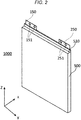
- FIGS. 1 and 2 are external views of the laminate-type battery.
- a battery cell 1000 includes a positive electrode 100 (electrode), a negative electrode 200 (electrode), a positive electrode terminal 150 (electrode terminal), a negative electrode terminal 250 (electrode terminal), a separator 300, and a package 500.
- the positive electrode 100 has a positive electrode mixture layer 110 (electrode mixture layer), a positive electrode current collector 120 (electrode current collector), and a positive electrode tab 130 (electrode tab).
- the positive electrode mixture layer 110 is formed on both surfaces of the positive electrode current collector 120.
- the negative electrode 200 has a negative electrode mixture layer 210 (electrode mixture layer), a negative electrode current collector 220 (electrode current collector), and a negative electrode tab 230 (electrode tab).
- the negative electrode mixture layer 210 is formed on both surfaces of the negative electrode current collector 220.
- the positive electrode 100, the separator 300, and the negative electrode 200 are laminated to form an electrode body 400.
- the battery cell 1000 is configured by laminating a plurality of the electrode bodies 400. As the positive electrode tabs 130 and the negative electrode tab 230 are connected, an electrical parallel connection is formed in the battery cell 1000.
- the battery cell 1000 in FIGS. 1 and 2 is a laminate-type secondary battery. The present invention can also be applied to a wound-type secondary battery.
- the laminating direction of the electrode bodies 400 is set as an x-axis direction, a direction in which the electrode tab protrudes is set as a z-axis direction, and a direction perpendicular to the xz plane is set as a y-axis direction.
- the positive electrode mixture layer 110 has a positive electrode active material that enables insertion and extraction of Li.
- the positive electrode active material may include LiCo-based oxide, LiNi-based composite oxide, LiMn-based composite oxide, Li-Co-Ni-Mn composite oxide, LiFeP-based oxide, LiMnPO 4 -based oxide, LiMn 1-x Fe x PO 4 (0 ⁇ 1 ⁇ x)-based oxide and the like, but are not limited thereto.
- the negative electrode mixture layer 210 has a negative electrode active material that enables insertion and extraction of Li. Examples of the negative electrode active material may include a carbon-based material such as natural graphite, soft carbon, and amorphous carbon, Si metal and a Si alloy, lithium titanate, lithium metal, and the like, but are not limited thereto.
- the electrode mixture layer may contain an electrode conductive agent that is responsible for the electron conductivity in the electrode mixture layer, an electrode binder that ensures adhesion between materials in the electrode mixture layer, and further, a solid electrolyte for ensuring the ion conductivity in the electrode mixture layer.
- a method for producing the electrode mixture layer is, for example, as follows. First, a material to be contained in the electrode mixture layer is dissolved in a solvent to form a slurry, and the slurry is formed on the electrode current collector by coating. Examples of the coating method include a method using a roll coater, a doctor blade method, a dipping method, and a spray method. Next, the electrode mixture layer applied on the electrode current collector is dried to remove the solvent. Next, the electrode mixture layer is pressed to ensure the electron conductivity and ion conductivity in the electrode mixture layer.
- the electrode current collector is electrically connected to the electrode tab.
- the electrode tab extends from a side surface of the electrode current collector. In FIG. 1 , no electrode mixture layer is formed on the electrode tab. However, the electrode mixture layer may be formed on the electrode tab within a range that does not adversely affect battery performance.
- Examples of the positive electrode current collector 120 and the positive electrode tab 130 may include an aluminum foil, an aluminum perforated foil having a hole diameter of 0.1 to 10 mm, expanded metal, a foamed aluminum plate, stainless steel, titanium, and the like, but are not limited thereto.
- Examples of the negative electrode current collector 220 and the negative electrode tab 230 may include a copper foil, a perforated copper foil having a hole diameter of 0.1 to 10 mm, expanded metal, a foamed copper plate, stainless steel, titanium, nickel, and the like, but are not limited thereto.
- the thickness of the electrode current collector and the electrode tab is preferably 10 nm to 1 mm. From the viewpoint of achieving both the energy density of the battery cell 1000 and the mechanical strength of the electrode, the thickness is preferably about 1 ⁇ m to 100 ⁇ m.
- the separator 300 is provided between the positive electrode 100 and the negative electrode 200, and pass lithium ions to prevent short circuit between positive electrode 100 and negative electrode 200 when the battery cell 1000 is a lithium ion secondary battery.
- Examples of a material forming the separator 300 may include a microporous membrane, a solid electrolyte, and the like, but are not limited thereto.
- microporous membrane may include polyolefin such as polyethylene and polypropylene, a glass fiber, and the like, but are not limited thereto.
- the battery cell 1000 is filled with an electrolyte by injecting the electrolyte into the battery cell 1000 from one open side of the package 500 or a liquid injection hole formed in the package 500.
- the electrolyte has a solvent and a lithium salt, for example, and serves as a medium that transmits lithium ions between the positive electrode 100 and the negative electrode 200.
- the solvent may include ethylene carbonate (EC), dimethyl carbonate (DMC), diethyl carbonate (DEC), propylene carbonate, butylene carbonate, ⁇ -butyrolactone, phosphoric acid triester, trimethoxymethane, dioxolan, diethyl ether, sulfolane, and the like, but are not limited thereto. These materials may be used alone or in combination.
- lithium salt examples include LiPF 6 , LiBF 4 , LiClO 4 , LiCF 3 SO 3 , LiCF 3 CO 2 , LiAsF 6 , LiSbF 6 , lithium bisoxalate borate (LiBOB), a lithium imide salt (for example, lithium bis(fluorosulfonyl) imide or LiFSI), and the like, but are not limited thereto.
- LiPF 6 LiBF 4 , LiClO 4 , LiCF 3 SO 3 , LiCF 3 CO 2 , LiAsF 6 , LiSbF 6 , lithium bisoxalate borate (LiBOB), a lithium imide salt (for example, lithium bis(fluorosulfonyl) imide or LiFSI), and the like, but are not limited thereto.
- LiPF 6 LiBF 4 , LiClO 4 , LiCF 3 SO 3 , LiCF 3 CO 2 , LiAsF 6 , LiSbF 6 , lithium bisoxalate bo
- the solid electrolyte may include a semisolid electrolyte in which a sulfide such as Li 10 Ge 2 PS 12 and Li 2 S-P 2 S 5 , an oxide such as Li-La-Zr-O, an ionic liquid, or a room-temperature molten salt is supported on an organic polymer, an inorganic particle, or the like, a gel electrolyte using a polymer gel as an electrolyte, and the like, but are not limited thereto.
- a semisolid electrolyte in which a sulfide such as Li 10 Ge 2 PS 12 and Li 2 S-P 2 S 5 , an oxide such as Li-La-Zr-O, an ionic liquid, or a room-temperature molten salt is supported on an organic polymer, an inorganic particle, or the like
- a gel electrolyte using a polymer gel as an electrolyte and the like, but are not limited thereto.
- the solid electrolyte serves as a medium that transmits lithium ions between the positive electrode 100 and the negative electrode 200, and the above electrolyte is basically unnecessary, so that an electrical series connection can be formed in the battery cell 1000.
- the electrolyte may be added to the battery cell 1000 even when the solid electrolyte is used as the separator 300 as long as the electrical short circuit in the battery cell 1000 can be prevented.
- the separator 300 may be provided as a sheet between the positive electrode 100 and the negative electrode 200, or may be formed on the electrode mixture layer by coating. The separator 300 may be formed on both surfaces of the electrode mixture layer. If the separator 300 is formed between the positive electrode 100 and the negative electrode 200, the separator 300 may be formed on one surface of the electrode mixture layer.
- the thickness of the separator 300 is preferably several nm to several mm from the viewpoint of ensuring the energy density and electronic insulation of the battery cell 1000.
- the electrode terminal is electrically connected to the electrode tab.
- Examples of the positive electrode terminal 150 and the negative electrode terminal 250 may include metal such as aluminum, copper, nickel, and stainless steel, but are not limited thereto.
- the electrode terminal has a positive electrode terminal hole 151 (electrode terminal hole) and a negative electrode terminal hole 251 (electrode terminal hole) through which a cell fastening bolt 1400 passes.
- the package 500 houses the electrode body 400.
- the electrode terminal protrudes from one side of the package 500.
- the package 500 has a package stepped portion 510.
- a block 1100 is formed above the package stepped portion 510 in the z-axis direction so as to oppose the electrode tab.
- Examples of the package 500 may include a material having corrosion resistance to the electrolyte or the solid electrolyte, such as an aluminum laminate film, aluminum, stainless steel, and nickel-plated steel, and the like, but are not limited thereto.
- FIGS. 3 , 4 , and 5 are external views of a battery module.
- a battery module 5000 includes the battery cell 1000, the block 1100, a square washer 1200, an insulating sheet 1300, the cell fastening bolt 1400, a middle plate 1500, an L-shaped bracket 1600, an L-shaped module terminal 1700, a bolt with a hole 1800, a lid-side stud bolt 1900, a cylindrical module terminal 2000, a module lid 2100, a bottom-side stud bolt 2200, and a module case 2300.
- a laminating direction of the battery cells 1000 is an x-axis direction, a direction in which the module lid 2100 is formed with respect to the battery cells 1000 is a z-axis direction, and a direction perpendicular to the xz plane is a y-axis direction.
- the block 1100 has an intermediate block 1110 and an end block 1120.
- the intermediate block 1110 is provided between electrode terminals in the plurality of battery cells 1000 in the x-axis direction.
- the end block 1120 is provided between the battery cell 1000 provided at the end of the battery module 5000 and the middle plate 1500 in the y-axis direction.
- the middle plate 1500 and the end block 1120 are not connected physically and electrically.
- a screw for fastening the cell fastening bolt 1400 is cut in the end block 1120 arranged on the opposite side to the square washer 1200 in the x-axis direction.
- the electrode terminals of the plurality of battery cells 1000 are physically and electrically connected in parallel by the block 1100.
- a size of the block 1100 on the yz plane is smaller than a size of the protruding portion of the electrode terminal.
- the block 1100 has a first block hole 1130 through which the cell fastening bolt 1400 passes when viewed from the x-axis direction.
- the block 1100 installed below the cylindrical module terminal 2000 in the z-axis direction has a second block hole 1140 through which the bolt with a hole 1800 passes when viewed from the y-axis direction.
- Examples of the block 1100 may include copper, aluminum, nickel, stainless steel, cladding materials thereof, plating using these materials, and the like, but are not limited thereto.
- the square washer 1200 physically and electrically connect the plurality of battery cells 1000 and the block 1100 together with the end block 1120 and the cell fastening bolt 1400.
- the square washer 1200 is provided between the battery cell 1000 provided at the end of the battery module 5000 and the middle plate 1500 in the x-axis direction.
- a size of the square washer 1200 on the yz plane and the size of the protruding portion of the electrode terminal are substantially the same, but may be different as long as there is no contact with the middle plate 1500.
- the square washer 1200 has a square washer hole through which the cell fastening bolt 1400 passes when viewed from the x-axis direction. Examples of the square washer 1200 may include the same materials as the block 1100, but are not limited thereto.
- the insulating sheet 1300 insulates the battery cells 1000 and the middle plate 1500. In the z-axis direction, the insulating sheet 1300 has an insulating sheet protrusion 1310 at an end of the insulating sheet 1300 on the side where the module lid 2100 is installed.
- the insulating sheet protrusion 1310 has an insulating sheet upper hole 1320 through which the lid-side stud bolt 1900 passes.
- the insulating sheet protrusion 1310 has an insulating sheet notch 1330 on the side of the insulating sheet upper hole 1320 where the square washer 1200 is arranged in the y-axis direction.
- the insulating sheet notch 1330 allows the insulating sheet protrusion 1310 to tilt in the x-axis direction toward the side where the middle plate 1500 is installed. As a result, when the square washer 1200 and the middle plate 1500 are close to each other, the contact between the square washer 1200 and the middle plate 1500 is prevented while suppressing the movement of the entire insulating sheet 1300.
- the insulating sheet protrusion 1310 has an insulating sheet lower hole 1340 through which the bottom-side stud bolt 2200 passes when viewed from the x-axis direction.
- Examples of the insulating sheet 1300 may include a fluororesin material such as polytetrafluoroethylene (PTFE), polypropylene (PP), and polybutylene terephthalate (PBT), and the like, but are not limited thereto.
- PTFE polytetrafluoroethylene
- PP polypropylene
- PBT polybutylene terephthalate
- the cell fastening bolt 1400 passes through the electrode terminal hole, the first block hole 1130, and the square washer hole.
- the cell fastening bolt 1400 is fastened with the square washer 1200.
- the electrodes of the plurality of battery cells 1000 come into physical contact with each other in the x-axis direction, and the plurality of battery cells 1000 are electrically connected in parallel.
- the cell fastening bolt 1400 is fastened with the square washer 1200, the plurality of battery cells 1000 are fixed, and the vibration of the battery cells 1000 is suppressed.
- Examples of the cell fastening bolt 1400 may include the same materials as the block 1100, but are not limited thereto.
- the middle plate 1500 is provided between the insulating sheet 1300 and the module case 2300 in the x-axis direction.
- the middle plates 1500 sandwich the battery cells 1000.
- the middle plate 1500 has a middle plate protrusion 1510 at an end on the side where the module lid 2100 is installed in the z-axis direction.
- the middle plates 1500 sandwich the battery cells 1000 and fixes the module case 2300 and the plurality of battery cells 1000 via the bottom-side stud bolt 2200. As a result, the vibration resistance of the battery module 5000 can be improved.
- the thickness of the middle plate 1500 is arbitrary as long as the securing pressure and vibration resistance can be ensured. When the thickness of the middle plate 1500 increases, the weight or volume of the battery module 5000 is likely to increase. Therefore, the thickness of the middle plate 1500 is preferably 1 to 20 mm, more preferably 5 to 15 mm, and still more preferably 8 to 10 mm.
- the middle plate protrusion 1510 has a middle plate upper hole 1520 through which the lid-side stud bolt 1900 passes when viewed from the x-axis direction.
- the middle plate protrusion 1510 has a middle plate lower hole 1530 through which the bottom-side stud bolt 2200 passes when viewed from the x-axis direction.
- Examples of the middle plate 1500 may include the same materials as the block 1100, but are not limited thereto.
- the L-shaped bracket 1600 has an L-shape when viewed from the y-axis direction.
- the L-shaped bracket 1600 has an L-shaped bracket first hole 1610 through which the lid-side stud bolt 1900 passes, in a portion of the L-shaped bracket 1600 extending in the z-axis direction.
- the L-shaped bracket 1600 has an L-shaped bracket second hole 1620 through which a L-shaped bracket fastening bolt passes, in a portion of the L-shaped bracket 1600 extending in the x-axis direction.
- the L-shaped bracket 1600 and the module lid 2100 are fastened by the L-shaped bracket fastening bolt.
- Examples of the L-shaped bracket 1600 may include the same materials as the block 1100, but are not limited thereto.
- the L-shaped module terminal 1700 is electrically connected to the cylindrical module terminal 2000.
- the L-shaped module terminal 1700 extracts a current flowing through the electrode terminal via the cylindrical module terminal 2000 to the outside of the module case 2300.
- the L-shaped module terminal 1700 fixes the module lid 2100 and the electrode bodies 400 in the plurality of battery cells 1000. As a result, the vibration resistance of the battery module 5000 can be improved.
- the L-shaped module terminal 1700 has an L-shape when viewed from the x-axis direction.
- the L-shaped module terminal 1700 has an L-shaped module terminal first hole 1710 through which the bolt with a hole 1800 passes, in a portion of the L-shaped module terminal 1700 extending in the z-axis direction.
- the L-shaped module terminal 1700 has an L-shaped module terminal second hole 1720 in a portion of the L-shaped module terminal 1700 extending in the y-axis direction.
- the L-shaped module terminal 1700 has an L-shaped module terminal fastening bolt that passes through the L-shaped module terminal second hole 1720.
- the L-shaped module terminal 1700 and the cylindrical module terminal 2000 are fastened and electrically connected by the L-shaped module terminal fastening bolt. Examples of the L-shaped module terminal 1700 may include the same materials as the block 1100, but are not limited thereto.
- the bolt with a hole 1800 is installed on the side of the block 1100 where the module case 2300 is arranged in the y-axis direction.
- the bolt with a hole 1800 passes through the second block hole 1140 and the L-shaped module terminal first hole 1710, and fastens the block 1100 and the L-shaped module terminal 1700.
- Examples of the bolt with a hole 1800 may include the same materials as the block 1100, but are not limited thereto.
- the lid-side stud bolt 1900 has a lid-side end stud bolt 1910 and a lid-side central stud bolt 1920.
- the lid-side end stud bolt 1910 is installed at a position closer to the block 1100 than the lid-side central stud bolt 1920. In the y-axis direction, the lid-side central stud bolt 1920 is provided between the lid-side end stud bolts 1910.
- the lid-side end stud bolt 1910 passes through the insulating sheet upper hole 1320 and the middle plate upper hole 1520, and fixes the insulating sheet 1300 and the middle plate 1500.
- the lid-side central stud bolt 1920 passes through the L-shaped bracket first hole 1610 and the middle plate upper hole 1520, and fixes the L-shaped bracket 1600 and the middle plate 1500.
- lid-side stud bolt 1900 and the middle plate 1500 are fastened, a surface pressure is generated from the middle plate 1500 to the plurality of battery cells 1000 so that the plurality of battery cells 1000 are fixed.
- Examples of the lid-side stud bolt 1900 may include the same materials as the block 1100, but are not limited thereto.
- the cylindrical module terminal 2000 is fastened to the L-shaped module terminal 1700 via a bolt built in the cylindrical module terminal 2000.
- Examples of the cylindrical module terminal 2000 may include the same materials as the block 1100, but are not limited thereto.
- the module lid 2100 seals the module case 2300.
- the module lid 2100 has a module lid first hole 2110 through which the cylindrical module terminal 2000 passes, a module lid second hole 2120 through which the L-shaped bracket fastening bolt passes, a rubber stopper 2130, and a rubber stopper hole 2140 into which the rubber stopper 2130 is inserted.
- the module lid 2100 is sealed by the rubber stopper 2130. Any shape may be adopted as the rubber stopper 2130 as long as the wirings of sensors can be taken out from the inside of the battery module 5000.
- wirings of the battery module 5000 may be connected to take out the wirings outside the battery module 5000 by replacing the rubber stopper 2130 with a resin screw or an arbitrary connector/receptacle.
- the module lid 2100 may include polybutylene terephthalate (PBT), phenolic resin, acrylonitrile-butadiene-styrene resin (ABS), and the like, but are not limited thereto.
- the bottom-side stud bolt 2200 is provided between the plurality of battery cells 1000 and the module case 2300 in the z-axis direction.
- the bottom-side stud bolt 2200 passes through the insulating sheet lower hole 1340 and the middle plate lower hole 1530, and fixes the insulating sheet 1300 and the middle plate 1500.
- a binding force is generated between the middle plate 1500 and the module case 2300, and the plurality of battery cells 1000 are stably fixed in the module case 2300.
- Examples of the bottom-side stud bolt 2200 may include the same materials as the block 1100, but are not limited thereto.
- the height of the bottom-side stud bolt 2200 from the bottom surface and the attached number thereof can be arbitrarily changed.
- the plurality of bottom-side stud bolts 2200 may have different heights from each other. As a result, it is possible to prevent screw heads of the bottom-side stud bolts 2200 of the plurality of battery modules 5000 from interfering with each other when the plurality of battery modules 5000 are arranged closely.
- the module case 2300 houses the plurality of battery cells 1000, the middle plate 1500, the lid-side stud bolt 1900, and the bottom-side stud bolt 2200.
- the plurality of battery cells 1000 and the middle plate 1500 are sealed inside the module case 2300. As a result, the plurality of battery cells 1000 can be stably secured by the middle plate 1500.
- the module lid 2100 is provided on an exposed portion of the module case 2300.
- the module case 2300 has a module case bolt 2310 extending in the y-axis direction (in-plane direction of the plurality of battery cells 1000). In the z-axis direction, the module case bolt 2310 is installed above the bottom-side stud bolt 2200 to prevent contact between the module case bolt 2310 and the bottom-side stud bolt 2200. In the y-axis direction, the module case 2300 and the middle plate 1500 are fastened by the module case bolt 2310. Examples of the module case 2300 may include the same materials as the block 1100, but are not limited thereto.
- the module case bolts 2310 installed at both ends in the y-axis direction are installed at different heights in the z-axis direction (the direction in which the module lid 2100 is installed). With such a three-dimensional arrangement, the shock resistance of the battery module 5000 can be improved.
- the module case bolt 2310 is attached in the y-axis direction instead of the bottom portion of the module case 2300 in the z-axis direction, and thus, the mountability and arrangement stability of the battery module 5000 are improved.
- a heat conductive sheet or the like can be inserted into the bottom portion of the battery module 5000, and the heat dissipation of the battery module 5000 can be improved.
- a cooling pipe may be arranged inside or on the surface of the middle plate 1500. As the cooling pipe is arranged, the temperature inside the battery module 5000 can be kept within a desired temperature range. As a passage of a pipe to connect a pipe inside a securing jig and the outside of the module case 2300, an opening may be formed in a side surface of the module case 2300, and the pipe may be formed to pass through the opening similarly to the bottom-side stud bolt 2200. The opening formed in the module case 2300 may be sealed with a resin or the like after the pipe is formed to pass therethrough. If a location near the bottom-side stud bolt 2200 is selected as the place where the piping passes, the stress on the pipe during the vibration can be reduced.
Landscapes
- Chemical & Material Sciences (AREA)
- Chemical Kinetics & Catalysis (AREA)
- Electrochemistry (AREA)
- General Chemical & Material Sciences (AREA)
- Engineering & Computer Science (AREA)
- Manufacturing & Machinery (AREA)
- Battery Mounting, Suspending (AREA)
Abstract
Description
- The present invention relates to a battery module.
- As a technique for improving the reliability of a power storage device,
PTL 1 discloses the following content. Apower storage device 1 includes: a housing 1a having a containermain body 10 and a lid 20 provided with external connection terminals 21a and 21b; a power storage module main body 30 having a cell stack 32 arranged inside the housing 1a; a bolt 11 regulating movement of the power storage module main body 30 with respect to a bottom wall 10a of the containermain body 10; and a support member 35 regulating movement of the power storage module main body 30 with respect to the lid 20. - PTL 1:
JP 2016-72230 A - In
PTL 1, fixing to the bottom wall 10a is performed by the bolt 11 inserted into a through-hole formed in the bottom wall 10a of the containermain body 10, that is, the bolt 11 functions as a first regulating portion that regulates the movement of the power storage module main body 30 with respect to the bottom wall 10a of the containermain body 10. In this case, a space corresponding to the height of a head of the bolt 11 is generated in the lower part of the container body, and the stability of arrangement as the power storage device is likely to decrease. - An object of the present invention is to improve the stability of arrangement of a battery module.
- Features of the present invention for solving the above problem are, for example, as follows.
- A battery module includes: a plurality of battery cells; a middle plate that secures the plurality of battery cells; a module case that houses the plurality of battery cells and the middle plate; and a module lid that seals the module case. The module case has module case bolts, the module case bolt extends in an in-plane direction of the plurality of battery cells, and the middle plate and the module case are fastened by the module case bolt in the in-plane direction of the plurality of battery cells.
- According to this invention, the stability of arrangement of the battery module can be improved. Other objects, configurations, and effects which have not been described above become apparent from an embodiment to be described hereinafter.
-
- [
FIG. 1] FIG. 1 is an external view of a laminate-type battery. - [
FIG. 2] FIG. 2 is an external view of the laminate-type battery. - [
FIG. 3] FIG. 3 is an external view of a battery module. - [
FIG. 4] FIG. 4 is an external view of the battery module. - [
FIG. 5] FIG. 5 is an external view of the battery module. - Hereinafter, an embodiment of the present invention will be described with reference to the drawings. The following descriptions illustrate specific examples of the content of the present invention. The present invention is not limited to these descriptions, and various changes and modifications by those skilled in the art can be made within the scope of the technical idea disclosed in the present specification. In addition, the same reference signs will be attached to those having the same function in the entire drawing for describing the present invention, and the repetitive description thereof will be omitted in some cases.
- The term "to" described herein is used as the meaning that includes numerical values described before and after "to" as a lower limit value and an upper limit value. In numerical ranges that are described stepwise in the present specification, an upper limit value or a lower limit value of one numerical range may be replaced with an upper limit value or a lower limit value of a numerical range of another stage. Upper limit values or lower limit values of the numerical ranges described in the present specification may be replaced with values shown in an embodiment.
- In the present specification, a lithium ion secondary battery will be described as an example of a laminate-type battery. The lithium ion secondary battery is an electrochemical device that enables storage and use of electric energy by inserting and extracting lithium ions into and from an electrode in an electrolyte. This is referred to by another name of a lithium ion battery, a non-aqueous electrolyte secondary battery, or a non-aqueous electrolyte secondary battery, and the present invention can be applied to all these batteries. The technical idea of the present invention can be applied to a sodium ion secondary battery, a magnesium ion secondary battery, a calcium ion secondary battery, a zinc secondary battery, an aluminum ion secondary battery, and the like.
-
FIGS. 1 and2 are external views of the laminate-type battery. Abattery cell 1000 includes a positive electrode 100 (electrode), a negative electrode 200 (electrode), a positive electrode terminal 150 (electrode terminal), a negative electrode terminal 250 (electrode terminal), aseparator 300, and apackage 500. - The
positive electrode 100 has a positive electrode mixture layer 110 (electrode mixture layer), a positive electrode current collector 120 (electrode current collector), and a positive electrode tab 130 (electrode tab). The positiveelectrode mixture layer 110 is formed on both surfaces of the positive electrodecurrent collector 120. Thenegative electrode 200 has a negative electrode mixture layer 210 (electrode mixture layer), a negative electrode current collector 220 (electrode current collector), and a negative electrode tab 230 (electrode tab). The negativeelectrode mixture layer 210 is formed on both surfaces of the negative electrodecurrent collector 220. - The
positive electrode 100, theseparator 300, and thenegative electrode 200 are laminated to form anelectrode body 400. - The
battery cell 1000 is configured by laminating a plurality of theelectrode bodies 400. As thepositive electrode tabs 130 and thenegative electrode tab 230 are connected, an electrical parallel connection is formed in thebattery cell 1000. Thebattery cell 1000 inFIGS. 1 and2 is a laminate-type secondary battery. The present invention can also be applied to a wound-type secondary battery. The laminating direction of theelectrode bodies 400 is set as an x-axis direction, a direction in which the electrode tab protrudes is set as a z-axis direction, and a direction perpendicular to the xz plane is set as a y-axis direction. - The positive
electrode mixture layer 110 has a positive electrode active material that enables insertion and extraction of Li. Examples of the positive electrode active material may include LiCo-based oxide, LiNi-based composite oxide, LiMn-based composite oxide, Li-Co-Ni-Mn composite oxide, LiFeP-based oxide, LiMnPO4-based oxide, LiMn1-xFexPO4 (0 < 1 < x)-based oxide and the like, but are not limited thereto. The negativeelectrode mixture layer 210 has a negative electrode active material that enables insertion and extraction of Li. Examples of the negative electrode active material may include a carbon-based material such as natural graphite, soft carbon, and amorphous carbon, Si metal and a Si alloy, lithium titanate, lithium metal, and the like, but are not limited thereto. - The electrode mixture layer may contain an electrode conductive agent that is responsible for the electron conductivity in the electrode mixture layer, an electrode binder that ensures adhesion between materials in the electrode mixture layer, and further, a solid electrolyte for ensuring the ion conductivity in the electrode mixture layer.
- A method for producing the electrode mixture layer is, for example, as follows. First, a material to be contained in the electrode mixture layer is dissolved in a solvent to form a slurry, and the slurry is formed on the electrode current collector by coating. Examples of the coating method include a method using a roll coater, a doctor blade method, a dipping method, and a spray method. Next, the electrode mixture layer applied on the electrode current collector is dried to remove the solvent. Next, the electrode mixture layer is pressed to ensure the electron conductivity and ion conductivity in the electrode mixture layer.
- The electrode current collector is electrically connected to the electrode tab. The electrode tab extends from a side surface of the electrode current collector. In
FIG. 1 , no electrode mixture layer is formed on the electrode tab. However, the electrode mixture layer may be formed on the electrode tab within a range that does not adversely affect battery performance. - Examples of the positive electrode
current collector 120 and thepositive electrode tab 130 may include an aluminum foil, an aluminum perforated foil having a hole diameter of 0.1 to 10 mm, expanded metal, a foamed aluminum plate, stainless steel, titanium, and the like, but are not limited thereto. Examples of the negative electrodecurrent collector 220 and thenegative electrode tab 230 may include a copper foil, a perforated copper foil having a hole diameter of 0.1 to 10 mm, expanded metal, a foamed copper plate, stainless steel, titanium, nickel, and the like, but are not limited thereto. - The thickness of the electrode current collector and the electrode tab is preferably 10 nm to 1 mm. From the viewpoint of achieving both the energy density of the
battery cell 1000 and the mechanical strength of the electrode, the thickness is preferably about 1 µm to 100 µm. - The
separator 300 is provided between thepositive electrode 100 and thenegative electrode 200, and pass lithium ions to prevent short circuit betweenpositive electrode 100 andnegative electrode 200 when thebattery cell 1000 is a lithium ion secondary battery. Examples of a material forming theseparator 300 may include a microporous membrane, a solid electrolyte, and the like, but are not limited thereto. - Examples of the microporous membrane may include polyolefin such as polyethylene and polypropylene, a glass fiber, and the like, but are not limited thereto. When the microporous membrane is used for the
separator 300, thebattery cell 1000 is filled with an electrolyte by injecting the electrolyte into thebattery cell 1000 from one open side of thepackage 500 or a liquid injection hole formed in thepackage 500. - The electrolyte has a solvent and a lithium salt, for example, and serves as a medium that transmits lithium ions between the
positive electrode 100 and thenegative electrode 200. Examples of the solvent may include ethylene carbonate (EC), dimethyl carbonate (DMC), diethyl carbonate (DEC), propylene carbonate, butylene carbonate, γ-butyrolactone, phosphoric acid triester, trimethoxymethane, dioxolan, diethyl ether, sulfolane, and the like, but are not limited thereto. These materials may be used alone or in combination. Examples of the lithium salt may include LiPF6, LiBF4, LiClO4, LiCF3SO3, LiCF3CO2, LiAsF6, LiSbF6, lithium bisoxalate borate (LiBOB), a lithium imide salt (for example, lithium bis(fluorosulfonyl) imide or LiFSI), and the like, but are not limited thereto. These lithium salts may be used alone or in combination. - Examples of the solid electrolyte may include a semisolid electrolyte in which a sulfide such as Li10Ge2PS12 and Li2S-P2S5, an oxide such as Li-La-Zr-O, an ionic liquid, or a room-temperature molten salt is supported on an organic polymer, an inorganic particle, or the like, a gel electrolyte using a polymer gel as an electrolyte, and the like, but are not limited thereto. When using the solid electrolyte as the
separator 300, the solid electrolyte serves as a medium that transmits lithium ions between thepositive electrode 100 and thenegative electrode 200, and the above electrolyte is basically unnecessary, so that an electrical series connection can be formed in thebattery cell 1000. However, the electrolyte may be added to thebattery cell 1000 even when the solid electrolyte is used as theseparator 300 as long as the electrical short circuit in thebattery cell 1000 can be prevented. - The
separator 300 may be provided as a sheet between thepositive electrode 100 and thenegative electrode 200, or may be formed on the electrode mixture layer by coating. Theseparator 300 may be formed on both surfaces of the electrode mixture layer. If theseparator 300 is formed between thepositive electrode 100 and thenegative electrode 200, theseparator 300 may be formed on one surface of the electrode mixture layer. The thickness of theseparator 300 is preferably several nm to several mm from the viewpoint of ensuring the energy density and electronic insulation of thebattery cell 1000. - The electrode terminal is electrically connected to the electrode tab. Examples of the
positive electrode terminal 150 and thenegative electrode terminal 250 may include metal such as aluminum, copper, nickel, and stainless steel, but are not limited thereto. The electrode terminal has a positive electrode terminal hole 151 (electrode terminal hole) and a negative electrode terminal hole 251 (electrode terminal hole) through which acell fastening bolt 1400 passes. - The
package 500 houses theelectrode body 400. The electrode terminal protrudes from one side of thepackage 500. Thepackage 500 has a package stepped portion 510. Ablock 1100 is formed above the package stepped portion 510 in the z-axis direction so as to oppose the electrode tab. Examples of thepackage 500 may include a material having corrosion resistance to the electrolyte or the solid electrolyte, such as an aluminum laminate film, aluminum, stainless steel, and nickel-plated steel, and the like, but are not limited thereto. -
FIGS. 3 ,4 , and5 are external views of a battery module. Abattery module 5000 includes thebattery cell 1000, theblock 1100, asquare washer 1200, an insulatingsheet 1300, thecell fastening bolt 1400, amiddle plate 1500, an L-shapedbracket 1600, an L-shapedmodule terminal 1700, a bolt with ahole 1800, a lid-side stud bolt 1900, acylindrical module terminal 2000, amodule lid 2100, a bottom-side stud bolt 2200, and amodule case 2300. A laminating direction of thebattery cells 1000 is an x-axis direction, a direction in which themodule lid 2100 is formed with respect to thebattery cells 1000 is a z-axis direction, and a direction perpendicular to the xz plane is a y-axis direction. - The
block 1100 has anintermediate block 1110 and anend block 1120. Theintermediate block 1110 is provided between electrode terminals in the plurality ofbattery cells 1000 in the x-axis direction. Theend block 1120 is provided between thebattery cell 1000 provided at the end of thebattery module 5000 and themiddle plate 1500 in the y-axis direction. Themiddle plate 1500 and theend block 1120 are not connected physically and electrically. A screw for fastening thecell fastening bolt 1400 is cut in theend block 1120 arranged on the opposite side to thesquare washer 1200 in the x-axis direction. As a result, the plurality of thebattery cells 1000 and theblock 1100 can be physically and electrically connected using thesquare washer 1200 and thecell fastening bolt 1400. - The electrode terminals of the plurality of
battery cells 1000 are physically and electrically connected in parallel by theblock 1100. A size of theblock 1100 on the yz plane is smaller than a size of the protruding portion of the electrode terminal. As a result, contact between theblock 1100 and thepackage 500 can be prevented, and a poor electrical connection betweenblock 1100 andbattery cell 1000 can be reduced. - The
block 1100 has afirst block hole 1130 through which thecell fastening bolt 1400 passes when viewed from the x-axis direction. Theblock 1100 installed below thecylindrical module terminal 2000 in the z-axis direction has asecond block hole 1140 through which the bolt with ahole 1800 passes when viewed from the y-axis direction. Examples of theblock 1100 may include copper, aluminum, nickel, stainless steel, cladding materials thereof, plating using these materials, and the like, but are not limited thereto. - The
square washer 1200 physically and electrically connect the plurality ofbattery cells 1000 and theblock 1100 together with theend block 1120 and thecell fastening bolt 1400. - The
square washer 1200 is provided between thebattery cell 1000 provided at the end of thebattery module 5000 and themiddle plate 1500 in the x-axis direction. A size of thesquare washer 1200 on the yz plane and the size of the protruding portion of the electrode terminal are substantially the same, but may be different as long as there is no contact with themiddle plate 1500. Thesquare washer 1200 has a square washer hole through which thecell fastening bolt 1400 passes when viewed from the x-axis direction. Examples of thesquare washer 1200 may include the same materials as theblock 1100, but are not limited thereto. - The insulating
sheet 1300 insulates thebattery cells 1000 and themiddle plate 1500. In the z-axis direction, the insulatingsheet 1300 has an insulatingsheet protrusion 1310 at an end of the insulatingsheet 1300 on the side where themodule lid 2100 is installed. The insulatingsheet protrusion 1310 has an insulating sheet upper hole 1320 through which the lid-side stud bolt 1900 passes. - The insulating
sheet protrusion 1310 has an insulatingsheet notch 1330 on the side of the insulating sheet upper hole 1320 where thesquare washer 1200 is arranged in the y-axis direction. The insulatingsheet notch 1330 allows the insulatingsheet protrusion 1310 to tilt in the x-axis direction toward the side where themiddle plate 1500 is installed. As a result, when thesquare washer 1200 and themiddle plate 1500 are close to each other, the contact between thesquare washer 1200 and themiddle plate 1500 is prevented while suppressing the movement of the entire insulatingsheet 1300. The insulatingsheet protrusion 1310 has an insulating sheetlower hole 1340 through which the bottom-side stud bolt 2200 passes when viewed from the x-axis direction. - Examples of the insulating
sheet 1300 may include a fluororesin material such as polytetrafluoroethylene (PTFE), polypropylene (PP), and polybutylene terephthalate (PBT), and the like, but are not limited thereto. - The
cell fastening bolt 1400 passes through the electrode terminal hole, thefirst block hole 1130, and the square washer hole. Thecell fastening bolt 1400 is fastened with thesquare washer 1200. As a result, the electrodes of the plurality ofbattery cells 1000 come into physical contact with each other in the x-axis direction, and the plurality ofbattery cells 1000 are electrically connected in parallel. As thecell fastening bolt 1400 is fastened with thesquare washer 1200, the plurality ofbattery cells 1000 are fixed, and the vibration of thebattery cells 1000 is suppressed. Examples of thecell fastening bolt 1400 may include the same materials as theblock 1100, but are not limited thereto. - The
middle plate 1500 is provided between the insulatingsheet 1300 and themodule case 2300 in the x-axis direction. Themiddle plates 1500 sandwich thebattery cells 1000. Themiddle plates 1500 installed at both ends of thebattery cells 1000 in the x-axis direction secure thebattery cells 1000. Themiddle plate 1500 has amiddle plate protrusion 1510 at an end on the side where themodule lid 2100 is installed in the z-axis direction. - The
middle plates 1500 sandwich thebattery cells 1000 and fixes themodule case 2300 and the plurality ofbattery cells 1000 via the bottom-side stud bolt 2200. As a result, the vibration resistance of thebattery module 5000 can be improved. The thickness of themiddle plate 1500 is arbitrary as long as the securing pressure and vibration resistance can be ensured. When the thickness of themiddle plate 1500 increases, the weight or volume of thebattery module 5000 is likely to increase. Therefore, the thickness of themiddle plate 1500 is preferably 1 to 20 mm, more preferably 5 to 15 mm, and still more preferably 8 to 10 mm. - The
middle plate protrusion 1510 has a middle plateupper hole 1520 through which the lid-side stud bolt 1900 passes when viewed from the x-axis direction. Themiddle plate protrusion 1510 has a middle plate lower hole 1530 through which the bottom-side stud bolt 2200 passes when viewed from the x-axis direction. Examples of themiddle plate 1500 may include the same materials as theblock 1100, but are not limited thereto. - The L-shaped
bracket 1600 has an L-shape when viewed from the y-axis direction. The L-shapedbracket 1600 has an L-shaped bracketfirst hole 1610 through which the lid-side stud bolt 1900 passes, in a portion of the L-shapedbracket 1600 extending in the z-axis direction. The L-shapedbracket 1600 has an L-shaped bracketsecond hole 1620 through which a L-shaped bracket fastening bolt passes, in a portion of the L-shapedbracket 1600 extending in the x-axis direction. The L-shapedbracket 1600 and themodule lid 2100 are fastened by the L-shaped bracket fastening bolt. Examples of the L-shapedbracket 1600 may include the same materials as theblock 1100, but are not limited thereto. - The L-shaped
module terminal 1700 is electrically connected to thecylindrical module terminal 2000. The L-shapedmodule terminal 1700 extracts a current flowing through the electrode terminal via thecylindrical module terminal 2000 to the outside of themodule case 2300. The L-shapedmodule terminal 1700 fixes themodule lid 2100 and theelectrode bodies 400 in the plurality ofbattery cells 1000. As a result, the vibration resistance of thebattery module 5000 can be improved. - The L-shaped
module terminal 1700 has an L-shape when viewed from the x-axis direction. The L-shapedmodule terminal 1700 has an L-shaped module terminalfirst hole 1710 through which the bolt with ahole 1800 passes, in a portion of the L-shapedmodule terminal 1700 extending in the z-axis direction. The L-shapedmodule terminal 1700 has an L-shaped module terminalsecond hole 1720 in a portion of the L-shapedmodule terminal 1700 extending in the y-axis direction. The L-shapedmodule terminal 1700 has an L-shaped module terminal fastening bolt that passes through the L-shaped module terminalsecond hole 1720. The L-shapedmodule terminal 1700 and thecylindrical module terminal 2000 are fastened and electrically connected by the L-shaped module terminal fastening bolt. Examples of the L-shapedmodule terminal 1700 may include the same materials as theblock 1100, but are not limited thereto. - The bolt with a
hole 1800 is installed on the side of theblock 1100 where themodule case 2300 is arranged in the y-axis direction. The bolt with ahole 1800 passes through thesecond block hole 1140 and the L-shaped module terminalfirst hole 1710, and fastens theblock 1100 and the L-shapedmodule terminal 1700. Examples of the bolt with ahole 1800 may include the same materials as theblock 1100, but are not limited thereto. - The lid-
side stud bolt 1900 has a lid-sideend stud bolt 1910 and a lid-sidecentral stud bolt 1920. The lid-sideend stud bolt 1910 is installed at a position closer to theblock 1100 than the lid-sidecentral stud bolt 1920. In the y-axis direction, the lid-sidecentral stud bolt 1920 is provided between the lid-sideend stud bolts 1910. The lid-sideend stud bolt 1910 passes through the insulating sheet upper hole 1320 and the middle plateupper hole 1520, and fixes the insulatingsheet 1300 and themiddle plate 1500. The lid-sidecentral stud bolt 1920 passes through the L-shaped bracketfirst hole 1610 and the middle plateupper hole 1520, and fixes the L-shapedbracket 1600 and themiddle plate 1500. When the lid-side stud bolt 1900 and themiddle plate 1500 are fastened, a surface pressure is generated from themiddle plate 1500 to the plurality ofbattery cells 1000 so that the plurality ofbattery cells 1000 are fixed. Examples of the lid-side stud bolt 1900 may include the same materials as theblock 1100, but are not limited thereto. - The
cylindrical module terminal 2000 is fastened to the L-shapedmodule terminal 1700 via a bolt built in thecylindrical module terminal 2000. Examples of thecylindrical module terminal 2000 may include the same materials as theblock 1100, but are not limited thereto. - The
module lid 2100 seals themodule case 2300. Themodule lid 2100 has a module lidfirst hole 2110 through which thecylindrical module terminal 2000 passes, a module lidsecond hole 2120 through which the L-shaped bracket fastening bolt passes, arubber stopper 2130, and arubber stopper hole 2140 into which therubber stopper 2130 is inserted. - Through the
rubber stopper hole 2140, it is possible to take out wirings of sensors that can be arbitrarily attached to the inside of thebattery module 5000. Themodule lid 2100 is sealed by therubber stopper 2130. Any shape may be adopted as therubber stopper 2130 as long as the wirings of sensors can be taken out from the inside of thebattery module 5000. For example, wirings of thebattery module 5000 may be connected to take out the wirings outside thebattery module 5000 by replacing therubber stopper 2130 with a resin screw or an arbitrary connector/receptacle. Examples of themodule lid 2100 may include polybutylene terephthalate (PBT), phenolic resin, acrylonitrile-butadiene-styrene resin (ABS), and the like, but are not limited thereto. - The bottom-
side stud bolt 2200 is provided between the plurality ofbattery cells 1000 and themodule case 2300 in the z-axis direction. The bottom-side stud bolt 2200 passes through the insulating sheetlower hole 1340 and the middle plate lower hole 1530, and fixes the insulatingsheet 1300 and themiddle plate 1500. As the bottom-side stud bolt 2200 and themiddle plate 1500 are fastened, a binding force is generated between themiddle plate 1500 and themodule case 2300, and the plurality ofbattery cells 1000 are stably fixed in themodule case 2300. Examples of the bottom-side stud bolt 2200 may include the same materials as theblock 1100, but are not limited thereto. - The height of the bottom-
side stud bolt 2200 from the bottom surface and the attached number thereof can be arbitrarily changed. The plurality of bottom-side stud bolts 2200 may have different heights from each other. As a result, it is possible to prevent screw heads of the bottom-side stud bolts 2200 of the plurality ofbattery modules 5000 from interfering with each other when the plurality ofbattery modules 5000 are arranged closely. - The
module case 2300 houses the plurality ofbattery cells 1000, themiddle plate 1500, the lid-side stud bolt 1900, and the bottom-side stud bolt 2200. The plurality ofbattery cells 1000 and themiddle plate 1500 are sealed inside themodule case 2300. As a result, the plurality ofbattery cells 1000 can be stably secured by themiddle plate 1500. - The
module lid 2100 is provided on an exposed portion of themodule case 2300. Themodule case 2300 has amodule case bolt 2310 extending in the y-axis direction (in-plane direction of the plurality of battery cells 1000). In the z-axis direction, themodule case bolt 2310 is installed above the bottom-side stud bolt 2200 to prevent contact between themodule case bolt 2310 and the bottom-side stud bolt 2200. In the y-axis direction, themodule case 2300 and themiddle plate 1500 are fastened by themodule case bolt 2310. Examples of themodule case 2300 may include the same materials as theblock 1100, but are not limited thereto. - The
module case bolts 2310 installed at both ends in the y-axis direction are installed at different heights in the z-axis direction (the direction in which themodule lid 2100 is installed). With such a three-dimensional arrangement, the shock resistance of thebattery module 5000 can be improved. - In one embodiment of the present invention, the
module case bolt 2310 is attached in the y-axis direction instead of the bottom portion of themodule case 2300 in the z-axis direction, and thus, the mountability and arrangement stability of thebattery module 5000 are improved. In addition, there is no obstacle, such as themodule case bolt 2310, in the bottom portion of themodule case 2300, and thus, the entire surface of thebattery module 5000 can be brought into contact with a mounting surface of thebattery module 5000, and the heat dissipation of thebattery module 5000 is improved. In addition, a heat conductive sheet or the like can be inserted into the bottom portion of thebattery module 5000, and the heat dissipation of thebattery module 5000 can be improved. In addition, as long as contents of thebattery cell 1000 do not leak from the plurality ofbattery cells 1000, it is possible to prevent the leakage of the contents of thebattery cell 1000 to the outside of thebattery module 5000 regardless of the mountability of themodule case bolt 2310. In addition, the influence of the vibration of thebattery module 5000 can be reduced, and the reliability of thebattery module 5000 can be improved. - A cooling pipe may be arranged inside or on the surface of the
middle plate 1500. As the cooling pipe is arranged, the temperature inside thebattery module 5000 can be kept within a desired temperature range. As a passage of a pipe to connect a pipe inside a securing jig and the outside of themodule case 2300, an opening may be formed in a side surface of themodule case 2300, and the pipe may be formed to pass through the opening similarly to the bottom-side stud bolt 2200. The opening formed in themodule case 2300 may be sealed with a resin or the like after the pipe is formed to pass therethrough. If a location near the bottom-side stud bolt 2200 is selected as the place where the piping passes, the stress on the pipe during the vibration can be reduced. -
- 100
- positive electrode
- 110
- positive electrode mixture layer
- 120
- positive electrode current collector
- 130
- positive electrode tab
- 150
- positive electrode terminal
- 151
- positive electrode terminal hole
- 200
- negative electrode
- 210
- negative electrode mixture layer
- 220
- negative electrode current collector
- 230
- negative electrode tab
- 250
- negative electrode terminal
- 251
- negative electrode terminal hole
- 300
- separator
- 400
- electrode body
- 500
- package
- 510
- package stepped portion
- 1000
- battery cell
- 1100
- block
- 1110
- intermediate block
- 1120
- end block
- 1130
- first block hole
- 1140
- second block hole
- 1200
- square washer
- 1300
- insulating sheet
- 1310
- insulating sheet protrusion
- 1320
- insulating sheet upper hole
- 1330
- insulating sheet notch
- 1340
- insulating sheet lower hole
- 1400
- cell fastening bolt
- 1500
- middle plate
- 1510
- middle plate protrusion
- 1520
- middle plate upper hole
- 1530
- middle plate lower hole
- 1600
- L-shaped bracket
- 1610
- L-shaped bracket first hole
- 1620
- L-shaped bracket second hole
- 1700
- L-shaped module terminal
- 1710
- L-shaped module terminal first hole
- 1720
- L-shaped module terminal second hole
- 1800
- bolt with hole
- 1900
- lid-side stud bolt
- 1910
- lid-side end stud bolt
- 1920
- lid-side central stud bolt
- 2000
- cylindrical module terminal
- 2100
- module lid
- 2110
- module lid first hole
- 2120
- module lid second hole
- 2130
- rubber stopper
- 2140
- rubber stopper hole
- 2200
- bottom-side stud bolt
- 2300
- module case
- 2310
- module case bolt
- 5000
- battery module
Claims (6)
- A battery module comprising:a plurality of battery cells;a middle plate that secures the plurality of battery cells;a module case that houses the plurality of battery cells and the middle plate; anda module lid that seals the module case,wherein the module case has module case bolts,the module case bolt extends in an in-plane direction of the plurality of battery cells, andthe middle plate and the module case are fastened by the module case bolt in the in-plane direction of the plurality of battery cells.
- The battery module according to claim 1, wherein
the module case bolts are installed at both ends in the in-plane direction of the plurality of battery cells, and
the module case bolts are installed at different heights in a direction in which the module lid is installed. - The battery module according to claim 1, further comprising:a lid-side stud bolt; and a bottom-side stud bolt,wherein the lid-side stud bolt and the bottom-side stud bolt are housed in the module case, andthe lid-side stud bolt and the bottom-side stud bolt are fastened to the middle plate.
- The battery module according to claim 1, further comprising
an insulating sheet,
wherein the insulating sheet is provided between the plurality of battery cells and the middle plate in a laminating direction of the plurality of battery cells. - The battery module according to claim 4, wherein
the insulating sheet has an insulating sheet protrusion,
the insulating sheet protrusion has an insulating sheet notch, and
the insulating sheet notch causes the insulating sheet protrusion to tilt toward a side where the middle plate is installed, in the laminating direction of the plurality of battery cells. - The battery module according to claim 1, wherein
the plurality of battery cells and the middle plate are sealed in the module case.
Applications Claiming Priority (2)
| Application Number | Priority Date | Filing Date | Title |
|---|---|---|---|
| JP2018025643A JP6994974B2 (en) | 2018-02-16 | 2018-02-16 | Battery module |
| PCT/JP2018/041598 WO2019159451A1 (en) | 2018-02-16 | 2018-11-09 | Battery module |
Publications (2)
| Publication Number | Publication Date |
|---|---|
| EP3754743A1 true EP3754743A1 (en) | 2020-12-23 |
| EP3754743A4 EP3754743A4 (en) | 2021-11-10 |
Family
ID=67619831
Family Applications (1)
| Application Number | Title | Priority Date | Filing Date |
|---|---|---|---|
| EP18906541.0A Withdrawn EP3754743A4 (en) | 2018-02-16 | 2018-11-09 | BATTERY MODULE |
Country Status (3)
| Country | Link |
|---|---|
| EP (1) | EP3754743A4 (en) |
| JP (1) | JP6994974B2 (en) |
| WO (1) | WO2019159451A1 (en) |
Family Cites Families (11)
| Publication number | Priority date | Publication date | Assignee | Title |
|---|---|---|---|---|
| JP5159112B2 (en) | 2007-01-24 | 2013-03-06 | 三洋電機株式会社 | Battery pack and manufacturing method thereof |
| JP5340659B2 (en) | 2008-07-07 | 2013-11-13 | 三洋電機株式会社 | Battery pack for vehicles |
| JP5542558B2 (en) | 2010-07-15 | 2014-07-09 | 株式会社東芝 | Secondary battery device |
| KR101292984B1 (en) * | 2011-08-22 | 2013-08-02 | 로베르트 보쉬 게엠베하 | Battery module |
| JP5931376B2 (en) | 2011-09-01 | 2016-06-08 | 株式会社東芝 | Battery pack and manufacturing method thereof |
| JP2015111493A (en) | 2012-03-28 | 2015-06-18 | 三洋電機株式会社 | Power supply device, and vehicle and power storage device comprising the same |
| KR20150069905A (en) * | 2013-12-16 | 2015-06-24 | 삼성에스디아이 주식회사 | Battery Pack |
| JP2016072230A (en) | 2014-09-30 | 2016-05-09 | 株式会社Gsユアサ | Power storage device |
| JP6627265B2 (en) * | 2015-06-08 | 2020-01-08 | 株式会社豊田自動織機 | Battery pack |
| US10516145B2 (en) | 2016-01-26 | 2019-12-24 | Ford Global Technologies, Llc | Battery pack array retention |
| CN109478618B (en) * | 2016-07-27 | 2021-11-23 | 柯锐世先进解决方案有限责任公司 | Battery cell assembly for battery module |
-
2018
- 2018-02-16 JP JP2018025643A patent/JP6994974B2/en not_active Expired - Fee Related
- 2018-11-09 EP EP18906541.0A patent/EP3754743A4/en not_active Withdrawn
- 2018-11-09 WO PCT/JP2018/041598 patent/WO2019159451A1/en not_active Ceased
Also Published As
| Publication number | Publication date |
|---|---|
| WO2019159451A1 (en) | 2019-08-22 |
| JP6994974B2 (en) | 2022-01-14 |
| JP2019145227A (en) | 2019-08-29 |
| EP3754743A4 (en) | 2021-11-10 |
Similar Documents
| Publication | Publication Date | Title |
|---|---|---|
| CN103999252B (en) | There is the duricrust battery core housing of vapor barrier layer | |
| KR101233573B1 (en) | Secondary battery | |
| US20140363712A1 (en) | Hard Shell Housing Comprising Superhydrophobic Material | |
| EP2445035A1 (en) | Secondary battery with a current collector terminal and a coupling terminal and method of manufacturing the same | |
| JP2018181622A (en) | Stacked secondary battery | |
| CN103119764A (en) | Battery comprising cuboid cells which contain a bipolar electrode | |
| KR102332343B1 (en) | The Battery Module | |
| KR20190122866A (en) | Secondary battery module | |
| JP2008016368A (en) | Film outer battery and battery pack | |
| US10211446B2 (en) | Rechargeable battery | |
| WO2024106143A1 (en) | Method for manufacturing power storage module, and power storage module | |
| KR20170021752A (en) | Method for producing a battery cell and battery cell | |
| CN113169410A (en) | Battery module, battery pack, and vehicle | |
| US10044023B2 (en) | Molten salt battery | |
| KR20200099391A (en) | The Secondary Battery And The Battery Module | |
| EP3754743A1 (en) | Battery module | |
| WO2019077922A1 (en) | Secondary battery module | |
| JP2020004515A (en) | Battery cell | |
| CN224138173U (en) | Battery devices, electrical appliances and energy storage devices | |
| WO2019150714A1 (en) | Layered cell | |
| CN223828627U (en) | Battery device and electric equipment | |
| CN222735311U (en) | Battery device, temperature sampling structure, energy storage device, energy storage system, power consumption device and charging network | |
| US20250149726A1 (en) | Battery Module | |
| JP2019083129A (en) | Secondary battery module | |
| WO2026081049A1 (en) | Battery cell, battery apparatus, energy storage apparatus, energy storage system, electrical apparatus, and charging network |
Legal Events
| Date | Code | Title | Description |
|---|---|---|---|
| STAA | Information on the status of an ep patent application or granted ep patent |
Free format text: STATUS: THE INTERNATIONAL PUBLICATION HAS BEEN MADE |
|
| PUAI | Public reference made under article 153(3) epc to a published international application that has entered the european phase |
Free format text: ORIGINAL CODE: 0009012 |
|
| STAA | Information on the status of an ep patent application or granted ep patent |
Free format text: STATUS: REQUEST FOR EXAMINATION WAS MADE |
|
| 17P | Request for examination filed |
Effective date: 20200610 |
|
| AK | Designated contracting states |
Kind code of ref document: A1 Designated state(s): AL AT BE BG CH CY CZ DE DK EE ES FI FR GB GR HR HU IE IS IT LI LT LU LV MC MK MT NL NO PL PT RO RS SE SI SK SM TR |
|
| AX | Request for extension of the european patent |
Extension state: BA ME |
|
| DAV | Request for validation of the european patent (deleted) | ||
| DAX | Request for extension of the european patent (deleted) | ||
| A4 | Supplementary search report drawn up and despatched |
Effective date: 20211008 |
|
| RIC1 | Information provided on ipc code assigned before grant |
Ipc: H01M 50/291 20210101ALI20211004BHEP Ipc: H01M 50/264 20210101ALI20211004BHEP Ipc: H01M 50/242 20210101ALI20211004BHEP Ipc: H01M 50/211 20210101ALI20211004BHEP Ipc: H01M 10/04 20060101AFI20211004BHEP |
|
| REG | Reference to a national code |
Ref country code: DE Ref legal event code: R079 Free format text: PREVIOUS MAIN CLASS: H01M0002100000 Ipc: H01M0010040000 |
|
| GRAP | Despatch of communication of intention to grant a patent |
Free format text: ORIGINAL CODE: EPIDOSNIGR1 |
|
| STAA | Information on the status of an ep patent application or granted ep patent |
Free format text: STATUS: GRANT OF PATENT IS INTENDED |
|
| RIC1 | Information provided on ipc code assigned before grant |
Ipc: H01M 50/289 20210101ALI20240209BHEP Ipc: H01M 50/291 20210101ALI20240209BHEP Ipc: H01M 50/264 20210101ALI20240209BHEP Ipc: H01M 50/242 20210101ALI20240209BHEP Ipc: H01M 50/211 20210101ALI20240209BHEP Ipc: H01M 10/04 20060101AFI20240209BHEP |
|
| INTG | Intention to grant announced |
Effective date: 20240227 |
|
| RIN1 | Information on inventor provided before grant (corrected) |
Inventor name: OKABE, SATORU Inventor name: HONDA, MITSUTOSHI Inventor name: INOUE, TAKESHI Inventor name: KOUNO, RYUJI Inventor name: FUJIMOTO, TAKAYUKI Inventor name: ODA, MASANARI |
|
| STAA | Information on the status of an ep patent application or granted ep patent |
Free format text: STATUS: THE APPLICATION IS DEEMED TO BE WITHDRAWN |
|
| 18D | Application deemed to be withdrawn |
Effective date: 20240628 |