EP3754670A1 - Flat harness - Google Patents
Flat harness Download PDFInfo
- Publication number
- EP3754670A1 EP3754670A1 EP20175226.8A EP20175226A EP3754670A1 EP 3754670 A1 EP3754670 A1 EP 3754670A1 EP 20175226 A EP20175226 A EP 20175226A EP 3754670 A1 EP3754670 A1 EP 3754670A1
- Authority
- EP
- European Patent Office
- Prior art keywords
- flat circuit
- flat
- circuit body
- bodies
- mark
- Prior art date
- Legal status (The legal status is an assumption and is not a legal conclusion. Google has not performed a legal analysis and makes no representation as to the accuracy of the status listed.)
- Granted
Links
Images




Classifications
-
- H—ELECTRICITY
- H05—ELECTRIC TECHNIQUES NOT OTHERWISE PROVIDED FOR
- H05K—PRINTED CIRCUITS; CASINGS OR CONSTRUCTIONAL DETAILS OF ELECTRIC APPARATUS; MANUFACTURE OF ASSEMBLAGES OF ELECTRICAL COMPONENTS
- H05K1/00—Printed circuits
- H05K1/02—Details
- H05K1/0266—Marks, test patterns or identification means
-
- H—ELECTRICITY
- H01—ELECTRIC ELEMENTS
- H01B—CABLES; CONDUCTORS; INSULATORS; SELECTION OF MATERIALS FOR THEIR CONDUCTIVE, INSULATING OR DIELECTRIC PROPERTIES
- H01B7/00—Insulated conductors or cables characterised by their form
- H01B7/36—Insulated conductors or cables characterised by their form with distinguishing or length marks
- H01B7/365—Insulated conductors or cables characterised by their form with distinguishing or length marks being indicia imposed on the insulation or conductor
-
- B—PERFORMING OPERATIONS; TRANSPORTING
- B60—VEHICLES IN GENERAL
- B60R—VEHICLES, VEHICLE FITTINGS, OR VEHICLE PARTS, NOT OTHERWISE PROVIDED FOR
- B60R16/00—Electric or fluid circuits specially adapted for vehicles and not otherwise provided for; Arrangement of elements of electric or fluid circuits specially adapted for vehicles and not otherwise provided for
- B60R16/02—Electric or fluid circuits specially adapted for vehicles and not otherwise provided for; Arrangement of elements of electric or fluid circuits specially adapted for vehicles and not otherwise provided for electric constitutive elements
- B60R16/0207—Wire harnesses
-
- H—ELECTRICITY
- H01—ELECTRIC ELEMENTS
- H01B—CABLES; CONDUCTORS; INSULATORS; SELECTION OF MATERIALS FOR THEIR CONDUCTIVE, INSULATING OR DIELECTRIC PROPERTIES
- H01B7/00—Insulated conductors or cables characterised by their form
- H01B7/08—Flat or ribbon cables
-
- H—ELECTRICITY
- H01—ELECTRIC ELEMENTS
- H01B—CABLES; CONDUCTORS; INSULATORS; SELECTION OF MATERIALS FOR THEIR CONDUCTIVE, INSULATING OR DIELECTRIC PROPERTIES
- H01B7/00—Insulated conductors or cables characterised by their form
- H01B7/08—Flat or ribbon cables
- H01B7/0838—Parallel wires, sandwiched between two insulating layers
-
- H—ELECTRICITY
- H01—ELECTRIC ELEMENTS
- H01B—CABLES; CONDUCTORS; INSULATORS; SELECTION OF MATERIALS FOR THEIR CONDUCTIVE, INSULATING OR DIELECTRIC PROPERTIES
- H01B7/00—Insulated conductors or cables characterised by their form
- H01B7/36—Insulated conductors or cables characterised by their form with distinguishing or length marks
- H01B7/361—Insulated conductors or cables characterised by their form with distinguishing or length marks being the colour of the insulation or conductor
-
- H—ELECTRICITY
- H05—ELECTRIC TECHNIQUES NOT OTHERWISE PROVIDED FOR
- H05K—PRINTED CIRCUITS; CASINGS OR CONSTRUCTIONAL DETAILS OF ELECTRIC APPARATUS; MANUFACTURE OF ASSEMBLAGES OF ELECTRICAL COMPONENTS
- H05K2201/00—Indexing scheme relating to printed circuits covered by H05K1/00
- H05K2201/09—Shape and layout
- H05K2201/09818—Shape or layout details not covered by a single group of H05K2201/09009 - H05K2201/09809
- H05K2201/09936—Marks, inscriptions, etc. for information
Definitions
- the present invention relates to a flat harness configured by laminating a plurality of flat circuit bodies.
- identification of a flat circuit body is performed by printing a number or the like on a plane of the flat circuit body ( JP-A-H05-242746 ).
- JP-A-H05-242746 a flat circuit body
- a flat circuit body has a tab protruding in a width direction thereof, and an identifier is provided on the tab ( JP-A-H07-176216 and JP-UM- A-H06-23123 ).
- JP-A-H07-176216 and JP-UM- A-H06-23123 JP-A-H07-176216 and JP-UM- A-H06-23123 .
- the present invention has been made in view of the above-described circumstances, and an object thereof is to provide a flat harness that can easily identify a flat circuit body at low cost.
- the flat harness according to the present invention is characterized by the following items [1] to [6].
- the mark is provided on the side surface of each of the flat circuit bodies.
- the position of the mark in the length direction of the flat circuit body is provided so as to be different for each type of the flat circuit body.
- the flat circuit body can be identified by the position of the mark in the length direction. Therefore, the flat circuit body can be easily identified at low cost.
- the mark is provided by coloring. Accordingly, the mark can be easily provided. In addition, since the position of the mark in the length direction is different for each type of flat circuit body, the flat circuit body can be easily identified even if the mark is provided by coloring on a portion having a small area such as a side surface.
- the color or shape of the mark is different for each type of the flat circuit body.
- the identification of the flat circuit body can be further facilitated.
- the distance in the length direction from the reference position to the mark is different for each type of the flat circuit body provided with the mark. Therefore, the identification of the flat circuit body can be further facilitated.
- the mark is provided with the bent portion as the reference position.
- the identification of the flat circuit body can be further facilitated.
- the distances of the plurality of flat circuit bodies from the reference positions to the marks become longer as the arrangement positions go toward one side in the lamination direction. As a result, it is possible to easily recognize whether or not there is an error in the lamination of the flat circuit body.
- the flat harness that can easily identify a flat circuit body at low cost without increasing a width.
- a flat harness 1 of the present embodiment shown in Figs. 1 to 4 is an electric wire for explaining electric components mounted on a vehicle, for example.
- a connector is connected to an end portion of the flat harness 1, and the electrical components are connected to each other by connecting the connector to a mating connector of the electrical component.
- the conductive portions 21 are each provided in a long sheet shape, and the plurality of conductive portions 21 are arranged side by side at intervals in a width direction D1.
- the pair of insulating covering portions 22, 22 is also provided in a long sheet shape, and covers the plurality of conductive portions 21 with both sides thereof sandwiched in a thickness direction D2.
- the plurality of conductive portions 21 are provided, but the present invention is not limited thereto, and one conductive portion 21 may be provided.
- the flat harness 1 is formed to have a desired harness shape and be guided to a mating connector of an electrical component by appropriately providing a bent portion 23 in which a plane of each flat circuit body 2 is partially overlapped and bent.
- the plane of the flat circuit body 2 described above is a surface facing the thickness direction D2 of the flat circuit body 2.
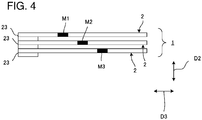
- each of the flat circuit bodies 2 is provided with the bent portion 23 bent at approximately 90 degrees, and as shown in Fig. 4 , the bent portions 23 are also stacked in the thickness direction D2.
- the flat circuit bodies 2 described above are respectively provided with markings M1 to M3 on one side surface S1 of a pair of side surfaces S1, S2 ( Fig. 1 ) opposite to each other in the width direction D1.
- the markings M1 to M3 are for identifying the flat circuit bodies 2, and are provided by applying ink or the like and coloring.
- the markings M1 to M3 are provided in a vicinity of the bent portions 23 in the side surface S1.
- distances of the flat circuit bodies 2 in a length direction D3 from the respective bent portions 23 (a reference position) to the markings M1 to M3 are provided to be different for each type of the flat circuit bodies 2 provided with the markings M1 to M3.
- the type of the flat circuit body 2 is classified according to a form of the flat circuit body 2 (for example, the number of conductive portions 21) and a shape (a different length, or the like) of the flat circuit body 2.
- the marking M1 provided on the flat circuit body 2 stacked on the top in Fig. 4 is provided such that the distance from the bent portion 23 is shortest.
- the marking M2 provided on the flat circuit body 2 stacked in the middle is provided such that the distance from the bent portion 23 is second shortest.
- the marking M3 provided on the flat circuit body 2 stacked at the bottom is provided such that the distance from the bent portion 23 is the longest. That is, in the plurality of flat circuit bodies 2, the distances from the bent portions 23 to the markings M1 to M3 become longer as arrangement positions of the markings go downward (one side) in the thickness direction D2.
- the markings M1 to M3 are provided on the side surfaces S1 of the flat circuit bodies 2.
- the distances from the respective bent portions 23 to the markings M1 to M3 are different for each type of the flat circuit bodies 2.
- positions of the markings M1 to M3 in the length direction D3 are different for each type of the flat circuit bodies 2. Accordingly, the flat circuit body 2 can be identified by the positions of the markings M1 to M3 in the length direction D3 (the distances from the respective bent portions 23 to the markings M1 to M3). Therefore, the flat circuit body 2 can be easily identified at low cost.
- the distances from the bent portions 23 to the markings M1 to M3 become longer as the arrangement positions go downward in the thickness direction D2. As a result, it is possible to easily recognize whether or not there is an error in the lamination of the flat circuit body 2.
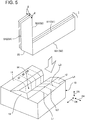
- the identification jig 10 is provided in a substantially cubic shape, includes a bottom wall (not shown) and three side walls 11 to 13 erecting from the bottom wall, and has an elongated groove portion 14 formed therein. A periphery of the bent portion 23 of the flat harness 1 is inserted into the groove portion 14.
- the side walls 11, 12 are spaced apart from each other in a width direction D4 of the groove portion 14 and form the groove portion 14 therebetween.
- One side (a lower side in the figure) of the groove portion 14 in a depth direction D5 is closed by the bottom wall (not shown), and another side (an upper side in the figure) of the groove portion 14 in the depth direction D5 is opened.
- one side (a right side in the figure) of the groove 14 in a longitudinal direction D6 is opened, and another side (a left side in the figure) of the longitudinal direction D6 is closed by the side wall 13.
- the operator inserts the periphery of the bent portion 23 of the flat harness 1 into the groove portion 14 so that the side surface portion S21 of the flat circuit body 2 abuts against the bottom wall (not shown) of the identification jig 10 and the side surface portion S12 abuts against the side wall 13.
- the markings M1 to M3 provided on the side surface portions S11 of the flat circuit bodies 2 can be visually recognized from an upper opening of the groove portion 14.
- dotted lines L1 to L4 indicating ranges of the markings M1 to M3 provided on the flat circuit bodies 2 are formed side by side in the longitudinal direction D6 on upper surface and inner surfaces of the side walls 11, 12 by printing or the like.
- an area between the dotted line L1 and the dotted line L2 indicate the range of the marking M1
- an area between the dotted line L2 and the dotted line L3 indicate the range of the marking M2
- an area between the dotted line L3 and the dotted line L4 indicate the range of the marking M3.
- a number "01” indicating the laminating order of the flat circuit body 2 in which the marking M1 is formed between the dotted lines L1, L2 is formed by printing or the like.
- a number "02” indicating the laminating order of the flat circuit body 2 in which the marking M2 is formed between the dotted lines L2, L3 is formed.
- a number "03” indicating the laminating order of the flat circuit body 2 in which the marking M3 is formed between the dotted lines L4, L5 is formed.
- each of the flat circuit bodies 2 can be identified more easily using the identification jig 10 as shown in Fig. 5 .
- the present invention is not limited to the embodiment described above, and may be appropriately modified, improved, or the like.
- materials, shapes, dimensions, numbers, arrangement positions or the like of elements in the embodiment described above are optional and not limited as long as the present invention can be achieved.
- the distances between the respective bent portions 23 and the markings M1 to M3 are different for each type of the flat circuit bodies 2, but the present invention is not limited thereto.
- the colors and shapes of the markings M1 to M3 may be different depending on the type of the flat circuit bodies 2. In this case, the colors of the markings M1 to M3 may be different for each form of the flat circuit bodies 2, and the shapes of the markings M1 to M3 may be different for each shape (the different lengths, or the like) of the flat circuit bodies 2.
- the markings M1, M3 having the same color and different shapes are respectively provided in the uppermost flat circuit body 2 and the lowermost flat circuit body 2, and it can be seen at a glance that the markings M1, M3 are of the same form but have different shapes.
- the correct laminating order of the flat circuit body 2 is shown in Fig. 6 , but the present invention is not limited thereto.
- what is shown in Fig. 7 may be the correct laminating order of the flat circuit body 2.
- the laminating order may be determined using the identification jig 10 on which the positions of the numbers "02" and "03" are changed.
- the reference position of the flat circuit body 2 is the bent portion 23, but the present invention is not limited thereto.
- an end portion of the flat circuit body 2 may be set as the reference position.
- a mark (the markings M1 to M3) provided on the side surface S1 of the flat circuit body 2 is provided by coloring, but the present invention is not limited thereto.
- the mark may be provided by cutting out the side surface S1 or by protruding a tab.
Landscapes
- Engineering & Computer Science (AREA)
- Microelectronics & Electronic Packaging (AREA)
- Mechanical Engineering (AREA)
- Structure Of Printed Boards (AREA)
- Insulated Conductors (AREA)
- Electric Cable Installation (AREA)
Abstract
Description
- The present invention relates to a flat harness configured by laminating a plurality of flat circuit bodies.
- Conventionally, identification of a flat circuit body is performed by printing a number or the like on a plane of the flat circuit body (
JP-A-H05-242746 - There has been proposed that a flat circuit body has a tab protruding in a width direction thereof, and an identifier is provided on the tab (
JP-A-H07-176216 A-H06-23123 - The present invention has been made in view of the above-described circumstances, and an object thereof is to provide a flat harness that can easily identify a flat circuit body at low cost.
- In order to achieve the above object, the flat harness according to the present invention is characterized by the following items [1] to [6].
- [1] There is provided a flat harness including:
- a plurality of flat circuit bodies that are stacked to each other,
- in which a mark is provided on a side surface of each of the plurality of flat circuit bodies; and
- in which a position of the mark in a length direction of the flat circuit body is provided so as to be different for each type of the flat circuit body.
- [2] In the flat harness according to the item [1], the mark is provided by coloring.
- [3] In the flat harness according to the item [2], a color or a shape of the mark is different for each type of the flat circuit body.
- [4] In the flat harness according to any one of the items [1] to [3], a distance in the length direction of the flat circuit body from a reference position of the flat circuit body to the position of the mark is different for each type of the flat circuit body.
- [5] In the flat harness according to the item [4], each of the plurality of flat circuit bodies has a bent portion formed by bending and overlapping a part of the corresponding flat circuit body, and the bent portion is the reference position.
- [6] In the flat harness according to the items [4] or [5], the plurality of flat circuit bodies are stacked so that distances from the reference positions to the positions of the marks in the plurality of flat circuit bodies increase toward one side in a stacked direction of the plurality of flat circuit bodies.
- According to the flat harness of the above configuration of the item [1], the mark is provided on the side surface of each of the flat circuit bodies. In addition, the position of the mark in the length direction of the flat circuit body is provided so as to be different for each type of the flat circuit body. As a result, the flat circuit body can be identified by the position of the mark in the length direction. Therefore, the flat circuit body can be easily identified at low cost.
- According to the flat harness having the above configuration of the item [2], the mark is provided by coloring. Accordingly, the mark can be easily provided. In addition, since the position of the mark in the length direction is different for each type of flat circuit body, the flat circuit body can be easily identified even if the mark is provided by coloring on a portion having a small area such as a side surface.
- According to the flat harness having the above configuration of the item [3], the color or shape of the mark is different for each type of the flat circuit body. As a result, the identification of the flat circuit body can be further facilitated.
- According to the flat harness having the above configuration of the item [4], the distance in the length direction from the reference position to the mark is different for each type of the flat circuit body provided with the mark. Therefore, the identification of the flat circuit body can be further facilitated.
- According to the flat harness having the above configuration of the item [5], the mark is provided with the bent portion as the reference position. As a result, the identification of the flat circuit body can be further facilitated.
- According to the flat harness having the above configuration of the item [6], the distances of the plurality of flat circuit bodies from the reference positions to the marks become longer as the arrangement positions go toward one side in the lamination direction. As a result, it is possible to easily recognize whether or not there is an error in the lamination of the flat circuit body.
- According to the present invention, it is possible to provide the flat harness that can easily identify a flat circuit body at low cost without increasing a width.
- The present invention has been briefly described above. Further, details of the present invention will be clarified by reading a mode (hereinafter, referred to as an "embodiment".) for carrying out the invention to be described below with reference to the accompanying drawings.
-
-
Fig. 1 is a perspective view of a flat harness according to the present invention. -
Fig. 2 is an exploded perspective view of the flat harness shown inFig. 1 . -
Fig. 3 is a sectional view taken along a line I-I ofFig. 2 . -
Fig. 4 is an X arrow view of the flat harness ofFig. 1 . -
Fig. 5 is a perspective view of the flat harness shown inFig. 1 and an identification jig for identifying a flat circuit body forming the flat harness. -
Fig. 6 is an example of a top view when the flat harness is inserted into the identification jig shown inFig. 5 . -
Fig. 7 is an example of a top view when the flat harness is inserted into the identification jig shown inFig. 5 . -
Fig. 8 is an example of a top view when the flat harness is inserted into the identification jig shown inFig. 5 . - A specific embodiment of the present invention will be described below with reference to the drawings.
- A
flat harness 1 of the present embodiment shown inFigs. 1 to 4 is an electric wire for explaining electric components mounted on a vehicle, for example. A connector is connected to an end portion of theflat harness 1, and the electrical components are connected to each other by connecting the connector to a mating connector of the electrical component. - As shown in
Figs. 1 and2 , in the present embodiment, theflat harness 1 is configured by laminating a plurality of (for example, three)flat circuit bodies 2. The plurality offlat circuit bodies 2 are each provided in a long sheet shape, and have substantially the same width. As shown inFig. 3 , each of theflat circuit bodies 2 includesconductive portions 21 and a pair ofinsulating covering portions conductive portion 21. - The
conductive portions 21 are each provided in a long sheet shape, and the plurality ofconductive portions 21 are arranged side by side at intervals in a width direction D1. The pair ofinsulating covering portions conductive portions 21 with both sides thereof sandwiched in a thickness direction D2. In an example shown inFig. 3 , the plurality ofconductive portions 21 are provided, but the present invention is not limited thereto, and oneconductive portion 21 may be provided. - As shown in
Fig. 1 , theflat harness 1 is configured by laminating the plurality offlat circuit bodies 2 in the thickness direction D2 (= a lamination direction). In addition, theflat harness 1 is formed to have a desired harness shape and be guided to a mating connector of an electrical component by appropriately providing abent portion 23 in which a plane of eachflat circuit body 2 is partially overlapped and bent. The plane of theflat circuit body 2 described above is a surface facing the thickness direction D2 of theflat circuit body 2. In the present embodiment, each of theflat circuit bodies 2 is provided with thebent portion 23 bent at approximately 90 degrees, and as shown inFig. 4 , thebent portions 23 are also stacked in the thickness direction D2. - As shown in
Fig. 4 , theflat circuit bodies 2 described above are respectively provided with markings M1 to M3 on one side surface S1 of a pair of side surfaces S1, S2 (Fig. 1 ) opposite to each other in the width direction D1. The markings M1 to M3 are for identifying theflat circuit bodies 2, and are provided by applying ink or the like and coloring. In addition, the markings M1 to M3 are provided in a vicinity of thebent portions 23 in the side surface S1. Further, distances of theflat circuit bodies 2 in a length direction D3 from the respective bent portions 23 (a reference position) to the markings M1 to M3 are provided to be different for each type of theflat circuit bodies 2 provided with the markings M1 to M3. Incidentally, the type of theflat circuit body 2 is classified according to a form of the flat circuit body 2 (for example, the number of conductive portions 21) and a shape (a different length, or the like) of theflat circuit body 2. - In the present embodiment, the marking M1 provided on the
flat circuit body 2 stacked on the top inFig. 4 is provided such that the distance from thebent portion 23 is shortest. The marking M2 provided on theflat circuit body 2 stacked in the middle is provided such that the distance from thebent portion 23 is second shortest. The marking M3 provided on theflat circuit body 2 stacked at the bottom is provided such that the distance from thebent portion 23 is the longest. That is, in the plurality offlat circuit bodies 2, the distances from thebent portions 23 to the markings M1 to M3 become longer as arrangement positions of the markings go downward (one side) in the thickness direction D2. - According to the
flat harness 1 described above, the markings M1 to M3 are provided on the side surfaces S1 of theflat circuit bodies 2. In addition, the distances from the respectivebent portions 23 to the markings M1 to M3 are different for each type of theflat circuit bodies 2. In other words, positions of the markings M1 to M3 in the length direction D3 are different for each type of theflat circuit bodies 2. Accordingly, theflat circuit body 2 can be identified by the positions of the markings M1 to M3 in the length direction D3 (the distances from the respectivebent portions 23 to the markings M1 to M3). Therefore, theflat circuit body 2 can be easily identified at low cost. - According to the
flat harness 1 described above, the markings M1 to M3 are provided by coloring. Accordingly, the markings M1 to M3 can be easily provided. In addition, since the distances from the respectivebent portions 23 to the markings M1 to M3 are different for each type of theflat circuit bodies 2, even if the markings M1 to M3 are each provided by coloring on a portion having a small area such as the side surface S1, theflat circuit body 2 can be easily identified. - In the
flat harness 1 described above, it is possible to identify theflat circuit body 2 and to easily determine whether or not there is an error in a laminating order of theflat circuit body 2 only by visually recognizing the side surface S1 as described above. However, as shown inFig. 5 , it is possible to more easily identify theflat circuit body 2 and determine whether or not there is an error in the laminating order using anidentification jig 10. - In the
flat harness 1 described above, in the plurality offlat circuit bodies 2, the distances from thebent portions 23 to the markings M1 to M3 become longer as the arrangement positions go downward in the thickness direction D2. As a result, it is possible to easily recognize whether or not there is an error in the lamination of theflat circuit body 2. - The identification of the
flat circuit body 2 using theidentification jig 10 will be described. Hereinafter, as shown inFig. 5 , in theflat circuit bodies 2, sides of the side surfaces S1 on which the markings M1 to M3 are provided with the respectivebent portions 23 interposed therebetween are described as side surface portions S11, and sides of the side surfaces S1 on which the markings M1 to M3 are not provided are described as side surface portions S12. In addition, a portion of the side surface S2 facing the side surface portion S11 in the width direction D1 is referred to as a side surface portion S21, and a portion of the side surface S2 facing the side surface portion S12 in the width direction D1 is referred to as a side surface portion S22. - The
identification jig 10 is provided in a substantially cubic shape, includes a bottom wall (not shown) and threeside walls 11 to 13 erecting from the bottom wall, and has an elongatedgroove portion 14 formed therein. A periphery of thebent portion 23 of theflat harness 1 is inserted into thegroove portion 14. Theside walls groove portion 14 and form thegroove portion 14 therebetween. One side (a lower side in the figure) of thegroove portion 14 in a depth direction D5 is closed by the bottom wall (not shown), and another side (an upper side in the figure) of thegroove portion 14 in the depth direction D5 is opened. In addition, one side (a right side in the figure) of thegroove 14 in a longitudinal direction D6 is opened, and another side (a left side in the figure) of the longitudinal direction D6 is closed by theside wall 13. - The operator inserts the periphery of the
bent portion 23 of theflat harness 1 into thegroove portion 14 so that the side surface portion S21 of theflat circuit body 2 abuts against the bottom wall (not shown) of theidentification jig 10 and the side surface portion S12 abuts against theside wall 13. When theflat harness 1 is inserted into thegroove portion 14 of theidentification jig 10 in this manner, as shown inFigs. 6 and 7 , the markings M1 to M3 provided on the side surface portions S11 of theflat circuit bodies 2 can be visually recognized from an upper opening of thegroove portion 14. - As shown in
Fig. 5 , dotted lines L1 to L4 indicating ranges of the markings M1 to M3 provided on theflat circuit bodies 2 are formed side by side in the longitudinal direction D6 on upper surface and inner surfaces of theside walls side wall 11, a number "01" indicating the laminating order of theflat circuit body 2 in which the marking M1 is formed between the dotted lines L1, L2 is formed by printing or the like. A number "02" indicating the laminating order of theflat circuit body 2 in which the marking M2 is formed between the dotted lines L2, L3 is formed. A number "03" indicating the laminating order of theflat circuit body 2 in which the marking M3 is formed between the dotted lines L4, L5 is formed. - As a result, as shown in
Fig. 6 , if theflat circuit body 2 in which the marking M1 is formed within the range of the dotted lines L1 and the dotted line L2 is positioned at the top, theflat circuit body 2 in which the marking M2 is formed within the range of the dotted line L2 and the dotted line L3 is positioned in the middle, and theflat circuit body 2 in which the marking M3 is formed within the range of the dotted line L3 and the dotted line L4 is positioned at the bottom, it is possible to visually easily determine that there is no error in the laminating order of theflat circuit body 2. - On the other hand, as shown in
Fig. 7 , if theflat circuit body 2 in which the marking M2 is formed within the range of the dotted line L2 to the dotted line L3 is not positioned in the middle, and theflat circuit body 2 in which the marking M3 is formed within the range of the dotted line L3 to the dotted line L4 is not positioned at the bottom, it is possible to visually easily determine that there is an error in the laminating order of theflat circuit body 2. - According to the embodiment described above, since the markings M1 to M3 are respectively provided on the
flat circuit bodies 2 with thebent portions 23 as the reference positions, each of theflat circuit bodies 2 can be identified more easily using theidentification jig 10 as shown inFig. 5 . - The present invention is not limited to the embodiment described above, and may be appropriately modified, improved, or the like. In addition, materials, shapes, dimensions, numbers, arrangement positions or the like of elements in the embodiment described above are optional and not limited as long as the present invention can be achieved.
- According to the embodiment described above, the distances between the respective
bent portions 23 and the markings M1 to M3 are different for each type of theflat circuit bodies 2, but the present invention is not limited thereto. The colors and shapes of the markings M1 to M3 may be different depending on the type of theflat circuit bodies 2. In this case, the colors of the markings M1 to M3 may be different for each form of theflat circuit bodies 2, and the shapes of the markings M1 to M3 may be different for each shape (the different lengths, or the like) of theflat circuit bodies 2. In an example shown inFig. 8 , the markings M1, M3 having the same color and different shapes are respectively provided in the uppermostflat circuit body 2 and the lowermostflat circuit body 2, and it can be seen at a glance that the markings M1, M3 are of the same form but have different shapes. - According to the embodiment described above, the correct laminating order of the
flat circuit body 2 is shown inFig. 6 , but the present invention is not limited thereto. Depending on a product, what is shown inFig. 7 may be the correct laminating order of theflat circuit body 2. In this case, the laminating order may be determined using theidentification jig 10 on which the positions of the numbers "02" and "03" are changed. - According to the embodiment described above, the reference position of the
flat circuit body 2 is thebent portion 23, but the present invention is not limited thereto. As the reference position, an end portion of theflat circuit body 2 may be set as the reference position. - According to the embodiment described above, a mark (the markings M1 to M3) provided on the side surface S1 of the
flat circuit body 2 is provided by coloring, but the present invention is not limited thereto. The mark may be provided by cutting out the side surface S1 or by protruding a tab.
Claims (6)
- A flat harness comprising:a plurality of flat circuit bodies that are stacked to each other,wherein a mark is provided on a side surface of each of the plurality of flat circuit bodies; andwherein a position of the mark in a length direction of the flat circuit body is provided so as to be different for each type of the flat circuit body.
- The flat harness according to claim 1, wherein the mark is provided by coloring.
- The flat harness according to claim 2, wherein a color or a shape of the mark is different for each type of the flat circuit body.
- The flat harness according to any one of claims 1 to 3, wherein a distance in the length direction of the flat circuit body from a reference position of the flat circuit body to the position of the mark is different for each type of the flat circuit body.
- The flat harness according to claim 4, wherein each of the plurality of flat circuit bodies has a bent portion formed by bending and overlapping a part of the corresponding flat circuit body;and
wherein the bent portion is the reference position. - The flat harness according to claim 4 or 5, wherein the plurality of flat circuit bodies are stacked so that distances from the reference positions to the positions of the marks in the plurality of flat circuit bodies increase toward one side in a stacked direction of the plurality of flat circuit bodies.
Applications Claiming Priority (1)
| Application Number | Priority Date | Filing Date | Title |
|---|---|---|---|
| JP2019114882A JP7025378B2 (en) | 2019-06-20 | 2019-06-20 | Flat harness |
Publications (2)
| Publication Number | Publication Date |
|---|---|
| EP3754670A1 true EP3754670A1 (en) | 2020-12-23 |
| EP3754670B1 EP3754670B1 (en) | 2022-08-17 |
Family
ID=70740528
Family Applications (1)
| Application Number | Title | Priority Date | Filing Date |
|---|---|---|---|
| EP20175226.8A Active EP3754670B1 (en) | 2019-06-20 | 2020-05-18 | Flat harness |
Country Status (4)
| Country | Link |
|---|---|
| US (1) | US11102881B2 (en) |
| EP (1) | EP3754670B1 (en) |
| JP (1) | JP7025378B2 (en) |
| CN (1) | CN112117048B (en) |
Citations (6)
| Publication number | Priority date | Publication date | Assignee | Title |
|---|---|---|---|---|
| US4636017A (en) * | 1984-06-01 | 1987-01-13 | Harvey Hubbell Incorporated | Flat conductor cable |
| JPH05242746A (en) | 1992-02-26 | 1993-09-21 | Furukawa Electric Co Ltd:The | Flat cable manufacturing method |
| JPH0623123A (en) | 1993-06-11 | 1994-02-01 | Ace Denken:Kk | Pachinko ball game machine |
| JPH07176216A (en) | 1993-12-20 | 1995-07-14 | Sumitomo Wiring Syst Ltd | Flat harness |
| JP2001216846A (en) * | 2000-02-04 | 2001-08-10 | Auto Network Gijutsu Kenkyusho:Kk | Tape wire with terminal, method for manufacturing the same, and method for manufacturing wire harness |
| JP2002056722A (en) * | 2000-08-11 | 2002-02-22 | Sumitomo Wiring Syst Ltd | Flat harness |
Family Cites Families (7)
| Publication number | Priority date | Publication date | Assignee | Title |
|---|---|---|---|---|
| JPH0351863U (en) * | 1989-09-27 | 1991-05-20 | ||
| JP2591330Y2 (en) * | 1992-08-28 | 1999-03-03 | 三菱電線工業株式会社 | Multilayer flat cable |
| JPH0664323U (en) * | 1993-02-19 | 1994-09-09 | 住友電装株式会社 | Flat harness |
| JPH1127817A (en) * | 1997-07-07 | 1999-01-29 | Harness Sogo Gijutsu Kenkyusho:Kk | Circuit identification method for wire harness |
| JP2003229225A (en) | 2002-01-31 | 2003-08-15 | Sumitomo Wiring Syst Ltd | Inspection method of electric wire connection to connector |
| PH12012501703A1 (en) * | 2010-03-02 | 2015-05-20 | Yazaki Corp | Wiring harness and manufacturing method thereof |
| US9842823B2 (en) * | 2014-12-29 | 2017-12-12 | Taiwan Semiconductor Manufacturing Co., Ltd. | Chip-stacking apparatus having a transport device configured to transport a chip onto a substrate |
-
2019
- 2019-06-20 JP JP2019114882A patent/JP7025378B2/en active Active
-
2020
- 2020-05-18 EP EP20175226.8A patent/EP3754670B1/en active Active
- 2020-05-18 CN CN202010420933.1A patent/CN112117048B/en active Active
- 2020-05-19 US US16/878,559 patent/US11102881B2/en active Active
Patent Citations (6)
| Publication number | Priority date | Publication date | Assignee | Title |
|---|---|---|---|---|
| US4636017A (en) * | 1984-06-01 | 1987-01-13 | Harvey Hubbell Incorporated | Flat conductor cable |
| JPH05242746A (en) | 1992-02-26 | 1993-09-21 | Furukawa Electric Co Ltd:The | Flat cable manufacturing method |
| JPH0623123A (en) | 1993-06-11 | 1994-02-01 | Ace Denken:Kk | Pachinko ball game machine |
| JPH07176216A (en) | 1993-12-20 | 1995-07-14 | Sumitomo Wiring Syst Ltd | Flat harness |
| JP2001216846A (en) * | 2000-02-04 | 2001-08-10 | Auto Network Gijutsu Kenkyusho:Kk | Tape wire with terminal, method for manufacturing the same, and method for manufacturing wire harness |
| JP2002056722A (en) * | 2000-08-11 | 2002-02-22 | Sumitomo Wiring Syst Ltd | Flat harness |
Also Published As
| Publication number | Publication date |
|---|---|
| US11102881B2 (en) | 2021-08-24 |
| EP3754670B1 (en) | 2022-08-17 |
| JP7025378B2 (en) | 2022-02-24 |
| US20200404776A1 (en) | 2020-12-24 |
| CN112117048B (en) | 2022-02-25 |
| JP2021002452A (en) | 2021-01-07 |
| CN112117048A (en) | 2020-12-22 |
Similar Documents
| Publication | Publication Date | Title |
|---|---|---|
| US10418773B2 (en) | Holding frame for a plug-type connector | |
| US6597578B2 (en) | Electrical connection box | |
| CN103515892B (en) | Electrical connection box | |
| GB1580443A (en) | Electrical coil assembly | |
| EP3813211B1 (en) | Bus bar cover | |
| JPH0955235A (en) | Wiring board for electrical connection | |
| JP2000252003A (en) | Splice absorption connector | |
| JP6370256B2 (en) | Power storage module | |
| JP3149966U (en) | Modular connector | |
| JP2018041713A (en) | External connection bus bar holding module and battery connection module | |
| EP3754670B1 (en) | Flat harness | |
| US9520255B2 (en) | Connection structure of electronic component and terminal metal fittings | |
| JP6737135B2 (en) | connector | |
| EP1617162B1 (en) | Heat exchanger | |
| US20080073119A1 (en) | Electrical Cable Having An Orientation Marker | |
| JP2002056722A (en) | Flat harness | |
| US6923671B2 (en) | Electric connection box | |
| WO2017163995A1 (en) | External connection bus bar holding module and battery connection module | |
| US6428335B1 (en) | Bus bar with terminal insulator and connector guide therefor | |
| CN107735911A (en) | Joint connector | |
| EP2650974B1 (en) | Terminal block and electronics unit | |
| JP6445891B2 (en) | FUSE UNIT AND FUSE UNIT MANUFACTURING METHOD | |
| JP2004006218A (en) | Punching device, punching method and flat cable | |
| JPH04131845U (en) | card type fuse | |
| JP2009032737A (en) | Flexible printed wiring board |
Legal Events
| Date | Code | Title | Description |
|---|---|---|---|
| PUAI | Public reference made under article 153(3) epc to a published international application that has entered the european phase |
Free format text: ORIGINAL CODE: 0009012 |
|
| STAA | Information on the status of an ep patent application or granted ep patent |
Free format text: STATUS: REQUEST FOR EXAMINATION WAS MADE |
|
| 17P | Request for examination filed |
Effective date: 20200518 |
|
| AK | Designated contracting states |
Kind code of ref document: A1 Designated state(s): AL AT BE BG CH CY CZ DE DK EE ES FI FR GB GR HR HU IE IS IT LI LT LU LV MC MK MT NL NO PL PT RO RS SE SI SK SM TR |
|
| AX | Request for extension of the european patent |
Extension state: BA ME |
|
| STAA | Information on the status of an ep patent application or granted ep patent |
Free format text: STATUS: EXAMINATION IS IN PROGRESS |
|
| 17Q | First examination report despatched |
Effective date: 20210504 |
|
| GRAP | Despatch of communication of intention to grant a patent |
Free format text: ORIGINAL CODE: EPIDOSNIGR1 |
|
| STAA | Information on the status of an ep patent application or granted ep patent |
Free format text: STATUS: GRANT OF PATENT IS INTENDED |
|
| INTG | Intention to grant announced |
Effective date: 20220608 |
|
| GRAS | Grant fee paid |
Free format text: ORIGINAL CODE: EPIDOSNIGR3 |
|
| GRAA | (expected) grant |
Free format text: ORIGINAL CODE: 0009210 |
|
| STAA | Information on the status of an ep patent application or granted ep patent |
Free format text: STATUS: THE PATENT HAS BEEN GRANTED |
|
| AK | Designated contracting states |
Kind code of ref document: B1 Designated state(s): AL AT BE BG CH CY CZ DE DK EE ES FI FR GB GR HR HU IE IS IT LI LT LU LV MC MK MT NL NO PL PT RO RS SE SI SK SM TR |
|
| REG | Reference to a national code |
Ref country code: CH Ref legal event code: EP |
|
| REG | Reference to a national code |
Ref country code: DE Ref legal event code: R096 Ref document number: 602020004534 Country of ref document: DE |
|
| REG | Reference to a national code |
Ref country code: IE Ref legal event code: FG4D |
|
| REG | Reference to a national code |
Ref country code: AT Ref legal event code: REF Ref document number: 1512702 Country of ref document: AT Kind code of ref document: T Effective date: 20220915 |
|
| REG | Reference to a national code |
Ref country code: NL Ref legal event code: MP Effective date: 20220817 |
|
| REG | Reference to a national code |
Ref country code: LT Ref legal event code: MG9D |
|
| PG25 | Lapsed in a contracting state [announced via postgrant information from national office to epo] |
Ref country code: SE Free format text: LAPSE BECAUSE OF FAILURE TO SUBMIT A TRANSLATION OF THE DESCRIPTION OR TO PAY THE FEE WITHIN THE PRESCRIBED TIME-LIMIT Effective date: 20220817 Ref country code: RS Free format text: LAPSE BECAUSE OF FAILURE TO SUBMIT A TRANSLATION OF THE DESCRIPTION OR TO PAY THE FEE WITHIN THE PRESCRIBED TIME-LIMIT Effective date: 20220817 Ref country code: PT Free format text: LAPSE BECAUSE OF FAILURE TO SUBMIT A TRANSLATION OF THE DESCRIPTION OR TO PAY THE FEE WITHIN THE PRESCRIBED TIME-LIMIT Effective date: 20221219 Ref country code: NO Free format text: LAPSE BECAUSE OF FAILURE TO SUBMIT A TRANSLATION OF THE DESCRIPTION OR TO PAY THE FEE WITHIN THE PRESCRIBED TIME-LIMIT Effective date: 20221117 Ref country code: NL Free format text: LAPSE BECAUSE OF FAILURE TO SUBMIT A TRANSLATION OF THE DESCRIPTION OR TO PAY THE FEE WITHIN THE PRESCRIBED TIME-LIMIT Effective date: 20220817 Ref country code: LV Free format text: LAPSE BECAUSE OF FAILURE TO SUBMIT A TRANSLATION OF THE DESCRIPTION OR TO PAY THE FEE WITHIN THE PRESCRIBED TIME-LIMIT Effective date: 20220817 Ref country code: LT Free format text: LAPSE BECAUSE OF FAILURE TO SUBMIT A TRANSLATION OF THE DESCRIPTION OR TO PAY THE FEE WITHIN THE PRESCRIBED TIME-LIMIT Effective date: 20220817 Ref country code: FI Free format text: LAPSE BECAUSE OF FAILURE TO SUBMIT A TRANSLATION OF THE DESCRIPTION OR TO PAY THE FEE WITHIN THE PRESCRIBED TIME-LIMIT Effective date: 20220817 |
|
| REG | Reference to a national code |
Ref country code: AT Ref legal event code: MK05 Ref document number: 1512702 Country of ref document: AT Kind code of ref document: T Effective date: 20220817 |
|
| PG25 | Lapsed in a contracting state [announced via postgrant information from national office to epo] |
Ref country code: PL Free format text: LAPSE BECAUSE OF FAILURE TO SUBMIT A TRANSLATION OF THE DESCRIPTION OR TO PAY THE FEE WITHIN THE PRESCRIBED TIME-LIMIT Effective date: 20220817 Ref country code: IS Free format text: LAPSE BECAUSE OF FAILURE TO SUBMIT A TRANSLATION OF THE DESCRIPTION OR TO PAY THE FEE WITHIN THE PRESCRIBED TIME-LIMIT Effective date: 20221217 Ref country code: HR Free format text: LAPSE BECAUSE OF FAILURE TO SUBMIT A TRANSLATION OF THE DESCRIPTION OR TO PAY THE FEE WITHIN THE PRESCRIBED TIME-LIMIT Effective date: 20220817 Ref country code: GR Free format text: LAPSE BECAUSE OF FAILURE TO SUBMIT A TRANSLATION OF THE DESCRIPTION OR TO PAY THE FEE WITHIN THE PRESCRIBED TIME-LIMIT Effective date: 20221118 |
|
| PG25 | Lapsed in a contracting state [announced via postgrant information from national office to epo] |
Ref country code: SM Free format text: LAPSE BECAUSE OF FAILURE TO SUBMIT A TRANSLATION OF THE DESCRIPTION OR TO PAY THE FEE WITHIN THE PRESCRIBED TIME-LIMIT Effective date: 20220817 Ref country code: RO Free format text: LAPSE BECAUSE OF FAILURE TO SUBMIT A TRANSLATION OF THE DESCRIPTION OR TO PAY THE FEE WITHIN THE PRESCRIBED TIME-LIMIT Effective date: 20220817 Ref country code: ES Free format text: LAPSE BECAUSE OF FAILURE TO SUBMIT A TRANSLATION OF THE DESCRIPTION OR TO PAY THE FEE WITHIN THE PRESCRIBED TIME-LIMIT Effective date: 20220817 Ref country code: DK Free format text: LAPSE BECAUSE OF FAILURE TO SUBMIT A TRANSLATION OF THE DESCRIPTION OR TO PAY THE FEE WITHIN THE PRESCRIBED TIME-LIMIT Effective date: 20220817 Ref country code: CZ Free format text: LAPSE BECAUSE OF FAILURE TO SUBMIT A TRANSLATION OF THE DESCRIPTION OR TO PAY THE FEE WITHIN THE PRESCRIBED TIME-LIMIT Effective date: 20220817 Ref country code: AT Free format text: LAPSE BECAUSE OF FAILURE TO SUBMIT A TRANSLATION OF THE DESCRIPTION OR TO PAY THE FEE WITHIN THE PRESCRIBED TIME-LIMIT Effective date: 20220817 |
|
| REG | Reference to a national code |
Ref country code: DE Ref legal event code: R097 Ref document number: 602020004534 Country of ref document: DE |
|
| PG25 | Lapsed in a contracting state [announced via postgrant information from national office to epo] |
Ref country code: SK Free format text: LAPSE BECAUSE OF FAILURE TO SUBMIT A TRANSLATION OF THE DESCRIPTION OR TO PAY THE FEE WITHIN THE PRESCRIBED TIME-LIMIT Effective date: 20220817 Ref country code: EE Free format text: LAPSE BECAUSE OF FAILURE TO SUBMIT A TRANSLATION OF THE DESCRIPTION OR TO PAY THE FEE WITHIN THE PRESCRIBED TIME-LIMIT Effective date: 20220817 |
|
| PLBE | No opposition filed within time limit |
Free format text: ORIGINAL CODE: 0009261 |
|
| STAA | Information on the status of an ep patent application or granted ep patent |
Free format text: STATUS: NO OPPOSITION FILED WITHIN TIME LIMIT |
|
| PG25 | Lapsed in a contracting state [announced via postgrant information from national office to epo] |
Ref country code: AL Free format text: LAPSE BECAUSE OF FAILURE TO SUBMIT A TRANSLATION OF THE DESCRIPTION OR TO PAY THE FEE WITHIN THE PRESCRIBED TIME-LIMIT Effective date: 20220817 |
|
| 26N | No opposition filed |
Effective date: 20230519 |
|
| PG25 | Lapsed in a contracting state [announced via postgrant information from national office to epo] |
Ref country code: SI Free format text: LAPSE BECAUSE OF FAILURE TO SUBMIT A TRANSLATION OF THE DESCRIPTION OR TO PAY THE FEE WITHIN THE PRESCRIBED TIME-LIMIT Effective date: 20220817 |
|
| REG | Reference to a national code |
Ref country code: CH Ref legal event code: PL |
|
| PG25 | Lapsed in a contracting state [announced via postgrant information from national office to epo] |
Ref country code: MC Free format text: LAPSE BECAUSE OF FAILURE TO SUBMIT A TRANSLATION OF THE DESCRIPTION OR TO PAY THE FEE WITHIN THE PRESCRIBED TIME-LIMIT Effective date: 20220817 |
|
| REG | Reference to a national code |
Ref country code: BE Ref legal event code: MM Effective date: 20230531 |
|
| PG25 | Lapsed in a contracting state [announced via postgrant information from national office to epo] |
Ref country code: MC Free format text: LAPSE BECAUSE OF FAILURE TO SUBMIT A TRANSLATION OF THE DESCRIPTION OR TO PAY THE FEE WITHIN THE PRESCRIBED TIME-LIMIT Effective date: 20220817 Ref country code: LU Free format text: LAPSE BECAUSE OF NON-PAYMENT OF DUE FEES Effective date: 20230518 Ref country code: LI Free format text: LAPSE BECAUSE OF NON-PAYMENT OF DUE FEES Effective date: 20230531 Ref country code: CH Free format text: LAPSE BECAUSE OF NON-PAYMENT OF DUE FEES Effective date: 20230531 |
|
| REG | Reference to a national code |
Ref country code: IE Ref legal event code: MM4A |
|
| PG25 | Lapsed in a contracting state [announced via postgrant information from national office to epo] |
Ref country code: IE Free format text: LAPSE BECAUSE OF NON-PAYMENT OF DUE FEES Effective date: 20230518 |
|
| PG25 | Lapsed in a contracting state [announced via postgrant information from national office to epo] |
Ref country code: IE Free format text: LAPSE BECAUSE OF NON-PAYMENT OF DUE FEES Effective date: 20230518 |
|
| PG25 | Lapsed in a contracting state [announced via postgrant information from national office to epo] |
Ref country code: IT Free format text: LAPSE BECAUSE OF FAILURE TO SUBMIT A TRANSLATION OF THE DESCRIPTION OR TO PAY THE FEE WITHIN THE PRESCRIBED TIME-LIMIT Effective date: 20220817 Ref country code: FR Free format text: LAPSE BECAUSE OF NON-PAYMENT OF DUE FEES Effective date: 20230531 Ref country code: BE Free format text: LAPSE BECAUSE OF NON-PAYMENT OF DUE FEES Effective date: 20230531 |
|
| PG25 | Lapsed in a contracting state [announced via postgrant information from national office to epo] |
Ref country code: BG Free format text: LAPSE BECAUSE OF FAILURE TO SUBMIT A TRANSLATION OF THE DESCRIPTION OR TO PAY THE FEE WITHIN THE PRESCRIBED TIME-LIMIT Effective date: 20220817 |
|
| PG25 | Lapsed in a contracting state [announced via postgrant information from national office to epo] |
Ref country code: BG Free format text: LAPSE BECAUSE OF FAILURE TO SUBMIT A TRANSLATION OF THE DESCRIPTION OR TO PAY THE FEE WITHIN THE PRESCRIBED TIME-LIMIT Effective date: 20220817 |
|
| GBPC | Gb: european patent ceased through non-payment of renewal fee |
Effective date: 20240518 |
|
| PG25 | Lapsed in a contracting state [announced via postgrant information from national office to epo] |
Ref country code: GB Free format text: LAPSE BECAUSE OF NON-PAYMENT OF DUE FEES Effective date: 20240518 |
|
| PGFP | Annual fee paid to national office [announced via postgrant information from national office to epo] |
Ref country code: DE Payment date: 20250402 Year of fee payment: 6 |
|
| PG25 | Lapsed in a contracting state [announced via postgrant information from national office to epo] |
Ref country code: CY Free format text: LAPSE BECAUSE OF FAILURE TO SUBMIT A TRANSLATION OF THE DESCRIPTION OR TO PAY THE FEE WITHIN THE PRESCRIBED TIME-LIMIT; INVALID AB INITIO Effective date: 20200518 |
|
| PG25 | Lapsed in a contracting state [announced via postgrant information from national office to epo] |
Ref country code: HU Free format text: LAPSE BECAUSE OF FAILURE TO SUBMIT A TRANSLATION OF THE DESCRIPTION OR TO PAY THE FEE WITHIN THE PRESCRIBED TIME-LIMIT; INVALID AB INITIO Effective date: 20200518 |
|
| PG25 | Lapsed in a contracting state [announced via postgrant information from national office to epo] |
Ref country code: TR Free format text: LAPSE BECAUSE OF FAILURE TO SUBMIT A TRANSLATION OF THE DESCRIPTION OR TO PAY THE FEE WITHIN THE PRESCRIBED TIME-LIMIT Effective date: 20220817 |