EP3754615B1 - Standortbasierte anwendungsaktivierung - Google Patents
Standortbasierte anwendungsaktivierung Download PDFInfo
- Publication number
- EP3754615B1 EP3754615B1 EP20180869.8A EP20180869A EP3754615B1 EP 3754615 B1 EP3754615 B1 EP 3754615B1 EP 20180869 A EP20180869 A EP 20180869A EP 3754615 B1 EP3754615 B1 EP 3754615B1
- Authority
- EP
- European Patent Office
- Prior art keywords
- application
- virtual
- user
- world
- minimum amount
- Prior art date
- Legal status (The legal status is an assumption and is not a legal conclusion. Google has not performed a legal analysis and makes no representation as to the accuracy of the status listed.)
- Active
Links
Images


Classifications
-
- H—ELECTRICITY
- H04—ELECTRIC COMMUNICATION TECHNIQUE
- H04L—TRANSMISSION OF DIGITAL INFORMATION, e.g. TELEGRAPHIC COMMUNICATION
- H04L67/00—Network arrangements or protocols for supporting network services or applications
- H04L67/50—Network services
- H04L67/52—Network services specially adapted for the location of the user terminal
-
- H—ELECTRICITY
- H04—ELECTRIC COMMUNICATION TECHNIQUE
- H04W—WIRELESS COMMUNICATION NETWORKS
- H04W4/00—Services specially adapted for wireless communication networks; Facilities therefor
- H04W4/02—Services making use of location information
- H04W4/021—Services related to particular areas, e.g. point of interest [POI] services, venue services or geofences
-
- G—PHYSICS
- G06—COMPUTING OR CALCULATING; COUNTING
- G06F—ELECTRIC DIGITAL DATA PROCESSING
- G06F3/00—Input arrangements for transferring data to be processed into a form capable of being handled by the computer; Output arrangements for transferring data from processing unit to output unit, e.g. interface arrangements
- G06F3/01—Input arrangements or combined input and output arrangements for interaction between user and computer
- G06F3/011—Arrangements for interaction with the human body, e.g. for user immersion in virtual reality
- G06F3/013—Eye tracking input arrangements
-
- A—HUMAN NECESSITIES
- A63—SPORTS; GAMES; AMUSEMENTS
- A63F—CARD, BOARD, OR ROULETTE GAMES; INDOOR GAMES USING SMALL MOVING PLAYING BODIES; VIDEO GAMES; GAMES NOT OTHERWISE PROVIDED FOR
- A63F13/00—Video games, i.e. games using an electronically generated display having two or more dimensions
- A63F13/20—Input arrangements for video game devices
- A63F13/21—Input arrangements for video game devices characterised by their sensors, purposes or types
- A63F13/211—Input arrangements for video game devices characterised by their sensors, purposes or types using inertial sensors, e.g. accelerometers or gyroscopes
-
- A—HUMAN NECESSITIES
- A63—SPORTS; GAMES; AMUSEMENTS
- A63F—CARD, BOARD, OR ROULETTE GAMES; INDOOR GAMES USING SMALL MOVING PLAYING BODIES; VIDEO GAMES; GAMES NOT OTHERWISE PROVIDED FOR
- A63F13/00—Video games, i.e. games using an electronically generated display having two or more dimensions
- A63F13/20—Input arrangements for video game devices
- A63F13/21—Input arrangements for video game devices characterised by their sensors, purposes or types
- A63F13/216—Input arrangements for video game devices characterised by their sensors, purposes or types using geographical information, e.g. location of the game device or player using GPS
-
- A—HUMAN NECESSITIES
- A63—SPORTS; GAMES; AMUSEMENTS
- A63F—CARD, BOARD, OR ROULETTE GAMES; INDOOR GAMES USING SMALL MOVING PLAYING BODIES; VIDEO GAMES; GAMES NOT OTHERWISE PROVIDED FOR
- A63F13/00—Video games, i.e. games using an electronically generated display having two or more dimensions
- A63F13/30—Interconnection arrangements between game servers and game devices; Interconnection arrangements between game devices; Interconnection arrangements between game servers
- A63F13/35—Details of game servers
- A63F13/355—Performing operations on behalf of clients with restricted processing capabilities, e.g. servers transform changing game scene into an encoded video stream for transmitting to a mobile phone or a thin client
-
- G—PHYSICS
- G06—COMPUTING OR CALCULATING; COUNTING
- G06F—ELECTRIC DIGITAL DATA PROCESSING
- G06F16/00—Information retrieval; Database structures therefor; File system structures therefor
- G06F16/90—Details of database functions independent of the retrieved data types
- G06F16/95—Retrieval from the web
- G06F16/953—Querying, e.g. by the use of web search engines
- G06F16/9535—Search customisation based on user profiles and personalisation
-
- G—PHYSICS
- G06—COMPUTING OR CALCULATING; COUNTING
- G06F—ELECTRIC DIGITAL DATA PROCESSING
- G06F16/00—Information retrieval; Database structures therefor; File system structures therefor
- G06F16/90—Details of database functions independent of the retrieved data types
- G06F16/95—Retrieval from the web
- G06F16/953—Querying, e.g. by the use of web search engines
- G06F16/9537—Spatial or temporal dependent retrieval, e.g. spatiotemporal queries
-
- G—PHYSICS
- G06—COMPUTING OR CALCULATING; COUNTING
- G06F—ELECTRIC DIGITAL DATA PROCESSING
- G06F3/00—Input arrangements for transferring data to be processed into a form capable of being handled by the computer; Output arrangements for transferring data from processing unit to output unit, e.g. interface arrangements
- G06F3/01—Input arrangements or combined input and output arrangements for interaction between user and computer
- G06F3/011—Arrangements for interaction with the human body, e.g. for user immersion in virtual reality
-
- G—PHYSICS
- G06—COMPUTING OR CALCULATING; COUNTING
- G06F—ELECTRIC DIGITAL DATA PROCESSING
- G06F3/00—Input arrangements for transferring data to be processed into a form capable of being handled by the computer; Output arrangements for transferring data from processing unit to output unit, e.g. interface arrangements
- G06F3/01—Input arrangements or combined input and output arrangements for interaction between user and computer
- G06F3/017—Gesture based interaction, e.g. based on a set of recognized hand gestures
-
- G—PHYSICS
- G06—COMPUTING OR CALCULATING; COUNTING
- G06T—IMAGE DATA PROCESSING OR GENERATION, IN GENERAL
- G06T19/00—Manipulating three-dimensional [3D] models or images for computer graphics
- G06T19/003—Navigation within 3D models or images
-
- H—ELECTRICITY
- H04—ELECTRIC COMMUNICATION TECHNIQUE
- H04L—TRANSMISSION OF DIGITAL INFORMATION, e.g. TELEGRAPHIC COMMUNICATION
- H04L67/00—Network arrangements or protocols for supporting network services or applications
- H04L67/01—Protocols
- H04L67/06—Protocols specially adapted for file transfer, e.g. file transfer protocol [FTP]
-
- H—ELECTRICITY
- H04—ELECTRIC COMMUNICATION TECHNIQUE
- H04L—TRANSMISSION OF DIGITAL INFORMATION, e.g. TELEGRAPHIC COMMUNICATION
- H04L67/00—Network arrangements or protocols for supporting network services or applications
- H04L67/50—Network services
- H04L67/51—Discovery or management thereof, e.g. service location protocol [SLP] or web services
-
- H—ELECTRICITY
- H04—ELECTRIC COMMUNICATION TECHNIQUE
- H04W—WIRELESS COMMUNICATION NETWORKS
- H04W4/00—Services specially adapted for wireless communication networks; Facilities therefor
- H04W4/02—Services making use of location information
- H04W4/029—Location-based management or tracking services
-
- A—HUMAN NECESSITIES
- A63—SPORTS; GAMES; AMUSEMENTS
- A63F—CARD, BOARD, OR ROULETTE GAMES; INDOOR GAMES USING SMALL MOVING PLAYING BODIES; VIDEO GAMES; GAMES NOT OTHERWISE PROVIDED FOR
- A63F2300/00—Features of games using an electronically generated display having two or more dimensions, e.g. on a television screen, showing representations related to the game
- A63F2300/80—Features of games using an electronically generated display having two or more dimensions, e.g. on a television screen, showing representations related to the game specially adapted for executing a specific type of game
- A63F2300/8082—Virtual reality
Definitions
- aspects of the present disclosure relate generally to computer communications, and particularly to activation of applications in response to user interaction.
- LBS location based services
- wireless devices such as mobile phones, tablet computers, head-mounted displays, and other devices.
- LBSs may include a broad range of services that may be based on the current location of a user with respect to a specific place. Examples of LBS include providing the location of the nearest restaurant, banking automatic teller machine (ATM), or the whereabouts of a person; parcel tracking; providing advertising directed at potential customers based on the current customer location; and personalized weather services.
- LBSs are typically provided via a wireless network to which a user of a wireless device may subscribe or connect to as a casual user. Once connected, the current user location may be derived from various types of information, such as GPS, uplink time difference of arrival (u-TDOA), and others.
- the applications are usually visible to users as an icon within a digital application store contained in a database available at a server.
- the user may look for the application and only after fully downloading the application data may the user have full access to the application.
- the user may first require to download the application and he or she will then receive discounts or other promotional material of interest once within an application activation distance range.
- the user may activate the application whenever desired, or, when the function of the application completely depends on the user's location (e.g., LBS advertisements), the application may be activated when the user is within an activation distance range of the application.
- Needing to fully download the application in advance in order to be able to interact with the application may result cumbersome for some users and may increase storage requirements on the devices. Additionally, the application's data, such as media content, are typically processed by the user devices, resulting in high hardware demands in order to satisfactorily execute the application.
- US 2015/188984 A1 discloses a system and method for offloading augmented reality processing.
- a sensor external to a viewing device of a user tracks a location and an orientation of the viewing device. The location and orientation are defined relative to predefined references of a physical environment local to the user.
- a server receives a request from the viewing device to offload at least one of a tracking process and an augmented reality rendering process. The augmented reality rendering process is based on an augmented reality database.
- the server generates offloaded processed data based on the request and the location and the orientation of the viewing device.
- the offloaded processed data is streamed to the viewing device.
- a visualization of the offloaded processed data is generated in the viewing device.
- the present invention provides a system of claim 1, a computer-implemented method of claim 9 and a computer-readable medium of claim 15.
- a system includes one or more servers comprising a memory and a processor, the one or more servers storing and providing a persistent virtual world system including a virtual version of the real-world comprising one or more applications virtually attached to virtual-world entities positioned according to real-world coordinates, and the one or more servers being configured to compute the state of the virtual-world entities and to process the one or more applications.
- the one or more servers are configured to, responsive to detecting one or more user devices entering a trigger zone configured around the one or more applications, send a minimum amount of application graphical representation to the user device(s) via a wireless network.
- a minimum amount of application graphical representation includes one or more static images or dynamic images animated in a loop.
- the entry of the user device(s) into a trigger zone is detected by receiving a notification of the position of the user device(s) (e.g., from a wireless network that tracks the position of the user device(s)), which is compared to a known boundary of the trigger zone.
- the one or more servers signal the one or more user devices to download a minimum amount of application data and provide the minimum amount of application data to the one or more user devices.
- the minimum detected by receiving a notification of the position of the user device(s) (e.g., from a wireless network that tracks the position of the user device(s)), which is compared to a known boundary of the trigger zone.
- the one or more servers signal the one or more user devices to download a minimum amount of application data and provide the minimum amount of application data to the one or more user devices.
- the one or more servers determine two or more media streams.
- amount of application data is a minimum amount of application data that is sufficient to enable user interaction with the application.
- the one or more servers determine two or more media streams.
- the download of the minimum amount of application data by the user device(s) is detected by receiving a notification from the user device(s) that the download was successful.
- the determination of the media streams is based on user information such as user viewing position, orientation, or viewing angles, or a combination thereof. Determining the two or more media streams signals the one or more servers to perform heavy-load computational tasks on respective application media content to be delivered to users via the user device(s). In an embodiment, receiving the media content signals the user device(s) to perform lightweight computational tasks on the received media content in order to execute the application on the user device(s). In some embodiments, the two or more media streams are further selected based on profile information of a user stored in the server obtained through social media networks.
- the system further includes the one or more user devices, which are connected to the one or more servers via a network and configured to receive and execute the one or more applications.
- the current system and method enable users to view applications upon a user's proximity to objects and locations to which the applications are virtually attached, as well as enabling, upon interaction, to seamlessly download the minimum amount of application data that is sufficient to enable interaction with the application.
- a user employing the user device is not required to fully download the application in order to interact with the application, which may speed-up the activation process and reduce memory requirements on the user device.
- the servers may be provided as hardware and software including a processor and a memory, wherein the processor may be configured to access and execute instructions and data included in a memory coupled to the server, and wherein the memory is configured to store instructions and data.
- the processor may perform at least pre-processing of media content, determination of suitable media streams, and heavy-load computational tasks on media content. Pre-processing of media content may include at least performing sound and video compression and assembling.
- the heavy-load computational tasks may include physics simulation (e.g., rigid body dynamics, soft body dynamics, fluid dynamics, etc.), lighting and shadows simulations, and rendering, amongst others.
- the memory may store a persistent virtual world system, which may include a virtual version of the real-world comprising virtual-world entities positioned according to real-world coordinates, including latitudinal and longitudinal positional and orientational data, as well as fully virtual objects not existing in the real world.
- a user may, within an application trigger zone, view a real-world object including an application that may be positioned based on the position, orientation, and dimension of the real-world object.
- the user may, within an application trigger zone, view applications virtually attached to items existing only in the virtual world but attached to an existing location in the real world.
- the persistent virtual world system may additionally include one or more application stores configured in the real world space, each comprising one or more applications.
- the application stores may be represented as an area of the real world where users can view and interact with the applications.
- the users may have the option to continue interaction with the application outside of the server zone.
- the heavy-load computations on media content may be transferred to other servers in other server zones.
- users may as well have the option to stop interacting with the application.
- the minimum amount of application data may be stored as cache in a memory coupled to the user device so that the next time that the user enters the trigger zone, the minimum amount of application data may not need to be downloaded again to the user device.
- the applications may be accessed completely virtually by users.
- a user may employ a user device to travel in virtual reality (VR) to places stored in the persistent virtual world system without physically having to move to those places.
- the places may be places found in the real-world, may be computer-generated places found only in a virtual-world, or may include combinations thereof.
- users may be able to view and access the applications after accessing a virtual trigger zone configured around the virtual replica.
- the servers may be located in compute centers located in areas relatively close to the items virtually attached to the applications.
- the compute centers may refer to facilities arranged to house computer systems and associated components, such as telecommunication and storage systems, power supplies, redundant data communication connections, environmental controls, and various security devices.
- the user devices may include various operational components comprising at least an input and output module configured to enable interaction with users, a power source configured to provide power to the user device, a memory configured to store application program instructions and telemetry metadata, one or more sensors configured to obtain various sensory data from users, one or more transceivers configured to send and receive communication signals to and from antennas, and a network interface configured to connect to the network and receive computer readable instructions from the network, each operational further operatively connected to a processor.
- a power source configured to provide power to the user device
- a memory configured to store application program instructions and telemetry metadata
- one or more sensors configured to obtain various sensory data from users
- one or more transceivers configured to send and receive communication signals to and from antennas
- a network interface configured to connect to the network and receive computer readable instructions from the network, each operational further operatively connected to a processor.
- the system may connect through a network including millimeter-wave (mmW) or combinations of mmW and sub 6GHz communication systems, such as through 5 th generation wireless systems communication (5G).
- mmW millimeter-wave
- 5G 5 th generation wireless systems communication
- the system may connect through wireless local area networking (Wi-Fi), which may provide data at 60 GHz.
- Wi-Fi wireless local area networking
- Provided communication systems may allow for about 1 to about 5 millisecond end-to-end (E2E) latency and 1-10 Gbps downlink speeds to end points in the field, complying with parameters necessary for executing the typically highly-interactive applications. This results in high-quality, low latency, real-time digital application content streaming.
- the system may communicatively connect through 4th generation wireless systems communication (4G), may be supported by 4G communication systems, or may include other wired or wireless communication systems.
- 4G 4th generation wireless systems communication
- 4G may be supported by 4G communication systems, or may include other wired or wireless communication systems.
- the sensing mechanisms mounted on the user devices include a combination of inertial tracking sensing mechanisms and transceivers.
- the inertial tracking sensing mechanisms can make use of devices such as accelerometers and gyroscopes, which may be integrated in an inertial measuring unit (IMU).
- the transceivers may be implemented to send and receive radio communication signals to and from antennas.
- the transceivers are mmW transceivers. In embodiments where mmW antennas are employed, the mmW transceivers are configured to receive mmW signals from the antennas and to send the data back to the antennas.
- the inertial sensors, and positional tracking provided by mmW transceivers and the accurate tracking, low-latency and high quality of service (QOS) functionalities provided by mmW-based antennas may enable sub-centimeter or even sub-millimeter positional and orientational tracking, which may increase accuracy when tracking the real-time position and orientation of the client elements.
- tracking may be implemented by employing several techniques known in the art, such as time of arrival (TOA), angle of arrival (AOA), or other tracking techniques known in the art (e.g., visual imaging, radar technology, etc.).
- TOA time of arrival
- AOA angle of arrival
- the sensing mechanisms and transceivers may be coupled together in a single tracking module device.
- a computer-implemented method includes the steps of providing, in a server system comprising one or more server computers, a persistent virtual world system including a virtual version of the real-world comprising one or more applications virtually attached to virtual-world entities positioned according to real-world coordinates; receiving, by the server system, a location of one or more user devices; determining, by the server system, whether the one or more user devices have entered an application trigger zone based at least in part on the location of the user device; providing, by the server system, upon receiving an indication (e.g., based on location tracking information received from a wireless network) of one or more user devices entering the application trigger zone, a minimum amount of application graphical representation to the one or more user devices; providing, by the server system, upon interaction with the minimum amount of application graphical representation, a minimum amount of application downloadable data to the one or more user devices; determining, by the server system, upon download of the minimum amount of application downloadable data, two or more media streams (e.g., based on user
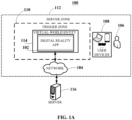
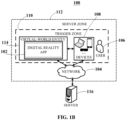
- FIGS. 1A-1B show a schematic representation of a system 100 according to an embodiment of the present disclosure.
- the system 100 enables the automatic activation of one or more applications 102 over a network 104.
- a user 106 employing a user device 108 may be first located in an area outside of a trigger zone 110.
- the trigger zone 110 may be provided within a server zone 112, and may be determined by a perimeter configured around the application 102 associated with or virtually attached to a virtual-world entity 114.
- the trigger zone 110 associated with the application 102 may, for example, move or be positioned or repositioned within a space in tandem with the entity to which it is virtually attached, or be removed from or reintroduced into a space as the entity to which it is attached is removed from or reintroduced into that space.
- the application 102 may be unattached or detached from an entity to which it was virtually attached. If the application is unattached, the application may be positioned in a space independent of the position of any entity. If the application is detached from an entity to which it was virtually attached, the application may, for example, be removed from a space in which that entity is still present, or remain in a fixed location that is independent of the location of that entity, or move independently of that entity.
- the application 102 may further include positional, orientational, and dimensional data of the virtual-world entity 114 stored and computed on a server 116.
- the server zone 112 may be configured around the trigger zone 110, and may be provided in areas relatively close to the server 116.
- the server zone 112 may include one or more applications 102 and respective trigger zones 110.
- system 100 is described as including a single server 116 in examples disclosed herein, it should be understood that functions described herein as being performed by a single server (e.g., server 116) may instead be performed by server system comprising multiple server computers, or vice versa.
- a trigger zone can be calculated as a distance between a user and the virtual position where an application has been configured in the real world.
- the trigger zone could be set for, e.g., from 10 to 30 meters around a location, object, or entity associated with an application.
- the trigger zone can be set according to the field of view of the user, e.g., when the location, object, or entity associated with an application is in the field of view of the user, then the application may be triggered for that specific user.
- a field of view trigger zone may be independent of distance from the user.
- a trigger zone can also be an area defined by the field of hearing of a user (e.g., when a user cannot see a location, object, or entity associated with an application because it is hidden behind another object, but he could in theory hear any sounds from it).
- This type of trigger zone may be limited by distance but may also take into account any potential sound absorption by nearby materials or objects.
- the network 104 may detect and track the user device 108 based on the location data of the user device 108. Once the client accesses the trigger zone 110, the network 104 may signal the server 116 to send a minimum amount of application graphical representation to the user device 108. If the user 106 interacts with the application graphical representation via the user device 108, the server 116 may signal the user device 108 to seamlessly (i.e., without user intervention) and automatically download a minimum amount of application data from the server 116.
- the term "minimum amount” does not refer to a smallest possible amount, but rather a predefined or threshold amount. The minimum amount may vary depending on system design, user preferences, or the like. Examples of possible minimum amounts are provided below.
- the server 116 determines two or more media streams (e.g., based on user information such as the user viewing position, orientation, and viewing angles), and may thereafter perform heavy-load computational tasks on the media content to be delivered to user 106 via the user device 108. Viewing position, orientation, and viewing angles may be calculated using, e.g., position, orientation, and/or viewing angle information received from the user device, or external gaze tracking systems, or other sources, or combinations thereof. Finally, the server 116 may send the computed media content along with instructions to perform lightweight computational tasks on the computed media content, which may be required to adequately represent the application 102 before beginning interactions with the application. In some embodiments, the two or more media streams are further selected based on profile information of a user stored in the server.
- the virtual-world entities 114 to which the applications may be virtually attached may represent real-world objects or may be fully virtual objects not existing in the real world.
- the virtual-world entities 114 representing real-world objects may be referred herein to virtual replicas.
- a virtual replica refers to accurate and persistent virtual representations of real-world elements.
- a virtual replica comprises data and models that provide self-computing capabilities and autonomous behavior.
- the data and models of the virtual replicas may be input through a plurality of software platforms, software engines, and sensors connected to real-world elements.
- Data are the attributes of the virtual replicas and the models are the graphical, mathematical and logic representations of any aspect of the corresponding real-world element that may be used to replicate the reality in the persistent virtual world system, such as 3D models, dynamic models, geometric models, and machine learning models.
- the term “persistent” is used to characterize a state of a system that can continue to exist without a continuously executing process or network connection.
- the term “persistent” may be used to characterize the virtual world system where the virtual world system and all of the virtual replicas, purely virtual objects and digital reality applications therein comprised continue to exist after the processes used for creating the virtual replicas, purely virtual objects and digital reality applications cease, and independent of users being connected to the virtual world system.
- the virtual world system is saved in a non-volatile storage location (e.g., in a server). In this way, virtual replicas, purely virtual objects and digital reality applications may interact and collaborate with each other when being configured for accomplishing specific goals even if users are not connected to the server.
- Self-computing capabilities also referred to as “self-managing capabilities” refers herein to the ability of a virtual replica of the persistent virtual world system to apply artificial intelligence algorithms in order to autonomously manage computer resources (e.g., distributed computing resources).
- virtual replicas with self-computing capabilities are able to autonomously manage computing resources to adapt to changes in the environment of corresponding real-world elements or in the real-world elements themselves.
- each virtual replica may act autonomously depending on the conditions in the real world reflected in the persistent virtual world system, by allocating required resources, autonomously sending and executing commands and generating events as required by each circumstance. Achieving this type of behavior may require training the virtual replicas with artificial intelligence algorithms during the modeling of the virtual replicas.
- the role of a virtual replica editor may be limited to defining general policies and rules that guide the self-management process. For example, in the case of a car accident, the virtual replicas of autonomous vehicles close to the accident may decide to lower their speed or come to a stop in order to worsen traffic conditions, and notify the relevant authorities, before the passengers in the vehicle can even know that there was an accident.
- the system 100 of the current disclosure may be implemented in a cloud to edge infrastructure that may display distributed computing capabilities employing public or private clouds, fog servers, and edge devices and systems, such as enterprise systems, mobile platforms, and user devices, all of which may connect through a network.
- a cloud to edge computing network access to computing power, computer infrastructure (e.g., through so-called infrastructure as a service, or IaaS), applications, and business processes can be delivered as a service to users via client devices on demand.
- IaaS infrastructure as a service
- resources including physical servers and network equipment enable a shared storage and computing that may be dynamically allocated depending on factors such as the distance of the user to the resources and the network and computational demand from the users.
- a pair of virtual-real twin, or twin-pair comprises a real-world element and its corresponding virtual replica, or virtual twin, and can be considered as a Cyber-physical system or CPS.
- the CPS is an integration of computation with physical processes whose behavior is defined by both cyber and physical parts of the system. Therefore, a virtual replica is the cyber part of the CPS, while the physical part is the real world element. The virtual replica may then be considered as an extension of the real twin that allows connecting the physical part with artificial intelligence and simulations to improve the object's capabilities and performance.
- a virtual replica includes one or more of 3D world and building data, such as SLAM or derivate-mapping based data; 3D geometry data; 3D point cloud data; or geographic information system data representing real-world structural properties that may serve to model a 3D structure for digital reality applications.
- 3D world and building data such as SLAM or derivate-mapping based data; 3D geometry data; 3D point cloud data; or geographic information system data representing real-world structural properties that may serve to model a 3D structure for digital reality applications.
- each of the virtual replicas of the persistent virtual world system may be geolocated using a reference coordinate system suitable for use with current geolocation technologies.
- the virtual replicas may use a World Geodetic System standard such as WGS84, which is the current reference coordinate system used by GPS.
- the virtual replicas may represent elements connected to the persistent virtual world system, such as user devices 108 and other devices (not shown), and also unconnected elements (not shown).
- the user devices 108 may be, for example, mobile devices, personal computers, game consoles, media centers, smart contact lenses, and head-mounted displays.
- the other devices may refer to any computing device or machine that can be connected to a network, can communicate with each other, and which receives sensory information from a plurality of sources, a technological concept known nowadays as the Internet of Things (IoT), and such devices can be referred to as IoT devices.
- IoT Internet of Things
- Unconnected elements refer to elements for which the virtual replica models are based only on the respective real appearance and physics of the corresponding real element, but which are not connected to the persistent virtual world system and thus do not send any real-time state updates.
- These unconnected elements may be, for example, topographical and other naturally-occurring elements, such as trees, mountains, terrains, and the sky, which may have been modeled according to their visual appearance and physics but which may not contain sensors to capture real-time data from them.
- Modeling techniques for converting real-world objects into virtual replicas may be based on techniques known in the art. For example, building owners may provide already-existing digital models of a building which may be integrated in the persistent virtual world system 206.
- radar-imaging such as synthetic-aperture radars, real-aperture radars, Light Detection and Ranging (LIDAR), inverse aperture radars, monopulse radars, and other types of imaging techniques may be used to map and model real-world objects before integrating them in the persistent virtual world system.
- the application 102 may be virtually attached to a real-world shoe positioned somewhere within a park.
- the application 102 may need to be configured (e.g., during the application's development stage) to be available at the real-world coordinates of the shoe.
- the system may provide multiple types of information about the shoe, including the shoe's position, orientation, and dimensions in the real-world coordinates.
- the virtual replica of the shoe stored in the server 116 may be visible to the user 106 via user devices 108 as a static or animated shoe after the user 106 has accessed the trigger zone 110 configured around the shoe.
- the virtual shoe may, for example, be statically floating in the air, or may also be performing an animation in a loop, such as rotating around its central axis.
- an application 102 is linked to a fully virtual object not existing in the real world, such as a virtual shoe that does not exist in real life and which may be configured to be floating in the air.
- the user 106 would only be able to view the floating shoe via the user device 108.
- the examples above describe applications virtually attached to static virtual world entities. However, applications can also be virtually attached to dynamic virtual world entities, such as a real-world person.
- the trigger zone 110 of the application 102 may be deployed during the application development stage around the user device 108 of the real-world person, and the coordinates of the application may be based upon a continuous tracking of the user device 108 carried by the user 106. Therefore, the application 102 may be activated once a user 106 has accessed the trigger zone 110 located around the person to which the application 102 is virtually attached, and may thereafter begin interactions with the media content from the application 102.
- the users may have the option to continue interaction with the application 102 outside of the server zone 112.
- the heavy-load computations on media content may be transferred to other servers in other server zones.
- users 106 may as well have the option to stop interacting with the application 102.
- the application 102 may be stored as cache in a memory coupled to the user device so that the next time that the user 106 enters the trigger zone 110, the application 102 may not need to be downloaded again to the user device 108.
- a minimum amount of application graphical representation includes one or more images showing a clear representation of an application to a user 106 and requiring only low amounts of data to be downloaded by a user device 108.
- a minimum amount of application graphical representation includes one or more static two-dimensional images, dynamic two-dimensional images animated in a loop, static three-dimensional images, dynamic three-dimensional images animated in a loop, or any combination thereof.
- servers 116 may be located in compute centers located in areas relatively close to virtual-world entities 114.
- the compute centers may refer to facilities arranged to house computer systems and associated components, such as telecommunication and storage systems, power supplies, redundant data communication connections, environmental controls, and various security devices.
- the network 104 may comprise antennas (not shown) configured to provide communication to elements of system 100.
- Antennas may be connected through wired or other means to compute centers.
- the antennas are provided within the compute centers and/or areas services by compute centers.
- the antennas may include millimeter wave (mmW)-based antenna systems or a combination of mmW-based antennas and sub 6GHz antenna systems, s, such as 5 th generation wireless systems communication networks (5G).
- the antennas may include other types of antennas, such as 4G antennas, or may be used as support antennas for the mmW/sub GHz antenna systems.
- the antennas may use wireless local area networking, such as WiFi, preferably, but not limited to, providing data at 60 GHz.
- GNSS global navigation satellite systems
- GPS global navigation satellite systems
- BDS Glonass
- QZSS Galileo
- IRNSS interrogation and trilateration
- GNSS can calculate the position, velocity, altitude, and time of devices.
- AGNSS assisted GNSS
- the external positioning system is augmented by assisted GNSS (AGNSS) through the architecture of existing cellular communications network, wherein the existing architecture comprises 5G.
- AGNSS tracking system is further supported by a 4G cellular communications network.
- the GNSS is further augmented via radio wireless local area networks such as Wi-Fi, preferably, but not limited to, providing data at 60 GHz.
- the GNSS is augmented via other techniques known in the art, such as via differential GPS (DGPS), satellite-based augmentation systems (SBASs), real-time kinematic (RTK) systems.
- DGPS differential GPS
- SBASs satellite-based augmentation systems
- RTK real-time kinematic
- tracking of devices is implemented by a combination of AGNSS and inertial sensors in the devices.
- tracking of the user device 108 by the network 104 may be performed employing several techniques known in the art. For example, tracking may be performed by employing time of arrival (TOA), angle of arrival (AOA), and other tracking techniques known in the art (e.g., visual imaging, radar technology, etc.)
- TOA time of arrival
- AOA angle of arrival
- other tracking techniques known in the art e.g., visual imaging, radar technology, etc.
- user devices 108 may include hardware and software that enable connection to a wireless network 104 and which may enable interaction with one or more applications 102.
- User interaction with applications 102 via user devices 108 may be gesture-enabled, whereby the users 106 may employ one or more gestures for interaction.
- the gestures can be natural user interface (NUI) gestures, which enable users to naturally interact with a device, free from artificial constraints imposed by input devices such as mice, keyboards, remote controls, and the like.
- NUI natural user interface
- NUI methods include those methods that employ gestures, such as tactile and non-tactile interfaces such as speech recognition, touch recognition, facial recognition, stylus recognition, air gestures (e.g., hand poses and movements and other body/appendage motions/poses), head and eye tracking, voice and speech utterances, and machine learning related at least to vision, speech, voice, pose, and touch data, for example.
- gestures such as tactile and non-tactile interfaces such as speech recognition, touch recognition, facial recognition, stylus recognition, air gestures (e.g., hand poses and movements and other body/appendage motions/poses), head and eye tracking, voice and speech utterances, and machine learning related at least to vision, speech, voice, pose, and touch data, for example.
- NUI technologies include, but are not limited to, touch sensitive displays, voice and speech recognition, intention and goal understanding, motion gesture detection using depth cameras (e.g., stereoscopic camera systems, infrared camera systems, color camera systems, and combinations thereof), motion gesture detection using accelerometers/gyroscopes, facial recognition, 3D displays, head, eye, and gaze tracking, immersive augmented reality and virtual reality systems (e.g., HoloLens TM , by Microsoft Corporation, or Oculus Rift TM which are head-mounted computer devices having a display that uses holographic lenses and spatial sound, as well as other capabilities), all of which provide a more natural user interface, as well as technologies for sensing brain activity using electric field sensing electrodes (e.g., electro-encephalograph (EEG)) and other neuro-biofeedback methods.
- depth cameras e.g., stereoscopic camera systems, infrared camera systems, color camera systems, and combinations thereof
- motion gesture detection using accelerometers/gyroscopes e.
- media content from the applications 102 may include at least one of the following: image data, 3D geometries, video data, audio data, textual data, haptic data, or a combination thereof. Additionally, one or more parts of the media content may include augmented reality (AR), virtual reality (VR), or mixed reality (MR) digital content.
- AR augmented reality
- VR virtual reality
- MR mixed reality
- the AR digital content may include physical, real-world environment elements augmented by computer-generated sensory input such as sound, video, graphics, or GPS data. Augmentation techniques are typically performed in real-time and in semantic context with environmental elements, such as overlaying supplemental information or virtual objects in the real world.
- the AR digital content allows information about the surrounding real world of a user 106 or virtual objects overlay in the real world to become interactive and digitally manipulable.
- the VR digital content may include virtual elements that are used to replace the real world with a simulated one.
- the MR digital content may include a mixture of augmented physical, real-world environment elements interacting with virtual elements.
- an MR experience may include a situation where cameras capture real humans.
- suitable computer software creates a 3D mesh of the humans that is then inserted into a virtual world and is able to interact with the real world.
- Recordings or generation of media content used in applications 102 may be performed through methods described in patent application no. PCT/EP2016/001626 filed on April 6th, 2017 by the same inventor of the current disclosure.
- the user device 108 may be equipped with sensors to determine a relative position of the user device 108 as well as a relative orientation of the headset (three angles) with regard to the viewer.
- This tracking information may amount to 6 degrees of freedom for the server 116 to determine how the output stream will be generated from the plurality of media streams.
- the perspective of the user device 108 including viewing position, viewing orientation, and/or viewing angles may be compared by the server 116 to a field of view or perspective from prerecorded or live videos recorded by an array of cameras or generated by computers.
- the server 116 may determine two or more media streams to be presented to the user device, and may determine the two or more media streams that correspond best to the viewing position, viewing orientation, and/or viewing angles of the user 106.
- determining the minimum amount of application graphical representation displayed to a user may include taking into account the user viewing position, viewing orientation, and/or viewing angles in order to display the correct images to the user.
- FIG. 2 depicts a schematic illustration of a system 200 according to an embodiment of the present disclosure, detailing a representation of a server 116.
- FIG. 2 may include similar elements as those of FIGS. 1A-1B and may therefore contain the same or similar reference numbers.
- the exemplary server 116 is communicatively connected to a user device 108 via a network 104, and includes at least a processor 202 and a memory 204.
- the processor 202 may be configured to access and execute instructions and data (not shown) included in the memory 204, including at least pre-processing of media content, determination of suitable media streams, and heavy-load computational tasks on media content.
- pre-processing tasks on media content may be performed when an application developer deploys the application and makes the application available at the server 116.
- the pre-processing may include, for example, sound and video compression and assembling.
- the processor 202 may additionally determine two or more media streams to be delivered to a user device 108 based on the user device 108 viewing position, orientation, and/or viewing angles. Similarly, the processor 202 may, upon a user accessing a trigger zone, determine a suitable positioning of the minimum amount of application graphical representation based on the client viewing position, orientation, and/or viewing angles.
- the processor 202 may perform heavy-load computational tasks on media content in a way that the user device 108 may only need to perform lightweight computational tasks on the processed media content in order to adequately represent the processed media content to users.
- the heavy-load computational tasks on media content may include physics simulations (e.g., rigid body dynamics, soft body dynamics, fluid dynamics, etc.), lighting, shadows simulations, rendering, etc.
- the memory 204 may store information accessible by the processor 202, including instructions and data, which may be executed by the processor 202.
- the memory 204 may be of any suitable type capable of storing information accessible by the processor 202, including a computer-readable medium, or other medium that stores data that may be read with the aid of an electronic device, such as a hard-drive, memory card, flash drive, ROM, RAM, DVD or other optical disks, as well as other write-capable and read-only memories.
- the memory 204 may include temporary storage in addition to persistent storage. Instructions may be executed directly (e.g., machine code), or indirectly (e.g., scripts) by the processor 202.
- the instructions may be stored in object code format for direct processing by the processor 202, or in any other computer language including scripts or collections of independent source code modules that may be interpreted on demand or compiled in advance.
- Data may be retrieved, stored, or modified by the processor 202 in accordance with the instructions.
- Data may, for example, be stored in computer registers, in a relational database as a table having a plurality of different fields and records, XML documents, or flat files.
- the data may also be formatted in any computer-readable format.
- the memory 204 may store a persistent virtual world system 206.
- the persistent virtual world system 206 may include a virtual version of the real-world comprising real-world entities positioned according to real-world coordinates, including latitudinal and longitudinal positional and orientational data.
- the persistent virtual world system 206 may additionally include one or more application stores 208 configured in real-world space, each comprising one or more applications 102. Each application 102 of the application stores 208 may be virtually attached to a virtual-world entity 114 made available at a real-world location and may be represented by a minimum amount of application graphical representation.
- the applications 102 may be accessed completely virtually (i.e., in VR) by users.
- a user may employ a user device 108 to virtually travel to virtual places stored in the persistent virtual world system 206 without physically having to move to those places.
- the places may be places found in the real-world, may be computer-generated places found only in a virtual-world, or may include combinations thereof.
- users may be able to view and access the applications 102 after accessing a virtual trigger zone configured around the virtual replica.
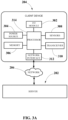
- FIG. 3A-3B depict a schematic illustration of a system according to an embodiment of the present disclosure, detailing a representation of a user device 108.
- FIG. 2 may include similar elements as those of FIGS. 1A-2 and may therefore contain the same or similar reference numbers.
- the user device 108 is communicatively connected to a server 116 via a network 104.
- the user device 108 may include system components such as an input/output (I/O) module 302, a power source 304, a memory 306, sensors 308, and a transceiver 310, and a network interface 312, all operatively connected to a processor 314.
- I/O input/output
- the I/O module 302 is implemented as computing hardware and software configured to interact with users and provide user input data to one or more other system components.
- I/O module 302 may be configured to interact with users, generate user input data based on the interaction, and provide the user input data to the processor 314 of the user device 108 before being transferred to other processing systems, such as server 116.
- I/O modules 302 is implemented as an external computing pointing device (e.g., a touch screen, mouse, 3D control, joystick, gamepad, and the like) and/or text entry device (e.g., a keyboard, dictation tool, and the like) configured to interact with user devices 108.
- I/O module 302 may provide additional, fewer, or different functionality to that described above.
- the power source 304 is implemented as computing hardware configured to provide power to the user devices 108.
- the power source 304 may be a battery.
- the power source 304 may be built into the user devices 108 or removable from the user devices 108, and may be rechargeable or non-rechargeable.
- the user devices 108 may be repowered by replacing one power source 304 with another power source 304.
- the power source 304 may be recharged by a cable attached to a charging source, such as a universal serial bus ("USB”) FireWire, Ethernet, Thunderbolt, or headphone cable, attached to a personal computer.
- USB universal serial bus
- the power source 304 may be recharged by inductive charging, wherein an electromagnetic field is used to transfer energy from an inductive charger to the power source 304 when the two are brought in close proximity, but need not be plugged into one another via a cable.
- a docking station may be used to facilitate charging.
- the memory 306 may be implemented as computing software and hardware adapted to store application program instructions and to store telemetry metadata of the user devices 108 from the sensors 308.
- the memory 204 may be of any suitable type capable of storing information accessible by the processor 314, including a computer-readable medium, or other medium that stores data that may be read with the aid of an electronic device, such as a hard-drive, memory card, flash drive, ROM, RAM, DVD or other optical disks, as well as other write-capable and read-only memories.
- the memory 204 may include temporary storage in addition to persistent storage.
- the sensors 308 may be implemented as computing software and hardware adapted to obtain various telemetry metadata from users.
- the sensors 308 may include, for example, one or more of an Inertia Measuring Unit (IMU), accelerometers, gyroscopes, light sensor, haptic sensors, cameras, eye-tracking sensors, and microphones, amongst others.
- IMU Inertia Measuring Unit
- the IMU is configured to measure and report the velocity, acceleration, angular momentum, speed of translation, speed of rotation, and other telemetry metadata of the user device 108 by using a combination of accelerometers and gyroscopes.
- Accelerometers within the IMU may be configured to measure the acceleration of the interaction device, including the acceleration due to the Earth's gravitational field.
- accelerometers within the IMU may include a tri-axial accelerometer that is capable of measuring acceleration in three orthogonal directions. In other embodiments one, two, three, or more separate accelerometers may be included within the IMU. In other embodiments, additional accelerometers and gyroscopes may be included separate from the IMU.
- the light sensors, haptic sensors, cameras, eye-tracking sensors, and microphones may be used to capture input details from a user and his or her environment, which may be transmitted to a server to determine two or more media streams to be delivered to the user device 108 depending on the user's viewing positions and orientations, distance from an application, and environmental factors, such as lighting and sounds, as well as enabling voice and haptic-related interactions.
- the transceivers 310 may be implemented as computing software and hardware configured to enable the user device 108 to receive communication signals from antennas and to send the data back to the antennas when interacting with media content.
- mmW transceivers may be employed, which may be configured to receive mmW wave signals from antennas and to send the data back to antennas when interacting with media content.
- the transceiver 310 may be a two-way communication transceiver 310.
- combining the capabilities of the IMU, accelerometers, and gyroscopes with the positional tracking provided by the transceivers 310 and the accurate tracking, low-latency and high QOS functionalities provided by mmW-based antennas may enable sub-centimeter or sub-millimeter positional and orientational tracking, which may increase accuracy when tracking the real-time position and orientation of the interaction devices and may improve the general user experience when interacting with immersive media content.
- the network interface 312 may be implemented as computing software and hardware to communicatively connect to the network 104, receive computer readable program instructions from the network 104 sent by the server 116, and forward the computer readable program instructions for storage in the memory 306 of the user device for execution by the processor 314.
- the processor 314 may be implemented as computing hardware and software configured to receive user input data, provide imaging requests, receive imaging data, process imaging data into environment or other data, process user input data and/or imaging data to generate user interaction data, provide server requests, receive server responses, and/or provide user interaction data, environment data, and content object data to one or more other system components.
- the processor 314 may receive user input data from I/O module 302 and may respectively implement application programs stored in the memory 306 of the user device 108.
- the processor 314 may receive location, position, or other telemetry metadata from sensors 308 (e.g., information about a user's hand movements, controller manipulation, traveling trajectory, etc.), from transceiver 310, or from combinations thereof.
- the processor 314 may also be capable of implementing analog or digital signal processing algorithms such as raw data reduction or filtering.
- FIG. 3B shows an embodiment whereby the user device 108 includes an I/O module 302, power source 304, a memory 306, a coupled sensor/transceiver 316, and a network interface 312 all operatively connected to a processor 314.
- the functionality of the various components of the user device 108 is the same as detailed FIG. 3A .
- one or more components of user device 108 may be omitted, or one or more additional components may be added.
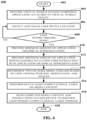
- FIG. 4 depicts a flow chart of a computer-implemented method 400 for enabling location-based activation of applications
- Method 400 is executed by a system according to an embodiment of the present disclosure, such as the systems discussed with regard to FIGS. 1A to 3B .
- Method 400 starts at steps 402 and 404 by providing, in a memory of a server, a persistent virtual world system including a virtual version of the real-world comprising one or more applications virtually attached to virtual-world entities positioned according to real-world coordinates.
- Providing the application in the server may further comprise developing, testing, validating, deploying and storing the application in the memory of the server.
- Providing the digital application in the server may additionally include pre-processing performed by the server, such as performing sound and video compression and assembling.
- the network detects and tracks the user device location.
- the method 400 proceeds in check 408 by checking whether the user device is located within a trigger zone.
- the method 400 continues in step 404 by detecting and tracking the user device location. If the user device is already located within the trigger zone, the method 400 proceeds by the server providing a minimum amount of application graphical representation to the user device, as viewed in step 410.
- Providing the minimum amount of application graphical representation includes determining a graphical representation taking into account the user viewing position, viewing orientation, and/or viewing angles in order to display the correct images to the user.
- step 412 the method 400 continues by the server providing the user device with a minimum amount of application downloadable data upon user interaction with the application graphical representation.
- the server proceeds by determining two or more media streams (e.g., based on user information such as user viewing position, orientation, and viewing angles).
- the method 400 proceeds by the server performing heavy-load computational tasks on media content, as viewed in step 416.
- step 418 the server provides the user device with the recently computed media content along with instructions to perform lightweight computational tasks thereon. The user device may then perform these lightweight computational tasks on the computed media content and continue the interaction with the application, ending the process in terminator 420.
Landscapes
- Engineering & Computer Science (AREA)
- Theoretical Computer Science (AREA)
- General Engineering & Computer Science (AREA)
- Multimedia (AREA)
- Databases & Information Systems (AREA)
- General Physics & Mathematics (AREA)
- Human Computer Interaction (AREA)
- Physics & Mathematics (AREA)
- Computer Networks & Wireless Communication (AREA)
- Signal Processing (AREA)
- Data Mining & Analysis (AREA)
- Software Systems (AREA)
- Radar, Positioning & Navigation (AREA)
- Remote Sensing (AREA)
- Computer Graphics (AREA)
- Computer Hardware Design (AREA)
- Environmental & Geological Engineering (AREA)
- Information Transfer Between Computers (AREA)
- User Interface Of Digital Computer (AREA)
Claims (15)
- System (100), das eine ortsbasierte Aktivierung von Anwendungen (102) ermöglicht, umfassend:
einen oder mehrere Server (116), die einen Speicher (204) und einen Prozessor (202, 314) umfassen, wobei der eine oder die mehreren Server ein persistentes System der virtuellen Welt speichern und bereitstellen, das eine virtuelle Version eines Raums der realen Welt beinhaltet, wobei die virtuelle Version eine Anwendung (102) umfasst, die virtuell an Entitäten der virtuellen Welt (114) angehängt ist, die gemäß Koordinaten der realen Welt positioniert sind, und wobei der eine oder die mehreren Server mindestens konfiguriert sind zum:Berechnen des Zustands der Entitäten der virtuellen Welt (114);dadurch gekennzeichnet, dass der eine oder die mehreren Server konfiguriert sind zum:Empfangen eines Orts eines Benutzergeräts (108);als Reaktion auf das Erkennen, dass ein Benutzergerät (108) in eine Auslösezone (110) eintritt, die mit der Anwendung (102) assoziiert ist, mindestens teilweise basierend auf dem Ort des Benutzergeräts (108), Senden einer minimalen Menge an grafischer Darstellung der Anwendung an das Benutzergerät (108) über ein drahtloses Netzwerk (104), wobei die minimale Menge an grafischer Darstellung der Anwendung ein oder mehrere Standbilder oder dynamische Bilder beinhaltet, die in einer Schleife animiert sind, die eine Darstellung der Anwendung zeigen;als Reaktion auf das Erkennen einer Benutzerinteraktion mit der minimalen Menge an grafischer Darstellung der Anwendung, Signalisieren des Benutzergeräts (108), eine minimale Menge an Anwendungsdaten herunterzuladen, die ausreicht, um eine Benutzerinteraktion mit der Anwendung (102) zu ermöglichen, und Bereitstellen der minimalen Menge an Anwendungsdaten an das Benutzergerät (108), um eine Benutzerinteraktion mit der Anwendung (102) zu ermöglichen;als Reaktion auf das Erkennen, dass die minimale Menge an Anwendungsdaten heruntergeladen wurde, Bestimmen von zwei oder mehr Medienströmen, wobei das Bestimmen der zwei oder mehr Medienströme dem einen oder den mehreren Servern signalisiert, Rechenaufgaben mit hoher Last an dem jeweiligen Anwendungsmedieninhalt durchzuführen, der an das Benutzergerät (108) geliefert werden soll, und den Medieninhalt und Anweisungen zum Durchführen von leichten Rechenaufgaben darauf an das Benutzergerät (108) zu senden. - System (100) nach Anspruch 1, wobei das Bestimmen der zwei oder mehr Medienströme auf einer Betrachtungsposition, Ausrichtung oder Betrachtungswinkel des Benutzers (106) oder einer Kombination davon basiert.
- System (100) nach Anspruch 1 oder 2, ferner umfassend das Benutzergerät (108), das mit dem einen oder den mehreren Servern verbunden und konfiguriert ist, um die Anwendung (102) zu empfangen und auszuführen.
- System (100) nach einem der vorhergehenden Ansprüche, wobei das Bereitstellen der minimalen Menge an Anwendungsdaten (102) das Vorverarbeiten des Anwendungsmedieninhalts durch den einen oder die mehreren Server umfasst, wobei das Vorverarbeiten mindestens Ton- und Videokompressionsoperationen umfasst.
- System (100) nach einem der vorhergehenden Ansprüche, wobei die Rechenaufgaben mit hoher Last an dem Anwendungsmedieninhalt Physiksimulationen, Beleuchtung, Schattensimulationen oder Rendering oder Kombinationen davon umfassen.
- System (100) nach einem der vorhergehenden Ansprüche, wobei die Entitäten der virtuellen Welt (114), an die die Anwendungen (102) virtuell angehängt sind, virtuelle Repliken von Objekten der realen Welt sind, wobei die virtuellen Repliken Daten und Modelle umfassen, die Selbstberechnungsfähigkeiten und autonomes Verhalten bereitstellen, insbesondere die virtuellen Repliken Elemente darstellen, die mit dem persistenten System der virtuellen Welt (206) verbunden sind, und nicht verbundene Elemente, wobei die verbundenen Elemente Rechengeräte umfassen; oder
wobei die Entitäten der virtuellen Welt (114), an die die Anwendungen (102) virtuell angehängt sind, vollständig virtuelle Objekte sind, die in der realen Welt nicht vorhanden sind. - System (100) nach einem der vorhergehenden Ansprüche, wobei das System (100, 200) für Benutzerinteraktionen (106) mit der Anwendung (102) in erweiterter Realität, virtueller Realität, gemischter Realität oder Kombinationen davon konfiguriert ist.
- System (100) nach einem der vorhergehenden Ansprüche, wobei die zwei oder mehr Medienströme ferner basierend auf Profilinformationen eines Benutzers (106) ausgewählt werden, die im Speicher (204) gespeichert sind oder durch soziale Mediennetzwerke erhalten werden.
- Computerimplementiertes Verfahren (400) zum Ermöglichen einer ortsbasierten Aktivierung von Anwendungen (102), das durch ein Serversystem durchgeführt wird, das einen oder mehrere Servercomputer umfasst, wobei das computerimplementierte Verfahren (400) umfasst:Bereitstellen (404), in dem Serversystem, eines persistenten Systems der virtuellen Welt (206), das eine virtuelle Version eines Raums der realen Welt beinhaltet, der eine Anwendung (102) umfasst, die virtuell an Entitäten der virtuellen Welt (114) angehängt ist, die gemäß Koordinaten der realen Welt positioniert sind;Empfangen eines Orts eines oder mehrerer Benutzergeräte (108); gekennzeichnet durchBestimmen, ob das eine oder die mehreren Benutzergeräte (108) in eine Anwendungsauslösezone eingetreten sind, die mit der Anwendung (12) assoziiert ist, mindestens teilweise basierend auf dem Ort des einen oder der mehreren Benutzergeräte (108);Bereitstellen (410), beim Empfangen einer Anzeige des einen oder der mehreren Benutzergeräte (108), die in die Anwendungsauslösezone eintreten, einer minimalen Menge an grafischer Darstellung der Anwendung an das eine oder die mehreren Benutzergeräte (108) über ein drahtloses Netzwerk (104), wobei die minimale Menge an grafischer Darstellung der Anwendung ein oder mehrere Standbilder oder dynamische Bilder beinhaltet, die in einer Schleife animiert sind, die eine Darstellung der Anwendung zeigen;Bereitstellen (412), bei Interaktion mit der minimalen Menge an grafischer Darstellung der Anwendung, einer minimalen Menge an herunterladbaren Daten der Anwendung (102), die ausreicht, um eine Benutzerinteraktion mit der Anwendung (102) zu ermöglichen, an das eine oder die mehreren Benutzergeräte (108), um eine Benutzerinteraktion mit der Anwendung (102) zu ermöglichen;Bestimmen (414), beim Herunterladen der minimalen Menge an herunterladbaren Daten der Anwendung (102), von zwei oder mehr Medienströmen;Durchführen (416), beim Bestimmen der zwei oder mehr Medienströme, von Rechenaufgaben mit hoher Last an Medieninhalt; undSenden (418) des Medieninhalts und Anweisungen zum Durchführen von leichten Rechenaufgaben darauf an das eine oder die mehreren Benutzergeräte (108).
- Verfahren (400) nach Anspruch 9, wobei das Bereitstellen der minimalen Menge an herunterladbaren Daten der Anwendung (102) das Vorverarbeiten des Anwendungsmedieninhalts umfasst, wobei das Vorverarbeiten mindestens Ton- und Videokompressionsoperationen umfasst.
- Verfahren (400) nach Anspruch 9 oder 10, wobei die Rechenaufgaben mit hoher Last an dem Medieninhalt das Durchführen von einem oder mehreren von Physiksimulationen, Beleuchtung, Schattensimulationen oder Rendering oder Kombinationen davon umfassen.
- Verfahren (400) nach einem der Ansprüche 9 bis 11, wobei die Entitäten der virtuellen Welt (114), an die die Anwendungen (102) virtuell angehängt sind, virtuelle Repliken von Objekten der realen Welt sind, wobei die virtuellen Repliken Daten und Modelle umfassen, die Selbstberechnungsfähigkeiten und autonomes Verhalten bereitstellen, insbesondere die virtuellen Repliken Elemente darstellen, die mit dem persistenten System der virtuellen Welt (206) verbunden sind, und nicht verbundene Elemente, wobei die verbundenen Elemente Rechengeräte umfassen; oder
wobei die Entitäten der virtuellen Welt (114), an die die Anwendungen (102) virtuell angehängt sind, vollständig virtuelle Objekte sind, die in der realen Welt nicht vorhanden sind. - Verfahren (400) nach einem der Ansprüche 9 bis 12, ferner umfassend das Verarbeiten von Benutzerinteraktionen in einer von erweiterter Realität, virtueller Realität, gemischter Realität oder Kombinationen davon.
- Verfahren (400) nach einem der Ansprüche 9 bis 13, wobei die zwei oder mehr Medienströme ferner basierend auf Profilinformationen eines Benutzers (106) ausgewählt werden, die im Serversystem gespeichert sind oder durch soziale Mediennetzwerke erhalten werden.
- Computerlesbares Medium, auf dem Computercode gespeichert ist, der konfiguriert ist, um ein oder mehrere Rechengeräte zu veranlassen, das Verfahren (400) nach einem der Ansprüche 9 bis 14 durchzuführen.
Applications Claiming Priority (1)
| Application Number | Priority Date | Filing Date | Title |
|---|---|---|---|
| US201962862941P | 2019-06-18 | 2019-06-18 |
Publications (2)
| Publication Number | Publication Date |
|---|---|
| EP3754615A1 EP3754615A1 (de) | 2020-12-23 |
| EP3754615B1 true EP3754615B1 (de) | 2024-05-08 |
Family
ID=71108525
Family Applications (1)
| Application Number | Title | Priority Date | Filing Date |
|---|---|---|---|
| EP20180869.8A Active EP3754615B1 (de) | 2019-06-18 | 2020-06-18 | Standortbasierte anwendungsaktivierung |
Country Status (3)
| Country | Link |
|---|---|
| US (1) | US11546721B2 (de) |
| EP (1) | EP3754615B1 (de) |
| CN (1) | CN112104689B (de) |
Families Citing this family (3)
| Publication number | Priority date | Publication date | Assignee | Title |
|---|---|---|---|---|
| US11816757B1 (en) * | 2019-12-11 | 2023-11-14 | Meta Platforms Technologies, Llc | Device-side capture of data representative of an artificial reality environment |
| CN115989476A (zh) * | 2021-08-16 | 2023-04-18 | 京东方科技集团股份有限公司 | 显示装置的控制方法、显示装置、设备和计算机存储介质 |
| US12361661B1 (en) | 2022-12-21 | 2025-07-15 | Meta Platforms Technologies, Llc | Artificial reality (XR) location-based displays and interactions |
Family Cites Families (52)
| Publication number | Priority date | Publication date | Assignee | Title |
|---|---|---|---|---|
| US7983817B2 (en) | 1995-06-07 | 2011-07-19 | Automotive Technologies Internatinoal, Inc. | Method and arrangement for obtaining information about vehicle occupants |
| JP2004537082A (ja) | 2001-01-26 | 2004-12-09 | ザクセル システムズ インコーポレイテッド | 仮想現実環境における実時間バーチャル・ビューポイント |
| JP4636741B2 (ja) | 2001-07-06 | 2011-02-23 | 任天堂株式会社 | 画像処理装置および立体形状表示プログラム |
| WO2004068300A2 (en) | 2003-01-25 | 2004-08-12 | Purdue Research Foundation | Methods, systems, and data structures for performing searches on three dimensional objects |
| US7890573B2 (en) * | 2005-11-18 | 2011-02-15 | Toshiba Medical Visualization Systems Europe, Limited | Server-client architecture in medical imaging |
| US8239132B2 (en) | 2008-01-22 | 2012-08-07 | Maran Ma | Systems, apparatus and methods for delivery of location-oriented information |
| US20090244059A1 (en) | 2008-03-26 | 2009-10-01 | Kulkarni Gaurav N | System and method for automatically generating virtual world environments based upon existing physical environments |
| US20090292464A1 (en) | 2008-05-23 | 2009-11-26 | Tele Atlas North America, Inc. | System and method for providing geographic markers on electronic objects and real-world objects |
| US9024972B1 (en) | 2009-04-01 | 2015-05-05 | Microsoft Technology Licensing, Llc | Augmented reality computing with inertial sensors |
| US20100325154A1 (en) | 2009-06-22 | 2010-12-23 | Nokia Corporation | Method and apparatus for a virtual image world |
| US20110279453A1 (en) | 2010-05-16 | 2011-11-17 | Nokia Corporation | Method and apparatus for rendering a location-based user interface |
| US8564621B2 (en) | 2010-08-11 | 2013-10-22 | International Business Machines Corporation | Replicating changes between corresponding objects |
| US9721386B1 (en) | 2010-12-27 | 2017-08-01 | Amazon Technologies, Inc. | Integrated augmented reality environment |
| US20120236158A1 (en) | 2011-01-23 | 2012-09-20 | Electronic Arts Inc. | Virtual directors' camera |
| US20130009994A1 (en) | 2011-03-03 | 2013-01-10 | Thomas Casey Hill | Methods and apparatus to generate virtual-world environments |
| US9142062B2 (en) | 2011-03-29 | 2015-09-22 | Qualcomm Incorporated | Selective hand occlusion over virtual projections onto physical surfaces using skeletal tracking |
| US20120309373A1 (en) | 2011-06-01 | 2012-12-06 | Atlanta Trading & Eng Consulting Llc | Proximity-Based Application Activation |
| US8681179B2 (en) | 2011-12-20 | 2014-03-25 | Xerox Corporation | Method and system for coordinating collisions between augmented reality and real reality |
| US20130178257A1 (en) | 2012-01-06 | 2013-07-11 | Augaroo, Inc. | System and method for interacting with virtual objects in augmented realities |
| US8963805B2 (en) | 2012-01-27 | 2015-02-24 | Microsoft Corporation | Executable virtual objects associated with real objects |
| US9292085B2 (en) * | 2012-06-29 | 2016-03-22 | Microsoft Technology Licensing, Llc | Configuring an interaction zone within an augmented reality environment |
| WO2014066558A2 (en) | 2012-10-23 | 2014-05-01 | Roam Holdings, LLC | Three-dimensional virtual environment |
| US9129429B2 (en) | 2012-10-24 | 2015-09-08 | Exelis, Inc. | Augmented reality on wireless mobile devices |
| US9142038B2 (en) | 2012-11-06 | 2015-09-22 | Ripple Inc | Rendering a digital element |
| CN105165009B (zh) * | 2013-01-17 | 2019-06-28 | 华为技术有限公司 | 一种多可视化组件屏幕共享的系统,装置,和方法 |
| US20140282220A1 (en) | 2013-03-14 | 2014-09-18 | Tim Wantland | Presenting object models in augmented reality images |
| EP3995952A1 (de) | 2013-04-19 | 2022-05-11 | Huawei Technologies Co., Ltd. | Verfahren zur anzeige eines 3d-szenegraphen auf einem bildschirm |
| US9940897B2 (en) | 2013-05-24 | 2018-04-10 | Awe Company Limited | Systems and methods for a shared mixed reality experience |
| US9165318B1 (en) | 2013-05-29 | 2015-10-20 | Amazon Technologies, Inc. | Augmented reality presentation |
| US10262462B2 (en) | 2014-04-18 | 2019-04-16 | Magic Leap, Inc. | Systems and methods for augmented and virtual reality |
| US9319835B2 (en) | 2013-09-19 | 2016-04-19 | Intel Corporation | Securely managed location-and-tracking service access |
| US9264479B2 (en) * | 2013-12-30 | 2016-02-16 | Daqri, Llc | Offloading augmented reality processing |
| US10203762B2 (en) | 2014-03-11 | 2019-02-12 | Magic Leap, Inc. | Methods and systems for creating virtual and augmented reality |
| US9489113B2 (en) * | 2014-03-28 | 2016-11-08 | Spotify Ab | System and method for playback of media content with audio touch menu functionality |
| US20160133230A1 (en) | 2014-11-11 | 2016-05-12 | Bent Image Lab, Llc | Real-time shared augmented reality experience |
| WO2016077506A1 (en) | 2014-11-11 | 2016-05-19 | Bent Image Lab, Llc | Accurate positioning of augmented reality content |
| US20170061700A1 (en) * | 2015-02-13 | 2017-03-02 | Julian Michael Urbach | Intercommunication between a head mounted display and a real world object |
| US9338595B1 (en) | 2015-02-23 | 2016-05-10 | International Business Machines Corporation | Location-based mobile object management in a distributed cloud for enhancing access and performance |
| EP3151554A1 (de) | 2015-09-30 | 2017-04-05 | Calay Venture S.a.r.l. | Anwesenheitskamera |
| US10397320B2 (en) | 2016-01-20 | 2019-08-27 | International Business Machines Corporation | Location based synchronized augmented reality streaming |
| US20170287215A1 (en) * | 2016-03-29 | 2017-10-05 | Google Inc. | Pass-through camera user interface elements for virtual reality |
| US10048751B2 (en) * | 2016-03-31 | 2018-08-14 | Verizon Patent And Licensing Inc. | Methods and systems for gaze-based control of virtual reality media content |
| US10617956B2 (en) * | 2016-09-30 | 2020-04-14 | Sony Interactive Entertainment Inc. | Methods for providing interactive content in a virtual reality scene to guide an HMD user to safety within a real world space |
| JP6252651B1 (ja) | 2016-10-19 | 2017-12-27 | 富士ゼロックス株式会社 | 三次元形状データの編集装置、三次元形状データの編集プログラム、及び三次元形状データのデータ構造 |
| US11132840B2 (en) * | 2017-01-16 | 2021-09-28 | Samsung Electronics Co., Ltd | Method and device for obtaining real time status and controlling of transmitting devices |
| EP3577631A1 (de) | 2017-02-01 | 2019-12-11 | PCMS Holdings, Inc. | System und verfahren zur bereitstellung von inhalten der erweiterten realität in voraufgezeichneten umgebungen |
| US20180276891A1 (en) | 2017-03-24 | 2018-09-27 | Pcms Holdings, Inc. | System and method for providing an in-context notification of a real-world event within a virtual reality experience |
| US10679428B1 (en) * | 2017-05-26 | 2020-06-09 | Snap Inc. | Neural network-based image stream modification |
| WO2019028479A1 (en) | 2017-08-04 | 2019-02-07 | Magical Technologies, Llc | SYSTEMS, METHODS AND APPARATUSES FOR DEPLOYING AND TARGETING VIRTUAL OBJECTS SENSITIVE TO CONTEXT AND MODELING BEHAVIOR OF VIRTUAL OBJECTS BASED ON PHYSICAL PRINCIPLES |
| US11164380B2 (en) | 2017-12-05 | 2021-11-02 | Samsung Electronics Co., Ltd. | System and method for transition boundaries and distance responsive interfaces in augmented and virtual reality |
| KR102236957B1 (ko) | 2018-05-24 | 2021-04-08 | 티엠알더블유 파운데이션 아이피 앤드 홀딩 에스에이알엘 | 가상 세계를 통해 가상 현실 응용 프로그램을 개발, 테스트하고, 실제 세계로 배포하기 위한 시스템 및 방법 |
| US11103773B2 (en) * | 2018-07-27 | 2021-08-31 | Yogesh Rathod | Displaying virtual objects based on recognition of real world object and identification of real world object associated location or geofence |
-
2020
- 2020-06-15 US US16/902,024 patent/US11546721B2/en active Active
- 2020-06-18 CN CN202010558338.4A patent/CN112104689B/zh active Active
- 2020-06-18 EP EP20180869.8A patent/EP3754615B1/de active Active
Also Published As
| Publication number | Publication date |
|---|---|
| US11546721B2 (en) | 2023-01-03 |
| CN112104689A (zh) | 2020-12-18 |
| US20200404447A1 (en) | 2020-12-24 |
| EP3754615A1 (de) | 2020-12-23 |
| CN112104689B (zh) | 2023-04-25 |
Similar Documents
| Publication | Publication Date | Title |
|---|---|---|
| US11270513B2 (en) | System and method for attaching applications and interactions to static objects | |
| KR102236957B1 (ko) | 가상 세계를 통해 가상 현실 응용 프로그램을 개발, 테스트하고, 실제 세계로 배포하기 위한 시스템 및 방법 | |
| US11202037B2 (en) | Virtual presence system and method through merged reality | |
| US11516296B2 (en) | Location-based application stream activation | |
| US11341727B2 (en) | Location-based platform for multiple 3D engines for delivering location-based 3D content to a user | |
| KR102906313B1 (ko) | 디지털 현실에서 향상된 사용자 대 사용자 통신을 가능하게 하는 방법 및 시스템 | |
| JP2024515248A (ja) | 拡張現実のためのパノプティック・セグメンテーション予測 | |
| US11471772B2 (en) | System and method for deploying virtual replicas of real-world elements into a persistent virtual world system | |
| EP3754615B1 (de) | Standortbasierte anwendungsaktivierung | |
| EP3754466B1 (de) | System und verfahren zum virtuell anbringen von anwendungen an und zum ermöglichen von interaktionen mit dynamischen objekten |
Legal Events
| Date | Code | Title | Description |
|---|---|---|---|
| PUAI | Public reference made under article 153(3) epc to a published international application that has entered the european phase |
Free format text: ORIGINAL CODE: 0009012 |
|
| STAA | Information on the status of an ep patent application or granted ep patent |
Free format text: STATUS: THE APPLICATION HAS BEEN PUBLISHED |
|
| AK | Designated contracting states |
Kind code of ref document: A1 Designated state(s): AL AT BE BG CH CY CZ DE DK EE ES FI FR GB GR HR HU IE IS IT LI LT LU LV MC MK MT NL NO PL PT RO RS SE SI SK SM TR |
|
| AX | Request for extension of the european patent |
Extension state: BA ME |
|
| RBV | Designated contracting states (corrected) |
Designated state(s): AL AT BE BG CH CY CZ DE DK EE ES FI FR GB GR HR HU IE IS IT LI LT LU LV MC MK MT NL NO PL PT RO RS SE SI SK SM TR |
|
| STAA | Information on the status of an ep patent application or granted ep patent |
Free format text: STATUS: REQUEST FOR EXAMINATION WAS MADE |
|
| 17P | Request for examination filed |
Effective date: 20210916 |
|
| STAA | Information on the status of an ep patent application or granted ep patent |
Free format text: STATUS: EXAMINATION IS IN PROGRESS |
|
| 17Q | First examination report despatched |
Effective date: 20230125 |
|
| REG | Reference to a national code |
Ref country code: DE Ref legal event code: R079 Free format text: PREVIOUS MAIN CLASS: G06T0019000000 Ipc: A63F0013211000 Ref country code: DE Ref legal event code: R079 Ref document number: 602020030508 Country of ref document: DE Free format text: PREVIOUS MAIN CLASS: G06T0019000000 Ipc: A63F0013211000 |
|
| GRAP | Despatch of communication of intention to grant a patent |
Free format text: ORIGINAL CODE: EPIDOSNIGR1 |
|
| STAA | Information on the status of an ep patent application or granted ep patent |
Free format text: STATUS: GRANT OF PATENT IS INTENDED |
|
| RAP3 | Party data changed (applicant data changed or rights of an application transferred) |
Owner name: THE CALANY HOLDING S.A.R.L. |
|
| RIC1 | Information provided on ipc code assigned before grant |
Ipc: G06F 3/01 20060101ALI20231124BHEP Ipc: A63F 13/355 20140101ALI20231124BHEP Ipc: A63F 13/216 20140101ALI20231124BHEP Ipc: A63F 13/211 20140101AFI20231124BHEP |
|
| INTG | Intention to grant announced |
Effective date: 20231214 |
|
| GRAS | Grant fee paid |
Free format text: ORIGINAL CODE: EPIDOSNIGR3 |
|
| GRAA | (expected) grant |
Free format text: ORIGINAL CODE: 0009210 |
|
| STAA | Information on the status of an ep patent application or granted ep patent |
Free format text: STATUS: THE PATENT HAS BEEN GRANTED |
|
| AK | Designated contracting states |
Kind code of ref document: B1 Designated state(s): AL AT BE BG CH CY CZ DE DK EE ES FI FR GB GR HR HU IE IS IT LI LT LU LV MC MK MT NL NO PL PT RO RS SE SI SK SM TR |
|
| REG | Reference to a national code |
Ref country code: GB Ref legal event code: FG4D |
|
| P01 | Opt-out of the competence of the unified patent court (upc) registered |
Effective date: 20240410 |
|
| REG | Reference to a national code |
Ref country code: CH Ref legal event code: EP |
|
| REG | Reference to a national code |
Ref country code: DE Ref legal event code: R096 Ref document number: 602020030508 Country of ref document: DE |
|
| REG | Reference to a national code |
Ref country code: IE Ref legal event code: FG4D |
|
| REG | Reference to a national code |
Ref country code: NL Ref legal event code: FP |
|
| REG | Reference to a national code |
Ref country code: LT Ref legal event code: MG9D |
|
| PG25 | Lapsed in a contracting state [announced via postgrant information from national office to epo] |
Ref country code: IS Free format text: LAPSE BECAUSE OF FAILURE TO SUBMIT A TRANSLATION OF THE DESCRIPTION OR TO PAY THE FEE WITHIN THE PRESCRIBED TIME-LIMIT Effective date: 20240908 |
|
| PG25 | Lapsed in a contracting state [announced via postgrant information from national office to epo] |
Ref country code: BG Free format text: LAPSE BECAUSE OF FAILURE TO SUBMIT A TRANSLATION OF THE DESCRIPTION OR TO PAY THE FEE WITHIN THE PRESCRIBED TIME-LIMIT Effective date: 20240508 |
|
| PG25 | Lapsed in a contracting state [announced via postgrant information from national office to epo] |
Ref country code: FI Free format text: LAPSE BECAUSE OF FAILURE TO SUBMIT A TRANSLATION OF THE DESCRIPTION OR TO PAY THE FEE WITHIN THE PRESCRIBED TIME-LIMIT Effective date: 20240508 Ref country code: HR Free format text: LAPSE BECAUSE OF FAILURE TO SUBMIT A TRANSLATION OF THE DESCRIPTION OR TO PAY THE FEE WITHIN THE PRESCRIBED TIME-LIMIT Effective date: 20240508 |
|
| PG25 | Lapsed in a contracting state [announced via postgrant information from national office to epo] |
Ref country code: GR Free format text: LAPSE BECAUSE OF FAILURE TO SUBMIT A TRANSLATION OF THE DESCRIPTION OR TO PAY THE FEE WITHIN THE PRESCRIBED TIME-LIMIT Effective date: 20240809 |
|
| PG25 | Lapsed in a contracting state [announced via postgrant information from national office to epo] |
Ref country code: PT Free format text: LAPSE BECAUSE OF FAILURE TO SUBMIT A TRANSLATION OF THE DESCRIPTION OR TO PAY THE FEE WITHIN THE PRESCRIBED TIME-LIMIT Effective date: 20240909 |
|
| REG | Reference to a national code |
Ref country code: AT Ref legal event code: MK05 Ref document number: 1684530 Country of ref document: AT Kind code of ref document: T Effective date: 20240508 |
|
| PG25 | Lapsed in a contracting state [announced via postgrant information from national office to epo] |
Ref country code: ES Free format text: LAPSE BECAUSE OF FAILURE TO SUBMIT A TRANSLATION OF THE DESCRIPTION OR TO PAY THE FEE WITHIN THE PRESCRIBED TIME-LIMIT Effective date: 20240508 |
|
| PG25 | Lapsed in a contracting state [announced via postgrant information from national office to epo] |
Ref country code: AT Free format text: LAPSE BECAUSE OF FAILURE TO SUBMIT A TRANSLATION OF THE DESCRIPTION OR TO PAY THE FEE WITHIN THE PRESCRIBED TIME-LIMIT Effective date: 20240508 |
|
| PG25 | Lapsed in a contracting state [announced via postgrant information from national office to epo] |
Ref country code: PL Free format text: LAPSE BECAUSE OF FAILURE TO SUBMIT A TRANSLATION OF THE DESCRIPTION OR TO PAY THE FEE WITHIN THE PRESCRIBED TIME-LIMIT Effective date: 20240508 |
|
| PG25 | Lapsed in a contracting state [announced via postgrant information from national office to epo] |
Ref country code: LV Free format text: LAPSE BECAUSE OF FAILURE TO SUBMIT A TRANSLATION OF THE DESCRIPTION OR TO PAY THE FEE WITHIN THE PRESCRIBED TIME-LIMIT Effective date: 20240508 |
|
| PG25 | Lapsed in a contracting state [announced via postgrant information from national office to epo] |
Ref country code: PT Free format text: LAPSE BECAUSE OF FAILURE TO SUBMIT A TRANSLATION OF THE DESCRIPTION OR TO PAY THE FEE WITHIN THE PRESCRIBED TIME-LIMIT Effective date: 20240909 Ref country code: PL Free format text: LAPSE BECAUSE OF FAILURE TO SUBMIT A TRANSLATION OF THE DESCRIPTION OR TO PAY THE FEE WITHIN THE PRESCRIBED TIME-LIMIT Effective date: 20240508 Ref country code: NO Free format text: LAPSE BECAUSE OF FAILURE TO SUBMIT A TRANSLATION OF THE DESCRIPTION OR TO PAY THE FEE WITHIN THE PRESCRIBED TIME-LIMIT Effective date: 20240808 Ref country code: LV Free format text: LAPSE BECAUSE OF FAILURE TO SUBMIT A TRANSLATION OF THE DESCRIPTION OR TO PAY THE FEE WITHIN THE PRESCRIBED TIME-LIMIT Effective date: 20240508 Ref country code: IS Free format text: LAPSE BECAUSE OF FAILURE TO SUBMIT A TRANSLATION OF THE DESCRIPTION OR TO PAY THE FEE WITHIN THE PRESCRIBED TIME-LIMIT Effective date: 20240908 Ref country code: HR Free format text: LAPSE BECAUSE OF FAILURE TO SUBMIT A TRANSLATION OF THE DESCRIPTION OR TO PAY THE FEE WITHIN THE PRESCRIBED TIME-LIMIT Effective date: 20240508 Ref country code: GR Free format text: LAPSE BECAUSE OF FAILURE TO SUBMIT A TRANSLATION OF THE DESCRIPTION OR TO PAY THE FEE WITHIN THE PRESCRIBED TIME-LIMIT Effective date: 20240809 Ref country code: FI Free format text: LAPSE BECAUSE OF FAILURE TO SUBMIT A TRANSLATION OF THE DESCRIPTION OR TO PAY THE FEE WITHIN THE PRESCRIBED TIME-LIMIT Effective date: 20240508 Ref country code: ES Free format text: LAPSE BECAUSE OF FAILURE TO SUBMIT A TRANSLATION OF THE DESCRIPTION OR TO PAY THE FEE WITHIN THE PRESCRIBED TIME-LIMIT Effective date: 20240508 Ref country code: BG Free format text: LAPSE BECAUSE OF FAILURE TO SUBMIT A TRANSLATION OF THE DESCRIPTION OR TO PAY THE FEE WITHIN THE PRESCRIBED TIME-LIMIT Effective date: 20240508 Ref country code: AT Free format text: LAPSE BECAUSE OF FAILURE TO SUBMIT A TRANSLATION OF THE DESCRIPTION OR TO PAY THE FEE WITHIN THE PRESCRIBED TIME-LIMIT Effective date: 20240508 Ref country code: RS Free format text: LAPSE BECAUSE OF FAILURE TO SUBMIT A TRANSLATION OF THE DESCRIPTION OR TO PAY THE FEE WITHIN THE PRESCRIBED TIME-LIMIT Effective date: 20240808 |
|
| PG25 | Lapsed in a contracting state [announced via postgrant information from national office to epo] |
Ref country code: DK Free format text: LAPSE BECAUSE OF FAILURE TO SUBMIT A TRANSLATION OF THE DESCRIPTION OR TO PAY THE FEE WITHIN THE PRESCRIBED TIME-LIMIT Effective date: 20240508 |
|
| PG25 | Lapsed in a contracting state [announced via postgrant information from national office to epo] |
Ref country code: EE Free format text: LAPSE BECAUSE OF FAILURE TO SUBMIT A TRANSLATION OF THE DESCRIPTION OR TO PAY THE FEE WITHIN THE PRESCRIBED TIME-LIMIT Effective date: 20240508 |
|
| PG25 | Lapsed in a contracting state [announced via postgrant information from national office to epo] |
Ref country code: CZ Free format text: LAPSE BECAUSE OF FAILURE TO SUBMIT A TRANSLATION OF THE DESCRIPTION OR TO PAY THE FEE WITHIN THE PRESCRIBED TIME-LIMIT Effective date: 20240508 |
|
| PG25 | Lapsed in a contracting state [announced via postgrant information from national office to epo] |
Ref country code: SK Free format text: LAPSE BECAUSE OF FAILURE TO SUBMIT A TRANSLATION OF THE DESCRIPTION OR TO PAY THE FEE WITHIN THE PRESCRIBED TIME-LIMIT Effective date: 20240508 Ref country code: RO Free format text: LAPSE BECAUSE OF FAILURE TO SUBMIT A TRANSLATION OF THE DESCRIPTION OR TO PAY THE FEE WITHIN THE PRESCRIBED TIME-LIMIT Effective date: 20240508 |
|
| PG25 | Lapsed in a contracting state [announced via postgrant information from national office to epo] |
Ref country code: SM Free format text: LAPSE BECAUSE OF FAILURE TO SUBMIT A TRANSLATION OF THE DESCRIPTION OR TO PAY THE FEE WITHIN THE PRESCRIBED TIME-LIMIT Effective date: 20240508 |
|
| PG25 | Lapsed in a contracting state [announced via postgrant information from national office to epo] |
Ref country code: SM Free format text: LAPSE BECAUSE OF FAILURE TO SUBMIT A TRANSLATION OF THE DESCRIPTION OR TO PAY THE FEE WITHIN THE PRESCRIBED TIME-LIMIT Effective date: 20240508 Ref country code: SK Free format text: LAPSE BECAUSE OF FAILURE TO SUBMIT A TRANSLATION OF THE DESCRIPTION OR TO PAY THE FEE WITHIN THE PRESCRIBED TIME-LIMIT Effective date: 20240508 Ref country code: RO Free format text: LAPSE BECAUSE OF FAILURE TO SUBMIT A TRANSLATION OF THE DESCRIPTION OR TO PAY THE FEE WITHIN THE PRESCRIBED TIME-LIMIT Effective date: 20240508 Ref country code: EE Free format text: LAPSE BECAUSE OF FAILURE TO SUBMIT A TRANSLATION OF THE DESCRIPTION OR TO PAY THE FEE WITHIN THE PRESCRIBED TIME-LIMIT Effective date: 20240508 Ref country code: DK Free format text: LAPSE BECAUSE OF FAILURE TO SUBMIT A TRANSLATION OF THE DESCRIPTION OR TO PAY THE FEE WITHIN THE PRESCRIBED TIME-LIMIT Effective date: 20240508 Ref country code: CZ Free format text: LAPSE BECAUSE OF FAILURE TO SUBMIT A TRANSLATION OF THE DESCRIPTION OR TO PAY THE FEE WITHIN THE PRESCRIBED TIME-LIMIT Effective date: 20240508 |
|
| PG25 | Lapsed in a contracting state [announced via postgrant information from national office to epo] |
Ref country code: MC Free format text: LAPSE BECAUSE OF FAILURE TO SUBMIT A TRANSLATION OF THE DESCRIPTION OR TO PAY THE FEE WITHIN THE PRESCRIBED TIME-LIMIT Effective date: 20240508 Ref country code: IT Free format text: LAPSE BECAUSE OF FAILURE TO SUBMIT A TRANSLATION OF THE DESCRIPTION OR TO PAY THE FEE WITHIN THE PRESCRIBED TIME-LIMIT Effective date: 20240508 |
|
| REG | Reference to a national code |
Ref country code: DE Ref legal event code: R097 Ref document number: 602020030508 Country of ref document: DE |
|
| PLBE | No opposition filed within time limit |
Free format text: ORIGINAL CODE: 0009261 |
|
| STAA | Information on the status of an ep patent application or granted ep patent |
Free format text: STATUS: NO OPPOSITION FILED WITHIN TIME LIMIT |
|
| 26N | No opposition filed |
Effective date: 20250211 |
|
| PG25 | Lapsed in a contracting state [announced via postgrant information from national office to epo] |
Ref country code: BE Free format text: LAPSE BECAUSE OF NON-PAYMENT OF DUE FEES Effective date: 20240630 Ref country code: SI Free format text: LAPSE BECAUSE OF FAILURE TO SUBMIT A TRANSLATION OF THE DESCRIPTION OR TO PAY THE FEE WITHIN THE PRESCRIBED TIME-LIMIT Effective date: 20240508 |
|
| REG | Reference to a national code |
Ref country code: BE Ref legal event code: MM Effective date: 20240630 |
|
| PGFP | Annual fee paid to national office [announced via postgrant information from national office to epo] |
Ref country code: DE Payment date: 20250618 Year of fee payment: 6 |
|
| PGFP | Annual fee paid to national office [announced via postgrant information from national office to epo] |
Ref country code: GB Payment date: 20250620 Year of fee payment: 6 |
|
| PGFP | Annual fee paid to national office [announced via postgrant information from national office to epo] |
Ref country code: LU Payment date: 20250617 Year of fee payment: 6 Ref country code: NL Payment date: 20250618 Year of fee payment: 6 |
|
| PGFP | Annual fee paid to national office [announced via postgrant information from national office to epo] |
Ref country code: FR Payment date: 20250618 Year of fee payment: 6 |
|
| PGFP | Annual fee paid to national office [announced via postgrant information from national office to epo] |
Ref country code: IE Payment date: 20250618 Year of fee payment: 6 |
|
| PG25 | Lapsed in a contracting state [announced via postgrant information from national office to epo] |
Ref country code: SE Free format text: LAPSE BECAUSE OF FAILURE TO SUBMIT A TRANSLATION OF THE DESCRIPTION OR TO PAY THE FEE WITHIN THE PRESCRIBED TIME-LIMIT Effective date: 20240508 |
|
| PGFP | Annual fee paid to national office [announced via postgrant information from national office to epo] |
Ref country code: CH Payment date: 20250701 Year of fee payment: 6 |
|
| PG25 | Lapsed in a contracting state [announced via postgrant information from national office to epo] |
Ref country code: CY Free format text: LAPSE BECAUSE OF FAILURE TO SUBMIT A TRANSLATION OF THE DESCRIPTION OR TO PAY THE FEE WITHIN THE PRESCRIBED TIME-LIMIT; INVALID AB INITIO Effective date: 20200618 |
|
| PG25 | Lapsed in a contracting state [announced via postgrant information from national office to epo] |
Ref country code: HU Free format text: LAPSE BECAUSE OF FAILURE TO SUBMIT A TRANSLATION OF THE DESCRIPTION OR TO PAY THE FEE WITHIN THE PRESCRIBED TIME-LIMIT; INVALID AB INITIO Effective date: 20200618 |