EP3754543B1 - System und verfahren zur unterstützung der erkennung von pflanzenkrankheiten - Google Patents
System und verfahren zur unterstützung der erkennung von pflanzenkrankheiten Download PDFInfo
- Publication number
- EP3754543B1 EP3754543B1 EP20174784.7A EP20174784A EP3754543B1 EP 3754543 B1 EP3754543 B1 EP 3754543B1 EP 20174784 A EP20174784 A EP 20174784A EP 3754543 B1 EP3754543 B1 EP 3754543B1
- Authority
- EP
- European Patent Office
- Prior art keywords
- crop
- image
- layer
- neural network
- image representation
- Prior art date
- Legal status (The legal status is an assumption and is not a legal conclusion. Google has not performed a legal analysis and makes no representation as to the accuracy of the status listed.)
- Active
Links
Images





Classifications
-
- G—PHYSICS
- G06—COMPUTING OR CALCULATING; COUNTING
- G06V—IMAGE OR VIDEO RECOGNITION OR UNDERSTANDING
- G06V10/00—Arrangements for image or video recognition or understanding
- G06V10/70—Arrangements for image or video recognition or understanding using pattern recognition or machine learning
- G06V10/764—Arrangements for image or video recognition or understanding using pattern recognition or machine learning using classification, e.g. of video objects
-
- G—PHYSICS
- G06—COMPUTING OR CALCULATING; COUNTING
- G06N—COMPUTING ARRANGEMENTS BASED ON SPECIFIC COMPUTATIONAL MODELS
- G06N3/00—Computing arrangements based on biological models
- G06N3/02—Neural networks
- G06N3/04—Architecture, e.g. interconnection topology
- G06N3/048—Activation functions
-
- G—PHYSICS
- G06—COMPUTING OR CALCULATING; COUNTING
- G06T—IMAGE DATA PROCESSING OR GENERATION, IN GENERAL
- G06T7/00—Image analysis
- G06T7/0002—Inspection of images, e.g. flaw detection
- G06T7/0012—Biomedical image inspection
-
- G—PHYSICS
- G06—COMPUTING OR CALCULATING; COUNTING
- G06T—IMAGE DATA PROCESSING OR GENERATION, IN GENERAL
- G06T7/00—Image analysis
- G06T7/10—Segmentation; Edge detection
-
- G—PHYSICS
- G06—COMPUTING OR CALCULATING; COUNTING
- G06V—IMAGE OR VIDEO RECOGNITION OR UNDERSTANDING
- G06V10/00—Arrangements for image or video recognition or understanding
- G06V10/70—Arrangements for image or video recognition or understanding using pattern recognition or machine learning
- G06V10/82—Arrangements for image or video recognition or understanding using pattern recognition or machine learning using neural networks
-
- G—PHYSICS
- G06—COMPUTING OR CALCULATING; COUNTING
- G06V—IMAGE OR VIDEO RECOGNITION OR UNDERSTANDING
- G06V20/00—Scenes; Scene-specific elements
- G06V20/10—Terrestrial scenes
- G06V20/188—Vegetation
-
- G—PHYSICS
- G06—COMPUTING OR CALCULATING; COUNTING
- G06T—IMAGE DATA PROCESSING OR GENERATION, IN GENERAL
- G06T2207/00—Indexing scheme for image analysis or image enhancement
- G06T2207/20—Special algorithmic details
- G06T2207/20081—Training; Learning
-
- G—PHYSICS
- G06—COMPUTING OR CALCULATING; COUNTING
- G06T—IMAGE DATA PROCESSING OR GENERATION, IN GENERAL
- G06T2207/00—Indexing scheme for image analysis or image enhancement
- G06T2207/20—Special algorithmic details
- G06T2207/20084—Artificial neural networks [ANN]
-
- G—PHYSICS
- G06—COMPUTING OR CALCULATING; COUNTING
- G06T—IMAGE DATA PROCESSING OR GENERATION, IN GENERAL
- G06T2207/00—Indexing scheme for image analysis or image enhancement
- G06T2207/30—Subject of image; Context of image processing
- G06T2207/30181—Earth observation
- G06T2207/30188—Vegetation; Agriculture
Definitions
- the present invention generally relates to electronic data processing, and more particularly, relates to image processing methods, computer program products and systems to support plant disease detection.
- CNNs Deep Convolutional Neural Networks
- Sladojevic et al. Deep neural networks based recognition of plant diseases by leaf image classification; Computational Intelligence and Neuroscience 2016
- AlexNet-like architecture was applied to model 13 different diseases from an image dataset obtained through internet online search.
- arXivpreprint arXiv:1511.08060 An open access repository of images on plant health to enable the development of mobile disease diagnostics.
- arXivpreprint arXiv:1511.08060 Their generated dataset contains more than 50,000 expertly curated images of healthy and infected leaves of 14 different crops (apple, blueberry, corn, grape, etc.) and a total number of 26 different diseases allowing their promoters to develop a disease identification classifier ( Mohanty, S.P., Hughes, D.P., Salathe, M., 2016. Using deep learning for image based plant disease detection. Frontiers in Plant Science 7 ).
- Deep learning networks have been also recently adapted to other crops such as rice ( Alfarisy et al., 2018. Deep learning based classification for paddy pests & diseases recognition, in: Proceedings of 2018 International Conference on Mathematics and Artificial Intelligence, ACM. pp. 21-25 ), grapevine ( Cruz, A.C., El-Kereamy, A., Ampatzidis, Y., 2018. Vision-based grapevine pierces disease detection system using artificial intelligence, in: 2018 ASABE Annual International Meeting, American Society of Agricultural and Biological Engineers. p. 1 ), wheat ( Picon et al., 2018.
- Computers and Electronics in Agriculture or banana ( Amara, J., Bouaziz, B., Algergawy, A., et al., 2017. A deep learning-based approach for banana leaf diseases classification., in: BTW (Workshops), pp. 79-88 ) and some recent work from Ferentinos, K.P. (2018. Deep learning models for plant disease detection and diagnosis.
- Computers and Electronics in Agriculture 145, 311-318 used a dataset of more than 80000 images to successfully distinguish among 58 distinct classes from 25 different crops with more than a 99% accuracy over the testing dataset by the use of five well-known CNN architectures.
- Lu et al. propose a MIL (Multiple Instance Learning) based approach over a fully convolutional network to integrate the neural network receptive field to focus on early disease activation map.
- Picon et al. propose a region-based method to focus on early diseases while allowing the detection of multiple diseases on the same plant.
- plant disease as used in the context of the present application is any deviation from the normal physiological functioning of a plant which is harmful to a plant, including but not limited to plant diseases (i.e. deviations from the normal physiological functioning of a plant) caused by
- a plant disease caused by fungi is referred to as a "fungal plant disease”
- a plant disease caused by bacteria is referred to as a "bacterial plant disease”
- a plant disease caused by viruses is referred to as a "viral plant disease”.
- the plant disease is a fungal, bacterial, or viral plant disease. More preferably, the plant disease is a fungal plant disease.
- fungal plant diseases may be assigned to or caused by one or more of the following agents: Phytopathogenic fungi, including soil-borne fungi, in particular from the classes of Plasmodiophoromycetes, Peronosporomycetes (syn. Oomycetes), Chytridiomycetes, Zygomycetes, Ascomycetes, Basidiomycetes, and Deuteromycetes (syn. Fungi imperfecti).
- Phytopathogenic fungi including soil-borne fungi, in particular from the classes of Plasmodiophoromycetes, Peronosporomycetes (syn. Oomycetes), Chytridiomycetes, Zygomycetes, Ascomycetes, Basidiomycetes, and Deuteromycetes (syn. Fungi imperfecti).
- a comprehensive list of causal agents causing fungal plant diseases is given in the following: Albugo spp. (white rust) on ornamentals, vegetables (e. g. A . candida) and sunflowers (e. g. A. tragopogonis); Alternaria spp. (Alternaria leaf spot) on vegetables (e.g. A. dauci or A. porri ) , oilseed rape (A. brassicicola or brassicae ) , sugar beets (A. tenuis ) , fruits (e.g. A. grandis ) , rice, soybeans, potatoes and tomatoes (e. g. A. solani, A. grandis or A. alternata ) , tomatoes (e. g. A. A.
- spot blotch B . sorokiniana
- cereals and e. g. B. oryzae on rice and turfs Blumeria (formerly Erysiphe ) graminis (powdery mildew) on cereals (e. g. on wheat or barley);
- Botrytis cinerea teleomorph: Botryotinia fuckeliana: grey mold
- fruits and berries e. g. strawberries
- vegetables e. g. lettuce, carrots, celery and cabbages
- B. squamosa or B. allii on onion family, oilseed rape, ornamentals e.g.
- B eliptica B eliptica ) , vines, forestry plants and wheat; Bremia lactucae (downy mildew) on lettuce; Ceratocystis (syn. Ophiostoma) spp. (rot or wilt) on broad-leaved trees and evergreens, e. g. C. ulmi (Dutch elm disease) on elms; Cercospora spp. (Cercospora leaf spots) on corn (e. g. Gray leaf spot: C. zeae-maydis ) , rice, sugar beets (e. g. C. beticola ) , sugar cane, vegetables, coffee, soybeans (e. g. C.
- Cladobotryum syn. Dactylium spp. (e.g. C. mycophilum, formerly Dactylium dendroides, teleomorph: Nectria albertinii, Nectria rosella syn. Hypomyces rosellus ) on mushrooms; Cladosporium spp. on tomatoes (e. g. C. fulvum: leaf mold) and cereals, e. g. C. herbarum (black ear) on wheat; Claviceps purpurea (ergot) on cereals; Cochliobolus (anamorph: Helminthosporium of Bipolaris ) spp.
- C. truncatum or C. gloeosporioides ) , vegetables (e.g. C. lagenarium or C. capsici ) , fruits (e.g. C. acutatum ) , coffee (e.g. C. coffeanum or C. kahawae ) and C. gloeosporioides on various crops; Corticium spp., e. g. C. sasakii (sheath blight) on rice; Corynespora cassiicola (leaf spots) on soybeans, cotton and ornamentals; Cycloconium spp., e. g. C. oleaginum on olive trees; Cylindrocarpon spp.
- Eutypa lata Errorohilum (syn. Helminthosporium ) spp. on corn (e. g. E. turcicum); Fusarium (teleomorph: Gibberella ) spp. (wilt, root or stem rot) on various plants, such as F . graminearum or F. culmorum (root rot, scab or head blight) on cereals (e. g. wheat or barley), F. oxysporum on tomatoes, F.
- Cladosporium vitis on vines; Macrophomina phaseolina (syn. phaseoli ) (root and stem rot) on soybeans and cotton; Microdochium (syn. Fusarium ) nivale (pink snow mold) on cereals (e. g. wheat or barley); Microsphaera diffusa (powdery mildew) on soybeans; Monilinia spp., e. g. M. laxa , M. fructicola and M. fructigena (syn. Monilia spp.: bloom and twig blight, brown rot) on stone fruits and other rosaceous plants; Mycosphaerella spp.
- M. graminicola anamorph: Zymoseptoria tritici formerly Septoria tritici: Septoria blotch
- M. fijiensis Syn. Pseudocercospora fijiensis : black Sigatoka disease
- M. musicola on bananas
- M. arachidicola Syn. M. arachidis or Cercospora arachidis
- M. berkeleyi on peanuts
- Peronospora spp. downy mildew
- brassicae oilseed rape (e. g. P. parasitica ), onions (e. g. P. destructor ) , tobacco ( P. tabacina ) and soybeans (e. g. P. manshurica ); Phakopsora pachyrhizi and P. meibomiae (soybean rust) on soybeans; Phialophora spp. e. g. on vines (e. g. P. tracheiphila and P. tetraspora ) and soybeans (e. g. P. gregata : stem rot); Phoma lingam (syn. Leptosphaeria biglobosa and L.
- oilseed rape e. g. P. parasitica
- onions e. g. P. destructor
- tobacco P. tabacina
- soybeans e. g. P. manshurica
- Podosphaera spp. (powdery mildew) on rosaceous plants, hop, pome and soft fruits (e. g. P. leucotricha on apples) and curcurbits ( P. xanthii); Polymyxa spp., e. g. on cereals, such as barley and wheat ( P. graminis ) and sugar beets ( P. betae ) and thereby transmitted viral diseases; Pseudocercosporella herpotrichoides (syn. Oculimacula yallundae, O.
- acuformis eyespot, teleomorph: Tapesia yallundae ) on cereals, e. g. wheat or barley; Pseudoperonospora (downy mildew) on various plants, e. g. P. cubensis on cucurbits or P. humili on hop; Pseudopezicula tracheiphila (red fire disease or,rotbrenner', anamorph: Phialophora ) on vines; Puccinia spp. (rusts) on various plants, e. g. P. triticina (brown or leaf rust), P. striiformis (stripe or yellow rust), P.
- hordei dwarf rust
- P. graminis stem or black rust
- P . recondita brown or leaf rust
- cereals such as e. g. wheat, barley or rye
- P. kuehnii range rust
- sugar cane and P. asparagi on asparagus
- Pyrenopeziza spp. e.g. P . brassicae on oilseed rape
- Pyrenophora anamorph: Drechslera ) tritici-repentis (tan spot) on wheat or P. teres (net blotch) on barley
- Pyricularia spp. e. g. P.
- oryzae (teleomorph: Magnaporthe grisea: rice blast) on rice and P. grisea on turf and cereals; Pythium spp. (damping-off) on turf, rice, corn, wheat, cotton, oilseed rape, sunflowers, soybeans, sugar beets, vegetables and various other plants (e. g. P. ultimum or P. aphanidermatum ) and P . oligandrum on mushrooms; Ramularia spp., e. g. R. collo-cygni (Ramularia leaf spots, Physiological leaf spots) on barley, R. areola (teleomorph: Mycosphaerella areola ) on cotton and R.
- Rhizoctonia spp. on cotton, rice, potatoes, turf, corn, oilseed rape, potatoes, sugar beets, vegetables and various other plants, e. g. R. solani (root and stem rot) on soybeans, R. solani (sheath blight) on rice or R. cerealis (Rhizoctonia spring blight) on wheat or barley; Rhizopus stolonifer (black mold, soft rot) on strawberries, carrots, cabbage, vines and tomatoes; Rhynchosporium secalis and R. sescalis and R. sescalis and R. sescalis and R. sescalis and R. sescalis and R. sescalis and R. sescalis and R. sescalis and R. sescalis and R. sescalis and R. sescalis and R. sescalis and R. sescalis and R. sescalis and R. sescalis and R. sescalis and R. sescalis and R. sescalis and R. sescalis and
- Attenuatum (sheath rot) on rice; Sclerotinia spp. (stem rot or white mold) on vegetables ( S . minor and S . sclerotiorum ) and field crops, such as oilseed rape, sunflowers (e. g. S . sclerotiorum ) and soybeans, S . rolfsii (syn. Athelia rolfsii ) on soybeans, peanut, vegetables, corn, cereals and ornamentals; Septoria spp. on various plants, e. g. S . glycines (brown spot) on soybeans, S . tritici (syn.
- Ustilago reiliana head smut), sorghum und sugar cane; Sphaerotheca fuliginea (syn. Podosphaera xanthii: powdery mildew) on cucurbits; Spongospora subterranea (powdery scab) on potatoes and thereby transmitted viral diseases; Stagonospora spp. on cereals, e. g. S . nodorum (Stagonospora blotch, teleomorph: Leptosphaeria [syn. Phaeosphaeria ] nodorum, syn.
- Septoria nodorum on wheat; Synchytrium endobioticum on potatoes (potato wart disease); Taphrina spp., e. g. T. deformans (leaf curl disease) on peaches and T. pruni (plum pocket) on plums; Thielaviopsis spp. (black root rot) on tobacco, pome fruits, vegetables, soybeans and cotton, e. g. T. basicola (syn. Chalara elegans ) ; Tilletia spp. (common bunt or stinking smut) on cereals, such as e. g. T. tritici (syn. T. caries, wheat bunt) and T.
- T. deformans leaf curl disease
- T. pruni plum pocket
- Thielaviopsis spp. black root rot
- tobacco, pome fruits, vegetables, soybeans and cotton e. g. T. basicola (syn.
- controversa dwarf bunt
- Trichoderma harzianum on mushrooms
- Typhula incarnata grey snow mold
- Urocystis spp. e. g. U. occulta (stem smut) on rye
- Uromyces spp. rust on vegetables, such as beans (e. g. U. appendiculatus, syn. U. phaseoli )
- sugar beets e. g. U. betae or U. beticola
- pulses e.g. U. vignae, U. pisi, U. viciae-fabae and U.
- Ustilago spp. loose smut on cereals (e. g. U. nuda and U. avaenae ) , corn (e. g. U. maydis: corn smut) and sugar cane; Venturia spp. (scab) on apples (e. g. V. inaequalis ) and pears; and Verticillium spp. (wilt) on various plants, such as fruits and ornamentals, vines, soft fruits, vegetables and field crops, e. g. V. longisporum on oilseed rape, V. dahliae on strawberries, oilseed rape, potatoes and tomatoes, and V. fungicola on mushrooms; Zymoseptoria tritici on cereals.
- a particularly preferred list list of causal agents causing practically important or preferred fungal plant diseases is given in the following: Rusts on soybean and cereals (e.g. Phakopsora pachyrhizi and P. meibomiae on soy; Puccinia tritici and P. striiformis on wheat); molds on specialty crops, soybean, oil seed rape and sunflowers (e.g. Botrytis cinerea on strawberries and vines, Sclerotinia sclerotiorum, S . minor and S . rolfsii on oil seed rape, sunflowers and soybean); Fusarium diseases on cereals (e.g. Fusarium culmorum and F .
- Rusts on soybean and cereals e.g. Phakopsora pachyrhizi and P. meibomiae on soy; Puccinia tritici and P. striiformis on wheat
- molds on specialty crops soybean, oil seed rape and sunflowers (e
- the above technical problem is solved by using a CNN architecture that is able to seamlessly incorporate contextual meta-data including the plant species information (and optionally, further crop related meta-data such as for example, weather data, temperature, data etc., prevailing at the respective field) to allow training a single multi-crop model that:
- the wheat dataset used by the Picon et al. paper containing 8178 field images was extended.
- the extended dataset includes Septoria (Septoria triciti), Tan Spot (Drechslera triciti-repentis) and Rust (Puccinia striiformis, Puccinia recondita) diseases over more than 36 wheat plant varieties.
- Three new crops have been added to the existing winter wheat (Triticum aestivum) species: Corn (Zea mays), Rape seed (Brassica napus) and Winter barley (Hordeum vulgare).
- winter wheat diseases have been extended including five different diseases (Septoria tritici, Puccinia striiformis, Puccinia recondita, Septoria nodorum and Drechslera tritici-repentis).
- the Helminthosporium turcicum disease has been included in the database, whereas rape seed crop includes Phoma lingam disease and winter barley crop includes four different diseases: Pyrenophora teres, Ramularia collo-cygni, Rhynchosporium secalis and Puccinia hordei, containing a total number of 100734 images, as shown in the reference table 1 of FIG. 7A .
- the herein disclosed approach of using an extended CNN topology integrating plant species information as complementary information to the input image over a complete multi-crop dataset surpasses the performance obtained by the two methods mentioned before by taking advantage on the visual information and variability from the full dataset and not suffering from the effect of diseases with similar appearance from other crops.
- the topology of a neural network refers to the way the neurons are connected in the neural network.
- computer system for detecting plant diseases.
- the computer system has a data storage component which stores a convolutional neural network (CNN) data structure.
- the CNN has been trained with a multi-crop dataset.
- This training dataset includes a plurality of input images which shows parts (or elements, such as leaves) of various crops. Thereby, each of the input images in the training data set shows either a part of a particular crop with one or more disease symptoms associated with one or more diseases of interest, or it shows a part of a particular crop with abiotic marks, or it shows a healthy part of a particular crop.
- Diseases of interest are such diseases for which the CNN has been trained and is therefore expected to provide meaningful classification results of input images which show crop parts with symptoms that are representative of at least one of the diseases of interest.
- the input images used for training the CNN include all kinds of plant elements of the various crops wherein the plant elements may appear healthy or show certain disease symptoms or show markers which are not representative of a disease of interest. For achieving good classification results, all of those three image categories should be present on a number of training input images which is sufficient to establish the corresponding weights in the CNN.
- the CNN has an extended topology which includes an image branch based on a classification convolutional neural network (e.g., a RESNET ⁇ architecture, such as for example a RESNET50 topology, DenseNet, VGGNet, etc.) for classifying the input images according to plant disease specific features.
- a classification convolutional neural network e.g., a RESNET ⁇ architecture, such as for example a RESNET50 topology, DenseNet, VGGNet, etc.
- the extended topology has a crop identification branch for adding plant species information.
- plant species information can be a crop identifier.
- the crop identifier can be a categorical vector of K components where K is the number of crop classes (i.e., number of different types of crop) considered when training the CNN model, and may be represented by a corresponding tensor or vector.
- further meta-data may also be added via the crop identification branch.
- the outputs of the image branch and the crop identification branch are then integrated by a branch integrator of the extended topology which is configured to integrate the plant species information with each input image wherein the plant species information specifies the crop on the respective input image with which it gets integrated. Training methods for the CNN with the extended topology are disclosed in more detail in the detailed description.
- the computer system further has an interface to receive a test input with an image of a particular crop showing one or more particular plant disease symptoms. This image is to be classified by the computer system according to potential diseases in accordance with its plant disease symptom(s). Further, via the interface, the computer system receives a respective crop identifier associated with the test input. For example, a farmer may find a crop leaf in an agricultural field showing some markers which have similarity with plant disease symptoms. The farmer can take a picture of the crop part with the symptoms, for example by using an RGB camera of a mobile device (e.g., smart phone, tablet computer, etc.) which is communicatively coupled with the computer system via a communication network.
- a mobile device e.g., smart phone, tablet computer, etc.
- the farmer also knows which kind of crop it is and can send the image together with a corresponding crop identifier to the computer system where it is received via said interface.
- the images may be recorded with any other suitable image recording device, such as for example, a DSLR camera, or a multi-spectral camera.
- the camera device does not need to be handheld but may also be mounted on a robot, a tractor or a drone. For example, by using drones, images of plants in a field can easily be taken from a zenithal view.
- the computer system can then apply the trained convolutional network to the received test input including the test image and the crop identifier.
- the trained CNN When the trained CNN is applied to test input images associated with crop identifier information it is operated as a classifier module of the computer system and provides a classification result according to the output vector of the convolutional neural network.
- the classification result indicates the one or more plant diseases associated with the one or more particular plant disease symptoms on the test input image.
- the classification result may be shown on an output device communicatively coupled with the computer system. For example, in the above farmer example, the classification result can be sent to the farmer's mobile device in response to the test input. It has been demonstrated that even when the crop ID is introduced erroneously the computer system can still provide better plant disease detection capabilities than the prior art systems.
- the computer system may also include a training module which can access an appropriate training dataset to train the CNN with a number of training input images being large enough to achieve a stable configuration of the CNN to provide reliable crop disease classification results.
- the training data set includes for each training image the associated crop identifier and the associated set of disease identifiers (i.e., the identifiers of such diseases which are present on the training image).
- the training of the CNN may occur in a dedicated training system and the trained CNN data structure is then copied to the data storage of the computer system.
- the computer system further includes an image cropping module configured to crop a new input image including a plant portion of the crop (e.g., a particular leaf, stem, panicle, etc.) to a region surrounding such plant portion.
- Cropping in general is the removal of unwanted outer areas from a photographic or illustrated image. The process usually includes the removal of some of the peripheral areas of an image to remove extraneous trash from the picture, to improve its framing, to change the aspect ratio, or to accentuate or isolate the subject matter from its background, and/or focus on the subtle early symptoms of smaller size that might otherwise be lost from the whole picture.
- the main leaf may be segmented by a segmentation neural network with a pixel-wise categorical cross-entropy loss function being complemented with a total variation term.
- a segmentation neural network may be used that manages to perform a decent segmentation, such as for example, a fully convolutional dense net, PSPNet, SegNet, etc.
- PSPNet fully convolutional dense net
- SegNet SegNet
- such networks are trained with the above mentioned categorical cross-entropy loss, but there are other options, such as for example binary crossentropy, Jackard index, Sorensen-Dice coefficient among others. Further, some segmentation networks do not use a total variation term for training.
- the CNN topology includes a backbone topology implemented by a classification convolutional neural network topology configured to gradually reduce the dimensionality of the image representation in the spatial domain while growing on the feature domain to learn image representations as sets of high level features.
- the backbone topology may be pre-trained with Imagenet or another dataset suitable for posterior fine-tuning for crop disease identification.
- a residual neural network may be used as backbone, such as for example the ResNet50 deep convolutional neural network with 50 layers.
- Other variants of the ResNet family e.g., ResNet101, ResNet152, SE-ResNet, ResNeXt, SE-ResNeXt, or SENet154
- other image classification CNN families e.g.
- DenseNet, Inception, MobileNet, EfficientNet, Xception or VGG may be used as well.
- a detailed description of the architecture of a ResNet50 backbone is given in the plant disease detection context.
- the skilled person may also use other classification CNNs as backbone topology.
- other kinds of pre-training/initialization may be used including but not being limited to: Imagenet-based pre-training, crop (not crop disease) identification, or initialization with random weights (i.e. training the backbone from scratch).
- the backbone is trained on a joint Imagenet + crop disease identification dataset.
- An image representation layer with an average pooling operation follows the backbone topology. That is, the output of the backbone feeds into the image representation layer which then integrates the high-level features of the input image.
- low-level features are minor details of the image, like lines or dots, that can be picked up by a convolutional filter or by SIFT or HOG algorithms (e.g., responding to edges/gradients and corners which are considered as low-level features in a visual processing pipeline)
- high-level features of an image are built on top of low-level features to detect objects and larger shapes in the image.
- the image representation layer is actually not performing any kind of operation. It is to be noted that sometimes in the context of neural networks the term "layer" is used only for layers performing actual operations.
- the term "layer” as used with the “image representation layer” also relates to the output "tensor” resulting from the operation performed in a preceding layer. Then, a reshaping operation matches the dimensions of the average pooling output with the dimensions of the crop identification branch. The reshaping operation does not modify any of the numbers in the CNN but merely looks at the numbers in a different way. In other words, reshaping is just a way of representing the output or any intermediate tensor/representation in a desired way.
- the image representation layer is then followed by a concatenation layer aggregating the crop identifier received via the crop identification branch into the output of the image representation layer by combining image descriptive features from the image representation layer with the information of the plant species present on the respective image.
- the crop identifier branch can be seen as a bypass to the backbone where the crop identifier information is directly merged with the image branch output in the concatenation layer.
- the crop identifier can be a categorical vector of K components where K is the number of crop classes (i.e., number of different types of crop) considered when training the CNN model. In such case, this vector has value "1" at the component corresponding to its crop class and value "0" for the other components.
- the crop vector is directly aggregated by the concatenation layer into the image representation layer. This yields a joint activation that combines the image descriptive features from the image representation layer with the information of the plant species (crop) that is shown on the image.
- the concatenation layer is then followed by a dense layer (all neurons connected with all inputs and all outputs) to map relationships between image high level features and respective crops with disease predictions using a sigmoid activation function.
- a dense layer all neurons connected with all inputs and all outputs
- This subsequent fully connected layer is responsible of mapping the relationships between the image high level features and the respective crop with disease predictions.
- the visual feature representation at the image representation layer and the subsequent crop-disease mapping are jointly learned (i.e., in the same training run).
- the backbone may be pre-trained with a dataset suitable for posterior fine-tuning, such as for example, the Imagenet dataset.
- Typical fine-tuning comprises freezing the weights from the first layers of the backbone network and performing a training where only the weights from the latter layers are modified. This maintains the low-level description trained from the pre-training dataset and modifies only the high level mapping. That is, in a typical setup, initially the backbone is trained and then the image representation layer and the subsequent crop-disease mapping are jointly trained.
- the learned visual features that are shared by all crops lead to a richer dataset representation
- the convolutional neural network topology again includes a backbone topology implemented by a classification convolutional neural network topology configured to gradually reduce the dimensionality of the image representation in the spatial domain while growing on the feature domain to learn image representations as sets of high-level features.
- the backbone topology may be pre-trained with a dataset for crop disease identification as described earlier.
- the backbone may be the same as in the first implementation.
- the backbone topology is followed by an image representation layer with an average pooling operation integrating the high level features, and by a reshaping operation matching the dimensions of the average pooling output with the dimensions of the crop identification branch.
- the image representation layer may be the same as in the first implementation.
- the second implementation follows a different motivation than the first implementation.
- the crop identifier vector is not concatenated as an additional feature as in the topology of the first implementation. Instead it is used to suppress the activation of certain visual features in case they are irrelevant for the plant species that is shown on the present test image.
- the crop identification branch is not simply bypassing the backbone but has a dense layer directly connected to the crop identifier.
- the number of neurons of the dense layer corresponds to the number of features at the image representation layer.
- a sigmoid activation function is used to map the resulting output of the dense layer into the range of [0,1].
- the crop identifier branch can be any CNN/set of layers that maps the crop identifier input to the crop identifier representation tensor/vector.
- the outputs of the image representation layer and the dense layer feed into a multiplication layer to integrate the output of the sigmoid activation function with the image representation layer by an elementwise multiplication.
- the plant species (crop) that is shown on the image modulates the response of the learned visual descriptors, thus reducing the effect of the inconsistent ones.
- the multiplication layer is then followed by a further dense layer to map relationships between image high level features and respective crops with disease predictions by using a further sigmoid activation function.
- a further dense layer to map relationships between image high level features and respective crops with disease predictions by using a further sigmoid activation function.
- the visual feature representation at the image representation layer and the subsequent crop-disease mapping are jointly learned.
- a third implementation also the concept of multiplicative suppression of activations is used.
- the suppression is performed directly over the final predictions of the CNN, just suppressing the activation of diseases which are not present on the represented plant-species. That is, diseases which are inconsistent with the crop identifier are suppressed.
- a disease is inconsistent with the crop identifier it the disease does not occur for the crops belonging to the crop type represented by the crop identifier.
- the convolutional neural network topology again includes a backbone topology implemented by a classification convolutional neural network topology configured to gradually reduce the dimensionality of the image representation in the spatial domain while growing on the feature domain to learn image representations as sets of high-level features.
- the backbone topology may be pre-trained for crop disease identification.
- the backbone may be the same as in the first implementation.
- the backbone topology is followed by an image representation layer with an average pooling operation integrating the high level features.
- the image representation layer is the followed by a first dense layer to map image high level features to disease predictions using a first sigmoid activation function.
- a second dense layer in the crop identification branch is directly connected to the crop identifier, with the number of neurons of the fully connected dense layer corresponding to the number of features at the image representation layer.
- a second sigmoid activation function is used to map the resulting output of the second dense layer into the range of [0,1].
- the crop identifier branch can be any CNN/set of layers that maps the crop identifier input to the crop identifier representation tensor/vector.
- the first and second dense layers with their sigmoid activation functions are followed by a multiplication layer to suppress activations of diseases predicted by the first dense layer but not present on the plant species represented by the crop identifier. This is again achieved by performing an elementwise multiplication of the activations.
- FIG. 1 illustrates a block diagram of a computer system 100 for detecting plant diseases.
- the system has an interface 110 which allows to receive external data 10, 20.
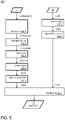
- the computer system 100 can be operated to execute a computer-implemented method 1000 for detecting plant diseases as illustrated by the simplified flow chart of FIG. 2.
- FIG. 1 is described in the context of FIG. 2 . The following description therefore refers to reference numbers of FIG. 1 and FIG. 2 where appropriate.
- test input image 10 images of a particular crop 1 showing one or more particular plant disease symptoms.
- test input images may be recorded with a camera device 90.
- a user e.g., a farmer
- a digital camera e.g., the camera of a smartphone or tablet computer
- a communication network e.g., a mobile communication network
- the user can then take photos of various crop parts (e.g., the leaves or other parts of the crop plant) which appear to show symptoms of plant disease(s). It is assumed that a particular transmitted input image 10 shows at least a portion 11 of said particular crop 10.
- the user in the field typically is aware of the type of crop which is grown in said field. Therefore, the user transmits a corresponding crop identifier 20 (crop ID) associated with the input image 10.
- the crop ID and test input image is then received 1100 by the computer system 100 via the interface 110.
- the user may provide further information 21 to the computer system.
- additional data 21 may relate to further external data specifying particular environmental conditions associated with the respective crop in the field. For example, weather conditions, soil conditions, or other environmental data which may have an impact on plant diseases may also be received by the computer system.
- the computer system 100 includes modules which are adapted to detect the presence of one or more plant diseases present on the crop 1 by applying 1200 advanced image processing to the corresponding test input image 10 in combination with the received crop ID information.
- One of such modules is implemented as a convolutional neural network 120 (CNN) which is stored in a data storage component of the computer system 100.
- the CNN 120 is part of a classifier 130 implemented by the computer system which provides predictions about potential diseases to an output device 50.
- the output device 50 can be the same device which is used by the user for providing the test input to the computer system. That is, the user may take a photo of the crop 1 and transmit the photo together with the crop ID to the computer system, and in turn the user receives from the computer system the disease predictions made by the classifier 130 as the system response.
- the computer system may further include an image cropping (or cutting) module configured to crop (cut) a new input image, including a plant main portion with a main leaf or main stem or main panicle of the crop, to a region surrounding the main portion.
- the main leaf can be segmented by a segmentation neural network with a pixel-wise categorical cross-entropy loss function being complemented with a total variation term.
- Such a leaf-mask crop approach is described in detail in Picon et al. (2018).
- the CNN 120 is pre-trained with a multi-crop dataset.
- the training dataset includes input images showing various crops (i.e. different types of crops). Each of the training input images shows a part of a particular crop.
- the training data set includes images with one or more disease symptoms associated with one or more diseases of interest, and images showing a part of a particular crop with abiotic marks (marks related to non-living parts of any habitat), and images showing a healthy part of a particular crop.
- the training data set includes images with indicators for biotic and abiotic stress factors for the plants, such as for example: insect feeding damage, nutrition deficiencies, drought stress, viruses, bacteria, healing damage, sunburn, etc.
- the wheat dataset used at Picon et al. (2018) containing 8178 images from the field has been extended.
- This dataset included Septoria (Septoria triciti), Tan Spot (Drechslera triciti-repentis) and Rust (Puccinia striiformis, Puccinia recondita) diseases over more than 36 wheat plant varieties.
- Three new crops have been added to the existing winter wheat (Triticum aestivum) specie: Corn (Zea mays), Rape seed (Brassica napus) and Winter barley (Hordeum vulgare).
- winter wheat diseases have been extended including five different diseases (Septoria tritici, Puccinia striiformis, Puccinia recondita, Septoria nodorum and Drechslera tritici-repentis).
- Helminthosporium turcicum disease has been included in the database whereas rape seed crop includes Phoma lingam disease and winter barley crop includes four different diseases: Pyrenophora teres,Ramularia collo-cygni, Rhynchosporium secalis and Puccinia hordei containing a total number of 100734 images as shown in Table 1 of FIG. 7A .
- the generated training dataset contains images at four different stages of infection with approximately equal shares (e.g., shares between 15% and 35%) in the number of input images used for the training of the convolutional neural network belonging to the various stages of the infection. For example, approximately, 25% of the images belong to initial stages of the infection, 25% to early stages, 25% to medium stages and 25% to advanced stages. In case more stages of infection are defined, the percentages of the shares are adjusted accordingly.
- the training dataset includes diseases that generate very similar symptoms, especially on early stages. In this sense, before the typical visual appearance of a disease occur, a very common effect is that the leaves show different shapes of chloroses. Not only for biotic stress, but also for abiotic stress, thus further complicating the exact determination of the disease.
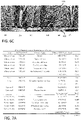
- the initial symptoms in Wheat of Puccinia recondita and Puccinia striiformis and also in Barley of Ramularia collo-cygni and Puccinia hordei show very similar chloroses as seen in FIGs. 6A and 6B brightening of small patches with slight differences in color and shape.
- the main leaf or main stem or main panicle at each image was automatically segmented by a fully convolutional DenseNet network (Jegou et al. (2017)) where the pixel-wise categorical cross-entropy loss function was complemented with a total variation term that penalizes segmentation of irregular regions.
- Each image was also labeled with all the diseases that are presented in a multi-label scheme where an image can have multiple diseases.
- the CNN 120 has an extended topology which includes:
- CNN 120 is part of a classifier module 130 which applies 1200 the trained CNN 120 to the received test input.
- the CNN 120 delivers an output vector.
- the classifier 130 provides 1300 a classification result CR1 indicating the one or more plant diseases associated with the one or more particular plant disease symptoms visible on the test input image.
- the classification result CR1 can be interpreted as a disease prediction with regards to the diseases associated with said symptoms.
- the image branch 121 of the CNN topology described includes a backbone topology implemented by a classification convolutional neural network topology configured to gradually reduce the dimensionality of the image representation in the spatial domain while growing on the feature domain to learn image representations as sets of high level features.
- the network layers gradually learn filters that represent the different spatial parts of the image while simultaneously only the maximum responses for these learned filters are kept at each spatial neighborhood by using the maximum pooling layers.
- a person skilled in neural network technologies may use different architectures for such a backbone, including but not limited to: a RESNET ⁇ architecture, such as for example a RESNET50 topology, a DenseNet architecture, a VGGNet architecture, or any other suitable classification convolutional neural network.
- a RESNET ⁇ architecture such as for example a RESNET50 topology
- a DenseNet architecture such as for example a RESNET50 topology
- a VGGNet architecture such as for example, the backbone may be derived from the ResNet50 topology presented by He et al. (2016. Deep residual learning for image recognition, in: Proceedings of the IEEE Conference on Computer Vision and Pattern Recognition, pp. 770-778 .).
- the ResNet50 neural network is composed of 50 layers with initial two consecutive 3x3 convolutions, both followed by 3x3 max-pooling operations.
- the backbone is trained over the full dataset containing all crops and serving as an estimation of the network capability of creating appropriate visual representations without crop information. Results for the baseline network over the full training dataset are depicted in table 2 of FIG. 7B .
- FIGs. 3 to 5 illustrate three alternative embodiments for the CNN 120 with different implementations for the image branch 121, the crop ID branch 122, and the branch integration 123.
- FIG. 3 shows details of a first CNN 120 implementation also referred to as the bypass solution.
- the image branch includes said backbone topology 121-1 (classification convolutional neural network) which receives the test input image 10 (dimensions 224x224x3) and gradually reduces the dimensionality of the image representation in the spatial domain (to finally 7x7x2048) while growing on the feature domain to learn image representations as sets of high level features.
- backbone topology 121-1 classification convolutional neural network
- the backbone 121-1 is followed by an image representation layer with an average pooling operation 121-2 integrating the high level features, and with a reshaping operation 121-3 matching the dimensions of the average pooling output (1x1x2048) with the dimensions (1xK) of the crop identification branch 122-1.
- the crop ID 20 thereby is representing crop information as a categorical vector of K components where K is the number of crops in the model. This vector is of value 1 at the component corresponding to its crop class and of value 0 for the other components.
- the vector (1xK) is bypassing the entire image branch.
- the crop ID branch 122-1 is directly feeding into the branch integration starting with a concatenation layer 123-1 aggregating the crop identifier 20 received via the crop identification branch 122-1 into the output of the image representation layer by combining image descriptive features from the image representation layer with the information of the plant species present on the respective image. That is, this aggregation generates a new joint layer with the dimension (1x(2048+K)) that combines the image descriptive features from the image representation layer with the information of the plant species (crop) that is present on the input image.
- a subsequent fully connected layer (dense layer 123-2) is responsible for mapping the relationships between the image high level features and the respective crops with the disease predictions P1 using a sigmoid activation function 123-3.
- the dense layer 123-2 reduces the dimension to (1xD).
- the visual feature representation at the image representation layer and the subsequent crop-disease mapping are jointly learned.
- the learned visual features that are shared by all the crops dealing to a more rich dataset representation and the crop mapping allow mapping similar features into different diseases based on the plant species present.
- FIG. 4 shows details of a second CNN 120 implementation.
- the image branch includes again a backbone topology 221-1 (classification convolutional neural network similar to the backbone 121-1) which receives the test input image 10 (dimensions 224x224x3) and gradually reduces the dimensionality of the image representation in the spatial domain (to finally 7x7x2048) while growing on the feature domain to learn image representations as sets of high level features.
- an image representation layer follows the backbone topology with an average pooling operation 221-2 integrating the high level features, and with a reshaping operation 221-3 matching the dimensions of the average pooling output with the dimensions of the crop identification branch.
- the crop identification branch has a dense layer 222-1 directly connected to the crop identifier 20, with the number of neurons of the dense layer corresponding to the number of features at the image representation layer.
- a sigmoid activation function 222-2 is used to map the resulting output into the range of [0,1].
- the image representation layer and the dense layer are followed by a multiplication layer 223-1 to integrate the output of the sigmoid activation function 222-2 with the image representation layer by an elementwise multiplication. That is, in this implementation, the crop ID vector 20 is not concatenated as an additional feature as in the bypass implementation but is rather used to suppress the activation of certain visual features when they are irrelevant for the plant species that is present on the test input image. This ensures that the plant species (crop) that is present on the input image modulates the response of the learned visual descriptors reducing the effect of inconsistent ones. In other words, the learned visual descriptors which are irrelevant (because the associated visual symptoms cannot cause any disease on the particular crop as identified by the crop identifier) are suppressed.
- the multiplication layer is the followed by a further dense layer 223-2 with a corresponding sigmoid activation function 223-3 to map relationships between image high level features and respective crops with disease predictions P2. Again, the visual feature representation at the image representation layer and the subsequent crop-disease mapping are jointly learned.
- FIG. 5 shows details of a third CNN 120 implementation.
- the image branch includes again said backbone topology 321-1 (classification convolutional neural network) which receives the test input image 10 (dimensions 224x224x3) and gradually reduces the dimensionality of the image representation in the spatial domain (to finally 7x7x2048) while growing on the feature domain to learn image representations as sets of high level features.
- backbone topology 321-1 classification convolutional neural network
- an image representation layer follows the backbone topology, with an average pooling operation 321-1 integrating the high level features, and with a reshaping operation 321-3 matching the dimensions of the average pooling output with the dimensions of the crop identification branch.
- the image representation layer is then followed by a first dense layer 321-4 to map image high level features to disease predictions using a first sigmoid activation function 321-5.
- the crop identification branch is similar to the second implementation.
- a second dense layer 322-1 in the crop identification branch is directly connected to the crop identifier 20, with the number of neurons of the fully connected dense layer corresponding to the number of features at the image representation layer.
- a second sigmoid activation function 322-2 is used to map the resulting output into the range of [0,1].
- the third implementation again uses a multiplication layer 323-1 for branch integration.
- the multiplication layer follows the first and second dense layers 321-4, 322-1 with their corresponding sigmoid activation functions. This allows to suppress activations of diseases predicted by the first dense layer 321-4 but not present on the plant species represented by the crop identifier 20 by performing an elementwise multiplication of the activations. That is, predictions determined by the first dense layer 321 which are not consistent with the crop identifier information are suppressed by a multiplication with the "0" components of the vector 20 so that only the predictions P3 remain for such diseases which can actually occur on the crop represented by the crop identifier 20.
- the suppression is performed directly over the final predictions of the network (coming out of the first dense layer 321-4 and its sigmoid activation function 32-15) by suppressing the activation of diseases that cannot be present on the represented plant-species.
- FIGs. 6A, 6B and 6C illustrate examples of input images which are part of the training data set.
- the upper image parts 602, 612, 622 in the figures correspond to the actual input image whereas the lower parts 601, 611, 621 of images show a zoomed area which is indicated by a corresponding square (e.g., 603, 613, 623) in the actual impute images.
- FIG. 6A illustrates examples of diseases on images contained in the dataset for wheat: a) Puccinia recondita, b) Puccinia striiformis, c) Drechslera tritici-repentis, d) Septoria tritici, and e) Septoria nodorum.
- the images in FIG. 6A focus on leaves as the plant portions with disease symptoms.
- FIG. 6B shows examples of diseases on images contained in the dataset for barley: a) Pyrenophorateres, b) Ramularia collo-cygni, c) Rhynchosporium secalis, d) Puccinia hordei, rape seed, e) Phoma lingam, corn: f) Helminthosporium turcicum.
- the images in FIG. 6B focus on leaves as the plant portions with disease symptoms.
- FIG. 6C shows further examples of diseases on images contained in the dataset for:
- EPPO code (formerly known as a Bayer code) in the "EPPO-CODE” column, is an encoded identifier that is used by the European and Mediterranean Plant Protection Organization (EPPO), in a system designed to uniquely identify organisms - namely plants, pests and pathogens - that are important to agriculture and crop protection.
- EPPO codes are a component of a database of names, both scientific and vernacular.
- the EPPO codes in the EPPO-Code column relate to the respective crop.
- the EPPO codes in the "Disease EPPO-code” column relate to the diseases in the column "Disease Name".
- the column “Total” shows the number of input images for the respective characteristics in the data set.
- Image acquisition date was set as division criterion to avoid images taken the same day to belong to different sets.
- the Area under the Receiver Operating Characteristic (ROC) Curve (AuC) was selected as the most suitable algorithm performance metric, in order to account for the class imbalance present in the dataset (in such cases, the use of accuracy is discouraged).
- Computed values of sensitivity, specificity and balanced accuracy (BAC), Negative predictive value (NPV) and positive predictive value (PPV) for the different diseases are also provided for the threshold value that maximizes the validation set accuracy following the same methodology used at Johannes et al. (2017) and at Picon et al. (2018).
- BAC specificity and balanced accuracy
- NPV Negative predictive value
- PPV positive predictive value
- the backbone of the network architecture may be pre-trained over the Imagenet dataset Russakovsky et al. (2015. ImageNet Large Scale Visual Recognition Challenge. International Journal of Computer Vision (IJCV) 115, 211-252. doi:10.1007/s11263-015-0816-y .).
- This pre-trained network serves as a backbone network for testing the different network topologies.
- each of the alternative CNN topologies (cf. FIG. 3 to 5 ) is loaded with the pre-trained weights for all shared layers and their weights are kept frozen.
- the last dense layer and the layers corresponding to the integration of the crop identification information are randomly initialized, and are the only ones allowed to modify its weights during learning at this stage.
- a final training stage completes the fine-tuning by starting from the weights resulting from the previous stage and unfreezing all the layers, thus yielding a free, unconstrained training.
- the network was trained using Stochastic Gradient Descent (SGD) optimization with an initial learning rate of 10 -4 , a learning rate decay of 10 -6 and a momentum of 0.9.
- SGD Stochastic Gradient Descent
- Table 2 in FIG. 7B illustrates validation results for the classification accuracy achievable by using only a backbone (baseline) topology (implemented with a ResNet50 architecture trained together with different crops.
- Table 3 in FIG. 7C illustrates validation results for the classification accuracy achievable by using only a backbone (baseline) topology (implemented with a ResNet50 architecture trained separately for each crop (as applied in the prior art).
- the first column in tables 2 and 3 show the EPPO codes of various plant diseases.
- the AuC column shows the Area Under ROC curve.
- an ROC curve (receiver operating characteristic curve) is a graph showing the performance of a classification model at all classification thresholds.
- AUC measures the entire two-dimensional area underneath the entire ROC curve from (0,0) to (1,1).
- AUC provides an aggregate measure of performance across all possible classification thresholds.
- One way of interpreting AUC is as the probability that the model ranks a random positive example more highly than a random negative example.
- the column BAC shows the Balanced accuracy: sensitivity + specificity / 2: this is a global metric to measure the performance of the CNN algorithm.
- the BAC value is the value which allows to compare the performance of the various CNN topologies.
- the other four columns Sens, Spec, NPV and PPV are related to sensitivity, specificity, negative predictive value and positive predictive value (cf. https://www.ncbi.nlm.nih.gov/pmc/articles/PMC2636062/)
- Table 4 in FIG. 7D shows the validation results achieved with the first implementation (RESNET-MC-1 architecture) of the CNN topology as described in cf. FIG. 3 (trained for all crops together).
- RESNET-MC-1 obtains an average BAC value of 0.96 while the baseline multi-crop model (average of BAC in table 2) only achieves a value of 0.94.
- the BAC value when using isolated models (cf. table 3) is only 0.85 for.
- the extended CNN topology as disclosed herein provides an alternative solution for detecting plant diseases which is able to achieve a better performance in accurately identifying plant diseases based on symptoms shown on respective crop images.
- FIG. 8 is a diagram that shows an example of a generic computer device 900 and a generic mobile computer device 950, which may be used with the techniques described here.
- Computing device 900 is intended to represent various forms of digital computers, such as laptops, desktops, workstations, personal digital assistants, servers, blade servers, mainframes, and other appropriate computers.
- Generic computer device 900 may correspond to the computer system 100 of FIG. 1 .
- Computing device 950 is intended to represent various forms of mobile devices, such as personal digital assistants, cellular telephones, smart phones, and other similar computing devices.
- computing device 950 may be used as a GUI frontend for a user to capture test input images and provide them to the computer device 900 with the respective crop identifier, and in turn, receive from the computer device, the disease prediction.
- computing device 950 may also include the output device 50 of FIG. 1 .
- the components shown here, their connections and relationships, and their functions, are meant to be exemplary only, and are not meant to limit implementations of the inventions described and/or claimed in this document.
- Computing device 900 includes a processor 902, memory 904, a storage device 906, a high-speed interface 908 connecting to memory 904 and high-speed expansion ports 910, and a low speed interface 912 connecting to low speed bus 914 and storage device 906.
- Each of the components 902, 904, 906, 908, 910, and 912 are interconnected using various busses, and may be mounted on a common motherboard or in other manners as appropriate.
- the processor 902 can process instructions for execution within the computing device 900, including instructions stored in the memory 904 or on the storage device 906 to display graphical information for a GUI on an external input/output device, such as display 916 coupled to high speed interface 908.
- multiple processing units and/or multiple buses may be used, as appropriate, along with multiple memories and types of memory.
- multiple computing devices 900 may be connected, with each device providing portions of the necessary operations (e.g., as a server bank, a group of blade servers, or a processing device).
- the memory 904 stores information within the computing device 900.
- the memory 904 is a volatile memory unit or units.
- the memory 904 is a non-volatile memory unit or units.
- the memory 904 may also be another form of computer-readable medium, such as a magnetic or optical disk.
- the storage device 906 is capable of providing mass storage for the computing device 900.
- the storage device 906 may be or contain a computer-readable medium, such as a floppy disk device, a hard disk device, an optical disk device, or a tape device, a flash memory or other similar solid state memory device, or an array of devices, including devices in a storage area network or other configurations.
- a computer program product can be tangibly embodied in an information carrier.
- the computer program product may also contain instructions that, when executed, perform one or more methods, such as those described above.
- the information carrier is a computer- or machine-readable medium, such as the memory 904, the storage device 906, or memory on processor 902.
- the high speed controller 908 manages bandwidth-intensive operations for the computing device 900, while the low speed controller 912 manages lower bandwidth-intensive operations.
- the high-speed controller 908 is coupled to memory 904, display 916 (e.g., through a graphics processor or accelerator), and to high-speed expansion ports 910, which may accept various expansion cards (not shown).
- low-speed controller 912 is coupled to storage device 906 and low-speed expansion port 914.
- the low-speed expansion port which may include various communication ports (e.g., USB, Bluetooth, Ethernet, wireless Ethernet) may be coupled to one or more input/output devices, such as a keyboard, a pointing device, a scanner, or a networking device such as a switch or router, e.g., through a network adapter.
- input/output devices such as a keyboard, a pointing device, a scanner, or a networking device such as a switch or router, e.g., through a network adapter.
- the computing device 900 may be implemented in a number of different forms, as shown in the figure. For example, it may be implemented as a standard server 920, or multiple times in a group of such servers. It may also be implemented as part of a rack server system 924. In addition, it may be implemented in a personal computer such as a laptop computer 922. Alternatively, components from computing device 900 may be combined with other components in a mobile device (not shown), such as device 950. Each of such devices may contain one or more of computing device 900, 950, and an entire system may be made up of multiple computing devices 900, 950 communicating with each other.
- Computing device 950 includes a processor 952, memory 964, an input/output device such as a display 954, a communication interface 966, and a transceiver 968, among other components.
- the device 950 may also be provided with a storage device, such as a microdrive or other device, to provide additional storage.
- a storage device such as a microdrive or other device, to provide additional storage.
- Each of the components 950, 952, 964, 954, 966, and 968 are interconnected using various buses, and several of the components may be mounted on a common motherboard or in other manners as appropriate.
- the processor 952 can execute instructions within the computing device 950, including instructions stored in the memory 964.
- the processor may be implemented as a chipset of chips that include separate and multiple analog and digital processing units.
- the processor may provide, for example, for coordination of the other components of the device 950, such as control of user interfaces, applications run by device 950, and wireless communication by device 950.
- Processor 952 may communicate with a user through control interface 958 and display interface 956 coupled to a display 954.
- the display 954 may be, for example, a TFT LCD (Thin-Film-Transistor Liquid Crystal Display) or an OLED (Organic Light Emitting Diode) display, or other appropriate display technology.
- the display interface 956 may comprise appropriate circuitry for driving the display 954 to present graphical and other information to a user.
- the control interface 958 may receive commands from a user and convert them for submission to the processor 952.
- an external interface 962 may be provide in communication with processor 952, so as to enable near area communication of device 950 with other devices.
- External interface 962 may provide, for example, for wired communication in some implementations, or for wireless communication in other implementations, and multiple interfaces may also be used.
- the memory 964 stores information within the computing device 950.
- the memory 964 can be implemented as one or more of a computer-readable medium or media, a volatile memory unit or units, or a non-volatile memory unit or units.
- Expansion memory 984 may also be provided and connected to device 950 through expansion interface 982, which may include, for example, a SIMM (Single In Line Memory Module) card interface.
- SIMM Single In Line Memory Module
- expansion memory 984 may provide extra storage space for device 950, or may also store applications or other information for device 950.
- expansion memory 984 may include instructions to carry out or supplement the processes described above, and may include secure information also.
- expansion memory 984 may act as a security module for device 950, and may be programmed with instructions that permit secure use of device 950.
- secure applications may be provided via the SIMM cards, along with additional information, such as placing the identifying information on the SIMM card in a non-hackable manner.
- the memory may include, for example, flash memory and/or NVRAM memory, as discussed below.
- a computer program product is tangibly embodied in an information carrier.
- the computer program product contains instructions that, when executed, perform one or more methods, such as those described above.
- the information carrier is a computer- or machine-readable medium, such as the memory 964, expansion memory 984, or memory on processor 952, that may be received, for example, over transceiver 968 or external interface 962.
- Device 950 may communicate wirelessly through communication interface 966, which may include digital signal processing circuitry where necessary. Communication interface 966 may provide for communications under various modes or protocols, such as GSM voice calls, SMS, EMS, or MMS messaging, CDMA, TDMA, PDC, WCDMA, CDMA2000, or GPRS, among others. Such communication may occur, for example, through radio-frequency transceiver 968. In addition, short-range communication may occur, such as using a Bluetooth, WiFi, or other such transceiver (not shown). In addition, GPS (Global Positioning System) receiver module 980 may provide additional navigation- and location-related wireless data to device 950, which may be used as appropriate by applications running on device 950.
- GPS Global Positioning System
- Device 950 may also communicate audibly using audio codec 960, which may receive spoken information from a user and convert it to usable digital information. Audio codec 960 may likewise generate audible sound for a user, such as through a speaker, e.g., in a handset of device 950. Such sound may include sound from voice telephone calls, may include recorded sound (e.g., voice messages, music files, etc.) and may also include sound generated by applications operating on device 950.
- Audio codec 960 may receive spoken information from a user and convert it to usable digital information. Audio codec 960 may likewise generate audible sound for a user, such as through a speaker, e.g., in a handset of device 950. Such sound may include sound from voice telephone calls, may include recorded sound (e.g., voice messages, music files, etc.) and may also include sound generated by applications operating on device 950.
- the computing device 950 may be implemented in a number of different forms, as shown in the figure. For example, it may be implemented as a cellular telephone 980. It may also be implemented as part of a smart phone 982, personal digital assistant, or other similar mobile device.
- implementations of the systems and techniques described here can be realized in digital electronic circuitry, integrated circuitry, specially designed ASICs (application specific integrated circuits), computer hardware, firmware, software, and/or combinations thereof.
- ASICs application specific integrated circuits
- These various implementations can include implementation in one or more computer programs that are executable and/or interpretable on a programmable system including at least one programmable processor, which may be special or general purpose, coupled to receive data and instructions from, and to transmit data and instructions to, a storage system, at least one input device, and at least one output device.
- the systems and techniques described here can be implemented on a computer having a display device (e.g., a CRT (cathode ray tube) or LCD (liquid crystal display) monitor) for displaying information to the user and a keyboard and a pointing device (e.g., a mouse or a trackball) by which the user can provide input to the computer.
- a display device e.g., a CRT (cathode ray tube) or LCD (liquid crystal display) monitor
- a keyboard and a pointing device e.g., a mouse or a trackball
- Other kinds of devices can be used to provide for interaction with a user as well; for example, feedback provided to the user can be any form of sensory feedback (e.g., visual feedback, auditory feedback, or tactile feedback); and input from the user can be received in any form, including acoustic, speech, or tactile input.
- the systems and techniques described here can be implemented in a computing device that includes a back end component (e.g., as a data server), or that includes a middleware component (e.g., an application server), or that includes a front end component (e.g., a client computer having a graphical user interface or a Web browser through which a user can interact with an implementation of the systems and techniques described here), or any combination of such back end, middleware, or front end components.
- the components of the system can be interconnected by any form or medium of digital data communication (e.g., a communication network). Examples of communication networks include a local area network ("LAN”), a wide area network (“WAN”), and the Internet.
- LAN local area network
- WAN wide area network
- the Internet the global information network
- the computing device can include clients and servers.
- a client and server are generally remote from each other and typically interact through a communication network.
- the relationship of client and server arises by virtue of computer programs running on the respective computers and having a client-server relationship to each other.
Landscapes
- Engineering & Computer Science (AREA)
- Theoretical Computer Science (AREA)
- Physics & Mathematics (AREA)
- General Physics & Mathematics (AREA)
- General Health & Medical Sciences (AREA)
- Health & Medical Sciences (AREA)
- Evolutionary Computation (AREA)
- Computer Vision & Pattern Recognition (AREA)
- Multimedia (AREA)
- Medical Informatics (AREA)
- Software Systems (AREA)
- Computing Systems (AREA)
- Artificial Intelligence (AREA)
- Databases & Information Systems (AREA)
- Nuclear Medicine, Radiotherapy & Molecular Imaging (AREA)
- Radiology & Medical Imaging (AREA)
- Quality & Reliability (AREA)
- Data Mining & Analysis (AREA)
- Biomedical Technology (AREA)
- Biophysics (AREA)
- Computational Linguistics (AREA)
- Life Sciences & Earth Sciences (AREA)
- Molecular Biology (AREA)
- General Engineering & Computer Science (AREA)
- Mathematical Physics (AREA)
- Measuring Or Testing Involving Enzymes Or Micro-Organisms (AREA)
- Image Analysis (AREA)
- Pretreatment Of Seeds And Plants (AREA)
- Management, Administration, Business Operations System, And Electronic Commerce (AREA)
Claims (15)
- Computerimplementiertes Verfahren (1000) zum Detektieren von Pflanzenkrankheiten unter Verwendung eines neuronalen Faltungsnetzes (120), das mit einem Datensatz für mehrere Kulturpflanzen trainiert wird, wobei der Trainingsdatensatz Trainingseingangsbilder umfasst, die jeweils diverse Kulturpflanzen zeigen, und jedes der Trainingseingangsbilder einen Abschnitt einer bestimmten Kulturpflanze mit einem oder mehreren Krankheitssymptomen, die einer oder mehreren Krankheiten von Interesse zugeordnet sind, zeigt oder einen Abschnitt einer bestimmten Kulturpflanze mit abiotischen Kennzeichen zeigt oder einen gesunden Abschnitt einer bestimmten Kulturpflanze zeigt, wobei das neuronale Faltungsnetz (120) mit einer erweiterten Topologie einen Bildzweig (121) auf der Grundlage eines neuronalen Klassifizierungs-Faltungsnetzes zum Klassifizieren von Versuchseingangsbildern gemäß pflanzenkrankheitsspezifischen Merkmalen, einen Kulturpflanzen-Identifizierungszweig (122) zum Hinzufügen von Pflanzenspeziesinformationen und einen Zweigintegrator zum Integrieren der Pflanzenspeziesinformationen mit jedem Versuchsbild umfasst, wobei die Pflanzenspeziesinformationen (20) die Kulturpflanze auf dem jeweiligen Versuchseingangsbild (10) spezifizieren, wobei das Verfahren Folgendes umfasst:Empfangen (1100) einer Versuchseingabe, die ein Bild einer bestimmten Kulturpflanze, die ein oder mehrere bestimmte Pflanzenkrankheitssymptome zeigt, und eine jeweilige Kulturpflanzenkennung umfasst;Anwenden (1200) des trainierten neuronalen Faltungsnetzes (120) auf die empfangene Versuchseingabe; undBereitstellen (1300) eines Klassifizierungsergebnisses gemäß dem Ausgangsvektor des neuronalen Faltungsnetzes, wobei das Klassifizierungsergebnis die eine oder die mehreren Pflanzenkrankheiten angibt, die dem einen oder den mehreren bestimmten Pflanzenkrankheitssymptomen zugeordnet sind.
- Verfahren nach Anspruch 1, wobei näherungsweise gleiche Anteile der Anzahl von Eingangsbildern, die zum Trainieren des neuronalen Faltungsnetzes verwendet werden, zu Anfangsstadien einer Infektion, frühen Stadien der Infektion, mittleren Stadien der Infektion und fortgeschrittenen Stadien der Infektion gehören.
- Verfahren nach einem der vorhergehenden Ansprüche, wobei ein neues Eingangsbild, das einen Abschnitt umfasst, der einen Pflanzenhauptabschnitt mit einem Hauptblatt oder einem Hauptstamm oder einer Hauptrispe zeigt, auf einen Bereich zugeschnitten wird, der den Hauptabschnitt umgibt, wobei der Hauptabschnitt durch ein neuronales Segmentierungsnetz segmentiert wird, wobei eine pixelweise, unbedingte Kreuzentropie-Verlustfunktion mit einem Gesamtvariationsausdruck ergänzt wird.
- Verfahren nach einem der vorhergehenden Ansprüche, wobei die Topologie des neuronalen Faltungsnetzes Folgendes umfasst:eine Backbone-Topologie, die durch eine Topologie eines neuronalen Klassifizierungs-Faltungsnetzes implementiert ist, die konfiguriert ist, die Dimensionalität der Bilddarstellung in der Raumdomäne allmählich zu verringern, während sie auf der Merkmalsdomäne wächst, wobei sie befähigt ist, Bilddarstellungen als Gruppen von Merkmalen auf hoher Ebene zu lernen;auf die Backbone-Topologie folgend eine Bilddarstellungsschicht mit einem Mittelwert-Poolbildungsvorgang, der die Merkmale auf hoher Ebene integriert, und mit einem Umbildungsvorgang, der die Dimensionen des Ausgangs der Mittelwert-Poolbildung mit den Dimensionen des Kulturpflanzen-Identifizierungszweigs abgleicht;auf die Bilddarstellungsschicht folgend eine Verkettungsschicht, die die Kulturpflanzenkennung, die über den Kulturpflanzen-Identifizierungszweig empfangen wird, in den Ausgang der Bilddarstellungsschicht aggregiert, indem bildbeschreibende Merkmale aus der Bilddarstellungsschicht mit den Informationen über die Pflanzenspezies, die auf dem jeweiligen Bild vorliegt, kombiniert werden;auf die Verkettungsschicht folgend eine dichte Schicht, um unter Verwendung einer S-Kurven-Aktivierungsfunktion Beziehungen zwischen Bildmerkmalen auf hoher Ebene und jeweiligen Kulturpflanzen mit Krankheitsvorhersagen abzubilden;wobei die visuelle Merkmalsdarstellung in der Bilddarstellungsschicht und die anschließende Kulturpflanze/Krankheits-Abbildung miteinander gelernt werden.
- Verfahren nach einem der Ansprüche 1 bis 3, wobei die Topologie des neuronalen Faltungsnetzes Folgendes umfasst:eine Backbone-Topologie, die durch eine Topologie eines neuronalen Klassifizierungs-Faltungsnetzes implementiert ist, die konfiguriert ist, die Dimensionalität der Bilddarstellung in der Raumdomäne allmählich zu verringern, während sie auf der Merkmalsdomäne wächst, wobei sie befähigt ist, Bilddarstellungen als Gruppen von Merkmalen auf hoher Ebene zu lernen;auf die Backbone-Topologie folgend eine Bilddarstellungsschicht mit einem Mittelwert-Poolbildungsvorgang, der die Merkmale auf hoher Ebene integriert, und mit einem Umbildungsvorgang, der die Dimensionen des Ausgangs der Mittelwert-Poolbildung mit den Dimensionen des Kulturpflanzen-Identifizierungszweigs abgleicht;wobei der Kulturpflanzen-Identifizierungszweig eine dichte Schicht aufweist, die direkt mit dem Kulturpflanzenkennungseingang verbunden ist, wobei die Anzahl der Neuronen der dichten Schicht der Anzahl von Merkmalen in der Bilddarstellungsschicht entspricht, und die eine S-Kurven-Aktivierungsfunktion verwendet, um den resultierenden Ausgang in den Bereich von [0, 1] abzubilden;auf die Bilddarstellungsschicht und die dichte Schicht folgend eine Multiplikationsschicht, um durch eine elementweise Multiplikation den Ausgang der S-Kurven-Aktivierungsfunktion mit der Bilddarstellungsschicht zu integrieren;auf die Multiplikationsschicht folgend eine weitere dichte Schicht, um Beziehungen zwischen Bildmerkmalen auf hoher Ebene und jeweiligen Kulturpflanzen mit Krankheitsvorhersagen abzubilden;wobei die visuelle Merkmalsdarstellung in der Bilddarstellungsschicht und die anschließende Kulturpflanze/Krankheits-Abbildung miteinander gelernt werden.
- Verfahren nach einem der Ansprüche 1 bis 3, wobei die Topologie des neuronalen Faltungsnetzes Folgendes umfasst:eine Backbone-Topologie, die durch eine Topologie eines neuronalen Klassifizierungs-Faltungsnetzes implementiert ist, die konfiguriert ist, die Dimensionalität der Bilddarstellung in der Raumdomäne allmählich zu verringern, während sie auf der Merkmalsdomäne wächst, wobei sie befähigt ist, Bilddarstellungen als Gruppen von Merkmalen auf hoher Ebene zu lernen;auf die Backbone-Topologie folgend eine Bilddarstellungsschicht mit einem Mittelwert-Poolbildungsvorgang, der die Merkmale auf hoher Ebene integriert, und mit einem Umbildungsvorgang, der die Dimensionen des Ausgangs der Mittelwert-Poolbildung mit den Dimensionen des Kulturpflanzen-Identifizierungszweigs abgleicht;auf die Bilddarstellungsschicht folgend eine erste dichte Schicht, um unter Verwendung einer ersten S-Kurven-Aktivierungsfunktion Bildmerkmale auf hoher Ebene auf Krankheitsvorhersagen abzubilden;eine zweite dichte Schicht im Kulturpflanzen-Identifizierungszweig, die direkt mit der Kulturpflanzenkennung verbunden ist, wobei die Anzahl der Neuronen der vollständig verbundenen dichten Schicht der Anzahl von Merkmalen in der Bilddarstellungsschicht entspricht, und die eine zweite S-Kurven-Aktivierungsfunktion verwendet, um den resultierenden Ausgang in den Bereich von [0, 1] abzubilden;auf die erste und die zweite dichte Schicht folgend eine Multiplikationsschicht, um Aktivierungen von Krankheiten, die durch die erste dichte Schicht vorhergesagt werden, jedoch auf der Pflanzenspezies, die durch die Kulturpflanzenkennung dargestellt wird, nicht vorliegen, zu unterdrücken, indem eine elementweise Multiplikation der Aktivierungen durchgeführt wird;wobei die visuelle Merkmalsdarstellung in der Bilddarstellungsschicht und die anschließende Kulturpflanze/Krankheits-Abbildung miteinander gelernt werden.
- Verfahren nach einem der Ansprüche 4 bis 6, wobei der Kulturpflanzen-Identifizierungszweig ferner konfiguriert ist, weitere externe Daten (21) zusammen mit der Kulturpflanzenkennung (20) hinzuzufügen, wobei die weiteren externen Daten bestimmte Umgebungsbedingungen spezifizieren, die einem jeweiligen kulturpflanzenspezifischen Eingangsbild zugeordnet sind.
- Verfahren nach einem der Ansprüche 4 bis 7, wobei die Backbone-Topologie zur Kulturpflanzen-Krankheitsidentifikation vorab mit einem Datensatz trainiert wird, der zur späteren Feinabstimmung geeignet ist.
- Computerprogrammprodukt, das Anweisungen umfasst, die dann, wenn sie in einen Datenspeicher einer Rechenvorrichtung geladen und durch mindestens einen Prozessor der Rechenvorrichtung ausgeführt werden, die Verfahrensschritte des computerimplementierten Verfahrens nach einem der vorhergehenden Ansprüche ausführen.
- Computersystem (100) zum Detektieren von Pflanzenkrankheiten; wobei das System Folgendes umfasst: eine Datenspeicherkomponente, in der ein neuronales Faltungsnetz (120) gespeichert ist, das mit einem Datensatz für mehrere Kulturpflanzen trainiert wird, wobei der Trainingsdatensatz Trainingseingangsbilder umfasst, die diverse Kulturpflanzen zeigen, und jedes der Trainingseingangsbilder einen Abschnitt (11) einer bestimmten Kulturpflanze mit einem oder mehreren Krankheitssymptomen, die einer oder mehreren Krankheiten von Interesse zugeordnet sind, zeigt oder einen Abschnitt einer bestimmten Kulturpflanze mit abiotischen Kennzeichen zeigt oder einen gesunden Abschnitt einer bestimmten Kulturpflanze zeigt, wobei das neuronale Faltungsnetz (120) mit einer erweiterten Topologie einen Bildzweig (121) auf der Grundlage eines neuronalen Klassifizierungs-Faltungsnetzes zum Klassifizieren von Versuchseingangsbildern gemäß pflanzenkrankheitsspezifischen Merkmalen, einen Kulturpflanzen-Identifizierungszweig (122) zum Hinzufügen von Pflanzenspeziesinformationen und einen Zweigintegrator zum Integrieren der Pflanzenspeziesinformationen mit jedem Versuchsbild umfasst, wobei die Pflanzenspeziesinformationen (20) die Kulturpflanze auf dem jeweiligen Versuchseingangsbild (10) spezifizieren;eine Schnittstelle (110), die konfiguriert ist, eine Versuchseingabe zu empfangen, die ein Bild (10) einer bestimmten Kulturpflanze (1), die ein oder mehrere bestimmte Pflanzenkrankheitssymptome zeigt, umfasst, und eine jeweilige Kulturpflanzenkennung (20) zu empfangen, die der Versuchseingabe zugeordnet ist; undein Klassifizierungsmodul (130), das konfiguriert ist, das trainierte neuronale Faltungsnetz (120) auf die empfangene Versuchseingabe anzuwenden und ein Klassifizierungsergebnis (CR1) gemäß dem Ausgangsvektor des neuronalen Faltungsnetzes (120) bereitzustellen, wobei das Klassifizierungsergebnis (CR1) die eine oder die mehreren Pflanzenkrankheiten angibt, die dem einen oder den mehreren bestimmten Pflanzenkrankheitssymptomen zugeordnet sind.
- System nach Anspruch 10, das ferner ein Bildzuschneidemodul umfasst, das konfiguriert ist, ein neues Eingangsbild, das ein Hauptblatt der Kulturpflanze enthält, auf einen Bereich zuzuschneiden, der das Hauptblatt umgibt, wobei das Hauptblatt durch ein neuronales Segmentierungsnetz segmentiert wird, wobei eine pixelweise, unbedingte Kreuzentropie-Verlustfunktion mit einem Gesamtvariationsausdruck ergänzt wird.
- System nach Anspruch 10 oder 11, wobei die Topologie des neuronalen Faltungsnetzes Folgendes umfasst:eine Backbone-Topologie (121-1), die durch eine Topologie eines neuronalen Klassifizierungs-Faltungsnetzes implementiert ist, die konfiguriert ist, die Dimensionalität der Bilddarstellung in der Raumdomäne allmählich zu verringern, während sie auf der Merkmalsdomäne wächst, um Bilddarstellungen als Gruppen von Merkmalen auf hoher Ebene zu lernen;auf die Backbone-Topologie (121-1) folgend eine Bilddarstellungsschicht mit einem Mittelwert-Poolbildungsvorgang (121-2), der die Merkmale auf hoher Ebene integriert, und mit einem Umbildungsvorgang (121-3), der die Dimensionen des Ausgangs der Mittelwert-Poolbildung mit den Dimensionen des Kulturpflanzen-Identifizierungszweigs (122-1) abgleicht;auf die Bilddarstellungsschicht folgend eine Verkettungsschicht (123-1), die die Kulturpflanzenkennung (20), die über den Kulturpflanzen-Identifizierungszweig (122-1) empfangen wird, in den Ausgang der Bilddarstellungsschicht aggregiert, indem bildbeschreibende Merkmale aus der Bilddarstellungsschicht mit den Informationen über die Pflanzenspezies, die auf dem jeweiligen Bild vorliegt, kombiniert werden;auf die Verkettungsschicht folgend eine dichte Schicht (123-2), um unter Verwendung einer S-Kurven-Aktivierungsfunktion (123-3) Beziehungen zwischen Bildmerkmalen auf hoher Ebene und jeweiligen Kulturpflanzen mit Krankheitsvorhersagen abzubilden;wobei die visuelle Merkmalsdarstellung in der Bilddarstellungsschicht und die anschließende Kulturpflanze/Krankheits-Abbildung miteinander gelernt werden.
- System nach Anspruch 10 oder 11, wobei die Topologie des neuronalen Faltungsnetzes Folgendes umfasst:eine Backbone-Topologie (221-1), die durch eine Topologie eines neuronalen Klassifizierungs-Faltungsnetzes implementiert ist, die konfiguriert ist, die Dimensionalität der Bilddarstellung in der Raumdomäne allmählich zu verringern, während sie auf der Merkmalsdomäne wächst, um Bilddarstellungen als Gruppen von Merkmalen auf hoher Ebene zu lernen;auf die Backbone-Topologie folgend eine Bilddarstellungsschicht mit einem Mittelwert-Poolbildungsvorgang (221-2), der die Merkmale auf hoher Ebene integriert, und mit einem Umbildungsvorgang (221-3), der die Dimensionen des Ausgangs der Mittelwert-Poolbildung mit den Dimensionen des Kulturpflanzen-Identifizierungszweigs abgleicht;wobei der Kulturpflanzen-Identifizierungszweig eine dichte Schicht (222-1) aufweist, die direkt mit der Kulturpflanzenkennung (20) verbunden ist, wobei die Anzahl der Neuronen der dichten Schicht der Anzahl von Merkmalen in der Bilddarstellungsschicht entspricht, und die eine S-Kurven-Aktivierungsfunktion (222-2) verwendet, um den resultierenden Ausgang in den Bereich von [0, 1] abzubilden;auf die Bilddarstellungsschicht und die dichte Schicht folgend eine Multiplikationsschicht (223-1), um durch eine elementweise Multiplikation den Ausgang der S-Kurven-Aktivierungsfunktion (222-2) mit der Bilddarstellungsschicht zu integrieren;auf die Multiplikationsschicht folgend eine weitere dichte Schicht (223-2), um Beziehungen zwischen Bildmerkmalen auf hoher Ebene und jeweiligen Kulturpflanzen mit Krankheitsvorhersagen abzubilden;wobei die visuelle Merkmalsdarstellung in der Bilddarstellungsschicht und die anschließende Kulturpflanze/Krankheits-Abbildung miteinander gelernt werden.
- System nach Anspruch 10 oder 11, wobei die Topologie des neuronalen Faltungsnetzes Folgendes umfasst:eine Backbone-Topologie (321-1), die durch eine Topologie eines neuronalen Klassifizierungs-Faltungsnetzes implementiert ist, die konfiguriert ist, die Dimensionalität der Bilddarstellung in der Raumdomäne allmählich zu verringern, während sie auf der Merkmalsdomäne wächst, um Bilddarstellungen als Gruppen von Merkmalen auf hoher Ebene zu lernen;auf die Backbone-Topologie folgend eine Bilddarstellungsschicht mit einem Mittelwert-Poolbildungsvorgang (321-1), der die Merkmale auf hoher Ebene integriert, und mit einem Umbildungsvorgang (321-3), der die Dimensionen des Ausgangs der Mittelwert-Poolbildung mit den Dimensionen des Kulturpflanzen-Identifizierungszweigs abgleicht;auf die Bilddarstellungsschicht folgend eine erst dichte Schicht (321-4), um unter Verwendung einer ersten S-Kurven-Aktivierungsfunktion (321-5) Bildmerkmale auf hoher Ebene auf Krankheitsvorhersagen abzubilden;eine zweite dichte Schicht (322-1) im Kulturpflanzen-Identifizierungszweig, die direkt mit der Kulturpflanzenkennung (20) verbunden ist, wobei die Anzahl der Neuronen der vollständig verbundenen dichten Schicht der Anzahl von Merkmalen in der Bilddarstellungsschicht entspricht, und die eine zweite S-Kurven-Aktivierungsfunktion (322-2) verwendet, um den resultierenden Ausgang in den Bereich von [0, 1] abzubilden;auf die erste und die zweite dichte Schicht (321-4, 322-1) mit ihren S-Kurven-Aktivierungsfunktionen folgend eine Multiplikationsschicht (323-1), um Aktivierungen von Krankheiten, die durch die erste dichte Schicht (321-4) vorhergesagt werden, jedoch auf der Pflanzenspezies, die durch die Kulturpflanzenkennung (20) dargestellt wird, nicht vorliegen, zu unterdrücken, indem eine elementweise Multiplikation der Aktivierungen durchgeführt wird; wobei die visuelle Merkmalsdarstellung in der Bilddarstellungsschicht und die anschließende Kulturpflanze/Krankheits-Abbildung miteinander gelernt werden.
- System nach einem der Ansprüche 10 bis 14, wobei die Backbone-Topologie auf einer RESNET-Topologie beruht.
Applications Claiming Priority (1)
| Application Number | Priority Date | Filing Date | Title |
|---|---|---|---|
| EP19174907.6A EP3739504A1 (de) | 2019-05-16 | 2019-05-16 | System und verfahren zur unterstützung der erkennung von pflanzenkrankheiten |
Publications (2)
| Publication Number | Publication Date |
|---|---|
| EP3754543A1 EP3754543A1 (de) | 2020-12-23 |
| EP3754543B1 true EP3754543B1 (de) | 2022-04-06 |
Family
ID=66589337
Family Applications (2)
| Application Number | Title | Priority Date | Filing Date |
|---|---|---|---|
| EP19174907.6A Withdrawn EP3739504A1 (de) | 2019-05-16 | 2019-05-16 | System und verfahren zur unterstützung der erkennung von pflanzenkrankheiten |
| EP20174784.7A Active EP3754543B1 (de) | 2019-05-16 | 2020-05-14 | System und verfahren zur unterstützung der erkennung von pflanzenkrankheiten |
Family Applications Before (1)
| Application Number | Title | Priority Date | Filing Date |
|---|---|---|---|
| EP19174907.6A Withdrawn EP3739504A1 (de) | 2019-05-16 | 2019-05-16 | System und verfahren zur unterstützung der erkennung von pflanzenkrankheiten |
Country Status (8)
| Country | Link |
|---|---|
| US (1) | US12148197B2 (de) |
| EP (2) | EP3739504A1 (de) |
| JP (1) | JP7562567B2 (de) |
| CN (1) | CN114072853A (de) |
| BR (1) | BR112021022829A2 (de) |
| CA (1) | CA3140489A1 (de) |
| PL (1) | PL3754543T3 (de) |
| WO (1) | WO2020229585A1 (de) |
Cited By (1)
| Publication number | Priority date | Publication date | Assignee | Title |
|---|---|---|---|---|
| WO2024254636A1 (en) * | 2023-06-13 | 2024-12-19 | Commonwealth Scientific And Industrial Research Organisation | Scanner for insect damage |
Families Citing this family (42)
| Publication number | Priority date | Publication date | Assignee | Title |
|---|---|---|---|---|
| US11462032B2 (en) | 2019-09-23 | 2022-10-04 | Proscia Inc. | Stain normalization for automated whole-slide image classification |
| CA3196713C (en) * | 2020-09-23 | 2023-11-14 | Proscia Inc. | Critical component detection using deep learning and attention |
| US12045992B2 (en) * | 2020-11-10 | 2024-07-23 | Nec Corporation | Multi-domain semantic segmentation with label shifts |
| CN112365514A (zh) * | 2020-12-09 | 2021-02-12 | 辽宁科技大学 | 基于改进PSPNet的语义分割方法 |
| CN112966550B (zh) * | 2021-01-28 | 2022-03-11 | 广东技术师范大学 | 基于植株识别模型的黄龙病防治方法、装置和计算机设备 |
| CN113158754B (zh) * | 2021-02-04 | 2024-07-02 | 安徽农业大学 | 一种番茄病害图像识别方法 |
| CN113052251A (zh) * | 2021-03-31 | 2021-06-29 | 青岛农业大学 | 一种基于深度学习的红掌生长指标获取方法 |
| CN112990341B (zh) * | 2021-04-02 | 2022-08-02 | 中国科学院宁波材料技术与工程研究所 | 基于深度学习的多特征联合的植物线虫检测方法及系统 |
| CN113096100B (zh) * | 2021-04-15 | 2023-08-22 | 杭州睿胜软件有限公司 | 用于植物病症诊断的方法和植物病症诊断系统 |
| US20220375239A1 (en) * | 2021-05-20 | 2022-11-24 | Vishnu Agarwal | System and methods to optimize yield in indoor farming |
| CN113391582B (zh) * | 2021-06-04 | 2024-02-27 | 北京工业大学 | 一种用于农林业病虫害和小气候气象信息远程监测的方法 |
| CN113435282B (zh) * | 2021-06-18 | 2021-12-21 | 南京农业大学 | 基于深度学习的无人机影像麦穗识别方法 |
| CN113780461B (zh) * | 2021-09-23 | 2022-08-05 | 中国人民解放军国防科技大学 | 基于特征匹配的鲁棒神经网络训练方法 |
| CN114170137B (zh) * | 2021-11-05 | 2023-07-04 | 成都理工大学 | 一种辣椒病害识别方法、识别系统、计算机可读存储介质 |
| TR2021019195A2 (tr) * | 2021-12-06 | 2021-12-21 | Mehmet Isilar | Hastalik, zararli ve yabanci ot mücadelesi̇nde yapay zekâ tabanli tahmi̇n karar destek si̇stemi̇ |
| US20230186623A1 (en) * | 2021-12-14 | 2023-06-15 | Ping An Technology (Shenzhen) Co., Ltd. | Systems and methods for crop disease diagnosis |
| CN114359578A (zh) * | 2021-12-31 | 2022-04-15 | 深圳市熠摄科技有限公司 | 病虫害识别智能终端应用方法及系统 |
| WO2023180176A1 (en) * | 2022-03-25 | 2023-09-28 | Basf Agro Trademarks Gmbh | Hybrid model to optimize the fungicide application schedule |
| CN114973024B (zh) * | 2022-04-15 | 2024-11-01 | 石河子大学 | 一种机采棉脱叶效果综合评价指标监测与评价方法及系统 |
| CN114972852A (zh) * | 2022-05-12 | 2022-08-30 | 中国农业大学 | 一种植物叶部多种病害检测方法及相关设备 |
| EP4590121A1 (de) | 2022-09-22 | 2025-07-30 | Bayer Aktiengesellschaft | Zielgenaue applikation von flüssigkeiten in einem feld für kulturpflanzen |
| CN115661476A (zh) * | 2022-10-28 | 2023-01-31 | 华智生物技术有限公司 | 一种水稻病害识别方法、系统、设备及存储介质 |
| CN115661544B (zh) * | 2022-11-08 | 2024-04-05 | 吉林农业大学 | 基于N-MobileNetXt的菠菜幼苗水分胁迫等级分类系统及方法 |
| CN116228194A (zh) * | 2022-12-30 | 2023-06-06 | 杭州睿胜软件有限公司 | 用于辅助用户进行植物养护的方法及装置 |
| CN116524255A (zh) * | 2023-04-24 | 2023-08-01 | 西北农林科技大学 | 基于Yolov5-ECA-ASFF的小麦赤霉病孢子识别方法 |
| CN116645599A (zh) * | 2023-04-27 | 2023-08-25 | 河南工业大学 | 一种轻量级多尺度cnn模型的小麦病害检测方法 |
| CN116310391B (zh) * | 2023-05-18 | 2023-08-15 | 安徽大学 | 一种用于茶叶病害的识别方法 |
| CN116612386A (zh) * | 2023-05-26 | 2023-08-18 | 成都理工大学 | 基于分级检测双任务模型的辣椒病虫害识别方法及系统 |
| CN116630803B (zh) * | 2023-05-26 | 2025-09-16 | 南京林业大学 | 基于深度学习的番茄病虫害检测与识别方法 |
| CN117173446B (zh) * | 2023-06-26 | 2024-10-29 | 北京百度网讯科技有限公司 | 图像分类与训练方法、装置、电子设备和存储介质 |
| WO2025097248A1 (en) * | 2023-11-07 | 2025-05-15 | Ground Truth Agriculture Inc. | Edge device for categorizing and selecting field image data for transmission to a central server |
| CN117876843B (zh) * | 2024-01-11 | 2024-07-05 | 安徽大学 | 一种具有动态降低图像冗余的高效农作物病害识别方法 |
| WO2025149480A1 (de) | 2024-01-12 | 2025-07-17 | Bayer Aktiengesellschaft | Zielgenaue applikation von flüssigkeiten auf ein zielobjekt in einem landwirtschaftlichen feld |
| EP4585043A1 (de) | 2024-01-12 | 2025-07-16 | Bayer Aktiengesellschaft | Zielgenaue applikation von flüssigkeiten auf ein zielobjekt in einem landwirtschaftlichen feld |
| CN117708761B (zh) * | 2024-02-06 | 2024-05-03 | 四川省亿尚农业旅游开发有限公司 | 一种融合多指标环境条件的朱顶红育苗系统及方法 |
| CN118658150B (zh) * | 2024-08-20 | 2024-11-15 | 湖南大学 | 一种基于显著性目标检测的复杂背景下棉花病害识别方法 |
| CN119107197B (zh) * | 2024-09-14 | 2025-06-13 | 广东省农业科学院植物保护研究所 | 基于火龙果有害生物发生规律的监测与防治方法及系统 |
| CN119360250B (zh) * | 2024-12-23 | 2025-03-21 | 中国农业大学 | 基于无人机多光谱植被指数变化率估测棉花脱叶率的方法 |
| CN119512289B (zh) * | 2025-01-21 | 2025-05-16 | 台州市一鸣机械股份有限公司 | 一种低温保鲜金属粮仓的智能化温湿度控制方法与系统 |
| CN120047734B (zh) * | 2025-01-24 | 2025-08-05 | 安徽大学 | 一种基于多层信息融合的农作物病害图像分类方法 |
| CN119963933B (zh) * | 2025-04-11 | 2025-07-04 | 景天下生态环境科技有限公司 | 基于人工智能的园林植物风险分级预警方法及系统 |
| CN120429589B (zh) * | 2025-07-08 | 2025-09-12 | 广东省农业科学院农业资源与环境研究所 | 一种用抗病营养液的香蕉苗培育过程监测方法及系统 |
Family Cites Families (5)
| Publication number | Priority date | Publication date | Assignee | Title |
|---|---|---|---|---|
| TWI435234B (zh) | 2011-11-24 | 2014-04-21 | Inst Information Industry | Plant disease identification method, system and record media |
| US11037291B2 (en) * | 2016-05-13 | 2021-06-15 | Basf Se | System and method for detecting plant diseases |
| US10685231B2 (en) | 2016-10-31 | 2020-06-16 | Optim Corporation | Computer system, and method and program for diagnosing plants |
| JP6757054B2 (ja) | 2017-05-30 | 2020-09-16 | 国立大学法人東北大学 | 皮膚組織の病理画像を用いた診断支援のためのシステム及び方法 |
| US10747999B2 (en) * | 2017-10-18 | 2020-08-18 | The Trustees Of Columbia University In The City Of New York | Methods and systems for pattern characteristic detection |
-
2019
- 2019-05-16 EP EP19174907.6A patent/EP3739504A1/de not_active Withdrawn
-
2020
- 2020-05-14 EP EP20174784.7A patent/EP3754543B1/de active Active
- 2020-05-14 US US17/611,517 patent/US12148197B2/en active Active
- 2020-05-14 PL PL20174784.7T patent/PL3754543T3/pl unknown
- 2020-05-14 WO PCT/EP2020/063428 patent/WO2020229585A1/en not_active Ceased
- 2020-05-14 CA CA3140489A patent/CA3140489A1/en active Pending
- 2020-05-14 BR BR112021022829A patent/BR112021022829A2/pt unknown
- 2020-05-14 CN CN202080048909.8A patent/CN114072853A/zh active Pending
- 2020-05-14 JP JP2021568252A patent/JP7562567B2/ja active Active
Non-Patent Citations (16)
| Title |
|---|
| AHMAD ARIB ALFARISY ET AL.: "Deep learning based classification for paddy pests & diseases recognition", ICMAI '18, PROCEEDINGS OF 2018 INTERNATIONAL CONFERENCE ON MATHEMATICS AND ARTIFICIAL INTELLIGENCE, April 2018 (2018-04-01), pages 21 - 25, XP055682578, DOI: 10.1145/3208788.3208795 |
| ANONYMOUS: "/multiple inputs for cnn images and parameters how to merge", 14 July 2018 (2018-07-14), XP093012476, Retrieved from the Internet <URL:https://stackoverflow.com/questions/51341613/multiple- inputs-for-cnn-images-and-parameters-how-to-merge> [retrieved on 20230110] |
| ARTZAI PICON ET AL.: "Crop conditional Convolutional Neural networks for massive multi-crop plant disease classification over cell phone acquired images taken on real field conditions", COMPUTERS AND ELECTRONICS IN AGRICULTURE, vol. 167, 19 November 2019 (2019-11-19), pages 105093, XP085931560, DOI: 10.1016/j.compag.2019.105093 |
| ARTZAI PICON ET AL.: "Deep convolutional neural networks for mobile capture device-based crop disease classification in the wild", COMPUTERS AND ELECTRONICS IN AGRICULTURE, vol. 161, 21 April 2018 (2018-04-21), pages 280 - 290, XP055640462, DOI: 10.1016/j.compag.2018.04.002 |
| BOUTELL M , LUO J: "Bayesian fusion of camera metadata cues in semantic scene classification", PROCEEDINGS OF THE 2004 IEEE COMPUTER SOCIETY CONFERENCE ON COMPUTER VISION AND PATTERN RECOGNITION 27 JUNE-2 JULY 2004 WASHINGTON, DC, USA, IEEE, PROCEEDINGS OF THE 2004 IEEE COMPUTER SOCIETY CONFERENCE ON COMPUTER VISION AND PATTERN RECOGNITION IEE, vol. 2, 27 June 2004 (2004-06-27) - 2 July 2004 (2004-07-02), Proceedings of the 2004 IEEE Computer Society Conference on Computer Vision and Pattern Recognition IEEE Comput. Soc Los Alamitos, CA, USA , pages 1 - 8, XP002319660, ISBN: 978-0-7695-2158-9, DOI: 10.1109/CVPR.2004.1315222 |
| BOUTELL, M. ET AL.: "Beyond pixels: Exploiting camera metadata for photo classification", PATTERN RECOGNITION, vol. 38, June 2005 (2005-06-01), pages 935 - 946, XP004777892, DOI: 10.1016/j.patcog.2004.11.013 |
| CHEN, D.M. ET AL.: "City-scale landmark identification on mobile devices", CVPR, 2011, pages 737 - 744, XP032038112, DOI: 10.1109/CVPR.2011.5995610 |
| JAYME GARCIA ARNAL BARBEDO ET AL.: "A review on the main challenges in automatic plant disease identification based on visible range images", BIOSYSTEMS ENGINEERING, vol. 144, 21 February 2016 (2016-02-21), pages 52 - 60, XP029467644, DOI: 10.1016/j.biosystemseng.2016.01.017 |
| JIANG LU ET AL.: "An in-field automatic wheat disease diagnosis system", COMPUTERS AND ELECTRONICS IN AGRICULTURE, vol. 142, 25 September 2017 (2017-09-25), pages 369 - 379, XP085236320, DOI: 10.1016/j.compag.2017.09.012 |
| KONSTANTINOS P. FERENTINOS: "Deep learning models for plant disease detection and diagnosis", COMPUTERS AND ELECTRONICS IN AGRICULTURE, vol. 145, 5 February 2018 (2018-02-05), pages 311 - 318, XP085343179, DOI: 10.1016/j.compag.2018.01.009 |
| MAGAREY R, ET AL.: "Nappfast: an internet system for the weather-based mapping of plant pathogens", PLANT DIS, vol. 91, 1 January 2007 (2007-01-01), XP093012478 |
| MEHDI MIRZA, OSINDERO SIMON: "Conditional generative adversarial nets", ARXIV:1411.1784V1 [CS.LG], 6 November 2014 (2014-11-06), XP055501175, Retrieved from the Internet <URL:https://arxiv.org/abs/1411.1784v1> [retrieved on 20180821] |
| PICÓN, A. ET AL.: "A statistical recommendation model of mobile services based on contextual evidences", EXPERT SYST. APPL., vol. 39, 2012, pages 647 - 653, XP028390581, DOI: 10.1016/j.eswa.2011.07.056 |
| SHARADA P. MOHANTY, HUGHES DAVID P., SALATHE MARCEL: "Using Deep Learning for Image-Based Plant Disease Detection", FRONTIERS IN PLANT SCIENCE, pages 1 - 10, XP055385570, Retrieved from the Internet <URL:https://www.ncbi.nlm.nih.gov/pmc/articles/PMC5032846/pdf/fpls-07-01419.pdf> [retrieved on 20170627], DOI: 10.3389/fpls.2016.01419 |
| SRDJAN SLADOJEVIC, ARSENOVIC MARKO, ANDERLA ANDRAS, CULIBRK DUBRAVKO, STEFANOVIC DARKO: "Deep Neural Networks Based Recognition of Plant Diseases by Leaf Image Classification", COMPUTATIONAL INTELLIGENCE AND NEUROSCIENCE, HINDAWI, 29 May 2016 (2016-05-29), pages 1 - 11, XP055385550, Retrieved from the Internet <URL:http://downloads.hindawi.com/journals/cin/2016/3289801.pdf> [retrieved on 20170627], DOI: 10.1155/2016/3289801 |
| VENETTE ROBERT C., KRITICOS DARREN J., MAGAREY ROGER D., KOCH FRANK H., BAKER RICHARD H. A., WORNER SUSAN P., GÓMEZ RABOTEAUX NADI: "Pest Risk Maps for Invasive Alien Species: A Roadmap for Improvement", BIOSCIENCE., BALTIMORE, MD, US, vol. 60, no. 5, 1 May 2010 (2010-05-01), US , pages 349 - 362, XP093012477, ISSN: 0006-3568, DOI: 10.1525/bio.2010.60.5.5 |
Cited By (1)
| Publication number | Priority date | Publication date | Assignee | Title |
|---|---|---|---|---|
| WO2024254636A1 (en) * | 2023-06-13 | 2024-12-19 | Commonwealth Scientific And Industrial Research Organisation | Scanner for insect damage |
Also Published As
| Publication number | Publication date |
|---|---|
| JP2022533820A (ja) | 2022-07-26 |
| WO2020229585A1 (en) | 2020-11-19 |
| CA3140489A1 (en) | 2020-11-19 |
| BR112021022829A2 (pt) | 2021-12-28 |
| EP3739504A1 (de) | 2020-11-18 |
| US12148197B2 (en) | 2024-11-19 |
| CN114072853A (zh) | 2022-02-18 |
| US20220230305A1 (en) | 2022-07-21 |
| PL3754543T3 (pl) | 2022-08-01 |
| JP7562567B2 (ja) | 2024-10-07 |
| EP3754543A1 (de) | 2020-12-23 |
Similar Documents
| Publication | Publication Date | Title |
|---|---|---|
| EP3754543B1 (de) | System und verfahren zur unterstützung der erkennung von pflanzenkrankheiten | |
| JP7686660B2 (ja) | 農業植物の植物保護処置計画を決定する方法およびシステム | |
| Morchid et al. | Intelligent detection for sustainable agriculture: A review of IoT-based embedded systems, cloud platforms, DL, and ML for plant disease detection | |
| Luo et al. | A survey of computer vision technologies in urban and controlled-environment agriculture | |
| Sivakumar et al. | Leaf disease identification: Enhanced cotton leaf disease identification using deep CNN models | |
| Grijalva et al. | Detecting and counting sorghum aphid alates using smart computer vision models | |
| Yang et al. | YOLO-detassel: Efficient object detection for Omitted Pre-Tassel in detasseling operation for maize seed production | |
| Rani et al. | Infield disease detection in citrus plants: integrating semantic segmentation and dynamic deep learning object detection model for enhanced agricultural yield | |
| Zheng et al. | An android-smartphone application for rice panicle detection and rice growth stage recognition using a lightweight YOLO network | |
| Khanal et al. | Paddy Disease Detection and Classification Using Computer Vision Techniques: A Mobile Application to Detect Paddy Disease | |
| US20240021273A1 (en) | Computer-implemented method for providing training data for a machine learning algorithm for classifying plants infested with a pathogen | |
| RU2815542C2 (ru) | Система и способ поддержки выявления болезней растений | |
| Mahenthiran et al. | Smart pest management: an augmented reality-based approach for an organic cultivation | |
| Rayamajhi et al. | Detection and segmentation of anthracnose leaf spots in flowering dogwood using deep learning for site-specific management | |
| WO2023105030A1 (en) | Method and system for predicting a crop disease in agriculture | |
| Wyawahare et al. | Crop-weed detection, depth estimation and disease diagnosis using YOLO and Darknet for Agribot: A precision farming Robot | |
| JP2025510797A (ja) | 殺真菌剤施用スケジュールを最適化するためのハイブリッドモデル | |
| Ngugi et al. | Recent advances in image processing techniques for automated leaf pest and disease recognition | |
| Ali et al. | Training YOLOv5s under Field-survey Conditions to Detect The Infections of Maize Plants in Real-time | |
| Zhang et al. | ArTreeficial in Advancing Novel Datasets and Developing Deep Learning Models for Spotted Lanternfly Identification | |
| Mkechera et al. | Towards Smart Monitoring of Invasive Aquatic Plants: A Comparative Evaluation of YOLOv11 and Faster R-CNN for Water Hyacinth Detection | |
| Godavarthi et al. | AI-POWERED CROP PEST DETECTION: A VISUAL APPROACH | |
| Kundu et al. | Identification of Foliar Pathologies in Apple Foliage Utilizing Advanced Deep Learning Techniques | |
| Dimitrov et al. | Queen bee detection with Object Detection algorithms: Deployed on single board computers and microcontrollers | |
| Malhotra et al. | Precision Weed Control for Sustainable Agriculture |
Legal Events
| Date | Code | Title | Description |
|---|---|---|---|
| PUAI | Public reference made under article 153(3) epc to a published international application that has entered the european phase |
Free format text: ORIGINAL CODE: 0009012 |
|
| STAA | Information on the status of an ep patent application or granted ep patent |
Free format text: STATUS: REQUEST FOR EXAMINATION WAS MADE |
|
| 17P | Request for examination filed |
Effective date: 20200514 |
|
| AK | Designated contracting states |
Kind code of ref document: A1 Designated state(s): AL AT BE BG CH CY CZ DE DK EE ES FI FR GB GR HR HU IE IS IT LI LT LU LV MC MK MT NL NO PL PT RO RS SE SI SK SM TR |
|
| AX | Request for extension of the european patent |
Extension state: BA ME |
|
| GRAP | Despatch of communication of intention to grant a patent |
Free format text: ORIGINAL CODE: EPIDOSNIGR1 |
|
| STAA | Information on the status of an ep patent application or granted ep patent |
Free format text: STATUS: GRANT OF PATENT IS INTENDED |
|
| RIC1 | Information provided on ipc code assigned before grant |
Ipc: G06K 9/00 20060101AFI20210510BHEP Ipc: G06K 9/62 20060101ALI20210510BHEP |
|
| INTG | Intention to grant announced |
Effective date: 20210527 |
|
| RIN1 | Information on inventor provided before grant (corrected) |
Inventor name: PICON, ARTZAI Inventor name: NACHTMANN, MATTHIAS Inventor name: SEITZ, MAXIMILIAN Inventor name: MOHNKE, PATRICK Inventor name: NAVARRA-MESTRE, RAMON Inventor name: JOHANNES, ALEXANDER Inventor name: EGGERS, TILL Inventor name: ORTIZ BARREDO, AMAIA MARIA Inventor name: ALVAREZ-GILA, AITOR Inventor name: ECHAZARRA HUGUET, JONE |
|
| RBV | Designated contracting states (corrected) |
Designated state(s): AL AT BE BG CH CY CZ DE DK EE ES FI FR GB GR HR HU IE IS IT LI LT LU LV MC MK MT NL NO PL PT RO RS SE SI SK SM TR |
|
| GRAS | Grant fee paid |
Free format text: ORIGINAL CODE: EPIDOSNIGR3 |
|
| GRAJ | Information related to disapproval of communication of intention to grant by the applicant or resumption of examination proceedings by the epo deleted |
Free format text: ORIGINAL CODE: EPIDOSDIGR1 |
|
| GRAL | Information related to payment of fee for publishing/printing deleted |
Free format text: ORIGINAL CODE: EPIDOSDIGR3 |
|
| STAA | Information on the status of an ep patent application or granted ep patent |
Free format text: STATUS: REQUEST FOR EXAMINATION WAS MADE |
|
| GRAP | Despatch of communication of intention to grant a patent |
Free format text: ORIGINAL CODE: EPIDOSNIGR1 |
|
| STAA | Information on the status of an ep patent application or granted ep patent |
Free format text: STATUS: GRANT OF PATENT IS INTENDED |
|
| INTC | Intention to grant announced (deleted) | ||
| INTG | Intention to grant announced |
Effective date: 20211103 |
|
| GRAA | (expected) grant |
Free format text: ORIGINAL CODE: 0009210 |
|
| STAA | Information on the status of an ep patent application or granted ep patent |
Free format text: STATUS: THE PATENT HAS BEEN GRANTED |
|
| AK | Designated contracting states |
Kind code of ref document: B1 Designated state(s): AL AT BE BG CH CY CZ DE DK EE ES FI FR GB GR HR HU IE IS IT LI LT LU LV MC MK MT NL NO PL PT RO RS SE SI SK SM TR |
|
| REG | Reference to a national code |
Ref country code: GB Ref legal event code: FG4D |
|
| REG | Reference to a national code |
Ref country code: CH Ref legal event code: EP |
|
| REG | Reference to a national code |
Ref country code: AT Ref legal event code: REF Ref document number: 1482093 Country of ref document: AT Kind code of ref document: T Effective date: 20220415 |
|
| REG | Reference to a national code |
Ref country code: IE Ref legal event code: FG4D |
|
| REG | Reference to a national code |
Ref country code: DE Ref legal event code: R096 Ref document number: 602020002521 Country of ref document: DE |
|
| REG | Reference to a national code |
Ref country code: LT Ref legal event code: MG9D |
|
| REG | Reference to a national code |
Ref country code: NL Ref legal event code: MP Effective date: 20220406 |
|
| REG | Reference to a national code |
Ref country code: AT Ref legal event code: MK05 Ref document number: 1482093 Country of ref document: AT Kind code of ref document: T Effective date: 20220406 |
|
| PG25 | Lapsed in a contracting state [announced via postgrant information from national office to epo] |
Ref country code: NL Free format text: LAPSE BECAUSE OF FAILURE TO SUBMIT A TRANSLATION OF THE DESCRIPTION OR TO PAY THE FEE WITHIN THE PRESCRIBED TIME-LIMIT Effective date: 20220406 |
|
| PG25 | Lapsed in a contracting state [announced via postgrant information from national office to epo] |
Ref country code: SE Free format text: LAPSE BECAUSE OF FAILURE TO SUBMIT A TRANSLATION OF THE DESCRIPTION OR TO PAY THE FEE WITHIN THE PRESCRIBED TIME-LIMIT Effective date: 20220406 Ref country code: PT Free format text: LAPSE BECAUSE OF FAILURE TO SUBMIT A TRANSLATION OF THE DESCRIPTION OR TO PAY THE FEE WITHIN THE PRESCRIBED TIME-LIMIT Effective date: 20220808 Ref country code: NO Free format text: LAPSE BECAUSE OF FAILURE TO SUBMIT A TRANSLATION OF THE DESCRIPTION OR TO PAY THE FEE WITHIN THE PRESCRIBED TIME-LIMIT Effective date: 20220706 Ref country code: LT Free format text: LAPSE BECAUSE OF FAILURE TO SUBMIT A TRANSLATION OF THE DESCRIPTION OR TO PAY THE FEE WITHIN THE PRESCRIBED TIME-LIMIT Effective date: 20220406 Ref country code: HR Free format text: LAPSE BECAUSE OF FAILURE TO SUBMIT A TRANSLATION OF THE DESCRIPTION OR TO PAY THE FEE WITHIN THE PRESCRIBED TIME-LIMIT Effective date: 20220406 Ref country code: GR Free format text: LAPSE BECAUSE OF FAILURE TO SUBMIT A TRANSLATION OF THE DESCRIPTION OR TO PAY THE FEE WITHIN THE PRESCRIBED TIME-LIMIT Effective date: 20220707 Ref country code: FI Free format text: LAPSE BECAUSE OF FAILURE TO SUBMIT A TRANSLATION OF THE DESCRIPTION OR TO PAY THE FEE WITHIN THE PRESCRIBED TIME-LIMIT Effective date: 20220406 Ref country code: ES Free format text: LAPSE BECAUSE OF FAILURE TO SUBMIT A TRANSLATION OF THE DESCRIPTION OR TO PAY THE FEE WITHIN THE PRESCRIBED TIME-LIMIT Effective date: 20220406 Ref country code: BG Free format text: LAPSE BECAUSE OF FAILURE TO SUBMIT A TRANSLATION OF THE DESCRIPTION OR TO PAY THE FEE WITHIN THE PRESCRIBED TIME-LIMIT Effective date: 20220706 Ref country code: AT Free format text: LAPSE BECAUSE OF FAILURE TO SUBMIT A TRANSLATION OF THE DESCRIPTION OR TO PAY THE FEE WITHIN THE PRESCRIBED TIME-LIMIT Effective date: 20220406 |
|
| REG | Reference to a national code |
Ref country code: DE Ref legal event code: R079 Ref document number: 602020002521 Country of ref document: DE Free format text: PREVIOUS MAIN CLASS: G06K0009000000 Ipc: G06V0010000000 |
|
| PG25 | Lapsed in a contracting state [announced via postgrant information from national office to epo] |
Ref country code: RS Free format text: LAPSE BECAUSE OF FAILURE TO SUBMIT A TRANSLATION OF THE DESCRIPTION OR TO PAY THE FEE WITHIN THE PRESCRIBED TIME-LIMIT Effective date: 20220406 Ref country code: LV Free format text: LAPSE BECAUSE OF FAILURE TO SUBMIT A TRANSLATION OF THE DESCRIPTION OR TO PAY THE FEE WITHIN THE PRESCRIBED TIME-LIMIT Effective date: 20220406 Ref country code: IS Free format text: LAPSE BECAUSE OF FAILURE TO SUBMIT A TRANSLATION OF THE DESCRIPTION OR TO PAY THE FEE WITHIN THE PRESCRIBED TIME-LIMIT Effective date: 20220806 |
|
| REG | Reference to a national code |
Ref country code: DE Ref legal event code: R026 Ref document number: 602020002521 Country of ref document: DE |
|
| PLBI | Opposition filed |
Free format text: ORIGINAL CODE: 0009260 |
|
| PLAX | Notice of opposition and request to file observation + time limit sent |
Free format text: ORIGINAL CODE: EPIDOSNOBS2 |
|
| REG | Reference to a national code |
Ref country code: BE Ref legal event code: MM Effective date: 20220531 |
|
| PG25 | Lapsed in a contracting state [announced via postgrant information from national office to epo] |
Ref country code: SM Free format text: LAPSE BECAUSE OF FAILURE TO SUBMIT A TRANSLATION OF THE DESCRIPTION OR TO PAY THE FEE WITHIN THE PRESCRIBED TIME-LIMIT Effective date: 20220406 Ref country code: SK Free format text: LAPSE BECAUSE OF FAILURE TO SUBMIT A TRANSLATION OF THE DESCRIPTION OR TO PAY THE FEE WITHIN THE PRESCRIBED TIME-LIMIT Effective date: 20220406 Ref country code: RO Free format text: LAPSE BECAUSE OF FAILURE TO SUBMIT A TRANSLATION OF THE DESCRIPTION OR TO PAY THE FEE WITHIN THE PRESCRIBED TIME-LIMIT Effective date: 20220406 Ref country code: MC Free format text: LAPSE BECAUSE OF FAILURE TO SUBMIT A TRANSLATION OF THE DESCRIPTION OR TO PAY THE FEE WITHIN THE PRESCRIBED TIME-LIMIT Effective date: 20220406 Ref country code: LU Free format text: LAPSE BECAUSE OF NON-PAYMENT OF DUE FEES Effective date: 20220514 Ref country code: EE Free format text: LAPSE BECAUSE OF FAILURE TO SUBMIT A TRANSLATION OF THE DESCRIPTION OR TO PAY THE FEE WITHIN THE PRESCRIBED TIME-LIMIT Effective date: 20220406 Ref country code: DK Free format text: LAPSE BECAUSE OF FAILURE TO SUBMIT A TRANSLATION OF THE DESCRIPTION OR TO PAY THE FEE WITHIN THE PRESCRIBED TIME-LIMIT Effective date: 20220406 Ref country code: CZ Free format text: LAPSE BECAUSE OF FAILURE TO SUBMIT A TRANSLATION OF THE DESCRIPTION OR TO PAY THE FEE WITHIN THE PRESCRIBED TIME-LIMIT Effective date: 20220406 |
|
| 26 | Opposition filed |
Opponent name: BAYER INTELLECTUAL PROPERTY GMBH / BAYER AKTIENGESELLSCHAFT Effective date: 20221221 |
|
| PG25 | Lapsed in a contracting state [announced via postgrant information from national office to epo] |
Ref country code: AL Free format text: LAPSE BECAUSE OF FAILURE TO SUBMIT A TRANSLATION OF THE DESCRIPTION OR TO PAY THE FEE WITHIN THE PRESCRIBED TIME-LIMIT Effective date: 20220406 |
|
| PG25 | Lapsed in a contracting state [announced via postgrant information from national office to epo] |
Ref country code: IE Free format text: LAPSE BECAUSE OF NON-PAYMENT OF DUE FEES Effective date: 20220514 |
|
| PLBB | Reply of patent proprietor to notice(s) of opposition received |
Free format text: ORIGINAL CODE: EPIDOSNOBS3 |
|
| PG25 | Lapsed in a contracting state [announced via postgrant information from national office to epo] |
Ref country code: SI Free format text: LAPSE BECAUSE OF FAILURE TO SUBMIT A TRANSLATION OF THE DESCRIPTION OR TO PAY THE FEE WITHIN THE PRESCRIBED TIME-LIMIT Effective date: 20220406 Ref country code: BE Free format text: LAPSE BECAUSE OF NON-PAYMENT OF DUE FEES Effective date: 20220531 |
|
| P01 | Opt-out of the competence of the unified patent court (upc) registered |
Effective date: 20230516 |
|
| REG | Reference to a national code |
Ref country code: CH Ref legal event code: PL |
|
| PG25 | Lapsed in a contracting state [announced via postgrant information from national office to epo] |
Ref country code: LI Free format text: LAPSE BECAUSE OF NON-PAYMENT OF DUE FEES Effective date: 20230531 Ref country code: CH Free format text: LAPSE BECAUSE OF NON-PAYMENT OF DUE FEES Effective date: 20230531 |
|
| PG25 | Lapsed in a contracting state [announced via postgrant information from national office to epo] |
Ref country code: MK Free format text: LAPSE BECAUSE OF FAILURE TO SUBMIT A TRANSLATION OF THE DESCRIPTION OR TO PAY THE FEE WITHIN THE PRESCRIBED TIME-LIMIT Effective date: 20220406 Ref country code: CY Free format text: LAPSE BECAUSE OF FAILURE TO SUBMIT A TRANSLATION OF THE DESCRIPTION OR TO PAY THE FEE WITHIN THE PRESCRIBED TIME-LIMIT Effective date: 20220406 |
|
| PG25 | Lapsed in a contracting state [announced via postgrant information from national office to epo] |
Ref country code: HU Free format text: LAPSE BECAUSE OF FAILURE TO SUBMIT A TRANSLATION OF THE DESCRIPTION OR TO PAY THE FEE WITHIN THE PRESCRIBED TIME-LIMIT; INVALID AB INITIO Effective date: 20200514 |
|
| PG25 | Lapsed in a contracting state [announced via postgrant information from national office to epo] |
Ref country code: MT Free format text: LAPSE BECAUSE OF FAILURE TO SUBMIT A TRANSLATION OF THE DESCRIPTION OR TO PAY THE FEE WITHIN THE PRESCRIBED TIME-LIMIT Effective date: 20220406 |
|
| PG25 | Lapsed in a contracting state [announced via postgrant information from national office to epo] |
Ref country code: BG Free format text: LAPSE BECAUSE OF FAILURE TO SUBMIT A TRANSLATION OF THE DESCRIPTION OR TO PAY THE FEE WITHIN THE PRESCRIBED TIME-LIMIT Effective date: 20220406 |
|
| PG25 | Lapsed in a contracting state [announced via postgrant information from national office to epo] |
Ref country code: BG Free format text: LAPSE BECAUSE OF FAILURE TO SUBMIT A TRANSLATION OF THE DESCRIPTION OR TO PAY THE FEE WITHIN THE PRESCRIBED TIME-LIMIT Effective date: 20220406 |
|
| REG | Reference to a national code |
Ref country code: DE Ref legal event code: R100 Ref document number: 602020002521 Country of ref document: DE |
|
| PLCK | Communication despatched that opposition was rejected |
Free format text: ORIGINAL CODE: EPIDOSNREJ1 |
|
| PLBN | Opposition rejected |
Free format text: ORIGINAL CODE: 0009273 |
|
| STAA | Information on the status of an ep patent application or granted ep patent |
Free format text: STATUS: OPPOSITION REJECTED |
|
| 27O | Opposition rejected |
Effective date: 20241212 |
|
| PGFP | Annual fee paid to national office [announced via postgrant information from national office to epo] |
Ref country code: DE Payment date: 20250528 Year of fee payment: 6 Ref country code: PL Payment date: 20250418 Year of fee payment: 6 |
|
| PGFP | Annual fee paid to national office [announced via postgrant information from national office to epo] |
Ref country code: GB Payment date: 20250520 Year of fee payment: 6 |
|
| PGFP | Annual fee paid to national office [announced via postgrant information from national office to epo] |
Ref country code: IT Payment date: 20250522 Year of fee payment: 6 |
|
| PGFP | Annual fee paid to national office [announced via postgrant information from national office to epo] |
Ref country code: FR Payment date: 20250526 Year of fee payment: 6 |
|
| PG25 | Lapsed in a contracting state [announced via postgrant information from national office to epo] |
Ref country code: TR Free format text: LAPSE BECAUSE OF FAILURE TO SUBMIT A TRANSLATION OF THE DESCRIPTION OR TO PAY THE FEE WITHIN THE PRESCRIBED TIME-LIMIT Effective date: 20220406 |