EP3753577A1 - Chondrocyte proliferation promoter, chondrocyte proliferation promotion method, screening method for chondrocyte proliferation promoters - Google Patents
Chondrocyte proliferation promoter, chondrocyte proliferation promotion method, screening method for chondrocyte proliferation promoters Download PDFInfo
- Publication number
- EP3753577A1 EP3753577A1 EP19754331.7A EP19754331A EP3753577A1 EP 3753577 A1 EP3753577 A1 EP 3753577A1 EP 19754331 A EP19754331 A EP 19754331A EP 3753577 A1 EP3753577 A1 EP 3753577A1
- Authority
- EP
- European Patent Office
- Prior art keywords
- group
- chondrocyte proliferation
- receptor
- agonist
- adiponectin receptor
- Prior art date
- Legal status (The legal status is an assumption and is not a legal conclusion. Google has not performed a legal analysis and makes no representation as to the accuracy of the status listed.)
- Granted
Links
- SHHUPGSHGSNPDB-UHFFFAOYSA-N O=C(COc(cc1)ccc1C(c1ccccc1)=O)NC1CCN(Cc2ccccc2)CC1 Chemical compound O=C(COc(cc1)ccc1C(c1ccccc1)=O)NC1CCN(Cc2ccccc2)CC1 SHHUPGSHGSNPDB-UHFFFAOYSA-N 0.000 description 1
Images





Classifications
-
- A—HUMAN NECESSITIES
- A61—MEDICAL OR VETERINARY SCIENCE; HYGIENE
- A61K—PREPARATIONS FOR MEDICAL, DENTAL OR TOILETRY PURPOSES
- A61K35/00—Medicinal preparations containing materials or reaction products thereof with undetermined constitution
- A61K35/12—Materials from mammals; Compositions comprising non-specified tissues or cells; Compositions comprising non-embryonic stem cells; Genetically modified cells
- A61K35/32—Bones; Osteocytes; Osteoblasts; Tendons; Tenocytes; Teeth; Odontoblasts; Cartilage; Chondrocytes; Synovial membrane
-
- A—HUMAN NECESSITIES
- A61—MEDICAL OR VETERINARY SCIENCE; HYGIENE
- A61K—PREPARATIONS FOR MEDICAL, DENTAL OR TOILETRY PURPOSES
- A61K38/00—Medicinal preparations containing peptides
- A61K38/16—Peptides having more than 20 amino acids; Gastrins; Somatostatins; Melanotropins; Derivatives thereof
- A61K38/17—Peptides having more than 20 amino acids; Gastrins; Somatostatins; Melanotropins; Derivatives thereof from animals; from humans
- A61K38/19—Cytokines; Lymphokines; Interferons
-
- A—HUMAN NECESSITIES
- A61—MEDICAL OR VETERINARY SCIENCE; HYGIENE
- A61K—PREPARATIONS FOR MEDICAL, DENTAL OR TOILETRY PURPOSES
- A61K31/00—Medicinal preparations containing organic active ingredients
- A61K31/33—Heterocyclic compounds
- A61K31/395—Heterocyclic compounds having nitrogen as a ring hetero atom, e.g. guanethidine or rifamycins
- A61K31/435—Heterocyclic compounds having nitrogen as a ring hetero atom, e.g. guanethidine or rifamycins having six-membered rings with one nitrogen as the only ring hetero atom
- A61K31/44—Non condensed pyridines; Hydrogenated derivatives thereof
- A61K31/445—Non condensed piperidines, e.g. piperocaine
- A61K31/4468—Non condensed piperidines, e.g. piperocaine having a nitrogen directly attached in position 4, e.g. clebopride, fentanyl
-
- A—HUMAN NECESSITIES
- A61—MEDICAL OR VETERINARY SCIENCE; HYGIENE
- A61K—PREPARATIONS FOR MEDICAL, DENTAL OR TOILETRY PURPOSES
- A61K45/00—Medicinal preparations containing active ingredients not provided for in groups A61K31/00 - A61K41/00
-
- A—HUMAN NECESSITIES
- A61—MEDICAL OR VETERINARY SCIENCE; HYGIENE
- A61P—SPECIFIC THERAPEUTIC ACTIVITY OF CHEMICAL COMPOUNDS OR MEDICINAL PREPARATIONS
- A61P19/00—Drugs for skeletal disorders
-
- C—CHEMISTRY; METALLURGY
- C12—BIOCHEMISTRY; BEER; SPIRITS; WINE; VINEGAR; MICROBIOLOGY; ENZYMOLOGY; MUTATION OR GENETIC ENGINEERING
- C12N—MICROORGANISMS OR ENZYMES; COMPOSITIONS THEREOF; PROPAGATING, PRESERVING, OR MAINTAINING MICROORGANISMS; MUTATION OR GENETIC ENGINEERING; CULTURE MEDIA
- C12N5/00—Undifferentiated human, animal or plant cells, e.g. cell lines; Tissues; Cultivation or maintenance thereof; Culture media therefor
- C12N5/06—Animal cells or tissues; Human cells or tissues
- C12N5/0602—Vertebrate cells
- C12N5/0652—Cells of skeletal and connective tissues; Mesenchyme
- C12N5/0655—Chondrocytes; Cartilage
-
- G—PHYSICS
- G01—MEASURING; TESTING
- G01N—INVESTIGATING OR ANALYSING MATERIALS BY DETERMINING THEIR CHEMICAL OR PHYSICAL PROPERTIES
- G01N33/00—Investigating or analysing materials by specific methods not covered by groups G01N1/00 - G01N31/00
- G01N33/15—Medicinal preparations ; Physical properties thereof, e.g. dissolubility
-
- G—PHYSICS
- G01—MEASURING; TESTING
- G01N—INVESTIGATING OR ANALYSING MATERIALS BY DETERMINING THEIR CHEMICAL OR PHYSICAL PROPERTIES
- G01N33/00—Investigating or analysing materials by specific methods not covered by groups G01N1/00 - G01N31/00
- G01N33/48—Biological material, e.g. blood, urine; Haemocytometers
- G01N33/50—Chemical analysis of biological material, e.g. blood, urine; Testing involving biospecific ligand binding methods; Immunological testing
-
- C—CHEMISTRY; METALLURGY
- C12—BIOCHEMISTRY; BEER; SPIRITS; WINE; VINEGAR; MICROBIOLOGY; ENZYMOLOGY; MUTATION OR GENETIC ENGINEERING
- C12N—MICROORGANISMS OR ENZYMES; COMPOSITIONS THEREOF; PROPAGATING, PRESERVING, OR MAINTAINING MICROORGANISMS; MUTATION OR GENETIC ENGINEERING; CULTURE MEDIA
- C12N2501/00—Active agents used in cell culture processes, e.g. differentation
- C12N2501/999—Small molecules not provided for elsewhere
Definitions
- the present invention relates to a chondrocyte proliferation promoter, a chondrocyte proliferation promotion method, and a screening method for chondrocyte proliferation promoters.
- Osteoarthritis is a disease which causes degeneration or deformation of bone tissue due to, for example, wear of the articular cartilage and which frequently develops especially in the elderly.
- a nonsteroidal anti-inflammatory drug has been used for treating osteoarthritis, but this treatment is no more than symptomatic treatment.
- An object of the present invention is to provide a novel chondrocyte proliferation promoter suitably used for, for example, treating or preventing a cartilage disorder such as osteoarthritis, a chondrocyte proliferation promotion method using the chondrocyte proliferation promoter, and a screening method for chondrocyte proliferation promoters.
- adiponectin receptor 1 (AdipoR1) and adiponectin receptor 2 (AdipoR2) are receptors classified as Class I of PAQR (progestin and AdipoQ receptors) family, and also referred to as PAQR1 and PAQR2, respectively.
- PAQR3 which is also classified as Class I of PAQR family, is also referred to as adiponectin receptor 3 (AdipoR3) since it binds to adiponectin similarly to the AdipoR1 and the AdipoR2. Therefore, PAQR4, which is classified as Class I of PAQR family similarly to these three receptors, is herein defined as adiponectin receptor 4 (AdipoR4).
- a novel chondrocyte proliferation promoter suitably used for, for example, treating or preventing a cartilage disorder such as osteoarthritis, a chondrocyte proliferation promotion method using the chondrocyte proliferation promoter, and a screening method for chondrocyte proliferation promoters can be provided.
- a chondrocyte proliferation promoter contains, as an active ingredient, an agonist (hereinafter referred to as "particular AdipoR agonist”) for at least one receptor selected from adiponectin receptor 1 (AdipoR1), adiponectin receptor 2 (AdipoR2), adiponectin receptor 3 (AdipoR3), and adiponectin receptor 4 (AdipoR4).
- an agonist hereinafter referred to as "particular AdipoR agonist” for at least one receptor selected from adiponectin receptor 1 (AdipoR1), adiponectin receptor 2 (AdipoR2), adiponectin receptor 3 (AdipoR3), and adiponectin receptor 4 (AdipoR4).
- the present inventors conducted extensive studies, and have confirmed that the particular AdipoR agonist has a proliferation promotion action on a chondrocyte. According to the present embodiment, a use of the particular AdipoR agonist for promoting chondrocyte proliferation is also provided. Furthermore, according to the present embodiment, a use of the particular AdipoR agonist for producing a chondrocyte proliferation promotor is also provided.
- the particular AdipoR agonist is not particularly limited as long as it is a material capable of activating at least one receptor selected from AdipoR1, AdipoR2, AdipoR3, and AdipoR4.
- the particular AdipoR agonist may be a selective agonist for any one receptor selected from AdipoR1, AdipoR2, AdipoR3, and AdipoR4 or an agonist for any plurality of the receptors.
- the particular AdipoR agonist is capable of activating at least one receptor selected from AdipoR1, AdipoR2, AdipoR3, and AdipoR4, it may be capable of activating another receptor.
- Example of the particular AdipoR agonist includes at least one selected from adiponectin, CTRP3, and CTRP6.
- the adiponectin, the CTRP3, and the CTRP6 are all proteins belonging to CTRP (C1q / TNF-related protein) family. As a result of experiments by the present inventors, it has been revealed that the adiponectin, the CTRP3, and the CTRP6 exhibit a chondrocyte proliferation promotion action via activation of AdipoR1, AdipoR2, and AdipoR1 and AdipoR4, respectively.
- Origins of the adiponectin, the CTRP3, and the CTRP6 are not particularly limited, and may be human or animals such as mouse, but are preferably human.
- amino acid sequences of human adiponectin, human CTRP3, and human CTRP6 one may refer to information registered in the GenBank database at the National Center for Biotechnology Information (NCBI).
- NCBI National Center for Biotechnology Information
- amino acid sequences of human adiponectin, human CTRP3, and human CTRP6 are deposited in the GenBank database, for example, under Accession Nos. AK291525, AAI12926, and CAK54433, respectively.
- Typical amino acid sequences are as follows. Underlined portions in the amino acid sequences represent globular domains (gC1q domains).
- the adiponectin, the CTRP3, and the CTRP6 may be commercial products or may be produced by a gene recombination method or a chemical synthesis method.
- a gene encoding adiponectin, CTRP3, or CTRP6 may be introduced into a microorganism such as E. coli or yeast, a plant cell, an insect cell, or an animal cell using an expression vector, to thereby express a protein therefrom.
- a mammalian cell is preferably used from the viewpoints of holding of conformation and post-translational modification.
- a mammalian cell is preferably used from the viewpoints of holding of conformation and post-translational modification.
- the adiponectin, the CTRP3, or the CTRP6 are produced by the chemical synthesis method, a liquid phase method, a solid phase method, a Boc method, an Fmoc method, and the like may be used singly or in combination.
- the adiponectin may be a mutated adiponectin comprising an amino acid sequence in which one or several amino acid residues are substituted for, deleted from, or added to an amino acid sequence of wild-type adiponectin as long as it is capable of activating at least one receptor selected from AdipoR1, AdipoR2, AdipoR3, and AdipoR4.
- the CTRP3 and the CTRP6 may be a mutated CTRP3 and a mutated CTRP6 comprising amino acid sequences in which one or several amino acid residues are substituted for, deleted from, or added to amino acid sequences of wild-type CTRP3 and wild-type CTRP6 as long as they are capable of activating at least one receptor selected from AdipoR1, AdipoR2, AdipoR3, and AdipoR4.
- Sequence identity between each mutated amino acid sequence and each wild-type amino acid sequence may be, for example, 80% or more, 85% or more, 90% or more, 93% or more, or 95% or more.
- sequence identity refers to consistency between sequences when two amino acid sequences are aligned, and may be calculated using, for example, BLAST program (https://www.ncbi.nlm.nih.gov/Blast/cgi).
- the particular AdipoR agonist may be a peptide constituting the globular domain of the adiponectin, the CTRP3, or the CTRP6.
- the particular AdipoR agonist may be a peptide constituting a mutated globular domain comprising an amino acid sequence in which one or several amino acid residues are substituted for, deleted from, or added to an amino acid sequence of the globular domain of the adiponectin, the CTRP3, or the CTRP6.
- sequence identity between each mutated amino acid sequence and each wild-type amino acid sequence may be, for example, 80% or more, 85% or more, 90% or more, 93% or more, or 95% or more.
- suitable are, for example, those selected from the following (a) to (c) :
- Sequence identity in (c) above may be 85% or more, 90% or more, 93% or more, or 95% or more.
- AdipoR agonist includes a compound represented by Formula (1) below.
- the compound represented by Formula (1) below is known to be an agonist for AdipoR1 and AdipoR2 (see, WO2015/046595 ).
- A represents a substituted or unsubstituted aryl group, a substituted or unsubstituted heteroaryl group, a substituted or unsubstituted aryloxy group, a C 4-8 tert-alkyl group, or - NH 2 ;
- Y 1 represents -(CHR 2 ) a - in which R 2 represents a hydrogen atom or a C 1-7 alkyl group and a represents an integer of 0 to 2, or -CO-;
- X represents CH or N;
- R 1 represents a C 1-7 alkyl group;
- m represents an integer of 0 to 4, when m is 2 or more, an m number of R 1 s may be the same as or different from each other;
- the "C 1-7 alkyl group” includes a methyl group, an ethyl group, an n-propyl group, an isopropyl group, an n-butyl group, an isobutyl group, an s-butyl group, a t-butyl group, an n-pentyl group, an n-hexyl group, an n-heptyl group, and the like, and is preferably a C 1-4 alkyl group.
- the "aryl group” includes a C 6-14 aryl group such as a phenyl group, a naphthyl group, an indenyl group, an anthryl group, and the like, is preferably a C 6-10 aryl group, and is more preferably a phenyl group.
- heteroaryl group includes a 5- to 14-membered heteroaryl group such as a furyl group, a thienyl group, an oxazolyl group, a pyridyl group, a pyrimidinyl group, a pyrazolyl group, a benzofuranyl group, a benzoxadiazolyl group, and the like, is preferably a 5- or 6-membered heteroaryl group, and is more preferably a furyl group, a pyridyl group, and a benzofuranyl group.
- Aryl in the "aryloxy group” may be the same as those described for the aryl group and is preferably a phenoxy group.
- the "arylene group” includes a group in which one hydrogen atom attached to an aromatic ring in the aryl group is removed, and is preferably a phenylene group and a naphthylene group.
- a group which may be substituted on the aryl group, the heteroaryl group, the aryloxy group, and the arylene group includes a C 1-4 alkyl group (a methyl group, an ethyl group, an n-propyl group, an n-butyl group, an isobutyl group, an s-butyl group, a t-butyl, etc.), a halo-C 1-4 alkyl group (a fluoromethyl group, a difluoromethyl group, a trifluoromethyl group, a chloromethyl group, a dichloromethyl group, a pentachloroethyl group, etc.), a halogen atom (a fluorine atom, a chlorine atom, a bromine atom, an iodine atom, etc.), a C 1-4 alkoxy group (a methoxy group, an ethoxy group, an n-propoxy group, an isopropoxy group, an
- the "C 3-7 cycloalkyl group” includes a cyclopropyl group, a cyclobutyl group, a cyclopentyl group, cyclohexyl group, and the like.
- the "C 2-4 alkenyl group” includes a vinyl group, a propenyl group, and the like.
- C 2-4 alkynyl group includes an ethynyl group, a propynyl group, a butynyl group, and the like and is preferably a 2-propynyl group and a 2-butynyl group.
- the "C 4-8 tert-alkyl group” includes a t-butyl group, a t-pentyl group, a t-hexyl group, and the like and is preferably a t-butyl group.
- the aryl group represented by A is preferably a phenyl group.
- the heteroaryl group represented by A is preferably a furyl group, a thienyl group, pyridyl group, a benzofuranyl group, and a benzoxadiazolyl group.
- the aryloxy group represented by A is preferably a phenoxy group.
- a group which may be substituted on the aryl group, the heteroaryl group, and the aryloxy group includes a C 1-4 alkyl group (a methyl group, an ethyl group, an n-propyl group, an n-butyl group, an isobutyl group, an s-butyl group, a t-butyl, etc.), a halo-C 1-4 alkyl group (a fluoromethyl group, a difluoromethyl group, a trifluoromethyl group, a chloromethyl group, a dichloromethyl group, a pentachloroethyl group, etc.), a halogen atom (a fluorine atom, a chlorine atom, a bromine atom, an iodine atom, etc.), a C 1-4 alkoxy group (a methoxy group, an ethoxy group, an n-propoxy group, an isopropoxy group, an n-butoxy group,
- the substituted aryl group, the substituted heteroaryl group, or the substituted aryloxy group includes an aryl group, heteroaryl group, or aryloxy group which is mono- to tri-substituted with the above-described substituents.
- A is more preferably a phenyl group or a phenyl group which is mono- to tri-substituted with the above-described substituents.
- the -(CHR 2 ) a - represented by Y 1 is preferably those in which R 2 is a hydrogen atom or a C 1-3 alkyl group (preferably a methyl group and an ethyl group) and a is 1, and is more preferably -CH 2 - or -CH(CH 3 )-.
- the C 1-7 alkyl group represented by R 1 is preferably a C 1-4 alkyl group (a methyl group, an ethyl group, an n-propyl group, an isopropyl group, an n-butyl group, an isobutyl group, an s-butyl group, a t-butyl group, etc.) and is more preferably a methyl group and an ethyl group.
- m is preferably 0 or 1.
- Y 2 is *-O-CH 2 -CONH-, -O-, *-CONH-, or a group represented by Formula (2) above, and is preferably *-O-CH 2 -CONH-.
- both p and q be 0 or one of p and q be 0 and the other be 1
- the C 1-7 alkyl group represented by R 3 is preferably a C 1-4 alkyl group (a methyl group, an ethyl group, an n-propyl group, etc.) and r is preferably 0 or 1.
- r is 2
- two R 3 s may be the same as or different from each other.
- the group represented by Formula (2) above includes the following groups.
- Y 2 is *-CONH- (CH 2 ) b -CO-, *-NHCO-Ar 1- CH 2 -, *-NHCO-(CH 2 ) b -, or -CO-, is preferably *-CONH-(CH 2 ) b -CO- and *-NHCO-Ar 1 -CH 2 -, and is more preferably *-CONH-(CH 2 ) b -CO-.
- b is preferably 2.
- the cyclic group represented by Z is an aryl group, a heteroaryl group, or a C 3-7 cycloalkyl group, is preferably an aryl group, is more preferably a phenyl group and a naphthyl group, and is further preferably a phenyl group.
- the "C 3-7 cycloalkyl group” is preferably a cyclopropyl group and a cyclobutyl group.
- B is a group which may be substituted on the cyclic group represented by Z, and when n is 2 or more, an n number of Bs may be the same as or different from each other. n is preferably an integer of 0 to 2.
- R 4 is preferably a C 1-4 alkyl group (a methyl group, an ethyl group, an n-propyl group, etc.), a phenyl group, a phenyl group substituted with mono- or di-substituted with a halogen atom or a nitro group, and a pyridyl group.
- R 5 is preferably a hydrogen atom and a C 3-7 cycloalkyl group
- R 6 is preferably a hydrogen atom, a C 1-7 alkyl group, and a C 2-4 alkenyl group, and more preferably both R 5 and R 6 are a hydrogen atom.
- Ar 2 in the Ar 2 -C 1-4 alkyl group is preferably a phenyl group, a furyl group, a pyrazolyl group, and a pyridyl group
- C 1-4 alkyl in the Ar 2 -C 1-4 alkyl group is preferably C 1-2 alkyl.
- the C 1-4 alkoxy-C 1-4 alkyl group is preferably a methoxyethyl group, an ethoxyethyl group, and an ethoxypropyl group.
- the C 1-7 alkyl group represented by B is preferably a methyl group, an ethyl group, an n-propyl group, an isopropyl group, an n-butyl group, an isobutyl group, an s-butyl group, and a t-butyl group.
- the C 3-7 cycloalkyl group represented by B is preferably a cyclopropyl group, a cyclobutyl group, and a cyclopentyl group.
- the halo-C 1-7 alkyl group represented by B is preferably a chloromethyl group, a dichloromethyl group, a fluoromethyl group, a difluoromethyl group, and a trifluoromethyl group, and is more preferably a trifluoromethyl group.
- the halogen atom represented by B is preferably a fluorine atom, a chlorine atom, a bromine atom, and an iodine atom.
- B is more preferably a C 1-7 alkyl group, a halogen atom, - NO 2 , a phenyl group, a halo-C 1-7 alkyl group, -CO-R 4 , -O-R 4 , and -CONR 5 R 6 .
- R 7 represents a C 1-4 alkyl group, a halo-C 1-4 alkyl group, a halogen atom, a C 1-4 alkoxy group, or a hydroxyl group
- s represents an integer of 0 to 3
- an s number of R 7 s may be the same as or different from each other.
- One example of the compound represented by Formula (1a) or (1b) below includes a compound represented by the following formula (also referred to as "AdipoRon").
- the compound represented by Formula (1) above encompasses all stereoisomers such as geometric isomers (e.g., a cis-isomer or a trans-isomer) and optical isomers (e.g., a d-isomer or an l-isomer), and may be a mixture including the isomers at any proportion.
- geometric isomers e.g., a cis-isomer or a trans-isomer
- optical isomers e.g., a d-isomer or an l-isomer
- the compound represented by Formula (1) above may be in the form of an acid addition salt or a base addition salt.
- the acid addition salt include a salt with a mineral acid such as hydrochloric acid, sulfuric acid, and the like; a salt with an organic carboxylic acid such as formic acid, acetic acid, citric acid, trichloroacetic acid, trifluoroacetic acid, fumaric acid, maleic acid, and the like; and a salt with a sulfonic acid such as methanesulfonic acid, benzenesulfonic acid, p-toluenesulfonic acid, mesitylenesulfonic acid, naphthalene sulfonic acid, and the like; and the like.
- the base addition salt examples include a salt with an alkali metal such as sodium, potassium, and the like; a salt with an alkali earth metal such as calcium, magnesium, and the like; an ammonium salt; a salt with a nitrogen-containing organic base such as trimethylamine, triethylamine, tributylamine, pyridine, N,N-dimethylaniline, N-methyl-D(-)-glucamine, N-methylpiperidine, N-methylmorpholine, diethylamine, cyclohexylamine, procaine, dibenzylamine, N-benzyl- ⁇ -phenethylamine, 1-ephenamine, N,N'-dibenzylethylenediamine, and the like; and the like.
- a salt with an alkali metal such as sodium, potassium, and the like
- a salt with an alkali earth metal such as calcium, magnesium, and the like
- an ammonium salt examples include a salt with a nitrogen-containing organic base such as
- the compound represented by Formula (1) above or salts thereof may be a hydrate or a solvate.
- the chondrocyte proliferation promoter may contain ingredients other than the particular AdipoR agonist, as necessary.
- ingredients other than the particular AdipoR agonist include an excipient, a disintegrant, a binder, a lubricant, a surfactant, a buffer, a solubilizing aid, a stabilizer, a tonicity agent, a suspending agent, an emulsifier, a buffer, a solvent, and the like.
- a dosage form of the chondrocyte proliferation promoter according to the present embodiment is not particularly limited and may be selected according to applications thereof.
- examples of the dosage form of the chondrocyte proliferation promoter include a parenteral agent such as a solution for injection, a lyophilized powder for injection, and the like; an oral agent such as a tablet, a granule, a capsule, a solution, and the like; and the like.
- the chondrocyte proliferation promotion method includes bringing the above-mentioned chondrocyte proliferation promoter into contact with a chondrocyte.
- the chondrocyte may be a chondrocyte present in vivo or may be a collected chondrocyte.
- Examples of the method for bringing the chondrocyte proliferation promoter into contact with the chondrocyte present in vivo include parenteral administration such as injection into the joint, oral administration, and the like. Administration of the chondrocyte proliferation promoter to patients in need of chondrocyte proliferation can promote proliferation of the chondrocyte present in vivo.
- administration of the chondrocyte proliferation promoter to a patient who suffers from a cartilage disorder such as osteoarthritis can treat the cartilage disorder.
- administration of the chondrocyte proliferation promoter to a patient whose cartilage is injured can ameliorate the cartilage injury and can prevent progression from the cartilage injury to cartilage degeneration and thus to secondary osteoarthritis.
- the term “treat” includes disappearance or reduction of symptoms as well as suppression of the degree of symptom progression.
- prevent includes prevention of the onset as well as delaying the timing of the onset.
- Examples of the method for bringing the chondrocyte proliferation promoter into contact with the collected chondrocyte include addition into a medium for culturing a cartilage tissue or a chondrocyte, and the like. Addition of the chondrocyte proliferation promoter into a medium for culturing a collected cartilage tissue or chondrocyte can promote chondrocyte proliferation.
- the cartilage disorder or the cartilage injury can be treated or ameliorated by culturing a cartilage tissue or a chondrocyte collected from a patient who suffers from the cartilage disorder such as osteoarthritis or whose cartilage is injured and transplanting or injecting the cultured cartilage tissue or chondrocyte back into the patient.
- the screening method for chondrocyte proliferation promoters includes screening candidate materials using, as an indication, activation of at least one receptor selected from AdipoR1, AdipoR2, AdipoR3, and AdipoR4.
- the particular AdipoR agonist has the proliferation promotion action on the chondrocyte, therefore, the chondrocyte proliferation promoters can be screened using, as the indication, activation of at least one receptor selected from AdipoR1, AdipoR2, AdipoR3, and AdipoR4.
- the screening method for chondrocyte proliferation promoters according to the present embodiment is preferably a method including screening candidate materials using, as the indication, activation of AdipoR4.
- a method for assessing the activation of at least one receptor selected from AdipoR1, AdipoR2, AdipoR3, and AdipoR4 is not particularly limited and any method can be adopted.
- Test Example 1 a statistical analysis in Test Example 1 was performed by the chi-square test (**P ⁇ 0.01), and statistical analyses in Test Examples 2 to 6 were performed by the Student's two-sided t-test (*P ⁇ 0.05; **P ⁇ 0.01; ***P ⁇ 0.001).
- mice in which C1qtnf6, a gene encoding CTRP6, was knocked out were made and verified for the effect of the gene knock out.
- the C1qtnf6 -/- mice were made based on C57BL/6J mice and according to the previous report ( Nat. Commun., 6: 8483 (2015 )).
- Wild-type (WT) C57BL/6J mice were purchased from CLEA Japan, Inc.
- Test Example 2 a role of CTRP6 in cartilage metabolism was examined.
- Costal cartilage tissues from neonates (5 to 6 day-old) of the C1qtnf6 -/- mice and the wild-type mice were enzymatically digested with DMEM containing 0.5 mg / ml collagenase D to thereby obtain primary chondrocytes.
- DMEM containing 10% FCS was added thereto at a volume of 500 ⁇ L per well and culturing was continued for 7 days.
- the cells were fixed with 10% neutral buffered formalin, washed with 0.1 N HCl, and then stained with a 1% Alcian blue 8GX solution (Sigma-Aldrich) in order to confirm chondrogenesis.
- the resultant stained cells were observed with a fluorescent microscope (BIOREVO BZ-9000, KEYENCE CORPORATION) and quantitated for fluorescent intensity using ImageJ software (NIH).
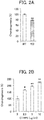
- the results are presented in FIG. 2A .
- chondrogenesis was more inhibited in the C1qtnf6 -/- mice than in the wild-type mice.
- the resultant stained cells were observed with a fluorescent microscope (BIOREVO BZ-9000, KEYENCE CORPORATION) and quantitated for fluorescent intensity using ImageJ software (NIH).
- the results are presented in FIG. 2B .
- the chondrogenesis was promoted in a recombinant human CTRP6 concentration-dependent manner.
- Test Example 3 a function of CTRP6 was analyzed using a mouse chondrocyte line ATDC5.
- a medium a HAM's F-12 medium containing 5% FBS and 1% penicillin / streptomycin was used.
- FIG. 3A As illustrated in FIG. 3A , it was confirmed that addition of the recombinant human CTRP6 facilitated cell proliferation of the ATDC5 cells.
- ATDC5 cells were seeded into a 60 mm Petri dish at a cell density of 1 x 10 6 / well and cultured in a serum-free HAM's F-12 medium for 4 hours. Then, the resultant was washed with PBS and then cultured in a serum-free HAM's F-12 medium containing 10 ng / ml recombinant human CTRP6 (Aviscera Bioscience) for 1 min, 5 min, 15 min, or 30 min.
- the cells were washed with a phosphatase-inhibiting buffer supplemented with PhosSTOP (Sigma) and then lysed with a lysis buffer (0.1% TritonX-100, 100 mM NaCl, 50 mM Tris-HCl (pH 7.5)).
- the resultant cell lysate was subjected to electrophoresis on a 12.5% SDS-PAGE gel and proteins were transferred onto a PVDF membrane.
- the membrane onto which the proteins had been transferred was blocked by shaking in 5% BSA / TBS at room temperature for 1 hour. After blocking, the membrane was shaken in the presence of a primary antibody (rabbit monoclonal antibody) at room temperature for 1 hour to thereby undergo a primary antibody reaction.
- a primary antibody rabbit monoclonal antibody
- an anti-ERK1/2 antibody 4695, 1000-fold dilution
- an anti-p-ERK1/2 antibody (4370, 1000-fold dilution)
- an anti-JNK antibody 9920, 1000-fold dilution
- an anti-p-JNK antibody 4668, 1000-fold dilution
- an anti-p38 antibody 9212, 1000-fold dilution
- an anti-p-p38 antibody 9211, 1000-fold dilution
- the membrane was washed with TBS containing 0.1% Tween-20 (TBST), and then shaken in the presence of an HRP-labeled anti-rabbit IgG goat polyclonal antibody (Jackson ImmunoResearch, 111-035-144, 2000-fold dilution) at room temperature for 1 hour to thereby undergo a secondary antibody reaction.
- HRP-labeled anti-rabbit IgG goat polyclonal antibody Jackson ImmunoResearch, 111-035-144, 2000-fold dilution
- FIG. 3B The western blotting results are presented in FIG. 3B . As illustrated in FIG. 3B , addition of the recombinant human CTRP6 facilitated phosphorylation of ERK1/2.
- ATDC5 cells were seeded into a 48-well plate at a cell density of 2 x 10 4 / well and cultured in the presence or absence of 50 ng / ml recombinant human CTRP6 (Aviscera Bioscience) for 2 days.
- FIG. 3C After 2 day-culture, the number of cells was counted with a hemocytometer. The results are presented in FIG. 3C . As illustrated in FIG. 3C , addition of the recombinant human CTRP6 facilitated cell proliferation of the ATDC5 cells, while addition of the ERK1/2 inhibitor inhibited cell proliferation. This suggests that chondrocyte proliferation by CTRP6 is via phosphorylation of ERK1/2.
- ATDC5 cells were seeded into a 24-well plate at a cell density of 1 x 10 6 / well and cultured in a HAM's F-12 medium containing 2.5% FBS for 24 hours. After culturing, 30 pmol of AdipoR1 siRNA, 30 pmol of AdipoR2 siRNA, 30 pmol of control siRNA-1, 6 pmol of AdipoR3 siRNA, 6 pmol of AdipoR4 siRNA, or 6 pmol of control siRNA-2 was introduced (transfected) thereinto and culturing was continued for 48 hours. Lipofectamine RNAiMAX (Invitrogen) was used to introduce the siRNAs.
- Lipofectamine RNAiMAX Invitrogen
- AdipoR3 siRNA, the AdipoR4 siRNA, and the control siRNA-2 were purchased from IDT Teck (TriTECTa RNAi Kit).
- Base sequences of the AdipoR1 siRNA, the AdipoR2 siRNA, and the control siRNA-1 were as follows:
- ATDC5 cells into which the siRNA had been introduced were seeded into a 60 mm Petri dish at a cell density of 1 x 10 6 / well and cultured in a serum-free HAM's F-12 medium for 4 hours. Then, the cells were washed with PBS and then cultured in a serum-free HAM's F-12 medium containing 10 ng / ml recombinant human CTRP6 (Aviscera Bioscience) for 15 min.
- FIGs. 4C and 4D The western blotting results are presented in FIGs. 4C and 4D .
- FIGs. 4C and 4D As illustrated in FIGs. 4C and 4D , in the ATDC5 cells into which the AdipoR1 siRNA or the AdipoR4 siRNA had been introduced, phosphorylation of ERK1/2 was not facilitated even though the recombinant human CTRP6 was added. This suggests that CTRP6 regulates chondrocyte proliferation via AdipoR1 and AdipoR4.
- a medium a HAM's F-12 medium containing 5% FBS and 1% penicillin / streptomycin was used.
- FIGs. 5A to 5D The results are presented in FIGs. 5A to 5D .
- addition of the recombinant human CTRP6, the adiponectin, or the AdipoRon facilitated cell proliferation of the ATDC5 cells, while addition of the AdipoR1 blocker inhibited cell proliferation.
- Cell proliferation of the ATDC5 cells was also facilitated when the recombinant human CTRP6 was added, but cell proliferation was not inhibited even though the adipoR1 blocker was added. This suggests that the CTRP6, the adiponectin, and the AdipoRon regulate chondrocyte proliferation via AdipoR1.
- AdipoR1 siRNA, AdipoR2 siRNA, control siRNA-1, AdipoR3 siRNA, AdipoR4 siRNA, or control siRNA-2 was introduced (transfected) into ATDC5 cells in the same manner as in Test Example 4 (1).
Landscapes
- Health & Medical Sciences (AREA)
- Life Sciences & Earth Sciences (AREA)
- Engineering & Computer Science (AREA)
- Chemical & Material Sciences (AREA)
- General Health & Medical Sciences (AREA)
- Medicinal Chemistry (AREA)
- Biomedical Technology (AREA)
- Pharmacology & Pharmacy (AREA)
- Bioinformatics & Cheminformatics (AREA)
- Immunology (AREA)
- Veterinary Medicine (AREA)
- Public Health (AREA)
- Animal Behavior & Ethology (AREA)
- Zoology (AREA)
- Biotechnology (AREA)
- Epidemiology (AREA)
- Rheumatology (AREA)
- Organic Chemistry (AREA)
- Cell Biology (AREA)
- Biochemistry (AREA)
- Molecular Biology (AREA)
- Genetics & Genomics (AREA)
- Wood Science & Technology (AREA)
- Microbiology (AREA)
- Physics & Mathematics (AREA)
- Pathology (AREA)
- Hematology (AREA)
- Urology & Nephrology (AREA)
- Food Science & Technology (AREA)
- General Physics & Mathematics (AREA)
- Analytical Chemistry (AREA)
- Virology (AREA)
- General Engineering & Computer Science (AREA)
- Developmental Biology & Embryology (AREA)
- Orthopedic Medicine & Surgery (AREA)
- General Chemical & Material Sciences (AREA)
- Nuclear Medicine, Radiotherapy & Molecular Imaging (AREA)
- Proteomics, Peptides & Aminoacids (AREA)
- Biophysics (AREA)
- Chemical Kinetics & Catalysis (AREA)
Abstract
Description
- The present invention relates to a chondrocyte proliferation promoter, a chondrocyte proliferation promotion method, and a screening method for chondrocyte proliferation promoters.
- Osteoarthritis is a disease which causes degeneration or deformation of bone tissue due to, for example, wear of the articular cartilage and which frequently develops especially in the elderly. Conventionally, for example, a nonsteroidal anti-inflammatory drug has been used for treating osteoarthritis, but this treatment is no more than symptomatic treatment.
- Therefore, in recent years, in order to treat or prevent a cartilage disorder such as osteoarthritis, attempts have been made to proliferate chondrocytes themselves. Hitherto, there have been proposed, as ingredients having a chondrocyte proliferation promotion action, for example, particular polysaccharides, particular urea derivatives, and particular peptides (see, for example,
Patent Documents 1 to 3). However, none of the ingredients have achieved practical use, and thus there is a continuing need to search for novel active ingredients. - Patent Document 1: Japanese Unexamined Patent Application, Publication No.
2004-002375 - Patent Document 2: Japanese Unexamined Patent Application, Publication No.
2005-336174 - Patent Document 3: Japanese Unexamined Patent Application, Publication No.
2015-059087 - An object of the present invention is to provide a novel chondrocyte proliferation promoter suitably used for, for example, treating or preventing a cartilage disorder such as osteoarthritis, a chondrocyte proliferation promotion method using the chondrocyte proliferation promoter, and a screening method for chondrocyte proliferation promoters.
- Specific means for solving the above-mentioned problems include the following embodiments.
- <1> A chondrocyte proliferation promoter containing, as an active ingredient, an agonist for at least one receptor selected from adiponectin receptor 1 (PAQR1), adiponectin receptor 2 (PAQR2), adiponectin receptor 3 (PAQR3), and adiponectin receptor 4 (PAQR4).
- <2> The chondrocyte proliferation promoter according to <1>, in which the agonist is an agonist for adiponectin receptor 4 (PAQR4).
- <3> The chondrocyte proliferation promoter according to <1> or <2>, in which the agonist is any of the following (a) to (c) :
- (a) a protein consisting of an amino acid sequence set forth in SEQ ID No: 3;
- (b) a protein consisting of a gClq domain in the amino acid sequence set forth in SEQ ID No: 3;
- (c) a protein having a sequence identity of 80% or more to the gClq domain in the amino acid sequence set forth in SEQ ID No: 3 and acting as an agonist for at least one receptor selected from adiponectin receptor 1 (PAQR1) and adiponectin receptor 4 (PAQR4).
- <4> The chondrocyte proliferation promoter according to <1>, in which the agonist is a compound represented by the following formula:

- <5> A chondrocyte proliferation promotion method, the method including:
bringing the chondrocyte proliferation promoter according to any one of <1> to <4> into contact with a chondrocyte. - <6> A use of an agonist for at least one receptor selected from adiponectin receptor 1 (PAQR1), adiponectin receptor 2 (PAQR2), adiponectin receptor 3 (PAQR3), and adiponectin receptor 4 (PAQR4) for promoting chondrocyte proliferation.
- <7> The use according to <6>, in which the agonist is an agonist for adiponectin receptor 4 (PAQR4).
- <8> A use of an agonist for at least one receptor selected from adiponectin receptor 1 (PAQR1), adiponectin receptor 2 (PAQR2), adiponectin receptor 3 (PAQR3), and adiponectin receptor 4 (PAQR4) for producing a chondrocyte proliferation promoter.
- <9> The use according to <8>, in which the agonist is an agonist for adiponectin receptor 4 (PAQR4).
- <10> A screening method for chondrocyte proliferation promoters, the method including:
screening candidate materials using, as an indication, activation of at least one receptor selected from adiponectin receptor 1 (PAQR1), adiponectin receptor 2 (PAQR2), adiponectin receptor 3 (PAQR3), and adiponectin receptor 4 (PAQR4). - <11> The screening method for chondrocyte proliferation promoters according to <10>, in which the method includes screening the candidate materials using, as the indication, activation of adiponectin receptor 4 (PAQR4).
- Meanwhile, adiponectin receptor 1 (AdipoR1) and adiponectin receptor 2 (AdipoR2) are receptors classified as Class I of PAQR (progestin and AdipoQ receptors) family, and also referred to as PAQR1 and PAQR2, respectively. Furthermore, PAQR3, which is also classified as Class I of PAQR family, is also referred to as adiponectin receptor 3 (AdipoR3) since it binds to adiponectin similarly to the AdipoR1 and the AdipoR2. Therefore, PAQR4, which is classified as Class I of PAQR family similarly to these three receptors, is herein defined as adiponectin receptor 4 (AdipoR4).
- According to the present invention, a novel chondrocyte proliferation promoter suitably used for, for example, treating or preventing a cartilage disorder such as osteoarthritis, a chondrocyte proliferation promotion method using the chondrocyte proliferation promoter, and a screening method for chondrocyte proliferation promoters can be provided.
-
-
FIG. 1A is a graph illustrating incidence rates of osteoarthritis in C1qtnf6-/- mice and wild-type mice. -
FIG. 1B is a figure illustrating results of histopathology of tissue sections of ankle joints. -
FIG. 2A is a graph illustrating chondrogenesis in primary chondrocytes of neonates of C1qtnf6-/- mice and wild-type mice. -
FIG. 2B is a graph illustrating chondrogenesis when primary chondrocytes of C1qtnf6-/- mice were cultured in the presence of various concentrations of recombinant human CTRP6. -
FIG. 3A is a graph illustrating the number of cells when ATDC5 cells were cultured in the presence of various concentrations of recombinant human CTRP6. -
FIG. 3B is a figure illustrating results of western blotting of MAPKs and phosphorylated MAPKs when ATDC5 cells were cultured in the presence of recombinant human CTRP6. -
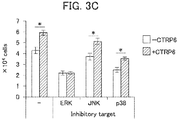
FIG. 3C is a graph illustrating the number of cells when ATDC5 cells were cultured in the presence or absence of recombinant human CTRP6 and in the presence of MAPK inhibitors. -
FIG. 4A is a graph illustrating the number of cells when ATDC5 cells into which AdipoR1 siRNA, AdipoR2 siRNA, or control siRNA-1 had been introduced were cultured in the presence or absence of recombinant human CTRP6. -
FIG. 4B is a graph illustrating the number of cells when ATDC5 cells into which AdipoR3 siRNA, AdipoR4 siRNA, or control siRNA-2 had been introduced were cultured in the presence or absence of recombinant human CTRP6. -
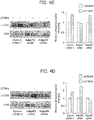
FIG. 4C is a figure illustrating results of western blotting of ERK and p-ERK when ATDC5 cells into which AdipoR1 siRNA, AdipoR2 siRNA, or control siRNA-1 had been introduced were cultured in the presence of recombinant human CTRP6. -
FIG. 4D is a figure illustrating results of western blotting of ERK and p-ERK when ATDC5 cells into which AdipoR3 siRNA, AdipoR4 siRNA, or control siRNA-2 had been introduced were cultured in the presence of recombinant human CTRP6. -
FIG. 5A is a graph illustrating the number of cells when ATDC5 cells were cultured in the presence or absence of recombinant human CTRP6 and in the presence or absence of the AdipoR1 blocker. -
FIG. 5B is a graph illustrating the number of cells when ATDC5 cells were cultured in the presence or absence of adiponectin and in the presence or absence of the AdipoR1 blocker. -
FIG. 5C is a graph illustrating the number of cells when ATDC5 cells were cultured in the presence or absence of AdipoRon and in the presence or absence of the AdipoR1 blocker. -
FIG. 5D is a graph illustrating the number of cells when ATDC5 cells were cultured in the presence or absence of recombinant human CTRP3 and in the presence or absence of the AdipoR1 blocker. -
FIG. 6A is a graph illustrating the number of cells when ATDC5 cells into which AdipoR1 siRNA, AdipoR2 siRNA, or control siRNA-1 had been introduced were cultured in the presence or absence of recombinant human CTRP3. -
FIG. 6B is a graph illustrating the number of cells when ATDC5 cells into which AdipoR3 siRNA, AdipoR4 siRNA, or control siRNA-2 had been introduced were cultured in the presence or absence of recombinant human CTRP3. - Embodiments of the present invention will now be described. However, the present invention is not limited to the following embodiments.
- A chondrocyte proliferation promoter according to the present embodiment contains, as an active ingredient, an agonist (hereinafter referred to as "particular AdipoR agonist") for at least one receptor selected from adiponectin receptor 1 (AdipoR1), adiponectin receptor 2 (AdipoR2), adiponectin receptor 3 (AdipoR3), and adiponectin receptor 4 (AdipoR4).
- The present inventors conducted extensive studies, and have confirmed that the particular AdipoR agonist has a proliferation promotion action on a chondrocyte. According to the present embodiment, a use of the particular AdipoR agonist for promoting chondrocyte proliferation is also provided. Furthermore, according to the present embodiment, a use of the particular AdipoR agonist for producing a chondrocyte proliferation promotor is also provided.
- The particular AdipoR agonist is not particularly limited as long as it is a material capable of activating at least one receptor selected from AdipoR1, AdipoR2, AdipoR3, and AdipoR4. For example, the particular AdipoR agonist may be a selective agonist for any one receptor selected from AdipoR1, AdipoR2, AdipoR3, and AdipoR4 or an agonist for any plurality of the receptors. Furthermore, as long as the particular AdipoR agonist is capable of activating at least one receptor selected from AdipoR1, AdipoR2, AdipoR3, and AdipoR4, it may be capable of activating another receptor.
- Example of the particular AdipoR agonist includes at least one selected from adiponectin, CTRP3, and CTRP6.
- The adiponectin, the CTRP3, and the CTRP6 are all proteins belonging to CTRP (C1q / TNF-related protein) family. As a result of experiments by the present inventors, it has been revealed that the adiponectin, the CTRP3, and the CTRP6 exhibit a chondrocyte proliferation promotion action via activation of AdipoR1, AdipoR2, and AdipoR1 and AdipoR4, respectively.
- Origins of the adiponectin, the CTRP3, and the CTRP6 are not particularly limited, and may be human or animals such as mouse, but are preferably human. For amino acid sequences of human adiponectin, human CTRP3, and human CTRP6, one may refer to information registered in the GenBank database at the National Center for Biotechnology Information (NCBI). For example, amino acid sequences of human adiponectin, human CTRP3, and human CTRP6 are deposited in the GenBank database, for example, under Accession Nos. AK291525, AAI12926, and CAK54433, respectively. Typical amino acid sequences are as follows. Underlined portions in the amino acid sequences represent globular domains (gC1q domains).
- (Amino acid sequence of human adiponectin (SEQ ID NO: 1))

- (Amino acid sequence of human CTRP3 (SEQ ID NO: 2))


- (Amino acid sequence of human CTRP6 (SEQ ID NO: 3))

- The adiponectin, the CTRP3, and the CTRP6 may be commercial products or may be produced by a gene recombination method or a chemical synthesis method. When the adiponectin, the CTRP3, or the CTRP6 are produced by the gene recombination method, for example, a gene encoding adiponectin, CTRP3, or CTRP6 may be introduced into a microorganism such as E. coli or yeast, a plant cell, an insect cell, or an animal cell using an expression vector, to thereby express a protein therefrom. When the human adiponectin, the human CTRP3, or the human CTRP6 are produced, a mammalian cell is preferably used from the viewpoints of holding of conformation and post-translational modification. When the adiponectin, the CTRP3, or the CTRP6 are produced by the chemical synthesis method, a liquid phase method, a solid phase method, a Boc method, an Fmoc method, and the like may be used singly or in combination.
- The adiponectin may be a mutated adiponectin comprising an amino acid sequence in which one or several amino acid residues are substituted for, deleted from, or added to an amino acid sequence of wild-type adiponectin as long as it is capable of activating at least one receptor selected from AdipoR1, AdipoR2, AdipoR3, and AdipoR4. Similarly, the CTRP3 and the CTRP6 may be a mutated CTRP3 and a mutated CTRP6 comprising amino acid sequences in which one or several amino acid residues are substituted for, deleted from, or added to amino acid sequences of wild-type CTRP3 and wild-type CTRP6 as long as they are capable of activating at least one receptor selected from AdipoR1, AdipoR2, AdipoR3, and AdipoR4.
- Sequence identity between each mutated amino acid sequence and each wild-type amino acid sequence may be, for example, 80% or more, 85% or more, 90% or more, 93% or more, or 95% or more. As used herein, the phrase "sequence identity" refers to consistency between sequences when two amino acid sequences are aligned, and may be calculated using, for example, BLAST program (https://www.ncbi.nlm.nih.gov/Blast/cgi).
- Meanwhile, for proteins belonging to CTRP family such as the adiponectin, only a globular domain (gC1q domain) thereof may be present in vivo, therefore, the globular domain is believed to be a functional site thereof (Trends. Immunol., 25 (10): 551-61 (2004)). Consequently, the particular AdipoR agonist may be a peptide constituting the globular domain of the adiponectin, the CTRP3, or the CTRP6.
- Furthermore, the particular AdipoR agonist may be a peptide constituting a mutated globular domain comprising an amino acid sequence in which one or several amino acid residues are substituted for, deleted from, or added to an amino acid sequence of the globular domain of the adiponectin, the CTRP3, or the CTRP6. In this case, sequence identity between each mutated amino acid sequence and each wild-type amino acid sequence may be, for example, 80% or more, 85% or more, 90% or more, 93% or more, or 95% or more.
- Among the above-mentioned particular AdipoR agonists, suitable are, for example, those selected from the following (a) to (c) :
- (a) a protein consisting of an amino acid sequence set forth in SEQ ID No: 3;
- (b) a protein consisting of a gClq domain in the amino acid sequence set forth in SEQ ID No: 3;
- (c) a protein having a sequence identity of 80% or more to the gClq domain in the amino acid sequence set forth in SEQ ID No: 3 and acting as an agonist for at least one receptor selected from AdipoR1 and AdipoR4.
- Sequence identity in (c) above may be 85% or more, 90% or more, 93% or more, or 95% or more.
- Furthermore, another example of the particular AdipoR agonist includes a compound represented by Formula (1) below. The compound represented by Formula (1) below is known to be an agonist for AdipoR1 and AdipoR2 (see,
WO2015/046595 ).
- In which A represents a substituted or unsubstituted aryl group, a substituted or unsubstituted heteroaryl group, a substituted or unsubstituted aryloxy group, a C4-8 tert-alkyl group, or - NH2;
Y1 represents -(CHR2)a- in which R2 represents a hydrogen atom or a C1-7 alkyl group and a represents an integer of 0 to 2, or -CO-;
X represents CH or N;
R1 represents a C1-7 alkyl group;
m represents an integer of 0 to 4, when m is 2 or more, an m number of R1s may be the same as or different from each other; - i) when X is CH,
Y2 represents *-O-CH2-CONH-, -O-, *-CONH-, or a group represented by Formula (2) below:
- ii) when X is N,
Y2 represents *-CONH-(CH2)b-CO-, *-NHCO-Ar1-CH2-, *-NHCO-(CH2)b-, or -CO- in which Ar1 represents a substituted or unsubstituted arylene group, b represents an integer of 1 to 3, and * represents an attachment point to Z;
Z represents a cyclic group selected from an aryl group, a heteroaryl group, and a C3-7 cycloalkyl group;
B is a group which may be substituted on the cyclic group represented by Z, and represents -CO-R4, -O-R4 in which R4 represents a C1-7 alkyl group, a substituted or unsubstituted phenyl group, or a substituted or unsubstituted pyridyl group; -CONR5R6 in which R5 represents a hydrogen atom, a C3-7 cycloalkyl group, a C1-4 alkoxy-C1-4 alkyl group, a norbornenyl-C1-4 alkyl group, or an Ar2-C1-4 alkyl group in which Ar2 represents a substituted or unsubstituted aryl group or a substituted or unsubstituted heteroaryl group, and R6 represents a hydrogen atom, a C1-7 alkyl group, a C2-4 alkenyl group, or a C2-4 alkynyl group; a C1-7 alkyl group, a C3-7 cycloalkyl group, a halo-C1-7 alkyl group, a phenyl group, a halogen atom, -NO2, or groups represented by the following formulas:
- In Formula (1) above, the "C1-7 alkyl group" includes a methyl group, an ethyl group, an n-propyl group, an isopropyl group, an n-butyl group, an isobutyl group, an s-butyl group, a t-butyl group, an n-pentyl group, an n-hexyl group, an n-heptyl group, and the like, and is preferably a C1-4 alkyl group.
- The "aryl group" includes a C6-14 aryl group such as a phenyl group, a naphthyl group, an indenyl group, an anthryl group, and the like, is preferably a C6-10 aryl group, and is more preferably a phenyl group.
- The "heteroaryl group" includes a 5- to 14-membered heteroaryl group such as a furyl group, a thienyl group, an oxazolyl group, a pyridyl group, a pyrimidinyl group, a pyrazolyl group, a benzofuranyl group, a benzoxadiazolyl group, and the like, is preferably a 5- or 6-membered heteroaryl group, and is more preferably a furyl group, a pyridyl group, and a benzofuranyl group.
- Aryl in the "aryloxy group" may be the same as those described for the aryl group and is preferably a phenoxy group.
- The "arylene group" includes a group in which one hydrogen atom attached to an aromatic ring in the aryl group is removed, and is preferably a phenylene group and a naphthylene group.
- A group which may be substituted on the aryl group, the heteroaryl group, the aryloxy group, and the arylene group includes a C1-4 alkyl group (a methyl group, an ethyl group, an n-propyl group, an n-butyl group, an isobutyl group, an s-butyl group, a t-butyl, etc.), a halo-C1-4 alkyl group (a fluoromethyl group, a difluoromethyl group, a trifluoromethyl group, a chloromethyl group, a dichloromethyl group, a pentachloroethyl group, etc.), a halogen atom (a fluorine atom, a chlorine atom, a bromine atom, an iodine atom, etc.), a C1-4 alkoxy group (a methoxy group, an ethoxy group, an n-propoxy group, an isopropoxy group, an n-butoxy group, an isobutoxy group, an s-butoxy group, a t-butoxy group, etc.), a hydroxy group, and the like.
- The "C3-7 cycloalkyl group" includes a cyclopropyl group, a cyclobutyl group, a cyclopentyl group, cyclohexyl group, and the like.
- The "C2-4 alkenyl group" includes a vinyl group, a propenyl group, and the like.
- The "C2-4 alkynyl group" includes an ethynyl group, a propynyl group, a butynyl group, and the like and is preferably a 2-propynyl group and a 2-butynyl group.
- The "C4-8 tert-alkyl group" includes a t-butyl group, a t-pentyl group, a t-hexyl group, and the like and is preferably a t-butyl group.
- The aryl group represented by A is preferably a phenyl group. Furthermore, the heteroaryl group represented by A is preferably a furyl group, a thienyl group, pyridyl group, a benzofuranyl group, and a benzoxadiazolyl group. Furthermore, the aryloxy group represented by A is preferably a phenoxy group. A group which may be substituted on the aryl group, the heteroaryl group, and the aryloxy group includes a C1-4 alkyl group (a methyl group, an ethyl group, an n-propyl group, an n-butyl group, an isobutyl group, an s-butyl group, a t-butyl, etc.), a halo-C1-4 alkyl group (a fluoromethyl group, a difluoromethyl group, a trifluoromethyl group, a chloromethyl group, a dichloromethyl group, a pentachloroethyl group, etc.), a halogen atom (a fluorine atom, a chlorine atom, a bromine atom, an iodine atom, etc.), a C1-4 alkoxy group (a methoxy group, an ethoxy group, an n-propoxy group, an isopropoxy group, an n-butoxy group, an isobutoxy group, an s-butoxy group, a t-butoxy group, etc.), a hydroxy group, and the like. The substituted aryl group, the substituted heteroaryl group, or the substituted aryloxy group includes an aryl group, heteroaryl group, or aryloxy group which is mono- to tri-substituted with the above-described substituents. A is more preferably a phenyl group or a phenyl group which is mono- to tri-substituted with the above-described substituents.
- The -(CHR2)a- represented by Y1 is preferably those in which R2 is a hydrogen atom or a C1-3 alkyl group (preferably a methyl group and an ethyl group) and a is 1, and is more preferably -CH2- or -CH(CH3)-.
- The C1-7 alkyl group represented by R1 is preferably a C1-4 alkyl group (a methyl group, an ethyl group, an n-propyl group, an isopropyl group, an n-butyl group, an isobutyl group, an s-butyl group, a t-butyl group, etc.) and is more preferably a methyl group and an ethyl group. Furthermore, m is preferably 0 or 1.
- When X is CH, Y2 is *-O-CH2-CONH-, -O-, *-CONH-, or a group represented by Formula (2) above, and is preferably *-O-CH2-CONH-.
- Furthermore, in the group represented by Formula (2) above, it is preferable that both p and q be 0 or one of p and q be 0 and the other be 1, and the C1-7 alkyl group represented by R3 is preferably a C1-4 alkyl group (a methyl group, an ethyl group, an n-propyl group, etc.) and r is preferably 0 or 1. When r is 2, two R3s may be the same as or different from each other.
- The group represented by Formula (2) above includes the following groups.

- When X is N, Y2 is *-CONH- (CH2)b-CO-, *-NHCO-Ar1-CH2-, *-NHCO-(CH2)b-, or -CO-, is preferably *-CONH-(CH2)b-CO- and *-NHCO-Ar1-CH2-, and is more preferably *-CONH-(CH2)b-CO-. b is preferably 2.
- The cyclic group represented by Z is an aryl group, a heteroaryl group, or a C3-7 cycloalkyl group, is preferably an aryl group, is more preferably a phenyl group and a naphthyl group, and is further preferably a phenyl group. The "C3-7 cycloalkyl group" is preferably a cyclopropyl group and a cyclobutyl group.
- B is a group which may be substituted on the cyclic group represented by Z, and when n is 2 or more, an n number of Bs may be the same as or different from each other. n is preferably an integer of 0 to 2.
- In -CO-R4 or -O-R4 represented by B, R4 is preferably a C1-4 alkyl group (a methyl group, an ethyl group, an n-propyl group, etc.), a phenyl group, a phenyl group substituted with mono- or di-substituted with a halogen atom or a nitro group, and a pyridyl group.
- In -CONR5R6 represented by B, R5 is preferably a hydrogen atom and a C3-7 cycloalkyl group, R6 is preferably a hydrogen atom, a C1-7 alkyl group, and a C2-4 alkenyl group, and more preferably both R5 and R6 are a hydrogen atom. In R5, Ar2 in the Ar2-C1-4 alkyl group is preferably a phenyl group, a furyl group, a pyrazolyl group, and a pyridyl group, and C1-4 alkyl in the Ar2-C1-4 alkyl group is preferably C1-2 alkyl. In R5, the C1-4 alkoxy-C1-4 alkyl group is preferably a methoxyethyl group, an ethoxyethyl group, and an ethoxypropyl group.
- The C1-7 alkyl group represented by B is preferably a methyl group, an ethyl group, an n-propyl group, an isopropyl group, an n-butyl group, an isobutyl group, an s-butyl group, and a t-butyl group. The C3-7 cycloalkyl group represented by B is preferably a cyclopropyl group, a cyclobutyl group, and a cyclopentyl group. The halo-C1-7 alkyl group represented by B is preferably a chloromethyl group, a dichloromethyl group, a fluoromethyl group, a difluoromethyl group, and a trifluoromethyl group, and is more preferably a trifluoromethyl group. The halogen atom represented by B is preferably a fluorine atom, a chlorine atom, a bromine atom, and an iodine atom.
- B is more preferably a C1-7 alkyl group, a halogen atom, - NO2, a phenyl group, a halo-C1-7 alkyl group, -CO-R4, -O-R4, and -CONR5R6.
- Among compounds represented by Formula (1) above, the following compounds (i) to (vii) are preferable:
- (i) a compound in which X is CH and Y2 is *-O-CH2-CONH-, or X is N and Y2 is *-CONH-(CH2)b-CO-;
- (ii) a compound in which X is CH, Y2 is -O-, Z is a phenyl group in which a group B is at the p (para) position, Y1 is - CH2- or -CO-, and A is a substituted or unsubstituted aryl group, a substituted or unsubstituted heteroaryl group, a substituted or unsubstituted aryloxy group, or a C4-8 tert-alkyl group;
- (iii) a compound in which X is CH, Y2 is *-CONH-, Z is m- or p-chlorophenyl, Y1 is -CH2-, and A is a phenyl group;
- (iv) a compound in which X is N, Y2 is *-NHCO-Ar1-CH2-, Ar1 is a phenyl group, Z is a phenyl group, Y1 is -CH2-, and A is a phenyl group;
- (v) a compound in which X is N, Y2 is *-NHCO-(CH2)2-, Z is a cyclopropyl group, Y1 is -CO-, and A is a phenyl group;
- (vi) a compound in which X is N, Y2 is *-NHCO-(CH2)2-, Z is a phenyl group, Y1 is a single bond, and A is an o-methoxy phenyl group;
- (vii) a compound in which X is N, Y2 is -CO-, Z is a phenyl group, B is p- (and m-) methoxy group, Y1 is -CH2-, and A is a p-CF3-phenyl group.
- Among the above-described compounds (i), suitable is a compound represented by Formula (1a) or (1b) below:

- One example of the compound represented by Formula (1a) or (1b) below includes a compound represented by the following formula (also referred to as "AdipoRon").

- The compound represented by Formula (1) above encompasses all stereoisomers such as geometric isomers (e.g., a cis-isomer or a trans-isomer) and optical isomers (e.g., a d-isomer or an l-isomer), and may be a mixture including the isomers at any proportion.
- The compound represented by Formula (1) above may be in the form of an acid addition salt or a base addition salt. Examples of the acid addition salt include a salt with a mineral acid such as hydrochloric acid, sulfuric acid, and the like; a salt with an organic carboxylic acid such as formic acid, acetic acid, citric acid, trichloroacetic acid, trifluoroacetic acid, fumaric acid, maleic acid, and the like; and a salt with a sulfonic acid such as methanesulfonic acid, benzenesulfonic acid, p-toluenesulfonic acid, mesitylenesulfonic acid, naphthalene sulfonic acid, and the like; and the like. Examples of the base addition salt include a salt with an alkali metal such as sodium, potassium, and the like; a salt with an alkali earth metal such as calcium, magnesium, and the like; an ammonium salt; a salt with a nitrogen-containing organic base such as trimethylamine, triethylamine, tributylamine, pyridine, N,N-dimethylaniline, N-methyl-D(-)-glucamine, N-methylpiperidine, N-methylmorpholine, diethylamine, cyclohexylamine, procaine, dibenzylamine, N-benzyl-β-phenethylamine, 1-ephenamine, N,N'-dibenzylethylenediamine, and the like; and the like.
- Furthermore, the compound represented by Formula (1) above or salts thereof may be a hydrate or a solvate.
- The chondrocyte proliferation promoter according to the present embodiment may contain ingredients other than the particular AdipoR agonist, as necessary. Examples of the ingredients other than the particular AdipoR agonist include an excipient, a disintegrant, a binder, a lubricant, a surfactant, a buffer, a solubilizing aid, a stabilizer, a tonicity agent, a suspending agent, an emulsifier, a buffer, a solvent, and the like.
- A dosage form of the chondrocyte proliferation promoter according to the present embodiment is not particularly limited and may be selected according to applications thereof. For example, when the chondrocyte proliferation promoter according to the present embodiment is used in medical use, examples of the dosage form of the chondrocyte proliferation promoter include a parenteral agent such as a solution for injection, a lyophilized powder for injection, and the like; an oral agent such as a tablet, a granule, a capsule, a solution, and the like; and the like.
- The chondrocyte proliferation promotion method according to the present embodiment includes bringing the above-mentioned chondrocyte proliferation promoter into contact with a chondrocyte. The chondrocyte may be a chondrocyte present in vivo or may be a collected chondrocyte.
- Examples of the method for bringing the chondrocyte proliferation promoter into contact with the chondrocyte present in vivo include parenteral administration such as injection into the joint, oral administration, and the like. Administration of the chondrocyte proliferation promoter to patients in need of chondrocyte proliferation can promote proliferation of the chondrocyte present in vivo.
- For example, administration of the chondrocyte proliferation promoter to a patient who suffers from a cartilage disorder such as osteoarthritis can treat the cartilage disorder. Furthermore, administration of the chondrocyte proliferation promoter to a patient whose cartilage is injured can ameliorate the cartilage injury and can prevent progression from the cartilage injury to cartilage degeneration and thus to secondary osteoarthritis. Meanwhile, the term "treat" includes disappearance or reduction of symptoms as well as suppression of the degree of symptom progression. Furthermore, the term "prevent" includes prevention of the onset as well as delaying the timing of the onset.
- Examples of the method for bringing the chondrocyte proliferation promoter into contact with the collected chondrocyte include addition into a medium for culturing a cartilage tissue or a chondrocyte, and the like. Addition of the chondrocyte proliferation promoter into a medium for culturing a collected cartilage tissue or chondrocyte can promote chondrocyte proliferation.
- For example, the cartilage disorder or the cartilage injury can be treated or ameliorated by culturing a cartilage tissue or a chondrocyte collected from a patient who suffers from the cartilage disorder such as osteoarthritis or whose cartilage is injured and transplanting or injecting the cultured cartilage tissue or chondrocyte back into the patient.
- The screening method for chondrocyte proliferation promoters according to the present embodiment includes screening candidate materials using, as an indication, activation of at least one receptor selected from AdipoR1, AdipoR2, AdipoR3, and AdipoR4. As described above, the particular AdipoR agonist has the proliferation promotion action on the chondrocyte, therefore, the chondrocyte proliferation promoters can be screened using, as the indication, activation of at least one receptor selected from AdipoR1, AdipoR2, AdipoR3, and AdipoR4. The screening method for chondrocyte proliferation promoters according to the present embodiment is preferably a method including screening candidate materials using, as the indication, activation of AdipoR4.
- A method for assessing the activation of at least one receptor selected from AdipoR1, AdipoR2, AdipoR3, and AdipoR4 is not particularly limited and any method can be adopted.
- Hereinafter, the present invention will be described in more detail by way of Examples, however, the present invention is not limited to these Examples. Meanwhile, a statistical analysis in Test Example 1 was performed by the chi-square test (**P<0.01), and statistical analyses in Test Examples 2 to 6 were performed by the Student's two-sided t-test (*P<0.05; **P<0.01; ***P<0.001).
- In Test Example 1, KO mice in which C1qtnf6, a gene encoding CTRP6, was knocked out (C1qtnf6-/- mice) were made and verified for the effect of the gene knock out. The C1qtnf6-/- mice were made based on C57BL/6J mice and according to the previous report (Nat. Commun., 6: 8483 (2015)). Wild-type (WT) C57BL/6J mice were purchased from CLEA Japan, Inc.
- The C1qtnf6-/- mice and the wild-type mice (both 12 month-old) were prepared and visually assessed for the onset of osteoarthritis (n = 8). Furthermore, tissue sections of the ankle joint were made, stained with Safranin O, and subjected to histopathology. Incidence rates of osteoarthritis are presented in
FIG. 1A and the results of histopathology are presented inFIG. 1B . It can be seen from the results ofFIGs. 1A and 1B that the C1qtnf6-/- mice spontaneously develop osteoarthritis. - In Test Example 2, a role of CTRP6 in cartilage metabolism was examined.
- Costal cartilage tissues from neonates (5 to 6 day-old) of the C1qtnf6-/- mice and the wild-type mice were enzymatically digested with DMEM containing 0.5 mg / ml collagenase D to thereby obtain primary chondrocytes. Then, 2 x 10⁵ cells were suspended into 10 µL of DMEM containing 10% FCS, seeded into a 24-well plate, and cultured at 37°C for 2 hours (both n = 3). Then, DMEM containing 10% FCS was added thereto at a volume of 500 µL per well and culturing was continued for 7 days. Then, the cells were fixed with 10% neutral buffered formalin, washed with 0.1 N HCl, and then stained with a 1% Alcian blue 8GX solution (Sigma-Aldrich) in order to confirm chondrogenesis.
- The resultant stained cells were observed with a fluorescent microscope (BIOREVO BZ-9000, KEYENCE CORPORATION) and quantitated for fluorescent intensity using ImageJ software (NIH). The results are presented in
FIG. 2A . As illustrated inFIG. 2A , chondrogenesis was more inhibited in the C1qtnf6-/- mice than in the wild-type mice. - In the same manner as described above, primary chondrocytes were obtained from the C1qtnf6-/- mice, and then 2 x 10⁵ cells were suspended into 10 µL of DMEM containing 10% FCS, seeded into a 24-well plate, and cultured at 37°C for 2 hours. Then, DMEMs containing 10% FCS and various concentrations (0, 2.5, 5, 10 µg / ml; all n = 3) of recombinant human CTRP6 (Aviscera Bioscience) were added thereto at a volume of 500 µL per well and culturing was continued for 7 days. Then, the cells were fixed with 10% neutral buffered formalin, washed with 0.1 N HCl, and then stained with a 1% Alcian blue 8GX solution (Sigma-Aldrich) in order to confirm chondrogenesis.
- The resultant stained cells were observed with a fluorescent microscope (BIOREVO BZ-9000, KEYENCE CORPORATION) and quantitated for fluorescent intensity using ImageJ software (NIH). The results are presented in
FIG. 2B . As illustrated inFIG. 2B , in the C1qtnf6-/- mice, the chondrogenesis was promoted in a recombinant human CTRP6 concentration-dependent manner. - In Test Example 3, a function of CTRP6 was analyzed using a mouse chondrocyte line ATDC5.
- ATDC5 cells were seeded into a 12-well plate at a cell density of 5 x 10⁴ / well and cultured in the presence of various concentrations (0, 100, 500 ng / ml; all n = 3) of recombinant human CTRP6 (Aviscera Bioscience). As a medium, a HAM's F-12 medium containing 5% FBS and 1% penicillin / streptomycin was used.
- After 4 and 7 day-culture, the number of cells was counted with a hemocytometer. The results are presented in
FIG. 3A . As illustrated inFIG. 3A , it was confirmed that addition of the recombinant human CTRP6 facilitated cell proliferation of the ATDC5 cells. - ATDC5 cells were seeded into a 60 mm Petri dish at a cell density of 1 x 10⁶ / well and cultured in a serum-free HAM's F-12 medium for 4 hours. Then, the resultant was washed with PBS and then cultured in a serum-free HAM's F-12 medium containing 10 ng / ml recombinant human CTRP6 (Aviscera Bioscience) for 1 min, 5 min, 15 min, or 30 min. Then, the cells were washed with a phosphatase-inhibiting buffer supplemented with PhosSTOP (Sigma) and then lysed with a lysis buffer (0.1% TritonX-100, 100 mM NaCl, 50 mM Tris-HCl (pH 7.5)).
- Then, the resultant cell lysate was subjected to electrophoresis on a 12.5% SDS-PAGE gel and proteins were transferred onto a PVDF membrane. The membrane onto which the proteins had been transferred was blocked by shaking in 5% BSA / TBS at room temperature for 1 hour. After blocking, the membrane was shaken in the presence of a primary antibody (rabbit monoclonal antibody) at room temperature for 1 hour to thereby undergo a primary antibody reaction. As the primary antibody, an anti-ERK1/2 antibody (4695, 1000-fold dilution), an anti-p-ERK1/2 antibody (4370, 1000-fold dilution), an anti-JNK antibody (9258, 1000-fold dilution), an anti-p-JNK antibody (4668, 1000-fold dilution), an anti-p38 antibody (9212, 1000-fold dilution), or an anti-p-p38 antibody (9211, 1000-fold dilution) (all purchased from Cell Signaling) were used. Then, the membrane was washed with TBS containing 0.1% Tween-20 (TBST), and then shaken in the presence of an HRP-labeled anti-rabbit IgG goat polyclonal antibody (Jackson ImmunoResearch, 111-035-144, 2000-fold dilution) at room temperature for 1 hour to thereby undergo a secondary antibody reaction. After washing with TBST three times, ECL Prime western blotting detection system (GE Healthcare) was used to visualize the proteins. Intensity of each band was quantified with ImageJ software (NIH).
- The western blotting results are presented in
FIG. 3B . As illustrated inFIG. 3B , addition of the recombinant human CTRP6 facilitated phosphorylation of ERK1/2. - ATDC5 cells were seeded into a 48-well plate at a cell density of 2 x 10⁴ / well and cultured in the presence or absence of 50 ng / ml recombinant human CTRP6 (Aviscera Bioscience) for 2 days. A HAM's F-12 medium containing 5% FBS and 1% penicillin / streptomycin was used as a medium, and a carrier (DMSO), 1 µM ERK1/2 inhibitor (U0126, Sigma), 1 µM JNK inhibitor (SP600125, Sigma), or 1 µM p38 inhibitor (SB239063, Sigma) was further added thereto (all n = 4).
- After 2 day-culture, the number of cells was counted with a hemocytometer. The results are presented in
FIG. 3C . As illustrated inFIG. 3C , addition of the recombinant human CTRP6 facilitated cell proliferation of the ATDC5 cells, while addition of the ERK1/2 inhibitor inhibited cell proliferation. This suggests that chondrocyte proliferation by CTRP6 is via phosphorylation of ERK1/2. - In Test Example 4, a receptor of CTRP6 was identified.
- ATDC5 cells were seeded into a 24-well plate at a cell density of 1 x 10⁶ / well and cultured in a HAM's F-12 medium containing 2.5% FBS for 24 hours. After culturing, 30 pmol of AdipoR1 siRNA, 30 pmol of AdipoR2 siRNA, 30 pmol of control siRNA-1, 6 pmol of AdipoR3 siRNA, 6 pmol of AdipoR4 siRNA, or 6 pmol of control siRNA-2 was introduced (transfected) thereinto and culturing was continued for 48 hours. Lipofectamine RNAiMAX (Invitrogen) was used to introduce the siRNAs.
- Meanwhile, the AdipoR3 siRNA, the AdipoR4 siRNA, and the control siRNA-2 were purchased from IDT Teck (TriTECTa RNAi Kit). Base sequences of the AdipoR1 siRNA, the AdipoR2 siRNA, and the control siRNA-1 were as follows:
- (Sense strand of AdipoR1 siRNA (SEQ ID NO: 4))
5'-GAGACUGGCAACAUCUGGACATT-3' - (Antisense strand of AdipoR1 siRNA (SEQ ID NO: 5))
5'-UGUCCAGAUGUUGCCAGUCUCTT-3' - (Sense strand of AdipoR2 siRNA (SEQ ID NO: 6))
5'-GCUUAGAGACACCUGUUUGUUTT-3' - (Antisense strand of AdipoR2 siRNA (SEQ ID NO: 7))
5'-AACAAACAGGUGUCUCUAAGCTT-3' - (Sense strand of control siRNA-1 (SEQ ID NO: 8))
5'-GUGCGCUGCUGGUGCCAACCCTT-3' - (Antisense strand of control siRNA-1 (SEQ ID NO: 9))
5'-GGGUUGGCACCAGCAGCGCACTT-3' - Forty-eight hours after the introduction of the siRNAs, the ATDC5 cells were seeded into a 48-well plate at a cell density of 2 x 10⁴ / well and cultured in the presence or absence of 100 ng / ml recombinant human CTRP6 (Aviscera Bioscience) for 1 day (all n = 4). After that, the number of cells was counted with a hemocytometer. The results are presented in
FIGs. 4A and 4B . As illustrated inFIGs. 4A and 4B , in the ATDC5 cells into which the AdipoR1 siRNA or the AdipoR4 siRNA had been introduced, facilitation of cell proliferation was not confirmed even though the recombinant human CTRP6 was added. This suggests that CTRP6 regulates chondrocyte proliferation via AdipoR1 and AdipoR4. - ATDC5 cells into which the siRNA had been introduced were seeded into a 60 mm Petri dish at a cell density of 1 x 10⁶ / well and cultured in a serum-free HAM's F-12 medium for 4 hours. Then, the cells were washed with PBS and then cultured in a serum-free HAM's F-12 medium containing 10 ng / ml recombinant human CTRP6 (Aviscera Bioscience) for 15 min. Then, the cells were washed with a phosphatase-inhibiting buffer supplemented with PhosSTOP (Sigma) and then lysed with a lysis buffer (0.1% TritonX-100, 100 mM NaCl, 50 mM Tris-HCl (pH 7.5)). Western blotting analysis was performed in the same manner as in Test Example 3 (2).
- The western blotting results are presented in
FIGs. 4C and 4D . As illustrated inFIGs. 4C and 4D , in the ATDC5 cells into which the AdipoR1 siRNA or the AdipoR4 siRNA had been introduced, phosphorylation of ERK1/2 was not facilitated even though the recombinant human CTRP6 was added. This suggests that CTRP6 regulates chondrocyte proliferation via AdipoR1 and AdipoR4. - In Test Example 5, receptors of adiponectin, AdipoRon, and CTRP3 as well as
CTPR 6 were identified. - ATDC5 cells were seeded into a 12-well plate at a cell density of 1 x 10⁴ / well and cultured in the presence or absence of 10 µg / ml AdipoR1 blocker (GeneTex) and in the presence or absence of 100 ng / ml recombinant human CTRP6 (Aviscera Bioscience) for 2 days (all n = 4). As a medium, a HAM's F-12 medium containing 5% FBS and 1% penicillin / streptomycin was used.
- Furthermore, 100 ng / ml adiponectin (BioVendor), 100 ng / ml AdipoRon (AdipoGen), or 50 ng / ml recombinant human CTRP3 (Aviscera Bioscience) was used instead of 100 ng / ml recombinant human CTRP6 to culture in the same manner as described above (all n = 4). Meanwhile, when the AdipoRon was used, a culture period was 1 day.
- After culturing, the number of cells was counted with a hemocytometer. The results are presented in
FIGs. 5A to 5D . As illustrated inFIGs. 5A to 5D , addition of the recombinant human CTRP6, the adiponectin, or the AdipoRon facilitated cell proliferation of the ATDC5 cells, while addition of the AdipoR1 blocker inhibited cell proliferation. Cell proliferation of the ATDC5 cells was also facilitated when the recombinant human CTRP6 was added, but cell proliferation was not inhibited even though the adipoR1 blocker was added. This suggests that the CTRP6, the adiponectin, and the AdipoRon regulate chondrocyte proliferation via AdipoR1. - In Test Example 6, a receptor of CTRP3 was identified.
- AdipoR1 siRNA, AdipoR2 siRNA, control siRNA-1, AdipoR3 siRNA, AdipoR4 siRNA, or control siRNA-2 was introduced (transfected) into ATDC5 cells in the same manner as in Test Example 4 (1).
- Forty-eight hours after the introduction of the siRNAs, the ATDC5 cells were seeded into a 48-well plate at a cell density of 2 x 10⁴ / well and cultured in the presence or absence of 50 ng / ml recombinant human CTRP3 (Aviscera Bioscience) for 2 days (all n = 4). After that, the number of cells was counted with a hemocytometer. The results are presented in
FIGs. 6A and 6B . As illustrated inFIG. 6A and 6B , in the ATDC5 cells into which the AdipoR2 siRNA had been introduced, facilitation of cell proliferation was not confirmed even though the recombinant human CTRP3 was added. This suggests that CTRP3 regulates chondrocyte proliferation via AdipoR2. - Japanese Patent Application No.
2018-024297, filed February 14, 2018 


Claims (11)
- A chondrocyte proliferation promoter comprising, as an active ingredient, an agonist for at least one receptor selected from adiponectin receptor 1 (PAQR1), adiponectin receptor 2 (PAQR2), adiponectin receptor 3 (PAQR3), and adiponectin receptor 4 (PAQR4).
- The chondrocyte proliferation promoter according to claim 1, wherein the agonist is an agonist for adiponectin receptor 4 (PAQR4).
- The chondrocyte proliferation promoter according to claim 1 or 2, wherein the agonist is any of the following (a) to (c) :(a) a protein consisting of an amino acid sequence set forth in SEQ ID No: 3;(b) a protein consisting of a gClq domain in the amino acid sequence set forth in SEQ ID No: 3;(c) a protein having a sequence identity of 80% or more to the gClq domain in the amino acid sequence set forth in SEQ ID No: 3 and acting as an agonist for at least one receptor selected from adiponectin receptor 1 (PAQR1) and adiponectin receptor 4 (PAQR4).
- The chondrocyte proliferation promoter according to claim 1, wherein the agonist is a compound represented by the following formula:

- A chondrocyte proliferation promotion method, the method comprising:
bringing the chondrocyte proliferation promoter according to any one of claims 1 to 4 into contact with a chondrocyte. - A use of an agonist for at least one receptor selected from adiponectin receptor 1 (PAQR1), adiponectin receptor 2 (PAQR2), adiponectin receptor 3 (PAQR3), and adiponectin receptor 4 (PAQR4) for promoting chondrocyte proliferation.
- The use according to claim 6, wherein the agonist is an agonist for adiponectin receptor 4 (PAQR4).
- A use of an agonist for at least one receptor selected from adiponectin receptor 1 (PAQR1), adiponectin receptor 2 (PAQR2), adiponectin receptor 3 (PAQR3), and adiponectin receptor 4 (PAQR4) for producing a chondrocyte proliferation promoter.
- The use according to claim 8, wherein the agonist is an agonist for adiponectin receptor 4 (PAQR4).
- A screening method for chondrocyte proliferation promoters, the method comprising:
screening candidate materials using, as an indication, activation of at least one receptor selected from adiponectin receptor 1 (PAQR1), adiponectin receptor 2 (PAQR2), adiponectin receptor 3 (PAQR3), and adiponectin receptor 4 (PAQR4). - The screening method for chondrocyte proliferation promoters according to claim 10, which comprises screening the candidate materials using, as the indication, activation of adiponectin receptor 4 (PAQR4).
Applications Claiming Priority (2)
| Application Number | Priority Date | Filing Date | Title |
|---|---|---|---|
| JP2018024297 | 2018-02-14 | ||
| PCT/JP2019/004980 WO2019159925A1 (en) | 2018-02-14 | 2019-02-13 | Chondrocyte proliferation promoter, chondrocyte proliferation promotion method, screening method for chondrocyte proliferation promoters |
Publications (3)
| Publication Number | Publication Date |
|---|---|
| EP3753577A1 true EP3753577A1 (en) | 2020-12-23 |
| EP3753577A4 EP3753577A4 (en) | 2021-05-26 |
| EP3753577B1 EP3753577B1 (en) | 2023-04-05 |
Family
ID=67619359
Family Applications (1)
| Application Number | Title | Priority Date | Filing Date |
|---|---|---|---|
| EP19754331.7A Active EP3753577B1 (en) | 2018-02-14 | 2019-02-13 | Chondrocyte proliferation promotion method |
Country Status (4)
| Country | Link |
|---|---|
| US (1) | US20200397827A1 (en) |
| EP (1) | EP3753577B1 (en) |
| JP (1) | JP7266307B2 (en) |
| WO (1) | WO2019159925A1 (en) |
Family Cites Families (7)
| Publication number | Priority date | Publication date | Assignee | Title |
|---|---|---|---|---|
| JP4461286B2 (en) | 2002-04-10 | 2010-05-12 | 有限会社 シーバイオン | Chondrocyte proliferation promoter and cartilage disorder preventive or therapeutic agent |
| JP2005336174A (en) | 2004-04-27 | 2005-12-08 | Santen Pharmaceut Co Ltd | Osteoarthritis treatment |
| EP2708233B1 (en) * | 2011-05-13 | 2018-06-27 | The University of Tokyo | Ctrp6 which can be used as therapeutic and prophylactic agent for autoimmune diseases |
| JP2015059087A (en) | 2013-09-17 | 2015-03-30 | 新田ゼラチン株式会社 | Therapeutic or preventive agent for osteoarthritis or osteoporosis |
| US20160214967A1 (en) * | 2013-09-30 | 2016-07-28 | The University Of Tokyo | Activator of adiponectin receptor |
| JP6551886B2 (en) * | 2013-11-15 | 2019-07-31 | 学校法人東京理科大学 | Drugs and methods of treatment for autoimmune diseases |
| JP6745676B2 (en) | 2016-08-09 | 2020-08-26 | 株式会社Subaru | Hybrid vehicle |
-
2019
- 2019-02-13 EP EP19754331.7A patent/EP3753577B1/en active Active
- 2019-02-13 US US16/968,436 patent/US20200397827A1/en not_active Abandoned
- 2019-02-13 JP JP2020500500A patent/JP7266307B2/en active Active
- 2019-02-13 WO PCT/JP2019/004980 patent/WO2019159925A1/en not_active Ceased
Also Published As
| Publication number | Publication date |
|---|---|
| WO2019159925A1 (en) | 2019-08-22 |
| JPWO2019159925A1 (en) | 2021-03-04 |
| US20200397827A1 (en) | 2020-12-24 |
| JP7266307B2 (en) | 2023-04-28 |
| EP3753577A4 (en) | 2021-05-26 |
| EP3753577B1 (en) | 2023-04-05 |
Similar Documents
| Publication | Publication Date | Title |
|---|---|---|
| CN112972492B (en) | Inhibition of cytokine-induced SH2 protein in NK cells | |
| Kim et al. | Macrophage migration inhibitory factor interacts with thioredoxin-interacting protein and induces NF-κB activity | |
| Knudson et al. | Hyaluronan and CD44: modulators of chondrocyte metabolism | |
| Ferri et al. | TRIM33 switches off Ifnb1 gene transcription during the late phase of macrophage activation | |
| Li et al. | ZMYND11-MBTD1 induces leukemogenesis through hijacking NuA4/TIP60 acetyltransferase complex and a PWWP-mediated chromatin association mechanism | |
| Lee et al. | CREB/CRTC2 controls GLP‐1‐dependent regulation of glucose homeostasis | |
| Bhatia et al. | Parathyroid hormone-related protein regulates cell survival pathways via integrin α6β4-mediated activation of phosphatidylinositol 3-kinase/Akt signaling | |
| Chen et al. | WSS25, a sulfated polysaccharide, inhibits RANKL-induced mouse osteoclast formation by blocking SMAD/ID1 signaling | |
| Litzenburger et al. | BMS-536924 reverses IGF-IR-induced transformation of mammary epithelial cells and causes growth inhibition and polarization of MCF7 cells | |
| Cai et al. | Identification of the CXCL12–CXCR4/CXCR7 axis as a potential therapeutic target for immunomodulating macrophage polarization and foreign body response to implanted biomaterials | |
| EP4267245A1 (en) | Method | |
| EP3753577B1 (en) | Chondrocyte proliferation promotion method | |
| EP3368157B1 (en) | Methods for identification, assessment, prevention, and treatment of metabolic disorders using pm20d1 and n-lipidated amino acids | |
| KR102090139B1 (en) | Novel p22phox inhibitor and composition for preventing or treating rheumatoid arthritis comprising the same | |
| Mueck et al. | TRAF6 regulates proliferation and differentiation of skeletal myoblasts | |
| Liu et al. | Early expression of p107 is associated with 3T3-L1 adipocyte differentiation | |
| Asakawa et al. | A novel JAK-STAT inhibitor, 2-[(3-Carbamoyl-2-thienyl) amino]-2-oxoethyl (2, 6-dichlorophenyl) acetate, suppresses helper T cell differentiation in vitro and collagen-induced arthritis in vivo | |
| JP4934812B2 (en) | NFAT2 expression suppression method | |
| JP6616190B2 (en) | Muscle formation promoter, muscle atrophy inhibitor, pharmaceutical composition, and TAZ activator | |
| KR101951550B1 (en) | PHARMACEUTICAL COMPOSITION FOR PREVENTING OR TREATING OF BONE METABOLIC DISEASE COMPRISING LYSYL-tRNA SYNTHETASE INHIBITOR | |
| JP2008247765A (en) | NFAT2 expression inhibitor and osteoclast formation inhibitor | |
| WO2022237621A1 (en) | Reagent for diagnosing and treating tumor and use thereof | |
| JP2023117338A (en) | Brain metastasis cancer inhibitor or therapeutic agent | |
| JP2024522359A (en) | Peptides derived from Ruminococcus torques | |
| Davies | The characterisation and role of mighty during myogenesis |
Legal Events
| Date | Code | Title | Description |
|---|---|---|---|
| STAA | Information on the status of an ep patent application or granted ep patent |
Free format text: STATUS: THE INTERNATIONAL PUBLICATION HAS BEEN MADE |
|
| PUAI | Public reference made under article 153(3) epc to a published international application that has entered the european phase |
Free format text: ORIGINAL CODE: 0009012 |
|
| STAA | Information on the status of an ep patent application or granted ep patent |
Free format text: STATUS: REQUEST FOR EXAMINATION WAS MADE |
|
| 17P | Request for examination filed |
Effective date: 20200911 |
|
| AK | Designated contracting states |
Kind code of ref document: A1 Designated state(s): AL AT BE BG CH CY CZ DE DK EE ES FI FR GB GR HR HU IE IS IT LI LT LU LV MC MK MT NL NO PL PT RO RS SE SI SK SM TR |
|
| AX | Request for extension of the european patent |
Extension state: BA ME |
|
| DAV | Request for validation of the european patent (deleted) | ||
| DAX | Request for extension of the european patent (deleted) | ||
| A4 | Supplementary search report drawn up and despatched |
Effective date: 20210423 |
|
| RIC1 | Information provided on ipc code assigned before grant |
Ipc: A61K 45/00 20060101AFI20210419BHEP Ipc: A61K 31/4468 20060101ALI20210419BHEP Ipc: A61K 38/19 20060101ALI20210419BHEP Ipc: A61P 19/00 20060101ALI20210419BHEP Ipc: A61P 43/00 20060101ALI20210419BHEP Ipc: G01N 33/15 20060101ALI20210419BHEP Ipc: G01N 33/50 20060101ALI20210419BHEP |
|
| STAA | Information on the status of an ep patent application or granted ep patent |
Free format text: STATUS: EXAMINATION IS IN PROGRESS |
|
| 17Q | First examination report despatched |
Effective date: 20220301 |
|
| GRAP | Despatch of communication of intention to grant a patent |
Free format text: ORIGINAL CODE: EPIDOSNIGR1 |
|
| STAA | Information on the status of an ep patent application or granted ep patent |
Free format text: STATUS: GRANT OF PATENT IS INTENDED |
|
| INTG | Intention to grant announced |
Effective date: 20220916 |
|
| GRAS | Grant fee paid |
Free format text: ORIGINAL CODE: EPIDOSNIGR3 |
|
| GRAA | (expected) grant |
Free format text: ORIGINAL CODE: 0009210 |
|
| STAA | Information on the status of an ep patent application or granted ep patent |
Free format text: STATUS: THE PATENT HAS BEEN GRANTED |
|
| AK | Designated contracting states |
Kind code of ref document: B1 Designated state(s): AL AT BE BG CH CY CZ DE DK EE ES FI FR GB GR HR HU IE IS IT LI LT LU LV MC MK MT NL NO PL PT RO RS SE SI SK SM TR |
|
| REG | Reference to a national code |
Ref country code: GB Ref legal event code: FG4D |
|
| REG | Reference to a national code |
Ref country code: DE Ref legal event code: R096 Ref document number: 602019027247 Country of ref document: DE |
|
| REG | Reference to a national code |
Ref country code: CH Ref legal event code: EP |
|
| REG | Reference to a national code |
Ref country code: AT Ref legal event code: REF Ref document number: 1557758 Country of ref document: AT Kind code of ref document: T Effective date: 20230415 |
|
| REG | Reference to a national code |
Ref country code: IE Ref legal event code: FG4D |
|
| REG | Reference to a national code |
Ref country code: LT Ref legal event code: MG9D |
|
| REG | Reference to a national code |
Ref country code: NL Ref legal event code: MP Effective date: 20230405 |
|
| REG | Reference to a national code |
Ref country code: AT Ref legal event code: MK05 Ref document number: 1557758 Country of ref document: AT Kind code of ref document: T Effective date: 20230405 |
|
| PG25 | Lapsed in a contracting state [announced via postgrant information from national office to epo] |
Ref country code: NL Free format text: LAPSE BECAUSE OF FAILURE TO SUBMIT A TRANSLATION OF THE DESCRIPTION OR TO PAY THE FEE WITHIN THE PRESCRIBED TIME-LIMIT Effective date: 20230405 |
|
| PG25 | Lapsed in a contracting state [announced via postgrant information from national office to epo] |
Ref country code: SE Free format text: LAPSE BECAUSE OF FAILURE TO SUBMIT A TRANSLATION OF THE DESCRIPTION OR TO PAY THE FEE WITHIN THE PRESCRIBED TIME-LIMIT Effective date: 20230405 Ref country code: PT Free format text: LAPSE BECAUSE OF FAILURE TO SUBMIT A TRANSLATION OF THE DESCRIPTION OR TO PAY THE FEE WITHIN THE PRESCRIBED TIME-LIMIT Effective date: 20230807 Ref country code: NO Free format text: LAPSE BECAUSE OF FAILURE TO SUBMIT A TRANSLATION OF THE DESCRIPTION OR TO PAY THE FEE WITHIN THE PRESCRIBED TIME-LIMIT Effective date: 20230705 Ref country code: ES Free format text: LAPSE BECAUSE OF FAILURE TO SUBMIT A TRANSLATION OF THE DESCRIPTION OR TO PAY THE FEE WITHIN THE PRESCRIBED TIME-LIMIT Effective date: 20230405 Ref country code: AT Free format text: LAPSE BECAUSE OF FAILURE TO SUBMIT A TRANSLATION OF THE DESCRIPTION OR TO PAY THE FEE WITHIN THE PRESCRIBED TIME-LIMIT Effective date: 20230405 |
|
| PG25 | Lapsed in a contracting state [announced via postgrant information from national office to epo] |
Ref country code: RS Free format text: LAPSE BECAUSE OF FAILURE TO SUBMIT A TRANSLATION OF THE DESCRIPTION OR TO PAY THE FEE WITHIN THE PRESCRIBED TIME-LIMIT Effective date: 20230405 Ref country code: PL Free format text: LAPSE BECAUSE OF FAILURE TO SUBMIT A TRANSLATION OF THE DESCRIPTION OR TO PAY THE FEE WITHIN THE PRESCRIBED TIME-LIMIT Effective date: 20230405 Ref country code: LV Free format text: LAPSE BECAUSE OF FAILURE TO SUBMIT A TRANSLATION OF THE DESCRIPTION OR TO PAY THE FEE WITHIN THE PRESCRIBED TIME-LIMIT Effective date: 20230405 Ref country code: LT Free format text: LAPSE BECAUSE OF FAILURE TO SUBMIT A TRANSLATION OF THE DESCRIPTION OR TO PAY THE FEE WITHIN THE PRESCRIBED TIME-LIMIT Effective date: 20230405 Ref country code: IS Free format text: LAPSE BECAUSE OF FAILURE TO SUBMIT A TRANSLATION OF THE DESCRIPTION OR TO PAY THE FEE WITHIN THE PRESCRIBED TIME-LIMIT Effective date: 20230805 Ref country code: HR Free format text: LAPSE BECAUSE OF FAILURE TO SUBMIT A TRANSLATION OF THE DESCRIPTION OR TO PAY THE FEE WITHIN THE PRESCRIBED TIME-LIMIT Effective date: 20230405 Ref country code: GR Free format text: LAPSE BECAUSE OF FAILURE TO SUBMIT A TRANSLATION OF THE DESCRIPTION OR TO PAY THE FEE WITHIN THE PRESCRIBED TIME-LIMIT Effective date: 20230706 Ref country code: AL Free format text: LAPSE BECAUSE OF FAILURE TO SUBMIT A TRANSLATION OF THE DESCRIPTION OR TO PAY THE FEE WITHIN THE PRESCRIBED TIME-LIMIT Effective date: 20230405 |
|
| PG25 | Lapsed in a contracting state [announced via postgrant information from national office to epo] |
Ref country code: FI Free format text: LAPSE BECAUSE OF FAILURE TO SUBMIT A TRANSLATION OF THE DESCRIPTION OR TO PAY THE FEE WITHIN THE PRESCRIBED TIME-LIMIT Effective date: 20230405 |
|
| REG | Reference to a national code |
Ref country code: DE Ref legal event code: R097 Ref document number: 602019027247 Country of ref document: DE |
|
| PG25 | Lapsed in a contracting state [announced via postgrant information from national office to epo] |
Ref country code: SK Free format text: LAPSE BECAUSE OF FAILURE TO SUBMIT A TRANSLATION OF THE DESCRIPTION OR TO PAY THE FEE WITHIN THE PRESCRIBED TIME-LIMIT Effective date: 20230405 |
|
| PG25 | Lapsed in a contracting state [announced via postgrant information from national office to epo] |
Ref country code: SM Free format text: LAPSE BECAUSE OF FAILURE TO SUBMIT A TRANSLATION OF THE DESCRIPTION OR TO PAY THE FEE WITHIN THE PRESCRIBED TIME-LIMIT Effective date: 20230405 Ref country code: SK Free format text: LAPSE BECAUSE OF FAILURE TO SUBMIT A TRANSLATION OF THE DESCRIPTION OR TO PAY THE FEE WITHIN THE PRESCRIBED TIME-LIMIT Effective date: 20230405 Ref country code: RO Free format text: LAPSE BECAUSE OF FAILURE TO SUBMIT A TRANSLATION OF THE DESCRIPTION OR TO PAY THE FEE WITHIN THE PRESCRIBED TIME-LIMIT Effective date: 20230405 Ref country code: EE Free format text: LAPSE BECAUSE OF FAILURE TO SUBMIT A TRANSLATION OF THE DESCRIPTION OR TO PAY THE FEE WITHIN THE PRESCRIBED TIME-LIMIT Effective date: 20230405 Ref country code: DK Free format text: LAPSE BECAUSE OF FAILURE TO SUBMIT A TRANSLATION OF THE DESCRIPTION OR TO PAY THE FEE WITHIN THE PRESCRIBED TIME-LIMIT Effective date: 20230405 Ref country code: CZ Free format text: LAPSE BECAUSE OF FAILURE TO SUBMIT A TRANSLATION OF THE DESCRIPTION OR TO PAY THE FEE WITHIN THE PRESCRIBED TIME-LIMIT Effective date: 20230405 |
|
| PLBE | No opposition filed within time limit |
Free format text: ORIGINAL CODE: 0009261 |
|
| STAA | Information on the status of an ep patent application or granted ep patent |
Free format text: STATUS: NO OPPOSITION FILED WITHIN TIME LIMIT |
|
| 26N | No opposition filed |
Effective date: 20240108 |
|
| PG25 | Lapsed in a contracting state [announced via postgrant information from national office to epo] |
Ref country code: SI Free format text: LAPSE BECAUSE OF FAILURE TO SUBMIT A TRANSLATION OF THE DESCRIPTION OR TO PAY THE FEE WITHIN THE PRESCRIBED TIME-LIMIT Effective date: 20230405 |
|
| PG25 | Lapsed in a contracting state [announced via postgrant information from national office to epo] |
Ref country code: SI Free format text: LAPSE BECAUSE OF FAILURE TO SUBMIT A TRANSLATION OF THE DESCRIPTION OR TO PAY THE FEE WITHIN THE PRESCRIBED TIME-LIMIT Effective date: 20230405 Ref country code: IT Free format text: LAPSE BECAUSE OF FAILURE TO SUBMIT A TRANSLATION OF THE DESCRIPTION OR TO PAY THE FEE WITHIN THE PRESCRIBED TIME-LIMIT Effective date: 20230405 |
|
| REG | Reference to a national code |
Ref country code: DE Ref legal event code: R119 Ref document number: 602019027247 Country of ref document: DE |
|
| PG25 | Lapsed in a contracting state [announced via postgrant information from national office to epo] |
Ref country code: MC Free format text: LAPSE BECAUSE OF FAILURE TO SUBMIT A TRANSLATION OF THE DESCRIPTION OR TO PAY THE FEE WITHIN THE PRESCRIBED TIME-LIMIT Effective date: 20230405 |
|
| REG | Reference to a national code |
Ref country code: CH Ref legal event code: PL |
|
| PG25 | Lapsed in a contracting state [announced via postgrant information from national office to epo] |
Ref country code: LU Free format text: LAPSE BECAUSE OF NON-PAYMENT OF DUE FEES Effective date: 20240213 |
|
| PG25 | Lapsed in a contracting state [announced via postgrant information from national office to epo] |
Ref country code: CH Free format text: LAPSE BECAUSE OF NON-PAYMENT OF DUE FEES Effective date: 20240229 |
|
| GBPC | Gb: european patent ceased through non-payment of renewal fee |
Effective date: 20240213 |
|
| PG25 | Lapsed in a contracting state [announced via postgrant information from national office to epo] |
Ref country code: LU Free format text: LAPSE BECAUSE OF NON-PAYMENT OF DUE FEES Effective date: 20240213 Ref country code: CH Free format text: LAPSE BECAUSE OF NON-PAYMENT OF DUE FEES Effective date: 20240229 |
|
| PG25 | Lapsed in a contracting state [announced via postgrant information from national office to epo] |
Ref country code: BG Free format text: LAPSE BECAUSE OF FAILURE TO SUBMIT A TRANSLATION OF THE DESCRIPTION OR TO PAY THE FEE WITHIN THE PRESCRIBED TIME-LIMIT Effective date: 20230405 |
|
| PG25 | Lapsed in a contracting state [announced via postgrant information from national office to epo] |
Ref country code: BG Free format text: LAPSE BECAUSE OF FAILURE TO SUBMIT A TRANSLATION OF THE DESCRIPTION OR TO PAY THE FEE WITHIN THE PRESCRIBED TIME-LIMIT Effective date: 20230405 |
|
| REG | Reference to a national code |
Ref country code: BE Ref legal event code: MM Effective date: 20240229 |
|
| PG25 | Lapsed in a contracting state [announced via postgrant information from national office to epo] |
Ref country code: DE Free format text: LAPSE BECAUSE OF NON-PAYMENT OF DUE FEES Effective date: 20240903 |
|
| PG25 | Lapsed in a contracting state [announced via postgrant information from national office to epo] |
Ref country code: BE Free format text: LAPSE BECAUSE OF NON-PAYMENT OF DUE FEES Effective date: 20240229 |
|
| PG25 | Lapsed in a contracting state [announced via postgrant information from national office to epo] |
Ref country code: GB Free format text: LAPSE BECAUSE OF NON-PAYMENT OF DUE FEES Effective date: 20240213 |
|
| PG25 | Lapsed in a contracting state [announced via postgrant information from national office to epo] |
Ref country code: FR Free format text: LAPSE BECAUSE OF NON-PAYMENT OF DUE FEES Effective date: 20240229 |
|
| PG25 | Lapsed in a contracting state [announced via postgrant information from national office to epo] |
Ref country code: IE Free format text: LAPSE BECAUSE OF NON-PAYMENT OF DUE FEES Effective date: 20240213 |
|
| PG25 | Lapsed in a contracting state [announced via postgrant information from national office to epo] |
Ref country code: IE Free format text: LAPSE BECAUSE OF NON-PAYMENT OF DUE FEES Effective date: 20240213 Ref country code: GB Free format text: LAPSE BECAUSE OF NON-PAYMENT OF DUE FEES Effective date: 20240213 Ref country code: FR Free format text: LAPSE BECAUSE OF NON-PAYMENT OF DUE FEES Effective date: 20240229 Ref country code: DE Free format text: LAPSE BECAUSE OF NON-PAYMENT OF DUE FEES Effective date: 20240903 Ref country code: BE Free format text: LAPSE BECAUSE OF NON-PAYMENT OF DUE FEES Effective date: 20240229 |
|
| PG25 | Lapsed in a contracting state [announced via postgrant information from national office to epo] |
Ref country code: CY Free format text: LAPSE BECAUSE OF FAILURE TO SUBMIT A TRANSLATION OF THE DESCRIPTION OR TO PAY THE FEE WITHIN THE PRESCRIBED TIME-LIMIT; INVALID AB INITIO Effective date: 20190213 |
|
| PG25 | Lapsed in a contracting state [announced via postgrant information from national office to epo] |
Ref country code: HU Free format text: LAPSE BECAUSE OF FAILURE TO SUBMIT A TRANSLATION OF THE DESCRIPTION OR TO PAY THE FEE WITHIN THE PRESCRIBED TIME-LIMIT; INVALID AB INITIO Effective date: 20190213 |
|
| PG25 | Lapsed in a contracting state [announced via postgrant information from national office to epo] |
Ref country code: TR Free format text: LAPSE BECAUSE OF FAILURE TO SUBMIT A TRANSLATION OF THE DESCRIPTION OR TO PAY THE FEE WITHIN THE PRESCRIBED TIME-LIMIT Effective date: 20230405 |