EP3753263B1 - Audiocodierungsvorrichtung und -verfahren - Google Patents
Audiocodierungsvorrichtung und -verfahren Download PDFInfo
- Publication number
- EP3753263B1 EP3753263B1 EP18711541.5A EP18711541A EP3753263B1 EP 3753263 B1 EP3753263 B1 EP 3753263B1 EP 18711541 A EP18711541 A EP 18711541A EP 3753263 B1 EP3753263 B1 EP 3753263B1
- Authority
- EP
- European Patent Office
- Prior art keywords
- direct sound
- signals
- format
- audio
- diffuse
- Prior art date
- Legal status (The legal status is an assumption and is not a legal conclusion. Google has not performed a legal analysis and makes no representation as to the accuracy of the status listed.)
- Active
Links
Images




Classifications
-
- H—ELECTRICITY
- H04—ELECTRIC COMMUNICATION TECHNIQUE
- H04R—LOUDSPEAKERS, MICROPHONES, GRAMOPHONE PICK-UPS OR LIKE ACOUSTIC ELECTROMECHANICAL TRANSDUCERS; ELECTRIC HEARING AIDS; PUBLIC ADDRESS SYSTEMS
- H04R1/00—Details of transducers, loudspeakers or microphones
- H04R1/20—Arrangements for obtaining desired frequency or directional characteristics
- H04R1/32—Arrangements for obtaining desired frequency or directional characteristics for obtaining desired directional characteristic only
- H04R1/40—Arrangements for obtaining desired frequency or directional characteristics for obtaining desired directional characteristic only by combining a number of identical transducers
- H04R1/406—Arrangements for obtaining desired frequency or directional characteristics for obtaining desired directional characteristic only by combining a number of identical transducers microphones
-
- G—PHYSICS
- G10—MUSICAL INSTRUMENTS; ACOUSTICS
- G10L—SPEECH ANALYSIS TECHNIQUES OR SPEECH SYNTHESIS; SPEECH RECOGNITION; SPEECH OR VOICE PROCESSING TECHNIQUES; SPEECH OR AUDIO CODING OR DECODING
- G10L19/00—Speech or audio signals analysis-synthesis techniques for redundancy reduction, e.g. in vocoders; Coding or decoding of speech or audio signals, using source filter models or psychoacoustic analysis
- G10L19/008—Multichannel audio signal coding or decoding using interchannel correlation to reduce redundancy, e.g. joint-stereo, intensity-coding or matrixing
-
- G—PHYSICS
- G10—MUSICAL INSTRUMENTS; ACOUSTICS
- G10L—SPEECH ANALYSIS TECHNIQUES OR SPEECH SYNTHESIS; SPEECH RECOGNITION; SPEECH OR VOICE PROCESSING TECHNIQUES; SPEECH OR AUDIO CODING OR DECODING
- G10L19/00—Speech or audio signals analysis-synthesis techniques for redundancy reduction, e.g. in vocoders; Coding or decoding of speech or audio signals, using source filter models or psychoacoustic analysis
- G10L19/02—Speech or audio signals analysis-synthesis techniques for redundancy reduction, e.g. in vocoders; Coding or decoding of speech or audio signals, using source filter models or psychoacoustic analysis using spectral analysis, e.g. transform vocoders or subband vocoders
-
- H—ELECTRICITY
- H04—ELECTRIC COMMUNICATION TECHNIQUE
- H04R—LOUDSPEAKERS, MICROPHONES, GRAMOPHONE PICK-UPS OR LIKE ACOUSTIC ELECTROMECHANICAL TRANSDUCERS; ELECTRIC HEARING AIDS; PUBLIC ADDRESS SYSTEMS
- H04R3/00—Circuits for transducers
- H04R3/02—Circuits for transducers for preventing acoustic reaction, i.e. acoustic oscillatory feedback
-
- H—ELECTRICITY
- H04—ELECTRIC COMMUNICATION TECHNIQUE
- H04S—STEREOPHONIC SYSTEMS
- H04S3/00—Systems employing more than two channels, e.g. quadraphonic
- H04S3/02—Systems employing more than two channels, e.g. quadraphonic of the matrix type, i.e. in which input signals are combined algebraically, e.g. after having been phase shifted with respect to each other
-
- H—ELECTRICITY
- H04—ELECTRIC COMMUNICATION TECHNIQUE
- H04R—LOUDSPEAKERS, MICROPHONES, GRAMOPHONE PICK-UPS OR LIKE ACOUSTIC ELECTROMECHANICAL TRANSDUCERS; ELECTRIC HEARING AIDS; PUBLIC ADDRESS SYSTEMS
- H04R2430/00—Signal processing covered by H04R, not provided for in its groups
- H04R2430/20—Processing of the output signals of the acoustic transducers of an array for obtaining a desired directivity characteristic
- H04R2430/21—Direction finding using differential microphone array [DMA]
-
- H—ELECTRICITY
- H04—ELECTRIC COMMUNICATION TECHNIQUE
- H04S—STEREOPHONIC SYSTEMS
- H04S2400/00—Details of stereophonic systems covered by H04S but not provided for in its groups
- H04S2400/15—Aspects of sound capture and related signal processing for recording or reproduction
-
- H—ELECTRICITY
- H04—ELECTRIC COMMUNICATION TECHNIQUE
- H04S—STEREOPHONIC SYSTEMS
- H04S2420/00—Techniques used stereophonic systems covered by H04S but not provided for in its groups
- H04S2420/11—Application of ambisonics in stereophonic audio systems
Definitions
- the present invention is related to audio recording and encoding, in particular for virtual reality applications, especially for virtual reality provided by a small portable device.
- VR virtual reality
- Ambisonic B-format with expensive directive microphones.
- Professional audio microphones exist to either record A-format to be encoded into Ambisonic B-format or directly Ambisonic B-format, for instance using Soundfield microphones. More generally speaking, it is technically difficult to arrange omnidirectional microphones on a mobile device to capture sound for VR.
- a way to generate Ambisonic B-format signals, given a distribution of omnidirectional microphones, is based on differential microphone arrays, i.e. applying delay and adding beam-forming in order to derive first order virtual microphone (e.g. cardioids) signals as A-format.
- first order virtual microphone e.g. cardioids
- the first limitation of this technique results from its spatial aliasing which, by design, reduces the bandwidth to frequencies ⁇ in the range: ⁇ ⁇ c 4 d mic , where c stands for the sound celerity and d mic the distance between a pair of two omnidirectional microphones.
- a second weakness results, for higher order Ambisonic B-format, from the microphone requirement. The required number of microphones and their required positions are not anymore suitable for mobile devices.
- Another way of generating ambisonic B-format signals from omnidirectional microphones corresponds to sampling the sound field at the recording point in space using a sufficiently dense distribution of microphones. These sampled sound pressure signals are then converted to spherical harmonics and can be linearly combined to eventually generate B-format signals.
- SNR signal to noise ratio
- Directional Audio Coding is also a further method for spatial sound representation, but it does not generate B-format signals. Instead, it reads first order B-format signals and generates a number of related audio parameters (direction of arrival, diffuseness) and adds these to an omnidirectional audio channel. Later, the decoder takes the above information and converts it to a multi-channel audio signal using amplitude panning for direct sound and de-correlating for diffuse sound.
- DirAc is thus a different technique which takes B-format as input to render it to its own audio format.
- the document EP 1 737 271 A1 shows an array microphone for recording spatial audio.
- an audio encoding device for encoding N audio signals, from N microphones, where N ⁇ 3, is provided.
- the device comprises a delay estimator, configured to estimate angles of incidence of direct sound by estimating for each pair of the N audio signals an angle of incidence of direct sound, and a beam deriver, configured to derive A-format direct sound signals from the estimated angles of incidence by deriving from each estimated angle of incidence an A-format direct sound signal, each A-format direct sound signal being a first-order virtual microphone signal, especially a cardioids signal. This allows for determining the A-format direct sound signals with a low hardware effort.
- the device additionally comprises an encoder, configured to encode the A-format direct sound signals in first-order ambisonic B-format direct sound signals by applying a transformation matrix to the A-format direct sound signals. This allows for generating ambisonic B-format signals using only a very low number of microphones, but still achieving a high output sound quality.
- the audio encoding device moreover comprises a short time Fourier transformer, configured to perform a short time Fourier transformation on each of the N audio signals x 1 , x 2 , x 3 , resulting in N short time Fourier transformed audio signals X 1 [k,i], X 2 [k,i], X 3 [k,i].
- the device comprises a direction of arrival estimator, configured to estimate a direction of arrival from the first-order ambisonic B-format direct sound signals, and a higher order ambisonic encoder, configured to encode higher order ambisonic B-format direct sound signals, using the first-order ambisonic B-format direct sound signals and the estimated direction of arrival, wherein higher order ambisonic B-format direct sound signals have an order higher than one.
- a direction of arrival estimator configured to estimate a direction of arrival from the first-order ambisonic B-format direct sound signals
- a higher order ambisonic encoder configured to encode higher order ambisonic B-format direct sound signals, using the first-order ambisonic B-format direct sound signals and the estimated direction of arrival, wherein higher order ambisonic B-format direct sound signals have an order higher than one.
- the higher order ambisonic B-format direct sound signals comprise second order ambisonic B-format direct sound signals limited to two dimensions
- the audio encoding device comprises a microphone matcher, configured to perform a matching of the N frequency domain audio signals, resulting in N matched frequency domain audio signals. This allows for further quality increase of the output signals.
- the audio encoding device comprises a diffuse sound estimator, configured to estimate a diffuse sound power, and a de-correlation filter bank, configured to perform a de-correlation of the diffuse sound power by generating three orthogonal diffuse sound components from the diffuse sound estimate power. This allows for implementing diffuse sound into the output signals.
- the audio encoding device comprises an adder, configured to add channel-wise, the first-order ambisonic B-format direct sound signals and the higher order ambisonic B-format direct sound signals, and/or the diffuse sound signals, resulting in complete ambisonic B-format signals.
- an adder configured to add channel-wise, the first-order ambisonic B-format direct sound signals and the higher order ambisonic B-format direct sound signals, and/or the diffuse sound signals, resulting in complete ambisonic B-format signals.
- an audio recording device comprising N microphones configured to record the N audio signals and an audio encoding device according to the first aspect or any of the implementation forms of the first aspect is provided. This allows for an audio recording and encoding in a single device.
- a method for encoding N audio signals, from N microphones, where N ⁇ 3 comprises estimating angles of incidence of direct sound by estimating for each pair of the N audio signals an angle of incidence of direct sound, and deriving A-format direct sound signals from the estimated angles of incidence by deriving from each estimated angle of incidence an A-format direct sound signal, each A-format direct sound signal being a first-order virtual microphone signal. This allows for determining the A-format direct sound signals with a low hardware effort.
- the method additionally comprises encoding the ambisonic A-format direct sound signals in first-order ambisonic B-format direct sound signals by applying at least one transformation matrix to the A-format direct sound signals. This allows for a simple and efficient determining of the ambisonic B-format direct sound signals.
- the method may further comprise extracting higher order ambisonic B-format direct sound signals by extracting direction of arrival from first order ambisonic B-format direct sound signals.
- a computer program with a program code for performing the method according to the third aspect is provided.
- the proposed approach is based on at least three omnidirectional microphones on a mobile device. Successively it estimates the angles of incidence of direct sound by means of delay estimation between the different microphone pairs. Given the incidences of direct sound, it derives beam signals, called the direct sound A-format signals. The direct sound A-format signals are then encoded into first order B-format using relevant transformation matrix.
- a direction of arrival estimate is derived from the X and Y first order B-format signals.
- the diffuse, non-directive sound is optionally rendered as multiple orthogonal components, generated using de-correlation filters.
- FIG. 1 we demonstrate the construction and general function of an embodiment of the first aspect and second aspect of the invention along FIG. 1 .
- FIG. 2-FIG. 9 further details of the construction and function of the first embodiment and the second embodiment are shown.
- FIG. 10 finally the function of an embodiment of the third aspect of the invention is described in detail. Similar entities and reference numbers in different figures have been partially omitted.
- FIG. 1 a first embodiment of the audio encoding device 3 is shown. Moreover, a first embodiment of the audio recording device 1 according to the second aspect of the invention is shown.
- the audio recording device 1 comprises a number of N ⁇ 3 microphones 2, which are connected to the audio encoding device 3.
- the audio encoding device 3 comprises a delay estimator 11, which is connected to the microphones 2.
- the audio encoding device 3 moreover comprises a beam deriver 12, which is connected to the delay estimator.
- the audio encoding device 3 comprises an encoder 13, which is connected to the beam deriver 12. Note that the encoder 13 is an optional feature with regard to the first aspect of the invention.
- the microphones 2 record N ⁇ 3 audio signals. These audio signals are preprocessed by components integrated into the microphones 2, in this diagram. For example, a transformation into the frequency domain is performed. This will be shown in more detail along FIG. 2 .
- the preprocessed audio signals are handed to the delay estimator 11, which estimates angles of incidence of direct sound by estimating for each pair of the N audio signals and angle of incidence of direct sound. These angles of incidence of direct sound are handed to the beam deriver 12, which derives A-format direct sound signals therefrom.
- Each A-format direct sound signal is a first-order virtual microphone signal, especially a cardioid signal.
- the encoder 13 which encodes the A-format direct sound signals to first-order ambisonic B-format direct sound signals by applying a transformation matrix to the A-format direct sound signals.
- the encoder outputs the first-order ambisonic B-format direct sound signals.
- FIG. 2 a second embodiment of the audio encoding device 3 and the audio recording device 1 are shown.
- the individual microphones 2a, 2b, 2c which correspond to the microphones 2 of FIG. 1 , are shown.
- Each of the microphones 2a, 2b, 2c is connected to a short-time Fourier transformer 10a, 10b, 10c, which each performs a short-time Fourier transformation of the N audio signals resulting in N short-time Fourier transformed audio signals.
- the beam deriver 12 determines the A-format direct sound signals and hands them to the encoder 13, which performs the encoding to B-format direct sound signals.
- the audio encoding device 3 moreover comprises a direction-of-arrival estimator 20, which is connected to the encoder 13. Moreover, it comprises a higher order ambisonic encoder 21, which is connected to the direction-of-arrival estimator 20.
- the direction-of-arrival estimator 20 estimates a direction of arrival from the first-order ambisonic B-format direct sound signals and hands it to the higher order ambisonic encoder 21.
- the higher order ambisonic encoder 21 encodes higher order ambisonic B-format direct sound signals, using the first-order ambisonic B-format direct sound signals and the estimated direction of arrival as an input.
- the higher order ambisonic B-format direct sound signals have a higher order than 1.
- the audio encoding device 3 comprises a microphone matcher 30, which performs a matching of the N frequency domain audio signals output by the short-time Fourier transformers 10a, 10b, 10c resulting in N match frequency domain audio signals.
- the audio encoding device 3 moreover comprises a diffuse sound estimator 31, which is configured to estimate a diffuse sound power based upon the N match frequency domain audio signals.
- the audio encoding device 3 comprises a de-correlation filter bank 32, which is connected to the diffuse sound estimator 31 and configured to perform a de-correlation of the diffuse sound power by generating three orthogonal diffuse sound components from the diffuse sound estimate power.
- the audio encoding device 3 comprises an adder 40, which adds the first-order B-format direct sound signals provided by the encoder 13, the higher order ambisonic B-format signals provided by the higher order encoder 21 and the diffuse sound components provided by the de-correlation filter bank 32.
- the sum signal is handed to an inverse short-time Fourier transformer 41, which performs an inverse short-time Fourier transformation to achieve the final ambisonic B-format signals in the time domain.
- FIG. 3 - 9 further details regarding the function of the individual components, shown in FIG. 2 are described.
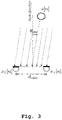
- FIG. 3 an angle of incidence, as it is determined by the delay estimator 11 is shown.
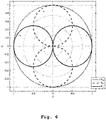
- FIG. 4 an example of an audio recording device 1 is shown in a two-dimensional diagram.
- the three microphones 2a, 2b, 2c are depicted in their actual physical location.
- the following algorithm aims at estimating the angle of incidence of direct sound based on cross-correlation between both recorded microphone signals x 1 and x 2 and derive parametrically gain filters to generate beams focusing in specific directions.
- a phase estimation, between both recording microphones, is carried out at each time-frequency tile.
- the microphone time-frequency representations, X 1 and X 2 of the microphone signals, are obtained using a N STFT points short-time Fourier transform (STFT).
- STFT short-time Fourier transform
- a microphone array has a restriction on the minimum spatial sampling rate.
- a high frequency extension is proposed based in equation (8) to constraint an unwrapping algorithm.
- the unwrapping aims at correcting the phase angle ⁇ 12 [ k , i ] by adding a multiple l [ k , i ] of 2 ⁇ when absolute jump between the two consecutive elements,
- the estimated unwrapped phase ⁇ 12 is obtained by limiting the multiples l to their physical possible values. Eventually, even if the phase is aliased at high-frequency, its slope still follows the same principles as the delay estimation at low frequency.
- the derived delay relates directly to the angle of incidence of sound emitted by a sound source, as illustrated in Figure 2 .
- a virtual cardioid signal can be retrieved from the direct sound of the input microphone signals. This corresponds to the function of the beam estimator 12.
- FIG. 5 three cardioid signals based upon three microphone pairs are depicted in a two-dimensional diagram, showing the respective gains.
- These spherical harmonics form a set of orthogonal basis functions and can be used to describe any function on the surface of a sphere.
- three, the minimum number of, microphones are considered and placed in the horizontal XY -plane, for instance disposed at the edges of a mobile device as illustrated in Figure 3 , having the coordinates ( x m 1 , y m 1 ), ( x m 2 , y m 2 ) , and ( x m 3 , y m 3 ).
- the three possible unordered microphone pairs are defined as:
- v p 1 x m 1 y m 1 ⁇ x m 2 y m 2
- v p 2 x m 2 y m 2 ⁇ x m 3 y m 3
- v p 3 x m 3 y m 3 ⁇ x m 1 y m 1 .
- the three resulting cardioids are pointing in the three directions ⁇ p 1 , ⁇ p 2 , and ⁇ p 3 , defining the corresponding A-format representation, as illustrated in Figure 4 .
- the corresponding first order Ambisonic B-format signals can be computed by means of linear combination of the spectra A p n .
- the first order Ambisonic B-format normalized directional responses R W , R X , and R Y are shown in Figure 5 , where R W corresponds to a monopole. while the signals R X and R Y correspond to two orthogonal dipoles.
- the directional responses are thus derived by substituting the azimuth angle ⁇ by the estimated DOA ⁇ XY . For instance, considering second order (assuming no elevation, i.e.
- the resulting ambisonic channels, R R , R U , R V , R L , R M , R P , and R Q contain only the direct sound components of the sound field.
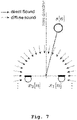
- FIG. 7 the occurrence of direct sound from a sound source and omnidirectional diffuse sound is shown in a diagram depicting the locations of two microphones.
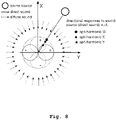
- FIG. 8 the directional responses to a sound source of direct sound is shown. Additionally, omnidirectional diffuse sound is depicted.
- the Ambisonic B-format signals are obtained by projecting the sound field unto the spherical harmonics basis defined in the previous table.
- the projection corresponds to the integration of the sound field signal over the spherical harmonics.
- the single diffuse sound estimate (28) is equivalent for all three microphones (or all three microphone pairs). Therefore there is no possibility to retrieve the native diffuse sound components of the Ambisonic B-format signals, i.e. D W , D X , and D Y as they would be obtained separately by projection of the diffuse sound field unto the spherical harmonics basis.
- an alternative is to generate three orthogonal diffuse sound components from the single known diffuse sound estimate P diff . This way, even if the diffuse sound components do not correspond to the native Ambisonic B-format obtained by projection, the most perceptually important property of orthogonality (enabling localization and spatialization) is preserved. This can be achieved by using de-correlation filters.
- the de-correlation filters are derived from a Gaussian noise sequence u of given length l u .
- a Gram-Schmidt process applied to this sequence leads to N u orthogonal sequences U 1 , U 2 , ⁇ , U N u which serve as filters to generate N u orthogonal diffuse sounds.
- N u 3
- the de-correlation filters are shaped such that they have an exponential decay over time, similarly as reverberation is a room.
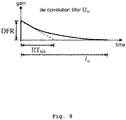
- FIG. 9 the filter response of a filter of the de-correlation filter bank 32 of FIG. 2 is shown. Especially the time constant of such a filter is depicted.
- the exponential decay of the de-correlation filters illustrated in Fig. 9 , will directly have an influence on the diffuse sound components in the B-format signals. A long decay will over emphasize the diffuse sound contribution in the final B-format but will ensure better separation between the three diffuse sound components.
- the resulting de-correlation filters are modulated by the diffuse-field responses of the ambisonic B-format channels they correspond to.
- This addition is performed by the adder 40 of FIG. 2 .
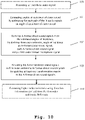
- a first optional step 100 at least 3 audio signals are recorded.
- angles of incidence of direct sound are estimated, by estimating for each pair of the N audio signals an angle of incidence of direct sound.
- A-format direct sound signals are derived from the estimated angles of incidence, by deriving from each estimated angle of incidence an A-format direct sound signal, each A-format direct sound signal being a first-order virtual microphone signal.
- the ambisonic A-format direct sound signals are encoded to first-order ambisonic B-format direct sound signals by applying at least one transformation matrix to the A-format direct sound signals.
- the fourth step of performing the encoding is an optional step with regard to the third aspect of the invention.
- a further optional fifth step 104 a higher order ambisonic B-Format signal is generated based on direction of arrival derived from first order B-Format.
- the audio encoding device according to the first aspect of the invention as well as the audio recording device according to the second aspect of the invention relate very closely to the audio encoding method according to the third aspect of the invention. Therefore, the elaborations along FIG. 1 - 9 are also valid with regard to the audio encoding method shown in FIG. 10 .
- the invention is not limited to the examples and especially not to a specific number of microphones.
- the characteristics of the exemplary embodiments can be used in any advantageous combination.
Landscapes
- Engineering & Computer Science (AREA)
- Physics & Mathematics (AREA)
- Health & Medical Sciences (AREA)
- Acoustics & Sound (AREA)
- Signal Processing (AREA)
- Otolaryngology (AREA)
- Audiology, Speech & Language Pathology (AREA)
- Human Computer Interaction (AREA)
- Multimedia (AREA)
- Computational Linguistics (AREA)
- Mathematical Physics (AREA)
- General Health & Medical Sciences (AREA)
- Spectroscopy & Molecular Physics (AREA)
- Algebra (AREA)
- Pure & Applied Mathematics (AREA)
- Theoretical Computer Science (AREA)
- Mathematical Optimization (AREA)
- Mathematical Analysis (AREA)
- General Physics & Mathematics (AREA)
- Circuit For Audible Band Transducer (AREA)
Claims (15)
- Audiocodierungsvorrichtung (3) zum Codieren von N Audiosignalen von N Mikrofonen, wo N ≥ 3, wobei die Audiocodierungsvorrichtung (3) Folgendes umfasst:- einen Verzögerungsschätzer (11), der dazu ausgelegt ist, Einfallswinkel von direktem Schall durch Schätzen eines Einfallswinkels von direktem Schall für jedes Paar der N Audiosignale zu schätzen,- einen Strahlableiter (12), der dazu ausgelegt ist, direkte Schallsignale des A-Formats durch Ableiten eines direkten Schallsignals des A-Formats von jedem Einfallswinkel von den geschätzten Einfallswinkeln abzuleiten, wobei jedes direkte Schallsignal des A-Formats ein virtuelles Mikrofonsignal erster Ordnung ist, und- einen Codierer (13), der dazu ausgelegt ist, die direkten Schallsignale des A-Formats durch Anwenden einer Transformationsmatrix auf die direkten Schallsignale des A-Formats in direkte Ambisonic-Schallsignale des B-Formats erster Ordnung zu codieren.
- Audiocodierungsvorrichtung (3) nach Anspruch 1,wobei N=3 und wobei die Audiocodierungsvorrichtung (3) einen Kurzzeit-Fouriertransformator (10a, 10b, 10c) umfasst, der dazu ausgelegt ist, an jedem der N Audiosignale x1, x2, x3 eine Kurzzeit-Fouriertransformation durchzuführen, was in N kurzzeit-fouriertransformierten Audiosignalen X1[k, i], X2[k, i], X3[k, i] resultiert,wobei der Verzögerungsschätzer (11) zu Folgendem ausgelegt ist- Bestimmen von Kreuzspektren von jedem Paar von kurzzeit-fouriertransformierten Audiosignalen gemäß


 - Bestimmen eines Winkels des komplexen Kreuzspektrums von jedem Paar von kurzzeit-fouriertransformierten Audiosignalen gemäß

 - Durchführen einer Phasenabwicklung zu Ψ̃ 12, Ψ̃ 13, Ψ̃ 23, durch, was in Ψ12, Ψ13, Ψ23, resultiert- Schätzen der Verzögerung in Anzahl von Abtastungen gemäß




 - Schätzen der Verzögerung in Sekunden gemäß

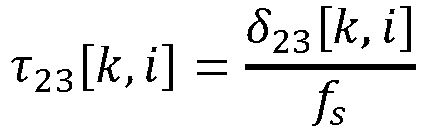 - Schätzen der Einfallswinkel gemäß

 x1 ein erstes Audiosignal der N Audiosignale ist,x2 ein zweites Audiosignal der N Audiosignale ist,x3 ein drittes Audiosignal der N Audiosignale ist,X1 ein erstes kurzzeit-fouriertransformiertes Audiosignal ist,X2 ein zweites kurzzeit-fouriertransformiertes Audiosignal ist,X3 ein drittes kurzzeit-fouriertransformiertes Audiosignal ist,k ein Frame des kurzzeit-fouriertransformierten Audiosignals ist undi ein Frequenzbin des kurzzeit-fouriertransformierten Audiosignals ist,X12 ein Kreuzspektrum eines Paares von X1 und X2 ist,X13 ein Kreuzspektrum eines Paares von X1 und X3 ist,X23 ein Kreuzspektrum eines Paares von X2 und X3 ist,αX ein Vernachlässigbarkeitsfaktor ist,X* der Konjugatkomplex von X ist,j die imaginäre Einheit ist,Ψ̃ 12 ein Winkel des komplexen Kreuzspektrums von X12 ist,Ψ̃ 13 ein Winkel des komplexen Kreuzspektrums von X13 ist,Ψ̃ 23 ein Winkel des komplexen Kreuzspektrums von X23 ist,ialias ein Frequenzbin ist, das einer Aliasfrequenz entspricht,fs eine Abtastfrequenz ist,dmic ein Abstand der Mikrofone (2, 2a, 2b, 2c) ist undc die Schallgeschwindigkeit ist.
 - Audiocodierungsvorrichtung (3) nach Anspruch 2,
wobei der Strahlableiter (12) zu Folgendem ausgelegt ist- Bestimmen von nierenförmigen Richtcharakteristiken gemäß

 - Ableiten von direkten Schallsignalen des A-Formats gemäß

 D eine nierenförmige Richtcharakteristik ist undA ein direktes Schallsignals des A-Formats ist.
 - Audiocodierungsvorrichtung (3) nach Anspruch 3,
wobei der Codierer (13) dazu ausgelegt ist, die direkten Schallsignale des A-Formats in die direkten Ambisonic-Schallsignale des B-Formats erster Ordnung gemäß Folgendem zu codieren RW ein erstes direktes Ambisonic-Schallsignal des B-Formats nullter Ordnung ist,RW ein erstes direktes Ambisonic-Schallsignal des B-Formats erster Ordnung ist,RW ein zweites direktes Ambisonic-Schallsignal des B-Formats erster Ordnung ist undΓ-1 die Transformationsmatrix ist.
 - Audiocodierungsvorrichtung (3) nach einem der Ansprüche 2 bis 4, die Folgendes umfasst- einen Ankunftsrichtungsschätzer (20), der dazu ausgelegt ist, eine Ankunftsrichtung von den direkten Ambisonic-Schallsignalen des B-Formats erster Ordnung zu schätzen, und- einen Ambisonic-Codierer (21) höherer Ordnung, der dazu ausgelegt ist, direkte Ambisonic-Schallsignale des B-Formats höherer Ordnung unter Verwendung der direkten Ambisonic-Schallsignale des B-Formats erster Ordnung und der geschätzten Ankunftsrichtung zu codieren, wobei die direkten Ambisonic-Schallsignale des B-Formats höherer Ordnung eine Ordnung höher als eins aufweisen.
- Audiocodierungsvorrichtung (3) nach Anspruch 5,
wobei der Ankunftsrichtungsschätzer (20) dazu ausgelegt ist, die Ankunftsrichtung gemäß Folgendem zu schätzen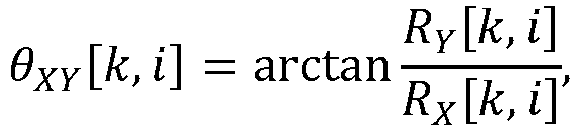
θXY [k,i] eine Ankunftsrichtung eines direkten Schalls von Frame k und Frequenzbin i ist. - Audiocodierungsvorrichtung (3) nach Anspruch 6,
wobei die direkten Ambisonic-Schallsignale des B-Formats höherer Ordnung direkte Ambisonic-Schallsignale des B-Formats zweiter Ordnung umfassen, die auf zwei Dimensionen beschränkt sind, wobei der Ambisonic-Codierer (21) höherer Ordnung dazu ausgelegt ist, die direkten Ambisonic-Schallsignale des B-Formats zweiter Ordnung gemäß Folgendem zu codieren


 RR ein erstes direktes Ambisonic-Schallsignal des B-Formats zweiter Ordnung ist,RS ein zweites direktes Ambisonic-Schallsignal des B-Formats zweiter Ordnung ist,RT ein drittes direktes Ambisonic-Schallsignal des B-Formats zweiter Ordnung ist,RU ein viertes direktes Ambisonic-Schallsignal des B-Formats zweiter Ordnung ist,RV ein fünftes direktes Ambisonic-Schallsignal des B-Formats zweiter Ordnung ist,"definiert als" bezeichnet,
 φ ein Elevationswinkel ist undθ ein Azimutwinkel ist.
 - Audiocodierungsvorrichtung (3) nach einem der Ansprüche 2 bis 7,
die einen Mikrofonabgleicher (30) umfasst, der dazu ausgelegt ist, einen Abgleich der N Frequenzdomänenaudiosignale durchzuführen, was in N abgeglichenen Frequenzdomänenaudiosignalen resultiert. - Audiocodierungsvorrichtung (3) nach Anspruch 8, die Folgendes umfassteinen Diffusschallschätzer (31), der dazu ausgelegt ist, eine Diffusschallleistung zu schätzen, undeine Dekorrelationsfilterbank (32), die dazu ausgelegt ist, durch Erzeugen von drei orthogonalen Diffusschallkomponenten aus der geschätzten Diffusschallleistung eine Dekorrelation der Diffusschallleistung durchzuführen.
- Audiocodierungsvorrichtung (3) nach Anspruch 9,
wobei der Diffusschallschätzer (31) dazu ausgelegt ist, die Diffusschallleistung gemäß Folgendem zu schätzen


 Pdiff die Diffusschallleistung ist,E{ } ein Erwartungswert ist,
 N1 Diffusschall in einem ersten Kanal ist undN2 Diffusschall in einem zweiten Kanal ist.
 - Audiocodierungsvorrichtung (3) nach Anspruch 10,
wobei die Dekorrelationsfilterbank (32) dazu ausgelegt ist, durch Erzeugen von drei orthogonalen Diffusschallkomponenten aus der geschätzten Diffusschallleistung die Dekorrelation der Diffusschallleistung durchzuführen





 wobei D̃W [k,i] eine Diffusschallkomponente des ersten Kanals ist,wobei D̃X [k,i] eine Diffusschallkomponente des zweiten Kanals ist,wobei D̃Y [k,i] eine Diffusschallkomponente des dritten Kanals ist,DFRW eine Diffusfeldcharakteristik des ersten Kanals ist,DFRX eine Diffusfeldcharakteristik des zweiten Kanals ist,DFRY eine Diffusfeldcharakteristik des dritten Kanals ist,wu ein Exponentialfenster ist,RT 60 eine Nachhallzeit ist,U 1 , U 2 , U 3 die Dekorrelationsfilterbank (32) ist,u eine Gaußsche Rauschsequenz ist,l u eine gegebene Länge der Gaußschen Rauschsequenz ist undP 2D-diff die Diffusrauschleistung ist.
 - Audiocodierungsvorrichtung (3) nach Anspruch 1 und 6 oder 1 und 8 oder 1 und 6 und 8,
die einen Addierer (41) umfasst, der dazu ausgelegt ist, die direkten Ambisonic-Schallsignale des B-Formats erster Ordnung und- die direkten Ambisonic-Schallsignale des B-Formats höherer Ordnung und/oder- die Diffusschallsignale,
kanalweise hinzuzufügen, was in vollständigen Ambisonic-Signalen des B-Formats resultiert. - Audioaufzeichnungsvorrichtung (1), die N Mikrofone (2, 2a, 2b, 2c), die dazu ausgelegt sind, die N Audiosignale aufzuzeichnen, und eine Audiocodierungsvorrichtung (3) nach einem der vorhergehenden Ansprüche umfasst.
- Verfahren zum Codieren von N Audiosignalen von N Mikrofonen (2, 2a, 2b, 2c), wo N ≥ 3, wobei das Verfahren Folgendes umfasst:- Schätzen (101) von Einfallswinkeln von direktem Schall durch Schätzen eines Einfallswinkels von direktem Schall für jedes Paar der N Audiosignale,- Ableiten (102) von direkten Schallsignalen des A-Formats durch Ableiten eines direkten Schallsignals des A-Formats von jedem Einfallswinkel von den geschätzten Einfallswinkeln, wobei jedes direkte Schallsignal des A-Formats ein virtuelles Mikrofonsignal erster Ordnung ist, und- Codieren der direkten Schallsignale des A-Formats durch Anwenden einer Transformationsmatrix auf die direkten Schallsignale des A-Formats in direkte Ambisonic-Schallsignale des B-Formats erster Ordnung.
- Computerprogramm mit einem Programmcode zum Durchführen des Verfahrens nach Anspruch 14, wenn das Computerprogramm auf einem Computer ausgeführt wird.
Applications Claiming Priority (1)
| Application Number | Priority Date | Filing Date | Title |
|---|---|---|---|
| PCT/EP2018/056411 WO2019174725A1 (en) | 2018-03-14 | 2018-03-14 | Audio encoding device and method |
Publications (2)
| Publication Number | Publication Date |
|---|---|
| EP3753263A1 EP3753263A1 (de) | 2020-12-23 |
| EP3753263B1 true EP3753263B1 (de) | 2022-08-24 |
Family
ID=61683788
Family Applications (1)
| Application Number | Title | Priority Date | Filing Date |
|---|---|---|---|
| EP18711541.5A Active EP3753263B1 (de) | 2018-03-14 | 2018-03-14 | Audiocodierungsvorrichtung und -verfahren |
Country Status (4)
| Country | Link |
|---|---|
| US (1) | US11632626B2 (de) |
| EP (1) | EP3753263B1 (de) |
| CN (1) | CN111819862B (de) |
| WO (1) | WO2019174725A1 (de) |
Families Citing this family (6)
| Publication number | Priority date | Publication date | Assignee | Title |
|---|---|---|---|---|
| US10878536B1 (en) | 2017-12-29 | 2020-12-29 | Gopro, Inc. | Apparatus and methods for non-uniform downsampling of captured panoramic images |
| EP3948859B1 (de) * | 2019-04-12 | 2024-10-16 | Huawei Technologies Co., Ltd. | Verfahren und vorrichtung zum erhalten eines ambisonic signal erster ordnung |
| WO2021243634A1 (en) * | 2020-06-04 | 2021-12-09 | Northwestern Polytechnical University | Binaural beamforming microphone array |
| CN112259110B (zh) * | 2020-11-17 | 2022-07-01 | 北京声智科技有限公司 | 音频编码方法及装置、音频解码方法及装置 |
| JP2023131911A (ja) * | 2022-03-10 | 2023-09-22 | 株式会社ズーム | ソフトウェア及びマイクロホンデバイス |
| CN119603622A (zh) * | 2025-02-10 | 2025-03-11 | 深圳市沃莱特电子有限公司 | 麦克风焊接方向检测方法、装置、计算机设备以及介质 |
Family Cites Families (7)
| Publication number | Priority date | Publication date | Assignee | Title |
|---|---|---|---|---|
| EP1737271A1 (de) * | 2005-06-23 | 2006-12-27 | AKG Acoustics GmbH | Mikrofonanordnung |
| JP6284480B2 (ja) * | 2012-08-29 | 2018-02-28 | シャープ株式会社 | 音声信号再生装置、方法、プログラム、及び記録媒体 |
| EP2733965A1 (de) * | 2012-11-15 | 2014-05-21 | Fraunhofer-Gesellschaft zur Förderung der angewandten Forschung e.V. | Vorrichtung und Verfahren zur Erzeugung mehrerer parametrischer Audioströme und Vorrichtung und Verfahren zur Erzeugung mehrere Lautsprechersignale |
| EP2738762A1 (de) * | 2012-11-30 | 2014-06-04 | Aalto-Korkeakoulusäätiö | Verfahren zur Raumfilterung von mindestens einem ersten Tonsignal, computerlesbares Speichermedium und Raumfilterungssystem basierend auf Kreuzmuster-Kohärenz |
| WO2014191798A1 (en) * | 2013-05-31 | 2014-12-04 | Nokia Corporation | An audio scene apparatus |
| CN205249484U (zh) * | 2015-12-30 | 2016-05-18 | 临境声学科技江苏有限公司 | 一种麦克风线性阵列增强指向性拾音器 |
| US10595146B2 (en) * | 2017-12-21 | 2020-03-17 | Verizon Patent And Licensing Inc. | Methods and systems for extracting location-diffused ambient sound from a real-world scene |
-
2018
- 2018-03-14 EP EP18711541.5A patent/EP3753263B1/de active Active
- 2018-03-14 WO PCT/EP2018/056411 patent/WO2019174725A1/en not_active Ceased
- 2018-03-14 CN CN201880090899.7A patent/CN111819862B/zh active Active
-
2020
- 2020-09-14 US US17/019,757 patent/US11632626B2/en active Active
Also Published As
| Publication number | Publication date |
|---|---|
| EP3753263A1 (de) | 2020-12-23 |
| CN111819862A (zh) | 2020-10-23 |
| US20210067868A1 (en) | 2021-03-04 |
| WO2019174725A1 (en) | 2019-09-19 |
| CN111819862B (zh) | 2021-10-22 |
| US11632626B2 (en) | 2023-04-18 |
Similar Documents
| Publication | Publication Date | Title |
|---|---|---|
| US12283279B2 (en) | Method and device for decoding an audio soundfield representation | |
| EP3753263B1 (de) | Audiocodierungsvorrichtung und -verfahren | |
| US11368790B2 (en) | Apparatus, method and computer program for encoding, decoding, scene processing and other procedures related to DirAC based spatial audio coding | |
| JP2015502716A (ja) | 空間パワー密度に基づくマイクロフォン位置決め装置および方法 | |
| EP3777235B1 (de) | Räumliche audioaufnahme | |
| Olgun et al. | Sound field interpolation via sparse plane wave decomposition for 6DoF immersive audio | |
| AU2021282442B2 (en) | Method and device for decoding an audio soundfield representation | |
| EP3912365A1 (de) | Vorrichtung und verfahren zur wiedergabe eines binauralen audiosignals | |
| AU2020201419B2 (en) | Method and device for decoding an audio soundfield representation |
Legal Events
| Date | Code | Title | Description |
|---|---|---|---|
| STAA | Information on the status of an ep patent application or granted ep patent |
Free format text: STATUS: UNKNOWN |
|
| STAA | Information on the status of an ep patent application or granted ep patent |
Free format text: STATUS: THE INTERNATIONAL PUBLICATION HAS BEEN MADE |
|
| PUAI | Public reference made under article 153(3) epc to a published international application that has entered the european phase |
Free format text: ORIGINAL CODE: 0009012 |
|
| STAA | Information on the status of an ep patent application or granted ep patent |
Free format text: STATUS: REQUEST FOR EXAMINATION WAS MADE |
|
| 17P | Request for examination filed |
Effective date: 20200916 |
|
| AK | Designated contracting states |
Kind code of ref document: A1 Designated state(s): AL AT BE BG CH CY CZ DE DK EE ES FI FR GB GR HR HU IE IS IT LI LT LU LV MC MK MT NL NO PL PT RO RS SE SI SK SM TR |
|
| AX | Request for extension of the european patent |
Extension state: BA ME |
|
| DAV | Request for validation of the european patent (deleted) | ||
| DAX | Request for extension of the european patent (deleted) | ||
| GRAP | Despatch of communication of intention to grant a patent |
Free format text: ORIGINAL CODE: EPIDOSNIGR1 |
|
| STAA | Information on the status of an ep patent application or granted ep patent |
Free format text: STATUS: GRANT OF PATENT IS INTENDED |
|
| INTG | Intention to grant announced |
Effective date: 20220407 |
|
| GRAS | Grant fee paid |
Free format text: ORIGINAL CODE: EPIDOSNIGR3 |
|
| GRAA | (expected) grant |
Free format text: ORIGINAL CODE: 0009210 |
|
| STAA | Information on the status of an ep patent application or granted ep patent |
Free format text: STATUS: THE PATENT HAS BEEN GRANTED |
|
| AK | Designated contracting states |
Kind code of ref document: B1 Designated state(s): AL AT BE BG CH CY CZ DE DK EE ES FI FR GB GR HR HU IE IS IT LI LT LU LV MC MK MT NL NO PL PT RO RS SE SI SK SM TR |
|
| REG | Reference to a national code |
Ref country code: CH Ref legal event code: EP |
|
| REG | Reference to a national code |
Ref country code: DE Ref legal event code: R096 Ref document number: 602018039672 Country of ref document: DE |
|
| REG | Reference to a national code |
Ref country code: IE Ref legal event code: FG4D |
|
| REG | Reference to a national code |
Ref country code: AT Ref legal event code: REF Ref document number: 1514514 Country of ref document: AT Kind code of ref document: T Effective date: 20220915 |
|
| REG | Reference to a national code |
Ref country code: LT Ref legal event code: MG9D |
|
| REG | Reference to a national code |
Ref country code: NL Ref legal event code: MP Effective date: 20220824 |
|
| PG25 | Lapsed in a contracting state [announced via postgrant information from national office to epo] |
Ref country code: SE Free format text: LAPSE BECAUSE OF FAILURE TO SUBMIT A TRANSLATION OF THE DESCRIPTION OR TO PAY THE FEE WITHIN THE PRESCRIBED TIME-LIMIT Effective date: 20220824 Ref country code: RS Free format text: LAPSE BECAUSE OF FAILURE TO SUBMIT A TRANSLATION OF THE DESCRIPTION OR TO PAY THE FEE WITHIN THE PRESCRIBED TIME-LIMIT Effective date: 20220824 Ref country code: PT Free format text: LAPSE BECAUSE OF FAILURE TO SUBMIT A TRANSLATION OF THE DESCRIPTION OR TO PAY THE FEE WITHIN THE PRESCRIBED TIME-LIMIT Effective date: 20221226 Ref country code: NO Free format text: LAPSE BECAUSE OF FAILURE TO SUBMIT A TRANSLATION OF THE DESCRIPTION OR TO PAY THE FEE WITHIN THE PRESCRIBED TIME-LIMIT Effective date: 20221124 Ref country code: NL Free format text: LAPSE BECAUSE OF FAILURE TO SUBMIT A TRANSLATION OF THE DESCRIPTION OR TO PAY THE FEE WITHIN THE PRESCRIBED TIME-LIMIT Effective date: 20220824 Ref country code: LV Free format text: LAPSE BECAUSE OF FAILURE TO SUBMIT A TRANSLATION OF THE DESCRIPTION OR TO PAY THE FEE WITHIN THE PRESCRIBED TIME-LIMIT Effective date: 20220824 Ref country code: LT Free format text: LAPSE BECAUSE OF FAILURE TO SUBMIT A TRANSLATION OF THE DESCRIPTION OR TO PAY THE FEE WITHIN THE PRESCRIBED TIME-LIMIT Effective date: 20220824 Ref country code: FI Free format text: LAPSE BECAUSE OF FAILURE TO SUBMIT A TRANSLATION OF THE DESCRIPTION OR TO PAY THE FEE WITHIN THE PRESCRIBED TIME-LIMIT Effective date: 20220824 |
|
| REG | Reference to a national code |
Ref country code: AT Ref legal event code: MK05 Ref document number: 1514514 Country of ref document: AT Kind code of ref document: T Effective date: 20220824 |
|
| PG25 | Lapsed in a contracting state [announced via postgrant information from national office to epo] |
Ref country code: PL Free format text: LAPSE BECAUSE OF FAILURE TO SUBMIT A TRANSLATION OF THE DESCRIPTION OR TO PAY THE FEE WITHIN THE PRESCRIBED TIME-LIMIT Effective date: 20220824 Ref country code: IS Free format text: LAPSE BECAUSE OF FAILURE TO SUBMIT A TRANSLATION OF THE DESCRIPTION OR TO PAY THE FEE WITHIN THE PRESCRIBED TIME-LIMIT Effective date: 20221224 Ref country code: HR Free format text: LAPSE BECAUSE OF FAILURE TO SUBMIT A TRANSLATION OF THE DESCRIPTION OR TO PAY THE FEE WITHIN THE PRESCRIBED TIME-LIMIT Effective date: 20220824 Ref country code: GR Free format text: LAPSE BECAUSE OF FAILURE TO SUBMIT A TRANSLATION OF THE DESCRIPTION OR TO PAY THE FEE WITHIN THE PRESCRIBED TIME-LIMIT Effective date: 20221125 |
|
| PG25 | Lapsed in a contracting state [announced via postgrant information from national office to epo] |
Ref country code: SM Free format text: LAPSE BECAUSE OF FAILURE TO SUBMIT A TRANSLATION OF THE DESCRIPTION OR TO PAY THE FEE WITHIN THE PRESCRIBED TIME-LIMIT Effective date: 20220824 Ref country code: RO Free format text: LAPSE BECAUSE OF FAILURE TO SUBMIT A TRANSLATION OF THE DESCRIPTION OR TO PAY THE FEE WITHIN THE PRESCRIBED TIME-LIMIT Effective date: 20220824 Ref country code: ES Free format text: LAPSE BECAUSE OF FAILURE TO SUBMIT A TRANSLATION OF THE DESCRIPTION OR TO PAY THE FEE WITHIN THE PRESCRIBED TIME-LIMIT Effective date: 20220824 Ref country code: DK Free format text: LAPSE BECAUSE OF FAILURE TO SUBMIT A TRANSLATION OF THE DESCRIPTION OR TO PAY THE FEE WITHIN THE PRESCRIBED TIME-LIMIT Effective date: 20220824 Ref country code: CZ Free format text: LAPSE BECAUSE OF FAILURE TO SUBMIT A TRANSLATION OF THE DESCRIPTION OR TO PAY THE FEE WITHIN THE PRESCRIBED TIME-LIMIT Effective date: 20220824 Ref country code: AT Free format text: LAPSE BECAUSE OF FAILURE TO SUBMIT A TRANSLATION OF THE DESCRIPTION OR TO PAY THE FEE WITHIN THE PRESCRIBED TIME-LIMIT Effective date: 20220824 |
|
| REG | Reference to a national code |
Ref country code: DE Ref legal event code: R097 Ref document number: 602018039672 Country of ref document: DE |
|
| PG25 | Lapsed in a contracting state [announced via postgrant information from national office to epo] |
Ref country code: SK Free format text: LAPSE BECAUSE OF FAILURE TO SUBMIT A TRANSLATION OF THE DESCRIPTION OR TO PAY THE FEE WITHIN THE PRESCRIBED TIME-LIMIT Effective date: 20220824 Ref country code: EE Free format text: LAPSE BECAUSE OF FAILURE TO SUBMIT A TRANSLATION OF THE DESCRIPTION OR TO PAY THE FEE WITHIN THE PRESCRIBED TIME-LIMIT Effective date: 20220824 |
|
| P01 | Opt-out of the competence of the unified patent court (upc) registered |
Effective date: 20230524 |
|
| PG25 | Lapsed in a contracting state [announced via postgrant information from national office to epo] |
Ref country code: AL Free format text: LAPSE BECAUSE OF FAILURE TO SUBMIT A TRANSLATION OF THE DESCRIPTION OR TO PAY THE FEE WITHIN THE PRESCRIBED TIME-LIMIT Effective date: 20220824 |
|
| PLBE | No opposition filed within time limit |
Free format text: ORIGINAL CODE: 0009261 |
|
| STAA | Information on the status of an ep patent application or granted ep patent |
Free format text: STATUS: NO OPPOSITION FILED WITHIN TIME LIMIT |
|
| 26N | No opposition filed |
Effective date: 20230525 |
|
| PG25 | Lapsed in a contracting state [announced via postgrant information from national office to epo] |
Ref country code: SI Free format text: LAPSE BECAUSE OF FAILURE TO SUBMIT A TRANSLATION OF THE DESCRIPTION OR TO PAY THE FEE WITHIN THE PRESCRIBED TIME-LIMIT Effective date: 20220824 |
|
| PG25 | Lapsed in a contracting state [announced via postgrant information from national office to epo] |
Ref country code: MC Free format text: LAPSE BECAUSE OF FAILURE TO SUBMIT A TRANSLATION OF THE DESCRIPTION OR TO PAY THE FEE WITHIN THE PRESCRIBED TIME-LIMIT Effective date: 20220824 |
|
| REG | Reference to a national code |
Ref country code: CH Ref legal event code: PL |
|
| REG | Reference to a national code |
Ref country code: BE Ref legal event code: MM Effective date: 20230331 |
|
| PG25 | Lapsed in a contracting state [announced via postgrant information from national office to epo] |
Ref country code: LU Free format text: LAPSE BECAUSE OF NON-PAYMENT OF DUE FEES Effective date: 20230314 |
|
| REG | Reference to a national code |
Ref country code: IE Ref legal event code: MM4A |
|
| PG25 | Lapsed in a contracting state [announced via postgrant information from national office to epo] |
Ref country code: LI Free format text: LAPSE BECAUSE OF NON-PAYMENT OF DUE FEES Effective date: 20230331 Ref country code: IE Free format text: LAPSE BECAUSE OF NON-PAYMENT OF DUE FEES Effective date: 20230314 Ref country code: FR Free format text: LAPSE BECAUSE OF NON-PAYMENT OF DUE FEES Effective date: 20230331 Ref country code: CH Free format text: LAPSE BECAUSE OF NON-PAYMENT OF DUE FEES Effective date: 20230331 |
|
| PG25 | Lapsed in a contracting state [announced via postgrant information from national office to epo] |
Ref country code: BE Free format text: LAPSE BECAUSE OF NON-PAYMENT OF DUE FEES Effective date: 20230331 |
|
| PG25 | Lapsed in a contracting state [announced via postgrant information from national office to epo] |
Ref country code: IT Free format text: LAPSE BECAUSE OF FAILURE TO SUBMIT A TRANSLATION OF THE DESCRIPTION OR TO PAY THE FEE WITHIN THE PRESCRIBED TIME-LIMIT Effective date: 20220824 |
|
| PG25 | Lapsed in a contracting state [announced via postgrant information from national office to epo] |
Ref country code: BG Free format text: LAPSE BECAUSE OF FAILURE TO SUBMIT A TRANSLATION OF THE DESCRIPTION OR TO PAY THE FEE WITHIN THE PRESCRIBED TIME-LIMIT Effective date: 20220824 |
|
| PG25 | Lapsed in a contracting state [announced via postgrant information from national office to epo] |
Ref country code: BG Free format text: LAPSE BECAUSE OF FAILURE TO SUBMIT A TRANSLATION OF THE DESCRIPTION OR TO PAY THE FEE WITHIN THE PRESCRIBED TIME-LIMIT Effective date: 20220824 |
|
| PGFP | Annual fee paid to national office [announced via postgrant information from national office to epo] |
Ref country code: DE Payment date: 20250204 Year of fee payment: 8 |
|
| PGFP | Annual fee paid to national office [announced via postgrant information from national office to epo] |
Ref country code: GB Payment date: 20250130 Year of fee payment: 8 |
|
| PG25 | Lapsed in a contracting state [announced via postgrant information from national office to epo] |
Ref country code: CY Free format text: LAPSE BECAUSE OF FAILURE TO SUBMIT A TRANSLATION OF THE DESCRIPTION OR TO PAY THE FEE WITHIN THE PRESCRIBED TIME-LIMIT; INVALID AB INITIO Effective date: 20180314 |
|
| PG25 | Lapsed in a contracting state [announced via postgrant information from national office to epo] |
Ref country code: HU Free format text: LAPSE BECAUSE OF FAILURE TO SUBMIT A TRANSLATION OF THE DESCRIPTION OR TO PAY THE FEE WITHIN THE PRESCRIBED TIME-LIMIT; INVALID AB INITIO Effective date: 20180314 |
|
| PG25 | Lapsed in a contracting state [announced via postgrant information from national office to epo] |
Ref country code: TR Free format text: LAPSE BECAUSE OF FAILURE TO SUBMIT A TRANSLATION OF THE DESCRIPTION OR TO PAY THE FEE WITHIN THE PRESCRIBED TIME-LIMIT Effective date: 20220824 |