EP3752717B1 - Sealing arrangement with pressure-loaded feather seals to seal gap between components of gas turbine engine - Google Patents
Sealing arrangement with pressure-loaded feather seals to seal gap between components of gas turbine engine Download PDFInfo
- Publication number
- EP3752717B1 EP3752717B1 EP18718050.0A EP18718050A EP3752717B1 EP 3752717 B1 EP3752717 B1 EP 3752717B1 EP 18718050 A EP18718050 A EP 18718050A EP 3752717 B1 EP3752717 B1 EP 3752717B1
- Authority
- EP
- European Patent Office
- Prior art keywords
- feather seal
- extending
- arcuate
- arcuate feather
- sealing arrangement
- Prior art date
- Legal status (The legal status is an assumption and is not a legal conclusion. Google has not performed a legal analysis and makes no representation as to the accuracy of the status listed.)
- Active
Links
Images



Classifications
-
- F—MECHANICAL ENGINEERING; LIGHTING; HEATING; WEAPONS; BLASTING
- F01—MACHINES OR ENGINES IN GENERAL; ENGINE PLANTS IN GENERAL; STEAM ENGINES
- F01D—NON-POSITIVE DISPLACEMENT MACHINES OR ENGINES, e.g. STEAM TURBINES
- F01D9/00—Stators
- F01D9/02—Nozzles; Nozzle boxes; Stator blades; Guide conduits, e.g. individual nozzles
-
- F—MECHANICAL ENGINEERING; LIGHTING; HEATING; WEAPONS; BLASTING
- F01—MACHINES OR ENGINES IN GENERAL; ENGINE PLANTS IN GENERAL; STEAM ENGINES
- F01D—NON-POSITIVE DISPLACEMENT MACHINES OR ENGINES, e.g. STEAM TURBINES
- F01D9/00—Stators
- F01D9/02—Nozzles; Nozzle boxes; Stator blades; Guide conduits, e.g. individual nozzles
- F01D9/023—Transition ducts between combustor cans and first stage of the turbine in gas-turbine engines; their cooling or sealings
-
- F—MECHANICAL ENGINEERING; LIGHTING; HEATING; WEAPONS; BLASTING
- F01—MACHINES OR ENGINES IN GENERAL; ENGINE PLANTS IN GENERAL; STEAM ENGINES
- F01D—NON-POSITIVE DISPLACEMENT MACHINES OR ENGINES, e.g. STEAM TURBINES
- F01D11/00—Preventing or minimising internal leakage of working-fluid, e.g. between stages
-
- F—MECHANICAL ENGINEERING; LIGHTING; HEATING; WEAPONS; BLASTING
- F01—MACHINES OR ENGINES IN GENERAL; ENGINE PLANTS IN GENERAL; STEAM ENGINES
- F01D—NON-POSITIVE DISPLACEMENT MACHINES OR ENGINES, e.g. STEAM TURBINES
- F01D11/00—Preventing or minimising internal leakage of working-fluid, e.g. between stages
- F01D11/003—Preventing or minimising internal leakage of working-fluid, e.g. between stages by packing rings; Mechanical seals
-
- F—MECHANICAL ENGINEERING; LIGHTING; HEATING; WEAPONS; BLASTING
- F01—MACHINES OR ENGINES IN GENERAL; ENGINE PLANTS IN GENERAL; STEAM ENGINES
- F01D—NON-POSITIVE DISPLACEMENT MACHINES OR ENGINES, e.g. STEAM TURBINES
- F01D11/00—Preventing or minimising internal leakage of working-fluid, e.g. between stages
- F01D11/005—Sealing means between non relatively rotating elements
-
- F—MECHANICAL ENGINEERING; LIGHTING; HEATING; WEAPONS; BLASTING
- F01—MACHINES OR ENGINES IN GENERAL; ENGINE PLANTS IN GENERAL; STEAM ENGINES
- F01D—NON-POSITIVE DISPLACEMENT MACHINES OR ENGINES, e.g. STEAM TURBINES
- F01D25/00—Component parts, details, or accessories, not provided for in, or of interest apart from, other groups
- F01D25/24—Casings; Casing parts, e.g. diaphragms, casing fastenings
-
- F—MECHANICAL ENGINEERING; LIGHTING; HEATING; WEAPONS; BLASTING
- F01—MACHINES OR ENGINES IN GENERAL; ENGINE PLANTS IN GENERAL; STEAM ENGINES
- F01D—NON-POSITIVE DISPLACEMENT MACHINES OR ENGINES, e.g. STEAM TURBINES
- F01D25/00—Component parts, details, or accessories, not provided for in, or of interest apart from, other groups
- F01D25/24—Casings; Casing parts, e.g. diaphragms, casing fastenings
- F01D25/243—Flange connections; Bolting arrangements
-
- F—MECHANICAL ENGINEERING; LIGHTING; HEATING; WEAPONS; BLASTING
- F01—MACHINES OR ENGINES IN GENERAL; ENGINE PLANTS IN GENERAL; STEAM ENGINES
- F01D—NON-POSITIVE DISPLACEMENT MACHINES OR ENGINES, e.g. STEAM TURBINES
- F01D25/00—Component parts, details, or accessories, not provided for in, or of interest apart from, other groups
- F01D25/30—Exhaust heads, chambers, or the like
-
- F—MECHANICAL ENGINEERING; LIGHTING; HEATING; WEAPONS; BLASTING
- F02—COMBUSTION ENGINES; HOT-GAS OR COMBUSTION-PRODUCT ENGINE PLANTS
- F02C—GAS-TURBINE PLANTS; AIR INTAKES FOR JET-PROPULSION PLANTS; CONTROLLING FUEL SUPPLY IN AIR-BREATHING JET-PROPULSION PLANTS
- F02C7/00—Features, components parts, details or accessories, not provided for in, or of interest apart form groups F02C1/00 - F02C6/00; Air intakes for jet-propulsion plants
- F02C7/28—Arrangement of seals
-
- F—MECHANICAL ENGINEERING; LIGHTING; HEATING; WEAPONS; BLASTING
- F05—INDEXING SCHEMES RELATING TO ENGINES OR PUMPS IN VARIOUS SUBCLASSES OF CLASSES F01-F04
- F05D—INDEXING SCHEME FOR ASPECTS RELATING TO NON-POSITIVE-DISPLACEMENT MACHINES OR ENGINES, GAS-TURBINES OR JET-PROPULSION PLANTS
- F05D2220/00—Application
- F05D2220/30—Application in turbines
- F05D2220/32—Application in turbines in gas turbines
-
- F—MECHANICAL ENGINEERING; LIGHTING; HEATING; WEAPONS; BLASTING
- F05—INDEXING SCHEMES RELATING TO ENGINES OR PUMPS IN VARIOUS SUBCLASSES OF CLASSES F01-F04
- F05D—INDEXING SCHEME FOR ASPECTS RELATING TO NON-POSITIVE-DISPLACEMENT MACHINES OR ENGINES, GAS-TURBINES OR JET-PROPULSION PLANTS
- F05D2240/00—Components
- F05D2240/10—Stators
- F05D2240/12—Fluid guiding means, e.g. vanes
- F05D2240/128—Nozzles
-
- F—MECHANICAL ENGINEERING; LIGHTING; HEATING; WEAPONS; BLASTING
- F05—INDEXING SCHEMES RELATING TO ENGINES OR PUMPS IN VARIOUS SUBCLASSES OF CLASSES F01-F04
- F05D—INDEXING SCHEME FOR ASPECTS RELATING TO NON-POSITIVE-DISPLACEMENT MACHINES OR ENGINES, GAS-TURBINES OR JET-PROPULSION PLANTS
- F05D2240/00—Components
- F05D2240/55—Seals
-
- F—MECHANICAL ENGINEERING; LIGHTING; HEATING; WEAPONS; BLASTING
- F05—INDEXING SCHEMES RELATING TO ENGINES OR PUMPS IN VARIOUS SUBCLASSES OF CLASSES F01-F04
- F05D—INDEXING SCHEME FOR ASPECTS RELATING TO NON-POSITIVE-DISPLACEMENT MACHINES OR ENGINES, GAS-TURBINES OR JET-PROPULSION PLANTS
- F05D2240/00—Components
- F05D2240/55—Seals
- F05D2240/57—Leaf seals
Definitions
- Disclosed embodiments are generally related to turbomachinery, such as gas turbine engines and, more particularly, to a sealing arrangement in a gas turbine engine, including pressure-loaded feather seals to seal a gap between a first turbine component, such as a transition duct exit, and a second turbine component, such as a first stage turbine vane structure.
- a number of combustion chambers combust fuel mixed with compressed air, and a hot working gas flowing from these combustion chambers is passed via respective transitions (also referred to by some in the art as ducts and tail tubes) to respective entrances of a turbine stage of the engine.
- a plurality of combustion chambers may be arranged radially about a longitudinal axis of the gas turbine engine, and likewise radially arranged transitions comprise outlet ends that converge to form an annular inflow of working gas to the turbine stage entrance.
- Each transition exit is joined by a number of seals each of which bridges a gap between a portion of the exit and one or more turbine components, such as turbine vane carrier.
- Disclosed embodiments offer an improved technical solution for a sealing arrangement in a gas turbine engine. See US patents 7,784,264 and 8,118,549 for examples of transition ducts for a gas turbine involving seal apparatuses. Further, US patent US 6 464 457 B1 shows a gas turbine engine arcuate segment with a leaf seal assembly. The leaf seal assembly includes a plurality of radially extending tabs circumferentially spaced apart from each other. Further, US 2016/326897 A1 discloses a turbomachine which includes a seal device for sealing a gap between two components, with a plurality of sealing elements tippable in the direction of a relative displacement of the components.
- a sealing arrangement to seal a gap between a first turbine component and a second turbine component in a gas turbine engine claimed in claim 1, is provided.
- Disclosed sealing arrangements provide substantial design flexibility since such sealing arrangements can reliably provide appropriate sealing functionality under various thermo-mechanical load scenarios that can routinely develop during operation of the gas turbine engine while enabling multiple degrees of freedom effective to accommodate radial and/or axial displacements that can develop between the first turbine component and the second turbine component and maintain such sealing joint.
- Disclosed feather seals may involve a multi-ply construction (comprising relatively thin metal plies that, without limitation, may range in thickness from approximately 0.3 mm to approximately 1.0 mm to achieve appropriate flexibility) to form the pressure-loaded sealing joint.
- These thin plies can be joined in a straightforward manner to form a relatively flexible sealing arrangement effective to reduce leakage rates by ensuring a substantially uniform sealing surface contact under various thermo-mechanical load scenarios.
- the joining of these thin plies may be performed by way of suitable joints, such as, without limitation, bonding joints, welding joints, brazing joints, etc.
- Disclosed embodiments are conducive to manufacturing-friendly and time-efficient operations that substantially improve manufacturability, dimensional accuracy and repeatability, and reduce costs.
- disclosed embodiments are effective to provide low-levels of stress under temperature gradients experienced during operation of the gas turbine engine. Accordingly, disclosed embodiments are expected to show an improved life relative to known seal designs, thereby reducing the requirement of replacement over the life of the gas turbine. This should reduce the cost of maintenance, and economic losses that otherwise would be endured due to downtime of the gas turbine engine.
- Disclosed embodiments providing longer life should in turn incrementally reduce the operating cost of the gas turbine over its entire life-cycle.
- forward and aft refer to the direction toward directions relative to the orientation of the gas turbine. Accordingly, “forward” refers to the compressor end of the engine, while “aftward” refers to the direction toward the turbine end of the engine.
- forward refers to the compressor end of the engine
- aftward refers to the direction toward the turbine end of the engine.
- downstream and upstream are used to indicate position, such as within a given conduit relative to the general direction of a flow moving through it. As will be appreciated, these terms reference a direction relative to the direction of flow expected through the given conduit during normal operation, which should be plainly apparent to those skilled in the art. As such, the term “downstream” refers to the direction in which the fluid is flowing through the given conduit, while “upstream” refers to the opposite of that.
- radial refers to a movement or position perpendicular to an axis.
- a first component resides closer to the central axis than a second component, the first component will be described as being either “radially inward” or “inboard” of the second component. If, on the other hand, the first component resides further from the central axis than the second component, the first component will be described herein as being either “radially outward” or “outboard” of the second component.
- axial refers to movement or position parallel to an axis
- circumferential refers to movement or position around an axis. While these terms may be applied in relation to a common central axis that may extend through the compressor and turbine sections of the engine, it should be appreciated that these terms may also be used in relation to other components or sub-systems of the engine as may be appropriate.
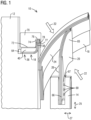
- FIG. 1 is a fragmentary, isometric view of a disclosed sealing arrangement 10 to seal a gap between a first turbine component 12, such as a transition duct exit, and a second turbine component 14, such as a first stage turbine vane structure, in a gas turbine engine.
- a first arcuate feather seal 16 may be connected to an anchoring assembly 18 of the sealing arrangement affixed to first turbine component 12.
- anchoring assembly 18 may be take any one of various alternative design configurations depending on the needs of a given application.
- a second arcuate feather seal 20 is affixed to second turbine component 14.
- first feather seal 16 and second feather seal 20 are responsive to a pressure differential (schematically represented by arrows 22) that develops across the gap to form a pressure-loaded sealing joint between respective sealing surfaces 24, 26 of first arcuate feather seal 16 and second arcuate feather seal 20. That is, the pressure differential urges sealing surfaces 24, 26 to contactively engage one another to form the pressure-loaded sealing joint and maintain such sealing joint under various thermo-mechanical load scenarios that can routinely develop during operation of the gas turbine engine.
- the pressure-loaded sealing joint which is formed between respective sealing surfaces 24, 26 may comprise, without limitation, a radially slidable pressure-loaded sealing joint (e.g., sweeping relative motion) between sealing surfaces 24, 26) to accommodate radial displacements (schematically represented by twin-headed arrow 25) between first turbine component 12 and second turbine component 14.
- the pressure-loaded sealing joint may additionally comprise an axially compliant pressure-loaded sealing joint to accommodate axial displacements (schematically represented by twin-headed arrow 27) between first turbine component 12 and second turbine component 14. This feature is effective to accommodate saw-toothing relative motion that commonly develops between adjacent row one vane segments in the gas turbine engine.
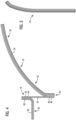
- first arcuate feather seal 16 may include a plurality of spaced apart slits 28 positioned perpendicular to a longitudinal axis 30 of first arcuate feather seal 16.
- second arcuate feather seal 20 may include a plurality of spaced apart slits 32 positioned perpendicular to a longitudinal axis 34 of second arcuate feather seal 20.
- arcuate feather seals 16, 20 comprise respective multi-ply assemblies joined to form a relatively flexible sealing arrangement effective to reduce leakage rates by ensuring a substantially uniform sealing surface contact under various thermo-mechanical load scenarios.
- anchoring assembly 18 may include an anchor member 36 including a radially-extending section 38 configured to turn into an axially-extending flange section 40.
- Anchoring assembly 18 may further include a support member 42 having a radially outer segment 43 having a forward surface 44 affixed to a corresponding surface of radially-extending section 38 of anchor member 36.
- Support member 42 further includes a radially inner segment 46 having an aft surface 48 affixed to a corresponding surface of an anchored end segment 50 of first arcuate feather seal 16.
- the respective sealing surface 24 of first arcuate feather seal 16 is disposed at a free segment 52 of first arcuate feather seal 16. Free segment 52 extends away from anchored end segment 50 of first arcuate feather seal 16.
- a respective ply of the respective multi-ply assemblies that respectively defines the sealing surfaces 24, 26 may comprise a cloth metal ply.
- axially-extending flange section 40 of anchor member 36 may be disposed on a circumferentially-extending step 64 constructed at the transition duct exit.
- the respective sealing surface 26 of second arcuate feather seal 20 may be disposed at a free end segment 65 of second arcuate feather seal 20. Free end segment 65 is disposed opposite an anchored end segment 66 of second arcuate feather seal 20. Free end segment 65 of second arcuate feather seal 20 is disposed radially outward relative to anchored end segment 66 of the second arcuate feather seal.
- Anchored end segment 66 of second arcuate feather seal 20 may be disposed in a circumferentially-extending groove 67 constructed at first stage turbine vane structure 14. Without limitation, anchored end segment 66 of second arcuate feather seal 20 may be retained by an interference fit (schematically represented by dimples 69) or other suitable affixing members, such as affixing pins, etc.
- Retainer block 70 may include a base segment 72 positioned against axially-extending flange section 40 of anchor member 36 to radially retain axially-extending flange section 40.
- Retainer block 70 may further include a radially extending slot 74 including a radial end 76 positioned to radially retain radially-extending section 38 of anchor member 36, and further including a forward surface 77 and an aft surface 78 to axially retain radially-extending section 38 of anchor member 36.
- a ply of the respective multi-ply assemblies that defines the sealing surfaces 24, 26 may comprise a ply coated with a high-temperature abrasion-resistant coating 60, such as, without limitation, a cobalt-based coating, a carbide-based coating or a tungsten-based coating. It will be appreciated that each of the plies that make up first feather seal 16 and second feather seal 20 may each be respectively coated with high-temperature abrasion-resistant coating 60.
- FIG. 7 is fragmentary, cross-sectional view of an alternative embodiment for affixing a disclosed sealing arrangement to transition duct exit 12.
- anchoring assembly 18 may be joined to a circumferentially-extending lip 81 of transition end exit 12 by way of a weld joint 83.
- first arcuate feather seal 16' may be joined to a lip 81' of transition end exit 12 by way of a circumferentially-extending connecting hook 82.
- One may optionally construct a circumferentially-extending retainer groove 84 in a forward surface 85 of lip 81' configured to receive a corresponding segment 86 of circumferentially-extending connecting hook 82.
- L-shaped reinforcer 88 may further include an axially-extending section 91 disposed against a radially-inner surface 92 of lip 81'.
- arrows 94 and 94' are intended to provide a conceptual visualization of the complex motion (e.g., involving radial and axial motion components) that can be developed at the respective outer and inner diameters of disclosed sealing arrangements.
Landscapes
- Engineering & Computer Science (AREA)
- Mechanical Engineering (AREA)
- General Engineering & Computer Science (AREA)
- Chemical & Material Sciences (AREA)
- Combustion & Propulsion (AREA)
- Turbine Rotor Nozzle Sealing (AREA)
Description
- Disclosed embodiments are generally related to turbomachinery, such as gas turbine engines and, more particularly, to a sealing arrangement in a gas turbine engine, including pressure-loaded feather seals to seal a gap between a first turbine component, such as a transition duct exit, and a second turbine component, such as a first stage turbine vane structure.
- In turbomachinery, such as a gas turbine engine, a number of combustion chambers combust fuel mixed with compressed air, and a hot working gas flowing from these combustion chambers is passed via respective transitions (also referred to by some in the art as ducts and tail tubes) to respective entrances of a turbine stage of the engine. More specifically, a plurality of combustion chambers may be arranged radially about a longitudinal axis of the gas turbine engine, and likewise radially arranged transitions comprise outlet ends that converge to form an annular inflow of working gas to the turbine stage entrance. Each transition exit is joined by a number of seals each of which bridges a gap between a portion of the exit and one or more turbine components, such as turbine vane carrier. A number of factors --such as adjacent component growth, variances due to thermal expansion, mechanical loads, vibrational forces from combustion dynamics, etc.-- can present challenges regarding durability and performance of such seals.
- Disclosed embodiments offer an improved technical solution for a sealing arrangement in a gas turbine engine. See
US patents 7,784,264 and8,118,549 for examples of transition ducts for a gas turbine involving seal apparatuses. Further, US patentUS 6 464 457 B1 shows a gas turbine engine arcuate segment with a leaf seal assembly. The leaf seal assembly includes a plurality of radially extending tabs circumferentially spaced apart from each other. Further,US 2016/326897 A1 discloses a turbomachine which includes a seal device for sealing a gap between two components, with a plurality of sealing elements tippable in the direction of a relative displacement of the components. InEP 2 592 231 A2 a turbine system is described which includes a flexible metallic seal contacting an interface member to provide a seal between the interface member and a turbine section. Furthermore,US 2012/200046 A1 discloses a system for sealing a gap between a transition exit frame and a vane rail at a turbine inlet. The system includes a seal with a compliant seal member having a generally u-shaped profile to provide a sealing function in an axial direction. - According to the present invention a sealing arrangement to seal a gap between a first turbine component and a second turbine component in a gas turbine engine claimed in claim 1, is provided.
- Disclosed sealing arrangements provide substantial design flexibility since such sealing arrangements can reliably provide appropriate sealing functionality under various thermo-mechanical load scenarios that can routinely develop during operation of the gas turbine engine while enabling multiple degrees of freedom effective to accommodate radial and/or axial displacements that can develop between the first turbine component and the second turbine component and maintain such sealing joint.
-
-
FIG. 1 is a fragmentary, isometric view of a disclosed sealing arrangement in a gas turbine engine, as may be used to seal a gap between a first turbine component, such as transition duct exit, and a second turbine component, such as a first stage turbine vane structure. -
FIGs. 2 and 3 are respective isometric views of non-limiting embodiments of a first arcuate feather seal and a second arcuate feather seal, as may be used in a disclosed sealing arrangement. -
FIG. 4 is a cross-sectional view of a first arcuate feather seal including an anchoring assembly. -
FIG. 5 is a cross-sectional view of the second arcuate feather seal. -
FIG. 6 is a fragmentary, isometric view of another disclosed sealing arrangement, as may include abrasion-resistant features in respective mutually contacting sealing surfaces of the first arcuate feather seal and the second arcuate feather seal. -
FIG. 7 is fragmentary, cross-sectional view of an alternative embodiment for affixing a disclosed sealing arrangement to a transition duct exit. -
FIG. 8 is fragmentary, cross-sectional view of another alternative embodiment for affixing a disclosed sealing arrangement to a transition duct exit. - The inventors of the present invention have recognized some practical limitations regarding certain known sealing designs that have been used to seal a gap between components in a gas turbine engine. Often, such known sealing designs may involve relatively thick (i.e., relatively stiff), metal strip seal segments, where at least some of the seal segments may overlap over one another to close the gap, and, in theory, should smoothly slide over one another to, for example, accommodate relative motion between the turbine components. However, in actual operation in the hot-temperature, high-vibration of the gas turbine engine, there may be substantial misalignments that can develop between the various seal segments, which may then interfere with one another, and may eventually bind causing premature wear of the sealing surfaces. This misalignment may be caused by various reasons, such as assembly tolerances, relative thermal growth, and deformation under thermo-mechanical loads and/or vibration. Regardless of the specific reason for the misalignment, it will be appreciated that such known seal designs tend to suffer from high rates of leakage under such misalignment conditions.
- In view of such recognition, the present inventors propose an innovative technical solution for a sealing arrangement. Disclosed embodiments, in a cost-effective and reliable manner, make use of feather seals responsive to a pressure differential that develops across the gap to form a pressure-loaded sealing joint having multiple degrees of freedom, such as can effectively accommodate axial and radial (e.g., saw-toothing) relative motion between adjacent row one vane segments in a gas turbine.
- Disclosed feather seals may involve a multi-ply construction (comprising relatively thin metal plies that, without limitation, may range in thickness from approximately 0.3 mm to approximately 1.0 mm to achieve appropriate flexibility) to form the pressure-loaded sealing joint. These thin plies can be joined in a straightforward manner to form a relatively flexible sealing arrangement effective to reduce leakage rates by ensuring a substantially uniform sealing surface contact under various thermo-mechanical load scenarios. The joining of these thin plies may be performed by way of suitable joints, such as, without limitation, bonding joints, welding joints, brazing joints, etc.
- Disclosed embodiments are conducive to manufacturing-friendly and time-efficient operations that substantially improve manufacturability, dimensional accuracy and repeatability, and reduce costs. Without limitation, disclosed embodiments are effective to provide low-levels of stress under temperature gradients experienced during operation of the gas turbine engine. Accordingly, disclosed embodiments are expected to show an improved life relative to known seal designs, thereby reducing the requirement of replacement over the life of the gas turbine. This should reduce the cost of maintenance, and economic losses that otherwise would be endured due to downtime of the gas turbine engine. Disclosed embodiments providing longer life should in turn incrementally reduce the operating cost of the gas turbine over its entire life-cycle.
- In the following detailed description, various specific details are set forth in order to provide a thorough understanding of such embodiments. However, those skilled in the art will understand that disclosed embodiments may be practiced without these specific details that the aspects of the present invention are not limited to the disclosed embodiments, and that aspects of the present invention may be practiced in a variety of alternative embodiments. In other instances, methods, procedures, and components, which would be well-understood by one skilled in the art have not been described in detail to avoid unnecessary and burdensome explanation.
- Furthermore, various operations may be described as multiple discrete steps performed in a manner that is helpful for understanding embodiments of the present invention. However, the order of description should not be construed as to imply that these operations need be performed in the order they are presented, nor that they are even order dependent, unless otherwise indicated. Moreover, repeated usage of the phrase "in one embodiment" does not necessarily refer to the same embodiment, although it may. It is noted that disclosed embodiments need not be construed as mutually exclusive embodiments, since aspects of such disclosed embodiments may be appropriately combined by one skilled in the art depending on the needs of a given application.
- The terms "comprising", "including", "having", and the like, as used in the present application, are intended to be synonymous unless otherwise indicated. Lastly, as used herein, the phrases "configured to" or "arranged to" embrace the concept that the feature preceding the phrases "configured to" or "arranged to" is intentionally and specifically designed or made to act or function in a specific way and should not be construed to mean that the feature just has a capability or suitability to act or function in the specified way, unless so indicated.
- Several non-limiting terms may be used throughout this disclosure to facilitate explaining structural and/or functional interrelationships between components within the turbine engine, and thus it may helpful to define this terminology to establish a common understanding. Accordingly, these terms and their definitions, unless stated otherwise, are as follows. The terms "forward" and "aft" or "aftward" or similar, without further specificity, refer to the direction toward directions relative to the orientation of the gas turbine. Accordingly, "forward" refers to the compressor end of the engine, while "aftward" refers to the direction toward the turbine end of the engine. Each of these terms, thus, may be used to indicate movement or relative position along a longitudinal central axis of the machine or a component therein. The terms "downstream" and "upstream" are used to indicate position, such as within a given conduit relative to the general direction of a flow moving through it. As will be appreciated, these terms reference a direction relative to the direction of flow expected through the given conduit during normal operation, which should be plainly apparent to those skilled in the art. As such, the term "downstream" refers to the direction in which the fluid is flowing through the given conduit, while "upstream" refers to the opposite of that. Thus, for example, the primary flow of working fluid through a gas turbine, which begins as an air flow moving through the compressor and then becomes a flow of combustion gases within the combustor and beyond, may be described as beginning at an upstream location, at an upstream or forward end of the compressor and flowing downstream eventually toward a location at a downstream or aftward end of the turbine.
- Additionally, the term "radial" refers to a movement or position perpendicular to an axis. For example, in certain situations it may be desirable to describe relative distance from a central axis, for example. In this case, for example, if a first component resides closer to the central axis than a second component, the first component will be described as being either "radially inward" or "inboard" of the second component. If, on the other hand, the first component resides further from the central axis than the second component, the first component will be described herein as being either "radially outward" or "outboard" of the second component. Additionally, as will be appreciated, the term "axial" refers to movement or position parallel to an axis, and the term "circumferential" refers to movement or position around an axis. While these terms may be applied in relation to a common central axis that may extend through the compressor and turbine sections of the engine, it should be appreciated that these terms may also be used in relation to other components or sub-systems of the engine as may be appropriate.
-
FIG. 1 is a fragmentary, isometric view of a disclosed sealingarrangement 10 to seal a gap between afirst turbine component 12, such as a transition duct exit, and asecond turbine component 14, such as a first stage turbine vane structure, in a gas turbine engine. A firstarcuate feather seal 16 may be connected to an anchoringassembly 18 of the sealing arrangement affixed tofirst turbine component 12. As will be appreciated from disclosure set forth below, anchoringassembly 18 may be take any one of various alternative design configurations depending on the needs of a given application. - A second
arcuate feather seal 20 is affixed tosecond turbine component 14. Without limitation,first feather seal 16 andsecond feather seal 20 are responsive to a pressure differential (schematically represented by arrows 22) that develops across the gap to form a pressure-loaded sealing joint between respective sealing surfaces 24, 26 of firstarcuate feather seal 16 and secondarcuate feather seal 20. That is, the pressure differential urges sealingsurfaces - The pressure-loaded sealing joint, which is formed between respective sealing surfaces 24, 26 may comprise, without limitation, a radially slidable pressure-loaded sealing joint (e.g., sweeping relative motion) between sealing
surfaces 24, 26) to accommodate radial displacements (schematically represented by twin-headed arrow 25) betweenfirst turbine component 12 andsecond turbine component 14. The pressure-loaded sealing joint may additionally comprise an axially compliant pressure-loaded sealing joint to accommodate axial displacements (schematically represented by twin-headed arrow 27) betweenfirst turbine component 12 andsecond turbine component 14. This feature is effective to accommodate saw-toothing relative motion that commonly develops between adjacent row one vane segments in the gas turbine engine. - As may be appreciated in
FIGs 2 and 3 , in one non-limiting embodiment, firstarcuate feather seal 16 may include a plurality of spaced apart slits 28 positioned perpendicular to alongitudinal axis 30 of firstarcuate feather seal 16. Similarly, secondarcuate feather seal 20 may include a plurality of spaced apart slits 32 positioned perpendicular to alongitudinal axis 34 of secondarcuate feather seal 20. These features are conducive to improving flexibility of disclosed seal arrangements to better accommodate relative axial and radial motion between the components. - As may be appreciated in
FIGs. 4 and 5 , arcuate feather seals 16, 20 comprise respective multi-ply assemblies joined to form a relatively flexible sealing arrangement effective to reduce leakage rates by ensuring a substantially uniform sealing surface contact under various thermo-mechanical load scenarios. As may be further appreciated inFIG. 4 , in one non-limiting embodiment, anchoringassembly 18 may include ananchor member 36 including a radially-extendingsection 38 configured to turn into an axially-extendingflange section 40. Anchoringassembly 18 may further include asupport member 42 having a radiallyouter segment 43 having aforward surface 44 affixed to a corresponding surface of radially-extendingsection 38 ofanchor member 36.Support member 42 further includes a radiallyinner segment 46 having anaft surface 48 affixed to a corresponding surface of ananchored end segment 50 of firstarcuate feather seal 16. - In one non-limiting embodiment, the
respective sealing surface 24 of firstarcuate feather seal 16 is disposed at afree segment 52 of firstarcuate feather seal 16.Free segment 52 extends away fromanchored end segment 50 of firstarcuate feather seal 16. In one non-limiting embodiment, a respective ply of the respective multi-ply assemblies that respectively defines the sealing surfaces 24, 26 may comprise a cloth metal ply. - As may be appreciated in
FIG. 1 , in one non-limiting embodiment, axially-extendingflange section 40 ofanchor member 36 may be disposed on a circumferentially-extendingstep 64 constructed at the transition duct exit. In one non-limiting embodiment, therespective sealing surface 26 of secondarcuate feather seal 20 may be disposed at afree end segment 65 of secondarcuate feather seal 20.Free end segment 65 is disposed opposite ananchored end segment 66 of secondarcuate feather seal 20.Free end segment 65 of secondarcuate feather seal 20 is disposed radially outward relative toanchored end segment 66 of the second arcuate feather seal.Anchored end segment 66 of secondarcuate feather seal 20 may be disposed in a circumferentially-extendinggroove 67 constructed at first stageturbine vane structure 14. Without limitation, anchoredend segment 66 of secondarcuate feather seal 20 may be retained by an interference fit (schematically represented by dimples 69) or other suitable affixing members, such as affixing pins, etc. - In certain applications, as seen in
FIG. 1 , one may optionally use aretainer block 70 to retainanchor assembly 18 instep 64 at the transition duct exit.Retainer block 70 may include abase segment 72 positioned against axially-extendingflange section 40 ofanchor member 36 to radially retain axially-extendingflange section 40.Retainer block 70 may further include aradially extending slot 74 including aradial end 76 positioned to radially retain radially-extendingsection 38 ofanchor member 36, and further including aforward surface 77 and anaft surface 78 to axially retain radially-extendingsection 38 ofanchor member 36. - As may be appreciated in
FIG. 6 , in one non-limiting embodiment, a ply of the respective multi-ply assemblies that defines the sealing surfaces 24, 26 may comprise a ply coated with a high-temperature abrasion-resistant coating 60, such as, without limitation, a cobalt-based coating, a carbide-based coating or a tungsten-based coating. It will be appreciated that each of the plies that make upfirst feather seal 16 andsecond feather seal 20 may each be respectively coated with high-temperature abrasion-resistant coating 60. -
FIG. 7 is fragmentary, cross-sectional view of an alternative embodiment for affixing a disclosed sealing arrangement to transitionduct exit 12. One skilled in the art will appreciate that this an alternative embodiment of anchoringassembly 18. Without limitation, at anouter diameter 79, firstarcuate feather seal 16 may be joined to a circumferentially-extendinglip 81 oftransition end exit 12 by way of a weld joint 83. Without limitation, at aninner diameter 80, first arcuate feather seal 16' may be joined to a lip 81' oftransition end exit 12 by way of a circumferentially-extending connectinghook 82. One may optionally construct a circumferentially-extendingretainer groove 84 in aforward surface 85 of lip 81' configured to receive a correspondingsegment 86 of circumferentially-extending connectinghook 82. -
FIG. 8 is fragmentary, cross-sectional view of another alternative embodiment for affixing a disclosed sealing arrangement to transition duct exit. Without limitation, atouter diameter 79, firstarcuate feather seal 16 may be joined tolip 81 oftransition end exit 12 by way of a bolted joint 87. Without limitation, atinner diameter 80, first arcuate feather seal 16' may be joined to lip 81' oftransition end exit 12 by way of circumferentially-extending connecting hook. One may optionally dispose a circumferntially-extending L-shapedreinforcer 88 including a radially-extendingsection 89 disposed against anaft surface 90 of lip 81' oftransition end exit 12. L-shapedreinforcer 88 may further include an axially-extendingsection 91 disposed against a radially-inner surface 92 of lip 81'. InFIGs. 7 and 8 ,arrows 94 and 94' are intended to provide a conceptual visualization of the complex motion (e.g., involving radial and axial motion components) that can be developed at the respective outer and inner diameters of disclosed sealing arrangements. - In operation, disclosed embodiments in a cost-effective and reliable manner, make use of feather seals responsive to a pressure differential that develops across the gap to form a reliable pressure-loaded sealing joint having multiple degrees of freedom, such as can effectively accommodate axial and radial (e.g., saw-toothing) relative motion between adjacent row one vane segments in a gas turbine. Disclosed embodiments are effective to provide low-levels of stress under temperature gradients experienced during operation of the gas turbine engine. Disclosed embodiments are user-friendly for installation during original deployment; or removal and subsequent installation during servicing operations, such as by uncomplicated sliding in or out of the respective turbine components. For example, no need to remove transition ducts during such operations.
- While embodiments of the present disclosure have been disclosed in exemplary forms, it will be apparent to those skilled in the art that many modifications, additions, and deletions can be made therein without departing from the scope of the invention and its equivalents, as set forth in the following claims.
Claims (14)
- A sealing arrangement (10) to seal a gap between a first turbine component (12) and a second turbine component (14) in a gas turbine engine, the sealing arrangement (10) comprising:a first arcuate feather seal (16) comprising an anchored end segment (50) and a free end segment (52), wherein the anchored end segment (52) of the first arcuate feather seal (16) is connected to an anchoring assembly (18) of the sealing arrangement (10) affixed to the first turbine component (12); anda second arcuate feather seal (20) comprising an anchored end segment (66) and a free end segment (65), wherein the anchored end segment (66) of the second arcuate feather seal (20) is affixed to the second turbine component (14), wherein the first arcuate feather seal (16) and the second arcuate feather seal (20) are responsive to a pressure differential that develops across the gap to form a pressure-loaded sealing joint between respective sealing surfaces (24, 26) of the first arcuate feather seal (16) and the second arcuate feather seal (20), to contactively engage the first arcuate feather seal and the second arcuate feather seal wherein the respective sealing surface (24) of the first arcuate feather seal (16) is disposed at the free end segment (52) of the first arcuate feather seal (16), the free end segment (52) disposed opposite the anchored end segment (50) of the first arcuate feather seal (16), and wherein the respective sealing surface (26) of the second arcuate feather seal (20) is disposed at the free end segment (65) of the second arcuate feather seal (20), the free end segment (65) disposed opposite the anchored end segment (66) of the second arcuate feather seal (20), wherein the free end segment (65) of the second arcuate feather seal (20) is disposed radially outward relative to the anchored end segment (66) of the second arcuate feather seal (20).
- The sealing arrangement (10) of claim 1, wherein the pressure-loaded sealing joint comprises a radially slidable pressure-loaded sealing joint between the respective sealing surfaces (24, 26) of the first arcuate feather seal (16) and the second arcuate feather seal (20) to accommodate radial displacements (25) between the first turbine component (12) and the second turbine component (14), and wherein the pressure-loaded sealing joint comprises an axially compliant pressure-loaded sealing joint to accommodate axial displacements (27) between the first turbine component (12) and the second turbine component (14).
- The sealing arrangement (10) of claim 1, wherein the anchoring assembly (18) comprises an anchor member (36) comprising a radially-extending section (38) configured to turn into an axially-extending flange section (40), and wherein the anchoring assembly (18) further comprises a support member (42) having a radially outer segment (43) having a forward surface (44) affixed to the radially-extending section (38) of the anchor member (36), the support member (42) further having a radially inner segment (46) having an aft surface (48) affixed to an anchored end segment (50) of the first arcuate feather seal (16).
- The sealing arrangement (10) of claim 1, wherein the first arcuate feather seal (16) and the second arcuate feather seal (20) comprise respective multi-ply assemblies, and wherein a ply of the respective multi-ply assemblies comprises a cloth metal ply or a ply coated with a high-temperature abrasion-resistant coating.
- The sealing arrangement (10) of claim 4, wherein the high-temperature abrasion-resistant coating is selected from the group consisting of a cobalt-based coating, a carbide-based coating and a tungsten-based coating.
- The sealing arrangement (10) of claim 1, wherein the first arcuate feather seal (16) comprises a plurality of spaced apart slits (30) positioned perpendicular to a longitudinal axis (30) of the first arcuate feather seal (16).
- The sealing arrangement (10) of claim 1, wherein the second arcuate feather seal (20) comprises a plurality of spaced apart slits (32) positioned perpendicular to a longitudinal axis (34) of the second arcuate feather seal (20).
- The sealing arrangement (10) of claim 1, wherein the first turbine component (12) comprises a transition duct exit and the second turbine component (14) comprises a first stage turbine vane structure.
- The sealing arrangement (10) of claim 8, wherein the axially-extending flange section (40) of the anchor member (36) is disposed on a circumferentially-extending step (64) constructed at the transition duct exit (12).
- The sealing arrangement (10) of claim 8, wherein the anchored end segment (66) of the second arcuate feather seal (20) is disposed in a circumferentially-extending groove (67) constructed at the first stage turbine vane structure (14).
- The sealing arrangement (10) of claim 3, comprising a retainer block (70) comprising a base segment (72) positioned against the axially-extending flange section (40) of the anchor member (36) to radially retain the axially-extending flange section (40) of the anchor member (36), and a radially extending slot (74) including a radial end (76) positioned to radially retain the radially-extending section (38) of the anchor member (36), and further including an aft surface (78) and a forward surface (77) to axially retain the radially-extending section (38) of the anchor member (36).
- The sealing arrangement (10) of claim 8, wherein at an outer diameter (79) of the transition duct exit (12) a respective first arcuate feather seal (16) is joined to a circumferentially-extending lip (81) of the transition duct exit (12) by way of a joint selected from the group consisting of a weld joint (83), and a bolted joint (87), and wherein at an inner diameter (80) of the transition duct exit (12) a respective first arcuate feather seal (16') is joined to a circumferentially-extending lip (81') of the transition duct exit (12) by way of a circumferentially-extending connecting hook (82).
- The sealing arrangement (10) of claim 12, wherein at the inner diameter (80) of the transition duct exit (12) further comprising a circumferentially-extending retainer groove (84) in a forward surface (85) of the circumferentially-extending lip (81').
- The sealing arrangement (10) of claim 12, wherein at the inner diameter (80) of the transition duct exit (12) further comprising a circumferentially-extending L-shaped reinforcer (88) including a radially-extending section (89) disposed against an aft surface (90) of the circumferentially-extending lip (81') of the transition duct exit (12), the circumferentially-extending L-shaped reinforcer (88) further including an axially-extending section (91) disposed against a radially-inner surface (92) of the circumferentially-extending lip (81') of the transition duct exit (12).
Applications Claiming Priority (1)
| Application Number | Priority Date | Filing Date | Title |
|---|---|---|---|
| PCT/US2018/024542 WO2019190477A1 (en) | 2018-03-27 | 2018-03-27 | Sealing arrangement with pressure-loaded feather seals to seal gap between components of gas turbine engine |
Publications (3)
| Publication Number | Publication Date |
|---|---|
| EP3752717A1 EP3752717A1 (en) | 2020-12-23 |
| EP3752717C0 EP3752717C0 (en) | 2025-06-25 |
| EP3752717B1 true EP3752717B1 (en) | 2025-06-25 |
Family
ID=61972614
Family Applications (1)
| Application Number | Title | Priority Date | Filing Date |
|---|---|---|---|
| EP18718050.0A Active EP3752717B1 (en) | 2018-03-27 | 2018-03-27 | Sealing arrangement with pressure-loaded feather seals to seal gap between components of gas turbine engine |
Country Status (3)
| Country | Link |
|---|---|
| US (1) | US11371368B2 (en) |
| EP (1) | EP3752717B1 (en) |
| WO (1) | WO2019190477A1 (en) |
Families Citing this family (1)
| Publication number | Priority date | Publication date | Assignee | Title |
|---|---|---|---|---|
| DE102024209407A1 (en) * | 2024-09-27 | 2026-04-02 | Siemens Energy Global GmbH & Co. KG | Sealing ring and sealing arrangement for two relatively movable stator components |
Citations (1)
| Publication number | Priority date | Publication date | Assignee | Title |
|---|---|---|---|---|
| US6464457B1 (en) * | 2001-06-21 | 2002-10-15 | General Electric Company | Turbine leaf seal mounting with headless pins |
Family Cites Families (21)
| Publication number | Priority date | Publication date | Assignee | Title |
|---|---|---|---|---|
| US4575099A (en) * | 1984-01-27 | 1986-03-11 | General Electric Company | High excursion seal with flexible membrane to prevent gas leakage through hinge |
| US4645217A (en) * | 1985-11-29 | 1987-02-24 | United Technologies Corporation | Finger seal assembly |
| US5143292A (en) * | 1991-05-09 | 1992-09-01 | General Electric Company | Cooled leaf seal |
| US5797723A (en) * | 1996-11-13 | 1998-08-25 | General Electric Company | Turbine flowpath seal |
| FR2786222B1 (en) * | 1998-11-19 | 2000-12-29 | Snecma | LAMELLE SEALING DEVICE |
| US6547257B2 (en) * | 2001-05-04 | 2003-04-15 | General Electric Company | Combination transition piece floating cloth seal and stage 1 turbine nozzle flexible sealing element |
| US7246995B2 (en) * | 2004-12-10 | 2007-07-24 | Siemens Power Generation, Inc. | Seal usable between a transition and a turbine vane assembly in a turbine engine |
| US7784264B2 (en) | 2006-08-03 | 2010-08-31 | Siemens Energy, Inc. | Slidable spring-loaded transition-to-turbine seal apparatus and heat-shielding system, comprising the seal, at transition/turbine junction of a gas turbine engine |
| US8118549B2 (en) | 2008-08-26 | 2012-02-21 | Siemens Energy, Inc. | Gas turbine transition duct apparatus |
| GB201007601D0 (en) * | 2010-05-07 | 2010-06-23 | Rolls Royce Plc | Sealing assembly |
| US8985592B2 (en) * | 2011-02-07 | 2015-03-24 | Siemens Aktiengesellschaft | System for sealing a gap between a transition and a turbine |
| US9879555B2 (en) | 2011-05-20 | 2018-01-30 | Siemens Energy, Inc. | Turbine combustion system transition seals |
| US9115585B2 (en) * | 2011-06-06 | 2015-08-25 | General Electric Company | Seal assembly for gas turbine |
| US8459041B2 (en) * | 2011-11-09 | 2013-06-11 | General Electric Company | Leaf seal for transition duct in turbine system |
| US8701415B2 (en) * | 2011-11-09 | 2014-04-22 | General Electric Company | Flexible metallic seal for transition duct in turbine system |
| BR112015032787A2 (en) * | 2013-07-19 | 2017-08-22 | Gen Electric | TURBINE NOZZLE APPLIANCE |
| US9828868B2 (en) * | 2014-09-11 | 2017-11-28 | United Technologies Corporation | Hinged seal using wire mesh |
| WO2016068857A1 (en) * | 2014-10-28 | 2016-05-06 | Siemens Aktiengesellschaft | Seal assembly between a transition duct and the first row vane assembly for use in turbine engines |
| ES2684387T3 (en) * | 2015-05-08 | 2018-10-02 | MTU Aero Engines AG | Turbomachine with a shutter |
| US9845733B2 (en) | 2015-10-06 | 2017-12-19 | Rohr, Inc. | Fire seal for use with a gas turbine engine |
| EP3385506B1 (en) * | 2017-04-07 | 2019-10-30 | MTU Aero Engines GmbH | Sealing arrangement for a gas turbine engine |
-
2018
- 2018-03-27 US US16/982,866 patent/US11371368B2/en active Active
- 2018-03-27 EP EP18718050.0A patent/EP3752717B1/en active Active
- 2018-03-27 WO PCT/US2018/024542 patent/WO2019190477A1/en not_active Ceased
Patent Citations (1)
| Publication number | Priority date | Publication date | Assignee | Title |
|---|---|---|---|---|
| US6464457B1 (en) * | 2001-06-21 | 2002-10-15 | General Electric Company | Turbine leaf seal mounting with headless pins |
Also Published As
| Publication number | Publication date |
|---|---|
| US11371368B2 (en) | 2022-06-28 |
| US20210054751A1 (en) | 2021-02-25 |
| EP3752717C0 (en) | 2025-06-25 |
| EP3752717A1 (en) | 2020-12-23 |
| WO2019190477A1 (en) | 2019-10-03 |
Similar Documents
| Publication | Publication Date | Title |
|---|---|---|
| US7784264B2 (en) | Slidable spring-loaded transition-to-turbine seal apparatus and heat-shielding system, comprising the seal, at transition/turbine junction of a gas turbine engine | |
| EP3249170B1 (en) | Seal assembly with seal rings for gas turbine engines | |
| EP3012493B1 (en) | Conformal seal | |
| EP2564032B1 (en) | Component of a turbine with leaf seals and method for sealing against leakage between a vane and a carrier element | |
| US10088049B2 (en) | Thermally protected seal assembly | |
| US11085314B2 (en) | Sliding seal | |
| EP3045783B1 (en) | Sliding seal | |
| US20180291759A1 (en) | Multi-piece seal | |
| EP3102810B1 (en) | Gas turbine circumferential axial segmented trough seal | |
| US11098606B2 (en) | Sliding seal | |
| EP3012494B1 (en) | Sliding seal | |
| EP3447343B1 (en) | Brush seal with sliding backing plate | |
| US20190203606A1 (en) | Systems and methods for assembling flow path components | |
| EP3012491B1 (en) | Bifurcated sliding seal | |
| EP3805530B1 (en) | Blade outer air seal for a gas turbine engine and corresponding assembling/disassembling method | |
| US10167730B2 (en) | Sliding seal | |
| EP3219927B1 (en) | Blade outer air seal with a heat shield | |
| EP3752717B1 (en) | Sealing arrangement with pressure-loaded feather seals to seal gap between components of gas turbine engine | |
| EP3067594B1 (en) | Sliding seal | |
| CN112539087B (en) | Turbine Snap in Spring Seal |
Legal Events
| Date | Code | Title | Description |
|---|---|---|---|
| STAA | Information on the status of an ep patent application or granted ep patent |
Free format text: STATUS: UNKNOWN |
|
| STAA | Information on the status of an ep patent application or granted ep patent |
Free format text: STATUS: THE INTERNATIONAL PUBLICATION HAS BEEN MADE |
|
| PUAI | Public reference made under article 153(3) epc to a published international application that has entered the european phase |
Free format text: ORIGINAL CODE: 0009012 |
|
| STAA | Information on the status of an ep patent application or granted ep patent |
Free format text: STATUS: REQUEST FOR EXAMINATION WAS MADE |
|
| 17P | Request for examination filed |
Effective date: 20200917 |
|
| AK | Designated contracting states |
Kind code of ref document: A1 Designated state(s): AL AT BE BG CH CY CZ DE DK EE ES FI FR GB GR HR HU IE IS IT LI LT LU LV MC MK MT NL NO PL PT RO RS SE SI SK SM TR |
|
| AX | Request for extension of the european patent |
Extension state: BA ME |
|
| RAP1 | Party data changed (applicant data changed or rights of an application transferred) |
Owner name: SIEMENS ENERGY GLOBAL GMBH & CO. KG |
|
| DAV | Request for validation of the european patent (deleted) | ||
| DAX | Request for extension of the european patent (deleted) | ||
| STAA | Information on the status of an ep patent application or granted ep patent |
Free format text: STATUS: EXAMINATION IS IN PROGRESS |
|
| 17Q | First examination report despatched |
Effective date: 20220404 |
|
| GRAP | Despatch of communication of intention to grant a patent |
Free format text: ORIGINAL CODE: EPIDOSNIGR1 |
|
| STAA | Information on the status of an ep patent application or granted ep patent |
Free format text: STATUS: GRANT OF PATENT IS INTENDED |
|
| INTG | Intention to grant announced |
Effective date: 20250313 |
|
| GRAS | Grant fee paid |
Free format text: ORIGINAL CODE: EPIDOSNIGR3 |
|
| GRAA | (expected) grant |
Free format text: ORIGINAL CODE: 0009210 |
|
| STAA | Information on the status of an ep patent application or granted ep patent |
Free format text: STATUS: THE PATENT HAS BEEN GRANTED |
|
| AK | Designated contracting states |
Kind code of ref document: B1 Designated state(s): AL AT BE BG CH CY CZ DE DK EE ES FI FR GB GR HR HU IE IS IT LI LT LU LV MC MK MT NL NO PL PT RO RS SE SI SK SM TR |
|
| REG | Reference to a national code |
Ref country code: GB Ref legal event code: FG4D |
|
| REG | Reference to a national code |
Ref country code: CH Ref legal event code: EP |
|
| REG | Reference to a national code |
Ref country code: CH Ref legal event code: EP |
|
| REG | Reference to a national code |
Ref country code: IE Ref legal event code: FG4D |
|
| REG | Reference to a national code |
Ref country code: DE Ref legal event code: R096 Ref document number: 602018082884 Country of ref document: DE |
|
| U01 | Request for unitary effect filed |
Effective date: 20250625 |
|
| U07 | Unitary effect registered |
Designated state(s): AT BE BG DE DK EE FI FR IT LT LU LV MT NL PT RO SE SI Effective date: 20250701 |
|
| PG25 | Lapsed in a contracting state [announced via postgrant information from national office to epo] |
Ref country code: GR Free format text: LAPSE BECAUSE OF FAILURE TO SUBMIT A TRANSLATION OF THE DESCRIPTION OR TO PAY THE FEE WITHIN THE PRESCRIBED TIME-LIMIT Effective date: 20250926 Ref country code: NO Free format text: LAPSE BECAUSE OF FAILURE TO SUBMIT A TRANSLATION OF THE DESCRIPTION OR TO PAY THE FEE WITHIN THE PRESCRIBED TIME-LIMIT Effective date: 20250925 |
|
| PG25 | Lapsed in a contracting state [announced via postgrant information from national office to epo] |
Ref country code: HR Free format text: LAPSE BECAUSE OF FAILURE TO SUBMIT A TRANSLATION OF THE DESCRIPTION OR TO PAY THE FEE WITHIN THE PRESCRIBED TIME-LIMIT Effective date: 20250625 |
|
| PG25 | Lapsed in a contracting state [announced via postgrant information from national office to epo] |
Ref country code: RS Free format text: LAPSE BECAUSE OF FAILURE TO SUBMIT A TRANSLATION OF THE DESCRIPTION OR TO PAY THE FEE WITHIN THE PRESCRIBED TIME-LIMIT Effective date: 20250925 |
|
| PG25 | Lapsed in a contracting state [announced via postgrant information from national office to epo] |
Ref country code: IS Free format text: LAPSE BECAUSE OF FAILURE TO SUBMIT A TRANSLATION OF THE DESCRIPTION OR TO PAY THE FEE WITHIN THE PRESCRIBED TIME-LIMIT Effective date: 20251025 |
|
| PG25 | Lapsed in a contracting state [announced via postgrant information from national office to epo] |
Ref country code: SM Free format text: LAPSE BECAUSE OF FAILURE TO SUBMIT A TRANSLATION OF THE DESCRIPTION OR TO PAY THE FEE WITHIN THE PRESCRIBED TIME-LIMIT Effective date: 20250625 |
|
| PG25 | Lapsed in a contracting state [announced via postgrant information from national office to epo] |
Ref country code: CZ Free format text: LAPSE BECAUSE OF FAILURE TO SUBMIT A TRANSLATION OF THE DESCRIPTION OR TO PAY THE FEE WITHIN THE PRESCRIBED TIME-LIMIT Effective date: 20250625 |
|
| PG25 | Lapsed in a contracting state [announced via postgrant information from national office to epo] |
Ref country code: PL Free format text: LAPSE BECAUSE OF FAILURE TO SUBMIT A TRANSLATION OF THE DESCRIPTION OR TO PAY THE FEE WITHIN THE PRESCRIBED TIME-LIMIT Effective date: 20250625 |
|
| PG25 | Lapsed in a contracting state [announced via postgrant information from national office to epo] |
Ref country code: SK Free format text: LAPSE BECAUSE OF FAILURE TO SUBMIT A TRANSLATION OF THE DESCRIPTION OR TO PAY THE FEE WITHIN THE PRESCRIBED TIME-LIMIT Effective date: 20250625 |
|
| PG25 | Lapsed in a contracting state [announced via postgrant information from national office to epo] |
Ref country code: ES Free format text: LAPSE BECAUSE OF FAILURE TO SUBMIT A TRANSLATION OF THE DESCRIPTION OR TO PAY THE FEE WITHIN THE PRESCRIBED TIME-LIMIT Effective date: 20250625 |
|
| REG | Reference to a national code |
Ref country code: CH Ref legal event code: U11 Free format text: ST27 STATUS EVENT CODE: U-0-0-U10-U11 (AS PROVIDED BY THE NATIONAL OFFICE) Effective date: 20260401 |
|
| PGFP | Annual fee paid to national office [announced via postgrant information from national office to epo] |
Ref country code: GB Payment date: 20260323 Year of fee payment: 9 |
|
| U20 | Renewal fee for the european patent with unitary effect paid |
Year of fee payment: 9 Effective date: 20260323 |
|
| PLBE | No opposition filed within time limit |
Free format text: ORIGINAL CODE: 0009261 |
|
| STAA | Information on the status of an ep patent application or granted ep patent |
Free format text: STATUS: NO OPPOSITION FILED WITHIN TIME LIMIT |