EP3751912A1 - Method of operating in idle mode and apparatus using same - Google Patents
Method of operating in idle mode and apparatus using same Download PDFInfo
- Publication number
- EP3751912A1 EP3751912A1 EP19750578.7A EP19750578A EP3751912A1 EP 3751912 A1 EP3751912 A1 EP 3751912A1 EP 19750578 A EP19750578 A EP 19750578A EP 3751912 A1 EP3751912 A1 EP 3751912A1
- Authority
- EP
- European Patent Office
- Prior art keywords
- sps
- command
- paging message
- idle mode
- wireless device
- Prior art date
- Legal status (The legal status is an assumption and is not a legal conclusion. Google has not performed a legal analysis and makes no representation as to the accuracy of the status listed.)
- Granted
Links
Images




Classifications
-
- H—ELECTRICITY
- H04—ELECTRIC COMMUNICATION TECHNIQUE
- H04W—WIRELESS COMMUNICATION NETWORKS
- H04W52/00—Power management, e.g. Transmission Power Control [TPC] or power classes
- H04W52/02—Power saving arrangements
- H04W52/0209—Power saving arrangements in terminal devices
-
- H—ELECTRICITY
- H04—ELECTRIC COMMUNICATION TECHNIQUE
- H04W—WIRELESS COMMUNICATION NETWORKS
- H04W68/00—User notification, e.g. alerting and paging, for incoming communication, change of service or the like
-
- H—ELECTRICITY
- H04—ELECTRIC COMMUNICATION TECHNIQUE
- H04W—WIRELESS COMMUNICATION NETWORKS
- H04W52/00—Power management, e.g. Transmission Power Control [TPC] or power classes
- H04W52/02—Power saving arrangements
- H04W52/0209—Power saving arrangements in terminal devices
- H04W52/0212—Power saving arrangements in terminal devices managed by the network, e.g. network or access point is leader and terminal is follower
- H04W52/0216—Power saving arrangements in terminal devices managed by the network, e.g. network or access point is leader and terminal is follower using a pre-established activity schedule, e.g. traffic indication frame
-
- H—ELECTRICITY
- H04—ELECTRIC COMMUNICATION TECHNIQUE
- H04W—WIRELESS COMMUNICATION NETWORKS
- H04W72/00—Local resource management
- H04W72/20—Control channels or signalling for resource management
-
- H—ELECTRICITY
- H04—ELECTRIC COMMUNICATION TECHNIQUE
- H04W—WIRELESS COMMUNICATION NETWORKS
- H04W72/00—Local resource management
- H04W72/20—Control channels or signalling for resource management
- H04W72/23—Control channels or signalling for resource management in the downlink direction of a wireless link, i.e. towards a terminal
-
- H—ELECTRICITY
- H04—ELECTRIC COMMUNICATION TECHNIQUE
- H04W—WIRELESS COMMUNICATION NETWORKS
- H04W52/00—Power management, e.g. Transmission Power Control [TPC] or power classes
- H04W52/02—Power saving arrangements
- H04W52/0209—Power saving arrangements in terminal devices
- H04W52/0225—Power saving arrangements in terminal devices using monitoring of external events, e.g. the presence of a signal
- H04W52/0229—Power saving arrangements in terminal devices using monitoring of external events, e.g. the presence of a signal where the received signal is a wanted signal
-
- Y—GENERAL TAGGING OF NEW TECHNOLOGICAL DEVELOPMENTS; GENERAL TAGGING OF CROSS-SECTIONAL TECHNOLOGIES SPANNING OVER SEVERAL SECTIONS OF THE IPC; TECHNICAL SUBJECTS COVERED BY FORMER USPC CROSS-REFERENCE ART COLLECTIONS [XRACs] AND DIGESTS
- Y02—TECHNOLOGIES OR APPLICATIONS FOR MITIGATION OR ADAPTATION AGAINST CLIMATE CHANGE
- Y02D—CLIMATE CHANGE MITIGATION TECHNOLOGIES IN INFORMATION AND COMMUNICATION TECHNOLOGIES [ICT], I.E. INFORMATION AND COMMUNICATION TECHNOLOGIES AIMING AT THE REDUCTION OF THEIR OWN ENERGY USE
- Y02D30/00—Reducing energy consumption in communication networks
- Y02D30/70—Reducing energy consumption in communication networks in wireless communication networks
Definitions
- the present disclosure relates to wireless communication, and more particularly, a method operating in an idle mode in a wireless communication system, and an apparatus using the method.
- 3rd generation partnership project 3rd generation partnership project
- eMBB enhanced mobile broadband
- MTC massive machine type communication
- URLLC ultra-reliable and low latency communication
- NR new radio
- LTE long term evolution
- a device used in Internet of things (IoT) or machine-type communication (MTC) requires transmission of a very short message with a relatively long cycle, but requires a very long battery lifespan of tens or hundreds of days.
- Disclosed is a method of adaptively reducing power consumption depending on various purposes.
- the present disclosure provides a method operating in an idle mode, and a device using the method.
- a method for communicating in a wireless communication system includes receiving a semi-persistent scheduling (SPS) command for indicating an activation of SPS transmission in an idle mode by using a paging message, and performing SPS transmission according to the SPS command in the idle mode.
- SPS semi-persistent scheduling
- a device in a wireless communication system includes a transceiver configured to transmit and receive a radio signal, and a processor operatively coupled to the transceiver.
- the processor is configured to control the transceiver to receive a semi-persistent scheduling (SPS) command indicating an activation of SPS transmission in an idle mode by using a paging message, and control the transceiver to perform SPS transmission according to the SPS command in the idle mode.
- SPS semi-persistent scheduling
- Power consumption of a wireless device is reduced, thereby operating for a longer time.
- the communication standard by the 3GPP standard organization includes long term evolution (LTE) and/or an evolution of an LTE system.
- LTE long term evolution
- LTE-A LTE-advanced
- NR 5G new radio
- the communication standard by the IEEE standard organization includes a wireless local area network (LAN) system such as IEEE 802.11a/b/g/b/ac/ax or the like.
- the aforementioned system uses various multiple access techniques such as orthogonal frequency division multiple access (OFDMA) and/or single carrier-frequency division multiple access (SC-FDMA) or the like in uplink and/or downlink.
- OFDMA orthogonal frequency division multiple access
- SC-FDMA single carrier-frequency division multiple access
- OFDMA orthogonal frequency division multiple access
- only the OFDMA may be used in downlink and only the SC-FDMA may be used in uplink, or the OFDMA and the SC-FDMA may be used together in downlink and/or uplink.
- a wireless device may be fixed or mobile, and may be referred to as another terminology, such as a user equipment (UE), a mobile station (MS), a mobile terminal (MT), a user terminal (UT), a subscriber station (SS), a personal digital assistant (PDA), a wireless modem, a handheld device, etc.
- the wireless device may also be a device supporting only data communication such as a machine-type communication (MTC) device.
- MTC machine-type communication
- a base station is generally a fixed station that communicates with the wireless device, and may be referred to as another terminology, such as an evolved-NodeB (eNB), a gNB, a base transceiver system (BTS), an access point, etc.
- eNB evolved-NodeB
- BTS base transceiver system
- a transmission reception point includes an antenna array having one or more antenna elements.
- the BS may include one or more TRPs.
- a new radio (NR) which is a 5G radio access technique supports various bandwidths and frequency bands for more flexible scheduling. Not only a frequency band below 6 GHz but also a frequency band above 6 GHz is supported. A supported bandwidth is up to 100 MHz in the band below 6 GHz and is up to 400 MHz in the band above 6 GHz.
- the NR may support a variety of subcarrier spacing of 15 kHz, 30 kHz, 60 kHz, 120 KHz, and 240 kHz.
- the NR standard supports various numerologies.
- a structure of a radio frame varies depending on the numerology.
- Table 1 shows an example of the numerology to be supported.
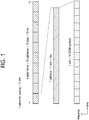
- FIG. 1 shows an example of a radio frame structure to which the present disclosure is applied.
- a slot may include a plurality of orthogonal frequency division multiplexing (OFDM) symbols.
- the number of OFDM symbols in a slot of Table 1 is for exemplary purposes only.
- the OFDM symbol is only for expressing one symbol period in a time region, and is not limited to a multiple-access scheme or a terminology.
- the OFDM symbol may be referred to as another terminology such as a single carrier-frequency division multiple access (SC-FDMA) symbol, a symbol period, or the like.
- SC-FDMA single carrier-frequency division multiple access
- the OFDM symbol in the slot may be divided for downlink (DL), flexible, and uplink (UL). This division may be called as a slot format.
- Information on the slot format may be reported to a wireless device by a BS.
- the wireless device may receive information on the slot format through a higher layer signal and/or downlink control information (DCI) on a physical downlink control channel (PDCCH).
- DCI downlink control information
- PDCCH physical downlink control channel
- the wireless device assumes that DL transmission occurs in a DL OFDM symbol or a flexible OFDM symbol.
- the wireless device may perform UL transmission in a UL OFDM symbol or a flexible OFDM symbol.
- a resource block may include a plurality of subcarriers contiguous in a frequency region.
- the RB may include 12 subcarriers.
- a common RB (CRB) is an RB in which an index is determined according to a numerology.
- a physical RB (PRB) is an RB defined in a bandwidth part (BWP). Assume that there are 20 RBs in the overall bandwidth of a specific numerology. The CRB is indexed from 0 to 19. When the BWP includes four CRBs (from a CRB 4 to a CRB 7) among the 20 RBs, the PRB in the BWP is indexed from 0 to 3.
- the BWP may be defined according to a size and a start point from the CRB 0 on a given carrier.
- a specific number e.g., up to 4
- BWPs may be configured to the wireless device. Only a specific number (e.g., 1) of BWPs may be activated for each cell at a specific time point.
- the number of configurable BWPs or the number of BWPs to be activated may be configured commonly for UL and DL or may be configured individually.
- the wireless device may expect DL transmission only in an activated DL BWP.
- the wireless device may perform UL transmission only in an activated UL BWP.
- the wireless device may obtain a time and/or frequency synchronization with a cell, and may perform cell discovery to obtain a cell identifier (ID).
- a synchronization channel such as a primary synchronization signal (PSS), a secondary synchronization signal (SSS), a physical broadcast channel (PBCH), or the like may be used for the cell discovery.
- PSS primary synchronization signal
- SSS secondary synchronization signal
- PBCH physical broadcast channel
- FIG. 2 shows an example of a synchronization channel applied to an embodiment of the present disclosure.
- Each of a PSS and an SSS may be transmitted through 127 subcarriers in one OFDM symbol.
- a PBCH may be transmitted through 240 subcarriers in 3 OFDM symbols.
- a synchronization signal/PBCH (SSB) block includes a time/frequency region in which the PSS, the SSS, and the PBCH are transmitted.
- the PSS is used to obtain a symbol timing of the SSB block, and indicates three hypotheses for identifying a cell ID.
- the SSS is used to identify the cell ID, and indicates 336 hypotheses. As a result, 1008 physical cell IDs may be indicated through the PSS and the SSS.
- the SSB block may be transmitted repeatedly according to a predetermined pattern in an SSB window.
- the SSB window may have a length of 5ms.
- all of the L SSB blocks include the same information, but may be transmitted through beams of different directions. That is, a quasi co-location (QCL) may not be applied for the SSB blocks in one SSB window.
- QCL quasi co-location
- a beam used to receive the SSB block may be used in a subsequent operation (e.g., a random access operation or the like) between a wireless device and a network.
- the SSB window may be repeated with a specific period (e.g., 20 ms). The repetition period may be determined individually according to a numerology.
- the PBCH has a bandwidth of 20 RBs in 2nd and 4th OFDM symbols, and has a bandwidth of 8 RBs in a 3rd ODM symbol.
- a demodulation reference signal (DMRS) for decoding the PBCH is included in the PBCH.
- a frequency region is determined in the DMRS according to a cell ID value.
- the DMRS for the PBCH may include information indicating an index of an SSB block.
- the PBCH may carry a master information block (MIB).
- MIB master information block
- SI System information
- MSI minimum SI
- OSI other SI
- SIB1 system information type1
- RMSI remaining minimum SI
- the MIB includes information required to decode the SIB1.
- the MIB may include at least any one of the SIB1, a message used in the random access procedure, a subcarrier spacing applied to other system information, a frequency offset between RBs transmitted after an SSB block, a bandwidth of PDCCH/SIB, and information for decoding the PDCCH.
- the MIB may be transmitted periodically, and the same information may be transmitted repeatedly for a specific time period.
- the SIB 1 includes control information, transmitted repeatedly through the PDSCH, for initial access of the UE and information for decoding a different SIB.
- a DL channel includes a physical downlink control channel (PDCCH), a physical downlink shared channel (PDSCH), and a physical broadcast channel (PBCH).
- the UL channel includes a physical uplink control channel (PUCCH), a physical uplink shared channel (PUSCH), and a physical random access channel (PRACH).
- PUCCH physical downlink control channel
- PUSCH physical uplink shared channel
- PRACH physical random access channel
- the PDSCH carries DL data.
- the PBCH carries a master information block (MIB) required for initial access.
- the PUSCH carries UL data.
- MIB master information block
- the PDCCH carries DCI.
- the DCI includes a UL grant having resource allocation for scheduling PUSCH transmission and a DL grant having resource allocation for scheduling PDSCH transmission.
- a control resource set (CORESET) is defined as a resource for monitoring the PDCCH.
- CRC cyclic redundancy check
- This identifier is called a radio network temporary identifier (RNTI).
- C-RNTI cell RNTI
- SI-RNTI system information RNTI
- the PUCCH carries uplink control information (UCI).
- the UCI may include hybrid automatic repeat request (HARQ) ACK/NACK and/or channel state information (CSI).
- HARQ hybrid automatic repeat request
- CSI channel state information
- the PUCCH may be transmitted in one or more OFDM symbols according to a PUCCH format.
- a radio resource control (RRC) state of a wireless device includes an RRC idle state and an RRC connected state.
- RRC radio resource control
- the RRC connected state is a state in which an RRC connection is established between the wireless device and a BS, and the BS and the wireless device may transmit/receive data with each other.
- the RRC idle state is a state in which the RRC connection is not established, and the wireless device may receive paging or may receive system information.
- FIG. 3 shows an example in which an RRC state of a wireless device transitions in 3GPP LTE.
- the wireless device After transitioning from an RRC connected state to an RRC idle state, the wireless device wakes up during a paging monitoring duration of every paging cycle and attempts to receive a paging message.
- Paging configuration information given by a BS includes information on a paging cycle and a paging monitoring duration.
- the paging cycle includes a paging monitoring duration and a paging non-monitoring duration.
- the wireless device is in a sleep state in which DL reception and UL transmission cannot be performed, and minimizes power consumption.
- the wireless device Upon receiving the paging message, the wireless device transitions back to the RRC connected state and then attempts to communicate with the BS.
- a device used in Internet of things (IoT) or machine-type communication (MTC) is fixed, and it necessary to minimize power consumption. Since power is consumed to transition back to the RRC connected state after receiving the paging message, it may be more efficient to perform DL reception or UL transmission directly in the RRC idle state.
- IoT Internet of things
- MTC machine-type communication
- an idle mode is a mode in which the wireless device repeatedly wakes up and sleeps while transitioning between the monitoring duration and the non-monitoring duration with a specific cycle.
- the wireless device may be in an RRC idle state in which SPS transmission is possible.
- the monitoring duration is a period in which the wireless device monitors a specific DL channel (e.g., a PDCCH/PDSCH for the paging message).
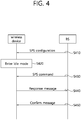
- FIG. 4 shows a communication method according to an embodiment of the present disclosure.
- a wireless device receives semi-persistent scheduling (SPS) configuration information in an idle mode from a BS.
- SPS configuration information may include a configuration for SPS transmission performed when the wireless device operates in the idle mode.
- the wireless device may receive configuration information regarding the idle mode from the BS.
- the configuration information may include at least one of a paging cycle, a paging offset, and a paging monitoring duration.
- the SPS configuration information may include at least one of a DL SPS configuration and a UL SPS configuration.
- SPS PDCCH/PDCCH/PUSCH/PUCCH refers to a channel used according to an SPS configuration.
- the DL SPS configuration may include at least one of a slot cycle/offset for SPS PDSCH reception, an SPS PDSCH format (code rate, the number of layers, PMI(precoding matrix index), TBS(transport block size), etc.), an SPS PDSCH transmission resource (an OFDM symbol position in slot, an RB position in slot, the number of OFDM symbols to be assigned, etc.), and when the SPS PDSCH is scheduled through the SPS PDCCH, a slot cycle/offset for SPS PDCCH reception, an SPS PDCCH format (code rate, the number of layers, PMI, DCI size, etc.), an SPS PDCCH transmission resource (a space region, the number of PDCCH candidates, the number of OFDM symbols, etc.).
- a slot cycle/offset for SPS PDSCH reception an SPS PDSCH format (code rate, the number of layers, PMI(precoding matrix index), TBS(transport block size), etc.)
- an SPS PDSCH transmission resource an OFDM symbol position in
- the DL SPS configuration may include information on a paging cycle in which transmission of SPS PDSCH and/or SPS PDCCH is expected.
- the wireless device may expect reception of SPS PDSCH and/or SPS PDCCH every 10 paging cycles.
- the UL SPS configuration may include at least one of a slot cycle/offset for SPS PUSCH reception, an SPS PUSCH format (code rate, the number of layers, PMI, TBS, etc.), an SPS PUSCH transmission resource (an OFDM symbol position in slot, an RB position in slot, the number of OFDM symbols to be assigned, etc.), a UL timing alignment (TA) value, and when the SPS PUSCH is transmitted together with a preamble, a preamble transmission format (a preamble sequence, a preamble format), a preamble transmission resource (an OFDM symbol position in slot, an RB position in slot, etc.).
- the UL SPS configuration may include information on a paging cycle in which transmission of SPS PUSCH is possible. For example, the wireless device may transmit the SPS PUSCH every 20 paging cycles.
- the SPS configuration may include information on an SPS identifier for identifying the idle mode of the wireless device.
- the SPS identifier may have a smaller number of bits than that of a device identifier (C-RNTI, IMSI(International Mobile Subscriber Identity), TIMSI(Temporary IMSI), etc.)) for identifying the wireless device.
- C-RNTI International Mobile Subscriber Identity
- IMSI International Mobile Subscriber Identity
- TIMSI Temporary IMSI
- step S420 the wireless device enters the idle mode.
- the wireless device may receive an SPS command from the BS during a monitoring duration of the idle mode.
- the SPS command may indicate activation/deactivation of predetermined SPS transmission.
- the SPS command may indicate continuation, stop, resumption, and/or a new SPS command.
- the SPS command may include a device identifier and/or an SPS identifier.
- the SPS command may be transmitted through a paging message provided by the BS.
- the paging message may be transmitted with a paging monitoring cycle/offset/frequency determined based on the device identifier or the SPS identifier.
- the SPS command may be transmitted by being included in the paging message transmitted by the BS.
- the SPS command may be transmitted through a cycle/offset/frequency resource used in transmission of a PDCCH for scheduling the paging message.
- the paging message may be transmitted with a paging monitoring duration/offset/frequency determined based on the device identifier or the SPS identifier.
- an SPS command indicating continuation of SPS transmission may be transmitted cyclically. If the SPS command indicating continuation of SPS transmission for a specific time is not received, the wireless device may stop or deactivate SPS transmission.
- the wireless device may transmit a response message for the SPS command to the BS.
- the response message may be an ACK message for confirming reception of the SPS command. This is for surely reporting to the BS whether the SPS command is correctly received.
- the response message may be transmitted by using a random access preamble, or may be transmitted on a PUSCH. If the SPS command is received in a slot n, the response message may be transmitted in a slot n+k (where k is an integer satisfying k>0). A time/frequency resource on which the response message is transmitted may be included in the SPS command or the paging message.
- a sequence of the random access preamble may be predetermined.
- SPS configuration information may include information on the random access preamble.
- the response message may be transmitted only when the SPS command indicates activation or deactivation, and may not be transmitted when the SPS command indicates another command.
- the BS and the wireless device may end the activated SPS transmission.
- the BS may transmit a confirm message for a response of the wireless device.
- the confirm message may be transmitted through a PDCCH or a PDSCH.
- the BS may transmit the confirm message in response to the random access preamble.
- the wireless device which has transmitted the response may stop or deactivate SPS transmission when the confirm message is not received for a specific time.
- the wireless device in which SPS transmission is activated may determine that SPS transmission is no longer necessary.
- the wireless device may transmit to the BS a request message for requesting for deactivating of SPS transmission or stopping of SPS transmission.
- the request message may be transmitted as the random access preamble.
- the request message may be transmitted on a PUSCH or an SPS PUCCH after transmission of the random access preamble.
- the BS may provide a response for the request message in response to the random access preamble. If the response for the request message is not received for a specific time, the wireless device may end an SPS operation. Alternatively, if the response for the request message is not received for the specific time, the wireless device may repeatedly transmit the request message. If the response for the request message is not received even after transmission is repeated M times, the wireless device may end the SPS operation.
- FIG. 5 shows an operation according to an embodiment of the present disclosure.
- a wireless device which has received an SPS command indicating SPS activation in an idle mode performs SPS transmission according to SPS configuration information.
- FIG. 6 shows a configuration of a paging message for an SPS command.
- the paging message may be transmitted on a PDSCH (referred to as P-PDSCH) scheduled by a PDCCH (referred to as P-PDCCH).
- P-PDSCH PDSCH
- P-PDCCH PDCCH
- DCI on the P-PDCCH may include the SPS command.
- the paging message on the P-PDSCH may include the SPS command.
- the DCI on the P-PDCCH may include flag information indicating whether the paging message includes the SPS command.
- P-PNTI used in masking of the P-PDCCH may report whether the SPS command is included in the paging message. For example, if the paging message does not include the SPS command, first P-RNTI may be used, and if the paging message includes the SPS command, second P-RNTI may be used.
- the second P-RNTI may be a device-specific identifier. Alternatively, the second P-RNTI may be a common identifier, and the paging message may include a plurality of SPS commands for a plurality of wireless devices.
- FIG. 7 is a block diagram showing a wireless communication system for implementing an embodiment of the present specification.
- a wireless device 50 includes a processor 51, a memory 52, and a transceiver 53.
- the memory 52 is operatively coupled to the processor 51, and stores various instructions executed by the processor 51.
- the transceiver 53 is operatively coupled to the processor 51, and transmits and/or receives a radio signal.
- the processor 51 implements the proposed functions, procedures, and/or methods. In the aforementioned embodiment, an operation of the wireless device may be implemented by the processor 51. When the aforementioned embodiment is implemented with a software instruction, the instruction may be stored in the memory 52, and may be executed by the processor 51 to perform the aforementioned operation.
- a BS 60 includes a processor 61, a memory 62, and a transceiver 63.
- the BS 60 may operate in an unlicensed band.
- the memory 62 is operatively coupled to the processor 61, and stores various instructions executed by the processor 61.
- the transceiver 63 is operatively coupled to the processor 61, and transmits and/or receives a radio signal.
- the processor 61 implements the proposed functions, procedures, and/or methods. In the aforementioned embodiment, an operation of the BS may be implemented by the processor 61. When the aforementioned embodiment is implemented with a software instruction, the instruction may be stored in the memory 62, and may be executed by the processor 61 to perform the aforementioned operation.
- the processor may include Application-specific Integrated Circuits (ASICs), other chipsets, logic circuits, and/or data processors.
- the memory may include Read-Only Memory (ROM), Random Access Memory (RAM), flash memory, memory cards, storage media and/or other storage devices.
- the transceiver may include a baseband circuit for processing a radio signal.
- the aforementioned scheme may be implemented using a module (procedure, function, etc.) which performs the aforementioned function.
- the module may be stored in the memory and executed by the processor.
- the memory may be disposed to the processor internally or externally and connected to the processor using a variety of well-known means.
Landscapes
- Engineering & Computer Science (AREA)
- Computer Networks & Wireless Communication (AREA)
- Signal Processing (AREA)
- Mobile Radio Communication Systems (AREA)
Abstract
Description
- The present disclosure relates to wireless communication, and more particularly, a method operating in an idle mode in a wireless communication system, and an apparatus using the method.
- In 3rd generation partnership project (3GPP), there was an agreement on an overall schedule and concept for 5G standardization in a workshop held in September 2015. An enhanced mobile broadband (eMBB), massive machine type communication (MTC), ultra-reliable and low latency communication (URLLC), or the like was specified as a top-level use-case. In order to satisfy a service scenario and a new requirement, in the 3GPP, it was determined to define a new radio (NR) different from the existing long term evolution (LTE), and both the LTE and the NR were defined as a 5G radio access technique.
- It is very important to minimize power consumption of a device in wireless communication. Reducing of power consumption has been developed in various ways depending on a communication requirement of the device. For example, a device used in Internet of things (IoT) or machine-type communication (MTC) requires transmission of a very short message with a relatively long cycle, but requires a very long battery lifespan of tens or hundreds of days.
- Disclosed is a method of adaptively reducing power consumption depending on various purposes.
- The present disclosure provides a method operating in an idle mode, and a device using the method.
- In an aspect, a method for communicating in a wireless communication system is provided. The method performed by a wireless device includes receiving a semi-persistent scheduling (SPS) command for indicating an activation of SPS transmission in an idle mode by using a paging message, and performing SPS transmission according to the SPS command in the idle mode.
- In another aspect, a device in a wireless communication system includes a transceiver configured to transmit and receive a radio signal, and a processor operatively coupled to the transceiver. The processor is configured to control the transceiver to receive a semi-persistent scheduling (SPS) command indicating an activation of SPS transmission in an idle mode by using a paging message, and control the transceiver to perform SPS transmission according to the SPS command in the idle mode.
- Power consumption of a wireless device is reduced, thereby operating for a longer time.
-
-
FIG. 1 shows an example of a radio frame structure to which the present disclosure is applied. -
FIG. 2 shows an example of a synchronization channel applied to an example of the present specification. -
FIG. 3 shows an example in which an RRC state of a wireless device transitions in 3GPP LTE. -
FIG. 4 shows a communication method according to an embodiment of the present disclosure. -
FIG. 5 shows an operation according to an embodiment of the present disclosure. -
FIG. 6 shows a configuration of a paging message for an SPS command. -
FIG. 7 is a block diagram showing a wireless communication system for implementing an embodiment of the present specification. - Technical features described below may be used in a communication standard by the 3rd generation partnership project (3GPP) standardization organization or a communication standard by the institute of electrical and electronics engineers (IEEE) standardization organization. For example, the communication standard by the 3GPP standard organization includes long term evolution (LTE) and/or an evolution of an LTE system. The evolution of the LTE system includes LTE-advanced (LTE-A), LTE-A Pro, and/or a5G new radio (NR). The communication standard by the IEEE standard organization includes a wireless local area network (LAN) system such as IEEE 802.11a/b/g/b/ac/ax or the like. The aforementioned system uses various multiple access techniques such as orthogonal frequency division multiple access (OFDMA) and/or single carrier-frequency division multiple access (SC-FDMA) or the like in uplink and/or downlink. For example, only the OFDMA may be used in downlink and only the SC-FDMA may be used in uplink, or the OFDMA and the SC-FDMA may be used together in downlink and/or uplink.
- A wireless device may be fixed or mobile, and may be referred to as another terminology, such as a user equipment (UE), a mobile station (MS), a mobile terminal (MT), a user terminal (UT), a subscriber station (SS), a personal digital assistant (PDA), a wireless modem, a handheld device, etc. The wireless device may also be a device supporting only data communication such as a machine-type communication (MTC) device.
- A base station (BS) is generally a fixed station that communicates with the wireless device, and may be referred to as another terminology, such as an evolved-NodeB (eNB), a gNB, a base transceiver system (BTS), an access point, etc. A transmission reception point (TRP) includes an antenna array having one or more antenna elements. The BS may include one or more TRPs.
- A new radio (NR) which is a 5G radio access technique supports various bandwidths and frequency bands for more flexible scheduling. Not only a frequency band below 6 GHz but also a frequency band above 6 GHz is supported. A supported bandwidth is up to 100 MHz in the band below 6 GHz and is up to 400 MHz in the band above 6 GHz. In addition, unlike the 3GPP LTE in which a subcarrier spacing is fixed to 15 kHz, the NR may support a variety of subcarrier spacing of 15 kHz, 30 kHz, 60 kHz, 120 KHz, and 240 kHz.
- The NR standard supports various numerologies. A structure of a radio frame varies depending on the numerology. Table 1 shows an example of the numerology to be supported.
[Table 1] Numerology Index (µ) Subcarrier spacing (kHz) Cyclic prefix Number of OFDM symbols per slot Number of slots per radio frame Number of slots per subframe 0 15 Normal 14 10 1 1 30 Normal 14 20 2 2 60 Normal 14 40 4 2 60 Extended 12 40 4 3 120 Normal 14 80 8 4 250 Normal 14 160 16 -
FIG. 1 shows an example of a radio frame structure to which the present disclosure is applied. Table 1 shows an example of a numerology index µ=0. - A slot may include a plurality of orthogonal frequency division multiplexing (OFDM) symbols. The number of OFDM symbols in a slot of Table 1 is for exemplary purposes only. The OFDM symbol is only for expressing one symbol period in a time region, and is not limited to a multiple-access scheme or a terminology. For example, the OFDM symbol may be referred to as another terminology such as a single carrier-frequency division multiple access (SC-FDMA) symbol, a symbol period, or the like.
- The OFDM symbol in the slot may be divided for downlink (DL), flexible, and uplink (UL). This division may be called as a slot format. Information on the slot format may be reported to a wireless device by a BS. The wireless device may receive information on the slot format through a higher layer signal and/or downlink control information (DCI) on a physical downlink control channel (PDCCH). The wireless device assumes that DL transmission occurs in a DL OFDM symbol or a flexible OFDM symbol. The wireless device may perform UL transmission in a UL OFDM symbol or a flexible OFDM symbol.
- A resource block (RB) may include a plurality of subcarriers contiguous in a frequency region. For example, the RB may include 12 subcarriers. A common RB (CRB) is an RB in which an index is determined according to a numerology. A physical RB (PRB) is an RB defined in a bandwidth part (BWP). Assume that there are 20 RBs in the overall bandwidth of a specific numerology. The CRB is indexed from 0 to 19. When the BWP includes four CRBs (from a CRB 4 to a CRB 7) among the 20 RBs, the PRB in the BWP is indexed from 0 to 3.
- The BWP may be defined according to a size and a start point from the
CRB 0 on a given carrier. A specific number (e.g., up to 4) of BWPs may be configured to the wireless device. Only a specific number (e.g., 1) of BWPs may be activated for each cell at a specific time point. The number of configurable BWPs or the number of BWPs to be activated may be configured commonly for UL and DL or may be configured individually. The wireless device may expect DL transmission only in an activated DL BWP. The wireless device may perform UL transmission only in an activated UL BWP. - The wireless device may obtain a time and/or frequency synchronization with a cell, and may perform cell discovery to obtain a cell identifier (ID). A synchronization channel such as a primary synchronization signal (PSS), a secondary synchronization signal (SSS), a physical broadcast channel (PBCH), or the like may be used for the cell discovery.
-
FIG. 2 shows an example of a synchronization channel applied to an embodiment of the present disclosure. Each of a PSS and an SSS may be transmitted through 127 subcarriers in one OFDM symbol. A PBCH may be transmitted through 240 subcarriers in 3 OFDM symbols. - A synchronization signal/PBCH (SSB) block includes a time/frequency region in which the PSS, the SSS, and the PBCH are transmitted. The PSS is used to obtain a symbol timing of the SSB block, and indicates three hypotheses for identifying a cell ID. The SSS is used to identify the cell ID, and indicates 336 hypotheses. As a result, 1008 physical cell IDs may be indicated through the PSS and the SSS.
- The SSB block may be transmitted repeatedly according to a predetermined pattern in an SSB window. The SSB window may have a length of 5ms. For example, when L SSB blocks are transmitted during one SSB window, all of the L SSB blocks include the same information, but may be transmitted through beams of different directions. That is, a quasi co-location (QCL) may not be applied for the SSB blocks in one SSB window. A beam used to receive the SSB block may be used in a subsequent operation (e.g., a random access operation or the like) between a wireless device and a network. The SSB window may be repeated with a specific period (e.g., 20 ms). The repetition period may be determined individually according to a numerology.
- The PBCH has a bandwidth of 20 RBs in 2nd and 4th OFDM symbols, and has a bandwidth of 8 RBs in a 3rd ODM symbol. A demodulation reference signal (DMRS) for decoding the PBCH is included in the PBCH. A frequency region is determined in the DMRS according to a cell ID value. The DMRS for the PBCH may include information indicating an index of an SSB block.
- The PBCH may carry a master information block (MIB). System information (SI) is divided into minimum SI (MSI) and other SI (OSI). The MSI may be divided again into MIB and system information type1 (SIB1), and the remaining MSI except for the MIB may be called remaining minimum SI (RMSI).
- The MIB includes information required to decode the SIB1. For example, the MIB may include at least any one of the SIB1, a message used in the random access procedure, a subcarrier spacing applied to other system information, a frequency offset between RBs transmitted after an SSB block, a bandwidth of PDCCH/SIB, and information for decoding the PDCCH. The MIB may be transmitted periodically, and the same information may be transmitted repeatedly for a specific time period. The
SIB 1 includes control information, transmitted repeatedly through the PDSCH, for initial access of the UE and information for decoding a different SIB. - A DL channel includes a physical downlink control channel (PDCCH), a physical downlink shared channel (PDSCH), and a physical broadcast channel (PBCH). The UL channel includes a physical uplink control channel (PUCCH), a physical uplink shared channel (PUSCH), and a physical random access channel (PRACH).
- The PDSCH carries DL data. The PBCH carries a master information block (MIB) required for initial access. The PUSCH carries UL data.
- The PDCCH carries DCI. The DCI includes a UL grant having resource allocation for scheduling PUSCH transmission and a DL grant having resource allocation for scheduling PDSCH transmission. A control resource set (CORESET) is defined as a resource for monitoring the PDCCH. In order to allow the wireless device to identify an owner or content of the DCI in the PDCCH, a unique identifier is masked to cyclic redundancy check (CRC) of the DCI. This identifier is called a radio network temporary identifier (RNTI). When the DCI includes a UL grant or DL grant for a specific wireless device, a cell RNTI (C-RNTI) is used. When the DCI carries system information, a system information RNTI (SI-RNTI) is used.
- The PUCCH carries uplink control information (UCI). The UCI may include hybrid automatic repeat request (HARQ) ACK/NACK and/or channel state information (CSI). The PUCCH may be transmitted in one or more OFDM symbols according to a PUCCH format.
- In 3GPP LTE, a radio resource control (RRC) state of a wireless device includes an RRC idle state and an RRC connected state.
- The RRC connected state is a state in which an RRC connection is established between the wireless device and a BS, and the BS and the wireless device may transmit/receive data with each other. The RRC idle state is a state in which the RRC connection is not established, and the wireless device may receive paging or may receive system information.
-
FIG. 3 shows an example in which an RRC state of a wireless device transitions in 3GPP LTE. - After transitioning from an RRC connected state to an RRC idle state, the wireless device wakes up during a paging monitoring duration of every paging cycle and attempts to receive a paging message. Paging configuration information given by a BS includes information on a paging cycle and a paging monitoring duration. The paging cycle includes a paging monitoring duration and a paging non-monitoring duration. During the paging non-monitoring duration, the wireless device is in a sleep state in which DL reception and UL transmission cannot be performed, and minimizes power consumption.
- Upon receiving the paging message, the wireless device transitions back to the RRC connected state and then attempts to communicate with the BS.
- In general, a device used in Internet of things (IoT) or machine-type communication (MTC) is fixed, and it necessary to minimize power consumption. Since power is consumed to transition back to the RRC connected state after receiving the paging message, it may be more efficient to perform DL reception or UL transmission directly in the RRC idle state.
- Hereinafter, an idle mode is a mode in which the wireless device repeatedly wakes up and sleeps while transitioning between the monitoring duration and the non-monitoring duration with a specific cycle. In the idle mode, the wireless device may be in an RRC idle state in which SPS transmission is possible. The monitoring duration is a period in which the wireless device monitors a specific DL channel (e.g., a PDCCH/PDSCH for the paging message).
-
FIG. 4 shows a communication method according to an embodiment of the present disclosure. - In step S410, a wireless device receives semi-persistent scheduling (SPS) configuration information in an idle mode from a BS. The SPS configuration information may include a configuration for SPS transmission performed when the wireless device operates in the idle mode.
- The wireless device may receive configuration information regarding the idle mode from the BS. The configuration information may include at least one of a paging cycle, a paging offset, and a paging monitoring duration.
- The SPS configuration information may include at least one of a DL SPS configuration and a UL SPS configuration. Hereinafter, SPS PDCCH/PDCCH/PUSCH/PUCCH refers to a channel used according to an SPS configuration.
- The DL SPS configuration may include at least one of a slot cycle/offset for SPS PDSCH reception, an SPS PDSCH format (code rate, the number of layers, PMI(precoding matrix index), TBS(transport block size), etc.), an SPS PDSCH transmission resource (an OFDM symbol position in slot, an RB position in slot, the number of OFDM symbols to be assigned, etc.), and when the SPS PDSCH is scheduled through the SPS PDCCH, a slot cycle/offset for SPS PDCCH reception, an SPS PDCCH format (code rate, the number of layers, PMI, DCI size, etc.), an SPS PDCCH transmission resource (a space region, the number of PDCCH candidates, the number of OFDM symbols, etc.). The DL SPS configuration may include information on a paging cycle in which transmission of SPS PDSCH and/or SPS PDCCH is expected. For example, the wireless device may expect reception of SPS PDSCH and/or SPS PDCCH every 10 paging cycles.
- The UL SPS configuration may include at least one of a slot cycle/offset for SPS PUSCH reception, an SPS PUSCH format (code rate, the number of layers, PMI, TBS, etc.), an SPS PUSCH transmission resource (an OFDM symbol position in slot, an RB position in slot, the number of OFDM symbols to be assigned, etc.), a UL timing alignment (TA) value, and when the SPS PUSCH is transmitted together with a preamble, a preamble transmission format (a preamble sequence, a preamble format), a preamble transmission resource (an OFDM symbol position in slot, an RB position in slot, etc.). The UL SPS configuration may include information on a paging cycle in which transmission of SPS PUSCH is possible. For example, the wireless device may transmit the SPS PUSCH every 20 paging cycles.
- The SPS configuration may include information on an SPS identifier for identifying the idle mode of the wireless device. The SPS identifier may have a smaller number of bits than that of a device identifier (C-RNTI, IMSI(International Mobile Subscriber Identity), TIMSI(Temporary IMSI), etc.)) for identifying the wireless device.
- In step S420, the wireless device enters the idle mode.
- In step S430, the wireless device may receive an SPS command from the BS during a monitoring duration of the idle mode.
- The SPS command may indicate activation/deactivation of predetermined SPS transmission. The SPS command may indicate continuation, stop, resumption, and/or a new SPS command. The SPS command may include a device identifier and/or an SPS identifier.
- The SPS command may be transmitted through a paging message provided by the BS. The paging message may be transmitted with a paging monitoring cycle/offset/frequency determined based on the device identifier or the SPS identifier.
- The SPS command may be transmitted by being included in the paging message transmitted by the BS. Alternatively, the SPS command may be transmitted through a cycle/offset/frequency resource used in transmission of a PDCCH for scheduling the paging message. The paging message may be transmitted with a paging monitoring duration/offset/frequency determined based on the device identifier or the SPS identifier.
- After SPS transmission is activated by the SPS command, an SPS command indicating continuation of SPS transmission may be transmitted cyclically. If the SPS command indicating continuation of SPS transmission for a specific time is not received, the wireless device may stop or deactivate SPS transmission.
- In step S440, the wireless device may transmit a response message for the SPS command to the BS. The response message may be an ACK message for confirming reception of the SPS command. This is for surely reporting to the BS whether the SPS command is correctly received.
- The response message may be transmitted by using a random access preamble, or may be transmitted on a PUSCH. If the SPS command is received in a slot n, the response message may be transmitted in a slot n+k (where k is an integer satisfying k>0). A time/frequency resource on which the response message is transmitted may be included in the SPS command or the paging message. When the response message is transmitted as the random access preamble, a sequence of the random access preamble may be predetermined. SPS configuration information may include information on the random access preamble.
- The response message may be transmitted only when the SPS command indicates activation or deactivation, and may not be transmitted when the SPS command indicates another command.
- If the response message is not received for a specific time after the SPS command is transmitted, the BS and the wireless device may end the activated SPS transmission.
- In step S450, the BS may transmit a confirm message for a response of the wireless device. The confirm message may be transmitted through a PDCCH or a PDSCH. When the response is received as the random access preamble, the BS may transmit the confirm message in response to the random access preamble.
- The wireless device which has transmitted the response may stop or deactivate SPS transmission when the confirm message is not received for a specific time.
- Meanwhile, in an idle mode, the wireless device in which SPS transmission is activated may determine that SPS transmission is no longer necessary. The wireless device may transmit to the BS a request message for requesting for deactivating of SPS transmission or stopping of SPS transmission.
- The request message may be transmitted as the random access preamble. Alternatively, the request message may be transmitted on a PUSCH or an SPS PUCCH after transmission of the random access preamble.
- The BS may provide a response for the request message in response to the random access preamble. If the response for the request message is not received for a specific time, the wireless device may end an SPS operation. Alternatively, if the response for the request message is not received for the specific time, the wireless device may repeatedly transmit the request message. If the response for the request message is not received even after transmission is repeated M times, the wireless device may end the SPS operation.
-
FIG. 5 shows an operation according to an embodiment of the present disclosure. - A wireless device which has received an SPS command indicating SPS activation in an idle mode performs SPS transmission according to SPS configuration information.
-
FIG. 6 shows a configuration of a paging message for an SPS command. - The paging message may be transmitted on a PDSCH (referred to as P-PDSCH) scheduled by a PDCCH (referred to as P-PDCCH).
- DCI on the P-PDCCH may include the SPS command. Alternatively, the paging message on the P-PDSCH may include the SPS command. The DCI on the P-PDCCH may include flag information indicating whether the paging message includes the SPS command.
- P-PNTI used in masking of the P-PDCCH may report whether the SPS command is included in the paging message. For example, if the paging message does not include the SPS command, first P-RNTI may be used, and if the paging message includes the SPS command, second P-RNTI may be used. The second P-RNTI may be a device-specific identifier. Alternatively, the second P-RNTI may be a common identifier, and the paging message may include a plurality of SPS commands for a plurality of wireless devices.
-
FIG. 7 is a block diagram showing a wireless communication system for implementing an embodiment of the present specification. - A
wireless device 50 includes aprocessor 51, amemory 52, and atransceiver 53. Thememory 52 is operatively coupled to theprocessor 51, and stores various instructions executed by theprocessor 51. Thetransceiver 53 is operatively coupled to theprocessor 51, and transmits and/or receives a radio signal. Theprocessor 51 implements the proposed functions, procedures, and/or methods. In the aforementioned embodiment, an operation of the wireless device may be implemented by theprocessor 51. When the aforementioned embodiment is implemented with a software instruction, the instruction may be stored in thememory 52, and may be executed by theprocessor 51 to perform the aforementioned operation. - A
BS 60 includes aprocessor 61, amemory 62, and atransceiver 63. TheBS 60 may operate in an unlicensed band. Thememory 62 is operatively coupled to theprocessor 61, and stores various instructions executed by theprocessor 61. Thetransceiver 63 is operatively coupled to theprocessor 61, and transmits and/or receives a radio signal. Theprocessor 61 implements the proposed functions, procedures, and/or methods. In the aforementioned embodiment, an operation of the BS may be implemented by theprocessor 61. When the aforementioned embodiment is implemented with a software instruction, the instruction may be stored in thememory 62, and may be executed by theprocessor 61 to perform the aforementioned operation. - The processor may include Application-specific Integrated Circuits (ASICs), other chipsets, logic circuits, and/or data processors. The memory may include Read-Only Memory (ROM), Random Access Memory (RAM), flash memory, memory cards, storage media and/or other storage devices. The transceiver may include a baseband circuit for processing a radio signal. When the embodiment is implemented in software, the aforementioned scheme may be implemented using a module (procedure, function, etc.) which performs the aforementioned function. The module may be stored in the memory and executed by the processor. The memory may be disposed to the processor internally or externally and connected to the processor using a variety of well-known means.
- In the above exemplary systems, although the methods have been described on the basis of the flowcharts using a series of the steps or blocks, the present disclosure is not limited to the sequence of the steps, and some of the steps may be performed at different sequences from the remaining steps or may be performed simultaneously with the remaining steps. Furthermore, those skilled in the art will understand that the steps shown in the flowcharts are not exclusive and may include other steps or one or more steps of the flowcharts may be deleted without affecting the scope of the present disclosure.
Claims (12)
- A method for communicating in a wireless communication system, the method performed by a wireless device and comprising:receiving a semi-persistent scheduling (SPS) command for indicating an activation of SPS transmission in an idle mode by using a paging message; andperforming SPS transmission according to the SPS command in the idle mode.
- The method of claim 1, wherein receiving of the SPS command by using the paging message comprises:receiving control channel information (DCI) for scheduling a physical downlink shared channel (PDSCH) on a physical downlink control channel (PDCCH); andreceiving the paging message on the PDSCH.
- The method of claim 2, wherein the DCI comprises information indicating that the SPS command is included in the paging message.
- The method of claim 2, wherein an identifier masked to cyclic redundancy check (CRC) of the DCI indicates that the SPS command is included in the paging message.
- The method of claim 1, further comprising:
transmitting a response message for confirming a reception of the SPS command. - The method of claim 5, wherein a predetermined random access preamble is transmitted as the response message.
- The method of claim 1, wherein the wireless device in the idle mode operates in a radio resource control (RRC) idle state.
- The method of claim 1, further comprising:receiving an SPS command indicating a continuation of the SPS transmission,wherein if the continuation of the SPS transmission is not received for a specific time, the SPS transmission is de-activated.
- A device in a wireless communication system, the device comprising:a transceiver configured to transmit and receive a radio signal; anda processor operatively coupled to the transceiver and configured to:control the transceiver to receive a semi-persistent scheduling (SPS) command indicating an activation of SPS transmission in an idle mode by using a paging message; andcontrol the transceiver to perform SPS transmission according to the SPS command in the idle mode.
- The device of claim 9,
wherein control channel information (DCI) for scheduling a physical downlink shared channel (PDSCH) is received on a physical downlink control channel (PDCCH); and
wherein the paging message is received on the PDSCH, so that the processor receives the SPS command by using the paging message. - The device of claim 10, wherein the DCI comprises information indicating that the SPS command is included in the paging message.
- The device of claim 10, wherein an identifier masked to cyclic redundancy check (CRC) of the DCI indicates that the SPS command is included in the paging message.
Applications Claiming Priority (2)
| Application Number | Priority Date | Filing Date | Title |
|---|---|---|---|
| US201862628295P | 2018-02-09 | 2018-02-09 | |
| PCT/KR2019/001611 WO2019156515A1 (en) | 2018-02-09 | 2019-02-11 | Method of operating in idle mode and apparatus using same |
Publications (3)
| Publication Number | Publication Date |
|---|---|
| EP3751912A1 true EP3751912A1 (en) | 2020-12-16 |
| EP3751912A4 EP3751912A4 (en) | 2021-11-24 |
| EP3751912B1 EP3751912B1 (en) | 2025-07-16 |
Family
ID=67549002
Family Applications (1)
| Application Number | Title | Priority Date | Filing Date |
|---|---|---|---|
| EP19750578.7A Active EP3751912B1 (en) | 2018-02-09 | 2019-02-11 | Method of operating in idle mode and apparatus using same |
Country Status (4)
| Country | Link |
|---|---|
| US (1) | US11395224B2 (en) |
| EP (1) | EP3751912B1 (en) |
| CN (1) | CN111699722B (en) |
| WO (1) | WO2019156515A1 (en) |
Families Citing this family (9)
| Publication number | Priority date | Publication date | Assignee | Title |
|---|---|---|---|---|
| US11291035B2 (en) * | 2018-05-03 | 2022-03-29 | Beijing Xiaomi Mobile Software Co., Ltd. | Information transmitting method and apparatus, base station, and user equipment |
| US11304221B2 (en) * | 2018-06-11 | 2022-04-12 | Qualcomm Incorporated | Techniques for updating semi-persistent scheduling (SPS) configuration in wireless communications |
| CN112583560A (en) * | 2019-09-30 | 2021-03-30 | 深圳市中兴微电子技术有限公司 | Resource activation method and device |
| WO2021114099A1 (en) * | 2019-12-10 | 2021-06-17 | Lenovo (Beijing) Limited | Method and apparatus for data transmission |
| EP4133849A1 (en) * | 2020-04-10 | 2023-02-15 | Telefonaktiebolaget LM ERICSSON (PUBL) | On interaction between semi-persistent scheduling (sps) release and physical downlink shared channel (pdsch) transmission |
| CN115150040A (en) * | 2021-03-31 | 2022-10-04 | 华为技术有限公司 | Communication method and device |
| WO2022236705A1 (en) * | 2021-05-11 | 2022-11-17 | Nokia Shanghai Bell Co., Ltd. | Polling device for multicast broadcast service interest indication |
| CN116800388B (en) * | 2022-03-11 | 2026-04-21 | 中国移动通信有限公司研究院 | A downlink data transmission indication method and apparatus, UE, and network equipment. |
| US20250294544A1 (en) * | 2022-06-29 | 2025-09-18 | Qualcomm Incorporated | Paging triggered semi-persistent scheduling resource activation for mobile terminated small data transmission |
Family Cites Families (18)
| Publication number | Priority date | Publication date | Assignee | Title |
|---|---|---|---|---|
| US20090182871A1 (en) * | 2008-01-14 | 2009-07-16 | Qualmcomm Incorporated | Backup paging for wireless communication |
| CN102595600B (en) * | 2011-01-17 | 2014-12-31 | 华为技术有限公司 | Semi-static scheduling method, user equipment and network device |
| CN107580376B (en) * | 2011-04-01 | 2021-08-20 | 交互数字专利控股公司 | Mobility management entity and method for providing connectivity information |
| US10178657B2 (en) * | 2011-12-02 | 2019-01-08 | Innovative Sonic Corporation | Method and apparatus for reconfiguring SPS (semi-persistent) operation in a wireless communication system |
| CN103313196B (en) * | 2012-03-07 | 2016-02-03 | 鼎桥通信技术有限公司 | SPS Activiation method, base station and trunked communication system |
| US9445365B2 (en) * | 2013-01-14 | 2016-09-13 | Apple Inc. | Reducing power consumption in voice over LTE terminals using semi persistent scheduling in connected discontinuous reception mode |
| CN106465293B (en) * | 2014-05-21 | 2020-07-17 | 夏普株式会社 | User equipment, communication method and integrated circuit |
| CN106470399B (en) * | 2015-08-14 | 2019-08-23 | 普天信息技术有限公司 | The method and system of semi-continuous scheduling reactivation in cluster multi call business |
| EP3343989B1 (en) * | 2015-08-25 | 2021-12-08 | LG Electronics Inc. | Method for resource allocation in wireless communication system and apparatus therefor |
| AU2016390529B2 (en) * | 2016-01-29 | 2020-11-26 | Panasonic Intellectual Property Corporation Of America | eNodeB, user equipment and wireless communication method |
| EP3422789B1 (en) * | 2016-04-01 | 2021-03-24 | LG Electronics Inc. | Method for transmitting downlink control information for sidelink scheduling in wireless communication system and terminal using same |
| WO2017191917A1 (en) * | 2016-05-02 | 2017-11-09 | 엘지전자 주식회사 | Method and apparatus for changing sps operation in wireless communication system |
| US10356749B2 (en) * | 2016-07-20 | 2019-07-16 | Lg Electronics Inc. | Method and apparatus for transmitting beam-formed paging based on feedback in wireless communication system |
| CN114900858A (en) * | 2016-12-30 | 2022-08-12 | 英特尔公司 | Method and apparatus for radio communication |
| CA3024596A1 (en) * | 2017-11-16 | 2019-05-16 | Comcast Cable Communications, Llc | Beam paging assistance |
| EP3711237A1 (en) * | 2017-11-17 | 2020-09-23 | Telefonaktiebolaget LM Ericsson (publ) | Efficient coreset configuration |
| EP3711396B1 (en) * | 2017-11-17 | 2024-07-24 | Panasonic Intellectual Property Corporation of America | Schemes for ssb to paging coreset mapping in nr |
| CN117202375A (en) * | 2018-08-09 | 2023-12-08 | 北京三星通信技术研究有限公司 | Method and equipment for RRC idle state uplink transmission |
-
2019
- 2019-02-11 CN CN201980012314.4A patent/CN111699722B/en active Active
- 2019-02-11 WO PCT/KR2019/001611 patent/WO2019156515A1/en not_active Ceased
- 2019-02-11 EP EP19750578.7A patent/EP3751912B1/en active Active
- 2019-02-11 US US16/967,684 patent/US11395224B2/en active Active
Also Published As
| Publication number | Publication date |
|---|---|
| EP3751912B1 (en) | 2025-07-16 |
| WO2019156515A1 (en) | 2019-08-15 |
| EP3751912A4 (en) | 2021-11-24 |
| US20210037463A1 (en) | 2021-02-04 |
| CN111699722A (en) | 2020-09-22 |
| CN111699722B (en) | 2023-08-25 |
| US11395224B2 (en) | 2022-07-19 |
Similar Documents
| Publication | Publication Date | Title |
|---|---|---|
| EP3751912B1 (en) | Method of operating in idle mode and apparatus using same | |
| CN114642039B (en) | Method and apparatus for saving power of user equipment in a wireless communication system | |
| EP3603261B1 (en) | Multiple starting and ending positions for scheduled downlink transmission on unlicensed spectrum | |
| EP3616450B1 (en) | Multiple starting positions for uplink transmission on unlicensed spectrum | |
| US20230038241A1 (en) | Method and apparatus for autonomous transmission | |
| CN107836093B (en) | Method and user equipment for receiving downlink signals and method and base station for transmitting downlink signals | |
| US10813077B2 (en) | Communications device, infrastructure equipment, communication system and methods for group paging and grouping communication devices based on various criteria | |
| CN116349173B (en) | Methods and apparatus for repeatedly transmitting/receiving downlink control information in wireless communication systems | |
| US11228400B2 (en) | Communications device, infrastructure equipment and methods | |
| US11012207B2 (en) | Method and device for transmitting tracking reference signal | |
| EP3178289A1 (en) | Load power consumption management in discontinuous reception | |
| US20170215222A1 (en) | Load Power Consumption Management in Discontinuous Reception | |
| CN119654845A (en) | Method for receiving downlink signal, user equipment, processing device and storage medium, method for sending downlink signal and base station | |
| CN119547542A (en) | Signal transmitting/receiving method and apparatus for wireless communication | |
| US11375467B2 (en) | Infrastructure equipment, wireless communications system, communications device and methods | |
| EP3751943A1 (en) | Method and apparatus for transmitting random access preamble in unlicensed band | |
| EP4615066A1 (en) | Method, user equipment, processing device, and storage medium for transmitting uplink signal, and method and base station for transmitting uplink signal | |
| EP4429352A1 (en) | Signal sending method and apparatus, and signal receiving method and apparatus | |
| JP7724923B2 (en) | Communication systems and methods | |
| US20260012891A1 (en) | Method and apparatus supporting multi-beam operation for low-power signal | |
| US20260129580A1 (en) | Method and apparatus for transmitting and receiving information through low power signal | |
| US20260025831A1 (en) | Control information format | |
| EP4712681A1 (en) | Method, user equipment, processing device, and storage medium for receiving downlink signal, and method and base station for transmitting downlink signal | |
| KR20220077882A (en) | Method and apparatus for transmitting and receiving paging message in communication system |
Legal Events
| Date | Code | Title | Description |
|---|---|---|---|
| STAA | Information on the status of an ep patent application or granted ep patent |
Free format text: STATUS: THE INTERNATIONAL PUBLICATION HAS BEEN MADE |
|
| PUAI | Public reference made under article 153(3) epc to a published international application that has entered the european phase |
Free format text: ORIGINAL CODE: 0009012 |
|
| STAA | Information on the status of an ep patent application or granted ep patent |
Free format text: STATUS: REQUEST FOR EXAMINATION WAS MADE |
|
| 17P | Request for examination filed |
Effective date: 20200729 |
|
| AK | Designated contracting states |
Kind code of ref document: A1 Designated state(s): AL AT BE BG CH CY CZ DE DK EE ES FI FR GB GR HR HU IE IS IT LI LT LU LV MC MK MT NL NO PL PT RO RS SE SI SK SM TR |
|
| AX | Request for extension of the european patent |
Extension state: BA ME |
|
| DAV | Request for validation of the european patent (deleted) | ||
| DAX | Request for extension of the european patent (deleted) | ||
| A4 | Supplementary search report drawn up and despatched |
Effective date: 20211022 |
|
| RIC1 | Information provided on ipc code assigned before grant |
Ipc: H04W 74/00 20090101ALI20211018BHEP Ipc: H04W 68/00 20090101ALI20211018BHEP Ipc: H04W 72/04 20090101ALI20211018BHEP Ipc: H04W 52/02 20090101AFI20211018BHEP |
|
| STAA | Information on the status of an ep patent application or granted ep patent |
Free format text: STATUS: EXAMINATION IS IN PROGRESS |
|
| 17Q | First examination report despatched |
Effective date: 20221116 |
|
| GRAP | Despatch of communication of intention to grant a patent |
Free format text: ORIGINAL CODE: EPIDOSNIGR1 |
|
| STAA | Information on the status of an ep patent application or granted ep patent |
Free format text: STATUS: GRANT OF PATENT IS INTENDED |
|
| RIC1 | Information provided on ipc code assigned before grant |
Ipc: H04W 72/23 20230101ALI20250204BHEP Ipc: H04W 68/00 20090101ALI20250204BHEP Ipc: H04W 52/02 20090101AFI20250204BHEP |
|
| INTG | Intention to grant announced |
Effective date: 20250212 |
|
| GRAS | Grant fee paid |
Free format text: ORIGINAL CODE: EPIDOSNIGR3 |
|
| GRAA | (expected) grant |
Free format text: ORIGINAL CODE: 0009210 |
|
| STAA | Information on the status of an ep patent application or granted ep patent |
Free format text: STATUS: THE PATENT HAS BEEN GRANTED |
|
| AK | Designated contracting states |
Kind code of ref document: B1 Designated state(s): AL AT BE BG CH CY CZ DE DK EE ES FI FR GB GR HR HU IE IS IT LI LT LU LV MC MK MT NL NO PL PT RO RS SE SI SK SM TR |
|
| REG | Reference to a national code |
Ref country code: GB Ref legal event code: FG4D |
|
| REG | Reference to a national code |
Ref country code: CH Ref legal event code: EP |
|
| REG | Reference to a national code |
Ref country code: DE Ref legal event code: R096 Ref document number: 602019072626 Country of ref document: DE |
|
| REG | Reference to a national code |
Ref country code: IE Ref legal event code: FG4D |
|
| REG | Reference to a national code |
Ref country code: NL Ref legal event code: MP Effective date: 20250716 |
|
| PG25 | Lapsed in a contracting state [announced via postgrant information from national office to epo] |
Ref country code: PT Free format text: LAPSE BECAUSE OF FAILURE TO SUBMIT A TRANSLATION OF THE DESCRIPTION OR TO PAY THE FEE WITHIN THE PRESCRIBED TIME-LIMIT Effective date: 20251117 |
|
| PG25 | Lapsed in a contracting state [announced via postgrant information from national office to epo] |
Ref country code: NL Free format text: LAPSE BECAUSE OF FAILURE TO SUBMIT A TRANSLATION OF THE DESCRIPTION OR TO PAY THE FEE WITHIN THE PRESCRIBED TIME-LIMIT Effective date: 20250716 |
|
| REG | Reference to a national code |
Ref country code: AT Ref legal event code: MK05 Ref document number: 1815273 Country of ref document: AT Kind code of ref document: T Effective date: 20250716 |
|
| PG25 | Lapsed in a contracting state [announced via postgrant information from national office to epo] |
Ref country code: IS Free format text: LAPSE BECAUSE OF FAILURE TO SUBMIT A TRANSLATION OF THE DESCRIPTION OR TO PAY THE FEE WITHIN THE PRESCRIBED TIME-LIMIT Effective date: 20251116 |
|
| PG25 | Lapsed in a contracting state [announced via postgrant information from national office to epo] |
Ref country code: NO Free format text: LAPSE BECAUSE OF FAILURE TO SUBMIT A TRANSLATION OF THE DESCRIPTION OR TO PAY THE FEE WITHIN THE PRESCRIBED TIME-LIMIT Effective date: 20251016 |
|
| REG | Reference to a national code |
Ref country code: LT Ref legal event code: MG9D |
|
| PG25 | Lapsed in a contracting state [announced via postgrant information from national office to epo] |
Ref country code: AT Free format text: LAPSE BECAUSE OF FAILURE TO SUBMIT A TRANSLATION OF THE DESCRIPTION OR TO PAY THE FEE WITHIN THE PRESCRIBED TIME-LIMIT Effective date: 20250716 |
|
| PG25 | Lapsed in a contracting state [announced via postgrant information from national office to epo] |
Ref country code: FI Free format text: LAPSE BECAUSE OF FAILURE TO SUBMIT A TRANSLATION OF THE DESCRIPTION OR TO PAY THE FEE WITHIN THE PRESCRIBED TIME-LIMIT Effective date: 20250716 |
|
| PG25 | Lapsed in a contracting state [announced via postgrant information from national office to epo] |
Ref country code: HR Free format text: LAPSE BECAUSE OF FAILURE TO SUBMIT A TRANSLATION OF THE DESCRIPTION OR TO PAY THE FEE WITHIN THE PRESCRIBED TIME-LIMIT Effective date: 20250716 |
|
| PG25 | Lapsed in a contracting state [announced via postgrant information from national office to epo] |
Ref country code: GR Free format text: LAPSE BECAUSE OF FAILURE TO SUBMIT A TRANSLATION OF THE DESCRIPTION OR TO PAY THE FEE WITHIN THE PRESCRIBED TIME-LIMIT Effective date: 20251017 |
|
| PG25 | Lapsed in a contracting state [announced via postgrant information from national office to epo] |
Ref country code: SE Free format text: LAPSE BECAUSE OF FAILURE TO SUBMIT A TRANSLATION OF THE DESCRIPTION OR TO PAY THE FEE WITHIN THE PRESCRIBED TIME-LIMIT Effective date: 20250716 |
|
| PG25 | Lapsed in a contracting state [announced via postgrant information from national office to epo] |
Ref country code: LV Free format text: LAPSE BECAUSE OF FAILURE TO SUBMIT A TRANSLATION OF THE DESCRIPTION OR TO PAY THE FEE WITHIN THE PRESCRIBED TIME-LIMIT Effective date: 20250716 |
|
| PG25 | Lapsed in a contracting state [announced via postgrant information from national office to epo] |
Ref country code: BG Free format text: LAPSE BECAUSE OF FAILURE TO SUBMIT A TRANSLATION OF THE DESCRIPTION OR TO PAY THE FEE WITHIN THE PRESCRIBED TIME-LIMIT Effective date: 20250716 Ref country code: PL Free format text: LAPSE BECAUSE OF FAILURE TO SUBMIT A TRANSLATION OF THE DESCRIPTION OR TO PAY THE FEE WITHIN THE PRESCRIBED TIME-LIMIT Effective date: 20250716 |
|
| PG25 | Lapsed in a contracting state [announced via postgrant information from national office to epo] |
Ref country code: RS Free format text: LAPSE BECAUSE OF FAILURE TO SUBMIT A TRANSLATION OF THE DESCRIPTION OR TO PAY THE FEE WITHIN THE PRESCRIBED TIME-LIMIT Effective date: 20251016 |
|
| PG25 | Lapsed in a contracting state [announced via postgrant information from national office to epo] |
Ref country code: ES Free format text: LAPSE BECAUSE OF FAILURE TO SUBMIT A TRANSLATION OF THE DESCRIPTION OR TO PAY THE FEE WITHIN THE PRESCRIBED TIME-LIMIT Effective date: 20250716 |
|
| PG25 | Lapsed in a contracting state [announced via postgrant information from national office to epo] |
Ref country code: SM Free format text: LAPSE BECAUSE OF FAILURE TO SUBMIT A TRANSLATION OF THE DESCRIPTION OR TO PAY THE FEE WITHIN THE PRESCRIBED TIME-LIMIT Effective date: 20250716 |
|
| PGFP | Annual fee paid to national office [announced via postgrant information from national office to epo] |
Ref country code: GB Payment date: 20260108 Year of fee payment: 8 |
|
| PG25 | Lapsed in a contracting state [announced via postgrant information from national office to epo] |
Ref country code: DK Free format text: LAPSE BECAUSE OF FAILURE TO SUBMIT A TRANSLATION OF THE DESCRIPTION OR TO PAY THE FEE WITHIN THE PRESCRIBED TIME-LIMIT Effective date: 20250716 |
|
| PGFP | Annual fee paid to national office [announced via postgrant information from national office to epo] |
Ref country code: DE Payment date: 20260105 Year of fee payment: 8 |
|
| PG25 | Lapsed in a contracting state [announced via postgrant information from national office to epo] |
Ref country code: IT Free format text: LAPSE BECAUSE OF FAILURE TO SUBMIT A TRANSLATION OF THE DESCRIPTION OR TO PAY THE FEE WITHIN THE PRESCRIBED TIME-LIMIT Effective date: 20250716 |
|
| PG25 | Lapsed in a contracting state [announced via postgrant information from national office to epo] |
Ref country code: CZ Free format text: LAPSE BECAUSE OF FAILURE TO SUBMIT A TRANSLATION OF THE DESCRIPTION OR TO PAY THE FEE WITHIN THE PRESCRIBED TIME-LIMIT Effective date: 20250716 |
|
| PG25 | Lapsed in a contracting state [announced via postgrant information from national office to epo] |
Ref country code: EE Free format text: LAPSE BECAUSE OF FAILURE TO SUBMIT A TRANSLATION OF THE DESCRIPTION OR TO PAY THE FEE WITHIN THE PRESCRIBED TIME-LIMIT Effective date: 20250716 Ref country code: SK Free format text: LAPSE BECAUSE OF FAILURE TO SUBMIT A TRANSLATION OF THE DESCRIPTION OR TO PAY THE FEE WITHIN THE PRESCRIBED TIME-LIMIT Effective date: 20250716 |