EP3750332B1 - Objektive qualitätsmetriken für räumliches ambisonic-audio - Google Patents
Objektive qualitätsmetriken für räumliches ambisonic-audio Download PDFInfo
- Publication number
- EP3750332B1 EP3750332B1 EP19725483.2A EP19725483A EP3750332B1 EP 3750332 B1 EP3750332 B1 EP 3750332B1 EP 19725483 A EP19725483 A EP 19725483A EP 3750332 B1 EP3750332 B1 EP 3750332B1
- Authority
- EP
- European Patent Office
- Prior art keywords
- test
- ambisonic signal
- ambisonic
- signal
- directional
- Prior art date
- Legal status (The legal status is an assumption and is not a legal conclusion. Google has not performed a legal analysis and makes no representation as to the accuracy of the status listed.)
- Active
Links
Images


Classifications
-
- H—ELECTRICITY
- H04—ELECTRIC COMMUNICATION TECHNIQUE
- H04S—STEREOPHONIC SYSTEMS
- H04S3/00—Systems employing more than two channels, e.g. quadraphonic
- H04S3/02—Systems employing more than two channels, e.g. quadraphonic of the matrix type, i.e. in which input signals are combined algebraically, e.g. after having been phase shifted with respect to each other
-
- G—PHYSICS
- G10—MUSICAL INSTRUMENTS; ACOUSTICS
- G10L—SPEECH ANALYSIS TECHNIQUES OR SPEECH SYNTHESIS; SPEECH RECOGNITION; SPEECH OR VOICE PROCESSING TECHNIQUES; SPEECH OR AUDIO CODING OR DECODING
- G10L19/00—Speech or audio signals analysis-synthesis techniques for redundancy reduction, e.g. in vocoders; Coding or decoding of speech or audio signals, using source filter models or psychoacoustic analysis
- G10L19/02—Speech or audio signals analysis-synthesis techniques for redundancy reduction, e.g. in vocoders; Coding or decoding of speech or audio signals, using source filter models or psychoacoustic analysis using spectral analysis, e.g. transform vocoders or subband vocoders
- G10L19/022—Blocking, i.e. grouping of samples in time; Choice of analysis windows; Overlap factoring
-
- G—PHYSICS
- G10—MUSICAL INSTRUMENTS; ACOUSTICS
- G10L—SPEECH ANALYSIS TECHNIQUES OR SPEECH SYNTHESIS; SPEECH RECOGNITION; SPEECH OR VOICE PROCESSING TECHNIQUES; SPEECH OR AUDIO CODING OR DECODING
- G10L19/00—Speech or audio signals analysis-synthesis techniques for redundancy reduction, e.g. in vocoders; Coding or decoding of speech or audio signals, using source filter models or psychoacoustic analysis
- G10L19/04—Speech or audio signals analysis-synthesis techniques for redundancy reduction, e.g. in vocoders; Coding or decoding of speech or audio signals, using source filter models or psychoacoustic analysis using predictive techniques
- G10L19/16—Vocoder architecture
- G10L19/167—Audio streaming, i.e. formatting and decoding of an encoded audio signal representation into a data stream for transmission or storage purposes
-
- G—PHYSICS
- G10—MUSICAL INSTRUMENTS; ACOUSTICS
- G10L—SPEECH ANALYSIS TECHNIQUES OR SPEECH SYNTHESIS; SPEECH RECOGNITION; SPEECH OR VOICE PROCESSING TECHNIQUES; SPEECH OR AUDIO CODING OR DECODING
- G10L25/00—Speech or voice analysis techniques not restricted to a single one of groups G10L15/00 - G10L21/00
- G10L25/48—Speech or voice analysis techniques not restricted to a single one of groups G10L15/00 - G10L21/00 specially adapted for particular use
- G10L25/69—Speech or voice analysis techniques not restricted to a single one of groups G10L15/00 - G10L21/00 specially adapted for particular use for evaluating synthetic or decoded voice signals
-
- G—PHYSICS
- G10—MUSICAL INSTRUMENTS; ACOUSTICS
- G10L—SPEECH ANALYSIS TECHNIQUES OR SPEECH SYNTHESIS; SPEECH RECOGNITION; SPEECH OR VOICE PROCESSING TECHNIQUES; SPEECH OR AUDIO CODING OR DECODING
- G10L19/00—Speech or audio signals analysis-synthesis techniques for redundancy reduction, e.g. in vocoders; Coding or decoding of speech or audio signals, using source filter models or psychoacoustic analysis
- G10L19/008—Multichannel audio signal coding or decoding using interchannel correlation to reduce redundancy, e.g. joint-stereo, intensity-coding or matrixing
-
- H—ELECTRICITY
- H04—ELECTRIC COMMUNICATION TECHNIQUE
- H04S—STEREOPHONIC SYSTEMS
- H04S2420/00—Techniques used stereophonic systems covered by H04S but not provided for in its groups
- H04S2420/11—Application of ambisonics in stereophonic audio systems
Definitions
- the present disclosure generally relates to streaming of spatial audio, and specifically, to streaming of ambisonic spatial audio.
- Streaming of spatial audio over networks requires efficient encoding techniques to compress raw audio content without compromising users' quality of experience (QoE).
- QoE quality of experience
- objective quality metrics to measure users' perceived quality and spatial localization accuracy are not currently available.
- Bin Cheng et al "A spatial Squeezing Approach to Ambisonic Audio Compression", Acoustics, Speech and Signal Processing, 2008, ICASSP 2008, IEEE International Conference on Acoustics, pages 369-72 , describes the coding of ambisonic signals with Spatially Squeezed Surround Audio Coding (S 3 AC). It further describes an evaluation of this coding against an original signal.
- Narbutt Miroslaw et al "Streaming VR for immersion: Quality aspects of compressed spatial audio", 23RD INTERNATIONAL CONFERENCE ON VIRTUAL SYSTEM & MULTIMEDIA (VSMM), IEEE, 31 October 2017 (2017-10-31), pages 1-6 , presents subjective tests evaluating the effect of compression of ambisonic signals on localization accuracy.
- a computing device includes a processor and a memory, where the processor is configured to generate spectrograms, for example, using short-time Fourier transform, for a plurality of channels of reference and test ambisonic signals.
- Ambisonics is a full-sphere surround sound format which covers sound sources above and below the listener in addition to the horizontal plane.
- the comparing may be based on phaseograms of the reference and test ambisonic signals.
- NIM Neurogram similarity index measure
- SSIM structural similarity index measure
- NSIM between two spectrograms may be defined with a weighted function of intensity, contrast, and structure.
- the optimal window size may be a 3 ⁇ 3 pixel square covering three frequency bands and a 12.8-ms time window.
- ViSQOL Virtual Speech Quality Objective Listener
- VoIP Voice over Internet Protocol
- ViSQOL provides a useful alternative to other metrics, for example, POLQA, in predicting speech quality in VoIP transmissions or streaming audio.
- ViSQOLAudio (V) is a full reference objective metric for measuring audio quality. It is based on using NSIM, a similarity measure that compares the similarity of signals by aligning and evaluating the similarity across time and frequency bands using a spectrogram-based comparison. ViSQOLAudio calculates magnitudes of the reference and test spectrograms using a 32-band Gammatone filter bank (e.g., 50 Hz - 20 KHz) to compare their similarity. ViSQOLAudio may also pre-process the test signal with time alignment and perform level adjustments to match timing and power characteristics of the reference signal. After pre-preprocessing, the signals may be compared with the NSIM similarity metric.
- ViSQOL is a model of human sensitivity to degradations in speech quality. It compares a reference signal with a degraded signal. The output is a prediction of speech quality perceived by an average individual.
- ViSQOL and ViSQOL audio contain subsystems that map raw NSIM similarity score (e.g., 0-1 scale) to a human perceptual scale mean opinion score (MOS).
- raw NSIM similarity score e.g., 0-1 scale
- MOS mean opinion score
- the present disclosure provides an objective audio quality metric that assesses Listening Quality (LQ) and/or Localization Accuracy (LA) of compressed B-format ambisonic signals.
- LQ Listening Quality
- LA Localization Accuracy
- the present disclosure describes an objective metric, referred to as AMBIQUAL that predicts users' quality of experience (QoE) by estimating Listening Quality and/or Localization Accuracy of an audio signal.
- the objective metric may be determined (e.g., computed) using ambisonics, which can simulate placement of auditory cues in a virtual 3D space to allow a person's ability to determine the virtual origin of a detected sound.
- the present disclosure proposes a mechanism that eliminates the need for performing large scale listening tests that are costly and time-consuming.
- the proposed mechanism describes an objective audio quality metric that assesses LQ and/or LA of compressed B-format ambisonic signals without involving human listeners.
- the objective audio quality metric may be used in the development of audio processing methods, for example, for applications such as web browsers, virtual reality (VR)/augmented reality (AR), streaming video services and/or production quality control of spatial media.
- the proposed mechanism provides for improved encoding (and decoding) schemes to compress (decompress) the ambisonic signals.
- the objective audio quality metric may be used to determine whether the encoding mechanism is optimal based on the determined LA values.
- Ambisonics is a full sphere audio surround technique that can be based upon the decomposition of a 3D sound field into a number of spherical harmonics signals.
- ambisonics contain a speaker-independent representation of a 3D sound field known as B-format, which can be decoded to any speaker layout.
- B-format may be especially useful in Augmented Reality (AR) and Virtual Reality (VR) applications as the format offers good audio signal manipulation possibilities (e.g., rendering audio in real-time according to head movements).
- the complete spatial audio information can be encoded into an ambisonics stream containing a number of spherical harmonics signals and scaled to any desired spatial order.
- the AMBIQUAL model builds on an adaptation of the ViSQOLAudio algorithm.
- the AMBIQUAL model predicts perceived quality and spatial localization accuracy by computing signal similarity directly from the B-format ambisonic audio streams.
- the AMBIQUAL model derives a spectro-temporal measure of similarity between a reference and test audio signal.
- AMBIQUAL derives Listening Quality and Localization Accuracy metrics directly from the B-format ambisonic audio channels unlike other existing methods that evaluate binaurally rendered signals.
- the AMBIQUAL model predicts a composite QoE for the spatial audio signal that is not focused on a particular listening direction or a given head related transfer function (HRTF) that is used in rendering the binaural signal.
- HRTF head related transfer function
- a computing device may generate spectrograms for each channel of reference and test signals.
- the reference and test signals may be higher order ambisonics (e.g., third order) and the computing device may create (or generate) patches from each of the spectrograms.
- the computing device may create one more patches for each channel of the reference and test signals.
- a patch may be a short duration of the entire signal, for example, 0.5 second in duration, and may a defined as a portion of the reference or test signal.
- the computing device may compare patches of the reference signal with corresponding patches (e.g., patches of a corresponding channel and with the closest match) of the test signal.
- the comparison may be performed using NSIM based on comparing spectrograms, phaseograms, or a combination thereof) to generate aggregate similarity scores.
- the computing device may determine the Listening Quality based on an aggregate score associated with an omni-directional channel (e.g., channel 0).
- the computing device may determine Localization Accuracy based on a weighted sum of similarity scores between corresponding multi-directional channels (e.g., channels 1-15).
- FIG. 1 illustrates spherical harmonics 100 of a third order ambisonics stream.
- the spherical harmonics illustrated in FIG. 1 are sorted by increasing ambisonic channel number (ACN) and aligned for symmetry.
- ACN ambisonic channel number
- the relevant spherical harmonics functions that may provide the direct-dependent amplitudes of each of the ambisonics signals are defined below in Table I.
- a first order ambisonics (1OA) audio 120 may be encoded into four spherical harmonics signals: an omni-directional component of order 0 (110) and three directional components of order 1 (120) - X (forward/backwards), Y (left/right), and Z (up/down).
- a second order ambisonics (2OA) audio 130 may be encoded into the omni-directional component of order 0 (110), the three directional components of order 1 (120), and five directional components of order 2 (130).
- a third order ambisonics (3OA) audio 140 may be encoded into the omni-directional component of order 0 (110), three directional components of order 1 (120), the five directional components of order 2 (130), and seven directional components of order 3 (140).
- An ambisonics stream (or signal) is said to be of order n when the ambisonics stream contains all the signals of orders 0 to n.
- the corresponding directional spherical harmonics represent more complex polar patterns allowing more accurate source localization as ambisonics order increases.
- the use of higher order ambisonics (HOA) may improve Listening Quality and Localization accuracy (e.g., more directional spherical harmonics).
- streaming ambisonics e.g., ambisonics data
- streaming ambisonics e.g., ambisonics data
- QoE Quality of Service
- omni-directional or multi-dimensional components of ambisonics may be referred to by ACNs, ambisonics of third order that may include 16 channels (of orders 0-3), as shown below in Table I.
- Table I has formulas for ambisonics expressing amplitudes as a function of Azimuth (a) and Elevation (e), in one example implementation.
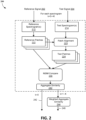
- FIG. 2 illustrates a flowchart 200 for determining an objective quality metric for ambisonic spatial audio, according to least one example implementation.
- a reference signal 202 and a test signal 204 may be inputs to a computing device (e.g., a computing device 500 of FIG. 5 ) for executing the process of the flowchart 200.
- the reference signal 202 and the test signal 204 may be B-format ambisonic signals, which, in one example, may be 10-20 seconds in duration.
- the reference signal 202 and the test signal 202 may be 3OA signals.
- the test signal 204 may be extracted (e.g., decoded) from an encoded (or compressed) version of the reference signal 202 so that the QoE may be determined by taking into account signal degradations and any changes to the perceived localization of sound source origins due to the decoding/encoding process.
- the reference signal 202 (e.g., reference ambisonic audio sources) may be rendered to 22 fixed localizations that may be evenly distributed on a quarter of the sphere.
- the test signal 204 (e.g., test ambisonic audio signals) may be rendered at 206 fixed localizations that may be evenly distributed on the whole sphere (e.g., with 30 horizontal and vertical steps).
- the computing device may create spectrograms (that may be referred to as reference spectrograms or reference phaseograms) of each channel of the reference signal 202. For example, 16 spectrograms of the reference signal 202 may be created, one spectrogram of each channel of the reference signal 202.
- the computing device may create spectrograms (that may be referred to as test spectrograms or test phaseograms) of each channel of the test signal 204. For example, 16 spectrograms may be created, one spectrogram of each channel of the test signal 204.
- the spectrograms of the test signal 202 and the reference signal 204 may be created using short-time Fourier transform (STFT) of their respective ambisonic channels. For instance, a STFT with a 1536-point Hamming window (e.g., 50% overlap) may be applied to the channels of the reference signal 202 and the test signal 204 to generate the spectrograms.
- the generated spectrograms may be phaseograms (also referred to as phase spectrograms).
- phase values of STFT may be processed and presented graphically such that time-frequency distribution of the phase of a component may provide information about phase modulations around a reference point to determine reference phase and reference frequency for the component.
- the STFT may create a spectrogram of real and imaginary numbers for every time/frequency from which the phase of every frequency at any given time may be extracted.
- the spectrograms may be generated based on intensities or a combination of phase angles and intensities.
- a spectrogram, z may be a matrix that is computed using a short-time Fourier transform of an input signal using a 1536-poing Hamming window (e.g., 50% overlap).
- atan2(Y, X) may return values in the closed interval [-pi, pi] based on values of Y and X as shown in the graphic below:
- the computing device may segment the reference spectrograms generated at block 212 into patches (that may be referred to as reference patches). That is, one or more reference patches may be created for each channel of the reference signal 202 from the respective reference spectrograms. In some implementations, the computing device may create (or generate) one or more patches from each of the reference spectrograms.
- a reference patch may be generated from a portion of the reference signal 202, for example, 0.5 seconds long and may be created using STFT. In one implementation, for example, a reference patch may be a 30 ⁇ 32 matrix (e.g., 32 frequency bands ⁇ 30 time frames). The references patches may be used for comparing with corresponding patches generated from the test signal 204 to compute similarity scores to determine Listening Quality and/or Localization Accuracy.
- the computing device may segment the test spectrograms generated at block 214 into patches (may be referred to as test patches). That is, one or more test patches may be created for each channel of the test signal 204 from the respective test spectrograms. In some implementations, the computing device may create (or generate) one or more patches from each of the test spectrograms. Similar to the reference patches, a test patch may be, for example, 0.5 seconds long and may be created using STFT. In one implementation, for example, a test patch may be a 30 ⁇ 32 matrix (e.g., 32 frequency bands ⁇ 30 time frames). The test patches may be used for comparing with the corresponding reference patches to compute similarity scores to determine Listening Quality and/or Localization Accuracy.
- test patches may be used for comparing with the corresponding reference patches to compute similarity scores to determine Listening Quality and/or Localization Accuracy.
- the test patches and the reference patches may be aligned with each other.
- the alignment e.g., time alignment
- the alignment may be performed, prior to comparing of the reference and test patches, to ensure that a reference patch is being compared with a corresponding test patch that is most similar.
- the alignment may be performed to time-align the patches prior to the comparison.
- the computing device may compare reference patches with test patches.
- the comparing may be performed using NSIM which may compare patches across all frequency bands and compute aggregate similarity scores at block 240.
- NSIM is a similarity measure for comparing spectrograms of reference patches and test patches to compute similarity scores.
- the comparison may be based on phase angles and NSIM may compare the phases in each of the points in the 30 ⁇ 32 matrices (associated with the reference and test patches) and compute the average value to generate the NSIM values.
- the omni-directional channel 110 is considered to contain a composite of directional channels and the content of the omni-directional channel 110 may be considered to be a good (e.g., representative) indicator of the Listening Quality (e.g., due to encoding artefacts and without localization differences).
- the LQ may be computed using ViSQOLAudio model (described above) that measures similarity scores using NSIM for patches of channel 0.
- the LQ scores may have values between 0 and 1, with a value of 1 being a perfect match. That is, a test patch matches perfectly with a corresponding reference patch.
- the Localization Accuracy is determined based on aggregate similarity scores of channels 1 to K (e.g., channels 1 to 15 for 3OA). That is, the similarity scores of channels 1-15 are computed and aggregated to determine the aggregate similarity score.
- the LA is determined as a weighted sum of similarity between the reference and test channels. That is, different weights may be assigned to the various directional components of channels 1-15.
- the channels may be grouped into vertical-only channels and mixed direction channels.
- channels 2, 6, and 12 are vertical-only channels.
- LA is the listening quality
- V ViSQOLAudio algorithm
- alpha ( ⁇ ) is a parameter that controls trade-off between vertical and horizontal components.
- r k is the reference phaseogram of vertical component channel k
- t k is the test phaseogram of vertical component channel k.
- r k is the reference phaseogram of mixed component channel k
- t k is the test phaseogram of mixed component channel k.
- the LA may be computed using the ViSQOLAudio model (described above) that measures NSIM similarity scores, for example, for channels 1-15 for third order ambisonics.
- the value of alpha ( ⁇ ) may control a trade-off between the importance of vertical and horizontal components (e.g., control bias). That is, the higher the value of ⁇ , the more emphasis may be given to vertical channel similarity (vs horizontal channel similarity).
- the Listening Quality and/or the Localization Accuracy of ambisonic spatial audio may be determined by computing aggregate similarity scores of channel 0 and channels 1-15, respectively, of the ambisonic spatial audio.
- the value of alpha may be channel dependent. In other words, different channels may have different alpha values to control the trade-off between the importance of vertical and horizontal components on a per-channel basis and/or the value of alpha may change depending on the ambisonic order.
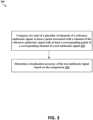
- FIG. 3 illustrates a flowchart 300 of a method of determining quality of experience (QoE) of ambisonics spatial audio according to least one example implementation.
- QoE quality of experience
- a computing device compares a patch associated with multi-directional channels of the reference ambisonic signal with a corresponding patch of the corresponding multi-directional channels of a test ambisonic signal.
- the comparison is performed for each of a plurality of channels of reference and test ambisonic signals.
- the test ambisonic signal is generated by decoding an encoded version of the reference ambisonic signal and the comparison may be based on phaseograms of the reference ambisonic signal and the test ambisonic signal.
- the computing device may compare at least one patch associated with each channel of the reference signal 202 with at least the corresponding patch of the test signal 204.
- the computing device may compare patch 1 of channel 0 of the reference signal 202 with patch 1 of channel 0 of the test signal 204, and compare patch 1 of channel 1 of the reference signal 202 with patch 1 of channel 1 of the test signal 204, and so on.
- the computing device determines a localization accuracy of the test ambisonic signal based on the comparison.
- the comparison is performed using NSIM, as described above in reference to FIG. 2 , to generate similarity scores.
- the computing device may determine the listening quality may be based on an aggregate score that is based on comparing of the omni-directional components (or channels) of the reference signal and the test signal.
- the computing device determines the localization accuracy based on a weighted sum of similarity scores between corresponding multi-directional channels (e.g., channels 1-15) of the test and reference signals.
- the localization accuracy of an ambisonic spatial audio is determined, and in one or more implementation, the listening quality is also determined.
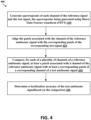
- FIG. 4 illustrates a flowchart 400 of a method of determining quality of experience (QoE) of ambisonics spatial audio, according to least another example implementation.
- QoE quality of experience
- a computing device may generate spectrograms of the plurality of channels of the reference ambisonic signal and the test ambisonic signal.
- the computing device may generate spectrograms of the plurality of channels of the reference ambisonic signal 202 and test ambisonic signal 204, as described above in reference to FIG. 2 .
- the spectrograms may be created using STFT.
- the computing device may align, prior to comparing, the patch associated with the channel of the reference ambisonic signal with the corresponding patch of the corresponding channel of the test ambisonic signal. In some implementations, the computing device may align corresponding patches with each other prior to comparison to provide for the patches with the best match to be compared with each other.
- the operations are similar to operations at block 310 of FIG. 3 .
- the operations are similar to operations at block 320 of FIG. 3 .
- the listening quality and/or localization accuracy of an ambisonic spatial audio are determined.
- FIG. 5 shows an example of a computer device 500 and a mobile computer device 550, which may be used with the techniques described here.
- Computing device 500 is intended to represent various forms of digital computers, such as laptops, desktops, workstations, personal digital assistants, servers, blade servers, mainframes, and other appropriate computers.
- Computing device 550 is intended to represent various forms of mobile devices, such as personal digital assistants, cellular telephones, smart phones, and other similar computing devices.
- the components shown here, their connections and relationships, and their functions, are meant to be exemplary only, and are not meant to limit implementations of the inventions described and/or claimed in this document.
- Computing device 500 includes a processor 502, memory 504, a storage device 506, a high-speed interface 508 connecting to memory 504 and high-speed expansion ports 510, and a low speed interface 512 connecting to low speed bus 514 and storage device 506.
- Each of the components 502, 504, 506, 508, 510, and 512 are interconnected using various busses, and may be mounted on a common motherboard or in other manners as appropriate.
- the processor 502 can process instructions for execution within the computing device 500, including instructions stored in the memory 504 or on the storage device 506 to display graphical information for a GUI on an external input/output device, such as display 516 coupled to high speed interface 508.
- multiple processors and/or multiple buses may be used, as appropriate, along with multiple memories and types of memory.
- multiple computing devices 500 may be connected, with each device providing portions of the necessary operations (e.g., as a server bank, a group of blade servers, or a multi-processor system).
- the memory 504 stores information within the computing device 500.
- the memory 504 is a volatile memory unit or units.
- the memory 504 is a non-volatile memory unit or units.
- the memory 504 may also be another form of computer-readable medium, such as a magnetic or optical disk.
- the storage device 506 is capable of providing mass storage for the computing device 500.
- the storage device 506 may be or contain a computer-readable medium, such as a floppy disk device, a hard disk device, an optical disk device, or a tape device, a flash memory or other similar solid state memory device, or an array of devices, including devices in a storage area network or other configurations.
- the computer program product can be tangibly embodied in an information carrier.
- the computer program product may also contain instructions that, when executed, perform one or more methods, such as those described above.
- the information carrier is a computer- or machine-readable medium, such as the memory 504, the storage device 506, or memory on processor 502.
- the high speed controller 508 manages bandwidth-intensive operations for the computing device 500, while the low speed controller 512 manages lower bandwidth-intensive operations.
- the high-speed controller 508 is coupled to memory 504, display 516 (e.g., through a graphics processor or accelerator), and to high-speed expansion ports 510, which may accept various expansion cards (not shown).
- low-speed controller 512 is coupled to storage device 506 and low-speed expansion port 514.
- the low-speed expansion port which may include various communication ports (e.g., USB, Bluetooth, Ethernet, wireless Ethernet) may be coupled to one or more input/output devices, such as a keyboard, a pointing device, a scanner, or a networking device such as a switch or router, e.g., through a network adapter.
- input/output devices such as a keyboard, a pointing device, a scanner, or a networking device such as a switch or router, e.g., through a network adapter.
- the computing device 500 may be implemented in a number of different forms, as shown in the figure. For example, it may be implemented as a standard server 520, or multiple times in a group of such servers. It may also be implemented as part of a rack server system 524. In addition, it may be implemented in a personal computer such as a laptop computer 522. Alternatively, components from computing device 500 may be combined with other components in a mobile device (not shown), such as device 550. Each of such devices may contain one or more of computing device 500, 550, and an entire system may be made up of multiple computing devices 500, 550 communicating with each other.
- Computing device 550 includes a processor 552, memory 564, an input/output device such as a display 554, a communication interface 566, and a transceiver 568, among other components.
- the device 550 may also be provided with a storage device, such as a microdrive or other device, to provide additional storage.
- a storage device such as a microdrive or other device, to provide additional storage.
- Each of the components 550, 552, 564, 554, 566, and 568, are interconnected using various buses, and several of the components may be mounted on a common motherboard or in other manners as appropriate.
- the processor 552 can execute instructions within the computing device 550, including instructions stored in the memory 564.
- the processor may be implemented as a chipset of chips that include separate and multiple analog and digital processors.
- the processor may provide, for example, for coordination of the other components of the device 550, such as control of user interfaces, applications run by device 550, and wireless communication by device 550.
- Processor 552 may communicate with a user through control interface 558 and display interface 556 coupled to a display 554.
- the display 554 may be, for example, a TFT LCD (Thin-Film-Transistor Liquid Crystal Display) or an OLED (Organic Light Emitting Diode) display, or other appropriate display technology.
- the display interface 556 may comprise appropriate circuitry for driving the display 554 to present graphical and other information to a user.
- the control interface 558 may receive commands from a user and convert them for submission to the processor 552.
- an external interface 562 may be provide in communication with processor 552, to enable near area communication of device 550 with other devices.
- External interface 562 may provide, for example, for wired communication in some implementations, or for wireless communication in other implementations, and multiple interfaces may also be used.
- the memory 564 stores information within the computing device 550.
- the memory 564 can be implemented as one or more of a computer-readable medium or media, a volatile memory unit or units, or a non-volatile memory unit or units.
- Expansion memory 574 may also be provided and connected to device 550 through expansion interface 572, which may include, for example, a SIMM (Single In Line Memory Module) card interface.
- SIMM Single In Line Memory Module
- expansion memory 574 may provide extra storage space for device 550, or may also store applications or other information for device 550.
- expansion memory 574 may include instructions to carry out or supplement the processes described above, and may include secure information also.
- expansion memory 574 may be provide as a security module for device 550, and may be programmed with instructions that permit secure use of device 550.
- secure applications may be provided via the SIMM cards, along with additional information, such as placing identifying information on the SIMM card in a non-hackable manner.
- the memory may include, for example, flash memory and/or NVRAM memory, as discussed below.
- a computer program product is tangibly embodied in an information carrier.
- the computer program product contains instructions that, when executed, perform one or more methods, such as those described above.
- the information carrier is a computer- or machine-readable medium, such as the memory 564, expansion memory 574, or memory on processor 552, that may be received, for example, over transceiver 568 or external interface 562.
- Device 550 may communicate wirelessly through communication interface 566, which may include digital signal processing circuitry where necessary. Communication interface 566 may provide for communications under various modes or protocols, such as GSM voice calls, SMS, EMS, or MMS messaging, CDMA, TDMA, PDC, WCDMA, CDMA2000, or GPRS, among others. Such communication may occur, for example, through radio-frequency transceiver 568. In addition, short-range communication may occur, such as using a Bluetooth, Wi-Fi, or other such transceiver (not shown). In addition, GPS (Global Positioning System) receiver module 570 may provide additional navigation- and location-related wireless data to device 550, which may be used as appropriate by applications running on device 550.
- GPS Global Positioning System
- Device 550 may also communicate audibly using audio codec 560, which may receive spoken information from a user and convert it to usable digital information. Audio codec 560 may likewise generate audible sound for a user, such as through a speaker, e.g., in a handset of device 550. Such sound may include sound from voice telephone calls, may include recorded sound (e.g., voice messages, music files, etc.) and may also include sound generated by applications operating on device 550.
- Audio codec 560 may receive spoken information from a user and convert it to usable digital information. Audio codec 560 may likewise generate audible sound for a user, such as through a speaker, e.g., in a handset of device 550. Such sound may include sound from voice telephone calls, may include recorded sound (e.g., voice messages, music files, etc.) and may also include sound generated by applications operating on device 550.
- the computing device 550 may be implemented in a number of different forms, as shown in the figure. For example, it may be implemented as a cellular telephone 580. It may also be implemented as part of a smart phone 582, personal digital assistant, or other similar mobile device.
- Various implementations of the systems and techniques described here can be realized in digital electronic circuitry, integrated circuitry, specially designed ASICs (application specific integrated circuits), computer hardware, firmware, software, and/or combinations thereof. These various implementations can include implementation in one or more computer programs that are executable and/or interpretable on a programmable system including at least one programmable processor, which may be special or general purpose, coupled to receive data and instructions from, and to transmit data and instructions to, a storage system, at least one input device, and at least one output device.
- Various implementations of the systems and techniques described here can be realized as and/or generally be referred to herein as a circuit, a module, a block, or a system that can combine software and hardware aspects.
- a module may include the functions/acts/computer program instructions executing on a processor (e.g., a processor formed on a silicon substrate, a GaAs substrate, and the like) or some other programmable data processing apparatus.
- Methods discussed above may be implemented by hardware, software, firmware, middleware, microcode, hardware description languages, or any combination thereof.
- the program code or code segments to perform the necessary tasks may be stored in a machine or computer readable medium such as a storage medium.
- a processor(s) may perform the necessary tasks.
- references to acts and symbolic representations of operations that may be implemented as program modules or functional processes include routines, programs, objects, components, data structures, etc., that perform particular tasks or implement particular abstract data types and may be described and/or implemented using existing hardware at existing structural elements.
- Such existing hardware may include one or more Central Processing Units (CPUs), digital signal processors (DSPs), application-specific-integrated-circuits, field programmable gate arrays (FPGAs) computers or the like.
- CPUs Central Processing Units
- DSPs digital signal processors
- FPGAs field programmable gate arrays
- the software implemented aspects of the example implementations are typically encoded on some form of non-transitory program storage medium or implemented over some type of transmission medium.
- the program storage medium may be magnetic (e.g., a floppy disk or a hard drive) or optical (e.g., a compact disk read only memory, or CD ROM), and may be read only or random access.
- the transmission medium may be twisted wire pairs, coaxial cable, optical fiber, or some other suitable transmission medium known to the art. The example implementations not limited by these aspects of any given implementation.
Landscapes
- Engineering & Computer Science (AREA)
- Physics & Mathematics (AREA)
- Signal Processing (AREA)
- Acoustics & Sound (AREA)
- Multimedia (AREA)
- Human Computer Interaction (AREA)
- Audiology, Speech & Language Pathology (AREA)
- Health & Medical Sciences (AREA)
- Computational Linguistics (AREA)
- Mathematical Physics (AREA)
- Spectroscopy & Molecular Physics (AREA)
- Algebra (AREA)
- General Physics & Mathematics (AREA)
- Mathematical Analysis (AREA)
- Mathematical Optimization (AREA)
- Pure & Applied Mathematics (AREA)
- Theoretical Computer Science (AREA)
- Stereophonic System (AREA)
Claims (13)
- Computerimplementiertes Verfahren zum Bestimmen der Erlebnisqualität (quality of experience, QoE) von räumlichen Ambisonic-Audiosignalen, umfassend:Vergleichen eines jedem einer Vielzahl von multidirektionalen Kanälen eines Referenz-Ambisonic-Signals zugeordneten Patches mit einem entsprechenden Patch eines entsprechenden multidirektionalen Kanals eines Test-Ambisonic-Signals basierend auf einem Neurogramm-Ähnlichkeits-Index-Maß (neurogram similarity index measure, NSIM), wobei das Test-Ambisonic-Signal durch Decodieren einer codierten Version des Referenz-Ambisonic-Signals erzeugt wird; undBestimmen einer Lokalisationsgenauigkeit des Test-Ambisonic-Signals basierend auf dem Vergleich durch Bestimmen eines aggregierten NSIM, der auf einer gewichteten Summe von NSIM zwischen entsprechenden multidirektionalen Kanälen des Test-Ambisonic-Signals und des Referenz-Ambisonic-Signals basiert,wobei in der gewichteten Summe den vertikalen und horizontalen Komponenten der multidirektionalen Kanäle Gewichte zugewiesen werden, um den Schwerpunkt zwischen horizontaler und vertikaler Kanalähnlichkeit zu ändern.
- Verfahren nach Anspruch 1, ferner umfassend für jeden Vergleich:
Ausrichten des dem multidirektionalen Kanal des Referenz-Ambisonic-Signals zugeordneten Patches mit dem entsprechenden Patch des entsprechenden multidirektionalen Kanals des Test-Ambisonic-Signals vor dem Vergleichen. - Verfahren nach Anspruch 1 oder 2, wobei das Vergleichen mindestens teilweise auf Spektrogrammen, Phasendiagrammen oder einer Kombination davon des Referenz-Ambisonic-Signals und des Test-Ambisonic-Signals basiert.
- Verfahren nach einem der Ansprüche 1 bis 3, ferner umfassend:
Erzeugen von Spektrogrammen der Vielzahl von multidirektionalen Kanälen des Referenz-Ambisonic-Signals und des Test-Ambisonic-Signals, wobei die Spektrogramme unter Verwendung der Kurzzeit-Fourier-Transformation (short-time Fourier transform, STFT) erzeugt werden. - Verfahren nach einem der Ansprüche 1 bis 4, ferner umfassend:
Bestimmen einer Hörqualität des Test-Ambisonic-Signals basierend auf dem Vergleich. - Rechenvorrichtung zum Bestimmen der Erlebnisqualität (QoE) von räumlichen Ambisonic-Audiosignalen, umfassend:einen Prozessor; undeinen Speicher, wobei der Speicher Anweisungen beinhaltet, die dazu konfiguriert sind, den Prozessor zu Folgendem zu veranlassen:Vergleichen eines jedem einer Vielzahl von multidirektionalen Kanälen eines Referenz-Ambisonic-Signals zugeordneten Patches mit einem entsprechenden Patch eines entsprechenden multidirektionalen Kanals eines Test-Ambisonic-Signals basierend auf einem Neurogramm-Ähnlichkeits-Index-Maß, NSIM, wobei das Test-Ambisonic-Signal durch Decodieren einer codierten Version des Referenz-Ambisonic-Signals erzeugt wird; undBestimmen einer Lokalisationsgenauigkeit des Test-Ambisonic-Signals basierend auf dem Vergleich durch Bestimmen eines aggregierten NSIM, das auf einer gewichteten Summe von NSIM zwischen entsprechenden multidirektionalen Kanälen des Test-Ambisonic-Signals und des Referenz-Ambisonic-Signals basiert, wobei in der gewichteten Summe den vertikalen und horizontalen Komponenten der multidirektionalen Kanäle Gewichte zugewiesen werden, um den Schwerpunkt zwischen horizontaler und vertikaler Kanalähnlichkeit zu ändern.
- Rechenvorrichtung nach Anspruch 6, wobei der Prozessor ferner zu Folgendem konfiguriert ist:
Ausrichten des dem multidirektionalen Kanal des Referenz-Ambisonic-Signals zugeordneten Patches mit dem entsprechenden Patch des entsprechenden multidirektionalen Kanals des Test-Ambisonic-Signals vor dem Vergleichen. - Rechenvorrichtung nach Anspruch 6 oder 7, wobei der Prozessor ferner zu Folgendem konfiguriert ist: Vergleichen basierend mindestens teilweise auf Spektrogrammen, Phasendiagrammen oder einer Kombination davon des Referenz-Ambisonic-Signals und des Test-Ambisonic-Signals.
- Rechenvorrichtung nach einem der Ansprüche 6 bis 8, wobei der Prozessor ferner zu Folgendem konfiguriert ist:
Bestimmen einer Hörqualität des Test-Ambisonic-Signals basierend auf dem Vergleich. - Nichttransitorisches, computerlesbares Speichermedium, auf dem ein computerausführbarer Programmcode gespeichert ist, der, wenn er auf einem Computersystem ausgeführt wird, das Computersystem veranlasst, ein Verfahren zum Bestimmen der Erlebnisqualität (QoE) von räumlichen Ambisonic-Audiosignalen durchzuführen, umfassend:Vergleichen eines jedem einer Vielzahl von multidirektionalen Kanälen eines Referenz-Ambisonic-Signals zugeordneten Patches mit einem entsprechenden Patch eines entsprechenden multidirektionalen Kanals eines Test-Ambisonic-Signals basierend auf einem Neurogramm-Ähnlichkeits-Index-Maß (neurogram similarity index measure, NSIM), wobei das Test-Ambisonic-Signal durch Decodieren einer codierten Version des Referenz-Ambisonic-Signals erzeugt wird; undBestimmen einer Lokalisationsgenauigkeit des Test-Ambisonic-Signals basierend auf dem Vergleich durch Bestimmen eines aggregierten NSIM, das auf einer gewichteten Summe von NSIM zwischen entsprechenden multidirektionalen Kanälen des Test-Ambisonic-Signals und des Referenz-Ambisonic-Signals basiert, wobei in der gewichteten Summe den vertikalen und horizontalen Komponenten der multidirektionalen Kanäle Gewichte zugewiesen werden, um den Schwerpunkt zwischen horizontaler und vertikaler Kanalähnlichkeit zu ändern.
- Computerlesbares Speichermedium nach Anspruch 10, ferner umfassend Code zum:
Ausrichten des dem multidirektionalen Kanal des Referenz-Ambisonic-Signals zugeordneten Patches mit dem entsprechenden Patch des entsprechenden multidirektionalen Kanals des Test-Ambisonic-Signals vor dem Vergleichen. - Computerlesbares Speichermedium nach Anspruch 10 oder 11, ferner umfassend Code zum:Vergleichen basierend mindestens teilweise auf Spektrogrammen, Phasendiagrammen oder einer Kombination davon des Referenz-Ambisonic-Signals und des Test-Ambisonic-Signals;Erzeugen von Spektrogrammen der Vielzahl von Kanälen des Referenz-Ambisonic-Signals und des Test-Ambisonic-Signals, wobei die Spektrogramme unter Verwendung der Kurzzeit-FourierTransformation (STFT) erzeugt werden.
- Computerlesbares Speichermedium nach Anspruch 10 bis 123, ferner umfassend Code zum:
Bestimmen einer Hörqualität des Test-Ambisonic-Signals basierend auf dem Vergleich.
Applications Claiming Priority (2)
| Application Number | Priority Date | Filing Date | Title |
|---|---|---|---|
| US15/973,287 US10672405B2 (en) | 2018-05-07 | 2018-05-07 | Objective quality metrics for ambisonic spatial audio |
| PCT/US2019/030884 WO2019217302A1 (en) | 2018-05-07 | 2019-05-06 | Objective quality metrics for ambisonic spatial audio |
Publications (3)
| Publication Number | Publication Date |
|---|---|
| EP3750332A1 EP3750332A1 (de) | 2020-12-16 |
| EP3750332B1 true EP3750332B1 (de) | 2024-09-04 |
| EP3750332C0 EP3750332C0 (de) | 2024-09-04 |
Family
ID=66625292
Family Applications (1)
| Application Number | Title | Priority Date | Filing Date |
|---|---|---|---|
| EP19725483.2A Active EP3750332B1 (de) | 2018-05-07 | 2019-05-06 | Objektive qualitätsmetriken für räumliches ambisonic-audio |
Country Status (4)
| Country | Link |
|---|---|
| US (1) | US10672405B2 (de) |
| EP (1) | EP3750332B1 (de) |
| CN (1) | CN111903144B (de) |
| WO (1) | WO2019217302A1 (de) |
Families Citing this family (6)
| Publication number | Priority date | Publication date | Assignee | Title |
|---|---|---|---|---|
| US10735031B2 (en) | 2018-09-20 | 2020-08-04 | Western Digital Technologies, Inc. | Content aware decoding method and system |
| US10862512B2 (en) | 2018-09-20 | 2020-12-08 | Western Digital Technologies, Inc. | Data driven ICAD graph generation |
| US10805087B1 (en) * | 2018-09-28 | 2020-10-13 | Amazon Technologies, Inc. | Code signing method and system |
| US12531077B2 (en) * | 2021-02-22 | 2026-01-20 | Tencent America LLC | Method and apparatus in audio processing |
| CN115497485B (zh) * | 2021-06-18 | 2024-10-18 | 华为技术有限公司 | 三维音频信号编码方法、装置、编码器和系统 |
| CN115148208B (zh) * | 2022-09-01 | 2023-02-03 | 北京探境科技有限公司 | 音频数据处理方法、装置、芯片及电子设备 |
Family Cites Families (7)
| Publication number | Priority date | Publication date | Assignee | Title |
|---|---|---|---|---|
| US8238563B2 (en) * | 2008-03-20 | 2012-08-07 | University of Surrey-H4 | System, devices and methods for predicting the perceived spatial quality of sound processing and reproducing equipment |
| US20090238371A1 (en) * | 2008-03-20 | 2009-09-24 | Francis Rumsey | System, devices and methods for predicting the perceived spatial quality of sound processing and reproducing equipment |
| EP2469741A1 (de) * | 2010-12-21 | 2012-06-27 | Thomson Licensing | Verfahren und Vorrichtung zur Kodierung und Dekodierung aufeinanderfolgender Rahmen einer Ambisonics-Darstellung eines 2- oder 3-dimensionalen Schallfelds |
| KR102185941B1 (ko) * | 2011-07-01 | 2020-12-03 | 돌비 레버러토리즈 라이쎈싱 코오포레이션 | 적응형 오디오 신호 생성, 코딩 및 렌더링을 위한 시스템 및 방법 |
| UA114793C2 (uk) * | 2012-04-20 | 2017-08-10 | Долбі Лабораторіс Лайсензін Корпорейшн | Система та спосіб для генерування, кодування та представлення даних адаптивного звукового сигналу |
| US9495968B2 (en) * | 2013-05-29 | 2016-11-15 | Qualcomm Incorporated | Identifying sources from which higher order ambisonic audio data is generated |
| DK201370793A1 (en) * | 2013-12-19 | 2015-06-29 | Gn Resound As | A hearing aid system with selectable perceived spatial positioning of sound sources |
-
2018
- 2018-05-07 US US15/973,287 patent/US10672405B2/en active Active
-
2019
- 2019-05-06 EP EP19725483.2A patent/EP3750332B1/de active Active
- 2019-05-06 WO PCT/US2019/030884 patent/WO2019217302A1/en not_active Ceased
- 2019-05-06 CN CN201980021791.7A patent/CN111903144B/zh active Active
Also Published As
| Publication number | Publication date |
|---|---|
| CN111903144B (zh) | 2022-03-11 |
| CN111903144A (zh) | 2020-11-06 |
| EP3750332A1 (de) | 2020-12-16 |
| US20190341060A1 (en) | 2019-11-07 |
| US10672405B2 (en) | 2020-06-02 |
| EP3750332C0 (de) | 2024-09-04 |
| WO2019217302A1 (en) | 2019-11-14 |
Similar Documents
| Publication | Publication Date | Title |
|---|---|---|
| EP3750332B1 (de) | Objektive qualitätsmetriken für räumliches ambisonic-audio | |
| US9479886B2 (en) | Scalable downmix design with feedback for object-based surround codec | |
| CN113678199B (zh) | 空间音频参数的重要性的确定及相关联的编码 | |
| US12243540B2 (en) | Merging of spatial audio parameters | |
| EP4082010B1 (de) | Kombinieren von räumlichen audioparametern | |
| EP4165629B1 (de) | Verfahren und vorrichtungen zur codierung von räumlichem hintergrundrauschen in einem mehrkanaleingangssignal | |
| EP4246510A1 (de) | Verfahren und vorrichtung zur audiokodierung und -dekodierung | |
| EP4213147B1 (de) | Auf direktionaler lautstärkekarte basierende audioverarbeitung | |
| AU2007204332A1 (en) | Decoding of binaural audio signals | |
| CN117136406A (zh) | 组合空间音频流 | |
| EP4396814A1 (de) | Stille-deskriptor mit räumlichen parametern | |
| RU2648632C2 (ru) | Классификатор многоканального звукового сигнала | |
| AU2024249186A1 (en) | Low coding rate parametric spatial audio encoding | |
| US10002615B2 (en) | Inter-channel level difference processing method and apparatus | |
| JP2022550803A (ja) | マルチチャネル音声信号に適用する修正の決定と、関連する符号化及び復号化 | |
| RU2836622C1 (ru) | Способы и устройства для кодирования и/или декодирования пространственного фонового шума в многоканальном входном сигнале | |
| US20250210052A1 (en) | Decoder and decoding method for discontinuous transmission of parametrically coded independent streams with metadata | |
| WO2024175320A1 (en) | Priority values for parametric spatial audio encoding | |
| HK40089737B (en) | Methods and devices for encoding decoding spatial background noise within a multi-channel input signal | |
| HK40089737A (en) | Methods and devices for encoding decoding spatial background noise within a multi-channel input signal |
Legal Events
| Date | Code | Title | Description |
|---|---|---|---|
| STAA | Information on the status of an ep patent application or granted ep patent |
Free format text: STATUS: UNKNOWN |
|
| STAA | Information on the status of an ep patent application or granted ep patent |
Free format text: STATUS: THE INTERNATIONAL PUBLICATION HAS BEEN MADE |
|
| PUAI | Public reference made under article 153(3) epc to a published international application that has entered the european phase |
Free format text: ORIGINAL CODE: 0009012 |
|
| STAA | Information on the status of an ep patent application or granted ep patent |
Free format text: STATUS: REQUEST FOR EXAMINATION WAS MADE |
|
| 17P | Request for examination filed |
Effective date: 20200910 |
|
| AK | Designated contracting states |
Kind code of ref document: A1 Designated state(s): AL AT BE BG CH CY CZ DE DK EE ES FI FR GB GR HR HU IE IS IT LI LT LU LV MC MK MT NL NO PL PT RO RS SE SI SK SM TR |
|
| AX | Request for extension of the european patent |
Extension state: BA ME |
|
| DAV | Request for validation of the european patent (deleted) | ||
| DAX | Request for extension of the european patent (deleted) | ||
| STAA | Information on the status of an ep patent application or granted ep patent |
Free format text: STATUS: EXAMINATION IS IN PROGRESS |
|
| 17Q | First examination report despatched |
Effective date: 20220622 |
|
| GRAP | Despatch of communication of intention to grant a patent |
Free format text: ORIGINAL CODE: EPIDOSNIGR1 |
|
| STAA | Information on the status of an ep patent application or granted ep patent |
Free format text: STATUS: GRANT OF PATENT IS INTENDED |
|
| INTG | Intention to grant announced |
Effective date: 20240325 |
|
| GRAS | Grant fee paid |
Free format text: ORIGINAL CODE: EPIDOSNIGR3 |
|
| GRAA | (expected) grant |
Free format text: ORIGINAL CODE: 0009210 |
|
| STAA | Information on the status of an ep patent application or granted ep patent |
Free format text: STATUS: THE PATENT HAS BEEN GRANTED |
|
| AK | Designated contracting states |
Kind code of ref document: B1 Designated state(s): AL AT BE BG CH CY CZ DE DK EE ES FI FR GB GR HR HU IE IS IT LI LT LU LV MC MK MT NL NO PL PT RO RS SE SI SK SM TR |
|
| P01 | Opt-out of the competence of the unified patent court (upc) registered |
Free format text: CASE NUMBER: APP_44544/2024 Effective date: 20240731 |
|
| REG | Reference to a national code |
Ref country code: GB Ref legal event code: FG4D |
|
| REG | Reference to a national code |
Ref country code: CH Ref legal event code: EP |
|
| REG | Reference to a national code |
Ref country code: IE Ref legal event code: FG4D |
|
| REG | Reference to a national code |
Ref country code: DE Ref legal event code: R096 Ref document number: 602019058270 Country of ref document: DE |
|
| U01 | Request for unitary effect filed |
Effective date: 20240926 |
|
| U07 | Unitary effect registered |
Designated state(s): AT BE BG DE DK EE FI FR IT LT LU LV MT NL PT RO SE SI Effective date: 20241022 |
|
| P04 | Withdrawal of opt-out of the competence of the unified patent court (upc) registered |
Free format text: CASE NUMBER: APP_56893/2024 Effective date: 20241018 |
|
| PG25 | Lapsed in a contracting state [announced via postgrant information from national office to epo] |
Ref country code: NO Free format text: LAPSE BECAUSE OF FAILURE TO SUBMIT A TRANSLATION OF THE DESCRIPTION OR TO PAY THE FEE WITHIN THE PRESCRIBED TIME-LIMIT Effective date: 20241204 |
|
| PG25 | Lapsed in a contracting state [announced via postgrant information from national office to epo] |
Ref country code: GR Free format text: LAPSE BECAUSE OF FAILURE TO SUBMIT A TRANSLATION OF THE DESCRIPTION OR TO PAY THE FEE WITHIN THE PRESCRIBED TIME-LIMIT Effective date: 20241205 Ref country code: PL Free format text: LAPSE BECAUSE OF FAILURE TO SUBMIT A TRANSLATION OF THE DESCRIPTION OR TO PAY THE FEE WITHIN THE PRESCRIBED TIME-LIMIT Effective date: 20240904 |
|
| PG25 | Lapsed in a contracting state [announced via postgrant information from national office to epo] |
Ref country code: HR Free format text: LAPSE BECAUSE OF FAILURE TO SUBMIT A TRANSLATION OF THE DESCRIPTION OR TO PAY THE FEE WITHIN THE PRESCRIBED TIME-LIMIT Effective date: 20240904 |
|
| PG25 | Lapsed in a contracting state [announced via postgrant information from national office to epo] |
Ref country code: RS Free format text: LAPSE BECAUSE OF FAILURE TO SUBMIT A TRANSLATION OF THE DESCRIPTION OR TO PAY THE FEE WITHIN THE PRESCRIBED TIME-LIMIT Effective date: 20241204 Ref country code: ES Free format text: LAPSE BECAUSE OF FAILURE TO SUBMIT A TRANSLATION OF THE DESCRIPTION OR TO PAY THE FEE WITHIN THE PRESCRIBED TIME-LIMIT Effective date: 20240904 |
|
| PG25 | Lapsed in a contracting state [announced via postgrant information from national office to epo] |
Ref country code: RS Free format text: LAPSE BECAUSE OF FAILURE TO SUBMIT A TRANSLATION OF THE DESCRIPTION OR TO PAY THE FEE WITHIN THE PRESCRIBED TIME-LIMIT Effective date: 20241204 Ref country code: PL Free format text: LAPSE BECAUSE OF FAILURE TO SUBMIT A TRANSLATION OF THE DESCRIPTION OR TO PAY THE FEE WITHIN THE PRESCRIBED TIME-LIMIT Effective date: 20240904 Ref country code: NO Free format text: LAPSE BECAUSE OF FAILURE TO SUBMIT A TRANSLATION OF THE DESCRIPTION OR TO PAY THE FEE WITHIN THE PRESCRIBED TIME-LIMIT Effective date: 20241204 Ref country code: HR Free format text: LAPSE BECAUSE OF FAILURE TO SUBMIT A TRANSLATION OF THE DESCRIPTION OR TO PAY THE FEE WITHIN THE PRESCRIBED TIME-LIMIT Effective date: 20240904 Ref country code: GR Free format text: LAPSE BECAUSE OF FAILURE TO SUBMIT A TRANSLATION OF THE DESCRIPTION OR TO PAY THE FEE WITHIN THE PRESCRIBED TIME-LIMIT Effective date: 20241205 Ref country code: ES Free format text: LAPSE BECAUSE OF FAILURE TO SUBMIT A TRANSLATION OF THE DESCRIPTION OR TO PAY THE FEE WITHIN THE PRESCRIBED TIME-LIMIT Effective date: 20240904 |
|
| PG25 | Lapsed in a contracting state [announced via postgrant information from national office to epo] |
Ref country code: IS Free format text: LAPSE BECAUSE OF FAILURE TO SUBMIT A TRANSLATION OF THE DESCRIPTION OR TO PAY THE FEE WITHIN THE PRESCRIBED TIME-LIMIT Effective date: 20250104 |
|
| PG25 | Lapsed in a contracting state [announced via postgrant information from national office to epo] |
Ref country code: SM Free format text: LAPSE BECAUSE OF FAILURE TO SUBMIT A TRANSLATION OF THE DESCRIPTION OR TO PAY THE FEE WITHIN THE PRESCRIBED TIME-LIMIT Effective date: 20240904 |
|
| PG25 | Lapsed in a contracting state [announced via postgrant information from national office to epo] |
Ref country code: CZ Free format text: LAPSE BECAUSE OF FAILURE TO SUBMIT A TRANSLATION OF THE DESCRIPTION OR TO PAY THE FEE WITHIN THE PRESCRIBED TIME-LIMIT Effective date: 20240904 |
|
| PG25 | Lapsed in a contracting state [announced via postgrant information from national office to epo] |
Ref country code: SK Free format text: LAPSE BECAUSE OF FAILURE TO SUBMIT A TRANSLATION OF THE DESCRIPTION OR TO PAY THE FEE WITHIN THE PRESCRIBED TIME-LIMIT Effective date: 20240904 |
|
| U20 | Renewal fee for the european patent with unitary effect paid |
Year of fee payment: 7 Effective date: 20250527 |
|
| PGFP | Annual fee paid to national office [announced via postgrant information from national office to epo] |
Ref country code: GB Payment date: 20250527 Year of fee payment: 7 |
|
| PLBE | No opposition filed within time limit |
Free format text: ORIGINAL CODE: 0009261 |
|
| STAA | Information on the status of an ep patent application or granted ep patent |
Free format text: STATUS: NO OPPOSITION FILED WITHIN TIME LIMIT |
|
| 26N | No opposition filed |
Effective date: 20250605 |
|
| REG | Reference to a national code |
Ref country code: CH Ref legal event code: H13 Free format text: ST27 STATUS EVENT CODE: U-0-0-H10-H13 (AS PROVIDED BY THE NATIONAL OFFICE) Effective date: 20251223 |
|
| PG25 | Lapsed in a contracting state [announced via postgrant information from national office to epo] |
Ref country code: CH Free format text: LAPSE BECAUSE OF NON-PAYMENT OF DUE FEES Effective date: 20250531 |
|
| PG25 | Lapsed in a contracting state [announced via postgrant information from national office to epo] |
Ref country code: MC Free format text: LAPSE BECAUSE OF FAILURE TO SUBMIT A TRANSLATION OF THE DESCRIPTION OR TO PAY THE FEE WITHIN THE PRESCRIBED TIME-LIMIT Effective date: 20240904 |
|
| U1N | Appointed representative for the unitary patent procedure changed after the registration of the unitary effect |
Representative=s name: MARKS & CLERK GST; GB |
|
| PG25 | Lapsed in a contracting state [announced via postgrant information from national office to epo] |
Ref country code: IE Free format text: LAPSE BECAUSE OF NON-PAYMENT OF DUE FEES Effective date: 20250506 |