EP3749646B1 - Heteroaryl compounds as kinase inhibitor - Google Patents
Heteroaryl compounds as kinase inhibitor Download PDFInfo
- Publication number
- EP3749646B1 EP3749646B1 EP19767545.7A EP19767545A EP3749646B1 EP 3749646 B1 EP3749646 B1 EP 3749646B1 EP 19767545 A EP19767545 A EP 19767545A EP 3749646 B1 EP3749646 B1 EP 3749646B1
- Authority
- EP
- European Patent Office
- Prior art keywords
- oxy
- amino
- ethyl
- phenyl
- chloropyridin
- Prior art date
- Legal status (The legal status is an assumption and is not a legal conclusion. Google has not performed a legal analysis and makes no representation as to the accuracy of the status listed.)
- Active
Links
Classifications
-
- C—CHEMISTRY; METALLURGY
- C07—ORGANIC CHEMISTRY
- C07D—HETEROCYCLIC COMPOUNDS
- C07D213/00—Heterocyclic compounds containing six-membered rings, not condensed with other rings, with one nitrogen atom as the only ring hetero atom and three or more double bonds between ring members or between ring members and non-ring members
- C07D213/02—Heterocyclic compounds containing six-membered rings, not condensed with other rings, with one nitrogen atom as the only ring hetero atom and three or more double bonds between ring members or between ring members and non-ring members having three double bonds between ring members or between ring members and non-ring members
- C07D213/04—Heterocyclic compounds containing six-membered rings, not condensed with other rings, with one nitrogen atom as the only ring hetero atom and three or more double bonds between ring members or between ring members and non-ring members having three double bonds between ring members or between ring members and non-ring members having no bond between the ring nitrogen atom and a non-ring member or having only hydrogen or carbon atoms directly attached to the ring nitrogen atom
- C07D213/60—Heterocyclic compounds containing six-membered rings, not condensed with other rings, with one nitrogen atom as the only ring hetero atom and three or more double bonds between ring members or between ring members and non-ring members having three double bonds between ring members or between ring members and non-ring members having no bond between the ring nitrogen atom and a non-ring member or having only hydrogen or carbon atoms directly attached to the ring nitrogen atom with hetero atoms or with carbon atoms having three bonds to hetero atoms with at the most one bond to halogen, e.g. ester or nitrile radicals, directly attached to ring carbon atoms
- C07D213/72—Nitrogen atoms
- C07D213/73—Unsubstituted amino or imino radicals
-
- A—HUMAN NECESSITIES
- A61—MEDICAL OR VETERINARY SCIENCE; HYGIENE
- A61K—PREPARATIONS FOR MEDICAL, DENTAL OR TOILETRY PURPOSES
- A61K31/00—Medicinal preparations containing organic active ingredients
- A61K31/33—Heterocyclic compounds
- A61K31/395—Heterocyclic compounds having nitrogen as a ring hetero atom, e.g. guanethidine or rifamycins
- A61K31/435—Heterocyclic compounds having nitrogen as a ring hetero atom, e.g. guanethidine or rifamycins having six-membered rings with one nitrogen as the only ring hetero atom
- A61K31/44—Non condensed pyridines; Hydrogenated derivatives thereof
-
- A—HUMAN NECESSITIES
- A61—MEDICAL OR VETERINARY SCIENCE; HYGIENE
- A61K—PREPARATIONS FOR MEDICAL, DENTAL OR TOILETRY PURPOSES
- A61K31/00—Medicinal preparations containing organic active ingredients
- A61K31/33—Heterocyclic compounds
- A61K31/395—Heterocyclic compounds having nitrogen as a ring hetero atom, e.g. guanethidine or rifamycins
- A61K31/435—Heterocyclic compounds having nitrogen as a ring hetero atom, e.g. guanethidine or rifamycins having six-membered rings with one nitrogen as the only ring hetero atom
- A61K31/44—Non condensed pyridines; Hydrogenated derivatives thereof
- A61K31/4412—Non condensed pyridines; Hydrogenated derivatives thereof having oxo groups directly attached to the heterocyclic ring
-
- A—HUMAN NECESSITIES
- A61—MEDICAL OR VETERINARY SCIENCE; HYGIENE
- A61K—PREPARATIONS FOR MEDICAL, DENTAL OR TOILETRY PURPOSES
- A61K39/00—Medicinal preparations containing antigens or antibodies
- A61K39/395—Antibodies; Immunoglobulins; Immune serum, e.g. antilymphocytic serum
- A61K39/39533—Antibodies; Immunoglobulins; Immune serum, e.g. antilymphocytic serum against materials from animals
- A61K39/3955—Antibodies; Immunoglobulins; Immune serum, e.g. antilymphocytic serum against materials from animals against proteinaceous materials, e.g. enzymes, hormones, lymphokines
-
- A—HUMAN NECESSITIES
- A61—MEDICAL OR VETERINARY SCIENCE; HYGIENE
- A61K—PREPARATIONS FOR MEDICAL, DENTAL OR TOILETRY PURPOSES
- A61K45/00—Medicinal preparations containing active ingredients not provided for in groups A61K31/00 - A61K41/00
- A61K45/06—Mixtures of active ingredients without chemical characterisation, e.g. antiphlogistics and cardiaca
-
- A—HUMAN NECESSITIES
- A61—MEDICAL OR VETERINARY SCIENCE; HYGIENE
- A61P—SPECIFIC THERAPEUTIC ACTIVITY OF CHEMICAL COMPOUNDS OR MEDICINAL PREPARATIONS
- A61P35/00—Antineoplastic agents
-
- A—HUMAN NECESSITIES
- A61—MEDICAL OR VETERINARY SCIENCE; HYGIENE
- A61P—SPECIFIC THERAPEUTIC ACTIVITY OF CHEMICAL COMPOUNDS OR MEDICINAL PREPARATIONS
- A61P35/00—Antineoplastic agents
- A61P35/02—Antineoplastic agents specific for leukemia
-
- C—CHEMISTRY; METALLURGY
- C07—ORGANIC CHEMISTRY
- C07D—HETEROCYCLIC COMPOUNDS
- C07D213/00—Heterocyclic compounds containing six-membered rings, not condensed with other rings, with one nitrogen atom as the only ring hetero atom and three or more double bonds between ring members or between ring members and non-ring members
- C07D213/02—Heterocyclic compounds containing six-membered rings, not condensed with other rings, with one nitrogen atom as the only ring hetero atom and three or more double bonds between ring members or between ring members and non-ring members having three double bonds between ring members or between ring members and non-ring members
- C07D213/04—Heterocyclic compounds containing six-membered rings, not condensed with other rings, with one nitrogen atom as the only ring hetero atom and three or more double bonds between ring members or between ring members and non-ring members having three double bonds between ring members or between ring members and non-ring members having no bond between the ring nitrogen atom and a non-ring member or having only hydrogen or carbon atoms directly attached to the ring nitrogen atom
- C07D213/06—Heterocyclic compounds containing six-membered rings, not condensed with other rings, with one nitrogen atom as the only ring hetero atom and three or more double bonds between ring members or between ring members and non-ring members having three double bonds between ring members or between ring members and non-ring members having no bond between the ring nitrogen atom and a non-ring member or having only hydrogen or carbon atoms directly attached to the ring nitrogen atom containing only hydrogen and carbon atoms in addition to the ring nitrogen atom
- C07D213/22—Heterocyclic compounds containing six-membered rings, not condensed with other rings, with one nitrogen atom as the only ring hetero atom and three or more double bonds between ring members or between ring members and non-ring members having three double bonds between ring members or between ring members and non-ring members having no bond between the ring nitrogen atom and a non-ring member or having only hydrogen or carbon atoms directly attached to the ring nitrogen atom containing only hydrogen and carbon atoms in addition to the ring nitrogen atom containing two or more pyridine rings directly linked together, e.g. bipyridyl
-
- C—CHEMISTRY; METALLURGY
- C07—ORGANIC CHEMISTRY
- C07D—HETEROCYCLIC COMPOUNDS
- C07D213/00—Heterocyclic compounds containing six-membered rings, not condensed with other rings, with one nitrogen atom as the only ring hetero atom and three or more double bonds between ring members or between ring members and non-ring members
- C07D213/02—Heterocyclic compounds containing six-membered rings, not condensed with other rings, with one nitrogen atom as the only ring hetero atom and three or more double bonds between ring members or between ring members and non-ring members having three double bonds between ring members or between ring members and non-ring members
- C07D213/04—Heterocyclic compounds containing six-membered rings, not condensed with other rings, with one nitrogen atom as the only ring hetero atom and three or more double bonds between ring members or between ring members and non-ring members having three double bonds between ring members or between ring members and non-ring members having no bond between the ring nitrogen atom and a non-ring member or having only hydrogen or carbon atoms directly attached to the ring nitrogen atom
- C07D213/60—Heterocyclic compounds containing six-membered rings, not condensed with other rings, with one nitrogen atom as the only ring hetero atom and three or more double bonds between ring members or between ring members and non-ring members having three double bonds between ring members or between ring members and non-ring members having no bond between the ring nitrogen atom and a non-ring member or having only hydrogen or carbon atoms directly attached to the ring nitrogen atom with hetero atoms or with carbon atoms having three bonds to hetero atoms with at the most one bond to halogen, e.g. ester or nitrile radicals, directly attached to ring carbon atoms
- C07D213/72—Nitrogen atoms
- C07D213/74—Amino or imino radicals substituted by hydrocarbon or substituted hydrocarbon radicals
-
- C—CHEMISTRY; METALLURGY
- C07—ORGANIC CHEMISTRY
- C07D—HETEROCYCLIC COMPOUNDS
- C07D213/00—Heterocyclic compounds containing six-membered rings, not condensed with other rings, with one nitrogen atom as the only ring hetero atom and three or more double bonds between ring members or between ring members and non-ring members
- C07D213/02—Heterocyclic compounds containing six-membered rings, not condensed with other rings, with one nitrogen atom as the only ring hetero atom and three or more double bonds between ring members or between ring members and non-ring members having three double bonds between ring members or between ring members and non-ring members
- C07D213/04—Heterocyclic compounds containing six-membered rings, not condensed with other rings, with one nitrogen atom as the only ring hetero atom and three or more double bonds between ring members or between ring members and non-ring members having three double bonds between ring members or between ring members and non-ring members having no bond between the ring nitrogen atom and a non-ring member or having only hydrogen or carbon atoms directly attached to the ring nitrogen atom
- C07D213/60—Heterocyclic compounds containing six-membered rings, not condensed with other rings, with one nitrogen atom as the only ring hetero atom and three or more double bonds between ring members or between ring members and non-ring members having three double bonds between ring members or between ring members and non-ring members having no bond between the ring nitrogen atom and a non-ring member or having only hydrogen or carbon atoms directly attached to the ring nitrogen atom with hetero atoms or with carbon atoms having three bonds to hetero atoms with at the most one bond to halogen, e.g. ester or nitrile radicals, directly attached to ring carbon atoms
- C07D213/72—Nitrogen atoms
- C07D213/75—Amino or imino radicals, acylated by carboxylic or carbonic acids, or by sulfur or nitrogen analogues thereof, e.g. carbamates
-
- C—CHEMISTRY; METALLURGY
- C07—ORGANIC CHEMISTRY
- C07D—HETEROCYCLIC COMPOUNDS
- C07D213/00—Heterocyclic compounds containing six-membered rings, not condensed with other rings, with one nitrogen atom as the only ring hetero atom and three or more double bonds between ring members or between ring members and non-ring members
- C07D213/02—Heterocyclic compounds containing six-membered rings, not condensed with other rings, with one nitrogen atom as the only ring hetero atom and three or more double bonds between ring members or between ring members and non-ring members having three double bonds between ring members or between ring members and non-ring members
- C07D213/04—Heterocyclic compounds containing six-membered rings, not condensed with other rings, with one nitrogen atom as the only ring hetero atom and three or more double bonds between ring members or between ring members and non-ring members having three double bonds between ring members or between ring members and non-ring members having no bond between the ring nitrogen atom and a non-ring member or having only hydrogen or carbon atoms directly attached to the ring nitrogen atom
- C07D213/60—Heterocyclic compounds containing six-membered rings, not condensed with other rings, with one nitrogen atom as the only ring hetero atom and three or more double bonds between ring members or between ring members and non-ring members having three double bonds between ring members or between ring members and non-ring members having no bond between the ring nitrogen atom and a non-ring member or having only hydrogen or carbon atoms directly attached to the ring nitrogen atom with hetero atoms or with carbon atoms having three bonds to hetero atoms with at the most one bond to halogen, e.g. ester or nitrile radicals, directly attached to ring carbon atoms
- C07D213/78—Carbon atoms having three bonds to hetero atoms, with at the most one bond to halogen, e.g. ester or nitrile radicals
- C07D213/81—Amides; Imides
-
- C—CHEMISTRY; METALLURGY
- C07—ORGANIC CHEMISTRY
- C07D—HETEROCYCLIC COMPOUNDS
- C07D213/00—Heterocyclic compounds containing six-membered rings, not condensed with other rings, with one nitrogen atom as the only ring hetero atom and three or more double bonds between ring members or between ring members and non-ring members
- C07D213/02—Heterocyclic compounds containing six-membered rings, not condensed with other rings, with one nitrogen atom as the only ring hetero atom and three or more double bonds between ring members or between ring members and non-ring members having three double bonds between ring members or between ring members and non-ring members
- C07D213/04—Heterocyclic compounds containing six-membered rings, not condensed with other rings, with one nitrogen atom as the only ring hetero atom and three or more double bonds between ring members or between ring members and non-ring members having three double bonds between ring members or between ring members and non-ring members having no bond between the ring nitrogen atom and a non-ring member or having only hydrogen or carbon atoms directly attached to the ring nitrogen atom
- C07D213/60—Heterocyclic compounds containing six-membered rings, not condensed with other rings, with one nitrogen atom as the only ring hetero atom and three or more double bonds between ring members or between ring members and non-ring members having three double bonds between ring members or between ring members and non-ring members having no bond between the ring nitrogen atom and a non-ring member or having only hydrogen or carbon atoms directly attached to the ring nitrogen atom with hetero atoms or with carbon atoms having three bonds to hetero atoms with at the most one bond to halogen, e.g. ester or nitrile radicals, directly attached to ring carbon atoms
- C07D213/78—Carbon atoms having three bonds to hetero atoms, with at the most one bond to halogen, e.g. ester or nitrile radicals
- C07D213/81—Amides; Imides
- C07D213/82—Amides; Imides in position 3
-
- C—CHEMISTRY; METALLURGY
- C07—ORGANIC CHEMISTRY
- C07D—HETEROCYCLIC COMPOUNDS
- C07D241/00—Heterocyclic compounds containing 1,4-diazine or hydrogenated 1,4-diazine rings
- C07D241/02—Heterocyclic compounds containing 1,4-diazine or hydrogenated 1,4-diazine rings not condensed with other rings
- C07D241/10—Heterocyclic compounds containing 1,4-diazine or hydrogenated 1,4-diazine rings not condensed with other rings having three double bonds between ring members or between ring members and non-ring members
- C07D241/14—Heterocyclic compounds containing 1,4-diazine or hydrogenated 1,4-diazine rings not condensed with other rings having three double bonds between ring members or between ring members and non-ring members with hetero atoms or with carbon atoms having three bonds to hetero atoms with at the most one bond to halogen, e.g. ester or nitrile radicals, directly attached to ring carbon atoms
- C07D241/18—Oxygen or sulfur atoms
-
- C—CHEMISTRY; METALLURGY
- C07—ORGANIC CHEMISTRY
- C07D—HETEROCYCLIC COMPOUNDS
- C07D241/00—Heterocyclic compounds containing 1,4-diazine or hydrogenated 1,4-diazine rings
- C07D241/02—Heterocyclic compounds containing 1,4-diazine or hydrogenated 1,4-diazine rings not condensed with other rings
- C07D241/10—Heterocyclic compounds containing 1,4-diazine or hydrogenated 1,4-diazine rings not condensed with other rings having three double bonds between ring members or between ring members and non-ring members
- C07D241/14—Heterocyclic compounds containing 1,4-diazine or hydrogenated 1,4-diazine rings not condensed with other rings having three double bonds between ring members or between ring members and non-ring members with hetero atoms or with carbon atoms having three bonds to hetero atoms with at the most one bond to halogen, e.g. ester or nitrile radicals, directly attached to ring carbon atoms
- C07D241/20—Nitrogen atoms
-
- C—CHEMISTRY; METALLURGY
- C07—ORGANIC CHEMISTRY
- C07D—HETEROCYCLIC COMPOUNDS
- C07D401/00—Heterocyclic compounds containing two or more hetero rings, having nitrogen atoms as the only ring hetero atoms, at least one ring being a six-membered ring with only one nitrogen atom
- C07D401/02—Heterocyclic compounds containing two or more hetero rings, having nitrogen atoms as the only ring hetero atoms, at least one ring being a six-membered ring with only one nitrogen atom containing two hetero rings
- C07D401/04—Heterocyclic compounds containing two or more hetero rings, having nitrogen atoms as the only ring hetero atoms, at least one ring being a six-membered ring with only one nitrogen atom containing two hetero rings directly linked by a ring-member-to-ring-member bond
-
- C—CHEMISTRY; METALLURGY
- C07—ORGANIC CHEMISTRY
- C07D—HETEROCYCLIC COMPOUNDS
- C07D401/00—Heterocyclic compounds containing two or more hetero rings, having nitrogen atoms as the only ring hetero atoms, at least one ring being a six-membered ring with only one nitrogen atom
- C07D401/02—Heterocyclic compounds containing two or more hetero rings, having nitrogen atoms as the only ring hetero atoms, at least one ring being a six-membered ring with only one nitrogen atom containing two hetero rings
- C07D401/12—Heterocyclic compounds containing two or more hetero rings, having nitrogen atoms as the only ring hetero atoms, at least one ring being a six-membered ring with only one nitrogen atom containing two hetero rings linked by a chain containing hetero atoms as chain links
-
- C—CHEMISTRY; METALLURGY
- C07—ORGANIC CHEMISTRY
- C07D—HETEROCYCLIC COMPOUNDS
- C07D401/00—Heterocyclic compounds containing two or more hetero rings, having nitrogen atoms as the only ring hetero atoms, at least one ring being a six-membered ring with only one nitrogen atom
- C07D401/14—Heterocyclic compounds containing two or more hetero rings, having nitrogen atoms as the only ring hetero atoms, at least one ring being a six-membered ring with only one nitrogen atom containing three or more hetero rings
-
- C—CHEMISTRY; METALLURGY
- C07—ORGANIC CHEMISTRY
- C07D—HETEROCYCLIC COMPOUNDS
- C07D405/00—Heterocyclic compounds containing both one or more hetero rings having oxygen atoms as the only ring hetero atoms, and one or more rings having nitrogen as the only ring hetero atom
- C07D405/02—Heterocyclic compounds containing both one or more hetero rings having oxygen atoms as the only ring hetero atoms, and one or more rings having nitrogen as the only ring hetero atom containing two hetero rings
- C07D405/12—Heterocyclic compounds containing both one or more hetero rings having oxygen atoms as the only ring hetero atoms, and one or more rings having nitrogen as the only ring hetero atom containing two hetero rings linked by a chain containing hetero atoms as chain links
-
- C—CHEMISTRY; METALLURGY
- C07—ORGANIC CHEMISTRY
- C07D—HETEROCYCLIC COMPOUNDS
- C07D405/00—Heterocyclic compounds containing both one or more hetero rings having oxygen atoms as the only ring hetero atoms, and one or more rings having nitrogen as the only ring hetero atom
- C07D405/14—Heterocyclic compounds containing both one or more hetero rings having oxygen atoms as the only ring hetero atoms, and one or more rings having nitrogen as the only ring hetero atom containing three or more hetero rings
-
- C—CHEMISTRY; METALLURGY
- C07—ORGANIC CHEMISTRY
- C07D—HETEROCYCLIC COMPOUNDS
- C07D409/00—Heterocyclic compounds containing two or more hetero rings, at least one ring having sulfur atoms as the only ring hetero atoms
- C07D409/02—Heterocyclic compounds containing two or more hetero rings, at least one ring having sulfur atoms as the only ring hetero atoms containing two hetero rings
- C07D409/12—Heterocyclic compounds containing two or more hetero rings, at least one ring having sulfur atoms as the only ring hetero atoms containing two hetero rings linked by a chain containing hetero atoms as chain links
-
- C—CHEMISTRY; METALLURGY
- C07—ORGANIC CHEMISTRY
- C07D—HETEROCYCLIC COMPOUNDS
- C07D409/00—Heterocyclic compounds containing two or more hetero rings, at least one ring having sulfur atoms as the only ring hetero atoms
- C07D409/14—Heterocyclic compounds containing two or more hetero rings, at least one ring having sulfur atoms as the only ring hetero atoms containing three or more hetero rings
-
- C—CHEMISTRY; METALLURGY
- C07—ORGANIC CHEMISTRY
- C07D—HETEROCYCLIC COMPOUNDS
- C07D413/00—Heterocyclic compounds containing two or more hetero rings, at least one ring having nitrogen and oxygen atoms as the only ring hetero atoms
- C07D413/02—Heterocyclic compounds containing two or more hetero rings, at least one ring having nitrogen and oxygen atoms as the only ring hetero atoms containing two hetero rings
- C07D413/12—Heterocyclic compounds containing two or more hetero rings, at least one ring having nitrogen and oxygen atoms as the only ring hetero atoms containing two hetero rings linked by a chain containing hetero atoms as chain links
-
- C—CHEMISTRY; METALLURGY
- C07—ORGANIC CHEMISTRY
- C07D—HETEROCYCLIC COMPOUNDS
- C07D417/00—Heterocyclic compounds containing two or more hetero rings, at least one ring having nitrogen and sulfur atoms as the only ring hetero atoms, not provided for by group C07D415/00
- C07D417/02—Heterocyclic compounds containing two or more hetero rings, at least one ring having nitrogen and sulfur atoms as the only ring hetero atoms, not provided for by group C07D415/00 containing two hetero rings
- C07D417/12—Heterocyclic compounds containing two or more hetero rings, at least one ring having nitrogen and sulfur atoms as the only ring hetero atoms, not provided for by group C07D415/00 containing two hetero rings linked by a chain containing hetero atoms as chain links
-
- C—CHEMISTRY; METALLURGY
- C07—ORGANIC CHEMISTRY
- C07D—HETEROCYCLIC COMPOUNDS
- C07D417/00—Heterocyclic compounds containing two or more hetero rings, at least one ring having nitrogen and sulfur atoms as the only ring hetero atoms, not provided for by group C07D415/00
- C07D417/14—Heterocyclic compounds containing two or more hetero rings, at least one ring having nitrogen and sulfur atoms as the only ring hetero atoms, not provided for by group C07D415/00 containing three or more hetero rings
-
- C—CHEMISTRY; METALLURGY
- C07—ORGANIC CHEMISTRY
- C07F—ACYCLIC, CARBOCYCLIC OR HETEROCYCLIC COMPOUNDS CONTAINING ELEMENTS OTHER THAN CARBON, HYDROGEN, HALOGEN, OXYGEN, NITROGEN, SULFUR, SELENIUM OR TELLURIUM
- C07F9/00—Compounds containing elements of Groups 5 or 15 of the Periodic Table
- C07F9/02—Phosphorus compounds
- C07F9/547—Heterocyclic compounds, e.g. containing phosphorus as a ring hetero atom
- C07F9/553—Heterocyclic compounds, e.g. containing phosphorus as a ring hetero atom having one nitrogen atom as the only ring hetero atom
- C07F9/576—Six-membered rings
- C07F9/58—Pyridine rings
-
- C—CHEMISTRY; METALLURGY
- C07—ORGANIC CHEMISTRY
- C07K—PEPTIDES
- C07K16/00—Immunoglobulins [IG], e.g. monoclonal or polyclonal antibodies
- C07K16/18—Immunoglobulins [IG], e.g. monoclonal or polyclonal antibodies against material from animals or humans
- C07K16/28—Immunoglobulins [IG], e.g. monoclonal or polyclonal antibodies against material from animals or humans against receptors, cell surface antigens or cell surface determinants
- C07K16/2803—Immunoglobulins [IG], e.g. monoclonal or polyclonal antibodies against material from animals or humans against receptors, cell surface antigens or cell surface determinants against the immunoglobulin superfamily
- C07K16/2818—Immunoglobulins [IG], e.g. monoclonal or polyclonal antibodies against material from animals or humans against receptors, cell surface antigens or cell surface determinants against the immunoglobulin superfamily against CD28 or CD152
-
- A—HUMAN NECESSITIES
- A61—MEDICAL OR VETERINARY SCIENCE; HYGIENE
- A61K—PREPARATIONS FOR MEDICAL, DENTAL OR TOILETRY PURPOSES
- A61K39/00—Medicinal preparations containing antigens or antibodies
- A61K2039/505—Medicinal preparations containing antigens or antibodies comprising antibodies
-
- A—HUMAN NECESSITIES
- A61—MEDICAL OR VETERINARY SCIENCE; HYGIENE
- A61K—PREPARATIONS FOR MEDICAL, DENTAL OR TOILETRY PURPOSES
- A61K2300/00—Mixtures or combinations of active ingredients, wherein at least one active ingredient is fully defined in groups A61K31/00 - A61K41/00
-
- C—CHEMISTRY; METALLURGY
- C07—ORGANIC CHEMISTRY
- C07K—PEPTIDES
- C07K2317/00—Immunoglobulins specific features
- C07K2317/70—Immunoglobulins specific features characterized by effect upon binding to a cell or to an antigen
- C07K2317/76—Antagonist effect on antigen, e.g. neutralization or inhibition of binding
Definitions
- the present invention relates to a compound having kinase inhibitory activity and its use in the field of medicine. More specifically, the present invention provides heteroaryl compounds having protein tyrosine kinase activity.
- the information provided is intended solely to assist the understanding of the reader. None of the information provided nor references cited is admitted to be prior art to the present invention.
- Protein tyrosine kinase can catalyze a variety of substrate proteins tyrosine residues to phosphorylate, and plays an important role in modulating cell growth, proliferation and differentiation.
- the aberrant kinase activity is associated with many human diseases, including cancer, autoimmune diseases and inflammatory diseases.
- protein tyrosine kinase can be a potential target of small molecule kinase inhibitors for modulating cell function, which is used for drug design.
- the growth factor receptors are cell-surface proteins. When bound by a growth factor ligand, growth factor receptors are converted to an active form which interacts with proteins on the inner surface of a cell membrane. This leads to phosphorylation on tyrosine residues of the receptor and other proteins and to the formation inside the cell of complexes with a variety of cytoplasmic signaling molecules that, in turn effect numerous cellular responses, such as cell division (proliferation), cell differentiation, cell growth, and expression of the metabolism of the extracellular microenvironment, etc.
- cytoplasmic signaling molecules that, in turn effect numerous cellular responses, such as cell division (proliferation), cell differentiation, cell growth, and expression of the metabolism of the extracellular microenvironment, etc.
- RTKs receptor tyrosine kinase
- HER receptor tyrosine kinase
- RTK subfamily consists of insulin receptor (IR), insulin-like growth factor I receptor (IGF-1R) and insulin receptor-related receptor (IRR).
- IR and IGF-1R interact with insulin, IGF-I and IGF-II to form a heterotetramer of two entirely extracellular glycosylated ⁇ subunits and two ⁇ subunits which cross the cell membrane and which contain the tyrosine kinase domain.
- a third RTK subfamily is referred to as the platelet derived growth factor receptor (“PDGFR”) group, which includes PDGFR ⁇ , PDGFR ⁇ , Flt 3, c-kit, and c-fms. These receptors consist of glycosylated extracellular domains composed of variable numbers of immunoglobulin-like loops and an intracellular domain wherein the tyrosine kinase domain is interrupted by unrelated amino acid sequences.
- PDGFR platelet derived growth factor receptor
- flk fetus liver kinase
- KDR/FLK-1 kinase insert domain-receptor fetal liver kinase-1
- flk-1R fetal liver kinase-1 receptor
- flt-4 fms-like tyrosine kinase
- a further member of the tyrosine kinase growth factor receptor family is the fibroblast growth factor ("FGF") receptor subgroup.
- the group consists of four receptors, FGFR1-4, and seven ligands, FGF1-7. While not yet well defined, it appears that the receptors consist of a glycosylated extracellular domain containing a variable number of immunoglobulin like loops and an intracellular domain in which the tyrosine kinase sequence is interrupted by regions of unrelated amino acid sequences.
- VEGF vascular endothelial growth factor
- VEGF is a dimeric glycoprotein similar to PDGF but has different biological functions and target cells specificity in vivo. In particular, VEGF is presently thought to play an essential role in vasculogenesis and angiogenesis.
- Still another member of the tyrosine kinase growth factor receptor group is MET, often referred to as c-Met, also known as human hepatocyte growth factor receptor tyrosine kinase (hHGFR).
- c-Met is thought to play a role in primary tumor growth and metastasis.
- the colony stimulating factor 1 receptor also known as macrophage colony stimulating factor receptor (M-CSFR)
- CD115 differentiation cluster 115
- CSF-1R is a cell surface protein encoded by the CSF-1R gene (also known as c-fms) in the human body.
- c-fms is a III transmembrane receptor protein tyrosine kinase (receptor protein tyrosinekinases, RPTKs), which regulates the key signal transduction cascade reactions that regulate cell growth and proliferation.
- the receptor consists of five immunoglobulin (IG) domains, one transmembrane domains, and a separate cytoplasmic kinase domain separated by the kinase inserting part.
- IG immunoglobulin
- c-fms was originally a member of the gene family isolated from the Susan McDonough strain of feline sarcoma viruses.
- the cellular proto-oncogene FMS (c-fms, cellular feline McDonough sarcoma) codes for the receptor of macrophage Colony-StimulatingFactor (M-CSF).
- M-CSF macrophage Colony-StimulatingFactor
- M-CSF is a cytokine that controls the production, differentiation and function of macrophages.
- M-CSF stimulates the differentiation of progenitor cells into mature monocytes and prolongs the survival of monocytes. Furthermore, M-CSF enhances cytotoxicity, superoxide production, phagocytosis, chemotaxis, and secondary cytokine production of additional factors in monocytes and macrophages. Examples of such additional factors include granulocyte colony-stimulating factor (G-CSF), interleukin-6 (IL-6), and interleukin-8 (IL-8).
- G-CSF granulocyte colony-stimulating factor
- IL-6 interleukin-6
- IL-8 interleukin-8
- M-CSF stimulates hematopoiesis, promotes the differentiation and proliferation of osteoclast progenitor cells, and has profound effects on lipid metabolism. Furthermore, M-CSF is important in pregnancy. Physiologically, large amounts of M-CSF are produced in the placenta, and M-CSF is believed to plays an essential role in trophoblast differentiation ( Motoyoshi, Int J. Hematol. 1998, 67:109-22 ). The elevated serum levels of M-CSF in early pregnancy may participate in the immunologic mechanisms responsible for the maintenance of the pregnancy ( Flanagan & Lader, Curr Opin Hematol. 1998, 5:181-5 ).
- c-fms and c-kit are two kinds of platelet derived growth factor receptors, ⁇ (alpha) (i.e., pdgfra) and ⁇ (beta) (pdgfrb) (PDGF).
- ⁇ (alpha) i.e., pdgfra
- pdgfrb ⁇ (beta)
- PDGF platelet derived growth factor receptors
- the gene coding for pdgfra is located on chromosome 4q11-q12 in the same region of chromosome 4 as the oncogene coding for c-kit.
- the genes coding for pdgfra and c-fms appear to have evolved from a common ancestral gene by gene duplication, inasmuch as these two genes are tandemly linked on chromosome 5.
- M-CSF the major macrophage growth factor
- the present invention provides compounds with tyrosine kinase inhibitory activity.
- the present invention described compounds comprising at least a compound of Formula (Ib).
- R 3 is selected from pyrazolyl, pyridyl, wherein the hydrogens on the ring may be substituted by halogen, CN, C 1 -C 3 alkyl, C 3 -C 6 cycloalkyl, (C 1 -C 5 ) heteroalkyl, C 3 -C 6 heterocycloalkyl, and the adjacent substituented groups on R 3 can join to form a 5-7 membered ring.
- R 3 in the formula (Ib) is selected from phenyl, pyrazolyl, pyridyl, wherein the hydrogens on the ring may be substituted by halogen, CN, O(C 1 -C 3 )alkyl, C 1 -C 3 alkyl, C 3 -C 6 cycloalkyl, (C 1 -C 5 )heteroalkyl, C 3 -C 6 heterocycloalkyl, N((C 1 -C 2 )alkyl) 2 , NH(C 1 -C 2 )alkyl; and the adjacent substituented groups in R 3 can join to form a 5-7 membered ring; W is selected from phenyl, wherein the hydrogens on the ring is substituted by one or more R 7 groups independently, and one of the substituented groups should be selected from N((C 1 -C 2 )alkyl) 2 , C(O)(C 1 -C 2 ) alkyl
- R 3 is selected from pyrazolyl, pyridyl, wherein the hydrogens on the ring may be substituted by halogen, CN, C 1 -C 3 alkyl, C 3 -C 6 cycloalkyl, (C 1 -C 5 ) heteroalkyl, C 3 -C 6 heterocycloalkyl, and the adjacent substituented groups on R 3 can join to form a 5-7 membered ring;
- W is selected from phenyl, wherein the hydrogens on the ring is substituted by one or more R 7 groups independently, and one of the substituented groups should be selected from N((C 1 -C 2 )alkyl) 2 , C(O)(C 1 -C 2 ) alkyl, C(O)O(C 1 -C 2 ) alkyl, P(O)((C 1 -C 2 )alkyl) 2 , SO 2 cyclopropyl, S(O) n (C 1 -
- the preferred compounds of the invention are selected from any one of the following compounds:
- the pharmaceutical composition of the present invention contains at least one effective therapeutic amount of a compound of the above formula (Ib) and at least one pharmaceutically acceptable excipient, adjuvant or carrier.
- the pharmaceutical composition of the invention can be applied to pharmaceutical manufacture.
- a compound of the above formula (Ib) or a pharmaceutical composition thereof can be used in a method for treating abnormal cell growth in a mammal comprising administering to the subject a therapeutically effective amount of the compound or salt, wherein the abnormal cell growth is preferably tumor.
- a compound of the above formula (Ib) or a pharmaceutical composition thereof can be used in the treatment and prevention of CSF-1R kinase mediated melanoma, ovarian cancer, uterine cancer, breast cancer, colon cancer, gastric cancer, liver cancer and non-small cell lung cancer, the use comprising administering a therapeutically effective amount to a subject Compound of formula (Ib) or a pharmaceutical composition thereof.
- the compounds and pharmaceutical compositions of the present invention are useful for the preparation of a medicament for treating abnormal cell growth in a mammal, wherein abnormal cell growth is preferably tumor.
- the compounds and pharmaceutical compositions of the invention are useful in the manufacture of a medicament for the treatment and prevention of CSF-1R kinase mediated tumor.
- the compounds and pharmaceutical compositions of the invention are administered in combination with chemotherapeutic agents, radiation, and/or cancer immunotherapy.
- C m -C n refers to the carbon atoms contained in m-n.
- Alkyl refers to a saturated aliphatic hydrocarbon radical or linker including straight chain and branched chain groups of 1 to 20 carbon atoms, preferably 1 to 12 carbon atoms, more preferably 1 to 8 carbon atoms, or 1 to 6 carbon atoms, or 1 to 4 carbon atoms.
- “Lower alkyl” refers specifically to an alkyl group with 1 to 4 carbon atoms. Examples of alkyl groups include -(CH 2 ) 3 -, methyl, ethyl, propyl, 2-propyl, n-butyl, iso-butyl, tert-butyl, pentyl, and the like. Alkyl may be substituted or unsubstituted.
- Typical substituent groups include cycloalkyl, aryl, heteroaryl, heteroalicyclic, hydroxy, alkoxy, aryloxy, mercapto, alkylthio, arylthio, cyano, halo, carbonyl, thiocarbonyl, O-carbamyl, N-carbamyl, O-thiocarbamyl, N-thiocarbamyl, C-amido, N-amido, C-carboxy, O-carboxy, nitro, silyl, amino and -NR x R y , where R x and R y are independently selected from the group consisting of hydrogen, alkyl, cycloalkyl, aryl, carbonyl, acetyl, sulfonyl, trifluoromethanesulfonyl and, combined, a five- or six-member heteroalicyclic ring.
- heteroalkyl include optionally substituted alkyl radicals in which one or more skeletal chain atoms is a heteroatom, e.g., oxygen, nitrogen, sulfur, silicon, phosphorus or combinations thereof.
- the heteroatom(s) may be placed at any interior position of the heteroalkyl group or at the position at which the heteroalkyl group is attached to the remainder of the molecule.
- Examples include, but are not limited to, -CH 2 -O-CH 3 , -CH 2 -CH 2 -O-CH 3 , -OCH 2 -, -CH 2 -NH-CH 3 , -CH 2 -CH 2 -NH-CH 3 , -CH 2 -N(CH 3 )-CH 3 , -NCH 2 CH 2 -, -CH 2 -CH 2 -NH-CH 3 , -CH 2 -CH 2 -N(CH 3 )-CH 3 , -CH 2 -S-CH 2 -CH 3 , -CH 2 -CH 2 -S(O)-CH 3 , -CH 2 -CH 2 -S(O) 2 -CH 3 .
- up to two heteroatoms may be consecutive, such as, by way of example, -CH 2 -NH-OCH 3 .
- Cycloalkyl refers to a 3 to 8 member all-carbon monocyclic ring, an all-carbon 5-member/6-member or 6-member/6-member fused bicyclic ring, or a multicyclic fused ring (a "fused" ring system means that each ring in the system shares at least an adjacent carbon atom with each other ring in the system) group wherein one or more of the rings may contain one or more double bonds but none of the rings has a completely conjugated pi-electron system.
- cycloalkyl groups examples, without limitation, are cyclopropane, cyclobutane, cyclopentane, cyclopentene, cyclohexane, cyclohexadiene, adamantane, cycloheptane, cycloheptatriene, and the like.
- a cycloalkyl group may be substituted or unsubstituted.
- Typical substituent groups include alkyl, aryl, heteroaryl, heteroalicyclic, hydroxy, alkoxy, aryloxy, mercapto, alkylthio, arylthio, cyano, halo, carbonyl, thiocarbonyl, C-carboxy, O-carboxy, O-carbamyl, N-carbamyl, Camido, N-amido, nitro, amino and -NR x R y , with R x and R y as defined above.
- Illustrative examples of cycloalkyl are derived from, but not limited to, the following:
- Cycloalkylalkyl or Alkylcycloalkyl means an alkyl radical, as defined herein, substituted with a cycloalkyl group.
- Non-limiting cycloalkylalkyl or alkylcycloalkyl groups include cyclopropylmethyl, cyclobutylmethyl, cyclopentylmethyl, cyclohexylmethyl, methylcyclobutyl and the like.
- Alkenyl refers to an alkyl group, as defined herein, consisting of at least two carbon atoms and at least one carbon-carbon double bond. Representative examples include, but are not limited to, ethenyl, 1-propenyl, 2-propenyl, 1-, 2-, or 3-butenyl, and the like.
- Aryl refers to an all-carbon monocyclic or fused-ring polycyclic groups of 6 to 12 carbon atoms having a completely conjugated pi-electron system. Examples, without limitation, of aryl groups are phenyl, naphthalenyl and anthracenyl. The aryl group may be substituted or unsubstituted.
- Typical substituents include halo, trihalomethyl, alkyl, hydroxy, alkoxy, aryloxy, mercapto, alkylthio, arylthio, cyano, nitro, carbonyl, thiocarbonyl, C-carboxy, O-carboxy, Ocarbamyl, N-carbamyl, O-thiocarbamyl, N-thiocarbamyl, C-amido, N-amido, sulfinyl, sulfonyl, amino and -NR x R y , with R x and R y as defined above.
- Heteroaryl refers to a monocyclic or fused ring group of 5 to 12 ring atoms containing one, two, three or four ring heteroatoms selected from N, O, and S, the remaining ring atoms being C, and, in addition, having a completely conjugated ⁇ -electron system.
- unsubstituted heteroaryl groups are pyrrole, furan, thiophene, imidazole, oxazole, thiazole, pyrazole, pyridine, pyrimidine, quinoline, isoquinoline, purine, tetrazole, triazine, and carbazole.
- the heteroaryl group may be substituted or unsubstituted.
- Typical substituents include alkyl, cycloalkyl, halo, trihalomethyl, hydroxy, alkoxy, aryloxy, mercapto, alkylthio, arylthio, cyano, nitro, carbonyl, thiocarbonyl, sulfonamido, C-carboxy, O-carboxy, sulfinyl, sulfonyl, O-carbamyl, N-carbamyl, O-thiocarbamyl, N-thiocarbamyl, C-amido, N-amido, amino and -NR x R y with R x and R y as defined above.
- a pharmaceutically acceptable heteroaryl is one that is sufficiently stable to be attached to a compound of the invention, formulated into a pharmaceutical composition and subsequently administered to a patient in need thereof.
- Examples of typical monocyclic heteroaryl groups include, but are not limited to:
- Heteroalicyclic or “heterocycle” refers to a monocyclic, fused ring group or spiro having in the ring(s) of 3 to 12 ring atoms, in which one or two ring atoms are heteroatoms selected from N, O, and S(O) n (wherein is 0, 1 or 2), the remaining ring atoms being C.
- the rings may also have one or more double bonds. However, the rings do not have a completely conjugated ⁇ -electron system.
- suitable saturated heteroalicyclic groups include, but are not limited to:
- the heterocycle group is optionally substituted with one or two substituents independently selected from halo, lower alkyl, lower alkyl substituted with carboxy, ester hydroxy, or mono or dialkylamino.
- Hydrophilicity refers to an -OH group.
- Alkoxy refers to both an -O-(alkyl) or an -O-(unsubstituted cycloalkyl) group. Representative examples include, but are not limited to, methoxy, ethoxy, propoxy, butoxy, cyclopropyloxy, cyclobutyloxy, cyclopentyloxy, cyclohexyloxy, and the like.
- the alkyl or cycloalkyl group may be substituted or unsubstituted, and typical substituents include a halogen group and the like. Representative examples include, but are not limited to, trifluoromethoxy, difluoromethoxy, and the like.
- Aryloxy refers to an -O-aryl or an -O-heteroaryl group, as defined herein. Representative examples include, but are not limited to, phenoxy, pyridinyloxy, furanyloxy, thienyloxy, pyrimidinyloxy, pyrazinyloxy, and the like, and derivatives thereof.
- Alkylthio refers to an -S-(alkyl) or an -S-(unsubstituted cycloalkyl) group. Representative examples include, but are not limited to, methylthio, ethylthio, propylthio, butylthio, cyclopropylthio, cyclobutylthio, cyclopentylthio, cyclohexylthio, and the like.
- Arylthio refers to an -S-aryl or an -S-heteroaryl group, as defined herein. Representative examples include, but are not limited to, phenylthio, pyridinylthio, furanylthio, thienylthio, pyrimidinylthio, and the like and derivatives thereof.
- Acyl or “carbonyl” refers to a -C(O)R" group, where R" is selected from the group consisting of hydrogen, lower alkyl, trihalomethyl, unsubstituted cycloalkyl, aryl optionally substituted with one or more, preferably one, two, or three substituents selected from the group consisting of lower alkyl, trihalomethyl, lower alkoxy, halo and -NR x R y groups, heteroaryl (bonded through a ring carbon) optionally substituted with one or more, preferably one, two, or three substitutents selected from the group consisting of lower alkyl, trihaloalkyl, lower alkoxy, halo and -NR x R y groups and heteroalicyclic (bonded through a ring carbon) optionally substituted with one or more, preferably one, two, or three substituents selected from the group consisting of lower alkyl, trihaloalkyl, lower alkoxy, halo and -
- Aldehyde refers to an acyl group in which R" is hydrogen.
- Thioacyl or “thiocarbonyl” refers to a -C(S)R" group, with R" as defined above.
- a “thiocarbonyl” group refers to a -C(S)R" group, with R" as defined above.
- C-carboxy refers to a -C(O)OR” group, with R" as defined above.
- O-carboxy refers to a -OC(O)R" group, with R" as defined above.
- Ester refers to a -C(O)OR” group with R" as defined herein except that R" cannot be hydrogen.
- Alcohol refers to a -C(O)CH 3 group.
- Halo group refers to fluorine, chlorine, bromine or iodine, preferably fluorine or chlorine.
- Trihalomethyl refers to a methyl group having three halo substituents, such as a trifluoromethyl group.
- a “sulfinyl” group refers to a -S(O)R" group wherein, in addition to being as defined above, R" may also be a hydroxy group.
- a “sulfonyl” group refers to a -S(O) 2 R" group wherein, in addition to being as defined above, R" may also be a hydroxy group.
- a " Phosphonoyl” group refers to a -P(O)R x R y group, wherein R x and R y is selected from alkyl or alkoxy.
- S-sulfonamido refers to a -S(O) 2 NR x R y group, with R x and R y as defined above.
- N-sulfonamido refers to a -NR x S(O) 2 R y group, with R x and R y as defined above.
- O-carbamyl refers to a -OC(O)NR x R y group with R x and R y as defined above.
- N-carbamyl refers to an R y OC(O)NR x - group, with R x and R y as defined above.
- O-thiocarbamyl refers to a -OC(S)NR x R y group with R x and R y as defined above.
- N-thiocarbamyl refers to a R y OC(S)NR x - group, with R y and Rx as defined above.
- Amino refers to an -NR x R y group, wherein R x and R y are both hydrogen.
- C-amido refers to a -C(O)NR x R y group with R x and R y as defined above.
- N-amido refers to a R x C(O)NR y group, with R x and R y as defined above.
- Niro refers to a -NO 2 group.
- Haloalkyl means an alkyl, preferably lower alkyl, that is substituted with one or more same or different halo atoms, e.g., -CH 2 Cl, -CF 3 , -CH 2 CF 3 , -CH 2 CCl 3 , and the like.
- Hydroxyalkyl means an alkyl, preferably lower alkyl, that is substituted with one, two, or three hydroxy groups; e.g., hydroxymethyl, 1 or 2-hydroxyethyl, 1,2-, 1,3-, or 2,3-dihydroxypropyl, and the like.
- Alkyl means alkyl, preferably lower alkyl, that is substituted with an aryl group as defined above; e.g., -CH 2 phenyl, -(CH 2 ) 2 phenyl, -(CH 2 ) 3 phenyl, CH 3 CH(CH 3 )CH 2 phenyl, and the like and derivatives thereof.
- Heteroaralkyl means alkyl, preferably lower alkyl, that is substituted with a heteroaryl group; e.g., -CH 2 pyridinyl, -(CH 2 ) 2 pyrimidinyl, -(CH 2 ) 3 imidazolyl, and the like, and derivatives thereof.
- “Monoalkylamino” means a radical -NHR where R is an alkyl or unsubstituted cycloalkyl group; e.g., methylamino, (1-methylethyl)amino, cyclohexylamino, and the like.
- Dialkylamino means a radical -NRR where each R is independently an alkyl or unsubstituted cycloalkyl group; dimethylamino, diethylamino, (1-methylethyl)-ethylamino, cyclohexylmethylamino, cyclopentylmethylamino, and the like.
- heteroatom refers to an atom other than carbon or hydrogen. Heteroatoms are typically independently selected from among oxygen, sulfur, nitrogen, silicon and phosphorus, but are not limited to these atoms. In embodiments in which two or more heteroatoms are present, the two or more heteroatoms can all be the same as one another, or some or all of the two or more heteroatoms can each be different from the others.
- optionally substituted or “substituted” means that the referenced group may be substituted with one or more additional group(s) individually and independently selected from alkyl, cycloalkyl, aryl, heteroaryl, heteroalicyclic, hydroxy, alkoxy, aryloxy, alkylthio, arylthio, alkylsulfoxide, arylsulfoxide, alkylsulfone, arylsulfone, cyano, halo, acyl, nitro, haloalkyl, fluoroalkyl, amino, including mono- and di-substituted amino groups, and the protected derivatives thereof.
- heterocycle group optionally substituted with an alkyl group means that the alkyl may but need not be present, and the description includes situations where the heterocycle group is substituted with an alkyl group and situations where the heterocycle group is not substituted with the alkyl group.
- acceptable or “pharmaceutically acceptable”, with respect to a formulation, composition or ingredient, as used herein, means having no persistent detrimental effect on the general health of the subject being treated or does not abrogate the biological activity or properties of the compound, and is relatively nontoxic.
- “Therapeutically effective amount” refers to the amount of a compound that, when administered to a subject for treating a disease, or at least one of the clinical symptoms of a disease or disorder, is sufficient to affect such treatment for the disease, disorder, or symptom.
- the "therapeutically effective amount” can vary depending on the compound, the disease, disorder, and/or symptoms of the disease or disorder, severity of the disease, disorder, and/or symptoms of the disease or disorder, the age of the subject to be treated, and/or the weight of the subject to be treated. An appropriate amount in any given instance can be readily apparent to those skilled in the art or capable of determination by routine experimentation.
- salts As used herein, the term “pharmaceutically acceptable salt” refers to those salts which retain the biological effectiveness and properties of the parent compound. Such salts include:
- any variable occurs more than one time in a chemical formula, its definition on each occurrence is independent of its definition at every other occurrence.
- the compounds of the present disclosure may contain one or more chiral centers and/or double bonds and therefore, may exist as stereoisomers, such as double-bond isomers (i.e., geometric isomers), enantiomers or diastereomers.
- any chemical structures within the scope of the specification depicted, in whole or in part, with a relative configuration encompass all possible enantiomers and stereoisomers of the illustrated compounds including the stereoisomerically pure form (e.g., geometrically pure, enantiomerically pure or diastereomerically pure) and enantiomeric and stereoisomeric mixtures.
- Enantiomeric and stereoisomeric mixtures can be resolved into the component enantiomers or stereoisomers using separation techniques or chiral synthesis techniques well known to the skilled artisan.
- Compounds of Formula (Ib) include, but are not limited to optical isomers of compounds of Formula (Ib), racemates, and other mixtures thereof.
- the single enantiomers or diastereomers, i.e., optically active forms can be obtained by asymmetric synthesis or by resolution of the racemates. Resolution of the racemates can be accomplished, for example, by conventional methods such as crystallization in the presence of a resolving agent, or chromatography, using, for example a chiral high-pressure liquid chromatography (HPLC) column.
- compounds of Formula (Ib) include Z- and E- forms (or cis- and trans- forms) of compounds with double bonds.
- chemical entities of the present invention include all tautomeric forms of the compound.
- Compounds of the present disclosure include, but are not limited to compounds of Formula (Ib), and all pharmaceutically acceptable forms thereof.
- Pharmaceutically acceptable forms of the compounds recited herein include pharmaceutically acceptable salts, solvates, crystal forms (including polymorphs and clathrates), chelates, non-covalent complexes, prodrugs, and mixtures thereof.
- the compounds described herein are in the form of pharmaceutically acceptable salts.
- the term "compound” encompasses not only the compound itself, but also a pharmaceutically acceptable salt thereof, a solvate thereof, a chelate thereof, a non-covalent complex thereof, a prodrug thereof, and mixtures of any of the foregoing.
- prodrugs also fall within the scope of chemical entities, for example, ester or amide derivatives of the compounds of Formula (Ib).
- the term "prodrugs” includes any compounds that become compounds of Formula (Ib) when administered to a patient, e.g., upon metabolic processing of the prodrug.
- Examples of prodrugs include, but are not limited to, acetate, formate, and benzoate and like derivatives of functional groups (such as alcohol or amine groups) in the compounds of Formula (Ib).
- the present invention compounds can be in the form of composition by oral, inhalation, rectal or parenteral administration administered to patients in need of such treatment.
- oral administration it can be prepared into a solid dosage form such as tablets, powders, granules, capsules, etc., or a liquid dosage form such as aqueous agents, oil-based suspension, syrup, ect.
- the compound/pharmaceutical composition is a solution for injection, an aqueous agent, or an oil-based suspension.
- the dosage form is tablets, coated tablets, capsules, suppositories, nasal sprays and injections, and more preferably, is a oral dosage.
- the dosage forms of the compound and pharmaceutically composition disclosed in the invention can be prepared by the conventional methods in pharmaceutical industry.
- the active ingredient is mixed with one or more excipients, and then formed into the desired dosage form.
- the present invention is further exemplified, but not limited, by the following examples that illustrate the preparation of compounds of Formula (Ib) of the present invention.
- Step 1 To the solution of 2-amino-3-hydrogen-5-chloropyridine (19.8 g, 180.0 mmol) in THF (200 mL) was added N,N'- Carbonyl diimidazole (43.8 g, 270.0 mmol). The mixture was heated to 75 °C and stirred for 16h. After the reaction was completed, the mixture was purified by column chromatography to give 17.63g 2,3-dihydropyridino[2,3-d][1,3]azole-2-ketone, yield:72%.
- Step 2 To the solution of 2,3-dihydropyridino[2,3-d][1,3]azole-2-ketone in DMF (90mL) at 0°C was added NCS (12.3g, 91.8mmol) in DMF (50mL) dropwise in 60min. The mixture was warmed to room temperature and react for 3h. To the reacion mixture was added 150mL ice water, and stir for 30min. The solid was collected by filtration to give the desired product (12.0g).
- Step 3 To the solution of 7.7g KOH in 80mL ice water is added 6-chlorooxazolo[4,5-b]pyridin-2(3H)-one (11.0g, 64.5mmol), the mixture was refluxed for 16h. Then the mixture was cooled to room temperature, and adjusted to PH ⁇ 8 with concentrated hydrochloric acid in an ice water bath. The solid was collected by filtration, and washed with water. After drying, 2-amino-3-hydrogen-5-chloropyridine was obtained as yellow solid (5.1g).
- Step 1 To the solution of 3-aminobenzylalcohol (6.2g, 50.0mmol), and NaHCO 3 (6.3g, 75.0 mmol) in 50mL MeCN is added Boc 2 O (13.1g, 60.0mmol) dropwise over 30min. After stir at room temperature for 16h, the sample was purified by column chromatography to give tert-butyl (3-(hydroxymethyl)phenyl)carbamate 6 as yellow oil (11.8g).
- Step 2 To the solution of 6 (5g, 22.4mmol), and TEA (12.54mL, 89.6mmol) in DCM (100mL) was added MsCl (3.47mL, 44.8mmol) in DCM (20mL) dropwise over 20 min at -15°C under nitrogen atmosphere. The resulting mixture was warmed to 0°C, and stir for 16h. The reaction mixture was poured into 100mL water, and stir for 5min. Collected the organic phase, concentrated in vacuo, and purified by column chromatography to give desired protuct 7 (1.86g, 27.6%).
- Step 3 To the solvent of acetone (30 mL) was added 7 (1.86g, 6.18mmol), 4 (896mg, 6.18mmol) and CsCO 3 (2.619g, 8.03mmol). The resulting mixture was heated to 60°C and refluxed for 16h. The reaction mixture was concentrated in vacuo, purified by column chromatography and dried in vacuo to give yellow solid 8 (810mg, 37.5%).
- Step 4 To the solution of 8 (810 mg, 2.3 mmol) in MeOH (10 mL) was added 12N HCl (0.5 mL). The mixture was stirred at 50°C for 16h, then concentrated in vacuo. The residue was mixed with toluene (5mL), then reconcentrated to dryness in vacuo to give white solid, which is the hydrochloride of 9 (650 mg, 98.3%), LC-MS[M+H]-m/z: 250.
- Step1 To concentrated sulfuric acid (100mL) cooled to -10°C was added 2-amino-3-fluoro-5-chloropyridine (10 g, 68.2 mmol) with stirring. After dissolution, the mixture was continued to stir at -10°C for 15min. Then 50 mL 30% hydrogen peroxide solution was added slowly, and the reaction temperature was maintained below 0°C. The mixture was warmed to room temperature and stirred for 72h, then poured into 500 mL 13% ice brine with stirring and extracetd with 200mL EA for three times. The combined organic extracts were washed with saturated sodium bicarbonate solution until the aqueous phase was alkaline, dried with anhydrous sodium sulfate and concentrated in vacuo. The residue was purified by column chromatography to give the desired product 2-nitro-3-fluoro-5-chloropyridine (2.8g, 23.3%).
- Step2 To the solution of 31 (1.0g, 4.2 mmol) in dried THF (10mL) was added potassium tert-butoxide (517.0 mg, 4.6mmol), the miture was stirred at room temperature for 10min, then added 2-nitro-3-fluoro-5-chloropyridine (741.0 mg, 4.6 mmol), and stirred at room temperature for 1h. The mixture was quenched by the addition of 10g silica gel, and purified by column chromatography to give the desired product (1.50g, 95%).
- Step3 The suspension of 34 (1.50g, 3.8mmol), anhydrous ferric chloride (60 mg, 0.38mmol) and activated carbon(200mg) in 10mL MeOH was refluxed for 15min. Then hydrazine hydrate (80% aqueous solution, 600mg, 9.5mmol) was added and the resulting mixture was refluxed for 1h, poured into 100mL 13% brine and extracted with 50mL EA for three times. The combined organic extracts were washed with brine for three times, dried with anhydrous sodium sulfate and concentrated in vacuo to give white solid (1.0 g, 2.5 mmol). The solid was redissolved in 10mL methanol, and added 1mL concentrated hydrochloric acid.
- Step4 Synthesis of compounds 54-71 was similar procedure to the example 3.
- Table 2 Comps. No. Compound structure Compound name MS [M+1] 54 (S)-N-(3-(1-((2-amino-5-chlo ropyridin-3-yl)oxy)ethyl)phe nyl)-3 -methylbenzamide 382 55 (S)-N-(3-(1-((2-amino-5-chlo ropyridin-3-yl)oxy)ethyl)phe nyl)-3-chlorobenzamide 402 56 (S)-N-(3-(1-((2-amino-5-chlo ropyridin-3-yl)oxy)ethyl)phe nyl)-2-fluoro-5-methylbenza mide 400 57 (S)-N-(3-(1-((2-amino-5-chlo ropyridin-3-yl)oxy)ethyl)phe
- Step1 To the solution of 165 (2.64 g, 10.0 mmol), 166 (3.12 g, 15.0 mmol) and x-phos (954 mg, 2.0 mmol) in dioxane (100 mL) was added the solution of K 3 PO 4 (6.57 g, 30.0 mmol) in water (10 mL). The resulting mixture was degassed with nitrogen for 3 times, and palladium acetate (225 mg, 1.0 mmol) was added, then degassed again. The reaction mixture was then heated at 110 °C for 24 h, cooled to room temperature, poured into 13% brine and extracted with EA twice. The combined organic layers was washed with brine, dried, filtered and concentrated. The crude product was purified by column chromatography to give brown oil.
- Step2 To the solution of 167 (62 mg, 0.2 mmol), ArCOOH (1.2eq), HATU(1.5eq) in DCM (2 mL) was added TEA (3.0eq). The reaction mixture was stirred at room temperature for 16h. The crude product was purified by column chromatography or PTLC. Table 4 Comps. No.
- Step 1 Similar procedure to step 1 of example 7.
- Step 2 To the solution of substrate (0.2 mmol) in methanol was added concentrated hydrochloric acid (1 mL). The reaction mixture was stirred at 50°C for 2h, then concentrated under reduced pressure. The residue was slurried with ether and the solid was collected by filtration to give the desired product.
- Step 1 To the solution of 3-aminoacetophenone (5.0 g, 37.0 mmol) in DCM (60mL) was added 3- methyl benzoic acid (5.0 g, 37.0 mmol), DMAP (0.9 g, 7.4 mmol) and EDCI (10.6 g, 55.5 mmol) successively. Cooled and added DIPEA (14.3 g, 111 mmol) dropwise. The reaction mixture was warmed to room temperature for overnight, diluted with EA, and washed with water once, diluted hydrochloric acid for three times and brine once successively. The organic layer was dried with anhydrous sodium sulfate and concentrated in vacuo to give white solid (9.2 g, 98%).
- Step 2 To the solution of 228 (2.0 g, 7.9 mmol) in methanol (20 mL) was added NaBH 4 (320 mg, 8.4 mmol) carefully in an ice bath. After stirring at room temperature for 1h, the reaction was quenched with water and extracted with EA. The combined organic layers were dried with anhydrous sodium sulfate and concentrated under reduced pressure. The crude product was used directly in the next step without further purification.
- Step 3 To the solution of 229 (100 mg, 0.39 mmol) in dried THF (10mL) was added t-BuOK (44 mg, 0.39 mmol). The mixture was stirred at room temperature for 10min, then was added 2-nitro-3-fluoro-5-chloropyridine(69 mg, 0.39 mmol) and continued to stirred at room temperature for 1h. The reaction was quenched with silica gel (1g), and purified by column chromatography to give the desired product (153 mg, 95%).
- Step 4 To the solution of 230 (153mg, 0.37mmol) in methanol (5mL) was added anhydrous ferric chloride (6mg), activated carbon (20mg). The resulting mixture was refluxed for 15min, then was added hydrazine hydrate (80% aqueous solution, 0.1mL) and refluxed for 1h. The reaction mixture was poured into brine (20 mL), extracted with EA thrice. The combined organic layers were washed with brine, dried with anhydrous sodium sulfate and concentrated in vacuo to give the desired product (118 mg, 84%).
- Step1 To the solution of 3 (853mg, 5.0mmol) and K 2 CO 3 (1.037g, 7.5mmol) in DMF (10mL) was added MeI (1.065g, 7.5mmol). The reaction mixture was stirred at room temperature for overnight. The mixture was poured into brine, extracted with EA, and concentrated under reduced pressure. The crude product was used directly in the next step without further purification.
- Step 2 To the suspension of the product of step 1 in water (20mL) was added KOH (1.4 g, 25 mmol). The reaction mixture was refluxed for 16h. After cooling to room temperature, the mixture was adjusted to PH ⁇ 6 with diluted hydrochloric acid, and extracted with EA. The combined organic layers were dried, and concentrated in vacuo. The crude product was purified by column chromatography to give the desired product as white solid (735mg, 93% for two steps).
- Step 4 Similar procedure to example 3 was followed to arrive at the title compound, with the LC-MS[M+H]-m/z 398.
- Step 1 To 238 (5.0 g, 26.2 mmol) was added SOCl 2 (10 mL), the mixture was refluxed for overnight. After cooling, SOCl 2 was removed under reduced pressure and the residual SOCl 2 was removed by azeotropic distillation with toluene. The crude product obtained was used directly in the next step.
- Step 3 To the suspension of LiAlH 4 (1.9 g, 50 mmol) in dioxane (25mL) was added 241 (1.63 g, 5.0 mmol) in dioxane (10 mL) dropwise at 10°C. The reaction mixture was refluxed for overnight, then cooled in ice bath and was carefully added 15% Sodium hydroxide aqueous solution (25 mL) dropwise. The resulting mixture was warmed to room temperature and stirred for 1h. The solid formed was filtered off, and washed with EA. The organic solution was dried and concentrated in vacuo. The residue was purified by column chromatography to give viscous liquid (327 mg, 23%).
- Step 4 Similar procedure to steps 3 and 4 of the example 12 was followed to arrive at the title compound, with the LC-MS[M+H]-m/z 410.
- Step1 To the suspension of 244 (5.0 g, 32.9 mmol) in MeCN was added K 2 CO 3 (6.8 g, 49.4 mmol) and 4-Methoxybenzylchloride (7.7 g, 49.4 mmol). The reaction was refluxed for overnight. The mixture was cooled down, poured into water, and extracted with EA. The combined organic layers were washed with water, dried, and concentrated. The crude was purified by column chromatography to give white solid (7.5 g, 83%).
- Step2 To the solution of 245 (1.0 g, 3.7 mmol) in MeOH (10 mL), was added NaBH 4 (141 mg, 3.7 mmol). The reaction mixture was stirred for 0.5h, then diluted with water, and extracted with EA. The combined organic layers were dried with anhydrous Na 2 SO 4 and concentrated under reduced pressure. The crude was used directly in the next step without further purification.
- Step1 To the solution 245 (1.0 g, 3.7 mmol) in DCM (20 mL) was added 3-Chloroperoxybenzoic acid (1.3 g, 7.4 mmol), and the reaction mixture was stirred for overnight. The insolubles was filtered off, and washed with sodium carbonate solution twice. The filtrate was dried and concentrated, then MeOH (20 mL) and MeONa (500 mg, 9.3 mmol) was added and the mixture was stirred for overnight. Most of the solvent was removed under reduced pressure and the residue was added water, adjusted to PH ⁇ 4-5 with diluted hydrochloric acid and extracted with EA. The combined organic layers were dried, concentrated and the residue was purified by column chromatography to give white solid (547 mg, 57%).
- Step2 Similar procedure to steps 3 and 4 of the example 12 was followed to arrive at the title compound with LC-MS[M+H]-m/z 387.
- Step 1 To a stirred solution of 4 (1.45 g, 10.0 mmol), cesium carbonate (6.52 g, 20.0 mmol) in acetone (50 mL) was added 259 (3.24 g, 20 mmol). The resulting mixture was refluxed for overnight. After cooling, the reaction mixture was poured into brine and extracted with ethyl acetate. The combined organic layers were dried by anhydrous sodium sulfate and concentrated in vacuum. The residue was purified by column chromatography to give the desired product as yellow solid (1.65 g, 61%).
- Step 2 Sodium hydride (60%, 200 mg, 5.0 mmol) was added to 4-methoxybenzyl alcohol (2 mL) with ice bath cooled. The resulting mixture was stirred for 10 minutes, and then 260 (135 mg, 0.5 mmol) was added. The reaction was stirred at 100°C for overnight. After cooling to room temperature, silica gel was added and the resulting mixture was concentrated under reduced pressure. The residue was purified by column chromatography to give the desired product as white solid (65 mg, 35%). LC-MS[M+H]-m/z 372.
- Step 1 Methyltriphenylphosphine bromide (1.96 g, 5.5 mmol) and sodium hydride (60%, 220 mg, 5.5 mmol) were added to anhydrous tetrahydrofuran under nitrogen atmosphere and the mixuture was stirred at 25°C for 1 hour. Then to the mixture was add 245 (1.36 g, 5 mmol) and this was stirred for 16 hours at 25 °C. The reaction was quenched with water, and the resulting mixture was extracted with ethyl acetate.
- PE: EA 2:1
- Step 1 To the solution of Compound 229 (2.0 g, 7.8 mmol) in methane dichloride (40 mL) was added triethylamine (1.58 g, 15.6 mmol), and methyl sulfonyl chloride (1.08 g, 9.4 mmol) was added dripwise with ice bath cooled. The resulting mixture was warmed to room temperature and reacted for overnight. The reaction mixture was washed with water for one time and washed with saturated sodium bicarbonate solution for two times. The organic layer was dried with anhydrous sodium sulfate and concentrated in vacuum. After cooling, to the residue was added DBU (10 mL) and the mixture was stirred at 50°C for overnight.
- DBU 10 mL
- Step 2 Similar procedure to step 2 of the example 23 was followed to arrive at compound 267 with LC-MS[M+H]-m/z 364.
- Step 1 To the solution of 267 (200 mg, 0.55 mmol) and DMAP (269 mg, 2.2 mmol) in DMF (10mL) was added Boc 2 O (480 mg, 2.2 mmol) dropwise. The reaction mixture was stirred at 50°C for 20h, then poured into brine and extracted with ethyl acetate. The combined organic layers were washed three times with brine, dried and concentrated under reduced pressure. The residue was purified by column chromatography to give the desired product as yellow solid (157 mg, 43%).
- Step 2 Fresh distilled dichloromethane (5.0 mL) was added to the Schlenk tube at room temperature under nitrogen atmosphere, and then diethyl zinc solution (1.0 mL, 1.0 mmol) (1.0 M in hexane) was added. After cooling for 10 minutes at - 40°C, a solution of diiodomethane (540 mg, 2.0 mmol) in dichloromethane (5.0 mL) was added dropwise.
- Step 3 To the solution of 269 (68 mg, 0.1 mmol) in methanol (5 mL) was added concentrated hydrochloric acid (0.2 mL). The resulting mixture was reacted for 4 h at 50°C, then concentrated in vacuum. The residue was resolved in water, and adjusted to alkaline with sodium bicarbonate. The mixture was extracted with EA and the organic layer was dried and concentrated under reduced pressure. The crude was purified by column chromatography to give white solid (32 mg, 85%). LC-MS[M+H]-m/z 378.
- Step 1 To a solution of MeMgCl (3M in ether, 2.0 mL, 6.0 mmol) and MeLi (3M in ether, 2.0 mL, 6.0 mmol) in anhydrous THF (30 mL) that had stirred at 0°C for 0.5h was added 228 (507 mg, 2 mmol) in THF (10 mL) under nitrogen atmosphere. After stirring at 0°C for 1h, the reaction mixture was warmed to room temperature and stirred for overnight. And then the mixture was recooled to 0 °C, quenched with saturated NH 4 Cl solution and extracted with ethyl acetate. The combined organic layers were dried by anhydrous sodium sulfate, filtered and concentrated. The crude was purified by column chromatography to give white solid (404 mg, 75%).
- Step 2 Compound 271 (135 mg, 0.5 mmol) was dissolved in dry THF (15 mL), and sodium hydride (60%, 24 mg, 0.6 mmol) was added at 0°C. The suspention was stirred for 10 minutes, then 33 (88 mg, 0.5 mmol) was added. The reaction mixture was stirred at room temperature for overnight, and then poured into brine. The resulting mixture was extracted with ethyl acetate. The combined organic layers were dried with anhydrous sodium sulfate, filtered and concentrated. The crude was purified by column chromatography to give light yellow solid (100 mg, 47%).
- Step 1 To the solution of 277 (2.0 g, 13.2 mmol)and K 2 CO 3 (5.47 g, 39.6 mmol) in acetonitrile (30 mL) was added BnBr (5.7 g, 33.0 mmol) and the reaction was stirred at room temperature for overnight. The reaction mixture was poured into brine and extracted with ethyl acetate. The combined organic phase was washed with brine again, dried and concentrated in vacumn. The residue was purified by column chromatography to give the desired product (3.4 g, 78%).
- EtMgBr 3M in diethyl ether, 11.2 mmol, 3.7 mL
- EtMgBr 3M in dieth
- Step4 Similar procedure to step 3 of example 26 was followed. LC-MS[M+H]-m/z 394.
- Step 1 Similar procedure to step 1 of example 27 was followed.
- Step 2 To the solution of 283 (1.4 g, 4.0 mmol) in anhydrous THF (20 mL) was slowly added n-BuLi (1M in Hexane solution, 5.2 mmol) dropwise at -78°C under nitrogen atmosphere. After the solution was stirred for 15 min, cyclobutanone (280 mg, 4.0 mmol) was added dropwise. The mixture was warmed to -20°C and stirred for 1h. The reaction was quenched by saturated NH 4 Cl (50 mL), and etracted with ethyl acetate (50mL ⁇ 2). The combined organic phase was washed with brine (50 mL) for two times and dried by anhydrous sodium sulfate. The residue was purified by column chromatography to give the desired product (797mg, Yield: 58%).
- Step 4 Similar procedure to step 3 and 4 of example 12 was followed, with the LC-MS[M+H]-m/z 388.
- Step 1 Similar procedure to example 4was followed to compound 321 .
- Step 2 To the solution of 231 (1.03 g, 4.0 mmol) and 322 (620 mg, 4.8 mmol) in anhydrous toluene (50 mL) was added DIAD(1.70 g, 8.0 mmol) dropwise at 0°C and the inner temperature was kept below 5°C. After the addition is completed, the reaction mixture was warmed to 25°C and stirred for overnight. When the reaction was completed, silica gel (10 g) was added to the reaction mixture. The resulting mixture was purified by column chromatography to give the desired product as yellow solid. LC-MS[M+H]-m/z 367. Yield: 68.2%.
- Step1 Similar procedure to example 4 was followed to compound 325 .
- Step 2 To the solution of t-BuOK(448mg, 4mmol) and 325 (1.23 g, 4.0 mmol) in anhydrous THF (2 mL) that had be stirred at room temperature for 5 min, was added 326 (592 mg, 4.0 mmol). The mixture was stirred at 50°C for overnight. When the reaction was completed, silica gel (10 g) was added to the reaction mixture. The resulting mixture was purified by column chromatography to give the desired product as yellow oil. LC-MS[M+H]-m/z 422. Yield: 59.3%.
- Substrate-TK and ATP were diluted to 5 times of the reaction concentration by 1x Kinase Buffer..
- the reaction concentration of CSF1R enzyme is shown in table 15.
- CSF1R enzyme was diluted to 5 ⁇ enzyme solution by1 ⁇ kinase buffer.
- the reaction concentration of Sa-XL665 is shown in table 15.
- Sa-XL665 was diluted to 4 ⁇ Sa-XL665 solution by Detection Buffer.
- TK-Ab-Cryptate was diluted to 100 ⁇ TK-Ab-Cryptate solution by Detection Buffer.
- Table 18 The ICso data of the compounds prepared in Representative Examples 3-52 are as follows (Table 18).: Table 18 Comps. In vitro inhibitory activity of CSF-1R IC 50 Comps. In vitro inhibitory activity of CSF-1R IC 50 22 +++ 175 +++ 54 +++ 178 +++ 55 +++ 179 +++ 64 +++ 180 +++ 72 +++ 181 +++ 73 +++ 182 +++ 74 +++ 187 +++ 78 +++ 188 +++ 83 +++ 202 +++ 85 +++ 205 +++ 86 +++ 206 +++ 95 ++ 222 ++ 103 + 236 ++ 132 +++ 305 ++ 134 +++ 318 ++ 141 ++ 323 ++ 170 +++ 327 ++ 171 +++ 331 ++ 174 +++ 348 +++ 367 +++ Footnote:+++: ⁇ 50nM; ++:51-500nM; +: ⁇ 500nM, but ⁇ 10uM ⁇
- mice The experimental results of anti-PDl combined with the compounds prepared in the representative example 3-52 on the inhibition of tumor size of MC-38 transplanted tumors are as follows: Table 20 Groups inhibition ratio Groups inhibition ratio anti-PD1-2mg/kg + anti-PD 1-10mg/kg ++ 72 -30mg/kg + 72 -30mg/kg+anti-PD1-10mg/kg ++ 78 -30mg/kg + 78 -30mg/kg+anti-PD1-10mg/kg ++ 83 -30mg/kg + 83 -30mg/kg+anti-PD1-10mg/kg +++ 85 -30mg/kg + 85 -30mg/kg+anti-PD1-10mg/kg +++ 86 -30mg/kg + 86 -30mg/kg+anti-PD1-10mg/kg +++ 178 -30mg/kg ++ 178 -30mg/kg+anti-PD1-10mg/kg +++ 179 -30mg/kg ++ 179
Landscapes
- Chemical & Material Sciences (AREA)
- Organic Chemistry (AREA)
- Health & Medical Sciences (AREA)
- Life Sciences & Earth Sciences (AREA)
- Medicinal Chemistry (AREA)
- General Health & Medical Sciences (AREA)
- Veterinary Medicine (AREA)
- Pharmacology & Pharmacy (AREA)
- Public Health (AREA)
- Animal Behavior & Ethology (AREA)
- Immunology (AREA)
- Epidemiology (AREA)
- Chemical Kinetics & Catalysis (AREA)
- General Chemical & Material Sciences (AREA)
- Nuclear Medicine, Radiotherapy & Molecular Imaging (AREA)
- Molecular Biology (AREA)
- Biochemistry (AREA)
- Bioinformatics & Cheminformatics (AREA)
- Microbiology (AREA)
- Mycology (AREA)
- Endocrinology (AREA)
- Engineering & Computer Science (AREA)
- Genetics & Genomics (AREA)
- Biophysics (AREA)
- Proteomics, Peptides & Aminoacids (AREA)
- Hematology (AREA)
- Oncology (AREA)
- Pharmaceuticals Containing Other Organic And Inorganic Compounds (AREA)
- Plural Heterocyclic Compounds (AREA)
- Pyridine Compounds (AREA)
Description
- This application claims benefit of priority to
Chinese Patent Application Serial No. 201810212171.9 filed on March 15, 2018 201810835038.9 filed on July 26, 2018 - The present invention relates to a compound having kinase inhibitory activity and its use in the field of medicine. More specifically, the present invention provides heteroaryl compounds having protein tyrosine kinase activity. The information provided is intended solely to assist the understanding of the reader. None of the information provided nor references cited is admitted to be prior art to the present invention.
- Protein tyrosine kinase can catalyze a variety of substrate proteins tyrosine residues to phosphorylate, and plays an important role in modulating cell growth, proliferation and differentiation. The aberrant kinase activity is associated with many human diseases, including cancer, autoimmune diseases and inflammatory diseases. As a mediator of cell signaling, protein tyrosine kinase can be a potential target of small molecule kinase inhibitors for modulating cell function, which is used for drug design.
- One of the prime aspects of PTK activity is their involvement with growth factor receptors. The growth factor receptors are cell-surface proteins. When bound by a growth factor ligand, growth factor receptors are converted to an active form which interacts with proteins on the inner surface of a cell membrane. This leads to phosphorylation on tyrosine residues of the receptor and other proteins and to the formation inside the cell of complexes with a variety of cytoplasmic signaling molecules that, in turn effect numerous cellular responses, such as cell division (proliferation), cell differentiation, cell growth, and expression of the metabolism of the extracellular microenvironment, etc. For a more complete discussion, see Schiessinger and Ullrich, Neuron, 9:303-391 (1992), which is incorporated by reference, including any drawings, as if fully set forth herein.
- The growth factor receptors with PTK activity are known as receptor tyrosine kinase ("RTKs"). They comprise a large family of transmembrane receptors with diverse biological activity. At present, at least 19 distinct subfamilies of RTKs have been identified. An example of these is the subfamily designated the "HER" RTKs, which include EGFR (epithelial growth factor receptor), HER2, HER3 and HER4. These RTKs consist of an extracellular glycosylated ligand binding domain, a transmembrane domain, and an intracellular cytoplasmic catalytic domain that can phosphorylate tyrosine residues on proteins.
- Another RTK subfamily consists of insulin receptor (IR), insulin-like growth factor I receptor (IGF-1R) and insulin receptor-related receptor (IRR). IR and IGF-1R interact with insulin, IGF-I and IGF-II to form a heterotetramer of two entirely extracellular glycosylated α subunits and two β subunits which cross the cell membrane and which contain the tyrosine kinase domain.
- A third RTK subfamily is referred to as the platelet derived growth factor receptor ("PDGFR") group, which includes PDGFR α, PDGFR β, Flt 3, c-kit, and c-fms. These receptors consist of glycosylated extracellular domains composed of variable numbers of immunoglobulin-like loops and an intracellular domain wherein the tyrosine kinase domain is interrupted by unrelated amino acid sequences.
- Another group which, because of its similarity to the PDGFR subfamily, is sometimes subsumed into the later group is the fetus liver kinase ("flk") receptor subfamily. The group is believed to be made up of kinase insert domain-receptor fetal liver kinase-1 (KDR/FLK-1), flk-1R, flk-4 and fms-like tyrosine kinase (flt-1).
- A further member of the tyrosine kinase growth factor receptor family is the fibroblast growth factor ("FGF") receptor subgroup. The group consists of four receptors, FGFR1-4, and seven ligands, FGF1-7. While not yet well defined, it appears that the receptors consist of a glycosylated extracellular domain containing a variable number of immunoglobulin like loops and an intracellular domain in which the tyrosine kinase sequence is interrupted by regions of unrelated amino acid sequences.
- Still another member of the tyrosine kinase growth factor receptor family is the vascular endothelial growth factor ("VEGF") receptor subgroup. VEGF is a dimeric glycoprotein similar to PDGF but has different biological functions and target cells specificity in vivo. In particular, VEGF is presently thought to play an essential role in vasculogenesis and angiogenesis.
- Still another member of the tyrosine kinase growth factor receptor group is MET, often referred to as c-Met, also known as human hepatocyte growth factor receptor tyrosine kinase (hHGFR). c-Met is thought to play a role in primary tumor growth and metastasis.
- A more complete listing of the known RTK subfamilies is described in Plowman et al., DN&P, 7(6): 334-339 (1994), which is incorporated by reference, including any drawings, as if fully set forth herein.
- The colony stimulating factor 1 receptor (CSF-1R), also known as macrophage colony stimulating factor receptor (M-CSFR)) and CD115 (differentiation cluster 115), is a cell surface protein encoded by the CSF-1R gene (also known as c-fms) in the human body. c-fms is a III transmembrane receptor protein tyrosine kinase (receptor protein tyrosinekinases, RPTKs), which regulates the key signal transduction cascade reactions that regulate cell growth and proliferation. The receptor consists of five immunoglobulin (IG) domains, one transmembrane domains, and a separate cytoplasmic kinase domain separated by the kinase inserting part.
- c-fms was originally a member of the gene family isolated from the Susan McDonough strain of feline sarcoma viruses. The cellular proto-oncogene FMS (c-fms, cellular feline McDonough sarcoma) codes for the receptor of macrophage Colony-StimulatingFactor (M-CSF). c-fms is crucial for the growth and differentiation of monocyte-macrophage lineage, and upon binding of M-CSF to the extracellular domain of c-fms, the receptor dimerizes and transautophosphorylates cytoplasmic tyrosine residues.
- M-CSF, originally described by Robinson and co-workers (Blood. 1969, 33:396-9), is a cytokine that controls the production, differentiation and function of macrophages. M-CSF stimulates the differentiation of progenitor cells into mature monocytes and prolongs the survival of monocytes. Furthermore, M-CSF enhances cytotoxicity, superoxide production, phagocytosis, chemotaxis, and secondary cytokine production of additional factors in monocytes and macrophages. Examples of such additional factors include granulocyte colony-stimulating factor (G-CSF), interleukin-6 (IL-6), and interleukin-8 (IL-8). M-CSF stimulates hematopoiesis, promotes the differentiation and proliferation of osteoclast progenitor cells, and has profound effects on lipid metabolism. Furthermore, M-CSF is important in pregnancy. Physiologically, large amounts of M-CSF are produced in the placenta, and M-CSF is believed to plays an essential role in trophoblast differentiation (Motoyoshi, Int J. Hematol. 1998, 67:109-22). The elevated serum levels of M-CSF in early pregnancy may participate in the immunologic mechanisms responsible for the maintenance of the pregnancy (Flanagan & Lader, Curr Opin Hematol. 1998, 5:181-5).
- Related to c-fms and c-kit are two kinds of platelet derived growth factor receptors, α (alpha) (i.e., pdgfra) and β (beta) (pdgfrb) (PDGF). The gene coding for pdgfra is located on chromosome 4q11-q12 in the same region of chromosome 4 as the oncogene coding for c-kit. The genes coding for pdgfra and c-fms appear to have evolved from a common ancestral gene by gene duplication, inasmuch as these two genes are tandemly linked on chromosome 5. They are oriented head-to-tail with the 5-prime exon of the c-fms gene located only 500 bp from the last 3-prime exon of the gene coding for pdgfra. The observation that production of M-CSF, the major macrophage growth factor, is increased in tissues during inflammation points out a role for c-fms in diseases, such as for example inflammatory diseases. More particularly, because elevated levels of M-CSF are found in the disease state, modulation of the activity of c-fms can ameliorate disease associated with increased levels of M-CSF.
- The present invention provides compounds with tyrosine kinase inhibitory activity.
- The present invention described compounds comprising at least a compound of Formula (Ib).

- Wherein:
- R3 is selected from H, halogen, C6-C10 phenyl, 5-10 membered heteroaryl, C3-C6 heterocycloalkyl;
- the hydrogens in R3 are optionally substituted by one or more R7 groups independently, and the adjacent R7 groups can join to form a 5-7 membered ring;
- W is selected from C6-C10 aryl, 5-10 membered heteroaryl, wherein the hydrogens on the rings may be substituted by one or more R7 groups independently;
- R7 is selected from H, halogen, OH, NO2, CN, O(C1-C3)alkyl, (C1-C5)heteroalkyl, O(C3-C6)cycloalkyl, O(C3-C6)heterocycloalkyl, C1-C5 alkyl, C=C, C ≡ C, C3-C6 cycloalkyl, C3-C6 heterocycloalkyl, NR5R6, C(O)(C1-C2)alkyl, C(O)O(C1-C2)alkyl, P(O)((C1-C2)alkyl)2, SO2 cyclopropyl, S(O)n(C1-C3)alkyl, wherein n=0, 1 or 2; and the two adjacent R7 groups can join to form a 5-7 membered ring;
- Each R5 and R6 is independently selected from H, C1-C3 alkyl, C3-C6 cycloalkyl, C(O)C1-C3 alkyl, S(O)2(C1-C3)alkyl or S(O)2(C3-C6)cycloalkyl; or R5 and R6 is combined together to form a 3-6 membered ring;
- In some embodiments, R3 in the formula (Ib) is selected from H, halogen; W is selected from phenyl or 5-10 membered heteroaryl, wherein the hydrogens on the ring may be substituted by one or more R7 groups independently, and the two adjacent R7 groups can join to form a 5-7 membered ring; R7 is selected from halogen, OH, NO2, CN, O(C1-C3)alkyl, (C1-C5) heteroalkyl, O(C3-C6)cycloalkyl, O(C3-C6)heterocycloalkyl, C1-C5 alkyl, C=C, C ≡ C, C3-C6 cycloalkyl, C3-C6 heterocycloalkyl, N((C1-C2)alkyl)2, NH(C1-C2)alkyl, C(O)(C1-C2)alkyl, C(O)O(C1-C2)alkyl, P(O)((C1-C2)alkyl)2, SO2 cyclopropyl, S(O)n(C1-C3)alkyl, wherein n=0, 1 or 2.
- In some embodiments, R3 in the formula (Ib) is selected from phenyl, 5-10 membered heteroaryl, C3-C6 heterocycloalkyl, wherein the hydrogens on the ring may be substituted by halogen, OH, NO2, CN, O(C1-C3)alkyl, (C1-C5)heteroalkyl, O(C3-C6)cycloalkyl, O(C3-C6)heterocycloalkyl, C1-C5 alkyl, C=C, C ≡ C, C3-C6 cycloalkyl, C3-C6 heterocycloalkyl, N((C1-C2)alkyl)2, NH(C1-C2)alkyl, C(O)(C1-C2)alkyl, C(O)O(C1-C2)alkyl, P(O)((C1-C2)alkyl)2, SO2 cyclopropyl, S(O)n(C1-C3)alkyl, wherein n=0, 1 or 2; W is selected from phenyl or 5-10 membered heteroaryl, wherein the hydrogens on the ring may be substituted by one or more R7 groups independently, and one of the substituented groups should be selected from NH2, N((C1-C2)alkyl)2, NH(C1-C2)alkyl, C(O)(C1-C2)alkyl, C(O)O(C1-C2)alkyl, P(O)((C1-C2)alkyl)2, SO2 cyclopropyl, S(O)n(C1-C3)alkyl, wherein n=0, 1 or 2, and the adjacent groups in R7 or W can join to form a 5-7 membered ring; In some further embodiments, R3 is selected from phenyl, pyrazolyl, pyridyl, wherein the hydrogens on the ring may be substituted by halogen, CN, O(C1-C3)alkyl, C1-C3 alkyl, C3-C6 cycloalkyl, (C1-C5)heteroalkyl, C3-C6 heterocycloalkyl, N((C1-C2)alkyl)2, NH(C1-C2)alkyl; and the adjacent substituented groups in R3 can join to form a 5-7 membered ring. In still further embodiments, R3 is selected from pyrazolyl, pyridyl, wherein the hydrogens on the ring may be substituted by halogen, CN, C1-C3 alkyl, C3-C6 cycloalkyl, (C1-C5) heteroalkyl, C3-C6 heterocycloalkyl, and the adjacent substituented groups on R3 can join to form a 5-7 membered ring.
- In some embodiments, R3 in the formula (Ib) is selected from phenyl, pyrazolyl, pyridyl, wherein the hydrogens on the ring may be substituted by halogen, CN, O(C1-C3)alkyl, C1-C3 alkyl, C3-C6 cycloalkyl, (C1-C5)heteroalkyl, C3-C6 heterocycloalkyl, N((C1-C2)alkyl)2, NH(C1-C2)alkyl; and the adjacent substituented groups in R3 can join to form a 5-7 membered ring; W is selected from phenyl, wherein the hydrogens on the ring is substituted by one or more R7 groups independently, and one of the substituented groups should be selected from N((C1-C2)alkyl)2, C(O)(C1-C2) alkyl, C(O)O(C1-C2) alkyl, P(O)((C1-C2)alkyl)2, SO2 cyclopropyl, S(O)n(C1-C3) alkyl, wherein n=0, 1 or 2, and the adjacent substituented groups in W can join to form a 5-7 membered ring. In some further embodiments, R3 is selected from pyrazolyl, pyridyl, wherein the hydrogens on the ring may be substituted by halogen, CN, C1-C3 alkyl, C3-C6 cycloalkyl, (C1-C5) heteroalkyl, C3-C6 heterocycloalkyl, and the adjacent substituented groups on R3 can join to form a 5-7 membered ring; W is selected from phenyl, wherein the hydrogens on the ring is substituted by one or more R7 groups independently, and one of the substituented groups should be selected from N((C1-C2)alkyl)2, C(O)(C1-C2) alkyl, C(O)O(C1-C2) alkyl, P(O)((C1-C2)alkyl)2, SO2 cyclopropyl, S(O)n(C1-C3) alkyl, wherein n=0, 1 or 2, and the adjacent substituented groups in W can join to form a 5-7 membered ring.
- More specifically, the preferred compounds of the invention are selected from any one of the following compounds:
- (R)-N-(3-(1-((2-amino-5-chloropyridin-3-yl)oxy)ethyl)phenyl)-3-methylbenzamide
- (R)-N-(3-(1-((2-amino-5-chloropyridin-3-yl)oxy)ethyl)phenyl)-2-chloro-5-methylben zamide
- (R)-N-(3-(1-((2-amino-5-chloropyridin-3-yl)oxy)ethyl)phenyl)-3-methoxybenzamide
- (R)-N-(3-(1-((2-amino-5-chloropyridin-3-yl)oxy)ethyl)phenyl)-3-cyanobenzamide
- (R)-N-(3-(1-((2-amino-5-chloropyridin-3-yl)oxy)ethyl)phenyl)-2,5-dichlorobenzamid e
- (R)-N-(3-(1-((2-amino-5-chloropyridin-3-yl)oxy)ethyl)phenyl)-3-ethynylbenzamide
- (R)-N-(3-(1-((2-amino-5-chloropyridin-3-yl)oxy)ethyl)phenyl)-3-(methylsulfonyl)ben zamide
- (R)-N-(3-(1-((2-amino-5-chloropyridin-3-yl)oxy)ethyl)phenyl)-3-(isopropylsulfonyl)b enzamide
- (R)-N-(3-(1-((2-amino-5-chloropyridin-3-yl)oxy)ethyl)phenyl)-3-(cyclopropylsulfony l)benzamide
- (R)-N-(3-(1-((2-amino-5-chloropyridin-3-yl)oxy)ethyl)phenyl)-3-(dimethylphosphory l)benzamide
- (R)-N-(3-(1-((2-amino-5-chloropyridin-3-yl)oxy)ethyl)phenyl)-3-(dimethylamino)ben zamide
- (R)-N-(3-(1-((2-amino-5-chloropyridin-3-yl)oxy)ethyl)phenyl)-5-methylnicotinamide
- (R)-N-(3-(1-((2-amino-5-chloropyridin-3-yl)oxy)ethyl)phenyl)-2-fluoro-5-methylbenz amide
- (R)-N-(3-(1-((2-amino-5-chloropyridin-3-yl)oxy)ethyl)phenyl)-2-chloro-3-methylben zamide
- (R)-N-(3-(1-((2-amino-5-chloropyridin-3-yl)oxy)ethyl)phenyl)-3-cyclopropylbenzami de
- (R)-N-(3-(1-((2-amino-5-chloropyridin-3-yl)oxy)ethyl)phenyl)-3-isopropylbenzamide
- (R)-N-(3-(1-((2-amino-5-chloropyridin-3-yl)oxy)ethyl)phenyl)-3-isopropoxybenzami de
- (R)-N-(3-(1-((2-amino-5-chloropyridin-3-yl)oxy)ethyl)phenyl)-3-(ethylsulfonyl)benza mide
- (R)-N-(3-(1-((2-amino-5-chloropyridin-3-yl)oxy)ethyl)phenyl)-2-chloro-3-methoxybe nzamide
- (R)-N-(3-(1-((2-amino-5-chloropyridin-3-yl)oxy)ethyl)phenyl)-3-(1-hydroxycyclopen tyl)benzamide
- (R)-N-(3-(1-((2-amino-5-chloropyridin-3-yl)oxy)ethyl)phenyl)-4-(methylsulfonyl)ben zamide
- (R)-N-(3-(1-((2-amino-5-chloropyridin-3-yl)oxy)ethyl)phenyl)-3-(1-hydroxycyclobut yl)benzamide
- (R)-N-(3-(1-((2-amino-5-chloropyridin-3-yl)oxy)ethyl)phenyl)-4-methylbenzamide
- (R)-N-(3-(1-((2-amino-5-chloropyridin-3-yl)oxy)ethyl)-4-chlorophenyl)-2-chloro-3-m ethylbenzamide
- N-(3-((R)-1-((2-amino-5-chloropyridin-3-yl)oxy)ethyl)phenyl)-3-((2-hydroxycyclohe xyl)amino)benzamide
- (R)-N-(5-(1-((2-amino-5-chloropyridin-3-yl)oxy)ethyl)-2-fluorophenyl)-2-chloro-3-m ethylbenzamide
- (R)-N-(3-(1-((2-amino-5-chloropyridin-3-yl)oxy)ethyl)phenyl)-3-(1-hydroxycyclohex yl)benzamide
- (R)-N-(3-(1-((2-amino-5-chloropyridin-3-yl)oxy)ethyl)phenyl)-4-((4-methylpiperazin -1-yl)methyl)benzamide
- (R)-N-(3-(1-((2-amino-5-chloropyridin-3-yl)oxy)ethyl)phenyl)-3-(4-methylpiperazin-1-yl)benzamide
- (R)-N-(3-(1-((2-amino-5-chloropyridin-3-yl)oxy)ethyl)phenyl)-4-(4-methylpiperazin-1-yl)benzamide
- (R)-N-(3-(1-((2-amino-5-chloropyridin-3-yl)oxy)ethyl)phenyl)-2-methoxy-5-(methyls ulfonyl)benzamide
- (R)-N-(3-(1-((2-amino-5-chloropyridin-3-yl)oxy)ethyl)phenyl)-3-((4-methylpiperazin -1-yl)methyl)benzamide
- (R)-N-(3-(1-((2-amino-5-chloropyridin-3-yl)oxy)ethyl)phenyl)-3-(cyclopropylsulfony l)benzamide
- (R)-N-(3-(1-((2-amino-5-chloropyridin-3-yl)oxy)ethyl)phenyl)-3-(isopropylsulfonyl)b enzamide
- (R)-N-(3-(1-((2-amino-5-chloropyridin-3-yl)oxy)ethyl)phenyl)-3-(cyclopentylsulfonyl )benzamide
- (R)-N-(3-(1-((2-amino-5-chloropyridin-3-yl)oxy)ethyl)phenyl)quinoline-3-carboxami de
- (R)-N-(3-(1-((2-amino-5-chloropyridin-3-yl)oxy)ethyl)phenyl)isoquinoline-6-carboxa mide
- (R)-N-(3-(1-((2-amino-5-chloropyridin-3-yl)oxy)ethyl)phenyl)quinoline-6-carboxami de
- (R)-N-(3-(1-((2-amino-5-chloropyridin-3-yl)oxy)ethyl)phenyl)-3-(pyrrolidin-1-ylsulfo nyl)benzamide
- (R)-N-(3-(1-((2-amino-5-chloropyridin-3-yl)oxy)ethyl)phenyl)-5-cyclopropylnicotina mide
- (R)-N-(5-(1-((2-amino-5-chloropyridin-3-yl)oxy)ethyl)pyridin-3-yl)-2-chloro-3-meth ylbenzamide
- (R)-N-(3-(1-((2-amino-5-chloropyridin-3-yl)oxy)ethyl)phenyl)-3-(1-cyanocyclopropy l)benzamide
- (R)-N-(3-(1-((2-amino-5-chloropyridin-3-yl)oxy)ethyl)phenyl)-3-cyclobutylbenzamid e
- (R)-N-(3-(1-((2-amino-5-chloropyridin-3-yl)oxy)ethyl)phenyl)-3-(trifluoromethyl)ben zamide
- (R)-N-(3-(1-((2-amino-5-chloropyridin-3-yl)oxy)ethyl)phenyl)-3-(pyrrolidin-1-yl)ben zamide
- (R)-N-(3-(1-((2-amino-5-chloropyridin-3-yl)oxy)ethyl)phenyl)-2,3-dihydrobenzo[b]th iophene-4-carboxamide 1,1-dioxide
- (R)-N-(3-(1-((2-amino-5-chloropyridin-3-yl)oxy)ethyl)phenyl)-2,3-dihydrobenzo[b]th iophene-5-carboxamide 1,1-dioxide
- (R)-N-(3-(1-((2-amino-5-chloropyridin-3-yl)oxy)ethyl)phenyl)benzo[d][1,3]dioxole-5 -carboxamide
- (R)-N-(3-(1-((2-amino-5-chloropyridin-3-yl)oxy)ethyl)phenyl)-5-fluoropicolinamide
- (R)-N-(3-(1-((2-amino-5-chloropyridin-3-yl)oxy)ethyl)phenyl)-5-methylpicolinamide
- (R)-N-(3-(1-((2-amino-5-chloropyridin-3-yl)oxy)ethyl)phenyl)-4-methylpicolinamide
- (R)-N-(3-(1-((2-amino-5-chloropyridin-3-yl)oxy)ethyl)phenyl)-4-(trifluoromethyl)pic olinamide
- (R)-N-(3-(1-((2-amino-5-chloropyridin-3-yl)oxy)ethyl)phenyl)-5-(trifluoromethyl)pic olinamide
- (R)-N-(3-(1-((2-amino-5-chloropyridin-3-yl)oxy)ethyl)phenyl)-6-(trifluoromethyl)pic olinamide
- (R)-N-(3-(1-((2-amino-5-chloropyridin-3-yl)oxy)ethyl)phenyl)-4-methyl-3-(methylsul fonyl)benzamide
- (R)-N-(5-(1-((2-amino-5-chloropyridin-3-yl)oxy)ethyl)-2-methylphenyl)-3-(trifluoro methyl)benzamide
- (R)-N-(3-(1-((2-amino-5-chloropyridin-3-yl)oxy)ethyl)phenyl)-3-(difluoromethyl)ben zamide
- (R)-N-(3-(1-((2-amino-5-chloropyridin-3-yl)oxy)ethyl)phenyl)-6-methylpicolinamide
- (R)-N-(3-(1-((2-amino-5-chloropyridin-3-yl)oxy)ethyl)phenyl)-4-chloro-3-methylben zamide
- (R)-N-(3-(1-((2-amino-5-chloropyridin-3-yl)oxy)ethyl)phenyl)-4-fluoro-3-methylbenz amide
- (R)-N-(3-(1-((2-amino-5-chloropyridin-3-yl)oxy)ethyl)phenyl)-3,4-dimethylbenzamid e
- (R)-N-(3-(1-((2-amino-5-chloropyridin-3-yl)oxy)ethyl)phenyl)-2,3-dihydro-1H-inden e-5-carboxamide
- (R)-N-(3-(1-((2-amino-5-chloropyridin-3-yl)oxy)ethyl)phenyl)-2,3-dihydrobenzo[b]th iophene-6-carboxamide 1,1-dioxide
- (R)-N-(3-(1-((2-amino-5-chloropyridin-3-yl)oxy)ethyl)phenyl)-3-fluoro-5-methylbenz amide
- (R)-N-(3-(1-((2-amino-5-chloropyridin-3-yl)oxy)ethyl)phenyl)-3-chloro-5-methylben zamide
- (R)-N-(3-(1-((2-amino-5-chloropyridin-3-yl)oxy)ethyl)phenyl)-3,5-dimethylbenzamid e
- (R)-N-(5-(1-((2-amino-5-chloropyridin-3-yl)oxy)ethyl)-2-methylphenyl)-3-(methylsul fonyl)benzamide
- (R)-N-(3-(1-((2-amino-5-chloropyridin-3-yl)oxy)ethyl)-4-fluorophenyl)-3-(methylsulf onyl)benzamide
- (R)-N-(3-(1-((2-amino-5-chloropyridin-3-yl)oxy)ethyl)-4-chlorophenyl)-3-(methylsul fonyl)benzamide
- (R)-N-(6-(1-((2-amino-5-chloropyridin-3-yl)oxy)ethyl)pyridin-2-yl)-3-methylbenzami de
- (R)-N-(3-(1-((2-amino-5-chloropyridin-3-yl)oxy)ethyl)-4-methylphenyl)-3-(methylsul fonyl)benzamide
- (R)-N-(3-(1-((2-amino-5-chloropyridin-3-yl)oxy)ethyl)-2-methylphenyl)-3-(methylsul fonyl)benzamide
- (R)-N-(4-(1-((2-amino-5-chloropyridin-3-yl)oxy)ethyl)pyridin-2-yl)-3-methylbenzami de
- (R)-N-(5-(1-((2-amino-5-chloropyridin-3-yl)oxy)ethyl)-2-chlorophenyl)-3-(methylsul fonyl)benzamide
- (R)-N-(5-(1-((2-amino-5-chloropyridin-3-yl)oxy)ethyl)-2-fluorophenyl)-3-(methylsulf onyl)benzamide
- (R)-N-(3-(1-((2-amino-5-chloropyridin-3-yl)oxy)ethyl)phenyl)-3-(methylsulfonyl)-4-( trifluoromethyl)benzamide
- (R)-N-(3-(1-((2-amino-5-chloropyridin-3-yl)oxy)ethyl)phenyl)benzo[b]thiophene-5-c arboxamide 1,1-dioxide
- (R)-N-(3-(1-((2-amino-5-chloropyridin-3-yl)oxy)ethyl)phenyl)benzo[b]thiophene-6-c arboxamide 1,1-dioxide
- (R)-N-(3-(1-((2-amino-5-chloropyridin-3-yl)oxy)ethyl)phenyl)-3-(methylsulfonyl)-5-( trifluoromethyl)benzamide
- (R)-N-(3-(1-((2-amino-5-chloropyridin-3-yl)oxy)ethyl)phenyl)-3,4-dimethyl-5-(meth ylsulfonyl)benzamide
- (R)-N-(3-(1-((2-amino-5-chloropyridin-3-yl)oxy)ethyl)phenyl)-1,5-dimethyl-1H-pyra zole-3-carboxamide
- (R)-N-(3-(1-((2-amino-5-chloropyridin-3-yl)oxy)ethyl)phenyl)-5-methylthiazole-2-ca rboxamide
- (R)-N-(3-(1-((2-amino-5-chloropyridin-3-yl)oxy)ethyl)phenyl)-1-(tert-butyl)-1H-pyra zole-4-carboxamide
- (R)-N-(3-(1-((2-amino-5-chloropyridin-3-yl)oxy)ethyl)phenyl)-1-isopropyl-1H-pyraz ole-4-carboxamide
- (R)-N-(3-(1-((2-amino-5-chloropyridin-3-yl)oxy)ethyl)phenyl)-1-methyl-1H-indazole -6-carboxamide
- (R)-N-(3-(1-((2-amino-5-chloropyridin-3-yl)oxy)ethyl)phenyl)benzofuran-6-carboxa mide
- (R)-N-(3-(1-((2-amino-5-chloropyridin-3-yl)oxy)ethyl)phenyl)-1-methyl-1H-indole-6 -carboxamide
- (R)-N-(3-(1-((2-amino-5-chloropyridin-3-yl)oxy)ethyl)phenyl)-5-(tert-butyl)isoxazole -3-carboxamide
- (R)-N-(3-(1-((2-amino-5-chloropyridin-3-yl)oxy)ethyl)phenyl)-1-methyl-2-oxo-1,2,3, 4-tetrahydroquinoline-7-carboxamide
- (R)-N-(3-(1-((2-amino-5-chloropyridin-3-yl)oxy)ethyl)phenyl)-1-methyl-1,2,3,4-tetra hydroquinoline-7-carboxamide
- (R)-N-(3-(1-((2-amino-5-chloropyridin-3-yl)oxy)ethyl)phenyl)-1-methylindoline-6-ca rboxamide
- (R)-N-(3-(1-((2-amino-5-chloropyridin-3-yl)oxy)ethyl)phenyl)-1-methyl-2-oxoindolin e-6-carboxamide
- (R)-N-(3-(1-((2-amino-5-chloropyridin-3-yl)oxy)ethyl)phenyl)-1,3-dihydroisobenzofu ran-5-carboxamide
- (R)-N-(3-(1-((2-amino-5-(1-methyl-1H-pyrazol-4-yl)pyridin-3-yl)oxy)ethyl)phenyl)-3 -(methylsulfonyl)benzamide
- (R)-N-(3-(1-((2-amino-5-(1-methyl-1H-pyrazol-4-yl)pyridin-3-yl)oxy)ethyl)phenyl)-3 -(trifluoromethyl)benzamide
- (R)-N-(3-(1-((2-amino-5-(1-methyl-1H-pyrazol-4-yl)pyridin-3-yl)oxy)ethyl)phenyl)-3 ,4-dimethylbenzamide
- (R)-N-(3-(1-((2-amino-5-(1-methyl-1H-pyrazol-4-yl)pyridin-3-yl)oxy)ethyl)phenyl)-3 ,5-dimethylbenzamide
- (R)-N-(3-(1-((2-amino-5-(1-methyl-1H-pyrazol-4-yl)pyridin-3-yl)oxy)ethyl)phenyl)-4 -methyl-3-(methylsulfonyl)benzamide
- (R)-N-(3-(1-((2-amino-5-(1-methyl-1H-pyrazol-4-yl)pyridin-3-yl)oxy)ethyl)phenyl)-2 ,3-dihydrobenzo[b]thiophene-6-carboxamide 1,1-dioxide
- (R)-N-(3-(1-((2-amino-5-(1-methyl-1H-pyrazol-4-yl)pyridin-3-yl)oxy)ethyl)phenyl)-3 -cyclopropylbenzamide
- (R)-N-(3-(1-((2-amino-5-(1-methyl-1H-pyrazol-4-yl)pyridin-3-yl)oxy)ethyl)phenyl)-3 -(methylsulfonyl)-4-(trifluoromethyl)benzamide
- (R)-N-(3-(1-((2-amino-5-(1-methyl-1H-pyrazol-4-yl)pyridin-3-yl)oxy)ethyl)phenyl)-3 -(methylsulfonyl)-5-(trifluoromethyl)benzamide
- (R)-N-(3-(1-((2-amino-5-(1-methyl-1H-pyrazol-4-yl)pyridin-3-yl)oxy)ethyl)phenyl)-3 ,4-dimethyl-5-(methylsulfonyl)benzamide
- (R)-N-(3-(1-((2-amino-5-(1-methyl-1H-pyrazol-4-yl)pyridin-3-yl)oxy)ethyl)phenyl)-3 -(dimethylamino)benzamide
- (R)-N-(3-(1-((2-amino-5-(1-methyl-1H-pyrazol-4-yl)pyridin-3-yl)oxy)ethyl)phenyl)-3 -(dimethylamino)-4-methylbenzamide
- (R)-N-(3-(1-((2-amino-5-(1-methyl-1H-pyrazol-4-yl)pyridin-3-yl)oxy)ethyl)phenyl)-3 -(methylthio)benzamide
- (R)-N-(3-(1-((2-amino-5-(1-methyl-1H-pyrazol-4-yl)pyridin-3-yl)oxy)ethyl)phenyl)-4 -(methylthio)benzamide
- (R)-N-(3-(1-((2-amino-5-(1-methyl-1H-pyrazol-4-yl)pyridin-3-yl)oxy)ethyl)phenyl)-4 -methyl-3-(methylthio)benzamide
- (R)-N-(3-(1-((2-amino-5-(1-methyl-1H-pyrazol-4-yl)pyridin-3-yl)oxy)ethyl)phenyl)-2 ',3'-dihydrospiro[cyclopropane-1,1'-indene]-6'-carboxamide
- (R)-N-(3-(1-((2-amino-5-(1-methyl-1H-pyrazol-4-yl)pyridin-3-yl)oxy)ethyl)phenyl)-1 -methylindoline-6-carboxamide
- (R)-N-(3-(1-((2-amino-5-(1-methyl-1H-pyrazol-4-yl)pyridin-3-yl)oxy)ethyl)phenyl)-4 -chloro-3-(dimethylamino)benzamide methyl
- (R)-3-((3-(1-((2-amino-5-(1-methyl-1H-pyrazol-4-yl)pyridin-3-yl)oxy)ethyl)phenyl)c arbamoyl)benzoate
- (R)-N-(3-(1-((2-amino-5-(1-methyl-1H-pyrazol-4-yl)pyridin-3-yl)oxy)ethyl)phenyl)-3 -isopropylbenzamide
- (R)-N-(3-(1-((2-amino-5-(1-methyl-1H-pyrazol-4-yl)pyridin-3-yl)oxy)ethyl)phenyl)-2 ,3-dihydro-1H-indene-5-carboxamide
- (R)-N-(3-(1-((2-amino-5-(1-methyl-1H-pyrazol-4-yl)pyridin-3-yl)oxy)ethyl)phenyl)-3 -ethylbenzamide
- (R)-N-(3-(1-((2-amino-5-(1-methyl-1H-pyrazol-4-yl)pyridin-3-yl)oxy)ethyl)phenyl)-5 -isopropylnicotinamide
- (R)-N-(3-(1-((2-amino-5-(1-methyl-1H-pyrazol-4-yl)pyridin-3-yl)oxy)ethyl)phenyl)-1 -methyl-1H-indole-6-carboxamide
- (R)-N-(3-(1-((2-amino-5-(1-methyl-1H-pyrazol-4-yl)pyridin-3-yl)oxy)ethyl)phenyl)b enzo[b]thiophene-6-carboxamide
- (R)-N-(3-(1-((2-amino-5-(1-methyl-1H-pyrazol-4-yl)pyridin-3-yl)oxy)ethyl)phenyl)-3 ,3-dimethyl-1,3-dihydroisobenzofuran-5-carboxamide
- (R)-N-(3-(1-((2-amino-5-(1-methyl-1H-pyrazol-4-yl)pyridin-3-yl)oxy)ethyl)phenyl)-2 H-spiro[benzofuran-3,1'-cyclopropane]-5-carboxamide
- (R)-N-(3-(1-((2-amino-5-(1-methyl-1H-pyrazol-4-yl)pyridin-3-yl)oxy)ethyl)phenyl)-2 ,3-dihydrobenzofuran-5-carboxamide
- (R)-N-(3-(1-((6-amino-[3,3'-bipyridin]-5-yl)oxy)ethyl)phenyl)-3-(methylsulfonyl)ben zamide
- (R)-N-(3-(1-((6-amino-[3,3'-bipyridin]-5-yl)oxy)ethyl)phenyl)-3-cyclopropylbenzami de
- (R)-N-(3-(1-((6-amino-[3,3'-bipyridin]-5-yl)oxy)ethyl)phenyl)-3-(trifluoromethyl)ben zamide
- (R)-N-(3-(1-((6-amino-[3,3'-bipyridin]-5-yl)oxy)ethyl)phenyl)-3-methylbenzamide
- (R)-N-(3-(1-((6-amino-[3,3'-bipyridin]-5-yl)oxy)ethyl)phenyl)-3,4-dimethylbenzamid e
- (R)-N-(3-(1-((6-amino-[3,3'-bipyridin]-5-yl)oxy)ethyl)phenyl)-3,5-dimethylbenzamid e
- (R)-N-(3-(1-((6-amino-[3,3'-bipyridin]-5-yl)oxy)ethyl)phenyl)-3-(dimethylamino)ben zamide
- (R)-N-(3-(1-((6-amino-[3,3'-bipyridin]-5-yl)oxy)ethyl)phenyl)-3-(dimethylamino)-4-methylbenzamide
- (R)-N-(3-(1-((6-amino-[3,3'-bipyridin]-5-yl)oxy)ethyl)phenyl)-3-(methylthio)benzami de
- (R)-N-(3-(1-((6-amino-[3,3'-bipyridin]-5-yl)oxy)ethyl)phenyl)-1-methylindoline-6-car boxamide
- (R)-N-(3-(1-((2-amino-5-(1-(piperidin-4-yl)-1H-pyrazol-4-yl)pyridin-3-yl)oxy)ethyl)p henyl)-3-cyclopropylbenzamide
- (R)-N-(3-(1-((2-amino-5-(1-cyclopropyl-1H-pyrazol-4-yl)pyridin-3-yl)oxy)ethyl)phen yl)-3-(dimethylamino)benzamide
- (R)-N-(3-(1-((2-amino-5-(1-ethyl-1H-pyrazol-4-yl)pyridin-3-yl)oxy)ethyl)phenyl)-3-( dimethylamino)benzamide
- (R)-N-(3-(1-((2-amino-5-(1-methylpiperidin-4-yl)pyridin-3-yl)oxy)ethyl)phenyl)-3-(d imethylamino)benzamide
- (R)-N-(3-(1-((2-amino-5-(4-hydroxy-3-methoxyphenyl)pyridin-3-yl)oxy)ethyl)phenyl )-3-(dimethylamino)benzamide
- (R)-N-(3-(1-((6-amino-6'-(4-methylpiperazin-1-yl)-[3,3'-bipyridin]-5-yl)oxy)ethyl)ph enyl)-3-(dimethylamino)benzamide
- (R)-N-(3-(1-((6-amino-[3,4'-bipyridin]-5-yl)oxy)ethyl)phenyl)-3-(dimethylamino)ben zamide
- (R)-N-(3-(1-((2-amino-5-(1-methyl-1H-pyrazol-5-yl)pyridin-3-yl)oxy)ethyl)phenyl)-4 -(methylthio)benzamide
- (R)-N-(3-(1-((2-amino-5-(1-cyclopropyl-1H-pyrazol-4-yl)pyridin-3-yl)oxy)ethyl)phen yl)-4-(methylthio)benzamide
- (R)-N-(3-(1-((2-amino-5-(1H-pyrazol-4-yl)pyridin-3-yl)oxy)ethyl)phenyl)-4-(methylt hio)benzamide
- (R)-N-(3-(1-((2-amino-5-(1-methyl-1H-pyrazol-4-yl)pyridin-3-yl)oxy)ethyl)phenyl)-3 -chloro-4-(methylthio)benzamide
- (R)-N-(3-(1-((2-amino-5-(1-methyl-1H-pyrazol-4-yl)pyridin-3-yl)oxy)ethyl)phenyl)-3 -fluoro-4-(methylthio)benzamide
- (R)-N-(3-(1-((2-amino-5-(1-methyl-1H-pyrazol-4-yl)pyridin-3-yl)oxy)ethyl)phenyl)-3 -cyano-4-(methylthio)benzamide
- (R)-N-(3-(1-((2-amino-5-(1,3-dimethyl-1H-pyrazol-4-yl)pyridin-3-yl)oxy)ethyl)phen yl)-4-(methylthio)benzamide
- (R)-N-(3-(1-((2-amino-5-(1-(2-(dimethylamino)-2-oxoethyl)-1H-pyrazol-4-yl)pyridin -3-yl)oxy)ethyl)phenyl)-4-(methylthio)benzamide
- (R)-N-(3-(1-((2-amino-5-(3-methyl-1H-pyrazol-4-yl)pyridin-3-yl)oxy)ethyl)phenyl)-4 -(methylthio)benzamide
- (R)-N1-(3-(1-((2-amino-5-(1-methyl-1H-pyrazol-4-yl)pyridin-3-yl)oxy)ethyl)phenyl)-4-(methylthio)isophthalamide
- N-(3-((R)-1-((2-amino-5-(1-methyl-1H-pyrazol-4-yl)pyridin-3-yl)oxy)ethyl)phenyl)-3 -(methylsulfinyl)benzamide
- The pharmaceutical composition of the present invention contains at least one effective therapeutic amount of a compound of the above formula (Ib) and at least one pharmaceutically acceptable excipient, adjuvant or carrier.
- The pharmaceutical composition of the invention can be applied to pharmaceutical manufacture.
- A compound of the above formula (Ib) or a pharmaceutical composition thereof, can be used in a method for treating abnormal cell growth in a mammal comprising administering to the subject a therapeutically effective amount of the compound or salt, wherein the abnormal cell growth is preferably tumor.
- A compound of the above formula (Ib) or a pharmaceutical composition thereof can be used in the treatment and prevention of CSF-1R kinase mediated melanoma, ovarian cancer, uterine cancer, breast cancer, colon cancer, gastric cancer, liver cancer and non-small cell lung cancer, the use comprising administering a therapeutically effective amount to a subject Compound of formula (Ib) or a pharmaceutical composition thereof.
- The compounds and pharmaceutical compositions of the present invention are useful for the preparation of a medicament for treating abnormal cell growth in a mammal, wherein abnormal cell growth is preferably tumor.
- The compounds and pharmaceutical compositions of the invention are useful in the manufacture of a medicament for the treatment and prevention of CSF-1R kinase mediated tumor.
- The compounds and pharmaceutical compositions of the invention are administered in combination with chemotherapeutic agents, radiation, and/or cancer immunotherapy.
- Unless otherwise stated, the following terms used in the specification and claims have the meanings discussed below. Variables defined in this section, such as R and the like, are for reference within this section only, and are not meant to have the same meaning as may be used outside of this definitions section. Further, many of the groups defined herein can be optionally substituted. The listing in this definitions section of typical substituents is exemplary and is not intended to limit the substituents defined elsewhere within this specification and claims.
- "Cm-Cn" refers to the carbon atoms contained in m-n.
- "Alkyl" refers to a saturated aliphatic hydrocarbon radical or linker including straight chain and branched chain groups of 1 to 20 carbon atoms, preferably 1 to 12 carbon atoms, more preferably 1 to 8 carbon atoms, or 1 to 6 carbon atoms, or 1 to 4 carbon atoms. "Lower alkyl" refers specifically to an alkyl group with 1 to 4 carbon atoms. Examples of alkyl groups include -(CH2)3-, methyl, ethyl, propyl, 2-propyl, n-butyl, iso-butyl, tert-butyl, pentyl, and the like. Alkyl may be substituted or unsubstituted. Typical substituent groups include cycloalkyl, aryl, heteroaryl, heteroalicyclic, hydroxy, alkoxy, aryloxy, mercapto, alkylthio, arylthio, cyano, halo, carbonyl, thiocarbonyl, O-carbamyl, N-carbamyl, O-thiocarbamyl, N-thiocarbamyl, C-amido, N-amido, C-carboxy, O-carboxy, nitro, silyl, amino and -NRxRy, where Rx and Ry are independently selected from the group consisting of hydrogen, alkyl, cycloalkyl, aryl, carbonyl, acetyl, sulfonyl, trifluoromethanesulfonyl and, combined, a five- or six-member heteroalicyclic ring.
- "heteroalkyl" include optionally substituted alkyl radicals in which one or more skeletal chain atoms is a heteroatom, e.g., oxygen, nitrogen, sulfur, silicon, phosphorus or combinations thereof. The heteroatom(s) may be placed at any interior position of the heteroalkyl group or at the position at which the heteroalkyl group is attached to the remainder of the molecule. Examples include, but are not limited to, -CH2-O-CH3, -CH2-CH2-O-CH3, -OCH2-, -CH2-NH-CH3, -CH2-CH2-NH-CH3, -CH2-N(CH3)-CH3, -NCH2CH2-, -CH2-CH2-NH-CH3, -CH2-CH2-N(CH3)-CH3, -CH2-S-CH2-CH3, -CH2-CH2-S(O)-CH3, -CH2-CH2-S(O)2-CH3. In addition, up to two heteroatoms may be consecutive, such as, by way of example, -CH2-NH-OCH3.
- "Cycloalkyl" refers to a 3 to 8 member all-carbon monocyclic ring, an all-carbon 5-member/6-member or 6-member/6-member fused bicyclic ring, or a multicyclic fused ring (a "fused" ring system means that each ring in the system shares at least an adjacent carbon atom with each other ring in the system) group wherein one or more of the rings may contain one or more double bonds but none of the rings has a completely conjugated pi-electron system. Examples, without limitation, of cycloalkyl groups are cyclopropane, cyclobutane, cyclopentane, cyclopentene, cyclohexane, cyclohexadiene, adamantane, cycloheptane, cycloheptatriene, and the like. A cycloalkyl group may be substituted or unsubstituted. Typical substituent groups include alkyl, aryl, heteroaryl, heteroalicyclic, hydroxy, alkoxy, aryloxy, mercapto, alkylthio, arylthio, cyano, halo, carbonyl, thiocarbonyl, C-carboxy, O-carboxy, O-carbamyl, N-carbamyl, Camido, N-amido, nitro, amino and -NRxRy, with Rx and Ry as defined above. Illustrative examples of cycloalkyl are derived from, but not limited to, the following:

- "Cycloalkylalkyl" or "Alkylcycloalkyl" means an alkyl radical, as defined herein, substituted with a cycloalkyl group. Non-limiting cycloalkylalkyl or alkylcycloalkyl groups include cyclopropylmethyl, cyclobutylmethyl, cyclopentylmethyl, cyclohexylmethyl, methylcyclobutyl and the like.
- "Alkenyl" refers to an alkyl group, as defined herein, consisting of at least two carbon atoms and at least one carbon-carbon double bond. Representative examples include, but are not limited to, ethenyl, 1-propenyl, 2-propenyl, 1-, 2-, or 3-butenyl, and the like.
- "Aryl" refers to an all-carbon monocyclic or fused-ring polycyclic groups of 6 to 12 carbon atoms having a completely conjugated pi-electron system. Examples, without limitation, of aryl groups are phenyl, naphthalenyl and anthracenyl. The aryl group may be substituted or unsubstituted. Typical substituents include halo, trihalomethyl, alkyl, hydroxy, alkoxy, aryloxy, mercapto, alkylthio, arylthio, cyano, nitro, carbonyl, thiocarbonyl, C-carboxy, O-carboxy, Ocarbamyl, N-carbamyl, O-thiocarbamyl, N-thiocarbamyl, C-amido, N-amido, sulfinyl, sulfonyl, amino and -NRxRy, with Rx and Ry as defined above.
- "Heteroaryl" refers to a monocyclic or fused ring group of 5 to 12 ring atoms containing one, two, three or four ring heteroatoms selected from N, O, and S, the remaining ring atoms being C, and, in addition, having a completely conjugated π-electron system. Examples, without limitation, of unsubstituted heteroaryl groups are pyrrole, furan, thiophene, imidazole, oxazole, thiazole, pyrazole, pyridine, pyrimidine, quinoline, isoquinoline, purine, tetrazole, triazine, and carbazole. The heteroaryl group may be substituted or unsubstituted. Typical substituents include alkyl, cycloalkyl, halo, trihalomethyl, hydroxy, alkoxy, aryloxy, mercapto, alkylthio, arylthio, cyano, nitro, carbonyl, thiocarbonyl, sulfonamido, C-carboxy, O-carboxy, sulfinyl, sulfonyl, O-carbamyl, N-carbamyl, O-thiocarbamyl, N-thiocarbamyl, C-amido, N-amido, amino and -NRxRy with Rx and Ry as defined above.
- A pharmaceutically acceptable heteroaryl is one that is sufficiently stable to be attached to a compound of the invention, formulated into a pharmaceutical composition and subsequently administered to a patient in need thereof.
- Examples of typical monocyclic heteroaryl groups include, but are not limited to:

- "Heteroalicyclic" or "heterocycle" refers to a monocyclic, fused ring group or spiro having in the ring(s) of 3 to 12 ring atoms, in which one or two ring atoms are heteroatoms selected from N, O, and S(O)n (wherein is 0, 1 or 2), the remaining ring atoms being C. The rings may also have one or more double bonds. However, the rings do not have a completely conjugated π-electron system. Examples of suitable saturated heteroalicyclic groups include, but are not limited to:

- The heterocycle group is optionally substituted with one or two substituents independently selected from halo, lower alkyl, lower alkyl substituted with carboxy, ester hydroxy, or mono or dialkylamino.
- "Hydroxy" refers to an -OH group.
- "Alkoxy" refers to both an -O-(alkyl) or an -O-(unsubstituted cycloalkyl) group. Representative examples include, but are not limited to, methoxy, ethoxy, propoxy, butoxy, cyclopropyloxy, cyclobutyloxy, cyclopentyloxy, cyclohexyloxy, and the like. The alkyl or cycloalkyl group may be substituted or unsubstituted, and typical substituents include a halogen group and the like. Representative examples include, but are not limited to, trifluoromethoxy, difluoromethoxy, and the like.
- "Aryloxy" refers to an -O-aryl or an -O-heteroaryl group, as defined herein. Representative examples include, but are not limited to, phenoxy, pyridinyloxy, furanyloxy, thienyloxy, pyrimidinyloxy, pyrazinyloxy, and the like, and derivatives thereof.
- "Mercapto" refers to an -SH group.
- "Alkylthio" refers to an -S-(alkyl) or an -S-(unsubstituted cycloalkyl) group. Representative examples include, but are not limited to, methylthio, ethylthio, propylthio, butylthio, cyclopropylthio, cyclobutylthio, cyclopentylthio, cyclohexylthio, and the like.
- "Arylthio" refers to an -S-aryl or an -S-heteroaryl group, as defined herein. Representative examples include, but are not limited to, phenylthio, pyridinylthio, furanylthio, thienylthio, pyrimidinylthio, and the like and derivatives thereof.
- "Acyl" or "carbonyl" refers to a -C(O)R" group, where R" is selected from the group consisting of hydrogen, lower alkyl, trihalomethyl, unsubstituted cycloalkyl, aryl optionally substituted with one or more, preferably one, two, or three substituents selected from the group consisting of lower alkyl, trihalomethyl, lower alkoxy, halo and -NRxRy groups, heteroaryl (bonded through a ring carbon) optionally substituted with one or more, preferably one, two, or three substitutents selected from the group consisting of lower alkyl, trihaloalkyl, lower alkoxy, halo and -NRxRy groups and heteroalicyclic (bonded through a ring carbon) optionally substituted with one or more, preferably one, two, or three substituents selected from the group consisting of lower alkyl, trihaloalkyl, lower alkoxy, halo and -NRxRy groups. Representative acyl groups include, but are not limited to, acetyl, trifluoroacetyl, benzoyl, and the like.
- "Aldehyde" refers to an acyl group in which R" is hydrogen.
- "Thioacyl" or "thiocarbonyl" refers to a -C(S)R" group, with R" as defined above.
- A "thiocarbonyl" group refers to a -C(S)R" group, with R" as defined above.
- A "C-carboxy" group refers to a -C(O)OR" group, with R" as defined above.
- An "O-carboxy" group refers to a -OC(O)R" group, with R" as defined above.
- "Ester" refers to a -C(O)OR" group with R" as defined herein except that R" cannot be hydrogen.
- "Acetyl" group refers to a -C(O)CH3 group.
- "Halo" group refers to fluorine, chlorine, bromine or iodine, preferably fluorine or chlorine.
- "Trihalomethyl" group refers to a methyl group having three halo substituents, such as a trifluoromethyl group.
- "Cyano" refers to a -C=N group.
- A "sulfinyl" group refers to a -S(O)R" group wherein, in addition to being as defined above, R" may also be a hydroxy group.
- A "sulfonyl" group refers to a -S(O)2R" group wherein, in addition to being as defined above, R" may also be a hydroxy group.
- A " Phosphonoyl" group refers to a -P(O)RxRy group, wherein Rx and Ry is selected from alkyl or alkoxy.
- "S-sulfonamido" refers to a -S(O)2NRxRy group, with Rx and Ry as defined above.
- "N-sulfonamido" refers to a -NRxS(O)2Ry group, with Rx and Ry as defined above.
- "O-carbamyl" group refers to a -OC(O)NRxRy group with Rx and Ry as defined above.
- "N-carbamyl" refers to an RyOC(O)NRx- group, with Rx and Ry as defined above.
- "O-thiocarbamyl" refers to a -OC(S)NRxRy group with Rx and Ry as defined above.
- "N-thiocarbamyl" refers to a RyOC(S)NRx- group, with Ry and Rx as defined above.
- "Amino" refers to an -NRxRy group, wherein Rx and Ry are both hydrogen.
- "C-amido" refers to a -C(O)NRxRy group with Rx and Ry as defined above.
- "N-amido" refers to a RxC(O)NRy group, with Rx and Ry as defined above.
- "-amido-" refers to a -C(O)NRy- group, with Rx and Ry as defined above.
- "Nitro" refers to a -NO2 group.
- "imine" refers to a -N=C- group.
- "Haloalkyl" means an alkyl, preferably lower alkyl, that is substituted with one or more same or different halo atoms, e.g., -CH2Cl, -CF3, -CH2CF3, -CH2CCl3, and the like.
- "Hydroxyalkyl" means an alkyl, preferably lower alkyl, that is substituted with one, two, or three hydroxy groups; e.g., hydroxymethyl, 1 or 2-hydroxyethyl, 1,2-, 1,3-, or 2,3-dihydroxypropyl, and the like.
- "Aralkyl" means alkyl, preferably lower alkyl, that is substituted with an aryl group as defined above; e.g., -CH2phenyl, -(CH2)2phenyl, -(CH2)3phenyl, CH3CH(CH3)CH2phenyl, and the like and derivatives thereof.
- "Heteroaralkyl" group means alkyl, preferably lower alkyl, that is substituted with a heteroaryl group; e.g., -CH2pyridinyl, -(CH2)2pyrimidinyl, -(CH2)3imidazolyl, and the like, and derivatives thereof.
- "Monoalkylamino" means a radical -NHR where R is an alkyl or unsubstituted cycloalkyl group; e.g., methylamino, (1-methylethyl)amino, cyclohexylamino, and the like.
- "Dialkylamino" means a radical -NRR where each R is independently an alkyl or unsubstituted cycloalkyl group; dimethylamino, diethylamino, (1-methylethyl)-ethylamino, cyclohexylmethylamino, cyclopentylmethylamino, and the like.
- The term "heteroatom" refers to an atom other than carbon or hydrogen. Heteroatoms are typically independently selected from among oxygen, sulfur, nitrogen, silicon and phosphorus, but are not limited to these atoms. In embodiments in which two or more heteroatoms are present, the two or more heteroatoms can all be the same as one another, or some or all of the two or more heteroatoms can each be different from the others.
- The term "optionally substituted" or "substituted" means that the referenced group may be substituted with one or more additional group(s) individually and independently selected from alkyl, cycloalkyl, aryl, heteroaryl, heteroalicyclic, hydroxy, alkoxy, aryloxy, alkylthio, arylthio, alkylsulfoxide, arylsulfoxide, alkylsulfone, arylsulfone, cyano, halo, acyl, nitro, haloalkyl, fluoroalkyl, amino, including mono- and di-substituted amino groups, and the protected derivatives thereof.
- "Optional" or "optionally" means that the subsequently described event or circumstance may but need not occur, and that the description includes instances where the event or circumstance occurs and instances in which it does not. For example, "heterocycle group optionally substituted with an alkyl group" means that the alkyl may but need not be present, and the description includes situations where the heterocycle group is substituted with an alkyl group and situations where the heterocycle group is not substituted with the alkyl group.
- The term "acceptable" or "pharmaceutically acceptable", with respect to a formulation, composition or ingredient, as used herein, means having no persistent detrimental effect on the general health of the subject being treated or does not abrogate the biological activity or properties of the compound, and is relatively nontoxic.
- "Therapeutically effective amount" refers to the amount of a compound that, when administered to a subject for treating a disease, or at least one of the clinical symptoms of a disease or disorder, is sufficient to affect such treatment for the disease, disorder, or symptom. The "therapeutically effective amount" can vary depending on the compound, the disease, disorder, and/or symptoms of the disease or disorder, severity of the disease, disorder, and/or symptoms of the disease or disorder, the age of the subject to be treated, and/or the weight of the subject to be treated. An appropriate amount in any given instance can be readily apparent to those skilled in the art or capable of determination by routine experimentation.
- As used herein, the term "pharmaceutically acceptable salt" refers to those salts which retain the biological effectiveness and properties of the parent compound. Such salts include:
- (1) acid addition salts, which can be obtained by reaction of the free base of the parent compound with inorganic acids such as hydrochloric acid, hydrobromic acid, nitric acid, phosphoric acid, sulfuric acid, and perchloric acid and the like, or with organic acids such as acetic acid, oxalic acid, (D) or (L) malic acid, maleic acid, methanesulfonic acid, ethanesulfonic acid, p-toluenesulfonic acid, salicylic acid, tartaric acid, citric acid, succinic acid or malonic acid and the like; or
- (2) salts formed when an acidic proton present in the parent compound either is replaced by a metal ion, e.g., an alkali metal ion, an alkaline earth ion, or an aluminum ion; or coordinates with an organic base such as ethanolamine, diethanolamine, triethanolamine, tromethamine, N-methylglucamine, and the like.
- As used herein, when any variable occurs more than one time in a chemical formula, its definition on each occurrence is independent of its definition at every other occurrence. The compounds of the present disclosure may contain one or more chiral centers and/or double bonds and therefore, may exist as stereoisomers, such as double-bond isomers (i.e., geometric isomers), enantiomers or diastereomers. Accordingly, any chemical structures within the scope of the specification depicted, in whole or in part, with a relative configuration encompass all possible enantiomers and stereoisomers of the illustrated compounds including the stereoisomerically pure form (e.g., geometrically pure, enantiomerically pure or diastereomerically pure) and enantiomeric and stereoisomeric mixtures. Enantiomeric and stereoisomeric mixtures can be resolved into the component enantiomers or stereoisomers using separation techniques or chiral synthesis techniques well known to the skilled artisan.
- Compounds of Formula (Ib) include, but are not limited to optical isomers of compounds of Formula (Ib), racemates, and other mixtures thereof. In those situations, the single enantiomers or diastereomers, i.e., optically active forms, can be obtained by asymmetric synthesis or by resolution of the racemates. Resolution of the racemates can be accomplished, for example, by conventional methods such as crystallization in the presence of a resolving agent, or chromatography, using, for example a chiral high-pressure liquid chromatography (HPLC) column. In addition, compounds of Formula (Ib) include Z- and E- forms (or cis- and trans- forms) of compounds with double bonds. Where compounds of Formula (Ib) exist in various tautomeric forms, chemical entities of the present invention include all tautomeric forms of the compound.
- Compounds of the present disclosure include, but are not limited to compounds of Formula (Ib), and all pharmaceutically acceptable forms thereof. Pharmaceutically acceptable forms of the compounds recited herein include pharmaceutically acceptable salts, solvates, crystal forms (including polymorphs and clathrates), chelates, non-covalent complexes, prodrugs, and mixtures thereof. In certain embodiments, the compounds described herein are in the form of pharmaceutically acceptable salts. As used henceforth, the term "compound" encompasses not only the compound itself, but also a pharmaceutically acceptable salt thereof, a solvate thereof, a chelate thereof, a non-covalent complex thereof, a prodrug thereof, and mixtures of any of the foregoing.
- As noted above, prodrugs also fall within the scope of chemical entities, for example, ester or amide derivatives of the compounds of Formula (Ib). The term "prodrugs" includes any compounds that become compounds of Formula (Ib) when administered to a patient, e.g., upon metabolic processing of the prodrug. Examples of prodrugs include, but are not limited to, acetate, formate, and benzoate and like derivatives of functional groups (such as alcohol or amine groups) in the compounds of Formula (Ib).
- The present invention compounds can be in the form of composition by oral, inhalation, rectal or parenteral administration administered to patients in need of such treatment. For oral administration, it can be prepared into a solid dosage form such as tablets, powders, granules, capsules, etc., or a liquid dosage form such as aqueous agents, oil-based suspension, syrup, ect. For parenteral administration, the compound/pharmaceutical composition is a solution for injection, an aqueous agent, or an oil-based suspension. Preferably, the dosage form is tablets, coated tablets, capsules, suppositories, nasal sprays and injections, and more preferably, is a oral dosage.
- The dosage forms of the compound and pharmaceutically composition disclosed in the invention can be prepared by the conventional methods in pharmaceutical industry. For example, the active ingredient is mixed with one or more excipients, and then formed into the desired dosage form.
- The present invention is further exemplified, but not limited, by the following examples that illustrate the preparation of compounds of Formula (Ib) of the present invention.
- The following examples are only used to disclose the preferred embodiments of the present invention, to help technicians in the art understand well, but are not used to limit the spirit and scope of the present invention. In the examples of the present invention, the approach or methods or the like is conventional in the art without specification. The compounds of the present invention can be prepared through, but not limited to, one or more of the following general reaction scheme:
-

- Step 1: To the solution of 2-amino-3-hydrogen-5-chloropyridine (19.8 g, 180.0 mmol) in THF (200 mL) was added N,N'- Carbonyl diimidazole (43.8 g, 270.0 mmol). The mixture was heated to 75 °C and stirred for 16h. After the reaction was completed, the mixture was purified by column chromatography to give 17.63g 2,3-dihydropyridino[2,3-d][1,3]azole-2-ketone, yield:72%.
- Step 2: To the solution of 2,3-dihydropyridino[2,3-d][1,3]azole-2-ketone in DMF (90mL) at 0°C was added NCS (12.3g, 91.8mmol) in DMF (50mL) dropwise in 60min. The mixture was warmed to room temperature and react for 3h. To the reacion mixture was added 150mL ice water, and stir for 30min. The solid was collected by filtration to give the desired product (12.0g).
- Step 3: To the solution of 7.7g KOH in 80mL ice water is added 6-chlorooxazolo[4,5-b]pyridin-2(3H)-one (11.0g, 64.5mmol), the mixture was refluxed for 16h. Then the mixture was cooled to room temperature, and adjusted to PH~8 with concentrated hydrochloric acid in an ice water bath. The solid was collected by filtration, and washed with water. After drying, 2-amino-3-hydrogen-5-chloropyridine was obtained as yellow solid (5.1g).
-

- Step 1: To the solution of 3-aminobenzylalcohol (6.2g, 50.0mmol), and NaHCO3 (6.3g, 75.0 mmol) in 50mL MeCN is added Boc2O (13.1g, 60.0mmol) dropwise over 30min. After stir at room temperature for 16h, the sample was purified by column chromatography to give tert-butyl (3-(hydroxymethyl)phenyl)carbamate 6 as yellow oil (11.8g).
- Step 2: To the solution of 6 (5g, 22.4mmol), and TEA (12.54mL, 89.6mmol) in DCM (100mL) was added MsCl (3.47mL, 44.8mmol) in DCM (20mL) dropwise over 20 min at -15°C under nitrogen atmosphere. The resulting mixture was warmed to 0°C, and stir for 16h. The reaction mixture was poured into 100mL water, and stir for 5min. Collected the organic phase, concentrated in vacuo, and purified by column chromatography to give desired protuct 7 (1.86g, 27.6%).
- Step 3: To the solvent of acetone (30 mL) was added 7 (1.86g, 6.18mmol), 4 (896mg, 6.18mmol) and CsCO3 (2.619g, 8.03mmol). The resulting mixture was heated to 60°C and refluxed for 16h. The reaction mixture was concentrated in vacuo, purified by column chromatography and dried in vacuo to give yellow solid 8 (810mg, 37.5%).
- Step 4: To the solution of 8 (810 mg, 2.3 mmol) in MeOH (10 mL) was added 12N HCl (0.5 mL). The mixture was stirred at 50°C for 16h, then concentrated in vacuo. The residue was mixed with toluene (5mL), then reconcentrated to dryness in vacuo to give white solid, which is the hydrochloride of 9 (650 mg, 98.3%), LC-MS[M+H]-m/z: 250.
-

- General Experimental Procedures:
To the flask was added 9 (57 mg, 0.2 mmol), R-COOH (1.2 eq, 0.24 mmol), EDCI (58 mg, 0.3 mmol), DMAP (5 mg, 0.04 mmol) in DCM (5 mL) successively, followed by DIPEA (77 mg, 0.6 mmol) with stirring. The resulting mixture was stirred at room temperature for overnight, and purified by column chromatography to give product.Table 1 Comps. No. Compound structure Compound name MS [M+1] 20 
N-(3-(((2-amino-5-chloropyridin-3-y l)oxy)methyl)phenyl)-3-methylbenza mide 368 21 
N-(3-(((2-amino-5-chloropyridin-3-y l)oxy)methyl)phenyl)-3-fluorobenza mide 372 22 
N-(3-(((2-amino-5-chloropyridin-3-y l)oxy)methyl)phenyl)-3-chlorobenza mide 388 23 
N-(3-(((2-amino-5-chloropyridin-3-y l)oxy)methyl)phenyl)-2-fluoro-5-met hylbenzamide 386 24 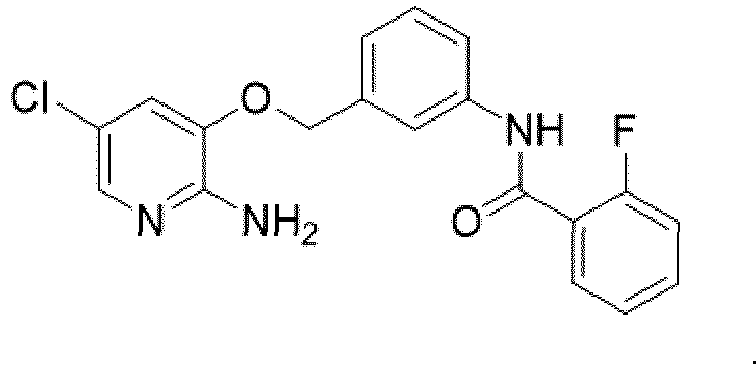
N-(3-(((2-amino-5-chloropyridin-3-y l)oxy)methyl)phenyl)-2-fluorobenza mide 372 25 
N-(3-(((2-amino-5-chloropyridin-3-y l)oxy)methyl)phenyl)benzamide 354 26 
N-(3-(((2-amino-5-chloropyridin-3-y l)oxy)methyl)phenyl)-5-fluoro-2-met hylbenzamide 386 27 
N-(3-(((2-amino-5-chloropyridin-3-y l)oxy)methyl)phenyl)-5-methylnicoti namide 369 28 
N-(3-(((2-amino-5-chloropyridin-3-y l)oxy)methyl)phenyl)-5-fluoronicoti namide 373 29 
N-(3-(((2-amino-5-chloropyridin-3-y l)oxy)methyl)phenyl)-5-chloronicoti namide 389 -

- To the dried three-necked flask was added R-methyl-CBS-oxazaborolidine (0.2 eq), BMS (10 M, 2.0 eq) under nitrogen atmosphere. The resulting mixture was diluted with DCM, and stir at 25°C for 30 min. Then cooled to -30 °C, (3-acetylphenyl)tert-butyl carbamate in DCM was added dropwise over 30min. The mixture was continued to stir for 3h at -30 °C. TLC was used to monitor the reaction. After the reation was completed, it was quenched by adding MeOH over 30 min. The resulting mixture was stirred at 80°C for 1h, then concentrated in vacuo, purified by column chromatography (PE/EA = 3 :1) and dried in vacuo to give the desired product as colorless oil. LC-MS[M+Na]-m/z: 260.
-

- Step1: To concentrated sulfuric acid (100mL) cooled to -10°C was added 2-amino-3-fluoro-5-chloropyridine (10 g, 68.2 mmol) with stirring. After dissolution, the mixture was continued to stir at -10°C for 15min. Then 50 mL 30% hydrogen peroxide solution was added slowly, and the reaction temperature was maintained below 0°C. The mixture was warmed to room temperature and stirred for 72h, then poured into 500 mL 13% ice brine with stirring and extracetd with 200mL EA for three times. The combined organic extracts were washed with saturated sodium bicarbonate solution until the aqueous phase was alkaline, dried with anhydrous sodium sulfate and concentrated in vacuo. The residue was purified by column chromatography to give the desired product 2-nitro-3-fluoro-5-chloropyridine (2.8g, 23.3%).
- Step2: To the solution of 31 (1.0g, 4.2 mmol) in dried THF (10mL) was added potassium tert-butoxide (517.0 mg, 4.6mmol), the miture was stirred at room temperature for 10min, then added 2-nitro-3-fluoro-5-chloropyridine (741.0 mg, 4.6 mmol), and stirred at room temperature for 1h. The mixture was quenched by the addition of 10g silica gel, and purified by column chromatography to give the desired product (1.50g, 95%).
- Step3: The suspension of 34 (1.50g, 3.8mmol), anhydrous ferric chloride (60 mg, 0.38mmol) and activated carbon(200mg) in 10mL MeOH was refluxed for 15min. Then hydrazine hydrate (80% aqueous solution, 600mg, 9.5mmol) was added and the resulting mixture was refluxed for 1h, poured into 100mL 13% brine and extracted with 50mL EA for three times. The combined organic extracts were washed with brine for three times, dried with anhydrous sodium sulfate and concentrated in vacuo to give white solid (1.0 g, 2.5 mmol). The solid was redissolved in 10mL methanol, and added 1mL concentrated hydrochloric acid. The resulting mixture was stirred at 50°C for 3h, then cooled to room temperature, and concentrated in vacuo.The residue was poured into 100mL saturated sodium bicarbonate solution, and extracted with 50mL EA for three times. The combined organic phase was dried with anhydrous sodium sulfate and concentrated to dryness in vacuo to give the desired product as yellow oil (602mg).
- Step4: Synthesis of compounds 54-71 was similar procedure to the example 3.
Table 2 Comps. No. Compound structure Compound name MS [M+1] 54 
(S)-N-(3-(1-((2-amino-5-chlo ropyridin-3-yl)oxy)ethyl)phe nyl)-3 -methylbenzamide 382 55 
(S)-N-(3-(1-((2-amino-5-chlo ropyridin-3-yl)oxy)ethyl)phe nyl)-3-chlorobenzamide 402 56 
(S)-N-(3-(1-((2-amino-5-chlo ropyridin-3-yl)oxy)ethyl)phe nyl)-2-fluoro-5-methylbenza mide 400 57 
(S)-N-(3-(1-((2-amino-5-chlo ropyridin-3-yl)oxy)ethyl)phe nyl)-2-chloro-5-methylbenza mide 416 58 
(S)-N-(3-(1-((2-amino-5-chlo ropyridin-3-yl)oxy)ethyl)phe nyl)-3-methoxybenzamide 398 59 
(S)-N-(3-(1-((2-amino-5-chlo ropyridin-3-yl)oxy)ethyl)phe nyl)-5-chloronicotinamide 403 60 
(S)-N-(3-(1-((2-amino-5-chlo ropyridin-3-yl)oxy)ethyl)phe nyl)-5-methylnicotinamide 383 61 
(S)-N-(3-(1-((2-amino-5-chlo ropyridin-3-yl)oxy)ethyl)phe nyl)-3-cyanobenzamide 393 62 
(S)-N-(3-(1-((2-amino-5-chlo ropyridin-3-yl)oxy)ethyl)phe nyl)-3-(trifluoromethoxy)ben zamide 452 63 
(S)-N-(3-(1-((2-amino-5-chlo ropyridin-3-yl)oxy)ethyl)phe nyl)-3 -(trifluoromethyl)benza mide 436 64 
(S)-N-(3-(1-((2-amino-5-chlo ropyridin-3-yl)oxy)ethyl)phe nyl)-2-chloro-3-methylbenza mide 416 65 
(S)-N-(3-(1-((2-amino-5-chlo ropyridin-3-yl)oxy)ethyl)phe nyl)-2,3-dichlorobenzamide 436 66 
(S)-N-(3-(1-((2-amino-5-chlo ropyridin-3-yl)oxy)ethyl)phe nyl)-2,5-dichlorobenzamide 436 67 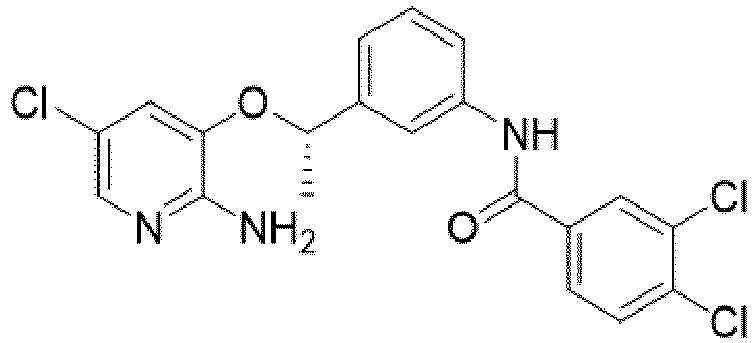
(S)-N-(3-(1-((2-amino-5-chlo ropyridin-3-yl)oxy)ethyl)phe nyl)-3,4-dichlorobenzamide 436 68 
(S)-N-(3-(1-((2-amino-5-chlo ropyridin-3-yl)oxy)ethyl)phe nyl)benzo[d] [1,3]dioxole-5-c arboxamide 412 69 
(S)-N-(3-(1-((2-amino-5-chlo ropyridin-3-yl)oxy)ethyl)phe nyl)-3-bromobenzamide 446 70 
(S)-N-(3-(1-((2-amino-5-chlo ropyridin-3-yl)oxy)ethyl)phe nyl)-3-cyclopropylbenzamide 408 71 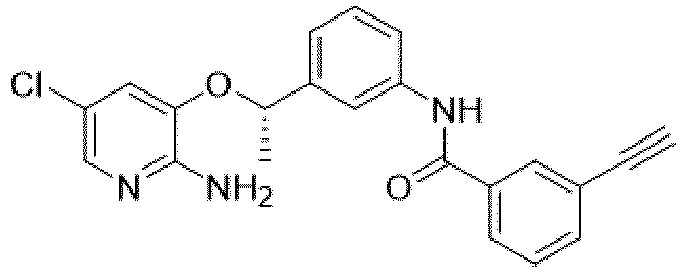
(S)-N-(3-(1-((2-amino-5-chlo ropyridin-3-yl)oxy)ethyl)phe nyl)-3-ethynylbenzamide 392 -
Table 3 Comps. No. Compound structure Compound name MS [M+1] 72 
(R)-N-(3-(1-((2-amino-5-chlor opyridin-3-yl)oxy)ethyl)phenyl )-3-methylbenzamide 382 73 
(R)-N-(3-(1-((2-amino-5-chlor opyridin-3-yl)oxy)ethyl)phenyl )-2-chloro-5-methylbenzamide 416 74 
(R)-N-(3-(1-((2-amino-5-chlor opyridin-3-yl)oxy)ethyl)phenyl )-3-methoxybenzamide 398 75 
(R)-N-(3-(1-((2-amino-5-chlor opyridin-3-yl)oxy)ethyl)phenyl )-3-cyanobenzamide 393 76 
(R)-N-(3-(1-((2-amino-5-chlor opyridin-3-yl)oxy)ethyl)phenyl )-2,5-dichlorobenzamide 436 77 
(R)-N-(3-(1-((2-amino-5-chlor opyridin-3-yl)oxy)ethyl)phenyl )-3-ethynylbenzamide 392 78 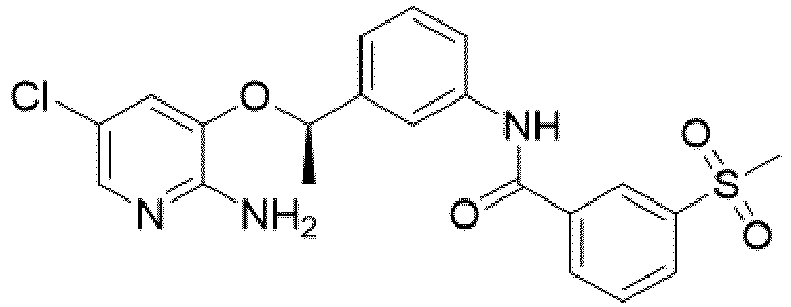
(R)-N-(3-(1-((2-amino-5-chlor opyridin-3-yl)oxy)ethyl)phenyl )-3-(methylsulfonyl)benzamide 446 79 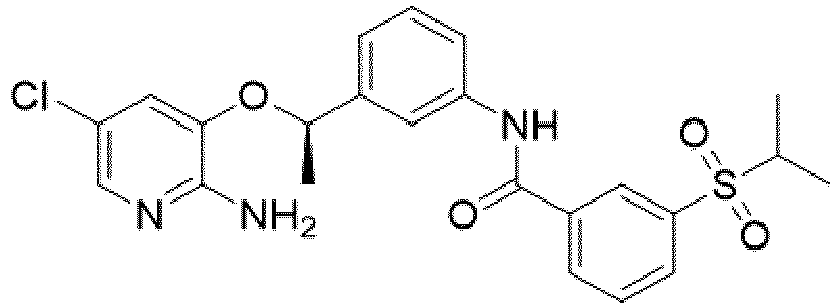
(R)-N-(3-(1-((2-amino-5-chlor opyridin-3-yl)oxy)ethyl)phenyl )-3-(isopropylsulfonyl)benzam ide 474 80 
(R)-N-(3-(1-((2-amino-5-chlor opyridin-3-yl)oxy)ethyl)phenyl )-3-(cyclopropylsulfonyl)benzamide 472 81 
(R)-N-(3-(1-((2-amino-5-chlor opyridin-3-yl)oxy)ethyl)phenyl )-3 -(dimethylphosphoryl)benza mide 444 82 
(R)-N-(3-(1-((2-amino-5-chlor opyridin-3-yl)oxy)ethyl)phenyl )-3-(dimethylamino)benzamide 411 83 
(R)-N-(3-(1-((2-amino-5-chlor opyridin-3-yl)oxy)ethyl)phenyl )-5-methylnicotinamide 383 84 
(R)-N-(3-(1-((2-amino-5-chlor opyridin-3-yl)oxy)ethyl)phenyl )-2-fluoro-5-methylbenzamide 400 85 
(R)-N-(3-(1-((2-amino-5-chlor opyridin-3-yl)oxy)ethyl)phenyl )-2-chloro-3-methylbenzamide 416 86 
(R)-N-(3-(1-((2-amino-5-chlor opyridin-3-yl)oxy)ethyl)phenyl )-3-cyclopropylbenzamide 408 87 
(R)-N-(3-(1-((2-amino-5-chlor opyridin-3-yl)oxy)ethyl)phenyl )-3-isopropylbenzamide 410 88 
(R)-N-(3-(1-((2-amino-5-chlor opyridin-3-yl)oxy)ethyl)phenyl )-3-isopropoxybenzamide 426 89 
(R)-N-(3-(1-((2-amino-5-chlor opyridin-3-yl)oxy)ethyl)phenyl )-3-(ethylsulfonyl)benzamide 460 90 
(R)-N-(3-(1-((2-amino-5-chlor opyridin-3-yl)oxy)ethyl)phenyl )-2-chloro-3-methoxybenzami de 432 91 
(R)-N-(3-(1-((2-amino-5-chlor opyridin-3-yl)oxy)ethyl)phenyl )-3-(1 -hydroxycyclopentyl)ben zamide 452 92 
(R)-N-(3-(1-((2-amino-5-chlor opyridin-3-yl)oxy)ethyl)phenyl )-4-(methylsulfonyl)benzamide 446 93 
(R)-N-(3-(1-((2-amino-5-chlor opyridin-3-yl)oxy)ethyl)phenyl )-3-(1-hydroxycyclobutyl)benzamide 438 94 
(R)-N-(3-(1-((2-amino-5-chlor opyridin-3-yl)oxy)ethyl)phenyl )-4-methylbenzamide 382 95 
(R)-N-(3-(1-((2-amino-5-chlor opyridin-3-yl)oxy)ethyl)-4-chl orophenyl)-2-chloro-3-methylb enzamide 450 96 
N-(3-((R)-1-((2-amino-5-chlor opyridin-3-yl)oxy)ethyl)phenyl )-3-((2-hydroxycyclohexyl)ami no)benzamide 481 97 
(R)-N-(5-(1-((2-amino-5-chlor opyridin-3-yl)oxy)ethyl)-2-flu orophenyl)-2-chloro-3-methylb enzamide 434 98 
(R)-N-(3-(1-((2-amino-5-chlor opyridin-3-yl)oxy)ethyl)phenyl )-3-(1-hydroxycyclohexyl)ben zamide 466 99 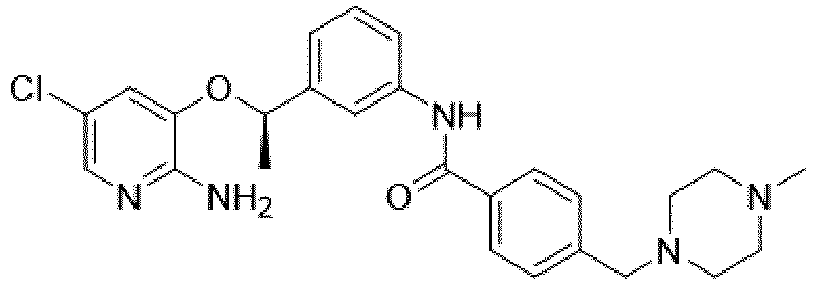
(R)-N-(3-(1-((2-amino-5-chlor opyridin-3-yl)oxy)ethyl)phenyl )-4-((4-methylpiperazin-1-yl)m ethyl)benzamide 480 100 
(R)-N-(3-(1-((2-amino-5-chlor opyridin-3-yl)oxy)ethyl)phenyl )-3 -(4-methylpiperazin-1-yl)be nzamide 466 101 
(R)-N-(3-(1-((2-amino-5-chlor opyridin-3-yl)oxy)ethyl)phenyl )-4-(4-methylpiperazin-1-yl)be nzamide 466 102 
(R)-N-(3-(1-((2-amino-5-chlor opyridin-3-yl)oxy)ethyl)phenyl )-2-methoxy-5-(methylsulfonyl )benzamide 476 103 
(R)-N-(3-(1-((2-amino-5-chlor opyridin-3-yl)oxy)ethyl)phenyl )-3 -((4-methylpiperazin-1-yl)m ethyl)benzamide 480 104 
(R)-N-(3-(1-((2-amino-5-chlor opyridin-3-yl)oxy)ethyl)phenyl )-3-(cyclopropylsulfonyl)benza mide 472 105 
(R)-N-(3-(1-((2-amino-5-chlor opyridin-3-yl)oxy)ethyl)phenyl )-3-(isopropylsulfonyl)benzam ide 474 106 
(R)-N-(3-(1-((2-amino-5-chlor opyridin-3-yl)oxy)ethyl)phenyl )-3-(cyclopentylsulfonyl)benza mide 500 107 
(R)-N-(3-(1-((2-amino-5-chlor opyridin-3-yl)oxy)ethyl)phenyl )quinoline-3-carboxamide 419 108 
(R)-N-(3-(1-((2-amino-5-chlor opyridin-3-yl)oxy)ethyl)phenyl )isoquinoline-6-carboxamide 419 109 
(R)-N-(3-(1-((2-amino-5-chlor opyridin-3-yl)oxy)ethyl)phenyl )quinoline-6-carboxamide 419 110 
(R)-N-(3-(1-((2-amino-5-chlor opyridin-3-yl)oxy)ethyl)phenyl )-3-(pyrrolidin-1-ylsulfonyl)be nzamide 501 111 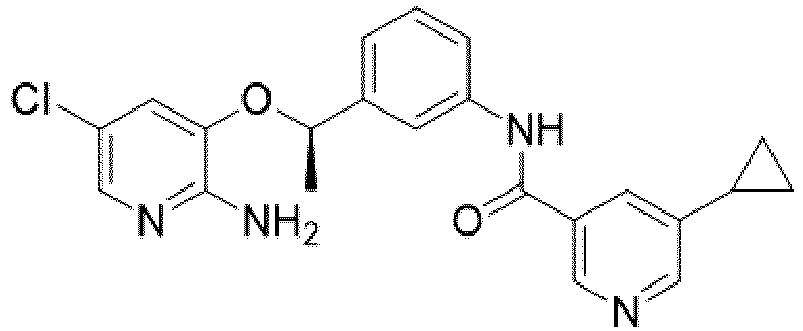
(R)-N-(3-(1-((2-amino-5-chlor opyridin-3-yl)oxy)ethyl)phenyl )-5-cyclopropylnicotinamide 409 112 
(R)-N-(5-(1-((2-amino-5-chlor opyridin-3-yl)oxy)ethyl)pyridi n-3-yl)-2-chloro-3-methylbenz amide 417 113 
(R)-N-(3-(1-((2-amino-5-chlor opyridin-3-yl)oxy)ethyl)phenyl )-3-(1-cyanocyclopropyl)benza mide 433 114 
(R)-N-(3-(1-((2-amino-5-chlor opyridin-3-yl)oxy)ethyl)phenyl )-3-cyclobutylbenzamide 422 115 
(R)-N-(3-(1-((2-amino-5-chlor opyridin-3-yl)oxy)ethyl)phenyl )-3-(trifluoromethyl)benzamid e 436 116 
(R)-N-(3-(1-((2-amino-5-chlor opyridin-3-yl)oxy)ethyl)phenyl )-3-(pyrrolidin-1-yl)benzamide 437 117 
(R)-N-(3-(1-((2-amino-5-chlor opyridin-3-yl)oxy)ethyl)phenyl )-2,3-dihydrobenzo[b]thiophen e-4-carboxamide 1,1-dioxide 458 118 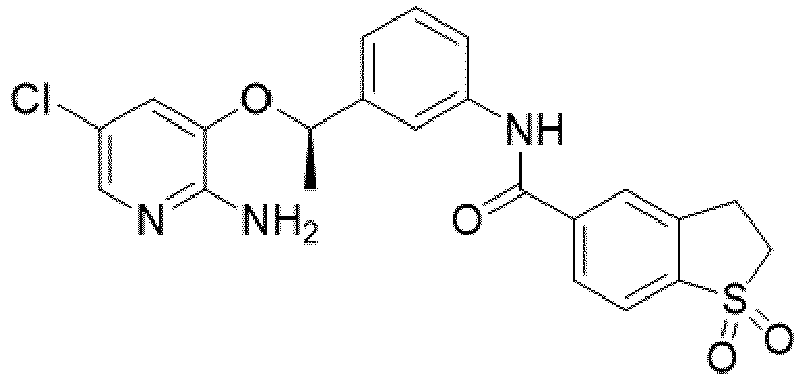
(R)-N-(3-(1-((2-amino-5-chlor opyridin-3-yl)oxy)ethyl)phenyl )-2,3-dihydrobenzo[b]thiophen e-5-carboxamide 1,1-dioxide 458 119 
(R)-N-(3-(1-((2-amino-5-chlor opyridin-3-yl)oxy)ethyl)phenyl )benzo[d][1,3]dioxole-5-carbo xamide 412 120 
(R)-N-(3-(1-((2-amino-5-chlor opyridin-3-yl)oxy)ethyl)phenyl )-5-fluoropicolinamide 387 121 
(R)-N-(3-(1-((2-amino-5-chlor opyridin-3-yl)oxy)ethyl)phenyl )-5-methylpicolinamide 383 122 
(R)-N-(3-(1-((2-amino-5-chlor opyridin-3-yl)oxy)ethyl)phenyl )-4-methylpicolinamide 383 123 
(R)-N-(3-(1-((2-amino-5-chlor opyridin-3-yl)oxy)ethyl)phenyl )-4-(trifluoromethyl)picolinami de 437 124 
(R)-N-(3-(1-((2-amino-5-chlor opyridin-3-yl)oxy)ethyl)phenyl )-5-(trifluoromethyl)picolinami de 437 125 
(R)-N-(3-(1-((2-amino-5-chlor opyridin-3-yl)oxy)ethyl)phenyl )-6-(trifluoromethyl)picolinami de 437 126 
(R)-N-(3-(1-((2-amino-5-chlor opyridin-3-yl)oxy)ethyl)phenyl )-4-methyl-3 -(methyl sulfonyl) benzamide 460 127 
(R)-N-(5-(1-((2-amino-5-chlor opyridin-3-yl)oxy)ethyl)-2-met hylphenyl)-3-(trifluoromethyl) benzamide 450 128 
(R)-N-(3-(1-((2-amino-5-chlor opyridin-3-yl)oxy)ethyl)phenyl )-3-(difluoromethyl)benzamide 418 129 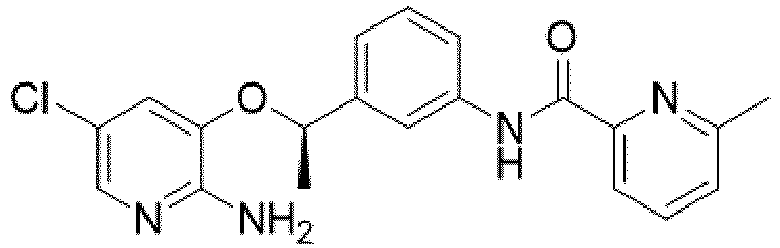
(R)-N-(3-(1-((2-amino-5-chlor opyridin-3-yl)oxy)ethyl)phenyl )-6-methylpicolinamide 383 130 
(R)-N-(3-(1-((2-amino-5-chlor opyridin-3-yl)oxy)ethyl)phenyl )-4-chloro-3-methylbenzamide 416 131 
(R)-N-(3-(1-((2-amino-5-chlor opyridin-3-yl)oxy)ethyl)phenyl )-4-fluoro-3-methylbenzamide 400 132 
(R)-N-(3-(1-((2-amino-5-chlor opyridin-3-yl)oxy)ethyl)phenyl )-3,4-dimethylbenzamide 396 133 
(R)-N-(3-(1-((2-amino-5-chlor opyridin-3-yl)oxy)ethyl)phenyl )-2,3-dihydro-1H-indene-5-car boxamide 408 134 
(R)-N-(3-(1-((2-amino-5-chlor opyridin-3-yl)oxy)ethyl)phenyl )-2,3-dihydrobenzo[b]thiophen e-6-carboxamide 1,1-dioxide 458 135 
(R)-N-(3-(1-((2-amino-5-chlor opyridin-3-yl)oxy)ethyl)phenyl )-3-fluoro-5-methylbenzamide 400 136 
(R)-N-(3-(1-((2-amino-5-chlor opyridin-3-yl)oxy)ethyl)phenyl )-3-chloro-5-methylbenzamide 416 137 
(R)-N-(3-(1-((2-amino-5-chlor opyridin-3-yl)oxy)ethyl)phenyl )-3,5-dimethylbenzamide 396 138 
(R)-N-(5-(1-((2-amino-5-chlor opyridin-3-yl)oxy)ethyl)-2-met hylphenyl)-3-(methylsulfonyl) benzamide 460 139 
(R)-N-(3-(1-((2-amino-5-chlor opyridin-3-yl)oxy)ethyl)-4-flu orophenyl)-3-(methylsulfonyl) benzamide 464 140 
(R)-N-(3-(1-((2-amino-5-chlor opyridin-3-yl)oxy)ethyl)-4-chl orophenyl)-3 -(methylsulfonyl) benzamide 480 141 
(R)-N-(6-(1-((2-amino-5-chlor opyridin-3-yl)oxy)ethyl)pyridi n-2-yl)-3-methylbenzamide 383 142 
(R)-N-(3-(1-((2-amino-5-chlor opyridin-3-yl)oxy)ethyl)-4-met hylphenyl)-3-(methylsulfonyl) benzamide 460 143 
(R)-N-(3-(1-((2-amino-5-chlor opyridin-3-yl)oxy)ethyl)-2-met hylphenyl)-3-(methylsulfonyl) benzamide 460 144 
(R)-N-(4-(1-((2-amino-5-chlor opyridin-3-yl)oxy)ethyl)pyridi n-2-yl)-3-methylbenzamide 383 145 
(R)-N-(5-(1-((2-amino-5-chlor opyridin-3-yl)oxy)ethyl)-2-chl orophenyl)-3 -(methylsulfonyl) benzamide 480 146 
(R)-N-(5-(1-((2-amino-5-chlor opyridin-3-yl)oxy)ethyl)-2-flu orophenyl)-3 -(methylsulfonyl) benzamide 464 147 
(R)-N-(3-(1-((2-amino-5-chlor opyridin-3-yl)oxy)ethyl)phenyl )-3-(methylsulfonyl)-4-(trifluor omethyl)benzamide 514 148 
(R)-N-(3-(1-((2-amino-5-chlor opyridin-3-yl)oxy)ethyl)phenyl )benzo[b]thiophene-5-carboxa mide 1,1-dioxide 456 149 
(R)-N-(3-(1-((2-amino-5-chlor opyridin-3-yl)oxy)ethyl)phenyl )benzo[b]thiophene-6-carboxa mide 1,1-dioxide 456 150 
(R)-N-(3-(1-((2-amino-5-chlor opyridin-3-yl)oxy)ethyl)phenyl )-3-(methylsulfonyl)-5-(trifluor omethyl)benzamide 514 151 
(R)-N-(3-(1-((2-amino-5-chlor opyridin-3-yl)oxy)ethyl)phenyl )-3,4-dimethyl-5-(methylsulfon yl)benzamide 474 152 
(R)-N-(3-(1-((2-amino-5-chlor opyridin-3-yl)oxy)ethyl)phenyl )-1,5-dimethyl-1H-pyrazole-3-carboxamide 386 153 
(R)-N-(3-(1-((2-amino-5-chlor opyridin-3-yl)oxy)ethyl)phenyl )-5-methylthiazole-2-carboxam ide 389 154 
(R)-N-(3-(1-((2-amino-5-chlor opyridin-3-yl)oxy)ethyl)phenyl )-1-(tert-butyl)-1H-pyrazole-4-carboxamide 414 155 
(R)-N-(3-(1-((2-amino-5-chlor opyridin-3-yl)oxy)ethyl)phenyl )-1-isopropyl-1H-pyrazole-4-c arboxamide 400 156 
(R)-N-(3-(1-((2-amino-5-chlor opyridin-3-yl)oxy)ethyl)phenyl )-1-methyl-1H-indazole-6-carb oxamide 422 157 
(R)-N-(3-(1-((2-amino-5-chlor opyridin-3-yl)oxy)ethyl)phenyl )benzofuran-6-carboxamide 408 158 
(R)-N-(3-(1-((2-amino-5-chlor opyridin-3-yl)oxy)ethyl)phenyl )-1-methyl-1H-indole-6-carbox amide 421 159 
(R)-N-(3-(1-((2-amino-5-chlor opyridin-3-yl)oxy)ethyl)phenyl )-5-(tert-butyl)isoxazole-3-carb oxamide 415 160 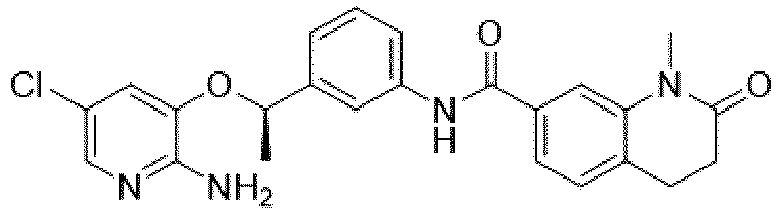
(R)-N-(3-(1-((2-amino-5-chlor opyridin-3-yl)oxy)ethyl)phenyl )-1-methyl-2-oxo-1,2,3,4-tetra hydroquinoline-7-carboxamide 451 161 
(R)-N-(3-(1-((2-amino-5-chlor opyridin-3-yl)oxy)ethyl)phenyl )-1-methyl-1,2,3,4-tetrahydroq uinoline-7-carboxamide 437 162 
(R)-N-(3-(1-((2-amino-5-chlor opyridin-3-yl)oxy)ethyl)phenyl )-1-methylindoline-6-carboxa mide 423 163 
(R)-N-(3-(1-((2-amino-5-chlor opyridin-3-yl)oxy)ethyl)phenyl )-1-methyl-2-oxoindoline-6-ca rboxamide 437 164 
(R)-N-(3-(1-((2-amino-5-chlor opyridin-3-yl)oxy)ethyl)phenyl )-1,3-dihydroisobenzofuran-5-carboxamide 410 -

- Step1: To the solution of 165 (2.64 g, 10.0 mmol), 166 (3.12 g, 15.0 mmol) and x-phos (954 mg, 2.0 mmol) in dioxane (100 mL) was added the solution of K3PO4 (6.57 g, 30.0 mmol) in water (10 mL). The resulting mixture was degassed with nitrogen for 3 times, and palladium acetate (225 mg, 1.0 mmol) was added, then degassed again. The reaction mixture was then heated at 110 °C for 24 h, cooled to room temperature, poured into 13% brine and extracted with EA twice. The combined organic layers was washed with brine, dried, filtered and concentrated. The crude product was purified by column chromatography to give brown oil.
- Step2: To the solution of 167 (62 mg, 0.2 mmol), ArCOOH (1.2eq), HATU(1.5eq) in DCM (2 mL) was added TEA (3.0eq). The reaction mixture was stirred at room temperature for 16h. The crude product was purified by column chromatography or PTLC.
Table 4 Comps. No. Compound structure Compound name MS [M+1] 168 
(R)-N-(3-(1-((2-amino-5-(1-met hyl-1H-pyrazol-4-yl)pyridin-3-yl )oxy)ethyl)phenyl)-3 -(methyl sul fonyl)benzamide 492 169 
(R)-N-(3-(1-((2-amino-5-(1-met hyl-1H-pyrazol-4-yl)pyridin-3-yl )oxy)ethyl)phenyl)-3 -(trifluorom ethyl)benzamide 482 170 
(R)-N-(3-(1-((2-amino-5-(1-met hyl-1H-pyrazol-4-yl)pyridin-3-yl )oxy)ethyl)phenyl)-3,4-dimethyl benzamide 442 171 
(R)-N-(3-(1-((2-amino-5-(1-met hyl-1H-pyrazol-4-yl)pyridin-3-yl )oxy)ethyl)phenyl)-3,5-dimethyl benzamide 442 172 
(R)-N-(3-(1-((2-amino-5-(1-met hyl-1H-pyrazol-4-yl)pyridin-3-yl )oxy)ethyl)phenyl)-4-methyl-3-( methylsulfonyl)benzamide 506 173 
(R)-N-(3-(1-((2-amino-5-(1-met hyl-1H-pyrazol-4-yl)pyridin-3-yl )oxy)ethyl)phenyl)-2,3-dihydrob enzo[b]thiophene-6-carboxamid e 1,1-dioxide 504 174 
(R)-N-(3-(1-((2-amino-5-(1-met hyl-1H-pyrazol-4-yl)pyridin-3-yl )oxy)ethyl)phenyl)-3-cyclopropy lbenzamide 454 175 
(R)-N-(3-(1-((2-amino-5-(1-met hyl-1H-pyrazol-4-yl)pyridin-3-yl )oxy)ethyl)phenyl)-3-(methylsul fonyl)-4-(trifluoromethyl)benza mide 560 176 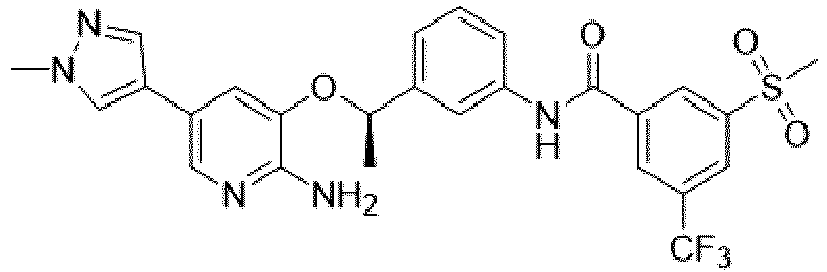
(R)-N-(3-(1-((2-amino-5-(1-met hyl-1H-pyrazol-4-yl)pyridin-3-yl )oxy)ethyl)phenyl)-3-(methylsul fonyl)-5-(trifluoromethyl)benza mide 560 177 
(R)-N-(3-(1-((2-amino-5-(1-met hyl-1H-pyrazol-4-yl)pyridin-3-yl )oxy)ethyl)phenyl)-3,4-dimethyl-5-(methylsulfonyl)benzamide 520 178 
(R)-N-(3-(1-((2-amino-5-(1-met hyl-1H-pyrazol-4-yl)pyridin-3-yl )oxy)ethyl)phenyl)-3-(dimethyla mino)benzamide 457 179 
(R)-N-(3-(1-((2-amino-5-(1-met hyl-1H-pyrazol-4-yl)pyridin-3-yl )oxy)ethyl)phenyl)-3-(dimethyla mino)-4-methylbenzamide 471 180 
(R)-N-(3-(1-((2-amino-5-(1-met hyl-1H-pyrazol-4-yl)pyridin-3-yl )oxy)ethyl)phenyl)-3 -(methylthi o)benzamide 460 181 
(R)-N-(3-(1-((2-amino-5-(1-met hyl-1H-pyrazol-4-yl)pyridin-3-yl )oxy)ethyl)phenyl)-4-(methylthi o)benzamide 460 182 
(R)-N-(3-(1-((2-amino-5-(1-met hyl-1H-pyrazol-4-yl)pyridin-3-yl )oxy)ethyl)phenyl)-4-methyl-3-( methylthio)benzamide 474 183 
(R)-N-(3-(1-((2-amino-5-(1-met hyl-1H-pyrazol-4-yl)pyridin-3-yl )oxy)ethyl)phenyl)-2',3'-dihydro spiro[cyclopropane-1,1'-indene]-6'-carboxamide 480 184 
(R)-N-(3-(1-((2-amino-5-(1-met hyl-1H-pyrazol-4-yl)pyridin-3-yl )oxy)ethyl)phenyl)-1-methylindo line-6-carboxamide 469 185 
(R)-N-(3-(1-((2-amino-5-(1-met hyl-1H-pyrazol-4-yl)pyridin-3-yl )oxy)ethyl)phenyl)-4-chloro-3-(d imethylamino)benzamide 491 186 
methyl (R)-3-((3-(1-((2-amino-5-(1-met hyl-1H-pyrazol-4-yl)pyridin-3-yl )oxy)ethyl)phenyl)carbamoyl)be nzoate 472 187 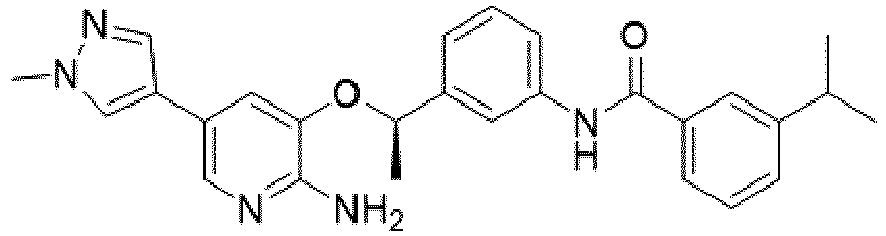
(R)-N-(3-(1-((2-amino-5-(1-met hyl-1H-pyrazol-4-yl)pyridin-3-yl )oxy)ethyl)phenyl)-3-isopropylb enzamide 456 188 
(R)-N-(3-(1-((2-amino-5-(1-met hyl-1H-pyrazol-4-yl)pyridin-3-yl )oxy)ethyl)phenyl)-2,3-dihydro-1H-indene-5-carboxamide 454 189 
(R)-N-(3-(1-((2-amino-5-(1-met hyl-1H-pyrazol-4-yl)pyridin-3-yl )oxy)ethyl)phenyl)-3-ethylbenzamide 442 190 
(R)-N-(3-(1-((2-amino-5-(1-met hyl-1H-pyrazol-4-yl)pyridin-3-yl )oxy)ethyl)phenyl)-5-isopropylni cotinamide 457 191 
(R)-N-(3-(1-((2-amino-5-(1-met hyl-1H-pyrazol-4-yl)pyridin-3-yl )oxy)ethyl)phenyl)-1-methyl-1H -indole-6-carboxamide 467 192 
(R)-N-(3-(1-((2-amino-5-(1-met hyl-1H-pyrazol-4-yl)pyridin-3-yl )oxy)ethyl)phenyl)benzo[b]thiop hene-6-carboxamide 470 193 
(R)-N-(3-(1-((2-amino-5-(1-met hyl-1H-pyrazol-4-yl)pyridin-3-yl )oxy)ethyl)phenyl)-3,3-dimethyl -1,3-dihydroisobenzofuran-5-car boxamide 484 194 
(R)-N-(3-(1((2-amino-5-(1-met hyl-1H-pyrazol-4-yl)pyridin-3-yl )oxy)ethyl)phenyl)-2H-spiro[ben zofuran-3,1'-cyclopropane]-5-car boxamide 482 195 
(R)-N-(3-(1-((2-amino-5-(1-met hyl-1H-pyrazol-4-yl)pyridin-3-yl )oxy)ethyl)phenyl)-2,3-dihydrob enzofuran-5-carboxamide 456 -

Table 5 Comps. No. Compound structure Compound name MS [M+1] 199 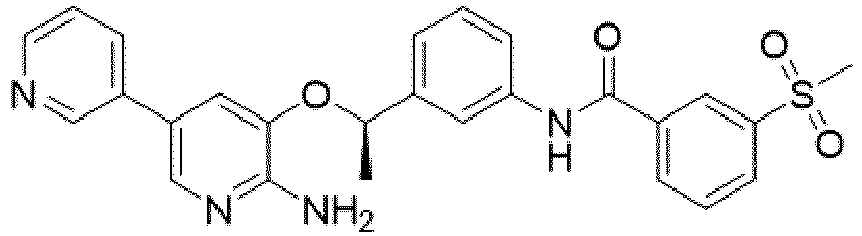
(R)-N-(3-(1-((6-amino-[3,3'-bipyridin]-5-yl)oxy)ethyl)phenyl)-3-(methylsulfonyl)benzamide 489 200 
(R)-N-(3-(1-((6-amino-[3,3'-bipyridin]-5-yl)oxy)ethyl)phenyl)-3-cyclopropylbenzamide 451 201 
(R)-N-(3-(1-((6-amino-[3,3'-bipyridin]-5-yl)oxy)ethyl)phenyl)-3-(trifluoromethyl)benzamide 479 202 
(R)-N-(3-(1-((6-amino-[3,3'-bipyridin]-5-yl)oxy)ethyl)phenyl)-3-methylbenzamide 425 203 
(R)-N-(3-(1-((6-amino-[3,3'-bipyridin]-5-yl)oxy)ethyl)phenyl)-3,4-dimethylbenzamide 439 204 
(R)-N-(3-(1-((6-amino-[3,3'-bipyridin]-5-yl)oxy )ethyl)phenyl)-3,5-dimethylbenzamide 439 205 
(R)-N-(3-(1-((6-amino-[3,3'-bipyridin]-5-yl)oxy)ethyl)phenyl)-3-(dimethylamino)benzamide 454 206 
(R)-N-(3-(1-((6-amino-[3,3'-bipyridin]-5-yl)oxy)ethyl)phenyl)-3-(dimethylamino)-4-methylbenzamide 468 207 
(R)-N-(3-(1-((6-amino-[3,3'-bipyridin]-5-yl)oxy)ethyl)phenyl)-3-(methylthio)benzamide 457 208 
(R)-N-(3-(1-((6-amino-[3,3'-bipy ridin]-5-yl)oxy)ethyl)phenyl)-1-methylindoline-6-carboxamide 466 -

- Step 1: Similar procedure to step 1 of example 7.
- Step 2: To the solution of substrate (0.2 mmol) in methanol was added concentrated hydrochloric acid (1 mL). The reaction mixture was stirred at 50°C for 2h, then concentrated under reduced pressure. The residue was slurried with ether and the solid was collected by filtration to give the desired product.
-
Table 6 Comps. No. Compound structure Compound name MS [M+1] 212 
(R)-N-(3-(1-((2-amino-5-(1-cyclopropyl-1H-pyrazol-4-yl)pyridin-3-yl)oxy)ethyl)phenyl)-3-(dimethylamino)benzamide 483 213 
(R)-N-(3-(1-((2-amino-5-(1-ethyl-1H-pyrazol-4-yl)pyridin-3-yl)oxy)ethyl)phenyl)-3-(dimethylamino)benzamide 471 214 
(R)-N-(3-(1-((2-amino-5-(1-methylpiperidin-4-yl)pyridin-3-yl)oxy)ethyl)phenyl)-3-(dimethylamino)benzamide 474 215 
(R)-N-(3-(1-((2-amino-5-(4-hydroxy-3-methoxyphenyl)pyridin-3-yl)oxy)ethyl)phenyl)-3-(dimethylamino)benzamide 499 216 
(R)-N-(3-(1-((6-amino-6'-(4-methylpiperazin-1-yl)-[3,3'-bipyridi n]-5-yl)oxy)ethyl)phenyl)-3-(dimethylamino)benzamide 552 217 
(R)-N-(3-(1-((6-amino-[3,4'-bipyridin]-5-yl)oxy)ethyl)phenyl)-3-(dimethylamino)benzamide 454 -

- Synthesis of compounds 222-226 is similar procedures to compounds 54-71.
Table 7 Comps. No. Compound structure Compound name MS [M+1] 222 
(S)-3-(1-((2-amino-5-chloropyridin-3-yl)oxy)ethyl)-N-(m-tolyl)benzamide 382 223 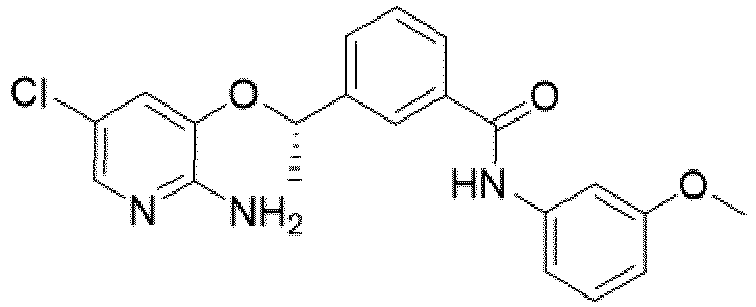
(S)-3-(1-((2-amino-5-chloropyridin-3-yl)oxy)ethyl)-N-(3-methoxyphenyl)benzamide 398 224 
(S)-3-(1-((2-amino-5-chloropyridin-3-yl)oxy)ethyl)-N-(3-chlorophenyl)benzamide 402 225 
(S)-3-(1-((2-amino-5-chloropyridin-3-yl)oxy)ethyl)-N-(3-cyanophenyl)benzamide 393 226 
(S)-3-(1-((2-amino-5-chloropyridin-3-yl)oxy)ethyl)-N-(3-ethylphenyl)benzamide 396 -

- Step 1:To the solution of 3-aminoacetophenone (5.0 g, 37.0 mmol) in DCM (60mL) was added 3- methyl benzoic acid (5.0 g, 37.0 mmol), DMAP (0.9 g, 7.4 mmol) and EDCI (10.6 g, 55.5 mmol) successively. Cooled and added DIPEA (14.3 g, 111 mmol) dropwise. The reaction mixture was warmed to room temperature for overnight, diluted with EA, and washed with water once, diluted hydrochloric acid for three times and brine once successively. The organic layer was dried with anhydrous sodium sulfate and concentrated in vacuo to give white solid (9.2 g, 98%).
- Step 2: To the solution of 228 (2.0 g, 7.9 mmol) in methanol (20 mL) was added NaBH4 (320 mg, 8.4 mmol) carefully in an ice bath. After stirring at room temperature for 1h, the reaction was quenched with water and extracted with EA. The combined organic layers were dried with anhydrous sodium sulfate and concentrated under reduced pressure. The crude product was used directly in the next step without further purification.
- Step 3: To the solution of 229 (100 mg, 0.39 mmol) in dried THF (10mL) was added t-BuOK (44 mg, 0.39 mmol). The mixture was stirred at room temperature for 10min, then was added 2-nitro-3-fluoro-5-chloropyridine(69 mg, 0.39 mmol) and continued to stirred at room temperature for 1h. The reaction was quenched with silica gel (1g), and purified by column chromatography to give the desired product (153 mg, 95%).
- Step 4:To the solution of 230 (153mg, 0.37mmol) in methanol (5mL) was added anhydrous ferric chloride (6mg), activated carbon (20mg). The resulting mixture was refluxed for 15min, then was added hydrazine hydrate (80% aqueous solution, 0.1mL) and refluxed for 1h. The reaction mixture was poured into brine (20 mL), extracted with EA thrice. The combined organic layers were washed with brine, dried with anhydrous sodium sulfate and concentrated in vacuo to give the desired product (118 mg, 84%).
-

- Step1: To the solution of 3 (853mg, 5.0mmol) and K2CO3 (1.037g, 7.5mmol) in DMF (10mL) was added MeI (1.065g, 7.5mmol). The reaction mixture was stirred at room temperature for overnight. The mixture was poured into brine, extracted with EA, and concentrated under reduced pressure. The crude product was used directly in the next step without further purification.
- Step 2: To the suspension of the product of step 1 in water (20mL) was added KOH (1.4 g, 25 mmol). The reaction mixture was refluxed for 16h. After cooling to room temperature, the mixture was adjusted to PH∼6 with diluted hydrochloric acid, and extracted with EA. The combined organic layers were dried, and concentrated in vacuo. The crude product was purified by column chromatography to give the desired product as white solid (735mg, 93% for two steps).
- Step 3: To the flask was added 233 (317 mg, 2.0 mmol), CsCO3 (978 mg, 3.0 mmol) and acetone (20 mL). Then 234 (648 mg, 3.0 mmol) was added with stirring. The resulting mixture was refluxed for 3h. After cooling, the solvent was removed under reduced pressure. The residue was added water, and extracted with EA. The combined organic layers were dried with anhydrous sodium sulfate and concentrated in vacuo. The crude was purified by column chromatography (PE/EA=1:1) to give white solid (485 mg, 83%). The solid was redisolved in EtOH (20 mL) and to the solution was added SnCl2 (1.86 g, 8.3 mmol) and diluted hydrochloric acid (0.5 mL). The resulting mixture was refluxed for 3h, then cooled, and diluted with ice water. The mixture was adjusted to PH∼14 with Sodium hydroxide, and extracted with EA thrice. The combined organic extracts were washed with brine, dried with anhydrous sodium sulfate, filtered, and concentrated under reduced pressure. The crude was purified by column chromatography (PE/EA=1:1) to give white solid (345 mg, 76%).
- Step 4: Similar procedure to example 3 was followed to arrive at the title compound, with the LC-MS[M+H]-m/z 398.
-

- Similar procedure to the example 3 was followed to arrive at the title compound, with LC-MS[M+H]-m/z 334.
-

- Step 1: To 238 (5.0 g, 26.2 mmol) was added SOCl2 (10 mL), the mixture was refluxed for overnight. After cooling, SOCl2 was removed under reduced pressure and the residual SOCl2 was removed by azeotropic distillation with toluene. The crude product obtained was used directly in the next step.
- Step 2: To the ice-cold solution of 240 (4.0 g, 26.2 mmol), TEA (5.3 g, 52.4 mmol) in DCM (50 mL) was added 239 in DCM (20 mL) dropwise. The resulting mixture was warmed to room temperature for overnight, then washed with water thrice, dried with anhydrous sodium sulfate, filtered, and concentrated in vacuo. The residue was purified by column chromatography (PE/EA=4:1) to give white solid (6.2 g, 73%).
- Step 3: To the suspension of LiAlH4 (1.9 g, 50 mmol) in dioxane (25mL) was added 241 (1.63 g, 5.0 mmol) in dioxane (10 mL) dropwise at 10°C. The reaction mixture was refluxed for overnight, then cooled in ice bath and was carefully added 15% Sodium hydroxide aqueous solution (25 mL) dropwise. The resulting mixture was warmed to room temperature and stirred for 1h. The solid formed was filtered off, and washed with EA. The organic solution was dried and concentrated in vacuo. The residue was purified by column chromatography to give viscous liquid (327 mg, 23%).
- Step 4: Similar procedure to steps 3 and 4 of the example 12 was followed to arrive at the title compound, with the LC-MS[M+H]-m/z 410.
-

- Step1: To the suspension of 244 (5.0 g, 32.9 mmol) in MeCN was added K2CO3 (6.8 g, 49.4 mmol) and 4-Methoxybenzylchloride (7.7 g, 49.4 mmol). The reaction was refluxed for overnight. The mixture was cooled down, poured into water, and extracted with EA. The combined organic layers were washed with water, dried, and concentrated. The crude was purified by column chromatography to give white solid (7.5 g, 83%).
- Step2: To the solution of 245 (1.0 g, 3.7 mmol) in MeOH (10 mL), was added NaBH4 (141 mg, 3.7 mmol). The reaction mixture was stirred for 0.5h, then diluted with water, and extracted with EA. The combined organic layers were dried with anhydrous Na2SO4 and concentrated under reduced pressure. The crude was used directly in the next step without further purification.
- Similar procedure of steps 3 and 4 to the example 2 was followed to arrive at the title compound, with the LC-MS[M+H]-m/z 401.
-

- Step1: To the solution 245 (1.0 g, 3.7 mmol) in DCM (20 mL) was added 3-Chloroperoxybenzoic acid (1.3 g, 7.4 mmol), and the reaction mixture was stirred for overnight. The insolubles was filtered off, and washed with sodium carbonate solution twice. The filtrate was dried and concentrated, then MeOH (20 mL) and MeONa (500 mg, 9.3 mmol) was added and the mixture was stirred for overnight. Most of the solvent was removed under reduced pressure and the residue was added water, adjusted to PH∼4-5 with diluted hydrochloric acid and extracted with EA. The combined organic layers were dried, concentrated and the residue was purified by column chromatography to give white solid (547 mg, 57%).
-

- Similar procedure to steps 1 and 3 of the example 18 was followed to arrive at compound 253 with LC-MS[M+H]-m/z 369.
-

- Similar procedure to step 3 of the example 12 was followed to arrive at compound 254 with LC-MS[M+H]-m/z 402.
-

- Similar procedure to step 3 of the example 18 was followed to arrive at compound 255 with LC-MS[M+H]-m/z 388.
- Similar procedure to the example 18 was followed to arrive at compounds 256-258.
Table 8 Comps. No. Compound structure Compound name MS [M+1] 256 
(R)-N-(3 -(1 -((3 -amino-6-chlorop yrazin-2-yl)oxy)ethyl)phenyl)-3-cyclopropylbenzamide 409 257 
(R)-N-(3 -(1 -((3 -amino-6-chlorop yrazin-2-yl)oxy)ethyl)phenyl)-3-methylbenzamide 383 258 
(S)-N-(3-(1-((3-amino-6-chlorop yrazin-2-yl)oxy)ethyl)phenyl)-3-methylbenzamide 383 -

- Step 1: To a stirred solution of 4 (1.45 g, 10.0 mmol), cesium carbonate (6.52 g, 20.0 mmol) in acetone (50 mL) was added 259 (3.24 g, 20 mmol). The resulting mixture was refluxed for overnight. After cooling, the reaction mixture was poured into brine and extracted with ethyl acetate. The combined organic layers were dried by anhydrous sodium sulfate and concentrated in vacuum. The residue was purified by column chromatography to give the desired product as yellow solid (1.65 g, 61%).
- Step 2: Sodium hydride (60%, 200 mg, 5.0 mmol) was added to 4-methoxybenzyl alcohol (2 mL) with ice bath cooled. The resulting mixture was stirred for 10 minutes, and then 260 (135 mg, 0.5 mmol) was added. The reaction was stirred at 100°C for overnight. After cooling to room temperature, silica gel was added and the resulting mixture was concentrated under reduced pressure. The residue was purified by column chromatography to give the desired product as white solid (65 mg, 35%). LC-MS[M+H]-m/z 372.
-

- Step 1: Methyltriphenylphosphine bromide (1.96 g, 5.5 mmol) and sodium hydride (60%, 220 mg, 5.5 mmol) were added to anhydrous tetrahydrofuran under nitrogen atmosphere and the mixuture was stirred at 25°C for 1 hour. Then to the mixture was add 245 (1.36 g, 5 mmol) and this was stirred for 16 hours at 25 °C. The reaction was quenched with water, and the resulting mixture was extracted with ethyl acetate. The combined organic layers were dried with anhydrous sodium sulfate, concentrated under reduced pressure, and the crude was purified by column chromatography (PE: EA = 20:1) to give the desired product as white solid (1.22 g, 90%). LC-MS[M+Na]-m/z 293.
- Step 2: To a stainless steel tube was added 5-chloro-3-bromo-2-aminopyridine (104 mg, 0.5 mmol), 263 (203 mg, 0.75 mmol) and DMF (5 mL). The mixture was stirred and degassed with nitrogen, after 5 minutes Pd(dppf)Cl2CH2Cl2 (41 mg, 0.05 mmol), triethylamine (152 mg, 1.5 mmol) was added successively. The tube was sealed, and heated at 150°C for overnight. After cooling, to the reaction solution was added brine and the resulting mixture was extracted with ethyl acetate. The combined organic phase was washed with brine twice, dried and concentrated. The residue was purified by column chromatography (PE: EA = 2:1)to give white solid (65 mg, 33%). LC-MS[M+H]-m/z 397.
-

- Step 1: To the solution of Compound 229 (2.0 g, 7.8 mmol) in methane dichloride (40 mL) was added triethylamine (1.58 g, 15.6 mmol), and methyl sulfonyl chloride (1.08 g, 9.4 mmol) was added dripwise with ice bath cooled. The resulting mixture was warmed to room temperature and reacted for overnight. The reaction mixture was washed with water for one time and washed with saturated sodium bicarbonate solution for two times. The organic layer was dried with anhydrous sodium sulfate and concentrated in vacuum. After cooling, to the residue was added DBU (10 mL) and the mixture was stirred at 50°C for overnight. After cooling, water was added and the mixture was extracted with ethyl acetate. The combined organic phase was washed with diluted hydrochloric acid twice, dried, concentrated in vacuum, and the residue was purified by column chromatography to give white solid (854 mg, 46%).
- Step 2: Similar procedure to step 2 of the example 23 was followed to arrive at compound 267 with LC-MS[M+H]-m/z 364.
-

- Step 1: To the solution of 267 (200 mg, 0.55 mmol) and DMAP (269 mg, 2.2 mmol) in DMF (10mL) was added Boc2O (480 mg, 2.2 mmol) dropwise. The reaction mixture was stirred at 50°C for 20h, then poured into brine and extracted with ethyl acetate. The combined organic layers were washed three times with brine, dried and concentrated under reduced pressure. The residue was purified by column chromatography to give the desired product as yellow solid (157 mg, 43%).
- Step 2: Fresh distilled dichloromethane (5.0 mL) was added to the Schlenk tube at room temperature under nitrogen atmosphere, and then diethyl zinc solution (1.0 mL, 1.0 mmol) (1.0 M in hexane) was added. After cooling for 10 minutes at - 40°C, a solution of diiodomethane (540 mg, 2.0 mmol) in dichloromethane (5.0 mL) was added dropwise. After reacting at -40°C for 1h, a solution of trichloroacetic acid (16 mg, 0.1 mmol) and DME (45 mg, 0.5 mmol) in dichloromethane (1 mL) was added and the reaction temperature was warmed to - 15 °C and stirred for 1 h. At this temperature, to the reaction solution was added a solution of 268 (133 mg, 0.2 mmol) in dichloromethane (5 mL) dropwise. Then it was warmed to 25 °C and reacted for 2h. The reaction mixture was quenched with saturated sodium bicarbonate solution, stirred at room temperature for 20 minutes, diluted with water, and extracted with dichloromethane twice. The combined organic layers were washed with saturated ammonium chloride solution, sodium sulfite solution, sodium bicarbonate and brine successively, dried, filtered and concentrated. The residue was purified by column chromatography to give the desired product as light yellow solid (68 mg, 50%).
- Step 3: To the solution of 269 (68 mg, 0.1 mmol) in methanol (5 mL) was added concentrated hydrochloric acid (0.2 mL). The resulting mixture was reacted for 4 h at 50°C, then concentrated in vacuum. The residue was resolved in water, and adjusted to alkaline with sodium bicarbonate. The mixture was extracted with EA and the organic layer was dried and concentrated under reduced pressure. The crude was purified by column chromatography to give white solid (32 mg, 85%). LC-MS[M+H]-m/z 378.
-

- Step 1: To a solution of MeMgCl (3M in ether, 2.0 mL, 6.0 mmol) and MeLi (3M in ether, 2.0 mL, 6.0 mmol) in anhydrous THF (30 mL) that had stirred at 0°C for 0.5h was added 228 (507 mg, 2 mmol) in THF (10 mL) under nitrogen atmosphere. After stirring at 0°C for 1h, the reaction mixture was warmed to room temperature and stirred for overnight. And then the mixture was recooled to 0 °C, quenched with saturated NH4Cl solution and extracted with ethyl acetate. The combined organic layers were dried by anhydrous sodium sulfate, filtered and concentrated. The crude was purified by column chromatography to give white solid (404 mg, 75%).
- Step 2: Compound 271 (135 mg, 0.5 mmol) was dissolved in dry THF (15 mL), and sodium hydride (60%, 24 mg, 0.6 mmol) was added at 0°C. The suspention was stirred for 10 minutes, then 33 (88 mg, 0.5 mmol) was added. The reaction mixture was stirred at room temperature for overnight, and then poured into brine. The resulting mixture was extracted with ethyl acetate. The combined organic layers were dried with anhydrous sodium sulfate, filtered and concentrated. The crude was purified by column chromatography to give light yellow solid (100 mg, 47%).
- The obtained solid (100 mg, 0.24 mmol) was redissolved in methanol (10 mL), and anhydrous ferric chloride (6 mg), activated carbon (20 mg) was added. The mixture was refluxed for 15 minutes, then hydrazine hydrate (80% aqueous solution)
- (0.1 mL) was added dropwise. The resulting mixture was refluxed for 1 h, then poured into brine, and extracted with EA for three times. The combined organic layers were washed with brine once, dried with anhydrous sodium sulfate. The solvent was removed under reduced pressure and the crude was purified by column chromatography to give white solid (85 mg, 89%).
- Synthesis of compounds 273-276 is similar to that of 272.
Table 9 Comps. No. Compound structure Compound name MS [M+1] 272 
N-(3-(2-((2-amino-5-chloropyridi n-3-yl)oxy)propan-2-yl)phenyl)-3 -methylbenzamide 396 273 
N-(3-(2-((2-amino-5-chloropyridi n-3-yl)oxy)propan-2-yl)phenyl)-2 -chloro-5-methylbenzamide 430 274 
N-(3-(2-((2-amino-5-chloropyridi n-3-yl)oxy)propan-2-yl)phenyl)-3 -methoxybenzamide 412 275 
N-(3-(2-((2-amino-5-chloropyridi n-3-yl)oxy)propan-2-yl)phenyl)-2 -chloro-3-methylbenzamide 430 276 
N-(3-(2-((2-amino-5-chloropyridi n-3-yl)oxy)propan-2-yl)phenyl)-2, 5-dichlorobenzamide 450 -

- Step 1: To the solution of 277 (2.0 g, 13.2 mmol)and K2CO3 (5.47 g, 39.6 mmol) in acetonitrile (30 mL) was added BnBr (5.7 g, 33.0 mmol) and the reaction was stirred at room temperature for overnight. The reaction mixture was poured into brine and extracted with ethyl acetate. The combined organic phase was washed with brine again, dried and concentrated in vacumn. The residue was purified by column chromatography to give the desired product (3.4 g, 78%).
- Step 2: To the solution of 278 (1.3 g, 4.0 mmol) and Ti(OPr-i)4 (1.6 g, 6.4 mmol) in THF (10 mL) was added a solution of EtMgBr (3M in diethyl ether, 11.2 mmol, 3.7 mL) in anhydrous THF (10 mL) dropwise at 0°C under nitrogen atmosphere. The reaction mixture was warmed to room temperature and stirred for overnight. The mixture was cooled to 0°C, quenched by saturated NH4Cl, and extracted with ethyl acetate. The combined organic phase was washed with saturated NaHCO3, water and brine successively. The resulting mixture was purified by column chromatography (PE/EA=5:1) to give the desired product as colorless oil (553mg, Yield: 42%).
- The obtained oil (500 mg, 1.5 mmol) was redissolved in methanol (20 mL), and then it was added 10%Pd/C (50 mg). The resulting mixture was stirred at room temperature under a hydrogen atmosphere for overnight, filtrated and concentrated. The residue was purified by column chromatography (PE/EA=2:1) to give yellow solid (21 mg, 9%).
- Step3: similar to example 3.
- Step4: Similar procedure to step 3 of example 26 was followed. LC-MS[M+H]-m/z 394.
-

- Step 1: Similar procedure to step 1 of example 27 was followed.
- Step 2: To the solution of 283 (1.4 g, 4.0 mmol) in anhydrous THF (20 mL) was slowly added n-BuLi (1M in Hexane solution, 5.2 mmol) dropwise at -78°C under nitrogen atmosphere. After the solution was stirred for 15 min, cyclobutanone (280 mg, 4.0 mmol) was added dropwise. The mixture was warmed to -20°C and stirred for 1h. The reaction was quenched by saturated NH4Cl (50 mL), and etracted with ethyl acetate (50mL × 2). The combined organic phase was washed with brine (50 mL) for two times and dried by anhydrous sodium sulfate. The residue was purified by column chromatography to give the desired product (797mg, Yield: 58%).
- Similar procedure to example 3 was followed.
- Similar procedure to the step 3 of example 26 was followed. LC-MS[M+H]-m/z: 408.
-

- Synthesis of compound 287 is similar to that of Example 28., with the LC-MS[M+H]-m/z 422.
-
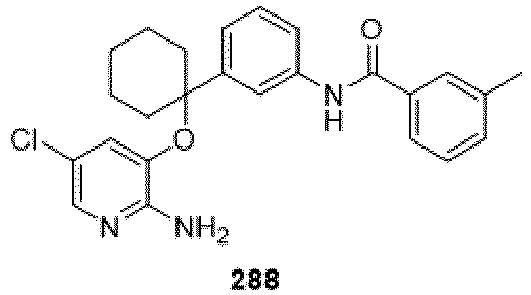
- Synthesis of compound 288 is similar to that of Example 28., with the LC-MS[M+H]-m/z 436.
-

- The synthesis of intermediate 292 is refered to paper[Meyers M J, Pelc M, Kamtekar S, et al. [J]. Bioorganic & Medicinal Chemistry Letters, 2010, 20(5): 1543-1547.]
- Step 4: Similar procedure to step 3 and 4 of example 12 was followed, with the LC-MS[M+H]-m/z 388.
-

- Similar procedure to example 31 was followed to arrive at compound 297, with the LC-MS[M+H]-m/z 396.
-

- Similar procedure to example 13 was followed to arrive at compound 298, with the LC-MS[M+H]-m/z 382.
-

- Similar procedure to example 17 was followed to arrive at compound 299, with the LC-MS[M+H]-m/z 425.
-

- Similar procedure to example 31 was followed to arrive at compound 300, with the LC-MS[M+H]-m/z 383.
-

- Similar procedure to example 31 was followed to arrive at compound 301, with the LC-MS[M+H]-m/z 392.
- Synthesis of compounds 302-314 was similar procedure to example 5:

Table 10 Comps. No. Compound structure Compound name MS [M+1] 302 
N-(4-((2-amino-5-chloropyridin -3 -yl)oxy)phenyl)-3 -methoxybe nzamide 370 303 
N-(4-((2-amino-5-chloropyridin -3-yl)oxy)phenyl)-4-methoxybe nzamide 370 304 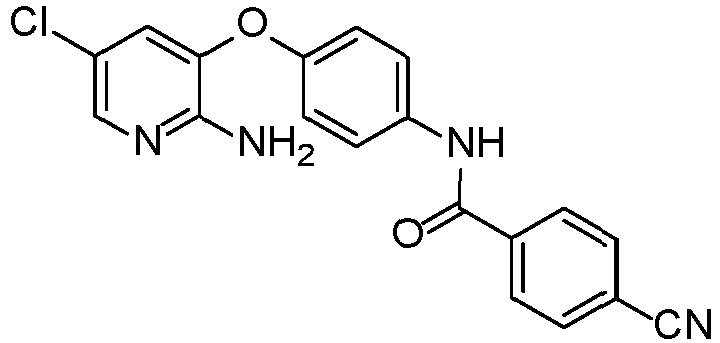
N-(4-((2-amino-5-chloropyridin -3 -yl)oxy)phenyl)-4-cyanobenz amide 365 305 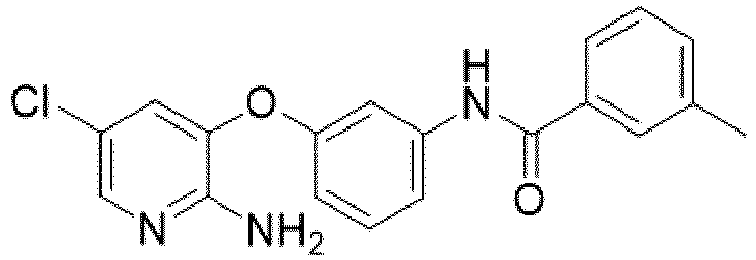
N-(3-((2-amino-5-chloropyridin -3-yl)oxy)phenyl)-3-methylbenz amide 354 306 
N-(3-((2-amino-5-chloropyridin -3 -yl)oxy)phenyl)-3 -methoxybe nzamide 370 307 
N-(3-((2-amino-5-chloropyridin -3 -yl)oxy)phenyl)-3 -chlorobenz amide 374 308 
N-(3-((2-amino-5-chloropyridin -3 -yl)oxy)phenyl)-3 -(trifluorom ethoxy)benzamide 424 309 
N-(3-((2-amino-5-chloropyridin -3-yl)oxy)phenyl)-4-methoxybe nzamide 370 310 
N-(3-((2-amino-5-chloropyridin -3-yl)oxy)phenyl)-3-(methylsulf onyl)benzamide 418 311 
N-(3-((2-amino-5-chloropyridin -3-yl)oxy)phenyl)-3-(1-hydroxy cyclopentyl)benzamide 424 312 
N-(3-((2-amino-5-chloropyridin -3 -yl)oxy)phenyl)-3 -cyclopropy lbenzamide 380 313 
N-(3-((2-amino-5-chloropyridin -3 -yl)oxy)phenyl)-3-(1-cyanocy clopropyl)benzamide 405 314 
N-(3-((2-amino-5-chloropyridin -3-yl)oxy)phenyl)-3-(4-methylp iperazin-1-yl)benzamide 438 -

- Similar procedure to example 5 was followed to arrive at compound 315, with the LC-MS[M+H]-m/z 388.
-

- Similar procedure to example 5 was followed to arrive at compound 316, with the LC-MS[M+H]-m/z 404.
-
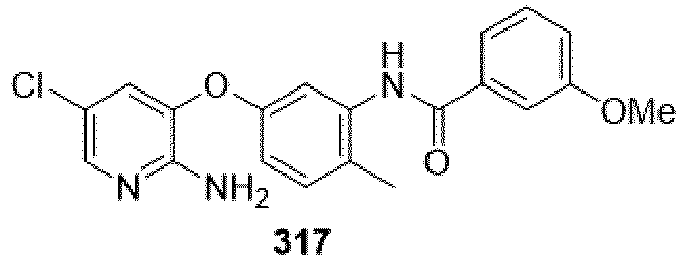
- Similar procedure to example 5 was followed to arrive at compound 317, with the LC-MS[M+H]-m/z 384.
-

- Similar procedure to example 5 was followed to arrive at compound 318, with the LC-MS[M+H]-m/z 416.
-

- Similar procedure to example 5 was followed to arrive at compound 319, with the LC-MS[M+H]-m/z 402.
-

- Similar procedure to example 5 was followed to arrive at compound 320, with the LC-MS[M+H]-m/z 402.
-

- Step 1: Similar procedure to example 4was followed to compound 321.
- Step 2: To the solution of 231(1.03 g, 4.0 mmol) and 322(620 mg, 4.8 mmol) in anhydrous toluene (50 mL) was added DIAD(1.70 g, 8.0 mmol) dropwise at 0°C and the inner temperature was kept below 5°C. After the addition is completed, the reaction mixture was warmed to 25°C and stirred for overnight. When the reaction was completed, silica gel (10 g) was added to the reaction mixture. The resulting mixture was purified by column chromatography to give the desired product as yellow solid. LC-MS[M+H]-m/z 367. Yield: 68.2%.
-

- Step1: Similar procedure to example 4 was followed to compound 325.
- Step 2: To the solution of t-BuOK(448mg, 4mmol) and 325(1.23 g, 4.0 mmol) in anhydrous THF (2 mL) that had be stirred at room temperature for 5 min, was added 326(592 mg, 4.0 mmol). The mixture was stirred at 50°C for overnight. When the reaction was completed, silica gel (10 g) was added to the reaction mixture. The resulting mixture was purified by column chromatography to give the desired product as yellow oil. LC-MS[M+H]-m/z 422. Yield: 59.3%.
-

- To a stirred solution of 165(132mg, 0.5 mmol) in acetone (2 mL) was added p-Tolyl isocyanate (80mg, 0.6mmol). The mixture was stirred at room temperature for 18h. When the reaction was completed, the insolubles was filtered off, and the filtrate was concentrated under reduced pressure. The residue was purified by column chromatography to give the desired product as white solid. LC-MS[M+H]-m/z 397.
-

- Similar procedure to example 46 was followed to arrive at compound 329, with the LC-MS[M+H]-m/z 397.
- The reaction route of compounds 330-347 was as follows:
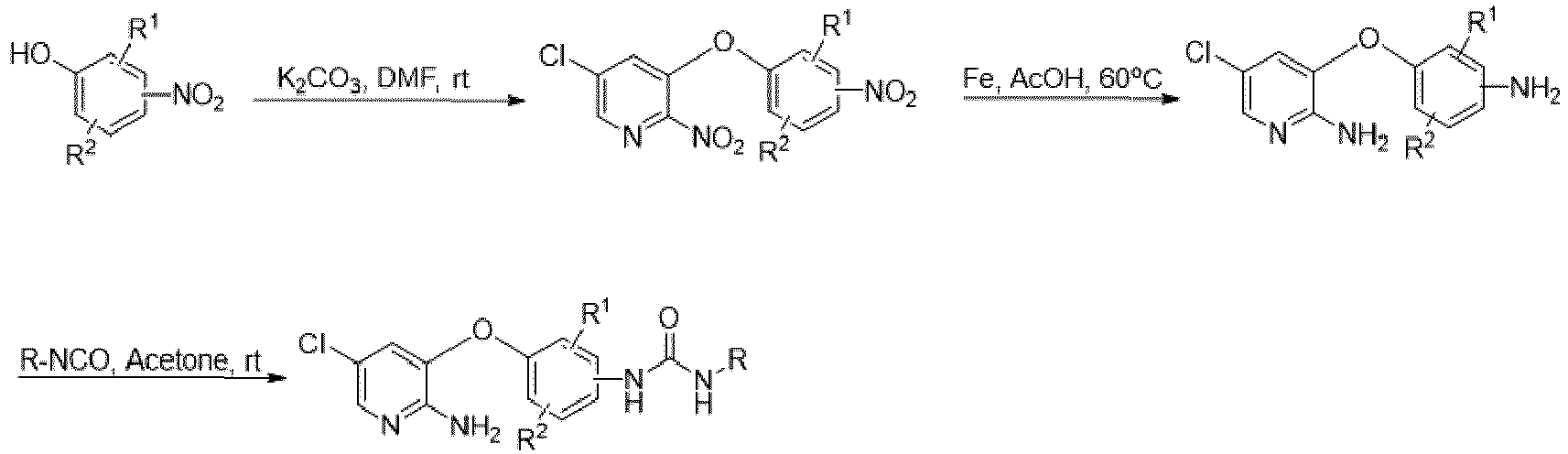
Table 11 Comps. No. Compound structure Compound name MS [M+1] 330 
1-(3-((2-amino-5-chloropyridin -3 -yl)oxy)phenyl)-3 -(4-chloro-3 -(trifluoromethyl)phenyl)urea 457 331 
1-(3-((2-amino-5-chloropyridin -3 -yl)oxy)phenyl)-3 -(m-tolyl)ur ea 369 332 
1-(3-((2-amino-5-chloropyridin -3 -yl)oxy)phenyl)-3 -(p-tolyl)ur ea 369 333 
1-(3-((2-amino-5-chloropyridin -3-yl)oxy)phenyl)-3-(4-(methyl sulfonyl)phenyl)urea 433 334 
1-(4-((2-amino-5-chloropyridin -3-yl)oxy)phenyl)-3-(m-tolyl)ur ea 369 335 
1-(4-((2-amino-5-chloropyridin -3-yl)oxy)phenyl)-3-(p-tolyl)ur ea 369 336 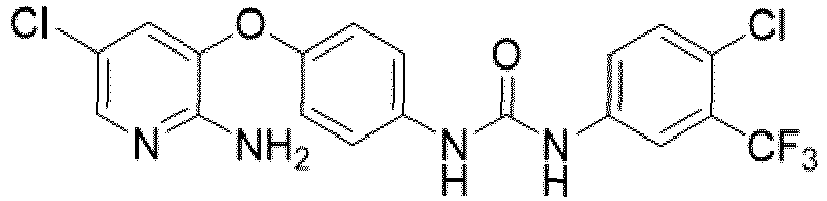
1-(4-((2-amino-5-chloropyridin -3-yl)oxy)phenyl)-3-(4-chloro-3 -(trifluoromethyl)phenyl)urea 457 337 
1-(4-((2-amino-5-chloropyridin -3-yl)oxy)-2-methylphenyl)-3-( 4-chloro-3-(trifluoromethyl)phe nyl)urea 471 338 
1-(4-((2-amino-5-chloropyri din -3-yl)oxy)-3-methylphenyl)-3-( 4-chloro-3-(trifluoromethyl)phe nyl)urea 471 339 
1-(4-((2-amino-5-chloropyridin -3 -yl)oxy)-3 -fluorophenyl)-3 -(4 -chloro-3-(trifluoromethyl)phen yl)urea 475 340 
1-(4-((2-amino-5-chloropyridin -3 -yl)oxy)-2-fluorophenyl)-3 -(4 -chloro-3-(trifluoromethyl)phen yl)urea 475 341 
1-(5-((2-amino-5-chloropyridin -3-yl)oxy)-2-methylphenyl)-3-( p-tolyl)urea 383 342 
1-(5-((2-amino-5-chloropyridin -3-yl)oxy)-2-chlorophenyl)-3-(p -tolyl)urea 403 343 
1-(3-((2-amino-5-chloropyridin -3-yl)oxy)phenyl)-3-(4-(dimeth ylamino)phenyl)urea 398 344 
1-(3-((2-amino-5-chloropyridin -3 -yl)oxy)phenyl)-3 -(4-methox yphenyl)urea 385 345 
1-(3-((2-amino-5-chloropyridin -3-yl)oxy)phenyl)-3-(2,3-dihydr obenzo[b]thiophen-5-yl)urea 413 346 
1-(3-((2-amino-5-chloropyridin -3-yl)oxy)phenyl)-3-(benzo[b]t hiophen-5-yl)urea 411 347 
1-(3-((2-amino-5-chloropyridin -3-yl)oxy)phenyl)-3-(1-(tert-but yl)-1H-pyrazol-4-yl)urea 401 - Synthesis of compounds 348-356 was similar procedures to that of example 7:

Comps. No. Compound structure Compound name MS [M+1] 348 
1-(3-((2-amino-5-(1-methyl-1H-pyrazol-4-yl)pyridin-3-y l)oxy)phenyl)-3-(4-chloro-3 -(trifluoromethyl)phenyl)ure a 502 349 
1-(3-((2-amino-5-(1-methyl-1H-pyrazol-4-yl)pyridin-3-y l)oxy)phenyl)-3-(p-tolyl)ure a 415 350 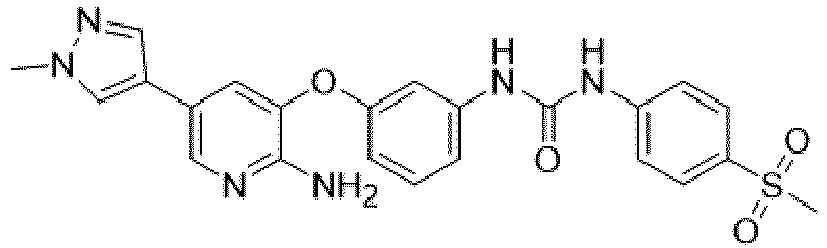
1-(3-((2-amino-5-(1-methyl-1H-pyrazol-4-yl)pyridin-3-y l)oxy)phenyl)-3-(4-(methyls ulfonyl)phenyl)urea 479 351 
1-(4-((2-amino-5-(1-methyl-1H-pyrazol-4-yl)pyridin-3-y l)oxy)phenyl)-3-(4-chloro-3 -(trifluoromethyl)phenyl)ure a 503 352 
1-(4-((2-amino-5-(1-methyl-1H-pyrazol-4-yl)pyridin-3-y l)oxy)-2-fluorophenyl)-3-(4-chloro-3-(trifluoromethyl)ph enyl)urea 521 353 
1-(3-((6-amino-[3,3'-bipyrid in]-5-yl)oxy)phenyl)-3-(4-c hloro-3-(trifluoromethyl)phe nyl)urea 500 354 
1-(3-((6-amino-[3,3'-bipyrid in]-5-yl)oxy)phenyl)-3-(p-to lyl)urea 412 355 
1-(3-((6-amino-[3,3'-bipyrid in]-5-yl)oxy)phenyl)-3-(4-( methylsulfonyl)phenyl)urea 476 356 
1-(4-((6-amino-[3,3'-bipyrid in]-5-yl)oxy)phenyl)-3-(4-c hloro-3-(trifluoromethyl)phe nyl)urea 500 - Synthesis of compounds 357-366 was similar procedures to that of example 7:
Table 13 Comps. No. Compound structure Compound name MS [M+1] 357 
(R)-N-(3-(1-((2-amino-5-(1-methyl-1H-pyrazol-5-yl)pyr idin-3 -yl)oxy)ethyl)phenyl)-4-(methylthio)benzamide 460 358 
(R)-N-(3-(1-((2-amino-5-(1-cyclopropyl-1H-pyrazol-4-y l)pyridin-3-yl)oxy)ethyl)phe nyl)-4-(methylthio)benzami de 486 359 
(R)-N-(3-(1-((2-amino-5-(1 H-pyrazol-4-yl)pyridin-3-yl) oxy)ethyl)phenyl)-4-(methyl thio)benzamide 446 360 
(R)-N-(3-(1-((2-amino-5-(1-methyl-1H-pyrazol-4-yl)pyr idin-3 -yl)oxy)ethyl)phenyl)-3-chloro-4-(methylthio)benz amide 494 361 
(R)-N-(3-(1-((2-amino-5-(1-methyl-1H-pyrazol-4-yl)pyr idin-3 -yl)oxy)ethyl)phenyl)-3-fluoro-4-(methylthio)benz amide 478 362 
(R)-N-(3-(1-((2-amino-5-(1-methyl-1H-pyrazol-4-yl)pyr idin-3-yl)oxy)ethyl)phenyl)-3-cyano-4-(methylthio)benz amide 485 363 
(R)-N-(3-(1-((2-amino-5-(1, 3-dimethyl-1H-pyrazol-4-yl )pyridin-3-yl)oxy)ethyl)phe nyl)-4-(methylthio)benzami de 474 364 
(R)-N-(3-(1-((2-amino-5-(1-(2-(dimethylamino)-2-oxoet hyl)-1H-pyrazol-4-yl)pyridi n-3-yl)oxy)ethyl)phenyl)-4-( methylthio)benzamide 531 365 
(R)-N-(3 -(1 -((2-amino-5 -(3 - methyl-1H-pyrazol-4-yl)pyr idin-3 -yl)oxy)ethyl)phenyl)-4-(methylthio)benzamide 460 366 
(R)-N1-(3-(1-((2-amino-5-( 1-methyl-1H-pyrazol-4-yl)p yridin-3-yl)oxy)ethyl)pheny l)-4-(methylthio)isophthala mide 503 -

- Compound 180 (100 mg, 0.22 mmol) was added to a 25 mL round bottom flask, then ethanol (10 mL) and hydrogen peroxide (30%, 2 mL) were added. The resulting mixture was stirred for overnight at room temperature. Brine was added and the mixture was extracted with DCM. The combined organic layers were dried, and concentrated in vacuo. The residue was purified by column chromatography (DCM: MeOH = 40:1) to give the desired product as white solid. LC-MS[M+H]-m/z: 476.
- Synthesis of compounds 368-373 was similar procedures to that of example 7:
Table 14 Comps. No. Compound structure Compound name MS [M+1] 368 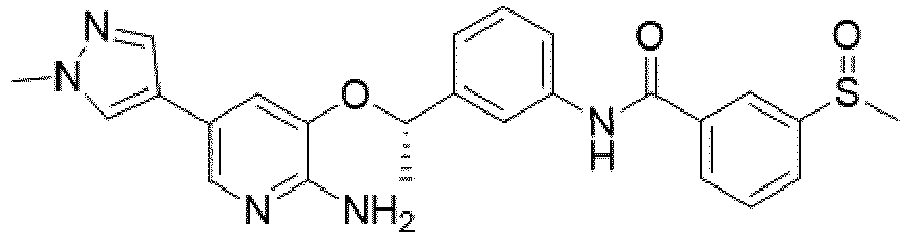
N-(3-((S)-1-((2-amino-5-(1-methyl- 1H-pyrazol-4-yl)pyri din-3 -yl)oxy)ethyl)phenyl)-3 -(methylsulfinyl)benzamide 476 369 
(S)-N-(3-(1-((2-amino-5-(1-methyl- 1H-pyrazol-4-yl)pyri din-3 -yl)oxy)ethyl)phenyl)-3 -(methylsulfonyl)benzamide 492 370 
(S)-N-(3-(1-((2-amino-5-(1-methyl- 1H-pyrazol-4-yl)pyri din-3-yl)oxy)ethyl)phenyl)-3 -(dimethylamino)benzamide 457 371 
(S)-N-(3-(1-((2-amino-5-(1-methyl- 1H-pyrazol-4-yl)pyri din-3 -yl)oxy)ethyl)phenyl)-3 -(dimethylamino)-4-methylb enzamide 471 372 
(S)-N-(3-(1-((2-amino-5-(1-methyl- 1H-pyrazol-4-yl)pyri din-3 -yl)oxy)ethyl)phenyl)-3 -(methylthio)benzamide 460 373 
(S)-N-(3-(1-((2-amino-5-(1-methyl- 1H-pyrazol-4-yl)pyri din-3 -yl)oxy)ethyl)phenyl)-4 -methyl-3-(methylthio)benza mide 474 -
I. Materials and instruments - 2104 EnVision® Multilabel Reader (PerkinElmer)
- OptiPlate-384, White Opaque 384-well MicroPlate(Cat.6007290, PerkinElmer) HTRF kinEASE TK (Cat.62TKOPEC, Cisbio)
- CSF-1R(Cat. PV3249,Invitrogen)
- ATP 10 mM (Cat.PV3227, Invitrogen)
- DTT 1 M (Cat.D5545, Sigma)
- MgCl2 1 M (Cat.M8266, Sigma)
- MnCl2 1 M (Cat.244589, Sigma)
- The reaction concentration of Substrate-TK and ATP are shown in table 15.
- Substrate-TK and ATP were diluted to 5 times of the reaction concentration by 1x Kinase Buffer..
- The reaction concentration of CSF1R enzyme is shown in table 15.
- CSF1R enzyme was diluted to 5×enzyme solution by1×kinase buffer.
- The reaction concentration of Sa-XL665 is shown in table 15.
- Sa-XL665 was diluted to 4×Sa-XL665 solution by Detection Buffer.
- TK-Ab-Cryptate was diluted to 100×TK-Ab-Cryptate solution by Detection Buffer.
- After all reagents had been prepared according to the above method, except enzymes, the sample was added after equilibrium to room temperature.
- a. Firstly, 2.5% DMSO solution was prepared by using 1× kinase buffer (the high concentration of DMSO will affect the reaction and control the final concentration of DMSO to 1%). Then the compounds were diluted by 2.5% DMSO solution corresponding to the enzyme. The screening concentration of the compounds was 4 times gradient dilution from 1000 nM, and 8 concentrations. In addition to the control pore, 4 microlitres of diluted solution containing 2.5% DMSO were added to the reaction pore and 4 microlitres of previously prepared solution containing 2.5% DMSO were added to the control pore.
- b. 2 microlitres of previously prepared TK-biotin substrate solution was added to all reaction pore (the amount of substrate used for enzyme screening is shown in Table 15).
- c. Adding 2 microlitres of CSF1R enzyme solution of corresponding concentration (the amount of enzyme is shown in Table 15) to all reaction pore except negative pore. The negative pore is supplemented with 2 microlitres of enzyme corresponding to 1 ×kinase buffer. After mixing, the compound and enzyme can be fully combined by incubating at room temperature for 10 minutes.
- d. Enzyme reaction was initiated by adding 2 microlitres ATP solution of corresponding concentration to all reaction pore. The reaction time was 30 minutes (the corresponding ATP concentration and reaction time at enzyme screening were shown in Table 15).
- e. Preparing the test solution 5 minutes before the end of kinase reaction. Streptavidin-XL665 and TK antibody europium cryptate (1:100) were prepared with detection buffer in the kit (the corresponding concentration of detection reagent for enzyme screening is shown in Table 15).
- f. After the kinase reaction, 5 microlitres of diluted Streptavidin-XL665 were added to all reaction pore, mixing, and then the diluted TK antibody europium cryptate solution was added immediately.
- g. After 1 hour reaction at room temperature, the fluorescence signals (320 nm stimulation, 665 nm, 615 nm emission) were detected by ENVISION (Perkinelmer) instrument. The inhibition rate of each pore was calculated by full active pore and background signal pore, and the average value of complex pore was obtained. Meanwhile, the half inhibitory activity (IC50) of each compound was fitted by professional drawing analysis software PRISM 5.0.
- The flow chart of the experiment is as follows:
Table 17 kinase assay Control Enzyme step(10µL) Sample Negative Positive Compounds 4 µL 4 µL 2.5%DMSO/kinase buffer 4 µL 2.5%DMSO/kinase buffer TK Substrate-biotin 2 µL 2 µL 2 µL Kinase 2 µL 2 µL Kinase buffer 2 µL Seal plate and incubate 10 min at RT ATP 2 µL 2 µL 2 µL Seal plate and incubate 40 min at RT Detection step(10 µL) Sa-XL665 5 µL 5 µL 5 µL TK Ab-Cryptate 5 µL 5 µL 5 µL Seal plate and incubate 1h at RT 320 nm Excitation, 665 nm, 615 nm Emission -


- Using Graphpad Prism 5 and log (inhibitor) vs. normalized response to fit ICso curve and calculate ICso value.
- The ICso data of the compounds prepared in Representative Examples 3-52 are as follows (Table 18).:
Table 18 Comps. In vitro inhibitory activity of CSF-1R IC50 Comps. In vitro inhibitory activity of CSF-1R IC50 22 +++ 175 +++ 54 +++ 178 +++ 55 +++ 179 +++ 64 +++ 180 +++ 72 +++ 181 +++ 73 +++ 182 +++ 74 +++ 187 +++ 78 +++ 188 +++ 83 +++ 202 +++ 85 +++ 205 +++ 86 +++ 206 +++ 95 ++ 222 ++ 103 + 236 ++ 132 +++ 305 ++ 134 +++ 318 ++ 141 ++ 323 ++ 170 +++ 327 ++ 171 +++ 331 ++ 174 +++ 348 +++ 367 +++ Footnote:+++:≤50nM; ++:51-500nM; +:≥500nM, but<10uM∘ -
1. Experimental Materials - 1.1 cell line
Mouse Myelogenous Leukemia Cells (NFS - 60) - 1.2 Compounds
Using DMSO to dissolve, and the required concentration was prepared with full culture medium without factors. - 1.3 Main Reagents
- Medium: RPMI Medium 1640, Gibco, No.31800-022
- Fetal Bovine Serum: PANSera, ES,No.2602 - P130707
- Penicillin-streptomycin: TRANS
- Trypsin: Gibco, No.25300-062
- PBS: Hyclone, No.SH30258.01
- Mouse M-CSF/CSF-1 Protein: Sino Biological Inc, No.51112 - MNAH
- M-CSF: Qilu Pharmaceutical co., Ltd.
- In this study, MC-38 cell lines were inoculated in C57 mice
- Experimental animal: C57 mice, male, 5-6 weeks old (18-22g)
- Cell Lines: MC38
- Inoculation: 2×10⁶/0.1 mL, Matrigel is added in 3 : 1 ratio
- PDl:InVivoMAb anti-mouse PD-1 (CD279), BioXCell
- Group: On day 4 after inoculating, all the mice were divided into 13 groups, respectively model group, the anti-PDl 2mg/kg group, anti-PD110mg/kg group, testing compounds alone, and the tested compound combine with anti-PDl 10mg/kg. Compounds were intragastrically administered daily at a dose of 30 mg/kg and anti-PDl was intraperitoneally injected once every 3 days. The drug was administered continuously for 2 weeks. In model group, 80% glycerol + 20% CMC-Na was given daily.
- Results: The experimental results of anti-PDl combined with the compounds prepared in the representative example 3-52 on the inhibition of tumor size of MC-38 transplanted tumors are as follows:
Table 20 Groups inhibition ratio Groups inhibition ratio anti-PD1-2mg/kg + anti-PD 1-10mg/kg ++ 72-30mg/kg + 72-30mg/kg+anti-PD1-10mg/kg ++ 78-30mg/kg + 78-30mg/kg+anti-PD1-10mg/kg ++ 83-30mg/kg + 83-30mg/kg+anti-PD1-10mg/kg +++ 85-30mg/kg + 85-30mg/kg+anti-PD1-10mg/kg +++ 86-30mg/kg + 86-30mg/kg+anti-PD1-10mg/kg +++ 178-30mg/kg ++ 178-30mg/kg+anti-PD1-10mg/kg +++ 179-30mg/kg ++ 179-30mg/kg+anti-PD1-10mg/kg +++ 182-30mg/kg ++ 182-30mg/kg+anti-PD1-10mg/kg +++ Footnote: +++:≥30%; ++:10%∼30%; +: <10% - Although the present invention has been described in considerable detail with reference to certain preferred versions thereof, other versions are possible. Therefore, the scope of the present invention should not be limited to the description of the preferred versions described herein. All features disclosed in the specification, and all the steps in any method or process disclosed, may be combined in any combination, except combinations where at least some of such features and/or steps are mutually exclusive. Each feature disclosed in the specification, can be replaced by alternative features serving the same, equivalent or similar purpose, unless expressly stated otherwise. Thus, unless expressly stated otherwise, each feature disclosed is one example only of a generic series of equivalent or similar features.
II. Experimental procedure
1. Reagent preparing
| TK | CSF-1R | |
| Enzyme Concentration | Final concentration in enzyme reaction step (10 µL) | 0.012ng/ul |
| ATP (µM) | 2.5uM | |
| Sub strate-TK | 460nM | |
| Enzyme reaction time | 40min | |
| Sa-XL665 | Final concentration in the end system (20 µL) | 28.75nM |
| TK-Ab-Cryptate | 1:100 dilution |
| Kinase | 5×Enzyme buffer | MgCl2 | MnCl2 | DTT | SEB | ddH2O |
| CSF-1R | 200 | 5 | 1 | 1 | 0 | 793 |
2. Experimental Method
The logarithmic growth phase of NFS-60 cells (1640 + 10% FBS + 40ng/ml M-CSF +1%Penicillin-streptomycin) were centrifuged (1000 r/min) and cultured in a factor-free medium at 37°C, 5% CO2 for 24 hours. Centrifugating (1000r/min), the culture medium was replaced by new culture medium including 40 ng/mL factors, and inoculated on 96-well plate by 2∗104 cells/mL, 100 µL/hole. After 16 hours, the tested compounds were added 10µL/hole, 3 duplicate holes per compound, 37 °C,5% CO2, continue to cultured for 72 h.Then 10 µL CCK reagent was added to each hole. After incubation for 4 hours, the absorbance of each hole was measured at 450 nm wavelength.
According to Formula:

3. Experimental results
The experimental results of the inhibition of NFS-60 cell proliferation by the compounds prepared in Example 3-52, 0.5 uM, are shown in the following table:
| Comps. | inhibition ratio % | Comps. | inhibition ratio % |
| 54 | ++ | 178 | +++ |
| 70 | +++ | 179 | +++ |
| 72 | +++ | 180 | +++ |
| 74 | +++ | 181 | +++ |
| 126 | +++ | 182 | +++ |
| 132 | +++ | 199 | +++ |
| 134 | +++ | 200 | +++ |
| 137 | +++ | 205 | +++ |
| 150 | +++ | 206 | +++ |
| 168 | +++ | 212 | +++ |
| 169 | +++ | 367 | +++ |
| Footnote:+++:≥50%; ++:10%-50%; +:<10% |
Claims (14)
- A compound of Formula (Ib):
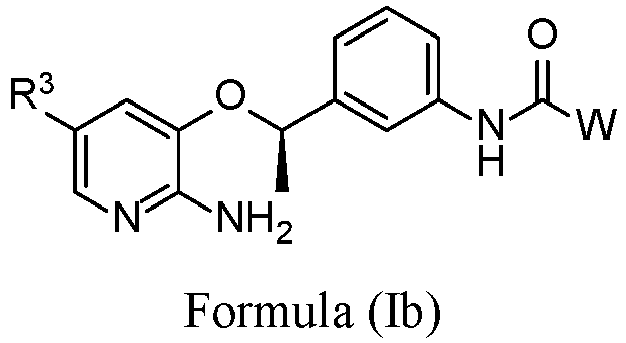 R3 is selected from H, halogen, C6-C10 phenyl, 5-10 membered heteroaryl, C3-C6 heterocycloalkyl; the hydrogens in R3 are optionally substituted by one or more R7 groups independently, and the adjacent R7 groups can join to form a 5-7 membered ring;W is selected from C6-C10 aryl, 5-10 membered heteroaryl, wherein the hydrogens on the rings may be substituted by one or more R7 groups independently;R7 is selected from H, halogen, OH, NO2, CN, O(C1-C3)alkyl, (C1-C5)heteroalkyl, O(C3-C6)cycloalkyl, O(C3-C6)heterocycloalkyl, C1-C5 alkyl, C=C, C ≡ C, C3-C6 cycloalkyl, C3-C6 heterocycloalkyl, NR5R6, C(O)(C1-C2)alkyl, C(O)O(C1-C2)alkyl, P(O)((C1-C2)alkyl)2, SO2 cyclopropyl, S(O)n(C1-C3)alkyl, wherein n=0, 1, or 2; and the two adjacent R7 groups can join to form a 5-7 membered ring;Each R5 and R6 is independently selected from H, C1-C3 alkyl, C3-C6 cycloalkyl, C(O)C1-C3 alkyl, S(O)2(C1-C3)alkyl or S(O)2(C3-C6)cycloalkyl; R5 and R6 can join to form a 3-6 membered ring.
 - A compound of Claim 1, wherein R3 is selected from H, halogen; W is selected from phenyl or 5-10 membered heteroaryl, wherein the hydrogens on the ring may be substituted by one or more R7 groups independently, and the two adjacent R7 groups can join to form a 5-7 membered ring; R7 is selected from halogen, OH, NO2, CN, O(C1-C3)alkyl, (C1-C5) heteroalkyl, O(C3-C6)cycloalkyl, O(C3-C6)heterocycloalkyl, C1-C5 alkyl, C=C, C≡C, C3-C6 cycloalkyl, C3-C6 heterocycloalkyl, N((C1-C2)alkyl)2, NH(C1-C2)alkyl, C(O)(C1-C2)alkyl, C(O)O(C1-C2)alkyl, P(O)((C1-C2)alkyl)2, SO2 cyclopropyl, S(O)n(C1-C3)alkyl, wherein n=0, 1, or 2.
- A compound of Claim 1, wherein R3 is selected from phenyl, 5-10 membered heteroaryl, C3-C6 heterocycloalkyl, wherein the hydrogens on the ring may be independently substituted by halogen, OH, NO2, CN, O(C1-C3)alkyl, (Ci-C5)heteroalkyl, O(C3-C6)cycloalkyl, O(C3-C6)heterocycloalkyl, C1-C5 alkyl, C=C, C≡ C, C3-C6 cycloalkyl, C3-C6 heterocycloalkyl, N((C1-C2)alkyl)2, NH(C1-C2)alkyl, C(O)(C1-C2)alkyl, C(O)O(C1-C2)alkyl, P(O)((C1-C2)alkyl)2, SO2 cyclopropyl, S(O)n(C1-C3)alkyl, wherein n=0, 1, or 2; W is selected from phenyl or 5-10 membered heteroaryl, wherein the hydrogens on the ring may be substituted by one or more R7 groups independently, and one of the substituted groups should be selected from NH2, N((C1-C2)alkyl)2, NH(C1-C2)alkyl, C(O)(C1-C2)alkyl, C(O)O(C1-C2)alkyl, P(O)((C1-C2)alkyl)2, SO2 cyclopropyl, S(O)n(C1-C3)alkyl, wherein n=0, 1, or 2, and the adjacent groups in R7 or W can join to form a 5-7 membered ring.
- A compound of Claim 3, wherein R3 is selected from phenyl, pyrazolyl, pyridyl, wherein the hydrogens on the ring may be substituted by halogen, CN, O(C1-C3)alkyl, C1-C3 alkyl, C3-C6 cycloalkyl, (C1-C5)heteroalkyl, C3-C6 heterocycloalkyl, N((Ci-C2)alkyl)2, NH(C1-C2)alkyl; and the adjacent substituted groups in R3 can join to form a 5-7 membered ring.
- A compound of Claim 4, wherein R3 is selected from pyrazolyl, pyridyl, wherein the hydrogens on the ring may be substituted by halogen, CN, C1-C3 alkyl, C3-C6 cycloalkyl, (C1-C5) heteroalkyl, C3-C6 heterocycloalkyl, and the adjacent substituted groups on R3 can join to form a 5-7 membered ring.
- A compound of Claim 3, 4 or 5, wherein W is selected from phenyl, wherein the hydrogens on the ring is substituted by one or more R7 groups independently, and one of the substituted groups should be selected from N((C1-C2)alkyl)2, C(O)(C1-C2) alkyl, C(O)O(C1-C2) alkyl, P(O)((C1-C2)alkyl)2, SO2 cyclopropyl, S(O)n(C1-C3) alkyl, wherein n=0, 1, or 2, and the adjacent substituted groups in W can join to form a 5-7 membered ring.
- A compound of Claim 1, wherein the compound is selected from:(R)-N-(3-(1-((2-amino-5-chloropyridin-3-yl)oxy)ethyl)phenyl)-3-methylbenzamide(R)-N-(3-(1-((2-amino-5-chloropyridin-3-yl)oxy)ethyl)phenyl)-2-chloro-5-methylbenzamide(R)-N-(3-(1-((2-amino-5-chloropyridin-3-yl)oxy)ethyl)phenyl)-3-methoxybenzamide(R)-N-(3-(1-((2-amino-5-chloropyridin-3-yl)oxy)ethyl)phenyl)-3-cyanobenzamide(R)-N-(3-(1-((2-amino-5-chloropyridin-3-yl)oxy)ethyl)phenyl)-2,5-dichlorobenzamide(R)-N-(3-(1-((2-amino-5-chloropyridin-3-yl)oxy)ethyl)phenyl)-3-ethynylbenzamide(R)-N-(3-(1-((2-amino-5-chloropyridin-3-yl)oxy)ethyl)phenyl)-3-(methy)sulfony))benzamide(R)-N-(3-(1-((2-amino-5-chloropyridin-3-yl)oxy)ethyl)phenyl)-3-(isopropylsulfonyl)benzamide(R)-N-(3-(1-((2-amino-5-chloropyridin-3-yl)oxy)ethyl)phenyl)-3-(cyclopropylsulfonyl)benzamide(R)-N-(3-(1-((2-amino-5-chloropyridin-3-yl)oxy)ethyl)phenyl)-3-(dimethylphosphoryl)benzamide(R)-N-(3-(1-((2-amino-5-chloropyridin-3-yl)oxy)ethyl)phenyl)-3-(dimethylamino)benzamide(R)-N-(3-(1-((2-amino-5-chloropyridin-3-yl)oxy)ethyl)phenyl)-5-methylnicotinamide(R)-N-(3-(1-((2-amino-5-chloropyridin-3-yl)oxy)ethyl)phenyl)-2-fluoro-5-methylbenzamide(R)-N-(3-(1-((2-amino-5-chloropyridin-3-yl)oxy)ethyl)phenyl)-2-chloro-3-methylbenzamide(R)-N-(3-(1-((2-amino-5-chloropyridin-3-yl)oxy)ethyl)phenyl)-3-cyclopropylbenzamide(R)-N-(3-(1-((2-amino-5-chloropyridin-3-yl)oxy)ethyl)phenyl)-3-isopropylbenzamide(R)-N-(3-(1-((2-amino-5-chloropyridin-3-yl)oxy)ethyl)phenyl)-3-isopropoxybenzamide(R)-N-(3-(1-((2-amino-5-chloropyridin-3-yl)oxy)ethyl)phenyl)-3-(ethylsulfonyl)benzamide(R)-N-(3-(1-((2-amino-5-chloropyridin-3-yl)oxy)ethyl)phenyl)-2-chloro-3-methoxybenzamide(R)-N-(3-(1-((2-amino-5-chloropyridin-3-yl)oxy)ethyl)phenyl)-3-(1-hydroxycyclopentyl))benzamide(R)-N-(3-(1-((2-amino-5-chloropyridin-3-yl)oxy)ethyl)phenyl)-4-(methylsulfony))benzamide(R)-N-(3-(1-((2-amino-5-chloropyridin-3-yl)oxy)ethyl)phenyl)-3-(1-hydroxycyclobutyl)benzamide(R)-N-(3-(1-((2-amino-5-chloropyridin-3-yl)oxy)ethyl)phenyl)-4-methylbenzamide(R)-N-(3-(1-((2-amino-5-chloropyridin-3-yl)oxy)ethyl)-4-chlorophenyl)-2-chloro-3-methylbenzamideN-(3-((R)-1-((2-amino-5-chloropyridin-3-yl)oxy)ethyl)phenyl)-3-((2-hydroxycyclohexyl)amino)benzamide(R)-N-(5-(1-((2-amino-5-chloropyridin-3-yl)oxy)ethyl)-2-fluorophenyl)-2-chloro-3-methylbenzamide(R)-N-(3-(1-((2-amino-5-chloropyridin-3-yl)oxy)ethyl)phenyl)-3-(1-hydroxycyclohexyl)benzamide(R)-N-(3-(1-((2-amino-5-chloropyridin-3-yl)oxy)ethyl)phenyl)-4-((4-methylpiperazin-1-yl)methyl)benzamide(R)-N-(3-(1-((2-amino-5-chloropyridin-3-yl)oxy)ethyl)phenyl)-3-(4-methylpiperazin-1-yl)benzamide(R)-N-(3-(1-((2-amino-5-chloropyridin-3-yl)oxy)ethyl)phenyl)-4-(4-methylpiperazin-1-yl)benzamide(R)-N-(3-(1-((2-amino-5-chloropyridin-3-yl)oxy)ethyl)phenyl)-2-methoxy-5-(methylsulfonyl)benzamide(R)-N-(3-(1-((2-amino-5-chloropyridin-3-yl)oxy)ethyl)phenyl)-3-((4-methylpiperazin-1-yl)methyl)benzamide(R)-N-(3-(1-((2-amino-5-chloropyridin-3-yl)oxy)ethyl)phenyl)-3-(cyclopropylsulfonyl)benzamide(R)-N-(3-(l-((2-amino-5-chloropyridin-3-yl)oxy)ethyl)phenyl)-3-(isopropylsulfonyl)benzamide(R)-N-(3-(1-((2-amino-5-chloropyridin-3-yl)oxy)ethyl)phenyl)-3-(cyclopentylsulfonyl)benzamide(R)-N-(3-(1-((2-amino-5-chloropyridin-3-yl)oxy)ethyl)phenyl)quinoline-3-carboxamide(R)-N-(3-(1-((2-amino-5-chloropyridin-3-yl)oxy)ethyl)phenyl)isoquinoline-6-carboxamide(R)-N-(3-(1-((2-amino-5-chloropyridin-3-yl)oxy)ethyl)phenyl)quinoline-6-carboxamide(R)-N-(3-(1-((2-amino-5-chloropyridin-3-yl)oxy)ethyl)phenyl)-3-(pyrrolidin-1-ylsulfonyl)benzamide(R)-N-(3-(1-((2-amino-5-chloropyridin-3-yl)oxy)ethyl)phenyl)-5-cyclopropylnicotinamide(R)-N-(5-(1-((2-amino-5-chloropyridin-3-yl)oxy)ethyl)pyridin-3-yl)-2-chloro-3-methylbenzamide(R)-N-(3-(1-((2-amino-5-chloropyridin-3-yl)oxy)ethyl)phenyl)-3-(1-cyanocyclopropyl)benzamide(R)-N-(3-(1-((2-amino-5-chloropyridin-3-yl)oxy)ethyl)phenyl)-3-cyclobutylbenzamide(R)-N-(3-(1-((2-amino-5-chloropyridin-3-yl)oxy)ethyl)phenyl)-3-(trifluoromethyl)benzamide(R)-N-(3-(1-((2-amino-5-chloropyridin-3-yl)oxy)ethyl)phenyl)-3-(pyrrolidin-1-yl)benzamide(R)-N-(3-(1-((2-amino-5-chloropyridin-3-yl)oxy)ethyl)phenyl)-2,3-dihydrobenzo[b]thiophene-4-carboxamide 1,1-dioxide(R)-N-(3-(1-((2-amino-5-chloropyridin-3-yl)oxy)ethyl)phenyl)-2,3-dihydrobenzo[b]thiophene-5-carboxamide 1,1-dioxide(R)-N-(3-(1-((2-amino-5-chloropyridin-3-yl)oxy)ethyl)phenyl)benzo[d][1,3]dioxole-5-carboxamide(R)-N-(3-(1-((2-amino-5-chloropyridin-3-yl)oxy)ethyl)phenyl)-5-fluoropicolinamide(R)-N-(3-(1-((2-amino-5-chloropyridin-3-yl)oxy)ethyl)phenyl)-5-methylpicolinamide(R)-N-(3-(1-((2-amino-5-chloropyridin-3-yl)oxy)ethyl)phenyl)-4-methylpicolinamide(R)-N-(3-(1-((2-amino-5-chloropyridin-3-yl)oxy)ethyl)phenyl)-4-(trifluoromethyl)picolinamide(R)-N-(3-(1-((2-amino-5-chloropyridin-3-yl)oxy)ethyl)phenyl)-5-(trifluoromethyl)picolinamide(R)-N-(3-(1-((2-amino-5-chloropyridin-3-yl)oxy)ethyl)phenyl)-6-(trifluoromethyl)picolinamide(R)-N-(3-(1-((2-amino-5-chloropyridin-3-yl)oxy)ethyl)phenyl)-4-methyl-3-(methylsulfonyl)benzamide(R)-N-(5-(1-((2-amino-5-chloropyridin-3-yl)oxy)ethyl)-2-methylphenyl)-3-(trifluoromethyl)benzamide(R)-N-(3-(1-((2-amino-5-chloropyridin-3-yl)oxy)ethyl)phenyl)-3-(difluoromethyl)benzamide(R)-N-(3-(1-((2-amino-5-chloropyridin-3-yl)oxy)ethyl)phenyl)-6-methylpicolinamide(R)-N-(3-(1-((2-amino-5-chloropyridin-3-yl)oxy)ethyl)phenyl)-4-chloro-3-methylbenzamide(R)-N-(3-(1-((2-amino-5-chloropyridin-3-yl)oxy)ethyl)phenyl)-4-fluoro-3-methylbenzamide(R)-N-(3-(1-((2-amino-5-chloropyridin-3-yl)oxy)ethyl)phenyl)-3,4-dimethylbenzamide(R)-N-(3-(1-((2-amino-5-chIoropyridin-3-yI)oxy)ethyI)phenyl)-2,3-dihydro-1H-indene-5-carboxamide(R)-N-(3-(1-((2-amino-5-chloropyridin-3-yl)oxy)ethyl)phenyl)-2,3-dihydrobenzo[b]thiophene-6-carboxamide 1,1 -dioxide(R)-N-(3-(1-((2-amino-5-chloropyridin-3-yl)oxy)ethyl)phenyl)-3-fluoro-5-methylbenzamide(R)-N-(3-(1-((2-amino-5-chloropyridin-3-yl)oxy)ethyl)phenyl)-3-chloro-5-methylbenzamide(R)-N-(3-(1-((2-amino-5-chloropyndin-3-yl)oxy)ethyl)phenyl)-3,5-dimethylbenzamide(R)-N-(5-(1-((2-amino-5-chloropyridin-3-yl)oxy)ethyl)-2-methylphenyl)-3-(methylsulfonyl)benzamide(R)-N-(3-(1-((2-amino-5-chloropyridin-3-yl)oxy)ethyl)-4-fluorophenyl)-3-(methylsulfonyl)benzamide(R)-N-(3-(1-((2-amino-5-chloropyridin-3-yl)oxy)ethyl)-4-chlorophenyl)-3-(methylsulfonyl)benzamide(R)-N-(6-(1-((2-amino-5-chloropyridin-3-yl)oxy)ethyl)pyridin-2-yl)-3-methylbenzamide(R)-N-(3-(1-((2-amino-5-chloropyridin-3-yl)oxy)ethyl)-4-methylphenyl)-3-(methylsulfonyl)benzamide(R)-N-(3-(1-((2-amino-5-chloropyridin-3-yl)oxy)ethyl)-2-methylphenyl)-3-(methylsulfonyl)benzamide(R)-N-(4-(1-((2-amino-5-chloropyridin-3-yl)oxy)ethyl)pyridin-2-yl)-3-methylbenzamide(R)-N-(5-(1-((2-amino-5-chloropyridin-3-yl)oxy)ethyl)-2-chlorophenyl)-3-(methylsulfonyl)benzamide(R)-N-(5-(1-((2-amino-5-chloropyridin-3-yl)oxy)ethyl)-2-fluorophenyl)-3-(methylsulfonyl)benzamide(R)-N-(3-(1-((2-amino-5-chloropyridin-3-yl)oxy)ethyl)phenyl)-3-(methylsulfonyl)-4-(trifluoromethyl)benzamide(R)-N-(3-(1-((2-amino-5-chloropyridin-3-yl)oxy)ethyl)phenyl)benzo[b]thiophene-5-carboxamide 1,1-dioxide(R)-N-(3-(1-((2-amino-5-chloropyridin-3-yl)oxy)ethyl)phenyl)benzo[b]thiophene-6-carboxamide 1,1-dioxide(R)-N-(3-(1-((2-amino-5-chloropyridin-3-yl)oxy)ethyl)phenyl)-3-(methylsulfonyl)-5-(trifluoromethyl)benzamide(R)-N-(3-(1-((2-amino-5-chloropyridin-3-yl)oxy)ethyl)phenyl)-3,4-dimethyl-5-(methylsulfonyl)benzamide(R)-N-(3-(1-((2-amino-5-chloropyridin-3-yl)oxy)ethyl)phenyl)-1,5-dimethyl-1H-pyrazole-3-carboxamide(R)-N-(3-(1-((2-amino-5-chloropyridin-3-yl)oxy)ethyl)phenyl)-5-methylthiazole-2-carboxamide(R)-N-(3-(1-((2-amino-5-chloropyridin-3-yl)oxy)ethyl)phenyl)-1-(tert-butyl)-1H-pyrazole-4-carboxamide(R)-N-(3-(1-((2-amino-5-chloropyndin-3-yl)oxy)ethyl)phenyl)-1-isopropyl-1H-pyrazole-4-carboxamide(R)-N-(3-(1-((2-amino-5-chloropyndin-3-yl)oxy)ethyl)phenyl)-1-methyl-1H-indazole-6-carboxamide(R)-N-(3-(1-((2-amino-5-chloropyridin-3-yl)oxy)ethyl)phenyl)benzofuran-6-carboxamide(R)-N-(3-(1-((2-amino-5-chloropyridin-3-yl)oxy)ethyl)phenyl)-1-methyl-1H-indole-6-carboxamide(R)-N-(3-(1-((2-amino-5-chloropyridin-3-yl)oxy)ethyl)phenyl)-5-(tert-butyl)isoxazole-3-carboxamide(R)-N-(3-(1-((2-amino-5-chloropyridin-3-yl)oxy)ethyl)phenyl)-1-methyl-2-oxo-1,2,3,4-tetrahydroquinoline-7-carboxamide(R)-N-(3-(1-((2-amino-5-chloropyridin-3-yl)oxy)ethyl)phenyl)-1-methyl-1,2,3,4-tetrahydroquinoline-7-carboxamide(R)-N-(3-(1-((2-amino-5-chloropyridin-3-yl)oxy)ethyl)phenyl)-1-methylindoline-6-carboxamide(R)-N-(3-(1-((2-amino-5-chloropyridin-3-yl)oxy)ethyl)phenyl)-1-methyl-2-oxoindoline-6-carboxamide(R)-N-(3-(1-((2-amino-5-chloropyridin-3-yl)oxy)ethyl)phenyl)-1,3-dihydroisobenzofuran-5-carboxamide(R)-N-(3-(1-((2-amino-5-(1-methyl-1H-pyrazol-4-yl)pyridin-3-yl)oxy)ethyl)phenyl)-3-(methylsulfonyl)benzamide(R)-N-(3-(1-((2-amino-5-(1-methyl-1H-pyrazol-4-yl)pyridin-3-yl)oxy)ethyl)phenyl)-3-(trifluoromethyl)benzamide(R)-N-(3-(1-((2-amino-5-(1-methyl-1H-pyrazol-4-yl)pyridin-3-yl)oxy)ethyl)phenyl)-3,4-dimethylbenzamide(R)-N-(3-(1-((2-amino-5-(1-methyl-1H-pyrazol-4-yl)pyridin-3-yl)oxy)ethyl)phenyl)-3,5-dimethylbenzamide(R)-N-(3-(1-((2-amino-5-(1-methyl-1H-pyrazol-4-yl)pyridin-3-yl)oxy)ethyl)phenyl)-4-methyl-3-(methylsulfonyl)benzamide(R)-N-(3-(1-((2-amino-5-(1-methyl-1H-pyrazol-4-yl)pyridin-3-yl)oxy)ethyl)phenyl)-2,3-dihydrobenzo[b]thiophene-6-carboxamide 1,1-dioxide(R)-N-(3-(1-((2-amino-5-(1-methyl-1H-pyrazol-4-yl)pyridin-3-yl)oxy)ethyl)phenyl)-3-cyclopropylbenzamide(R)-N-(3-(1-((2-amino-5-(1-methyl-1H-pyrazol-4-yl)pyridin-3-yl)oxy)ethyl)phenyl)-3-(methylsulfonyl)-4-(trifluoromethyl)benzamide(R)-N-(3-(1-((2-amino-5-(1-methyl-1H-pyrazol-4-yl)pyridin-3-yl)oxy)ethyl)phenyl)-3-(methylsulfonyl)-5-(trifluoromethyl)benzamide(R)-N-(3-(1-((2-amino-5-(1-methyl-1H-pyrazol-4-yl)pyridin-3-yl)oxy)ethyl)phenyl)-3,4-dimethyl-5-(methylsulfonyl)benzamide(R)-N-(3-(1-((2-amino-5-(1-methyl-1H-pyrazol-4-yl)pyridin-3-yl)oxy)ethyl)phenyl)-3-(dimethylamino)benzamide(R)-N-(3-(1-((2-amino-5-(1-methyl-1H-pyrazol-4-yl)pyridin-3-yl)oxy)ethyl)phenyl)-3-(dimethylamino)-4-methylbenzamide(R)-N-(3-(1-((2-amino-5-(1-methyl-1H-pyrazol-4-yl)pyridin-3-yl)oxy)ethyl)phenyl)-3-(methylthio)benzamide(R)-N-(3-(1-((2-amino-5-(1-methyl-1H-pyrazol-4-yl)pyridin-3-yl)oxy)ethyl)phenyl)-4-(methylthio)benzamide(R)-N-(3-(1-((2-amino-5-(1-methyl-1H-pyrazol-4-yl)pyridin-3-yl)oxy)ethyl)phenyl)-4-methyl-3-(methylthio)benzamide(R)-N-(3-(1-((2-amino-5-(1-methyl-1H-pyrazol-4-yl)pyridin-3-yl)oxy)ethyl)phenyl)-2,3 -dihydrospiro[cyclopropane-1,1-indene]-6-carboxamide(R)-N-(3-(1-((2-amino-5-(1-methyl-1H-pyrazol-4-yl)pyridin-3-yl)oxy)ethyl)phenyl)-1-methylindoline-6-carboxamide(R)-N-(3-(1-((2-amino-5-(1-methyl-1H-pyrazol-4-yl)pyridin-3-yl)oxy)ethyl)phenyl)-4-chloro-3-(dimethylamino)benzamidemethyl (R)-3 -((3 -(1-((2-amino-5-(1-methyl-1H-pyrazol-4-yl)pyridin-3-yl)oxy)ethyl)phenyl)carbamoyl)benzoate(R)-N-(3-(1-((2-amino-5-(1-methyl-1H-pyrazol-4-yl)pyridin-3-yl)oxy)ethyl)phenyl)-3-isopropylbenzamide(R)-N-(3-(1-((2-amino-5-(1-methyl-1H-pyrazol-4-yl)pyridin-3-yl)oxy)ethyl)phenyl)-2,3 -dihydro-1H-indene-5-carboxamide(R)-N-(3-(1-((2-amino-5-(1-methyl-1H-pyrazol-4-yl)pyridin-3-yl)oxy)ethyl)phenyl)-3-ethylbenzamide(R)-N-(3-(1-((2-amino-5-(1-methyl-1H-pyrazol-4-yl)pyridin-3-yl)oxy)ethyl)phenyl)-5-isopropylnicotinamide(R)-N-(3-(1-((2-amino-5-(1-methyl-1H-pyrazol-4-yl)pyridin-3-yl)oxy)ethyl)phenyl)-1-methyl-1H-indole-6-carboxamide(R)-N-(3-(1-((2-amino-5-(1-methyl-1H-pyrazol-4-yl)pyridin-3-yl)oxy)ethyl)phenyl)benzo[b]thiophene-6-carboxamide(R)-N-(3-(1-((2-amino-5-(1-methyl-1H-pyrazol-4-yl)pyridin-3-yl)oxy)ethyl)phenyl)-3,3-dimethyl-1,3 -dihydroisobenzofuran-5-carboxamide(R)-N-(3-(1-((2-amino-5-(1-methyl-1H-pyrazol-4-yl)pyridin-3-yl)oxy)ethyl)phenyl)-2H-spiro[benzofuran-3,1 -cyclopropane]-5-carboxamide(R)-N-(3-(1-((2-amino-5-(1-methyl-1H-pyrazol-4-yl)pyridin-3-yl)oxy)ethyl)phenyl)-2,3-dihydrobenzofuran-5-carboxamide(R)-N-(3-(1-((6-amino-[3,3 -bipyridin]-5-yl)oxy)ethyl)phenyl)-3-(methylsulfonyl)benzamide(R)-N-(3-(1-((6-amino-[3,3-bipyridin]-5-yl)oxy)ethyl)phenyl)-3-cyclopropylbenzamide(R)-N-(3-(1-((6-amino-[3,3-bipyridin]-5-yl)oxy)ethyl)phenyl)-3-(trifluoromethyl)benzamide(R)-N-(3-(1-((6-amino-[3,3 -bipyridin]-5-yl)oxy)ethyl)phenyl)-3-methylbenzamide(R)-N-(3-(1-((6-amino-[3,3-bipyridin]-5-yl)oxy)ethyl)phenyl)-3,4-dimethylbenzamide(R)-N-(3-(1-((6-amino-[3,3-bipyridin]-5-yl)oxy)ethyl)phenyl)-3,5-dimethylbenzamide(R)-N-(3-(1-((6-amino-[3,3-bipyridin]-5-yl)oxy)ethyl)phenyl)-3-(dimethylamino)benzamide(R)-N-(3-(1-((6-amino-[3,3 -bipyridin]-5-yl)oxy)ethyl)phenyl)-3-(dimethylamino)-4-methylbenzamide(R)-N-(3-(1-((6-amino-[3,3-bipyridin]-5-yl)oxy)ethyl)phenyl)-3-(methylthio)benzamide(R)-N-(3-(1-((6-amino-[3,3-bipyridin]-5-yl)oxy)ethyl)phenyl)-1-methylindoline-6-carboxamide(R)-N-(3-(1-((2-amino-5-(1-(piperidin-4-yl)-1H-pyrazol-4-yl)pyridin-3-yl)oxy)ethyl)phenyl)-3 -cyclopropylbenzamide(R)-N-(3-(1-((2-amino-5-(1-cyclopropyl-1H-pyrazol-4-yl)pyridin-3-yl)oxy)ethyl)phenyl)-3-(dimethylamino)benzamide(R)-N-(3-(1-((2-amino-5-(1-ethyl-1H-pyrazol-4-yl)pyridin-3-yl)oxy)ethyl)phenyl)-3-(dimethylamino)benzamide(R)-N-(3-(1-((2-amino-5-(1-methylpiperidin-4-yl)pyridin-3-yl)oxy)ethyl)phenyl)-3-(dimethylamino)benzamide(R)-N-(3-(1-((2-amino-5-(4-hydroxy-3-methoxyphenyl)pyridin-3-yl)oxy)ethyl)phenyl)-3-(dimethylamino)benzamide(R)-N-(3-(1-((6-amino-6-(4-methylpiperazin-l-yl)-[3,3-bipyridin]-5-yl)oxy)ethyl)phenyl)-3-(dimethylamino)benzamide(R)-N-(3-(1-((6-amino-[3,4-bipyridin]-5-yl)oxy)ethyl)phenyl)-3-(dimethylamino)benzamide(R)-N-(3-(1-((2-amino-5-(1-methyl-1H-pyrazol-5-yl)pyridin-3-yl)oxy)ethyl)phenyl)-4-(methylthio)benzamide(R)-N-(3-(1-((2-amino-5-(1-cyclopropyl-1H-pyrazol-4-yl)pyridin-3-yl)oxy)ethyl)phenyl)-4-(methylthio)benzamide(R)-N-(3-(1-((2-amino-5-(1H-pyrazol-4-yl)pyridin-3-yl)oxy)ethyl)phenyl)-4-(methylthio)benzamide(R)-N-(3-(1-((2-amino-5-(1-methyl-1H-pyrazol-4-yl)pyridin-3-yl)oxy)ethyl)phenyl)-3-chloro-4-(methylthio)benzamide(R)-N-(3-(1-((2-amino-5-(1-methyl-1H-pyrazol-4-yl)pyridin-3-yl)oxy)ethyl)phenyl)-3-fluoro-4-(methylthio)benzamide(R)-N-(3-(1-((2-amino-5-(1-methyl-1H-pyrazol-4-yl)pyridin-3-yl)oxy)ethyl)phenyl)-3-cyano-4-(methylthio)benzamide(R)-N-(3-(1-((2-amino-5-(1,3-dimethyl-1H-pyrazol-4-yl)pyridin-3-yl)oxy)ethyl)phenyl)-4-(methylthio)benzamide(R)-N-(3-(1-((2-amino-5-(1-(2-(dimethylamino)-2-oxoethyl)-1H-pyrazol-4-yl)pyridin-3-yl)oxy)ethyl)phenyl)-4-(methylthio)benzamide(R)-N-(3-(1-((2-amino-5-(3-methyl-1H-pyrazol-4-yl)pyridin-3-yl)oxy)ethyl)phenyl)-4-(methylthio)benzamide(R)-N1-(3-(1-((2-amino-5-(1-methyl-1H-pyrazol-4-yl)pyridin-3-yl)oxy)ethyl)phenyl)-4-(methylthio)isophthalamideN-(3-((R)-1-((2-amino-5-(1-methyl-1H-pyrazol-4-yl)pyridin-3-yl)oxy)ethyl)phenyl)-3-(methylsulfinyl)benzamide.
- A pharmaceutical composition, comprising a therapeutically effective amount of at least one compound according to any one of Claims 1-7, and at least one pharmaceutically acceptable excipient, adjuvant or carrier.
- A pharmaceutical composition of Claim 8 for use as a medicament.
- A compound of any of claims 1-7 or a pharmaceutical composition of claim 8 for use intreating and preventing CSF-1R kinase-mediated melanoma, ovarian, uterine, breast, colon, stomach, liver, and non-small cell lung cancer.
- A compound of any of claims 1-7 or a pharmaceutical composition of claim 8 for use in treating abnormal cell growth in a mammal.
- A compound of any of claims 1-7 or a pharmaceutical composition of claim 8 for use in treating tumor.
- A compound of any of claims 1-7 or a pharmaceutical composition of claim 8 for use in treating or preventing CSF-1R kinase-mediated tumor.
- A compound of any of claims 1-7 or a pharmaceutical composition of claim 8 for use in treatment in combination with a chemotherapeutic agent, radiotherapy, and/or cancer immunotherapy.
Priority Applications (1)
| Application Number | Priority Date | Filing Date | Title |
|---|---|---|---|
| SI201930264T SI3749646T1 (en) | 2018-03-15 | 2019-03-13 | Heteroaryl compounds as kinase inhibitor |
Applications Claiming Priority (3)
| Application Number | Priority Date | Filing Date | Title |
|---|---|---|---|
| CN201810212171 | 2018-03-15 | ||
| CN201810835038 | 2018-07-26 | ||
| PCT/CN2019/078006 WO2019174601A1 (en) | 2018-03-15 | 2019-03-13 | Heteroaryl compounds as kinase inhibitor |
Publications (3)
| Publication Number | Publication Date |
|---|---|
| EP3749646A1 EP3749646A1 (en) | 2020-12-16 |
| EP3749646A4 EP3749646A4 (en) | 2020-12-23 |
| EP3749646B1 true EP3749646B1 (en) | 2022-04-06 |
Family
ID=67908670
Family Applications (1)
| Application Number | Title | Priority Date | Filing Date |
|---|---|---|---|
| EP19767545.7A Active EP3749646B1 (en) | 2018-03-15 | 2019-03-13 | Heteroaryl compounds as kinase inhibitor |
Country Status (17)
| Country | Link |
|---|---|
| US (1) | US11767296B2 (en) |
| EP (1) | EP3749646B1 (en) |
| JP (1) | JP7034512B2 (en) |
| KR (1) | KR102556742B1 (en) |
| CN (2) | CN111601790B (en) |
| AU (1) | AU2019233207B2 (en) |
| CA (1) | CA3093138C (en) |
| CY (1) | CY1125335T1 (en) |
| DK (1) | DK3749646T3 (en) |
| ES (1) | ES2920702T3 (en) |
| HU (1) | HUE058998T2 (en) |
| LT (1) | LT3749646T (en) |
| PL (1) | PL3749646T3 (en) |
| PT (1) | PT3749646T (en) |
| SG (1) | SG11202008705TA (en) |
| SI (1) | SI3749646T1 (en) |
| WO (1) | WO2019174601A1 (en) |
Families Citing this family (9)
| Publication number | Priority date | Publication date | Assignee | Title |
|---|---|---|---|---|
| JP7034512B2 (en) * | 2018-03-15 | 2022-03-14 | フーチェン ハイシィ ファーマシューティカルズ シーオー.,エルティーディー | Heteroaryl compound as a kinase inhibitor |
| KR102234399B1 (en) * | 2018-05-23 | 2021-04-05 | 아주대학교산학협력단 | Toll-like Receptor 3/7/8/9 Inhibitory Antagonistic Small Molecule Compounds TAC5 Series |
| US20210147441A1 (en) * | 2019-09-26 | 2021-05-20 | Agency For Science, Technology And Research (A*Star) | Therapeutic compounds and methods of use thereof |
| EP4214198A4 (en) * | 2020-09-21 | 2024-10-09 | Hutchison Medipharma Limited | HETEROAROMATIC COMPOUNDS AND THEIR USES |
| CN115197130B (en) * | 2022-07-27 | 2023-06-27 | 安徽医科大学 | A kind of aryl urea derivative and its preparation method and application |
| WO2025103436A2 (en) * | 2023-11-17 | 2025-05-22 | Fujian Haixi Pharmaceuticals Co., Ltd. | Sarcoma treatments using csf-1r/pdgfr multi-target inhibitors |
| WO2025223372A1 (en) * | 2024-04-22 | 2025-10-30 | Fujian Haixi Pharmaceuticals Co., Ltd. | Combination comprising a pd-1 inhibitor and a pyridine compound for use in treating solid tumors |
| US20250346567A1 (en) * | 2024-05-13 | 2025-11-13 | Pfizer Inc. | Substituted pyridine and phenyl compounds |
| CN119912388B (en) * | 2025-04-02 | 2025-08-08 | 天津辰欣药物研究有限公司 | Preparation method of high-purity and high-yield benzyloxypyridine compound |
Family Cites Families (8)
| Publication number | Priority date | Publication date | Assignee | Title |
|---|---|---|---|---|
| WO2003079064A1 (en) * | 2002-03-19 | 2003-09-25 | Dicos Technologies Inc. | Interference filter with locally different finesses |
| AU2003246927A1 (en) * | 2002-07-03 | 2004-01-23 | Astex Technology Limited | 3-`(hetero) arylmethoxy ! pyridines and their analogues as p38 map kinase inhibitors |
| RS53118B (en) * | 2003-02-26 | 2014-06-30 | Sugen Inc. | AMINOHETEROARYL UNITS AS PROTEIN KINASE INHIBITORS |
| CN1777427A (en) * | 2003-02-26 | 2006-05-24 | 苏根公司 | Aminoheteroaryl compounds as protein kinase inhibitors |
| JP4333186B2 (en) * | 2003-04-07 | 2009-09-16 | ソニー株式会社 | Communication system and communication lighting device |
| WO2005002673A1 (en) * | 2003-07-03 | 2005-01-13 | Astex Therapeutics Limited | Raf kinase inhibitors |
| RU2671212C2 (en) * | 2013-02-02 | 2018-10-30 | Чиа Тай Тяньцин Фармасьютикал Груп Ко., Лтд | Substituted 2-aminopyridine protein kinase inhibitor |
| JP7034512B2 (en) * | 2018-03-15 | 2022-03-14 | フーチェン ハイシィ ファーマシューティカルズ シーオー.,エルティーディー | Heteroaryl compound as a kinase inhibitor |
-
2019
- 2019-03-13 JP JP2020549595A patent/JP7034512B2/en active Active
- 2019-03-13 US US16/979,195 patent/US11767296B2/en active Active
- 2019-03-13 SG SG11202008705TA patent/SG11202008705TA/en unknown
- 2019-03-13 DK DK19767545.7T patent/DK3749646T3/en active
- 2019-03-13 AU AU2019233207A patent/AU2019233207B2/en active Active
- 2019-03-13 ES ES19767545T patent/ES2920702T3/en active Active
- 2019-03-13 CN CN201980005170.XA patent/CN111601790B/en active Active
- 2019-03-13 CA CA3093138A patent/CA3093138C/en active Active
- 2019-03-13 WO PCT/CN2019/078006 patent/WO2019174601A1/en not_active Ceased
- 2019-03-13 CN CN202310197369.5A patent/CN116715625A/en active Pending
- 2019-03-13 PT PT197675457T patent/PT3749646T/en unknown
- 2019-03-13 PL PL19767545.7T patent/PL3749646T3/en unknown
- 2019-03-13 SI SI201930264T patent/SI3749646T1/en unknown
- 2019-03-13 HU HUE19767545A patent/HUE058998T2/en unknown
- 2019-03-13 EP EP19767545.7A patent/EP3749646B1/en active Active
- 2019-03-13 LT LTEPPCT/CN2019/078006T patent/LT3749646T/en unknown
- 2019-03-13 KR KR1020207026070A patent/KR102556742B1/en active Active
-
2022
- 2022-07-06 CY CY20221100463T patent/CY1125335T1/en unknown
Also Published As
| Publication number | Publication date |
|---|---|
| US11767296B2 (en) | 2023-09-26 |
| CY1125335T1 (en) | 2025-03-28 |
| DK3749646T3 (en) | 2022-05-02 |
| PL3749646T3 (en) | 2022-07-25 |
| CA3093138A1 (en) | 2019-09-19 |
| WO2019174601A1 (en) | 2019-09-19 |
| EP3749646A4 (en) | 2020-12-23 |
| HUE058998T2 (en) | 2022-09-28 |
| CA3093138C (en) | 2023-01-03 |
| SG11202008705TA (en) | 2020-10-29 |
| AU2019233207A1 (en) | 2020-10-01 |
| JP7034512B2 (en) | 2022-03-14 |
| ES2920702T3 (en) | 2022-08-08 |
| JP2021516250A (en) | 2021-07-01 |
| EP3749646A1 (en) | 2020-12-16 |
| CN111601790B (en) | 2023-03-31 |
| CN116715625A (en) | 2023-09-08 |
| CN111601790A (en) | 2020-08-28 |
| KR102556742B1 (en) | 2023-07-18 |
| KR20200119850A (en) | 2020-10-20 |
| US20220380312A1 (en) | 2022-12-01 |
| LT3749646T (en) | 2022-07-11 |
| SI3749646T1 (en) | 2022-09-30 |
| AU2019233207B2 (en) | 2021-05-27 |
| PT3749646T (en) | 2022-06-24 |
Similar Documents
| Publication | Publication Date | Title |
|---|---|---|
| JP7207629B2 (en) | Fused tricyclic urea-based compounds as Raf kinase and/or dimer inhibitors of Raf kinase | |
| US11767296B2 (en) | Heteroaryl compounds as kinase inhibitor | |
| CN106220635B (en) | Fused tetracyclic or pentacyclic dihydrodiaza*carbazolones as PARP inhibitors | |
| TWI755426B (en) | Novel 5 or 8-substituted imidazo[1,5-a]pyridines as selective inhibitors of indoleamine and/or tryptophane 2,3-dioxygenases | |
| KR20130129244A (en) | Substituted 6,6-fused nitrogenous heterocyclic compounds and uses thereof | |
| JP2013503190A (en) | Raf inhibitory compounds and methods of use thereof | |
| KR20120034729A (en) | Janus kinase inhibitor compounds and methods | |
| EA007063B1 (en) | AMINOBENZAMIDE DERIVATIVES AS GLYCOGEN SYNTHASE KINASE 3β INHIBITORS | |
| CN120265619A (en) | Isoquinolones as PI3K inhibitors | |
| EA037264B1 (en) | Heterocyclic sulfonamide derivative and medicament containing same | |
| KR20250030448A (en) | Benzopyrimidin-4(3H)-ones as PI3K inhibitors | |
| CN104822658B (en) | Fused Tricyclic Amides as Multiple Kinase Inhibitors | |
| CN110407839B (en) | Preparation and application of triazole heterocyclic compound containing heteroaryl amide structure | |
| JP2017521449A (en) | Quinoxaline compounds, methods of preparing them and uses thereof | |
| CN118139846A (en) | An EGFR small molecule inhibitor, a pharmaceutical composition containing the same and its use | |
| JP2026510535A (en) | Novel inhibitors of phosphatidylinositol 3-kinase | |
| KR20250121036A (en) | Naphthamide compounds, their preparation methods and applications | |
| KR20260070403A (en) | Benzopyridinone and Benzopyrimidinone as PI3K Inhibitors | |
| CN113354630A (en) | 5, 6-dihydrobenzo [ h ] quinazoline compound and application thereof | |
| HK1263053A1 (en) | Fused tricyclic urea compounds as raf kinase and/or raf kinase dimer inhibitors | |
| JP2026516333A (en) | Isoquinolinone derivatives and 4H-quinolidinone derivatives and their pharmaceutical compositions for the treatment of diseases | |
| HK1217485B (en) | Fused tricyclic urea compounds as raf kinase and/or raf kinase dimer inhibitors | |
| HK1244787B (en) | 5 OR 8-SUBSTITUTED IMIDAZO [1, 5-a] PYRIDINES AS INDOLEAMINE, TRYPTOPHANE DIOXYGENASE INHIBITOR |
Legal Events
| Date | Code | Title | Description |
|---|---|---|---|
| STAA | Information on the status of an ep patent application or granted ep patent |
Free format text: STATUS: THE INTERNATIONAL PUBLICATION HAS BEEN MADE |
|
| PUAI | Public reference made under article 153(3) epc to a published international application that has entered the european phase |
Free format text: ORIGINAL CODE: 0009012 |
|
| STAA | Information on the status of an ep patent application or granted ep patent |
Free format text: STATUS: REQUEST FOR EXAMINATION WAS MADE |
|
| 17P | Request for examination filed |
Effective date: 20200909 |
|
| AK | Designated contracting states |
Kind code of ref document: A1 Designated state(s): AL AT BE BG CH CY CZ DE DK EE ES FI FR GB GR HR HU IE IS IT LI LT LU LV MC MK MT NL NO PL PT RO RS SE SI SK SM TR |
|
| AX | Request for extension of the european patent |
Extension state: BA ME |
|
| A4 | Supplementary search report drawn up and despatched |
Effective date: 20201119 |
|
| RIC1 | Information provided on ipc code assigned before grant |
Ipc: A61K 31/4412 20060101ALI20201113BHEP Ipc: A61P 35/00 20060101ALI20201113BHEP Ipc: A61K 31/44 20060101ALI20201113BHEP Ipc: A61K 31/4965 20060101ALI20201113BHEP Ipc: C07D 213/65 20060101ALI20201113BHEP Ipc: C07D 213/73 20060101AFI20201113BHEP |
|
| RIN1 | Information on inventor provided before grant (corrected) |
Inventor name: KANG, XINSHAN Inventor name: FENG, YAN Inventor name: LIAN, XIN Inventor name: GONG, XUAN Inventor name: FU, YUELI Inventor name: WANG, RUYONG Inventor name: LI, JUNQING Inventor name: ZHENG, JIANJIA |
|
| STAA | Information on the status of an ep patent application or granted ep patent |
Free format text: STATUS: EXAMINATION IS IN PROGRESS |
|
| 17Q | First examination report despatched |
Effective date: 20210519 |
|
| DAV | Request for validation of the european patent (deleted) | ||
| DAX | Request for extension of the european patent (deleted) | ||
| GRAP | Despatch of communication of intention to grant a patent |
Free format text: ORIGINAL CODE: EPIDOSNIGR1 |
|
| STAA | Information on the status of an ep patent application or granted ep patent |
Free format text: STATUS: GRANT OF PATENT IS INTENDED |
|
| INTG | Intention to grant announced |
Effective date: 20211029 |
|
| GRAS | Grant fee paid |
Free format text: ORIGINAL CODE: EPIDOSNIGR3 |
|
| GRAA | (expected) grant |
Free format text: ORIGINAL CODE: 0009210 |
|
| STAA | Information on the status of an ep patent application or granted ep patent |
Free format text: STATUS: THE PATENT HAS BEEN GRANTED |
|
| AK | Designated contracting states |
Kind code of ref document: B1 Designated state(s): AL AT BE BG CH CY CZ DE DK EE ES FI FR GB GR HR HU IE IS IT LI LT LU LV MC MK MT NL NO PL PT RO RS SE SI SK SM TR |
|
| REG | Reference to a national code |
Ref country code: GB Ref legal event code: FG4D |
|
| REG | Reference to a national code |
Ref country code: CH Ref legal event code: EP |
|
| REG | Reference to a national code |
Ref country code: AT Ref legal event code: REF Ref document number: 1481231 Country of ref document: AT Kind code of ref document: T Effective date: 20220415 |
|
| REG | Reference to a national code |
Ref country code: DE Ref legal event code: R096 Ref document number: 602019013526 Country of ref document: DE |
|
| REG | Reference to a national code |
Ref country code: IE Ref legal event code: FG4D |
|
| REG | Reference to a national code |
Ref country code: NL Ref legal event code: FP |
|
| REG | Reference to a national code |
Ref country code: DK Ref legal event code: T3 Effective date: 20220428 |
|
| REG | Reference to a national code |
Ref country code: SE Ref legal event code: TRGR |
|
| REG | Reference to a national code |
Ref country code: FI Ref legal event code: FGE |
|
| REG | Reference to a national code |
Ref country code: NO Ref legal event code: T2 Effective date: 20220406 |
|
| REG | Reference to a national code |
Ref country code: RO Ref legal event code: EPE |
|
| REG | Reference to a national code |
Ref country code: PT Ref legal event code: SC4A Ref document number: 3749646 Country of ref document: PT Date of ref document: 20220624 Kind code of ref document: T Free format text: AVAILABILITY OF NATIONAL TRANSLATION Effective date: 20220620 |
|
| REG | Reference to a national code |
Ref country code: ES Ref legal event code: FG2A Ref document number: 2920702 Country of ref document: ES Kind code of ref document: T3 Effective date: 20220808 |
|
| REG | Reference to a national code |
Ref country code: GR Ref legal event code: EP Ref document number: 20220401350 Country of ref document: GR Effective date: 20220808 |
|
| REG | Reference to a national code |
Ref country code: HU Ref legal event code: AG4A Ref document number: E058998 Country of ref document: HU |
|
| REG | Reference to a national code |
Ref country code: SK Ref legal event code: T3 Ref document number: E 40088 Country of ref document: SK |
|
| PG25 | Lapsed in a contracting state [announced via postgrant information from national office to epo] |
Ref country code: HR Free format text: LAPSE BECAUSE OF FAILURE TO SUBMIT A TRANSLATION OF THE DESCRIPTION OR TO PAY THE FEE WITHIN THE PRESCRIBED TIME-LIMIT Effective date: 20220406 Ref country code: BG Free format text: LAPSE BECAUSE OF FAILURE TO SUBMIT A TRANSLATION OF THE DESCRIPTION OR TO PAY THE FEE WITHIN THE PRESCRIBED TIME-LIMIT Effective date: 20220706 |
|
| PG25 | Lapsed in a contracting state [announced via postgrant information from national office to epo] |
Ref country code: RS Free format text: LAPSE BECAUSE OF FAILURE TO SUBMIT A TRANSLATION OF THE DESCRIPTION OR TO PAY THE FEE WITHIN THE PRESCRIBED TIME-LIMIT Effective date: 20220406 |
|
| REG | Reference to a national code |
Ref country code: DE Ref legal event code: R097 Ref document number: 602019013526 Country of ref document: DE |
|
| PG25 | Lapsed in a contracting state [announced via postgrant information from national office to epo] |
Ref country code: SM Free format text: LAPSE BECAUSE OF FAILURE TO SUBMIT A TRANSLATION OF THE DESCRIPTION OR TO PAY THE FEE WITHIN THE PRESCRIBED TIME-LIMIT Effective date: 20220406 Ref country code: EE Free format text: LAPSE BECAUSE OF FAILURE TO SUBMIT A TRANSLATION OF THE DESCRIPTION OR TO PAY THE FEE WITHIN THE PRESCRIBED TIME-LIMIT Effective date: 20220406 |
|
| PLBE | No opposition filed within time limit |
Free format text: ORIGINAL CODE: 0009261 |
|
| STAA | Information on the status of an ep patent application or granted ep patent |
Free format text: STATUS: NO OPPOSITION FILED WITHIN TIME LIMIT |
|
| 26N | No opposition filed |
Effective date: 20230110 |
|
| PG25 | Lapsed in a contracting state [announced via postgrant information from national office to epo] |
Ref country code: AL Free format text: LAPSE BECAUSE OF FAILURE TO SUBMIT A TRANSLATION OF THE DESCRIPTION OR TO PAY THE FEE WITHIN THE PRESCRIBED TIME-LIMIT Effective date: 20220406 |
|
| P01 | Opt-out of the competence of the unified patent court (upc) registered |
Effective date: 20230526 |
|
| REG | Reference to a national code |
Ref country code: AT Ref legal event code: UEP Ref document number: 1481231 Country of ref document: AT Kind code of ref document: T Effective date: 20220406 |
|
| PG25 | Lapsed in a contracting state [announced via postgrant information from national office to epo] |
Ref country code: MC Free format text: LAPSE BECAUSE OF FAILURE TO SUBMIT A TRANSLATION OF THE DESCRIPTION OR TO PAY THE FEE WITHIN THE PRESCRIBED TIME-LIMIT Effective date: 20220406 |
|
| PG25 | Lapsed in a contracting state [announced via postgrant information from national office to epo] |
Ref country code: BG Free format text: LAPSE BECAUSE OF FAILURE TO SUBMIT A TRANSLATION OF THE DESCRIPTION OR TO PAY THE FEE WITHIN THE PRESCRIBED TIME-LIMIT Effective date: 20220406 |
|
| PG25 | Lapsed in a contracting state [announced via postgrant information from national office to epo] |
Ref country code: BG Free format text: LAPSE BECAUSE OF FAILURE TO SUBMIT A TRANSLATION OF THE DESCRIPTION OR TO PAY THE FEE WITHIN THE PRESCRIBED TIME-LIMIT Effective date: 20220406 |
|
| PGFP | Annual fee paid to national office [announced via postgrant information from national office to epo] |
Ref country code: ES Payment date: 20250416 Year of fee payment: 7 |
|
| PGFP | Annual fee paid to national office [announced via postgrant information from national office to epo] |
Ref country code: IT Payment date: 20250331 Year of fee payment: 7 |
|
| PGFP | Annual fee paid to national office [announced via postgrant information from national office to epo] |
Ref country code: CH Payment date: 20250401 Year of fee payment: 7 |
|
| PGFP | Annual fee paid to national office [announced via postgrant information from national office to epo] |
Ref country code: NL Payment date: 20260202 Year of fee payment: 8 Ref country code: LU Payment date: 20260224 Year of fee payment: 8 |
|
| REG | Reference to a national code |
Ref country code: CH Ref legal event code: U11 Free format text: ST27 STATUS EVENT CODE: U-0-0-U10-U11 (AS PROVIDED BY THE NATIONAL OFFICE) Effective date: 20260401 |
|
| PGFP | Annual fee paid to national office [announced via postgrant information from national office to epo] |
Ref country code: SE Payment date: 20260204 Year of fee payment: 8 |
|
| PGFP | Annual fee paid to national office [announced via postgrant information from national office to epo] |
Ref country code: LT Payment date: 20260226 Year of fee payment: 8 Ref country code: GB Payment date: 20260203 Year of fee payment: 8 |
|
| PGFP | Annual fee paid to national office [announced via postgrant information from national office to epo] |
Ref country code: NO Payment date: 20260206 Year of fee payment: 8 Ref country code: DK Payment date: 20260204 Year of fee payment: 8 Ref country code: DE Payment date: 20260320 Year of fee payment: 8 Ref country code: IE Payment date: 20260204 Year of fee payment: 8 |
|
| PGFP | Annual fee paid to national office [announced via postgrant information from national office to epo] |
Ref country code: AT Payment date: 20260319 Year of fee payment: 8 |
|
| PGFP | Annual fee paid to national office [announced via postgrant information from national office to epo] |
Ref country code: RO Payment date: 20260220 Year of fee payment: 8 Ref country code: FI Payment date: 20260320 Year of fee payment: 8 Ref country code: BE Payment date: 20260209 Year of fee payment: 8 |
|
| PGFP | Annual fee paid to national office [announced via postgrant information from national office to epo] |
Ref country code: HU Payment date: 20260227 Year of fee payment: 8 |
|
| PGFP | Annual fee paid to national office [announced via postgrant information from national office to epo] |
Ref country code: IS Payment date: 20260328 Year of fee payment: 8 Ref country code: FR Payment date: 20260202 Year of fee payment: 8 |
|
| PGFP | Annual fee paid to national office [announced via postgrant information from national office to epo] |
Ref country code: TR Payment date: 20260202 Year of fee payment: 8 |
|
| PGFP | Annual fee paid to national office [announced via postgrant information from national office to epo] |
Ref country code: PT Payment date: 20260204 Year of fee payment: 8 Ref country code: CZ Payment date: 20260204 Year of fee payment: 8 |
|
| PGFP | Annual fee paid to national office [announced via postgrant information from national office to epo] |
Ref country code: PL Payment date: 20260305 Year of fee payment: 8 Ref country code: GR Payment date: 20260319 Year of fee payment: 8 Ref country code: CY Payment date: 20260304 Year of fee payment: 8 Ref country code: MT Payment date: 20260211 Year of fee payment: 8 |
|
| PGFP | Annual fee paid to national office [announced via postgrant information from national office to epo] |
Ref country code: SK Payment date: 20260204 Year of fee payment: 8 Ref country code: LV Payment date: 20260320 Year of fee payment: 8 |
|
| PGFP | Annual fee paid to national office [announced via postgrant information from national office to epo] |
Ref country code: SI Payment date: 20260209 Year of fee payment: 8 |