EP3749627B1 - Smart release nitrogen-containing fertilizer granules - Google Patents
Smart release nitrogen-containing fertilizer granules Download PDFInfo
- Publication number
- EP3749627B1 EP3749627B1 EP19751745.1A EP19751745A EP3749627B1 EP 3749627 B1 EP3749627 B1 EP 3749627B1 EP 19751745 A EP19751745 A EP 19751745A EP 3749627 B1 EP3749627 B1 EP 3749627B1
- Authority
- EP
- European Patent Office
- Prior art keywords
- acid
- poly
- repeat units
- water
- fertilizer granule
- Prior art date
- Legal status (The legal status is an assumption and is not a legal conclusion. Google has not performed a legal analysis and makes no representation as to the accuracy of the status listed.)
- Active
Links
Images


Classifications
-
- A—HUMAN NECESSITIES
- A01—AGRICULTURE; FORESTRY; ANIMAL HUSBANDRY; HUNTING; TRAPPING; FISHING
- A01N—PRESERVATION OF BODIES OF HUMANS OR ANIMALS OR PLANTS OR PARTS THEREOF; BIOCIDES, e.g. AS DISINFECTANTS, AS PESTICIDES OR AS HERBICIDES; PEST REPELLANTS OR ATTRACTANTS; PLANT GROWTH REGULATORS
- A01N25/00—Biocides, pest repellants or attractants, or plant growth regulators, characterised by their forms, or by their non-active ingredients or by their methods of application, e.g. seed treatment or sequential application; Substances for reducing the noxious effect of the active ingredients to organisms other than pests
- A01N25/12—Powders or granules
-
- C—CHEMISTRY; METALLURGY
- C05—FERTILISERS; MANUFACTURE THEREOF
- C05G—MIXTURES OF FERTILISERS COVERED INDIVIDUALLY BY DIFFERENT SUBCLASSES OF CLASS C05; MIXTURES OF ONE OR MORE FERTILISERS WITH MATERIALS NOT HAVING A SPECIFIC FERTILISING ACTIVITY, e.g. PESTICIDES, SOIL-CONDITIONERS, WETTING AGENTS; FERTILISERS CHARACTERISED BY THEIR FORM
- C05G5/00—Fertilisers characterised by their form
- C05G5/10—Solid or semi-solid fertilisers, e.g. powders
- C05G5/12—Granules or flakes
-
- C—CHEMISTRY; METALLURGY
- C05—FERTILISERS; MANUFACTURE THEREOF
- C05G—MIXTURES OF FERTILISERS COVERED INDIVIDUALLY BY DIFFERENT SUBCLASSES OF CLASS C05; MIXTURES OF ONE OR MORE FERTILISERS WITH MATERIALS NOT HAVING A SPECIFIC FERTILISING ACTIVITY, e.g. PESTICIDES, SOIL-CONDITIONERS, WETTING AGENTS; FERTILISERS CHARACTERISED BY THEIR FORM
- C05G3/00—Mixtures of one or more fertilisers with additives not having a specially fertilising activity
- C05G3/90—Mixtures of one or more fertilisers with additives not having a specially fertilising activity for affecting the nitrification of ammonium compounds or urea in the soil
-
- A—HUMAN NECESSITIES
- A01—AGRICULTURE; FORESTRY; ANIMAL HUSBANDRY; HUNTING; TRAPPING; FISHING
- A01N—PRESERVATION OF BODIES OF HUMANS OR ANIMALS OR PLANTS OR PARTS THEREOF; BIOCIDES, e.g. AS DISINFECTANTS, AS PESTICIDES OR AS HERBICIDES; PEST REPELLANTS OR ATTRACTANTS; PLANT GROWTH REGULATORS
- A01N25/00—Biocides, pest repellants or attractants, or plant growth regulators, characterised by their forms, or by their non-active ingredients or by their methods of application, e.g. seed treatment or sequential application; Substances for reducing the noxious effect of the active ingredients to organisms other than pests
- A01N25/08—Biocides, pest repellants or attractants, or plant growth regulators, characterised by their forms, or by their non-active ingredients or by their methods of application, e.g. seed treatment or sequential application; Substances for reducing the noxious effect of the active ingredients to organisms other than pests containing solids as carriers or diluents
- A01N25/10—Macromolecular compounds
-
- A—HUMAN NECESSITIES
- A01—AGRICULTURE; FORESTRY; ANIMAL HUSBANDRY; HUNTING; TRAPPING; FISHING
- A01N—PRESERVATION OF BODIES OF HUMANS OR ANIMALS OR PLANTS OR PARTS THEREOF; BIOCIDES, e.g. AS DISINFECTANTS, AS PESTICIDES OR AS HERBICIDES; PEST REPELLANTS OR ATTRACTANTS; PLANT GROWTH REGULATORS
- A01N37/00—Biocides, pest repellants or attractants, or plant growth regulators containing organic compounds containing a carbon atom having three bonds to hetero atoms with at the most two bonds to halogen, e.g. carboxylic acids
- A01N37/10—Aromatic or araliphatic carboxylic acids, or thio analogues thereof; Derivatives thereof
-
- A—HUMAN NECESSITIES
- A01—AGRICULTURE; FORESTRY; ANIMAL HUSBANDRY; HUNTING; TRAPPING; FISHING
- A01N—PRESERVATION OF BODIES OF HUMANS OR ANIMALS OR PLANTS OR PARTS THEREOF; BIOCIDES, e.g. AS DISINFECTANTS, AS PESTICIDES OR AS HERBICIDES; PEST REPELLANTS OR ATTRACTANTS; PLANT GROWTH REGULATORS
- A01N37/00—Biocides, pest repellants or attractants, or plant growth regulators containing organic compounds containing a carbon atom having three bonds to hetero atoms with at the most two bonds to halogen, e.g. carboxylic acids
- A01N37/36—Biocides, pest repellants or attractants, or plant growth regulators containing organic compounds containing a carbon atom having three bonds to hetero atoms with at the most two bonds to halogen, e.g. carboxylic acids containing at least one carboxylic group or a thio analogue, or a derivative thereof, and a singly bound oxygen or sulfur atom attached to the same carbon skeleton, this oxygen or sulfur atom not being a member of a carboxylic group or of a thio analogue, or of a derivative thereof, e.g. hydroxy-carboxylic acids
- A01N37/38—Biocides, pest repellants or attractants, or plant growth regulators containing organic compounds containing a carbon atom having three bonds to hetero atoms with at the most two bonds to halogen, e.g. carboxylic acids containing at least one carboxylic group or a thio analogue, or a derivative thereof, and a singly bound oxygen or sulfur atom attached to the same carbon skeleton, this oxygen or sulfur atom not being a member of a carboxylic group or of a thio analogue, or of a derivative thereof, e.g. hydroxy-carboxylic acids having at least one oxygen or sulfur atom attached to an aromatic ring system
- A01N37/40—Biocides, pest repellants or attractants, or plant growth regulators containing organic compounds containing a carbon atom having three bonds to hetero atoms with at the most two bonds to halogen, e.g. carboxylic acids containing at least one carboxylic group or a thio analogue, or a derivative thereof, and a singly bound oxygen or sulfur atom attached to the same carbon skeleton, this oxygen or sulfur atom not being a member of a carboxylic group or of a thio analogue, or of a derivative thereof, e.g. hydroxy-carboxylic acids having at least one oxygen or sulfur atom attached to an aromatic ring system having at least one carboxylic group or a thio analogue, or a derivative thereof, and one oxygen or sulfur atom attached to the same aromatic ring system
-
- A—HUMAN NECESSITIES
- A01—AGRICULTURE; FORESTRY; ANIMAL HUSBANDRY; HUNTING; TRAPPING; FISHING
- A01N—PRESERVATION OF BODIES OF HUMANS OR ANIMALS OR PLANTS OR PARTS THEREOF; BIOCIDES, e.g. AS DISINFECTANTS, AS PESTICIDES OR AS HERBICIDES; PEST REPELLANTS OR ATTRACTANTS; PLANT GROWTH REGULATORS
- A01N37/00—Biocides, pest repellants or attractants, or plant growth regulators containing organic compounds containing a carbon atom having three bonds to hetero atoms with at the most two bonds to halogen, e.g. carboxylic acids
- A01N37/44—Biocides, pest repellants or attractants, or plant growth regulators containing organic compounds containing a carbon atom having three bonds to hetero atoms with at the most two bonds to halogen, e.g. carboxylic acids containing at least one carboxylic group or a thio analogue, or a derivative thereof, and a nitrogen atom attached to the same carbon skeleton by a single or double bond, this nitrogen atom not being a member of a derivative or of a thio analogue of a carboxylic group, e.g. amino-carboxylic acids
- A01N37/48—Nitro-carboxylic acids; Derivatives thereof
-
- A—HUMAN NECESSITIES
- A01—AGRICULTURE; FORESTRY; ANIMAL HUSBANDRY; HUNTING; TRAPPING; FISHING
- A01N—PRESERVATION OF BODIES OF HUMANS OR ANIMALS OR PLANTS OR PARTS THEREOF; BIOCIDES, e.g. AS DISINFECTANTS, AS PESTICIDES OR AS HERBICIDES; PEST REPELLANTS OR ATTRACTANTS; PLANT GROWTH REGULATORS
- A01N39/00—Biocides, pest repellants or attractants, or plant growth regulators containing aryloxy- or arylthio-aliphatic or cycloaliphatic compounds, containing the group or, e.g. phenoxyethylamine, phenylthio-acetonitrile, phenoxyacetone
- A01N39/02—Aryloxy-carboxylic acids; Derivatives thereof
- A01N39/04—Aryloxy-acetic acids; Derivatives thereof
-
- A—HUMAN NECESSITIES
- A01—AGRICULTURE; FORESTRY; ANIMAL HUSBANDRY; HUNTING; TRAPPING; FISHING
- A01N—PRESERVATION OF BODIES OF HUMANS OR ANIMALS OR PLANTS OR PARTS THEREOF; BIOCIDES, e.g. AS DISINFECTANTS, AS PESTICIDES OR AS HERBICIDES; PEST REPELLANTS OR ATTRACTANTS; PLANT GROWTH REGULATORS
- A01N43/00—Biocides, pest repellants or attractants, or plant growth regulators containing heterocyclic compounds
- A01N43/02—Biocides, pest repellants or attractants, or plant growth regulators containing heterocyclic compounds having rings with one or more oxygen or sulfur atoms as the only ring hetero atoms
- A01N43/04—Biocides, pest repellants or attractants, or plant growth regulators containing heterocyclic compounds having rings with one or more oxygen or sulfur atoms as the only ring hetero atoms with one hetero atom
- A01N43/06—Biocides, pest repellants or attractants, or plant growth regulators containing heterocyclic compounds having rings with one or more oxygen or sulfur atoms as the only ring hetero atoms with one hetero atom five-membered rings
- A01N43/12—Biocides, pest repellants or attractants, or plant growth regulators containing heterocyclic compounds having rings with one or more oxygen or sulfur atoms as the only ring hetero atoms with one hetero atom five-membered rings condensed with a carbocyclic ring
-
- A—HUMAN NECESSITIES
- A01—AGRICULTURE; FORESTRY; ANIMAL HUSBANDRY; HUNTING; TRAPPING; FISHING
- A01N—PRESERVATION OF BODIES OF HUMANS OR ANIMALS OR PLANTS OR PARTS THEREOF; BIOCIDES, e.g. AS DISINFECTANTS, AS PESTICIDES OR AS HERBICIDES; PEST REPELLANTS OR ATTRACTANTS; PLANT GROWTH REGULATORS
- A01N43/00—Biocides, pest repellants or attractants, or plant growth regulators containing heterocyclic compounds
- A01N43/34—Biocides, pest repellants or attractants, or plant growth regulators containing heterocyclic compounds having rings with one nitrogen atom as the only ring hetero atom
- A01N43/36—Biocides, pest repellants or attractants, or plant growth regulators containing heterocyclic compounds having rings with one nitrogen atom as the only ring hetero atom five-membered rings
- A01N43/38—Biocides, pest repellants or attractants, or plant growth regulators containing heterocyclic compounds having rings with one nitrogen atom as the only ring hetero atom five-membered rings condensed with carbocyclic rings
-
- A—HUMAN NECESSITIES
- A01—AGRICULTURE; FORESTRY; ANIMAL HUSBANDRY; HUNTING; TRAPPING; FISHING
- A01N—PRESERVATION OF BODIES OF HUMANS OR ANIMALS OR PLANTS OR PARTS THEREOF; BIOCIDES, e.g. AS DISINFECTANTS, AS PESTICIDES OR AS HERBICIDES; PEST REPELLANTS OR ATTRACTANTS; PLANT GROWTH REGULATORS
- A01N45/00—Biocides, pest repellants or attractants, or plant growth regulators, containing compounds having three or more carbocyclic rings condensed among themselves, at least one ring not being a six-membered ring
-
- C—CHEMISTRY; METALLURGY
- C05—FERTILISERS; MANUFACTURE THEREOF
- C05B—PHOSPHATIC FERTILISERS
- C05B7/00—Fertilisers based essentially on alkali or ammonium orthophosphates
-
- C—CHEMISTRY; METALLURGY
- C05—FERTILISERS; MANUFACTURE THEREOF
- C05C—NITROGENOUS FERTILISERS
- C05C3/00—Fertilisers containing other salts of ammonia or ammonia itself, e.g. gas liquor
-
- C—CHEMISTRY; METALLURGY
- C05—FERTILISERS; MANUFACTURE THEREOF
- C05D—INORGANIC FERTILISERS NOT COVERED BY SUBCLASSES C05B, C05C; FERTILISERS PRODUCING CARBON DIOXIDE
- C05D1/00—Fertilisers containing potassium
- C05D1/005—Fertilisers containing potassium post-treatment
-
- C—CHEMISTRY; METALLURGY
- C05—FERTILISERS; MANUFACTURE THEREOF
- C05D—INORGANIC FERTILISERS NOT COVERED BY SUBCLASSES C05B, C05C; FERTILISERS PRODUCING CARBON DIOXIDE
- C05D1/00—Fertilisers containing potassium
- C05D1/02—Manufacture from potassium chloride or sulfate or double or mixed salts thereof
-
- C—CHEMISTRY; METALLURGY
- C05—FERTILISERS; MANUFACTURE THEREOF
- C05D—INORGANIC FERTILISERS NOT COVERED BY SUBCLASSES C05B, C05C; FERTILISERS PRODUCING CARBON DIOXIDE
- C05D9/00—Other inorganic fertilisers
- C05D9/02—Other inorganic fertilisers containing trace elements
-
- C—CHEMISTRY; METALLURGY
- C05—FERTILISERS; MANUFACTURE THEREOF
- C05F—ORGANIC FERTILISERS NOT COVERED BY SUBCLASSES C05B, C05C, e.g. FERTILISERS FROM WASTE OR REFUSE
- C05F11/00—Other organic fertilisers
- C05F11/10—Fertilisers containing plant vitamins or hormones
-
- C—CHEMISTRY; METALLURGY
- C05—FERTILISERS; MANUFACTURE THEREOF
- C05G—MIXTURES OF FERTILISERS COVERED INDIVIDUALLY BY DIFFERENT SUBCLASSES OF CLASS C05; MIXTURES OF ONE OR MORE FERTILISERS WITH MATERIALS NOT HAVING A SPECIFIC FERTILISING ACTIVITY, e.g. PESTICIDES, SOIL-CONDITIONERS, WETTING AGENTS; FERTILISERS CHARACTERISED BY THEIR FORM
- C05G3/00—Mixtures of one or more fertilisers with additives not having a specially fertilising activity
- C05G3/30—Anti-agglomerating additives; Anti-solidifying additives
-
- C—CHEMISTRY; METALLURGY
- C05—FERTILISERS; MANUFACTURE THEREOF
- C05G—MIXTURES OF FERTILISERS COVERED INDIVIDUALLY BY DIFFERENT SUBCLASSES OF CLASS C05; MIXTURES OF ONE OR MORE FERTILISERS WITH MATERIALS NOT HAVING A SPECIFIC FERTILISING ACTIVITY, e.g. PESTICIDES, SOIL-CONDITIONERS, WETTING AGENTS; FERTILISERS CHARACTERISED BY THEIR FORM
- C05G5/00—Fertilisers characterised by their form
- C05G5/30—Layered or coated, e.g. dust-preventing coatings
-
- C—CHEMISTRY; METALLURGY
- C05—FERTILISERS; MANUFACTURE THEREOF
- C05G—MIXTURES OF FERTILISERS COVERED INDIVIDUALLY BY DIFFERENT SUBCLASSES OF CLASS C05; MIXTURES OF ONE OR MORE FERTILISERS WITH MATERIALS NOT HAVING A SPECIFIC FERTILISING ACTIVITY, e.g. PESTICIDES, SOIL-CONDITIONERS, WETTING AGENTS; FERTILISERS CHARACTERISED BY THEIR FORM
- C05G5/00—Fertilisers characterised by their form
- C05G5/30—Layered or coated, e.g. dust-preventing coatings
- C05G5/37—Layered or coated, e.g. dust-preventing coatings layered or coated with a polymer
-
- B—PERFORMING OPERATIONS; TRANSPORTING
- B82—NANOTECHNOLOGY
- B82Y—SPECIFIC USES OR APPLICATIONS OF NANOSTRUCTURES; MEASUREMENT OR ANALYSIS OF NANOSTRUCTURES; MANUFACTURE OR TREATMENT OF NANOSTRUCTURES
- B82Y30/00—Nanotechnology for materials or surface science, e.g. nanocomposites
-
- B—PERFORMING OPERATIONS; TRANSPORTING
- B82—NANOTECHNOLOGY
- B82Y—SPECIFIC USES OR APPLICATIONS OF NANOSTRUCTURES; MEASUREMENT OR ANALYSIS OF NANOSTRUCTURES; MANUFACTURE OR TREATMENT OF NANOSTRUCTURES
- B82Y5/00—Nanobiotechnology or nanomedicine, e.g. protein engineering or drug delivery
-
- Y—GENERAL TAGGING OF NEW TECHNOLOGICAL DEVELOPMENTS; GENERAL TAGGING OF CROSS-SECTIONAL TECHNOLOGIES SPANNING OVER SEVERAL SECTIONS OF THE IPC; TECHNICAL SUBJECTS COVERED BY FORMER USPC CROSS-REFERENCE ART COLLECTIONS [XRACs] AND DIGESTS
- Y02—TECHNOLOGIES OR APPLICATIONS FOR MITIGATION OR ADAPTATION AGAINST CLIMATE CHANGE
- Y02P—CLIMATE CHANGE MITIGATION TECHNOLOGIES IN THE PRODUCTION OR PROCESSING OF GOODS
- Y02P60/00—Technologies relating to agriculture, livestock or agroalimentary industries
- Y02P60/20—Reduction of greenhouse gas [GHG] emissions in agriculture, e.g. CO2
- Y02P60/21—Dinitrogen oxide [N2O], e.g. using aquaponics, hydroponics or efficiency measures
Definitions
- the present invention relates to smart release nitrogen-containing fertilizer granules. More specifically, the present invention is concerned with nitrogen fertilizer granules in which the nitrogen release can be timed and the nitrogen release rate can be controlled according to the needs of the plants to be fertilized.
- Nitrogen-containing fertilizers such as urea, ammonium sulfate, monoammonium phosphate, and diammonium phosphate are widely used in agriculture, especially in rice farming in Asia.
- nitrogen applied via conventional fertilizers is lost due to leaching, water run-off, soil immobilization, and volatilization of ammonia and nitrous oxide gases.
- nitrogen fertilizers added to the soil are readily transformed through a number of undesirable biological and chemical processes, including nitrification, leaching, and evaporation. Many of these transformation processes reduce the level of nitrogen available for uptake by the targeted plant.
- nitrification a process by which certain widely occurring soil bacteria metabolize the ammonium form of nitrogen in the soil, transforming the nitrogen into nitrite and nitrate forms of nitrogen, which are more susceptible to loss from the soil through leaching or volatilization.
- the decrease in available nitrogen due to nitrification necessitates the addition of more nitrogen-rich fertilizer to compensate for the loss of agriculturally active nitrogen available to the plants.
- Methods for reducing nitrification include treating soil with agriculturally active compounds that inhibit or at least reduce the metabolic activity of at least some of the bacteria in the soil that contribute to nitrification. These compounds are called nitrification inhibitors.
- the most widely used and agriculturally important nitrogen fertilizer is urea. After application of urea to soil, it is readily hydrolyzed to yield ammonia and carbon dioxide. This process is catalyzed by the enzyme urease, which is produced by some bacteria and fungi that may be present in the soil. The gaseous products formed by the hydrolysis reaction (i.e., ammonia and carbon dioxide) can volatilize to the atmosphere and thus, substantial losses from the total amount of the nitrogen applied to the soil can occur. Attempts to reduce losses of applied nitrogen have utilized urease inhibitors, which are compounds capable of inhibiting the catalytic activity of the urease enzyme on urea in the soil, as additives to the fertilizer.
- Urea granules coated with humus, chitosan, N-(n-butyl)thiophosphoric triamide, or dicyandiamide are commercially available and have been proven to increase fertilizer use efficiency in farming due to the inhibition of the urease and nitrification processes.
- these products find limited use in lowland rice cultivation due to their high water solubility. Indeed, in traditional rice farming in Vietnam and other Asian countries, rice paddy fields are continuously flooded with water.
- Nitrogen-containing fertilizers bearing various coatings are known - see US Patents 4,019,890 ; 4,657,576 ; 4,851,027 ; 4,880,455 ; and 6,187,074 as well as Chinese patents CN101875584 and CN104355874 .
- a controlled release fertilizer composition is described in U.S. Pat. No. 8,764,873 .
- the fertilizer composition comprises a plant nutrient core containing at least one water soluble plant nutrient, and a biomaterial coating layer, acting as an encapsulating layer, formed of a biomaterial produced by subjecting animal waste to a pyrolysis reaction, the biomaterial being a resinous thermoplastic substance liquefiable upon heating and the biomaterial imparting a slow release property to the fertilizer.
- the fertilizer may further comprise a fertilizer coating layer positioned between the biomaterial coating layer and the plant nutrient core.
- the biomaterial coating layer is described as imparting a slow or controlled release property to the fertilizer, and/or prevent or reduce the tendency of the fertilizer particles to cake together.
- a smart release nitrogen-containing fertilizer granule comprising:
- Figure 1 shows a cross-sectional scheme (not to scale) of an embodiment of the smart release nitrogen-containing fertilizer granule (100) of the invention with a nitrogen-containing fertilizer core (102).
- the core (102) is covered with the organic functional layer (104), which is in turn covered by the polymeric controlled release layer (106), which is finally covered with the polymeric anticaking layer (108).
- the anticaking layer (108) will become under pressure and will eventually crack and detach from the granule. Once the anticaking layer (108) is cracked/detached, water intake will increase. Water will reach the core where it will dissolve the nitrogen-containing fertilizer. The resulting nitrogen-containing aqueous solution will diffuse outward through the organic functional release layer (104) and the controlled release layer (106) to finally reach and fertilize the surrounding environment.
- One of the purposes of the anticaking layer is to prevent the smart release nitrogen-containing fertilizer granules from sticking to each other, especially in the presence of humidity and at temperatures above 30°C, for example during storage and transport. It will be clear from the above that another purpose of the anticaking layer is to delay water intake and nitrogen release. Indeed, these will be delayed until the anticaking layer cracks/detaches from the granule. Yet another purpose of the anticaking layer is, in certain embodiments, to release a plant hormone or phosphorus solubilizer in the surrounding environment.
- the water-insoluble nanoparticles of the anticaking layer are made of a copolymer comprising repeat units having a plant hormone or phosphorus solubilizer covalently or ionically attached as a pendant group, this plant hormone or phosphorus solubilizer will be released in the environment.
- controlled release layer (106) - and, in embodiments, of the organic functional layer (104) - is to swell to create pressure that will cause the anticaking layer to crack/detach.
- controlled release layer (106) Another purpose of the controlled release layer (106) is to control the nitrogen release rate and the timing of nitrogen release. For example, when the controlled release layer is thicker, the nitrogen release rate is slower. When the controlled release layer is thinner, the nitrogen release rate is faster. See e.g. Figures 11 to 14 .
- the organic functional layer (104) may also affect the nitrogen release rate. Indeed, for example, a humus organic functional layer significantly increases the nitrogen release rate. See e.g. Figures 11 and 12 .
- covered or “covering” as in “an organic functional layer covering the core” means that the totality of the surface of the substrate (the core in this example) is covered by the layer (the organic functional layer in this example).
- nanoparticles are particles with an average particle size between 40 nm and 200 nm.
- the nanoparticles have an average particle size of 40 nm or more, 50 nm or more, 60 nm or more, 70 nm or more, 75 nm or more, or 80 nm or more; and/or an average particle size of 200 nm or less, 180 nm or less, 160 nm or less, 150 nm or less, 140 nm or less, 130 nm or less, 125 nm or less, about 120 nm or less, 115 nm or less, or 110 nm or less.
- the nanoparticles have an average particle size between 75 nm and 110 nm.
- the average particle size can be measured in a dilute water solution using a particle size analyzer, for example a Brookhaven ® NanoBrook ® 173Plus.
- copolymeric nanoparticles are nanoparticles made of a copolymer.
- water-swellable nanoparticles are nanoparticles that, in the presence of water, absorb said water and swell, i.e. increase in volume.
- water-insoluble nanoparticles are nanoparticles that do not significantly dissolve in water nor significantly swell in the presence of water. When these nanoparticles can be dispersed in water, they can also be called “water-dispersible” nanoparticles.
- the smart release nitrogen-containing fertilizer granule comprises one or more enzyme inhibitors, microbial suppressors, phosphorus solubilizers, and/or plant hormones. These compounds are comprised in the organic functional layer. In some instances, they may also be covalently or ionically attached to the copolymer forming the water-insoluble copolymeric nanoparticles of the anticaking layer. These compounds, once delivered to the surrounding environment, act according to their nature, i.e. enzyme inhibitors, microbial suppressors, phosphorus solubilizers, and/or plant hormones.
- a "nitrogen-containing fertilizer” has its regular meaning in the art in fertilizers, that is a water-soluble nitrogen-containing salt or organic compound conventionally used to provide nitrogen to plants.
- a “nitrogen-containing fertilizer core” is a core comprising one or more such nitrogen-containing fertilizers.
- Non-limiting examples of nitrogen-containing fertilizers include those commonly found in conventional nitrogen-containing fertilizers, such as urea and water-soluble ammonium salts, including ammonium sulfates, ammonium phosphates and ammonium nitrates.
- Preferred nitrogen-containing fertilizers include urea, ammonium nitrate, calcium ammonium nitrate, ammonium sulfate, monoammonium phosphate (MAP), diammonium phosphate (DAP), and triammonium phosphate (TAP).
- More preferred nitrogen-containing fertilizers include urea, ammonium nitrate, ammonium sulfate, monoammonium phosphate, diammonium phosphate and triammonium phosphate, preferably urea and diammonium phosphate.
- the nitrogen-containing fertilizers also contains phosphorus (often in the form of phosphate groups), which is a plant nutrient.
- the fertilizer granules of the invention release both plant nutrients (N and P) in the environment.
- the core is a conventional (preferably uncoated) nitrogen-containing fertilizer granule commercially sold for use as a fertilizer.
- the core can be of any shape, for example roughly spherical.
- the core is of the shape of a conventional (preferably uncoated) granule commercially sold for use as a fertilizer.
- the core can be of any size.
- the core is of the size of a conventional (preferably uncoated) granule commercially sold for use as a fertilizer.
- the core ranges from 1.0 mm to 5.0 mm in size, preferably from 1.5 mm to 5.0 mm.
- the organic functional layer comprises at least one functional organic compound that is an enzyme inhibitor, a microbial suppressor, a phosphorus solubilizer, and/or a plant hormone, preferably an enzyme inhibitor. These functional organic compounds help maximizing nutrient use efficiency and/or stimulate plant growth and/or resistance to biotic and abiotic stress.
- the organic functional layer comprises two or more functional organic compounds to further maximize these effects.
- the organic functional layer is coated on the nitrogen-containing fertilizer core.
- the organic functional layer can be produced on the nitrogen-containing fertilizer core by applying an aqueous solution or suspension of the functional organic compound with, optionally, a polymeric binder, followed by drying. This can be carried out for example by spray coating the solution or suspension on the nitrogen-containing fertilizer core in a fluidized bed.
- the temperature for the coating and drying steps is between 25 and 50°C.
- the organic functional layer has a coating weight between 0.1 wt.% and 10 wt.% preferably between 0.1 wt.% and 7 wt.%, and more preferably between 0.1 wt.% and 4.0 wt.% (based on the weight of the nitrogen-containing fertilizer core).
- Microbial suppressors are compounds that inhibit or at least reduce the metabolic activity of one or more microorganism that is deleterious to the action of the fertilizer.
- Preferred microbial suppressors include nitrification inhibitors, which are compounds that inhibit or at least reduce the nitrification of ammonium salt to nitrite and nitrate by bacteria, such as autotrophic ammonia-oxidizing bacteria like nitrosomonas and nitrobacter.
- Preferred nitrification inhibitors include dicyandiamide (DCD), 2-chloro-6-(trichloromethyl)pyridine (nitrapyrin), 5-ethoxy-3-trichloromethyl-1,2,4-thiadiazole (Terrazole ® ), 2-amino-3-chloro-6-methylpyridine (AM), 2-mercaptobezothiazole (MBT), and 2-sulfanimalamidothiazole (ST), as well as combinations thereof. More preferred nitrification inhibitors include dicyandiamide (DCD).
- Phosphorus solubilizers increase nutrient use efficiency.
- Phosphorus solubilizers are compounds, preferably organic acids and their salts, that help solubilize phosphorus immobilized in the soil due to complexation with aluminum and ferric cations or adsorption. Indeed, phosphorus (also in the form of phosphate) is found in water-soluble forms, adsorbed on solid particles and in water-insoluble forms, the latter being due to reaction of phosphate with Al 3+ and Fe 3+ in the soil to form AlPO 4 and FePO 4 .
- a phosphorus solubilizer such as organic acids and their salts
- lauric acid dissolves more selectively AlPO 4
- citric acid dissolves more selectively to FePO 4
- gluconic acid dissolves both Al and Fe phosphate salts.
- Preferred phosphorus solubilizers include citric acid, lauric acid, alkyl sulfuric acid, wherein the alkyl group is preferably a linear or branched alkyl chain with 4 to 24 carbon atoms (preferably lauryl sulfuric acid), oxalic acid, and gluconic acid as well as their salts.
- Preferred such salts include for example alkali salts, such as sodium and potassium salts.
- More preferred phosphorus solubilizers include citric acid, gluconic acid, and oxalic acid as well as their salts and alkyl sulfuric acid salts.
- Most preferred phosphate solubilizers include alkyl sulfuric acid salts, such as sodium alkyl sulfate and potassium alkyl sulfate.
- Plant hormones are well-known to the skilled person.
- Preferred plant hormones include, among others, plant growth hormones (PGH) that stimulate plant growth and plant immune hormones (PIH) that stimulate resistance to biotic and abiotic stressors.
- PGH plant growth hormones
- PIH plant immune hormones
- Non-limiting examples of plant hormones include: • abscisic acid (PGH); • auxins (PGH and in some cases also PIH), including:
- the plant hormone is 4-chlorophenyloxy acetic acid, indole-3-acetic acid, gibberellic acid, 1-naphthalene acetic acid, 4-nitrobenzoic acid, salicylic acid, or a combination thereof.
- Enzyme inhibitors are compounds that inhibit the action of an enzyme that is deleterious to the action of the fertilizer.
- Preferred enzyme inhibitors include urease inhibitors, i.e. compounds that inhibit or at least reduce the activity of the urease enzyme, which undesirably hydrolyzes nitrogen-containing fertilizers, especially urea, into ammonium salt.
- Preferred urease inhibitors include:
- Tannic acid is a polyphenol comprising, as can be seen in its chemical formula below, 5 polyphenolic branches, each branch bearing 3 terminal hydroxy (-OH) groups: Tannic acid (with the terminal hydroxy groups of each phenolic branch circled).
- an organic functional layer comprising unsubstituted tannic acid can be sticky during coating on the fertilizer core, which causes difficulty when attempting to produce large quantities of fertilizer granules.
- the tannic acid (and polyphenols generally) is substituted as described below. It has been surprisingly found that such substitution allows to easily produce large quantities of the fertilizer granules as it reduces the stickiness of the granules during coating of the organic functional layer.
- the tannic acid (and polyphenols generally) bears one or more, preferably two or more, more preferably five substituents as described below.
- one or more, preferably two or more, and more preferably five of the hydroxy groups of the tannic acid (and polyphenols generally) are replaced by -OR 1 groups in which R 1 is a substituent as described below.
- one terminal hydroxy group on each of the phenolic branches of the polyphenol is replaced by a -OR 1 group, in which R 1 is a substituent as described below.
- the substituent(s) (R 1 ) of the polyphenols comprise a functional group bearing negative or positive charge and an oppositely charged counterion.
- Non-limiting examples of functional groups a bearing negative or positive charge include carboxylate (-COO - ), sulfonate (-SO 3 - ), ammonium (-NH 3 + ), alkyl ammonium (-N(alkyl)H 2 + ), and dialkyl ammonium (-N(alkyl) 2 H + ), wherein the alkyl is preferably a C 1-6 alkyl.
- the functional groups bearing negative or positive charge can be attached to the polyphenols (preferably tannic acid) directly or indirectly via a linking group, preferably the functional groups are attached indirectly via a linking group.
- linking groups include alkylene groups, preferably comprising between 1 and 6 carbon atoms and more preferably between 1 and 4 carbon atoms.
- Preferred functional group and linking group couples include:
- Non-limiting examples of oppositely charged counterion include metal cations and carboxylate or sulfonate anions of organic acids that are microbial suppressors, phosphorus solubilizers, and/or plant hormones, preferably plant hormones.
- organic acids that are enzyme inhibitors, microbial suppressors, phosphorus solubilizers, and/or plant hormones have been described above - this matter is not repeated here.
- Preferred metal cations include alkali cations, preferably K + .
- Preferred carboxylate or sulfonate anions of organic acids that are enzyme inhibitors, microbial suppressors, phosphorus solubilizers, and/or plant hormones include the carboxylate anions of gibberellic acid, 1-napthanlene acetic acid and 4-nitrobenzoic acid.
- Preferred substituent(s) of polyphenols which comprise a functional group bearing negative or positive charge and an oppositely charged counterion, include:
- Preferred substituted tannic acids have the following ideal structures: Tannic acid substituted with acetic acid potassium salt (TAAA), Tannic acid substituted with butyl sulfonic acid potassium salt (TABS), Tannic acid substituted with ethyl ammonium 1-napthanlene acetic acid salt (TANAA), Tannic acid substituted with ethyl ammonium gibberellic acid salt (TAGA), and Tannic acid substituted with ethyl ammonium 4-nitrobenzoic acid salt (TABA, also called TANB).
- TAAA acetic acid potassium salt
- TABS Tannic acid substituted with butyl sulfonic acid potassium salt
- TANAA Tannic acid substituted with ethyl ammonium 1-napthanlene acetic acid salt
- TAGA Tannic acid substituted with ethyl ammonium gibberellic acid salt
- TABA also called TANB
- the organic functional layer further comprises a water-soluble, water-swellable, or water-dispersible polymeric binder.
- the polymeric binder eases the formation of a cohesive coating, especially when the functional organic compound, when used by itself, does not allow the formation of such a coating.
- the organic functional layer comprises 0 wt.% or more, 10 wt.% or more, 20 wt.% or more, 30 wt.% or more, 40 wt.% or more, or 50 wt.% or; and/or 60 wt.% or less, 50 wt.% or less, 40 wt.% or less, 30 wt.% or less, 20 wt.%, or 10 wt.% or less of the polymeric binder, based on the weight of the organic functional layer.
- the organic functional layer comprises 0 wt.%, 33 wt.%, or 50 wt.% of the polymeric binder based on the weight of the organic functional layer.
- the organic functional layer comprises 40 wt.% or more, 50 wt.% or more, 60 wt.% or more, 70 wt.% or more, 80 wt.% or more, or 90 wt.% or more; and/or 100 wt.% or less, 90 wt.% or less, 80 wt.% or less, 70 wt.% or less, or 60 wt.% or less of the functional organic compounds (in total), based on the weight of the organic functional layer.
- the organic functional layer comprises 50 wt.%, 64 wt.%, or 100 wt.% of the functional organic compounds (in total), based on the weight of the extended release layer.
- the polymeric binder is water-swellable copolymeric nanoparticles.
- the copolymer making these water-swellable copolymeric nanoparticles comprises crosslinkable repeat units, i.e. at units that can undergo crosslinking with or without a crosslinking agent, upon drying of the organic functional layer.
- the glass transition temperature of the copolymer, before crosslinking if any ranges between 18 and 25°C.
- the copolymer making the water-swellable copolymeric nanoparticles of the organic functional layer is of formula (I): wherein:
- the above formula should be understood to represent copolymers in which all X4 repeat units are the same or in which X4 represents two or more acrylic acid, methacrylic acid, acrylamide, methacrylamide, vinyl phosphoric acid, and/or N,N-dimethylaminoethyl methacrylamide repeat units. In preferred embodiments, all X4 repeat units are the same.
- alkyl group of the alkyl acrylate repeat units, alkyl methacrylate repeat units, alkoxy dialkyl vinylsilane repeat units, and dialkoxy alkyl vinylsilane repeat units can be linear or branched. In preferred embodiments, these alkyl groups comprise between 1 and 6 carbon atoms.
- alkoxy groups of the alkoxy dialkyl vinylsilane repeat units, dialkoxy alkyl vinylsilane repeat units, and trialkoxy vinylsilane repeat units can be linear or branched. In preferred embodiments, these alkoxy groups comprise between 1 and 6 carbon atoms.
- the X3 repeat units are optionally crosslinked with each other within the nanoparticles. Indeed, when producing the granules of the invention, the X3 repeat units can undergo self-crosslinking upon heating at a temperature between 40 and 50°C. In preferred embodiments, for example those in which the organic functional layer was produced in such conditions, some of the X3 repeat units are crosslinked with each other within the nanoparticles. In embodiments, up to 3% of the X3 repeat unit are crosslinked. More extensive crosslinking could yield an undesirably brittle organic functional layer. Crosslinking allows to modify the potassium release rate as desired. Indeed, crosslinking decreases the rate of swelling of the nanoparticles, which increase the potassium release rate, and allow using a thinner organic functional layer. In other embodiments, the X3 repeat units are not crosslinked with each other.
- the alkyl group of the alkyl acrylate or alkyl methacrylate repeat unit is butyl.
- X2 represents alkyl acrylate, preferably butyl acrylate.
- the alkoxy group of the alkoxy dialkyl vinylsilane, dialkoxy alkyl vinylsilane, or trialkoxy vinylsilane repeat units is ethoxy.
- X3 represents trialkoxy vinylsilane, preferably triethoxy vinylsilane repeat units.
- X4 represents acrylic acid, acrylamide, or vinyl phosphoric acid repeat units.
- a is 25 wt.% or more, 35 wt.% or more, 40 wt.% or more, or 45 wt.% or more; and/or 75 wt.% or less, 65 wt.% or less, 60 wt.% or less, 55 wt.% or less, or 50 wt.% or less. In more preferred embodiments, a is 48 wt.%.
- b is 25 wt.% or more, 35 wt.% or more, 40 wt.% or more, or 45 wt% or more; and/or 75 wt.% or less, 65 wt.% or less, 60 wt.% or less, 55 wt.% or less, or 50 wt.% or less. In more preferred embodiments, b is 48 wt.%.
- c is 0.5 wt.% or more, 1 wt.% or more, 1.5 wt.% or more, 2 wt.% or more, 2.5 wt.% or more; and/or 15 wt.% or less, 10 wt.% or less, 7.5 wt.% or less, 5 wt.% or less, 4 wt.% or less, or 3.5 wt.% or less. In more preferred embodiments, c is 3 wt.%.
- d is 0.5 wt.% or more, 0.6 wt.% or more, 0.7 wt.% or more, 0.8 wt.% or more, 0.9 wt.% or more; and/or 10 wt.% or less, 5 wt.% or less, 3 wt.% or less, 2 wt.% or less, or 1.5 wt.% or less. In more preferred embodiments, d is 1 wt.%.
- the copolymer making the water-swellable copolymeric nanoparticles of the organic functional layer has the following ideal chemical structure: or preferably wherein a, b, c and d are 48 wt.%, 48 wt.%, 3 wt.% and 1wt.%, respectively, based on the total weight of the copolymer.
- the polymeric binder may be a mixture of the above copolymeric nanoparticles.
- the copolymeric nanoparticles may comprise a mixture of the above copolymers.
- Copolymeric nanoparticles comprising crosslinkable trialkoxy vinylsilane repeat units, such as triethoxysilyl repeat units, can be synthesized by free radical emulsion copolymerization in an aqueous solution containing anionic and non-ionic surfactants, such as sodium n-dodecyl benzene sulfonate and n-octanol.
- anionic and non-ionic surfactants such as sodium n-dodecyl benzene sulfonate and n-octanol.
- a pH controlling agent such as sodium bicarbonate might also be used in the copolymerization to provide a stable polymeric nanoparticle suspension with nanoparticles having a particle size in the 40 nm to 200 nm range.
- the controlled release layer covers the organic functional layer and comprises water-swellable copolymeric nanoparticles.
- the controlled release layer can be produced on the organic functional layer by applying a suspension of the water-swellable copolymeric nanoparticles in an aqueous solvent, following by drying. This can be carried out for example by spray coating in a fluidized bed.
- the temperature for the coating and drying steps is from 25 to below 50°C.
- the controlled release layer has a coating weight between 2 wt.% and 10 wt.% preferably between 4 wt.% and 20 wt.%, and more preferably between 5 wt.% and 15 wt.% (based on the weight of the nitrogen-containing fertilizer core).
- the controlled release layer is thicker (has a larger coating weight) than the organic functional layer.
- the copolymer making the water-swellable copolymeric nanoparticles of the controlled release layer comprise crosslinkable repeat units, that can undergo crosslinking, with or without crosslinking agents, upon drying of the controlled release layer.
- the glass transition temperature of this copolymer, before crosslinking if any ranges between 18 and 25°C.
- the copolymer making the water-swellable copolymeric nanoparticles of the controlled release layer is of formula (I) as defined above, including all preferred embodiments thereof.
- this copolymer is POLY-001, POLY-002 and POLY-003, more preferably POLY-001.
- the copolymeric nanoparticles may comprise a mixture of the above copolymers.
- the controlled release layer may comprise a mixture of the above copolymeric nanoparticles.
- the anticaking layer covers the controlled release layer and comprises water-insoluble copolymeric nanoparticles.
- the anticaking layer can be produced on the controlled release layer by applying a suspension of the water-insoluble copolymeric nanoparticles in an aqueous solvent, followed by drying. This can be carried out for example by spray coating in a fluidized bed.
- the temperature for the coating and drying steps is between 30°C and 70°C, preferably between 35°C and 65°C.
- the anticaking layer has a coating weight between 1 wt.% and 10 wt.%, preferably between 2 wt.% and 5 wt.% (based on the weight of the nitrogen-containing fertilizer core).
- the copolymer making the water-insoluble copolymeric nanoparticles comprises repeat units having a plant hormone or a phosphorus solubilizer covalently or ionically attached as a pendant group.
- the glass transition temperature of the copolymer ranges between 35 and 55°C.
- the copolymer making the water-insoluble copolymeric nanoparticles is of formula (II): wherein:
- alkyl groups of the alkyl acrylate repeat units and the alkyl methacrylate repeat units can be linear or branched. In preferred embodiments, these alkyl groups comprise between 1 and 6 carbon atoms, preferably butyl.
- Y2 represents alkyl acrylate, preferably butyl acrylate.
- the plant hormone or phosphorus solubilizer that is covalently or ionically attached as a pendant group to the copolymer making the water-insoluble copolymeric nanoparticles for example the copolymer of formula (II), is:
- the plant hormone or phosphorus solubilizer is preferably a residue of an organic acid (that is a plant hormone or phosphorus solubilizer).
- the plant hormone or phosphorus solubilizer is preferably a carboxylate anion of an organic acid (that is a plant hormone or phosphorus solubilizer).
- the organic acid is a phosphorus solubilizer.
- phosphorus solubilizers are as defined above, including preferred embodiments thereof.
- the organic acid is a plant hormone.
- plant hormones are as defined above, including preferred embodiments thereof.
- the organic acid that is a plant hormone or phosphorus solubilizer is:
- the pendant group is ionically attached to repeat units Y3.
- Y3 represents repeat units of formula (III): wherein:
- R 1 is methyl
- both R 2 groups are methyl.
- the pendant group A- is a carboxylate anion (RCOO) of an organic acid (RCOOH) that is a plant hormone or phosphorus solubilizer, preferably a plant hormone.
- RCOOH organic acid
- these organic acids that are a plant hormone or a phosphorus solubilizer are as defined above, including preferred embodiments thereof.
- Y3 is a repeat unit obtained by polymerizing the following monomers.
- [2-(methacryloyloxy)ethyl]dimethylammonium 1-naphthaleneacetate salt [2-(methacryloyloxy)ethyl]dimethylammonium 1-naphthaleneacetate salt
- [2-(methacryloyloxy)ethyl]dimethylammonium abscisicate salt [2-(methacryloyloxy)ethyl]dimethylammonium 2-hydroxybenzoate salt
- [2-(methacryloyloxy)ethyl]dimethyl-ammonium (4-chlorophenoxy) acetoate [2-(methacryloyloxy)ethy
- a is 20 wt.% or more, 25 wt.% or more, 30 wt.% or more, 35 wt.% or more, 39 wt.% or more, or 40 wt.% or more; and/or 65 wt.% or less, 60 wt.% or less, 55 wt.% or less, 50 wt.% or less, 46 wt.% or less, or 45 wt.% or less.
- a is preferably 50 wt.%.
- a is preferably between 35 wt.% and 50 wt.% and more preferably between 39 wt.% and 46 wt.%.
- b is 30 wt.% or more, 35 wt.% or more, 40 wt.% or more, 44 wt.% or more, or 45 wt.% or more; and/or 80 wt.% or less, 70 wt.% or less, 65 wt.% or less, 60 wt.% or less, 55 wt.% or less, 50 wt.% or less, or 49 wt.% or less.
- b is preferably 50 wt.%.
- b is preferably between 40 wt.% and 50 wt.% and more preferably between 44 wt.% and 49 wt.%.
- c is 0 wt.% or more, 1 wt.% or more, 2 wt.% or more, 3 wt.% or more, 4 wt.% or more, 5 wt.% or more; and/or 30 wt.% or less, 25 wt.% or less, 20 wt.% or less, 17 wt.% or less, 15 wt.% or less, 12 wt.% or less, or 10 wt.% or less.
- c is 0 wt.%. In other embodiments, c is greater than 0 wt.%.
- Preferred copolymers of formula (II) have the following ideal chemical structures: preferably wherein a is 50 wt.% and b is 50 wt.%, preferably wherein a is 44 wt.%, b is 47 wt.%, and c is 9 wt.%, or wherein a is 39 wt.%, b is 44 wt.%, and c is 17 wt.%, more preferably wherein a is 44 wt.%, b is 47 wt.%, and c is 9 wt.%, preferably wherein a is 46 wt.%, b is 48 wt.%, and c is 6 wt.%, or wherein a is 41 wt.%, b is 47 wt.%, and c is 12 wt.%, more preferably wherein a is 46 wt.%, b is 48 wt.%, and c is 6 wt.%,
- copolymers of formula (II) include POLY-004, POLY-005, and POLY-007, preferably POLY-004.
- the pendant group is covalently attached to repeat units Y3.
- Y3 represents repeat units of formula (IV): wherein:
- this organic acid that is a plant hormone or a phosphorus solubilizer are as defined above, including preferred embodiments thereof.
- the organic acid is gibberellic acid, indole-3-acetic acid, 1-naphthalene acetic acid, 2-naphthalene acetic acid, 4-nitrobenzoic acid, 4-chlorophenyloxyacetic acid, or salicylic acid.
- the repeat unit Y3 of formula (IV) is obtained by polymerization of the following monomer of formula (VI), which can be synthesized by the reacting the monomer of formula (V) with the organic acid in an oxygen atmosphere at temperature around 40°C in presence of 1,4-dioxolane without catalyst.
- D-COOH is the organic acid that is a plant hormone or a phosphorus solubilizer.
- Preferred copolymers of formula (IV) have the following ideal chemical structures: preferably wherein a is 47 wt.%, b is 50 wt.%, and c is 3 wt.%, preferably wherein a is 47 wt.%, b is 50 wt.%, and c is 3 wt.%, preferably wherein a is 47 wt.%, b is 50 wt.%, and c is 3 wt.%, or preferably wherein a is 47 wt.%, b is 50 wt.%, and c is 3 wt.%.
- the anticaking layer may comprise a mixture of the above water-insoluble copolymeric nanoparticles.
- the water-insoluble copolymeric nanoparticles may comprise a mixture of the above copolymers.
- the copolymer for the water-insoluble copolymeric nanoparticles for the anticaking layer can be synthesized, for example, by free radical emulsion copolymerization in an aqueous solution containing anionic and non-ionic surfactants, such as sodium n-dodecyl benzene sulfonate and n-octanol.
- anionic and non-ionic surfactants such as sodium n-dodecyl benzene sulfonate and n-octanol.
- a pH controlling agent, such as sodium bicarbonate can also be used in the copolymerization to provide a stable polymeric nanoparticle suspension.
- an organic acid can be represented as RCOOH, in which R is an organic group.
- An organic carboxylate salt can be represented as RCOO- M + , i.e. an organic carboxylate anion (RCOO - ) with a cation (M + ), in which R is an organic group.
- a salt is often conceptualized as the result of an acid-base reaction: HA + BOH ⁇ AB + H 2 O Acid Base Salt Water
- A is an anion and B is a cation
- a given anion (A-) is "the carboxylate anion of a given corresponding acid” (HA).
- HA carboxylate anion of a given corresponding acid
- the anion (A - ) corresponds to the following underlined part of the acid: HA.
- the carboxylate anion of acetic acid CH 3 COOH
- CH 3 COO - is acetate
- a “residue" of an organic acid or a carboxylate anion is a group obtained by covalently attaching an organic acid or a carboxylate anion to another molecule.
- the term “about” has its ordinary meaning. In embodiments, it may mean plus or minus 10% or plus or minus 5% of the numerical value qualified.
- alkyP alkylene
- alkenyl alkenylene
- alkynyl alkynylene
- alkynylene alkynylene
- hydrocarbon chains of the above groups can be linear or branched. Further, unless otherwise specified, these groups can contain between 1 and 18 carbon atoms, more specifically between 1 and 12 carbon atoms, between 1 and 6 carbon atoms, between 1 and 3 carbon atoms, or contain 1 or 2, preferably 1, or preferably 2 carbon atoms.
- NBTPT N-(n-Butyl)thiophosphoric triamide, available from Sigma-Aldrich, Canada.
- N-Humus Urea fertilizer coated with humic acid available from Ca Mau Fertilizers, Camau, Vietnam N-46.NANO.C+ Urea fertilizer coated with chitosan (N: 46% and Chitosan 3.5%), available from Ca Mau Fertilizers, Camau, Vietnam N-46-Plus Urea fertilizer coated with NBTPT and DCD (N: 46%, 230ppm NBTPT and 950ppm DCD), available from Ca Mau Fertilizers, Camau, Vietnam SDS Sodium dodecyl sulfonate, available from Signa Aldrich, Canada TA Tannic acid, available from Sigma Aldrich, Canada UREA Urea fertilizer containing 46% nitrogen, available from Ca Mau Fertilizers, Camau, Vietnam
- Copolymeric nanoparticles were synthesized in a 500 Kg oil heated double wall glass-lined reactor equipped with a water condenser, mechanical stirrer, dropping funnel, thermometer and nitrogen or air inlet.
- the particle size of the copolymeric nanoparticles was measured in a dilute water solution using a Brookhaven ® NanoBrook ® 173Plus particle size analyzer.
- the molecular weight of the copolymers was measured using a Waters ® size exclusion chromatography column using N , N -dimethylformamide as an eluent and using polystyrene standards.
- copolymeric nanoparticles POLY-001 (as an aqueous suspension) was done by mixing a prepolymer solution, which comprised 236 Kg of deionized water, 39.6 Kg of styrene, 39.6 Kg of n-butylacrylate, 0.82 Kg of acrylic acid, 2.48 Kg of triethoxy vinylsilane, 0.82 Kg of ammonium bicarbonate and 0.82 Kg n-octanol in a 1,000-liter stainless steel tank with a high shear mixer. In a separate smaller tank, a solution of ammonium persulfate free radical initiator was prepared by dissolving 0.42 Kg of ammonium persulfate into 10 Kg deionized water.
- One hundred and sixty kilograms of the prepolymer solution were loaded in the reactor.
- the temperature was slowly raised to 80°C and the remaining prepolymer solution was added to the reactor using a dosing pump at a rate 32.0 Kg per hour.
- the ammonium persulfate solution was also added to the reactor using a dosing pump at a rate of 2.00 Kg per hour.
- Copolymer POLY-001 was: with a, b, c and d being 48 wt.%, 48 wt.%, 3 wt.% and 1 wt.%, respectively, based on the total weight of the copolymer.
- the glass transition temperature, particle size, and polydispersity of POLY-001 were measured to be 20°C, 92.0 nm and 0.020, respectively.
- Figure 2 shows the FTIR spectrum of copolymeric nanoparticles POLY-001 in a KBr pellet.
- copolymeric nanoparticles POLY-004 (as an aqueous suspension) was done by mixing a prepolymer solution, which comprised 236 Kg of deionized water, 50.0 Kg of styrene, 50.0 Kg of butyl methacrylate, 0.82 Kg of ammonium bicarbonate and 0.82 Kg n-octanol in a 1,000-liter stainless steel tank with a high shear mixer. In a separate smaller tank, a solution of ammonium persulfate free radical initiator was prepared by dissolving 0.42 Kg of ammonium persulfate into 10 Kg deionized water.
- One hundred and sixty kilograms of the prepolymer solution were loaded in the reactor.
- the temperature was slowly raised to 80°C and the remaining prepolymer solution was added to the reactor using a dosing pump at a rate 32.0 Kg per hour.
- the ammonium persulfate solution was also added to the reactor using a dosing pump at a rate of 2.00 Kg per hour.
- Copolymer POLY-001 was: with a and b both being 50 wt%, based on the total weight of the copolymer.
- the particle size and polydispersity of POLY-004 were measured to be 79 nm and 0.023, respectively.
- Figure 3 shows the FTIR spectrum of copolymeric nanoparticles POLY-004 in a KBr pellet.
- copolymeric nanoparticles POLY-005 (as an aqueous suspension) was done by mixing a prepolymer solution, which comprised 236 Kg of deionized water, 47.0 Kg of styrene, 50.0 Kg of butyl methacrylate, 3.00 Kg of N,N-dimethylamino ethylmethacrylate, 0.82 Kg of ammonium bicarbonate and 0.82 Kg n-octanol in a 1,000-liter stainless steel tank with a high shear mixer. In a separate smaller tank, a solution of ammonium persulfate free radical initiator was prepared by dissolving 0.42 Kg of ammonium persulfate into 10 Kg deionized water.
- One hundred and sixty kilograms of the prepolymer solution were loaded in the reactor.
- the temperature was slowly raised to 80°C and the remaining prepolymer solution was added to the reactor using a dosing pump at a rate 32.0 Kg per hour.
- the ammonium persulfate solution was also added to the reactor using a dosing pump at a rate of 2.00 Kg per hour.
- the particle size of the copolymeric nanoparticles was measured to be 1,250 nm with a polydispersity of 0.120.
- Copolymer POLY-005 was: with a being 44 wt.%, b being 47 wt.%, and c being 9 wt.%, based on the total weight of the copolymer.
- the particle size and polydispersity were measured to be 109 nm and 0.078, respectively.
- Deionized water was added to the reactor to adjust the solid weight to 25%, thus producing a suspension that could directly be used (with optional further dilution as desired) to produce smart N-Fertilizers.
- Figure 4 shows the FTIR spectrum of copolymeric nanoparticles POLY-005 in a KBr pellet.
- copolymeric nanoparticles POLY-007 (as an aqueous suspension) was performed in the same manner as in Example 3 with the exception that the monomers were 47.0 Kg of styrene, 50.0 Kg of butyl methacrylate and 3.00 Kg of 2-(dimethylamino)ethyl methacrylate. After 24 hours of polymerization, 3.55 Kg of 1-naphthalene acetic acid were slowly added to the reactor. The reaction was continued, stirring, in the same conditions, for an additional 3 hours. Then, the reactor was cooled to room temperature and deionized water was added to dilute to 25% solid weight, thus producing a suspension that could directly be used (with optional further dilution as desired) to produce smart N-Fertilizers.
- the monomers were 47.0 Kg of styrene, 50.0 Kg of butyl methacrylate and 3.00 Kg of 2-(dimethylamino)ethyl methacrylate.
- Copolymer POLY-007 was: with a being 46 wt.%, b being 48 wt.%, and c being 6 wt.%, based on the total weight of the copolymer,
- the particle size and polydispersity of POLY-007 were measured to be 76 nm and 0.03, respectively.
- Figure 5 shows the FTIR spectrum of copolymeric nanoparticles POLY-007 in a KBr pellet.
- TAAA (formula provided above in the section entitled "Enzyme Inhibitors”) was performed by slowly adding 170 grams of tannic acid in 300 ml of de-ionized water containing 40 grams of potassium hydroxide under nitrogen atmosphere and constant stirring at 80 °C. After 1.5 hours, a solution of 170 grams of chloroacetic acid (28%) was slowly dropped into the reaction mixture. The reaction allowed to continue in the same conditions for an additional 5 hours. The obtained solution was ready for production of smart N-Fertilizers.
- Figure 6 shows the FTIR spectrum of tannin molecule TAAA of Example 5 in a KBr pellet.
- TABS formula provided above in the section entitled "Enzyme Inhibitors”
- tannic acid in 300 ml of de-ionized water containing 40 grams of potassium hydroxide under nitrogen atmosphere and constant stirring at 80 °C.
- a solution of 68.1 grams of 1,4-butane sultone was slowly dropped into the reaction mixture.
- the reaction allowed to continue in the same conditions for an additional 5 hours.
- the obtained solution was ready for production of smart N-Fertilizers.
- Figure 7 shows the FTIR spectrum of tannin molecule TABS in a KBr pellet.
- TANAA (formula provided above in the section entitled "Enzyme Inhibitors”) was performed by slowly adding 170 grams of tannic acid in 300 ml of de-ionized water containing 40 grams of potassium hydroxide under nitrogen atmosphere and constant stirring at 80°C. After 1.5 hours, a solution of 58.0 grams of 2-chloroethylamine hydrochloride in 150 ml of water was slowly dropped into the reaction mixture. The reaction was allowed to continue in the same conditions for an additional 5 hours. Then, a solution containing 93.1 grams of 1-naphthalene acetic acid in 300 ml ethanol was slowly added to the reaction mixture. The reaction was allowed to continue, stirring, in the same conditions for an additional 5 hours. The obtained solution was ready for production of smart N-Fertilizers.
- Figure 8 shows the FTIR spectrum of tannin molecule TANAA in a KBr pellet.
- TAGA (formula provided above in the section entitled "Enzyme Inhibitors”) was performed by slowly adding 170 grams of tannic acid in 300 ml of de-ionized water containing 40 grams of potassium hydroxide under nitrogen atmosphere and constant stirring at 80°C. After 1.5 hours, a solution of 58.0 grams of 2-chloroethylamine hydrochloride in 150 ml of water was slowly dropped into the reaction mixture. The reaction was allowed to continue in the same conditions for an additional 5 hours. Then, a solution containing 173 grams of gibberellic acid in 500 ml ethanol was slowly added to the reaction mixture. The reaction was allowed to continue, stirring, in the same conditions for an additional 5 hours. The obtained solution was ready for production of smart N-Fertilizers.
- Figure 9 shows the FTIR spectrum of tannin molecule TAGA in a KBr pellet.
- TABA Ethyl Ammonium 4-Nitrobenzoic Acid Salt Groups
- TABA (formula provided above in the section entitled "Enzyme Inhibitors”) was performed by slowly adding 170 grams of tannic acid in 300 ml of de-ionized water containing 40 grams of potassium hydroxide under nitrogen atmosphere and constant stirring at 80°C. After 1.5 hours, a solution of 58.0 grams of 2-chloroethylamine hydrochloride in 150 ml of water was slowly dropped into the reaction mixture. The reaction was allowed to continue in the same conditions for an additional 5 hours. Then, a solution containing 83.6 grams of 4-nitrobenzoic acid in 500 ml ethanol slowly was added to the reaction mixture. The reaction was allowed to continue, strirring, in the same conditions for an additional 5 hours. The obtained solution was ready for production of smart N-Fertilizers.
- Figure 10 shows the FTIR spectrum of tannin molecule TABA in a KBr pellet.
- Nitrogen containing fertilizer granules were sieved to remove granules (N-Fertilizer) with the size less than 1.5 mm. Then, sieved N-Fertilizer granules (10Kg) were loaded into a home-built Wurster fluidized bed. The bed temperature was set at 32 ⁇ 2 °C and 20% relative humidity with a hot air stream at a speed of 300 to 400 m 3 per hour for 5 minutes to dry the nitrogen containing granules.
- an aqueous solution containing 25 wt.% of water-swellable copolymeric nanoparticles together with one or more functional organic compound was sprayed from the bottom of the fluidized bed at a rate of 60 grams per minute.
- the mist was carried by the hot air stream and deposited the copolymeric nanoparticles and functional organic compound(s) onto the surface of the granules (which were floating in the hot air stream). The process was continued until the desired thickness for the organic functional layer [104] was reached.
- the coating of the controlled release layer onto the surface of the nitrogen containing granules covered with the organic functional release layer was done in the same manner as coating the organic functional layer with the exception that the aqueous solution contained water-swellable copolymeric nanoparticles (25 wt.%) only (i.e. no functional organic compound was present).
- the coating of the anticaking layer onto the surface of the controlled release layer was done in the same manner as coating the controlled release layer with the exception that the aqueous solution contained only water-insoluble copolymeric nanoparticles (25 wt.%) and that temperature of the fluid bed was increased to 45°C.
- urea release 4 g of Smart N-Fertilizer were immersed in 400 mL water in a glass bottle and stored in an oven at 30°C. At specific times, 5 mL sample solution was collected for high performance liquid chromatography (HPLC) analysis.
- HPLC apparatus was equipped with a Waters 2414 Refractive Index Detector and a XSelect column with water eluent. The sample solution was filtered through a 0.2 ⁇ m filter and injected into the HPLC system. By comparing the urea peak with calibration curves, the urea concentration of the sample solution could be determined.
- coated fertilizer granules were ground to a fine powder, which was then dissolved in water.
- concentration of urea in the obtained solution was determined using the HPLC system.
- Coated granules were ground to a fine powder and then dissolved in water for determining the maximum weight of water-soluble analytes ( Mtotal release ) using UV-VIS absorption spectroscopy.
- each value represents the thickness of the coating that would be obtained if only the component accompanied by the value was present.
- the entry "TAAA (3%) POLY-001 (1%)" under Layer 104 means that layer 104 has a total thickness of 4%, 75% of which is constituted of TAAA (thus equivalent to a TAAA layer with a 3% thickness) and 25% of which is constituted of POLY-001 (thus equivalent to a POLY-001 layer with a 1% thickness).
- Figure 11 shows the cumulative urea release from the fertilizers of Examples 10, 11 and 12. It can be seen that increasing the thickness of the controlled release layer 106 (5, 7, and 10% in Examples 10, 11 and 12, respectively) reduces the urea release rate.
- Figure 12 shows the cumulative urea release from the fertilizers of Examples 14, 15 and 16. Again, it can be seen that increasing the thickness of the controlled release layer 106 (5, 7, and 10% in Examples 14, 15 and 16, respectively) reduces the urea release rate. Comparing Figures 11 and 12 , it can be seen that the presence of a humus layer (layer 104) significantly increased (in fact almost doubled) the urea release rate.
- Figure 13 shows the cumulative humus release from the fertilizers of Examples 14, 15 and 16. Again, increasing the thickness of the controlled release layer reduces the humus release rate.
- Figure 14 shows the cumulative urea release from the fertilizers of Examples 21 and 22. Again, it can be seen that increasing the thickness of the controlled release layer 106 (5 and 7% in Examples 21 and 22, respectively) reduces the urea release rate. Comparing Figures 11 and 14 , it can be seen that the presence of a NBTPT/DCD layer (layer 104) does not significantly change the urea release rate.
- Fertilizers comprising different functional layers were used for growing Brassica integrifolia. The experiments were done in plastic planting pots containing 5Kg of a growth media comprising 50% coconut fibers and 50% topsoil. The N, P 2 O 5 and K 2 O contents in 100 g of the growth media were 7.7 mg, 32 mg and 34 mg, respectively. Ten grams of urea were buried in the growth media at around 3 cm depth as a comparative example (Example 41). Alternatively, 10 grams of various smart N-fertilizers comprising different organic functional layer 104 were buried into the growth media at around 3 cm depth (Examples 42 and following). Then, ten seeds of Brassica integrifolia (also called English spinach) were placed in each planting pot. The planting pots were placed outdoor and wetted with 200ml water every day.
- the fertilizers of the invention produced significantly larger plants in a much higher yield than the plain urea fertilizer.
- Table below shows the height, leaf length, leaf width, weight of 6 plants, and total yield of Brassica integrifolia on day 31 after planting.
- Figure 16 shows the Brassica integrifolia plants grown in Examples 41 (comparative) and Examples 49-54, 31 days after planting.
- the fertilizers of the invention produced significantly larger plants in a much higher yield than the plain urea fertilizer.
- the fertilizers of the invention produced significantly larger plants in a much higher yield than the plain DAP fertilizer.
- Smart N-Fertilizers of this invention were used for rice farming in Longduc Commue, Travinh City, Vietnam between August and October 2017. For each example, an experiment was done on a 1,000 m 2 rice paddy field using DaiThom 8 certified rice seed, which is a 100-day rice variety available from Southern Seed Joint Stock Company, Ho Chi Minh City, Vietnam. The 14-day old rice plants were transplanted to the tilled soil using a Yanmar Rice Transplanter (Model YR60D), which was equipped with an automatic fertilizer applicating system. The fertilizers were buried at a depth around 5 cm in the soil and 5 cm away from to the rice plants. The space between the rice plants was 30 cm by 15 cm.
- All the rice paddy fields were flooded with water up to about 2-5 cm above the soil surface from day 5 to day 25. During the period between day 26 and 36, water was gradually drained down to -15 cm below the soil surface. On day 37, water was slowly pumped into the rice paddy field up to 5 cm above the soil surface. During the period between day 38 and 49, water was gradually drained down to -15 cm below the soil surface. On day 50, water was slowly pumped into the rice paddy filed to around 5 cm above the soil surface and kept at this level until day 85. Water was then let to evaporate naturally to dryness in view of harvesting on day 102.
- the fertilizers of the invention produced rice in a much higher yield compared to the three comparative fertilizers used, despite the fact that much less fertilizer was used.
- the rice/fertilizer weight ratio was almost double for the fertilizers of the invention.
- copolymeric nanoparticles POLY-002 (as an aqueous suspension) was done similarly to the synthesis of POLY-001 with the exception that 0.82 Kg of vinylphosphonic acid was used instead of acrylic acid.
- Copolymer POLY-002 was: with a, b, c and d being 48 wt.%, 48 wt.%, 3 wt.% and 1wt%, respectively.
- the glass transition temperature, particle size, and polydispersity of POLY-001 were measured to be 20°C, 91.3 nm and 0.005, respectively.
- Figure 18 shows the FTIR spectrum of copolymeric nanoparticles POLY-002 in a KBr pellet.
- copolymeric nanoparticles POLY-003 (as an aqueous suspension) was done similarly to the synthesis of POLY-001 with the exception that 0.82 Kg of acrylamide was used instead of acrylic acid.
- Copolymer POLY-003 was: with a, b, c and d being 48 wt.%, 48 wt.%, 3 wt.% and 1wt%, respectively.
- the glass transition temperature, molecular weight, particle size, and polydispersity of POLY-001 were measured to be 21°C, 112 kDa, 67.0 nm, and 0.003, respectively.
- Figure 19 shows the FTIR spectrum of copolymeric nanoparticles POLY-003 in a KBr pellet.
- copolymeric nanoparticles POLY-005 (as an aqueous suspension) was done by mixing a prepolymer solution, which comprised 236 Kg of deionized water, 47.0 Kg of styrene, 50.0 Kg of butyl methacrylate, 3.00 Kg of N,N-dimethylamino ethylmethacrylate, 0.82 Kg of ammonium bicarbonate and 0.82 Kg n-octanol in a 1,000-liter stainless steel tank with a high shear mixer. In a separate smaller tank, a solution of ammonium persulfate free radical initiator was prepared by dissolving 0.42 Kg of ammonium persulfate into 10 Kg deionized water.
- One hundred and sixty kilograms of the prepolymer solution were loaded in the reactor.
- the temperature was slowly raised to 80°C and the remaining prepolymer solution was added to the reactor using a dosing pump at a rate 32.0 Kg per hour.
- the ammonium persulfate solution was also added to the reactor using a dosing pump at a rate of 2.00 Kg per hour.
- the particle size of the copolymeric nanoparticles was measured to be 1,250 nm with a polydispersity of 0.120.
- Copolymer POLY-005 was: with a being 44 wt.%, b being 47 wt.% and c being 9 wt.%.
- the particle size and polydispersity were measured to be 109 nm and 0.078, respectively.
- Deionized water was added to the reactor to adjust the solid weight to 25%, thus producing a suspension that could directly be used (with optional further dilution as desired) to produce smart release potash fertilizers.
- Figure 20 shows the FTIR spectrum of copolymeric nanoparticles POLY-005 in a KBr pellet.
- copolymeric nanoparticles POLY-007 (as an aqueous suspension) was performed in the same manner as in Example 103 with the exception that the monomers were 47.0 Kg of styrene, 50.0 Kg of butyl methacrylate and 3.00 Kg of 2-(dimethylamino)ethyl methacrylate. After 24 hours of polymerization, 3.55 Kg of 1-naphthalene acetic acid were slowly added to the reactor. The reaction was continued, stirring, in the same conditions, for an additional 3 hours. Then, the reactor was cooled to room temperature and deionized water was added to dilute to 25% solid weight, thus producing a suspension that could directly be used (with optional further dilution as desired) to produce smart release potash fertilizers.
- the monomers were 47.0 Kg of styrene, 50.0 Kg of butyl methacrylate and 3.00 Kg of 2-(dimethylamino)ethyl methacrylate.
- Copolymer POLY-007 was: with a being 46 wt.%, b being 48 wt.% and c being 6 wt.%.
- the particle size and polydispersity of POLY-007 were measured to be 76 nm and 0.03, respectively.
- Figure 21 shows the FTIR spectrum of POLY-007 in a KBr pellet.
- copolymeric nanoparticles POLY-009 was performed in the same manner as in Example 103 with the exception that the monomers were 47.0 Kg of styrene, 50.0 Kg of butyl methacrylate and 3.00 Kg of 2-(dimethylamino)ethyl methacrylate. After 24 hours of polymerization, 3.20 Kg of 4-nitrobenzoic acid were slowly added into the reactor. The reaction was continued, stirring, in the same conditions, for an additional 3 hours. Then, the reactor was cooled to room temperature and deionized water was added to dilute to 25% solid weight, thus producing a suspension that could directly be used (with optional further dilution as desired) to produce smart release potash fertilizers.
- the monomers were 47.0 Kg of styrene, 50.0 Kg of butyl methacrylate and 3.00 Kg of 2-(dimethylamino)ethyl methacrylate.
- 3.20 Kg of 4-nitrobenzoic acid were slowly added into the reactor
- Copolymer POLY-009 was: with a being 46 wt.%, b being 48 wt.% and c being 6 wt.%.
- the particle size and polydispersity of POLY-009 were measured to be 109 nm and 0.021, respectively.
- Figure 22 shows the FTIR spectrum of POLY-009 in a KBr pellet.
- POLY-011 (as an aqueous suspension) was performed in the same manner as in Example 103 with the exception that the monomers were 47.0 Kg of styrene, 50.0 Kg of butyl methacrylate and 3.00 Kg of 2-(dimethylamino)ethyl methacrylate. After 24 hours of polymerization, 3.56 Kg of 4-chlorophenyloxy acetic acid were slowly added to the reactor. The reaction was continued, stirring, in the same conditions for an additional 3 hours. Then, the reactor was cooled to room temperature and deionized water was added to dilute to 25% solid weight, thus producing a suspension that could directly be used (with optional further dilution as desired) to produce smart release potash fertilizers.
- Copolymer POLY-011 was: with a being 46 wt.%, b being 48 wt.% and c being 6 wt.%.
- the particle size and polydispersity were measured to be 91 nm and 0.035, respectively.
- Figure 23 shows the FTIR spectrum of POLY-011 in a KBr pellet.
- the smart release potash fertilizer granule comprised:
- Irregularly shaped potash granules (potassium chloride 00:00:61, available from Phu My Fertilizers, Vietnam) were sieved to remove granules less than 2.0 mm in size. Then, the sieved potash granules (10Kg) were loaded into a home-built Wurster fluidized bed. The bed temperature was set at 32 ⁇ 2°C with 20% relative humidity using a hot air stream at a speed of 300 to 400 m 3 per hour. The potash granules were agitated using this hot air stream. First, the granules were agitated for 5 minutes to dry them.
- the coating of the controlled release layer on top of the extended release layer was done in the same manner with the exception that an aqueous solution contained only copolymeric nanoparticles (25% solid weight) was sprayed. This process was continued until the desired coating thickness was reached.
- the spraying was stopped and the granules were agitated by the hot air stream of the fluidized bed in the same conditions for an additional 10 minutes to dry the granules before the next layer (anticaking layer) was applied.
- the coating of the anticaking layer on top of the controlled release layer was done in the same manner with the exception that water-insoluble copolymeric nanoparticles were used and the temperature of the fluid bed was raised to 45°C.
- the spraying was stopped, and the granules were agitated by the hot air stream of the fluidized bed in the same conditions for an additional 20 minutes to completely remove the water.
- the total weight of the copolymers in the extended release layer and controlled release layer was kept at 10 wt.% based on the weight of the potash core.
- a set of five standard KCI solutions with known concentrations were prepared and their potassium atomic absorption were measured.
- the potassium absorption of the sample was compared with the calibration curve, which allowed to determine its potassium concentration. If the potassium absorption was not in the working range of the calibration curve, the sample solution was diluted in HCl 1% before AAS analysis.
- the fertilizer granules were ground into a fine powder and then dissolved in water, which allowed obtaining the maximum amount of water-soluble analytes (m absolute-release ) using the UV-vis absorption spectroscopy method described above.
- a solution of 4,000ppm GA3 was prepared by dissolving 0.04g of GA3 in 100mL ethanol.
- the GA3 solution 4000ppm was diluted with ethanol and a HCl solution 3.75M in a 25mL volume flask to obtain standard GA3 solutions with specific concentrations (see the following table).
- Composition of standard GA3 solutions for UV-vis spectroscopy calibration Standard GA3 concentration (ppm) 200 400 600 800 1000 Volume of GA3 solution 4,000ppm (mL) 1.25 2.5 3.75 5 6.25 Volume of ethanol (mL) 1 1 1 1 1 Volume of HCl solution 3.75M (mL) 22.75 21.5 20.25 19 17.75
- Calibration curves of these organic acids were prepared by analyzing the UV-vis absorption spectra of solutions of known concentrations of the organic acids in ethanol. To determine the organic acid concentration in an aqueous sample, a 5mL aqueous solution sample was diluted in ethanol two-fold for UV-vis spectroscopy. The absorption intensities at particular wavelengths were used to calculate the organic acid concentrations using the calibration curves.
- a 5mL aqueous solution was mixed with 1mL ethanol and 19mL of a HCl solution 3.75M in a 25mL volume flask.
- the resulting solution was analyzed with UV-vis spectroscopy.
- the absorption intensity at 254nm was compared with the calibration curve to determine the organic acid concentration.
- SA solution 1000ppm was dissolved in 5mL NaOH solution 1M, which was then diluted in water to obtain 100mL SA solution 1000ppm.
- the SA solution 1000ppm was mixed with a FeCl 3 solution 0.02M in a 25mL volume flask to produce standard SA solutions for the calibration curve (see the following table).
- Composition of standard SA solutions for UV-vis spectroscopy calibration are shown in the table below.
- Standard SA concentration (ppm) 0 20 40 60 80 Volume of SA solution 1000ppm (mL) 0 0.5 1 1.5 2 Volume of FeCl 3 solution 0.02M (mL) 25 24.5 24 23.5 23
- a 5mL sample solution was diluted in 20M! of a FeCl 3 solution 0.02M to obtain a violet solution.
- the absorption intensity at 529nm was compared to the calibration curve to determine the SA concentration in the sample solution.
- the following table reports the cumulative potassium release from these smart release potash fertilizers after 10, 20 and 40 days.
- the smart release potash fertilizer with copolymeric nanoparticle POLY-002 provided the slowest cumulative potassium release of in water compared to POLY-001 and POLY-003.
- the following table reports the number of days required for the cumulative anion (acid) release to reach 100%.
- the cumulative the release was strongly dependent on the pKa of the associated acids. The stronger the acids, the longer slower the anion release.
Landscapes
- Life Sciences & Earth Sciences (AREA)
- Chemical & Material Sciences (AREA)
- Pest Control & Pesticides (AREA)
- Organic Chemistry (AREA)
- Health & Medical Sciences (AREA)
- General Health & Medical Sciences (AREA)
- Zoology (AREA)
- Plant Pathology (AREA)
- Dentistry (AREA)
- Wood Science & Technology (AREA)
- Engineering & Computer Science (AREA)
- Environmental Sciences (AREA)
- Agronomy & Crop Science (AREA)
- Inorganic Chemistry (AREA)
- Chemical Kinetics & Catalysis (AREA)
- Toxicology (AREA)
- Soil Sciences (AREA)
- Botany (AREA)
- Fertilizers (AREA)
- Cultivation Of Plants (AREA)
- Agricultural Chemicals And Associated Chemicals (AREA)
Description
- The present invention relates to smart release nitrogen-containing fertilizer granules. More specifically, the present invention is concerned with nitrogen fertilizer granules in which the nitrogen release can be timed and the nitrogen release rate can be controlled according to the needs of the plants to be fertilized.
- Nitrogen-containing fertilizers, such as urea, ammonium sulfate, monoammonium phosphate, and diammonium phosphate are widely used in agriculture, especially in rice farming in Asia. However, over 50% of the nitrogen applied via conventional fertilizers is lost due to leaching, water run-off, soil immobilization, and volatilization of ammonia and nitrous oxide gases. Indeed, nitrogen fertilizers added to the soil are readily transformed through a number of undesirable biological and chemical processes, including nitrification, leaching, and evaporation. Many of these transformation processes reduce the level of nitrogen available for uptake by the targeted plant.
- One such process is nitrification, a process by which certain widely occurring soil bacteria metabolize the ammonium form of nitrogen in the soil, transforming the nitrogen into nitrite and nitrate forms of nitrogen, which are more susceptible to loss from the soil through leaching or volatilization. The decrease in available nitrogen due to nitrification necessitates the addition of more nitrogen-rich fertilizer to compensate for the loss of agriculturally active nitrogen available to the plants. These concerns intensify the demand for improved management of nitrogen, in order to reduce costs associated with the use of additional nitrogen fertilizer. Methods for reducing nitrification include treating soil with agriculturally active compounds that inhibit or at least reduce the metabolic activity of at least some of the bacteria in the soil that contribute to nitrification. These compounds are called nitrification inhibitors.
- The most widely used and agriculturally important nitrogen fertilizer is urea. After application of urea to soil, it is readily hydrolyzed to yield ammonia and carbon dioxide. This process is catalyzed by the enzyme urease, which is produced by some bacteria and fungi that may be present in the soil. The gaseous products formed by the hydrolysis reaction (i.e., ammonia and carbon dioxide) can volatilize to the atmosphere and thus, substantial losses from the total amount of the nitrogen applied to the soil can occur. Attempts to reduce losses of applied nitrogen have utilized urease inhibitors, which are compounds capable of inhibiting the catalytic activity of the urease enzyme on urea in the soil, as additives to the fertilizer.
- Urea granules coated with humus, chitosan, N-(n-butyl)thiophosphoric triamide, or dicyandiamide are commercially available and have been proven to increase fertilizer use efficiency in farming due to the inhibition of the urease and nitrification processes. However, these products find limited use in lowland rice cultivation due to their high water solubility. Indeed, in traditional rice farming in Vietnam and other Asian countries, rice paddy fields are continuously flooded with water. Because of nitrogen fertilizer losses, to meet the nitrogen requirements of the rice plants, farmers must apply nitrogen-containing fertilizers three to five times per harvest season, which increases production costs (including labor, transportation, etc.) In addition, urea granules coated with the humus, chitosan, N-(n-butyl)thiophosphoric triamide, or dicyandiamide strongly absorb moisture. As a result, they tend to stick together, which makes them unsuitable for use with fertilizer applicators.
- Nitrogen-containing fertilizers bearing various coatings are known - see
US Patents 4,019,890 ;4,657,576 ;4,851,027 ;4,880,455 ; and6,187,074 as well as Chinese patentsCN101875584 andCN104355874 . - A controlled release fertilizer composition is described in
U.S. Pat. No. 8,764,873 . The fertilizer composition comprises a plant nutrient core containing at least one water soluble plant nutrient, and a biomaterial coating layer, acting as an encapsulating layer, formed of a biomaterial produced by subjecting animal waste to a pyrolysis reaction, the biomaterial being a resinous thermoplastic substance liquefiable upon heating and the biomaterial imparting a slow release property to the fertilizer. The fertilizer may further comprise a fertilizer coating layer positioned between the biomaterial coating layer and the plant nutrient core. The biomaterial coating layer is described as imparting a slow or controlled release property to the fertilizer, and/or prevent or reduce the tendency of the fertilizer particles to cake together. - In accordance with the present invention, there is provided:
- 1. A nitrogen-containing fertilizer granule comprising:
- a nitrogen-containing fertilizer core;
- an organic functional layer covering the core, wherein the organic functional layer comprises at least one functional organic compound that is an enzyme inhibitor, a microbial suppressor, a phosphorus solubilizer, and/or a plant hormone;
- a controlled release layer covering the organic functional layer, wherein the controlled release layer comprises water-swellable copolymeric nanoparticles; and
- an anticaking layer covering the controlled release layer, wherein the anticaking layer comprises water-insoluble copolymeric nanoparticles.
- In the appended drawings:
- Fig. 1
- is a 3D cutaway view an embodiment of the smart release nitrogen-containing fertilizer granule (100) of the invention;
- Fig. 2
- shows the FTIR spectrum of copolymeric nanoparticles POLY-001 in a KBr pellet;
- Fig. 3
- shows the FTIR spectrum of copolymeric nanoparticles POLY-004 in a KBr pellet;
- Fig. 4
- shows the FTIR spectrum of copolymeric nanoparticles POLY-005 in a KBr pellet;
- Fig. 5
- shows the FTIR spectrum of copolymeric nanoparticles POLY-007 in a KBr pellet;
- Fig. 6
- shows the FTIR spectrum of substituted tannin molecule TAAA of Example 5 in a KBr pellet;
- Fig. 7
- shows the FTIR spectrum of substituted tannin molecule TABS of Example 6 in a KBr pellet;
- Fig. 8
- shows the FTIR spectrum of substituted tannin molecule TANAA of Example 7 in a KBr pellet;
- Fig. 9
- shows the FTIR spectrum of substituted tannin molecule TAGA of Example 8 in a KBr pellet;
- Fig. 10
- shows the FTIR spectrum of substituted tannin molecule TABA of Example 9 a KBr pellet;
- Fig. 11
- shows the cumulative urea release from the fertilizers of Examples 10, 11 and 12;
- Fig. 12
- shows the cumulative urea release from the fertilizers of Examples 14, 15 and 16;
- Fig. 13
- shows the cumulative humus release from the fertilizers of Examples 14, 15 and 16;
- Fig. 14
- shows the cumulative urea release from the fertilizers of Examples 21 and 22;
- Fig. 15
- shows the Brassica integrifolia plants grown in Examples 41 to 48, 31 days after planting;
- Fig. 16
- shows the Brassica integrifolia plants grown in Examples 41 and 49-54, 31 days after planting;
- Fig. 17
- shows the Brassica integrifolia plants grown in Examples 55 to 64 days after planting;
- Fig. 18
- shows the FTIR spectrum of copolymeric nanoparticles POLY-002 in a KBr pellet;
- Fig. 19
- shows the FTIR spectrum of copolymeric nanoparticles POLY-003 in a KBr pellet;
- Fig. 20
- shows the FTIR spectrum of copolymeric nanoparticles POLY-005 in in a KBr pellet;
- Fig. 21
- shows the FTIR spectrum of copolymeric nanoparticles POLY-007 in in a KBr pellet;
- Fig. 22
- shows the FTIR spectrum of copolymeric nanoparticles POLY-009 in a KBr pellet; and
- Fig. 23
- shows the FTIR spectrum of copolymeric nanoparticles POLY-01 1 in a KBr pellet.
- Turning now to the invention in more details, there is provided a smart release nitrogen-containing fertilizer granule comprising:
- a nitrogen-containing fertilizer core;
- an organic functional layer covering the core, wherein the organic functional layer comprises at least one functional organic compound that is an enzyme inhibitor, a microbial suppressor, a phosphorus solubilizer, and/or a plant hormone;
- a controlled release layer covering the organic functional layer, wherein the controlled release layer comprises water-swellable copolymeric nanoparticles; and
- an anticaking layer covering the controlled release layer, wherein the anticaking layer comprises water-insoluble copolymeric nanoparticles.
-
Figure 1 shows a cross-sectional scheme (not to scale) of an embodiment of the smart release nitrogen-containing fertilizer granule (100) of the invention with a nitrogen-containing fertilizer core (102). The core (102) is covered with the organic functional layer (104), which is in turn covered by the polymeric controlled release layer (106), which is finally covered with the polymeric anticaking layer (108). - When the smart release nitrogen-containing fertilizer granules are used (in fields, planting containers, etc.), water molecules from the surrounding environment (i.e. soil or another growing medium) will diffuse inward through the anticaking layer (108), then through the controlled release layer (106) and finally through the functional organic layer (104). When coming into contact with the controlled release layer (106) and the organic functional layer (104), the water will cause the water-swellable nanoparticles in the controlled release layer (106) - and, in certain embodiments, in the organic functional layer (104) - to swell, while the anticaking layer (108), which contains water-insoluble nanoparticles, will not swell. As a result, the anticaking layer (108) will become under pressure and will eventually crack and detach from the granule. Once the anticaking layer (108) is cracked/detached, water intake will increase. Water will reach the core where it will dissolve the nitrogen-containing fertilizer. The resulting nitrogen-containing aqueous solution will diffuse outward through the organic functional release layer (104) and the controlled release layer (106) to finally reach and fertilize the surrounding environment.
- One of the purposes of the anticaking layer is to prevent the smart release nitrogen-containing fertilizer granules from sticking to each other, especially in the presence of humidity and at temperatures above 30°C, for example during storage and transport. It will be clear from the above that another purpose of the anticaking layer is to delay water intake and nitrogen release. Indeed, these will be delayed until the anticaking layer cracks/detaches from the granule. Yet another purpose of the anticaking layer is, in certain embodiments, to release a plant hormone or phosphorus solubilizer in the surrounding environment. Indeed, in embodiments in which the water-insoluble nanoparticles of the anticaking layer are made of a copolymer comprising repeat units having a plant hormone or phosphorus solubilizer covalently or ionically attached as a pendant group, this plant hormone or phosphorus solubilizer will be released in the environment.
- It has been explained above that one of the purposes of the controlled release layer (106) - and, in embodiments, of the organic functional layer (104) - is to swell to create pressure that will cause the anticaking layer to crack/detach.
- Another purpose of the controlled release layer (106) is to control the nitrogen release rate and the timing of nitrogen release. For example, when the controlled release layer is thicker, the nitrogen release rate is slower. When the controlled release layer is thinner, the nitrogen release rate is faster. See e.g.
Figures 11 to 14 . - In embodiments, the organic functional layer (104) may also affect the nitrogen release rate. Indeed, for example, a humus organic functional layer significantly increases the nitrogen release rate. See e.g.
Figures 11 and 12 . - Herein, "covered" or "covering" as in "an organic functional layer covering the core" means that the totality of the surface of the substrate (the core in this example) is covered by the layer (the organic functional layer in this example).
- Herein, "nanoparticles" are particles with an average particle size between 40 nm and 200 nm. Preferably, the nanoparticles have an average particle size of 40 nm or more, 50 nm or more, 60 nm or more, 70 nm or more, 75 nm or more, or 80 nm or more; and/or an average particle size of 200 nm or less, 180 nm or less, 160 nm or less, 150 nm or less, 140 nm or less, 130 nm or less, 125 nm or less, about 120 nm or less, 115 nm or less, or 110 nm or less. In preferred embodiments, the nanoparticles have an average particle size between 75 nm and 110 nm. The average particle size can be measured in a dilute water solution using a particle size analyzer, for example a Brookhaven® NanoBrook® 173Plus.
- Herein, "copolymeric nanoparticles" are nanoparticles made of a copolymer.
- Herein, "water-swellable" nanoparticles are nanoparticles that, in the presence of water, absorb said water and swell, i.e. increase in volume.
- Herein, "water-insoluble" nanoparticles are nanoparticles that do not significantly dissolve in water nor significantly swell in the presence of water. When these nanoparticles can be dispersed in water, they can also be called "water-dispersible" nanoparticles.
- Herein, the thickness of the organic functional layer, controlled release layer, and anticaking layer is expressed as a coating weight calculated as follows:

- When the coating thickness is less than 1 wt%, it can be expressed, if desired, in ppm (1 wt% = 10 000 ppm).
- As noted above, the smart release nitrogen-containing fertilizer granule comprises one or more enzyme inhibitors, microbial suppressors, phosphorus solubilizers, and/or plant hormones. These compounds are comprised in the organic functional layer. In some instances, they may also be covalently or ionically attached to the copolymer forming the water-insoluble copolymeric nanoparticles of the anticaking layer. These compounds, once delivered to the surrounding environment, act according to their nature, i.e. enzyme inhibitors, microbial suppressors, phosphorus solubilizers, and/or plant hormones.
- Herein, a "nitrogen-containing fertilizer" has its regular meaning in the art in fertilizers, that is a water-soluble nitrogen-containing salt or organic compound conventionally used to provide nitrogen to plants.
- Thus, herein, a "nitrogen-containing fertilizer core" is a core comprising one or more such nitrogen-containing fertilizers.
- Non-limiting examples of nitrogen-containing fertilizers include those commonly found in conventional nitrogen-containing fertilizers, such as urea

- From the above, it will be apparent to the skilled person that in many cases, the nitrogen-containing fertilizers also contains phosphorus (often in the form of phosphate groups), which is a plant nutrient. Thus, in such cases, the fertilizer granules of the invention release both plant nutrients (N and P) in the environment.
- In embodiments, the core is a conventional (preferably uncoated) nitrogen-containing fertilizer granule commercially sold for use as a fertilizer.
- The core can be of any shape, for example roughly spherical. In embodiments, the core is of the shape of a conventional (preferably uncoated) granule commercially sold for use as a fertilizer.
- The core can be of any size. In embodiments, the core is of the size of a conventional (preferably uncoated) granule commercially sold for use as a fertilizer. In embodiments, the core ranges from 1.0 mm to 5.0 mm in size, preferably from 1.5 mm to 5.0 mm.
- The organic functional layer comprises at least one functional organic compound that is an enzyme inhibitor, a microbial suppressor, a phosphorus solubilizer, and/or a plant hormone, preferably an enzyme inhibitor. These functional organic compounds help maximizing nutrient use efficiency and/or stimulate plant growth and/or resistance to biotic and abiotic stress.
- In embodiments, the organic functional layer comprises two or more functional organic compounds to further maximize these effects.
- As noted above, the organic functional layer is coated on the nitrogen-containing fertilizer core. The organic functional layer can be produced on the nitrogen-containing fertilizer core by applying an aqueous solution or suspension of the functional organic compound with, optionally, a polymeric binder, followed by drying. This can be carried out for example by spray coating the solution or suspension on the nitrogen-containing fertilizer core in a fluidized bed. In embodiments, the temperature for the coating and drying steps is between 25 and 50°C.
- In embodiments, the organic functional layer has a coating weight between 0.1 wt.% and 10 wt.% preferably between 0.1 wt.% and 7 wt.%, and more preferably between 0.1 wt.% and 4.0 wt.% (based on the weight of the nitrogen-containing fertilizer core).
- Microbial suppressors are compounds that inhibit or at least reduce the metabolic activity of one or more microorganism that is deleterious to the action of the fertilizer.
- Preferred microbial suppressors include nitrification inhibitors, which are compounds that inhibit or at least reduce the nitrification of ammonium salt to nitrite and nitrate by bacteria, such as autotrophic ammonia-oxidizing bacteria like nitrosomonas and nitrobacter.
- Preferred nitrification inhibitors include dicyandiamide (DCD), 2-chloro-6-(trichloromethyl)pyridine (nitrapyrin), 5-ethoxy-3-trichloromethyl-1,2,4-thiadiazole (Terrazole®), 2-amino-3-chloro-6-methylpyridine (AM), 2-mercaptobezothiazole (MBT), and 2-sulfanimalamidothiazole (ST), as well as combinations thereof. More preferred nitrification inhibitors include dicyandiamide (DCD).
- Phosphorus solubilizers increase nutrient use efficiency. Phosphorus solubilizers are compounds, preferably organic acids and their salts, that help solubilize phosphorus immobilized in the soil due to complexation with aluminum and ferric cations or adsorption. Indeed, phosphorus (also in the form of phosphate) is found in water-soluble forms, adsorbed on solid particles and in water-insoluble forms, the latter being due to reaction of phosphate with Al3+ and Fe3+ in the soil to form AlPO4 and FePO4. Using a phosphorus solubilizer, such as organic acids and their salts, it is possible to increase the amount of water-soluble phosphate in the soil due to the formation of Al3+ and Fe3+ with the organic acid anion (A). For example, lauric acid dissolves more selectively AlPO4, citric acid dissolves more selectively to FePO4, and gluconic acid dissolves both Al and Fe phosphate salts.
- Preferred phosphorus solubilizers include citric acid, lauric acid, alkyl sulfuric acid, wherein the alkyl group is preferably a linear or branched alkyl chain with 4 to 24 carbon atoms (preferably lauryl sulfuric acid), oxalic acid, and gluconic acid as well as their salts. Preferred such salts include for example alkali salts, such as sodium and potassium salts. More preferred phosphorus solubilizers include citric acid, gluconic acid, and oxalic acid as well as their salts and alkyl sulfuric acid salts. Most preferred phosphate solubilizers include alkyl sulfuric acid salts, such as sodium alkyl sulfate and potassium alkyl sulfate.
- Plant hormones are well-known to the skilled person. Preferred plant hormones include, among others, plant growth hormones (PGH) that stimulate plant growth and plant immune hormones (PIH) that stimulate resistance to biotic and abiotic stressors. Of note, some plant hormones present both PGH and PIH activity. Non-limiting examples of plant hormones include:
• abscisic acid (PGH);
• auxins (PGH and in some cases also PIH), including: - ∘ native auxins such as indole-3-acetic acid, 4-chloroindole-3-acetic acid, 2-phenylacetic acid, indole-3-butanoic acid, and indole-3-propanoic acid, and
- ∘ synthetic auxins such as 1-naphthaleneacetic acid, 2,4,5-trichlorophenoxyacetic acid, 2,4-dichlorophenoxyacetic acid, 4-chlorophenoxyacetic acid, 2-methoxy-3,6-dichlorobenzoic acid, 4-nitrobenzoic acid, 2-hydroxybenzoic acid, 4-chlorobenzoic acid, 2,4-dichlorobenzoic acid, 2,4,5,-trichlorobenzoic acid, and 4-amino-3,5,6-trichloropicolinic acid;
- In preferred embodiments, the plant hormone is 4-chlorophenyloxy acetic acid, indole-3-acetic acid, gibberellic acid, 1-naphthalene acetic acid, 4-nitrobenzoic acid, salicylic acid, or a combination thereof.
- Enzyme inhibitors are compounds that inhibit the action of an enzyme that is deleterious to the action of the fertilizer. Preferred enzyme inhibitors include urease inhibitors, i.e. compounds that inhibit or at least reduce the activity of the urease enzyme, which undesirably hydrolyzes nitrogen-containing fertilizers, especially urea, into ammonium salt. Preferred urease inhibitors include:
- chitosan,
- humic acids (for example provided in the form of humus),
- fulvic acids,
- unsubstituted or substituted polyphenols,
- saponin,
- N-(n-butyl)thiophosphoric triamide (NBTPT),
- phenylphosphorodiamidate (PPDA),
- acetohydroxamic acid,
- alkyl hydroxamic acid,
- trans-cinnamoyl hydroxamic acid,
- benzohydroxamic acid, and
- hydroxamic acid,
- Preferred polyphenols include tannic acid. Tannic acid is a polyphenol comprising, as can be seen in its chemical formula below, 5 polyphenolic branches, each branch bearing 3 terminal hydroxy (-OH) groups:

- Unfortunately, in practice, an organic functional layer comprising unsubstituted tannic acid can be sticky during coating on the fertilizer core, which causes difficulty when attempting to produce large quantities of fertilizer granules.
- In preferred embodiments, the tannic acid (and polyphenols generally) is substituted as described below. It has been surprisingly found that such substitution allows to easily produce large quantities of the fertilizer granules as it reduces the stickiness of the granules during coating of the organic functional layer. Thus, in embodiments, the tannic acid (and polyphenols generally) bears one or more, preferably two or more, more preferably five substituents as described below. Preferably, one or more, preferably two or more, and more preferably five of the hydroxy groups of the tannic acid (and polyphenols generally) are replaced by -OR1 groups in which R1 is a substituent as described below. More preferably, one terminal hydroxy group on each of the phenolic branches of the polyphenol (e.g. one terminal hydroxy group on each of the five phenolic branches of the tannic acid) is replaced by a -OR1 group, in which R1 is a substituent as described below.
- In embodiments, the substituent(s) (R1) of the polyphenols (preferably tannic acid) comprise a functional group bearing negative or positive charge and an oppositely charged counterion.
- Non-limiting examples of functional groups a bearing negative or positive charge include carboxylate (-COO-), sulfonate (-SO3 -), ammonium (-NH3 +), alkyl ammonium (-N(alkyl)H2 +), and dialkyl ammonium (-N(alkyl)2H+), wherein the alkyl is preferably a C1-6 alkyl.
- The functional groups bearing negative or positive charge can be attached to the polyphenols (preferably tannic acid) directly or indirectly via a linking group, preferably the functional groups are attached indirectly via a linking group. Non-limiting examples of linking groups include alkylene groups, preferably comprising between 1 and 6 carbon atoms and more preferably between 1 and 4 carbon atoms.
- Preferred functional group and linking group couples include:
- acetate (-CH2-COO-),
- butyl sulfonate (-(CH2)4-SO3 -), and
- ethyl ammonium (-(CH2)2-NH3 +).
- Non-limiting examples of oppositely charged counterion include metal cations and carboxylate or sulfonate anions of organic acids that are microbial suppressors, phosphorus solubilizers, and/or plant hormones, preferably plant hormones. Organic acids that are enzyme inhibitors, microbial suppressors, phosphorus solubilizers, and/or plant hormones have been described above - this matter is not repeated here.
- Preferred metal cations include alkali cations, preferably K+.
- Preferred carboxylate or sulfonate anions of organic acids that are enzyme inhibitors, microbial suppressors, phosphorus solubilizers, and/or plant hormones include the carboxylate anions of gibberellic acid, 1-napthanlene acetic acid and 4-nitrobenzoic acid.
- Preferred substituent(s) of polyphenols (preferably tannic acid), which comprise a functional group bearing negative or positive charge and an oppositely charged counterion, include:
- acetic acid potassium salt (-CH2-COO-K+),
- butyl sulfonic acid potassium salt (-(CH2)4-SO3 - K+),
- ethyl ammonium gibberellic acid salt

- ethyl ammonium 1-napthanlene acetic acid salt

- ethyl ammonium 4-nitrobenzoic acid salt

- Preferred substituted tannic acids have the following ideal structures:
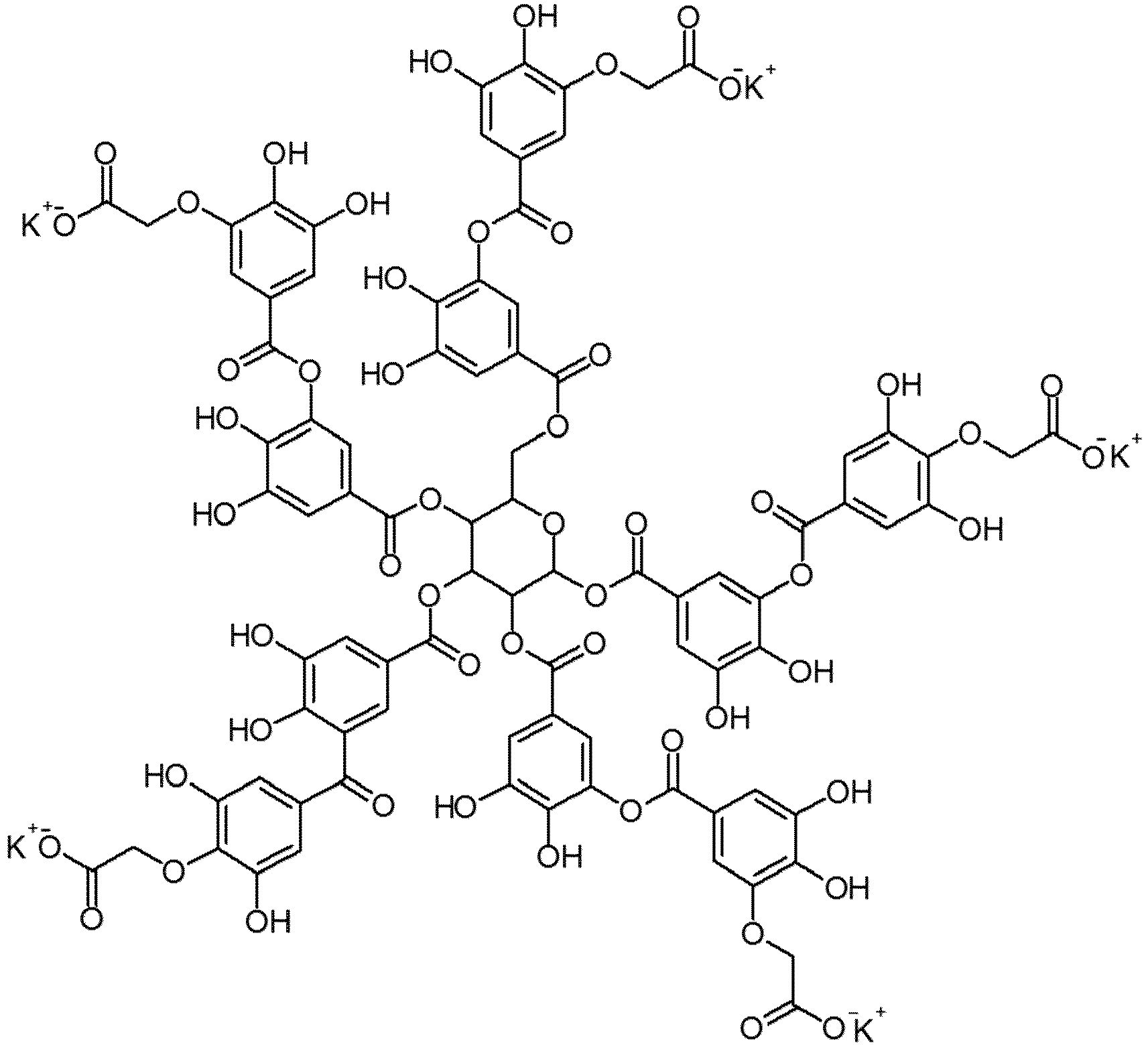


- Optionally, in embodiments, the organic functional layer further comprises a water-soluble, water-swellable, or water-dispersible polymeric binder. The polymeric binder eases the formation of a cohesive coating, especially when the functional organic compound, when used by itself, does not allow the formation of such a coating.
- In embodiments, the organic functional layer comprises 0 wt.% or more, 10 wt.% or more, 20 wt.% or more, 30 wt.% or more, 40 wt.% or more, or 50 wt.% or; and/or 60 wt.% or less, 50 wt.% or less, 40 wt.% or less, 30 wt.% or less, 20 wt.%, or 10 wt.% or less of the polymeric binder, based on the weight of the organic functional layer. In preferred embodiments, the organic functional layer comprises 0 wt.%, 33 wt.%, or 50 wt.% of the polymeric binder based on the weight of the organic functional layer.
- In embodiments, the organic functional layer comprises 40 wt.% or more, 50 wt.% or more, 60 wt.% or more, 70 wt.% or more, 80 wt.% or more, or 90 wt.% or more; and/or 100 wt.% or less, 90 wt.% or less, 80 wt.% or less, 70 wt.% or less, or 60 wt.% or less of the functional organic compounds (in total), based on the weight of the organic functional layer. In preferred embodiments, the organic functional layer comprises 50 wt.%, 64 wt.%, or 100 wt.% of the functional organic compounds (in total), based on the weight of the extended release layer.
- In embodiments, the polymeric binder is water-swellable copolymeric nanoparticles. In embodiments, the copolymer making these water-swellable copolymeric nanoparticles comprises crosslinkable repeat units, i.e. at units that can undergo crosslinking with or without a crosslinking agent, upon drying of the organic functional layer.
- The embodiments, the glass transition temperature of the copolymer, before crosslinking if any, ranges between 18 and 25°C.
- In preferred embodiments, the copolymer making the water-swellable copolymeric nanoparticles of the organic functional layer is of formula (I):

- X1 represents styrene repeat units;
- X2 represents alkyl acrylate or alkyl methacrylate repeat units;
- X3 represents alkoxy dialkyl vinylsilane, dialkoxy alkyl vinylsilane, or trialkoxy vinylsilane repeat units;
- X4 represents acrylic acid, methacrylic acid, acrylamide, methacrylamide, vinyl phosphoric acid, or N,N-dimethylaminoethyl methacrylamide repeat units; and
- a, b, c and d represents the weight percent of repeat units X1, X2, X3, and X4, respectively, based on the total weight of the copolymer, and each vary between 0.5 and 50 wt.%,
- The above formula should be understood to represent copolymers in which all X2 repeat units are the same or in which X2 represents two or more alkyl acrylate and/or alkyl methacrylate repeat units. In preferred embodiments, all X2 repeat units are the same.
- Similarly, the above formula should be understood to represent copolymers in which all X3 repeat units are the same or in which X3 represents two or more alkoxy dialkyl vinylsilane, dialkoxy alkyl vinylsilane, and/or trialkoxy vinylsilane repeat units. In preferred embodiments, all X3 repeat units are the same.
- Similarly, the above formula should be understood to represent copolymers in which all X4 repeat units are the same or in which X4 represents two or more acrylic acid, methacrylic acid, acrylamide, methacrylamide, vinyl phosphoric acid, and/or N,N-dimethylaminoethyl methacrylamide repeat units. In preferred embodiments, all X4 repeat units are the same.
- The alkyl group of the alkyl acrylate repeat units, alkyl methacrylate repeat units, alkoxy dialkyl vinylsilane repeat units, and dialkoxy alkyl vinylsilane repeat units can be linear or branched. In preferred embodiments, these alkyl groups comprise between 1 and 6 carbon atoms.
- The alkoxy groups of the alkoxy dialkyl vinylsilane repeat units, dialkoxy alkyl vinylsilane repeat units, and trialkoxy vinylsilane repeat units can be linear or branched. In preferred embodiments, these alkoxy groups comprise between 1 and 6 carbon atoms.
- As noted above, the X3 repeat units are optionally crosslinked with each other within the nanoparticles. Indeed, when producing the granules of the invention, the X3 repeat units can undergo self-crosslinking upon heating at a temperature between 40 and 50°C. In preferred embodiments, for example those in which the organic functional layer was produced in such conditions, some of the X3 repeat units are crosslinked with each other within the nanoparticles. In embodiments, up to 3% of the X3 repeat unit are crosslinked. More extensive crosslinking could yield an undesirably brittle organic functional layer. Crosslinking allows to modify the potassium release rate as desired. Indeed, crosslinking decreases the rate of swelling of the nanoparticles, which increase the potassium release rate, and allow using a thinner organic functional layer. In other embodiments, the X3 repeat units are not crosslinked with each other.
- In preferred embodiments, the alkyl group of the alkyl acrylate or alkyl methacrylate repeat unit is butyl.
- In preferred embodiments, X2 represents alkyl acrylate, preferably butyl acrylate.
- In preferred embodiments, the alkoxy group of the alkoxy dialkyl vinylsilane, dialkoxy alkyl vinylsilane, or trialkoxy vinylsilane repeat units is ethoxy.
- In preferred embodiments, X3 represents trialkoxy vinylsilane, preferably triethoxy vinylsilane repeat units.
- In preferred embodiments, X4 represents acrylic acid, acrylamide, or vinyl phosphoric acid repeat units.
- In preferred embodiments, a is 25 wt.% or more, 35 wt.% or more, 40 wt.% or more, or 45 wt.% or more; and/or 75 wt.% or less, 65 wt.% or less, 60 wt.% or less, 55 wt.% or less, or 50 wt.% or less. In more preferred embodiments, a is 48 wt.%.
- In preferred embodiments, b is 25 wt.% or more, 35 wt.% or more, 40 wt.% or more, or 45 wt% or more; and/or 75 wt.% or less, 65 wt.% or less, 60 wt.% or less, 55 wt.% or less, or 50 wt.% or less. In more preferred embodiments, b is 48 wt.%.
- In preferred embodiments, c is 0.5 wt.% or more, 1 wt.% or more, 1.5 wt.% or more, 2 wt.% or more, 2.5 wt.% or more; and/or 15 wt.% or less, 10 wt.% or less, 7.5 wt.% or less, 5 wt.% or less, 4 wt.% or less, or 3.5 wt.% or less. In more preferred embodiments, c is 3 wt.%.
- In preferred embodiments, d is 0.5 wt.% or more, 0.6 wt.% or more, 0.7 wt.% or more, 0.8 wt.% or more, 0.9 wt.% or more; and/or 10 wt.% or less, 5 wt.% or less, 3 wt.% or less, 2 wt.% or less, or 1.5 wt.% or less. In more preferred embodiments, d is 1 wt.%.
- In most preferred embodiments, the copolymer making the water-swellable copolymeric nanoparticles of the organic functional layer has the following ideal chemical structure:
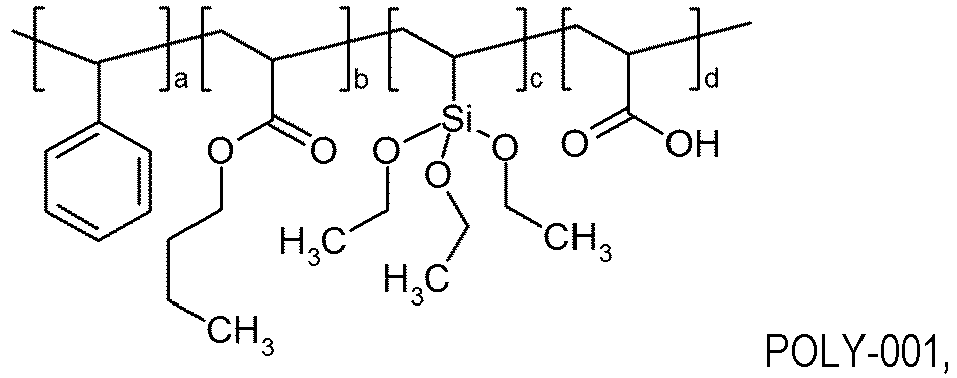


- The polymeric binder may be a mixture of the above copolymeric nanoparticles.
- The copolymeric nanoparticles may comprise a mixture of the above copolymers.
- Copolymeric nanoparticles comprising crosslinkable trialkoxy vinylsilane repeat units, such as triethoxysilyl repeat units, can be synthesized by free radical emulsion copolymerization in an aqueous solution containing anionic and non-ionic surfactants, such as sodium n-dodecyl benzene sulfonate and n-octanol. A pH controlling agent, such as sodium bicarbonate might also be used in the copolymerization to provide a stable polymeric nanoparticle suspension with nanoparticles having a particle size in the 40 nm to 200 nm range.
- As noted above, the controlled release layer covers the organic functional layer and comprises water-swellable copolymeric nanoparticles.
- The controlled release layer can be produced on the organic functional layer by applying a suspension of the water-swellable copolymeric nanoparticles in an aqueous solvent, following by drying. This can be carried out for example by spray coating in a fluidized bed. In embodiments, the temperature for the coating and drying steps is from 25 to below 50°C.
- In embodiments, the controlled release layer has a coating weight between 2 wt.% and 10 wt.% preferably between 4 wt.% and 20 wt.%, and more preferably between 5 wt.% and 15 wt.% (based on the weight of the nitrogen-containing fertilizer core). In preferred embodiments, the controlled release layer is thicker (has a larger coating weight) than the organic functional layer.
- In embodiments, the copolymer making the water-swellable copolymeric nanoparticles of the controlled release layer comprise crosslinkable repeat units, that can undergo crosslinking, with or without crosslinking agents, upon drying of the controlled release layer.
- The embodiments, the glass transition temperature of this copolymer, before crosslinking if any, ranges between 18 and 25°C.
- In preferred embodiments, the copolymer making the water-swellable copolymeric nanoparticles of the controlled release layer is of formula (I) as defined above, including all preferred embodiments thereof. Thus, in most preferred embodiments, this copolymer is POLY-001, POLY-002 and POLY-003, more preferably POLY-001.
- The copolymeric nanoparticles may comprise a mixture of the above copolymers.
- The controlled release layer may comprise a mixture of the above copolymeric nanoparticles.
- The anticaking layer covers the controlled release layer and comprises water-insoluble copolymeric nanoparticles.
- The anticaking layer can be produced on the controlled release layer by applying a suspension of the water-insoluble copolymeric nanoparticles in an aqueous solvent, followed by drying. This can be carried out for example by spray coating in a fluidized bed. In embodiments, the temperature for the coating and drying steps is between 30°C and 70°C, preferably between 35°C and 65°C.
- In embodiments, the anticaking layer has a coating weight between 1 wt.% and 10 wt.%, preferably between 2 wt.% and 5 wt.% (based on the weight of the nitrogen-containing fertilizer core).
- In embodiments, the copolymer making the water-insoluble copolymeric nanoparticles comprises repeat units having a plant hormone or a phosphorus solubilizer covalently or ionically attached as a pendant group.
- The embodiments, the glass transition temperature of the copolymer ranges between 35 and 55°C.
- In preferred embodiments, the copolymer making the water-insoluble copolymeric nanoparticles is of formula (II):
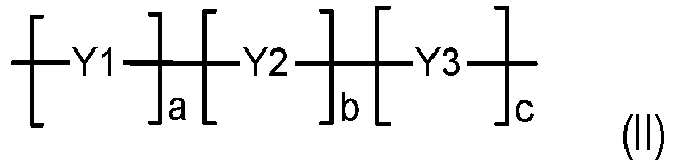
- Y1 represents styrene repeat units;
- Y2 represents alkyl acrylate or alkyl methacrylate repeat units;
- Y3 represents repeat units comprising, as a pendant group, an ionically or covalently attached plant hormone or phosphorus solubilizer;
- a and b represents the weight percent of repeat units Y1 and Y2, respectively, based on the total weight of the copolymer, and vary between 10 wt.% to 95 wt.%; and
- c represents the weight percent of repeat units Y3, based on the total weight of the copolymer, and vary between 0 wt.% to 30 wt.%.
- The above formula should be understood to represent copolymers in which all Y2 repeat units are the same or in which Y2 represents two or more alkyl acrylate and/or alkyl methacrylate repeat units. In preferred embodiments, all Y2 repeat units are the same.
- Similarly, the above formula should be understood to represent copolymers in which all Y3 repeat units are the same or in which Y3 represents two or more different repeat units comprising, as a pendant group, ionically or covalently attached plant hormones and/or phosphorus solubilizers. In preferred embodiments, all Y3 repeat units are the same.
- The alkyl groups of the alkyl acrylate repeat units and the alkyl methacrylate repeat units can be linear or branched. In preferred embodiments, these alkyl groups comprise between 1 and 6 carbon atoms, preferably butyl.
- In preferred embodiments, Y2 represents alkyl acrylate, preferably butyl acrylate.
- In embodiments, the plant hormone or phosphorus solubilizer that is covalently or ionically attached as a pendant group to the copolymer making the water-insoluble copolymeric nanoparticles, for example the copolymer of formula (II), is:
- a residue of an organic acid that is a plant hormone or phosphorus solubilizer or
- a carboxylate anion of an organic acid that is a plant hormone or phosphorus solubilizer.
- When it is covalently attached, the plant hormone or phosphorus solubilizer is preferably a residue of an organic acid (that is a plant hormone or phosphorus solubilizer).
- When it is ionically attached, the plant hormone or phosphorus solubilizer is preferably a carboxylate anion of an organic acid (that is a plant hormone or phosphorus solubilizer).
- In preferred embodiments, the organic acid is a phosphorus solubilizer. Such phosphorus solubilizers are as defined above, including preferred embodiments thereof.
- In preferred embodiments, the organic acid is a plant hormone. Such plant hormones are as defined above, including preferred embodiments thereof.
- In preferred embodiments, the organic acid that is a plant hormone or phosphorus solubilizer is:
- 1-naphthalene acetic acid, 2,4,5-trichlorobenzoic acid, 2,4,5-trichlorophenoxyacetic acid, 2,4-dichlorobenzoic acid, 2,4-dichlorophenoxyacetic acid, 2-hydroxybenzoic acid, 4-chlorobenzoic acid, 4-chlorophenoxyacetic acid, 4-nitrobenzoic acid, abscisic acid, citric acid, gibberellic acid, gibberellin A13, gibberellin A3, gibberellin A4, gluconic acid, indole-3-acetic acid, indole-3-butanoic acid, oxalic acid, or salicylic acid;
- preferably 1-naphthalene acetic acid, 4-chlorophenoxyacetic acid, abscisic acid, citric acid, gibberellic acid, gibberellin A3, gluconic acid, indole-3-acetic acid, indole-3-butanoic acid, oxalic acid, or salicylic acid;
- more preferably 1-naphthalene acetic acid, 4-chlorophenoxyacetic acid, 4-nitrobenzoic acid, gibberellic acid, gibberellin A3, gluconic acid, indole-3-acetic acid, oxalic acid, salicylic acid, or citric acid; and
- most preferably 1-naphthalene acetic acid or gibberellic acid.
- In preferred embodiments, the pendant group is ionically attached to repeat units Y3. In more preferred embodiments, Y3 represents repeat units of formula (III):

- R1 is a hydrogen atom or methyl;
- R2 is the same or different C1-6 alkyl; and
- A- is a carboxylate anion of an organic acid that is a plant hormone or a phosphorus solubilizer.
- In preferred embodiments, R1 is methyl.
- In preferred embodiments, both R2 groups are methyl.
- As can be seen in the above, in formula (III), the pendant group A- is a carboxylate anion (RCOO) of an organic acid (RCOOH) that is a plant hormone or phosphorus solubilizer, preferably a plant hormone. Preferably, these organic acids that are a plant hormone or a phosphorus solubilizer are as defined above, including preferred embodiments thereof.
- In preferred embodiment, Y3 is a repeat unit obtained by polymerizing the following monomers.


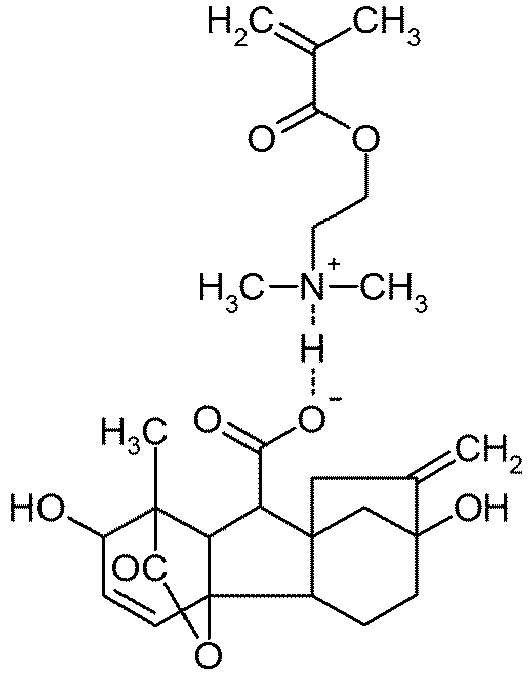


- Of note, the structure of the Y3 repeat units obtained by polymerizing the above monomers can easily be deduced from the structure of the monomers as follows:

- In preferred embodiments, a is 20 wt.% or more, 25 wt.% or more, 30 wt.% or more, 35 wt.% or more, 39 wt.% or more, or 40 wt.% or more; and/or 65 wt.% or less, 60 wt.% or less, 55 wt.% or less, 50 wt.% or less, 46 wt.% or less, or 45 wt.% or less. In embodiments when c is zero, a is preferably 50 wt.%. In embodiments when c is greater than zero, a is preferably between 35 wt.% and 50 wt.% and more preferably between 39 wt.% and 46 wt.%.
- In preferred embodiments, b is 30 wt.% or more, 35 wt.% or more, 40 wt.% or more, 44 wt.% or more, or 45 wt.% or more; and/or 80 wt.% or less, 70 wt.% or less, 65 wt.% or less, 60 wt.% or less, 55 wt.% or less, 50 wt.% or less, or 49 wt.% or less. In embodiments when c is zero, b is preferably 50 wt.%. In embodiments when c is greater than zero, b is preferably between 40 wt.% and 50 wt.% and more preferably between 44 wt.% and 49 wt.%.
- In preferred embodiments, c is 0 wt.% or more, 1 wt.% or more, 2 wt.% or more, 3 wt.% or more, 4 wt.% or more, 5 wt.% or more; and/or 30 wt.% or less, 25 wt.% or less, 20 wt.% or less, 17 wt.% or less, 15 wt.% or less, 12 wt.% or less, or 10 wt.% or less. In embodiments, c is 0 wt.%. In other embodiments, c is greater than 0 wt.%.
- Preferred copolymers of formula (II) have the following ideal chemical structures:

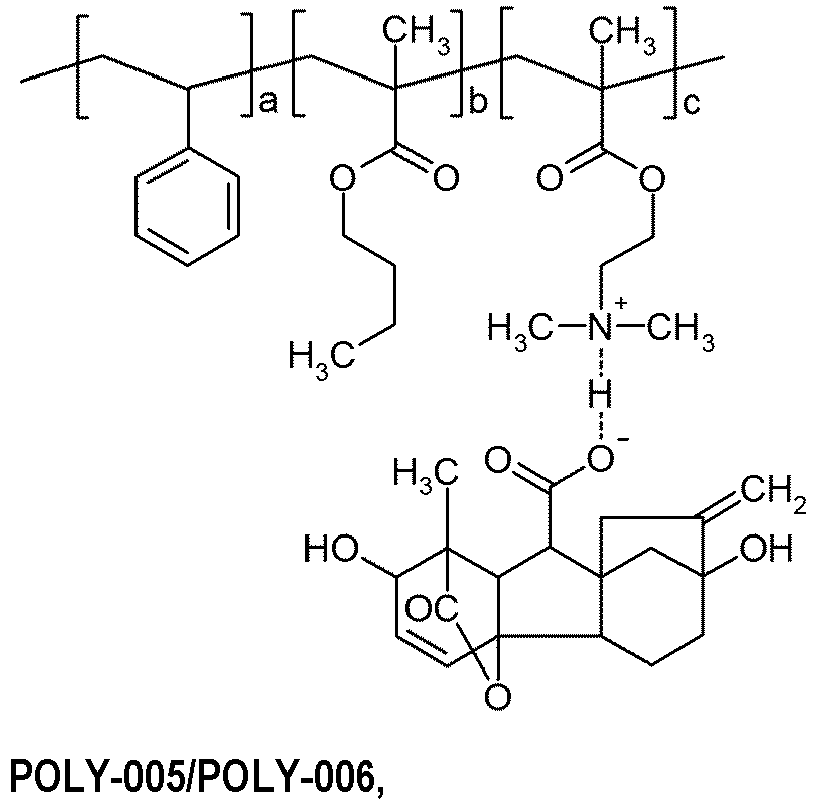
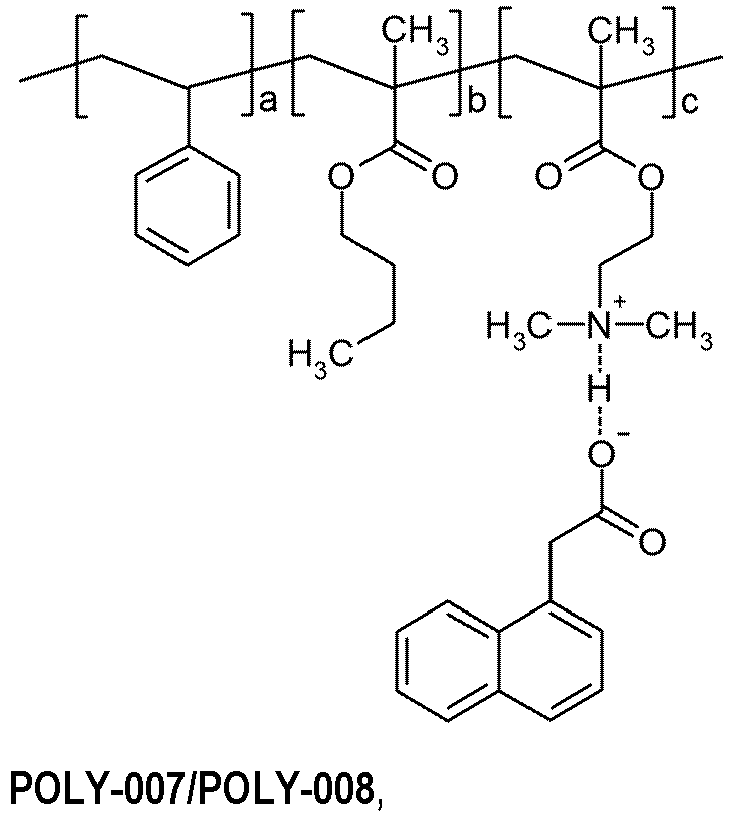


- Most preferred copolymers of formula (II) include POLY-004, POLY-005, and POLY-007, preferably POLY-004.
- In embodiments, the pendant group is covalently attached to repeat units Y3. In more preferred embodiments, Y3 represents repeat units of formula (IV):

- R1 is a hydrogen atom or methyl;
- D-C(=O)- is a residue of an organic acid that is a plant hormone or phosphorus solubilizer.
- As can be seen in the above, in formula (IV), the pendant group D-C(=O)- is a residue of an organic acid (D-COOH) that is a plant hormone or a phosphorus solubilizer, preferably a plant hormone. Preferably, this organic acid that is a plant hormone or a phosphorus solubilizer are as defined above, including preferred embodiments thereof.
- In preferred embodiments, the organic acid is gibberellic acid, indole-3-acetic acid, 1-naphthalene acetic acid, 2-naphthalene acetic acid, 4-nitrobenzoic acid, 4-chlorophenyloxyacetic acid, or salicylic acid.
- In preferred embodiments, the repeat unit Y3 of formula (IV) is obtained by polymerization of the following monomer of formula (VI), which can be synthesized by the reacting the monomer of formula (V) with the organic acid in an oxygen atmosphere at temperature around 40°C in presence of 1,4-dioxolane without catalyst.

- Preferred copolymers of formula (IV) have the following ideal chemical structures:


- The anticaking layer may comprise a mixture of the above water-insoluble copolymeric nanoparticles.
- The water-insoluble copolymeric nanoparticles may comprise a mixture of the above copolymers.
- The copolymer for the water-insoluble copolymeric nanoparticles for the anticaking layer can be synthesized, for example, by free radical emulsion copolymerization in an aqueous solution containing anionic and non-ionic surfactants, such as sodium n-dodecyl benzene sulfonate and n-octanol. A pH controlling agent, such as sodium bicarbonate can also be used in the copolymerization to provide a stable polymeric nanoparticle suspension.
- The use of the terms "a" and "an" and "the" and similar referents in the context of describing the invention (especially in the context of the following claims) are to be construed to cover both the singular and the plural, unless otherwise indicated herein or clearly contradicted by context.
- The terms "comprising", "having", "including", and "containing" are to be construed as open-ended terms (i.e., meaning "including, but not limited to") unless otherwise noted.
- Similarly, herein a general chemical structure, such as Formulas I to IX, with various substituents (R1, R2, etc.) and various radicals (alkyl, halogen atom, etc.) enumerated for these substituents is intended to serve as a shorthand method of referring individually to each and every molecule obtained by the combination of any of the radicals for any of the substituents. Each individual molecule is incorporated into the specification as if it were individually recited herein. Further, all subsets of molecules within the general chemical structures are also incorporated into the specification as if they were individually recited herein.
- All methods described herein can be performed in any suitable order unless otherwise indicated herein or otherwise clearly contradicted by context.
- For clarity, an organic acid can be represented as RCOOH, in which R is an organic group.
- An organic carboxylate salt can be represented as RCOO- M+, i.e. an organic carboxylate anion (RCOO-) with a cation (M+), in which R is an organic group.
- Since a salt is often conceptualized as the result of an acid-base reaction:
HA + BOH → AB + H2O
Acid Base Salt Water
wherein A is an anion and B is a cation,
it is often said for simplicity that a given anion (A-) is "the carboxylate anion of a given corresponding acid" (HA). This means that the anion (A-) corresponds to the following underlined part of the acid: HA. For example, the carboxylate anion of acetic acid (CH3COOH) is acetate (CH3COO-). - Herein, a "residue" of an organic acid or a carboxylate anion is a group obtained by covalently attaching an organic acid or a carboxylate anion to another molecule. For example, an organic acid RCOOH can be reacted with a -NCO group to attach the organic acid as follows: -N-C(=O)-R, wherein R-C(=O)- is the residue of the organic acid.
- The use of any and all examples, or exemplary language (e.g., "such as") provided herein, is intended merely to better illuminate the invention and does not pose a limitation on the scope of the invention unless otherwise claimed.
- No language in the specification should be construed as indicating any non-claimed element as essential to the practice of the invention.
- Herein, the term "about" has its ordinary meaning. In embodiments, it may mean plus or minus 10% or plus or minus 5% of the numerical value qualified.
- Unless otherwise defined, all technical and scientific terms used herein have the same meaning as commonly understood by one of ordinary skill in the art to which this invention belongs.
- Herein, the terms "alkyP", "alkylene", "alkenyl", "alkenylene", "alkynyl", "alkynylene" and their derivatives (such as alkoxy, alkyleneoxy, etc.) have their ordinary meaning in the art.
- For more certainty, herein:
Term Definition alkyl monovalent saturated aliphatic hydrocarbon radical of general formula -CnH2n+1 alkylene bivalent saturated aliphatic hydrocarbon radical of general formula -CnH2n- (also called alkanediyl) - It is to be noted that, unless otherwise specified, the hydrocarbon chains of the above groups can be linear or branched. Further, unless otherwise specified, these groups can contain between 1 and 18 carbon atoms, more specifically between 1 and 12 carbon atoms, between 1 and 6 carbon atoms, between 1 and 3 carbon atoms, or contain 1 or 2, preferably 1, or preferably 2 carbon atoms.
- Other objects, advantages and features of the present invention will become more apparent upon reading of the following non-restrictive description of specific embodiments thereof, given by way of example only with reference to the accompanying drawings.
- The present invention is illustrated in further details by the following non-limiting examples.
- The following chemicals were used as received without further purification.
CTA Citric Acid, available from Sigma-Aldrich, Canada CPA 4-Chlorophenoxyacetic Acid, available from Sigma-Aldrich, Canada GBA Gibberellic Acid, available from Sigma-Aldrich, Canada GNA Gluconic Acid, available from Sigma-Aldrich, Canada IAA Indole-3-Acetic Acid, available from Sigma-Aldrich, Canada NAA 1-Naphthalene Acetic Acid, available from Sigma-Aldrich, Canada SAA Salicylic Acid, available from Sigma-Aldrich, Canada BZQ 1,4-benzoquinone, available from Sigma-Aldrich, Canada DAP Diammonium phosphate fertilizer, available from Phu My Fertilizers, Vungtau, Vietnam DCD Dicyandiamide 99%, available from Sigma-Aldrich, Canada DDL Dibutyltin dilaurate, available from Sigma-Aldrich, Canada DMA 2-(N,N-Dimethylamino)ethyl methacrylate, available from Sigma-Aldrich, Canada DMF N,N-dimethylformamide, available from Sigma-Aldrich, Canada DXL 1,4-dioxolane, available from Sigma-Aldrich, Canada ICM 2-isocyanatoethyl methacrylate, available from Korea Showa Chemicals, Seoul, Korea. NBA p-Nitrobenzoic Acid, available from Sigma-Aldrich, Canada NBTPT N-(n-Butyl)thiophosphoric triamide, available from Sigma-Aldrich, Canada. N-Humus Urea fertilizer coated with humic acid (N: 35% and Humus 7%), available from Ca Mau Fertilizers, Camau, Vietnam N-46.NANO.C+ Urea fertilizer coated with chitosan (N: 46% and Chitosan 3.5%), available from Ca Mau Fertilizers, Camau, Vietnam N-46-Plus Urea fertilizer coated with NBTPT and DCD (N: 46%, 230ppm NBTPT and 950ppm DCD), available from Ca Mau Fertilizers, Camau, Vietnam SDS Sodium dodecyl sulfonate, available from Signa Aldrich, Canada TA Tannic acid, available from Sigma Aldrich, Canada UREA Urea fertilizer containing 46% nitrogen, available from Ca Mau Fertilizers, Camau, Vietnam - Copolymeric nanoparticles were synthesized in a 500 Kg oil heated double wall glass-lined reactor equipped with a water condenser, mechanical stirrer, dropping funnel, thermometer and nitrogen or air inlet.
- The products were characterized with a Perkin Elmer® Spectrum Two® FTIR spectrometer.
- The particle size of the copolymeric nanoparticles was measured in a dilute water solution using a Brookhaven® NanoBrook® 173Plus particle size analyzer.
- The molecular weight of the copolymers was measured using a Waters® size exclusion chromatography column using N,N-dimethylformamide as an eluent and using polystyrene standards.
- The synthesis of copolymeric nanoparticles POLY-001 (as an aqueous suspension) was done by mixing a prepolymer solution, which comprised 236 Kg of deionized water, 39.6 Kg of styrene, 39.6 Kg of n-butylacrylate, 0.82 Kg of acrylic acid, 2.48 Kg of triethoxy vinylsilane, 0.82 Kg of ammonium bicarbonate and 0.82 Kg n-octanol in a 1,000-liter stainless steel tank with a high shear mixer. In a separate smaller tank, a solution of ammonium persulfate free radical initiator was prepared by dissolving 0.42 Kg of ammonium persulfate into 10 Kg deionized water.
- One hundred and sixty kilograms of the prepolymer solution were loaded in the reactor. The temperature was slowly raised to 80°C and the remaining prepolymer solution was added to the reactor using a dosing pump at a rate 32.0 Kg per hour. Simultaneously, the ammonium persulfate solution was also added to the reactor using a dosing pump at a rate of 2.00 Kg per hour.
- After both solutions were completely added into the reactor, the polymerization was continued at 80°C under nitrogen atmosphere and constant stirring for additional 15 hours. Reaction samples were removed from the reactor after 16, 20 and 24 hours to measure the solid weight for monitoring the completeness of the polymerization. After the polymerization was completed, deionized water was added to the reactor to adjust the solid weight to 25%, thus producing a suspension that could directly be used (with optional further dilution as desired) to produce smart N-Fertilizers.
- Copolymer POLY-001 was:

- The glass transition temperature, particle size, and polydispersity of POLY-001 were measured to be 20°C, 92.0 nm and 0.020, respectively.
-
Figure 2 shows the FTIR spectrum of copolymeric nanoparticles POLY-001 in a KBr pellet. - The synthesis of copolymeric nanoparticles POLY-004 (as an aqueous suspension) was done by mixing a prepolymer solution, which comprised 236 Kg of deionized water, 50.0 Kg of styrene, 50.0 Kg of butyl methacrylate, 0.82 Kg of ammonium bicarbonate and 0.82 Kg n-octanol in a 1,000-liter stainless steel tank with a high shear mixer. In a separate smaller tank, a solution of ammonium persulfate free radical initiator was prepared by dissolving 0.42 Kg of ammonium persulfate into 10 Kg deionized water.
- One hundred and sixty kilograms of the prepolymer solution were loaded in the reactor. The temperature was slowly raised to 80°C and the remaining prepolymer solution was added to the reactor using a dosing pump at a rate 32.0 Kg per hour. Simultaneously, the ammonium persulfate solution was also added to the reactor using a dosing pump at a rate of 2.00 Kg per hour.
- After both solutions were completely added into the reactor, the polymerization was continued at 80°C under nitrogen atmosphere and constant stirring for additional 15 hours. Reaction samples were removed from the reactor after 16, 20 and 24 hours to measure the solid weight for monitoring the completeness of the polymerization. After the polymerization was completed, deionized water was added to the reactor to adjust the solid weight to 25%, thus producing a suspension that could directly be used (with optional further dilution as desired) to produce smart N-Fertilizers.
- Copolymer POLY-001 was:

- The particle size and polydispersity of POLY-004 were measured to be 79 nm and 0.023, respectively.
-
Figure 3 shows the FTIR spectrum of copolymeric nanoparticles POLY-004 in a KBr pellet. - The synthesis of copolymeric nanoparticles POLY-005 (as an aqueous suspension) was done by mixing a prepolymer solution, which comprised 236 Kg of deionized water, 47.0 Kg of styrene, 50.0 Kg of butyl methacrylate, 3.00 Kg of N,N-dimethylamino ethylmethacrylate, 0.82 Kg of ammonium bicarbonate and 0.82 Kg n-octanol in a 1,000-liter stainless steel tank with a high shear mixer. In a separate smaller tank, a solution of ammonium persulfate free radical initiator was prepared by dissolving 0.42 Kg of ammonium persulfate into 10 Kg deionized water.
- One hundred and sixty kilograms of the prepolymer solution were loaded in the reactor. The temperature was slowly raised to 80°C and the remaining prepolymer solution was added to the reactor using a dosing pump at a rate 32.0 Kg per hour. Simultaneously, the ammonium persulfate solution was also added to the reactor using a dosing pump at a rate of 2.00 Kg per hour.
- After both solutions were completely added to the reactor, the polymerization was continued at 80°C under nitrogen atmosphere and constant stirring for additional 15 hours. Reaction samples were removed from the reactor after 16, 20 and 24 hours to measure the solid weight for monitoring the completeness of the polymerization.
- The particle size of the copolymeric nanoparticles was measured to be 1,250 nm with a polydispersity of 0.120.
- Then, 6.60 Kg of gibberellic acid were slowly added to the reactor and the stirring continued in the same conditions for an additional 3 hours.
- Copolymer POLY-005 was:

- The particle size and polydispersity were measured to be 109 nm and 0.078, respectively.
- Deionized water was added to the reactor to adjust the solid weight to 25%, thus producing a suspension that could directly be used (with optional further dilution as desired) to produce smart N-Fertilizers.
-
Figure 4 shows the FTIR spectrum of copolymeric nanoparticles POLY-005 in a KBr pellet. - The synthesis of copolymeric nanoparticles POLY-007 (as an aqueous suspension) was performed in the same manner as in Example 3 with the exception that the monomers were 47.0 Kg of styrene, 50.0 Kg of butyl methacrylate and 3.00 Kg of 2-(dimethylamino)ethyl methacrylate. After 24 hours of polymerization, 3.55 Kg of 1-naphthalene acetic acid were slowly added to the reactor. The reaction was continued, stirring, in the same conditions, for an additional 3 hours. Then, the reactor was cooled to room temperature and deionized water was added to dilute to 25% solid weight, thus producing a suspension that could directly be used (with optional further dilution as desired) to produce smart N-Fertilizers.
- Copolymer POLY-007 was:

- The particle size and polydispersity of POLY-007 were measured to be 76 nm and 0.03, respectively.
-
Figure 5 shows the FTIR spectrum of copolymeric nanoparticles POLY-007 in a KBr pellet. - The synthesis of TAAA (formula provided above in the section entitled "Enzyme Inhibitors") was performed by slowly adding 170 grams of tannic acid in 300 ml of de-ionized water containing 40 grams of potassium hydroxide under nitrogen atmosphere and constant stirring at 80 °C. After 1.5 hours, a solution of 170 grams of chloroacetic acid (28%) was slowly dropped into the reaction mixture. The reaction allowed to continue in the same conditions for an additional 5 hours. The obtained solution was ready for production of smart N-Fertilizers.
-
Figure 6 shows the FTIR spectrum of tannin molecule TAAA of Example 5 in a KBr pellet. - The synthesis of TABS (formula provided above in the section entitled "Enzyme Inhibitors") was performed by slowly adding 170 grams of tannic acid in 300 ml of de-ionized water containing 40 grams of potassium hydroxide under nitrogen atmosphere and constant stirring at 80 °C. After 1.5 hours, a solution of 68.1 grams of 1,4-butane sultone was slowly dropped into the reaction mixture. The reaction allowed to continue in the same conditions for an additional 5 hours. The obtained solution was ready for production of smart N-Fertilizers.
-
Figure 7 shows the FTIR spectrum of tannin molecule TABS in a KBr pellet. - The synthesis of TANAA (formula provided above in the section entitled "Enzyme Inhibitors") was performed by slowly adding 170 grams of tannic acid in 300 ml of de-ionized water containing 40 grams of potassium hydroxide under nitrogen atmosphere and constant stirring at 80°C. After 1.5 hours, a solution of 58.0 grams of 2-chloroethylamine hydrochloride in 150 ml of water was slowly dropped into the reaction mixture. The reaction was allowed to continue in the same conditions for an additional 5 hours. Then, a solution containing 93.1 grams of 1-naphthalene acetic acid in 300 ml ethanol was slowly added to the reaction mixture. The reaction was allowed to continue, stirring, in the same conditions for an additional 5 hours. The obtained solution was ready for production of smart N-Fertilizers.
-
Figure 8 shows the FTIR spectrum of tannin molecule TANAA in a KBr pellet. - The synthesis of TAGA (formula provided above in the section entitled "Enzyme Inhibitors") was performed by slowly adding 170 grams of tannic acid in 300 ml of de-ionized water containing 40 grams of potassium hydroxide under nitrogen atmosphere and constant stirring at 80°C. After 1.5 hours, a solution of 58.0 grams of 2-chloroethylamine hydrochloride in 150 ml of water was slowly dropped into the reaction mixture. The reaction was allowed to continue in the same conditions for an additional 5 hours. Then, a solution containing 173 grams of gibberellic acid in 500 ml ethanol was slowly added to the reaction mixture. The reaction was allowed to continue, stirring, in the same conditions for an additional 5 hours. The obtained solution was ready for production of smart N-Fertilizers.
-
Figure 9 shows the FTIR spectrum of tannin molecule TAGA in a KBr pellet. - The synthesis of TABA (formula provided above in the section entitled "Enzyme Inhibitors") was performed by slowly adding 170 grams of tannic acid in 300 ml of de-ionized water containing 40 grams of potassium hydroxide under nitrogen atmosphere and constant stirring at 80°C. After 1.5 hours, a solution of 58.0 grams of 2-chloroethylamine hydrochloride in 150 ml of water was slowly dropped into the reaction mixture. The reaction was allowed to continue in the same conditions for an additional 5 hours. Then, a solution containing 83.6 grams of 4-nitrobenzoic acid in 500 ml ethanol slowly was added to the reaction mixture. The reaction was allowed to continue, strirring, in the same conditions for an additional 5 hours. The obtained solution was ready for production of smart N-Fertilizers.
-
Figure 10 shows the FTIR spectrum of tannin molecule TABA in a KBr pellet. - Nitrogen containing fertilizer granules were sieved to remove granules (N-Fertilizer) with the size less than 1.5 mm. Then, sieved N-Fertilizer granules (10Kg) were loaded into a home-built Wurster fluidized bed. The bed temperature was set at 32 ± 2 °C and 20% relative humidity with a hot air stream at a speed of 300 to 400 m3 per hour for 5 minutes to dry the nitrogen containing granules.
- Then, an aqueous solution containing 25 wt.% of water-swellable copolymeric nanoparticles together with one or more functional organic compound was sprayed from the bottom of the fluidized bed at a rate of 60 grams per minute. The mist was carried by the hot air stream and deposited the copolymeric nanoparticles and functional organic compound(s) onto the surface of the granules (which were floating in the hot air stream). The process was continued until the desired thickness for the organic functional layer [104] was reached.
- Then, the spraying was stopped, while the granules remained floating in the hot air stream for an additional 10 minutes in the same conditions before coating the next layer.
- The coating of the controlled release layer onto the surface of the nitrogen containing granules covered with the organic functional release layer was done in the same manner as coating the organic functional layer with the exception that the aqueous solution contained water-swellable copolymeric nanoparticles (25 wt.%) only (i.e. no functional organic compound was present).
- Then, the spraying was stopped, while the granules remained floating in the hot air stream for an additional 10 minutes in the same conditions before coating the next layer.
- The coating of the anticaking layer onto the surface of the controlled release layer was done in the same manner as coating the controlled release layer with the exception that the aqueous solution contained only water-insoluble copolymeric nanoparticles (25 wt.%) and that temperature of the fluid bed was increased to 45°C.
- Then, the spraying was stopped, while the granules remained floating in the hot air stream for an additional 20 minutes in the same conditions to remove water.
- For measuring urea release, 4 g of Smart N-Fertilizer were immersed in 400 mL water in a glass bottle and stored in an oven at 30°C. At specific times, 5 mL sample solution was collected for high performance liquid chromatography (HPLC) analysis. The HPLC apparatus was equipped with a Waters 2414 Refractive Index Detector and a XSelect column with water eluent. The sample solution was filtered through a 0.2 µm filter and injected into the HPLC system. By comparing the urea peak with calibration curves, the urea concentration of the sample solution could be determined.
- To prepare the calibration curves, standard urea was dissolved in water to obtain two stock solutions with concentrations of 1000 ppm and 10,000 ppm. Two sets of standard urea solutions were prepared for plotting the calibration curves as described.
- The percentage of urea release is calculated using the equation:

- To determine the Mtotal release value, coated fertilizer granules were ground to a fine powder, which was then dissolved in water. The concentration of urea in the obtained solution was determined using the HPLC system.
- 24g Smart N-Fertilizers were immersed in 200mL water in a glass bottle that was stored in an oven at 30°C. After specific periods of time, 5mL sample solution was collected for UV-VIS spectroscopy analysis using a Jasco V-670 absorption spectrometer. The absorption intensity at a particular wavelength was compared with a calibration curve to calculate the concentration of organic compound released in the initial solution.
- The percentage of organic compound release was calculated using the equation:

- Coated granules were ground to a fine powder and then dissolved in water for determining the maximum weight of water-soluble analytes (Mtotal release) using UV-VIS absorption spectroscopy.
- The following Smart N-Fertilizers were produced.
Example Name of fertilizer Core 102 Layer 104 Layer 106 Layer 108 10 N0503 UREA NONE POLY-001 (5%) POLY-004 (3%) 11 N0703 UREA NONE POLY-001 (7%) POLY-004 (3%) 12 N1003 UREA NONE POLY-001 (10%) POLY-004 (3%) 13 DAP0503 DAP NONE POLY-001 (5%) POLY-004 (3%) 14 NH0503 UREA HUMUS (7%) POLY-001 (5%) POLY-004 (3%) 15 NH0703 UREA HUMUS (7%) POLY-001 (7%) POLY-004 (3%) 16 NH1003 UREA HUMUS (7%) POLY-001 (10%) POLY-004 (3%) 17 NH0703GA UREA HUMUS (7%) POLY-001 (7%) POLY-005 (3%) 18 NH0703NAA UREA HUMUS (7%) POLY-001 (7%) POLY-007 (3%) 19 NC0503 UREA CHITOSAN (3%) POLY-001 (5%) POLY-004 (3%) 20 NC0703 UREA CHITOSAN (3%) POLY-001 (7%) POLY-004 (3%) 21 NBD0503 UREA NBTPT (230ppm) POLY-001 (5%) POLY-004 (3%) DCD (950ppm) 22 NBD0703 UREA NBTPT (230ppm) POLY-001 (7%) POLY-004 (3%) DCD (950ppm) 23 N BD0503GA UREA NBTPT (230ppm) POLY-001 (5%) POLY-005 (3%) DCD (950ppm) 24 NBD0503NAA UREA NBTPT (230ppm) POLY-001 (5%) POLY-007 (3%) DCD (950ppm) 25 NTA0503 UREA TA (1%) POLY-001 (5%) POLY-004 (3%) 26 NTA0703 UREA TA (1%) POLY-001 (7%) POLY-004 (3%) 27 NTANAA0503 UREA TANAA (1%) POLY-001 (5%) POLY-004 (3%) 28 NTAGA0503 UREA TAGA (1%) POLY-001 (5%) POLY-004 (3%) 29 NTABS0503 UREA TABS (1%) POLY-001 (5%) POLY-004 (3%) 30 NTABA0503 UREA TABA (1%) POLY-001 (5%) POLY-004 (3%) 31 NTAAA0503 UREA TAAA (1% POLY-001 (5%) POLY-004 (3%) 32 DAPSDS0503 DAP SDS (3%) POLY-001 (5%) POLY-004 (3%) POLY-001 (3%) 33 DAPTA0503 DAP TA (3%) POLY-001 (5%) POLY-004 (3%) POLY-001 (3%) 34 DAPTAAA0503 DAP TAAA (3%) POLY-001 (5%) POLY-004 (3%) POLY-001 (1%) 35 DAPTABS0503 DAP TABS (3%) POLY-001 (5%) POLY-004 (3%) POLY-001 (1%) 36 DAPTANAA0503 DAP TANAA (3%) POLY-001 (5%) POLY-004 (3%) POLY-001 (1%) 37 DAPTAGA0503 DAP TAGA (3%) POLY-001 (5%) POLY-004 (3%) POLY-001 (1%) 38 DAPTABA0503 DAP TABA (3%) POLY-001 (5%) POLY-004 (3%) POLY-001 (1%) 39 DAPTAAA0503GA DAP TAAA (3%) POLY-001 (5%) POLY-005 (3%) POLY-001 (1%) 40 DAPTAAA0503NAA DAP TAAA (3%) POLY-001 (5%) POLY-007 (3%) POLY-001 (1%) - N.B. The values in parentheses in the above table are the thicknesses (i.e. coating weight) of the various layers. When there are two values given for a given layer (
e.g. layer 104 of Ex. 32 to 40), each value represents the thickness of the coating that would be obtained if only the component accompanied by the value was present. For example, in Ex. 40, the entry "TAAA (3%) POLY-001 (1%)" underLayer 104 means thatlayer 104 has a total thickness of 4%, 75% of which is constituted of TAAA (thus equivalent to a TAAA layer with a 3% thickness) and 25% of which is constituted of POLY-001 (thus equivalent to a POLY-001 layer with a 1% thickness). -
Figure 11 shows the cumulative urea release from the fertilizers of Examples 10, 11 and 12. It can be seen that increasing the thickness of the controlled release layer 106 (5, 7, and 10% in Examples 10, 11 and 12, respectively) reduces the urea release rate. -
Figure 12 shows the cumulative urea release from the fertilizers of Examples 14, 15 and 16. Again, it can be seen that increasing the thickness of the controlled release layer 106 (5, 7, and 10% in Examples 14, 15 and 16, respectively) reduces the urea release rate. ComparingFigures 11 and 12 , it can be seen that the presence of a humus layer (layer 104) significantly increased (in fact almost doubled) the urea release rate. -
Figure 13 shows the cumulative humus release from the fertilizers of Examples 14, 15 and 16. Again, increasing the thickness of the controlled release layer reduces the humus release rate. -
Figure 14 shows the cumulative urea release from the fertilizers of Examples 21 and 22. Again, it can be seen that increasing the thickness of the controlled release layer 106 (5 and 7% in Examples 21 and 22, respectively) reduces the urea release rate. ComparingFigures 11 and14 , it can be seen that the presence of a NBTPT/DCD layer (layer 104) does not significantly change the urea release rate. - Fertilizers comprising different functional layers were used for growing Brassica integrifolia. The experiments were done in plastic planting pots containing 5Kg of a growth media comprising 50% coconut fibers and 50% topsoil. The N, P2O5 and K2O contents in 100 g of the growth media were 7.7 mg, 32 mg and 34 mg, respectively. Ten grams of urea were buried in the growth media at around 3 cm depth as a comparative example (Example 41). Alternatively, 10 grams of various smart N-fertilizers comprising different organic
functional layer 104 were buried into the growth media at around 3 cm depth (Examples 42 and following). Then, ten seeds of Brassica integrifolia (also called English spinach) were placed in each planting pot. The planting pots were placed outdoor and wetted with 200ml water every day. - The table below shows the height, leaf length, leaf width, weight of 6 plants per pot and the total yield of brassica integrifolia on day 31 after planting.
Figure 15 shows the Brassica integrifolia plants grown in Examples 41 to 48, 31 days after planting.Examples Fertilizers Height (cm) Leaf length (cm) Leaf width (cm) Weight of 6 plants (gram) Total yield (gram) 41 (comparative) Urea 4.90 2.00 1.00 5 5 42 N0503 from Example 10 26.9 12.1 8.00 140 301 43 NH0503 from Example 14 30.1 15.4 9.60 279 430 44 NH0703GA from Example 17 27.3 13.6 8.30 195 326 45 NH0703NAA from Example 18 29.0 14.2 8.70 241 350 46 NBD0503 from Example 21 27.0 13.0 8.50 202 358 47 NBD0503GA from Example 23 28.3 12.6 8.40 208 413 48 NBD0503NAA from Example 24 26.2 11.4 7.70 173 273 - The fertilizers of the invention produced significantly larger plants in a much higher yield than the plain urea fertilizer.
- Smart N-Fertilizers with different organic functional layer comprising tannic acid and its modifiers were used for growing brassica integrifolia. These experiments were carried out as described above for Examples 42 to 48.
- The table below shows the height, leaf length, leaf width, weight of 6 plants, and total yield of Brassica integrifolia on day 31 after planting.
Figure 16 shows the Brassica integrifolia plants grown in Examples 41 (comparative) and Examples 49-54, 31 days after planting.Examples Fertilizers Height (cm) Leaf length (cm) Leaf width (cm) Weight of 6 plants (gram) Total yield (gram) 41 (comparative) Urea 4.90 2.00 1.00 5 5 49 N0503 from Example 10 29.2 14.8 9.50 140 301 50 NTA0503 from Example 25 33.0 15.4 10.0 286 559 51 NTANAA0503 from Example 27 28.2 13.0 8.50 217 398 52 NTABS0503 from Example 29 31.1 14.6 9.10 233 433 53 NTABA0503 from Example 30 31.1 15.8 10.5 293 546 54 NTAAA0503 from Example 31 32.6 14.4 9.30 273 474 - The fertilizers of the invention produced significantly larger plants in a much higher yield than the plain urea fertilizer.
- Smart N-Fertilizers with different organic functional layer were used for growing brassica integrifolia. These experiments were carried out as described above for Examples 42 to 48, with the exception of Example 55 (comparative), in which ten grams of DAP were buried in the growth media at around 3 cm depth as a comparative example.
- The table below shows the height, leaf length, leaf width, weight of 6 plants, and total yield of Brassica integrifolia on day 31 after planting.
Figure 17 shows the Brassica integrifolia plants grown in Examples 55 to 64 days after planting.Example Fertilizers Height (cm) Leaf length (cm) Leaf width (cm) Weight of 6 plants (gram) Total yield (gram) 55 (comparative) DAP 7.60 4.20 2.40 9 15 56 DAP0503 from Example 13 25.1 11.8 7.80 161 213 57 DAPTA0503 from Example 33 24.9 12.2 8.00 159 302 58 DAPTABS0503 from Example 35 24.3 11.6 7.20 121 271 59 DAPTANAA0503 from Example 36 25.8 12.6 8.00 173 380 60 DAPTAGA0503 from Example 37 25.9 12.4 7.80 146 343 61 DAPTABA0503 from Example 38 24.3 11.2 7.10 119 289 62 DAPTAAA0503 from Example 34 23.5 11.5 6.90 112 256 63 DAPTAAA0503GA from Example 39 19.2 10.5 6.50 114 240 64 DAPTAAA0503NAA from Example 40 21.6 11.9 7.30 109 200 - The fertilizers of the invention produced significantly larger plants in a much higher yield than the plain DAP fertilizer.
- Smart N-Fertilizers of this invention were used for rice farming in Longduc Commue, Travinh City, Vietnam between August and October 2017. For each example, an experiment was done on a 1,000 m2 rice paddy
field using DaiThom 8 certified rice seed, which is a 100-day rice variety available from Southern Seed Joint Stock Company, Ho Chi Minh City, Vietnam. The 14-day old rice plants were transplanted to the tilled soil using a Yanmar Rice Transplanter (Model YR60D), which was equipped with an automatic fertilizer applicating system. The fertilizers were buried at a depth around 5 cm in the soil and 5 cm away from to the rice plants. The space between the rice plants was 30 cm by 15 cm. All the rice paddy fields were flooded with water up to about 2-5 cm above the soil surface from day 5 to day 25. During the period between day 26 and 36, water was gradually drained down to -15 cm below the soil surface. On day 37, water was slowly pumped into the rice paddy field up to 5 cm above the soil surface. During the period betweenday 38 and 49, water was gradually drained down to -15 cm below the soil surface. Onday 50, water was slowly pumped into the rice paddy filed to around 5 cm above the soil surface and kept at this level until day 85. Water was then let to evaporate naturally to dryness in view of harvesting onday 102.Description EXAMPLES 65 (comp.) 66 (comp.) 67 (comp.) 68 69 70 71 72 73 Urea 22 Kg -- -- -- -- -- -- -- -- Urea N-Humus -- 22 Kg -- -- -- -- -- -- -- Urea N-46-Plus -- -- 22 Kg -- -- -- -- -- -- N0503 from Example 10 -- -- -- 5 Kg -- -- -- -- -- N0703 from Example 11 -- -- -- 6 Kg -- -- -- -- -- NH0703 from Example 15 -- -- -- -- 5 Kg 5 Kg -- -- -- NH1003 from Example 16 -- -- -- -- 6 Kg -- -- -- -- NH0703NAA from Example 18 -- -- -- -- -- 6 Kg -- -- -- NC0503 from Example 19 -- -- -- -- -- -- 5 Kg -- -- NC0703 from Example 20 -- -- -- -- -- -- 6 Kg -- -- NBD0503 from Example 21 -- -- -- -- -- -- -- 5 Kg -- NBD0703 from Example 22 -- -- -- -- -- -- -- 6 Kg -- NBD0503NAA from Example 23 -- -- -- -- -- -- -- -- 6 Kg NBD0703NAA from Example 24 -- -- -- -- -- -- -- -- 5 Kg DAP (Kg) 8 8 8 8 8 8 8 8 8 Potash (Kg) 11 11 11 11 11 11 11 11 11 Yields (Kg) per 1,000 m2 483 540 543 620 702 718 663 660 694 Rice (Kg) / Fertilizer (Kg) 11.8 13.2 13.2 20.7 23.4 23.9 22.1 22.0 23.1 - The fertilizers of the invention produced rice in a much higher yield compared to the three comparative fertilizers used, despite the fact that much less fertilizer was used. The rice/fertilizer weight ratio was almost double for the fertilizers of the invention.
- We show below the synthesis, characterization, and use of other copolymeric nanoparticles and compare their performances to those of nanoparticles of POLY-001, POLY-005, and POLY-007. The result reported below concern potash fertilizers, rather than the nitrogen fertilizers of the invention. Nevertheless, these results show that these other copolymeric nanoparticles can be successfully used in the nitrogen fertilizers of the invention because the copolymeric nanoparticles in the potash fertilizers are used in the same manner for the same purpose as in the nitrogen fertilizers of the invention.
- The synthesis of copolymeric nanoparticles POLY-002 (as an aqueous suspension) was done similarly to the synthesis of POLY-001 with the exception that 0.82 Kg of vinylphosphonic acid was used instead of acrylic acid.
- Copolymer POLY-002 was:

- The glass transition temperature, particle size, and polydispersity of POLY-001 were measured to be 20°C, 91.3 nm and 0.005, respectively.
-
Figure 18 shows the FTIR spectrum of copolymeric nanoparticles POLY-002 in a KBr pellet. - The synthesis of copolymeric nanoparticles POLY-003 (as an aqueous suspension) was done similarly to the synthesis of POLY-001 with the exception that 0.82 Kg of acrylamide was used instead of acrylic acid.
- Copolymer POLY-003 was:

- The glass transition temperature, molecular weight, particle size, and polydispersity of POLY-001 were measured to be 21°C, 112 kDa, 67.0 nm, and 0.003, respectively.
-
Figure 19 shows the FTIR spectrum of copolymeric nanoparticles POLY-003 in a KBr pellet. - The synthesis of copolymeric nanoparticles POLY-005 (as an aqueous suspension) was done by mixing a prepolymer solution, which comprised 236 Kg of deionized water, 47.0 Kg of styrene, 50.0 Kg of butyl methacrylate, 3.00 Kg of N,N-dimethylamino ethylmethacrylate, 0.82 Kg of ammonium bicarbonate and 0.82 Kg n-octanol in a 1,000-liter stainless steel tank with a high shear mixer. In a separate smaller tank, a solution of ammonium persulfate free radical initiator was prepared by dissolving 0.42 Kg of ammonium persulfate into 10 Kg deionized water.
- One hundred and sixty kilograms of the prepolymer solution were loaded in the reactor. The temperature was slowly raised to 80°C and the remaining prepolymer solution was added to the reactor using a dosing pump at a rate 32.0 Kg per hour. Simultaneously, the ammonium persulfate solution was also added to the reactor using a dosing pump at a rate of 2.00 Kg per hour.
- After both solutions were completely added to the reactor, the polymerization was continued at 80°C under nitrogen atmosphere and constant stirring for additional 15 hours. Reaction samples were removed from the reactor after 16, 20 and 24 hours to measure the solid weight for monitoring the completeness of the polymerization.
- The particle size of the copolymeric nanoparticles was measured to be 1,250 nm with a polydispersity of 0.120.
- Then, 6.60 Kg of gibberellic acid were slowly added to the reactor and the stirring continued in the same conditions for an additional 3 hours.
- Copolymer POLY-005 was:
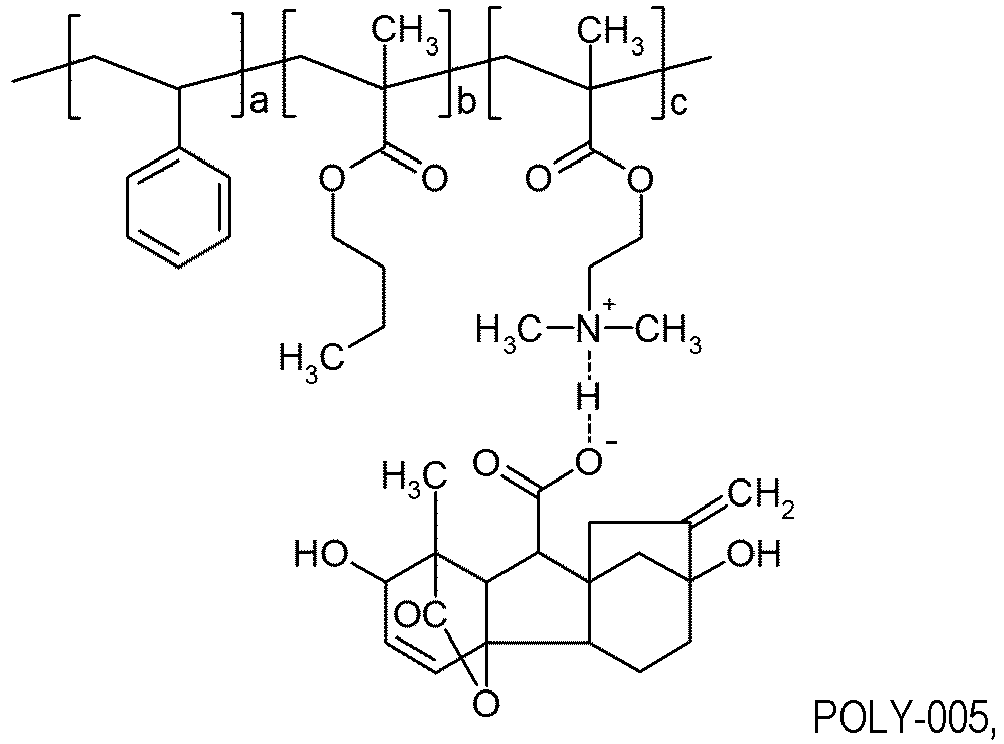
- The particle size and polydispersity were measured to be 109 nm and 0.078, respectively.
- Deionized water was added to the reactor to adjust the solid weight to 25%, thus producing a suspension that could directly be used (with optional further dilution as desired) to produce smart release potash fertilizers.
-
Figure 20 shows the FTIR spectrum of copolymeric nanoparticles POLY-005 in a KBr pellet. - The synthesis of copolymeric nanoparticles POLY-007 (as an aqueous suspension) was performed in the same manner as in Example 103 with the exception that the monomers were 47.0 Kg of styrene, 50.0 Kg of butyl methacrylate and 3.00 Kg of 2-(dimethylamino)ethyl methacrylate. After 24 hours of polymerization, 3.55 Kg of 1-naphthalene acetic acid were slowly added to the reactor. The reaction was continued, stirring, in the same conditions, for an additional 3 hours. Then, the reactor was cooled to room temperature and deionized water was added to dilute to 25% solid weight, thus producing a suspension that could directly be used (with optional further dilution as desired) to produce smart release potash fertilizers.
- Copolymer POLY-007 was:

- The particle size and polydispersity of POLY-007 were measured to be 76 nm and 0.03, respectively.
-
Figure 21 shows the FTIR spectrum of POLY-007 in a KBr pellet. - The synthesis of copolymeric nanoparticles POLY-009 was performed in the same manner as in Example 103 with the exception that the monomers were 47.0 Kg of styrene, 50.0 Kg of butyl methacrylate and 3.00 Kg of 2-(dimethylamino)ethyl methacrylate. After 24 hours of polymerization, 3.20 Kg of 4-nitrobenzoic acid were slowly added into the reactor. The reaction was continued, stirring, in the same conditions, for an additional 3 hours. Then, the reactor was cooled to room temperature and deionized water was added to dilute to 25% solid weight, thus producing a suspension that could directly be used (with optional further dilution as desired) to produce smart release potash fertilizers.
- Copolymer POLY-009 was:

- The particle size and polydispersity of POLY-009 were measured to be 109 nm and 0.021, respectively.
-
Figure 22 shows the FTIR spectrum of POLY-009 in a KBr pellet. - The synthesis of POLY-011 (as an aqueous suspension) was performed in the same manner as in Example 103 with the exception that the monomers were 47.0 Kg of styrene, 50.0 Kg of butyl methacrylate and 3.00 Kg of 2-(dimethylamino)ethyl methacrylate. After 24 hours of polymerization, 3.56 Kg of 4-chlorophenyloxy acetic acid were slowly added to the reactor. The reaction was continued, stirring, in the same conditions for an additional 3 hours. Then, the reactor was cooled to room temperature and deionized water was added to dilute to 25% solid weight, thus producing a suspension that could directly be used (with optional further dilution as desired) to produce smart release potash fertilizers.
- Copolymer POLY-011 was:

- The particle size and polydispersity were measured to be 91 nm and 0.035, respectively.
-
Figure 23 shows the FTIR spectrum of POLY-011 in a KBr pellet. - The smart release potash fertilizer granule comprised:
- a potash core;
- an extended release layer covering the potash core, wherein the extended release layer comprises water-swellable copolymeric nanoparticles and at least one water-soluble organic acid or water-soluble organic carboxylate salt;
- a controlled release layer covering the extended release layer, wherein the controlled release layer comprises water-swellable copolymeric nanoparticles; and
- an anticaking layer covering the controlled release layer, wherein the anticaking layer comprises water-insoluble copolymeric nanoparticles.
- Irregularly shaped potash granules (potassium chloride 00:00:61, available from Phu My Fertilizers, Vietnam) were sieved to remove granules less than 2.0 mm in size. Then, the sieved potash granules (10Kg) were loaded into a home-built Wurster fluidized bed. The bed temperature was set at 32 ± 2°C with 20% relative humidity using a hot air stream at a speed of 300 to 400 m3 per hour. The potash granules were agitated using this hot air stream. First, the granules were agitated for 5 minutes to dry them.
- An aqueous solution containing 5% solid weight of water-swellable copolymeric nanoparticles together with an organic acid was sprayed from the bottom of the fluidized bed at the rate of 60 grams per minute. The mists were carried by the hot air stream and deposited the copolymeric nanoparticles and organic acid onto the surface of the potash granules (which were floating in the hot air stream of the fluidized bed). This process was continued until the desired coating thickness was reached.
- Then, the spraying was stopped, and the granules were agitated by the hot air stream of the fluidized bed in the same conditions for an additional 10 minutes to dry the granules before the next layer (controlled release layer) was applied.
- The coating of the controlled release layer on top of the extended release layer was done in the same manner with the exception that an aqueous solution contained only copolymeric nanoparticles (25% solid weight) was sprayed. This process was continued until the desired coating thickness was reached.
- Then, the spraying was stopped and the granules were agitated by the hot air stream of the fluidized bed in the same conditions for an additional 10 minutes to dry the granules before the next layer (anticaking layer) was applied.
- The coating of the anticaking layer on top of the controlled release layer was done in the same manner with the exception that water-insoluble copolymeric nanoparticles were used and the temperature of the fluid bed was raised to 45°C.
- After the desired thickness was reached, the spraying was stopped, and the granules were agitated by the hot air stream of the fluidized bed in the same conditions for an additional 20 minutes to completely remove the water.
- For comparison purpose, the total weight of the copolymers in the extended release layer and controlled release layer was kept at 10 wt.% based on the weight of the potash core.
- To measure the potassium release in water, 4g of coated smart release potash fertilizer granules were immersed in 400mL water in a glass bottle. The glass bottle was placed in an oven at 30°C. At specific times, 5mL of solution were collected for the determination of potassium concentration. The sample solution was pumped into an atomic absorption spectrometer (Perkin Elmer® AAnalyst 200) to record the potassium atomic absorption.
- A set of five standard KCI solutions with known concentrations were prepared and their potassium atomic absorption were measured. A calibration curve of the potassium atomic absorption vs the potassium concentration was plotted. To determine an unknown potassium concentration in an aqueous sample, the potassium absorption of the sample was compared with the calibration curve, which allowed to determine its potassium concentration. If the potassium absorption was not in the working range of the calibration curve, the sample solution was diluted in HCl 1% before AAS analysis.
- The cumulative potassium release (%) was calculated using the following equation:

- 24g coated fertilizer granules were immersed in 200mL water in a glass bottle that was stored in an oven at 30°C. After specific periods of time, a 5mL sample solution was collected for UV-vis spectroscopy analysis using a Jasco® V-670 absorption spectrometer. The absorption intensity at a particular wavelength was compared with a calibration curve to calculated the organic acid concentration released. The percentage of organic acid release was calculated using the following equation:

- A solution of 4,000ppm GA3 was prepared by dissolving 0.04g of GA3 in 100mL ethanol. For UV-Vis absorption analysis, the GA3 solution 4000ppm was diluted with ethanol and a HCl solution 3.75M in a 25mL volume flask to obtain standard GA3 solutions with specific concentrations (see the following table). Composition of standard GA3 solutions for UV-vis spectroscopy calibration
Standard GA3 concentration (ppm) 200 400 600 800 1000 Volume of GA3 solution 4,000ppm (mL) 1.25 2.5 3.75 5 6.25 Volume of ethanol (mL) 1 1 1 1 1 Volume of HCl solution 3.75M (mL) 22.75 21.5 20.25 19 17.75 - Calibration curves of these organic acids were prepared by analyzing the UV-vis absorption spectra of solutions of known concentrations of the organic acids in ethanol. To determine the organic acid concentration in an aqueous sample, a 5mL aqueous solution sample was diluted in ethanol two-fold for UV-vis spectroscopy. The absorption intensities at particular wavelengths were used to calculate the organic acid concentrations using the calibration curves.
- For sample analysis, a 5mL aqueous solution was mixed with 1mL ethanol and 19mL of a HCl solution 3.75M in a 25mL volume flask. The resulting solution was analyzed with UV-vis spectroscopy. The absorption intensity at 254nm was compared with the calibration curve to determine the organic acid concentration.
- 0.1g of SA was dissolved in 5mL NaOH solution 1M, which was then diluted in water to obtain 100mL SA solution 1000ppm. The SA solution 1000ppm was mixed with a FeCl3 solution 0.02M in a 25mL volume flask to produce standard SA solutions for the calibration curve (see the following table). Composition of standard SA solutions for UV-vis spectroscopy calibration are shown in the table below.
Standard SA concentration (ppm) 0 20 40 60 80 Volume of SA solution 1000ppm (mL) 0 0.5 1 1.5 2 Volume of FeCl3 solution 0.02M (mL) 25 24.5 24 23.5 23 - In the concentration measurement, a 5mL sample solution was diluted in 20M! of a FeCl3 solution 0.02M to obtain a violet solution. The absorption intensity at 529nm was compared to the calibration curve to determine the SA concentration in the sample solution.
- Smart release potash fertilizers were produced by coating potash granules:
- with an aqueous suspension comprising 2.5% solid weight of gluconic acid and 2.5% solid weight of different copolymeric nanoparticles POLY-001 (Example 107), POLY-002 (Example 108), or POLY-003 (Example 109) to form an extended release layer with a coating weight of 2 wt%, based on the weight of the potash core,
- then, with an aqueous suspension comprising copolymeric nanoparticles POLY-001 to form a controlled release layer with a coating weight of 8 wt.%, based on the weight of the potash core, and
- finally, with an aqueous suspension comprising copolymeric nanoparticles POLY-007 to form an anti-caking layer with a coating weight of 3 wt.%, based on the weight of the potash core.
- The following table reports the cumulative potassium release from these smart release potash fertilizers after 10, 20 and 40 days. The smart release potash fertilizer with copolymeric nanoparticle POLY-002 provided the slowest cumulative potassium release of in water compared to POLY-001 and POLY-003.
-
Examples Copolymers Cumulative Release of Potassium (%) 10 Days 20 Days 40 Days 107 POLY-001 9.40 15.0 22.4 108 POLY-002 9.20 12.5 17.4 109 POLY-003 10.0 13.8 24.8 - Smart release potash fertilizers were produced by coating potash granules:
- with an aqueous suspension comprising 2.5% solid weight of gluconic acid and 2.5% solid weight of POLY-001 to form an extended release layer with a coating weight of 2 wt.%, based on the weight of the potash core,
- then, with an aqueous suspension comprising copolymeric nanoparticles POLY-001 to form a controlled release layer with a coating weight of 8 wt.%, based on the weight of the potash core, and
- finally, with an aqueous suspension comprising copolymeric nanoparticles comprising POLY-005 (Example 110), POLY-007 (Example 111), POLY-009 (Example 112), POLY-010 (Example 113), or POLY-011 (Example 114) to form an anti-caking layer with a coating weight of 3 wt.%, based on the weight of the potash core.
- The following table reports the number of days required for the cumulative anion (acid) release to reach 100%. The cumulative the release was strongly dependent on the pKa of the associated acids. The stronger the acids, the longer slower the anion release.
-
Example Copolymers Anion Pendant Group pKa* Days required 110 POLY-005 Gibberelloate 4.00 10 days 111 POLY-007 1-Naphthalene acetoate 4.23 12 days 112 POLY-009 4-Nitrobenzoate 3.44 20 days 113 POLY-010 Salicyloate 2.60 36 days 114 POLY-011 4-Chlorophenyloxy acetoate 3.58 15 days * of associated acids - The scope of the claims should not be limited by the preferred embodiments set forth in the examples, but should be given the broadest interpretation consistent with the description as a whole.
- The present description refers to a number of documents, these documents include, but are not limited to, the following:
- L. Dong, A.L. Cordova-Kreylosb, J. Yanga, H. Yuana, and K. M. Scow, Humic acids buffer the effects of urea on soil ammonia oxidizers and potential nitrification, Soil Biol Biochem. 2009 August; 41(8): 1612-1621;
-
US Patent no. 4,019,890 ; -
US Patent no. 4,657,576 ; -
US Patent no. 4,851,027 ; -
US Patent no. 4,880,455 ; -
US Patent no. 6,187,074 ; - Chinese patent
CN104355874 ; and - Chinese patent
CN101875584 .
• gibberellins, which are a group of more than 125 well-known closely related tetracyclic diterpene acids (PGH and in some cases also PIH);
Gibberellins are derived from the ent-gibberellane skeleton and have either 19 or 20 carbons. The 19-carbon gibberellins, such as gibberellic acid (GA3), have lost
 |  |
 | 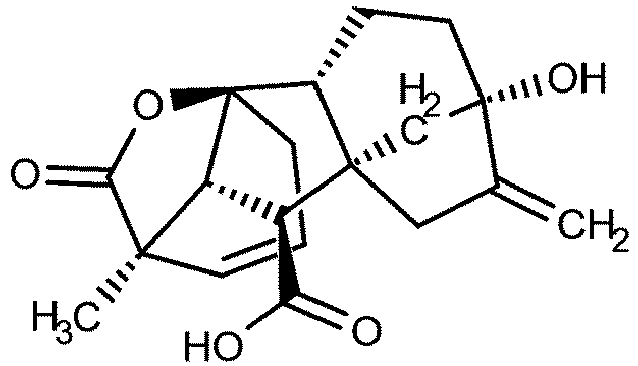 |
 |  |
 |
• gluconic acid (PGH),
• salicylic acid (PGH and PIH);
• jasmonic acid (PGH and PIH);
• oxalic acid (PGH);
• citric acid (PGH); and
• pipecolic acid (PIH), and combinations thereof.
Claims (18)
- A nitrogen-containing fertilizer granule (100) comprising:• a nitrogen-containing fertilizer core (102);• an organic functional layer (104) covering the core (102), wherein the organic functional layer (104) comprises at least one functional organic compound that is an enzyme inhibitor, a microbial suppressor, a phosphorus solubilizer, and/or a plant hormone;• a controlled release layer (106) covering the organic functional layer (104), wherein the controlled release layer (106) comprises water-swellable copolymeric nanoparticles; and• an anticaking layer (108) covering the controlled release layer (106), wherein the anticaking layer (108) comprises water-insoluble copolymeric nanoparticles.
- The fertilizer granule (100 of claim 1, wherein the microbial suppressor is a nitrification inhibitor, which is dicyandiamide, 2-chloro-6-(trichloromethyl)pyridine, 5-ethoxy-3-trichloromethyl-1,2,4-thiadiazole, 2-amino-3-chloro-6-methylpyridine, 2-mercaptobezothiazole, 2-sulfanimalamidothiazole, or a combination thereof.
- The fertilizer granule (100) of claim 1 or 2, wherein the phosphorus solubilizer is citric acid, lauric acid, alkyl sulfuric acid, wherein the alkyl group is preferably a linear or branched alkyl chain with 4 to 24 carbon atoms, oxalic acid, or gluconic acid or a salt thereof.
- The fertilizer granule (100) of any one of claims 1 to 3, wherein the plant hormone is abscisic acid; an auxin; a gibberellin; gluconic acid, salicylic acid; jasmonic acid; oxalic acid; citric acid; or pipecolic acid.
- The fertilizer granule (100) of any one of claims 1 to 4, wherein the enzyme inhibitor is an urease inhibitor, which is• chitosan,• humic acids, for example provided in the form of humus,• fulvic acids,• a polyphenol, unsubstituted or substituted,• saponin,• N-(n-butyl)thiophosphoric triamide,• phenylphosphorodiamidate,• acetohydroxamic acid,• alkyl hydroxamic acid,• trans-cinnamoyl hydroxamic acid,• benzohydroxamic acid, or• hydroxamic acid,or a combination thereof.
- The fertilizer granule (100) of claim 5, wherein the polyphenol is a substituted tannic acid bearing one or more, preferably two or more, more preferably five substituents, wherein said substituents comprise a functional group a bearing negative or positive charge and an oppositely charged counterion, and wherein the oppositely charged counterion is a metal cation or a carboxylate or sulfonate anion of an organic acid that is a microbial suppressor, a phosphorus solubilizer, and/or a plant hormone.
- The fertilizer granule (100) of claim 6, wherein said substituent is:• acetic acid potassium salt,• butyl sulfonic acid potassium salt,• ethyl ammonium gibberellic acid salt,• ethyl ammonium 1-napthanlene acetic acid salt, or• ethyl ammonium 4-nitrobenzoic acid salt.
- The fertilizer granule (100) of claim 6 or 7, wherein the substituted tannic acid has the following ideal chemical structure:


- The fertilizer granule (100) of any one of claims 1 to 8, wherein the organic functional layer (104) further comprises a water-swellable polymeric binder in the form of water-swellable copolymeric nanoparticles.
- The fertilizer granule (100) of claim 9, wherein the copolymer making the water-swellable copolymeric nanoparticles is of formula (I):
 • X1 represents styrene repeat units;• X2 represents alkyl acrylate or alkyl methacrylate repeat units;• X3 represents alkoxy dialkyl vinylsilane, dialkoxy alkyl vinylsilane, or trialkoxy vinylsilane repeat units;• X4 represents acrylic acid, methacrylic acid, acrylamide, methacrylamide, vinyl phosphoric acid, or N,N-dimethylaminoethyl methacrylamide repeat units; and• a, b, c and d represent the weight percent of repeat units X1, X2, X3, and X4, respectively, based on the total weight of the copolymer, and each vary between 0.5 wt% and 50 wt%, andwherein the X3 repeat units are optionally crosslinked with each other within the nanoparticles.
 - The fertilizer granule (100) of claim 10, wherein some of the X3 repeat units are crosslinked with each other within the nanoparticles.
- The fertilizer granule (100) of claim 10 or 11, wherein the copolymer making the water-swellable copolymeric nanoparticles has the following ideal chemical structure:


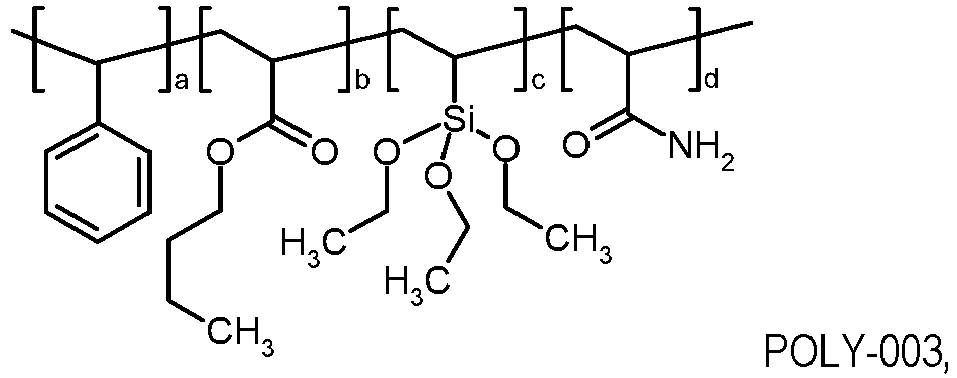
- The fertilizer granule (100) of any one of claims 1 to 12, wherein the copolymer making the water-insoluble copolymeric nanoparticles comprises repeat units having a plant hormone or a phosphorus solubilizer covalently or ionically attached as a pendant group.
- The fertilizer granule (100) of claim 13, wherein the copolymer making the water-insoluble copolymeric nanoparticles is of formula (II):
 • Y1 represents styrene repeat units;• Y2 represents alkyl acrylate or alkyl methacrylate repeat units;• Y3 represents repeat units comprising, as a pendant group, an ionically or covalently attached said plant hormone or said phosphorus solubilizer;• a and b represents the weight percent of repeat units Y1 and Y2, respectively, based on the total weight of the copolymer, and vary between 10 wt% to 95 wt%; and• c represents the weight percent of repeat units Y3, based on the total weight of the copolymer, and vary between 0 wt% to 30 wt%.
 - The fertilizer granule (100) of claim 14, wherein Y3 represents repeat units of formula (III):
 • R1 is a hydrogen atom or methyl;• R2 is the same or different C1-6 alkyl; and• A- is a carboxylate anion of an organic acid that is a plant hormone or a phosphorus solubilizer.
 - The fertilizer granule (100) of claim 15, wherein the copolymers of formula (II) has the following ideal chemical structure:


preferably wherein a is 44 wt%, b is 47 wt%, and c is 9 wt%, or wherein a is 39 wt%, b is 44 wt%, and c is 17 wt%, preferably wherein a is 50 wt% and b is 50 wt%, more preferably wherein a is 44 wt%, b is about 47 wt%, and c is 9 wt%, 

preferably wherein a is 46 wt%, b is 48 wt%, and c is 6 wt%, or wherein a is 41 wt%, b is 47 wt%, and c is 12 wt%, more preferably wherein a is 46 wt%, b is 48 wt%, and c is 6 wt%, preferably wherein a is 46 wt%, b is 48 wt%, and c is 6 wt%, 

preferably wherein a is 46 wt%, b is 49 wt%, and c is 5 wt%, or preferably wherein a is 46 wt%, b is 48 wt%, and c is 6 wt%. - The fertilizer granule (100) of claim 14, wherein Y3 represents repeat units of formula (IV):
 • R1 is a hydrogen atom or methyl;• D-C(=O)- is a residue of an organic acid that is a plant hormone or a phosphorus solubilizer.
 - The fertilizer granule (100) of claim 17, wherein the copolymer of formula (II) has the following ideal chemical structures:


preferably wherein a is 47 wt%, b is 50 wt%, and c is 3 wt%, preferably wherein a is 47 wt%, b is 50 wt%, and c is 3 wt%, 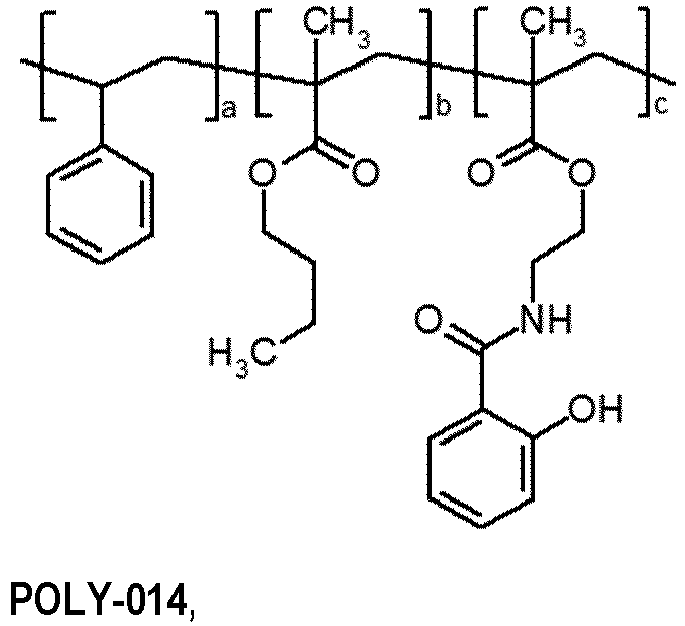

preferably wherein a is 47 wt%, b is 50 wt%, and c is 3 wt%, or preferably wherein a is 47 wt%, b is 50 wt%, and c is 3 wt%.
Applications Claiming Priority (2)
| Application Number | Priority Date | Filing Date | Title |
|---|---|---|---|
| US201862628646P | 2018-02-09 | 2018-02-09 | |
| PCT/CA2019/050155 WO2019153081A1 (en) | 2018-02-09 | 2019-02-06 | Smart release nitrogen-containing fertilizer granules |
Publications (3)
| Publication Number | Publication Date |
|---|---|
| EP3749627A1 EP3749627A1 (en) | 2020-12-16 |
| EP3749627A4 EP3749627A4 (en) | 2021-11-17 |
| EP3749627B1 true EP3749627B1 (en) | 2024-05-08 |
Family
ID=67548645
Family Applications (1)
| Application Number | Title | Priority Date | Filing Date |
|---|---|---|---|
| EP19751745.1A Active EP3749627B1 (en) | 2018-02-09 | 2019-02-06 | Smart release nitrogen-containing fertilizer granules |
Country Status (10)
| Country | Link |
|---|---|
| US (1) | US11649195B2 (en) |
| EP (1) | EP3749627B1 (en) |
| JP (1) | JP7308852B2 (en) |
| KR (1) | KR102689436B1 (en) |
| CN (1) | CN111868014B (en) |
| AU (1) | AU2019216889B2 (en) |
| CA (1) | CA3088450A1 (en) |
| MX (1) | MX2020008154A (en) |
| TW (1) | TWI829669B (en) |
| WO (1) | WO2019153081A1 (en) |
Families Citing this family (14)
| Publication number | Priority date | Publication date | Assignee | Title |
|---|---|---|---|---|
| WO2020037242A1 (en) | 2018-08-16 | 2020-02-20 | Anuvia Plant Nutrients Holdings, Llc | Reactive inorganic coatings for agricultural fertilizers |
| JP2022507494A (en) | 2018-11-14 | 2022-01-18 | アヌビア・プラント・ニュートリエンツ・ホールディングス・インコーポレイテッド | Delivery of bioactive molecules in organically fortified inorganic fertilizer coatings or surface layers |
| CA3141022A1 (en) * | 2019-06-12 | 2020-12-17 | Henrik KARRING | Mitigation of ammonia, odor and greenhouse gases |
| EP4015489A1 (en) * | 2020-12-21 | 2022-06-22 | Yara International ASA | Improved ammonium-based composition and method for the manufacture thereof |
| BE1029553B1 (en) * | 2021-12-07 | 2023-01-27 | Eurochem Antwerpen | BINDER-FREE NANOPARTICLE COATING FOR INORGANIC FERTILIZERS |
| EP4206167A1 (en) * | 2021-12-31 | 2023-07-05 | SABIC Global Technologies, B.V. | Nano bio-carrier with micronutrients coated on chemical fertilizers |
| EP4206168A1 (en) * | 2021-12-31 | 2023-07-05 | SABIC Global Technologies B.V. | Nano bio-carrier with plant additives coated on chemical fertilizers |
| EP4457198A1 (en) * | 2021-12-31 | 2024-11-06 | Sabic Agri-Nutrients Company | Nano bio-carrier with plant additives coated on chemical fertilizers |
| EP4206166A1 (en) * | 2021-12-31 | 2023-07-05 | SABIC Global Technologies, B.V. | Nano bio-carrier with micronutrients coated on chemical fertilizers |
| EP4634140A2 (en) * | 2022-12-12 | 2025-10-22 | Aqua Yield Operations, Inc. | Coated granular fertilizers and methods of making coated granular fertilizers |
| US11999669B1 (en) | 2023-05-08 | 2024-06-04 | King Faisal University | Nitrogen activator stabilizer for reducing and protecting nitrogen fertilizer |
| US12134585B1 (en) | 2023-05-08 | 2024-11-05 | King Faisal University | Nitrogen activator stabilizer for reducing and protecting nitrogen fertilizer |
| US12006272B1 (en) | 2023-05-08 | 2024-06-11 | King Faisal University | Nitrogen activator stabilizer for reducing and protecting nitrogen fertilizer |
| AR133359A1 (en) * | 2023-07-25 | 2025-09-24 | Best Agrolife Ltd | COMPOSITION INCLUDING FERTILIZERS WITH NANOPARTICLES AND PROCESSES FOR THEIR PREPARATION |
Family Cites Families (39)
| Publication number | Priority date | Publication date | Assignee | Title |
|---|---|---|---|---|
| US3502458A (en) | 1967-02-28 | 1970-03-24 | Roy U Schenk | Method of making a slow release fertilizer |
| JPS543104B2 (en) | 1973-12-28 | 1979-02-17 | ||
| NL8403505A (en) | 1984-11-16 | 1986-06-16 | Sierra Chemical Europ | GRAIN FERTILIZER COMPOSITION WITH REGULAR FERTILIZER DELIVERY AND METHOD FOR PREPARING THE SAME |
| US4851027A (en) | 1987-02-19 | 1989-07-25 | Kyowa Hakko Kogyo, Co. Ltd. | Gradually effective, coated fertilizer |
| IL81975A0 (en) | 1987-03-24 | 1987-10-20 | Haifa Chemicals Ltd | Method for the manufacture of slow-release fertilizers |
| US5089041A (en) | 1990-03-22 | 1992-02-18 | The O.M. Scott & Sons Company | Encapsulated slow release fertilizers |
| JPH0753291A (en) * | 1993-08-17 | 1995-02-28 | Chisso Corp | Coated granular fertilizer containing trace elements |
| DE19521502A1 (en) | 1995-06-13 | 1996-12-19 | Basf Ag | Enveloped fertilizer granules |
| CN1195966A (en) | 1995-07-28 | 1998-10-14 | 智索股份有限公司 | Coating granular insecticide, preparation and application method of the insecticide |
| JP3750694B2 (en) * | 1995-08-30 | 2006-03-01 | チッソ株式会社 | Coated agrochemical granule and method for producing the same |
| WO1997007676A1 (en) | 1995-08-29 | 1997-03-06 | E.I. Du Pont De Nemours And Company | Crop protection composition comprising a crop protection solid particle coated with a water-insoluble coating material and a crop protection mixture comprising the same |
| CN1566034A (en) * | 2003-06-25 | 2005-01-19 | 中国石油化工股份有限公司 | Slow release/controlled release fertilizer for regulating and controlling crop nutrition all the time and preparation method thereof |
| CN1644568A (en) * | 2004-12-20 | 2005-07-27 | 周端午 | Nutrient released modle of compound controlled releasing and production thereof |
| US7267707B2 (en) | 2005-03-30 | 2007-09-11 | Florikan E.S.A. Corp. | Polyurethane encapsulated fertilizer |
| ITMI20051892A1 (en) * | 2005-10-07 | 2007-04-08 | Sadepan Chimica S R L | METHOD FOR THE PREPARATION OF GRANULAR ORGANIC-MINERAL FERTILIZERS WITH NITROGEN, SLOW CESSION, HIGH FREQUENCY AND MINIMUM ENVIRONMENTAL IMPACT |
| CN101200399A (en) * | 2006-12-13 | 2008-06-18 | 中国科学院沈阳应用生态研究所 | A resin-coated controlled-release fertilizer and its preparation method |
| CA2783244A1 (en) * | 2009-12-07 | 2011-06-16 | Momentum Technologies, Inc. | Nutrient yielding bio-renewable controlled release fertilizer coatings |
| CN101875584B (en) | 2010-04-27 | 2014-03-05 | 中国科学院南京土壤研究所 | Water-based polymer-coated controlled-release fertilizer and preparation method thereof |
| CN102653491A (en) | 2011-03-04 | 2012-09-05 | 施可丰化工股份有限公司 | Application of composite synergist into Southern double cropping rice |
| CN102391051A (en) * | 2011-09-29 | 2012-03-28 | 河南芭中现代农业有限公司 | Wheat special fertilizer |
| CN102442854A (en) * | 2011-09-29 | 2012-05-09 | 任留旺 | Fertilizer special for peanuts |
| EP2790678A4 (en) * | 2011-12-16 | 2015-09-30 | Celanese Eva Performance Polymers Inc | Gastroretentive controlled release vehicles that include ethylene copolymers, ethyl celluloses, and/or thermpoplastic polyurethanes |
| CN102746068B (en) * | 2012-07-31 | 2014-03-19 | 四川泸天化股份有限公司 | Externally added anticaking agent for urea |
| CN102942415B (en) * | 2012-11-15 | 2014-09-03 | 中国农业大学 | Physical and chemical dual-control-type polymer-coated controlled-release fertilizer and preparation method thereof |
| CN103172473B (en) * | 2012-12-12 | 2015-04-01 | 南京百阳垦生物技术有限责任公司 | Smart controlled-release fertilizer |
| RU2016137471A (en) * | 2014-02-21 | 2018-03-27 | Алкоа Инк. | COMPOSITIONS OF FERTILIZERS AND METHODS FOR THEIR PREPARATION |
| CN103951508A (en) * | 2014-04-26 | 2014-07-30 | 上高县泽达生态科技有机农业开发有限公司 | Molecular network type nano-coating efficient slow release organic fertilizer and production process thereof |
| CN104355874B (en) | 2014-11-13 | 2016-08-17 | 江苏省农业科学院 | A kind of aqueous-based polymers emulsion coating controlled-release fertilizer and preparation method thereof |
| EP3230234A4 (en) * | 2014-12-11 | 2018-09-12 | Dow AgroSciences LLC | Nitrification inhibitor compositions and methods for preparing the same |
| CN104557342B (en) * | 2015-02-04 | 2017-08-29 | 安徽帝元生物科技有限公司 | A kind of preparation method of retentivity urea |
| CN104557343B (en) * | 2015-02-04 | 2017-07-11 | 安徽帝元生物科技有限公司 | A kind of retentivity urea |
| US11214653B2 (en) * | 2015-10-28 | 2022-01-04 | Dune Sciences, Inc. | Water-soluble solid or semi-solid dispersion of particles |
| EP3435764A4 (en) * | 2016-03-29 | 2019-08-21 | Jyant Technologies, Inc. | Nanoformulations for plants |
| CN106588267A (en) * | 2016-11-22 | 2017-04-26 | 成都锦汇科技有限公司 | Fertilizer coating composition |
| CN107032869A (en) * | 2016-11-22 | 2017-08-11 | 成都锦汇科技有限公司 | A kind of coated slow release fertilizer |
| CN107032868A (en) * | 2016-11-22 | 2017-08-11 | 成都锦汇科技有限公司 | A kind of preparation method of coated slow-release compound fertilizer |
| CN106747920A (en) * | 2016-11-22 | 2017-05-31 | 成都锦汇科技有限公司 | A kind of coated slow-release compound fertilizer |
| CN106831208A (en) * | 2017-04-11 | 2017-06-13 | 叶集区华农种植专业合作社 | A kind of pear tree can increase slow release fertilizer of flower and fruit and preparation method thereof |
| EP3612506A1 (en) * | 2017-04-19 | 2020-02-26 | SABIC Global Technologies B.V. | Enhanced efficiency fertilizer with urease inhibitor and nitrification inhibitor separated within the same particle |
-
2019
- 2019-02-06 EP EP19751745.1A patent/EP3749627B1/en active Active
- 2019-02-06 JP JP2020542984A patent/JP7308852B2/en active Active
- 2019-02-06 AU AU2019216889A patent/AU2019216889B2/en active Active
- 2019-02-06 US US16/967,973 patent/US11649195B2/en active Active
- 2019-02-06 KR KR1020207022425A patent/KR102689436B1/en active Active
- 2019-02-06 CA CA3088450A patent/CA3088450A1/en active Pending
- 2019-02-06 MX MX2020008154A patent/MX2020008154A/en unknown
- 2019-02-06 WO PCT/CA2019/050155 patent/WO2019153081A1/en not_active Ceased
- 2019-02-06 CN CN201980012290.2A patent/CN111868014B/en active Active
- 2019-02-11 TW TW108104468A patent/TWI829669B/en active
Also Published As
| Publication number | Publication date |
|---|---|
| KR20200121296A (en) | 2020-10-23 |
| TW201940457A (en) | 2019-10-16 |
| AU2019216889A1 (en) | 2020-08-27 |
| EP3749627A4 (en) | 2021-11-17 |
| US11649195B2 (en) | 2023-05-16 |
| JP2021513500A (en) | 2021-05-27 |
| MX2020008154A (en) | 2020-09-18 |
| EP3749627A1 (en) | 2020-12-16 |
| CN111868014A (en) | 2020-10-30 |
| KR102689436B1 (en) | 2024-07-30 |
| TWI829669B (en) | 2024-01-21 |
| WO2019153081A1 (en) | 2019-08-15 |
| CA3088450A1 (en) | 2019-08-15 |
| CN111868014B (en) | 2023-12-08 |
| JP7308852B2 (en) | 2023-07-14 |
| BR112020015770A2 (en) | 2020-12-08 |
| AU2019216889B2 (en) | 2024-02-08 |
| US20210363073A1 (en) | 2021-11-25 |
Similar Documents
| Publication | Publication Date | Title |
|---|---|---|
| US11649195B2 (en) | Smart release nitrogen-containing fertilizer granules | |
| TWI421228B (en) | Fertilizer-polymer mixtures which inhibit nitrification in soils | |
| US11591275B2 (en) | Smart release potash fertilizer granules | |
| Khan et al. | Effects of sulfur and urease coated controlled release urea on dry matter yield, N uptake and grain quality of rice. | |
| EP2623486B1 (en) | 5-aminolevulinic acid-containing solid fertilizer and process for producing same | |
| Khan et al. | Green synthesis and evaluation of calcium-based nanocomposites fertilizers: a way forward to sustainable agricultural | |
| CN104211479B (en) | A kind of humic acids activated form Chemical Mixed Fertilizer and production method thereof | |
| CN110436994A (en) | A kind of preparation method of high nitrogen content liquid slow-release nitrogenous fertilizer | |
| US5549728A (en) | Urea-containing fertilizer with reduced rate of ammonia release | |
| CN1040975A (en) | Leaf fertilizer for preventing and controlling plant diseases and its preparation method | |
| CA3118770C (en) | Chelating carrier for secondary nutrients and micronutrients and use thereof | |
| BR112020015770B1 (en) | Fertilizer granules containing intelligent-release nitrogen. | |
| CN113615465B (en) | A method to promote the transformation of mango young leaves from heterotrophic to autotrophic | |
| LU502995B1 (en) | A Special High-Efficiency Magnesium-Containing Urea Ammonium Nitrate Liquid Fertilizer for Sugarcane | |
| EP4441014B1 (en) | Benzothiazole derivative as a urease inhibitor for fertilizer application | |
| CN119306539A (en) | A kind of special medicine fertilizer granule for soil-borne diseases and preparation method thereof | |
| CN120535337A (en) | A fulvic acid-type composite microbial organic fertilizer and its preparation method | |
| CN119707574A (en) | High-magnesium-content compound fertilizer and preparation method and application thereof | |
| WO2025022341A1 (en) | Composition comprising nano-particulate fertilizer and process thereof for improved plant growth and yield | |
| CN106258059A (en) | Improve the method for dichloroquinoline Degradation speed in soil |
Legal Events
| Date | Code | Title | Description |
|---|---|---|---|
| STAA | Information on the status of an ep patent application or granted ep patent |
Free format text: STATUS: THE INTERNATIONAL PUBLICATION HAS BEEN MADE |
|
| PUAI | Public reference made under article 153(3) epc to a published international application that has entered the european phase |
Free format text: ORIGINAL CODE: 0009012 |
|
| STAA | Information on the status of an ep patent application or granted ep patent |
Free format text: STATUS: REQUEST FOR EXAMINATION WAS MADE |
|
| 17P | Request for examination filed |
Effective date: 20200909 |
|
| AK | Designated contracting states |
Kind code of ref document: A1 Designated state(s): AL AT BE BG CH CY CZ DE DK EE ES FI FR GB GR HR HU IE IS IT LI LT LU LV MC MK MT NL NO PL PT RO RS SE SI SK SM TR |
|
| AX | Request for extension of the european patent |
Extension state: BA ME |
|
| RIN1 | Information on inventor provided before grant (corrected) |
Inventor name: LE, NHIEN H. Inventor name: THACH, NA Inventor name: TRAN, HOA V. Inventor name: VO, SONY T. Inventor name: LY, MAN M. Inventor name: NGUYEN, VINH Q. Inventor name: NGUYEN, MY T. Inventor name: KIM, VAN T. |
|
| DAV | Request for validation of the european patent (deleted) | ||
| DAX | Request for extension of the european patent (deleted) | ||
| A4 | Supplementary search report drawn up and despatched |
Effective date: 20211020 |
|
| RIC1 | Information provided on ipc code assigned before grant |
Ipc: C05G 5/30 20200101ALI20211014BHEP Ipc: C05G 3/00 20200101ALI20211014BHEP Ipc: C05C 3/00 20060101ALI20211014BHEP Ipc: C05C 1/02 20060101ALI20211014BHEP Ipc: C05G 1/00 20060101ALI20211014BHEP Ipc: A01P 21/00 20060101ALI20211014BHEP Ipc: A01N 43/90 20060101ALI20211014BHEP Ipc: A01N 43/38 20060101ALI20211014BHEP Ipc: A01N 39/04 20060101ALI20211014BHEP Ipc: A01N 37/40 20060101ALI20211014BHEP Ipc: A01N 37/36 20060101ALI20211014BHEP Ipc: A01N 37/10 20060101ALI20211014BHEP Ipc: A01N 37/04 20060101ALI20211014BHEP Ipc: A01N 33/22 20060101ALI20211014BHEP Ipc: C05G 5/00 20200101AFI20211014BHEP |
|
| GRAP | Despatch of communication of intention to grant a patent |
Free format text: ORIGINAL CODE: EPIDOSNIGR1 |
|
| STAA | Information on the status of an ep patent application or granted ep patent |
Free format text: STATUS: GRANT OF PATENT IS INTENDED |
|
| INTG | Intention to grant announced |
Effective date: 20231201 |
|
| RIN1 | Information on inventor provided before grant (corrected) |
Inventor name: NGUYEN, VINH Q. Inventor name: VO, SONY T. Inventor name: THACH, NA Inventor name: LE, NHIEN H. Inventor name: KIM, VAN T. Inventor name: LY, MAN M. Inventor name: TRAN, HOA V. Inventor name: NGUYEN, MY T. |
|
| GRAS | Grant fee paid |
Free format text: ORIGINAL CODE: EPIDOSNIGR3 |
|
| GRAA | (expected) grant |
Free format text: ORIGINAL CODE: 0009210 |
|
| STAA | Information on the status of an ep patent application or granted ep patent |
Free format text: STATUS: THE PATENT HAS BEEN GRANTED |
|
| AK | Designated contracting states |
Kind code of ref document: B1 Designated state(s): AL AT BE BG CH CY CZ DE DK EE ES FI FR GB GR HR HU IE IS IT LI LT LU LV MC MK MT NL NO PL PT RO RS SE SI SK SM TR |
|
| REG | Reference to a national code |
Ref country code: GB Ref legal event code: FG4D |
|
| REG | Reference to a national code |
Ref country code: CH Ref legal event code: EP |
|
| REG | Reference to a national code |
Ref country code: DE Ref legal event code: R096 Ref document number: 602019051941 Country of ref document: DE |
|
| REG | Reference to a national code |
Ref country code: IE Ref legal event code: FG4D |
|
| REG | Reference to a national code |
Ref country code: LT Ref legal event code: MG9D |
|
| REG | Reference to a national code |
Ref country code: NL Ref legal event code: MP Effective date: 20240508 |
|
| PG25 | Lapsed in a contracting state [announced via postgrant information from national office to epo] |
Ref country code: IS Free format text: LAPSE BECAUSE OF FAILURE TO SUBMIT A TRANSLATION OF THE DESCRIPTION OR TO PAY THE FEE WITHIN THE PRESCRIBED TIME-LIMIT Effective date: 20240908 |
|
| PG25 | Lapsed in a contracting state [announced via postgrant information from national office to epo] |
Ref country code: BG Free format text: LAPSE BECAUSE OF FAILURE TO SUBMIT A TRANSLATION OF THE DESCRIPTION OR TO PAY THE FEE WITHIN THE PRESCRIBED TIME-LIMIT Effective date: 20240508 |
|
| PG25 | Lapsed in a contracting state [announced via postgrant information from national office to epo] |
Ref country code: FI Free format text: LAPSE BECAUSE OF FAILURE TO SUBMIT A TRANSLATION OF THE DESCRIPTION OR TO PAY THE FEE WITHIN THE PRESCRIBED TIME-LIMIT Effective date: 20240508 Ref country code: HR Free format text: LAPSE BECAUSE OF FAILURE TO SUBMIT A TRANSLATION OF THE DESCRIPTION OR TO PAY THE FEE WITHIN THE PRESCRIBED TIME-LIMIT Effective date: 20240508 |
|
| PG25 | Lapsed in a contracting state [announced via postgrant information from national office to epo] |
Ref country code: GR Free format text: LAPSE BECAUSE OF FAILURE TO SUBMIT A TRANSLATION OF THE DESCRIPTION OR TO PAY THE FEE WITHIN THE PRESCRIBED TIME-LIMIT Effective date: 20240809 |
|
| PG25 | Lapsed in a contracting state [announced via postgrant information from national office to epo] |
Ref country code: PT Free format text: LAPSE BECAUSE OF FAILURE TO SUBMIT A TRANSLATION OF THE DESCRIPTION OR TO PAY THE FEE WITHIN THE PRESCRIBED TIME-LIMIT Effective date: 20240909 |
|
| REG | Reference to a national code |
Ref country code: AT Ref legal event code: MK05 Ref document number: 1684888 Country of ref document: AT Kind code of ref document: T Effective date: 20240508 |
|
| PG25 | Lapsed in a contracting state [announced via postgrant information from national office to epo] |
Ref country code: NL Free format text: LAPSE BECAUSE OF FAILURE TO SUBMIT A TRANSLATION OF THE DESCRIPTION OR TO PAY THE FEE WITHIN THE PRESCRIBED TIME-LIMIT Effective date: 20240508 |
|
| PG25 | Lapsed in a contracting state [announced via postgrant information from national office to epo] |
Ref country code: ES Free format text: LAPSE BECAUSE OF FAILURE TO SUBMIT A TRANSLATION OF THE DESCRIPTION OR TO PAY THE FEE WITHIN THE PRESCRIBED TIME-LIMIT Effective date: 20240508 |
|
| PG25 | Lapsed in a contracting state [announced via postgrant information from national office to epo] |
Ref country code: AT Free format text: LAPSE BECAUSE OF FAILURE TO SUBMIT A TRANSLATION OF THE DESCRIPTION OR TO PAY THE FEE WITHIN THE PRESCRIBED TIME-LIMIT Effective date: 20240508 |
|
| PG25 | Lapsed in a contracting state [announced via postgrant information from national office to epo] |
Ref country code: PL Free format text: LAPSE BECAUSE OF FAILURE TO SUBMIT A TRANSLATION OF THE DESCRIPTION OR TO PAY THE FEE WITHIN THE PRESCRIBED TIME-LIMIT Effective date: 20240508 |
|
| PG25 | Lapsed in a contracting state [announced via postgrant information from national office to epo] |
Ref country code: LV Free format text: LAPSE BECAUSE OF FAILURE TO SUBMIT A TRANSLATION OF THE DESCRIPTION OR TO PAY THE FEE WITHIN THE PRESCRIBED TIME-LIMIT Effective date: 20240508 |
|
| PG25 | Lapsed in a contracting state [announced via postgrant information from national office to epo] |
Ref country code: PT Free format text: LAPSE BECAUSE OF FAILURE TO SUBMIT A TRANSLATION OF THE DESCRIPTION OR TO PAY THE FEE WITHIN THE PRESCRIBED TIME-LIMIT Effective date: 20240909 Ref country code: PL Free format text: LAPSE BECAUSE OF FAILURE TO SUBMIT A TRANSLATION OF THE DESCRIPTION OR TO PAY THE FEE WITHIN THE PRESCRIBED TIME-LIMIT Effective date: 20240508 Ref country code: NO Free format text: LAPSE BECAUSE OF FAILURE TO SUBMIT A TRANSLATION OF THE DESCRIPTION OR TO PAY THE FEE WITHIN THE PRESCRIBED TIME-LIMIT Effective date: 20240808 Ref country code: NL Free format text: LAPSE BECAUSE OF FAILURE TO SUBMIT A TRANSLATION OF THE DESCRIPTION OR TO PAY THE FEE WITHIN THE PRESCRIBED TIME-LIMIT Effective date: 20240508 Ref country code: LV Free format text: LAPSE BECAUSE OF FAILURE TO SUBMIT A TRANSLATION OF THE DESCRIPTION OR TO PAY THE FEE WITHIN THE PRESCRIBED TIME-LIMIT Effective date: 20240508 Ref country code: IS Free format text: LAPSE BECAUSE OF FAILURE TO SUBMIT A TRANSLATION OF THE DESCRIPTION OR TO PAY THE FEE WITHIN THE PRESCRIBED TIME-LIMIT Effective date: 20240908 Ref country code: HR Free format text: LAPSE BECAUSE OF FAILURE TO SUBMIT A TRANSLATION OF THE DESCRIPTION OR TO PAY THE FEE WITHIN THE PRESCRIBED TIME-LIMIT Effective date: 20240508 Ref country code: GR Free format text: LAPSE BECAUSE OF FAILURE TO SUBMIT A TRANSLATION OF THE DESCRIPTION OR TO PAY THE FEE WITHIN THE PRESCRIBED TIME-LIMIT Effective date: 20240809 Ref country code: FI Free format text: LAPSE BECAUSE OF FAILURE TO SUBMIT A TRANSLATION OF THE DESCRIPTION OR TO PAY THE FEE WITHIN THE PRESCRIBED TIME-LIMIT Effective date: 20240508 Ref country code: ES Free format text: LAPSE BECAUSE OF FAILURE TO SUBMIT A TRANSLATION OF THE DESCRIPTION OR TO PAY THE FEE WITHIN THE PRESCRIBED TIME-LIMIT Effective date: 20240508 Ref country code: BG Free format text: LAPSE BECAUSE OF FAILURE TO SUBMIT A TRANSLATION OF THE DESCRIPTION OR TO PAY THE FEE WITHIN THE PRESCRIBED TIME-LIMIT Effective date: 20240508 Ref country code: AT Free format text: LAPSE BECAUSE OF FAILURE TO SUBMIT A TRANSLATION OF THE DESCRIPTION OR TO PAY THE FEE WITHIN THE PRESCRIBED TIME-LIMIT Effective date: 20240508 Ref country code: RS Free format text: LAPSE BECAUSE OF FAILURE TO SUBMIT A TRANSLATION OF THE DESCRIPTION OR TO PAY THE FEE WITHIN THE PRESCRIBED TIME-LIMIT Effective date: 20240808 |
|
| PG25 | Lapsed in a contracting state [announced via postgrant information from national office to epo] |
Ref country code: DK Free format text: LAPSE BECAUSE OF FAILURE TO SUBMIT A TRANSLATION OF THE DESCRIPTION OR TO PAY THE FEE WITHIN THE PRESCRIBED TIME-LIMIT Effective date: 20240508 |
|
| PG25 | Lapsed in a contracting state [announced via postgrant information from national office to epo] |
Ref country code: EE Free format text: LAPSE BECAUSE OF FAILURE TO SUBMIT A TRANSLATION OF THE DESCRIPTION OR TO PAY THE FEE WITHIN THE PRESCRIBED TIME-LIMIT Effective date: 20240508 |
|
| PG25 | Lapsed in a contracting state [announced via postgrant information from national office to epo] |
Ref country code: CZ Free format text: LAPSE BECAUSE OF FAILURE TO SUBMIT A TRANSLATION OF THE DESCRIPTION OR TO PAY THE FEE WITHIN THE PRESCRIBED TIME-LIMIT Effective date: 20240508 |
|
| PG25 | Lapsed in a contracting state [announced via postgrant information from national office to epo] |
Ref country code: SK Free format text: LAPSE BECAUSE OF FAILURE TO SUBMIT A TRANSLATION OF THE DESCRIPTION OR TO PAY THE FEE WITHIN THE PRESCRIBED TIME-LIMIT Effective date: 20240508 Ref country code: RO Free format text: LAPSE BECAUSE OF FAILURE TO SUBMIT A TRANSLATION OF THE DESCRIPTION OR TO PAY THE FEE WITHIN THE PRESCRIBED TIME-LIMIT Effective date: 20240508 |
|
| PG25 | Lapsed in a contracting state [announced via postgrant information from national office to epo] |
Ref country code: SM Free format text: LAPSE BECAUSE OF FAILURE TO SUBMIT A TRANSLATION OF THE DESCRIPTION OR TO PAY THE FEE WITHIN THE PRESCRIBED TIME-LIMIT Effective date: 20240508 |
|
| PG25 | Lapsed in a contracting state [announced via postgrant information from national office to epo] |
Ref country code: SM Free format text: LAPSE BECAUSE OF FAILURE TO SUBMIT A TRANSLATION OF THE DESCRIPTION OR TO PAY THE FEE WITHIN THE PRESCRIBED TIME-LIMIT Effective date: 20240508 Ref country code: SK Free format text: LAPSE BECAUSE OF FAILURE TO SUBMIT A TRANSLATION OF THE DESCRIPTION OR TO PAY THE FEE WITHIN THE PRESCRIBED TIME-LIMIT Effective date: 20240508 Ref country code: RO Free format text: LAPSE BECAUSE OF FAILURE TO SUBMIT A TRANSLATION OF THE DESCRIPTION OR TO PAY THE FEE WITHIN THE PRESCRIBED TIME-LIMIT Effective date: 20240508 Ref country code: EE Free format text: LAPSE BECAUSE OF FAILURE TO SUBMIT A TRANSLATION OF THE DESCRIPTION OR TO PAY THE FEE WITHIN THE PRESCRIBED TIME-LIMIT Effective date: 20240508 Ref country code: DK Free format text: LAPSE BECAUSE OF FAILURE TO SUBMIT A TRANSLATION OF THE DESCRIPTION OR TO PAY THE FEE WITHIN THE PRESCRIBED TIME-LIMIT Effective date: 20240508 Ref country code: CZ Free format text: LAPSE BECAUSE OF FAILURE TO SUBMIT A TRANSLATION OF THE DESCRIPTION OR TO PAY THE FEE WITHIN THE PRESCRIBED TIME-LIMIT Effective date: 20240508 |
|
| PG25 | Lapsed in a contracting state [announced via postgrant information from national office to epo] |
Ref country code: IT Free format text: LAPSE BECAUSE OF FAILURE TO SUBMIT A TRANSLATION OF THE DESCRIPTION OR TO PAY THE FEE WITHIN THE PRESCRIBED TIME-LIMIT Effective date: 20240508 |
|
| REG | Reference to a national code |
Ref country code: DE Ref legal event code: R097 Ref document number: 602019051941 Country of ref document: DE |
|
| PLBE | No opposition filed within time limit |
Free format text: ORIGINAL CODE: 0009261 |
|
| STAA | Information on the status of an ep patent application or granted ep patent |
Free format text: STATUS: NO OPPOSITION FILED WITHIN TIME LIMIT |
|
| 26N | No opposition filed |
Effective date: 20250211 |
|
| PG25 | Lapsed in a contracting state [announced via postgrant information from national office to epo] |
Ref country code: SI Free format text: LAPSE BECAUSE OF FAILURE TO SUBMIT A TRANSLATION OF THE DESCRIPTION OR TO PAY THE FEE WITHIN THE PRESCRIBED TIME-LIMIT Effective date: 20240508 |
|
| REG | Reference to a national code |
Ref country code: DE Ref legal event code: R119 Ref document number: 602019051941 Country of ref document: DE |
|
| PG25 | Lapsed in a contracting state [announced via postgrant information from national office to epo] |
Ref country code: SE Free format text: LAPSE BECAUSE OF FAILURE TO SUBMIT A TRANSLATION OF THE DESCRIPTION OR TO PAY THE FEE WITHIN THE PRESCRIBED TIME-LIMIT Effective date: 20240508 |
|
| PG25 | Lapsed in a contracting state [announced via postgrant information from national office to epo] |
Ref country code: MC Free format text: LAPSE BECAUSE OF FAILURE TO SUBMIT A TRANSLATION OF THE DESCRIPTION OR TO PAY THE FEE WITHIN THE PRESCRIBED TIME-LIMIT Effective date: 20240508 |
|
| REG | Reference to a national code |
Ref country code: CH Ref legal event code: PL |
|
| PG25 | Lapsed in a contracting state [announced via postgrant information from national office to epo] |
Ref country code: LU Free format text: LAPSE BECAUSE OF NON-PAYMENT OF DUE FEES Effective date: 20250206 |
|
| PG25 | Lapsed in a contracting state [announced via postgrant information from national office to epo] |
Ref country code: CH Free format text: LAPSE BECAUSE OF NON-PAYMENT OF DUE FEES Effective date: 20250228 |
|
| GBPC | Gb: european patent ceased through non-payment of renewal fee |
Effective date: 20250206 |
|
| REG | Reference to a national code |
Ref country code: BE Ref legal event code: MM Effective date: 20250228 |
|
| PG25 | Lapsed in a contracting state [announced via postgrant information from national office to epo] |
Ref country code: DE Free format text: LAPSE BECAUSE OF NON-PAYMENT OF DUE FEES Effective date: 20250902 |
|
| PG25 | Lapsed in a contracting state [announced via postgrant information from national office to epo] |
Ref country code: GB Free format text: LAPSE BECAUSE OF NON-PAYMENT OF DUE FEES Effective date: 20250206 |
|
| PG25 | Lapsed in a contracting state [announced via postgrant information from national office to epo] |
Ref country code: FR Free format text: LAPSE BECAUSE OF NON-PAYMENT OF DUE FEES Effective date: 20250228 |
|
| PG25 | Lapsed in a contracting state [announced via postgrant information from national office to epo] |
Ref country code: BE Free format text: LAPSE BECAUSE OF NON-PAYMENT OF DUE FEES Effective date: 20250228 |
|
| PG25 | Lapsed in a contracting state [announced via postgrant information from national office to epo] |
Ref country code: IE Free format text: LAPSE BECAUSE OF NON-PAYMENT OF DUE FEES Effective date: 20250206 |