EP3748988A1 - Display device - Google Patents
Display device Download PDFInfo
- Publication number
- EP3748988A1 EP3748988A1 EP18904213.8A EP18904213A EP3748988A1 EP 3748988 A1 EP3748988 A1 EP 3748988A1 EP 18904213 A EP18904213 A EP 18904213A EP 3748988 A1 EP3748988 A1 EP 3748988A1
- Authority
- EP
- European Patent Office
- Prior art keywords
- step shape
- display device
- plate
- speaker
- vertical surfaces
- Prior art date
- Legal status (The legal status is an assumption and is not a legal conclusion. Google has not performed a legal analysis and makes no representation as to the accuracy of the status listed.)
- Granted
Links
Images















Classifications
-
- H—ELECTRICITY
- H04—ELECTRIC COMMUNICATION TECHNIQUE
- H04R—LOUDSPEAKERS, MICROPHONES, GRAMOPHONE PICK-UPS OR LIKE ACOUSTIC ELECTROMECHANICAL TRANSDUCERS; ELECTRIC HEARING AIDS; PUBLIC ADDRESS SYSTEMS
- H04R1/00—Details of transducers, loudspeakers or microphones
- H04R1/02—Casings; Cabinets ; Supports therefor; Mountings therein
- H04R1/028—Casings; Cabinets ; Supports therefor; Mountings therein associated with devices performing functions other than acoustics, e.g. electric candles
-
- G—PHYSICS
- G06—COMPUTING OR CALCULATING; COUNTING
- G06F—ELECTRIC DIGITAL DATA PROCESSING
- G06F1/00—Details not covered by groups G06F3/00 - G06F13/00 and G06F21/00
- G06F1/16—Constructional details or arrangements
- G06F1/1601—Constructional details related to the housing of computer displays, e.g. of CRT monitors, of flat displays
- G06F1/1605—Multimedia displays, e.g. with integrated or attached speakers, cameras, microphones
-
- H—ELECTRICITY
- H04—ELECTRIC COMMUNICATION TECHNIQUE
- H04R—LOUDSPEAKERS, MICROPHONES, GRAMOPHONE PICK-UPS OR LIKE ACOUSTIC ELECTROMECHANICAL TRANSDUCERS; ELECTRIC HEARING AIDS; PUBLIC ADDRESS SYSTEMS
- H04R1/00—Details of transducers, loudspeakers or microphones
- H04R1/02—Casings; Cabinets ; Supports therefor; Mountings therein
- H04R1/023—Screens for loudspeakers
-
- H—ELECTRICITY
- H04—ELECTRIC COMMUNICATION TECHNIQUE
- H04R—LOUDSPEAKERS, MICROPHONES, GRAMOPHONE PICK-UPS OR LIKE ACOUSTIC ELECTROMECHANICAL TRANSDUCERS; ELECTRIC HEARING AIDS; PUBLIC ADDRESS SYSTEMS
- H04R1/00—Details of transducers, loudspeakers or microphones
- H04R1/02—Casings; Cabinets ; Supports therefor; Mountings therein
- H04R1/025—Arrangements for fixing loudspeaker transducers, e.g. in a box, furniture
-
- H—ELECTRICITY
- H04—ELECTRIC COMMUNICATION TECHNIQUE
- H04R—LOUDSPEAKERS, MICROPHONES, GRAMOPHONE PICK-UPS OR LIKE ACOUSTIC ELECTROMECHANICAL TRANSDUCERS; ELECTRIC HEARING AIDS; PUBLIC ADDRESS SYSTEMS
- H04R1/00—Details of transducers, loudspeakers or microphones
- H04R1/20—Arrangements for obtaining desired frequency or directional characteristics
- H04R1/32—Arrangements for obtaining desired frequency or directional characteristics for obtaining desired directional characteristic only
- H04R1/34—Arrangements for obtaining desired frequency or directional characteristics for obtaining desired directional characteristic only by using a single transducer with sound reflecting, diffracting, directing or guiding means
- H04R1/345—Arrangements for obtaining desired frequency or directional characteristics for obtaining desired directional characteristic only by using a single transducer with sound reflecting, diffracting, directing or guiding means for loudspeakers
-
- H—ELECTRICITY
- H04—ELECTRIC COMMUNICATION TECHNIQUE
- H04R—LOUDSPEAKERS, MICROPHONES, GRAMOPHONE PICK-UPS OR LIKE ACOUSTIC ELECTROMECHANICAL TRANSDUCERS; ELECTRIC HEARING AIDS; PUBLIC ADDRESS SYSTEMS
- H04R2499/00—Aspects covered by H04R or H04S not otherwise provided for in their subgroups
- H04R2499/10—General applications
- H04R2499/15—Transducers incorporated in visual displaying devices, e.g. televisions, computer displays, laptops
Definitions
- the present disclosure relates to a display device.
- LCD liquid crystal display
- PDP plasma display panel
- ELD electroluminescent display
- VFD vacuum fluorescent display
- OLED organic light emitting diode
- a sound system or an image control system that may be included in the display device recently tends to be small-sized and slim, and research has been actively conducted accordingly.
- An object of the present disclosure is to address the above-described and other problems.
- Another object of the present disclosure is to reflect forward sound of a speaker toward a lower part of a display device.
- Another object of the present disclosure is to minimize a height of a reflective plate reflecting sound of a speaker.
- Another object of the present disclosure is to prevent a resonance from occurring in a reflective plate.
- a display device comprising a display panel having a lower side; a speaker positioned in a rear of the display panel and adjacent to the lower side of the display panel, the speaker configured to provide a sound to a downward of the display panel; and a reflective plate covering the lower side and extending along the lower side, the reflective plate having an inner surface facing the speaker and including a step shape that protrudes from the inner surface and extends along the lower side, the reflective plate configured to reflect forward the sound provided by the speaker.
- the display device may further comprise a cover coupled to a front surface of the reflective plate.
- the step shape may include a first surface toward a front and a second surface that is connected to the first surface and faces the display panel.
- the first surface and the second surface may form a right angle.
- the first surface and the second surface may form an obtuse angle.
- the first surface and the second surface may be roundly connected.
- the step shape may include a plurality of step shapes, and the plurality of step shapes may be spaced apart along a thickness direction of the display panel.
- Each step shape may include a third surface toward a front and a fourth surface that is connected to the third surface and faces the display panel. Heights of the third surfaces may be the same as each other.
- Each step shape may include a fifth surface toward a front and a sixth surface that is connected to the fifth surface and faces the display panel.
- a height of the fifth surface may decrease as it goes to the front.
- Each step shape may include a seventh surface toward a front and an eighth surface that is connected to the seventh surface and faces the display panel.
- the eighth surfaces may have the same depth in the thickness direction of the display device.
- Each step shape may include a ninth surface toward a front and a tenth surface that is connected to the ninth surface and faces the display panel.
- the tenth surface may have an increasing depth in the thickness direction of the display device as it goes to the front.
- the reflective plate may include a first part facing the speaker; and a second part that extends from a lower end of the first part and bends to a front of the first part.
- the reflective plate may include a third part that extends from a lower end of the second part and bends to a front of the second part.
- the reflective plate may include a first side plate that extends from one end of the first part and bends to the front of the first part; and a second side plate that extends from other end of the first part and bends to the front of the first part.
- the reflective plate may include a second step shape that protrudes from the first side plate to an inside of the reflective plate and extends along a boundary of the first part and the first side plate.
- the present disclosure can reflect forward sound of a speaker toward a lower part of a display device.
- the present disclosure can minimize a height of a reflective plate reflecting sound of a speaker.
- the present disclosure can prevent a resonance from occurring in a reflective plate.
- a suffix such as "module” and “unit” may be used to refer to elements or components. Use of such a suffix herein is merely intended to facilitate description of the present disclosure, and the suffix itself is not intended to give any special meaning or function. It will be noted that a detailed description of known arts will be omitted if it is determined that the detailed description of the known arts can obscure the embodiments of the disclosure.
- the accompanying drawings are used to help easily understand various technical features and it should be understood that the embodiments presented herein are not limited by the accompanying drawings. As such, the present disclosure should be construed to extend to any alterations, equivalents and substitutes in addition to those which are particularly set out in the accompanying drawings.
- a singular expression can include a plural expression as long as it does not have an apparently different meaning in context.
- OLED organic light emitting diode
- LCD liquid crystal display
- a display panel 100 or a head portion may include a first long side LS1, a second long side LS2 opposite the first long side LS1, a first short side SS1 adjacent to the first long side LS1 and the second long side LS2, and a second short side SS2 opposite the first short side SS1.
- the first short side SS1 may be referred to as a first side area
- the second short side SS2 may be referred to as a second side area opposite the first side area
- the first long side LS1 may be referred to as a third side area which is adjacent to the first side area and the second side area and is positioned between the first side area and the second side area
- the second long side LS2 may be referred to as a fourth side area which is adjacent to the first side area and the second side area, is positioned between the first side area and the second side area, and is opposite to the third side area.
- Embodiments of the present disclosure illustrate and describe that lengths of the first and second long sides LS1 and LS2 are longer than lengths of the first and second short sides SS1 and SS2 for the convenience of explanation. However, the lengths of the first and second long sides LS1 and LS2 may be almost equal to the lengths of the first and second short sides SS1 and SS2.
- a first direction DR1 may be a direction parallel to the long sides LS1 and LS2 of the display panel 100
- a second direction DR2 may be a direction parallel to the short sides SS1 and SS2 of the display panel 100.
- a third direction DR3 may be a direction vertical to the first direction DR1 and/or the second direction DR2.
- a side or a surface on which a display device displays an image may be referred to as a forward direction, a front side, or a front surface.
- a side or a surface at which the image cannot be observed may be referred to as a backward or rearward direction, a back or rear side, or a back or rear surface.
- the first long side LS1 may be referred to as an upward direction, an upper side, or an upper surface.
- the second long side LS2 may be referred to as a downward direction, a lower side, or a lower surface.
- the first short side SS1 may be referred to as a right direction, a right side, or a right surface
- the second short side SS2 may be referred to as a left direction, a left side, or a left surface.
- the first long side LS1, the second long side LS2, the first short side SS1, and the second short side SS2 may be referred to as edges of the display device. Positions where the first long side LS1, the second long side LS2, the first short side SS1, and the second short side SS2 meet one another may be referred to as corners.
- a position where the first long side LS1 and the first short side SS1 meet each other may be referred to as a first corner C1
- a position where the first long side LS1 and the second short side SS2 meet each other may be referred to as a second corner C2
- a position where the second short side SS2 and the second long side LS2 meet each other may be referred to as a third corner C3
- a position where the second long side LS2 and the first short side SS1 meet each other may be referred to as a fourth corner C4.
- a direction from the first short side SS1 to the second short side SS2 or a direction from the second short side SS2 to the first short side SS1 may be referred to as a left-right direction LR.
- a direction from the first long side LS1 to the second long side LS2 or from the second long side LS2 to the first long side LS1 may be referred to as an up-down direction UD
- a reflective plate 200 may face the second long side LS2 or the fourth side area of the display panel 100.
- the reflective plate may be spaced apart from the second long side LS2 or the fourth side area of the display panel 100.
- the reflective plate 200 may be coupled to the rear surface of the display panel 100.
- the reflective plate 200 may be called a plate 200.
- a stand 120 may support the display panel 100 or the reflective plate 200.
- the stand 120 may be coupled to the rear surface of the display panel 100 or the rear of the reflective plate 200.
- a speaker 110 may be positioned in the rear of the display panel 100.
- the speaker 110 may be adjacent to the second long side LS2 or the fourth side area of the display panel 100.
- the speaker 110 may be coupled to the rear surface of the display panel 100.
- the speaker 110 may provide sound in the downward direction.
- the reflective plate 200 may face the speaker 110.
- the reflective plate 200 may be coupled to the rear of the speaker 110.
- the reflective plate 200 may reflect the sound, that is provided in the downward direction by the speaker 110, to the front.
- the plurality of speakers 110 or the plurality of reflective plates 200 may be formed.
- the plurality of speakers 110 or the plurality of reflective plate 200 may be disposed along the second long side LS2 of the display panel 100.
- the reflective plate 200 may include side plates 220 and 230 that are spaced apart from each other, or a curved plate 210 connecting the side plates 220 and 230.
- the side plates 220 and 230 may be called plates 220 and 230.
- the curved plate 210 may be called a plate 210.
- the reflective plate 200 may be opened in a +Y-axis direction or a +Z-axis direction.
- the side plates 220 and 230 or the curved plate 210 may reflect the sound, that is provided in the downward direction by the speaker 110, to the front.
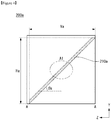
- a reflective plate 200a may have a height Ha in the Y-axis direction and have a depth Va in the Z-axis direction.
- the reflective plate 200a may be inclined to the Z-axis by an angle ⁇ a.
- the angle ⁇ a may be an acute angle.
- a plate 210a1 may have a smooth surface.
- the sound provided in the downward direction from the speaker 110 may be reflected from the smooth surface and may be emitted forward.
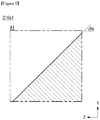
- a plate 210a2 may have a step shape.
- the step shape may extend along the X-axis direction or a longitudinal direction of the plate 210a2.
- Horizontal surfaces of the step shape may have a depth Va11.
- Vertical surfaces of the step shape may have a height Ha11.
- the horizontal surfaces and the vertical surfaces may form a right angle.
- the sound provided in the downward direction from the speaker 110 may be reflected from the horizontal surfaces or the vertical surfaces of the step shape and may be emitted forward.
- Horizontal surfaces and vertical surfaces of a plate 210a2' may be roundly connected.
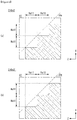
- a plate 210a3 may have a step shape.
- the step shape may extend along the X-axis direction or a longitudinal direction of the plate 210a3.
- First surfaces Va2 of the step shape may have depths Va21, Va22 and Va23.
- the first surfaces may be inclined to the Z-axis by an angle ⁇ Va2.
- Vertical surfaces Ha2 of the step shape may have heights Ha21, Ha22 and Ha23.
- the second surfaces may be inclined to the Z-axis by an angle ⁇ Ha2.
- the first surface Va2 and the second surface Ha2 may form an angle ⁇ 1.
- the angle ⁇ 1 may be an obtuse angle.
- the sound provided in the downward direction from the speaker 110 may be reflected from the first surface Va2 or the second surface Ha2 of the step shape and may be emitted forward.
- the first surface Va2' and the second surface Ha2' of the plate 210a3' may be roundly connected.
- a plate 210a4 may have a step shape.
- the step shape may extend along the X-axis direction or a longitudinal direction of the plate 210a4.
- Horizontal surfaces of the step shape may have depths Va31, Va32 and Va33.
- the depth Va31 may be greater than the depth Va32.
- the depth Va32 may be greater than the depth Va33.
- Vertical surfaces of the step shape may have heights Ha31, Ha32 and Ha33.
- the height Ha31 may be greater than the height Ha32.
- the height Ha32 may be greater than the height Ha33.
- the horizontal surfaces and the vertical surfaces may form a right angle.
- the sound provided in the downward direction from the speaker 110 may be reflected from the horizontal surfaces or the vertical surfaces of the step shape and may be emitted forward.
- Horizontal surfaces and vertical surfaces of a plate 210a4' may be roundly connected.
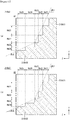
- a reflective plate 200b may have a height Hb in the Y-axis direction and have a depth Vb in the Z-axis direction.
- a curved plate 210b may include a first part 210ba and a second part 210bb.
- the first part 210ba may be inclined to the Z-axis by an angle ⁇ b1.
- the second part 210bb may be inclined to the Z-axis by an angle ⁇ b2.
- the angle ⁇ b1 may be greater than the angle ⁇ b2.
- the angles ⁇ b1 and ⁇ b2 may be an acute angle.
- a curved plate 210b1 may have a smooth surface.
- a first part 210b11 and a second part 210b12 may have a smooth surface.
- the sound provided in the downward direction from the speaker 110 may be reflected from the smooth surface and may be emitted forward.
- a curved plate 210b2 may have a step shape.
- the step shape may extend along the X-axis direction or a longitudinal direction of the curved plate 210b2.
- Horizontal surfaces of a step shape of a first part 210b21 may have a depth Vb11.
- Vertical surfaces of the step shape of the first part 210b21 may have a height Hb11.
- the horizontal surfaces and the vertical surfaces may form a right angle.
- Horizontal surfaces of a step shape of a second part 210b22 may have a depth Vb12.
- Vertical surfaces of the step shape of the second part 210b22 may have a height Hb12.
- the horizontal surfaces and the vertical surfaces may form a right angle.
- the sound provided in the downward direction from the speaker 110 may be reflected from the horizontal surfaces or the vertical surfaces of the step shape and may be emitted forward.
- Horizontal surfaces and vertical surfaces of a plate 210b2' may be roundly connected.
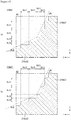
- a curved plate 210b3 may have a step shape.
- the step shape may extend along the X-axis direction or a longitudinal direction of the curved plate 210b3.
- Horizontal surfaces of a step shape of a first part 210b31 may have depths Vb21, Vb22 and Vb23.
- the depth Vb21 may be greater than the depth Vb22.
- the depth Vb22 may be greater than the depth Vb23.
- Vertical surfaces of the step shape of the first part 210b31 may have heights Hb21 and Hb22.
- the height Hb21 may be greater than the height Hb22.
- the horizontal surfaces and the vertical surfaces of the first part 210b31 may form a right angle.
- Horizontal surfaces of a step shape of a second part 210b32 may have depths Vb24 and Vb25.
- the depth Vb24 may be greater than the depth Vb25.
- Vertical surfaces of the step shape of the second part 210b32 may have heights Hb23 and Hb24.
- the height Hb23 may be greater than the height Hb24.
- the horizontal surfaces and the vertical surfaces of the second part 210b32 may form a right angle.
- the sound provided in the downward direction from the speaker 110 may be reflected from the horizontal surfaces or the vertical surfaces of the step shape and may be emitted forward.
- Horizontal surfaces and vertical surfaces of a plate 210b3' may be roundly connected.
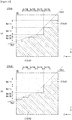
- a reflective plate 200c may have a height Hc in the Y-axis direction and have a depth Vc in the Z-axis direction.
- a curved plate 210c may include a first part 210ca, a second part 210cb, and a third part 210cc.
- the first part 210ca may be inclined to the Z-axis by an angle ⁇ c1.
- the second part 210cb may be inclined to the Z-axis by an angle ⁇ c2.
- the third part 210cc may be inclined to the Z-axis by an angle ⁇ c3.
- the angle ⁇ c1 may be greater than the angle ⁇ c2.
- the angle ⁇ c2 may be greater than the angle ⁇ c3.
- the angles ⁇ c1, ⁇ c2 and ⁇ c3 may be an acute angle.
- a curved plate 210c1 may have a smooth surface.
- a first part 210c11 and a second part 210c12 may have a smooth surface. The sound provided in the downward direction from the speaker 110 may be reflected from the smooth surface and may be emitted forward.
- a curved plate 210c2 may have a step shape.
- the step shape may extend along the X-axis direction or a longitudinal direction of the curved plate 210c2.
- Horizontal surfaces of a step shape of a first part 210c21 may have a depth Vc11a.
- Vertical surfaces of the step shape of the first part 210c21 may have a height Hc11a.
- the horizontal surfaces and the vertical surfaces may form a right angle.
- Horizontal surfaces of a step shape of a second part 210c22 may have a depth Vc12a.
- Vertical surfaces of the step shape of the second part 210c22 may have a height Hc12a.
- the horizontal surfaces and the vertical surfaces may form a right angle.
- the sound provided in the downward direction from the speaker 110 may be reflected from the horizontal surfaces or the vertical surfaces of the step shape and may be emitted forward.
- Horizontal surfaces and vertical surfaces of a plate 210c2' may be roundly connected.
- a curved plate 210c3 may have a step shape.
- the step shape may extend along the X-axis direction or a longitudinal direction of the curved plate 210c3.
- Horizontal surfaces of a step shape of a first part 210c31 may have depths Vc21a, Vc22a and Vc23a.
- the depth Vc21a may be greater than the depth Vc22a.
- the depth Vc22a may be greater than the depth Vc23a.
- Vertical surfaces of the step shape of the first part 210c31 may have heights Hc21a and Hc22a.
- the height Hc21a may be greater than the height Hc22a.
- the horizontal surfaces and the vertical surfaces of the first part 210c31 may form a right angle.
- Horizontal surfaces of a step shape of a second part 210c32 may have depths Vc24a and Vc25a. The depth Vc24a may be greater than the depth Vc25a.
- Vertical surfaces of the step shape of the second part 210c32 may have heights Hc23a and Hc24a. The height Hc23a may be greater than the height Hc24a.
- the horizontal surfaces and the vertical surfaces of the second part 210c32 may form a right angle. The sound provided in the downward direction from the speaker 110 may be reflected from the horizontal surfaces or the vertical surfaces of the step shape and may be emitted forward. Horizontal surfaces and vertical surfaces of a plate 210c3' may be roundly connected.
- a curved plate 210c4 may have a smooth surface.
- a third part 210c41 and a fourth part 210c42 may have a smooth surface. The sound provided in the downward direction from the speaker 110 may be reflected from the smooth surface and may be emitted forward.
- a curved plate 210c5 may have a step shape.
- the step shape may extend along the X-axis direction or a longitudinal direction of the curved plate 210c5.
- Horizontal surfaces of a step shape of a third part 210c51 may have a depth Vc11b.
- Vertical surfaces of the step shape of the third part 210c51 may have a height Hc11b.
- the horizontal surfaces and the vertical surfaces may form a right angle.
- Horizontal surfaces of a step shape of a fourth part 210c52 may have a depth Vc12b.
- Vertical surfaces of the step shape of the fourth part 210c52 may have a height Hc12b.
- the horizontal surfaces and the vertical surfaces may form a right angle.
- the sound provided in the downward direction from the speaker 110 may be reflected from the horizontal surfaces or the vertical surfaces of the step shape and may be emitted forward.
- Horizontal surfaces and vertical surfaces of a plate 210c5' may be roundly connected.
- a curved plate 210c6 may have a step shape.
- the step shape may extend along the X-axis direction or a longitudinal direction of the curved plate 210c6.
- Horizontal surfaces of a step shape of a third part 210c61 may have depths Vc21b, Vc22b and Vc23b.
- the depth Vc21b may be greater than the depth Vc22b.
- the depth Vc22b may be greater than the depth Vc23b.
- Vertical surfaces of the step shape of the third part 210c61 may have heights Hc21b and Hc22b.
- the height Hc21b may be greater than the height Hc22b.
- the horizontal surfaces and the vertical surfaces of the third part 210c61 may form a right angle.
- Horizontal surfaces of a step shape of a fourth part 210c62 may have depths Vc24b and Vc25b. The depth Vc24b may be greater than the depth Vc25b.
- Vertical surfaces of the step shape of the fourth part 210c62 may have heights Hc23b and Hc24b. The height Hc23b may be greater than the height Hc24b.
- the horizontal surfaces and the vertical surfaces of the fourth part 210c62 may form a right angle.
- the sound provided in the downward direction from the speaker 110 may be reflected from the horizontal surfaces or the vertical surfaces of the step shape and may be emitted forward.
- Horizontal surfaces and vertical surfaces of a plate 210c6' may be roundly connected.
- a reflective plate 200d may have a height Hd in the Y-axis direction and have a depth Vd in the Z-axis direction.
- a curved plate 210d may have a rounded curved shape.
- a curved plate 210d1 may have a smooth surface.
- the sound provided from the speaker 110 may be reflected from the smooth surface and may be emitted forward.
- a curved plate 210d2 may have a step shape.
- the step shape may extend along the X-axis direction or a longitudinal direction of the curved plate 210d2.
- Horizontal surfaces of the step shape may have depths Vd11, Vd12, Vd13 and Vd14.
- the depth Vd14 may be greater than the depth Vd13.
- the depth Vd13 may be greater than the depth Vd12.
- the depth Vd12 may be greater than the depth Vd11.
- Vertical surfaces of the step shape may have a height Hd11.
- the horizontal surfaces and the vertical surfaces may form a right angle.
- the sound provided from the speaker 110 may be reflected from the horizontal surfaces or the vertical surfaces of the step shape and may be emitted forward.
- Horizontal surfaces and vertical surfaces of a plate 210d2' may be roundly connected.
- a curved plate 210d3 may have a step shape.
- the step shape may extend along the X-axis direction or a longitudinal direction of the curved plate 210d3.
- Horizontal surfaces of the step shape may have a depth Vd21.
- Vertical surfaces of the step shape may have heights Hd21, Hd22 and Hd23.
- the height Hd21 may be greater than the height Hd22.
- the height Hd22 may be greater than the height Hd23.
- the horizontal surfaces and the vertical surfaces may form a right angle.
- the sound provided from the speaker 110 may be reflected from the horizontal surfaces or the vertical surfaces of the step shape and may be emitted forward.
- Horizontal surfaces and vertical surfaces of a plate 210d3' may be roundly connected.
- a curved plate 210d4 may have a step shape.
- the step shape may extend along the X-axis direction or a longitudinal direction of the curved plate 210d4.
- Horizontal surfaces of the step shape may have depths Vd31, Vd32 and Vd33.
- the depth Vd33 may be greater than the depth Vd32.
- the depth Vd32 may be greater than the depth Vd31.
- Inclined surfaces of the step shape may be inclined to the horizontal surface by an angle ⁇ 10.
- the angle ⁇ 10 may be an obtuse angle.
- the inclined surfaces may have lengths Hd31, Hd32 and Hd33 in an inclined direction.
- the length Hd31 may be greater than the length Hd32.
- the length Hd32 may be greater than the length Hd33.
- the sound provided from the speaker 110 may be reflected from the horizontal surfaces or the inclined surfaces of the step shape and may be emitted forward.
- Horizontal surfaces and inclined surfaces of a plate 210d4' may be roundly connected.
- the reflective plates 200, 200a, 200b, 200c and 200d may be curved or include the step shape.
- the embodiments can maintain a function of reflecting the sound of the speaker 110 while minimizing the Y-axis direction height of the reflective plates 200, 200a, 200b, 200c and 200d.
- the embodiments can prevent the sound emitted from the speaker 110 from being resonated inside the reflective plates 200, 200a, 200b, 200c and 200d.
- the embodiments can minimize an energy loss of the sound.
- the sound emitted from the speaker 110 may be diffuse-reflected from the reflective plates 200, 200a, 200b, 200c and 200d, and the reflected sound may be uniformly radiated to the front of the display device.
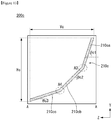
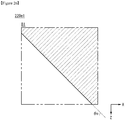
- a reflective plate 200e may have a width He in the X-axis direction and have a depth Ve in the Z-axis direction.
- a side plate 220e may be inclined to the X-axis by an angle ⁇ e.
- the angle ⁇ e may be an acute angle.
- the side plates 220e and 230e may be symmetrical to a curved plate 210e.
- a side plate 220e1 may have a smooth surface.
- the sound provided from the speaker 110 may be reflected from the smooth surface and may be emitted forward.
- a side plate 220e2 may have a step shape.
- the step shape may extend along the Y-axis direction or a height direction of the side plate 220e2.
- First vertical surfaces of the step shape may have a width Ve11.
- Second vertical surfaces of the step shape may have a depth He11.
- the first vertical surfaces and the second vertical surfaces may form a right angle.
- the sound provided from the speaker 110 may be reflected from the first vertical surfaces or the second vertical surfaces of the step shape and may be emitted forward.
- First vertical surfaces and second vertical surfaces of a side plate 220e2' may be roundly connected.
- a side plate 220e3 may have a step shape.
- the step shape may extend along the Y-axis direction or a height direction of the side plate 220e3.
- Third vertical surfaces of the step shape may have widths Ve21, Ve22 and Ve23.
- the width Ve21 may be greater than the width Ve22.
- the width Ve22 may be greater than the width Ve23.
- Fourth vertical surfaces of the step shape may have depths He21, He22 and He23.
- the depth He21 may be greater than the depth He22.
- the depth He22 may be greater than the depth He23.
- Fourth vertical surfaces of the step shape may have depths He21, He22, He23.
- the depth He21 may be greater than the depth He22.
- the depth He22 may be greater than the depth He23.
- the third vertical surfaces and the fourth vertical surfaces may form a right angle.
- the sound provided from the speaker 110 may be reflected from the third vertical surfaces or the fourth vertical surfaces of the step shape and may be emitted forward.
- Third vertical surfaces and fourth vertical surfaces of a side plate 220e3' may be roundly connected.
- a side plate 220e4 may have a step shape.
- the step shape may extend along the Y-axis direction or a height direction of the side plate 220e4.
- Fifth vertical surfaces of the step shape may be inclined to the X-axis by an angle ⁇ 12.
- the fifth vertical surfaces of the step shape may have a length Ve31.
- Sixth vertical surfaces of the step shape may be inclined to the X-axis by an angle ⁇ 13.
- the sixth vertical surfaces of the step shape may have a length He31.
- the angle ⁇ 13 may be greater than the angle ⁇ 12.
- the fifth vertical surfaces and the sixth vertical surfaces may form an angle ⁇ 11.
- the angle ⁇ 11 may be an obtuse angle.
- the sound provided from the speaker 110 may be reflected from the fifth vertical surfaces or the sixth vertical surfaces of the step shape and may be emitted forward.
- Fifth vertical surfaces and sixth vertical surfaces of a side plate 220e4' may be roundly connected.
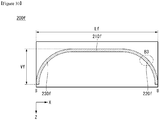
- a reflective plate 200f may have a width Lf in the X-axis direction and have a depth Vf in the Z-axis direction.
- Side plates 220f and 230f may have a rounded curved shape.
- the side plates 220f and 230f may be symmetrical to a curved plate 210f.
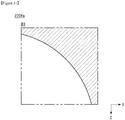
- a side plate 220fa may have a smooth surface.
- the sound provided from the speaker 110 may be reflected from the smooth surface and may be emitted forward.
- a side plate 220f1 may have a step shape.
- the step shape may extend along the Z-axis direction or a height direction of the side plate 220f1.
- Seventh vertical surfaces of the step shape may have widths Vf11, Vf12 and Vf13.
- the widths Vf11, Vf12 and Vf13 may be the same as each other.
- Eighth vertical surfaces of the step shape may have depths Hf11, Hf12, Hf13 and Hf14.
- the depth Hf14 may be greater than the depth Hf13.
- the depth Hf13 may be greater than the depth Hf12.
- the depth Hf12 may be greater than the depth Hf11.
- the seventh vertical surfaces and the eighth vertical surfaces may form a right angle.
- the sound provided from the speaker 110 may be reflected from the seventh vertical surfaces or the eighth vertical surfaces of the step shape and may be emitted forward.
- Seventh vertical surfaces and eighth vertical surfaces of a side plate 220gl' may be roundly connected.
- a side plate 220f2 may have a step shape.
- the step shape may extend along the Z-axis direction or a height direction of the side plate 220g2.
- Ninth vertical surfaces of the step shape may have widths Vf21, Vf22 and Vf23.
- the width Vf21 may be greater than the width Vf22.
- the width Vf22 may be greater than the width Vf23.
- Tenth vertical surfaces of the step shape may have depths Hf21, Hf22 and Hf23.
- the depths Hf21, Hf22 and Hf23 may be the same as each other.
- the ninth vertical surfaces and the tenth vertical surfaces may form a right angle.
- the sound provided from the speaker 110 may be reflected from the ninth vertical surfaces or the tenth vertical surfaces of the step shape and may be emitted forward.
- Ninth vertical surfaces and tenth vertical surfaces of a side plate 220f2' may be roundly connected.
- a side plate 220f3 may have a step shape.
- the step shape may extend along the Z-axis direction or a height direction of the side plate 220f3.
- Eleventh vertical surfaces of the step shape may have lengths Vf31, Vf32 and Vf33.
- the lengths Vf31, Vf32 and Vf33 may be the same as each other.
- the length Vf31 may be greater than the length Vf32.
- the length Vf32 may be greater than the length Vf33.
- Twelfth vertical surfaces of the step shape may be perpendicular to the X-axis.
- the twelfth vertical surfaces of the step shape may have depths Hf31, Hf32 and Hf33.
- the depth Hf33 may be greater than the depth Hf32.
- the depth Hf32 may be greater than the depth Hf31.
- the eleventh vertical surfaces and the twelfth vertical surfaces may form an angle ⁇ 14.
- the angle ⁇ 14 may be an obtuse angle.
- the sound provided from the speaker 110 may be reflected from the eleventh vertical surfaces or the twelfth vertical surfaces of the step shape and may be emitted forward.
- Eleventh vertical surfaces and twelfth vertical surfaces of a side plate 220f3' may be roundly connected.
- the reflective plates 200, 200e and 200g may be curved or include the step shape.
- the embodiments can maintain a function of reflecting the sound of the speaker 110 while minimizing the Y-axis direction height of the reflective plates 200, 200e and 200g.
- the embodiments can prevent the sound emitted from the speaker 110 from being resonated inside the reflective plates 200, 200e and 200g.
- the embodiments can minimize an energy loss of the sound.
- the sound emitted from the speaker 110 may be diffuse-reflected from the reflective plates 200, 200e and 200g, and the reflected sound may be uniformly radiated to the front of the display device.
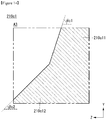
- a front surface of a reflective plate 200g may have a rectangular shape. Side plates 230h and 220g and a curved plate 210g may form a rectangle.
- the reflective plate 200g may have a width Vg and a height Hg.
- a front surface of a reflective plate 200f may have a trapezoid shape.
- Side plates 230h and 220h and a curved plate 210h may form a trapezoid.
- the reflective plate 200h may have a width Vh and a height Hh.
- a front surface of a reflective plate 200i may have a polygon shape. Side plates 230i and 220i and a curved plate 210i may form a polygon.
- the reflective plate 200i may have a width Vj and a height Hj.
- left and right sides of a reflective plate 200j may have a curved shape.
- Side plates 230j and 220j and a curved plate 210jk may form an appearance of the reflective plate 200j.
- the reflective plate 200j may have a width Vj and a height Hj.
- a back cover 130 may be positioned in the rear of a display panel 100 or a display module.
- the back cover 130 may be coupled to a rear surface of the display panel 100 or a rear surface of the display module.
- Speakers 300 and 310 may be fastened to the back cover 130.
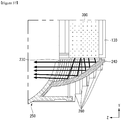
- the speakers 300 and 310 may emit sound in the downward direction.
- the speakers 300 and 310 may emit sound in the -Y-axis direction.
- the sound emitted from the speakers 300 and 310 may be reflected forward or in the +Z-axis direction from the reflective plate 200.
- the sound emitted from the speakers 300 and 310 may be reflected from the plate 210 (as indicated by R1), or may be reflected from the side plate 230 (as indicated by R2).
- the back cover 130 may be called a frame 130 or a cover 130.
- the back cover 130 may include a coupling portion 131, and the coupling portion 131 may include coupling protrusions 131a.
- the back cover 130 may be fastened to the display panel 100 or the display module through the coupling protrusions 131a.
- the reflective plate 200 may include a coupling portion 240.
- the coupling portion 240 may be fastened to the coupling portion 131 of the back cover 130.
- the reflective plate 200 may include a rigid portion 260.
- the rigid portion 260 may extend in the downward direction or the Y-axis direction of the plate 210.
- the rigid portion 260 may increase the rigidity of the reflective plate 200.
- the plurality of rigid portions 260 may be formed and may be spaced apart in the X-axis direction.
- a cover 250 may be coupled to the front surface of the reflective plate 200.
- the reflective plate 200 may include a stepped portion 201.
- the stepped portion 201 may be formed on the rear surface of the reflective plate 200.
- the stepped portion 201 may reduce the weight of the reflective plate 200.
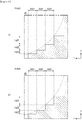
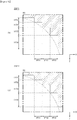
- a graph may show the measurement of a sound pressure of sound emitted to the front of the display device through the reflective plate 200.
- a graph g1 may be a graph for the reflective plates 200b, 200c and 200d.
- a graph g2 may be a graph for the reflective plate 200a.
- a sound pressure loss in the graph g1 may be less than that in the graph g2.
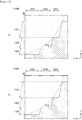
- a graph may show the measurement of a sound pressure of sound emitted to the front of the display device through the reflective plate 200.
- a graph g3 may be a graph for step-shaped reflective plates 210a2, 210a2', 210a3, 210a3', 210a4, 210a4', 210b2, 210b2', 210b3, 210b3', 210c2, 210c2', 210c3, 210c3', 210c5, 210c5', 210c6, 210c6', 210d2, 210d2', 210d3, 210d3', 210d4, 210d4', 220e2, 220e2', 220e3, 220e3', 220e4, 220e4', 220g1, 220g1', 220g2, 220g2', 220g3, and 220g3'.
- a graph g4 may be a graph for reflective plates not having a step shape 210a1, 210b1, 210c1, 210c4, 210d1, 220e1, and 220ga.
- a sound pressure loss in the graph g3 may be less than that in the graph g4.
- Some embodiments or other embodiments of the present disclosure described above are not exclusive or distinct from each other. Some embodiments or other embodiments of the present disclosure described above can be used together or combined in configuration and/or function.
Landscapes
- Engineering & Computer Science (AREA)
- Physics & Mathematics (AREA)
- Otolaryngology (AREA)
- Health & Medical Sciences (AREA)
- Acoustics & Sound (AREA)
- Signal Processing (AREA)
- General Engineering & Computer Science (AREA)
- Theoretical Computer Science (AREA)
- Multimedia (AREA)
- Human Computer Interaction (AREA)
- General Physics & Mathematics (AREA)
- Computer Hardware Design (AREA)
- Details Of Audible-Bandwidth Transducers (AREA)
- Obtaining Desirable Characteristics In Audible-Bandwidth Transducers (AREA)
Abstract
Description
- The present disclosure relates to a display device.
- With the development of the information society, various demands for display devices are increasing. Various display devices, such as a liquid crystal display (LCD), a plasma display panel (PDP), an electroluminescent display (ELD), a vacuum fluorescent display (VFD), and an organic light emitting diode (OLED) display have been recently studied and used in response to the various demands for the display devices.
- A sound system or an image control system that may be included in the display device recently tends to be small-sized and slim, and research has been actively conducted accordingly.
- An object of the present disclosure is to address the above-described and other problems.
- Another object of the present disclosure is to reflect forward sound of a speaker toward a lower part of a display device.
- Another object of the present disclosure is to minimize a height of a reflective plate reflecting sound of a speaker.
- Another object of the present disclosure is to prevent a resonance from occurring in a reflective plate.
- To achieve the above-described and other objects, in one aspect of the present disclosure, there is provided a display device comprising a display panel having a lower side; a speaker positioned in a rear of the display panel and adjacent to the lower side of the display panel, the speaker configured to provide a sound to a downward of the display panel; and a reflective plate covering the lower side and extending along the lower side, the reflective plate having an inner surface facing the speaker and including a step shape that protrudes from the inner surface and extends along the lower side, the reflective plate configured to reflect forward the sound provided by the speaker.
- The display device may further comprise a cover coupled to a front surface of the reflective plate.
- The step shape may include a first surface toward a front and a second surface that is connected to the first surface and faces the display panel.
- The first surface and the second surface may form a right angle.
- The first surface and the second surface may form an obtuse angle.
- The first surface and the second surface may be roundly connected.
- The step shape may include a plurality of step shapes, and the plurality of step shapes may be spaced apart along a thickness direction of the display panel.
- Each step shape may include a third surface toward a front and a fourth surface that is connected to the third surface and faces the display panel. Heights of the third surfaces may be the same as each other.
- Each step shape may include a fifth surface toward a front and a sixth surface that is connected to the fifth surface and faces the display panel. A height of the fifth surface may decrease as it goes to the front.
- Each step shape may include a seventh surface toward a front and an eighth surface that is connected to the seventh surface and faces the display panel. The eighth surfaces may have the same depth in the thickness direction of the display device.
- Each step shape may include a ninth surface toward a front and a tenth surface that is connected to the ninth surface and faces the display panel. The tenth surface may have an increasing depth in the thickness direction of the display device as it goes to the front.
- The reflective plate may include a first part facing the speaker; and a second part that extends from a lower end of the first part and bends to a front of the first part.
- The reflective plate may include a third part that extends from a lower end of the second part and bends to a front of the second part.
- The reflective plate may include a first side plate that extends from one end of the first part and bends to the front of the first part; and a second side plate that extends from other end of the first part and bends to the front of the first part.
- The reflective plate may include a second step shape that protrudes from the first side plate to an inside of the reflective plate and extends along a boundary of the first part and the first side plate.
- Effects of a display device according to the present disclosure are described as follows.
- According to at least one aspect of the present disclosure, the present disclosure can reflect forward sound of a speaker toward a lower part of a display device.
- According to at least one aspect of the present disclosure, the present disclosure can minimize a height of a reflective plate reflecting sound of a speaker.
- According to at least one aspect of the present disclosure, the present disclosure can prevent a resonance from occurring in a reflective plate.
- Additional scope of applicability of the present disclosure will become apparent from the detailed description given blow. However, it should be understood that the detailed description and specific examples, while indicating preferred embodiments of the present disclosure, are given by illustration only, since various changes and modifications within the spirit and scope of the present disclosure will become apparent to those skilled in the art from this detailed description.
-
-
FIG. 1 illustrates an example of a display device according to an embodiment of the present disclosure. -
FIGS. 2 to 29 illustrate an example of a reflective plate according to an embodiment of the present disclosure. - Reference will now be made in detail to embodiments of the disclosure, examples of which are illustrated in the accompanying drawings. Wherever possible, the same reference numbers will be used throughout the drawings to refer to the same or like parts.
- In general, a suffix such as "module" and "unit" may be used to refer to elements or components. Use of such a suffix herein is merely intended to facilitate description of the present disclosure, and the suffix itself is not intended to give any special meaning or function. It will be noted that a detailed description of known arts will be omitted if it is determined that the detailed description of the known arts can obscure the embodiments of the disclosure. The accompanying drawings are used to help easily understand various technical features and it should be understood that the embodiments presented herein are not limited by the accompanying drawings. As such, the present disclosure should be construed to extend to any alterations, equivalents and substitutes in addition to those which are particularly set out in the accompanying drawings.
- The terms including an ordinal number such as first, second, etc. may be used to describe various components, but the components are not limited by such terms. The terms are used only for the purpose of distinguishing one component from other components.
- When any component is described as "connected to" or "coupled to" another component, this should be understood to mean that still other component(s) may exist between them, although any component may be directly connected to or directly coupled to another component. In contrast, when any component is described as "directly connected to" or "directly coupled to" another component, this should be understood to mean that no component exists between them.
- A singular expression can include a plural expression as long as it does not have an apparently different meaning in context.
- In the present disclosure, the terms "include" and "have" should be understood to be intended to designate that illustrated features, numbers, steps, operations, components, parts or combinations thereof are present and not to preclude the existence of one or more different features, numbers, steps, operations, components, parts or combinations thereof, or the possibility of the addition thereof.
- In the following description, embodiments of the present disclosure are described using an organic light emitting diode (OLED) display panel as an example of a display panel, but are not limited thereto. Other display panels may be used. For example, a plasma display panel (PDP), a field emission display (FED) panel, and a liquid crystal display (LCD) panel may be used.
- The terms such as height, length, and width may be mixed and used for the convenience of explanation, and the respective terms do not have meanings or roles that are distinct from each other.
- Referring to
FIG. 1 , adisplay panel 100 or a head portion may include a first long side LS1, a second long side LS2 opposite the first long side LS1, a first short side SS1 adjacent to the first long side LS1 and the second long side LS2, and a second short side SS2 opposite the first short side SS1. - In embodiments disclosed herein, the first short side SS1 may be referred to as a first side area, the second short side SS2 may be referred to as a second side area opposite the first side area, the first long side LS1 may be referred to as a third side area which is adjacent to the first side area and the second side area and is positioned between the first side area and the second side area, and the second long side LS2 may be referred to as a fourth side area which is adjacent to the first side area and the second side area, is positioned between the first side area and the second side area, and is opposite to the third side area.
- Embodiments of the present disclosure illustrate and describe that lengths of the first and second long sides LS1 and LS2 are longer than lengths of the first and second short sides SS1 and SS2 for the convenience of explanation. However, the lengths of the first and second long sides LS1 and LS2 may be almost equal to the lengths of the first and second short sides SS1 and SS2.
- Further, a first direction DR1 may be a direction parallel to the long sides LS1 and LS2 of the
display panel 100, and a second direction DR2 may be a direction parallel to the short sides SS1 and SS2 of thedisplay panel 100. A third direction DR3 may be a direction vertical to the first direction DR1 and/or the second direction DR2. - In addition, a side or a surface on which a display device displays an image may be referred to as a forward direction, a front side, or a front surface. When the display device displays an image, a side or a surface at which the image cannot be observed may be referred to as a backward or rearward direction, a back or rear side, or a back or rear surface. When the display device is viewed at the forward direction, the front side, or the front surface, the first long side LS1 may be referred to as an upward direction, an upper side, or an upper surface. In the same manner as the first long side LS1, the second long side LS2 may be referred to as a downward direction, a lower side, or a lower surface. Further, the first short side SS1 may be referred to as a right direction, a right side, or a right surface, and the second short side SS2 may be referred to as a left direction, a left side, or a left surface.
- The first long side LS1, the second long side LS2, the first short side SS1, and the second short side SS2 may be referred to as edges of the display device. Positions where the first long side LS1, the second long side LS2, the first short side SS1, and the second short side SS2 meet one another may be referred to as corners. For example, a position where the first long side LS1 and the first short side SS1 meet each other may be referred to as a first corner C1, a position where the first long side LS1 and the second short side SS2 meet each other may be referred to as a second corner C2, a position where the second short side SS2 and the second long side LS2 meet each other may be referred to as a third corner C3, and a position where the second long side LS2 and the first short side SS1 meet each other may be referred to as a fourth corner C4.
- In embodiments disclosed herein, a direction from the first short side SS1 to the second short side SS2 or a direction from the second short side SS2 to the first short side SS1 may be referred to as a left-right direction LR. A direction from the first long side LS1 to the second long side LS2 or from the second long side LS2 to the first long side LS1 may be referred to as an up-down direction UD
- A
reflective plate 200 may face the second long side LS2 or the fourth side area of thedisplay panel 100. The reflective plate may be spaced apart from the second long side LS2 or the fourth side area of thedisplay panel 100. Thereflective plate 200 may be coupled to the rear surface of thedisplay panel 100. Thereflective plate 200 may be called aplate 200. - A
stand 120 may support thedisplay panel 100 or thereflective plate 200. Thestand 120 may be coupled to the rear surface of thedisplay panel 100 or the rear of thereflective plate 200. - Referring to
FIG. 2 , aspeaker 110 may be positioned in the rear of thedisplay panel 100. Thespeaker 110 may be adjacent to the second long side LS2 or the fourth side area of thedisplay panel 100. Thespeaker 110 may be coupled to the rear surface of thedisplay panel 100. Thespeaker 110 may provide sound in the downward direction. Thereflective plate 200 may face thespeaker 110. Thereflective plate 200 may be coupled to the rear of thespeaker 110. Thereflective plate 200 may reflect the sound, that is provided in the downward direction by thespeaker 110, to the front. The plurality ofspeakers 110 or the plurality ofreflective plates 200 may be formed. The plurality ofspeakers 110 or the plurality ofreflective plate 200 may be disposed along the second long side LS2 of thedisplay panel 100. - Referring to
FIG. 3 , thereflective plate 200 may includeside plates curved plate 210 connecting theside plates side plates plates curved plate 210 may be called aplate 210. Thereflective plate 200 may be opened in a +Y-axis direction or a +Z-axis direction. Theside plates curved plate 210 may reflect the sound, that is provided in the downward direction by thespeaker 110, to the front. - Referring to
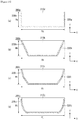
FIG. 4 , areflective plate 200a may have a height Ha in the Y-axis direction and have a depth Va in the Z-axis direction. Thereflective plate 200a may be inclined to the Z-axis by an angle θa. The angle θa may be an acute angle. - Referring to
FIG. 5 , a plate 210a1 may have a smooth surface. The sound provided in the downward direction from thespeaker 110 may be reflected from the smooth surface and may be emitted forward. - Referring to
FIG. 6 , a plate 210a2 may have a step shape. The step shape may extend along the X-axis direction or a longitudinal direction of the plate 210a2. Horizontal surfaces of the step shape may have a depth Va11. Vertical surfaces of the step shape may have a height Ha11. The horizontal surfaces and the vertical surfaces may form a right angle. The sound provided in the downward direction from thespeaker 110 may be reflected from the horizontal surfaces or the vertical surfaces of the step shape and may be emitted forward. Horizontal surfaces and vertical surfaces of a plate 210a2' may be roundly connected. - Referring to
FIG. 7 , a plate 210a3 may have a step shape. The step shape may extend along the X-axis direction or a longitudinal direction of the plate 210a3. First surfaces Va2 of the step shape may have depths Va21, Va22 and Va23. The first surfaces may be inclined to the Z-axis by an angle θVa2. Vertical surfaces Ha2 of the step shape may have heights Ha21, Ha22 and Ha23. The second surfaces may be inclined to the Z-axis by an angle θHa2. The first surface Va2 and the second surface Ha2 may form an angle θ1. For example, the angle θ1 may be an obtuse angle. The sound provided in the downward direction from thespeaker 110 may be reflected from the first surface Va2 or the second surface Ha2 of the step shape and may be emitted forward. The first surface Va2' and the second surface Ha2' of the plate 210a3' may be roundly connected. - Referring to
FIG. 8 , a plate 210a4 may have a step shape. The step shape may extend along the X-axis direction or a longitudinal direction of the plate 210a4. Horizontal surfaces of the step shape may have depths Va31, Va32 and Va33. The depth Va31 may be greater than the depth Va32. The depth Va32 may be greater than the depth Va33. Vertical surfaces of the step shape may have heights Ha31, Ha32 and Ha33. The height Ha31 may be greater than the height Ha32. The height Ha32 may be greater than the height Ha33. The horizontal surfaces and the vertical surfaces may form a right angle. The sound provided in the downward direction from thespeaker 110 may be reflected from the horizontal surfaces or the vertical surfaces of the step shape and may be emitted forward. Horizontal surfaces and vertical surfaces of a plate 210a4' may be roundly connected. - Referring to
FIG. 9 , areflective plate 200b may have a height Hb in the Y-axis direction and have a depth Vb in the Z-axis direction. Acurved plate 210b may include a first part 210ba and a second part 210bb. The first part 210ba may be inclined to the Z-axis by an angle θb1. The second part 210bb may be inclined to the Z-axis by an angle θb2. The angle θb1 may be greater than the angle θb2. The angles θb1 and θb2 may be an acute angle. - Referring to
FIG. 10 , a curved plate 210b1 may have a smooth surface. Alternatively, a first part 210b11 and a second part 210b12 may have a smooth surface. The sound provided in the downward direction from thespeaker 110 may be reflected from the smooth surface and may be emitted forward. - Referring to
FIG. 11 , a curved plate 210b2 may have a step shape. The step shape may extend along the X-axis direction or a longitudinal direction of the curved plate 210b2. Horizontal surfaces of a step shape of a first part 210b21 may have a depth Vb11. Vertical surfaces of the step shape of the first part 210b21 may have a height Hb11. The horizontal surfaces and the vertical surfaces may form a right angle. Horizontal surfaces of a step shape of a second part 210b22 may have a depth Vb12. Vertical surfaces of the step shape of the second part 210b22 may have a height Hb12. The horizontal surfaces and the vertical surfaces may form a right angle. The sound provided in the downward direction from thespeaker 110 may be reflected from the horizontal surfaces or the vertical surfaces of the step shape and may be emitted forward. Horizontal surfaces and vertical surfaces of a plate 210b2' may be roundly connected. - Referring to
FIG. 12 , a curved plate 210b3 may have a step shape. The step shape may extend along the X-axis direction or a longitudinal direction of the curved plate 210b3. Horizontal surfaces of a step shape of a first part 210b31 may have depths Vb21, Vb22 and Vb23. The depth Vb21 may be greater than the depth Vb22. The depth Vb22 may be greater than the depth Vb23. Vertical surfaces of the step shape of the first part 210b31 may have heights Hb21 and Hb22. The height Hb21 may be greater than the height Hb22. The horizontal surfaces and the vertical surfaces of the first part 210b31 may form a right angle. Horizontal surfaces of a step shape of a second part 210b32 may have depths Vb24 and Vb25. The depth Vb24 may be greater than the depth Vb25. Vertical surfaces of the step shape of the second part 210b32 may have heights Hb23 and Hb24. The height Hb23 may be greater than the height Hb24. The horizontal surfaces and the vertical surfaces of the second part 210b32 may form a right angle. The sound provided in the downward direction from thespeaker 110 may be reflected from the horizontal surfaces or the vertical surfaces of the step shape and may be emitted forward. Horizontal surfaces and vertical surfaces of a plate 210b3' may be roundly connected. - Referring to
FIG. 13 , areflective plate 200c may have a height Hc in the Y-axis direction and have a depth Vc in the Z-axis direction. Acurved plate 210c may include a first part 210ca, a second part 210cb, and a third part 210cc. The first part 210ca may be inclined to the Z-axis by an angle θc1. The second part 210cb may be inclined to the Z-axis by an angle θc2. The third part 210cc may be inclined to the Z-axis by an angle θc3. The angle θc1 may be greater than the angle θc2. The angle θc2 may be greater than the angle θc3. The angles θc1, θc2 and θc3 may be an acute angle. - Referring to
FIG. 14 , a curved plate 210c1 may have a smooth surface. Alternatively, a first part 210c11 and a second part 210c12 may have a smooth surface. The sound provided in the downward direction from thespeaker 110 may be reflected from the smooth surface and may be emitted forward. - Referring to
FIG. 15 , a curved plate 210c2 may have a step shape. The step shape may extend along the X-axis direction or a longitudinal direction of the curved plate 210c2. Horizontal surfaces of a step shape of a first part 210c21 may have a depth Vc11a. Vertical surfaces of the step shape of the first part 210c21 may have a height Hc11a. The horizontal surfaces and the vertical surfaces may form a right angle. Horizontal surfaces of a step shape of a second part 210c22 may have a depth Vc12a. Vertical surfaces of the step shape of the second part 210c22 may have a height Hc12a. The horizontal surfaces and the vertical surfaces may form a right angle. The sound provided in the downward direction from thespeaker 110 may be reflected from the horizontal surfaces or the vertical surfaces of the step shape and may be emitted forward. Horizontal surfaces and vertical surfaces of a plate 210c2' may be roundly connected. - Referring to
FIG. 16 , a curved plate 210c3 may have a step shape. The step shape may extend along the X-axis direction or a longitudinal direction of the curved plate 210c3. Horizontal surfaces of a step shape of a first part 210c31 may have depths Vc21a, Vc22a and Vc23a. The depth Vc21a may be greater than the depth Vc22a. The depth Vc22a may be greater than the depth Vc23a. Vertical surfaces of the step shape of the first part 210c31 may have heights Hc21a and Hc22a. The height Hc21a may be greater than the height Hc22a. The horizontal surfaces and the vertical surfaces of the first part 210c31 may form a right angle. Horizontal surfaces of a step shape of a second part 210c32 may have depths Vc24a and Vc25a. The depth Vc24a may be greater than the depth Vc25a. Vertical surfaces of the step shape of the second part 210c32 may have heights Hc23a and Hc24a. The height Hc23a may be greater than the height Hc24a. The horizontal surfaces and the vertical surfaces of the second part 210c32 may form a right angle. The sound provided in the downward direction from thespeaker 110 may be reflected from the horizontal surfaces or the vertical surfaces of the step shape and may be emitted forward. Horizontal surfaces and vertical surfaces of a plate 210c3' may be roundly connected. - Referring to
FIG. 17 , a curved plate 210c4 may have a smooth surface. Alternatively, a third part 210c41 and a fourth part 210c42 may have a smooth surface. The sound provided in the downward direction from thespeaker 110 may be reflected from the smooth surface and may be emitted forward. - Referring to
FIG. 18 , a curved plate 210c5 may have a step shape. The step shape may extend along the X-axis direction or a longitudinal direction of the curved plate 210c5. Horizontal surfaces of a step shape of a third part 210c51 may have a depth Vc11b. Vertical surfaces of the step shape of the third part 210c51 may have a height Hc11b. The horizontal surfaces and the vertical surfaces may form a right angle. Horizontal surfaces of a step shape of a fourth part 210c52 may have a depth Vc12b. Vertical surfaces of the step shape of the fourth part 210c52 may have a height Hc12b. The horizontal surfaces and the vertical surfaces may form a right angle. The sound provided in the downward direction from thespeaker 110 may be reflected from the horizontal surfaces or the vertical surfaces of the step shape and may be emitted forward. Horizontal surfaces and vertical surfaces of a plate 210c5' may be roundly connected. - Referring to
FIG. 19 , a curved plate 210c6 may have a step shape. The step shape may extend along the X-axis direction or a longitudinal direction of the curved plate 210c6. Horizontal surfaces of a step shape of a third part 210c61 may have depths Vc21b, Vc22b and Vc23b. The depth Vc21b may be greater than the depth Vc22b. The depth Vc22b may be greater than the depth Vc23b. Vertical surfaces of the step shape of the third part 210c61 may have heights Hc21b and Hc22b. The height Hc21b may be greater than the height Hc22b. The horizontal surfaces and the vertical surfaces of the third part 210c61 may form a right angle. Horizontal surfaces of a step shape of a fourth part 210c62 may have depths Vc24b and Vc25b. The depth Vc24b may be greater than the depth Vc25b. Vertical surfaces of the step shape of the fourth part 210c62 may have heights Hc23b and Hc24b. The height Hc23b may be greater than the height Hc24b. The horizontal surfaces and the vertical surfaces of the fourth part 210c62 may form a right angle. The sound provided in the downward direction from thespeaker 110 may be reflected from the horizontal surfaces or the vertical surfaces of the step shape and may be emitted forward. Horizontal surfaces and vertical surfaces of a plate 210c6' may be roundly connected. - Referring to
FIG. 20 , areflective plate 200d may have a height Hd in the Y-axis direction and have a depth Vd in the Z-axis direction. Acurved plate 210d may have a rounded curved shape. - Referring to
FIG. 21 , a curved plate 210d1 may have a smooth surface. The sound provided from thespeaker 110 may be reflected from the smooth surface and may be emitted forward. - Referring to
FIG. 22 , a curved plate 210d2 may have a step shape. The step shape may extend along the X-axis direction or a longitudinal direction of the curved plate 210d2. Horizontal surfaces of the step shape may have depths Vd11, Vd12, Vd13 and Vd14. The depth Vd14 may be greater than the depth Vd13. The depth Vd13 may be greater than the depth Vd12. The depth Vd12 may be greater than the depth Vd11. Vertical surfaces of the step shape may have a height Hd11. The horizontal surfaces and the vertical surfaces may form a right angle. The sound provided from thespeaker 110 may be reflected from the horizontal surfaces or the vertical surfaces of the step shape and may be emitted forward. Horizontal surfaces and vertical surfaces of a plate 210d2' may be roundly connected. - Referring to
FIG. 23 , a curved plate 210d3 may have a step shape. The step shape may extend along the X-axis direction or a longitudinal direction of the curved plate 210d3. Horizontal surfaces of the step shape may have a depth Vd21. Vertical surfaces of the step shape may have heights Hd21, Hd22 and Hd23. The height Hd21 may be greater than the height Hd22. The height Hd22 may be greater than the height Hd23. The horizontal surfaces and the vertical surfaces may form a right angle. The sound provided from thespeaker 110 may be reflected from the horizontal surfaces or the vertical surfaces of the step shape and may be emitted forward. Horizontal surfaces and vertical surfaces of a plate 210d3' may be roundly connected. - Referring to
FIG. 24 , a curved plate 210d4 may have a step shape. The step shape may extend along the X-axis direction or a longitudinal direction of the curved plate 210d4. Horizontal surfaces of the step shape may have depths Vd31, Vd32 and Vd33. The depth Vd33 may be greater than the depth Vd32. The depth Vd32 may be greater than the depth Vd31. Inclined surfaces of the step shape may be inclined to the horizontal surface by an angle θ10. The angle θ10 may be an obtuse angle. The inclined surfaces may have lengths Hd31, Hd32 and Hd33 in an inclined direction. The length Hd31 may be greater than the length Hd32. The length Hd32 may be greater than the length Hd33. The sound provided from thespeaker 110 may be reflected from the horizontal surfaces or the inclined surfaces of the step shape and may be emitted forward. Horizontal surfaces and inclined surfaces of a plate 210d4' may be roundly connected. - According to the above-described embodiments, the
reflective plates speaker 110 while minimizing the Y-axis direction height of thereflective plates speaker 110 from being resonated inside thereflective plates speaker 110 may be diffuse-reflected from thereflective plates - Referring to
FIG. 25 , a reflective plate 200e may have a width He in the X-axis direction and have a depth Ve in the Z-axis direction. A side plate 220e may be inclined to the X-axis by an angle θe. The angle θe may be an acute angle. The side plates 220e and 230e may be symmetrical to a curved plate 210e. - Referring to
FIG. 26 , a side plate 220e1 may have a smooth surface. The sound provided from thespeaker 110 may be reflected from the smooth surface and may be emitted forward. - Referring to
FIG. 27 , a side plate 220e2 may have a step shape. The step shape may extend along the Y-axis direction or a height direction of the side plate 220e2. First vertical surfaces of the step shape may have a width Ve11. Second vertical surfaces of the step shape may have a depth He11. The first vertical surfaces and the second vertical surfaces may form a right angle. The sound provided from thespeaker 110 may be reflected from the first vertical surfaces or the second vertical surfaces of the step shape and may be emitted forward. First vertical surfaces and second vertical surfaces of a side plate 220e2' may be roundly connected. - Referring to
FIG. 28 , a side plate 220e3 may have a step shape. The step shape may extend along the Y-axis direction or a height direction of the side plate 220e3. Third vertical surfaces of the step shape may have widths Ve21, Ve22 and Ve23. The width Ve21 may be greater than the width Ve22. The width Ve22 may be greater than the width Ve23. Fourth vertical surfaces of the step shape may have depths He21, He22 and He23. The depth He21 may be greater than the depth He22. The depth He22 may be greater than the depth He23. Fourth vertical surfaces of the step shape may have depths He21, He22, He23. The depth He21 may be greater than the depth He22. The depth He22 may be greater than the depth He23. The third vertical surfaces and the fourth vertical surfaces may form a right angle. The sound provided from thespeaker 110 may be reflected from the third vertical surfaces or the fourth vertical surfaces of the step shape and may be emitted forward. Third vertical surfaces and fourth vertical surfaces of a side plate 220e3' may be roundly connected. - Referring to
FIG. 29 , a side plate 220e4 may have a step shape. The step shape may extend along the Y-axis direction or a height direction of the side plate 220e4. Fifth vertical surfaces of the step shape may be inclined to the X-axis by an angle θ12. The fifth vertical surfaces of the step shape may have a length Ve31. Sixth vertical surfaces of the step shape may be inclined to the X-axis by an angle θ13. The sixth vertical surfaces of the step shape may have a length He31. The angle θ13 may be greater than the angle θ12. The fifth vertical surfaces and the sixth vertical surfaces may form an angle θ11. For example, the angle θ11 may be an obtuse angle. The sound provided from thespeaker 110 may be reflected from the fifth vertical surfaces or the sixth vertical surfaces of the step shape and may be emitted forward. Fifth vertical surfaces and sixth vertical surfaces of a side plate 220e4' may be roundly connected. - Referring to
FIG. 30 , areflective plate 200f may have a width Lf in the X-axis direction and have a depth Vf in the Z-axis direction.Side plates side plates curved plate 210f. - Referring to
FIG. 31 , a side plate 220fa may have a smooth surface. The sound provided from thespeaker 110 may be reflected from the smooth surface and may be emitted forward. - Referring to
FIG. 32 , a side plate 220f1 may have a step shape. The step shape may extend along the Z-axis direction or a height direction of the side plate 220f1. Seventh vertical surfaces of the step shape may have widths Vf11, Vf12 and Vf13. The widths Vf11, Vf12 and Vf13 may be the same as each other. Eighth vertical surfaces of the step shape may have depths Hf11, Hf12, Hf13 and Hf14. The depth Hf14 may be greater than the depth Hf13. The depth Hf13 may be greater than the depth Hf12. The depth Hf12 may be greater than the depth Hf11. The seventh vertical surfaces and the eighth vertical surfaces may form a right angle. The sound provided from thespeaker 110 may be reflected from the seventh vertical surfaces or the eighth vertical surfaces of the step shape and may be emitted forward. Seventh vertical surfaces and eighth vertical surfaces of a side plate 220gl' may be roundly connected. - Referring to
FIG. 33 , a side plate 220f2 may have a step shape. The step shape may extend along the Z-axis direction or a height direction of the side plate 220g2. Ninth vertical surfaces of the step shape may have widths Vf21, Vf22 and Vf23. The width Vf21 may be greater than the width Vf22. The width Vf22 may be greater than the width Vf23. Tenth vertical surfaces of the step shape may have depths Hf21, Hf22 and Hf23. The depths Hf21, Hf22 and Hf23 may be the same as each other. The ninth vertical surfaces and the tenth vertical surfaces may form a right angle. The sound provided from thespeaker 110 may be reflected from the ninth vertical surfaces or the tenth vertical surfaces of the step shape and may be emitted forward. Ninth vertical surfaces and tenth vertical surfaces of a side plate 220f2' may be roundly connected. - Referring to
FIG. 34 , a side plate 220f3 may have a step shape. The step shape may extend along the Z-axis direction or a height direction of the side plate 220f3. Eleventh vertical surfaces of the step shape may have lengths Vf31, Vf32 and Vf33. The lengths Vf31, Vf32 and Vf33 may be the same as each other. The length Vf31 may be greater than the length Vf32. The length Vf32 may be greater than the length Vf33. Twelfth vertical surfaces of the step shape may be perpendicular to the X-axis. The twelfth vertical surfaces of the step shape may have depths Hf31, Hf32 and Hf33. The depth Hf33 may be greater than the depth Hf32. The depth Hf32 may be greater than the depth Hf31. The eleventh vertical surfaces and the twelfth vertical surfaces may form an angle θ14. For example, the angle θ14 may be an obtuse angle. The sound provided from thespeaker 110 may be reflected from the eleventh vertical surfaces or the twelfth vertical surfaces of the step shape and may be emitted forward. Eleventh vertical surfaces and twelfth vertical surfaces of a side plate 220f3' may be roundly connected. - According to the above-described embodiments, the
reflective plates speaker 110 while minimizing the Y-axis direction height of thereflective plates speaker 110 from being resonated inside thereflective plates speaker 110 may be diffuse-reflected from thereflective plates - Referring to
FIG. 35 , a front surface of areflective plate 200g may have a rectangular shape.Side plates curved plate 210g may form a rectangle. Thereflective plate 200g may have a width Vg and a height Hg. Alternatively, a front surface of areflective plate 200f may have a trapezoid shape.Side plates curved plate 210h may form a trapezoid. Thereflective plate 200h may have a width Vh and a height Hh. Alternatively, a front surface of a reflective plate 200i may have a polygon shape.Side plates Side plates - Referring to
FIGS. 36 and37 , aback cover 130 may be positioned in the rear of adisplay panel 100 or a display module. Theback cover 130 may be coupled to a rear surface of thedisplay panel 100 or a rear surface of the display module.Speakers back cover 130. Thespeakers speakers speakers reflective plate 200. The sound emitted from thespeakers - The
back cover 130 may be called aframe 130 or acover 130. Theback cover 130 may include acoupling portion 131, and thecoupling portion 131 may includecoupling protrusions 131a. Theback cover 130 may be fastened to thedisplay panel 100 or the display module through thecoupling protrusions 131a. - The
reflective plate 200 may include acoupling portion 240. Thecoupling portion 240 may be fastened to thecoupling portion 131 of theback cover 130. Thereflective plate 200 may include arigid portion 260. Therigid portion 260 may extend in the downward direction or the Y-axis direction of theplate 210. Therigid portion 260 may increase the rigidity of thereflective plate 200. The plurality ofrigid portions 260 may be formed and may be spaced apart in the X-axis direction. - A
cover 250 may be coupled to the front surface of thereflective plate 200. Thereflective plate 200 may include a steppedportion 201. The steppedportion 201 may be formed on the rear surface of thereflective plate 200. The steppedportion 201 may reduce the weight of thereflective plate 200. - Referring to
FIG. 38 , a graph may show the measurement of a sound pressure of sound emitted to the front of the display device through thereflective plate 200. A graph g1 may be a graph for thereflective plates reflective plate 200a. A sound pressure loss in the graph g1 may be less than that in the graph g2. - Referring to
FIG. 39 , a graph may show the measurement of a sound pressure of sound emitted to the front of the display device through thereflective plate 200. A graph g3 may be a graph for step-shaped reflective plates 210a2, 210a2', 210a3, 210a3', 210a4, 210a4', 210b2, 210b2', 210b3, 210b3', 210c2, 210c2', 210c3, 210c3', 210c5, 210c5', 210c6, 210c6', 210d2, 210d2', 210d3, 210d3', 210d4, 210d4', 220e2, 220e2', 220e3, 220e3', 220e4, 220e4', 220g1, 220g1', 220g2, 220g2', 220g3, and 220g3'. A graph g4 may be a graph for reflective plates not having a step shape 210a1, 210b1, 210c1, 210c4, 210d1, 220e1, and 220ga. A sound pressure loss in the graph g3 may be less than that in the graph g4. - It will be apparent to those skilled in the art that the present disclosure can be embodied in other specific forms within the scope without departing from the spirit and essential features of the present disclosure.
- Some embodiments or other embodiments of the present disclosure described above are not exclusive or distinct from each other. Some embodiments or other embodiments of the present disclosure described above can be used together or combined in configuration and/or function.
- The above detailed description is merely an example and should not be to be understood as limiting the present disclosure. The scope of the present disclosure should be determined by rational interpretation of the appended claims, and all modifications within the equivalent range of the present disclosure are included in the scope of the present disclosure.
Claims (15)
- A display device comprising:a display panel having a lower side;a speaker positioned in a rear of the display panel and adjacent to the lower side of the display panel, the speaker configured to provide a sound to a downward of the display panel; anda reflective plate covering the lower side and extending along the lower side, the reflective plate having an inner surface facing the speaker and including a step shape that protrudes from the inner surface and extends along the lower side, the reflective plate configured to reflect forward the sound provided by the speaker.
- The display device of claim 1, further comprising a cover coupled to a front surface of the reflective plate.
- The display device of claim 2, wherein the step shape includes a first surface toward a front and a second surface that is connected to the first surface and faces the display panel.
- The display device of claim 3, wherein the first surface and the second surface form a right angle.
- The display device of claim 3, wherein the first surface and the second surface form an obtuse angle.
- The display device of claim 3, wherein the first surface and the second surface are roundly connected.
- The display device of claim 2, wherein the step shape includes a plurality of step shapes,
wherein the plurality of the step shapes are spaced apart along a thickness direction of the display panel. - The display device of claim 7, wherein each step shape includes a third surface toward a front and a fourth surface that is connected to the third surface and faces the display panel,
wherein heights of the third surfaces are the same as each other. - The display device of claim 7, wherein each step shape includes a fifth surface toward a front and a sixth surface that is connected to the fifth surface and faces the display panel,
wherein a height of the fifth surface decreases as it goes to the front. - The display device of claim 7, wherein each step shape includes a seventh surface toward a front and an eighth surface that is connected to the seventh surface and faces the display panel,
wherein the eighth surfaces have the same depth in the thickness direction of the display device. - The display device of claim 7, wherein each step shape includes a ninth surface toward a front and a tenth surface that is connected to the ninth surface and faces the display panel,
wherein the tenth surface has an increasing depth in the thickness direction of the display device as it goes to the front. - The display device of claim 1, wherein the reflective plate includes:a first part facing the speaker; anda second part that extends from a lower end of the first part and bends to a front of the first part.
- The display device of claim 12, wherein the reflective plate includes a third part that extends from a lower end of the second part and bends to a front of the second part.
- The display device of claim 12, wherein the reflective plate includes:a first side plate that extends from one end of the first part and bends to the front of the first part; anda second side plate that extends from other end of the first part and bends to the front of the first part.
- The display device of claim 14, wherein the reflective plate includes a second step shape that protrudes from the first side plate to an inside of the reflective plate and extends along a boundary of the first part and the first side plate.
Applications Claiming Priority (2)
| Application Number | Priority Date | Filing Date | Title |
|---|---|---|---|
| KR1020180012358A KR102413332B1 (en) | 2018-01-31 | 2018-01-31 | Display device |
| PCT/KR2018/006226 WO2019151582A1 (en) | 2018-01-31 | 2018-05-31 | Display device |
Publications (3)
| Publication Number | Publication Date |
|---|---|
| EP3748988A1 true EP3748988A1 (en) | 2020-12-09 |
| EP3748988A4 EP3748988A4 (en) | 2021-10-20 |
| EP3748988B1 EP3748988B1 (en) | 2025-10-08 |
Family
ID=67479367
Family Applications (1)
| Application Number | Title | Priority Date | Filing Date |
|---|---|---|---|
| EP18904213.8A Active EP3748988B1 (en) | 2018-01-31 | 2018-05-31 | Display device |
Country Status (4)
| Country | Link |
|---|---|
| US (1) | US11412323B2 (en) |
| EP (1) | EP3748988B1 (en) |
| KR (1) | KR102413332B1 (en) |
| WO (1) | WO2019151582A1 (en) |
Cited By (1)
| Publication number | Priority date | Publication date | Assignee | Title |
|---|---|---|---|---|
| EP4027651A1 (en) * | 2021-01-08 | 2022-07-13 | BSH Hausgeräte GmbH | Electronic device with one or more speaker drivers |
Family Cites Families (7)
| Publication number | Priority date | Publication date | Assignee | Title |
|---|---|---|---|---|
| US6257365B1 (en) | 1996-08-30 | 2001-07-10 | Mediaphile Av Technologies, Inc. | Cone reflector/coupler speaker system and method |
| CN1647573B (en) | 2002-03-15 | 2010-06-16 | 夏普株式会社 | Image display device |
| JP4808168B2 (en) * | 2007-02-23 | 2011-11-02 | シャープ株式会社 | Display device |
| KR100929020B1 (en) | 2008-01-17 | 2009-11-26 | 성균관대학교산학협력단 | Sound output system of wall-mounted flat panel display |
| JP2013191995A (en) * | 2012-03-13 | 2013-09-26 | Seiko Epson Corp | Parametric speaker and acoustic system |
| KR102081246B1 (en) * | 2013-04-15 | 2020-02-25 | 엘지전자 주식회사 | Display apparatus |
| JP2015041814A (en) * | 2013-08-20 | 2015-03-02 | 船井電機株式会社 | Speaker attachment structure and display device |
-
2018
- 2018-01-31 KR KR1020180012358A patent/KR102413332B1/en active Active
- 2018-05-31 US US16/966,843 patent/US11412323B2/en active Active
- 2018-05-31 WO PCT/KR2018/006226 patent/WO2019151582A1/en not_active Ceased
- 2018-05-31 EP EP18904213.8A patent/EP3748988B1/en active Active
Cited By (1)
| Publication number | Priority date | Publication date | Assignee | Title |
|---|---|---|---|---|
| EP4027651A1 (en) * | 2021-01-08 | 2022-07-13 | BSH Hausgeräte GmbH | Electronic device with one or more speaker drivers |
Also Published As
| Publication number | Publication date |
|---|---|
| KR102413332B1 (en) | 2022-06-27 |
| EP3748988B1 (en) | 2025-10-08 |
| KR20190092982A (en) | 2019-08-08 |
| US11412323B2 (en) | 2022-08-09 |
| EP3748988A4 (en) | 2021-10-20 |
| US20210044895A1 (en) | 2021-02-11 |
| WO2019151582A1 (en) | 2019-08-08 |
Similar Documents
| Publication | Publication Date | Title |
|---|---|---|
| US9275561B2 (en) | Optical adhesive film and flat panel display device having the same | |
| EP4083697B1 (en) | Display device | |
| KR102445670B1 (en) | display device | |
| CN203232221U (en) | display device | |
| KR20230157917A (en) | Display device | |
| US12140830B2 (en) | Display device | |
| EP4235280A1 (en) | Display device | |
| EP4047673B1 (en) | Display device | |
| EP3321727A1 (en) | Display apparatus | |
| KR102502881B1 (en) | Display device | |
| KR102391777B1 (en) | Speaker assembly and display device comprising it | |
| EP3748988A1 (en) | Display device | |
| CN107577075B (en) | display device | |
| US12262491B2 (en) | Display apparatus | |
| US11300825B2 (en) | Display device | |
| KR102428657B1 (en) | Display device | |
| US11042060B2 (en) | Display device | |
| US10816719B2 (en) | Display device | |
| US11714305B2 (en) | Display apparatus | |
| US10244643B1 (en) | Display device | |
| KR20150058990A (en) | Rear cover and display apparatus including the same | |
| KR102881946B1 (en) | display device | |
| KR20190004954A (en) | Display device | |
| KR20180080461A (en) | Display device | |
| KR102715641B1 (en) | Display device |
Legal Events
| Date | Code | Title | Description |
|---|---|---|---|
| STAA | Information on the status of an ep patent application or granted ep patent |
Free format text: STATUS: THE INTERNATIONAL PUBLICATION HAS BEEN MADE |
|
| PUAI | Public reference made under article 153(3) epc to a published international application that has entered the european phase |
Free format text: ORIGINAL CODE: 0009012 |
|
| STAA | Information on the status of an ep patent application or granted ep patent |
Free format text: STATUS: REQUEST FOR EXAMINATION WAS MADE |
|
| 17P | Request for examination filed |
Effective date: 20200730 |
|
| AK | Designated contracting states |
Kind code of ref document: A1 Designated state(s): AL AT BE BG CH CY CZ DE DK EE ES FI FR GB GR HR HU IE IS IT LI LT LU LV MC MK MT NL NO PL PT RO RS SE SI SK SM TR |
|
| AX | Request for extension of the european patent |
Extension state: BA ME |
|
| DAV | Request for validation of the european patent (deleted) | ||
| DAX | Request for extension of the european patent (deleted) | ||
| A4 | Supplementary search report drawn up and despatched |
Effective date: 20210922 |
|
| RIC1 | Information provided on ipc code assigned before grant |
Ipc: H04R 1/02 20060101ALI20210916BHEP Ipc: H04R 1/34 20060101AFI20210916BHEP |
|
| STAA | Information on the status of an ep patent application or granted ep patent |
Free format text: STATUS: EXAMINATION IS IN PROGRESS |
|
| 17Q | First examination report despatched |
Effective date: 20230706 |
|
| GRAP | Despatch of communication of intention to grant a patent |
Free format text: ORIGINAL CODE: EPIDOSNIGR1 |
|
| STAA | Information on the status of an ep patent application or granted ep patent |
Free format text: STATUS: GRANT OF PATENT IS INTENDED |
|
| INTG | Intention to grant announced |
Effective date: 20250430 |
|
| GRAS | Grant fee paid |
Free format text: ORIGINAL CODE: EPIDOSNIGR3 |
|
| GRAA | (expected) grant |
Free format text: ORIGINAL CODE: 0009210 |
|
| STAA | Information on the status of an ep patent application or granted ep patent |
Free format text: STATUS: THE PATENT HAS BEEN GRANTED |
|
| AK | Designated contracting states |
Kind code of ref document: B1 Designated state(s): AL AT BE BG CH CY CZ DE DK EE ES FI FR GB GR HR HU IE IS IT LI LT LU LV MC MK MT NL NO PL PT RO RS SE SI SK SM TR |
|
| REG | Reference to a national code |
Ref country code: GB Ref legal event code: FG4D Ref country code: CH Ref legal event code: F10 Free format text: ST27 STATUS EVENT CODE: U-0-0-F10-F00 (AS PROVIDED BY THE NATIONAL OFFICE) Effective date: 20251008 |
|
| REG | Reference to a national code |
Ref country code: DE Ref legal event code: R096 Ref document number: 602018086276 Country of ref document: DE |
|
| REG | Reference to a national code |
Ref country code: IE Ref legal event code: FG4D |
|
| REG | Reference to a national code |
Ref country code: NL Ref legal event code: MP Effective date: 20251008 |
|
| REG | Reference to a national code |
Ref country code: AT Ref legal event code: MK05 Ref document number: 1845893 Country of ref document: AT Kind code of ref document: T Effective date: 20251008 |
|
| PG25 | Lapsed in a contracting state [announced via postgrant information from national office to epo] |
Ref country code: NL Free format text: LAPSE BECAUSE OF FAILURE TO SUBMIT A TRANSLATION OF THE DESCRIPTION OR TO PAY THE FEE WITHIN THE PRESCRIBED TIME-LIMIT Effective date: 20251008 |
|
| PG25 | Lapsed in a contracting state [announced via postgrant information from national office to epo] |
Ref country code: ES Free format text: LAPSE BECAUSE OF FAILURE TO SUBMIT A TRANSLATION OF THE DESCRIPTION OR TO PAY THE FEE WITHIN THE PRESCRIBED TIME-LIMIT Effective date: 20251008 |
|
| REG | Reference to a national code |
Ref country code: LT Ref legal event code: MG9D |
|
| PG25 | Lapsed in a contracting state [announced via postgrant information from national office to epo] |
Ref country code: NO Free format text: LAPSE BECAUSE OF FAILURE TO SUBMIT A TRANSLATION OF THE DESCRIPTION OR TO PAY THE FEE WITHIN THE PRESCRIBED TIME-LIMIT Effective date: 20260108 |
|
| PG25 | Lapsed in a contracting state [announced via postgrant information from national office to epo] |
Ref country code: HR Free format text: LAPSE BECAUSE OF FAILURE TO SUBMIT A TRANSLATION OF THE DESCRIPTION OR TO PAY THE FEE WITHIN THE PRESCRIBED TIME-LIMIT Effective date: 20251008 Ref country code: FI Free format text: LAPSE BECAUSE OF FAILURE TO SUBMIT A TRANSLATION OF THE DESCRIPTION OR TO PAY THE FEE WITHIN THE PRESCRIBED TIME-LIMIT Effective date: 20251008 Ref country code: AT Free format text: LAPSE BECAUSE OF FAILURE TO SUBMIT A TRANSLATION OF THE DESCRIPTION OR TO PAY THE FEE WITHIN THE PRESCRIBED TIME-LIMIT Effective date: 20251008 |
|
| PG25 | Lapsed in a contracting state [announced via postgrant information from national office to epo] |
Ref country code: RS Free format text: LAPSE BECAUSE OF FAILURE TO SUBMIT A TRANSLATION OF THE DESCRIPTION OR TO PAY THE FEE WITHIN THE PRESCRIBED TIME-LIMIT Effective date: 20260108 |
|
| PG25 | Lapsed in a contracting state [announced via postgrant information from national office to epo] |
Ref country code: IS Free format text: LAPSE BECAUSE OF FAILURE TO SUBMIT A TRANSLATION OF THE DESCRIPTION OR TO PAY THE FEE WITHIN THE PRESCRIBED TIME-LIMIT Effective date: 20260208 |
|
| PG25 | Lapsed in a contracting state [announced via postgrant information from national office to epo] |
Ref country code: PT Free format text: LAPSE BECAUSE OF FAILURE TO SUBMIT A TRANSLATION OF THE DESCRIPTION OR TO PAY THE FEE WITHIN THE PRESCRIBED TIME-LIMIT Effective date: 20260209 |
|
| PG25 | Lapsed in a contracting state [announced via postgrant information from national office to epo] |
Ref country code: PL Free format text: LAPSE BECAUSE OF FAILURE TO SUBMIT A TRANSLATION OF THE DESCRIPTION OR TO PAY THE FEE WITHIN THE PRESCRIBED TIME-LIMIT Effective date: 20251008 |
|
| PG25 | Lapsed in a contracting state [announced via postgrant information from national office to epo] |
Ref country code: LV Free format text: LAPSE BECAUSE OF FAILURE TO SUBMIT A TRANSLATION OF THE DESCRIPTION OR TO PAY THE FEE WITHIN THE PRESCRIBED TIME-LIMIT Effective date: 20251008 |