EP3748708A1 - Organic light-emitting device and electronic apparatus including the same - Google Patents
Organic light-emitting device and electronic apparatus including the same Download PDFInfo
- Publication number
- EP3748708A1 EP3748708A1 EP20188007.7A EP20188007A EP3748708A1 EP 3748708 A1 EP3748708 A1 EP 3748708A1 EP 20188007 A EP20188007 A EP 20188007A EP 3748708 A1 EP3748708 A1 EP 3748708A1
- Authority
- EP
- European Patent Office
- Prior art keywords
- group
- substituted
- unsubstituted
- bond
- alkyl
- Prior art date
- Legal status (The legal status is an assumption and is not a legal conclusion. Google has not performed a legal analysis and makes no representation as to the accuracy of the status listed.)
- Granted
Links
- 0 *c1cc(-c2cccc3c2cccc3)cc(-c2ccccc2)c1 Chemical compound *c1cc(-c2cccc3c2cccc3)cc(-c2ccccc2)c1 0.000 description 46
- YXFVVABEGXRONW-UHFFFAOYSA-N Cc1ccccc1 Chemical compound Cc1ccccc1 YXFVVABEGXRONW-UHFFFAOYSA-N 0.000 description 3
- MYQNJZYMOASVQV-UHFFFAOYSA-O C(C1)CC=CC1[SH+](C1CC=CCC1)(C(C1)C(OC2C=CCCC22)=C2C=C1[n]1c(C=CCC2)c2c2c1cccc2)c1ccccc1 Chemical compound C(C1)CC=CC1[SH+](C1CC=CCC1)(C(C1)C(OC2C=CCCC22)=C2C=C1[n]1c(C=CCC2)c2c2c1cccc2)c1ccccc1 MYQNJZYMOASVQV-UHFFFAOYSA-O 0.000 description 1
- MNTKNLXTRTVPOG-VHOZIDCHSA-N CC(/C=C\C=C/C[S-](C)c1c2cccc1)N2N Chemical compound CC(/C=C\C=C/C[S-](C)c1c2cccc1)N2N MNTKNLXTRTVPOG-VHOZIDCHSA-N 0.000 description 1
- FJFPNMDPQNICTQ-UHFFFAOYSA-N CC(C)(c1c2cccc1)c(cccc1)c1N2N Chemical compound CC(C)(c1c2cccc1)c(cccc1)c1N2N FJFPNMDPQNICTQ-UHFFFAOYSA-N 0.000 description 1
- QWLWAICEQRZXCW-UHFFFAOYSA-N CC1C=CC=CC1[n]1c(-c2ccc(-c(cc3)cc4c3c(-c3ccccc3)c(cccc3)c3c4-c3ccccc3)cc2)nc2ccccc12 Chemical compound CC1C=CC=CC1[n]1c(-c2ccc(-c(cc3)cc4c3c(-c3ccccc3)c(cccc3)c3c4-c3ccccc3)cc2)nc2ccccc12 QWLWAICEQRZXCW-UHFFFAOYSA-N 0.000 description 1
- HLTWPEDCRAMGSW-UHFFFAOYSA-N Cc1c(C)ncnc1C Chemical compound Cc1c(C)ncnc1C HLTWPEDCRAMGSW-UHFFFAOYSA-N 0.000 description 1
- NNZCRHWOSCNVTH-UHFFFAOYSA-N Cc1cc(-c2ccncc2)cc(-c2ccncc2)c1 Chemical compound Cc1cc(-c2ccncc2)cc(-c2ccncc2)c1 NNZCRHWOSCNVTH-UHFFFAOYSA-N 0.000 description 1
- SHWJDJFALPQHCB-UHFFFAOYSA-N Cc1cc(CNC2=C(C)NCC=C2C)nc(N)c1 Chemical compound Cc1cc(CNC2=C(C)NCC=C2C)nc(N)c1 SHWJDJFALPQHCB-UHFFFAOYSA-N 0.000 description 1
- DIFWNBWUPDMCTF-UHFFFAOYSA-N Cc1ccccc1-c1nc(-c2c3Oc(cccc4)c4[Si](c4ccccc4)(c4ccccc4)c3ccc2)cc(-c2cccc3c2Oc(cccc2)c2[SiH-]3(C2C=CC=CC2)c2ccccc2)n1 Chemical compound Cc1ccccc1-c1nc(-c2c3Oc(cccc4)c4[Si](c4ccccc4)(c4ccccc4)c3ccc2)cc(-c2cccc3c2Oc(cccc2)c2[SiH-]3(C2C=CC=CC2)c2ccccc2)n1 DIFWNBWUPDMCTF-UHFFFAOYSA-N 0.000 description 1
- VCTCCJNSRRSDGI-UHFFFAOYSA-N Cc1ccccc1C(NC(c1cccc2c1Oc(cccc1)c1[SiH-]2(c1ccccc1)c1ccccc1)=C1)N=C1C(C=CCC12)=C1Oc(cccc1)c1[SH-]2(c1ccccc1)c1ccccc1 Chemical compound Cc1ccccc1C(NC(c1cccc2c1Oc(cccc1)c1[SiH-]2(c1ccccc1)c1ccccc1)=C1)N=C1C(C=CCC12)=C1Oc(cccc1)c1[SH-]2(c1ccccc1)c1ccccc1 VCTCCJNSRRSDGI-UHFFFAOYSA-N 0.000 description 1
- BJJDXAFKCKSLTE-UHFFFAOYSA-N Cc1nc(C)nc(N)c1 Chemical compound Cc1nc(C)nc(N)c1 BJJDXAFKCKSLTE-UHFFFAOYSA-N 0.000 description 1
- XUNJRBDCHKCHGF-UHFFFAOYSA-N NN(c1c(C2(c3ccccc3)c3ccccc3)cccc1)c1c2cccc1 Chemical compound NN(c1c(C2(c3ccccc3)c3ccccc3)cccc1)c1c2cccc1 XUNJRBDCHKCHGF-UHFFFAOYSA-N 0.000 description 1
- IDBMOGYDBLTSHC-UHFFFAOYSA-N N[n]1c(cncc2)c2c2ccccc12 Chemical compound N[n]1c(cncc2)c2c2ccccc12 IDBMOGYDBLTSHC-UHFFFAOYSA-N 0.000 description 1
- BEJXRCICHMMQRM-UHFFFAOYSA-N Nc(cc1)ccc1P(c1ccccc1)(c1ccccc1)=O Chemical compound Nc(cc1)ccc1P(c1ccccc1)(c1ccccc1)=O BEJXRCICHMMQRM-UHFFFAOYSA-N 0.000 description 1
- UIPIVMHFIYRMPU-UHFFFAOYSA-N Nc1cc(-c2cc3ccccc3cc2)cc(-c2ccccc2)c1 Chemical compound Nc1cc(-c2cc3ccccc3cc2)cc(-c2ccccc2)c1 UIPIVMHFIYRMPU-UHFFFAOYSA-N 0.000 description 1
- OJFMCIZSQGICOV-UHFFFAOYSA-N Nc1cc(-c2cccnc2)cc(-c2cccnc2)c1 Chemical compound Nc1cc(-c2cccnc2)cc(-c2cccnc2)c1 OJFMCIZSQGICOV-UHFFFAOYSA-N 0.000 description 1
- BODXNJXWEBCCQV-UHFFFAOYSA-N c(cc1)ccc1-[n]1c(-c(cc2)ccc2-c(cc2)cc3c2c(-c2cccc4ccccc24)c(cccc2)c2c3-c2c(cccc3)c3ccc2)nc2c1cccc2 Chemical compound c(cc1)ccc1-[n]1c(-c(cc2)ccc2-c(cc2)cc3c2c(-c2cccc4ccccc24)c(cccc2)c2c3-c2c(cccc3)c3ccc2)nc2c1cccc2 BODXNJXWEBCCQV-UHFFFAOYSA-N 0.000 description 1
Images




Classifications
-
- H—ELECTRICITY
- H10—SEMICONDUCTOR DEVICES; ELECTRIC SOLID-STATE DEVICES NOT OTHERWISE PROVIDED FOR
- H10K—ORGANIC ELECTRIC SOLID-STATE DEVICES
- H10K85/00—Organic materials used in the body or electrodes of devices covered by this subclass
- H10K85/60—Organic compounds having low molecular weight
- H10K85/649—Aromatic compounds comprising a hetero atom
- H10K85/654—Aromatic compounds comprising a hetero atom comprising only nitrogen as heteroatom
-
- C—CHEMISTRY; METALLURGY
- C09—DYES; PAINTS; POLISHES; NATURAL RESINS; ADHESIVES; COMPOSITIONS NOT OTHERWISE PROVIDED FOR; APPLICATIONS OF MATERIALS NOT OTHERWISE PROVIDED FOR
- C09K—MATERIALS FOR MISCELLANEOUS APPLICATIONS, NOT PROVIDED FOR ELSEWHERE
- C09K11/00—Luminescent materials, e.g. electroluminescent or chemiluminescent
- C09K11/06—Luminescent materials, e.g. electroluminescent or chemiluminescent containing organic luminescent materials
-
- H—ELECTRICITY
- H10—SEMICONDUCTOR DEVICES; ELECTRIC SOLID-STATE DEVICES NOT OTHERWISE PROVIDED FOR
- H10K—ORGANIC ELECTRIC SOLID-STATE DEVICES
- H10K50/00—Organic light-emitting devices
- H10K50/10—OLEDs or polymer light-emitting diodes [PLED]
- H10K50/11—OLEDs or polymer light-emitting diodes [PLED] characterised by the electroluminescent [EL] layers
-
- H—ELECTRICITY
- H10—SEMICONDUCTOR DEVICES; ELECTRIC SOLID-STATE DEVICES NOT OTHERWISE PROVIDED FOR
- H10K—ORGANIC ELECTRIC SOLID-STATE DEVICES
- H10K59/00—Integrated devices, or assemblies of multiple devices, comprising at least one organic light-emitting element covered by group H10K50/00
- H10K59/10—OLED displays
- H10K59/12—Active-matrix OLED [AMOLED] displays
-
- H—ELECTRICITY
- H10—SEMICONDUCTOR DEVICES; ELECTRIC SOLID-STATE DEVICES NOT OTHERWISE PROVIDED FOR
- H10K—ORGANIC ELECTRIC SOLID-STATE DEVICES
- H10K85/00—Organic materials used in the body or electrodes of devices covered by this subclass
- H10K85/30—Coordination compounds
- H10K85/341—Transition metal complexes, e.g. Ru(II)polypyridine complexes
- H10K85/342—Transition metal complexes, e.g. Ru(II)polypyridine complexes comprising iridium
-
- H—ELECTRICITY
- H10—SEMICONDUCTOR DEVICES; ELECTRIC SOLID-STATE DEVICES NOT OTHERWISE PROVIDED FOR
- H10K—ORGANIC ELECTRIC SOLID-STATE DEVICES
- H10K85/00—Organic materials used in the body or electrodes of devices covered by this subclass
- H10K85/30—Coordination compounds
- H10K85/341—Transition metal complexes, e.g. Ru(II)polypyridine complexes
- H10K85/346—Transition metal complexes, e.g. Ru(II)polypyridine complexes comprising platinum
-
- H—ELECTRICITY
- H10—SEMICONDUCTOR DEVICES; ELECTRIC SOLID-STATE DEVICES NOT OTHERWISE PROVIDED FOR
- H10K—ORGANIC ELECTRIC SOLID-STATE DEVICES
- H10K85/00—Organic materials used in the body or electrodes of devices covered by this subclass
- H10K85/40—Organosilicon compounds, e.g. TIPS pentacene
-
- H—ELECTRICITY
- H10—SEMICONDUCTOR DEVICES; ELECTRIC SOLID-STATE DEVICES NOT OTHERWISE PROVIDED FOR
- H10K—ORGANIC ELECTRIC SOLID-STATE DEVICES
- H10K85/00—Organic materials used in the body or electrodes of devices covered by this subclass
- H10K85/60—Organic compounds having low molecular weight
- H10K85/649—Aromatic compounds comprising a hetero atom
- H10K85/657—Polycyclic condensed heteroaromatic hydrocarbons
- H10K85/6572—Polycyclic condensed heteroaromatic hydrocarbons comprising only nitrogen in the heteroaromatic polycondensed ring system, e.g. phenanthroline or carbazole
-
- H—ELECTRICITY
- H10—SEMICONDUCTOR DEVICES; ELECTRIC SOLID-STATE DEVICES NOT OTHERWISE PROVIDED FOR
- H10K—ORGANIC ELECTRIC SOLID-STATE DEVICES
- H10K85/00—Organic materials used in the body or electrodes of devices covered by this subclass
- H10K85/60—Organic compounds having low molecular weight
- H10K85/649—Aromatic compounds comprising a hetero atom
- H10K85/657—Polycyclic condensed heteroaromatic hydrocarbons
- H10K85/6574—Polycyclic condensed heteroaromatic hydrocarbons comprising only oxygen in the heteroaromatic polycondensed ring system, e.g. cumarine dyes
-
- C—CHEMISTRY; METALLURGY
- C09—DYES; PAINTS; POLISHES; NATURAL RESINS; ADHESIVES; COMPOSITIONS NOT OTHERWISE PROVIDED FOR; APPLICATIONS OF MATERIALS NOT OTHERWISE PROVIDED FOR
- C09K—MATERIALS FOR MISCELLANEOUS APPLICATIONS, NOT PROVIDED FOR ELSEWHERE
- C09K2211/00—Chemical nature of organic luminescent or tenebrescent compounds
- C09K2211/10—Non-macromolecular compounds
- C09K2211/1018—Heterocyclic compounds
- C09K2211/1025—Heterocyclic compounds characterised by ligands
- C09K2211/1029—Heterocyclic compounds characterised by ligands containing one nitrogen atom as the heteroatom
-
- C—CHEMISTRY; METALLURGY
- C09—DYES; PAINTS; POLISHES; NATURAL RESINS; ADHESIVES; COMPOSITIONS NOT OTHERWISE PROVIDED FOR; APPLICATIONS OF MATERIALS NOT OTHERWISE PROVIDED FOR
- C09K—MATERIALS FOR MISCELLANEOUS APPLICATIONS, NOT PROVIDED FOR ELSEWHERE
- C09K2211/00—Chemical nature of organic luminescent or tenebrescent compounds
- C09K2211/10—Non-macromolecular compounds
- C09K2211/1018—Heterocyclic compounds
- C09K2211/1025—Heterocyclic compounds characterised by ligands
- C09K2211/1044—Heterocyclic compounds characterised by ligands containing two nitrogen atoms as heteroatoms
-
- C—CHEMISTRY; METALLURGY
- C09—DYES; PAINTS; POLISHES; NATURAL RESINS; ADHESIVES; COMPOSITIONS NOT OTHERWISE PROVIDED FOR; APPLICATIONS OF MATERIALS NOT OTHERWISE PROVIDED FOR
- C09K—MATERIALS FOR MISCELLANEOUS APPLICATIONS, NOT PROVIDED FOR ELSEWHERE
- C09K2211/00—Chemical nature of organic luminescent or tenebrescent compounds
- C09K2211/10—Non-macromolecular compounds
- C09K2211/1018—Heterocyclic compounds
- C09K2211/1025—Heterocyclic compounds characterised by ligands
- C09K2211/1059—Heterocyclic compounds characterised by ligands containing three nitrogen atoms as heteroatoms
-
- C—CHEMISTRY; METALLURGY
- C09—DYES; PAINTS; POLISHES; NATURAL RESINS; ADHESIVES; COMPOSITIONS NOT OTHERWISE PROVIDED FOR; APPLICATIONS OF MATERIALS NOT OTHERWISE PROVIDED FOR
- C09K—MATERIALS FOR MISCELLANEOUS APPLICATIONS, NOT PROVIDED FOR ELSEWHERE
- C09K2211/00—Chemical nature of organic luminescent or tenebrescent compounds
- C09K2211/10—Non-macromolecular compounds
- C09K2211/1018—Heterocyclic compounds
- C09K2211/1025—Heterocyclic compounds characterised by ligands
- C09K2211/1096—Heterocyclic compounds characterised by ligands containing other heteroatoms
-
- H—ELECTRICITY
- H10—SEMICONDUCTOR DEVICES; ELECTRIC SOLID-STATE DEVICES NOT OTHERWISE PROVIDED FOR
- H10K—ORGANIC ELECTRIC SOLID-STATE DEVICES
- H10K2101/00—Properties of the organic materials covered by group H10K85/00
- H10K2101/10—Triplet emission
-
- H—ELECTRICITY
- H10—SEMICONDUCTOR DEVICES; ELECTRIC SOLID-STATE DEVICES NOT OTHERWISE PROVIDED FOR
- H10K—ORGANIC ELECTRIC SOLID-STATE DEVICES
- H10K2101/00—Properties of the organic materials covered by group H10K85/00
- H10K2101/20—Delayed fluorescence emission
-
- H—ELECTRICITY
- H10—SEMICONDUCTOR DEVICES; ELECTRIC SOLID-STATE DEVICES NOT OTHERWISE PROVIDED FOR
- H10K—ORGANIC ELECTRIC SOLID-STATE DEVICES
- H10K2101/00—Properties of the organic materials covered by group H10K85/00
- H10K2101/90—Multiple hosts in the emissive layer
-
- H—ELECTRICITY
- H10—SEMICONDUCTOR DEVICES; ELECTRIC SOLID-STATE DEVICES NOT OTHERWISE PROVIDED FOR
- H10K—ORGANIC ELECTRIC SOLID-STATE DEVICES
- H10K85/00—Organic materials used in the body or electrodes of devices covered by this subclass
- H10K85/30—Coordination compounds
- H10K85/321—Metal complexes comprising a group IIIA element, e.g. Tris (8-hydroxyquinoline) gallium [Gaq3]
- H10K85/324—Metal complexes comprising a group IIIA element, e.g. Tris (8-hydroxyquinoline) gallium [Gaq3] comprising aluminium, e.g. Alq3
Definitions
- One or more embodiments relate to an organic light-emitting device and an electronic apparatus including the same.
- Organic light-emitting devices are self-emission devices that have wide viewing angles, high contrast ratios, short response times, and excellent characteristics in terms of brightness, driving voltage, and response speed, compared to devices in the art.
- organic light-emitting devices may include a first electrode disposed on a substrate, and a hole transport region, an emission layer, an electron transport region, and a second electrode, which are sequentially disposed on the first electrode. Holes provided from the first electrode may move toward the emission layer through the hole transport region, and electrons provided from the second electrode may move toward the emission layer through the electron transport region. Carriers, such as holes and electrons, recombine in the emission layer to produce excitons. These excitons transit (e.g., transition or relax) from an excited state to a ground state, thereby generating light.
- aspects of embodiments of the present disclosure provide an organic light-emitting device having high luminescent efficiency and a long lifespan and an electronic apparatus including the same.
- Another aspect of an embodiment provides an electronic apparatus including the organic light-emitting device.
- An organic light-emitting device includes a first electrode, a second electrode facing the first electrode, and an emission layer disposed between the first electrode and the second electrode.
- the emission layer includes a first compound, a second compound, and a third compound.
- the first compound, the second compound, and the third compound are different from one another, wherein the first compound is represented by Formula 1, the second compound is represented by Formula 2, and the third compound includes a group represented by Formula 3.
- M in Formula 1 is a transition metal, but is not iridium (Ir).
- M may be titanium (Ti), cobalt (Co), copper (Cu), zinc (Zn), zirconium (Zr), ruthenium (Ru), rhodium (Rh), palladium (Pd), platinum (Pt), gold (Au), osmium (Os), or rhenium (Re).
- M in Formula 1 may be Pt, Pd, or Au, but embodiments of the present disclosure are not limited thereto.
- M in Formula 1 may be Pt, but embodiments of the present disclosure are not limited thereto.
- X 1 to X 4 in Formula 1 are each independently N or C.
- X 1 may be N, and X 2 to X 4 may each be C; X 1 and X 4 may each be N, and X 2 and X 3 may each be C; X 1 to X 4 may each be C; or X 1 to X 3 may each be C, and X 4 may be N, but embodiments of the present disclosure are not limited thereto.
- T 11 to T 14 in Formula 1 may each be a chemical bond.
- two bonds selected from a bond between X 1 or T 11 and M, a bond between X 2 or T 12 and M, a bond between X 3 or T 13 and M, and a bond between X 4 or T 14 and M are each a coordinate bond (e.g., a coordinate covalent bond), and the others thereof are each a covalent bond (e.g., a covalent single bond, which may be referred to herein as a single bond). Therefore, the first compound represented by Formula 1 may be electrically neutral.
- T 11 to T 14 may each be a chemical bond
- a bond between X 1 and M and a bond between X 4 and M may each be a coordinate bond (e.g., a coordinate covalent bond or dative bond)
- a bond between X 2 and M and a bond between X 3 and M may each be a covalent bond (e.g., a covalent single bond, which may be referred to herein as a single bond).
- T 11 to T 14 may each be a chemical bond
- a bond between X 1 and M and a bond between X 4 and M may each be a coordinate bond (e.g., a coordinate covalent bond)
- at least one of X 1 and X 4 may be C, but embodiments of the present disclosure are not limited thereto.
- T 1 in Formula 1 may be a single bond, *-N(R 5 )-*', *-C(R 5a )(R 5b )-*', *-Si(R 5a )(R 5b )-*', *-S-*', or *-O-*'
- T 2 in Formula 1 may be *-N(R 6 )-*', *-B(R 6 )-*', *-C(R 6a )(R 6b )-*', *-Si(R 6a )(R 6b )-*', *-S-*', or *-O-*'
- T 3 in Formula 1 may be a single bond, but embodiments of the present disclosure are not limited thereto.
- T 1 in Formula 1 may be a single bond, *-N(R 5 )-*', *-C(R 5a )(R 5b )-*', *-Si(R 5a )(R 5b )-*', *-S-*', or *-O-*'
- T 2 in Formula 1 may be *-N(R 6 )-*', *-C(R 6a )(R 6b )-*', *-Si(R 6a )(R 6b )-*', *-S-*', or *-O-*'
- T 3 in Formula 1 may be a single bond, but embodiments of the present disclosure are not limited thereto.
- T 1 in Formula 1 may be a single bond, *-N(R 5 )-*', *-C(R 5a )(R 5b )-*', or *-O-*'
- T 2 in Formula 1 may be *-B(R 6 )-*' or *-O-*'
- T 3 in Formula 1 may be a single bond, but embodiments of the present disclosure are not limited thereto.
- ring CY 1 to ring CY 4 , ring CY 51 to ring CY 53 , and ring CY 71 and ring CY 72 are each independently selected from a C 5 -C 30 carbocyclic group and a C 1 -C 30 heterocyclic group.
- ring CY 1 to ring CY 4 , ring CY 51 to ring CY 53 , and ring CY 71 and ring CY 72 may each independently be selected from a C 5 -C 20 carbocyclic group and a C 1 -C 20 heterocyclic group.
- ring CY 1 to ring CY 4 , ring CY 51 to CY 53 , ring CY 71 , and ring CY 72 may each independently be i) first ring, ii) second ring, iii) a condensed ring in which at least two first rings are condensed (e.g., combined together), iv) a condensed ring in which at least two second rings are condensed (e.g., combined together), or v) a condensed ring in which at least one first ring is condensed with (e.g., combined with) at least one second ring, wherein the first ring may be selected from a cyclopentane group, a cyclopentadiene group, a furan group, a thiophene group, a pyrrole group, a silole group, an oxazole group, an isoxazole group, an oxadiazole group
- ring CY 1 to ring CY 4 , ring CY 51 to CY 53 , ring CY 71 , and ring CY 72 may each independently be selected from a benzene group, a naphthalene group, an anthracene group, a phenanthrene group, a triphenylene group, a pyrene group, a chrysene group, a cyclopentadiene group, a 1,2,3,4-tetrahydronaphthalene group, a thiophene group, a furan group, an indole group, a benzoborol group, a benzophosphole group, an indene group, a benzosilole group, a benzogermole group, a benzothiophene group, a benzoselenophene group, a benzofuran group, a carbazole group, a dibenzoborol group, a dibenz
- L 51 to L 53 are each independently selected from a substituted or unsubstituted C 5 -C 30 carbocyclic group, and a substituted or unsubstituted C 1 -C 30 heterocyclic group.
- L 51 to L 53 may each independently be selected from a substituted or unsubstituted C 5 -C 20 carbocyclic group, and a substituted or unsubstituted C 1 -C 20 heterocyclic group.
- L 51 to L 53 may each independently be selected from:
- a bond between L 51 and ring CY 51 , a bond between L 52 and ring CY 52 , a bond between L 53 and ring CY 53 , a bond between at least two L 51 (s), a bond between at least two L 52 (s), a bond between at least two L 53 (s), a bond between L51 and a carbon atom between X 54 and X 55 in Formula 2, a bond between L 52 and a carbon atom between X 54 and X 56 in Formula 2, and a bond between L 53 and a carbon atom between X 55 and X 56 in Formula 2 are each a "carbon-carbon single bond".
- b51 to b53 indicates the number of L 51 to L 53 , respectively, and are each independently an integer of 0 to 5.
- *-(L 51 ) b51 -*' is a single bond
- *-(L 52 )b 52 -*' is a single bond
- *-(L 53 ) ab3 -*' is a single bond
- b51 is two or more, two or more L 51 (s) may be identical to or different from each other, when b52 is two or more, two or more L 52 (s) may be identical to or different from each other, when b53 is two or more, two or more L 53 (s) may be identical to or different from each other.
- b51 to b53 may each independently be 0, 1, or 2.
- X 54 is N or C(R 54 )
- X 55 is N or C(R 55 )
- X 56 is N or C(R56)
- at least one selected from X 54 to X 56 is a nitrogen atom (N).
- R 54 to R 56 may respectively be the same as defined above and below.
- X 81 is a single bond, O, S, N(R 81 ), B(R 81 ), C(R 81a )(R 81b ), or Si(R 81a )(R 81b ).
- R 81 , R 81a , and R 81b may respectively be the same as defined above and below.
- R 1 to R 7 , R 5a , R 5b , R 6a , R 6b , R 7a , R 7b , R', R", R 51 to R 56 , R 71 , R 72 , R 81 , R 81a , and R 81b are each independently selected from hydrogen, deuterium, -F, -CI, -Br, -I, a hydroxyl group, a cyano group, a nitro group, an amidino group, a hydrazine group, a hydrazone group, a substituted or unsubstituted C 1 -C 60 (e.g.
- C 1 -C 20 alkyl group
- a substituted or unsubstituted C 2 -C 60 e.g. C 2 -C 20 ) alkenyl group
- a substituted or unsubstituted C 2 -C 60 e.g. C 2 -C 20 alkynyl group
- a substituted or unsubstituted C 1 -C 60 e.g.
- C 1 -C 20 alkoxy group, a substituted or unsubstituted C 3 -C 10 cycloalkyl group, a substituted or unsubstituted C 1 -C 10 heterocycloalkyl group, a substituted or unsubstituted C 3 -C 10 cycloalkenyl group, a substituted or unsubstituted C 1 -C 10 heterocycloalkenyl group, a substituted or unsubstituted C 6 -C 60 (e.g. C 6 -C 30 ) aryl group, a substituted or unsubstituted C 7 -C 60 (e.g.
- C 7 -C 30 alkyl aryl group, a substituted or unsubstituted C 6 -C 60 (e.g. C 6 -C 30 ) aryloxy group, a substituted or unsubstituted C 6 -C 60 ( e.g. C 6 -C 30 ) arylthio group, a substituted or unsubstituted C 1 -C 60 ( e.g. C 1 -C 20 ) heteroaryl group, a substituted or unsubstituted C 2 -C 60 (e.g.
- the bidentate organic ligand may be, for example, represented by Formula 93, but embodiments of the present disclosure are not limited thereto:
- X 93 , T 93 , ring CY 93 , R 93 , and a93 may respectively be the same as defined in connection with X 3 , T 13 , ring CY 3 , R 3 , and a3, X 94 , T 94 , ring CY 94 , R 94 , and a94 may respectively be the same as defined in connection with X 4 , T 14 , ring CY 4 , R 4 , and a4, T 95 may be the same as defined in connection with T 3 , and *3 and *4 each indicate a binding site to a neighboring atom.
- T 93 may be a chemical bond
- ring CY 93 may be an oxazole group, an isoxazole group, an oxadiazole group, an isoxadiazole group, an oxatriazole group, an isoxatriazole group, a thiazole group, an isothiazole group, a thiadiazole group, an isothiadiazole group, a thiatriazole group, an isothiatriazole group, a pyrazole group, an imidazole group, a triazole group, or a tetrazole group
- T 94 may be O, or S
- ring CY 94 may be a benzene group, a pyridine group, a pyrimidine group, a pyrazine group, a pyridazine group, or a triazine group, but embodiments of the present disclosure are not limited thereto.
- T 2 may be *-N(R 6 )-*', *-B(R 6 )-*', or *-P(R 6 )-*', and R 6 may be a bidentate organic ligand as described above, but embodiments of the present disclosure are not limited thereto.
- T 2 may be *-N(R 6 )-*' or *-B(R 6 )-*', and R 6 may be a bidentate organic ligand as described above, but embodiments of the present disclosure are not limited thereto.
- T 2 may be *-B(R 6 )-*', and R 6 may be a bidentate organic ligand as described above, but embodiments of the present disclosure are not limited thereto.
- R 1 to R 7 , R 5a , R 5b , R 6a , R 6b , R 7a , R 7b , R', R", R 51 to R 56 , R 71 , R 72 , R 81 , R 81a , R 81b , and R 10a may each independently be selected from:
- ring CY 91 and ring CY 92 are each independently selected from a C 5 -C 30 (e.g. C 5 -C 20 ) carbocyclic group and a C 1 -C 30 (e.g. C 1 -C 20 ) heterocyclic group
- X 91 is a single bond, O, S, N(R 91 ), B(R 91 ), C(R 91a )(R 91b ), or Si(R 91a )(R 91b )
- R 91 , R 91a , and R 91b are respectively the same as defined in connection with R 81 , R 81a , and R 81b , and * indicates a binding site to a neighboring atom.
- ring CY 91 and ring CY 92 may each independently be selected from a benzene group, a pyridine group, a pyrimidine group, a pyrazine group, a pyridazine group, and a triazine group
- R 91 , R 91a , and R 91b may each independently be selected from: hydrogen and a C 1 -C 10 alkyl group; a phenyl group, a biphenyl group, a pyridinyl group, a pyrimidinyl group, a pyridazinyl group, a pyrazinyl group, and a triazinyl group; and a phenyl group, a pyridinyl group, a pyrimidinyl group, a pyridazinyl group, a pyrazinyl group, and a triazinyl group, each substituted with at least one selected from
- R 1 to R 4 , R 5a , R 5b , R 6a , R 6b , R 7a , R 7b , R', R", R 51 to R 56 , R 71 , R 72 , R 81 , R 81a , R 81b , and R 10a may not be the bidentate organic ligand.
- a1 to a4, a51 to a53, a71, and a72 respectively indicate the number of R 1 (s) to R 4 (s), R 51 (s) to R 53 (s), R 71 (s), and R 72 (s), and are each independently an integer of 0 to 20 (for example, an integer of 0 to 5).
- R 1 (s) may be identical to or different from each other, and the same applies to a2 to a4, a51 to a53, a71 and a72 and R 2 to R 4 , R 51 to R 53 , R 71 , and R 72 .
- R 10a is the same as defined in connection with R 1 .
- a moiety represented by in Formula 1 may be selected from groups represented by Formulae A1-1(1) to A1-1(49):
- X 1 and R 1 are respectively the same as defined herein, X 11 is O, S, C(R 11 )(R 12 ), Si(R 11 )(R 12 ), or N(R 11 ), R 11 to R 18 are respectively the same as defined in connection with R 1 , a16 is an integer of 0 to 6, a15 is an integer of 0 to 5, a14 is an integer of 0 to 4, a13 is an integer of 0 to 3, a12 is an integer of 0 to 2, * indicates a binding site to T 11 or M in Formula 1, and *' indicates a binding site to T 1 in Formula 1.
- a moiety represented by in Formula 1 may be selected from groups represented by Formulae A2-1 (1) to A2-1(17) and A2-2(1) to A2-2(7):
- X 2 and R 2 are respectively the same as defined herein, X 21 is O, S, C(R 21 )(R 22 ), Si(R 21 )(R 22 ), or N(R 21 ), R 21 to R 28 are respectively the same as defined in connection with R 2 , a25 is an integer of 0 to 5, a24 is an integer of 0 to 4, a23 is an integer of 0 to 3, a22 is an integer of 0 to 2, * indicates a binding site to T 12 or M in Formula 1, *' indicates a binding site to T 1 in Formula 1, and *" indicates a binding site to T 2 in Formula 1.
- a moiety represented by in Formula 1 may be selected from groups represented by Formulae A3-1(1) to A3-1(17) and A3-2(1) to A3-2(7):
- X 3 and R 3 are respectively the same as defined herein, X 31 is O, S, C(R 31 )(R 32 ), Si(R 31 )(R 32 ), or N(R 31 ), R 31 to R 38 are respectively the same as defined in connection with R 3 , a35 is an integer of 0 to 5, a34 is an integer of 0 to 4, a33 is an integer of 0 to 3, a32 is an integer of 0 to 2, * indicates a binding site to T 13 or M in Formula 1, *' indicates a binding site to T 13 or M in Formula 1, and *" indicates a binding site to T 2 in Formula 1.
- a moiety represented by in Formula 1 may be selected from groups represented by Formulae A4-1(1) to A4-1(49):
- X 4 and R 4 are respectively the same as defined herein, X 41 is O, S, C(R 41 )(R 42 ), Si(R 41 )(R 42 ), or N(R 41 ), R 41 to R 48 are respectively the same as defined in connection with R 4 , a46 is an integer of 0 to 6, a45 is an integer of 0 to 5, a44 is an integer of 0 to 4, a43 is an integer of 0 to 3, a42 is an integer of 0 to 2, * indicates a binding site to T 14 or M in Formula 1, and *' indicates a binding site to T 3 in Formula 1.
- a group represented by and a group represented by may not be a phenyl group.
- a group represented by a group represented by may be identical to each other.
- ring CY 51 and ring CY 52 may each independently be selected from a benzene group, a pyridine group, a pyrimidine group, a pyridazine group, a pyrazine group, and a triazine group
- R 51 and R 52 may each independently be selected from a substituted or unsubstituted C 3 -C 10 cycloalkyl group, a substituted or unsubstituted C 1 -C 10 heterocycloalkyl group, a substituted or unsubstituted C 3 -C 10 cycloalkenyl group, a substituted or unsubstituted C 1 -C 10 heterocycloalkenyl group, a substituted or unsubstituted C 6 -C 60 ( e.g .
- C 6 -C 30 aryl group, a substituted or unsubstituted C 7 -C 60 ( e.g. C 7 -C 30 ) alkyl aryl group, a substituted or unsubstituted C 6 -C 60 (e.g. C 6 -C 30 ) aryloxy group, a substituted or unsubstituted C 6 -C 60 ( e.g . C 6 -C 30 ) arylthio group, a substituted or unsubstituted C 1 -C 60 ( e.g . C 1 -C 20 ) heteroaryl group, a substituted or unsubstituted C 2 -C 60 ( e.g .
- Q 1 to Q 3 may each independently be selected from a C 3 -C 10 cycloalkyl group, a C 1 -C 10 heterocycloalkyl group, a C 3 -C 10 cycloalkenyl group, a C 1 -C 10 heterocycloalkenyl group, a C 6 -C 60 ( e.g.
- C 6 -C 30 aryl group, a C 6 -C 60 (e.g. C 6 -C 30 ) aryloxy group, a C 6 -C 60 ( e.g. C 6 -C 30 ) arylthio group, a C 1 -C 60 ( e.g. C 1 -C 20 ) heteroaryl group, a monovalent non-aromatic condensed polycyclic group, a monovalent non-aromatic condensed heteropolycyclic group, and a C 6 -C 60 ( e.g .
- C 6 -C 30 aryl group substituted with at least one selected from deuterium, -F, a cyano group, a C 1 -C 10 alkyl group, a phenyl group, and a biphenyl group, and a51 and a52 may each independently be 1, 2, or 3.
- a moiety represented by may be selected from groups represented by Formulae CY51-1 to CY51-17 and/or, a moiety represented by may be selected from groups represented by Formulae CY52-1 to CY52-17 and/or, a moiety represented by may be selected from groups represented by Formulae CY53-1 to CY53-18:
- Y 63 is a single bond, O, S, N(R 63 ), B(R 63 ), C(R 63a )(R 63b ), or Si(R 63a )(R 63b ),
- Y 64 is a single bond, O, S, N(R 64 ), B(R 64 ), C(R 64a )(R 64b ), or Si(R 64a )(R 64b ),
- Y 67 is a single bond, O, S, N(R 67 ), B(R 67 ), C(R 67a )(R 67b ), or Si(R 67a )(R 67b ), and
- Y 68 is a single bond, O, S, N(R 68 ), B(R 68 ), C(R 68a )(R 68b ), or Si(R 68a
- Y 63 and Y 64 in Formulae CY51-16 and CY51-17 are not both a single bond (e.g., are not concurrently or simultaneously a single bond), Y 67 and Y 68 in Formulae CY52-16 and CY52-17 are not both a single bond (e.g., are not concurrently or simultaneously a single bond), R 51a to R 51e , R 61 to R 64 , R 63a , R 63b , R 64a , and R 64b are respectively the same as defined in connection with R 51 , wherein R 51a to R 51e are not hydrogen, R 52a to R 52e , R 65 to R 68 , R 67a , R 67b , R 68a , and R 68b are respectively the same as defined in connection with R 52 , wherein R 52a to R 52e are not hydrogen, R 53a to R 53e are respectively the same as defined in connection with R 53 , wherein R 53a to R 53e are not hydrogen, and *
- R 51a to R 51e and R 52a to R 52e may each independently be selected from:
- Y 63 may be O or S
- Y 64 may be Si(R 64a )(R 64b ); or ii) Y 63 may be Si(R 63a )(R 63b ), and Y 64 may be O or S.
- Y 67 may be O or S
- Y 68 may be Si(R 68a )(R 68b ); or ii) Y 67 may be Si(R 67a )(R 67b ), and Y 68 may be O or S, but embodiments of the present disclosure are not limited thereto.
- the third compound may be represented by Formulae 3-1 to 3-5:
- ring CY 71 , ring CY 72 , X 81 , R 71 , R 72 , a71, and a72 are respectively the same as defined above
- ring CY 73 , ring CY 74 , R 73 , R 74 , a73, and a74 are respectively the same as defined in connection with ring CY 71 , ring CY 72 , R 71 , R 72 , a71, and a72
- L 81 is selected from *-C(Q 4 )(Q 5 )-*', *-Si(Q 4 )(Q 5 )-*', a substituted or unsubstituted C 5 -C 30 (e.g.
- C 5 -C 20 carbocyclic group, and a substituted or unsubstituted C 1 -C 30 (e.g. C 1 -C 20 ) heterocyclic group, wherein Q 4 and Q 5 are respectively the same as defined in connection with Q 1 , b81 is an integer of 0 to 5, wherein, when b81 is 0, *-(L 81 ) b81 -*' is a single bond, and when b81 is two or more, two or more L 81 (s) are identical to or different from each other, X 82 is a single bond, O, S, N(R 82 ), B(R 82 ), C(R 82a )(R 82b ), or Si(R 82a )(R 82b ), X 83 is a single bond, O, S, N(R 83 ), B(R 83 ), C(R 83a )(R 83b ), or Si(R 83a )(R 83b
- L 81 may be selected from:
- a moiety represented by in Formulae 3-1 and 3-2 may be selected from groups represented by Formulae CY71-1(1) to CY71-1(8)
- a moiety represented by in Formulae 3-1 and 3-3 may be selected from groups represented by Formulae CY71-2(1) to CY71-2(8)
- a moiety represented by in Formulae 3-2 and 3-4 may be selected from groups represented by Formulae CY71-3(1) to CY71-3(32)
- a moiety represented by in Formulae 3-3 to 3-5 may be selected from groups represented by Formulae CY71-4(1) to CY71-4(32)
- a moiety represented by in Formula 3-5 may be selected from groups represented by Formulae CY71-5(1) to CY71-5(8), but embodiments of the present disclosure are not limited thereto:
- X 81 to X 84 , R 80 , and R 84 are respectively the same as defined herein, X 85 is a single bond, O, S, N(R 85 ), B(R 85 ), C(R 85a )(R 85b ), or Si(R 85a )(R 85b ), X 86 is a single bond, O, S, N(R 86 ), B(R 86 ), C(R 86a )(R 86b ), or Si(R 86a )(R 86b ), in Formulae CY71-1(1) to CY71-1(8) and CY71-4(1) to CY71-4(32), X 85 and X 86 are not both a single bond (e.g., are
- the first compound may be selected from Compounds D1 to D100:
- the second compound may be selected from Compounds H2-1 to H2-64:
- the third compound may be selected from Compounds H3-1 to H3-28:
- a weight ratio of the second compound to the third compound may be in a range of 1 : 9 to 9 : 1, 2 : 8 to 8 : 2, 3 : 7 to 7 : 3 or 4 : 6 to 6: 4, but embodiments of the present disclosure are not limited thereto.
- the organic light-emitting device may satisfy at least one of Condition 1 to Condition 4:
- the HOMO energy levels and the LUMO energy levels of the first compound, the second compound, and the third compound are negative values and may actually be measured by any suitable method available in the art, for example, a method described in Evaluation Example.
- an absolute value of a difference between the LUMO energy level of the first compound and the LUMO energy level of the second compound may be 0.1 eV to 1.0 eV
- an absolute value of a difference between the LUMO energy level of the first compound and the LUMO energy level of the third compound may be 0.1 eV to 1.0 eV
- an absolute value of a difference between the HOMO energy level of the first compound and the HOMO energy level of the second compound may be 1.25 eV or less (for example, 0.2 eV to 1.25 eV)
- an absolute value of a difference between the HOMO energy level of the first compound and the HOMO energy level of the third compound may be 1.25 eV or less (for example, 0.2 eV to 1.25 eV).
- the emission layer of the organic light-emitting device includes:
- a decay time of delayed fluorescence in a time-resolved electroluminescence (TREL) spectrum of the organic light-emitting device is about 50 ns or more, for example, 50 ns to 10 ⁇ s.
- the decay time of the delayed fluorescence in the TREL spectrum of the organic light-emitting device may be 1.4 ⁇ s to 4 ⁇ s or 1.5 ⁇ s to 3 ⁇ s.
- the organic light-emitting device may have a non-resonance structure
- the electroluminescence (EL) spectrum of the organic light-emitting device includes a first peak and a second peak
- the maximum emission wavelength of the second peak is greater than the maximum emission wavelength of the first peak
- a difference between the maximum emission wavelength of the second peak and the maximum emission wavelength of the first peak may be in a range of about 5 nm to about 30 nm (for example, in a range of about 5 nm to about 20 nm or about 5 nm to about 10 nm)
- the intensity of the second peak may be smaller than the intensity of the first peak.
- the maximum emission wavelength of the first peak may be in a range of about 390 nm to about 500 nm (for example, 430 nm to 470 nm). Therefore, the organic light-emitting device may emit blue light having excellent color purity (for example, deep blue light).
- the first peak may be an emission peak of phosphorescence emitted from the first compound
- the second peak may be an emission peak of an exciplex formed from the first compound and the second compound.
- the intensity of the second peak may be in a range of about 20 % to about 90 % of the intensity of the first peak.
- the first compound may be an organometallic compound having a tetradentate ligand and Pt, Pd, or Au as a core metal.
- the organic light-emitting device may have a non-resonance structure.
- An EL spectrum of the organic light-emitting device may include a first peak and a second peak, the maximum emission wavelength of the second peak may be greater than the maximum emission wavelength of the first peak, a difference between the maximum emission wavelength of the second peak and the maximum emission wavelength of the first peak may be in a range of about 5 nm to about 30 nm, and the intensity of the second peak may be smaller than the intensity of the first peak.
- the first peak and the second peak are the same as described above.
- the first compound, the second compound, and the third compound are the same as described above.
- the electronic apparatus may further include a thin film transistor.
- the electronic apparatus may further include a thin film transistor including a source electrode and a drain electrode, and the first electrode of the organic light-emitting device may be electrically coupled to (e.g., electrically connected to) the source electrode or the drain electrode.
- FIG. 1 is a schematic view of an organic light-emitting device 10 according to an embodiment.
- the organic light-emitting device 10 includes a first electrode 110, an organic layer 150, and a second electrode 190.
- a substrate may be additionally disposed under the first electrode 110 or above the second electrode 190.
- the substrate may be a glass substrate or a plastic substrate, each having excellent mechanical strength, thermal stability, transparency, surface smoothness, ease of handling, and water resistance.
- the first electrode 110 may be formed by depositing or sputtering a material for forming the first electrode 110 on the substrate.
- the material for forming the first electrode 110 may be selected from materials with a high work function to facilitate hole injection.
- the first electrode 110 may be a reflective electrode, a semi-transmissive electrode, or a transmissive electrode.
- a material for forming a first electrode 110 may be selected from indium tin oxide (ITO), indium zinc oxide (IZO), tin oxide (SnO 2 ), zinc oxide (ZnO), and any combinations thereof, but embodiments of the present disclosure are not limited thereto.
- the first electrode 110 is a semi-transmissive electrode or a reflective electrode
- magnesium (Mg) silver (Ag), aluminium (Al), aluminium-lithium (Al-Li), calcium (Ca), magnesium-indium (Mg-In), magnesium-silver (Mg-Ag), or any combination thereof may be used.
- the material for forming the first electrode 110 is not limited thereto.
- the first electrode 110 may have a single-layered structure, or a multi-layered structure including two or more layers.
- the first electrode 110 may have a three-layered structure of ITO/Ag/ITO, but the structure of the first electrode 110 is not limited thereto.
- the organic layer 150 is disposed on the first electrode 110.
- the organic layer 150 may include an emission layer.
- the organic layer 150 may include a hole transport region between the first electrode 110 and the emission layer, and an electron transport region between the emission layer and the second electrode 190.
- the hole transport region may have i) a single-layered structure including a single layer including a single material, ii) a single-layered structure including a single layer including a plurality of different materials, or iii) a multi-layered structure having a plurality of layers including a plurality of different materials.
- the hole transport region may include at least one layer selected from a hole injection layer, a hole transport layer, an emission auxiliary layer, and an electron blocking layer.
- the hole transport region may have a single-layered structure including a single layer including a plurality of different materials, or a multi-layered structure having a hole injection layer/hole transport layer structure, a hole injection layer/hole transport layer/emission auxiliary layer structure, a hole injection layer/emission auxiliary layer structure, a hole transport layer/emission auxiliary layer structure, or a hole injection layer/hole transport layer/electron blocking layer structure, wherein for each structure, constituting layers are sequentially stacked from the first electrode 110 in this stated order, but the structure of the hole transport region is not limited thereto.
- the hole transport region may include at least one selected from m-MTDATA, TDATA, 2-TNATA, NPB(NPD), ⁇ -NPB, TPD, Spiro-TPD, Spiro-NPB, methylated-NPB, TAPC, HMTPD, 4,4',4"-tris(N-carbazolyl)triphenylamine (TCTA), polyaniline/dodecylbenzenesulfonic acid (PANI/DBSA), (poly(3,4-ethylenedioxythiophene)/poly(4-styrenesulfonate) (PEDOT/PSS), polyaniline/camphor sulfonic acid (PANI/CSA), polyaniline/poly(4-styrenesulfonate) (PANI/PSS), a compound represented by Formula 201, and a compound represented by Formula 202:
- L 201 to L 204 may each independently be selected from a substituted or unsubstituted C 3 -C 10 cycloalkylene group, a substituted or unsubstituted C 1 -C 16 heterocycloalkylene group, a substituted or unsubstituted C 3 -C 10 cycloalkenylene group, a substituted or unsubstituted C 1 -C 10 heterocycloalkenylene group, a substituted or unsubstituted C 6 -C 60 ( e.g. C 6 -C 32 ) arylene group, a substituted or unsubstituted ( e.g.
- L 205 may be selected from *-O-*', *-S-*', *-N(Q 201 )-*', a substituted or unsubstituted C 1 -C 20 alkylene group, a substituted or unsubstituted C 2 -C 20 alkenylene group, a substituted or unsubstituted C 3 -C 10 cycloalkylene group, a substituted or unsubstituted C 1 -C 10 heterocycloalkylene group, a substituted or unsubstituted C 3 -C 10 cycloalkenylene group, a substituted or unsubstituted C 1 -C 10 heterocycloalkenylene group, a substituted or unsubstituted C 1 -C 10 heterocycloalkenylene group,
- arylene group a substituted or unsubstituted C 1 -C 60 ( e.g . C 1 -C 20 ) heteroarylene group, a substituted or unsubstituted divalent non-aromatic condensed polycyclic group, and a substituted or unsubstituted divalent non-aromatic condensed heteropolycyclic group
- xa1 to xa4 may each independently be an integer of 0 to 3
- xa5 may be an integer of 1 to 10
- R 201 to R 204 and Q 201 may each independently be selected from a substituted or unsubstituted C 3 -C 10 cycloalkyl group, a substituted or unsubstituted C 1 -C 10 heterocycloalkyl group, a substituted or unsubstituted C 3 -C 10 cycloalkenyl group, a substituted or unsubstituted C 1 -C 10 heterocycloalkenyl
- C 6 -C 32 aryl group, a substituted or unsubstituted C 6 -C 60 ( e.g. C 6 -C 32 ) aryloxy group, a substituted or unsubstituted C 6 -C 60 ( e.g. C 6 -C 32 ) arylthio group, a substituted or unsubstituted C 1 -C 60 ( e.g . C 1 -C 20 ) heteroaryl group, a substituted or unsubstituted monovalent non-aromatic condensed polycyclic group, and a substituted or unsubstituted monovalent non-aromatic condensed heteropolycyclic group.
- R 201 and R 202 may optionally be linked via a single bond, a dimethyl-methylene group, or a diphenyl-methylene group
- R 203 and R 204 may optionally be linked via a single bond, a dimethyl-methylene group, or a diphenyl-methylene group.
- L 201 to L 205 may each independently be selected from:
- xa1 to xa4 may each independently be 0, 1, or 2.
- xa5 may be 1, 2, 3, or 4.
- R 201 to R 204 and Q 201 may each independently be selected from:
- At least one selected from R 201 to R 203 may each independently be selected from:
- R 201 and R 202 may be linked via a single bond, and/or ii) R 203 and R 204 may be linked via a single bond.
- At least one selected from R 201 to R 204 may be selected from:
- the compound represented by Formula 201 may be represented by Formula 201A:
- the compound represented by Formula 201 may be represented by Formula 201A(1) below, but embodiments of the present disclosure are not limited thereto:
- the compound represented by Formula 201 may be represented by Formula 201A-1 below, but embodiments of the present disclosure are not limited thereto:
- the compound represented by Formula 202 may be represented by Formula 202A:
- the compound represented by Formula 202 may be represented by Formula 202A-1:
- L 201 to L 203 L 201 to L 203 , xa1 to xa3, xa5, and R 202 to R 204 may respectively be the same as defined above, R 211 and R 212 may respectively be the same as defined in connection with R 203 .
- R 213 to R 217 may each independently be selected from hydrogen, deuterium, -F, -Cl, -Br, -I, a hydroxyl group, a cyano group, a nitro group, an amidino group, a hydrazine group, a hydrazone group, a C 1 -C 20 alkyl group, a C 1 -C 20 alkoxy group, a cyclopentyl group, a cyclohexyl group, a cycloheptyl group, a cyclopentenyl group, a cyclohexenyl group, a phenyl group, a biphenyl group, a terphenyl group, a phenyl group substituted with a C 1 -C 10 alkyl group, a phenyl group substituted with -F, a pentalenyl group, an indenyl group, a naphthyl group, an azuleny
- a thickness of the hole transport region may be in a range of about 100 ⁇ to about 10,000 ⁇ , for example, about 100 ⁇ to about 7000 ⁇ , about 100 ⁇ to about 5000 ⁇ , about 100 ⁇ to about 3000 ⁇ , or about 100 ⁇ to about 1,000 ⁇ .
- the thickness of the hole injection layer may be in a range of about 100 ⁇ to about 9,000 ⁇ , and for example, about 100 ⁇ to about 7,000 ⁇ , about 100 ⁇ to about 5,000 ⁇ , about 100 ⁇ to about 3,000 ⁇ , about 100 ⁇ to about 2,000 ⁇ or about 100 ⁇ to about 1,000 ⁇ , and the thickness of the hole transport layer may be in a range of about 50 ⁇ to about 2,000 ⁇ , and for example, about 100 ⁇ to about 1,500 ⁇ .
- suitable or satisfactory hole transporting characteristics may be obtained without a substantial increase in driving voltage.
- the emission auxiliary layer may increase light-emission efficiency by compensating for an optical resonance distance according to the wavelength of light emitted by an emission layer, and the electron blocking layer may block the flow of electrons from an electron transport region.
- the emission auxiliary layer and the electron blocking layer may include the materials as described above.
- the hole transport region may further include, in addition to these materials, a charge-generation material for the improvement of conductive properties.
- the charge-generation material may be homogeneously or non-homogeneously dispersed in the hole transport region.
- the charge-generation material may be, for example, a p-dopant.
- the p-dopant may have a lowest unoccupied molecular orbital (LUMO) energy level of about -3.5 eV or less.
- LUMO lowest unoccupied molecular orbital
- the p-dopant may include at least one selected from a quinone derivative, a metal oxide, and a cyano group-containing compound, but embodiments of the present disclosure are not limited thereto.
- the p-dopant may include at least one selected from:
- R 221 to R 223 may each independently be selected from a substituted or unsubstituted C 3 -C 10 cycloalkyl group, a substituted or unsubstituted C 1 -C 10 heterocycloalkyl group, a substituted or unsubstituted C 3 -C 10 cycloalkenyl group, a substituted or unsubstituted C 1 -C 10 heterocycloalkenyl group, a substituted or unsubstituted C 6 -C 60 ( e.g . C 6 -C 32 ) aryl group, a substituted or unsubstituted C 1 -C 60 ( e.g .
- R 221 to R 223 may have at least one substituent selected from a cyano group, -F, -Cl, -Br, -I, a C 1 -C 20 alkyl group substituted with -F, a C 1 -C 20 alkyl group substituted with -Cl, a C 1 -C 20 alkyl group substituted with -Br, and a C 1 -C 20 alkyl group substituted with -I.
- the emission layer may include a host and a dopant.
- the host and the dopant may be the same as described above.
- an amount of the dopant may be in a range of about 0.01 parts to about 15 parts by weight based on 100 parts by weight of the host, but embodiments of the present disclosure are not limited thereto.
- a thickness of the emission layer may be in a range of about 100 ⁇ to about 1,000 ⁇ , for example, about 100 ⁇ to about 800 ⁇ , about 150 ⁇ to about 800 ⁇ , about 150 ⁇ to about 700 ⁇ , about 150 ⁇ to about 650 ⁇ , about 200 ⁇ to about 600 ⁇ or about 200 ⁇ to about 400 ⁇ .
- excellent light-emission characteristics may be obtained without a substantial increase in driving voltage.
- Electron transport region in organic layer 150 is Electron transport region in organic layer 150
- the electron transport region may have i) a single-layered structure including a single layer including a single material, ii) a single-layered structure including a single layer including a plurality of different materials, or iii) a multi-layered structure having a plurality of layers including a plurality of different materials.
- the electron transport region may include at least one selected from a buffer layer, a hole blocking layer, an electron control layer, an electron transport layer, and an electron injection layer, but embodiments of the present disclosure are not limited thereto.
- the electron transport region may have an electron transport layer/electron injection layer structure, a hole blocking layer/electron transport layer/electron injection layer structure, an electron control layer/electron transport layer/electron injection layer structure, or a buffer layer/electron transport layer/electron injection layer structure, wherein for each structure, constituting layers are sequentially stacked from an emission layer.
- embodiments of the structure of the electron transport region are not limited thereto.
- the hole transport region may include the second compound as described above.
- the hole transport region may include a buffer layer.
- the buffer layer may directly contact the emission layer, and may include the second compound.
- the electron transport region may include a buffer layer, an electron transport layer, and an electron injection layer, which are stacked in this stated order on the emission layer, and the buffer layer may include the second compound as described above.
- the electron transport region (for example, a hole blocking layer, an electron control layer, or an electron transport layer in the electron transport region) may include a metal-free compound containing at least one ⁇ electron-depleted nitrogen-containing ring.
- Examples of the ⁇ electron-depleted nitrogen-containing ring include an imidazole, a pyrazole, a thiazole, an isothiazole, an oxazole, an isoxazole, a pyridine, a pyrazine, a pyrimidine, a pyridazine, an indazole, a purine, a quinoline, an isoquinoline, a benzoquinoline, a phthalazine, a naphthyridine, a quinoxaline, a quinazoline, a cinnoline, a phenanthridine, an acridine, a phenanthroline, a phenazine, a benzimidazole, an isobenzothiazole, a benzoxazole, an isobenzoxazole, a triazole, a tetrazole, an oxadiazole, a triazine
- the electron transport region may include a compound represented by Formula 601: Formula 601 [Ar 601 ] xe11 -[(L 601 ) xe1 -R 601 ] xe21 .
- Ar 601 may be a substituted or unsubstituted C 5 -C 60 carbocyclic group or a substituted or unsubstituted C 1 -C 60 heterocyclic group
- xe11 may be 1, 2, or 3
- L 601 may be selected from a substituted or unsubstituted C 3 -C 10 cycloalkylene group, a substituted or unsubstituted C 1 -C 10 heterocycloalkylene group, a substituted or unsubstituted C 3 -C 10 cycloalkenylene group, a substituted or unsubstituted C 1 -C 10 heterocycloalkenylene group, a substituted or unsubstituted C 6 -C 60 arylene group, a substituted or unsubstituted C 1 -C 60 heteroarylene group, a substituted or unsubstituted divalent non-aromatic condensed polycyclic group, and a substituted or unsubstituted
- At least one of Ar 601 (s) in the number of xe11 and/or at least one of R 601 (s) in the number of xe21 may include the ⁇ electron-depleted nitrogen-containing ring.
- Ar 601 may be a substituted or unsubstituted C 5 -C 30 carbocyclic group or a substituted or unsubstituted C 1 -C 20 heterocyclic group, but embodiments are not limited thereto.
- ring Ar 601 in Formula 601 may be selected from:
- xe11 in Formula 601 is two or more, two or more Ar 601 (s) may be linked via a single bond.
- Ar 601 in Formula 601 may be an anthracene group.
- a compound represented by Formula 601 may be represented by Formula 601-1:
- X 614 may be N or C(R 614 ), X 615 may be N or C(R 615 ), and X 616 may be N or C(R 616 ), wherein at least one selected from X 614 to X 616 may be N, L 611 to L 613 may respectively be the same as defined in connection with L 601 , xe611 to xe613 may respectively be the same as defined in connection with xe1, R 611 to R 613 may respectively be the same as defined in connection with R 601 , and R 614 to R 616 may each independently be selected from hydrogen, deuterium, -F, -Cl, -Br, -I, a hydroxyl group, a cyano group, a nitro group, an amidino group, a hydrazine group, a hydrazone group, a C 1 -C 20 alkyl group, a C 1 -C 20 alkoxy group, a phenyl group
- L 601 and L 611 to L 613 in Formulae 601 and 601-1 may each independently be selected from: a substituted or unsubstituted C 3 -C 16 cycloalkylene group, a substituted or unsubstituted C 1 -C 10 heterocycloalkylene group, a substituted or unsubstituted C 3 -C 16 cycloalkenylene group, a substituted or unsubstituted C 1 -C 16 heterocycloalkenylene group, a substituted or unsubstituted C 6 -C 30 arylene group, a substituted or unsubstituted C 1 -C 20 heteroarylene group, a substituted or unsubstituted divalent non-aromatic condensed polycyclic group, and a substituted or unsubstituted divalent non-aromatic condensed heteropolycyclic group, but embodiments are not limited thereto.
- L 601 and L 611 to L 613 in Formulae 601 and 601-1 may each independently be selected from:
- xe1 and xe611 to xe613 in Formulae 601 and 601-1 may each independently be 0, 1, or 2.
- R 601 and R 611 to R 613 in Formulae 601 and 601-1 may each independently be selected from: a substituted or unsubstituted C 3 -C 16 cycloalkyl group, a substituted or unsubstituted C 1 -C 10 heterocycloalkyl group, a substituted or unsubstituted C 3 -C 16 cycloalkenyl group, a substituted or unsubstituted C 1 -C 16 heterocycloalkenyl group, a substituted or unsubstituted C 6 -C 30 aryl group, a substituted or unsubstituted C 6 -C 30 aryloxy group, a substituted or unsubstituted C 6 -C 30 arylthio group, a substituted or unsubstituted C 1 -C 20 heteroaryl group, a substituted or unsubstituted monovalent non-aromatic condensed polycyclic group, a substituted or un
- R 601 and R 611 to R 613 in Formula 601 and 601-1 may each independently be selected from:
- the electron transport region may include at least one compound selected from Compounds ET1 to ET36, but embodiments of the present disclosure are not limited thereto:
- the electron transport region may include at least one selected from 2,9-dimethyl-4,7-diphenyl-1,10-phenanthroline (BCP), 4,7-diphenyl-1,10-phenanthroline (Bphen), Alq 3 , BAlq, 3-(biphenyl-4-yl)-5-(4-tert-butylphenyl)-4-phenyl-4H-1,2,4-triazole (TAZ), and NTAZ.
- the thickness of the buffer layer, the hole blocking layer, or the electron controlling layer may each independently be in a range of about 20 ⁇ to about 1,000 ⁇ , for example, about 20 ⁇ to about 700 ⁇ , about 20 ⁇ to about 500 ⁇ , about 20 ⁇ to about 400 ⁇ , about 30 ⁇ to about 400 ⁇ or about 30 ⁇ to about 300 ⁇ .
- the hole blocking layer may have excellent hole blocking characteristics or electron control characteristics without a substantial increase in driving voltage.
- a thickness of the electron transport layer may be in a range of about 100 ⁇ to about 1,000 ⁇ , for example, about 100 ⁇ to about 700 ⁇ , about 100 ⁇ to about 600 ⁇ , about 150 ⁇ to about 600 ⁇ , about 150 ⁇ to about 500 ⁇ or about 250 ⁇ to about 350 ⁇ .
- the electron transport layer may have suitable or satisfactory electron transport characteristics without a substantial increase in driving voltage.
- the electron transport region (for example, the electron transport layer in the electron transport region) may further include, in addition to the materials described above, a metal-containing material.
- the metal-containing material may include at least one selected from alkali metal complex and alkaline earth-metal complex.
- the alkali metal complex may include a metal ion selected from a Li ion, a Na ion, a K ion, a Rb ion, and a Cs ion
- the alkaline earth-metal complex may include a metal ion selected from a Be ion, a Mg ion, a Ca ion, a Sr ion, and a Ba ion.
- a ligand coordinated with the metal ion of the alkali metal complex or the alkaline earth-metal complex may be selected from a hydroxy quinoline, a hydroxy isoquinoline, a hydroxy benzoquinoline, a hydroxy acridine, a hydroxy phenanthridine, a hydroxy phenyloxazole, a hydroxy phenylthiazole, a hydroxy phenyloxadiazole, a hydroxy phenylthiadiazole, a hydroxy phenylpyridine, a hydroxy phenylbenzimidazole, a hydroxy phenylbenzothiazole, a bipyridine, a phenanthroline, and a cyclopentadiene, but embodiments of the present disclosure are not limited thereto.
- the metal-containing material may include a Li complex.
- the Li complex may include, for example, Compound ET-D1 (8-hydroxyquinolinolato-lithium, LiQ) or ET-D2.
- the electron transport region may include an electron injection layer that facilitates injection of electrons from the second electrode 190.
- the electron injection layer may directly contact the second electrode 190.
- the electron injection layer may have i) a single-layered structure including a single layer including a single material, ii) a single-layered structure including a single layer including a plurality of different materials, or iii) a multi-layered structure having a plurality of layers including a plurality of different materials.
- the electron injection layer may include an alkali metal, an alkaline earth metal, a rare earth metal, an alkali metal compound, an alkaline earth-metal compound, a rare earth metal compound, an alkali metal complex, an alkaline earth-metal complex, a rare earth metal complex, or any combinations thereof.
- the electron injection layer may include Li, Na, K, Rb, Cs, Mg, Ca, Er, Tm, Yb or any combination thereof.
- a material included in the electron injection layer is not limited thereto.
- the alkali metal may be selected from Li, Na, K, Rb, and Cs. In one embodiment, the alkali metal may be Li, Na, or Cs. In one or more embodiments, the alkali metal may be Li or Cs, but embodiments of the present disclosure are not limited thereto.
- the alkaline earth metal may be selected from Mg, Ca, Sr, and Ba.
- the rare earth metal may be selected from Sc, Y, Ce, Tm, Yb, and Gd.
- the alkali metal compound, the alkaline earth-metal compound, and the rare earth metal compound may be selected from oxides and halides (for example, fluorides, chlorides, bromides, or iodides) of the alkali metal, the alkaline earth-metal, and the rare earth metal.
- oxides and halides for example, fluorides, chlorides, bromides, or iodides
- the alkali metal compound may be selected from alkali metal oxides, such as Li 2 O, Cs 2 O, or K 2 O, and alkali metal halides, such as LiF, NaF, CsF, KF, Lil, Nal, Csl, or KI.
- the alkali metal compound may be selected from LiF, Li 2 O, NaF, Lil, Nal, Csl, and KI, but embodiments of the present disclosure are not limited thereto.
- the alkaline earth-metal compound may be selected from alkaline earth-metal oxides, such as BaO, SrO, CaO, Ba x Sr 1-x O (0 ⁇ x ⁇ 1), or Ba x Ca 1-x O (0 ⁇ x ⁇ 1).
- the alkaline earth-metal compound may be selected from BaO, SrO, and CaO, but embodiments of the present disclosure are not limited thereto.
- the rare earth metal compound may be selected from YbF 3 , ScF 3 , SCO 3 , Y 2 O 3 , Ce 2 O 3 , GdF 3 , and TbF 3 .
- the rare earth metal compound may be selected from YbF 3 , ScF 3 , TbF 3 , YbI 3 , ScI 3 , and TbI 3 , but embodiments of the present disclosure are not limited thereto.
- the alkali metal complex, the alkaline earth-metal complex, and the rare earth metal complex may include an ion of alkali metal, alkaline earth-metal, and rare earth metal as described above, and a ligand coordinated with a metal ion of the alkali metal complex, the alkaline earth-metal complex, or the rare earth metal complex may be selected from hydroxy quinoline, hydroxy isoquinoline, hydroxy benzoquinoline, hydroxy acridine, hydroxy phenanthridine, hydroxy phenyloxazole, hydroxy phenylthiazole, hydroxy phenyloxadiazole, hydroxy phenylthiadiazole, hydroxy phenylpyridine, hydroxy phenylbenzimidazole, hydroxy phenylbenzothiazole, bipyridine, phenanthroline, and cyclopentadiene, but embodiments of the present disclosure are not limited thereto.
- the electron injection layer may consist of an alkali metal, an alkaline earth metal, a rare earth metal, an alkali metal compound, an alkaline earth-metal compound, a rare earth metal compound, an alkali metal complex, an alkaline earth-metal complex, a rare earth metal complex, or any combinations thereof, as described above.
- the electron injection layer may further include an organic material.
- an alkali metal, an alkaline earth metal, a rare earth metal, an alkali metal compound, an alkaline earth-metal compound, a rare earth metal compound, an alkali metal complex, an alkaline earth-metal complex, a rare earth metal complex, or any combinations thereof may be homogeneously or non-homogeneously dispersed in a matrix including the organic material.
- a thickness of the electron injection layer may be in a range of about 1 ⁇ to about 100 ⁇ , for example, about 3 ⁇ to about 90 ⁇ or about 3 ⁇ to about 20 ⁇ .
- the electron injection layer may have suitable or satisfactory electron injection characteristics without a substantial increase in driving voltage.
- the electron transport region of the organic light-emitting device 10 may include a buffer layer, an electron transport layer, and an electron injection layer, at least one layer selected from the electron transport layer and the electron injection layer may include an alkali metal, an alkaline earth metal, a rare earth metal, an alkali metal compound, an alkaline earth-metal compound, a rare earth metal compound, an alkali metal complex, an alkaline earth-metal complex, a rare earth metal complex, or any combinations thereof.
- the second electrode 190 may be disposed on the organic layer 150 having such a structure.
- the second electrode 190 may be a cathode that is an electron injection electrode, and in this regard, a material for forming the second electrode 190 may be a material having a low work function, and such a material may be metal, alloy, an electrically conductive compound, or a mixture thereof.
- the second electrode 190 may include at least one selected from lithium (Li), silver (Ag), magnesium (Mg), aluminium (Al), aluminium-lithium (Al-Li), calcium (Ca), magnesium-indium (Mg-In), magnesium-silver (Mg-Ag), ITO, and IZO, but embodiments of the present disclosure are not limited thereto.
- the second electrode 190 may be a transmissive electrode, a semi-transmissive electrode, or a reflective electrode.
- the second electrode 190 may have a single-layered structure, or a multi-layered structure including two or more layers.
- An organic light-emitting device 20 of FIG. 2 includes a first capping layer 210, a first electrode 110, an organic layer 150, and a second electrode 190 which are sequentially stacked in this stated order.
- An organic light-emitting device 30 of FIG. 3 includes a first electrode 110, an organic layer 150, a second electrode 190, and a second capping layer 220 which are sequentially stacked in this stated order.
- An organic light-emitting device 40 of FIG. 4 includes a first capping layer 210, a first electrode 110, an organic layer 150, a second electrode 190, and a second capping layer 220 which are sequenthially stacked in this stated order.
- the first electrode 110, the organic layer 150, and the second electrode 190 may be understood by referring to the description presented in connection with FIG. 1 .
- the organic layer 150 of each of the organic light-emitting devices 20 and 40 light generated in an emission layer may pass through the first electrode 110, which is a semi-transmissive electrode or a transmissive electrode, and the first capping layer 210 toward the outside, and in the organic layer 150 of each of the organic light-emitting devices 30 and 40, light generated in an emission layer may pass through the second electrode 190, which is a semi-transmissive electrode or a transmissive electrode, and the second capping layer 220 toward the outside.
- the first capping layer 210 and the second capping layer 220 may increase external luminescent efficiency according to the principle of constructive interference.
- the first capping layer 210 and the second capping layer 220 may each independently be an organic capping layer including an organic material, an inorganic capping layer including an inorganic material, or a composite capping layer including an organic material and an inorganic material.
- At least one selected from the first capping layer 210 and the second capping layer 220 may each independently include at least one material selected from carbocyclic compounds, heterocyclic compounds, amine-based compounds, porphyrine derivatives, phthalocyanine derivatives, a naphthalocyanine derivatives, alkali metal complexes, and alkaline earth-based complexes.
- the carbocyclic compound, the heterocyclic compound, and the amine-based compound may be optionally substituted with a substituent containing at least one element selected from O, N, S, Se, Si, F, Cl, Br, and I.
- at least one selected from the first capping layer 210 and the second capping layer 220 may each independently include an amine-based compound.
- At least one selected from the first capping layer 210 and the second capping layer 220 may each independently include the compound represented by Formula 201 or the compound represented by Formula 202.
- Layers constituting the hole transport region, an emission layer, and layers constituting the electron transport region may be formed in a certain region by using one or more suitable methods selected from vacuum deposition, spin coating, casting, Langmuir-Blodgett (LB) deposition, ink-jet printing, laser-printing, and laser-induced thermal imaging.
- suitable methods selected from vacuum deposition, spin coating, casting, Langmuir-Blodgett (LB) deposition, ink-jet printing, laser-printing, and laser-induced thermal imaging.
- the deposition may be performed at a deposition temperature of about 100 °C to about 500 °C, a vacuum degree of about 10 -8 torr to about 10 -3 torr, and a deposition speed of about 0.01 ⁇ /sec to about 100 ⁇ /sec by taking into account a material to be included in a layer to be formed, and the structure of a layer to be formed.
- the spin coating may be performed at a coating speed of about 2,000 rpm to about 5,000 rpm and at a heat treatment temperature of about 80 °C to 200 °C, depending on a compound to be included in a layer and the structure of each layer to be formed.
- C 1 -C 60 alkyl group refers to a linear or branched saturated aliphatic hydrocarbon monovalent group having 1 to 60 carbon atoms, and non-limiting examples thereof include a methyl group, an ethyl group, a propyl group, an isobutyl group, a sec-butyl group, a tert-butyl group, a pentyl group, an isoamyl group, and a hexyl group.
- C 1 -C 60 alkylene group refers to a divalent group having substantially the same structure as the C 1 -C 60 alkyl group. Corresponding definitions apply to other ranges given for the number of carbon atoms in an alkyl/alkylene group.
- C 2 -C 60 alkenyl group refers to a hydrocarbon group formed by substituting at least one carbon-carbon double bond at a main chain (e.g., in the middle) or at a terminus of the C 2 -C 60 alkyl group, and non-limiting examples thereof include an ethenyl group, a propenyl group, and a butenyl group.
- C 2 -C 60 alkenylene group refers to a divalent group having substantially the same structure as the C 2 -C 60 alkenyl group. Corresponding definitions apply to other ranges given for the number of carbon atoms in an alkenyl/alkenylene group.
- C 2 -C 60 alkynyl group refers to a hydrocarbon group formed by substituting at least one carbon-carbon triple bond at a main chain (e.g., in the middle) or at a terminus of the C 2 -C 60 alkyl group, and non-limiting examples thereof include an ethynyl group, and a propynyl group.
- C 2 -C 60 alkynylene group refers to a divalent group having substantially the same structure as the C 2 -C 60 alkynyl group. Corresponding definitions apply to other ranges given for the number of carbon atoms in an alkynyl/alkynylene group.
- C 1 -C 60 alkoxy group refers to a monovalent group represented by -OA 101 (wherein A 101 is the C 1 -C 60 alkyl group), and non-limiting examples thereof include a methoxy group, an ethoxy group, and an isopropyloxy group. Corresponding definitions apply to other ranges given for the number of carbon atoms in an alkoxy group.
- C 3 -C 10 cycloalkyl group refers to a monovalent saturated hydrocarbon monocyclic group having 3 to 10 carbon atoms, and non-limiting examples thereof include a cyclopropyl group, a cyclobutyl group, a cyclopentyl group, a cyclohexyl group, and a cycloheptyl group.
- C 3 -C 10 cycloalkylene group refers to a divalent group having substantially the same structure as the C 3 -C 10 cycloalkyl group.
- C 1 -C 10 heterocycloalkyl group refers to a monovalent saturated monocyclic group having at least one heteroatom selected from N, O, Si, P, and S as a ring-forming atom and 1 to 10 carbon atoms, and non-limiting examples thereof include a 1,2,3,4-oxatriazolidinyl group, a tetrahydrofuranyl group, a tetrahydrothiophenyl group.
- C 1 -C 10 heterocycloalkylene group refers to a divalent group having substantially the same structure as the C 1 -C 10 heterocycloalkyl group.
- C 3 -C 10 cycloalkenyl group refers to a monovalent monocyclic group that has 3 to 10 carbon atoms and at least one double bond in the ring thereof and no aromaticity (e.g., the ring, group, and/or entire molecule is not aromatic), and non-limiting examples thereof include a cyclopentenyl group, a cyclohexenyl group, and a cycloheptenyl group.
- C 3 -C 10 cycloalkenylene group refers to a divalent group having substantially the same structure as the C 3 -C 10 cycloalkenyl group.
- C 1 -C 10 heterocycloalkenyl group refers to a monovalent monocyclic group that has at least one heteroatom selected from N, O, Si, P, and S as a ring-forming atom, 1 to 10 carbon atoms, and at least one carbon-carbon double bond in its ring.
- Non-limiting examples of the C 1 -C 10 heterocycloalkenyl group are a 4,5-dihydro-1,2,3,4-oxatriazolyl group, a 2,3-dihydrofuranyl group, and a 2,3-dihydrothiophenyl group.
- C 1 -C 10 heterocycloalkenylene group refers to a divalent group having substantially the same structure as the C 1 -C 10 heterocycloalkenyl group.
- C 6 -C 60 aryl group refers to a monovalent group having a carbocyclic aromatic system having 6 to 60 carbon atoms
- C 6 -C 60 arylene group refers to a divalent group having a carbocyclic aromatic system having 6 to 60 carbon atoms.
- Non-limiting examples of the C 6 -C 60 aryl group include a phenyl group, a naphthyl group, an anthracenyl group, a phenanthrenyl group, a pyrenyl group, and a chrysenyl group.
- C 6 -C 60 aryl group and the C 6 -C 60 arylene group each include two or more rings, the rings may be fused to each other (e.g., combined together).
- C 7 -C 60 alkylaryl group refers to a C 6 -C 60 aryl group substituted with at least one C 1 -C 60 alkyl group. Corresponding definitions apply to other ranges given for the number of carbon atoms in an aryl/arylene group.
- C 1 -C 60 heteroaryl group refers to a monovalent group having a heterocyclic aromatic system that has at least one heteroatom selected from N, O, Si, P, and S as a ring-forming atom, in addition to 1 to 60 carbon atoms.
- C 1 -C 60 heteroarylene group refers to a divalent group having a heterocyclic aromatic system that has at least one heteroatom selected from N, O, Si, P, and S as a ring-forming atom, in addition to 1 to 60 carbon atoms.
- Non-limiting examples of the C 1 -C 60 heteroaryl group include a pyridinyl group, a pyrimidinyl group, a pyrazinyl group, a pyridazinyl group, a triazinyl group, a quinolinyl group, and an isoquinolinyl group.
- the C 1 -C 60 heteroaryl group and the C 1 -C 60 heteroarylene group each include two or more rings, the rings may be fused to each other (e.g., combined together).
- C 6 -C 60 aryloxy group refers to -OA 102 (wherein A 102 is the C 6 -C 60 aryl group), and the term “C 6 -C 60 arylthio group,” as used herein, indicates -SA 103 (wherein A 103 is the C 6 -C 60 aryl group).
- Corresponding definitions apply to other ranges given for the number of carbon atoms in an aryloxy group and an arylthio group.
- An example of the monovalent non-aromatic condensed polycyclic group is a fluorenyl group.
- divalent non-aromatic condensed polycyclic group refers to a divalent group having substantially the same structure as the monovalent non-aromatic condensed polycyclic group.
- An example of the monovalent non-aromatic condensed heteropolycyclic group is a carbazolyl group.
- divalent non-aromatic condensed heteropolycyclic group refers to a divalent group having substantially the same structure as the monovalent non-aromatic condensed heteropolycyclic group.
- C 5 -C 30 carbocyclic group refers to a monocyclic or polycyclic group having 5 to 30 carbon atoms in which a ring-forming atom is a carbon atom only.
- the C 5 -C 30 carbocyclic group may be an aromatic carbocyclic group or a non-aromatic carbocyclic group.
- the C 5 -C 30 carbocyclic group may be a ring, such as benzene, a monovalent group, such as a phenyl group, or a divalent group, such as a phenylene group.
- the C 5 -C 30 carbocyclic group may be a trivalent group or a quadrivalent group.
- Corresponding definitions apply to other ranges given for the number of carbon atoms in a carbocyclic group.
- C 1 -C 30 heterocyclic group refers to a group having substantially the same structure as the C 1 -C 30 carbocyclic group, except that as a ring-forming atom, at least one heteroatom selected from N, O, Si, P, and S is used in addition to carbon (the number of carbon atoms may be in a range of 1 to 30). Corresponding definitions apply to other ranges given for the number of carbon atoms in a heterocyclic group.
- C 1 -C 20 heteroarylene group, the substituted divalent non-aromatic condensed polycyclic group, the substituted divalent non-aromatic condensed heteropolycyclic group, the substituted C 1 -C 60 ( e.g. C 1 -C 20 ) alkyl group, the substituted C 2 -C 60 ( e.g. C 2 -C 20 ) alkenyl group, the substituted C 2 -C 60 ( e.g. C 2 -C 20 ) alkynyl group, the substituted C 1 -C 60 ( e.g.
- C 1 -C 20 alkoxy group, the substituted C 3 -C 10 cycloalkyl group, the substituted C 1 -C 16 heterocycloalkyl group, the substituted C 3 -C 16 cycloalkenyl group, the substituted C 1 -C 10 heterocycloalkenyl group, the substituted C 6 -C 60 ( e.g . C 6 -C 30 ) aryl group, the substituted C 7 -C 60 ( e.g. C 7 -C 30 ) alkyl aryl group, the substituted C 6 -C 60 ( e.g. C 6 -C 30 ) aryloxy group, the substituted C 6 -C 60 ( e.g .
- C 6 -C 30 ) arylthio group, the substituted C 1 -C 60 ( e.g. C 1 -C 20 ) heteroaryl group, the substituted C 2 -C 60 ( e.g. C 2 -C 20 ) alkyl heteroaryl group, the substituted monovalent non-aromatic condensed polycyclic group, and the substituted monovalent non-aromatic condensed heteropolycyclic group may be selected from:
- Ph may refer to a phenyl group
- Me may refer to a methyl group
- Et may refer to an ethyl group
- ter-Bu or “Bu t ,” as used herein, may refer to a tert-butyl group
- OMe as used herein, may refer to a methoxy group.
- biphenyl group refers to "a phenyl group substituted with a phenyl group.”
- the "biphenyl group” is a substituted phenyl group having a C 6 -C 60 aryl group as a substituent.
- terphenyl group refers to "a substituted phenyl group substituted with a biphenyl group.”
- the “terphenyl group” is a phenyl group having, as a substituent, a C 6 -C 60 aryl group substituted with a C 6 -C 60 aryl group.
- HOMO and LUMO energy levels of Compounds D5, D8, H2-2, H2-10, H3-2, and H3-4 were evaluated by methods described in Table 1, and results thereof are shown in Table 2.
- Table HOMO energy level evaluation method A voltage-current (V-A) graph of each Compound was obtained by using a cyclic voltammetry (CV) (electrolyte: 0.1 M Bu 4 NPF 6 / solvent: DMF (dimethylforamide) / electrode: 3-electrode system (working electrode: GC, reference electrode: Ag/AgCl, auxiliary electrode: Pt)), and then the HOMO energy level of each Compound was calculated from an oxidation onset.
- CV cyclic voltammetry
- a Corning 15 ⁇ /cm 2 (1,200 ⁇ ) ITO glass substrate was cut to a size of 50 mm x 50 mm x 0.7 mm, sonicated with isopropyl alcohol and pure water each for 5 minutes, and then cleaned by exposure to ultraviolet rays and ozone for 30 minutes. Then, the ITO glass substrate was provided to a vacuum deposition apparatus.
- 2-TNATA was vacuum-deposited on the anode to form a hole injection layer having a thickness of 600 ⁇
- 4,4'-bis[ N -(1-naphthyl)- N -phenyl] aminobiphenyl (NPB) was vacuum-deposited on the hole injection layer to form a hole transport layer having a thickness of 300 ⁇ .
- Compound D8 as a first compound, Compound H2-2 as a second compound, and Compound H3-2 as a third compound were vacuum-deposited on the hole transport layer to form an emission layer having a thickness of 300 ⁇ .
- An amount of Compound D8 was 10 wt% based on a total amount (100 wt%) of the emission layer, and a weight ratio of Compound H2-2 to Compound H3-2 was adjusted to 2:8.
- Compound H2-2 was vacuum-deposited on the emission layer to form a hole blocking layer having a thickness of 50 ⁇ , Alq 3 was vacuum-deposited on the hole blocking layer to form an electron transport layer having a thickness of 300 ⁇ , LiF was vacuum-deposited on the electron transport layer to form an electron injection layer having a thickness of 10 ⁇ , and Al was vacuum-deposited on the electron injection layer to form a cathode having a thickness of 3,000 ⁇ , thereby completing the manufacture of an organic light-emitting device.
- Organic light-emitting devices were manufactured in substantially the same manner as in Example 1, except that Compounds shown in Table 3 were each respectively used as a first compound, a second compound, and a third compound in forming an emission layer.
- An organic light-emitting device was manufactured in substantially the same manner as in Example 4, except that a thickness of a hole transport layer was changed to 1,150 ⁇ .
- the driving voltage (V), current density (mA/cm 2 ), luminescent efficiency (cd/A), maximum emission wavelength (nm), and lifespan (T 90 ) of the organic light-emitting devices manufactured according to Examples 1 to 5 and Comparative Examples 1 to 5 (at 1,000 cd/m 2 ) were measured by using Keithley MU 236 and a luminance meter PR650, and results thereof are shown in Table 3.
- the lifespan (T 90 ) in Table 3 indicates an amount of time that lapsed from initial use until when luminance was 90 % of initial luminance (100 %).
- EL spectra of the organic light-emitting devices manufactured according to Examples 1 to 4 are shown in FIG. 5 .
- Luminance-luminescent efficiency graphs of the organic light-emitting devices manufactured according to Examples 1 to 4 are shown in FIG. 6 .
- Time-luminance graphs of the organic light-emitting devices manufactured according to Examples 1 to 4 are shown in FIG. 7 .
- a luminance-luminescent efficiency graph of the organic light-emitting device manufactured according to Comparative Example 1 is shown in FIG. 8 .
- a time-luminance graph of the organic light-emitting device manufactured according to Comparative Example 1 is shown in FIG. 9 .
- the organic light-emitting devices manufactured according to Examples 1 to 4 have, in addition to a main emission peak having a maximum emission wavelength of about 455 nm, an auxiliary emission peak derived from an exciplex formed by a first compound and a second compound having a maximum emission wavelength of about 470 nm.
- the organic light-emitting devices manufactured according to Examples 1 to 5 may emit blue light, may have luminescent efficiency higher than or equivalent to that of the organic light-emitting devices manufactured according to Comparative Examples 1 to 5, and may have improved lifespan characteristics.
- the TREL spectrum of the organic light-emitting device of Example 4 was measured by using Tektronix TDS 460 Four Channel Digitizing Oscilloscope. From the TREL spectrum, the decay time of the delayed fluorescence emitted from the organic light-emitting device of Example 4 was confirmed to be 2.95 ⁇ s.
- the organic light-emitting device may have high luminescent efficiency and a long lifespan and may be used to manufacture high-quality electronic apparatuses.
- first,” “second,” “third,” etc. may be used herein to describe various elements, components, regions, layers and/or sections, these elements, components, regions, layers and/or sections should not be limited by these terms. These terms are used to distinguish one element, component, region, layer or section from another element, component, region, layer or section. Thus, a first element, component, region, layer or section described below could be termed a second element, component, region, layer or section, without departing from the spirit and scope of the present disclosure.
- spatially relative terms such as “beneath,” “below,” “lower,” “under,” “above,” “upper,” and the like, may be used herein for ease of explanation to describe one element or feature's relationship to another element(s) or feature(s) as illustrated in the figures. It will be understood that the spatially relative terms are intended to encompass different orientations of the device in use or in operation, in addition to the orientation depicted in the figures. For example, if the device in the figures is turned over, elements described as “below” or “beneath” or “under” other elements or features would then be oriented “above” the other elements or features. Thus, the example terms “below” and “under” can encompass both an orientation of above and below. The device may be otherwise oriented (e.g., rotated 90 degrees or at other orientations) and the spatially relative descriptors used herein should be interpreted accordingly.
- the terms “substantially,” “about,” and similar terms are used as terms of approximation and not as terms of degree, and are intended to account for the inherent deviations in measured or calculated values that would be recognized by those of ordinary skill in the art. Further, the use of “may” when describing embodiments of the present disclosure refers to “one or more embodiments of the present disclosure.” As used herein, the terms “use,” “using,” and “used” may be considered synonymous with the terms “utilize,” “utilizing,” and “utilized,” respectively.
- any numerical range recited herein is intended to include all subranges of the same numerical precision subsumed within the recited range.
- a range of "1.0 to 10.0" is intended to include all subranges between (and including) the recited minimum value of 1.0 and the recited maximum value of 10.0, that is, having a minimum value equal to or greater than 1.0 and a maximum value equal to or less than 10.0, such as, for example, 2.4 to 7.6.
- Any maximum numerical limitation recited herein is intended to include all lower numerical limitations subsumed therein, and any minimum numerical limitation recited in this specification is intended to include all higher numerical limitations subsumed therein.
Landscapes
- Chemical & Material Sciences (AREA)
- Engineering & Computer Science (AREA)
- Materials Engineering (AREA)
- Physics & Mathematics (AREA)
- Spectroscopy & Molecular Physics (AREA)
- Crystallography & Structural Chemistry (AREA)
- Inorganic Chemistry (AREA)
- Optics & Photonics (AREA)
- Organic Chemistry (AREA)
- Microelectronics & Electronic Packaging (AREA)
- Electroluminescent Light Sources (AREA)
- Indole Compounds (AREA)
Abstract
Description
- This application is a divisional application of
EP19163558.0 - One or more embodiments relate to an organic light-emitting device and an electronic apparatus including the same.
- Organic light-emitting devices are self-emission devices that have wide viewing angles, high contrast ratios, short response times, and excellent characteristics in terms of brightness, driving voltage, and response speed, compared to devices in the art.
- An example of such organic light-emitting devices may include a first electrode disposed on a substrate, and a hole transport region, an emission layer, an electron transport region, and a second electrode, which are sequentially disposed on the first electrode. Holes provided from the first electrode may move toward the emission layer through the hole transport region, and electrons provided from the second electrode may move toward the emission layer through the electron transport region. Carriers, such as holes and electrons, recombine in the emission layer to produce excitons. These excitons transit (e.g., transition or relax) from an excited state to a ground state, thereby generating light.
- Aspects of embodiments of the present disclosure provide an organic light-emitting device having high luminescent efficiency and a long lifespan and an electronic apparatus including the same.
- Additional aspects of embodiments will be set forth in part in the description which follows and, in part, will be apparent from the description, or may be learned by practice of the presented embodiments.
- An aspect of an embodiment provides an organic light-emitting device including:
- a first electrode;
- a second electrode facing the first electrode; and
- an emission layer disposed between the first electrode and the second electrode,
- wherein the emission layer includes a first compound, a second compound, and a third compound,
- the first compound, the second compound, and the third compound are different from one another,
- the first compound is represented by Formula 1,
- the second compound is represented by Formula 2, and
- the third compound includes a group represented by Formula 3:


- wherein, in Formulae 1 to 3,
- M is a transition metal, but is not iridium (Ir),
- X1 to X4 are each independently N or C,
- T11 to T14 are each independently a chemical bond, O, S, B(R'), N(R'), P(R'), C(R')(R"), Si(R')(R"), Ge(R')(R"), C(=O), B(R')(R"), N(R')(R"), or P(R')(R"), wherein, when T11 is a chemical bond, X1 and M are directly bound, when T12 is a chemical bond, X2 and M are directly bound, when T13 is a chemical bond, X3 and M are directly bound, and when T14 is a chemical bond, X4 and M are directly bound,
- two bonds selected from a bond between X1 or T11 and M, a bond between X2 or T12 and M, a bond between X3 or T13 and M, and a bond between X4 or T14 and M are each a coordinate bond (e.g., a coordinate covalent bond), and the others thereof are each a covalent bond (e.g., a covalent single bond, which may be referred to herein as a single bond),
- T1 is selected from a single bond, a double bond, *-N(R5)-*', *-B(R5)-*', *-P(R5)-*', *-C(R5a)(R5b)-*', *-Si(R5a)(R5b)-*', *-Ge(R5a)(R5b)-*', *-S-*', *-Se-*', *-O-*', *-C(=O)-*', *-S(=O)-*', *-S(=O)2-*', *-C(R5)=*', *=C(R5)-*', *-C(R5a)=C(R5b)-*', *-C(=S)-*', and *-C≡C-*',
- T2 is selected from a single bond, a double bond, *-N(R6)-*', *-B(R6)-*', *-P(R6)-*', *-C(R6a)(R6b)-*', *-Si(R6a)(R6b)-*', *-Ge(R6a)(R6b)-*', *-S-*', *-Se-*', *-O-*', *-C(=O)-*', *-S(=O)-*', *-S(=O)2-*', *-C(R6)=*', *=*-C(R6a)=C(R6b)-*', *-C(=S)-*', and *-C≡C-*',
- T3 is selected from a single bond, a double bond, *-N(R7)-*', *-B(R7)-*', *-P(R7)-*', *-C(R7a)(R7b)-*', *-Si(R7a)(R7b)-*', *-Ge(R7a)(R7b)-*', *-S-*', *-Se-*', *-O-*', *-C(=O)-*', *-S(=O)-*', *-S(=O)2-*', *-C(R7)=*', *=C(R7)-*', *-C(R7a)=C(R7b)-*', *-C(=S)-*', and *-C≡C-*',
- ring CY1 to ring CY4, ring CY51 to ring CY53, ring CY71, and ring CY72 are each independently selected from a C5-C30 carbocyclic group and a C1-C30 heterocyclic group,
- L51 to L53 are each independently selected from a substituted or unsubstituted C5-C30 carbocyclic group and a substituted or unsubstituted C1-C30 heterocyclic group,
- a bond between L51 and ring CY51, a bond between L52 and ring CY52, a bond between L53 and ring CY53, a bond between two or more L51(s), a bond between two or more L52(s), a bond between two or more L53(s), a bond between L51 and carbon between X54 and X55 in
Formula 2, a bond between L52 and carbon between X54 and X56 inFormula 2, and a bond between L53 and carbon between X55 and X56 inFormula 2 are each a carbon-carbon single bond, - b51 to b53 are each independently an integer of 0 to 5, wherein, when b51 is 0, *-(L51)b51-*' is a single bond, when b52 is 0, *-(L52)b52-*' is a single bond, and when b53 is 0, *-(L53)b53-*' is a single bond,
- X54 is N or C(R54), X55 is N or C(R55), X56 is N or C(R56), and at least one selected from X54 to X56 is N,
- X81 is a single bond, O, S, N(R81), B(R81), C(R81a)(R81b), or Si(R81a)(R81b),
- R1 to R7, R5a, R5b, R6a, R6b, R7a, R7b, R', R", R51 to R56, R71, R72, R81, R81a, and R81b are each independently selected from hydrogen, deuterium, -F, -Cl, -Br, -I, a hydroxyl group, a cyano group, a nitro group, an amidino group, a hydrazine group, a hydrazone group, a substituted or unsubstituted C1-C60 alkyl group, a substituted or unsubstituted C2-C60 alkenyl group, a substituted or unsubstituted C2-C60 alkynyl group, a substituted or unsubstituted C1-C60 alkoxy group, a substituted or unsubstituted C3-C10 cycloalkyl group, a substituted or unsubstituted C1-C10 heterocycloalkyl group, a substituted or unsubstituted C3-C10 cycloalkenyl group, a substituted or unsubstituted C1-C10 heterocycloalkenyl group, a substituted or unsubstituted C6-C60 aryl group, a substituted or unsubstituted C7-C60 alkyl aryl group, a substituted or unsubstituted C6-C60 aryloxy group, a substituted or unsubstituted C6-C60 arylthio group, a substituted or unsubstituted C1-C60 heteroaryl group, a substituted or unsubstituted C2-C60 alkyl heteroaryl group, a substituted or unsubstituted monovalent non-aromatic condensed polycyclic group, a substituted or unsubstituted monovalent non-aromatic condensed heteropolycyclic group, -C(Q1)(Q2)(Q3), -Si(Q1)(Q2)(Q3), -N(Q1)(Q2), -B(Q1)(Q2), - C(=O)(Q1), -S(=O)2(Q1), -P(=O)(Q1)(Q2), and a bidentate organic ligand,
- a1 to a4, a51 to a53, a71, and a72 are each independently an integer of 0 to 20,
- i) two groups selected from R1(s) in the number of a1, ii) two groups selected from R2(s) in the number of a2, iii) two groups selected from R3(s) in the number of a3, iv) two groups selected from R4(s) in the number of a4, v) R5a and R5b, vi) R6a and R6b, vii) R7a and R7b, and viii) two groups selected from R1 to R7, R5a, R5b, R6a, R6b, R7a, R7b, R', and R" are optionally linked via a single bond, a double bond, or a first linking group to form a C5-C30 carbocyclic group that is unsubstituted or substituted with at least one R10a or a C1-C30 heterocyclic group that is unsubstituted or substituted with at least one R10a,
- Rioa is the same as defined in connection with R1,
- * and *' each indicate a binding site to a neighboring atom,
- at least one substituent of the substituted C5-C30 carbocyclic group, the substituted C1-C30 heterocyclic group, the substituted C1-C60 alkyl group, the substituted C2-C60 alkenyl group, the substituted C2-C60 alkynyl group, the substituted C1-C60 alkoxy group, the substituted C3-C10 cycloalkyl group, the substituted C1-C10 heterocycloalkyl group, the substituted C3-C10 cycloalkenyl group, the substituted C1-C10 heterocycloalkenyl group, the substituted C6-C60 aryl group, the substituted C7-C60 alkyl aryl group, the substituted C6-C60 aryloxy group, the substituted C6-C60 arylthio group, the substituted C1-C60 heteroaryl group, the substituted C2-C60 alkyl heteroaryl group, the substituted monovalent non-aromatic condensed polycyclic group, and the substituted monovalent non-aromatic condensed heteropolycyclic group is selected from:
- deuterium, -F, -Cl, -Br, -I, a hydroxyl group, a cyano group, a nitro group, an amidino group, a hydrazine group, a hydrazone group, a C1-C60 alkyl group, a C2-C60 alkenyl group, a C2-C60 alkynyl group, and a C1-C60 alkoxy group;
- a C1-C60 alkyl group, a C2-C60 alkenyl group, a C2-C60 alkynyl group, and a C1-C60 alkoxy group, each substituted with at least one selected from deuterium, -F, - Cl, -Br, -I, a hydroxyl group, a cyano group, a nitro group, an amidino group, a hydrazine group, a hydrazone group, a C3-C10 cycloalkyl group, a C1-C10 heterocycloalkyl group, a C3-C10 cycloalkenyl group, a C1-C10 heterocycloalkenyl group, a C6-C60 aryl group, a C7-C60 alkyl aryl group, a C6-C60 aryloxy group, a C6-C60 arylthio group, a C1-C60 heteroaryl group, a C2-C60 alkyl heteroaryl group, a monovalent non-aromatic condensed polycyclic group, a monovalent non-aromatic condensed heteropolycyclic group, -O(Q11), -S(Q11), -Si(Q11)(Q12)(Q13), -N(Q11)(Q12), -B(Q11)(Q12), -P(Q11)(Q12), -C(=O)(Q11), -S(=O)2(Q11), and -P(=O)(Q11)(Q12);
- a C3-C10 cycloalkyl group, a C1-C10 heterocycloalkyl group, a C3-C10 cycloalkenyl group, a C1-C10 heterocycloalkenyl group, a C6-C60 aryl group, a C7-C60 alkyl aryl group, a C6-C60 aryloxy group, a C6-C60 arylthio group, a C1-C60 heteroaryl group, a C2-C60 alkyl heteroaryl group, a monovalent non-aromatic condensed polycyclic group, and a monovalent non-aromatic condensed heteropolycyclic group;
- a C3-C10 cycloalkyl group, a C1-C10 heterocycloalkyl group, a C3-C10 cycloalkenyl group, a C1-C10 heterocycloalkenyl group, a C6-C60 aryl group, a C7-C60 alkyl aryl group, a C6-C60 aryloxy group, a C6-C60 arylthio group, a C1-C60 heteroaryl group, a C2-C60 alkyl heteroaryl group, a monovalent non-aromatic condensed polycyclic group, and a monovalent non-aromatic condensed heteropolycyclic group, each substituted with at least one selected from deuterium, -F, -Cl, -Br, -I, a hydroxyl group, a cyano group, a nitro group, an amidino group, a hydrazine group, a hydrazone group, a C1-C60 alkyl group, a C2-C60 alkenyl group, a C2-C60 alkynyl group, a C1-C60 alkoxy group, a C3-C10 cycloalkyl group, a C1-C10 heterocycloalkyl group, a C3-C10 cycloalkenyl group, a C1-C10 heterocycloalkenyl group, a C6-C60 aryl group, a C7-C60 alkyl aryl group, a C6-C60 aryloxy group, a C6-C60 arylthio group, a C1-C60 heteroaryl group, a C2-C60 alkyl heteroaryl group, a monovalent non-aromatic condensed polycyclic group, a monovalent non-aromatic condensed heteropolycyclic group, - O(Q21), -S(Q21), -Si(Q21)(Q22)(Q23), -N(Q21)(Q22), -B(Q21)(Q22), -P(Q21)(Q22), - C(=O)(Q21), -S(=O)2(Q21), and -P(=O)(Q21)(Q22); and
- -O(Q31), -S(Q31), -Si(Q31)(Q32)(Q33), -N(Q31)(Q32), -B(Q31)(Q32), -P(Q31)(Q32), -C(=O)(Q31), -S(=O)2(Q31), and -P(=O)(Q31)(Q32), and
- Q1 to Q3, Q11 to Q13, Q21 to Q23, and Q31 to Q33 are each independently selected from hydrogen, deuterium, -F, -Cl, -Br, -I, a hydroxyl group, a cyano group, a nitro group, an amidino group, a hydrazine group, a hydrazone group, a C1-C60 alkyl group, a C2-C60 alkenyl group, a C2-C60 alkynyl group, a C1-C60 alkoxy group, a C3-C10 cycloalkyl group, a C1-C10 heterocycloalkyl group, a C3-C10 cycloalkenyl group, a C1-C10 heterocycloalkenyl group, a C6-C60 aryl group, a C6-C60 aryloxy group, a C6-C60 arylthio group, a C1-C60 heteroaryl group, a monovalent non-aromatic condensed polycyclic group, a monovalent non-aromatic condensed heteropolycyclic group, a C1-C60 alkyl group substituted with at least one selected from deuterium, -F, a cyano group, a C1-C60 alkyl group, a phenyl group, and a biphenyl group, and a C6-C60 aryl group substituted with at least one selected from deuterium, -F, a cyano group, a C1-C10 alkyl group, a phenyl group, and a biphenyl group.
- Another aspect of an embodiment provides an organic light-emitting device including:
- a first electrode;
- a second electrode facing the first electrode; and
- an emission layer disposed between the first electrode and the second electrode,
- wherein the emission layer includes a first compound, a second compound, and a third compound,
- the first compound, the second compound, and the third compound are different from one another,
- an amount of the first compound is smaller than a total amount of the second compound and the third compound,
- the first compound is an iridium (Ir)-free organometallic compound,
- the second compound includes at least one group selected from a pyridine group, a pyrimidine group, a pyridazine group, a pyrazine group, a triazine group, and a tetrazine group,
- the first compound and the second compound form an exciplex,
- a decay time of delayed fluorescence in a time-resolved electroluminescence (TREL) spectrum of the organic light-emitting device is about 50 ns or more.
- Another aspect of an embodiment provides an electronic apparatus including the organic light-emitting device.
- At least some of the above and other features of the invention are set out in the claims.
- These and/or other aspects will become apparent and more readily appreciated from the following description of the embodiments, taken in conjunction with the accompanying drawings in which:
-
FIGS. 1-4 are schematic views of organic light-emitting devices; -
FIG. 5 is a graph illustrating electroluminescence (EL) spectra of organic light-emitting devices manufactured according to Examples 1 to 4; -
FIG. 6 is a graph illustrating luminance-luminescent efficiency graphs of the organic light-emitting devices manufactured according to Examples 1 to 4; -
FIG. 7 is a graph illustrating time-luminance graphs of the organic light-emitting devices manufactured according to Examples 1 to 4; -
FIG. 8 is a graph illustrating a luminance-luminescent efficiency graph of an organic light-emitting device manufactured according to Comparative Example 1; and -
FIG. 9 is a graph illustrating a time-luminance graph of the organic light-emitting device manufactured according to Comparative Example 1. - Reference will now be made in more detail to embodiments, examples of which are illustrated in the accompanying drawings, wherein like reference numerals refer to like elements throughout. In this regard, the present embodiments may have different forms and should not be construed as being limited to the descriptions set forth herein. Accordingly, the embodiments are merely described below, by referring to the figures, to explain aspects of embodiments of the present description. As used herein, the term "and/or" includes any and all combinations of one or more of the associated listed items. Expressions such as "at least one of," when preceding a list of elements, modify the entire list of elements and do not modify the individual elements of the list.
- An organic light-emitting device according to an embodiment includes a first electrode, a second electrode facing the first electrode, and an emission layer disposed between the first electrode and the second electrode.
- The emission layer includes a first compound, a second compound, and a third compound. The first compound, the second compound, and the third compound are different from one another, wherein the first compound is represented by
Formula 1, the second compound is represented byFormula 2, and the third compound includes a group represented byFormula 3.


- M in
Formula 1 is a transition metal, but is not iridium (Ir). - For example, M may be titanium (Ti), cobalt (Co), copper (Cu), zinc (Zn), zirconium (Zr), ruthenium (Ru), rhodium (Rh), palladium (Pd), platinum (Pt), gold (Au), osmium (Os), or rhenium (Re).
- For example, M in
Formula 1 may be Pt, Pd, or Au, but embodiments of the present disclosure are not limited thereto. For example, M inFormula 1 may be Pt, but embodiments of the present disclosure are not limited thereto. - X1 to X4 in
Formula 1 are each independently N or C. - For example, in
Formula 1,
X1 may be N, and X2 to X4 may each be C;
X1 and X4 may each be N, and X2 and X3 may each be C;
X1 to X4 may each be C; or
X1 to X3 may each be C, and X4 may be N, but embodiments of the present disclosure are not limited thereto. - In
Formula 1, T11 to T14 are each independently a chemical bond, O, S, B(R'), N(R'), P(R'), C(R')(R"), Si(R')(R"), Ge(R')(R"), C(=O), B(R')(R"), N(R')(R"), or P(R')(R"), wherein, when T11 is the chemical bond, X1 and M are directly bound, when T12 is the chemical bond, X2 and M are directly bound, when T13 is the chemical bond, X3 and M are directly bound, and when T14 is the chemical bond, X4 and M are directly bound. - For example, T11 to T14 in
Formula 1 may each be a chemical bond. - In
Formula 1, two bonds selected from a bond between X1 or T11 and M, a bond between X2 or T12 and M, a bond between X3 or T13 and M, and a bond between X4 or T14 and M are each a coordinate bond (e.g., a coordinate covalent bond), and the others thereof are each a covalent bond (e.g., a covalent single bond, which may be referred to herein as a single bond). Therefore, the first compound represented byFormula 1 may be electrically neutral. - For example, in
Formula 1, T11 to T14 may each be a chemical bond, a bond between X1 and M and a bond between X4 and M may each be a coordinate bond (e.g., a coordinate covalent bond or dative bond), and a bond between X2 and M and a bond between X3 and M may each be a covalent bond (e.g., a covalent single bond, which may be referred to herein as a single bond). - In one embodiment, in
Formula 1, T11 to T14 may each be a chemical bond, a bond between X1 and M and a bond between X4 and M may each be a coordinate bond (e.g., a coordinate covalent bond), and at least one of X1 and X4 may be C, but embodiments of the present disclosure are not limited thereto. - In
Formula 1,
T1 is selected from a single bond, a double bond, *-N(R5)-*', *-B(R5)-*', *-P(R5)-*', *-C(R5a)(R5b)-*', *-Si(R5a)(R5b)-*', *-Ge(R5a)(R5b)-*', *-S-*', *-Se-*', *-O-*', *-C(=O)-*', *-S(=O)-*', *-S(=O)2-*', *-C(R5)=*', *=C(R5)-*', *-C(R5a)=C(R5b)-*', *-C(=S)-*', and *-C≡C-*',
T2 is selected from a single bond, a double bond, *-N(R6)-*', *-B(R6)-*', *-P(R6)-*', *-C(R6a)(R6b)-*', *-Si(R6a)(R6b)-*', *-Ge(R6a)(R6b)-*', *-S-*', *-Se-*', *-O-*', *-C(=O)-*', *-S(=O)-*', *-S(=O)2-*', *-C(R6)=*', * = *-C(R6a)=C(R6b)-*', *-C(=S)-*', and *-C≡C-*', and
T3 is selected from a single bond, a double bond, *-N(R7)-*', *-B(R7)-*', *-P(R7)-*', *-C(R7a)(R7b)-*', *-Si(R7a)(R7b)-*', *-Ge(R7a)(R7b)-*', *-S-*', *-Se-*', *-O-*', *-C(=O)-*', *-S(=O)-*', *-S(=O)2-*', *-C(R7)=*', *=C(R7)-*', *-C(R7a)=C(R7b)-*', *-C(=S)-*', and *-C≡C-*'. - For example,
T1 inFormula 1 may be a single bond, *-N(R5)-*', *-C(R5a)(R5b)-*', *-Si(R5a)(R5b)-*', *-S-*', or *-O-*',
T2 inFormula 1 may be *-N(R6)-*', *-B(R6)-*', *-C(R6a)(R6b)-*', *-Si(R6a)(R6b)-*', *-S-*', or *-O-*', and
T3 inFormula 1 may be a single bond, but embodiments of the present disclosure are not limited thereto. - For example,
T1 inFormula 1 may be a single bond, *-N(R5)-*', *-C(R5a)(R5b)-*', *-Si(R5a)(R5b)-*', *-S-*', or *-O-*',
T2 inFormula 1 may be *-N(R6)-*', *-C(R6a)(R6b)-*', *-Si(R6a)(R6b)-*', *-S-*', or *-O-*', and
T3 inFormula 1 may be a single bond, but embodiments of the present disclosure are not limited thereto. - For example,
T1 inFormula 1 may be a single bond, *-N(R5)-*', *-C(R5a)(R5b)-*', or *-O-*',
T2 inFormula 1 may be *-B(R6)-*' or *-O-*', and
T3 inFormula 1 may be a single bond, but embodiments of the present disclosure are not limited thereto. - In
Formulae 1 to 3, ring CY1 to ring CY4, ring CY51 to ring CY53, and ring CY71 and ring CY72 are each independently selected from a C5-C30 carbocyclic group and a C1-C30 heterocyclic group. For example, inFormulae 1 to 3, ring CY1 to ring CY4, ring CY51 to ring CY53, and ring CY71 and ring CY72 may each independently be selected from a C5-C20 carbocyclic group and a C1-C20 heterocyclic group. - For example, in
Formulae 1 to 3, ring CY1 to ring CY4, ring CY51 to CY53, ring CY71, and ring CY72 may each independently be i) first ring, ii) second ring, iii) a condensed ring in which at least two first rings are condensed (e.g., combined together), iv) a condensed ring in which at least two second rings are condensed (e.g., combined together), or v) a condensed ring in which at least one first ring is condensed with (e.g., combined with) at least one second ring,
wherein the first ring may be selected from a cyclopentane group, a cyclopentadiene group, a furan group, a thiophene group, a pyrrole group, a silole group, an oxazole group, an isoxazole group, an oxadiazole group, an isoxadiazole group, an oxatriazole group, an isoxatriazole group, a thiazole group, an isothiazole group, a thiadiazole group, an isothiadiazole group, a thiatriazole group, an isothiatriazole group, a pyrazole group, an imidazole group, a triazole group, a tetrazole group, an azasilole group, a diazasilole group, and a triazasilole group, and
the second ring may be selected from an adamantane group, a norbornane group, a norbornene group, a cyclohexane group, a cyclohexene group, a benzene group, a pyridine group, a pyrimidine group, a pyrazine group, a pyridazine group, a triazine group, an oxasiline group, a thiasiline group, a dihydroazasiline group, a dihydrodisiline group, a dihydrosiline group, a dioxine group, an oxathiine group, an oxazine group, a pyran group, a dithiine group, a thiazine group, a thiopyran group, a cyclohexadiene group, a dihydropyridine group, and a dihydropyrazine group. - For example, in Formula 1 to 3, ring CY1 to ring CY4, ring CY51 to CY53, ring CY71, and ring CY72 may each independently be selected from a benzene group, a naphthalene group, an anthracene group, a phenanthrene group, a triphenylene group, a pyrene group, a chrysene group, a cyclopentadiene group, a 1,2,3,4-tetrahydronaphthalene group, a thiophene group, a furan group, an indole group, a benzoborol group, a benzophosphole group, an indene group, a benzosilole group, a benzogermole group, a benzothiophene group, a benzoselenophene group, a benzofuran group, a carbazole group, a dibenzoborol group, a dibenzophosphole group, a fluorene group, a dibenzosilole group, a dibenzogermole group, a dibenzothiophene group, a dibenzoselenophene group, a dibenzofuran group, a dibenzothiophene 5-oxide group, 9H-fluorene-9-one group, a dibenzothiophene 5,5-dioxide group, an azaindole group, an azabenzoborol group, an azabenzophosphol group, an azaindene group, an azabenzosilole group, an azabenzogermole group, an azabenzothiophene group, an azabenzoselenophene group, an azabenzofuran group, an azacarbazole group, an azadibenzoborol group, an azadibenzophosphole group, an azafluorene group, an azadibenzosilole group, an azadibenzogermole group, an azadibenzothiophene group, an azadibenzoselenophene group, an azadibenzofuran group, an azadibenzothiophene 5-oxide group, an aza-9H-fluorene-9-one group, an azadibenzothiophene 5,5-dioxide group, a pyridine group, a pyrimidine group, a pyrazine group, a pyridazine group, a triazine group, a quinoline group, an isoquinoline group, a quinoxaline group, a quinazoline group, a phenanthroline group, a pyrrole group, a pyrazole group, an imidazole group, a triazole group, an oxazole group, an isoxazole group, a thiazole group, an isothiazole group, an oxadiazole group, a thiadiazole group, a benzopyrazole group, a benzimidazole group, a benzoxazole group, a benzothiazole group, a benzooxadiazole group, a benzothiadiazole group, a 5,6,7,8-tetrahydroisoquinoline group, and a 5,6,7,8-tetrahydroquinoline group, but embodiments of the present disclosure are not limited thereto.
- In
Formula 2, L51 to L53 are each independently selected from a substituted or unsubstituted C5-C30 carbocyclic group, and a substituted or unsubstituted C1-C30 heterocyclic group. For example, inFormula 2, L51 to L53 may each independently be selected from a substituted or unsubstituted C5-C20 carbocyclic group, and a substituted or unsubstituted C1-C20 heterocyclic group. - For example, L51 to L53 may each independently be selected from:
- a benzene group, a naphthalene group, an anthracene group, a phenanthrene group, a triphenylene group, a pyrene group, a chrysene group, a cyclopentadiene group, a furan group, a thiophene group, a silole group, an indene group, a fluorene group, an indole group, a carbazole group, a benzofuran group, a dibenzofuran group, a benzothiophene group, a dibenzothiophene group, a benzosilole group, a dibenzosilole group, an azafluorene group, an azacarbazole group, an azadibenzofuran group, an azadibenzothiophene group, an azadibenzosilole group, a pyridine group, a pyrimidine group, a pyrazine group, a pyridazine group, a triazine group, a quinoline group, an isoquinoline group, a quinoxaline group, a quinazoline group, a phenanthroline group, a pyrrole group, a pyrazole group, an imidazole group, a triazole group, an oxazole group, an isoxazole group, a thiazole group, an isothiazole group, an oxadiazole group, a thiadiazole group, a benzopyrazole group, a benzimidazole group, a benzoxazole group, a benzothiazole group, a benzooxadiazole group, and a benzothiadiazole group; and
- a benzene group, a naphthalene group, an anthracene group, a phenanthrene group, a triphenylene group, a pyrene group, a chrysene group, a cyclopentadiene group, a furan group, a thiophene group, a silole group, an indene group, a fluorene group, an indole group, a carbazole group, a benzofuran group, a dibenzofuran group, a benzothiophene group, a dibenzothiophene group, a benzosilole group, a dibenzosilole group, an azafluorene group, an azacarbazole group, an azadibenzofuran group, an azadibenzothiophene group, an azadibenzosilole group, a pyridine group, a pyrimidine group, a pyrazine group, a pyridazine group, a triazine group, a quinoline group, an isoquinoline group, a quinoxaline group, a quinazoline group, a phenanthroline group, a pyrrole group, a pyrazole group, an imidazole group, a triazole group, an oxazole group, an isoxazole group, a thiazole group, an isothiazole group, an oxadiazole group, a thiadiazole group, a benzopyrazole group, a benzimidazole group, a benzoxazole group, a benzothiazole group, a benzooxadiazole group, and a benzothiadiazole group, each substituted with at least one selected from deuterium, -F, -Cl, -Br, -I, a hydroxyl group, a cyano group, a nitro group, an amidino group, a hydrazine group, a hydrazone group, a C1-C20 alkyl group, a C1-C20 alkoxy group, a phenyl group, a naphthyl group, a pyridinyl group, a pyrimidinyl group, a triazinyl group, a fluorenyl group, a dimethylfluorenyl group, a diphenylfluorenyl group, a carbazolyl group, a phenylcarbazolyl group, a dibenzofuranyl group, a dibenzothiophenyl (dibenzothienyl) group, a dibenzosilolyl group, a dimethyldibenzosilolyl group, a diphenyldibenzosilolyl group, -O(Q31), -S(Q31), - Si(Q31)(Q32)(Q33), -N(Q31)(Q32), -B(Q31)(Q32), -P(Q31)(Q32), -C(=O)(Q31), -S(=O)2(Q31), and -P(=O)(Q31)(Q32), and
- Q31 to Q33 may each independently be selected from hydrogen, deuterium, a C1-C20 alkyl group, a C1-C20 alkoxy group, a phenyl group, a biphenyl group, a terphenyl group, a pyridinyl group, a pyrimidinyl group, a pyridazinyl group, a pyrazinyl group, and a triazinyl group, but embodiments of the present disclosure are not limited thereto.
- In
Formula 2, a bond between L51 and ring CY51, a bond between L52 and ring CY52, a bond between L53 and ring CY53, a bond between at least two L51(s), a bond between at least two L52(s), a bond between at least two L53(s), a bond between L51 and a carbon atom between X54 and X55 inFormula 2, a bond between L52 and a carbon atom between X54 and X56 inFormula 2, and a bond between L53 and a carbon atom between X55 and X56 inFormula 2 are each a "carbon-carbon single bond". - In
Formula 2, b51 to b53 indicates the number of L51 to L53, respectively, and are each independently an integer of 0 to 5. When b51 is 0, *-(L51)b51-*' is a single bond, when b52 is 0, *-(L52)b52-*' is a single bond, when b53 is 0, *-(L53)ab3-*' is a single bond, when b51 is two or more, two or more L51(s) may be identical to or different from each other, when b52 is two or more, two or more L52(s) may be identical to or different from each other, when b53 is two or more, two or more L53(s) may be identical to or different from each other. For example, b51 to b53 may each independently be 0, 1, or 2. - In
Formula 2, X54 is N or C(R54), X55 is N or C(R55), and X56 is N or C(R56), and at least one selected from X54 to X56 is a nitrogen atom (N). R54 to R56 may respectively be the same as defined above and below. - In
Formula 3, X81 is a single bond, O, S, N(R81), B(R81), C(R81a)(R81b), or Si(R81a)(R81b). R81, R81a, and R81b may respectively be the same as defined above and below. - R1 to R7, R5a, R5b, R6a, R6b, R7a, R7b, R', R", R51 to R56, R71, R72, R81, R81a, and R81b are each independently selected from hydrogen, deuterium, -F, -CI, -Br, -I, a hydroxyl group, a cyano group, a nitro group, an amidino group, a hydrazine group, a hydrazone group, a substituted or unsubstituted C1-C60 (e.g. C1-C20) alkyl group, a substituted or unsubstituted C2-C60 (e.g. C2-C20) alkenyl group, a substituted or unsubstituted C2-C60 (e.g. C2-C20) alkynyl group, a substituted or unsubstituted C1-C60 (e.g. C1-C20) alkoxy group, a substituted or unsubstituted C3-C10 cycloalkyl group, a substituted or unsubstituted C1-C10 heterocycloalkyl group, a substituted or unsubstituted C3-C10 cycloalkenyl group, a substituted or unsubstituted C1-C10 heterocycloalkenyl group, a substituted or unsubstituted C6-C60 (e.g. C6-C30) aryl group, a substituted or unsubstituted C7-C60 (e.g. C7-C30) alkyl aryl group, a substituted or unsubstituted C6-C60 (e.g. C6-C30) aryloxy group, a substituted or unsubstituted C6-C60 (e.g. C6-C30) arylthio group, a substituted or unsubstituted C1-C60 (e.g. C1-C20) heteroaryl group, a substituted or unsubstituted C2-C60 (e.g. C2-C20) alkyl heteroaryl group, a substituted or unsubstituted monovalent non-aromatic condensed polycyclic group, a substituted or unsubstituted monovalent non-aromatic condensed heteropolycyclic group, -C(Q1)(Q2)(Q3), -Si(Q1)(Q2)(Q3), -N(Q1)(Q2), -B(Q1)(Q2), - C(=O)(Q1), -S(=O)2(Q1), -P(=O)(Q1)(Q2), and a bidentate organic ligand, wherein Q1 to Q3 may respectively be the same as defined above.
- The bidentate organic ligand may be, for example, represented by Formula 93, but embodiments of the present disclosure are not limited thereto:

- In Formula 93,
X93, T93, ring CY93, R93, and a93 may respectively be the same as defined in connection with X3, T13, ring CY3, R3, and a3,
X94, T94, ring CY94, R94, and a94 may respectively be the same as defined in connection with X4, T14, ring CY4, R4, and a4,
T95 may be the same as defined in connection with T3, and
*3 and *4 each indicate a binding site to a neighboring atom. - For example, in Formula 93, T93 may be a chemical bond, ring CY93 may be an oxazole group, an isoxazole group, an oxadiazole group, an isoxadiazole group, an oxatriazole group, an isoxatriazole group, a thiazole group, an isothiazole group, a thiadiazole group, an isothiadiazole group, a thiatriazole group, an isothiatriazole group, a pyrazole group, an imidazole group, a triazole group, or a tetrazole group, T94 may be O, or S, and ring CY94 may be a benzene group, a pyridine group, a pyrimidine group, a pyrazine group, a pyridazine group, or a triazine group, but embodiments of the present disclosure are not limited thereto.
- In one embodiment, in
Formula 1, T2 may be *-N(R6)-*', *-B(R6)-*', or *-P(R6)-*', and R6 may be a bidentate organic ligand as described above, but embodiments of the present disclosure are not limited thereto. For example, in one embodiment, inFormula 1, T2 may be *-N(R6)-*' or *-B(R6)-*', and R6 may be a bidentate organic ligand as described above, but embodiments of the present disclosure are not limited thereto. For example, in one embodiment, inFormula 1, T2 may be *-B(R6)-*', and R6 may be a bidentate organic ligand as described above, but embodiments of the present disclosure are not limited thereto. - For example, R1 to R7, R5a, R5b, R6a, R6b, R7a, R7b, R', R", R51 to R56, R71, R72, R81, R81a, R81b, and R10a may each independently be selected from:
- hydrogen, deuterium, -F, -Cl, -Br, -I, a hydroxyl group, a cyano group, a nitro group, an amidino group, a hydrazine group, a hydrazone group, a C1-C20 alkyl group, and a C1-C20 alkoxy group;
- a C1-C20 alkyl group and a C1-C20 alkoxy group, each substituted with at least one selected from deuterium, -F, -Cl, -Br, -I, -CD3, -CD2H, -CDH2, -CF3, -CF2H, - CFH2, a hydroxyl group, a cyano group, a nitro group, an amidino group, a hydrazine group, a hydrazone group, a C1-C10 alkyl group, a cyclopentyl group, a cyclohexyl group, a cycloheptyl group, a cycloctyl group, an adamantanyl group, a norbornanyl group, a norbornenyl group, a cyclopentenyl group, a cyclohexenyl group, a cycloheptenyl group, a phenyl group, a biphenyl group, a naphthyl group, a pyridinyl group, and a pyrimidinyl group;
- a cyclopentyl group, a cyclohexyl group, a cycloheptyl group, a cycloctyl group, an adamantanyl group, a norbornanyl group, a norbornenyl group, a cyclopentenyl group, a cyclohexenyl group, a cycloheptenyl group, a phenyl group, a biphenyl group, a C1-C10 alkyl phenyl group, a naphthyl group, a fluorenyl group, a phenanthrenyl group, an anthracenyl group, a fluoranthenyl group, a triphenylenyl group, a pyrenyl group, a chrysenyl group, a pyrrolyl group, a thiophenyl (thienyl) group, a furanyl group, an imidazolyl group, a pyrazolyl group, a thiazolyl group, an isothiazolyl group, an oxazolyl group, an isoxazolyl group, a pyridinyl group, a pyrazinyl group, a pyrimidinyl group, a pyridazinyl group, an isoindolyl group, an indolyl group, an indazolyl group, a purinyl group, a quinolinyl group, an isoquinolinyl group, a benzoquinolinyl group, a quinoxalinyl group, a quinazolinyl group, a cinnolinyl group, a carbazolyl group, a phenanthrolinyl group, a benzimidazolyl group, a benzofuranyl group, a benzothiophenyl (benzothienyl) group, an isobenzothiazolyl group, a benzoxazolyl group, an isobenzoxazolyl group, a triazolyl group, a tetrazolyl group, an oxadiazolyl group, a triazinyl group, a dibenzofuranyl group, a dibenzothiophenyl group, a benzocarbazolyl group, a dibenzocarbazolyl group, an imidazopyridinyl group, an imidazopyrimidinyl group, an azacarbazolyl group, an azadibenzofuranyl group, an azadibenzothiophenyl group, an azafluorenyl group, an azadibenzosilolyl group, and a group represented by Formula 91;
- a cyclopentyl group, a cyclohexyl group, a cycloheptyl group, a cycloctyl group, an adamantanyl group, a norbornanyl group, a norbornenyl group, a cyclopentenyl group, a cyclohexenyl group, a cycloheptenyl group, a phenyl group, a biphenyl group, a C1-C10 alkyl phenyl group, a naphthyl group, a fluorenyl group, a phenanthrenyl group, an anthracenyl group, a fluoranthenyl group, a triphenylenyl group, a pyrenyl group, a chrysenyl group, a pyrrolyl group, a thiophenyl group, a furanyl group, an imidazolyl group, a pyrazolyl group, a thiazolyl group, an isothiazolyl group, an oxazolyl group, an isoxazolyl group, a pyridinyl group, a pyrazinyl group, a pyrimidinyl group, a pyridazinyl group, an isoindolyl group, an indolyl group, an indazolyl group, a purinyl group, a quinolinyl group, an isoquinolinyl group, a benzoquinolinyl group, a quinoxalinyl group, a quinazolinyl group, a cinnolinyl group, a carbazolyl group, a phenanthrolinyl group, a benzimidazolyl group, a benzofuranyl group, a benzothiophenyl group, an isobenzothiazolyl group, a benzoxazolyl group, an isobenzoxazolyl group, a triazolyl group, a tetrazolyl group, an oxadiazolyl group, a triazinyl group, a dibenzofuranyl group, a dibenzothiophenyl group, a benzocarbazolyl group, a dibenzocarbazolyl group, an imidazopyridinyl group, an imidazopyrimidinyl group, an azacarbazolyl group, an azadibenzofuranyl group, an azadibenzothiophenyl group, an azafluorenyl group, an azadibenzosilolyl group, and a group represented by Formula 91, each substituted with at least one selected from deuterium, -F, -Cl, -Br, -I, -CD3, -CD2H, -CDH2, -CF3, -CF2H, -CFH2, a hydroxyl group, a cyano group, a nitro group, an amidino group, a hydrazine group, a hydrazone group, a C1-C20 alkyl group, a C1-C20 alkoxy group, a cyclopentyl group, a cyclohexyl group, a cycloheptyl group, a cycloctyl group, an adamantanyl group, a norbornanyl group, a norbornenyl group, a cyclopentenyl group, a cyclohexenyl group, a cycloheptenyl group, a phenyl group, a biphenyl group, a C1-C10 alkyl phenyl group, a naphthyl group, a fluorenyl group, a phenanthrenyl group, an anthracenyl group, a fluoranthenyl group, a triphenylenyl group, a pyrenyl group, a chrysenyl group, a pyrrolyl group, a thiophenyl group, a furanyl group, an imidazolyl group, a pyrazolyl group, a thiazolyl group, an isothiazolyl group, an oxazolyl group, an isoxazolyl group, a pyridinyl group, a pyrazinyl group, a pyrimidinyl group, a pyridazinyl group, an isoindolyl group, an indolyl group, an indazolyl group, a purinyl group, a quinolinyl group, an isoquinolinyl group, a benzoquinolinyl group, a quinoxalinyl group, a quinazolinyl group, a cinnolinyl group, a carbazolyl group, a phenanthrolinyl group, a benzimidazolyl group, a benzofuranyl group, a benzothiophenyl group, an isobenzothiazolyl group, a benzoxazolyl group, an isobenzoxazolyl group, a triazolyl group, a tetrazolyl group, an oxadiazolyl group, a triazinyl group, a dibenzofuranyl group, a dibenzothiophenyl group, a benzocarbazolyl group, a dibenzocarbazolyl group, an imidazopyridinyl group, an imidazopyrimidinyl group, -O(Q31), -S(Q31), -Si(Q31)(Q32)(Q33), -N(Q31)(Q32), -B(Q31)(Q32), -P(Q31)(Q32), - C(=O)(Q31), -S(=O)2(Q31), and -P(=O)(Q31)(Q32); and
- -C(Q1)(Q2)(Q3), -Si(Q1)(Q2)(Q3), -N(Q1)(Q2), -B(Q1)(Q2), -C(=O)(Q1), - S(=O)2(Q1), -P(=O)(Q1)(Q2), and a bidentate organic ligand represented by Formula 93, and
- Q1 to Q3 and Q31 to Q33 may each independently be selected from:
- -CH3, -CD3, -CD2H, -CDH2, -CH2CH3, -CH2CD3, -CH2CD2H, -CH2CDH2, - CHDCH3, -CHDCD2H, -CHDCDH2, -CHDCD3, -CD2CD3, -CD2CD2H, and -CD2CDH2;
- an n-propyl group, an isopropyl group, an n-butyl group, an isobutyl group, a sec-butyl group, a tert-butyl group, an n-pentyl group, an isopentyl group, a sec-pentyl group, a tert-pentyl group, a phenyl group, a naphthyl group, a pyridinyl group, a pyrimidinyl group, a pyridazinyl group, a pyrazinyl group, and a triazinyl group; and
- an n-propyl group, an isopropyl group, an n-butyl group, an isobutyl group, a sec-butyl group, a tert-butyl group, an n-pentyl group, an isopentyl group, a sec-pentyl group, a tert-pentyl group, a phenyl group, a naphthyl group, a pyridinyl group, a pyrimidinyl group, a pyridazinyl group, a pyrazinyl group, and a triazinyl group, each substituted with at least one selected from deuterium, a C1-C10 alkyl group, a phenyl group, a biphenyl group, a pyridinyl group, a pyrimidinyl group, a pyridazinyl group, a pyrazinyl group, and a triazinyl group, but embodiments of the present disclosure are not limited thereto:

- In Formula 91,
ring CY91 and ring CY92 are each independently selected from a C5-C30 (e.g. C5-C20) carbocyclic group and a C1-C30 (e.g. C1-C20) heterocyclic group,
X91 is a single bond, O, S, N(R91), B(R91), C(R91a)(R91b), or Si(R91a)(R91b),
R91, R91a, and R91b are respectively the same as defined in connection with R81, R81a, and R81b, and
* indicates a binding site to a neighboring atom.
For example, in Formula 91,
ring CY91 and ring CY92 may each independently be selected from a benzene group, a pyridine group, a pyrimidine group, a pyrazine group, a pyridazine group, and a triazine group,
R91, R91a, and R91b may each independently be selected from:
hydrogen and a C1-C10 alkyl group;
a phenyl group, a biphenyl group, a pyridinyl group, a pyrimidinyl group, a pyridazinyl group, a pyrazinyl group, and a triazinyl group; and
a phenyl group, a pyridinyl group, a pyrimidinyl group, a pyridazinyl group, a pyrazinyl group, and a triazinyl group, each substituted with at least one selected from deuterium, a C1-C10 alkyl group, a phenyl group, a biphenyl group, a pyridinyl group, a pyrimidinyl group, a pyridazinyl group, a pyrazinyl group, and a triazinyl group;
but embodiments of the present disclosure are not limited thereto. - In one or more embodiments, R1 to R7, R5a, R5b, R6a, R6b, R7a, R7b, R', R", R51 to R56, R71, R72, R81, R81a, R81b and R10a may each independently be selected from hydrogen, deuterium, -F, a cyano group, a nitro group, -CH3, -CD3, -CD2H, -CDH2, - CF3, -CF2H, -CFH2, groups represented by Formulae 9-1 to 9-19, groups represented by Formulae 10-1 to 10-243, -C(Q1)(Q2)(Q3), -Si(Q1)(Q2)(Q3), -P(=O)(Q1)(Q2) (wherein Q1 to Q3 may respectively be the same as defined above), and a bidentate organic ligand represented by Formula 93, but embodiments of the present disclosure are not limited thereto:








- In Formulae 9-1 to 9-19 and 10-1 to 10-243, * indicates a binding site to a neighboring atom, Ph indicates a phenyl group, and TMS indicates a trimethylsilyl group.
- R1 to R4, R5a, R5b, R6a, R6b, R7a, R7b, R', R", R51 to R56, R71, R72, R81, R81a, R81b, and R10a may not be the bidentate organic ligand.
- a1 to a4, a51 to a53, a71, and a72 respectively indicate the number of R1(s) to R4(s), R51(s) to R53(s), R71(s), and R72(s), and are each independently an integer of 0 to 20 (for example, an integer of 0 to 5). When a1 is two or more, two or more R1(s) may be identical to or different from each other, and the same applies to a2 to a4, a51 to a53, a71 and a72 and R2 to R4, R51 to R53, R71, and R72.
- In
Formula 1, i) two groups selected from R1(s) in the number of a1, ii) two groups selected from R2(s) in the number of a2, iii) two groups selected from R3(s) in the number of a3, iv) two groups selected from R4(s) in the number of a4, v) R5a and R5b, vi) R6a and R6b, vii) R7a and R7b, and viii) two groups selected from R1 to R7, R5a, R5b, R6a, R6b, R7a, R7b, R', and R" are optionally linked via a single bond, a double bond, or a first linking group to form a C5-C30 (e.g. C5-C20) carbocyclic group that is unsubstituted or substituted with at least one R10a or a C1-C30 (e.g. C1-C20) heterocyclic group that is unsubstituted or substituted with at least one Rioa. R10a is the same as defined in connection with R1. The first linking group may be selected from *-N(R95)-*', *-B(R95)-*', *-P(R95)-*', *-C(R95a)(R95b)-*', *-Si(R95a)(R95b)-*', *-Ge(R95a)(R95b)-*', *-S-*', *-Se-*', *-O-*', *-C(=O)-*', *-S(=O)-*', *-S(=O)2-*', *-C(R95)=*', *=C(R95)-*', *-C(R95a)=C(R95b)-*', *-C(=S)-*', and *-C≡C-*', and R95, R95a, and R95b may respectively be the same as defined in connection with R1. The "C5-C30 carbocyclic group" and the "C1-C30 heterocyclic group" may respectively be the same as defined in connection with ring CY1. - In one embodiment, a moiety represented by

Formula 1 may be selected from groups represented by Formulae A1-1(1) to A1-1(49):


- In Formulae A1-1(1) to A1-1(49),
X1 and R1 are respectively the same as defined herein,
X11 is O, S, C(R11)(R12), Si(R11)(R12), or N(R11),
R11 to R18 are respectively the same as defined in connection with R1,
a16 is an integer of 0 to 6,
a15 is an integer of 0 to 5,
a14 is an integer of 0 to 4,
a13 is an integer of 0 to 3,
a12 is an integer of 0 to 2,
* indicates a binding site to T11 or M inFormula 1, and
*' indicates a binding site to T1 inFormula 1. - In one or more embodiments, a moiety represented by

Formula 1 may be selected from groups represented by Formulae A2-1 (1) to A2-1(17) and A2-2(1) to A2-2(7):


- In Formulae A2-1(1) to A2-1(17) and A2-2(1) to A2-2(7),
X2 and R2 are respectively the same as defined herein,
X21 is O, S, C(R21)(R22), Si(R21)(R22), or N(R21),
R21 to R28 are respectively the same as defined in connection with R2,
a25 is an integer of 0 to 5,
a24 is an integer of 0 to 4,
a23 is an integer of 0 to 3,
a22 is an integer of 0 to 2,
* indicates a binding site to T12 or M inFormula 1,
*' indicates a binding site to T1 inFormula 1, and
*" indicates a binding site to T2 inFormula 1. - In one or more embodiments, a moiety represented by

Formula 1 may be selected from groups represented by Formulae A3-1(1) to A3-1(17) and A3-2(1) to A3-2(7):
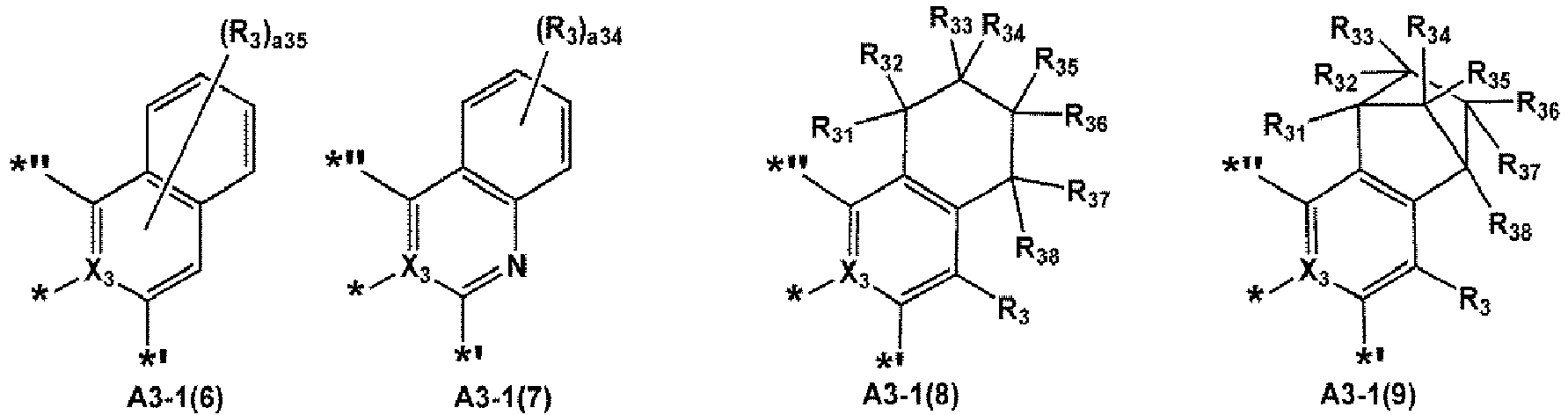


- In Formulae A3-1(1) to A3-1(17) and A3-2(1) to A3-2(7),
X3 and R3 are respectively the same as defined herein,
X31 is O, S, C(R31)(R32), Si(R31)(R32), or N(R31),
R31 to R38 are respectively the same as defined in connection with R3,
a35 is an integer of 0 to 5,
a34 is an integer of 0 to 4,
a33 is an integer of 0 to 3,
a32 is an integer of 0 to 2,
* indicates a binding site to T13 or M inFormula 1,
*' indicates a binding site to T13 or M inFormula 1, and
*" indicates a binding site to T2 inFormula 1. - In one or more embodiments, a moiety represented by

Formula 1 may be selected from groups represented by Formulae A4-1(1) to A4-1(49):


- In Formulae A1-1(1) to A1-1(49),
X4 and R4 are respectively the same as defined herein,
X41 is O, S, C(R41)(R42), Si(R41)(R42), or N(R41),
R41 to R48 are respectively the same as defined in connection with R4,
a46 is an integer of 0 to 6,
a45 is an integer of 0 to 5,
a44 is an integer of 0 to 4,
a43 is an integer of 0 to 3,
a42 is an integer of 0 to 2,
* indicates a binding site to T14 or M inFormula 1, and
*' indicates a binding site to T3 inFormula 1. - In one or more embodiments, in
Formula 2, a group represented by
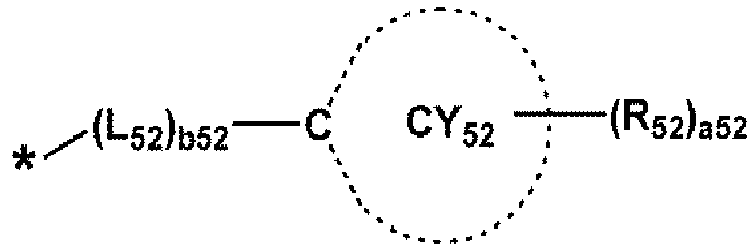
- In one or more embodiments, in
Formula 2, a group represented by

- In one or more embodiments, in
Formula 2, ring CY51 and ring CY52 may each independently be selected from a benzene group, a pyridine group, a pyrimidine group, a pyridazine group, a pyrazine group, and a triazine group,
R51 and R52 may each independently be selected from a substituted or unsubstituted C3-C10 cycloalkyl group, a substituted or unsubstituted C1-C10 heterocycloalkyl group, a substituted or unsubstituted C3-C10 cycloalkenyl group, a substituted or unsubstituted C1-C10 heterocycloalkenyl group, a substituted or unsubstituted C6-C60 (e.g. C6-C30) aryl group, a substituted or unsubstituted C7-C60 (e.g. C7-C30) alkyl aryl group, a substituted or unsubstituted C6-C60 (e.g. C6-C30) aryloxy group, a substituted or unsubstituted C6-C60 (e.g. C6-C30) arylthio group, a substituted or unsubstituted C1-C60 (e.g. C1-C20) heteroaryl group, a substituted or unsubstituted C2-C60 (e.g. C2-C20) alkyl heteroaryl group, a substituted or unsubstituted monovalent non-aromatic condensed polycyclic group, a substituted or unsubstituted monovalent non-aromatic condensed heteropolycyclic group, -C(Q1)(Q2)(Q3), and -Si(Q1)(Q2)(Q3),
Q1 to Q3 may each independently be selected from a C3-C10 cycloalkyl group, a C1-C10 heterocycloalkyl group, a C3-C10 cycloalkenyl group, a C1-C10 heterocycloalkenyl group, a C6-C60 (e.g. C6-C30) aryl group, a C6-C60 (e.g. C6-C30) aryloxy group, a C6-C60 (e.g. C6-C30) arylthio group, a C1-C60 (e.g. C1-C20) heteroaryl group, a monovalent non-aromatic condensed polycyclic group, a monovalent non-aromatic condensed heteropolycyclic group, and a C6-C60 (e.g. C6-C30) aryl group substituted with at least one selected from deuterium, -F, a cyano group, a C1-C10 alkyl group, a phenyl group, and a biphenyl group, and
a51 and a52 may each independently be 1, 2, or 3. - In one or more embodiments, in
Formula 2, a moiety represented by
a moiety represented by
a moiety represented by

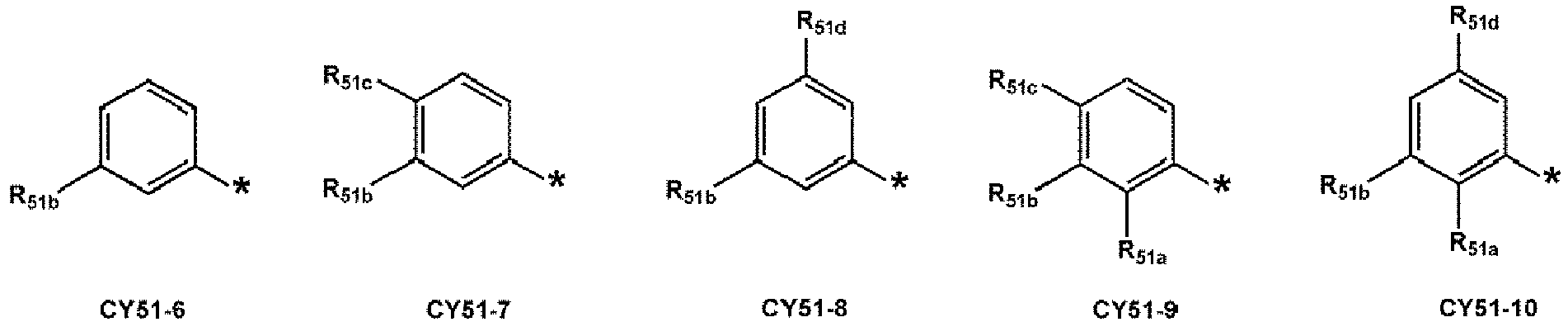






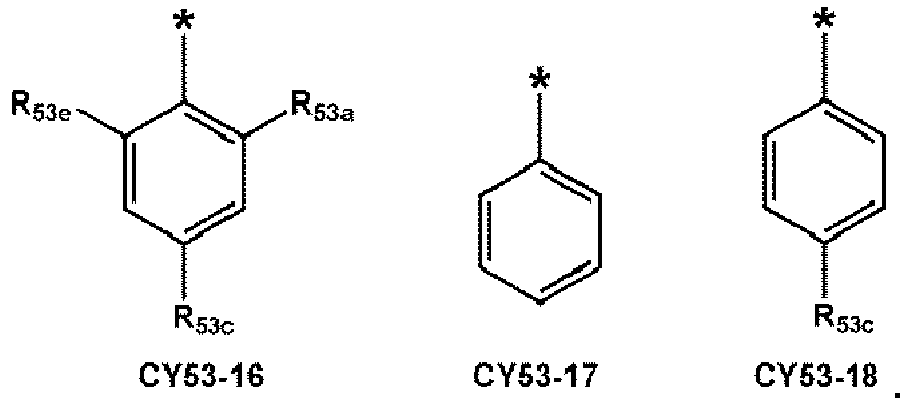
- In Formulae CY51-1 to CY51-17, CY52-1 to CY52-17, and CY53-1 to CY53-18,
Y63 is a single bond, O, S, N(R63), B(R63), C(R63a)(R63b), or Si(R63a)(R63b),
Y64 is a single bond, O, S, N(R64), B(R64), C(R64a)(R64b), or Si(R64a)(R64b),
Y67 is a single bond, O, S, N(R67), B(R67), C(R67a)(R67b), or Si(R67a)(R67b), and
Y68 is a single bond, O, S, N(R68), B(R68), C(R68a)(R68b), or Si(R68a)(R68b).
Y63 and Y64 in Formulae CY51-16 and CY51-17 are not both a single bond (e.g., are not concurrently or simultaneously a single bond),
Y67 and Y68 in Formulae CY52-16 and CY52-17 are not both a single bond (e.g., are not concurrently or simultaneously a single bond),
R51a to R51e, R61 to R64, R63a, R63b, R64a, and R64b are respectively the same as defined in connection with R51, wherein R51a to R51e are not hydrogen,
R52a to R52e, R65 to R68, R67a, R67b, R68a, and R68b are respectively the same as defined in connection with R52, wherein R52a to R52e are not hydrogen,
R53a to R53e are respectively the same as defined in connection with R53, wherein R53a to R53e are not hydrogen, and
* indicates a binding site to a neighboring atom. - For example,
in Formulae CY51-1 to CY51-15 and CY52-1 to CY52-15, R51a to R51e and R52a to R52e may each independently be selected from: - a cyclopentyl group, a cyclohexyl group, a cycloheptyl group, a cycloctyl group, an adamantanyl group, a norbornanyl group, a norbornenyl group, a cyclopentenyl group, a cyclohexenyl group, a cycloheptenyl group, a phenyl group, a biphenyl group, a C1-C10 alkyl phenyl group, a naphthyl group, a fluorenyl group, a phenanthrenyl group, an anthracenyl group, a fluoranthenyl group, a triphenylenyl group, a pyrenyl group, a chrysenyl group, a pyrrolyl group, a thiophenyl group, a furanyl group, an imidazolyl group, a pyrazolyl group, a thiazolyl group, an isothiazolyl group, an oxazolyl group, an isoxazolyl group, a pyridinyl group, a pyrazinyl group, a pyrimidinyl group, a pyridazinyl group, an isoindolyl group, an indolyl group, an indazolyl group, a purinyl group, a quinolinyl group, an isoquinolinyl group, a benzoquinolinyl group, a quinoxalinyl group, a quinazolinyl group, a cinnolinyl group, a carbazolyl group, a phenanthrolinyl group, a benzimidazolyl group, a benzofuranyl group, a benzothiophenyl group, an isobenzothiazolyl group, a benzoxazolyl group, an isobenzoxazolyl group, a triazolyl group, a tetrazolyl group, an oxadiazolyl group, a triazinyl group, a dibenzofuranyl group, a dibenzothiophenyl group, a benzocarbazolyl group, a dibenzocarbazolyl group, an imidazopyridinyl group, an imidazopyrimidinyl group, an azacarbazolyl group, an azadibenzofuranyl group, an azadibenzothiophenyl group, an azafluorenyl group, an azadibenzosilolyl group, and a group represented by Formula 91;
- a cyclopentyl group, a cyclohexyl group, a cycloheptyl group, a cycloctyl group, an adamantanyl group, a norbornanyl group, a norbornenyl group, a cyclopentenyl group, a cyclohexenyl group, a cycloheptenyl group, a phenyl group, a biphenyl group, a C1-C10 alkyl phenyl group, a naphthyl group, a fluorenyl group, a phenanthrenyl group, an anthracenyl group, a fluoranthenyl group, a triphenylenyl group, a pyrenyl group, a chrysenyl group, a pyrrolyl group, a thiophenyl group, a furanyl group, an imidazolyl group, a pyrazolyl group, a thiazolyl group, an isothiazolyl group, an oxazolyl group, an isoxazolyl group, a pyridinyl group, a pyrazinyl group, a pyrimidinyl group, a pyridazinyl group, an isoindolyl group, an indolyl group, an indazolyl group, a purinyl group, a quinolinyl group, an isoquinolinyl group, a benzoquinolinyl group, a quinoxalinyl group, a quinazolinyl group, a cinnolinyl group, a carbazolyl group, a phenanthrolinyl group, a benzimidazolyl group, a benzofuranyl group, a benzothiophenyl group, an isobenzothiazolyl group, a benzoxazolyl group, an isobenzoxazolyl group, a triazolyl group, a tetrazolyl group, an oxadiazolyl group, a triazinyl group, a dibenzofuranyl group, a dibenzothiophenyl group, a benzocarbazolyl group, a dibenzocarbazolyl group, an imidazopyridinyl group, an imidazopyrimidinyl group, an azacarbazolyl group, an azadibenzofuranyl group, an azadibenzothiophenyl group, an azafluorenyl group, an azadibenzosilolyl group, and a group represented by Formula 91, each substituted with at least one selected from deuterium, -F, -Cl, -Br, -I, -CD3, -CD2H, -CDH2, -CF3, -CF2H, -CFH2, a hydroxyl group, a cyano group, a nitro group, an amidino group, a hydrazine group, a hydrazone group, a C1-C20 alkyl group, a C1-C20 alkoxy group, a cyclopentyl group, a cyclohexyl group, a cycloheptyl group, a cycloctyl group, an adamantanyl group, a norbornanyl group, a norbornenyl group, a cyclopentenyl group, a cyclohexenyl group, a cycloheptenyl group, a phenyl group, a biphenyl group, a C1-C10 alkyl phenyl group, a naphthyl group, a fluorenyl group, a phenanthrenyl group, an anthracenyl group, a fluoranthenyl group, a triphenylenyl group, a pyrenyl group, a chrysenyl group, a pyrrolyl group, a thiophenyl group, a furanyl group, an imidazolyl group, a pyrazolyl group, a thiazolyl group, an isothiazolyl group, an oxazolyl group, an isoxazolyl group, a pyridinyl group, a pyrazinyl group, a pyrimidinyl group, a pyridazinyl group, an isoindolyl group, an indolyl group, an indazolyl group, a purinyl group, a quinolinyl group, an isoquinolinyl group, a benzoquinolinyl group, a quinoxalinyl group, a quinazolinyl group, a cinnolinyl group, a carbazolyl group, a phenanthrolinyl group, a benzimidazolyl group, a benzofuranyl group, a benzothiophenyl group, an isobenzothiazolyl group, a benzoxazolyl group, an isobenzoxazolyl group, a triazolyl group, a tetrazolyl group, an oxadiazolyl group, a triazinyl group, a dibenzofuranyl group, a dibenzothiophenyl group, a benzocarbazolyl group, a dibenzocarbazolyl group, an imidazopyridinyl group, and an imidazopyrimidinyl group; and
- -C(Q1)(Q2)(Q3) and -Si(Q1)(Q2)(Q3), and
- Q1 to Q3 may each independently be selected from:
- a phenyl group, a naphthyl group, a pyridinyl group, a pyrimidinyl group, a pyridazinyl group, a pyrazinyl group, and a triazinyl group; and
- a phenyl group, a naphthyl group, a pyridinyl group, a pyrimidinyl group, a pyridazinyl group, a pyrazinyl group, and a triazinyl group, each substituted with at least one selected from deuterium, a C1-C10 alkyl group, a phenyl group, a biphenyl group, a pyridinyl group, a pyrimidinyl group, a pyridazinyl group, a pyrazinyl group, and a triazinyl group.
- In Formulae CY51-16 and CY51-17, i) Y63 may be O or S, and Y64 may be Si(R64a)(R64b); or ii) Y63 may be Si(R63a)(R63b), and Y64 may be O or S.
- In Formulae CY52-16 and CY52-17, i) Y67 may be O or S, and Y68 may be Si(R68a)(R68b); or ii) Y67 may be Si(R67a)(R67b), and Y68 may be O or S, but embodiments of the present disclosure are not limited thereto.
- In one or more embodiments, the third compound may be represented by Formulae 3-1 to 3-5:


- In Formulae 3-1 to 3-5,
ring CY71, ring CY72, X81, R71, R72, a71, and a72 are respectively the same as defined above,
ring CY73, ring CY74, R73, R74, a73, and a74 are respectively the same as defined in connection with ring CY71, ring CY72, R71, R72, a71, and a72,
L81 is selected from *-C(Q4)(Q5)-*', *-Si(Q4)(Q5)-*', a substituted or unsubstituted C5-C30 (e.g. C5-C20) carbocyclic group, and a substituted or unsubstituted C1-C30 (e.g. C1-C20) heterocyclic group, wherein Q4 and Q5 are respectively the same as defined in connection with Q1,
b81 is an integer of 0 to 5, wherein, when b81 is 0, *-(L81)b81-*' is a single bond, and when b81 is two or more, two or more L81(s) are identical to or different from each other,
X82 is a single bond, O, S, N(R82), B(R82), C(R82a)(R82b), or Si(R82a)(R82b),
X83 is a single bond, O, S, N(R83), B(R83), C(R83a)(R83b), or Si(R83a)(R83b),
in Formulae 3-2 and 3-4, X82 and X83 are not both a single bond (e.g., are not concurrently or simultaneously a single bond),
X84 is C or Si,
R80, R82, R83, R82a, R82b, R83a, R83b, and R84 are respectively the same as defined in connection with R81, and
* and *' each indicate a binding site to a neighboring atom. - For example, L81 may be selected from:
- *-C(Q4)(Q5)-*' and *-Si(Q4)(Q5)-*';
- a benzene group, a naphthalene group, an anthracene group, a phenanthrene group, a triphenylene group, a pyrene group, a chrysene group, a cyclopentadiene group, a furan group, a thiophene group, a silole group, an indene group, a fluorene group, an indole group, a carbazole group, a benzofuran group, a dibenzofuran group, a benzothiophene group, a dibenzothiophene group, a benzosilole group, a dibenzosilole group, an azafluorene group, an azacarbazole group, an azadibenzofuran group, an azadibenzothiophene group, an azadibenzosilole group, a pyridine group, a pyrimidine group, a pyrazine group, a pyridazine group, a triazine group, a quinoline group, an isoquinoline group, a quinoxaline group, a quinazoline group, a phenanthroline group, a pyrrole group, a pyrazole group, an imidazole group, a triazole group, an oxazole group, an isoxazole group, a thiazole group, an isothiazole group, an oxadiazole group, a thiadiazole group, a benzopyrazole group, a benzimidazole group, a benzoxazole group, a benzothiazole group, a benzooxadiazole group, and a benzothiadiazole group; and
- a benzene group, a naphthalene group, an anthracene group, a phenanthrene group, a triphenylene group, a pyrene group, a chrysene group, a cyclopentadiene group, a furan group, a thiophene group, a silole group, an indene group, a fluorene group, an indole group, a carbazole group, a benzofuran group, a dibenzofuran group, a benzothiophene group, a dibenzothiophene group, a benzosilole group, a dibenzosilole group, an azafluorene group, an azacarbazole group, an azadibenzofuran group, an azadibenzothiophene group, an azadibenzosilole group, a pyridine group, a pyrimidine group, a pyrazine group, a pyridazine group, a triazine group, a quinoline group, an isoquinoline group, a quinoxaline group, a quinazoline group, a phenanthroline group, a pyrrole group, a pyrazole group, an imidazole group, a triazole group, an oxazole group, an isoxazole group, a thiazole group, an isothiazole group, an oxadiazole group, a thiadiazole group, a benzopyrazole group, a benzimidazole group, a benzoxazole group, a benzothiazole group, a benzooxadiazole group, and a benzothiadiazole group, each substituted with at least one selected from deuterium, -F, -Cl, -Br, -I, a hydroxyl group, a cyano group, a nitro group, an amidino group, a hydrazine group, a hydrazone group, a C1-C20 alkyl group, a C1-C20 alkoxy group, a phenyl group, a naphthyl group, a pyridinyl group, a pyrimidinyl group, a triazinyl group, a fluorenyl group, a dimethylfluorenyl group, a diphenyl fluorenyl group, a carbazolyl group, a phenylcarbazolyl group, a dibenzofuranyl group, a dibenzothiophenyl group, a dibenzosilolyl group, a dimethyl dibenzosilolyl group, a diphenyl dibenzosilolyl group, -O(Q31), -S(Q31), -Si(Q31)(Q32)(Q33), -N(Q31)(Q32),-B(Q31)(Q32), -P(Q31)(Q32), -C(=O)(Q31), -S(=O)2(Q31), and -P(=O)(Q31)(Q32), and
- Q4, Q5, and Q31 to Q33 may each independently be selected from hydrogen, deuterium, a C1-C20 alkyl group, a C1-C20 alkoxy group, a phenyl group, a biphenyl group, a terphenyl group, a pyridinyl group, a pyrimidinyl group, a pyridazinyl group, a pyrazinyl group, and a triazinyl group, but embodiments of the present disclosure are not limited thereto.
- For example, a moiety represented by
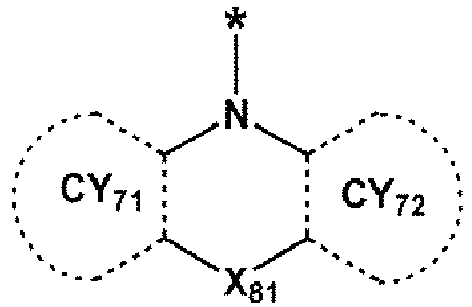
a moiety represented by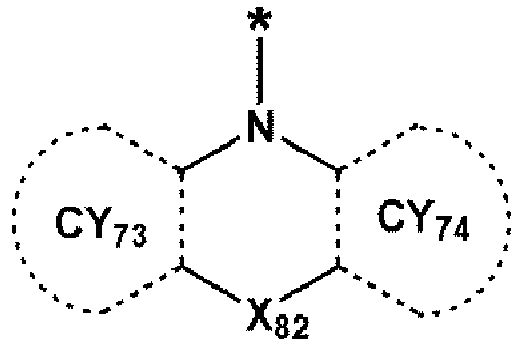
a moiety represented by
a moiety represented by
a moiety represented by
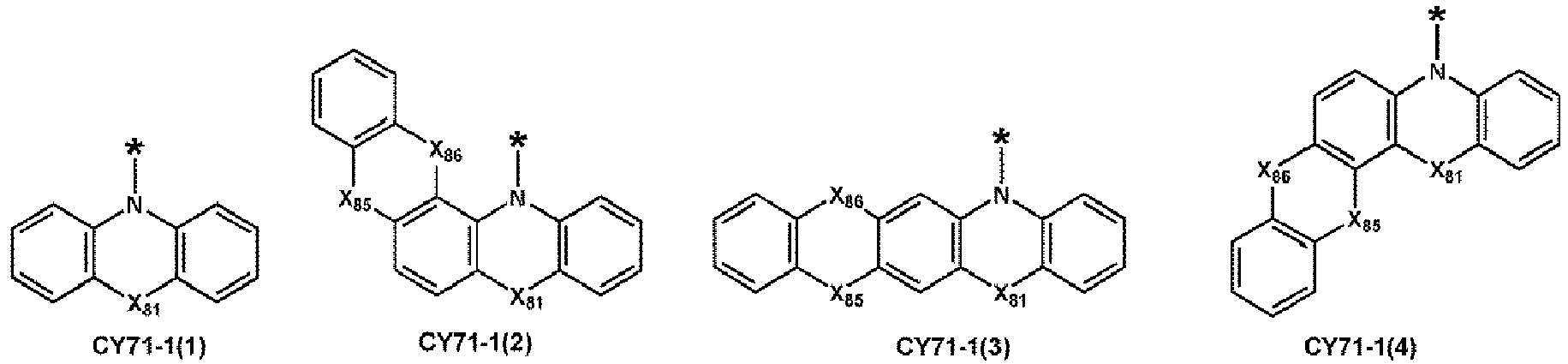


- In Formulae CY71-1(1) to CY71-1(8), CY71-2(1) to CY71-2(8), CY71-3(1) to CY71-3(32), CY71-4(1) to CY71-4(32), and CY71-5(1) to CY71-5(8),
X81 to X84, R80, and R84 are respectively the same as defined herein,
X85 is a single bond, O, S, N(R85), B(R85), C(R85a)(R85b), or Si(R85a)(R85b),
X86 is a single bond, O, S, N(R86), B(R86), C(R86a)(R86b), or Si(R86a)(R86b),
in Formulae CY71-1(1) to CY71-1(8) and CY71-4(1) to CY71-4(32), X85 and X86 are not both a single bond (e.g., are not a single bond concurrently or at the same time),
X87 is a single bond, O, S, N(R87), B(R87), C(R87a)(R87b), or Si(R87a)(R87b),
X88 is a single bond, O, S, N(R88), B(R88), C(R88a)(R88b), or Si(R88a)(R88b),
in Formulae CY71-2(1) to CY71-2(8), CY71-3(1) to CY71-3(32), and CY71-5(1) to CY71-5(8), X87 and X88 are not both a single bond (e.g., are not a single bond concurrently or at the same time),
R85 to R88, R85a, R85b, R86a, R86b, R87a, R87b, R88a, and R88b are respectively the same as defined in connection with R81. - In one embodiment, the first compound may be selected from Compounds D1 to D100:





- In one or more embodiments, the second compound may be selected from Compounds H2-1 to H2-64:


- In one or more embodiments, the third compound may be selected from Compounds H3-1 to H3-28:


- In one embodiment, a weight ratio of the second compound to the third compound may be in a range of 1 : 9 to 9 : 1, 2 : 8 to 8 : 2, 3 : 7 to 7 : 3 or 4 : 6 to 6: 4, but embodiments of the present disclosure are not limited thereto.
- In one embodiment, the organic light-emitting device may satisfy at least one of
Condition 1 to Condition 4: -
Condition 1
lowest unoccupied molecular orbital (LUMO) energy level (eV) of third compound > LUMO energy level (eV) of first compound -
Condition 2
LUMO energy level (eV) of first compound > LUMO energy level (eV) of second compound -
Condition 3
highest occupied molecular orbital (HOMO) energy level (eV) of first compound > HOMO energy level (eV) of third compound -
Condition 4
HOMO energy level (eV) of third compound > HOMO energy level (eV) of second compound - The HOMO energy levels and the LUMO energy levels of the first compound, the second compound, and the third compound are negative values and may actually be measured by any suitable method available in the art, for example, a method described in Evaluation Example.
- In one or more embodiments, an absolute value of a difference between the LUMO energy level of the first compound and the LUMO energy level of the second compound may be 0.1 eV to 1.0 eV, an absolute value of a difference between the LUMO energy level of the first compound and the LUMO energy level of the third compound may be 0.1 eV to 1.0 eV, an absolute value of a difference between the HOMO energy level of the first compound and the HOMO energy level of the second compound may be 1.25 eV or less (for example, 0.2 eV to 1.25 eV), and an absolute value of a difference between the HOMO energy level of the first compound and the HOMO energy level of the third compound may be 1.25 eV or less (for example, 0.2 eV to 1.25 eV).
- As described above, when the relationship between the LUMO energy level and the HOMO energy level is satisfied, a suitable balance of hole and electron injections into the emission layer may be achieved.
- The emission layer of the organic light-emitting device includes:
- 1) a first compound represented by Formula 1 (
Formula 1 has a tetradentate ligand, and M inFormula 1 is a transition metal, but is not iridium); - 2) a second compound represented by Formula 2 (in
Formula 2, a bond between L51 and ring CY51, a bond between L52 and ring CY52, a bond between L53 and ring CY53, a bond between two or more L51(s), a bond between two or more L52(s), a bond between two or more L53(s), a bond between L51 and carbon between X54 and X55 inFormula 2, a bond between L52 and carbon between X54 and X56 inFormula 2, and a bond between L53 and carbon between X55 and X56 inFormula 2 are each a "carbon-carbon" single bond); and - 3) a third compound including a group represented by
Formula 3 that is different fromFormulae - Therefore, it is possible to implement an organic light-emitting device having high luminescent efficiency and a long lifespan, since an exciplex is effectively formed between the first compound and the second compound.
- A decay time of delayed fluorescence in a time-resolved electroluminescence (TREL) spectrum of the organic light-emitting device is about 50 ns or more, for example, 50 ns to 10 µs. In one embodiment, the decay time of the delayed fluorescence in the TREL spectrum of the organic light-emitting device may be 1.4 µs to 4 µs or 1.5 µs to 3 µs. When the decay time of the delayed fluorescence of the organic light-emitting device satisfies the above-described range, the time when the first compound exists in an excited state is relatively reduced so that the organic light-emitting device may have high luminescent efficiency and a long lifespan.
- In one embodiment, the organic light-emitting device may have a non-resonance structure, the electroluminescence (EL) spectrum of the organic light-emitting device includes a first peak and a second peak, the maximum emission wavelength of the second peak is greater than the maximum emission wavelength of the first peak, a difference between the maximum emission wavelength of the second peak and the maximum emission wavelength of the first peak may be in a range of about 5 nm to about 30 nm (for example, in a range of about 5 nm to about 20 nm or about 5 nm to about 10 nm), and the intensity of the second peak may be smaller than the intensity of the first peak. When the difference between the maximum emission wavelength of the second peak and the maximum emission wavelength of the first peak satisfies the above-described range, it is possible to implement an organic light-emitting device having excellent color purity (for example, a blue organic light-emitting device having excellent color purity).
- The maximum emission wavelength of the first peak may be in a range of about 390 nm to about 500 nm (for example, 430 nm to 470 nm). Therefore, the organic light-emitting device may emit blue light having excellent color purity (for example, deep blue light).
- The first peak may be an emission peak of phosphorescence emitted from the first compound, and
the second peak may be an emission peak of an exciplex formed from the first compound and the second compound. - The intensity of the second peak may be in a range of about 20 % to about 90 % of the intensity of the first peak. When the intensity of the second peak and the intensity of the first peak satisfy the above-described ranges, the emission efficiency of phosphorescence emitted from the first compound is not reduced, and the time when the first compound exists in the excited state is effectively controlled by the exciplex emitting the light of the second peak, thereby implementing an organic light-emitting device having high luminescent efficiency and a long lifespan.
- Another aspect of an embodiment provides an organic light-emitting device including:
- a first electrode;
- a second electrode facing the first electrode; and
- an emission layer disposed between the first electrode and the second electrode,
- wherein the emission layer includes a first compound, a second compound, and a third compound,
- the first compound, the second compound, and the third compound are different from one another,
- an amount of the first compound is smaller than a total amount of the second compound and the third compound,
- the first compound is an iridium-free organometallic compound (e.g., the organometallic compound contains no iridium),
- the second compound includes at least one group selected from a pyridine group, a pyrimidine group, a pyridazine group, a pyrazine group, a triazine group, and a tetrazine group,
- the first compound and the second compound form an exciplex, and
- a decay time of delayed fluorescence in a TREL spectrum is about 50 ns or more (for example, 50 ns to 10 µs, 1.4 µs to 4 µs, or 1.5 µs to 3 µs). When the decay time of the delayed fluorescence of the organic light-emitting device satisfies the above-described range, the time when the first compound exists in the excited state is relatively reduced so that the organic light-emitting device may have high luminescent efficiency and a long lifespan.
- In the organic light-emitting device, the first compound may be an organometallic compound having a tetradentate ligand and Pt, Pd, or Au as a core metal.
- The organic light-emitting device may have a non-resonance structure.
- An EL spectrum of the organic light-emitting device may include a first peak and a second peak, the maximum emission wavelength of the second peak may be greater than the maximum emission wavelength of the first peak, a difference between the maximum emission wavelength of the second peak and the maximum emission wavelength of the first peak may be in a range of about 5 nm to about 30 nm, and the intensity of the second peak may be smaller than the intensity of the first peak. The first peak and the second peak are the same as described above.
- The first compound, the second compound, and the third compound are the same as described above.
- Another aspect of an embodiment provides an electronic apparatus including the organic light-emitting device. The electronic apparatus may further include a thin film transistor. For example, the electronic apparatus may further include a thin film transistor including a source electrode and a drain electrode, and the first electrode of the organic light-emitting device may be electrically coupled to (e.g., electrically connected to) the source electrode or the drain electrode.
-
FIG. 1 is a schematic view of an organic light-emittingdevice 10 according to an embodiment. The organic light-emittingdevice 10 includes afirst electrode 110, anorganic layer 150, and asecond electrode 190. - Hereinafter, the structure of the organic light-emitting
device 10 according to an embodiment and a method of manufacturing the organic light-emittingdevice 10 will be described in connection withFIG. 1 . - In
FIG. 1 , a substrate may be additionally disposed under thefirst electrode 110 or above thesecond electrode 190. The substrate may be a glass substrate or a plastic substrate, each having excellent mechanical strength, thermal stability, transparency, surface smoothness, ease of handling, and water resistance. - The
first electrode 110 may be formed by depositing or sputtering a material for forming thefirst electrode 110 on the substrate. When thefirst electrode 110 is an anode, the material for forming thefirst electrode 110 may be selected from materials with a high work function to facilitate hole injection. - The
first electrode 110 may be a reflective electrode, a semi-transmissive electrode, or a transmissive electrode. When thefirst electrode 110 is a transmissive electrode, a material for forming afirst electrode 110 may be selected from indium tin oxide (ITO), indium zinc oxide (IZO), tin oxide (SnO2), zinc oxide (ZnO), and any combinations thereof, but embodiments of the present disclosure are not limited thereto. When thefirst electrode 110 is a semi-transmissive electrode or a reflective electrode, as a material for forming thefirst electrode 110, magnesium (Mg), silver (Ag), aluminium (Al), aluminium-lithium (Al-Li), calcium (Ca), magnesium-indium (Mg-In), magnesium-silver (Mg-Ag), or any combination thereof may be used. However, the material for forming thefirst electrode 110 is not limited thereto. - The
first electrode 110 may have a single-layered structure, or a multi-layered structure including two or more layers. For example, thefirst electrode 110 may have a three-layered structure of ITO/Ag/ITO, but the structure of thefirst electrode 110 is not limited thereto. - The
organic layer 150 is disposed on thefirst electrode 110. Theorganic layer 150 may include an emission layer. - The
organic layer 150 may include a hole transport region between thefirst electrode 110 and the emission layer, and an electron transport region between the emission layer and thesecond electrode 190. - The hole transport region may have i) a single-layered structure including a single layer including a single material, ii) a single-layered structure including a single layer including a plurality of different materials, or iii) a multi-layered structure having a plurality of layers including a plurality of different materials.
- The hole transport region may include at least one layer selected from a hole injection layer, a hole transport layer, an emission auxiliary layer, and an electron blocking layer.
- For example, the hole transport region may have a single-layered structure including a single layer including a plurality of different materials, or a multi-layered structure having a hole injection layer/hole transport layer structure, a hole injection layer/hole transport layer/emission auxiliary layer structure, a hole injection layer/emission auxiliary layer structure, a hole transport layer/emission auxiliary layer structure, or a hole injection layer/hole transport layer/electron blocking layer structure, wherein for each structure, constituting layers are sequentially stacked from the
first electrode 110 in this stated order, but the structure of the hole transport region is not limited thereto. - The hole transport region may include at least one selected from m-MTDATA, TDATA, 2-TNATA, NPB(NPD), β-NPB, TPD, Spiro-TPD, Spiro-NPB, methylated-NPB, TAPC, HMTPD, 4,4',4"-tris(N-carbazolyl)triphenylamine (TCTA), polyaniline/dodecylbenzenesulfonic acid (PANI/DBSA), (poly(3,4-ethylenedioxythiophene)/poly(4-styrenesulfonate) (PEDOT/PSS), polyaniline/camphor sulfonic acid (PANI/CSA), polyaniline/poly(4-styrenesulfonate) (PANI/PSS), a compound represented by Formula 201, and a compound represented by Formula 202:


- In Formulae 201 and 202,
L201 to L204 may each independently be selected from a substituted or unsubstituted C3-C10 cycloalkylene group, a substituted or unsubstituted C1-C16 heterocycloalkylene group, a substituted or unsubstituted C3-C10 cycloalkenylene group, a substituted or unsubstituted C1-C10 heterocycloalkenylene group, a substituted or unsubstituted C6-C60 (e.g. C6-C32) arylene group, a substituted or unsubstituted (e.g. C1-C20) C1-C60 heteroarylene group, a substituted or unsubstituted divalent non-aromatic condensed polycyclic group, and a substituted or unsubstituted divalent non-aromatic condensed heteropolycyclic group,
L205 may be selected from *-O-*', *-S-*', *-N(Q201)-*', a substituted or unsubstituted C1-C20 alkylene group, a substituted or unsubstituted C2-C20 alkenylene group, a substituted or unsubstituted C3-C10 cycloalkylene group, a substituted or unsubstituted C1-C10 heterocycloalkylene group, a substituted or unsubstituted C3-C10 cycloalkenylene group, a substituted or unsubstituted C1-C10 heterocycloalkenylene group, a substituted or unsubstituted C6-C60 (e.g. C6-C32) arylene group, a substituted or unsubstituted C1-C60 (e.g. C1-C20) heteroarylene group, a substituted or unsubstituted divalent non-aromatic condensed polycyclic group, and a substituted or unsubstituted divalent non-aromatic condensed heteropolycyclic group,
xa1 to xa4 may each independently be an integer of 0 to 3,
xa5 may be an integer of 1 to 10, and
R201 to R204 and Q201 may each independently be selected from a substituted or unsubstituted C3-C10 cycloalkyl group, a substituted or unsubstituted C1-C10 heterocycloalkyl group, a substituted or unsubstituted C3-C10 cycloalkenyl group, a substituted or unsubstituted C1-C10 heterocycloalkenyl group, a substituted or unsubstituted C6-C60 (e.g. C6-C32) aryl group, a substituted or unsubstituted C6-C60 (e.g. C6-C32) aryloxy group, a substituted or unsubstituted C6-C60 (e.g. C6-C32) arylthio group, a substituted or unsubstituted C1-C60 (e.g. C1-C20) heteroaryl group, a substituted or unsubstituted monovalent non-aromatic condensed polycyclic group, and a substituted or unsubstituted monovalent non-aromatic condensed heteropolycyclic group. - For example, in Formula 202, R201 and R202 may optionally be linked via a single bond, a dimethyl-methylene group, or a diphenyl-methylene group, R203 and R204 may optionally be linked via a single bond, a dimethyl-methylene group, or a diphenyl-methylene group.
- In one or more embodiments, in Formulae 201 and 202,
L201 to L205 may each independently be selected from: - a phenylene group, a pentalenylene group, an indenylene group, a naphthylene group, an azulenylene group, a heptalenylene group, an indacenylene group, an acenaphthylene group, a fluorenylene group, a spiro-bifluorenylene group, a benzofluorenylene group, a dibenzofluorenylene group, a phenalenylene group, a phenanthrenylene group, an anthracenylene group, a fluoranthenylene group, a triphenylenylene group, a pyrenylene group, a chrysenylene group, a naphthacenylene group, a picenylene group, a perylenylene group, a pentaphenylene group, a hexacenylene group, a pentacenylene group, a rubicenylene group, a coronenylene group, an ovalenylene group, a thiophenylene group, a furanylene group, a carbazolylene group, an indolylene group, an isoindolylene group, a benzofuranylene group, a benzothiophenylene group, a dibenzofuranylene group, a dibenzothiophenylene group, a benzocarbazolylene group, a dibenzocarbazolylene group, a dibenzosilolylene group, and a pyridinylene group; and
- a phenylene group, a pentalenylene group, an indenylene group, a naphthylene group, an azulenylene group, a heptalenylene group, an indacenylene group, an acenaphthylene group, a fluorenylene group, a spiro-bifluorenylene group, a benzofluorenylene group, a dibenzofluorenylene group, a phenalenylene group, a phenanthrenylene group, an anthracenylene group, a fluoranthenylene group, a triphenylenylene group, a pyrenylene group, a chrysenylene group, a naphthacenylene group, a picenylene group, a perylenylene group, a pentaphenylene group, a hexacenylene group, a pentacenylene group, a rubicenylene group, a coronenylene group, an ovalenylene group, a thiophenylene group, a furanylene group, a carbazolylene group, an indolylene group, an isoindolylene group, a benzofuranylene group, a benzothiophenylene group, a dibenzofuranylene group, a dibenzothiophenylene group, a benzocarbazolylene group, a dibenzocarbazolylene group, a dibenzosilolylene group, and a pyridinylene group, each substituted with at least one selected from deuterium, -F, -Cl, -Br, -I, a hydroxyl group, a cyano group, a nitro group, an amidino group, a hydrazine group, a hydrazone group, a C1-C20 alkyl group, a C1-C20 alkoxy group, a cyclopentyl group, a cyclohexyl group, a cycloheptyl group, a cyclopentenyl group, a cyclohexenyl group, a phenyl group, a biphenyl group, a terphenyl group, a phenyl group substituted with a C1-C16 alkyl group, a phenyl group substituted with -F, a pentalenyl group, an indenyl group, a naphthyl group, an azulenyl group, a heptalenyl group, an indacenyl group, an acenaphthyl group, a fluorenyl group, a spiro-bifluorenyl group, a benzofluorenyl group, a dibenzofluorenyl group, a phenalenyl group, a phenanthrenyl group, an anthracenyl group, a fluoranthenyl group, a triphenylenyl group, a pyrenyl group, a chrysenyl group, a naphthacenyl group, a picenyl group, a perylenyl group, a pentaphenyl group, a hexacenyl group, a pentacenyl group, a rubicenyl group, a coronenyl group, an ovalenyl group, a thiophenyl group, a furanyl group, a carbazolyl group, an indolyl group, an isoindolyl group, a benzofuranyl group, a benzothiophenyl group, a dibenzofuranyl group, a dibenzothiophenyl group, a benzocarbazolyl group, a dibenzocarbazolyl group, a dibenzosilolyl group, a pyridinyl group, -Si(Q31)(Q32)(Q33), and -N(Q31)(Q32), and
- Q31 to Q33 may each independently be selected from a C1-C16 alkyl group, a C1-C10 alkoxy group, a phenyl group, a biphenyl group, a terphenyl group, and a naphthyl group.
- In one or more embodiments, xa1 to xa4 may each independently be 0, 1, or 2.
- In one or more embodiments, xa5 may be 1, 2, 3, or 4.
- In one or more embodiments, R201 to R204 and Q201 may each independently be selected from:
- a phenyl group, a biphenyl group, a terphenyl group, a pentalenyl group, an indenyl group, a naphthyl group, an azulenyl group, a heptalenyl group, an indacenyl group, an acenaphthyl group, a fluorenyl group, a spiro-bifluorenyl group, a benzofluorenyl group, a dibenzofluorenyl group, a phenalenyl group, a phenanthrenyl group, an anthracenyl group, a fluoranthenyl group, a triphenylenyl group, a pyrenyl group, a chrysenyl group, a naphthacenyl group, a picenyl group, a perylenyl group, a pentaphenyl group, a hexacenyl group, a pentacenyl group, a rubicenyl group, a coronenyl group, an ovalenyl group, a thiophenyl group, a furanyl group, a carbazolyl group, an indolyl group, an isoindolyl group, a benzofuranyl group, a benzothiophenyl group, a dibenzofuranyl group, a dibenzothiophenyl group, a benzocarbazolyl group, a dibenzocarbazolyl group, a dibenzosilolyl group, and a pyridinyl group; and
- a phenyl group, a biphenyl group, a terphenyl group, a pentalenyl group, an indenyl group, a naphthyl group, an azulenyl group, a heptalenyl group, an indacenyl group, an acenaphthyl group, a fluorenyl group, a spiro-bifluorenyl group, a benzofluorenyl group, a dibenzofluorenyl group, a phenalenyl group, a phenanthrenyl group, an anthracenyl group, a fluoranthenyl group, a triphenylenyl group, a pyrenyl group, a chrysenyl group, a naphthacenyl group, a picenyl group, a perylenyl group, a pentaphenyl group, a hexacenyl group, a pentacenyl group, a rubicenyl group, a coronenyl group, an ovalenyl group, a thiophenyl group, a furanyl group, a carbazolyl group, an indolyl group, an isoindolyl group, a benzofuranyl group, a benzothiophenyl group, a dibenzofuranyl group, a dibenzothiophenyl group, a benzocarbazolyl group, a dibenzocarbazolyl group, a dibenzosilolyl group, and a pyridinyl group, each substituted with at least one selected from deuterium, -F, -Cl, -Br, -I, a hydroxyl group, a cyano group, a nitro group, an amidino group, a hydrazine group, a hydrazone group, a C1-C20 alkyl group, a C1-C20 alkoxy group, a cyclopentyl group, a cyclohexyl group, a cycloheptyl group, a cyclopentenyl group, a cyclohexenyl group, a phenyl group, a biphenyl group, a terphenyl group, a phenyl group substituted with a C1-C16 alkyl group, a phenyl group substituted with -F, a pentalenyl group, an indenyl group, a naphthyl group, an azulenyl group, a heptalenyl group, an indacenyl group, an acenaphthyl group, a fluorenyl group, a spiro-bifluorenyl group, a benzofluorenyl group, a dibenzofluorenyl group, a phenalenyl group, a phenanthrenyl group, an anthracenyl group, a fluoranthenyl group, a triphenylenyl group, a pyrenyl group, a chrysenyl group, a naphthacenyl group, a picenyl group, a perylenyl group, a pentaphenyl group, a hexacenyl group, a pentacenyl group, a rubicenyl group, a coronenyl group, an ovalenyl group, a thiophenyl group, a furanyl group, a carbazolyl group, an indolyl group, an isoindolyl group, a benzofuranyl group, a benzothiophenyl group, a dibenzofuranyl group, a dibenzothiophenyl group, a benzocarbazolyl group, a dibenzocarbazolyl group, a dibenzosilolyl group, a pyridinyl group, -Si(Q31)(Q32)(Q33), and -N(Q31)(Q32), and
- Q31 to Q33 may respective be the same as defined above.
- In one or more embodiments, in Formula 201, at least one selected from R201 to R203 may each independently be selected from:
- a fluorenyl group, a spiro-bifluorenyl group, a carbazolyl group, a dibenzofuranyl group, and a dibenzothiophenyl group; and
- a fluorenyl group, a spiro-bifluorenyl group, a carbazolyl group, a dibenzofuranyl group, and a dibenzothiophenyl group, each substituted with at least one selected from deuterium, -F, -Cl, -Br, -I, a hydroxyl group, a cyano group, a nitro group, an amidino group, a hydrazine group, a hydrazone group, a C1-C20 alkyl group, a C1-C20 alkoxy group, a cyclopentyl group, a cyclohexyl group, a cycloheptyl group, a cyclopentenyl group, a cyclohexenyl group, a phenyl group, a biphenyl group, a terphenyl group, a phenyl group substituted with a C1-C16 alkyl group, a phenyl group substituted with -F, a naphthyl group, a fluorenyl group, a spiro-bifluorenyl group, a carbazolyl group, a dibenzofuranyl group, and a dibenzothiophenyl group;
- but embodiments of the present disclosure are not limited thereto.
- In one or more embodiments, in Formula 202, i) R201 and R202 may be linked via a single bond, and/or ii) R203 and R204 may be linked via a single bond.
- In one or more embodiments, in Formula 202, at least one selected from R201 to R204 may be selected from:
- a carbazolyl group; and
- a carbazolyl group substituted with at least one selected from deuterium, -F, -Cl, -Br, -I, a hydroxyl group, a cyano group, a nitro group, an amidino group, a hydrazine group, a hydrazone group, a C1-C20 alkyl group, a C1-C20 alkoxy group, a cyclopentyl group, a cyclohexyl group, a cycloheptyl group, a cyclopentenyl group, a cyclohexenyl group, a phenyl group, a biphenyl group, a terphenyl group, a phenyl group substituted with a C1-C10 alkyl group, a phenyl group substituted with -F, a naphthyl group, a fluorenyl group, a spiro-bifluorenyl group, a carbazolyl group, a dibenzofuranyl group, and a dibenzothiophenyl group,
- but embodiments of the present disclosure are not limited thereto.
- The compound represented by Formula 201 may be represented by Formula 201A:
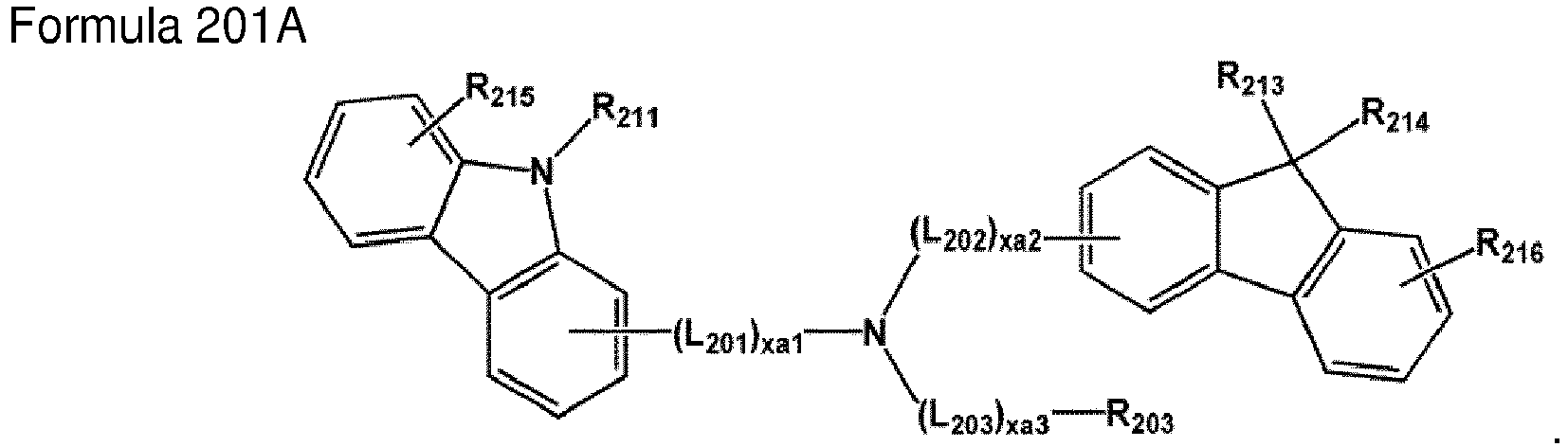
- In one embodiment, the compound represented by Formula 201 may be represented by Formula 201A(1) below, but embodiments of the present disclosure are not limited thereto:


- In one embodiment, the compound represented by Formula 201 may be represented by Formula 201A-1 below, but embodiments of the present disclosure are not limited thereto:

- In one embodiment, the compound represented by Formula 202 may be represented by Formula 202A:

- In one embodiment, the compound represented by Formula 202 may be represented by Formula 202A-1:


- In Formulae 201A, 201A(1), 201A-1, 202A, and 202A-1,
L201 to L203, xa1 to xa3, xa5, and R202 to R204 may respectively be the same as defined above,
R211 and R212 may respectively be the same as defined in connection with R203. - R213 to R217 may each independently be selected from hydrogen, deuterium, -F, -Cl, -Br, -I, a hydroxyl group, a cyano group, a nitro group, an amidino group, a hydrazine group, a hydrazone group, a C1-C20 alkyl group, a C1-C20 alkoxy group, a cyclopentyl group, a cyclohexyl group, a cycloheptyl group, a cyclopentenyl group, a cyclohexenyl group, a phenyl group, a biphenyl group, a terphenyl group, a phenyl group substituted with a C1-C10 alkyl group, a phenyl group substituted with -F, a pentalenyl group, an indenyl group, a naphthyl group, an azulenyl group, a heptalenyl group, an indacenyl group, an acenaphthyl group, a fluorenyl group, a spiro-bifluorenyl group, a benzofluorenyl group, a dibenzofluorenyl group, a phenalenyl group, a phenanthrenyl group, an anthracenyl group, a fluoranthenyl group, a triphenylenyl group, a pyrenyl group, a chrysenyl group, a naphthacenyl group, a picenyl group, a perylenyl group, a pentaphenyl group, a hexacenyl group, a pentacenyl group, a rubicenyl group, a coronenyl group, an ovalenyl group, a thiophenyl group, a furanyl group, a carbazolyl group, an indolyl group, an isoindolyl group, a benzofuranyl group, a benzothiophenyl group, a dibenzofuranyl group, a dibenzothiophenyl group, a benzocarbazolyl group, a dibenzocarbazolyl group, a dibenzosilolyl group, and a pyridinyl group.
- A thickness of the hole transport region may be in a range of about 100 Å to about 10,000 Å, for example, about 100 Å to about 7000 Å, about 100 Å to about 5000 Å, about 100 Å to about 3000 Å, or about 100 Å to about 1,000 Å. When the hole transport region includes at least one of a hole injection layer and a hole transport layer, the thickness of the hole injection layer may be in a range of about 100 Å to about 9,000 Å, and for example, about 100 Å to about 7,000 Å, about 100 Å to about 5,000 Å, about 100 Å to about 3,000 Å, about 100 Å to about 2,000 Å or about 100 Å to about 1,000 Å, and the thickness of the hole transport layer may be in a range of about 50 Å to about 2,000 Å, and for example, about 100 Å to about 1,500 Å. When the thicknesses of the hole transport region, the hole injection layer, and the hole transport layer are within these ranges, suitable or satisfactory hole transporting characteristics may be obtained without a substantial increase in driving voltage.
- The emission auxiliary layer may increase light-emission efficiency by compensating for an optical resonance distance according to the wavelength of light emitted by an emission layer, and the electron blocking layer may block the flow of electrons from an electron transport region. The emission auxiliary layer and the electron blocking layer may include the materials as described above.
- The hole transport region may further include, in addition to these materials, a charge-generation material for the improvement of conductive properties. The charge-generation material may be homogeneously or non-homogeneously dispersed in the hole transport region.
- The charge-generation material may be, for example, a p-dopant.
- In one embodiment, the p-dopant may have a lowest unoccupied molecular orbital (LUMO) energy level of about -3.5 eV or less.
- The p-dopant may include at least one selected from a quinone derivative, a metal oxide, and a cyano group-containing compound, but embodiments of the present disclosure are not limited thereto.
- For example, the p-dopant may include at least one selected from:
- a quinone derivative, such as tetracyanoquinodimethane (TCNQ) and 2,3,5,6-tetrafluoro-7,7,8,8-tetracyanoquinodimethane (F4-TCNQ);
- a metal oxide, such as tungsten oxide or molybdenum oxide;
- 1,4,5,8,9,12-hexaazatriphenylene-hexacarbonitrile (HAT-CN); and
- a compound represented by Formula 221,
- In Formula 221,
R221 to R223 may each independently be selected from a substituted or unsubstituted C3-C10 cycloalkyl group, a substituted or unsubstituted C1-C10 heterocycloalkyl group, a substituted or unsubstituted C3-C10 cycloalkenyl group, a substituted or unsubstituted C1-C10 heterocycloalkenyl group, a substituted or unsubstituted C6-C60 (e.g. C6-C32) aryl group, a substituted or unsubstituted C1-C60 (e.g. C1-C20) heteroaryl group, a substituted or unsubstituted monovalent non-aromatic condensed polycyclic group, and a substituted or unsubstituted monovalent non-aromatic condensed heteropolycyclic group, wherein at least one selected from R221 to R223 may have at least one substituent selected from a cyano group, -F, -Cl, -Br, -I, a C1-C20 alkyl group substituted with -F, a C1-C20 alkyl group substituted with -Cl, a C1-C20 alkyl group substituted with -Br, and a C1-C20 alkyl group substituted with -I. - The emission layer may include a host and a dopant. The host and the dopant may be the same as described above.
- In the emission layer, an amount of the dopant may be in a range of about 0.01 parts to about 15 parts by weight based on 100 parts by weight of the host, but embodiments of the present disclosure are not limited thereto.
- A thickness of the emission layer may be in a range of about 100 Å to about 1,000 Å, for example, about 100 Å to about 800 Å, about 150 Å to about 800 Å, about 150 Å to about 700 Å, about 150 Å to about 650 Å, about 200 Å to about 600 Å or about 200 Å to about 400 Å. When the thickness of the emission layer is within this range, excellent light-emission characteristics may be obtained without a substantial increase in driving voltage.
- The electron transport region may have i) a single-layered structure including a single layer including a single material, ii) a single-layered structure including a single layer including a plurality of different materials, or iii) a multi-layered structure having a plurality of layers including a plurality of different materials.
- The electron transport region may include at least one selected from a buffer layer, a hole blocking layer, an electron control layer, an electron transport layer, and an electron injection layer, but embodiments of the present disclosure are not limited thereto.
- For example, the electron transport region may have an electron transport layer/electron injection layer structure, a hole blocking layer/electron transport layer/electron injection layer structure, an electron control layer/electron transport layer/electron injection layer structure, or a buffer layer/electron transport layer/electron injection layer structure, wherein for each structure, constituting layers are sequentially stacked from an emission layer. However, embodiments of the structure of the electron transport region are not limited thereto.
- The hole transport region may include the second compound as described above.
- In one embodiment, the hole transport region may include a buffer layer. The buffer layer may directly contact the emission layer, and may include the second compound.
- In one or more embodiments, the electron transport region may include a buffer layer, an electron transport layer, and an electron injection layer, which are stacked in this stated order on the emission layer, and the buffer layer may include the second compound as described above.
- The electron transport region (for example, a hole blocking layer, an electron control layer, or an electron transport layer in the electron transport region) may include a metal-free compound containing at least one π electron-depleted nitrogen-containing ring.
- The term "π electron-depleted nitrogen-containing ring," as used herein, indicates a C1-C60 (e.g. a C1-C30) heterocyclic group having at least one *-N=*' moiety as a ring-forming moiety.
- For example, the "π electron-depleted nitrogen-containing ring" may be i) a 5-membered to 7-membered heteromonocyclic group having at least one *-N=*' moiety, ii) a heteropolycyclic group in which two or more 5-membered to 7-membered heteromonocyclic groups each having at least one *-N=*' moiety are condensed with each other (e.g., combined with each other), or iii) a heteropolycyclic group in which at least one of 5-membered to 7-membered heteromonocyclic groups, each having at least one *-N=*' moiety, is condensed with (e.g., combined with) at least one C5-C60 (e.g. a C5-C30) carbocyclic group.
- Examples of the π electron-depleted nitrogen-containing ring include an imidazole, a pyrazole, a thiazole, an isothiazole, an oxazole, an isoxazole, a pyridine, a pyrazine, a pyrimidine, a pyridazine, an indazole, a purine, a quinoline, an isoquinoline, a benzoquinoline, a phthalazine, a naphthyridine, a quinoxaline, a quinazoline, a cinnoline, a phenanthridine, an acridine, a phenanthroline, a phenazine, a benzimidazole, an isobenzothiazole, a benzoxazole, an isobenzoxazole, a triazole, a tetrazole, an oxadiazole, a triazine, a thiadiazole, an imidazopyridine, an imidazopyrimidine, and an azacarbazole, but are not limited thereto.
- For example, the electron transport region may include a compound represented by Formula 601:
Formula 601 [Ar601]xe11-[(L601)xe1-R601]xe21.
- In Formula 601,
Ar601 may be a substituted or unsubstituted C5-C60 carbocyclic group or a substituted or unsubstituted C1-C60 heterocyclic group,
xe11 may be 1, 2, or 3,
L601 may be selected from a substituted or unsubstituted C3-C10 cycloalkylene group, a substituted or unsubstituted C1-C10 heterocycloalkylene group, a substituted or unsubstituted C3-C10 cycloalkenylene group, a substituted or unsubstituted C1-C10 heterocycloalkenylene group, a substituted or unsubstituted C6-C60 arylene group, a substituted or unsubstituted C1-C60 heteroarylene group, a substituted or unsubstituted divalent non-aromatic condensed polycyclic group, and a substituted or unsubstituted divalent non-aromatic condensed heteropolycyclic group;
xe1 may be an integer from 0 to 5,
R601 may be selected from a substituted or unsubstituted C3-C10 cycloalkyl group, a substituted or unsubstituted C1-C10 heterocycloalkyl group, a substituted or unsubstituted C3-C10 cycloalkenyl group, a substituted or unsubstituted C1-C10 heterocycloalkenyl group, a substituted or unsubstituted C6-C60 aryl group, a substituted or unsubstituted C6-C60 aryloxy group, a substituted or unsubstituted C6-C60 arylthio group, a substituted or unsubstituted C1-C60 heteroaryl group, a substituted or unsubstituted monovalent non-aromatic condensed polycyclic group, a substituted or unsubstituted monovalent non-aromatic condensed heteropolycyclic group,-Si(Q601)(Q602)(Q603), -C(=O)(Q601), -S(=O)2(Q601), and -P(=O)(Q601)(Q602),
Q601 to Q603 may each independently be a C1-C16 alkyl group, a C1-C16 alkoxy group, a phenyl group, a biphenyl group, a terphenyl group, or a naphthyl group, and
xe21 may be an integer from 1 to 5. - In one embodiment, at least one of Ar601(s) in the number of xe11 and/or at least one of R601(s) in the number of xe21 may include the π electron-depleted nitrogen-containing ring.
- For example, Ar601 may be a substituted or unsubstituted C5-C30 carbocyclic group or a substituted or unsubstituted C1-C20 heterocyclic group, but embodiments are not limited thereto.
- In one embodiment, ring Ar601 in Formula 601 may be selected from:
- a benzene group, a naphthalene group, a fluorene group, a spiro-bifluorene group, a benzofluorene group, a dibenzofluorene group, a phenalene group, a phenanthrene group, an anthracene group, a fluoranthene group, a triphenylene group, a pyrene group, a chrysene group, a naphthacene group, a picene group, a perylene group, a pentaphene group, an indenoanthracene group, a dibenzofuran group, a dibenzothiophene group, a carbazole group, an imidazole group, a pyrazole group, a thiazole group, an isothiazole group, an oxazole group, an isoxazole group, a pyridine group, a pyrazine group, a pyrimidine group, a pyridazine group, an indazole group, a purine group, a quinoline group, an isoquinoline group, a benzoquinoline group, a phthalazine group, a naphthyridine group, a quinoxaline group, a quinazoline group, a cinnoline group, a phenanthridine group, an acridine group, a phenanthroline group, a phenazine group, a benzimidazole group, an isobenzothiazole group, a benzoxazole group, an isobenzoxazole group, a triazole group, a tetrazole group, an oxadiazole group, a triazine group, a thiadiazole group, an imidazopyridine group, an imidazopyrimidine group, and an azacarbazole group; and
- a benzene group, a naphthalene group, a fluorene group, a spiro-bifluorene group, a benzofluorene group, a dibenzofluorene group, a phenalene group, a phenanthrene group, an anthracene group, a fluoranthene group, a triphenylene group, a pyrene group, a chrysene group, a naphthacene group, a picene group, a perylene group, a pentaphene group, an indenoanthracene group, a dibenzofuran group, a dibenzothiophene group, a carbazole group, an imidazole group, a pyrazole group, a thiazole group, an isothiazole group, an oxazole group, an isoxazole group, a pyridine group, a pyrazine group, a pyrimidine group, a pyridazine group, an indazole group, a purine group, a quinoline group, an isoquinoline group, a benzoquinoline group, a phthalazine group, a naphthyridine group, a quinoxaline group, a quinazoline group, a cinnoline group, a phenanthridine group, an acridine group, a phenanthroline group, a phenazine group, a benzimidazole group, an isobenzothiazole group, a benzoxazole group, an isobenzoxazole group, a triazole group, a tetrazole group, an oxadiazole group, a triazine group, a thiadiazole group, an imidazopyridine group, an imidazopyrimidine group, and an azacarbazole group, each substituted with at least one selected from deuterium, -F, -Cl, -Br, -I, a hydroxyl group, a cyano group, a nitro group, an amidino group, a hydrazine group, a hydrazone group, a C1-C20 alkyl group, a C1-C20 alkoxy group, a phenyl group, a biphenyl group, a terphenyl group, a naphthyl group, -Si(Q31)(Q32)(Q33), -S(=O)2(Q31), and -P(=O)(Q31)(Q32), and
- Q31 to Q33 may each independently be selected from a C1-C16 alkyl group, a C1-C16 alkoxy group, a phenyl group, a biphenyl group, a terphenyl group, and a naphthyl group.
- When xe11 in Formula 601 is two or more, two or more Ar601(s) may be linked via a single bond.
- In one or more embodiments, Ar601 in Formula 601 may be an anthracene group.
- In one or more embodiments, a compound represented by Formula 601 may be represented by Formula 601-1:

- In Formula 601-1,
X614 may be N or C(R614), X615 may be N or C(R615), and X616 may be N or C(R616), wherein at least one selected from X614 to X616 may be N,
L611 to L613 may respectively be the same as defined in connection with L601,
xe611 to xe613 may respectively be the same as defined in connection with xe1,
R611 to R613 may respectively be the same as defined in connection with R601, and
R614 to R616 may each independently be selected from hydrogen, deuterium, -F, -Cl, -Br, -I, a hydroxyl group, a cyano group, a nitro group, an amidino group, a hydrazine group, a hydrazone group, a C1-C20 alkyl group, a C1-C20 alkoxy group, a phenyl group, a biphenyl group, a terphenyl group, and a naphthyl group. - For example, L601 and L611 to L613 in Formulae 601 and 601-1 may each independently be selected from: a substituted or unsubstituted C3-C16 cycloalkylene group, a substituted or unsubstituted C1-C10 heterocycloalkylene group, a substituted or unsubstituted C3-C16 cycloalkenylene group, a substituted or unsubstituted C1-C16 heterocycloalkenylene group, a substituted or unsubstituted C6-C30 arylene group, a substituted or unsubstituted C1-C20 heteroarylene group, a substituted or unsubstituted divalent non-aromatic condensed polycyclic group, and a substituted or unsubstituted divalent non-aromatic condensed heteropolycyclic group, but embodiments are not limited thereto.
- In one embodiment, L601 and L611 to L613 in Formulae 601 and 601-1 may each independently be selected from:
- a phenylene group, a naphthylene group, a fluorenylene group, a spiro-bifluorenylene group, a benzofluorenylene group, a dibenzofluorenylene group, a phenanthrenylene group, an anthracenylene group, a fluoranthenylene group, a triphenylenylene group, a pyrenylene group, a chrysenylene group, a perylenylene group, a pentaphenylene group, a hexacenylene group, a pentacenylene group, a thiophenylene group, a furanylene group, a carbazolylene group, an indolylene group, an isoindolylene group, a benzofuranylene group, a benzothiophenylene group, a dibenzofuranylene group, a dibenzothiophenylene group, a benzocarbazolylene group, a dibenzocarbazolylene group, a dibenzosilolylene group, a pyridinylene group, an imidazolylene group, a pyrazolylene group, a thiazolylene group, an isothiazolylene group, an oxazolylene group, an isoxazolylene group, a thiadiazolylene group, an oxadiazolylene group, a pyrazinylene group, a pyrimidinylene group, a pyridazinylene group, a triazinylene group, a quinolinylene group, an isoquinolinylene group, a benzoquinolinylene group, a phthalazinylene group, a naphthyridinylene group, a quinoxalinylene group, a quinazolinylene group, a cinnolinylene group, a phenanthridinylene group, an acridinylene group, a phenanthrolinylene group, a phenazinylene group, a benzimidazolylene group, an isobenzothiazolylene group, a benzoxazolylene group, an isobenzoxazolylene group, a triazolylene group, a tetrazolylene group, an imidazopyridinylene group, an imidazopyrimidinylene group, and an azacarbazolylene group; and
- a phenylene group, a naphthylene group, a fluorenylene group, a spiro-bifluorenylene group, a benzofluorenylene group, a dibenzofluorenylene group, a phenanthrenylene group, an anthracenylene group, a fluoranthenylene group, a triphenylenylene group, a pyrenylene group, a chrysenylene group, a perylenylene group, a pentaphenylene group, a hexacenylene group, a pentacenylene group, a thiophenylene group, a furanylene group, a carbazolylene group, an indolylene group, an isoindolylene group, a benzofuranylene group, a benzothiophenylene group, a dibenzofuranylene group, a dibenzothiophenylene group, a benzocarbazolylene group, a dibenzocarbazolylene group, a dibenzosilolylene group, a pyridinylene group, an imidazolylene group, a pyrazolylene group, a thiazolylene group, an isothiazolylene group, an oxazolylene group, an isoxazolylene group, a thiadiazolylene group, an oxadiazolylene group, a pyrazinylene group, a pyrimidinylene group, a pyridazinylene group, a triazinylene group, a quinolinylene group, an isoquinolinylene group, a benzoquinolinylene group, a phthalazinylene group, a naphthyridinylene group, a quinoxalinylene group, a quinazolinylene group, a cinnolinylene group, a phenanthridinylene group, an acridinylene group, a phenanthrolinylene group, a phenazinylene group, a benzimidazolylene group, an isobenzothiazolylene group, a benzoxazolylene group, an isobenzoxazolylene group, a triazolylene group, a tetrazolylene group, an imidazopyridinylene group, an imidazopyrimidinylene group, and an azacarbazolylene group, each substituted with at least one selected from deuterium, -F, -Cl, -Br, -I, a hydroxyl group, a cyano group, a nitro group, an amidino group, a hydrazine group, a hydrazone group, a C1-C20 alkyl group, a C1-C20 alkoxy group, a phenyl group, a biphenyl group, a terphenyl group, a naphthyl group, a fluorenyl group, a spiro-bifluorenyl group, a benzofluorenyl group, a dibenzofluorenyl group, a phenanthrenyl group, an anthracenyl group, a fluoranthenyl group, a triphenylenyl group, a pyrenyl group, a chrysenyl group, a perylenyl group, a pentaphenyl group, a hexacenyl group, a pentacenyl group, a thiophenyl group, a furanyl group, a carbazolyl group, an indolyl group, an isoindolyl group, a benzofuranyl group, a benzothiophenyl group, a dibenzofuranyl group, a dibenzothiophenyl group, a benzocarbazolyl group, a dibenzocarbazolyl group, a dibenzosilolyl group, a pyridinyl group, an imidazolyl group, a pyrazolyl group, a thiazolyl group, an isothiazolyl group, an oxazolyl group, an isoxazolyl group, a thiadiazolyl group, an oxadiazolyl group, a pyrazinyl group, a pyrimidinyl group, a pyridazinyl group, a triazinyl group, a quinolinyl group, an isoquinolinyl group, a benzoquinolinyl group, a phthalazinyl group, a naphthyridinyl group, a quinoxalinyl group, a quinazolinyl group, a cinnolinyl group, a phenanthridinyl group, an acridinyl group, a phenanthrolinyl group, a phenazinyl group, a benzimidazolyl group, an isobenzothiazolyl group, a benzoxazolyl group, an isobenzoxazolyl group, a triazolyl group, a tetrazolyl group, an imidazopyridinyl group, an imidazopyrimidinyl group, and an azacarbazolyl group;
- but embodiments of the present disclosure are not limited thereto.
- In one or more embodiments, xe1 and xe611 to xe613 in Formulae 601 and 601-1 may each independently be 0, 1, or 2.
- For example, R601 and R611 to R613 in Formulae 601 and 601-1 may each independently be selected from: a substituted or unsubstituted C3-C16 cycloalkyl group, a substituted or unsubstituted C1-C10 heterocycloalkyl group, a substituted or unsubstituted C3-C16 cycloalkenyl group, a substituted or unsubstituted C1-C16 heterocycloalkenyl group, a substituted or unsubstituted C6-C30 aryl group, a substituted or unsubstituted C6-C30 aryloxy group, a substituted or unsubstituted C6-C30 arylthio group, a substituted or unsubstituted C1-C20 heteroaryl group, a substituted or unsubstituted monovalent non-aromatic condensed polycyclic group, a substituted or unsubstituted monovalent non-aromatic condensed heteropolycyclic group,-Si(Q601)(Q602)(Q603), -C(=O)(Q601), -S(=O)2(Q601), and -P(=O)(Q601)(Q602).
- In one or more embodiments, R601 and R611 to R613 in Formula 601 and 601-1 may each independently be selected from:
- a phenyl group, a biphenyl group, a terphenyl group, a naphthyl group, a fluorenyl group, a spiro-bifluorenyl group, a benzofluorenyl group, a dibenzofluorenyl group, a phenanthrenyl group, an anthracenyl group, a fluoranthenyl group, a triphenylenyl group, a pyrenyl group, a chrysenyl group, a perylenyl group, a pentaphenyl group, a hexacenyl group, a pentacenyl group, a thiophenyl group, a furanyl group, a carbazolyl group, an indolyl group, an isoindolyl group, a benzofuranyl group, a benzothiophenyl group, a dibenzofuranyl group, a dibenzothiophenyl group, a benzocarbazolyl group, a dibenzocarbazolyl group, a dibenzosilolyl group, a pyridinyl group, an imidazolyl group, a pyrazolyl group, a thiazolyl group, an isothiazolyl group, an oxazolyl group, an isoxazolyl group, a thiadiazolyl group, an oxadiazolyl group, a pyrazinyl group, a pyrimidinyl group, a pyridazinyl group, a triazinyl group, a quinolinyl group, an isoquinolinyl group, a benzoquinolinyl group, a phthalazinyl group, a naphthyridinyl group, a quinoxalinyl group, a quinazolinyl group, a cinnolinyl group, a phenanthridinyl group, an acridinyl group, a phenanthrolinyl group, a phenazinyl group, a benzimidazolyl group, an isobenzothiazolyl group, a benzoxazolyl group, an isobenzoxazolyl group, a triazolyl group, a tetrazolyl group, an imidazopyridinyl group, an imidazopyrimidinyl group, and an azacarbazolyl group;
- a phenyl group, a biphenyl group, a terphenyl group, a naphthyl group, a fluorenyl group, a spiro-bifluorenyl group, a benzofluorenyl group, a dibenzofluorenyl group, a phenanthrenyl group, an anthracenyl group, a fluoranthenyl group, a triphenylenyl group, a pyrenyl group, a chrysenyl group, a perylenyl group, a pentaphenyl group, a hexacenyl group, a pentacenyl group, a thiophenyl group, a furanyl group, a carbazolyl group, an indolyl group, an isoindolyl group, a benzofuranyl group, a benzothiophenyl group, a dibenzofuranyl group, a dibenzothiophenyl group, a benzocarbazolyl group, a dibenzocarbazolyl group, a dibenzosilolyl group, a pyridinyl group, an imidazolyl group, a pyrazolyl group, a thiazolyl group, an isothiazolyl group, an oxazolyl group, an isoxazolyl group, a thiadiazolyl group, an oxadiazolyl group, a pyrazinyl group, a pyrimidinyl group, a pyridazinyl group, a triazinyl group, a quinolinyl group, an isoquinolinyl group, a benzoquinolinyl group, a phthalazinyl group, a naphthyridinyl group, a quinoxalinyl group, a quinazolinyl group, a cinnolinyl group, a phenanthridinyl group, an acridinyl group, a phenanthrolinyl group, a phenazinyl group, a benzimidazolyl group, an isobenzothiazolyl group, a benzoxazolyl group, an isobenzoxazolyl group, a triazolyl group, a tetrazolyl group, an imidazopyridinyl group, an imidazopyrimidinyl group, and an azacarbazolyl group, each substituted with at least one selected from deuterium, -F, -Cl, -Br, -I, a hydroxyl group, a cyano group, a nitro group, an amidino group, a hydrazine group, a hydrazone group, a C1-C20 alkyl group, a C1-C20 alkoxy group, a phenyl group, a biphenyl group, a terphenyl group, a naphthyl group, a fluorenyl group, a spiro-bifluorenyl group, a benzofluorenyl group, a dibenzofluorenyl group, a phenanthrenyl group, an anthracenyl group, a fluoranthenyl group, a triphenylenyl group, a pyrenyl group, a chrysenyl group, a perylenyl group, a pentaphenyl group, a hexacenyl group, a pentacenyl group, a thiophenyl group, a furanyl group, a carbazolyl group, an indolyl group, an isoindolyl group, a benzofuranyl group, a benzothiophenyl group, a dibenzofuranyl group, a dibenzothiophenyl group, a benzocarbazolyl group, a dibenzocarbazolyl group, a dibenzosilolyl group, a pyridinyl group, an imidazolyl group, a pyrazolyl group, a thiazolyl group, an isothiazolyl group, an oxazolyl group, an isoxazolyl group, a thiadiazolyl group, an oxadiazolyl group, a pyrazinyl group, a pyrimidinyl group, a pyridazinyl group, a triazinyl group, a quinolinyl group, an isoquinolinyl group, a benzoquinolinyl group, a phthalazinyl group, a naphthyridinyl group, a quinoxalinyl group, a quinazolinyl group, a cinnolinyl group, a phenanthridinyl group, an acridinyl group, a phenanthrolinyl group, a phenazinyl group, a benzimidazolyl group, an isobenzothiazolyl group, a benzoxazolyl group, an isobenzoxazolyl group, a triazolyl group, a tetrazolyl group, an imidazopyridinyl group, an imidazopyrimidinyl group, and an azacarbazolyl group; and
- -S(=O)2(Q601) and -P(=O)(Q601)(Q602), and
- Q601 and Q602 may respectively be the same as defined above.
- The electron transport region may include at least one compound selected from Compounds ET1 to ET36, but embodiments of the present disclosure are not limited thereto:


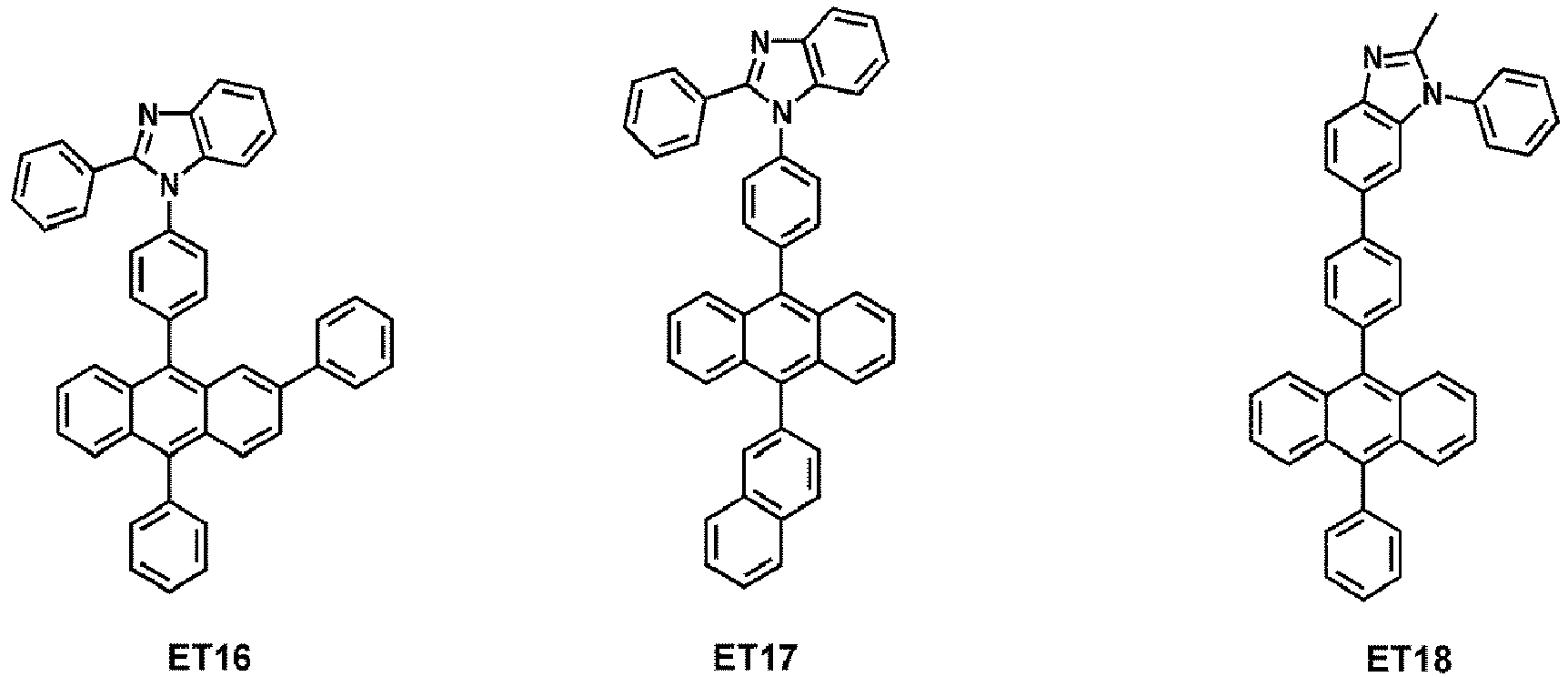


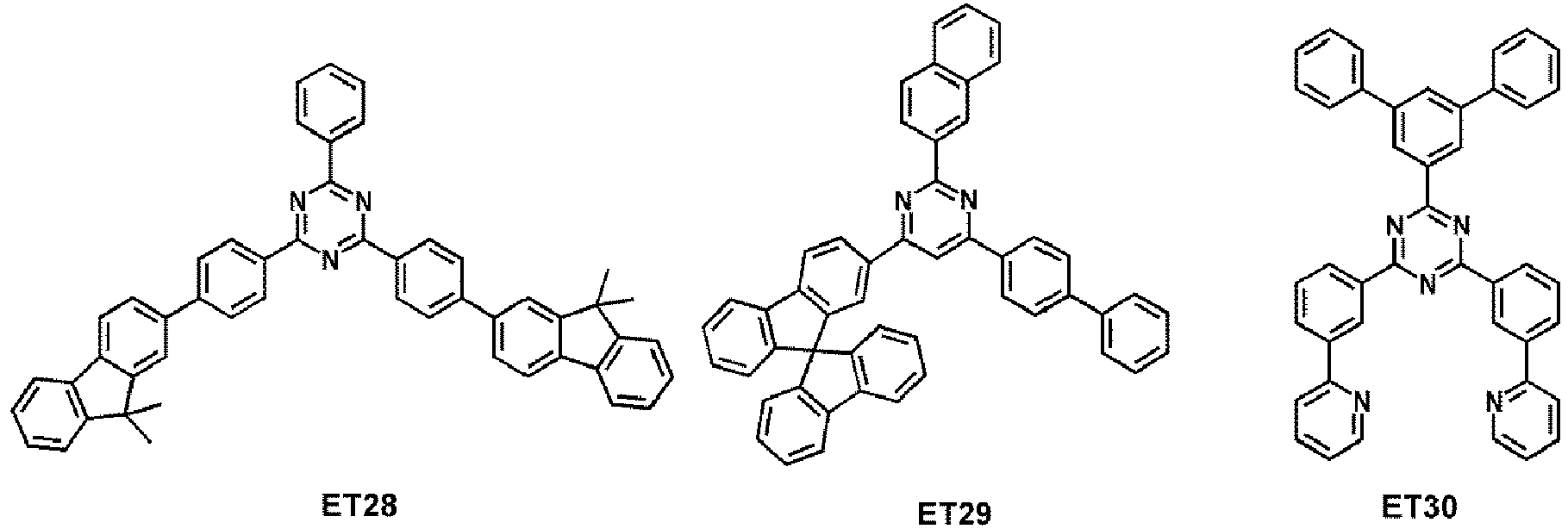


- In one or more embodiments, the electron transport region may include at least one selected from 2,9-dimethyl-4,7-diphenyl-1,10-phenanthroline (BCP), 4,7-diphenyl-1,10-phenanthroline (Bphen), Alq3, BAlq, 3-(biphenyl-4-yl)-5-(4-tert-butylphenyl)-4-phenyl-4H-1,2,4-triazole (TAZ), and NTAZ.


- The thickness of the buffer layer, the hole blocking layer, or the electron controlling layer may each independently be in a range of about 20 Å to about 1,000 Å, for example, about 20 Å to about 700 Å, about 20 Å to about 500 Å, about 20 Å to about 400 Å, about 30 Å to about 400 Å or about 30 Å to about 300 Å. When the thicknesses of the buffer layer, the hole blocking layer, and the electron control layer are within these ranges, the hole blocking layer may have excellent hole blocking characteristics or electron control characteristics without a substantial increase in driving voltage.
- A thickness of the electron transport layer may be in a range of about 100 Å to about 1,000 Å, for example, about 100 Å to about 700 Å, about 100 Å to about 600 Å, about 150 Å to about 600 Å, about 150 Å to about 500 Å or about 250 Å to about 350 Å. When the thickness of the electron transport layer is within the range described above, the electron transport layer may have suitable or satisfactory electron transport characteristics without a substantial increase in driving voltage.
- The electron transport region (for example, the electron transport layer in the electron transport region) may further include, in addition to the materials described above, a metal-containing material.
- The metal-containing material may include at least one selected from alkali metal complex and alkaline earth-metal complex. The alkali metal complex may include a metal ion selected from a Li ion, a Na ion, a K ion, a Rb ion, and a Cs ion, and the alkaline earth-metal complex may include a metal ion selected from a Be ion, a Mg ion, a Ca ion, a Sr ion, and a Ba ion. A ligand coordinated with the metal ion of the alkali metal complex or the alkaline earth-metal complex may be selected from a hydroxy quinoline, a hydroxy isoquinoline, a hydroxy benzoquinoline, a hydroxy acridine, a hydroxy phenanthridine, a hydroxy phenyloxazole, a hydroxy phenylthiazole, a hydroxy phenyloxadiazole, a hydroxy phenylthiadiazole, a hydroxy phenylpyridine, a hydroxy phenylbenzimidazole, a hydroxy phenylbenzothiazole, a bipyridine, a phenanthroline, and a cyclopentadiene, but embodiments of the present disclosure are not limited thereto.
- For example, the metal-containing material may include a Li complex. The Li complex may include, for example, Compound ET-D1 (8-hydroxyquinolinolato-lithium, LiQ) or ET-D2.

- The electron transport region may include an electron injection layer that facilitates injection of electrons from the
second electrode 190. The electron injection layer may directly contact thesecond electrode 190. - The electron injection layer may have i) a single-layered structure including a single layer including a single material, ii) a single-layered structure including a single layer including a plurality of different materials, or iii) a multi-layered structure having a plurality of layers including a plurality of different materials.
- The electron injection layer may include an alkali metal, an alkaline earth metal, a rare earth metal, an alkali metal compound, an alkaline earth-metal compound, a rare earth metal compound, an alkali metal complex, an alkaline earth-metal complex, a rare earth metal complex, or any combinations thereof.
- In one or more embodiments, the electron injection layer may include Li, Na, K, Rb, Cs, Mg, Ca, Er, Tm, Yb or any combination thereof. However, a material included in the electron injection layer is not limited thereto.
- The alkali metal may be selected from Li, Na, K, Rb, and Cs. In one embodiment, the alkali metal may be Li, Na, or Cs. In one or more embodiments, the alkali metal may be Li or Cs, but embodiments of the present disclosure are not limited thereto.
- The alkaline earth metal may be selected from Mg, Ca, Sr, and Ba.
- The rare earth metal may be selected from Sc, Y, Ce, Tm, Yb, and Gd.
- The alkali metal compound, the alkaline earth-metal compound, and the rare earth metal compound may be selected from oxides and halides (for example, fluorides, chlorides, bromides, or iodides) of the alkali metal, the alkaline earth-metal, and the rare earth metal.
- The alkali metal compound may be selected from alkali metal oxides, such as Li2O, Cs2O, or K2O, and alkali metal halides, such as LiF, NaF, CsF, KF, Lil, Nal, Csl, or KI. In one embodiment, the alkali metal compound may be selected from LiF, Li2O, NaF, Lil, Nal, Csl, and KI, but embodiments of the present disclosure are not limited thereto.
- The alkaline earth-metal compound may be selected from alkaline earth-metal oxides, such as BaO, SrO, CaO, BaxSr1-xO (0<x<1), or BaxCa1-xO (0<x<1). In one embodiment, the alkaline earth-metal compound may be selected from BaO, SrO, and CaO, but embodiments of the present disclosure are not limited thereto.
- The rare earth metal compound may be selected from YbF3, ScF3, SCO3, Y2O3, Ce2O3, GdF3, and TbF3. In one embodiment, the rare earth metal compound may be selected from YbF3, ScF3, TbF3, YbI3, ScI3, and TbI3, but embodiments of the present disclosure are not limited thereto.
- The alkali metal complex, the alkaline earth-metal complex, and the rare earth metal complex may include an ion of alkali metal, alkaline earth-metal, and rare earth metal as described above, and a ligand coordinated with a metal ion of the alkali metal complex, the alkaline earth-metal complex, or the rare earth metal complex may be selected from hydroxy quinoline, hydroxy isoquinoline, hydroxy benzoquinoline, hydroxy acridine, hydroxy phenanthridine, hydroxy phenyloxazole, hydroxy phenylthiazole, hydroxy phenyloxadiazole, hydroxy phenylthiadiazole, hydroxy phenylpyridine, hydroxy phenylbenzimidazole, hydroxy phenylbenzothiazole, bipyridine, phenanthroline, and cyclopentadiene, but embodiments of the present disclosure are not limited thereto.
- The electron injection layer may consist of an alkali metal, an alkaline earth metal, a rare earth metal, an alkali metal compound, an alkaline earth-metal compound, a rare earth metal compound, an alkali metal complex, an alkaline earth-metal complex, a rare earth metal complex, or any combinations thereof, as described above. In one or more embodiments, the electron injection layer may further include an organic material. When the electron injection layer further includes an organic material, an alkali metal, an alkaline earth metal, a rare earth metal, an alkali metal compound, an alkaline earth-metal compound, a rare earth metal compound, an alkali metal complex, an alkaline earth-metal complex, a rare earth metal complex, or any combinations thereof may be homogeneously or non-homogeneously dispersed in a matrix including the organic material.
- A thickness of the electron injection layer may be in a range of about 1 Å to about 100 Å, for example, about 3 Å to about 90 Å or about 3 Å to about 20 Å. When the thickness of the electron injection layer is within the range described above, the electron injection layer may have suitable or satisfactory electron injection characteristics without a substantial increase in driving voltage.
- In one embodiment, the electron transport region of the organic light-emitting
device 10 may include a buffer layer, an electron transport layer, and an electron injection layer, at least one layer selected from the electron transport layer and the electron injection layer may include an alkali metal, an alkaline earth metal, a rare earth metal, an alkali metal compound, an alkaline earth-metal compound, a rare earth metal compound, an alkali metal complex, an alkaline earth-metal complex, a rare earth metal complex, or any combinations thereof. - The
second electrode 190 may be disposed on theorganic layer 150 having such a structure. Thesecond electrode 190 may be a cathode that is an electron injection electrode, and in this regard, a material for forming thesecond electrode 190 may be a material having a low work function, and such a material may be metal, alloy, an electrically conductive compound, or a mixture thereof. - The
second electrode 190 may include at least one selected from lithium (Li), silver (Ag), magnesium (Mg), aluminium (Al), aluminium-lithium (Al-Li), calcium (Ca), magnesium-indium (Mg-In), magnesium-silver (Mg-Ag), ITO, and IZO, but embodiments of the present disclosure are not limited thereto. Thesecond electrode 190 may be a transmissive electrode, a semi-transmissive electrode, or a reflective electrode. - The
second electrode 190 may have a single-layered structure, or a multi-layered structure including two or more layers. - An organic light-emitting
device 20 ofFIG. 2 includes afirst capping layer 210, afirst electrode 110, anorganic layer 150, and asecond electrode 190 which are sequentially stacked in this stated order. An organic light-emittingdevice 30 ofFIG. 3 includes afirst electrode 110, anorganic layer 150, asecond electrode 190, and asecond capping layer 220 which are sequentially stacked in this stated order. An organic light-emittingdevice 40 ofFIG. 4 includes afirst capping layer 210, afirst electrode 110, anorganic layer 150, asecond electrode 190, and asecond capping layer 220 which are sequenthially stacked in this stated order. - In
FIGS. 2-4 , thefirst electrode 110, theorganic layer 150, and thesecond electrode 190 may be understood by referring to the description presented in connection withFIG. 1 . - In the
organic layer 150 of each of the organic light-emittingdevices first electrode 110, which is a semi-transmissive electrode or a transmissive electrode, and thefirst capping layer 210 toward the outside, and in theorganic layer 150 of each of the organic light-emittingdevices second electrode 190, which is a semi-transmissive electrode or a transmissive electrode, and thesecond capping layer 220 toward the outside. - The
first capping layer 210 and thesecond capping layer 220 may increase external luminescent efficiency according to the principle of constructive interference. - The
first capping layer 210 and thesecond capping layer 220 may each independently be an organic capping layer including an organic material, an inorganic capping layer including an inorganic material, or a composite capping layer including an organic material and an inorganic material. - At least one selected from the
first capping layer 210 and thesecond capping layer 220 may each independently include at least one material selected from carbocyclic compounds, heterocyclic compounds, amine-based compounds, porphyrine derivatives, phthalocyanine derivatives, a naphthalocyanine derivatives, alkali metal complexes, and alkaline earth-based complexes. The carbocyclic compound, the heterocyclic compound, and the amine-based compound may be optionally substituted with a substituent containing at least one element selected from O, N, S, Se, Si, F, Cl, Br, and I. In one embodiment, at least one selected from thefirst capping layer 210 and thesecond capping layer 220 may each independently include an amine-based compound. - In one embodiment, at least one selected from the
first capping layer 210 and thesecond capping layer 220 may each independently include the compound represented by Formula 201 or the compound represented by Formula 202. - Hereinbefore, the organic light-emitting device according to an embodiment has been described in connection with
FIGS. 1-4 . However, embodiments of the present disclosure are not limited thereto. - Layers constituting the hole transport region, an emission layer, and layers constituting the electron transport region may be formed in a certain region by using one or more suitable methods selected from vacuum deposition, spin coating, casting, Langmuir-Blodgett (LB) deposition, ink-jet printing, laser-printing, and laser-induced thermal imaging.
- When layers constituting the hole transport region, an emission layer, and layers constituting the electron transport region are formed by vacuum deposition, the deposition may be performed at a deposition temperature of about 100 °C to about 500 °C, a vacuum degree of about 10-8 torr to about 10-3 torr, and a deposition speed of about 0.01 Å/sec to about 100 Å/sec by taking into account a material to be included in a layer to be formed, and the structure of a layer to be formed.
- When layers constituting the hole transport region, an emission layer, and layers constituting the electron transport region are formed by spin coating, the spin coating may be performed at a coating speed of about 2,000 rpm to about 5,000 rpm and at a heat treatment temperature of about 80 °C to 200 °C, depending on a compound to be included in a layer and the structure of each layer to be formed.
- The term "C1-C60 alkyl group," as used herein, refers to a linear or branched saturated aliphatic hydrocarbon monovalent group having 1 to 60 carbon atoms, and non-limiting examples thereof include a methyl group, an ethyl group, a propyl group, an isobutyl group, a sec-butyl group, a tert-butyl group, a pentyl group, an isoamyl group, and a hexyl group. The term "C1-C60 alkylene group," as used herein, refers to a divalent group having substantially the same structure as the C1-C60 alkyl group. Corresponding definitions apply to other ranges given for the number of carbon atoms in an alkyl/alkylene group.
- The term "C2-C60 alkenyl group," as used herein, refers to a hydrocarbon group formed by substituting at least one carbon-carbon double bond at a main chain (e.g., in the middle) or at a terminus of the C2-C60 alkyl group, and non-limiting examples thereof include an ethenyl group, a propenyl group, and a butenyl group. The term "C2-C60 alkenylene group," as used herein, refers to a divalent group having substantially the same structure as the C2-C60 alkenyl group. Corresponding definitions apply to other ranges given for the number of carbon atoms in an alkenyl/alkenylene group.
- The term "C2-C60 alkynyl group," as used herein, refers to a hydrocarbon group formed by substituting at least one carbon-carbon triple bond at a main chain (e.g., in the middle) or at a terminus of the C2-C60 alkyl group, and non-limiting examples thereof include an ethynyl group, and a propynyl group. The term "C2-C60 alkynylene group," as used herein, refers to a divalent group having substantially the same structure as the C2-C60 alkynyl group. Corresponding definitions apply to other ranges given for the number of carbon atoms in an alkynyl/alkynylene group.
- The term "C1-C60 alkoxy group," as used herein, refers to a monovalent group represented by -OA101 (wherein A101 is the C1-C60 alkyl group), and non-limiting examples thereof include a methoxy group, an ethoxy group, and an isopropyloxy group. Corresponding definitions apply to other ranges given for the number of carbon atoms in an alkoxy group.
- The term "C3-C10 cycloalkyl group," as used herein, refers to a monovalent saturated hydrocarbon monocyclic group having 3 to 10 carbon atoms, and non-limiting examples thereof include a cyclopropyl group, a cyclobutyl group, a cyclopentyl group, a cyclohexyl group, and a cycloheptyl group. The term "C3-C10 cycloalkylene group," as used herein, refers to a divalent group having substantially the same structure as the C3-C10 cycloalkyl group.
- The term "C1-C10 heterocycloalkyl group," as used herein, refers to a monovalent saturated monocyclic group having at least one heteroatom selected from N, O, Si, P, and S as a ring-forming atom and 1 to 10 carbon atoms, and non-limiting examples thereof include a 1,2,3,4-oxatriazolidinyl group, a tetrahydrofuranyl group, a tetrahydrothiophenyl group. The term "C1-C10 heterocycloalkylene group," as used herein refers to a divalent group having substantially the same structure as the C1-C10 heterocycloalkyl group.
- The term "C3-C10 cycloalkenyl group," as used herein, refers to a monovalent monocyclic group that has 3 to 10 carbon atoms and at least one double bond in the ring thereof and no aromaticity (e.g., the ring, group, and/or entire molecule is not aromatic), and non-limiting examples thereof include a cyclopentenyl group, a cyclohexenyl group, and a cycloheptenyl group. The term "C3-C10 cycloalkenylene group," as used herein, refers to a divalent group having substantially the same structure as the C3-C10 cycloalkenyl group.
- The term "C1-C10 heterocycloalkenyl group," as used herein, refers to a monovalent monocyclic group that has at least one heteroatom selected from N, O, Si, P, and S as a ring-forming atom, 1 to 10 carbon atoms, and at least one carbon-carbon double bond in its ring. Non-limiting examples of the C1-C10 heterocycloalkenyl group are a 4,5-dihydro-1,2,3,4-oxatriazolyl group, a 2,3-dihydrofuranyl group, and a 2,3-dihydrothiophenyl group. The term "C1-C10 heterocycloalkenylene group," as used herein, refers to a divalent group having substantially the same structure as the C1-C10 heterocycloalkenyl group.
- The term "C6-C60 aryl group," as used herein, refers to a monovalent group having a carbocyclic aromatic system having 6 to 60 carbon atoms, and the term "C6-C60 arylene group," as used herein, refers to a divalent group having a carbocyclic aromatic system having 6 to 60 carbon atoms. Non-limiting examples of the C6-C60 aryl group include a phenyl group, a naphthyl group, an anthracenyl group, a phenanthrenyl group, a pyrenyl group, and a chrysenyl group. When the C6-C60 aryl group and the C6-C60 arylene group each include two or more rings, the rings may be fused to each other (e.g., combined together). The term "C7-C60 alkylaryl group," as used herein refers to a C6-C60 aryl group substituted with at least one C1-C60 alkyl group. Corresponding definitions apply to other ranges given for the number of carbon atoms in an aryl/arylene group.
- The term "C1-C60 heteroaryl group," as used herein, refers to a monovalent group having a heterocyclic aromatic system that has at least one heteroatom selected from N, O, Si, P, and S as a ring-forming atom, in addition to 1 to 60 carbon atoms. The term "C1-C60 heteroarylene group," as used herein, refers to a divalent group having a heterocyclic aromatic system that has at least one heteroatom selected from N, O, Si, P, and S as a ring-forming atom, in addition to 1 to 60 carbon atoms. Non-limiting examples of the C1-C60 heteroaryl group include a pyridinyl group, a pyrimidinyl group, a pyrazinyl group, a pyridazinyl group, a triazinyl group, a quinolinyl group, and an isoquinolinyl group. When the C1-C60 heteroaryl group and the C1-C60 heteroarylene group each include two or more rings, the rings may be fused to each other (e.g., combined together). The term "C2-C60 alkyl heteroaryl group," as used herein, refers to a C1-C60 heteroaryl group substituted with at least one C1-C60 alkyl group. Corresponding definitions apply to other ranges given for the number of carbon atoms in an heteroaryl/heteroarylene group.
- The term "C6-C60 aryloxy group," as used herein refers to -OA102 (wherein A102 is the C6-C60 aryl group), and the term "C6-C60 arylthio group," as used herein, indicates -SA103 (wherein A103 is the C6-C60 aryl group). Corresponding definitions apply to other ranges given for the number of carbon atoms in an aryloxy group and an arylthio group.
- The term "monovalent non-aromatic condensed polycyclic group," as used herein, refers to a monovalent group (for example, having 8 to 60 carbon atoms) having two or more rings condensed with each other (e.g., combined together), only carbon atoms as ring-forming atoms, and no aromaticity in its entire molecular structure (e.g., the entire group and/or molecule is not aromatic). An example of the monovalent non-aromatic condensed polycyclic group is a fluorenyl group. The term "divalent non-aromatic condensed polycyclic group," as used herein, refers to a divalent group having substantially the same structure as the monovalent non-aromatic condensed polycyclic group.
- The term "monovalent non-aromatic condensed heteropolycyclic group," as used herein, refers to a monovalent group (for example, having 1 to 60 carbon atoms) having two or more rings condensed to each other (e.g., combined together), at least one heteroatom selected from N, O, Si, P, and S, other than carbon atoms, as a ring-forming atom, and no aromaticity in its entire molecular structure (e.g., the entire group and/or molecule is not aromatic). An example of the monovalent non-aromatic condensed heteropolycyclic group is a carbazolyl group. The term "divalent non-aromatic condensed heteropolycyclic group," as used herein, refers to a divalent group having substantially the same structure as the monovalent non-aromatic condensed heteropolycyclic group.
- The term "C5-C30 carbocyclic group," as used herein, refers to a monocyclic or polycyclic group having 5 to 30 carbon atoms in which a ring-forming atom is a carbon atom only. The C5-C30 carbocyclic group may be an aromatic carbocyclic group or a non-aromatic carbocyclic group. The C5-C30 carbocyclic group may be a ring, such as benzene, a monovalent group, such as a phenyl group, or a divalent group, such as a phenylene group. In one or more embodiments, depending on the number of substituents connected to the C5-C30 carbocyclic group, the C5-C30 carbocyclic group may be a trivalent group or a quadrivalent group. Corresponding definitions apply to other ranges given for the number of carbon atoms in a carbocyclic group.
- The term "C1-C30 heterocyclic group," as used herein, refers to a group having substantially the same structure as the C1-C30 carbocyclic group, except that as a ring-forming atom, at least one heteroatom selected from N, O, Si, P, and S is used in addition to carbon (the number of carbon atoms may be in a range of 1 to 30). Corresponding definitions apply to other ranges given for the number of carbon atoms in a heterocyclic group.
- At least one substituent selected from the substituted C5-C30 carbocyclic group, the substituted C1-C30 heterocyclic group, the substituted C3-C10 cycloalkylene group, the substituted C1-C16 heterocycloalkylene group, the substituted C3-C10 cycloalkenylene group, the substituted C1-C16 heterocycloalkenylene group, the substituted C6-C60 (e.g. C6-C30) arylene group, the substituted C1-C60 (e.g. C1-C20) heteroarylene group, the substituted divalent non-aromatic condensed polycyclic group, the substituted divalent non-aromatic condensed heteropolycyclic group, the substituted C1-C60 (e.g. C1-C20) alkyl group, the substituted C2-C60 (e.g. C2-C20) alkenyl group, the substituted C2-C60 (e.g. C2-C20) alkynyl group, the substituted C1-C60 (e.g. C1-C20) alkoxy group, the substituted C3-C10 cycloalkyl group, the substituted C1-C16 heterocycloalkyl group, the substituted C3-C16 cycloalkenyl group, the substituted C1-C10 heterocycloalkenyl group, the substituted C6-C60 (e.g. C6-C30) aryl group, the substituted C7-C60 (e.g. C7-C30) alkyl aryl group, the substituted C6-C60 (e.g. C6-C30) aryloxy group, the substituted C6-C60 (e.g. C6-C30) arylthio group, the substituted C1-C60 (e.g. C1-C20) heteroaryl group, the substituted C2-C60 (e.g. C2-C20) alkyl heteroaryl group, the substituted monovalent non-aromatic condensed polycyclic group, and the substituted monovalent non-aromatic condensed heteropolycyclic group may be selected from:
- deuterium, -F, -Cl, -Br, -I, a hydroxyl group, a cyano group, a nitro group, an amidino group, a hydrazine group, a hydrazone group, a C1-C60 (e.g. C1-C20) alkyl group, a C2-C60 (e.g. C2-C20) alkenyl group, a C2-C60 (e.g. C2-C20) alkynyl group, and a C1-C60 (e.g. C1-C20) alkoxy group;
- a C1-C60 (e.g. C1-C20) alkyl group, a C2-C60 (e.g. C2-C20) alkenyl group, a C2-C60 (e.g. C2-C20) alkynyl group, and a C1-C60 (e.g. C1-C20) alkoxy group, each substituted with at least one selected from deuterium, -F, -Cl, -Br, -I, a hydroxyl group, a cyano group, a nitro group, an amidino group, a hydrazine group, a hydrazone group, a C3-C10 cycloalkyl group, a C1-C10 heterocycloalkyl group, a C3-C10 cycloalkenyl group, a C1-C16 heterocycloalkenyl group, a C6-C60 (e.g. C6-C30) aryl group, a C7-C60 (e.g. C7-C30) alkyl aryl group, a C6-C60 (e.g. C6-C30) aryloxy group, a C6-C60 (e.g. C6-C30) arylthio group, a C1-C60 (e.g. C1-C20) heteroaryl group, a C2-C60 (e.g. C2-C20) alkyl heteroaryl group, a monovalent non-aromatic condensed polycyclic group, a monovalent non-aromatic condensed heteropolycyclic group, -O(Q11), -S(Q11),-Si(Q11)(Q12)(Q13), -N(Q11)(Q12), -B(Q11)(Q12), -P(Q11)(Q12), -C(=O)(Q11), -S(=O)2(Q11), and -P(=O)(Q11)(Q12);
- a C3-C10 cycloalkyl group, a C1-C10 heterocycloalkyl group, a C3-C10 cycloalkenyl group, a C1-C10 heterocycloalkenyl group, a C6-C60 (e.g. C6-C30) aryl group, a C7-C60 (e.g. C7-C30) alkyl aryl group, a C6-C60 (e.g. C6-C30) aryloxy group, a C6-C60 (e.g. C6-C30) arylthio group, a C1-C60 (e.g. C1-C20) heteroaryl group, a C2-C60 (e.g. C2-C20) alkyl heteroaryl group, a monovalent non-aromatic condensed polycyclic group, and a monovalent non-aromatic condensed heteropolycyclic group;
- a C3-C10 cycloalkyl group, a C1-C10 heterocycloalkyl group, a C3-C10 cycloalkenyl group, a C1-C10 heterocycloalkenyl group, a C6-C60 (e.g. C6-C30) aryl group, a C7-C60 (e.g. C7-C30) alkyl aryl group, a C6-C60 (e.g. C6-C30) aryloxy group, a C6-C60 (e.g. C6-C30) arylthio group, a C1-C60 (e.g. C1-C20) heteroaryl group, a C2-C60 (e.g. C2-C20) alkyl heteroaryl group, a monovalent non-aromatic condensed polycyclic group, and a monovalent non-aromatic condensed heteropolycyclic group, each substituted with at least one selected from deuterium, -F, -CI, -Br, -I, a hydroxyl group, a cyano group, a nitro group, an amidino group, a hydrazine group, a hydrazone group, a C1-C60 (e.g. C1-C20) alkyl group, a C2-C60 (e.g. C2-C20) alkenyl group, a C2-C60 (e.g. C2-C20) alkynyl group, a C1-C60 (e.g. C1-C20) alkoxy group, a C3-C10 cycloalkyl group, a C1-C10 heterocycloalkyl group, a C3-C10 cycloalkenyl group, a C1-C10 heterocycloalkenyl group, a C6-C60 (e.g. C6-C30) aryl group, a C7-C60 (e.g. C7-C30) alkyl aryl group, a C6-C60 (e.g. C6-C30) aryloxy group, a C6-C60 (e.g. C6-C30) arylthio group, a C1-C60 (e.g. C1-C20) heteroaryl group, a C2-C60 (e.g. C2-C20) alkyl heteroaryl group, a monovalent non-aromatic condensed polycyclic group, a monovalent non-aromatic condensed heteropolycyclic group, -O(Q21), -S(Q21), -Si(Q21)(Q22)(Q23), -N(Q21)(Q22), - B(Q21)(Q22), -P(Q21)(Q22), -C(=O)(Q21), -S(=O)2(Q21), and -P(=O)(Q21)(Q22); and
- -O(Q31), -S(Q31), -Si(Q31)(Q32)(Q33), -N(Q31)(Q32), -B(Q31)(Q32), -P(Q31)(Q32), -C(=O)(Q31), -S(=O)2(Q31), and -P(=O)(Q31)(Q32), and
- Q1 to Q3, Q11 to Q13, Q21 to Q23, and Q31 to Q33 may each independently be selected from hydrogen, deuterium, -F, -CI, -Br, -I, a hydroxyl group, a cyano group, a nitro group, an amidino group, a hydrazine group, a hydrazone group, a C1-C60 (e.g. C1-C20) alkyl group, a C2-C60 (e.g. C2-C20) alkenyl group, a C2-C60 (e.g. C2-C20) alkynyl group, a C1-C60 (e.g. C1-C20) alkoxy group, a C3-C10 cycloalkyl group, a C1-C10 heterocycloalkyl group, a C3-C10 cycloalkenyl group, a C1-C10 heterocycloalkenyl group, a C6-C60 (e.g. C6-C30) aryl group, a C6-C60 (e.g. C6-C30) aryloxy group, a C6-C60 (e.g. C6-C30) arylthio group, a C1-C60 (e.g. C1-C20) heteroaryl group, a monovalent non-aromatic condensed polycyclic group, a monovalent non-aromatic condensed heteropolycyclic group, a C1-C60 (e.g. C1-C20) alkyl group substituted with at least one selected from deuterium, -F, a cyano group, a C1-C60 (e.g. C1-C20) alkyl group, a phenyl group, and a biphenyl group, and a C6-C60 (e.g. C6-C30) aryl group substituted with at least one selected from deuterium, -F, a cyano group, a C1-C10 alkyl group, a phenyl group, and a biphenyl group.
- The term "Ph," as used herein, may refer to a phenyl group; the term "Me," as used herein, may refer to a methyl group; the term "Et," as used herein, may refer to an ethyl group; the terms "ter-Bu" or "But," as used herein, may refer to a tert-butyl group; and the term "OMe," as used herein, may refer to a methoxy group.
- The term "biphenyl group," as used herein, refers to "a phenyl group substituted with a phenyl group." In other words, the "biphenyl group" is a substituted phenyl group having a C6-C60 aryl group as a substituent.
- The term "terphenyl group," as used herein, refers to "a substituted phenyl group substituted with a biphenyl group." In other words, the "terphenyl group" is a phenyl group having, as a substituent, a C6-C60 aryl group substituted with a C6-C60 aryl group.
- * and *', as used herein, unless defined otherwise, each refer to a binding site to a neighboring atom in a corresponding formula.
- Hereinafter, a compound according to embodiments and an organic light-emitting device according to embodiments will be described in more detail with reference to Synthesis Examples and Examples. The wording "B was used instead of A" used in describing Synthesis Examples refers to that an identical (e.g., a substantially identical) molar equivalent of B was used in place of A.
-

- Diphenylether in tetrahydrofuran (THF) was reacted with tetramethylethylenediamine (TMEDA) and nBuLi, and the reaction product therefrom was reacted with dichlorodiphenylsilane to obtain Intermediate H2-10(2). Intermediate H2-10(2) was identified by LC-MS.
C24H18OSi: M+1 351.3. - Intermediate H2-10(2) in THF was reacted with TMEDA and nBuLi, and the reaction product therefrom was reacted with trimethylborate to obtain Intermediate H2-10(1). Intermediate H2-10(1) was identified by LC-MS.
C24H19BO3Si: M+1 395.2. - 1.8 g of 2,4-dichloro-6-phenyltriazine (CAS number = 1700-02-3), 3.0 g of Intermediate H2-10(1), 0.33 g of tetrakis(triphenylphosphine)palladium, and 2.5 g of potassium carbonate were added to a reaction container, and 30 mL of toluene, 10 mL of ethanol, and 10 mL of distilled water were added thereto and refluxed for 24 hours. After the reaction was completed, an organic layer obtained by extracting the reaction solution by using ethyl acetate was dried by using magnesium sulfate, and a residual obtained by evaporating the solvent was purified by silica gel column chromatography to synthesize 3.4 g (yield: 55 %) of Compound H2-10. Compound H2-10 was identified by MS/FAB and 1H -NMR.
1H NMR (CDCl3, 400 MHz) 8.36 (d, 2H), 8.05 (d, 2H), 7.52-7.41 (m, 15H), 7.37-7.35 (m, 14H), 7.11-7.05 (m, 4H).
MS/FAB found: 854.4, calc.: 853.26. - HOMO and LUMO energy levels of Compounds D5, D8, H2-2, H2-10, H3-2, and H3-4 were evaluated by methods described in Table 1, and results thereof are shown in Table 2.
Table HOMO energy level evaluation method A voltage-current (V-A) graph of each Compound was obtained by using a cyclic voltammetry (CV) (electrolyte: 0.1 M Bu4NPF6 / solvent: DMF (dimethylforamide) / electrode: 3-electrode system (working electrode: GC, reference electrode: Ag/AgCl, auxiliary electrode: Pt)), and then the HOMO energy level of each Compound was calculated from an oxidation onset. LUMO energy level evaluation method A V-A graph of each Compound was obtained by using a cyclic voltammetry (CV) (electrolyte: 0.1 M Bu4NPF6 / solvent: DMF (dimethylforamide) / electrode: 3-electrode system (working electrode: GC, reference electrode: Ag/AgCl, auxiliary electrode: Pt)), and then, the LUMO energy level of each Compound was calculated from a reduction onset. Table 2 Compound No. HOMO (eV) LUMO (eV) D5 -5.24 -2.25 D8 -5.25 -2.16 H2-2 -6.50 -2.72 H2-10 -6.20 -2.45 H3-2 -5.51 -1.91 H3-4 -5.64 -2.13 

- Referring to Table 2, it is confirmed that Compounds D5, D8, H2-2, H2-10, H3-2, and H3-4 have HOMO and LUMO energy levels suitable for manufacturing the organic light-emitting device.
- As an anode, a
Corning 15 Ω/cm2 (1,200 Å) ITO glass substrate was cut to a size of 50 mm x 50 mm x 0.7 mm, sonicated with isopropyl alcohol and pure water each for 5 minutes, and then cleaned by exposure to ultraviolet rays and ozone for 30 minutes. Then, the ITO glass substrate was provided to a vacuum deposition apparatus. - 2-TNATA was vacuum-deposited on the anode to form a hole injection layer having a thickness of 600 Å, and 4,4'-bis[N-(1-naphthyl)-N-phenyl] aminobiphenyl (NPB) was vacuum-deposited on the hole injection layer to form a hole transport layer having a thickness of 300 Å.
- Compound D8 as a first compound, Compound H2-2 as a second compound, and Compound H3-2 as a third compound were vacuum-deposited on the hole transport layer to form an emission layer having a thickness of 300 Å. An amount of Compound D8 was 10 wt% based on a total amount (100 wt%) of the emission layer, and a weight ratio of Compound H2-2 to Compound H3-2 was adjusted to 2:8.
- Compound H2-2 was vacuum-deposited on the emission layer to form a hole blocking layer having a thickness of 50 Å, Alq3 was vacuum-deposited on the hole blocking layer to form an electron transport layer having a thickness of 300 Å, LiF was vacuum-deposited on the electron transport layer to form an electron injection layer having a thickness of 10 Å, and Al was vacuum-deposited on the electron injection layer to form a cathode having a thickness of 3,000 Å, thereby completing the manufacture of an organic light-emitting device.


- Organic light-emitting devices were manufactured in substantially the same manner as in Example 1, except that Compounds shown in Table 3 were each respectively used as a first compound, a second compound, and a third compound in forming an emission layer.
- An organic light-emitting device was manufactured in substantially the same manner as in Example 4, except that a thickness of a hole transport layer was changed to 1,150 Å.
- The driving voltage (V), current density (mA/cm2), luminescent efficiency (cd/A), maximum emission wavelength (nm), and lifespan (T90) of the organic light-emitting devices manufactured according to Examples 1 to 5 and Comparative Examples 1 to 5 (at 1,000 cd/m2) were measured by using Keithley MU 236 and a luminance meter PR650, and results thereof are shown in Table 3. The lifespan (T90) in Table 3 indicates an amount of time that lapsed from initial use until when luminance was 90 % of initial luminance (100 %). EL spectra of the organic light-emitting devices manufactured according to Examples 1 to 4 are shown in
FIG. 5 . Luminance-luminescent efficiency graphs of the organic light-emitting devices manufactured according to Examples 1 to 4 are shown inFIG. 6 . Time-luminance graphs of the organic light-emitting devices manufactured according to Examples 1 to 4 are shown inFIG. 7 . A luminance-luminescent efficiency graph of the organic light-emitting device manufactured according to Comparative Example 1 is shown inFIG. 8 . A time-luminance graph of the organic light-emitting device manufactured according to Comparative Example 1 is shown inFIG. 9 .Table 3 Dopant Host (weight ratio) Luminance Luminescent Maximum emission Lifespan (T90, h) First compound Second compound Third compound (cd/m2) efficiency (cd/A) wavelength (nm) (at 1000 cd/m2) Example 1 D8 H2-2 H3-2 1000 14.20 457 3.0 2:8 Example 2 D8 H2-2 H3-2 1000 19.80 457 7.0 3: 7 Example 3 D8 H2-2 H3-2 1000 20.10 457 11.0 4: 6 Example 4 D8 H2-10 H3-2 1000 28.30 457 21.0 4 :6 Example 5 D8 H2-10 H3-2 1062 28.80 453 10.0 4:6 Comparative Example 1 D5 H3-4 1000 6.9 458 0.1 Comparative Example 2 D5 H3-2 1000 10.7 456 0.1 Comparative Example 3 D5 H2-2 1000 3.8 485 0.5 Comparative Example 4 D5 H-A 1000 3.0 485 0.5 Comparative Example 5 Ir-D H2-2 H3-2 1000 24.2 465 2.0 4:6 

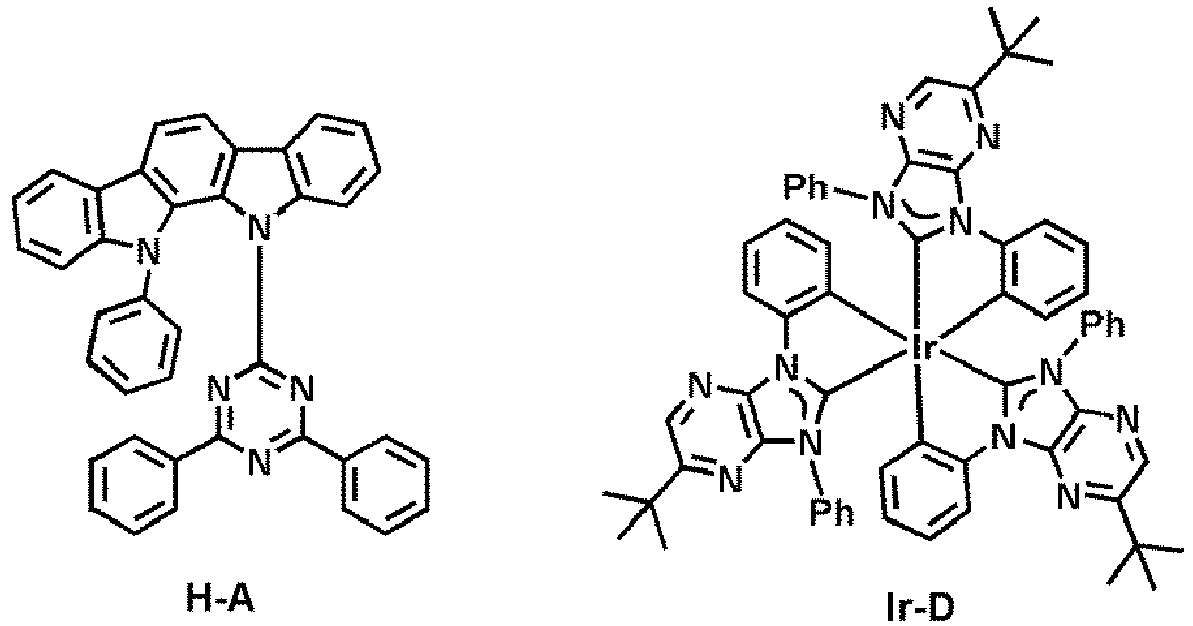
- Referring to
FIG. 5 , it is confirmed that the organic light-emitting devices manufactured according to Examples 1 to 4 have, in addition to a main emission peak having a maximum emission wavelength of about 455 nm, an auxiliary emission peak derived from an exciplex formed by a first compound and a second compound having a maximum emission wavelength of about 470 nm. - Referring to
FIGS. 6-9 and Table 3, it is confirmed that the organic light-emitting devices manufactured according to Examples 1 to 5 may emit blue light, may have luminescent efficiency higher than or equivalent to that of the organic light-emitting devices manufactured according to Comparative Examples 1 to 5, and may have improved lifespan characteristics. - Regarding the organic light-emitting device of Example 4, while a voltage pulse (pulse width was in a range of 10 ns to 1 ms) was applied by using an AVTECCH AV-1011-B pulse generator, the TREL spectrum of the organic light-emitting device of Example 4 was measured by using Tektronix TDS 460 Four Channel Digitizing Oscilloscope. From the TREL spectrum, the decay time of the delayed fluorescence emitted from the organic light-emitting device of Example 4 was confirmed to be 2.95 µs.
- The organic light-emitting device according to embodiments of the present disclosure may have high luminescent efficiency and a long lifespan and may be used to manufacture high-quality electronic apparatuses.
- It will be understood that, although the terms "first," "second," "third," etc., may be used herein to describe various elements, components, regions, layers and/or sections, these elements, components, regions, layers and/or sections should not be limited by these terms. These terms are used to distinguish one element, component, region, layer or section from another element, component, region, layer or section. Thus, a first element, component, region, layer or section described below could be termed a second element, component, region, layer or section, without departing from the spirit and scope of the present disclosure.
- Spatially relative terms, such as "beneath," "below," "lower," "under," "above," "upper," and the like, may be used herein for ease of explanation to describe one element or feature's relationship to another element(s) or feature(s) as illustrated in the figures. It will be understood that the spatially relative terms are intended to encompass different orientations of the device in use or in operation, in addition to the orientation depicted in the figures. For example, if the device in the figures is turned over, elements described as "below" or "beneath" or "under" other elements or features would then be oriented "above" the other elements or features. Thus, the example terms "below" and "under" can encompass both an orientation of above and below. The device may be otherwise oriented (e.g., rotated 90 degrees or at other orientations) and the spatially relative descriptors used herein should be interpreted accordingly.
- It will be understood that when an element or layer is referred to as being "on," "connected to," or "coupled to" another element or layer, it can be directly on, connected to, or coupled to the other element or layer, or one or more intervening elements or layers may be present. In addition, it will also be understood that when an element or layer is referred to as being "between" two elements or layers, it can be the only element or layer between the two elements or layers, or one or more intervening elements or layers may also be present.
- The terminology used herein is for the purpose of describing particular embodiments only and is not intended to be limiting of the present disclosure. As used herein, the singular forms "a" and "an" are intended to include the plural forms as well, unless the context clearly indicates otherwise. It will be further understood that the terms "comprises," "comprising," "includes," and "including," when used in this specification, specify the presence of the stated features, integers, acts, operations, elements, and/or components, but do not preclude the presence or addition of one or more other features, integers, acts, operations, elements, components, and/or groups thereof.
- As used herein, the terms "substantially," "about," and similar terms are used as terms of approximation and not as terms of degree, and are intended to account for the inherent deviations in measured or calculated values that would be recognized by those of ordinary skill in the art. Further, the use of "may" when describing embodiments of the present disclosure refers to "one or more embodiments of the present disclosure." As used herein, the terms "use," "using," and "used" may be considered synonymous with the terms "utilize," "utilizing," and "utilized," respectively.
- Also, any numerical range recited herein is intended to include all subranges of the same numerical precision subsumed within the recited range. For example, a range of "1.0 to 10.0" is intended to include all subranges between (and including) the recited minimum value of 1.0 and the recited maximum value of 10.0, that is, having a minimum value equal to or greater than 1.0 and a maximum value equal to or less than 10.0, such as, for example, 2.4 to 7.6. Any maximum numerical limitation recited herein is intended to include all lower numerical limitations subsumed therein, and any minimum numerical limitation recited in this specification is intended to include all higher numerical limitations subsumed therein.
- It should be understood that embodiments described herein should be considered in a descriptive sense only and not for purposes of limitation. Descriptions of features or aspects within each embodiment should typically be considered as available for other similar features or aspects in other embodiments.
- While one or more embodiments have been described with reference to the figures, it will be understood by those of ordinary skill in the art that various changes in form and details may be made therein without departing from the scope as defined by the following claims, and equivalents thereof.
- The present invention will now be described with reference to the following clauses:
-
Clause 1. An organic light-emitting device comprising:- a first electrode;
- a second electrode facing the first electrode; and
- an emission layer between the first electrode and the second electrode;
- wherein the emission layer comprises a first compound, a second compound, and a third compound,
- the first compound, the second compound, and the third compound are different from one another,
- the first compound is represented by
Formula 1, - the second compound is represented by
Formula 2, and - the third compound comprises a group represented by Formula 3:


- wherein, in
Formulae 1 to 3, - M is a transition metal, provided that M is not iridium (Ir),
- X1 to X4 are each independently N or C,
- T11 to T14 are each independently a chemical bond, O, S, B(R'), N(R'), P(R'), C(R')(R"), Si(R')(R"), Ge(R')(R"), C(=O), B(R')(R"), N(R')(R"), or P(R')(R"), wherein, when T11 is the chemical bond, X1 and M are directly bound, when T12 is the chemical bond, X2 and M are directly bound, when T13 is the chemical bond, X3 and M are directly bound, and when T14 is the chemical bond, X4 and M are directly bound,
- two bonds selected from a bond between X1 or T11 and M, a bond between X2 or T12 and M, a bond between X3 or T13 and M, and a bond between X4 or T14 and M are each a coordinate bond, and the others thereof are each a covalent bond,
- T1 is selected from a single bond, a double bond, *-N(R5)-*', *-B(R5)-*', *-P(R5)-*', *-C(R5a)(R5b)-*', *-Si(R5a)(R5b)-*', *-Ge(R5a)(R5b)-*', *-S-*', *-Se-*', *-O-*', *-C(=O)-*', *-S(=O)-*', *-S(=O)2-*', *-C(R5)=*', *=C(R5)-*', *-C(R5a)=C(R5b)-*', *-C(=S)-*', and *-C≡C-*',
- T2 is selected from a single bond, a double bond, *-N(R6)-*', *-B(R6)-*', *-P(R6)-*', *-C(R6a)(R6b)-*', *-Si(R6a)(R6b)-*', *-Ge(R6a)(R6b)-*', *-S-*', *-Se-*', *-O-*', *-C(=O)-*', *-S(=O)-*', *-S(=O)2-*', *-C(R6)=*', *=C(R6)-*', *-C(R6a)=C(R6b)-*', *-C(=S)-*', and *-C≡C-*',
- T3 is selected from a single bond, a double bond, *-N(R7)-*', *-B(R7)-*', *-P(R7)-*', *-C(R7a)(R7b)-*', *-Si(R7a)(R7b)-*', *-Ge(R7a)(R7b)-*', *-S-*', *-Se-*', *-O-*', *-C(=O)-*', *-S(=O)-*', *-S(=O)2-*', *-C(R7)=*', *=C(R7)-*', *-C(R7a)=C(R7b)-*', *-C(=S)-*', and *-C≡C-*',
- ring CY1 to ring CY4, ring CY51 to ring CY53, and ring CY71 and ring CY72 are each independently selected from a C5-C30 carbocyclic group and a C1-C30 heterocyclic group,
- L51 to L53 are each independently selected from a substituted or unsubstituted C5-C30 carbocyclic group and a substituted or unsubstituted C1-C30 heterocyclic group,
- a bond between L51 and ring CY51, a bond between L52 and ring CY52, a bond between L53 and ring CY53, a bond between two or more L51(s), a bond between two or more L52(s), a bond between two or more L53(s), a bond between L51 and carbon between X54 and X55 in
Formula 2, a bond between L52 and carbon between X54 and X56 inFormula 2, and a bond between L53 and carbon between X55 and X56 inFormula 2 are each a carbon-carbon single bond, - b51 to b53 are each independently an integer of 0 to 5, wherein, when b51 is 0, *-(L51)b51-*' is a single bond, when b52 is 0, *-(L52)b52-*' is a single bond, and when b53 is 0, *-(L53)b53-*' is a single bond,
- X54 is N or C(R54), X55 is N or C(R55), X56 is N or C(R56), and at least one selected from X54 to X56 is N,
- X81 is a single bond, O, S, N(R81), B(R81), C(R81a)(R81b), or Si(R81a)(R81b),
- R1 to R7, R5a, R5b, R6a, R6b, R7a, R7b, R', R", R51 to R56, R71, R72, R81, R81a, and R81b are each independently selected from hydrogen, deuterium, -F, -Cl, -Br, -I, a hydroxyl group, a cyano group, a nitro group, an amidino group, a hydrazine group, a hydrazone group, a substituted or unsubstituted C1-C60 alkyl group, a substituted or unsubstituted C2-C60 alkenyl group, a substituted or unsubstituted C2-C60 alkynyl group, a substituted or unsubstituted C1-C60 alkoxy group, a substituted or unsubstituted C3-C10 cycloalkyl group, a substituted or unsubstituted C1-C10 heterocycloalkyl group, a substituted or unsubstituted C3-C10 cycloalkenyl group, a substituted or unsubstituted C1-C10 heterocycloalkenyl group, a substituted or unsubstituted C6-C60 aryl group, a substituted or unsubstituted C7-C60 alkyl aryl group, a substituted or unsubstituted C6-C60 aryloxy group, a substituted or unsubstituted C6-C60 arylthio group, a substituted or unsubstituted C1-C60 heteroaryl group, a substituted or unsubstituted C2-C60 alkyl heteroaryl group, a substituted or unsubstituted monovalent non-aromatic condensed polycyclic group, a substituted or unsubstituted monovalent non-aromatic condensed heteropolycyclic group, -C(Q1)(Q2)(Q3), -Si(Q1)(Q2)(Q3), -N(Q1)(Q2), -B(Q1)(Q2), - C(=O)(Q1), -S(=O)2(Q1), -P(=O)(Q1)(Q2), and a bidentate organic ligand,
- a1 to a4, a51 to a53, a71 and a72 are each independently an integer of 0 to 20,
- i) two groups selected from R1(s) in the number of a1, ii) two groups selected from R2(s) in the number of a2, iii) two groups selected from R3(s) in the number of a3, iv) two groups selected from R4(s) in the number of a4, v) R5a and R5b, vi) R6a and R6b, vii) R7a and R7b, and viii) two groups selected from R1 to R7, R5a, R5b, R6a, R6b, R7a, R7b, R', and R" are optionally linked via a single bond, a double bond, or a first linking group to form a C5-C30 carbocyclic group that is unsubstituted or substituted with at least one R10a or a C1-C30 heterocyclic group that is unsubstituted or substituted with at least one R10a,
- R10a is the same as defined in connection with R1,
- * and *' each indicate a binding site to a neighboring atom,
- at least one substituent of the substituted C5-C30 carbocyclic group, the substituted C1-C30 heterocyclic group, the substituted C1-C60 alkyl group, the substituted C2-C60 alkenyl group, the substituted C2-C60 alkynyl group, the substituted C1-C60 alkoxy group, the substituted C3-C10 cycloalkyl group, the substituted C1-C10 heterocycloalkyl group, the substituted C3-C10 cycloalkenyl group, the substituted C1-C10 heterocycloalkenyl group, the substituted C6-C60 aryl group, the substituted C7-C60 alkyl aryl group, the substituted C6-C60 aryloxy group, the substituted C6-C60 arylthio group, the substituted C1-C60 heteroaryl group, the substituted C2-C60 alkyl heteroaryl group, the substituted monovalent non-aromatic condensed polycyclic group, and the substituted monovalent non-aromatic condensed heteropolycyclic group is selected from:
- deuterium, -F, -CI, -Br, -I, a hydroxyl group, a cyano group, a nitro group, an amidino group, a hydrazine group, a hydrazone group, a C1-C60 alkyl group, a C2-C60 alkenyl group, a C2-C60 alkynyl group, and a C1-C60 alkoxy group;
- a C1-C60 alkyl group, a C2-C60 alkenyl group, a C2-C60 alkynyl group, and a C1-C60 alkoxy group, each substituted with at least one selected from deuterium, -F, -CI, - Br, -I, a hydroxyl group, a cyano group, a nitro group, an amidino group, a hydrazine group, a hydrazone group, a C3-C10 cycloalkyl group, a C1-C10 heterocycloalkyl group, a C3-C10 cycloalkenyl group, a C1-C10 heterocycloalkenyl group, a C6-C60 aryl group, a C7-C60 alkyl aryl group, a C6-C60 aryloxy group, a C6-C60 arylthio group, a C1-C60 heteroaryl group, a C2-C60 alkyl heteroaryl group, a monovalent non-aromatic condensed polycyclic group, a monovalent non-aromatic condensed heteropolycyclic group, -O(Q11), -S(Q11), -Si(Q11)(Q12)(Q13), -N(Q11)(Q12), -B(Q11)(Q12), -P(Q11)(Q12), - C(=O)(Q11), -S(=O)2(Q11), and -P(=O)(Q11)(Q12);
- a C3-C10 cycloalkyl group, a C1-C10 heterocycloalkyl group, a C3-C10 cycloalkenyl group, a C1-C10 heterocycloalkenyl group, a C6-C60 aryl group, a C7-C60 alkyl aryl group, a C6-C60 aryloxy group, a C6-C60 arylthio group, a C1-C60 heteroaryl group, a C2-C60 alkyl heteroaryl group, a monovalent non-aromatic condensed polycyclic group, and a monovalent non-aromatic condensed heteropolycyclic group;
- a C3-C10 cycloalkyl group, a C1-C10 heterocycloalkyl group, a C3-C10 cycloalkenyl group, a C1-C10 heterocycloalkenyl group, a C6-C60 aryl group, a C7-C60 alkyl aryl group, a C6-C60 aryloxy group, a C6-C60 arylthio group, a C1-C60 heteroaryl group, a C2-C60 alkyl heteroaryl group, a monovalent non-aromatic condensed polycyclic group, and a monovalent non-aromatic condensed heteropolycyclic group, each substituted with at least one selected from deuterium, -F, -CI, -Br, -I, a hydroxyl group, a cyano group, a nitro group, an amidino group, a hydrazine group, a hydrazone group, a C1-C60 alkyl group, a C2-C60 alkenyl group, a C2-C60 alkynyl group, a C1-C60 alkoxy group, a C3-C10 cycloalkyl group, a C1-C10 heterocycloalkyl group, a C3-C10 cycloalkenyl group, a C1-C10 heterocycloalkenyl group, a C6-C60 aryl group, a C7-C60 alkyl aryl group, a C6-C60 aryloxy group, a C6-C60 arylthio group, a C1-C60 heteroaryl group, a C2-C60 alkyl heteroaryl group, a monovalent non-aromatic condensed polycyclic group, a monovalent non-aromatic condensed heteropolycyclic group, -O(Q21), -S(Q21), - Si(Q21)(Q22)(Q23), -N(Q21)(Q22), -B(Q21)(Q22), -P(Q21)(Q22), -C(=O)(Q21), -S(=O)2(Q21), and -P(=O)(Q21)(Q22); and
- -O(Q31), -S(Q31), -Si(Q31)(Q32)(Q33), -N(Q31)(Q32), -B(Q31)(Q32), -P(Q31)(Q32), - C(=O)(Q31), -S(=O)2(Q31) and -P(=O)(Q31)(Q32), and
- Q1 to Q3, Q11 to Q13, Q21 to Q23, and Q31 to Q33 are each independently selected from hydrogen, deuterium, -F, -CI, -Br, -I, a hydroxyl group, a cyano group, a nitro group, an amidino group, a hydrazine group, a hydrazone group, a C1-C60 alkyl group, a C2-C60 alkenyl group, a C2-C60 alkynyl group, a C1-C60 alkoxy group, a C3-C10 cycloalkyl group, a C1-C10 heterocycloalkyl group, a C3-C10 cycloalkenyl group, a C1-C10 heterocycloalkenyl group, a C6-C60 aryl group, a C6-C60 aryloxy group, a C6-C60 arylthio group, a C1-C60 heteroaryl group, a monovalent non-aromatic condensed polycyclic group, a monovalent non-aromatic condensed heteropolycyclic group, a C1-C60 alkyl group substituted with at least one selected from deuterium, -F, a cyano group, a C1-C60 alkyl group, a phenyl group, and a biphenyl group, and a C6-C60 aryl group substituted with at least one selected from deuterium, -F, a cyano group, a C1-C10 alkyl group, a phenyl group, and a biphenyl group.
- wherein, in
-
Clause 2. An organic light-emitting device according toclause 1, wherein:
inFormula 1, T11 to T14 are each a chemical bond, a bond between X1 and M and a bond between X4 and M are each a coordinate bond, and at least one of X1 and X4 is C. -
Clause 3. An organic light-emitting device according toclause 1 orclause 2, wherein:- in
Formulae 1 to 3, ring CY1 to ring CY4, ring CY51 to CY53, ring CY71, and ring CY72 are each independently i) a first ring, ii) a second ring, iii) a condensed ring in which at least two first rings are condensed, iv) a condensed ring in which at least two second rings are condensed, or v) a condensed ring in which at least one first ring is condensed with at least one second ring, - the first ring is selected from a cyclopentane group, a cyclopentadiene group, a furan group, a thiophene group, a pyrrole group, a silole group, an oxazole group, an isoxazole group, an oxadiazole group, an isoxadiazole group, an oxatriazole group, an isoxatriazole group, a thiazole group, an isothiazole group, a thiadiazole group, an isothiadiazole group, a thiatriazole group, an isothiatriazole group, a pyrazole group, an imidazole group, a triazole group, a tetrazole group, an azasilole group, a diazasilole group, and a triazasilole group, and
- the second ring is selected from an adamantane group, a norbornane group, a norbornene group, a cyclohexane group, a cyclohexene group, a benzene group, a pyridine group, a pyrimidine group, a pyrazine group, a pyridazine group, a triazine group, an oxasiline group, a thiasiline group, a dihydroazasiline group, a dihydrodisiline group, a dihydrosiline group, a dioxine group, an oxathiine group, an oxazine group, a pyran group, a dithiine group, a thiazine group, a thiopyran group, a cyclohexadiene group, a dihydropyridine group, and a dihydropyrazine group.
- in
-
Clause 4. An organic light-emitting device according to any one ofclauses 1 to 3, wherein:- a group represented by


Formula 2 are not a phenyl group; and/or - a group represented by


Formula 2 are identical to each other; and/or- ring CY51 and ring CY52 are each independently selected from a benzene group, a pyridine group, a pyrimidine group, a pyridazine group, a pyrazine group, and a triazine group,
- R51 and R52 are each independently selected from a substituted or unsubstituted C3-C10 cycloalkyl group, a substituted or unsubstituted C1-C10 heterocycloalkyl group, a substituted or unsubstituted C3-C10 cycloalkenyl group, a substituted or unsubstituted C1-C10 heterocycloalkenyl group, a substituted or unsubstituted C6-C60 aryl group, a substituted or unsubstituted C7-C60 alkyl aryl group, a substituted or unsubstituted C6-C60 aryloxy group, a substituted or unsubstituted C6-C60 arylthio group, a substituted or unsubstituted C1-C60 heteroaryl group, a substituted or unsubstituted C2-C60 alkyl heteroaryl group, a substituted or unsubstituted monovalent non-aromatic condensed polycyclic group, a substituted or unsubstituted monovalent non-aromatic condensed heteropolycyclic group, -C(Q1)(Q2)(Q3), and -Si(Q1)(Q2)(Q3),
- Q1 to Q3 are each independently selected from a C3-C10 cycloalkyl group, a C1-C10 heterocycloalkyl group, a C3-C10 cycloalkenyl group, a C1-C10 heterocycloalkenyl group, a C6-C60 aryl group, a C6-C60 aryloxy group, a C6-C60 arylthio group, a C1-C60 heteroaryl group, a monovalent non-aromatic condensed polycyclic group, a monovalent non-aromatic condensed heteropolycyclic group, and a C6-C60 aryl group substituted with at least one selected from deuterium, -F, a cyano group, a C1-C10 alkyl group, a phenyl group, and a biphenyl group, and
- a51 and a52 are each independently 1, 2, or 3.
- a group represented by
-
Clause 5. An organic light-emitting device according to any one ofclauses 1 to 4, wherein:- a moiety represented by

- a moiety represented by

- a moiety represented by





- in Formulae CY51-1 to CY51-17, CY52-1 to CY52-17, and CY53-1 to CY53-18,
- Y63 is a single bond, O, S, N(R63), B(R63), C(R63a)(R63b), or Si(R63a)(R63b),
- Y64 is a single bond, O, S, N(R64), B(R64), C(R64a)(R64b), or Si(R64a)(R64b),
- Y67 is a single bond, O, S, N(R67), B(R67), C(R67a)(R67b), or Si(R67a)(R67b),
- Y68 is a single bond, O, S, N(R68), B(R68), C(R68a)(R68b), or Si(R68a)(R68b),
- Y63 and Y64 in Formulae CY51-16 and CY51-17 are not both a single bond,
- Y67 and Y68 in Formulae CY52-16 and CY52-17 are not both a single bond,
- R51a to R51e, R61 to R64, R63a, R63b, R64a, and R64b are respectively the same as defined in connection with R51 in
clause 1, wherein R51a to R51e are not hydrogen, - R52a to R52e, R65 to R68, R67a, R67b, R68a, and R68b are respectively the same as defined in connection with R52 in
clause 1, wherein R52a to R52e are not hydrogen, - R53a to R53e are respectively the same as defined in connection with R53 in
clause 1, wherein R53a to R53e are not hydrogen, and - * indicates a binding site to a neighboring atom.
- a moiety represented by
-
Clause 6. An organic light-emitting device according to any one ofclauses 1 to 5, wherein:
the third compound is represented by one of Formulae 3-1 to 3-5:


- wherein, in Formulae 3-1 to 3-5,
- ring CY71, ring CY72, X81, R71, R72, a71, and a72 are respectively the same as defined in
clause 1, - ring CY73, ring CY74, R73, R74, a73, and a74 are respectively the same as defined in connection with ring CY71, ring CY72, R71, R72, a71, and a72 in
clause 1, - L81 is selected from *-C(Q4)(Q5)-*', *-Si(Q4)(Q5)-*', a substituted or unsubstituted C5-C36 carbocyclic group, and a substituted or unsubstituted C1-C30 heterocyclic group, wherein Q4 and Q5 are respectively the same as defined in connection with Q1 in
clause 1, - b81 is an integer of 0 to 5, wherein, when b81 is 0, *-(L81)b81-*' is a single bond, and when b81 is two or more, two or more L81(s) are identical to or different from each other,
- X82 is a single bond, O, S, N(R82), B(R82), C(R82a)(R82b), or Si(R82a)(R82b),
- X83 is a single bond, O, S, N(R83), B(R83), C(R83a)(R83b) or Si(R83a)(R83b),
- X82 and X83 in Formulae 3-2 and 3-4 are not both a single bond,
- X84 is C or Si,
- R80, R82, R83, R82a, R82b, R83a, R83b, and R84 are respectively the same as defined in connection with R81 in
clause 1, and - * and *' each indicate a binding site to a neighboring atom.
- Clause 7. An organic light-emitting device according to
clause 6, wherein:- a moiety represented by

- a moiety represented by

- a moiety represent by

- a moiety represented by

- a moiety represented by


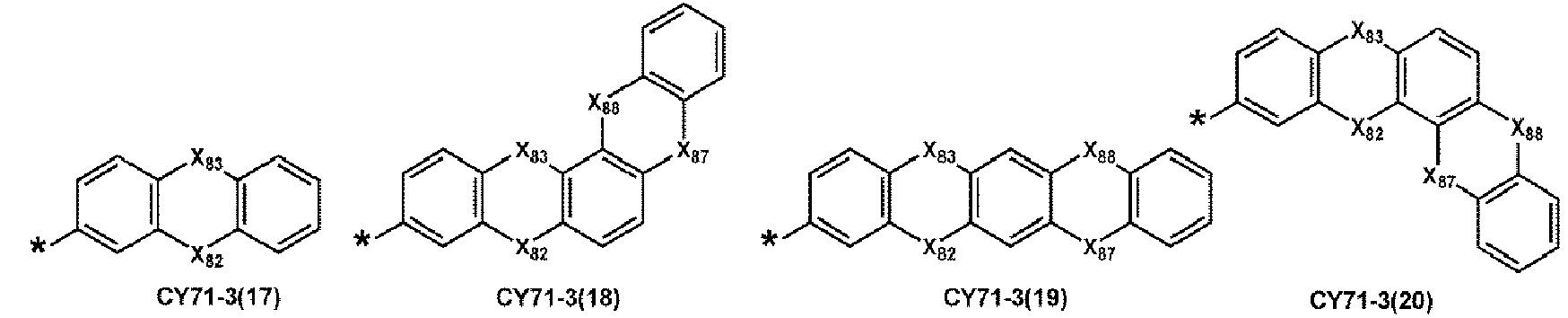





- wherein, in Formulae CY71-1 (1) to CY71-1 (8), CY71-2(1) to CY71-2(8), CY71-3(1) to CY71-3(32), CY71-4(1) to CY71-4(32), and CY71-5(1) to CY71-5(8),
- X81 to X84, R80, and R84 are the same as defined in
clause 8, - X85 is a single bond, O, S, N(R85), B(R85), C(R85a)(R85b), or Si(R85a)(R85b),
- X86 is a single bond, O, S, N(R86), B(R86), C(R86a)(R86b), or Si(R86a)(R86b),
- X85 and X86 in Formulae CY71-1 (1) to CY71-1 (8) and CY71-4(1) to CY71-4(32) are not both a single bond,
- X87 is a single bond, O, S, N(R87), B(R87), C(R87a)(R87b), or Si(R87a)(R87b),
- X88 is a single bond, O, S, N(R88), B(R88), C(R88a)(R88b), or Si(R88a)(R88b),
- X87 and X88 in Formulae CY71-2(1) to CY71-2(8), CY71-3(1) to CY71-3(32), and CY71-5(1) to CY71-5(8) are not both a single bond, and
- R85 to R88, R85a, R85b, R86a, R86b, R87a, R87b, R88a, and R88b are respectively the same as defined in connection with R81 in
clause 1.
- a moiety represented by
-
Clause 8. An organic light-emitting device according to any one ofclauses 1 to 7, wherein:
the second compound is selected from Compounds H2-1 to H2-64:


- Clause 9. An organic light-emitting device according to any one of
clauses 1 to 8, wherein:
the first compound and the second compound form an exciplex; and/or
a decay time of delayed fluorescence in a time-resolved electroluminescence (TREL) spectrum of the organic light-emitting device is about 50 ns or more. -
Clause 10. An organic light-emitting device according to clause 9, wherein:- the organic light-emitting device has a non-resonance structure,
- an electroluminescence (EL) spectrum of the organic light-emitting device includes a first peak and a second peak,
- a maximum emission wavelength of the second peak is greater than a maximum emission wavelength of the first peak,
- a difference between the maximum emission wavelength of the second peak and the maximum emission wavelength of the first peak is in a range of about 5 nm to about 30 nm,
- the intensity of the second peak is smaller than the intensity of the first peak,
- the first peak is an emission peak of phosphorescence emitted from the first compound, and
- the second peak is an emission peak of an exciplex formed by the first compound and the second compound.
- Clause 11. An organic light-emitting device comprising:
- a first electrode;
- a second electrode facing the first electrode; and
- an emission layer disposed between the first electrode and the second electrode;
- the emission layer comprises a first compound, a second compound, and a third compound,
- the first compound, the second compound, and the third compound are different from one another,
- an amount of the first compound is smaller than a total amount of the second compound and the third compound,
- the first compound is an iridium (Ir)-free organometallic compound,
- the second compound comprises at least one group selected from a pyridine group, a pyrimidine group, a pyridazine group, a pyrazine group, a triazine group, and a tetrazine group,
- the first compound and the second compound form an exciplex, and
- a decay time of delayed fluorescence in a time-resolved electroluminescence (TREL) spectrum of the organic light-emitting device is 50 ns or more.
-
Clause 12. An organic light-emitting device according to clause 11, wherein:- the organic light-emitting device has a non-resonance structure,
- an electroluminescence (EL) spectrum of the organic light-emitting device includes a first peak and a second peak,
- a maximum emission wavelength of the second peak is greater than a maximum emission wavelength of the first peak,
- a difference between the maximum emission wavelength of the second peak and the maximum emission wavelength of the first peak is in a range of about 5 nm to about 30 nm, and
the intensity of the second peak is smaller than the intensity of the first peak; and/or - the maximum emission wavelength of the first peak is in a range of about 390 nm to about 500 nm.
- Clause 13. An organic light-emitting device according to
clause 12, wherein:- the first peak is an emission peak of phosphorescence emitted from the first compound, and
- the second peak is an emission peak of an exciplex formed by the first compound and the second compound.
-
Clause 14. An organic light-emitting device according toclause 11 or 12, wherein:
the intensity of the second peak is in a range of about 20 % to about 90 % of the intensity of the first peak. -
Clause 15. An electronic apparatus comprising an organic light-emitting device according to any one ofclauses 1 to 14.


Claims (15)
- An organic light-emitting device (10, 20, 30, 40) comprising:a first electrode (110);a second electrode (190) facing the first electrode (110); andan emission layer (150) between the first electrode (110) and the second electrode (190);wherein the emission layer (150) comprises a first compound, a second compound, and a third compound,the first compound, the second compound, and the third compound are different from one another,the first compound is represented by Formula 1,the second compound is represented by Formula 2, andthe third compound comprises a group represented by Formula 3:


 M is a transition metal, provided that M is not iridium (Ir),X1 to X4 are each independently N or C,T11 to T14 are each independently a chemical bond, O, S, B(R'), N(R'), P(R'), C(R')(R"), Si(R')(R"), Ge(R')(R"), C(=O), B(R')(R"), N(R')(R"), or P(R')(R"), wherein, when T11 is the chemical bond, X1 and M are directly bound, when T12 is the chemical bond, X2 and M are directly bound, when T13 is the chemical bond, X3 and M are directly bound, and when T14 is the chemical bond, X4 and M are directly bound,two bonds selected from a bond between X1 or T11 and M, a bond between X2 or T12 and M, a bond between X3 or T13 and M, and a bond between X4 or T14 and M are each a coordinate bond, and the others thereof are each a covalent bond,T1 is selected from a single bond, a double bond, *-N(R5)-*', *-B(R5)-*', *-P(R5)-*', *-C(R5a)(R5b)-*', *-Si(R5a)(R5b)-*', *-Ge(R5a)(R5b)-*', *-S-*', *-Se-*', *-O-*', *-C(=O)-*', *-S(=O)-*', *-S(=O)2-*', *-C(R5)=*', *=C(R5)-*', *-C(R5a)=C(R5b)-*', *-C(=S)-*', and *-C≡C-*',T2 is selected from a single bond, a double bond, *-N(R6)-*', *-B(R6)-*', *-P(R6)-*', *-C(R6a)(R6b)-*', *-Si(R6a)(R6b)-*', *-Ge(R6a)(R6b)-*', *-S-*', *-Se-*', *-O-*', *-C(=O)-*', *-S(=O)-*', *-S(=O)2-*', *-C(R6)=*', *=C(R6)-*', *-C(R6a)=C(R6b)-*', *-C(=S)-*', and *-C≡C-*',T3 is selected from a single bond, a double bond, *-N(R7)-*', *-B(R7)-*', *-P(R7)-*', *-C(R7a)(R7b)-*', *-Si(R7a)(R7b)-*', *-Ge(R7a)(R7b)-*', *-S-*', *-Se-*', *-O-*', *-C(=O)-*', *-S(=O)-*', *-S(=O)2-*', *-C(R7)=*', *=C(R7)-*', *-C(R7a)=C(R7b)-*', *-C(=S)-*', and *-C≡C-*',ring CY1 to ring CY4, and ring CY71 and ring CY72 are each independently selected from a C5-C30 carbocyclic group and a C1-C30 heterocyclic group,L51 to L53 are each independently selected from a substituted or unsubstituted C5-C30 carbocyclic group and a substituted or unsubstituted C1-C30 heterocyclic group,a bond between L51 and ring CY51, a bond between L52 and ring CY52, a bond between L53 and ring CY53, a bond between two or more L51(s), a bond between two or more L52(s), a bond between two or more L53(s), a bond between L51 and carbon between X54 and X55 in Formula 2, a bond between L52 and carbon between X54 and X56 in Formula 2, and a bond between L53 and carbon between X55 and X56 in Formula 2 are each a carbon-carbon single bond,b51 to b53 are each independently an integer of 0 to 5, wherein, when b51 is 0, *-(L51)b51-*' is a single bond, when b52 is 0, *-(L52)b52-*' is a single bond, and when b53 is 0, *-(L53)b53-*' is a single bond,X54 is N or C(R54), X55 is N or C(R55), X56 is N or C(R56), and at least one selected from X54 to X56 is N,X81 is a single bond, O, S, N(R81), B(R81), C(R81a)(R81b), or Si(R81a)(R81b),R1 to R7, R5a, R5b, R6a, R6b, R7a, R7b, R', R", R51 to R56, R71, R72, R81, R81a, and R81b are each independently selected from hydrogen, deuterium, -F, -CI, -Br, -I, a hydroxyl group, a cyano group, a nitro group, an amidino group, a hydrazine group, a hydrazone group, a substituted or unsubstituted C1-C60 alkyl group, a substituted or unsubstituted C2-C60 alkenyl group, a substituted or unsubstituted C2-C60 alkynyl group, a substituted or unsubstituted C1-C60 alkoxy group, a substituted or unsubstituted C3-C10 cycloalkyl group, a substituted or unsubstituted C1-C10 heterocycloalkyl group, a substituted or unsubstituted C3-C10 cycloalkenyl group, a substituted or unsubstituted C1-C10 heterocycloalkenyl group, a substituted or unsubstituted C6-C60 aryl group, a substituted or unsubstituted C7-C60 alkyl aryl group, a substituted or unsubstituted C6-C60 aryloxy group, a substituted or unsubstituted C6-C60 arylthio group, a substituted or unsubstituted C1-C60 heteroaryl group, a substituted or unsubstituted C2-C60 alkyl heteroaryl group, a substituted or unsubstituted monovalent non-aromatic condensed polycyclic group, a substituted or unsubstituted monovalent non-aromatic condensed heteropolycyclic group, -C(Q1)(Q2)(Q3), -Si(Q1)(Q2)(Q3), -N(Q1)(Q2), -B(Q1)(Q2), - C(=O)(Q1), -S(=O)2(Q1), -P(=O)(Q1)(Q2), and a bidentate organic ligand,a1 to a4, a51 to a53, a71 and a72 are each independently an integer of 0 to 20,wherein a moiety represented by
 a moiety represented by
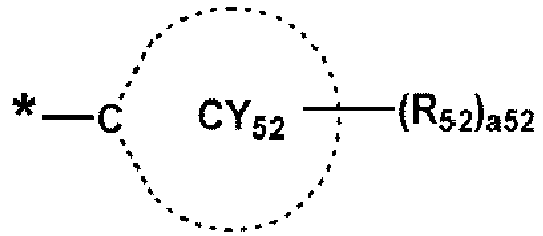 a moiety represented by


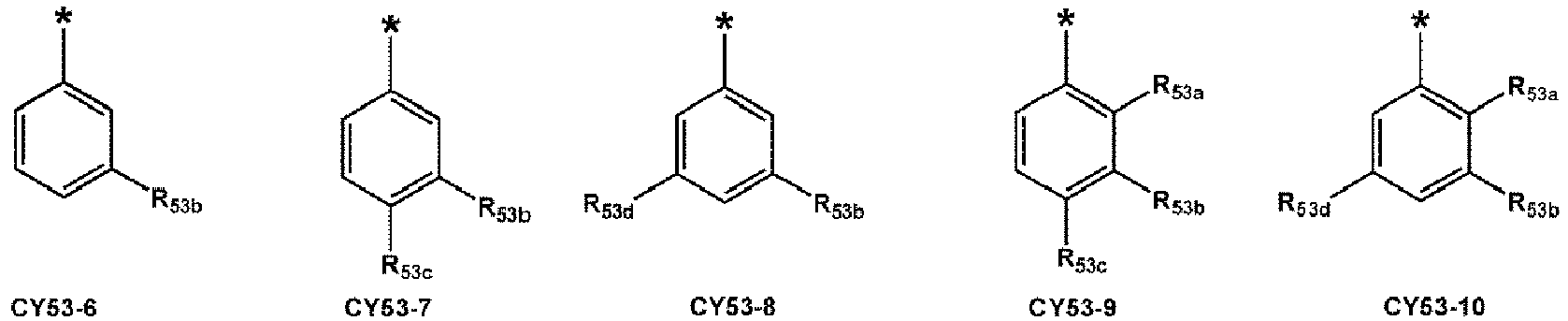

 in Formulae CY51-1 to CY51-17, CY52-1 to CY52-17, and CY53-1 to CY53-18,Y63 is a single bond, O, S, N(R63), B(R63), C(R63a)(R63b), or Si(R63a)(R63b),Y64 is a single bond, O, S, N(R64), B(R64), C(R64a)(R64b), or Si(R64a)(R64b),Y67 is a single bond, O, S, N(R67), B(R67), C(R67a)(R67b), or Si(R67a)(R67b),Y68 is a single bond, O, S, N(R68), B(R68), C(R68a)(R68b), or Si(R68a)(R68b),Y63 and Y64 in Formulae CY51-16 and CY51-17 are not both a single bond,Y67 and Y68 in Formulae CY52-16 and CY52-17 are not both a single bond,R51a to R51e, R61 to R64, R63a, R63b, R64a, and R64b are respectively the same as defined in connection with R51 described above, wherein R51a to R51e are not hydrogen,R52a to R52e, R65 to R68, R67a, R67b, R68a, and R68b are respectively the same as defined in connection with R52 described above, wherein R52a to R52e are not hydrogen,R53a to R53e are respectively the same as defined in connection with R53 described above, wherein R53a to R53e are not hydrogen, and* indicates a binding site to a neighboring atom,i) two groups selected from R1(s) in the number of a1, ii) two groups selected from R2(s) in the number of a2, iii) two groups selected from R3(s) in the number of a3, iv) two groups selected from R4(s) in the number of a4, v) R5a and R5b, vi) R6a and R6b, vii) R7a and R7b, and viii) two groups selected from R1 to R7, R5a, R5b, R6a, R6b, R7a, R7b, R', and R" are optionally linked via a single bond, a double bond, or a first linking group to form a C5-C30 carbocyclic group that is unsubstituted or substituted with at least one R10a or a C1-C30 heterocyclic group that is unsubstituted or substituted with at least one R10a,R10a is the same as defined in connection with R1,* and *' each indicate a binding site to a neighboring atom,at least one substituent of the substituted C5-C30 carbocyclic group, the substituted C1-C30 heterocyclic group, the substituted C1-C60 alkyl group, the substituted C2-C60 alkenyl group, the substituted C2-C60 alkynyl group, the substituted C1-C60 alkoxy group, the substituted C3-C10 cycloalkyl group, the substituted C1-C10 heterocycloalkyl group, the substituted C3-C10 cycloalkenyl group, the substituted C1-C10 heterocycloalkenyl group, the substituted C6-C60 aryl group, the substituted C7-C60 alkyl aryl group, the substituted C6-C60 aryloxy group, the substituted C6-C60 arylthio group, the substituted C1-C60 heteroaryl group, the substituted C2-C60 alkyl heteroaryl group, the substituted monovalent non-aromatic condensed polycyclic group, and the substituted monovalent non-aromatic condensed heteropolycyclic group is selected from:deuterium, -F, -CI, -Br, -I, a hydroxyl group, a cyano group, a nitro group, an amidino group, a hydrazine group, a hydrazone group, a C1-C60 alkyl group, a C2-C60 alkenyl group, a C2-C60 alkynyl group, and a C1-C60 alkoxy group;a C1-C60 alkyl group, a C2-C60 alkenyl group, a C2-C60 alkynyl group, and a C1-C60 alkoxy group, each substituted with at least one selected from deuterium, -F, -CI, - Br, -I, a hydroxyl group, a cyano group, a nitro group, an amidino group, a hydrazine group, a hydrazone group, a C3-C10 cycloalkyl group, a C1-C10 heterocycloalkyl group, a C3-C10 cycloalkenyl group, a C1-C10 heterocycloalkenyl group, a C6-C60 aryl group, a C7-C60 alkyl aryl group, a C6-C60 aryloxy group, a C6-C60 arylthio group, a C1-C60 heteroaryl group, a C2-C60 alkyl heteroaryl group, a monovalent non-aromatic condensed polycyclic group, a monovalent non-aromatic condensed heteropolycyclic group, -O(Q11), -S(Q11), -Si(Q11)(Q12)(Q13), -N(Q11)(Q12), -B(Q11)(Q12), -P(Q11)(Q12), - C(=O)(Q11), -S(=O)2(Q11), and -P(=O)(Q11)(Q12);a C3-C10 cycloalkyl group, a C1-C10 heterocycloalkyl group, a C3-C10 cycloalkenyl group, a C1-C10 heterocycloalkenyl group, a C6-C60 aryl group, a C7-C60 alkyl aryl group, a C6-C60 aryloxy group, a C6-C60 arylthio group, a C1-C60 heteroaryl group, a C2-C60 alkyl heteroaryl group, a monovalent non-aromatic condensed polycyclic group, and a monovalent non-aromatic condensed heteropolycyclic group;a C3-C10 cycloalkyl group, a C1-C10 heterocycloalkyl group, a C3-C10 cycloalkenyl group, a C1-C10 heterocycloalkenyl group, a C6-C60 aryl group, a C7-C60 alkyl aryl group, a C6-C60 aryloxy group, a C6-C60 arylthio group, a C1-C60 heteroaryl group, a C2-C60 alkyl heteroaryl group, a monovalent non-aromatic condensed polycyclic group, and a monovalent non-aromatic condensed heteropolycyclic group, each substituted with at least one selected from deuterium, -F, -Cl, -Br, -I, a hydroxyl group, a cyano group, a nitro group, an amidino group, a hydrazine group, a hydrazone group, a C1-C60 alkyl group, a C2-C60 alkenyl group, a C2-C60 alkynyl group, a C1-C60 alkoxy group, a C3-C10 cycloalkyl group, a C1-C10 heterocycloalkyl group, a C3-C10 cycloalkenyl group, a C1-C10 heterocycloalkenyl group, a C6-C60 aryl group, a C7-C60 alkyl aryl group, a C6-C60 aryloxy group, a C6-C60 arylthio group, a C1-C60 heteroaryl group, a C2-C60 alkyl heteroaryl group, a monovalent non-aromatic condensed polycyclic group, a monovalent non-aromatic condensed heteropolycyclic group, -O(Q21), -S(Q21), - Si(Q21)(Q22)(Q23), -N(Q21)(Q22), -B(Q21)(Q22), -P(Q21)(Q22), -C(=O)(Q21), -S(=O)2(Q21), and -P(=O)(Q21)(Q22); and-O(Q31), -S(Q31), -Si(Q31)(Q32)(Q33), -N(Q31)(Q32), -B(Q31)(Q32), -P(Q31)(Q32), - C(=O)(Q31), -S(=O)2(Q31) and -P(=O)(Q31)(Q32), andQ1 to Q3, Q11 to Q13, Q21 to Q23, and Q31 to Q33 are each independently selected from hydrogen, deuterium, -F, -CI, -Br, -I, a hydroxyl group, a cyano group, a nitro group, an amidino group, a hydrazine group, a hydrazone group, a C1-C60 alkyl group, a C2-C60 alkenyl group, a C2-C60 alkynyl group, a C1-C60 alkoxy group, a C3-C16 cycloalkyl group, a C1-C10 heterocycloalkyl group, a C3-C10 cycloalkenyl group, a C1-C10 heterocycloalkenyl group, a C6-C60 aryl group, a C6-C60 aryloxy group, a C6-C60 arylthio group, a C1-C60 heteroaryl group, a monovalent non-aromatic condensed polycyclic group, a monovalent non-aromatic condensed heteropolycyclic group, a C1-C60 alkyl group substituted with at least one selected from deuterium, -F, a cyano group, a C1-C60 alkyl group, a phenyl group, and a biphenyl group, and a C6-C60 aryl group substituted with at least one selected from deuterium, -F, a cyano group, a C1-C10 alkyl group, a phenyl group, and a biphenyl group.
 - An organic light-emitting device (10, 20, 30, 40) according to claim 1, wherein:
in Formula 1, T11 to T14 are each a chemical bond, a bond between X1 and M and a bond between X4 and M are each a coordinate bond, and at least one of X1 and X4 is C. - An organic light-emitting device according to claim 1 or claim 2, wherein:in Formulae 1 to 3, ring CY1 to ring CY4, ring CY71, and ring CY72 are each independently i) a first ring, ii) a second ring, iii) a condensed ring in which at least two first rings are condensed, iv) a condensed ring in which at least two second rings are condensed, or v) a condensed ring in which at least one first ring is condensed with at least one second ring,the first ring is selected from a cyclopentane group, a cyclopentadiene group, a furan group, a thiophene group, a pyrrole group, a silole group, an oxazole group, an isoxazole group, an oxadiazole group, an isoxadiazole group, an oxatriazole group, an isoxatriazole group, a thiazole group, an isothiazole group, a thiadiazole group, an isothiadiazole group, a thiatriazole group, an isothiatriazole group, a pyrazole group, an imidazole group, a triazole group, a tetrazole group, an azasilole group, a diazasilole group, and a triazasilole group, andthe second ring is selected from an adamantane group, a norbornane group, a norbornene group, a cyclohexane group, a cyclohexene group, a benzene group, a pyridine group, a pyrimidine group, a pyrazine group, a pyridazine group, a triazine group, an oxasiline group, a thiasiline group, a dihydroazasiline group, a dihydrodisiline group, a dihydrosiline group, a dioxine group, an oxathiine group, an oxazine group, a pyran group, a dithiine group, a thiazine group, a thiopyran group, a cyclohexadiene group, a dihydropyridine group, and a dihydropyrazine group.
- An organic light-emitting device (10, 20, 30, 40) according to any one of claims 1 to 3, wherein:a group represented by

 a group represented by
 R51 and R52 are each independently selected from a substituted or unsubstituted C3-C10 cycloalkyl group, a substituted or unsubstituted C1-C10 heterocycloalkyl group, a substituted or unsubstituted C3-C10 cycloalkenyl group, a substituted or unsubstituted C1-C10 heterocycloalkenyl group, a substituted or unsubstituted C6-C60 aryl group, a substituted or unsubstituted C7-C60 alkyl aryl group, a substituted or unsubstituted C6-C60 aryloxy group, a substituted or unsubstituted C6-C60 arylthio group, a substituted or unsubstituted C1-C60 heteroaryl group, a substituted or unsubstituted C2-C60 alkyl heteroaryl group, a substituted or unsubstituted monovalent non-aromatic condensed polycyclic group, a substituted or unsubstituted monovalent non-aromatic condensed heteropolycyclic group, -C(Q1)(Q2)(Q3), and -Si(Q1)(Q2)(Q3),Q1 to Q3 are each independently selected from a C3-C10 cycloalkyl group, a C1-C10 heterocycloalkyl group, a C3-C10 cycloalkenyl group, a C1-C10 heterocycloalkenyl group, a C6-C60 aryl group, a C6-C60 aryloxy group, a C6-C60 arylthio group, a C1-C60 heteroaryl group, a monovalent non-aromatic condensed polycyclic group, a monovalent non-aromatic condensed heteropolycyclic group, and a C6-C60 aryl group substituted with at least one selected from deuterium, -F, a cyano group, a C1-C10 alkyl group, a phenyl group, and a biphenyl group, anda51 and a52 are each independently 1, 2, or 3.
 - An organic light-emitting device (10, 20, 30, 40) according to any one of claims 1 to 4, wherein:
the third compound is represented by one of Formulae 3-1 to 3-5:


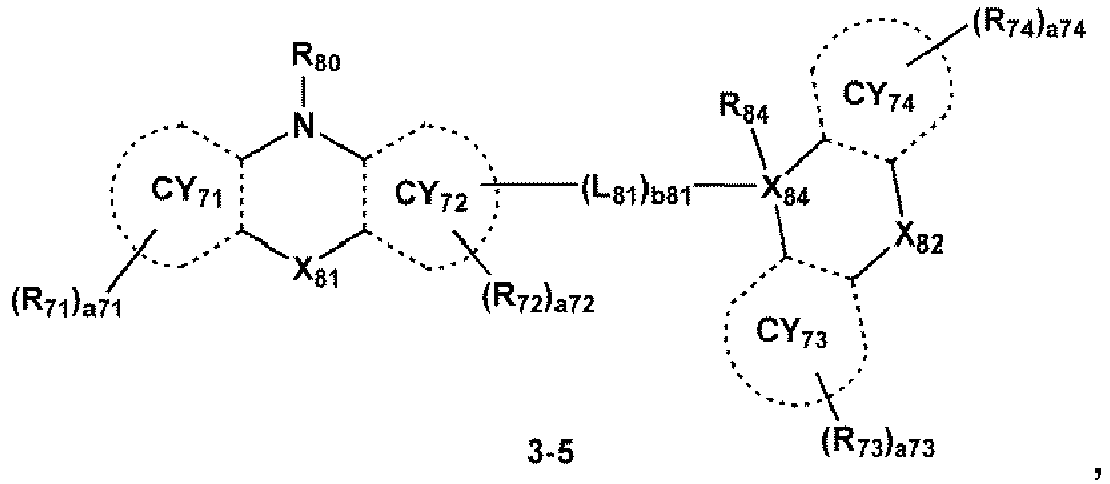 ring CY71, ring CY72, X81, R71, R72, a71, and a72 are respectively the same as defined in claim 1,ring CY73, ring CY74, R73, R74, a73, and a74 are respectively the same as defined in connection with ring CY71, ring CY72, R71, R72, a71, and a72 in claim 1,L81 is selected from *-C(Q4)(Q5)-*', *-Si(Q4)(Q5)-*', a substituted or unsubstituted C5-C30 carbocyclic group, and a substituted or unsubstituted C1-C30 heterocyclic group, wherein Q4 and Q5 are respectively the same as defined in connection with Q1 in claim 1,b81 is an integer of 0 to 5, wherein, when b81 is 0, *-(L81)b81-*' is a single bond, and when b81 is two or more, two or more L81(s) are identical to or different from each other,X82 is a single bond, O, S, N(R82), B(R82), C(R82a)(R82b), or Si(R82a)(R82b),X83 is a single bond, O, S, N(R83), B(R83), C(R83a)(R83b) or Si(R83a)(R83b),X82 and X83 in Formulae 3-2 and 3-4 are not both a single bond,X84 is C or Si,R80, R82, R83, R82a, R82b, R83a, R83b, and R84 are respectively the same as defined in connection with R81 in claim 1, and* and *' each indicate a binding site to a neighboring atom.
 - An organic light-emitting device (10, 20, 30, 40) according to claim 5, wherein:a moiety represented by
 a moiety represented by
 a moiety represent by
 a moiety represented by
 a moiety represented by


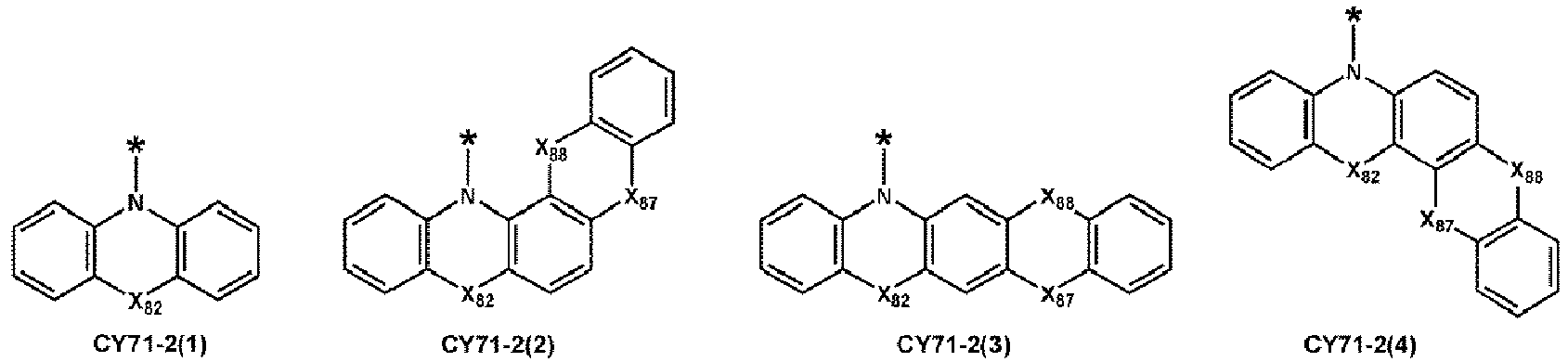





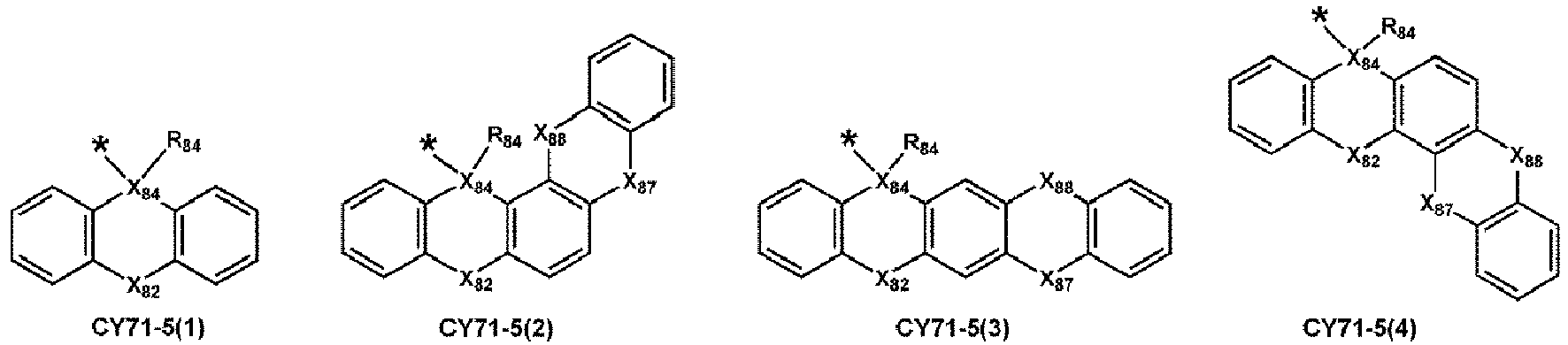
 wherein, in Formulae CY71-1 (1) to CY71-1 (8), CY71-2(1) to CY71-2(8), CY71- 3(1) to CY71-3(32), CY71-4(1) to CY71-4(32), and CY71-5(1) to CY71-5(8),X81 to X84, R80, and R84 are the same as defined in claim 5,X85 is a single bond, O, S, N(R85), B(R85), C(R85a)(R85b), or Si(R85a)(R85b),X86 is a single bond, O, S, N(R86), B(R86), C(R86a)(R86b), or Si(R86a)(R86b),X85 and X86 in Formulae CY71-1(1) to CY71-1(8) and CY71-4(1) to CY71-4(32) are not both a single bond,X87 is a single bond, O, S, N(R87), B(R87), C(R87a)(R87b), or Si(R87a)(R87b),X88 is a single bond, O, S, N(R88), B(R88), C(R88a)(R88b), or Si(R88a)(R88b),X87 and X88 in Formulae CY71-2(1) to CY71-2(8), CY71-3(1) to CY71-3(32), and CY71-5(1) to CY71-5(8) are not both a single bond, andR85 to R88, R85a, R85b, R86a, R86b, R87a, R87b, R88a, and R88b are respectively the same as defined in connection with R81 in claim 1.
 - An organic light-emitting device (10, 20, 30, 40) according to any one of claims 1 to 6, wherein:
the second compound is selected from Compounds H2-1 to H2-64:



- An organic light-emitting device (10, 20, 30, 40) according to any one of claims 1 to 7, wherein:
the first compound and the second compound form an exciplex; and/or
a decay time of delayed fluorescence in a time-resolved electroluminescence (TREL) spectrum of the organic light-emitting device is about 50 ns or more. - An organic light-emitting device (10, 20, 30, 40) according to claim 8, wherein:the organic light-emitting device (10, 20, 30, 40) has a non-resonance structure,an electroluminescence (EL) spectrum of the organic light-emitting device (10, 20, 30, 40) includes a first peak and a second peak,a maximum emission wavelength of the second peak is greater than a maximum emission wavelength of the first peak,a difference between the maximum emission wavelength of the second peak and the maximum emission wavelength of the first peak is in a range of about 5 nm to about 30 nm,the intensity of the second peak is smaller than the intensity of the first peak,the first peak is an emission peak of phosphorescence emitted from the first compound, andthe second peak is an emission peak of an exciplex formed by the first compound and the second compound.
- An organic light-emitting device (10, 20, 30, 40) comprising:a first electrode (110);a second electrode (190) facing the first electrode (110); andan emission layer (150) disposed between the first electrode (110) and the second electrode (190);the emission layer (150) comprises a first compound, a second compound, and a third compound,the first compound, the second compound, and the third compound are different from one another,an amount of the first compound is smaller than a total amount of the second compound and the third compound,the first compound is an iridium (Ir)-free organometallic compound,the second compound is represented by Formula 2,the first compound and the second compound form an exciplex, and
a decay time of delayed fluorescence in a time-resolved electroluminescence (TREL) spectrum of the organic light-emitting device is 50 ns or more L51 to L53 are each independently selected from a substituted or unsubstituted C5-C30 carbocyclic group and a substituted or unsubstituted C1-C30 heterocyclic group,a bond between L51 and ring CY51, a bond between L52 and ring CY52, a bond between L53 and ring CY53, a bond between two or more L51(s), a bond between two or more L52(s), a bond between two or more L53(s), a bond between L51 and carbon between X54 and X55 in Formula 2, a bond between L52 and carbon between X54 and X56 in Formula 2, and a bond between L53 and carbon between X55 and X56 in Formula 2 are each a carbon-carbon single bond,b51 to b53 are each independently an integer of 0 to 5, wherein, when b51 is 0, *-(L51)b51-*' is a single bond, when b52 is 0, *-(L52)b52-*' is a single bond, and when b53 is 0, *-(L53)b53-*' is a single bond,X54 is N or C(R54), X55 is N or C(R55), X56 is N or C(R56), and at least one selected from X54 to X56 is N,R51 to R56 are each independently selected from hydrogen, deuterium, -F, -Cl, - Br, -I, a hydroxyl group, a cyano group, a nitro group, an amidino group, a hydrazine group, a hydrazone group, a substituted or unsubstituted C1-C60 alkyl group, a substituted or unsubstituted C2-C60 alkenyl group, a substituted or unsubstituted C2-C60 alkynyl group, a substituted or unsubstituted C1-C60 alkoxy group, a substituted or unsubstituted C3-C10 cycloalkyl group, a substituted or unsubstituted C1-C10 heterocycloalkyl group, a substituted or unsubstituted C3-C10 cycloalkenyl group, a substituted or unsubstituted C1-C10 heterocycloalkenyl group, a substituted or unsubstituted C6-C60 aryl group, a substituted or unsubstituted C7-C60 alkyl aryl group, a substituted or unsubstituted C6-C60 aryloxy group, a substituted or unsubstituted C6-C60 arylthio group, a substituted or unsubstituted C1-C60 heteroaryl group, a substituted or unsubstituted C2-C60 alkyl heteroaryl group, a substituted or unsubstituted monovalent non-aromatic condensed polycyclic group, a substituted or unsubstituted monovalent non-aromatic condensed heteropolycyclic group, -C(Q1)(Q2)(Q3), - Si(Q1)(Q2)(Q3), -N(Q1)(Q2), -B(Q1)(Q2), -C(=O)(Q1), -S(=O)2(Q1), -P(=O)(Q1)(Q2), and a bidentate organic ligand,a51 to a53 are each independently an integer of 0 to 20,wherein a moiety represented by
 a moiety represented by
 a moiety represented by


 in Formulae CY51-1 to CY51-17, CY52-1 to CY52-17, and CY53-1 to CY53-18,Y63 is a single bond, O, S, N(R63), B(R63), C(R63a)(R63b), or Si(R63a)(R63b),Y64 is a single bond, O, S, N(R64), B(R64), C(R64a)(R64b), or Si(R64a)(R64b),Y67 is a single bond, O, S, N(R67), B(R67), C(R67a)(R67b), or Si(R67a)(R67b),Y68 is a single bond, O, S, N(R68), B(R68), C(R68a)(R68b), or Si(R68a)(R68b),Y63 and Y64 in Formulae CY51-16 and CY51-17 are not both a single bond,Y67 and Y68 in Formulae CY52-16 and CY52-17 are not both a single bond,R51a to R51e, R61 to R64, R63a, R63b, R64a, and R64b are respectively the same as defined in connection with R51 described above, wherein R51a to R51e are not hydrogen,R52a to R52e, R65 to R68, R67a, R67b, R68a, and R68b are respectively the same as defined in connection with R52 described above, wherein R52a to R52e are not hydrogen,R53a to R53e are respectively the same as defined in connection with R53 described above, wherein R53a to R53e are not hydrogen, and* indicates a binding site to a neighboring atom,at least one substituent of the substituted C5-C30 carbocyclic group, the substituted C1-C30 heterocyclic group, the substituted C1-C60 alkyl group, the substituted C2-C60 alkenyl group, the substituted C2-C60 alkynyl group, the substituted C1-C60 alkoxy group, the substituted C3-C10 cycloalkyl group, the substituted C1-C10 heterocycloalkyl group, the substituted C3-C10 cycloalkenyl group, the substituted C1-C10 heterocycloalkenyl group, the substituted C6-C60 aryl group, the substituted C7-C60 alkyl aryl group, the substituted C6-C60 aryloxy group, the substituted C6-C60 arylthio group, the substituted C1-C60 heteroaryl group, the substituted C2-C60 alkyl heteroaryl group, the substituted monovalent non-aromatic condensed polycyclic group, and the substituted monovalent non-aromatic condensed heteropolycyclic group is selected from:deuterium, -F, -Cl, -Br, -I, a hydroxyl group, a cyano group, a nitro group, an amidino group, a hydrazine group, a hydrazone group, a C1-C60 alkyl group, a C2-C60 alkenyl group, a C2-C60 alkynyl group, and a C1-C60 alkoxy group;a C1-C60 alkyl group, a C2-C60 alkenyl group, a C2-C60 alkynyl group, and a C1-C60 alkoxy group, each substituted with at least one selected from deuterium, -F, -Cl, - Br, -I, a hydroxyl group, a cyano group, a nitro group, an amidino group, a hydrazine group, a hydrazone group, a C3-C10 cycloalkyl group, a C1-C10 heterocycloalkyl group, a C3-C10 cycloalkenyl group, a C1-C10 heterocycloalkenyl group, a C6-C60 aryl group, a C7-C60 alkyl aryl group, a C6-C60 aryloxy group, a C6-C60 arylthio group, a C1-C60 heteroaryl group, a C2-C60 alkyl heteroaryl group, a monovalent non-aromatic condensed polycyclic group, a monovalent non-aromatic condensed heteropolycyclic group, -O(Q11), -S(Q11), -Si(Q11)(Q12)(Q13), -N(Q11)(Q12), -B(Q11)(Q12), -P(Q11)(Q12), - C(=O)(Q11), -S(=O)2(Q11), and -P(=O)(Q11)(Q12);a C3-C10 cycloalkyl group, a C1-C10 heterocycloalkyl group, a C3-C10 cycloalkenyl group, a C1-C10 heterocycloalkenyl group, a C6-C60 aryl group, a C7-C60 alkyl aryl group, a C6-C60 aryloxy group, a C6-C60 arylthio group, a C1-C60 heteroaryl group, a C2-C60 alkyl heteroaryl group, a monovalent non-aromatic condensed polycyclic group, and a monovalent non-aromatic condensed heteropolycyclic group;a C3-C10 cycloalkyl group, a C1-C10 heterocycloalkyl group, a C3-C10 cycloalkenyl group, a C1-C10 heterocycloalkenyl group, a C6-C60 aryl group, a C7-C60 alkyl aryl group, a C6-C60 aryloxy group, a C6-C60 arylthio group, a C1-C60 heteroaryl group, a C2-C60 alkyl heteroaryl group, a monovalent non-aromatic condensed polycyclic group, and a monovalent non-aromatic condensed heteropolycyclic group, each substituted with at least one selected from deuterium, -F, -Cl, -Br, -I, a hydroxyl group, a cyano group, a nitro group, an amidino group, a hydrazine group, a hydrazone group, a C1-C60 alkyl group, a C2-C60 alkenyl group, a C2-C60 alkynyl group, a C1-C60 alkoxy group, a C3-C10 cycloalkyl group, a C1-C10 heterocycloalkyl group, a C3-C10 cycloalkenyl group, a C1-C10 heterocycloalkenyl group, a C6-C60 aryl group, a C7-C60 alkyl aryl group, a C6-C60 aryloxy group, a C6-C60 arylthio group, a C1-C60 heteroaryl group, a C2-C60 alkyl heteroaryl group, a monovalent non-aromatic condensed polycyclic group, a monovalent non-aromatic condensed heteropolycyclic group, -O(Q21), -S(Q21), - Si(Q21)(Q22)(Q23), -N(Q21)(Q22), -B(Q21)(Q22), -P(Q21)(Q22), -C(=O)(Q21), -S(=O)2(Q21), and -P(=O)(Q21)(Q22); and-O(Q31), -S(Q31), -Si(Q31)(Q32)(Q33), -N(Q31)(Q32), -B(Q31)(Q32), -P(Q31)(Q32), - C(=O)(Q31), -S(=O)2(Q31) and -P(=O)(Q31)(Q32), andQ1 to Q3, Q11 to Q13, Q21 to Q23, and Q31 to Q33 are each independently selected from hydrogen, deuterium, -F, -Cl, -Br, -I, a hydroxyl group, a cyano group, a nitro group, an amidino group, a hydrazine group, a hydrazone group, a C1-C60 alkyl group, a C2-C60 alkenyl group, a C2-C60 alkynyl group, a C1-C60 alkoxy group, a C3-C10 cycloalkyl group, a C1-C10 heterocycloalkyl group, a C3-C10 cycloalkenyl group, a C1-C10 heterocycloalkenyl group, a C6-C60 aryl group, a C6-C60 aryloxy group, a C6-C60 arylthio group, a C1-C60 heteroaryl group, a monovalent non-aromatic condensed polycyclic group, a monovalent non-aromatic condensed heteropolycyclic group, a C1-C60 alkyl group substituted with at least one selected from deuterium, -F, a cyano group, a C1-C60 alkyl group, a phenyl group, and a biphenyl group, and a C6-C60 aryl group substituted with at least one selected from deuterium, -F, a cyano group, a C1-C10 alkyl group, a phenyl group, and a biphenyl group.
 - An organic light-emitting device (10, 20, 30, 40) according to claim 10, wherein:the organic light-emitting device (10, 20, 30, 40) has a non-resonance structure,an electroluminescence (EL) spectrum of the organic light-emitting device (10, 20, 30, 40) includes a first peak and a second peak,a maximum emission wavelength of the second peak is greater than a maximum emission wavelength of the first peak,a difference between the maximum emission wavelength of the second peak and the maximum emission wavelength of the first peak is in a range of about 5 nm to about 30 nm, and
the intensity of the second peak is smaller than the intensity of the first peak; and/orthe maximum emission wavelength of the first peak is in a range of about 390 nm to about 500 nm. - An organic light-emitting device (10, 20, 30, 40) according to claim 11, wherein:the first peak is an emission peak of phosphorescence emitted from the first compound, andthe second peak is an emission peak of an exciplex formed by the first compound and the second compound.
- An organic light-emitting device (10, 20, 30, 40) according to claim 10 or 11, wherein:
the intensity of the second peak is in a range of about 20 % to about 90 % of the intensity of the first peak. - An electronic apparatus comprising an organic light-emitting device (10, 20, 30, 40) according to any one of claims 1 to 13.
- A compound represented by Formula 2:
 L51 to L53 are each independently selected from a substituted or unsubstituted C5-C30 carbocyclic group and a substituted or unsubstituted C1-C30 heterocyclic group,a bond between L51 and ring CY51, a bond between L52 and ring CY52, a bond between L53 and ring CY53, a bond between two or more L51(s), a bond between two or more L52(s), a bond between two or more L53(s), a bond between L51 and carbon between X54 and X55 in Formula 2, a bond between L52 and carbon between X54 and X56 in Formula 2, and a bond between L53 and carbon between X55 and X56 in Formula 2 are each a carbon-carbon single bond,b51 to b53 are each independently an integer of 0 to 5, wherein, when b51 is 0, *-(L51)b51-*' is a single bond, when b52 is 0, *-(L52)b52-*' is a single bond, and when b53 is 0, *-(L53)b53-*' is a single bond,X54 is N or C(R54), X55 is N or C(R55), X56 is N or C(R56), and at least one selected from X54 to X56 is N,R51 to R56 are each independently selected from hydrogen, deuterium, -F, -Cl, - Br, -I, a hydroxyl group, a cyano group, a nitro group, an amidino group, a hydrazine group, a hydrazone group, a substituted or unsubstituted C1-C60 alkyl group, a substituted or unsubstituted C2-C60 alkenyl group, a substituted or unsubstituted C2-C60 alkynyl group, a substituted or unsubstituted C1-C60 alkoxy group, a substituted or unsubstituted C3-C10 cycloalkyl group, a substituted or unsubstituted C1-C10 heterocycloalkyl group, a substituted or unsubstituted C3-C10 cycloalkenyl group, a substituted or unsubstituted C1-C10 heterocycloalkenyl group, a substituted or unsubstituted C6-C60 aryl group, a substituted or unsubstituted C7-C60 alkyl aryl group, a substituted or unsubstituted C6-C60 aryloxy group, a substituted or unsubstituted C6-C60 arylthio group, a substituted or unsubstituted C1-C60 heteroaryl group, a substituted or unsubstituted C2-C60 alkyl heteroaryl group, a substituted or unsubstituted monovalent non-aromatic condensed polycyclic group, a substituted or unsubstituted monovalent non-aromatic condensed heteropolycyclic group, -C(Q1)(Q2)(Q3), - Si(Q1)(Q2)(Q3), -N(Q1)(Q2), -B(Q1)(Q2), -C(=O)(Q1), -S(=O)2(Q1), -P(=O)(Q1)(Q2), and a bidentate organic ligand,a51 to a53 are each independently an integer of 0 to 20,wherein a moiety represented by
 a moiety represented by
 a moiety represented by


 in Formulae CY51-1 to CY51-17, CY52-1 to CY52-17, and CY53-1 to CY53-18,Y63 is a single bond, O, S, N(R63), B(R63), C(R63a)(R63b), or Si(R63a)(R63b),Y64 is a single bond, O, S, N(R64), B(R64), C(R64a)(R64b), or Si(R64a)(R64b),Y67 is a single bond, O, S, N(R67), B(R67), C(R67a)(R67b), or Si(R67a)(R67b),Y68 is a single bond, O, S, N(R68), B(R68), C(R68a)(R68b), or Si(R68a)(R68b),Y63 and Y64 in Formulae CY51-16 and CY51-17 are not both a single bond,Y67 and Y68 in Formulae CY52-16 and CY52-17 are not both a single bond,R51a to R51e, R61 to R64, R63a, R63b, R64a, and R64b are respectively the same as defined in connection with R51 described above, wherein R51a to R51e are not hydrogen,R52a to R52e, R65 to R68, R67a, R67b, R68a, and R68b are respectively the same as defined in connection with R52 described above, wherein R52a to R52e are not hydrogen,R53a to R53e are respectively the same as defined in connection with R53 described above, wherein R53a to R53e are not hydrogen, and* indicates a binding site to a neighboring atom,at least one substituent of the substituted C5-C30 carbocyclic group, the substituted C1-C30 heterocyclic group, the substituted C1-C60 alkyl group, the substituted C2-C60 alkenyl group, the substituted C2-C60 alkynyl group, the substituted C1-C60 alkoxy group, the substituted C3-C10 cycloalkyl group, the substituted C1-C10 heterocycloalkyl group, the substituted C3-C10 cycloalkenyl group, the substituted C1-C10 heterocycloalkenyl group, the substituted C6-C60 aryl group, the substituted C7-C60 alkyl aryl group, the substituted C6-C60 aryloxy group, the substituted C6-C60 arylthio group, the substituted C1-C60 heteroaryl group, the substituted C2-C60 alkyl heteroaryl group, the substituted monovalent non-aromatic condensed polycyclic group, and the substituted monovalent non-aromatic condensed heteropolycyclic group is selected from:deuterium, -F, -Cl, -Br, -I, a hydroxyl group, a cyano group, a nitro group, an amidino group, a hydrazine group, a hydrazone group, a C1-C60 alkyl group, a C2-C60 alkenyl group, a C2-C60 alkynyl group, and a C1-C60 alkoxy group;a C1-C60 alkyl group, a C2-C60 alkenyl group, a C2-C60 alkynyl group, and a C1-C60 alkoxy group, each substituted with at least one selected from deuterium, -F, -Cl, - Br, -I, a hydroxyl group, a cyano group, a nitro group, an amidino group, a hydrazine group, a hydrazone group, a C3-C10 cycloalkyl group, a C1-C10 heterocycloalkyl group, a C3-C10 cycloalkenyl group, a C1-C10 heterocycloalkenyl group, a C6-C60 aryl group, a C7-C60 alkyl aryl group, a C6-C60 aryloxy group, a C6-C60 arylthio group, a C1-C60 heteroaryl group, a C2-C60 alkyl heteroaryl group, a monovalent non-aromatic condensed polycyclic group, a monovalent non-aromatic condensed heteropolycyclic group, -O(Q11), -S(Q11), -Si(Q11)(Q12)(Q13), -N(Q11)(Q12), -B(Q11)(Q12), -P(Q11)(Q12), - C(=O)(Q11), -S(=O)2(Q11), and -P(=O)(Q11)(Q12);a C3-C10 cycloalkyl group, a C1-C10 heterocycloalkyl group, a C3-C10 cycloalkenyl group, a C1-C10 heterocycloalkenyl group, a C6-C60 aryl group, a C7-C60 alkyl aryl group, a C6-C60 aryloxy group, a C6-C60 arylthio group, a C1-C60 heteroaryl group, a C2-C60 alkyl heteroaryl group, a monovalent non-aromatic condensed polycyclic group, and a monovalent non-aromatic condensed heteropolycyclic group;a C3-C10 cycloalkyl group, a C1-C10 heterocycloalkyl group, a C3-C10 cycloalkenyl group, a C1-C10 heterocycloalkenyl group, a C6-C60 aryl group, a C7-C60 alkyl aryl group, a C6-C60 aryloxy group, a C6-C60 arylthio group, a C1-C60 heteroaryl group, a C2-C60 alkyl heteroaryl group, a monovalent non-aromatic condensed polycyclic group, and a monovalent non-aromatic condensed heteropolycyclic group, each substituted with at least one selected from deuterium, -F, -Cl, -Br, -I, a hydroxyl group, a cyano group, a nitro group, an amidino group, a hydrazine group, a hydrazone group, a C1-C60 alkyl group, a C2-C60 alkenyl group, a C2-C60 alkynyl group, a C1-C60 alkoxy group, a C3-C10 cycloalkyl group, a C1-C10 heterocycloalkyl group, a C3-C10 cycloalkenyl group, a C1-C10 heterocycloalkenyl group, a C6-C60 aryl group, a C7-C60 alkyl aryl group, a C6-C60 aryloxy group, a C6-C60 arylthio group, a C1-C60 heteroaryl group, a C2-C60 alkyl heteroaryl group, a monovalent non-aromatic condensed polycyclic group, a monovalent non-aromatic condensed heteropolycyclic group, -O(Q21), -S(Q21), - Si(Q21)(Q22)(Q23), -N(Q21)(Q22), -B(Q21)(Q22), -P(Q21)(Q22), -C(=O)(Q21), -S(=O)2(Q21), and -P(=O)(Q21)(Q22); and-O(Q31), -S(Q31), -Si(Q31)(Q32)(Q33), -N(Q31)(Q32), -B(Q31)(Q32), -P(Q31)(Q32), - C(=O)(Q31), -S(=O)2(Q31) and -P(=O)(Q31)(Q32), andQ1 to Q3, Q11 to Q13, Q21 to Q23, and Q31 to Q33 are each independently selected from hydrogen, deuterium, -F, -Cl, -Br, -I, a hydroxyl group, a cyano group, a nitro group, an amidino group, a hydrazine group, a hydrazone group, a C1-C60 alkyl group, a C2-C60 alkenyl group, a C2-C60 alkynyl group, a C1-C60 alkoxy group, a C3-C10 cycloalkyl group, a C1-C10 heterocycloalkyl group, a C3-C10 cycloalkenyl group, a C1-C10 heterocycloalkenyl group, a C6-C60 aryl group, a C6-C60 aryloxy group, a C6-C60 arylthio group, a C1-C60 heteroaryl group, a monovalent non-aromatic condensed polycyclic group, a monovalent non-aromatic condensed heteropolycyclic group, a C1-C60 alkyl group substituted with at least one selected from deuterium, -F, a cyano group, a C1-C60 alkyl group, a phenyl group, and a biphenyl group, and a C6-C60 aryl group substituted with at least one selected from deuterium, -F, a cyano group, a C1-C10 alkyl group, a phenyl group, and a biphenyl group.
Applications Claiming Priority (2)
| Application Number | Priority Date | Filing Date | Title |
|---|---|---|---|
| KR1020180033482A KR102637792B1 (en) | 2018-03-22 | 2018-03-22 | Organic light emitting device and electronic device including the same |
| EP19163558.0A EP3544076B1 (en) | 2018-03-22 | 2019-03-18 | Organic light-emitting device and electronic apparatus including the same |
Related Parent Applications (1)
| Application Number | Title | Priority Date | Filing Date |
|---|---|---|---|
| EP19163558.0A Division EP3544076B1 (en) | 2018-03-22 | 2019-03-18 | Organic light-emitting device and electronic apparatus including the same |
Publications (2)
| Publication Number | Publication Date |
|---|---|
| EP3748708A1 true EP3748708A1 (en) | 2020-12-09 |
| EP3748708B1 EP3748708B1 (en) | 2025-04-30 |
Family
ID=65861227
Family Applications (2)
| Application Number | Title | Priority Date | Filing Date |
|---|---|---|---|
| EP20188007.7A Active EP3748708B1 (en) | 2018-03-22 | 2019-03-18 | Organic light-emitting device and electronic apparatus including the same |
| EP19163558.0A Active EP3544076B1 (en) | 2018-03-22 | 2019-03-18 | Organic light-emitting device and electronic apparatus including the same |
Family Applications After (1)
| Application Number | Title | Priority Date | Filing Date |
|---|---|---|---|
| EP19163558.0A Active EP3544076B1 (en) | 2018-03-22 | 2019-03-18 | Organic light-emitting device and electronic apparatus including the same |
Country Status (5)
| Country | Link |
|---|---|
| US (2) | US12550606B2 (en) |
| EP (2) | EP3748708B1 (en) |
| JP (2) | JP7278121B2 (en) |
| KR (2) | KR102637792B1 (en) |
| CN (1) | CN110299457B (en) |
Families Citing this family (36)
| Publication number | Priority date | Publication date | Assignee | Title |
|---|---|---|---|---|
| US11261192B2 (en) | 2018-03-09 | 2022-03-01 | Recurium Ip Holdings, Llc | Substituted 1,2-dihydro-3H-pyrazolo[3,4-D]pyrimidin-3-ones |
| KR102637792B1 (en) | 2018-03-22 | 2024-02-19 | 삼성디스플레이 주식회사 | Organic light emitting device and electronic device including the same |
| WO2020050162A1 (en) * | 2018-09-03 | 2020-03-12 | 国立大学法人大阪大学 | Organic el material and organic el device |
| US11690285B2 (en) | 2018-11-28 | 2023-06-27 | Universal Display Corporation | Electroluminescent devices |
| KR102767901B1 (en) | 2019-01-29 | 2025-02-18 | 삼성디스플레이 주식회사 | Organic electroluminescence device and polycyclic compound for organic electroluminescence device |
| KR102804493B1 (en) | 2019-04-30 | 2025-05-09 | 삼성디스플레이 주식회사 | Organic light emitting device |
| US20210119168A1 (en) * | 2019-10-01 | 2021-04-22 | Samsung Display Co., Ltd. | Organic electroluminescence device |
| KR102556834B1 (en) * | 2019-10-01 | 2023-07-19 | 삼성디스플레이 주식회사 | Organic electroluminescence device |
| KR102460911B1 (en) * | 2019-10-01 | 2022-11-01 | 삼성디스플레이 주식회사 | Organic electroluminescence device |
| KR102472168B1 (en) * | 2019-10-01 | 2022-11-30 | 삼성디스플레이 주식회사 | Organic electroluminescence device |
| KR102505883B1 (en) | 2019-10-04 | 2023-03-06 | 삼성디스플레이 주식회사 | Organic light-emitting device and apparatus including the same |
| KR102508499B1 (en) * | 2019-10-04 | 2023-03-10 | 삼성디스플레이 주식회사 | Organic light emitting device and device with same |
| KR102505882B1 (en) * | 2019-10-04 | 2023-03-06 | 삼성디스플레이 주식회사 | Organic light-emitting device and apparatus including the same |
| KR102544979B1 (en) | 2019-10-04 | 2023-06-20 | 삼성디스플레이 주식회사 | Organic light-emitting device and apparatus including the same |
| KR102505881B1 (en) * | 2019-10-04 | 2023-03-06 | 삼성디스플레이 주식회사 | Organic light-emitting device and apparatus including the same |
| JP7488091B2 (en) * | 2019-11-14 | 2024-05-21 | ユニバーサル ディスプレイ コーポレイション | Organic electroluminescent materials and devices |
| KR102808662B1 (en) * | 2019-11-28 | 2025-05-16 | 삼성디스플레이 주식회사 | Organometallic compound, organic light-emitting device including the same and apparatus including the same |
| JP2023022342A (en) * | 2020-01-31 | 2023-02-15 | 国立大学法人京都大学 | Compound, light-emitting material, and organic light-emitting element |
| US12336425B2 (en) | 2020-05-11 | 2025-06-17 | Samsung Display Co., Ltd. | Compound and light-emitting device including the same |
| KR102853327B1 (en) | 2020-05-14 | 2025-09-01 | 삼성디스플레이 주식회사 | Organometallic compound and organic light emitting device comprising the same |
| KR102552269B1 (en) | 2020-05-14 | 2023-07-07 | 삼성디스플레이 주식회사 | Heterocyclic compound and organic light emitting device including the same |
| KR102867203B1 (en) * | 2020-07-13 | 2025-10-16 | 삼성디스플레이 주식회사 | Light emitting device, electronic apparatus including the same and organometallic compound |
| KR102801011B1 (en) * | 2020-07-13 | 2025-04-30 | 삼성디스플레이 주식회사 | Light emitting device and electronic apparatus including the same |
| KR102929423B1 (en) | 2020-07-17 | 2026-02-23 | 삼성디스플레이 주식회사 | Light emitting device and electronic apparatus comprising the device |
| US12225816B2 (en) | 2020-09-02 | 2025-02-11 | Samsung Display Co., Ltd. | Light-emitting device and electronic apparatus including the same |
| KR102483957B1 (en) * | 2020-09-02 | 2023-01-05 | 삼성디스플레이 주식회사 | light emitting device and electronic device including the light emitting device |
| KR102493132B1 (en) * | 2020-09-11 | 2023-01-31 | 삼성디스플레이 주식회사 | Light-emitting device and electronic apparatus including the same |
| KR20220036056A (en) * | 2020-09-15 | 2022-03-22 | 솔루스첨단소재 주식회사 | Organic compound and organic electroluminescent device comprising the same |
| KR102473633B1 (en) | 2020-10-23 | 2022-12-06 | 삼성디스플레이 주식회사 | Organic electroluminescence device |
| KR102830954B1 (en) * | 2020-11-12 | 2025-07-08 | 삼성디스플레이 주식회사 | An Organic light emitting device and electronic device including the same |
| KR20220085892A (en) * | 2020-12-15 | 2022-06-23 | 삼성디스플레이 주식회사 | Organic electroluminescence device and organometallic compound for organic electroluminescence device |
| KR20220085924A (en) | 2020-12-15 | 2022-06-23 | 삼성디스플레이 주식회사 | Light emitting device and electronic apparatus comprising same |
| KR20220094301A (en) * | 2020-12-28 | 2022-07-06 | 삼성디스플레이 주식회사 | Heterocyclic compound, light emitting device including the heterocyclic compound and electronic apparatus including the light emitting device |
| KR20230048203A (en) * | 2021-10-01 | 2023-04-11 | 삼성디스플레이 주식회사 | Light emitting element |
| KR20230056805A (en) * | 2021-10-19 | 2023-04-28 | 삼성디스플레이 주식회사 | Light emitting element |
| KR20250144085A (en) * | 2024-03-26 | 2025-10-10 | 삼성에스디아이 주식회사 | Composition for organic optoelectronic device, organic optoelectronic device and display device |
Citations (7)
| Publication number | Priority date | Publication date | Assignee | Title |
|---|---|---|---|---|
| EP1820801A1 (en) * | 2004-12-10 | 2007-08-22 | Pioneer Corporation | Organic compound, charge-transporting material, and organic electroluminescent element |
| JP2007335904A (en) * | 2007-09-10 | 2007-12-27 | Konica Minolta Holdings Inc | Organic electroluminescence element and display device |
| WO2012143080A2 (en) * | 2011-04-18 | 2012-10-26 | Merck Patent Gmbh | Materials for organic electroluminescent devices |
| CN103360303A (en) * | 2013-07-31 | 2013-10-23 | 华南理工大学 | Compound with pyridine as nucleus, preparation method and applications |
| DE102014008722A1 (en) * | 2014-06-18 | 2015-12-24 | Merck Patent Gmbh | Compositions for electronic devices |
| EP3275968A1 (en) * | 2015-03-27 | 2018-01-31 | Industry-Academic Cooperation Foundation Dankook University | Ortho-substituted thermally activated delayed fluorescence material and organic light-emitting device comprising same |
| EP3428174A1 (en) * | 2017-07-14 | 2019-01-16 | Samsung Display Co., Ltd. | Organometallic compound and organic light-emitting device including the same |
Family Cites Families (133)
| Publication number | Priority date | Publication date | Assignee | Title |
|---|---|---|---|---|
| US6939624B2 (en) | 2000-08-11 | 2005-09-06 | Universal Display Corporation | Organometallic compounds and emission-shifting organic electrophosphorescence |
| US6863997B2 (en) | 2001-12-28 | 2005-03-08 | The Trustees Of Princeton University | White light emitting OLEDs from combined monomer and aggregate emission |
| US6879319B2 (en) | 2002-10-25 | 2005-04-12 | Eastman Kodak Company | Integrated OLED display and touch screen |
| JP4552382B2 (en) * | 2003-03-06 | 2010-09-29 | コニカミノルタホールディングス株式会社 | ORGANIC ELECTROLUMINESCENT ELEMENT, ORGANIC ELECTROLUMINESCENT ELEMENT MATERIAL, DISPLAY DEVICE AND LIGHTING DEVICE |
| KR100537621B1 (en) | 2004-02-02 | 2005-12-19 | 삼성에스디아이 주식회사 | Iridium compound and organic electroluminescent display device using the same |
| JP4869565B2 (en) * | 2004-04-23 | 2012-02-08 | 富士フイルム株式会社 | Organic electroluminescence device |
| US7393599B2 (en) | 2004-05-18 | 2008-07-01 | The University Of Southern California | Luminescent compounds with carbene ligands |
| KR100730115B1 (en) | 2004-06-23 | 2007-06-19 | 삼성에스디아이 주식회사 | Iridium compound and organic electroluminescent device using same |
| KR100721565B1 (en) * | 2004-11-17 | 2007-05-23 | 삼성에스디아이 주식회사 | Low molecular organic electroluminescent device and manufacturing method thereof |
| DE102004057072A1 (en) | 2004-11-25 | 2006-06-01 | Basf Ag | Use of Transition Metal Carbene Complexes in Organic Light Emitting Diodes (OLEDs) |
| ATE430789T1 (en) | 2004-12-23 | 2009-05-15 | Ciba Holding Inc | ELECTROLUMINESCENT METAL COMPLEXES WITH NUCLEOPHILIC CARBENE LIGANDS |
| KR101223717B1 (en) | 2005-04-12 | 2013-01-18 | 삼성디스플레이 주식회사 | Silyl substituted cyclometalated transition metal complex and organic electroluminescence device using the same |
| US9051344B2 (en) | 2005-05-06 | 2015-06-09 | Universal Display Corporation | Stability OLED materials and devices |
| JP2007045742A (en) | 2005-08-10 | 2007-02-22 | Mitsubishi Chemicals Corp | Process for producing transition metal complex and transition metal complex |
| JP2008147424A (en) | 2006-12-11 | 2008-06-26 | Idemitsu Kosan Co Ltd | Organic electroluminescence device |
| US8106199B2 (en) | 2007-02-13 | 2012-01-31 | Arizona Board Of Regents For And On Behalf Of Arizona State University | Organometallic materials for optical emission, optical absorption, and devices including organometallic materials |
| KR100907400B1 (en) | 2007-08-28 | 2009-07-10 | 삼성모바일디스플레이주식회사 | Thin film transistor and light emitting display device using same |
| US20110301351A1 (en) | 2007-12-21 | 2011-12-08 | Arizona Board Of Regents For And On Behalf Of Arizona State University | Platinum (II) Di (2-Pyrazolyl) Benzene Chloride Analogs and Uses |
| US8389725B2 (en) | 2008-02-29 | 2013-03-05 | Arizona Board Of Regents For And On Behalf Of Arizona State University | Tridentate platinum (II) complexes |
| JP5421242B2 (en) * | 2008-03-24 | 2014-02-19 | 新日鉄住金化学株式会社 | Compound for organic electroluminescent device and organic electroluminescent device using the same |
| CN102292327A (en) | 2009-01-22 | 2011-12-21 | 保土谷化学工业株式会社 | Compound having triazole ring structure connected with pyridyl group and organic electroluminescent device |
| JP5495578B2 (en) | 2009-02-13 | 2014-05-21 | ケミプロ化成株式会社 | Novel triarylphosphine oxide derivative, host material comprising the same, and organic electroluminescence device containing the same |
| JP5604505B2 (en) | 2009-04-06 | 2014-10-08 | アリゾナ ボード オブ リージェンツ アクティング フォー アンド オン ビハーフ オブ アリゾナ ステイト ユニバーシティ | Synthesis of four-coordinate platinum complexes and their application to light-emitting devices |
| TWI419955B (en) | 2009-04-23 | 2013-12-21 | Chien Hong Cheng | Β-diketone ancillary ligands and their metal complexes used in organic optolelectronic devices |
| JP5735229B2 (en) * | 2009-07-31 | 2015-06-17 | ユー・ディー・シー アイルランド リミテッド | Organic electroluminescence device |
| EP2461390B1 (en) * | 2009-07-31 | 2018-05-23 | UDC Ireland Limited | Organic electroluminescent element |
| KR20110049244A (en) * | 2009-11-04 | 2011-05-12 | 다우어드밴스드디스플레이머티리얼 유한회사 | Novel organic light emitting compound and organic electroluminescent device employing the same |
| JP5415340B2 (en) | 2010-03-31 | 2014-02-12 | ユー・ディー・シー アイルランド リミテッド | Organic electroluminescence device |
| DE112011101526T5 (en) | 2010-04-30 | 2013-05-16 | Arizona Board Of Regents Acting For And On Behalf Of Arizona State University | Synthesis of four-coordinate palladium complexes and their applications in light-emitting devices |
| US9324957B2 (en) | 2010-04-30 | 2016-04-26 | Arizona Board Of Regents On Behalf Of Arizona State University | Synthesis of four coordinated gold complexes and their applications in light emitting devices thereof |
| JP5719125B2 (en) | 2010-06-10 | 2015-05-13 | ユー・ディー・シー アイルランド リミテッド | Carbazole compound having a specific structure, charge transport material and organic electroluminescent device using the same |
| TW201231459A (en) | 2010-12-20 | 2012-08-01 | Du Pont | Electroactive compositions for electronic applications |
| KR102136426B1 (en) | 2011-02-16 | 2020-07-21 | 가부시키가이샤 한도오따이 에네루기 켄큐쇼 | Light-emitting element |
| TWI541247B (en) | 2011-02-18 | 2016-07-11 | 美國亞利桑那州立大學董事會 | Four-coordinate platinum and palladium complex with geometrically distortion charge transfer state and its application in illuminating devices |
| US8883322B2 (en) | 2011-03-08 | 2014-11-11 | Universal Display Corporation | Pyridyl carbene phosphorescent emitters |
| KR20250034194A (en) | 2011-04-07 | 2025-03-10 | 가부시키가이샤 한도오따이 에네루기 켄큐쇼 | Light-emitting element |
| WO2012142387A1 (en) | 2011-04-14 | 2012-10-18 | Arizona Board Of Regents Acting For And On Behalf Of Arizona State University | Pyridine-oxyphenyl coordinated iridium (iii) complexes and methods of making and using |
| WO2012162488A1 (en) | 2011-05-26 | 2012-11-29 | Arizona Board Of Regents Acting For And On Behalf Of Arizona State University | Synthesis of platinum and palladium complexes as narrow-band phosphorescent emitters for full color displays |
| EP2715825B1 (en) | 2011-05-27 | 2017-10-25 | Universal Display Corporation | Oled having multi-component emissive layer |
| EP2551274B1 (en) * | 2011-07-25 | 2015-12-09 | Universal Display Corporation | Tetradentate platinum complexes |
| US9783564B2 (en) | 2011-07-25 | 2017-10-10 | Universal Display Corporation | Organic electroluminescent materials and devices |
| EP2779263B1 (en) | 2011-11-11 | 2020-12-09 | Mitsubishi Chemical Corporation | Organic electroluminescent element and organic electroluminescent device |
| US9461254B2 (en) | 2012-01-03 | 2016-10-04 | Universal Display Corporation | Organic electroluminescent materials and devices |
| KR101803537B1 (en) | 2012-02-09 | 2017-11-30 | 가부시키가이샤 한도오따이 에네루기 켄큐쇼 | Light-emitting element |
| JP2013232629A (en) | 2012-04-06 | 2013-11-14 | Semiconductor Energy Lab Co Ltd | Light-emitting element, light-emitting device, electronic device, and lighting device |
| JP6158542B2 (en) | 2012-04-13 | 2017-07-05 | 株式会社半導体エネルギー研究所 | LIGHT EMITTING ELEMENT, LIGHT EMITTING DEVICE, ELECTRONIC DEVICE, AND LIGHTING DEVICE |
| JP6158543B2 (en) | 2012-04-13 | 2017-07-05 | 株式会社半導体エネルギー研究所 | LIGHT EMITTING ELEMENT, LIGHT EMITTING DEVICE, ELECTRONIC DEVICE, AND LIGHTING DEVICE |
| US20150194622A1 (en) | 2012-06-14 | 2015-07-09 | Idemitsu Kosan Co., Ltd. | Biscarbazole derivative host materials and red emitter for oled emissive region |
| KR101431645B1 (en) | 2012-06-26 | 2014-08-20 | 롬엔드하스전자재료코리아유한회사 | Light-Emitting Layer and Organic Electroluminescence Device comprising the same |
| US9059412B2 (en) | 2012-07-19 | 2015-06-16 | Universal Display Corporation | Transition metal complexes containing substituted imidazole carbene as ligands and their application in OLEDs |
| KR102579507B1 (en) | 2012-08-03 | 2023-09-19 | 가부시키가이샤 한도오따이 에네루기 켄큐쇼 | Light-emitting element, light-emitting device, display device, electronic appliance, and lighting device |
| DE102013214661B4 (en) | 2012-08-03 | 2023-01-05 | Semiconductor Energy Laboratory Co., Ltd. | Light-emitting element, light-emitting device and lighting device |
| US9312502B2 (en) | 2012-08-10 | 2016-04-12 | Arizona Board Of Regents Acting For And On Behalf Of Arizona State University | Iridium complexes demonstrating broadband emission through controlled geometric distortion and applications thereof |
| US9142710B2 (en) | 2012-08-10 | 2015-09-22 | Semiconductor Energy Laboratory Co., Ltd. | Light-emitting element, light-emitting device, display device, electronic device, and lighting device |
| CN103682108A (en) | 2012-08-31 | 2014-03-26 | 海洋王照明科技股份有限公司 | Organic light-emitting device and preparation method thereof |
| KR101966680B1 (en) | 2012-10-18 | 2019-04-09 | 도레이 카부시키가이샤 | Benzindolocarbazole derivative, light-emitting element material produced using same, and light-emitting element |
| KR20140135525A (en) | 2013-05-16 | 2014-11-26 | 제일모직주식회사 | Luminescent material and organic optoelectric device and display device |
| JP6252829B2 (en) | 2013-07-12 | 2017-12-27 | 凸版印刷株式会社 | CHARGE TRANSPORT POLYMER, AND CHARGE TRANSPORT POLYMER COMPOSITION, LIGHT-EMITTING CHARGE TRANSPORT FILM, AND ORGANIC EL DEVICE |
| KR102086556B1 (en) | 2013-08-02 | 2020-03-10 | 삼성디스플레이 주식회사 | Organic light emitting diode |
| DE112014007321B3 (en) | 2013-08-26 | 2022-01-20 | Semiconductor Energy Laboratory Co., Ltd. | Light Emitting Device |
| KR102083434B1 (en) | 2013-09-04 | 2020-03-03 | 삼성디스플레이 주식회사 | Organic light emitting device and manufacturing method thereof |
| JP6804823B2 (en) | 2013-10-14 | 2020-12-23 | アリゾナ・ボード・オブ・リージェンツ・オン・ビハーフ・オブ・アリゾナ・ステイト・ユニバーシティーArizona Board of Regents on behalf of Arizona State University | Platinum complex and device |
| KR102717395B1 (en) | 2013-12-02 | 2024-10-16 | 가부시키가이샤 한도오따이 에네루기 켄큐쇼 | Light-emitting element, display module, lighting module, light-emitting device, display device, electronic appliance, and lighting device |
| US9224963B2 (en) | 2013-12-09 | 2015-12-29 | Arizona Board Of Regents On Behalf Of Arizona State University | Stable emitters |
| US10020455B2 (en) | 2014-01-07 | 2018-07-10 | Arizona Board Of Regents On Behalf Of Arizona State University | Tetradentate platinum and palladium complex emitters containing phenyl-pyrazole and its analogues |
| EP3473635B1 (en) | 2014-05-08 | 2020-07-22 | Universal Display Corporation | Stabilized imidazophenanthridine materials |
| US9941479B2 (en) | 2014-06-02 | 2018-04-10 | Arizona Board Of Regents On Behalf Of Arizona State University | Tetradentate cyclometalated platinum complexes containing 9,10-dihydroacridine and its analogues |
| KR102321377B1 (en) | 2014-06-09 | 2021-11-04 | 삼성디스플레이 주식회사 | Organic light- emitting devices |
| KR20160007967A (en) | 2014-07-10 | 2016-01-21 | 삼성디스플레이 주식회사 | Organic light emitting device |
| US9923155B2 (en) | 2014-07-24 | 2018-03-20 | Arizona Board Of Regents On Behalf Of Arizona State University | Tetradentate platinum (II) complexes cyclometalated with functionalized phenyl carbene ligands and their analogues |
| KR102245164B1 (en) | 2014-08-22 | 2021-04-27 | 엘지디스플레이 주식회사 | Organic light emitting device and method of fabricating the same |
| US10741772B2 (en) | 2014-08-29 | 2020-08-11 | Samsung Electronics Co., Ltd. | Organic light-emitting device |
| KR102372084B1 (en) | 2014-10-17 | 2022-03-08 | 삼성전자주식회사 | Organic light emitting device including the same |
| CN104370974B (en) | 2014-12-04 | 2018-01-23 | 南京大学 | One kind is using nitrogen heterocyclic ring Cabbeen as complex of iridium of the second main part and preparation method thereof |
| CN107108585B (en) * | 2014-12-29 | 2024-06-11 | 东进世美肯株式会社 | Novel compound and organic light-emitting device containing the same |
| CN105895810B (en) * | 2015-01-26 | 2018-11-30 | 北京维信诺科技有限公司 | A kind of thermal activation sensitized phosphorescence organic electroluminescence device |
| KR101706752B1 (en) * | 2015-02-17 | 2017-02-27 | 서울대학교산학협력단 | Organic light-emitting device comprising delayed fluorescent host, phosphorescent dopant and fluorescent dopant |
| KR102500270B1 (en) | 2015-04-16 | 2023-02-16 | 삼성디스플레이 주식회사 | Organic light-emitting display apparatus and method for manufacturing the same |
| KR102584846B1 (en) | 2015-05-05 | 2023-10-04 | 유니버셜 디스플레이 코포레이션 | Organic electroluminescent materials and devices |
| CN107615509B (en) | 2015-05-29 | 2019-11-08 | 株式会社半导体能源研究所 | Light-emitting element, light-emitting device, display device, electronic equipment, and lighting device |
| KR101919438B1 (en) | 2015-06-26 | 2018-11-16 | 삼성에스디아이 주식회사 | Composition for organic optoelectric device, organic optoelectric device and display device |
| KR20170008358A (en) | 2015-07-13 | 2017-01-24 | 삼성디스플레이 주식회사 | Organic light-emitting display device |
| KR102516496B1 (en) | 2015-07-23 | 2023-04-04 | 가부시키가이샤 한도오따이 에네루기 켄큐쇼 | Light-emitting element, display device, electronic device, and lighting device |
| US10240085B2 (en) * | 2015-08-27 | 2019-03-26 | Samsung Electronics Co., Ltd. | Thin film and organic light-emitting device including the same |
| KR102601599B1 (en) * | 2015-08-27 | 2023-11-14 | 삼성전자주식회사 | Thin film and organic light emitting device including the same |
| US10297764B2 (en) | 2015-09-14 | 2019-05-21 | Samsung Electronics Co., Ltd. | Mixture, thin film, and organic light emitting device including mixture and thin film |
| KR101948709B1 (en) | 2015-09-25 | 2019-02-15 | 삼성에스디아이 주식회사 | Composition for organic optoelectric device, organic optoelectric device and display device |
| KR101977163B1 (en) | 2015-09-25 | 2019-05-10 | 삼성에스디아이 주식회사 | Composition for organic optoelectric device, organic optoelectric device and display device |
| KR102362839B1 (en) | 2015-10-28 | 2022-02-15 | 삼성디스플레이 주식회사 | Organic light emitting device, fabrication method of the same and organic light emitting display device including the same |
| KR102546673B1 (en) | 2015-12-03 | 2023-06-23 | 삼성디스플레이 주식회사 | Organic light emitting device and display device having the same |
| KR102665870B1 (en) | 2015-12-23 | 2024-05-14 | 솔루스첨단소재 주식회사 | Organic compounds and organic electro luminescence device comprising the same |
| EP3190164B1 (en) | 2016-01-05 | 2019-07-24 | Samsung Electronics Co., Ltd | Composition, thin film including the composition, and organic light-emitting device including the composition or the thin film |
| JP6802189B2 (en) | 2016-01-08 | 2020-12-16 | コニカミノルタ株式会社 | Thin film and organic electroluminescence device |
| KR102615636B1 (en) | 2016-01-13 | 2023-12-20 | 삼성디스플레이 주식회사 | Organic light-emitting device |
| US10096658B2 (en) | 2016-04-22 | 2018-10-09 | Semiconductor Energy Laboratory Co., Ltd. | Light-emitting element, display device, electronic device, and lighting device |
| KR102896425B1 (en) | 2016-05-06 | 2025-12-09 | 가부시키가이샤 한도오따이 에네루기 켄큐쇼 | Light-emitting element, display device, electronic device, and lighting device |
| KR102341030B1 (en) | 2016-05-20 | 2021-12-21 | 가부시키가이샤 한도오따이 에네루기 켄큐쇼 | Light-emitting element, display device, electronic device, and lighting device |
| KR102587955B1 (en) | 2016-06-02 | 2023-10-16 | 삼성전자주식회사 | Condensed cyclic compound and organic light emitting device including the same |
| KR102643636B1 (en) | 2016-09-26 | 2024-03-06 | 삼성디스플레이 주식회사 | Condensed compound and organic light emitting device comprising the same |
| KR102707563B1 (en) | 2016-10-17 | 2024-09-20 | 삼성디스플레이 주식회사 | Condensed-cyclic compound and organic light emitting device comprising the same |
| WO2018100476A1 (en) | 2016-11-30 | 2018-06-07 | Semiconductor Energy Laboratory Co., Ltd. | Light-emitting element, light-emitting device, electronic device, and lighting device |
| CN108336237B (en) | 2017-01-20 | 2020-01-31 | 昆山工研院新型平板显示技术中心有限公司 | An organic electroluminescent device |
| US11802136B2 (en) | 2017-06-23 | 2023-10-31 | Universal Display Corporation | Organic electroluminescent materials and devices |
| US12089428B2 (en) | 2017-07-03 | 2024-09-10 | Samsung Electronics Co., Ltd. | Organic light-emitting device |
| KR102360782B1 (en) * | 2017-07-20 | 2022-02-10 | 삼성디스플레이 주식회사 | Organic light emitting device |
| US11228010B2 (en) * | 2017-07-26 | 2022-01-18 | Universal Display Corporation | Organic electroluminescent materials and devices |
| US11765970B2 (en) | 2017-07-26 | 2023-09-19 | Universal Display Corporation | Organic electroluminescent materials and devices |
| KR102395782B1 (en) * | 2017-07-31 | 2022-05-09 | 삼성전자주식회사 | Organic light emitting device |
| CN107394051B (en) | 2017-08-14 | 2019-12-27 | 上海天马有机发光显示技术有限公司 | Light emitting device and display device |
| KR102637102B1 (en) * | 2017-09-05 | 2024-02-20 | 삼성전자주식회사 | Organic light emitting device |
| CN109427987B (en) * | 2017-09-05 | 2023-04-07 | 三星电子株式会社 | Organic light emitting device |
| US11081659B2 (en) * | 2018-01-10 | 2021-08-03 | Universal Display Corporation | Organic electroluminescent materials and devices |
| EP3537495B1 (en) * | 2018-03-08 | 2025-02-12 | Samsung Display Co., Ltd. | Organic light-emitting device |
| KR102633851B1 (en) | 2018-03-16 | 2024-02-07 | 삼성디스플레이 주식회사 | Diamine-based compound and organic light emitting device comprising the same |
| KR102637792B1 (en) | 2018-03-22 | 2024-02-19 | 삼성디스플레이 주식회사 | Organic light emitting device and electronic device including the same |
| KR102697986B1 (en) | 2018-04-05 | 2024-08-23 | 삼성디스플레이 주식회사 | Organic electroluminescence device and polycyclic compound for organic electroluminescence device |
| KR102648402B1 (en) | 2018-06-12 | 2024-03-18 | 삼성디스플레이 주식회사 | Condensed-cyclic compound and organic light emitting device including the same |
| KR102654919B1 (en) | 2018-07-23 | 2024-04-05 | 삼성디스플레이 주식회사 | Organic light-emitting device |
| CN109346614B (en) | 2018-08-31 | 2020-01-31 | 昆山国显光电有限公司 | organic electroluminescent device and display device |
| KR20260057227A (en) | 2018-09-14 | 2026-04-27 | 가부시키가이샤 한도오따이 에네루기 켄큐쇼 | Light-emitting device, light-emitting apparatus, electronic device, and lighting device |
| KR102693673B1 (en) | 2018-10-25 | 2024-08-08 | 엘지디스플레이 주식회사 | Organic light emitting diode and organic light emittid device having the diode |
| DE112020001143T5 (en) | 2019-03-08 | 2021-12-02 | Semiconductor Energy Laboratory Co., Ltd. | Light-emitting device, light-emitting device, display device, electronic device and lighting device |
| CN111755628A (en) | 2019-03-26 | 2020-10-09 | 三星显示有限公司 | Organic Light Emitting Devices and Electronic Devices |
| KR102608423B1 (en) | 2019-03-28 | 2023-12-01 | 삼성디스플레이 주식회사 | Organic light emitting device and electronic apparatus |
| KR102804493B1 (en) | 2019-04-30 | 2025-05-09 | 삼성디스플레이 주식회사 | Organic light emitting device |
| KR102275039B1 (en) | 2019-10-08 | 2021-07-08 | 엘티소재주식회사 | Organic light emitting device, manufacturing method of the same and composition for organic layer of organic light emitting device |
| KR102850713B1 (en) | 2020-05-18 | 2025-08-28 | 삼성디스플레이 주식회사 | Organic electroluminescence device and organometallic compound for organic electroluminescence device |
| US12127477B2 (en) | 2020-05-28 | 2024-10-22 | Samsung Display Co., Ltd. | Organic light-emitting device |
| KR102929423B1 (en) * | 2020-07-17 | 2026-02-23 | 삼성디스플레이 주식회사 | Light emitting device and electronic apparatus comprising the device |
| KR20220053729A (en) * | 2020-10-22 | 2022-05-02 | 삼성디스플레이 주식회사 | An Organometallic compound and organic light emitting device including the same |
| KR102956607B1 (en) * | 2020-12-02 | 2026-04-24 | 삼성디스플레이 주식회사 | Light emitting diode |
| KR20220085892A (en) * | 2020-12-15 | 2022-06-23 | 삼성디스플레이 주식회사 | Organic electroluminescence device and organometallic compound for organic electroluminescence device |
| KR20220085924A (en) | 2020-12-15 | 2022-06-23 | 삼성디스플레이 주식회사 | Light emitting device and electronic apparatus comprising same |
-
2018
- 2018-03-22 KR KR1020180033482A patent/KR102637792B1/en active Active
-
2019
- 2019-03-18 EP EP20188007.7A patent/EP3748708B1/en active Active
- 2019-03-18 EP EP19163558.0A patent/EP3544076B1/en active Active
- 2019-03-20 CN CN201910211714.XA patent/CN110299457B/en active Active
- 2019-03-20 JP JP2019053905A patent/JP7278121B2/en active Active
- 2019-03-21 US US16/360,938 patent/US12550606B2/en active Active
-
2022
- 2022-07-20 US US17/813,749 patent/US12563962B2/en active Active
- 2022-10-19 JP JP2022167925A patent/JP7475412B2/en active Active
-
2024
- 2024-02-07 KR KR1020240019157A patent/KR102956638B1/en active Active
Patent Citations (7)
| Publication number | Priority date | Publication date | Assignee | Title |
|---|---|---|---|---|
| EP1820801A1 (en) * | 2004-12-10 | 2007-08-22 | Pioneer Corporation | Organic compound, charge-transporting material, and organic electroluminescent element |
| JP2007335904A (en) * | 2007-09-10 | 2007-12-27 | Konica Minolta Holdings Inc | Organic electroluminescence element and display device |
| WO2012143080A2 (en) * | 2011-04-18 | 2012-10-26 | Merck Patent Gmbh | Materials for organic electroluminescent devices |
| CN103360303A (en) * | 2013-07-31 | 2013-10-23 | 华南理工大学 | Compound with pyridine as nucleus, preparation method and applications |
| DE102014008722A1 (en) * | 2014-06-18 | 2015-12-24 | Merck Patent Gmbh | Compositions for electronic devices |
| EP3275968A1 (en) * | 2015-03-27 | 2018-01-31 | Industry-Academic Cooperation Foundation Dankook University | Ortho-substituted thermally activated delayed fluorescence material and organic light-emitting device comprising same |
| EP3428174A1 (en) * | 2017-07-14 | 2019-01-16 | Samsung Display Co., Ltd. | Organometallic compound and organic light-emitting device including the same |
Also Published As
| Publication number | Publication date |
|---|---|
| CN110299457A (en) | 2019-10-01 |
| CN110299457B (en) | 2024-08-16 |
| JP7278121B2 (en) | 2023-05-19 |
| KR20240026466A (en) | 2024-02-28 |
| JP2022191441A (en) | 2022-12-27 |
| KR102956638B1 (en) | 2026-04-23 |
| KR20190112232A (en) | 2019-10-04 |
| JP7475412B2 (en) | 2024-04-26 |
| EP3544076B1 (en) | 2020-08-26 |
| US12563962B2 (en) | 2026-02-24 |
| US20190296254A1 (en) | 2019-09-26 |
| US20220384745A1 (en) | 2022-12-01 |
| US12550606B2 (en) | 2026-02-10 |
| EP3748708B1 (en) | 2025-04-30 |
| KR102637792B1 (en) | 2024-02-19 |
| JP2019169710A (en) | 2019-10-03 |
| EP3544076A1 (en) | 2019-09-25 |
Similar Documents
| Publication | Publication Date | Title |
|---|---|---|
| EP3544076B1 (en) | Organic light-emitting device and electronic apparatus including the same | |
| CN111048677B (en) | Organic light emitting device | |
| CN111653677B (en) | organic light emitting device | |
| EP3792255B1 (en) | Heterocyclic compound and organic light-emitting device including the same | |
| EP3882253B1 (en) | Organometallic compound and organic light-emitting device including the same | |
| CN118843374A (en) | Organic light emitting device | |
| EP3587427B1 (en) | Organometallic compound, organic light-emitting device including the same, and apparatus including the organic light-emitting device | |
| CN107528005B (en) | Organic light emitting device | |
| US12501821B2 (en) | Organic light-emitting device and organometallic compound | |
| CN113698433B (en) | Organometallic compounds | |
| CN107540614B (en) | Heterocyclic compound and organic light emitting device including the same | |
| CN110615776B (en) | Diamine compound and organic light-emitting device including the same | |
| US11631822B2 (en) | Organometallic compound and organic light-emitting device including the same | |
| EP3575295B1 (en) | Heterocyclic compound and organic light-emitting device including the same | |
| CN113512067B (en) | Organometallic compound and organic light emitting device including the same | |
| CN106866346B (en) | Condensed ring compound and organic light-emitting device comprising the same |
Legal Events
| Date | Code | Title | Description |
|---|---|---|---|
| PUAI | Public reference made under article 153(3) epc to a published international application that has entered the european phase |
Free format text: ORIGINAL CODE: 0009012 |
|
| STAA | Information on the status of an ep patent application or granted ep patent |
Free format text: STATUS: THE APPLICATION HAS BEEN PUBLISHED |
|
| AC | Divisional application: reference to earlier application |
Ref document number: 3544076 Country of ref document: EP Kind code of ref document: P |
|
| AK | Designated contracting states |
Kind code of ref document: A1 Designated state(s): AL AT BE BG CH CY CZ DE DK EE ES FI FR GB GR HR HU IE IS IT LI LT LU LV MC MK MT NL NO PL PT RO RS SE SI SK SM TR |
|
| STAA | Information on the status of an ep patent application or granted ep patent |
Free format text: STATUS: REQUEST FOR EXAMINATION WAS MADE |
|
| 17P | Request for examination filed |
Effective date: 20210413 |
|
| RBV | Designated contracting states (corrected) |
Designated state(s): AL AT BE BG CH CY CZ DE DK EE ES FI FR GB GR HR HU IE IS IT LI LT LU LV MC MK MT NL NO PL PT RO RS SE SI SK SM TR |
|
| STAA | Information on the status of an ep patent application or granted ep patent |
Free format text: STATUS: EXAMINATION IS IN PROGRESS |
|
| 17Q | First examination report despatched |
Effective date: 20220812 |
|
| P01 | Opt-out of the competence of the unified patent court (upc) registered |
Effective date: 20230516 |
|
| REG | Reference to a national code |
Ref country code: DE Ref legal event code: R079 Free format text: PREVIOUS MAIN CLASS: H01L0051540000 Ipc: H10K0085300000 Ref document number: 602019069513 Country of ref document: DE |
|
| GRAP | Despatch of communication of intention to grant a patent |
Free format text: ORIGINAL CODE: EPIDOSNIGR1 |
|
| STAA | Information on the status of an ep patent application or granted ep patent |
Free format text: STATUS: GRANT OF PATENT IS INTENDED |
|
| RIC1 | Information provided on ipc code assigned before grant |
Ipc: H10K 101/20 20230101ALN20241024BHEP Ipc: H10K 101/00 20230101ALN20241024BHEP Ipc: H10K 101/10 20230101ALN20241024BHEP Ipc: H10K 50/11 20230101ALN20241024BHEP Ipc: H10K 85/40 20230101ALI20241024BHEP Ipc: H10K 85/60 20230101ALI20241024BHEP Ipc: H10K 85/30 20230101AFI20241024BHEP |
|
| RIC1 | Information provided on ipc code assigned before grant |
Ipc: H10K 101/20 20230101ALN20241105BHEP Ipc: H10K 101/00 20230101ALN20241105BHEP Ipc: H10K 101/10 20230101ALN20241105BHEP Ipc: H10K 50/11 20230101ALN20241105BHEP Ipc: H10K 85/40 20230101ALI20241105BHEP Ipc: H10K 85/60 20230101ALI20241105BHEP Ipc: H10K 85/30 20230101AFI20241105BHEP |
|
| INTG | Intention to grant announced |
Effective date: 20241114 |
|
| RIN1 | Information on inventor provided before grant (corrected) |
Inventor name: HWANG, SEOKHWAN Inventor name: KIM, YOUNGKOOK Inventor name: HAN, JUNGHOON Inventor name: JUN, MIEUN Inventor name: JEON, MINA Inventor name: LEE, HYOYOUNG Inventor name: AHN, HEECHOON Inventor name: SIM, MUNKI Inventor name: PARK, JUNHA Inventor name: KIM, SUNGBUM Inventor name: KO, SOOBYUNG |
|
| GRAS | Grant fee paid |
Free format text: ORIGINAL CODE: EPIDOSNIGR3 |
|
| GRAA | (expected) grant |
Free format text: ORIGINAL CODE: 0009210 |
|
| STAA | Information on the status of an ep patent application or granted ep patent |
Free format text: STATUS: THE PATENT HAS BEEN GRANTED |
|
| AC | Divisional application: reference to earlier application |
Ref document number: 3544076 Country of ref document: EP Kind code of ref document: P |
|
| AK | Designated contracting states |
Kind code of ref document: B1 Designated state(s): AL AT BE BG CH CY CZ DE DK EE ES FI FR GB GR HR HU IE IS IT LI LT LU LV MC MK MT NL NO PL PT RO RS SE SI SK SM TR |
|
| REG | Reference to a national code |
Ref country code: CH Ref legal event code: EP Ref country code: GB Ref legal event code: FG4D |
|
| REG | Reference to a national code |
Ref country code: DE Ref legal event code: R096 Ref document number: 602019069513 Country of ref document: DE |
|
| REG | Reference to a national code |
Ref country code: IE Ref legal event code: FG4D |
|
| REG | Reference to a national code |
Ref country code: NL Ref legal event code: MP Effective date: 20250430 |
|
| REG | Reference to a national code |
Ref country code: AT Ref legal event code: MK05 Ref document number: 1791348 Country of ref document: AT Kind code of ref document: T Effective date: 20250430 |
|
| PG25 | Lapsed in a contracting state [announced via postgrant information from national office to epo] |
Ref country code: FI Free format text: LAPSE BECAUSE OF FAILURE TO SUBMIT A TRANSLATION OF THE DESCRIPTION OR TO PAY THE FEE WITHIN THE PRESCRIBED TIME-LIMIT Effective date: 20250430 Ref country code: PT Free format text: LAPSE BECAUSE OF FAILURE TO SUBMIT A TRANSLATION OF THE DESCRIPTION OR TO PAY THE FEE WITHIN THE PRESCRIBED TIME-LIMIT Effective date: 20250901 Ref country code: ES Free format text: LAPSE BECAUSE OF FAILURE TO SUBMIT A TRANSLATION OF THE DESCRIPTION OR TO PAY THE FEE WITHIN THE PRESCRIBED TIME-LIMIT Effective date: 20250430 |
|
| REG | Reference to a national code |
Ref country code: LT Ref legal event code: MG9D |
|
| PG25 | Lapsed in a contracting state [announced via postgrant information from national office to epo] |
Ref country code: NO Free format text: LAPSE BECAUSE OF FAILURE TO SUBMIT A TRANSLATION OF THE DESCRIPTION OR TO PAY THE FEE WITHIN THE PRESCRIBED TIME-LIMIT Effective date: 20250730 Ref country code: GR Free format text: LAPSE BECAUSE OF FAILURE TO SUBMIT A TRANSLATION OF THE DESCRIPTION OR TO PAY THE FEE WITHIN THE PRESCRIBED TIME-LIMIT Effective date: 20250731 |
|
| PG25 | Lapsed in a contracting state [announced via postgrant information from national office to epo] |
Ref country code: PL Free format text: LAPSE BECAUSE OF FAILURE TO SUBMIT A TRANSLATION OF THE DESCRIPTION OR TO PAY THE FEE WITHIN THE PRESCRIBED TIME-LIMIT Effective date: 20250430 Ref country code: NL Free format text: LAPSE BECAUSE OF FAILURE TO SUBMIT A TRANSLATION OF THE DESCRIPTION OR TO PAY THE FEE WITHIN THE PRESCRIBED TIME-LIMIT Effective date: 20250430 |
|
| PG25 | Lapsed in a contracting state [announced via postgrant information from national office to epo] |
Ref country code: BG Free format text: LAPSE BECAUSE OF FAILURE TO SUBMIT A TRANSLATION OF THE DESCRIPTION OR TO PAY THE FEE WITHIN THE PRESCRIBED TIME-LIMIT Effective date: 20250430 |
|
| PG25 | Lapsed in a contracting state [announced via postgrant information from national office to epo] |
Ref country code: HR Free format text: LAPSE BECAUSE OF FAILURE TO SUBMIT A TRANSLATION OF THE DESCRIPTION OR TO PAY THE FEE WITHIN THE PRESCRIBED TIME-LIMIT Effective date: 20250430 |
|
| PG25 | Lapsed in a contracting state [announced via postgrant information from national office to epo] |
Ref country code: AT Free format text: LAPSE BECAUSE OF FAILURE TO SUBMIT A TRANSLATION OF THE DESCRIPTION OR TO PAY THE FEE WITHIN THE PRESCRIBED TIME-LIMIT Effective date: 20250430 |
|
| PG25 | Lapsed in a contracting state [announced via postgrant information from national office to epo] |
Ref country code: RS Free format text: LAPSE BECAUSE OF FAILURE TO SUBMIT A TRANSLATION OF THE DESCRIPTION OR TO PAY THE FEE WITHIN THE PRESCRIBED TIME-LIMIT Effective date: 20250731 |
|
| PG25 | Lapsed in a contracting state [announced via postgrant information from national office to epo] |
Ref country code: IS Free format text: LAPSE BECAUSE OF FAILURE TO SUBMIT A TRANSLATION OF THE DESCRIPTION OR TO PAY THE FEE WITHIN THE PRESCRIBED TIME-LIMIT Effective date: 20250830 |
|
| PG25 | Lapsed in a contracting state [announced via postgrant information from national office to epo] |
Ref country code: LV Free format text: LAPSE BECAUSE OF FAILURE TO SUBMIT A TRANSLATION OF THE DESCRIPTION OR TO PAY THE FEE WITHIN THE PRESCRIBED TIME-LIMIT Effective date: 20250430 |
|
| PG25 | Lapsed in a contracting state [announced via postgrant information from national office to epo] |
Ref country code: DK Free format text: LAPSE BECAUSE OF FAILURE TO SUBMIT A TRANSLATION OF THE DESCRIPTION OR TO PAY THE FEE WITHIN THE PRESCRIBED TIME-LIMIT Effective date: 20250430 Ref country code: SM Free format text: LAPSE BECAUSE OF FAILURE TO SUBMIT A TRANSLATION OF THE DESCRIPTION OR TO PAY THE FEE WITHIN THE PRESCRIBED TIME-LIMIT Effective date: 20250430 |
|
| PG25 | Lapsed in a contracting state [announced via postgrant information from national office to epo] |
Ref country code: CZ Free format text: LAPSE BECAUSE OF FAILURE TO SUBMIT A TRANSLATION OF THE DESCRIPTION OR TO PAY THE FEE WITHIN THE PRESCRIBED TIME-LIMIT Effective date: 20250430 |
|
| PG25 | Lapsed in a contracting state [announced via postgrant information from national office to epo] |
Ref country code: EE Free format text: LAPSE BECAUSE OF FAILURE TO SUBMIT A TRANSLATION OF THE DESCRIPTION OR TO PAY THE FEE WITHIN THE PRESCRIBED TIME-LIMIT Effective date: 20250430 |
|
| PG25 | Lapsed in a contracting state [announced via postgrant information from national office to epo] |
Ref country code: RO Free format text: LAPSE BECAUSE OF FAILURE TO SUBMIT A TRANSLATION OF THE DESCRIPTION OR TO PAY THE FEE WITHIN THE PRESCRIBED TIME-LIMIT Effective date: 20250430 Ref country code: SK Free format text: LAPSE BECAUSE OF FAILURE TO SUBMIT A TRANSLATION OF THE DESCRIPTION OR TO PAY THE FEE WITHIN THE PRESCRIBED TIME-LIMIT Effective date: 20250430 |
|
| PG25 | Lapsed in a contracting state [announced via postgrant information from national office to epo] |
Ref country code: IT Free format text: LAPSE BECAUSE OF FAILURE TO SUBMIT A TRANSLATION OF THE DESCRIPTION OR TO PAY THE FEE WITHIN THE PRESCRIBED TIME-LIMIT Effective date: 20250430 |
|
| REG | Reference to a national code |
Ref country code: DE Ref legal event code: R097 Ref document number: 602019069513 Country of ref document: DE |
|
| PLBE | No opposition filed within time limit |
Free format text: ORIGINAL CODE: 0009261 |
|
| STAA | Information on the status of an ep patent application or granted ep patent |
Free format text: STATUS: NO OPPOSITION FILED WITHIN TIME LIMIT |
|
| REG | Reference to a national code |
Ref country code: CH Ref legal event code: L10 Free format text: ST27 STATUS EVENT CODE: U-0-0-L10-L00 (AS PROVIDED BY THE NATIONAL OFFICE) Effective date: 20260311 |
|
| 26N | No opposition filed |
Effective date: 20260202 |
|
| PGFP | Annual fee paid to national office [announced via postgrant information from national office to epo] |
Ref country code: GB Payment date: 20260224 Year of fee payment: 8 |
|
| PGFP | Annual fee paid to national office [announced via postgrant information from national office to epo] |
Ref country code: DE Payment date: 20260220 Year of fee payment: 8 |
|
| PGFP | Annual fee paid to national office [announced via postgrant information from national office to epo] |
Ref country code: FR Payment date: 20260224 Year of fee payment: 8 |