EP3748489B1 - Bildeinstellvorrichtung und -system für demonstrationsunterricht - Google Patents
Bildeinstellvorrichtung und -system für demonstrationsunterricht Download PDFInfo
- Publication number
- EP3748489B1 EP3748489B1 EP20178185.3A EP20178185A EP3748489B1 EP 3748489 B1 EP3748489 B1 EP 3748489B1 EP 20178185 A EP20178185 A EP 20178185A EP 3748489 B1 EP3748489 B1 EP 3748489B1
- Authority
- EP
- European Patent Office
- Prior art keywords
- demonstration teaching
- adjustment device
- image
- image adjustment
- operator
- Prior art date
- Legal status (The legal status is an assumption and is not a legal conclusion. Google has not performed a legal analysis and makes no representation as to the accuracy of the status listed.)
- Active
Links
Images
Classifications
-
- G—PHYSICS
- G06—COMPUTING OR CALCULATING; COUNTING
- G06F—ELECTRIC DIGITAL DATA PROCESSING
- G06F3/00—Input arrangements for transferring data to be processed into a form capable of being handled by the computer; Output arrangements for transferring data from processing unit to output unit, e.g. interface arrangements
- G06F3/14—Digital output to display device ; Cooperation and interconnection of the display device with other functional units
- G06F3/1454—Digital output to display device ; Cooperation and interconnection of the display device with other functional units involving copying of the display data of a local workstation or window to a remote workstation or window so that an actual copy of the data is displayed simultaneously on two or more displays, e.g. teledisplay
-
- G—PHYSICS
- G06—COMPUTING OR CALCULATING; COUNTING
- G06F—ELECTRIC DIGITAL DATA PROCESSING
- G06F3/00—Input arrangements for transferring data to be processed into a form capable of being handled by the computer; Output arrangements for transferring data from processing unit to output unit, e.g. interface arrangements
- G06F3/01—Input arrangements or combined input and output arrangements for interaction between user and computer
- G06F3/011—Arrangements for interaction with the human body, e.g. for user immersion in virtual reality
- G06F3/013—Eye tracking input arrangements
-
- G—PHYSICS
- G09—EDUCATION; CRYPTOGRAPHY; DISPLAY; ADVERTISING; SEALS
- G09B—EDUCATIONAL OR DEMONSTRATION APPLIANCES; APPLIANCES FOR TEACHING, OR COMMUNICATING WITH, THE BLIND, DEAF OR MUTE; MODELS; PLANETARIA; GLOBES; MAPS; DIAGRAMS
- G09B5/00—Electrically-operated educational appliances
- G09B5/06—Electrically-operated educational appliances with both visual and audible presentation of the material to be studied
- G09B5/065—Combinations of audio and video presentations, e.g. videotapes, videodiscs, television systems
-
- G—PHYSICS
- G09—EDUCATION; CRYPTOGRAPHY; DISPLAY; ADVERTISING; SEALS
- G09G—ARRANGEMENTS OR CIRCUITS FOR CONTROL OF INDICATING DEVICES USING STATIC MEANS TO PRESENT VARIABLE INFORMATION
- G09G5/00—Control arrangements or circuits for visual indicators common to cathode-ray tube indicators and other visual indicators
- G09G5/12—Synchronisation between the display unit and other units, e.g. other display units, video-disc players
-
- G—PHYSICS
- G09—EDUCATION; CRYPTOGRAPHY; DISPLAY; ADVERTISING; SEALS
- G09B—EDUCATIONAL OR DEMONSTRATION APPLIANCES; APPLIANCES FOR TEACHING, OR COMMUNICATING WITH, THE BLIND, DEAF OR MUTE; MODELS; PLANETARIA; GLOBES; MAPS; DIAGRAMS
- G09B5/00—Electrically-operated educational appliances
- G09B5/08—Electrically-operated educational appliances providing for individual presentation of information to a plurality of student stations
- G09B5/14—Electrically-operated educational appliances providing for individual presentation of information to a plurality of student stations with provision for individual teacher-student communication
Definitions
- Examples of the present invention relate to the field of terminal application technologies, and in particular, to an image adjustment device and system for demonstration teaching.
- terminals are used for demonstration teaching.
- a teacher uses a parent terminal and each student uses a child terminal in demonstration teaching. That is, a demonstration teaching system includes one parent terminal and a plurality of child terminals. The parent terminal can control the child terminals.
- the parent terminal can control the child terminals.
- the content displayed on the child terminals terminals for students
- the content displayed on the child terminals is authentic and interesting to increase the students' enthusiasm for study during teaching demonstration. Therefore, how to ensure the authenticity and interest of the content displayed on the parent terminal and the plurality of child terminals is a problem that needs to be solved urgently.
- US 2014/325389 A1 discloses how to share an object from a source computing device to a destination device by simply moving and releasing the object in a specific region on the display of the source device.
- US 2014/055578 A1 discloses adjusting a video signal according to a position information before and after a change in position of a viewer to enlarge an image in the video signal, and transmits the adjusted video signal to the video signal output means.
- examples of the present invention provide an image adjustment device and system for demonstration teaching.
- An objective of the present invention is to ensure the authenticity and interest of content displayed on a parent terminal and a plurality of child terminals, so as to achieve the best demonstration effect.
- An example of the present invention provides a first image adjustment device for demonstration teaching.
- the device is applied to a controlled end (the first image adjustment device for demonstration teaching) in demonstration teaching.
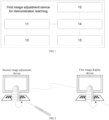
- the device includes a first transceiver 11, an interactive control device 12, a first eye tracking device 13, a first data control device 14, and a display device 15.
- the first transceiver 11 is configured to receive a control command sent by a second image adjustment device for demonstration teaching, where the control command includes a to-be-displayed image and operation information with regard to the to-be-displayed image.
- the second image adjustment device for demonstration teaching can control the first image adjustment device for demonstration teaching by using an interactive control device 12. This example of the present invention is applied to a demonstration teaching process.
- FIG. 2 is a schematic diagram of a first image adjustment device for demonstration teaching and a second image adjustment device for demonstration teaching according to an example of the present invention.
- There are a plurality of first image adjustment devices for demonstration teaching which are terminals for students (first operators).
- There are one second image adjustment device for demonstration teaching which is a terminal for a teacher (a second operator).
- the second image adjustment device for demonstration teaching can control an operation of the first image adjustment device for demonstration teaching.
- the second image adjustment device for demonstration teaching controls the first image adjustment device for demonstration teaching through a network.
- the network control can be that the second image adjustment device for demonstration teaching controls the first image adjustment device for demonstration teaching directly through the Internet.
- the network control can be alternatively that the second image adjustment device for demonstration teaching controls the first image adjustment device for demonstration teaching by using a network switch element. Details are not limited in this example of the present invention.
- the second image adjustment device for demonstration teaching can control the first image adjustment device for demonstration teaching on the premise that the second image adjustment device for demonstration teaching and the first image adjustment device for demonstration teaching synchronously display content.
- This mode can be referred to as a teaching demonstration mode. If it is not required that the second image adjustment device for demonstration teaching and the first image adjustment device for demonstration teaching synchronously display content, the second image adjustment device for demonstration teaching can disconnect control on the first image adjustment device for demonstration teaching. In this case, the first image adjustment device for demonstration teaching and the second image adjustment device for demonstration teaching are independent of each other.
- This mode can be referred to as a normal mode. It should be noted that the descriptions in this example of the present invention are all implemented when the second image adjustment device for demonstration teaching can control the first image adjustment device for demonstration teaching.
- the second image adjustment device for demonstration teaching can switch between the teaching demonstration mode and the normal mode as required.
- the display terminal is a three-dimensional (3D) display terminal.
- the first image adjustment device for demonstration teaching can be controlled by the second image adjustment device for demonstration teaching.
- the to-be-displayed image on the first image adjustment device for demonstration teaching is dynamically adjusted based on a position relationship between the first image adjustment device for demonstration teaching and an operator.
- the first image adjustment device for demonstration teaching receives the control command sent by the second image adjustment device for demonstration teaching.
- the control command can be sent to the first image adjustment device for demonstration teaching together with the displayed content.
- the displayed content is sent first, and then the control command is sent. Delivery time of the control command is not limited in this example of the present invention.
- the first eye tracking device 13 is configured to acquire first pupillary distance information of the first operator, and acquire first eye positioning information of the first operator for the first image adjustment device for demonstration teaching.
- the second pupillary distance information and the second eye positioning information of the operator can be acquired by using any method in the prior art. Details are not described in this example of the present invention.
- An objective of acquiring the first pupillary distance information and the first eye positioning information is to dynamically adjust the to-be-displayed image in real time based on different first pupillary distance information and different first eye positioning information, so as to achieve the best display effect on the first image adjustment device for demonstration teaching.
- the first data control device 14 is configured to dynamically adjust an image pixel arrangement of the to-be-displayed image on the first image adjustment device for demonstration teaching based on the first pupillary distance information and the first eye positioning information that are acquired by the first eye tracking device and the operation information.
- the adjustment process is a process of real-time dynamic adjustment based on the first pupillary distance information, the first eye positioning information, and the operation information. When any one or a combination of the first pupillary distance information, the first eye positioning information, and the operation information changes, the image pixel arrangement is adjusted in real time.
- the display device 15 is configured to display a virtual display image obtained after the first data control device 14 adjusts the image pixel arrangement.
- the first transceiver is configured to receive the control command sent by the second image adjustment device for demonstration teaching, where the control command includes the to-be-displayed image and the operation information with regard to the to-be-displayed image, and the second image adjustment device for demonstration teaching can control the first image adjustment device for demonstration teaching by using the interactive control device;
- the first eye tracking device is configured to acquire the first pupillary distance information of the first operator and the first eye positioning information of the first operator for the first image adjustment device for demonstration teaching;
- the first data control device is configured to dynamically adjust the image pixel arrangement of the to-be-displayed image on the first image adjustment device for demonstration teaching based on the first pupillary distance information and the first eye positioning information that are acquired by the first eye tracking device and the operation information;
- the display device is configured to display the virtual display image obtained after the first data control device adjusts the image pixel arrangement.
- the to-be-displayed image transmitted by the second image adjustment device for demonstration teaching and the operation information with regard to the to-be-displayed image are determined. Then the image pixel arrangement on the first image adjustment device for demonstration teaching is adjusted based on the first pupillary distance information and the first eye positioning information. This ensures the authenticity and 3D interest of content displayed on the first image adjustment device for demonstration teaching.
- control command further includes the second pupillary distance information of the second operator on the side of the second image adjustment device for demonstration teaching and the second eye positioning information of the second operator for the second image adjustment device for demonstration teaching.
- the first data control device 14 adjusts the image pixel arrangement based on the first pupillary distance information, the second pupillary distance information, the first eye positioning information, and the second eye positioning information, which is a premise of achieving consistency between content displayed on the first image adjustment device for demonstration teaching and content displayed on the second image adjustment device for demonstration teaching.
- Implementation methods include but are not limited to the following: a first calculation module is configured to calculate a first difference between the first pupillary distance information and the second pupillary distance information; a second calculation module is configured to calculate a second difference between the first eye positioning information and the second eye positioning information; and an adjustment module is configured to adjust the image pixel arrangement on the first image adjustment device for demonstration teaching based on the first difference and the second difference.
- the first calculation module, the second calculation module, and the adjustment module are not shown in the figure.
- the first image adjustment device for demonstration teaching takes the first pupillary distance information and the first eye positioning information as reference, and calculates the difference between the first pupillary distance information and the second pupillary distance information and the difference between the first eye positioning information and the second eye positioning information to adjust the image pixel arrangement on the first image adjustment device for demonstration teaching. For example, when the first pupillary distance information is greater than the second pupillary distance information, the image pixel arrangement on the first image adjustment device for demonstration teaching is zoomed out. If the first eye positioning information is on the right of the second eye positioning information, the image pixel arrangement on the first image adjustment device for demonstration teaching is adjusted to the left. In actual application, adjustment can be performed based on both the pupillary distance information and the eye positioning information, or based only on the pupillary distance information or the eye positioning information. Details are not limited in this example of the present invention.
- the first operator is registered before using the first image adjustment device for demonstration teaching, so that the image pixel arrangement is adjusted in real time based on different operators. This enhances the authenticity and diversity of the to-be-displayed image.
- the first eye tracking device 13 is further configured to perform face recognition on an operator, and extract an eye movement and duration of watch on the first image adjustment device for demonstration teaching; and if the eye movement and the duration of watch meet a preset condition threshold, determine the operator as the first operator, and identity and register the operator. The operator is registered after being determined as the first operator, so that the image pixel arrangement can be adjusted on a first display interface without detecting in real time whether the first operator changes. This saves processing resources to some extent.
- the first operator may go out for a long time or the teaching demonstration may end.
- the first eye tracking device 13 is further configured to detect in real time a period of time in which the first operator does not watch the first image adjustment device for demonstration teaching, and deregister the identified and registered first operator if determining that the period of time exceeds a preset interruption threshold.
- An example of the present invention further provides a second image adjustment device for demonstration teaching.
- the device is applied to a control end (the second image adjustment device for demonstration teaching) in demonstration teaching.
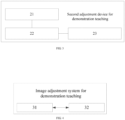
- the device includes a second eye tracking device 21, a second data control device 22, and a second transceiver 23.
- the second eye tracking device 21 is configured to acquire second pupillary distance information of a second operator (for example, between a second operator and the second image adjustment device for demonstration teaching); and locate the second operator's eye to determine second eye positioning information of the second operator for the second image adjustment device for demonstration teaching.
- first pupillary distance information and first eye positioning information of an operator can be acquired by using any method in the prior art. Details are not described in this example of the present invention.
- An objective of acquiring the second pupillary distance information and the second eye positioning information is to adjust an image pixel arrangement of content displayed on the second image adjustment device for demonstration teaching.
- first pupillary distance information and the first eye positioning information that are acquired by a first image adjustment device for demonstration teaching and the second pupillary distance information and the second eye positioning information that are acquired by the second image adjustment device for demonstration teaching are independently calculated by the first image adjustment device for demonstration teaching and the second image adjustment device for demonstration teaching.
- the calculation performed by the first image adjustment device and the calculation performed by the second image adjustment device do not interfere with each other.
- the second eye tracking device 21 is further configured to trace a position change caused by an operation on a to-be-displayed image, and generate operation information with regard to the to-be-displayed image based on the position change.
- the to-be-displayed image is obtained after adjustment performed by the second image adjustment device for demonstration teaching. That is, the adjustment has been performed based on the second eye positioning information and the second pupillary distance information of the operator. The best display effect of the to-be-displayed image is achieved on the second image adjustment device for demonstration teaching.
- the operation information with regard to the to-be-displayed image is a moving track generated when the operator performs a specific operation on the to-be-displayed image, for example, zooming in, adjusting, editing, and closing the to-be-displayed image.
- Operations on the to-be-displayed image are usually performed by using a mouse, stylus, interactive pen, and the like.
- descriptions are provided by using the interactive pen as an example.
- the interactive pen is shown in FIG. 2 and is connected to the second image adjustment device for demonstration teaching in a wireless manner.
- the second data control device 22 is configured to adjust an image pixel arrangement of the to-be-displayed image on the second image adjustment device for demonstration teaching based on the second pupillary distance information and the second eye positioning information that are acquired by the second eye tracking device and a preset adjustment threshold.
- the preset adjustment threshold records a mapping relationship between the second pupillary distance information, the second eye positioning information, and the image pixel arrangement.
- the preset adjustment threshold may be set in advance for a certain window or for an entire display interface. Details need to be determined based on different application scenarios. However, the mapping relationship between the first pupillary distance information, the first eye positioning information, and the image pixel arrangement recorded by the preset adjustment threshold is fixed regardless of application scenario.
- the second transceiver 23 is configured to send a control command to the first image adjustment device for demonstration teaching, where the control command includes the to-be-displayed image and the operation information, so that the first image adjustment device for demonstration teaching adjusts the image pixel arrangement based on the to-be-displayed image and the operation information.
- the second eye tracking device 21 performs the identification and registration to prevent interference from a bystander, so as to ensure the best watch angle for the operator. In this way, the best 3D effect can be achieved on the second image adjustment device for demonstration teaching.
- a specific operation process is as follows: First, face detection is performed to determine the number of persons currently watching the display interface; then eye tracking is performed, where the tracking includes tracking an eye movement and duration of watch on the second image adjustment device for demonstration teaching; and a person who watches the display interface for a longer time with less eye movements is determined as the operator.
- the determined operator is then registered, so that the image pixel arrangement can be adjusted on a second display interface without detecting in real time whether the operator changes. This saves processing resources to some extent.
- the second eye tracking device 21 is further configured to detect in real time a period of time in which the second operator does not watch the second image adjustment device for demonstration teaching, and deregister the identified and registered operator if determining that the period of time exceeds a preset interruption threshold.
- the real-time eye tracking aims to determine whether the operator leaves.
- the preset interruption threshold in this example of the present invention is an empirical value, which can be set to 5 minutes, 10 minutes, or the like. The specific value is not limited in this example the present invention.
- the eye tracking device 21 may perform the eye tracking when the second operator watches a certain window or the entire display interface.
- the identified and registered operator is deregistered provided that the period of time exceeds the preset interruption threshold, and so on.
- the second data control device 22 is further configured to adjust in real time the image pixel arrangement on the second image adjustment device for demonstration teaching based on the second pupillary distance information, the second eye positioning information, and a distance between the second operator's eye and the second image adjustment device for demonstration teaching.
- the display effect can be adjusted to some extent. However, it cannot be determined whether the display effect is the best 3D display effect.
- the second transceiver 21 is further configured to send the control command to the first image adjustment device for demonstration teaching based on a group number, where a plurality of first image adjustment devices for demonstration teaching each correspond to a unique group number. There can be a plurality of second image adjustment devices for demonstration teaching in a same local area network.
- the second image adjustment devices for demonstration teaching can independently control the first image adjustment devices for demonstration teaching by using the group number.
- the second image adjustment device for demonstration teaching sends the group number together with the control command. Only the first image adjustment device for demonstration teaching corresponding to the group number can receive the control command.
- An example of the present invention further provides a first image adjustment device for demonstration teaching.
- the first image adjustment device for demonstration teaching includes the first image adjustment device for demonstration teaching shown in FIG. 1 .
- An example of the present invention further provides a second image adjustment device for demonstration teaching.
- the second image adjustment device for demonstration teaching includes the second image adjustment device for demonstration teaching shown in FIG. 3 .
- An example of the present invention further provides an image adjustment system for demonstration teaching.
- the system includes a first image adjustment device 31 for demonstration teaching and a second image adjustment device 32 for demonstration teaching.
- a first transceiver 11 is configured to receive a control command sent by the second image adjustment device for demonstration teaching, where the control command includes a to-be-displayed image and operation information with regard to the to-be-displayed image
- the second image adjustment device 12 for demonstration teaching can control the first image adjustment device for demonstration teaching by using an interactive control device
- a first eye tracking device 13 is configured to acquire first pupillary distance information of a first operator and first eye positioning information of the first operator for the first image adjustment device for demonstration teaching
- a first data control device 14 is configured to dynamically adjust an image pixel arrangement of the to-be-displayed image on the first image adjustment device for demonstration teaching based on the first pupillary distance information and the first eye positioning information that are acquired by the first eye tracking device and the operation information
- a display device 15 is configured to display a virtual display image obtained after the first data control device adjusts the image pixel arrangement.
- the to-be-displayed image transmitted by the second image adjustment device for demonstration teaching and the operation information with regard to the to-be-displayed image are determined. Then the image pixel arrangement on the first image adjustment device for demonstration teaching is adjusted based on the first pupillary distance information and the first eye positioning information. This ensures the authenticity and 3D interest of content displayed on the first image adjustment device for demonstration teaching.
- the embodiments of the present application may be provided as a method, a system, or a computer program product. Therefore, the present application may use a form of hardware only embodiments, software only embodiments, or embodiments with a combination of software and hardware. Moreover, the present application may use a form of a computer program product that is implemented on one or more computer-usable storage media (including but not limited to a disk memory, a CD-ROM, an optical memory, and the like) that include computer-usable program codes.
- computer-usable storage media including but not limited to a disk memory, a CD-ROM, an optical memory, and the like
- These computer program instructions may be provided for a general-purpose computer, a dedicated computer, an embedded processor, or a processor of any other programmable data processing device to generate a machine, so that the instructions executed by a computer or a processor of any other programmable data processing device generate an apparatus for implementing a specific function in one or more processes in the flowcharts and/or in one or more blocks in the block diagrams.
- the computing device includes one or more processors (CPUs), input/output interfaces, network interfaces, and memory.
- processors CPUs
- input/output interfaces network interfaces
- memory volatile and non-volatile memory
- the memory may be non-persistent memory, random access memory (RAM) and/or non-volatile memory in a computer readable medium, such as a read only memory (ROM) or flash memory (flash RAM).
- RAM random access memory
- ROM read only memory
- flash RAM flash memory
- the computer readable medium includes persistent, non-persistent, movable, and unmovable media that may implement information storage by using any method or technology.
- the information can be a computer readable instruction, a data structure, a program module, or other data.
- Examples of the computer storage medium include but are not limited to a phase change RAM (PRAM), a static RAM (SRAM), a dynamic RAM (DRAM), a RAM of another type, a read-only memory (ROM), an electrically erasable programmable ROM (EEPROM), a flash memory or another memory technology, a compact disc ROM (CD-ROM), a digital versatile disc (DVD) or another optical storage, a cassette, a cassette magnetic disk storage, or another magnetic storage device or any other non-transmission medium.
- the computer storage medium can be configured to store information that can be accessed by a computing device. As described in the specification, the computer readable medium does not include computer readable transitory media such as a modulated data signal and a carrier.
- the embodiments of the present application may be provided as a method, a system, or a computer program product. Therefore, the present application may use a form of hardware only embodiments, software only embodiments, or embodiments with a combination of software and hardware. Moreover, the present application may use a form of a computer program product that is implemented on one or more computer-usable storage media (including but not limited to a disk memory, a CD-ROM, an optical memory, and the like) that include computer-usable program codes.
- computer-usable storage media including but not limited to a disk memory, a CD-ROM, an optical memory, and the like
Landscapes
- Engineering & Computer Science (AREA)
- Theoretical Computer Science (AREA)
- Physics & Mathematics (AREA)
- General Physics & Mathematics (AREA)
- General Engineering & Computer Science (AREA)
- Multimedia (AREA)
- Human Computer Interaction (AREA)
- Computer Hardware Design (AREA)
- Educational Technology (AREA)
- Educational Administration (AREA)
- Business, Economics & Management (AREA)
- User Interface Of Digital Computer (AREA)
- Processing Or Creating Images (AREA)
Claims (3)
- Eine erste Bildanpassungsvorrichtung (31) für Demonstrationsunterricht aufweisend:ein erstes Sende- und Empfangsgerät (11), das dazu konfiguriert ist, einen Steuerbefehl zu empfangen, der von einer zweiten Bildanpassungsvorrichtung (32) für Demonstrationsunterricht gesendet wird, wobei der Steuerbefehl ein anzuzeigendes Bild und Betriebsinformationen bezüglich des anzuzeigenden Bildes aufweist, und wobei die zweite Bildanpassungsvorrichtung (32) für Demonstrationsunterricht dazu eingerichtet ist, die erste Bildanpassungsvorrichtung (31) für Demonstrationsunterricht mittels einer interaktiven Steuervorrichtung (12) zu steuern;eine erste Augenverfolgungsvorrichtung (13), die dazu konfiguriert ist, erste Pupillenabstandsinformationen eines ersten Bedieners zu erfassen sowie erste Augenpositionsinformationen des ersten Bedieners für die erste Bildanpassungsvorrichtung (31) für Demonstrationsunterricht zu erfassen;eine erste Datensteuervorrichtung (14), die dazu konfiguriert ist, basierend auf den von der ersten Augenverfolgungsvorrichtung (13) erfassten ersten Pupillenabstandsinformationen und ersten Augenpositionsinformationen sowie den Betriebsinformationen, eine Bildpixelanordnung des anzuzeigenden Bildes auf der ersten Bildanpassungsvorrichtung (31) für Demonstrationsunterricht dynamisch anzupassen; undeine Anzeigevorrichtung (15), die dazu konfiguriert ist, ein virtuelles Anzeige-Bild anzuzeigen, das nach Anpassung der Bildpixelanordnung durch die erste Datensteuervorrichtung (14) erhalten wird, wobei die Anzeigevorrichtung (15) eine 3D-Anzeige ist;wobei die Betriebsinformationen bezüglich des anzuzeigenden Bildes basierend auf einer Positionsänderung erzeugt werden, die durch eine Bedienung am anzuzeigenden Bild verursacht wird;wobei der Steuerbefehl ferner zweite Pupillenabstandsinformationen des zweiten Bedieners auf der Seite der zweiten Bildanpassungsvorrichtung (32) für Demonstrationsunterricht und zweite Augenpositionsinformationen des zweiten Bedieners für die zweite Bildanpassungsvorrichtung (32) für Demonstrationsunterricht aufweist; undwobei die erste Datensteuervorrichtung (14) aufweist:ein erstes Berechnungsmodul, das dazu konfiguriert ist, eine erste Differenz zwischen den ersten Pupillenabstandsinformationen und den zweiten Pupillenabstandsinformationen zu berechnen;ein zweites Berechnungsmodul, das dazu konfiguriert ist, eine zweite Differenz zwischen den ersten Augenpositionsinformationen und den zweiten Augenpositionsinformationen zu berechnen; undein Anpassungsmodul, das dazu konfiguriert ist, die Bildpixelanordnung des anzuzeigenden Bildes auf der ersten Bildanpassungsvorrichtung (31) für Demonstrationsunterricht basierend auf der ersten Differenz und der zweiten Differenz anzupassen.
- Vorrichtung nach Anspruch 1, dadurch gekennzeichnet, dass die erste Augenverfolgungsvorrichtung (13) ferner dazu konfiguriert ist, eine Gesichtserkennung bei einem Bediener durchzuführen, eine Augenbewegung und Betrachtungsdauer auf der ersten Bildanpassungsvorrichtung (31) für Demonstrationsunterricht zu extrahieren; und falls die Augenbewegung und die Betrachtungsdauer einen voreingestellten Schwellenwert erfüllen, den Bediener als ersten Bediener zu bestimmen sowie den Bediener zu identifizieren und zu registrieren.
- Vorrichtung nach Anspruch 2, dadurch gekennzeichnet, dass die erste Augenverfolgungsvorrichtung (13) ferner dazu konfiguriert ist, in Echtzeit einen Zeitraum zu erfassen, während dessen der erste Bediener die erste Bildanpassungsvorrichtung (31) für Demonstrationsunterricht nicht betrachtet, und den identifizierten und registrierten ersten Bediener abzumelden, falls festgestellt wird, dass der Zeitraum einen voreingestellten Unterbrechungsschwellenwert überschreitet.
Applications Claiming Priority (1)
| Application Number | Priority Date | Filing Date | Title |
|---|---|---|---|
| CN201910481989.5A CN110308790A (zh) | 2019-06-04 | 2019-06-04 | 演示教学的图像调整装置及系统 |
Publications (3)
| Publication Number | Publication Date |
|---|---|
| EP3748489A1 EP3748489A1 (de) | 2020-12-09 |
| EP3748489B1 true EP3748489B1 (de) | 2025-06-25 |
| EP3748489C0 EP3748489C0 (de) | 2025-06-25 |
Family
ID=68075580
Family Applications (1)
| Application Number | Title | Priority Date | Filing Date |
|---|---|---|---|
| EP20178185.3A Active EP3748489B1 (de) | 2019-06-04 | 2020-06-04 | Bildeinstellvorrichtung und -system für demonstrationsunterricht |
Country Status (2)
| Country | Link |
|---|---|
| EP (1) | EP3748489B1 (de) |
| CN (1) | CN110308790A (de) |
Families Citing this family (2)
| Publication number | Priority date | Publication date | Assignee | Title |
|---|---|---|---|---|
| CN111601064B (zh) * | 2020-05-18 | 2022-02-22 | 维沃移动通信有限公司 | 信息交互方法和信息交互装置 |
| CN118072345B (zh) * | 2023-11-22 | 2024-07-26 | 广州炫视智能科技有限公司 | 基于兴趣捕捉的显示方法及系统 |
Family Cites Families (9)
| Publication number | Priority date | Publication date | Assignee | Title |
|---|---|---|---|---|
| US20120162384A1 (en) * | 2010-12-22 | 2012-06-28 | Vesely Michael A | Three-Dimensional Collaboration |
| US9595127B2 (en) * | 2010-12-22 | 2017-03-14 | Zspace, Inc. | Three-dimensional collaboration |
| CN102800302B (zh) * | 2011-05-25 | 2015-08-05 | 联想移动通信科技有限公司 | 一种终端设备调整显示屏分辨率的方法和终端设备 |
| CN102842301B (zh) * | 2012-08-21 | 2015-05-20 | 京东方科技集团股份有限公司 | 显示画面调节装置、显示装置及显示方法 |
| US20140325389A1 (en) * | 2013-04-26 | 2014-10-30 | Hewlett-Packard Development Company, L.P. | Object sharing |
| CN105266756B (zh) * | 2015-11-12 | 2017-07-14 | 小米科技有限责任公司 | 瞳距测量方法、装置及终端 |
| CN107195210B (zh) * | 2017-07-03 | 2020-07-10 | 北京大生在线科技有限公司 | 二维与三维结合的远程教学系统及控制方法 |
| CN109040736B (zh) * | 2018-08-08 | 2020-11-03 | 张家港康得新光电材料有限公司 | 一种人眼空间位置的标定方法、装置、设备和存储介质 |
| CN109819231A (zh) * | 2019-01-28 | 2019-05-28 | 北京牡丹电子集团有限责任公司数字电视技术中心 | 一种视觉自适应裸眼3d图像处理方法及装置 |
-
2019
- 2019-06-04 CN CN201910481989.5A patent/CN110308790A/zh active Pending
-
2020
- 2020-06-04 EP EP20178185.3A patent/EP3748489B1/de active Active
Also Published As
| Publication number | Publication date |
|---|---|
| EP3748489A1 (de) | 2020-12-09 |
| CN110308790A (zh) | 2019-10-08 |
| EP3748489C0 (de) | 2025-06-25 |
Similar Documents
| Publication | Publication Date | Title |
|---|---|---|
| CN108769517B (zh) | 一种基于增强现实进行远程辅助的方法与设备 | |
| KR101411058B1 (ko) | 비디오 분석 테스트 시스템 | |
| EP3748489B1 (de) | Bildeinstellvorrichtung und -system für demonstrationsunterricht | |
| EP3197147A1 (de) | Ereignissignalverarbeitungsverfahren und -vorrichtung | |
| RU2016123130A (ru) | Отслеживание и ограничение доступа | |
| EP3679520B1 (de) | Verarbeitung von bildern zur lokalisierung neuer objekte | |
| CN103365404A (zh) | 一种人机交互的方法和装置 | |
| CN116820251A (zh) | 一种手势轨迹交互方法、智能眼镜及存储介质 | |
| CN102799271A (zh) | 一种基于人手手势的交互命令识别方法及系统 | |
| JP2016511587A (ja) | 3dビジュアルコンテンツの自動評価のための技術 | |
| CN106919891A (zh) | 一种图像处理方法及装置 | |
| US10445620B2 (en) | Method and system for object tracking in multiple non-linear distortion lenses | |
| CN114627519A (zh) | 数据处理方法、装置、电子设备和存储介质 | |
| WO2020213088A1 (ja) | 表示制御装置、表示制御方法、プログラム、ならびに、非一時的なコンピュータ読取可能な情報記録媒体 | |
| US20190094962A1 (en) | Non-transitory computer-readable storage medium, display control method, and display control apparatus | |
| US10101885B1 (en) | Interact with TV using phone camera and touch | |
| US11538503B1 (en) | Information processing apparatus, information processing method, and non-transitory computer readable medium | |
| CN107256375A (zh) | 一种电脑前人体坐姿监测方法 | |
| CN114147707A (zh) | 一种基于视觉识别信息的机器人对接方法与设备 | |
| CN110300297A (zh) | 演示教学的图像调整方法及装置 | |
| US20240046487A1 (en) | Image processing method and apparatus | |
| CN114627542B (zh) | 眼动位置的确定方法、装置、存储介质及电子设备 | |
| CN113192127B (zh) | 一种图像处理方法、装置、电子设备和存储介质 | |
| US20220358670A1 (en) | Tracking method for image generation, a computer program product and a computer system | |
| TWI897239B (zh) | 人臉視頻深度偽造的檢測方法、裝置及存儲介質 |
Legal Events
| Date | Code | Title | Description |
|---|---|---|---|
| PUAI | Public reference made under article 153(3) epc to a published international application that has entered the european phase |
Free format text: ORIGINAL CODE: 0009012 |
|
| STAA | Information on the status of an ep patent application or granted ep patent |
Free format text: STATUS: THE APPLICATION HAS BEEN PUBLISHED |
|
| AK | Designated contracting states |
Kind code of ref document: A1 Designated state(s): AL AT BE BG CH CY CZ DE DK EE ES FI FR GB GR HR HU IE IS IT LI LT LU LV MC MK MT NL NO PL PT RO RS SE SI SK SM TR |
|
| AX | Request for extension of the european patent |
Extension state: BA ME |
|
| STAA | Information on the status of an ep patent application or granted ep patent |
Free format text: STATUS: REQUEST FOR EXAMINATION WAS MADE |
|
| 17P | Request for examination filed |
Effective date: 20210609 |
|
| RBV | Designated contracting states (corrected) |
Designated state(s): AL AT BE BG CH CY CZ DE DK EE ES FI FR GB GR HR HU IE IS IT LI LT LU LV MC MK MT NL NO PL PT RO RS SE SI SK SM TR |
|
| STAA | Information on the status of an ep patent application or granted ep patent |
Free format text: STATUS: EXAMINATION IS IN PROGRESS |
|
| 17Q | First examination report despatched |
Effective date: 20221202 |
|
| GRAP | Despatch of communication of intention to grant a patent |
Free format text: ORIGINAL CODE: EPIDOSNIGR1 |
|
| STAA | Information on the status of an ep patent application or granted ep patent |
Free format text: STATUS: GRANT OF PATENT IS INTENDED |
|
| INTG | Intention to grant announced |
Effective date: 20250124 |
|
| RIN1 | Information on inventor provided before grant (corrected) |
Inventor name: TANG, CAICAI Inventor name: ZHAO, FEI |
|
| GRAS | Grant fee paid |
Free format text: ORIGINAL CODE: EPIDOSNIGR3 |
|
| GRAA | (expected) grant |
Free format text: ORIGINAL CODE: 0009210 |
|
| STAA | Information on the status of an ep patent application or granted ep patent |
Free format text: STATUS: THE PATENT HAS BEEN GRANTED |
|
| AK | Designated contracting states |
Kind code of ref document: B1 Designated state(s): AL AT BE BG CH CY CZ DE DK EE ES FI FR GB GR HR HU IE IS IT LI LT LU LV MC MK MT NL NO PL PT RO RS SE SI SK SM TR |
|
| REG | Reference to a national code |
Ref country code: GB Ref legal event code: FG4D |
|
| REG | Reference to a national code |
Ref country code: CH Ref legal event code: EP |
|
| REG | Reference to a national code |
Ref country code: CH Ref legal event code: EP |
|
| REG | Reference to a national code |
Ref country code: IE Ref legal event code: FG4D |
|
| REG | Reference to a national code |
Ref country code: DE Ref legal event code: R096 Ref document number: 602020053185 Country of ref document: DE |
|
| U01 | Request for unitary effect filed |
Effective date: 20250725 |
|
| U07 | Unitary effect registered |
Designated state(s): AT BE BG DE DK EE FI FR IT LT LU LV MT NL PT RO SE SI Effective date: 20250731 |
|
| PG25 | Lapsed in a contracting state [announced via postgrant information from national office to epo] |
Ref country code: NO Free format text: LAPSE BECAUSE OF FAILURE TO SUBMIT A TRANSLATION OF THE DESCRIPTION OR TO PAY THE FEE WITHIN THE PRESCRIBED TIME-LIMIT Effective date: 20250925 Ref country code: GR Free format text: LAPSE BECAUSE OF FAILURE TO SUBMIT A TRANSLATION OF THE DESCRIPTION OR TO PAY THE FEE WITHIN THE PRESCRIBED TIME-LIMIT Effective date: 20250926 |
|
| PG25 | Lapsed in a contracting state [announced via postgrant information from national office to epo] |
Ref country code: HR Free format text: LAPSE BECAUSE OF FAILURE TO SUBMIT A TRANSLATION OF THE DESCRIPTION OR TO PAY THE FEE WITHIN THE PRESCRIBED TIME-LIMIT Effective date: 20250625 |
|
| PG25 | Lapsed in a contracting state [announced via postgrant information from national office to epo] |
Ref country code: RS Free format text: LAPSE BECAUSE OF FAILURE TO SUBMIT A TRANSLATION OF THE DESCRIPTION OR TO PAY THE FEE WITHIN THE PRESCRIBED TIME-LIMIT Effective date: 20250925 |
|
| PG25 | Lapsed in a contracting state [announced via postgrant information from national office to epo] |
Ref country code: IS Free format text: LAPSE BECAUSE OF FAILURE TO SUBMIT A TRANSLATION OF THE DESCRIPTION OR TO PAY THE FEE WITHIN THE PRESCRIBED TIME-LIMIT Effective date: 20251025 |
|
| PG25 | Lapsed in a contracting state [announced via postgrant information from national office to epo] |
Ref country code: SM Free format text: LAPSE BECAUSE OF FAILURE TO SUBMIT A TRANSLATION OF THE DESCRIPTION OR TO PAY THE FEE WITHIN THE PRESCRIBED TIME-LIMIT Effective date: 20250625 |
|
| PG25 | Lapsed in a contracting state [announced via postgrant information from national office to epo] |
Ref country code: CZ Free format text: LAPSE BECAUSE OF FAILURE TO SUBMIT A TRANSLATION OF THE DESCRIPTION OR TO PAY THE FEE WITHIN THE PRESCRIBED TIME-LIMIT Effective date: 20250625 |
|
| PG25 | Lapsed in a contracting state [announced via postgrant information from national office to epo] |
Ref country code: PL Free format text: LAPSE BECAUSE OF FAILURE TO SUBMIT A TRANSLATION OF THE DESCRIPTION OR TO PAY THE FEE WITHIN THE PRESCRIBED TIME-LIMIT Effective date: 20250625 |
|
| PG25 | Lapsed in a contracting state [announced via postgrant information from national office to epo] |
Ref country code: SK Free format text: LAPSE BECAUSE OF FAILURE TO SUBMIT A TRANSLATION OF THE DESCRIPTION OR TO PAY THE FEE WITHIN THE PRESCRIBED TIME-LIMIT Effective date: 20250625 |
|
| PG25 | Lapsed in a contracting state [announced via postgrant information from national office to epo] |
Ref country code: ES Free format text: LAPSE BECAUSE OF FAILURE TO SUBMIT A TRANSLATION OF THE DESCRIPTION OR TO PAY THE FEE WITHIN THE PRESCRIBED TIME-LIMIT Effective date: 20250625 |