EP3748349A1 - Methods and apparatus for measuring the total organic content of aqueous streams - Google Patents
Methods and apparatus for measuring the total organic content of aqueous streams Download PDFInfo
- Publication number
- EP3748349A1 EP3748349A1 EP20181232.8A EP20181232A EP3748349A1 EP 3748349 A1 EP3748349 A1 EP 3748349A1 EP 20181232 A EP20181232 A EP 20181232A EP 3748349 A1 EP3748349 A1 EP 3748349A1
- Authority
- EP
- European Patent Office
- Prior art keywords
- aqueous stream
- oxidation
- platinum electrode
- potential
- electrode
- Prior art date
- Legal status (The legal status is an assumption and is not a legal conclusion. Google has not performed a legal analysis and makes no representation as to the accuracy of the status listed.)
- Pending
Links
- 238000000034 method Methods 0.000 title claims abstract description 62
- BASFCYQUMIYNBI-UHFFFAOYSA-N platinum Chemical compound [Pt] BASFCYQUMIYNBI-UHFFFAOYSA-N 0.000 claims abstract description 243
- 229910052697 platinum Inorganic materials 0.000 claims abstract description 119
- 230000004044 response Effects 0.000 claims abstract description 34
- CURLTUGMZLYLDI-UHFFFAOYSA-N Carbon dioxide Chemical compound O=C=O CURLTUGMZLYLDI-UHFFFAOYSA-N 0.000 claims description 188
- 229910002092 carbon dioxide Inorganic materials 0.000 claims description 144
- 238000007254 oxidation reaction Methods 0.000 claims description 117
- 230000003647 oxidation Effects 0.000 claims description 116
- 229910052799 carbon Inorganic materials 0.000 claims description 50
- 239000001569 carbon dioxide Substances 0.000 claims description 46
- OKTJSMMVPCPJKN-UHFFFAOYSA-N Carbon Chemical compound [C] OKTJSMMVPCPJKN-UHFFFAOYSA-N 0.000 claims description 45
- 238000005259 measurement Methods 0.000 claims description 41
- QAOWNCQODCNURD-UHFFFAOYSA-N Sulfuric acid Chemical compound OS(O)(=O)=O QAOWNCQODCNURD-UHFFFAOYSA-N 0.000 claims description 39
- 239000003792 electrolyte Substances 0.000 claims description 28
- PCHJSUWPFVWCPO-UHFFFAOYSA-N gold Chemical compound [Au] PCHJSUWPFVWCPO-UHFFFAOYSA-N 0.000 claims description 17
- 239000010931 gold Substances 0.000 claims description 17
- 229910052737 gold Inorganic materials 0.000 claims description 16
- 238000006056 electrooxidation reaction Methods 0.000 claims description 12
- 239000000126 substance Substances 0.000 claims description 10
- 239000002253 acid Substances 0.000 claims description 9
- 230000003197 catalytic effect Effects 0.000 claims description 5
- 230000001590 oxidative effect Effects 0.000 abstract description 26
- 229910003460 diamond Inorganic materials 0.000 description 57
- 239000010432 diamond Substances 0.000 description 57
- OKKJLVBELUTLKV-UHFFFAOYSA-N Methanol Chemical compound OC OKKJLVBELUTLKV-UHFFFAOYSA-N 0.000 description 45
- 239000012528 membrane Substances 0.000 description 36
- XLYOFNOQVPJJNP-UHFFFAOYSA-N water Substances O XLYOFNOQVPJJNP-UHFFFAOYSA-N 0.000 description 26
- 238000001179 sorption measurement Methods 0.000 description 21
- 230000009467 reduction Effects 0.000 description 20
- QVGXLLKOCUKJST-UHFFFAOYSA-N atomic oxygen Chemical compound [O] QVGXLLKOCUKJST-UHFFFAOYSA-N 0.000 description 18
- 238000002484 cyclic voltammetry Methods 0.000 description 18
- 239000001301 oxygen Substances 0.000 description 18
- 229910052760 oxygen Inorganic materials 0.000 description 18
- 238000011084 recovery Methods 0.000 description 16
- 239000000243 solution Substances 0.000 description 16
- 241000894007 species Species 0.000 description 16
- CZMRCDWAGMRECN-UGDNZRGBSA-N Sucrose Chemical compound O[C@H]1[C@H](O)[C@@H](CO)O[C@@]1(CO)O[C@@H]1[C@H](O)[C@@H](O)[C@H](O)[C@@H](CO)O1 CZMRCDWAGMRECN-UGDNZRGBSA-N 0.000 description 15
- 229930006000 Sucrose Natural products 0.000 description 15
- 239000005720 sucrose Substances 0.000 description 15
- 238000001514 detection method Methods 0.000 description 14
- 230000008569 process Effects 0.000 description 14
- 239000012491 analyte Substances 0.000 description 13
- 150000002894 organic compounds Chemical class 0.000 description 13
- 239000012530 fluid Substances 0.000 description 12
- 238000012546 transfer Methods 0.000 description 12
- 229910002091 carbon monoxide Inorganic materials 0.000 description 10
- 238000006243 chemical reaction Methods 0.000 description 10
- UGFAIRIUMAVXCW-UHFFFAOYSA-N Carbon monoxide Chemical compound [O+]#[C-] UGFAIRIUMAVXCW-UHFFFAOYSA-N 0.000 description 9
- 150000001875 compounds Chemical class 0.000 description 9
- 238000002474 experimental method Methods 0.000 description 9
- 230000006870 function Effects 0.000 description 9
- 239000000463 material Substances 0.000 description 8
- UFHFLCQGNIYNRP-UHFFFAOYSA-N Hydrogen Chemical compound [H][H] UFHFLCQGNIYNRP-UHFFFAOYSA-N 0.000 description 7
- KFZMGEQAYNKOFK-UHFFFAOYSA-N Isopropanol Chemical compound CC(C)O KFZMGEQAYNKOFK-UHFFFAOYSA-N 0.000 description 7
- 229920000557 Nafion® Polymers 0.000 description 7
- 239000007864 aqueous solution Substances 0.000 description 7
- 238000002848 electrochemical method Methods 0.000 description 7
- 239000001257 hydrogen Substances 0.000 description 7
- 229910052739 hydrogen Inorganic materials 0.000 description 7
- 230000003068 static effect Effects 0.000 description 7
- 230000015572 biosynthetic process Effects 0.000 description 6
- 238000009792 diffusion process Methods 0.000 description 6
- 239000007800 oxidant agent Substances 0.000 description 6
- IWZKICVEHNUQTL-UHFFFAOYSA-M potassium hydrogen phthalate Chemical compound [K+].OC(=O)C1=CC=CC=C1C([O-])=O IWZKICVEHNUQTL-UHFFFAOYSA-M 0.000 description 6
- 238000012360 testing method Methods 0.000 description 6
- ZOXJGFHDIHLPTG-UHFFFAOYSA-N Boron Chemical compound [B] ZOXJGFHDIHLPTG-UHFFFAOYSA-N 0.000 description 5
- 229910052796 boron Inorganic materials 0.000 description 5
- 238000003869 coulometry Methods 0.000 description 5
- 230000007423 decrease Effects 0.000 description 5
- 230000002452 interceptive effect Effects 0.000 description 5
- 238000003968 anodic stripping voltammetry Methods 0.000 description 4
- 150000001721 carbon Chemical group 0.000 description 4
- 230000000694 effects Effects 0.000 description 4
- 239000007772 electrode material Substances 0.000 description 4
- 239000000543 intermediate Substances 0.000 description 4
- 229920002493 poly(chlorotrifluoroethylene) Polymers 0.000 description 4
- 239000005023 polychlorotrifluoroethylene (PCTFE) polymer Substances 0.000 description 4
- 230000005855 radiation Effects 0.000 description 4
- 238000001075 voltammogram Methods 0.000 description 4
- 229910021607 Silver chloride Inorganic materials 0.000 description 3
- XSQUKJJJFZCRTK-UHFFFAOYSA-N Urea Chemical compound NC(N)=O XSQUKJJJFZCRTK-UHFFFAOYSA-N 0.000 description 3
- WYTGDNHDOZPMIW-RCBQFDQVSA-N alstonine Natural products C1=CC2=C3C=CC=CC3=NC2=C2N1C[C@H]1[C@H](C)OC=C(C(=O)OC)[C@H]1C2 WYTGDNHDOZPMIW-RCBQFDQVSA-N 0.000 description 3
- -1 but not limited to Chemical class 0.000 description 3
- 239000004202 carbamide Substances 0.000 description 3
- 239000003054 catalyst Substances 0.000 description 3
- 239000000356 contaminant Substances 0.000 description 3
- 229910021420 polycrystalline silicon Inorganic materials 0.000 description 3
- 238000004094 preconcentration Methods 0.000 description 3
- 230000002829 reductive effect Effects 0.000 description 3
- HKZLPVFGJNLROG-UHFFFAOYSA-M silver monochloride Chemical compound [Cl-].[Ag+] HKZLPVFGJNLROG-UHFFFAOYSA-M 0.000 description 3
- 239000000758 substrate Substances 0.000 description 3
- 238000004832 voltammetry Methods 0.000 description 3
- IJGRMHOSHXDMSA-UHFFFAOYSA-N Atomic nitrogen Chemical compound N#N IJGRMHOSHXDMSA-UHFFFAOYSA-N 0.000 description 2
- 101150116295 CAT2 gene Proteins 0.000 description 2
- 101100326920 Caenorhabditis elegans ctl-1 gene Proteins 0.000 description 2
- 241000282326 Felis catus Species 0.000 description 2
- VEXZGXHMUGYJMC-UHFFFAOYSA-N Hydrochloric acid Chemical compound Cl VEXZGXHMUGYJMC-UHFFFAOYSA-N 0.000 description 2
- 101100126846 Neurospora crassa (strain ATCC 24698 / 74-OR23-1A / CBS 708.71 / DSM 1257 / FGSC 987) katG gene Proteins 0.000 description 2
- 238000009825 accumulation Methods 0.000 description 2
- 239000003929 acidic solution Substances 0.000 description 2
- 150000001298 alcohols Chemical class 0.000 description 2
- 230000004888 barrier function Effects 0.000 description 2
- 238000011088 calibration curve Methods 0.000 description 2
- 230000008859 change Effects 0.000 description 2
- 238000002485 combustion reaction Methods 0.000 description 2
- 230000001276 controlling effect Effects 0.000 description 2
- 230000000875 corresponding effect Effects 0.000 description 2
- 238000005260 corrosion Methods 0.000 description 2
- 230000007797 corrosion Effects 0.000 description 2
- 230000003247 decreasing effect Effects 0.000 description 2
- 230000001419 dependent effect Effects 0.000 description 2
- 239000002019 doping agent Substances 0.000 description 2
- 238000010292 electrical insulation Methods 0.000 description 2
- 238000005516 engineering process Methods 0.000 description 2
- 239000010408 film Substances 0.000 description 2
- 150000002500 ions Chemical class 0.000 description 2
- 230000000670 limiting effect Effects 0.000 description 2
- 239000011159 matrix material Substances 0.000 description 2
- 238000000691 measurement method Methods 0.000 description 2
- QSHDDOUJBYECFT-UHFFFAOYSA-N mercury Chemical compound [Hg] QSHDDOUJBYECFT-UHFFFAOYSA-N 0.000 description 2
- 229910052751 metal Inorganic materials 0.000 description 2
- 239000002184 metal Substances 0.000 description 2
- 231100000572 poisoning Toxicity 0.000 description 2
- 230000000607 poisoning effect Effects 0.000 description 2
- 230000010287 polarization Effects 0.000 description 2
- 239000000047 product Substances 0.000 description 2
- 239000003115 supporting electrolyte Substances 0.000 description 2
- 235000012431 wafers Nutrition 0.000 description 2
- 101100494773 Caenorhabditis elegans ctl-2 gene Proteins 0.000 description 1
- 101100112369 Fasciola hepatica Cat-1 gene Proteins 0.000 description 1
- 229920006367 Neoflon Polymers 0.000 description 1
- 101100005271 Neurospora crassa (strain ATCC 24698 / 74-OR23-1A / CBS 708.71 / DSM 1257 / FGSC 987) cat-1 gene Proteins 0.000 description 1
- 239000004696 Poly ether ether ketone Substances 0.000 description 1
- XUIMIQQOPSSXEZ-UHFFFAOYSA-N Silicon Chemical compound [Si] XUIMIQQOPSSXEZ-UHFFFAOYSA-N 0.000 description 1
- BQCADISMDOOEFD-UHFFFAOYSA-N Silver Chemical compound [Ag] BQCADISMDOOEFD-UHFFFAOYSA-N 0.000 description 1
- 238000002835 absorbance Methods 0.000 description 1
- 150000007513 acids Chemical class 0.000 description 1
- 238000013459 approach Methods 0.000 description 1
- 230000006399 behavior Effects 0.000 description 1
- 230000008901 benefit Effects 0.000 description 1
- JUPQTSLXMOCDHR-UHFFFAOYSA-N benzene-1,4-diol;bis(4-fluorophenyl)methanone Chemical compound OC1=CC=C(O)C=C1.C1=CC(F)=CC=C1C(=O)C1=CC=C(F)C=C1 JUPQTSLXMOCDHR-UHFFFAOYSA-N 0.000 description 1
- 239000008364 bulk solution Substances 0.000 description 1
- 125000004432 carbon atom Chemical group C* 0.000 description 1
- 150000001722 carbon compounds Chemical class 0.000 description 1
- BVKZGUZCCUSVTD-UHFFFAOYSA-N carbonic acid Chemical compound OC(O)=O BVKZGUZCCUSVTD-UHFFFAOYSA-N 0.000 description 1
- 239000003153 chemical reaction reagent Substances 0.000 description 1
- 239000003795 chemical substances by application Substances 0.000 description 1
- 239000012141 concentrate Substances 0.000 description 1
- 238000007796 conventional method Methods 0.000 description 1
- 230000002596 correlated effect Effects 0.000 description 1
- 125000004122 cyclic group Chemical group 0.000 description 1
- 230000009849 deactivation Effects 0.000 description 1
- 239000008367 deionised water Substances 0.000 description 1
- 229910021641 deionized water Inorganic materials 0.000 description 1
- 238000011161 development Methods 0.000 description 1
- 238000006073 displacement reaction Methods 0.000 description 1
- 239000003651 drinking water Substances 0.000 description 1
- 235000020188 drinking water Nutrition 0.000 description 1
- 230000005518 electrochemistry Effects 0.000 description 1
- 238000005868 electrolysis reaction Methods 0.000 description 1
- 229920002313 fluoropolymer Polymers 0.000 description 1
- 239000004811 fluoropolymer Substances 0.000 description 1
- 231100001261 hazardous Toxicity 0.000 description 1
- 238000010438 heat treatment Methods 0.000 description 1
- 235000003642 hunger Nutrition 0.000 description 1
- 238000011065 in-situ storage Methods 0.000 description 1
- 230000002427 irreversible effect Effects 0.000 description 1
- 239000007788 liquid Substances 0.000 description 1
- 230000005923 long-lasting effect Effects 0.000 description 1
- 238000004519 manufacturing process Methods 0.000 description 1
- 230000001404 mediated effect Effects 0.000 description 1
- 150000002739 metals Chemical class 0.000 description 1
- 239000000203 mixture Substances 0.000 description 1
- 238000012544 monitoring process Methods 0.000 description 1
- 229910052757 nitrogen Inorganic materials 0.000 description 1
- 230000033116 oxidation-reduction process Effects 0.000 description 1
- 230000020477 pH reduction Effects 0.000 description 1
- 238000005192 partition Methods 0.000 description 1
- 239000012466 permeate Substances 0.000 description 1
- FHHJDRFHHWUPDG-UHFFFAOYSA-N peroxysulfuric acid Chemical compound OOS(O)(=O)=O FHHJDRFHHWUPDG-UHFFFAOYSA-N 0.000 description 1
- 239000002957 persistent organic pollutant Substances 0.000 description 1
- 238000005375 photometry Methods 0.000 description 1
- 229920002530 polyetherether ketone Polymers 0.000 description 1
- BDERNNFJNOPAEC-UHFFFAOYSA-N propan-1-ol Chemical compound CCCO BDERNNFJNOPAEC-UHFFFAOYSA-N 0.000 description 1
- 230000001681 protective effect Effects 0.000 description 1
- 238000010926 purge Methods 0.000 description 1
- 238000011002 quantification Methods 0.000 description 1
- 238000006479 redox reaction Methods 0.000 description 1
- 238000011946 reduction process Methods 0.000 description 1
- 238000010405 reoxidation reaction Methods 0.000 description 1
- 230000002441 reversible effect Effects 0.000 description 1
- 150000003839 salts Chemical class 0.000 description 1
- 230000035945 sensitivity Effects 0.000 description 1
- 229910052710 silicon Inorganic materials 0.000 description 1
- 239000010703 silicon Substances 0.000 description 1
- 239000002904 solvent Substances 0.000 description 1
- 230000037351 starvation Effects 0.000 description 1
- 238000011003 system suitability test Methods 0.000 description 1
- BFKJFAAPBSQJPD-UHFFFAOYSA-N tetrafluoroethene Chemical group FC(F)=C(F)F BFKJFAAPBSQJPD-UHFFFAOYSA-N 0.000 description 1
- 239000010409 thin film Substances 0.000 description 1
- 239000002351 wastewater Substances 0.000 description 1
Images






Classifications
-
- G—PHYSICS
- G01—MEASURING; TESTING
- G01N—INVESTIGATING OR ANALYSING MATERIALS BY DETERMINING THEIR CHEMICAL OR PHYSICAL PROPERTIES
- G01N27/00—Investigating or analysing materials by the use of electric, electrochemical, or magnetic means
- G01N27/26—Investigating or analysing materials by the use of electric, electrochemical, or magnetic means by investigating electrochemical variables; by using electrolysis or electrophoresis
- G01N27/416—Systems
- G01N27/49—Systems involving the determination of the current at a single specific value, or small range of values, of applied voltage for producing selective measurement of one or more particular ionic species
-
- G—PHYSICS
- G01—MEASURING; TESTING
- G01N—INVESTIGATING OR ANALYSING MATERIALS BY DETERMINING THEIR CHEMICAL OR PHYSICAL PROPERTIES
- G01N33/00—Investigating or analysing materials by specific methods not covered by groups G01N1/00 - G01N31/00
- G01N33/0004—Gaseous mixtures, e.g. polluted air
- G01N33/0009—General constructional details of gas analysers, e.g. portable test equipment
- G01N33/0027—General constructional details of gas analysers, e.g. portable test equipment concerning the detector
- G01N33/0036—General constructional details of gas analysers, e.g. portable test equipment concerning the detector specially adapted to detect a particular component
- G01N33/004—CO or CO2
-
- G—PHYSICS
- G01—MEASURING; TESTING
- G01N—INVESTIGATING OR ANALYSING MATERIALS BY DETERMINING THEIR CHEMICAL OR PHYSICAL PROPERTIES
- G01N33/00—Investigating or analysing materials by specific methods not covered by groups G01N1/00 - G01N31/00
- G01N33/18—Water
- G01N33/1826—Organic contamination in water
- G01N33/1846—Total carbon analysis
-
- G—PHYSICS
- G01—MEASURING; TESTING
- G01N—INVESTIGATING OR ANALYSING MATERIALS BY DETERMINING THEIR CHEMICAL OR PHYSICAL PROPERTIES
- G01N27/00—Investigating or analysing materials by the use of electric, electrochemical, or magnetic means
- G01N27/26—Investigating or analysing materials by the use of electric, electrochemical, or magnetic means by investigating electrochemical variables; by using electrolysis or electrophoresis
- G01N27/403—Cells and electrode assemblies
- G01N27/404—Cells with anode, cathode and cell electrolyte on the same side of a permeable membrane which separates them from the sample fluid, e.g. Clark-type oxygen sensors
- G01N27/4045—Cells with anode, cathode and cell electrolyte on the same side of a permeable membrane which separates them from the sample fluid, e.g. Clark-type oxygen sensors for gases other than oxygen
Definitions
- the invention relates to the field of determining the concentration of organic contaminants in a water sample matrix by measuring total organic carbon (TOC) using electrochemical oxidation and detection methods.
- TOC total organic carbon
- Total organic carbon is a well-established water quality parameter that quantifies the overall concentration of organic substances, all of which are typically regarded as contaminants.
- the total carbon is the sum of the amount of total organic carbon (TOC) and the amount of inorganic carbon (IC) present in the sample.
- TOC measurement techniques involve 3 steps: first, measure the concentration of inorganic carbon (i.e. carbon in all the forms of dissolved carbon dioxide); second, oxidize organics in sample water to CO 2 ; and third, measure the CO 2 derived from the organics.
- Some instruments allow for the acidification of the sample and purge CO 2 so that the inorganic carbon (IC) concentration is not measured.
- Oxidation of the organics in the water sample is traditionally achieved by UV radiation (with or without a chemical oxidizer present), combustion, or heat treatment (with or without catalysts or oxidizing agents).
- Mercury vapor lamps used in UV radiation cause harmful radiation and have a short service life. UV-persulfate oxidation adds harmful chemical oxidants.
- Conductivity detectors measure CO 2 in the water sample and may be divided into two groups: direct and membrane-based conductivity.
- the direct conductivity method is susceptible to interference from the ionic content of water from other sources besides CO 2 .
- a CO 2 -permeable membrane is located between the sample water chamber and the deionized water acceptor chamber to separate the CO 2 from the sample matrix. The membrane selectively passes only CO 2 and serves as a protective barrier to interfering substances in the liquid.
- TOC analyzers that operate based on combustion oxidation and conventional measurement techniques are typically, large, complex, and costly instruments.
- Many TOC analyzers are laboratory units. These units are not portable or suitable for "field use", wherein the instruments are brought to the water system being tested and are used to test the system for a short period of time. Instead, samples must be brought to the analyzer for testing in a controlled environment.
- Many TOC analyzers are not easily adapted to an "on-line" system wherein the instrument is placed in the water system being tested and aqueous samples may be tested and monitored automatically, without human intervention.
- TOC analyzers may also be classified as “flow-through” or "batch” instruments.
- flow-through is used to describe an instrument wherein the samples are flowing samples streams as opposed to “batch” wherein the samples are collected and analyzed.
- the sample may flow continuously through the instrument as it is analyzed and may be returned to the sample source or directed elsewhere for treatment or disposal.
- Many flow-through instruments may also have an auto sampler wherein the samples are collected and analyzed, allowing the instrument to operate as a batch instrument.
- a method for measuring carbon dioxide in an aqueous stream may comprise providing an aqueous stream, wherein any organic carbon has been oxidized therein and providing a carbon dioxide measurement module comprising at least one platinum electrode therein.
- the aqueous stream may be contacted with the platinum electrode.
- a cathodic potential followed by an anodic potential may be applied to the platinum electrode while maintaining contact of the platinum electrode with the aqueous stream.
- the amperometric response of the platinum may be measured and equated to a total organic carbon content of the aqueous stream.
- the anodic potential may be an anodic potential sweep or an anodic potential step.
- the platinum electrode may be platinized.
- the platinum electrode may be decorated with gold adatoms.
- the organic carbon in the aqueous stream may be oxidized using a method selected from the group consisting of electrooxidation, chemical oxidation, UV-persulfate oxidation, thermal oxidation, and catalytic oxidation.
- the method may further comprise adding an electrolyte to the aqueous stream before applying the cathodic potential to the platinum electrode.
- the electrolyte may comprise an acid, such as sulfuric acid.
- the total organic carbon in an aqueous stream may be measured.
- the method may comprise providing an aqueous stream, providing an oxidation module comprising at least one doped diamond electrode therein, and providing a carbon dioxide measurement module comprising at least one platinum electrode therein.
- the method may comprise contacting the aqueous stream with the doped diamond electrode in the oxidation module and applying an oxidizing potential to the doped diamond electrode to oxidize any organics in the aqueous stream and form an oxidized aqueous stream.
- the oxidized aqueous stream may then be transferred from the oxidation module to the carbon dioxide measurement module.
- the method may also comprise contacting the oxidized aqueous stream with the platinum electrode and applying a cathodic potential followed by applying an anodic potential to the platinum electrode.
- the method may also comprise measuring an amperometric response of the platinum electrode and equating the amperometric response of the platinum electrode to a total organic content of the aqueous stream.
- a method is disclosed wherein the platinum electrode may be platinized.
- the platinum electrode may be decorated with gold adatoms.
- the doped diamond electrode may be a boron-doped diamond electrode.
- the method may further comprise adding an electrolyte to the aqueous stream or the oxidized aqueous stream before applying the cathodic potential to the platinum electrode.
- the electrolyte may comprise an acid, such as sulfuric acid.
- the anodic potential may be an anodic potential sweep or an anodic potential step.
- the oxidizing potential may be a static anodic potential, an alternating potential waveform, or anodic potential pulses.
- an apparatus for oxidizing organics in an aqueous stream may comprise an oxidizing module comprising a dual-compartment cell therein.
- the dual-compartment cells may have a first compartment with a doped diamond anode therein and a second compartment with a cathode therein.
- the oxidation module may be configured to contact the aqueous stream with the doped diamond electrode and to apply an oxidizing potential to the doped-diamond anode, thereby oxidizing any organics in the aqueous stream to form an oxidized aqueous stream.
- the dual-compartment cell may further comprise a conducting membrane separating the first and second compartments.
- the conducting membrane may be a proton exchange membrane.
- the oxidizing potential may be a static anodic potential, an alternating potential waveform, or anodic potential pulses.
- the doped diamond anode may be a boron-doped diamond anode.
- an apparatus for measuring total organic carbon in an aqueous stream may comprise an oxidation module comprising at least one doped diamond electrode therein.
- the oxidation module may be configured to contact the aqueous stream with the doped diamond electrode and to apply an oxidizing potential to the doped diamond electrode thereby oxidizing any organics in the aqueous stream to form an oxidized aqueous stream.
- the apparatus may also comprise a carbon dioxide measurement module comprising at least one platinum electrode therein.
- the carbon dioxide measurement module may be configured to contact the oxidized aqueous stream with the platinum electrode and to apply a cathodic potential and thereafter apply an anodic potential to the platinum electrode.
- the apparatus may also comprise a fluid transfer module operatively connected to the oxidation module and the carbon dioxide measurement module and configured to transfer the oxidized aqueous stream from the oxidation module to the carbon dioxide measurement module.
- the apparatus may also comprise a control module operatively connected to the carbon dioxide measurement module and configured to measure an amperometric response of the platinum electrode and to equate the amperometric response of the platinum electrode to a total organic content of the aqueous stream.
- the control module may be further operatively connected to the oxidation module and the fluid transfer module.
- the platinum electrode may be platinized. Alternatively, the platinum electrode may be decorated with gold adatoms.
- the doped diamond electrode may be a boron-doped diamond electrode.
- the anodic potential may be an anodic potential sweep or an anodic potential step.
- the oxidizing potential may be a static anodic potential, an alternating potential waveform, or anodic potential pulses.
- the oxidation module may further comprise a dual-compartment cell, wherein the dual-compartment cell has a first compartment with an anode therein and a second compartment with a cathode therein.
- the dual-compartment cell may further comprise a conducting membrane that separates the first compartment from the second compartment.
- the conducting membrane may be a proton exchange membrane.
- a system for measuring carbon dioxide an aqueous stream may comprise a memory and a processor operatively connected to the memory.
- the processor may be configured to receive inputs, such as an amperometric response of a platinum electrode, and use the inputs to generate outputs, such as a total organic content of an aqueous stream.
- the processor may be further configured to store the outputs in the memory.
- the inputs comprising an amperometric response may be generated by contacting an aqueous stream with a platinum electrode, applying a cathodic potential to the platinum electrode and then applying an anodic potential to the platinum electrode while maintaining contact with the aqueous stream.
- the platinum electrode may be platinized.
- the platinum electrode may be decorated with gold adatoms.
- the inputs may further comprise a background amperometric response.
- the invention relates to determining the total concentration of organic contaminants in water by measuring total organic carbon (TOC) using electrochemical methods.
- the invention may comprise a carbon electrooxidation scheme, a CO 2 electrochemical measurement scheme, or a combination of the two schemes.
- the disclosed TOC measurements comprise three separate steps in which carbon undergoes electrocatalytic reactions.
- the first step transforms all organic carbon to carbon dioxide in a heterogeneous oxidation step. This step is demonstrated in Example Set 1.
- the second step performs two tasks: reduce carbon dioxide to carbon monoxide; and concentrate carbon monoxide on the surface of the electrode.
- the third step like the first step, is an oxidation reaction.
- the second and third steps are demonstrated in Example Set 2.
- the first and third steps are oxidation steps.
- the oxidation in the third step takes place in a different environment than in the first step.
- carbon monoxide adsorbed on the platinum electrode surface is oxidized to carbon dioxide in an anodic stripping process.
- Step three must occur in connection with step two. Since all substrate carbon is present as carbon monoxide chemisorbed at the electrode surface, there is a direct proportionality between electrical charge used in step three and TOC concentration.
- a method for measuring carbon dioxide in an aqueous stream may comprise providing an aqueous stream, wherein any organic carbon has been oxidized therein and providing a carbon dioxide measurement module comprising at least one platinum electrode therein.
- the aqueous stream may be contacted with the platinum electrode.
- a cathodic potential followed by an anodic potential may be applied to the platinum electrode while maintaining contact of the platinum electrode with the aqueous stream.
- the amperometric response of the platinum may be measured and equated to a total organic carbon content of the aqueous stream.
- the anodic potential may be an anodic potential sweep or an anodic potential step.
- the platinum electrode may be platinized.
- the platinum electrode may be decorated with gold adatoms.
- Traditional oxidation methods well known in the art, such as UV-persulfate oxidation, may be combined with the CO 2 electrochemical measurement.
- the organic carbon in the aqueous stream may be oxidized using a method selected from the group consisting of electrooxidation, chemical oxidation, UV-persulfate oxidation, thermal oxidation, and catalytic oxidation.
- the method may further comprise adding an electrolyte to the aqueous stream before applying the cathodic potential to the platinum electrode.
- the electrolyte may comprise an acid, such as sulfuric acid.
- the total organic carbon in an aqueous stream may be measured.
- the method may comprise providing an aqueous stream, providing an oxidation module comprising at least one doped diamond electrode therein, and providing a carbon dioxide measurement module comprising at least one platinum electrode therein.
- the method may comprise contacting the aqueous stream with the doped diamond electrode in the oxidation module and applying an oxidizing potential to the doped diamond electrode to oxidize any organics in the aqueous stream and form an oxidized aqueous stream.
- the oxidized aqueous stream may then be transferred from the oxidation module to the carbon dioxide measurement module.
- the method may also comprise contacting the oxidized aqueous stream with the platinum electrode and applying a cathodic potential followed by applying an anodic potential to the platinum electrode.
- the method may also comprise measuring an amperometric response of the platinum electrode and equating the amperometric response of the platinum electrode to a total organic content of the aqueous stream.
- a method is disclosed wherein the platinum electrode may be platinized.
- the platinum electrode may be decorated with gold adatoms.
- the doped diamond electrode may be a boron-doped diamond electrode.
- the anodic potential may be an anodic potential sweep or an anodic potential step.
- the oxidizing potential may be a static anodic potential, an alternating potential waveform, or anodic potential pulses.
- the method may further comprise adding an electrolyte to the aqueous stream or the oxidized aqueous stream. Whether or not an electrolyte is required will depend on the application and the specific analyte being tested. Conductive analytes may not require an additional electrolyte. If the analyte is not sufficiently conductive, adding an electrolyte may improve the conductivity of the analyte, thereby allowing the CO 2 to be measured electrochemically. Accordingly, the electrolyte may be added to the oxidized aqueous stream before applying the cathodic potential to the platinum electrode. Any electrolyte is suitable, including solutions of acids, bases and salts.
- the electrolyte is sulfuric acid or hydrochloric acid, it may even improve the oxidation process.
- sulfuric acid the sulfuric acid will oxidize to a peroxysulfuric acid (i.e. peroxymonosulfuric or peroxydisulfuric) when the oxidation potential is applied to the doped diamond electrode.
- Pesulfate ions act as oxidizing agents in many in-situ chemical oxidation applications, including UV light oxidation. Accordingly, the electrolyte may be added to the aqueous stream before the oxidation potential is applied. If the electrolyte is added before the oxidation step, additional electrolyte may not be required in the CO 2 measurement step.
- the method may comprise adding an electrolyte to either the aqueous stream before applying said oxidation potential, or to the oxidized aqueous stream before applying said cathodic potential.
- the electrolyte may comprise an acid, such as sulfuric acid.
- an apparatus for oxidizing organics in an aqueous stream may comprise an oxidizing module comprising a dual-compartment cell therein.
- the dual-compartment cells may have a first compartment with a doped diamond anode therein and a second compartment with a cathode therein.
- the oxidation module may be configured to contact the aqueous stream with the doped diamond electrode and to apply an oxidizing potential to the doped-diamond anode, thereby oxidizing any organics in the aqueous stream to form an oxidized aqueous stream.
- the dual-compartment cell may further comprise a conducting membrane separating the first and second compartments.
- the conducting membrane may be a proton exchange membrane.
- the oxidizing potential may be a static anodic potential, an alternating potential waveform, or anodic potential pulses.
- the doped diamond anode may be a boron-doped diamond anode.
- an apparatus for measuring total organic carbon in an aqueous stream may comprise two consecutive reaction modules.
- the first module, or “oxidation” module may be an electrochemical cell with conditions optimized to convert the analyte's carbon to carbon dioxide by electrochemical oxidation.
- the second module, or “carbon dioxide measurement” module may be an electrochemistry-based CO 2 sensor where the dissolved CO 2 produced is detected and quantified.
- the analyte, or sample may be an aqueous stream. The analyte with carbon oxidized to CO 2 in the oxidation module is then fed to the carbon dioxide measurement module.
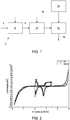
- the apparatus (2) may comprise an oxidation module (6) comprising at least one doped diamond electrode therein.
- the oxidation module may be configured to contact the aqueous stream (4) with the doped diamond electrode and to apply an oxidizing potential to the doped diamond electrode thereby oxidizing any organics in the aqueous stream to form an oxidized aqueous stream (8).
- the apparatus may also comprise a carbon dioxide measurement module (12) comprising at least one platinum electrode therein.
- the carbon dioxide measurement module may be configured to contact the oxidized aqueous stream with the platinum electrode and apply a cathodic potential to the platinum electrode and thereafter apply an anodic potential to the platinum electrode.
- the apparatus may also comprise a fluid transfer module (10) operatively connected to the oxidation module and the carbon dioxide measurement module and configured to transfer the oxidized aqueous stream from the oxidation module to the carbon dioxide measurement module.
- the fluid transfer module may comprise one or more fluid transfer components known to persons of ordinary skill in the art for assisting in transferring the aqueous stream. Such fluid transfer components include, but are not limited to, tubes, pipes, hoses, channels, valves, pumps, etc.
- the apparatus may also comprise a control module (14), operatively connected to the carbon dioxide measurement module and configured to measure an amperometric response of the platinum electrode and equating the amperometric response of the platinum electrode to a total organic content of the aqueous stream.
- control module may also be operatively connected to the oxidation and the fluid transfer modules (18).
- the control module may comprise a programmable logic controller or similar device and an electronics unit used to control the function of the other modules it is operatively connected to, take measurements, collect data, and make calculations.
- the aqueous stream (16) may leave the carbon dioxide measurement module.
- the platinum electrode may be platinized.
- the platinum electrode may be decorated with gold adatoms.
- the doped diamond electrode may be a boron-doped diamond electrode.
- the anodic potential may be an anodic potential sweep or an anodic potential step.
- the oxidizing potential may be a static anodic potential, an alternating potential waveform, or anodic potential pulses.
- the oxidation module may further comprise a dual-compartment cell, wherein the dual-compartment cell has a first compartment with an anode therein and a second compartment with a cathode therein.
- the dual-compartment cell may further comprise a conducting membrane that separates the first compartment from the second compartment.
- the conducting membrane may be a proton exchange membrane.
- Conductive boron-doped diamond is an example of a material with a high overpotential for oxygen evolution in aqueous solutions. Accordingly, this invention involves the use of boron doped-diamond (“BDD") electrodes for the electrochemical oxidation of the organics to CO 2 . Such electrodes have been shown to possess attractive properties over conventional electrodes, like platinum. Properties of BDD electrodes include superior chemical and mechanical stability, stability against corrosion, low and stable voltammetric background currents, and a wide working potential window stemming from the high overpotentials for both oxygen and hydrogen evolution reactions. Thus, oxidation of a broad range of compounds in aqueous solution is possible.
- BDD boron doped-diamond
- Electrochemical oxidation of organic compounds on doped diamond does not require harmful radiation or chemical oxidants as required in tradition UV- persulfate oxidation.
- BDD represents a safe, long lasting alternative to mercury vapor UV lamps which are environmentally hazardous and have a short service life.
- the oxidation module may have a pair of electrodes comprising a substrate material such as a rectangular silicon wafer coated with a doped-diamond film.
- the diamond dopant may be boron.
- the boron dopant serves to make the diamond electrically conductive.
- One of the boron-doped diamond (BDD) coated electrodes serves as an anode while the second BDD coated electrode serves as the cathode.
- the oxidation module may be a single-compartment cell where the analyte is directed through a single serpentine channel and allowed to contact the BDD anode and cathode in succession.
- An example of a suitable serpentine material is polychlorotrifluoroethylene (PCTFE).
- PCTFE polychlorotrifluoroethylene
- the serpentine provides electrical insulation between the two electrodes.
- the serpentine is constructed so as to maximize distance between the electrodes and maximize surface of the electrodes in contact with sample while keeping fluidic path volume to a minimum. With a single-compartment cell, there is no barrier separating the anode and cathode.
- the oxidation module may be a dual-compartment cell wherein a conductive membrane physically separates the anode and cathode.
- the analyte is restricted to contact only the anode for oxidation.
- the dual-compartment cell may have a first compartment and a second compartment therein, with a conducting membrane separating the first and second compartments. The purpose of the conducting membrane is to physically separate the oxidized aqueous sample from the cathode while allowing protons from the oxidized aqueous sample to permeate the membrane thereby closing the electrical circuit.
- a suitable conducting membrane is the proton exchange membrane made of a sulfonated tetrafluoroethylene based fluoropolymer, such as Nafion®, or membranes made of a similar material.
- the organics may be oxidized by applying a DC voltage between the anode and the cathode. Alternatively, the applied voltage may be in the form of a square wave.
- This invention also relates to an electrochemical CO 2 sensor to detect and quantify the CO 2 generated from the electrooxidation step.
- the principle behind the detection relies on the use of a Pt electrode to measure CO 2 electrochemically based on redox reactions.
- Conventional TOC instruments based on membrane conductometric detection methods require the use of membranes that allow CO 2 to selectively pass through it.
- the detection scheme of the present invention enables the user to avoid the use of a membrane, conductivity cell, and a DI water loop.
- the reduction of CO 2 leads to the formation of a layer of chemisorbed CO 2 , and the latter species is concentrated on the Pt electrode surface. This increases the sensitivity of the measurement process.
- the CO 2 electrochemical measurement scheme of the invention relies on the principle that some metal catalysts, such as platinum, may reduce CO 2 and irreversibly adsorb the reduction product(s).
- metal catalysts such as platinum
- CO 2 is concentrated on the surface of platinum-containing electrode as a chemisorbed layer by applying a cathodic potential.
- the chemisorbed layer is then oxidized to CO 2 by applying an anodic potential sweep.
- the electrical charge is measured and its magnitude correlated to the carbon concentration based on sample flow rate and the preconcentration step timing. Because the chemisorbed CO 2 oxidation signal occurs on the stripping curve in the same potential range where dissolved oxygen in sample is reduced, oxygen reduction is an interference.
- the oxygen reduction is proportional to the dissolved oxygen bulk concentration, while chemisorbed CO 2 reduction is proportional to the surface area of the electrode surface.
- the CO 2 surface signal is enhanced by increasing the surface area of the Pt electrode through platinization.
- the surface area of the Pt electrode may also be increased by decorating it with gold adatoms.
- the carbon dioxide measurement module comprises an electrochemical cell containing working, reference, and auxiliary electrodes
- the working electrode may be constructed of a material comprising platinum that reduces CO 2 and chemisorbs reduction products. Chemisorbed CO 2 is then oxidized back to CO 2 for quantification in an anodic stripping voltammetry sweep.
- the working electrode may be constructed of a material comprising platinized platinum.
- the working electrode may also be constructed of a mixture platinum (Pt) and gold (Au) or a platinum surface modified by decorating with gold adatoms. When the platinum surface is decorated with gold adatoms, individual gold atoms are adsorbed onto the platinum surface, increasing the roughness of the electrode, and thereby increasing the surface area.
- an apparatus for measuring total organic carbon in an aqueous stream may comprise an oxidation module comprising at least one doped diamond electrode therein.
- the oxidation module may be configured to contact the aqueous stream with the doped diamond electrode and to apply an oxidizing potential to the doped diamond electrode thereby oxidizing any organics in the aqueous stream to form an oxidized aqueous stream.
- the apparatus may also comprise a carbon dioxide measurement module comprising at least one platinum electrode therein.
- the carbon dioxide measurement module may be configured to contact the oxidized aqueous stream with the platinum electrode and to apply a cathodic potential and thereafter apply an anodic potential to the platinum electrode.
- the apparatus may also comprise a fluid transfer module operatively connected to the oxidation module and the carbon dioxide measurement module and configured to transfer the oxidized aqueous stream from the oxidation module to the carbon dioxide measurement module.
- the apparatus may also comprise a control module operatively connected to the carbon dioxide measurement module and configured to measure an amperometric response of the platinum electrode and to equate the amperometric response of the platinum electrode to a total organic content of the aqueous stream.
- the control module may be further operatively connected to the oxidation module and the fluid transfer module.
- the platinum electrode may be platinized. Alternatively, the platinum electrode may be decorated with gold adatoms.
- the doped diamond electrode may be a boron-doped diamond electrode.
- the anodic potential may be an anodic potential sweep or an anodic potential step.
- the oxidizing potential may be a static anodic potential, an alternating potential waveform, or anodic potential pulses.
- the oxidation module may further comprise a dual-compartment cell, wherein the dual-compartment cell has a first compartment with an anode therein and a second compartment with a cathode therein.
- the dual-compartment cell may further comprise a conducting membrane that separates the first compartment from the second compartment.
- the conducting membrane may be a proton exchange membrane.
- a system for measuring carbon dioxide an aqueous stream may comprise a memory and a processor operatively connected to the memory.
- the processor may be configured to receive inputs, such as an amperometric response of a platinum electrode, and use the inputs to generate outputs, such as a total organic content of an aqueous stream.
- the processor may be further configured to store the outputs in the memory.
- the inputs comprising an amperometric response may be generated by contacting an aqueous stream with a platinum electrode, applying a cathodic potential to the platinum electrode and then applying an anodic potential to the platinum electrode while maintaining contact with the aqueous stream.
- the platinum electrode may be platinized.
- the platinum electrode may be decorated with gold adatoms.
- the inputs may further comprise a background amperometric response.
- Set 1 discloses various embodiments of the oxidation module.
- Set 2 discloses various embodiments of the CO 2 measurement module.
- Example 1.1 demonstrates electrooxidation of organic compounds in water.
- Boron doped diamond (BDD) was used as the oxidizing electrode.
- a thin-film (app. 4 ⁇ m) of boron-doped diamond was vacuum-deposited on a polycrystalline silicon substrate (Adamant Technologies, Switzerland).
- the examples disclose multiple embodiments of oxidations cells suitable for use in the present invention.
- Example 1.1 bench-top experiments were performed with sulfuric acid as the electrolyte.
- the boron-doped diamond electrode comprised a doped-diamond film deposited on a polycrystalline silicon disk (3.7 mm).
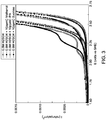
- FIG. 2 shows the cyclic voltammetry of a BBD disk as compared to a platinum disk, both in 0.5M H 2 SO 4 .
- the BDD shows its suitability for oxidation of organic compounds.
- the BDD electrode above was then used to oxidize various organic compounds.
- the same experimental setup as in Example 1.1 was used. Methanol, isopropanol and sucrose were chosen as the organic compounds for the experiments. (all Aldrich).
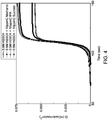
- Organics oxidation manifests itself on the anodic part of cyclic voltammograms. As shown on Fig. 3 , the different organic compounds generate different voltammograms.
- Methanol, isopropanol and sucrose showed oxidation in less anodic potentials than water oxidation. Without limiting this disclosure to one theory of operation, it is believed that the organics were directly oxidized on the electrode without water intermediates, i.e. OH radicals, leading to the resolution in the oxidation potential between the different compounds.
- FIG. 4 shows the coulometry of boron-doped diamond in aqueous solutions of various organic compounds.
- the two alcohols have a higher recovery than sucrose. However, this may be only an apparent difference as a result of one or more factors.
- One factor may be sucrose's different number of electrons needed to oxidize one carbon atom (electron to carbon ratio).
- the concentrations of the organics tested were based on carbon content. Therefore sucrose required less of a charge to transform into carbon dioxide than the alcohols.
- the electron to carbon ratios of the tested organic compounds are shown in the following equations.
- FIG. 5 shows the coulometry of BDD in 0.5M H 2 SO 4 with varying concentration of methanol (CH 3 OH). As can be seen in FIG. 5 , increased methanol concentration requires an increased charge for oxidation. There was no saturation or starvation observed even with 100 ppm C methanol.
- a bench-top TOC analyzer was built. It had the configuration shown in Figure 6 .
- Example 1.3 A the sample was directed through a single-compartment cell comprising a single serpentine channel and allowed to contact two electrodes in succession.
- FIG. 7 is a cross section of a single-compartment cell with a flow insert and a rectangular doped diamond electrodeplate.
- FIG. 8 shows an exploded view of an embodiment of a single-compartment cell.
- the electrodes were rectangular polycrystalline silicon wafers (2.5 x 5 cm) coated with boron-doped diamond deposits (Adamant Technologies, Switzerland).
- the serpentine channel also referred to as an "insert” or “flow insert”, made from polychlorotrifluoroethylene (PCTFE) (Neoflon, Daikin Industries) provided electrical insulation between the two electrodes.
- PCTFE polychlorotrifluoroethylene
- the single-compartment cell was constructed in a way to maximize the distance between the electrodes and maximize the surface of the electrodes in contact with sample while minimizing the fluid path volume.
- the achieved fluid path volume was 0.525 ml and the electrode surface area exposed to sample was 1.886 cm 2 per electrode.
- Aqueous solutions of methanol, potassium hydrogen phthalate (KHP), sucrose and urea were oxidized using the single-compartment oxidation cell.
- the concentration of all the solutions was 3 ppm C.
- the electrolyte was 0.5 M H 2 SO 4 .
- a DC voltage of 5.5 V was chosen as generating the highest oxidation efficiencies.
- the sample flow rate was 50 ⁇ l/min with a corresponding residence time of 10.5 minutes.
- the TOC recoveries of various aqueous solutions are shown in FIG. 9 .
- the %TOC recovery was approximately 34% for methanol and urea, 23% for KHP, and 15% for sucrose.
- FIG. 10 shows the relative % TOC recovery of the tested compounds normalized to methanol.
- the recoveries of sucrose and KHP are low, with sucrose's TOC recovery under 50%of that of methanol.
- the low recoveries may be the result of formation of intermediates during oxidation that form redox couples. These couples may undergo repeated oxidation-reduction when passing over anode and cathode. As a result, oxidation may not be complete and the intermediates may exit the oxidation module producing the observed lower TOC recoveries.
- Example 1.3 B a dual-compartment cell that separated oxidation from reduction was tested.
- the schematic of the prototype TOC analyzer with a dual-compartment cell is shown in FIG. 11 .
- the dual-compartment cell (30) comprised an anode (32) and cathode (34), one flow channel wherein the sample contacts only the anode, and one flow channel wherein the sample contacts only the cathode.
- a proton exchange membrane (36) separated the two channels while maintaining continuity of the electrical circuit (Nafion® N117, Ion Power).
- the Ag/AgCI reference electrode (38) was placed outside the oxidation cell and contacted the sample before the anode (32).
- the dual-compartment cell is an expansion of the single-compartment cell in Example 1.3 A.
- a cross section of the dual-compartment cell with two flow inserts is shown in FIG. 12 .
- FIG. 13 shows an exploded view of the dual-compartment cell.
- a Nafion® membrane (not shown) was placed between the two flow inserts to separate the anode from the cathode.
- the electrode surface area exposed to the sample did not change (1.886 cm 2 ).
- the fluid path volume nearly doubled to 0.942 ml per side.
- the channel depth adjacent to the Nafion® membrane increased in size for the double-partition cell to maintain sample flow. The enlargement was dictated by the Nafion® membrane's tendency to expand when exposed to water or other solvents. As the membrane expands, it may restrict sample flow in the channels adjacent to it.
- Example 1.3 B the applied voltage was controlled by a potentiostat (Solartron 1280B). Aqueous solutions of methanol, potassium hydrogen phthalate, sucrose and urea (all Aldrich) were oxidized using the dual-compartment cell. The concentrations of all the solutions were 3 ppm C. The electrolyte was 0.5 M H 2 SO 4 .
- the dual-compartment cell performance was also tested for higher TOC concentrations.
- the response for sucrose is shown in FIG. 15 .
- the range tested (3 - 50 ppm C) there is almost a perfect linear response.
- Example Set 2 demonstrate how dissolved organic carbon is measured by electrochemical methods. More specifically, the examples show how carbon present in the analyte may form a self-assembled layer (submonolayer) of chemisorbed carbon monoxide on the surface of an anode in the preconcentration step followed by stoichiometric oxidation to carbon dioxide in the anodic stripping step.
- Example 2.1 experiments were performed in a conventional electrochemical cell.
- a 3-mm platinized platinum disk fitted in a PEEK housing served as working electrode.
- Platinized platinum gauze, 1 in. x 1 in. was used as an auxiliary electrode.
- a cross-section of a 0.5-mm diameter silver wire covered with silver chloride was the reference electrode.
- Both working and reference electrodes were part of a flow cell (BAS).
- a solution of 0.5 M H 2 SO 4 made a supporting electrolyte.
- the cell was controlled by a potentiostat (Solartron 1280B).
- the system suitability was checked by cyclic voltammetry shown in FIG. 16 .
- the potential sweep rate was 100 mV/sec.
- the next step was to saturate solution with gaseous CO 2 .
- the voltammetric response in these conditions, together with background curve (no CO 2 present), is presented in FIG. 17 .
- the CO 2 influenced cyclic voltammetry in two regions: 1) a decrease in the hydrogen ionization cluster peaks in the cathodic part of the curve, and 2) an appearance of additional oxidation peak in the anodic part of the curve.
- the cyclic voltammetry of the test system changes for the following reasons. Carbon dioxide present in the solution cannot be further oxidized and remains inactive during anodic polarization of the platinum. However, carbon dioxide is reduced on cathodic polarized platinum to form "reduced chemisorbed species". Formation of these species proceeds through displacement of hydrogen chemisorbed on the electrode. The current associated with the reduction is small because the process is diffusion limited and cannot be directly recorded during voltammetry experiments. But, a decrease in hydrogen surface coverage is recorded in the form of decreased hydrogen ionization peaks. The chemisorbed species derived from carbon dioxide remains on the surface until the potential threshold for adsorbed water oxidation on platinum is reached. Oxidation of the chemisorbed species occurs just before the platinum is oxidized.
- the CO 2 -specific analytical signal to be used is the oxidation peak of the chemisorbed CO 2 -derrived species.
- the reduction in hydrogen coverage is not CO 2 specific because many potentially interfering compounds present in sample water may displace adsorbed hydrogen as well.
- the chemisorption of CO 2 during cyclic voltammetry is inadequate to produce a significant analytical signal for lower CO 2 concentrations.
- the potential-time program is shown in FIG. 18 .
- the potentiostatic adsorption step (“Adsorption”), the cyclic voltammetry step (“Stripping”) and the background scans (“Background 1" and “Background 2”) are shown in the potential-time program.
- Cyclic voltammetry is used in the full potential range instead of a classic anodic-only voltammetric stripping sweep in order to ensure reproducibility of the electrode conditions for both analytical and background sweeps.
- the CO 2 detection scheme includes an initial cyclic voltammetric sweep provided for monitoring the correctness of the whole system prior to each experiment. This step is not used for analytical purposes.
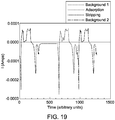
- the current needed to execute a potential-time program is shown in FIG. 19 .
- An oxidation peak that serves as an analytical signal can be easily identified on the anodic voltammetric stripping portion of the cycle ("Stripping") in comparison to the background scans ("Background 1" and "Background 2"). As expected, both the Background 1 and Background 2 background scans are almost identical.
- an alternative potential-time program exits. It is possible to execute a potential double-anodic step instead of a stripping voltammetric potential sweep.
- Example 2.3 Several factors may affect CO 2 measurement using flow-through testing equipment. These factors must be understood before the CO 2 measurements are made so testing parameters may be developed to compensate for the effects. The experiments in Example 2.3 are aimed at understanding the CO 2 measurement system's background response and developing the appropriate measurement parameters for flow-through testing.
- the system dependency on concentration of the supporting electrolyte (H 2 SO 4 ) is shown in FIG. 20 .
- An acidified sample was directed through the flow-through sensor by using a syringe.
- the potential sweep rate was 10 mV/sec.
- the sample flow rate was 100 ⁇ l/min.
- the voltammogram at an acid concentration of 0.1 M has all the features of platinum voltammetric behavior; therefore the H 2 SO 4 at a concentration of at least 0.1 M was accepted for further experiments.
- Sample flow rate is a factor that affects CO 2 measurement. Oxygen dissolved in a sample (for samples exposed to air) reduces on platinum. The corresponding reduction current is proportional to the apparent concentration of oxygen on the surface of the electrode. In stationary conditions (no electrolyte replenishment or mixing), a diffusion layer develops, bringing the oxygen surface concentration down to zero and minimizing reduction current. Stationary conditions are often referred to as "stop flow" conditions in this disclosure. This stop flow situation is illustrated in FIG. 21.
- FIG. 21 shows the cyclic voltammetry of an flow-through system in 0.1M of H 2 SO 4 . The potential sweep rate was 40 mV/ sec. Sample flow rates are indicated on the graph.
- the CO 2 signal may be amplified leaving the oxygen reduction signal unchanged.
- Anodic stripping voltammetry with preconcentration takes advantage of producing surface species for oxidation. This makes the analytical signal independent from the electrolyte bulk concentration and diffusion of any interfering species.
- Anodic stripping voltammetry is dependent on the surface coverage of adsorbed species, which, in the case of CO 2 surface species, are irreversibly chemisorbed on platinum.
- a well-known process of platinizing the platinum results in an enlargement of the electrode real surface area by increasing the electrode roughness. Surface currents are increased by orders of magnitude leaving the bulk solution currents unaffected. This results in an oxygen reduction process that is below the detection limit.
- FIG. 22 Voltammetry of a flow-through sensor after platinization in 0.1 M H 2 SO 4 is shown in FIG. 22 .
- the sample flow rate was 100 ⁇ l/min and the potential sweep rate was 40 mV/sec.
- a voltammogram for the same electrode before platinization is also shown.
- the surface area of the original electrode was 0.19 cm 2 and after platinization 13.5 cm 2 (geometric area was 0.07 cm 2 ). Therefore, the electrode surface area was increased approximately 70 times. In other words, the surface concentration of CO 2 derived species was increased so the species could be detected while the oxygen related current remained at the background level.
- FIG. 23 presents cyclic voltammetry for the CO 2 sensor recorded flow-through with varying potential sweep rates.
- the solution was 0.1 M H 2 SO 4 with a flow rate of 100 ⁇ l/min.
- the current features of platinum are shifted with applied potential sweep rate.
- the CO 2 related current clearly visible during a slow scan ( FIG. 23 , insert), overlaps with the platinum oxidation characteristic during faster scans. This is an indication of insufficient electrolyte conductivity for larger currents or faster scan rates.
- slower sweep rates that allow slower reactions to proceed in real time equilibrium conditions are preferred.
- the electrode potential at which reduction and chemisorption of CO 2 occurs affects the reaction kinetics of those processes, and thus, accumulation of surface CO 2 species. Conditions that allow CO 2 to adsorb exclusively in the form of surface bonded CO with the highest efficiency are preferred. The choice of platinum also helps the efficiency of surface CO formation, and the addition of gold adatoms increases the efficiency even further.
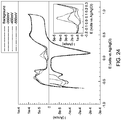
- FIG. 24 shows the response of an online CO 2 sensor in a 0.1 M H 2 SO 4 solution with 450 ppb C CO 2 .
- the solution flow rate was 133 ⁇ l/min.
- the potential sweep rate was 10 mV/sec.
- An adsorption process was conducted in potentials of -350 mV, -450 mV, and -550 mV (vs. Ag/AgCl).
- the adsorption time was 10 min.
- Oxidation peaks are presented in FIG. 24 and their numerical values are in FIG. 25 .
- the insert in FIG. 24 is an enlarged view of the stripping current peak. At a potential of -450 mV, the maximum efficiency occurs. The effective CO 2 recovery is close to 20%.
- the CO 2 signal is also affected by adsorption time.
- the efficiency of collection of the CO 2 derived species as a function of adsorption time is presented in FIG. 26 .
- a 0.1 M H 2 SO 4 solution with a CO 2 concentration of 100 ppb C was chosen for these experiments.
- the solution flow rate through the sensor was 130 ⁇ l/min.
- the potential sweep rate was 10 mV/sec and the adsorption potential was -450 mV vs. Ag/AgCl.
- the efficiency of CO 2 collection is at its maximum for the shortest times investigated. It is close to 30% for 1 minute adsorption and then decreases with increasing adsorption time. This trend is illustrated in FIG. 27 which shows the CO 2 collection efficiency as a function of adsorption time in a 0.1 M H 2 SO 4 solution with a CO 2 concentration of 100 ppb C. With the sensor active volume of 360 ⁇ l and the sample flow rate at 130 ⁇ l/min, the sample residence time at the sensor is less than 3 minutes. Hence, the decrease in collection efficiency is not related to sample diffusion problems, but to the electrode's energy heterogeneity. The activity towards adsorbing CO 2 species decreases with surface coverage with chemisorbed CO 2 . The kinetic effects of a decreasing available electrode surface are shown in FIG. 28 .
- the CO 2 kinetic detection limit is shown in FIG. 29 .
- Adsorption of a low concentrated CO 2 solution, 18 ppb C in the given graph, is barely detectable on the stripping voltammogram after 10 minutes. However, after 1 hour of adsorption, CO ads accumulation reached a detectable level.
- FIG. 30 Sensor response to different CO 2 levels in the sample is shown in FIG. 30 .
- the solution was a 0.1 M H 2 SO 4 solution with a flow rate through the sensor of 40 ⁇ l/min.
- the potential sweep rate was 10 mV/sec and the adsorption potential was -450 mV.
- the adsorption time was 10 minutes.
- the efficiency is close to 20% in most cases ( FIG. 31 ). The exceptions are the lowest and highest concentrations.
- the data point for the lowest concentration may have a detection limit error, and likely not very reliable.
- the problem may be due to the electrode changing activity (as discussed previously).
- FIG. 32 shows various linear calibration curves for the sensor.
Landscapes
- Chemical & Material Sciences (AREA)
- Health & Medical Sciences (AREA)
- Life Sciences & Earth Sciences (AREA)
- Pathology (AREA)
- General Physics & Mathematics (AREA)
- Immunology (AREA)
- Physics & Mathematics (AREA)
- Analytical Chemistry (AREA)
- Biochemistry (AREA)
- General Health & Medical Sciences (AREA)
- Engineering & Computer Science (AREA)
- Food Science & Technology (AREA)
- Medicinal Chemistry (AREA)
- Molecular Biology (AREA)
- Chemical Kinetics & Catalysis (AREA)
- Electrochemistry (AREA)
- Combustion & Propulsion (AREA)
- Investigating Or Analyzing Non-Biological Materials By The Use Of Chemical Means (AREA)
- Electrolytic Production Of Non-Metals, Compounds, Apparatuses Therefor (AREA)
Abstract
Description
- The invention relates to the field of determining the concentration of organic contaminants in a water sample matrix by measuring total organic carbon (TOC) using electrochemical oxidation and detection methods.
- Water quality is often indicated by the total organic carbon (TOC) present in the sample. Total organic carbon (TOC) is a well-established water quality parameter that quantifies the overall concentration of organic substances, all of which are typically regarded as contaminants. In most aqueous samples, such as drinking water, raw water, wastewater, industrial process streams, and the like, the total carbon (TC) is the sum of the amount of total organic carbon (TOC) and the amount of inorganic carbon (IC) present in the sample.
- Most TOC measurement techniques involve 3 steps: first, measure the concentration of inorganic carbon (i.e. carbon in all the forms of dissolved carbon dioxide); second, oxidize organics in sample water to CO2; and third, measure the CO2 derived from the organics. Some instruments, however, allow for the acidification of the sample and purge CO2 so that the inorganic carbon (IC) concentration is not measured. Oxidation of the organics in the water sample is traditionally achieved by UV radiation (with or without a chemical oxidizer present), combustion, or heat treatment (with or without catalysts or oxidizing agents). Mercury vapor lamps used in UV radiation cause harmful radiation and have a short service life. UV-persulfate oxidation adds harmful chemical oxidants.
- Use of electrochemical methods has become an attractive alternative to traditional methods for treating water that contains dissolved organic compounds. Generally, organic pollutants dissolved in the water can be destroyed electrochemically by direct anodic oxidation at the electrode surface or indirectly through oxidation processes mediated by electrogenerated oxidants. The compound's oxidation potential and the choice of electrode material both influence where oxidation is by direct or indirect means. Classical electrode materials like platinum tend to suffer from several problems when used during electrolytic oxidation. Slow reaction rates, low efficiencies, and deactivation of the surface are possible. Corrosion during anodic polarization may also occur. Platinum offers a limited anodic range making direct organic oxidation problematic.
- Conventional methods to measure inorganic carbon (CO2, H2CO3,


- Conductivity detectors measure CO2 in the water sample and may be divided into two groups: direct and membrane-based conductivity. The direct conductivity method is susceptible to interference from the ionic content of water from other sources besides CO2. In the membrane-based conductometric method, a CO2-permeable membrane is located between the sample water chamber and the deionized water acceptor chamber to separate the CO2 from the sample matrix. The membrane selectively passes only CO2 and serves as a protective barrier to interfering substances in the liquid.
- Most TOC analyzers that operate based on combustion oxidation and conventional measurement techniques are typically, large, complex, and costly instruments. Many TOC analyzers are laboratory units. These units are not portable or suitable for "field use", wherein the instruments are brought to the water system being tested and are used to test the system for a short period of time. Instead, samples must be brought to the analyzer for testing in a controlled environment. Many TOC analyzers are not easily adapted to an "on-line" system wherein the instrument is placed in the water system being tested and aqueous samples may be tested and monitored automatically, without human intervention.
- TOC analyzers may also be classified as "flow-through" or "batch" instruments. The term "flow-through" is used to describe an instrument wherein the samples are flowing samples streams as opposed to "batch" wherein the samples are collected and analyzed. In flow-through instruments, the sample may flow continuously through the instrument as it is analyzed and may be returned to the sample source or directed elsewhere for treatment or disposal. Many flow-through instruments, however, may also have an auto sampler wherein the samples are collected and analyzed, allowing the instrument to operate as a batch instrument.
- Accordingly, methods, apparatuses, and systems are disclosed that are not only suitable for laboratory use, but are also suitable for portable, on-line, or flow-through applications. In one embodiment, a method for measuring carbon dioxide in an aqueous stream is disclosed. The method may comprise providing an aqueous stream, wherein any organic carbon has been oxidized therein and providing a carbon dioxide measurement module comprising at least one platinum electrode therein. The aqueous stream may be contacted with the platinum electrode. A cathodic potential followed by an anodic potential may be applied to the platinum electrode while maintaining contact of the platinum electrode with the aqueous stream. The amperometric response of the platinum may be measured and equated to a total organic carbon content of the aqueous stream. In another embodiment, the anodic potential may be an anodic potential sweep or an anodic potential step. In another embodiment, the platinum electrode may be platinized. Alternatively, the platinum electrode may be decorated with gold adatoms. In yet another embodiment, the organic carbon in the aqueous stream may be oxidized using a method selected from the group consisting of electrooxidation, chemical oxidation, UV-persulfate oxidation, thermal oxidation, and catalytic oxidation. In another embodiment, the method may further comprise adding an electrolyte to the aqueous stream before applying the cathodic potential to the platinum electrode. In yet another embodiment, the electrolyte may comprise an acid, such as sulfuric acid.
- In yet another method embodiment, the total organic carbon in an aqueous stream may be measured. The method may comprise providing an aqueous stream, providing an oxidation module comprising at least one doped diamond electrode therein, and providing a carbon dioxide measurement module comprising at least one platinum electrode therein. The method may comprise contacting the aqueous stream with the doped diamond electrode in the oxidation module and applying an oxidizing potential to the doped diamond electrode to oxidize any organics in the aqueous stream and form an oxidized aqueous stream. The oxidized aqueous stream may then be transferred from the oxidation module to the carbon dioxide measurement module. The method may also comprise contacting the oxidized aqueous stream with the platinum electrode and applying a cathodic potential followed by applying an anodic potential to the platinum electrode. The method may also comprise measuring an amperometric response of the platinum electrode and equating the amperometric response of the platinum electrode to a total organic content of the aqueous stream. In another embodiment, a method is disclosed wherein the platinum electrode may be platinized. Alternatively, the platinum electrode may be decorated with gold adatoms. In yet another embodiment, the doped diamond electrode may be a boron-doped diamond electrode. In another embodiment, the method may further comprise adding an electrolyte to the aqueous stream or the oxidized aqueous stream before applying the cathodic potential to the platinum electrode. In yet another method embodiment, the electrolyte may comprise an acid, such as sulfuric acid. In another method the anodic potential may be an anodic potential sweep or an anodic potential step. In yet another embodiment, the oxidizing potential may be a static anodic potential, an alternating potential waveform, or anodic potential pulses.
- In another embodiment, an apparatus for oxidizing organics in an aqueous stream is disclosed. The apparatus may comprise an oxidizing module comprising a dual-compartment cell therein. The dual-compartment cells may have a first compartment with a doped diamond anode therein and a second compartment with a cathode therein. The oxidation module may be configured to contact the aqueous stream with the doped diamond electrode and to apply an oxidizing potential to the doped-diamond anode, thereby oxidizing any organics in the aqueous stream to form an oxidized aqueous stream. In another embodiment, the dual-compartment cell may further comprise a conducting membrane separating the first and second compartments. The conducting membrane may be a proton exchange membrane. In yet another embodiment, the oxidizing potential may be a static anodic potential, an alternating potential waveform, or anodic potential pulses. In another embodiment, the doped diamond anode may be a boron-doped diamond anode.
- In another embodiment, an apparatus for measuring total organic carbon in an aqueous stream is disclosed. The apparatus may comprise an oxidation module comprising at least one doped diamond electrode therein. The oxidation module may be configured to contact the aqueous stream with the doped diamond electrode and to apply an oxidizing potential to the doped diamond electrode thereby oxidizing any organics in the aqueous stream to form an oxidized aqueous stream. The apparatus may also comprise a carbon dioxide measurement module comprising at least one platinum electrode therein. The carbon dioxide measurement module may be configured to contact the oxidized aqueous stream with the platinum electrode and to apply a cathodic potential and thereafter apply an anodic potential to the platinum electrode. The apparatus may also comprise a fluid transfer module operatively connected to the oxidation module and the carbon dioxide measurement module and configured to transfer the oxidized aqueous stream from the oxidation module to the carbon dioxide measurement module. The apparatus may also comprise a control module operatively connected to the carbon dioxide measurement module and configured to measure an amperometric response of the platinum electrode and to equate the amperometric response of the platinum electrode to a total organic content of the aqueous stream. In yet another embodiment, the control module may be further operatively connected to the oxidation module and the fluid transfer module. In another embodiment of the apparatus, the platinum electrode may be platinized. Alternatively, the platinum electrode may be decorated with gold adatoms. In another embodiment, the doped diamond electrode may be a boron-doped diamond electrode. In another embodiment, the anodic potential may be an anodic potential sweep or an anodic potential step. The oxidizing potential may be a static anodic potential, an alternating potential waveform, or anodic potential pulses. In yet another embodiment, the oxidation module may further comprise a dual-compartment cell, wherein the dual-compartment cell has a first compartment with an anode therein and a second compartment with a cathode therein. In another embodiment, the dual-compartment cell may further comprise a conducting membrane that separates the first compartment from the second compartment. The conducting membrane may be a proton exchange membrane.
- In another embodiment, a system for measuring carbon dioxide an aqueous stream is disclosed. The system may comprise a memory and a processor operatively connected to the memory. The processor may be configured to receive inputs, such as an amperometric response of a platinum electrode, and use the inputs to generate outputs, such as a total organic content of an aqueous stream. The processor may be further configured to store the outputs in the memory. The inputs comprising an amperometric response may be generated by contacting an aqueous stream with a platinum electrode, applying a cathodic potential to the platinum electrode and then applying an anodic potential to the platinum electrode while maintaining contact with the aqueous stream. In another system embodiment, the platinum electrode may be platinized. Alternatively, the platinum electrode may be decorated with gold adatoms. In yet another system embodiment, the inputs may further comprise a background amperometric response.
-
-
FIG. 1 shows an embodiment of a total organic carbon analyzer. -
FIG. 2 shows the cyclic voltammetry of boron-doped diamond disk and platinum disk in 0.5M H2SO4. -
FIG. 3 shows the voltammetry of boron-doped diamond in acidic solutions of various organic compounds. -
FIG. 4 shows the coulometry of boron-doped diamond in acidic solutions of various organic compounds. -
FIG. 5 shows the coulometry of boron-doped diamond in 0.5M H2SO4 with varying concentrations of CH3OH. -
FIG. 6 shows an embodiment of a TOC analyzer. -
FIG. 7 shows a cross section of an embodiment of an oxidation module comprising a single-compartment cell. -
FIG. 8 shows an exploded view of an embodiment of an oxidation module comprising a single-compartment cell. -
FIG. 9 shows the recovery of 3 ppm C of aqueous solutions of various organic compounds at a flow rate of 50 µl/min. -
FIG. 10 shows the relative recovery of 3 ppm C of selected compounds normalized to the recovery of 3 ppm C of methanol. -
FIG. 11 shows an embodiment of a TOC analyzer with oxidation module with separated oxidation and reduction compartments. -
FIG. 12 shows a cross section of an embodiment of an oxidation module comprising a dual-compartment cell. -
FIG. 13 shows an exploded view of an embodiment of an oxidation module comprising a dual-compartment cell. -
FIG. 14 shows the relative recovery of 3 ppm C of selected compounds in a Nafion®-separated dual-compartment cell. -
FIG. 15 shows the sucrose concentration recovery in a Nafion®-separated oxidation cell. -
FIG. 16 shows the cyclic voltammetry of platinum in 0.5M H2SO4 recorded in a conventional electrochemical environment. -
FIG. 17 shows the cyclic voltammetry of platinum in 0.5M H2SO4 with and without CO2 present (background response). -
FIG. 18 shows an embodiment of a potential-time program applied to platinum in a CO2 detection module. -
FIG. 19 shows the current response to the potential-time program presented inFig. 18 . -
FIG. 20 shows the cyclic voltammetry of a "flow-through" embodiment of the CO2 detection module. -
FIG. 21 shows the cyclic voltammetry of a flow-through system in 0.1M of H2SO4 at different flow rates. -
FIG. 22 shows the cyclic voltammetry comparison of a smooth platinum electrode and a platinized platinum electrode in a conventional electrochemical environment. -
FIG. 23 shows the cyclic voltammetry of a flow-through embodiment of a CO2 sensor in 0.1M H2SO4 at different potential sweep rates. -
FIG. 24 shows the cyclic voltammetry of a flow-through embodiment of a CO2 sensor in 0.1M H2SO4 after applying cathodic step at different potentials. -
FIG. 25 is the CO2 sensor response to 450 ppb C carbon dioxide as a function of adsorption potential. -
FIG. 26 shows the anodic stripping peak of a flow-through embodiment of a CO2 sensor as a function of adsorption time at a sample CO2 concentration of 100 ppb C. -
FIG. 27 shows the CO2 collection efficiency as a function of adsorption time at a sample CO2 concentration of 100 ppb C. -
FIG. 28 shows the kinetics of CO2 adsorption, at a sample CO2 concentration of 100 ppb C. -
FIG. 29 shows the anodic stripping peak of a flow-through embodiment of a CO2 sensor as a function of adsorption time at a sample CO2 concentration of 18 ppb C. -
FIG. 30 shows the anodic stripping peak of a CO2 sensor as a function of sample CO2 concentration. -
FIG. 31 shows the CO2 collection efficiency as a function of sample CO2 concentration. -
FIG. 32 shows various calibration curves of an embodiment of a CO2 sensor. - Methods, apparatuses, and systems are disclosed that are not only suitable for laboratory use, but are also suitable for portable, on-line, or flow-through applications. The invention relates to determining the total concentration of organic contaminants in water by measuring total organic carbon (TOC) using electrochemical methods. The invention may comprise a carbon electrooxidation scheme, a CO2 electrochemical measurement scheme, or a combination of the two schemes.
- The principle behind an electrochemical approach to CO2 electrochemical measurements lies in the physicochemical properties of carbon:
- ✔ Carbon atoms can easily change oxidation stage by exchanging electrons with electrodes;
- ✔ Carbon at its highest oxidation stage (+4) forms exclusively carbon dioxide;
- ✔ Carbon dioxide exhibits no specific adsorption on variety of catalytic metals; and
- ✔ Carbon at lower oxidation stages (+2 in carbon monoxide, but not limited to it) chemisorbs on most catalytic materials (this process is often referred to as poisoning).
- The disclosed TOC measurements comprise three separate steps in which carbon undergoes electrocatalytic reactions. The first step transforms all organic carbon to carbon dioxide in a heterogeneous oxidation step. This step is demonstrated in
Example Set 1. The second step performs two tasks: reduce carbon dioxide to carbon monoxide; and concentrate carbon monoxide on the surface of the electrode. The third step, like the first step, is an oxidation reaction. The second and third steps are demonstrated inExample Set 2. - As noted above, the first and third steps are oxidation steps. The oxidation in the third step, however, takes place in a different environment than in the first step. In the third step, carbon monoxide adsorbed on the platinum electrode surface is oxidized to carbon dioxide in an anodic stripping process. Step three must occur in connection with step two. Since all substrate carbon is present as carbon monoxide chemisorbed at the electrode surface, there is a direct proportionality between electrical charge used in step three and TOC concentration.
- The entire process comprising the above three steps may be described as electrooxidation, followed by chemisorption, followed by anodic stripping voltammetry.
- In TOC measurements, electro-oxidation is performed first. The reaction is carried out in the conditions optimized for converting most of the analyte's carbon into carbon dioxide as in Formula I:

- where R denotes organic carbon compounds, including but not limited to, isopropyl alcohol, methanol, and sucrose;
- cat 1 is an electrode comprising a material including, but not limited to, boron doped diamond, nitrogen doped diamond, platinum; and
- x,y, and z are stoichiometric values that may vary with R.
- In the chemisorption step, reduction leads to the formation of the layer of chemisorbed carbon monoxide (often referred as catalyst poisoning) as in Formula II:

In the application presented here, the formation of irreversible platinum and chemisorbed carbon monoxide bonding may be used for concentrating carbon on the platinum surface. - Once chemisorbed carbon monoxide is formed, it can be quantified in the oxidation process. Unlike the initial oxidation process, the reoxidation process is fast and stoichiometric. All analyte is in the form of carbon monoxide and is already present on the reaction surface. Therefore, the kinetics of this process has no diffusion limitations as in Formula III.

- When the CO is reoxidized, the electrical charge is measured. There is a straight forward correlation between the oxidation charge and carbon concentration based on the analyte's flow rate and the chemisorption step duration.
- Accordingly, in one embodiment, a method for measuring carbon dioxide in an aqueous stream is disclosed. The method may comprise providing an aqueous stream, wherein any organic carbon has been oxidized therein and providing a carbon dioxide measurement module comprising at least one platinum electrode therein. The aqueous stream may be contacted with the platinum electrode. A cathodic potential followed by an anodic potential may be applied to the platinum electrode while maintaining contact of the platinum electrode with the aqueous stream. The amperometric response of the platinum may be measured and equated to a total organic carbon content of the aqueous stream. In another embodiment, the anodic potential may be an anodic potential sweep or an anodic potential step. In another embodiment, the platinum electrode may be platinized. Alternatively, the platinum electrode may be decorated with gold adatoms. Traditional oxidation methods well known in the art, such as UV-persulfate oxidation, may be combined with the CO2 electrochemical measurement. Accordingly, in yet another embodiment, the organic carbon in the aqueous stream may be oxidized using a method selected from the group consisting of electrooxidation, chemical oxidation, UV-persulfate oxidation, thermal oxidation, and catalytic oxidation. In another embodiment, the method may further comprise adding an electrolyte to the aqueous stream before applying the cathodic potential to the platinum electrode. In yet another embodiment, the electrolyte may comprise an acid, such as sulfuric acid.
- In yet another method embodiment, the total organic carbon in an aqueous stream may be measured. The method may comprise providing an aqueous stream, providing an oxidation module comprising at least one doped diamond electrode therein, and providing a carbon dioxide measurement module comprising at least one platinum electrode therein. The method may comprise contacting the aqueous stream with the doped diamond electrode in the oxidation module and applying an oxidizing potential to the doped diamond electrode to oxidize any organics in the aqueous stream and form an oxidized aqueous stream. The oxidized aqueous stream may then be transferred from the oxidation module to the carbon dioxide measurement module. The method may also comprise contacting the oxidized aqueous stream with the platinum electrode and applying a cathodic potential followed by applying an anodic potential to the platinum electrode. The method may also comprise measuring an amperometric response of the platinum electrode and equating the amperometric response of the platinum electrode to a total organic content of the aqueous stream. In another embodiment, a method is disclosed wherein the platinum electrode may be platinized. Alternatively, the platinum electrode may be decorated with gold adatoms. In yet another embodiment, the doped diamond electrode may be a boron-doped diamond electrode. In another method the anodic potential may be an anodic potential sweep or an anodic potential step. In yet another embodiment, the oxidizing potential may be a static anodic potential, an alternating potential waveform, or anodic potential pulses.
- In another embodiment, the method may further comprise adding an electrolyte to the aqueous stream or the oxidized aqueous stream. Whether or not an electrolyte is required will depend on the application and the specific analyte being tested. Conductive analytes may not require an additional electrolyte. If the analyte is not sufficiently conductive, adding an electrolyte may improve the conductivity of the analyte, thereby allowing the CO2 to be measured electrochemically. Accordingly, the electrolyte may be added to the oxidized aqueous stream before applying the cathodic potential to the platinum electrode. Any electrolyte is suitable, including solutions of acids, bases and salts. In cases where the electrolyte is sulfuric acid or hydrochloric acid, it may even improve the oxidation process. In the case of sulfuric acid, the sulfuric acid will oxidize to a peroxysulfuric acid (i.e. peroxymonosulfuric or peroxydisulfuric) when the oxidation potential is applied to the doped diamond electrode. Pesulfate ions act as oxidizing agents in many in-situ chemical oxidation applications, including UV light oxidation. Accordingly, the electrolyte may be added to the aqueous stream before the oxidation potential is applied. If the electrolyte is added before the oxidation step, additional electrolyte may not be required in the CO2 measurement step. Thus, in another embodiment, the method may comprise adding an electrolyte to either the aqueous stream before applying said oxidation potential, or to the oxidized aqueous stream before applying said cathodic potential. In yet another method embodiment, the electrolyte may comprise an acid, such as sulfuric acid.
- In another embodiment, an apparatus for oxidizing organics in an aqueous stream is disclosed. The apparatus may comprise an oxidizing module comprising a dual-compartment cell therein. The dual-compartment cells may have a first compartment with a doped diamond anode therein and a second compartment with a cathode therein. The oxidation module may be configured to contact the aqueous stream with the doped diamond electrode and to apply an oxidizing potential to the doped-diamond anode, thereby oxidizing any organics in the aqueous stream to form an oxidized aqueous stream. In another embodiment, the dual-compartment cell may further comprise a conducting membrane separating the first and second compartments. The conducting membrane may be a proton exchange membrane. In yet another embodiment, the oxidizing potential may be a static anodic potential, an alternating potential waveform, or anodic potential pulses. In another embodiment, the doped diamond anode may be a boron-doped diamond anode.
- In another embodiment, an apparatus for measuring total organic carbon in an aqueous stream is disclosed. The apparatus may comprise two consecutive reaction modules. The first module, or "oxidation" module, may be an electrochemical cell with conditions optimized to convert the analyte's carbon to carbon dioxide by electrochemical oxidation. The second module, or "carbon dioxide measurement" module, may be an electrochemistry-based CO2 sensor where the dissolved CO2 produced is detected and quantified. The analyte, or sample, may be an aqueous stream. The analyte with carbon oxidized to CO2 in the oxidation module is then fed to the carbon dioxide measurement module.
- As shown in
FIG.1 , the apparatus (2) may comprise an oxidation module (6) comprising at least one doped diamond electrode therein. The oxidation module may be configured to contact the aqueous stream (4) with the doped diamond electrode and to apply an oxidizing potential to the doped diamond electrode thereby oxidizing any organics in the aqueous stream to form an oxidized aqueous stream (8). The apparatus may also comprise a carbon dioxide measurement module (12) comprising at least one platinum electrode therein. The carbon dioxide measurement module may be configured to contact the oxidized aqueous stream with the platinum electrode and apply a cathodic potential to the platinum electrode and thereafter apply an anodic potential to the platinum electrode. The apparatus may also comprise a fluid transfer module (10) operatively connected to the oxidation module and the carbon dioxide measurement module and configured to transfer the oxidized aqueous stream from the oxidation module to the carbon dioxide measurement module. The fluid transfer module may comprise one or more fluid transfer components known to persons of ordinary skill in the art for assisting in transferring the aqueous stream. Such fluid transfer components include, but are not limited to, tubes, pipes, hoses, channels, valves, pumps, etc. The apparatus may also comprise a control module (14), operatively connected to the carbon dioxide measurement module and configured to measure an amperometric response of the platinum electrode and equating the amperometric response of the platinum electrode to a total organic content of the aqueous stream. Persons of ordinary skill in the art may recognize that the control module may also be operatively connected to the oxidation and the fluid transfer modules (18). The control module may comprise a programmable logic controller or similar device and an electronics unit used to control the function of the other modules it is operatively connected to, take measurements, collect data, and make calculations. Once the TOC of the aqueous stream has been measured, the aqueous stream (16) may leave the carbon dioxide measurement module. In another embodiment of the apparatus, the platinum electrode may be platinized. Alternatively, the platinum electrode may be decorated with gold adatoms. In another embodiment, the doped diamond electrode may be a boron-doped diamond electrode. In another embodiment, the anodic potential may be an anodic potential sweep or an anodic potential step. The oxidizing potential may be a static anodic potential, an alternating potential waveform, or anodic potential pulses. In yet another embodiment, the oxidation module may further comprise a dual-compartment cell, wherein the dual-compartment cell has a first compartment with an anode therein and a second compartment with a cathode therein. In another embodiment, the dual-compartment cell may further comprise a conducting membrane that separates the first compartment from the second compartment. The conducting membrane may be a proton exchange membrane. - Different compounds found in water electrooxidize at different anodic potentials. Some oxidize at relatively high potentials, higher than water itself. Choosing an electrode material with high overpotential for water oxidation opens the possibility of oxidizing those compounds with relatively high potentials.
- Conductive boron-doped diamond is an example of a material with a high overpotential for oxygen evolution in aqueous solutions. Accordingly, this invention involves the use of boron doped-diamond ("BDD") electrodes for the electrochemical oxidation of the organics to CO2. Such electrodes have been shown to possess attractive properties over conventional electrodes, like platinum. Properties of BDD electrodes include superior chemical and mechanical stability, stability against corrosion, low and stable voltammetric background currents, and a wide working potential window stemming from the high overpotentials for both oxygen and hydrogen evolution reactions. Thus, oxidation of a broad range of compounds in aqueous solution is possible. Electrochemical oxidation of organic compounds on doped diamond does not require harmful radiation or chemical oxidants as required in tradition UV- persulfate oxidation. In addition, BDD represents a safe, long lasting alternative to mercury vapor UV lamps which are environmentally hazardous and have a short service life.
- Accordingly, in one embodiment, the oxidation module may have a pair of electrodes comprising a substrate material such as a rectangular silicon wafer coated with a doped-diamond film. The diamond dopant may be boron. The boron dopant serves to make the diamond electrically conductive. One of the boron-doped diamond (BDD) coated electrodes serves as an anode while the second BDD coated electrode serves as the cathode.
- Accordingly, in one embodiment, the oxidation module may be a single-compartment cell where the analyte is directed through a single serpentine channel and allowed to contact the BDD anode and cathode in succession. An example of a suitable serpentine material is polychlorotrifluoroethylene (PCTFE). The serpentine provides electrical insulation between the two electrodes. The serpentine is constructed so as to maximize distance between the electrodes and maximize surface of the electrodes in contact with sample while keeping fluidic path volume to a minimum. With a single-compartment cell, there is no barrier separating the anode and cathode.
- In another embodiment, the oxidation module may be a dual-compartment cell wherein a conductive membrane physically separates the anode and cathode. In the dual-compartment cell, the analyte is restricted to contact only the anode for oxidation. The dual-compartment cell may have a first compartment and a second compartment therein, with a conducting membrane separating the first and second compartments. The purpose of the conducting membrane is to physically separate the oxidized aqueous sample from the cathode while allowing protons from the oxidized aqueous sample to permeate the membrane thereby closing the electrical circuit. An example of a suitable conducting membrane is the proton exchange membrane made of a sulfonated tetrafluoroethylene based fluoropolymer, such as Nafion®, or membranes made of a similar material. The organics may be oxidized by applying a DC voltage between the anode and the cathode. Alternatively, the applied voltage may be in the form of a square wave.
- This invention also relates to an electrochemical CO2 sensor to detect and quantify the CO2 generated from the electrooxidation step. The principle behind the detection relies on the use of a Pt electrode to measure CO2 electrochemically based on redox reactions. Conventional TOC instruments based on membrane conductometric detection methods require the use of membranes that allow CO2 to selectively pass through it. The detection scheme of the present invention enables the user to avoid the use of a membrane, conductivity cell, and a DI water loop. In addition, the reduction of CO2 leads to the formation of a layer of chemisorbed CO2, and the latter species is concentrated on the Pt electrode surface. This increases the sensitivity of the measurement process.
- The CO2 electrochemical measurement scheme of the invention relies on the principle that some metal catalysts, such as platinum, may reduce CO2 and irreversibly adsorb the reduction product(s). First, CO2 is concentrated on the surface of platinum-containing electrode as a chemisorbed layer by applying a cathodic potential. The chemisorbed layer is then oxidized to CO2 by applying an anodic potential sweep. The electrical charge is measured and its magnitude correlated to the carbon concentration based on sample flow rate and the preconcentration step timing. Because the chemisorbed CO2 oxidation signal occurs on the stripping curve in the same potential range where dissolved oxygen in sample is reduced, oxygen reduction is an interference. The oxygen reduction is proportional to the dissolved oxygen bulk concentration, while chemisorbed CO2 reduction is proportional to the surface area of the electrode surface. Hence, rather than controlling the level of interfering oxygen, the CO2 surface signal is enhanced by increasing the surface area of the Pt electrode through platinization. The surface area of the Pt electrode may also be increased by decorating it with gold adatoms.
- Accordingly, in one embodiment, the carbon dioxide measurement module comprises an electrochemical cell containing working, reference, and auxiliary electrodes where the working electrode may be constructed of a material comprising platinum that reduces CO2 and chemisorbs reduction products. Chemisorbed CO2 is then oxidized back to CO2 for quantification in an anodic stripping voltammetry sweep. Alternatively, the working electrode may be constructed of a material comprising platinized platinum. The working electrode may also be constructed of a mixture platinum (Pt) and gold (Au) or a platinum surface modified by decorating with gold adatoms. When the platinum surface is decorated with gold adatoms, individual gold atoms are adsorbed onto the platinum surface, increasing the roughness of the electrode, and thereby increasing the surface area.
- In another embodiment, an apparatus for measuring total organic carbon in an aqueous stream is disclosed. The apparatus may comprise an oxidation module comprising at least one doped diamond electrode therein. The oxidation module may be configured to contact the aqueous stream with the doped diamond electrode and to apply an oxidizing potential to the doped diamond electrode thereby oxidizing any organics in the aqueous stream to form an oxidized aqueous stream. The apparatus may also comprise a carbon dioxide measurement module comprising at least one platinum electrode therein. The carbon dioxide measurement module may be configured to contact the oxidized aqueous stream with the platinum electrode and to apply a cathodic potential and thereafter apply an anodic potential to the platinum electrode. The apparatus may also comprise a fluid transfer module operatively connected to the oxidation module and the carbon dioxide measurement module and configured to transfer the oxidized aqueous stream from the oxidation module to the carbon dioxide measurement module. The apparatus may also comprise a control module operatively connected to the carbon dioxide measurement module and configured to measure an amperometric response of the platinum electrode and to equate the amperometric response of the platinum electrode to a total organic content of the aqueous stream. In yet another embodiment, the control module may be further operatively connected to the oxidation module and the fluid transfer module. In another embodiment of the apparatus, the platinum electrode may be platinized. Alternatively, the platinum electrode may be decorated with gold adatoms. In another embodiment, the doped diamond electrode may be a boron-doped diamond electrode. In another embodiment, the anodic potential may be an anodic potential sweep or an anodic potential step. The oxidizing potential may be a static anodic potential, an alternating potential waveform, or anodic potential pulses. In yet another embodiment, the oxidation module may further comprise a dual-compartment cell, wherein the dual-compartment cell has a first compartment with an anode therein and a second compartment with a cathode therein. In another embodiment, the dual-compartment cell may further comprise a conducting membrane that separates the first compartment from the second compartment. The conducting membrane may be a proton exchange membrane.
- In another embodiment, a system for measuring carbon dioxide an aqueous stream is disclosed. The system may comprise a memory and a processor operatively connected to the memory. The processor may be configured to receive inputs, such as an amperometric response of a platinum electrode, and use the inputs to generate outputs, such as a total organic content of an aqueous stream. The processor may be further configured to store the outputs in the memory. The inputs comprising an amperometric response may be generated by contacting an aqueous stream with a platinum electrode, applying a cathodic potential to the platinum electrode and then applying an anodic potential to the platinum electrode while maintaining contact with the aqueous stream. In another system embodiment, the platinum electrode may be platinized. Alternatively, the platinum electrode may be decorated with gold adatoms. In yet another system embodiment, the inputs may further comprise a background amperometric response.
- The examples are divided into two sets.
Set 1 discloses various embodiments of the oxidation module.Set 2 discloses various embodiments of the CO2 measurement module. - Example 1.1 demonstrates electrooxidation of organic compounds in water. Boron doped diamond (BDD) was used as the oxidizing electrode. A thin-film (app. 4 µm) of boron-doped diamond was vacuum-deposited on a polycrystalline silicon substrate (Adamant Technologies, Switzerland). The examples disclose multiple embodiments of oxidations cells suitable for use in the present invention.
- For Example 1.1, bench-top experiments were performed with sulfuric acid as the electrolyte. The boron-doped diamond electrode comprised a doped-diamond film deposited on a polycrystalline silicon disk (3.7 mm).
FIG. 2 shows the cyclic voltammetry of a BBD disk as compared to a platinum disk, both in 0.5M H2SO4. With the nearly flat double layer region and a very wide accessible potential window of water stability, the BDD shows its suitability for oxidation of organic compounds. - The BDD electrode above was then used to oxidize various organic compounds. The same experimental setup as in Example 1.1 was used. Methanol, isopropanol and sucrose were chosen as the organic compounds for the experiments. (all Aldrich).
- Organics oxidation manifests itself on the anodic part of cyclic voltammograms. As shown on
Fig. 3 , the different organic compounds generate different voltammograms. - Methanol, isopropanol and sucrose showed oxidation in less anodic potentials than water oxidation. Without limiting this disclosure to one theory of operation, it is believed that the organics were directly oxidized on the electrode without water intermediates, i.e. OH radicals, leading to the resolution in the oxidation potential between the different compounds.
- Coulometry results are presented in
FIG. 4 - 5 .FIG. 4 shows the coulometry of boron-doped diamond in aqueous solutions of various organic compounds. The two alcohols have a higher recovery than sucrose. However, this may be only an apparent difference as a result of one or more factors. One factor may be sucrose's different number of electrons needed to oxidize one carbon atom (electron to carbon ratio). The concentrations of the organics tested were based on carbon content. Therefore sucrose required less of a charge to transform into carbon dioxide than the alcohols. The electron to carbon ratios of the tested organic compounds are shown in the following equations. -
C -2 H 3 OH + H 2 O → C +4 O 2 + 6e- + 6H +
6 electrons per carbon atom -

-

- The relationship between the oxidation charge and the concentration was verified using methanol.
FIG. 5 shows the coulometry of BDD in 0.5M H2SO4 with varying concentration of methanol (CH3OH). As can be seen inFIG. 5 , increased methanol concentration requires an increased charge for oxidation. There was no saturation or starvation observed even with 100 ppm C methanol. - A bench-top TOC analyzer was built. It had the configuration shown in
Figure 6 . The CO2 concentration, and thus efficiency of the oxidation cell, was measured via membrane conductivity using a Sievers 900 TOC Analyzer (GE Analytical Instruments). - For Example 1.3 A, the sample was directed through a single-compartment cell comprising a single serpentine channel and allowed to contact two electrodes in succession.
FIG. 7 is a cross section of a single-compartment cell with a flow insert and a rectangular doped diamond electrodeplate.FIG. 8 shows an exploded view of an embodiment of a single-compartment cell. - As seen in
FIG. 7-8 , the electrodes were rectangular polycrystalline silicon wafers (2.5 x 5 cm) coated with boron-doped diamond deposits (Adamant Technologies, Switzerland). The serpentine channel, also referred to as an "insert" or "flow insert", made from polychlorotrifluoroethylene (PCTFE) (Neoflon, Daikin Industries) provided electrical insulation between the two electrodes. The single-compartment cell was constructed in a way to maximize the distance between the electrodes and maximize the surface of the electrodes in contact with sample while minimizing the fluid path volume. The achieved fluid path volume was 0.525 ml and the electrode surface area exposed to sample was 1.886 cm2 per electrode. - Aqueous solutions of methanol, potassium hydrogen phthalate (KHP), sucrose and urea (all Aldrich, ACS reagents) were oxidized using the single-compartment oxidation cell. The concentration of all the solutions was 3 ppm C. The electrolyte was 0.5 M H2SO4. A DC voltage of 5.5 V was chosen as generating the highest oxidation efficiencies. The sample flow rate was 50 µl/min with a corresponding residence time of 10.5 minutes. The TOC recoveries of various aqueous solutions are shown in
FIG. 9 . The %TOC recovery was approximately 34% for methanol and urea, 23% for KHP, and 15% for sucrose. - Methanol recovery was used as a benchmark for Example 1.3 A.
FIG. 10 shows the relative % TOC recovery of the tested compounds normalized to methanol. - As can be seen in
FIG. 9 - 10 , the recoveries of sucrose and KHP are low, with sucrose's TOC recovery under 50%of that of methanol. Without limiting this disclosure to one theory of operation, the low recoveries may be the result of formation of intermediates during oxidation that form redox couples. These couples may undergo repeated oxidation-reduction when passing over anode and cathode. As a result, oxidation may not be complete and the intermediates may exit the oxidation module producing the observed lower TOC recoveries. - In electrolysis, as a direct consequence of Maxwell's equations, when current flows through an electrolyte, one electrode (anode) supports oxidation while the opposite electrode (cathode) supports reduction. Therefore, in a single-compartment cell, the sample undergoes oxidation as well as reduction as it flows through the cell. If the particular sample contains a reversible redox system, it will proceed towards equilibrium rather than total oxidation.
- Accordingly, in Example 1.3 B, a dual-compartment cell that separated oxidation from reduction was tested. The schematic of the prototype TOC analyzer with a dual-compartment cell is shown in
FIG. 11 . The dual-compartment cell (30) comprised an anode (32) and cathode (34), one flow channel wherein the sample contacts only the anode, and one flow channel wherein the sample contacts only the cathode. A proton exchange membrane (36) separated the two channels while maintaining continuity of the electrical circuit (Nafion® N117, Ion Power). The Ag/AgCI reference electrode (38) was placed outside the oxidation cell and contacted the sample before the anode (32). - The dual-compartment cell is an expansion of the single-compartment cell in Example 1.3 A. A cross section of the dual-compartment cell with two flow inserts is shown in
FIG. 12 .FIG. 13 shows an exploded view of the dual-compartment cell. A Nafion® membrane (not shown) was placed between the two flow inserts to separate the anode from the cathode. The electrode surface area exposed to the sample did not change (1.886 cm2). However, the fluid path volume nearly doubled to 0.942 ml per side. The channel depth adjacent to the Nafion® membrane increased in size for the double-partition cell to maintain sample flow. The enlargement was dictated by the Nafion® membrane's tendency to expand when exposed to water or other solvents. As the membrane expands, it may restrict sample flow in the channels adjacent to it. - For Example 1.3 B, the applied voltage was controlled by a potentiostat (Solartron 1280B). Aqueous solutions of methanol, potassium hydrogen phthalate, sucrose and urea (all Aldrich) were oxidized using the dual-compartment cell. The concentrations of all the solutions were 3 ppm C. The electrolyte was 0.5 M H2SO4.
- The introduction of a membrane separator into the dual-compartment cell limited sample contact to only the anode. As can be seen in
FIG. 14 , the recovery of sucrose and KHP improved. These results confirmed the intermediates hypothesis. - The dual-compartment cell performance was also tested for higher TOC concentrations. The response for sucrose is shown in
FIG. 15 . In the range tested, (3 - 50 ppm C) there is almost a perfect linear response. - The examples in
Example Set 2 demonstrate how dissolved organic carbon is measured by electrochemical methods. More specifically, the examples show how carbon present in the analyte may form a self-assembled layer (submonolayer) of chemisorbed carbon monoxide on the surface of an anode in the preconcentration step followed by stoichiometric oxidation to carbon dioxide in the anodic stripping step. - For Example 2.1, experiments were performed in a conventional electrochemical cell. A 3-mm platinized platinum disk fitted in a PEEK housing served as working electrode. Platinized platinum gauze, 1 in. x 1 in., was used as an auxiliary electrode. A cross-section of a 0.5-mm diameter silver wire covered with silver chloride was the reference electrode. Both working and reference electrodes were part of a flow cell (BAS). A solution of 0.5 M H2SO4 made a supporting electrolyte. The cell was controlled by a potentiostat (Solartron 1280B). The system suitability was checked by cyclic voltammetry shown in
FIG. 16 . The potential sweep rate was 100 mV/sec. - The shape of current-potential curve was excellent. Some distortions were minimal and largely due to high roughness of the electrode. Real surface of the electrode calculated from the data presented in
FIG. 16 was 13.5 cm2. Hence, the roughness factor of the electrode was almost 200 (geometric area of the electrode disk was 0.07 cm2). There was no indication of any CO2 present in the solution. This curve represented system background response. - The next step was to saturate solution with gaseous CO2. The voltammetric response in these conditions, together with background curve (no CO2 present), is presented in
FIG. 17 . The CO2 influenced cyclic voltammetry in two regions: 1) a decrease in the hydrogen ionization cluster peaks in the cathodic part of the curve, and 2) an appearance of additional oxidation peak in the anodic part of the curve. - The cyclic voltammetry of the test system changes for the following reasons. Carbon dioxide present in the solution cannot be further oxidized and remains inactive during anodic polarization of the platinum. However, carbon dioxide is reduced on cathodic polarized platinum to form "reduced chemisorbed species". Formation of these species proceeds through displacement of hydrogen chemisorbed on the electrode. The current associated with the reduction is small because the process is diffusion limited and cannot be directly recorded during voltammetry experiments. But, a decrease in hydrogen surface coverage is recorded in the form of decreased hydrogen ionization peaks. The chemisorbed species derived from carbon dioxide remains on the surface until the potential threshold for adsorbed water oxidation on platinum is reached. Oxidation of the chemisorbed species occurs just before the platinum is oxidized.
- Following these experiments, there are two significant observations to make. First, the CO2-specific analytical signal to be used is the oxidation peak of the chemisorbed CO2-derrived species. The reduction in hydrogen coverage is not CO2 specific because many potentially interfering compounds present in sample water may displace adsorbed hydrogen as well. Second, the chemisorption of CO2 during cyclic voltammetry is inadequate to produce a significant analytical signal for lower CO2 concentrations.
- The above mentioned properties of the analytical system led to the development of a CO2 detection scheme. The potential-time program is shown in
FIG. 18 . The potentiostatic adsorption step ("Adsorption"), the cyclic voltammetry step ("Stripping") and the background scans ("Background 1" and "Background 2") are shown in the potential-time program. Cyclic voltammetry is used in the full potential range instead of a classic anodic-only voltammetric stripping sweep in order to ensure reproducibility of the electrode conditions for both analytical and background sweeps. - The CO2 detection scheme includes an initial cyclic voltammetric sweep provided for monitoring the correctness of the whole system prior to each experiment. This step is not used for analytical purposes. The current needed to execute a potential-time program is shown in
FIG. 19 . An oxidation peak that serves as an analytical signal can be easily identified on the anodic voltammetric stripping portion of the cycle ("Stripping") in comparison to the background scans ("Background 1" and "Background 2"). As expected, both theBackground 1 andBackground 2 background scans are almost identical. - Although not included in the examples, an alternative potential-time program exits. It is possible to execute a potential double-anodic step instead of a stripping voltammetric potential sweep.
- Several factors may affect CO2 measurement using flow-through testing equipment. These factors must be understood before the CO2 measurements are made so testing parameters may be developed to compensate for the effects. The experiments in Example 2.3 are aimed at understanding the CO2 measurement system's background response and developing the appropriate measurement parameters for flow-through testing.
- The system dependency on concentration of the supporting electrolyte (H2SO4) is shown in
FIG. 20 . An acidified sample was directed through the flow-through sensor by using a syringe. The potential sweep rate was 10 mV/sec. The sample flow rate was 100 µl/min. The voltammogram at an acid concentration of 0.1 M has all the features of platinum voltammetric behavior; therefore the H2SO4 at a concentration of at least 0.1 M was accepted for further experiments. - Sample flow rate is a factor that affects CO2 measurement. Oxygen dissolved in a sample (for samples exposed to air) reduces on platinum. The corresponding reduction current is proportional to the apparent concentration of oxygen on the surface of the electrode. In stationary conditions (no electrolyte replenishment or mixing), a diffusion layer develops, bringing the oxygen surface concentration down to zero and minimizing reduction current. Stationary conditions are often referred to as "stop flow" conditions in this disclosure. This stop flow situation is illustrated in
FIG. 21. FIG. 21 shows the cyclic voltammetry of an flow-through system in 0.1M of H2SO4. The potential sweep rate was 40 mV/ sec. Sample flow rates are indicated on the graph. - As soon as the diffusion layer is disturbed by the flowing sample, the electrolyte in the vicinity of the electrode is replaced and a quasi-stationary oxygen reduction current develops. The magnitude of this current depends on the flow rate. This phenomenon for different acid sample flow rates is also illustrated in
FIG. 21 . - Because the current from the oxidation of chemisorbed CO2 occurs on the voltammetric curve in the same potential range as the oxygen reduction, the oxygen reduction is considered an interference. In addition, control of the oxygen content of the analyte is rather difficult. Therefore, instead of controlling the level of oxygen and other possibly interfering agents, the CO2 signal may be amplified leaving the oxygen reduction signal unchanged.
- Anodic stripping voltammetry with preconcentration takes advantage of producing surface species for oxidation. This makes the analytical signal independent from the electrolyte bulk concentration and diffusion of any interfering species. Anodic stripping voltammetry is dependent on the surface coverage of adsorbed species, which, in the case of CO2 surface species, are irreversibly chemisorbed on platinum. A well-known process of platinizing the platinum results in an enlargement of the electrode real surface area by increasing the electrode roughness. Surface currents are increased by orders of magnitude leaving the bulk solution currents unaffected. This results in an oxygen reduction process that is below the detection limit.
- Voltammetry of a flow-through sensor after platinization in 0.1 M H2SO4 is shown in
FIG. 22 . The sample flow rate was 100 µl/min and the potential sweep rate was 40 mV/sec. For comparison, a voltammogram for the same electrode before platinization is also shown. The surface area of the original electrode was 0.19 cm2 and after platinization 13.5 cm2 (geometric area was 0.07 cm2). Therefore, the electrode surface area was increased approximately 70 times. In other words, the surface concentration of CO2 derived species was increased so the species could be detected while the oxygen related current remained at the background level. - Voltammetric current is also dependent on potential sweep rate.
FIG. 23 presents cyclic voltammetry for the CO2 sensor recorded flow-through with varying potential sweep rates. The solution was 0.1 M H2SO4 with a flow rate of 100 µl/min. As can be seen inFIG. 23 , the current features of platinum are shifted with applied potential sweep rate. As a result, the CO2 related current, clearly visible during a slow scan (FIG. 23 , insert), overlaps with the platinum oxidation characteristic during faster scans. This is an indication of insufficient electrolyte conductivity for larger currents or faster scan rates. Thus, slower sweep rates that allow slower reactions to proceed in real time equilibrium conditions are preferred. - The electrode potential at which reduction and chemisorption of CO2 occurs affects the reaction kinetics of those processes, and thus, accumulation of surface CO2 species. Conditions that allow CO2 to adsorb exclusively in the form of surface bonded CO with the highest efficiency are preferred. The choice of platinum also helps the efficiency of surface CO formation, and the addition of gold adatoms increases the efficiency even further.
-
FIG. 24 shows the response of an online CO2 sensor in a 0.1 M H2SO4 solution with 450 ppb C CO2. The solution flow rate was 133 µl/min. The potential sweep rate was 10 mV/sec. An adsorption process was conducted in potentials of -350 mV, -450 mV, and -550 mV (vs. Ag/AgCl). The adsorption time was 10 min. Oxidation peaks are presented inFIG. 24 and their numerical values are inFIG. 25 . The insert inFIG. 24 is an enlarged view of the stripping current peak. At a potential of -450 mV, the maximum efficiency occurs. The effective CO2 recovery is close to 20%. - The CO2 signal is also affected by adsorption time. The efficiency of collection of the CO2 derived species as a function of adsorption time is presented in
FIG. 26 . A 0.1 M H2SO4 solution with a CO2 concentration of 100 ppb C was chosen for these experiments. The solution flow rate through the sensor was 130 µl/min. The potential sweep rate was 10 mV/sec and the adsorption potential was -450 mV vs. Ag/AgCl. - The efficiency of CO2 collection is at its maximum for the shortest times investigated. It is close to 30% for 1 minute adsorption and then decreases with increasing adsorption time. This trend is illustrated in
FIG. 27 which shows the CO2 collection efficiency as a function of adsorption time in a 0.1 M H2SO4 solution with a CO2 concentration of 100 ppb C. With the sensor active volume of 360 µl and the sample flow rate at 130 µl/min, the sample residence time at the sensor is less than 3 minutes. Hence, the decrease in collection efficiency is not related to sample diffusion problems, but to the electrode's energy heterogeneity. The activity towards adsorbing CO2 species decreases with surface coverage with chemisorbed CO2. The kinetic effects of a decreasing available electrode surface are shown inFIG. 28 . - The CO2 kinetic detection limit is shown in
FIG. 29 . Adsorption of a low concentrated CO2 solution, 18 ppb C in the given graph, is barely detectable on the stripping voltammogram after 10 minutes. However, after 1 hour of adsorption, COads accumulation reached a detectable level. - Sensor response to different CO2 levels in the sample is shown in
FIG. 30 . The solution was a 0.1 M H2SO4 solution with a flow rate through the sensor of 40 µl/min. The potential sweep rate was 10 mV/sec and the adsorption potential was -450 mV. The adsorption time was 10 minutes. The efficiency is close to 20% in most cases (FIG. 31 ). The exceptions are the lowest and highest concentrations. - The data point for the lowest concentration may have a detection limit error, and likely not very reliable. For the highest concentration, the problem may be due to the electrode changing activity (as discussed previously).
FIG. 32 shows various linear calibration curves for the sensor. The dashed line (R2 = 0.8943) is based on all the data points, whereas the data point for the highest CO2 concentration was eliminated for the dotted line (R2 = 0.9741). Linearity may be improved by varying the adsorption times across the full detection range. - This written description uses examples to disclose the invention, including the best mode, and also to enable any person skilled in the art to practice the invention, including making and using any devices or systems and performing any incorporated methods. The patentable scope of the invention is defined by the claims, and may include other examples that occur to those skilled in the art. Such other examples are intended to be within the scope of the claims if they have structural elements that do not differ from the literal language of the claims, or if they include equivalent structural elements with insubstantial differences from the literal languages of the claims. For example, the patentable scope of the invention is not limited to the various cell and TOC analyzer configurations disclosed in the examples.
Claims (9)
- A method for measuring carbon dioxide in an aqueous stream, said method comprising:providing said aqueous stream, wherein any organic carbon in said aqueous stream has been oxidized therein;providing a carbon dioxide measurement module comprising at least one platinum electrode therein;contacting said aqueous stream with said platinum electrode;applying a cathodic potential to said platinum electrode;applying an anodic potential to said platinum electrode and measuring the amperometric response of said platinum electrode while maintaining contact of said platinum electrode with said aqueous stream; andequating said amperometric response to a total organic carbon content of said aqueous stream.
- The method of claim 1, wherein said anodic potential is an anodic potential sweep or an anodic potential step.
- The method of claim 1, wherein said platinum electrode is platinized.
- The method of claim 1, wherein said platinum electrode is decorated with gold adatoms.
- The method of claim 1, wherein said organic carbon in said aqueous stream has been oxidized using at least one method selected from the group consisting of electrooxidation, chemical oxidation, UV-persulfate oxidation, thermal oxidation, and catalytic oxidation.
- The method of claim 1, wherein said method further comprises adding an electrolyte to said aqueous stream before applying said cathodic potential.
- The method of claim 6, wherein said electrolyte is an acid.
- The method of claim 7, wherein said acid is sulfuric acid.
- A system for measuring carbon dioxide in an aqueous stream, said system comprising:a memory; anda processor operatively connected to said memory, said processor configured to:receive inputs, said inputs comprising an amperometric response of an aqueous stream, wherein said amperometric response was generated by:
contacting said aqueous stream with said platinum electrode:applying a cathodic potential to said platinum electrode; andapplying an anodic potential to said platinum electrode andmeasuring said amperometric response of said platinum electrode;use said inputs to calculate outputs, said outputs comprising a total organic carbon content of said aqueous stream; andstore said outputs in said memory.
Applications Claiming Priority (3)
| Application Number | Priority Date | Filing Date | Title |
|---|---|---|---|
| US201261647335P | 2012-05-15 | 2012-05-15 | |
| PCT/US2012/069706 WO2013172868A1 (en) | 2012-05-15 | 2012-12-14 | Methods and apparatus for measuring the total organic content of aqueous streams |
| EP12821340.2A EP2850422B1 (en) | 2012-05-15 | 2012-12-14 | Methods and apparatus for measuring the total organic content of aqueous streams |
Related Parent Applications (2)
| Application Number | Title | Priority Date | Filing Date |
|---|---|---|---|
| EP12821340.2A Division EP2850422B1 (en) | 2012-05-15 | 2012-12-14 | Methods and apparatus for measuring the total organic content of aqueous streams |
| EP12821340.2A Division-Into EP2850422B1 (en) | 2012-05-15 | 2012-12-14 | Methods and apparatus for measuring the total organic content of aqueous streams |
Publications (1)
| Publication Number | Publication Date |
|---|---|
| EP3748349A1 true EP3748349A1 (en) | 2020-12-09 |
Family
ID=47666464
Family Applications (2)
| Application Number | Title | Priority Date | Filing Date |
|---|---|---|---|
| EP20181232.8A Pending EP3748349A1 (en) | 2012-05-15 | 2012-12-14 | Methods and apparatus for measuring the total organic content of aqueous streams |
| EP12821340.2A Active EP2850422B1 (en) | 2012-05-15 | 2012-12-14 | Methods and apparatus for measuring the total organic content of aqueous streams |
Family Applications After (1)
| Application Number | Title | Priority Date | Filing Date |
|---|---|---|---|
| EP12821340.2A Active EP2850422B1 (en) | 2012-05-15 | 2012-12-14 | Methods and apparatus for measuring the total organic content of aqueous streams |
Country Status (6)
| Country | Link |
|---|---|
| US (1) | US10031105B2 (en) |
| EP (2) | EP3748349A1 (en) |
| JP (1) | JP6163202B2 (en) |
| CN (1) | CN104303051A (en) |
| CA (1) | CA2872236C (en) |
| WO (1) | WO2013172868A1 (en) |
Families Citing this family (7)
| Publication number | Priority date | Publication date | Assignee | Title |
|---|---|---|---|---|
| JP6344229B2 (en) * | 2014-12-17 | 2018-06-20 | 株式会社デンソー | Gas sensor and manufacturing method thereof |
| CN105510394A (en) * | 2015-12-04 | 2016-04-20 | 中国电子科技集团公司第四十八研究所 | Method for detecting content of total organic matters in water in microgravity environment |
| US10976279B2 (en) * | 2016-09-30 | 2021-04-13 | Honeywell International Inc. | Method and apparatus of electrolyte concentration measurement |
| US10724984B2 (en) * | 2017-07-29 | 2020-07-28 | Hach Company | SP3 substituted carbon electrode TOC analysis using metallic catalyst |
| EP3767286B1 (en) * | 2019-07-19 | 2021-09-29 | Hach Company | Sp3 substituted carbon electrode analysis |
| WO2021050895A1 (en) * | 2019-09-12 | 2021-03-18 | University Of Washington | Electrochemical method for oxidation of organic compounds in aqueous solutions and reduction of by-products |
| US12416598B2 (en) * | 2021-03-31 | 2025-09-16 | Hach Company | Derived alkalinity |
Citations (7)
| Publication number | Priority date | Publication date | Assignee | Title |
|---|---|---|---|---|
| US4729824A (en) * | 1982-05-11 | 1988-03-08 | Giner, Inc. | Gas sensor and method of using same |
| EP0659691A1 (en) * | 1993-12-22 | 1995-06-28 | Eastman Kodak Company | Electrolysis of wastewater with a doped diamond anode |
| WO1997021096A1 (en) * | 1995-12-04 | 1997-06-12 | Sievers Instruments, Inc. | Method and apparatus for the measurement of dissolved carbon |
| US6267866B1 (en) * | 1999-10-14 | 2001-07-31 | The United States Of America As Represented By The Secretary Of The Navy | Fabrication of a high surface area boron-doped diamond coated metal mesh for electrochemical applications |
| DE102008010581A1 (en) * | 2008-02-12 | 2009-08-20 | Technische Universität Dresden | Electrochemical method for determination of total organic carbon in aqueous sample, involves guiding carbon dioxide to detector by carrier gas and selectively quantifying carbon dioxide, where gas contains mixture of oxygen and water |
| US20100089773A1 (en) * | 2002-06-10 | 2010-04-15 | Trustees Of Tufts College | Total organic compound (toc) analyzer |
| US20100294672A1 (en) * | 2009-05-25 | 2010-11-25 | Endress + Hauser Conducta Gesellschaft Fur Mess- Und Regeltechnik Mbh + Co. Kg | Method and apparatus for determining information concerning presence of constituents of a liquid sample with oxygen demand |
Family Cites Families (6)
| Publication number | Priority date | Publication date | Assignee | Title |
|---|---|---|---|---|
| JPS59500833A (en) | 1982-05-11 | 1984-05-10 | ガイナ−.インコ−ポレ−テツド | Method for measuring gas concentration, gas sensor and device therefor |
| US4824551A (en) | 1985-06-11 | 1989-04-25 | Gas Research Institute | Cell for measuring gas levels |
| JP3992832B2 (en) | 1997-07-14 | 2007-10-17 | イムラ・ジャパン株式会社 | Concentration measuring method and concentration sensor for multiple substances to be measured using diamond electrode |
| GB2382138A (en) * | 2001-11-20 | 2003-05-21 | David Precious | Monitoring total organic carbon |
| JP2007155671A (en) * | 2005-12-08 | 2007-06-21 | Kobe Steel Ltd | Method and apparatus for analyzing aqueous solution |
| US20070183929A1 (en) | 2006-02-09 | 2007-08-09 | OI Analytical | Total organic carbon analysis |
-
2012
- 2012-12-14 CA CA2872236A patent/CA2872236C/en active Active
- 2012-12-14 CN CN201280073201.3A patent/CN104303051A/en active Pending
- 2012-12-14 EP EP20181232.8A patent/EP3748349A1/en active Pending
- 2012-12-14 WO PCT/US2012/069706 patent/WO2013172868A1/en not_active Ceased
- 2012-12-14 JP JP2015512618A patent/JP6163202B2/en active Active
- 2012-12-14 US US14/400,689 patent/US10031105B2/en active Active
- 2012-12-14 EP EP12821340.2A patent/EP2850422B1/en active Active
Patent Citations (7)
| Publication number | Priority date | Publication date | Assignee | Title |
|---|---|---|---|---|
| US4729824A (en) * | 1982-05-11 | 1988-03-08 | Giner, Inc. | Gas sensor and method of using same |
| EP0659691A1 (en) * | 1993-12-22 | 1995-06-28 | Eastman Kodak Company | Electrolysis of wastewater with a doped diamond anode |
| WO1997021096A1 (en) * | 1995-12-04 | 1997-06-12 | Sievers Instruments, Inc. | Method and apparatus for the measurement of dissolved carbon |
| US6267866B1 (en) * | 1999-10-14 | 2001-07-31 | The United States Of America As Represented By The Secretary Of The Navy | Fabrication of a high surface area boron-doped diamond coated metal mesh for electrochemical applications |
| US20100089773A1 (en) * | 2002-06-10 | 2010-04-15 | Trustees Of Tufts College | Total organic compound (toc) analyzer |
| DE102008010581A1 (en) * | 2008-02-12 | 2009-08-20 | Technische Universität Dresden | Electrochemical method for determination of total organic carbon in aqueous sample, involves guiding carbon dioxide to detector by carrier gas and selectively quantifying carbon dioxide, where gas contains mixture of oxygen and water |
| US20100294672A1 (en) * | 2009-05-25 | 2010-11-25 | Endress + Hauser Conducta Gesellschaft Fur Mess- Und Regeltechnik Mbh + Co. Kg | Method and apparatus for determining information concerning presence of constituents of a liquid sample with oxygen demand |
Non-Patent Citations (4)
| Title |
|---|
| BEDEN B. ET AL: "ON THE NAT&E -OF REDUCED CO, AN IR SPECTROSCOPIC INVESTIGATION", JOURNAL OF ELECTROANALYTICAL CHEMISTRY AND INTERFACIAL ELECTROCHEMISTRY, no. 139, 8 October 1982 (1982-10-08), pages 203 - 206, XP093255604, DOI: https://doi.org/10.1016/0022-0728(82)85116-4 * |
| DIXON N M ET AL: "The control and measurement of 'CO2' during fermentations", JOURNAL OF MICROBIOLOGICAL METHODS, ELSEVIER, AMSTERDAM, NL, vol. 10, no. 3, November 1989 (1989-11-01), pages 155 - 176, XP023893468, ISSN: 0167-7012, [retrieved on 19891101], DOI: 10.1016/0167-7012(89)90048-1 * |
| KANOKORN PHOTINON ET AL: "Thick-Film Carbon Dioxide Sensor via Anodic Adsorbate Stripping Technique and Its Structural Dependence", SENSORS, vol. 9, no. 9, 2009, pages 7203 - 7216, XP055056582, ISSN: 1424-8220, DOI: 10.3390/s90907203 * |
| YOURONG WANG HEQING YAN ET AL: "Solid Polymer Electrolyte-Based CO2 Sensor Using Anodic Adsorbate Stripping", vol. 38, no. 13, 2008, pages 2057 - 2065, XP008160844, ISSN: 0003-2719, Retrieved from the Internet <URL:http://www.tandfonline.com/doi/abs/10.1080/00032710500260738> [retrieved on 20070202], DOI: 10.1080/00032710500260738 * |
Also Published As
| Publication number | Publication date |
|---|---|
| JP6163202B2 (en) | 2017-07-12 |
| CA2872236C (en) | 2019-04-30 |
| WO2013172868A1 (en) | 2013-11-21 |
| EP2850422B1 (en) | 2025-02-05 |
| US20150129435A1 (en) | 2015-05-14 |
| US10031105B2 (en) | 2018-07-24 |
| EP2850422A1 (en) | 2015-03-25 |
| CN104303051A (en) | 2015-01-21 |
| JP2015516581A (en) | 2015-06-11 |
| CA2872236A1 (en) | 2013-11-21 |
Similar Documents
| Publication | Publication Date | Title |
|---|---|---|
| EP2850422B1 (en) | Methods and apparatus for measuring the total organic content of aqueous streams | |
| US8216447B2 (en) | Total organic compound (TOC) analyzer | |
| US20070114137A1 (en) | Residual chlorine measuring method and residual chlorine measuring device | |
| EP3809129B1 (en) | A total organic carbon analyzer | |
| US6090268A (en) | CO gas sensor and CO gas concentration measuring method | |
| de Queiroz et al. | Real time monitoring of in situ generated hydrogen peroxide in electrochemical advanced oxidation reactors using an integrated Pt microelectrode | |
| CN108291890B (en) | Pulse potential gas sensor | |
| Hodgson et al. | Amperometric gas sensors of high sensitivity | |
| JPH03191854A (en) | Apparatus and method for restricting ef- fect of insoluble oxygen content of eletrolytic solution to minimum in low range oxygen analyzer | |
| EP3767286B1 (en) | Sp3 substituted carbon electrode analysis | |
| JP5311410B2 (en) | Sensitivity sensitization method for redox substance detection and apparatus therefor | |
| Stutts et al. | Integration of differential pulse voltammograms for concentration measurements | |
| KR102042681B1 (en) | In-situ monitoring system including flow sensor cells, and in-situ monitoring method using the same | |
| Dormond-herrera et al. | Voltammetric Membrane Chlorine Dioxide Electrode | |
| Gu et al. | Study on the cyclic voltammetric behavior of the chloroaquorhodium (III) complexes |
Legal Events
| Date | Code | Title | Description |
|---|---|---|---|
| PUAI | Public reference made under article 153(3) epc to a published international application that has entered the european phase |
Free format text: ORIGINAL CODE: 0009012 |
|
| STAA | Information on the status of an ep patent application or granted ep patent |
Free format text: STATUS: THE APPLICATION HAS BEEN PUBLISHED |
|
| AC | Divisional application: reference to earlier application |
Ref document number: 2850422 Country of ref document: EP Kind code of ref document: P |
|
| AK | Designated contracting states |
Kind code of ref document: A1 Designated state(s): AL AT BE BG CH CY CZ DE DK EE ES FI FR GB GR HR HU IE IS IT LI LT LU LV MC MK MT NL NO PL PT RO RS SE SI SK SM TR |
|
| STAA | Information on the status of an ep patent application or granted ep patent |
Free format text: STATUS: REQUEST FOR EXAMINATION WAS MADE |
|
| 17P | Request for examination filed |
Effective date: 20210609 |
|
| RBV | Designated contracting states (corrected) |
Designated state(s): AL AT BE BG CH CY CZ DE DK EE ES FI FR GB GR HR HU IE IS IT LI LT LU LV MC MK MT NL NO PL PT RO RS SE SI SK SM TR |
|
| RIN1 | Information on inventor provided before grant (corrected) |
Inventor name: FRANASZCZUK, KRZYSZTOF Inventor name: ROSARIO-CANALES, MARIEM RUTH |
|
| STAA | Information on the status of an ep patent application or granted ep patent |
Free format text: STATUS: EXAMINATION IS IN PROGRESS |
|
| 17Q | First examination report despatched |
Effective date: 20230118 |
|
| P01 | Opt-out of the competence of the unified patent court (upc) registered |
Effective date: 20230521 |