EP3747862A1 - Aldh2 activator - Google Patents
Aldh2 activator Download PDFInfo
- Publication number
- EP3747862A1 EP3747862A1 EP19746574.3A EP19746574A EP3747862A1 EP 3747862 A1 EP3747862 A1 EP 3747862A1 EP 19746574 A EP19746574 A EP 19746574A EP 3747862 A1 EP3747862 A1 EP 3747862A1
- Authority
- EP
- European Patent Office
- Prior art keywords
- compound
- methoxymethyl
- methyl
- group
- fluoro
- Prior art date
- Legal status (The legal status is an assumption and is not a legal conclusion. Google has not performed a legal analysis and makes no representation as to the accuracy of the status listed.)
- Withdrawn
Links
- 239000012190 activator Substances 0.000 title claims description 6
- 101150038502 ALDH2 gene Proteins 0.000 title 1
- 150000001875 compounds Chemical class 0.000 claims abstract description 162
- 150000003839 salts Chemical class 0.000 claims abstract description 55
- 125000004435 hydrogen atom Chemical group [H]* 0.000 claims abstract description 20
- 125000004191 (C1-C6) alkoxy group Chemical group 0.000 claims abstract description 19
- 125000004169 (C1-C6) alkyl group Chemical group 0.000 claims abstract description 16
- 125000005843 halogen group Chemical group 0.000 claims abstract description 15
- -1 methoxymethoxy group Chemical group 0.000 claims description 57
- 239000008194 pharmaceutical composition Substances 0.000 claims description 25
- 239000003814 drug Substances 0.000 claims description 17
- 229910052731 fluorine Inorganic materials 0.000 claims description 13
- 125000002496 methyl group Chemical group [H]C([H])([H])* 0.000 claims description 13
- 125000001153 fluoro group Chemical group F* 0.000 claims description 12
- 229940124597 therapeutic agent Drugs 0.000 claims description 12
- 229910052801 chlorine Inorganic materials 0.000 claims description 10
- WKBOTKDWSSQWDR-UHFFFAOYSA-N Bromine atom Chemical group [Br] WKBOTKDWSSQWDR-UHFFFAOYSA-N 0.000 claims description 9
- 125000001309 chloro group Chemical group Cl* 0.000 claims description 9
- XOAHKKBDIVMOPI-UHFFFAOYSA-N 2-bromo-6-fluoro-N-[[3-fluoro-4-(methoxymethyl)phenyl]methyl]benzamide Chemical compound BrC1=C(C(=O)NCC2=CC(=C(C=C2)COC)F)C(=CC=C1)F XOAHKKBDIVMOPI-UHFFFAOYSA-N 0.000 claims description 7
- GESVFOJKJJPYNS-UHFFFAOYSA-N 2,6-dichloro-N-[[3-fluoro-4-(methoxymethyl)phenyl]methyl]benzamide Chemical compound ClC1=C(C(=O)NCC2=CC(=C(C=C2)COC)F)C(=CC=C1)Cl GESVFOJKJJPYNS-UHFFFAOYSA-N 0.000 claims description 6
- 125000001449 isopropyl group Chemical group [H]C([H])([H])C([H])(*)C([H])([H])[H] 0.000 claims description 6
- FNUXAUZWVGONPD-UHFFFAOYSA-N 2,6-dichloro-N-[[4-(methoxymethyl)-3-methylphenyl]methyl]benzamide Chemical compound ClC1=C(C(=O)NCC2=CC(=C(C=C2)COC)C)C(=CC=C1)Cl FNUXAUZWVGONPD-UHFFFAOYSA-N 0.000 claims description 5
- 206010053138 Congenital aplastic anaemia Diseases 0.000 claims description 5
- 201000004939 Fanconi anemia Diseases 0.000 claims description 5
- 206010065390 Inflammatory pain Diseases 0.000 claims description 5
- 208000001132 Osteoporosis Diseases 0.000 claims description 5
- KXDAEFPNCMNJSK-UHFFFAOYSA-N benzene carboxamide Natural products NC(=O)C1=CC=CC=C1 KXDAEFPNCMNJSK-UHFFFAOYSA-N 0.000 claims description 5
- 208000006934 radiodermatitis Diseases 0.000 claims description 5
- YCJFYBISESTUMP-UHFFFAOYSA-N 2-bromo-6-chloro-N-[[3-fluoro-4-(methoxymethyl)phenyl]methyl]benzamide Chemical compound BrC1=C(C(=O)NCC2=CC(=C(C=C2)COC)F)C(=CC=C1)Cl YCJFYBISESTUMP-UHFFFAOYSA-N 0.000 claims description 4
- RHODFLWWXBOKDI-UHFFFAOYSA-N 2-chloro-N-[[3-fluoro-4-(methoxymethyl)phenyl]methyl]benzamide Chemical compound ClC1=C(C(=O)NCC2=CC(=C(C=C2)COC)F)C=CC=C1 RHODFLWWXBOKDI-UHFFFAOYSA-N 0.000 claims description 4
- JPQVETRDCYDDNC-UHFFFAOYSA-N 2,6-dichloro-N-[[4-(methoxymethyl)phenyl]methyl]benzamide Chemical compound ClC1=C(C(=O)NCC2=CC=C(C=C2)COC)C(=CC=C1)Cl JPQVETRDCYDDNC-UHFFFAOYSA-N 0.000 claims description 3
- BAQGQRWIBBVRGB-UHFFFAOYSA-N 2,6-difluoro-N-[[3-fluoro-4-(methoxymethyl)phenyl]methyl]benzamide Chemical compound FC1=C(C(=O)NCC2=CC(=C(C=C2)COC)F)C(=CC=C1)F BAQGQRWIBBVRGB-UHFFFAOYSA-N 0.000 claims description 3
- XVMKKFAFSBZYTE-UHFFFAOYSA-N 2-bromo-N-[[3-fluoro-4-(methoxymethyl)phenyl]methyl]benzamide Chemical compound BrC1=C(C(=O)NCC2=CC(=C(C=C2)COC)F)C=CC=C1 XVMKKFAFSBZYTE-UHFFFAOYSA-N 0.000 claims description 3
- DITIDXAPEHGKLH-UHFFFAOYSA-N 2-chloro-6-fluoro-N-[[3-fluoro-4-(methoxymethyl)phenyl]methyl]benzamide Chemical compound ClC1=C(C(=O)NCC2=CC(=C(C=C2)COC)F)C(=CC=C1)F DITIDXAPEHGKLH-UHFFFAOYSA-N 0.000 claims description 3
- BBXHQTIXRWZVPD-UHFFFAOYSA-N 2-chloro-N-[[3-fluoro-4-(methoxymethyl)phenyl]methyl]-6-(methoxymethyl)benzamide Chemical compound ClC1=C(C(=O)NCC2=CC(=C(C=C2)COC)F)C(=CC=C1)COC BBXHQTIXRWZVPD-UHFFFAOYSA-N 0.000 claims description 3
- HUWOWMJSEHSICY-UHFFFAOYSA-N 2-chloro-N-[[3-fluoro-4-(methoxymethyl)phenyl]methyl]-6-propan-2-ylbenzamide Chemical compound ClC1=C(C(=O)NCC2=CC(=C(C=C2)COC)F)C(=CC=C1)C(C)C HUWOWMJSEHSICY-UHFFFAOYSA-N 0.000 claims description 3
- DPJXLTUVVOOHRS-UHFFFAOYSA-N N-[[3-fluoro-4-(methoxymethyl)phenyl]methyl]-2,6-dimethylbenzamide Chemical compound FC=1C=C(C=CC=1COC)CNC(C1=C(C=CC=C1C)C)=O DPJXLTUVVOOHRS-UHFFFAOYSA-N 0.000 claims description 3
- 102000009645 Mitochondrial Aldehyde Dehydrogenase Human genes 0.000 claims 1
- 108010009513 Mitochondrial Aldehyde Dehydrogenase Proteins 0.000 claims 1
- 125000001997 phenyl group Chemical group [H]C1=C([H])C([H])=C(*)C([H])=C1[H] 0.000 claims 1
- XEKOWRVHYACXOJ-UHFFFAOYSA-N Ethyl acetate Chemical compound CCOC(C)=O XEKOWRVHYACXOJ-UHFFFAOYSA-N 0.000 description 93
- YMWUJEATGCHHMB-UHFFFAOYSA-N Dichloromethane Chemical compound ClCCl YMWUJEATGCHHMB-UHFFFAOYSA-N 0.000 description 63
- 239000002904 solvent Substances 0.000 description 55
- IMNFDUFMRHMDMM-UHFFFAOYSA-N N-Heptane Chemical compound CCCCCCC IMNFDUFMRHMDMM-UHFFFAOYSA-N 0.000 description 46
- HEDRZPFGACZZDS-MICDWDOJSA-N Trichloro(2H)methane Chemical compound [2H]C(Cl)(Cl)Cl HEDRZPFGACZZDS-MICDWDOJSA-N 0.000 description 44
- 238000000034 method Methods 0.000 description 44
- XLYOFNOQVPJJNP-UHFFFAOYSA-N water Substances O XLYOFNOQVPJJNP-UHFFFAOYSA-N 0.000 description 42
- 238000006243 chemical reaction Methods 0.000 description 39
- 238000004519 manufacturing process Methods 0.000 description 38
- 239000011541 reaction mixture Substances 0.000 description 38
- OKKJLVBELUTLKV-UHFFFAOYSA-N Methanol Chemical compound OC OKKJLVBELUTLKV-UHFFFAOYSA-N 0.000 description 36
- 239000000203 mixture Substances 0.000 description 34
- JGFZNNIVVJXRND-UHFFFAOYSA-N N,N-Diisopropylethylamine (DIPEA) Chemical compound CCN(C(C)C)C(C)C JGFZNNIVVJXRND-UHFFFAOYSA-N 0.000 description 28
- 238000000425 proton nuclear magnetic resonance spectrum Methods 0.000 description 23
- 238000001816 cooling Methods 0.000 description 22
- ZMXDDKWLCZADIW-UHFFFAOYSA-N N,N-Dimethylformamide Chemical compound CN(C)C=O ZMXDDKWLCZADIW-UHFFFAOYSA-N 0.000 description 21
- VYPSYNLAJGMNEJ-UHFFFAOYSA-N Silicium dioxide Chemical compound O=[Si]=O VYPSYNLAJGMNEJ-UHFFFAOYSA-N 0.000 description 21
- 239000000741 silica gel Substances 0.000 description 21
- 229910002027 silica gel Inorganic materials 0.000 description 21
- 238000004440 column chromatography Methods 0.000 description 18
- IAZDPXIOMUYVGZ-UHFFFAOYSA-N Dimethylsulphoxide Chemical compound CS(C)=O IAZDPXIOMUYVGZ-UHFFFAOYSA-N 0.000 description 17
- RTZKZFJDLAIYFH-UHFFFAOYSA-N Diethyl ether Chemical compound CCOCC RTZKZFJDLAIYFH-UHFFFAOYSA-N 0.000 description 15
- ZMANZCXQSJIPKH-UHFFFAOYSA-N Triethylamine Chemical compound CCN(CC)CC ZMANZCXQSJIPKH-UHFFFAOYSA-N 0.000 description 15
- 238000010992 reflux Methods 0.000 description 15
- CSNNHWWHGAXBCP-UHFFFAOYSA-L Magnesium sulfate Chemical compound [Mg+2].[O-][S+2]([O-])([O-])[O-] CSNNHWWHGAXBCP-UHFFFAOYSA-L 0.000 description 14
- 230000000052 comparative effect Effects 0.000 description 13
- 239000000706 filtrate Substances 0.000 description 13
- 239000002207 metabolite Substances 0.000 description 13
- IKHGUXGNUITLKF-UHFFFAOYSA-N Acetaldehyde Chemical compound CC=O IKHGUXGNUITLKF-UHFFFAOYSA-N 0.000 description 12
- WYURNTSHIVDZCO-UHFFFAOYSA-N Tetrahydrofuran Chemical compound C1CCOC1 WYURNTSHIVDZCO-UHFFFAOYSA-N 0.000 description 11
- 239000012044 organic layer Substances 0.000 description 11
- 239000007858 starting material Substances 0.000 description 11
- AFCARXCZXQIEQB-UHFFFAOYSA-N N-[3-oxo-3-(2,4,6,7-tetrahydrotriazolo[4,5-c]pyridin-5-yl)propyl]-2-[[3-(trifluoromethoxy)phenyl]methylamino]pyrimidine-5-carboxamide Chemical compound O=C(CCNC(=O)C=1C=NC(=NC=1)NCC1=CC(=CC=C1)OC(F)(F)F)N1CC2=C(CC1)NN=N2 AFCARXCZXQIEQB-UHFFFAOYSA-N 0.000 description 10
- CDBYLPFSWZWCQE-UHFFFAOYSA-L Sodium Carbonate Chemical compound [Na+].[Na+].[O-]C([O-])=O CDBYLPFSWZWCQE-UHFFFAOYSA-L 0.000 description 10
- WQDUMFSSJAZKTM-UHFFFAOYSA-N Sodium methoxide Chemical compound [Na+].[O-]C WQDUMFSSJAZKTM-UHFFFAOYSA-N 0.000 description 10
- CREAXYHHOZYRBN-UHFFFAOYSA-N [3-fluoro-4-(methoxymethyl)phenyl]methanamine Chemical compound COCC1=CC=C(CN)C=C1F CREAXYHHOZYRBN-UHFFFAOYSA-N 0.000 description 10
- BWHMMNNQKKPAPP-UHFFFAOYSA-L potassium carbonate Chemical compound [K+].[K+].[O-]C([O-])=O BWHMMNNQKKPAPP-UHFFFAOYSA-L 0.000 description 10
- HEMHJVSKTPXQMS-UHFFFAOYSA-M Sodium hydroxide Chemical compound [OH-].[Na+] HEMHJVSKTPXQMS-UHFFFAOYSA-M 0.000 description 9
- 239000012267 brine Substances 0.000 description 9
- 230000000694 effects Effects 0.000 description 9
- BDERNNFJNOPAEC-UHFFFAOYSA-N propan-1-ol Chemical compound CCCO BDERNNFJNOPAEC-UHFFFAOYSA-N 0.000 description 9
- 238000006722 reduction reaction Methods 0.000 description 9
- HPALAKNZSZLMCH-UHFFFAOYSA-M sodium;chloride;hydrate Chemical compound O.[Na+].[Cl-] HPALAKNZSZLMCH-UHFFFAOYSA-M 0.000 description 9
- 239000007787 solid Substances 0.000 description 9
- 108020002663 Aldehyde Dehydrogenase Proteins 0.000 description 8
- 238000001914 filtration Methods 0.000 description 8
- 239000000243 solution Substances 0.000 description 8
- NMKJFZCBCIUYHI-UHFFFAOYSA-N N-(1,3-benzodioxol-5-ylmethyl)-2,6-dichlorobenzamide Chemical compound ClC1=CC=CC(Cl)=C1C(=O)NCC1=CC=C(OCO2)C2=C1 NMKJFZCBCIUYHI-UHFFFAOYSA-N 0.000 description 7
- 239000002585 base Substances 0.000 description 7
- 229920001525 carrageenan Polymers 0.000 description 7
- 235000010418 carrageenan Nutrition 0.000 description 7
- 229910052943 magnesium sulfate Inorganic materials 0.000 description 7
- 235000019341 magnesium sulphate Nutrition 0.000 description 7
- 239000000047 product Substances 0.000 description 7
- 230000035484 reaction time Effects 0.000 description 7
- 238000012360 testing method Methods 0.000 description 7
- RYHBNJHYFVUHQT-UHFFFAOYSA-N 1,4-Dioxane Chemical compound C1COCCO1 RYHBNJHYFVUHQT-UHFFFAOYSA-N 0.000 description 6
- JBLIDPPHFGWTKU-UHFFFAOYSA-N 2,6-dichlorobenzoyl chloride Chemical compound ClC(=O)C1=C(Cl)C=CC=C1Cl JBLIDPPHFGWTKU-UHFFFAOYSA-N 0.000 description 6
- NLXLAEXVIDQMFP-UHFFFAOYSA-N Ammonia chloride Chemical compound [NH4+].[Cl-] NLXLAEXVIDQMFP-UHFFFAOYSA-N 0.000 description 6
- LFQSCWFLJHTTHZ-UHFFFAOYSA-N Ethanol Chemical compound CCO LFQSCWFLJHTTHZ-UHFFFAOYSA-N 0.000 description 6
- YXFVVABEGXRONW-UHFFFAOYSA-N Toluene Chemical compound CC1=CC=CC=C1 YXFVVABEGXRONW-UHFFFAOYSA-N 0.000 description 6
- VSCWAEJMTAWNJL-UHFFFAOYSA-K aluminium trichloride Chemical compound Cl[Al](Cl)Cl VSCWAEJMTAWNJL-UHFFFAOYSA-K 0.000 description 6
- 239000000679 carrageenan Substances 0.000 description 6
- 229940113118 carrageenan Drugs 0.000 description 6
- UHVMMEOXYDMDKI-JKYCWFKZSA-L zinc;1-(5-cyanopyridin-2-yl)-3-[(1s,2s)-2-(6-fluoro-2-hydroxy-3-propanoylphenyl)cyclopropyl]urea;diacetate Chemical compound [Zn+2].CC([O-])=O.CC([O-])=O.CCC(=O)C1=CC=C(F)C([C@H]2[C@H](C2)NC(=O)NC=2N=CC(=CC=2)C#N)=C1O UHVMMEOXYDMDKI-JKYCWFKZSA-L 0.000 description 6
- 102000005369 Aldehyde Dehydrogenase Human genes 0.000 description 5
- 239000007821 HATU Substances 0.000 description 5
- VEXZGXHMUGYJMC-UHFFFAOYSA-N Hydrochloric acid Chemical compound Cl VEXZGXHMUGYJMC-UHFFFAOYSA-N 0.000 description 5
- KDLHZDBZIXYQEI-UHFFFAOYSA-N Palladium Chemical compound [Pd] KDLHZDBZIXYQEI-UHFFFAOYSA-N 0.000 description 5
- 239000007864 aqueous solution Substances 0.000 description 5
- 239000003153 chemical reaction reagent Substances 0.000 description 5
- 239000003795 chemical substances by application Substances 0.000 description 5
- QZUDBNBUXVUHMW-UHFFFAOYSA-N clozapine Chemical compound C1CN(C)CCN1C1=NC2=CC(Cl)=CC=C2NC2=CC=CC=C12 QZUDBNBUXVUHMW-UHFFFAOYSA-N 0.000 description 5
- 229960004170 clozapine Drugs 0.000 description 5
- 125000000956 methoxy group Chemical group [H]C([H])([H])O* 0.000 description 5
- 230000003647 oxidation Effects 0.000 description 5
- 238000007254 oxidation reaction Methods 0.000 description 5
- YJVFFLUZDVXJQI-UHFFFAOYSA-L palladium(ii) acetate Chemical compound [Pd+2].CC([O-])=O.CC([O-])=O YJVFFLUZDVXJQI-UHFFFAOYSA-L 0.000 description 5
- 229910000027 potassium carbonate Inorganic materials 0.000 description 5
- 125000006239 protecting group Chemical group 0.000 description 5
- 239000000523 sample Substances 0.000 description 5
- 229910000029 sodium carbonate Inorganic materials 0.000 description 5
- 239000012453 solvate Substances 0.000 description 5
- VNFWTIYUKDMAOP-UHFFFAOYSA-N sphos Chemical compound COC1=CC=CC(OC)=C1C1=CC=CC=C1P(C1CCCCC1)C1CCCCC1 VNFWTIYUKDMAOP-UHFFFAOYSA-N 0.000 description 5
- SECXISVLQFMRJM-UHFFFAOYSA-N N-Methylpyrrolidone Chemical compound CN1CCCC1=O SECXISVLQFMRJM-UHFFFAOYSA-N 0.000 description 4
- KEAYESYHFKHZAL-UHFFFAOYSA-N Sodium Chemical compound [Na] KEAYESYHFKHZAL-UHFFFAOYSA-N 0.000 description 4
- 230000003213 activating effect Effects 0.000 description 4
- 239000011324 bead Substances 0.000 description 4
- PFKFTWBEEFSNDU-UHFFFAOYSA-N carbonyldiimidazole Chemical compound C1=CN=CN1C(=O)N1C=CN=C1 PFKFTWBEEFSNDU-UHFFFAOYSA-N 0.000 description 4
- IKDUDTNKRLTJSI-UHFFFAOYSA-N hydrazine monohydrate Substances O.NN IKDUDTNKRLTJSI-UHFFFAOYSA-N 0.000 description 4
- 239000007924 injection Substances 0.000 description 4
- 238000002347 injection Methods 0.000 description 4
- 238000002372 labelling Methods 0.000 description 4
- 239000010410 layer Substances 0.000 description 4
- 239000012299 nitrogen atmosphere Substances 0.000 description 4
- BASFCYQUMIYNBI-UHFFFAOYSA-N platinum Chemical compound [Pt] BASFCYQUMIYNBI-UHFFFAOYSA-N 0.000 description 4
- 230000009467 reduction Effects 0.000 description 4
- 239000012312 sodium hydride Substances 0.000 description 4
- 229910000104 sodium hydride Inorganic materials 0.000 description 4
- 239000000126 substance Substances 0.000 description 4
- 230000002194 synthesizing effect Effects 0.000 description 4
- MEKOFIRRDATTAG-UHFFFAOYSA-N 2,2,5,8-tetramethyl-3,4-dihydrochromen-6-ol Chemical compound C1CC(C)(C)OC2=C1C(C)=C(O)C=C2C MEKOFIRRDATTAG-UHFFFAOYSA-N 0.000 description 3
- QTBSBXVTEAMEQO-UHFFFAOYSA-N Acetic acid Chemical compound CC(O)=O QTBSBXVTEAMEQO-UHFFFAOYSA-N 0.000 description 3
- WEVYAHXRMPXWCK-UHFFFAOYSA-N Acetonitrile Chemical compound CC#N WEVYAHXRMPXWCK-UHFFFAOYSA-N 0.000 description 3
- IJGRMHOSHXDMSA-UHFFFAOYSA-N Atomic nitrogen Chemical compound N#N IJGRMHOSHXDMSA-UHFFFAOYSA-N 0.000 description 3
- XEEYBQQBJWHFJM-UHFFFAOYSA-N Iron Chemical compound [Fe] XEEYBQQBJWHFJM-UHFFFAOYSA-N 0.000 description 3
- KFZMGEQAYNKOFK-UHFFFAOYSA-N Isopropanol Chemical compound CC(C)O KFZMGEQAYNKOFK-UHFFFAOYSA-N 0.000 description 3
- WMFOQBRAJBCJND-UHFFFAOYSA-M Lithium hydroxide Chemical compound [Li+].[OH-] WMFOQBRAJBCJND-UHFFFAOYSA-M 0.000 description 3
- 241000699666 Mus <mouse, genus> Species 0.000 description 3
- LRHPLDYGYMQRHN-UHFFFAOYSA-N N-Butanol Chemical compound CCCCO LRHPLDYGYMQRHN-UHFFFAOYSA-N 0.000 description 3
- 208000002193 Pain Diseases 0.000 description 3
- KWYUFKZDYYNOTN-UHFFFAOYSA-M Potassium hydroxide Chemical compound [OH-].[K+] KWYUFKZDYYNOTN-UHFFFAOYSA-M 0.000 description 3
- 238000005917 acylation reaction Methods 0.000 description 3
- 229940024606 amino acid Drugs 0.000 description 3
- 125000004202 aminomethyl group Chemical group [H]N([H])C([H])([H])* 0.000 description 3
- 235000019270 ammonium chloride Nutrition 0.000 description 3
- 239000012131 assay buffer Substances 0.000 description 3
- 230000007681 cardiovascular toxicity Effects 0.000 description 3
- 239000003054 catalyst Substances 0.000 description 3
- 238000007796 conventional method Methods 0.000 description 3
- UAOMVDZJSHZZME-UHFFFAOYSA-N diisopropylamine Chemical compound CC(C)NC(C)C UAOMVDZJSHZZME-UHFFFAOYSA-N 0.000 description 3
- 229940079593 drug Drugs 0.000 description 3
- 210000002683 foot Anatomy 0.000 description 3
- 210000000548 hind-foot Anatomy 0.000 description 3
- 239000001257 hydrogen Substances 0.000 description 3
- 229910052739 hydrogen Inorganic materials 0.000 description 3
- 125000002887 hydroxy group Chemical group [H]O* 0.000 description 3
- 230000006698 induction Effects 0.000 description 3
- 239000012280 lithium aluminium hydride Substances 0.000 description 3
- 125000005498 phthalate group Chemical group 0.000 description 3
- 102000004169 proteins and genes Human genes 0.000 description 3
- 108090000623 proteins and genes Proteins 0.000 description 3
- 230000004044 response Effects 0.000 description 3
- 238000001308 synthesis method Methods 0.000 description 3
- 238000004809 thin layer chromatography Methods 0.000 description 3
- YBJHBAHKTGYVGT-ZKWXMUAHSA-N (+)-Biotin Chemical group N1C(=O)N[C@@H]2[C@H](CCCCC(=O)O)SC[C@@H]21 YBJHBAHKTGYVGT-ZKWXMUAHSA-N 0.000 description 2
- CYPYTURSJDMMMP-WVCUSYJESA-N (1e,4e)-1,5-diphenylpenta-1,4-dien-3-one;palladium Chemical compound [Pd].[Pd].C=1C=CC=CC=1\C=C\C(=O)\C=C\C1=CC=CC=C1.C=1C=CC=CC=1\C=C\C(=O)\C=C\C1=CC=CC=C1.C=1C=CC=CC=1\C=C\C(=O)\C=C\C1=CC=CC=C1 CYPYTURSJDMMMP-WVCUSYJESA-N 0.000 description 2
- NWZSZGALRFJKBT-KNIFDHDWSA-N (2s)-2,6-diaminohexanoic acid;(2s)-2-hydroxybutanedioic acid Chemical compound OC(=O)[C@@H](O)CC(O)=O.NCCCC[C@H](N)C(O)=O NWZSZGALRFJKBT-KNIFDHDWSA-N 0.000 description 2
- CXEWREITGADCOJ-UHFFFAOYSA-N (4-bromo-2,5-difluorophenyl)methanol Chemical compound OCC1=CC(F)=C(Br)C=C1F CXEWREITGADCOJ-UHFFFAOYSA-N 0.000 description 2
- OHVLMTFVQDZYHP-UHFFFAOYSA-N 1-(2,4,6,7-tetrahydrotriazolo[4,5-c]pyridin-5-yl)-2-[4-[2-[[3-(trifluoromethoxy)phenyl]methylamino]pyrimidin-5-yl]piperazin-1-yl]ethanone Chemical compound N1N=NC=2CN(CCC=21)C(CN1CCN(CC1)C=1C=NC(=NC=1)NCC1=CC(=CC=C1)OC(F)(F)F)=O OHVLMTFVQDZYHP-UHFFFAOYSA-N 0.000 description 2
- FOKJBURHHQPWEY-UHFFFAOYSA-N 1-bromo-2,5-difluoro-4-(methoxymethyl)benzene Chemical compound BrC1=C(C=C(C(=C1)F)COC)F FOKJBURHHQPWEY-UHFFFAOYSA-N 0.000 description 2
- TUGQBDIAJCDXOA-UHFFFAOYSA-N 2,6-dichloro-N-[[2,5-difluoro-4-(methoxymethyl)phenyl]methyl]benzamide Chemical compound ClC1=C(C(=O)NCC2=CC(=C(C=C2F)COC)F)C(=CC=C1)Cl TUGQBDIAJCDXOA-UHFFFAOYSA-N 0.000 description 2
- CVSBUTZQHXLXTB-UHFFFAOYSA-N 2,6-dichloro-n-(2,3-dihydro-1,4-benzodioxin-6-ylmethyl)benzamide Chemical compound ClC1=CC=CC(Cl)=C1C(=O)NCC1=CC=C(OCCO2)C2=C1 CVSBUTZQHXLXTB-UHFFFAOYSA-N 0.000 description 2
- VZSRBBMJRBPUNF-UHFFFAOYSA-N 2-(2,3-dihydro-1H-inden-2-ylamino)-N-[3-oxo-3-(2,4,6,7-tetrahydrotriazolo[4,5-c]pyridin-5-yl)propyl]pyrimidine-5-carboxamide Chemical compound C1C(CC2=CC=CC=C12)NC1=NC=C(C=N1)C(=O)NCCC(N1CC2=C(CC1)NN=N2)=O VZSRBBMJRBPUNF-UHFFFAOYSA-N 0.000 description 2
- XXZCIYUJYUESMD-UHFFFAOYSA-N 2-[4-[2-(2,3-dihydro-1H-inden-2-ylamino)pyrimidin-5-yl]-3-(morpholin-4-ylmethyl)pyrazol-1-yl]-1-(2,4,6,7-tetrahydrotriazolo[4,5-c]pyridin-5-yl)ethanone Chemical compound C1C(CC2=CC=CC=C12)NC1=NC=C(C=N1)C=1C(=NN(C=1)CC(=O)N1CC2=C(CC1)NN=N2)CN1CCOCC1 XXZCIYUJYUESMD-UHFFFAOYSA-N 0.000 description 2
- WZFUQSJFWNHZHM-UHFFFAOYSA-N 2-[4-[2-(2,3-dihydro-1H-inden-2-ylamino)pyrimidin-5-yl]piperazin-1-yl]-1-(2,4,6,7-tetrahydrotriazolo[4,5-c]pyridin-5-yl)ethanone Chemical compound C1C(CC2=CC=CC=C12)NC1=NC=C(C=N1)N1CCN(CC1)CC(=O)N1CC2=C(CC1)NN=N2 WZFUQSJFWNHZHM-UHFFFAOYSA-N 0.000 description 2
- YLZOPXRUQYQQID-UHFFFAOYSA-N 3-(2,4,6,7-tetrahydrotriazolo[4,5-c]pyridin-5-yl)-1-[4-[2-[[3-(trifluoromethoxy)phenyl]methylamino]pyrimidin-5-yl]piperazin-1-yl]propan-1-one Chemical compound N1N=NC=2CN(CCC=21)CCC(=O)N1CCN(CC1)C=1C=NC(=NC=1)NCC1=CC(=CC=C1)OC(F)(F)F YLZOPXRUQYQQID-UHFFFAOYSA-N 0.000 description 2
- FPQQSJJWHUJYPU-UHFFFAOYSA-N 3-(dimethylamino)propyliminomethylidene-ethylazanium;chloride Chemical compound Cl.CCN=C=NCCCN(C)C FPQQSJJWHUJYPU-UHFFFAOYSA-N 0.000 description 2
- VIFIVUGGBHYEOR-UHFFFAOYSA-N 4-(methoxymethyl)-3-methylbenzonitrile Chemical compound COCc1ccc(cc1C)C#N VIFIVUGGBHYEOR-UHFFFAOYSA-N 0.000 description 2
- BXSWVRGOODJFHS-UHFFFAOYSA-N 4-bromo-2-fluoro-1-(methoxymethyl)benzene Chemical compound COCC1=CC=C(Br)C=C1F BXSWVRGOODJFHS-UHFFFAOYSA-N 0.000 description 2
- JVJFIQYAHPMBBX-UHFFFAOYSA-N 4-hydroxynonenal Chemical compound CCCCCC(O)C=CC=O JVJFIQYAHPMBBX-UHFFFAOYSA-N 0.000 description 2
- 229920000936 Agarose Polymers 0.000 description 2
- QGZKDVFQNNGYKY-UHFFFAOYSA-N Ammonia Chemical compound N QGZKDVFQNNGYKY-UHFFFAOYSA-N 0.000 description 2
- FODAJOQFYIAJBB-UHFFFAOYSA-N COCc1cc(F)c(CN)cc1F Chemical compound COCc1cc(F)c(CN)cc1F FODAJOQFYIAJBB-UHFFFAOYSA-N 0.000 description 2
- HEDRZPFGACZZDS-UHFFFAOYSA-N Chloroform Chemical compound ClC(Cl)Cl HEDRZPFGACZZDS-UHFFFAOYSA-N 0.000 description 2
- XJUZRXYOEPSWMB-UHFFFAOYSA-N Chloromethyl methyl ether Chemical compound COCCl XJUZRXYOEPSWMB-UHFFFAOYSA-N 0.000 description 2
- 102000002004 Cytochrome P-450 Enzyme System Human genes 0.000 description 2
- 108010015742 Cytochrome P-450 Enzyme System Proteins 0.000 description 2
- QOSSAOTZNIDXMA-UHFFFAOYSA-N Dicylcohexylcarbodiimide Chemical compound C1CCCCC1N=C=NC1CCCCC1 QOSSAOTZNIDXMA-UHFFFAOYSA-N 0.000 description 2
- IAZDPXIOMUYVGZ-WFGJKAKNSA-N Dimethyl sulfoxide Chemical compound [2H]C([2H])([2H])S(=O)C([2H])([2H])[2H] IAZDPXIOMUYVGZ-WFGJKAKNSA-N 0.000 description 2
- 208000030453 Drug-Related Side Effects and Adverse reaction Diseases 0.000 description 2
- 108090000790 Enzymes Proteins 0.000 description 2
- 102000004190 Enzymes Human genes 0.000 description 2
- UFHFLCQGNIYNRP-UHFFFAOYSA-N Hydrogen Chemical compound [H][H] UFHFLCQGNIYNRP-UHFFFAOYSA-N 0.000 description 2
- 206010067125 Liver injury Diseases 0.000 description 2
- BAVYZALUXZFZLV-UHFFFAOYSA-N Methylamine Chemical compound NC BAVYZALUXZFZLV-UHFFFAOYSA-N 0.000 description 2
- PXHVJJICTQNCMI-UHFFFAOYSA-N Nickel Chemical compound [Ni] PXHVJJICTQNCMI-UHFFFAOYSA-N 0.000 description 2
- 239000004677 Nylon Substances 0.000 description 2
- 239000004793 Polystyrene Substances 0.000 description 2
- JUJWROOIHBZHMG-UHFFFAOYSA-N Pyridine Chemical compound C1=CC=NC=C1 JUJWROOIHBZHMG-UHFFFAOYSA-N 0.000 description 2
- 239000007868 Raney catalyst Substances 0.000 description 2
- 229910000564 Raney nickel Inorganic materials 0.000 description 2
- QAOWNCQODCNURD-UHFFFAOYSA-N Sulfuric acid Chemical compound OS(O)(=O)=O QAOWNCQODCNURD-UHFFFAOYSA-N 0.000 description 2
- 206010070863 Toxicity to various agents Diseases 0.000 description 2
- QNURDLJPNDMOIV-UHFFFAOYSA-N [4-(methoxymethyl)-3-methylphenyl]methanamine Chemical compound COCC1=CC=C(CN)C=C1C QNURDLJPNDMOIV-UHFFFAOYSA-N 0.000 description 2
- 230000002378 acidificating effect Effects 0.000 description 2
- AZDRQVAHHNSJOQ-UHFFFAOYSA-N alumane Chemical class [AlH3] AZDRQVAHHNSJOQ-UHFFFAOYSA-N 0.000 description 2
- 125000004429 atom Chemical group 0.000 description 2
- 230000015572 biosynthetic process Effects 0.000 description 2
- MCQRPQCQMGVWIQ-UHFFFAOYSA-N boron;methylsulfanylmethane Chemical compound [B].CSC MCQRPQCQMGVWIQ-UHFFFAOYSA-N 0.000 description 2
- FJDQFPXHSGXQBY-UHFFFAOYSA-L caesium carbonate Chemical compound [Cs+].[Cs+].[O-]C([O-])=O FJDQFPXHSGXQBY-UHFFFAOYSA-L 0.000 description 2
- 229910000024 caesium carbonate Inorganic materials 0.000 description 2
- 229910052799 carbon Inorganic materials 0.000 description 2
- 125000004432 carbon atom Chemical group C* 0.000 description 2
- 238000009903 catalytic hydrogenation reaction Methods 0.000 description 2
- 238000004587 chromatography analysis Methods 0.000 description 2
- 239000013078 crystal Substances 0.000 description 2
- 230000036267 drug metabolism Effects 0.000 description 2
- 125000004185 ester group Chemical group 0.000 description 2
- 150000002148 esters Chemical group 0.000 description 2
- 238000006266 etherification reaction Methods 0.000 description 2
- 239000011521 glass Substances 0.000 description 2
- RWSXRVCMGQZWBV-WDSKDSINSA-N glutathione Chemical compound OC(=O)[C@@H](N)CCC(=O)N[C@@H](CS)C(=O)NCC(O)=O RWSXRVCMGQZWBV-WDSKDSINSA-N 0.000 description 2
- 238000010438 heat treatment Methods 0.000 description 2
- 231100000234 hepatic damage Toxicity 0.000 description 2
- 238000000338 in vitro Methods 0.000 description 2
- INQOMBQAUSQDDS-UHFFFAOYSA-N iodomethane Chemical compound IC INQOMBQAUSQDDS-UHFFFAOYSA-N 0.000 description 2
- 125000000468 ketone group Chemical group 0.000 description 2
- XGZVUEUWXADBQD-UHFFFAOYSA-L lithium carbonate Chemical compound [Li+].[Li+].[O-]C([O-])=O XGZVUEUWXADBQD-UHFFFAOYSA-L 0.000 description 2
- 229910052808 lithium carbonate Inorganic materials 0.000 description 2
- 230000008818 liver damage Effects 0.000 description 2
- 238000001819 mass spectrum Methods 0.000 description 2
- 239000003863 metallic catalyst Substances 0.000 description 2
- IRJPBAOVOKTWNV-UHFFFAOYSA-N methyl 2-chloro-6-(methoxymethyl)benzoate Chemical compound COCC1=CC=CC(Cl)=C1C(=O)OC IRJPBAOVOKTWNV-UHFFFAOYSA-N 0.000 description 2
- 229910052757 nitrogen Inorganic materials 0.000 description 2
- 229920001778 nylon Polymers 0.000 description 2
- 125000002524 organometallic group Chemical group 0.000 description 2
- 229910052763 palladium Inorganic materials 0.000 description 2
- NFHFRUOZVGFOOS-UHFFFAOYSA-N palladium;triphenylphosphane Chemical compound [Pd].C1=CC=CC=C1P(C=1C=CC=CC=1)C1=CC=CC=C1.C1=CC=CC=C1P(C=1C=CC=CC=1)C1=CC=CC=C1.C1=CC=CC=C1P(C=1C=CC=CC=1)C1=CC=CC=C1.C1=CC=CC=C1P(C=1C=CC=CC=1)C1=CC=CC=C1 NFHFRUOZVGFOOS-UHFFFAOYSA-N 0.000 description 2
- 230000004526 pharmaceutical effect Effects 0.000 description 2
- 229910052697 platinum Inorganic materials 0.000 description 2
- 229920002223 polystyrene Polymers 0.000 description 2
- 238000002360 preparation method Methods 0.000 description 2
- 125000001501 propionyl group Chemical group O=C([*])C([H])([H])C([H])([H])[H] 0.000 description 2
- 230000002285 radioactive effect Effects 0.000 description 2
- 229920006395 saturated elastomer Polymers 0.000 description 2
- LPXPTNMVRIOKMN-UHFFFAOYSA-M sodium nitrite Chemical compound [Na+].[O-]N=O LPXPTNMVRIOKMN-UHFFFAOYSA-M 0.000 description 2
- 239000000758 substrate Substances 0.000 description 2
- VZCYOOQTPOCHFL-UHFFFAOYSA-N trans-butenedioic acid Natural products OC(=O)C=CC(O)=O VZCYOOQTPOCHFL-UHFFFAOYSA-N 0.000 description 2
- AZHAJNNLBSKSOB-UHFFFAOYSA-N (3-fluoro-4-methoxyphenyl)methanamine Chemical compound COC1=CC=C(CN)C=C1F AZHAJNNLBSKSOB-UHFFFAOYSA-N 0.000 description 1
- LMDZBCPBFSXMTL-UHFFFAOYSA-N 1-Ethyl-3-(3-dimethylaminopropyl)carbodiimide Substances CCN=C=NCCCN(C)C LMDZBCPBFSXMTL-UHFFFAOYSA-N 0.000 description 1
- FBOPQDAOLYMXPX-UHFFFAOYSA-N 2,6-dichloro-N-[(4-fluoro-3-methoxyphenyl)methyl]benzamide Chemical compound ClC1=C(C(=O)NCC2=CC(=C(C=C2)F)OC)C(=CC=C1)Cl FBOPQDAOLYMXPX-UHFFFAOYSA-N 0.000 description 1
- QRHUZEVERIHEPT-UHFFFAOYSA-N 2,6-difluorobenzoyl chloride Chemical compound FC1=CC=CC(F)=C1C(Cl)=O QRHUZEVERIHEPT-UHFFFAOYSA-N 0.000 description 1
- HCBHQDKBSKYGCK-UHFFFAOYSA-N 2,6-dimethylbenzoic acid Chemical compound CC1=CC=CC(C)=C1C(O)=O HCBHQDKBSKYGCK-UHFFFAOYSA-N 0.000 description 1
- VPSXHKGJZJCWLV-UHFFFAOYSA-N 2-[4-[2-(2,3-dihydro-1H-inden-2-ylamino)pyrimidin-5-yl]-3-(1-ethylpiperidin-4-yl)oxypyrazol-1-yl]-1-(2,4,6,7-tetrahydrotriazolo[4,5-c]pyridin-5-yl)ethanone Chemical compound C1C(CC2=CC=CC=C12)NC1=NC=C(C=N1)C=1C(=NN(C=1)CC(=O)N1CC2=C(CC1)NN=N2)OC1CCN(CC1)CC VPSXHKGJZJCWLV-UHFFFAOYSA-N 0.000 description 1
- URGXUQODOUMRFP-UHFFFAOYSA-N 2-bromo-6-chlorobenzoic acid Chemical compound OC(=O)C1=C(Cl)C=CC=C1Br URGXUQODOUMRFP-UHFFFAOYSA-N 0.000 description 1
- MDAZJVAIZVUWDE-UHFFFAOYSA-N 2-bromo-6-fluorobenzoic acid Chemical compound OC(=O)C1=C(F)C=CC=C1Br MDAZJVAIZVUWDE-UHFFFAOYSA-N 0.000 description 1
- NZCKTGCKFJDGFD-UHFFFAOYSA-N 2-bromobenzoyl chloride Chemical compound ClC(=O)C1=CC=CC=C1Br NZCKTGCKFJDGFD-UHFFFAOYSA-N 0.000 description 1
- GFNAJZAKJGKJCS-UHFFFAOYSA-N 2-chloro-6-fluorobenzoyl chloride Chemical compound FC1=CC=CC(Cl)=C1C(Cl)=O GFNAJZAKJGKJCS-UHFFFAOYSA-N 0.000 description 1
- ONIKNECPXCLUHT-UHFFFAOYSA-N 2-chlorobenzoyl chloride Chemical compound ClC(=O)C1=CC=CC=C1Cl ONIKNECPXCLUHT-UHFFFAOYSA-N 0.000 description 1
- SVSUYEJKNSMKKW-UHFFFAOYSA-N 4,4,5,5-tetramethyl-2-prop-1-en-2-yl-1,3,2-dioxaborolane Chemical compound CC(=C)B1OC(C)(C)C(C)(C)O1 SVSUYEJKNSMKKW-UHFFFAOYSA-N 0.000 description 1
- AFWUDADEHIHOQA-UHFFFAOYSA-N 4-(bromomethyl)-3-methylbenzonitrile Chemical compound CC1=CC(C#N)=CC=C1CBr AFWUDADEHIHOQA-UHFFFAOYSA-N 0.000 description 1
- XMHNLZXYPAULDF-UHFFFAOYSA-N 4-bromo-1-(bromomethyl)-2-fluorobenzene Chemical compound FC1=CC(Br)=CC=C1CBr XMHNLZXYPAULDF-UHFFFAOYSA-N 0.000 description 1
- YWZSTHLOAZTDFJ-UHFFFAOYSA-N 4-bromo-2,5-difluorobenzoic acid Chemical compound OC(=O)C1=CC(F)=C(Br)C=C1F YWZSTHLOAZTDFJ-UHFFFAOYSA-N 0.000 description 1
- CJIJXIFQYOPWTF-UHFFFAOYSA-N 7-hydroxycoumarin Chemical group O1C(=O)C=CC2=CC(O)=CC=C21 CJIJXIFQYOPWTF-UHFFFAOYSA-N 0.000 description 1
- ZCYVEMRRCGMTRW-UHFFFAOYSA-N 7553-56-2 Chemical group [I] ZCYVEMRRCGMTRW-UHFFFAOYSA-N 0.000 description 1
- QTBSBXVTEAMEQO-UHFFFAOYSA-M Acetate Chemical compound CC([O-])=O QTBSBXVTEAMEQO-UHFFFAOYSA-M 0.000 description 1
- 102000008143 Bone Morphogenetic Protein 2 Human genes 0.000 description 1
- 108010049931 Bone Morphogenetic Protein 2 Proteins 0.000 description 1
- OKTJSMMVPCPJKN-UHFFFAOYSA-N Carbon Chemical compound [C] OKTJSMMVPCPJKN-UHFFFAOYSA-N 0.000 description 1
- ZAMOUSCENKQFHK-UHFFFAOYSA-N Chlorine atom Chemical compound [Cl] ZAMOUSCENKQFHK-UHFFFAOYSA-N 0.000 description 1
- KRKNYBCHXYNGOX-UHFFFAOYSA-K Citrate Chemical compound [O-]C(=O)CC(O)(CC([O-])=O)C([O-])=O KRKNYBCHXYNGOX-UHFFFAOYSA-K 0.000 description 1
- IGXWBGJHJZYPQS-SSDOTTSWSA-N D-Luciferin Chemical group OC(=O)[C@H]1CSC(C=2SC3=CC=C(O)C=C3N=2)=N1 IGXWBGJHJZYPQS-SSDOTTSWSA-N 0.000 description 1
- CYCGRDQQIOGCKX-UHFFFAOYSA-N Dehydro-luciferin Natural products OC(=O)C1=CSC(C=2SC3=CC(O)=CC=C3N=2)=N1 CYCGRDQQIOGCKX-UHFFFAOYSA-N 0.000 description 1
- FEWJPZIEWOKRBE-JCYAYHJZSA-N Dextrotartaric acid Chemical compound OC(=O)[C@H](O)[C@@H](O)C(O)=O FEWJPZIEWOKRBE-JCYAYHJZSA-N 0.000 description 1
- IAYPIBMASNFSPL-UHFFFAOYSA-N Ethylene oxide Chemical group C1CO1 IAYPIBMASNFSPL-UHFFFAOYSA-N 0.000 description 1
- PIICEJLVQHRZGT-UHFFFAOYSA-N Ethylenediamine Chemical compound NCCN PIICEJLVQHRZGT-UHFFFAOYSA-N 0.000 description 1
- BJGNCJDXODQBOB-UHFFFAOYSA-N Fivefly Luciferin Natural products OC(=O)C1CSC(C=2SC3=CC(O)=CC=C3N=2)=N1 BJGNCJDXODQBOB-UHFFFAOYSA-N 0.000 description 1
- PXGOKWXKJXAPGV-UHFFFAOYSA-N Fluorine Chemical compound FF PXGOKWXKJXAPGV-UHFFFAOYSA-N 0.000 description 1
- VZCYOOQTPOCHFL-OWOJBTEDSA-N Fumaric acid Chemical compound OC(=O)\C=C\C(O)=O VZCYOOQTPOCHFL-OWOJBTEDSA-N 0.000 description 1
- WQZGKKKJIJFFOK-GASJEMHNSA-N Glucose Natural products OC[C@H]1OC(O)[C@H](O)[C@@H](O)[C@@H]1O WQZGKKKJIJFFOK-GASJEMHNSA-N 0.000 description 1
- 108010024636 Glutathione Proteins 0.000 description 1
- 206010019851 Hepatotoxicity Diseases 0.000 description 1
- CPELXLSAUQHCOX-UHFFFAOYSA-N Hydrogen bromide Chemical compound Br CPELXLSAUQHCOX-UHFFFAOYSA-N 0.000 description 1
- 208000004454 Hyperalgesia Diseases 0.000 description 1
- AHLPHDHHMVZTML-BYPYZUCNSA-N L-Ornithine Chemical class NCCC[C@H](N)C(O)=O AHLPHDHHMVZTML-BYPYZUCNSA-N 0.000 description 1
- CKLJMWTZIZZHCS-REOHCLBHSA-N L-aspartic acid Chemical compound OC(=O)[C@@H](N)CC(O)=O CKLJMWTZIZZHCS-REOHCLBHSA-N 0.000 description 1
- WHUUTDBJXJRKMK-VKHMYHEASA-N L-glutamic acid Chemical compound OC(=O)[C@@H](N)CCC(O)=O WHUUTDBJXJRKMK-VKHMYHEASA-N 0.000 description 1
- KDXKERNSBIXSRK-YFKPBYRVSA-N L-lysine Chemical class NCCCC[C@H](N)C(O)=O KDXKERNSBIXSRK-YFKPBYRVSA-N 0.000 description 1
- JVTAAEKCZFNVCJ-UHFFFAOYSA-M Lactate Chemical compound CC(O)C([O-])=O JVTAAEKCZFNVCJ-UHFFFAOYSA-M 0.000 description 1
- GUBGYTABKSRVRQ-QKKXKWKRSA-N Lactose Natural products OC[C@H]1O[C@@H](O[C@H]2[C@H](O)[C@@H](O)C(O)O[C@@H]2CO)[C@H](O)[C@@H](O)[C@H]1O GUBGYTABKSRVRQ-QKKXKWKRSA-N 0.000 description 1
- DDWFXDSYGUXRAY-UHFFFAOYSA-N Luciferin Natural products CCc1c(C)c(CC2NC(=O)C(=C2C=C)C)[nH]c1Cc3[nH]c4C(=C5/NC(CC(=O)O)C(C)C5CC(=O)O)CC(=O)c4c3C DDWFXDSYGUXRAY-UHFFFAOYSA-N 0.000 description 1
- 238000000585 Mann–Whitney U test Methods 0.000 description 1
- 241001465754 Metazoa Species 0.000 description 1
- AFVFQIVMOAPDHO-UHFFFAOYSA-N Methanesulfonic acid Chemical compound CS(O)(=O)=O AFVFQIVMOAPDHO-UHFFFAOYSA-N 0.000 description 1
- 241000699670 Mus sp. Species 0.000 description 1
- MBBZMMPHUWSWHV-BDVNFPICSA-N N-methylglucamine Chemical class CNC[C@H](O)[C@@H](O)[C@H](O)[C@H](O)CO MBBZMMPHUWSWHV-BDVNFPICSA-N 0.000 description 1
- 238000005481 NMR spectroscopy Methods 0.000 description 1
- 229910002651 NO3 Inorganic materials 0.000 description 1
- NHNBFGGVMKEFGY-UHFFFAOYSA-N Nitrate Chemical compound [O-][N+]([O-])=O NHNBFGGVMKEFGY-UHFFFAOYSA-N 0.000 description 1
- 108010038807 Oligopeptides Chemical group 0.000 description 1
- 102000015636 Oligopeptides Human genes 0.000 description 1
- 229910019142 PO4 Inorganic materials 0.000 description 1
- OAICVXFJPJFONN-UHFFFAOYSA-N Phosphorus Chemical compound [P] OAICVXFJPJFONN-UHFFFAOYSA-N 0.000 description 1
- XBDQKXXYIPTUBI-UHFFFAOYSA-M Propionate Chemical compound CCC([O-])=O XBDQKXXYIPTUBI-UHFFFAOYSA-M 0.000 description 1
- KJTLSVCANCCWHF-UHFFFAOYSA-N Ruthenium Chemical compound [Ru] KJTLSVCANCCWHF-UHFFFAOYSA-N 0.000 description 1
- 238000000297 Sandmeyer reaction Methods 0.000 description 1
- QAOWNCQODCNURD-UHFFFAOYSA-L Sulfate Chemical compound [O-]S([O-])(=O)=O QAOWNCQODCNURD-UHFFFAOYSA-L 0.000 description 1
- 229910021626 Tin(II) chloride Inorganic materials 0.000 description 1
- JAWMENYCRQKKJY-UHFFFAOYSA-N [3-(2,4,6,7-tetrahydrotriazolo[4,5-c]pyridin-5-ylmethyl)-1-oxa-2,8-diazaspiro[4.5]dec-2-en-8-yl]-[2-[[3-(trifluoromethoxy)phenyl]methylamino]pyrimidin-5-yl]methanone Chemical compound N1N=NC=2CN(CCC=21)CC1=NOC2(C1)CCN(CC2)C(=O)C=1C=NC(=NC=1)NCC1=CC(=CC=C1)OC(F)(F)F JAWMENYCRQKKJY-UHFFFAOYSA-N 0.000 description 1
- YODLUZCGKXCOGJ-UHFFFAOYSA-N [4-(methoxymethyl)phenyl]methanamine Chemical compound COCC1=CC=C(CN)C=C1 YODLUZCGKXCOGJ-UHFFFAOYSA-N 0.000 description 1
- WRSVIZQEENMKOC-UHFFFAOYSA-N [B].[Co].[Co].[Co] Chemical compound [B].[Co].[Co].[Co] WRSVIZQEENMKOC-UHFFFAOYSA-N 0.000 description 1
- NJVHJTQSGGRHGP-UHFFFAOYSA-K [Li].[Al+3].[Cl-].[Cl-].[Cl-] Chemical compound [Li].[Al+3].[Cl-].[Cl-].[Cl-] NJVHJTQSGGRHGP-UHFFFAOYSA-K 0.000 description 1
- XJLXINKUBYWONI-DQQFMEOOSA-N [[(2r,3r,4r,5r)-5-(6-aminopurin-9-yl)-3-hydroxy-4-phosphonooxyoxolan-2-yl]methoxy-hydroxyphosphoryl] [(2s,3r,4s,5s)-5-(3-carbamoylpyridin-1-ium-1-yl)-3,4-dihydroxyoxolan-2-yl]methyl phosphate Chemical compound NC(=O)C1=CC=C[N+]([C@@H]2[C@H]([C@@H](O)[C@H](COP([O-])(=O)OP(O)(=O)OC[C@@H]3[C@H]([C@@H](OP(O)(O)=O)[C@@H](O3)N3C4=NC=NC(N)=C4N=C3)O)O2)O)=C1 XJLXINKUBYWONI-DQQFMEOOSA-N 0.000 description 1
- KXKVLQRXCPHEJC-UHFFFAOYSA-N acetic acid trimethyl ester Natural products COC(C)=O KXKVLQRXCPHEJC-UHFFFAOYSA-N 0.000 description 1
- 230000004913 activation Effects 0.000 description 1
- 239000000654 additive Substances 0.000 description 1
- 230000000996 additive effect Effects 0.000 description 1
- 238000001042 affinity chromatography Methods 0.000 description 1
- 239000000556 agonist Substances 0.000 description 1
- 229910000086 alane Inorganic materials 0.000 description 1
- 150000001299 aldehydes Chemical class 0.000 description 1
- 229910052784 alkaline earth metal Inorganic materials 0.000 description 1
- 125000000217 alkyl group Chemical group 0.000 description 1
- 125000004414 alkyl thio group Chemical group 0.000 description 1
- 150000001412 amines Chemical class 0.000 description 1
- 125000003277 amino group Chemical group 0.000 description 1
- 238000005902 aminomethylation reaction Methods 0.000 description 1
- 229910021529 ammonia Inorganic materials 0.000 description 1
- 150000003863 ammonium salts Chemical class 0.000 description 1
- 230000001195 anabolic effect Effects 0.000 description 1
- 239000000164 antipsychotic agent Substances 0.000 description 1
- 239000003125 aqueous solvent Substances 0.000 description 1
- 125000000637 arginyl group Chemical class N[C@@H](CCCNC(N)=N)C(=O)* 0.000 description 1
- 230000001174 ascending effect Effects 0.000 description 1
- 229940009098 aspartate Drugs 0.000 description 1
- 238000003149 assay kit Methods 0.000 description 1
- 239000012298 atmosphere Substances 0.000 description 1
- QVGXLLKOCUKJST-UHFFFAOYSA-N atomic oxygen Chemical compound [O] QVGXLLKOCUKJST-UHFFFAOYSA-N 0.000 description 1
- 125000000852 azido group Chemical group *N=[N+]=[N-] 0.000 description 1
- 238000005452 bending Methods 0.000 description 1
- JUHORIMYRDESRB-UHFFFAOYSA-N benzathine Chemical class C=1C=CC=CC=1CNCCNCC1=CC=CC=C1 JUHORIMYRDESRB-UHFFFAOYSA-N 0.000 description 1
- SRSXLGNVWSONIS-UHFFFAOYSA-M benzenesulfonate Chemical compound [O-]S(=O)(=O)C1=CC=CC=C1 SRSXLGNVWSONIS-UHFFFAOYSA-M 0.000 description 1
- 229940077388 benzenesulfonate Drugs 0.000 description 1
- WPYMKLBDIGXBTP-UHFFFAOYSA-N benzoic acid Chemical compound OC(=O)C1=CC=CC=C1 WPYMKLBDIGXBTP-UHFFFAOYSA-N 0.000 description 1
- RWCCWEUUXYIKHB-UHFFFAOYSA-N benzophenone Chemical group C=1C=CC=CC=1C(=O)C1=CC=CC=C1 RWCCWEUUXYIKHB-UHFFFAOYSA-N 0.000 description 1
- 125000003236 benzoyl group Chemical group [H]C1=C([H])C([H])=C(C([H])=C1[H])C(*)=O 0.000 description 1
- 230000000975 bioactive effect Effects 0.000 description 1
- 238000011953 bioanalysis Methods 0.000 description 1
- 229960002685 biotin Drugs 0.000 description 1
- 235000020958 biotin Nutrition 0.000 description 1
- 239000011616 biotin Substances 0.000 description 1
- 230000037396 body weight Effects 0.000 description 1
- 210000000988 bone and bone Anatomy 0.000 description 1
- UWTDFICHZKXYAC-UHFFFAOYSA-N boron;oxolane Chemical compound [B].C1CCOC1 UWTDFICHZKXYAC-UHFFFAOYSA-N 0.000 description 1
- 159000000007 calcium salts Chemical class 0.000 description 1
- 125000003917 carbamoyl group Chemical group [H]N([H])C(*)=O 0.000 description 1
- 150000007942 carboxylates Chemical class 0.000 description 1
- 238000005119 centrifugation Methods 0.000 description 1
- 239000003638 chemical reducing agent Substances 0.000 description 1
- 239000000460 chlorine Substances 0.000 description 1
- 238000009833 condensation Methods 0.000 description 1
- 230000005494 condensation Effects 0.000 description 1
- 238000006482 condensation reaction Methods 0.000 description 1
- 239000012043 crude product Substances 0.000 description 1
- 238000002425 crystallisation Methods 0.000 description 1
- 230000008025 crystallization Effects 0.000 description 1
- 125000001295 dansyl group Chemical group [H]C1=C([H])C(N(C([H])([H])[H])C([H])([H])[H])=C2C([H])=C([H])C([H])=C(C2=C1[H])S(*)(=O)=O 0.000 description 1
- 230000001419 dependent effect Effects 0.000 description 1
- 239000012351 deprotecting agent Substances 0.000 description 1
- 238000010511 deprotection reaction Methods 0.000 description 1
- 238000001514 detection method Methods 0.000 description 1
- 238000011161 development Methods 0.000 description 1
- DIXBSCZRIZDQGC-UHFFFAOYSA-N diaziridine Chemical group C1NN1 DIXBSCZRIZDQGC-UHFFFAOYSA-N 0.000 description 1
- 125000000664 diazo group Chemical group [N-]=[N+]=[*] 0.000 description 1
- WMKGGPCROCCUDY-PHEQNACWSA-N dibenzylideneacetone Chemical compound C=1C=CC=CC=1\C=C\C(=O)\C=C\C1=CC=CC=C1 WMKGGPCROCCUDY-PHEQNACWSA-N 0.000 description 1
- ZBCBWPMODOFKDW-UHFFFAOYSA-N diethanolamine Chemical class OCCNCCO ZBCBWPMODOFKDW-UHFFFAOYSA-N 0.000 description 1
- 150000005332 diethylamines Chemical class 0.000 description 1
- VLNZUSMTOFYNPS-UHFFFAOYSA-N diethylphosphorylformonitrile Chemical compound CCP(=O)(CC)C#N VLNZUSMTOFYNPS-UHFFFAOYSA-N 0.000 description 1
- 229940043279 diisopropylamine Drugs 0.000 description 1
- VAYGXNSJCAHWJZ-UHFFFAOYSA-N dimethyl sulfate Chemical compound COS(=O)(=O)OC VAYGXNSJCAHWJZ-UHFFFAOYSA-N 0.000 description 1
- 150000002016 disaccharides Chemical group 0.000 description 1
- 239000002552 dosage form Substances 0.000 description 1
- 239000003596 drug target Substances 0.000 description 1
- 230000002255 enzymatic effect Effects 0.000 description 1
- 238000006911 enzymatic reaction Methods 0.000 description 1
- CCIVGXIOQKPBKL-UHFFFAOYSA-M ethanesulfonate Chemical compound CCS([O-])(=O)=O CCIVGXIOQKPBKL-UHFFFAOYSA-M 0.000 description 1
- 125000001301 ethoxy group Chemical group [H]C([H])([H])C([H])([H])O* 0.000 description 1
- 125000001495 ethyl group Chemical group [H]C([H])([H])C([H])([H])* 0.000 description 1
- PQVSTLUFSYVLTO-UHFFFAOYSA-N ethyl n-ethoxycarbonylcarbamate Chemical compound CCOC(=O)NC(=O)OCC PQVSTLUFSYVLTO-UHFFFAOYSA-N 0.000 description 1
- 238000011156 evaluation Methods 0.000 description 1
- 230000000763 evoking effect Effects 0.000 description 1
- 230000005284 excitation Effects 0.000 description 1
- 238000002474 experimental method Methods 0.000 description 1
- 238000000605 extraction Methods 0.000 description 1
- GNBHRKFJIUUOQI-UHFFFAOYSA-N fluorescein Chemical group O1C(=O)C2=CC=CC=C2C21C1=CC=C(O)C=C1OC1=CC(O)=CC=C21 GNBHRKFJIUUOQI-UHFFFAOYSA-N 0.000 description 1
- 239000007850 fluorescent dye Substances 0.000 description 1
- 239000011737 fluorine Substances 0.000 description 1
- 229930182830 galactose Chemical group 0.000 description 1
- 238000004817 gas chromatography Methods 0.000 description 1
- 239000008103 glucose Substances 0.000 description 1
- 125000002791 glucosyl group Chemical group C1([C@H](O)[C@@H](O)[C@H](O)[C@H](O1)CO)* 0.000 description 1
- 229930195712 glutamate Natural products 0.000 description 1
- 229960003180 glutathione Drugs 0.000 description 1
- 229910001385 heavy metal Inorganic materials 0.000 description 1
- 231100000304 hepatotoxicity Toxicity 0.000 description 1
- 230000007686 hepatotoxicity Effects 0.000 description 1
- 238000004128 high performance liquid chromatography Methods 0.000 description 1
- 230000003301 hydrolyzing effect Effects 0.000 description 1
- 238000001727 in vivo Methods 0.000 description 1
- 238000011534 incubation Methods 0.000 description 1
- 230000002401 inhibitory effect Effects 0.000 description 1
- 208000037817 intestinal injury Diseases 0.000 description 1
- 229910052740 iodine Inorganic materials 0.000 description 1
- PNDPGZBMCMUPRI-UHFFFAOYSA-N iodine Chemical compound II PNDPGZBMCMUPRI-UHFFFAOYSA-N 0.000 description 1
- 150000002500 ions Chemical class 0.000 description 1
- 229910052742 iron Inorganic materials 0.000 description 1
- 208000028867 ischemia Diseases 0.000 description 1
- 125000000959 isobutyl group Chemical group [H]C([H])([H])C([H])(C([H])([H])[H])C([H])([H])* 0.000 description 1
- 239000008101 lactose Substances 0.000 description 1
- 229910052747 lanthanoid Inorganic materials 0.000 description 1
- 150000002602 lanthanoids Chemical class 0.000 description 1
- 239000003446 ligand Substances 0.000 description 1
- 229940040692 lithium hydroxide monohydrate Drugs 0.000 description 1
- GLXDVVHUTZTUQK-UHFFFAOYSA-M lithium hydroxide monohydrate Substances [Li+].O.[OH-] GLXDVVHUTZTUQK-UHFFFAOYSA-M 0.000 description 1
- 210000004185 liver Anatomy 0.000 description 1
- 210000001853 liver microsome Anatomy 0.000 description 1
- HWYHZTIRURJOHG-UHFFFAOYSA-N luminol Chemical group O=C1NNC(=O)C2=C1C(N)=CC=C2 HWYHZTIRURJOHG-UHFFFAOYSA-N 0.000 description 1
- 159000000003 magnesium salts Chemical class 0.000 description 1
- 238000013227 male C57BL/6J mice Methods 0.000 description 1
- VZCYOOQTPOCHFL-UPHRSURJSA-N maleic acid Chemical compound OC(=O)\C=C/C(O)=O VZCYOOQTPOCHFL-UPHRSURJSA-N 0.000 description 1
- IWYDHOAUDWTVEP-UHFFFAOYSA-M mandelate Chemical compound [O-]C(=O)C(O)C1=CC=CC=C1 IWYDHOAUDWTVEP-UHFFFAOYSA-M 0.000 description 1
- 239000011159 matrix material Substances 0.000 description 1
- 238000005259 measurement Methods 0.000 description 1
- 230000007246 mechanism Effects 0.000 description 1
- 230000002503 metabolic effect Effects 0.000 description 1
- 230000004060 metabolic process Effects 0.000 description 1
- 238000006241 metabolic reaction Methods 0.000 description 1
- 229910052751 metal Inorganic materials 0.000 description 1
- 239000002184 metal Substances 0.000 description 1
- 229910021645 metal ion Inorganic materials 0.000 description 1
- MJCVQYOLCAQONS-UHFFFAOYSA-N methyl 2-chloro-6-hydroxybenzoate Chemical compound COC(=O)C1=C(O)C=CC=C1Cl MJCVQYOLCAQONS-UHFFFAOYSA-N 0.000 description 1
- 230000001035 methylating effect Effects 0.000 description 1
- 150000002772 monosaccharides Chemical class 0.000 description 1
- 125000004108 n-butyl group Chemical group [H]C([H])([H])C([H])([H])C([H])([H])C([H])([H])* 0.000 description 1
- 125000001280 n-hexyl group Chemical group C(CCCCC)* 0.000 description 1
- 125000000740 n-pentyl group Chemical group [H]C([H])([H])C([H])([H])C([H])([H])C([H])([H])C([H])([H])* 0.000 description 1
- 125000004123 n-propyl group Chemical group [H]C([H])([H])C([H])([H])C([H])([H])* 0.000 description 1
- 238000002610 neuroimaging Methods 0.000 description 1
- 230000007935 neutral effect Effects 0.000 description 1
- 238000006386 neutralization reaction Methods 0.000 description 1
- 229930027945 nicotinamide-adenine dinucleotide Natural products 0.000 description 1
- 150000002828 nitro derivatives Chemical class 0.000 description 1
- 125000000449 nitro group Chemical group [O-][N+](*)=O 0.000 description 1
- QJGQUHMNIGDVPM-UHFFFAOYSA-N nitrogen group Chemical group [N] QJGQUHMNIGDVPM-UHFFFAOYSA-N 0.000 description 1
- 229910000510 noble metal Inorganic materials 0.000 description 1
- QIQXTHQIDYTFRH-UHFFFAOYSA-N octadecanoic acid Chemical compound CCCCCCCCCCCCCCCCCC(O)=O QIQXTHQIDYTFRH-UHFFFAOYSA-N 0.000 description 1
- 230000003287 optical effect Effects 0.000 description 1
- 150000007530 organic bases Chemical class 0.000 description 1
- 230000004072 osteoblast differentiation Effects 0.000 description 1
- 230000001590 oxidative effect Effects 0.000 description 1
- 229910052760 oxygen Inorganic materials 0.000 description 1
- 239000001301 oxygen Substances 0.000 description 1
- 125000004430 oxygen atom Chemical group O* 0.000 description 1
- 125000003538 pentan-3-yl group Chemical group [H]C([H])([H])C([H])([H])C([H])(*)C([H])([H])C([H])([H])[H] 0.000 description 1
- 238000011170 pharmaceutical development Methods 0.000 description 1
- 230000006611 pharmacological activation Effects 0.000 description 1
- NBIIXXVUZAFLBC-UHFFFAOYSA-K phosphate Chemical compound [O-]P([O-])([O-])=O NBIIXXVUZAFLBC-UHFFFAOYSA-K 0.000 description 1
- 239000010452 phosphate Substances 0.000 description 1
- 239000008363 phosphate buffer Substances 0.000 description 1
- 229910052698 phosphorus Inorganic materials 0.000 description 1
- 239000011574 phosphorus Substances 0.000 description 1
- 238000005222 photoaffinity labeling Methods 0.000 description 1
- 239000002504 physiological saline solution Substances 0.000 description 1
- 238000002600 positron emission tomography Methods 0.000 description 1
- XAEFZNCEHLXOMS-UHFFFAOYSA-M potassium benzoate Chemical compound [K+].[O-]C(=O)C1=CC=CC=C1 XAEFZNCEHLXOMS-UHFFFAOYSA-M 0.000 description 1
- UMJSCPRVCHMLSP-UHFFFAOYSA-N pyridine Natural products COC1=CC=CN=C1 UMJSCPRVCHMLSP-UHFFFAOYSA-N 0.000 description 1
- 229910001426 radium ion Inorganic materials 0.000 description 1
- 230000010410 reperfusion Effects 0.000 description 1
- PYWVYCXTNDRMGF-UHFFFAOYSA-N rhodamine B Chemical group [Cl-].C=12C=CC(=[N+](CC)CC)C=C2OC2=CC(N(CC)CC)=CC=C2C=1C1=CC=CC=C1C(O)=O PYWVYCXTNDRMGF-UHFFFAOYSA-N 0.000 description 1
- 229910052703 rhodium Inorganic materials 0.000 description 1
- 239000010948 rhodium Substances 0.000 description 1
- MHOVAHRLVXNVSD-UHFFFAOYSA-N rhodium atom Chemical compound [Rh] MHOVAHRLVXNVSD-UHFFFAOYSA-N 0.000 description 1
- 238000012502 risk assessment Methods 0.000 description 1
- 229910052707 ruthenium Inorganic materials 0.000 description 1
- 125000002914 sec-butyl group Chemical group [H]C([H])([H])C([H])([H])C([H])(*)C([H])([H])[H] 0.000 description 1
- 238000000926 separation method Methods 0.000 description 1
- 238000002603 single-photon emission computed tomography Methods 0.000 description 1
- 150000003384 small molecules Chemical class 0.000 description 1
- 235000010288 sodium nitrite Nutrition 0.000 description 1
- 159000000000 sodium salts Chemical class 0.000 description 1
- 239000007790 solid phase Substances 0.000 description 1
- 235000011150 stannous chloride Nutrition 0.000 description 1
- 230000024188 startle response Effects 0.000 description 1
- 230000000638 stimulation Effects 0.000 description 1
- 238000006467 substitution reaction Methods 0.000 description 1
- KDYFGRWQOYBRFD-UHFFFAOYSA-L succinate(2-) Chemical compound [O-]C(=O)CCC([O-])=O KDYFGRWQOYBRFD-UHFFFAOYSA-L 0.000 description 1
- 150000003871 sulfonates Chemical class 0.000 description 1
- 239000006228 supernatant Substances 0.000 description 1
- 208000024891 symptom Diseases 0.000 description 1
- 238000010189 synthetic method Methods 0.000 description 1
- 229940095064 tartrate Drugs 0.000 description 1
- 125000000999 tert-butyl group Chemical group [H]C([H])([H])C(*)(C([H])([H])[H])C([H])([H])[H] 0.000 description 1
- 230000001225 therapeutic effect Effects 0.000 description 1
- AXZWODMDQAVCJE-UHFFFAOYSA-L tin(II) chloride (anhydrous) Chemical compound [Cl-].[Cl-].[Sn+2] AXZWODMDQAVCJE-UHFFFAOYSA-L 0.000 description 1
- 238000003354 tissue distribution assay Methods 0.000 description 1
- YONPGGFAJWQGJC-UHFFFAOYSA-K titanium(iii) chloride Chemical compound Cl[Ti](Cl)Cl YONPGGFAJWQGJC-UHFFFAOYSA-K 0.000 description 1
- JOXIMZWYDAKGHI-UHFFFAOYSA-N toluene-4-sulfonic acid Chemical compound CC1=CC=C(S(O)(=O)=O)C=C1 JOXIMZWYDAKGHI-UHFFFAOYSA-N 0.000 description 1
- 230000001988 toxicity Effects 0.000 description 1
- 231100000419 toxicity Toxicity 0.000 description 1
- 231100000027 toxicology Toxicity 0.000 description 1
- 229910052723 transition metal Inorganic materials 0.000 description 1
- 150000003624 transition metals Chemical class 0.000 description 1
- ORHBXUUXSCNDEV-UHFFFAOYSA-N umbelliferone Chemical group C1=CC(=O)OC2=CC(O)=CC=C21 ORHBXUUXSCNDEV-UHFFFAOYSA-N 0.000 description 1
- HFTAFOQKODTIJY-UHFFFAOYSA-N umbelliferone Chemical group Cc1cc2C=CC(=O)Oc2cc1OCC=CC(C)(C)O HFTAFOQKODTIJY-UHFFFAOYSA-N 0.000 description 1
- UGOMMVLRQDMAQQ-UHFFFAOYSA-N xphos Chemical compound CC(C)C1=CC(C(C)C)=CC(C(C)C)=C1C1=CC=CC=C1P(C1CCCCC1)C1CCCCC1 UGOMMVLRQDMAQQ-UHFFFAOYSA-N 0.000 description 1
- 239000008096 xylene Substances 0.000 description 1
- 150000003738 xylenes Chemical class 0.000 description 1
Classifications
-
- C—CHEMISTRY; METALLURGY
- C07—ORGANIC CHEMISTRY
- C07C—ACYCLIC OR CARBOCYCLIC COMPOUNDS
- C07C233/00—Carboxylic acid amides
- C07C233/64—Carboxylic acid amides having carbon atoms of carboxamide groups bound to carbon atoms of six-membered aromatic rings
- C07C233/67—Carboxylic acid amides having carbon atoms of carboxamide groups bound to carbon atoms of six-membered aromatic rings having the nitrogen atom of at least one of the carboxamide groups bound to a carbon atom of a hydrocarbon radical substituted by singly-bound oxygen atoms
- C07C233/68—Carboxylic acid amides having carbon atoms of carboxamide groups bound to carbon atoms of six-membered aromatic rings having the nitrogen atom of at least one of the carboxamide groups bound to a carbon atom of a hydrocarbon radical substituted by singly-bound oxygen atoms with the substituted hydrocarbon radical bound to the nitrogen atom of the carboxamide group by an acyclic carbon atom
- C07C233/73—Carboxylic acid amides having carbon atoms of carboxamide groups bound to carbon atoms of six-membered aromatic rings having the nitrogen atom of at least one of the carboxamide groups bound to a carbon atom of a hydrocarbon radical substituted by singly-bound oxygen atoms with the substituted hydrocarbon radical bound to the nitrogen atom of the carboxamide group by an acyclic carbon atom of a carbon skeleton containing six-membered aromatic rings
-
- A—HUMAN NECESSITIES
- A61—MEDICAL OR VETERINARY SCIENCE; HYGIENE
- A61K—PREPARATIONS FOR MEDICAL, DENTAL OR TOILETRY PURPOSES
- A61K31/00—Medicinal preparations containing organic active ingredients
- A61K31/16—Amides, e.g. hydroxamic acids
- A61K31/165—Amides, e.g. hydroxamic acids having aromatic rings, e.g. colchicine, atenolol, progabide
- A61K31/166—Amides, e.g. hydroxamic acids having aromatic rings, e.g. colchicine, atenolol, progabide having the carbon of a carboxamide group directly attached to the aromatic ring, e.g. procainamide, procarbazine, metoclopramide, labetalol
-
- A—HUMAN NECESSITIES
- A61—MEDICAL OR VETERINARY SCIENCE; HYGIENE
- A61P—SPECIFIC THERAPEUTIC ACTIVITY OF CHEMICAL COMPOUNDS OR MEDICINAL PREPARATIONS
- A61P19/00—Drugs for skeletal disorders
- A61P19/08—Drugs for skeletal disorders for bone diseases, e.g. rachitism, Paget's disease
- A61P19/10—Drugs for skeletal disorders for bone diseases, e.g. rachitism, Paget's disease for osteoporosis
-
- A—HUMAN NECESSITIES
- A61—MEDICAL OR VETERINARY SCIENCE; HYGIENE
- A61P—SPECIFIC THERAPEUTIC ACTIVITY OF CHEMICAL COMPOUNDS OR MEDICINAL PREPARATIONS
- A61P29/00—Non-central analgesic, antipyretic or antiinflammatory agents, e.g. antirheumatic agents; Non-steroidal antiinflammatory drugs [NSAID]
-
- A—HUMAN NECESSITIES
- A61—MEDICAL OR VETERINARY SCIENCE; HYGIENE
- A61P—SPECIFIC THERAPEUTIC ACTIVITY OF CHEMICAL COMPOUNDS OR MEDICINAL PREPARATIONS
- A61P7/00—Drugs for disorders of the blood or the extracellular fluid
- A61P7/06—Antianaemics
-
- C—CHEMISTRY; METALLURGY
- C07—ORGANIC CHEMISTRY
- C07C—ACYCLIC OR CARBOCYCLIC COMPOUNDS
- C07C235/00—Carboxylic acid amides, the carbon skeleton of the acid part being further substituted by oxygen atoms
- C07C235/42—Carboxylic acid amides, the carbon skeleton of the acid part being further substituted by oxygen atoms having carbon atoms of carboxamide groups bound to carbon atoms of six-membered aromatic rings and singly-bound oxygen atoms bound to the same carbon skeleton
- C07C235/44—Carboxylic acid amides, the carbon skeleton of the acid part being further substituted by oxygen atoms having carbon atoms of carboxamide groups bound to carbon atoms of six-membered aromatic rings and singly-bound oxygen atoms bound to the same carbon skeleton with carbon atoms of carboxamide groups and singly-bound oxygen atoms bound to carbon atoms of the same non-condensed six-membered aromatic ring
- C07C235/58—Carboxylic acid amides, the carbon skeleton of the acid part being further substituted by oxygen atoms having carbon atoms of carboxamide groups bound to carbon atoms of six-membered aromatic rings and singly-bound oxygen atoms bound to the same carbon skeleton with carbon atoms of carboxamide groups and singly-bound oxygen atoms bound to carbon atoms of the same non-condensed six-membered aromatic ring with carbon atoms of carboxamide groups and singly-bound oxygen atoms, bound in ortho-position to carbon atoms of the same non-condensed six-membered aromatic ring
- C07C235/60—Carboxylic acid amides, the carbon skeleton of the acid part being further substituted by oxygen atoms having carbon atoms of carboxamide groups bound to carbon atoms of six-membered aromatic rings and singly-bound oxygen atoms bound to the same carbon skeleton with carbon atoms of carboxamide groups and singly-bound oxygen atoms bound to carbon atoms of the same non-condensed six-membered aromatic ring with carbon atoms of carboxamide groups and singly-bound oxygen atoms, bound in ortho-position to carbon atoms of the same non-condensed six-membered aromatic ring having the nitrogen atoms of the carboxamide groups bound to hydrogen atoms or to acyclic carbon atoms
Definitions
- the present invention relates to an ALDH2 activator.
- the present invention provides a compound that has an effect of activating ALDH2 and produces a small amount of reactive metabolites.
- a compound according to the present invention has a potential use as an ALDH2 activator.
- the solvent to be used in this reaction is not particularly limited as long as it does not inhibit the reaction, and examples of the solvent preferably include tetrahydrofurane, dioxane, methanol, ethanol, water, and a mixture thereof
- the reaction temperature is usually, but not particularly limited to, from an ice-cold temperature to the reflux temperature of the solvent and preferably, for example, from room temperature to the reflux temperature of the solvent.
- the reaction time is usually, but not particularly limited to, from 0.5 to 48 hours and preferably from 0.5 to 24 hours.
- compositions according to the present invention can be produced by combining a pharmaceutically acceptable additive with compound (I) or a pharmaceutically acceptable salt thereof
- Pharmaceutical compositions according to the present invention can be produced according to a known method such as a method, for example as described in General Rules for Preparations in The Japanese Pharmacopoeia, Sixteenth Editi on.
- compositions in accordance with to the present invention can be administered appropriately to a patient depending on their dosage forms.
- Table 1 lists the oxidation rates when the compounds are added, in which the rates are calculated on the basis of the assumption that the acetaldehyde oxidation rates in the absence of the compounds are 100.
- the rate for Comparative Example 1 compound was normalized to a value of "175" for 10 ⁇ M of the compound concentration while the rate for Comparative Example 1 compound was normalized to a value of "137" for 1 ⁇ M of the compound concentration.
Landscapes
- Health & Medical Sciences (AREA)
- Chemical & Material Sciences (AREA)
- Organic Chemistry (AREA)
- Veterinary Medicine (AREA)
- Public Health (AREA)
- General Health & Medical Sciences (AREA)
- Animal Behavior & Ethology (AREA)
- Life Sciences & Earth Sciences (AREA)
- Medicinal Chemistry (AREA)
- Pharmacology & Pharmacy (AREA)
- Chemical Kinetics & Catalysis (AREA)
- Physical Education & Sports Medicine (AREA)
- General Chemical & Material Sciences (AREA)
- Rheumatology (AREA)
- Nuclear Medicine, Radiotherapy & Molecular Imaging (AREA)
- Bioinformatics & Cheminformatics (AREA)
- Engineering & Computer Science (AREA)
- Orthopedic Medicine & Surgery (AREA)
- Diabetes (AREA)
- Hematology (AREA)
- Pain & Pain Management (AREA)
- Epidemiology (AREA)
- Organic Low-Molecular-Weight Compounds And Preparation Thereof (AREA)
- Pharmaceuticals Containing Other Organic And Inorganic Compounds (AREA)
- Acyclic And Carbocyclic Compounds In Medicinal Compositions (AREA)
Abstract

X and Y are the same or different from each other and represent a hydrogen atom, a halogen atom, a C1-6 alkyl group, or a C1-6 alkoxy group, wherein the C1-6 alkoxy group may be substituted with a C1-6 alkoxy group, and
Z and W are the same or different from each other and represent a hydrogen atom, a halogen atom, or a C1-6 alkyl group.
Description
- The present invention relates to an ALDH2 activator.
- Aldehyde dehydrogenase 2 (ALDH2) is an enzyme that detoxifies endogenous or exogenous aldehydes harmful to a living body, such as acetaldehyde and 4-hydroxynonenal, by oxidizing them.
- Thus, ALDH2-activating compounds are expected to have various pharmaceutical effects as listed in Patent Literature 1. Among the ALDH2-activating compounds, N-[(2H-1,3-benzodioxol-5-yl)methyl]-2,6-dichlorobenzamide (hereinafter referred to as "Alda-1") described in Patent Literature 2 has been reported to have various pharmaceutical effects in the non-clinical studies (for example, Non Patent Literature 1 and Non Patent Literature 2).
- However, Alda-1 has challenging problems for its clinical development. The problems include production of reactive metabolites. Reactive metabolites are generally known to potentially cause serious blood toxicity and liver damage (Non Patent Literature 3). Clozapine, which is an antipsychotic agent and is an example of drugs causing serious blood toxicity and liver damage, has been reported to produce reactive metabolites abundantly in in vitro tests using matrix from human liver (Non Patent Literatures 4, 5). As demonstrated in Test Example 2 below, Alda-1 is a compound that produces reactive metabolites as much as clozapine.
- Therefore, a compound that has an effect of activating ALDH2 and produces a smaller amount of reactive metabolites is desirable.
-
- [Patent Literature 1]
WO 2014/160185 - [Patent Literature 2]
WO 2008/112164 -
- [Non Patent Literature 1] Qiankun Zhu et al., "Pretreatment with the ALDH2 agonist Alda-1 reduces intestinal injury induced by ischaemia and reperfusion in mice", Clinical Science., 131, 1123-1136,2017.
- [Non Patent Literature 2] Monika Mittal et al., "Pharmacological activation of aldehyde dehydrogenase 2 promotes osteoblast differentiation via bone morphogenetic protein-2 and induces bone anabolic effect", Toxicology and Applied Pharmacology., 316, 63-73, 2017.
- [Non Patent Literature 3] F. Peter Guengerich, "Mechanisms of Drug Toxicity and Relevance to Pharmaceutical Development", Drug Metabolism and Pharmacokinetics., 26, 3-14,2011.
- [Non Patent Literature 4] Shintaro Nakayama et al., "A Zone Classification System for Risk Assessment of Idiosyncratic Drug Toxicity Using Daily Dose and Covalent Binding", Drug Metabolism and Disposition., 37, 1970-1977, 2009.
- [Non Patent Literature 5] Yoshihiro Miyaji et al., "In vitro evaluation of the potential for drug-induced toxicity based on 35S-labeled glutathione adduct formation and daily dose", Bioanalysis., 4,263-269, 2012.
- A problem to be solved by the present invention is to provide a compound that has an effect of activating ALDH2 and produces a small amount of reactive metabolites.
- The present inventors have made every effort to achieve the present invention.
- Namely, the present invention relates to the following [1] to [32]:
- [1] A compound represented by formula (1):

- or a pharmaceutically acceptable salt thereof, wherein X and Y are the same or different from each other and represent a hydrogen atom, a halogen atom, a C1-6 alkyl group, or a C1-6 alkoxy group, wherein the C1-6 alkoxy group may be substituted with a C1-6 alkoxy group, and
- Z and W are the same or different from each other and represent a hydrogen atom, a halogen atom, or a C1-6 alkyl group.
- [2] The compound or a pharmaceutically acceptable salt thereof according to [1], wherein the halogen atom is a fluorine atom, a chlorine atom, or a bromine atom.
- [3] The compound or a pharmaceutically acceptable salt thereof according to [1] or [2], wherein the C1-6 alkyl group is a methyl group or an isopropyl group.
- [4] The compound or a pharmaceutically acceptable salt thereof according to any one of [1] to [3], wherein X is a hydrogen atom, a fluorine atom, a chlorine atom, a bromine atom, a methyl group, an isopropyl group, or a methoxymethoxy group.
- [5] The compound or a pharmaceutically acceptable salt thereof according to any one of [1] to [4], wherein Y is a chlorine atom, a bromine atom, or a methyl group.
- [6] The compound or a pharmaceutically acceptable salt thereof according to any one of [1] to [5], wherein Z is a hydrogen atom, a fluorine atom, or a methyl group.
- [7] The compound or a pharmaceutically acceptable salt thereof according to any one of [1] to [6], wherein W is a hydrogen atom or a fluorine atom.
- [8] A compound selected from:
- (1) 2,6-dichloro-N-{[3-fluoro-4-(methoxymethyl)phenyl]methyl}benzamide,
- (2) 2,6-dichloro-N-{[3,6-difluoro-4-(methoxymethyl)phenyl]methyl}benzamide,
- (3) 2,6-dichloro-N-[4-(methoxymethyl)benzyl]benzamide,
- (4) 2,6-dichloro-N-{[4-(methoxymethyl)-3-methylphenyl]methyl}benzamide,
- (5) 2-bromo-6-chloro-N-{[3-fluoro-4-(methoxymethyl)phenyl]methyl}benzamide,
- (6) 2-chloro-N-{[3-fluoro-4-(methoxymethyl)phenyl]methyl}benzamide,
- (7) 2-bromo-N-{[3-fluoro-4-(methoxymethyl)phenyl]methyl}benzamide,
- (8) 2-bromo-6-fluoro-N-{[3-fluoro-4-(methoxymethyl)phenyl] methyl} benzamide,
- (9) 2-chloro-N-{[3-fluoro-4-(methoxymethyl)phenyl]methyl}-6-(methoxymethyl)benzamide,
- (10) 2-chloro-6-fluoro-N-{[3-fluoro-4-(methoxymethyl)phenyl] methyl} benzamide,
- (11) N-{[3-fluoro-4-(methoxymethyl)phenyl]methyl}-2,6-dimethylbenzamide,
- (12) 2-chloro-N-[3-fluoro-4-(methoxymethyl)benzyl]-6-isopropylbenzamide, and
- (13) 2,6-difluoro-N-{[3-fluoro-4-(methoxymethyl)phenyl]methyl}benzamide or a pharmaceutically acceptable salt thereof
- [9] 2,6-dichloro-N-{[3-fluoro-4-(methoxymethyl)phenyl]methyl}benzamide represented by the formula:

- [10] 2,6-dichloro-N-{[4-(methoxymethyl)-3-methylphenyl] methyl}benzamide represented by the formula:

- [11] 2-bromo-6-fluoro-N-{[3-fluoro4-(methoxymethyl)phenyl]methyl}benzamide represented by the formula:

- [12] A pharmaceutical composition comprising the compound or a pharmaceutically acceptable salt thereof according to any one of [1] to [11].
- [13] The pharmaceutical composition according to [12], wherein the pharmaceutical composition is a therapeutic agent for radiodermatitis.
- [14] The pharmaceutical composition according to [12], wherein the pharmaceutical composition is a therapeutic agent for osteoporosis.
- [15] The pharmaceutical composition according to [12], wherein the pharmaceutical composition is a therapeutic agent for Fanconi anemia.
- [16] The pharmaceutical composition according to [12], wherein the pharmaceutical composition is a therapeutic agent for inflammatory pain.
- [17] The pharmaceutical composition according to [12], wherein the pharmaceutical composition is an ALDH2 activator.
- [18] A method for treating radiodermatitis, comprising administering the compound or a pharmaceutically acceptable salt thereof according to any one of [1] to [11] to a patient in need thereof
- [19] A method for treating osteoporosis, comprising administering the compound or a pharmaceutically acceptable salt thereof according to any one of [1] to [11] to a patient in need thereof
- [20] A method for treating Fanconi anemia, comprising administering the compound or a pharmaceutically acceptable salt thereof according to any one of [1] to [11] to a patient in need thereof
- [21] A method for treating inflammatory pain, comprising administering the compound or a pharmaceutically acceptable salt thereof according to any one of [1] to [11] to a patient in need thereof
- [22] A method for activating ALDH2, comprising administering the compound or a pharmaceutically acceptable salt thereof according to any one of [1] to [11] to a patient in need thereof
- [23] The compound or a pharmaceutically acceptable salt thereof according to any one of [1] to [11] for use in the treatment of radiodermatitis.
- [24] The compound or a pharmaceutically acceptable salt thereof according to any one of [1] to [11] for use in the treatment of osteoporosis.
- [25] The compound or a pharmaceutically acceptable salt thereof according to any one of [1] to [11] for use in the treatment of Fanconi anemia.
- [26] The compound or a pharmaceutically acceptable salt thereof according to any one of [1] to [11] for use in the treatment of inflammatory pain.
- [27] The compound or a pharmaceutically acceptable salt thereof according to any one of [1] to [11] for use in the activation of ALDH2.
- [28] Use of the compound or a pharmaceutically acceptable salt thereof according to any one of [1] to [11] for the manufacture of a therapeutic agent for radiodermatitis.
- [29] Use of the compound or a pharmaceutically acceptable salt thereof according to any one of [1] to [11] for the manufacture of a therapeutic agent for osteoporosis.
- [30] Use of the compound or a pharmaceutically acceptable salt thereof according to any one of [1] to [11] for the manufacture of a therapeutic agent for Fanconi anemia.
- [31] Use of the compound or a pharmaceutically acceptable salt thereof according to any one of [1] to [11] for the manufacture of a therapeutic agent for inflammatory pain.
- [32] Use of the compound or a pharmaceutically acceptable salt thereof according to any one of [1] to [11] for the manufacture of an ALDH2 activator.
- The present invention provides a compound that has an effect of activating ALDH2 and produces a small amount of reactive metabolites. In other words, a compound according to the present invention has a potential use as an ALDH2 activator.
- The present invention will be described in more detail below. The term "a compound according to the present invention" as used herein refers to a compound represented by formula (1) or a pharmaceutically acceptable salt thereof A compound represented by formula (1) may be referred to as "compound (1)" as appropriate.
- A compound according to the present invention has the structure as shown for the moiety with the conformation clearly defined in formula (1) whereas other moieties with the conformation that is not clearly defined may exist as stereoisomers which may be either of the stereoisomers or a mixture thereof At the same time, a compound according to the present invention, which can exist as polymorphic forms, is not limited to a particular crystal form only and may exist as any one of crystal forms or a mixture thereof A compound according to the present invention includes an amorphous form, an anhydrate, and a solvate such as a hydrate.
- The meanings of terms and symbols or the like as described herein will be illustrated and the present invention will be also described in more detail below.
- The term "halogen atom" as used herein refers to a fluorine atom, a chlorine atom, a bromine atom, or an iodine atom.
- The term "C1-6 alkyl group" as used herein refers to a straight or branched alkyl group having 1 to 6 carbon atoms and specific examples thereof include a methyl group, an ethyl group, a 1-propyl group, a 2-propyl group, a 2-methyl-1-propyl group, a 2-methyl-2-propyl group, a 1-butyl group, a 2-butyl group, a 1-pentyl group, a 2-pentyl group, a 3-pentyl group, a 1-hexyl group, a 2-hexyl group, and a 3-hexyl group.
- The term "C1-6 alkoxy group" as used herein refers to a group having an oxygen atom attached to the terminal of the "C1-6 alkyl group" as defined above and specific examples thereof include a methoxy group, an ethoxy group, a 1-propyloxy group, a 2-propyloxy group, a 2-methyl-1-propyloxy group, a 2-methyl-2-propyloxy group, a 1-butyloxy group, a 2-butyloxy group, a 1-pentyloxy group, a 2-pentyloxy group, a 3-pentyloxy group, a 1-hexyloxy group, a 2-hexyloxy group, and a 3-hexyloxy group.
- X in a compound represented by formula (1) is a hydrogen atom, a halogen atom, a C1-6 alkyl group, or a C1-6 alkoxy group, wherein the C1-6 alkoxy group may be substituted with a C1-6 alkoxy group. X is preferably a hydrogen atom, a fluorine atom, a chlorine atom, a bromine atom, a methyl group, an isopropyl group, or a methoxymethoxy group.
- Y in a compound represented by formula (1) is a hydrogen atom, a halogen atom, a C1-6 alkyl group, or a C1-6 alkoxy group, wherein the C1-6 alkoxy group may be substituted with a C1-6 alkoxy group. Y is preferably a chlorine atom, a bromine atom, or a methyl group.
- Z in a compound represented by formula (1) is a hydrogen atom, a halogen atom, or a C1-6 alkyl group and is preferably a hydrogen atom, a fluorine atom, or a methyl group.
- W in a compound represented by formula (1) is a hydrogen atom, a halogen atom, or a C1-6 alkyl group and is preferably a hydrogen atom or a fluorine atom.
- The term "pharmaceutically acceptable salt" as used herein is not particularly limited as long as it can be formed with a compound represented by formula (1) and is pharmaceutically acceptable, and examples of the pharmaceutically acceptable salt include inorganic acid salts, organic acid salts, inorganic base salts, organic base salts, and acidic or basic amino acid salts.
- Preferable examples of the inorganic acid salts include hydrochloride, hydrobromide, sulfate, nitrate, and phosphate, and preferable examples of the organic acid salts include carboxylates, such as acetate, succinate, fumarate, maleate, tartrate, citrate, lactate, stearate, benzoate, and mandelate; and sulfonates, such as methanesulfonate, ethanesulfonate, p-toluenesulfonate, and benzenesulfonate.
- Preferable examples of the inorganic base salts include alkaline metal salts, such as sodium salt and potassium salt; alkaline-earth metal salts, such as calcium salt and magnesium salt; aluminum salt; and ammonium salt, and preferable examples of the organic base salts include diethylamine salt, diethanolamine salt, meglumine salt, and N,N'-dibenzylethylenediamine salt.
- Preferable examples of the acidic amino acid salts include aspartate and glutamate, and preferable examples of the basic amino acid salts include arginine salt, lysine salt, and ornithine salt.
- A Compound represented by formula (1) can be produced using methods described below. The methods for producing a compound represented by formula (1) are not limited to the methods and may be modified based on the common knowledge of those skilled in the art.
-

- The method for producing compound (1) will be described below.
- In this step, compound (2) is reacted with compound (3) to give compound (1).
- Compound (2) may be used directly from a commercially available product or produced from commercially available products using any known method. Moreover, compound (2) can be produced using the method in step A-1 below or the like.
- Compound (3) may be used directly from a commercially available product or produced from commercially available products using any known method. Moreover, compound (3) can be produced using the methods described in the Production Examples in Examples below or in step 2 or step 4 below later or the like.
- This step can be performed under conditions similar to commonly used conditions as described in the following literatures. Examples of known methods include methods described in J. Med. Chem., 34(1), 227-234 (1991) and J. Med. Chem., 37(7), 999-1014 (1994).
- A solvent to be used in this reaction is not particularly limited as long as it can partly dissolve starting materials and do not inhibit the reaction, and examples of the solvent include tetrahydrofurane, 1,4-dioxane, ethyl acetate, methyl acetate, dichloromethane, chloroform, DMF, toluene, and xylenes. Condensing agents that can be used include CDI (N,N'-carbonyldiimidazole), Bop (1H-1,2,3-benzotriazol-1-yloxy(tri(dimethylamino))phosphonium hexafluorophosphate), WSC (1-ethyl-3-(3-dimethylaminopropyl)carbodiimide hydrochloride), DCC (N,N-dicyclohexylcarbodiimide), diethyl phosphoryl cyanide, and PyBOP (benzotriazol-1-yloxytris(pyrrolidino)phosphonium hexafluorophosphate).
- Compound (2) can be used in an amount of from one equivalent relative to compound (3) to an excessive amount. An organic base such as triethylamine and diisopropylamine may optionally be added in an amount of from one equivalent relative to compound (3) to an excessive amount. The reaction temperature will vary depending on starting materials and a solvent to be used and is preferably, but not particularly limited to, from an ice-cold temperature to the reflux temperature of the solvent. The reaction time is usually, but not particularly limited to, from 0.5 to 48 hours and preferably from 0.5 to 24 hours.
- Acylation reaction, which is a method known to those skilled in the art, can be also used in this step. Examples of the base used in the acylation reaction include triethylamine, pyridine, potassium carbonate, and diisopropylethylamine.
- The reaction temperature is usually, but not particularly limited to, from -78°C to the reflux temperature of the solvent and preferably from -20°C to room temperature.
- A solvent to be used in the acylation reaction is not particularly limited as long as it does not inhibit the reaction and can partly dissolve starting materials, and examples of the solvent preferably include tetrahydrofurane, diethyl ether, toluene, and dichloromethane.
- In this step, cyano compound (4) is subjected to a reduction reaction to give compound (3).
- This step is not particularly limited as long as it is a reduction method known to those skilled in the art, and examples of the reduction method include reduction by catalytic hydrogenation using lithium aluminum hydride or a mixture of lithium aluminum hydride and aluminum chloride, or a metallic catalyst, such as Raney nickel, palladium, platinum, or cobalt boride. Preferably, examples of the reduction method include a reduction reaction using alane prepared from aluminum chloride and lithium aluminum hydride.
- In this step, leaving group L3 of compound (5) is substituted with a methoxy group to give compound (4).
- This reaction can be performed under conditions similar to the conditions typically used in a reaction in which a leaving group is converted to a methoxy group. Example of methoxylating agents include, but are not particularly limited to, sodium methoxide and a solution of sodium methoxide in methanol. A solvent to be used for the reaction is not particularly limited as long as it does not inhibit the reaction and can partly dissolve starting materials, and examples of the solvent preferably include methanol. The reaction temperature usually ranges from -78°C to the reflux temperature of the solvent and preferably from 0°C to the reflux temperature of the solvent. The reaction time is usually, but not particularly limited to, from 5 minutes to 48 hours and preferably from 5 minutes to 12 hours.
- In this step, leaving group L2 of compound (6) is converted to a derivative of an aminomethyl group by a condensation reaction using a transition metal and subsequently a protecting group of the amine is deprotected to give compound (3).
- Examples of aminomethylation conditions that can be performed include conditions similar to the reaction conditions as described in Org. Lett., 14(11), 2818-2821 (2012). Specifically, examples of organometallic catalysts to be used in this reaction preferably include, but are not particularly limited to, metallic catalysts such as palladium acetate (II), tris(dibenzylideneacetone)dipalladium(0), and (dibenzylideneacetone)palladium(0). The organometallic catalysts are used in an amount of from about 0.001 to 0.5 equivalent relative to starting materials. Examples of the aminomethyl derivative, which is a condensation partner, preferably include, but are not particularly limited to, sodium [(1,3-dioxoisoindolin-2-yl)methyl]trifluoroborate. The aminomethyl derivative is typically used in an amount of, but not particularly limited to, from 1 to 5 equivalents relative to compound (6). A solvent to be used in this reaction is not particularly limited as long as it does not inhibit the reaction, and examples of the solvent can preferably include 1,4-dioxane, water, and a mixture thereof Examples of ligands to be used preferably include, but are not particularly limited to, XPhos and SPhos. Examples of such bases or salts preferably include, but are not particularly limited to, lithium carbonate, sodium carbonate, potassium carbonate, and cesium carbonate. The reaction temperature is usually, but not particularly limited to, from an ice-cold temperature to the reflux temperature of the solvent and preferably, for example, from room temperature to the reflux temperature of the solvent. The reaction time is usually, but not particularly limited to, from 0.5 to 48 hours and preferably from 0.5 to 24 hours.
- Subsequent deprotection of the protecting group on the amino group is performed under conditions which are not particularly limited when the protecting group is a phthalate group, but preferably, addition of deprotecting agents, including ethylenediamine and hydrazine hydrate, may produce an excellent result. Further addition of a solvent may produce an excellent result when the protecting group is a phthalate group. A solvent to be added is not particularly limited as long as it does not inhibit the reaction, and examples of the solvent preferably include methanol, ethanol, 1-propanol, 2-propanol, and 1-butanol. The reaction temperature is usually, but not particularly limited to, from an ice-cold temperature to the reflux temperature of the solvent and preferably, for example, from room temperature to the reflux temperature of the solvent. The reaction time is usually, but not particularly limited to, from 0.5 to 96 hours and preferably from 1 to 48 hours when the protecting group is a phthalate group.
- In this step, the hydroxy group of compound (7) is converted to a methoxy group to give compound (6).
- This step can be performed under conditions similar to the conditions commonly used in a reaction where a hydroxy group is converted to a methoxy group. Examples of methylating agents preferably include, but are not particularly limited to, methyl iodide and dimethyl sulfate. Bases to be used are not particularly limited unless inhibiting the reaction, and examples of the bases preferably include sodium hydride. A solvent to be used in the reaction is not particularly limited as long as it does not inhibit the reaction and can partly dissolve starting materials, and examples of the solvent preferably include tetrahydrofurane, DMF, DMSO, and NMP The reaction temperature is usually from -78°C to the reflux temperature of the solvent and preferably from 0°C to 50°C. The reaction time is usually, but not particularly limited to, from 5 minutes to 48 hours and preferably from 5 minutes to 12 hours.
- In this step, compound (8) is subjected to a reduction reaction to give compound (7).
- Carboxylic acid compound (8) can be used in any method known to those skilled in the art to give alcohol compound (7). Examples of reducing agents to be used in the reaction include a borane dimethyl sulfide complex and a borane tetrahydrofurane complex. The reaction temperature is usually, but not particularly limited to, from -78°C to the reflux temperature of the solvent and preferably from -20°C to room temperature. A solvent to be used in the reaction is not particularly limited as long as it does not inhibit the reaction and can partly dissolve starting materials, and examples of the solvent preferably include tetrahydrofurane and diethyl ether.
- Compound (2-1), which is Compound (2) wherein Y is a C1-6 alkoxy group optionally substituted with a C1-6 alkoxy group can be synthesized using the following method:

- Compounds (2-1), (2-2), (2-3), (2-4), (2-5), and (2-6) to be used in this step may be used directly from commercially available products or produced from commercially available products using any method known to those skilled in the art or methods as described in the Production Examples in Examples.
- In this step, the ester moiety of compound (2-2) is hydrolyzed to give compound (2-1).
- A method for synthesizing compound (2-1) by hydrolyzing the ester moiety of compound (2-2) is a synthesis method known to those skilled in the art and examples of the method include, but are not particularly limited to, a reaction using a base or salt in an aqueous solvent. Examples of the base or salt to be used preferably include, but are not particularly limited to, lithium hydroxide or a hydrate thereof, sodium hydroxide, and potassium hydroxide. The solvent to be used in this reaction is not particularly limited as long as it does not inhibit the reaction, and examples of the solvent preferably include tetrahydrofurane, dioxane, methanol, ethanol, water, and a mixture thereof The reaction temperature is usually, but not particularly limited to, from an ice-cold temperature to the reflux temperature of the solvent and preferably, for example, from room temperature to the reflux temperature of the solvent. The reaction time is usually, but not particularly limited to, from 0.5 to 48 hours and preferably from 0.5 to 24 hours.
- In this step, the etherification reaction between compounds (2-3) and (2-4) is performed to give compound (2-2).
- A method for synthesizing compound (2-2) by the etherification between compounds (2-3) and (2-4) is a synthesis method known to those skilled in the art, and for example, compound (2-3) is used in an amount of, but not particularly limited to, from 1 to 5 equivalents relative to compound (2-4). A solvent to be used in this reaction is not particularly limited as long as it does not inhibit the reaction, and examples of the solvent can preferably include tetrahydrofurane, DMF, DMSO, and NMP Examples of bases or salts to be used preferably include, but are not particularly limited to, lithium carbonate, sodium carbonate, potassium carbonate, cesium carbonate, triethylamine, diisopropylethylamine, and sodium hydride. The reaction temperature is usually, but not particularly limited to, from an ice-cold temperature to the reflux temperature of the solvent, and preferably, for example, from room temperature to the reflux temperature of the solvent. The reaction time is usually, but not particularly limited to, from 0.5 to 48 hours, and preferably from 0.5 to 24 hours.
- In this step, compound (2-4) is obtained from compound (2-5).
- A method for synthesizing hydroxide compound (2-4) by Sandmeyer reaction using compound (2-5) can be performed under conditions similar to the commonly used conditions as described in the following literatures. This method can be performed under conditions similar to reaction conditions of known methods, for example, as described in J. Org. Chem., 42(12), 2053-2058 (1977) and J. Med. Chem., 47(4), 871-887 (2004). Examples of the method preferably include heating under reflux using sodium nitrite and sulfuric acid in a water solvent.
- In this step, compound (2-5) is obtained from compound (2-6).
- A method for synthesizing compound (2-5) by reducing the nitro compound of compound (2-6) is a synthesis method known to those skilled in the art and examples of the method include catalytic hydrogenation using noble metal catalysts, such as Raney nickel, palladium, ruthenium, rhodium, and platinum; and a reduction reaction using a stoichiometric amount of iron(0), tin(II) chloride, or titanium(III) chloride. Examples of the method preferably include a reduction reaction with iron under neutral conditions using ammonium chloride.
- After a reaction in each method or each step as described above, the target compound of each step can be collected from the reaction mixture in accordance with a conventional method.
- The methods as described above are representative of methods for producing compound (1), but starting compounds and various reagents in the production of compound (1) may form their salts or exist as their solvate forms such as a hydrate, and may both vary depending on the starting materials or a solvent used, and are not particularly limited as long as they do not inhibit the reactions. A solvent to be used will also vary depending on starting materials or reagents, and the solvent is not particularly limited as long as it does not inhibit the reactions and can partly dissolve the starting materials. When compound (1) is obtained as a free form, the free form of compound (1) can be converted, in accordance with a conventional method, to a salt or a solvate thereof that is acceptably formed.
- When compound (1) is obtained as a salt or solvate, the salt or solvate can be converted to its free form in accordance with a conventional method.
- Various isomers (such as geometrical isomer, optical isomer, rotational isomer, stereoisomer, and tautomer) for compound (1) or its intermediate can be purified and isolated using conventional separation techniques, for example, crystallization, diastereomeric salt formation, enzymatic resolution, and different chromatographic methods (such as thin-layer chromatography, column chromatography, and gas chromatography).
- Pharmaceutical compositions according to the present invention can be produced by combining a pharmaceutically acceptable additive with compound (I) or a pharmaceutically acceptable salt thereof Pharmaceutical compositions according to the present invention can be produced according to a known method such as a method, for example as described in General Rules for Preparations in The Japanese Pharmacopoeia, Sixteenth Edition.
- Pharmaceutical compositions in accordance with to the present invention can be administered appropriately to a patient depending on their dosage forms.
- The dosage of medicaments according to the present invention will typically vary depending on a symptom, age, sex, or body weight and may be an amount sufficient to have a desired effect. For example, a dosage of about 0.1 to 5000 mg (preferably 0.5 to 1000 mg) per day will be given as a single dose or 2 to 6 subdivided doses for a single day or a plurality of days for an adult.
- A compound according to the present invention includes isotopically labeled compounds of compound (1), which are identical to compound (1) except that one or more atoms are replaced by an atom having an atomic mass or mass number different from the atomic mass or mass number usually found in nature. Examples of isotopes that can be incorporated into compound (1) include isotopes of hydrogen, carbon, nitrogen, oxygen, phosphorus, fluorine, iodine, and chlorine, such as 2H, 3H, 11C, 14C, 18F, 35S, 123I, and 125I.
- Compound (1) or a pharmaceutically acceptable derivative (such as salt) thereof, which contains the aforementioned isotopes and/or other isotopes, are encompassed within the scope of the compounds according to the present invention. Isotopically-labeled compounds according to the present invention, for example, those into which radioactive isotopes such as 3H and 14C are incorporated, are useful in tissue distribution assays for a medicament or substrate. Isotopes 3H and 14C are believed to be useful due to their ease of preparation and detection. Isotopes 11C and 18F are believed to be useful for positron-emission tomography (PET) while isotope 125I is believed to be useful for single photon emission computed tomography (SPECT). Isotopes 11C, 18F, and 125I are all useful for brain imaging. Substitution with heavier isotopes such as 2H can afford certain therapeutic advantages resulting from greater metabolic stability, for example, increased in vivo half-life or reduced dosage requirements and, hence, is believed to be useful in some circumstances. An isotopically labeled compound of compound (1) can equally be prepared by performing the procedures disclosed in the Examples section below using a readily available isotopically labeled reagent instead of a non-isotopically labeled reagent.
- Compound (1) can be used as a chemical probe to trap target proteins for bioactive low molecular weight compounds. In other words, compound (1) can be converted to a probe for affinity chromatography or photoaffinity or the like by incorporating a labeling group or a linker or the like into the moiety that is different from a structural moiety essential for exerting an activity of the compound, using a technique as described in J. Mass Spectrum. Soc. Jpn. Vol. 51, No.5 2003, p492-498 or International Publication No.
WO 2007/139149 or the like. - Examples of the labeling groups or linkers or the like to be used for the chemical probe include groups listed in the group consisting of (1) to (5) as follows:
- (1) protein labeling groups, such as photoaffinity labeling groups (such as a benzoyl group, a benzophenone group, an azido group, a carbonylazido group, a diaziridine group, an enone group, a diazo group, and a nitro group) and chemical affinity groups (such as ketone group in which an alpha carbon atom is replaced with a halogen atom; a carbamoyl group; an ester group; an alkylthio group; Michael receptor (such as an α,β-unsaturated ketone group and α,β-unsaturated ester group); and an oxirane group),
- (2) cleavable linkers such as -S-S-, -O-Si-O-, monosaccharide (such as a glucose group and a galactose group), or disaccharide (such as lactose), and oligopeptide linkers cleavable by enzymatic reactions,
- (3) fishing tag groups such as biotin and 3-(4,4-difluoro-5,7-dimethyl-4H-3a,4a-diaza-4-bora-s-indacen-3-yl)propionyl group,
- (4) radioactive label groups such as 125I, 32P, 3H, and 14C; fluorescent label groups such as fluorescein, rhodamine, dansyl, umbelliferone, 7-nitrofurazanyl, and 3-(4,4-difluoro-5,7-dimethyl-4H-3a,4a-diaza-4-bora-s-indacen-3 -yl)propionyl group; chemiluminescence groups such as luciferin and luminol; and detectable markers such as lanthanoid metal ions and heavy metal ions including radium ion, or
- (5) groups enabling attachment to solid phase supports, such as glass beads, glass beds, microtiter plates, agarose beads, agarose beds, polystyrene beads, polystyrene beds, nylon beads, and nylon beds.
- Probes prepared by incorporating a labeling group or the like selected from the group consisting of (1) to (5) as described above into compound (1) according to the methods described in the above literatures or the like can be used as chemical probes for identification of labeled proteins useful for searching for novel drug targets, for example.
- Compounds according to the present invention can be produced using methods as described in, for example, the Production Examples and the Examples as described below. It should be noted that these methods are exemplary and that compounds according to the present invention are not limited to the following specific examples in any instances.
- Abbreviations as used herein are as follows:
-
- SPhos: 2-dicyclohexylphosphino-2',6'-dimethoxybiphenyl
- HATU: 1-[bis(dimethylamino)methylene]-1H-1,2,3-triazolo[4,5-b]pyridinium 3-oxide hexafluorophosphate
- DMSO: dimethyl sulfoxide
-

- To a mixture of [3-fluoro-4-(methoxymethyl)phenyl]methanamine (21 mg, 0.12 mmol) as described in Production Example 1-2 and dichloromethane (1 mL) was added N,N-diisopropylethylamine (0.033 mL, 0.19 mmol) followed by 2,6-dichlorobenzoyl chloride (0.014 mL, 0.095 mmol) at room temperature and the resultant was stirred overnight at the same temperature. The reaction mixture was purified by column chromatography on silica gel (heptane:ethyl acetate = 2:1) to give the title compound (30 mg, 93% yield).
1H-NMR Spectrum (CDCl3) δ (ppm): 3.40 (s, 3 H), 4.51 (s, 2 H), 4.67 (d, J=5.86 Hz, 2 H), 6.07 (br. s., 1 H), 7.10 - 7.15(m, 1 H), 7.18 (dd, J=7.81, 1.56 Hz, 1 H), 7.24 - 7.29 (m, 1 H), 7.31 - 7.34(m, 2 H), 7.36 - 7.41 (m, 1 H). -

- To a mixture of 4-bromo-2-fluorobenzyl bromide (10 g, 37 mmol) and methanol (37 mL) was added sodium methoxide (28% in methanol, 3.2 mL, 16 mmol) at room temperature and the resultant was stirred at the same temperature for 3 hours. Sodium methoxide (28% in methanol, 6.4 mL, 31 mmol) was further added to the reaction mixture at room temperature and the resultant was stirred at the same temperature for additional 1.5 hours. After the reaction mixture was concentrated under a reduced pressure, heptane and water were added to the residue and the resultant was neutralized with a saturated aqueous solution of ammonium chloride. After extraction with heptane, the organic layer was washed sequentially with water and brine and dried over magnesium sulfate. The solid was removed by filtration and the filtrate was evaporated to remove the solvent under a reduced pressure to give the title compound (7.6 g, 93% yield).
1H-NMR Spectrum (CDCl3) δ (ppm): 3.41 (s, 3 H),4.45 - 4.50 (m, 2 H), 7.21 -7.26 (m, 1 H), 7.28 - 7.32 (m, 2 H). -

- To a mixture of 4-bromo-2-fluoro-1-(methoxymethyl)benzene (2.0 g, 9.1 mmol) as described in Production Example 1-1, sodium [(1,3-dioxoisoindolin-2-yl)methyl]trifluoroborate (4.6 g, 18 mmol), palladium acetate (II) (0.31 g, 1.4 mmol), SPhos (1.4 g, 3.3 mmol), and sodium carbonate (4.8 g, 46 mmol) were sequentially added 1,4-dioxane (34 mL) and water (17 mL) and the resultant was stirred at 110°C under nitrogen atmosphere for 22 hours. Hydrazine hydrate (3.1 mL, 64 mmol) and 1-propanol (51 mL) were added to the reaction mixture and the resultant was stirred at 110°C for additional 24 hours. The mixture was cooled to room temperature followed by addition of dichloromethane and brine, the reaction mixture was filtered through celite™, and the solid was washed with dichloromethane. The organic layer of the filtrate was separated and the aqueous layer was extracted with dichloromethane (three times). All the organic layers were combined and dried over magnesium sulfate. The solid was removed by filtration and the filtrate was evaporated to remove the solvent under a reduced pressure. The residue was purified by column chromatography on NH silica gel (heptane:ethyl acetate = 90:10 to 0:100 gradient). The resulting crude product was dissolved in diethyl ether and then extracted with 2 N hydrochloric acid. The resulting aqueous layer was washed sequentially with diethyl ether (once) and ethyl acetate (three times) followed by basification with 5 N sodium hydroxide aqueous solution. The solution was extracted with dichloromethane (three times) and dried over magnesium sulfate. The solid was removed by filtration and the filtrate was evaporated to remove the solvent under a reduced pressure to give the title compound (1.5 g, 94% yield).
1H-NMR Spectrum (CDCl3) δ (ppm): 3.40 (s, 3 H), 3.87 (s, 2 H), 4.51 (s, 2 H), 6.99 - 7.14 (m, 2H), 7.35 (t, J = 7.61 Hz, 1H). -
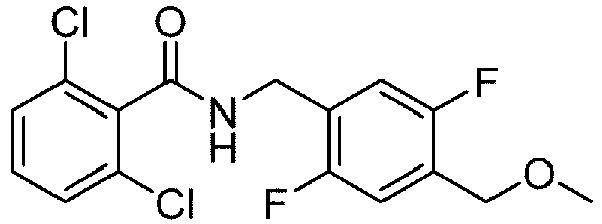
- To a mixture of [3,6-difluoro-4-(methoxymethyl)phenyl]methanamine (23 mg, 0.12 mmol) as described in Production Example 2-3 and dichloromethane (1 mL) was added N,N-diisopropylethylamine (0.033 mL, 0.36 mmol) followed by 2,6-dichlorobenzoyl chloride (0.026 mL, 0.18 mmol) at room temperature and the resultant was stirred at the same temperature for 1 hour. The resulting reaction mixture was purified by column chromatography on silica gel (heptane:ethyl acetate = 19:1 to 1:1 gradient) to give the title compound (38 mg, 88% yield).
1H-NMR Spectrum (CDCl3) δ (ppm): 3.42 (s, 3 H), 4.48 (s, 2 H), 4.67 (d, J = 5.86 Hz, 2 H), 6.38 (br. s, 1 H), 7.07 - 7.16(m, 2 H), 7.18 - 7.28 (m, 1H), 7.29 - 7.34 (m, 2 H). -

- To a mixture of 4-bromo-2,5-difluorobenzoic acid (2.4 g, 10 mmol) and tetrahydrofurane (25 mL) was added borane dimethyl sulfide complex (2.5 mL, 26 mmol) at room temperature under nitrogen atmosphere. After stirred for 1.5 hours, the reaction mixture was cooled in an ice bath followed by slow dropwise addition of methanol (10 mL). After stirred at room temperature for 30 minutes, brine was added and the resultant was extracted with ethyl acetate. The organic layer was dried over magnesium sulfate. The solid was removed by filtration and the filtrate was evaporated to remove the solvent under a reduced pressure. The residue was purified by column chromatography on silica gel (heptane:ethyl acetate = 9:1 to 0:10 gradient) to give the title compound (2.0 g, 96% purity (as determined by NMR), 87% yield).
1H-NMR Spectrum (CDCl3) δ (ppm): 1.89 (br. s,1 H), 4.72 (d, J = 3.12 Hz, 2 H), 7.23 - 7.31 (m, 2 H). -

- To a mixture of (4-bromo-2,5-difluorophenyl)methanol (2.0 g, 8.7 mmol) as described in Production Example 2-1 and dimethylformamide (9 mL) was added sodium hydride (60 wt%, 0.21 g, 5.2 mmol) at under ice-cooling under nitrogen atmosphere and the resultant was stirred at the same temperature for 20 minutes. Methyl iodide (2.7 mL, 44 mmol) was added under ice cooling and the resultant was stirred at the same temperature for additional 1 hour. To the resulting reaction mixture was further added sodium hydride (60 wt%, 0.21 g, 5.2 mmol) under ice cooling and the resultant was stirred for 2 hours. Water was added under ice cooling to stop the reaction and the solution was then neutralized with a saturated aqueous solution of ammonium chloride and the resultant was extracted with ethyl acetate. The resulting organic layer was washed sequentially with water and brine and dried over magnesium sulfate. The solid was removed by filtration and the filtrate was evaporated to remove the solvent under a reduced pressure. The residue was purified by column chromatography on silica gel (heptane:ethyl acetate = 9:1 to 3:2 gradient) to give the title compound (1.8 g, 87% yield).
1H-NMR Spectrum (CDCl3) δ (ppm): 3.42 (s, 3 H), 4.45 (s, 2 H), 7.10 - 7.37 m, 2 H). -

- To a mixture of 1-bromo-2,5-difluoro-4-(methoxymethyl)benzene (1.8 g, 7.6 mmol) as described in Production Example 2-2, sodium [(1,3-dioxoisoindolin-2-yl)methyl]trifluoroborate (3.8 g, 15 mmol), palladium acetate (II) (0.26 g, 1.1 mmol), SPhos (1.1 g, 2.7 mmol), and sodium carbonate (4.0 g, 38 mmol) were added 1,4-dioxane (34 mL) and water (17 mL) and stirred at 110°C under nitrogen atmosphere for 18 hours. Hydrazine monohydrate (2.6 mL, 53 mmol) and 1-propanol (43 mL) were added to the resulting reaction mixture and the resultant was stirred at 110°C for additional 21 hours. After cooled to room temperature, dichloromethane and brine were added and the reaction mixture was filtered through celite™ and the solid was washed with dichloromethane. The organic layer of the filtrate was separated and the aqueous layer was extracted with dichloromethane (three times). All the organic layers were combined and dried over magnesium sulfate. The solid was removed by filtration and the filtrate was evaporated to remove the solvent under a reduced pressure. The residue was dissolved in ethyl acetate and then extracted with 2 N hydrochloric acid. The resulting aqueous layer was washed with ethyl acetate (twice) followed by basification with 5 N sodium hydroxide aqueous solution. The solution was extracted with dichloromethane (three times) and dried over magnesium sulfate. The solid was removed by filtration and the filtrate was evaporated to remove the solvent under a reduced pressure. The residue was purified by column chromatography on NH silica gel (heptane:ethyl acetate = 9:1 to 1:4 gradient) to give the title compound (1.2 g, 81% yield).
1H-NMR Spectrum (CDCl3) δ (ppm): 3.41 (s, 3 H), 3.87 (s, 2 H), 4.48 (s, 2 H), 7.03 - 7.14 (m, 2H). -

- To a mixture of [4-(methoxymethyl)phenyl]methanamine (21 mg, 0.12 mmol) and dichloromethane (1 mL) was added triethylamine (0.040 mL, 0.29 mmol) followed by 2,6-dichlorobenzoyl chloride (0.021 mL, 0.14 mmol) at room temperature and the resultant was stirred at the same temperature for 2 hours. The reaction mixture was purified by column chromatography on silica gel (heptane:ethyl acetate = 4:1 to 3:2 gradient) to give the title compound (34 mg, 93% yield).
1H-NMR Spectrum (CDCl3) δ (ppm): 3.35 (s, 3 H), 4.42 (s, 2 H), 4.64 (d, J=5.50 Hz, 2 H), 6.09 (br. s., 1 H), 7.19 - 7.26(m, 1 H), 7.26 - 7.32 (m, 4 H), 7.32 - 7.41 (m, 2 H). -

- To a mixture of [4-(methoxymethyl)-3-methylphenyl]methanamine (19 mg, 0.12 mmol) as described in Production Example 4-2 and dichloromethane (1 mL) was added N,N-diisopropylethylamine (0.040 mL, 0.19 mmol) followed by 2,6-dichlorobenzoyl chloride (0.017 mL, 0.12 mmol) under ice cooling and the resultant was stirred at room temperature for 3 hours. The reaction mixture was purified by column chromatography on silica gel (heptane:ethyl acetate = 2:1) and triturated with diethyl ether to give the title compound (23 mg, 59% yield).
1H-NMR Spectrum (CDCl3) δ (ppm): 2.32 (s, 3 H), 3.39 (s, 3 H), 4.43 (s, 2 H), 4.65 (d, J=5.86 Hz, 2 H), 5.95 (br. s., 1 H),7.19 - 7.23 (m, 2 H), 7.24 - 7.27 (m, 2 H), 7.28 - 7.33 (m, 3 H). -

- To a mixture of sodium methoxide (28% in methanol, 0.049 mL, 0.24 mmol) and methanol (1 mL) was added 4-(bromomethyl)-3-methylbenzonitrile (50 mg, 0.24 mmol) at room temperature and the resultant was stirred at the same temperature for 4 hours. Acetic acid was added to the reaction mixture at room temperature until neutralization was completed, and the mixture was evaporated to remove the solvent under a reduced pressure. The residue was purified by column chromatography on silica gel (heptane:ethyl acetate = 8:1) to give the title compound (27 mg, 69% yield).
1H-NMR Spectrum (CDCl3) δ (ppm): 2.33 (s, 3 H), 3.45 (s, 3 H), 4.47 (s, 2 H), 7.44 - 7.51 (m, 3 H). -

- To a mixture of aluminum chloride (200 mg, 1.5 mmol) and tetrahydrofurane (3 mL) was added lithium aluminum chloride (2.5 M in tetrahydrofurane, 0.40 mL, 0.99 mmol) dropwise under ice cooling and the resultant was stirred at room temperature for 1 hour. A mixture of 4-(methoxymethyl)-3-methylbenzonitrile (53 mg, 0.33 mmol) as described in Production Example 4-1 and tetrahydrofurane (1 mL) was added dropwise to the reaction mixture under ice cooling and the resultant was stirred overnight at room temperature. To the reaction mixture was added 28% aqueous solution of ammonia under ice cooling and the resultant was stirred at room temperature for 1 hour. The reaction mixture was filtered through celite™ and the filtrate was evaporated to remove the solvent under a reduced pressure to give the title compound (55 mg).
Mass spectrum (ESI) m/z: 166 (M+H)+ -

- To a mixture of 2-bromo-6-chlorobenzoic acid (270 mg, 1.1 mmol) and dichloromethane (4 mL) were added sequentially N,N-diisopropylethylamine (0.39 mL, 2.3 mmol) and [3-fluoro-4-(methoxymethyl)phenyl]methanamine (210 mg, 1.3 mmol) as described in Production Example 1-2 under ice cooling. HATU (520 mg, 1.4 mmol) was added to the reaction mixture under ice cooling and the resultant was stirred at room temperature for 3 hours. The reaction mixture was purified by column chromatography on silica gel (heptane:ethyl acetate = 4:1 to 1:1 gradient) to give the title compound (300 mg, 68% yield).
1H-NMR Spectrum (CDCl3) δ (ppm): 3.41 (s, 3 H), 4.51 (s, 2 H), 4.68 (d, J=5.86 Hz, 2 H), 6.01 (d, J=4.69 Hz, 1 H), 7.15(dd, J=10.54, 1.17 Hz, 1 H), 7.17 - 7.22 (m, 2 H), 7.35 - 7.42 (m, 2 H), 7.48 -7.51 (m, 1 H), 7.48 - 7.51 (m, 1 H). -

- To a mixture of [3-fluoro-4-(methoxymethyl)phenyl]methanamine (30 mg, 0.18 mmol) as described in Production Example 1-2, N,N-diisopropylethylamine (0.061 mL, 0.36 mmol), and dichloromethane (1 mL) was added 2-chlorobenzoyl chloride (0.022 mL, 0.18 mmol) at room temperature and the resultant was stirred at the same temperature for 2 hours. The reaction mixture was purified by column chromatography on silica gel (heptane:ethyl acetate = 3:2) to give the title compound (47 mg, 86% yield).
1H-NMR Spectrum (CDCl3) δ (ppm): 3.41 (s, 3 H), 4.51 (s, 2 H), 4.66 (d, J=5.86 Hz, 2 H), 6.54 (br. s., 1 H), 7.09 (ddJ=10.54, 1.56 Hz, 1 H), 7.16 (dd, J=7.81, 1.56 Hz, 1 H), 7.31 - 7.43 (m, 4 H),7.69 - 7.73 (m, 1 H). -

- To a mixture of [3-fluoro-4-(methoxymethyl)phenyl]methanamine (30 mg, 0.18 mmol) as described in Production Example 1-2, N,N-diisopropylethylamine (0.061 mL, 0.36 mmol), and dichloromethane (1 mL) was added 2-bromobenzoyl chloride (0.023 mL, 0.18 mmol) at room temperature and the resultant was stirred at the same temperature for 2 hours. The reaction mixture was purified by column chromatography on silica gel (heptane:ethyl acetate = 3:2) to give the title compound (49 mg, 78% yield).
1H-NMR Spectrum (CDCl3) δ (ppm): 3.41 (s, 3 H,) 4.51 (s, 2 H), 4.65 (d, J=5.86 Hz, 2 H), 6.31 (br. s., 1 H), 7.10 (dd,J=10.54, 1.56 Hz, 1 H), 7.17 (dd, J=7.81, 1.56 Hz, 1 H), 7.26 - 7.31 (m, 1 H),7.34 - 7.38 (m, 1 H), 7.38 - 7.41 (m, 1H), 7.58 (ddd, J=9.18, 7.81, 1.37 Hz, 2 H). -

- To a mixture of 2-bromo-6-fluorobenzoic acid (15 mg, 0.068 mmol) and N,N-dimethylformamide (0.5 mL) were sequentially added N,N-diisopropylethylamine (0.029 mL, 0.17 mmol) and [3-fluoro-4-(methoxymethyl)phenyl]methanamine (17 mg, 0.10 mmol) as described in Production Example 1-2 under ice cooling. HATU (39 mg, 0.10 mmol) was added to the reaction mixture under ice cooling and the resultant was stirred overnight at room temperature. Water was added to the reaction mixture and the resultant was extracted with ethyl acetate. The organic layer was washed sequentially with water and brine and evaporated to remove the solvent under a reduced pressure. The residue was purified by column chromatography on silica gel (heptane:ethyl acetate = 3:1 to 3:2 gradient) to give the title compound (20 mg, 80% yield).
1H-NMR Spectrum (CDCl3) δ (ppm): 3.41 (s, 3 H), 4.51 (s, 2 H), 4.67 (d, J=6.25 Hz, 2 H), 6.07 (br. s., 1 H), 7.07 - 7.14(m, 2 H), 7.18 (d, J=8.20 Hz, 1 H), 7.22 - 7.29 (m, 1H), 7.37 - 7.42 (m, 2 H). -

- To a mixture of methyl 2-chloro-6-(methoxymethyl)benzoate (220 mg, 0.95 mmol) as described in Production Example 9-1, methanol (0.6 mL), and water (0.6 mL) was added lithium hydroxide monohydrate (40 mg, 0.95 mmol) at room temperature and the resultant was stirred overnight at 50°C. The reaction mixture was evaporated to remove the solvent under a reduced pressure. To a mixture of the residue and N,N-dimethylformamide (5 mL) were sequentially added
N,N-diisopropylethylamine (0.40 mL, 2.4 mmol) and [3-fluoro-4-(methoxymethyl)phenyl]methanamine (240 mg, 1.4 mmol) as described in Production Example 1-2 under ice cooling. HATU (540 mg, 1.4 mmol) was added to the reaction mixture under ice cooling and the resultant was stirred at room temperature for 3 hours. Water was added to the reaction mixture and the resultant was extracted with ethyl acetate. The organic layer was washed sequentially with water and brine and evaporated to remove the solvent under a reduced pressure. The residue was purified by column chromatography on silica gel (heptane:ethyl acetate = 7:3 to 1:1 gradient) to give the title compound (54 mg, 16% yield).
1H-NMR Spectrum (CDCl3) δ (ppm): 3.41 (s, 3 H), 3.46 (s, 3 H), 4.51 (s, 2 H), 4.69 (d, J=6.25 Hz, 2 H), 5.22 (s, 2 H), 6.05(br. s., 1 H), 7.04 - 7.10 (m, 2 H), 7.15 - 7.28 (m, 3 H), 7.38 (t, J=7.61 Hz, 1H). -

- To a mixture of methyl 2-chloro-6-hydroxybenzoate (970 mg, 5.2 mmol) and N,N-dimethylformamide (10 mL)were sequentially added potassium carbonate (1.1 g, 7.8 mmol) and methoxymethyl chloride (0.41 mL, 5.4 mmol) under ice cooling and the resultant was stirred at room temperature for 3 hours. Potassium carbonate (0.36 g, 2.6 mmol) and methoxymethyl chloride (0.20 mL, 2.6 mmol) were sequentially added to the reaction mixture under ice cooling and the resultant was stirred overnight at room temperature. Water was added to the reaction mixture and the resultant was extracted with ethyl acetate. The organic layer was washed sequentially with water and brine and evaporated to remove the solvent under a reduced pressure. The residue was purified by filtration through NH silica gel to give the title compound (1.2 g, 97% yield).
1H-NMR Spectrum (CDCl3) δ (ppm): 3.47 (s, 3 H)3.46 - 3.48 (m, 3 H) 3.95 (s, 3 H) 5.19 (s, 2 H) 7.03 - 7.06 (m, 1 H) 7.06 -7.09 (m, 1 H) 7.24 -7.29 (m, 1 H). -

- To a mixture of [3-fluoro-4-(methoxymethyl)phenyl]methanamine (16 mg, 0.095 mmol) as described in Production Example 1-2 and dichloromethane (0.5 mL) were added N,N-diisopropylethylamine (0.033 mL, 0.19 mmol) and 2-chloro-6-fluorobenzoyl chloride (0.013 mL, 0.095 mmol) under ice cooling and the resultant was stirred at room temperature for 3 hours. The reaction mixture was purified by column chromatography on silica gel (heptane:ethyl acetate = 3:1 to 3:2 gradient) to give the title compound (32 mg, a quantitative yield).
1H-NMR Spectrum (CDCl3) δ (ppm): 3.40 (s, 3 H), 4.51 (s, 2 H), 4.67 (d, J=6.25 Hz, 2 H), 6.11 (br. s., 1 H), 7.05 (td,J=8.49, 0.98 Hz, 1 H), 7.10 (d, J=10.54 Hz, 1 H), 7.16 (d, J=7.81 Hz, 1 H),7.21 -7.24 (m, 1 H), 7.29 -7.35 (m, 1 H), 7.39 (t, J=7.81 Hz, 1 H). -

- To a mixture of 2,6-dimethyl benzoic acid (30 mg, 0.20 mmol) and N,N-dimethylformamide (0.3 mL) were sequentially added N,N-diisopropylethylamine (0.068 mL, 0.40 mmol) and [3-fluoro-4-(methoxymethyl)phenyl]methanamine (34 mg, 0.20 mmol) as described in Production Example 1-2 under ice cooling. HATU (99 mg, 0.26 mmol) was added to the reaction mixture under ice cooling and the resultant was stirred at room temperature for 3 hours. Water was added to the reaction mixture and the resultant was extracted with ethyl acetate. The organic layer was washed sequentially with water and brine and evaporated to remove the solvent under a reduced pressure. The residue was purified by column chromatography on silica gel (heptane:ethyl acetate = 75:25 to 65:35 gradient) to give the title compound (42 mg, 70% yield).
1H-NMR Spectrum (CDCl3) δ (ppm): 2.31 (s, 6 H), 3.41 (s, 3 H), 4.51 (s, 2 H), 4.63 (d, J=5.86 Hz, 2 H), 5.94 (br. s., 1 H),7.01 (d, J=8.20 Hz, 2 H), 7.08 (dd, J=10.35, 1.76 Hz, 1 H), 7.13 - 7.18 (m, 2 H), 7.39 (t, J=7.61 Hz, 1 H). -

- To a mixture of 2-chloro-N-[3-fluoro-4-(methoxymethyl)benzyl-6-(prop-1-en-2-yl)]benzamide (20 mg, 0.059 mmol) as described in Production Example 12-1, methanol (1 mL), and tetrahydrofurane (0.5 mL) was added palladium-fibroin (25 mg, 0.0059 mmol) and the resultant was stirred overnight under hydrogen atmosphere at room temperature. Hydrogen in the reaction system was replaced with nitrogen and the reaction mixture was filtered through filter paper. The filtrate was evaporated to remove the solvent under a reduced pressure and the residue was purified by chromatography on silica gel (heptane:ethyl acetate = 3:1 to 2:1 gradient) to give the title compound (18 mg, 87% yield).
1H-NMR Spectrum (CDCl3) δ (ppm): 1.22 (d,J=6.70 Hz, 6 H), 3.04 (dt, J=13.60, 6.95 Hz, 1 H), 3.39 (s, 3 H), 4.49 (s, 2 H), 4.64 (d, J=5.86 Hz, 2 H), 5.95 (br. s., 1 H), 7.05 - 7.12 (m, 1H), 7.16(dd, J=7.95, 1.22 Hz, 1 H), 7.20(td, J=6.73, 1.22Hz, 1H), 7.22 -7.30 (m, 2 H), 7.37 (t, J=7.64 Hz, 1H). -

- To a mixture of 2-bromo-6-chloro-N-[3-fluoro-4-(methoxymethyl)benzyl]benzamide (30 mg, 0.078 mmol) as described in Example 5, sodium carbonate (12 mg, 0.12 mmol), tetrakis(triphenylphosphine)palladium(0) (4.5 mg, 0.0039 mmol) were sequentially added 1,4-dioxane (0.6 mL), pure water (0.2 mL), and 2-isopropenyl-4,4,5,5-tetramethyl-1,3,2-dioxaborolane (19 mL, 0.10 mmol) and the resultant was stirred with heating at 100°C overnight. The reaction mixture was filtered through celite™ and the filtrate was evaporated to remove the solvent under a reduced pressure. The residue was purified by thin layer chromatography on silica gel (heptane:ethyl acetate = 2:1) to give the title compound (23 mg, 87% yield).
1H-NMR Spectrum (CDCl3) δ (ppm): , 2.04 (s, 3H), 3.38 (s, 3 H), 4.49 (s, 2 H), 4.58 (d, J=6.11 Hz, 2 H), 5.02 (br. s., 1 H),5.16 (t, J=1.53 Hz, 1 H), 5.95 (br. s., 1 H), 7.07 (d, J=10.39 Hz, 1 H), 7.09 -7.16 (m, 2 H), 7.21 - 7.32 (m, 2 H), 7.32 - 7.42 (m, 1 H). -

- To a mixture of [3-fluoro-4-(methoxymethyl)phenyl]methanamine (32 mg, 0.19 mmol) as described in Production Example 1-2 and dichloromethane (2 mL) were added N,N-diisopropylethylamine (0.033 mL, 0.19 mmol) and 2,6-difluorobenzoyl chloride (0.054 mL, 0.32 mmol) under ice cooling and the resultant was stirred at room temperature for 3 hours. The reaction mixture was purified by column chromatography on silica gel (heptane:ethyl acetate = 4:1 to 1:1 gradient) to give the title compound (46 mg, 93% yield).
1H-NMR Spectrum (CDCl3) δ (ppm) : 3.39 (s, 3 H), 4.49 (s, 2 H), 4.64 (d, J=5.89 Hz, 2 H), 6.29 (br. s., 1 H), 6.91 - 6.98 (m, 2 H), 7.05 (dd, J=10.65, 1.59 Hz, 1 H), 7.13 (dd, J=7.93, 1.59 Hz, 1 H), 7.32 - 7.41 (m, 2 H). -

-

- To a mixture of 2,3-dihydro-1,4-benzodioxin-6-yl)methylamine (50 mg, 0.30 mmol) and dichloromethane (1 mL) were added N,N-diisopropylethylamine (0.11 mL, 0.61 mmol) and 2,6-dichlorobenzoyl chloride (0.043 mL, 0.30 mmol) under ice cooling and the resultant was stirred at room temperature for 3 hours. The reaction mixture was purified by column chromatography on silica gel (heptane:ethyl acetate = 2:1) to give the title compound (94 mg, 92% yield).
1H-NMR Spectrum (CDCl3) δ (ppm): 4.24 (s, 4 H), 4.57 (d, J=5.47 Hz, 2 H), 5.94 (br. s., 1 H), 6.81 - 6.92 (m, 3 H), 7.21 -7.33 (m, 3 H). -

- To a mixture of 3-fluoro-4-methoxybenzylamine (28.9 mg, 0.19 mmol) and dichloromethane (1 mL) was added triethylamine (0.040 mL, 0.29 mmol) followed by 2,6-dichlorobenzoyl chloride (0.021 mL, 0.14 mmol) under ice cooling and the resultant was stirred at room temperature for 1 hour. The reaction mixture was filtered through celite™ and the filtrate was evaporated to remove the solvent under a reduced pressure. The residue was triturated with heptane/ethyl acetate (1:1) to give the title compound (47 mg, 60% yield).
1H-NMR Spectrum (DMSO-d6) δ (ppm): 3.78 (s, 3H), 4.37 (d, J=6.11 Hz, 2 H), 7.07 - 7.14 (m, 1 H), 7.14- 7.20 (m, 1 H), 7.37 -7.43 (m, 1 H), 7.47 (s, 1 H), 7.48 (s, 1 H), 9.07-9.17 (m, 1 H). - Effects of compounds on the acetaldehyde oxidation rate by aldehyde dehydrogenase 2 (ALDH2) were evaluated using a method known in the art. Specifically, the test was performed using a commercially available kit, PicoProbe™ Aldehyde dehydrogenase Activity Assay Kit (from BioVision Inc.) in accordance with the product's instruction. Reagents as described below were sequentially added to each well in a 384-well plate with a pipette.
- 1. 10 µL of the commercially available ALDH2 enzyme (from ATGen Inc.) dissolved in ALDH assay Buffer so as to obtain a concentration of 1 µg/mL
- 2. 10 µL of 30 µM or 3 µM compound solution (containing 3% DMSO) prepared with ALDH assay Buffer
- 3. 10 µL of Reaction mix consisting of 7.82 µL of ALDH assay Buffer, 0.55 µL of PicoProbe, 0.27 µL of Substrate Mix, and 1.36 µL of Acetaldehyde
- Before addition of 3, the plate was incubated at room temperature for 5 minutes. After addition of 3, fluorescence was determined using EnVision 2101 Multilabel Reader (from PerkinElmer Inc.) at room temperature over 60 minutes. The measurements were taken at interval of 2 minutes.
- Fluorescence was detected at an excitation wavelength of 535 nm and an emission wavelength of 587 nm.
- Table 1 lists the oxidation rates when the compounds are added, in which the rates are calculated on the basis of the assumption that the acetaldehyde oxidation rates in the absence of the compounds are 100. The rate for Comparative Example 1 compound was normalized to a value of "175" for 10 µM of the compound concentration while the rate for Comparative Example 1 compound was normalized to a value of "137" for 1 µM of the compound concentration. The results indicated that the compounds according to the present invention increased the acetaldehyde oxidation rate in a manner similar to Comparative Example compounds.
[Table 1] Compound Concentration 10 µM 1 µM Example 1 179 138 Example 2 168 125 Example 3 156 117 Example 4 175 136 Example 5 168 129 Example 6 148 108 Example 7 156 119 Example 8 165 128 Example 9 170 120 Example 10 168 125 Example 11 156 117 Example 12 175 136 Example 13 143 114 Comparative Example 1 175 137 Comparative Example 2 164 125 Comparative Example 3 165 135 - Ability of compounds to produce reactive metabolites was evaluated using the method as described below. Cytochrome P450 (CYP) dependent metabolism was initiated by adding 1 mg/mL human liver microsome, 0.2 mmol/L compound, and 0.1 mmol/L RI-labeled capture agent, and lastly 1 mmol/L NADPH to 100 mM phosphate buffer (pH 7.4). After incubation at 37°C for 60 minutes, the reaction mixture (0.1 mL) and an equal volume of acetonitrile were added to stop the metabolic reaction. After 0.8 mL of water was added to the supernatant from centrifugation, 0.5 mL of the resulting solution was injected into HPLC connected to a radio detector and a covalent complex between the reactive metabolite and RI-labeled capture agent was quantitatively analyzed for its RI intensity.
- The results as shown in Table 2 indicated that compounds according to the present invention produced a smaller amount of reactive metabolites than clozapine, which is known to induce serious blood toxicity and hepatotoxicity via production of reactive metabolites, and Comparative Example compounds.
[Table 2] Reactive Metabolites (% of clozapine) Example 1 8 Example 2 15 Example 3 10 Example 4 7 Example 5 5 Example 6 8 Example 7 24 Example 8 10 Example 9 20 Example 10 10 Example 11 34 Example 12 7 Example 13 15 Clozapine 100 Comparative Example 1 90 Comparative Example 2 147 Comparative Example 3 263 - This experiment was carried out with reference to Science Translational Medicine 6, 251 r118 (2014). Male C57 BL / 6 J mice (Charles River Japan) of 7-week-old were used. Carrageenan was subcutaneously administered to the mouse by intraplantar injection of the left hind paw to induce mechanical allodynia in the footpad. Mechanical stimulus-evoked withdrawal response at 180 min after the induction was assessed by applying a von Frey filament (ascending bending force 0.16 g) to the footpad of the hind paw. The filament was perpendicularly applied to the footpad so that the filament was bent for 6 second. The withdrawal response was scored in three stages (0: no response or startle response (moving paw without lifting); 1: lifting of paw; 2: licking or shaking of paw). The mouse was stimulated ten times and the sum of the scores of the ten stimulation (withdrawal score) was calculated.
The compound of Example 1 was dissolved in DMSO/5% glucose solution for injection (1:1 by volume ratio). The compound was subcutaneously administered to the dorsocervical site of the mouse at a dose of 12 mg/kg (no compound in vehicle-treated group) and at a volume of 5 mL/kg three times in total: 15 min before the carrageenan injection, and 30 min and 150 min after the carrageenan injection. Carrageenan was dissolved in a physiological saline to prepare a 1.5 % solution, and it was subcutaneously administered to the footpad of the hind paw at 7 µL/body. - Wilcoxon rank sum test was used to compare the vehicle-treated group and the Example 1-treated group. The significance level was calculated as 5%, divided into less than 5% (p <0.05) and less than 1% (p <0.01). For the significant difference test, a commercially available statistical program SAS SYSTEM (SAS Software Release 9.1.3; SAS Institute Japan Ltd) was used. As shown in Table 3, it was shown that the compound according to the present invention suppresses pain induced by carrageenin.
[Table 3] Group Vehicle Example 1 Number of animals 5 5 Total pain-related score Time after carrageenan induction (min) Pre 1.8 ±0.2 1.6 ± 0.2 180 15.6± 1.4 6.8 ±1.0** Each value shows mean ± S. E. Pre: Before induction Significantly different from vehicle group (**: p<0.01)
Claims (17)
- A compound represented by formula (1):
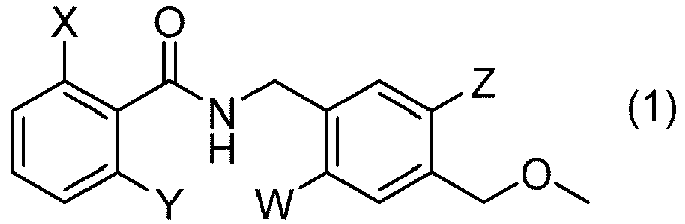 X and Y are the same or different from each other and represent a hydrogen atom, a halogen atom, a C1-6 alkyl group, or a C1-6 alkoxy group, wherein the C1-6 alkoxy group may be substituted with a C1-6 alkoxy group, andZ and W are the same or different from each other and represent a hydrogen atom, a halogen atom, or a C1-6 alkyl group.
 - The compound or a pharmaceutically acceptable salt thereof according to claim 1, wherein the halogen atom is a fluorine atom, a chlorine atom, or a bromine atom.
- The compound or a pharmaceutically acceptable salt thereof according to claim 1 or 2, wherein the C1-6 alkyl group is a methyl group or an isopropyl group.
- The compound or a pharmaceutically acceptable salt thereof according to any one of claims 1 to 3, wherein X is a hydrogen atom, a fluorine atom, a chlorine atom, a bromine atom, a methyl group, an isopropyl group, or a methoxymethoxy group.
- The compound or a pharmaceutically acceptable salt thereof according to any one of claims 1 to 4, wherein Y is a chlorine atom, a bromine atom, or a methyl group.
- The compound or a pharmaceutically acceptable salt thereof according to any one of claims 1 to 5, wherein Z is a hydrogen atom, a fluorine atom, or a methyl group.
- The compound or a pharmaceutically acceptable salt thereof according to any one of claims 1 to 6, wherein W is a hydrogen atom or a fluorine atom.
- A compound selected from:(1) 2,6-dichloro-N-{[3-fluoro4-(methoxymethyl)phenyl]methyl}benzamide,(2)2,6-dichloro-N-{[3,6-difluoro-4-(methoxymethyl)phenyl]methyl}benzamide,(3) 2,6-dichloro-N-[4-(methoxymethyl)benzyl]benzamide,(4) 2,6-dichloro-N-{[4-(methoxymethyl)-3-methylphenyl] methyl }benzamide,(5) 2-bromo-6-chloro-N-{[3-fluoro-4-(methoxymethyl)phenyl]methyl}benzamide,(6) 2-chloro-N-{[3-fluoro-4-(methoxymethyl)phenyl]methyl}benzamide,(7) 2-bromo-N-{[3-fluoro-4-(methoxymethyl)phenyl]methyl}benzamide,(8) 2-bromo-6-fluoro-N-{[3-fluoro-4-(methoxymethyl)phenyl] methyl}benzamide,(9) 2-chloro-N-{[3-fluoro-4-(methoxymethyl)phenyl]methyl}-6-(methoxymethyl)benzamide,(10) 2-chloro-6-fluoro-N-{[3-fluoro-4-(methoxymethyl)phenyl] methyl} benzamide,(11) N-{[3-fluoro-4-(methoxymethyl)phenyl]methyl}-2,6-dimethylbenzamide,(12) 2-chloro-N-[3-fluoro-4-(methoxymethyl)benzyl]-6-isopropylbenzamide, and(13) 2,6-difluoro-N-{[3-fluoro-4-(methoxymethyl)phenyl]methyl}benzamide or a pharmaceutically acceptable salt thereof
- 2,6-dichloro-N-{[3-fluoro-4-(methoxymethyl)phenyl]methyl}benzamide represented by the formula:

- 2,6-dichloro-N-{[4-(methoxymethyl)-3-methylphenyl]methyl}benzamide represented by the formula:

- 2-bromo-6-fluoro-N-{[3-fluoro-4-(methoxymethyl)phenyl]methyl}benzamide represented by the formula:
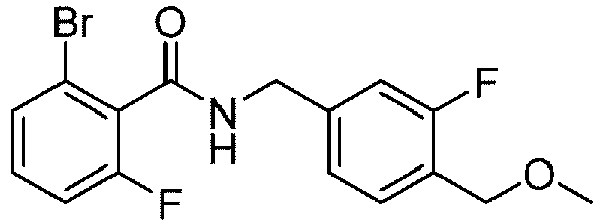
- A pharmaceutical composition comprising the compound or a pharmaceutically acceptable salt thereof according to any one of claims 1 to 11.
- The pharmaceutical composition according to claim 12, wherein the pharmaceutical composition is a therapeutic agent for radiodermatitis.
- The pharmaceutical composition according to claim 12, wherein the pharmaceutical composition is a therapeutic agent for osteoporosis.
- The pharmaceutical composition according to claim 12, wherein the pharmaceutical composition is a therapeutic agent for Fanconi anemia.
- The pharmaceutical composition according to claim 12, wherein the pharmaceutical composition is a therapeutic agent for inflammatory pain.
- The pharmaceutical composition according to claim 12, wherein the pharmaceutical composition is an ALDH2 activator.
Applications Claiming Priority (2)
| Application Number | Priority Date | Filing Date | Title |
|---|---|---|---|
| JP2018015512 | 2018-01-31 | ||
| PCT/JP2019/002955 WO2019151241A1 (en) | 2018-01-31 | 2019-01-29 | Aldh2 activator |
Publications (1)
| Publication Number | Publication Date |
|---|---|
| EP3747862A1 true EP3747862A1 (en) | 2020-12-09 |
Family
ID=67391231
Family Applications (1)
| Application Number | Title | Priority Date | Filing Date |
|---|---|---|---|
| EP19746574.3A Withdrawn EP3747862A1 (en) | 2018-01-31 | 2019-01-29 | Aldh2 activator |
Country Status (12)
| Country | Link |
|---|---|
| US (1) | US10406126B2 (en) |
| EP (1) | EP3747862A1 (en) |
| JP (1) | JPWO2019151241A1 (en) |
| KR (1) | KR20200115474A (en) |
| CN (1) | CN111566082A (en) |
| AU (1) | AU2019214670A1 (en) |
| BR (1) | BR112020014237A2 (en) |
| CA (1) | CA3085992A1 (en) |
| IL (1) | IL275883A (en) |
| MX (1) | MX2020006628A (en) |
| RU (1) | RU2020121490A (en) |
| WO (1) | WO2019151241A1 (en) |
Families Citing this family (2)
| Publication number | Priority date | Publication date | Assignee | Title |
|---|---|---|---|---|
| US12509423B2 (en) | 2020-11-02 | 2025-12-30 | Alchemedicine, Inc. | Compound, aldehyde dehydrogenase 2 activating agent, pharmaceutical composition, and therapeutic and/or prophylactic drug |
| JPWO2023204292A1 (en) | 2022-04-22 | 2023-10-26 |
Family Cites Families (6)
| Publication number | Priority date | Publication date | Assignee | Title |
|---|---|---|---|---|
| US1181487A (en) * | 1915-06-21 | 1916-05-02 | Martin Sindell | Portable truck. |
| JP2009184924A (en) | 2006-05-31 | 2009-08-20 | Eisai R & D Management Co Ltd | Compound for biological reagent |
| WO2008112164A2 (en) | 2007-03-08 | 2008-09-18 | The Board Of Trustees Of The Leland Stanford Junior University | Mitochondrial aldehyde dehydrogenase-2 modulators and methods of use thereof |
| JP2012087116A (en) * | 2010-09-21 | 2012-05-10 | Ishihara Sangyo Kaisha Ltd | Benzamide derivative or salt of the same, pesticide, miticide, nematicide or pesticide for soil pest containing the same |
| WO2014160185A2 (en) | 2013-03-14 | 2014-10-02 | The Board Of Trustees Of The Leland Stanford Junior University | Mitochondrial aldehyde dehydrogenase-2 modulators and methods of use thereof |
| US12509423B2 (en) * | 2020-11-02 | 2025-12-30 | Alchemedicine, Inc. | Compound, aldehyde dehydrogenase 2 activating agent, pharmaceutical composition, and therapeutic and/or prophylactic drug |
-
2019
- 2019-01-29 AU AU2019214670A patent/AU2019214670A1/en not_active Abandoned
- 2019-01-29 CA CA3085992A patent/CA3085992A1/en not_active Abandoned
- 2019-01-29 CN CN201980006700.2A patent/CN111566082A/en active Pending
- 2019-01-29 JP JP2019569127A patent/JPWO2019151241A1/en active Pending
- 2019-01-29 RU RU2020121490A patent/RU2020121490A/en unknown
- 2019-01-29 BR BR112020014237-9A patent/BR112020014237A2/en not_active Application Discontinuation
- 2019-01-29 WO PCT/JP2019/002955 patent/WO2019151241A1/en not_active Ceased
- 2019-01-29 MX MX2020006628A patent/MX2020006628A/en unknown
- 2019-01-29 US US16/260,350 patent/US10406126B2/en not_active Expired - Fee Related
- 2019-01-29 EP EP19746574.3A patent/EP3747862A1/en not_active Withdrawn
- 2019-01-29 KR KR1020207017801A patent/KR20200115474A/en not_active Withdrawn
-
2020
- 2020-07-06 IL IL275883A patent/IL275883A/en unknown
Also Published As
| Publication number | Publication date |
|---|---|
| RU2020121490A (en) | 2022-02-28 |
| US10406126B2 (en) | 2019-09-10 |
| JPWO2019151241A1 (en) | 2021-01-28 |
| WO2019151241A1 (en) | 2019-08-08 |
| KR20200115474A (en) | 2020-10-07 |
| US20190231720A1 (en) | 2019-08-01 |
| BR112020014237A2 (en) | 2020-12-08 |
| AU2019214670A1 (en) | 2020-07-09 |
| IL275883A (en) | 2020-08-31 |
| CN111566082A (en) | 2020-08-21 |
| CA3085992A1 (en) | 2019-08-08 |
| MX2020006628A (en) | 2020-09-14 |
Similar Documents
| Publication | Publication Date | Title |
|---|---|---|
| EP3983384B1 (en) | N-(phenyl)-indole-3-sulfonamide derivatives and related compounds as gpr17 modulators for treating cns disorders such as multiple sclerosis | |
| EP3725779B1 (en) | Substituted pyridazinone compound | |
| EP4074703A1 (en) | Pyridinyl-(aza)indolsulfonamides | |
| EP2991975B1 (en) | Inhibitors of nicotinamide phosphoribosyltransferase, compositions, products and uses thereof | |
| McCague et al. | Inhibition of enzymes of estrogen and androgen biosynthesis by esters of 4-pyridylacetic acid | |
| EP3287463A1 (en) | Condensed-ring pyrimidylamino derivative, preparation method therefor, and intermediate, pharmaceutical composition and applications thereof | |
| CN110092779B (en) | Substituted phenyl compound and application thereof | |
| JP2000500786A (en) | Ether muscarinic antagonist | |
| JP2021512913A (en) | Alkoxybenzo five-membered (six-membered) heterocyclic amine compounds and their pharmaceutical uses | |
| RU2282627C2 (en) | Coumarone derivatives eliciting comt-inhibiting activity | |
| US10406126B2 (en) | ALDH2 activator | |
| Okaecwe et al. | Inhibition of monoamine oxidase by 8-phenoxymethylcaffeine derivatives | |
| CN117362231A (en) | Synthesis method and application of substituted amidine compound | |
| CN108794517A (en) | A kind of arginase inhibitor and preparation method thereof and purposes | |
| CN111205244A (en) | Thiazolo ring compound, its preparation method, intermediate and application | |
| JP2025511343A (en) | N-substituted quinolinone compounds, their preparation and use | |
| Xu et al. | Design, synthesis and biological evaluation of selective histone deacetylase 6 (HDAC6) inhibitors bearing benzoindazole or pyrazoloindazole scaffold as surface recognition motif | |
| EP3542796A1 (en) | Compound having anti-cancer effect, and preparation method therefor and use thereof | |
| JPH0629264B2 (en) | 2-amino-5-hydroxy-4-pyrimidone | |
| EP2041153B1 (en) | New 5-thioxylopyranose derivatives | |
| CN118994241B (en) | A class of compounds with arylamide structure and their applications | |
| JP4852416B2 (en) | Cyclic diamine compound and pharmaceutical containing the same | |
| RU2803116C2 (en) | Quinolinil-containing compound, its pharmaceutical composition and use | |
| US6503917B1 (en) | 2,4,6-trisubstituted pyridines with estrogenic activity and methods for the solid phase synthesis thereof | |
| US6384060B1 (en) | 2,4,6-trisbstituted pyridines with estrogenic activity and methods for the solid phase synthesis thereof |
Legal Events
| Date | Code | Title | Description |
|---|---|---|---|
| STAA | Information on the status of an ep patent application or granted ep patent |
Free format text: STATUS: THE INTERNATIONAL PUBLICATION HAS BEEN MADE |
|
| PUAI | Public reference made under article 153(3) epc to a published international application that has entered the european phase |
Free format text: ORIGINAL CODE: 0009012 |
|
| STAA | Information on the status of an ep patent application or granted ep patent |
Free format text: STATUS: REQUEST FOR EXAMINATION WAS MADE |
|
| 17P | Request for examination filed |
Effective date: 20200708 |
|
| AK | Designated contracting states |
Kind code of ref document: A1 Designated state(s): AL AT BE BG CH CY CZ DE DK EE ES FI FR GB GR HR HU IE IS IT LI LT LU LV MC MK MT NL NO PL PT RO RS SE SI SK SM TR |
|
| AX | Request for extension of the european patent |
Extension state: BA ME |
|
| DAV | Request for validation of the european patent (deleted) | ||
| DAX | Request for extension of the european patent (deleted) | ||
| STAA | Information on the status of an ep patent application or granted ep patent |
Free format text: STATUS: THE APPLICATION HAS BEEN WITHDRAWN |
|
| 18W | Application withdrawn |
Effective date: 20210709 |