EP3747589A1 - Verfahren zum reparieren von durchgehenden wanddefekten an gussteilen mittels vor ort gelöteten stopfen - Google Patents
Verfahren zum reparieren von durchgehenden wanddefekten an gussteilen mittels vor ort gelöteten stopfen Download PDFInfo
- Publication number
- EP3747589A1 EP3747589A1 EP20178466.7A EP20178466A EP3747589A1 EP 3747589 A1 EP3747589 A1 EP 3747589A1 EP 20178466 A EP20178466 A EP 20178466A EP 3747589 A1 EP3747589 A1 EP 3747589A1
- Authority
- EP
- European Patent Office
- Prior art keywords
- plug
- cast article
- aperture
- diameter
- braze material
- Prior art date
- Legal status (The legal status is an assumption and is not a legal conclusion. Google has not performed a legal analysis and makes no representation as to the accuracy of the status listed.)
- Withdrawn
Links
- 238000000034 method Methods 0.000 title claims abstract description 62
- 230000007547 defect Effects 0.000 title claims abstract description 25
- 238000005266 casting Methods 0.000 title description 14
- 239000000463 material Substances 0.000 claims abstract description 94
- 239000011248 coating agent Substances 0.000 claims abstract description 13
- 238000000576 coating method Methods 0.000 claims abstract description 13
- 239000011800 void material Substances 0.000 claims abstract description 12
- 238000003754 machining Methods 0.000 claims abstract description 11
- 238000010438 heat treatment Methods 0.000 claims abstract description 10
- 238000005219 brazing Methods 0.000 description 20
- 230000008569 process Effects 0.000 description 20
- 239000011162 core material Substances 0.000 description 8
- 230000008901 benefit Effects 0.000 description 6
- 229910000601 superalloy Inorganic materials 0.000 description 4
- 239000000446 fuel Substances 0.000 description 3
- PXHVJJICTQNCMI-UHFFFAOYSA-N Nickel Chemical compound [Ni] PXHVJJICTQNCMI-UHFFFAOYSA-N 0.000 description 2
- 239000002826 coolant Substances 0.000 description 2
- 239000012530 fluid Substances 0.000 description 2
- 238000004519 manufacturing process Methods 0.000 description 2
- 230000003068 static effect Effects 0.000 description 2
- 239000003570 air Substances 0.000 description 1
- 229910045601 alloy Inorganic materials 0.000 description 1
- 239000000956 alloy Substances 0.000 description 1
- QDWJUBJKEHXSMT-UHFFFAOYSA-N boranylidynenickel Chemical compound [Ni]#B QDWJUBJKEHXSMT-UHFFFAOYSA-N 0.000 description 1
- 229910017052 cobalt Inorganic materials 0.000 description 1
- 239000010941 cobalt Substances 0.000 description 1
- GUTLYIVDDKVIGB-UHFFFAOYSA-N cobalt atom Chemical compound [Co] GUTLYIVDDKVIGB-UHFFFAOYSA-N 0.000 description 1
- 238000004891 communication Methods 0.000 description 1
- 230000006835 compression Effects 0.000 description 1
- 238000007906 compression Methods 0.000 description 1
- 230000008878 coupling Effects 0.000 description 1
- 238000010168 coupling process Methods 0.000 description 1
- 238000005859 coupling reaction Methods 0.000 description 1
- 238000007598 dipping method Methods 0.000 description 1
- 238000005516 engineering process Methods 0.000 description 1
- 238000005242 forging Methods 0.000 description 1
- PCHJSUWPFVWCPO-UHFFFAOYSA-N gold Chemical compound [Au] PCHJSUWPFVWCPO-UHFFFAOYSA-N 0.000 description 1
- 239000010931 gold Substances 0.000 description 1
- 229910052737 gold Inorganic materials 0.000 description 1
- 230000012447 hatching Effects 0.000 description 1
- 239000007788 liquid Substances 0.000 description 1
- 229910001338 liquidmetal Inorganic materials 0.000 description 1
- 238000005461 lubrication Methods 0.000 description 1
- 239000002184 metal Substances 0.000 description 1
- 229910052751 metal Inorganic materials 0.000 description 1
- 239000000203 mixture Substances 0.000 description 1
- 229910052759 nickel Inorganic materials 0.000 description 1
- PEUPIGGLJVUNEU-UHFFFAOYSA-N nickel silicon Chemical compound [Si].[Ni] PEUPIGGLJVUNEU-UHFFFAOYSA-N 0.000 description 1
- 239000003921 oil Substances 0.000 description 1
- OFNHPGDEEMZPFG-UHFFFAOYSA-N phosphanylidynenickel Chemical compound [P].[Ni] OFNHPGDEEMZPFG-UHFFFAOYSA-N 0.000 description 1
- 230000009467 reduction Effects 0.000 description 1
- 230000004044 response Effects 0.000 description 1
- 238000005507 spraying Methods 0.000 description 1
- 239000000126 substance Substances 0.000 description 1
- 238000007740 vapor deposition Methods 0.000 description 1
Images




Classifications
-
- B—PERFORMING OPERATIONS; TRANSPORTING
- B23—MACHINE TOOLS; METAL-WORKING NOT OTHERWISE PROVIDED FOR
- B23P—METAL-WORKING NOT OTHERWISE PROVIDED FOR; COMBINED OPERATIONS; UNIVERSAL MACHINE TOOLS
- B23P6/00—Restoring or reconditioning objects
-
- B—PERFORMING OPERATIONS; TRANSPORTING
- B23—MACHINE TOOLS; METAL-WORKING NOT OTHERWISE PROVIDED FOR
- B23K—SOLDERING OR UNSOLDERING; WELDING; CLADDING OR PLATING BY SOLDERING OR WELDING; CUTTING BY APPLYING HEAT LOCALLY, e.g. FLAME CUTTING; WORKING BY LASER BEAM
- B23K1/00—Soldering, e.g. brazing, or unsoldering
- B23K1/0008—Soldering, e.g. brazing, or unsoldering specially adapted for particular articles or work
- B23K1/0018—Brazing of turbine parts
-
- B—PERFORMING OPERATIONS; TRANSPORTING
- B23—MACHINE TOOLS; METAL-WORKING NOT OTHERWISE PROVIDED FOR
- B23K—SOLDERING OR UNSOLDERING; WELDING; CLADDING OR PLATING BY SOLDERING OR WELDING; CUTTING BY APPLYING HEAT LOCALLY, e.g. FLAME CUTTING; WORKING BY LASER BEAM
- B23K1/00—Soldering, e.g. brazing, or unsoldering
- B23K1/19—Soldering, e.g. brazing, or unsoldering taking account of the properties of the materials to be soldered
-
- B—PERFORMING OPERATIONS; TRANSPORTING
- B23—MACHINE TOOLS; METAL-WORKING NOT OTHERWISE PROVIDED FOR
- B23K—SOLDERING OR UNSOLDERING; WELDING; CLADDING OR PLATING BY SOLDERING OR WELDING; CUTTING BY APPLYING HEAT LOCALLY, e.g. FLAME CUTTING; WORKING BY LASER BEAM
- B23K1/00—Soldering, e.g. brazing, or unsoldering
- B23K1/20—Preliminary treatment of work or areas to be soldered, e.g. in respect of a galvanic coating
-
- B—PERFORMING OPERATIONS; TRANSPORTING
- B23—MACHINE TOOLS; METAL-WORKING NOT OTHERWISE PROVIDED FOR
- B23P—METAL-WORKING NOT OTHERWISE PROVIDED FOR; COMBINED OPERATIONS; UNIVERSAL MACHINE TOOLS
- B23P6/00—Restoring or reconditioning objects
- B23P6/002—Repairing turbine components, e.g. moving or stationary blades, rotors
- B23P6/005—Repairing turbine components, e.g. moving or stationary blades, rotors using only replacement pieces of a particular form
-
- B—PERFORMING OPERATIONS; TRANSPORTING
- B23—MACHINE TOOLS; METAL-WORKING NOT OTHERWISE PROVIDED FOR
- B23P—METAL-WORKING NOT OTHERWISE PROVIDED FOR; COMBINED OPERATIONS; UNIVERSAL MACHINE TOOLS
- B23P6/00—Restoring or reconditioning objects
- B23P6/04—Repairing fractures or cracked metal parts or products, e.g. castings
-
- B—PERFORMING OPERATIONS; TRANSPORTING
- B23—MACHINE TOOLS; METAL-WORKING NOT OTHERWISE PROVIDED FOR
- B23P—METAL-WORKING NOT OTHERWISE PROVIDED FOR; COMBINED OPERATIONS; UNIVERSAL MACHINE TOOLS
- B23P6/00—Restoring or reconditioning objects
- B23P6/04—Repairing fractures or cracked metal parts or products, e.g. castings
- B23P6/045—Repairing fractures or cracked metal parts or products, e.g. castings of turbine components, e.g. moving or stationary blades, rotors, etc.
-
- F—MECHANICAL ENGINEERING; LIGHTING; HEATING; WEAPONS; BLASTING
- F01—MACHINES OR ENGINES IN GENERAL; ENGINE PLANTS IN GENERAL; STEAM ENGINES
- F01D—NON-POSITIVE DISPLACEMENT MACHINES OR ENGINES, e.g. STEAM TURBINES
- F01D5/00—Blades; Blade-carrying members; Heating, heat-insulating, cooling or antivibration means on the blades or the members
- F01D5/005—Repairing methods or devices
-
- B—PERFORMING OPERATIONS; TRANSPORTING
- B23—MACHINE TOOLS; METAL-WORKING NOT OTHERWISE PROVIDED FOR
- B23K—SOLDERING OR UNSOLDERING; WELDING; CLADDING OR PLATING BY SOLDERING OR WELDING; CUTTING BY APPLYING HEAT LOCALLY, e.g. FLAME CUTTING; WORKING BY LASER BEAM
- B23K2101/00—Articles made by soldering, welding or cutting
- B23K2101/001—Turbines
-
- B—PERFORMING OPERATIONS; TRANSPORTING
- B23—MACHINE TOOLS; METAL-WORKING NOT OTHERWISE PROVIDED FOR
- B23K—SOLDERING OR UNSOLDERING; WELDING; CLADDING OR PLATING BY SOLDERING OR WELDING; CUTTING BY APPLYING HEAT LOCALLY, e.g. FLAME CUTTING; WORKING BY LASER BEAM
- B23K2103/00—Materials to be soldered, welded or cut
- B23K2103/08—Non-ferrous metals or alloys
-
- B—PERFORMING OPERATIONS; TRANSPORTING
- B23—MACHINE TOOLS; METAL-WORKING NOT OTHERWISE PROVIDED FOR
- B23K—SOLDERING OR UNSOLDERING; WELDING; CLADDING OR PLATING BY SOLDERING OR WELDING; CUTTING BY APPLYING HEAT LOCALLY, e.g. FLAME CUTTING; WORKING BY LASER BEAM
- B23K2103/00—Materials to be soldered, welded or cut
- B23K2103/18—Dissimilar materials
- B23K2103/26—Alloys of Nickel and Cobalt and Chromium
-
- F—MECHANICAL ENGINEERING; LIGHTING; HEATING; WEAPONS; BLASTING
- F05—INDEXING SCHEMES RELATING TO ENGINES OR PUMPS IN VARIOUS SUBCLASSES OF CLASSES F01-F04
- F05D—INDEXING SCHEME FOR ASPECTS RELATING TO NON-POSITIVE-DISPLACEMENT MACHINES OR ENGINES, GAS-TURBINES OR JET-PROPULSION PLANTS
- F05D2230/00—Manufacture
- F05D2230/20—Manufacture essentially without removing material
- F05D2230/21—Manufacture essentially without removing material by casting
-
- F—MECHANICAL ENGINEERING; LIGHTING; HEATING; WEAPONS; BLASTING
- F05—INDEXING SCHEMES RELATING TO ENGINES OR PUMPS IN VARIOUS SUBCLASSES OF CLASSES F01-F04
- F05D—INDEXING SCHEME FOR ASPECTS RELATING TO NON-POSITIVE-DISPLACEMENT MACHINES OR ENGINES, GAS-TURBINES OR JET-PROPULSION PLANTS
- F05D2230/00—Manufacture
- F05D2230/20—Manufacture essentially without removing material
- F05D2230/23—Manufacture essentially without removing material by permanently joining parts together
- F05D2230/232—Manufacture essentially without removing material by permanently joining parts together by welding
- F05D2230/237—Brazing
-
- F—MECHANICAL ENGINEERING; LIGHTING; HEATING; WEAPONS; BLASTING
- F05—INDEXING SCHEMES RELATING TO ENGINES OR PUMPS IN VARIOUS SUBCLASSES OF CLASSES F01-F04
- F05D—INDEXING SCHEME FOR ASPECTS RELATING TO NON-POSITIVE-DISPLACEMENT MACHINES OR ENGINES, GAS-TURBINES OR JET-PROPULSION PLANTS
- F05D2230/00—Manufacture
- F05D2230/80—Repairing, retrofitting or upgrading methods
Definitions
- This disclosure relates to a gas turbine engine, and more particularly to repairing cast components of gas turbine engines.
- Casting technology enable fabrication of intricate designs that forging or wrought alloy processing may not produce.
- Casting may contain defects, such as residual casting core material, dross, inclusions, porosity, shrinkage, etc. The defects may result in non-conforming parts.
- a method of repairing a cast article defect is disclosed herein.
- the method may comprise: machining an aperture at a defect location of a cast article, the aperture having a first diameter at an outer surface of the cast article and a second diameter at an inner surface of the cast article, the first diameter being greater than or equal to the second diameter; coating a plug side surface of a plug with a braze material, the plug having a complimentary shape with the aperture; coating at least one of a top surface or a bottom surface of the plug with an excess braze material; inserting the plug into the aperture from the inner surface of the cast article towards the outer surface of the cast article and leaving at least one void between a the braze material and a side surface of the aperture; and heating the cast article and the plug.
- the method may further comprise removing a portion of the excess braze material from at least one of the top surface or the bottom surface of the plug.
- the cast article may have a wall thickness between 0.12" (0.305 cm) to 1.5" (3.81 cm).
- the first diameter may be greater than the second diameter.
- the cast article may be a non-directionally oriented microstructure.
- the plug may comprise a gap between the plug side surface of the plug and the side surface of the aperture, the gap being between 0.002" (0.0508 mm) and 0.004" (0.1016 mm), and the gap being partially filled by the braze material.
- the method may further comprise filling the at least one void with the excess braze material.
- the plug may be frustoconical in shape.
- a method of repairing a cast article defect in accordance with various embodiments, is disclosed herein.
- the method may comprise: machining an aperture at a defect location of a cast article, the aperture having a first diameter at an outer surface of the cast article and a second diameter at an inner surface of the cast article, the first diameter being greater than or equal to the second diameter; coating a side surface of the aperture with a braze material; coating at least one of a portion of the outer surface proximate the aperture or a portion of the inner surface proximate the aperture of the cast article with an excess braze material; inserting a plug having a complimentary shape to the aperture into the aperture from the inner surface of the cast article towards the outer surface of the cast article, and leaving at least one void between a the braze material and a plug side surface of the plug; and heating the cast article and the plug.
- the method may further comprise removing a portion of the excess braze material from at least one of the portion of the outer surface or the portion of the inner surface of the plug.
- the cast article may have a wall thickness between 0.12" (0.305 cm) to 1.5" (3.81 cm).
- the first diameter may be greater than the second diameter.
- the cast article may be a non-directionally oriented microstructure.
- the plug may comprise a gap between the plug side surface of the plug and the side surface of the aperture, the gap being between 0.002" (0.0508 mm) and 0.004" (0.1016 mm)), and the gap being partially filled by the braze material.
- the method may further comprise filling the at least one void with a portion of the excess braze material.
- the plug may be frustoconical in shape.
- the repaired cast article may comprise a cast article and a frustoconical plug.
- the cast article may comprise an outer wall and an inner wall.
- the outer wall may have an outer surface and an inner surface.
- the inner wall may be disposed opposite the outer wall and define an internal cavity.
- the frustoconical plug may be disposed in the outer wall.
- the frustoconical plug may have a first diameter at the inner surface of the outer wall and a second diameter at the outer surface of the outer wall, the first diameter being greater than the second diameter.
- a thickness of the outer wall may be between 0.12" (0.305 cm) to 1.5" (3.81 cm).
- the repaired cast article may further comprise a gap between a plug side surface of the frustoconical plug and an aperture surface of the cast article, the gap being between 0.002" (0.0508 mm) and 0.004" (0.1016 mm)), and the gap being filled with a braze material.
- the cast article may be a non-directionally oriented microstructure.
- any reference to attached, fixed, connected, or the like may include permanent, removable, temporary, partial, full, and/or any other possible attachment option. Additionally, any reference to without contact (or similar phrases) may also include reduced contact or minimal contact.
- Cross hatching lines may be used throughout the figures to denote different parts but not necessarily to denote the same or different materials.
- tail refers to the direction associated with the tail (e.g., the back end) of an aircraft, or generally, to the direction of exhaust of the gas turbine engine.
- forward refers to the direction associated with the nose (e.g., the front end) of an aircraft, or generally, to the direction of flight or motion.
- distal refers to the direction radially outward, or generally, away from the axis of rotation of a turbine engine.
- proximal refers to a direction radially inward, or generally, towards the axis of rotation of a turbine engine.
- Gas turbine engine 20 may be a two-spool turbofan that generally incorporates a fan section 22, a compressor section 24, a combustor section 26 and a turbine section 28.
- Alternative engines may include other systems or features.
- fan section 22 can drive coolant (e.g., air) along a bypass flow-path B while compressor section 24 can drive coolant along a core flow-path C for compression and communication into combustor section 26 then expansion through turbine section 28.
- coolant e.g., air
- compressor section 24 can drive coolant along a core flow-path C for compression and communication into combustor section 26 then expansion through turbine section 28.
- Gas turbine engine 20 may generally comprise a low speed spool 30 and a high speed spool 32 mounted for rotation about an engine central longitudinal axis A-A' relative to an engine static structure 36 or engine case via several bearing systems 38, 38-1, and 38-2.
- Engine central longitudinal axis A-A' is oriented in the z direction on the provided xyz axis. It should be understood that various bearing systems 38 at various locations may alternatively or additionally be provided, including for example, bearing system 38, bearing system 38-1, and bearing system 38-2.
- Low speed spool 30 may generally comprise an inner shaft 40 that interconnects a fan 42, a low pressure compressor 44 and a low pressure turbine 46.
- Inner shaft 40 may be connected to fan 42 through a geared architecture 48 that can drive fan 42 at a lower speed than low speed spool 30.
- Geared architecture 48 may comprise a gear assembly 60 enclosed within a gear housing 62.
- Gear assembly 60 couples inner shaft 40 to a rotating fan structure.
- High speed spool 32 may comprise an outer shaft 50 that interconnects a high pressure compressor 52 and high pressure turbine 54.
- a combustor 56 may be located between high pressure compressor 52 and high pressure turbine 54.
- a mid-turbine frame 57 of engine static structure 36 may be located generally between high pressure turbine 54 and low pressure turbine 46.
- Mid-turbine frame 57 may support one or more bearing systems 38 in turbine section 28.
- Inner shaft 40 and outer shaft 50 may be concentric and rotate via bearing systems 38 about the engine central longitudinal axis A-A', which is collinear with their longitudinal axes.
- A-A' the engine central longitudinal axis A-A'
- the core airflow C may be compressed by low pressure compressor 44 then high pressure compressor 52, mixed and burned with fuel in combustor 56, then expanded over high pressure turbine 54 and low pressure turbine 46.
- Turbines 46, 54 rotationally drive the respective low speed spool 30 and high speed spool 32 in response to the expansion.
- Gas turbine engine 20 may be, for example, a high-bypass ratio geared aircraft engine. In various embodiments, the bypass ratio of gas turbine engine 20 may be greater than about six (6). In various embodiments, the bypass ratio of gas turbine engine 20 may be greater than ten (10).
- geared architecture 48 may be an epicyclic gear train, such as a star gear system (sun gear in meshing engagement with a plurality of star gears supported by a carrier and in meshing engagement with a ring gear) or other gear system. Geared architecture 48 may have a gear reduction ratio of greater than about 2.3 and low pressure turbine 46 may have a pressure ratio that is greater than about five (5). In various embodiments, the bypass ratio of gas turbine engine 20 is greater than about ten (10:1).
- the diameter of fan 42 may be significantly larger than that of the low pressure compressor 44, and the low pressure turbine 46 may have a pressure ratio that is greater than about five (5:1).
- Low pressure turbine 46 pressure ratio may be measured prior to inlet of low pressure turbine 46 as related to the pressure at the outlet of low pressure turbine 46 prior to an exhaust nozzle.
- a gas turbine engine may comprise an industrial gas turbine (IGT) or a geared aircraft engine, such as a geared turbofan, or non-geared aircraft engine, such as a turbofan, or may comprise any gas turbine engine as desired.
- IGT industrial gas turbine
- a geared aircraft engine such as a geared turbofan
- non-geared aircraft engine such as a turbofan
- various gas turbine engine components may be manufactured via a casting process.
- a casting process may comprise heating a metal until it becomes liquid and pouring it into a mold.
- the mold may contain at least one hollow cavity of a desired shape.
- the liquid metal may then be allowed to solidify into the desired shape.
- the casting process may allow the manufacturing of complex shapes, such as the mid-turbine frame 57, blades of low pressure compressor 44 low pressure turbine 46, high pressure compressor 52, high pressure turbine 56, and/or manifolds supporting a fuel system, lubrication system, hydraulic system.
- a cast component may contain defects, such as residual casting core material, dross, inclusions, porosity, shrinkage, and/or the like.
- the cast article may be formed of a superalloy composition having a non-directionally oriented microstructure.
- the superalloy may be a nickel based super alloy or a cobalt based super alloy.
- thickness of the portion of the cast article, T1 may be between 0.06" (0.1524 cm) and 1.75" (4.45 cm), or between 0.12" (0.305 cm) to 1.5" (3.81 cm), or between 0.20" (0.508 cm) and 1.2" (3.05 cm).
- the cast article may be formed via casting with multiple cores.
- the cores may be formed separately and then assembled into a wax die.
- the wax die may create the hollow cavities during the casting process.
- a cavity created by the die may provide tooling access to an internal surface of the cavity.
- First wall 230 may be an outer wall having an outer surface 232 and an inner surface 234.
- the portion of the cast article 200 may comprise a cavity 210 and a wall 220.
- wall 220 may comprise a first wall 230 and a second wall 240.
- the wall 220 may have a distance D1 defined between as a distance measured perpendicular to inner surface 234 from first wall 230 to second wall 240, the second wall 240 being opposite the first wall 230.
- the distance D1 may vary through the cavity 210.
- distance D1 may be uniform throughout cavity 210.
- distance D1 may have a minimum distance of 0.75" (1.90 cm).
- Outer surface 232 may be exposed to a gas path of a gas turbine engine, such as bypass flow path B and/or core flow path C during operation of the gas turbine engine as depicted in FIG. 1 .
- inner surface may be exposed to a fluid, such as oil, fuel, air, hydraulic fluid, etc. being directed to other gas engine components during operation of the gas turbine engine.
- first wall 230 may have a defect 236.
- the defect 236 may comprise residual casting core material, dross, inclusions, porosity, shrinkage, etc.
- the defect may be of a size, such that it does not conform to quality standards to accept the part for use in a gas turbine engine.
- Cast article 200 may comprise first wall 230 having an outer surface 232 and an inner surface 234.
- An aperture 310 may be created where the defect 236 was by machining through the first wall 230.
- the aperture 310 may have a side surface 312 revolved around a centerline of aperture 310.
- the aperture 310 may have a first diameter D2 on outer surface 232.
- the first diameter D2 may be a limiting diameter.
- a limiting diameter may be a diameter defined for uniformity of a process (e.g., regardless of thickness, T1 of a cast component, the same limiting diameter may be used).
- the first diameter D2 may be used as a reference diameter for all applications of a repairing process of a casting defect.
- the aperture 310 may have a second diameter D3 at inner surface 234. In various embodiments, the second diameter D3 may be greater than or equal to first diameter D2.
- the aperture 310 may be configured to receive a plug to be bonded to the first wall 230 and fill aperture 310.
- the side surface 312 may be tapered at an angle between 0 degrees and 60 degrees, or between 2 degrees and 60 degrees, or between 5 degrees and 60 degrees, or between 10 degrees and 60 degrees.
- an Electro-Discharge Machining (EDM) process may be utilized to bore the hole from the outer surface 232 of the first wall 230.
- the plug 400 may have a complimentary shape to aperture 310 (e.g., the plug may be frustoconical in shape).
- the plug 400 may have a first surface 420, a second surface 430 opposite the first surface 420, and a plug side surface 410.
- the plug side surface 410 may revolve around a centerline of the plug 400 extending from a center point of the first surface to a center point of the second surface 430.
- the first surface 420 may have a first diameter D4, and the second surface 430 may have a second diameter D5.
- the first diameter D4 may be greater than or equal to the second diameter D5.
- First diameter D4 of the plug 400 may be less than first diameter D2 of the aperture 310.
- the first diameter D4 of the plug 400 may be between 0.002" (0.1016 mm) - 0.100" (2.54 mm) less than the first diameter D2 of the aperture 310.
- the second diameter D5 of the plug 400 is greater than or equal to the second diameter D3 of the aperture 310.
- the second diameter D5 of the plug 400 may be between 0.002" (0.0508 mm) - 0.100" (2.54 mm) greater than the second diameter D3 of the aperture 310.
- the plug 400 has a height greater than or equal to the thickness of the cast article.
- the plug side surface 410 may be tapered at an angle between 0 degrees and 60 degrees, or between 2 degrees and 60 degrees, or between 5 degrees and 60 degrees, or between 10 degrees and 60 degrees.
- the taper angle of the plug side surface 410 is substantially equal to the taper angle of the side surface 312 of aperture 310.
- substantially equal is plus or minus 2 degrees.
- the plug 400 may comprise a material that is the same as the material of the cast article. In various embodiments, the plug 400 may comprise a material that is different than the material of the cast article.
- the plug assembly 500 may comprise a plug 400 and a braze material 510.
- Various materials may be used for the braze material 510, including but not limited to nickel-boron pastes, nickel-silicon pastes, nickel-phosphorus pastes, gold pastes or other any other material capable of withstanding high temperatures in the gas turbine engine and creating a strong bond between the plug 400 and the cast article 300.
- the braze material 510 may be disposed on at least a portion of plug side surface 410.
- the braze material 510 may cover the plug side surface 410 in its entirety.
- the braze material 510 may have a thickness being less than or equal to the gap between the side surface 312 of the aperture 310 and the plug side surface 410 of the plug 400. In various embodiments, the thickness of the braze material 510 may be between 0.001" (0.0254 mm) and 0.004" (0.1016 mm).
- the braze material 510 may further be disposed on the at least a portion of first surface 420 and a portion of the second surface 430 of the plug 400.
- the braze material 510 may be added to the plug 400 by dipping the plug 400 in the braze material, coating the plug 400 with the braze material 510, spraying the braze material 510 on the plug 400, or by vapor deposition of the braze material 510 onto the plug 400.
- first surface 420 is flush with outer surface 232. In various embodiments, first surface 420 extends beyond outer surface 232. Similarly, second surface 430 may be flush with inner surface 234 or extend beyond inner surface 234 into the cavity.
- the side surface 312 and the plug side surface 410 may be separated by a gap between 0.002" (0.0508 mm) and 0.004" (0.1016 mm).
- the plug assembly 500 may be easier to align and place in the aperture 310 and account for variances in the gap along the side surface 312 of the aperture 310.
- the braze material 510 may fuse the cast article 300 to the plug 400.
- the braze material 510 may pull from the outer surface braze material 512 and/or the inner surface braze material 514 to fill any gaps between the side braze material 516 and the side surface 312 of the aperture 310.
- the braze material 510 may fill up to a 0.004" (0.1016 mm) gap.
- the brazing process may pull the outer surface braze material 512 and the inner surface braze material 514, which are in areas that are not adjacent to a surface, to fill a void 520 between side braze material 516 and side surface 312 of aperture 310.
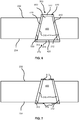
- FIG. 7 a cross section of a plug assembly 500 inserted into an aperture 310 of a cast article 300, post-brazing, is depicted.
- the capillary flow of braze material 510 may draw braze material 510 from the plug side surface 410 to the void 520.
- the inner surface braze material 514 that remains may be reduced, the outer surface braze material 512 may also be reduced, and the side braze material 516 may be increased due to the brazing process filling the voids between side braze material 516 and side surface 312 of aperture 310.
- the inner surface braze material 514 is depicted as non-continuous, it could be continuous in various embodiments.
- the excess outer surface braze material 512, any excess plug portion extending beyond outer surface 232, the inner surface braze material 514, and/or any excess plug portion extending beyond inner surface 234 may be removed by machining, or any other method known in the art.
- Repaired cast article may comprise a wall 220, a plug 400, and a braze material 510.
- the braze material 510 may be disposed between the side surface 312 of the aperture 310 and the plug side surface 410 of the plug 400.
- the plug may have a diameter at outer surface 232 of first wall 230 that is less than a diameter at inner surface 234 of first wall 230.
- Cast article assembly 900 may comprise an first wall 230, an aperture 310, and a braze material 510.
- the braze material 510 may comprise an outer surface braze portion 912, an inner surface braze portion 914 and a side surface braze portion 916.
- the side surface braze portion 916 may be disposed on side surface 312 of the aperture 310.
- the outer surface braze portion 912 may be disposed on a portion of outer surface 232 of first wall 230, the portion of outer surface 232 being proximate the side surface 312.
- the inner surface braze portion 914 may be disposed on a portion of inner surface 234 of the first wall 230, the portion of inner surface 234 being proximate the side surface 312.
- first surface 420 is flush with outer surface 232. In various embodiments, first surface 420 extends beyond outer surface 232. Similarly, second surface 430 may be flush with inner surface 234 or extend beyond inner surface 234 into the cavity.
- the side surface 312 and the plug side surface 410 may be separated by a gap between 0.002" (0.0508 mm) and 0.004" (0.1016 mm). By side surface 912 braze portion 916 at least partially filling the gap, the plug 400 may be easier to align and place in the aperture and account for variances in the gap along the side surface 312.
- the braze material 510 may fuse the cast article assembly 900 to the plug 400.
- the braze material 510 may pull from the outer surface braze portion 912 and/or the inner surface braze portion 914 to fill any gaps between the side surface braze portion 916 and the plug side surface 410 of the plug 400.
- the braze material 510 may fill up to a 0.004" (0.1016 mm) gap.
- the brazing process may pull the outer surface braze portion 912 and the inner surface braze portion 914, which are in areas that are not adjacent to a surface, to fill a void between side braze material 516 and plug side surface 410 of plug 400.
- FIG. 11 a cross section of a plug 400 inserted into an aperture 310 of a cast article assembly 900, post-brazing is depicted.
- the inner surface braze portion 914 that remains may be reduced, the outer surface braze portion 912 may also be reduced, and the side surface braze portion 916 may be increased due to the brazing process filling the voids between side surface braze portion 916 and plug side surface 410 of plug 400.
- the excess outer surface braze portion 912, any plug portion that extends past outer surface 232, any inner surface braze portion 914, and/or any plug portion that extends past inner surface 234 may be removed by machining, or any other method known in the art.
- Repaired cast article 1200 may comprise wall 220, a plug 400, and a braze material 510.
- the braze material 510 may be disposed between the side surface 312 of the aperture 310 and the plug side surface 410 of the plug 400.
- the plug may have a diameter at outer surface 232 of first wall 230 that is less than or equal to a diameter at inner surface 234 of first wall 230.
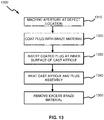
- the method may comprise machining an aperture at a defect location of the cast article (step 1310).
- the aperture may be tapered with an outer diameter at an inner surface of the cast article that is greater than or equal to an outer diameter at an outer surface of the cast article.
- the method may comprise coating a plug with a braze material (step 1320).
- the plug all surfaces of the plug may be coated with the braze material.
- the plug may have a complimentary shape to the aperture.
- the plug may be frustoconical in shape.
- the plug may be inserted from an inner surface side of the cast article (step 1330).
- the inserted plug may have voids between the braze material and a side surface of the aperture in the cast article.
- the cast article may be heated and join the plug to the cast article (step 1340).
- the cast article may be heated to a temperature at 1,975 °F (or 1,079 °C) or greater.
- the voids between the braze material and the side surface of the aperture may be filled by the excess braze material on an outer surface and an inner surface of the plug.
- the excess braze material may be machined off of the inner surface and the outer surface of the plug (step 1350).
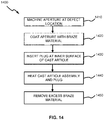
- the method may comprise machining an aperture at a defect location of the cast article (step 1410).
- the aperture may be tapered with an outer diameter at an inner surface of the cast article that is greater than or equal to an outer diameter at an outer surface of the cast article.
- the method may comprise coating the aperture of the cast article with a braze material (step 1420).
- the side surface of the aperture, an outer surface portion of the cast article proximate the aperture, and a portion of an inner surface of the cast article proximate the aperture may be coated with the braze material.
- a plug may be inserted from an inner surface side of the cast article toward an outer surface of the cast article (step 1430).
- the plug may have a complimentary shape to the aperture.
- the plug may be frustoconical in shape.
- the inserted plug may have voids between the braze material and the side surface of the aperture in the cast article.
- the cast article assembly may be heated and join the plug to the cast article (step 1440).
- the cast article assembly may be heated to a temperature at 1,975 °F (or 1,079 °C) or greater.
- the voids between the braze material and the side surface of the aperture may be filled by the excess braze material on the portion of the outer surface of the cast article and the portion of the inner surface of the cast article.
- the excess braze material may be machined off of the inner surface and the outer surface of the plug (step 1450).
- references to "various embodiments”, “one embodiment”, “an embodiment”, “an example embodiment”, etc. indicate that the embodiment described may include a particular feature, structure, or characteristic, but every embodiment may not necessarily include the particular feature, structure, or characteristic. Moreover, such phrases are not necessarily referring to the same embodiment. Further, when a particular feature, structure, or characteristic is described in connection with an embodiment, it is submitted that it is within the knowledge of one skilled in the art to affect such feature, structure, or characteristic in connection with other embodiments whether or not explicitly described. After reading the description, it will be apparent to one skilled in the relevant art(s) how to implement the disclosure in alternative embodiments.
Landscapes
- Engineering & Computer Science (AREA)
- Mechanical Engineering (AREA)
- General Engineering & Computer Science (AREA)
- Chemical & Material Sciences (AREA)
- Materials Engineering (AREA)
- Turbine Rotor Nozzle Sealing (AREA)
Applications Claiming Priority (1)
| Application Number | Priority Date | Filing Date | Title |
|---|---|---|---|
| US16/434,744 US20200384560A1 (en) | 2019-06-07 | 2019-06-07 | Braze-in-place plug repair method for throughwall defects on castings |
Publications (1)
| Publication Number | Publication Date |
|---|---|
| EP3747589A1 true EP3747589A1 (de) | 2020-12-09 |
Family
ID=71266258
Family Applications (1)
| Application Number | Title | Priority Date | Filing Date |
|---|---|---|---|
| EP20178466.7A Withdrawn EP3747589A1 (de) | 2019-06-07 | 2020-06-05 | Verfahren zum reparieren von durchgehenden wanddefekten an gussteilen mittels vor ort gelöteten stopfen |
Country Status (2)
| Country | Link |
|---|---|
| US (1) | US20200384560A1 (de) |
| EP (1) | EP3747589A1 (de) |
Cited By (2)
| Publication number | Priority date | Publication date | Assignee | Title |
|---|---|---|---|---|
| US11524350B1 (en) * | 2021-10-04 | 2022-12-13 | General Electric Company | Backwall strike braze repair |
| US20250345872A1 (en) * | 2024-05-07 | 2025-11-13 | Rtx Corporation | Method of diffusion braze repair of cooling holes and cracks |
Families Citing this family (10)
| Publication number | Priority date | Publication date | Assignee | Title |
|---|---|---|---|---|
| JP7434199B2 (ja) * | 2021-03-08 | 2024-02-20 | 株式会社東芝 | タービン動翼 |
| DE102021211825A1 (de) | 2021-10-20 | 2023-04-20 | Siemens Energy Global GmbH & Co. KG | Stopfen löten, Bauteil einer Gasturbine und Verfahren |
| US12576614B2 (en) | 2023-10-27 | 2026-03-17 | Ge Infrastructure Technology Llc | Porous metal coupon with thermal transfer structure for component and related component |
| US12502713B2 (en) | 2023-10-27 | 2025-12-23 | Ge Infrastructure Technology Llc | Porous metal coupon with sealed cavity for repairing component, component with same and related method |
| US12544845B2 (en) * | 2023-10-27 | 2026-02-10 | Ge Infrastructure Technology Llc | Porous metal coupon with braze material infiltration barrier for repairing component, component with same and related method |
| US12605768B2 (en) | 2023-10-27 | 2026-04-21 | Ge Infrastructure Technology Llc | Porous metal coupon with low porosity region for repairing component, component with same and related method |
| US20250135588A1 (en) * | 2023-10-27 | 2025-05-01 | Ge Infrastructure Technology Llc | Braze repair using metal coupon with porous region |
| US12528133B2 (en) | 2024-01-19 | 2026-01-20 | Ge Infrastructure Technology Llc | Metal coupon with braze reservoir for component, component with same and related method |
| US20250242409A1 (en) * | 2024-01-26 | 2025-07-31 | Rtx Corporation | Use of sacrificial surface during directed energy deposition repair process |
| US20250326074A1 (en) * | 2024-04-18 | 2025-10-23 | Ge Infrastructure Technology Llc | Systems and methods for repairing machined slots in gas turbine components |
Citations (7)
| Publication number | Priority date | Publication date | Assignee | Title |
|---|---|---|---|---|
| EP1074331A1 (de) * | 1999-08-02 | 2001-02-07 | General Electric Company | Verfahren zum Reparieren von Gussteilen aus Superlegierungen unter Verwendung eines metallurgisch verbundenen konischen Stopfens |
| US6454156B1 (en) * | 2000-06-23 | 2002-09-24 | Siemens Westinghouse Power Corporation | Method for closing core printout holes in superalloy gas turbine blades |
| US20030034379A1 (en) * | 2001-08-16 | 2003-02-20 | Jackson Melvin Robert | Method of repairing superalloy directional castings |
| DE10256414A1 (de) * | 2002-12-02 | 2004-06-09 | Siemens Ag | Verfahren zur Herstellung eines Bauteils |
| US20130086785A1 (en) * | 2011-10-06 | 2013-04-11 | Yan Cui | Hybrid repair plugs and repair methods incorporating the same |
| WO2013066680A1 (en) * | 2011-11-04 | 2013-05-10 | Siemens Energy, Inc. | Splice insert repair for superalloy turbine blades |
| US20150328725A1 (en) * | 2014-05-15 | 2015-11-19 | Cummins Inc. | Conical pins for the structural repair of defects |
-
2019
- 2019-06-07 US US16/434,744 patent/US20200384560A1/en not_active Abandoned
-
2020
- 2020-06-05 EP EP20178466.7A patent/EP3747589A1/de not_active Withdrawn
Patent Citations (7)
| Publication number | Priority date | Publication date | Assignee | Title |
|---|---|---|---|---|
| EP1074331A1 (de) * | 1999-08-02 | 2001-02-07 | General Electric Company | Verfahren zum Reparieren von Gussteilen aus Superlegierungen unter Verwendung eines metallurgisch verbundenen konischen Stopfens |
| US6454156B1 (en) * | 2000-06-23 | 2002-09-24 | Siemens Westinghouse Power Corporation | Method for closing core printout holes in superalloy gas turbine blades |
| US20030034379A1 (en) * | 2001-08-16 | 2003-02-20 | Jackson Melvin Robert | Method of repairing superalloy directional castings |
| DE10256414A1 (de) * | 2002-12-02 | 2004-06-09 | Siemens Ag | Verfahren zur Herstellung eines Bauteils |
| US20130086785A1 (en) * | 2011-10-06 | 2013-04-11 | Yan Cui | Hybrid repair plugs and repair methods incorporating the same |
| WO2013066680A1 (en) * | 2011-11-04 | 2013-05-10 | Siemens Energy, Inc. | Splice insert repair for superalloy turbine blades |
| US20150328725A1 (en) * | 2014-05-15 | 2015-11-19 | Cummins Inc. | Conical pins for the structural repair of defects |
Cited By (3)
| Publication number | Priority date | Publication date | Assignee | Title |
|---|---|---|---|---|
| US11524350B1 (en) * | 2021-10-04 | 2022-12-13 | General Electric Company | Backwall strike braze repair |
| US11951557B2 (en) | 2021-10-04 | 2024-04-09 | General Electric Company | Backwall strike braze repair |
| US20250345872A1 (en) * | 2024-05-07 | 2025-11-13 | Rtx Corporation | Method of diffusion braze repair of cooling holes and cracks |
Also Published As
| Publication number | Publication date |
|---|---|
| US20200384560A1 (en) | 2020-12-10 |
Similar Documents
| Publication | Publication Date | Title |
|---|---|---|
| EP3747589A1 (de) | Verfahren zum reparieren von durchgehenden wanddefekten an gussteilen mittels vor ort gelöteten stopfen | |
| EP3080401B1 (de) | Gebondete mehrteilige gasturbinenmotorkomponente | |
| EP2971567B1 (de) | Verfahren zur herstellung eines artikels mit abschnitten mit unterschiedlichen mikrostrukturen | |
| US20180161851A1 (en) | Core assembly including studded spacer | |
| EP3498979B1 (de) | Gekühltes schaufelblatt | |
| US20160001354A1 (en) | Gas turbine engine component manufacturing method and core for making same | |
| EP4431700A1 (de) | Verfahren zur anpassung der vibratorischen eigenschaften einer abdeckung für eine hohlschaufelanordnung mit offenem körper, hohlschaufelanordnung und verfahren zur änderung einer vibratorischen eigenschaft einer abdeckung an einen offenen körper | |
| EP4407147A1 (de) | Verfahren zum löten einer abdeckung an einen offenen körper für eine hohlschaufelanordnung, hohlschaufelanordnung und verfahren zum anfügen einer abdeckung an einen offenen körper | |
| US10024181B2 (en) | Casting of thin wall hollow airfoil sections | |
| EP3246109A1 (de) | Gusssystem für ein präzisionsgussverfahren | |
| US20210115799A1 (en) | Angled tip rods | |
| EP4495381A1 (de) | Verfahren zur bildung einer hohlen leitschaufelanordnung, hohle leitschaufelanordnung und verfahren zur verbesserung der belastungsfähigkeit zwischen einer abdeckung und einem offenen körper für eine hohlen leitschaufelanordnung | |
| US12358043B2 (en) | Integral core bumpers | |
| EP3412868B1 (de) | Leitschaufel mit plattformkühlung mit einstellbarer durchflussteilung für ein gasturbinentriebwerk | |
| EP3633148B1 (de) | Poröses metallisches turbinenbauteil aus verbundguss und entsprechende herstellungsverfahren | |
| EP2929955B1 (de) | Buckelrippensystem | |
| EP3663520B1 (de) | Verbundstoffbläserschaufel mit eintrittskantenummantelung | |
| EP3626932A1 (de) | Gekühlte komponente für einen gasturbinenmotor sowie zugehörige feingussform und fertigungsverfahren |
Legal Events
| Date | Code | Title | Description |
|---|---|---|---|
| PUAI | Public reference made under article 153(3) epc to a published international application that has entered the european phase |
Free format text: ORIGINAL CODE: 0009012 |
|
| STAA | Information on the status of an ep patent application or granted ep patent |
Free format text: STATUS: THE APPLICATION HAS BEEN PUBLISHED |
|
| AK | Designated contracting states |
Kind code of ref document: A1 Designated state(s): AL AT BE BG CH CY CZ DE DK EE ES FI FR GB GR HR HU IE IS IT LI LT LU LV MC MK MT NL NO PL PT RO RS SE SI SK SM TR |
|
| AX | Request for extension of the european patent |
Extension state: BA ME |
|
| STAA | Information on the status of an ep patent application or granted ep patent |
Free format text: STATUS: REQUEST FOR EXAMINATION WAS MADE |
|
| 17P | Request for examination filed |
Effective date: 20210528 |
|
| RBV | Designated contracting states (corrected) |
Designated state(s): AL AT BE BG CH CY CZ DE DK EE ES FI FR GB GR HR HU IE IS IT LI LT LU LV MC MK MT NL NO PL PT RO RS SE SI SK SM TR |
|
| RAP3 | Party data changed (applicant data changed or rights of an application transferred) |
Owner name: RTX CORPORATION |
|
| STAA | Information on the status of an ep patent application or granted ep patent |
Free format text: STATUS: EXAMINATION IS IN PROGRESS |
|
| 17Q | First examination report despatched |
Effective date: 20240315 |
|
| STAA | Information on the status of an ep patent application or granted ep patent |
Free format text: STATUS: THE APPLICATION IS DEEMED TO BE WITHDRAWN |
|
| 18D | Application deemed to be withdrawn |
Effective date: 20240716 |