EP3745947B1 - Verfahren zur erkennung einer umwandlung von leichter kognitiver beeinträchtigung und morbus alzheimer - Google Patents
Verfahren zur erkennung einer umwandlung von leichter kognitiver beeinträchtigung und morbus alzheimer Download PDFInfo
- Publication number
- EP3745947B1 EP3745947B1 EP19707477.6A EP19707477A EP3745947B1 EP 3745947 B1 EP3745947 B1 EP 3745947B1 EP 19707477 A EP19707477 A EP 19707477A EP 3745947 B1 EP3745947 B1 EP 3745947B1
- Authority
- EP
- European Patent Office
- Prior art keywords
- eeg
- signal
- signals
- time
- sub
- Prior art date
- Legal status (The legal status is an assumption and is not a legal conclusion. Google has not performed a legal analysis and makes no representation as to the accuracy of the status listed.)
- Active
Links
Images
Classifications
-
- A—HUMAN NECESSITIES
- A61—MEDICAL OR VETERINARY SCIENCE; HYGIENE
- A61B—DIAGNOSIS; SURGERY; IDENTIFICATION
- A61B5/00—Measuring for diagnostic purposes; Identification of persons
- A61B5/72—Signal processing specially adapted for physiological signals or for diagnostic purposes
- A61B5/7235—Details of waveform analysis
- A61B5/7264—Classification of physiological signals or data, e.g. using neural networks, statistical classifiers, expert systems or fuzzy systems
-
- A—HUMAN NECESSITIES
- A61—MEDICAL OR VETERINARY SCIENCE; HYGIENE
- A61B—DIAGNOSIS; SURGERY; IDENTIFICATION
- A61B5/00—Measuring for diagnostic purposes; Identification of persons
- A61B5/24—Detecting, measuring or recording bioelectric or biomagnetic signals of the body or parts thereof
- A61B5/316—Modalities, i.e. specific diagnostic methods
- A61B5/369—Electroencephalography [EEG]
-
- A—HUMAN NECESSITIES
- A61—MEDICAL OR VETERINARY SCIENCE; HYGIENE
- A61B—DIAGNOSIS; SURGERY; IDENTIFICATION
- A61B5/00—Measuring for diagnostic purposes; Identification of persons
- A61B5/24—Detecting, measuring or recording bioelectric or biomagnetic signals of the body or parts thereof
- A61B5/316—Modalities, i.e. specific diagnostic methods
- A61B5/369—Electroencephalography [EEG]
- A61B5/372—Analysis of electroencephalograms
-
- A—HUMAN NECESSITIES
- A61—MEDICAL OR VETERINARY SCIENCE; HYGIENE
- A61B—DIAGNOSIS; SURGERY; IDENTIFICATION
- A61B5/00—Measuring for diagnostic purposes; Identification of persons
- A61B5/40—Detecting, measuring or recording for evaluating the nervous system
- A61B5/4076—Diagnosing or monitoring particular conditions of the nervous system
- A61B5/4088—Diagnosing of monitoring cognitive diseases, e.g. Alzheimer, prion diseases or dementia
-
- G—PHYSICS
- G06—COMPUTING OR CALCULATING; COUNTING
- G06F—ELECTRIC DIGITAL DATA PROCESSING
- G06F18/00—Pattern recognition
- G06F18/20—Analysing
- G06F18/22—Matching criteria, e.g. proximity measures
-
- G—PHYSICS
- G06—COMPUTING OR CALCULATING; COUNTING
- G06F—ELECTRIC DIGITAL DATA PROCESSING
- G06F18/00—Pattern recognition
- G06F18/20—Analysing
- G06F18/23—Clustering techniques
- G06F18/231—Hierarchical techniques, i.e. dividing or merging pattern sets so as to obtain a dendrogram
-
- G—PHYSICS
- G06—COMPUTING OR CALCULATING; COUNTING
- G06F—ELECTRIC DIGITAL DATA PROCESSING
- G06F2218/00—Aspects of pattern recognition specially adapted for signal processing
- G06F2218/12—Classification; Matching
- G06F2218/16—Classification; Matching by matching signal segments
- G06F2218/18—Classification; Matching by matching signal segments by plotting the signal segments against each other, e.g. analysing scattergrams
-
- G—PHYSICS
- G16—INFORMATION AND COMMUNICATION TECHNOLOGY [ICT] SPECIALLY ADAPTED FOR SPECIFIC APPLICATION FIELDS
- G16H—HEALTHCARE INFORMATICS, i.e. INFORMATION AND COMMUNICATION TECHNOLOGY [ICT] SPECIALLY ADAPTED FOR THE HANDLING OR PROCESSING OF MEDICAL OR HEALTHCARE DATA
- G16H50/00—ICT specially adapted for medical diagnosis, medical simulation or medical data mining; ICT specially adapted for detecting, monitoring or modelling epidemics or pandemics
- G16H50/20—ICT specially adapted for medical diagnosis, medical simulation or medical data mining; ICT specially adapted for detecting, monitoring or modelling epidemics or pandemics for computer-aided diagnosis, e.g. based on medical expert systems
Definitions
- AD Alzheimer's Disease
- AD is a neurodegenerative disease characterized by a subtle onset, which is estimated to begin decades before cognitive and memory problems become visible, and by gradual progression. AD upsets the metabolic processes that keep healthy neurons and causes nerve cells to stop functioning, lose interconnections with other neurons, and eventually die. The death of nerve cells causes memory deficits, personality changes, problems in the performance of daily activities.
- NIA/AA National Institute on Aging and the Alzheimer Association
- aMCI amnestic MCI
- non-amnestic MCI The first one refers to patients with memory deficits and the second one refers to patients with cognitive deficits but not memory deficits. aMCI subjects are more likely to develop AD.
- a purpose of the present invention is to provide a method of objective assessment of the progression of MCI to AD, quantifying the effects it has on the patient's electroencephalogram (EEG).
- the present invention achieves the above purpose by providing a computer implemented method for detecting the conversion from mild cognitive impairment (MCI) to Alzheimer disease (AD), the method comprising the stages of claim 1.
- MCI mild cognitive impairment
- AD Alzheimer disease
- the method of the invention is based on the advanced processing of EEG signals since electroencephalography is a non-invasive neurophysiological evaluation technique, very well tolerated by patients, rapid, cost-effective and widespread on a large scale.
- the EEG is therefore the optimal candidate for the development of a system of early diagnosis of AD.
- the clinics in which the MCI and AD subjects are taken care of are normally equipped with EEG acquisition systems since the reporting of EEG tracing is part of the most widespread evaluation protocols of this category of patients.
- the method of the invention is based on an innovative measure of synchronization of the EEG signals, called Permutation Jaccard Distance (PJD) and on its use as a measure of coupling between the electrodes.
- the electrodes are considered “nodes” of a complex network and the coupling between the nodes is estimated through the PJD.
- the network thus obtained is passed into input to the hierarchical clustering so that the electrodes are divided into clusters, according to the degree of coupling between them.
- the density of connectivity or network density (ND) between the electrodes, then between the corresponding brain areas, is estimated accordingly.
- ND network density
- the proposed system thus provides an objective criterion for monitoring the brain health status of MCI subjects, which goes alongside the other criteria of neurological, psychological, clinical and cognitive assessment normally provided by the evaluation protocols of these patients.
- the method of the invention for detecting a conversion from mild cognitive impairment (MCI) to Alzheimer disease (AD), illustrated in the Figures, comprises the following stages:
- the whole method of the invention is based on an EEG tracing data processing. Carrying out the method of the invention never requires the presence of the human body.
- the whole method must be executed offline once the input data, i.e. the data of the two EEG tracings previously recorded at time T 0 (baseline) and at time T 1 (some months after T 0 , for example 2 or 3 or 4 or 5 months after T 0 ) have been stored on a computer.
- the data processing can be performed by any computer on which a software adapted to execute said steps is installed.
- the EEG tracings once memorized, are reviewed by an EEG expert in order to identify, preferably visually, and eliminate tracing segments contaminated by artifacts.
- the EEG tracings, thus cleaned up by the artifacts, will be subsequently processed according to the method of the invention.
- stage c) and stage d) for each first sub-tracing EEG sb T0 and each second sub-tracing EEG sb T1 the following is provided
- stage d) the hierarchical Clustering is performed, starting from the dissimilarity matrices D T0 (sb) and D T1 (sb), outputting two dendrograms showing the connection between the first signals EEG sb (1, ..., n) at time T 0 and the connection between the second signals EEG sb (1, ..., n) at time T 1 , respectively, as a function of a fusion level FL, whereby for each dissimilarity matrix and for each fusion level FL, a set of clusters is determined.
- the hierarchical Clustering is performed by an agglomerative hierarchical Clustering algorithm, preferably a "complete linkage algorithm”, also referred to as “furthest neighbour”, which defines the distance or dissimilarity between two clusters by means of the maximum distance between a pair of signals, a signal belonging to a first cluster while the other signal of said pair belonging to the second cluster.
- an agglomerative hierarchical Clustering algorithm preferably a "complete linkage algorithm”, also referred to as "furthest neighbour” which defines the distance or dissimilarity between two clusters by means of the maximum distance between a pair of signals, a signal belonging to a first cluster while the other signal of said pair belonging to the second cluster.
- stage e the following is provided
- the network densities ND FL T0 (sb) and ND FL T1 (sb) are estimated for different fusion levels from 0 to 1, preferably but not necessarily with steps of 0.01.
- stage c) of the method of the invention before calculating the Permutation Jaccard Distance PJD X,Y w (sb) for each possible pair of signals EEG sb (x) and EEG sb (y), the following is provided:
- PE(Y) is the Permutation Entropy of the signal EEG sb (y)
- PJE(X,Y) is the Permutation Joint Entropy of the signals EEG sb (x) and EEG sb (y)
- stage b) it is sufficient to extract, for each epoch w of the first tracing EEG-T 0 , only two first sub-tracings EEG sb T0 corresponding to the two frequency sub-bands delta and theta, and for each epoch w of the second tracing EEG-T 1 only two second sub-tracings EEG sb T1 corresponding to the two frequency sub-bands delta and theta.
- EEG electroencephalography
- the EEG tracing is then viewed by the EEG expert in order to find and exclude any sleep patterns and to label and eliminate segments that exhibit artifacts. If the sampling frequency is higher than 256 Hz, a 256 Hz downsampling will be performed.
- the EEG tracing thus acquired is divided into epochs w of equal duration and not overlapping, of about 3-7 seconds, for example 5 seconds, and is then divided into four sub-tracings EEG sb (stage b), each associated with one of the specific sub-bands of interest: EEG delta , EEG theta , EEG alfa , EEG beta .
- the sub-tracings are extracted by filtering, in a known manner, each EEG channel through bandpass filters based on the Fast Fourier Transform (FFT) and on the reverse FFT (IFFT).
- FFT Fast Fourier Transform
- IFFT reverse FFT
- each EEG signal is broken down into its different elementary frequency components; by means of the IFFT, the EEG signal is then reconstructed in the desired specific sub-band, that is: delta (0.5-4Hz), theta (4-8 Hz), alpha (8-13 Hz) and beta (13-30 Hz).
- EEG delta , EEG theta , EEG alpha , EEG beta is then analyzed independently from the others.
- the "inter-electrode" dissimilarity is quantified by estimating the coupling strength between the corresponding signals EEG sb (x) and EEG sb (y). In this way it is possible to associate a graph to the EEG recorded at time T 0 and a graph to the EEG recorded at time T 1 .
- HC hierarchical clustering
- a set of clusters is determined and it is possible subsequently estimate the network density or connectivity density.
- the connectivity density of the two graphs corresponding to time T 0 and time T 1 , it is possible to indirectly quantify how the brain connectivity varies.
- Permutation Entropy was introduced by Bandt and Pompe ( C. Bandt and B. Pompe - Permutation entropy: A natural complexity measure for time series - Phys. Rev. Lett., 88 (17), 2002 ) as a symbolic descriptor of dynamic complexity changes in time series. Thanks to the projection in symbols (motifs), the Permutation Entropy, or simply PE, estimates the randomness of a time series regardless of its amplitude, which plays a key role when analyzing the EEG. In fact, the amplitude of EEG, recorded through a given electrode, depends on the distance from the reference electrode. When processing EEG recordings using amplitude-dependent techniques, each EEG signal should first be normalized to cancel the effect of closeness to the reference electrode.
- PE is a univariate descriptor that can only describe the randomness of a single time series, in this case an EEG signal, and cannot quantify the coupling strength between two or more time series, i.e. between two or more EEG signals.
- the descriptor proposed in the method of the invention namely the Permutation Jaccard Distance (PJD), is based on the same projection into symbols adopted by Permutation Entropy (PE), but is a multivariate descriptor that can quantify the coupling strength between two or more time series.
- PID Permutation Jaccard Distance
- PE Permutation Entropy
- MI(X;Y) H(X) + H(Y) - H(X,Y).
- time series projection in symbols Given two time series x and y with N samples, they can be mapped into an m-dimensional space, where m is the embedding dimension [ N. Packard, J. Crutchfield, J. Farmer and R. Shaw, "Geometry from time series", Phys. Rev. Lett. 45, (1980) 712 .]
- Xt and Yt are both vectors with three elements.
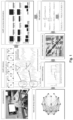
- the algorithm checks which motif occurs in Xt (motif ⁇ 4 in the example shown in Figure 1 ) and which motif occurs in Yt (motif ⁇ 1 in the example of Figure 1 ).
- the algorithm in the first iteration, will increment the number of occurrences ⁇ X ( ⁇ 4 ) of the motif ⁇ 4 in the time series x, and the number of occurrences ⁇ Y ( ⁇ 1 ) of the motif ⁇ 1 in the time series y.
- the algorithm will also increment the number of joint occurrences ⁇ X,Y ( ⁇ 4 , ⁇ 1 ) of the two motifs ⁇ 4 and ⁇ 1 .
- the algorithm moves to the following samples x(t+1), y(t+1), constructs two new vectors X t+1 and Y t+1 and reiterates the procedure just illustrated.
- the procedure becomes amplitude independent. This feature is very useful when analyzing EEG signals, because a signal recorded through an electrode close to the reference electrode will inherently have a lower amplitude, compared to a electrode located farther away.
- PJE Permutation Joint Entropy
- PVI Permutation Variation of Information
- JD Jaccard Distance
- PJD is a symbolic methodology, it is less sensitive to artifacts because it projects the EEG time series into a set of symbols (motifs). In this way, the possible amplitude variation in the EEG signal, due to artifacts, would not alter the amplitude of the symbols, which are predetermined. Furthermore, PJD is nonlinear and could capture nonlinear dynamics in the EEG signal better than linear descriptors of the coupling strength, such as coherence (Wavelet Coherence).
- the Permutation Jaccard Distance between each possible pair of signals is calculated, for each patient, in each frequency sub-band, for both EEG-T 0 and EEG-T 1 tracings.
- a hierarchical Clustering HC is used to group the signals, and therefore the electrodes, according to their mutual Permutation Jaccard Distances (PJDs) and subsequently to estimate the connectivity density of the electrode network.
- JDs mutual Permutation Jaccard Distances
- Hierarchical clustering partitions a sample dataset into clusters.
- the divisive hierarchical clustering assigns the entire dataset to a cluster and then iteratively splits it into groups until all groups are single clusters.
- this algorithm is computationally expensive.
- agglomerative HC algorithms have been proposed in the literature ( Brian S. Everitt, Sabine Landau, Morven Leese, Daniel Stahl. Cluster Analysis, 5th Edition (2011). Wiley. ISBN: 978-0-470-74991-3 ).
- a "complete linkage algorithm” is used, also called “furthest neighbour”, which defines the distance or dissimilarity between two clusters by means of the maximum distance between a pair of signals.
- Said mean values PJD T0 X,Y (sb) and PJD T1 X,Y (sb) thus define the dissimilarity D X,Y T0 (sb) and D X,Y T1 (sb) between the signal EEG sb (x) and the signal EEG sb (y) of each possible pair of signals, respectively at the time T 0 and at the time T 1 , i.e. between two electrodes of each possible pair of electrodes.
- D Ti (sb) for each phase of the follow-up Ti of each patient and for each sub-band.
- the hierarchical Clustering HC is applied to the dissimilarity matrices D T0 (sb) and D T1 (sb), having as output for each frequency sub-band two dendrograms showing the connection among the first signals EEG sb (1, ..., n) at time T 0 and the connection among the second signals EEG sb (1, ..., n) at time T 1 , respectively, as a function of a fusion level FL, i.e.
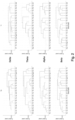
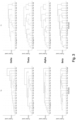
- the dendrogram therefore provides a view of the connection between the electrodes as a function of the fusion level (stage d). Given a fusion level FL, the electrodes connected at a level below FL will belong to the same cluster and will be considered connected. Therefore, for each dissimilarity matrix and each level of fusion FL, a set of clusters is determined (see for example Figure 2 or 3 ).
- the number of active connections AC FL T0 (sb) and AC FL T1 (sb) is calculated for each fusion level FL, respectively by summing the number of possible pairs of first signals EEG sb (1, ..., n) at time T 0 , and summing the number of possible pairs of second signals EEG sb (1, ..., n) at time T 1 , present within each cluster of the respective set of clusters. That is, the number of active connections AC FL T0 (sb) and AC FL T1 (sb) is calculated for each fusion level FL, by summing the number of signal pairs belonging to the first set of signals EEG sb (1 ,.
- the network densities ND FL T0 (sb) and ND FL T1 (sb) are defined for each fusion level FL by normalizing the number of active connections AC FL T0 (sb) and AC FL T1 (sb) with respect to the total number of possible connections, where n is the number of signals (electrodes).
- ND FL Ti sb AC FL Ti sb n ⁇ n ⁇ 1 / 2 .
- the dendrograms of two patients are illustrated by way of example in Figures 2 and 3 .
- the dendrogram in Figure 2 refers to a first patient Pt30 with stable MCI at time T 1
- the dendrogram in Figure 3 refers to a patient Pt51 in which there was the conversion from MCI to Alzheimer's disease (AD) at time T 1 .
- AD Alzheimer's disease
- the axis of the ordinates of the dendrogram represents the distance or dissimilarity between the clusters (fusion level FL).
- the axis of the abscissas of the dendrogram represents the electrodes.
- Each branch of the diagram corresponds to a cluster.
- the (horizontal) conjunction line of two or more branches identifies the distance (fusion level) at which the clusters merge.
- ND FL T0 (sb) and ND FL T1 (sb) were estimated as described above.
- ND indicates how many connections are active as a function of the threshold of the selected fusion level.
- the network densities ND FL T0 (sb) and ND FL T1 (sb) were calculated for different fusion level thresholds ranging from 0 to 1, with a step of 0,01.
- the fusion level is between 0 and 1 because the PJD is by definition included in that range.
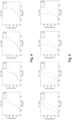
- Figures 4 and 5 show explanatory representations of the evolution of the network density from T 0 to T 1 as a function of the fusion level threshold, in each sub-band, for the patient Pt30 (stable MCI) and for the patient Pt51 (converted AD), respectively.
- the method of the present invention for the indirect estimation of the density of brain connectivity is extremely sensitive and specific for the conversion from MCI to AD.
- the use of the PJD as a symbolic descriptor of the coupling strength gave better results than the linear descriptors of the coupling strength, such as coherence (Wavelet Coherence), which instead led to the detection of false positives.
Landscapes
- Health & Medical Sciences (AREA)
- Engineering & Computer Science (AREA)
- Life Sciences & Earth Sciences (AREA)
- Physics & Mathematics (AREA)
- Data Mining & Analysis (AREA)
- Public Health (AREA)
- Medical Informatics (AREA)
- Biomedical Technology (AREA)
- Artificial Intelligence (AREA)
- Theoretical Computer Science (AREA)
- General Health & Medical Sciences (AREA)
- Pathology (AREA)
- Neurology (AREA)
- Biophysics (AREA)
- Psychiatry (AREA)
- Heart & Thoracic Surgery (AREA)
- Molecular Biology (AREA)
- Surgery (AREA)
- Animal Behavior & Ethology (AREA)
- Veterinary Medicine (AREA)
- Computer Vision & Pattern Recognition (AREA)
- Evolutionary Computation (AREA)
- Physiology (AREA)
- Psychology (AREA)
- Bioinformatics & Cheminformatics (AREA)
- Bioinformatics & Computational Biology (AREA)
- General Physics & Mathematics (AREA)
- General Engineering & Computer Science (AREA)
- Evolutionary Biology (AREA)
- Signal Processing (AREA)
- Mathematical Physics (AREA)
- Hospice & Palliative Care (AREA)
- Neurosurgery (AREA)
- Child & Adolescent Psychology (AREA)
- Developmental Disabilities (AREA)
- Fuzzy Systems (AREA)
- Databases & Information Systems (AREA)
- Epidemiology (AREA)
- Primary Health Care (AREA)
- Measurement And Recording Of Electrical Phenomena And Electrical Characteristics Of The Living Body (AREA)
Claims (7)
- Computerimplementiertes Verfahren zum Erkennen einer Umwandlung von leichter kognitiver Beeinträchtigung (MCI) zu Alzheimer-Krankheit (AD), wobei das Verfahren die folgenden Stufen umfasst:a) Bereitstellen einer Vielzahl von ersten Signalen EEG (1, ..., n), die zu einem ersten Zeitpunkt T0 aufgezeichnet wurden und eine erste Aufzeichnung EEG-T0 eines Patienten mit leichter kognitiver Beeinträchtigung definieren, und einer Vielzahl von zweiten Signalen EEG (1, ..., n), die zu einem zweiten Zeitpunkt T1 aufgezeichnet wurden und eine zweite Aufzeichnung EEG-T1 desselben Patienten definieren, als Eingangsdaten, wobei jedes erste Signal und jedes zweite Signal einer jeweiligen Elektrode V (mit V = 1, ..., n) entspricht,
und wobei die erste Aufzeichnung EEG-T0 und die zweite Aufzeichnung EEG-T1 in Epochen (w) gleicher Dauer unterteilt sind;b) für jede Epoche (w) der ersten Aufzeichnung EEG-T0, Extrahieren von mindestens zwei ersten Unteraufzeichnungen EEGsb T0, die einem jeweiligen Frequenzunterband (sb = delta, theta) entsprechen, und für jede Epoche (w) der zweiten Aufzeichnung EEG-T1, Extrahieren von mindestens zwei zweiten Unteraufzeichnungen EEGsb T1, die einem jeweiligen Frequenzunterband (sb = delta, theta) entsprechen;c) für jede Epoche (w) und für jede der ersten Unter-Aufzeichnungen EEGsb T0und zweiten Unter-Aufzeichnungen EEGsb T1 für jedes mögliche Paar von Signalen x und y (mit x = 1, ..., n; y = 1, ..., n und x ≠ y), Berechnen der Permutations-Jaccard-Distanz PJDX,Y W(sb) zwischen dem Signal EEGsb(x) und dem Signal EEGsb(y) sowohl zum Zeitpunkt T0 als auch zum Zeitpunkt T1;d) für jede erste Unteraufzeichnung EEGsb T0 und jede zweite Unteraufzeichnung EEGsb T1, Durchführen eines hierarchischen Clustering, um die Signale der jeweiligen Unteraufzeichnung gemäß ihrer gegenseitigen Permutations-Jaccard-Distanzen in Cluster zu unterteilen;e) Schätzen der Netzwerkdichte, wenn ein Fusionsniveau FL variiert, aus den durch das hierarchische Clustering erhaltenen Clustern, wobei zwei Kurven NDT0(sb) und NDT1(sb) für jedes Frequenzunterband (sb = delta, theta) definiert werden;f) Berechnen der prozentualen Abweichung ΔND(sb)% der Fläche, die von den beiden Kurven NDT1(sb) und NDT0(sb) begrenzt wird, für jedes Frequenzunterband mit der Formel ΔND(sb)% = (NDT1(sb) - NDT0(sb))*100/NDT0(sb);g) Überprüfen, ob die prozentuale Abweichung ΔND(sb)% für jedes Frequenzunterband im Übergang von T0 zu T1 negativ ist, um die Umwandlung von leichter kognitiver Beeinträchtigung (MCI) in Alzheimer-Krankheit (AD) zu bestätigen; wobei in Stufe c) vor der Berechnung der Permutations-Jaccard-Distanz PJDX,Y W(sb) für jedes mögliche Paar von Signalen EEGsb(x) und EEGsb(y) folgendes vorgesehen istc1) für jedes mögliche Paar von Signalen EEGsb(x) and EEGsb(y), das in einem m-dimensionalen Raum abbildbar ist, wobei jedes Signal EEGsb(x), EEGsb(y) N Zeitaufzeichnungen (t, t+1, ..., t+N-1) in der Epoche (w) aufweist, Erfassen einer Vielzahl von Symbolen πi, πj mit i, j=1,..., m!, die in der Epoche (w) für jede Aufzeichnung (t, t+1, ..., t+N-1 auftreten;c2) für jede Aufzeichnung (t, t+1, ..., t+N-1) Erfassen der Anzahl des Auftretens ηX(πi) jedes Symbols πi entlang des Signals EEGsb(x), der Anzahl des Auftretens ηY(πj) jedes Symbols πj entlang des Signals EEGsb(y), und der Anzahl des gemeinsamen Auftretens ηX,Y(πi,πj) der beiden Symbole πi, πj entlang des Signals EEGsb(x) und des Signals EEGsb(y):c3) nachdem die Signale EEGsb(x), EEGsb(y) vollständig verarbeitet wurden, Schätzen der Auftrittswahrscheinlichkeit pX(πi) des Symbols πi entlang des Signals EEGsb(x), der Auftrittswahrscheinlichkeit pY(πi) des Symbols πi entlang des Signals EEGsb(x) und der gemeinsamen Auftrittswahrscheinlichkeit pX,Y(πi, πj) der beiden Symbole πi, πj zusammen mit dem Signal EEGsb(x) und dem Signal EEGsb(y);wobei

und wobei L eine zeitliche Verzögerung zwischen einer Probe und der nächsten ist;und wobei für jede Epoche (w) die Permutations-Jaccard-Distanz PJDX,Y(sb) zwischen dem Signal EEGsb(x) und dem Signal EEGsb(y) durch die folgende Beziehung definiert ist: PJDX,Y(sb) = 1 - PMI(X,Y)/PJE(X,Y),wobei PMI(X,Y) die gegenseitige Permutationsinformation ist, die definiert ist als
 wobei PE(X) die Permutationsentropie des Signals EEGsb(x) ist:
 PE(Y) die Permutationsentropie des Signals EEGsb(y) ist:
 und PJE(X,Y) die gemeinsame Permutationsentropie der Signale EEGsb(X) und EEGsb(y) ist:
 wobei log der natürliche Logarithmus ist.
 - Computerimplementiertes Verfahren nach Anspruch 1, wobei zwischen Stufe c) und Stufe d) für jede erste Unteraufzeichnung EEGsb T0 und jede zweite Unteraufzeichnung EEGsb T1 Folgendes vorgesehen ist:- Berechnen der jeweiligen Mittelwerte PJDT0 X,Y(sb), PJDT1 X,Y(sb) über alle Epochen (w) für jedes mögliche Paar von Signalen EEGsb(x) und EEGsb(y), wobei die Mittelwerte PJDT0 X,Y(sb) und PJDT1 X,Y(sb) die Unähnlichkeiten DX,Y T0(sb) und DX,Y T1(sb) zwischen dem Signal EEGsb(x) und dem Signal EEGsb(y) für jedes mögliche Paar zum Zeitpunkt T0 bzw. Zeitpunkt T1 definieren;- Aufbauen von zwei Netzwerken NETsb(Ti), mit i = 0, 1, dessen Knoten "x" das Signal EEGsb(x) zum Zeitpunkt Ti darstellt, und die Gewichtung, die die Knoten "x" und "y" des Netzwerkes NETsb(Ti) verbindet, die Unähnlichkeit zwischen dem Paar von Signalen EEGsb(x) und EEGsb(y) zum Zeitpunkt Ti darstellt, wodurch zwei Unähnlichkeitsmatrizen DT0(sb) und DT1(sb) entstehen, deren (x, y)-tes Element gleich DX,Y(sb)=PJDX,Y T0(sb) bzw. DX,Y T1(sb)=PJDX,Y T1(sb) ist.
- Computerimplementiertes Verfahren nach Anspruch 2, wobei in Stufe d) das hierarchische Clustering aus den Unähnlichkeitsmatrizen DT0(sb) und DT1(sb) durchgeführt wird, wobei zwei Dendrogramme ausgegeben werden, die die Verbindung zwischen den ersten Signalen EEGsb(1, ..., n) zum Zeitpunkt T0 und die Verbindung zwischen den zweiten Signalen EEGsb(1, ..., n) zum Zeitpunkt T1 als Funktion eines Fusionsgrads FL zeigen, wobei für jede Unähnlichkeitsmatrix und für jeden Fusionsgrad FL eine Menge von Clustern bestimmt wird.
- Computerimplementiertes Verfahren nach Anspruch 3, wobei in Stufe e) Folgendes vorgesehen ist- für jeden Fusionsgrad FL Berechnen der Anzahl aktiver Verbindungen ACFL T0(sb) und ACFL T1(sb) durch Summieren der Anzahl möglicher Paare der ersten Signale EEGsb(1, ..., n) zum Zeitpunkt T0, die für einen vorbestimmten Fusionsgrad FL zu verbinden sind, bzw. Summieren der Anzahl möglicher Paare von zweiten Signalen EEGsb(1, ..., n) zum Zeitpunkt T1, die jeweils für den vorgegebenen Fusionsgrad zu verbinden sind;- für jeden Fusionsgrad FL Schätzen der Netzwerkdichten NDFL T0(sb) und NDFL T1(sb) durch Normalisieren von ACFL T0(sb) und ACFL T1(sb) in Bezug auf die Gesamtzahl möglicher Verbindungen gleich [n*(n-1)/2], wobei n die Anzahl der Signale ist.
- Computerimplementiertes Verfahren nach Anspruch 4, wobei die Netzwerkdichten NDFL T0(sb) und NDFL T1(sb) für verschiedene Fusionsgrade von 0 bis 1, vorzugsweise in Schritten von 0,01, geschätzt werden.
- Computerimplementiertes Verfahren nach einem der vorhergehenden Ansprüche, wobei das hierarchische Clustering durch einen Algorithmus für agglomeratives hierarchisches Clustering durchgeführt wird, vorzugsweise einen "Complete Linkage Algorithm", der auch als "Furthest Neighbour" bezeichnet wird.
- Computerimplementiertes Verfahren nach einem der vorhergehenden Ansprüche, wobei in Stufe b) für jede Epoche (w) der ersten Aufzeichnung EEG-T0 vier erste Unteraufzeichnungen EEGsb T0 extrahiert werden, die einem jeweiligen Frequenzunterband (sb = delta, theta, alpha, beta) entsprechen, und für jede Epoche (w) der zweiten Aufzeichnung EEG T1 vier zweite Unteraufzeichnungen EEGsb T1 extrahiert werden, die einem jeweiligen Frequenzunterband (sb = delta, theta, alpha, beta) entsprechen.
Applications Claiming Priority (2)
| Application Number | Priority Date | Filing Date | Title |
|---|---|---|---|
| IT201800002183A IT201800002183A1 (it) | 2018-01-30 | 2018-01-30 | Metodo per rilevare una conversione da lieve deterioramento cognitivo a malattia di alzheimer |
| PCT/IB2019/050742 WO2019150274A1 (en) | 2018-01-30 | 2019-01-30 | Method for detecting a conversion from mild cognitive impairment to alzheimer disease |
Publications (3)
| Publication Number | Publication Date |
|---|---|
| EP3745947A1 EP3745947A1 (de) | 2020-12-09 |
| EP3745947C0 EP3745947C0 (de) | 2024-02-07 |
| EP3745947B1 true EP3745947B1 (de) | 2024-02-07 |
Family
ID=62386651
Family Applications (1)
| Application Number | Title | Priority Date | Filing Date |
|---|---|---|---|
| EP19707477.6A Active EP3745947B1 (de) | 2018-01-30 | 2019-01-30 | Verfahren zur erkennung einer umwandlung von leichter kognitiver beeinträchtigung und morbus alzheimer |
Country Status (4)
| Country | Link |
|---|---|
| US (1) | US11666285B2 (de) |
| EP (1) | EP3745947B1 (de) |
| IT (1) | IT201800002183A1 (de) |
| WO (1) | WO2019150274A1 (de) |
Families Citing this family (4)
| Publication number | Priority date | Publication date | Assignee | Title |
|---|---|---|---|---|
| CN112102952B (zh) * | 2020-08-24 | 2024-05-14 | 广州金域医学检验中心有限公司 | 基于距离计算方法鉴定病理类别的方法及相关设备 |
| JP7630781B2 (ja) * | 2020-11-03 | 2025-02-18 | 国立大学法人京都大学 | 呼吸曲線抽出方法 |
| CN112237433B (zh) * | 2020-11-05 | 2021-07-23 | 山东大学 | 一种脑电信号异常监测系统及方法 |
| WO2023175602A1 (en) * | 2022-03-14 | 2023-09-21 | Ramot At Tel-Aviv University Ltd. | Personal universal dendrogramic holographic signature from eeg data analysis for diagnosis of neuro-psychiatric diseases |
Family Cites Families (5)
| Publication number | Priority date | Publication date | Assignee | Title |
|---|---|---|---|---|
| US20090024050A1 (en) * | 2007-03-30 | 2009-01-22 | Searete Llc, A Limited Liability Corporation Of The State Of Delaware | Computational user-health testing |
| US20130178731A1 (en) * | 2010-08-13 | 2013-07-11 | Children's Medical Center Corporation | Methods and apparatus for risk assessment of developmental disorders during early cognitive development |
| US20200261013A1 (en) * | 2017-09-27 | 2020-08-20 | Ilan Ben-Oren | Cognitive and physiological monitoring and analysis for correlation for management of cognitive impairment related conditions |
| CN113518578A (zh) * | 2018-12-21 | 2021-10-19 | 大脑和脊髓研究所 | 测量和监测神经变性的系统和方法 |
| CN114340487A (zh) * | 2019-08-19 | 2022-04-12 | 昆士兰大学 | 一种处理哮喘患者咳嗽音以应用适当治疗的方法和装置 |
-
2018
- 2018-01-30 IT IT201800002183A patent/IT201800002183A1/it unknown
-
2019
- 2019-01-30 WO PCT/IB2019/050742 patent/WO2019150274A1/en not_active Ceased
- 2019-01-30 US US16/965,714 patent/US11666285B2/en active Active
- 2019-01-30 EP EP19707477.6A patent/EP3745947B1/de active Active
Non-Patent Citations (5)
| Title |
|---|
| IERACITANO COSIMO ET AL: "Wavelet coherence-based clustering of EEG signals to estimate the brain connectivity in absence epileptic patients", 2017 INTERNATIONAL JOINT CONFERENCE ON NEURAL NETWORKS (IJCNN), IEEE, 14 May 2017 (2017-05-14), pages 1297 - 1304, XP033112202, DOI: 10.1109/IJCNN.2017.7966002 * |
| MAMMONE NADIA ET AL: "Hierarchical clustering of the electroencephalogram spectral coherence to study the changes in brain connectivity in Alzheimer's disease", 2016 IEEE CONGRESS ON EVOLUTIONARY COMPUTATION (CEC), IEEE, 24 July 2016 (2016-07-24), pages 1241 - 1248, XP033006830, DOI: 10.1109/CEC.2016.7743929 * |
| NADIA MAMMONE ET AL: "A Permutation Disalignment Index-Based Complex Network Approach to Evaluate Longitudinal Changes in Brain-Electrical Connectivity", ENTROPY, vol. 19, no. 10, 17 October 2017 (2017-10-17), pages 548, XP055528218, DOI: 10.3390/e19100548 * |
| NADIA MAMMONE ET AL: "Permutation Jaccard Distance-Based Hierarchical Clustering to Estimate EEG Network Density Modifications in MCI Subjects", IEEE TRANSACTIONS ON NEURAL NETWORKS AND LEARNING SYSTEMS, vol. 29, no. 10, 1 October 2018 (2018-10-01), USA, pages 5122 - 5135, XP055526523, ISSN: 2162-237X, DOI: 10.1109/TNNLS.2018.2791644 * |
| ZIAD SANKARI ET AL: "Wavelet Coherence Model for Diagnosis of Alzheimer Disease", CLINICAL EEG AND NEUROSCIENCE, ELECTROENCEPHALOGRAPHY AND CLINICAL NEUROSCIENCE SOCIETY, US, vol. 43, no. 4, 1 October 2012 (2012-10-01), pages 268 - 278, XP008179676, ISSN: 1550-0594, [retrieved on 20120510], DOI: 10.1177/1550059412444970 * |
Also Published As
| Publication number | Publication date |
|---|---|
| US20210030369A1 (en) | 2021-02-04 |
| EP3745947C0 (de) | 2024-02-07 |
| EP3745947A1 (de) | 2020-12-09 |
| IT201800002183A1 (it) | 2019-07-30 |
| WO2019150274A1 (en) | 2019-08-08 |
| US11666285B2 (en) | 2023-06-06 |
Similar Documents
| Publication | Publication Date | Title |
|---|---|---|
| Mammone et al. | Permutation Jaccard distance-based hierarchical clustering to estimate EEG network density modifications in MCI subjects | |
| Gupta et al. | A novel signal modeling approach for classification of seizure and seizure-free EEG signals | |
| EP3745947B1 (de) | Verfahren zur erkennung einer umwandlung von leichter kognitiver beeinträchtigung und morbus alzheimer | |
| CN109893126A (zh) | 基于脑功能网络特征的癫痫发作预测方法 | |
| Bugeja et al. | A novel method of EEG data acquisition, feature extraction and feature space creation for early detection of epileptic seizures | |
| Raghu et al. | Cross-database evaluation of EEG based epileptic seizures detection driven by adaptive median feature baseline correction | |
| TaghiBeyglou et al. | ADHD diagnosis in children using common spatial pattern and nonlinear analysis of filter banked EEG | |
| Yadav et al. | Variational mode decomposition-based seizure classification using Bayesian regularized shallow neural network | |
| Jacob et al. | Effect of combining features generated through non-linear analysis and wavelet transform of EEG signals for the diagnosis of encephalopathy | |
| Sabeti et al. | Analysing complexity, variability and spectral measures of schizophrenic EEG signal | |
| Wei et al. | Transfer learning-based seizure detection on multiple channels of paediatric EEGs | |
| Kumar | Efficient automated method to extract EOG artifact by combining Circular SSA with wavelet and unsupervised clustering from single channel EEG | |
| Pedrollo et al. | Spiking neural networks diagnosis of ADHD subtypes through EEG signals evaluation | |
| Nandini et al. | Efficient patient independent seizure detection system using WAF based hybrid feature extraction method and XGBoost classifier | |
| CN113598792B (zh) | 基于有监督特征融合算法的癫痫脑电分类方法 | |
| Abásolo1 et al. | Approximate entropy of EEG background activity in Alzheimer's disease patients | |
| Hasnaoui et al. | Leveraging epilepsy detection accuracy through burst energy integration in CWT and decision tree classification of EEG signals | |
| Khoa et al. | Detecting epileptic seizure from scalp EEG using Lyapunov spectrum | |
| Waqar et al. | Towards classifying epileptic seizures using entropy variants | |
| Begum et al. | An initiative to classify different neurological disorder in children using multichannel EEG signals | |
| Khoshkhahtinat et al. | Dynamic changes of brain network during epileptic seizure | |
| Nancy et al. | A brain EEG classification system for the mild cognitive impairment analysis | |
| Vedavathi et al. | Wavelet transform based neural network model to detect and characterise ECG and EEG signals simultaneously | |
| Dalal et al. | Statistical feature rich Deep learning based Epileptic Seizure detection | |
| Kathrine et al. | Automated Insomnia Detection Using Multi-Channel EEG Signals—A Comparative Study |
Legal Events
| Date | Code | Title | Description |
|---|---|---|---|
| STAA | Information on the status of an ep patent application or granted ep patent |
Free format text: STATUS: UNKNOWN |
|
| STAA | Information on the status of an ep patent application or granted ep patent |
Free format text: STATUS: THE INTERNATIONAL PUBLICATION HAS BEEN MADE |
|
| PUAI | Public reference made under article 153(3) epc to a published international application that has entered the european phase |
Free format text: ORIGINAL CODE: 0009012 |
|
| STAA | Information on the status of an ep patent application or granted ep patent |
Free format text: STATUS: REQUEST FOR EXAMINATION WAS MADE |
|
| 17P | Request for examination filed |
Effective date: 20200831 |
|
| AK | Designated contracting states |
Kind code of ref document: A1 Designated state(s): AL AT BE BG CH CY CZ DE DK EE ES FI FR GB GR HR HU IE IS IT LI LT LU LV MC MK MT NL NO PL PT RO RS SE SI SK SM TR |
|
| AX | Request for extension of the european patent |
Extension state: BA ME |
|
| RIN1 | Information on inventor provided before grant (corrected) |
Inventor name: MORABITO, FRANCESCO CARLO Inventor name: MAMMONE, NADIA Inventor name: BONANNO, LILLA Inventor name: BRAMANTI, ALESSIA Inventor name: CAMPOLO, MAURIZIO Inventor name: IERACITANO, COSIMO Inventor name: BRAMANTI, PLACIDO |
|
| DAV | Request for validation of the european patent (deleted) | ||
| DAX | Request for extension of the european patent (deleted) | ||
| STAA | Information on the status of an ep patent application or granted ep patent |
Free format text: STATUS: EXAMINATION IS IN PROGRESS |
|
| 17Q | First examination report despatched |
Effective date: 20220331 |
|
| REG | Reference to a national code |
Ref country code: DE Ref legal event code: R079 Free format text: PREVIOUS MAIN CLASS: A61B0005000000 Ipc: A61B0005369000 Ref document number: 602019046152 Country of ref document: DE |
|
| GRAP | Despatch of communication of intention to grant a patent |
Free format text: ORIGINAL CODE: EPIDOSNIGR1 |
|
| STAA | Information on the status of an ep patent application or granted ep patent |
Free format text: STATUS: GRANT OF PATENT IS INTENDED |
|
| RIC1 | Information provided on ipc code assigned before grant |
Ipc: A61B 5/00 20060101ALI20230227BHEP Ipc: G06F 18/231 20230101ALI20230227BHEP Ipc: G06F 18/22 20230101ALI20230227BHEP Ipc: A61B 5/369 20210101AFI20230227BHEP |
|
| INTG | Intention to grant announced |
Effective date: 20230314 |
|
| P01 | Opt-out of the competence of the unified patent court (upc) registered |
Effective date: 20230529 |
|
| GRAJ | Information related to disapproval of communication of intention to grant by the applicant or resumption of examination proceedings by the epo deleted |
Free format text: ORIGINAL CODE: EPIDOSDIGR1 |
|
| STAA | Information on the status of an ep patent application or granted ep patent |
Free format text: STATUS: EXAMINATION IS IN PROGRESS |
|
| INTC | Intention to grant announced (deleted) | ||
| GRAP | Despatch of communication of intention to grant a patent |
Free format text: ORIGINAL CODE: EPIDOSNIGR1 |
|
| STAA | Information on the status of an ep patent application or granted ep patent |
Free format text: STATUS: GRANT OF PATENT IS INTENDED |
|
| INTG | Intention to grant announced |
Effective date: 20230830 |
|
| GRAS | Grant fee paid |
Free format text: ORIGINAL CODE: EPIDOSNIGR3 |
|
| GRAA | (expected) grant |
Free format text: ORIGINAL CODE: 0009210 |
|
| STAA | Information on the status of an ep patent application or granted ep patent |
Free format text: STATUS: THE PATENT HAS BEEN GRANTED |
|
| AK | Designated contracting states |
Kind code of ref document: B1 Designated state(s): AL AT BE BG CH CY CZ DE DK EE ES FI FR GB GR HR HU IE IS IT LI LT LU LV MC MK MT NL NO PL PT RO RS SE SI SK SM TR |
|
| REG | Reference to a national code |
Ref country code: GB Ref legal event code: FG4D |
|
| REG | Reference to a national code |
Ref country code: CH Ref legal event code: EP |
|
| REG | Reference to a national code |
Ref country code: DE Ref legal event code: R096 Ref document number: 602019046152 Country of ref document: DE |
|
| REG | Reference to a national code |
Ref country code: IE Ref legal event code: FG4D |
|
| U01 | Request for unitary effect filed |
Effective date: 20240305 |
|
| U07 | Unitary effect registered |
Designated state(s): AT BE BG DE DK EE FI FR IT LT LU LV MT NL PT SE SI Effective date: 20240313 |
|
| P04 | Withdrawal of opt-out of the competence of the unified patent court (upc) registered |
Effective date: 20240412 |
|
| PG25 | Lapsed in a contracting state [announced via postgrant information from national office to epo] |
Ref country code: IS Free format text: LAPSE BECAUSE OF FAILURE TO SUBMIT A TRANSLATION OF THE DESCRIPTION OR TO PAY THE FEE WITHIN THE PRESCRIBED TIME-LIMIT Effective date: 20240607 |
|
| PG25 | Lapsed in a contracting state [announced via postgrant information from national office to epo] |
Ref country code: GR Free format text: LAPSE BECAUSE OF FAILURE TO SUBMIT A TRANSLATION OF THE DESCRIPTION OR TO PAY THE FEE WITHIN THE PRESCRIBED TIME-LIMIT Effective date: 20240508 |
|
| PG25 | Lapsed in a contracting state [announced via postgrant information from national office to epo] |
Ref country code: HR Free format text: LAPSE BECAUSE OF FAILURE TO SUBMIT A TRANSLATION OF THE DESCRIPTION OR TO PAY THE FEE WITHIN THE PRESCRIBED TIME-LIMIT Effective date: 20240207 Ref country code: RS Free format text: LAPSE BECAUSE OF FAILURE TO SUBMIT A TRANSLATION OF THE DESCRIPTION OR TO PAY THE FEE WITHIN THE PRESCRIBED TIME-LIMIT Effective date: 20240507 |
|
| PG25 | Lapsed in a contracting state [announced via postgrant information from national office to epo] |
Ref country code: ES Free format text: LAPSE BECAUSE OF FAILURE TO SUBMIT A TRANSLATION OF THE DESCRIPTION OR TO PAY THE FEE WITHIN THE PRESCRIBED TIME-LIMIT Effective date: 20240207 |
|
| PG25 | Lapsed in a contracting state [announced via postgrant information from national office to epo] |
Ref country code: RS Free format text: LAPSE BECAUSE OF FAILURE TO SUBMIT A TRANSLATION OF THE DESCRIPTION OR TO PAY THE FEE WITHIN THE PRESCRIBED TIME-LIMIT Effective date: 20240507 Ref country code: NO Free format text: LAPSE BECAUSE OF FAILURE TO SUBMIT A TRANSLATION OF THE DESCRIPTION OR TO PAY THE FEE WITHIN THE PRESCRIBED TIME-LIMIT Effective date: 20240507 Ref country code: IS Free format text: LAPSE BECAUSE OF FAILURE TO SUBMIT A TRANSLATION OF THE DESCRIPTION OR TO PAY THE FEE WITHIN THE PRESCRIBED TIME-LIMIT Effective date: 20240607 Ref country code: HR Free format text: LAPSE BECAUSE OF FAILURE TO SUBMIT A TRANSLATION OF THE DESCRIPTION OR TO PAY THE FEE WITHIN THE PRESCRIBED TIME-LIMIT Effective date: 20240207 Ref country code: GR Free format text: LAPSE BECAUSE OF FAILURE TO SUBMIT A TRANSLATION OF THE DESCRIPTION OR TO PAY THE FEE WITHIN THE PRESCRIBED TIME-LIMIT Effective date: 20240508 Ref country code: ES Free format text: LAPSE BECAUSE OF FAILURE TO SUBMIT A TRANSLATION OF THE DESCRIPTION OR TO PAY THE FEE WITHIN THE PRESCRIBED TIME-LIMIT Effective date: 20240207 |
|
| PG25 | Lapsed in a contracting state [announced via postgrant information from national office to epo] |
Ref country code: PL Free format text: LAPSE BECAUSE OF FAILURE TO SUBMIT A TRANSLATION OF THE DESCRIPTION OR TO PAY THE FEE WITHIN THE PRESCRIBED TIME-LIMIT Effective date: 20240207 |
|
| PG25 | Lapsed in a contracting state [announced via postgrant information from national office to epo] |
Ref country code: PL Free format text: LAPSE BECAUSE OF FAILURE TO SUBMIT A TRANSLATION OF THE DESCRIPTION OR TO PAY THE FEE WITHIN THE PRESCRIBED TIME-LIMIT Effective date: 20240207 |
|
| PG25 | Lapsed in a contracting state [announced via postgrant information from national office to epo] |
Ref country code: SM Free format text: LAPSE BECAUSE OF FAILURE TO SUBMIT A TRANSLATION OF THE DESCRIPTION OR TO PAY THE FEE WITHIN THE PRESCRIBED TIME-LIMIT Effective date: 20240207 |
|
| PG25 | Lapsed in a contracting state [announced via postgrant information from national office to epo] |
Ref country code: CZ Free format text: LAPSE BECAUSE OF FAILURE TO SUBMIT A TRANSLATION OF THE DESCRIPTION OR TO PAY THE FEE WITHIN THE PRESCRIBED TIME-LIMIT Effective date: 20240207 |
|
| PG25 | Lapsed in a contracting state [announced via postgrant information from national office to epo] |
Ref country code: SK Free format text: LAPSE BECAUSE OF FAILURE TO SUBMIT A TRANSLATION OF THE DESCRIPTION OR TO PAY THE FEE WITHIN THE PRESCRIBED TIME-LIMIT Effective date: 20240207 |
|
| PG25 | Lapsed in a contracting state [announced via postgrant information from national office to epo] |
Ref country code: SM Free format text: LAPSE BECAUSE OF FAILURE TO SUBMIT A TRANSLATION OF THE DESCRIPTION OR TO PAY THE FEE WITHIN THE PRESCRIBED TIME-LIMIT Effective date: 20240207 Ref country code: SK Free format text: LAPSE BECAUSE OF FAILURE TO SUBMIT A TRANSLATION OF THE DESCRIPTION OR TO PAY THE FEE WITHIN THE PRESCRIBED TIME-LIMIT Effective date: 20240207 Ref country code: RO Free format text: LAPSE BECAUSE OF FAILURE TO SUBMIT A TRANSLATION OF THE DESCRIPTION OR TO PAY THE FEE WITHIN THE PRESCRIBED TIME-LIMIT Effective date: 20240207 Ref country code: CZ Free format text: LAPSE BECAUSE OF FAILURE TO SUBMIT A TRANSLATION OF THE DESCRIPTION OR TO PAY THE FEE WITHIN THE PRESCRIBED TIME-LIMIT Effective date: 20240207 |
|
| REG | Reference to a national code |
Ref country code: DE Ref legal event code: R097 Ref document number: 602019046152 Country of ref document: DE |
|
| PLBE | No opposition filed within time limit |
Free format text: ORIGINAL CODE: 0009261 |
|
| STAA | Information on the status of an ep patent application or granted ep patent |
Free format text: STATUS: NO OPPOSITION FILED WITHIN TIME LIMIT |
|
| 26N | No opposition filed |
Effective date: 20241108 |
|
| PGFP | Annual fee paid to national office [announced via postgrant information from national office to epo] |
Ref country code: CH Payment date: 20250626 Year of fee payment: 7 |
|
| U21 | Renewal fee for the european patent with unitary effect paid with additional fee |
Year of fee payment: 7 Effective date: 20250621 |
|
| PG25 | Lapsed in a contracting state [announced via postgrant information from national office to epo] |
Ref country code: MC Free format text: LAPSE BECAUSE OF FAILURE TO SUBMIT A TRANSLATION OF THE DESCRIPTION OR TO PAY THE FEE WITHIN THE PRESCRIBED TIME-LIMIT Effective date: 20240207 |
|
| PGFP | Annual fee paid to national office [announced via postgrant information from national office to epo] |
Ref country code: GB Payment date: 20251211 Year of fee payment: 8 |
|
| U20 | Renewal fee for the european patent with unitary effect paid |
Year of fee payment: 8 Effective date: 20251205 |
|
| PG25 | Lapsed in a contracting state [announced via postgrant information from national office to epo] |
Ref country code: IE Free format text: LAPSE BECAUSE OF NON-PAYMENT OF DUE FEES Effective date: 20250130 |
|
| REG | Reference to a national code |
Ref country code: CH Ref legal event code: U11 Free format text: ST27 STATUS EVENT CODE: U-0-0-U10-U11 (AS PROVIDED BY THE NATIONAL OFFICE) Effective date: 20260201 |