EP3744965B1 - Solid rocket motor propellant manufacture and configurations - Google Patents
Solid rocket motor propellant manufacture and configurations Download PDFInfo
- Publication number
- EP3744965B1 EP3744965B1 EP20175839.8A EP20175839A EP3744965B1 EP 3744965 B1 EP3744965 B1 EP 3744965B1 EP 20175839 A EP20175839 A EP 20175839A EP 3744965 B1 EP3744965 B1 EP 3744965B1
- Authority
- EP
- European Patent Office
- Prior art keywords
- mandrel
- layers
- interior chamber
- mold
- grain
- Prior art date
- Legal status (The legal status is an assumption and is not a legal conclusion. Google has not performed a legal analysis and makes no representation as to the accuracy of the status listed.)
- Active
Links
Images




Classifications
-
- F—MECHANICAL ENGINEERING; LIGHTING; HEATING; WEAPONS; BLASTING
- F02—COMBUSTION ENGINES; HOT-GAS OR COMBUSTION-PRODUCT ENGINE PLANTS
- F02K—JET-PROPULSION PLANTS
- F02K9/00—Rocket-engine plants, i.e. plants carrying both fuel and oxidant therefor; Control thereof
- F02K9/08—Rocket-engine plants, i.e. plants carrying both fuel and oxidant therefor; Control thereof using solid propellants
- F02K9/10—Shape or structure of solid propellant charges
- F02K9/18—Shape or structure of solid propellant charges of the internal-burning type having a star or like shaped internal cavity
-
- C—CHEMISTRY; METALLURGY
- C06—EXPLOSIVES; MATCHES
- C06B—EXPLOSIVES OR THERMIC COMPOSITIONS; MANUFACTURE THEREOF; USE OF SINGLE SUBSTANCES AS EXPLOSIVES
- C06B45/00—Compositions or products which are defined by structure or arrangement of component of product
- C06B45/12—Compositions or products which are defined by structure or arrangement of component of product having contiguous layers or zones
-
- C—CHEMISTRY; METALLURGY
- C06—EXPLOSIVES; MATCHES
- C06B—EXPLOSIVES OR THERMIC COMPOSITIONS; MANUFACTURE THEREOF; USE OF SINGLE SUBSTANCES AS EXPLOSIVES
- C06B21/00—Apparatus or methods for working-up explosives, e.g. forming, cutting, drying
- C06B21/0033—Shaping the mixture
- C06B21/0058—Shaping the mixture by casting a curable composition, e.g. of the plastisol type
-
- F—MECHANICAL ENGINEERING; LIGHTING; HEATING; WEAPONS; BLASTING
- F02—COMBUSTION ENGINES; HOT-GAS OR COMBUSTION-PRODUCT ENGINE PLANTS
- F02K—JET-PROPULSION PLANTS
- F02K9/00—Rocket-engine plants, i.e. plants carrying both fuel and oxidant therefor; Control thereof
- F02K9/08—Rocket-engine plants, i.e. plants carrying both fuel and oxidant therefor; Control thereof using solid propellants
- F02K9/24—Charging rocket engines with solid propellants; Methods or apparatus specially adapted for working solid propellant charges
-
- F—MECHANICAL ENGINEERING; LIGHTING; HEATING; WEAPONS; BLASTING
- F02—COMBUSTION ENGINES; HOT-GAS OR COMBUSTION-PRODUCT ENGINE PLANTS
- F02K—JET-PROPULSION PLANTS
- F02K9/00—Rocket-engine plants, i.e. plants carrying both fuel and oxidant therefor; Control thereof
- F02K9/72—Rocket-engine plants, i.e. plants carrying both fuel and oxidant therefor; Control thereof using liquid and solid propellants, i.e. hybrid rocket-engine plants
-
- F—MECHANICAL ENGINEERING; LIGHTING; HEATING; WEAPONS; BLASTING
- F05—INDEXING SCHEMES RELATING TO ENGINES OR PUMPS IN VARIOUS SUBCLASSES OF CLASSES F01-F04
- F05D—INDEXING SCHEME FOR ASPECTS RELATING TO NON-POSITIVE-DISPLACEMENT MACHINES OR ENGINES, GAS-TURBINES OR JET-PROPULSION PLANTS
- F05D2230/00—Manufacture
- F05D2230/10—Manufacture by removing material
- F05D2230/13—Manufacture by removing material using lasers
-
- F—MECHANICAL ENGINEERING; LIGHTING; HEATING; WEAPONS; BLASTING
- F05—INDEXING SCHEMES RELATING TO ENGINES OR PUMPS IN VARIOUS SUBCLASSES OF CLASSES F01-F04
- F05D—INDEXING SCHEME FOR ASPECTS RELATING TO NON-POSITIVE-DISPLACEMENT MACHINES OR ENGINES, GAS-TURBINES OR JET-PROPULSION PLANTS
- F05D2230/00—Manufacture
- F05D2230/20—Manufacture essentially without removing material
- F05D2230/21—Manufacture essentially without removing material by casting
-
- F—MECHANICAL ENGINEERING; LIGHTING; HEATING; WEAPONS; BLASTING
- F05—INDEXING SCHEMES RELATING TO ENGINES OR PUMPS IN VARIOUS SUBCLASSES OF CLASSES F01-F04
- F05D—INDEXING SCHEME FOR ASPECTS RELATING TO NON-POSITIVE-DISPLACEMENT MACHINES OR ENGINES, GAS-TURBINES OR JET-PROPULSION PLANTS
- F05D2230/00—Manufacture
- F05D2230/30—Manufacture with deposition of material
- F05D2230/31—Layer deposition
-
- F—MECHANICAL ENGINEERING; LIGHTING; HEATING; WEAPONS; BLASTING
- F05—INDEXING SCHEMES RELATING TO ENGINES OR PUMPS IN VARIOUS SUBCLASSES OF CLASSES F01-F04
- F05D—INDEXING SCHEME FOR ASPECTS RELATING TO NON-POSITIVE-DISPLACEMENT MACHINES OR ENGINES, GAS-TURBINES OR JET-PROPULSION PLANTS
- F05D2260/00—Function
- F05D2260/96—Preventing, counteracting or reducing vibration or noise
- F05D2260/963—Preventing, counteracting or reducing vibration or noise by Helmholtz resonators
Definitions
- the disclosure relates to solid rocket motor propellant molding. More particularly, the disclosure relates to mold manufacture.
- Typical solid rocket propellants have included the combination of fuel (e.g., finely divided metals/alloys), oxidizers (e.g., crystalline high explosive compounds), and binder (e.g., organics).
- fuel e.g., finely divided metals/alloys
- oxidizers e.g., crystalline high explosive compounds
- binder e.g., organics.
- propellant is typically cast/molded and dried or cured to form a solid grain shape.
- Typical rocket motor propellant grain shapes are cylindrical outside with a central axial passageway extending to an outlet at one end of the grain.
- the passageway may be blind or may be a through-passageway with the opposite end being blocked by a motor casing.
- the open downstream end may be exposed to a motor nozzle (e.g., a convergent-divergent nozzle).
- a liquid propellant (or propellant component) is passed through a solid propellant (or propellant component).
- the liquid is an oxidizer and the solid is a fuel.
- Control over liquid flow may control motor thrust, even allowing the motor to be stopped and restarted.
- one or both of the liquid and solid may be a fuel/oxidizer mixture. In such situations, the liquid may be relatively higher in oxidizer content and the solid relatively higher in fuel content.
- United States Patent 7,141,812 (the '812 patent) of Appleby et al., November 28, 2006 , "Devices, methods, and systems involving castings", and United States Patent 10,207,315 (the '315 patent) of Appleby et al., February 19, 2019 , "Systems, devices, and/or methods for manufacturing castings".
- Such a method is known under the trademark TOMO of Mikro Systems, Inc. of Charlottesville, Virginia.
- DE2024897B1 , JP2013040588A , US3136831A and GB1605418A disclose methods and propellants of the prior art.
- a method for manufacturing a solid propellant is provided according to claim 1.
- a further embodiment of any of the foregoing embodiments may additionally include the first material being metallic.
- a further embodiment of any of the foregoing embodiments may additionally include the second material being a silicone.
- a further embodiment of any of the foregoing embodiments may additionally include the molded second material molding a Helmholtz resonator in the rocket propellant grain.
- a further embodiment of any of the foregoing embodiments may additionally include the forming the tool comprising: forming the layers with the cuts; and bonding the layers to each other.
- a further embodiment of any of the foregoing embodiments may additionally include the forming the layers comprising photomasking and etching.
- a further embodiment of any of the foregoing embodiments may additionally and/or alternatively include the forming the layers comprising laser cutting.
- a further embodiment of any of the foregoing embodiments may additionally include the layers having thickness of 0.001 inch to 0.003 inch (25 ⁇ m to 76 um) .
- a further embodiment of any of the foregoing embodiments may additionally include the elastic mandrel comprising: a shaft; and at least one radial protrusion from the shaft, the at least one radial protrusion casting at least one radial extension of the interior chamber.
- a further embodiment of any of the foregoing embodiments may additionally and/or alternatively include the at least one radial extension of the interior chamber comprising a full annulus.
- a further embodiment of any of the foregoing embodiments may additionally and/or alternatively include the at least one radial extension of the interior chamber comprising: a proximal portion; and an axially protuberant distal portion.
- a further embodiment of any of the foregoing embodiments may additionally and/or alternatively include the at least one radial extension of the interior chamber being a single off-center extension at a given axial position.
- a further embodiment of any of the foregoing embodiments may additionally include the at least one radial extension of the interior chamber forming a Helmholtz resonator in the rocket propellant grain.
- a further embodiment of any of the foregoing embodiments may additionally include the mandrel being formed of silicone.
- a further embodiment of any of the foregoing embodiments may additionally include the method being repeated with the same mandrel to mold a second rocket propellant grain.
- FIG. 1 shows a propellant grain 20 having a central longitudinal axis or centerline 500.
- the grain extends from a first end 22 to a second end 24 and has an outer lateral surface 26 therebetween.
- the exemplary outer lateral surface 26 is right circular cylindrical thus forming an outer diameter (OD) surface.
- the interior surface 28 forms a central longitudinal chamber or passageway 30.
- the exemplary passageway 30 extends full end-to-end with a first opening 32 at the first end 22 and a second opening 34 at the second end 24.
- the first opening 32 is blocked by motor casing structure (not shown) and the second opening 34 is open to discharge (e.g., via a nozzle (not shown)) to provide an outlet.
- the first opening 32 is an inlet for receiving a liquid flow of a liquid propellant or propellant component (not shown) from a source such as a tank either via a pump or via gas pressurization.
- a source such as a tank either via a pump or via gas pressurization.
- Other components of a hybrid or non-hybrid rocket motor such as igniters are also not shown.
- the overall dimensions of the propellant grain will depend upon the particular application.
- An overall grain length L may broadly range from a few centimeters to several meters (e.g., 2.0cm to 10m).
- a ratio of said length to a transverse dimension such as a diameter D may broadly range between about 1:1 and about 20:1.
- the central passageway 30 has an axially-varied cross-section.
- the exemplary cross-section includes a series of alternating low cross-section areas/regions 40A, 40B, 40C, 40D and high cross-section areas/regions 42A, 42B, 42C as radial extensions off a trunk of the passageway 30 formed by the low cross-section areas.
- the exemplary areas 40A-D and 42A-C are circular in footprint thus right circular cylindrical in exemplary shape.
- One or more of the radial extensions may be at intermediate axial positions or portions of the propellant grain length (i.e., there is propellant to both axial sides of the extension).
- the size, shape, and distribution of the high cross-section areas/regions allows tailoring of combustion profile and thus the mass flow rate and thrust profile (e.g. thrust magnitude versus time).
- the enhanced surface area increases combustion rate to control the thrust profile.
- the propellant grain 20 may be molded as a single piece.
- the single piece may fully circumscribe the axis 500 (e.g., as distinguished from a circumferentially segmented grain formed in mating sectors).
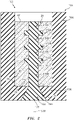
- FIG. 2 shows a mold 100 casting the grain 20 with the end 22 corresponding to a surface/meniscus of poured liquid propellant precursor prior to drying or curing.
- the mold 100 includes a mandrel 102 for molding the chamber 30.
- the mandrel is captured by an outer member 104.
- the exemplary outer member 104 is a full annulus member having a sidewall 106 and a transverse web 108 forming a lower end wall.
- the exemplary lower end wall is centrally apertured to mate with the mandrel.
- An alternative outer member may be a similar structure but formed as a pair of halves mating at a parting plane.
- the mandrel 102 has a shaft portion 120 generally formed as an inverse of the chamber 30 with narrow portions 130A, 130B, 130C, 130D corresponding to chamber portions 40A-40D, respectively and wide portions 132A, 132B, 132C corresponding to chamber portions 42A-C.
- the mold outer member 104 sidewall 106 has an inner diameter (ID) surface 140 for casting the grain OD surface 26.
- the mold outer member 104 web 108 has an internal shoulder surface 142 for casting the end 24.
- the web 108 also has a surface 144 for registering/mating with corresponding surface portions of the mandrel (e.g., shown as an exemplary frustoconical perimeter surface 124 of a head 122 of the mandrel).
- the exemplary materials for at least the mandrel 102 is an elastic material (e.g., a flexible elastomeric material) such as a silicone. The flexibility will allow the mandrel to be extracted from the ultimate cast grain.
- the mandrel may be pulled outward with tension on the mandrel radially contracting the shaft portion 120 to allow disengagement of the wide portions 132A-C of the mandrel from the corresponding wide chamber portions 42A-C.
- the mold outer member 104 may also be of such a flexible material or may be relatively rigid such as formed of an alloy (e.g., stainless steel).
- the mold outer member could also have a rigid portion (e.g. a jacket such an alloy) backing the flexible material to provide both the needed flexibility for removal and the strength required for the casting process.
- the mandrel may be extracted.
- the outer member provides structural backing to the grain 20 to prevent damage to the grain.
- the mold outer member may be separated from the grain.
- FIG. 3 shows a mold 200 used to mold the mandrel 102.
- the mold 200 is formed of a pair of mold halves 202 meeting at a parting plane 510.
- Each mold half 202 has a sidewall portion 204 and a base portion 206 combining to form a sidewall and base of the mold.
- the mold halves are formed from a stack of laminations 250A, 250B...250n ( FIG. 4 ) consistent with processes of the '812 and '315 patents.
- the laminations may be cut from sheet stock (e.g., of metal or alloy). Exemplary cutting techniques include laser machining and photolithographic techniques (e.g., photomasking and chemical etching).
- Exemplary sheet thickness is 0.0010 inch to 0.0030 inch (25 micrometers to 76 micrometers), more broadly, 20 micrometers to 100 micrometers or 20 micrometers to 1.0 millimeter.
- Alternatives to the lamination may involve conventional machining of an alloy forging or billet.
- the laminations 250A-250n have cut borders normal to the faces of the laminations, thus creating a stepped tool along angled surfaces such as those molding the frustoconical perimeter surface 124 of the mandrel head.
- the mandrel head may be generally frustoconical with a stepped smaller scale structure.
- the computer model used to cut the laminations may (e.g., via laser machining), depending on cutting technique, allow for off-normal inclination of the cut borders so that the combined laminations form a smooth continuous taper along for ultimately casting continuously tapering surfaces such as the mandrel head perimeter surface 124.
- the laminations may be stacked and bonded to each other (e.g., via braze, solder, or adhesive (e.g., epoxy)).
- a variety of mandrel/chamber shapes more complex than those of FIGs. 1 and 2 may be formed in addition to casting features that mechanically backlock the mandrel (requiring its deformation to extract).
- a complex cross-section of the chamber creating enhanced surface area may provide a large contact surface area with a straight mandrel.
- the contact surface area may be so large that extraction would require excessive force.
- the stretching of an elastic mandrel may disengage the mandrel surface from the chamber surface and effectively allow the mandrel to peel away from the chamber surface.
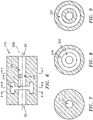
- FIG. 5 is a cross-section of a grain 300 having an axial chamber 302 with relatively complex transverse perimeter cross-section/footprint (e.g., with radial branches 304 shown protruding from a central core 306). Such a situation has much greater chamber surface area (and thus mandrel contact area) than a right circular cylindrical chamber.
- FIG. 6 shows a grain 320 having chamber 322 which presents even more extreme backlocking than the chamber 30 of the first grain 20.
- the FIG. 6 region branches axially.
- the result is an annular branch chamber 324 with an annular port 326 to a main cylindrical trunk portion 328 of the chamber 322.
- the branch chamber 324 may behave as a resonator (e.g., Helmholtz resonator). The resonator may dampen thermoacoustic instabilities.
- FIG. 10 shows a grain 350 having a chamber 352 formed as an asymmetric variant on the chamber 322 of FIG. 6 with the relatively wide cross-section area 354 (including port 356) extending outward in just one direction rather than: (a) around the full circumference; or (b) at even angular intervals.
- the FIG. 6 resonator may be tailored to damp axial mode thermoacoustic instabilities
- the FIG. 10 chamber may damp tangential mode thermoacoustic instabilities.
Landscapes
- Engineering & Computer Science (AREA)
- Chemical & Material Sciences (AREA)
- Combustion & Propulsion (AREA)
- Mechanical Engineering (AREA)
- General Engineering & Computer Science (AREA)
- Organic Chemistry (AREA)
- Crystallography & Structural Chemistry (AREA)
- Moulds For Moulding Plastics Or The Like (AREA)
- Molds, Cores, And Manufacturing Methods Thereof (AREA)
Description
- The disclosure relates to solid rocket motor propellant molding. More particularly, the disclosure relates to mold manufacture.
- Typical solid rocket propellants have included the combination of fuel (e.g., finely divided metals/alloys), oxidizers (e.g., crystalline high explosive compounds), and binder (e.g., organics). To form a solid rocket motor, propellant is typically cast/molded and dried or cured to form a solid grain shape. Typical rocket motor propellant grain shapes are cylindrical outside with a central axial passageway extending to an outlet at one end of the grain. The passageway may be blind or may be a through-passageway with the opposite end being blocked by a motor casing. The open downstream end may be exposed to a motor nozzle (e.g., a convergent-divergent nozzle).
- Several examples of propellant composition and manufacturing techniques are found in
United States Patent 3,702,272 (the '272 patent) of McDonnell et al., November 7, 1972 , "Spherical Rocket Propellant Casting Granules and Method of Preparation". Further compositions are disclosed inUnited States Patent Application Publication 2017/0240484A1 (the '484 publication) of Terry et al., August 24, 2017 , "Solid-Rocket Propellants". The '484 publication discloses several examples of use of aluminum-lithium alloys as fuels (replacing baseline pure aluminum or pure lithium), ammonium perchlorate as an oxidizer, and organic binders (e.g., hydroxyl-terminated polybutadiene (HTPB)). Such binders can serve a dual purpose of also augmenting the fuel. - In hybrid rocket motors, a liquid propellant (or propellant component) is passed through a solid propellant (or propellant component). In one area of examples, the liquid is an oxidizer and the solid is a fuel. Control over liquid flow (via pumps and/or valves) may control motor thrust, even allowing the motor to be stopped and restarted. In other examples, one or both of the liquid and solid may be a fuel/oxidizer mixture. In such situations, the liquid may be relatively higher in oxidizer content and the solid relatively higher in fuel content.
- Separately,
United States Patent 7,141,812 (the '812 patent) of Appleby et al., November 28, 2006 , "Devices, methods, and systems involving castings", andUnited States Patent 10,207,315 (the '315 patent) of Appleby et al., February 19, 2019 DE2024897B1 ,JP2013040588A US3136831A andGB1605418A - In one aspect a method for manufacturing a solid propellant is provided according to claim 1.
- A further embodiment of any of the foregoing embodiments may additionally include the first material being metallic.
- A further embodiment of any of the foregoing embodiments may additionally include the second material being a silicone.
- A further embodiment of any of the foregoing embodiments may additionally include the molded second material molding a Helmholtz resonator in the rocket propellant grain.
- A further embodiment of any of the foregoing embodiments may additionally include the forming the tool comprising: forming the layers with the cuts; and bonding the layers to each other.
- A further embodiment of any of the foregoing embodiments may additionally include the forming the layers comprising photomasking and etching.
- A further embodiment of any of the foregoing embodiments may additionally and/or alternatively include the forming the layers comprising laser cutting.
- A further embodiment of any of the foregoing embodiments may additionally include the layers having thickness of 0.001 inch to 0.003 inch (25 µm to 76 um) .
- A further embodiment of any of the foregoing embodiments may additionally include the elastic mandrel comprising: a shaft; and at least one radial protrusion from the shaft, the at least one radial protrusion casting at least one radial extension of the interior chamber.
- A further embodiment of any of the foregoing embodiments may additionally and/or alternatively include the at least one radial extension of the interior chamber comprising a full annulus.
- A further embodiment of any of the foregoing embodiments may additionally and/or alternatively include the at least one radial extension of the interior chamber comprising: a proximal portion; and an axially protuberant distal portion.
- A further embodiment of any of the foregoing embodiments may additionally and/or alternatively include the at least one radial extension of the interior chamber being a single off-center extension at a given axial position.
- A further embodiment of any of the foregoing embodiments may additionally include the at least one radial extension of the interior chamber forming a Helmholtz resonator in the rocket propellant grain.
- A further embodiment of any of the foregoing embodiments may additionally include the mandrel being formed of silicone.
- A further embodiment of any of the foregoing embodiments may additionally include the method being repeated with the same mandrel to mold a second rocket propellant grain.
- The details of one or more embodiments are set forth in the accompanying drawings and the description below. Other features, objects, and advantages will be apparent from the description and drawings, and from the claims.
-
-
FIG. 1 is a central longitudinal sectional view of a propellant grain. -
FIG. 2 is a central longitudinal sectional view of a mold used to mold the grain ofFIG. 1 . -
FIG. 3 is a central longitudinal sectional view of a mold for molding a mandrel of the mold ofFIG. 2 . -
FIG. 4 is a central longitudinal sectional view of a mold half of the mold ofFIG. 3 schematically showing laminations. -
FIG. 5 is a transverse sectional view of a second propellant grain. -
FIG. 6 is a central longitudinal sectional view of a third propellant grain. -
FIG. 7 is a transverse sectional view of the third propellant grain taken along line 7-7 ofFIG. 6 . -
FIG. 8 is a transverse sectional view of the third propellant grain taken along line 8-8 ofFIG. 6 . -
FIG. 9 is a transverse sectional view of the third propellant grain taken along line 9-9 ofFIG. 6 . -
FIG. 10 is a central longitudinal sectional view of a fourth propellant grain. -
FIG. 11 is a transverse sectional view of the fourth propellant grain taken along line 11-11 ofFIG. 10 . -
FIG. 12 is a transverse sectional view of the fourth propellant grain taken along line 12-12 ofFIG. 10 . - Like reference numbers and designations in the various drawings indicate like elements.
-
FIG. 1 shows apropellant grain 20 having a central longitudinal axis orcenterline 500. The grain extends from afirst end 22 to asecond end 24 and has an outerlateral surface 26 therebetween. The exemplary outerlateral surface 26 is right circular cylindrical thus forming an outer diameter (OD) surface. Theinterior surface 28 forms a central longitudinal chamber orpassageway 30. Theexemplary passageway 30 extends full end-to-end with afirst opening 32 at thefirst end 22 and a second opening 34 at thesecond end 24. In an exemplary use situation of a non-hybrid rocket, thefirst opening 32 is blocked by motor casing structure (not shown) and thesecond opening 34 is open to discharge (e.g., via a nozzle (not shown)) to provide an outlet. In an exemplary use situation of a hybrid rocket, thefirst opening 32 is an inlet for receiving a liquid flow of a liquid propellant or propellant component (not shown) from a source such as a tank either via a pump or via gas pressurization. Other components of a hybrid or non-hybrid rocket motor such as igniters are also not shown. The overall dimensions of the propellant grain will depend upon the particular application. An overall grain length L (FIG. 1 ) may broadly range from a few centimeters to several meters (e.g., 2.0cm to 10m). A ratio of said length to a transverse dimension such as a diameter D may broadly range between about 1:1 and about 20:1. - The
central passageway 30 has an axially-varied cross-section. The exemplary cross-section includes a series of alternating low cross-section areas/regions regions passageway 30 formed by the low cross-section areas. Theexemplary areas 40A-D and 42A-C are circular in footprint thus right circular cylindrical in exemplary shape. One or more of the radial extensions may be at intermediate axial positions or portions of the propellant grain length (i.e., there is propellant to both axial sides of the extension). - The size, shape, and distribution of the high cross-section areas/regions allows tailoring of combustion profile and thus the mass flow rate and thrust profile (e.g. thrust magnitude versus time). Generally, the enhanced surface area increases combustion rate to control the thrust profile.
- The
propellant grain 20 may be molded as a single piece. In such an implementation, the single piece may fully circumscribe the axis 500 (e.g., as distinguished from a circumferentially segmented grain formed in mating sectors).FIG. 2 shows amold 100 casting thegrain 20 with theend 22 corresponding to a surface/meniscus of poured liquid propellant precursor prior to drying or curing. Themold 100 includes amandrel 102 for molding thechamber 30. The mandrel is captured by anouter member 104. The exemplaryouter member 104 is a full annulus member having asidewall 106 and atransverse web 108 forming a lower end wall. The exemplary lower end wall is centrally apertured to mate with the mandrel. An alternative outer member (not shown) may be a similar structure but formed as a pair of halves mating at a parting plane. Themandrel 102 has ashaft portion 120 generally formed as an inverse of thechamber 30 withnarrow portions chamber portions 40A-40D, respectively andwide portions chamber portions 42A-C. - The mold
outer member 104sidewall 106 has an inner diameter (ID)surface 140 for casting thegrain OD surface 26. The moldouter member 104web 108 has aninternal shoulder surface 142 for casting theend 24. Theweb 108 also has asurface 144 for registering/mating with corresponding surface portions of the mandrel (e.g., shown as an exemplaryfrustoconical perimeter surface 124 of ahead 122 of the mandrel). The exemplary materials for at least themandrel 102 is an elastic material (e.g., a flexible elastomeric material) such as a silicone. The flexibility will allow the mandrel to be extracted from the ultimate cast grain. For example, the mandrel may be pulled outward with tension on the mandrel radially contracting theshaft portion 120 to allow disengagement of thewide portions 132A-C of the mandrel from the correspondingwide chamber portions 42A-C. The moldouter member 104 may also be of such a flexible material or may be relatively rigid such as formed of an alloy (e.g., stainless steel).In further variations, the mold outer member could also have a rigid portion (e.g. a jacket such an alloy) backing the flexible material to provide both the needed flexibility for removal and the strength required for the casting process. - In a manufacture situation, after at least partial drying/curing, the mandrel may be extracted. During mandrel extraction, the outer member provides structural backing to the
grain 20 to prevent damage to the grain. Thereafter, the mold outer member may be separated from the grain. -
FIG. 3 shows amold 200 used to mold themandrel 102. Themold 200 is formed of a pair ofmold halves 202 meeting at a parting plane 510. Eachmold half 202 has asidewall portion 204 and abase portion 206 combining to form a sidewall and base of the mold. In an exemplary embodiment, the mold halves are formed from a stack of laminations 250A, 250B...250n (FIG. 4 ) consistent with processes of the '812 and '315 patents. The laminations may be cut from sheet stock (e.g., of metal or alloy). Exemplary cutting techniques include laser machining and photolithographic techniques (e.g., photomasking and chemical etching). Exemplary sheet thickness is 0.0010 inch to 0.0030 inch (25 micrometers to 76 micrometers), more broadly, 20 micrometers to 100 micrometers or 20 micrometers to 1.0 millimeter. Alternatives to the lamination may involve conventional machining of an alloy forging or billet. - In the exemplary illustrated embodiment, the
laminations 250A-250n have cut borders normal to the faces of the laminations, thus creating a stepped tool along angled surfaces such as those molding thefrustoconical perimeter surface 124 of the mandrel head. Thus, the mandrel head may be generally frustoconical with a stepped smaller scale structure. However, the computer model used to cut the laminations may (e.g., via laser machining), depending on cutting technique, allow for off-normal inclination of the cut borders so that the combined laminations form a smooth continuous taper along for ultimately casting continuously tapering surfaces such as the mandrelhead perimeter surface 124. - Once cut, the laminations may be stacked and bonded to each other (e.g., via braze, solder, or adhesive (e.g., epoxy)).
- A variety of mandrel/chamber shapes more complex than those of
FIGs. 1 and2 may be formed in addition to casting features that mechanically backlock the mandrel (requiring its deformation to extract). For example, a complex cross-section of the chamber creating enhanced surface area may provide a large contact surface area with a straight mandrel. The contact surface area may be so large that extraction would require excessive force. In such a situation, the stretching of an elastic mandrel may disengage the mandrel surface from the chamber surface and effectively allow the mandrel to peel away from the chamber surface. -
FIG. 5 is a cross-section of agrain 300 having anaxial chamber 302 with relatively complex transverse perimeter cross-section/footprint (e.g., withradial branches 304 shown protruding from a central core 306). Such a situation has much greater chamber surface area (and thus mandrel contact area) than a right circular cylindrical chamber. -
FIG. 6 shows agrain 320 havingchamber 322 which presents even more extreme backlocking than thechamber 30 of thefirst grain 20. Whereas the correspondingFIG. 1 high cross-section regions 42A-C extend purely radially, theFIG. 6 region branches axially. The result is anannular branch chamber 324 with anannular port 326 to a maincylindrical trunk portion 328 of thechamber 322. In addition to tailoring the combustion profile, thebranch chamber 324 may behave as a resonator (e.g., Helmholtz resonator). The resonator may dampen thermoacoustic instabilities. -
FIG. 10 shows agrain 350 having achamber 352 formed as an asymmetric variant on thechamber 322 ofFIG. 6 with the relatively wide cross-section area 354 (including port 356) extending outward in just one direction rather than: (a) around the full circumference; or (b) at even angular intervals. Whereas theFIG. 6 resonator may be tailored to damp axial mode thermoacoustic instabilities, theFIG. 10 chamber may damp tangential mode thermoacoustic instabilities.
Claims (15)
- A method for manufacturing a solid propellant, the method characterised by:forming a tool (200) of layers (250) of a first material wherein cuts in the layers (250) form a first interior chamber in the tool;using the tool (200) to mold a second material in the first interior chamber;removing the molded second material (102) from the tool (200) ;using the molded second material (102) to mold an interior chamber (30) in a rocket propellant grain (20);removing the molded second material (102) from the rocket propellant grain (20); andthe removing the molded second material (102) from the rocket propellant grain stretches the second material.
- The method of claim 1, wherein the first material is metallic.
- The method of claim 1 or 2, wherein the second material is a silicone.
- The method of claim 1, 2 or 3, wherein:
the molded second material (102) molds a Helmholtz resonator in the rocket propellant grain (20). - The method of any preceding claim, wherein the forming the tool (200) comprises:forming the layers (250) with the cuts; andbonding the layers (250A) to each other.
- The method of claim 5, wherein the forming the layers (250) comprises photomasking and etching.
- The method of claim 5 or 6, wherein the forming the layers (250) comprises laser cutting.
- The method of any preceding claim, wherein:
the layers (250) have thickness of 0.001 inch to 0.003 inch (25 µm to 76 µm). - The method of claim 1, wherein the molded second material (102) is an elastic mandrel (102).
- The method of claim 9, wherein the elastic mandrel (102) comprises:a shaft (120); andat least one radial protrusion (132) from the shaft (120), the at least one radial protrusion (132) casting at least one radial extension (42) of the interior chamber (30).
- The method of claim 10, wherein the at least one radial extension (42) of the interior chamber (30):comprises a full annulus (42); and/orcomprises a proximal portion (326, 356) and an axially protuberant distal portion (324, 354).
- The method of claim 10 or 11, wherein the at least one radial extension (42) of the interior chamber (30) is a single off-center extension at a given axial position.
- The method of claim 10, 11 or 12, wherein:
the at least one radial extension (42) of the interior chamber (30) forms a Helmholtz resonator in the rocket propellant grain (20). - The method of any of claims 9-13, wherein the mandrel (102) is formed of silicone.
- The method of any of claims 9-14, repeated with the same mandrel (102) to mold a second rocket propellant grain (20).
Priority Applications (1)
| Application Number | Priority Date | Filing Date | Title |
|---|---|---|---|
| EP22206787.8A EP4151850B1 (en) | 2019-05-31 | 2020-05-20 | Solid rocket motor propellant manufacture and configurations |
Applications Claiming Priority (1)
| Application Number | Priority Date | Filing Date | Title |
|---|---|---|---|
| US16/427,663 US20200377428A1 (en) | 2019-05-31 | 2019-05-31 | Solid Rocket Motor Propellant Manufacture and Configurations |
Related Child Applications (1)
| Application Number | Title | Priority Date | Filing Date |
|---|---|---|---|
| EP22206787.8A Division EP4151850B1 (en) | 2019-05-31 | 2020-05-20 | Solid rocket motor propellant manufacture and configurations |
Publications (2)
| Publication Number | Publication Date |
|---|---|
| EP3744965A1 EP3744965A1 (en) | 2020-12-02 |
| EP3744965B1 true EP3744965B1 (en) | 2022-11-30 |
Family
ID=70802701
Family Applications (2)
| Application Number | Title | Priority Date | Filing Date |
|---|---|---|---|
| EP22206787.8A Active EP4151850B1 (en) | 2019-05-31 | 2020-05-20 | Solid rocket motor propellant manufacture and configurations |
| EP20175839.8A Active EP3744965B1 (en) | 2019-05-31 | 2020-05-20 | Solid rocket motor propellant manufacture and configurations |
Family Applications Before (1)
| Application Number | Title | Priority Date | Filing Date |
|---|---|---|---|
| EP22206787.8A Active EP4151850B1 (en) | 2019-05-31 | 2020-05-20 | Solid rocket motor propellant manufacture and configurations |
Country Status (2)
| Country | Link |
|---|---|
| US (1) | US20200377428A1 (en) |
| EP (2) | EP4151850B1 (en) |
Families Citing this family (3)
| Publication number | Priority date | Publication date | Assignee | Title |
|---|---|---|---|---|
| CN112377326B (en) * | 2020-12-06 | 2022-08-23 | 西安长峰机电研究所 | Multi-ring-groove medicine type mechanical forming core mold of solid rocket engine |
| CN114154354B (en) * | 2022-02-08 | 2022-04-15 | 中国人民解放军国防科技大学 | General combustion surface calculation method for solid rocket engine |
| CN118373721A (en) * | 2024-04-11 | 2024-07-23 | 上海航天化工应用研究所 | A detachable and assembled solid propellant casting mold and method |
Family Cites Families (11)
| Publication number | Priority date | Publication date | Assignee | Title |
|---|---|---|---|---|
| US3136831A (en) * | 1961-07-14 | 1964-06-09 | United Aircraft Corp | Casting method |
| US3702272A (en) | 1964-01-10 | 1972-11-07 | Olin Mathieson | Spherical rocket propellant casting granules and method of preparation |
| DE2024897B1 (en) * | 1970-05-22 | 1971-12-09 | Wasag-Chemie GmbH, 8000 München | Cast propellant charge prodn for internal or internal and external - burning charges using inflatable moulds/cores |
| GB1605418A (en) * | 1971-07-21 | 1998-02-25 | Bristol Aerojet Ltd | Improvements in and relating to rockets |
| US4936092A (en) * | 1988-11-28 | 1990-06-26 | The United States Of America As Represented By The Secretary Of The Navy | Propellant grain design |
| US5391025A (en) * | 1992-04-21 | 1995-02-21 | Thiokol Corporation | Propellant grain machining device |
| US5259901A (en) * | 1992-05-27 | 1993-11-09 | Thiokol Corporation | Method for constructing an inflatable mandrel |
| US7141812B2 (en) * | 2002-06-05 | 2006-11-28 | Mikro Systems, Inc. | Devices, methods, and systems involving castings |
| US9315663B2 (en) * | 2008-09-26 | 2016-04-19 | Mikro Systems, Inc. | Systems, devices, and/or methods for manufacturing castings |
| JP2013040588A (en) * | 2011-08-18 | 2013-02-28 | Ihi Aerospace Co Ltd | Molding method and device of solid propellant |
| WO2016144955A1 (en) | 2015-03-09 | 2016-09-15 | Purdue Research Foundation | Solid-rocket propellants |
-
2019
- 2019-05-31 US US16/427,663 patent/US20200377428A1/en not_active Abandoned
-
2020
- 2020-05-20 EP EP22206787.8A patent/EP4151850B1/en active Active
- 2020-05-20 EP EP20175839.8A patent/EP3744965B1/en active Active
Also Published As
| Publication number | Publication date |
|---|---|
| US20200377428A1 (en) | 2020-12-03 |
| EP4151850B1 (en) | 2026-02-25 |
| EP3744965A1 (en) | 2020-12-02 |
| EP4151850A1 (en) | 2023-03-22 |
Similar Documents
| Publication | Publication Date | Title |
|---|---|---|
| EP3744965B1 (en) | Solid rocket motor propellant manufacture and configurations | |
| EP2027955B1 (en) | Method for manufacturing of fuel nozzle floating collar | |
| US9033670B2 (en) | Axially-split radial turbines and methods for the manufacture thereof | |
| EP2189230B1 (en) | Castings, casting cores and methods | |
| EP1978208B1 (en) | A method of manufacturing multi alloy integrally bladed turbine rotors | |
| EP3062021B1 (en) | Fuel injector | |
| EP0413983B1 (en) | Production method for a channeled wall thrust nozzle | |
| EP3034804B1 (en) | Pre-diffuser strut for gas turbine engine | |
| US11262077B2 (en) | Spall plate for consumable combustor support structures | |
| EP3633268B1 (en) | Additively manufactured combustor shell with consumable support structures | |
| EP3106248A1 (en) | Manufacture of a casing with a boss | |
| EP4039939A1 (en) | Containment systems for engine | |
| EP4370260B1 (en) | Improved molding core for manufacturing a hollow omc part | |
| US11806939B2 (en) | Kinetic disassembly of support structure system for additively manufactured rotating components | |
| US20100043200A1 (en) | Method of manufacturing thin wall isogrid casings | |
| CN112459921A (en) | Integral air injection device with multiple obliquely-cut spray pipes and air injection method | |
| EP3663563B1 (en) | Casing with integral cavity | |
| EP3795902B1 (en) | Support structure for combustor components and method of using same | |
| JP2006044976A (en) | Apparatus and method for manufacturing propellant for solid rocket motor | |
| EP3431207B1 (en) | Linkage of composite core features | |
| WO2025238095A1 (en) | Arrangement having a combustion chamber and a propellant charge for use as a gas generator or solid propellant rocket motor |
Legal Events
| Date | Code | Title | Description |
|---|---|---|---|
| PUAI | Public reference made under article 153(3) epc to a published international application that has entered the european phase |
Free format text: ORIGINAL CODE: 0009012 |
|
| STAA | Information on the status of an ep patent application or granted ep patent |
Free format text: STATUS: THE APPLICATION HAS BEEN PUBLISHED |
|
| AK | Designated contracting states |
Kind code of ref document: A1 Designated state(s): AL AT BE BG CH CY CZ DE DK EE ES FI FR GB GR HR HU IE IS IT LI LT LU LV MC MK MT NL NO PL PT RO RS SE SI SK SM TR |
|
| AX | Request for extension of the european patent |
Extension state: BA ME |
|
| STAA | Information on the status of an ep patent application or granted ep patent |
Free format text: STATUS: REQUEST FOR EXAMINATION WAS MADE |
|
| 17P | Request for examination filed |
Effective date: 20210513 |
|
| RBV | Designated contracting states (corrected) |
Designated state(s): AL AT BE BG CH CY CZ DE DK EE ES FI FR GB GR HR HU IE IS IT LI LT LU LV MC MK MT NL NO PL PT RO RS SE SI SK SM TR |
|
| GRAP | Despatch of communication of intention to grant a patent |
Free format text: ORIGINAL CODE: EPIDOSNIGR1 |
|
| STAA | Information on the status of an ep patent application or granted ep patent |
Free format text: STATUS: GRANT OF PATENT IS INTENDED |
|
| INTG | Intention to grant announced |
Effective date: 20220614 |
|
| GRAS | Grant fee paid |
Free format text: ORIGINAL CODE: EPIDOSNIGR3 |
|
| GRAA | (expected) grant |
Free format text: ORIGINAL CODE: 0009210 |
|
| STAA | Information on the status of an ep patent application or granted ep patent |
Free format text: STATUS: THE PATENT HAS BEEN GRANTED |
|
| AK | Designated contracting states |
Kind code of ref document: B1 Designated state(s): AL AT BE BG CH CY CZ DE DK EE ES FI FR GB GR HR HU IE IS IT LI LT LU LV MC MK MT NL NO PL PT RO RS SE SI SK SM TR |
|
| REG | Reference to a national code |
Ref country code: CH Ref legal event code: EP Ref country code: GB Ref legal event code: FG4D |
|
| REG | Reference to a national code |
Ref country code: AT Ref legal event code: REF Ref document number: 1534874 Country of ref document: AT Kind code of ref document: T Effective date: 20221215 Ref country code: DE Ref legal event code: R096 Ref document number: 602020006554 Country of ref document: DE |
|
| REG | Reference to a national code |
Ref country code: IE Ref legal event code: FG4D |
|
| REG | Reference to a national code |
Ref country code: LT Ref legal event code: MG9D |
|
| REG | Reference to a national code |
Ref country code: NL Ref legal event code: MP Effective date: 20221130 |
|
| PG25 | Lapsed in a contracting state [announced via postgrant information from national office to epo] |
Ref country code: SE Free format text: LAPSE BECAUSE OF FAILURE TO SUBMIT A TRANSLATION OF THE DESCRIPTION OR TO PAY THE FEE WITHIN THE PRESCRIBED TIME-LIMIT Effective date: 20221130 Ref country code: PT Free format text: LAPSE BECAUSE OF FAILURE TO SUBMIT A TRANSLATION OF THE DESCRIPTION OR TO PAY THE FEE WITHIN THE PRESCRIBED TIME-LIMIT Effective date: 20230331 Ref country code: NO Free format text: LAPSE BECAUSE OF FAILURE TO SUBMIT A TRANSLATION OF THE DESCRIPTION OR TO PAY THE FEE WITHIN THE PRESCRIBED TIME-LIMIT Effective date: 20230228 Ref country code: LT Free format text: LAPSE BECAUSE OF FAILURE TO SUBMIT A TRANSLATION OF THE DESCRIPTION OR TO PAY THE FEE WITHIN THE PRESCRIBED TIME-LIMIT Effective date: 20221130 Ref country code: FI Free format text: LAPSE BECAUSE OF FAILURE TO SUBMIT A TRANSLATION OF THE DESCRIPTION OR TO PAY THE FEE WITHIN THE PRESCRIBED TIME-LIMIT Effective date: 20221130 Ref country code: ES Free format text: LAPSE BECAUSE OF FAILURE TO SUBMIT A TRANSLATION OF THE DESCRIPTION OR TO PAY THE FEE WITHIN THE PRESCRIBED TIME-LIMIT Effective date: 20221130 |
|
| REG | Reference to a national code |
Ref country code: AT Ref legal event code: MK05 Ref document number: 1534874 Country of ref document: AT Kind code of ref document: T Effective date: 20221130 |
|
| PG25 | Lapsed in a contracting state [announced via postgrant information from national office to epo] |
Ref country code: RS Free format text: LAPSE BECAUSE OF FAILURE TO SUBMIT A TRANSLATION OF THE DESCRIPTION OR TO PAY THE FEE WITHIN THE PRESCRIBED TIME-LIMIT Effective date: 20221130 Ref country code: PL Free format text: LAPSE BECAUSE OF FAILURE TO SUBMIT A TRANSLATION OF THE DESCRIPTION OR TO PAY THE FEE WITHIN THE PRESCRIBED TIME-LIMIT Effective date: 20221130 Ref country code: LV Free format text: LAPSE BECAUSE OF FAILURE TO SUBMIT A TRANSLATION OF THE DESCRIPTION OR TO PAY THE FEE WITHIN THE PRESCRIBED TIME-LIMIT Effective date: 20221130 Ref country code: IS Free format text: LAPSE BECAUSE OF FAILURE TO SUBMIT A TRANSLATION OF THE DESCRIPTION OR TO PAY THE FEE WITHIN THE PRESCRIBED TIME-LIMIT Effective date: 20230330 Ref country code: HR Free format text: LAPSE BECAUSE OF FAILURE TO SUBMIT A TRANSLATION OF THE DESCRIPTION OR TO PAY THE FEE WITHIN THE PRESCRIBED TIME-LIMIT Effective date: 20221130 Ref country code: GR Free format text: LAPSE BECAUSE OF FAILURE TO SUBMIT A TRANSLATION OF THE DESCRIPTION OR TO PAY THE FEE WITHIN THE PRESCRIBED TIME-LIMIT Effective date: 20230301 |
|
| P01 | Opt-out of the competence of the unified patent court (upc) registered |
Effective date: 20230521 |
|
| PG25 | Lapsed in a contracting state [announced via postgrant information from national office to epo] |
Ref country code: NL Free format text: LAPSE BECAUSE OF FAILURE TO SUBMIT A TRANSLATION OF THE DESCRIPTION OR TO PAY THE FEE WITHIN THE PRESCRIBED TIME-LIMIT Effective date: 20221130 |
|
| PG25 | Lapsed in a contracting state [announced via postgrant information from national office to epo] |
Ref country code: SM Free format text: LAPSE BECAUSE OF FAILURE TO SUBMIT A TRANSLATION OF THE DESCRIPTION OR TO PAY THE FEE WITHIN THE PRESCRIBED TIME-LIMIT Effective date: 20221130 Ref country code: RO Free format text: LAPSE BECAUSE OF FAILURE TO SUBMIT A TRANSLATION OF THE DESCRIPTION OR TO PAY THE FEE WITHIN THE PRESCRIBED TIME-LIMIT Effective date: 20221130 Ref country code: EE Free format text: LAPSE BECAUSE OF FAILURE TO SUBMIT A TRANSLATION OF THE DESCRIPTION OR TO PAY THE FEE WITHIN THE PRESCRIBED TIME-LIMIT Effective date: 20221130 Ref country code: DK Free format text: LAPSE BECAUSE OF FAILURE TO SUBMIT A TRANSLATION OF THE DESCRIPTION OR TO PAY THE FEE WITHIN THE PRESCRIBED TIME-LIMIT Effective date: 20221130 Ref country code: CZ Free format text: LAPSE BECAUSE OF FAILURE TO SUBMIT A TRANSLATION OF THE DESCRIPTION OR TO PAY THE FEE WITHIN THE PRESCRIBED TIME-LIMIT Effective date: 20221130 Ref country code: AT Free format text: LAPSE BECAUSE OF FAILURE TO SUBMIT A TRANSLATION OF THE DESCRIPTION OR TO PAY THE FEE WITHIN THE PRESCRIBED TIME-LIMIT Effective date: 20221130 |
|
| PG25 | Lapsed in a contracting state [announced via postgrant information from national office to epo] |
Ref country code: SK Free format text: LAPSE BECAUSE OF FAILURE TO SUBMIT A TRANSLATION OF THE DESCRIPTION OR TO PAY THE FEE WITHIN THE PRESCRIBED TIME-LIMIT Effective date: 20221130 Ref country code: AL Free format text: LAPSE BECAUSE OF FAILURE TO SUBMIT A TRANSLATION OF THE DESCRIPTION OR TO PAY THE FEE WITHIN THE PRESCRIBED TIME-LIMIT Effective date: 20221130 |
|
| REG | Reference to a national code |
Ref country code: DE Ref legal event code: R097 Ref document number: 602020006554 Country of ref document: DE |
|
| PLBE | No opposition filed within time limit |
Free format text: ORIGINAL CODE: 0009261 |
|
| STAA | Information on the status of an ep patent application or granted ep patent |
Free format text: STATUS: NO OPPOSITION FILED WITHIN TIME LIMIT |
|
| RAP4 | Party data changed (patent owner data changed or rights of a patent transferred) |
Owner name: RTX CORPORATION |
|
| 26N | No opposition filed |
Effective date: 20230831 |
|
| PG25 | Lapsed in a contracting state [announced via postgrant information from national office to epo] |
Ref country code: SI Free format text: LAPSE BECAUSE OF FAILURE TO SUBMIT A TRANSLATION OF THE DESCRIPTION OR TO PAY THE FEE WITHIN THE PRESCRIBED TIME-LIMIT Effective date: 20221130 |
|
| REG | Reference to a national code |
Ref country code: CH Ref legal event code: PL |
|
| PG25 | Lapsed in a contracting state [announced via postgrant information from national office to epo] |
Ref country code: MC Free format text: LAPSE BECAUSE OF FAILURE TO SUBMIT A TRANSLATION OF THE DESCRIPTION OR TO PAY THE FEE WITHIN THE PRESCRIBED TIME-LIMIT Effective date: 20221130 |
|
| REG | Reference to a national code |
Ref country code: BE Ref legal event code: MM Effective date: 20230531 |
|
| PG25 | Lapsed in a contracting state [announced via postgrant information from national office to epo] |
Ref country code: MC Free format text: LAPSE BECAUSE OF FAILURE TO SUBMIT A TRANSLATION OF THE DESCRIPTION OR TO PAY THE FEE WITHIN THE PRESCRIBED TIME-LIMIT Effective date: 20221130 Ref country code: LU Free format text: LAPSE BECAUSE OF NON-PAYMENT OF DUE FEES Effective date: 20230520 Ref country code: LI Free format text: LAPSE BECAUSE OF NON-PAYMENT OF DUE FEES Effective date: 20230531 Ref country code: CH Free format text: LAPSE BECAUSE OF NON-PAYMENT OF DUE FEES Effective date: 20230531 |
|
| REG | Reference to a national code |
Ref country code: IE Ref legal event code: MM4A |
|
| PG25 | Lapsed in a contracting state [announced via postgrant information from national office to epo] |
Ref country code: IE Free format text: LAPSE BECAUSE OF NON-PAYMENT OF DUE FEES Effective date: 20230520 |
|
| PG25 | Lapsed in a contracting state [announced via postgrant information from national office to epo] |
Ref country code: IE Free format text: LAPSE BECAUSE OF NON-PAYMENT OF DUE FEES Effective date: 20230520 |
|
| PG25 | Lapsed in a contracting state [announced via postgrant information from national office to epo] |
Ref country code: IT Free format text: LAPSE BECAUSE OF FAILURE TO SUBMIT A TRANSLATION OF THE DESCRIPTION OR TO PAY THE FEE WITHIN THE PRESCRIBED TIME-LIMIT Effective date: 20221130 Ref country code: BE Free format text: LAPSE BECAUSE OF NON-PAYMENT OF DUE FEES Effective date: 20230531 |
|
| PG25 | Lapsed in a contracting state [announced via postgrant information from national office to epo] |
Ref country code: BG Free format text: LAPSE BECAUSE OF FAILURE TO SUBMIT A TRANSLATION OF THE DESCRIPTION OR TO PAY THE FEE WITHIN THE PRESCRIBED TIME-LIMIT Effective date: 20221130 |
|
| PG25 | Lapsed in a contracting state [announced via postgrant information from national office to epo] |
Ref country code: BG Free format text: LAPSE BECAUSE OF FAILURE TO SUBMIT A TRANSLATION OF THE DESCRIPTION OR TO PAY THE FEE WITHIN THE PRESCRIBED TIME-LIMIT Effective date: 20221130 |
|
| PGFP | Annual fee paid to national office [announced via postgrant information from national office to epo] |
Ref country code: DE Payment date: 20250423 Year of fee payment: 6 |
|
| PGFP | Annual fee paid to national office [announced via postgrant information from national office to epo] |
Ref country code: GB Payment date: 20250423 Year of fee payment: 6 |
|
| PGFP | Annual fee paid to national office [announced via postgrant information from national office to epo] |
Ref country code: FR Payment date: 20250423 Year of fee payment: 6 |
|
| PG25 | Lapsed in a contracting state [announced via postgrant information from national office to epo] |
Ref country code: CY Free format text: LAPSE BECAUSE OF FAILURE TO SUBMIT A TRANSLATION OF THE DESCRIPTION OR TO PAY THE FEE WITHIN THE PRESCRIBED TIME-LIMIT; INVALID AB INITIO Effective date: 20200520 |
|
| PG25 | Lapsed in a contracting state [announced via postgrant information from national office to epo] |
Ref country code: HU Free format text: LAPSE BECAUSE OF FAILURE TO SUBMIT A TRANSLATION OF THE DESCRIPTION OR TO PAY THE FEE WITHIN THE PRESCRIBED TIME-LIMIT; INVALID AB INITIO Effective date: 20200520 |
|
| REG | Reference to a national code |
Ref country code: DE Ref legal event code: R081 Ref document number: 602020006554 Country of ref document: DE Owner name: RTX CORPORATION (N.D.GES.D. STAATES DELAWARE),, US Free format text: FORMER OWNER: RAYTHEON TECHNOLOGIES CORPORATION, FARMINGTON, CT, US |
|
| PG25 | Lapsed in a contracting state [announced via postgrant information from national office to epo] |
Ref country code: TR Free format text: LAPSE BECAUSE OF FAILURE TO SUBMIT A TRANSLATION OF THE DESCRIPTION OR TO PAY THE FEE WITHIN THE PRESCRIBED TIME-LIMIT Effective date: 20221130 |