EP3744608A1 - Method, device, and program for estimating derailment coefficient - Google Patents
Method, device, and program for estimating derailment coefficient Download PDFInfo
- Publication number
- EP3744608A1 EP3744608A1 EP19743205.7A EP19743205A EP3744608A1 EP 3744608 A1 EP3744608 A1 EP 3744608A1 EP 19743205 A EP19743205 A EP 19743205A EP 3744608 A1 EP3744608 A1 EP 3744608A1
- Authority
- EP
- European Patent Office
- Prior art keywords
- bogie
- estimation equation
- wheel load
- lateral force
- normal
- Prior art date
- Legal status (The legal status is an assumption and is not a legal conclusion. Google has not performed a legal analysis and makes no representation as to the accuracy of the status listed.)
- Granted
Links
Images



Classifications
-
- B—PERFORMING OPERATIONS; TRANSPORTING
- B61—RAILWAYS
- B61F—RAIL VEHICLE SUSPENSIONS, e.g. UNDERFRAMES, BOGIES OR ARRANGEMENTS OF WHEEL AXLES; RAIL VEHICLES FOR USE ON TRACKS OF DIFFERENT WIDTH; PREVENTING DERAILING OF RAIL VEHICLES; WHEEL GUARDS, OBSTRUCTION REMOVERS OR THE LIKE FOR RAIL VEHICLES
- B61F9/00—Rail vehicles characterised by means for preventing derailing, e.g. by use of guide wheels
-
- B—PERFORMING OPERATIONS; TRANSPORTING
- B61—RAILWAYS
- B61K—AUXILIARY EQUIPMENT SPECIALLY ADAPTED FOR RAILWAYS, NOT OTHERWISE PROVIDED FOR
- B61K9/00—Railway vehicle profile gauges; Detecting or indicating overheating of components; Apparatus on locomotives or cars to indicate bad track sections; General design of track recording vehicles
- B61K9/08—Measuring installations for surveying permanent way
Definitions
- the present invention relates to a method, device, and program for estimating a derailment coefficient when a bogie provided to rolling stock is traveling along a curved section of track.
- the present invention relates to a method, device, and program capable of estimating a derailment coefficient of a normal bogie (a bogie lacking wheel load and lateral force measurement capabilities) on a normal curved section (a curved section not installed with measurement equipment having wheel load and lateral force measuring capabilities).
- Evaluating indicators of derailment for rolling stock, and taking countermeasures according to the evaluation results, is important to improve travel safety of rolling stock.
- a derailment coefficient Q/P i.e. a value arrived at by dividing a lateral force Q that is the force acting in a horizontal direction between wheel and rail, by a wheel load P that is the force acting in a vertical direction between wheel and rail, has been widely employed as an indicator of derailment.
- a derailment coefficient (outside derailment coefficient) Q/P for an outside wheel on the front axle of a rolling stock bogie when the rolling stock is traveling on a curved section of track is widely employed.
- Ground side measurement is capable of measuring the wheel load P and lateral force Q of all bogies traveling on curved sections installed with measurement equipment. However, ground side measurement is not able to measure the wheel load P and lateral force Q for curved sections not installed with the measurement equipment. Installing measurement equipment to all curved sections is not realistic due to the dramatic rise in cost this would incur and to the resulting increase in maintenance effort.
- Vehicle side measurement is capable of measuring the wheel load P and lateral force Q at all curved sections that the PQ monitoring bogie is traveling along.
- the wheel load P and lateral force Q are not able to be measured for bogies other than PQ monitoring bogies, i.e. for bodies lacking wheel load and lateral force measurement capabilities. Making all bogies PQ monitoring bogies is not realistic due to the dramatic rise in cost this would incur and to the resulting increase in maintenance effort.
- wheel load P and lateral force Q measurement methods for both ground side measurements and vehicle side measurements in that they are not able to compute an outside derailment coefficient Q/P for when a normal bogie travels on a normal curved section since the wheel load P and lateral force Q are not able to be measured by a normal bogie (bogie lacking wheel load P and lateral force Q measurement capabilities) traveling on a normal curved section (curved section not installed with measurement equipment having wheel load P and lateral force Q measuring capabilities).
- the present invention addresses the provision of a method capable of estimating a derailment coefficient of a normal bogie (bogie lacking wheel load and lateral force measurement capabilities) on a normal curved section (curved section not installed with measurement equipment having wheel load and lateral force measuring capabilities).
- a derailment coefficient estimation method is a method of estimating a derailment coefficient in a case in which a bogie provided to rolling stock is traveling on a curved section of track.
- the derailment coefficient estimation method includes a first estimation equation generation step, a second estimation equation generation step, a third estimation equation generation step, a correction coefficient generation step, a fourth estimation equation generation step, and an estimation step.
- the first estimation equation generation step includes measuring a wheel load and lateral force of a monitoring bogie using measurement equipment in a case in which the monitoring bogie, which can measure wheel load and lateral force, is traveling on a reference curved section of track installed with the measurement equipment, which can measure wheel load and lateral force, and generating a first estimation equation that estimates a derailment coefficient of the monitoring bogie on the reference curved section by performing multivariate analysis using a derailment coefficient computed from the measured wheel load and lateral force as an objective variable and using at least a specific computation value that is computed from the measured wheel load and lateral force as well as a travel velocity of the monitoring bogie as explanatory variables.
- the second estimation equation generation step includes measuring a wheel load and lateral force of a normal bogie using the measurement equipment in a case in which the normal bogie which cannot measure wheel load and lateral force is traveling on the reference curved section, and generating a second estimation equation that estimates a derailment coefficient of the normal bogie on the reference curved section by performing multivariate analysis using a derailment coefficient computed from the measured wheel load and lateral force as an objective variable and using at least a specific computation value that is computed from the measured wheel load and lateral force as well as a travel velocity of the normal bogie as explanatory variables.
- the third estimation equation generation step includes measuring a wheel load and lateral force of the monitoring bogie using the monitoring bogie itself in a case in which the monitoring bogie, which can measure wheel load and lateral force, is traveling on a normal curved section of track not installed with measurement equipment, which can measure wheel load and lateral force, and generating a third estimation equation that estimates a derailment coefficient of the monitoring bogie on the normal curved section by performing multivariate analysis using a derailment coefficient computed from the measured wheel load and lateral force as an objective variable and using at least a specific computation value that is computed from the measured wheel load and lateral force as well as a travel velocity of the monitoring bogie as explanatory variables.
- the correction coefficient generation step includes generating correction coefficients for the explanatory variables in the second estimation equation based on coefficients of the explanatory variables in the first estimation equation, coefficients of the explanatory variables in the third estimation equation, values of the explanatory variables employed when the first estimation equation was generated, and values of the explanatory variables employed when the third estimation equation was generated.
- the fourth estimation equation generation step includes generating a fourth estimation equation that estimates a derailment coefficient of the normal bogie on the normal curved section by taking account of the correction coefficients in the coefficients of the explanatory variables in the second estimation equation.
- the estimation step includes estimating a derailment coefficient of the normal bogie on the normal curved section by measuring the wheel load and lateral force of the normal bogie using the measurement equipment in a case in which the normal bogie is traveling along the reference curved section, and inputting, into the fourth estimation equation, at least a specific computation value that is computed from the measured wheel load and lateral force as well as the travel velocity of the normal bogie.
- a derailment coefficient estimating device is a device to estimate a derailment coefficient in a case in which a bogie provided to rolling stock is traveling on a curved section of track.
- the derailment coefficient estimation device includes a first estimation equation generation section, a second estimation equation generation section, a third estimation equation generation section, a correction coefficient generation section, a fourth estimation equation generation section, and an estimation section.
- the first estimation equation generation section is employed to generate a first estimation equation that estimates a derailment coefficient of a monitoring bogie on a reference curved section of track installed with measurement equipment, which can measure wheel load and lateral force, by performing multivariate analysis using input of results of measuring a wheel load and lateral force of the monitoring bogie using the measurement equipment in a case in which the monitoring bogie, which can measure wheel load and lateral force, is traveling on the reference curved section, using a derailment coefficient computed from the measured wheel load and lateral force as an objective variable, and using at least a specific computation value that is computed from the measured wheel load and lateral force as well as a travel velocity of the monitoring bogie as explanatory variables.
- the second estimation equation generation section is employed to generate a second estimation equation to estimate a derailment coefficient of the normal bogie on the reference curved section by performing multivariate analysis using input of results of measuring a wheel load and lateral force of the normal bogie using the measurement equipment in a case in which the normal bogie, which cannot measure wheel load and lateral force, is traveling on the reference curved section, using a derailment coefficient computed from the measured wheel load and lateral force as an objective variable, and using at least a specific computation value that is computed from the measured wheel load and lateral force as well as a travel velocity of the normal bogie as explanatory variables.
- the third estimation equation generation section is employed to generate a third estimation equation to estimate a derailment coefficient of the monitoring bogie on the normal curved section of track not installed with measurement equipment, which can measure wheel load and lateral force, by performing multivariate analysis using input of results of measuring a wheel load and lateral force of the monitoring bogie using the monitoring bogie itself in a case in which the monitoring bogie, which can measure wheel load and lateral force, is traveling on the normal curved section, using a derailment coefficient computed from the measured wheel load and lateral force as an objective variable, and using at least a specific computation value that is computed from the measured wheel load and lateral force as well as a travel velocity of the monitoring bogie as explanatory variables.
- the correction coefficient generation section is employed to generate correction coefficients for the explanatory variables in the second estimation equation based on coefficients of the explanatory variables in the first estimation equation, coefficients of the explanatory variables in the third estimation equation, values of the explanatory variables employed when the first estimation equation was generated, and values of the explanatory variables employed when the third estimation equation was generated.
- the fourth estimation equation generation section is employed to generate a fourth estimation equation to estimate a derailment coefficient of the normal bogie on the normal curved section by taking account of the correction coefficients in the coefficients of the explanatory variables in the second estimation equation.
- the estimation section is employed to estimate a derailment coefficient of the normal bogie on the normal curved section by using input of results of measuring the wheel load and lateral force of the normal bogie using the measurement equipment in a case in which the normal bogie is traveling along the reference curved section, and inputting, into the fourth estimation equation, at least a specific computation value that is computed from the measured wheel load and lateral force as well as the travel velocity of the normal bogie.
- a program according to a third aspect is a program to estimate a derailment coefficient in a case in which a bogie provided to rolling stock is traveling on a curved section of track.
- the program causes a computer to execute processing including generating a first estimation equation, generating a second estimation equation, generating a third estimation equation, generate correction coefficients, generating a fourth estimation equation, and estimating a derailment coefficient.
- the first estimation equation is to estimate a derailment coefficient of a monitoring bogie on a reference curved section of track installed with the measurement equipment, which can measure wheel load and lateral force, by performing multivariate analysis using input of results of measuring a wheel load and lateral force of the monitoring bogie using the measurement equipment in a case in which the monitoring bogie, which can measure wheel load and lateral force, is traveling on the reference curved section, using a derailment coefficient computed from the measured wheel load and lateral force as an objective variable, and using at least a specific computation value that is computed from the measured wheel load and lateral force as well as a travel velocity of the monitoring bogie as explanatory variables.
- the second estimation equation is to estimate a derailment coefficient of a normal bogie on the reference curved section by performing multivariate analysis using input of results of measuring a wheel load and lateral force of the normal bogie using the measurement equipment in a case in which the normal bogie, which cannot measure wheel load and lateral force, is traveling on the reference curved section, using a derailment coefficient computed from the measured wheel load and lateral force as an objective variable, and using at least a specific computation value that is computed from the measured wheel load and lateral force as well as a travel velocity of the normal bogie as explanatory variables.
- the third estimation equation is to estimate a derailment coefficient of the monitoring bogie on the normal curved section of track not installed with measurement equipment, which can measure wheel load and lateral force, by performing multivariate analysis using input of results of measuring a wheel load and lateral force of the monitoring bogie using the monitoring bogie itself in a case in which the monitoring bogie which can measure wheel load and lateral force, is traveling on the normal curved section, using a derailment coefficient computed from the measured wheel load and lateral force as an objective variable, and using at least a specific computation value that is computed from the measured wheel load and lateral force as well as a travel velocity of the monitoring bogie as explanatory variables.
- the correction coefficients for the explanatory variables in the second estimation equation are generated based on coefficients of the explanatory variables in the first estimation equation, coefficients of the explanatory variables in the third estimation equation, values of the explanatory variables employed when the first estimation equation was generated, and values of the explanatory variables employed when the third estimation equation was generated.
- the fourth estimation equation to estimate a derailment coefficient of the normal bogie on the normal curved section is generated by taking account of the correction coefficients in the coefficients of the explanatory variables in the second estimation equation.
- the derailment coefficient of the normal bogie on the normal curved section is estimated by using input of results of measuring the wheel load and lateral force of the normal bogie using the measurement equipment in a case in which the normal bogie is traveling along the reference curved section, and inputting, into the fourth estimation equation, at least a specific computation value that is computed from the measured wheel load and lateral force as well as the travel velocity of the normal bogie.
- the present invention enables a derailment coefficient to be estimated for a normal bogie on a normal curved section.
- the present inventors have conjectured using multivariate analysis, in which data measurable with measurement equipment and the like is employed as explanatory variables, to generate an estimation equation for estimating an outside derailment coefficient when a monitoring bogie having wheel load and lateral force measuring capabilities is traveling on a reference curved section that is installed with measurement equipment having wheel load and lateral force measuring capabilities (i.e. that is capable of ground side measurement).
- multivariate analysis in which data measurable by a monitoring bogie and the like is employed as explanatory variables to generate an estimation equation for estimating an outside derailment coefficient when the monitoring bogie is traveling on a normal curved section that is not installed with measurement equipment having wheel load and lateral force measuring capabilities (i.e. that is not capable of ground side measurement). They have then conjectured the possibility of extracting the effect of changing the curved section (changing from the reference curved section to the normal curved section) in changes to the estimation equation by comparing these two estimation equations.
- An estimation equation to estimate an outside derailment coefficient when a normal bogie is traveling on a reference curved section is then generated using multivariate analysis in which data measurable with the measurement equipment and the like is employed as explanatory variables.
- the present inventors have conjectured that, as long as the effect of changing the curved section in changes to the estimation equation could indeed be extracted by taking account of the extracted effect of changing the curved section to the generated estimation equations, it would be possible to generate an estimation equation to estimate an outside derailment coefficient when a normal bogie is traveling on a normal curved section, a computation not hitherto possible.
- the present inventors have completed the outside derailment coefficient estimation method according to an exemplary embodiment of the present invention.
- An exemplary embodiment of the present invention provides a method to estimate an outside derailment coefficient for when a bogie provided to rolling stock is traveling along a curved section of track, and provides an outside derailment coefficient estimation method including each of the following steps.
- the second estimation equation (estimation equation to estimate the outside derailment coefficient of the normal bogie on the reference curved section) is generated in the second estimation equation generation step.
- the effect of changing the curved section (changing from the reference curved section to the normal curved section) in changes to the estimation equation are extracted using the first estimation equation generated in the first estimation equation generation step (the estimation equation to estimate the outside derailment coefficient of the monitoring bogie on the reference curved section) and the third estimation equation generated in the third estimation equation generation step (the estimation equation to estimate the outside derailment coefficient of the monitoring bogie on the normal curved section) are used to extract.
- the correction coefficients are generated for the explanatory variables in the second estimation equation based on coefficients of the explanatory variables in the first estimation equation, coefficients of the explanatory variables in the third estimation equation, the explanatory variables employed when the first estimation equation was generated by multivariate analysis, and the explanatory variables employed when the third estimation equation was generated.
- the outside derailment coefficient estimation method enables the fourth estimation equation (estimation equation to estimate the outside derailment coefficient of the normal bogie on the normal curved section) to be generated by taking account of the correction coefficients (taking account of the effect of changing the curved section) in the second estimation equation (the estimation equation to estimate the outside derailment coefficient of the normal bogie on the reference curved section). More specifically, the fourth estimation equation can be generated by taking account of the correction coefficients in the coefficients of the explanatory variables in the second estimation equation.
- the outside derailment coefficient estimation method enables the outside derailment coefficient of the normal bogie on the normal curved section to be estimated by measuring the wheel load and lateral force of the normal bogie with the measurement equipment when the normal bogie is traveling along the reference curved section and inputting these into the fourth estimation equation.
- the outside derailment coefficient estimation method enables the outside derailment coefficient to be estimated when a normal bogie is traveling on a normal curved section, which has hitherto not been computable.
- Increasing the number of normal curved sections applied with the outside derailment coefficient estimation method according to the present invention enables the outside derailment coefficient to be estimated for when the normal bogie is traveling along all of the curved sections.
- re-executing the first estimation equation generation step to the third estimation equation generation step at appropriate timings increases the number of data for objective variables and explanatory variables for employing in multivariate analysis, enabling appropriate data to be employed for the objective variable and explanatory variables that is appropriate to the change in the state of the curved section.
- outside derailment coefficient estimation method is not limited to always employing only a computation value computed from the wheel load and lateral force as well as the travel velocity of the bogie (monitoring bogie or normal bogie) as the explanatory variables in the first estimation equation to the fourth estimation equation.
- other parameters than that effect the outside derailment coefficient may also be added to the explanatory variables.
- the outside derailment coefficient estimation method is not limited to always executing the first estimation equation generation step, the second estimation equation generation step, the third estimation equation generation step, the correction coefficient generation step, the fourth estimation equation generation step, and the estimation step in this sequence.
- the correction coefficient generation step, the fourth estimation equation generation step, and the estimation step need always to be executed in this sequence, the executing sequence of the other steps may be altered as appropriate.
- the first estimation equation generation step and the third estimation equation generation step need to be executed prior to the correction coefficient generation step.
- the second estimation equation generation step needs to be executed prior to the fourth estimation equation generation step.
- the correction coefficients for the explanatory variables in the second estimation equation are generated by multiplying together respective ratios of coefficients of the explanatory variables in the third estimation equation with respect to coefficients of the explanatory variables in the first estimation equation, by multiplying with respective ratios of average values of the explanatory variables employed when the third estimation equation was generated with respect to the average values of the explanatory variables employed when the first estimation equation was generated.
- the fourth estimation equation generation step the fourth estimation equation to estimate the outside derailment coefficient of the normal bogie on the normal curved section is generated by multiplying coefficients of the explanatory variables in the second estimation equation with the correction coefficients.
- the preferable method described above enables the outside derailment coefficient to be estimated with good precision.
- the computation value preferably employs at least one parameter from out of an inside derailment coefficient, a front axle left-right wheel load balance, or a rear axle left-right wheel load balance.
- the inside derailment coefficient means a derailment coefficient (a value of the lateral force divided by the wheel load) for the inside wheel on the front axle installed on a bogie (the monitoring bogie or the normal bogie).
- the front axle left-right wheel load balance means a value calculated by (PI - P2)/(P1 + P2), wherein PI is the wheel load of the left wheel on the front axle with respect to the direction of travel of the bogie and P2 is the wheel load of the right wheel of the front axle.
- the rear axle left-right wheel load balance is similarly defined.
- the preferable method described above enables the outside derailment coefficient to be estimated with good precision.
- a first order polynomial equation of the explanatory variables may be employed for the first estimation equation, the second estimation equation, the third estimation equation, and the fourth estimation equation.
- the exemplary embodiment of the present invention is not limited thereto, and a second order or higher polynomial equation of the explanatory variables may be employed for the first estimation equation to the fourth estimation equation.
- polynomials including the explanatory variables may be of different orders from each other.
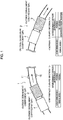
- Fig. 1 is a plan view to schematically explain an outside derailment coefficient estimation method according to the present exemplary embodiment.
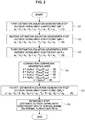
- Fig. 2 is a flowchart illustrating an outline procedure of an outside derailment coefficient estimation method according to the present exemplary embodiment.
- the outside derailment coefficient estimation method is a method to estimate the outside derailment coefficient when a bogie provided to rolling stock is traveling along a curved section of track.
- hitherto use of measurement values by measurement equipment 11 has enabled computation of an outside derailment coefficient Q/P 1 when a monitoring bogie 3 having wheel load P and lateral force Q measuring capabilities is traveling on a reference curved section 1 installed with measurement equipment 11 having wheel load P and lateral force Q measuring capabilities.
- hitherto use of measurement values by the measurement equipment 11 has enabled computation of an outside derailment coefficient Q/P 2 when a normal bogie 4 lacking wheel load P and lateral force Q measurement capabilities is traveling on the reference curved section 1.
- hitherto use of measurement values by the monitoring bogie 3 has enabled computation of an outside derailment coefficient Q/P 3 when the monitoring bogie 3 is traveling on a normal curved section 2 not installed with the measurement equipment 11 having wheel load P and lateral force Q measuring capabilities.
- hitherto the computation of an outside derailment coefficient Q/P 4 when the normal bogie 4 is traveling on the normal curved section 2 has not been possible.
- the outside derailment coefficient estimation method is a method to estimate the outside derailment coefficient Q/P 4 when the normal bogie 4 is traveling on the normal curved section 2, which has not hitherto been possible to compute.
- the method of estimating the outside derailment coefficient Q/P 4 includes a first estimation equation generation step S1, a second estimation equation generation step S2, a third estimation equation generation step S3, a correction coefficient generation step S4, a fourth estimation equation generation step S5, and an estimation step S6. Explanation follows in sequence regarding each of the steps S1 to S6.
- the wheel load P and lateral force Q of the monitoring bogie 3 are measured with the measurement equipment 11 when the monitoring bogie 3 is traveling along the reference curved section 1.
- a known PQ monitoring bogie such as that described in JP-A No. 2014-54881 , for example, is applicable as the monitoring bogie 3.
- known measurement equipment such as that described in JP-A No. H10-185666 , for example, may is applicable as the measurement equipment 11. The measurement referred to above is repeatedly performed on the same reference curved section 1 by the same monitoring bogie 3 to acquire plural measurement data of wheel load P and lateral force Q.
- a first estimation equation to estimate the outside derailment coefficient Q/P 1 of the monitoring bogie 3 on the reference curved section 1 is generated by performing multivariate analysis using the outside derailment coefficient Q/P 1 computed from the measured wheel load P and lateral force Q as an objective variable, and using at least a specific computation value that is computed from the measured wheel load P and lateral force Q (excluding the outside derailment coefficient Q/P 1 ) as well as the travel velocity of the monitoring bogie 3 as explanatory variables.
- the travel velocity of the monitoring bogie 3 may be easily measured using a speedometer generally provided to rolling stock.
- a first order polynomial equation of explanatory variables is employed as the first estimation equation.
- the first estimation equation may be represented by the following Equation (1), wherein V 1 is the travel velocity of the monitoring bogie 3, and X 1 , Y 1 , Z 1 are employed as three computation values computed from the wheel load P and lateral force Q.
- Q / P 1 a 1 ⁇ V 1 + b 1 ⁇ X 1 + c 1 ⁇ Y 1 + d 1 ⁇ Z 1 + e 1
- the coefficients a 1 to d 1 of the explanatory variables of Equation (1) and e 1 that is a constant of Equation (1) may be identified by employing a least-squares method, for example, on plural data computed for the computation values X 1 to Z 1 based on the plural measurement data for the wheel load P and lateral force Q acquired in the first estimation equation generation step, on plural data measured for the travel velocity V 1 , and on plural data computed for the outside derailment coefficient Q/P 1 .
- the wheel load P and lateral force Q of the normal bogie 4 are measured with the measurement equipment 11 when the normal bogie 4 is traveling along the reference curved section 1.
- the above measurements are repeatedly performed on the same reference curved section 1 for the same normal bogie 4 to acquire plural measurement data of wheel load P and lateral force Q.
- a second estimation equation to estimate an outside derailment coefficient Q/P 2 of the normal bogie 4 on the reference curved section 1 is generated by performing multivariate analysis using the outside derailment coefficient Q/P 2 computed from the measured wheel load P and lateral force Q as an objective variable, and using at least a specific computation value that is computed from the measured wheel load P and lateral force Q (excluding the outside derailment coefficient Q/P 2 ) as well as the travel velocity of the normal bogie 4 as explanatory variables.
- the travel velocity of the normal bogie 4 may be easily measured using a speedometer generally provided to rolling stock.
- a first order polynomial equation of explanatory variables is employed as the second estimation equation.
- the second estimation equation may be represented by the following Equation (2), wherein V 2 is the travel velocity of the normal bogie 4, and X 2 , Y 2 , Z 2 are respectively employed as three computation values computed from the wheel load P and lateral force Q.
- Q / P 2 a 2 ⁇ V 2 + b 2 ⁇ X 2 + c 2 ⁇ Y 2 + d 2 ⁇ Z 2 + e 2 X 2 to Z 2 are each similar types of computation value to X 1 to Z 1 of the first estimation equation.
- the coefficients a 2 to d 2 that are the explanatory variables of Equation (2) and e 2 that is a constant term of Equation (2) may be identified by employing a least-squares method, for example, on plural data for the computed values X 2 to Z 2 computed based on the plural measurement data for the wheel load P and lateral force Q acquired in the second estimation equation generation step, on plural data measured for the travel velocity V 2 , and on plural data computed for the outside derailment coefficient Q/P 2 .
- the wheel load P and lateral force Q of the monitoring bogie 3 are measured with the monitoring bogie 3 when the monitoring bogie 3 is traveling along the normal curved section 2.
- the measurement referred to above is repeatedly performed on the same normal curved section 2 for the same monitoring bogie 3 to acquire plural measurement data of the wheel load P and lateral force Q.
- the third estimation equation to estimate the outside derailment coefficient Q/P 3 of the monitoring bogie 3 on the normal curved section 2 is generated by performing multivariate analysis using the outside derailment coefficient Q/P 3 computed from the measured wheel load P and lateral force Q as an objective variable and using at least a specific computation value that is computed from the measured wheel load P and lateral force Q (excluding the outside derailment coefficient Q/P 3 ) as well as the travel velocity of the monitoring bogie 3 as explanatory variables.
- the third estimation equation may be represented by the following Equation (3), wherein V 3 is the travel velocity of the monitoring bogie 3, and X 3 , Y 3 , Z 3 are respectively employed as three computation values computed from the wheel load P and lateral force Q.
- Q / P 3 a 3 ⁇ V 3 + b 3 ⁇ X 3 + c 3 ⁇ Y 3 + d 3 ⁇ Z 3 + e 3 X 3 to Z 3 are each similar types of computation values to X 1 to Z 1 of the first estimation equation and X 2 to Z 2 of the second estimation equation.
- the coefficients a 3 to d 3 that are the explanatory variables of Equation (3) and e 3 that is a constant term of Equation (3) may be identified by employing a least-squares method, for example, on plural data for the computed values X 3 to Z 3 computed based on the plural measurement data for the wheel load P and lateral force Q acquired in the third estimation equation generation step, on plural data measured for the travel velocity V 3 , and on plural data computed for the outside derailment coefficient Q/P 3 .
- correction coefficients are generated for the explanatory variables V 2 and X 2 to Z 2 in the second estimation equation represented by Equation (2) based on the coefficients a 1 to d 1 of the explanatory variables V 1 and X 1 to Z 1 in the first estimation equation represented by Equation (1), the coefficients a 3 to d 3 of the explanatory variables V 3 and X 3 to Z 3 in the third estimation equation represented by Equation (3), the plural data of the explanatory variable V 1 and X 1 to Z 1 employed when the first estimation equation was generated (for example, the plural data of the explanatory variables V 1 and X 1 to Z 1 employed when using a least-squares method), and the plural data of the explanatory variable V 3 and X 3 to Z 3 employed when the third estimation equation was generated (for example, the plural data of the explanatory variables V 3 and X 3 to Z 3 employed when using a least-squares method).
- the correction coefficients are generated for the explanatory variables V 2 and X 2 to Z 2 in the second estimation equation by multiplying together respective ratios of the coefficients a 3 to d 3 of the explanatory variables V 3 and X 3 to Z 3 in the third estimation equation with respect to the coefficients a 1 to d 1 of the explanatory variables V 1 and X 1 to Z 1 of the first estimation equation, by multiplying with the respective ratios of the average values of the explanatory variables V 3 and X 3 to Z 3 employed when the third estimation equation was generated with respect to the average values of the explanatory variables V 1 and X 1 to Z 1 employed when the first estimation equation was generated.
- correction coefficients ⁇ , ⁇ , ⁇ , and ⁇ are the respective correction coefficients ⁇ , ⁇ , ⁇ , and ⁇ for the explanatory variables V 2 and X 2 to Z 2 of the second estimation equation and are represented by the following Equations (4) to (7), wherein V lave and Xiave to Ziave are respective average values of the explanatory variables V 1 and X 1 to Z 1 employed when the first estimation equation was generated, and V 3ave and X 3ave to Z 3ave are respective average values of the explanatory variables V 3 and X 3 to Z 3 employed when the third estimation equation was generated.
- a correction coefficient is also generated for the constant term e 2 in the second estimation equation.
- the correction coefficient for the constant term e 2 in the second estimation equation is generated by taking the square of the ratio of the constant term e 3 in the third estimation equation with respect to the constant term e 1 in the first estimation equation.
- the fourth estimation equation to estimate the outside derailment coefficient Q/P 4 of the normal bogie 4 on the normal curved section 2 is generated by taking account of the correction coefficients ⁇ , ⁇ , ⁇ , and ⁇ in the coefficients a 3 to d 3 of the explanatory variables V 2 and X 2 to Z 2 in the second estimation equation.
- the fourth estimation equation to estimate the outside derailment coefficient Q/P 4 of the normal bogie 4 on the normal curved section 2 is generated by also taking account of the correction coefficient ⁇ in the constant term e 2 of the second estimation equation.
- the fourth estimation equation to estimate the outside derailment coefficient Q/P 4 of the normal bogie 4 on the normal curved section 2 is generated by multiplying the coefficients a 2 to d 2 of the explanatory variables V 2 and X 2 to Z 2 in the second estimation equation with the correction coefficients ⁇ , ⁇ , ⁇ , and ⁇ .
- the fourth estimation equation to estimate the outside derailment coefficient Q/P 4 of the normal bogie 4 on the normal curved section 2 is generated by multiplying the constant term e 2 in the second estimation equation by the correction coefficient ⁇ .
- Equation (9) the fourth estimation equation is represented by the following Equation (9).
- Q / P 4 ⁇ ⁇ a 2 ⁇ V 2 + ⁇ ⁇ b 2 ⁇ X 2 + ⁇ ⁇ c 2 ⁇ Y 2 + ⁇ ⁇ d 2 ⁇ Z 2 + ⁇ ⁇ e 2
- the fourth estimation equation generated in the above described manner is stored and employed in the next estimation step S6.
- the wheel load P and lateral force Q of the normal bogie 4 are measured with the measurement equipment 11 when the normal bogie 4 is traveling along the reference curved section 1.
- the outside derailment coefficient Q/P 4 of the normal bogie 4 on the normal curved section 2 is estimated by inputting the fourth estimation equation with at least a specific computation value that is computed from the measured wheel load P and lateral force Q (X 2 , Y 2 , Z 2 in the present exemplary embodiment) as well as with the travel velocity V 2 of the normal bogie 4.
- Fig. 3A, Fig. 3B , Fig. 4A, and Fig. 4B are diagrams illustrating examples of results of comparing estimated values of the outside derailment coefficient Q/P 1 to Q/P 4 estimated using the Equations (1) to (3) and (9), against measured values of the outside derailment coefficient Q/P 1 to Q/P 4 measured using the measurement equipment 11 or the monitoring bogie 3.
- An inside derailment coefficient is employed as the explanatory variables X 1 to X 3 for all of the Equations (1) to (3) and (9).
- the front axle left-right wheel load balance is employed as the explanatory variables Y 1 to Y 3 .
- the rear axle left-right wheel load balance is employed as the explanatory variables Z 1 to Z 3 .
- Fig. 3A illustrates results of comparing the estimated values and the measured values of the outside derailment coefficient Q/P 1 .
- the measured values of the outside derailment coefficient Q/P 1 are measured using the measurement equipment 11.
- Fig. 3B illustrates results of comparing the estimated values and the measured values of the outside derailment coefficient Q/P 2 .
- the measured values of the outside derailment coefficient Q/P 2 are measured using the measurement equipment 11.
- Fig. 4A illustrates results of comparing the estimated values and the measured values of the outside derailment coefficient Q/P 3 .
- the measured values of the outside derailment coefficient Q/P 3 are measured using the monitoring bogie 3.
- Fig. 4B illustrates results of comparing the estimated values and the measured values of the outside derailment coefficient Q/P 4 .
- the results illustrated in Fig. 4B are measured by temporarily installing the measurement equipment 11 on the normal curved section 2 to evaluate the estimated values of the outside derailment coefficient Q/P 4 , and are measured values measured with the measurement equipment
- the outside derailment coefficients Q/P 1 to Q/P 3 can be estimated with comparatively good precision.
- the outside derailment coefficient Q/P 4 when the normal bogie 4 is traveling along the normal curved section 2 can be estimated with good precision, a computation that hitherto has not been possible.
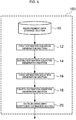
- FIG. 5 is a schematic diagram illustrating an outline configuration of an outside derailment coefficient estimation device according to an exemplary embodiment of the present invention.
- an outside derailment coefficient estimation device 100 includes a measurement data storage section 10, a first estimation equation generation section 12, a second estimation equation generation section 14, a third estimation equation generation section 16, a correction coefficient generation section 17, a fourth estimation equation generation section 18, and an outside derailment coefficient estimation section 20.
- the measurement data storage section 10 is stored with plural measurement data for the wheel load P, the lateral force Q, and the travel velocity V acquired by measuring the wheel load P and lateral force Q of the monitoring bogie 3 with the measurement equipment 11 when the monitoring bogie 3 is traveling along the reference curved section 1, and by repeatedly performing these measurements in the same reference curved section 1 for the same monitoring bogie 3.
- the measurement data storage section 10 is stored with plural measurement data of the wheel load P, lateral force Q, and travel velocity V acquired by measuring the wheel load P and lateral force Q of the normal bogie 4 with the measurement equipment 11 when the normal bogie 4 is traveling along the reference curved section 1, and by repeatedly performing these measurements on the same reference curved section 1 with the same normal bogie 4.
- the measurement data storage section 10 is stored with plural measurement data of the wheel load P, lateral force Q, and travel velocity V acquired by measuring the wheel load P and lateral force Q of the monitoring bogie 3 with the monitoring bogie 3 itself when the monitoring bogie 3 is traveling along the normal curved section 2, and by repeatedly performing these measurements on the same normal curved section 2 with the same monitoring bogie 3.
- the measurement data storage section 10 is stored with measurement data of the wheel load P, lateral force Q, and travel velocity V acquired by measuring the wheel load P and lateral force Q of the normal bogie 4 with the measurement equipment 11 when the normal bogie 4 is traveling along the reference curved section 1.
- the first estimation equation generation section 12 Based on the plural measurement data stored in the measurement data storage section 10 for the wheel load P and lateral force Q of the monitoring bogie 3 measured with the measurement equipment 11 when the monitoring bogie 3 is traveling along the reference curved section 1, the first estimation equation generation section 12 generates the first estimation equation by identifying coefficients of the explanatory variables and the constant term of the first estimation equation represented by Equation (1) to estimate the outside derailment coefficient Q/P 1 of the monitoring bogie 3 on the reference curved section 1.
- Such identification is achieved by performing multivariate analysis using the outside derailment coefficient Q/P 1 computed from the measured wheel load P and lateral force Q as an objective variable, and using at least a specific computation value that is computed from the measured wheel load P and lateral force Q (excluding the outside derailment coefficient Q/P 1 ) as well as the travel velocity of the monitoring bogie 3 as explanatory variables.
- the second estimation equation generation section 14 Based on the plural measurement data stored in the measurement data storage section 10 for the wheel load P and lateral force Q of the normal bogie 4 measured with the measurement equipment 11 when the normal bogie 4 is traveling along the reference curved section 1, the second estimation equation generation section 14 generates the second estimation equation by identifying coefficients of the explanatory variables and the constant term of the second estimation equation represented by Equation (2) to estimate the outside derailment coefficient Q/P 2 of the normal bogie 4 on the reference curved section 1.
- Such identification is achieved by performing multivariate analysis using the outside derailment coefficient Q/P 2 computed from the measured wheel load P and lateral force Q as an objective variable, and using at least a specific computation value that is computed from the measured wheel load P and lateral force Q (excluding the outside derailment coefficient Q/P 2 ) as well as the travel velocity of the normal bogie 4 as explanatory variables.
- the third estimation equation generation section 16 Based on the plural measurement data stored in the measurement data storage section 10 for the wheel load P and lateral force Q of the monitoring bogie 3 measured with the monitoring bogie 3 when the monitoring bogie 3 is traveling along the normal curved section 2, the third estimation equation generation section 16 generates the third estimation equation by identifying coefficients of the explanatory variables and the constant term of the third estimation equation represented by Equation (3) to estimate the outside derailment coefficient Q/P 3 of the monitoring bogie 3 on the normal curved section 2.
- Such identification is achieved by performing multivariate analysis using the outside derailment coefficient Q/P 3 computed from the measured wheel load P and lateral force Q as an objective variable, and using at least a specific computation value that is computed from the measured wheel load P and lateral force Q (excluding the outside derailment coefficient Q/P 3 ) as well as the travel velocity of the monitoring bogie 3 as explanatory variables.
- the correction coefficient generation section 17 Based on coefficients of the explanatory variables in the first estimation equation, coefficients of the explanatory variables in the third estimation equation, the plural data of the explanatory variables employed when the first estimation equation was generated, and the plural data of the explanatory variables employed when the third estimation equation was generated, the correction coefficient generation section 17 generates the respective correction coefficients for the explanatory variables of the second estimation equation according to Equation (4) to Equation (7).
- the correction coefficient generation section 17 based on the ratio of the constant term in the third estimation equation with respect to the constant term in the first estimation equation, the correction coefficient generation section 17 generates the correction coefficient for the constant term in the second estimation equation according to Equation (8).
- the fourth estimation equation generation section 18 then generates the fourth estimation equation represented by Equation (9) to estimate the outside derailment coefficient Q/P 4 of the normal bogie 4 on the normal curved section 2 by taking account of the respective correction coefficients in the coefficients of the explanatory variables and the constant term in the second estimation equation.
- the outside derailment coefficient estimation section 20 estimates the outside derailment coefficient Q/P 4 of the normal bogie 4 on the normal curved section 2 by inputting the fourth estimation equation represented by Equation (9) with at least a specific computation value that is computed from the measured wheel load P and lateral force Q (X 2 , Y 2 , Z 2 in the present exemplary embodiment) as well as the travel velocity V 2 of the normal bogie 4.
- the outside derailment coefficient estimation device 100 is, for example, implemented using a computer 64, illustrated in Fig. 6 .
- the computer 64 includes a CPU 66, memory 68, a storage section 70 stored with an outside derailment coefficient estimation program 76, a display section 26 including a monitor, and an input section 28 including a keyboard and a mouse.
- the CPU 66, the memory 68, the storage section 70, the display section 26, and the input section 28 are mutually connected through a bus 74.
- the storage section 70 may be implemented by a HDD, SSD, flash memory, or the like.
- the outside derailment coefficient estimation program 76 stored in the storage section 70 is employed to cause the computer 64 to function as the outside derailment coefficient estimation device 100.
- the CPU 66 reads the outside derailment coefficient estimation program 76 from the storage section 70, expands the outside derailment coefficient estimation program 76 into the memory 68, and executes the outside derailment coefficient estimation program 76.
- the outside derailment coefficient estimation program 76 may be provided stored on a computer-readable medium.
- the measurement data includes plural measurement data of the wheel load P and lateral force Q of the monitoring bogie 3 measured with the measurement equipment 11 when the monitoring bogie 3 is traveling along the reference curved section 1, plural measurement data of the wheel load P and lateral force Q of the normal bogie 4 measured with the measurement equipment 11 when the normal bogie 4 is traveling along the reference curved section 1, measurement data of the wheel load P and lateral force Q of the monitoring bogie 3 measured with the monitoring bogie 3 when the monitoring bogie 3 is traveling along the normal curved section 2, and measurement data of the wheel load P and lateral force Q of the normal bogie 4 measured with the measurement equipment 11 when the normal bogie 4 is traveling along the reference curved section 1.
- the outside derailment coefficient estimation processing is executed in the outside derailment coefficient estimation device 100.
- Explanation follows regarding the outside derailment coefficient estimation processing, with reference to Fig. 2 .
- Note that the flow illustrating the flow of the outside derailment coefficient estimation processing is similar to the flow illustrating the outline procedure of the outside derailment coefficient estimation method of Fig. 2 , and so will be described with the same reference signs appended thereto.
- the first estimation equation generation section 12 Based on the plural measurement data stored in the measurement data storage section 10 for the wheel load P and lateral force Q of the monitoring bogie 3 measured with the measurement equipment 11 when the monitoring bogie 3 is traveling along the reference curved section 1, the first estimation equation generation section 12 generates the first estimation equation by identifying coefficients of the explanatory variables and the constant term of the first estimation equation represented by Equation (1) to estimate the outside derailment coefficient Q/P 1 of the monitoring bogie 3 on the reference curved section 1.
- Such identification is achieved by performing multivariate analysis using the outside derailment coefficient Q/P 1 computed from the measured wheel load P and lateral force Q as an objective variable, and using at least a specific computation value that is computed from the measured wheel load P and lateral force Q (excluding the outside derailment coefficient Q/P 1 ) as well as the travel velocity of the monitoring bogie 3 as explanatory variables.
- the second estimation equation generation section 14 Based on the plural measurement data stored in the measurement data storage section 10 for the wheel load P and lateral force Q of the normal bogie 4 measured with the measurement equipment 11 when the normal bogie 4 is traveling along the reference curved section 1, the second estimation equation generation section 14 generates the second estimation equation by identifying coefficients of the explanatory variables and the constant term of the second estimation equation represented by Equation (2) to estimate the outside derailment coefficient Q/P 2 of the normal bogie 4 on the reference curved section 1.
- Such identification is achieved by performing multivariate analysis using the outside derailment coefficient Q/P 2 computed from the measured wheel load P and lateral force Q as an objective variable, and using at least a specific computation value that is computed from the measured wheel load P and lateral force Q (excluding the outside derailment coefficient Q/P 2 ) as well as the travel velocity of the normal bogie 4 as explanatory variables.
- the third estimation equation generation section 16 Based on the plural measurement data stored in the measurement data storage section 10 for the wheel load P and lateral force Q of the monitoring bogie 3 measured with the monitoring bogie 3 when the monitoring bogie 3 is traveling along the normal curved section 2, the third estimation equation generation section 16 generates the third estimation equation by identifying coefficients of the explanatory variables and the constant term of the third estimation equation represented by Equation (3) to estimate the outside derailment coefficient Q/P 3 of the monitoring bogie 3 on the normal curved section 2.
- Such identification is achieved by performing multivariate analysis using the outside derailment coefficient Q/P 3 computed from the measured wheel load P and lateral force Q as an objective variable, and using at least a specific computation value that is computed from the measured wheel load P and lateral force Q (excluding the outside derailment coefficient Q/P 3 ) as well as the travel velocity of the monitoring bogie 3 as explanatory variables.
- the correction coefficient generation section 17 Based on coefficients of the explanatory variables in the first estimation equation, coefficients of the explanatory variables in the third estimation equation, the plural data of the explanatory variables employed when the first estimation equation was generated, and the plural data of the explanatory variables employed when the third estimation equation was generated, the correction coefficient generation section 17 generates the respective correction coefficients for the explanatory variables of the second estimation equation according to Equation (4) to Equation (7).
- the correction coefficient generation section 17 Furthermore, based on the ratio of the constant term in the third estimation equation with respect to the constant term in the first estimation equation, the correction coefficient generation section 17 generates the correction coefficient for the constant term in the second estimation equation according to Equation (8).
- the fourth estimation equation generation section 18 then generates the fourth estimation equation represented by Equation (9) to estimate the outside derailment coefficient Q/P 4 of the normal bogie 4 on the normal curved section 2 by taking account of the respective correction coefficients in the coefficients of the explanatory variables and the constant term in the second estimation equation.
- the outside derailment coefficient estimation section 20 estimates the outside derailment coefficient Q/P 4 of the normal bogie 4 on the normal curved section 2 by inputting the fourth estimation equation represented by Equation (9) with at least a specific computation value that is computed from the measured wheel load P and lateral force Q (X 2 , Y 2 , Z 2 in the present exemplary embodiment) as well as with the travel velocity V 2 of the normal bogie 4.
- the outside derailment coefficient estimation device 100 enables a derailment coefficient to be estimated for a normal bogie (bogie lacking wheel load and lateral force measurement capabilities) on a normal curved section (curved section not installed with measurement equipment having wheel load and lateral force measuring capabilities).
- a method to estimate a derailment coefficient when a bogie provided to rolling stock is traveling on a curved section of track the derailment coefficient estimation method including:
- the derailment coefficient estimation method of Supplement 1 or Supplement 2 wherein at least one parameter is employed as the computation value from out of an inside derailment coefficient, a front axle left-right wheel load balance, or a rear axle left-right wheel load balance.
- a device to estimate a derailment coefficient when a bogie provided to rolling stock is traveling on a curved section of track the derailment coefficient estimation device including:
- derailment coefficient estimation device of any one of Supplement 6 to Supplement 9, wherein the derailment coefficient is a derailment coefficient of an outside wheel.
- a program to estimate a derailment coefficient when a bogie provided to rolling stock is traveling on a curved section of track the program causing a computer to execute processing including:
- the derailment coefficient estimation device of Supplement 11 or Supplement 12 wherein at least one parameter is employed as the computation value from out of an inside derailment coefficient, a front axle left-right wheel load balance, or a rear axle left-right wheel load balance.
- derailment coefficient estimation device of any one of Supplement 11 to Supplement 14, wherein the derailment coefficient is a derailment coefficient of an outside wheel.
Landscapes
- Engineering & Computer Science (AREA)
- Mechanical Engineering (AREA)
- Control Of Driving Devices And Active Controlling Of Vehicle (AREA)
- Machines For Laying And Maintaining Railways (AREA)
- Force Measurement Appropriate To Specific Purposes (AREA)
- Electric Propulsion And Braking For Vehicles (AREA)
- Management, Administration, Business Operations System, And Electronic Commerce (AREA)
Abstract
Description
- The present invention relates to a method, device, and program for estimating a derailment coefficient when a bogie provided to rolling stock is traveling along a curved section of track. In particular, the present invention relates to a method, device, and program capable of estimating a derailment coefficient of a normal bogie (a bogie lacking wheel load and lateral force measurement capabilities) on a normal curved section (a curved section not installed with measurement equipment having wheel load and lateral force measuring capabilities).
- Evaluating indicators of derailment for rolling stock, and taking countermeasures according to the evaluation results, is important to improve travel safety of rolling stock.
- Hitherto, a derailment coefficient Q/P, i.e. a value arrived at by dividing a lateral force Q that is the force acting in a horizontal direction between wheel and rail, by a wheel load P that is the force acting in a vertical direction between wheel and rail, has been widely employed as an indicator of derailment. In particular, a derailment coefficient (outside derailment coefficient) Q/P for an outside wheel on the front axle of a rolling stock bogie when the rolling stock is traveling on a curved section of track is widely employed.
- The following are two known methods for measuring the wheel load P and the lateral force Q to compute the derailment coefficient Q/P.
- (1) Ground side measurement: these are methods in which measurement equipment having wheel load P and lateral force Q measuring capabilities is installed on a curved section to detect the forces acting on rails. In these methods the wheel load P and lateral force Q for a bogie traveling on a curved section is measured with the installed measurement equipment (see, for example, Japanese Patent Application Laid-Open (
JP-A) No. H10-185666 - (2) Vehicle side measurement: these are methods to measure the wheel load P and lateral force Q for a bogie traveling on a curved section using a bogie, called a PQ monitoring bogie, that is attached with sensors having wheel load P and lateral force Q measuring capabilities to detect the forces acting on wheels (see, for example,
JP-A No. 2014-54881 - Ground side measurement is capable of measuring the wheel load P and lateral force Q of all bogies traveling on curved sections installed with measurement equipment. However, ground side measurement is not able to measure the wheel load P and lateral force Q for curved sections not installed with the measurement equipment. Installing measurement equipment to all curved sections is not realistic due to the dramatic rise in cost this would incur and to the resulting increase in maintenance effort.
- Vehicle side measurement is capable of measuring the wheel load P and lateral force Q at all curved sections that the PQ monitoring bogie is traveling along. However, the wheel load P and lateral force Q are not able to be measured for bogies other than PQ monitoring bogies, i.e. for bodies lacking wheel load and lateral force measurement capabilities. Making all bogies PQ monitoring bogies is not realistic due to the dramatic rise in cost this would incur and to the resulting increase in maintenance effort.
- As described above, there is a problem with wheel load P and lateral force Q measurement methods for both ground side measurements and vehicle side measurements in that they are not able to compute an outside derailment coefficient Q/P for when a normal bogie travels on a normal curved section since the wheel load P and lateral force Q are not able to be measured by a normal bogie (bogie lacking wheel load P and lateral force Q measurement capabilities) traveling on a normal curved section (curved section not installed with measurement equipment having wheel load P and lateral force Q measuring capabilities).
- In order to solve the problem arising with conventional technology described above, the present invention addresses the provision of a method capable of estimating a derailment coefficient of a normal bogie (bogie lacking wheel load and lateral force measurement capabilities) on a normal curved section (curved section not installed with measurement equipment having wheel load and lateral force measuring capabilities).
- A derailment coefficient estimation method according to a first aspect is a method of estimating a derailment coefficient in a case in which a bogie provided to rolling stock is traveling on a curved section of track. The derailment coefficient estimation method includes a first estimation equation generation step, a second estimation equation generation step, a third estimation equation generation step, a correction coefficient generation step, a fourth estimation equation generation step, and an estimation step. The first estimation equation generation step includes measuring a wheel load and lateral force of a monitoring bogie using measurement equipment in a case in which the monitoring bogie, which can measure wheel load and lateral force, is traveling on a reference curved section of track installed with the measurement equipment, which can measure wheel load and lateral force, and generating a first estimation equation that estimates a derailment coefficient of the monitoring bogie on the reference curved section by performing multivariate analysis using a derailment coefficient computed from the measured wheel load and lateral force as an objective variable and using at least a specific computation value that is computed from the measured wheel load and lateral force as well as a travel velocity of the monitoring bogie as explanatory variables. The second estimation equation generation step includes measuring a wheel load and lateral force of a normal bogie using the measurement equipment in a case in which the normal bogie which cannot measure wheel load and lateral force is traveling on the reference curved section, and generating a second estimation equation that estimates a derailment coefficient of the normal bogie on the reference curved section by performing multivariate analysis using a derailment coefficient computed from the measured wheel load and lateral force as an objective variable and using at least a specific computation value that is computed from the measured wheel load and lateral force as well as a travel velocity of the normal bogie as explanatory variables. The third estimation equation generation step includes measuring a wheel load and lateral force of the monitoring bogie using the monitoring bogie itself in a case in which the monitoring bogie, which can measure wheel load and lateral force, is traveling on a normal curved section of track not installed with measurement equipment, which can measure wheel load and lateral force, and generating a third estimation equation that estimates a derailment coefficient of the monitoring bogie on the normal curved section by performing multivariate analysis using a derailment coefficient computed from the measured wheel load and lateral force as an objective variable and using at least a specific computation value that is computed from the measured wheel load and lateral force as well as a travel velocity of the monitoring bogie as explanatory variables. The correction coefficient generation step includes generating correction coefficients for the explanatory variables in the second estimation equation based on coefficients of the explanatory variables in the first estimation equation, coefficients of the explanatory variables in the third estimation equation, values of the explanatory variables employed when the first estimation equation was generated, and values of the explanatory variables employed when the third estimation equation was generated. The fourth estimation equation generation step includes generating a fourth estimation equation that estimates a derailment coefficient of the normal bogie on the normal curved section by taking account of the correction coefficients in the coefficients of the explanatory variables in the second estimation equation. The estimation step includes estimating a derailment coefficient of the normal bogie on the normal curved section by measuring the wheel load and lateral force of the normal bogie using the measurement equipment in a case in which the normal bogie is traveling along the reference curved section, and inputting, into the fourth estimation equation, at least a specific computation value that is computed from the measured wheel load and lateral force as well as the travel velocity of the normal bogie.
- A derailment coefficient estimating device according to a second aspect is a device to estimate a derailment coefficient in a case in which a bogie provided to rolling stock is traveling on a curved section of track. The derailment coefficient estimation device includes a first estimation equation generation section, a second estimation equation generation section, a third estimation equation generation section, a correction coefficient generation section, a fourth estimation equation generation section, and an estimation section. The first estimation equation generation section is employed to generate a first estimation equation that estimates a derailment coefficient of a monitoring bogie on a reference curved section of track installed with measurement equipment, which can measure wheel load and lateral force, by performing multivariate analysis using input of results of measuring a wheel load and lateral force of the monitoring bogie using the measurement equipment in a case in which the monitoring bogie, which can measure wheel load and lateral force, is traveling on the reference curved section, using a derailment coefficient computed from the measured wheel load and lateral force as an objective variable, and using at least a specific computation value that is computed from the measured wheel load and lateral force as well as a travel velocity of the monitoring bogie as explanatory variables. The second estimation equation generation section is employed to generate a second estimation equation to estimate a derailment coefficient of the normal bogie on the reference curved section by performing multivariate analysis using input of results of measuring a wheel load and lateral force of the normal bogie using the measurement equipment in a case in which the normal bogie, which cannot measure wheel load and lateral force, is traveling on the reference curved section, using a derailment coefficient computed from the measured wheel load and lateral force as an objective variable, and using at least a specific computation value that is computed from the measured wheel load and lateral force as well as a travel velocity of the normal bogie as explanatory variables. The third estimation equation generation section is employed to generate a third estimation equation to estimate a derailment coefficient of the monitoring bogie on the normal curved section of track not installed with measurement equipment, which can measure wheel load and lateral force, by performing multivariate analysis using input of results of measuring a wheel load and lateral force of the monitoring bogie using the monitoring bogie itself in a case in which the monitoring bogie, which can measure wheel load and lateral force, is traveling on the normal curved section, using a derailment coefficient computed from the measured wheel load and lateral force as an objective variable, and using at least a specific computation value that is computed from the measured wheel load and lateral force as well as a travel velocity of the monitoring bogie as explanatory variables. The correction coefficient generation section is employed to generate correction coefficients for the explanatory variables in the second estimation equation based on coefficients of the explanatory variables in the first estimation equation, coefficients of the explanatory variables in the third estimation equation, values of the explanatory variables employed when the first estimation equation was generated, and values of the explanatory variables employed when the third estimation equation was generated. The fourth estimation equation generation section is employed to generate a fourth estimation equation to estimate a derailment coefficient of the normal bogie on the normal curved section by taking account of the correction coefficients in the coefficients of the explanatory variables in the second estimation equation. The estimation section is employed to estimate a derailment coefficient of the normal bogie on the normal curved section by using input of results of measuring the wheel load and lateral force of the normal bogie using the measurement equipment in a case in which the normal bogie is traveling along the reference curved section, and inputting, into the fourth estimation equation, at least a specific computation value that is computed from the measured wheel load and lateral force as well as the travel velocity of the normal bogie.
- A program according to a third aspect is a program to estimate a derailment coefficient in a case in which a bogie provided to rolling stock is traveling on a curved section of track. The program causes a computer to execute processing including generating a first estimation equation, generating a second estimation equation, generating a third estimation equation, generate correction coefficients, generating a fourth estimation equation, and estimating a derailment coefficient. The first estimation equation is to estimate a derailment coefficient of a monitoring bogie on a reference curved section of track installed with the measurement equipment, which can measure wheel load and lateral force, by performing multivariate analysis using input of results of measuring a wheel load and lateral force of the monitoring bogie using the measurement equipment in a case in which the monitoring bogie, which can measure wheel load and lateral force, is traveling on the reference curved section, using a derailment coefficient computed from the measured wheel load and lateral force as an objective variable, and using at least a specific computation value that is computed from the measured wheel load and lateral force as well as a travel velocity of the monitoring bogie as explanatory variables. The second estimation equation is to estimate a derailment coefficient of a normal bogie on the reference curved section by performing multivariate analysis using input of results of measuring a wheel load and lateral force of the normal bogie using the measurement equipment in a case in which the normal bogie, which cannot measure wheel load and lateral force, is traveling on the reference curved section, using a derailment coefficient computed from the measured wheel load and lateral force as an objective variable, and using at least a specific computation value that is computed from the measured wheel load and lateral force as well as a travel velocity of the normal bogie as explanatory variables. The third estimation equation is to estimate a derailment coefficient of the monitoring bogie on the normal curved section of track not installed with measurement equipment, which can measure wheel load and lateral force, by performing multivariate analysis using input of results of measuring a wheel load and lateral force of the monitoring bogie using the monitoring bogie itself in a case in which the monitoring bogie which can measure wheel load and lateral force, is traveling on the normal curved section, using a derailment coefficient computed from the measured wheel load and lateral force as an objective variable, and using at least a specific computation value that is computed from the measured wheel load and lateral force as well as a travel velocity of the monitoring bogie as explanatory variables. The correction coefficients for the explanatory variables in the second estimation equation are generated based on coefficients of the explanatory variables in the first estimation equation, coefficients of the explanatory variables in the third estimation equation, values of the explanatory variables employed when the first estimation equation was generated, and values of the explanatory variables employed when the third estimation equation was generated. The fourth estimation equation to estimate a derailment coefficient of the normal bogie on the normal curved section is generated by taking account of the correction coefficients in the coefficients of the explanatory variables in the second estimation equation. The derailment coefficient of the normal bogie on the normal curved section is estimated by using input of results of measuring the wheel load and lateral force of the normal bogie using the measurement equipment in a case in which the normal bogie is traveling along the reference curved section, and inputting, into the fourth estimation equation, at least a specific computation value that is computed from the measured wheel load and lateral force as well as the travel velocity of the normal bogie.
- The present invention enables a derailment coefficient to be estimated for a normal bogie on a normal curved section.
-
-
Fig. 1 is a plan view to schematically explain an outside derailment coefficient estimation method according to an exemplary embodiment of the present invention. -
Fig. 2 is a flowchart illustrating an outline procedure of an outside derailment coefficient estimation method according to an exemplary embodiment of the present invention. -
Fig. 3A is a diagram illustrating an example of results comparing estimated values and measured values of an outside derailment coefficient Q/P1. -
Fig. 3B is a diagram illustrating an example of results comparing estimated values and measured values of an outside derailment coefficient Q/P2. -
Fig. 4A is a diagram illustrating an example of results comparing estimated values and measured values of an outside derailment coefficient Q/P3. -
Fig. 4B is a diagram illustrating an example of results comparing estimated values and measured values of an outside derailment coefficient Q/P4. -
Fig. 5 is a schematic diagram illustrating an outline configuration of an outside derailment coefficient estimation device according to an exemplary embodiment of the present invention. -
Fig. 6 is a schematic block diagram of an example of a computer functioning as an outside derailment coefficient estimation device. - Explanation follows regarding an outside derailment coefficient estimation method according to an exemplary embodiment of the present invention, with reference to the appended drawings.
- As a result of diligent investigations, the present inventors have conjectured using multivariate analysis, in which data measurable with measurement equipment and the like is employed as explanatory variables, to generate an estimation equation for estimating an outside derailment coefficient when a monitoring bogie having wheel load and lateral force measuring capabilities is traveling on a reference curved section that is installed with measurement equipment having wheel load and lateral force measuring capabilities (i.e. that is capable of ground side measurement). Similarly, they have conjectured using multivariate analysis in which data measurable by a monitoring bogie and the like is employed as explanatory variables to generate an estimation equation for estimating an outside derailment coefficient when the monitoring bogie is traveling on a normal curved section that is not installed with measurement equipment having wheel load and lateral force measuring capabilities (i.e. that is not capable of ground side measurement). They have then conjectured the possibility of extracting the effect of changing the curved section (changing from the reference curved section to the normal curved section) in changes to the estimation equation by comparing these two estimation equations.
- An estimation equation to estimate an outside derailment coefficient when a normal bogie is traveling on a reference curved section is then generated using multivariate analysis in which data measurable with the measurement equipment and the like is employed as explanatory variables. The present inventors have conjectured that, as long as the effect of changing the curved section in changes to the estimation equation could indeed be extracted by taking account of the extracted effect of changing the curved section to the generated estimation equations, it would be possible to generate an estimation equation to estimate an outside derailment coefficient when a normal bogie is traveling on a normal curved section, a computation not hitherto possible.
- As a result of further diligent investigations based on the above idea, the present inventors have completed the outside derailment coefficient estimation method according to an exemplary embodiment of the present invention.
- An exemplary embodiment of the present invention provides a method to estimate an outside derailment coefficient for when a bogie provided to rolling stock is traveling along a curved section of track, and provides an outside derailment coefficient estimation method including each of the following steps.
- (1) A first estimation equation generation step: measuring a wheel load and lateral force of a monitoring bogie with measurement equipment when the monitoring bogie having wheel load and lateral force measuring capabilities is traveling on a reference curved section installed with the measurement equipment having wheel load and lateral force measuring capabilities, and generating a first estimation equation to estimate an outside derailment coefficient of the monitoring bogie on the reference curved section by performing multivariate analysis using an outside derailment coefficient computed from the measured wheel load and lateral force as an objective variable and using at least a specific computation value that is computed from the measured wheel load and lateral force as well as a travel velocity of the monitoring bogie as explanatory variables.
- (2) A second estimation equation generation step: measuring a wheel load and lateral force of a normal bogie with the measurement equipment when the normal bogie lacking wheel load and lateral force measurement capabilities is traveling on the reference curved section, and generating a second estimation equation to estimate an outside derailment coefficient of the normal bogie on the reference curved section by performing multivariate analysis using an outside derailment coefficient computed from the measured wheel load and lateral force as an objective variable and using at least a specific computation value that is computed from the measured wheel load and lateral force as well as a travel velocity of the normal bogie as explanatory variables.
- (3) Third estimation equation generation step: measuring a wheel load and lateral force of the monitoring bogie with the monitoring bogie itself when the monitoring bogie having wheel load and lateral force measuring capabilities is traveling on a normal curved section not installed with measurement equipment having wheel load and lateral force measuring capabilities, and generating a third estimation equation to estimate an outside derailment coefficient of the monitoring bogie on the normal curved section by performing multivariate analysis using an outside derailment coefficient computed from the measured wheel load and lateral force as an objective variable and using at least a specific computation value that is computed from the measured wheel load and lateral force as well as a travel velocity of the monitoring bogie as explanatory variables.
- (4) Correction coefficient generation step: generating correction coefficients for the explanatory variables in the second estimation equation based on coefficients of the explanatory variables in the first estimation equation, coefficients of the explanatory variables in the third estimation equation, the explanatory variables employed when the first estimation equation was generated, and the explanatory variables employed when the third estimation equation was generated.
- (5) Fourth estimation equation generation step: generating a fourth estimation equation to estimate the outside derailment coefficient of the normal bogie on the normal curved section by taking account of the correction coefficients in the coefficients of the explanatory variables in the second estimation equation.
- (6) Estimation step: estimating an outside derailment coefficient of the normal bogie on the normal curved section by measuring the wheel load and lateral force of the normal bogie with the measurement equipment when the normal bogie is traveling along the reference curved section, and inputting the fourth estimation equation with at least a specific computation value that is computed from the measured wheel load and lateral force as well as the travel velocity of the normal bogie.
- According to the outside derailment coefficient estimation method according to an exemplary embodiment present invention, the second estimation equation (estimation equation to estimate the outside derailment coefficient of the normal bogie on the reference curved section) is generated in the second estimation equation generation step. Moreover, in the correction coefficient generation step, the effect of changing the curved section (changing from the reference curved section to the normal curved section) in changes to the estimation equation are extracted using the first estimation equation generated in the first estimation equation generation step (the estimation equation to estimate the outside derailment coefficient of the monitoring bogie on the reference curved section) and the third estimation equation generated in the third estimation equation generation step (the estimation equation to estimate the outside derailment coefficient of the monitoring bogie on the normal curved section) are used to extract. More specifically, in the correction coefficient generation step, the correction coefficients are generated for the explanatory variables in the second estimation equation based on coefficients of the explanatory variables in the first estimation equation, coefficients of the explanatory variables in the third estimation equation, the explanatory variables employed when the first estimation equation was generated by multivariate analysis, and the explanatory variables employed when the third estimation equation was generated.
- Then, in the fourth estimation equation generation step, the outside derailment coefficient estimation method according to an exemplary embodiment of the present invention enables the fourth estimation equation (estimation equation to estimate the outside derailment coefficient of the normal bogie on the normal curved section) to be generated by taking account of the correction coefficients (taking account of the effect of changing the curved section) in the second estimation equation (the estimation equation to estimate the outside derailment coefficient of the normal bogie on the reference curved section). More specifically, the fourth estimation equation can be generated by taking account of the correction coefficients in the coefficients of the explanatory variables in the second estimation equation.
- Finally, in the estimation step, the outside derailment coefficient estimation method according to the exemplary embodiment of the present invention enables the outside derailment coefficient of the normal bogie on the normal curved section to be estimated by measuring the wheel load and lateral force of the normal bogie with the measurement equipment when the normal bogie is traveling along the reference curved section and inputting these into the fourth estimation equation.
- The outside derailment coefficient estimation method according to an exemplary embodiment of the present invention enables the outside derailment coefficient to be estimated when a normal bogie is traveling on a normal curved section, which has hitherto not been computable. Increasing the number of normal curved sections applied with the outside derailment coefficient estimation method according to the present invention enables the outside derailment coefficient to be estimated for when the normal bogie is traveling along all of the curved sections. Moreover, re-executing the first estimation equation generation step to the third estimation equation generation step at appropriate timings increases the number of data for objective variables and explanatory variables for employing in multivariate analysis, enabling appropriate data to be employed for the objective variable and explanatory variables that is appropriate to the change in the state of the curved section. This enables the estimation precision of the first estimation equation to the third estimation equation to be improved. Also re-executing the correction coefficient generation step and the fourth estimation equation generation step, at the timings when the first estimation equation generation step to the third estimation equation generation step are re-executed, enables the estimation precision of the fourth estimation equation to be improved, and enables the outside derailment coefficient to be estimated in the estimation step with good precision.
- Note that the outside derailment coefficient estimation method according to the exemplary embodiment of the present invention is not limited to always employing only a computation value computed from the wheel load and lateral force as well as the travel velocity of the bogie (monitoring bogie or normal bogie) as the explanatory variables in the first estimation equation to the fourth estimation equation. As well as these, other parameters than that effect the outside derailment coefficient (for example, radius of curvature of the reference curved section or the normal curved section, wheel load itself, and the like) may also be added to the explanatory variables.
- Moreover, the outside derailment coefficient estimation method according to the exemplary embodiment of the present invention is not limited to always executing the first estimation equation generation step, the second estimation equation generation step, the third estimation equation generation step, the correction coefficient generation step, the fourth estimation equation generation step, and the estimation step in this sequence. Although the correction coefficient generation step, the fourth estimation equation generation step, and the estimation step need always to be executed in this sequence, the executing sequence of the other steps may be altered as appropriate. However, the first estimation equation generation step and the third estimation equation generation step need to be executed prior to the correction coefficient generation step. Moreover, the second estimation equation generation step needs to be executed prior to the fourth estimation equation generation step.
- In the outside derailment coefficient estimation method according to the exemplary embodiment of the present invention, preferably in the correction coefficient generation step the correction coefficients for the explanatory variables in the second estimation equation are generated by multiplying together respective ratios of coefficients of the explanatory variables in the third estimation equation with respect to coefficients of the explanatory variables in the first estimation equation, by multiplying with respective ratios of average values of the explanatory variables employed when the third estimation equation was generated with respect to the average values of the explanatory variables employed when the first estimation equation was generated. In the fourth estimation equation generation step, the fourth estimation equation to estimate the outside derailment coefficient of the normal bogie on the normal curved section is generated by multiplying coefficients of the explanatory variables in the second estimation equation with the correction coefficients.
- Employing the preferable method described above when generating the correction coefficients is conjectured to enable change in the degree of contribution of the respective explanatory variables as the curved section is changed to be reflected in the second estimation equation after correction (i.e. in the fourth estimation equation generated thereby) by employing respective ratios of the coefficients of the explanatory variables in the third estimation equation with respect to the coefficients of the explanatory variables in the first estimation equation. Furthermore, when generating the correction coefficients, employing ratios of the average values of the explanatory variables employed when the third estimation equation was generated with respect to the average values of the explanatory variables employed when the first estimation equation was generated is conjectured to enable changes to values of the explanatory variables as the curved section is changed to be reflected in the second estimation equation after correction (i.e. in the fourth estimation equation generated thereby).
- The preferable method described above enables the outside derailment coefficient to be estimated with good precision.
- Furthermore, in the outside derailment coefficient estimation method according to the exemplary embodiment of the present invention, the computation value preferably employs at least one parameter from out of an inside derailment coefficient, a front axle left-right wheel load balance, or a rear axle left-right wheel load balance.
- The inside derailment coefficient means a derailment coefficient (a value of the lateral force divided by the wheel load) for the inside wheel on the front axle installed on a bogie (the monitoring bogie or the normal bogie).
- The front axle left-right wheel load balance means a value calculated by (PI - P2)/(P1 + P2), wherein PI is the wheel load of the left wheel on the front axle with respect to the direction of travel of the bogie and P2 is the wheel load of the right wheel of the front axle. The rear axle left-right wheel load balance is similarly defined.
- The preferable method described above enables the outside derailment coefficient to be estimated with good precision.
- Furthermore, in the outside derailment coefficient estimation method according to an exemplary embodiment of the present invention, a first order polynomial equation of the explanatory variables may be employed for the first estimation equation, the second estimation equation, the third estimation equation, and the fourth estimation equation.
- However, the exemplary embodiment of the present invention is not limited thereto, and a second order or higher polynomial equation of the explanatory variables may be employed for the first estimation equation to the fourth estimation equation. Moreover, polynomials including the explanatory variables may be of different orders from each other.
-
Fig. 1 is a plan view to schematically explain an outside derailment coefficient estimation method according to the present exemplary embodiment.Fig. 2 is a flowchart illustrating an outline procedure of an outside derailment coefficient estimation method according to the present exemplary embodiment. - As illustrated in
Fig. 1 , the outside derailment coefficient estimation method according to the present exemplary embodiment is a method to estimate the outside derailment coefficient when a bogie provided to rolling stock is traveling along a curved section of track. As illustrated inFig. 1 , hitherto use of measurement values by measurement equipment 11 (or a monitoring bogie 3) has enabled computation of an outside derailment coefficient Q/P1 when amonitoring bogie 3 having wheel load P and lateral force Q measuring capabilities is traveling on a referencecurved section 1 installed withmeasurement equipment 11 having wheel load P and lateral force Q measuring capabilities. Moreover, hitherto use of measurement values by themeasurement equipment 11 has enabled computation of an outside derailment coefficient Q/P2 when anormal bogie 4 lacking wheel load P and lateral force Q measurement capabilities is traveling on the reference curvedsection 1. Furthermore, hitherto use of measurement values by themonitoring bogie 3 has enabled computation of an outside derailment coefficient Q/P3 when themonitoring bogie 3 is traveling on a normalcurved section 2 not installed with themeasurement equipment 11 having wheel load P and lateral force Q measuring capabilities. However, hitherto the computation of an outside derailment coefficient Q/P4 when thenormal bogie 4 is traveling on the normalcurved section 2 has not been possible. The outside derailment coefficient estimation method according to the present exemplary embodiment is a method to estimate the outside derailment coefficient Q/P4 when thenormal bogie 4 is traveling on the normalcurved section 2, which has not hitherto been possible to compute. - As illustrated in
Fig. 2 , the method of estimating the outside derailment coefficient Q/P4 according to the present exemplary embodiment includes a first estimation equation generation step S1, a second estimation equation generation step S2, a third estimation equation generation step S3, a correction coefficient generation step S4, a fourth estimation equation generation step S5, and an estimation step S6. Explanation follows in sequence regarding each of the steps S1 to S6. - At the first estimation equation generation step S1, the wheel load P and lateral force Q of the
monitoring bogie 3 are measured with themeasurement equipment 11 when themonitoring bogie 3 is traveling along the reference curvedsection 1. A known PQ monitoring bogie, such as that described inJP-A No. 2014-54881 monitoring bogie 3. Moreover, known measurement equipment, such as that described inJP-A No. H10-185666 measurement equipment 11. The measurement referred to above is repeatedly performed on the same reference curvedsection 1 by thesame monitoring bogie 3 to acquire plural measurement data of wheel load P and lateral force Q. - Then at the first estimation equation generation step S1, a first estimation equation to estimate the outside derailment coefficient Q/P1 of the
monitoring bogie 3 on the reference curvedsection 1 is generated by performing multivariate analysis using the outside derailment coefficient Q/P1 computed from the measured wheel load P and lateral force Q as an objective variable, and using at least a specific computation value that is computed from the measured wheel load P and lateral force Q (excluding the outside derailment coefficient Q/P1) as well as the travel velocity of themonitoring bogie 3 as explanatory variables. Note that the travel velocity of themonitoring bogie 3 may be easily measured using a speedometer generally provided to rolling stock. - In the present exemplary embodiment, a first order polynomial equation of explanatory variables is employed as the first estimation equation. For example, the first estimation equation may be represented by the following Equation (1), wherein V1 is the travel velocity of the
monitoring bogie 3, and X1, Y1, Z1 are employed as three computation values computed from the wheel load P and lateral force Q.
- In multivariate analysis, the coefficients a1 to d1 of the explanatory variables of Equation (1) and e1 that is a constant of Equation (1) may be identified by employing a least-squares method, for example, on plural data computed for the computation values X1 to Z1 based on the plural measurement data for the wheel load P and lateral force Q acquired in the first estimation equation generation step, on plural data measured for the travel velocity V1, and on plural data computed for the outside derailment coefficient Q/P1.
- At the second estimation equation generation step S2, the wheel load P and lateral force Q of the
normal bogie 4 are measured with themeasurement equipment 11 when thenormal bogie 4 is traveling along the reference curvedsection 1. The above measurements are repeatedly performed on the same reference curvedsection 1 for the samenormal bogie 4 to acquire plural measurement data of wheel load P and lateral force Q. - Then at the second estimation equation generation step S2, a second estimation equation to estimate an outside derailment coefficient Q/P2 of the
normal bogie 4 on the reference curvedsection 1 is generated by performing multivariate analysis using the outside derailment coefficient Q/P2 computed from the measured wheel load P and lateral force Q as an objective variable, and using at least a specific computation value that is computed from the measured wheel load P and lateral force Q (excluding the outside derailment coefficient Q/P2) as well as the travel velocity of thenormal bogie 4 as explanatory variables. Note that the travel velocity of thenormal bogie 4 may be easily measured using a speedometer generally provided to rolling stock. - In the present exemplary embodiment, similarly to the first estimation equation, a first order polynomial equation of explanatory variables is employed as the second estimation equation. For example, the second estimation equation may be represented by the following Equation (2), wherein V2 is the travel velocity of the
normal bogie 4, and X2, Y2, Z2 are respectively employed as three computation values computed from the wheel load P and lateral force Q.
- In multivariate analysis, the coefficients a2 to d2 that are the explanatory variables of Equation (2) and e2 that is a constant term of Equation (2) may be identified by employing a least-squares method, for example, on plural data for the computed values X2 to Z2 computed based on the plural measurement data for the wheel load P and lateral force Q acquired in the second estimation equation generation step, on plural data measured for the travel velocity V2, and on plural data computed for the outside derailment coefficient Q/P2.
- At the third estimation equation generation step S3, the wheel load P and lateral force Q of the
monitoring bogie 3 are measured with themonitoring bogie 3 when themonitoring bogie 3 is traveling along the normalcurved section 2. The measurement referred to above is repeatedly performed on the same normalcurved section 2 for thesame monitoring bogie 3 to acquire plural measurement data of the wheel load P and lateral force Q. - Then at the third estimation equation generation step S3, the third estimation equation to estimate the outside derailment coefficient Q/P3 of the
monitoring bogie 3 on the normalcurved section 2 is generated by performing multivariate analysis using the outside derailment coefficient Q/P3 computed from the measured wheel load P and lateral force Q as an objective variable and using at least a specific computation value that is computed from the measured wheel load P and lateral force Q (excluding the outside derailment coefficient Q/P3) as well as the travel velocity of themonitoring bogie 3 as explanatory variables. - In the present exemplary embodiment, similarly to the first estimation equation and the second estimation equation, a first order polynomial equation of explanatory variables is employed as the third estimation equation. For example, the third estimation equation may be represented by the following Equation (3), wherein V3 is the travel velocity of the
monitoring bogie 3, and X3, Y3, Z3 are respectively employed as three computation values computed from the wheel load P and lateral force Q.
- In multivariate analysis, the coefficients a3 to d3 that are the explanatory variables of Equation (3) and e3 that is a constant term of Equation (3) may be identified by employing a least-squares method, for example, on plural data for the computed values X3 to Z3 computed based on the plural measurement data for the wheel load P and lateral force Q acquired in the third estimation equation generation step, on plural data measured for the travel velocity V3, and on plural data computed for the outside derailment coefficient Q/P3.
- At the correction coefficient generation step S4, correction coefficients are generated for the explanatory variables V2 and X2 to Z2 in the second estimation equation represented by Equation (2) based on the coefficients a1 to d1 of the explanatory variables V1 and X1 to Z1 in the first estimation equation represented by Equation (1), the coefficients a3 to d3 of the explanatory variables V3 and X3 to Z3 in the third estimation equation represented by Equation (3), the plural data of the explanatory variable V1 and X1 to Z1 employed when the first estimation equation was generated (for example, the plural data of the explanatory variables V1 and X1 to Z1 employed when using a least-squares method), and the plural data of the explanatory variable V3 and X3 to Z3 employed when the third estimation equation was generated (for example, the plural data of the explanatory variables V3 and X3 to Z3 employed when using a least-squares method).
- In the present exemplary embodiment, the correction coefficients are generated for the explanatory variables V2 and X2 to Z2 in the second estimation equation by multiplying together respective ratios of the coefficients a3 to d3 of the explanatory variables V3 and X3 to Z3 in the third estimation equation with respect to the coefficients a1 to d1 of the explanatory variables V1 and X1 to Z1 of the first estimation equation, by multiplying with the respective ratios of the average values of the explanatory variables V3 and X3 to Z3 employed when the third estimation equation was generated with respect to the average values of the explanatory variables V1 and X1 to Z1 employed when the first estimation equation was generated.
- Namely, correction coefficients α, β, γ, and δ are the respective correction coefficients α, β, γ, and δ for the explanatory variables V2 and X2 to Z2 of the second estimation equation and are represented by the following Equations (4) to (7), wherein Vlave and Xiave to Ziave are respective average values of the explanatory variables V1 and X1 to Z1 employed when the first estimation equation was generated, and V3ave and X3ave to Z3ave are respective average values of the explanatory variables V3 and X3 to Z3 employed when the third estimation equation was generated.


- Note that at the correction coefficient generation step S4 of the present exemplary embodiment, a correction coefficient is also generated for the constant term e2 in the second estimation equation. In the present exemplary embodiment, the correction coefficient for the constant term e2 in the second estimation equation is generated by taking the square of the ratio of the constant term e3 in the third estimation equation with respect to the constant term e1 in the first estimation equation.
- Namely, if the correction coefficient for the constant term e2 in the second estimation equation is denoted ε, then the correction coefficient ε is represented by the following Equation (8).

- At the fourth estimation equation generation step S5, the fourth estimation equation to estimate the outside derailment coefficient Q/P4 of the
normal bogie 4 on the normalcurved section 2 is generated by taking account of the correction coefficients α, β, γ, and δ in the coefficients a3 to d3 of the explanatory variables V2 and X2 to Z2 in the second estimation equation. Note that in the present exemplary embodiment, the fourth estimation equation to estimate the outside derailment coefficient Q/P4 of thenormal bogie 4 on the normalcurved section 2 is generated by also taking account of the correction coefficient ε in the constant term e2 of the second estimation equation. - More specifically, at the fourth estimation equation generation step S5 in the present exemplary embodiment, the fourth estimation equation to estimate the outside derailment coefficient Q/P4 of the
normal bogie 4 on the normalcurved section 2 is generated by multiplying the coefficients a2 to d2 of the explanatory variables V2 and X2 to Z2 in the second estimation equation with the correction coefficients α, β, γ, and δ. Moreover, in the present exemplary embodiment, the fourth estimation equation to estimate the outside derailment coefficient Q/P4 of thenormal bogie 4 on the normalcurved section 2 is generated by multiplying the constant term e2 in the second estimation equation by the correction coefficient ε. - Namely, the fourth estimation equation is represented by the following Equation (9).

- The fourth estimation equation generated in the above described manner is stored and employed in the next estimation step S6.
- At the estimation step S6, the wheel load P and lateral force Q of the
normal bogie 4 are measured with themeasurement equipment 11 when thenormal bogie 4 is traveling along the reference curvedsection 1. - Then at the estimation step S6, the outside derailment coefficient Q/P4 of the
normal bogie 4 on the normalcurved section 2 is estimated by inputting the fourth estimation equation with at least a specific computation value that is computed from the measured wheel load P and lateral force Q (X2, Y2, Z2 in the present exemplary embodiment) as well as with the travel velocity V2 of thenormal bogie 4. -
Fig. 3A, Fig. 3B ,Fig. 4A, and Fig. 4B are diagrams illustrating examples of results of comparing estimated values of the outside derailment coefficient Q/P1 to Q/P4 estimated using the Equations (1) to (3) and (9), against measured values of the outside derailment coefficient Q/P1 to Q/P4 measured using themeasurement equipment 11 or themonitoring bogie 3. An inside derailment coefficient is employed as the explanatory variables X1 to X3 for all of the Equations (1) to (3) and (9). The front axle left-right wheel load balance is employed as the explanatory variables Y1 to Y3. Furthermore, the rear axle left-right wheel load balance is employed as the explanatory variables Z1 to Z3. -
Fig. 3A illustrates results of comparing the estimated values and the measured values of the outside derailment coefficient Q/P1. The measured values of the outside derailment coefficient Q/P1 are measured using themeasurement equipment 11.Fig. 3B illustrates results of comparing the estimated values and the measured values of the outside derailment coefficient Q/P2. The measured values of the outside derailment coefficient Q/P2 are measured using themeasurement equipment 11.Fig. 4A illustrates results of comparing the estimated values and the measured values of the outside derailment coefficient Q/P3. The measured values of the outside derailment coefficient Q/P3 are measured using themonitoring bogie 3.Fig. 4B illustrates results of comparing the estimated values and the measured values of the outside derailment coefficient Q/P4. The results illustrated inFig. 4B are measured by temporarily installing themeasurement equipment 11 on the normalcurved section 2 to evaluate the estimated values of the outside derailment coefficient Q/P4, and are measured values measured with themeasurement equipment 11. - As illustrated in
Fig. 3A, Fig. 3B , andFig. 4A , the outside derailment coefficients Q/P1 to Q/P3 can be estimated with comparatively good precision. By employing these results, it is apparent that, as illustrated inFig. 4B , the outside derailment coefficient Q/P4 when thenormal bogie 4 is traveling along the normalcurved section 2 can be estimated with good precision, a computation that hitherto has not been possible. -
Fig. 5 is a schematic diagram illustrating an outline configuration of an outside derailment coefficient estimation device according to an exemplary embodiment of the present invention. As illustrated inFig. 5 , an outside derailmentcoefficient estimation device 100 according to the present exemplary embodiment includes a measurementdata storage section 10, a first estimationequation generation section 12, a second estimationequation generation section 14, a third estimationequation generation section 16, a correction coefficient generation section 17, a fourth estimationequation generation section 18, and an outside derailmentcoefficient estimation section 20. - The measurement
data storage section 10 is stored with plural measurement data for the wheel load P, the lateral force Q, and the travel velocity V acquired by measuring the wheel load P and lateral force Q of themonitoring bogie 3 with themeasurement equipment 11 when themonitoring bogie 3 is traveling along the reference curvedsection 1, and by repeatedly performing these measurements in the same reference curvedsection 1 for thesame monitoring bogie 3. - Moreover, the measurement
data storage section 10 is stored with plural measurement data of the wheel load P, lateral force Q, and travel velocity V acquired by measuring the wheel load P and lateral force Q of thenormal bogie 4 with themeasurement equipment 11 when thenormal bogie 4 is traveling along the reference curvedsection 1, and by repeatedly performing these measurements on the same reference curvedsection 1 with the samenormal bogie 4. - Moreover, the measurement
data storage section 10 is stored with plural measurement data of the wheel load P, lateral force Q, and travel velocity V acquired by measuring the wheel load P and lateral force Q of themonitoring bogie 3 with themonitoring bogie 3 itself when themonitoring bogie 3 is traveling along the normalcurved section 2, and by repeatedly performing these measurements on the same normalcurved section 2 with thesame monitoring bogie 3. - Moreover, the measurement
data storage section 10 is stored with measurement data of the wheel load P, lateral force Q, and travel velocity V acquired by measuring the wheel load P and lateral force Q of thenormal bogie 4 with themeasurement equipment 11 when thenormal bogie 4 is traveling along the reference curvedsection 1. - Based on the plural measurement data stored in the measurement
data storage section 10 for the wheel load P and lateral force Q of themonitoring bogie 3 measured with themeasurement equipment 11 when themonitoring bogie 3 is traveling along the reference curvedsection 1, the first estimationequation generation section 12 generates the first estimation equation by identifying coefficients of the explanatory variables and the constant term of the first estimation equation represented by Equation (1) to estimate the outside derailment coefficient Q/P1 of themonitoring bogie 3 on the reference curvedsection 1. Such identification is achieved by performing multivariate analysis using the outside derailment coefficient Q/P1 computed from the measured wheel load P and lateral force Q as an objective variable, and using at least a specific computation value that is computed from the measured wheel load P and lateral force Q (excluding the outside derailment coefficient Q/P1) as well as the travel velocity of themonitoring bogie 3 as explanatory variables. - Based on the plural measurement data stored in the measurement
data storage section 10 for the wheel load P and lateral force Q of thenormal bogie 4 measured with themeasurement equipment 11 when thenormal bogie 4 is traveling along the reference curvedsection 1, the second estimationequation generation section 14 generates the second estimation equation by identifying coefficients of the explanatory variables and the constant term of the second estimation equation represented by Equation (2) to estimate the outside derailment coefficient Q/P2 of thenormal bogie 4 on the reference curvedsection 1. Such identification is achieved by performing multivariate analysis using the outside derailment coefficient Q/P2 computed from the measured wheel load P and lateral force Q as an objective variable, and using at least a specific computation value that is computed from the measured wheel load P and lateral force Q (excluding the outside derailment coefficient Q/P2) as well as the travel velocity of thenormal bogie 4 as explanatory variables. - Based on the plural measurement data stored in the measurement
data storage section 10 for the wheel load P and lateral force Q of themonitoring bogie 3 measured with themonitoring bogie 3 when themonitoring bogie 3 is traveling along the normalcurved section 2, the third estimationequation generation section 16 generates the third estimation equation by identifying coefficients of the explanatory variables and the constant term of the third estimation equation represented by Equation (3) to estimate the outside derailment coefficient Q/P3 of themonitoring bogie 3 on the normalcurved section 2. Such identification is achieved by performing multivariate analysis using the outside derailment coefficient Q/P3 computed from the measured wheel load P and lateral force Q as an objective variable, and using at least a specific computation value that is computed from the measured wheel load P and lateral force Q (excluding the outside derailment coefficient Q/P3) as well as the travel velocity of themonitoring bogie 3 as explanatory variables. - Based on coefficients of the explanatory variables in the first estimation equation, coefficients of the explanatory variables in the third estimation equation, the plural data of the explanatory variables employed when the first estimation equation was generated, and the plural data of the explanatory variables employed when the third estimation equation was generated, the correction coefficient generation section 17 generates the respective correction coefficients for the explanatory variables of the second estimation equation according to Equation (4) to Equation (7).
- Moreover, based on the ratio of the constant term in the third estimation equation with respect to the constant term in the first estimation equation, the correction coefficient generation section 17 generates the correction coefficient for the constant term in the second estimation equation according to Equation (8).
- The fourth estimation
equation generation section 18 then generates the fourth estimation equation represented by Equation (9) to estimate the outside derailment coefficient Q/P4 of thenormal bogie 4 on the normalcurved section 2 by taking account of the respective correction coefficients in the coefficients of the explanatory variables and the constant term in the second estimation equation. - Based on the measurement data stored in the measurement
data storage section 10 for the wheel load P and lateral force Q of thenormal bogie 4 measured with themeasurement equipment 11 when thenormal bogie 4 is traveling along the reference curvedsection 1, the outside derailmentcoefficient estimation section 20 estimates the outside derailment coefficient Q/P4 of thenormal bogie 4 on the normalcurved section 2 by inputting the fourth estimation equation represented by Equation (9) with at least a specific computation value that is computed from the measured wheel load P and lateral force Q (X2, Y2, Z2 in the present exemplary embodiment) as well as the travel velocity V2 of thenormal bogie 4. - The outside derailment
coefficient estimation device 100 is, for example, implemented using acomputer 64, illustrated inFig. 6 . Thecomputer 64 includes aCPU 66,memory 68, astorage section 70 stored with an outside derailmentcoefficient estimation program 76, adisplay section 26 including a monitor, and aninput section 28 including a keyboard and a mouse. TheCPU 66, thememory 68, thestorage section 70, thedisplay section 26, and theinput section 28 are mutually connected through abus 74. - The
storage section 70 may be implemented by a HDD, SSD, flash memory, or the like. The outside derailmentcoefficient estimation program 76 stored in thestorage section 70 is employed to cause thecomputer 64 to function as the outside derailmentcoefficient estimation device 100. TheCPU 66 reads the outside derailmentcoefficient estimation program 76 from thestorage section 70, expands the outside derailmentcoefficient estimation program 76 into thememory 68, and executes the outside derailmentcoefficient estimation program 76. Note that the outside derailmentcoefficient estimation program 76 may be provided stored on a computer-readable medium. - First, an operator inputs measurement data to the outside derailment
coefficient estimation device 100. The measurement data includes plural measurement data of the wheel load P and lateral force Q of themonitoring bogie 3 measured with themeasurement equipment 11 when themonitoring bogie 3 is traveling along the reference curvedsection 1, plural measurement data of the wheel load P and lateral force Q of thenormal bogie 4 measured with themeasurement equipment 11 when thenormal bogie 4 is traveling along the reference curvedsection 1, measurement data of the wheel load P and lateral force Q of themonitoring bogie 3 measured with themonitoring bogie 3 when themonitoring bogie 3 is traveling along the normalcurved section 2, and measurement data of the wheel load P and lateral force Q of thenormal bogie 4 measured with themeasurement equipment 11 when thenormal bogie 4 is traveling along the reference curvedsection 1. Then on instigation by an operation performed by the operator, such as instructing start of outside derailment coefficient estimation processing, the outside derailment coefficient estimation processing is executed in the outside derailmentcoefficient estimation device 100. Explanation follows regarding the outside derailment coefficient estimation processing, with reference toFig. 2 . Note that the flow illustrating the flow of the outside derailment coefficient estimation processing is similar to the flow illustrating the outline procedure of the outside derailment coefficient estimation method ofFig. 2 , and so will be described with the same reference signs appended thereto. - At step S1 of the outside derailment coefficient estimation processing, based on the plural measurement data stored in the measurement
data storage section 10 for the wheel load P and lateral force Q of themonitoring bogie 3 measured with themeasurement equipment 11 when themonitoring bogie 3 is traveling along the reference curvedsection 1, the first estimationequation generation section 12 generates the first estimation equation by identifying coefficients of the explanatory variables and the constant term of the first estimation equation represented by Equation (1) to estimate the outside derailment coefficient Q/P1 of themonitoring bogie 3 on the reference curvedsection 1. Such identification is achieved by performing multivariate analysis using the outside derailment coefficient Q/P1 computed from the measured wheel load P and lateral force Q as an objective variable, and using at least a specific computation value that is computed from the measured wheel load P and lateral force Q (excluding the outside derailment coefficient Q/P1) as well as the travel velocity of themonitoring bogie 3 as explanatory variables. - At step S2, based on the plural measurement data stored in the measurement
data storage section 10 for the wheel load P and lateral force Q of thenormal bogie 4 measured with themeasurement equipment 11 when thenormal bogie 4 is traveling along the reference curvedsection 1, the second estimationequation generation section 14 generates the second estimation equation by identifying coefficients of the explanatory variables and the constant term of the second estimation equation represented by Equation (2) to estimate the outside derailment coefficient Q/P2 of thenormal bogie 4 on the reference curvedsection 1. Such identification is achieved by performing multivariate analysis using the outside derailment coefficient Q/P2 computed from the measured wheel load P and lateral force Q as an objective variable, and using at least a specific computation value that is computed from the measured wheel load P and lateral force Q (excluding the outside derailment coefficient Q/P2) as well as the travel velocity of thenormal bogie 4 as explanatory variables. - At step S3, based on the plural measurement data stored in the measurement
data storage section 10 for the wheel load P and lateral force Q of themonitoring bogie 3 measured with themonitoring bogie 3 when themonitoring bogie 3 is traveling along the normalcurved section 2, the third estimationequation generation section 16 generates the third estimation equation by identifying coefficients of the explanatory variables and the constant term of the third estimation equation represented by Equation (3) to estimate the outside derailment coefficient Q/P3 of themonitoring bogie 3 on the normalcurved section 2. Such identification is achieved by performing multivariate analysis using the outside derailment coefficient Q/P3 computed from the measured wheel load P and lateral force Q as an objective variable, and using at least a specific computation value that is computed from the measured wheel load P and lateral force Q (excluding the outside derailment coefficient Q/P3) as well as the travel velocity of themonitoring bogie 3 as explanatory variables. - At step S4, based on coefficients of the explanatory variables in the first estimation equation, coefficients of the explanatory variables in the third estimation equation, the plural data of the explanatory variables employed when the first estimation equation was generated, and the plural data of the explanatory variables employed when the third estimation equation was generated, the correction coefficient generation section 17 generates the respective correction coefficients for the explanatory variables of the second estimation equation according to Equation (4) to Equation (7).
- Furthermore, based on the ratio of the constant term in the third estimation equation with respect to the constant term in the first estimation equation, the correction coefficient generation section 17 generates the correction coefficient for the constant term in the second estimation equation according to Equation (8).
- At step S5, the fourth estimation
equation generation section 18 then generates the fourth estimation equation represented by Equation (9) to estimate the outside derailment coefficient Q/P4 of thenormal bogie 4 on the normalcurved section 2 by taking account of the respective correction coefficients in the coefficients of the explanatory variables and the constant term in the second estimation equation. - At step S6, based on the measurement data stored in the measurement
data storage section 10 for the wheel load P and lateral force Q of thenormal bogie 4 measured with themeasurement equipment 11 when thenormal bogie 4 is traveling along the reference curvedsection 1, the outside derailmentcoefficient estimation section 20 estimates the outside derailment coefficient Q/P4 of thenormal bogie 4 on the normalcurved section 2 by inputting the fourth estimation equation represented by Equation (9) with at least a specific computation value that is computed from the measured wheel load P and lateral force Q (X2, Y2, Z2 in the present exemplary embodiment) as well as with the travel velocity V2 of thenormal bogie 4. - As described above, the outside derailment
coefficient estimation device 100 according to the present exemplary embodiment enables a derailment coefficient to be estimated for a normal bogie (bogie lacking wheel load and lateral force measurement capabilities) on a normal curved section (curved section not installed with measurement equipment having wheel load and lateral force measuring capabilities). - The disclosure of Japanese Patent Application No.
2018-011509 - All cited documents, patent applications, or technical standards mentioned in the present specification are incorporated by reference in the present specification to the same extent as if each individual cited document, patent application, or technical standard was specifically and individually indicated to be incorporated by reference.
- The following supplements are also disclosed in relation to the exemplary embodiment described above.
- A method to estimate a derailment coefficient when a bogie provided to rolling stock is traveling on a curved section of track, the derailment coefficient estimation method including:
- a first estimation equation generation step of measuring a wheel load and lateral force of a monitoring bogie with measurement equipment when the monitoring bogie having wheel load and lateral force measuring capabilities is traveling on a reference curved section of track installed with the measurement equipment having wheel load and lateral force measuring capabilities, and generating a first estimation equation to estimate a derailment coefficient of the monitoring bogie on the reference curved section by performing multivariate analysis using a derailment coefficient computed from the measured wheel load and lateral force as an objective variable, and using at least a specific computation value that is computed from the measured wheel load and lateral force as well as a travel velocity of the monitoring bogie as explanatory variables;
- a second estimation equation generation step of measuring a wheel load and lateral force of a normal bogie with the measurement equipment when the normal bogie lacking wheel load and lateral force measurement capabilities is traveling on the reference curved section, and generating a second estimation equation to estimate a derailment coefficient of the normal bogie on the reference curved section by performing multivariate analysis using a derailment coefficient computed from the measured wheel load and lateral force as an objective variable and using at least a specific computation value that is computed from the measured wheel load and lateral force as well as a travel velocity of the normal bogie as explanatory variables;
- a third estimation equation generation step of measuring a wheel load and lateral force of the monitoring bogie with the monitoring bogie itself when the monitoring bogie having wheel load and lateral force measuring capabilities is traveling on a normal curved section of track not installed with measurement equipment having wheel load and lateral force measuring capabilities, and generating a third estimation equation to estimate a derailment coefficient of the monitoring bogie on the normal curved section by performing multivariate analysis using a derailment coefficient computed from the measured wheel load and lateral force as an objective variable and using at least a specific computation value that is computed from the measured wheel load and lateral force as well as a travel velocity of the monitoring bogie as explanatory variables;
- a correction coefficient generation step of generating correction coefficients for the explanatory variables in the second estimation equation based on coefficients of the explanatory variables in the first estimation equation, coefficients of the explanatory variables in the third estimation equation, values of the explanatory variables employed when the first estimation equation was generated, and values of the explanatory variables employed when the third estimation equation was generated;
- a fourth estimation equation generation step of generating a fourth estimation equation to estimate a derailment coefficient of the normal bogie on the normal curved section by taking account of the correction coefficients in the coefficients of the explanatory variables in the second estimation equation; and
- an estimation step of estimating a derailment coefficient of the normal bogie on the normal curved section by measuring the wheel load and lateral force of the normal bogie with the measurement equipment when the normal bogie is traveling along the reference curved section, and inputting the fourth estimation equation with at least a specific computation value that is computed from the measured wheel load and lateral force as well as the travel velocity of the normal bogie.
- The derailment coefficient estimation method of
Supplement 1, wherein: - in the correction coefficient generation step, the correction coefficients for the explanatory variables in the second estimation equation are generated by multiplying together respective ratios of coefficients of the explanatory variables in the third estimation equation with respect to coefficients of the explanatory variables in the first estimation equation, by multiplying with respective ratios of average values of the explanatory variables employed when the third estimation equation was generated with respect to the average values of the explanatory variables employed when the first estimation equation was generated; and
- in the fourth estimation equation generation step, the fourth estimation equation to estimate the derailment coefficient of the normal bogie on the normal curved section is generated by multiplying coefficients of the explanatory variables in the second estimation equation with the correction coefficients.
- The derailment coefficient estimation method of
Supplement 1 orSupplement 2, wherein at least one parameter is employed as the computation value from out of an inside derailment coefficient, a front axle left-right wheel load balance, or a rear axle left-right wheel load balance. - The derailment coefficient estimation method of any one of
Supplement 1 toSupplement 3, wherein the first estimation equation, the second estimation equation, the third estimation equation, and the fourth estimation equation are first order polynomial equations of the explanatory variables. - The derailment coefficient estimation method of any one of
Supplement 1 toSupplement 4, wherein the derailment coefficient is a derailment coefficient of an outside wheel. - A device to estimate a derailment coefficient when a bogie provided to rolling stock is traveling on a curved section of track, the derailment coefficient estimation device including:
- a first estimation equation generation section to generate a first estimation equation to estimate a derailment coefficient of a monitoring bogie in a reference curved section by performing multivariate analysis using input of results of measuring a wheel load and lateral force of the monitoring bogie with measurement equipment when the monitoring bogie having wheel load and lateral force measuring capabilities is traveling on the reference curved section of track installed with the measurement equipment having wheel load and lateral force measuring capabilities, using a derailment coefficient computed from the measured wheel load and lateral force as an objective variable, and using at least a specific computation value that is computed from the measured wheel load and lateral force as well as a travel velocity of the monitoring bogie as explanatory variables;
- a second estimation equation generation section to generate a second estimation equation to estimate a derailment coefficient of the normal bogie on the reference curved section by performing multivariate analysis using input of results of measuring a wheel load and lateral force of the normal bogie with the measurement equipment when the normal bogie lacking wheel load and lateral force measurement capabilities is traveling on the reference curved section, using a derailment coefficient computed from the measured wheel load and lateral force as an objective variable, and using at least a specific computation value that is computed from the measured wheel load and lateral force as well as a travel velocity of the normal bogie as explanatory variables;
- a third estimation equation generation section to generate a third estimation equation to estimate a derailment coefficient of the monitoring bogie on the normal curved section by performing multivariate analysis using input of results of measuring a wheel load and lateral force of the monitoring bogie with the monitoring bogie itself when the monitoring bogie having wheel load and lateral force measuring capabilities is traveling on a normal curved section of track not installed with measurement equipment having wheel load and lateral force measuring capabilities, using a derailment coefficient computed from the measured wheel load and lateral force as an objective variable, and using at least a specific computation value that is computed from the measured wheel load and lateral force as well as a travel velocity of the monitoring bogie as explanatory variables;
- a correction coefficient generation section to generate correction coefficients for the explanatory variables in the second estimation equation based on coefficients of the explanatory variables in the first estimation equation, coefficients of the explanatory variables in the third estimation equation, values of the explanatory variables employed when the first estimation equation was generated, and values of the explanatory variables employed when the third estimation equation was generated;
- a fourth estimation equation generation section to generate a fourth estimation equation to estimate a derailment coefficient of the normal bogie on the normal curved section by taking account of the correction coefficients in the coefficients of the explanatory variables in the second estimation equation; and
- an estimation section to estimate a derailment coefficient of the normal bogie on the normal curved section by using input of results of measuring the wheel load and lateral force of the normal bogie with the measurement equipment when the normal bogie is traveling along the reference curved section, and inputting the fourth estimation equation with at least a specific computation value that is computed from the measured wheel load and lateral force as well as the travel velocity of the normal bogie.
-
Supplement 7. The derailment coefficient estimation device ofSupplement 6, wherein:- in the correction coefficient generation section, the correction coefficients for the explanatory variables in the second estimation equation are generated by multiplying together respective ratios of coefficients of the explanatory variables in the third estimation equation with respect to coefficients of the explanatory variables in the first estimation equation, by multiplying with respective ratios of average values of the explanatory variables employed when the third estimation equation was generated with respect to the average values of the explanatory variables employed when the first estimation equation was generated; and
- in the fourth estimation equation generation section, the fourth estimation equation to estimate the derailment coefficient of the normal bogie on the normal curved section is generated by multiplying coefficients of the explanatory variables in the second estimation equation with the correction coefficients.
-
Supplement 8. The derailment coefficient estimation device ofSupplement 6 orSupplement 7, wherein at least one parameter is employed as the computation value from out of an inside derailment coefficient, a front axle left-right wheel load balance, or a rear axle left-right wheel load balance. - The derailment coefficient estimation device of any one of
Supplement 6 toSupplement 8, wherein the first estimation equation, the second estimation equation, the third estimation equation, and the fourth estimation equation are first order polynomial equations of the explanatory variables. - The derailment coefficient estimation device of any one of
Supplement 6 toSupplement 9, wherein the derailment coefficient is a derailment coefficient of an outside wheel. - A program to estimate a derailment coefficient when a bogie provided to rolling stock is traveling on a curved section of track, the program causing a computer to execute processing including:
- generating a first estimation equation to estimate a derailment coefficient of a monitoring bogie in a reference curved section by performing multivariate analysis using input of results of measuring a wheel load and lateral force of the monitoring bogie with measurement equipment when the monitoring bogie having wheel load and lateral force measuring capabilities is traveling on the reference curved section of track installed with the measurement equipment having wheel load and lateral force measuring capabilities, using a derailment coefficient computed from the measured wheel load and lateral force as an objective variable, and using at least a specific computation value that is computed from the measured wheel load and lateral force as well as a travel velocity of the monitoring bogie as explanatory variables;
- generating a second estimation equation to estimate a derailment coefficient of the normal bogie on the reference curved section by performing multivariate analysis using input of results of measuring a wheel load and lateral force of the normal bogie with the measurement equipment when the normal bogie lacking wheel load and lateral force measurement capabilities is traveling on the reference curved section, using a derailment coefficient computed from the measured wheel load and lateral force as an objective variable, and using at least a specific computation value that is computed from the measured wheel load and lateral force as well as a travel velocity of the normal bogie as explanatory variables;
- generating a third estimation equation to estimate a derailment coefficient of the monitoring bogie on the normal curved section by performing multivariate analysis using input of results of measuring a wheel load and lateral force of the monitoring bogie with the monitoring bogie itself when the monitoring bogie having wheel load and lateral force measuring capabilities is traveling on a normal curved section of track not installed with measurement equipment having wheel load and lateral force measuring capabilities, using a derailment coefficient computed from the measured wheel load and lateral force as an objective variable, and using at least a specific computation value that is computed from the measured wheel load and lateral force as well as a travel velocity of the monitoring bogie as explanatory variables;
- generating correction coefficients for the explanatory variables in the second estimation equation based on coefficients of the explanatory variables in the first estimation equation, coefficients of the explanatory variables in the third estimation equation, values of the explanatory variables employed when the first estimation equation was generated, and values of the explanatory variables employed when the third estimation equation was generated;
- generating a fourth estimation equation to estimate a derailment coefficient of the normal bogie on the normal curved section by taking account of the correction coefficients in the coefficients of the explanatory variables in the second estimation equation; and
- estimating a derailment coefficient of the normal bogie on the normal curved section by using input of results of measuring the wheel load and lateral force of the normal bogie with the measurement equipment when the normal bogie is traveling along the reference curved section, and inputting the fourth estimation equation with at least a specific computation value that is computed from the measured wheel load and lateral force as well as the travel velocity of the normal bogie.
- The derailment program of
Supplement 12, wherein: - in generating the correction coefficient, the correction coefficients for the explanatory variables in the second estimation equation are generated by multiplying together respective ratios of coefficients of the explanatory variables in the third estimation equation with respect to coefficients of the explanatory variables in the first estimation equation, by multiplying with respective ratios of average values of the explanatory variables employed when the third estimation equation was generated with respect to the average values of the explanatory variables employed when the first estimation equation was generated; and
- in the fourth estimation equation generation section, the fourth estimation equation to estimate the derailment coefficient of the normal bogie on the normal curved section is generated by multiplying coefficients of the explanatory variables in the second estimation equation with the correction coefficients.
- The derailment coefficient estimation device of
Supplement 11 orSupplement 12, wherein at least one parameter is employed as the computation value from out of an inside derailment coefficient, a front axle left-right wheel load balance, or a rear axle left-right wheel load balance. - The derailment coefficient estimation device of any one of
Supplement 11 to Supplement 13, wherein the first estimation equation, the second estimation equation, the third estimation equation, and the fourth estimation equation are first order polynomial equations of the explanatory variables. - The derailment coefficient estimation device of any one of
Supplement 11 to Supplement 14, wherein the derailment coefficient is a derailment coefficient of an outside wheel. - A computer-readable medium stored with a program to estimate a derailment coefficient when a bogie provided to rolling stock is traveling on a curved section of track, the program causing a computer to execute processing including:
- generating a first estimation equation to estimate a derailment coefficient of a monitoring bogie in a reference curved section by performing multivariate analysis using input of results of measuring a wheel load and lateral force of the monitoring bogie with measurement equipment when the monitoring bogie having wheel load and lateral force measuring capabilities is traveling on the reference curved section of track installed with the measurement equipment having wheel load and lateral force measuring capabilities, using a derailment coefficient computed from the measured wheel load and lateral force as an objective variable, and using at least a specific computation value that is computed from the measured wheel load and lateral force as well as a travel velocity of the monitoring bogie as explanatory variables;
- generating a second estimation equation to estimate a derailment coefficient of the normal bogie on the reference curved section by performing multivariate analysis using input of results of measuring a wheel load and lateral force of the normal bogie with the measurement equipment when the normal bogie lacking wheel load and lateral force measurement capabilities is traveling on the reference curved section, using a derailment coefficient computed from the measured wheel load and lateral force as an objective variable, and using at least a specific computation value that is computed from the measured wheel load and lateral force as well as a travel velocity of the normal bogie as explanatory variables;
- generating a third estimation equation to estimate a derailment coefficient of the monitoring bogie on the normal curved section by performing multivariate analysis using input of results of measuring a wheel load and lateral force of the monitoring bogie with the monitoring bogie itself when the monitoring bogie having wheel load and lateral force measuring capabilities is traveling on a normal curved section of track not installed with measurement equipment having wheel load and lateral force measuring capabilities, using a derailment coefficient computed from the measured wheel load and lateral force as an objective variable, and using at least a specific computation value that is computed from the measured wheel load and lateral force as well as a travel velocity of the monitoring bogie as explanatory variables;
- generating correction coefficients for the explanatory variables in the second estimation equation based on coefficients of the explanatory variables in the first estimation equation, coefficients of the explanatory variables in the third estimation equation, values of the explanatory variables employed when the first estimation equation was generated, and values of the explanatory variables employed when the third estimation equation was generated;
- generating a fourth estimation equation to estimate a derailment coefficient of the normal bogie on the normal curved section by taking account of the correction coefficients in the coefficients of the explanatory variables in the second estimation equation; and
- estimating a derailment coefficient of the normal bogie on the normal curved section by using input of results of measuring the wheel load and lateral force of the normal bogie with the measurement equipment when the normal bogie is traveling along the reference curved section, and inputting the fourth estimation equation with at least a specific computation value that is computed from the measured wheel load and lateral force as well as the travel velocity of the normal bogie.
Claims (11)
- A method of estimating a derailment coefficient in a case in which a bogie provided to rolling stock is traveling on a curved section of track, the derailment coefficient estimation method comprising:a first estimation equation generation step of measuring a wheel load and a lateral force of a monitoring bogie using measurement equipment in a case in which the monitoring bogie, which can measure wheel load and lateral force, is traveling on a reference curved section of track installed with the measurement equipment, which can measure wheel load and lateral force, and generating a first estimation equation that estimates a derailment coefficient of the monitoring bogie on the reference curved section by performing multivariate analysis using a derailment coefficient computed from the measured wheel load and lateral force as an objective variable and using at least a specific computation value that is computed from the measured wheel load and lateral force as well as a travel velocity of the monitoring bogie as explanatory variables;a second estimation equation generation step of measuring a wheel load and a lateral force of a normal bogie using the measurement equipment in a case in which the normal bogie, which cannot measure wheel load and lateral force, is traveling on the reference curved section, and generating a second estimation equation that estimates a derailment coefficient of the normal bogie on the reference curved section by performing multivariate analysis using a derailment coefficient computed from the measured wheel load and lateral force as an objective variable and using at least a specific computation value that is computed from the measured wheel load and lateral force as well as a travel velocity of the normal bogie as explanatory variables;a third estimation equation generation step of measuring a wheel load and a lateral force of the monitoring bogie using the monitoring bogie itself in a case in which the monitoring bogie, which can measure wheel load and lateral force, is traveling on a normal curved section of track not installed with measurement equipment, which can measure wheel load and lateral force, and generating a third estimation equation that estimates a derailment coefficient of the monitoring bogie on the normal curved section by performing multivariate analysis using a derailment coefficient computed from the measured wheel load and lateral force as an objective variable and using at least a specific computation value that is computed from the measured wheel load and lateral force as well as a travel velocity of the monitoring bogie as explanatory variables;a correction coefficient generation step of generating correction coefficients for the explanatory variables in the second estimation equation based on coefficients of the explanatory variables in the first estimation equation, coefficients of the explanatory variables in the third estimation equation, values of the explanatory variables employed when the first estimation equation was generated, and values of the explanatory variables employed when the third estimation equation was generated;a fourth estimation equation generation step of generating a fourth estimation equation that estimates a derailment coefficient of the normal bogie on the normal curved section by taking account of the correction coefficients in the coefficients of the explanatory variables in the second estimation equation; andan estimation step of estimating a derailment coefficient of the normal bogie on the normal curved section by measuring the wheel load and the lateral force of the normal bogie using the measurement equipment in a case in which the normal bogie is traveling along the reference curved section, and inputting, into the fourth estimation equation, at least a specific computation value that is computed from the measured wheel load and lateral force as well as the travel velocity of the normal bogie.
- The derailment coefficient estimation method of claim 1, wherein:in the correction coefficient generation step, the correction coefficients for the explanatory variables in the second estimation equation are generated by multiplying together respective ratios of coefficients of the explanatory variables in the third estimation equation with respect to coefficients of the explanatory variables in the first estimation equation, with respective ratios of average values of the explanatory variables employed when the third estimation equation was generated with respect to the average values of the explanatory variables employed when the first estimation equation was generated; andin the fourth estimation equation generation step, the fourth estimation equation that estimates the derailment coefficient of the normal bogie on the normal curved section is generated by multiplying coefficients of the explanatory variables in the second estimation equation with the correction coefficients.
- The derailment coefficient estimation method of claim 1 or claim 2, wherein at least one parameter among an inside derailment coefficient, a front axle left-right wheel load balance, or a rear axle left-right wheel load balance, is employed as the computation value.
- The derailment coefficient estimation method of any one of claim 1 to claim 3, wherein the first estimation equation, the second estimation equation, the third estimation equation, and the fourth estimation equation are first order polynomial equations of the explanatory variables.
- The derailment coefficient estimation method of any one of claim 1 to claim 4, wherein the derailment coefficient is a derailment coefficient of an outside wheel.
- A device to estimate a derailment coefficient in a case in which a bogie provided to rolling stock is traveling on a curved section of track, the derailment coefficient estimation device comprising:a first estimation equation generation section that generates a first estimation equation that estimates a derailment coefficient of a monitoring bogie on a reference curved section of track installed with measurement equipment, which can measure wheel load and lateral force, by performing multivariate analysis using input of results of measuring a wheel load and a lateral force of the monitoring bogie using the measurement equipment in a case in which the monitoring bogie, which can measure wheel load and lateral force, is traveling on the reference curved section, using a derailment coefficient computed from the measured wheel load and lateral force as an objective variable, and using at least a specific computation value that is computed from the measured wheel load and lateral force as well as a travel velocity of the monitoring bogie as explanatory variables;a second estimation equation generation section that generates a second estimation equation that estimates a derailment coefficient of a normal bogie on the reference curved section by performing multivariate analysis using input of results of measuring a wheel load and a lateral force of the normal bogie using the measurement equipment in a case in which the normal bogie, which cannot measure wheel load and lateral force, is traveling on the reference curved section, using a derailment coefficient computed from the measured wheel load and lateral force as an objective variable, and using at least a specific computation value that is computed from the measured wheel load and lateral force as well as a travel velocity of the normal bogie as explanatory variables;a third estimation equation generation section that generates a third estimation equation that estimates a derailment coefficient of the monitoring bogie on a normal curved section of track not installed with measurement equipment, which can measure wheel load and lateral force, by performing multivariate analysis using input of results of measuring a wheel load and lateral force of the monitoring bogie using the monitoring bogie itself in a case in which the monitoring bogie, which can measure wheel load and lateral force, is traveling on the normal curved section, using a derailment coefficient computed from the measured wheel load and lateral force as an objective variable, and using at least a specific computation value that is computed from the measured wheel load and lateral force as well as a travel velocity of the monitoring bogie as explanatory variables;a correction coefficient generation section that generates correction coefficients for the explanatory variables in the second estimation equation based on coefficients of the explanatory variables in the first estimation equation, coefficients of the explanatory variables in the third estimation equation, values of the explanatory variables employed when the first estimation equation was generated, and values of the explanatory variables employed when the third estimation equation was generated;a fourth estimation equation generation section that generates a fourth estimation equation that estimates a derailment coefficient of the normal bogie on the normal curved section by taking account of the correction coefficients in the coefficients of the explanatory variables in the second estimation equation; andan estimation section that estimates a derailment coefficient of the normal bogie on the normal curved section by using input of results of measuring the wheel load and the lateral force of the normal bogie using the measurement equipment in a case in which the normal bogie is traveling along the reference curved section, and inputting, into the fourth estimation equation, at least a specific computation value that is computed from the measured wheel load and lateral force as well as the travel velocity of the normal bogie.
- The derailment coefficient estimation device of claim 6, wherein:in the correction coefficient generation section, the correction coefficients for the explanatory variables in the second estimation equation are generated by multiplying together respective ratios of coefficients of the explanatory variables in the third estimation equation with respect to coefficients of the explanatory variables in the first estimation equation, with respective ratios of average values of the explanatory variables employed when the third estimation equation was generated with respect to the average values of the explanatory variables employed when the first estimation equation was generated; andin the fourth estimation equation generation section, the fourth estimation equation that estimates the derailment coefficient of the normal bogie on the normal curved section is generated by multiplying coefficients of the explanatory variables in the second estimation equation with the correction coefficients.
- The derailment coefficient estimation device of claim 6 or claim 7, wherein at least one parameter among an inside derailment coefficient, a front axle left-right wheel load balance, or a rear axle left-right wheel load balance, is employed as the computation value.
- The derailment coefficient estimation device of any one of claim 6 to claim 8, wherein the first estimation equation, the second estimation equation, the third estimation equation, and the fourth estimation equation are first order polynomial equations of the explanatory variables.
- The derailment coefficient estimation device of any one of claim 6 to claim 9, wherein the derailment coefficient is a derailment coefficient of an outside wheel.
- A program that estimates a derailment coefficient in a case in which a bogie provided to rolling stock is traveling on a curved section of track, the program causing a computer to execute processing comprising:generating a first estimation equation that estimates a derailment coefficient of a monitoring bogie on a reference curved section of track installed with the measurement equipment, which can measure wheel load and lateral force, by performing multivariate analysis using input of results of measuring a wheel load and a lateral force of the monitoring bogie using the measurement equipment in a case in which the monitoring bogie, which can measure wheel load and lateral force, is traveling on the reference curved section, using a derailment coefficient computed from the measured wheel load and lateral force as an objective variable, and using at least a specific computation value that is computed from the measured wheel load and lateral force as well as a travel velocity of the monitoring bogie as explanatory variables;generating a second estimation equation that estimates a derailment coefficient of a normal bogie on the reference curved section by performing multivariate analysis using input of results of measuring a wheel load and a lateral force of the normal bogie using the measurement equipment in a case in which the normal bogie, which cannot measure wheel load and lateral force, is traveling on the reference curved section, using a derailment coefficient computed from the measured wheel load and lateral force as an objective variable, and using at least a specific computation value that is computed from the measured wheel load and lateral force as well as a travel velocity of the normal bogie as explanatory variables;generating a third estimation equation that estimates a derailment coefficient of the monitoring bogie on a normal curved section of track not installed with measurement equipment, which can measure wheel load and lateral force, by performing multivariate analysis using input of results of measuring a wheel load and a lateral force of the monitoring bogie using the monitoring bogie itself in a case in which the monitoring bogie, which can measure wheel load and lateral force, is traveling on the normal curved section, using a derailment coefficient computed from the measured wheel load and lateral force as an objective variable, and using at least a specific computation value that is computed from the measured wheel load and lateral force as well as a travel velocity of the monitoring bogie as explanatory variables;generating correction coefficients for the explanatory variables in the second estimation equation based on coefficients of the explanatory variables in the first estimation equation, coefficients of the explanatory variables in the third estimation equation, values of the explanatory variables employed when the first estimation equation was generated, and values of the explanatory variables employed when the third estimation equation was generated;generating a fourth estimation equation that estimates a derailment coefficient of the normal bogie on the normal curved section by taking account of the correction coefficients in the coefficients of the explanatory variables in the second estimation equation; andestimating a derailment coefficient of the normal bogie on the normal curved section by using input of results of measuring the wheel load and the lateral force of the normal bogie using the measurement equipment in a case in which the normal bogie is traveling along the reference curved section, and inputting, into the fourth estimation equation, at least a specific computation value that is computed from the measured wheel load and lateral force as well as the travel velocity of the normal bogie.
Applications Claiming Priority (2)
| Application Number | Priority Date | Filing Date | Title |
|---|---|---|---|
| JP2018011509 | 2018-01-26 | ||
| PCT/JP2019/001357 WO2019146503A1 (en) | 2018-01-26 | 2019-01-17 | Method, device, and program for estimating derailment coefficient |
Publications (4)
| Publication Number | Publication Date |
|---|---|
| EP3744608A1 true EP3744608A1 (en) | 2020-12-02 |
| EP3744608A4 EP3744608A4 (en) | 2021-10-20 |
| EP3744608C0 EP3744608C0 (en) | 2024-05-22 |
| EP3744608B1 EP3744608B1 (en) | 2024-05-22 |
Family
ID=67395968
Family Applications (1)
| Application Number | Title | Priority Date | Filing Date |
|---|---|---|---|
| EP19743205.7A Active EP3744608B1 (en) | 2018-01-26 | 2019-01-17 | Method, device, and program for estimating derailment coefficient |
Country Status (5)
| Country | Link |
|---|---|
| EP (1) | EP3744608B1 (en) |
| JP (1) | JP6930609B2 (en) |
| CN (1) | CN111655564B (en) |
| ES (1) | ES2980170T3 (en) |
| WO (1) | WO2019146503A1 (en) |
Family Cites Families (10)
| Publication number | Priority date | Publication date | Assignee | Title |
|---|---|---|---|---|
| JP2715093B2 (en) * | 1988-04-01 | 1998-02-16 | 株式会社共和電業 | Derailment coefficient measuring device |
| JP3151160B2 (en) * | 1996-12-25 | 2001-04-03 | 運輸省船舶技術研究所長 | Method and apparatus for continuous measurement of wheel load and lateral pressure of railway vehicle by ground side measurement |
| JP2007327788A (en) * | 2006-06-06 | 2007-12-20 | Nec San-Ei Instruments Ltd | Wheel load/lateral pressure sensor, measurement method therefor, and wheel load/lateral pressure measuring device and measurement method therefor, and derailment coefficient measuring device and measurement method therefor |
| KR100946232B1 (en) * | 2008-06-13 | 2010-03-09 | 한국철도기술연구원 | Deviation coefficient measuring device and its method using vertical displacement and normal lateral acceleration |
| KR101084157B1 (en) * | 2009-12-24 | 2011-11-16 | 한국철도기술연구원 | Active steering control device and method for rolling stock |
| KR101256901B1 (en) * | 2011-07-27 | 2013-04-22 | 서울과학기술대학교 산학협력단 | Prediction methods for derailment of the wheels using the external force acted on the wheelset |
| JP5884121B2 (en) * | 2011-12-12 | 2016-03-15 | 新日鐵住金株式会社 | Factor analysis method for outer-rail derailment coefficient |
| CN102567786A (en) * | 2011-12-13 | 2012-07-11 | 北京交通大学 | Method for predicting derailment coefficients |
| JP5959378B2 (en) | 2012-09-11 | 2016-08-02 | 川崎重工業株式会社 | Load measuring method and apparatus, railway vehicle equipped with load measuring apparatus, and load management system |
| JP2018011509A (en) | 2017-10-22 | 2018-01-18 | イズオグ,エゼキエルIZUOGU, Ezekiel | Izuogu machine (self-sustaining emagnetodynamics machine) |
-
2019
- 2019-01-17 EP EP19743205.7A patent/EP3744608B1/en active Active
- 2019-01-17 CN CN201980010217.1A patent/CN111655564B/en active Active
- 2019-01-17 JP JP2019567031A patent/JP6930609B2/en active Active
- 2019-01-17 ES ES19743205T patent/ES2980170T3/en active Active
- 2019-01-17 WO PCT/JP2019/001357 patent/WO2019146503A1/en not_active Ceased
Also Published As
| Publication number | Publication date |
|---|---|
| EP3744608A4 (en) | 2021-10-20 |
| CN111655564B (en) | 2023-01-17 |
| WO2019146503A1 (en) | 2019-08-01 |
| EP3744608C0 (en) | 2024-05-22 |
| JP6930609B2 (en) | 2021-09-01 |
| EP3744608B1 (en) | 2024-05-22 |
| ES2980170T3 (en) | 2024-09-30 |
| JPWO2019146503A1 (en) | 2021-01-07 |
| CN111655564A (en) | 2020-09-11 |
Similar Documents
| Publication | Publication Date | Title |
|---|---|---|
| EP3431359A1 (en) | Track state evaluation method, device, and program | |
| He et al. | Damage detection of beam structures using quasi-static moving load induced displacement response | |
| Wang et al. | Extraction of bridge fundamental frequency from estimated vehicle excitation through a particle filter approach | |
| EP3235705A1 (en) | Railway vehicle state monitoring device | |
| JP6543863B2 (en) | Structural performance survey method of railway bridge | |
| JP6736669B2 (en) | Method for determining modal parameters of road vehicle or rail vehicle and method of indirect characterization of road profile or rail profile | |
| CN103827653B (en) | Detect the method for abnormal generation, equipment and computer program | |
| CN103984875B (en) | Bridge structure damage diagnosis method based on accumulated damage factor sequence under complex environment | |
| CN108515984A (en) | A kind of wheel hurt detection method and device | |
| JP2009237805A (en) | Bridge passage vehicle monitoring system, bridge passage vehicle monitoring method and computer program | |
| JP2017027468A (en) | Data generation device, data generation method, program, and recording medium | |
| KR101265149B1 (en) | Weigh-In-Motion Evaluation System and Evaluation Method | |
| JP2017075821A (en) | Apparatus, method and program for specifying weight of vehicle traveling traffic route, and recording medium | |
| CN103837358B (en) | The method for early warning of the overall lateral resistance behavior exception of long-span bridges | |
| EP3744608B1 (en) | Method, device, and program for estimating derailment coefficient | |
| CN110203254B (en) | Safety detection method for Kalman filter in train positioning system | |
| JP5884121B2 (en) | Factor analysis method for outer-rail derailment coefficient | |
| Kraft et al. | Parameter identification of multi-body railway vehicle models–application of the adjoint state approach | |
| Sroka et al. | Information fusion in weigh in motion systems | |
| Diebold et al. | Study of a swept wing with leading-edge ice using a wake survey technique | |
| Maghsood et al. | Modeling extreme loads acting on steering components using driving events | |
| CN120971753A (en) | Train instantaneous speed estimation method and system | |
| JP2022042798A (en) | Processing device, processing method, and program | |
| US20220342404A1 (en) | Diagnosis of technical systems | |
| Goi et al. | Bayesian Damage Detection for Bridges under Noisy Condition |
Legal Events
| Date | Code | Title | Description |
|---|---|---|---|
| STAA | Information on the status of an ep patent application or granted ep patent |
Free format text: STATUS: THE INTERNATIONAL PUBLICATION HAS BEEN MADE |
|
| PUAI | Public reference made under article 153(3) epc to a published international application that has entered the european phase |
Free format text: ORIGINAL CODE: 0009012 |
|
| STAA | Information on the status of an ep patent application or granted ep patent |
Free format text: STATUS: REQUEST FOR EXAMINATION WAS MADE |
|
| 17P | Request for examination filed |
Effective date: 20200826 |
|
| AK | Designated contracting states |
Kind code of ref document: A1 Designated state(s): AL AT BE BG CH CY CZ DE DK EE ES FI FR GB GR HR HU IE IS IT LI LT LU LV MC MK MT NL NO PL PT RO RS SE SI SK SM TR |
|
| AX | Request for extension of the european patent |
Extension state: BA ME |
|
| DAV | Request for validation of the european patent (deleted) | ||
| DAX | Request for extension of the european patent (deleted) | ||
| A4 | Supplementary search report drawn up and despatched |
Effective date: 20210921 |
|
| RIC1 | Information provided on ipc code assigned before grant |
Ipc: B61K 13/00 20060101ALI20210915BHEP Ipc: B61K 9/08 20060101AFI20210915BHEP |
|
| STAA | Information on the status of an ep patent application or granted ep patent |
Free format text: STATUS: EXAMINATION IS IN PROGRESS |
|
| 17Q | First examination report despatched |
Effective date: 20230103 |
|
| GRAP | Despatch of communication of intention to grant a patent |
Free format text: ORIGINAL CODE: EPIDOSNIGR1 |
|
| STAA | Information on the status of an ep patent application or granted ep patent |
Free format text: STATUS: GRANT OF PATENT IS INTENDED |
|
| INTG | Intention to grant announced |
Effective date: 20230802 |
|
| GRAS | Grant fee paid |
Free format text: ORIGINAL CODE: EPIDOSNIGR3 |
|
| GRAJ | Information related to disapproval of communication of intention to grant by the applicant or resumption of examination proceedings by the epo deleted |
Free format text: ORIGINAL CODE: EPIDOSDIGR1 |
|
| GRAL | Information related to payment of fee for publishing/printing deleted |
Free format text: ORIGINAL CODE: EPIDOSDIGR3 |
|
| STAA | Information on the status of an ep patent application or granted ep patent |
Free format text: STATUS: EXAMINATION IS IN PROGRESS |
|
| INTC | Intention to grant announced (deleted) | ||
| GRAP | Despatch of communication of intention to grant a patent |
Free format text: ORIGINAL CODE: EPIDOSNIGR1 |
|
| STAA | Information on the status of an ep patent application or granted ep patent |
Free format text: STATUS: GRANT OF PATENT IS INTENDED |
|
| INTG | Intention to grant announced |
Effective date: 20240215 |
|
| GRAA | (expected) grant |
Free format text: ORIGINAL CODE: 0009210 |
|
| STAA | Information on the status of an ep patent application or granted ep patent |
Free format text: STATUS: THE PATENT HAS BEEN GRANTED |
|
| AK | Designated contracting states |
Kind code of ref document: B1 Designated state(s): AL AT BE BG CH CY CZ DE DK EE ES FI FR GB GR HR HU IE IS IT LI LT LU LV MC MK MT NL NO PL PT RO RS SE SI SK SM TR |
|
| REG | Reference to a national code |
Ref country code: GB Ref legal event code: FG4D |
|
| REG | Reference to a national code |
Ref country code: CH Ref legal event code: EP |
|
| REG | Reference to a national code |
Ref country code: DE Ref legal event code: R096 Ref document number: 602019052590 Country of ref document: DE |
|
| REG | Reference to a national code |
Ref country code: IE Ref legal event code: FG4D |
|
| U01 | Request for unitary effect filed |
Effective date: 20240522 |
|
| U07 | Unitary effect registered |
Designated state(s): AT BE BG DE DK EE FI FR IT LT LU LV MT NL PT SE SI Effective date: 20240529 |
|
| REG | Reference to a national code |
Ref country code: ES Ref legal event code: FG2A Ref document number: 2980170 Country of ref document: ES Kind code of ref document: T3 Effective date: 20240930 |
|
| PG25 | Lapsed in a contracting state [announced via postgrant information from national office to epo] |
Ref country code: IS Free format text: LAPSE BECAUSE OF FAILURE TO SUBMIT A TRANSLATION OF THE DESCRIPTION OR TO PAY THE FEE WITHIN THE PRESCRIBED TIME-LIMIT Effective date: 20240922 |
|
| PG25 | Lapsed in a contracting state [announced via postgrant information from national office to epo] |
Ref country code: HR Free format text: LAPSE BECAUSE OF FAILURE TO SUBMIT A TRANSLATION OF THE DESCRIPTION OR TO PAY THE FEE WITHIN THE PRESCRIBED TIME-LIMIT Effective date: 20240522 |
|
| PG25 | Lapsed in a contracting state [announced via postgrant information from national office to epo] |
Ref country code: GR Free format text: LAPSE BECAUSE OF FAILURE TO SUBMIT A TRANSLATION OF THE DESCRIPTION OR TO PAY THE FEE WITHIN THE PRESCRIBED TIME-LIMIT Effective date: 20240823 |
|
| PG25 | Lapsed in a contracting state [announced via postgrant information from national office to epo] |
Ref country code: PL Free format text: LAPSE BECAUSE OF FAILURE TO SUBMIT A TRANSLATION OF THE DESCRIPTION OR TO PAY THE FEE WITHIN THE PRESCRIBED TIME-LIMIT Effective date: 20240522 |
|
| PG25 | Lapsed in a contracting state [announced via postgrant information from national office to epo] |
Ref country code: PL Free format text: LAPSE BECAUSE OF FAILURE TO SUBMIT A TRANSLATION OF THE DESCRIPTION OR TO PAY THE FEE WITHIN THE PRESCRIBED TIME-LIMIT Effective date: 20240522 Ref country code: NO Free format text: LAPSE BECAUSE OF FAILURE TO SUBMIT A TRANSLATION OF THE DESCRIPTION OR TO PAY THE FEE WITHIN THE PRESCRIBED TIME-LIMIT Effective date: 20240822 Ref country code: IS Free format text: LAPSE BECAUSE OF FAILURE TO SUBMIT A TRANSLATION OF THE DESCRIPTION OR TO PAY THE FEE WITHIN THE PRESCRIBED TIME-LIMIT Effective date: 20240922 Ref country code: HR Free format text: LAPSE BECAUSE OF FAILURE TO SUBMIT A TRANSLATION OF THE DESCRIPTION OR TO PAY THE FEE WITHIN THE PRESCRIBED TIME-LIMIT Effective date: 20240522 Ref country code: GR Free format text: LAPSE BECAUSE OF FAILURE TO SUBMIT A TRANSLATION OF THE DESCRIPTION OR TO PAY THE FEE WITHIN THE PRESCRIBED TIME-LIMIT Effective date: 20240823 Ref country code: RS Free format text: LAPSE BECAUSE OF FAILURE TO SUBMIT A TRANSLATION OF THE DESCRIPTION OR TO PAY THE FEE WITHIN THE PRESCRIBED TIME-LIMIT Effective date: 20240822 |
|
| U20 | Renewal fee for the european patent with unitary effect paid |
Year of fee payment: 7 Effective date: 20241205 |
|
| PGFP | Annual fee paid to national office [announced via postgrant information from national office to epo] |
Ref country code: GB Payment date: 20241128 Year of fee payment: 7 |
|
| PG25 | Lapsed in a contracting state [announced via postgrant information from national office to epo] |
Ref country code: CZ Free format text: LAPSE BECAUSE OF FAILURE TO SUBMIT A TRANSLATION OF THE DESCRIPTION OR TO PAY THE FEE WITHIN THE PRESCRIBED TIME-LIMIT Effective date: 20240522 |
|
| PG25 | Lapsed in a contracting state [announced via postgrant information from national office to epo] |
Ref country code: RO Free format text: LAPSE BECAUSE OF FAILURE TO SUBMIT A TRANSLATION OF THE DESCRIPTION OR TO PAY THE FEE WITHIN THE PRESCRIBED TIME-LIMIT Effective date: 20240522 Ref country code: SK Free format text: LAPSE BECAUSE OF FAILURE TO SUBMIT A TRANSLATION OF THE DESCRIPTION OR TO PAY THE FEE WITHIN THE PRESCRIBED TIME-LIMIT Effective date: 20240522 |
|
| PG25 | Lapsed in a contracting state [announced via postgrant information from national office to epo] |
Ref country code: SM Free format text: LAPSE BECAUSE OF FAILURE TO SUBMIT A TRANSLATION OF THE DESCRIPTION OR TO PAY THE FEE WITHIN THE PRESCRIBED TIME-LIMIT Effective date: 20240522 |
|
| PG25 | Lapsed in a contracting state [announced via postgrant information from national office to epo] |
Ref country code: SM Free format text: LAPSE BECAUSE OF FAILURE TO SUBMIT A TRANSLATION OF THE DESCRIPTION OR TO PAY THE FEE WITHIN THE PRESCRIBED TIME-LIMIT Effective date: 20240522 Ref country code: SK Free format text: LAPSE BECAUSE OF FAILURE TO SUBMIT A TRANSLATION OF THE DESCRIPTION OR TO PAY THE FEE WITHIN THE PRESCRIBED TIME-LIMIT Effective date: 20240522 Ref country code: RO Free format text: LAPSE BECAUSE OF FAILURE TO SUBMIT A TRANSLATION OF THE DESCRIPTION OR TO PAY THE FEE WITHIN THE PRESCRIBED TIME-LIMIT Effective date: 20240522 Ref country code: CZ Free format text: LAPSE BECAUSE OF FAILURE TO SUBMIT A TRANSLATION OF THE DESCRIPTION OR TO PAY THE FEE WITHIN THE PRESCRIBED TIME-LIMIT Effective date: 20240522 |
|
| REG | Reference to a national code |
Ref country code: DE Ref legal event code: R097 Ref document number: 602019052590 Country of ref document: DE |
|
| PLBE | No opposition filed within time limit |
Free format text: ORIGINAL CODE: 0009261 |
|
| STAA | Information on the status of an ep patent application or granted ep patent |
Free format text: STATUS: NO OPPOSITION FILED WITHIN TIME LIMIT |
|
| PGFP | Annual fee paid to national office [announced via postgrant information from national office to epo] |
Ref country code: ES Payment date: 20250204 Year of fee payment: 7 |
|
| PGFP | Annual fee paid to national office [announced via postgrant information from national office to epo] |
Ref country code: CH Payment date: 20250201 Year of fee payment: 7 |
|
| 26N | No opposition filed |
Effective date: 20250225 |
|
| PG25 | Lapsed in a contracting state [announced via postgrant information from national office to epo] |
Ref country code: MC Free format text: LAPSE BECAUSE OF FAILURE TO SUBMIT A TRANSLATION OF THE DESCRIPTION OR TO PAY THE FEE WITHIN THE PRESCRIBED TIME-LIMIT Effective date: 20240522 |
|
| PG25 | Lapsed in a contracting state [announced via postgrant information from national office to epo] |
Ref country code: IE Free format text: LAPSE BECAUSE OF NON-PAYMENT OF DUE FEES Effective date: 20250117 |