EP3744378A1 - Catheter - Google Patents
Catheter Download PDFInfo
- Publication number
- EP3744378A1 EP3744378A1 EP18901942.5A EP18901942A EP3744378A1 EP 3744378 A1 EP3744378 A1 EP 3744378A1 EP 18901942 A EP18901942 A EP 18901942A EP 3744378 A1 EP3744378 A1 EP 3744378A1
- Authority
- EP
- European Patent Office
- Prior art keywords
- distal
- catheter
- region
- present
- proximal
- Prior art date
- Legal status (The legal status is an assumption and is not a legal conclusion. Google has not performed a legal analysis and makes no representation as to the accuracy of the status listed.)
- Withdrawn
Links
- 239000011347 resin Substances 0.000 claims abstract description 31
- 229920005989 resin Polymers 0.000 claims abstract description 31
- 229910052751 metal Inorganic materials 0.000 claims description 30
- 239000002184 metal Substances 0.000 claims description 30
- 150000002736 metal compounds Chemical class 0.000 claims description 26
- 230000003746 surface roughness Effects 0.000 claims description 22
- WFKWXMTUELFFGS-UHFFFAOYSA-N tungsten Chemical compound [W] WFKWXMTUELFFGS-UHFFFAOYSA-N 0.000 abstract description 48
- 208000031481 Pathologic Constriction Diseases 0.000 abstract description 22
- 230000036262 stenosis Effects 0.000 abstract description 22
- 208000037804 stenosis Diseases 0.000 abstract description 22
- 230000000694 effects Effects 0.000 abstract description 17
- 229910052721 tungsten Inorganic materials 0.000 description 21
- 239000010937 tungsten Substances 0.000 description 21
- 239000000843 powder Substances 0.000 description 12
- 239000000463 material Substances 0.000 description 9
- 238000001704 evaporation Methods 0.000 description 8
- 230000003247 decreasing effect Effects 0.000 description 5
- 230000001788 irregular Effects 0.000 description 5
- 238000000034 method Methods 0.000 description 5
- 229920003225 polyurethane elastomer Polymers 0.000 description 5
- 230000003902 lesion Effects 0.000 description 4
- 239000004952 Polyamide Substances 0.000 description 3
- 210000004204 blood vessel Anatomy 0.000 description 3
- 229920002647 polyamide Polymers 0.000 description 3
- 229910000014 Bismuth subcarbonate Inorganic materials 0.000 description 2
- 229910045601 alloy Inorganic materials 0.000 description 2
- 239000000956 alloy Substances 0.000 description 2
- TZCXTZWJZNENPQ-UHFFFAOYSA-L barium sulfate Chemical compound [Ba+2].[O-]S([O-])(=O)=O TZCXTZWJZNENPQ-UHFFFAOYSA-L 0.000 description 2
- MGLUJXPJRXTKJM-UHFFFAOYSA-L bismuth subcarbonate Chemical compound O=[Bi]OC(=O)O[Bi]=O MGLUJXPJRXTKJM-UHFFFAOYSA-L 0.000 description 2
- 229940036358 bismuth subcarbonate Drugs 0.000 description 2
- 230000008020 evaporation Effects 0.000 description 2
- BASFCYQUMIYNBI-UHFFFAOYSA-N platinum Chemical compound [Pt] BASFCYQUMIYNBI-UHFFFAOYSA-N 0.000 description 2
- 229920001343 polytetrafluoroethylene Polymers 0.000 description 2
- 239000004810 polytetrafluoroethylene Substances 0.000 description 2
- ZNOKGRXACCSDPY-UHFFFAOYSA-N tungsten trioxide Chemical compound O=[W](=O)=O ZNOKGRXACCSDPY-UHFFFAOYSA-N 0.000 description 2
- DZKDPOPGYFUOGI-UHFFFAOYSA-N tungsten(iv) oxide Chemical compound O=[W]=O DZKDPOPGYFUOGI-UHFFFAOYSA-N 0.000 description 2
- 229910000684 Cobalt-chrome Inorganic materials 0.000 description 1
- RTAQQCXQSZGOHL-UHFFFAOYSA-N Titanium Chemical compound [Ti] RTAQQCXQSZGOHL-UHFFFAOYSA-N 0.000 description 1
- WUTHJWCAESRVMV-UHFFFAOYSA-N [W].[Bi] Chemical compound [W].[Bi] WUTHJWCAESRVMV-UHFFFAOYSA-N 0.000 description 1
- 229910052788 barium Inorganic materials 0.000 description 1
- DSAJWYNOEDNPEQ-UHFFFAOYSA-N barium atom Chemical compound [Ba] DSAJWYNOEDNPEQ-UHFFFAOYSA-N 0.000 description 1
- 229910052797 bismuth Inorganic materials 0.000 description 1
- JCXGWMGPZLAOME-UHFFFAOYSA-N bismuth atom Chemical compound [Bi] JCXGWMGPZLAOME-UHFFFAOYSA-N 0.000 description 1
- 150000001622 bismuth compounds Chemical class 0.000 description 1
- 229910000416 bismuth oxide Inorganic materials 0.000 description 1
- WMWLMWRWZQELOS-UHFFFAOYSA-N bismuth(III) oxide Inorganic materials O=[Bi]O[Bi]=O WMWLMWRWZQELOS-UHFFFAOYSA-N 0.000 description 1
- 230000001684 chronic effect Effects 0.000 description 1
- 239000010952 cobalt-chrome Substances 0.000 description 1
- 150000001875 compounds Chemical class 0.000 description 1
- TYIXMATWDRGMPF-UHFFFAOYSA-N dibismuth;oxygen(2-) Chemical compound [O-2].[O-2].[O-2].[Bi+3].[Bi+3] TYIXMATWDRGMPF-UHFFFAOYSA-N 0.000 description 1
- 229920001971 elastomer Polymers 0.000 description 1
- 239000000806 elastomer Substances 0.000 description 1
- 230000003073 embolic effect Effects 0.000 description 1
- 238000002594 fluoroscopy Methods 0.000 description 1
- PCHJSUWPFVWCPO-UHFFFAOYSA-N gold Chemical compound [Au] PCHJSUWPFVWCPO-UHFFFAOYSA-N 0.000 description 1
- 229910052737 gold Inorganic materials 0.000 description 1
- 239000010931 gold Substances 0.000 description 1
- 229910052741 iridium Inorganic materials 0.000 description 1
- GKOZUEZYRPOHIO-UHFFFAOYSA-N iridium atom Chemical compound [Ir] GKOZUEZYRPOHIO-UHFFFAOYSA-N 0.000 description 1
- 230000008018 melting Effects 0.000 description 1
- 238000002844 melting Methods 0.000 description 1
- 238000012986 modification Methods 0.000 description 1
- 230000004048 modification Effects 0.000 description 1
- QGLKJKCYBOYXKC-UHFFFAOYSA-N nonaoxidotritungsten Chemical compound O=[W]1(=O)O[W](=O)(=O)O[W](=O)(=O)O1 QGLKJKCYBOYXKC-UHFFFAOYSA-N 0.000 description 1
- RVTZCBVAJQQJTK-UHFFFAOYSA-N oxygen(2-);zirconium(4+) Chemical compound [O-2].[O-2].[Zr+4] RVTZCBVAJQQJTK-UHFFFAOYSA-N 0.000 description 1
- 229910052697 platinum Inorganic materials 0.000 description 1
- HWLDNSXPUQTBOD-UHFFFAOYSA-N platinum-iridium alloy Chemical class [Ir].[Pt] HWLDNSXPUQTBOD-UHFFFAOYSA-N 0.000 description 1
- 229920000728 polyester Polymers 0.000 description 1
- -1 polytetrafluoroethylene Polymers 0.000 description 1
- 229920002635 polyurethane Polymers 0.000 description 1
- 239000004814 polyurethane Substances 0.000 description 1
- 238000005488 sandblasting Methods 0.000 description 1
- 239000010935 stainless steel Substances 0.000 description 1
- 229910001220 stainless steel Inorganic materials 0.000 description 1
- 229910052715 tantalum Inorganic materials 0.000 description 1
- GUVRBAGPIYLISA-UHFFFAOYSA-N tantalum atom Chemical compound [Ta] GUVRBAGPIYLISA-UHFFFAOYSA-N 0.000 description 1
- 239000010936 titanium Substances 0.000 description 1
- 229910052719 titanium Inorganic materials 0.000 description 1
- 229910001930 tungsten oxide Inorganic materials 0.000 description 1
- 238000009941 weaving Methods 0.000 description 1
- 229910001928 zirconium oxide Inorganic materials 0.000 description 1
Images



Classifications
-
- A—HUMAN NECESSITIES
- A61—MEDICAL OR VETERINARY SCIENCE; HYGIENE
- A61M—DEVICES FOR INTRODUCING MEDIA INTO, OR ONTO, THE BODY; DEVICES FOR TRANSDUCING BODY MEDIA OR FOR TAKING MEDIA FROM THE BODY; DEVICES FOR PRODUCING OR ENDING SLEEP OR STUPOR
- A61M25/00—Catheters; Hollow probes
- A61M25/0067—Catheters; Hollow probes characterised by the distal end, e.g. tips
- A61M25/008—Strength or flexibility characteristics of the catheter tip
-
- A—HUMAN NECESSITIES
- A61—MEDICAL OR VETERINARY SCIENCE; HYGIENE
- A61M—DEVICES FOR INTRODUCING MEDIA INTO, OR ONTO, THE BODY; DEVICES FOR TRANSDUCING BODY MEDIA OR FOR TAKING MEDIA FROM THE BODY; DEVICES FOR PRODUCING OR ENDING SLEEP OR STUPOR
- A61M25/00—Catheters; Hollow probes
- A61M25/01—Introducing, guiding, advancing, emplacing or holding catheters
- A61M25/0105—Steering means as part of the catheter or advancing means; Markers for positioning
- A61M25/0108—Steering means as part of the catheter or advancing means; Markers for positioning using radio-opaque or ultrasound markers
-
- A—HUMAN NECESSITIES
- A61—MEDICAL OR VETERINARY SCIENCE; HYGIENE
- A61B—DIAGNOSIS; SURGERY; IDENTIFICATION
- A61B17/00—Surgical instruments, devices or methods
- A61B17/32—Surgical cutting instruments
- A61B17/3205—Excision instruments
- A61B17/3207—Atherectomy devices working by cutting or abrading; Similar devices specially adapted for non-vascular obstructions
-
- A—HUMAN NECESSITIES
- A61—MEDICAL OR VETERINARY SCIENCE; HYGIENE
- A61L—METHODS OR APPARATUS FOR STERILISING MATERIALS OR OBJECTS IN GENERAL; DISINFECTION, STERILISATION OR DEODORISATION OF AIR; CHEMICAL ASPECTS OF BANDAGES, DRESSINGS, ABSORBENT PADS OR SURGICAL ARTICLES; MATERIALS FOR BANDAGES, DRESSINGS, ABSORBENT PADS OR SURGICAL ARTICLES
- A61L29/00—Materials for catheters, medical tubing, cannulae, or endoscopes or for coating catheters
- A61L29/14—Materials characterised by their function or physical properties, e.g. lubricating compositions
- A61L29/18—Materials at least partially X-ray or laser opaque
-
- A—HUMAN NECESSITIES
- A61—MEDICAL OR VETERINARY SCIENCE; HYGIENE
- A61M—DEVICES FOR INTRODUCING MEDIA INTO, OR ONTO, THE BODY; DEVICES FOR TRANSDUCING BODY MEDIA OR FOR TAKING MEDIA FROM THE BODY; DEVICES FOR PRODUCING OR ENDING SLEEP OR STUPOR
- A61M25/00—Catheters; Hollow probes
- A61M25/0043—Catheters; Hollow probes characterised by structural features
-
- A—HUMAN NECESSITIES
- A61—MEDICAL OR VETERINARY SCIENCE; HYGIENE
- A61M—DEVICES FOR INTRODUCING MEDIA INTO, OR ONTO, THE BODY; DEVICES FOR TRANSDUCING BODY MEDIA OR FOR TAKING MEDIA FROM THE BODY; DEVICES FOR PRODUCING OR ENDING SLEEP OR STUPOR
- A61M25/00—Catheters; Hollow probes
- A61M25/0043—Catheters; Hollow probes characterised by structural features
- A61M25/005—Catheters; Hollow probes characterised by structural features with embedded materials for reinforcement, e.g. wires, coils, braids
- A61M25/0053—Catheters; Hollow probes characterised by structural features with embedded materials for reinforcement, e.g. wires, coils, braids having a variable stiffness along the longitudinal axis, e.g. by varying the pitch of the coil or braid
-
- A—HUMAN NECESSITIES
- A61—MEDICAL OR VETERINARY SCIENCE; HYGIENE
- A61M—DEVICES FOR INTRODUCING MEDIA INTO, OR ONTO, THE BODY; DEVICES FOR TRANSDUCING BODY MEDIA OR FOR TAKING MEDIA FROM THE BODY; DEVICES FOR PRODUCING OR ENDING SLEEP OR STUPOR
- A61M25/00—Catheters; Hollow probes
- A61M25/0067—Catheters; Hollow probes characterised by the distal end, e.g. tips
- A61M25/0068—Static characteristics of the catheter tip, e.g. shape, atraumatic tip, curved tip or tip structure
-
- A—HUMAN NECESSITIES
- A61—MEDICAL OR VETERINARY SCIENCE; HYGIENE
- A61B—DIAGNOSIS; SURGERY; IDENTIFICATION
- A61B17/00—Surgical instruments, devices or methods
- A61B17/22—Implements for squeezing-off ulcers or the like on inner organs of the body; Implements for scraping-out cavities of body organs, e.g. bones; for invasive removal or destruction of calculus using mechanical vibrations; for removing obstructions in blood vessels, not otherwise provided for
- A61B2017/22038—Implements for squeezing-off ulcers or the like on inner organs of the body; Implements for scraping-out cavities of body organs, e.g. bones; for invasive removal or destruction of calculus using mechanical vibrations; for removing obstructions in blood vessels, not otherwise provided for with a guide wire
-
- A—HUMAN NECESSITIES
- A61—MEDICAL OR VETERINARY SCIENCE; HYGIENE
- A61B—DIAGNOSIS; SURGERY; IDENTIFICATION
- A61B17/00—Surgical instruments, devices or methods
- A61B17/22—Implements for squeezing-off ulcers or the like on inner organs of the body; Implements for scraping-out cavities of body organs, e.g. bones; for invasive removal or destruction of calculus using mechanical vibrations; for removing obstructions in blood vessels, not otherwise provided for
- A61B2017/22094—Implements for squeezing-off ulcers or the like on inner organs of the body; Implements for scraping-out cavities of body organs, e.g. bones; for invasive removal or destruction of calculus using mechanical vibrations; for removing obstructions in blood vessels, not otherwise provided for for crossing total occlusions, i.e. piercing
-
- A—HUMAN NECESSITIES
- A61—MEDICAL OR VETERINARY SCIENCE; HYGIENE
- A61L—METHODS OR APPARATUS FOR STERILISING MATERIALS OR OBJECTS IN GENERAL; DISINFECTION, STERILISATION OR DEODORISATION OF AIR; CHEMICAL ASPECTS OF BANDAGES, DRESSINGS, ABSORBENT PADS OR SURGICAL ARTICLES; MATERIALS FOR BANDAGES, DRESSINGS, ABSORBENT PADS OR SURGICAL ARTICLES
- A61L29/00—Materials for catheters, medical tubing, cannulae, or endoscopes or for coating catheters
- A61L29/02—Inorganic materials
-
- A—HUMAN NECESSITIES
- A61—MEDICAL OR VETERINARY SCIENCE; HYGIENE
- A61M—DEVICES FOR INTRODUCING MEDIA INTO, OR ONTO, THE BODY; DEVICES FOR TRANSDUCING BODY MEDIA OR FOR TAKING MEDIA FROM THE BODY; DEVICES FOR PRODUCING OR ENDING SLEEP OR STUPOR
- A61M25/00—Catheters; Hollow probes
- A61M25/0043—Catheters; Hollow probes characterised by structural features
- A61M2025/006—Catheters; Hollow probes characterised by structural features having a special surface topography or special surface properties, e.g. roughened or knurled surface
-
- A—HUMAN NECESSITIES
- A61—MEDICAL OR VETERINARY SCIENCE; HYGIENE
- A61M—DEVICES FOR INTRODUCING MEDIA INTO, OR ONTO, THE BODY; DEVICES FOR TRANSDUCING BODY MEDIA OR FOR TAKING MEDIA FROM THE BODY; DEVICES FOR PRODUCING OR ENDING SLEEP OR STUPOR
- A61M25/00—Catheters; Hollow probes
- A61M25/0043—Catheters; Hollow probes characterised by structural features
- A61M2025/0063—Catheters; Hollow probes characterised by structural features having means, e.g. stylets, mandrils, rods or wires to reinforce or adjust temporarily the stiffness, column strength or pushability of catheters which are already inserted into the human body
-
- A—HUMAN NECESSITIES
- A61—MEDICAL OR VETERINARY SCIENCE; HYGIENE
- A61M—DEVICES FOR INTRODUCING MEDIA INTO, OR ONTO, THE BODY; DEVICES FOR TRANSDUCING BODY MEDIA OR FOR TAKING MEDIA FROM THE BODY; DEVICES FOR PRODUCING OR ENDING SLEEP OR STUPOR
- A61M25/00—Catheters; Hollow probes
- A61M25/0009—Making of catheters or other medical or surgical tubes
- A61M25/001—Forming the tip of a catheter, e.g. bevelling process, join or taper
-
- A—HUMAN NECESSITIES
- A61—MEDICAL OR VETERINARY SCIENCE; HYGIENE
- A61M—DEVICES FOR INTRODUCING MEDIA INTO, OR ONTO, THE BODY; DEVICES FOR TRANSDUCING BODY MEDIA OR FOR TAKING MEDIA FROM THE BODY; DEVICES FOR PRODUCING OR ENDING SLEEP OR STUPOR
- A61M25/00—Catheters; Hollow probes
- A61M25/0043—Catheters; Hollow probes characterised by structural features
- A61M25/0045—Catheters; Hollow probes characterised by structural features multi-layered, e.g. coated
-
- A—HUMAN NECESSITIES
- A61—MEDICAL OR VETERINARY SCIENCE; HYGIENE
- A61M—DEVICES FOR INTRODUCING MEDIA INTO, OR ONTO, THE BODY; DEVICES FOR TRANSDUCING BODY MEDIA OR FOR TAKING MEDIA FROM THE BODY; DEVICES FOR PRODUCING OR ENDING SLEEP OR STUPOR
- A61M25/00—Catheters; Hollow probes
- A61M25/0043—Catheters; Hollow probes characterised by structural features
- A61M25/005—Catheters; Hollow probes characterised by structural features with embedded materials for reinforcement, e.g. wires, coils, braids
Definitions
- the present invention relates to a catheter used by inserting into a lumen of a blood vessel or the like of a patient.
- a catheter used by inserting into a lumen of a blood vessel or the like of a patient is known conventionally.
- a physician performing a procedure inserts a guidewire into the lumen of the catheter, protrudes a distal end of the guidewire from a distal end of the catheter, gets the catheter to a lesion by leading of the guide wire, places a device such as a stent or an embolic coil in the lesion through the lumen of the catheter.
- a distal portion of the catheter used in the procedure is generally configured to be soft in order to improve a tracking performance to the guide wire, or to reduce a risk of perforating the lumen of the blood vessel or the like.
- Patent Document 1 lower the flexural modulus of the distal end, it is raised catheter tube a flexural modulus of the proximal end has been described (see FIG. 2 , etc.).
- Patent Document 1 Japanese Patent Application Publication No. 8(1996)-57035 A
- the present invention has been made in response to forgoing problems of the convetional technique, and is intended to provide a catheter capable of preventing collapse of the catheter tip even when inserted into a stenosis such as CTO or the like, and being inserted easily into the stenosis.
- a second aspect of the present invention is characterized in that, in the catheter according to the first aspect, a surface roughness of the distal region is greater than a surface roughness of the proximal region.
- a third aspect of the present invention is characterized in that, in the catheter according to the first aspect or the second aspect, degree of exposure of metal or metal compound on the surface of the distal region is higher than degree of exposure of metal or metal compound on the surface of the proximal region.
- the catheter comprises a main body, and a distal portion joined to a distal end of the main body and made of a resin including metal or metal compound, wherein the distal portion includes a distal region and a proximal region disposed in a proximal side of the distal region, and a hardness of the distal region is higher than a hardness of the proximal region, the proximal region has a followability to a medical device such as a guidewire used together, and the catheter has an effect of improving insertability into the stenosis and an effect of preventing the collapse of the distal portion of the catheter when the catheter is inserted into the stenosis.
- a surface roughness of the distal region is greater than a surface roughness of the proximal region in the catheter of the first aspect of the present invention, in addition to the effects of the catheter of the first aspect of the present invention, it is capable of further improving insertability into the stenosis to reduce the contact resistance between hard distal region and the stenosis.
- the third aspect of the present invention as degree of exposure of metal or metal compound on the surface of the distal region is higher than degree of exposure of metal or metal compound on the surface of the proximal region in the catheter of the first aspect or the second aspect of the present invention, in addition to the effects of the catheter of the first aspect or the second aspect of the present invention, it is capable of improving insertability into the stenosis to reduce the contact resistance between the distal region and the stenosis by utilizing metal or metal compound contained.
- metal or metal compound includes radiopaque metal in the catheter of any one of the first aspect to the third aspect of the present invention, in addition to the effects of the catheter of any one of the first aspect to the third aspect of the present invention, it is capable of improving a visibility of the distal portion by adding a perforamance of a visibility.
- FIG.1 is an overall view of the catheter of a first embodiment of the present invention
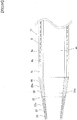
- FIG. 2 is a longitudinal sectional view around a distal portion of the catheter of the first embodiment.
- the catheter body 5 includes an inner layer 6a, a braid 6b wound around an outer periphery of the inner layer 6a, and an outer layer 6c covering the inner layer 6a and the braid 6b as shown in FIG. 2 .
- the inner layer 6a is an elongated hollow tubular body made of a resin and forms a lumen 4b for inserting a guidewire or other medical devices inside.
- Resin material forming the inner layer 6a is not particularly limited, PTFE (polytetrafluoroethylene) is used in the present embodiment.
- the braid 6b is formed by weaving a total of 24 element wires of twelve first wires and twelve second wires (12 ⁇ 12) into a mesh alternately.
- the material constituting the braid 6b is also not particularly limited, a stainless alloy is used in the present embodiment.
- the outer layer 6c is made of resin and covers the inner layer 6a and the braid 6b.
- Resin material forming the outer layer 6c is not particularly limited, polyamide, polyamide elastomer, polyester, polyurethane and the like can be used, the polyamide is used in the present embodiment.
- the distal tip 3 is joined to the distal end of the catheter body 5 has a tubular shape with a lumen 4a communicating with the lumen 4b of the catheter body 5, and tapered periphery gradually decreasing diameter toward the distal end of the catheter body 5.
- the distal tip 3 includes a distal region 7 located on a distal side of the distal tip 3 and a proximal region 9 located on a proximal side of the distal region 7.
- Resin material forming the distal tip 3 is also not particularly limited, polyurethane elastomer is used in the present embodiment.
- Powder made of biocompatible metal or metal compound is mixed inside the distal tip 3
- tungsten powder 2 is mixed inside the distal tip 3 in the present embodiment.
- tungsten powder 2 is mixed only in the distal region 7, not mixed in the proximal region 9.
- the hardness of the distal region 7 is set higher than the hardness of the proximal region 9.
- an outer surface 7a of the distal region 7 and an outer surface 9a of the proximal region 9 are smooth in the present embodiment.
- the connector 8 is also made of resin, has a lumen communicating with the lumen 4b of the catheter body 5, and is joined to the proximal end of the catheter body 5.
- the catheter 1 comprises a catheter body 5, and a distal tip 3 joined to a distal end of the catheter body 5 and made of a resin including tungsten powder 2, wherein the distal tip 3 includes a distal region 7 and a proximal region 9 disposed in a proximal side of the distal region 7, and a hardness of the distal region 7 is higher than a hardness of the proximal region 9, the proximal region 9 has a followability to a medical device such as a guidewire and the like used together, thus, the catheter 1 has an effect of improving insertability into the stenosis and an effect of preventing the collapse of the distal tip 3 of the catheter 1 when the catheter 1 is inserted into the stenosis.
- the catheter 11 of the second embodiment differs from the catheter 1 of the first embodiment in a distal tip configuration. That is, in the distal tip 3 of the catheter 1 of the first embodiment, powder of biocompatible metal or metal compound was mixed only in the distal region 7, not mixed in the proximal region 9.
- powder of biocompatible metal or metal compound is mixed in the distal region and the proximal region of the distal tip.
- FIG. 3 is a longitudinal sectional view around a distal portion of the catheter of the second embodiment.
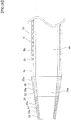
- the distal tip 13 is joined to the distal end of the catheter body 5 has a tubular shape with a lumen 14a communicating with the lumen 4b of the catheter body 5, and tapered periphery gradually decreasing diameter toward the distal end of the catheter body 5.
- the distal tip 13 includes a distal region 17 located on a distal side of the distal tip 13 and a proximal region 19 located on a proximal side of the distal region 17.
- Powder made of biocompatible metal or metal compound is mixed inside the distal tip 13
- tungsten powder 12 is mixed inside the distal tip 13 in the present embodiment.
- tungsten powder 12 is mixed in the distal region 17 and the proximal region 19.
- the amount per unit volume of tungsten powder 12 in the distal region 17 is greater than the amount per unit volume of the tungsten powder 12 in the proximal region 19.
- the hardness of the distal region 17 is set higher than the hardness of the proximal region 19.
- an outer surface 17a of the distal region 17 and an outer surface 19a of the proximal region 19 are smooth in the present embodiment.
- the catheter 21 of the third embodiment differs from the catheter 11 of the second embodiment in condition of an outer surface of the distal tip of the catheter. That is, an outer surface 17a and an outer surface 19a of the distal tip 13 of catheter 11 of the second embodiment are smooth. In contrast, an outer surface of the distal tip of the present embodiment is irregular.
- FIG. 4 is a longitudinal sectional view around a distal portion of the catheter of the third embodiment.
- a catheter 21 of the present embodiment includes a catheter body 5 (corresponding to "a main body” of the present invention), a distal tip 23 (corresponding to "a distal portion” of the present invention) joined to a distal end of the catheter body 5, and a connector 8 joined to a proximal end of the catheter body 5.
- the distal tip 23 is joined to the distal end of the catheter body 5 has a tubular shape with a lumen 24a communicating with the lumen 4b of the catheter body 5, and tapered periphery gradually decreasing diameter toward the distal end of the catheter body 5.
- the distal tip 23 includes a distal region 27 located on a distal side of the distal tip 23 and a proximal region 29 located on a proximal side of the distal region 27.
- Resin material forming the distal tip 23 is not particularly limited, polyurethane elastomer is used in the present embodiment.
- Powder made of biocompatible metal or metal compound is mixed inside the distal tip 23, tungsten powder 22 is mixed inside the distal tip 23 in the present embodiment.
- tungsten powder 22 is mixed in the distal region 27 and the proximal region 29.
- the amount per unit volume of tungsten powder 22 in the distal region 27 is greater than the amount per unit volume of the tungsten powder 22 in the proximal region 29.
- the hardness of the distal region 27 is set higher than the hardness of the proximal region 29.
- a surface roughness of an outer surface 27a of the distal region 27 is greater than a surface roughness of the outer surface 29a of the proximal region 29.
- the catheter 21 comprises a catheter body 5, and a distal tip 23 joined to a distal end of the catheter body 5 and made of a resin including tungsten powder 22, wherein the distal tip 23 includes a distal region 27 and a proximal region 29 disposed in a proximal side of the distal region 27, a hardness of the distal region 27 is higher than a hardness of the proximal region 29, and the surface roughness of the outer surface 27a of the distal region 27 is greater than the surface roughness of the outer surface 29a of proximal region 29, in addition to the effects of the catheter 1 of the first embodiment and the catheter 11 of the second embodiment, it is capable of further improving insertability into the stenosis to reduce the contact resistance between the distal region 27 having high-hardness and the stenosis.
- the catheter 31 of the fourth embodiment differs from the catheter 21 of the third embodiment in structure of an outer surface of the distal tip of the catheter. That is, an outer surface 27a and an outer surface 29a of the distal tip 23 of catheter 21 of the third embodiment were configured to form an irregular state by resin constituting the distal tip 23. In contrast, an outer surface of the distal tip of the present embodiment is configuired to form an irregular state by powder of biocompatible metal or metal compound mixed inside the distal chip 23.
- FIG. 5 is a longitudinal sectional view around a distal portion of the catheter of the fourth embodiment.
- a catheter 31 of the present embodiment includes a catheter body 5 (corresponding to "a main body” of the present invention), a distal tip 33 (corresponding to "a distal portion” of the present invention) joined to a distal end of the catheter body 5, and a connector 8 joined to a proximal end of the catheter body 5.
- the distal tip 33 includes a distal region 37 located on a distal side of the distal tip 33 and a proximal region 39 located on a proximal side of the distal region 37.
- Resin material forming the distal tip 33 is not particularly limited, polyurethane elastomer is used in the present embodiment.
- Powder made of biocompatible metal or metal compound is mixed inside the distal tip 33, tungsten powder 32 is mixed inside the distal tip 33 in the present embodiment.
- tungsten powder 32 is mixed in the distal region 37 and the proximal region 39.
- the amount per unit volume of tungsten powder 32 in the distal region 37 is greater than the amount per unit volume of the tungsten powder 32 in the proximal region 39.
- the hardness of the distal region 37 is set higher than the hardness of the proximal region 39.
- a surface roughness of an outer surface 37a of the distal region 37 is greater than a surface roughness of the outer surface 39a of the proximal region 39.
- a convex portion in the irregular state defining a surface roughness is formed by protrusion of tungsten 32 mixed inside the distal region 37 and the proximal region 39 from the outer surface 37a of the distal region 37 and the outer surface 39a of the proximal region 39 (a tungsten 32 protruding from the outer surface 39a is written as a projecting tungsten 32a in FIG.5 ) in the present embodiment.
- the number per unit area of the projecting tungsten 32a on the outer surface 37a of the distal region 37 can be easily increased more than the number per unit area of the projecting tungsten 32a on the outer surface 39a of the proximal region 39 to remove resin constituting the distal tip 33 by means of simply melting, evaporating or the like.
- the catheter 31 comprises a catheter body 5, and a distal tip 33 joined to a distal end of the catheter body 5 and made of a resin including tungsten powder 32, wherein the distal tip 33 includes a distal region 37 and a proximal region 39 disposed in a proximal side of the distal region 37, a hardness of the distal region 37 is higher than a hardness of the proximal region 39, and degree of exposure of tungsten 32a on the outer surface 37a of the distal region 37 is higher than degree of exposure of tungsten 32a on the outer surface 39a of the proximal region 39, in addition to the effects of the catheter 21 of the third embodiment, it is capable of further improving insertability into the stenosis to reduce the contact resistance between the distal region 37 having high-hardness and the stenosis easily.
- FIG. 6 is a longitudinal sectional view around a distal portion of the catheter of the fifth embodiment.
- a catheter 41 of the present embodiment includes a catheter body 5 (corresponding to "a main body” of the present invention), a distal tip 43 (corresponding to "a distal portion” of the present invention) joined to a distal end of the catheter body 5, and a connector 8 joined to a proximal end of the catheter body 5.
- the distal tip 43 is joined to the distal end of the catheter body 5 has a tubular shape with a lumen 44a communicating with the lumen 4b of the catheter body 5, and tapered periphery gradually decreasing diameter toward the distal end of the catheter body 5.
- the distal tip 43 includes a distal region 47 located on a distal side of the distal tip 43 and a proximal region 49 located on a proximal side of the distal region 47.
- Resin material forming the distal tip 43 is not particularly limited, polyurethane elastomer is used in the present embodiment.
- Powder made of biocompatible metal or metal compound is mixed inside the distal tip 43, tungsten powder 42 is mixed inside the distal tip 43 in the present embodiment.
- tungsten powder 42 is mixed in the distal region 47 and the proximal region 49.
- the amount per unit volume of tungsten powder 42 in the distal region 47 is substantially equal to the amount per unit volume of the tungsten powder 42 in the proximal region 49.
- the distal region 47 of the distal tip 43 of the present embodiment a certain amount of resin is evaporated from the outer surface 47a of the distal region 47 by laser irradiation such as excimer laser etc.
- the hardness of the distal region 47 is set higher than the hardness of the proximal region 49 in the present embodiment.
- a surface roughness of an outer surface 47a of the distal region 47 is greater than a surface roughness of the outer surface 49a of the proximal region 49. This is set by controlling irradiation time and the like of the excimer laser etc. so that evaporation amount of the resin in the distal region 47 is more than evaporation amount of the resin in the proximal region 49.
- a convex portion in the irregular state defining a surface roughness is formed by protrusion of tungsten 42 mixed inside the distal region 47 and the proximal region 49 from the outer surface 47a of the distal region 47 and the outer surface 49a of the proximal region 49 (a tungsten 42 protruding from the outer surface 39a is written as a projecting tungsten 42a in FIG.6 ).
- the protrusion height of the projection tungsten 42a on the outer surface 47a of the distal region 47 is higher than the protrusion height of the projection tungsten 42a on the outer surface 49a of the proximal region 49.
- the surface roughness of the outer surface becomes great.
- the catheter 41 comprises a catheter body 5, and a distal tip 43 joined to a distal end of the catheter body 5 and made of a resin including tungsten powder 42, wherein the distal tip 43 includes a distal region 47 and a proximal region 49 disposed in a proximal side of the distal region 47, a hardness of the distal region 47 is higher than a hardness of the proximal region 49 by evaporating a certain amount of resin from the distal region 47, and a surface roughness of the outer surface 47a of the distal region 47 is greater than a surface roughness of the outer surface 49a of the proximal region 49 by control the height of the projection tungsten 42a that tungsten 42 mixed inside the distal tip 43 protrudes from the outer surface of the distal tip 43, in addition to the effects of the catheter 31 of the fourth embodiment, the catheter 41 can be easily set a hardness difference between the distal region 47 and the proximal region 49.
- the proximal region 49 also has a followability to a medical device such as a guidewire and the like used together, thus, the catheter 41 has an effect of improving insertability into the stenosis and an effect of preventing the collapse of the distal tip 43 of the catheter 41 when the catheter 41 is inserted into the stenosis.
- the catheter 41 includes the distal region 47 characterized in that it is formed by evaporating the resin of a distal portion more than the proximal region 49.
- a manufacturer can easily set a hardness of the distal region 47 and a hardness of the proximal region 49 by only adjusting energy of laser etc, and can easily set a surface roughness of the distal region 47 and a surface roughness of the proximal region 49 by only adjusting energy of laser etc.
- catheters of the various embodiments of the present invention have been described in each of the foregoing embodiments as an example of catheters, such catheters are not limited to the foregoing embodiments. Any catheter can be implemented with various modifications within a scope not departing from a subject matter thereof.
- a hardness difference between the distal region and the proximal region in the first to fourth embodiments causes on the basis of the amount of biocompatible metal or metal compound exemplified by tungsten mixed inside the distal region and the proximal region.
- Catheters in the first to fifth embodiments have been described as the distal tip 3, 13, 23, 33 and 43 are applied to a catheter of the simplest configuration. However, they are not limited thereto.
- the distal tip 3, 13, 23, 33 and 43 are applicable to any medical catheter such as a balloon catheter and a multi-lumen catheter.
Landscapes
- Health & Medical Sciences (AREA)
- Life Sciences & Earth Sciences (AREA)
- Veterinary Medicine (AREA)
- Public Health (AREA)
- General Health & Medical Sciences (AREA)
- Animal Behavior & Ethology (AREA)
- Biomedical Technology (AREA)
- Heart & Thoracic Surgery (AREA)
- Engineering & Computer Science (AREA)
- Hematology (AREA)
- Anesthesiology (AREA)
- Pulmonology (AREA)
- Biophysics (AREA)
- Epidemiology (AREA)
- Surgery (AREA)
- Inorganic Chemistry (AREA)
- Chemical & Material Sciences (AREA)
- Physics & Mathematics (AREA)
- Optics & Photonics (AREA)
- Vascular Medicine (AREA)
- Nuclear Medicine, Radiotherapy & Molecular Imaging (AREA)
- Medical Informatics (AREA)
- Molecular Biology (AREA)
- Media Introduction/Drainage Providing Device (AREA)
Abstract
Description
- The present invention relates to a catheter used by inserting into a lumen of a blood vessel or the like of a patient.
- A catheter used by inserting into a lumen of a blood vessel or the like of a patient is known conventionally. A physician performing a procedure inserts a guidewire into the lumen of the catheter, protrudes a distal end of the guidewire from a distal end of the catheter, gets the catheter to a lesion by leading of the guide wire, places a device such as a stent or an embolic coil in the lesion through the lumen of the catheter.
- A distal portion of the catheter used in the procedure is generally configured to be soft in order to improve a tracking performance to the guide wire, or to reduce a risk of perforating the lumen of the blood vessel or the like. For example, Patent Document 1, lower the flexural modulus of the distal end, it is raised catheter tube a flexural modulus of the proximal end has been described (see
FIG. 2 , etc.). - Patent Document 1 : Japanese Patent Application Publication No.
8(1996)-57035 A - A procedure for severe patients having CTO (Chronic Total Occlusion) or the lesion close to CTO is expected recently, however, we have a problem that the conventional catheter described above can not be inserted into such lesions well.
- The present invention has been made in response to forgoing problems of the convetional technique, and is intended to provide a catheter capable of preventing collapse of the catheter tip even when inserted into a stenosis such as CTO or the like, and being inserted easily into the stenosis. Solution for Problems
- It is characterized in that, to solve the foregoing problems, a catheter according to a first aspect of the present invention comprises a main body and a distal portion joined to a distal end of the main body, and made of a resin including metal or metal compound, wherein the distal portion includes a distal region and a proximal region disposed in a proximal side of the distal region, and a hardness of the distal region is higher than a hardness of the proximal region.
- A second aspect of the present invention is characterized in that, in the catheter according to the first aspect, a surface roughness of the distal region is greater than a surface roughness of the proximal region.
- A third aspect of the present invention is characterized in that, in the catheter according to the first aspect or the second aspect, degree of exposure of metal or metal compound on the surface of the distal region is higher than degree of exposure of metal or metal compound on the surface of the proximal region.
- Furthermore, a fourth aspect of the present invention is characterized in that, in the catheter according to any one of the first aspect to the third aspect, metal or metal compound includes radiopaque metal. Advantageous Effects of Invention
- According to the first aspect of the present invention, as the catheter comprises a main body, and a distal portion joined to a distal end of the main body and made of a resin including metal or metal compound, wherein the distal portion includes a distal region and a proximal region disposed in a proximal side of the distal region, and a hardness of the distal region is higher than a hardness of the proximal region, the proximal region has a followability to a medical device such as a guidewire used together, and the catheter has an effect of improving insertability into the stenosis and an effect of preventing the collapse of the distal portion of the catheter when the catheter is inserted into the stenosis.
- According to the second aspect of the present invention, as a surface roughness of the distal region is greater than a surface roughness of the proximal region in the catheter of the first aspect of the present invention, in addition to the effects of the catheter of the first aspect of the present invention, it is capable of further improving insertability into the stenosis to reduce the contact resistance between hard distal region and the stenosis.
- According to the third aspect of the present invention, as degree of exposure of metal or metal compound on the surface of the distal region is higher than degree of exposure of metal or metal compound on the surface of the proximal region in the catheter of the first aspect or the second aspect of the present invention, in addition to the effects of the catheter of the first aspect or the second aspect of the present invention, it is capable of improving insertability into the stenosis to reduce the contact resistance between the distal region and the stenosis by utilizing metal or metal compound contained.
- Further, according to the fourth aspect of the present invention, as metal or metal compound includes radiopaque metal in the catheter of any one of the first aspect to the third aspect of the present invention, in addition to the effects of the catheter of any one of the first aspect to the third aspect of the present invention, it is capable of improving a visibility of the distal portion by adding a perforamance of a visibility.
-
-
FIG.1 is an overall view of the catheter of a first embodiment of the present invention. -
FIG. 2 is a longitudinal sectional view around a distal portion of the catheter of the first embodiment. -
FIG. 3 is a longitudinal sectional view around a distal portion of the catheter of the second embodiment. -
FIG. 4 is a longitudinal sectional view around a distal portion of the catheter of the third embodiment. -
FIG. 5 is a longitudinal sectional view around a distal portion of the catheter of the fourth embodiment. -
FIG. 6 is a longitudinal sectional view around a distal portion of the catheter of the fifth embodiment. - Hereinafter, embodiments of the present invention will be described with reference to the drawings.
- First of all, a first embodiment of the present invention will be described. The drawings used in the present embodiment is exaggerated to facilitate understanding of the present invention, the dimensions of the drawings differ from actual dimensions.
-
FIG.1 is an overall view of the catheter of a first embodiment of the present invention,FIG. 2 is a longitudinal sectional view around a distal portion of the catheter of the first embodiment. - As shown in
FIG. 1 , a catheter 1 of the present embodiment includes a catheter body 5 (corresponding to "a main body" of the present invention), a distal tip 3 (corresponding to "a distal portion" of the present invention) joined to a distal end of thecatheter body 5, and aconnector 8 joined to a proximal end of thecatheter body 5. - The
catheter body 5 includes aninner layer 6a, abraid 6b wound around an outer periphery of theinner layer 6a, and anouter layer 6c covering theinner layer 6a and thebraid 6b as shown inFIG. 2 . - The
inner layer 6a is an elongated hollow tubular body made of a resin and forms alumen 4b for inserting a guidewire or other medical devices inside. Resin material forming theinner layer 6a is not particularly limited, PTFE (polytetrafluoroethylene) is used in the present embodiment. - The
braid 6b is formed by weaving a total of 24 element wires of twelve first wires and twelve second wires (12 × 12) into a mesh alternately. The material constituting thebraid 6b is also not particularly limited, a stainless alloy is used in the present embodiment. - The
outer layer 6c is made of resin and covers theinner layer 6a and thebraid 6b. Resin material forming theouter layer 6c is not particularly limited, polyamide, polyamide elastomer, polyester, polyurethane and the like can be used, the polyamide is used in the present embodiment. - The
distal tip 3 is joined to the distal end of thecatheter body 5 has a tubular shape with alumen 4a communicating with thelumen 4b of thecatheter body 5, and tapered periphery gradually decreasing diameter toward the distal end of thecatheter body 5. - Further, the
distal tip 3 includes adistal region 7 located on a distal side of thedistal tip 3 and aproximal region 9 located on a proximal side of thedistal region 7. - Resin material forming the
distal tip 3 is also not particularly limited, polyurethane elastomer is used in the present embodiment. - Powder made of biocompatible metal or metal compound is mixed inside the
distal tip 3,tungsten powder 2 is mixed inside thedistal tip 3 in the present embodiment. - Incidentally, material mixed inside the
distal tip 3 is not limited to tungsten powder, it may be powder made of radiopaque metal or radiopaque metal compound such as gold, platinum, iridium, platinum-iridium alloys, barium, barium sulfate, bismuth, bismuth compounds (bismuth oxide, bismuth trioxide, bismuth subcarbonate, bismuth subcarbonate, tungsten bismuth), zirconium oxide, tantalum, cobalt chrome alloys, tungsten, tungsten-based compound (tungsten oxide, tungsten dioxide, tungsten trioxide), stainless steel, or titanium. It may also be powder made of radiolucent metal or radiolucent metal compound. - However, if powder consisting of radiopaque metal is mixed inside the
distal tip 3, visibility of thedistal tip 3 under X-ray fluoroscopy can be enhanced. - This point is similar with respect to powder of biocompatible metal or metal compound mixed inside the
distal tip 3 in embodiments described below. - In the present embodiment,
tungsten powder 2 is mixed only in thedistal region 7, not mixed in theproximal region 9. Thus, in the present embodiment, the hardness of thedistal region 7 is set higher than the hardness of theproximal region 9. In addition, anouter surface 7a of thedistal region 7 and anouter surface 9a of theproximal region 9 are smooth in the present embodiment. - The
connector 8 is also made of resin, has a lumen communicating with thelumen 4b of thecatheter body 5, and is joined to the proximal end of thecatheter body 5. - According to the catheter 1 of the present embodiment, as the catheter 1 comprises a
catheter body 5, and adistal tip 3 joined to a distal end of thecatheter body 5 and made of a resin includingtungsten powder 2, wherein thedistal tip 3 includes adistal region 7 and aproximal region 9 disposed in a proximal side of thedistal region 7, and a hardness of thedistal region 7 is higher than a hardness of theproximal region 9, theproximal region 9 has a followability to a medical device such as a guidewire and the like used together, thus, the catheter 1 has an effect of improving insertability into the stenosis and an effect of preventing the collapse of thedistal tip 3 of the catheter 1 when the catheter 1 is inserted into the stenosis. - Next, a second embodiment of the present invention will be described. The drawings used in the present embodiment is also exaggerated to facilitate understanding of the present invention, the dimensions of the drawings differ from actual dimensions.
- Hereinafter the second embodiment of the present invention will be described, the overall view of the catheter will not be described because it is similar to
FIG 1 . Portions common to the first embodiment will be denoted by the same reference numerals, descriptions of the portions will be omitted. - The
catheter 11 of the second embodiment differs from the catheter 1 of the first embodiment in a distal tip configuration. That is, in thedistal tip 3 of the catheter 1 of the first embodiment, powder of biocompatible metal or metal compound was mixed only in thedistal region 7, not mixed in theproximal region 9. - In contrast, in the distal tip of the present embodiment, powder of biocompatible metal or metal compound is mixed in the distal region and the proximal region of the distal tip.
-
FIG. 3 is a longitudinal sectional view around a distal portion of the catheter of the second embodiment. - A
catheter 11 of the present embodiment includes a catheter body 5 (corresponding to "a main body" of the present invention), a distal tip 3 (corresponding to "a distal portion" of the present invention) joined to a distal end of thecatheter body 5, and aconnector 8 joined to a proximal end of thecatheter body 5. - The
distal tip 13 is joined to the distal end of thecatheter body 5 has a tubular shape with alumen 14a communicating with thelumen 4b of thecatheter body 5, and tapered periphery gradually decreasing diameter toward the distal end of thecatheter body 5. - Further, the
distal tip 13 includes adistal region 17 located on a distal side of thedistal tip 13 and aproximal region 19 located on a proximal side of thedistal region 17. - Resin material forming the
distal tip 13 is not particularly limited, polyurethane elastomer is used in the present embodiment. - Powder made of biocompatible metal or metal compound is mixed inside the
distal tip 13,tungsten powder 12 is mixed inside thedistal tip 13 in the present embodiment. - In the present embodiment,
tungsten powder 12 is mixed in thedistal region 17 and theproximal region 19. The amount per unit volume oftungsten powder 12 in thedistal region 17 is greater than the amount per unit volume of thetungsten powder 12 in theproximal region 19. - Thus, in the present embodiment, the hardness of the
distal region 17 is set higher than the hardness of theproximal region 19. In addition, anouter surface 17a of thedistal region 17 and anouter surface 19a of theproximal region 19 are smooth in the present embodiment. - According to the
catheter 11 of the present embodiment, as thecatheter 11 comprises acatheter body 5, and adistal tip 13 joined to a distal end of thecatheter body 5 and made of a resin includingtungsten powder 12, wherein thedistal tip 13 includes adistal region 17 and aproximal region 19 disposed in a proximal side of thedistal region 17, and a hardness of thedistal region 17 is higher than a hardness of theproximal region 19, theproximal region 19 has a followability to a medical device such as a guidewire and the like used together, thus, the catheter 1 has an effect of improving insertability into the stenosis and an effect of preventing the collapse of thedistal tip 13 of thecatheter 11 when thecatheter 11 is inserted into the stenosis. - Next, a third embodiment of the present invention will be described. The drawings used in the present embodiment is also exaggerated to facilitate understanding of the present invention, the dimensions of the drawings differ from actual dimensions.
- Hereinafter the third embodiment of the present invention will be described, the overall view of the catheter will not be described because it is similar to
FIG 1 . Portions common to the first embodiment will be denoted by the same reference numerals, descriptions of the portions will be omitted. - The
catheter 21 of the third embodiment differs from thecatheter 11 of the second embodiment in condition of an outer surface of the distal tip of the catheter. That is, anouter surface 17a and anouter surface 19a of thedistal tip 13 ofcatheter 11 of the second embodiment are smooth. In contrast, an outer surface of the distal tip of the present embodiment is irregular. -
FIG. 4 is a longitudinal sectional view around a distal portion of the catheter of the third embodiment. - A
catheter 21 of the present embodiment includes a catheter body 5 (corresponding to "a main body" of the present invention), a distal tip 23 (corresponding to "a distal portion" of the present invention) joined to a distal end of thecatheter body 5, and aconnector 8 joined to a proximal end of thecatheter body 5. - The
distal tip 23 is joined to the distal end of thecatheter body 5 has a tubular shape with alumen 24a communicating with thelumen 4b of thecatheter body 5, and tapered periphery gradually decreasing diameter toward the distal end of thecatheter body 5. - Further, the
distal tip 23 includes adistal region 27 located on a distal side of thedistal tip 23 and aproximal region 29 located on a proximal side of thedistal region 27. - Resin material forming the
distal tip 23 is not particularly limited, polyurethane elastomer is used in the present embodiment. - Powder made of biocompatible metal or metal compound is mixed inside the
distal tip 23,tungsten powder 22 is mixed inside thedistal tip 23 in the present embodiment. - In the present embodiment,
tungsten powder 22 is mixed in thedistal region 27 and theproximal region 29. The amount per unit volume oftungsten powder 22 in thedistal region 27 is greater than the amount per unit volume of thetungsten powder 22 in theproximal region 29. Thus, in the present embodiment, the hardness of thedistal region 27 is set higher than the hardness of theproximal region 29. - Further, in the present embodiment, a surface roughness of an
outer surface 27a of thedistal region 27 is greater than a surface roughness of theouter surface 29a of theproximal region 29. Incidentally, it is possible by known techniques such as a sandblasting to control the surface roughness of thedistal tip 23. - According to the
catheter 21 of the present embodiment, as thecatheter 21 comprises acatheter body 5, and adistal tip 23 joined to a distal end of thecatheter body 5 and made of a resin includingtungsten powder 22, wherein thedistal tip 23 includes adistal region 27 and aproximal region 29 disposed in a proximal side of thedistal region 27, a hardness of thedistal region 27 is higher than a hardness of theproximal region 29, and the surface roughness of theouter surface 27a of thedistal region 27 is greater than the surface roughness of theouter surface 29a ofproximal region 29, in addition to the effects of the catheter 1 of the first embodiment and thecatheter 11 of the second embodiment, it is capable of further improving insertability into the stenosis to reduce the contact resistance between thedistal region 27 having high-hardness and the stenosis. - Next, a fourth embodiment of the present invention will be described. The drawings used in the present embodiment is also exaggerated to facilitate understanding of the present invention, the dimensions of the drawings differ from actual dimensions.
- Hereinafter the fourth embodiment of the present invention will be described, the overall view of the catheter will not be described because it is similar to
FIG 1 . Portions common to the first embodiment will be denoted by the same reference numerals, descriptions of the portions will be omitted. - The
catheter 31 of the fourth embodiment differs from thecatheter 21 of the third embodiment in structure of an outer surface of the distal tip of the catheter. That is, anouter surface 27a and anouter surface 29a of thedistal tip 23 ofcatheter 21 of the third embodiment were configured to form an irregular state by resin constituting thedistal tip 23. In contrast, an outer surface of the distal tip of the present embodiment is configuired to form an irregular state by powder of biocompatible metal or metal compound mixed inside thedistal chip 23. -
FIG. 5 is a longitudinal sectional view around a distal portion of the catheter of the fourth embodiment. - A
catheter 31 of the present embodiment includes a catheter body 5 (corresponding to "a main body" of the present invention), a distal tip 33 (corresponding to "a distal portion" of the present invention) joined to a distal end of thecatheter body 5, and aconnector 8 joined to a proximal end of thecatheter body 5. - The
distal tip 33 is joined to the distal end of thecatheter body 5 has a tubular shape with alumen 34a communicating with thelumen 4b of thecatheter body 5, and tapered periphery gradually decreasing diameter toward the distal end of thecatheter body 5. - Further, the
distal tip 33 includes adistal region 37 located on a distal side of thedistal tip 33 and aproximal region 39 located on a proximal side of thedistal region 37. - Resin material forming the
distal tip 33 is not particularly limited, polyurethane elastomer is used in the present embodiment. - Powder made of biocompatible metal or metal compound is mixed inside the
distal tip 33,tungsten powder 32 is mixed inside thedistal tip 33 in the present embodiment. - In the present embodiment,
tungsten powder 32 is mixed in thedistal region 37 and theproximal region 39. The amount per unit volume oftungsten powder 32 in thedistal region 37 is greater than the amount per unit volume of thetungsten powder 32 in theproximal region 39. Thus, in the present embodiment, the hardness of thedistal region 37 is set higher than the hardness of theproximal region 39. - Further, in the present embodiment, a surface roughness of an
outer surface 37a of thedistal region 37 is greater than a surface roughness of theouter surface 39a of theproximal region 39. - A convex portion in the irregular state defining a surface roughness is formed by protrusion of
tungsten 32 mixed inside thedistal region 37 and theproximal region 39 from theouter surface 37a of thedistal region 37 and theouter surface 39a of the proximal region 39 (atungsten 32 protruding from theouter surface 39a is written as a projectingtungsten 32a inFIG.5 ) in the present embodiment. - In the present embodiment, as the amount per unit volume of
tungsten powder 32 in thedistal region 37 is larger than the amount per unit volume oftungsten powder 32 in theproximal region 39, the number per unit area of the projectingtungsten 32a on theouter surface 37a of thedistal region 37 can be easily increased more than the number per unit area of the projectingtungsten 32a on theouter surface 39a of theproximal region 39 to remove resin constituting thedistal tip 33 by means of simply melting, evaporating or the like. - In this case, degree of exposure of the
tungsten 32a on theouter surface 37a of thedistal region 37 is higher than degree of exposure of thetungsten 32a on theouter surface 39a of theproximal region 39. - According to the
catheter 31 of the present embodiment, as thecatheter 31 comprises acatheter body 5, and adistal tip 33 joined to a distal end of thecatheter body 5 and made of a resin includingtungsten powder 32, wherein thedistal tip 33 includes adistal region 37 and aproximal region 39 disposed in a proximal side of thedistal region 37, a hardness of thedistal region 37 is higher than a hardness of theproximal region 39, and degree of exposure oftungsten 32a on theouter surface 37a of thedistal region 37 is higher than degree of exposure oftungsten 32a on theouter surface 39a of theproximal region 39, in addition to the effects of thecatheter 21 of the third embodiment, it is capable of further improving insertability into the stenosis to reduce the contact resistance between thedistal region 37 having high-hardness and the stenosis easily. - Next, a fifth embodiment of the present invention will be described. The drawings used in the present embodiment is also exaggerated to facilitate understanding of the present invention, the dimensions of the drawings differ from actual dimensions.
- Hereinafter the fifth embodiment of the present invention will be described, the overall view of the catheter will not be described because it is similar to
FIG 1 . Portions common to the first embodiment will be denoted by the same reference numerals, descriptions of the portions will be omitted. - The
catheter 41 of the fifth embodiment differs from thecatheter 31 of the fourth embodiment in structure of a distal region of the distal tip of the catheter. That is, adistal region 32 of thedistal tip 33 of thecatheter 31 of the fourth embodiment is constituted by resin in normal state excepttungsten 32. In contrast, a distal region of the distal tip of the present embodiment is constituted by evaporating a certain amount of resin from resin constituting thedistal region 37. -
FIG. 6 is a longitudinal sectional view around a distal portion of the catheter of the fifth embodiment. - A
catheter 41 of the present embodiment includes a catheter body 5 (corresponding to "a main body" of the present invention), a distal tip 43 (corresponding to "a distal portion" of the present invention) joined to a distal end of thecatheter body 5, and aconnector 8 joined to a proximal end of thecatheter body 5. - The
distal tip 43 is joined to the distal end of thecatheter body 5 has a tubular shape with alumen 44a communicating with thelumen 4b of thecatheter body 5, and tapered periphery gradually decreasing diameter toward the distal end of thecatheter body 5. - Further, the
distal tip 43 includes adistal region 47 located on a distal side of thedistal tip 43 and aproximal region 49 located on a proximal side of thedistal region 47. - Resin material forming the
distal tip 43 is not particularly limited, polyurethane elastomer is used in the present embodiment. - Powder made of biocompatible metal or metal compound is mixed inside the
distal tip 43,tungsten powder 42 is mixed inside thedistal tip 43 in the present embodiment. - In the present embodiment,
tungsten powder 42 is mixed in thedistal region 47 and theproximal region 49. The amount per unit volume oftungsten powder 42 in thedistal region 47 is substantially equal to the amount per unit volume of thetungsten powder 42 in theproximal region 49. - On the other hand, in the
distal region 47 of thedistal tip 43 of the present embodiment, a certain amount of resin is evaporated from theouter surface 47a of thedistal region 47 by laser irradiation such as excimer laser etc. Thus, the hardness of thedistal region 47 is set higher than the hardness of theproximal region 49 in the present embodiment. - Further, in the present embodiment, a surface roughness of an
outer surface 47a of thedistal region 47 is greater than a surface roughness of theouter surface 49a of theproximal region 49. This is set by controlling irradiation time and the like of the excimer laser etc. so that evaporation amount of the resin in thedistal region 47 is more than evaporation amount of the resin in theproximal region 49. - In the present embodiment, as in the fourth embodiment, a convex portion in the irregular state defining a surface roughness is formed by protrusion of
tungsten 42 mixed inside thedistal region 47 and theproximal region 49 from theouter surface 47a of thedistal region 47 and theouter surface 49a of the proximal region 49 (atungsten 42 protruding from theouter surface 39a is written as a projectingtungsten 42a inFIG.6 ). - That is, in the present embodiment, the protrusion height of the
projection tungsten 42a on theouter surface 47a of thedistal region 47 is higher than the protrusion height of theprojection tungsten 42a on theouter surface 49a of theproximal region 49. Thus, the surface roughness of the outer surface becomes great. - According to the
catheter 41 of the present embodiment, as thecatheter 41 comprises acatheter body 5, and adistal tip 43 joined to a distal end of thecatheter body 5 and made of a resin includingtungsten powder 42, wherein thedistal tip 43 includes adistal region 47 and aproximal region 49 disposed in a proximal side of thedistal region 47, a hardness of thedistal region 47 is higher than a hardness of theproximal region 49 by evaporating a certain amount of resin from thedistal region 47, and a surface roughness of theouter surface 47a of thedistal region 47 is greater than a surface roughness of theouter surface 49a of theproximal region 49 by control the height of theprojection tungsten 42a that tungsten 42 mixed inside thedistal tip 43 protrudes from the outer surface of thedistal tip 43, in addition to the effects of thecatheter 31 of the fourth embodiment, thecatheter 41 can be easily set a hardness difference between thedistal region 47 and theproximal region 49. Theproximal region 49 also has a followability to a medical device such as a guidewire and the like used together, thus, thecatheter 41 has an effect of improving insertability into the stenosis and an effect of preventing the collapse of thedistal tip 43 of thecatheter 41 when thecatheter 41 is inserted into the stenosis. - The
catheter 41 includes thedistal region 47 characterized in that it is formed by evaporating the resin of a distal portion more than theproximal region 49. According to thiscatheter 41, as thedistal region 47 is formed by evaporating the resin of the distal porion more than theproximal region 49, a manufacturer can easily set a hardness of thedistal region 47 and a hardness of theproximal region 49 by only adjusting energy of laser etc, and can easily set a surface roughness of thedistal region 47 and a surface roughness of theproximal region 49 by only adjusting energy of laser etc. - While catheters of the various embodiments of the present invention have been described in each of the foregoing embodiments as an example of catheters, such catheters are not limited to the foregoing embodiments. Any catheter can be implemented with various modifications within a scope not departing from a subject matter thereof.
- For example, a hardness difference between the distal region and the proximal region in the first to fourth embodiments causes on the basis of the amount of biocompatible metal or metal compound exemplified by tungsten mixed inside the distal region and the proximal region. However, as shown in the fifth embodiment, it is possible to set higher a hardness of the distal region than a hardness of the proximal region by evaporating a certain amount of resin from the distal region in the first to fourth embodiments.
- Catheters in the first to fifth embodiments have been described as the
distal tip distal tip -
- 1, 11, 21, 31, 41 ... catheter
- 2, 12, 22, 32, 42 ... tungsten (Examples of biocompatible metal or metal compound)
- 3, 13, 23, 33,43 ... distal tip
- 7, 17, 27, 37, 47 ... distal region
- 9, 19, 29, 39,49 ... proximal region
- 5 ... catheter body
- 8 ... connector
- 6a ... inner layer
- 6b ... braid
- 6c ... outer layer
Claims (4)
- A catheter, comprising:a main body; anda distal portion joined to a distal end of the main body, and made of a resin including a metal or a metal compound, whereinthe distal portion includes a distal region and a proximal region disposed in a proximal side of the distal region, andhardness of the distal region is higher than hardness of the proximal region.
- A catheter according to Claim 1,
surface roughness of the distal region is greater than surface roughness of the proximal region. - A catheter according to Claim 1 or Claim 2,
degree of exposure of the metal or the metal compound on the surface of the distal region is higher than degree of exposure of the metal or the metal compound on the surface of the proximal region. - A catheter according to any one of Claims 1 to 3,
the metal or the metal compound includes radiopaque metal.
Applications Claiming Priority (1)
| Application Number | Priority Date | Filing Date | Title |
|---|---|---|---|
| PCT/JP2018/002180 WO2019146026A1 (en) | 2018-01-25 | 2018-01-25 | Catheter |
Publications (2)
| Publication Number | Publication Date |
|---|---|
| EP3744378A1 true EP3744378A1 (en) | 2020-12-02 |
| EP3744378A4 EP3744378A4 (en) | 2021-10-13 |
Family
ID=67395261
Family Applications (1)
| Application Number | Title | Priority Date | Filing Date |
|---|---|---|---|
| EP18901942.5A Withdrawn EP3744378A4 (en) | 2018-01-25 | 2018-01-25 | Catheter |
Country Status (6)
| Country | Link |
|---|---|
| US (1) | US20200276413A1 (en) |
| EP (1) | EP3744378A4 (en) |
| JP (1) | JPWO2019146026A1 (en) |
| KR (1) | KR20200112806A (en) |
| CN (1) | CN111405921A (en) |
| WO (1) | WO2019146026A1 (en) |
Families Citing this family (26)
| Publication number | Priority date | Publication date | Assignee | Title |
|---|---|---|---|---|
| WO2016123278A1 (en) | 2015-01-29 | 2016-08-04 | Redsmith, Inc. | Rapid insertion integrated catheter and method of using an integrated catheter |
| BR112022003606A2 (en) | 2019-09-10 | 2022-05-24 | Bard Access Systems Inc | Quickly inserted central catheter and methods thereof |
| CN213252379U (en) | 2019-09-24 | 2021-05-25 | 巴德阿克塞斯系统股份有限公司 | Catheter assembly for accessing the vasculature of a patient |
| CN112691280A (en) | 2019-10-22 | 2021-04-23 | 巴德阿克塞斯系统股份有限公司 | Rapidly insertable central catheter and method |
| CN112704801B (en) | 2019-10-25 | 2025-11-04 | 巴德阿克塞斯系统股份有限公司 | Guide wire management device and method |
| CN113144380B (en) | 2020-01-23 | 2025-10-14 | 巴德阿克塞斯系统股份有限公司 | Detachable catheter docking station systems and methods |
| US12186494B2 (en) | 2020-03-13 | 2025-01-07 | Bard Access Systems, Inc. | Guidewire-management devices and methods thereof |
| BR112022017350A2 (en) | 2020-03-13 | 2022-10-18 | Bard Access Systems Inc | GUIDE WIRE MANAGEMENT DEVICES AND METHODS THEREOF. |
| CN215916116U (en) | 2020-04-23 | 2022-03-01 | 巴德阿克塞斯系统股份有限公司 | Quick-insertion central catheter assembly |
| JP7781778B2 (en) | 2020-05-21 | 2025-12-08 | バード・アクセス・システムズ,インコーポレーテッド | Rapid insertion central venous catheter including catheter assembly and method thereof |
| JP7695967B2 (en) | 2020-06-29 | 2025-06-19 | バード・アクセス・システムズ,インコーポレーテッド | Central Venous Catheter Assembly |
| CA3186443A1 (en) | 2020-06-29 | 2022-01-06 | Bard Access Systems, Inc. | Rapidly insertable central catheters including catheter assemblies and methods thereof |
| CA3186472A1 (en) * | 2020-07-01 | 2022-01-06 | Bard Access Systems, Inc. | Rapidly insertable central catheters and methods thereof |
| US12605528B2 (en) | 2020-07-31 | 2026-04-21 | Bard Access Systems, Inc. | Two-piece rapidly insertable central catheters, introducers therefor, and methods thereof |
| CN114053557B (en) | 2020-08-03 | 2026-05-12 | 巴德阿克塞斯系统股份有限公司 | Detachable needle and dilator catheter placement apparatus and related methods |
| US12290644B2 (en) | 2020-10-28 | 2025-05-06 | Bard Access Systems, Inc. | Catheter placement system with stiffening system |
| CN217041052U (en) | 2020-12-03 | 2022-07-26 | 巴德阿克塞斯系统股份有限公司 | Guide wire |
| CN217187395U (en) | 2020-12-17 | 2022-08-16 | 巴德阿克塞斯系统股份有限公司 | Central catheter capable of being inserted rapidly and assembly thereof |
| CN216985885U (en) | 2020-12-21 | 2022-07-19 | 巴德阿克塞斯系统股份有限公司 | Catheter placement system |
| CN217566954U (en) | 2020-12-21 | 2022-10-14 | 巴德阿克塞斯系统股份有限公司 | Catheter insertion system and catheter placement system |
| JP2024113208A (en) * | 2021-06-23 | 2024-08-22 | テルモ株式会社 | Percutaneous Catheter |
| US20240058582A1 (en) * | 2022-08-19 | 2024-02-22 | Cook Medical Technologies Llc | Medical introducer and sheath |
| JP2024058700A (en) * | 2022-10-17 | 2024-04-30 | 朝日インテック株式会社 | catheter |
| US12599748B2 (en) | 2022-12-06 | 2026-04-14 | Bard Access Systems, Inc. | Catheter tips for rapidly insertable central catheters and methods thereof |
| JP2026043056A (en) * | 2023-01-30 | 2026-03-12 | テルモ株式会社 | Catheters and catheter systems |
| CN116650810B (en) * | 2023-07-03 | 2026-02-27 | 无锡市惠山区人民医院 | A sharp breakthrough localization catheter for lower extremity arterial occlusion segments |
Family Cites Families (18)
| Publication number | Priority date | Publication date | Assignee | Title |
|---|---|---|---|---|
| US4280500A (en) * | 1978-03-31 | 1981-07-28 | Kazuaki Ono | Tubular flexible medical instrument |
| JPS5735A (en) | 1980-05-30 | 1982-01-05 | Yamatake Honeywell Co Ltd | Power source detector |
| US5234416A (en) * | 1991-06-06 | 1993-08-10 | Advanced Cardiovascular Systems, Inc. | Intravascular catheter with a nontraumatic distal tip |
| JP3761214B2 (en) * | 1995-03-20 | 2006-03-29 | 株式会社パイオラックス | Medical guidewire |
| US6814744B2 (en) * | 2001-09-28 | 2004-11-09 | Scimed Life Systems, Inc | Balloon catheter with striped flexible tip |
| JP2008229160A (en) * | 2007-03-22 | 2008-10-02 | Kaneka Corp | catheter |
| US20080275426A1 (en) * | 2007-05-03 | 2008-11-06 | Boston Scientific Scimed, Inc. | Flexible and Durable Tip |
| JP5430065B2 (en) * | 2007-12-28 | 2014-02-26 | テルモ株式会社 | Guide wire |
| JP5354916B2 (en) * | 2008-01-25 | 2013-11-27 | テルモ株式会社 | Transendoscopic guidewire |
| US7998576B2 (en) * | 2008-02-15 | 2011-08-16 | Unitika Ltd. | Radiopaque monofilament for contrast X-ray radiography |
| US10086176B2 (en) * | 2009-12-11 | 2018-10-02 | Hotspur Technologies, Inc. | Balloon catheter and methods for use |
| JP5649131B2 (en) * | 2011-10-11 | 2015-01-07 | 朝日インテック株式会社 | Medical tube and catheter using the same |
| JP5975486B2 (en) * | 2013-02-15 | 2016-08-23 | 朝日インテック株式会社 | catheter |
| JP5901078B2 (en) * | 2014-03-25 | 2016-04-06 | 朝日インテック株式会社 | catheter |
| JP5954748B2 (en) * | 2014-04-25 | 2016-07-20 | 朝日インテック株式会社 | catheter |
| EP3056238B1 (en) * | 2015-02-13 | 2019-08-28 | Asahi Intecc Co., Ltd. | Catheter |
| JP6558773B2 (en) * | 2015-10-27 | 2019-08-14 | 朝日インテック株式会社 | catheter |
| JP6604654B2 (en) * | 2016-06-24 | 2019-11-13 | 朝日インテック株式会社 | catheter |
-
2018
- 2018-01-25 KR KR1020207014850A patent/KR20200112806A/en not_active Ceased
- 2018-01-25 WO PCT/JP2018/002180 patent/WO2019146026A1/en not_active Ceased
- 2018-01-25 EP EP18901942.5A patent/EP3744378A4/en not_active Withdrawn
- 2018-01-25 CN CN201880076115.5A patent/CN111405921A/en active Pending
- 2018-01-25 JP JP2019567452A patent/JPWO2019146026A1/en active Pending
-
2020
- 2020-05-19 US US16/877,943 patent/US20200276413A1/en not_active Abandoned
Also Published As
| Publication number | Publication date |
|---|---|
| US20200276413A1 (en) | 2020-09-03 |
| KR20200112806A (en) | 2020-10-05 |
| JPWO2019146026A1 (en) | 2021-01-07 |
| CN111405921A (en) | 2020-07-10 |
| EP3744378A4 (en) | 2021-10-13 |
| WO2019146026A1 (en) | 2019-08-01 |
Similar Documents
| Publication | Publication Date | Title |
|---|---|---|
| US20200276413A1 (en) | Catheter | |
| US12186509B2 (en) | Intravascular delivery system and method for percutaneous coronary intervention | |
| US4922924A (en) | Catheter guidewire with varying radiopacity | |
| EP0823261B1 (en) | Guidewire having a distal tip that can change its shape within a vessel | |
| EP2922593B1 (en) | Preformed guidewire | |
| US8251949B2 (en) | Balloon catheter with radiopaque marker | |
| US12268828B2 (en) | Double concentric guidewire | |
| US11154312B2 (en) | Reentry catheter for crossing a vascular occlusion | |
| CA2228346C (en) | Guidewire having a distal tip that can change its shape within a vessel | |
| EP2174685B1 (en) | Catheter | |
| US6520934B1 (en) | Catheter assemblies with flexible radiopaque marker | |
| US20060253102A1 (en) | Non-expandable transluminal access sheath | |
| JP7155269B2 (en) | Guided extension catheter | |
| US20210008343A1 (en) | Guide extension catheter | |
| US20080269721A1 (en) | Interventional medical device system having a spiral section and radiopaque marker and method of making the same | |
| JPH06169996A (en) | Moldable guide wire with ultraelasticity | |
| JP2009273640A (en) | Guiding catheter | |
| CN101631584A (en) | System for intraluminal passage in living vasculature | |
| EP2687255A1 (en) | Guidewire with highly flexible tip | |
| US12447307B2 (en) | Catheters and methods for producing catheters | |
| US8777873B2 (en) | Wire guide having a rib for coil attachment | |
| JP4518044B2 (en) | Thrombus aspiration catheter | |
| US10722689B2 (en) | Guidewire with integral radiopaque markers | |
| JP2009268648A (en) | Medical catheter | |
| JP2025183963A (en) | catheter |
Legal Events
| Date | Code | Title | Description |
|---|---|---|---|
| STAA | Information on the status of an ep patent application or granted ep patent |
Free format text: STATUS: THE INTERNATIONAL PUBLICATION HAS BEEN MADE |
|
| PUAI | Public reference made under article 153(3) epc to a published international application that has entered the european phase |
Free format text: ORIGINAL CODE: 0009012 |
|
| STAA | Information on the status of an ep patent application or granted ep patent |
Free format text: STATUS: REQUEST FOR EXAMINATION WAS MADE |
|
| 17P | Request for examination filed |
Effective date: 20200519 |
|
| AK | Designated contracting states |
Kind code of ref document: A1 Designated state(s): AL AT BE BG CH CY CZ DE DK EE ES FI FR GB GR HR HU IE IS IT LI LT LU LV MC MK MT NL NO PL PT RO RS SE SI SK SM TR |
|
| AX | Request for extension of the european patent |
Extension state: BA ME |
|
| DAV | Request for validation of the european patent (deleted) | ||
| DAX | Request for extension of the european patent (deleted) | ||
| A4 | Supplementary search report drawn up and despatched |
Effective date: 20210915 |
|
| RIC1 | Information provided on ipc code assigned before grant |
Ipc: A61M 25/01 20060101ALI20210909BHEP Ipc: A61M 25/098 20060101ALI20210909BHEP Ipc: A61M 25/00 20060101AFI20210909BHEP |
|
| STAA | Information on the status of an ep patent application or granted ep patent |
Free format text: STATUS: THE APPLICATION IS DEEMED TO BE WITHDRAWN |
|
| 18D | Application deemed to be withdrawn |
Effective date: 20220420 |