EP3742762B1 - Reproducing device, reproducing method, and in-vehicle loudspeaker system - Google Patents
Reproducing device, reproducing method, and in-vehicle loudspeaker system Download PDFInfo
- Publication number
- EP3742762B1 EP3742762B1 EP18901686.8A EP18901686A EP3742762B1 EP 3742762 B1 EP3742762 B1 EP 3742762B1 EP 18901686 A EP18901686 A EP 18901686A EP 3742762 B1 EP3742762 B1 EP 3742762B1
- Authority
- EP
- European Patent Office
- Prior art keywords
- speaker unit
- unit group
- group
- distance
- speaker
- Prior art date
- Legal status (The legal status is an assumption and is not a legal conclusion. Google has not performed a legal analysis and makes no representation as to the accuracy of the status listed.)
- Active
Links
Images


Classifications
-
- H—ELECTRICITY
- H04—ELECTRIC COMMUNICATION TECHNIQUE
- H04S—STEREOPHONIC SYSTEMS
- H04S7/00—Indicating arrangements; Control arrangements, e.g. balance control
- H04S7/30—Control circuits for electronic adaptation of the sound field
- H04S7/301—Automatic calibration of stereophonic sound system, e.g. with test microphone
-
- H—ELECTRICITY
- H04—ELECTRIC COMMUNICATION TECHNIQUE
- H04S—STEREOPHONIC SYSTEMS
- H04S7/00—Indicating arrangements; Control arrangements, e.g. balance control
- H04S7/30—Control circuits for electronic adaptation of the sound field
- H04S7/302—Electronic adaptation of stereophonic sound system to listener position or orientation
-
- B—PERFORMING OPERATIONS; TRANSPORTING
- B60—VEHICLES IN GENERAL
- B60R—VEHICLES, VEHICLE FITTINGS, OR VEHICLE PARTS, NOT OTHERWISE PROVIDED FOR
- B60R11/00—Arrangements for holding or mounting articles, not otherwise provided for
- B60R11/02—Arrangements for holding or mounting articles, not otherwise provided for for radio sets, television sets, telephones, or the like; Arrangement of controls thereof
-
- H—ELECTRICITY
- H04—ELECTRIC COMMUNICATION TECHNIQUE
- H04R—LOUDSPEAKERS, MICROPHONES, GRAMOPHONE PICK-UPS OR LIKE ACOUSTIC ELECTROMECHANICAL TRANSDUCERS; ELECTRIC HEARING AIDS; PUBLIC ADDRESS SYSTEMS
- H04R29/00—Monitoring arrangements; Testing arrangements
- H04R29/001—Monitoring arrangements; Testing arrangements for loudspeakers
- H04R29/002—Loudspeaker arrays
-
- H—ELECTRICITY
- H04—ELECTRIC COMMUNICATION TECHNIQUE
- H04R—LOUDSPEAKERS, MICROPHONES, GRAMOPHONE PICK-UPS OR LIKE ACOUSTIC ELECTROMECHANICAL TRANSDUCERS; ELECTRIC HEARING AIDS; PUBLIC ADDRESS SYSTEMS
- H04R3/00—Circuits for transducers
- H04R3/12—Circuits for transducers for distributing signals to two or more loudspeakers
-
- H—ELECTRICITY
- H04—ELECTRIC COMMUNICATION TECHNIQUE
- H04R—LOUDSPEAKERS, MICROPHONES, GRAMOPHONE PICK-UPS OR LIKE ACOUSTIC ELECTROMECHANICAL TRANSDUCERS; ELECTRIC HEARING AIDS; PUBLIC ADDRESS SYSTEMS
- H04R2203/00—Details of circuits for transducers, loudspeakers or microphones covered by H04R3/00 but not provided for in any of its subgroups
- H04R2203/12—Beamforming aspects for stereophonic sound reproduction with loudspeaker arrays
-
- H—ELECTRICITY
- H04—ELECTRIC COMMUNICATION TECHNIQUE
- H04R—LOUDSPEAKERS, MICROPHONES, GRAMOPHONE PICK-UPS OR LIKE ACOUSTIC ELECTROMECHANICAL TRANSDUCERS; ELECTRIC HEARING AIDS; PUBLIC ADDRESS SYSTEMS
- H04R2430/00—Signal processing covered by H04R, not provided for in its groups
- H04R2430/01—Aspects of volume control, not necessarily automatic, in sound systems
-
- H—ELECTRICITY
- H04—ELECTRIC COMMUNICATION TECHNIQUE
- H04R—LOUDSPEAKERS, MICROPHONES, GRAMOPHONE PICK-UPS OR LIKE ACOUSTIC ELECTROMECHANICAL TRANSDUCERS; ELECTRIC HEARING AIDS; PUBLIC ADDRESS SYSTEMS
- H04R2430/00—Signal processing covered by H04R, not provided for in its groups
- H04R2430/20—Processing of the output signals of the acoustic transducers of an array for obtaining a desired directivity characteristic
-
- H—ELECTRICITY
- H04—ELECTRIC COMMUNICATION TECHNIQUE
- H04R—LOUDSPEAKERS, MICROPHONES, GRAMOPHONE PICK-UPS OR LIKE ACOUSTIC ELECTROMECHANICAL TRANSDUCERS; ELECTRIC HEARING AIDS; PUBLIC ADDRESS SYSTEMS
- H04R2499/00—Aspects covered by H04R or H04S not otherwise provided for in their subgroups
- H04R2499/10—General applications
- H04R2499/13—Acoustic transducers and sound field adaptation in vehicles
-
- H—ELECTRICITY
- H04—ELECTRIC COMMUNICATION TECHNIQUE
- H04R—LOUDSPEAKERS, MICROPHONES, GRAMOPHONE PICK-UPS OR LIKE ACOUSTIC ELECTROMECHANICAL TRANSDUCERS; ELECTRIC HEARING AIDS; PUBLIC ADDRESS SYSTEMS
- H04R5/00—Stereophonic arrangements
- H04R5/04—Circuit arrangements, e.g. for selective connection of amplifier inputs/outputs to loudspeakers, for loudspeaker detection, or for adaptation of settings to personal preferences or hearing impairments
-
- H—ELECTRICITY
- H04—ELECTRIC COMMUNICATION TECHNIQUE
- H04S—STEREOPHONIC SYSTEMS
- H04S2420/00—Techniques used stereophonic systems covered by H04S but not provided for in its groups
- H04S2420/05—Application of the precedence or Haas effect, i.e. the effect of first wavefront, in order to improve sound-source localisation
Definitions
- the present disclosure relates to a reproduction device, a reproduction method, and an on-vehicle speaker system.
- Patent Literature 1 discloses an on-vehicle acoustic device including four speakers.
- the on-vehicle acoustic device delays an acoustic signal transmitted from a sound source and transmits the signal to each speaker. That is, a speaker that is farther from a listening position is set as a reference and a delay is allotted to a speaker that is closer to a delay circuit.
- a delay time is allotted to a left front speaker and a left rear speaker so that the phases of the sounds from the left front speaker and the left rear speaker that reach the left ear of a driver coincide with each other.
- Patent Literature 2 discloses an on-vehicle digital audio system including four speakers.
- the signal applied to a speaker system is delayed in accordance with the speaker system furthest from a listening position. By this configuration, the distance from the listening position to each speaker system is equivalently equidistant.
- Patent Literature 3 discloses a voice signal processing device for appropriately delaying a signal in accordance with a size of a room.
- Left and right front speakers and a center speaker are disposed on the front side of the listening position, and left and right surround speakers are disposed on the rear side of the listening position.
- the voice signal processing device receives a front channel signal and a surround channel signal and outputs a delay surround channel signal that is delayed by a prescribed time from the surround channel signal. This delay time is determined in accordance with a difference in a distance from each speaker to the listening position (paragraph 0037).
- the voice signal processing device adds a delay surround signal to the front channel signal.
- the front speaker outputs the front channel signal to which the delay surround signal is added. Further, in order to make the sound pressure level of the sounds equal at the listening position, a sound volume adjustment circuit corrects the level of an acoustic signal and applies the signal to each speaker.
- WO 2012/172394 A1 describes a sound adaptation module for a passenger car which comprises an input connection for receiving a passenger occupation pattern of the passenger car, an audio input connection for receiving audio signals from an audio source and a database with predetermined sound profiles. Moreover, the sound adaptation module comprises a selection means for selecting a sound profile from the predetermined sound profiles based on the passenger occupation pattern and adaptation means for adapting the audio signals according to the sound profile and output connections for transmitting the adapted audio signals from the adaptation means to at least two loud- speakers.
- JP 2005323025 A describes a bass reproducing device that enables a speaker unit to be installed even in a small-sized vehicle wherein large installation area can not be secured, and is capable of bass reproduction of high quality with sufficient sound pressure.
- the bass reproducing device is equipped with: at least four or more speaker devices which each have a bass speaker unit put in a dedicated cabinet and are arranged dispersedly in a listening room; and delay processing circuits which adjust output timing of signals to the respective speaker devices so that arrival times of sounds from the respective speaker devices to a listening point in the listening room are coincident.
- US 2003/043051 A1 describes a remote control apparatus which can operate and adjust a multi-channel receiver comprises: transmitting means for transmitting data to the receiver; a microphone for receiving sound outputted from the receiver; and arithmetic operating means which calculates the state of the receiver from the sound received by the microphone and analyzes an adjustment value of the receiver from a calculation result, wherein the transmitting means transmits data for initiating adjustment for the receiver and transmits an analysis result obtained by the arithmetic operating means to the receiver.
- Patent Literatures 1 to 3 even though the center localization can be corrected, since the sound is output from the front and the rear sides of the listener, a feeling of strangeness in the auditory image may be caused. Further, in a seat other than the driver seat in which the listener sits, the preceding sound effect does not become minimal, and thus the listener may be caused to feel the strangeness.
- the present disclosure has been made in view of such a problem and an object thereof is to provide a reproduction device, a reproduction method, and an on-vehicle speaker system.
- a reproduction device is a reproduction device according to claim 1.
- a reproduction method according to an embodiment is a reproduction method according to claim 8
- a reproduction device a reproduction method, and an on-vehicle speaker system that can appropriately localize an acoustic image can be provided.
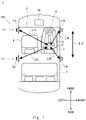
- Fig. 1 is a schematic diagram showing a vehicle interior 2 of a car 1 viewed from the above.
- the longitudinal direction and the lateral direction are defined based on a driver U who is the listener as shown in Fig. 1 .
- the longitudinal direction and the lateral direction shown in Fig. 1 coincide with the longitudinal direction and the lateral direction of the car 1 in the advancing direction thereof.
- the vehicle interior 2 of the car 1 includes a driver seat 3, a passenger seat 4, a rear seat 5, and a steering wheel 6.
- the steering wheel 6 is disposed in front of the driver seat 3.
- the driver U who sits in the driver seat 3 is the target listener.
- the car 1 is a car having a right-side steering wheel in which the steering wheel 6 is disposed on the right-hand side. Therefore, the driver seat 3 is disposed on the right-hand side in the front row and the passenger seat 4 is disposed side-by-side thereto on the left-hand side in the front row. Further, the rear seat 5 is disposed behind the driver seat 3 and the passenger seat 4.
- the vehicle interior 2 is equipped with an on-vehicle speaker system 100 including a first speaker unit group 11, a second speaker unit group 12, and a reproduction device 30.
- the reproduction device 30 is disposed to, for example, a dashboard.
- the reproduction device 30 is a processing device including a sound source, a decoder, a DSP (Digital Signal Processor), a D/A (Digital to Analog) converter, an amplifier and so on.
- the sound source is, for example, an MP3 (MPEG Audio Layer-3) player or a CD (Compact Disc) player, and may be an external device.
- a part or all of the reproduction device 30 can be implemented as a function of a car navigation system.
- the first speaker unit group 11 and the second speaker unit group 12 are disposed within the vehicle interior 2.
- the reproduction device 30 outputs a reproduction signal for reproducing music within the vehicle interior 2.
- the reproduction device 30 outputs, for example, stereo music signals of L-ch and R-ch to the first speaker unit group 11 and the second speaker unit group 12.
- the driver U can listen to music within the vehicle interior 2.
- the first speaker unit group 11 includes a first left speaker unit 11L and a first right speaker unit 11R.
- the first left speaker unit 11L is disposed to a front door on the left-hand side, that is, to a door on the passenger seat 2 side.
- the first right speaker unit 11R is disposed to a front door on the right-hand side, that is, to a door on the driver seat 3 side.
- the second speaker unit group 12 includes a second left speaker unit 12L and a second right speaker unit 12R.
- the second left speaker unit 12L is disposed to a rear door on the left-hand side and the second right speaker unit 12R is disposed to a rear door on the right-hand side.
- the place where the speaker unit is disposed is not specifically limited. For example, it may be disposed to the dashboard or behind the rear seat.
- the second speaker unit group 12 is disposed behind the first speaker unit group 11.
- the first speaker unit group 11 is a front speaker unit group that is disposed on the front side of the driver U and the second speaker unit group 12 is a rear speaker unit group that is disposed behind the driver U.
- the first left speaker unit 11L and the first right speaker unit 11R are front speaker units for L-ch and R-ch, respectively
- the second left speaker unit 12L and the second right speaker unit 12R are rear speaker units for L-ch and R-ch, respectively.
- the first left speaker unit 11L, the first right speaker unit 11R, the second left speaker unit 12L, and the second right speaker unit 12R are fullrange speakers.
- the reproduction device 30 includes a delay circuit that delays a reproduction signal input to each of the speaker units.
- the delay time set for the reproduction signal transmitted to each of the plurality of speaker units 11L, 11R, 12L, and 12R is explained below.
- the position of the head of the driver U who is the target listener is referred to as a reference position P. Note that in the present embodiment, since the car 1 has a right-side steering wheel, a distance from the reference position P to the right speaker unit is shorter than a distance from the reference position P to the left speaker unit in each of the speaker unit groups.
- a distance from the reference position P to the first left speaker unit 11L is referred to as L1L
- a distance from the reference position P to the first right speaker unit 11R is referred to as L1R
- a distance from the reference position P to the second left speaker unit 12L is referred to as L2L
- a distance from the reference position P to the second right speaker unit 12R is referred to as L2R.
- a distance from the first speaker unit group 11 to the second speaker unit group 12 in the longitudinal direction is referred to as L12. Note that the distance from the first left speaker unit 11L to the second left speaker unit 12L and the distance from the first right speaker unit 11R to the second right speaker unit 12R in the longitudinal direction are the same.
- a measurement value obtained through a measuring tape or the like can be used for the distance from the reference position P to each of the speaker units. For example, assuming that the position of the head of the driver U who is seated in the driver seat 3 is the reference position P, the driver U or another person measures the distance from the reference point P to each of the speaker units using a measuring tape. The distance measured by the driver U etc. is input to the reproduction device 30. Alternatively, the distance may be measured using various sensors.
- the delay time (the arrival time) from the reference position P to each of the speaker units is calculated as described below.
- the sound velocity c 331.5+0,611 [m/s] and t denotes temperature [°C].
- a delay value D1L with respect to the first left speaker unit 11L is expressed by the following Expression (1).
- D 1 L s L 1 L m / c m / s
- delay values D1R, D2L, and D2R with respect to the first right speaker unit 11R, the second left speaker unit 12L, and the second right speaker unit 12R can be expressed by the following Expressions (2), (3), and (4), respectively.
- D 1 R s L 1 R m / c m / s
- D 2 L s L 2 L m / c m / s
- D 2 R s L 2 R m / c m / s
- the delay value (the delay time) set between the first speaker unit group 11 and the second speaker unit group 12 is expressed by the following Expression (5).
- D 12 s L12 m / c m / s
- a lateral delay time is set between the first left speaker unit 11L and the first right speaker unit 11R in accordance with a time alignment method.
- a delay time in accordance with a distance difference (L1L-L1R) between the distance L1R and the distance L1L is set between the first left speaker unit 11L and the first right speaker unit 11R.
- the car 1 has a right-side steering wheel and the driver U who sits in the driver seat is the target listener.
- the first right speaker unit 11R is relatively close to the reference position P and the first left speaker unit 11L is relatively far from the reference position P.
- the distance L1R is shorter than the distance L1L.
- the delay time with respect to the first right speaker unit 11R is set longer than the delay time with respect to the first left speaker unit 11L. Assuming that the delay time with respect to the first left speaker unit 11L that is relatively far is 0[s], delay times D1R' and D1L' set between the first right speaker unit 11R and the first left speaker unit 11L in the first speaker unit group 11 are expressed by the Expressions (6) and (7).
- a lateral delay time is set between the second left speaker unit 12L and the second right speaker unit 12R in accordance with the time alignment method.
- a delay time in accordance with a distance difference (L2L-L2R) between the distance L2R and the distance L2L is set between the second left speaker unit 12L and the second right speaker unit 12R.
- the delay time with respect to the second right speaker unit 12R is set longer than the delay time with respect to the second left speaker unit 12L.
- a delay time is set for the second speaker unit group 12 in a similar manner as that for the first speaker unit group 11. That is, the delay times D2R' and D2L' set between the second right speaker unit 12R and the second left speaker unit 12L in the second speaker unit group 12 are expressed by the Expressions (8) and (9).
- the delay time D12 in accordance with the longitudinal distance L12 is set between the first speaker unit group 11 and the second speaker unit group 12.
- the delay times D2R" and D2L" set for the second right speaker unit 12R and the second left speaker unit 12L, respectively are expressed by the Expression (10) and the Expression (11).
- D 2 R " D 2 R ′ + D 12
- the delay times D2R" and D2L" become the delay times allotted to the second right speaker unit 12R and the second left speaker unit 12L, respectively. That is, the reproduction device 30 delays the reproduction signals transmitted to the first left speaker unit 11L, the first right speaker unit 11R, the second left speaker unit 12L, and the second right speaker unit 12R by the delay times D1L', D1R', D2L", and D2R", respectively.
- the delay times D2R" and D2R" with respect to the second right speaker unit 12R and the second left speaker unit 12L are calculated.
- the reproduction device 30 controls a sound volume level in accordance with a difference in the distance from the reference position to each of the speaker units. Specifically, among the four speaker units of the first speaker unit group 11, the first right speaker unit 11R is the closest to the reference position P. Therefore, the sound volume of the first left speaker unit 11L is not changed while the sound volume of the first right speaker unit 11R, the second left speaker unit 12L, and the second right speaker unit 12R are turned down.
- a sound volume level V1F of the first left speaker unit 11L and a sound volume level V1R of the first right speaker unit 11R can be calculated from the following Expressions (12) and (13).
- V 1 R 10 * log 1 / L 1 L / L 1 R 2 dB
- V 1 L 0 dB
- the sound volume level can be calculated in a similar manner for the second speaker unit group 12 based on the inverse square law of the distance from the second speaker unit group 12 to the driver U.
- a sound volume level V2R of the second right speaker unit 12R and a sound volume level V2L of the second left speaker unit 12L are expressed by the following Expressions (14) and (15).
- V 2 R 10 * Log 1 / L 1 L / L 2 R 2 dB
- V 2 L 10 * Log 1 / L 1 L / L 2 R 2 dB
- the preceding sound effect of the first speaker unit group 11 on the front side can be emphasized when the sound volume of the second speaker unit group 12 is turned down with respect to the sound volume of the first speaker unit group 11.
- the delay times between the first speaker unit group 11 and the second speaker unit group 12 may be set independently.
- the lateral preceding sound effect can be made the minimum. That is, the delay time between the first left speaker unit 11L and the first right speaker unit 11R as regards the first speaker unit group 11 is delayed based on the time alignment method and the delay time between the second left speaker unit 12L and the second right speaker unit 12R as regards the second speaker unit group 12 is delayed based on the time alignment method. Accordingly, it is possible to maintain the center localization. For example, it is possible to localize a monaural component (a line component) in front of the driver U.
- a monaural component a line component
- the second speaker unit group 12 is delayed with respect to the first speaker unit group 11. That is, the reproduction device 30 allots a delay time to the second speaker unit group 12 in accordance with the longitudinal distance L12 between the speaker unit included in the first speaker unit group 11 and the speaker unit included in the second speaker unit group 12. Therefore, the preceding sound effect can be emphasized with respect to the first speaker unit group 11.
- the sound localization of the sound from the front side becomes natural creating the feeling of embracement, and a natural space can be obtained.
- the longitudinal distance L12 between the speaker units in the longitudinal direction is measured, and the reproduction device 30 allots the delay time in accordance with the longitudinal distance L12 to the second speaker unit group 12. Accordingly, the delay time can be set easily. By this configuration, it is possible to cause a lag in the arrival time between the first speaker unit group 11 and the second speaker unit group 12. An acoustic wave from the first speaker unit group 11 arrives at the driver U earlier than an acoustic wave from the second speaker unit group 12. Therefore, the preceding sound effect can be emphasized with respect to the first speaker unit group 11.
- the acoustic wave of the first speaker unit group 11 is output before the acoustic wave from the second speaker unit group 12 is output. Therefore, even when a passenger who is seated in the passenger seat 4 or the rear seat 5 is the listener, it is possible to reduce the feeling of strangeness felt by the passenger compared to the case where the standard time alignment method is employed. Since only the way to allot the delay time to each of the speaker units is changed, there is no change in the delay circuit.
- a lateral delay time is allotted to the first right speaker unit 11R and the second right speaker unit 12R.
- the lateral delay time may be allotted inversely.
- the delay time of the first right speaker unit 11R is 0, the delay time in accordance with the distance difference is allotted to the first left speaker unit 11L, and a delay time obtained by adding the delay time in accordance with the longitudinal distance to the delay time in accordance with the distance difference is allotted to the second left speaker unit 12L and the second right speaker unit 12R.
- the sound volumes of the speaker units should be adjusted in a similar manner.
- FIG. 2 is a diagram schematically showing the vehicle interior 2 of the car 1 to which the speaker system 100 is mounted.
- a third speaker unit group 13 is added.
- the basic configuration and process other than those of the third speaker unit group 13 are the same as those of the first embodiment, and thus explanations thereof are omitted.
- the third speaker unit group 13 includes a third left speaker unit 13L and a right speaker unit 13R.
- the third speaker unit group 13 is disposed behind the rear seat 5.
- the third speaker unit group 13 is disposed behind the second speaker unit group 12. Therefore, in the second embodiment, the third speaker unit group 13 is a rear speaker unit group that is disposed on the rearmost side.
- a distance from the reference position P to the third left speaker unit 13L is referred to as L3L and a distance from the reference position P to the third right speaker unit 13R is referred to as L3R.
- the distance between the first speaker unit group 11 and the third speaker unit group 13 in the longitudinal direction is referred to as a longitudinal direction distance L13.
- the distance between the second speaker unit group 12 and the third speaker unit group 13 in the longitudinal direction is referred to as a longitudinal direction distance L23.
- a lateral delay time is set between the third left speaker unit 13L and the third right speaker unit 13R in accordance with the time alignment method in the same manner as that set in the first speaker unit group 11 and the second speaker unit group 12.
- a delay time in accordance with a distance difference (L3L-L3R) between the distance L3R and the distance L3L is set between the third left speaker unit 13L and the third right speaker unit 13R.
- the delay value (the delay time) D13 set between the first speaker unit group 11 and the third speaker unit group 13 is expressed by the following Expression (19).
- the distance L3R is shorter than the distance L3L.
- a delay time is set for the third speaker unit group 13 in a similar manner as that for the first speaker unit group 11 and the second speaker unit group 12. That is, in the third speaker unit group 13, the lateral delay times D3R' and D3L' set for the third right speaker unit 13R and the third left speaker unit 13L, respectively are expressed by the Expression (20) and the Expression (21).
- the delay times D3R” and D3L” are the delay times allotted to the third right speaker unit 13R and the third left speaker unit 13L.
- the delay time in accordance with the longitudinal distance L13 is allotted between the first speaker unit group 11 and the third speaker unit group 13.
- the delay time in accordance with the longitudinal distance D23 is allotted between the second speaker unit group 12 and the third speaker unit group 13.
- Fig. 3 is a block diagram showing the configuration of reproduction device 30.
- the reproduction device 30 includes a sound source 31, a delay unit 32, an amplifier unit 33, and an input unit 35.
- the reproduction device 30 outputs six reproduction signals to the respective speaker units.
- the delay unit 32 includes six delay circuits 321L, 321R, 322L, 322R, 323L, and 323R for the respective speaker units.
- the delay unit 32 may be implemented as a function of the DSP. In this case, a D/A convertor is disposed at a latter part of the delay unit 32.
- the amplifier unit 33 includes six amplifiers 331L, 331R, 332L, 332R, 333L, and 333R.
- the amplifiers 331L, 331R, 332L, 332R, 333L, and 333R may be built-in within the speaker unit.
- the sound source 31 outputs the reproduction signal to each of the six speaker units 11L, 11R, 12L, 12R, 13L, and 13R.
- the number of channels of the reproduction signal is not specifically limited.
- the delay circuit 321L delays the reproduction signal transmitted to the first left speaker unit 11L and outputs the delayed signal to the amplifier 331L.
- the amplifier 331L amplifies the reproduction signal and outputs the amplified signal to the first left speaker unit 11L.
- the delay circuit 321R delays the reproduction signal with respect to the first right speaker unit 11R and outputs the delayed signal to the amplifier 331R.
- the amplifier 331R amplifies the reproduction signal and outputs the amplified signal to the first right speaker unit 11R.
- the delay time D1L' is set for the delay circuit 321L and the delay time D1R' is set for the delay circuit 321R.
- the delay circuit 322L delays the reproduction signal transmitted to the second left speaker unit 12L and outputs the delayed signal to the amplifier 331L.
- the amplifier 332L amplifies the reproduction signal and outputs the amplified signal to the second left speaker unit 12L.
- the delay circuit 322R delays the reproduction signal transmitted to the second right speaker unit 12R and outputs the amplified signal to the amplifier 332R.
- the amplifier 332R amplifies the reproduction signal and outputs the amplified signal to the second right speaker unit 12R.
- the delay time D2L" is set for the delay circuit 322L and the delay time D2R" is set for the delay circuit 322R.
- the delay circuit 323L delays the reproduction signal transmitted to the third speaker unit 13L and outputs the delayed signal to the amplifier 333L.
- the amplifier 333L amplifies the reproduction signal and outputs the amplified signal to the third left speaker unit 13L.
- the delay circuit 323R delays the reproduction transmitted to the third right speaker unit 13R and outputs the delayed signal to the amplifier 333R.
- the amplifier 333R amplifies the reproduction signal and outputs the amplified signal to the third right speaker unit 13R.
- the delay time D3L" is set for the delay circuit 323L and the delay time D3R" is set for the delay circuit 323R.
- the delay time in the delay unit 32 is input through the input unit 35.
- the input unit 35 is provided with an input device such as a touch panel or a button. Further, by having the driver U etc. operate the input unit 35, the distance measured using the measuring tape is input. By this configuration, the reproduction device 30 inputs the delay time with respect to each speaker unit in accordance with the Expressions mentioned above.
- either one or both of the delay times D12 and D13 can be made to be adjustable.
- the delay time D12 or the delay time D13 can be changed.
- the reproduction device 30 delays the reproduction signal by the delay time and outputs the delayed signal to each of the speaker unit groups.
- An auditory test is conducted by having the driver U listen to a music that is played according the reproduction signal. From the result of the auditory test that is repeated by increasing/decreasing the delay time D12 or the delay time D13, the delay time which is most suitable for the driver U is selected. By this configuration, the delay time can be finely adjusted and the acoustic image can be localized more appropriately.
- the sound volume of each of the speaker unit groups can be adjusted by adjusting an amplification factor in each amplifier in the amplifier unit 33.
- the amplification unit 33 may adjust the sound volume level in accordance with the distance difference. Further, by having the driver U operate the input unit 35, the sound volume of each of the speaker units may be adjusted.
- the reproduction device 30 may not be limited to a physically single device.
- it may be configured as a device in which the delay unit 32 and the amplifier unit 33 are separated devices.
- the sound source 31 may be an MP3 player or the like that is externally connected to the reproduction device 30.
- the sound source 31 is connected to the reproduction device 30 via a USB (Universal Serial Bus), Bluetooth (registered trademark) or the like.
- the reproduction device 30 shown in Fig. 3 can be employed in the first embodiment as well. In this case, the reproduction device 30 should include the delay circuit and the amplifiers with respect to the four speaker units.
- the speaker unit 100 may further include a fourth speaker unit group disposed behind the third speaker unit group 13.
- the delay time may be set based on the longitudinal distance between the speaker units included in the fourth speaker unit group and the speaker units included in the first speaker unit group 11.
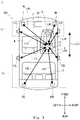
- FIG. 4 is a diagram schematically showing the vehicle interior 2 of the car 1 on which the speaker system 100 mounted.
- a fourth left speaker unit 14L, a fourth right speaker unit 14R, a fifth left speaker unit 15L, and a fifth right speaker unit 15R are added to the configuration shown in Fig. 1 .
- the number of speaker units included in one speaker unit group is two, however in the third and the fourth embodiment, the number thereof is four.
- the configuration other than the fourth left speaker unit 14L, the fourth right speaker unit 14R, the fifth left speaker unit 15L, and the fifth right speaker unit 15R and the process are the same as those described in the first embodiment, and thus explanations thereof are omitted.
- the first speaker unit group 11 includes the first left speaker unit 11L, the first right speaker unit 11R, the fourth left speaker unit 14L, and the fourth right speaker unit 14R.
- the fourth left speaker unit 14L and the fourth right speaker unit 14R are disposed on the front side of the first left speaker unit 11L and the first right speaker unit 11R.
- the second speaker unit group 12 is disposed behind the fifth left speaker unit 15L that includes the second left speaker unit 12L, the second right speaker unit 12R, the fourth left speaker unit 14L, and the fourth right speaker unit 14R, and the fifth right speaker unit 15R is disposed behind the second left speaker units 12L and 12R.
- the fourth left speaker unit 14L and the fourth right speaker unit 14R are disposed in the first row from the front, and the first left speaker unit 11L and the first right speaker unit 11R are disposed in the second row from the front.
- the second left speaker unit 12L and the second right speaker unit 12R are disposed in the third row from the front and the fifth left speaker unit 15L and the fifth right speaker unit 15R are disposed in the fourth row from the front.
- L4L and L4R Distances from the reference position P to the fourth left speaker unit 14L and to the fourth right speaker unit 14R are referred to as L4L and L4R, respectively.
- Distances from the reference position P to the fifth left speaker unit 15L and to the fifth right speaker unit 15R are referred to as L5L and L5R, respectively.
- the delay times (the arrival times) D4L, D4R, D5L, and D5R with respect to the fourth left speaker unit 14L, the fourth right speaker unit 14R, the fifth left speaker unit 15L, and the fifth right speaker unit 15R are expressed by the following Expressions (24) and (27).
- the fourth left speaker unit 14L, the fourth right speaker unit 14R, the first left speaker unit 11L, and the first right speaker unit 11R that are disposed in front of the driver U constitute the first speaker unit group 11.
- Delay times for the fourth left speaker unit 14L, the fourth right speaker unit 14R, the first left speaker unit 11L, and the first right speaker unit 11R are included in the first speaker unit group 11 are set according to the time alignment method.
- the fourth left speaker unit 14L is the furthest from the reference position P, and thus it is set as a reference. Assuming that the delay time with respect to the fourth left speaker unit 14L is 0, delay times are set for the fourth right speaker unit 14R, the first left speaker unit 11L, and the first right speaker unit 11R in accordance the distance difference.
- the delay time D4R' with respect to the fourth right speaker unit 14R is set based on the distance difference (L4L-L4R).
- the delay times D1L' and D1R' with respect to the first left speaker unit 11L and the first right speaker unit 11R are set by the distance difference (L4L-L1L) and the distance difference (L4L-L1R), respectively.
- the delay times D1L', D1R', D4L', and D4R' set among the speaker units of the first speaker unit group 11 are expressed by the following Expressions (28) to (31).
- D 1 R ′ D 4 L ⁇ D 1 L
- D 4 R ′ D 4 L ⁇ D 4 R
- the reproduction device 30 delays the reproduction signals transmitted to the first left speaker unit 11L, the first right speaker unit 11R, the fourth left speaker unit 14L, and the fourth right speaker unit 14R by the delay times D1L", D1R", D4L", and D4R", respectively.
- the second left speaker unit 12L, the second right speaker unit 12R, the fifth left speaker unit 15L, and the fifth right speaker unit 15R disposed behind the driver U constitute the second speaker unit group 12.
- the delay times are set according to the time alignment method.
- the fifth left speaker unit 15L is the furthest from the reference position P, and thus it is set as a reference. Assuming that the delay time with respect to the fifth left speaker unit 15L is 0, delay times are set for the fifth right speaker unit 15R, the second left speaker unit 12L, and the second right speaker unit 12R in accordance the distance difference.
- the delay time D5R' with respect to the fifth right speaker unit 15R is set based on the difference in the distance (L5L-L5R).
- the delay times D2L' and D2R' with respect to the second left speaker unit 12L and the second right speaker unit 12R are set by the distance difference (L5L-L2L) and the distance difference (L5L-L2R), respectively.
- the delay times set among the speaker units of the second speaker unit group 12 are expressed by the following Expressions (32) to (35).
- the delay value (the delay time) D12 set between the first speaker unit group 11 and the second speaker unit group 12 is set based on the longitudinal distance L12 in a similar manner as the first embodiment. That is, the delay value D12 is expressed by the Expression (36).
- D 12 s L 12 m / c m / s
- the longitudinal distance L12 is a distance in the longitudinal direction between the speaker unit of the first speaker unit group 11 which is disposed on the rearmost side and the speaker unit of the second speaker unit group 12 which is disposed on the frontmost side.
- the longitudinal distance L12 is a distance in the longitudinal direction between first left speaker unit 11L and the second left speaker unit 12L.
- the reproduction device 30 delays the reproduction signals transmitted to the second left speaker unit 12L, the second right speaker unit 12R, the fifth left speaker unit 15L, and the fifth right speaker unit 15R by the delay times D2L", D2R", D5L", and D5R", respectively.
- the plurality of speaker units disposed on the front side of the driver U constitute the first speaker unit group 11 and the plurality of speaker units disposed on the rear side of the driver constitute the second speaker unit group 12. Further, in each of the speaker unit groups, the delay times are set according to the time alignment method. Further, a delay time in accordance with the longitudinal distance L12 is allotted between the first speaker unit group 11 and the second speaker unit group 12. That is, the delay time in accordance with the longitudinal distance L12 is added to the delay time set according to the time alignment method in the second speaker unit group 12. By this configuration, the same effect as that of the first embodiment can be obtained.
- each of the first speaker unit group 11 and the second speaker unit group 12 includes four speaker units, however, the number of the speaker units included in either one of the speaker unit groups may be two.
- the delay time is set according to the time alignment method while the delay time is set between the two speaker unit groups based on the longitudinal distance L12.
- the delay time shown in the first embodiment is set for the first speaker unit group 11 and the delay time shown in third embodiment is set for the second speaker unit group 12.
- the delay time shown in the first embodiment is set for the second speaker unit group 12 and the delay time shown in the third embodiment is set for the first speaker unit group 11.
- the delay time can be set in a similar manner based on the time alignment method.
- the first to third embodiments can be used in combination as appropriate.
- the second embodiment and the third embodiment can be used in combination.
- the configuration of the reproduction device 30 shown in Fig. 3 can be applied to the first and third embodiments.
- the third speaker unit group may be added to the speaker unit arrangement shown in Fig. 4 .
- one or more of the speaker unit groups of the first speaker unit group 11, the second speaker unit group 12, and the third speaker unit group 13 may include four or more speaker units.
- the longitudinal distances L12, L13, and L23 may be the longitudinal distance from the driver U to the speaker unit on the farther side.
- the delay time is set using the longitudinal distance of the left speaker unit.
- the delay time is set using the longitudinal distance of the right speaker unit.
- the reproduction device 30 according to the first to third embodiments can also be applied to a speaker system other than an on-vehicle speaker system. That is, the reproduction device and the speaker system according to the embodiments is applicable to a speaker system that is disposed asymmetrically.
- the present disclosure can be applied to a reproduction device that outputs a reproduction signal and an on-vehicle speaker system.
Landscapes
- Engineering & Computer Science (AREA)
- Physics & Mathematics (AREA)
- Acoustics & Sound (AREA)
- Signal Processing (AREA)
- Health & Medical Sciences (AREA)
- General Health & Medical Sciences (AREA)
- Otolaryngology (AREA)
- Mechanical Engineering (AREA)
- Stereophonic System (AREA)
- Fittings On The Vehicle Exterior For Carrying Loads, And Devices For Holding Or Mounting Articles (AREA)
Description
- The present disclosure relates to a reproduction device, a reproduction method, and an on-vehicle speaker system.
-
Patent Literature 1 discloses an on-vehicle acoustic device including four speakers. The on-vehicle acoustic device delays an acoustic signal transmitted from a sound source and transmits the signal to each speaker. That is, a speaker that is farther from a listening position is set as a reference and a delay is allotted to a speaker that is closer to a delay circuit. - A delay time is allotted to a left front speaker and a left rear speaker so that the phases of the sounds from the left front speaker and the left rear speaker that reach the left ear of a driver coincide with each other.
-
Patent Literature 2 discloses an on-vehicle digital audio system including four speakers. InPatent Literature 2, the signal applied to a speaker system is delayed in accordance with the speaker system furthest from a listening position. By this configuration, the distance from the listening position to each speaker system is equivalently equidistant. -
Patent Literature 3 discloses a voice signal processing device for appropriately delaying a signal in accordance with a size of a room. Left and right front speakers and a center speaker are disposed on the front side of the listening position, and left and right surround speakers are disposed on the rear side of the listening position. The voice signal processing device receives a front channel signal and a surround channel signal and outputs a delay surround channel signal that is delayed by a prescribed time from the surround channel signal. This delay time is determined in accordance with a difference in a distance from each speaker to the listening position (paragraph 0037). - The voice signal processing device adds a delay surround signal to the front channel signal. The front speaker outputs the front channel signal to which the delay surround signal is added. Further, in order to make the sound pressure level of the sounds equal at the listening position, a sound volume adjustment circuit corrects the level of an acoustic signal and applies the signal to each speaker.
-
- Patent Literature 1:
Japanese Unexamined Patent Application Publication No. H07-162998 - Patent Literature 2:
Japanese Unexamined Patent Application Publication No. H07-203598 - Patent Literature 3:
Japanese Unexamined Patent Application Publication No. 2012-235456 -
WO 2012/172394 A1 describes a sound adaptation module for a passenger car which comprises an input connection for receiving a passenger occupation pattern of the passenger car, an audio input connection for receiving audio signals from an audio source and a database with predetermined sound profiles. Moreover, the sound adaptation module comprises a selection means for selecting a sound profile from the predetermined sound profiles based on the passenger occupation pattern and adaptation means for adapting the audio signals according to the sound profile and output connections for transmitting the adapted audio signals from the adaptation means to at least two loud- speakers. -
JP 2005323025 A -
US 2003/043051 A1 describes a remote control apparatus which can operate and adjust a multi-channel receiver comprises: transmitting means for transmitting data to the receiver; a microphone for receiving sound outputted from the receiver; and arithmetic operating means which calculates the state of the receiver from the sound received by the microphone and analyzes an adjustment value of the receiver from a calculation result, wherein the transmitting means transmits data for initiating adjustment for the receiver and transmits an analysis result obtained by the arithmetic operating means to the receiver. - In
Patent Literatures 1 to 3, even though the center localization can be corrected, since the sound is output from the front and the rear sides of the listener, a feeling of strangeness in the auditory image may be caused. Further, in a seat other than the driver seat in which the listener sits, the preceding sound effect does not become minimal, and thus the listener may be caused to feel the strangeness. - The present disclosure has been made in view of such a problem and an object thereof is to provide a reproduction device, a reproduction method, and an on-vehicle speaker system.
- A reproduction device according to an embodiment is a reproduction device according to
claim 1. - A reproduction method according to an embodiment is a reproduction method according to claim 8
- According to the present disclosure, a reproduction device, a reproduction method, and an on-vehicle speaker system that can appropriately localize an acoustic image can be provided.
-
-
Fig. 1 is a diagram showing an on-vehicle speaker system according to a first embodiment; -
Fig. 2 is a diagram showing an on-vehicle speaker system according to a second embodiment; -
Fig. 3 is diagram showing a delay circuit of an on-vehicle speaker system; and -
Fig. 4 is a diagram showing an on-vehicle speaker system according to a third embodiment. - A reproduction device and an on-vehicle speaker system according to the present embodiment is described using
Fig. 1. Fig. 1 is a schematic diagram showing avehicle interior 2 of acar 1 viewed from the above. In the explanation given below, the longitudinal direction and the lateral direction are defined based on a driver U who is the listener as shown inFig. 1 . The longitudinal direction and the lateral direction shown inFig. 1 coincide with the longitudinal direction and the lateral direction of thecar 1 in the advancing direction thereof. - The
vehicle interior 2 of thecar 1 includes adriver seat 3, apassenger seat 4, arear seat 5, and asteering wheel 6. Thesteering wheel 6 is disposed in front of thedriver seat 3. The driver U who sits in thedriver seat 3 is the target listener. Here, explanation is given on the condition that thecar 1 is a car having a right-side steering wheel in which thesteering wheel 6 is disposed on the right-hand side. Therefore, thedriver seat 3 is disposed on the right-hand side in the front row and thepassenger seat 4 is disposed side-by-side thereto on the left-hand side in the front row. Further, therear seat 5 is disposed behind thedriver seat 3 and thepassenger seat 4. - Furthermore, the
vehicle interior 2 is equipped with an on-vehicle speaker system 100 including a firstspeaker unit group 11, a secondspeaker unit group 12, and areproduction device 30. Thereproduction device 30 is disposed to, for example, a dashboard. Thereproduction device 30 is a processing device including a sound source, a decoder, a DSP (Digital Signal Processor), a D/A (Digital to Analog) converter, an amplifier and so on. The sound source is, for example, an MP3 (MPEG Audio Layer-3) player or a CD (Compact Disc) player, and may be an external device. Further, a part or all of thereproduction device 30 can be implemented as a function of a car navigation system. - The first
speaker unit group 11 and the secondspeaker unit group 12 are disposed within thevehicle interior 2. Thereproduction device 30 outputs a reproduction signal for reproducing music within thevehicle interior 2. Thereproduction device 30 outputs, for example, stereo music signals of L-ch and R-ch to the firstspeaker unit group 11 and the secondspeaker unit group 12. The driver U can listen to music within thevehicle interior 2. - The first
speaker unit group 11 includes a firstleft speaker unit 11L and a firstright speaker unit 11R. The firstleft speaker unit 11L is disposed to a front door on the left-hand side, that is, to a door on thepassenger seat 2 side. The firstright speaker unit 11R is disposed to a front door on the right-hand side, that is, to a door on thedriver seat 3 side. - The second
speaker unit group 12 includes a secondleft speaker unit 12L and a secondright speaker unit 12R. The secondleft speaker unit 12L is disposed to a rear door on the left-hand side and the secondright speaker unit 12R is disposed to a rear door on the right-hand side. Of course, the place where the speaker unit is disposed is not specifically limited. For example, it may be disposed to the dashboard or behind the rear seat. - The second
speaker unit group 12 is disposed behind the firstspeaker unit group 11. The firstspeaker unit group 11 is a front speaker unit group that is disposed on the front side of the driver U and the secondspeaker unit group 12 is a rear speaker unit group that is disposed behind the driver U. In other words, the firstleft speaker unit 11L and the firstright speaker unit 11R are front speaker units for L-ch and R-ch, respectively, and the secondleft speaker unit 12L and the secondright speaker unit 12R are rear speaker units for L-ch and R-ch, respectively. Here, the firstleft speaker unit 11L, the firstright speaker unit 11R, the secondleft speaker unit 12L, and the secondright speaker unit 12R are fullrange speakers. - Music reproduced by the
reproduction device 30 is output from the plurality ofspeaker units reproduction device 30 includes a delay circuit that delays a reproduction signal input to each of the speaker units. The delay time set for the reproduction signal transmitted to each of the plurality ofspeaker units car 1 has a right-side steering wheel, a distance from the reference position P to the right speaker unit is shorter than a distance from the reference position P to the left speaker unit in each of the speaker unit groups. - A distance from the reference position P to the first
left speaker unit 11L is referred to as L1L, a distance from the reference position P to the firstright speaker unit 11R is referred to as L1R, a distance from the reference position P to the secondleft speaker unit 12L is referred to as L2L, and a distance from the reference position P to the secondright speaker unit 12R is referred to as L2R. Further, a distance from the firstspeaker unit group 11 to the secondspeaker unit group 12 in the longitudinal direction is referred to as L12. Note that the distance from the firstleft speaker unit 11L to the secondleft speaker unit 12L and the distance from the firstright speaker unit 11R to the secondright speaker unit 12R in the longitudinal direction are the same. - A measurement value obtained through a measuring tape or the like can be used for the distance from the reference position P to each of the speaker units. For example, assuming that the position of the head of the driver U who is seated in the
driver seat 3 is the reference position P, the driver U or another person measures the distance from the reference point P to each of the speaker units using a measuring tape. The distance measured by the driver U etc. is input to thereproduction device 30. Alternatively, the distance may be measured using various sensors. - Here, the delay time (the arrival time) from the reference position P to each of the speaker units is calculated as described below. Note that the sound velocity c = 331.5+0,611 [m/s] and t denotes temperature [°C].
- A delay value D1L with respect to the first
left speaker unit 11L is expressed by the following Expression (1).
- In the same way, delay values D1R, D2L, and D2R with respect to the first
right speaker unit 11R, the secondleft speaker unit 12L, and the secondright speaker unit 12R can be expressed by the following Expressions (2), (3), and (4), respectively.


- The delay value (the delay time) set between the first
speaker unit group 11 and the secondspeaker unit group 12 is expressed by the following Expression (5).
- In the first
speaker unit group 11, a lateral delay time is set between the firstleft speaker unit 11L and the firstright speaker unit 11R in accordance with a time alignment method. A delay time in accordance with a distance difference (L1L-L1R) between the distance L1R and the distance L1L is set between the firstleft speaker unit 11L and the firstright speaker unit 11R. By allotting a delay time to the lateral reproduction signal as described above, the arrival time of the reproduction signals of L-ch and R-ch to the driver U can be brought to be the same. Thus, it is possible to minimize the lateral preceding sound effect as much as possible. - Here, the
car 1 has a right-side steering wheel and the driver U who sits in the driver seat is the target listener. The firstright speaker unit 11R is relatively close to the reference position P and the firstleft speaker unit 11L is relatively far from the reference position P. The distance L1R is shorter than the distance L1L. The delay time with respect to the firstright speaker unit 11R is set longer than the delay time with respect to the firstleft speaker unit 11L. Assuming that the delay time with respect to the firstleft speaker unit 11L that is relatively far is 0[s], delay times D1R' and D1L' set between the firstright speaker unit 11R and the firstleft speaker unit 11L in the firstspeaker unit group 11 are expressed by the Expressions (6) and (7).


- Also in the second
speaker unit group 12, a lateral delay time is set between the secondleft speaker unit 12L and the secondright speaker unit 12R in accordance with the time alignment method. A delay time in accordance with a distance difference (L2L-L2R) between the distance L2R and the distance L2L is set between the secondleft speaker unit 12L and the secondright speaker unit 12R. By allotting a lateral delay time as described above, the arrival time of the reproduction signals of L-ch and R-ch to the driver U can be brought to be the same. Thus, it is possible to minimize the lateral preceding sound effect as much as possible. - In the second
speaker unit group 12 as well, the distance L2R is shorter than the distance L2L. Therefore, the delay time with respect to the secondright speaker unit 12R is set longer than the delay time with respect to the secondleft speaker unit 12L. Assuming that the delay time with respect to the secondleft speaker unit 12L that is relatively far is 0[s], a delay time is set for the secondspeaker unit group 12 in a similar manner as that for the firstspeaker unit group 11. That is, the delay times D2R' and D2L' set between the secondright speaker unit 12R and the secondleft speaker unit 12L in the secondspeaker unit group 12 are expressed by the Expressions (8) and (9).


- Further, the delay time D12 in accordance with the longitudinal distance L12 is set between the first
speaker unit group 11 and the secondspeaker unit group 12. By adding the delay time D12 corresponding to the longitudinal distance to the secondspeaker unit group 12, the delay times D2R" and D2L" set for the secondright speaker unit 12R and the secondleft speaker unit 12L, respectively are expressed by the Expression (10) and the Expression (11).


- The delay times D2R" and D2L" become the delay times allotted to the second
right speaker unit 12R and the secondleft speaker unit 12L, respectively. That is, thereproduction device 30 delays the reproduction signals transmitted to the firstleft speaker unit 11L, the firstright speaker unit 11R, the secondleft speaker unit 12L, and the secondright speaker unit 12R by the delay times D1L', D1R', D2L", and D2R", respectively. - By adding the delay time D12 to the delay times D2R' and D2L' allotted to the second
speaker unit group 12, the delay times D2R" and D2R" with respect to the secondright speaker unit 12R and the secondleft speaker unit 12L are calculated. As described above, only the secondspeaker unit group 12 is added with the delay time D12 delayed by the longitudinal distance L12. Thus, the delay time can be easily set. - Next, how the sound volume is set is explained. The
reproduction device 30 controls a sound volume level in accordance with a difference in the distance from the reference position to each of the speaker units. Specifically, among the four speaker units of the firstspeaker unit group 11, the firstright speaker unit 11R is the closest to the reference position P. Therefore, the sound volume of the firstleft speaker unit 11L is not changed while the sound volume of the firstright speaker unit 11R, the secondleft speaker unit 12L, and the secondright speaker unit 12R are turned down. In accordance with the inverse square law, a sound volume level V1F of the firstleft speaker unit 11L and a sound volume level V1R of the firstright speaker unit 11R can be calculated from the following Expressions (12) and (13).


- The sound volume level can be calculated in a similar manner for the second
speaker unit group 12 based on the inverse square law of the distance from the secondspeaker unit group 12 to the driver U. A sound volume level V2R of the secondright speaker unit 12R and a sound volume level V2L of the secondleft speaker unit 12L are expressed by the following Expressions (14) and (15).


- In setting the sound volume of each of the speaker units, the preceding sound effect of the first
speaker unit group 11 on the front side can be emphasized when the sound volume of the secondspeaker unit group 12 is turned down with respect to the sound volume of the firstspeaker unit group 11. - Actually, there is reflection by the glass and the interior materials etc. as well as sound absorption by the seats within the
vehicle interior 2. There are cases where even when the firstspeaker unit group 11 and the secondspeaker unit group 12 are the same unit, there is already a difference in the sound volume between the two groups. It is desirable to observe and determine the sound volume level by performing microphone measurement. Or, it is desirable to adjust the volume so that the volume level of the secondspeaker unit group 12 is lower than that of the firstspeaker unit group 11 according to the auditory sense of the driver U. When the sound volume of the firstspeaker unit group 11 and the secondspeaker unit group 12 can be heard at the same level, the following Expression (16) may hold true.
- In the explanation given above, it has been described that the first
left speaker unit 11L, the firstright speaker unit 11R, the secondleft speaker unit 12L, and the secondright speaker unit 12R are full range speakers, however, in a 2-way or a 3-way configuration, the delay times between the firstspeaker unit group 11 and the secondspeaker unit group 12 may be set independently. - In the present embodiment, the lateral preceding sound effect can be made the minimum. That is, the delay time between the first
left speaker unit 11L and the firstright speaker unit 11R as regards the firstspeaker unit group 11 is delayed based on the time alignment method and the delay time between the secondleft speaker unit 12L and the secondright speaker unit 12R as regards the secondspeaker unit group 12 is delayed based on the time alignment method. Accordingly, it is possible to maintain the center localization. For example, it is possible to localize a monaural component (a line component) in front of the driver U. - Further, the second
speaker unit group 12 is delayed with respect to the firstspeaker unit group 11. That is, thereproduction device 30 allots a delay time to the secondspeaker unit group 12 in accordance with the longitudinal distance L12 between the speaker unit included in the firstspeaker unit group 11 and the speaker unit included in the secondspeaker unit group 12. Therefore, the preceding sound effect can be emphasized with respect to the firstspeaker unit group 11. By this configuration, the sound localization of the sound from the front side becomes natural creating the feeling of embracement, and a natural space can be obtained. In addition, it is possible to reduce the feeling of strangeness in the auditory image. - The longitudinal distance L12 between the speaker units in the longitudinal direction is measured, and the
reproduction device 30 allots the delay time in accordance with the longitudinal distance L12 to the secondspeaker unit group 12. Accordingly, the delay time can be set easily. By this configuration, it is possible to cause a lag in the arrival time between the firstspeaker unit group 11 and the secondspeaker unit group 12. An acoustic wave from the firstspeaker unit group 11 arrives at the driver U earlier than an acoustic wave from the secondspeaker unit group 12. Therefore, the preceding sound effect can be emphasized with respect to the firstspeaker unit group 11. - Further, the acoustic wave of the first
speaker unit group 11 is output before the acoustic wave from the secondspeaker unit group 12 is output. Therefore, even when a passenger who is seated in thepassenger seat 4 or therear seat 5 is the listener, it is possible to reduce the feeling of strangeness felt by the passenger compared to the case where the standard time alignment method is employed. Since only the way to allot the delay time to each of the speaker units is changed, there is no change in the delay circuit. - In the aforementioned explanation, since the
car 1 has a right-side steering wheel, a lateral delay time is allotted to the firstright speaker unit 11R and the secondright speaker unit 12R. However, in the case of a car having a left-side steering wheel or a car having a right-side steering wheel in which a passenger who is the listener is seated in the passenger seat, the lateral delay time may be allotted inversely. For example, assuming that the delay time of the firstright speaker unit 11R is 0, the delay time in accordance with the distance difference is allotted to the firstleft speaker unit 11L, and a delay time obtained by adding the delay time in accordance with the longitudinal distance to the delay time in accordance with the distance difference is allotted to the secondleft speaker unit 12L and the secondright speaker unit 12R. Further, as regards the sound volume in the case of a car having a left-side steering wheel, the sound volumes of the speaker units should be adjusted in a similar manner. - A reproduction device and a speaker system according to a second embodiment is described using
Fig. 2. Fig. 2 is a diagram schematically showing thevehicle interior 2 of thecar 1 to which thespeaker system 100 is mounted. In the second embodiment, in addition to the configuration of the first embodiment, a thirdspeaker unit group 13 is added. The basic configuration and process other than those of the thirdspeaker unit group 13 are the same as those of the first embodiment, and thus explanations thereof are omitted. - The third
speaker unit group 13 includes a thirdleft speaker unit 13L and aright speaker unit 13R. The thirdspeaker unit group 13 is disposed behind therear seat 5. The thirdspeaker unit group 13 is disposed behind the secondspeaker unit group 12. Therefore, in the second embodiment, the thirdspeaker unit group 13 is a rear speaker unit group that is disposed on the rearmost side. - As shown in
Fig. 2 , a distance from the reference position P to the thirdleft speaker unit 13L is referred to as L3L and a distance from the reference position P to the thirdright speaker unit 13R is referred to as L3R. The distance between the firstspeaker unit group 11 and the thirdspeaker unit group 13 in the longitudinal direction is referred to as a longitudinal direction distance L13. The distance between the secondspeaker unit group 12 and the thirdspeaker unit group 13 in the longitudinal direction is referred to as a longitudinal direction distance L23. L13=L12+L23 holds true. - In the third
speaker unit group 13, a lateral delay time is set between the thirdleft speaker unit 13L and the thirdright speaker unit 13R in accordance with the time alignment method in the same manner as that set in the firstspeaker unit group 11 and the secondspeaker unit group 12. A delay time in accordance with a distance difference (L3L-L3R) between the distance L3R and the distance L3L is set between the thirdleft speaker unit 13L and the thirdright speaker unit 13R. By allotting a lateral delay time as described above, it is possible to minimize the lateral preceding sound effect as much as possible. - The delay times (the arrival times) D3L and D3R with respect to the third
left speaker unit 13L and the thirdright speaker unit 13R are expressed by the following Expressions (17) and (18).

- The delay value (the delay time) D13 set between the first
speaker unit group 11 and the thirdspeaker unit group 13 is expressed by the following Expression (19).
- In the third
speaker unit group 13 as well, the distance L3R is shorter than the distance L3L. Assuming that the delay time with respect to the thirdleft speaker unit 13L that is far is 0[s], a delay time is set for the thirdspeaker unit group 13 in a similar manner as that for the firstspeaker unit group 11 and the secondspeaker unit group 12. That is, in the thirdspeaker unit group 13, the lateral delay times D3R' and D3L' set for the thirdright speaker unit 13R and the thirdleft speaker unit 13L, respectively are expressed by the Expression (20) and the Expression (21).


- Further, the delay time D13 in accordance with the longitudinal distance L13 between the first
speaker unit group 11 and the thirdspeaker unit group 13 is set. By adding the delay time D13 corresponding to the longitudinal distance to the thirdspeaker unit group 13, the following Expressions (22) and (23) hold true.


- The delay times D3R" and D3L" are the delay times allotted to the third
right speaker unit 13R and the thirdleft speaker unit 13L. As described above, the delay time in accordance with the longitudinal distance L13 is allotted between the firstspeaker unit group 11 and the thirdspeaker unit group 13. In other words, the delay time in accordance with the longitudinal distance D23 is allotted between the secondspeaker unit group 12 and the thirdspeaker unit group 13. By this configuration, even when the number of the speaker units is equal to or larger than six, the same effect as that achieved in the first embodiment can be obtained. - Next, a configuration of the
reproduction device 30 is described usingFig. 3. Fig. 3 is a block diagram showing the configuration ofreproduction device 30. Thereproduction device 30 includes asound source 31, adelay unit 32, anamplifier unit 33, and aninput unit 35. - In the second embodiment, since there are six speaker units, the
reproduction device 30 outputs six reproduction signals to the respective speaker units. Thedelay unit 32 includes sixdelay circuits delay unit 32 may be implemented as a function of the DSP. In this case, a D/A convertor is disposed at a latter part of thedelay unit 32. In a similar manner, theamplifier unit 33 includes sixamplifiers amplifiers - The
sound source 31 outputs the reproduction signal to each of the sixspeaker units delay circuit 321L delays the reproduction signal transmitted to the firstleft speaker unit 11L and outputs the delayed signal to theamplifier 331L. Theamplifier 331L amplifies the reproduction signal and outputs the amplified signal to the firstleft speaker unit 11L. - In a similar manner, the
delay circuit 321R delays the reproduction signal with respect to the firstright speaker unit 11R and outputs the delayed signal to theamplifier 331R. Theamplifier 331R amplifies the reproduction signal and outputs the amplified signal to the firstright speaker unit 11R. As described above, the delay time D1L' is set for thedelay circuit 321L and the delay time D1R' is set for thedelay circuit 321R. - The
delay circuit 322L delays the reproduction signal transmitted to the secondleft speaker unit 12L and outputs the delayed signal to theamplifier 331L. Theamplifier 332L amplifies the reproduction signal and outputs the amplified signal to the secondleft speaker unit 12L. Thedelay circuit 322R delays the reproduction signal transmitted to the secondright speaker unit 12R and outputs the amplified signal to theamplifier 332R. Theamplifier 332R amplifies the reproduction signal and outputs the amplified signal to the secondright speaker unit 12R. As described above, the delay time D2L"is set for thedelay circuit 322L and the delay time D2R" is set for thedelay circuit 322R. - The
delay circuit 323L delays the reproduction signal transmitted to thethird speaker unit 13L and outputs the delayed signal to theamplifier 333L. Theamplifier 333L amplifies the reproduction signal and outputs the amplified signal to the thirdleft speaker unit 13L. Thedelay circuit 323R delays the reproduction transmitted to the thirdright speaker unit 13R and outputs the delayed signal to theamplifier 333R. Theamplifier 333R amplifies the reproduction signal and outputs the amplified signal to the thirdright speaker unit 13R. As described above, the delay time D3L"is set for thedelay circuit 323L and the delay time D3R" is set for thedelay circuit 323R. - By having the six speaker units output the reproduction signal, music can be reproduced. The sound localization of the sound from the front side becomes natural and an appropriate acoustic image can be reproduced. The delay time in the
delay unit 32 is input through theinput unit 35. For example, theinput unit 35 is provided with an input device such as a touch panel or a button. Further, by having the driver U etc. operate theinput unit 35, the distance measured using the measuring tape is input. By this configuration, thereproduction device 30 inputs the delay time with respect to each speaker unit in accordance with the Expressions mentioned above. - Furthermore, either one or both of the delay times D12 and D13 can be made to be adjustable. By having the driver U operate the
input unit 35, the delay time D12 or the delay time D13 can be changed. Further, thereproduction device 30 delays the reproduction signal by the delay time and outputs the delayed signal to each of the speaker unit groups. An auditory test is conducted by having the driver U listen to a music that is played according the reproduction signal. From the result of the auditory test that is repeated by increasing/decreasing the delay time D12 or the delay time D13, the delay time which is most suitable for the driver U is selected. By this configuration, the delay time can be finely adjusted and the acoustic image can be localized more appropriately. - Further, the sound volume of each of the speaker unit groups can be adjusted by adjusting an amplification factor in each amplifier in the
amplifier unit 33. Theamplification unit 33 may adjust the sound volume level in accordance with the distance difference. Further, by having the driver U operate theinput unit 35, the sound volume of each of the speaker units may be adjusted. - The
reproduction device 30 may not be limited to a physically single device. For example, it may be configured as a device in which thedelay unit 32 and theamplifier unit 33 are separated devices. Further, thesound source 31 may be an MP3 player or the like that is externally connected to thereproduction device 30. In this case, thesound source 31 is connected to thereproduction device 30 via a USB (Universal Serial Bus), Bluetooth (registered trademark) or the like. Thereproduction device 30 shown inFig. 3 can be employed in the first embodiment as well. In this case, thereproduction device 30 should include the delay circuit and the amplifiers with respect to the four speaker units. - In this embodiment, the
speaker unit 100 may further include a fourth speaker unit group disposed behind the thirdspeaker unit group 13. In this case as well, in a similar manner as described above, the delay time may be set based on the longitudinal distance between the speaker units included in the fourth speaker unit group and the speaker units included in the firstspeaker unit group 11. - A reproduction device and a speaker system according to a third embodiment is described using
Fig. 4. Fig. 4 is a diagram schematically showing thevehicle interior 2 of thecar 1 on which thespeaker system 100 mounted. - In the third embodiment, a fourth
left speaker unit 14L, a fourthright speaker unit 14R, a fifthleft speaker unit 15L, and a fifthright speaker unit 15R are added to the configuration shown inFig. 1 . In the first and second embodiments, the number of speaker units included in one speaker unit group is two, however in the third and the fourth embodiment, the number thereof is four. The configuration other than the fourthleft speaker unit 14L, the fourthright speaker unit 14R, the fifthleft speaker unit 15L, and the fifthright speaker unit 15R and the process are the same as those described in the first embodiment, and thus explanations thereof are omitted. - The first
speaker unit group 11 includes the firstleft speaker unit 11L, the firstright speaker unit 11R, the fourthleft speaker unit 14L, and the fourthright speaker unit 14R. The fourthleft speaker unit 14L and the fourthright speaker unit 14R are disposed on the front side of the firstleft speaker unit 11L and the firstright speaker unit 11R. - The second
speaker unit group 12 is disposed behind the fifthleft speaker unit 15L that includes the secondleft speaker unit 12L, the secondright speaker unit 12R, the fourthleft speaker unit 14L, and the fourthright speaker unit 14R, and the fifthright speaker unit 15R is disposed behind the secondleft speaker units - The fourth
left speaker unit 14L and the fourthright speaker unit 14R are disposed in the first row from the front, and the firstleft speaker unit 11L and the firstright speaker unit 11R are disposed in the second row from the front. The secondleft speaker unit 12L and the secondright speaker unit 12R are disposed in the third row from the front and the fifthleft speaker unit 15L and the fifthright speaker unit 15R are disposed in the fourth row from the front. - Distances from the reference position P to the fourth
left speaker unit 14L and to the fourthright speaker unit 14R are referred to as L4L and L4R, respectively. Distances from the reference position P to the fifthleft speaker unit 15L and to the fifthright speaker unit 15R are referred to as L5L and L5R, respectively. The delay times (the arrival times) D4L, D4R, D5L, and D5R with respect to the fourthleft speaker unit 14L, the fourthright speaker unit 14R, the fifthleft speaker unit 15L, and the fifthright speaker unit 15R are expressed by the following Expressions (24) and (27).


- Further, the fourth
left speaker unit 14L, the fourthright speaker unit 14R, the firstleft speaker unit 11L, and the firstright speaker unit 11R that are disposed in front of the driver U constitute the firstspeaker unit group 11. Delay times for the fourthleft speaker unit 14L, the fourthright speaker unit 14R, the firstleft speaker unit 11L, and the firstright speaker unit 11R are included in the firstspeaker unit group 11 are set according to the time alignment method. - Among the fourth
left speaker unit 14L, the fourthright speaker unit 14R, the firstleft speaker unit 11L, and the firstright speaker unit 11R, the fourthleft speaker unit 14L is the furthest from the reference position P, and thus it is set as a reference. Assuming that the delay time with respect to the fourthleft speaker unit 14L is 0, delay times are set for the fourthright speaker unit 14R, the firstleft speaker unit 11L, and the firstright speaker unit 11R in accordance the distance difference. - The delay time D4R' with respect to the fourth
right speaker unit 14R is set based on the distance difference (L4L-L4R). In the similar manner, the delay times D1L' and D1R' with respect to the firstleft speaker unit 11L and the firstright speaker unit 11R are set by the distance difference (L4L-L1L) and the distance difference (L4L-L1R), respectively. The delay times D1L', D1R', D4L', and D4R' set among the speaker units of the firstspeaker unit group 11 are expressed by the following Expressions (28) to (31).


- The
reproduction device 30 delays the reproduction signals transmitted to the firstleft speaker unit 11L, the firstright speaker unit 11R, the fourthleft speaker unit 14L, and the fourthright speaker unit 14R by the delay times D1L", D1R", D4L", and D4R", respectively. - The second
left speaker unit 12L, the secondright speaker unit 12R, the fifthleft speaker unit 15L, and the fifthright speaker unit 15R disposed behind the driver U constitute the secondspeaker unit group 12. As regards the secondleft speaker unit 12L, the secondright speaker unit 12R, the fifthleft speaker unit 15L, and the fifthright speaker unit 15R included in the secondspeaker unit group 12 as well, the delay times are set according to the time alignment method. - Among the second
left speaker unit 12L, the secondright speaker unit 12R, the fifthleft speaker unit 15L, and the fifthright speaker unit 15R, the fifthleft speaker unit 15L is the furthest from the reference position P, and thus it is set as a reference. Assuming that the delay time with respect to the fifthleft speaker unit 15L is 0, delay times are set for the fifthright speaker unit 15R, the secondleft speaker unit 12L, and the secondright speaker unit 12R in accordance the distance difference. - Specifically, the delay time D5R' with respect to the fifth
right speaker unit 15R is set based on the difference in the distance (L5L-L5R). In the similar manner, the delay times D2L' and D2R' with respect to the secondleft speaker unit 12L and the secondright speaker unit 12R are set by the distance difference (L5L-L2L) and the distance difference (L5L-L2R), respectively. The delay times set among the speaker units of the secondspeaker unit group 12 are expressed by the following Expressions (32) to (35).


- The delay value (the delay time) D12 set between the first
speaker unit group 11 and the secondspeaker unit group 12 is set based on the longitudinal distance L12 in a similar manner as the first embodiment. That is, the delay value D12 is expressed by the Expression (36).
- Note that the longitudinal distance L12 is a distance in the longitudinal direction between the speaker unit of the first
speaker unit group 11 which is disposed on the rearmost side and the speaker unit of the secondspeaker unit group 12 which is disposed on the frontmost side. For example, the longitudinal distance L12 is a distance in the longitudinal direction between firstleft speaker unit 11L and the secondleft speaker unit 12L. - The delay times D2L", D2R", D5L", and D5R"set for the second
left speaker unit 12L, the secondright speaker unit 12R, the fifthleft speaker unit 15L, and the fifthright speaker unit 15R, respectively, are expressed by the following Expressions (37) to (40).


- The
reproduction device 30 delays the reproduction signals transmitted to the secondleft speaker unit 12L, the secondright speaker unit 12R, the fifthleft speaker unit 15L, and the fifthright speaker unit 15R by the delay times D2L", D2R", D5L", and D5R", respectively. - As described above, the plurality of speaker units disposed on the front side of the driver U constitute the first
speaker unit group 11 and the plurality of speaker units disposed on the rear side of the driver constitute the secondspeaker unit group 12. Further, in each of the speaker unit groups, the delay times are set according to the time alignment method. Further, a delay time in accordance with the longitudinal distance L12 is allotted between the firstspeaker unit group 11 and the secondspeaker unit group 12. That is, the delay time in accordance with the longitudinal distance L12 is added to the delay time set according to the time alignment method in the secondspeaker unit group 12. By this configuration, the same effect as that of the first embodiment can be obtained. - Note that in the aforementioned explanation, each of the first
speaker unit group 11 and the secondspeaker unit group 12 includes four speaker units, however, the number of the speaker units included in either one of the speaker unit groups may be two. In this case, in each of the speaker unit groups, the delay time is set according to the time alignment method while the delay time is set between the two speaker unit groups based on the longitudinal distance L12. - For example, when the number of the speaker units included in the first
speaker unit group 11 is two, the delay time shown in the first embodiment is set for the firstspeaker unit group 11 and the delay time shown in third embodiment is set for the secondspeaker unit group 12. - On the other hand, when the number of the speaker units included in the second
speaker unit group 12 is two, the delay time shown in the first embodiment is set for the secondspeaker unit group 12 and the delay time shown in the third embodiment is set for the firstspeaker unit group 11. - Furthermore, when the number of the speaker units included in one speaker unit group is equal to or larger than four, the delay time can be set in a similar manner based on the time alignment method.
- The first to third embodiments can be used in combination as appropriate. For example, the second embodiment and the third embodiment can be used in combination. The configuration of the
reproduction device 30 shown inFig. 3 can be applied to the first and third embodiments. The third speaker unit group may be added to the speaker unit arrangement shown inFig. 4 . Alternatively, one or more of the speaker unit groups of the firstspeaker unit group 11, the secondspeaker unit group 12, and the thirdspeaker unit group 13 may include four or more speaker units. - Note that in the first to third embodiments, it has been explained on the assumption that the positions of the left and right speaker units in the longitudinal direction are the same, however, the positions of the left and right speaker units in the longitudinal direction may differ. In this case, the longitudinal distances L12, L13, and L23 may be the longitudinal distance from the driver U to the speaker unit on the farther side. For example, in the case of a car having a right-side steering wheel, the delay time is set using the longitudinal distance of the left speaker unit. On other hand, in the case of a car having a left-side steering wheel, the delay time is set using the longitudinal distance of the right speaker unit.
- The
reproduction device 30 according to the first to third embodiments can also be applied to a speaker system other than an on-vehicle speaker system. That is, the reproduction device and the speaker system according to the embodiments is applicable to a speaker system that is disposed asymmetrically. - The present disclosure made by the inventors of the present application has been explained above in a concrete manner based on the embodiments. However, the present disclosure is not limited to the above-described embodiments, and needless to say, various modifications can be made without departing from the scope of the present disclosure, as defined in the appended set of claims.
- The present application is based upon and claims the benefit of priority from
Japanese Patent Application No. 2018-007544, filed on January 19, 2018 - The present disclosure can be applied to a reproduction device that outputs a reproduction signal and an on-vehicle speaker system.
-
- 1
- CAR
- 2
- VEHICLE INTERIOR
- 3
- DRIVER SEAT
- 4
- PASSENGER SEAT
- 5
- REAR SEAT
- 6
- STEERING WHEEL
- 11
- FIRST SPEAKER UNIT GROUP
- 11L
- FIRST LEFT SPEAKER UNIT
- 11R
- FIRST RIGHT SPEAKER UNIT
- 12
- SECOND SPEAKER UNIT GROUP
- 12L
- SECOND LEFT SPEAKER UNIT
- 12R
- SECOND RIGHT SPEAKER UNIT
- 13
- THIRD SPEAKER UNIT GROUP
- 13L
- THIRD LEFT SPEAKER UNIT
- 13R
- THIRD RIGHT SPEAKER UNIT
- 14L
- FOURTH LEFT SPEAKER UNIT
- 14R
- FOURTH RIGHT SPEAKER UNIT
- 15L
- FIFTH LEFT SPEAKER UNIT
- 15R
- FIFTH RIGHT SPEAKER UNIT
- 30
- REPRODUCTION DEVICE
- 31
- SOUND SOURCE
- 32
- DELAY UNIT
- 33
- AMPLIFIER UNIT
Claims (8)
- A reproduction device (30) for reproducing music, the reproduction device (30) configured to output a reproduction signal to a speaker unit system comprising a first speaker unit group (11) to be disposed in front of a listener and a second speaker unit group (12) to be disposed behind the listener, the reproduction device (30) comprising:a first delay circuit (321L, 321R) configured to delay a reproduction signal and output the so obtained first delayed reproduction signal to the first speaker unit group (11); anda second delay circuit (322L, 322R) configured to delay the reproduction signal and output the so obtained second delayed reproduction signal to the second speaker unit group (12),wherein the first speaker unit group (11) is configured to output the first delayed reproduction signal and the second speaker unit group (12) is configured to output the second delayed reproduction signal, whereinthe first speaker unit group (11) includes at least a first left speaker unit (11L) and a first right speaker unit (11R),the second speaker unit group (12) includes at least a second left speaker unit (12L) and a second right speaker unit (12R),wherein the reproduction device is configured to set, for the first delay circuit, in the first speaker unit group (11), a first delay time in accordance with a first distance difference between a distance from a reference position to a speaker unit of the first speaker unit group furthest from the reference position and a distance from the reference position to another speaker unit of the first speaker unit group, andwherein the reproduction device is configured to set, for the second delay circuit, in the second speaker unit group (12), a second delay time in accordance with a second distance difference between a distance from the reference position to a speaker unit of the second speaker unit group furthest from the reference position and a distance from the reference position to another speaker unit of the second speaker unit group and in accordance with a first longitudinal distance from a speaker unit included in the first speaker unit group to a speaker unit included in the second speaker group.
- The reproduction device (30) according to Claim 1, wherein in the second speaker unit group (12), the sum obtained by adding a second value in accordance with the first longitudinal distance to a first value in accordance with the second distance difference is set as the second delay time.
- The reproduction device (30) according to Claim 1 or 2, further comprising a third delay circuit (323L, 323R) configured to delay the reproduction signal output to a third speaker unit group (13) disposed behind the second speaker unit group (12), whereinthe third speaker unit group (13) includes at least a third left speaker unit (13L) and a third right speaker unit (13R), andin the third speaker unit group (13), a third delay time in accordance with a distance difference between a distance from the reference position to a speaker unit furthest from the reference position and a distance from the reference position to another speaker unit and a second longitudinal distance from a speaker unit included in the first speaker unit group (11) to a speaker unit included in the third speaker unit group is set for a third delay circuit.
- The reproduction device (30) according to any one of Claims 1 to 3, wherein the first speaker unit group (11) further comprises a fourth left speaker unit (14L) and a fourth right speaker unit (14R).
- The reproduction device (30) according to any one of Claims 1 to 4, wherein the second speaker unit group (12) further comprises a fifth left speaker unit (15L) and a fifth right speaker unit (15R).
- The reproduction device (30) according to any one of Claims 1 to 5, wherein in the first speaker unit group and the second speaker unit group, by suppressing a sound volume level in accordance with the distance difference from the reference position to each of the speaker units, a sound volume is made smaller for the speaker unit closer to the reference position than the other speaker unit is and sounds are output from the speaker units.
- An on-vehicle speaker system comprising:the reproduction device (30) according to any one of Claims 1 to 6; andthe first and second speaker unit groups (11, 12) to each of which the reproduction signal from the reproduction device is input.
- A reproduction method of reproducing music by a speaker unit system that comprises a first speaker unit group (11) and a second speaker unit group (12) disposed behind the first speaker unit group, the reproduction method comprising:a step of delaying a reproduction signal by a first delay circuit (321L,321R) and outputting the so obtained first delayed reproduction signal to a first speaker unit group (11) and delaying the reproduction signal by a second delay circuit (322L, 322R) and outputting the so obtained second delayed reproduction signal to a second speaker unit group; anda step of outputting the first delayed reproduction signal from the first speaker unit group (11) and the second delayed reproduction signal from the second speaker unit group (12), whereinthe first speaker unit group (11) includes at least a first left speaker unit (11L) and a first right speaker unit (11R),the second speaker unit group (12) includes at least a second left speaker unit (12L) and a second right speaker unit (12R),in the first speaker unit group (11), a first delay time in accordance with a first distance difference between a distance from a reference position to a speaker of the first speaker unit group furthest from the reference position and a distance from the reference position to another speaker unit of the first speaker unit group is set for the first delay circuit, andin the second speaker unit group (12), a second delay time in accordance with a second distance difference between a distance from the reference position to a speaker unit of the second speaker unit group furthest from the reference position and a distance from the reference position to another speaker unit of the second speaker unit group, and in accordance with a first longitudinal distance from a speaker unit included in the first speaker unit group to a speaker unit included in the second speaker group is set for the second delay circuit.
Applications Claiming Priority (2)
| Application Number | Priority Date | Filing Date | Title |
|---|---|---|---|
| JP2018007544 | 2018-01-19 | ||
| PCT/JP2018/037053 WO2019142407A1 (en) | 2018-01-19 | 2018-10-03 | Reproducing device, reproducing method, and in-vehicle loudspeaker system |
Publications (3)
| Publication Number | Publication Date |
|---|---|
| EP3742762A1 EP3742762A1 (en) | 2020-11-25 |
| EP3742762A4 EP3742762A4 (en) | 2021-01-27 |
| EP3742762B1 true EP3742762B1 (en) | 2022-10-26 |
Family
ID=67301413
Family Applications (1)
| Application Number | Title | Priority Date | Filing Date |
|---|---|---|---|
| EP18901686.8A Active EP3742762B1 (en) | 2018-01-19 | 2018-10-03 | Reproducing device, reproducing method, and in-vehicle loudspeaker system |
Country Status (5)
| Country | Link |
|---|---|
| US (1) | US11012801B2 (en) |
| EP (1) | EP3742762B1 (en) |
| JP (1) | JP7091994B2 (en) |
| CN (1) | CN111264067B (en) |
| WO (1) | WO2019142407A1 (en) |
Families Citing this family (3)
| Publication number | Priority date | Publication date | Assignee | Title |
|---|---|---|---|---|
| US12328558B2 (en) | 2020-06-16 | 2025-06-10 | Sowa Sound Aps | Sound output unit and a method of operating it |
| CN113115199B (en) * | 2021-03-12 | 2022-05-24 | 华南理工大学 | Vehicle-mounted sound reproduction signal delay method adaptive to listening center position |
| EP4592820A4 (en) * | 2022-09-22 | 2026-03-18 | Beijing Co Wheels Tech Co Ltd | METHOD AND DEVICE FOR CONTROLLING SOUND REPRODUCTION AS WELL AS ELECTRONIC DEVICE AND VEHICLE |
Family Cites Families (23)
| Publication number | Priority date | Publication date | Assignee | Title |
|---|---|---|---|---|
| JPS56172100U (en) * | 1980-05-21 | 1981-12-18 | ||
| JPS6440999U (en) * | 1987-09-03 | 1989-03-10 | ||
| JP3260360B2 (en) * | 1990-11-02 | 2002-02-25 | クラリオン株式会社 | Sound image localization control device |
| JPH07162998A (en) | 1993-12-03 | 1995-06-23 | Fujitsu Ten Ltd | On-vehicle acoustic device |
| JPH07203598A (en) | 1993-12-28 | 1995-08-04 | Fujitsu Ten Ltd | On-vehicle digital audio system |
| JP2001028799A (en) | 1999-05-10 | 2001-01-30 | Sony Corp | In-vehicle sound reproduction device |
| JP2001069598A (en) | 1999-08-31 | 2001-03-16 | Fujitsu Ten Ltd | On-vehicle multi-channel audio reproduction apparatus |
| JP2001119800A (en) | 1999-10-19 | 2001-04-27 | Matsushita Electric Ind Co Ltd | In-vehicle sound image controller |
| JP2001352600A (en) * | 2000-06-08 | 2001-12-21 | Marantz Japan Inc | Remote controller, receiver and audio system |
| US20030021433A1 (en) | 2001-07-30 | 2003-01-30 | Lee Kyung Lak | Speaker configuration and signal processor for stereo sound reproduction for vehicle and vehicle having the same |
| JP2005323025A (en) * | 2004-05-07 | 2005-11-17 | Pioneer Electronic Corp | Bass reproducing device |
| US7283634B2 (en) * | 2004-08-31 | 2007-10-16 | Dts, Inc. | Method of mixing audio channels using correlated outputs |
| JP2006324898A (en) * | 2005-05-18 | 2006-11-30 | Sony Corp | Audio playback device |
| FR2918532B1 (en) * | 2007-07-05 | 2015-04-24 | Arkamys | METHOD FOR THE SOUND PROCESSING OF A STEREO PHONE SIGNAL INSIDE A MOTOR VEHICLE AND A MOTOR VEHICLE USING THE SAME |
| WO2009095965A1 (en) * | 2008-01-31 | 2009-08-06 | Mitsubishi Electric Corporation | Band-splitting time compensation signal processing device |
| WO2009144781A1 (en) * | 2008-05-27 | 2009-12-03 | パイオニア株式会社 | Audio reproduction device |
| WO2010150368A1 (en) * | 2009-06-24 | 2010-12-29 | パイオニア株式会社 | Acoustic field regulator |
| WO2012172394A1 (en) * | 2011-06-17 | 2012-12-20 | Continental Automotive Gmbh | Automatic sound adaptation for an automobile |
| WO2013145127A1 (en) * | 2012-03-27 | 2013-10-03 | パイオニア株式会社 | Sound reproduction device |
| JP2012235456A (en) | 2012-04-20 | 2012-11-29 | Pioneer Electronic Corp | Voice signal processing device, and voice signal processing program |
| CN102883239B (en) * | 2012-09-24 | 2014-09-03 | 惠州华阳通用电子有限公司 | Sound field reappearing method in vehicle |
| JP5917765B2 (en) * | 2013-02-13 | 2016-05-18 | パイオニア株式会社 | Audio reproduction device, audio reproduction method, and audio reproduction program |
| US10096999B2 (en) | 2016-06-30 | 2018-10-09 | General Electric Company | Gas tube-switched flexible alternating current transmission system |
-
2018
- 2018-10-03 EP EP18901686.8A patent/EP3742762B1/en active Active
- 2018-10-03 CN CN201880068885.5A patent/CN111264067B/en active Active
- 2018-10-03 WO PCT/JP2018/037053 patent/WO2019142407A1/en not_active Ceased
- 2018-10-30 JP JP2018203764A patent/JP7091994B2/en active Active
-
2020
- 2020-06-15 US US16/901,722 patent/US11012801B2/en active Active
Also Published As
| Publication number | Publication date |
|---|---|
| CN111264067B (en) | 2021-07-27 |
| JP2019129531A (en) | 2019-08-01 |
| CN111264067A (en) | 2020-06-09 |
| EP3742762A4 (en) | 2021-01-27 |
| WO2019142407A1 (en) | 2019-07-25 |
| JP7091994B2 (en) | 2022-06-28 |
| US20200314579A1 (en) | 2020-10-01 |
| EP3742762A1 (en) | 2020-11-25 |
| US11012801B2 (en) | 2021-05-18 |
Similar Documents
| Publication | Publication Date | Title |
|---|---|---|
| US4953219A (en) | Stereo signal reproducing system using reverb unit | |
| CN111480346B (en) | car audio system | |
| EP3742762B1 (en) | Reproducing device, reproducing method, and in-vehicle loudspeaker system | |
| US20030021433A1 (en) | Speaker configuration and signal processor for stereo sound reproduction for vehicle and vehicle having the same | |
| EP1487236A2 (en) | Sound system with equalization for a convertible automobile | |
| EP2023672A1 (en) | Speaker system | |
| US8165325B2 (en) | Automotive virtual surround audio system | |
| US20060262937A1 (en) | Audio reproducing apparatus | |
| JP2020120290A (en) | 3d acoustic system and vehicle | |
| EP1280377A1 (en) | Speaker configuration and signal processor for stereo sound reproduction for vehicle and vehicle having the same | |
| JP3260360B2 (en) | Sound image localization control device | |
| KR100456772B1 (en) | Speaker configuration and signal processor for stereo sound reproduction in a vehicle and a vehicle having the same | |
| JPH0383492A (en) | Car audio equipment | |
| JP4714524B2 (en) | Audio apparatus and control method thereof | |
| JP2007312081A (en) | Audio system | |
| US20050041820A1 (en) | Method of mounting and driving speakers | |
| KR100569372B1 (en) | Volume automatic adjustment device for car multichannel audio system | |
| JP2022006537A (en) | Reproduction device, setting method, and vehicle onboard speaker system | |
| JP4405131B2 (en) | Audio equipment | |
| JP2022013239A (en) | Reproduction device, setting method, and vehicle onboard speaker system | |
| JPS6389000A (en) | In-vehicle sound reproduction device | |
| JPH11355896A (en) | Acoustic reproduction device | |
| JPH0530600A (en) | Sound image control device | |
| JP2013165387A (en) | On-vehicle audio device | |
| JPH10150700A (en) | Listening position adjusting method and its device |
Legal Events
| Date | Code | Title | Description |
|---|---|---|---|
| STAA | Information on the status of an ep patent application or granted ep patent |
Free format text: STATUS: THE INTERNATIONAL PUBLICATION HAS BEEN MADE |
|
| PUAI | Public reference made under article 153(3) epc to a published international application that has entered the european phase |
Free format text: ORIGINAL CODE: 0009012 |
|
| STAA | Information on the status of an ep patent application or granted ep patent |
Free format text: STATUS: REQUEST FOR EXAMINATION WAS MADE |
|
| 17P | Request for examination filed |
Effective date: 20200612 |
|
| AK | Designated contracting states |
Kind code of ref document: A1 Designated state(s): AL AT BE BG CH CY CZ DE DK EE ES FI FR GB GR HR HU IE IS IT LI LT LU LV MC MK MT NL NO PL PT RO RS SE SI SK SM TR |
|
| AX | Request for extension of the european patent |
Extension state: BA ME |
|
| A4 | Supplementary search report drawn up and despatched |
Effective date: 20210112 |
|
| RIC1 | Information provided on ipc code assigned before grant |
Ipc: H04R 3/12 20060101ALI20201221BHEP Ipc: H04S 7/00 20060101ALI20201221BHEP Ipc: H04R 5/04 20060101ALI20201221BHEP Ipc: B60R 11/02 20060101ALI20201221BHEP Ipc: H04S 3/00 20060101AFI20201221BHEP |
|
| DAV | Request for validation of the european patent (deleted) | ||
| DAX | Request for extension of the european patent (deleted) | ||
| GRAP | Despatch of communication of intention to grant a patent |
Free format text: ORIGINAL CODE: EPIDOSNIGR1 |
|
| STAA | Information on the status of an ep patent application or granted ep patent |
Free format text: STATUS: GRANT OF PATENT IS INTENDED |
|
| INTG | Intention to grant announced |
Effective date: 20220630 |
|
| GRAS | Grant fee paid |
Free format text: ORIGINAL CODE: EPIDOSNIGR3 |
|
| GRAA | (expected) grant |
Free format text: ORIGINAL CODE: 0009210 |
|
| STAA | Information on the status of an ep patent application or granted ep patent |
Free format text: STATUS: THE PATENT HAS BEEN GRANTED |
|
| AK | Designated contracting states |
Kind code of ref document: B1 Designated state(s): AL AT BE BG CH CY CZ DE DK EE ES FI FR GB GR HR HU IE IS IT LI LT LU LV MC MK MT NL NO PL PT RO RS SE SI SK SM TR |
|
| REG | Reference to a national code |
Ref country code: GB Ref legal event code: FG4D |
|
| REG | Reference to a national code |
Ref country code: CH Ref legal event code: EP |
|
| REG | Reference to a national code |
Ref country code: AT Ref legal event code: REF Ref document number: 1527951 Country of ref document: AT Kind code of ref document: T Effective date: 20221115 |
|
| REG | Reference to a national code |
Ref country code: DE Ref legal event code: R096 Ref document number: 602018042429 Country of ref document: DE |
|
| REG | Reference to a national code |
Ref country code: IE Ref legal event code: FG4D |
|
| REG | Reference to a national code |
Ref country code: LT Ref legal event code: MG9D |
|
| REG | Reference to a national code |
Ref country code: NL Ref legal event code: MP Effective date: 20221026 |
|
| REG | Reference to a national code |
Ref country code: AT Ref legal event code: MK05 Ref document number: 1527951 Country of ref document: AT Kind code of ref document: T Effective date: 20221026 |
|
| PG25 | Lapsed in a contracting state [announced via postgrant information from national office to epo] |
Ref country code: NL Free format text: LAPSE BECAUSE OF FAILURE TO SUBMIT A TRANSLATION OF THE DESCRIPTION OR TO PAY THE FEE WITHIN THE PRESCRIBED TIME-LIMIT Effective date: 20221026 |
|
| PG25 | Lapsed in a contracting state [announced via postgrant information from national office to epo] |
Ref country code: SE Free format text: LAPSE BECAUSE OF FAILURE TO SUBMIT A TRANSLATION OF THE DESCRIPTION OR TO PAY THE FEE WITHIN THE PRESCRIBED TIME-LIMIT Effective date: 20221026 Ref country code: PT Free format text: LAPSE BECAUSE OF FAILURE TO SUBMIT A TRANSLATION OF THE DESCRIPTION OR TO PAY THE FEE WITHIN THE PRESCRIBED TIME-LIMIT Effective date: 20230227 Ref country code: NO Free format text: LAPSE BECAUSE OF FAILURE TO SUBMIT A TRANSLATION OF THE DESCRIPTION OR TO PAY THE FEE WITHIN THE PRESCRIBED TIME-LIMIT Effective date: 20230126 Ref country code: LT Free format text: LAPSE BECAUSE OF FAILURE TO SUBMIT A TRANSLATION OF THE DESCRIPTION OR TO PAY THE FEE WITHIN THE PRESCRIBED TIME-LIMIT Effective date: 20221026 Ref country code: FI Free format text: LAPSE BECAUSE OF FAILURE TO SUBMIT A TRANSLATION OF THE DESCRIPTION OR TO PAY THE FEE WITHIN THE PRESCRIBED TIME-LIMIT Effective date: 20221026 Ref country code: ES Free format text: LAPSE BECAUSE OF FAILURE TO SUBMIT A TRANSLATION OF THE DESCRIPTION OR TO PAY THE FEE WITHIN THE PRESCRIBED TIME-LIMIT Effective date: 20221026 Ref country code: AT Free format text: LAPSE BECAUSE OF FAILURE TO SUBMIT A TRANSLATION OF THE DESCRIPTION OR TO PAY THE FEE WITHIN THE PRESCRIBED TIME-LIMIT Effective date: 20221026 |
|
| PG25 | Lapsed in a contracting state [announced via postgrant information from national office to epo] |
Ref country code: RS Free format text: LAPSE BECAUSE OF FAILURE TO SUBMIT A TRANSLATION OF THE DESCRIPTION OR TO PAY THE FEE WITHIN THE PRESCRIBED TIME-LIMIT Effective date: 20221026 Ref country code: PL Free format text: LAPSE BECAUSE OF FAILURE TO SUBMIT A TRANSLATION OF THE DESCRIPTION OR TO PAY THE FEE WITHIN THE PRESCRIBED TIME-LIMIT Effective date: 20221026 Ref country code: LV Free format text: LAPSE BECAUSE OF FAILURE TO SUBMIT A TRANSLATION OF THE DESCRIPTION OR TO PAY THE FEE WITHIN THE PRESCRIBED TIME-LIMIT Effective date: 20221026 Ref country code: IS Free format text: LAPSE BECAUSE OF FAILURE TO SUBMIT A TRANSLATION OF THE DESCRIPTION OR TO PAY THE FEE WITHIN THE PRESCRIBED TIME-LIMIT Effective date: 20230226 Ref country code: HR Free format text: LAPSE BECAUSE OF FAILURE TO SUBMIT A TRANSLATION OF THE DESCRIPTION OR TO PAY THE FEE WITHIN THE PRESCRIBED TIME-LIMIT Effective date: 20221026 Ref country code: GR Free format text: LAPSE BECAUSE OF FAILURE TO SUBMIT A TRANSLATION OF THE DESCRIPTION OR TO PAY THE FEE WITHIN THE PRESCRIBED TIME-LIMIT Effective date: 20230127 |
|
| REG | Reference to a national code |
Ref country code: DE Ref legal event code: R097 Ref document number: 602018042429 Country of ref document: DE |
|
| PG25 | Lapsed in a contracting state [announced via postgrant information from national office to epo] |
Ref country code: SM Free format text: LAPSE BECAUSE OF FAILURE TO SUBMIT A TRANSLATION OF THE DESCRIPTION OR TO PAY THE FEE WITHIN THE PRESCRIBED TIME-LIMIT Effective date: 20221026 Ref country code: RO Free format text: LAPSE BECAUSE OF FAILURE TO SUBMIT A TRANSLATION OF THE DESCRIPTION OR TO PAY THE FEE WITHIN THE PRESCRIBED TIME-LIMIT Effective date: 20221026 Ref country code: EE Free format text: LAPSE BECAUSE OF FAILURE TO SUBMIT A TRANSLATION OF THE DESCRIPTION OR TO PAY THE FEE WITHIN THE PRESCRIBED TIME-LIMIT Effective date: 20221026 Ref country code: DK Free format text: LAPSE BECAUSE OF FAILURE TO SUBMIT A TRANSLATION OF THE DESCRIPTION OR TO PAY THE FEE WITHIN THE PRESCRIBED TIME-LIMIT Effective date: 20221026 Ref country code: CZ Free format text: LAPSE BECAUSE OF FAILURE TO SUBMIT A TRANSLATION OF THE DESCRIPTION OR TO PAY THE FEE WITHIN THE PRESCRIBED TIME-LIMIT Effective date: 20221026 |
|
| PG25 | Lapsed in a contracting state [announced via postgrant information from national office to epo] |
Ref country code: SK Free format text: LAPSE BECAUSE OF FAILURE TO SUBMIT A TRANSLATION OF THE DESCRIPTION OR TO PAY THE FEE WITHIN THE PRESCRIBED TIME-LIMIT Effective date: 20221026 Ref country code: AL Free format text: LAPSE BECAUSE OF FAILURE TO SUBMIT A TRANSLATION OF THE DESCRIPTION OR TO PAY THE FEE WITHIN THE PRESCRIBED TIME-LIMIT Effective date: 20221026 |
|
| PLBE | No opposition filed within time limit |
Free format text: ORIGINAL CODE: 0009261 |
|
| STAA | Information on the status of an ep patent application or granted ep patent |
Free format text: STATUS: NO OPPOSITION FILED WITHIN TIME LIMIT |
|
| 26N | No opposition filed |
Effective date: 20230727 |
|
| PG25 | Lapsed in a contracting state [announced via postgrant information from national office to epo] |
Ref country code: SI Free format text: LAPSE BECAUSE OF FAILURE TO SUBMIT A TRANSLATION OF THE DESCRIPTION OR TO PAY THE FEE WITHIN THE PRESCRIBED TIME-LIMIT Effective date: 20221026 |
|
| PG25 | Lapsed in a contracting state [announced via postgrant information from national office to epo] |
Ref country code: IT Free format text: LAPSE BECAUSE OF FAILURE TO SUBMIT A TRANSLATION OF THE DESCRIPTION OR TO PAY THE FEE WITHIN THE PRESCRIBED TIME-LIMIT Effective date: 20221026 Ref country code: MC Free format text: LAPSE BECAUSE OF FAILURE TO SUBMIT A TRANSLATION OF THE DESCRIPTION OR TO PAY THE FEE WITHIN THE PRESCRIBED TIME-LIMIT Effective date: 20221026 |
|
| REG | Reference to a national code |
Ref country code: CH Ref legal event code: PL |
|
| REG | Reference to a national code |
Ref country code: BE Ref legal event code: MM Effective date: 20231031 |
|
| PG25 | Lapsed in a contracting state [announced via postgrant information from national office to epo] |
Ref country code: LU Free format text: LAPSE BECAUSE OF NON-PAYMENT OF DUE FEES Effective date: 20231003 |
|
| PG25 | Lapsed in a contracting state [announced via postgrant information from national office to epo] |
Ref country code: LU Free format text: LAPSE BECAUSE OF NON-PAYMENT OF DUE FEES Effective date: 20231003 |
|
| PG25 | Lapsed in a contracting state [announced via postgrant information from national office to epo] |
Ref country code: CH Free format text: LAPSE BECAUSE OF NON-PAYMENT OF DUE FEES Effective date: 20231031 |
|
| PG25 | Lapsed in a contracting state [announced via postgrant information from national office to epo] |
Ref country code: CH Free format text: LAPSE BECAUSE OF NON-PAYMENT OF DUE FEES Effective date: 20231031 |
|
| PG25 | Lapsed in a contracting state [announced via postgrant information from national office to epo] |
Ref country code: BE Free format text: LAPSE BECAUSE OF NON-PAYMENT OF DUE FEES Effective date: 20231031 |
|
| PG25 | Lapsed in a contracting state [announced via postgrant information from national office to epo] |
Ref country code: IE Free format text: LAPSE BECAUSE OF NON-PAYMENT OF DUE FEES Effective date: 20231003 |
|
| PG25 | Lapsed in a contracting state [announced via postgrant information from national office to epo] |
Ref country code: IE Free format text: LAPSE BECAUSE OF NON-PAYMENT OF DUE FEES Effective date: 20231003 |
|
| PG25 | Lapsed in a contracting state [announced via postgrant information from national office to epo] |
Ref country code: BG Free format text: LAPSE BECAUSE OF FAILURE TO SUBMIT A TRANSLATION OF THE DESCRIPTION OR TO PAY THE FEE WITHIN THE PRESCRIBED TIME-LIMIT Effective date: 20221026 |
|
| PG25 | Lapsed in a contracting state [announced via postgrant information from national office to epo] |
Ref country code: BG Free format text: LAPSE BECAUSE OF FAILURE TO SUBMIT A TRANSLATION OF THE DESCRIPTION OR TO PAY THE FEE WITHIN THE PRESCRIBED TIME-LIMIT Effective date: 20221026 |
|
| PG25 | Lapsed in a contracting state [announced via postgrant information from national office to epo] |
Ref country code: CY Free format text: LAPSE BECAUSE OF FAILURE TO SUBMIT A TRANSLATION OF THE DESCRIPTION OR TO PAY THE FEE WITHIN THE PRESCRIBED TIME-LIMIT; INVALID AB INITIO Effective date: 20181003 |
|
| PG25 | Lapsed in a contracting state [announced via postgrant information from national office to epo] |
Ref country code: HU Free format text: LAPSE BECAUSE OF FAILURE TO SUBMIT A TRANSLATION OF THE DESCRIPTION OR TO PAY THE FEE WITHIN THE PRESCRIBED TIME-LIMIT; INVALID AB INITIO Effective date: 20181003 |
|
| PGFP | Annual fee paid to national office [announced via postgrant information from national office to epo] |
Ref country code: GB Payment date: 20250828 Year of fee payment: 8 |
|
| PGFP | Annual fee paid to national office [announced via postgrant information from national office to epo] |
Ref country code: FR Payment date: 20250908 Year of fee payment: 8 |
|
| PG25 | Lapsed in a contracting state [announced via postgrant information from national office to epo] |
Ref country code: TR Free format text: LAPSE BECAUSE OF FAILURE TO SUBMIT A TRANSLATION OF THE DESCRIPTION OR TO PAY THE FEE WITHIN THE PRESCRIBED TIME-LIMIT Effective date: 20221026 |
|
| PGFP | Annual fee paid to national office [announced via postgrant information from national office to epo] |
Ref country code: DE Payment date: 20250902 Year of fee payment: 8 |