EP3741835A1 - Highly viscous bleach gel - Google Patents
Highly viscous bleach gel Download PDFInfo
- Publication number
- EP3741835A1 EP3741835A1 EP19176014.9A EP19176014A EP3741835A1 EP 3741835 A1 EP3741835 A1 EP 3741835A1 EP 19176014 A EP19176014 A EP 19176014A EP 3741835 A1 EP3741835 A1 EP 3741835A1
- Authority
- EP
- European Patent Office
- Prior art keywords
- surfactant
- bleach
- alkyl
- composition according
- surfactants
- Prior art date
- Legal status (The legal status is an assumption and is not a legal conclusion. Google has not performed a legal analysis and makes no representation as to the accuracy of the status listed.)
- Withdrawn
Links
- 239000007844 bleaching agent Substances 0.000 title claims abstract description 50
- 239000000203 mixture Substances 0.000 claims abstract description 59
- 239000004094 surface-active agent Substances 0.000 claims abstract description 35
- 239000002736 nonionic surfactant Substances 0.000 claims abstract description 32
- 239000003945 anionic surfactant Substances 0.000 claims abstract description 29
- 150000001875 compounds Chemical class 0.000 claims abstract description 21
- 239000002562 thickening agent Substances 0.000 claims abstract description 9
- 239000002888 zwitterionic surfactant Substances 0.000 claims abstract description 8
- 239000002563 ionic surfactant Substances 0.000 claims abstract description 7
- 239000003093 cationic surfactant Substances 0.000 claims abstract description 6
- -1 alkyl ether sulphates Chemical class 0.000 claims description 29
- 235000014113 dietary fatty acids Nutrition 0.000 claims description 19
- 229930195729 fatty acid Natural products 0.000 claims description 19
- 239000000194 fatty acid Substances 0.000 claims description 19
- 125000000217 alkyl group Chemical group 0.000 claims description 13
- 150000002191 fatty alcohols Chemical class 0.000 claims description 13
- 150000004665 fatty acids Chemical class 0.000 claims description 12
- DGAQECJNVWCQMB-PUAWFVPOSA-M Ilexoside XXIX Chemical group C[C@@H]1CC[C@@]2(CC[C@@]3(C(=CC[C@H]4[C@]3(CC[C@@H]5[C@@]4(CC[C@@H](C5(C)C)OS(=O)(=O)[O-])C)C)[C@@H]2[C@]1(C)O)C)C(=O)O[C@H]6[C@@H]([C@H]([C@@H]([C@H](O6)CO)O)O)O.[Na+] DGAQECJNVWCQMB-PUAWFVPOSA-M 0.000 claims description 11
- 229910052708 sodium Inorganic materials 0.000 claims description 11
- 239000011734 sodium Substances 0.000 claims description 11
- ZLMJMSJWJFRBEC-UHFFFAOYSA-N Potassium Chemical group [K] ZLMJMSJWJFRBEC-UHFFFAOYSA-N 0.000 claims description 6
- 150000001768 cations Chemical class 0.000 claims description 6
- 229910052700 potassium Inorganic materials 0.000 claims description 6
- 239000011591 potassium Chemical group 0.000 claims description 6
- 150000003973 alkyl amines Chemical group 0.000 claims description 5
- 239000003381 stabilizer Substances 0.000 claims description 4
- QGZKDVFQNNGYKY-UHFFFAOYSA-O Ammonium Chemical group [NH4+] QGZKDVFQNNGYKY-UHFFFAOYSA-O 0.000 claims description 3
- 239000005708 Sodium hypochlorite Substances 0.000 claims description 3
- 150000001447 alkali salts Chemical class 0.000 claims description 3
- 150000001412 amines Chemical class 0.000 claims description 3
- SUKJFIGYRHOWBL-UHFFFAOYSA-N sodium hypochlorite Chemical group [Na+].Cl[O-] SUKJFIGYRHOWBL-UHFFFAOYSA-N 0.000 claims description 3
- 239000003513 alkali Substances 0.000 claims description 2
- 125000005210 alkyl ammonium group Chemical group 0.000 claims description 2
- 239000000975 dye Substances 0.000 claims description 2
- 150000002170 ethers Chemical class 0.000 claims description 2
- QWPPOHNGKGFGJK-UHFFFAOYSA-N hypochlorous acid Chemical compound ClO QWPPOHNGKGFGJK-UHFFFAOYSA-N 0.000 claims description 2
- 239000004615 ingredient Substances 0.000 claims description 2
- 239000002304 perfume Substances 0.000 claims description 2
- 229920000151 polyglycol Polymers 0.000 claims description 2
- 239000010695 polyglycol Substances 0.000 claims description 2
- IAYPIBMASNFSPL-UHFFFAOYSA-N Ethylene oxide Chemical compound C1CO1 IAYPIBMASNFSPL-UHFFFAOYSA-N 0.000 description 45
- 150000001335 aliphatic alkanes Chemical class 0.000 description 15
- 125000004432 carbon atom Chemical group C* 0.000 description 15
- 150000001298 alcohols Polymers 0.000 description 14
- LFQSCWFLJHTTHZ-UHFFFAOYSA-N Ethanol Chemical compound CCO LFQSCWFLJHTTHZ-UHFFFAOYSA-N 0.000 description 11
- 239000002253 acid Substances 0.000 description 11
- 150000002148 esters Chemical class 0.000 description 8
- 239000007788 liquid Substances 0.000 description 8
- HLZKNKRTKFSKGZ-UHFFFAOYSA-N 1-Tetradecanol Natural products CCCCCCCCCCCCCCO HLZKNKRTKFSKGZ-UHFFFAOYSA-N 0.000 description 7
- 150000008051 alkyl sulfates Chemical class 0.000 description 7
- 150000003839 salts Chemical class 0.000 description 7
- 238000004140 cleaning Methods 0.000 description 6
- 239000000047 product Substances 0.000 description 6
- 239000000126 substance Substances 0.000 description 6
- 239000003760 tallow Substances 0.000 description 6
- 244000060011 Cocos nucifera Species 0.000 description 5
- 235000013162 Cocos nucifera Nutrition 0.000 description 5
- 238000004519 manufacturing process Methods 0.000 description 5
- 150000004702 methyl esters Chemical class 0.000 description 5
- 239000004435 Oxo alcohol Substances 0.000 description 4
- 229910052783 alkali metal Inorganic materials 0.000 description 4
- 150000004996 alkyl benzenes Chemical class 0.000 description 4
- 239000007859 condensation product Substances 0.000 description 4
- 235000015110 jellies Nutrition 0.000 description 4
- 239000008274 jelly Substances 0.000 description 4
- 229940043348 myristyl alcohol Drugs 0.000 description 4
- XLYOFNOQVPJJNP-UHFFFAOYSA-N water Substances O XLYOFNOQVPJJNP-UHFFFAOYSA-N 0.000 description 4
- RZVAJINKPMORJF-UHFFFAOYSA-N Acetaminophen Chemical compound CC(=O)NC1=CC=C(O)C=C1 RZVAJINKPMORJF-UHFFFAOYSA-N 0.000 description 3
- ZMANZCXQSJIPKH-UHFFFAOYSA-N Triethylamine Chemical compound CCN(CC)CC ZMANZCXQSJIPKH-UHFFFAOYSA-N 0.000 description 3
- 230000002209 hydrophobic effect Effects 0.000 description 3
- 125000002496 methyl group Chemical group [H]C([H])([H])* 0.000 description 3
- 239000000344 soap Substances 0.000 description 3
- 239000007921 spray Substances 0.000 description 3
- AKEJUJNQAAGONA-UHFFFAOYSA-N sulfur trioxide Chemical compound O=S(=O)=O AKEJUJNQAAGONA-UHFFFAOYSA-N 0.000 description 3
- 102000004190 Enzymes Human genes 0.000 description 2
- 108090000790 Enzymes Proteins 0.000 description 2
- PEDCQBHIVMGVHV-UHFFFAOYSA-N Glycerol Natural products OCC(O)CO PEDCQBHIVMGVHV-UHFFFAOYSA-N 0.000 description 2
- QAOWNCQODCNURD-UHFFFAOYSA-N Sulfuric acid Chemical compound OS(O)(=O)=O QAOWNCQODCNURD-UHFFFAOYSA-N 0.000 description 2
- 239000013543 active substance Substances 0.000 description 2
- 125000003158 alcohol group Polymers 0.000 description 2
- 125000001931 aliphatic group Chemical group 0.000 description 2
- 150000001340 alkali metals Chemical group 0.000 description 2
- 150000005215 alkyl ethers Chemical class 0.000 description 2
- 150000003863 ammonium salts Chemical class 0.000 description 2
- 238000004061 bleaching Methods 0.000 description 2
- 239000012459 cleaning agent Substances 0.000 description 2
- 239000003599 detergent Substances 0.000 description 2
- UKMSUNONTOPOIO-UHFFFAOYSA-N docosanoic acid Chemical compound CCCCCCCCCCCCCCCCCCCCCC(O)=O UKMSUNONTOPOIO-UHFFFAOYSA-N 0.000 description 2
- POULHZVOKOAJMA-UHFFFAOYSA-N dodecanoic acid Chemical class CCCCCCCCCCCC(O)=O POULHZVOKOAJMA-UHFFFAOYSA-N 0.000 description 2
- 125000003438 dodecyl group Chemical group [H]C([H])([H])C([H])([H])C([H])([H])C([H])([H])C([H])([H])C([H])([H])C([H])([H])C([H])([H])C([H])([H])C([H])([H])C([H])([H])C([H])([H])* 0.000 description 2
- 238000007046 ethoxylation reaction Methods 0.000 description 2
- LIWAQLJGPBVORC-UHFFFAOYSA-N ethylmethylamine Chemical compound CCNC LIWAQLJGPBVORC-UHFFFAOYSA-N 0.000 description 2
- 229940083124 ganglion-blocking antiadrenergic secondary and tertiary amines Drugs 0.000 description 2
- IPCSVZSSVZVIGE-UHFFFAOYSA-N hexadecanoic acid Chemical compound CCCCCCCCCCCCCCCC(O)=O IPCSVZSSVZVIGE-UHFFFAOYSA-N 0.000 description 2
- 229910052739 hydrogen Inorganic materials 0.000 description 2
- 239000001257 hydrogen Substances 0.000 description 2
- 125000004435 hydrogen atom Chemical group [H]* 0.000 description 2
- 239000000463 material Substances 0.000 description 2
- GLDOVTGHNKAZLK-UHFFFAOYSA-N octadecan-1-ol Chemical compound CCCCCCCCCCCCCCCCCCO GLDOVTGHNKAZLK-UHFFFAOYSA-N 0.000 description 2
- 229920001515 polyalkylene glycol Polymers 0.000 description 2
- 150000003138 primary alcohols Chemical class 0.000 description 2
- 239000002689 soil Substances 0.000 description 2
- 150000003871 sulfonates Chemical class 0.000 description 2
- 238000006277 sulfonation reaction Methods 0.000 description 2
- 150000003467 sulfuric acid derivatives Chemical class 0.000 description 2
- JSPLKZUTYZBBKA-UHFFFAOYSA-N trioxidane Chemical compound OOO JSPLKZUTYZBBKA-UHFFFAOYSA-N 0.000 description 2
- ALSTYHKOOCGGFT-KTKRTIGZSA-N (9Z)-octadecen-1-ol Chemical compound CCCCCCCC\C=C/CCCCCCCCO ALSTYHKOOCGGFT-KTKRTIGZSA-N 0.000 description 1
- DNIAPMSPPWPWGF-GSVOUGTGSA-N (R)-(-)-Propylene glycol Chemical group C[C@@H](O)CO DNIAPMSPPWPWGF-GSVOUGTGSA-N 0.000 description 1
- XFRVVPUIAFSTFO-UHFFFAOYSA-N 1-Tridecanol Chemical compound CCCCCCCCCCCCCO XFRVVPUIAFSTFO-UHFFFAOYSA-N 0.000 description 1
- HZAXFHJVJLSVMW-UHFFFAOYSA-N 2-Aminoethan-1-ol Chemical compound NCCO HZAXFHJVJLSVMW-UHFFFAOYSA-N 0.000 description 1
- QTDIEDOANJISNP-UHFFFAOYSA-N 2-dodecoxyethyl hydrogen sulfate Chemical compound CCCCCCCCCCCCOCCOS(O)(=O)=O QTDIEDOANJISNP-UHFFFAOYSA-N 0.000 description 1
- 235000021357 Behenic acid Nutrition 0.000 description 1
- DPUOLQHDNGRHBS-UHFFFAOYSA-N Brassidinsaeure Natural products CCCCCCCCC=CCCCCCCCCCCCC(O)=O DPUOLQHDNGRHBS-UHFFFAOYSA-N 0.000 description 1
- FBPFZTCFMRRESA-FSIIMWSLSA-N D-Glucitol Natural products OC[C@H](O)[C@H](O)[C@@H](O)[C@H](O)CO FBPFZTCFMRRESA-FSIIMWSLSA-N 0.000 description 1
- URXZXNYJPAJJOQ-UHFFFAOYSA-N Erucic acid Natural products CCCCCCC=CCCCCCCCCCCCC(O)=O URXZXNYJPAJJOQ-UHFFFAOYSA-N 0.000 description 1
- 239000005639 Lauric acid Substances 0.000 description 1
- WHXSMMKQMYFTQS-UHFFFAOYSA-N Lithium Chemical compound [Li] WHXSMMKQMYFTQS-UHFFFAOYSA-N 0.000 description 1
- FYYHWMGAXLPEAU-UHFFFAOYSA-N Magnesium Chemical compound [Mg] FYYHWMGAXLPEAU-UHFFFAOYSA-N 0.000 description 1
- IGFHQQFPSIBGKE-UHFFFAOYSA-N Nonylphenol Natural products CCCCCCCCCC1=CC=C(O)C=C1 IGFHQQFPSIBGKE-UHFFFAOYSA-N 0.000 description 1
- 235000019482 Palm oil Nutrition 0.000 description 1
- 235000021314 Palmitic acid Nutrition 0.000 description 1
- 239000002202 Polyethylene glycol Substances 0.000 description 1
- GOOHAUXETOMSMM-UHFFFAOYSA-N Propylene oxide Chemical compound CC1CO1 GOOHAUXETOMSMM-UHFFFAOYSA-N 0.000 description 1
- 235000021355 Stearic acid Nutrition 0.000 description 1
- QAOWNCQODCNURD-UHFFFAOYSA-L Sulfate Chemical compound [O-]S([O-])(=O)=O QAOWNCQODCNURD-UHFFFAOYSA-L 0.000 description 1
- 238000005903 acid hydrolysis reaction Methods 0.000 description 1
- 150000007513 acids Chemical class 0.000 description 1
- 239000000654 additive Substances 0.000 description 1
- 238000005904 alkaline hydrolysis reaction Methods 0.000 description 1
- 150000001336 alkenes Chemical class 0.000 description 1
- 229940100198 alkylating agent Drugs 0.000 description 1
- 239000002168 alkylating agent Substances 0.000 description 1
- 125000002947 alkylene group Chemical group 0.000 description 1
- 125000003368 amide group Chemical group 0.000 description 1
- 125000003277 amino group Chemical group 0.000 description 1
- 229940116226 behenic acid Drugs 0.000 description 1
- 229940077388 benzenesulfonate Drugs 0.000 description 1
- 150000007942 carboxylates Chemical class 0.000 description 1
- 150000001735 carboxylic acids Chemical class 0.000 description 1
- 239000004359 castor oil Substances 0.000 description 1
- 229960000541 cetyl alcohol Drugs 0.000 description 1
- 239000007795 chemical reaction product Substances 0.000 description 1
- OEYIOHPDSNJKLS-UHFFFAOYSA-N choline Chemical compound C[N+](C)(C)CCO OEYIOHPDSNJKLS-UHFFFAOYSA-N 0.000 description 1
- 229960001231 choline Drugs 0.000 description 1
- 239000003240 coconut oil Substances 0.000 description 1
- 235000019864 coconut oil Nutrition 0.000 description 1
- 230000000694 effects Effects 0.000 description 1
- 238000004945 emulsification Methods 0.000 description 1
- 239000003995 emulsifying agent Substances 0.000 description 1
- DPUOLQHDNGRHBS-KTKRTIGZSA-N erucic acid Chemical compound CCCCCCCC\C=C/CCCCCCCCCCCC(O)=O DPUOLQHDNGRHBS-KTKRTIGZSA-N 0.000 description 1
- 125000001495 ethyl group Chemical group [H]C([H])([H])C([H])([H])* 0.000 description 1
- 239000004744 fabric Substances 0.000 description 1
- 239000011440 grout Substances 0.000 description 1
- 229910052736 halogen Inorganic materials 0.000 description 1
- 150000002367 halogens Chemical class 0.000 description 1
- 125000000623 heterocyclic group Chemical group 0.000 description 1
- 125000001165 hydrophobic group Chemical group 0.000 description 1
- 125000002887 hydroxy group Chemical group [H]O* 0.000 description 1
- 229910052744 lithium Inorganic materials 0.000 description 1
- 239000011777 magnesium Substances 0.000 description 1
- 229910052749 magnesium Inorganic materials 0.000 description 1
- 229910052751 metal Inorganic materials 0.000 description 1
- 239000002184 metal Substances 0.000 description 1
- 150000005673 monoalkenes Chemical class 0.000 description 1
- 125000001421 myristyl group Chemical group [H]C([*])([H])C([H])([H])C([H])([H])C([H])([H])C([H])([H])C([H])([H])C([H])([H])C([H])([H])C([H])([H])C([H])([H])C([H])([H])C([H])([H])C([H])([H])C([H])([H])[H] 0.000 description 1
- WQEPLUUGTLDZJY-UHFFFAOYSA-N n-Pentadecanoic acid Natural products CCCCCCCCCCCCCCC(O)=O WQEPLUUGTLDZJY-UHFFFAOYSA-N 0.000 description 1
- GOQYKNQRPGWPLP-UHFFFAOYSA-N n-heptadecyl alcohol Natural products CCCCCCCCCCCCCCCCCO GOQYKNQRPGWPLP-UHFFFAOYSA-N 0.000 description 1
- BXWNKGSJHAJOGX-UHFFFAOYSA-N n-hexadecyl alcohol Natural products CCCCCCCCCCCCCCCCO BXWNKGSJHAJOGX-UHFFFAOYSA-N 0.000 description 1
- SNQQPOLDUKLAAF-UHFFFAOYSA-N nonylphenol Chemical compound CCCCCCCCCC1=CC=CC=C1O SNQQPOLDUKLAAF-UHFFFAOYSA-N 0.000 description 1
- QIQXTHQIDYTFRH-UHFFFAOYSA-N octadecanoic acid Chemical compound CCCCCCCCCCCCCCCCCC(O)=O QIQXTHQIDYTFRH-UHFFFAOYSA-N 0.000 description 1
- OQCDKBAXFALNLD-UHFFFAOYSA-N octadecanoic acid Natural products CCCCCCCC(C)CCCCCCCCC(O)=O OQCDKBAXFALNLD-UHFFFAOYSA-N 0.000 description 1
- JRZJOMJEPLMPRA-UHFFFAOYSA-N olefin Natural products CCCCCCCC=C JRZJOMJEPLMPRA-UHFFFAOYSA-N 0.000 description 1
- 229940055577 oleyl alcohol Drugs 0.000 description 1
- XMLQWXUVTXCDDL-UHFFFAOYSA-N oleyl alcohol Natural products CCCCCCC=CCCCCCCCCCCO XMLQWXUVTXCDDL-UHFFFAOYSA-N 0.000 description 1
- 239000004006 olive oil Substances 0.000 description 1
- 235000008390 olive oil Nutrition 0.000 description 1
- 125000005429 oxyalkyl group Chemical group 0.000 description 1
- 239000003346 palm kernel oil Substances 0.000 description 1
- 235000019865 palm kernel oil Nutrition 0.000 description 1
- 239000002540 palm oil Substances 0.000 description 1
- 125000000913 palmityl group Chemical group [H]C([*])([H])C([H])([H])C([H])([H])C([H])([H])C([H])([H])C([H])([H])C([H])([H])C([H])([H])C([H])([H])C([H])([H])C([H])([H])C([H])([H])C([H])([H])C([H])([H])C([H])([H])C([H])([H])[H] 0.000 description 1
- 229920001223 polyethylene glycol Polymers 0.000 description 1
- 229920002503 polyoxyethylene-polyoxypropylene Polymers 0.000 description 1
- YLQLIQIAXYRMDL-UHFFFAOYSA-N propylheptyl alcohol Chemical compound CCCCCC(CO)CCC YLQLIQIAXYRMDL-UHFFFAOYSA-N 0.000 description 1
- 150000003856 quaternary ammonium compounds Chemical class 0.000 description 1
- 150000004023 quaternary phosphonium compounds Chemical class 0.000 description 1
- 239000011833 salt mixture Substances 0.000 description 1
- 229920006395 saturated elastomer Polymers 0.000 description 1
- 150000004671 saturated fatty acids Chemical class 0.000 description 1
- 150000003333 secondary alcohols Chemical class 0.000 description 1
- 159000000000 sodium salts Chemical class 0.000 description 1
- 230000003381 solubilizing effect Effects 0.000 description 1
- 239000000600 sorbitol Substances 0.000 description 1
- 239000008117 stearic acid Substances 0.000 description 1
- 229940012831 stearyl alcohol Drugs 0.000 description 1
- 230000019635 sulfation Effects 0.000 description 1
- 238000005670 sulfation reaction Methods 0.000 description 1
- BDHFUVZGWQCTTF-UHFFFAOYSA-M sulfonate Chemical compound [O-]S(=O)=O BDHFUVZGWQCTTF-UHFFFAOYSA-M 0.000 description 1
- 150000004026 tertiary sulfonium compounds Chemical class 0.000 description 1
- TUNFSRHWOTWDNC-HKGQFRNVSA-N tetradecanoic acid Chemical class CCCCCCCCCCCCC[14C](O)=O TUNFSRHWOTWDNC-HKGQFRNVSA-N 0.000 description 1
- 230000008719 thickening Effects 0.000 description 1
- 150000004670 unsaturated fatty acids Chemical class 0.000 description 1
- 235000021122 unsaturated fatty acids Nutrition 0.000 description 1
Classifications
-
- C—CHEMISTRY; METALLURGY
- C11—ANIMAL OR VEGETABLE OILS, FATS, FATTY SUBSTANCES OR WAXES; FATTY ACIDS THEREFROM; DETERGENTS; CANDLES
- C11D—DETERGENT COMPOSITIONS; USE OF SINGLE SUBSTANCES AS DETERGENTS; SOAP OR SOAP-MAKING; RESIN SOAPS; RECOVERY OF GLYCEROL
- C11D1/00—Detergent compositions based essentially on surface-active compounds; Use of these compounds as a detergent
- C11D1/66—Non-ionic compounds
- C11D1/83—Mixtures of non-ionic with anionic compounds
-
- C—CHEMISTRY; METALLURGY
- C11—ANIMAL OR VEGETABLE OILS, FATS, FATTY SUBSTANCES OR WAXES; FATTY ACIDS THEREFROM; DETERGENTS; CANDLES
- C11D—DETERGENT COMPOSITIONS; USE OF SINGLE SUBSTANCES AS DETERGENTS; SOAP OR SOAP-MAKING; RESIN SOAPS; RECOVERY OF GLYCEROL
- C11D3/00—Other compounding ingredients of detergent compositions covered in group C11D1/00
- C11D3/395—Bleaching agents
- C11D3/3956—Liquid compositions
-
- C—CHEMISTRY; METALLURGY
- C11—ANIMAL OR VEGETABLE OILS, FATS, FATTY SUBSTANCES OR WAXES; FATTY ACIDS THEREFROM; DETERGENTS; CANDLES
- C11D—DETERGENT COMPOSITIONS; USE OF SINGLE SUBSTANCES AS DETERGENTS; SOAP OR SOAP-MAKING; RESIN SOAPS; RECOVERY OF GLYCEROL
- C11D1/00—Detergent compositions based essentially on surface-active compounds; Use of these compounds as a detergent
- C11D1/02—Anionic compounds
- C11D1/12—Sulfonic acids or sulfuric acid esters; Salts thereof
- C11D1/29—Sulfates of polyoxyalkylene ethers
Definitions
- the present application relates to the technical field of cleaning hard surfaces. It refers to a viscous bleach composition, comprising at least one bleach compound and at least two surfactants. Said composition has a high viscosity but is free of any thickeners.
- Respective cleaning agents are usually liquid and are applied as a spray to the area from which the dirt shall be removed.
- a respective spray distributes the active agent, namely surfactant and bleach and/or enzyme homogenously to a quite large area.
- the disadvantage is, that the liquid stays on the surface to be cleaned only if the surface is flat.
- the liquid runs down the wall and there is only little contact between the soil and the cleaning agent. A longer contact time would increase the cleaning efficiency.
- a liquid comprising a bleaching agent as a spray, it usually splashes and thus, the risk occurs that clothes by the user or other surfaces near by the area to be cleaned are somehow damaged by the liquid bleach product.
- a viscous bleach composition having a viscosity of at least 10,000 mPas at 20 °C, said composition comprising at least one bleach compound in an amount from 0.3 % as to 1.7 % as, at least two surfactants, said surfactants being selected from anionic surfactant, nonionic surfactant, zwitterionic surfactant, ampholytic surfactant, and cationic surfactant, the total amount of surfactant being within the range of from 2 % as to 20 % as, said composition being free of thickeners.
- a composition of the present invention therefore eases the cleaning of vertical surfaces and no areas such as grout and increases safety concerns associated with liquid bleach products e. g. splash or damaging fabrics or other surfaces near by the area to be cleaned. All amounts of surfactants and bleach compound are in % as (% active substance), if not explicitly stated different.
- the bleach composition according to the present invention has a viscosity of at least 10,000 mPas at 20 °C.
- the viscosity is at least 12,000 mPas, especially at least 15,000 mPas, especially preferred at least 17,000 mPas, preferred at least 20,000 mPas, all at 20 °C.
- the viscosity was measured using a Brookfiled Viscosimeter DV2T with Spindle number 31.
- the composition comprises at least one bleach compound in an amount of from 0.3 % as to 1.7 % as.
- the amount of the bleach composition is preferably at least 0.3 % as, especially at least 0.4 % as, preferably at least 0.5 % as especially preferred at least from 0.6 % as, preferably at least 0.65 % as, especially at least 0.7 % as and preferred at least 0.75 % as. It is shown that these amounts of bleach compounds are sufficient to obtain the jelly bleach composition with the above-mentioned viscosity.
- the amount of active bleach compound shall not exceed 1.7 % as. Preferably, it is 1.6 % as or less, especially 1.5 % as or less, preferred 1.4 % as or less, preferably 1.3 % as or less, especially preferred 1.25 % as or less.
- the composition according to the present invention further comprises at least two surfactants, which are different from each other.
- the surfactants are selected from anionic surfactant, nonionic surfactant, zwitterionic surfactant, ampholytic surfactant and cationic surfactant.
- Within the scope of the present application is therefore a combination of for example two anionic surfactants, two nonionic surfactants, two zwitterionic surfactants etc.
- the composition comprises at least one anionic surfactant and at least one nonionic surfactant.
- the total amount of surfactant is within a range of from 2 % as to 20 % as. Surprisingly it was found that these relatively low amounts of total surfactant are sufficient to provide good cleaning performance together with the above-mentioned amount of bleach compound. At the same time, this range of surfactants enables a stable high viscous bleach composition, without the need of any thickeners. Preferably, the composition is also free of salts, which would also work as thickeners.
- the composition comprises at least two surfactants, wherein at least one surfactant is an anionic surfactant and the other is at least one nonionic surfactant.
- the amount of anionic surfactant is in this preferred embodiment within a range of from 1 % as to 10 % as, preferably from 2 % as to 9 % as, in some embodiments it is from 3 % as to 8 % as, preferably from 2 % as to 8 % as, especially from 4 % as to 7 % as or from 5 % as to 6 % as, especially it is from 3 % as to 5 % as or from 4 % as to 6 % as.
- this amount of anionic surfactants enables the production of a viscous bleach composition with a high viscosity.
- Such jelly composition enables an improved handling together with improved security for the user.
- the amount of the nonionic surfactant is within a range of from 1 % as to 10 % as, preferably from 2 % as to 9 % as, in some embodiments it is from 3 % as to 8 % as, preferably from 2 % as to 8 % as, especially from 4 % as to 7 % as or from 5 % as to 6 % as, especially it is from 3 % as to 5 % as or from 4 % as to 6 % as.
- the present application refers to viscous bleach composition having a viscosity of at least 10,000 mPas at 20 °C, said composition comprising at least one bleach compound in an amount from 0.3 by weight to 1.7 % as, at least two surfactants, wherein at least one surfactant is an anionic surfactant and at least one surfactant is an nonionic surfactant, the total amount of surfactant being within the range of from 2 % as to 20 % as, the amount of the anionic surfactant being within a range of from 1 % as to 10 % as in the amount of the nonionic surfactant being also within the range of from 1 % as to 10 % as, said composition being free of thickeners.
- This composition enables the production of a stable jelly viscous bleach composition with high viscosity at room temperature.
- the ratio of the amount of the at least one anionic surfactant to the at least one nonionic surfactant is preferably within a range from 1:1 to 2:1, especially from 1:1 to 1.5 :1.
- the ration of the total amount of surfactant to the amount of bleach compound is preferably within a range from 40:1 to 5:1, especially from 30:1
- Suitable bleach compounds are those known for the person skilled in the art.
- it is selected from alkali or earth alkali salt of hypochlorous acid.
- it is sodium hypochlorite.
- Sodium hypochlorite is known to have a high bleaching activity. At the same time handling in the production is manageable also on the safety aspects.
- Suitable surfactants which can be used according to embodiments of the present invention are described in the following: Sulfonates and/or sulfates may preferably be used as the anionic surfactant.
- the anionic surfactant content is from about 1% to about 10% as and preferably from about 2 % to about 8 % as, each based on 100% of the total bleach composition.
- Preferred surfactants of the sulfonate type include C 9-13 alkylbenzene sulfonates, olefin sulfonates, i.e., mixtures of alkene and hydroxyalkane sulfonates as well as disulfonates such as those obtained, for example, from C 12-18 monoolefins with terminal or internal double bonds by sulfonation with gaseous sulfur trioxide and subsequent alkaline or acidic hydrolysis of the sulfonation products.
- esters of ⁇ -sulfofatty acids for example, the ⁇ -sulfonated methyl esters of hydrogenated coconut fatty acids, palm kernel fatty acids or tallow fatty acids.
- the alkali salts and in particular the sodium salts of the sulfuric acid hemiesters of the C 12-C18 fatty alcohols for example, those from coconut fatty alcohol, tallow fatty alcohol, lauryl, myristyl, cetyl or stearyl alcohol or C 10 -C 25 oxo alcohols and the hemiesters of secondary alcohols of these chain lengths are preferred as the alk(en)yl sulfates.
- the C 12 -C 16 alkyl sulfates and the C 12 -C 15 alkyl sulfate as well as the C 14 -C 15 alkyl sulfates are preferred.
- 2,3-alkyl sulfates are suitable anionic surfactants.
- the anionic surfactant is a polyethoxylated alcohol sulfate, such as those sold under the trade name CLAFOAM® 303 (Pilot Chemical Company, California).
- Such materials also known as alkyl ether sulfates (AES) or alkyl polyethoxysulfates, correspond to the following formula (I) R'-O-(C 2 H 4 O) n -SO 3 M' wherein R' is a C 8 -C 20 alkyl group, n is from 1 to 20, and M' is a salt-forming cation; preferably, R' is C 10 -C 18 alkyl, n is from 1 to 15, and M' is sodium, potassium, ammonium, alkylammonium, or alkanolammonium.
- AES alkyl ether sulfates
- R' is a C 12 -C 16 alkyl, n is from 1 to 6, and M' is sodium.
- the alkyl ether sulfate is sodium lauryl ether sulphate (SLES) and n is from 1 to 4. In a preferred embodiment, the alkyl ether sulfate is SLES and n is 2.
- Unethoxylated alkyl sulfates may also be added separately to the liquid compositions of this invention.
- Suitable unalkoxylated, e.g., unethoxylated, alkyl ether sulfate surfactants are those produced by the sulfation of higher C 8 -C 20 fatty alcohols.
- Conventional primary alkyl sulfate surfactants have the general formula of: ROSO 3 M, wherein R is typically a linear C 8 -C 20 hydrocarbyl group, which may be straight chain or branched chain, and M is a water-solubilizing cation; preferably R is a C 10 -C 15 alkyl, and M is alkali metal. In one embodiment, R is C 12 -C 14 and M is sodium.
- the anionic surfactant is a water soluble salt of an alkyl benzene sulfonate having between 8 and 22 carbon atoms in the alkyl group.
- the anionic surfactant comprises an alkali metal salt of C 10-16 alkyl benzene sulfonic acids, such as C 11-14 alkyl benzene sulfonic acids.
- the alkyl group is linear and such linear alkyl benzene sulfonates are known in the art as "LAS.”
- Other suitable anionic surfactants include sodium and potassium linear, straight chain alkylbenzene sulfonates in which the average number of carbon atoms in the alkyl group is between 11 and 14.
- Sodium C 11 -C 14 e.g., LAS is one suitable anionic surfactant for use herein.
- the composition comprises 2-phenyl alkylbenzene sulfonate.
- Suitable anionic surfactants include soaps. Suitable examples include saturated and unsaturated fatty acid soaps, such as the salts of lauric acid, myristic acid, palmitic acid, stearic acid, (hydrogenated) erucic acid and behenic acid as well as in particular salt mixtures derived from natural fatty acids, for example, coconut, palm kernel, olive oil or tallow fatty acids.
- the anionic surfactants as well as the soaps may be present in the form of their sodium, potassium or magnesium or ammonium salts.
- the anionic surfactants are preferably present in the form of their ammonium salts.
- Preferred counterions for the anionic surfactants are the protonated forms of choline, triethylamine, monoethanolamine or methyl ethyl amine.
- one of the at least two surfactants is an alkylene sulfofatty acid salt (also referred to herein as an ⁇ -sulfofatty acid ester), such as a methylester sulfonate (MES) of a fatty acid (e.g., palm oil-based MES).
- MES methylester sulfonate
- a sulfofatty acid is typically formed by esterifying a carboxylic acid with an alkanol and then sulfonating the ⁇ -position of the resulting ester.
- the ⁇ -sulfofatty acid ester is typically of the following formula (II): wherein R 1 is a linear or branched alkane, R 2 is a linear or branched alkane, and R 3 is hydrogen, a halogen, a mono-valent or di-valent cation, or an unsubstituted or substituted ammonium cation.
- R 1 can be a C 4 to C 24 alkane, including a C 10 , C 12 , C 14 , C 16 , and/or Cis alkane.
- R 2 can be a C 1 to C 8 alkane, including a methyl group.
- R 3 is typically a mono-valent or di-valent cation, such as a cation that forms a water soluble salt with the ⁇ -sulfofatty acid ester (e.g., an alkali metal salt such as sodium, potassium, or lithium).
- the ⁇ -sulfofatty acid ester of formula (I) can be a methyl ester sulfonate, such as a C 16 methyl ester sulfonate, a Cis methyl ester sulfonate, or a mixture thereof.
- the ⁇ -sulfofatty acid ester is a salt, which is generally of the following formula (III): wherein R 1 and R 2 are alkanes and M is a monovalent metal.
- R 1 can be an alkane containing 4 to 24 carbon atoms, and is typically a C 8 , C 10 , C 12 , C 14 , C 16 , and/or Cis alkane.
- R 2 is typically an alkane containing 1 to 8 carbon atoms, and more typically a methyl group.
- M is typically an alkali metal, such as sodium or potassium.
- the ⁇ -sulfofatty acid ester of formula (II) can be a sodium methyl ester sulfonate, such as a sodium C 8 -C 18 methyl ester sulfonate.
- surfactants suitable for use in preparing the present compositions include additional anionic surfactants, nonionic surfactants, zwitterionic surfactants, ampholytic surfactants, and cationic surfactants.
- Suitable nonionic surfactants include polyalkoxylated alkanolamides, which are generally of the following formula (IV): wherein R 4 is an alkane or hydroalkane, R 5 and R 7 are alkanes and n is a positive integer.
- R 4 is typically an alkane containing 6 to 22 carbon atoms.
- R5 is typically an alkane containing 1-8 carbon atoms.
- R 7 is typically an alkane containing 1 to 4 carbon atoms, and more typically an ethyl group.
- the degree of polyalkoxylation typically ranges from about 1 to about 100, from about 3 to about 8, or from about 5 to about 6.
- R 6 can be hydrogen, an alkane, a hydroalkane group, or a polyalkoxylated alkane.
- the polyalkoxylated alkanolamide is typically a polyalkoxylated mono- or di-alkanolamide, such as a C 16 and/or Cis ethoxylated monoalkanolamide, or an ethoxylated monoalkanolamide prepared from palm kernel oil or coconut oil.
- suitable nonionic surfactants include alkoxylated fatty alcohols, alkoxylated fatty acid alkyl esters, fatty acid amides, alkoxylated fatty acid amides, polyhydroxy fatty acid amides, alkyl phenol polyglycol ethers, amine oxides, alkyl polyglucoside and mixtures thereof.
- the nonionic is an amine oxide, especially an alkyl amine oxide (R 1 R 2 R 3 NO).
- alkyl amine oxides dimethyl alkyl amine oxides are preferred.
- R 1 and R 2 are methyl groups.
- R 3 is an alkyl chain with a chain length of 10 to 16 C-atoms. Suitable compounds are for example obtainable under the tradename Dehyton TL from BASF SE, Germany.
- Alkoxylated, advantageously ethoxylated, in particular primary alcohols preferably with 8 to 18 carbon atoms and an average of 4 to 12 mol ethylene oxide (EO) per mol alcohol are preferably used as the nonionic surfactant, in which the alcohol moiety is linear or may preferably be methyl-branched in position 2 and/or may contain linear and methyl-branched moieties in the mixture such as how they are usually present in oxo alcohols radicals.
- alcohols ethoxylates with linear radicals from alcohols of native origin with 12 to 18 carbon atoms, for example, from coconut, palm and tallow fatty or oleyl alcohol and an average of 5 to 8 EO per mol alcohol are preferred in particular.
- the preferred ethoxylated alcohols include, for example, C 12-14 alcohols with 4 EO or 7 EO, C 9-11 alcohol with 7 EO, C 13-15 alcohols with 5 EO, 7 EO or 8 EO, C 12-18 alcohols with 5 EO or 7 EO and mixture thereof.
- the stated degrees of ethoxylation are statistical averages which may be a whole number or a fraction for a specific product.
- Preferred alcohol ethoxylates have a narrow homolog distribution (narrow range ethoxylates, NRE).
- fatty alcohols with more than 12 EO may also be used. Examples of these include tallow fatty alcohol with 14 EO, 25 EO, 30 EO or 40 EO.
- Nonionic surfactants containing EO and PO groups together in the molecule can also be used as contemplated herein.
- a mixture of a (more strongly) branch ethoxylated fatty alcohol and an unbranched ethoxylated fatty alcohol such as, for example, a mixture of a C 16-18 fatty alcohol with 7 EO and 2-propylheptanol with 7 EO.
- the first composition contains a C12-18 fatty alcohol with 7 EO, a C 13-15 oxo alcohol with 7 EO and/or a C 13-15 oxo alcohol with 8 EO as a nonionic surfactant.
- nonionic surfactants include those containing an organic hydrophobic group and a hydrophilic group that is a reaction product of a solubilizing group (such as a carboxylate, hydroxyl, amido, or amino group) with an alkylating agent, such as ethylene oxide, propylene oxide, or a polyhydration product thereof (such as polyethylene glycol).
- a solubilizing group such as a carboxylate, hydroxyl, amido, or amino group
- an alkylating agent such as ethylene oxide, propylene oxide, or a polyhydration product thereof (such as polyethylene glycol).
- nonionic surfactants include, for example, polyoxyalkylene alkyl ethers, polyoxyalkylene alkylphenyl ethers, polyoxyalkylene sorbitan fatty acid esters, polyoxyalkylene sorbitol fatty acid esters, polyalkylene glycol fatty acid esters, alkyl polyalkylene glycol fatty acid esters, polyoxyethylene polyoxypropylene alkyl ethers, polyoxyalkylene castor oils, polyoxyalkylene alkylamines, glycerol fatty acid esters, alkylglucosamides, alkylglucosides, and alkylamine oxides.
- the composition is substantially free of nonylphenol nonionic surfactants. In this context, the term "substantially free" means less than about one weight percent.
- the nonionic surfactant is an ethoxylated nonionic surfactant.
- the ethoxylated nonionic surfactant is an aliphatic primary alcohol ethoxylate.
- the ethoxylated nonionic surfactant is an aliphatic secondary alcohol ethoxylate.
- the alcohol ethoxylates are the condensation products of an organic aliphatic or alkyl aromatic hydrophobic compound and hydrophilic ethylene oxide groups. The length of the polyetheneoxy chain can be adjusted to achieve the desired balance between the hydrophobic and hydrophilic elements.
- the nonionic surfactant class includes the condensation products of a higher alcohol (e.g., an alkanol containing 8 to 16 carbon atoms in a straight or branched chain configuration) condensed with 4 to 20 moles of ethylene oxide, for example, lauryl or myristyl alcohol condensed with 16 moles of ethylene oxide (EO), tridecanol condensed with 6 to moles of EO, myristyl alcohol condensed with 10 moles of EO per mole of myristyl alcohol, the condensation product of EO with a cut of coconut fatty alcohol containing a mixture of fatty alcohols with alkyl chains varying from 10 to 14 carbon atoms in length and wherein the condensate contains either 6 moles of EO per mole of total alcohol or 9 moles of EO per mole of alcohol, and tallow alcohol ethoxylates containing 6 EO to 11 EO per mole of alcohol.
- a higher alcohol e.g., an alkanol
- the ethoxylated alcohol is a higher aliphatic, primary alcohol containing 9-15 carbon atoms, such as C 9 -C 11 alkanol condensed with 4 to 10 moles of ethylene oxide, C 12 -C 15 alkanol condensed with 12 moles ethylene oxide (for example, NEODOL 25-12 (Shell Chemicals, Netherlands)), C 14 -C 15 alkanol condensed with 13 moles ethylene oxide (for example, NEODOL 45-13 (Shell Chemicals, Netherlands)), or a C 12 -C 14 alkanol condensed with 2, 3, 4, 7, 9, or 10 moles of ethylene oxide.
- C 9 -C 11 alkanol condensed with 4 to 10 moles of ethylene oxide for example, NEODOL 25-12 (Shell Chemicals, Netherlands)
- C 14 -C 15 alkanol condensed with 13 moles ethylene oxide for example, NEODOL 45-13 (Shell Chemicals, Netherlands)
- Ethoxylated alcohols containing 9-15 carbon atoms have an HLB (hydrophobic lipophilic balance) value of 8 to 15 and give good oil-in-water emulsification, whereas ethoxylated alcohols with HLB values below 7 contain less than 4 ethylene oxide groups and tend to be poor emulsifiers and poor detergents.
- HLB hydrophobic lipophilic balance
- Additional satisfactory water soluble alcohol ethylene oxide condensates are the condensation products of a secondary aliphatic alcohol containing 8 to 18 carbon atoms in a straight or branched chain configuration condensed with 5 to 30 moles of ethylene oxide.
- Examples of commercially available nonionic detergents of the foregoing type are C 12 -C 14 secondary alkanol condensed with either 9 EO (TERGITOLTM 15-S-9 (Dow Chemical Company, Michigan, United States)) or 12 EO (TERGITOLTM 15-S-12 (Dow Chemical Company, Michigan, United States)).
- the ethoxylated alcohol is a C 12 -C 14 alkanol condensed with 7 moles of ethylene oxide. In some embodiments, the ethoxylated alcohol is a C 12 -C 15 ethoxylated alcohol condensed with 7 moles of ethylene oxide. In some embodiments, the ethoxylated alcohol is NEODOL 25-7 (Shell Chemicals, Netherlands).
- Suitable zwitterionic surfactants can be broadly described as derivatives of secondary and tertiary amines, derivatives of heterocyclic secondary and tertiary amines, or derivatives of quaternary ammonium, quaternary phosphonium or tertiary sulfonium compounds, such as those disclosed in U.S. Pat. No. 3,929,678 , which is incorporated by reference herein.
- composition according to the present invention may also comprise further ingredients such as for example pH stabilizing agents, perfumes, bleach stabilizers, and/or dyes.
- further ingredients such as for example pH stabilizing agents, perfumes, bleach stabilizers, and/or dyes.
- Respective compounds and maybe also other additives are known for the skilled person. Again, it is to be noted that no thickener is present and against all expectations it is nevertheless possible to obtain a bleach composition with high viscosity.
Landscapes
- Chemical & Material Sciences (AREA)
- Life Sciences & Earth Sciences (AREA)
- Engineering & Computer Science (AREA)
- Chemical Kinetics & Catalysis (AREA)
- Oil, Petroleum & Natural Gas (AREA)
- Wood Science & Technology (AREA)
- Organic Chemistry (AREA)
- Detergent Compositions (AREA)
Abstract
The present application refers to a viscous bleach composition having a viscosity of at least 10,000 mPas at 20 °C, said composition comprising at least one bleach compound in an amount from 0.3 % as to 1.7 % as,at least two surfactants, said surfactants being selected from anionic surfactant, nonionic surfactant, zwitterionic surfactant, ampholytic surfactant, and cationic surfactant, the total amount of surfactant being within the range of from 2 % as to 20 % as, said composition being free of thickeners.
Description
- The present application relates to the technical field of cleaning hard surfaces. It refers to a viscous bleach composition, comprising at least one bleach compound and at least two surfactants. Said composition has a high viscosity but is free of any thickeners.
- For cleaning surfaces, usually compounds comprising surfactants are used. But some dirt or soil cannot be removed by surfactants only, but enzymes and/or bleach are used to improve the cleaning efficiency. Respective cleaning agents are usually liquid and are applied as a spray to the area from which the dirt shall be removed.
- A respective spray distributes the active agent, namely surfactant and bleach and/or enzyme homogenously to a quite large area. The disadvantage is, that the liquid stays on the surface to be cleaned only if the surface is flat. When, e.g., a wall shall be cleaned, for example in a bath room, the liquid runs down the wall and there is only little contact between the soil and the cleaning agent. A longer contact time would increase the cleaning efficiency. Additionally, when applying a liquid comprising a bleaching agent as a spray, it usually splashes and thus, the risk occurs that clothes by the user or other surfaces near by the area to be cleaned are somehow damaged by the liquid bleach product.
- Thus, there is a need of bleach products which can easily be applied to different hard surfaces thereby enabling contact for a longer time with the dirt or spoils compared to common liquid compositions, and at the same time the safety for the user shall be increased. Surprisingly it was found that a bleach composition comprising specific amount of an active bleach compound as well as at least two surfactants which are of course distinguished from each other, enables production of bleach compounds in jelly and high viscous form.
- Thus, in a first aspect the problem of the present invention is solved by a viscous bleach composition having a viscosity of at least 10,000 mPas at 20 °C, said composition comprising at least one bleach compound in an amount from 0.3 % as to 1.7 % as,
at least two surfactants, said surfactants being selected from anionic surfactant, nonionic surfactant, zwitterionic surfactant, ampholytic surfactant, and cationic surfactant,
the total amount of surfactant being within the range of from 2 % as to 20 % as,
said composition being free of thickeners. - Surprisingly it was found that the specific disclosed combination enables the production of a compound with a high viscosity at room temperature without the need of any thickening agents or salts for thickening. A composition of the present invention therefore eases the cleaning of vertical surfaces and no areas such as grout and increases safety concerns associated with liquid bleach products e. g. splash or damaging fabrics or other surfaces near by the area to be cleaned. All amounts of surfactants and bleach compound are in % as (% active substance), if not explicitly stated different.
- The bleach composition according to the present invention has a viscosity of at least 10,000 mPas at 20 °C. Preferably, the viscosity is at least 12,000 mPas, especially at least 15,000 mPas, especially preferred at least 17,000 mPas, preferred at least 20,000 mPas, all at 20 °C. The viscosity was measured using a Brookfiled Viscosimeter DV2T with Spindle number 31.
- The composition comprises at least one bleach compound in an amount of from 0.3 % as to 1.7 % as. The amount of the bleach composition is preferably at least 0.3 % as, especially at least 0.4 % as, preferably at least 0.5 % as especially preferred at least from 0.6 % as, preferably at least 0.65 % as, especially at least 0.7 % as and preferred at least 0.75 % as. It is shown that these amounts of bleach compounds are sufficient to obtain the jelly bleach composition with the above-mentioned viscosity.
- Amounts of the bleach of 1.7 % as are sufficient to get a good bleaching performance. At the same time, in case the amount of bleach is too high, the viscosity will decrease again. Thus, the amount of active bleach compound shall not exceed 1.7 % as. Preferably, it is 1.6 % as or less, especially 1.5 % as or less, preferred 1.4 % as or less, preferably 1.3 % as or less, especially preferred 1.25 % as or less.
- The composition according to the present invention further comprises at least two surfactants, which are different from each other. The surfactants are selected from anionic surfactant, nonionic surfactant, zwitterionic surfactant, ampholytic surfactant and cationic surfactant. Within the scope of the present application is therefore a combination of for example two anionic surfactants, two nonionic surfactants, two zwitterionic surfactants etc. But also, within the scope of the present invention is a combination of one ionic surfactant and one nonionic surfactant or at least one ionic surfactant and at least one zwitterionic surfactant or at least one nonionic surfactant and at least one cationic surfactant etc. In one preferred embodiment, the composition comprises at least one anionic surfactant and at least one nonionic surfactant.
- The total amount of surfactant is within a range of from 2 % as to 20 % as. Surprisingly it was found that these relatively low amounts of total surfactant are sufficient to provide good cleaning performance together with the above-mentioned amount of bleach compound. At the same time, this range of surfactants enables a stable high viscous bleach composition, without the need of any thickeners. Preferably, the composition is also free of salts, which would also work as thickeners.
- Preferably, the composition comprises at least two surfactants, wherein at least one surfactant is an anionic surfactant and the other is at least one nonionic surfactant. The amount of anionic surfactant is in this preferred embodiment within a range of from 1 % as to 10 % as, preferably from 2 % as to 9 % as, in some embodiments it is from 3 % as to 8 % as, preferably from 2 % as to 8 % as, especially from 4 % as to 7 % as or from 5 % as to 6 % as, especially it is from 3 % as to 5 % as or from 4 % as to 6 % as. Again, this amount of anionic surfactants enables the production of a viscous bleach composition with a high viscosity. Such jelly composition enables an improved handling together with improved security for the user.
- In the preferred embodiment, where the composition comprises at least one anionic surfactant and at least one nonionic surfactant, the amount of the nonionic surfactant is within a range of from 1 % as to 10 % as, preferably from 2 % as to 9 % as, in some embodiments it is from 3 % as to 8 % as, preferably from 2 % as to 8 % as, especially from 4 % as to 7 % as or from 5 % as to 6 % as, especially it is from 3 % as to 5 % as or from 4 % as to 6 % as.
- Therefore, in a preferred embodiment, the present application refers to viscous bleach composition having a viscosity of at least 10,000 mPas at 20 °C, said composition comprising at least one bleach compound in an amount from 0.3 by weight to 1.7 % as, at least two surfactants, wherein at least one surfactant is an anionic surfactant and at least one surfactant is an nonionic surfactant, the total amount of surfactant being within the range of from 2 % as to 20 % as, the amount of the anionic surfactant being within a range of from 1 % as to 10 % as in the amount of the nonionic surfactant being also within the range of from 1 % as to 10 % as, said composition being free of thickeners. This composition enables the production of a stable jelly viscous bleach composition with high viscosity at room temperature.
- The ratio of the amount of the at least one anionic surfactant to the at least one nonionic surfactant is preferably within a range from 1:1 to 2:1, especially from 1:1 to 1.5 :1. The ration of the total amount of surfactant to the amount of bleach compound is preferably within a range from 40:1 to 5:1, especially from 30:1
- Suitable bleach compounds are those known for the person skilled in the art. Preferably, it is selected from alkali or earth alkali salt of hypochlorous acid. Preferably, it is sodium hypochlorite. Sodium hypochlorite is known to have a high bleaching activity. At the same time handling in the production is manageable also on the safety aspects.
- Suitable surfactants, which can be used according to embodiments of the present invention are described in the following:
Sulfonates and/or sulfates may preferably be used as the anionic surfactant. The anionic surfactant content is from about 1% to about 10% as and preferably from about 2 % to about 8 % as, each based on 100% of the total bleach composition. - Preferred surfactants of the sulfonate type include C9-13 alkylbenzene sulfonates, olefin sulfonates, i.e., mixtures of alkene and hydroxyalkane sulfonates as well as disulfonates such as those obtained, for example, from C12-18 monoolefins with terminal or internal double bonds by sulfonation with gaseous sulfur trioxide and subsequent alkaline or acidic hydrolysis of the sulfonation products. Also suitable are C12-18 alkanesulfonates and the esters of α-sulfofatty acids (ester sulfonates), for example, the α-sulfonated methyl esters of hydrogenated coconut fatty acids, palm kernel fatty acids or tallow fatty acids.
- The alkali salts and in particular the sodium salts of the sulfuric acid hemiesters of the C12-C18 fatty alcohols, for example, those from coconut fatty alcohol, tallow fatty alcohol, lauryl, myristyl, cetyl or stearyl alcohol or C10-C25 oxo alcohols and the hemiesters of secondary alcohols of these chain lengths are preferred as the alk(en)yl sulfates. Of technical interest are the C12-C16 alkyl sulfates and the C12-C15 alkyl sulfate as well as the C14-C15 alkyl sulfates are preferred. Also 2,3-alkyl sulfates are suitable anionic surfactants.
- In one embodiment, the anionic surfactant is a polyethoxylated alcohol sulfate, such as those sold under the trade name CLAFOAM® 303 (Pilot Chemical Company, California). Such materials, also known as alkyl ether sulfates (AES) or alkyl polyethoxysulfates, correspond to the following formula (I)
R'-O-(C2H4O)n-SO3M'
wherein R' is a C8-C20 alkyl group, n is from 1 to 20, and M' is a salt-forming cation; preferably, R' is C10-C18 alkyl, n is from 1 to 15, and M' is sodium, potassium, ammonium, alkylammonium, or alkanolammonium. In another embodiment, R' is a C12-C16 alkyl, n is from 1 to 6, and M' is sodium. In another embodiment, the alkyl ether sulfate is sodium lauryl ether sulphate (SLES) and n is from 1 to 4. In a preferred embodiment, the alkyl ether sulfate is SLES and n is 2. - The alkyl ether sulfates will generally be used in the form of mixtures comprising varying R' chain lengths and varying degrees of ethoxylation. Frequently such mixtures will inevitably also contain some unethoxylated alkyl sulfate materials, i.e., surfactants of the above ethoxylated alkyl sulfate formula wherein n=0. Unethoxylated alkyl sulfates may also be added separately to the liquid compositions of this invention. Suitable unalkoxylated, e.g., unethoxylated, alkyl ether sulfate surfactants are those produced by the sulfation of higher C8-C20 fatty alcohols. Conventional primary alkyl sulfate surfactants have the general formula of: ROSO3M, wherein R is typically a linear C8-C20 hydrocarbyl group, which may be straight chain or branched chain, and M is a water-solubilizing cation; preferably R is a C10-C15 alkyl, and M is alkali metal. In one embodiment, R is C12-C14 and M is sodium.
- In one embodiment, the anionic surfactant is a water soluble salt of an alkyl benzene sulfonate having between 8 and 22 carbon atoms in the alkyl group. In one embodiment, the anionic surfactant comprises an alkali metal salt of C10-16 alkyl benzene sulfonic acids, such as C11-14 alkyl benzene sulfonic acids. In one embodiment, the alkyl group is linear and such linear alkyl benzene sulfonates are known in the art as "LAS." Other suitable anionic surfactants include sodium and potassium linear, straight chain alkylbenzene sulfonates in which the average number of carbon atoms in the alkyl group is between 11 and 14. Sodium C11-C14, e.g., LAS is one suitable anionic surfactant for use herein. In some embodiments, the composition comprises 2-phenyl alkylbenzene sulfonate.
- Other suitable anionic surfactants include soaps. Suitable examples include saturated and unsaturated fatty acid soaps, such as the salts of lauric acid, myristic acid, palmitic acid, stearic acid, (hydrogenated) erucic acid and behenic acid as well as in particular salt mixtures derived from natural fatty acids, for example, coconut, palm kernel, olive oil or tallow fatty acids.
- The anionic surfactants as well as the soaps may be present in the form of their sodium, potassium or magnesium or ammonium salts. The anionic surfactants are preferably present in the form of their ammonium salts. Preferred counterions for the anionic surfactants are the protonated forms of choline, triethylamine, monoethanolamine or methyl ethyl amine.
- In some embodiments, one of the at least two surfactants is an alkylene sulfofatty acid salt (also referred to herein as an α-sulfofatty acid ester), such as a methylester sulfonate (MES) of a fatty acid (e.g., palm oil-based MES). Such a sulfofatty acid is typically formed by esterifying a carboxylic acid with an alkanol and then sulfonating the α-position of the resulting ester. The α-sulfofatty acid ester is typically of the following formula (II):

- More typically, the α-sulfofatty acid ester is a salt, which is generally of the following formula (III):
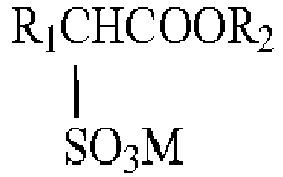
- Other surfactants suitable for use in preparing the present compositions include additional anionic surfactants, nonionic surfactants, zwitterionic surfactants, ampholytic surfactants, and cationic surfactants.
- Suitable nonionic surfactants include polyalkoxylated alkanolamides, which are generally of the following formula (IV):

- Further, suitable nonionic surfactants include alkoxylated fatty alcohols, alkoxylated fatty acid alkyl esters, fatty acid amides, alkoxylated fatty acid amides, polyhydroxy fatty acid amides, alkyl phenol polyglycol ethers, amine oxides, alkyl polyglucoside and mixtures thereof.
- In a preferred embodiment, the nonionic is an amine oxide, especially an alkyl amine oxide (R1R2R3NO). Among the alkyl amine oxides, dimethyl alkyl amine oxides are preferred. Here, R1 and R2 are methyl groups. R3 is an alkyl chain with a chain length of 10 to 16 C-atoms. Suitable compounds are for example obtainable under the tradename Dehyton TL from BASF SE, Germany.
- Alkoxylated, advantageously ethoxylated, in particular primary alcohols preferably with 8 to 18 carbon atoms and an average of 4 to 12 mol ethylene oxide (EO) per mol alcohol are preferably used as the nonionic surfactant, in which the alcohol moiety is linear or may preferably be methyl-branched in position 2 and/or may contain linear and methyl-branched moieties in the mixture such as how they are usually present in oxo alcohols radicals. In particular, however, alcohols ethoxylates with linear radicals from alcohols of native origin with 12 to 18 carbon atoms, for example, from coconut, palm and tallow fatty or oleyl alcohol and an average of 5 to 8 EO per mol alcohol are preferred in particular. The preferred ethoxylated alcohols include, for example, C12-14 alcohols with 4 EO or 7 EO, C9-11 alcohol with 7 EO, C13-15 alcohols with 5 EO, 7 EO or 8 EO, C12-18 alcohols with 5 EO or 7 EO and mixture thereof. The stated degrees of ethoxylation are statistical averages which may be a whole number or a fraction for a specific product. Preferred alcohol ethoxylates have a narrow homolog distribution (narrow range ethoxylates, NRE). In addition to these nonionic surfactants, fatty alcohols with more than 12 EO may also be used. Examples of these include tallow fatty alcohol with 14 EO, 25 EO, 30 EO or 40 EO. Nonionic surfactants containing EO and PO groups together in the molecule can also be used as contemplated herein. Also suitable is a mixture of a (more strongly) branch ethoxylated fatty alcohol and an unbranched ethoxylated fatty alcohol such as, for example, a mixture of a C16-18 fatty alcohol with 7 EO and 2-propylheptanol with 7 EO. In particular, preferably the first composition contains a C12-18 fatty alcohol with 7 EO, a C13-15 oxo alcohol with 7 EO and/or a C13-15 oxo alcohol with 8 EO as a nonionic surfactant.
- Other suitable nonionic surfactants include those containing an organic hydrophobic group and a hydrophilic group that is a reaction product of a solubilizing group (such as a carboxylate, hydroxyl, amido, or amino group) with an alkylating agent, such as ethylene oxide, propylene oxide, or a polyhydration product thereof (such as polyethylene glycol). Such nonionic surfactants include, for example, polyoxyalkylene alkyl ethers, polyoxyalkylene alkylphenyl ethers, polyoxyalkylene sorbitan fatty acid esters, polyoxyalkylene sorbitol fatty acid esters, polyalkylene glycol fatty acid esters, alkyl polyalkylene glycol fatty acid esters, polyoxyethylene polyoxypropylene alkyl ethers, polyoxyalkylene castor oils, polyoxyalkylene alkylamines, glycerol fatty acid esters, alkylglucosamides, alkylglucosides, and alkylamine oxides. In another embodiment, the composition is substantially free of nonylphenol nonionic surfactants. In this context, the term "substantially free" means less than about one weight percent.
- In some embodiments, the nonionic surfactant is an ethoxylated nonionic surfactant. In some embodiments, the ethoxylated nonionic surfactant is an aliphatic primary alcohol ethoxylate. In some embodiments, the ethoxylated nonionic surfactant is an aliphatic secondary alcohol ethoxylate. In some embodiments, the alcohol ethoxylates are the condensation products of an organic aliphatic or alkyl aromatic hydrophobic compound and hydrophilic ethylene oxide groups. The length of the polyetheneoxy chain can be adjusted to achieve the desired balance between the hydrophobic and hydrophilic elements. The nonionic surfactant class includes the condensation products of a higher alcohol (e.g., an alkanol containing 8 to 16 carbon atoms in a straight or branched chain configuration) condensed with 4 to 20 moles of ethylene oxide, for example, lauryl or myristyl alcohol condensed with 16 moles of ethylene oxide (EO), tridecanol condensed with 6 to moles of EO, myristyl alcohol condensed with 10 moles of EO per mole of myristyl alcohol, the condensation product of EO with a cut of coconut fatty alcohol containing a mixture of fatty alcohols with alkyl chains varying from 10 to 14 carbon atoms in length and wherein the condensate contains either 6 moles of EO per mole of total alcohol or 9 moles of EO per mole of alcohol, and tallow alcohol ethoxylates containing 6 EO to 11 EO per mole of alcohol.
- In some embodiments, the ethoxylated alcohol is a higher aliphatic, primary alcohol containing 9-15 carbon atoms, such as C9-C11 alkanol condensed with 4 to 10 moles of ethylene oxide, C12-C15 alkanol condensed with 12 moles ethylene oxide (for example, NEODOL 25-12 (Shell Chemicals, Netherlands)), C14-C15 alkanol condensed with 13 moles ethylene oxide (for example, NEODOL 45-13 (Shell Chemicals, Netherlands)), or a C12-C14 alkanol condensed with 2, 3, 4, 7, 9, or 10 moles of ethylene oxide. Ethoxylated alcohols containing 9-15 carbon atoms have an HLB (hydrophobic lipophilic balance) value of 8 to 15 and give good oil-in-water emulsification, whereas ethoxylated alcohols with HLB values below 7 contain less than 4 ethylene oxide groups and tend to be poor emulsifiers and poor detergents.
- Additional satisfactory water soluble alcohol ethylene oxide condensates are the condensation products of a secondary aliphatic alcohol containing 8 to 18 carbon atoms in a straight or branched chain configuration condensed with 5 to 30 moles of ethylene oxide. Examples of commercially available nonionic detergents of the foregoing type are C12-C14 secondary alkanol condensed with either 9 EO (TERGITOL™ 15-S-9 (Dow Chemical Company, Michigan, United States)) or 12 EO (TERGITOL™ 15-S-12 (Dow Chemical Company, Michigan, United States)).
- In some embodiments, the ethoxylated alcohol is a C12-C14 alkanol condensed with 7 moles of ethylene oxide. In some embodiments, the ethoxylated alcohol is a C12-C15 ethoxylated alcohol condensed with 7 moles of ethylene oxide. In some embodiments, the ethoxylated alcohol is NEODOL 25-7 (Shell Chemicals, Netherlands).
- Suitable zwitterionic surfactants can be broadly described as derivatives of secondary and tertiary amines, derivatives of heterocyclic secondary and tertiary amines, or derivatives of quaternary ammonium, quaternary phosphonium or tertiary sulfonium compounds, such as those disclosed in
U.S. Pat. No. 3,929,678 , which is incorporated by reference herein. - The composition according to the present invention may also comprise further ingredients such as for example pH stabilizing agents, perfumes, bleach stabilizers, and/or dyes. Respective compounds and maybe also other additives are known for the skilled person. Again, it is to be noted that no thickener is present and against all expectations it is nevertheless possible to obtain a bleach composition with high viscosity.
Claims (10)
- Viscous bleach composition having a viscosity of at least 10,000 mPas at 20 °C, said composition comprising at least one bleach compound in an amount from 0.3 % as to 1.7 % as,
at least two surfactants, said surfactants being selected from anionic surfactant, nonionic surfactant, zwitterionic surfactant, ampholytic surfactant, and cationic surfactant,
the total amount of surfactant being within the range of from 2 % as to 20 % as,
said composition being free of thickeners. - Bleach composition according to claim 1, wherein the amount of the bleach compound is from 0.5 % as to 1.5 % as, especially from 0.75 % as to 1.25 % as.
- Bleach composition according to any one of claims 1 or 2, wherein it comprises at least one anionic surfactant and at least non-ionic surfactant as surfactant.
- Bleach composition according to any of claims 1 to 3, wherein the amount of the anionic surfactant is within a range of from 1 % as to 10 % as, preferably from 2 % as to 8 % as, especially from 3 % as to 5 % as.
- Bleach composition according to any of claims 1 to 4, wherein the amount of the nonionic surfactant is within a range of from 1 % as to 10 % as, preferably from 2 % as to 8 % as, especially from 3 % as to 4 % as.
- Bleach composition according to any of claims 1 to 5, wherein the active bleach compound is selected from an alkali or earth alkali salt of hypochlorous acid, especially it is sodium hypochlorite.
- Bleach composition according to any of claims 1 to 6, wherein the at least one anionic surfactant is selected from alkyl ether sulphates of the general formula (I)
R'-O-(C2H4O)n-SO3M' (I)
wherein R' is a C8-C20 alkyl group, n is from 1 to 20, and M' is a salt-forming cation; preferably, R' is C10-C18 alkyl, n is from 1 to 15, and M' is sodium, potassium, ammonium, alkylammonium, or alkanolammonium. - Bleach composition according to any of claims 1 to 7, wherein the non-ionic surfactant is selected from the group consisting of polyalkoxylated alkanolamides, amine oxides, alkoxylated fatty alcohols, alkoxylated fatty acid alkyl esters, fatty acid amides, alkoxylated fatty acid amides, polyhydroxy fatty acid amides, alkyl phenol polyglycol ethers, alkyl polyglucoside and mixtures thereof, especially it is an alkyl amine oxide.
- Bleach composition according to any of claims 1 to 8, wherein the viscosity is at least 12,000 mPas at 20 °C.
- Bleach composition according to any of claims 1 to 9 further comprising one or more of the following ingredients: pH stabilizing agent, perfumes, bleach stabilizer, and/or dyes.
Priority Applications (1)
| Application Number | Priority Date | Filing Date | Title |
|---|---|---|---|
| EP19176014.9A EP3741835A1 (en) | 2019-05-22 | 2019-05-22 | Highly viscous bleach gel |
Applications Claiming Priority (1)
| Application Number | Priority Date | Filing Date | Title |
|---|---|---|---|
| EP19176014.9A EP3741835A1 (en) | 2019-05-22 | 2019-05-22 | Highly viscous bleach gel |
Publications (1)
| Publication Number | Publication Date |
|---|---|
| EP3741835A1 true EP3741835A1 (en) | 2020-11-25 |
Family
ID=66630280
Family Applications (1)
| Application Number | Title | Priority Date | Filing Date |
|---|---|---|---|
| EP19176014.9A Withdrawn EP3741835A1 (en) | 2019-05-22 | 2019-05-22 | Highly viscous bleach gel |
Country Status (1)
| Country | Link |
|---|---|
| EP (1) | EP3741835A1 (en) |
Citations (4)
| Publication number | Priority date | Publication date | Assignee | Title |
|---|---|---|---|---|
| US3929678A (en) | 1974-08-01 | 1975-12-30 | Procter & Gamble | Detergent composition having enhanced particulate soil removal performance |
| US5688756A (en) * | 1993-07-27 | 1997-11-18 | The Clorox Company | Gelled hypochlorite-based cleaner |
| US5703036A (en) * | 1993-09-20 | 1997-12-30 | The Procter & Gamble Company | Thickened aqueous detergent compositions with improved cleaning performance |
| US20080255017A1 (en) * | 2004-11-23 | 2008-10-16 | Johannes Dettinger | Adhesive Agent For Sanitary Cleaning And Deodorization |
-
2019
- 2019-05-22 EP EP19176014.9A patent/EP3741835A1/en not_active Withdrawn
Patent Citations (4)
| Publication number | Priority date | Publication date | Assignee | Title |
|---|---|---|---|---|
| US3929678A (en) | 1974-08-01 | 1975-12-30 | Procter & Gamble | Detergent composition having enhanced particulate soil removal performance |
| US5688756A (en) * | 1993-07-27 | 1997-11-18 | The Clorox Company | Gelled hypochlorite-based cleaner |
| US5703036A (en) * | 1993-09-20 | 1997-12-30 | The Procter & Gamble Company | Thickened aqueous detergent compositions with improved cleaning performance |
| US20080255017A1 (en) * | 2004-11-23 | 2008-10-16 | Johannes Dettinger | Adhesive Agent For Sanitary Cleaning And Deodorization |
Similar Documents
| Publication | Publication Date | Title |
|---|---|---|
| EP2297287B1 (en) | Liquid cleaning compositions and manufacture | |
| US6440924B1 (en) | Aqueous multiphase detergents with immiscible phases | |
| US6043203A (en) | Compositions based on APG and ester quat surfactants | |
| ES2424871T3 (en) | Surfactant composition | |
| US10544383B2 (en) | Dishwashing detergent composition comprising a branched anionic/amine oxide surfactant mixture | |
| JP2023530130A (en) | Reduced Glycol Fatty Alcohol Ethoxylates and Reduced Glycol Sulfate Ethoxylated Surfactants | |
| US20150164756A1 (en) | Surfactant Solutions Containing N-Methyl-N-C8-C10-Acylglucamines And N-Methyl-N-C12-C14-Acylglucamines | |
| WO2013054635A1 (en) | Composition for dishwashing liquid for cleaning hands | |
| DE60211300T2 (en) | IMPROVEMENTS IN LIQUID DETERGENTS | |
| MXPA02003127A (en) | Acidic light duty liquid cleaning compositions. | |
| JP6549383B2 (en) | Dishwashing composition for hand washing | |
| US4476045A (en) | Surfactant | |
| US6495507B1 (en) | High foaming, grease cutting light duty liquid detergent | |
| JP2016147928A (en) | Dishwashing composition for hand washing | |
| CA1210662A (en) | Anionic nonionic surfactant mixture | |
| EP3741835A1 (en) | Highly viscous bleach gel | |
| US4983323A (en) | Surfactant compositions | |
| US4476043A (en) | Surfactant product | |
| US5847183A (en) | Fatty alcohol (ether) sulfates with improved low-temperature behavior | |
| DE10131721C1 (en) | Quickly soluble cleaning gel | |
| US6184194B1 (en) | High foaming, grease cutting light duty liquid detergent having antibacterial properties comprising proton donating agent | |
| SE437381B (en) | Aqueous liquid detergent composition and process for its preparation | |
| JP6549379B2 (en) | Dishwashing composition for hand washing | |
| US6180579B1 (en) | High foaming, grease cutting light duty liquid detergent comprising ether carboxylates and amine oxides | |
| DE10063427A1 (en) | Liquid cleaning composition, especially for hard surfaces, comprises amphoteric polymer, antibacterial agent, nonionic surfactant and solvent |
Legal Events
| Date | Code | Title | Description |
|---|---|---|---|
| PUAI | Public reference made under article 153(3) epc to a published international application that has entered the european phase |
Free format text: ORIGINAL CODE: 0009012 |
|
| AK | Designated contracting states |
Kind code of ref document: A1 Designated state(s): AL AT BE BG CH CY CZ DE DK EE ES FI FR GB GR HR HU IE IS IT LI LT LU LV MC MK MT NL NO PL PT RO RS SE SI SK SM TR |
|
| AX | Request for extension of the european patent |
Extension state: BA ME |
|
| STAA | Information on the status of an ep patent application or granted ep patent |
Free format text: STATUS: THE APPLICATION HAS BEEN WITHDRAWN |
|
| 18W | Application withdrawn |
Effective date: 20201207 |