EP3741724A1 - Microbeads and preparation method therefor - Google Patents
Microbeads and preparation method therefor Download PDFInfo
- Publication number
- EP3741724A1 EP3741724A1 EP19875170.3A EP19875170A EP3741724A1 EP 3741724 A1 EP3741724 A1 EP 3741724A1 EP 19875170 A EP19875170 A EP 19875170A EP 3741724 A1 EP3741724 A1 EP 3741724A1
- Authority
- EP
- European Patent Office
- Prior art keywords
- microbeads
- sample
- acid
- conjugate
- controlling
- Prior art date
- Legal status (The legal status is an assumption and is not a legal conclusion. Google has not performed a legal analysis and makes no representation as to the accuracy of the status listed.)
- Granted
Links
Images

Classifications
-
- C—CHEMISTRY; METALLURGY
- C03—GLASS; MINERAL OR SLAG WOOL
- C03C—CHEMICAL COMPOSITION OF GLASSES, GLAZES OR VITREOUS ENAMELS; SURFACE TREATMENT OF GLASS; SURFACE TREATMENT OF FIBRES OR FILAMENTS MADE FROM GLASS, MINERALS OR SLAGS; JOINING GLASS TO GLASS OR OTHER MATERIALS
- C03C12/00—Powdered glass; Bead compositions
-
- G—PHYSICS
- G01—MEASURING; TESTING
- G01N—INVESTIGATING OR ANALYSING MATERIALS BY DETERMINING THEIR CHEMICAL OR PHYSICAL PROPERTIES
- G01N1/00—Sampling; Preparing specimens for investigation
- G01N1/28—Preparing specimens for investigation including physical details of (bio-)chemical methods covered elsewhere, e.g. G01N33/50, C12Q
-
- C—CHEMISTRY; METALLURGY
- C01—INORGANIC CHEMISTRY
- C01B—NON-METALLIC ELEMENTS; COMPOUNDS THEREOF; METALLOIDS OR COMPOUNDS THEREOF NOT COVERED BY SUBCLASS C01C
- C01B33/00—Silicon; Compounds thereof
- C01B33/113—Silicon oxides; Hydrates thereof
- C01B33/12—Silica; Hydrates thereof, e.g. lepidoic silicic acid
- C01B33/18—Preparation of finely divided silica neither in sol nor in gel form; After-treatment thereof
-
- B—PERFORMING OPERATIONS; TRANSPORTING
- B01—PHYSICAL OR CHEMICAL PROCESSES OR APPARATUS IN GENERAL
- B01J—CHEMICAL OR PHYSICAL PROCESSES, e.g. CATALYSIS OR COLLOID CHEMISTRY; THEIR RELEVANT APPARATUS
- B01J19/00—Chemical, physical or physico-chemical processes in general; Their relevant apparatus
- B01J19/0086—Processes carried out with a view to control or to change the pH-value; Applications of buffer salts; Neutralisation reactions
-
- C—CHEMISTRY; METALLURGY
- C01—INORGANIC CHEMISTRY
- C01P—INDEXING SCHEME RELATING TO STRUCTURAL AND PHYSICAL ASPECTS OF SOLID INORGANIC COMPOUNDS
- C01P2004/00—Particle morphology
- C01P2004/60—Particles characterised by their size
Definitions
- the present invention relates to microbeads which enables to adjust pH of a sample, and to microbeads that can easily adjust pH of a sample by passing the sample through microbeads controlled to a desired pH.
- an acid or base solution is added to a sample, pH value of the sample is measured by a pH meter or a pH paper sensor, and optimization is carried out to reach a desired pH value.
- the present invention provides microbeads having conjugated acid and conjugate base adsorbed onto Si-OH groups on the surface of the microbeads by electrostatic interaction.
- the microbeads may be used for controlling the pH value of the sample.
- the microbeads may have a specific pH selected from pH 1 to 13.
- the microbeads may be silica-based glass microbeads.
- the average diameter of the microbeads may be 100 to 300 ⁇ m.
- the present invention provides a method for manufacturing the microbeads, comprising the steps of:
- the volatilizing the solvent may be performed in an inert gas atmosphere at 40 to 70 °C.
- the inert gas may comprise at least one selected from the group consisting of nitrogen, argon and helium.
- bead may be used interchangeably with “beads” unless otherwise stated. Also, unless stated otherwise, the singular expression of a term may be understood to include the plural expression of the term, and the plural expression of the term may be understood to include the singular expression of the term.
- the expression “to” is used as an expression including a corresponding numerical value. Specifically, for example, the expression “1 to 2” means not only including 1 and 2, but also including all values between 1 and 2.
- the present invention provides a method for manufacturing the microbeads, comprising the steps of:
- the sample can be adjusted to the desired pH by passing the sample through the microbeads prepared as described above.
- the sample may be a neutral sample, for example, may be a sample having a value of pH 6.8 to 7.9, for example pH 7.
- the volatilizing the solvent may be carried out in an inert gas atmosphere at 40 to 70 °C, for example 50 °C.
- the inert gas may include, for example, one or more selected from the group consisting of nitrogen, argon, and helium, and for example, nitrogen gas (N 2 ) may be used. It is also possible to volatilize the solvent under reduced pressure during such inert gas purge.
- the solvent is not particularly limited as long as it is a substance that dissolves each substance well according to the type of conjugate acid and conjugate base, for example, it may include distilled water, deionized water and the like.
- the buffer solution may have a specific pH selected from pH 1 to 13, and the microbead may be controlled to have a specific pH selected from pH 1 to 13, depending on the respective buffer solution.
- the microbeads may be immersed in a buffer solution having a specific pH selected from pH 1 to 13 to cause the microbeads to have pH that is the same as or similar to or close to that of the buffer solution.
- the microbeads may include, for example, silica-based microbeads, and specifically, for example, silica-based glass microbeads.
- the microbeads may have salts coated well on the surface during the manufacturing process and may have OH-groups on the surface so that the salts coated on the surface of the microbead can be eluted into the sample when the sample passes through the microbeads. That is, the conjugate acid and the conjugate base contained in the buffer solution are adsorbed onto the Si-OH group on the surface of the microbead by the electrostatic interaction, so that the conjugate acid and the conjugate base can be eluted when the sample passes through the beads.
- the microbeads to be used in the present invention can serve as a support in the buffer solution, and can be used without particular limitation as long as all components in the buffer solution are well adsorbed.
- the microbead having a porous structure it may facilitate adjusting pH of a larger volume of sample due to its large surface area.
- the average diameter of the microbead is not particularly limited, and may be, for example, 100 to 300 ⁇ m, for example, 150 to 210 ⁇ m.
- a schematic diagram of the microbeads with controlled pH is shown in Fig. 1 .
- the buffer solution can be prepared for each desired pH concentration by using conjugate acid and conjugate base compound reagents as shown in Table 1.
- Table 1 Hydrochloric acid/ Potassium chloride Glycine/ Hydrochloric acid Potassium hydrogen phthalate/ Hydrochloric acid Citric acid/ Sodium citrate Sodium acetate/ Acetic acid Potassium hydrogen phtaalate/ Sodium hydroxide Disodium hydrogen phthalate / Sodium dihydrogen orthophospate Dipotassium hydrogen phthalate / Potassium dlhydrogen orthophospate Potassium dlhydrogen orthophosphate / sodium hydroxide Barbitone sodium / Hydrochloric add Tris (hydroxylmethyl) aminomethane / Hydrochloric acid Sodium tetraborate/ Hydrochloric acid Glycine/ Sodium hydroxide Sodium carbonate/ Sodium hydrogen carbonate Sodium tetraborate/ Sodium hydroxide Sodium bicarbonate / Sodium hydroxide Sodium hydroxide
- all components in the pH buffer solution may be adsorbed onto the microbeads.
- the pH of the microbeads may be determined according to the composition ratio of all components of the substance except for the solvent component in each pH buffer solution, for example according to the composition ratio of the compound in Table 1 below.
- potassium hydrogen phthalate/hydrochloric acid potassium hydrogen phthalate is used as weak acid and hydrochloric acid is used as strong acid.
- concentrations of hydrogen ion from potassium hydrogen phthalate and conjugate base are determined depending on the amount of a strong acid, hydrochloric acid to be added, thereby adjusting the pH.
- the pH of the sample can be adjusted more simply and economically by providing a device containing the above-described microbeads.
- the device containing microbeads according to the present invention may have an inlet 10 through which a sample is injected, a channel 20 through which a pH of the injected sample is adjusted, and an outlet 30 through which the sample with the adjusted pH is discharged. It is shown as an example in Fig. 2 .
- the device as shown in Fig. 2 may be provided in plurality, and each device may be filled with microbeads having different pH, thereby providing a device capable of controlling pH of the sample in multiple.
- a sample may be injected into one integrated injection part, the injected sample may be simultaneously passed through a plurality of channels, respectively, and adjusted to a desired pH by pH-controlled microbeads included in each channel, and it may be discharged through each of the outlets.
- pH-controlled microbeads included in each channel may be discharged through each of the outlets.
- Buffer solutions of pH 1 to 13 were prepared as shown in Table 2.
- pH Description 1 50 ml (0.2 M KCl) + 134 mL (0.2 M HCl) 2 100mL (0.1M KH2PO4) + 99.0mL (0.1M HCl) 3 100mL (0.1M KH2PO4) + 44.6mL (0.1 M HCl) 4 100mL (0.1M KH2PO4) + 0.2mL (0.1 M HCl) 5 100mL (0.1M KH2PO4) + 4.5mL (0.1M NaOH) 6 100mL (0.1M KH2PO4) + 11.2mL (0.1M NaOH) 7 100mL (0.1M KH2PO4) + 58.2mL (0.1 M NaOH) 8 100mL (0.1M KH2PO4) + 93.4mL (0.1M NaOH) 9 100 mL (0.025 M Na2B4O7.10H2O) + 9.2mL (0.1 M HCl) 10 100 mL (0.025 M Na
- microbeads having respective pH concentrations.
- the microbeads according to Examples and Comparative Examples were prepared with varying the temperature at which the solvent component was volatilized. Specifically, the microbeads according to Comparative Example 1 were prepared at room temperature, the microbeads according to Example 1 were prepared at 50 °C, and the microbeads according to Comparative Example 2 were prepared at 90 °C.
- the pH of the sample was measured after calibration of pH of the pH measuring instrument (S220 SevenCompactTM pH/lon (METTLER TOLEDO)) by using a sample of pH 4, 6, 9 and 10 as a reference standard solution. After passing 2 mL of the sample through each of pH-controlled microbeads, the pH of the sample was measured. The results are shown in Table 3.
Landscapes
- Chemical & Material Sciences (AREA)
- Organic Chemistry (AREA)
- Inorganic Chemistry (AREA)
- Life Sciences & Earth Sciences (AREA)
- Chemical Kinetics & Catalysis (AREA)
- General Physics & Mathematics (AREA)
- Health & Medical Sciences (AREA)
- Analytical Chemistry (AREA)
- Biochemistry (AREA)
- General Health & Medical Sciences (AREA)
- Physics & Mathematics (AREA)
- Immunology (AREA)
- Pathology (AREA)
- General Chemical & Material Sciences (AREA)
- Engineering & Computer Science (AREA)
- Geochemistry & Mineralogy (AREA)
- Materials Engineering (AREA)
- Measuring Or Testing Involving Enzymes Or Micro-Organisms (AREA)
- Silicon Compounds (AREA)
- Sampling And Sample Adjustment (AREA)
- Solid-Sorbent Or Filter-Aiding Compositions (AREA)
- Treatment Of Liquids With Adsorbents In General (AREA)
Abstract
Description
- The present invention relates to microbeads which enables to adjust pH of a sample, and to microbeads that can easily adjust pH of a sample by passing the sample through microbeads controlled to a desired pH.
- In general, in order to adjust pH, an acid or base solution is added to a sample, pH value of the sample is measured by a pH meter or a pH paper sensor, and optimization is carried out to reach a desired pH value.
- However, such series of processes in the prior art are not economical because they have disadvantages of being labor intensive and time consuming. In addition, the conventional automatic pH control system requires a lot of time and money to automate by a valve system the process of observing pH of the sample in real time through the electrochemical system by adding acid or base continuously.
- Therefore, there is a need for materials and methods that can adjust the pH in a simple and economic way.
- It is an object of the present invention to provide microbeads which allow for simple and rapid adjustment of a sample to a desired specific pH.
- In order to solve the above problems, the present invention provides microbeads having conjugated acid and conjugate base adsorbed onto Si-OH groups on the surface of the microbeads by electrostatic interaction.
- The microbeads may be used for controlling the pH value of the sample.
- According to one embodiment, the microbeads may have a specific pH selected from
pH 1 to 13. - According to one embodiment, the microbeads may be silica-based glass microbeads.
- According to one embodiment, the average diameter of the microbeads may be 100 to 300 µm.
- According to other embodiment, the present invention provides a method for manufacturing the microbeads, comprising the steps of:
- immersing the microbeads in a buffer solution containing conjugate acid and conjugate base to cause the conjugate acid and conjugate base components to be adsorbed onto the microbeads; and
- the solvent to prepare microbeads with controlled pH.
- According to one embodiment, the volatilizing the solvent may be performed in an inert gas atmosphere at 40 to 70 °C.
- In addition, the inert gas may comprise at least one selected from the group consisting of nitrogen, argon and helium.
- According to another embodiment of the present invention, it is possible to provide a device for controlling pH value of a sample, containing the microbeads.
- According to still other embodiment of the present invention, it is possible to provide a pH adjusting system for controlling pH value of a sample, containing the microbeads.
- Other specific details of embodiments of the present invention are included in the following detailed description.
- According to the present invention, it is possible to control a sample to a desired pH in a simple and easy way without the need for an automated device such as an additional valve system for pH adjustment. Therefore, it is possible to save time and money and apply to various fields usefully.
-
-
Fig. 1 is a schematic diagram showing the microbeads. -
Fig. 2 is a schematic diagram of the device according to an embodiment of the present invention. -
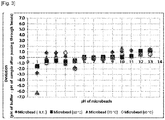
Fig. 3 is a graph showing the relationship between deviation of the result values and pH of the microbeads. - Since various modifications and variations can be made in the present invention, particular embodiments are illustrated in the drawings and will be described in detail in the detailed description. It should be understood, however, that the invention is not intended to be limited to the particular embodiments, but includes all modifications, equivalents, and alternatives falling within the spirit and scope of the invention. In the following description of the present invention, detailed description of known functions will be omitted if it is determined that it may obscure the gist of the present invention.
- As used herein, the term "bead" may be used interchangeably with "beads" unless otherwise stated. Also, unless stated otherwise, the singular expression of a term may be understood to include the plural expression of the term, and the plural expression of the term may be understood to include the singular expression of the term.
- Unless stated otherwise in the present specification, the expression "to" is used as an expression including a corresponding numerical value. Specifically, for example, the expression "1 to 2" means not only including 1 and 2, but also including all values between 1 and 2.
- Hereinafter, the microbeads and the preparation method thereof according to the embodiment of the present invention will be described in more detail.
- The present invention provides a method for manufacturing the microbeads, comprising the steps of:
- immersing the microbeads in a buffer solution containing conjugate acid and conjugate base to cause the conjugate acid and conjugate base components to be adsorbed onto the microbeads; and
- volatilizing the solvent to prepare microbeads with controlled pH.
- The sample can be adjusted to the desired pH by passing the sample through the microbeads prepared as described above.
- According to one embodiment, the sample may be a neutral sample, for example, may be a sample having a value of pH 6.8 to 7.9, for example pH 7.
- According to one embodiment, the volatilizing the solvent may be carried out in an inert gas atmosphere at 40 to 70 °C, for example 50 °C. The inert gas may include, for example, one or more selected from the group consisting of nitrogen, argon, and helium, and for example, nitrogen gas (N2) may be used. It is also possible to volatilize the solvent under reduced pressure during such inert gas purge.
- According to one embodiment, the solvent is not particularly limited as long as it is a substance that dissolves each substance well according to the type of conjugate acid and conjugate base, for example, it may include distilled water, deionized water and the like.
- According to one embodiment, the buffer solution may have a specific pH selected from
pH 1 to 13, and the microbead may be controlled to have a specific pH selected frompH 1 to 13, depending on the respective buffer solution. Specifically, the microbeads may be immersed in a buffer solution having a specific pH selected frompH 1 to 13 to cause the microbeads to have pH that is the same as or similar to or close to that of the buffer solution. - According to one embodiment, the microbeads may include, for example, silica-based microbeads, and specifically, for example, silica-based glass microbeads. The microbeads may have salts coated well on the surface during the manufacturing process and may have OH-groups on the surface so that the salts coated on the surface of the microbead can be eluted into the sample when the sample passes through the microbeads. That is, the conjugate acid and the conjugate base contained in the buffer solution are adsorbed onto the Si-OH group on the surface of the microbead by the electrostatic interaction, so that the conjugate acid and the conjugate base can be eluted when the sample passes through the beads. As such, the microbeads to be used in the present invention can serve as a support in the buffer solution, and can be used without particular limitation as long as all components in the buffer solution are well adsorbed. In the case the microbead having a porous structure, it may facilitate adjusting pH of a larger volume of sample due to its large surface area. In addition, the average diameter of the microbead is not particularly limited, and may be, for example, 100 to 300 µm, for example, 150 to 210 µm. As described above, a schematic diagram of the microbeads with controlled pH is shown in
Fig. 1 . - According to one embodiment, the buffer solution can be prepared for each desired pH concentration by using conjugate acid and conjugate base compound reagents as shown in Table 1.
[Table 1] Hydrochloric acid/ Potassium chloride Glycine/ Hydrochloric acid Potassium hydrogen phthalate/ Hydrochloric acid Citric acid/ Sodium citrate Sodium acetate/ Acetic acid Potassium hydrogen phtaalate/ Sodium hydroxide Disodium hydrogen phthalate / Sodium dihydrogen orthophospate Dipotassium hydrogen phthalate / Potassium dlhydrogen orthophospate Potassium dlhydrogen orthophosphate / sodium hydroxide Barbitone sodium / Hydrochloric add Tris (hydroxylmethyl) aminomethane / Hydrochloric acid Sodium tetraborate/ Hydrochloric acid Glycine/ Sodium hydroxide Sodium carbonate/ Sodium hydrogen carbonate Sodium tetraborate/ Sodium hydroxide Sodium bicarbonate / Sodium hydroxide Sodium hydrogen orthophosphate / Sodium hydroxide Potassium chloride/ Sodium hydroxide - More specifically, a buffer solution having a desired pH may be prepared by adjusting a ratio of conjugate base and acid according to the Henderson-Hasselbach equation of the following equation 1:

- In other words, the buffer solution having more than pH 0 and less than
pH 14 or frompH 1 topH 13 may be prepared by a reagent combination of weak acid/strong acid, acid/base, acid/conjugate base, weak base/strong base or salt/base. In general, an acid/base reagent combination and a corresponding composition ratio thereof may be used to prepare buffers with varying pH values. However, a weak acid/strong acid reagent combination may be used primarily to prepare acidic buffer solutions ofpH 2 to pH 4, and a weak base/strong base reagent combination may be used primarily to prepare basic buffer solutions of pH 9 topH 11, for example. - In addition, all components in the pH buffer solution may be adsorbed onto the microbeads. At this time, the pH of the microbeads may be determined according to the composition ratio of all components of the substance except for the solvent component in each pH buffer solution, for example according to the composition ratio of the compound in Table 1 below. When the sample passes through the microbeads prepared as described above, salts adsorbed on the microbeads are eluted to change pH of the sample, thereby controlling the sample to have a desired pH.
- For example, in Table 1, in the case of potassium hydrogen phthalate/hydrochloric acid, potassium hydrogen phthalate is used as weak acid and hydrochloric acid is used as strong acid. The concentrations of hydrogen ion from potassium hydrogen phthalate and conjugate base are determined depending on the amount of a strong acid, hydrochloric acid to be added, thereby adjusting the pH.
- According to other embodiment of the present invention, the pH of the sample can be adjusted more simply and economically by providing a device containing the above-described microbeads. The device containing microbeads according to the present invention may have an
inlet 10 through which a sample is injected, achannel 20 through which a pH of the injected sample is adjusted, and anoutlet 30 through which the sample with the adjusted pH is discharged. It is shown as an example inFig. 2 . In addition, for example, the device as shown inFig. 2 may be provided in plurality, and each device may be filled with microbeads having different pH, thereby providing a device capable of controlling pH of the sample in multiple. Specifically, for example, a sample may be injected into one integrated injection part, the injected sample may be simultaneously passed through a plurality of channels, respectively, and adjusted to a desired pH by pH-controlled microbeads included in each channel, and it may be discharged through each of the outlets. Such a device is more efficient because the pH of the sample can be adjusted concurrently to save time and effort. - In addition, according to another embodiment, it is possible to provide a pH adjusting system applying the above principle.
- Hereinafter, embodiments of the present invention will be described in detail so that those skilled in the art can easily carry out the present invention. The present invention may, however, be embodied in many different forms and should not be construed as limited to the embodiments set forth herein.
- Buffer solutions of
pH 1 to 13 were prepared as shown in Table 2.[Table 2] pH Description 1 50 ml (0.2 M KCl) + 134 mL (0.2 M HCl) 2 100mL (0.1M KH2PO4) + 99.0mL (0.1M HCl) 3 100mL (0.1M KH2PO4) + 44.6mL (0.1 M HCl) 4 100mL (0.1M KH2PO4) + 0.2mL (0.1 M HCl) 5 100mL (0.1M KH2PO4) + 4.5mL (0.1M NaOH) 6 100mL (0.1M KH2PO4) + 11.2mL (0.1M NaOH) 7 100mL (0.1M KH2PO4) + 58.2mL (0.1 M NaOH) 8 100mL (0.1M KH2PO4) + 93.4mL (0.1M NaOH) 9 100 mL (0.025 M Na2B4O7.10H2O) + 9.2mL (0.1 M HCl) 10 100 mL (0.025 M Na284O7.10H2O) + 36.6mL (0.1 M NaOH) 11 100 mL (0.05 M NaHCO3) + 45.4mL (0.1 M NaOH) 12 100 mL (0.05 M Na2HPO4) + 53.8 mL (0.1 M NaOH) 13 50 mL (0.2 M KCl) + 132 mL (0.2 M NaOH) - To prepare pH-controlled microbeads, 200 mg of silica-based glass microbeads (average particle size 150-210 µm) were incubated in 5 mL of each buffer solution according to the above preparation example. Thereafter, the solvent component was volatilized under a nitrogen gas (N2) atmosphere to prepare microbeads having respective pH concentrations. The microbeads according to Examples and Comparative Examples were prepared with varying the temperature at which the solvent component was volatilized. Specifically, the microbeads according to Comparative Example 1 were prepared at room temperature, the microbeads according to Example 1 were prepared at 50 °C, and the microbeads according to Comparative Example 2 were prepared at 90 °C.
- The pH of the sample was measured after calibration of pH of the pH measuring instrument (S220 SevenCompact™ pH/lon (METTLER TOLEDO)) by using a sample of
pH 4, 6, 9 and 10 as a reference standard solution. After passing 2 mL of the sample through each of pH-controlled microbeads, the pH of the sample was measured. The results are shown in Table 3.[Table 3] pH of beads pH of sample before passing through beads Comparative Example 1 (R.T.) Example 1 (50 °C) Comparative Example 2 (90 °C) pH of sample after passing through beads Deviation pH of sample after passing through beads Deviation pH of sample after passing through beads Deviation 1 7.7 3.7 -2.7 2.5 -1.5 8.2 -7.2 2 7.7 1.1 0.9 2.6 -0.6 2.9 -0.9 3 7.7 2.1 0.9 3.5 -0.5 3 0 4 7.7 3.8 0.2 4.7 -0.7 3.1 0.9 5 7.7 6.8 -1.8 5.5 -0.5 6.9 -1.9 6 7.7 6 0 5.9 0.1 6 0 7 7.7 7.1 -0.1 7 0 7.1 -0.1 8 7.7 8.2 -0.2 7.9 0.1 8.2 -0.2 9 7.7 8 1 8.9 0.1 9 0 10 7.7 8.9 1.1 9.9 0.1 9.4 0.6 11 7.7 9.7 1.3 10.7 0.3 - - 12 7.7 10.8 1.2 10.8 1.2 11.4 0.6 13 7.7 11.7 1.3 11.7 1.3 12.4 0.6 - The results according to Table 3 are shown in
Fig. 3 . As shown in Table 3 andFig. 3 , it can be seen that there is a difference in the results of using each microbead depending on the change of temperature in the manufacturing process. In particular, it can be seen that the pH deviation of the sample is the smallest when using the beads according to Example 1, whereas the deviation increases significantly when using the beads according to Comparative Examples 1 and 2. - While the present invention has been particularly shown and described with reference to specific embodiments thereof, it will be apparent to those skilled in the art that this specific description is merely a preferred embodiment and that the scope of the invention is not limited thereby. It is therefore intended that the scope of the invention be defined by the claims appended hereto and their equivalents.
Claims (10)
- Microbeads having conjugated acid and conjugate base adsorbed onto Si-OH groups present on a surface of the microbeads by electrostatic interaction.
- Microbeads according to claim 1, wherein the microbeads are used for controlling pH value of a sample.
- The microbeads according to claim 1, wherein the microbeads have a specific pH of 1 to 13.
- The microbeads according to claim 1, wherein the microbeads are silica-based glass microbeads.
- The microbeads according to claim 1, wherein an average diameter of the microbeads is 100 to 300 µm.
- A method for manufacturing the microbeads of claim 1, comprising the steps of:immersing microbeads in a buffer solution containing conjugate acid and conjugate base to cause the conjugate acid and conjugate base components to be adsorbed onto microbeads; andvolatilizing the solvent to prepare microbeads with controlled pH.
- The method for manufacturing the microbeads according to claim 6, wherein the volatilizing the solvent is performed in an inert gas atmosphere at 40 to 70 °C.
- The method for manufacturing the microbeads according to claim 7, wherein the inert gas comprises at least one selected from the group consisting of nitrogen, argon and helium.
- A device for controlling pH value of a sample, containing the microbeads of claim 1.
- A pH adjusting system for controlling pH value of a sample, containing the microbeads of claim 1.
Applications Claiming Priority (3)
| Application Number | Priority Date | Filing Date | Title |
|---|---|---|---|
| KR20180125755 | 2018-10-22 | ||
| KR1020190130775A KR102451333B1 (en) | 2018-10-22 | 2019-10-21 | Microbeads and preparation method thereof |
| PCT/KR2019/013875 WO2020085757A1 (en) | 2018-10-22 | 2019-10-22 | Microbeads and preparation method therefor |
Publications (3)
| Publication Number | Publication Date |
|---|---|
| EP3741724A1 true EP3741724A1 (en) | 2020-11-25 |
| EP3741724A4 EP3741724A4 (en) | 2021-03-31 |
| EP3741724B1 EP3741724B1 (en) | 2023-08-23 |
Family
ID=70732773
Family Applications (1)
| Application Number | Title | Priority Date | Filing Date |
|---|---|---|---|
| EP19875170.3A Active EP3741724B1 (en) | 2018-10-22 | 2019-10-22 | Microbeads and preparation method therefor |
Country Status (5)
| Country | Link |
|---|---|
| US (1) | US12529628B2 (en) |
| EP (1) | EP3741724B1 (en) |
| JP (1) | JP7048023B2 (en) |
| KR (1) | KR102451333B1 (en) |
| CN (1) | CN111757849B (en) |
Family Cites Families (34)
| Publication number | Priority date | Publication date | Assignee | Title |
|---|---|---|---|---|
| JPS517750B2 (en) * | 1973-11-13 | 1976-03-10 | ||
| JPH01188445A (en) * | 1988-01-25 | 1989-07-27 | Nippon Sheet Glass Co Ltd | Preventing method for glass yellowing |
| US6221363B1 (en) * | 1991-07-11 | 2001-04-24 | Baxter Aktiengesellschaft | Vaccine for the prevention of lyme disease |
| JPH08338842A (en) * | 1995-06-12 | 1996-12-24 | Tokuyama Corp | Method for producing syphilis antigen |
| AU2001265419B2 (en) | 2000-06-02 | 2007-03-01 | Cytometry Applications, Inc. | No wash bead assay, kit and procedure |
| US7279119B2 (en) * | 2001-06-14 | 2007-10-09 | Ppg Industries Ohio, Inc. | Silica and silica-based slurry |
| JP2003201112A (en) | 2001-12-28 | 2003-07-15 | Nippon Aerosil Co Ltd | Surface modified silica powder and its silica slurry |
| WO2006039507A2 (en) | 2004-10-01 | 2006-04-13 | Phenomenex, Inc. | Ph stable chromatographic media using templated multilayer organic/inorganic grafting |
| DE102004057997A1 (en) | 2004-12-01 | 2006-06-08 | Wacker Chemie Ag | Metal oxides with a permanent positive surface charge over a wide pH range |
| GB0510354D0 (en) | 2005-05-20 | 2005-06-29 | Imp College Innovations Ltd | Method of spectroscopy |
| US20070191571A1 (en) * | 2006-02-14 | 2007-08-16 | Sink Chester W | Resol beads, methods of making them, and methods of using them |
| JP5137491B2 (en) | 2007-08-09 | 2013-02-06 | デンカ生研株式会社 | Method for modifying adsorbability and / or elution of aluminum hydroxide adsorbent |
| KR100876657B1 (en) | 2007-10-15 | 2009-01-07 | 한국기계연구원 | Manufacturing Method of Surface-Modified Microbeads and Microbead Array Chips and Identification of Disease Specific Antigens Using Microbead Array Chips |
| KR101208930B1 (en) * | 2009-10-16 | 2012-12-07 | 가천대학교 산학협력단 | High Sensitive Biochip and Method for Detection of Nucleic Acid Using the Same |
| US20130130917A1 (en) * | 2011-01-13 | 2013-05-23 | Halgen Corporation | Method for specific enrichment of nucleic acid sequences |
| CN102350319B (en) * | 2011-07-15 | 2013-05-08 | 江苏大学 | Preparation method of fly ash superbead magnetic composite material surface imprinting adsorbent |
| JP6006326B2 (en) | 2012-01-18 | 2016-10-12 | エルジー・ケム・リミテッド | Latex composition for dip molding |
| JP2015514425A (en) * | 2012-04-17 | 2015-05-21 | リージェンツ オブ ザ ユニバーシティ オブ ミネソタ | Inlet and outlet geometry for vertical three-stream microfluidic devices |
| IN2015DN02055A (en) * | 2012-09-17 | 2015-08-14 | Grace W R & Co | |
| KR101528197B1 (en) | 2013-07-29 | 2015-06-15 | 서강대학교산학협력단 | pH-responsive Mesoporous Silica Nanoparticle Coated with Chitosan |
| JP6305007B2 (en) | 2013-10-18 | 2018-04-04 | 新日鉄住金マテリアルズ株式会社 | Spherical amorphous silica particles, method for producing the same, and resin composition containing the same |
| US9469660B2 (en) * | 2014-06-03 | 2016-10-18 | International Business Machines Corporation | Sulfur scavenging materials comprising hexahydrotriazine-modified particle |
| CN104655754B (en) * | 2015-02-11 | 2017-01-18 | 华东理工大学 | Secondary ion-change device and ion-change chromatograph and detection system with same |
| AU2016334203A1 (en) | 2015-10-05 | 2018-03-15 | M. Technique Co., Ltd. | Metal oxide particles and method for producing same |
| KR101613403B1 (en) | 2015-12-18 | 2016-04-19 | 주식회사 에이치제이메디칼 | Drug delivery system by Gelatin Sponge or Gelatin microsphere and Drug delivery system prepared thereby |
| WO2017134910A1 (en) | 2016-02-02 | 2017-08-10 | エム・テクニック株式会社 | Zinc oxide particles with controlled color properties, method for producing same, and coating composition that includes said zinc oxide particles |
| JP6604435B2 (en) | 2016-05-30 | 2019-11-13 | 日本軽金属株式会社 | Surface-modified sodium hypochlorite pentahydrate crystal and method for producing the same |
| CN109196073B (en) | 2016-06-02 | 2022-07-29 | M技术株式会社 | Coloring ultraviolet ray protection agent |
| JP6269896B1 (en) | 2016-06-02 | 2018-01-31 | エム・テクニック株式会社 | Ultraviolet ray and / or near infrared ray blocking agent composition for transparent material |
| CN106337187B (en) * | 2016-08-25 | 2018-10-12 | 南京理工大学 | Double stimuli responsive type nano containers of a kind of acid/base and preparation method thereof |
| JP6942460B2 (en) | 2016-10-27 | 2021-09-29 | 大阪ガスケミカル株式会社 | Adsorbent for odorous substances |
| JP6149283B1 (en) | 2017-01-06 | 2017-06-21 | エム・テクニック株式会社 | Method for producing silicon compound-coated oxide particles with controlled color characteristics |
| CN107854449B (en) * | 2017-09-20 | 2020-09-29 | 中山大学 | A kind of nanocomposite microsphere with drug controlled release performance and its preparation method and application |
| JP6839643B2 (en) | 2017-11-21 | 2021-03-10 | 鹿島建設株式会社 | How to treat pH adjustment materials, pH adjustment sheets, and soil generated from construction |
-
2019
- 2019-10-21 KR KR1020190130775A patent/KR102451333B1/en active Active
- 2019-10-22 CN CN201980014541.0A patent/CN111757849B/en active Active
- 2019-10-22 EP EP19875170.3A patent/EP3741724B1/en active Active
- 2019-10-22 JP JP2020543975A patent/JP7048023B2/en active Active
- 2019-10-22 US US16/979,730 patent/US12529628B2/en active Active
Also Published As
| Publication number | Publication date |
|---|---|
| CN111757849B (en) | 2023-06-02 |
| US12529628B2 (en) | 2026-01-20 |
| EP3741724A4 (en) | 2021-03-31 |
| EP3741724B1 (en) | 2023-08-23 |
| CN111757849A (en) | 2020-10-09 |
| JP2021514918A (en) | 2021-06-17 |
| KR102451333B1 (en) | 2022-10-06 |
| JP7048023B2 (en) | 2022-04-05 |
| US20210041332A1 (en) | 2021-02-11 |
| KR20200045425A (en) | 2020-05-04 |
Similar Documents
| Publication | Publication Date | Title |
|---|---|---|
| Gatlin et al. | Acidity determination in droplets formed by electrospraying methanol-water solutions | |
| McFarren | Buffered filter paper chromatography of amino acids | |
| US10620171B2 (en) | Methods of liquid chromatography for anionic compounds | |
| US20090200166A1 (en) | Method of Analyzing Hemoglobin by Capillary Eletrophoresis | |
| JP2015516078A (en) | Sample component analysis method | |
| Arunyanart et al. | Influence of micelles on partitioning equilibria of ionizable species in liquid chromatography: pH and ionic strength effects | |
| US12510520B2 (en) | Use of vapor deposition coated flow paths for improved analytical analysis | |
| WO2002060565A1 (en) | Automated in-process isotope and mass spectrometry | |
| EP3741724B1 (en) | Microbeads and preparation method therefor | |
| Subirats et al. | Retention of ionisable compounds on high-performance liquid chromatography: XV. Estimation of the pH variation of aqueous buffers with the change of the acetonitrile fraction of the mobile phase | |
| US20200393472A1 (en) | Haemoglobin analysis method | |
| Scogin et al. | Binding of nickel and zinc ions to bacitracin A | |
| KR20180103961A (en) | Biological analysis of insulin analogues | |
| Budziak et al. | Application of Nb2O5–SiO2 in pre-concentration and determination of copper and cadmium by flow system with flame atomic absorption spectrometry | |
| Wada et al. | Simultaneous determination of degradation products related to chemical warfare agents by high‐performance liquid chromatography/mass spectrometry | |
| CN114236032A (en) | Method for measuring glyphosate in water body by double ionization scanning mode-liquid chromatography-tandem mass spectrometry | |
| CA1161734A (en) | Stabilized romanowsky stain solution | |
| EP3106867B1 (en) | Method and device for identifying gases | |
| KR102431463B1 (en) | A device incluing microbeads capable of controlling pH of a sample | |
| EP4257975B1 (en) | METHOD FOR CALIBRINGING POTENTIOMETRIC MAGNESIUM ION SELECTIVE ELECTRODE | |
| Cox et al. | Evaluation of coupled transport across a liquid membrane as an analytical preconcentration technique | |
| Chu et al. | Development of a model for analyzing the swelling rate of ionic gels on the basis of the diffusion of mobile ions: Application to the pH-sensitive swelling of a polyelectrolyte complex gel prepared from xanthan and chitosan | |
| Stenken et al. | Detection of N-acetylcysteine, cysteine and their disulfides in urine by liquid chromatography with a dual-electrode amperometric detector | |
| EP3702033A1 (en) | Multiple qualitative and quantitative heavy metal analysis device implemented by rotary platform | |
| US11440005B2 (en) | Device comprising microbeads capable of adjusting pH of sample |
Legal Events
| Date | Code | Title | Description |
|---|---|---|---|
| STAA | Information on the status of an ep patent application or granted ep patent |
Free format text: STATUS: THE INTERNATIONAL PUBLICATION HAS BEEN MADE |
|
| PUAI | Public reference made under article 153(3) epc to a published international application that has entered the european phase |
Free format text: ORIGINAL CODE: 0009012 |
|
| STAA | Information on the status of an ep patent application or granted ep patent |
Free format text: STATUS: REQUEST FOR EXAMINATION WAS MADE |
|
| 17P | Request for examination filed |
Effective date: 20200818 |
|
| AK | Designated contracting states |
Kind code of ref document: A1 Designated state(s): AL AT BE BG CH CY CZ DE DK EE ES FI FR GB GR HR HU IE IS IT LI LT LU LV MC MK MT NL NO PL PT RO RS SE SI SK SM TR |
|
| AX | Request for extension of the european patent |
Extension state: BA ME |
|
| RIN1 | Information on inventor provided before grant (corrected) |
Inventor name: PARK, BYUNG HYUN Inventor name: KIM, BYOUNG HYOUN Inventor name: HAN, SU YOUN |
|
| A4 | Supplementary search report drawn up and despatched |
Effective date: 20210225 |
|
| RIC1 | Information provided on ipc code assigned before grant |
Ipc: C01B 33/18 20060101AFI20210219BHEP Ipc: C03C 12/00 20060101ALI20210219BHEP Ipc: B01J 19/00 20060101ALI20210219BHEP |
|
| STAA | Information on the status of an ep patent application or granted ep patent |
Free format text: STATUS: EXAMINATION IS IN PROGRESS |
|
| 17Q | First examination report despatched |
Effective date: 20211125 |
|
| DAV | Request for validation of the european patent (deleted) | ||
| DAX | Request for extension of the european patent (deleted) | ||
| GRAP | Despatch of communication of intention to grant a patent |
Free format text: ORIGINAL CODE: EPIDOSNIGR1 |
|
| STAA | Information on the status of an ep patent application or granted ep patent |
Free format text: STATUS: GRANT OF PATENT IS INTENDED |
|
| INTG | Intention to grant announced |
Effective date: 20230327 |
|
| GRAS | Grant fee paid |
Free format text: ORIGINAL CODE: EPIDOSNIGR3 |
|
| GRAA | (expected) grant |
Free format text: ORIGINAL CODE: 0009210 |
|
| STAA | Information on the status of an ep patent application or granted ep patent |
Free format text: STATUS: THE PATENT HAS BEEN GRANTED |
|
| AK | Designated contracting states |
Kind code of ref document: B1 Designated state(s): AL AT BE BG CH CY CZ DE DK EE ES FI FR GB GR HR HU IE IS IT LI LT LU LV MC MK MT NL NO PL PT RO RS SE SI SK SM TR |
|
| REG | Reference to a national code |
Ref country code: GB Ref legal event code: FG4D |
|
| REG | Reference to a national code |
Ref country code: CH Ref legal event code: EP |
|
| REG | Reference to a national code |
Ref country code: IE Ref legal event code: FG4D |
|
| REG | Reference to a national code |
Ref country code: DE Ref legal event code: R096 Ref document number: 602019035837 Country of ref document: DE |
|
| REG | Reference to a national code |
Ref country code: LT Ref legal event code: MG9D |
|
| REG | Reference to a national code |
Ref country code: NL Ref legal event code: MP Effective date: 20230823 |
|
| REG | Reference to a national code |
Ref country code: AT Ref legal event code: MK05 Ref document number: 1602422 Country of ref document: AT Kind code of ref document: T Effective date: 20230823 |
|
| PG25 | Lapsed in a contracting state [announced via postgrant information from national office to epo] |
Ref country code: GR Free format text: LAPSE BECAUSE OF FAILURE TO SUBMIT A TRANSLATION OF THE DESCRIPTION OR TO PAY THE FEE WITHIN THE PRESCRIBED TIME-LIMIT Effective date: 20231124 |
|
| PG25 | Lapsed in a contracting state [announced via postgrant information from national office to epo] |
Ref country code: IS Free format text: LAPSE BECAUSE OF FAILURE TO SUBMIT A TRANSLATION OF THE DESCRIPTION OR TO PAY THE FEE WITHIN THE PRESCRIBED TIME-LIMIT Effective date: 20231223 |
|
| PG25 | Lapsed in a contracting state [announced via postgrant information from national office to epo] |
Ref country code: SE Free format text: LAPSE BECAUSE OF FAILURE TO SUBMIT A TRANSLATION OF THE DESCRIPTION OR TO PAY THE FEE WITHIN THE PRESCRIBED TIME-LIMIT Effective date: 20230823 Ref country code: RS Free format text: LAPSE BECAUSE OF FAILURE TO SUBMIT A TRANSLATION OF THE DESCRIPTION OR TO PAY THE FEE WITHIN THE PRESCRIBED TIME-LIMIT Effective date: 20230823 Ref country code: PT Free format text: LAPSE BECAUSE OF FAILURE TO SUBMIT A TRANSLATION OF THE DESCRIPTION OR TO PAY THE FEE WITHIN THE PRESCRIBED TIME-LIMIT Effective date: 20231226 Ref country code: NO Free format text: LAPSE BECAUSE OF FAILURE TO SUBMIT A TRANSLATION OF THE DESCRIPTION OR TO PAY THE FEE WITHIN THE PRESCRIBED TIME-LIMIT Effective date: 20231123 Ref country code: NL Free format text: LAPSE BECAUSE OF FAILURE TO SUBMIT A TRANSLATION OF THE DESCRIPTION OR TO PAY THE FEE WITHIN THE PRESCRIBED TIME-LIMIT Effective date: 20230823 Ref country code: LV Free format text: LAPSE BECAUSE OF FAILURE TO SUBMIT A TRANSLATION OF THE DESCRIPTION OR TO PAY THE FEE WITHIN THE PRESCRIBED TIME-LIMIT Effective date: 20230823 Ref country code: LT Free format text: LAPSE BECAUSE OF FAILURE TO SUBMIT A TRANSLATION OF THE DESCRIPTION OR TO PAY THE FEE WITHIN THE PRESCRIBED TIME-LIMIT Effective date: 20230823 Ref country code: IS Free format text: LAPSE BECAUSE OF FAILURE TO SUBMIT A TRANSLATION OF THE DESCRIPTION OR TO PAY THE FEE WITHIN THE PRESCRIBED TIME-LIMIT Effective date: 20231223 Ref country code: HR Free format text: LAPSE BECAUSE OF FAILURE TO SUBMIT A TRANSLATION OF THE DESCRIPTION OR TO PAY THE FEE WITHIN THE PRESCRIBED TIME-LIMIT Effective date: 20230823 Ref country code: GR Free format text: LAPSE BECAUSE OF FAILURE TO SUBMIT A TRANSLATION OF THE DESCRIPTION OR TO PAY THE FEE WITHIN THE PRESCRIBED TIME-LIMIT Effective date: 20231124 Ref country code: FI Free format text: LAPSE BECAUSE OF FAILURE TO SUBMIT A TRANSLATION OF THE DESCRIPTION OR TO PAY THE FEE WITHIN THE PRESCRIBED TIME-LIMIT Effective date: 20230823 Ref country code: AT Free format text: LAPSE BECAUSE OF FAILURE TO SUBMIT A TRANSLATION OF THE DESCRIPTION OR TO PAY THE FEE WITHIN THE PRESCRIBED TIME-LIMIT Effective date: 20230823 |
|
| PG25 | Lapsed in a contracting state [announced via postgrant information from national office to epo] |
Ref country code: PL Free format text: LAPSE BECAUSE OF FAILURE TO SUBMIT A TRANSLATION OF THE DESCRIPTION OR TO PAY THE FEE WITHIN THE PRESCRIBED TIME-LIMIT Effective date: 20230823 |
|
| PG25 | Lapsed in a contracting state [announced via postgrant information from national office to epo] |
Ref country code: ES Free format text: LAPSE BECAUSE OF FAILURE TO SUBMIT A TRANSLATION OF THE DESCRIPTION OR TO PAY THE FEE WITHIN THE PRESCRIBED TIME-LIMIT Effective date: 20230823 |
|
| PG25 | Lapsed in a contracting state [announced via postgrant information from national office to epo] |
Ref country code: SM Free format text: LAPSE BECAUSE OF FAILURE TO SUBMIT A TRANSLATION OF THE DESCRIPTION OR TO PAY THE FEE WITHIN THE PRESCRIBED TIME-LIMIT Effective date: 20230823 Ref country code: RO Free format text: LAPSE BECAUSE OF FAILURE TO SUBMIT A TRANSLATION OF THE DESCRIPTION OR TO PAY THE FEE WITHIN THE PRESCRIBED TIME-LIMIT Effective date: 20230823 Ref country code: ES Free format text: LAPSE BECAUSE OF FAILURE TO SUBMIT A TRANSLATION OF THE DESCRIPTION OR TO PAY THE FEE WITHIN THE PRESCRIBED TIME-LIMIT Effective date: 20230823 Ref country code: EE Free format text: LAPSE BECAUSE OF FAILURE TO SUBMIT A TRANSLATION OF THE DESCRIPTION OR TO PAY THE FEE WITHIN THE PRESCRIBED TIME-LIMIT Effective date: 20230823 Ref country code: DK Free format text: LAPSE BECAUSE OF FAILURE TO SUBMIT A TRANSLATION OF THE DESCRIPTION OR TO PAY THE FEE WITHIN THE PRESCRIBED TIME-LIMIT Effective date: 20230823 Ref country code: CZ Free format text: LAPSE BECAUSE OF FAILURE TO SUBMIT A TRANSLATION OF THE DESCRIPTION OR TO PAY THE FEE WITHIN THE PRESCRIBED TIME-LIMIT Effective date: 20230823 Ref country code: SK Free format text: LAPSE BECAUSE OF FAILURE TO SUBMIT A TRANSLATION OF THE DESCRIPTION OR TO PAY THE FEE WITHIN THE PRESCRIBED TIME-LIMIT Effective date: 20230823 |
|
| REG | Reference to a national code |
Ref country code: DE Ref legal event code: R097 Ref document number: 602019035837 Country of ref document: DE |
|
| PG25 | Lapsed in a contracting state [announced via postgrant information from national office to epo] |
Ref country code: IT Free format text: LAPSE BECAUSE OF FAILURE TO SUBMIT A TRANSLATION OF THE DESCRIPTION OR TO PAY THE FEE WITHIN THE PRESCRIBED TIME-LIMIT Effective date: 20230823 Ref country code: MC Free format text: LAPSE BECAUSE OF FAILURE TO SUBMIT A TRANSLATION OF THE DESCRIPTION OR TO PAY THE FEE WITHIN THE PRESCRIBED TIME-LIMIT Effective date: 20230823 |
|
| REG | Reference to a national code |
Ref country code: CH Ref legal event code: PL |
|
| REG | Reference to a national code |
Ref country code: BE Ref legal event code: MM Effective date: 20231031 |
|
| PG25 | Lapsed in a contracting state [announced via postgrant information from national office to epo] |
Ref country code: LU Free format text: LAPSE BECAUSE OF NON-PAYMENT OF DUE FEES Effective date: 20231022 |
|
| PLBE | No opposition filed within time limit |
Free format text: ORIGINAL CODE: 0009261 |
|
| STAA | Information on the status of an ep patent application or granted ep patent |
Free format text: STATUS: NO OPPOSITION FILED WITHIN TIME LIMIT |
|
| PG25 | Lapsed in a contracting state [announced via postgrant information from national office to epo] |
Ref country code: LU Free format text: LAPSE BECAUSE OF NON-PAYMENT OF DUE FEES Effective date: 20231022 |
|
| PG25 | Lapsed in a contracting state [announced via postgrant information from national office to epo] |
Ref country code: CH Free format text: LAPSE BECAUSE OF NON-PAYMENT OF DUE FEES Effective date: 20231031 |
|
| GBPC | Gb: european patent ceased through non-payment of renewal fee |
Effective date: 20231123 |
|
| 26N | No opposition filed |
Effective date: 20240524 |
|
| PG25 | Lapsed in a contracting state [announced via postgrant information from national office to epo] |
Ref country code: CH Free format text: LAPSE BECAUSE OF NON-PAYMENT OF DUE FEES Effective date: 20231031 Ref country code: SI Free format text: LAPSE BECAUSE OF FAILURE TO SUBMIT A TRANSLATION OF THE DESCRIPTION OR TO PAY THE FEE WITHIN THE PRESCRIBED TIME-LIMIT Effective date: 20230823 |
|
| PG25 | Lapsed in a contracting state [announced via postgrant information from national office to epo] |
Ref country code: BE Free format text: LAPSE BECAUSE OF NON-PAYMENT OF DUE FEES Effective date: 20231031 |
|
| PG25 | Lapsed in a contracting state [announced via postgrant information from national office to epo] |
Ref country code: IE Free format text: LAPSE BECAUSE OF NON-PAYMENT OF DUE FEES Effective date: 20231022 |
|
| PG25 | Lapsed in a contracting state [announced via postgrant information from national office to epo] |
Ref country code: GB Free format text: LAPSE BECAUSE OF NON-PAYMENT OF DUE FEES Effective date: 20231123 |
|
| PG25 | Lapsed in a contracting state [announced via postgrant information from national office to epo] |
Ref country code: IE Free format text: LAPSE BECAUSE OF NON-PAYMENT OF DUE FEES Effective date: 20231022 Ref country code: GB Free format text: LAPSE BECAUSE OF NON-PAYMENT OF DUE FEES Effective date: 20231123 |
|
| PG25 | Lapsed in a contracting state [announced via postgrant information from national office to epo] |
Ref country code: BG Free format text: LAPSE BECAUSE OF FAILURE TO SUBMIT A TRANSLATION OF THE DESCRIPTION OR TO PAY THE FEE WITHIN THE PRESCRIBED TIME-LIMIT Effective date: 20230823 |
|
| PG25 | Lapsed in a contracting state [announced via postgrant information from national office to epo] |
Ref country code: BG Free format text: LAPSE BECAUSE OF FAILURE TO SUBMIT A TRANSLATION OF THE DESCRIPTION OR TO PAY THE FEE WITHIN THE PRESCRIBED TIME-LIMIT Effective date: 20230823 |
|
| PG25 | Lapsed in a contracting state [announced via postgrant information from national office to epo] |
Ref country code: CY Free format text: LAPSE BECAUSE OF FAILURE TO SUBMIT A TRANSLATION OF THE DESCRIPTION OR TO PAY THE FEE WITHIN THE PRESCRIBED TIME-LIMIT; INVALID AB INITIO Effective date: 20191022 |
|
| PG25 | Lapsed in a contracting state [announced via postgrant information from national office to epo] |
Ref country code: HU Free format text: LAPSE BECAUSE OF FAILURE TO SUBMIT A TRANSLATION OF THE DESCRIPTION OR TO PAY THE FEE WITHIN THE PRESCRIBED TIME-LIMIT; INVALID AB INITIO Effective date: 20191022 |
|
| PGFP | Annual fee paid to national office [announced via postgrant information from national office to epo] |
Ref country code: FR Payment date: 20250925 Year of fee payment: 7 |
|
| PG25 | Lapsed in a contracting state [announced via postgrant information from national office to epo] |
Ref country code: TR Free format text: LAPSE BECAUSE OF FAILURE TO SUBMIT A TRANSLATION OF THE DESCRIPTION OR TO PAY THE FEE WITHIN THE PRESCRIBED TIME-LIMIT Effective date: 20230823 |
|
| PGFP | Annual fee paid to national office [announced via postgrant information from national office to epo] |
Ref country code: DE Payment date: 20250922 Year of fee payment: 7 |