EP3741663A1 - Window for an aircraft and display for aircraft window - Google Patents
Window for an aircraft and display for aircraft window Download PDFInfo
- Publication number
- EP3741663A1 EP3741663A1 EP20169286.0A EP20169286A EP3741663A1 EP 3741663 A1 EP3741663 A1 EP 3741663A1 EP 20169286 A EP20169286 A EP 20169286A EP 3741663 A1 EP3741663 A1 EP 3741663A1
- Authority
- EP
- European Patent Office
- Prior art keywords
- display panel
- window
- transparent display
- information
- aircraft
- Prior art date
- Legal status (The legal status is an assumption and is not a legal conclusion. Google has not performed a legal analysis and makes no representation as to the accuracy of the status listed.)
- Granted
Links
Images


Classifications
-
- B—PERFORMING OPERATIONS; TRANSPORTING
- B64—AIRCRAFT; AVIATION; COSMONAUTICS
- B64C—AEROPLANES; HELICOPTERS
- B64C1/00—Fuselages; Constructional features common to fuselages, wings, stabilising surfaces or the like
- B64C1/14—Windows; Doors; Hatch covers or access panels; Surrounding frame structures; Canopies; Windscreens accessories therefor, e.g. pressure sensors, water deflectors, hinges, seals, handles, latches, windscreen wipers
- B64C1/1476—Canopies; Windscreens or similar transparent elements
- B64C1/1492—Structure and mounting of the transparent elements in the window or windscreen
-
- B—PERFORMING OPERATIONS; TRANSPORTING
- B64—AIRCRAFT; AVIATION; COSMONAUTICS
- B64D—EQUIPMENT FOR FITTING IN OR TO AIRCRAFT; FLIGHT SUITS; PARACHUTES; ARRANGEMENT OR MOUNTING OF POWER PLANTS OR PROPULSION TRANSMISSIONS IN AIRCRAFT
- B64D11/00—Passenger or crew accommodation; Flight-deck installations not otherwise provided for
- B64D11/0015—Arrangements for entertainment or communications, e.g. radio, television
-
- B—PERFORMING OPERATIONS; TRANSPORTING
- B64—AIRCRAFT; AVIATION; COSMONAUTICS
- B64C—AEROPLANES; HELICOPTERS
- B64C1/00—Fuselages; Constructional features common to fuselages, wings, stabilising surfaces or the like
- B64C1/14—Windows; Doors; Hatch covers or access panels; Surrounding frame structures; Canopies; Windscreens accessories therefor, e.g. pressure sensors, water deflectors, hinges, seals, handles, latches, windscreen wipers
- B64C1/1476—Canopies; Windscreens or similar transparent elements
- B64C1/1484—Windows
-
- B—PERFORMING OPERATIONS; TRANSPORTING
- B64—AIRCRAFT; AVIATION; COSMONAUTICS
- B64D—EQUIPMENT FOR FITTING IN OR TO AIRCRAFT; FLIGHT SUITS; PARACHUTES; ARRANGEMENT OR MOUNTING OF POWER PLANTS OR PROPULSION TRANSMISSIONS IN AIRCRAFT
- B64D45/00—Aircraft indicators or protectors not otherwise provided for
-
- G—PHYSICS
- G02—OPTICS
- G02B—OPTICAL ELEMENTS, SYSTEMS OR APPARATUS
- G02B27/00—Optical systems or apparatus not provided for by any of the groups G02B1/00 - G02B26/00, G02B30/00
- G02B27/01—Head-up displays
-
- G—PHYSICS
- G06—COMPUTING OR CALCULATING; COUNTING
- G06F—ELECTRIC DIGITAL DATA PROCESSING
- G06F3/00—Input arrangements for transferring data to be processed into a form capable of being handled by the computer; Output arrangements for transferring data from processing unit to output unit, e.g. interface arrangements
- G06F3/14—Digital output to display device ; Cooperation and interconnection of the display device with other functional units
- G06F3/1423—Digital output to display device ; Cooperation and interconnection of the display device with other functional units controlling a plurality of local displays, e.g. CRT and flat panel display
-
- G—PHYSICS
- G09—EDUCATION; CRYPTOGRAPHY; DISPLAY; ADVERTISING; SEALS
- G09G—ARRANGEMENTS OR CIRCUITS FOR CONTROL OF INDICATING DEVICES USING STATIC MEANS TO PRESENT VARIABLE INFORMATION
- G09G3/00—Control arrangements or circuits, of interest only in connection with visual indicators other than cathode-ray tubes
- G09G3/20—Control arrangements or circuits, of interest only in connection with visual indicators other than cathode-ray tubes for presentation of an assembly of a number of characters, e.g. a page, by composing the assembly by combination of individual elements arranged in a matrix no fixed position being assigned to or needed to be assigned to the individual characters or partial characters
- G09G3/2092—Details of a display terminals using a flat panel, the details relating to the control arrangement of the display terminal and to the interfaces thereto
-
- G—PHYSICS
- G09—EDUCATION; CRYPTOGRAPHY; DISPLAY; ADVERTISING; SEALS
- G09G—ARRANGEMENTS OR CIRCUITS FOR CONTROL OF INDICATING DEVICES USING STATIC MEANS TO PRESENT VARIABLE INFORMATION
- G09G5/00—Control arrangements or circuits for visual indicators common to cathode-ray tube indicators and other visual indicators
- G09G5/003—Details of a display terminal, the details relating to the control arrangement of the display terminal and to the interfaces thereto
- G09G5/006—Details of the interface to the display terminal
-
- B—PERFORMING OPERATIONS; TRANSPORTING
- B64—AIRCRAFT; AVIATION; COSMONAUTICS
- B64D—EQUIPMENT FOR FITTING IN OR TO AIRCRAFT; FLIGHT SUITS; PARACHUTES; ARRANGEMENT OR MOUNTING OF POWER PLANTS OR PROPULSION TRANSMISSIONS IN AIRCRAFT
- B64D11/00—Passenger or crew accommodation; Flight-deck installations not otherwise provided for
- B64D2011/0061—Windows displaying outside view, artificially generated
-
- G—PHYSICS
- G02—OPTICS
- G02B—OPTICAL ELEMENTS, SYSTEMS OR APPARATUS
- G02B27/00—Optical systems or apparatus not provided for by any of the groups G02B1/00 - G02B26/00, G02B30/00
- G02B27/01—Head-up displays
- G02B2027/0192—Supplementary details
- G02B2027/0196—Supplementary details having transparent supporting structure for display mounting, e.g. to a window or a windshield
-
- G—PHYSICS
- G09—EDUCATION; CRYPTOGRAPHY; DISPLAY; ADVERTISING; SEALS
- G09G—ARRANGEMENTS OR CIRCUITS FOR CONTROL OF INDICATING DEVICES USING STATIC MEANS TO PRESENT VARIABLE INFORMATION
- G09G2370/00—Aspects of data communication
- G09G2370/08—Details of image data interface between the display device controller and the data line driver circuit
-
- G—PHYSICS
- G09—EDUCATION; CRYPTOGRAPHY; DISPLAY; ADVERTISING; SEALS
- G09G—ARRANGEMENTS OR CIRCUITS FOR CONTROL OF INDICATING DEVICES USING STATIC MEANS TO PRESENT VARIABLE INFORMATION
- G09G2380/00—Specific applications
- G09G2380/02—Flexible displays
-
- G—PHYSICS
- G09—EDUCATION; CRYPTOGRAPHY; DISPLAY; ADVERTISING; SEALS
- G09G—ARRANGEMENTS OR CIRCUITS FOR CONTROL OF INDICATING DEVICES USING STATIC MEANS TO PRESENT VARIABLE INFORMATION
- G09G2380/00—Specific applications
- G09G2380/12—Avionics applications
Definitions
- the present disclosure relates to a sidewall including a window for an aircraft, and more particularly to a sidewall construction including a window for an aircraft having an integrated display unit.
- the sidewall assembly includes, but is not limited to, a window.
- the sidewall assembly further includes, but is not limited to, a sidewall portion that has an inner-facing side and that at least partially surrounds the window.
- the sidewall assembly further includes, but is not limited to, a transparent display panel that is coupled to the sidewall portion and that covers the inner-facing side of the sidewall portion including the window.
- the transparent display panel includes a display screen configured to display information to a passenger.
- the sidewall assembly further includes, but is not limited to, a display controller that is in communication with the transparent display panel to communicate a video/audio signal providing the information to the display screen.
- the aircraft in another non-limiting embodiment, includes, but is not limited to, a fuselage surrounding an aircraft interior.
- the fuselage includes a sidewall portion having an inner-facing side disposed adjacent to the aircraft interior.
- the aircraft further includes, but is not limited to, a window that is disposed in the fuselage at least partially surrounded by the sidewall portion.
- the aircraft further includes, but is not limited to, a transparent display panel that is coupled to the sidewall portion and that covers the inner-facing side of the sidewall portion including the window.
- the transparent display panel includes a display screen that is configured to display information to a passenger in the aircraft interior.
- the aircraft further includes, but is not limited to, a display controller that is in communication with the transparent display panel to communicate a video/audio signal providing the information to the display screen.
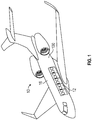
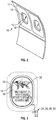
- FIGS. 1 and 2 respectively show an aircraft 10 including a fuselage 100 with a window display 12 and an associated inner passenger compartment panel 11 according to the present teachings.
- the window display 12 is configured to be placed between an outer window member 14 of an aircraft passenger compartment 16 and an inner passenger compartment window 18.
- the window display 12 is configured to provide textual or graphical information to a passenger within the passenger compartment 16.
- the display 12 can be releasably fixed to the inner compartment window 18 for ease of repair or replacement.
- the inner passenger compartment panel 11 can include switches or capacitive sensors (not shown) which allow for the interface by the passenger with the contents of the display 12.
- the display 12 includes a transparent (e.g. translucent) display member 20 (see FIG. 3 ) for transmitting information to the passenger.
- This transparent display member 20 can be an thin film transparent display member such as LCD display or a transparent thin film having associated OLEDs. Additionally, the display member 20 can be a projection display associated along the frame of the display member
- the thin film transparent display 20 has a controllable data transmission circuit 22 for varying the light transmission through or from the pixels 24 defined in the thin film transparent display member 20 (see FIG. 3 ).
- the controllable data transmission circuit 22 has a plurality of associated sensors (26, 28, 30) which can be used to vary the color or amount of light transmitted through each pixel associated with an image 32. Alternatively, changes the amount or color of or amount of light associated with the background 34 of the display member 20 can be automated to maximize visibility. Because of differences in altitude and positioning of the sun about the earth, there will be large variations in the amount of backlight passing through the outer window member 14 at any given time. Because of the changes in environmental conditions, the associated sensor 30 can be a temperature measuring sensor which will allow the circuit 22 to change currents to the display member as is needed to maintain visual quality or to protect the thin film display.
- the circuit 22 can include a pair of light receiving sensors 26, 28 which determine the amount of light passing through the window assembly and the inner passenger compartment. Both sensors 26, 28 provide a signal indicative of these light values.
- the controllable data transmission circuit 22 then will calculate a difference in the amount of light between the outside and inside of the cabin and adjust either the darkness or color of pixels sending transmitting information, or the amount of light transmitted through a background.
- the amount of light transmitted by the OLEDS can be adjusted to adjust current or voltage to the OLED to change the visibility of pixels transmitting information or the temperature of the thin film display.
- the display member 20 can incorporate capacitive touch sensors which will allow the passenger to interact with the window display 12 to change the image on the display 12. These touch sensors can use the electrodes of the OLEDS to convert the display member into a capacitive touch pad.
- the thin display member 20 can include a second layer of LCD or polarizable material (not shown) that can change the overall amount of light transmitted through the inner compartment window 18. It is envisioned that the display member 20 can be used to communicate safety information to the passengers such as a need to remain seated or fasten seat belts. Additional, as shown in FIG. 3 , information related to the location of the aircraft along a flight path, viewable items in the ground or sky of interest, or movies can be shown.
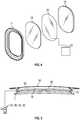
- FIG. 4 represents an exploded view of the window according to the present teachings. Shown is the associated inner passenger compartment panel 11 which can be of the form of a wall panel or a window frame. As shown, the window display 12 is positioned between an outer window member 14 of an aircraft passenger compartment 16 and an inner passenger compartment window 18. To facilitate repair, the display 12 can be releasably fixed to the inner compartment window 18 for ease of access.
- FIG. 5 shows a cross section through an aircraft window with the display member 20.
- the outer window member 14 and an inner passenger compartment window 18 can have a curved or flat configuration (i.e. planar or substantially planar cross-sectional shape).
- the outer surface 40 of the inner passenger compartment window 18 is spaced from or offset from the outer window member 14 and the defined fuselage contour.
- Disposed on the outer surface 40 is the display member 20 which is functionally positioned between the inner and outer window members (18, 16).
- suitable materials for the outer 14 and inner window panels 18 can include, but are not limited to, plastic materials (such as acrylic polymers). Such as polyacrylates; polyalkylmethacrylates, such as polymethylmethacrylates, polyethylmethacrylates, polypropylmethacrylates, stretched acrylic, and the like; polyurethanes; polycarbonates; polyalkylterephthalates, such as polyethyleneterephthalate (PET), polypropyleneterephthalates, polybutylene terephthalates, and the like; polysiloxane-containing polymers; or copolymers of any monomers for preparing these, or any mixtures thereof); glass, such as conventional soda-lime-silicate glass (the glass can be annealed, heat treated, or chemically tempered glass); or combinations of any of the above.
- plastic materials such as acrylic polymers.
- plastic materials such as acrylic polymers.
- plastic materials such as acrylic polymers.
- polyacrylates such as polyacrylates; polyalkylmethacryl
- the inner window 18 and outer window 14 are preferably transparent to visible light.
- transparent is meant having visible light transmission of greater than 0% up to 100%.
- one or both of the panels 12, 18 can be translucent.
- the display member or inner or outer window members (14, 18) can include for instance a film which acts a polarizer or light filter which filters out certain incident light frequencies.
- FIGS. 6-14 illustrate another embodiment for providing a display for the aircraft 10.
- the aircraft 10 includes a fuselage 100 that surrounds an aircraft interior 102.
- a sidewall assembly 104 is included into the fuselage 100.
- the sidewall assembly 104 includes a sidewall portion 106 of the fuselage 100 that includes an inner-facing side 108 disposed adjacent to the aircraft interior 102 and an outer-facing side 110 disposed opposite the inner-facing side 108 adjacent to the outside of the aircraft 10.
- the sidewall assembly 104 includes a plurality of windows 112 and 114 that are spaced apart and that are partially or fully surrounded by the sidewall portion 106.
- a transparent display panel 116 is coupled to the sidewall portion 106 covering the inner-facing side 108 of the sidewall portion 106 including the windows 112 and 114.
- the transparent display panel 116 includes one or more display screens 118a-b that independently display information (e.g., different information) to a passenger(s) 120 in the aircraft interior 102.
- the transparent display panel 116 is a transparent OLED panel and the display screens 118a-b are OLED display screens.
- the transparent display panel 116 has a relatively large screen size of about 55 to about 90 inches for advantageous viewing.
- a display controller 122 is in communication with the transparent display panel 116 to communicate video/audio signals 124 and 126 providing corresponding information to the display screens 118a and 118b.
- the display controller 122 may be controlled by the passenger 120 or other occupant of the aircraft 10 via a user input device 121 (e.g., hand-held controller, personal computing device or the like) to direct the display controller 122 to communicate the video/audio signals 124 and 126 to the various display screens 118a and 118b.
- a user input device 121 e.g., hand-held controller, personal computing device or the like
- the display controller 122 is in communication with a cabin management system (CMS) 128.
- CMS cabin management system
- the CMS 128 is configured to control various cabin environmental functions such as temperature, lighting, galley services, and in-flight entertainment which includes audio, video, interfaces to personal electronic devices, access to media content storage (audio & video files), satellite TV, and moving map equipment as well as access to long-range satellite communications and internet connectivity.
- the CMS 128 is in communication with an avionics system 130, an internet gateway 132, and an audio-video database 134, which contains a plurality of audio-video information and/or a plurality of movies, and provides information to the display controller 122 corresponding to temperature information, safety information, audio/video information, movies, financial market information, internet accessed information, flight information, and/or viewable items outside the aircraft.
- the display controller 122 may be in direct communication with the audio-video database 134 to access the audio-video information and/or movies for communication to one or more of the display screens 118a and/or 118b.
- the display controller 122 accesses the audio/video database 134 (e.g.
- the user input device 121 is used to switch the transparent display panel 116 on and/or off.
- the transparent display panel 116 is turned to an "on condition" that enables or otherwise powers the display screens 118a and/or 118b to display corresponding information as discussed above.
- the transparent display panel 116 is turned to an "off condition" where the transparent display panel 116 is transparent to allow the inner-facing side 108 of the sidewall portion 106 including the windows 112 and 114 to be visible through the transparent display panel 116 to the passenger 120.
- the passenger 120 can view clearly through the transparent display panel 116 and the windows 112 and 114 to outside the aircraft 10 when the transparent display panel 116 is in the "off condition.”
- the sidewall assembly 104 includes a window shade 136 for each of the windows 112 and 114.
- the window shade 136 is disposed between the window 112 or 114 and the transparent display panel 116.
- Each of the window shades 136 are movable between an open position (as illustrated on FIGS. 7-9 ) to allow light to pass between the windows 112 and 114 and the transparent display panel 116 when the transparent display panel 116 is in the "off condition" and a closed position (as illustrated in FIGS. 10 and 12 ) to obstruct light from passing between the windows 112 and 114 and the transparent display panel 116 when the transparent display panel 116 is in the "on condition," for example to enhance viewing of the display screens 118a-b.
- the sidewall assembly 104 includes a movable blackout panel 138 (e.g. black opaque panel) for each of the windows 112 and 114.
- the movable blackout panel 138 is disposed between the corresponding window shade 136 and the transparent display panel 116.
- the display controller 122 is in communication with a blackout control device 140 that is operable coupled to the movable blackout panels 138 to move the panels 138 between a retracted position (as illustrated on FIGS.
- the blackout control device 140 is further configured to move the window shades 136 between the open position and the closed position.
- the display controller 122 communicates command signals to the blackout control device 142 move the window shades 136 independently or together with movable blackout panels 138 between the open/retracted positions and the closed/extended positions.
- the sidewall assembly 104 includes a transparent covering 142 that is disposed adjacent to and covers the transparent display panel 116.
- the transparent covering 142 is a plastic sheet formed of a transparent or amorphous polymeric material, such as, for example polymethylmethacrylate (PMMA), polycarbonate (e.g., Lexan®), or the like.
- a ledge 144 is disposed adjacent to the inner-facing side 108 of the sidewall portion 106 extending under the transparent display panel 116 and the transparent covering 142 towards the aircraft interior 102.
- the ledge 144 is both a functional and aesthetical trim piece that provides an understructure for supporting the transparent display panel 116.
- the transparent display panel 116 is secured to the sidewall portion 106 via fasteners 146.
- Example embodiments are provided so that this disclosure will be thorough, and will fully convey the scope to those who are skilled in the art. Numerous specific details are set forth such as examples of specific components, devices, and methods, to provide a thorough understanding of embodiments of the present disclosure. It will be apparent to those skilled in the art that specific details need not be employed, that example embodiments may be embodied in many different forms and that neither should be construed to limit the scope of the disclosure. In some example embodiments, well-known processes, well-known device structures, and well-known technologies are not described in detail.
- first, second, third, etc. may be used herein to describe various elements, components, regions, layers and/or sections, these elements, components, regions, layers and/or sections should not be limited by these terms. These terms may be only used to distinguish one element, component, region, layer or section from another region, layer or section. Terms such as “first,” “second,” and other numerical terms when used herein do not imply a sequence or order unless clearly indicated by the context. Thus, a first element, component, region, layer or section discussed below could be termed a second element, component, region, layer or section without departing from the teachings of the example embodiments.
- spatially relative terms such as “inner,” “outer,” “beneath”, “below”, “lower”, “above”, “upper” and the like, may be used herein for ease of description to describe one element or feature's relationship to another element(s) or feature(s) as illustrated in the figures.
- Spatially relative terms may be intended to encompass different orientations of the device in use or operation in addition to the orientation depicted in the figures. For example, if the device in the figures is turned over, elements described as “below” or “beneath” other elements or features would then be oriented “above” the other elements or features.
- the example term “below” can encompass both an orientation of above and below.
- the device may be otherwise oriented (rotated 90 degrees or at other orientations) and the spatially relative descriptors used herein interpreted accordingly.
- Aspect 2 The sidewall assembly of Aspect 1, wherein the transparent display panel is configured to be switchable between an on condition that enables the display screen to display the information and an off condition where the transparent display panel is transparent to allow the inner-facing side of the sidewall portion including the window to be visible through the transparent display panel to the passenger.
- Aspect 3 The sidewall assembly of Aspects 1 or 2, further comprising at least one additional window, wherein the sidewall portion at least partially surrounds the at least one additional window, and wherein the transparent display panel covers the at least one additional window.
- Aspect 4 The sidewall assembly of any one of Aspects 1 to 3, wherein the transparent display panel comprises at least one additional display screen configured to display additional information to the passenger, and wherein the display controller is in communication with the transparent display panel to communicate at least one additional video/audio signal providing the additional information to the at least one additional display screen.
- Aspect 5 The sidewall assembly of any one of Aspects 1 to 4, further comprising a transparent covering disposed adjacent to and covering the transparent display panel.
- Aspect 6 The sidewall assembly of any one of Aspects 1 to 5, further comprising a ledge disposed adjacent to the inner-facing side of the sidewall portion extending under the transparent display panel.
- Aspect 7 The sidewall assembly of any one of Aspects 1 to 6, wherein the transparent display panel has a screen size of about 55 to about 90 inches.
- Aspect 8 The sidewall assembly of any one of Aspects 1 to 7, further comprising a window shade that is disposed between the window and the transparent display panel and that is movable between an open position to allow light to pass between the window and the transparent display panel and a closed position to obstruct light from passing between the window and the transparent display panel.
- Aspect 9 The sidewall assembly of any one of Aspects 1 to 8, further comprising:
- Aspect 10 The sidewall assembly of Aspect 9, wherein the display controller is configured to provide a command signal to the blackout control device to move the movable blackout panel between the retracted position and the extended position.
- An aircraft comprising:
- Aspect 12 The aircraft of Aspect 11, further comprising a cabin management system (CMS) in communication with the display controller to provide the information to the display controller, wherein the information includes one of temperature information, safety information, audio/video information, a movie, financial market information, internet accessed information, flight information, a viewable item outside the aircraft, and a combination thereof.
- CMS cabin management system
- Aspect 13 The aircraft of Aspect 12, further comprising an audio/video database containing the information corresponding to one of the audio/video information, a plurality of movies, and a combination thereof, and wherein one of the display controller and the CMS are in communication with the audio/video database for receiving the information.
- Aspect 14 The aircraft of any one of Aspects 11 to 13, wherein the transparent display panel is configured to be switchable between an on condition that enables the display screen to display the information and an off condition where the transparent display panel is transparent to allow the inner-facing side of the sidewall portion including the window to be visible through the transparent display panel to the passenger.
- Aspect 15 The aircraft of Aspect 14, further comprising a window shade that is disposed between the window and the transparent display panel and that is movable between an open position that allows light to pass between the window and the transparent display panel when the transparent display panel is in the off condition and a closed position that obstructs light from passing between the window and the transparent display panel when the transparent display panel is in the on condition.
- Aspect 16 The aircraft of Aspect 15, further comprising:
- Aspect 17 The aircraft of Aspect 16, wherein the blackout control device is further configured to move the window shade between the open position and the closed position.
- Aspect 18 The aircraft of Aspect 17, wherein the display controller is configured to provide a command signal to the blackout control device to move at least one of the movable blackout panel and the window shade.
- Aspect 19 The aircraft of any one of Aspects 11 to 18, wherein the sidewall portion at least partially surrounds at least one additional window, and wherein the transparent display panel covers the at least one additional window.
- Aspect 20 The aircraft of any one of Aspects 11 to 19, further comprising: a transparent covering disposed adjacent to and covering the transparent display panel; and a ledge disposed adjacent to the inner-facing side of the sidewall portion extending under the transparent display panel and the transparent covering.
Landscapes
- Engineering & Computer Science (AREA)
- Aviation & Aerospace Engineering (AREA)
- Physics & Mathematics (AREA)
- Mechanical Engineering (AREA)
- General Physics & Mathematics (AREA)
- Theoretical Computer Science (AREA)
- Computer Hardware Design (AREA)
- Optics & Photonics (AREA)
- Human Computer Interaction (AREA)
- General Engineering & Computer Science (AREA)
- Devices For Indicating Variable Information By Combining Individual Elements (AREA)
Abstract
Description
- This application is a continuation-in-part (CIP) application of U.S. Application No.
16/421,891 - The present disclosure relates to a sidewall including a window for an aircraft, and more particularly to a sidewall construction including a window for an aircraft having an integrated display unit.
- This section provides background information related to the present disclosure which is not necessarily prior art.
- The desire for improved entertainment for passengers on aircraft has led to an increase in the number of screens for passengers to provide on-demand content. The proliferation of these screens has increased the weight of the aircraft thereby hurting aircraft fuel economy. It is therefore desirable to provide a mechanism which decreases this increased weight without decreasing passenger access to on-demand content.
- Various non-limiting embodiments of a sidewall assembly for an aircraft, and various non-limiting embodiments of an aircraft, are provided herein.
- In a first non-limiting embodiment, the sidewall assembly includes, but is not limited to, a window. The sidewall assembly further includes, but is not limited to, a sidewall portion that has an inner-facing side and that at least partially surrounds the window. The sidewall assembly further includes, but is not limited to, a transparent display panel that is coupled to the sidewall portion and that covers the inner-facing side of the sidewall portion including the window. The transparent display panel includes a display screen configured to display information to a passenger. The sidewall assembly further includes, but is not limited to, a display controller that is in communication with the transparent display panel to communicate a video/audio signal providing the information to the display screen.
- In another non-limiting embodiment, the aircraft includes, but is not limited to, a fuselage surrounding an aircraft interior. The fuselage includes a sidewall portion having an inner-facing side disposed adjacent to the aircraft interior. The aircraft further includes, but is not limited to, a window that is disposed in the fuselage at least partially surrounded by the sidewall portion. The aircraft further includes, but is not limited to, a transparent display panel that is coupled to the sidewall portion and that covers the inner-facing side of the sidewall portion including the window. The transparent display panel includes a display screen that is configured to display information to a passenger in the aircraft interior. The aircraft further includes, but is not limited to, a display controller that is in communication with the transparent display panel to communicate a video/audio signal providing the information to the display screen.
- The drawings described herein are for illustrative purposes only of selected embodiments and not all possible implementations and are not intended to limit the scope of the present disclosure.
-
FIG. 1 is a perspective view illustrating an aircraft with a window in accordance with an exemplary embodiment; -
FIG. 2 is a perspective view illustrating an aircraft inner panel including two windows in accordance with an exemplary embodiment; -
FIG. 3 is a front view of a window in accordance with an exemplary embodiment; -
FIG. 4 is an exploded view of the window in accordance with an exemplary embodiment; -
FIG. 5 is a sectional view illustrating a cross section through the window ofFIGS. 1-4 ; -
FIG. 6 is a perspective view illustrating an aircraft interior including a sidewall assembly that includes a transparent display panel with a plurality of display screens in accordance with an exemplary embodiment; -
FIG. 7 is a side view of a sidewall assembly for an aircraft in accordance with an exemplary embodiment; -
FIG. 8 is a perspective view of a sidewall assembly for an aircraft in accordance with an exemplary embodiment; -
FIG. 9 is a perspective view of a sidewall assembly for an aircraft in accordance with an exemplary embodiment; -
FIG. 10 is a sectional view of the sidewall assembly depicted inFIG. 7 along line 10-10; -
FIG. 11 is a sectional view of the sidewall assembly depicted inFIG. 7 along line 11-11; -
FIG. 12 is an enlarged sectional view of the sidewall assembly depicted inFIG. 10 in the and circledarea 12; -
FIG. 13 is an enlarged sectional view of the sidewall assembly depicted inFIG. 11 in the and circled area 13; and -
FIG. 14 is a block diagram of a transparent display panel with a plurality of display screens in communication with a display controller and other systems in accordance with an exemplary embodiment. - Corresponding reference numerals indicate corresponding parts throughout the several views of the drawings.
- Example embodiments will now be described more fully with reference to the accompanying drawings.
FIGS. 1 and2 respectively show anaircraft 10 including afuselage 100 with awindow display 12 and an associated innerpassenger compartment panel 11 according to the present teachings. Thewindow display 12 is configured to be placed between anouter window member 14 of anaircraft passenger compartment 16 and an innerpassenger compartment window 18. Thewindow display 12 is configured to provide textual or graphical information to a passenger within thepassenger compartment 16. As described below, thedisplay 12 can be releasably fixed to theinner compartment window 18 for ease of repair or replacement. The innerpassenger compartment panel 11 can include switches or capacitive sensors (not shown) which allow for the interface by the passenger with the contents of thedisplay 12. - The
display 12 includes a transparent (e.g. translucent) display member 20 (seeFIG. 3 ) for transmitting information to the passenger. Thistransparent display member 20 can be an thin film transparent display member such as LCD display or a transparent thin film having associated OLEDs. Additionally, thedisplay member 20 can be a projection display associated along the frame of the display member The thin filmtransparent display 20 has a controllabledata transmission circuit 22 for varying the light transmission through or from the pixels 24 defined in the thin film transparent display member 20 (seeFIG. 3 ). - As best seen in
FIG. 3 , the controllabledata transmission circuit 22 has a plurality of associated sensors (26, 28, 30) which can be used to vary the color or amount of light transmitted through each pixel associated with animage 32. Alternatively, changes the amount or color of or amount of light associated with thebackground 34 of thedisplay member 20 can be automated to maximize visibility. Because of differences in altitude and positioning of the sun about the earth, there will be large variations in the amount of backlight passing through theouter window member 14 at any given time. Because of the changes in environmental conditions, the associatedsensor 30 can be a temperature measuring sensor which will allow thecircuit 22 to change currents to the display member as is needed to maintain visual quality or to protect the thin film display. - Additionally, as the internal cabin lighting may be changed during a flight, the visibility of information transmitted by the
display member 20 for the passenger can be obscured. As such, thecircuit 22 can include a pair of light receiving sensors 26, 28 which determine the amount of light passing through the window assembly and the inner passenger compartment. Both sensors 26, 28 provide a signal indicative of these light values. The controllabledata transmission circuit 22 then will calculate a difference in the amount of light between the outside and inside of the cabin and adjust either the darkness or color of pixels sending transmitting information, or the amount of light transmitted through a background. - In the case of an OLED display, the amount of light transmitted by the OLEDS can be adjusted to adjust current or voltage to the OLED to change the visibility of pixels transmitting information or the temperature of the thin film display. Additionally, the
display member 20 can incorporate capacitive touch sensors which will allow the passenger to interact with thewindow display 12 to change the image on thedisplay 12. These touch sensors can use the electrodes of the OLEDS to convert the display member into a capacitive touch pad. - Optionally, the
thin display member 20 can include a second layer of LCD or polarizable material (not shown) that can change the overall amount of light transmitted through theinner compartment window 18. It is envisioned that thedisplay member 20 can be used to communicate safety information to the passengers such as a need to remain seated or fasten seat belts. Additional, as shown inFIG. 3 , information related to the location of the aircraft along a flight path, viewable items in the ground or sky of interest, or movies can be shown. -
FIG. 4 represents an exploded view of the window according to the present teachings. Shown is the associated innerpassenger compartment panel 11 which can be of the form of a wall panel or a window frame. As shown, thewindow display 12 is positioned between anouter window member 14 of anaircraft passenger compartment 16 and an innerpassenger compartment window 18. To facilitate repair, thedisplay 12 can be releasably fixed to theinner compartment window 18 for ease of access. -
FIG. 5 shows a cross section through an aircraft window with thedisplay member 20. Theouter window member 14 and an innerpassenger compartment window 18 can have a curved or flat configuration (i.e. planar or substantially planar cross-sectional shape). Theouter surface 40 of the innerpassenger compartment window 18 is spaced from or offset from theouter window member 14 and the defined fuselage contour. Disposed on theouter surface 40 is thedisplay member 20 which is functionally positioned between the inner and outer window members (18, 16). By coupling thedisplay member 20 to theouter surface 40 of the innerpassenger compartment window 18, thedisplay member 20 can be protected from passenger contact. This additionally allows for aframe 42 to be used as a support for thedisplay member 20 and an electrical connector (not shown) for data and power transmission. - Examples of suitable materials for the outer 14 and
inner window panels 18 can include, but are not limited to, plastic materials (such as acrylic polymers). Such as polyacrylates; polyalkylmethacrylates, such as polymethylmethacrylates, polyethylmethacrylates, polypropylmethacrylates, stretched acrylic, and the like; polyurethanes; polycarbonates; polyalkylterephthalates, such as polyethyleneterephthalate (PET), polypropyleneterephthalates, polybutylene terephthalates, and the like; polysiloxane-containing polymers; or copolymers of any monomers for preparing these, or any mixtures thereof); glass, such as conventional soda-lime-silicate glass (the glass can be annealed, heat treated, or chemically tempered glass); or combinations of any of the above. - The
inner window 18 andouter window 14 are preferably transparent to visible light. By "transparent" is meant having visible light transmission of greater than 0% up to 100%. Alternatively, one or both of thepanels -
FIGS. 6-14 illustrate another embodiment for providing a display for theaircraft 10. Referring toFIGS. 1 ,6-9 , and14 , as discussed above, theaircraft 10 includes afuselage 100 that surrounds anaircraft interior 102. Incorporated into thefuselage 100 is asidewall assembly 104. Thesidewall assembly 104 includes asidewall portion 106 of thefuselage 100 that includes an inner-facingside 108 disposed adjacent to theaircraft interior 102 and an outer-facingside 110 disposed opposite the inner-facingside 108 adjacent to the outside of theaircraft 10. - Referring to
FIGS. 6-9 and14 , in an exemplary embodiment, thesidewall assembly 104 includes a plurality ofwindows sidewall portion 106. As illustrated, atransparent display panel 116 is coupled to thesidewall portion 106 covering the inner-facingside 108 of thesidewall portion 106 including thewindows transparent display panel 116 includes one ormore display screens 118a-b that independently display information (e.g., different information) to a passenger(s) 120 in theaircraft interior 102. In an exemplary embodiment, thetransparent display panel 116 is a transparent OLED panel and thedisplay screens 118a-b are OLED display screens. In an exemplary embodiment, thetransparent display panel 116 has a relatively large screen size of about 55 to about 90 inches for advantageous viewing. - Referring also to
FIG. 14 , in an exemplary embodiment, adisplay controller 122 is in communication with thetransparent display panel 116 to communicate video/audio signals display screens display controller 122 may be controlled by thepassenger 120 or other occupant of theaircraft 10 via a user input device 121 (e.g., hand-held controller, personal computing device or the like) to direct thedisplay controller 122 to communicate the video/audio signals various display screens - In an exemplary embodiment, the
display controller 122 is in communication with a cabin management system (CMS) 128. Among various functions, theCMS 128 is configured to control various cabin environmental functions such as temperature, lighting, galley services, and in-flight entertainment which includes audio, video, interfaces to personal electronic devices, access to media content storage (audio & video files), satellite TV, and moving map equipment as well as access to long-range satellite communications and internet connectivity. As illustrated, theCMS 128 is in communication with anavionics system 130, aninternet gateway 132, and an audio-video database 134, which contains a plurality of audio-video information and/or a plurality of movies, and provides information to thedisplay controller 122 corresponding to temperature information, safety information, audio/video information, movies, financial market information, internet accessed information, flight information, and/or viewable items outside the aircraft. Independently, thedisplay controller 122 may be in direct communication with the audio-video database 134 to access the audio-video information and/or movies for communication to one or more of thedisplay screens 118a and/or 118b. In one example, thedisplay controller 122 accesses the audio/video database 134 (e.g. directly or through the CMS 128) to communicate video/audio signals 124 to thetransparent display panel 116 for display of a movie (e.g., audio/video information) on thedisplay screen 118a, and independently accesses the avionics system 130 (e.g., through the CMS 128) to communicate video/audio signals 126 for display of flight information on thedisplay screen 118b. - In an exemplary embodiment, the
user input device 121 is used to switch thetransparent display panel 116 on and/or off. In one example and as illustratedFIGS. 6 and14 , thetransparent display panel 116 is turned to an "on condition" that enables or otherwise powers thedisplay screens 118a and/or 118b to display corresponding information as discussed above. In another example and as illustrated inFIGS. 7-8 , thetransparent display panel 116 is turned to an "off condition" where thetransparent display panel 116 is transparent to allow the inner-facingside 108 of thesidewall portion 106 including thewindows transparent display panel 116 to thepassenger 120. As such, thepassenger 120 can view clearly through thetransparent display panel 116 and thewindows aircraft 10 when thetransparent display panel 116 is in the "off condition." - Referring to
FIGS. 7-14 , in an exemplary embodiment, thesidewall assembly 104 includes awindow shade 136 for each of thewindows window shade 136 is disposed between thewindow transparent display panel 116. Each of the window shades 136 are movable between an open position (as illustrated onFIGS. 7-9 ) to allow light to pass between thewindows transparent display panel 116 when thetransparent display panel 116 is in the "off condition" and a closed position (as illustrated inFIGS. 10 and 12 ) to obstruct light from passing between thewindows transparent display panel 116 when thetransparent display panel 116 is in the "on condition," for example to enhance viewing of thedisplay screens 118a-b. - To further enhance viewing of the
display screens 118a-b, in an exemplary embodiment, thesidewall assembly 104 includes a movable blackout panel 138 (e.g. black opaque panel) for each of thewindows movable blackout panel 138 is disposed between thecorresponding window shade 136 and thetransparent display panel 116. In an exemplary embodiment, thedisplay controller 122 is in communication with ablackout control device 140 that is operable coupled to themovable blackout panels 138 to move thepanels 138 between a retracted position (as illustrated onFIGS. 7-9 ) that allows light to pass between thewindows transparent display panel 116 when thetransparent display panel 116 is in the "off condition" and an extended position (as illustrated inFIGS. 10 and 12 ) that obstructs light from passing between thewindows transparent display panel 116 when thetransparent display panel 116 is in the "on condition." As such, with themovable blackout panels 138 and the window shades 136 in the retracted/open positions, thepassenger 120 can see clearly through thetransparent display panel 116 and thewindows aircraft 10. Likewise, with themovable blackout panels 138 and the window shades 136 in the extended/closed positions, enhance viewing of thedisplay screens 118a-b to thepassenger 120 is provided because the area behind thetransparent display panel 116 is blacked out by obstructing outside light from passing through thewindows display screens 118a-b. - In an exemplary embodiment, the
blackout control device 140 is further configured to move the window shades 136 between the open position and the closed position. In one example, thedisplay controller 122 communicates command signals to theblackout control device 142 move the window shades 136 independently or together withmovable blackout panels 138 between the open/retracted positions and the closed/extended positions. - Referring to
FIGS. 7-8 and10-13 , in an exemplary embodiment, thesidewall assembly 104 includes atransparent covering 142 that is disposed adjacent to and covers thetransparent display panel 116. For example, thetransparent covering 142 is a plastic sheet formed of a transparent or amorphous polymeric material, such as, for example polymethylmethacrylate (PMMA), polycarbonate (e.g., Lexan®), or the like. - As illustrated, a
ledge 144 is disposed adjacent to the inner-facingside 108 of thesidewall portion 106 extending under thetransparent display panel 116 and thetransparent covering 142 towards theaircraft interior 102. In an exemplary embodiment, theledge 144 is both a functional and aesthetical trim piece that provides an understructure for supporting thetransparent display panel 116. Additionally, thetransparent display panel 116 is secured to thesidewall portion 106 viafasteners 146. - The foregoing description of the embodiments has been provided for purposes of illustration and description. It is not intended to be exhaustive or to limit the disclosure. Individual elements or features of a particular embodiment are generally not limited to that particular embodiment, but, where applicable, are interchangeable and can be used in a selected embodiment, even if not specifically shown or described. The same may also be varied in many ways. Such variations are not to be regarded as a departure from the disclosure, and all such modifications are intended to be included within the scope of the disclosure.
- Example embodiments are provided so that this disclosure will be thorough, and will fully convey the scope to those who are skilled in the art. Numerous specific details are set forth such as examples of specific components, devices, and methods, to provide a thorough understanding of embodiments of the present disclosure. It will be apparent to those skilled in the art that specific details need not be employed, that example embodiments may be embodied in many different forms and that neither should be construed to limit the scope of the disclosure. In some example embodiments, well-known processes, well-known device structures, and well-known technologies are not described in detail.
- The terminology used herein is for the purpose of describing particular example embodiments only and is not intended to be limiting. As used herein, the singular forms "a", "an" and "the" may be intended to include the plural forms as well, unless the context clearly indicates otherwise. The terms "comprises," "comprising," "including," and "having," are inclusive and therefore specify the presence of stated features, integers, steps, operations, elements, and/or components, but do not preclude the presence or addition of one or more other features, integers, steps, operations, elements, components, and/or groups thereof. The method steps, processes, and operations described herein are not to be construed as necessarily requiring their performance in the particular order discussed or illustrated, unless specifically identified as an order of performance. It is also to be understood that additional or alternative steps may be employed.
- When an element or layer is referred to as being "on", "engaged to", "connected to" or "coupled to" another element or layer, it may be directly on, engaged, connected or coupled to the other element or layer, or intervening elements or layers may be present. In contrast, when an element is referred to as being "directly on," "directly engaged to", "directly connected to" or "directly coupled to" another element or layer, there may be no intervening elements or layers present. Other words used to describe the relationship between elements should be interpreted in a like fashion (e.g., "between" versus "directly between," "adjacent" versus "directly adjacent," etc.). As used herein, the term "and/or" includes any and all combinations of one or more of the associated listed items.
- Although the terms first, second, third, etc. may be used herein to describe various elements, components, regions, layers and/or sections, these elements, components, regions, layers and/or sections should not be limited by these terms. These terms may be only used to distinguish one element, component, region, layer or section from another region, layer or section. Terms such as "first," "second," and other numerical terms when used herein do not imply a sequence or order unless clearly indicated by the context. Thus, a first element, component, region, layer or section discussed below could be termed a second element, component, region, layer or section without departing from the teachings of the example embodiments.
- Spatially relative terms, such as "inner," "outer," "beneath", "below", "lower", "above", "upper" and the like, may be used herein for ease of description to describe one element or feature's relationship to another element(s) or feature(s) as illustrated in the figures. Spatially relative terms may be intended to encompass different orientations of the device in use or operation in addition to the orientation depicted in the figures. For example, if the device in the figures is turned over, elements described as "below" or "beneath" other elements or features would then be oriented "above" the other elements or features. Thus, the example term "below" can encompass both an orientation of above and below. The device may be otherwise oriented (rotated 90 degrees or at other orientations) and the spatially relative descriptors used herein interpreted accordingly.
- The present disclosure may be further described by the following aspects.
-
Aspect 1. A sidewall assembly for an aircraft, the sidewall assembly comprising: - a window;
- a sidewall portion having an inner-facing side and at least partially surrounding the window;
- a transparent display panel coupled to the sidewall portion and covering the inner-facing side of the sidewall portion including the window, the transparent display panel comprising a display screen configured to display information to a passenger; and
- a display controller in communication with the transparent display panel to communicate a video/audio signal providing the information to the display screen.
- Aspect 2. The sidewall assembly of
Aspect 1, wherein the transparent display panel is configured to be switchable between an on condition that enables the display screen to display the information and an off condition where the transparent display panel is transparent to allow the inner-facing side of the sidewall portion including the window to be visible through the transparent display panel to the passenger. - Aspect 3. The sidewall assembly of
Aspects 1 or 2, further comprising at least one additional window, wherein the sidewall portion at least partially surrounds the at least one additional window, and wherein the transparent display panel covers the at least one additional window. - Aspect 4. The sidewall assembly of any one of
Aspects 1 to 3, wherein the transparent display panel comprises at least one additional display screen configured to display additional information to the passenger, and wherein the display controller is in communication with the transparent display panel to communicate at least one additional video/audio signal providing the additional information to the at least one additional display screen. - Aspect 5. The sidewall assembly of any one of
Aspects 1 to 4, further comprising a transparent covering disposed adjacent to and covering the transparent display panel. - Aspect 6. The sidewall assembly of any one of
Aspects 1 to 5, further comprising a ledge disposed adjacent to the inner-facing side of the sidewall portion extending under the transparent display panel. - Aspect 7. The sidewall assembly of any one of
Aspects 1 to 6, wherein the transparent display panel has a screen size of about 55 to about 90 inches. - Aspect 8. The sidewall assembly of any one of
Aspects 1 to 7, further comprising a window shade that is disposed between the window and the transparent display panel and that is movable between an open position to allow light to pass between the window and the transparent display panel and a closed position to obstruct light from passing between the window and the transparent display panel. - Aspect 9. The sidewall assembly of any one of
Aspects 1 to 8, further comprising: - a movable blackout panel that is disposed between the window and the transparent display panel; and
- a blackout control device that is configured to move the movable blackout panel between a retracted position to allow light to pass between the window and the transparent display panel and an extended position to obstruct light from passing between the window and the transparent display panel.
-
Aspect 10. The sidewall assembly of Aspect 9, wherein the display controller is configured to provide a command signal to the blackout control device to move the movable blackout panel between the retracted position and the extended position. -
Aspect 11. An aircraft comprising: - a fuselage surrounding an aircraft interior and comprising a sidewall portion having an inner-facing side disposed adjacent to the aircraft interior;
- a window disposed in the fuselage at least partially surrounded by the sidewall portion;
- a transparent display panel coupled to the sidewall portion and covering the inner-facing side of the sidewall portion including the window, the transparent display panel comprising a display screen configured to display information to a passenger in the aircraft interior; and
- a display controller in communication with the transparent display panel to communicate a video/audio signal providing the information to the display screen.
-
Aspect 12. The aircraft ofAspect 11, further comprising a cabin management system (CMS) in communication with the display controller to provide the information to the display controller, wherein the information includes one of temperature information, safety information, audio/video information, a movie, financial market information, internet accessed information, flight information, a viewable item outside the aircraft, and a combination thereof. - Aspect 13. The aircraft of
Aspect 12, further comprising an audio/video database containing the information corresponding to one of the audio/video information, a plurality of movies, and a combination thereof, and wherein one of the display controller and the CMS are in communication with the audio/video database for receiving the information. -
Aspect 14. The aircraft of any one ofAspects 11 to 13, wherein the transparent display panel is configured to be switchable between an on condition that enables the display screen to display the information and an off condition where the transparent display panel is transparent to allow the inner-facing side of the sidewall portion including the window to be visible through the transparent display panel to the passenger. - Aspect 15. The aircraft of
Aspect 14, further comprising a window shade that is disposed between the window and the transparent display panel and that is movable between an open position that allows light to pass between the window and the transparent display panel when the transparent display panel is in the off condition and a closed position that obstructs light from passing between the window and the transparent display panel when the transparent display panel is in the on condition. -
Aspect 16. The aircraft of Aspect 15, further comprising: - a movable blackout panel that is disposed between the window shade and the transparent display panel; and
- a blackout control device that is configured to move the movable blackout panel between a retracted position that allows light to pass between the window and the transparent display panel when the transparent display panel is in the off condition and an extended position that obstructs light from passing between the window and the transparent display panel when the transparent display panel is in the on condition.
- Aspect 17. The aircraft of
Aspect 16, wherein the blackout control device is further configured to move the window shade between the open position and the closed position. -
Aspect 18. The aircraft of Aspect 17, wherein the display controller is configured to provide a command signal to the blackout control device to move at least one of the movable blackout panel and the window shade. - Aspect 19. The aircraft of any one of
Aspects 11 to 18, wherein the sidewall portion at least partially surrounds at least one additional window, and wherein the transparent display panel covers the at least one additional window. -
Aspect 20. The aircraft of any one ofAspects 11 to 19, further comprising:
a transparent covering disposed adjacent to and covering the transparent display panel; and
a ledge disposed adjacent to the inner-facing side of the sidewall portion extending under the transparent display panel and the transparent covering.
Claims (15)
- A sidewall assembly for an aircraft, the sidewall assembly comprising:a window;a sidewall portion having an inner-facing side and at least partially surrounding the window;a transparent display panel coupled to the sidewall portion and covering the inner-facing side of the sidewall portion including the window, the transparent display panel comprising a display screen configured to display information to a passenger; anda display controller in communication with the transparent display panel to communicate a video/audio signal providing the information to the display screen.
- The sidewall assembly of claim 1, wherein the transparent display panel is configured to be switchable between an on condition that enables the display screen to display the information and an off condition where the transparent display panel is transparent to allow the inner-facing side of the sidewall portion including the window to be visible through the transparent display panel to the passenger.
- The sidewall assembly of claims 1 or 2, wherein the transparent display panel comprises at least one additional display screen configured to display additional information to the passenger, and wherein the display controller is in communication with the transparent display panel to communicate at least one additional video/audio signal providing the additional information to the at least one additional display screen.
- The sidewall assembly of any one of claims 1 to 3, further comprising a window shade that is disposed between the window and the transparent display panel and that is movable between an open position to allow light to pass between the window and the transparent display panel and a closed position to obstruct light from passing between the window and the transparent display panel.
- The sidewall assembly of any one of claims 1 to 4, further comprising:a movable blackout panel that is disposed between the window and the transparent display panel; anda blackout control device that is configured to move the movable blackout panel between a retracted position to allow light to pass between the window and the transparent display panel and an extended position to obstruct light from passing between the window and the transparent display panel.
- The sidewall assembly of claim 5, wherein the display controller is configured to provide a command signal to the blackout control device to move the movable blackout panel between the retracted position and the extended position.
- An aircraft comprising:a fuselage surrounding an aircraft interior and comprising a sidewall portion having an inner-facing side disposed adjacent to the aircraft interior;a window disposed in the fuselage at least partially surrounded by the sidewall portion;a transparent display panel coupled to the sidewall portion and covering the inner-facing side of the sidewall portion including the window, the transparent display panel comprising a display screen configured to display information to a passenger in the aircraft interior; anda display controller in communication with the transparent display panel to communicate a video/audio signal providing the information to the display screen.
- The aircraft of claim 7, further comprising a cabin management system (CMS) in communication with the display controller to provide the information to the display controller, wherein the information includes one of temperature information, safety information, audio/video information, a movie, financial market information, internet accessed information, flight information, a viewable item outside the aircraft, and a combination thereof.
- The aircraft of claim 8, further comprising an audio/video database containing the information corresponding to one of the audio/video information, a plurality of movies, and a combination thereof, and wherein one of the display controller and the CMS are in communication with the audio/video database for receiving the information.
- The aircraft of any one of claims 7 to 9, wherein the transparent display panel is configured to be switchable between an on condition that enables the display screen to display the information and an off condition where the transparent display panel is transparent to allow the inner-facing side of the sidewall portion including the window to be visible through the transparent display panel to the passenger.
- The aircraft of claim 10, further comprising a window shade that is disposed between the window and the transparent display panel and that is movable between an open position that allows light to pass between the window and the transparent display panel when the transparent display panel is in the off condition and a closed position that obstructs light from passing between the window and the transparent display panel when the transparent display panel is in the on condition.
- The aircraft of claim 11, further comprising:a movable blackout panel that is disposed between the window shade and the transparent display panel; anda blackout control device that is configured to move the movable blackout panel between a retracted position that allows light to pass between the window and the transparent display panel when the transparent display panel is in the off condition and an extended position that obstructs light from passing between the window and the transparent display panel when the transparent display panel is in the on condition.
- The aircraft of claim 12, wherein the blackout control device is further configured to move the window shade between the open position and the closed position.
- The aircraft of claim 13, wherein the display controller is configured to provide a command signal to the blackout control device to move at least one of the movable blackout panel and the window shade.
- The aircraft of any one of claims 7 to 14, further comprising:a transparent covering disposed adjacent to and covering the transparent display panel; anda ledge disposed adjacent to the inner-facing side of the sidewall portion extending under the transparent display panel and the transparent covering.
Applications Claiming Priority (2)
| Application Number | Priority Date | Filing Date | Title |
|---|---|---|---|
| US16/421,891 US10996810B2 (en) | 2019-05-24 | 2019-05-24 | Window for an aircraft and display for aircraft window |
| US16/821,666 US11390370B2 (en) | 2019-05-24 | 2020-03-17 | Window for an aircraft and display for aircraft window |
Publications (2)
| Publication Number | Publication Date |
|---|---|
| EP3741663A1 true EP3741663A1 (en) | 2020-11-25 |
| EP3741663B1 EP3741663B1 (en) | 2023-02-22 |
Family
ID=70289318
Family Applications (1)
| Application Number | Title | Priority Date | Filing Date |
|---|---|---|---|
| EP20169286.0A Active EP3741663B1 (en) | 2019-05-24 | 2020-04-14 | Window for an aircraft and display for aircraft window |
Country Status (4)
| Country | Link |
|---|---|
| US (3) | US11390370B2 (en) |
| EP (1) | EP3741663B1 (en) |
| KR (1) | KR102606974B1 (en) |
| CN (1) | CN111976951B (en) |
Families Citing this family (9)
| Publication number | Priority date | Publication date | Assignee | Title |
|---|---|---|---|---|
| CN114228973B (en) * | 2021-12-31 | 2024-06-07 | 中国商用飞机有限责任公司 | Aircraft porthole system with transparent display and display method and medium thereof |
| JP7658042B2 (en) * | 2022-06-24 | 2025-04-08 | トヨタ自動車株式会社 | Information processing device and vehicle |
| US12280865B2 (en) * | 2022-08-22 | 2025-04-22 | Textron Innovations Inc. | Window roller shade and dimming pane |
| EP4589577A4 (en) * | 2022-09-30 | 2025-09-24 | Lg Electronics Inc | TRANSPARENT DISPLAY DEVICE |
| US20240351686A1 (en) * | 2023-04-20 | 2024-10-24 | The Boeing Company | Divider system for an internal cabin of an aircraft |
| US20240391590A1 (en) * | 2023-05-26 | 2024-11-28 | The Boeing Company | Entry way system for an internal cabin of an aircraft |
| US12367794B1 (en) | 2024-01-19 | 2025-07-22 | The Boeing Company | Virtual window for aircraft fuselage |
| US20250299641A1 (en) * | 2024-03-21 | 2025-09-25 | Ami Industries, Inc. | Customizable veneer |
| WO2025259633A1 (en) * | 2024-06-11 | 2025-12-18 | Otto Aviation Group, Llc | Reduced-drag laminar flow fixed-wing aircraft - cabin |
Citations (7)
| Publication number | Priority date | Publication date | Assignee | Title |
|---|---|---|---|---|
| DE102006007283A1 (en) * | 2006-02-16 | 2007-08-30 | Airbus Deutschland Gmbh | Landmark information system in an airplane |
| US20130161971A1 (en) * | 2011-12-21 | 2013-06-27 | Gentex Corporation | Switchable variable transmittance window assembly |
| US20150077337A1 (en) * | 2013-09-19 | 2015-03-19 | Airbus Operations Gmbh | System and method for interactive visualization of information in an aircraft cabin |
| EP3090947A1 (en) * | 2015-05-07 | 2016-11-09 | The Boeing Company | Airplane cabin panoramic view system |
| WO2018119436A1 (en) * | 2016-12-23 | 2018-06-28 | Newtonoid Technologies, Llc | Intelligent glass displays and methods of making and using same |
| EP3470327A1 (en) * | 2017-10-16 | 2019-04-17 | The Boeing Company | Interactive dimmable window systems and methods |
| EP3666649A1 (en) * | 2018-12-12 | 2020-06-17 | Bombardier Inc. | System and method for control of an aircraft cabin display |
Family Cites Families (11)
| Publication number | Priority date | Publication date | Assignee | Title |
|---|---|---|---|---|
| US4679610A (en) * | 1986-01-31 | 1987-07-14 | Mike Spraggins | Modular window insert with collapsible shade |
| US4890878A (en) * | 1988-11-28 | 1990-01-02 | Harary Eli D | Vehicular armrest |
| US5903247A (en) | 1996-07-19 | 1999-05-11 | The Regents Of The University Of California | Servo controlled liquid crystal windows |
| US8064120B2 (en) * | 2004-03-12 | 2011-11-22 | The Boeing Company | Aircraft cabin services system including zone controllers for lighting control modules and dimmable windows |
| DE102006007285A1 (en) * | 2006-02-16 | 2007-08-30 | Airbus Deutschland Gmbh | Visualization system in an airplane |
| CN202011398U (en) * | 2011-03-25 | 2011-10-19 | 方超 | Train window screen control system |
| US9921425B2 (en) | 2013-04-05 | 2018-03-20 | Jiansheng Wang | Switchable projection panel |
| EP3296204B1 (en) * | 2016-09-20 | 2019-06-26 | Airbus Operations GmbH | Visual output assembly for aircraft cabin |
| CN107100504A (en) * | 2017-05-24 | 2017-08-29 | 安徽嘉伟新材料科技有限责任公司 | A kind of transparent multimedia windowpane |
| CN108639352A (en) * | 2018-07-20 | 2018-10-12 | 中国商用飞机有限责任公司 | Display scene lighting system |
| US10996810B2 (en) * | 2019-05-24 | 2021-05-04 | Gulfstream Aerospace Corporation | Window for an aircraft and display for aircraft window |
-
2020
- 2020-03-17 US US16/821,666 patent/US11390370B2/en active Active
- 2020-04-14 EP EP20169286.0A patent/EP3741663B1/en active Active
- 2020-05-22 CN CN202010443820.3A patent/CN111976951B/en active Active
- 2020-05-22 KR KR1020200061616A patent/KR102606974B1/en active Active
-
2022
- 2022-05-24 US US17/664,793 patent/US11685505B2/en active Active
-
2023
- 2023-05-10 US US18/315,350 patent/US12187410B2/en active Active
Patent Citations (7)
| Publication number | Priority date | Publication date | Assignee | Title |
|---|---|---|---|---|
| DE102006007283A1 (en) * | 2006-02-16 | 2007-08-30 | Airbus Deutschland Gmbh | Landmark information system in an airplane |
| US20130161971A1 (en) * | 2011-12-21 | 2013-06-27 | Gentex Corporation | Switchable variable transmittance window assembly |
| US20150077337A1 (en) * | 2013-09-19 | 2015-03-19 | Airbus Operations Gmbh | System and method for interactive visualization of information in an aircraft cabin |
| EP3090947A1 (en) * | 2015-05-07 | 2016-11-09 | The Boeing Company | Airplane cabin panoramic view system |
| WO2018119436A1 (en) * | 2016-12-23 | 2018-06-28 | Newtonoid Technologies, Llc | Intelligent glass displays and methods of making and using same |
| EP3470327A1 (en) * | 2017-10-16 | 2019-04-17 | The Boeing Company | Interactive dimmable window systems and methods |
| EP3666649A1 (en) * | 2018-12-12 | 2020-06-17 | Bombardier Inc. | System and method for control of an aircraft cabin display |
Also Published As
| Publication number | Publication date |
|---|---|
| KR20200135741A (en) | 2020-12-03 |
| US20200369361A1 (en) | 2020-11-26 |
| US11685505B2 (en) | 2023-06-27 |
| KR102606974B1 (en) | 2023-11-29 |
| US12187410B2 (en) | 2025-01-07 |
| EP3741663B1 (en) | 2023-02-22 |
| US11390370B2 (en) | 2022-07-19 |
| US20220281581A1 (en) | 2022-09-08 |
| CN111976951B (en) | 2022-12-30 |
| US20230278693A1 (en) | 2023-09-07 |
| CN111976951A (en) | 2020-11-24 |
Similar Documents
| Publication | Publication Date | Title |
|---|---|---|
| US12187410B2 (en) | Window for an aircraft and display for aircraft window | |
| US10996810B2 (en) | Window for an aircraft and display for aircraft window | |
| US9776478B2 (en) | Digital sunshade for automotive glass | |
| EP3350001B1 (en) | An autonomous vehicle that minimizes human reactions | |
| US6654070B1 (en) | Interactive heads up display (IHUD) | |
| CN110618548B (en) | System with dynamic pixelized window | |
| CN106004361B (en) | Vehicle light screen, visor system, vehicle and shading and display methods | |
| JP7667272B2 (en) | LCD Assembly | |
| US10252667B2 (en) | Vehicle trim assembly comprising a storage compartment and a shutter | |
| IL191164A (en) | Backlight for a display device with improved filtering and method for constructing the same | |
| WO2024114609A1 (en) | Vehicle window glass, control method thereof, vehicle-mounted projection system and projection film | |
| EP3786932B1 (en) | Extending brightness dimming range of displays via image frame manipulation | |
| KR102161918B1 (en) | Apparatus for providing external panoramic view contents for aircraft while flying | |
| CN111717151A (en) | Privacy window and display for vehicle | |
| EP3458259B1 (en) | Window assembly for vehicle with variable thickness profile associated with front-facing camera | |
| WO2025119168A1 (en) | Laminated glass and vehicle | |
| US12085828B2 (en) | Liquid crystal window bonding and sealing | |
| US20240009971A1 (en) | Windows With Selective Area Adjustable Haze | |
| US20120205938A1 (en) | Sun visor | |
| US20220020320A1 (en) | Display device and a vehicle with the display device | |
| EP4567509A1 (en) | Blanket transistor array for electrophoretic coatings and method thereof | |
| WO2025051218A1 (en) | Vehicle | |
| US20240164038A1 (en) | Vehicle display device with protective film to contain glass fragments | |
| WO2019197425A1 (en) | Vehicle device, vehicle and method for operating a vehicle device | |
| CN117246251A (en) | display devices and vehicles |
Legal Events
| Date | Code | Title | Description |
|---|---|---|---|
| PUAI | Public reference made under article 153(3) epc to a published international application that has entered the european phase |
Free format text: ORIGINAL CODE: 0009012 |
|
| STAA | Information on the status of an ep patent application or granted ep patent |
Free format text: STATUS: REQUEST FOR EXAMINATION WAS MADE |
|
| 17P | Request for examination filed |
Effective date: 20200414 |
|
| AK | Designated contracting states |
Kind code of ref document: A1 Designated state(s): AL AT BE BG CH CY CZ DE DK EE ES FI FR GB GR HR HU IE IS IT LI LT LU LV MC MK MT NL NO PL PT RO RS SE SI SK SM TR |
|
| AX | Request for extension of the european patent |
Extension state: BA ME |
|
| STAA | Information on the status of an ep patent application or granted ep patent |
Free format text: STATUS: EXAMINATION IS IN PROGRESS |
|
| 17Q | First examination report despatched |
Effective date: 20210908 |
|
| GRAP | Despatch of communication of intention to grant a patent |
Free format text: ORIGINAL CODE: EPIDOSNIGR1 |
|
| STAA | Information on the status of an ep patent application or granted ep patent |
Free format text: STATUS: GRANT OF PATENT IS INTENDED |
|
| RIC1 | Information provided on ipc code assigned before grant |
Ipc: G09G 3/3208 20160101ALN20220808BHEP Ipc: B64D 11/00 20060101ALI20220808BHEP Ipc: B64C 1/14 20060101AFI20220808BHEP |
|
| RIC1 | Information provided on ipc code assigned before grant |
Ipc: G09G 3/3208 20160101ALN20220817BHEP Ipc: B64D 11/00 20060101ALI20220817BHEP Ipc: B64C 1/14 20060101AFI20220817BHEP |
|
| INTG | Intention to grant announced |
Effective date: 20220912 |
|
| RIN1 | Information on inventor provided before grant (corrected) |
Inventor name: BRISCOE, BRYAN Inventor name: WALLACE, MATTHEW Inventor name: O'HARA, TIMOTHY Inventor name: BULLOCK, JOHN Inventor name: THORNTON, SEAN Inventor name: SPENCER, STEPHEN |
|
| GRAS | Grant fee paid |
Free format text: ORIGINAL CODE: EPIDOSNIGR3 |
|
| GRAA | (expected) grant |
Free format text: ORIGINAL CODE: 0009210 |
|
| STAA | Information on the status of an ep patent application or granted ep patent |
Free format text: STATUS: THE PATENT HAS BEEN GRANTED |
|
| AK | Designated contracting states |
Kind code of ref document: B1 Designated state(s): AL AT BE BG CH CY CZ DE DK EE ES FI FR GB GR HR HU IE IS IT LI LT LU LV MC MK MT NL NO PL PT RO RS SE SI SK SM TR |
|
| REG | Reference to a national code |
Ref country code: GB Ref legal event code: FG4D |
|
| REG | Reference to a national code |
Ref country code: CH Ref legal event code: EP |
|
| REG | Reference to a national code |
Ref country code: DE Ref legal event code: R096 Ref document number: 602020008194 Country of ref document: DE |
|
| REG | Reference to a national code |
Ref country code: AT Ref legal event code: REF Ref document number: 1549344 Country of ref document: AT Kind code of ref document: T Effective date: 20230315 Ref country code: IE Ref legal event code: FG4D |
|
| REG | Reference to a national code |
Ref country code: LT Ref legal event code: MG9D |
|
| P01 | Opt-out of the competence of the unified patent court (upc) registered |
Effective date: 20230519 |
|
| REG | Reference to a national code |
Ref country code: NL Ref legal event code: MP Effective date: 20230222 |
|
| REG | Reference to a national code |
Ref country code: AT Ref legal event code: MK05 Ref document number: 1549344 Country of ref document: AT Kind code of ref document: T Effective date: 20230222 |
|
| PG25 | Lapsed in a contracting state [announced via postgrant information from national office to epo] |
Ref country code: RS Free format text: LAPSE BECAUSE OF FAILURE TO SUBMIT A TRANSLATION OF THE DESCRIPTION OR TO PAY THE FEE WITHIN THE PRESCRIBED TIME-LIMIT Effective date: 20230222 Ref country code: PT Free format text: LAPSE BECAUSE OF FAILURE TO SUBMIT A TRANSLATION OF THE DESCRIPTION OR TO PAY THE FEE WITHIN THE PRESCRIBED TIME-LIMIT Effective date: 20230622 Ref country code: NO Free format text: LAPSE BECAUSE OF FAILURE TO SUBMIT A TRANSLATION OF THE DESCRIPTION OR TO PAY THE FEE WITHIN THE PRESCRIBED TIME-LIMIT Effective date: 20230522 Ref country code: NL Free format text: LAPSE BECAUSE OF FAILURE TO SUBMIT A TRANSLATION OF THE DESCRIPTION OR TO PAY THE FEE WITHIN THE PRESCRIBED TIME-LIMIT Effective date: 20230222 Ref country code: LV Free format text: LAPSE BECAUSE OF FAILURE TO SUBMIT A TRANSLATION OF THE DESCRIPTION OR TO PAY THE FEE WITHIN THE PRESCRIBED TIME-LIMIT Effective date: 20230222 Ref country code: LT Free format text: LAPSE BECAUSE OF FAILURE TO SUBMIT A TRANSLATION OF THE DESCRIPTION OR TO PAY THE FEE WITHIN THE PRESCRIBED TIME-LIMIT Effective date: 20230222 Ref country code: HR Free format text: LAPSE BECAUSE OF FAILURE TO SUBMIT A TRANSLATION OF THE DESCRIPTION OR TO PAY THE FEE WITHIN THE PRESCRIBED TIME-LIMIT Effective date: 20230222 Ref country code: ES Free format text: LAPSE BECAUSE OF FAILURE TO SUBMIT A TRANSLATION OF THE DESCRIPTION OR TO PAY THE FEE WITHIN THE PRESCRIBED TIME-LIMIT Effective date: 20230222 Ref country code: AT Free format text: LAPSE BECAUSE OF FAILURE TO SUBMIT A TRANSLATION OF THE DESCRIPTION OR TO PAY THE FEE WITHIN THE PRESCRIBED TIME-LIMIT Effective date: 20230222 |
|
| PG25 | Lapsed in a contracting state [announced via postgrant information from national office to epo] |
Ref country code: SE Free format text: LAPSE BECAUSE OF FAILURE TO SUBMIT A TRANSLATION OF THE DESCRIPTION OR TO PAY THE FEE WITHIN THE PRESCRIBED TIME-LIMIT Effective date: 20230222 Ref country code: PL Free format text: LAPSE BECAUSE OF FAILURE TO SUBMIT A TRANSLATION OF THE DESCRIPTION OR TO PAY THE FEE WITHIN THE PRESCRIBED TIME-LIMIT Effective date: 20230222 Ref country code: IS Free format text: LAPSE BECAUSE OF FAILURE TO SUBMIT A TRANSLATION OF THE DESCRIPTION OR TO PAY THE FEE WITHIN THE PRESCRIBED TIME-LIMIT Effective date: 20230622 Ref country code: GR Free format text: LAPSE BECAUSE OF FAILURE TO SUBMIT A TRANSLATION OF THE DESCRIPTION OR TO PAY THE FEE WITHIN THE PRESCRIBED TIME-LIMIT Effective date: 20230523 Ref country code: FI Free format text: LAPSE BECAUSE OF FAILURE TO SUBMIT A TRANSLATION OF THE DESCRIPTION OR TO PAY THE FEE WITHIN THE PRESCRIBED TIME-LIMIT Effective date: 20230222 |
|
| PG25 | Lapsed in a contracting state [announced via postgrant information from national office to epo] |
Ref country code: SM Free format text: LAPSE BECAUSE OF FAILURE TO SUBMIT A TRANSLATION OF THE DESCRIPTION OR TO PAY THE FEE WITHIN THE PRESCRIBED TIME-LIMIT Effective date: 20230222 Ref country code: RO Free format text: LAPSE BECAUSE OF FAILURE TO SUBMIT A TRANSLATION OF THE DESCRIPTION OR TO PAY THE FEE WITHIN THE PRESCRIBED TIME-LIMIT Effective date: 20230222 Ref country code: EE Free format text: LAPSE BECAUSE OF FAILURE TO SUBMIT A TRANSLATION OF THE DESCRIPTION OR TO PAY THE FEE WITHIN THE PRESCRIBED TIME-LIMIT Effective date: 20230222 Ref country code: DK Free format text: LAPSE BECAUSE OF FAILURE TO SUBMIT A TRANSLATION OF THE DESCRIPTION OR TO PAY THE FEE WITHIN THE PRESCRIBED TIME-LIMIT Effective date: 20230222 Ref country code: CZ Free format text: LAPSE BECAUSE OF FAILURE TO SUBMIT A TRANSLATION OF THE DESCRIPTION OR TO PAY THE FEE WITHIN THE PRESCRIBED TIME-LIMIT Effective date: 20230222 |
|
| REG | Reference to a national code |
Ref country code: DE Ref legal event code: R097 Ref document number: 602020008194 Country of ref document: DE |
|
| PG25 | Lapsed in a contracting state [announced via postgrant information from national office to epo] |
Ref country code: SK Free format text: LAPSE BECAUSE OF FAILURE TO SUBMIT A TRANSLATION OF THE DESCRIPTION OR TO PAY THE FEE WITHIN THE PRESCRIBED TIME-LIMIT Effective date: 20230222 |
|
| REG | Reference to a national code |
Ref country code: CH Ref legal event code: PL |
|
| PG25 | Lapsed in a contracting state [announced via postgrant information from national office to epo] |
Ref country code: LU Free format text: LAPSE BECAUSE OF NON-PAYMENT OF DUE FEES Effective date: 20230414 |
|
| PLBE | No opposition filed within time limit |
Free format text: ORIGINAL CODE: 0009261 |
|
| STAA | Information on the status of an ep patent application or granted ep patent |
Free format text: STATUS: NO OPPOSITION FILED WITHIN TIME LIMIT |
|
| REG | Reference to a national code |
Ref country code: BE Ref legal event code: MM Effective date: 20230430 |
|
| PG25 | Lapsed in a contracting state [announced via postgrant information from national office to epo] |
Ref country code: MC Free format text: LAPSE BECAUSE OF FAILURE TO SUBMIT A TRANSLATION OF THE DESCRIPTION OR TO PAY THE FEE WITHIN THE PRESCRIBED TIME-LIMIT Effective date: 20230222 |
|
| 26N | No opposition filed |
Effective date: 20231123 |
|
| PG25 | Lapsed in a contracting state [announced via postgrant information from national office to epo] |
Ref country code: SI Free format text: LAPSE BECAUSE OF FAILURE TO SUBMIT A TRANSLATION OF THE DESCRIPTION OR TO PAY THE FEE WITHIN THE PRESCRIBED TIME-LIMIT Effective date: 20230222 Ref country code: MC Free format text: LAPSE BECAUSE OF FAILURE TO SUBMIT A TRANSLATION OF THE DESCRIPTION OR TO PAY THE FEE WITHIN THE PRESCRIBED TIME-LIMIT Effective date: 20230222 Ref country code: LI Free format text: LAPSE BECAUSE OF NON-PAYMENT OF DUE FEES Effective date: 20230430 Ref country code: FR Free format text: LAPSE BECAUSE OF NON-PAYMENT OF DUE FEES Effective date: 20230422 Ref country code: CH Free format text: LAPSE BECAUSE OF NON-PAYMENT OF DUE FEES Effective date: 20230430 |
|
| REG | Reference to a national code |
Ref country code: IE Ref legal event code: MM4A |
|
| PG25 | Lapsed in a contracting state [announced via postgrant information from national office to epo] |
Ref country code: BE Free format text: LAPSE BECAUSE OF NON-PAYMENT OF DUE FEES Effective date: 20230430 |
|
| PG25 | Lapsed in a contracting state [announced via postgrant information from national office to epo] |
Ref country code: IE Free format text: LAPSE BECAUSE OF NON-PAYMENT OF DUE FEES Effective date: 20230414 |
|
| PG25 | Lapsed in a contracting state [announced via postgrant information from national office to epo] |
Ref country code: IE Free format text: LAPSE BECAUSE OF NON-PAYMENT OF DUE FEES Effective date: 20230414 |
|
| PG25 | Lapsed in a contracting state [announced via postgrant information from national office to epo] |
Ref country code: IT Free format text: LAPSE BECAUSE OF FAILURE TO SUBMIT A TRANSLATION OF THE DESCRIPTION OR TO PAY THE FEE WITHIN THE PRESCRIBED TIME-LIMIT Effective date: 20230222 |
|
| PG25 | Lapsed in a contracting state [announced via postgrant information from national office to epo] |
Ref country code: BG Free format text: LAPSE BECAUSE OF FAILURE TO SUBMIT A TRANSLATION OF THE DESCRIPTION OR TO PAY THE FEE WITHIN THE PRESCRIBED TIME-LIMIT Effective date: 20230222 |
|
| PG25 | Lapsed in a contracting state [announced via postgrant information from national office to epo] |
Ref country code: BG Free format text: LAPSE BECAUSE OF FAILURE TO SUBMIT A TRANSLATION OF THE DESCRIPTION OR TO PAY THE FEE WITHIN THE PRESCRIBED TIME-LIMIT Effective date: 20230222 |
|
| GBPC | Gb: european patent ceased through non-payment of renewal fee |
Effective date: 20240414 |
|
| PG25 | Lapsed in a contracting state [announced via postgrant information from national office to epo] |
Ref country code: GB Free format text: LAPSE BECAUSE OF NON-PAYMENT OF DUE FEES Effective date: 20240414 |
|
| PG25 | Lapsed in a contracting state [announced via postgrant information from national office to epo] |
Ref country code: GB Free format text: LAPSE BECAUSE OF NON-PAYMENT OF DUE FEES Effective date: 20240414 |
|
| PGFP | Annual fee paid to national office [announced via postgrant information from national office to epo] |
Ref country code: DE Payment date: 20250306 Year of fee payment: 6 |
|
| PG25 | Lapsed in a contracting state [announced via postgrant information from national office to epo] |
Ref country code: CY Free format text: LAPSE BECAUSE OF FAILURE TO SUBMIT A TRANSLATION OF THE DESCRIPTION OR TO PAY THE FEE WITHIN THE PRESCRIBED TIME-LIMIT; INVALID AB INITIO Effective date: 20200414 |
|
| PG25 | Lapsed in a contracting state [announced via postgrant information from national office to epo] |
Ref country code: HU Free format text: LAPSE BECAUSE OF FAILURE TO SUBMIT A TRANSLATION OF THE DESCRIPTION OR TO PAY THE FEE WITHIN THE PRESCRIBED TIME-LIMIT; INVALID AB INITIO Effective date: 20200414 |
|
| PG25 | Lapsed in a contracting state [announced via postgrant information from national office to epo] |
Ref country code: TR Free format text: LAPSE BECAUSE OF FAILURE TO SUBMIT A TRANSLATION OF THE DESCRIPTION OR TO PAY THE FEE WITHIN THE PRESCRIBED TIME-LIMIT Effective date: 20230222 |