EP3741628B1 - Vehicle structure and method for manufacturing the same - Google Patents
Vehicle structure and method for manufacturing the same Download PDFInfo
- Publication number
- EP3741628B1 EP3741628B1 EP18899999.9A EP18899999A EP3741628B1 EP 3741628 B1 EP3741628 B1 EP 3741628B1 EP 18899999 A EP18899999 A EP 18899999A EP 3741628 B1 EP3741628 B1 EP 3741628B1
- Authority
- EP
- European Patent Office
- Prior art keywords
- bumper
- bumper beam
- end portion
- tube
- width direction
- Prior art date
- Legal status (The legal status is an assumption and is not a legal conclusion. Google has not performed a legal analysis and makes no representation as to the accuracy of the status listed.)
- Active
Links
Images


Classifications
-
- B—PERFORMING OPERATIONS; TRANSPORTING
- B60—VEHICLES IN GENERAL
- B60R—VEHICLES, VEHICLE FITTINGS, OR VEHICLE PARTS, NOT OTHERWISE PROVIDED FOR
- B60R19/00—Wheel guards; Radiator guards, e.g. grilles; Obstruction removers; Fittings damping bouncing force in collisions
- B60R19/02—Bumpers, i.e. impact receiving or absorbing members for protecting vehicles or fending off blows from other vehicles or objects
- B60R19/04—Bumpers, i.e. impact receiving or absorbing members for protecting vehicles or fending off blows from other vehicles or objects formed from more than one section in a side-by-side arrangement
-
- B—PERFORMING OPERATIONS; TRANSPORTING
- B60—VEHICLES IN GENERAL
- B60R—VEHICLES, VEHICLE FITTINGS, OR VEHICLE PARTS, NOT OTHERWISE PROVIDED FOR
- B60R19/00—Wheel guards; Radiator guards, e.g. grilles; Obstruction removers; Fittings damping bouncing force in collisions
- B60R19/02—Bumpers, i.e. impact receiving or absorbing members for protecting vehicles or fending off blows from other vehicles or objects
- B60R19/24—Arrangements for mounting bumpers on vehicles
- B60R19/26—Arrangements for mounting bumpers on vehicles comprising yieldable mounting means
- B60R19/34—Arrangements for mounting bumpers on vehicles comprising yieldable mounting means destroyed upon impact, e.g. one-shot type
-
- B—PERFORMING OPERATIONS; TRANSPORTING
- B23—MACHINE TOOLS; METAL-WORKING NOT OTHERWISE PROVIDED FOR
- B23P—METAL-WORKING NOT OTHERWISE PROVIDED FOR; COMBINED OPERATIONS; UNIVERSAL MACHINE TOOLS
- B23P19/00—Machines for simply fitting together or separating metal parts or objects, or metal and non-metal parts, whether or not involving some deformation; Tools or devices therefor so far as not provided for in other classes
- B23P19/02—Machines for simply fitting together or separating metal parts or objects, or metal and non-metal parts, whether or not involving some deformation; Tools or devices therefor so far as not provided for in other classes for connecting objects by press fit or for detaching same
-
- B—PERFORMING OPERATIONS; TRANSPORTING
- B60—VEHICLES IN GENERAL
- B60R—VEHICLES, VEHICLE FITTINGS, OR VEHICLE PARTS, NOT OTHERWISE PROVIDED FOR
- B60R19/00—Wheel guards; Radiator guards, e.g. grilles; Obstruction removers; Fittings damping bouncing force in collisions
- B60R19/02—Bumpers, i.e. impact receiving or absorbing members for protecting vehicles or fending off blows from other vehicles or objects
- B60R19/18—Bumpers, i.e. impact receiving or absorbing members for protecting vehicles or fending off blows from other vehicles or objects characterised by the cross-section; Means within the bumper to absorb impact
-
- B—PERFORMING OPERATIONS; TRANSPORTING
- B60—VEHICLES IN GENERAL
- B60R—VEHICLES, VEHICLE FITTINGS, OR VEHICLE PARTS, NOT OTHERWISE PROVIDED FOR
- B60R19/00—Wheel guards; Radiator guards, e.g. grilles; Obstruction removers; Fittings damping bouncing force in collisions
- B60R19/02—Bumpers, i.e. impact receiving or absorbing members for protecting vehicles or fending off blows from other vehicles or objects
- B60R19/24—Arrangements for mounting bumpers on vehicles
-
- B—PERFORMING OPERATIONS; TRANSPORTING
- B60—VEHICLES IN GENERAL
- B60R—VEHICLES, VEHICLE FITTINGS, OR VEHICLE PARTS, NOT OTHERWISE PROVIDED FOR
- B60R19/00—Wheel guards; Radiator guards, e.g. grilles; Obstruction removers; Fittings damping bouncing force in collisions
- B60R19/02—Bumpers, i.e. impact receiving or absorbing members for protecting vehicles or fending off blows from other vehicles or objects
- B60R19/18—Bumpers, i.e. impact receiving or absorbing members for protecting vehicles or fending off blows from other vehicles or objects characterised by the cross-section; Means within the bumper to absorb impact
- B60R2019/186—Additional energy absorbing means supported on bumber beams, e.g. cellular structures or material
Definitions
- the present invention relates to a vehicle structure used for a vehicle and a method for manufacturing the same, and more particularly to a bumper structure used for an automobile, or the like, and a method for manufacturing the same.
- JP 2009 96459 A is usually designed to withstand a crash load mainly from a front, and is not designed with sufficient consideration for the high-speed offset crash described above.
- JP2008068849 A discloses a bumper structure according to the preamble of claim 1.
- the bumper structure is a steel press-formed product
- a deep and long bent shape is highly difficult to process, and in order to greatly improve strength of the end portion, it is necessary to apply a patch, or the like.
- a problem similar to those with an extruded material occurs.
- a vehicle structure as disclosed in WO 2017/065231 A1 discloses a frame structure attached to an automobile.
- An object of the present invention is to provide a vehicle structure capable of improving strength against an offset load with a simple configuration and a method for manufacturing the same.
- a first aspect of the present invention is a vehicle structure as specified in claim 1.
- the vehicle structure is a bumper structure and strength against an offset load can be improved by a simple configuration in which the third member is joined to the end portion of the first member in the vehicle width direction.
- joint strength between the first member and the third member can be improved by setting the overlap length between the third member and the first member to a predetermined length or more.
- the first aspect preferably further includes the following configuration.
- a second aspect of the present invention is a method for manufacturing a vehicle structure, the method including the features specified in claim 3.
- a vehicle structure can be manufactured in which strength against an offset load is improved.
- the second aspect preferably further includes the following configuration.
- the method further includes inserting the third member into the first member from the end portion of the first member in the vehicle width direction inward in the vehicle width direction of the first member, and joining by press-fitting the second member into the first member and the third member by tube-expanding the insertion part of the second member into the first member and the third member.
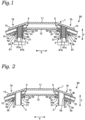
- Fig. 1 is a horizontal cross-sectional view of a vehicle structure 90 according to one embodiment of the present invention, and in the present embodiment, the vehicle structure 90 is a bumper structure, and a vehicle width direction of a vehicle corresponds to an X direction, and a front-back direction of the vehicle corresponds to a Y direction.
- the vehicle structure 90 includes a first member (bumper beam) 1 that extends in the vehicle width direction (X direction), and second members (bumper stays) 2, 3 that extend in the front-back direction (Y direction) of the vehicle and are inserted into the bumper beam 1 in the Y direction.
- the bumper stays 2, 3 are configured to connect the bumper beam 1 to a vehicle frame (not illustrated).
- the bumper beam 1 has a hollow shape and a perpendicular cross section in a rectangular shape.
- the bumper beam 1 includes a front wall 11 positioned on a front side when attached to the vehicle, a back wall 12 arranged parallel with the front wall 11 and positioned on a back side, two front oblique walls 13, 14 that extend obliquely outward in the vehicle width direction from both end portions of the front wall 11 in the vehicle width direction, and two back oblique walls 15, 16 that extend obliquely outward in the vehicle width direction from both end portions of the back wall 12 in the vehicle width direction, the back oblique walls 15, 16 being arranged in parallel with the front oblique walls 13, 14.
- the back oblique wall 15 has a hole part 15a into which the bumper stay 2 is inserted, and the back oblique wall 16 has a hole part 16a into which the bumper stay 3 is inserted.
- the bumper stays 2, 3 have tube parts 21, 31 having a hollow shape as insertion parts to be inserted into the bumper beam 1, and are joined by press-fitting to the bumper beam 1.
- elastic bodies (rubbers) 80 inserted into the tube parts 21, 31 of the bumper stays 2, 3 are compressed in the Y direction by pressers 81, the rubbers 80 are swelled in a direction orthogonal to a compression direction, and the tube parts 21, 31 of the bumper stays 2, 3 are tube-expanded.
- the bumper stays 2, 3 are joined by press-fitting to the bumper beam 1 by being tube-expanded.
- the bumper beam 1 and the bumper stays 2, 3 are each made of an extruded material of aluminum alloy.
- a rubber 80 As the material of a rubber 80, it is preferable to use any one of, for example, urethane rubber, chloroprene rubber, CNR rubber (chloroprene rubber + nitrile rubber), or silicone rubber. Furthermore, hardness of the rubber 80 is preferably 30 or more in Shore A.
- a presser 81 is attached to a press device (not illustrated), and can compress the rubber 80 in the Y direction by being driven by the press device.
- the presser 81 has a projection 81a as a part that presses the rubber 80, and a pressing surface 81b that is an end surface of the projection 81a has a flat surface that is perpendicular to a projection direction (Y direction).
- Fig. 2 is the horizontal cross-sectional view in Fig. 1 without the rubbers 80 and the pressers 81.
- a vehicle structure 10 further has third members (reinforcement members) 4, 5, which are arranged at end portions 1a, 1b in the X direction of the bumper beam 1 and are joined to the end portions 1a, 1b.
- the reinforcement member 4 has a hollow shape and a perpendicular cross section in a rectangular shape. The reinforcement member 4 is inserted into the bumper beam 1 from the end portion 1a of the bumper beam 1 inward in the vehicle width direction of the bumper beam 1, and is joined to the end portion 1a so as to protrude outward in the X direction from an end surface of the end portion 1a of the bumper beam 1.
- the reinforcement member 5 has a hollow shape and a perpendicular cross section in a rectangular shape.
- the reinforcement member 5 is inserted into the bumper beam 1 from the end portion 1b of the bumper beam 1 inward in the vehicle width direction of the bumper beam 1, and is joined to the end portion 1b so as to protrude outward in the X direction from an end surface of the end portion 1b of the bumper beam 1.
- the reinforcement member 4 is inserted into the bumper beam 1 so as to overlap the bumper stay 2 when viewed from the Y direction.
- the reinforcement member 5 is inserted into the bumper beam 1 so as to overlap the bumper stay 3 when viewed from the Y direction. Therefore, when the bumper stays 2, 3 are tube-expanded by the rubbers 80 inserted in the tube parts 21, 31 of the bumper stays 2, 3, the bumper stay 2 is joined by press-fitting to the bumper beam 1 via the reinforcement member 4, and the bumper stay 3 is joined by press-fitting to the bumper beam 1 via the reinforcement member 5.
- the reinforcement member 4 has a hole part 4a into which the bumper stay 2 is inserted, and the reinforcement member 5 has a hole part 5a into which the bumper stay 3 is inserted.
- the bumper stays 2, 3 have seat parts 2a and 3a that extend in the X direction, and the seat parts 2a, 3a include insertion holes 2b, 3b through which fixing bolts 91, which join the bumper stays 2, 3, the end portions 1a, 1b of the bumper beam 1, and the reinforcement members 4, 5, are inserted.
- fixing bolts 91 positions of the end portion 1a of the bumper beam 1 and the reinforcement member 4 with respect to the bumper stay 2 are fixed, and positions of the end portion of the bumper beam 1 and the reinforcement member 5 with respect to the bumper stay 3 are fixed.
- Fig. 3 is a cross-sectional view taken along line III-III in Fig. 2 .
- adhesive 92 is arranged between the end portion 1b of the bumper beam 1 and the reinforcement member 5.
- adhesive that is an insulation material, in consideration of potential difference corrosion between different members.
- adhesive that is an insulation material in consideration of crevice corrosion. Note that a configuration similar to the above configuration is provided between the end portion 1a of the bumper beam 1 and the reinforcement member 4.
- Fig. 4 is a diagram similar to Fig. 3 , which illustrates a modification of the above embodiment.
- key groove parts 1b1 recessed inward on a perpendicular cross section may be formed on an inner surface of the end portion 1b of the bumper beam 1.
- a protrusion 5b that engages with a key groove part 1b1 is formed at a position facing the key groove part 1b1.
- the adhesive 92 is arranged between the end portion 1b of the bumper beam 1 and the reinforcement member 5. Note that a configuration similar to the above configuration is provided between the end portion 1a of the bumper beam 1 and the reinforcement member 4.
- Fig. 5 is a perspective view of a part of the vehicle structure in Fig. 1
- Fig. 6 is a partial perspective view of Fig. 4 .
- an overlap amount L between the reinforcement member 4 and the bumper beam 1 formed by the reinforcement member 4 being inserted into the bumper beam 1 is three times or more a length of a short side S of a perpendicular cross section of the reinforcement member 4.
- an overlap amount between the reinforcement member 5 and the bumper beam 1 formed by the reinforcement member 5 being inserted into the bumper beam 1 is three times or more a length of a short side of a perpendicular cross section of the reinforcement member 5.
- Fig. 7 is a horizontal cross-sectional view in which the bumper stays 2, 3 are tube-expanded by the rubbers 80
- Fig. 8 is a horizontal cross-sectional view illustrating a state where compression of the rubbers 80 is released.
- the bumper beam 1, the bumper stays 2, 3, the reinforcement members 4, 5, and the rubbers 80 are prepared. Then, the reinforcement member 4 is inserted into the bumper beam 1 from the end portion 1a of the bumper beam 1 inward in the vehicle width direction of the bumper beam 1, and the reinforcement member 5 is inserted into the bumper beam 1 from the end portion 1b of the bumper beam 1 inward in the vehicle width direction of the bumper beam 1.
- the tube part 21 of the bumper stay 2 is inserted into the hole part 15a formed in the end portion 1a of the bumper beam 1. At this time, the tube part 21 of the bumper stay 2 penetrates the hole part 4a formed in the reinforcement member 4. Similarly, a tube part 31 of the bumper stay 3 is inserted into the hole part 16a formed in the end portion 1b of the bumper beam 1. At this time, the tube part 31 of the bumper stay 3 penetrates the hole part 5a formed in the reinforcement member 5.
- the fixing bolts 91 are inserted into the insertion holes 2b, 3b of the bumper stay 2, positions of the end portion 1a of the bumper beam 1 and the reinforcement member 4 with respect to the bumper stay 2 are fixed, and positions of the end portion 1b of the bumper beam 1 and the reinforcement member 5 with respect to the bumper stay 3 are fixed.
- the fixing bolts 91 and the seat parts 2a, 3a of the bumper stays 2, 3 may be unnecessary.
- the rubbers 80 are inserted into the tube parts 21, 31 of the bumper stays 2, 3.
- a member inserted into the tube parts 21, 31 of the bumper stays 2, 3 is not limited to a rubber 80, and, for example, a fluid sealing member in which gas or liquid is sealed may be used instead of rubber. Any member can be used as long as the member swells outward by application of compressive force and can tube-expand a tube part of a bumper stay. Note that, it is preferable that the member be a member that is evenly deformed like rubber when swelling outward by application of compressive force.
- the bumper beam 1 is configured by one tube, and a cross-sectional shape of the bumper beam 1 is a shape that has one space inside, and each of the reinforcement members 4, 5 is correspondingly configured by one tube body, and a cross-sectional shape of the reinforcement members 4, 5 is a shape that has one space inside.
- the bumper beam 1 and the reinforcement members 4, 5 are not limited to the above, and may include a plurality of tube bodies.
- Fig. 9 is a perspective view of a part of a vehicle structure of a modification in which the bumper beam 1 is configured by two tube bodies being connected
- Fig. 10 is a partial perspective view of Fig. 9 .
- the bumper beam 1 is configured by two tube bodies 191, 192 that extend in the vehicle width direction being arranged vertically, and the tube body 191 and the tube body 192 being connected by a connection wall 193.
- the reinforcement member 4 is provided with two tube bodies 491, 492 that extend in the vehicle width direction being arranged vertically. Then, the tube body 491 of the reinforcement member 4 is inserted into the tube body 191 of the bumper beam 1 from the end portion 1a of the bumper beam 1 inward in the vehicle width direction of the bumper beam 1, and the tube body 492 of the reinforcement member 4 is inserted into the tube body 492 of the bumper beam 1 from the end portion 1a of the bumper beam 1 inward in the vehicle width direction of the bumper beam 1.
- the reinforcement member 5 is also configured similarly to the reinforcement member 4, and is similarly inserted from the end portion 1b of the bumper beam 1 inward in the vehicle width direction of the bumper beam 1.
- the bumper beam 1 is configured by the tube body 191 and the tube body 192 being connected by the connection wall 193, so that the connection wall 193 can improve structural strength of the bumper beam 1, and as a result, strength against an offset load can be further improved at the end portions 1a, 1b of the bumper beam 1, into which the reinforcement members 4, 5 are inserted.
- Fig. 11 is a perspective view of a part of the vehicle structure of the modification in Fig. 9
- Fig. 12 is a partial perspective view of Fig. 11 .
- the bumper stay 2 is configured to penetrate not only the back oblique wall 15 of the bumper beam 1 but also the front oblique wall 13.
- the bumper stay 3 is configured to penetrate not only the back oblique wall 16 of the bumper beam 1 but also the front oblique wall 14.
- the bumper stays 2, 3 are configured to penetrate the back oblique walls 15, 16 and front oblique walls 13, 14 of the bumper beam 1, joint strength between the bumper stays 2, 3, the reinforcement members 4, 5, and the bumper beam 1 can be improved by press-fitting the bumper stays 2, 3. As a result, the strength against an offset load can be further improved at the end portions 1a, 1b of the bumper beam 1, into which the reinforcement members 4, 5 are inserted.
- Fig. 13 is a perspective view of a part of the vehicle structure of the modification in Fig. 9
- Fig. 14 is a partial perspective view of Fig. 13 .
- the bumper stay 2 is configured to penetrate the back oblique wall 15 of the bumper beam 1 and not to penetrate the reinforcement member 4.
- the bumper stay 3 is configured to penetrate the back oblique wall 16 of the bumper beam 1 and not to penetrate the reinforcement member 5.
- the bumper stays 2, 3 penetrate the back oblique walls 15, 16 of the bumper beam 1 and do not penetrate the reinforcement members 4, 5, lengths of the bumper stays 2, 3 can be shortened by which weight of the vehicle structure 90 can be reduced. Furthermore, it is possible to reduce an effect of joining by press-fitting the bumper stays 2, 3 to the bumper beam 1 on joint between the bumper beam 1 and the reinforcement members 4, 5.
- the connection wall 193 is present at a central part in the vertical direction, in a cross section.
- the connection wall 193 is present at a central part in the vertical direction, in a cross section.
- two each of the reinforcement members 4, 5 are provided.
- a reinforcement member may be arranged at an end portion of a bumper beam by the end portion of the bumper beam being inserted into an inside of the reinforcement member.
- a reinforcement member may be arranged at either one end portion of the bumper beam 1.
- the reinforcement members 4, 5 are arranged so as to protrude from the end portions 1a, of the bumper beam 1 outward in the vehicle width direction in the above embodiment, the reinforcement members 4, 5 may be arranged so as not to protrude from the end portions 1a, 1b of the bumper beam 1.
- the bumper beam 1 and the reinforcement members 4, 5 are joined by the bumper stays 2, 3 being joined by press-fitting to the bumper beam 1 in the above embodiment, the bumper beam 1 and the reinforcement members 4, 5 may be joined by riveting, welding, adhesive, or key groove bending. Furthermore, rubber press-fitting is described as an example of joint by press-fitting in the above embodiment, hydro press-fitting or electromagnetic press-fitting may be applied
- the present invention is not limited to a bumper structure and can be widely applied to a vehicle structure used in a vehicle.
Landscapes
- Engineering & Computer Science (AREA)
- Mechanical Engineering (AREA)
- Body Structure For Vehicles (AREA)
- Automobile Manufacture Line, Endless Track Vehicle, Trailer (AREA)
Description
- The present invention relates to a vehicle structure used for a vehicle and a method for manufacturing the same, and more particularly to a bumper structure used for an automobile, or the like, and a method for manufacturing the same.
- In recent years, automobile crash standards have become stricter, and one of the most recent issues is to reduce damage to an automobile and an occupant in a case where an offset crash has occurred during high-speed traveling of the automobile. Specifically, a small offset crash test is stipulated in which an automobile is caused to crash into a barrier jig at a predetermined speed in a state where a predetermined amount of overlap with respect to a vehicle width of the automobile is provided. Then, in the test described above, a standard of the amount of overlap with respect to the vehicle width of the automobile has been strengthened from conventional 40% to 15%, and the crash speed has become faster than before, for example, from 50 km/h to 64 km/h.
- However, a bumper structure as disclosed in
JP 2009 96459 A JP2008068849 A claim 1. - Here, in order to deal with the offset load described above, it is conceivable to simply increase a length of the bumper structure in a vehicle width direction. However, for example, in a case where the bumper structure is an aluminum extruded material, there is a limit to an extension amount in the vehicle width direction due to problems that a bending length increases and bending curvature decreases. Furthermore, because a cross section of an extruded material is uniform in the vehicle width direction, it is necessary to increase a size of a bumper beam itself or increase thickness of the bumper beam to improve strength in order to impose a large load only on an end portion, which, however, increases overall weight of the bumper structure.
- Furthermore, in a case where the bumper structure is a steel press-formed product, a deep and long bent shape is highly difficult to process, and in order to greatly improve strength of the end portion, it is necessary to apply a patch, or the like. Furthermore, in a case where the bumper structure is a steel roll-formed product, a problem similar to those with an extruded material occurs.
- A vehicle structure as disclosed in
WO 2017/065231 A1 discloses a frame structure attached to an automobile. - An object of the present invention is to provide a vehicle structure capable of improving strength against an offset load with a simple configuration and a method for manufacturing the same.
- A first aspect of the present invention is a vehicle structure as specified in
claim 1. - According to the first aspect, the vehicle structure is a bumper structure and strength against an offset load can be improved by a simple configuration in which the third member is joined to the end portion of the first member in the vehicle width direction. In particular, joint strength between the first member and the third member can be improved by setting the overlap length between the third member and the first member to a predetermined length or more.
- The first aspect preferably further includes the following configuration.
- (1) The third member is arranged so as to overlap the second member in the front-back direction.
- According to the configuration (1), strength of the end portion of the first member in the vehicle width direction can be further improved by the third member being arranged so as to overlap the second member.
- A second aspect of the present invention is a method for manufacturing a vehicle structure, the method including the features specified in
claim 3. - According to the second aspect, a vehicle structure can be manufactured in which strength against an offset load is improved.
- The second aspect preferably further includes the following configuration.
- (2) The method further includes inserting the third member into the first member from the end portion of the first member in the vehicle width direction inward in the vehicle width direction of the first member, and joining by press-fitting the second member into the first member and the third member by tube-expanding the insertion part of the second member into the first member and the third member.
- According to the configuration (2), it is possible to manufacture a vehicle structure in which strength of joint parts of the first member, the second member, and the third member are improved.
- According to the present invention, it is possible to provide a vehicle structure capable of improving strength against an offset load with a simple configuration and a method for manufacturing the same.
-
-
Fig. 1 is a horizontal cross-sectional view of a vehicle structure according to one embodiment of the present invention; -
Fig. 2 is the horizontal cross-sectional view inFig. 1 without rubbers and pressers; -
Fig. 3 is a cross-sectional view taken along line III-III inFig. 2 ; -
Fig. 4 is a diagram similar toFig. 3 , which illustrates a modification; -
Fig. 5 is a perspective view of a part of the vehicle structure inFig. 1 ; -
Fig. 6 is a partial perspective view ofFig. 4 ; -
Fig. 7 is a horizontal cross-sectional view in which bumper stays are tube-expanded by rubbers; -
Fig. 8 is a horizontal cross-sectional view illustrating a state where compression of the rubbers is released; -
Fig. 9 is a perspective view of a part of a vehicle structure of a modification in which a bumper beam is configured by two tube bodies being connected; -
Fig. 10 is a partial perspective view ofFig. 9 ; -
Fig. 11 is a perspective view of a part of the vehicle structure of the modification inFig. 9 ; -
Fig. 12 is a partial perspective view ofFig. 11 ; -
Fig. 13 is a perspective view of a part of the vehicle structure of the modification inFig. 9 ; and -
Fig. 14 is a partial perspective view ofFig. 13 . - An embodiment of the present invention will be described below with reference to the accompanying drawings.
-
Fig. 1 is a horizontal cross-sectional view of avehicle structure 90 according to one embodiment of the present invention, and in the present embodiment, thevehicle structure 90 is a bumper structure, and a vehicle width direction of a vehicle corresponds to an X direction, and a front-back direction of the vehicle corresponds to a Y direction. - As illustrated in
Fig. 1 , thevehicle structure 90 includes a first member (bumper beam) 1 that extends in the vehicle width direction (X direction), and second members (bumper stays) 2, 3 that extend in the front-back direction (Y direction) of the vehicle and are inserted into thebumper beam 1 in the Y direction. The bumper stays 2, 3 are configured to connect thebumper beam 1 to a vehicle frame (not illustrated). - The
bumper beam 1 has a hollow shape and a perpendicular cross section in a rectangular shape. Thebumper beam 1 includes afront wall 11 positioned on a front side when attached to the vehicle, aback wall 12 arranged parallel with thefront wall 11 and positioned on a back side, two frontoblique walls front wall 11 in the vehicle width direction, and two backoblique walls back wall 12 in the vehicle width direction, the backoblique walls oblique walls - The back
oblique wall 15 has ahole part 15a into which the bumper stay 2 is inserted, and the backoblique wall 16 has ahole part 16a into which the bumper stay 3 is inserted. - The bumper stays 2, 3 have
tube parts bumper beam 1, and are joined by press-fitting to thebumper beam 1. As an example of joint by press-fitting, elastic bodies (rubbers) 80 inserted into thetube parts pressers 81, therubbers 80 are swelled in a direction orthogonal to a compression direction, and thetube parts bumper beam 1 by being tube-expanded. - The
bumper beam 1 and the bumper stays 2, 3 are each made of an extruded material of aluminum alloy. - As the material of a
rubber 80, it is preferable to use any one of, for example, urethane rubber, chloroprene rubber, CNR rubber (chloroprene rubber + nitrile rubber), or silicone rubber. Furthermore, hardness of therubber 80 is preferably 30 or more in Shore A. - A
presser 81 is attached to a press device (not illustrated), and can compress therubber 80 in the Y direction by being driven by the press device. Thepresser 81 has aprojection 81a as a part that presses therubber 80, and apressing surface 81b that is an end surface of theprojection 81a has a flat surface that is perpendicular to a projection direction (Y direction). -
Fig. 2 is the horizontal cross-sectional view inFig. 1 without therubbers 80 and thepressers 81. As illustrated inFigs 1 and 2 , a vehicle structure 10 further has third members (reinforcement members) 4, 5, which are arranged atend portions bumper beam 1 and are joined to theend portions reinforcement member 4 has a hollow shape and a perpendicular cross section in a rectangular shape. Thereinforcement member 4 is inserted into thebumper beam 1 from theend portion 1a of thebumper beam 1 inward in the vehicle width direction of thebumper beam 1, and is joined to theend portion 1a so as to protrude outward in the X direction from an end surface of theend portion 1a of thebumper beam 1. - The
reinforcement member 5 has a hollow shape and a perpendicular cross section in a rectangular shape. Thereinforcement member 5 is inserted into thebumper beam 1 from theend portion 1b of thebumper beam 1 inward in the vehicle width direction of thebumper beam 1, and is joined to theend portion 1b so as to protrude outward in the X direction from an end surface of theend portion 1b of thebumper beam 1. - The
reinforcement member 4 is inserted into thebumper beam 1 so as to overlap thebumper stay 2 when viewed from the Y direction. Similarly, thereinforcement member 5 is inserted into thebumper beam 1 so as to overlap thebumper stay 3 when viewed from the Y direction. Therefore, when the bumper stays 2, 3 are tube-expanded by therubbers 80 inserted in thetube parts bumper stay 2 is joined by press-fitting to thebumper beam 1 via thereinforcement member 4, and thebumper stay 3 is joined by press-fitting to thebumper beam 1 via thereinforcement member 5. Thereinforcement member 4 has ahole part 4a into which thebumper stay 2 is inserted, and thereinforcement member 5 has ahole part 5a into which thebumper stay 3 is inserted. - The bumper stays 2, 3 have
seat parts seat parts insertion holes bolts 91, which join the bumper stays 2, 3, theend portions bumper beam 1, and thereinforcement members bolts 91, positions of theend portion 1a of thebumper beam 1 and thereinforcement member 4 with respect to thebumper stay 2 are fixed, and positions of the end portion of thebumper beam 1 and thereinforcement member 5 with respect to thebumper stay 3 are fixed. -
Fig. 3 is a cross-sectional view taken along line III-III inFig. 2 . As illustrated inFig. 3 , adhesive 92 is arranged between theend portion 1b of thebumper beam 1 and thereinforcement member 5. In a case where material of thebumper beam 1 and material of thereinforcement member 5 are different members, it is preferable to arrange adhesive that is an insulation material, in consideration of potential difference corrosion between different members. Furthermore, also in a case where material of thebumper beam 1 and material of thereinforcement member 5 are the same material, it is preferable to arrange adhesive that is an insulation material in consideration of crevice corrosion. Note that a configuration similar to the above configuration is provided between theend portion 1a of thebumper beam 1 and thereinforcement member 4. -
Fig. 4 is a diagram similar toFig. 3 , which illustrates a modification of the above embodiment. As illustrated inFig. 4 , key groove parts 1b1 recessed inward on a perpendicular cross section may be formed on an inner surface of theend portion 1b of thebumper beam 1. In that case, in thereinforcement member 5, aprotrusion 5b that engages with a key groove part 1b1 is formed at a position facing the key groove part 1b1. By theprotrusion 5b of thereinforcement member 5 engaging with thekey groove part 1b of theend portion 1b of thebumper beam 1, positioning of thereinforcement member 5 in a circumferential direction with respect to theend portion 1b is possible. Further, by bending theend portion 1b in the Y direction, positioning of thereinforcement member 5 in the X direction with respect to theend portion 1b is possible. Furthermore, similarly toFig. 3 , the adhesive 92 is arranged between theend portion 1b of thebumper beam 1 and thereinforcement member 5. Note that a configuration similar to the above configuration is provided between theend portion 1a of thebumper beam 1 and thereinforcement member 4. -
Fig. 5 is a perspective view of a part of the vehicle structure inFig. 1 , andFig. 6 is a partial perspective view ofFig. 4 . As illustrated inFigs. 5 and 6 , an overlap amount L between thereinforcement member 4 and thebumper beam 1 formed by thereinforcement member 4 being inserted into thebumper beam 1 is three times or more a length of a short side S of a perpendicular cross section of thereinforcement member 4. Similarly, an overlap amount between thereinforcement member 5 and thebumper beam 1 formed by thereinforcement member 5 being inserted into thebumper beam 1 is three times or more a length of a short side of a perpendicular cross section of thereinforcement member 5. - Next, a method for manufacturing the
vehicle structure 90 will be described mainly with reference toFigs. 2 ,7, and 8. Fig. 7 is a horizontal cross-sectional view in which the bumper stays 2, 3 are tube-expanded by therubbers 80, andFig. 8 is a horizontal cross-sectional view illustrating a state where compression of therubbers 80 is released. - First, as illustrated in
Fig. 2 , thebumper beam 1, the bumper stays 2, 3, thereinforcement members rubbers 80 are prepared. Then, thereinforcement member 4 is inserted into thebumper beam 1 from theend portion 1a of thebumper beam 1 inward in the vehicle width direction of thebumper beam 1, and thereinforcement member 5 is inserted into thebumper beam 1 from theend portion 1b of thebumper beam 1 inward in the vehicle width direction of thebumper beam 1. - Next, the
tube part 21 of thebumper stay 2 is inserted into thehole part 15a formed in theend portion 1a of thebumper beam 1. At this time, thetube part 21 of thebumper stay 2 penetrates thehole part 4a formed in thereinforcement member 4. Similarly, atube part 31 of thebumper stay 3 is inserted into thehole part 16a formed in theend portion 1b of thebumper beam 1. At this time, thetube part 31 of thebumper stay 3 penetrates thehole part 5a formed in thereinforcement member 5. Then, the fixingbolts 91 are inserted into theinsertion holes bumper stay 2, positions of theend portion 1a of thebumper beam 1 and thereinforcement member 4 with respect to thebumper stay 2 are fixed, and positions of theend portion 1b of thebumper beam 1 and thereinforcement member 5 with respect to thebumper stay 3 are fixed. Here, in a case where thetube parts bumper beam 1, the fixingbolts 91 and theseat parts insertion holes bolts 91 are inserted are provided) may be unnecessary. Then, therubbers 80 are inserted into thetube parts - After the
rubbers 80 are inserted, as illustrated inFig. 7 , projections of thepressers 81 are inserted into thetube parts rubbers 80 are compressed in the Y direction to swell in a direction orthogonal to a compression direction, by which thetube parts reinforcement members bumper beam 1 by the tube expansion. - After the bumper stays 2, 3 are joined by press-fitting, as illustrated in
Fig. 8 , the compression of therubbers 80 by thepressers 81 is released. Therubbers 80 from which compressive force is removed restore to an original shape by elastic force of own. Therefore, therubbers 80 can be easily taken out of the bumper stays 2, 3. - A member inserted into the
tube parts rubber 80, and, for example, a fluid sealing member in which gas or liquid is sealed may be used instead of rubber. Any member can be used as long as the member swells outward by application of compressive force and can tube-expand a tube part of a bumper stay. Note that, it is preferable that the member be a member that is evenly deformed like rubber when swelling outward by application of compressive force. - With the
vehicle structure 90 having the above-described configuration, the following effects can be exhibited. - (1) It is possible to provide a
vehicle structure 90 with improved strength against an offset load by a simple configuration in which thereinforcement members end portions bumper beam 1 in the vehicle width direction. - (2) It is possible to further improve strength of the
end portions 1a, of thebumper beam 1 in the vehicle width direction by, when viewed from the front-back direction, thereinforcement member 4 being arranged so as to overlap thebumper stay 2 and thereinforcement member 5 being arranged so as to overlap thebumper stay 3. - (3) It is possible to improve joint strength between the
bumper beam 1 and thereinforcement members reinforcement members bumper beam 1 to a predetermined length or more, that is, three times or more a length of a short side S of a perpendicular cross section of thereinforcement members - (4) It is possible to improve strength of joint parts between the
bumper beam 1, the bumper stays 2, 3, and thereinforcement members tube parts bumper beam 1 and thereinforcement members - (5) The
tube parts rubbers 80. Here, because therubbers 80 are isotropically deformable, thetube parts tube parts tube parts rubber 80 enables thebumper beam 1, the bumper stays 2, 3, and thereinforcement members bumper beam 1, the bumper stays 2, 3, and thereinforcement members - (6) By the fixing
bolts 91, positions of theend portion 1a of thebumper beam 1 and thereinforcement member 4 with respect to thebumper stay 2 can be fixed, and positions of the end portion of thebumper beam 1 and thereinforcement member 5 with respect to thebumper stay 3 can be fixed. Then, also when the bumper stays 2, 3 are tube-expanded by therubbers 80, shifting of positions of thebumper beam 1 and thereinforcement members - (7) It is possible to suppress potential difference corrosion or crevice corrosion between the
bumper beam 1 and thereinforcement members end portions 1a, of thebumper beam 1 and thereinforcement members - In the above embodiment, the
bumper beam 1 is configured by one tube, and a cross-sectional shape of thebumper beam 1 is a shape that has one space inside, and each of thereinforcement members reinforcement members bumper beam 1 and thereinforcement members Fig. 9 is a perspective view of a part of a vehicle structure of a modification in which thebumper beam 1 is configured by two tube bodies being connected, andFig. 10 is a partial perspective view ofFig. 9 . - As illustrated in
Figs. 9 and 10 , thebumper beam 1 is configured by twotube bodies tube body 191 and thetube body 192 being connected by aconnection wall 193. Accordingly, thereinforcement member 4 is provided with twotube bodies tube body 491 of thereinforcement member 4 is inserted into thetube body 191 of thebumper beam 1 from theend portion 1a of thebumper beam 1 inward in the vehicle width direction of thebumper beam 1, and thetube body 492 of thereinforcement member 4 is inserted into thetube body 492 of thebumper beam 1 from theend portion 1a of thebumper beam 1 inward in the vehicle width direction of thebumper beam 1. Thereinforcement member 5 is also configured similarly to thereinforcement member 4, and is similarly inserted from theend portion 1b of thebumper beam 1 inward in the vehicle width direction of thebumper beam 1. - According to the above configuration, the
bumper beam 1 is configured by thetube body 191 and thetube body 192 being connected by theconnection wall 193, so that theconnection wall 193 can improve structural strength of thebumper beam 1, and as a result, strength against an offset load can be further improved at theend portions bumper beam 1, into which thereinforcement members -
Fig. 11 is a perspective view of a part of the vehicle structure of the modification inFig. 9 , andFig. 12 is a partial perspective view ofFig. 11 . As illustrated inFigs. 11 and 12 , thebumper stay 2 is configured to penetrate not only theback oblique wall 15 of thebumper beam 1 but also thefront oblique wall 13. Similarly, thebumper stay 3 is configured to penetrate not only theback oblique wall 16 of thebumper beam 1 but also thefront oblique wall 14. - According to the above configuration, because the bumper stays 2, 3 are configured to penetrate the back
oblique walls oblique walls bumper beam 1, joint strength between the bumper stays 2, 3, thereinforcement members bumper beam 1 can be improved by press-fitting the bumper stays 2, 3. As a result, the strength against an offset load can be further improved at theend portions bumper beam 1, into which thereinforcement members -
Fig. 13 is a perspective view of a part of the vehicle structure of the modification inFig. 9 , andFig. 14 is a partial perspective view ofFig. 13 . As illustrated inFigs. 13 and 14 , thebumper stay 2 is configured to penetrate theback oblique wall 15 of thebumper beam 1 and not to penetrate thereinforcement member 4. Similarly, thebumper stay 3 is configured to penetrate theback oblique wall 16 of thebumper beam 1 and not to penetrate thereinforcement member 5. - According to the above configuration, because the bumper stays 2, 3 penetrate the back
oblique walls bumper beam 1 and do not penetrate thereinforcement members vehicle structure 90 can be reduced. Furthermore, it is possible to reduce an effect of joining by press-fitting the bumper stays 2, 3 to thebumper beam 1 on joint between thebumper beam 1 and thereinforcement members - As illustrated in
Figs. 9 to 14 , in a case where thebumper beam 1 is configured by the twotube bodies tube body 191 and thetube body 192 being connected by theconnection wall 193, theconnection wall 193 is present at a central part in the vertical direction, in a cross section. At this time, usually, two each of thereinforcement members bumper beam 1 and to have one each of thereinforcement members connection wall 193 of thebumper beam 1 only at parts where thereinforcement members reinforcement members - Although the
reinforcement members end portions 1a, by being inserted into theend portions 1a, of thebumper beam 1 in the above embodiment, a reinforcement member may be arranged at an end portion of a bumper beam by the end portion of the bumper beam being inserted into an inside of the reinforcement member. - Although the
reinforcement members end portions 1a, of thebumper beam 1 in the above embodiment, a reinforcement member may be arranged at either one end portion of thebumper beam 1. - Although the
reinforcement members end portions 1a, of thebumper beam 1 outward in the vehicle width direction in the above embodiment, thereinforcement members end portions bumper beam 1. - Although the
bumper beam 1 and thereinforcement members bumper beam 1 in the above embodiment, thebumper beam 1 and thereinforcement members - Although the above embodiment is described taking a bumper structure as the
vehicle structure 90 by way of example, the present invention is not limited to a bumper structure and can be widely applied to a vehicle structure used in a vehicle. - The present invention is not limited to the configurations described in the above embodiment, and can include various modifications conceivable by a person skilled in the art without departing from the scope of the claims.
- 1: Bumper beam, 1a: End portion, 1b: End portion, 11: Front wall, 12: Back wall, 13: Front oblique wall, 14: Front oblique wall, 15: Back oblique wall, 16: Back oblique wall, 2: Bumper stay, 21: Tube part, 3: Bumper stay, 31: Tube part, 4: Reinforcement member, 5: Reinforcement member, 80: Rubber, 81: Presser, 90: Vehicle structure, 91: Fixing bolt, 92: Adhesive
Claims (4)
- A vehicle structure (90) comprising:a first member (1) that extends in a vehicle width direction (X);a second member (2, 3) that extends in a front-back direction (Y); anda third member (4, 5) that is arranged at an end portion (1a, 1b) of the first member (1) in the vehicle width direction (X) and joined to the end portion (1a, 1b),wherein a cross-sectional shape of the third member (4, 5) has a rectangular shape, andwherein the second member (2, 3) is inserted in the front-back direction (Y) into the first member (1) and the third member (4, 5),characterized in thatthe vehicle structure (90) is a bumper structure, andan overlap length (L) between the third member (4, 5) and the first member (1) is three times or more than a length of a short side (S) of a cross section of the third member (4, 5).
- The vehicle structure (90) according to claim 1, wherein the third member (4, 5) is arranged so as to overlap the second member (2, 3) in the front-back direction (Y).
- A method for manufacturing the vehicle structure (90) according to claim 1 or 2, the method comprising:preparing the first member (1) that extends in the vehicle width direction (X), the second member (2, 3 that extends in the front-back direction (Y), and the third member (4, 5) that extends in the vehicle width direction (X);arranging the third member (4, 5) at the end portion (1a, 1b) of the first member (1) in the vehicle width direction (X) and joining the third member (4, 5) to the end portion (1a, 1b); andinserting the second member (2, 3) into the first member (1) and the third member (4, 5) from the front-back direction (Y).
- The method according to claim 3, comprising:inserting the third member (4, 5) into the first member (1) from the end portion (1a, 1b) of the first member (1) in the vehicle width direction (X) inward in the vehicle width direction (X) of the first member (1); andjoining by press-fitting the second member (2, 3) into the first member (1) and the third member (4, 5) by tube-expanding an insertion part (21, 31) of the second member (2, 3) into the first member (1) and the third member (4, 5).
Applications Claiming Priority (2)
| Application Number | Priority Date | Filing Date | Title |
|---|---|---|---|
| JP2018004391A JP7072389B2 (en) | 2018-01-15 | 2018-01-15 | Vehicle structure and its manufacturing method |
| PCT/JP2018/046077 WO2019138781A1 (en) | 2018-01-15 | 2018-12-14 | Structure for vehicles, and method for manufacturing same |
Publications (3)
| Publication Number | Publication Date |
|---|---|
| EP3741628A1 EP3741628A1 (en) | 2020-11-25 |
| EP3741628A4 EP3741628A4 (en) | 2021-10-06 |
| EP3741628B1 true EP3741628B1 (en) | 2023-04-26 |
Family
ID=67219367
Family Applications (1)
| Application Number | Title | Priority Date | Filing Date |
|---|---|---|---|
| EP18899999.9A Active EP3741628B1 (en) | 2018-01-15 | 2018-12-14 | Vehicle structure and method for manufacturing the same |
Country Status (4)
| Country | Link |
|---|---|
| US (1) | US11345294B2 (en) |
| EP (1) | EP3741628B1 (en) |
| JP (1) | JP7072389B2 (en) |
| WO (1) | WO2019138781A1 (en) |
Families Citing this family (5)
| Publication number | Priority date | Publication date | Assignee | Title |
|---|---|---|---|---|
| JP6760873B2 (en) * | 2017-03-24 | 2020-09-23 | 株式会社神戸製鋼所 | Vehicle structure |
| SE1750635A1 (en) * | 2017-05-22 | 2018-11-23 | Gestamp Hardtech Ab | Bumper beam with reinforcement patch |
| US11364863B2 (en) * | 2020-05-01 | 2022-06-21 | Toyota Motor Engineering & Manufacturing North America, Inc. | Structural reinforcement insert for a vehicle bumper |
| US11713013B2 (en) | 2020-07-09 | 2023-08-01 | Fontaine Commercial Trailer, Inc. | Side underride guard assembly for a trailer |
| KR20230068662A (en) * | 2021-11-11 | 2023-05-18 | 현대자동차주식회사 | Bumper back beam having public use |
Family Cites Families (9)
| Publication number | Priority date | Publication date | Assignee | Title |
|---|---|---|---|---|
| ATE384644T1 (en) * | 2004-03-22 | 2008-02-15 | Peugeot Citroen Automobiles Sa | METHOD FOR PRODUCING A SUPPORT PLATE OF AN ENERGY ABSORBING BUMPER AND SUPPORT PLATE OBTAINED BY THIS METHOD |
| JP2007222877A (en) * | 2006-02-21 | 2007-09-06 | Showa Denko Kk | Jointing structure of hollow members |
| JP2007284039A (en) * | 2006-03-22 | 2007-11-01 | Kobe Steel Ltd | Bumper structure and frame structure |
| JP4895739B2 (en) | 2006-09-16 | 2012-03-14 | 株式会社神戸製鋼所 | Bumper structure |
| JP5203870B2 (en) | 2007-09-26 | 2013-06-05 | 株式会社神戸製鋼所 | Automotive body reinforcement with excellent bending crush characteristics |
| DE112010006033T5 (en) * | 2009-10-19 | 2013-08-29 | Showa Denko K.K. | Vehicle bumper beam and method of making the same |
| JP5300936B2 (en) * | 2011-08-22 | 2013-09-25 | 株式会社神戸製鋼所 | Bumper structure |
| JP2017074601A (en) | 2015-10-14 | 2017-04-20 | 株式会社神戸製鋼所 | Bonding method of each component constituting frame structure mounted on automobile, and frame structure mounted on automobile |
| JP6706600B2 (en) * | 2017-09-05 | 2020-06-10 | 株式会社神戸製鋼所 | Bumper system |
-
2018
- 2018-01-15 JP JP2018004391A patent/JP7072389B2/en active Active
- 2018-12-14 WO PCT/JP2018/046077 patent/WO2019138781A1/en not_active Ceased
- 2018-12-14 US US16/954,923 patent/US11345294B2/en active Active
- 2018-12-14 EP EP18899999.9A patent/EP3741628B1/en active Active
Also Published As
| Publication number | Publication date |
|---|---|
| EP3741628A4 (en) | 2021-10-06 |
| US11345294B2 (en) | 2022-05-31 |
| WO2019138781A1 (en) | 2019-07-18 |
| EP3741628A1 (en) | 2020-11-25 |
| JP2019123322A (en) | 2019-07-25 |
| JP7072389B2 (en) | 2022-05-20 |
| US20200377046A1 (en) | 2020-12-03 |
Similar Documents
| Publication | Publication Date | Title |
|---|---|---|
| EP3741628B1 (en) | Vehicle structure and method for manufacturing the same | |
| JP4478200B2 (en) | Hydroform processing method and hydroformed parts | |
| WO2018173859A1 (en) | Vehicular structure | |
| CN112703130B (en) | Bumper beam with steel reinforcements | |
| CN106061639B (en) | Tubular part and its end sealing method | |
| EP3604087B1 (en) | Vehicle structural member and method for producing same | |
| JP2009248585A (en) | Vehicle body reinforcement structure | |
| CA2262777C (en) | Process for cold forming tube ends | |
| US8443642B2 (en) | Process for pre-forming cylindrical tubes into tubular members having sharp corners | |
| JP5149495B2 (en) | How to connect multiple pipes | |
| WO2020100483A1 (en) | Bead forming method and structure member | |
| US10843251B2 (en) | Method for joining members | |
| JP6020290B2 (en) | Vehicle side body structure | |
| JP2011131219A (en) | Method for forming pipe member | |
| US20190210087A1 (en) | Method for joining members, and joint body | |
| JP6000888B2 (en) | Mounting structure for the joint reinforcement collar | |
| EP4112203B1 (en) | Vehicular structure member and method for manufacturing same | |
| EP4104947B1 (en) | Method for producing structure | |
| JP2013159153A (en) | Bumper structure | |
| EP3738689B1 (en) | Joined body and method for manufacturing same | |
| EP3988226A1 (en) | Joined body and production method for same | |
| JP2001321843A (en) | Body frame member and method of forming the frame member | |
| JP5342225B2 (en) | Axle case structure |
Legal Events
| Date | Code | Title | Description |
|---|---|---|---|
| STAA | Information on the status of an ep patent application or granted ep patent |
Free format text: STATUS: THE INTERNATIONAL PUBLICATION HAS BEEN MADE |
|
| PUAI | Public reference made under article 153(3) epc to a published international application that has entered the european phase |
Free format text: ORIGINAL CODE: 0009012 |
|
| STAA | Information on the status of an ep patent application or granted ep patent |
Free format text: STATUS: REQUEST FOR EXAMINATION WAS MADE |
|
| 17P | Request for examination filed |
Effective date: 20200623 |
|
| AK | Designated contracting states |
Kind code of ref document: A1 Designated state(s): AL AT BE BG CH CY CZ DE DK EE ES FI FR GB GR HR HU IE IS IT LI LT LU LV MC MK MT NL NO PL PT RO RS SE SI SK SM TR |
|
| AX | Request for extension of the european patent |
Extension state: BA ME |
|
| DAV | Request for validation of the european patent (deleted) | ||
| DAX | Request for extension of the european patent (deleted) | ||
| A4 | Supplementary search report drawn up and despatched |
Effective date: 20210906 |
|
| RIC1 | Information provided on ipc code assigned before grant |
Ipc: B62D 65/16 20060101ALI20210831BHEP Ipc: B60R 19/24 20060101ALI20210831BHEP Ipc: B60R 19/04 20060101AFI20210831BHEP |
|
| STAA | Information on the status of an ep patent application or granted ep patent |
Free format text: STATUS: EXAMINATION IS IN PROGRESS |
|
| 17Q | First examination report despatched |
Effective date: 20220621 |
|
| GRAP | Despatch of communication of intention to grant a patent |
Free format text: ORIGINAL CODE: EPIDOSNIGR1 |
|
| STAA | Information on the status of an ep patent application or granted ep patent |
Free format text: STATUS: GRANT OF PATENT IS INTENDED |
|
| INTG | Intention to grant announced |
Effective date: 20221209 |
|
| GRAS | Grant fee paid |
Free format text: ORIGINAL CODE: EPIDOSNIGR3 |
|
| GRAA | (expected) grant |
Free format text: ORIGINAL CODE: 0009210 |
|
| STAA | Information on the status of an ep patent application or granted ep patent |
Free format text: STATUS: THE PATENT HAS BEEN GRANTED |
|
| AK | Designated contracting states |
Kind code of ref document: B1 Designated state(s): AL AT BE BG CH CY CZ DE DK EE ES FI FR GB GR HR HU IE IS IT LI LT LU LV MC MK MT NL NO PL PT RO RS SE SI SK SM TR |
|
| REG | Reference to a national code |
Ref country code: GB Ref legal event code: FG4D |
|
| REG | Reference to a national code |
Ref country code: CH Ref legal event code: EP |
|
| REG | Reference to a national code |
Ref country code: DE Ref legal event code: R096 Ref document number: 602018049045 Country of ref document: DE |
|
| REG | Reference to a national code |
Ref country code: AT Ref legal event code: REF Ref document number: 1562608 Country of ref document: AT Kind code of ref document: T Effective date: 20230515 |
|
| REG | Reference to a national code |
Ref country code: IE Ref legal event code: FG4D |
|
| P01 | Opt-out of the competence of the unified patent court (upc) registered |
Effective date: 20230523 |
|
| REG | Reference to a national code |
Ref country code: LT Ref legal event code: MG9D |
|
| REG | Reference to a national code |
Ref country code: NL Ref legal event code: MP Effective date: 20230426 |
|
| REG | Reference to a national code |
Ref country code: AT Ref legal event code: MK05 Ref document number: 1562608 Country of ref document: AT Kind code of ref document: T Effective date: 20230426 |
|
| PG25 | Lapsed in a contracting state [announced via postgrant information from national office to epo] |
Ref country code: NL Free format text: LAPSE BECAUSE OF FAILURE TO SUBMIT A TRANSLATION OF THE DESCRIPTION OR TO PAY THE FEE WITHIN THE PRESCRIBED TIME-LIMIT Effective date: 20230426 |
|
| PG25 | Lapsed in a contracting state [announced via postgrant information from national office to epo] |
Ref country code: SE Free format text: LAPSE BECAUSE OF FAILURE TO SUBMIT A TRANSLATION OF THE DESCRIPTION OR TO PAY THE FEE WITHIN THE PRESCRIBED TIME-LIMIT Effective date: 20230426 Ref country code: PT Free format text: LAPSE BECAUSE OF FAILURE TO SUBMIT A TRANSLATION OF THE DESCRIPTION OR TO PAY THE FEE WITHIN THE PRESCRIBED TIME-LIMIT Effective date: 20230828 Ref country code: NO Free format text: LAPSE BECAUSE OF FAILURE TO SUBMIT A TRANSLATION OF THE DESCRIPTION OR TO PAY THE FEE WITHIN THE PRESCRIBED TIME-LIMIT Effective date: 20230726 Ref country code: ES Free format text: LAPSE BECAUSE OF FAILURE TO SUBMIT A TRANSLATION OF THE DESCRIPTION OR TO PAY THE FEE WITHIN THE PRESCRIBED TIME-LIMIT Effective date: 20230426 Ref country code: AT Free format text: LAPSE BECAUSE OF FAILURE TO SUBMIT A TRANSLATION OF THE DESCRIPTION OR TO PAY THE FEE WITHIN THE PRESCRIBED TIME-LIMIT Effective date: 20230426 |
|
| PG25 | Lapsed in a contracting state [announced via postgrant information from national office to epo] |
Ref country code: RS Free format text: LAPSE BECAUSE OF FAILURE TO SUBMIT A TRANSLATION OF THE DESCRIPTION OR TO PAY THE FEE WITHIN THE PRESCRIBED TIME-LIMIT Effective date: 20230426 Ref country code: PL Free format text: LAPSE BECAUSE OF FAILURE TO SUBMIT A TRANSLATION OF THE DESCRIPTION OR TO PAY THE FEE WITHIN THE PRESCRIBED TIME-LIMIT Effective date: 20230426 Ref country code: LV Free format text: LAPSE BECAUSE OF FAILURE TO SUBMIT A TRANSLATION OF THE DESCRIPTION OR TO PAY THE FEE WITHIN THE PRESCRIBED TIME-LIMIT Effective date: 20230426 Ref country code: LT Free format text: LAPSE BECAUSE OF FAILURE TO SUBMIT A TRANSLATION OF THE DESCRIPTION OR TO PAY THE FEE WITHIN THE PRESCRIBED TIME-LIMIT Effective date: 20230426 Ref country code: IS Free format text: LAPSE BECAUSE OF FAILURE TO SUBMIT A TRANSLATION OF THE DESCRIPTION OR TO PAY THE FEE WITHIN THE PRESCRIBED TIME-LIMIT Effective date: 20230826 Ref country code: HR Free format text: LAPSE BECAUSE OF FAILURE TO SUBMIT A TRANSLATION OF THE DESCRIPTION OR TO PAY THE FEE WITHIN THE PRESCRIBED TIME-LIMIT Effective date: 20230426 Ref country code: GR Free format text: LAPSE BECAUSE OF FAILURE TO SUBMIT A TRANSLATION OF THE DESCRIPTION OR TO PAY THE FEE WITHIN THE PRESCRIBED TIME-LIMIT Effective date: 20230727 |
|
| PG25 | Lapsed in a contracting state [announced via postgrant information from national office to epo] |
Ref country code: FI Free format text: LAPSE BECAUSE OF FAILURE TO SUBMIT A TRANSLATION OF THE DESCRIPTION OR TO PAY THE FEE WITHIN THE PRESCRIBED TIME-LIMIT Effective date: 20230426 |
|
| PG25 | Lapsed in a contracting state [announced via postgrant information from national office to epo] |
Ref country code: SK Free format text: LAPSE BECAUSE OF FAILURE TO SUBMIT A TRANSLATION OF THE DESCRIPTION OR TO PAY THE FEE WITHIN THE PRESCRIBED TIME-LIMIT Effective date: 20230426 |
|
| REG | Reference to a national code |
Ref country code: DE Ref legal event code: R097 Ref document number: 602018049045 Country of ref document: DE |
|
| PG25 | Lapsed in a contracting state [announced via postgrant information from national office to epo] |
Ref country code: SM Free format text: LAPSE BECAUSE OF FAILURE TO SUBMIT A TRANSLATION OF THE DESCRIPTION OR TO PAY THE FEE WITHIN THE PRESCRIBED TIME-LIMIT Effective date: 20230426 Ref country code: SK Free format text: LAPSE BECAUSE OF FAILURE TO SUBMIT A TRANSLATION OF THE DESCRIPTION OR TO PAY THE FEE WITHIN THE PRESCRIBED TIME-LIMIT Effective date: 20230426 Ref country code: RO Free format text: LAPSE BECAUSE OF FAILURE TO SUBMIT A TRANSLATION OF THE DESCRIPTION OR TO PAY THE FEE WITHIN THE PRESCRIBED TIME-LIMIT Effective date: 20230426 Ref country code: EE Free format text: LAPSE BECAUSE OF FAILURE TO SUBMIT A TRANSLATION OF THE DESCRIPTION OR TO PAY THE FEE WITHIN THE PRESCRIBED TIME-LIMIT Effective date: 20230426 Ref country code: DK Free format text: LAPSE BECAUSE OF FAILURE TO SUBMIT A TRANSLATION OF THE DESCRIPTION OR TO PAY THE FEE WITHIN THE PRESCRIBED TIME-LIMIT Effective date: 20230426 Ref country code: CZ Free format text: LAPSE BECAUSE OF FAILURE TO SUBMIT A TRANSLATION OF THE DESCRIPTION OR TO PAY THE FEE WITHIN THE PRESCRIBED TIME-LIMIT Effective date: 20230426 |
|
| PLBE | No opposition filed within time limit |
Free format text: ORIGINAL CODE: 0009261 |
|
| STAA | Information on the status of an ep patent application or granted ep patent |
Free format text: STATUS: NO OPPOSITION FILED WITHIN TIME LIMIT |
|
| 26N | No opposition filed |
Effective date: 20240129 |
|
| PG25 | Lapsed in a contracting state [announced via postgrant information from national office to epo] |
Ref country code: SI Free format text: LAPSE BECAUSE OF FAILURE TO SUBMIT A TRANSLATION OF THE DESCRIPTION OR TO PAY THE FEE WITHIN THE PRESCRIBED TIME-LIMIT Effective date: 20230426 |
|
| PG25 | Lapsed in a contracting state [announced via postgrant information from national office to epo] |
Ref country code: SI Free format text: LAPSE BECAUSE OF FAILURE TO SUBMIT A TRANSLATION OF THE DESCRIPTION OR TO PAY THE FEE WITHIN THE PRESCRIBED TIME-LIMIT Effective date: 20230426 Ref country code: IT Free format text: LAPSE BECAUSE OF FAILURE TO SUBMIT A TRANSLATION OF THE DESCRIPTION OR TO PAY THE FEE WITHIN THE PRESCRIBED TIME-LIMIT Effective date: 20230426 |
|
| REG | Reference to a national code |
Ref country code: CH Ref legal event code: PL |
|
| PG25 | Lapsed in a contracting state [announced via postgrant information from national office to epo] |
Ref country code: LU Free format text: LAPSE BECAUSE OF NON-PAYMENT OF DUE FEES Effective date: 20231214 |
|
| PG25 | Lapsed in a contracting state [announced via postgrant information from national office to epo] |
Ref country code: MC Free format text: LAPSE BECAUSE OF FAILURE TO SUBMIT A TRANSLATION OF THE DESCRIPTION OR TO PAY THE FEE WITHIN THE PRESCRIBED TIME-LIMIT Effective date: 20230426 |
|
| GBPC | Gb: european patent ceased through non-payment of renewal fee |
Effective date: 20231214 |
|
| REG | Reference to a national code |
Ref country code: BE Ref legal event code: MM Effective date: 20231231 |
|
| PG25 | Lapsed in a contracting state [announced via postgrant information from national office to epo] |
Ref country code: MC Free format text: LAPSE BECAUSE OF FAILURE TO SUBMIT A TRANSLATION OF THE DESCRIPTION OR TO PAY THE FEE WITHIN THE PRESCRIBED TIME-LIMIT Effective date: 20230426 Ref country code: LU Free format text: LAPSE BECAUSE OF NON-PAYMENT OF DUE FEES Effective date: 20231214 |
|
| REG | Reference to a national code |
Ref country code: IE Ref legal event code: MM4A |
|
| PG25 | Lapsed in a contracting state [announced via postgrant information from national office to epo] |
Ref country code: IE Free format text: LAPSE BECAUSE OF NON-PAYMENT OF DUE FEES Effective date: 20231214 |
|
| PG25 | Lapsed in a contracting state [announced via postgrant information from national office to epo] |
Ref country code: GB Free format text: LAPSE BECAUSE OF NON-PAYMENT OF DUE FEES Effective date: 20231214 |
|
| PG25 | Lapsed in a contracting state [announced via postgrant information from national office to epo] |
Ref country code: BE Free format text: LAPSE BECAUSE OF NON-PAYMENT OF DUE FEES Effective date: 20231231 |
|
| PG25 | Lapsed in a contracting state [announced via postgrant information from national office to epo] |
Ref country code: FR Free format text: LAPSE BECAUSE OF NON-PAYMENT OF DUE FEES Effective date: 20231231 |
|
| PG25 | Lapsed in a contracting state [announced via postgrant information from national office to epo] |
Ref country code: CH Free format text: LAPSE BECAUSE OF NON-PAYMENT OF DUE FEES Effective date: 20231231 |
|
| PG25 | Lapsed in a contracting state [announced via postgrant information from national office to epo] |
Ref country code: IE Free format text: LAPSE BECAUSE OF NON-PAYMENT OF DUE FEES Effective date: 20231214 Ref country code: GB Free format text: LAPSE BECAUSE OF NON-PAYMENT OF DUE FEES Effective date: 20231214 Ref country code: FR Free format text: LAPSE BECAUSE OF NON-PAYMENT OF DUE FEES Effective date: 20231231 Ref country code: CH Free format text: LAPSE BECAUSE OF NON-PAYMENT OF DUE FEES Effective date: 20231231 Ref country code: BE Free format text: LAPSE BECAUSE OF NON-PAYMENT OF DUE FEES Effective date: 20231231 |
|
| PG25 | Lapsed in a contracting state [announced via postgrant information from national office to epo] |
Ref country code: BG Free format text: LAPSE BECAUSE OF FAILURE TO SUBMIT A TRANSLATION OF THE DESCRIPTION OR TO PAY THE FEE WITHIN THE PRESCRIBED TIME-LIMIT Effective date: 20230426 |
|
| PG25 | Lapsed in a contracting state [announced via postgrant information from national office to epo] |
Ref country code: BG Free format text: LAPSE BECAUSE OF FAILURE TO SUBMIT A TRANSLATION OF THE DESCRIPTION OR TO PAY THE FEE WITHIN THE PRESCRIBED TIME-LIMIT Effective date: 20230426 |
|
| PG25 | Lapsed in a contracting state [announced via postgrant information from national office to epo] |
Ref country code: CY Free format text: LAPSE BECAUSE OF FAILURE TO SUBMIT A TRANSLATION OF THE DESCRIPTION OR TO PAY THE FEE WITHIN THE PRESCRIBED TIME-LIMIT; INVALID AB INITIO Effective date: 20181214 |
|
| PG25 | Lapsed in a contracting state [announced via postgrant information from national office to epo] |
Ref country code: HU Free format text: LAPSE BECAUSE OF FAILURE TO SUBMIT A TRANSLATION OF THE DESCRIPTION OR TO PAY THE FEE WITHIN THE PRESCRIBED TIME-LIMIT; INVALID AB INITIO Effective date: 20181214 |
|
| PG25 | Lapsed in a contracting state [announced via postgrant information from national office to epo] |
Ref country code: TR Free format text: LAPSE BECAUSE OF FAILURE TO SUBMIT A TRANSLATION OF THE DESCRIPTION OR TO PAY THE FEE WITHIN THE PRESCRIBED TIME-LIMIT Effective date: 20230426 |
|
| PGFP | Annual fee paid to national office [announced via postgrant information from national office to epo] |
Ref country code: DE Payment date: 20250930 Year of fee payment: 8 |