EP3741590B1 - Tire position-determining method and device and tire pressure monitoring system - Google Patents
Tire position-determining method and device and tire pressure monitoring system Download PDFInfo
- Publication number
- EP3741590B1 EP3741590B1 EP19741892.4A EP19741892A EP3741590B1 EP 3741590 B1 EP3741590 B1 EP 3741590B1 EP 19741892 A EP19741892 A EP 19741892A EP 3741590 B1 EP3741590 B1 EP 3741590B1
- Authority
- EP
- European Patent Office
- Prior art keywords
- exciter
- tire pressure
- signal
- response signals
- excitation signal
- Prior art date
- Legal status (The legal status is an assumption and is not a legal conclusion. Google has not performed a legal analysis and makes no representation as to the accuracy of the status listed.)
- Active
Links
Images



Classifications
-
- B—PERFORMING OPERATIONS; TRANSPORTING
- B60—VEHICLES IN GENERAL
- B60C—VEHICLE TYRES; TYRE INFLATION; TYRE CHANGING; CONNECTING VALVES TO INFLATABLE ELASTIC BODIES IN GENERAL; DEVICES OR ARRANGEMENTS RELATED TO TYRES
- B60C23/00—Devices for measuring, signalling, controlling, or distributing tyre pressure or temperature, specially adapted for mounting on vehicles; Arrangement of tyre inflating devices on vehicles, e.g. of pumps or of tanks; Tyre cooling arrangements
- B60C23/02—Signalling devices actuated by tyre pressure
- B60C23/04—Signalling devices actuated by tyre pressure mounted on the wheel or tyre
- B60C23/0408—Signalling devices actuated by tyre pressure mounted on the wheel or tyre transmitting the signals by non-mechanical means from the wheel or tyre to a vehicle body mounted receiver
- B60C23/0422—Signalling devices actuated by tyre pressure mounted on the wheel or tyre transmitting the signals by non-mechanical means from the wheel or tyre to a vehicle body mounted receiver characterised by the type of signal transmission means
- B60C23/0433—Radio signals
- B60C23/0447—Wheel or tyre mounted circuits
- B60C23/0455—Transmission control of wireless signals
- B60C23/0464—Transmission control of wireless signals to avoid signal interference
-
- B—PERFORMING OPERATIONS; TRANSPORTING
- B60—VEHICLES IN GENERAL
- B60C—VEHICLE TYRES; TYRE INFLATION; TYRE CHANGING; CONNECTING VALVES TO INFLATABLE ELASTIC BODIES IN GENERAL; DEVICES OR ARRANGEMENTS RELATED TO TYRES
- B60C23/00—Devices for measuring, signalling, controlling, or distributing tyre pressure or temperature, specially adapted for mounting on vehicles; Arrangement of tyre inflating devices on vehicles, e.g. of pumps or of tanks; Tyre cooling arrangements
- B60C23/02—Signalling devices actuated by tyre pressure
- B60C23/04—Signalling devices actuated by tyre pressure mounted on the wheel or tyre
- B60C23/0408—Signalling devices actuated by tyre pressure mounted on the wheel or tyre transmitting the signals by non-mechanical means from the wheel or tyre to a vehicle body mounted receiver
- B60C23/0415—Automatically identifying wheel mounted units, e.g. after replacement or exchange of wheels
- B60C23/0416—Automatically identifying wheel mounted units, e.g. after replacement or exchange of wheels allocating a corresponding wheel position on vehicle, e.g. front/left or rear/right
-
- B—PERFORMING OPERATIONS; TRANSPORTING
- B60—VEHICLES IN GENERAL
- B60C—VEHICLE TYRES; TYRE INFLATION; TYRE CHANGING; CONNECTING VALVES TO INFLATABLE ELASTIC BODIES IN GENERAL; DEVICES OR ARRANGEMENTS RELATED TO TYRES
- B60C23/00—Devices for measuring, signalling, controlling, or distributing tyre pressure or temperature, specially adapted for mounting on vehicles; Arrangement of tyre inflating devices on vehicles, e.g. of pumps or of tanks; Tyre cooling arrangements
- B60C23/02—Signalling devices actuated by tyre pressure
- B60C23/04—Signalling devices actuated by tyre pressure mounted on the wheel or tyre
- B60C23/0408—Signalling devices actuated by tyre pressure mounted on the wheel or tyre transmitting the signals by non-mechanical means from the wheel or tyre to a vehicle body mounted receiver
- B60C23/0422—Signalling devices actuated by tyre pressure mounted on the wheel or tyre transmitting the signals by non-mechanical means from the wheel or tyre to a vehicle body mounted receiver characterised by the type of signal transmission means
- B60C23/0433—Radio signals
- B60C23/0435—Vehicle body mounted circuits, e.g. transceiver or antenna fixed to central console, door, roof, mirror or fender
- B60C23/0438—Vehicle body mounted circuits, e.g. transceiver or antenna fixed to central console, door, roof, mirror or fender comprising signal transmission means, e.g. for a bidirectional communication with a corresponding wheel mounted receiver
- B60C23/044—Near field triggers, e.g. magnets or triggers with 125 KHz
-
- B—PERFORMING OPERATIONS; TRANSPORTING
- B60—VEHICLES IN GENERAL
- B60C—VEHICLE TYRES; TYRE INFLATION; TYRE CHANGING; CONNECTING VALVES TO INFLATABLE ELASTIC BODIES IN GENERAL; DEVICES OR ARRANGEMENTS RELATED TO TYRES
- B60C23/00—Devices for measuring, signalling, controlling, or distributing tyre pressure or temperature, specially adapted for mounting on vehicles; Arrangement of tyre inflating devices on vehicles, e.g. of pumps or of tanks; Tyre cooling arrangements
- B60C23/02—Signalling devices actuated by tyre pressure
- B60C23/04—Signalling devices actuated by tyre pressure mounted on the wheel or tyre
- B60C23/0408—Signalling devices actuated by tyre pressure mounted on the wheel or tyre transmitting the signals by non-mechanical means from the wheel or tyre to a vehicle body mounted receiver
- B60C23/0422—Signalling devices actuated by tyre pressure mounted on the wheel or tyre transmitting the signals by non-mechanical means from the wheel or tyre to a vehicle body mounted receiver characterised by the type of signal transmission means
- B60C23/0433—Radio signals
- B60C23/0435—Vehicle body mounted circuits, e.g. transceiver or antenna fixed to central console, door, roof, mirror or fender
- B60C23/0438—Vehicle body mounted circuits, e.g. transceiver or antenna fixed to central console, door, roof, mirror or fender comprising signal transmission means, e.g. for a bidirectional communication with a corresponding wheel mounted receiver
- B60C23/0442—Vehicle body mounted circuits, e.g. transceiver or antenna fixed to central console, door, roof, mirror or fender comprising signal transmission means, e.g. for a bidirectional communication with a corresponding wheel mounted receiver the transmitted signal comprises further information, e.g. instruction codes, sensor characteristics or identification data
-
- B—PERFORMING OPERATIONS; TRANSPORTING
- B60—VEHICLES IN GENERAL
- B60C—VEHICLE TYRES; TYRE INFLATION; TYRE CHANGING; CONNECTING VALVES TO INFLATABLE ELASTIC BODIES IN GENERAL; DEVICES OR ARRANGEMENTS RELATED TO TYRES
- B60C23/00—Devices for measuring, signalling, controlling, or distributing tyre pressure or temperature, specially adapted for mounting on vehicles; Arrangement of tyre inflating devices on vehicles, e.g. of pumps or of tanks; Tyre cooling arrangements
- B60C23/02—Signalling devices actuated by tyre pressure
- B60C23/04—Signalling devices actuated by tyre pressure mounted on the wheel or tyre
- B60C23/0408—Signalling devices actuated by tyre pressure mounted on the wheel or tyre transmitting the signals by non-mechanical means from the wheel or tyre to a vehicle body mounted receiver
- B60C23/0422—Signalling devices actuated by tyre pressure mounted on the wheel or tyre transmitting the signals by non-mechanical means from the wheel or tyre to a vehicle body mounted receiver characterised by the type of signal transmission means
- B60C23/0433—Radio signals
- B60C23/0447—Wheel or tyre mounted circuits
- B60C23/045—Means for detecting electromagnetic field changes being not part of the signal transmission per se, e.g. strength, direction, propagation or masking
-
- B—PERFORMING OPERATIONS; TRANSPORTING
- B60—VEHICLES IN GENERAL
- B60C—VEHICLE TYRES; TYRE INFLATION; TYRE CHANGING; CONNECTING VALVES TO INFLATABLE ELASTIC BODIES IN GENERAL; DEVICES OR ARRANGEMENTS RELATED TO TYRES
- B60C23/00—Devices for measuring, signalling, controlling, or distributing tyre pressure or temperature, specially adapted for mounting on vehicles; Arrangement of tyre inflating devices on vehicles, e.g. of pumps or of tanks; Tyre cooling arrangements
- B60C23/02—Signalling devices actuated by tyre pressure
- B60C23/04—Signalling devices actuated by tyre pressure mounted on the wheel or tyre
- B60C23/0408—Signalling devices actuated by tyre pressure mounted on the wheel or tyre transmitting the signals by non-mechanical means from the wheel or tyre to a vehicle body mounted receiver
- B60C23/0422—Signalling devices actuated by tyre pressure mounted on the wheel or tyre transmitting the signals by non-mechanical means from the wheel or tyre to a vehicle body mounted receiver characterised by the type of signal transmission means
- B60C23/0433—Radio signals
- B60C23/0447—Wheel or tyre mounted circuits
- B60C23/0455—Transmission control of wireless signals
- B60C23/0457—Transmission control of wireless signals self triggered by timer
-
- B—PERFORMING OPERATIONS; TRANSPORTING
- B60—VEHICLES IN GENERAL
- B60C—VEHICLE TYRES; TYRE INFLATION; TYRE CHANGING; CONNECTING VALVES TO INFLATABLE ELASTIC BODIES IN GENERAL; DEVICES OR ARRANGEMENTS RELATED TO TYRES
- B60C23/00—Devices for measuring, signalling, controlling, or distributing tyre pressure or temperature, specially adapted for mounting on vehicles; Arrangement of tyre inflating devices on vehicles, e.g. of pumps or of tanks; Tyre cooling arrangements
- B60C23/02—Signalling devices actuated by tyre pressure
- B60C23/04—Signalling devices actuated by tyre pressure mounted on the wheel or tyre
- B60C23/0408—Signalling devices actuated by tyre pressure mounted on the wheel or tyre transmitting the signals by non-mechanical means from the wheel or tyre to a vehicle body mounted receiver
- B60C23/0422—Signalling devices actuated by tyre pressure mounted on the wheel or tyre transmitting the signals by non-mechanical means from the wheel or tyre to a vehicle body mounted receiver characterised by the type of signal transmission means
- B60C23/0433—Radio signals
- B60C23/0447—Wheel or tyre mounted circuits
- B60C23/0455—Transmission control of wireless signals
- B60C23/0461—Transmission control of wireless signals externally triggered, e.g. by wireless request signal, magnet or manual switch
-
- B—PERFORMING OPERATIONS; TRANSPORTING
- B60—VEHICLES IN GENERAL
- B60C—VEHICLE TYRES; TYRE INFLATION; TYRE CHANGING; CONNECTING VALVES TO INFLATABLE ELASTIC BODIES IN GENERAL; DEVICES OR ARRANGEMENTS RELATED TO TYRES
- B60C23/00—Devices for measuring, signalling, controlling, or distributing tyre pressure or temperature, specially adapted for mounting on vehicles; Arrangement of tyre inflating devices on vehicles, e.g. of pumps or of tanks; Tyre cooling arrangements
- B60C23/02—Signalling devices actuated by tyre pressure
- B60C23/04—Signalling devices actuated by tyre pressure mounted on the wheel or tyre
- B60C23/0408—Signalling devices actuated by tyre pressure mounted on the wheel or tyre transmitting the signals by non-mechanical means from the wheel or tyre to a vehicle body mounted receiver
- B60C23/0422—Signalling devices actuated by tyre pressure mounted on the wheel or tyre transmitting the signals by non-mechanical means from the wheel or tyre to a vehicle body mounted receiver characterised by the type of signal transmission means
- B60C23/0433—Radio signals
- B60C23/0447—Wheel or tyre mounted circuits
- B60C23/0455—Transmission control of wireless signals
- B60C23/0462—Structure of transmission protocol
-
- G—PHYSICS
- G01—MEASURING; TESTING
- G01S—RADIO DIRECTION-FINDING; RADIO NAVIGATION; DETERMINING DISTANCE OR VELOCITY BY USE OF RADIO WAVES; LOCATING OR PRESENCE-DETECTING BY USE OF THE REFLECTION OR RERADIATION OF RADIO WAVES; ANALOGOUS ARRANGEMENTS USING OTHER WAVES
- G01S13/00—Systems using the reflection or reradiation of radio waves, e.g. radar systems; Analogous systems using reflection or reradiation of waves whose nature or wavelength is irrelevant or unspecified
- G01S13/74—Systems using reradiation of radio waves, e.g. secondary radar systems; Analogous systems
- G01S13/75—Systems using reradiation of radio waves, e.g. secondary radar systems; Analogous systems using transponders powered from received waves, e.g. using passive transponders, or using passive reflectors
- G01S13/751—Systems using reradiation of radio waves, e.g. secondary radar systems; Analogous systems using transponders powered from received waves, e.g. using passive transponders, or using passive reflectors wherein the responder or reflector radiates a coded signal
Definitions
- the present invention relates to the field of automotive technologies, and in particular, to a tire location positioning method and apparatus, a tire pressure monitoring system (tire pressure monitoring system, TPMS) receiver, a tire pressure sensor, a TPMS including the TPMS receiver and the tire pressure sensor and an automobile including the TPMS.
- a tire pressure monitoring system tire pressure monitoring system, TPMS
- TPMS Tire pressure monitoring system
- a TPMS performs real-time monitoring on main parameters such as pressure and temperature of an automobile tire in a traveling or stationary state by using a highly sensitive micro wireless sensing apparatus fastened inside the automobile tire, to ensure that the pressure and the temperature of the tire are maintained within standard ranges, thereby reducing a probability of a flat tire or tire damage and reducing fuel consumption and damage of automobile parts.
- the TPMS includes a plurality of highly sensitive tire pressure sensors mounted on each of the tires, which collect data such as the pressure and the temperature of the automobile tire in real time, and transmit the data to a central monitor included in the TPMS.
- a wheel identifying apparatus includes first and second triggering devices located on the body of a vehicle, a plurality of transceivers each of which is located on one of the running and spare wheels of the vehicle, and a receiver and a wheel identifier both of which are located on the body of the vehicle.
- the first and second triggering devices continuously transmit first and second trigger signals, respectively.
- Each of the transceivers monitors the strength of either the first or second trigger signal thereat for a given length of time, and transmits a signal indicating variation in the monitored strength.
- the receiver receives and provides to the wheel identifier all the signals transmitted by the transceivers.
- the wheel identifier identifies, for each of the signals, the wheel on which the transceiver having transmitted the signal is located through a comparison between the variations indicated by the signals.
- the TPMS performs positioning on a tire location generally in two manners: 1.
- the tire location is identified according to an identifier (ID) of a tire pressure sensor.
- ID an identifier
- the ID of the tire pressure sensor corresponding to the tire needs to be manually entered into the central monitor. If the entry is mistakenly performed in accident, a detection error will be caused. Moreover, during subsequent maintenance, if the tire is replaced or tire locations are exchanged, an ID of a new tire pressure sensor needs to be entered. Therefore, extremely inconvenience is caused. 2.
- Positioning is performed on left and right wheels based on an acceleration.
- a main objective of the present invention is to provide a tire location positioning method and apparatus, a TPMS receiver, a tire pressure sensor, a TPMS and an automobile, to identify tire locations in real time without manually entering IDs of tire pressure sensors, and achieve accurate and reliable identification results.
- the embodiments of the present invention provide a tire location positioning method and apparatus, a TPMS receiver, a tire pressure sensor, a TPMS and an automobile.
- a tire location positioning system includes the TPMS receiver and the tire pressure sensor.
- the automobile includes the tire location positioning system.
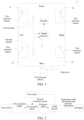
- FIG. 1 is a schematic diagram of an application environment of a tire location positioning method according to this embodiment of the present invention.
- An application scenario includes an automobile 1.
- the automobile 1 includes a left front wheel 11, a right front wheel 12, a left rear wheel 13, a right rear wheel 14 and a TPMS.
- the TPMS may include the tire location positioning system (including the TPMS receiver and the tire pressure sensor), a first exciter, a second exciter and a display.
- the TPMS includes four tire pressure sensors.
- the left front wheel 11, the right front wheel 12, the left rear wheel 13 and the right rear wheel 14 each have one tire pressure sensor mounted.
- the first exciter is configured to send a first excitation signal to the left front wheel and the right front wheel, and a distance between the first exciter and the left front wheel is unequal to a distance between the first exciter and the right front wheel.
- the second exciter is configured to send a second excitation signal to the left rear wheel and the right rear wheel, and a distance between the second exciter and the left rear wheel is unequal to a distance between the second exciter and the right rear wheel.
- the first excitation signal and the second excitation signal are both used for activating the tire pressure sensors.
- the first exciter may be disposed on any position where the first excitation signal can act on the left front wheel and the right front wheel and the distance to the left front wheel is unequal to the distance to the right front wheel.
- the second exciter may be disposed on any position where the second excitation signal can act on the left rear wheel and the right rear wheel and the distance to the left rear wheel is unequal to the distance to the right rear wheel.
- the first exciter is disposed on a front axle (not shown in the figure) and close to a left end of the front axle
- the second exciter is disposed on a rear axle (not shown in the figure) and close to a left end of the rear axle, so that the first excitation signal acts on the left front wheel and the right front wheel
- the second excitation signal acts on the left rear wheel and the right rear wheel.
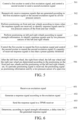
- FIG. 2 is a schematic diagram of an implementation principle of application of a tire location positioning method according to this embodiment of the present invention.
- the implementation principle mainly includes as follows:
- positioning may be first performed on the front and rear wheels according to the times when the response signals are received, to identify the response signals sent by the tire pressure sensors of the front and rear wheels. After the front and rear wheels are determined, positioning may be performed on the left and right wheels according to the signal strength information, to identify the response signals sent by the tire pressure sensors of the left and right wheels. In this way, the response signals sent by the tire pressure sensors of the wheels are identified.
- the four response signals received by the TPMS receiver respectively are: a "response signal 1", a "response signal 2", a "response signal 3" and a "response signal 4".
- the "response signal 1" is a response signal sent by the tire pressure sensor of the left front wheel 11, and the “response signal 2" is a response signal sent by the tire pressure sensor of the right front wheel 12.
- Signal strength corresponding to the "response signal 3" and signal strength corresponding to the "response signal 4" are compared with the preset signal strength threshold.
- the "response signal 3" is a response signal sent by the tire pressure sensor of the left rear wheel 13
- the “response signal 4" is a response signal sent by the tire pressure sensor of the right rear wheel 14.
- positioning may be first performed on the left and right wheels according to the signal strength information, to identify the response signals sent by the tire pressure sensors of the left and right wheels.
- positioning may be performed on the front and rear wheels according to the times when the response signals are received, to identify the response signals sent by the tire pressure sensors of the front and rear wheels. In this way, the response signals sent by the tire pressure sensors of the wheels are identified.
- the automobile 1 may include automobiles of various types, for example, a passenger vehicle or a commercial vehicle.
- the TPMS receiver may include an electronic control unit (ECU) and the like, to send a control instruction to implement functions performed by the TPMS receiver.
- ECU electronice control unit
- the first exciter is disposed on the front axle and close to a right end of the front axle
- the second exciter is disposed on the rear axle and close to a right end of the rear axle.
- the first exciter is disposed on the rear axle
- the second exciter is disposed on the front axle.
- the two response signals that are received earlier are set as the response signals sent by the tire pressure sensors of the rear wheels
- the two response signals that are received later are set as the response signals sent by the tire pressure sensors of the front wheels.
- the TPMS receiver performs positioning on the wheels according to the times when the response signals are received and the signal strength information, so that tire locations can be identified in real time when the automobile is in a stationary or moving state without manually entering IDs of the tire pressure sensors, and identification results are accurate and reliable.
- FIG. 4 is a schematic flowchart of a tire location positioning method according to an embodiment of the present invention.
- the tire location positioning method provided in this embodiment of the present invention is applied to an automobile.
- the automobile includes a left front wheel, a right front wheel, a left rear wheel and a right rear wheel.
- the wheels are each provided with a tire pressure sensor.
- the automobile further includes a first exciter and a second exciter.
- the first exciter is configured to send a first excitation signal to the left front wheel and the right front wheel, and a distance between the first exciter and the left front wheel is unequal to a distance between the first exciter and the right front wheel.
- the second exciter is configured to send a second excitation signal to the left rear wheel and the right rear wheel, and a distance between the second exciter and the left rear wheel is unequal to a distance between the second exciter and the right rear wheel.
- the method may be performed by the TPMS receiver of the automobile 1 in FIG. 1 .
- the TPMS receiver may include an ECU and the like.
- the method includes the following steps: 401: Control the first exciter to send the first excitation signal, and control the second exciter to send the second excitation signal.
- a time when the first excitation signal is sent is different from a time when the second excitation signal is sent.
- the TPMS receiver first controls the first exciter to send the first excitation signal, and after a preset time, controls the second exciter to send the second excitation signal.
- the TPMS receiver is separately connected to the first exciter and the second exciter, to control the first exciter to send the first excitation signal and control the second exciter to send the second excitation signal.
- Transmission directions in which the first exciter sends the first excitation signal and the second exciter sends the second excitation signal and tire pressure sensors of left and right wheels are on a same axis, to ensure that the tire pressure sensors of the left and right wheels on the same axis all can receive the first excitation signal or the second excitation signal.
- tire pressure sensors of front wheels including the left front wheel and the right front wheel
- tire pressure sensors of rear wheels including the left rear wheel and right rear wheel
- the first exciter and the second exciter may be low-frequency exciters, and the first excitation signal and the second excitation signal that are sent may be low-frequency excitation signals.
- the TPMS receiver is separately communicatively connected to all the tire pressure sensors, to respectively receive the response signals that are generated according to the first excitation signal or the second excitation signal by all the tire pressure sensors.
- the TPMS receiver may receive four response signals.
- the response signals each include signal strength information, the signal strength information being used for representing signal strength of receiving the first excitation signal or the second excitation signal.
- the signal strength information may be 1-byte information converted from a signal strength volume of receiving the first excitation signal or the second excitation signal, for example, a power byte P used for representing signal strength.
- 403 Perform positioning on front and rear wheels according to times when the response signals are received, to identify response signals sent by tire pressure sensors of the front and rear wheels.
- the tire pressure sensors of the front wheels can receive only the first excitation signal sent by the first exciter
- the tire pressure sensors of the rear wheels can receive only the second excitation signal sent by the second exciter
- the time when the first exciter sends the first excitation signal is different from the time when the second exciter sends the second excitation signal
- times when the tire pressure sensors of the front wheels receive the first excitation signal are also different from times when the tire pressure sensors of the rear wheels receive the second excitation signal.
- the TPMS receiver controls the first exciter to send the first excitation signal
- the tire pressure sensors of the left front wheel and the right front wheel receive the first excitation signal, generate response signals after being activated, and send the response signals to the TPMS receiver.
- the TPMS receiver controls the second exciter to send the second excitation signal, and the tire pressure sensors of the left rear wheel and the right rear wheel receive the second excitation signal, generate response signals after being activated, and send the response signals to the TPMS receiver.
- the TPMS receiver may perform positioning on the front and rear wheels according to the times when the response signals are received, to identify the response signals sent by the tire pressure sensors of the front and rear wheels.
- the four response signals received by the TPMS receiver respectively are: a "response signal 1", a “response signal 2", a “response signal 3” and a “response signal 4", and the "response signal 1" and the “response signal 2" are received by the TPMS receiver earlier than the "response signal 3" and the "response signal 4".
- the "response signal 1" and the “response signal 2" are the response signals sent by the tire pressure sensors of the front wheels
- the "response signal 3" and the “response signal 4" are the response signals sent by the tire pressure sensors of the rear wheels.
- the first exciter is configured to send the first excitation signal to the left front wheel and the right front wheel, and the distance between the first exciter and the left front wheel is unequal to the distance between the first exciter and the right front wheel; and the second exciter is configured to send the second excitation signal to the left rear wheel and the right rear wheel, and the distance between the second exciter and the left rear wheel is unequal to the distance between the second exciter and the right rear wheel.
- the first exciter is disposed on a front axle and close to a left end of the front axle
- the second exciter is disposed on a rear axle and close to a left end of the rear axle.
- a first excitation signal or a second excitation signal received by tire pressure sensors of left wheels is stronger than a first excitation signal or a second excitation signal received by tire pressure sensors of the right wheels (including the right front wheel and the right rear wheel).
- signal strength represented by signal strength information of the response signals of the tire pressure sensors of the left front wheel and the left rear wheel is greater than signal strength represented by signal strength information of the response signals of the tire pressure sensors of the right front wheel and the right rear wheel.
- the TPMS receiver may perform positioning on the left and right wheels according to the signal strength information.
- values of signal strength represented by signal strength information of the four response signals respectively are P1, P2, P3 and P4, and the TPMS receiver learns, through comparison, that P1 and P2 are greater than P3 and P4. Then two response signals corresponding to P1 and P2 are set as the response signals sent by the tire pressure sensor of the left front wheel and the tire pressure sensor of the left rear wheel, and two response signals corresponding to P3 and P4 are set as the response signals sent by the tire pressure sensor of the right front wheel and the tire pressure sensor of the right rear wheel.
- the TPMS receiver may identify, according to the times when the response signals are received and the signal strength information, the response signals sent by the tire pressure sensors of the wheels, that is, each of the response signals is from a tire pressure sensor of which wheel. For example, positioning is first performed on the front and rear wheels according to the times when the response signals are received, to identify the response signals sent by the tire pressure sensors of the front and rear wheels. After the front and rear wheels are determined, positioning is performed on the left and right wheels according to the signal strength information, to identify the response signals sent by the tire pressure sensors of the left and right wheels. In this way, the response signals sent by the tire pressure sensors of the wheels are identified.
- positioning is first performed on the left and right wheels according to the signal strength information, to identify the response signals sent by the tire pressure sensors of the left and right wheels. After the left and right wheels are determined, positioning is performed on the front and rear wheels according to the times when the response signals are received, to identify the response signals sent by the tire pressure sensors of the front and rear wheels. In this way, the response signals sent by the tire pressure sensors of the wheels are identified.
- steps 401 to 404 may be performed in different sequences. For example, step 404 is first performed and then step 403 is performed.
- the TPMS receiver performs positioning on the front and rear wheels according to the times when the response signals are received, and performs positioning on the left and right wheels according to the signal strength information, so that tire locations can be identified in real time when the automobile is in a stationary or moving state without manually entering IDs of the tire pressure sensors, and identification results are accurate and reliable.
- FIG. 5 is a schematic flowchart of a tire location positioning method according to another embodiment of the present invention.
- the tire location positioning method provided in this embodiment of the present invention is applied to an automobile.
- the automobile includes a left front wheel, a right front wheel, a left rear wheel and a right rear wheel.
- the wheels are each provided with a tire pressure sensor.
- the automobile further includes a first exciter and a second exciter.
- the first exciter is configured to send a first excitation signal to the left front wheel and the right front wheel, and a distance between the first exciter and the left front wheel is unequal to a distance between the first exciter and the right front wheel.
- the second exciter is configured to send a second excitation signal to the left rear wheel and the right rear wheel, and a distance between the second exciter and the left rear wheel is unequal to a distance between the second exciter and the right rear wheel.
- the method may be performed by the TPMS receiver of the automobile 1 in FIG. 1 .
- the TPMS receiver may include an ECU and the like.
- the method includes the following steps: 501: Control the first exciter to send the first excitation signal, and control the second exciter to send the second excitation signal.
- a time when the first excitation signal is sent is different from a time when the second excitation signal is sent.
- the TPMS receiver first controls the first exciter to send the first excitation signal, and after a preset time, controls the second exciter to send the second excitation signal.
- Transmission directions in which the first exciter sends the first excitation signal and the second exciter sends the second excitation signal and tire pressure sensors of left and right wheels are on a same axis, to ensure that the tire pressure sensors of the left and right wheels on the same axis all can receive the first excitation signal or the second excitation signal.
- tire pressure sensors of front wheels including the left front wheel and the right front wheel
- tire pressure sensors of rear wheels including the left rear wheel and right rear wheel
- the response signals include signal strength information, the signal strength information being used for representing signal strength of receiving the first excitation signal or the second excitation signal.
- 503 Perform positioning on front and rear wheels according to times when the response signals are received, to identify response signals sent by tire pressure sensors of the front and rear wheels.
- the tire pressure sensors of the front wheels can receive only the first excitation signal sent by the first exciter
- the tire pressure sensors of the rear wheels can receive only the second excitation signal sent by the second exciter
- the time when the first excitation signal is sent is different from the time when the second excitation signal is sent. For example, the time when the first exciter sends the first excitation signal is earlier than the time when the second exciter sends the second excitation signal. Therefore, times when the tire pressure sensors of the front wheels receive the first excitation signal are earlier than times when the tire pressure sensors of the rear wheels receive the second excitation signal.
- the TPMS receiver controls the first exciter to send the first excitation signal, and the tire pressure sensors of the left front wheel and the right front wheel receive the first excitation signal, generate response signals after being activated, and send the response signals to a controller.
- the controller controls the second exciter to send the second excitation signal, and the tire pressure sensors of the left rear wheel and the right rear wheel receive the second excitation signal, generate response signals after being activated, and send the response signals to the controller.
- the controller may perform positioning on the front and rear wheels according to the times when the response signals are received, to identify the response signals sent by the tire pressure sensors of the front and rear wheels.
- the time when the first excitation signal is sent is earlier than the time when the second excitation signal is sent.
- Two response signals that are received earlier are set as the response signals sent by the tire pressure sensors of the front wheels, where the front wheels include the left front wheel and the right front wheel; and two response signals that are received later are set as the response signals sent by the tire pressure sensors of the rear wheels, where the rear wheels include the left rear wheel and the right rear wheel.
- four response signals received by the TPMS receiver respectively are: a “response signal 1", a “response signal 2", a “response signal 3” and a “response signal 4"
- the "response signal 1" and the “response signal 2” are two response signals that are received earlier in the four response signals received by the controller
- the "response signal 3" and the “response signal 4" are two response signals that are received later in the four response signals received by the TPMS receiver.
- the "response signal 1" and the “response signal 2" are the response signals sent by the tire pressure sensors of the front wheels
- the "response signal 3" and the “response signal 4" are the response signals sent by the tire pressure sensors of the rear wheels.
- 504 Perform positioning on left and right wheels according to the signal strength information, to identify response signals sent by tire pressure sensors of the left and right wheels.
- the first exciter is configured to send the first excitation signal to the left front wheel and the right front wheel
- the second exciter is configured to send the second excitation signal to the left rear wheel and the right rear wheel
- the distance between the first exciter and the left front wheel is unequal to the distance between the first exciter and the right front wheel
- the distance between the second exciter and the left rear wheel is unequal to the distance between the first exciter and the right rear wheel.
- the distance between the first exciter and the left front wheel is less than the distance between the first exciter and the right front wheel
- the distance between the second exciter and the left rear wheel is less than the distance between the second exciter and the right rear wheel.
- the first exciter is disposed on a front axle and close to a left end of the front axle
- the second exciter is disposed on a rear axle and close to a left end of the rear axle. Therefore, a first excitation signal or a second excitation signal received by tire pressure sensors of left wheels (including the left front wheel and the left rear wheel) is stronger than a first excitation signal or a second excitation signal received by tire pressure sensors of the right wheels (including the right front wheel and the right rear wheel).
- signal strength represented by signal strength information of the response signals of the tire pressure sensors of the left front wheel and the left rear wheel is greater than signal strength represented by signal strength information of the response signals of the tire pressure sensors of the right front wheel and the right rear wheel.
- the TPMS receiver may perform positioning on the left and right wheels according to the signal strength information. Specifically, two response signals whose signal strength is greater than a preset signal strength threshold are set as the response signals sent by the tire pressure sensors of the left wheels, where the left wheels include the left front wheel and the left rear wheel; and two response signals whose signal strength is less than the preset signal strength threshold are set as the response signals sent by the tire pressure sensors of the right wheels, where the left wheels include the right front wheel and the right rear wheel.
- values of signal strength represented by signal strength information of the four response signals respectively are P1, P2, P3 and P4, the preset signal strength threshold is P, and the TPMS receiver learns, by comparing P with P 1, P2, P3 and P4, that P1 and P2 are greater than P, and P3 and P4 are less than P. Then two response signals corresponding to P1 and P2 are set as the response signals sent by the tire pressure sensor of the left front wheel and the tire pressure sensor of the left rear wheel, and two response signals corresponding to P3 and P4 are set as the response signals sent by the tire pressure sensor of the right front wheel and the tire pressure sensor of the right rear wheel.
- the TPMS receiver may identify, according to the times when the response signals are received and the signal strength information, the response signals sent by the tire pressure sensors of the wheels, that is, each of the response signals is from a tire pressure sensor of which wheel. For example, positioning is first performed on the front and rear wheels according to the times when the response signals are received, to identify the response signals sent by the tire pressure sensors of the front and rear wheels. After the front and rear wheels are determined, positioning is performed on the left and right wheels according to the signal strength information, to identify the response signals sent by tire pressure sensors of the left and right wheels. In this way, the response signals sent by the tire pressure sensors of the wheels are identified.
- positioning is first performed on the left and right wheels according to the signal strength information, to identify the response signals sent by the tire pressure sensors of the left and right wheels. After the left and right wheels are determined, positioning is performed on the front and rear wheels according to the times when the response signals are received, to identify the response signals sent by the tire pressure sensors of the front and rear wheels. In this way, the response signals sent by the tire pressure sensors of the wheels are identified.
- the tire pressure sensors may fail to successfully respond to the first excitation signal or the second excitation signal due to an external factor and the like, and therefore cannot generate response signals.
- the TPMS receiver needs to control the first exciter to resend the first excitation signal or control the second exciter to resend the second excitation signal, to avoid a packet loss.
- the TPMS receiver controls the first exciter to resend the first excitation signal and controls the second exciter to resend the second excitation signal. Subsequently, the TPMS receiver continues to monitor the quantity of received response signals, and stops resending until the quantity of received response signals is equal to the preset quantity threshold.
- a times threshold may be preset.
- resending is stopped regardless of whether the quantity of received response signals is equal to the preset quantity threshold, to avoid a case in which the first exciter is repeatedly controlled to send the first excitation signal and the second exciter is repeatedly controlled to send the second excitation signal, but the quantity of received response signals never reaches the quantity threshold, for example, a case in which some of the four tire pressure sensors may be damaged, and cannot generate or send response signals.
- the automobile further includes a spare tire, the spare tire being provided with a tire pressure sensor; and the method further includes the following step: 506: After the left front wheel, the right front wheel, the left rear wheel and the right rear wheel are determined according to the positioning on the front and rear wheels and the positioning on the left and right wheels, set, if a periodic positioning signal is received, the positioning signal as positioning information sent by the tire pressure sensor of the spare tire.
- the response signals sent by the tire pressure sensors of the wheels may be identified through steps 503 and 504. If the TPMS receiver further receives a periodic positioning signal, for example, a positioning signal that is sent with T as a period, the TPMS receiver sets the positioning signal as positioning information sent by the tire pressure sensor of the spare tire, to perform positioning on the spare tire.
- a periodic positioning signal for example, a positioning signal that is sent with T as a period
- steps 505 and 506 may be optional steps in different embodiments.
- steps 501 to 506 may be performed in different sequences.
- the TPMS receiver performs positioning on the front and rear wheels according to the times when the response signals are received, and performs positioning on the left and right wheels according to the signal strength information, so that tire locations can be identified in real time when the automobile is in a stationary or moving state without manually entering IDs of the tire pressure sensors, and identification results are accurate and reliable.
- FIG. 6 is a schematic flowchart of a tire location positioning method according to another embodiment of the present invention.
- the tire location positioning method provided in this embodiment of the present invention is applied to an automobile.
- the automobile includes a TPMS receiver.
- the automobile further includes a first exciter and a second exciter.
- the first exciter is configured to send a first excitation signal to a left front wheel and a right front wheel, and a distance between the first exciter and the left front wheel is unequal to a distance between the first exciter and the right front wheel.
- the second exciter is configured to send a second excitation signal to a left rear wheel and a right rear wheel, and a distance between the second exciter and the left rear wheel is unequal to a distance between the second exciter and the right rear wheel.
- the method may be performed by the tire pressure sensors of the automobile 1 in FIG. 1 .
- the method includes the following steps: 601: Receive an excitation signal.
- the tire pressure sensors receive the first excitation signal sent by the first exciter or the second excitation signal sent by the second exciter.
- Each of the tire pressure sensors can receive only one of the first excitation signal and the second excitation signal. For example, a tire pressure sensor receives the first excitation signal, then the tire pressure sensor cannot receive the second excitation signal.
- the tire pressure sensors generate response signals according to the first excitation signal or the second excitation signal. Transmission directions in which the first exciter sends the first excitation signal and the second exciter sends the second excitation signal and tire pressure sensors of left and right wheels are on a same axis.
- the first exciter is disposed on a front axle
- the second exciter is disposed on a rear axle. Therefore, tire pressure sensors of front wheels (including the left front wheel and the right front wheel) can receive only the first excitation signal sent by the first exciter, and tire pressure sensors of rear wheels (including the left rear wheel and the right rear wheel) can receive only the second excitation signal sent by the second exciter.
- the tire pressure sensors of the left front wheel and the right front wheel receive the first excitation signal, and generate response signals after being activated.
- the tire pressure sensors of the left rear wheel and the right rear wheel receive the second excitation signal, and generate response signals after being activated.
- the response signals include signal strength information, the signal strength information being used for representing signal strength of receiving the first excitation signal or the second excitation signal.
- the response signals are the same as the response signals in the foregoing embodiments. Therefore, details are not described herein again.
- All the tire pressure sensors send the generated response signals to the TPMS receiver, and the TPMS receiver performs positioning on the wheels according to times when the response signals are received and the signal strength information.
- signal strength corresponding to a response signal sent by the tire pressure sensor of the left front wheel is P 1
- signal strength corresponding to a response signal sent by the tire pressure sensor of the right front wheel is P2.
- a delay time of the response signal sent by the tire pressure sensor of the left front wheel is k*P1
- a delay time of the response signal sent by the tire pressure sensor of the right front wheel is k*P2.
- 605 Delay the response signal according to the delay time.
- no packet overlap phenomenon occurs when the response signals sent by the tire pressure sensors of the front and rear wheels are received by the TPMS receiver. That is, it is controlled during a process of receiving the response signals sent by the front wheels, the response signals sent by the rear wheels are not received, to avoid packet overlap.
- packet overlap may occur when the response signals sent by the tire pressure sensors of the left and right wheels are received by the TPMS receiver. To prevent the packet overlap, the response signals may be delayed.
- the tire pressure sensors may determine, according to the signal strength information, delay times of generating the response signals, and then delay the response signals according to the delay times, so that times when the TPMS receiver receives the response signals sent by the tire pressure sensors of the left wheels and receives the response signals sent by the tire pressure sensors of the right wheels are different, thereby effectively avoiding packet overlap when the TPMS receiver receives the response signals of the tire pressure sensors of the left and right wheels. That the tire pressure sensors delay the response signals according to the delay times may be as follows: the tire pressure sensors delay, according to the delay times, generating the response signals, or the tire pressure sensors delay, according to the delay times, sending the response signals to the TPMS receiver.
- steps 604 and 605 may be optional steps in different embodiments.
- steps 601 to 605 may be performed in different sequences. For example, steps 604 and 605 are first performed, and then step 603 is performed.
- the tire pressure sensors generate the response signals according to the excitation signals, and send the response signals to the TPMS receiver, and the controller performs positioning on the front and rear wheels according to the times of the response signals, and performs positioning on the left and right wheels according to the signal strength information, so that tire locations can be identified in real time when the automobile is in a stationary or moving state without manually entering IDs of the tire pressure sensors, and identification results are accurate and reliable.
- FIG. 7 is a schematic diagram of a tire location positioning apparatus according to an embodiment of the present invention.
- the tire location positioning apparatus provided in this embodiment of the present invention may be configured in a TPMS receiver of an automobile.
- the automobile includes a left front wheel, a right front wheel, a left rear wheel and a right rear wheel.
- the wheels are each provided with a tire pressure sensor.
- the automobile further includes a first exciter and a second exciter.
- the first exciter is configured to send a first excitation signal to the left front wheel and the right front wheel, and a distance between the first exciter and the left front wheel is unequal to a distance between the first exciter and the right front wheel.
- the second exciter is configured to send a second excitation signal to the left rear wheel and the right rear wheel, and a distance between the second exciter and the left rear wheel is unequal to a distance between the second exciter and the right rear wheel.
- a first control module 701 is configured to control the first exciter to send the first excitation signal, and control the second exciter to send the second excitation signal.
- a time when the first excitation signal is sent is different from a time when the second excitation signal is sent.
- the first control module 701 first controls the first exciter to send the first excitation signal, and after a preset time, controls the second exciter to send the second excitation signal. Transmission directions in which the first exciter sends the first excitation signal and the second exciter sends the second excitation signal under control of the first control module 701 and tire pressure sensors of left and right wheels to be on a same axis, to ensure that the tire pressure sensors of the left and right wheels on the same axis all can receive the first excitation signal or the second excitation signal.
- tire pressure sensors of front wheels including the left front wheel and the right front wheel
- tire pressure sensors of rear wheels including the left rear wheel and right rear wheel
- a response signal receiving module 702 is configured to respectively receive response signals that are generated according to the first excitation signal or the second excitation signal by all the tire pressure sensors in the left front wheel, the right front wheel, the left rear wheel and the right rear wheel.
- the response signal receiving module 702 may receive four response signals.
- the response signals each include signal strength information, the signal strength information being used for representing signal strength of receiving the first excitation signal or the second excitation signal.
- the signal strength information may be 1-byte information converted from a signal strength volume of receiving the first excitation signal or the second excitation signal, for example, a power byte P used for representing signal strength.
- a front and rear wheel positioning module 703 is configured to perform positioning on front and rear wheels according to times when the response signals are received, to identify response signals sent by tire pressure sensors of the front and rear wheels.
- the tire pressure sensors of the front wheels can receive only the first excitation signal sent by the first exciter
- the tire pressure sensors of the rear wheels can receive only the second excitation signal sent by the second exciter
- the time when the first excitation signal is sent is different from the time when the second excitation signal is sent.
- the time when the first exciter sends the first excitation signal is earlier than the time when the second exciter sends the second excitation signal. Therefore, a time when the tire pressure sensors of the front wheels receive the first excitation signal is earlier than a time when the tire pressure sensors of the rear wheels receive the second excitation signal.
- the front and rear wheel positioning module 703 may perform positioning on the front and rear wheels according to the times when the response signals are received, to identify the response signals sent by the tire pressure sensors of the front and rear wheels.
- a left and right wheel positioning module 704 is configured to perform positioning on left and right wheels according to the signal strength information, to identify response signals sent by tire pressure sensors of the left and right wheels.
- the first exciter is configured to send the first excitation signal to the left front wheel and the right front wheel
- the second exciter is configured to send the second excitation signal to the left rear wheel and the right rear wheel
- the distance between the first exciter and the left front wheel is unequal to the distance between the first exciter and the right front wheel
- the distance between the second exciter and the left rear wheel is unequal to the distance between the second exciter and the right rear wheel.
- the distance between the first exciter and the left front wheel is less than the distance between the first exciter and the right front wheel
- the distance between the second exciter and the left rear wheel is less than the distance between the second exciter and the right rear wheel.
- the first exciter is disposed on a front axle and close to a left end of the front axle
- the second exciter is disposed on a rear axle and close to a left end of the rear axle. Therefore, a first excitation signal or a second excitation signal received by tire pressure sensors of left wheels (including the left front wheel and the left rear wheel) is stronger than a first excitation signal or a second excitation signal received by tire pressure sensors of the right wheels (including the right front wheel and the right rear wheel).
- signal strength represented by signal strength information of the response signals of the tire pressure sensors of the left front wheel and the left rear wheel is greater than signal strength represented by signal strength information of the response signals of the tire pressure sensors of the right front wheel and the right rear wheel.
- the left and right wheel positioning module 704 may perform positioning on the left and right wheels according to the signal strength information.
- the tire location positioning apparatus 70 may perform the tire location positioning method provided in Embodiment 2 of the present invention, and have corresponding functional modules and beneficial effects of performing the method.
- the tire location positioning apparatus 70 may perform the tire location positioning method provided in Embodiment 2 of the present invention, and have corresponding functional modules and beneficial effects of performing the method.
- FIG. 8 is a schematic diagram of a tire location positioning apparatus according to another embodiment of the present invention.
- the tire location positioning apparatus provided in this embodiment of the present invention may be configured in a TPMS receiver of an automobile.
- the automobile further includes a first exciter and a second exciter.
- the first exciter is configured to send a first excitation signal to a left front wheel and a right front wheel, and a distance between the first exciter and the left front wheel is unequal to a distance between the first exciter and the right front wheel.
- the second exciter is configured to send a second excitation signal to a left rear wheel and a right rear wheel, and a distance between the second exciter and the left rear wheel is unequal to a distance between the second exciter and the right rear wheel.
- a first control module 801 is configured to control the first exciter to send the first excitation signal, and control the second exciter to send the second excitation signal.
- a time when the first excitation signal is sent is different from a time when the second excitation signal is sent.
- the first control module 801 first controls the first exciter to send the first excitation signal, and after a preset time, controls the second exciter to send the second excitation signal.
- Transmission directions in which the first exciter sends the first excitation signal and the second exciter sends the second excitation signal and tire pressure sensors of left and right wheels are on a same axis, to ensure that the tire pressure sensors of the left and right wheels on the same axis all can receive the first excitation signal or the second excitation signal.
- tire pressure sensors of front wheels including the left front wheel and the right front wheel
- tire pressure sensors of rear wheels including the left rear wheel and right rear wheel
- a response signal receiving module 802 is configured to respectively receive response signals that are generated according to the first excitation signal or the second excitation signal by all the tire pressure sensors in the left front wheel, the right front wheel, the left rear wheel and the right rear wheel.
- the response signals include signal strength information, the signal strength information being used for representing signal strength of receiving the first excitation signal or the second excitation signal.
- a front and rear wheel positioning module 803 is configured to perform positioning on front and rear wheels according to times when the response signals are received, to identify response signals sent by tire pressure sensors of the front and rear wheels.
- the tire pressure sensors of the front wheels can receive only the first excitation signal sent by the first exciter
- the tire pressure sensors of the rear wheels can receive only the second excitation signal sent by the second exciter
- the time when the first excitation signal is sent is different from the time when the second excitation signal is sent.
- the time when the first exciter sends the first excitation signal is earlier than the time when the second exciter sends the second excitation signal. Therefore, the front and rear wheel positioning module 803 may perform positioning on the front and rear wheels according to the times when the response signals are received, to identify the response signals sent by the tire pressure sensors of the front and rear wheels.
- the front and rear wheel positioning module 803 is specifically configured to: in a case that the time when the first excitation signal is sent is earlier than the time when the second excitation signal is sent, set two response signals that are received earlier as response signals sent by the tire pressure sensors of the front wheels, where the front wheels include the left front wheel and the right front wheel; and set two response signals that are received later as response signals sent by the tire pressure sensors of the rear wheels, where the rear wheels include the left rear wheel and the right rear wheel.
- a left and right wheel positioning module 804 is configured to perform positioning on left and right wheels according to the signal strength information, to identify response signals sent by tire pressure sensors of the left and right wheels.
- the first exciter is configured to send the first excitation signal to the left front wheel and the right front wheel
- the second exciter is configured to send the second excitation signal to the left rear wheel and the right rear wheel
- the distance between the first exciter and the left front wheel is unequal to the distance between the first exciter and the right front wheel
- the distance between the second exciter and the left rear wheel is unequal to the distance between the second exciter and the right rear wheel.
- the distance between the first exciter and the left front wheel is less than the distance between the first exciter and the right front wheel
- the distance between the second exciter and the left rear wheel is less than the distance between the second exciter and the right rear wheel.
- the first exciter is disposed on a front axle and close to a left end of the front axle
- the second exciter is disposed on a rear axle and close to a left end of the rear axle. Therefore, a first excitation signal or a second excitation signal received by tire pressure sensors of left wheels (including the left front wheel and the left rear wheel) is stronger than a first excitation signal or a second excitation signal received by tire pressure sensors of the right wheels (including the right front wheel and the right rear wheel).
- signal strength represented by signal strength information of the response signals of the tire pressure sensors of the left front wheel and the left rear wheel is greater than signal strength represented by signal strength information of the response signals of the tire pressure sensors of the right front wheel and the right rear wheel.
- the left and right wheel positioning module 804 may perform positioning on the left and right wheels according to the signal strength information.
- the left and right wheel positioning module 804 is specifically configured to: set two response signals whose signal strength is greater than a preset signal strength threshold as response signals sent by the tire pressure sensors of the left wheels, where the left wheels include the left front wheel and the left rear wheel; and set two response signals whose signal strength is less than the preset signal strength threshold as response signals sent by the tire pressure sensors of the right wheels, where the right wheels include the right front wheel and the right rear wheel.
- a second control module 805 is configured to control the first exciter to resend the first excitation signal and control the second exciter to resend the second excitation signal if a quantity of received response signals is less than a preset quantity threshold.
- the second control module 805 controls the first exciter to resend the first excitation signal and controls the second exciter to resend the second excitation signal, to avoid a packet loss.
- a spare tire positioning module 806 is configured to: after the left front wheel, the right front wheel, the left rear wheel and the right rear wheel are determined according to the positioning on the front and rear wheels and the positioning on the left and right wheels, set, if a periodic positioning signal is received, the positioning signal as a positioning signal sent by the tire pressure sensor of the spare tire.
- Positioning may be performed on the spare tire by using the spare tire positioning module 806.
- the tire location positioning apparatus 80 may perform the tire location positioning method provided in Embodiment 3 of the present invention, and have corresponding functional modules and beneficial effects of performing the method.
- the tire location positioning apparatus 80 may perform the tire location positioning method provided in Embodiment 3 of the present invention.
- FIG. 9 is a schematic diagram of a tire location positioning apparatus according to another embodiment of the present invention.
- the tire location positioning apparatus provided in this embodiment of the present invention may be configured in tire pressure sensors of an automobile.
- the automobile includes a TPMS receiver.
- the automobile further includes a first exciter and a second exciter.
- the first exciter is configured to send a first excitation signal to a left front wheel and a right front wheel, and a distance between the first exciter and the left front wheel is unequal to a distance between the first exciter and the right front wheel.
- the second exciter is configured to send a second excitation signal to a left rear wheel and a right rear wheel, and a distance between the second exciter and the left rear wheel is unequal to a distance between the second exciter and the right rear wheel.
- the apparatus 90 includes the following modules: An excitation signal receiving module 901 is configured to receive an excitation signal.
- a response signal generating module 902 is configured to generate a response signal according to the excitation signal.
- the response signals include signal strength information, the signal strength information being used for representing signal strength of receiving the first excitation signal or the second excitation signal.
- a response signal sending module 903 is configured to send the response signal.
- a delay time determining module 904 is configured to determine, according to the signal strength information, a delay time for the generated response signal.
- a response delay module 905 is configured to delay the response signal according to the delay time.
- the tire location positioning apparatus 90 may perform the tire location positioning method provided in Embodiment 4 of the present invention, and have corresponding functional modules and beneficial effects of performing the method.
- the tire location positioning apparatus 90 may perform the tire location positioning method provided in Embodiment 4 of the present invention, and have corresponding functional modules and beneficial effects of performing the method.
- FIG. 10 is a schematic diagram of a hardware structure of a TPMS receiver according to this embodiment of the present invention.
- the TPMS receiver 100 includes: one or more processors 1001 and a memory 1002. In FIG. 10 , for example, there is one processor 1001.
- the processor 1001 and the memory 1002 may be connected by using a bus or in another manner. In FIG. 10 , for example, connection is performed by using a bus.
- the memory 1002 may be configured to store non-volatile software programs and non-volatile computer-executable programs and modules, for example, program instructions/modules (for example, the first control module 801, the response signal receiving module 802, the front and rear wheel positioning module 803, the left and right wheel positioning module 804, the second control module 805 and the spare tire positioning module 806 that are shown in FIG. 8 ) corresponding to the tire location positioning method provided in Embodiment 2 or Embodiment 3 of the present invention.
- the processor 1001 runs the non-volatile software programs, instructions and modules that are stored in the memory 1002, to perform various function applications and data processing of the TPMS receiver, to implement the tire location positioning method provided in method Embodiment 2 or Embodiment 3.
- the memory 1002 may include a program storage area and a data storage area.
- the program storage area may store an operating system and an application program required by at least one function.
- the data storage area may store data or the like created according to use of the TPMS receiver.
- the memory 1002 may include a high-speed random access memory (RAM), and may further include a non-volatile memory such as at least one magnetic disk storage device, a flash memory or another non-volatile solid-state storage device.
- the memory 1002 may optionally include memories that are disposed remote to the processor 1001, and these remote memories may be connected to the TPMS receiver through a network.
- Embodiments of the network include, but are not limited to, the Internet, an intranet, a local area network, a mobile communications network, and a combination thereof.
- the one or more modules are stored in the memory 1002.
- the one or more modules When executed by the one or more processors 1001, the one or more modules perform the tire location positioning method provided in Embodiment 2 or Embodiment 3 of the present invention, for example, performing step 501 to step 506 of the method in FIG. 5 that are described above, or implementing functions of the modules 801 to 806 in FIG. 8 .
- the TPMS receiver may perform the tire location positioning method provided in Embodiment 2 or Embodiment 3 of the present invention, and have corresponding functional modules and beneficial effects of performing the method.
- the TPMS receiver may perform the tire location positioning method provided in Embodiment 2 or Embodiment 3 of the present invention, and have corresponding functional modules and beneficial effects of performing the method.
- This embodiment of the present invention provides a computer program product, including a computer program stored on a non-volatile computer-readable storage medium, the computer program including a program instruction, the program instruction, when executed by the TPMS receiver, causing the TPMS receiver to perform the tire location positioning method provided in Embodiment 2 or Embodiment 3 of the present invention.
- the TPMS receiver performs step 501 to step 506 of the method in FIG. 5 that are described above, or implements functions of the modules 801 to 806 in FIG. 8 .
- This embodiment of the present invention provides a non-volatile computer-readable storage medium, storing a computer-executable instruction, the computer-executable instruction being configured to cause the TPMS receiver to perform the tire location positioning method provided in Embodiment 2 or Embodiment 3 of the present invention.
- the TPMS receiver performs step 501 to step 506 of the method in FIG. 5 that are described above, or implements functions of the modules 801 to 806 in FIG. 8 .
- FIG. 11 is a schematic diagram of a hardware structure of a tire pressure sensor according to this embodiment of the present invention.
- the tire pressure sensor 110 includes: one or more processors 1101 and a memory 1102. In FIG. 11 , for example, there is one processor 1101.
- the processor 1101 and the memory 1102 may be connected by using a bus or in another manner. In FIG. 11 , for example, connection is performed by using a bus.
- the memory 1102 may be configured to store non-volatile software programs and non-volatile computer-executable programs and modules, for example, program instructions/modules (for example, the excitation signal receiving module 901, the response signal generating module 902, the response signal sending module 903, the delay time determining module 904 and the response delay module 905 that are shown in FIG. 9 ) corresponding to the tire location positioning method provided in Embodiment 4 of the present invention.
- the processor 1101 runs the non-volatile software programs, instructions and modules that are stored in the memory 1102, to perform various function applications and data processing of the tire pressure sensor, that is, to implement the tire location positioning method provided in method Embodiment 4.
- the memory 1102 may include a program storage area and a data storage area.
- the program storage area may store an operating system and an application program required by at least one function.
- the data storage area may store data or the like created according to use of the tire pressure sensor.
- the memory 1102 may include a high-speed RAM, and may further include a non-volatile memory such as at least one magnetic disk storage device, a flash memory or another non-volatile solid-state storage device.
- the memory 1102 may optionally include memories that are disposed remote to the processor 1101, and these remote memories may be connected to the tire pressure sensor through a network.
- Embodiments of the network include, but are not limited to, the Internet, an intranet, a local area network, a mobile communications network, and a combination thereof.
- the one or more modules are stored in the memory 1102.
- the one or more modules When executed by the one or more processors 1101, the one or more modules perform the tire location positioning method provided in Embodiment 4 of the present invention, for example, performing step 601 to step 605 of the method in FIG. 6 that are described above, or implementing functions of the modules 901 to 905 in FIG. 9 .
- the tire pressure sensor may perform the tire location positioning method provided in Embodiment 4 of the present invention, and have corresponding functional modules and beneficial effects of performing the method.
- the tire location positioning method provided in Embodiment 4 of the present invention.
- This embodiment of the present invention provides a computer program product, including a computer program stored on a non-volatile computer-readable storage medium, the computer program including a program instruction, the program instruction, when executed by the tire pressure sensor, causing the tire pressure sensor to perform the tire location positioning method provided in Embodiment 4 of the present invention.
- the tire pressure sensor performs step 601 to step 605 of the method in FIG. 6 that are described above, and implements functions of the modules 901 to 905 in FIG. 9 .
- This embodiment of the present invention provides a non-volatile computer-readable storage medium, storing a computer-executable instruction, the computer-executable instruction being configured to cause the tire pressure sensor to perform the tire location positioning method provided in Embodiment 4 of the present invention.
- the tire pressure sensor performs step 601 to step 605 of the method in FIG. 6 that are described above, and implements functions of the modules 901 to 905 in FIG. 9 .
- FIG. 12 is a schematic diagram of a TPMS according to this embodiment of the present invention.
- the TPMS 120 includes: the TPMS receiver 100 and the tire pressure sensor 110.
- the TPMS receiver is communicatively connected to the tire pressure sensor.
- the TPMS 120 can identify tire locations in real time without IDs of tire pressure sensors manually entered, and identification results are accurate and reliable.
- FIG. 13 is a schematic diagram of an automobile according to this embodiment of the present invention.
- the automobile 130 includes the TPMS 120.
- the automobile 130 includes a left front wheel 11, a right front wheel 12, a left rear wheel 13 and a right rear wheel 14.
- the TPMS 120 With the TPMS 120, the automobile 130 can identify tire locations in real time without IDs of tire pressure sensors manually entered, and identification results are accurate and reliable.
Landscapes
- Engineering & Computer Science (AREA)
- Mechanical Engineering (AREA)
- Computer Networks & Wireless Communication (AREA)
- Radar, Positioning & Navigation (AREA)
- Remote Sensing (AREA)
- Physics & Mathematics (AREA)
- General Physics & Mathematics (AREA)
- Electromagnetism (AREA)
- Measuring Fluid Pressure (AREA)
Description
- The present invention relates to the field of automotive technologies, and in particular, to a tire location positioning method and apparatus, a tire pressure monitoring system (tire pressure monitoring system, TPMS) receiver, a tire pressure sensor, a TPMS including the TPMS receiver and the tire pressure sensor and an automobile including the TPMS.
- A TPMS performs real-time monitoring on main parameters such as pressure and temperature of an automobile tire in a traveling or stationary state by using a highly sensitive micro wireless sensing apparatus fastened inside the automobile tire, to ensure that the pressure and the temperature of the tire are maintained within standard ranges, thereby reducing a probability of a flat tire or tire damage and reducing fuel consumption and damage of automobile parts. The TPMS includes a plurality of highly sensitive tire pressure sensors mounted on each of the tires, which collect data such as the pressure and the temperature of the automobile tire in real time, and transmit the data to a central monitor included in the TPMS. Related data such as the pressure and the temperature of the automobile tire is displayed by the central monitor in real time in a digital form, and compared with a preset standard pressure value and a preset safe temperature. When the tire is abnormal, a driver is prompted in a form such as buzzing or voice to use a warning automobile active safety system (to prevent a flat tire).
- In the related art, the document
US 20080276701A1 discloses that a wheel identifying apparatus includes first and second triggering devices located on the body of a vehicle, a plurality of transceivers each of which is located on one of the running and spare wheels of the vehicle, and a receiver and a wheel identifier both of which are located on the body of the vehicle. The first and second triggering devices continuously transmit first and second trigger signals, respectively. Each of the transceivers monitors the strength of either the first or second trigger signal thereat for a given length of time, and transmits a signal indicating variation in the monitored strength. The receiver receives and provides to the wheel identifier all the signals transmitted by the transceivers. The wheel identifier identifies, for each of the signals, the wheel on which the transceiver having transmitted the signal is located through a comparison between the variations indicated by the signals. - Currently, the TPMS performs positioning on a tire location generally in two manners: 1. The tire location is identified according to an identifier (ID) of a tire pressure sensor. According to this manner, after the tire pressure sensor is mounted on a tire, the ID of the tire pressure sensor corresponding to the tire needs to be manually entered into the central monitor. If the entry is mistakenly performed in accident, a detection error will be caused. Moreover, during subsequent maintenance, if the tire is replaced or tire locations are exchanged, an ID of a new tire pressure sensor needs to be entered. Therefore, extremely inconvenience is caused. 2. Positioning is performed on left and right wheels based on an acceleration. In the method, there is no need to manually enter an ID, but the positioning on the left and right wheels can be completed only after the automobile has traveled a distance at a certain speed, real-time positioning cannot be performed, and positioning cannot be performed on the tires when the automobile is in a stationary state.
- A main objective of the present invention is to provide a tire location positioning method and apparatus, a TPMS receiver, a tire pressure sensor, a TPMS and an automobile, to identify tire locations in real time without manually entering IDs of tire pressure sensors, and achieve accurate and reliable identification results.
- This objective is accomplished by tire location positioning methods as set out in
claims 1 and 6, a tire pressure monitoring system receiver with the features of claim 7 and a tire pressure sensor according toclaim 12. - Preferred embodiments are the subject matter of dependent claims.
- One or more embodiments are described by using examples with reference to the corresponding figures in the accompanying drawings, and these exemplary descriptions are not to be construed as limiting the embodiments. Elements in the accompanying drawings that have same reference numerals are represented as similar elements, and unless otherwise particularly stated, the figures in the accompanying drawings are not drawn to scale.
-
FIG. 1 is a schematic diagram of an application environment of a tire location positioning method according to an embodiment of the present invention; -
FIG. 2 is a schematic diagram of an implementation principle of application of a tire location positioning method according to an embodiment of the present invention; -
FIG. 3 is a sequence diagram of a first excitation signal and a second excitation signal according to an embodiment of the present invention; -
FIG. 4 is a schematic flowchart of a tire location positioning method according to an embodiment of the present invention; -
FIG. 5 is a schematic flowchart of a tire location positioning method according to another embodiment of the present invention; -
FIG. 6 is a schematic flowchart of a tire location positioning method according to another embodiment of the present invention; -
FIG. 7 is a schematic diagram of a tire location positioning apparatus according to an embodiment of the present invention; -
FIG. 8 is a schematic diagram of a tire location positioning apparatus according to another embodiment of the present invention; -
FIG. 9 is a schematic diagram of a tire location positioning apparatus according to another embodiment of the present invention; -
FIG. 10 is a schematic diagram of a hardware structure of a TPMS receiver according to an embodiment of the present invention; -
FIG. 11 is a schematic diagram of a hardware structure of a tire pressure sensor according to an embodiment of the present invention; -
FIG. 12 is a schematic diagram of a TPMS according to an embodiment of the present invention; and -
FIG. 13 is a schematic diagram of an automobile according to an embodiment of the present invention. - To make objectives, technical solutions and advantages of embodiments of the present invention clearer, the following clearly and completely describes the technical solutions in the embodiments of the present invention with reference to the accompanying drawings in the embodiments of the present invention.
- The embodiments of the present invention provide a tire location positioning method and apparatus, a TPMS receiver, a tire pressure sensor, a TPMS and an automobile. A tire location positioning system includes the TPMS receiver and the tire pressure sensor. The automobile includes the tire location positioning system. With the tire location positioning method, tire locations can be identified in real time when an automobile is in a stationary or moving state without manually entering IDs of tire pressure sensors, and identification results are accurate and reliable. The following describes an application environment of the method by using examples.
-
FIG. 1 is a schematic diagram of an application environment of a tire location positioning method according to this embodiment of the present invention. An application scenario includes anautomobile 1. Theautomobile 1 includes aleft front wheel 11, a rightfront wheel 12, a leftrear wheel 13, a rightrear wheel 14 and a TPMS. The TPMS may include the tire location positioning system (including the TPMS receiver and the tire pressure sensor), a first exciter, a second exciter and a display. Moreover, the TPMS includes four tire pressure sensors. Theleft front wheel 11, the rightfront wheel 12, the leftrear wheel 13 and the rightrear wheel 14 each have one tire pressure sensor mounted. The first exciter is configured to send a first excitation signal to the left front wheel and the right front wheel, and a distance between the first exciter and the left front wheel is unequal to a distance between the first exciter and the right front wheel. The second exciter is configured to send a second excitation signal to the left rear wheel and the right rear wheel, and a distance between the second exciter and the left rear wheel is unequal to a distance between the second exciter and the right rear wheel. The first excitation signal and the second excitation signal are both used for activating the tire pressure sensors. The first exciter may be disposed on any position where the first excitation signal can act on the left front wheel and the right front wheel and the distance to the left front wheel is unequal to the distance to the right front wheel. The second exciter may be disposed on any position where the second excitation signal can act on the left rear wheel and the right rear wheel and the distance to the left rear wheel is unequal to the distance to the right rear wheel. For example, the first exciter is disposed on a front axle (not shown in the figure) and close to a left end of the front axle, and the second exciter is disposed on a rear axle (not shown in the figure) and close to a left end of the rear axle, so that the first excitation signal acts on the left front wheel and the right front wheel, and the second excitation signal acts on the left rear wheel and the right rear wheel. This example is used for description below. -
FIG. 2 is a schematic diagram of an implementation principle of application of a tire location positioning method according to this embodiment of the present invention. The implementation principle mainly includes as follows: - 1. The TPMS receiver controls the first exciter to send the first excitation signal, and controls the second exciter to send the second excitation signal. A time when the first excitation signal is sent is different from a time when the second excitation signal is sent. For example, the TPMS receiver controls the first exciter to send the first excitation signal, and after a preset time, controls the second exciter to send the second excitation signal. The TPMS receiver is separately connected to the first exciter and the second exciter, to control the first exciter to send the first excitation signal and control the second exciter to send the second excitation signal.
FIG. 3 is a sequence diagram of the first excitation signal and the second excitation signal. As shown inFIG. 3 , at a moment T1, the TPMS receiver controls the first exciter to send the first excitation signal, and after a preset time, namely, at a moment T2, the TPMS receiver controls the second exciter to send the second excitation signal. Transmission directions in which the first exciter sends the first excitation signal and the second exciter sends the second excitation signal and tire pressure sensors of left and right wheels are on a same axis, to ensure that the tire pressure sensors of the left and right wheels on the same axis all can receive the first excitation signal or the second excitation signal. The first exciter and the second exciter may be low-frequency exciters, and the first excitation signal and the second excitation signal that are sent may be low-frequency excitation signals. - 2. The tire pressure sensor generates a response signal according to the first excitation signal or the second excitation signal, and sends the response signal to the TPMS receiver. The response signal may be a high-frequency response signal. As the transmission directions in which the first exciter sends the first excitation signal and the second exciter sends the second excitation signal and the tire pressure sensors of the left and right wheels are on the same axis, the first exciter is disposed on the front axle, and the second exciter is disposed on the rear axle, tire pressure sensors of front wheels (including the
left front wheel 11 and the right front wheel 12) can receive only the first excitation signal sent by the first exciter, and tire pressure sensors of rear wheels (including the leftrear wheel 13 and the right rear wheel 14) can receive only the second excitation signal sent by the second exciter. The tire pressure sensors of theleft front wheel 11 and theright front wheel 12 receive the first excitation signal, generate response signals after being activated, and send the response signals to the TPMS receiver. The tire pressure sensors of the leftrear wheel 13 and the rightrear wheel 14 receive the second excitation signal, generate response signals after being activated, and send the response signals to the TPMS receiver. The response signals include signal strength information, the signal strength information being used for representing signal strength of receiving the first excitation signal or the second excitation signal. The signal strength information may be 1-byte information converted from a signal strength volume of receiving the first excitation signal or the second excitation signal, for example, a power byte P used for representing signal strength. - 3. The TPMS receiver respectively receives response signals that are generated according to the first excitation signal or the second excitation signal by each tire pressure sensor. Because the
left front wheel 11, theright front wheel 12, the leftrear wheel 13 and the rightrear wheel 14 each have one tire pressure sensor mounted, the TPMS receiver may receive four response signals. - 4. The TPMS receiver performs positioning on front and rear wheels according to times when the response signals are received, to identify response signals sent by the tire pressure sensors of the front and rear wheels. As the tire pressure sensors of the front wheels can receive only the first excitation signal sent by the first exciter, the tire pressure sensors of the rear wheels can receive only the second excitation signal sent by the second exciter, and the time when the first exciter sends the first excitation signal is earlier than the time when the second exciter sends the second excitation signal, a time when the tire pressure sensors of the front wheels receive the first excitation signal is earlier than a time when the tire pressure sensors of the rear wheels receive the second excitation signal. That is, at the moment T1, the TPMS receiver controls the first exciter to send the first excitation signal, and the tire pressure sensors of the
left front wheel 11 and theright front wheel 12 receive the first excitation signal, generate the response signals after being activated, and send the response signals to the TPMS receiver. After the preset time, namely, at the moment T2, the TPMS receiver controls the second exciter to send the second excitation signal, and the tire pressure sensors of the leftrear wheel 13 and the rightrear wheel 14 receive the second excitation signal, generate the response signals after being activated, and send the response signals to the TPMS receiver. Then the TPMS receiver may perform positioning on the front and rear wheels according to the times when the response signals are received. Specifically, two response signals that are received earlier are set as response signals sent by the tire pressure sensor of theleft front wheel 11 and the tire pressure sensor of theright front wheel 12, and two response signals that are received later are set as response signals sent by the tire pressure sensor of the leftrear wheel 13 and the tire pressure sensor of the rightrear wheel 14. - 5. The TPMS receiver performs positioning on left and right wheels according to the signal strength information, to identify response signals sent by tire pressure sensors of the left and right wheels. As the first exciter is disposed on the front axle and close to the left end of the front axle, and the second exciter is disposed on the rear axle and close to the left end of the rear axle, a first excitation signal or a second excitation signal received by tire pressure sensors of left wheels (including the
left front wheel 11 and the left rear wheel 13) is stronger than a first excitation signal or a second excitation signal received by tire pressure sensors of right wheels (including theright front wheel 12 and the right rear wheel 14). In other words, signal strength represented by signal strength information of the response signals of the tire pressure sensors of theleft front wheel 11 and the leftrear wheel 13 is greater than signal strength represented by signal strength information of the response signals of the tire pressure sensors of theright front wheel 12 and the rightrear wheel 14. The TPMS receiver may perform positioning on the left and right wheels according to the signal strength information. Specifically, two response signals whose signal strength is greater than a preset signal strength threshold are set as the response signals sent by the tire pressure sensor of theleft front wheel 11 and the tire pressure sensor of the leftrear wheel 13, and two response signals whose signal strength is less than the preset signal strength threshold are set as the response signals sent by the tire pressure sensor of theright front wheel 12 and the tire pressure sensor of the rightrear wheel 14. For example, values of signal strength represented by signal strength information of the four response signals respectively are P1, P2, P3 and P4, the preset signal strength threshold is P, and the TPMS receiver learns, through comparison, that P1 and P2 are greater than P, and P3 and P4 are less than P. Then two response signals corresponding to P1 and P2 are set as the response signals sent by the tire pressure sensor of theleft front wheel 11 and the tire pressure sensor of the leftrear wheel 13, and two response signals corresponding to P3 and P4 are set as the response signals sent by the tire pressure sensor of theright front wheel 12 and the tire pressure sensor of the rightrear wheel 14.
The TPMS receiver may identify, according to the times when the response signals are received and the signal strength information, the response signals sent by the tire pressure sensors of the wheels, that is, each of the response signals is from a tire pressure sensor of which wheel. In a general TPMS, a tire pressure sensor is mainly configured to collect pressure information of a tire. Therefore, the response signals may further include pressure information of tires. In other words, the TPMS receiver may determine, through the positioning on the front and rear wheels and the positioning on the left and right wheels, collected pressure information of a tire is from a tire pressure sensor of which wheel. If a tire is abnormal, a location of the abnormal tire may be quickly and conveniently determined. - 6. The TPMS receiver sends positioning result information and the pressure information to the display. Through the positioning result information and the pressure information sending to the display, intuitive learning of the pressure information and the like of the tires is facilitated.
- It should be noted that in this embodiment of the present invention, positioning may be first performed on the front and rear wheels according to the times when the response signals are received, to identify the response signals sent by the tire pressure sensors of the front and rear wheels. After the front and rear wheels are determined, positioning may be performed on the left and right wheels according to the signal strength information, to identify the response signals sent by the tire pressure sensors of the left and right wheels. In this way, the response signals sent by the tire pressure sensors of the wheels are identified. For example, the four response signals received by the TPMS receiver respectively are: a "
response signal 1", a "response signal 2", a "response signal 3" and a "response signal 4". First, it is learned, through positioning on the front and rear wheels, that the "response signal 1" and the "response signal 2" are the response signals sent by the tire pressure sensors of the front wheels, and the "response signal 3" and the "response signal 4" are the response signals sent by the tire pressure sensors of the rear wheels. Then signal strength corresponding to the "response signal 1" and signal strength corresponding to the "response signal 2" are compared with the preset signal strength threshold. If the signal strength corresponding to the "response signal 1" is greater than the preset signal strength threshold, and the signal strength corresponding to the "response signal 2" is less than the preset signal strength threshold, the "response signal 1" is a response signal sent by the tire pressure sensor of theleft front wheel 11, and the "response signal 2" is a response signal sent by the tire pressure sensor of theright front wheel 12. Signal strength corresponding to the "response signal 3" and signal strength corresponding to the "response signal 4" are compared with the preset signal strength threshold. If the signal strength corresponding to the "response signal 3" is greater than the preset signal strength threshold, and the signal strength corresponding to the "response signal 4" is less than the preset signal strength threshold, the "response signal 3" is a response signal sent by the tire pressure sensor of the leftrear wheel 13, and the "response signal 4" is a response signal sent by the tire pressure sensor of the rightrear wheel 14. Alternatively, positioning may be first performed on the left and right wheels according to the signal strength information, to identify the response signals sent by the tire pressure sensors of the left and right wheels. After the left and right wheels are determined, positioning may be performed on the front and rear wheels according to the times when the response signals are received, to identify the response signals sent by the tire pressure sensors of the front and rear wheels. In this way, the response signals sent by the tire pressure sensors of the wheels are identified. - It should be further noted that in this embodiment of the present invention, the
automobile 1 may include automobiles of various types, for example, a passenger vehicle or a commercial vehicle. The TPMS receiver may include an electronic control unit (ECU) and the like, to send a control instruction to implement functions performed by the TPMS receiver. - It may be understood that in some other embodiments, the first exciter is disposed on the front axle and close to a right end of the front axle, and the second exciter is disposed on the rear axle and close to a right end of the rear axle. When the first exciter is close to the right end of the front axle, and the second exciter is close to the right end of the rear axle, the two response signals whose signal strength is greater than the preset signal strength threshold are set as the response signals sent by the tire pressure sensors of the right wheels, and the two response signals whose signal strength is less than the preset signal strength threshold are set as the response signals sent by the tire pressure sensors of the left wheels.
- It may further be understood that in some other embodiments, the first exciter is disposed on the rear axle, and the second exciter is disposed on the front axle. In this case, the two response signals that are received earlier are set as the response signals sent by the tire pressure sensors of the rear wheels, and the two response signals that are received later are set as the response signals sent by the tire pressure sensors of the front wheels.
- In this embodiment of the present invention, the TPMS receiver performs positioning on the wheels according to the times when the response signals are received and the signal strength information, so that tire locations can be identified in real time when the automobile is in a stationary or moving state without manually entering IDs of the tire pressure sensors, and identification results are accurate and reliable.
-
FIG. 4 is a schematic flowchart of a tire location positioning method according to an embodiment of the present invention. The tire location positioning method provided in this embodiment of the present invention is applied to an automobile. The automobile includes a left front wheel, a right front wheel, a left rear wheel and a right rear wheel. The wheels are each provided with a tire pressure sensor. Moreover, the automobile further includes a first exciter and a second exciter. The first exciter is configured to send a first excitation signal to the left front wheel and the right front wheel, and a distance between the first exciter and the left front wheel is unequal to a distance between the first exciter and the right front wheel. The second exciter is configured to send a second excitation signal to the left rear wheel and the right rear wheel, and a distance between the second exciter and the left rear wheel is unequal to a distance between the second exciter and the right rear wheel. The method may be performed by the TPMS receiver of theautomobile 1 inFIG. 1 . The TPMS receiver may include an ECU and the like. - Referring to
FIG. 4 , the method includes the following steps:
401: Control the first exciter to send the first excitation signal, and control the second exciter to send the second excitation signal. - A time when the first excitation signal is sent is different from a time when the second excitation signal is sent. For example, the TPMS receiver first controls the first exciter to send the first excitation signal, and after a preset time, controls the second exciter to send the second excitation signal. The TPMS receiver is separately connected to the first exciter and the second exciter, to control the first exciter to send the first excitation signal and control the second exciter to send the second excitation signal. Transmission directions in which the first exciter sends the first excitation signal and the second exciter sends the second excitation signal and tire pressure sensors of left and right wheels are on a same axis, to ensure that the tire pressure sensors of the left and right wheels on the same axis all can receive the first excitation signal or the second excitation signal. Specifically, tire pressure sensors of front wheels (including the left front wheel and the right front wheel) may receive the first excitation signal, and tire pressure sensors of rear wheels (including the left rear wheel and right rear wheel) may receive the second excitation signal. The first exciter and the second exciter may be low-frequency exciters, and the first excitation signal and the second excitation signal that are sent may be low-frequency excitation signals.
- 402: Respectively receive response signals that are generated according to the first excitation signal or the second excitation signal by all the tire pressure sensors.
- The TPMS receiver is separately communicatively connected to all the tire pressure sensors, to respectively receive the response signals that are generated according to the first excitation signal or the second excitation signal by all the tire pressure sensors. As the left front wheel, the right front wheel, the left rear wheel and the right rear wheel each have one tire pressure sensor mounted, the TPMS receiver may receive four response signals. The response signals each include signal strength information, the signal strength information being used for representing signal strength of receiving the first excitation signal or the second excitation signal. The signal strength information may be 1-byte information converted from a signal strength volume of receiving the first excitation signal or the second excitation signal, for example, a power byte P used for representing signal strength.
- 403: Perform positioning on front and rear wheels according to times when the response signals are received, to identify response signals sent by tire pressure sensors of the front and rear wheels.
- As the tire pressure sensors of the front wheels can receive only the first excitation signal sent by the first exciter, the tire pressure sensors of the rear wheels can receive only the second excitation signal sent by the second exciter, and the time when the first exciter sends the first excitation signal is different from the time when the second exciter sends the second excitation signal, times when the tire pressure sensors of the front wheels receive the first excitation signal are also different from times when the tire pressure sensors of the rear wheels receive the second excitation signal. For example, the TPMS receiver controls the first exciter to send the first excitation signal, and the tire pressure sensors of the left front wheel and the right front wheel receive the first excitation signal, generate response signals after being activated, and send the response signals to the TPMS receiver. After the preset time, the TPMS receiver controls the second exciter to send the second excitation signal, and the tire pressure sensors of the left rear wheel and the right rear wheel receive the second excitation signal, generate response signals after being activated, and send the response signals to the TPMS receiver. In this way, the TPMS receiver may perform positioning on the front and rear wheels according to the times when the response signals are received, to identify the response signals sent by the tire pressure sensors of the front and rear wheels. For example, the four response signals received by the TPMS receiver respectively are: a "
response signal 1", a "response signal 2", a "response signal 3" and a "response signal 4", and the "response signal 1" and the "response signal 2" are received by the TPMS receiver earlier than the "response signal 3" and the "response signal 4". Then it may be determined that the "response signal 1" and the "response signal 2" are the response signals sent by the tire pressure sensors of the front wheels, and the "response signal 3" and the "response signal 4" are the response signals sent by the tire pressure sensors of the rear wheels. - 404: Perform positioning on left and right wheels according to the signal strength information, to identify response signals sent by tire pressure sensors of the left and right wheels.
- As described above, the first exciter is configured to send the first excitation signal to the left front wheel and the right front wheel, and the distance between the first exciter and the left front wheel is unequal to the distance between the first exciter and the right front wheel; and the second exciter is configured to send the second excitation signal to the left rear wheel and the right rear wheel, and the distance between the second exciter and the left rear wheel is unequal to the distance between the second exciter and the right rear wheel. For example, the first exciter is disposed on a front axle and close to a left end of the front axle, and the second exciter is disposed on a rear axle and close to a left end of the rear axle. Therefore, a first excitation signal or a second excitation signal received by tire pressure sensors of left wheels (including the left front wheel and the left rear wheel) is stronger than a first excitation signal or a second excitation signal received by tire pressure sensors of the right wheels (including the right front wheel and the right rear wheel). In other words, signal strength represented by signal strength information of the response signals of the tire pressure sensors of the left front wheel and the left rear wheel is greater than signal strength represented by signal strength information of the response signals of the tire pressure sensors of the right front wheel and the right rear wheel. The TPMS receiver may perform positioning on the left and right wheels according to the signal strength information. For example, values of signal strength represented by signal strength information of the four response signals respectively are P1, P2, P3 and P4, and the TPMS receiver learns, through comparison, that P1 and P2 are greater than P3 and P4. Then two response signals corresponding to P1 and P2 are set as the response signals sent by the tire pressure sensor of the left front wheel and the tire pressure sensor of the left rear wheel, and two response signals corresponding to P3 and P4 are set as the response signals sent by the tire pressure sensor of the right front wheel and the tire pressure sensor of the right rear wheel.
- The TPMS receiver may identify, according to the times when the response signals are received and the signal strength information, the response signals sent by the tire pressure sensors of the wheels, that is, each of the response signals is from a tire pressure sensor of which wheel. For example, positioning is first performed on the front and rear wheels according to the times when the response signals are received, to identify the response signals sent by the tire pressure sensors of the front and rear wheels. After the front and rear wheels are determined, positioning is performed on the left and right wheels according to the signal strength information, to identify the response signals sent by the tire pressure sensors of the left and right wheels. In this way, the response signals sent by the tire pressure sensors of the wheels are identified. Alternatively, positioning is first performed on the left and right wheels according to the signal strength information, to identify the response signals sent by the tire pressure sensors of the left and right wheels. After the left and right wheels are determined, positioning is performed on the front and rear wheels according to the times when the response signals are received, to identify the response signals sent by the tire pressure sensors of the front and rear wheels. In this way, the response signals sent by the tire pressure sensors of the wheels are identified.
- It should be noted that, from the descriptions of this embodiment of the present invention, persons of ordinary skill in the art may understand that in different embodiments,
steps 401 to 404 may be performed in different sequences. For example,step 404 is first performed and then step 403 is performed. - It should be noted that, for technical details that are not described in
steps 401 to 404 in this embodiment of the present invention, reference may be made to the specific descriptions of the foregoing embodiment. - In this embodiment of the present invention, the TPMS receiver performs positioning on the front and rear wheels according to the times when the response signals are received, and performs positioning on the left and right wheels according to the signal strength information, so that tire locations can be identified in real time when the automobile is in a stationary or moving state without manually entering IDs of the tire pressure sensors, and identification results are accurate and reliable.
-
FIG. 5 is a schematic flowchart of a tire location positioning method according to another embodiment of the present invention. The tire location positioning method provided in this embodiment of the present invention is applied to an automobile. The automobile includes a left front wheel, a right front wheel, a left rear wheel and a right rear wheel. The wheels are each provided with a tire pressure sensor. Moreover, the automobile further includes a first exciter and a second exciter. The first exciter is configured to send a first excitation signal to the left front wheel and the right front wheel, and a distance between the first exciter and the left front wheel is unequal to a distance between the first exciter and the right front wheel. The second exciter is configured to send a second excitation signal to the left rear wheel and the right rear wheel, and a distance between the second exciter and the left rear wheel is unequal to a distance between the second exciter and the right rear wheel. The method may be performed by the TPMS receiver of theautomobile 1 inFIG. 1 . The TPMS receiver may include an ECU and the like. - Referring to
FIG. 5 , the method includes the following steps:
501: Control the first exciter to send the first excitation signal, and control the second exciter to send the second excitation signal. - In this embodiment of the present invention, a time when the first excitation signal is sent is different from a time when the second excitation signal is sent. For example, the TPMS receiver first controls the first exciter to send the first excitation signal, and after a preset time, controls the second exciter to send the second excitation signal. Transmission directions in which the first exciter sends the first excitation signal and the second exciter sends the second excitation signal and tire pressure sensors of left and right wheels are on a same axis, to ensure that the tire pressure sensors of the left and right wheels on the same axis all can receive the first excitation signal or the second excitation signal. Specifically, tire pressure sensors of front wheels (including the left front wheel and the right front wheel) may receive the first excitation signal, and tire pressure sensors of rear wheels (including the left rear wheel and right rear wheel) may receive the second excitation signal.
- 502: Respectively receive response signals that are generated according to the first excitation signal or the second excitation signal by all the tire pressure sensors.
- The response signals include signal strength information, the signal strength information being used for representing signal strength of receiving the first excitation signal or the second excitation signal.
- 503: Perform positioning on front and rear wheels according to times when the response signals are received, to identify response signals sent by tire pressure sensors of the front and rear wheels.
- As described above, the tire pressure sensors of the front wheels can receive only the first excitation signal sent by the first exciter, the tire pressure sensors of the rear wheels can receive only the second excitation signal sent by the second exciter, and the time when the first excitation signal is sent is different from the time when the second excitation signal is sent. For example, the time when the first exciter sends the first excitation signal is earlier than the time when the second exciter sends the second excitation signal. Therefore, times when the tire pressure sensors of the front wheels receive the first excitation signal are earlier than times when the tire pressure sensors of the rear wheels receive the second excitation signal. That is, the TPMS receiver controls the first exciter to send the first excitation signal, and the tire pressure sensors of the left front wheel and the right front wheel receive the first excitation signal, generate response signals after being activated, and send the response signals to a controller. After the preset time, the controller controls the second exciter to send the second excitation signal, and the tire pressure sensors of the left rear wheel and the right rear wheel receive the second excitation signal, generate response signals after being activated, and send the response signals to the controller. In this way, the controller may perform positioning on the front and rear wheels according to the times when the response signals are received, to identify the response signals sent by the tire pressure sensors of the front and rear wheels. Specifically, the time when the first excitation signal is sent is earlier than the time when the second excitation signal is sent. Two response signals that are received earlier are set as the response signals sent by the tire pressure sensors of the front wheels, where the front wheels include the left front wheel and the right front wheel; and two response signals that are received later are set as the response signals sent by the tire pressure sensors of the rear wheels, where the rear wheels include the left rear wheel and the right rear wheel. For example, four response signals received by the TPMS receiver respectively are: a "
response signal 1", a "response signal 2", a "response signal 3" and a "response signal 4", the "response signal 1" and the "response signal 2" are two response signals that are received earlier in the four response signals received by the controller, and the "response signal 3" and the "response signal 4" are two response signals that are received later in the four response signals received by the TPMS receiver. Then it may be determined that the "response signal 1" and the "response signal 2" are the response signals sent by the tire pressure sensors of the front wheels, and the "response signal 3" and the "response signal 4" are the response signals sent by the tire pressure sensors of the rear wheels. - 504: Perform positioning on left and right wheels according to the signal strength information, to identify response signals sent by tire pressure sensors of the left and right wheels.
- As described above, the first exciter is configured to send the first excitation signal to the left front wheel and the right front wheel, and the second exciter is configured to send the second excitation signal to the left rear wheel and the right rear wheel; and the distance between the first exciter and the left front wheel is unequal to the distance between the first exciter and the right front wheel, and the distance between the second exciter and the left rear wheel is unequal to the distance between the first exciter and the right rear wheel. For example, the distance between the first exciter and the left front wheel is less than the distance between the first exciter and the right front wheel, and the distance between the second exciter and the left rear wheel is less than the distance between the second exciter and the right rear wheel. For example, the first exciter is disposed on a front axle and close to a left end of the front axle, and the second exciter is disposed on a rear axle and close to a left end of the rear axle. Therefore, a first excitation signal or a second excitation signal received by tire pressure sensors of left wheels (including the left front wheel and the left rear wheel) is stronger than a first excitation signal or a second excitation signal received by tire pressure sensors of the right wheels (including the right front wheel and the right rear wheel). In other words, signal strength represented by signal strength information of the response signals of the tire pressure sensors of the left front wheel and the left rear wheel is greater than signal strength represented by signal strength information of the response signals of the tire pressure sensors of the right front wheel and the right rear wheel. The TPMS receiver may perform positioning on the left and right wheels according to the signal strength information. Specifically, two response signals whose signal strength is greater than a preset signal strength threshold are set as the response signals sent by the tire pressure sensors of the left wheels, where the left wheels include the left front wheel and the left rear wheel; and two response signals whose signal strength is less than the preset signal strength threshold are set as the response signals sent by the tire pressure sensors of the right wheels, where the left wheels include the right front wheel and the right rear wheel. For example, values of signal strength represented by signal strength information of the four response signals respectively are P1, P2, P3 and P4, the preset signal strength threshold is P, and the TPMS receiver learns, by comparing P with
P 1, P2, P3 and P4, that P1 and P2 are greater than P, and P3 and P4 are less than P. Then two response signals corresponding to P1 and P2 are set as the response signals sent by the tire pressure sensor of the left front wheel and the tire pressure sensor of the left rear wheel, and two response signals corresponding to P3 and P4 are set as the response signals sent by the tire pressure sensor of the right front wheel and the tire pressure sensor of the right rear wheel. - The TPMS receiver may identify, according to the times when the response signals are received and the signal strength information, the response signals sent by the tire pressure sensors of the wheels, that is, each of the response signals is from a tire pressure sensor of which wheel. For example, positioning is first performed on the front and rear wheels according to the times when the response signals are received, to identify the response signals sent by the tire pressure sensors of the front and rear wheels. After the front and rear wheels are determined, positioning is performed on the left and right wheels according to the signal strength information, to identify the response signals sent by tire pressure sensors of the left and right wheels. In this way, the response signals sent by the tire pressure sensors of the wheels are identified. Alternatively, positioning is first performed on the left and right wheels according to the signal strength information, to identify the response signals sent by the tire pressure sensors of the left and right wheels. After the left and right wheels are determined, positioning is performed on the front and rear wheels according to the times when the response signals are received, to identify the response signals sent by the tire pressure sensors of the front and rear wheels. In this way, the response signals sent by the tire pressure sensors of the wheels are identified.
- 505: Control the first exciter to resend the first excitation signal and control the second exciter to resend the second excitation signal if a quantity of received response signals is less than a preset quantity threshold.
- After the TPMS receiver controls the first exciter to send the first excitation signal and controls the second exciter to send the second excitation signal, the tire pressure sensors may fail to successfully respond to the first excitation signal or the second excitation signal due to an external factor and the like, and therefore cannot generate response signals. In this case, the TPMS receiver needs to control the first exciter to resend the first excitation signal or control the second exciter to resend the second excitation signal, to avoid a packet loss.
- If the quantity of response signals received by the TPMS receiver is less than the preset quantity threshold, that is, being less than 4, it is considered that a packet loss occurs. In this case, the TPMS receiver controls the first exciter to resend the first excitation signal and controls the second exciter to resend the second excitation signal. Subsequently, the TPMS receiver continues to monitor the quantity of received response signals, and stops resending until the quantity of received response signals is equal to the preset quantity threshold. In some embodiments, a times threshold may be preset. After a quantity of resending times reaches the preset times threshold, resending is stopped regardless of whether the quantity of received response signals is equal to the preset quantity threshold, to avoid a case in which the first exciter is repeatedly controlled to send the first excitation signal and the second exciter is repeatedly controlled to send the second excitation signal, but the quantity of received response signals never reaches the quantity threshold, for example, a case in which some of the four tire pressure sensors may be damaged, and cannot generate or send response signals.
- In this embodiment of the present invention, the automobile further includes a spare tire, the spare tire being provided with a tire pressure sensor; and the method further includes the following step:
506: After the left front wheel, the right front wheel, the left rear wheel and the right rear wheel are determined according to the positioning on the front and rear wheels and the positioning on the left and right wheels, set, if a periodic positioning signal is received, the positioning signal as positioning information sent by the tire pressure sensor of the spare tire. - The response signals sent by the tire pressure sensors of the wheels, namely, the response signals sent by the tire pressure sensors of the left front wheel, the right front wheel, the left rear wheel and the right rear wheel, may be identified through
steps - It may be understood that, in some other embodiments,
steps steps 501 to 506 may be performed in different sequences. - It should be further noted that, for technical details that are not described in
steps 501 to 506 in this embodiment of the present invention, reference may be made to the specific descriptions of the foregoing embodiment. - In this embodiment of the present invention, the TPMS receiver performs positioning on the front and rear wheels according to the times when the response signals are received, and performs positioning on the left and right wheels according to the signal strength information, so that tire locations can be identified in real time when the automobile is in a stationary or moving state without manually entering IDs of the tire pressure sensors, and identification results are accurate and reliable.
-
FIG. 6 is a schematic flowchart of a tire location positioning method according to another embodiment of the present invention. The tire location positioning method provided in this embodiment of the present invention is applied to an automobile. The automobile includes a TPMS receiver. The automobile further includes a first exciter and a second exciter. The first exciter is configured to send a first excitation signal to a left front wheel and a right front wheel, and a distance between the first exciter and the left front wheel is unequal to a distance between the first exciter and the right front wheel. The second exciter is configured to send a second excitation signal to a left rear wheel and a right rear wheel, and a distance between the second exciter and the left rear wheel is unequal to a distance between the second exciter and the right rear wheel. The method may be performed by the tire pressure sensors of theautomobile 1 inFIG. 1 . - Referring to
FIG. 6 , the method includes the following steps:
601: Receive an excitation signal. - Specifically, the tire pressure sensors receive the first excitation signal sent by the first exciter or the second excitation signal sent by the second exciter. Each of the tire pressure sensors can receive only one of the first excitation signal and the second excitation signal. For example, a tire pressure sensor receives the first excitation signal, then the tire pressure sensor cannot receive the second excitation signal.
- 602: Generate a response signal according to the excitation signal.
- The tire pressure sensors generate response signals according to the first excitation signal or the second excitation signal. Transmission directions in which the first exciter sends the first excitation signal and the second exciter sends the second excitation signal and tire pressure sensors of left and right wheels are on a same axis. For example, the first exciter is disposed on a front axle, and the second exciter is disposed on a rear axle. Therefore, tire pressure sensors of front wheels (including the left front wheel and the right front wheel) can receive only the first excitation signal sent by the first exciter, and tire pressure sensors of rear wheels (including the left rear wheel and the right rear wheel) can receive only the second excitation signal sent by the second exciter. The tire pressure sensors of the left front wheel and the right front wheel receive the first excitation signal, and generate response signals after being activated. The tire pressure sensors of the left rear wheel and the right rear wheel receive the second excitation signal, and generate response signals after being activated. The response signals include signal strength information, the signal strength information being used for representing signal strength of receiving the first excitation signal or the second excitation signal. The response signals are the same as the response signals in the foregoing embodiments. Therefore, details are not described herein again.
- 603: Send the response signal to the TPMS receiver.
- All the tire pressure sensors send the generated response signals to the TPMS receiver, and the TPMS receiver performs positioning on the wheels according to times when the response signals are received and the signal strength information.
- 604: Determine, according to the signal strength information, a delay time for the generated response signal.
- In this embodiment of the present invention, the delay time may be proportional to signal strength corresponding to the response signal, that is, the delay time t=k*p (k is a natural number, and p is corresponding signal strength). For example, signal strength corresponding to a response signal sent by the tire pressure sensor of the left front wheel is
P 1, and signal strength corresponding to a response signal sent by the tire pressure sensor of the right front wheel is P2. Then a delay time of the response signal sent by the tire pressure sensor of the left front wheel is k*P1, and a delay time of the response signal sent by the tire pressure sensor of the right front wheel is k*P2. - 605: Delay the response signal according to the delay time.
- As the first excitation signal and the second excitation signal are sent at different times, no packet overlap phenomenon occurs when the response signals sent by the tire pressure sensors of the front and rear wheels are received by the TPMS receiver. That is, it is controlled during a process of receiving the response signals sent by the front wheels, the response signals sent by the rear wheels are not received, to avoid packet overlap. However, packet overlap may occur when the response signals sent by the tire pressure sensors of the left and right wheels are received by the TPMS receiver. To prevent the packet overlap, the response signals may be delayed. As signal strength represented by signal strength information included in the response signals generated by the tire pressure sensors of the left wheels is greater than signal strength represented by signal strength information included in the response signals generated by the tire pressure sensors of the right wheels, the tire pressure sensors may determine, according to the signal strength information, delay times of generating the response signals, and then delay the response signals according to the delay times, so that times when the TPMS receiver receives the response signals sent by the tire pressure sensors of the left wheels and receives the response signals sent by the tire pressure sensors of the right wheels are different, thereby effectively avoiding packet overlap when the TPMS receiver receives the response signals of the tire pressure sensors of the left and right wheels. That the tire pressure sensors delay the response signals according to the delay times may be as follows: the tire pressure sensors delay, according to the delay times, generating the response signals, or the tire pressure sensors delay, according to the delay times, sending the response signals to the TPMS receiver.
- It should be noted that, for technical details that are not described in
steps 601 to 605 in this embodiment of the present invention, reference may be made to the specific descriptions of the foregoing embodiment. - It may be understood that, in some other embodiments,
steps 604 and 605 may be optional steps in different embodiments. In addition, from the descriptions of this embodiment of the present invention, persons of ordinary skill in the art may understand that in different embodiments,steps 601 to 605 may be performed in different sequences. For example, steps 604 and 605 are first performed, and then step 603 is performed. - It should be further noted that, for technical details that are not described in
steps 601 to 605 in this embodiment of the present invention, reference may be made to the specific descriptions of the foregoing embodiment. - In this embodiment of the present invention, the tire pressure sensors generate the response signals according to the excitation signals, and send the response signals to the TPMS receiver, and the controller performs positioning on the front and rear wheels according to the times of the response signals, and performs positioning on the left and right wheels according to the signal strength information, so that tire locations can be identified in real time when the automobile is in a stationary or moving state without manually entering IDs of the tire pressure sensors, and identification results are accurate and reliable.
-
FIG. 7 is a schematic diagram of a tire location positioning apparatus according to an embodiment of the present invention. The tire location positioning apparatus provided in this embodiment of the present invention may be configured in a TPMS receiver of an automobile. The automobile includes a left front wheel, a right front wheel, a left rear wheel and a right rear wheel. The wheels are each provided with a tire pressure sensor. The automobile further includes a first exciter and a second exciter. The first exciter is configured to send a first excitation signal to the left front wheel and the right front wheel, and a distance between the first exciter and the left front wheel is unequal to a distance between the first exciter and the right front wheel. The second exciter is configured to send a second excitation signal to the left rear wheel and the right rear wheel, and a distance between the second exciter and the left rear wheel is unequal to a distance between the second exciter and the right rear wheel. - Referring to
FIG. 7 , theapparatus 70 includes the following modules:
Afirst control module 701 is configured to control the first exciter to send the first excitation signal, and control the second exciter to send the second excitation signal. - A time when the first excitation signal is sent is different from a time when the second excitation signal is sent. For example, the
first control module 701 first controls the first exciter to send the first excitation signal, and after a preset time, controls the second exciter to send the second excitation signal. Transmission directions in which the first exciter sends the first excitation signal and the second exciter sends the second excitation signal under control of thefirst control module 701 and tire pressure sensors of left and right wheels to be on a same axis, to ensure that the tire pressure sensors of the left and right wheels on the same axis all can receive the first excitation signal or the second excitation signal. Specifically, tire pressure sensors of front wheels (including the left front wheel and the right front wheel) may receive the first excitation signal, and tire pressure sensors of rear wheels (including the left rear wheel and right rear wheel) may receive the second excitation signal. - A response
signal receiving module 702 is configured to respectively receive response signals that are generated according to the first excitation signal or the second excitation signal by all the tire pressure sensors in the left front wheel, the right front wheel, the left rear wheel and the right rear wheel. - As the left front wheel, the right front wheel, the left rear wheel and the right rear wheel each have one tire pressure sensor mounted, the response
signal receiving module 702 may receive four response signals. The response signals each include signal strength information, the signal strength information being used for representing signal strength of receiving the first excitation signal or the second excitation signal. The signal strength information may be 1-byte information converted from a signal strength volume of receiving the first excitation signal or the second excitation signal, for example, a power byte P used for representing signal strength. - A front and rear
wheel positioning module 703 is configured to perform positioning on front and rear wheels according to times when the response signals are received, to identify response signals sent by tire pressure sensors of the front and rear wheels. - As described above, the tire pressure sensors of the front wheels can receive only the first excitation signal sent by the first exciter, the tire pressure sensors of the rear wheels can receive only the second excitation signal sent by the second exciter, and the time when the first excitation signal is sent is different from the time when the second excitation signal is sent. For example, the time when the first exciter sends the first excitation signal is earlier than the time when the second exciter sends the second excitation signal. Therefore, a time when the tire pressure sensors of the front wheels receive the first excitation signal is earlier than a time when the tire pressure sensors of the rear wheels receive the second excitation signal. Accordingly, the front and rear
wheel positioning module 703 may perform positioning on the front and rear wheels according to the times when the response signals are received, to identify the response signals sent by the tire pressure sensors of the front and rear wheels. - A left and right
wheel positioning module 704 is configured to perform positioning on left and right wheels according to the signal strength information, to identify response signals sent by tire pressure sensors of the left and right wheels. - As described above, the first exciter is configured to send the first excitation signal to the left front wheel and the right front wheel, and the second exciter is configured to send the second excitation signal to the left rear wheel and the right rear wheel; and the distance between the first exciter and the left front wheel is unequal to the distance between the first exciter and the right front wheel, and the distance between the second exciter and the left rear wheel is unequal to the distance between the second exciter and the right rear wheel. For example, the distance between the first exciter and the left front wheel is less than the distance between the first exciter and the right front wheel, and the distance between the second exciter and the left rear wheel is less than the distance between the second exciter and the right rear wheel. For example, the first exciter is disposed on a front axle and close to a left end of the front axle, and the second exciter is disposed on a rear axle and close to a left end of the rear axle. Therefore, a first excitation signal or a second excitation signal received by tire pressure sensors of left wheels (including the left front wheel and the left rear wheel) is stronger than a first excitation signal or a second excitation signal received by tire pressure sensors of the right wheels (including the right front wheel and the right rear wheel). In other words, signal strength represented by signal strength information of the response signals of the tire pressure sensors of the left front wheel and the left rear wheel is greater than signal strength represented by signal strength information of the response signals of the tire pressure sensors of the right front wheel and the right rear wheel. The left and right
wheel positioning module 704 may perform positioning on the left and right wheels according to the signal strength information. - It should be noted that in this embodiment of the present invention, the tire
location positioning apparatus 70 may perform the tire location positioning method provided in Embodiment 2 of the present invention, and have corresponding functional modules and beneficial effects of performing the method. For technical details that are not described in the embodiment of the tirelocation positioning apparatus 70, reference may be made to the tire location positioning method provided in Embodiment 2 of the present invention. -
FIG. 8 is a schematic diagram of a tire location positioning apparatus according to another embodiment of the present invention. The tire location positioning apparatus provided in this embodiment of the present invention may be configured in a TPMS receiver of an automobile. The automobile further includes a first exciter and a second exciter. The first exciter is configured to send a first excitation signal to a left front wheel and a right front wheel, and a distance between the first exciter and the left front wheel is unequal to a distance between the first exciter and the right front wheel. The second exciter is configured to send a second excitation signal to a left rear wheel and a right rear wheel, and a distance between the second exciter and the left rear wheel is unequal to a distance between the second exciter and the right rear wheel. - Referring to
FIG. 8 , theapparatus 80 includes the following modules:
Afirst control module 801 is configured to control the first exciter to send the first excitation signal, and control the second exciter to send the second excitation signal. - A time when the first excitation signal is sent is different from a time when the second excitation signal is sent. For example, the
first control module 801 first controls the first exciter to send the first excitation signal, and after a preset time, controls the second exciter to send the second excitation signal. Transmission directions in which the first exciter sends the first excitation signal and the second exciter sends the second excitation signal and tire pressure sensors of left and right wheels are on a same axis, to ensure that the tire pressure sensors of the left and right wheels on the same axis all can receive the first excitation signal or the second excitation signal. Specifically, tire pressure sensors of front wheels (including the left front wheel and the right front wheel) may receive the first excitation signal, and tire pressure sensors of rear wheels (including the left rear wheel and right rear wheel) may receive the second excitation signal. - A response
signal receiving module 802 is configured to respectively receive response signals that are generated according to the first excitation signal or the second excitation signal by all the tire pressure sensors in the left front wheel, the right front wheel, the left rear wheel and the right rear wheel. - The response signals include signal strength information, the signal strength information being used for representing signal strength of receiving the first excitation signal or the second excitation signal.
- A front and rear
wheel positioning module 803 is configured to perform positioning on front and rear wheels according to times when the response signals are received, to identify response signals sent by tire pressure sensors of the front and rear wheels. - As described above, the tire pressure sensors of the front wheels can receive only the first excitation signal sent by the first exciter, the tire pressure sensors of the rear wheels can receive only the second excitation signal sent by the second exciter, and the time when the first excitation signal is sent is different from the time when the second excitation signal is sent. For example, the time when the first exciter sends the first excitation signal is earlier than the time when the second exciter sends the second excitation signal. Therefore, the front and rear
wheel positioning module 803 may perform positioning on the front and rear wheels according to the times when the response signals are received, to identify the response signals sent by the tire pressure sensors of the front and rear wheels. In a case that the time when the first excitation signal is sent is earlier than the time when the second excitation signal is sent, the front and rearwheel positioning module 803 is specifically configured to: in a case that the time when the first excitation signal is sent is earlier than the time when the second excitation signal is sent, set two response signals that are received earlier as response signals sent by the tire pressure sensors of the front wheels, where the front wheels include the left front wheel and the right front wheel; and set two response signals that are received later as response signals sent by the tire pressure sensors of the rear wheels, where the rear wheels include the left rear wheel and the right rear wheel. - A left and right
wheel positioning module 804 is configured to perform positioning on left and right wheels according to the signal strength information, to identify response signals sent by tire pressure sensors of the left and right wheels. - As described above, the first exciter is configured to send the first excitation signal to the left front wheel and the right front wheel, and the second exciter is configured to send the second excitation signal to the left rear wheel and the right rear wheel; and the distance between the first exciter and the left front wheel is unequal to the distance between the first exciter and the right front wheel, and the distance between the second exciter and the left rear wheel is unequal to the distance between the second exciter and the right rear wheel. For example, the distance between the first exciter and the left front wheel is less than the distance between the first exciter and the right front wheel, and the distance between the second exciter and the left rear wheel is less than the distance between the second exciter and the right rear wheel. For example, the first exciter is disposed on a front axle and close to a left end of the front axle, and the second exciter is disposed on a rear axle and close to a left end of the rear axle. Therefore, a first excitation signal or a second excitation signal received by tire pressure sensors of left wheels (including the left front wheel and the left rear wheel) is stronger than a first excitation signal or a second excitation signal received by tire pressure sensors of the right wheels (including the right front wheel and the right rear wheel). In other words, signal strength represented by signal strength information of the response signals of the tire pressure sensors of the left front wheel and the left rear wheel is greater than signal strength represented by signal strength information of the response signals of the tire pressure sensors of the right front wheel and the right rear wheel. Accordingly, the left and right
wheel positioning module 804 may perform positioning on the left and right wheels according to the signal strength information. In a case the distance between the first exciter and the left front wheel is less than the distance between the first exciter and the right front wheel, and the distance between the second exciter and the left rear wheel is less than the distance between the second exciter and the right rear wheel, the left and rightwheel positioning module 804 is specifically configured to: set two response signals whose signal strength is greater than a preset signal strength threshold as response signals sent by the tire pressure sensors of the left wheels, where the left wheels include the left front wheel and the left rear wheel; and set two response signals whose signal strength is less than the preset signal strength threshold as response signals sent by the tire pressure sensors of the right wheels, where the right wheels include the right front wheel and the right rear wheel. - A second control module 805 is configured to control the first exciter to resend the first excitation signal and control the second exciter to resend the second excitation signal if a quantity of received response signals is less than a preset quantity threshold.
- The second control module 805 controls the first exciter to resend the first excitation signal and controls the second exciter to resend the second excitation signal, to avoid a packet loss.
- A spare
tire positioning module 806 is configured to: after the left front wheel, the right front wheel, the left rear wheel and the right rear wheel are determined according to the positioning on the front and rear wheels and the positioning on the left and right wheels, set, if a periodic positioning signal is received, the positioning signal as a positioning signal sent by the tire pressure sensor of the spare tire. - Positioning may be performed on the spare tire by using the spare
tire positioning module 806. - It should be noted that in this embodiment of the present invention, the tire
location positioning apparatus 80 may perform the tire location positioning method provided in Embodiment 3 of the present invention, and have corresponding functional modules and beneficial effects of performing the method. For technical details that are not described in the embodiment of the tirelocation positioning apparatus 80, reference may be made to the tire location positioning method provided in Embodiment 3 of the present invention. -
FIG. 9 is a schematic diagram of a tire location positioning apparatus according to another embodiment of the present invention. The tire location positioning apparatus provided in this embodiment of the present invention may be configured in tire pressure sensors of an automobile. The automobile includes a TPMS receiver. The automobile further includes a first exciter and a second exciter. The first exciter is configured to send a first excitation signal to a left front wheel and a right front wheel, and a distance between the first exciter and the left front wheel is unequal to a distance between the first exciter and the right front wheel. The second exciter is configured to send a second excitation signal to a left rear wheel and a right rear wheel, and a distance between the second exciter and the left rear wheel is unequal to a distance between the second exciter and the right rear wheel. - Referring to
FIG. 9 , theapparatus 90 includes the following modules:
An excitationsignal receiving module 901 is configured to receive an excitation signal. - A response
signal generating module 902 is configured to generate a response signal according to the excitation signal. - The response signals include signal strength information, the signal strength information being used for representing signal strength of receiving the first excitation signal or the second excitation signal.
- A response
signal sending module 903 is configured to send the response signal. - A delay
time determining module 904 is configured to determine, according to the signal strength information, a delay time for the generated response signal. - A
response delay module 905 is configured to delay the response signal according to the delay time. - It should be noted that in this embodiment of the present invention, the tire
location positioning apparatus 90 may perform the tire location positioning method provided in Embodiment 4 of the present invention, and have corresponding functional modules and beneficial effects of performing the method. For technical details that are not described in the embodiment of the tirelocation positioning apparatus 90, reference may be made to the tire location positioning method provided in Embodiment 4 of the present invention. -
FIG. 10 is a schematic diagram of a hardware structure of a TPMS receiver according to this embodiment of the present invention. As shown inFIG. 10 , theTPMS receiver 100 includes:
one ormore processors 1001 and amemory 1002. InFIG. 10 , for example, there is oneprocessor 1001. - The
processor 1001 and thememory 1002 may be connected by using a bus or in another manner. InFIG. 10 , for example, connection is performed by using a bus. - The
memory 1002, as a non-volatile computer-readable storage medium, may be configured to store non-volatile software programs and non-volatile computer-executable programs and modules, for example, program instructions/modules (for example, thefirst control module 801, the responsesignal receiving module 802, the front and rearwheel positioning module 803, the left and rightwheel positioning module 804, the second control module 805 and the sparetire positioning module 806 that are shown inFIG. 8 ) corresponding to the tire location positioning method provided in Embodiment 2 or Embodiment 3 of the present invention. Theprocessor 1001 runs the non-volatile software programs, instructions and modules that are stored in thememory 1002, to perform various function applications and data processing of the TPMS receiver, to implement the tire location positioning method provided in method Embodiment 2 or Embodiment 3. - The
memory 1002 may include a program storage area and a data storage area. The program storage area may store an operating system and an application program required by at least one function. The data storage area may store data or the like created according to use of the TPMS receiver. In addition, thememory 1002 may include a high-speed random access memory (RAM), and may further include a non-volatile memory such as at least one magnetic disk storage device, a flash memory or another non-volatile solid-state storage device. In some embodiments, thememory 1002 may optionally include memories that are disposed remote to theprocessor 1001, and these remote memories may be connected to the TPMS receiver through a network. Embodiments of the network include, but are not limited to, the Internet, an intranet, a local area network, a mobile communications network, and a combination thereof. - The one or more modules are stored in the
memory 1002. When executed by the one ormore processors 1001, the one or more modules perform the tire location positioning method provided in Embodiment 2 or Embodiment 3 of the present invention, for example, performingstep 501 to step 506 of the method inFIG. 5 that are described above, or implementing functions of themodules 801 to 806 inFIG. 8 . - The TPMS receiver may perform the tire location positioning method provided in Embodiment 2 or Embodiment 3 of the present invention, and have corresponding functional modules and beneficial effects of performing the method. For technical details that are not described in the embodiment of the TPMS receiver, reference may be made to the tire location positioning method provided in Embodiment 2 or Embodiment 3 of the present invention.
- This embodiment of the present invention provides a computer program product, including a computer program stored on a non-volatile computer-readable storage medium, the computer program including a program instruction, the program instruction, when executed by the TPMS receiver, causing the TPMS receiver to perform the tire location positioning method provided in Embodiment 2 or Embodiment 3 of the present invention. For example, the TPMS receiver performs
step 501 to step 506 of the method inFIG. 5 that are described above, or implements functions of themodules 801 to 806 inFIG. 8 . - This embodiment of the present invention provides a non-volatile computer-readable storage medium, storing a computer-executable instruction, the computer-executable instruction being configured to cause the TPMS receiver to perform the tire location positioning method provided in Embodiment 2 or Embodiment 3 of the present invention. For example, the TPMS receiver performs
step 501 to step 506 of the method inFIG. 5 that are described above, or implements functions of themodules 801 to 806 inFIG. 8 . -
FIG. 11 is a schematic diagram of a hardware structure of a tire pressure sensor according to this embodiment of the present invention. As shown inFIG. 11 , thetire pressure sensor 110 includes:
one ormore processors 1101 and amemory 1102. InFIG. 11 , for example, there is oneprocessor 1101. - The
processor 1101 and thememory 1102 may be connected by using a bus or in another manner. InFIG. 11 , for example, connection is performed by using a bus. - The
memory 1102, as a non-volatile computer-readable storage medium, may be configured to store non-volatile software programs and non-volatile computer-executable programs and modules, for example, program instructions/modules (for example, the excitationsignal receiving module 901, the responsesignal generating module 902, the responsesignal sending module 903, the delaytime determining module 904 and theresponse delay module 905 that are shown inFIG. 9 ) corresponding to the tire location positioning method provided in Embodiment 4 of the present invention. Theprocessor 1101 runs the non-volatile software programs, instructions and modules that are stored in thememory 1102, to perform various function applications and data processing of the tire pressure sensor, that is, to implement the tire location positioning method provided in method Embodiment 4. - The
memory 1102 may include a program storage area and a data storage area. The program storage area may store an operating system and an application program required by at least one function. The data storage area may store data or the like created according to use of the tire pressure sensor. In addition, thememory 1102 may include a high-speed RAM, and may further include a non-volatile memory such as at least one magnetic disk storage device, a flash memory or another non-volatile solid-state storage device. In some embodiments, thememory 1102 may optionally include memories that are disposed remote to theprocessor 1101, and these remote memories may be connected to the tire pressure sensor through a network. Embodiments of the network include, but are not limited to, the Internet, an intranet, a local area network, a mobile communications network, and a combination thereof. - The one or more modules are stored in the
memory 1102. When executed by the one ormore processors 1101, the one or more modules perform the tire location positioning method provided in Embodiment 4 of the present invention, for example, performingstep 601 to step 605 of the method inFIG. 6 that are described above, or implementing functions of themodules 901 to 905 inFIG. 9 . - The tire pressure sensor may perform the tire location positioning method provided in Embodiment 4 of the present invention, and have corresponding functional modules and beneficial effects of performing the method. For technical details that are not described in the embodiment of the tire pressure sensor, reference may be made to the tire location positioning method provided in Embodiment 4 of the present invention.
- This embodiment of the present invention provides a computer program product, including a computer program stored on a non-volatile computer-readable storage medium, the computer program including a program instruction, the program instruction, when executed by the tire pressure sensor, causing the tire pressure sensor to perform the tire location positioning method provided in Embodiment 4 of the present invention. For example, the tire pressure sensor performs
step 601 to step 605 of the method inFIG. 6 that are described above, and implements functions of themodules 901 to 905 inFIG. 9 . - This embodiment of the present invention provides a non-volatile computer-readable storage medium, storing a computer-executable instruction, the computer-executable instruction being configured to cause the tire pressure sensor to perform the tire location positioning method provided in Embodiment 4 of the present invention. For example, the tire pressure sensor performs
step 601 to step 605 of the method inFIG. 6 that are described above, and implements functions of themodules 901 to 905 inFIG. 9 . -
FIG. 12 is a schematic diagram of a TPMS according to this embodiment of the present invention. As shown inFIG. 12 , theTPMS 120 includes: theTPMS receiver 100 and thetire pressure sensor 110. The TPMS receiver is communicatively connected to the tire pressure sensor. With the TPMS receiver and the tire pressure sensor, theTPMS 120 can identify tire locations in real time without IDs of tire pressure sensors manually entered, and identification results are accurate and reliable. For technical details that are not described in the embodiment of theTPMS 120, reference may be made to theTPMS receiver 100 provided in Embodiment 8 of the present invention and thetire pressure sensor 110 provided in Embodiment 9 of the present invention. -
FIG. 13 is a schematic diagram of an automobile according to this embodiment of the present invention. As shown inFIG. 13 , theautomobile 130 includes theTPMS 120. Theautomobile 130 includes aleft front wheel 11, a rightfront wheel 12, a leftrear wheel 13 and a rightrear wheel 14. With theTPMS 120, theautomobile 130 can identify tire locations in real time without IDs of tire pressure sensors manually entered, and identification results are accurate and reliable.
Claims (12)
- A tire location positioning method, applied to an automobile (1), the automobile (1) comprising a left front wheel (11), a right front wheel (12), a left rear wheel (13) and a right rear wheel (14), and each of the wheels being provided with a tire pressure sensor, wherein the automobile (1) further comprises a first exciter and a second exciter, the first exciter is configured to send a first excitation signal to the left front wheel (11) and the right front wheel (12), and a distance between the first exciter and the left front wheel (11) is unequal to a distance between the first exciter and the right front wheel (12); the second exciter is configured to send a second excitation signal to the left rear wheel (13) and the right rear wheel (14), and a distance between the second exciter and the left rear wheel (13) is unequal to a distance between the second exciter and the right rear wheel (14); the method comprisescontrolling the first exciter to send the first excitation signal, and controlling the second exciter to send the second excitation signal, wherein a time when the first excitation signal is sent is different from a time when the second excitation signal is sent;respectively receiving response signals that are generated according to the first excitation signal or the second excitation signal by all tire pressure sensors, wherein the response signals comprise signal strength information, the signal strength information being used for representing signal strength of receiving the first excitation signal or the second excitation signal;performing positioning on the front and rear wheels according to times when the response signals are received, to identify the response signals sent by the tire pressure sensors of the front and rear wheels; andperforming positioning on left and right wheels according to the signal strength information, to identify the response signals sent by the tire pressure sensors of the left and right wheels;wherein each of the response signals is transmitted by each of the tire pressure sensors according to a delay time, the delay time is determined according to a corresponding signal strength, the delay time is calculated by a formula of t=k*p, t represents the delay time, k represents a natural number, p represents the corresponding signal strength.
- The method according to claim 1, wherein the time when the first excitation signal is sent is earlier than the time when the second excitation signal is sent; and
the performing positioning on front and rear wheels according to times when the response signals are received, to identify the response signals sent by the tire pressure sensors of the front and rear wheels comprises:setting two response signals that are received earlier as the response signals sent by the tire pressure sensors of the left front wheel (11) and the right front wheel (12); andsetting two response signals that are received later as the response signals sent by the tire pressure sensors of the left rear wheel (13) and the right rear wheel (14). - The method according to claim 1, wherein the distance between the first exciter and the left front wheel (11) is less than the distance between the first exciter and the right front wheel (12), and the distance between the second exciter and the left rear wheel (13) is less than the distance between the second exciter and the right rear wheel (14); and
the performing positioning on left and right wheels according to the signal strength information, to identify the response signals sent by the tire pressure sensors of the left and right wheels comprises:setting two response signals whose signal strength is greater than a preset signal strength threshold as the response signals sent by the tire pressure sensors of the left front wheel (11) and the left rear wheel (13); andsetting two response signals whose signal strength is less than the preset signal strength threshold as the response signals sent by the tire pressure sensors of the right front wheel (12) and the right rear wheel (14). - The method according to any of claims 1 to 3, further comprising:
controlling the first exciter to resend the first excitation signal and controlling the second exciter to resend the second excitation signal if a quantity of received response signals is less than a preset quantity threshold. - The method according to any of claims 1 to 3, wherein the automobile (1) further comprises a spare tire, the spare tire being provided with a tire pressure sensor; and the method further comprises:
after the left front wheel (11), the right front wheel (12), the left rear wheel (13) and the right rear wheel (14) are determined according to the positioning on the front and rear wheels and the positioning on the left and right wheels, setting, if a periodic positioning signal is received, the positioning signal as a positioning signal sent by the tire pressure sensor of the spare tire. - A tire location positioning method, applied to an automobile (1), the automobile (1) comprising a tire pressure monitoring system (TPMS) receiver, the method is configured to operate in the tire pressure sensors and comprises:receiving an excitation signal;generating a response signal according to the excitation signal, wherein the response signal comprises signal strength information, the signal strength information being used for representing signal strength of receiving the excitation signal;determining, according to the signal strength information, a delay time for the generated response signal; characterized bysending the response signal to the TPMS receiver according to the delay time, wherein the delay time is calculated by a formula of t=k*p, t represents the delay time, k represents a natural number, p represents the corresponding signal strength.
- A tire pressure monitoring system (TPMS) receiver, comprisinga first control module (701), configured to control a first exciter to send a first excitation signal, and control a second exciter to send a second excitation signal, wherein a time when the first excitation signal is sent is different from a time when the second excitation signal is sent;a response signal receiving module (702), configured to respectively receive response signals that are generated according to the first excitation signal or the second excitation signal by all tire pressure sensors in a left front wheel (11), a right front wheel (12), a left rear wheel (13) and a right rear wheel (14), wherein the response signals comprise signal strength information, the signal strength information being used for representing signal strength of receiving the first excitation signal or the second excitation signal;a front and rear wheel positioning module (703), configured to perform positioning on front and rear wheels according to times when the response signals are received, to identify the response signals sent by the tire pressure sensors of the front and rear wheels; anda left and right wheel positioning module (704), configured to perform positioning on left and right wheels according to the signal strength information, to identify the response signals sent by the tire pressure sensors of the left and right wheels;wherein each of the response signals is transmitted by each of the tire pressure sensors according to a delay time, the delay time is determined according to a corresponding signal strength, the delay time is calculated by a formula of t=k*p, t represents the delay time, k represents a natural number, p represents the corresponding signal strength.
- The TPMS receiver according to claim 7, wherein in a case that the time when the first excitation signal is sent is earlier than the time when the second excitation signal is sent, the front and rear wheel positioning module is specifically configured to:set two response signals that are received earlier as the response signals sent by the tire pressure sensors of the left front wheel (11) and the right front wheel (12); andset two response signals that are received later as the response signals sent by the tire pressure sensors of the left rear wheel (13) and the right rear wheel (14).
- The TPMS receiver according to claim 7, wherein in a case that a distance between the first exciter and the left front wheel (11) is less than a distance between the first exciter and the right front wheel (12), and a distance between the second exciter and the left rear wheel (13) is less than a distance between the second exciter and the right rear wheel (14), the left and right wheel positioning module is specifically configured to:set two response signals whose signal strength is greater than a preset signal strength threshold as the response signals sent by the tire pressure sensors of the left front wheel (11) and the left rear wheel (13); andset two response signals whose signal strength is less than the preset signal strength threshold as the response signals sent by the tire pressure sensors of the right front wheel (12) and the right rear wheel (14).
- The TPMS receiver according to any of claims 7 to 9, further comprising:
a second control module, configured to control the first exciter to resend the first excitation signal and control the second exciter to resend the second excitation signal if a quantity of the received response signals is less than a preset quantity threshold. - The TPMS receiver according to any of claims 7 to 9, further comprising:
a spare tire positioning module, configured to: after the left front wheel (11), the right front wheel (12), the left rear wheel (13) and the right rear wheel (14) are determined according to the positioning on the front and rear wheels and the positioning on the left and right wheels, set, if a periodic positioning signal is received, the positioning signal as a positioning signal sent by the tire pressure sensor of the spare tire. - A tire pressure sensor, comprising:an excitation signal receiving module (901), configured to receive an excitation signal;a response signal generating module (902), configured to generate a response signal according to the excitation signal, wherein the response signal comprises signal strength information, the signal strength information being used for representing signal strength of receiving the excitation signal;a delay time determining module (904), configured to determine, according to the signal strength information, a delay time for the generated response signal; characterized bya response signal sending module (903), configured to send the response signal according to the delay time, wherein the delay time is calculated by a formula of t=k*p, t represents the delay time, k represents a natural number, p represents the corresponding signal strength.
Applications Claiming Priority (2)
| Application Number | Priority Date | Filing Date | Title |
|---|---|---|---|
| CN201810054460.0A CN108248303A (en) | 2018-01-19 | 2018-01-19 | Tire location localization method, device and tire pressure monitoring system |
| PCT/CN2019/071058 WO2019141122A1 (en) | 2018-01-19 | 2019-01-10 | Tire position-determining method and device and tire pressure monitoring system |
Publications (3)
| Publication Number | Publication Date |
|---|---|
| EP3741590A1 EP3741590A1 (en) | 2020-11-25 |
| EP3741590A4 EP3741590A4 (en) | 2021-08-25 |
| EP3741590B1 true EP3741590B1 (en) | 2024-11-13 |
Family
ID=62741513
Family Applications (1)
| Application Number | Title | Priority Date | Filing Date |
|---|---|---|---|
| EP19741892.4A Active EP3741590B1 (en) | 2018-01-19 | 2019-01-10 | Tire position-determining method and device and tire pressure monitoring system |
Country Status (4)
| Country | Link |
|---|---|
| US (1) | US11084335B2 (en) |
| EP (1) | EP3741590B1 (en) |
| CN (1) | CN108248303A (en) |
| WO (1) | WO2019141122A1 (en) |
Families Citing this family (16)
| Publication number | Priority date | Publication date | Assignee | Title |
|---|---|---|---|---|
| CN108248303A (en) * | 2018-01-19 | 2018-07-06 | 深圳市道通科技股份有限公司 | Tire location localization method, device and tire pressure monitoring system |
| US11240751B2 (en) * | 2019-07-25 | 2022-02-01 | Sensata Technologies, Inc. | Communication between a wheel unit sensor and a master controller |
| CN110497746A (en) * | 2019-09-03 | 2019-11-26 | 深圳市全昇科技有限公司 | A multi-sensor communication method for tire pressure detection |
| CN110497745A (en) * | 2019-09-03 | 2019-11-26 | 深圳市全昇科技有限公司 | A kind of sensor searching method for tire pressure monitoring |
| US11479065B2 (en) * | 2019-09-16 | 2022-10-25 | Sensata Technolgies, Inc. | Position sensing system and method for locating tire pressure monitoring sensors using correlation to wheel end sensors |
| CN111452571A (en) * | 2020-04-16 | 2020-07-28 | 深圳市全昇科技有限公司 | Positioning and identifying system and method for tire pressure sensor of truck |
| WO2022051044A1 (en) * | 2020-09-02 | 2022-03-10 | Bridgestone Americas Tire Operations, Llc | Vehicle tire localization system and method using temperature rise data |
| CN113022235B (en) * | 2021-03-19 | 2023-06-13 | 深圳市道通科技股份有限公司 | Tire positioning method, device, equipment, storage medium and tire pressure monitoring method |
| CN113071270B (en) * | 2021-03-22 | 2023-02-28 | 深圳市道通科技股份有限公司 | Detection system, method, device, electronic equipment and computer readable storage medium |
| CN114179571B (en) * | 2021-12-22 | 2022-10-21 | 奇瑞汽车股份有限公司 | Tire pressure sensor positioning method and device and vehicle |
| CN114571924B (en) * | 2022-03-21 | 2023-08-01 | 奇瑞汽车股份有限公司 | Tire pressure sensor positioning method and device and vehicle |
| US11958321B2 (en) * | 2022-08-17 | 2024-04-16 | Cypress Semiconductor Corporation | Received signal strength indicator (RSSI) signature for tire localization |
| EP4368419B1 (en) | 2022-11-08 | 2025-08-27 | The Goodyear Tire & Rubber Company | System and method for auto-location of tires employing footprint length |
| US12354459B2 (en) | 2022-11-28 | 2025-07-08 | The Goodyear Tire & Rubber Company | Loose sensor detection |
| US12344050B2 (en) | 2022-12-09 | 2025-07-01 | The Goodyear Tire & Rubber Company | Method and system for detecting swapped tires on a vehicle |
| US12330454B2 (en) | 2022-12-13 | 2025-06-17 | The Goodyear Tire & Rubber Company | System for auto-location of tires employing footprint length |
Family Cites Families (32)
| Publication number | Priority date | Publication date | Assignee | Title |
|---|---|---|---|---|
| US7423532B2 (en) * | 2001-10-29 | 2008-09-09 | Schrader Bridgeport International, Inc. | Determination of wheel sensor position using a single radio frequency detector in an automotive remote tire monitor system |
| US7010968B2 (en) * | 2002-04-18 | 2006-03-14 | Schrader Bridgeport International, Inc. | Determination of wheel sensor position using a wireless solution |
| JP3636184B2 (en) * | 2002-07-31 | 2005-04-06 | 株式会社デンソー | Tire pressure sensor ID registration method and ID registration system, tire pressure monitoring system, tire pressure sensor, and smart control system |
| US6888446B2 (en) * | 2003-02-25 | 2005-05-03 | Lear Corporation | Tire pressure monitoring auto location assembly |
| US7002455B2 (en) * | 2003-10-22 | 2006-02-21 | General Motors Corporation | Method and apparatus for monitoring tire pressure |
| US6941802B2 (en) * | 2004-01-27 | 2005-09-13 | Nissan Technical Center North America, Inc. | Vehicle spare tire pressure detection assembly |
| DE102004032698A1 (en) * | 2004-07-06 | 2006-02-16 | Siemens Ag | Apparatus and method for determining a wheel position |
| JP4175348B2 (en) * | 2005-07-06 | 2008-11-05 | 株式会社デンソー | Wheel position detecting device and tire air pressure detecting device having the same |
| DE102006042679B4 (en) * | 2005-09-13 | 2019-10-10 | Denso Corporation | Reliable remote tire monitoring system with tire monitors operating in low power mode |
| JP4760640B2 (en) * | 2006-09-19 | 2011-08-31 | 株式会社デンソー | Wheel position detecting device and tire air pressure detecting device having the same |
| JP2008074163A (en) * | 2006-09-19 | 2008-04-03 | Denso Corp | Tire pressure detector |
| JP4876887B2 (en) * | 2006-12-15 | 2012-02-15 | 株式会社デンソー | Wheel position detecting device and tire air pressure detecting device having the same |
| JP5194451B2 (en) * | 2006-12-29 | 2013-05-08 | 株式会社デンソー | Wheel position detecting device and tire air pressure detecting device having the same |
| DE102008022107A1 (en) * | 2007-05-07 | 2008-11-13 | Denso Corp., Kariya-shi | Wheel recognition device and tire pressure detection device with the function of the wheel recognition |
| JP4412361B2 (en) * | 2007-07-11 | 2010-02-10 | 株式会社デンソー | Wheel position detecting device, tire air pressure detecting device and transmitter / receiver provided with the same |
| US7920058B2 (en) * | 2008-11-05 | 2011-04-05 | Ford Global Technologies | Trailer tire pressure monitoring system |
| US8332103B2 (en) * | 2009-09-22 | 2012-12-11 | Schrader Electronics Ltd. | Vehicle wheel auto-location using wheel phase angle information |
| US8332104B2 (en) * | 2009-09-22 | 2012-12-11 | Schrader Electronics Ltd. | System and method for performing auto-location of a tire pressure monitoring sensor arranged with a vehicle wheel |
| US8564428B2 (en) * | 2010-06-15 | 2013-10-22 | Honda Motor Co., Ltd. | Memorizing location of tires in TPMS and smart entry system |
| US8584517B2 (en) * | 2010-06-21 | 2013-11-19 | Schrader Electronics Ltd | Load based wheel position determination |
| DE102010037510B4 (en) * | 2010-09-13 | 2016-08-18 | Huf Hülsbeck & Fürst Gmbh & Co. Kg | A method for assigning identifiers of wheel electronics of a tire pressure monitoring system of a vehicle to the positions of the wheels on the vehicle |
| CN102452279B (en) * | 2010-10-22 | 2015-07-15 | 上海保隆汽车科技股份有限公司 | Tyre pressure signal receiving and processing method, and apparatus thereof |
| EP2537689B1 (en) * | 2011-06-22 | 2014-05-14 | Huf Hülsbeck & Fürst GmbH & Co. KG | Automated positioning of wheels in tyre pressure control systems |
| CN103101408A (en) * | 2011-11-11 | 2013-05-15 | 台达电子工业股份有限公司 | Tire position recognition system and method |
| DE102012110689A1 (en) * | 2012-11-08 | 2014-05-08 | Huf Hülsbeck & Fürst Gmbh & Co. Kg | A method of associating tire pressure monitoring devices with the various positions of a number of wheels of a vehicle |
| JP2015013637A (en) * | 2013-06-03 | 2015-01-22 | 株式会社東海理化電機製作所 | Tire position determination system |
| GB2526305B (en) * | 2014-05-20 | 2018-11-14 | Jaguar Land Rover Ltd | Central tyre inflation system and method |
| JP6128143B2 (en) * | 2015-02-18 | 2017-05-17 | トヨタ自動車株式会社 | Tire pressure monitoring system |
| JP6409648B2 (en) * | 2015-03-27 | 2018-10-24 | 株式会社オートネットワーク技術研究所 | Communication device mounting position determination system and determination device |
| JP6451588B2 (en) * | 2015-10-20 | 2019-01-16 | 株式会社オートネットワーク技術研究所 | Tire pressure monitoring system, detection device and monitoring device |
| GB2545693B (en) * | 2015-12-22 | 2020-05-20 | Schrader Electronics Ltd | Advanced tire monitoring system |
| CN108248303A (en) * | 2018-01-19 | 2018-07-06 | 深圳市道通科技股份有限公司 | Tire location localization method, device and tire pressure monitoring system |
-
2018
- 2018-01-19 CN CN201810054460.0A patent/CN108248303A/en active Pending
-
2019
- 2019-01-10 WO PCT/CN2019/071058 patent/WO2019141122A1/en not_active Ceased
- 2019-01-10 EP EP19741892.4A patent/EP3741590B1/en active Active
-
2020
- 2020-07-16 US US16/931,168 patent/US11084335B2/en active Active
Also Published As
| Publication number | Publication date |
|---|---|
| CN108248303A (en) | 2018-07-06 |
| US11084335B2 (en) | 2021-08-10 |
| EP3741590A1 (en) | 2020-11-25 |
| EP3741590A4 (en) | 2021-08-25 |
| US20200346500A1 (en) | 2020-11-05 |
| WO2019141122A1 (en) | 2019-07-25 |
Similar Documents
| Publication | Publication Date | Title |
|---|---|---|
| EP3741590B1 (en) | Tire position-determining method and device and tire pressure monitoring system | |
| US12045348B2 (en) | Methods and arrangements for multi-layer in-vehicle network intrusion detection and characterization | |
| EP3753756B1 (en) | Tire positioning method and apparatus, electronic control unit, and tire pressure sensor | |
| US10395524B2 (en) | Method and system for detecting autonomously driven vehicles, for distance measurement and for distance control | |
| US9669801B2 (en) | Systems and methods for detecting wheel assembly tampering | |
| US20210258187A1 (en) | Electronic control device, electronic control method, and recording medium | |
| US7269530B1 (en) | Wireless transmission method for tire detection signals | |
| US10796503B2 (en) | Vehicle calibration based upon performance product detection | |
| JP2006062444A (en) | Tire pressure detector | |
| CN104417294B (en) | The localization method of TPMS sensors and the positioner using the TPMS sensors | |
| CN117227649A (en) | Automatic starting method, device and electronic equipment for unmanned vehicle | |
| US20230142252A1 (en) | Method for determining reliability of received data | |
| JP2007003267A (en) | Vehicle body side communication device for receiving tire pressure information, tire pressure transmitter for detecting and transmitting tire pressure of own wheel, and tire pressure monitoring system | |
| JP6036528B2 (en) | Theft detection system, transmitter and receiver constituting the system | |
| JP4400380B2 (en) | Tire pressure detector | |
| CN103754174B (en) | A kind of automobile-used information processor and system | |
| JP2006027390A (en) | Tire pressure detector | |
| US20050253697A1 (en) | Tire condition monitoring system and method | |
| CN209208609U (en) | A kind of public transport is brought to a halt auto-alarm system | |
| CN109572335A (en) | Tire localization method and system | |
| CN110816443B (en) | Vehicle monitoring method and device and unmanned vehicle | |
| KR101509907B1 (en) | Method for diagnosing status of vehicle controller and system thereof | |
| US11570186B2 (en) | Security reporting via message tagging | |
| JP5716593B2 (en) | Vehicle anti-theft device and vehicle anti-theft system | |
| US20200193737A1 (en) | System and method to automatically determine a driving mode of a vehicle |
Legal Events
| Date | Code | Title | Description |
|---|---|---|---|
| STAA | Information on the status of an ep patent application or granted ep patent |
Free format text: STATUS: THE INTERNATIONAL PUBLICATION HAS BEEN MADE |
|
| PUAI | Public reference made under article 153(3) epc to a published international application that has entered the european phase |
Free format text: ORIGINAL CODE: 0009012 |
|
| STAA | Information on the status of an ep patent application or granted ep patent |
Free format text: STATUS: REQUEST FOR EXAMINATION WAS MADE |
|
| 17P | Request for examination filed |
Effective date: 20200331 |
|
| AK | Designated contracting states |
Kind code of ref document: A1 Designated state(s): AL AT BE BG CH CY CZ DE DK EE ES FI FR GB GR HR HU IE IS IT LI LT LU LV MC MK MT NL NO PL PT RO RS SE SI SK SM TR |
|
| AX | Request for extension of the european patent |
Extension state: BA ME |
|
| DAV | Request for validation of the european patent (deleted) | ||
| DAX | Request for extension of the european patent (deleted) | ||
| A4 | Supplementary search report drawn up and despatched |
Effective date: 20210723 |
|
| RIC1 | Information provided on ipc code assigned before grant |
Ipc: B60C 23/04 20060101AFI20210719BHEP |
|
| STAA | Information on the status of an ep patent application or granted ep patent |
Free format text: STATUS: EXAMINATION IS IN PROGRESS |
|
| 17Q | First examination report despatched |
Effective date: 20240229 |
|
| GRAP | Despatch of communication of intention to grant a patent |
Free format text: ORIGINAL CODE: EPIDOSNIGR1 |
|
| STAA | Information on the status of an ep patent application or granted ep patent |
Free format text: STATUS: GRANT OF PATENT IS INTENDED |
|
| GRAS | Grant fee paid |
Free format text: ORIGINAL CODE: EPIDOSNIGR3 |
|
| GRAA | (expected) grant |
Free format text: ORIGINAL CODE: 0009210 |
|
| STAA | Information on the status of an ep patent application or granted ep patent |
Free format text: STATUS: THE PATENT HAS BEEN GRANTED |
|
| INTG | Intention to grant announced |
Effective date: 20240919 |
|
| AK | Designated contracting states |
Kind code of ref document: B1 Designated state(s): AL AT BE BG CH CY CZ DE DK EE ES FI FR GB GR HR HU IE IS IT LI LT LU LV MC MK MT NL NO PL PT RO RS SE SI SK SM TR |
|
| REG | Reference to a national code |
Ref country code: GB Ref legal event code: FG4D |
|
| REG | Reference to a national code |
Ref country code: CH Ref legal event code: EP |
|
| REG | Reference to a national code |
Ref country code: DE Ref legal event code: R096 Ref document number: 602019061928 Country of ref document: DE |
|
| REG | Reference to a national code |
Ref country code: IE Ref legal event code: FG4D |
|
| REG | Reference to a national code |
Ref country code: LT Ref legal event code: MG9D |
|
| REG | Reference to a national code |
Ref country code: NL Ref legal event code: MP Effective date: 20241113 |
|
| PG25 | Lapsed in a contracting state [announced via postgrant information from national office to epo] |
Ref country code: IS Free format text: LAPSE BECAUSE OF FAILURE TO SUBMIT A TRANSLATION OF THE DESCRIPTION OR TO PAY THE FEE WITHIN THE PRESCRIBED TIME-LIMIT Effective date: 20250313 Ref country code: PT Free format text: LAPSE BECAUSE OF FAILURE TO SUBMIT A TRANSLATION OF THE DESCRIPTION OR TO PAY THE FEE WITHIN THE PRESCRIBED TIME-LIMIT Effective date: 20250313 Ref country code: HR Free format text: LAPSE BECAUSE OF FAILURE TO SUBMIT A TRANSLATION OF THE DESCRIPTION OR TO PAY THE FEE WITHIN THE PRESCRIBED TIME-LIMIT Effective date: 20241113 |
|
| PG25 | Lapsed in a contracting state [announced via postgrant information from national office to epo] |
Ref country code: NL Free format text: LAPSE BECAUSE OF FAILURE TO SUBMIT A TRANSLATION OF THE DESCRIPTION OR TO PAY THE FEE WITHIN THE PRESCRIBED TIME-LIMIT Effective date: 20241113 Ref country code: FI Free format text: LAPSE BECAUSE OF FAILURE TO SUBMIT A TRANSLATION OF THE DESCRIPTION OR TO PAY THE FEE WITHIN THE PRESCRIBED TIME-LIMIT Effective date: 20241113 |
|
| REG | Reference to a national code |
Ref country code: AT Ref legal event code: MK05 Ref document number: 1741437 Country of ref document: AT Kind code of ref document: T Effective date: 20241113 |
|
| PG25 | Lapsed in a contracting state [announced via postgrant information from national office to epo] |
Ref country code: BG Free format text: LAPSE BECAUSE OF FAILURE TO SUBMIT A TRANSLATION OF THE DESCRIPTION OR TO PAY THE FEE WITHIN THE PRESCRIBED TIME-LIMIT Effective date: 20241113 |
|
| PG25 | Lapsed in a contracting state [announced via postgrant information from national office to epo] |
Ref country code: ES Free format text: LAPSE BECAUSE OF FAILURE TO SUBMIT A TRANSLATION OF THE DESCRIPTION OR TO PAY THE FEE WITHIN THE PRESCRIBED TIME-LIMIT Effective date: 20241113 |
|
| PG25 | Lapsed in a contracting state [announced via postgrant information from national office to epo] |
Ref country code: NO Free format text: LAPSE BECAUSE OF FAILURE TO SUBMIT A TRANSLATION OF THE DESCRIPTION OR TO PAY THE FEE WITHIN THE PRESCRIBED TIME-LIMIT Effective date: 20250213 |
|
| PG25 | Lapsed in a contracting state [announced via postgrant information from national office to epo] |
Ref country code: LV Free format text: LAPSE BECAUSE OF FAILURE TO SUBMIT A TRANSLATION OF THE DESCRIPTION OR TO PAY THE FEE WITHIN THE PRESCRIBED TIME-LIMIT Effective date: 20241113 Ref country code: GR Free format text: LAPSE BECAUSE OF FAILURE TO SUBMIT A TRANSLATION OF THE DESCRIPTION OR TO PAY THE FEE WITHIN THE PRESCRIBED TIME-LIMIT Effective date: 20250214 Ref country code: AT Free format text: LAPSE BECAUSE OF FAILURE TO SUBMIT A TRANSLATION OF THE DESCRIPTION OR TO PAY THE FEE WITHIN THE PRESCRIBED TIME-LIMIT Effective date: 20241113 |
|
| PG25 | Lapsed in a contracting state [announced via postgrant information from national office to epo] |
Ref country code: PL Free format text: LAPSE BECAUSE OF FAILURE TO SUBMIT A TRANSLATION OF THE DESCRIPTION OR TO PAY THE FEE WITHIN THE PRESCRIBED TIME-LIMIT Effective date: 20241113 |
|
| PG25 | Lapsed in a contracting state [announced via postgrant information from national office to epo] |
Ref country code: RS Free format text: LAPSE BECAUSE OF FAILURE TO SUBMIT A TRANSLATION OF THE DESCRIPTION OR TO PAY THE FEE WITHIN THE PRESCRIBED TIME-LIMIT Effective date: 20250213 |
|
| PG25 | Lapsed in a contracting state [announced via postgrant information from national office to epo] |
Ref country code: SM Free format text: LAPSE BECAUSE OF FAILURE TO SUBMIT A TRANSLATION OF THE DESCRIPTION OR TO PAY THE FEE WITHIN THE PRESCRIBED TIME-LIMIT Effective date: 20241113 |
|
| PG25 | Lapsed in a contracting state [announced via postgrant information from national office to epo] |
Ref country code: DK Free format text: LAPSE BECAUSE OF FAILURE TO SUBMIT A TRANSLATION OF THE DESCRIPTION OR TO PAY THE FEE WITHIN THE PRESCRIBED TIME-LIMIT Effective date: 20241113 |
|
| PG25 | Lapsed in a contracting state [announced via postgrant information from national office to epo] |
Ref country code: EE Free format text: LAPSE BECAUSE OF FAILURE TO SUBMIT A TRANSLATION OF THE DESCRIPTION OR TO PAY THE FEE WITHIN THE PRESCRIBED TIME-LIMIT Effective date: 20241113 |
|
| PG25 | Lapsed in a contracting state [announced via postgrant information from national office to epo] |
Ref country code: RO Free format text: LAPSE BECAUSE OF FAILURE TO SUBMIT A TRANSLATION OF THE DESCRIPTION OR TO PAY THE FEE WITHIN THE PRESCRIBED TIME-LIMIT Effective date: 20241113 |
|
| PG25 | Lapsed in a contracting state [announced via postgrant information from national office to epo] |
Ref country code: SK Free format text: LAPSE BECAUSE OF FAILURE TO SUBMIT A TRANSLATION OF THE DESCRIPTION OR TO PAY THE FEE WITHIN THE PRESCRIBED TIME-LIMIT Effective date: 20241113 |
|
| PG25 | Lapsed in a contracting state [announced via postgrant information from national office to epo] |
Ref country code: CZ Free format text: LAPSE BECAUSE OF FAILURE TO SUBMIT A TRANSLATION OF THE DESCRIPTION OR TO PAY THE FEE WITHIN THE PRESCRIBED TIME-LIMIT Effective date: 20241113 |
|
| PG25 | Lapsed in a contracting state [announced via postgrant information from national office to epo] |
Ref country code: IT Free format text: LAPSE BECAUSE OF FAILURE TO SUBMIT A TRANSLATION OF THE DESCRIPTION OR TO PAY THE FEE WITHIN THE PRESCRIBED TIME-LIMIT Effective date: 20241113 |
|
| REG | Reference to a national code |
Ref country code: DE Ref legal event code: R097 Ref document number: 602019061928 Country of ref document: DE |
|
| REG | Reference to a national code |
Ref country code: CH Ref legal event code: PL |
|
| PG25 | Lapsed in a contracting state [announced via postgrant information from national office to epo] |
Ref country code: SE Free format text: LAPSE BECAUSE OF FAILURE TO SUBMIT A TRANSLATION OF THE DESCRIPTION OR TO PAY THE FEE WITHIN THE PRESCRIBED TIME-LIMIT Effective date: 20241113 |
|
| PG25 | Lapsed in a contracting state [announced via postgrant information from national office to epo] |
Ref country code: MC Free format text: LAPSE BECAUSE OF FAILURE TO SUBMIT A TRANSLATION OF THE DESCRIPTION OR TO PAY THE FEE WITHIN THE PRESCRIBED TIME-LIMIT Effective date: 20241113 Ref country code: LU Free format text: LAPSE BECAUSE OF NON-PAYMENT OF DUE FEES Effective date: 20250110 |
|
| PLBE | No opposition filed within time limit |
Free format text: ORIGINAL CODE: 0009261 |
|
| STAA | Information on the status of an ep patent application or granted ep patent |
Free format text: STATUS: NO OPPOSITION FILED WITHIN TIME LIMIT |
|
| PG25 | Lapsed in a contracting state [announced via postgrant information from national office to epo] |
Ref country code: BE Free format text: LAPSE BECAUSE OF NON-PAYMENT OF DUE FEES Effective date: 20250131 |
|
| PG25 | Lapsed in a contracting state [announced via postgrant information from national office to epo] |
Ref country code: CH Free format text: LAPSE BECAUSE OF NON-PAYMENT OF DUE FEES Effective date: 20250131 |
|
| 26N | No opposition filed |
Effective date: 20250814 |
|
| REG | Reference to a national code |
Ref country code: BE Ref legal event code: MM Effective date: 20250131 |
|
| PG25 | Lapsed in a contracting state [announced via postgrant information from national office to epo] |
Ref country code: IE Free format text: LAPSE BECAUSE OF NON-PAYMENT OF DUE FEES Effective date: 20250110 |
|
| PGFP | Annual fee paid to national office [announced via postgrant information from national office to epo] |
Ref country code: GB Payment date: 20260121 Year of fee payment: 8 |
|
| PGFP | Annual fee paid to national office [announced via postgrant information from national office to epo] |
Ref country code: DE Payment date: 20260120 Year of fee payment: 8 |
|
| PGFP | Annual fee paid to national office [announced via postgrant information from national office to epo] |
Ref country code: FR Payment date: 20260116 Year of fee payment: 8 |