EP3741101B1 - Computerimplementiertes verfahren zur erzeugung eines automatisierten videostroms von feldsportarten mit einem gemeinsamen objekt von interesse - Google Patents
Computerimplementiertes verfahren zur erzeugung eines automatisierten videostroms von feldsportarten mit einem gemeinsamen objekt von interesse Download PDFInfo
- Publication number
- EP3741101B1 EP3741101B1 EP19700617.4A EP19700617A EP3741101B1 EP 3741101 B1 EP3741101 B1 EP 3741101B1 EP 19700617 A EP19700617 A EP 19700617A EP 3741101 B1 EP3741101 B1 EP 3741101B1
- Authority
- EP
- European Patent Office
- Prior art keywords
- interest
- video stream
- players
- player
- basis
- Prior art date
- Legal status (The legal status is an assumption and is not a legal conclusion. Google has not performed a legal analysis and makes no representation as to the accuracy of the status listed.)
- Active
Links
Images

Classifications
-
- H—ELECTRICITY
- H04—ELECTRIC COMMUNICATION TECHNIQUE
- H04N—PICTORIAL COMMUNICATION, e.g. TELEVISION
- H04N5/00—Details of television systems
- H04N5/222—Studio circuitry; Studio devices; Studio equipment
-
- G—PHYSICS
- G06—COMPUTING OR CALCULATING; COUNTING
- G06T—IMAGE DATA PROCESSING OR GENERATION, IN GENERAL
- G06T7/00—Image analysis
- G06T7/20—Analysis of motion
-
- G—PHYSICS
- G06—COMPUTING OR CALCULATING; COUNTING
- G06T—IMAGE DATA PROCESSING OR GENERATION, IN GENERAL
- G06T7/00—Image analysis
- G06T7/30—Determination of transform parameters for the alignment of images, i.e. image registration
- G06T7/33—Determination of transform parameters for the alignment of images, i.e. image registration using feature-based methods
-
- G—PHYSICS
- G06—COMPUTING OR CALCULATING; COUNTING
- G06T—IMAGE DATA PROCESSING OR GENERATION, IN GENERAL
- G06T7/00—Image analysis
- G06T7/70—Determining position or orientation of objects or cameras
-
- G—PHYSICS
- G06—COMPUTING OR CALCULATING; COUNTING
- G06V—IMAGE OR VIDEO RECOGNITION OR UNDERSTANDING
- G06V10/00—Arrangements for image or video recognition or understanding
- G06V10/20—Image preprocessing
- G06V10/25—Determination of region of interest [ROI] or a volume of interest [VOI]
-
- G—PHYSICS
- G06—COMPUTING OR CALCULATING; COUNTING
- G06V—IMAGE OR VIDEO RECOGNITION OR UNDERSTANDING
- G06V20/00—Scenes; Scene-specific elements
- G06V20/40—Scenes; Scene-specific elements in video content
- G06V20/41—Higher-level, semantic clustering, classification or understanding of video scenes, e.g. detection, labelling or Markovian modelling of sport events or news items
- G06V20/42—Higher-level, semantic clustering, classification or understanding of video scenes, e.g. detection, labelling or Markovian modelling of sport events or news items of sport video content
-
- G—PHYSICS
- G06—COMPUTING OR CALCULATING; COUNTING
- G06V—IMAGE OR VIDEO RECOGNITION OR UNDERSTANDING
- G06V20/00—Scenes; Scene-specific elements
- G06V20/50—Context or environment of the image
- G06V20/52—Surveillance or monitoring of activities, e.g. for recognising suspicious objects
-
- H—ELECTRICITY
- H04—ELECTRIC COMMUNICATION TECHNIQUE
- H04N—PICTORIAL COMMUNICATION, e.g. TELEVISION
- H04N23/00—Cameras or camera modules comprising electronic image sensors; Control thereof
- H04N23/60—Control of cameras or camera modules
- H04N23/698—Control of cameras or camera modules for achieving an enlarged field of view, e.g. panoramic image capture
-
- H—ELECTRICITY
- H04—ELECTRIC COMMUNICATION TECHNIQUE
- H04N—PICTORIAL COMMUNICATION, e.g. TELEVISION
- H04N23/00—Cameras or camera modules comprising electronic image sensors; Control thereof
- H04N23/80—Camera processing pipelines; Components thereof
-
- H—ELECTRICITY
- H04—ELECTRIC COMMUNICATION TECHNIQUE
- H04N—PICTORIAL COMMUNICATION, e.g. TELEVISION
- H04N23/00—Cameras or camera modules comprising electronic image sensors; Control thereof
- H04N23/90—Arrangement of cameras or camera modules, e.g. multiple cameras in TV studios or sports stadiums
-
- H—ELECTRICITY
- H04—ELECTRIC COMMUNICATION TECHNIQUE
- H04N—PICTORIAL COMMUNICATION, e.g. TELEVISION
- H04N23/00—Cameras or camera modules comprising electronic image sensors; Control thereof
- H04N23/95—Computational photography systems, e.g. light-field imaging systems
- H04N23/951—Computational photography systems, e.g. light-field imaging systems by using two or more images to influence resolution, frame rate or aspect ratio
-
- H—ELECTRICITY
- H04—ELECTRIC COMMUNICATION TECHNIQUE
- H04N—PICTORIAL COMMUNICATION, e.g. TELEVISION
- H04N23/00—Cameras or camera modules comprising electronic image sensors; Control thereof
- H04N23/95—Computational photography systems, e.g. light-field imaging systems
- H04N23/957—Light-field or plenoptic cameras or camera modules
-
- G—PHYSICS
- G06—COMPUTING OR CALCULATING; COUNTING
- G06T—IMAGE DATA PROCESSING OR GENERATION, IN GENERAL
- G06T2207/00—Indexing scheme for image analysis or image enhancement
- G06T2207/10—Image acquisition modality
- G06T2207/10016—Video; Image sequence
-
- G—PHYSICS
- G06—COMPUTING OR CALCULATING; COUNTING
- G06T—IMAGE DATA PROCESSING OR GENERATION, IN GENERAL
- G06T2207/00—Indexing scheme for image analysis or image enhancement
- G06T2207/20—Special algorithmic details
- G06T2207/20081—Training; Learning
-
- G—PHYSICS
- G06—COMPUTING OR CALCULATING; COUNTING
- G06T—IMAGE DATA PROCESSING OR GENERATION, IN GENERAL
- G06T2207/00—Indexing scheme for image analysis or image enhancement
- G06T2207/30—Subject of image; Context of image processing
- G06T2207/30221—Sports video; Sports image
-
- G—PHYSICS
- G06—COMPUTING OR CALCULATING; COUNTING
- G06T—IMAGE DATA PROCESSING OR GENERATION, IN GENERAL
- G06T2207/00—Indexing scheme for image analysis or image enhancement
- G06T2207/30—Subject of image; Context of image processing
- G06T2207/30221—Sports video; Sports image
- G06T2207/30224—Ball; Puck
-
- G—PHYSICS
- G06—COMPUTING OR CALCULATING; COUNTING
- G06T—IMAGE DATA PROCESSING OR GENERATION, IN GENERAL
- G06T2207/00—Indexing scheme for image analysis or image enhancement
- G06T2207/30—Subject of image; Context of image processing
- G06T2207/30241—Trajectory
Definitions
- the present invention relates to the field of automated detection of a moving area of interest in a video stream of field sports with a common object of interest, such as a ball.
- the invention is applicable in automated or computer-assisted production of video streams of field sports, such as soccer, handball, floorball, rugby, football, hockey, ice hockey, tennis, badminton, horse polo, water polo and the like.
- the invention is further applicable for purposes of, camera-assisted referee systems, game analyses and statics systems, and the like in which the automated detection of a moving area of interest in field sports is desired.
- the invention is particularly concerned with detection of players' postures in a video stream as a way of improving the accuracy of the determination of the object of interest.
- Video production of field sports undertaken for television broadcasting purposes involves a complex setup of manually operated high-end cameras, high-end audio equipment, manually operated cameras, vision and audio mixers, a production team including technicians, camera operators and on-site production control room staff, etc.
- the manpower and costs required for TV production of sporting productions cannot be expended for small-scale amateur events.
- the evolution of portable video cameras, such as those embedded in smartphones or stand-alone cameras allows video recording sport events at minimum costs, but still manual follow-cam movement of the camera is required, even if the camera is mounted in a fixture. Further, actions far from the camera may be difficult to capture due to the very limited elevation of a hand-carried camera, manually operated for achieving follow-cam movement in a sports ground, such as a soccer field.
- WO 2015/151095 proposes a method for a computerized, server autonomously producing a TV show of a sports game.
- the method includes receiving a stream of video images from several video cameras for capturing a panoramic view of the scene.
- US 7,864,215 relates to the general concept of automatic video recording and editing of a sports event using at least two video feed sources.
- a wide image video sequence of a scene is recorded using a device having two video cameras co-located in a predetermined relationship to each other with an overlap between images from the respective cameras.
- a wide image video sequence is generated by combining synchronously recorded video sequences.
- ARIKI Y ET AL Digital camera work for soccer video production with event recognition and accurate ball tracking by switching search method
- MULTIMEDIA AND EXPO 2008 IEEE INTERNATIONAL CONFERENCE ON, IEEE, PISCATAWAY, NJ, USA, 23 June 2008
- DOI: 10.1109/ICME.2008.4607578ISBN: 978-1-4244-2570-9 discloses a method of digital zooming by automatically recognizing the soccer game events such as penalty kick and free kick based on player and ball tracking HUANG Y ET AL: "A Method of Small Object Detection and Tracking Based on Particle Filters",PROCEEDINGS OF THE INTERNATIONAL CONFERENCE ON PATTERN RECOGNITION discloses an efficient method of small object localization is that integrates detection and tracking.
- the present invention provides, in a first aspect, a computer-implemented method for automated detection of a moving area of interest in a video stream of field sports with a common object of interest encompassing a plurality of players and the object of interest, the method comprising the steps of:
- the invention provides
- the concentration of action in the sports ground and hence the area of interest are automatically detectable by digital image processing.
- Preferred embodiments of the present invention hence enable computer-implemented and automated production of a processed video stream of the field sports.
- the processed video stream may include a cropped and warped portion of the originally captured video stream that includes that portion of the sports ground, in which action is concentrated, but which does not include areas of no interest, i.e. areas in which no action of interest takes place.
- the method and system claimed herein are applicable in a method and a system for automated production of a processed video stream of the field sports, wherein the video camera system comprises a panoramic camera system.
- the system and method for automated production of the processed video stream may comprise:
- the present invention provides a computer-implemented method for automated production of a processed video stream of field sports with a common object of interest, wherein the field sports encompasses a plurality of players and an object of interest, the method comprising the steps of:
- the invention provides a system for automated production of a processed video stream of field sports with a common object of interest, wherein the field sports encompasses a plurality of players and an object of interest, the system comprising:
- the panoramic video stream is digitally processed to continuously identify the moving area of interest, i.e. that part of a sports ground which is of interest to the spectator.
- the method may comprises step (b) including digitally processing the panoramic video stream to identify boundaries of the sports ground therein.
- the area of interest is automatically detected by digital processing of individual frames of the video stream to ascertain the area of action, i.e. area of interest, within the video stream.
- the concentration of action may be based on detection of the presence of a ball of the sports game within the sports ground, on the basis of detection of movement of the ball and/or players between frames of the panoramic video stream and/or on the basis of other indicators of action.
- Step (c) of digitally processing the panoramic video stream to continuously identify a moving area of interest as well as step (d) of cropping and warping the panoramic video stream may be carried out in a delayed mode or in a real-time mode.
- embodiments of the method according to the invention may include an initialization phase and a subsequent production phase, wherein step (b) is performed only in the initialization phase, and wherein steps (c) and (d) are performed repeatedly throughout the production phase.
- the method comprises initially the step of capturing a sports ground by means of a panoramic video camera system to produce a panoramic video stream.
- the field sports may include soccer, handball, floorball, rugby, football, tennis or the like.
- the method is preferably fully passive, i.e. once installed and initialized, a processed follow-cam video stream is produced without the need for interaction by an operator, although operator interaction may be enabled in embodiments of the invention.
- the entire field is being recorded by means of the panoramic video camera system.
- the camera system may, for example, include one, two, three or more digital video cameras, preferably at a fixed position relative to the sports ground.
- the video camera, or the plurality of video cameras may be mounted in a fixture at an elevated position relative to the sports ground, e.g. elevated and supported by a mast at a distance of, for example, 0 - 10 meters from a border edge of the sports ground, at an elevation of, say, 1 - 10 meters above ground.
- each camera may not cover the entire sports ground, whilst together the optical projections of the cameras altogether preferably cover the entire sports ground.
- each camera may have a horizontal field width of 90 - 140 degrees, such as 90 - 120 degrees, such as approximately 110 degrees.
- the camera or cameras used may be commercially available action cameras of ordinary type.
- a plurality of video streams may be stitched together onsite or at a remote location to generate the panoramic video stream.
- the panoramic video camera system comprises a single panoramic camera only
- such camera preferably outputs the panoramic video stream directly.
- Digital processing of the panoramic video stream may be performed onsite by computing means in embedded into the camera system or arranged in the immediate vicinity thereof, or alternatively at a remote location.
- the panoramic video stream is digitally processed to continuously identify a moving area of interest on the basis of a detected concentration of action in the field sports within the boundaries of the sports ground.
- Such digital processing may occur 'on the fly' while the game is one to produce a live or real-time follow-cam stream, or a slightly delayed nearly-live production, or digital processing may occur once the entire game or a portion thereof has been recorded.
- the duration of the game may, e.g., be 30 - 150 minutes, such as 90-150 minutes in respect of an ordinary soccer game, possibly including extra time and penalty shooting.
- the processed follow-cam video stream is produced by cropping and warping the panoramic video stream, whereby cropping and warping is carried out to include the moving area of interest.
- the sports ground should preferably be clearly and uniformly lit, a stable camera position should preferably be ensured to immobilize the camera system relative to the sports ground, and the dimensions and limits of the sports ground should preferably be clearly detectable or pre-defined.
- the panoramic video stream may be digitally processed to automatically identify the boundaries of the sports ground therein by detection of, e.g., sidelines, corner flags, and/or other indicators, such as pre-defined optical markers arranged at the boundaries of the sports ground for automatic recognition thereof by image processing software embodying the present invention.
- Fig. 1 shows an exemplary embodiment of a sports ground in the form a soccer field 102, comprising a ball 104, a plurality of players 106, and an area of interest 108.
- the area of interest 108 is typically an area including the ball 104 as well as players in action in a zone around the ball 104.
- the camera system 110 comprises left and right cameras 112 and 122, respectively.
- the left camera 112 has a first horizontal field width 114 between first limits 116 and 118
- the right camera 122 has a second horizontal field width 124 between second limits 126 and 128.
- a stitched panoramic image between first left limit 116 and second right limit 128 cover the entire sports ground 102.
- the position of the object of interest is preferably determined by use of a machine learning module which may be configured to detect the players' postures and, optionally, orientations in the video stream.
- Detection of the players' postures and, optionally, orientations improves accuracy to the detection of the moving area of interest in the video stream.
- the determination of the players' postures and, optionally, orientations may be combined with the detection of the object of interest, as determined, e.g., a probability distribution obtained by particle filtering in order to identify a probability distribution more accurate than the probability distribution achievable by particle filtering per se.
- the machine learning module may be configured to detect and correlate multiple players' postures and, optionally, orientations.
- respective directional vectors may be derived on the basis of multiple players' respective postures and, optionally, orientations.
- Such vectors may be projected into a two-dimensional mapping.
- a point or an area where the directional vectors intersect may be identified as the area of interest, or as a possible identification of the area of interest.
- the machine learning module may alternatively or further be configured to carry out at least one of the following steps:
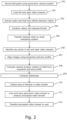
- Fig. 2 is a flowchart including steps of an embodiment of a method according to the invention relying on two video cameras. Only a single panoramic video camera may be employed, or alternatively more than two cameras may be utilized. Once the field sports has been recorded by the cameras, their respective video streams may be loaded onto a workstation which may be provided on-site or at a remote location. Next, key points may be identified in the video stream(s) produced by the camera(s). In case an audio recording is being made, the audio signal may be extracted, and if a plurality of cameras is being employed, a possible time offset between the plurality of cameras may be determined.
- the panoramic video stream may be produced, e.g. by digitally stitching the plurality of video streams together, i.e. by aligning the plurality of video streams into a panoramic video stream.
- the step of identifying key points may be performed in the plurality of video streams before stitching together thereof, or after stitching.
- a digital detector may be run through the video to identify key elements used to direct the camera, i.e. used to identify the area of interest for eventual cropping of the panoramic video stream.
- the area of interest is found is found using computer vision and machine learning, such as by a neural network, as part of which:
- the processed video stream is generated to include a cropped and warped version of the panoramic video stream following the continuously moving area of interest throughout the game.
- functionality may be embedded in a end-user viewer software allowing a user to control a virtual camera interactively.
- Fig. 2 includes the following steps:
- Steps 202-204 are performed only in embodiments, in which the panoramic camera system includes multiple cameras. If the panoramic camera system includes a single camera only, steps 202-204 are omitted.
- One embodiment of the method includes steps 201, 206, and 208-212 only.
- the video stream may include the step of omitting, from raw images obtained from the panoramic camera system, parts, such as selected pixels or lines, such as e.g. every second line, of a lower part of images.
- parts such as selected pixels or lines, such as e.g. every second line, of a lower part of images.
- details recorded in the lower part of each image are closer to the camera in the physical world, they appear with greater resolution in the images than details in the upper part of the images, which, in the physical world, are at a greater distance from the camera.
- the use of bandwidth and storage resources may be reduced by including in the processed video stream, notably in the stacked video stream, only selected parts of the images.
- a table identifying, in respect of each pixel in the panoramic image from where its numeric value is to be derived in the stacked image may optionally be generated.
- the image quality of the originally captured images may thus be sustained, at least until the omitted pixels or lines from the raw images are eventually erased.
- This table is herein referred to as a deltamap.
- step 204 is optional.
- players may be detected through computer vision by determining a difference between two images for identifying moving objects, and filtering objects of a size not matching the size of a human being, as reflected by predetermined data. Sizes of objects may be determined on the basis of the position of the camera system relative to the field (i.e. relative to the sports ground).
- data concerning the positions of the cameras relative to the field may be used for vanishing or eliminating a stitch seam in the optical image which would otherwise be visible, or more clearly visible, when two images are stitched together.
- the images may be projected onto a virtual field, and an image may be digitally generated in which the stitch seam is not visible provided that objects in the seam occur in the plane of the field.
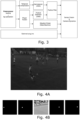
- Fig. 3 is a block diagram showing elements of a system according to the invention.
- a preprocessor is included to scale the incoming video stream and segment it into foreground and background. Such segmentation may be carried out by comparing a current image with a range or pre-stored images in order to distinguish moving players and ball(s) from stationary background. Temporal compression may be carried out through several frames to identify balls. In any current greyscale image, differences may be determined between the current image and seven frames back in time. The total of eight images may be reduced from 8 bits to three and stored in 24 bits per pixel to reduce bandwidth required for transmittal to the machine learning module carrying out detections. A time series of images can thus be reduced to a single image. Reduced images can represent moving objects in the future or past and be combined.
- a sequence of images may be fed into a machine learning module for analysis thereof by image subtraction, i.e. by a process step in which the digital numeric value of the image is subtracted from another image.
- Ball detection is carried out by the machine learning module into which compressed images (frames) are fed.
- the machine learning module outputs a single channel image representing the probability of a ball being present in the individual pixels.
- decompression may be performed to bring data back into eight images, which may then be evaluated by a machine learning module that outputs a single channel (8 bit) image representing the probability of a ball being present in the input image (frame).
- a background image including static (i.e. stationary) elements may optionally be generated, whereby image subtraction may be employed to identify moving objects, such as notably a ball, puck or the like, or players.
- the machine learning module may thus be adapted to detect the optical appearance as well as the dynamics of moving objects.
- image subtraction only moving objects appear, and data storage capacity can thus be reduced to 2 bits per pixels.
- a beneficial tradeoff between data storage consumption and performance is thus achieved relative to processing 10 greyscale image which would demand 8*10 bits per pixel.
- the estimated position of the object of interest is preferably determined on the basis of a probability representation of the object of interest in the at least one frame of the video stream.
- the number of particles modelled in the at least one frame of the video stream to determine each particle's probability of representing the object of interest are at least 100, such as at least 1,000 or at least 2,000 .
- a high number or particles increases the accuracy of the method.
- the step of modelling the particles may comprise:
- the probability of the position of the object of interest in the fame may be objected in repeatedly performed computational steps.
- the particles may be represented in a digital output frame or in a stream of digital output frames, and the position of the object of interest may be automatically estimated on the basis of a detected density of a cloud of particles.
- the art of particle filtering applicable to the present invention is described, e.g., in 'Measure-Valued Processes and Interacting Particle Systems. Application to Nonlinear Filtering Problems' by P. Del Moral, The Anals of Applied Probability, 1998, Vol. 8, No. 2, 438-495 .
- the result of particle filtering may be represented by a cloud of particle proposals that follows the ball being detected. If the cloud is spatially dense, the position of the ball is detected in the three-dimensional space, whereas a scattered cloud of particles indicates the presence of the ball at particular positions with smaller probability.
- Particle filtering as employed herein is further disclosed by S. Thrun: Particle Filters in Robotics, In Proceedings of Uncertainty in AI (UAI) 2002 available at http://robots.stanford.edu/papers/thrun.pf-in-robotics-uai02.pdf .
- players and the players' postures are detected by use of a machine learning module.
- the detection of players is carried out on the basis of:
- the players' postures and, optionally, orientations in the video stream may be detected on the basis of a probability map of the position of the object of interest relative to each player.
- the machine learning module may access a database of uniformly sized pictures of players, each picture including one player and one object of interest, wherein in each of the pictures the position of the object of interest relative to the player is known.
- a posture of each player in the at least one frame of the video stream may be determined and matched with at least one of the pictures in the database to determine a possible position of the object of interest relative to the player.
- Probabilities of the presence of the object of interest estimated as disclosed herein, may be combined with the possible position of the object of interest relative to the player to estimate the position of the object of interest relative to the player.
- the concentration of action in the object of interest may be detected on the basis of object of interest positions in a plurality of respective frames of the panoramic video stream captured between a first point in time and a second point in time.
- the concentration of action in the sports ground may be detected on the basis of the detection of the players' positions relative to the sports ground in the plurality of frames of the panoramic video stream captured between a first point in time and a second point in time.
- a situation finder may be provided to monitor player locations and determine key situations, such as corner kicks, free kicks or penalties based on an identification of zones occupied by players.
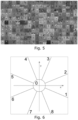
- a posture estimator may be provided to provide a probability map of the position of a ball relative to a player. For example, uniformly sized pictures of players as those depicted in Fig. 5 may be fed into a machine learning module, to which the position of the ball in each picture is also made known.
- a probability map may be arranged into a fixed number (e.g. 16) of equally sized arc pieces and a center circle having a radius of e.g. 5 cm. The arc pieces may expand to infinity.
- Ball observations from the thus obtained data set may be combined with the player images, and thanks to knowledge of the position of the camera system, it is possible to project the ball observation as well as the player observation onto the sports ground.
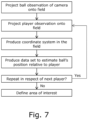
- a virtual coordinate system may be produced as illustrated in Fig.
- the vertical axis in Fig. 6 is normally placed on the field along a straight line between the panoramic camera system and the player, with the player being placed centrally.
- the machine learning module outputs an intensity in each of the fields depicted in Fig. 6 .
- the outputs of all of the observed players may be combined to increase stability of the result. That part of the field which has received the highest response in the output machine learning module is taken as that part of the field in which the ball is most likely present.
- embodiments of the present invention may include modules for identifying situations (situation finder), estimating postures (posture estimator), and for identifying players (player finder).
- the position of the object of interest is determined by use of a computer vision and machine learning module configured to detect the players' postures and, optionally, orientations in the video stream.
- the estimated position of the object of interest is determined on the basis of a probability representation of the object of interest, such as in particular a ball, in a plurality of frames of the video stream.
- at least 100 particles are modelled in the plurality of frames of the video stream to determine each particle's probability of representing the object of interest.
- the detection of players is carried out on the basis of pre-stored data representing the position of the video camera system relative to the sports ground and pre-stored information data representing characteristics of the players, whereby the players' postures and, optionally, orientations in the video stream are detected on the basis of a probability map of the position of the object of interest relative to each player.
- a preferred embodiment of the machine learning module should be understood to mean a software component which accesses a database of uniformly sized pictures of players, each picture including one player and one object of interest, wherein in each of the pictures the position of the object of interest relative to the player is known.
- a posture of each player in the at least one frame of the video stream can be determined and matched with at least one of the pictures in the database to determine a possible position of the object of interest relative to the player, whereby probabilities of the presence of the object of interest are combined with the possible position of the object of interest relative to the player to estimate the position of the object of interest relative to the player.
- Sensor fusion and camera dynamics encompass evaluation of the proposals from the various detectors against each other to derive the most promising combination, to which cropping may be directed.
- the camera dynamics i.e. cropping dynamics, may model pitch and yaw rotation of the camera system, as well as zoom. Dampening as provided by real cameras in the physical world may also be provided to result in a smooth virtual camera experience. When detections have been run and a camera path has been generated, a processed followcam video stream of the field sports is generated.
- the concentration of action may be detected on the basis of one or more players' direction of posture in at least one frame of the video stream, and/or a detected ball trajectory in a plurality of frames of the panoramic video stream.
- Concentration of action in the field sports is detected on the basis of ball positions in a plurality of respective frames of the panoramic video stream captured between a first point in time and a second point in time. Additionally or alternatively, concentration of action in the field sports may be detected on the basis of the detection of the players' positions relative to the sports ground in the plurality of frames of the panoramic video stream captured between a first point in time and a second point in time. Additionally or alternatively, to increase precision, the concentration of action in the field sports may be detected on the basis of detection of the players' pose in at least one frame of the panoramic video stream.
- the panoramic camera system may conveniently be positioned on a stand proximate a sideline at a mid-field position of the sports ground.
Landscapes
- Engineering & Computer Science (AREA)
- Multimedia (AREA)
- Theoretical Computer Science (AREA)
- Signal Processing (AREA)
- Physics & Mathematics (AREA)
- General Physics & Mathematics (AREA)
- Computing Systems (AREA)
- Computer Vision & Pattern Recognition (AREA)
- Computational Linguistics (AREA)
- Software Systems (AREA)
- Image Analysis (AREA)
- Studio Devices (AREA)
Claims (10)
- Computerimplementiertes Verfahren zur automatisierten Detektierung eines sich bewegenden Bereichs von Interesse in einem Videostrom von Feldsportarten mit einem gemeinsamen Objekt von Interesse, umschließend eine Vielzahl von Spielern und das Objekt von Interesse, wobei das Verfahren die Schritte umfasst:(i) Bilderfassen eines Sportplatzes mittels eines Videokamerasystems, um den Videostrom zu produzieren;(ii) digitales Verarbeiten des Videostroms, um den Bereich von Interesse des Spiels innerhalb der Grenzen des Sportplatzes kontinuierlich zu identifizieren, wobei der Bereich von Interesse in dem Sportplatz basierend auf einer geschätzten Position des Objekts von Interesse in mindestens einem Frame des Videostroms bestimmt wird,wobei die geschätzte Position des Objekts von Interesse unter Verwendung eines Computervisions- und Maschinenlernmoduls bestimmt wird;wobei das Maschinenlernmodul auf eine Datenbank von gleichförmig bemessenen Bildern von Spielern zugreift und somit unter Verwendung derselben trainiert wird, wobei jedes Bild einen Spieler und ein Objekt von Interesse einschließt, wobei in jedem der Bilder die Position des Objekts von Interesse relativ zu dem Spieler bekannt ist;wobei das Maschinenlernmodul konfiguriert ist, um die Spieler in dem Videostrom zu detektieren, und konfiguriert ist, um die Stellungen der Spieler in dem Videostrom zu detektieren, wobei die Stellung jedes Spielers in dem mindestens einen Frame des Videostroms bestimmt und mit mindestens einem der Bilder in der Datenbank abgeglichen wird, um eine mögliche Position des Objekts von Interesse relativ zu dem Spieler zu bestimmen;wobei eine Wahrscheinlichkeit einer Richtung des Objekts von Interesse zur Laufzeit für jeden Spieler produziert wird;wobei mindestens 100 Partikel in dem mindestens einen Frame des Videostroms modelliert werden, um die Wahrscheinlichkeit jedes Partikels zu bestimmen, dass das Objekt von Interesse repräsentiert wird, um eine Wahrscheinlichkeitsverteilung des Objekts von Interesse zu erhalten, die durch Partikelfiltern erhalten wird;wobei die Wahrscheinlichkeitsverteilung einer geschätzten Anwesenheit des Objekts von Interesse mit der möglichen Position des Objekts von Interesse relativ zu den Spielern kombiniert wird, um die Position des Objekts von Interesse relativ zu den Spielern zu schätzen.
- Verfahren nach Anspruch 1, wobei das Maschinenlernmodul konfiguriert ist, um mindestens einen der folgenden Schritte auszuführen:- Detektieren des Balls in dem Videostrom;- Detektieren von einem oder mehreren vorbestimmten Ereignissen, wie Eckstößen, Freistößen oder Elfmeterschießen, basierend auf der Position der Spieler in dem Videostrom;- Detektieren des Bereichs von Interesse in dem Videostrom.
- Verfahren nach Anspruch 1 oder 2, wobei die geschätzte Position des Objekts von Interesse basierend auf einer Wahrscheinlichkeitsrepräsentation des Objekts von Interesse in dem mindestens einen Frame des Videostroms bestimmt wird.
- Verfahren nach einem der Ansprüche 1 bis 3, wobei der Schritt des Modellierens der Partikel umfasst:- Projizieren jedes Partikels auf einen Punkt in jedem von dem mindestens einen Frame;- Abtasten der Ausgabe des Maschinenlernmoduls an jenem Punkt in dem Frame, auf den das Partikel projiziert wird; und- Aktualisieren der Position jedes Partikels unter Verwendung von Newtonscher Dynamik.
- Verfahren nach einem der vorhergehenden Ansprüche, des Weiteren umfassend den Schritt des Aktualisierens der Wahrscheinlichkeit der Position des Objekts von Interesse in dem Frame, und des Repräsentierens der Partikel in einem digitalen Ausgabe-Frame oder in einem Strom von digitalen Ausgabe-Frames, und des automatischen Schätzens der Position des Objekts von Interesse basierend auf einer detektierten Dichte einer Wolke von Partikeln.
- Verfahren nach einem der vorhergehenden Ansprüche, wobei die Detektierung von Spielern basierend auf Folgenden ausgeführt wird:- vorab gespeicherten Daten, die die Position des Videokamerasystems relativ zu dem Sportplatz repräsentieren; und- vorab gespeicherten Informationsdaten, die Charakteristika der Spieler repräsentieren.
- Verfahren nach Anspruch 6, wobei die Spieler in dem digitalen Videostrom unter Verwendung von linearer quadratischer Schätzung (LQE) verfolgt werden.
- Verfahren nach einem der vorhergehenden Ansprüche, wobei die Orientierungen und/oder Stellungen der Spieler in dem Videostrom basierend auf einer Wahrscheinlichkeitskarte der Position des Objekts von Interesse relativ zu jedem Spieler detektiert werden.
- Verfahren nach einem der vorhergehenden Ansprüche, wobei die Konzentration der Aktion in dem Objekt von Interesse basierend auf Positionen des Objekts von Interesse in einer Vielzahl jeweiliger Frames des Panorama-Videostroms detektiert wird, der zwischen einem ersten Zeitpunkt und einem zweiten Zeitpunkt erfasst wird.
- Verfahren nach einem der vorhergehenden Ansprüche, wobei die Konzentration der Aktion auf dem Sportplatz basierend auf Detektierung von Positionen der Spieler relativ zu dem Sportplatz in der Vielzahl von Frames des Panorama-Videostroms detektiert wird, der zwischen einem ersten Zeitpunkt und einem zweiten Zeitpunkt erfasst wird.
Applications Claiming Priority (3)
| Application Number | Priority Date | Filing Date | Title |
|---|---|---|---|
| EP18152486 | 2018-01-19 | ||
| EP18152483 | 2018-01-19 | ||
| PCT/EP2019/051260 WO2019141813A1 (en) | 2018-01-19 | 2019-01-18 | A computer-implemented method for automated detection of a moving area of interest in a video stream of field sports with a common object of interest |
Publications (3)
| Publication Number | Publication Date |
|---|---|
| EP3741101A1 EP3741101A1 (de) | 2020-11-25 |
| EP3741101C0 EP3741101C0 (de) | 2025-04-09 |
| EP3741101B1 true EP3741101B1 (de) | 2025-04-09 |
Family
ID=65023916
Family Applications (1)
| Application Number | Title | Priority Date | Filing Date |
|---|---|---|---|
| EP19700617.4A Active EP3741101B1 (de) | 2018-01-19 | 2019-01-18 | Computerimplementiertes verfahren zur erzeugung eines automatisierten videostroms von feldsportarten mit einem gemeinsamen objekt von interesse |
Country Status (4)
| Country | Link |
|---|---|
| US (2) | US11310418B2 (de) |
| EP (1) | EP3741101B1 (de) |
| ES (1) | ES3021734T3 (de) |
| WO (1) | WO2019141813A1 (de) |
Families Citing this family (23)
| Publication number | Priority date | Publication date | Assignee | Title |
|---|---|---|---|---|
| US11188759B2 (en) * | 2019-01-03 | 2021-11-30 | James Harvey ELDER | System and method for automated video processing of an input video signal using tracking of a single moveable bilaterally-targeted game-object |
| CN110781723B (zh) * | 2019-09-05 | 2022-09-02 | 杭州视鑫科技有限公司 | 一种群体异常行为识别方法 |
| TWI749365B (zh) * | 2019-09-06 | 2021-12-11 | 瑞昱半導體股份有限公司 | 移動影像整合方法及移動影像整合系統 |
| US11473927B2 (en) * | 2020-02-05 | 2022-10-18 | Electronic Arts Inc. | Generating positions of map items for placement on a virtual map |
| US11908194B2 (en) * | 2020-03-16 | 2024-02-20 | New York University | Tracking sparse objects and people in large scale environments |
| CN111860570B (zh) * | 2020-06-03 | 2021-06-15 | 成都信息工程大学 | 一种云微粒子图像提取及分类方法 |
| US12322178B2 (en) * | 2020-06-04 | 2025-06-03 | Hole-In-One Media, Inc. | Autonomous activity monitoring system and method |
| US12462563B2 (en) * | 2020-06-12 | 2025-11-04 | Intel Corporation | Systems and methods for virtual camera highlight creation |
| US11516391B2 (en) * | 2020-06-18 | 2022-11-29 | Qualcomm Incorporated | Multiple camera system for wide angle imaging |
| NL2025923B1 (en) * | 2020-06-26 | 2022-02-21 | Mobile Viewpoint B V | Method for detecting and/or tracking moving objects within a certain zone and sports video production system in which such a method is implemented. |
| EP4475012A3 (de) | 2020-07-29 | 2025-01-22 | Optima Sports Systems S.L. | Rechnersystem und computer-implementiertes verfahren zur erfassung von ereignissen aus georäumlichen daten |
| US11640713B2 (en) | 2020-07-29 | 2023-05-02 | Optima Sports Systems S.L. | Computing system and a computer-implemented method for sensing gameplay events and augmentation of video feed with overlay |
| DE102020120200A1 (de) * | 2020-07-30 | 2022-02-03 | SPORTTOTAL TECHNOLOGY GmbH | Panoramakamera |
| US12363440B2 (en) * | 2020-10-30 | 2025-07-15 | Teledyne Flir Defense, Inc. | Situational awareness-based image annotation systems and methods |
| CN112734231B (zh) * | 2021-01-09 | 2021-08-24 | 深圳市瑞驰文体发展有限公司 | 台球赛事管理平台 |
| US11532099B2 (en) * | 2021-02-03 | 2022-12-20 | BetMIX, LLC | Method and system for compiling performance metrics for racing competitors |
| FR3132029B1 (fr) * | 2022-01-24 | 2023-12-15 | Psoft | Dispositif mural de défense mobile pour entrainement au tir arrêté d’un sport de balle. |
| US12496524B2 (en) | 2023-05-03 | 2025-12-16 | Gamechanger Media, Inc. | Systems and methods for automatic media generation for game sessions |
| US20250114695A1 (en) * | 2023-10-04 | 2025-04-10 | Sony Interactive Entertainment Inc. | Ai responsive layout for cross-platform environments |
| KR20250085988A (ko) * | 2023-12-06 | 2025-06-13 | 주식회사 스포잇 | 축구 영상에서 볼을 감지하고 움직임 정보를 획득하기 위한 방법 및 시스템 |
| US20250315917A1 (en) * | 2024-04-09 | 2025-10-09 | Stats Llc | Systems and methods for panoramic and tactical video generation |
| GB2644018A (en) * | 2024-09-11 | 2026-03-18 | Sony Group Corp | Sports image processing and object tracking |
| WO2026073920A1 (en) * | 2024-10-04 | 2026-04-09 | Veo Technologies Aps | Method and system for stabilizing an output from a video of a sport event |
Family Cites Families (11)
| Publication number | Priority date | Publication date | Assignee | Title |
|---|---|---|---|---|
| SE0302065D0 (sv) | 2003-07-14 | 2003-07-14 | Stefan Carlsson | Video - method and apparatus |
| US20090290753A1 (en) * | 2007-10-11 | 2009-11-26 | General Electric Company | Method and system for gaze estimation |
| GB2465538B (en) * | 2008-08-01 | 2013-03-13 | Sony Corp | Method and apparatus for generating an event log |
| EP2777780B1 (de) * | 2011-11-08 | 2021-08-25 | Sony Group Corporation | Sensorvorrichtung, analysator und speichermedium |
| GB2517730A (en) | 2013-08-29 | 2015-03-04 | Mediaproduccion S L | A method and system for producing a video production |
| NL2012399B1 (en) | 2014-03-11 | 2015-11-26 | De Vroome Poort B V | Autonomous camera system for capturing sporting events. |
| CN106165393A (zh) * | 2014-04-03 | 2016-11-23 | 皮克索洛特公司 | 用于自动电视制作的方法和系统 |
| EP3262643A4 (de) | 2015-02-24 | 2019-02-20 | Plaay, LLC | System und verfahren zur erzeugung eines sportvideos |
| US10003722B2 (en) | 2015-03-17 | 2018-06-19 | Disney Enterprises, Inc. | Method and system for mimicking human camera operation |
| US20190261000A1 (en) * | 2017-04-01 | 2019-08-22 | Intel Corporation | Video motion processing including static determination, occlusion detection, frame rate conversion, and adjusting compression ratio |
| US10572775B2 (en) * | 2017-12-05 | 2020-02-25 | X Development Llc | Learning and applying empirical knowledge of environments by robots |
-
2019
- 2019-01-18 EP EP19700617.4A patent/EP3741101B1/de active Active
- 2019-01-18 US US16/962,582 patent/US11310418B2/en active Active
- 2019-01-18 WO PCT/EP2019/051260 patent/WO2019141813A1/en not_active Ceased
- 2019-01-18 ES ES19700617T patent/ES3021734T3/es active Active
-
2022
- 2022-03-21 US US17/699,905 patent/US20230092516A1/en not_active Abandoned
Also Published As
| Publication number | Publication date |
|---|---|
| EP3741101A1 (de) | 2020-11-25 |
| US20230092516A1 (en) | 2023-03-23 |
| US11310418B2 (en) | 2022-04-19 |
| ES3021734T3 (en) | 2025-05-27 |
| EP3741101C0 (de) | 2025-04-09 |
| WO2019141813A1 (en) | 2019-07-25 |
| US20200404174A1 (en) | 2020-12-24 |
Similar Documents
| Publication | Publication Date | Title |
|---|---|---|
| US20230092516A1 (en) | Computer-implemented method for automated detection of a moving area of interest in a video stream of field sports with a common object of interest | |
| US11064107B2 (en) | Objects trail-based analysis and control of video | |
| US9744457B2 (en) | System and method for optical player tracking in sports venues | |
| Chen et al. | Mimicking human camera operators | |
| EP1864505B1 (de) | Echtzeit-objekteverfolgung und bewegungserfassung in sportereignissen | |
| Iwase et al. | Parallel tracking of all soccer players by integrating detected positions in multiple view images | |
| US8805007B2 (en) | Integrated background and foreground tracking | |
| US9596399B2 (en) | Apparatus for intelligent and autonomous video content generation and streaming | |
| US20150264258A1 (en) | Autonomous camera system for capturing sporting events | |
| CN113873174A (zh) | 用于自动电视制作的方法和系统 | |
| CN101639354A (zh) | 对象跟踪的设备和方法 | |
| US20170201723A1 (en) | Method of providing object image based on object tracking | |
| Patrona et al. | Computational UAV cinematography for intelligent shooting based on semantic visual analysis | |
| Okuma et al. | Automatic rectification of long image sequences | |
| CN114037923A (zh) | 一种目标活动热点图绘制方法、系统、设备及存储介质 | |
| JP2009505553A (ja) | ビデオストリームへの視覚効果の挿入を管理するためのシステムおよび方法 | |
| Daigo et al. | Automatic pan control system for broadcasting ball games based on audience's face direction | |
| Naruo et al. | Development of Technology for Generating Panorama and Visualization Using Two-viewpoint Images | |
| CA2901913C (en) | System and method for optical player tracking in sports venues | |
| Couceiro et al. | Tracking Data Visual Representations for Sports Broadcasting Enrichment. | |
| Dawes et al. | Image-based camera tracking for athletics | |
| Petilla et al. | Single player tracking in multiple sports videos | |
| Zhang et al. | Representation of the player action in sport videos | |
| Hanzra et al. | Automatic cameraman for dynamic video acquisition of football match | |
| Yamagishi et al. | A Player Position Tracking Method Based on a Wide-Area Pan-Tilt-Zoom Video. |
Legal Events
| Date | Code | Title | Description |
|---|---|---|---|
| STAA | Information on the status of an ep patent application or granted ep patent |
Free format text: STATUS: UNKNOWN |
|
| STAA | Information on the status of an ep patent application or granted ep patent |
Free format text: STATUS: THE INTERNATIONAL PUBLICATION HAS BEEN MADE |
|
| PUAI | Public reference made under article 153(3) epc to a published international application that has entered the european phase |
Free format text: ORIGINAL CODE: 0009012 |
|
| STAA | Information on the status of an ep patent application or granted ep patent |
Free format text: STATUS: REQUEST FOR EXAMINATION WAS MADE |
|
| 17P | Request for examination filed |
Effective date: 20200819 |
|
| AK | Designated contracting states |
Kind code of ref document: A1 Designated state(s): AL AT BE BG CH CY CZ DE DK EE ES FI FR GB GR HR HU IE IS IT LI LT LU LV MC MK MT NL NO PL PT RO RS SE SI SK SM TR |
|
| AX | Request for extension of the european patent |
Extension state: BA ME |
|
| DAV | Request for validation of the european patent (deleted) | ||
| DAX | Request for extension of the european patent (deleted) | ||
| STAA | Information on the status of an ep patent application or granted ep patent |
Free format text: STATUS: EXAMINATION IS IN PROGRESS |
|
| 17Q | First examination report despatched |
Effective date: 20220831 |
|
| TPAC | Observations filed by third parties |
Free format text: ORIGINAL CODE: EPIDOSNTIPA |
|
| GRAP | Despatch of communication of intention to grant a patent |
Free format text: ORIGINAL CODE: EPIDOSNIGR1 |
|
| STAA | Information on the status of an ep patent application or granted ep patent |
Free format text: STATUS: GRANT OF PATENT IS INTENDED |
|
| GRAJ | Information related to disapproval of communication of intention to grant by the applicant or resumption of examination proceedings by the epo deleted |
Free format text: ORIGINAL CODE: EPIDOSDIGR1 |
|
| GRAP | Despatch of communication of intention to grant a patent |
Free format text: ORIGINAL CODE: EPIDOSNIGR1 |
|
| RIC1 | Information provided on ipc code assigned before grant |
Ipc: H04N 23/80 20230101ALI20240701BHEP Ipc: H04N 23/698 20230101ALI20240701BHEP Ipc: G06V 20/52 20220101ALI20240701BHEP Ipc: G06V 20/40 20220101ALI20240701BHEP Ipc: G06V 10/25 20220101ALI20240701BHEP Ipc: G06T 7/33 20170101ALI20240701BHEP Ipc: H04N 5/222 20060101AFI20240701BHEP |
|
| INTG | Intention to grant announced |
Effective date: 20240717 |
|
| INTG | Intention to grant announced |
Effective date: 20240730 |
|
| GRAJ | Information related to disapproval of communication of intention to grant by the applicant or resumption of examination proceedings by the epo deleted |
Free format text: ORIGINAL CODE: EPIDOSDIGR1 |
|
| GRAJ | Information related to disapproval of communication of intention to grant by the applicant or resumption of examination proceedings by the epo deleted |
Free format text: ORIGINAL CODE: EPIDOSDIGR1 |
|
| STAA | Information on the status of an ep patent application or granted ep patent |
Free format text: STATUS: EXAMINATION IS IN PROGRESS |
|
| INTG | Intention to grant announced |
Effective date: 20240730 |
|
| INTC | Intention to grant announced (deleted) | ||
| GRAP | Despatch of communication of intention to grant a patent |
Free format text: ORIGINAL CODE: EPIDOSNIGR1 |
|
| STAA | Information on the status of an ep patent application or granted ep patent |
Free format text: STATUS: GRANT OF PATENT IS INTENDED |
|
| GRAS | Grant fee paid |
Free format text: ORIGINAL CODE: EPIDOSNIGR3 |
|
| INTG | Intention to grant announced |
Effective date: 20250204 |
|
| GRAA | (expected) grant |
Free format text: ORIGINAL CODE: 0009210 |
|
| STAA | Information on the status of an ep patent application or granted ep patent |
Free format text: STATUS: THE PATENT HAS BEEN GRANTED |
|
| RAP3 | Party data changed (applicant data changed or rights of an application transferred) |
Owner name: VEO TECHNOLOGIES APS |
|
| RIN1 | Information on inventor provided before grant (corrected) |
Inventor name: REINICKE, KELD Inventor name: TEISBAEK, HENRIK, BJOERN Inventor name: TAXBOEL, JESPER, MOLBECH |
|
| AK | Designated contracting states |
Kind code of ref document: B1 Designated state(s): AL AT BE BG CH CY CZ DE DK EE ES FI FR GB GR HR HU IE IS IT LI LT LU LV MC MK MT NL NO PL PT RO RS SE SI SK SM TR |
|
| REG | Reference to a national code |
Ref country code: GB Ref legal event code: FG4D |
|
| REG | Reference to a national code |
Ref country code: CH Ref legal event code: EP |
|
| REG | Reference to a national code |
Ref country code: DE Ref legal event code: R096 Ref document number: 602019068369 Country of ref document: DE |
|
| REG | Reference to a national code |
Ref country code: IE Ref legal event code: FG4D |
|
| U01 | Request for unitary effect filed |
Effective date: 20250409 |
|
| U07 | Unitary effect registered |
Designated state(s): AT BE BG DE DK EE FI FR IT LT LU LV MT NL PT RO SE SI Effective date: 20250416 |
|
| REG | Reference to a national code |
Ref country code: ES Ref legal event code: FG2A Ref document number: 3021734 Country of ref document: ES Kind code of ref document: T3 Effective date: 20250527 |
|
| PG25 | Lapsed in a contracting state [announced via postgrant information from national office to epo] |
Ref country code: GR Free format text: LAPSE BECAUSE OF FAILURE TO SUBMIT A TRANSLATION OF THE DESCRIPTION OR TO PAY THE FEE WITHIN THE PRESCRIBED TIME-LIMIT Effective date: 20250710 |
|
| PG25 | Lapsed in a contracting state [announced via postgrant information from national office to epo] |
Ref country code: PL Free format text: LAPSE BECAUSE OF FAILURE TO SUBMIT A TRANSLATION OF THE DESCRIPTION OR TO PAY THE FEE WITHIN THE PRESCRIBED TIME-LIMIT Effective date: 20250409 |
|
| PG25 | Lapsed in a contracting state [announced via postgrant information from national office to epo] |
Ref country code: HR Free format text: LAPSE BECAUSE OF FAILURE TO SUBMIT A TRANSLATION OF THE DESCRIPTION OR TO PAY THE FEE WITHIN THE PRESCRIBED TIME-LIMIT Effective date: 20250409 |
|
| PG25 | Lapsed in a contracting state [announced via postgrant information from national office to epo] |
Ref country code: RS Free format text: LAPSE BECAUSE OF FAILURE TO SUBMIT A TRANSLATION OF THE DESCRIPTION OR TO PAY THE FEE WITHIN THE PRESCRIBED TIME-LIMIT Effective date: 20250709 |
|
| PG25 | Lapsed in a contracting state [announced via postgrant information from national office to epo] |
Ref country code: IS Free format text: LAPSE BECAUSE OF FAILURE TO SUBMIT A TRANSLATION OF THE DESCRIPTION OR TO PAY THE FEE WITHIN THE PRESCRIBED TIME-LIMIT Effective date: 20250809 |
|
| PG25 | Lapsed in a contracting state [announced via postgrant information from national office to epo] |
Ref country code: SM Free format text: LAPSE BECAUSE OF FAILURE TO SUBMIT A TRANSLATION OF THE DESCRIPTION OR TO PAY THE FEE WITHIN THE PRESCRIBED TIME-LIMIT Effective date: 20250409 |
|
| PG25 | Lapsed in a contracting state [announced via postgrant information from national office to epo] |
Ref country code: CZ Free format text: LAPSE BECAUSE OF FAILURE TO SUBMIT A TRANSLATION OF THE DESCRIPTION OR TO PAY THE FEE WITHIN THE PRESCRIBED TIME-LIMIT Effective date: 20250409 |
|
| PG25 | Lapsed in a contracting state [announced via postgrant information from national office to epo] |
Ref country code: SK Free format text: LAPSE BECAUSE OF FAILURE TO SUBMIT A TRANSLATION OF THE DESCRIPTION OR TO PAY THE FEE WITHIN THE PRESCRIBED TIME-LIMIT Effective date: 20250409 |
|
| PLBE | No opposition filed within time limit |
Free format text: ORIGINAL CODE: 0009261 |
|
| STAA | Information on the status of an ep patent application or granted ep patent |
Free format text: STATUS: NO OPPOSITION FILED WITHIN TIME LIMIT |
|
| REG | Reference to a national code |
Ref country code: CH Ref legal event code: L10 Free format text: ST27 STATUS EVENT CODE: U-0-0-L10-L00 (AS PROVIDED BY THE NATIONAL OFFICE) Effective date: 20260218 |
|
| U20 | Renewal fee for the european patent with unitary effect paid |
Year of fee payment: 8 Effective date: 20260202 |
|
| 26N | No opposition filed |
Effective date: 20260112 |
|
| PGFP | Annual fee paid to national office [announced via postgrant information from national office to epo] |
Ref country code: GB Payment date: 20260121 Year of fee payment: 8 |
|
| PGFP | Annual fee paid to national office [announced via postgrant information from national office to epo] |
Ref country code: ES Payment date: 20260206 Year of fee payment: 8 |
|
| PGFP | Annual fee paid to national office [announced via postgrant information from national office to epo] |
Ref country code: NO Payment date: 20260126 Year of fee payment: 8 Ref country code: IE Payment date: 20260116 Year of fee payment: 8 |