EP3739472B1 - Procédé et dispositif destinés au traitement de données et dispositif informatique - Google Patents
Procédé et dispositif destinés au traitement de données et dispositif informatique Download PDFInfo
- Publication number
- EP3739472B1 EP3739472B1 EP19738606.3A EP19738606A EP3739472B1 EP 3739472 B1 EP3739472 B1 EP 3739472B1 EP 19738606 A EP19738606 A EP 19738606A EP 3739472 B1 EP3739472 B1 EP 3739472B1
- Authority
- EP
- European Patent Office
- Prior art keywords
- data
- smallest
- data unit
- unit
- request
- Prior art date
- Legal status (The legal status is an assumption and is not a legal conclusion. Google has not performed a legal analysis and makes no representation as to the accuracy of the status listed.)
- Active
Links
Images





Classifications
-
- G—PHYSICS
- G06—COMPUTING OR CALCULATING; COUNTING
- G06F—ELECTRIC DIGITAL DATA PROCESSING
- G06F16/00—Information retrieval; Database structures therefor; File system structures therefor
- G06F16/10—File systems; File servers
- G06F16/18—File system types
- G06F16/1805—Append-only file systems, e.g. using logs or journals to store data
-
- G—PHYSICS
- G06—COMPUTING OR CALCULATING; COUNTING
- G06F—ELECTRIC DIGITAL DATA PROCESSING
- G06F11/00—Error detection; Error correction; Monitoring
- G06F11/07—Responding to the occurrence of a fault, e.g. fault tolerance
- G06F11/08—Error detection or correction by redundancy in data representation, e.g. by using checking codes
- G06F11/10—Adding special bits or symbols to the coded information, e.g. parity check, casting out 9's or 11's
- G06F11/1004—Adding special bits or symbols to the coded information, e.g. parity check, casting out 9's or 11's to protect a block of data words, e.g. CRC or checksum
-
- G—PHYSICS
- G06—COMPUTING OR CALCULATING; COUNTING
- G06F—ELECTRIC DIGITAL DATA PROCESSING
- G06F11/00—Error detection; Error correction; Monitoring
- G06F11/07—Responding to the occurrence of a fault, e.g. fault tolerance
- G06F11/08—Error detection or correction by redundancy in data representation, e.g. by using checking codes
- G06F11/10—Adding special bits or symbols to the coded information, e.g. parity check, casting out 9's or 11's
- G06F11/1076—Parity data used in redundant arrays of independent storages, e.g. in RAID systems
-
- G—PHYSICS
- G06—COMPUTING OR CALCULATING; COUNTING
- G06F—ELECTRIC DIGITAL DATA PROCESSING
- G06F11/00—Error detection; Error correction; Monitoring
- G06F11/07—Responding to the occurrence of a fault, e.g. fault tolerance
- G06F11/14—Error detection or correction of the data by redundancy in operations
- G06F11/1402—Saving, restoring, recovering or retrying
- G06F11/1415—Saving, restoring, recovering or retrying at system level
- G06F11/1435—Saving, restoring, recovering or retrying at system level using file system or storage system metadata
-
- G—PHYSICS
- G06—COMPUTING OR CALCULATING; COUNTING
- G06F—ELECTRIC DIGITAL DATA PROCESSING
- G06F3/00—Input arrangements for transferring data to be processed into a form capable of being handled by the computer; Output arrangements for transferring data from processing unit to output unit, e.g. interface arrangements
- G06F3/06—Digital input from, or digital output to, record carriers, e.g. RAID, emulated record carriers or networked record carriers
- G06F3/0601—Interfaces specially adapted for storage systems
- G06F3/0602—Interfaces specially adapted for storage systems specifically adapted to achieve a particular effect
- G06F3/061—Improving I/O performance
-
- G—PHYSICS
- G06—COMPUTING OR CALCULATING; COUNTING
- G06F—ELECTRIC DIGITAL DATA PROCESSING
- G06F3/00—Input arrangements for transferring data to be processed into a form capable of being handled by the computer; Output arrangements for transferring data from processing unit to output unit, e.g. interface arrangements
- G06F3/06—Digital input from, or digital output to, record carriers, e.g. RAID, emulated record carriers or networked record carriers
- G06F3/0601—Interfaces specially adapted for storage systems
- G06F3/0602—Interfaces specially adapted for storage systems specifically adapted to achieve a particular effect
- G06F3/0614—Improving the reliability of storage systems
- G06F3/0619—Improving the reliability of storage systems in relation to data integrity, e.g. data losses, bit errors
-
- G—PHYSICS
- G06—COMPUTING OR CALCULATING; COUNTING
- G06F—ELECTRIC DIGITAL DATA PROCESSING
- G06F3/00—Input arrangements for transferring data to be processed into a form capable of being handled by the computer; Output arrangements for transferring data from processing unit to output unit, e.g. interface arrangements
- G06F3/06—Digital input from, or digital output to, record carriers, e.g. RAID, emulated record carriers or networked record carriers
- G06F3/0601—Interfaces specially adapted for storage systems
- G06F3/0628—Interfaces specially adapted for storage systems making use of a particular technique
- G06F3/0638—Organizing or formatting or addressing of data
- G06F3/064—Management of blocks
-
- G—PHYSICS
- G06—COMPUTING OR CALCULATING; COUNTING
- G06F—ELECTRIC DIGITAL DATA PROCESSING
- G06F3/00—Input arrangements for transferring data to be processed into a form capable of being handled by the computer; Output arrangements for transferring data from processing unit to output unit, e.g. interface arrangements
- G06F3/06—Digital input from, or digital output to, record carriers, e.g. RAID, emulated record carriers or networked record carriers
- G06F3/0601—Interfaces specially adapted for storage systems
- G06F3/0628—Interfaces specially adapted for storage systems making use of a particular technique
- G06F3/0638—Organizing or formatting or addressing of data
- G06F3/0643—Management of files
-
- G—PHYSICS
- G06—COMPUTING OR CALCULATING; COUNTING
- G06F—ELECTRIC DIGITAL DATA PROCESSING
- G06F3/00—Input arrangements for transferring data to be processed into a form capable of being handled by the computer; Output arrangements for transferring data from processing unit to output unit, e.g. interface arrangements
- G06F3/06—Digital input from, or digital output to, record carriers, e.g. RAID, emulated record carriers or networked record carriers
- G06F3/0601—Interfaces specially adapted for storage systems
- G06F3/0628—Interfaces specially adapted for storage systems making use of a particular technique
- G06F3/0655—Vertical data movement, i.e. input-output transfer; data movement between one or more hosts and one or more storage devices
- G06F3/0656—Data buffering arrangements
-
- G—PHYSICS
- G06—COMPUTING OR CALCULATING; COUNTING
- G06F—ELECTRIC DIGITAL DATA PROCESSING
- G06F3/00—Input arrangements for transferring data to be processed into a form capable of being handled by the computer; Output arrangements for transferring data from processing unit to output unit, e.g. interface arrangements
- G06F3/06—Digital input from, or digital output to, record carriers, e.g. RAID, emulated record carriers or networked record carriers
- G06F3/0601—Interfaces specially adapted for storage systems
- G06F3/0628—Interfaces specially adapted for storage systems making use of a particular technique
- G06F3/0655—Vertical data movement, i.e. input-output transfer; data movement between one or more hosts and one or more storage devices
- G06F3/0659—Command handling arrangements, e.g. command buffers, queues, command scheduling
-
- G—PHYSICS
- G06—COMPUTING OR CALCULATING; COUNTING
- G06F—ELECTRIC DIGITAL DATA PROCESSING
- G06F3/00—Input arrangements for transferring data to be processed into a form capable of being handled by the computer; Output arrangements for transferring data from processing unit to output unit, e.g. interface arrangements
- G06F3/06—Digital input from, or digital output to, record carriers, e.g. RAID, emulated record carriers or networked record carriers
- G06F3/0601—Interfaces specially adapted for storage systems
- G06F3/0668—Interfaces specially adapted for storage systems adopting a particular infrastructure
- G06F3/0671—In-line storage system
- G06F3/0673—Single storage device
-
- G—PHYSICS
- G06—COMPUTING OR CALCULATING; COUNTING
- G06F—ELECTRIC DIGITAL DATA PROCESSING
- G06F3/00—Input arrangements for transferring data to be processed into a form capable of being handled by the computer; Output arrangements for transferring data from processing unit to output unit, e.g. interface arrangements
- G06F3/06—Digital input from, or digital output to, record carriers, e.g. RAID, emulated record carriers or networked record carriers
- G06F3/0601—Interfaces specially adapted for storage systems
- G06F3/0668—Interfaces specially adapted for storage systems adopting a particular infrastructure
- G06F3/0671—In-line storage system
- G06F3/0673—Single storage device
- G06F3/0674—Disk device
- G06F3/0676—Magnetic disk device
-
- G—PHYSICS
- G06—COMPUTING OR CALCULATING; COUNTING
- G06F—ELECTRIC DIGITAL DATA PROCESSING
- G06F9/00—Arrangements for program control, e.g. control units
- G06F9/06—Arrangements for program control, e.g. control units using stored programs, i.e. using an internal store of processing equipment to receive or retain programs
- G06F9/46—Multiprogramming arrangements
- G06F9/48—Program initiating; Program switching, e.g. by interrupt
- G06F9/4806—Task transfer initiation or dispatching
- G06F9/4843—Task transfer initiation or dispatching by program, e.g. task dispatcher, supervisor, operating system
- G06F9/485—Task life-cycle, e.g. stopping, restarting, resuming execution
-
- G—PHYSICS
- G06—COMPUTING OR CALCULATING; COUNTING
- G06F—ELECTRIC DIGITAL DATA PROCESSING
- G06F11/00—Error detection; Error correction; Monitoring
- G06F11/07—Responding to the occurrence of a fault, e.g. fault tolerance
- G06F11/14—Error detection or correction of the data by redundancy in operations
- G06F11/1446—Point-in-time backing up or restoration of persistent data
Definitions
- the example embodiments of the present application relate to the field of computer technology, and, more particularly, to a method and device for data processing, and a computer device.
- Append write which is a common data writing method in storage systems, refers to appending newly written data on the basis of data already written. Append write can be used to perform write operations in many application scenarios. For example, if a data file to be written is large, multiple write operations are usually required to complete writing the data file into a disk. In this case, append write can be used to perform write operations.
- one data writing method in the prior art is that the appending data is written to a new position in the disk each time; and an index relationship of the data and its storage position is established such that the data may be located according to the index relationship.
- EP 2 735 978 A1 discloses a solution for writing and managing large metadata, using a DRAM+SSD+HDD three-tier architecture.
- WO 2017/141315A1 discloses a storage apparatus configured to perform deduplication and compression process on write data by overwriting previous write data.
- the example embodiments of the present application provide a method and device for data processing, and a computer device to solve the technical problems of inconvenient operation and low efficiency in the prior art.
- an example embodiment of the present application provides a data processing method, comprising:
- an example embodiment of the present application provides a data processing method, comprising:
- an example embodiment of the present application provides a data processing method, comprising:
- an example embodiment of the present application provides a data processing device, comprising:
- an example embodiment of the present application provides a data processing device, comprising:
- an example embodiment of the present application provides a data processing device, comprising:
- an example embodiment of the present application provides a computer device, comprising a storage component and a processing component, wherein:
- an example embodiment of the present application provides a computer device, comprising a storage component and a processing component, wherein:
- an example embodiment of the present application provides a computer device, comprising a storage component and a processing component, wherein
- a smallest data unit of a buffer is searched for first; then at least some of the appending data is sequentially written into the smallest data unit of the buffer to obtain a first smallest data unit to be stored, and data not yet written in the appending data is written into at least one smallest data unit to obtain at least one second smallest data unit to be stored; afterwards, the first smallest data unit to be stored is written into a storage device in an overwriting manner, and the at least one second smallest data unit to be stored is sequentially written into the storage device, thereby completing the operation of writing appending data into the storage device.
- the smallest data unit not fully written and corresponds to the appending data is continued to be buffered, so that the next append write request may continue to be executed according to the technical solution of the present application.
- the smallest data unit is used, and the length of the smallest data unit is fixed, such that there is no need to establish and maintain an index relationship.
- the data storage position may be located by calculation, which improves the operation convenience. Since the smallest data units are written in the storage device in sequence, the data integrity and the efficiency of the write operation are ensured.
- a smallest data unit of a buffer is searched for first; then at least some of the appending data is sequentially written into the smallest data unit of the buffer to obtain a first smallest data unit to be stored, and data not yet written in the appending data is written into at least one smallest data unit to obtain at least one second smallest data unit to be stored; afterwards, the first smallest data unit to be stored is written into a storage device in an overwriting manner, and the at least one second smallest data unit to be stored is sequentially written into the storage device, thereby completing the operation of writing appending data into the storage device; additionally, the smallest data unit not fully written that corresponds to the appending data is continued to be buffered, so that the next append write request may continue to be executed according to the technical solutions of the present application
- the smallest data unit is used, and the length of the smallest data unit is fixed, such that there is no need to establish and maintain the index relationship.
- the data storage position may be located by means of calculation, which improves the operation convenience; and since the smallest data units are written in the storage device in sequence, the data integrity and the write operation efficiency are guaranteed.
- FIG. 1 is a flowchart of an example embodiment of a data processing method according to an example embodiment of the present application. The method comprises the following steps: 101: search for a smallest data unit of a buffer with regard to appending data in an append write request.
- the append write request is initiated with regard to a data file, which is written to a storage device through multiple append write operations.
- the appending data in each append write request may be part of the data in the data file; and lengths of the appending data in each append write request may vary.
- the sequentially write at least some of the appending data into the smallest data unit of the buffer may refer to writing the at least some of the data into the smallest data unit of the buffer at a position right after where the last write operation ends.
- step 103 may be directly executed.
- the data not yet written in the appending data refers to data that is not written into any smallest data unit. If the appending data does not have any data not yet written, step 104 and step 105 may be executed.
- the first smallest data unit to be stored is first written into the storage device in the overwriting manner, and then the at least one second smallest data unit to be stored is sequentially written into the storage device.
- Sequentially writing the at least one second smallest data unit to be stored into the storage device means to write the at least one second smallest data unit to be stored at the position right after where the writing operation of the first smallest data unit to be stored ends in the storage device. Since the first smallest data unit to be stored is written into the storage device in the overwritten manner, the end position of the write operation for the first smallest data unit to be stored in the storage device may also be referred to as the end position of a write operation for the previous append write request in the storage device.
- the at least one second smallest data unit to be stored is directly and sequentially written into the storage device; that is, the at least one second smallest data unit to be stored is written at the position right after where the write operation for the previous append write request ends in the storage device.
- the smallest data unit is a type of data storage structure, and the appending data is split according to the smallest data unit. It can be appreciated that writing at least some of the appending data into the smallest data unit and writing data not yet written in the appending data into at least one smallest data unit described in the example embodiments of the present application is also a conversion operation performed on the appending data according to the data storage structure corresponding to the smallest data unit, such that the appending data is converted into the data organization format of the at least one smallest data unit. Each smallest data unit includes at least some of the appending data of an append write request.
- Writing the first smallest data unit to be stored in the storage device in the overwriting manner and sequentially writing the at least one second smallest data unit to be stored into the storage device refers to the operation of storing the smallest data unit into the storage device, thereby implementing the storage of the appending data.
- the at least some of the appending data is selected from a position where the appending data starts; the writing data not yet written into the at least one smallest data unit refers to that the writing starts from a position where the data not yet written starts.
- Data with a second fixed length is selected each time, and a smallest data unit is generated therefrom until the length of the data not yet written is less than the second fixed length. At this time, one smallest data unit is also generated to store the data not yet written, and that this smallest data unit is not fully written with data.
- the length of the smallest data unit is fixed.
- the length of the smallest data unit is described as a "first fixed length”.
- the smallest data unit may write appending data with the second fixed length; and the smallest data unit not fully written with data may refer to that the data written in the smallest data unit is less than the second fixed length; the smallest data unit that is fully written with data also means that the data written in the smallest data unit is of a length equaling to the second fixed length.
- the smallest data unit stored in the buffer is the smallest data unit that is not fully written with data. If the smallest data unit is present in the buffer, preferentially the appending data will be sequentially written into the smallest data unit of the buffer until the smallest sheet of reading and writing is fully written with data; and then the data not yet written will be written into at least one smallest data unit.
- the first smallest data unit to be stored is written to the storage device in the overwriting manner, such that the smallest data unit not fully written with data and was last written into the storage device is overwritten. Since the first smallest data unit to be stored is written into the appending data of the last append write request, i.e., being written into the storage device in the overwriting manner, the data integrity is guaranteed.
- the appending data is preferentially written into the smallest data unit of the buffer, the continuity of data in the smallest data unit is guaranteed, such that continuous and complete data may be obtained when the data is read.
- data is written into the storage device in the format of a smallest data unit with a fixed length.
- the storage position of the data may be determined simply through calculation; the index relationship between the data and the storage position does not need to be maintained additionally, which improves the operation convenience.
- the smallest data unit is sequentially written, rather than randomly written, into the storage device, which may enhance the write operation efficiency; and the data integrity and continuity are guaranteed by using the partial overwrite operation.
- the data processing method in the example embodiment shown in FIG. 1 is mainly introduced from the perspective of data writing process.
- the data is written into the storage device according to the data processing method in the example embodiment shown in FIG. 1 ; when the data is read from the storage device, the storage position of the data may be located through calculation.
- FIG. 2 a flowchart of another example embodiment of a data processing method according to an example embodiment of the present application is illustrated. The method comprises the following steps:
- the data-reading request may be sent by a requestor.
- Each data-reading request may carry the request start position and the request offset.
- the request offset may refer to a data length of the object requested to be read.
- a start boundary of any smallest data unit may be located; based on the request offset and the first fixed length of the smallest data unit, a number of smallest data units that need to be read may be calculated; thus, at least one target smallest data unit may be obtained through calculation by combining the request start position, the request offset, and the first fixed length.
- a start boundary of a certain smallest data unit may be located according to the request start position, and an end boundary of a certain smallest data unit may be located according to the length of the object requested to be read.
- the valid data in the at least one target smallest data unit may be read from the storage device, and the at least one target smallest data unit is spliced in accordance with the storage order to form a larger data, and is fed back to the requestor.
- the index relationship between the data and the storage position does not need to be established; and the storage position of the data may be located through calculation, which improves the operation convenience.
- the smallest data unit may include a data storage area and a metadata description area located at the end of the data storage area. Appending data is written into the data storage area, and metadata of the appending data generates the metadata description area. The metadata is generated based on the received appending data, and may be used to indicate relevant information, such as the attributes, of the appending data.
- the length of the smallest data unit is fixed, and the lengths of the data storage area and data description area thereof are also fixed.
- the appending data is written into the data storage area, which is the valid data of the smallest data unit.
- the length of the smallest data unit is a first fixed length; the length of the data storage area is a second fixed length; and the length of the metadata description area is a third fixed length, wherein the first fixed length is equal to the sum of the second fixed length and the third fixed length.
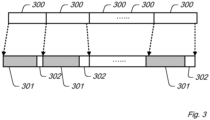
- each smallest data unit 300 is composed of a data storage area 301 and a metadata description area 302; and the metadata description area 302 is located at the end of the data storage area 301.
- the data storage area 301 stores therein the valid data, i.e., data requested to be written, which is as the shaded portion in FIG. 3 ; the metadata description area 302 is used to store the metadata of the valid data.
- the append writing at least some of the appending data into the smallest data unit of the buffer to obtain a first smallest data unit to be stored, and writing data not yet written in the appending data into at least one smallest data unit to obtain at least one second smallest data unit to be stored may comprise:
- the appending data and the metadata thereof are packaged together to form an independent data format. Only one write operation is needed to write the appending data and metadata, which not only reduces the write frequencies, the write operation efficiency is also enhanced.
- the read, from the storage device, valid data in the at least one target smallest data unit and splice the same may comprise: reading, from the storage device, valid data in the data storage area of the at least one target smallest data unit and splicing the same.
- parity check may be performed on valid data in each target smallest data unit to verify whether the data is complete and accurate, etc.; if the parity check is successful, the valid data in the data storage area of at least one target smallest data unit is spliced.
- the metadata in the metadata description area may include a data checksum of the valid data.
- the data checksum is calculated based on the data written into the data storage area, and the data checksum is used as the metadata to be stored in the metadata description area.
- the data checksum may be calculated using a CRC (Cyclical Redundancy Check) algorithm, which is similar to that in the prior art. Details are not repeated herein.
- CRC Cyclical Redundancy Check
- the reading, from the storage device, valid data in the data storage area of the at least one target smallest data unit and splicing the same may comprise:
- the appending data in one append write request may be divided into at least one smallest data unit to be written into the storage device.
- write operation failures might occur due to, for example, a process crashing abnormally, a machine restarting because of power down, and the like. After the process restarts, data recovery is required.
- request atomicity will need to be ensured; that is, operations for one append write request are either all successful or all failures, which also means that at least one smallest data unit corresponding to one append write request is all written either successfully or unsuccessfully, such that after a process restarts due to a write operation failure, the data may be recovered to the boundary of any append write request, thus ensuring the atomicity of the append write request.
- the metadata may comprise therein a valid data length after a last but one write operation, a valid data length after a last write operation, and whether data last written and at least some data in a next smallest data unit belong to a same append write request; additionally, to facilitate the parity check, a data checksum after the last but one write operation and a data checksum after the last write operation may further be included.
- the metadata must further include some other attribute information related to the service, which is similar to those in the prior art. Details are not repeated herein.
- each metadata description area may include at least the following fields:
- a data recovery length of a data file may be recovered to a data end position of any append write request based on the valid data length after the last but one write operation in each of the smallest data unit, the valid data length after the last write operation, and whether the data last written and at least some data in the next smallest data unit belong to the same append write request, thus maintaining the atomicity.
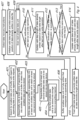
- FIG. 4 is a flowchart of another example embodiment of a data processing method according to an example embodiment of the present application.
- the method comprises the following steps:
- the data recovery instruction may be automatically triggered when a write operation failure is detected, or may be triggered manually.
- step 407 is not limited to the operation sequence in this example embodiment, and it may be performed after or before any one of steps 401 to 406 or simultaneously.
- step 411 is executed; and if not, step 415 is executed.
- the metadata description area may store the data checksum after the last but one write operation; as a result, whether the parity check performed on the data after the last but one write operation is successful or not may be determined based on the data checksum after the last but one write operation.
- step 412 whether verification of data after the last write operation is successful or not; if so, step 413 is executed; and if not, step 415 is executed.
- the metadata description area may store the data checksum after the last write operation; as a result, whether the parity check performed on the data after the last write operation is successful or not may be determined based on the data checksum after the last write operation.
- step 413 detect whether the current smallest data unit and the next smallest data unit belong to the same append write request; if so, return to step 409 to resume execution; and if not, execute step 414.
- the current smallest data unit and the next smallest data unit belong to the same append write request, it indicates that the last written data in the current smallest data unit is not the data end position of the append write request; it is thus necessary to continue scanning to find the request boundary.
- step 414 update the valid data length of the data already written based on a valid data length after the last write operation, and return to step 409 to resume execution.
- the parity check performed on the data after the last write operation of any smallest data unit fails, but the parity check performed on the data after the last but one write operation succeeds, it indicates that the last but one write operation and the last write operation do not belong to the same append write request.
- the parity check performed on the data after the last write operation fails, the valid data length of the data already written obtained based on updating the valid data length after the last but one write operation may be used as the recovery length of the data file.
- data recovery may be used to ensure the request atomicity, thereby restoring the data file to the data end position of any append write request.
- the technical solution of the example embodiment of the present application may not only guarantee the write operation efficiency, improve the write operation convenience, but it may also ensure the request atomicity.
- the any smallest data unit may be buffered to ensure that the execution for the append write operation may be continued.
- the sequentially writing data not yet written in the appending data into a data storage area of at least one smallest data unit may comprise:
- the preset character may be a character 0 or a null character.
- the writing the first smallest data unit to be stored into a storage device in an overwriting manner may comprise:
- Each append write request carries the write start position, and may further include the length of the data to be written. Therefore, based on the write start position and the first fixed length of the smallest data unit, the position of the previous smallest data unit may be found and used as the position where data is to be written, such that the first smallest data unit to be stored may be written into the storage device and overwrites the previous smallest data unit.
- FIG. 5 is a flowchart of still another example embodiment of a data processing method according to an example embodiment of the present application. This example embodiment is described from the perspective of a data acquisition process. The method may comprise the following steps:
- valid data written in each smallest data unit comprises at least some appending data in an append write request or at least some appending data in an append write request and at least some appending data in a next append write request.
- the calculate, based on a first fixed length of a smallest data unit, at least one target smallest data unit corresponding to the data-reading request comprises:
- the smallest data unit may comprise a data storage area and a metadata description area located at an end of the data storage area, wherein the data storage area is used to store valid data and the metadata description area is used to store metadata of the valid data; and the read, from a storage device, valid data in the at least one target smallest data unit and splice the same comprises: reading, from a storage device, valid data in the data storage area of the at least one target smallest data unit and splicing the same.
- the metadata may further include a data checksum after the last but one write operation and a data checksum after the last write operation; thus, after valid data in the data storage area of the at least one target smallest data unit is read from the storage device, parity check may be performed on the data based on the data checksum after the last but one write operation and the data checksum after the last write operation in each smallest data unit; if the parity checks performed on the data after the last but one write operation and on the data after the last write operation in each smallest data unit are both successful, then the valid data in the data storage area of the at least one target smallest data unit is spliced.
- FIG. 6 is a flowchart of yet still another example embodiment of a data processing method according to an example embodiment of the present application. This example embodiment is mainly described from the perspective of a data recovery process. The method may comprise the following steps:
- the recover based on a valid data length after a last but one write operation in a metadata description area of a smallest data unit, a valid data length after a last write operation, and whether data last written and at least some data in a next smallest data unit belong to a same append write request, a data recovery length of a data file to a data end position of any append write request to maintain atomicity may comprise:
- the metadata description area may store the data checksum after the last but one write operation; as a result, whether the parity check performed on the data after the last but one write operation is successful or not may be determined based on the data checksum after the last but one write operation.
- metadata description area may store a data checksum after the last write operation; as a result, whether the parity check performed on the data after the last write operation is successful or not may be determined based on the data checksum after the last write operation.
- the appending data is written into the storage device together with the metadata of the appending data, thereby reducing the write operation frequencies and ensuring the write operation efficiency.
- the appending data is reorganized according to the fixed data format of the smallest data unit; the index relationship does not need to be maintained; and the position of the data may be located through calculation to implement data reading, thereby ensuring the write operation convenience.
- the overwrite operation is adopted and whether two consequent append write requests correspond to the same smallest data unit is recorded; thus, the data end boundary of the append write request may be identified, thereby ensuring the request atomicity during data recovery.
- FIG. 7 is a schematic structural diagram of an example embodiment of a data processing device according to an example embodiment of the present application.
- the device comprises:
- the data processing device may further comprise:
- the smallest data unit comprises a data storage area and a metadata description area located at an end of the data storage area; the metadata description area is used to store metadata; the data organizing module may be specifically used for:
- the metadata may at least comprise a valid data length after a last but one write operation, a valid data length after a last write operation, and whether data last written and at least some data in a next smallest data unit belong to a same append write request;
- the device may further comprise:
- the metadata may further include a data checksum after the last but one write operation and a data checksum after the last write operation;
- the data recovery module performing parity check on the data after the last but one write operation in the current smallest data unit may specifically be performing the parity check on the data after the last but one write operation based on the data checksum of the last but one write operation in the current smallest data unit; and the data recovery module performing parity check on the data after the last write operation in the current smallest data unit may specifically be performing the parity check on the data after the last write operation based on the data checksum after the last write operation in the current smallest data unit.
- the device may further comprise: a buffer triggering module, configured to, if data after the last write operation in any smallest data unit fails the parity check, delete the last written data and buffer the any smallest data unit.
- a buffer triggering module configured to, if data after the last write operation in any smallest data unit fails the parity check, delete the last written data and buffer the any smallest data unit.
- the data organizing module writing data not yet written in the appending data into a data storage area of at least one smallest data unit may specifically be writing data not yet written in the appending data into a data storage area of at least one smallest data unit; if a data storage area of any smallest data unit is not fully written with data, filling the data storage area with preset characters at an end of the data written in the data storage area of any smallest data unit; the data writing module sequentially writing at least some of the appending data into the data storage area in the smallest data unit of the buffer may specifically be writing at least some of the appending data to a position of the preset characters in the data storage area of the smallest data unit of the buffer, so as to replace the preset characters.
- the data writing module writing the first smallest data unit to be stored into a storage device in an overwriting manner may specifically be determining a position where data is to be written based on a write start position of the append write request and the first fixed length of the smallest data unit; and writing the first smallest data unit to be stored into the storage device in an overwriting manner based on the position where data is to be written.
- the data processing device of the example embodiment shown in FIG. 7 may be implemented as a computer device.
- the computer device may deploy data storage nodes and the like of the distributed storage system.
- the data storage nodes are the nodes responsible for processing data-writing requests or data-reading requests in the distributed storage system.
- the distributed storage system consists of a plurality of data storage nodes.
- the computer device may include a storage component 801 and a processing component 802; the storage component 801 is configured to store one or a plurality of computer-readable instructions, wherein the one or plurality of computer-readable instructions are called and executed by the processing component 802.
- the processing component 802 is configured to:
- the smallest data unit not fully written that corresponds to the appending data may be buffered in the storage component 801.
- the storage device may be an external storage medium of the computer device, or may be referring to the storage component 801 in some implementation scenarios.
- the processing component may further execute the data processing methods described in any of the example embodiments shown from FIG. 1 to FIG. 4 .
- the processing component 802 may comprise one or a plurality of processors to execute computer-readable instructions so as to implement all or some of the steps in the above methods.
- the processing component may also be one or more application specific integrated circuits (ASIC), digital signal processors (DSP), digital signal processing devices (DSPD), programmable logic devices (PLD), field programmable gate arrays (FPGA), controllers, microcontrollers, microprocessors, or other electronic components to implement the above methods.
- ASIC application specific integrated circuits
- DSP digital signal processors
- DSPD digital signal processing devices
- PLD programmable logic devices
- FPGA field programmable gate arrays
- controllers microcontrollers, microprocessors, or other electronic components to implement the above methods.
- the storage component 801 is configured to store various types of data to support operations on the computer device.
- the storage component may be implemented using any type of volatile or non-volatile storage devices or a combination thereof, such as static random-access memory (SRAM), electrically erasable programmable read-only memory (EEPROM), erasable programmable read-only memory (EPROM), programmable read-only memory (PROM), read-only memory (ROM), magnetic memory, flash memory, magnetic disk, or optical disk.
- SRAM static random-access memory
- EEPROM electrically erasable programmable read-only memory
- EPROM erasable programmable read-only memory
- PROM programmable read-only memory
- ROM read-only memory
- the computer device must necessarily further include other components, such as input/output interfaces, communication components, and so on.
- the input/output interface provides an interface between the processing component and a peripheral interface module.
- the peripheral interface module may be an output device, an input device, or the like.
- the communication component is configured to facilitate wired or wireless communication between the computer device and other devices, such as communication with a requestor.
- An example embodiment of the present application further provides a computer-readable storage medium having stored therein a computer program which, when executed by a computer, implements the afore-mentioned data processing methods of any of the example embodiments shown from FIG. 1 to FIG. 3 .
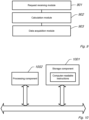
- FIG. 9 is a schematic structural diagram of still another example embodiment of a data processing device according to an example embodiment of the present application.
- the device may comprise:
- the data obtained after splicing may be fed back to the requestor.
- valid data written in each smallest data unit comprises at least some appending data in an append write request or at least some appending data in an append write request and at least some appending data in a next append write request.
- the calculation module may be specifically used for:
- the smallest data unit comprises a data storage area and a metadata description area located at an end of the data storage area, wherein the data storage area is used to store valid data and the metadata description area is used to store metadata of the valid data;
- the read, from a storage device, valid data in the at least one target smallest data unit and splice the same comprises: reading, from a storage device, valid data in the data storage area of the at least one target smallest data unit and splicing the same.
- the data processing device of the example embodiment shown in FIG. 9 may be implemented as a computer device.
- the computer device may deploy data storage nodes and the like of the distributed storage system.
- the computer device may include a storage component 1001 and a processing component 1002; the storage component 1001 is configured to store one or a plurality of computer-readable instructions, wherein the one or plurality of computer-readable instructions are called and executed by the processing component 1002.
- the processing component 1002 is configured to:
- the processing component 1002 may comprise one or a plurality of processors to execute computer-readable instructions so as to implement all or some of the steps in the above methods.
- the processing component may also be one or more application specific integrated circuits (ASIC), digital signal processors (DSP), digital signal processing devices (DSPD), programmable logic devices (PLD), field programmable gate arrays (FPGA), controllers, microcontrollers, microprocessors, or other electronic components to implement the above methods.
- ASIC application specific integrated circuits
- DSP digital signal processors
- DSPD digital signal processing devices
- PLD programmable logic devices
- FPGA field programmable gate arrays
- controllers microcontrollers, microprocessors, or other electronic components to implement the above methods.
- the storage component 1001 is configured to store various types of data to support operations on the computer device.
- the memory may be implemented using any type of volatile or non-volatile storage devices or a combination thereof, such as static random-access memory (SRAM), electrically erasable programmable read-only memory (EEPROM), erasable programmable read-only memory (EPROM), programmable read-only memory (PROM), read-only memory (ROM), magnetic memory, flash memory, magnetic disk, or optical disk.
- SRAM static random-access memory
- EEPROM electrically erasable programmable read-only memory
- EPROM erasable programmable read-only memory
- PROM programmable read-only memory
- ROM read-only memory
- the computer device must necessarily further include other components, such as input/output interfaces, communication components, and so on.
- the input/output interface provides an interface between the processing component and a peripheral interface module.
- the peripheral interface module may be an output device, an input device, or the like.
- the communication component is configured to facilitate wired or wireless communication between the computer device and other devices, such as communication with a requestor.
- An example embodiment of the present application further provides a computer-readable storage medium having stored therein a computer program which, when executed by a computer, implements the afore-mentioned data processing method of any of the example embodiments shown in FIG. 4 .
- the computer device shown in FIG. 10 and the computer device shown in 8 may be the same computer device.
- FIG. 11 is a schematic structural diagram of yet another example embodiment of a data processing device according to an example embodiment of the present application.
- the device may comprise:
- the data recovery module may be specifically used for:
- the data processing device shown in FIG. 11 may be implemented as a computer device.
- the computer device may deploy data storage nodes and the like of the distributed storage system.
- the computer device may include a storage component 1201 and a processing component 1202; the storage component 1201 is configured to store one or a plurality of computer-readable instructions, wherein the one or plurality of computer-readable instructions are called and executed by the processing component 1202.
- the processing component 1202 is configured to:
- the processing component 1202 may comprise one or a plurality of processors to execute computer-readable instructions so as to implement all or some of the steps in the above methods.
- the processing component may also be one or more application specific integrated circuits (ASIC), digital signal processors (DSP), digital signal processing devices (DSPD), programmable logic devices (PLD), field programmable gate arrays (FPGA), controllers, microcontrollers, microprocessors, or other electronic components to implement the above methods.
- ASIC application specific integrated circuits
- DSP digital signal processors
- DSPD digital signal processing devices
- PLD programmable logic devices
- FPGA field programmable gate arrays
- controllers microcontrollers, microprocessors, or other electronic components to implement the above methods.
- the storage component 1201 is configured to store various types of data to support operations on the computer device.
- the memory may be implemented using any type of volatile or non-volatile storage devices or a combination thereof, such as static random-access memory (SRAM), electrically erasable programmable read-only memory (EEPROM), erasable programmable read-only memory (EPROM), programmable read-only memory (PROM), read-only memory (ROM), magnetic memory, flash memory, magnetic disk, or optical disk.
- SRAM static random-access memory
- EEPROM electrically erasable programmable read-only memory
- EPROM erasable programmable read-only memory
- PROM programmable read-only memory
- ROM read-only memory
- the computer device must further include other components, such as input/output interfaces, communication components, and so on.
- the input/output interface provides an interface between the processing component and a peripheral interface module.
- the peripheral interface module may be an output device, an input device, or the like.
- the communication component is configured to facilitate wired or wireless communication between the computer device and other devices, such as communication with a requestor.
- An example embodiment of the present application further provides a computer-readable storage medium having stored therein a computer program which, when executed by a computer, implements the afore-mentioned data processing method shown in FIG. 5 .
- the computer device shown in FIG. 12 may be the same computer device.
- the computer device shown in FIG. 10 may be the same computer device.
- FIG. 8 may be the same computer device.
- the appending data is written into the storage device together with the metadata of the appending data, thereby reducing the write operation frequencies and ensuring the write operation efficiency.
- the appending data is reorganized according to the fixed data format of the smallest data unit; the index relationship does not need to be maintained; the position of the data may be located through calculation to implement the data reading, thereby ensuring the write operation convenience.
- the overwrite operation is adopted and whether two consequent append write requests correspond to the same smallest data unit is recorded; thus, the data end boundary of the append write request may be identified, thereby ensuring the request atomicity during data recovery.
- the device example embodiments described above are only examples, wherein the units described as separate components may or may not be physically separated; and the components displayed as units may or may not be physical units; that is, the units may be located in one place, or may be distributed on a plurality of network units. Some or all of the modules may be selected according to actual needs to achieve the object of the solution of the example embodiments. Those of ordinary skill in the art may understand and implement the example embodiments without creative efforts.
- each implementation may be realized by means of software plus a necessary general hardware platform, and may certainly be implemented by hardware.
- the computer software product may be stored in a computer-readable storage medium, such as a ROM/RAM, a magnetic disk, or an optical disk, and includes several instructions for enabling a computer device (which may be a personal computer, a server, a network device, or the like) to execute the methods described in each example embodiment or some parts of the example embodiments.
Landscapes
- Engineering & Computer Science (AREA)
- Theoretical Computer Science (AREA)
- General Engineering & Computer Science (AREA)
- Physics & Mathematics (AREA)
- General Physics & Mathematics (AREA)
- Human Computer Interaction (AREA)
- Computer Security & Cryptography (AREA)
- Quality & Reliability (AREA)
- Software Systems (AREA)
- Databases & Information Systems (AREA)
- Data Mining & Analysis (AREA)
- Library & Information Science (AREA)
- Information Retrieval, Db Structures And Fs Structures Therefor (AREA)
Claims (15)
- Procédé comprenant :la recherche (101 ; 201 ; 401) d'une plus petite unité de données (300) d'une mémoire tampon en vue de l'ajout de données dans une demande d'écriture d'ajout ;l'écriture séquentielle (102 ; 202 ; 402) d'au moins une partie des données d'ajout dans la plus petite unité de données (300) de la mémoire tampon pour obtenir une première plus petite unité de données à stocker, et l'écriture (103 ; 203 ; 403) de données non encore écrites dans les données d'ajout dans au moins une plus petite unité de données (300) pour obtenir au moins une seconde plus petite unité de données à stocker ;caractérisé en ce quel'écriture (104 ; 204 ; 404) de la première plus petite unité de données à stocker dans un dispositif de stockage par écrasement, et l'écriture séquentielle (105 ; 205 ; 405) de l'au moins une seconde plus petite unité de données à stocker dans le dispositif de stockage ; etla mise en mémoire tampon (106 ; 206 ; 406) d'une plus petite unité de données qui n'a pas été entièrement écrite et qui correspond aux données d'ajout.
- Procédé selon la revendication 1, comprenant en outre :la réception (207 ; 501) d'une demande de lecture de données ;le calcul (208 ; 502), sur la base d'une première longueur fixe de la plus petite unité de données (300), d'au moins une plus petite unité de données cible correspondant à la demande de lecture de données ; etla lecture et l'épissage (209 ; 503), à partir du dispositif de stockage, de données valides dans l'au moins une plus petite unité de données cible.
- Procédé selon la revendication 2, dans lequel le calcul (208 ; 502), sur la base de la première longueur fixe de la plus petite unité de données (300), de l'au moins une plus petite unité de données cible correspondant à la demande de lecture de données comprend :la détermination d'une position de début de demande et d'un décalage de demande correspondant à la demande de lecture des données ; etle calcul, sur la base de la première longueur fixe de la plus petite unité de données (300), de la position de début de demande et du décalage de demande, de l'au moins une plus petite unité de données cible correspondant à la demande de lecture.
- Procédé selon l'une quelconque des revendications 1 à 3, dans lequel :
la plus petite unité de données (300) comprend une zone de stockage de données (301) et une zone de description de métadonnées (302) située à une extrémité de la zone de stockage de données (301), dans lequel la zone de description de métadonnées (302) est utilisée pour stocker des métadonnées. - Procédé selon la revendication 4, dans lequel l'écriture séquentielle (102 ; 202 ; 402) de l'au moins une partie des données d'ajout dans la plus petite unité de données (300) de la mémoire tampon pour obtenir la première plus petite unité de données à stocker, et l'écriture (103 ; 203 ; 403) de données non encore écrites dans les données d'ajout dans l'au moins une plus petite unité de données (300) pour obtenir l'au moins une seconde plus petite unité de données à stocker comprennent :l'écriture séquentielle d'au moins une partie des données d'ajout dans la zone de stockage de données (301) dans la plus petite unité de données (300) de la mémoire tampon, et la modification, sur la base d'au moins une partie des données, de la zone de description de métadonnées (302) dans la plus petite unité de données (300) de la mémoire tampon afin d'obtenir la première plus petite unité de données à stocker ; etl'écriture de données non encore écrites dans les données d'ajout dans une zone de stockage de données (301) d'au moins une plus petite unité de données (300), et la génération, sur la base de données écrites dans chaque zone de stockage de données (301), d'une zone de description de métadonnées (302) correspondante pour chaque zone de stockage de données (301), de manière à obtenir l'au moins une seconde plus petite unité de données à stocker.
- Procédé selon la revendication 4 ou 5, dans lequel :
les métadonnées comprennent au moins une longueur de données valide après une avant-dernière opération d'écriture, une longueur de données valide après une dernière opération d'écriture, et du fait que des dernières données écrites et au moins une partie des données dans une plus petite unité de données suivante appartiennent à une même demande d'écriture d'ajout. - Procédé selon la revendication 6, comprenant en outre :la détection (407 ; 601) d'instructions de récupération de données ;la récupération (408-415 ; 602), sur la base de la longueur de données valide après l'avant-dernière opération d'écriture dans chacune des plus petites unités de données (300), de la longueur de données valide après la dernière opération d'écriture et du fait que les dernières données écrites et au moins une partie des données de la plus petite unité de données suivante appartiennent à la même demande d'écriture d'ajout, d'une longueur de récupération de données d'un fichier de données à une position de fin de données d'une demande d'écriture d'ajout respective afin de maintenir une atomicité.
- Procédé selon la revendication 7, dans lequel la récupération (408-415 ; 602), sur la base de la longueur de données valide après l'avant-dernière opération d'écriture dans chacune des plus petites unités de données (300), de la longueur de données valide après la dernière opération d'écriture et du fait que les dernières données écrites et au moins une partie des données de la plus petite unité de données suivante appartiennent à la même demande d'écriture d'ajout, de la longueur de récupération de données du fichier de données à la position de fin de données de la demande d'écriture d'ajout respective pour maintenir une atomicité comprend :l'initialisation (408) d'une longueur de données valide des données déjà écrites dans le fichier de données à zéro et d'une position de balayage initiale à une position de début du fichier de données dans le dispositif de stockage ;le balayage (409) de la plus petite unité de données suivante ;la vérification (410) des données après l'avant-dernière opération d'écriture dans une plus petite unité de données actuelle ;en réponse à la détermination (410) du fait que les données après l'avant-dernière opération d'écriture dans la plus petite unité de données actuelle sont vérifiées, la mise à jour (411) de la longueur de données valide des données déjà écrites sur la base d'une longueur de données valide après l'avant-dernière opération d'écriture dans la plus petite unité de données actuelle ;la vérification (412) des données après la dernière opération d'écriture dans la plus petite unité de données actuelle ;en réponse à la détermination (412) du fait que les données après la dernière opération d'écriture dans la plus petite unité de données actuelle sont vérifiées, le fait de détecter (413) si la plus petite unité de données actuelle et la plus petite unité de données suivante appartiennent à la même demande d'écriture d'ajout ;en réponse à la détermination (413) du fait que la plus petite unité de données actuelle et la plus petite unité de données suivante appartiennent à la même demande d'écriture d'ajout, le retour à l'étape de balayage (409) de la plus petite unité de données suivante pour reprendre l'exécution ; eten réponse à la détermination (413) du fait que la plus petite unité de données actuelle et la plus petite unité de données suivante n'appartiennent pas à la même demande d'écriture d'ajout, la mise à jour (414), sur la base d'une longueur de données valide après la dernière opération d'écriture dans la plus petite unité de données actuelle, de la longueur de données valide des données déjà écrites et le retour à l'étape de balayage (409) de la plus petite unité de données suivante pour reprendre l'exécution.
- Procédé selon la revendication 5, dans lequel :
l'écriture de données non encore écrites dans les données d'ajout dans la zone de stockage de données (301) d'au moins une plus petite unité de données (300) comprend :l'écriture séquentielle de données non encore écrites dans les données d'ajout dans une zone de stockage de données (301) d'au moins une plus petite unité de données (300) ; eten réponse à la détermination du fait qu'une zone de stockage de données (301) d'une plus petite unité de données (300) n'est pas entièrement écrite avec des données, le remplissage de la zone de stockage de données (301) avec des caractères prédéfinis à la fin des données écrites dans la zone de stockage de données (301) de la plus petite unité de données (300) respective. - Procédé selon la revendication 9, dans lequel l'écriture séquentielle d'au moins une partie des données d'ajout dans la zone de stockage de données (301) dans la plus petite unité de données (300) de la mémoire tampon comprend :
l'écriture d'au moins une partie des données d'ajout à une position des caractères prédéfinis dans la zone de stockage de données (301) de la plus petite unité de données (300) de la mémoire tampon pour remplacer les caractères prédéfinis. - Procédé selon l'une quelconque des revendications 1 à 10, dans lequel l'écriture (104 ; 204 ; 404) de la première plus petite unité de données à stocker dans le dispositif de stockage par écrasement comprend :la détermination, sur la base d'une position de début d'écriture de la demande d'écriture d'ajout et de la première longueur fixe de la plus petite unité de données (300), d'une position où les données doivent être écrites ; etl'écriture, sur la base de la position où des données doivent être écrites, de la première plus petite unité de données à stocker dans le dispositif de stockage par écrasement.
- Dispositif comprenant :un ou plusieurs processeurs (1002) ; etune ou plusieurs mémoires (1001) stockant des instructions lisibles par ordinateur qui, exécutables par le ou les processeurs, amènent le ou les processeurs à réaliser des opérations comprenant :la réception (207 ; 501) d'une demande de lecture de données ;le calcul (208 ; 502), sur la base d'une première longueur fixe de la plus petite unité de données (300), d'au moins une plus petite unité de données cible correspondant à la demande de lecture de données ; etla lecture et l'épissage (209 ; 503), à partir du dispositif de stockage, de données valides dans au moins une plus petite unité de données cible, dans lequeldes données valides écrites dans une plus petite unité de données respective comprennent au moins une partie des données d'ajout dans une demande d'écriture d'ajout ou au moins une partie des données d'ajout dans la demande d'écriture d'ajout et au moins une partie des données d'ajout dans une demande d'écriture d'ajout suivante.
- Dispositif selon la revendication 12, dans lequel le calcul (208 ; 502), sur la base de la première longueur fixe de la plus petite unité de données (300), d'au moins une plus petite unité de données cible correspondant à la demande de lecture de données comprend :la détermination d'une position de début de la demande et d'un décalage de la demande correspondant à la demande de lecture des données ; etle calcul, sur la base de la première longueur fixe de la plus petite unité de données (300), de la position de début de la demande et du décalage de la demande, d'au moins une plus petite unité de données cible correspondant à la demande de lecture.
- Dispositif selon la revendication 12 ou 13, dans lequel :la plus petite unité de données (300) comprend une zone de stockage de données (301) et une zone de description de métadonnées (302) située à une extrémité de la zone de stockage de données (301), dans lequel la zone de stockage de données (301) est utilisée pour stocker des données valides et la zone de description de métadonnées (302) est utilisée pour stocker des métadonnées des données valides ; etla lecture (209 ; 503), à partir du dispositif de stockage, des données valides dans l'au moins une plus petite unité de données cible et l'épissage de ces données comprend :
la lecture et l'épissage (209 ; 503), à partir du dispositif de stockage, des données valides dans la zone de stockage de données (301) de l'au moins une plus petite unité de données cible. - Une ou plusieurs mémoires (1201) stockant des instructions lisibles par ordinateur qui, exécutables par le ou les processeurs (1202), amènent le ou les processeurs (1202) à réaliser des opérations comprenant :la détection (407 ; 601) d'instructions de récupération de données ; etla récupération (408-415 ; 602), sur la base d'une longueur de données valide après une avant-dernière opération d'écriture dans une zone de description de métadonnées (302) d'une plus petite unité de données (300), d'une longueur de données valide après une dernière opération d'écriture et du fait que les dernières données écrites et au moins une partie des données d'une plus petite unité de données suivante appartiennent à une même demande d'écriture d'ajout, d'une longueur de récupération des données d'un fichier de données à une position de fin de données d'une demande d'écriture d'ajout pour maintenir l'atomicité, dans lequel :la plus petite unité de données (300) comprend une zone de stockage de données (301) et une zone de description de métadonnées (302) située à une extrémité de la zone de stockage de données (301), dans lequel la zone de stockage de données (301) est utilisée pour stocker des données valides et la zone de description de métadonnées (302) est utilisée pour stocker des métadonnées des données valides ; etles données valides comprennent au moins une partie des données d'ajout dans la demande d'écriture d'ajout ou au moins une partie des données d'ajout dans la demande d'écriture d'ajout et au moins une partie des données d'ajout dans une demande d'écriture d'ajout suivante.
Applications Claiming Priority (2)
| Application Number | Priority Date | Filing Date | Title |
|---|---|---|---|
| CN201810020395.XA CN110018784B (zh) | 2018-01-09 | 2018-01-09 | 数据处理方法、装置及计算设备 |
| PCT/CN2019/070581 WO2019137322A1 (fr) | 2018-01-09 | 2019-01-07 | Procédé et dispositif destinés au traitement de données et dispositif informatique |
Publications (3)
| Publication Number | Publication Date |
|---|---|
| EP3739472A1 EP3739472A1 (fr) | 2020-11-18 |
| EP3739472A4 EP3739472A4 (fr) | 2021-10-06 |
| EP3739472B1 true EP3739472B1 (fr) | 2024-12-11 |
Family
ID=67187847
Family Applications (1)
| Application Number | Title | Priority Date | Filing Date |
|---|---|---|---|
| EP19738606.3A Active EP3739472B1 (fr) | 2018-01-09 | 2019-01-07 | Procédé et dispositif destinés au traitement de données et dispositif informatique |
Country Status (4)
| Country | Link |
|---|---|
| US (1) | US11294592B2 (fr) |
| EP (1) | EP3739472B1 (fr) |
| CN (1) | CN110018784B (fr) |
| WO (1) | WO2019137322A1 (fr) |
Families Citing this family (2)
| Publication number | Priority date | Publication date | Assignee | Title |
|---|---|---|---|---|
| US11249830B1 (en) * | 2020-08-14 | 2022-02-15 | Micron Technology, Inc. | Detecting page fault traffic |
| CN115908678B (zh) * | 2023-02-25 | 2023-05-30 | 深圳市益玩网络科技有限公司 | 骨骼模型渲染方法、装置、电子设备及存储介质 |
Family Cites Families (22)
| Publication number | Priority date | Publication date | Assignee | Title |
|---|---|---|---|---|
| WO1999019805A1 (fr) | 1997-10-10 | 1999-04-22 | Rambus Incorporated | Procede et appareil pour operations d'ecriture dans une memoire en deux temps |
| JP2005293774A (ja) | 2004-04-02 | 2005-10-20 | Hitachi Global Storage Technologies Netherlands Bv | ディスク装置の制御方法 |
| US7519788B2 (en) | 2004-06-04 | 2009-04-14 | Micron Technology, Inc. | System and method for an asynchronous data buffer having buffer write and read pointers |
| JP2006072435A (ja) | 2004-08-31 | 2006-03-16 | Hitachi Ltd | ストレージシステムおよびデータ記録方法 |
| US7743217B2 (en) | 2005-06-29 | 2010-06-22 | Stmicroelectronics S.A. | Cache consistency in a multiprocessor system with shared memory |
| US8250316B2 (en) | 2006-06-06 | 2012-08-21 | Seagate Technology Llc | Write caching random data and sequential data simultaneously |
| US7596643B2 (en) | 2007-02-07 | 2009-09-29 | Siliconsystems, Inc. | Storage subsystem with configurable buffer |
| JP4977583B2 (ja) | 2007-11-22 | 2012-07-18 | 株式会社日立製作所 | 記憶制御装置及び記憶制御装置の制御方法 |
| CN101241420A (zh) * | 2008-03-20 | 2008-08-13 | 杭州华三通信技术有限公司 | 用于提高写地址非连续的数据存储效率的方法和存储设备 |
| JP2010267164A (ja) | 2009-05-15 | 2010-11-25 | Toshiba Storage Device Corp | 記憶装置、データ転送制御装置、データ転送方法およびデータ転送プログラム |
| US8370683B1 (en) | 2009-07-31 | 2013-02-05 | Western Digital Technologies, Inc. | System and method to reduce write splice failures |
| US8929020B2 (en) * | 2011-06-24 | 2015-01-06 | International Business Machines Corporation | Linear recording device for executing optimum writing upon receipt of series of commands including mixed read and write commands and method and program thereof |
| CN102364474B (zh) * | 2011-11-17 | 2014-08-20 | 中国科学院计算技术研究所 | 用于机群文件系统的元数据存储系统和管理方法 |
| CN103257831B (zh) * | 2012-02-20 | 2016-12-07 | 深圳市腾讯计算机系统有限公司 | 存储器的读写控制方法及对应的存储器 |
| CN102799679B (zh) * | 2012-07-24 | 2014-10-22 | 河海大学 | 基于Hadoop的海量空间数据索引更新系统及方法 |
| US10684986B2 (en) | 2013-08-28 | 2020-06-16 | Biosense Webster (Israel) Ltd. | Double buffering with atomic transactions for the persistent storage of real-time data flows |
| US9760281B2 (en) | 2015-03-27 | 2017-09-12 | Intel Corporation | Sequential write stream management |
| CN111007991B (zh) * | 2015-08-13 | 2024-01-26 | 北京忆恒创源科技股份有限公司 | 基于nvdimm分离读写请求的方法及其计算机 |
| CN105335098B (zh) * | 2015-09-25 | 2019-03-26 | 华中科技大学 | 一种基于存储级内存的日志文件系统性能提高方法 |
| JP6685334B2 (ja) * | 2016-02-15 | 2020-04-22 | 株式会社日立製作所 | ストレージ装置 |
| CN105843775B (zh) * | 2016-04-06 | 2018-12-04 | 中国科学院计算技术研究所 | 片上数据划分读写方法、系统及其装置 |
| CN111949605B (zh) * | 2019-05-15 | 2024-07-19 | 伊姆西Ip控股有限责任公司 | 用于实现文件系统的方法、设备和计算机程序产品 |
-
2018
- 2018-01-09 CN CN201810020395.XA patent/CN110018784B/zh active Active
-
2019
- 2019-01-07 WO PCT/CN2019/070581 patent/WO2019137322A1/fr not_active Ceased
- 2019-01-07 EP EP19738606.3A patent/EP3739472B1/fr active Active
-
2020
- 2020-07-08 US US16/923,999 patent/US11294592B2/en active Active
Also Published As
| Publication number | Publication date |
|---|---|
| US11294592B2 (en) | 2022-04-05 |
| WO2019137322A1 (fr) | 2019-07-18 |
| US20200341680A1 (en) | 2020-10-29 |
| CN110018784B (zh) | 2023-01-10 |
| EP3739472A1 (fr) | 2020-11-18 |
| EP3739472A4 (fr) | 2021-10-06 |
| CN110018784A (zh) | 2019-07-16 |
Similar Documents
| Publication | Publication Date | Title |
|---|---|---|
| US12117911B2 (en) | Remote data replication method and system | |
| US10261869B2 (en) | Transaction processing using torn write detection | |
| US10599337B2 (en) | Method and device for writing data and acquiring data in a distributed storage system | |
| US8370297B2 (en) | Approach for optimizing restores of deduplicated data | |
| CN108563532B (zh) | 数据处理方法及相关装置 | |
| US9063894B2 (en) | Cascade ordering | |
| US11099980B2 (en) | Host aware update write | |
| US10552403B2 (en) | Using checksums to reduce the write latency of logging | |
| CN111400267A (zh) | 记录日志的方法和装置 | |
| EP3336702A1 (fr) | Procédé et dispositif de récupération de métadonnées | |
| US11294592B2 (en) | Method and device for data processing, and computer device | |
| CN117435404B (zh) | 永久增量备份数据储存的处理方法、系统及数据恢复方法 | |
| US20210181977A1 (en) | Optimizing atomic writes to a storage device | |
| CN119759295B (zh) | 卷实时备份中历史数据构建方法、系统、设备及存储介质 | |
| CN112346771B (zh) | 升级文件生成方法及装置 | |
| CN113806316B (zh) | 一种文件同步方法、设备及存储介质 | |
| US11500590B2 (en) | Method, device and computer program product for data writing | |
| CN116841463A (zh) | 存储设备的数据校验方法、装置、设备及存储介质 | |
| CN119645733B (zh) | Kvm数据存储处理方法、系统及其连续数据点恢复方法 | |
| CN113934370B (zh) | 非易失性存储器的耗损均衡方法、设备及介质 | |
| CN116775379A (zh) | 一种链表式数据存储方法、智能终端及存储介质 | |
| US11182250B1 (en) | Systems and methods of resyncing data in erasure-coded objects with multiple failures | |
| CN111984460B (zh) | 元数据的恢复方法及装置 | |
| CN120508437A (zh) | 一种数据校验方法和相关设备 |
Legal Events
| Date | Code | Title | Description |
|---|---|---|---|
| STAA | Information on the status of an ep patent application or granted ep patent |
Free format text: STATUS: THE INTERNATIONAL PUBLICATION HAS BEEN MADE |
|
| PUAI | Public reference made under article 153(3) epc to a published international application that has entered the european phase |
Free format text: ORIGINAL CODE: 0009012 |
|
| STAA | Information on the status of an ep patent application or granted ep patent |
Free format text: STATUS: REQUEST FOR EXAMINATION WAS MADE |
|
| 17P | Request for examination filed |
Effective date: 20200706 |
|
| AK | Designated contracting states |
Kind code of ref document: A1 Designated state(s): AL AT BE BG CH CY CZ DE DK EE ES FI FR GB GR HR HU IE IS IT LI LT LU LV MC MK MT NL NO PL PT RO RS SE SI SK SM TR |
|
| AX | Request for extension of the european patent |
Extension state: BA ME |
|
| DAV | Request for validation of the european patent (deleted) | ||
| DAX | Request for extension of the european patent (deleted) | ||
| REG | Reference to a national code |
Free format text: PREVIOUS MAIN CLASS: G06F0017000000 Ipc: G06F0016180000 Ref country code: DE Ref legal event code: R079 Ref document number: 602019063371 Country of ref document: DE Free format text: PREVIOUS MAIN CLASS: G06F0017000000 Ipc: G06F0016180000 |
|
| A4 | Supplementary search report drawn up and despatched |
Effective date: 20210902 |
|
| RIC1 | Information provided on ipc code assigned before grant |
Ipc: G06F 16/18 20190101AFI20210827BHEP |
|
| P01 | Opt-out of the competence of the unified patent court (upc) registered |
Effective date: 20230418 |
|
| GRAP | Despatch of communication of intention to grant a patent |
Free format text: ORIGINAL CODE: EPIDOSNIGR1 |
|
| STAA | Information on the status of an ep patent application or granted ep patent |
Free format text: STATUS: GRANT OF PATENT IS INTENDED |
|
| INTG | Intention to grant announced |
Effective date: 20240830 |
|
| GRAS | Grant fee paid |
Free format text: ORIGINAL CODE: EPIDOSNIGR3 |
|
| GRAA | (expected) grant |
Free format text: ORIGINAL CODE: 0009210 |
|
| STAA | Information on the status of an ep patent application or granted ep patent |
Free format text: STATUS: THE PATENT HAS BEEN GRANTED |
|
| AK | Designated contracting states |
Kind code of ref document: B1 Designated state(s): AL AT BE BG CH CY CZ DE DK EE ES FI FR GB GR HR HU IE IS IT LI LT LU LV MC MK MT NL NO PL PT RO RS SE SI SK SM TR |
|
| REG | Reference to a national code |
Ref country code: GB Ref legal event code: FG4D |
|
| REG | Reference to a national code |
Ref country code: CH Ref legal event code: EP |
|
| REG | Reference to a national code |
Ref country code: DE Ref legal event code: R096 Ref document number: 602019063371 Country of ref document: DE |
|
| REG | Reference to a national code |
Ref country code: IE Ref legal event code: FG4D |
|
| REG | Reference to a national code |
Ref country code: LT Ref legal event code: MG9D |
|
| PG25 | Lapsed in a contracting state [announced via postgrant information from national office to epo] |
Ref country code: HR Free format text: LAPSE BECAUSE OF FAILURE TO SUBMIT A TRANSLATION OF THE DESCRIPTION OR TO PAY THE FEE WITHIN THE PRESCRIBED TIME-LIMIT Effective date: 20241211 |
|
| PG25 | Lapsed in a contracting state [announced via postgrant information from national office to epo] |
Ref country code: FI Free format text: LAPSE BECAUSE OF FAILURE TO SUBMIT A TRANSLATION OF THE DESCRIPTION OR TO PAY THE FEE WITHIN THE PRESCRIBED TIME-LIMIT Effective date: 20241211 |
|
| PG25 | Lapsed in a contracting state [announced via postgrant information from national office to epo] |
Ref country code: BG Free format text: LAPSE BECAUSE OF FAILURE TO SUBMIT A TRANSLATION OF THE DESCRIPTION OR TO PAY THE FEE WITHIN THE PRESCRIBED TIME-LIMIT Effective date: 20241211 |
|
| REG | Reference to a national code |
Ref country code: NL Ref legal event code: MP Effective date: 20241211 |
|
| PG25 | Lapsed in a contracting state [announced via postgrant information from national office to epo] |
Ref country code: ES Free format text: LAPSE BECAUSE OF FAILURE TO SUBMIT A TRANSLATION OF THE DESCRIPTION OR TO PAY THE FEE WITHIN THE PRESCRIBED TIME-LIMIT Effective date: 20241211 |
|
| PG25 | Lapsed in a contracting state [announced via postgrant information from national office to epo] |
Ref country code: NO Free format text: LAPSE BECAUSE OF FAILURE TO SUBMIT A TRANSLATION OF THE DESCRIPTION OR TO PAY THE FEE WITHIN THE PRESCRIBED TIME-LIMIT Effective date: 20250311 |
|
| PG25 | Lapsed in a contracting state [announced via postgrant information from national office to epo] |
Ref country code: GR Free format text: LAPSE BECAUSE OF FAILURE TO SUBMIT A TRANSLATION OF THE DESCRIPTION OR TO PAY THE FEE WITHIN THE PRESCRIBED TIME-LIMIT Effective date: 20250312 Ref country code: LV Free format text: LAPSE BECAUSE OF FAILURE TO SUBMIT A TRANSLATION OF THE DESCRIPTION OR TO PAY THE FEE WITHIN THE PRESCRIBED TIME-LIMIT Effective date: 20241211 |
|
| PG25 | Lapsed in a contracting state [announced via postgrant information from national office to epo] |
Ref country code: RS Free format text: LAPSE BECAUSE OF FAILURE TO SUBMIT A TRANSLATION OF THE DESCRIPTION OR TO PAY THE FEE WITHIN THE PRESCRIBED TIME-LIMIT Effective date: 20250311 |
|
| PG25 | Lapsed in a contracting state [announced via postgrant information from national office to epo] |
Ref country code: NL Free format text: LAPSE BECAUSE OF FAILURE TO SUBMIT A TRANSLATION OF THE DESCRIPTION OR TO PAY THE FEE WITHIN THE PRESCRIBED TIME-LIMIT Effective date: 20241211 |
|
| REG | Reference to a national code |
Ref country code: AT Ref legal event code: MK05 Ref document number: 1750950 Country of ref document: AT Kind code of ref document: T Effective date: 20241211 |
|
| PG25 | Lapsed in a contracting state [announced via postgrant information from national office to epo] |
Ref country code: SM Free format text: LAPSE BECAUSE OF FAILURE TO SUBMIT A TRANSLATION OF THE DESCRIPTION OR TO PAY THE FEE WITHIN THE PRESCRIBED TIME-LIMIT Effective date: 20241211 |
|
| PG25 | Lapsed in a contracting state [announced via postgrant information from national office to epo] |
Ref country code: PL Free format text: LAPSE BECAUSE OF FAILURE TO SUBMIT A TRANSLATION OF THE DESCRIPTION OR TO PAY THE FEE WITHIN THE PRESCRIBED TIME-LIMIT Effective date: 20241211 |
|
| PG25 | Lapsed in a contracting state [announced via postgrant information from national office to epo] |
Ref country code: IS Free format text: LAPSE BECAUSE OF FAILURE TO SUBMIT A TRANSLATION OF THE DESCRIPTION OR TO PAY THE FEE WITHIN THE PRESCRIBED TIME-LIMIT Effective date: 20250411 |
|
| PG25 | Lapsed in a contracting state [announced via postgrant information from national office to epo] |
Ref country code: PT Free format text: LAPSE BECAUSE OF FAILURE TO SUBMIT A TRANSLATION OF THE DESCRIPTION OR TO PAY THE FEE WITHIN THE PRESCRIBED TIME-LIMIT Effective date: 20250411 |
|
| PG25 | Lapsed in a contracting state [announced via postgrant information from national office to epo] |
Ref country code: EE Free format text: LAPSE BECAUSE OF FAILURE TO SUBMIT A TRANSLATION OF THE DESCRIPTION OR TO PAY THE FEE WITHIN THE PRESCRIBED TIME-LIMIT Effective date: 20241211 |
|
| PG25 | Lapsed in a contracting state [announced via postgrant information from national office to epo] |
Ref country code: RO Free format text: LAPSE BECAUSE OF FAILURE TO SUBMIT A TRANSLATION OF THE DESCRIPTION OR TO PAY THE FEE WITHIN THE PRESCRIBED TIME-LIMIT Effective date: 20241211 Ref country code: AT Free format text: LAPSE BECAUSE OF FAILURE TO SUBMIT A TRANSLATION OF THE DESCRIPTION OR TO PAY THE FEE WITHIN THE PRESCRIBED TIME-LIMIT Effective date: 20241211 |
|
| PG25 | Lapsed in a contracting state [announced via postgrant information from national office to epo] |
Ref country code: SK Free format text: LAPSE BECAUSE OF FAILURE TO SUBMIT A TRANSLATION OF THE DESCRIPTION OR TO PAY THE FEE WITHIN THE PRESCRIBED TIME-LIMIT Effective date: 20241211 |
|
| PG25 | Lapsed in a contracting state [announced via postgrant information from national office to epo] |
Ref country code: CZ Free format text: LAPSE BECAUSE OF FAILURE TO SUBMIT A TRANSLATION OF THE DESCRIPTION OR TO PAY THE FEE WITHIN THE PRESCRIBED TIME-LIMIT Effective date: 20241211 |
|
| PG25 | Lapsed in a contracting state [announced via postgrant information from national office to epo] |
Ref country code: IT Free format text: LAPSE BECAUSE OF FAILURE TO SUBMIT A TRANSLATION OF THE DESCRIPTION OR TO PAY THE FEE WITHIN THE PRESCRIBED TIME-LIMIT Effective date: 20241211 |
|
| REG | Reference to a national code |
Ref country code: CH Ref legal event code: PL |
|
| PG25 | Lapsed in a contracting state [announced via postgrant information from national office to epo] |
Ref country code: SE Free format text: LAPSE BECAUSE OF FAILURE TO SUBMIT A TRANSLATION OF THE DESCRIPTION OR TO PAY THE FEE WITHIN THE PRESCRIBED TIME-LIMIT Effective date: 20241211 |
|
| REG | Reference to a national code |
Ref country code: DE Ref legal event code: R097 Ref document number: 602019063371 Country of ref document: DE |
|
| PG25 | Lapsed in a contracting state [announced via postgrant information from national office to epo] |
Ref country code: MC Free format text: LAPSE BECAUSE OF FAILURE TO SUBMIT A TRANSLATION OF THE DESCRIPTION OR TO PAY THE FEE WITHIN THE PRESCRIBED TIME-LIMIT Effective date: 20241211 Ref country code: LU Free format text: LAPSE BECAUSE OF NON-PAYMENT OF DUE FEES Effective date: 20250107 |
|
| PG25 | Lapsed in a contracting state [announced via postgrant information from national office to epo] |
Ref country code: DK Free format text: LAPSE BECAUSE OF FAILURE TO SUBMIT A TRANSLATION OF THE DESCRIPTION OR TO PAY THE FEE WITHIN THE PRESCRIBED TIME-LIMIT Effective date: 20241211 |
|
| PG25 | Lapsed in a contracting state [announced via postgrant information from national office to epo] |
Ref country code: BE Free format text: LAPSE BECAUSE OF NON-PAYMENT OF DUE FEES Effective date: 20250131 |
|
| PLBE | No opposition filed within time limit |
Free format text: ORIGINAL CODE: 0009261 |
|
| STAA | Information on the status of an ep patent application or granted ep patent |
Free format text: STATUS: NO OPPOSITION FILED WITHIN TIME LIMIT |
|
| PG25 | Lapsed in a contracting state [announced via postgrant information from national office to epo] |
Ref country code: CH Free format text: LAPSE BECAUSE OF NON-PAYMENT OF DUE FEES Effective date: 20250131 |
|
| REG | Reference to a national code |
Ref country code: BE Ref legal event code: MM Effective date: 20250131 |
|
| 26N | No opposition filed |
Effective date: 20250912 |
|
| PG25 | Lapsed in a contracting state [announced via postgrant information from national office to epo] |
Ref country code: IE Free format text: LAPSE BECAUSE OF NON-PAYMENT OF DUE FEES Effective date: 20250107 |
|
| PGFP | Annual fee paid to national office [announced via postgrant information from national office to epo] |
Ref country code: GB Payment date: 20260123 Year of fee payment: 8 |
|
| PGFP | Annual fee paid to national office [announced via postgrant information from national office to epo] |
Ref country code: DE Payment date: 20260126 Year of fee payment: 8 |
|
| PGFP | Annual fee paid to national office [announced via postgrant information from national office to epo] |
Ref country code: FR Payment date: 20260129 Year of fee payment: 8 |