EP3739189B1 - Method and system for operating an engine - Google Patents
Method and system for operating an engine Download PDFInfo
- Publication number
- EP3739189B1 EP3739189B1 EP20175048.6A EP20175048A EP3739189B1 EP 3739189 B1 EP3739189 B1 EP 3739189B1 EP 20175048 A EP20175048 A EP 20175048A EP 3739189 B1 EP3739189 B1 EP 3739189B1
- Authority
- EP
- European Patent Office
- Prior art keywords
- fuel
- manifold
- amount
- engine
- supplying
- Prior art date
- Legal status (The legal status is an assumption and is not a legal conclusion. Google has not performed a legal analysis and makes no representation as to the accuracy of the status listed.)
- Active
Links
Images


Classifications
-
- F—MECHANICAL ENGINEERING; LIGHTING; HEATING; WEAPONS; BLASTING
- F02—COMBUSTION ENGINES; HOT-GAS OR COMBUSTION-PRODUCT ENGINE PLANTS
- F02C—GAS-TURBINE PLANTS; AIR INTAKES FOR JET-PROPULSION PLANTS; CONTROLLING FUEL SUPPLY IN AIR-BREATHING JET-PROPULSION PLANTS
- F02C7/00—Features, components parts, details or accessories, not provided for in, or of interest apart form groups F02C1/00 - F02C6/00; Air intakes for jet-propulsion plants
- F02C7/22—Fuel supply systems
- F02C7/232—Fuel valves; Draining valves or systems
-
- F—MECHANICAL ENGINEERING; LIGHTING; HEATING; WEAPONS; BLASTING
- F02—COMBUSTION ENGINES; HOT-GAS OR COMBUSTION-PRODUCT ENGINE PLANTS
- F02C—GAS-TURBINE PLANTS; AIR INTAKES FOR JET-PROPULSION PLANTS; CONTROLLING FUEL SUPPLY IN AIR-BREATHING JET-PROPULSION PLANTS
- F02C9/00—Controlling gas-turbine plants; Controlling fuel supply in air- breathing jet-propulsion plants
- F02C9/26—Control of fuel supply
- F02C9/28—Regulating systems responsive to plant or ambient parameters, e.g. temperature, pressure, rotor speed
-
- F—MECHANICAL ENGINEERING; LIGHTING; HEATING; WEAPONS; BLASTING
- F02—COMBUSTION ENGINES; HOT-GAS OR COMBUSTION-PRODUCT ENGINE PLANTS
- F02C—GAS-TURBINE PLANTS; AIR INTAKES FOR JET-PROPULSION PLANTS; CONTROLLING FUEL SUPPLY IN AIR-BREATHING JET-PROPULSION PLANTS
- F02C7/00—Features, components parts, details or accessories, not provided for in, or of interest apart form groups F02C1/00 - F02C6/00; Air intakes for jet-propulsion plants
- F02C7/22—Fuel supply systems
- F02C7/222—Fuel flow conduits, e.g. manifolds
-
- F—MECHANICAL ENGINEERING; LIGHTING; HEATING; WEAPONS; BLASTING
- F02—COMBUSTION ENGINES; HOT-GAS OR COMBUSTION-PRODUCT ENGINE PLANTS
- F02C—GAS-TURBINE PLANTS; AIR INTAKES FOR JET-PROPULSION PLANTS; CONTROLLING FUEL SUPPLY IN AIR-BREATHING JET-PROPULSION PLANTS
- F02C9/00—Controlling gas-turbine plants; Controlling fuel supply in air- breathing jet-propulsion plants
- F02C9/26—Control of fuel supply
- F02C9/32—Control of fuel supply characterised by throttling of fuel
- F02C9/34—Joint control of separate flows to main and auxiliary burners
-
- F—MECHANICAL ENGINEERING; LIGHTING; HEATING; WEAPONS; BLASTING
- F05—INDEXING SCHEMES RELATING TO ENGINES OR PUMPS IN VARIOUS SUBCLASSES OF CLASSES F01-F04
- F05D—INDEXING SCHEME FOR ASPECTS RELATING TO NON-POSITIVE-DISPLACEMENT MACHINES OR ENGINES, GAS-TURBINES OR JET-PROPULSION PLANTS
- F05D2220/00—Application
- F05D2220/30—Application in turbines
- F05D2220/32—Application in turbines in gas turbines
-
- F—MECHANICAL ENGINEERING; LIGHTING; HEATING; WEAPONS; BLASTING
- F05—INDEXING SCHEMES RELATING TO ENGINES OR PUMPS IN VARIOUS SUBCLASSES OF CLASSES F01-F04
- F05D—INDEXING SCHEME FOR ASPECTS RELATING TO NON-POSITIVE-DISPLACEMENT MACHINES OR ENGINES, GAS-TURBINES OR JET-PROPULSION PLANTS
- F05D2270/00—Control
- F05D2270/30—Control parameters, e.g. input parameters
- F05D2270/303—Temperature
- F05D2270/3032—Temperature excessive temperatures, e.g. caused by overheating
Definitions
- the present disclosure relates generally to engines, and, more particularly, to operating an engine.
- the engine may be operated by using one fuel stage and turning off the other fuel stage(s).
- stagnant fuel may be present in the fuel stage(s) not being used. This stagnant fuel may be exposed to high temperatures, which may lead to fuel coking in the unused fuel stage(s).
- US 9303562 B2 discloses methods and systems for operating gas turbine engines in accordance with the preamble of claim 1.
- US 2015/292412 A1 discloses a fuel injector for a turbine engine.
- US 5799872 A discloses an apparatus for the purging of fluid spray.
- US 5339845 A discloses a cleaning apparatus and method for fuel and other passages.
- a method for operating an engine comprises operating the engine at low power by supplying fuel to a combustor through a first set of fuel nozzles of at least one first manifold and without supplying fuel to the combustor through a second set of fuel nozzles of at least one second manifold, determining an amount of fuel to at least in part fill the at least one second manifold to impede fuel coking of the second set of fuel nozzles, and supplying the amount of fuel periodically to the at least one second manifold.
- the method further comprises determining an amount of time for residual fuel at the second set of fuel nozzles to reach a coking temperature, and setting a time interval for supplying the amount of fuel to the at least one second manifold at less than the amount of time as determined.
- the method further comprises determining a duration for supplying the amount of fuel to the at least one second manifold, the duration determined to fill the at least one second manifold.
- the engine is decoupled from a rotor of a rotorcraft while the engine is operating at low power.
- the amount of fuel is determined to prevent the engine from being recoupled to the rotor.
- the method further comprises determining a rate for supplying the amount of fuel to the at least one second manifold to prevent the engine from surging.
- supplying the amount of fuel to the at least one second manifold comprises increasing a fuel pressure above a cracking pressure of a hydraulic flow divider valve, the hydraulic flow divider valve operatively connected to the at least one first manifold and the at least one second manifold, the hydraulic flow divider valve diverting the amount of fuel to the at least one second manifold.
- supplying the amount of fuel to the at least one second manifold comprises actuating a solenoid of a solenoid actuated flow divider valve, the solenoid actuated flow divider valve operatively connected to the at least one first manifold and the at least one second manifold, the solenoid when actuated causing the solenoid actuated flow divider valve to divert the amount of fuel to the at least one second manifold.
- a system for operating an engine comprising at least one processing unit and a non-transitory computer-readable memory having stored thereon program instructions.
- the program instructions are executable by the at least one processing unit for operating the engine at low power by supplying fuel to a combustor through a first set of fuel nozzles of at least one first manifold and without supplying fuel to the combustor through a second set of fuel nozzles of at least one second manifold, determining an amount of fuel to at least in part fill the at least one second manifold to impede fuel coking of the second set of fuel nozzles, and supplying the amount of fuel periodically to the at least one second manifold.
- the program instructions are further executable for determining an amount of time for residual fuel at the second set of fuel nozzles to reach a coking temperature, and setting a time interval for supplying the amount of fuel to the at least one second manifold at less than the amount of time as determined.
- the program instructions are further executable for determining a duration for supplying the amount of fuel to the at least one second manifold, the duration determined to fill the at least one second manifold.
- the engine is decoupled from a rotor of a rotorcraft while the engine is operating at low power.
- the amount of fuel is determined to prevent the engine from being recoupled to the rotor.
- the program instructions are further executable for determining a rate for supplying the amount of fuel to the at least one second manifold to prevent the engine from surging.
- the program instructions executable for supplying the amount of fuel to the at least one second manifold comprise program instructions executable for increasing fuel pressure above a cracking pressure of a hydraulic flow divider valve, the hydraulic flow divider valve operatively connected to the at least one first manifold and the at least one second manifold, the hydraulic flow divider valve diverting the amount of fuel to the at least one second manifold.
- the program instructions executable for supplying the amount of fuel to the at least one second manifold comprise program instructions executable for actuating a solenoid of a solenoid actuated flow divider valve, the solenoid actuated flow divider valve operatively connected to the at least one first manifold and the at least one second manifold, the solenoid when actuated causing the solenoid actuated flow divider valve to divert the amount of fuel to the at least one second manifold.
- a computer readable medium having stored thereon program code executable by a processor for operating an engine.
- the program code comprises instructions for operating the engine at low power by supplying fuel to a combustor through a first set of fuel nozzles of at least one first manifold and without supplying fuel to the combustor through a second set of fuel nozzles of at least one second manifold, determining an amount of fuel to at least in part fill the at least one second manifold to impede fuel coking of the second set of fuel nozzles, and supplying the amount of fuel periodically to the at least one second manifold.
- the program code further comprises instructions for determining an amount of time for residual fuel at the second set of fuel nozzles to reach a coking temperature, and setting a time interval for supplying the amount of fuel to the at least one second manifold at less than the amount of time as determined.
- the engine is decoupled from a rotor of a rotorcraft while the engine is operating at low power.
- the amount of fuel is determined to prevent the engine from being recoupled to the rotor.
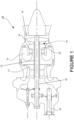
- Figure 1 illustrates a gas turbine engine 10 of a type that may be provided for use in flight, generally comprising in serial flow communication a compressor section 12 for pressurizing the air, a combustor 14 in which the compressed air is mixed with fuel and ignited for generating an annular stream of hot combustion gases, and a turbine section 16 for extracting energy from the combustion gases.
- the fuel is provided to the combustor 14 through multiple fuel nozzles (not illustrated in Figure 1 ) disposed about the combustor 14. Fuel is sprayed from the nozzles into the combustor 14, and the mixture of fuel and air is ignited for generating the annular stream of hot combustion gases.
- the combustion gases flowing out of the combustor 14 circulate through the turbine section 16 and are expelled through an exhaust duct 18.
- the turbine section 16 includes a compressor turbine 20 in driving engagement with the compressor section 12 through a high pressure shaft 22, and a power turbine 24 in driving engagement with a power shaft 26.
- the power shaft 26 is in driving engagement with an output shaft 28 through a reduction gearbox (not illustrated).
- the engine 10 is a turboshaft engine, the methods and systems described herein may be applicable to any other type of gas turbine engine, such as a turbofan, turboprop, or any other suitable aircraft or industrial engine.
- FIG. 2A illustrates a fuel supply system 200 for supplying fuel to the combustor 14.
- a first set of fuel nozzles 201 of at least one first manifold 211 supplies fuel to the combustor 14 during operation of the engine 10
- a second set of fuel nozzles 202 of at least one second manifold 212 may be used to supply fuel to the combustor 14 depending on the operation of the engine 10.
- An electronic controller 240 controls a fuel pump 242 to supply fuel from a reservoir 246 to the manifolds 211, 212 through one or more fuel lines. More specifically, the fuel pump 242 generates pressure to accordingly supply the fuel.
- the fuel pump 242 provides the fuel to a fuel flow divider 248, which is operably connected to the manifolds 211, 212, to accordingly supply fuel to manifolds 211, 212.
- the engine 10 is operated at low power by supplying fuel to the combustor 14 through the first set of fuel nozzles 201 of the first manifold 211 and without supplying fuel to the combustor 14 through the second set of fuel nozzles 202 of the second manifold 212.
- the fuel supply system 200 is described herein as having two manifolds and two sets of nozzles, the fuel supply system 200 can include any number of manifolds and sets of nozzles. For example, a given set of nozzles may have two or more manifolds that supply fuel thereto.
- the second set of fuel nozzles 202 When the second set of fuel nozzles 202 is not in use, residual fuel may remain in the second manifold 212 and in and/or at the tips of the nozzles 202. Furthermore, the nozzles 202, and possibly at least part of the second manifold 212, can heat up to high temperatures when they are not in use. If the fuel is allowed to heat up beyond a coking temperature, coke can begin to buildup in the fuel, at the tip and/or on the walls of the nozzles 202 and/or in the manifold 212.
- the coking temperature refers to the temperature at which fuel begins to coke. By way of a specific and non-limiting example, the coking temperature of fuel used in aircraft engines may be approximately 400° F (478 K).
- the coking temperature varies depending on the fuel used. If the nozzles 202 are allowed to exceed the coking temperature, the coke particulates can build up and clog the nozzles 202, reducing the nozzles' effectiveness, or completely blocking fuel from passing through the nozzles 202. When coke particulates are formed within the nozzles 202, the nozzles 202 would typically be cleaned out or replaced. The cleaning and replacement process can be tedious and costly. To impede fuel coking, an amount of fuel is periodically provided to the second manifold 212 to cause the second set of fuel nozzles 202 to supply fuel to the combustor 14, as is further described herein.
- the controller 240 determines an amount of fuel to at least in part fill the second manifold 202 to impede fuel coking when the second set of fuel nozzles 202 are not in use.
- the controller 240 controls the fuel pump 242 to cause the amount of fuel to be periodically supplied to the second manifold 212 to impede fuel coking. Periodically supplying the amount of fuel to the second manifold 212 causes a flow of fresh fuel to the second set of fuel nozzles 202 and the second manifold 212 to clear any residual fuel gathered in the second manifold 212 and/or at the nozzles 202.
- the fuel flow divider 248 is a hydraulic flow divider valve.
- the hydraulic flow divider valve cuts off the fuel to the second manifold 212. That is, the hydraulic flow divider valve has a cracking pressure below which the hydraulic flow divider valve cuts off fuel to the second manifold 212.
- the cracking pressure is a minimum pressure for the hydraulic flow divider valve to operably provide fuel flow to the second manifold 212.
- the amount of fuel periodically supplied to the second manifold 212 may be provided at a pressure above the cracking pressure of the hydraulic flow divider valve in order to provide the amount of fuel to the second manifold 212.
- the fuel flow divider 248 is a solenoid actuated flow divider valve.
- the controller 240 may be communicatively connected to the solenoid actuated flow divider valve to actuate a solenoid of the solenoid actuated flow divider valve to cause fuel to be provided to the second manifold 212.
- the controller 240 may synchronize the control of the fuel pump 242 (to provide the additional amount of fuel) and the actuation of the solenoid actuated flow divider valve.
- a signal diagram illustrates the control of fuel flow supplied from the fuel pump 242.
- the fuel flow is supplied at a first value 251 to operate the engine 10 at low power.
- fuel is supplied to the first set of fuel nozzles 201 and without any fuel being supplied to the second set of fuel nozzles, as the fuel pressure is less than an amount which would cause the fuel flow divider 248 to provide fuel to the second manifold 212.
- An additional amount of fuel 250 is periodically supplied to replenish the second manifold 202 to cause the second set of fuel nozzles 202 to supply fuel to the combustor 14.
- the additional amount of fuel 250 is supplied to cause the fuel flow to be provided at a second value 252 for a duration 254.
- the duration may be set at any suitable time period such that the cracking pressure 260 is exceeded for a sufficient period of time to clear any residual fuel in the second manifold 212 and at the second set of nozzles 202.
- the duration may be determined to fill the second manifold 212.
- the amount of fuel 250 is periodically supplied at a time interval 256.
- the time interval is set such that it is shorter than an amount of time that it would take for residual fuel in the second manifold 212 and/or at the second set of nozzles 202 to reach the coking temperature.
- the rate 258 at which the fuel flow is increased from the first value 251 to the second value 252 may be set at any suitable value.
- the rate 258 may be set to prevent the engine 10 from surging.
- the controller 240 may determine the amount of fuel 250, the first value 251, the second value 252, the duration 254, the interval 256 and/or the rate 258. In some embodiments, one or more of the amount of fuel 250, the first value 251, the second value 252, the duration 254, the interval 256 and the rate 258 may be predetermined values that are obtained by the controller 240. In some embodiments, one or more of the amount of fuel 250, the first value 251, the second value 252, the duration 254, the interval 256 and the rate 258 may be calculated by the controller 240.
- the engine 10 comprises more than two manifolds, where each manifold is associated with a set of fuel nozzles.
- the engine 10 may comprise three manifolds, four manifolds, five manifolds, and so forth.
- the engine 10 may be operated with one or more primary manifolds being used to supply fuel to the combustor 14 and with one or more secondary manifolds not being used to supply fuel to the combustor 14.
- the amount of fuel may be determined to replenish the secondary manifold(s) and supplied periodically to the secondary manifold(s) to impede fuel coking.
- the engine 10 is operated at low power by supplying fuel to the combustor 14 through a first set of fuel nozzles 201 of at least one first manifold 211 and without supplying fuel to the combustor 14 through a second set of fuel nozzles 202 of at least one second manifold 212.
- an amount of fuel 250 to at least in part fill the at least one second manifold 212 to impede fuel coking of the second set of fuel nozzles 202 is determined.
- the at least one second manifold 212 may be filled partially or completely.
- the amount of fuel 250 is periodically supplied to the at least one second manifold 212 to impede fuel coking of the second set of fuel nozzles 202.
- the method 300 comprises, at step 308, determining a duration 254 for supplying the amount of fuel 250 to the at least one second manifold 212 to refill the at least one second manifold 212.
- the method 300 comprises, at step 310, determining a rate 258 for supplying the amount of fuel 250 to the at least one second manifold 212 to prevent the engine 10 from surging.
- step 312 comprises increasing fuel pressure of the fuel supplied to the hydraulic flow divider valve above the cracking pressure.
- the hydraulic flow divider valve is operatively connected to the at least one first manifold 211 and the at least one second manifold 212, and the hydraulic flow divider valve diverting the amount of fuel to the at least one second manifold 212.
- step 312 comprises actuating the solenoid of solenoid actuated flow divider valve.
- the solenoid actuated flow divider valve operatively connected to the at least one first manifold 211 and the at least one second manifold 212, the solenoid when actuated causing the solenoid actuated flow divider valve to divert the amount of fuel to the at least one second manifold 212.
- one or more of the amount of fuel 250, the first value 251, the second value 252, the duration 254, the interval 256 and the rate 258 may be determined to prevent one or more components of the engine 10 from overheating. For instance, when the engine 10 runs at low power for an extended period of time, one or more components of the engine 10 from overheating. For example, the amount of time for one or more components of the engine 10 to overheat when the engine runs at low power may be determined and the interval 256 may be set at less than this amount of time.
- an indicator may be outputted to an aircraft computer for display on a display device, to indicate that the engine 10 is operated in a mode where the amount of fuel is periodically being provided to the second manifold 212 to prevent fuel coking.
- the controller 240 may be implemented with the computing device 400.
- the method 300 may be implemented with the computing device 400.
- the computing device 400 comprises at least one processing unit 412 and at least one memory 414 which has stored therein computer-executable instructions 416.
- the processing unit 412 may comprise any suitable devices configured to implement the method 300 such that instructions 416, when executed by the computing device 400 or other programmable apparatus, may cause the functions/acts/steps performed as part of the method 300 as described herein to be executed.
- the processing unit 412 may comprise, for example, any type of general-purpose microprocessor or microcontroller, a digital signal processing (DSP) processor, a central processing unit (CPU), an integrated circuit, a field programmable gate array (FPGA), a reconfigurable processor, other suitably programmed or programmable logic circuits, or any combination thereof.
- DSP digital signal processing
- CPU central processing unit
- FPGA field programmable gate array
- reconfigurable processor other suitably programmed or programmable logic circuits, or any combination thereof.
- the memory 414 may comprise any suitable known or other machine-readable storage medium.
- the memory 414 comprises a non-transitory computer readable storage medium, for example, but not limited to, an electronic, magnetic, optical, electromagnetic, infrared, or semiconductor system, apparatus, or device, or any suitable combination of the foregoing.
- the memory 414 may include a suitable combination of any type of computer memory that is located either internally or externally to device, for example random-access memory (RAM), read-only memory (ROM), compact disc read-only memory (CDROM), electro-optical memory, magnetooptical memory, erasable programmable read-only memory (EPROM), and electrically-erasable programmable read-only memory (EEPROM), Ferroelectric RAM (FRAM) or the like.
- Memory 414 may comprise any storage means (e.g., devices) suitable for retrievably storing machine-readable instructions 416 executable by processing unit 412.
- the computing device 400 can be implemented as part of a full-authority digital engine controls (FADEC) or other similar device, including electronic engine control (EEC), engine control unit (ECU), electronic propeller control, propeller control unit, and the like.
- FADEC full-authority digital engine controls
- EEC electronic engine control
- ECU engine control unit
- propeller control propeller control unit
- the methods and systems for operating an engine described herein may be implemented in a high level procedural or object oriented programming or scripting language, or a combination thereof, to communicate with or assist in the operation of a computer system, for example the computing device 400.
- the methods and systems for operating an engine may be implemented in assembly or machine language.
- the language may be a compiled or interpreted language.
- Program code for implementing the methods and systems for operating an engine may be stored on a storage media or a device, for example a ROM, a magnetic disk, an optical disc, a flash drive, or any other suitable storage media or device.
- the program code may be readable by a general or special-purpose programmable computer for configuring and operating the computer when the storage media or device is read by the computer to perform the procedures described herein.
- Embodiments of the methods and systems for operating an engine may also be considered to be implemented by way of a non-transitory computer-readable storage medium having a computer program stored thereon.
- the computer program may comprise computer-readable instructions which cause a computer, or more specifically the processing unit 412 of the computing device 400, to operate in a specific and predefined manner to perform the functions described herein, for example those described in the method 300.
- Computer-executable instructions may be in many forms, including program modules, executed by one or more computers or other devices.
- program modules include routines, programs, objects, components, data structures, etc., that perform particular tasks or implement particular abstract data types.
- functionality of the program modules may be combined or distributed as desired in various embodiments.
- FIG. 5 illustrates a schematic representation of an exemplary multi-engine system 105 that may be used as a powerplant for an aircraft.
- the multi-engine system 105 comprises two or more gas turbine engines 102, 104.
- Each of the gas turbine engines 102, 104 may be a turboshaft engine, such as the engine 10 of Figure 1 .
- the multi-engine system 105 may manage the operation of the engines 102, 104.
- the multi-engine system 105 may be used as a dual engine powerplant for an aircraft, such as a helicopter or other rotorcraft.
- the multi-engine system 105 may be used in marine and/or industrial applications. It should be noted that the multi-engine system 105 can include any suitable number of engines.
- the multi-engine system 105 of this embodiment includes first and second engines 102, 104 each having a respective transmission 152 which are interconnected by a common output gearbox 150 to drive a common load 170.
- the common load 170 may comprise a rotary wing of a rotary-wing aircraft.
- the common load 170 may be a main rotor of a rotorcraft.
- each of engines 102, 104 may be drivingly coupled to the common load 170 via the output gearbox 150, which may be of the speed-reduction type.
- the gearbox 150 may have a plurality of transmission shafts 156 to receive mechanical energy from respective output shafts 154 of respective engines 102, 104.
- the gearbox 150 may be configured to direct at least some of the combined mechanical energy from the plurality of the engines 102, 104 toward a common output shaft 158 for driving the common load 170 at a suitable operating (e.g., rotational) speed.
- a suitable operating e.g., rotational
- the multi-engine system 105 may also be configured, for example, to drive accessories and/or other elements of an associated aircraft.
- the gearbox 150 may be configured to permit the common load 170 to be driven by either of the engines 102, 104 or, by a combination of both engines 102, 104 together.
- Each output shaft 154 is independently engaged or disengaged from the gearbox 150.
- a given transmission 152 can selectively couple or decouple a given output shaft 154 to/from the transmission shaft 156.
- the output shafts that are engaged with the gearbox 150 drive the rotor 170.
- rotation of that output shaft does not drive the rotor 170.
- the rotor 170 rotates faster than a given output shaft 154, that output shaft becomes decoupled from the gearbox 150.
- the multi-engine system 250 may be implemented according to the systems and/or methods described in U.S. Provisional Application Nos. 62/715,917 , 62/803,064 and 62/803,070 , and U.S. Application No. 16/366,293 .
- the rotor 170 is driven by the first engine 102 without the second engine 104 driving the rotor 170.
- the second engine 104 is decoupled from the rotor 170. That is, the output shaft 154 of the second engine 104 is decoupled from the gearbox 150.
- the second engine 104 could be operated at low power.
- the second engine 104 may be operated at a very low idle condition.
- the second engine 104 is operating at low power by supplying fuel to the first set of fuel nozzles 201 and without any fuel being supplied to at least the second set of fuel nozzles 202.
- the amount of fuel is determined to prevent the engine 104 from being recoupled to the rotor 170. In some embodiments, one or more of the amount of fuel 250, the first value 251, the second value 252, the duration 254, the interval 256 and the rate 258 may be determined to prevent the second engine 104 from being recoupled to the rotor 170.
Landscapes
- Engineering & Computer Science (AREA)
- Chemical & Material Sciences (AREA)
- Combustion & Propulsion (AREA)
- Mechanical Engineering (AREA)
- General Engineering & Computer Science (AREA)
- Control Of Turbines (AREA)
Description
- The present disclosure relates generally to engines, and, more particularly, to operating an engine.
- For engines having a multistage fueling system, the engine may be operated by using one fuel stage and turning off the other fuel stage(s). However, stagnant fuel may be present in the fuel stage(s) not being used. This stagnant fuel may be exposed to high temperatures, which may lead to fuel coking in the unused fuel stage(s).
- As such, there is a need for improvement.
-
US 9303562 B2 claim 1. -
US 2015/292412 A1 discloses a fuel injector for a turbine engine. -
US 5799872 A discloses an apparatus for the purging of fluid spray. -
US 5339845 A discloses a cleaning apparatus and method for fuel and other passages. - In accordance with a first aspect of the present invention, there is provided a method for operating an engine. The method comprises operating the engine at low power by supplying fuel to a combustor through a first set of fuel nozzles of at least one first manifold and without supplying fuel to the combustor through a second set of fuel nozzles of at least one second manifold, determining an amount of fuel to at least in part fill the at least one second manifold to impede fuel coking of the second set of fuel nozzles, and supplying the amount of fuel periodically to the at least one second manifold.
- In an optional embodiment, the method further comprises determining an amount of time for residual fuel at the second set of fuel nozzles to reach a coking temperature, and setting a time interval for supplying the amount of fuel to the at least one second manifold at less than the amount of time as determined.
- In an optional embodiment, the method further comprises determining a duration for supplying the amount of fuel to the at least one second manifold, the duration determined to fill the at least one second manifold.
- In an optional embodiment, the engine is decoupled from a rotor of a rotorcraft while the engine is operating at low power.
- In an optional embodiment, the amount of fuel is determined to prevent the engine from being recoupled to the rotor.
- In an optional embodiment, the method further comprises determining a rate for supplying the amount of fuel to the at least one second manifold to prevent the engine from surging.
- In an optional embodiment, supplying the amount of fuel to the at least one second manifold comprises increasing a fuel pressure above a cracking pressure of a hydraulic flow divider valve, the hydraulic flow divider valve operatively connected to the at least one first manifold and the at least one second manifold, the hydraulic flow divider valve diverting the amount of fuel to the at least one second manifold.
- In an optional embodiment, supplying the amount of fuel to the at least one second manifold comprises actuating a solenoid of a solenoid actuated flow divider valve, the solenoid actuated flow divider valve operatively connected to the at least one first manifold and the at least one second manifold, the solenoid when actuated causing the solenoid actuated flow divider valve to divert the amount of fuel to the at least one second manifold.
- In accordance with a second aspect of the present invention, there is provided a system for operating an engine. The system comprises at least one processing unit and a non-transitory computer-readable memory having stored thereon program instructions. The program instructions are executable by the at least one processing unit for operating the engine at low power by supplying fuel to a combustor through a first set of fuel nozzles of at least one first manifold and without supplying fuel to the combustor through a second set of fuel nozzles of at least one second manifold, determining an amount of fuel to at least in part fill the at least one second manifold to impede fuel coking of the second set of fuel nozzles, and supplying the amount of fuel periodically to the at least one second manifold.
- In an optional embodiment, the program instructions are further executable for determining an amount of time for residual fuel at the second set of fuel nozzles to reach a coking temperature, and setting a time interval for supplying the amount of fuel to the at least one second manifold at less than the amount of time as determined.
- In an optional embodiment, the program instructions are further executable for determining a duration for supplying the amount of fuel to the at least one second manifold, the duration determined to fill the at least one second manifold.
- In an optional embodiment, the engine is decoupled from a rotor of a rotorcraft while the engine is operating at low power.
- In an optional embodiment, the amount of fuel is determined to prevent the engine from being recoupled to the rotor.
- In an optional embodiment, the program instructions are further executable for determining a rate for supplying the amount of fuel to the at least one second manifold to prevent the engine from surging.
- In an optional embodiment, the program instructions executable for supplying the amount of fuel to the at least one second manifold comprise program instructions executable for increasing fuel pressure above a cracking pressure of a hydraulic flow divider valve, the hydraulic flow divider valve operatively connected to the at least one first manifold and the at least one second manifold, the hydraulic flow divider valve diverting the amount of fuel to the at least one second manifold.
- In an optional embodiment, the program instructions executable for supplying the amount of fuel to the at least one second manifold comprise program instructions executable for actuating a solenoid of a solenoid actuated flow divider valve, the solenoid actuated flow divider valve operatively connected to the at least one first manifold and the at least one second manifold, the solenoid when actuated causing the solenoid actuated flow divider valve to divert the amount of fuel to the at least one second manifold.
- In accordance with a third aspect of the present invention, there is provided a computer readable medium having stored thereon program code executable by a processor for operating an engine. The program code comprises instructions for operating the engine at low power by supplying fuel to a combustor through a first set of fuel nozzles of at least one first manifold and without supplying fuel to the combustor through a second set of fuel nozzles of at least one second manifold, determining an amount of fuel to at least in part fill the at least one second manifold to impede fuel coking of the second set of fuel nozzles, and supplying the amount of fuel periodically to the at least one second manifold.
- In an optional embodiment, the program code further comprises instructions for determining an amount of time for residual fuel at the second set of fuel nozzles to reach a coking temperature, and setting a time interval for supplying the amount of fuel to the at least one second manifold at less than the amount of time as determined.
- In an optional embodiment, the engine is decoupled from a rotor of a rotorcraft while the engine is operating at low power.
- In an optional embodiment, the amount of fuel is determined to prevent the engine from being recoupled to the rotor.
- Reference is now made to the accompanying figures in which:
-
Figure 1 is a schematic of an example gas turbine engine, in accordance with one or more embodiments; -
Figure 2A is a schematic diagram illustrating an example fuel supply system for supplying fuel to an engine, in accordance with one or more embodiments; -
Figure 2B is a signal diagram illustrating the supply of fuel, in accordance with one or more embodiments; -
Figure 3 is a flowchart of an example method for operating an engine, in accordance with one or more embodiments; -
Figure 4 is a block diagram of an example computing device for controlling an engine, in accordance with one or more embodiments; and -
Figure 5 is a schematic representation of an exemplary multi-engine system for an aircraft, showing axial cross-sectional views of two gas turbine engines, in accordance with one or more embodiments. - It will be noted that throughout the appended drawings, like features are identified by like reference numerals.
-
Figure 1 illustrates agas turbine engine 10 of a type that may be provided for use in flight, generally comprising in serial flow communication acompressor section 12 for pressurizing the air, acombustor 14 in which the compressed air is mixed with fuel and ignited for generating an annular stream of hot combustion gases, and aturbine section 16 for extracting energy from the combustion gases. The fuel is provided to thecombustor 14 through multiple fuel nozzles (not illustrated inFigure 1 ) disposed about thecombustor 14. Fuel is sprayed from the nozzles into thecombustor 14, and the mixture of fuel and air is ignited for generating the annular stream of hot combustion gases. The combustion gases flowing out of thecombustor 14 circulate through theturbine section 16 and are expelled through anexhaust duct 18. Theturbine section 16 includes acompressor turbine 20 in driving engagement with thecompressor section 12 through ahigh pressure shaft 22, and apower turbine 24 in driving engagement with apower shaft 26. Thepower shaft 26 is in driving engagement with anoutput shaft 28 through a reduction gearbox (not illustrated). It should be understood that while theengine 10 is a turboshaft engine, the methods and systems described herein may be applicable to any other type of gas turbine engine, such as a turbofan, turboprop, or any other suitable aircraft or industrial engine. -
Figure 2A illustrates afuel supply system 200 for supplying fuel to thecombustor 14. In this illustrated embodiment, a first set offuel nozzles 201 of at least onefirst manifold 211 supplies fuel to thecombustor 14 during operation of theengine 10, and a second set offuel nozzles 202 of at least onesecond manifold 212 may be used to supply fuel to thecombustor 14 depending on the operation of theengine 10. Anelectronic controller 240 controls afuel pump 242 to supply fuel from areservoir 246 to themanifolds fuel pump 242 generates pressure to accordingly supply the fuel. Thefuel pump 242 provides the fuel to afuel flow divider 248, which is operably connected to themanifolds engine 10 is operated at low power by supplying fuel to thecombustor 14 through the first set offuel nozzles 201 of thefirst manifold 211 and without supplying fuel to thecombustor 14 through the second set offuel nozzles 202 of thesecond manifold 212. While thefuel supply system 200 is described herein as having two manifolds and two sets of nozzles, thefuel supply system 200 can include any number of manifolds and sets of nozzles. For example, a given set of nozzles may have two or more manifolds that supply fuel thereto. - When the second set of
fuel nozzles 202 is not in use, residual fuel may remain in thesecond manifold 212 and in and/or at the tips of thenozzles 202. Furthermore, thenozzles 202, and possibly at least part of thesecond manifold 212, can heat up to high temperatures when they are not in use. If the fuel is allowed to heat up beyond a coking temperature, coke can begin to buildup in the fuel, at the tip and/or on the walls of thenozzles 202 and/or in themanifold 212. The coking temperature refers to the temperature at which fuel begins to coke. By way of a specific and non-limiting example, the coking temperature of fuel used in aircraft engines may be approximately 400° F (478 K). - The coking temperature varies depending on the fuel used. If the
nozzles 202 are allowed to exceed the coking temperature, the coke particulates can build up and clog thenozzles 202, reducing the nozzles' effectiveness, or completely blocking fuel from passing through thenozzles 202. When coke particulates are formed within thenozzles 202, thenozzles 202 would typically be cleaned out or replaced. The cleaning and replacement process can be tedious and costly. To impede fuel coking, an amount of fuel is periodically provided to thesecond manifold 212 to cause the second set offuel nozzles 202 to supply fuel to thecombustor 14, as is further described herein. - The
controller 240 determines an amount of fuel to at least in part fill thesecond manifold 202 to impede fuel coking when the second set offuel nozzles 202 are not in use. Thecontroller 240 controls thefuel pump 242 to cause the amount of fuel to be periodically supplied to thesecond manifold 212 to impede fuel coking. Periodically supplying the amount of fuel to thesecond manifold 212 causes a flow of fresh fuel to the second set offuel nozzles 202 and thesecond manifold 212 to clear any residual fuel gathered in thesecond manifold 212 and/or at thenozzles 202. - In some embodiments, the
fuel flow divider 248 is a hydraulic flow divider valve. When thefuel pump 242 generates pressure less than an amount to maintain flow in thesecond manifold 212, the hydraulic flow divider valve cuts off the fuel to thesecond manifold 212. That is, the hydraulic flow divider valve has a cracking pressure below which the hydraulic flow divider valve cuts off fuel to thesecond manifold 212. The cracking pressure is a minimum pressure for the hydraulic flow divider valve to operably provide fuel flow to thesecond manifold 212. The amount of fuel periodically supplied to thesecond manifold 212 may be provided at a pressure above the cracking pressure of the hydraulic flow divider valve in order to provide the amount of fuel to thesecond manifold 212. - In some embodiments, the
fuel flow divider 248 is a solenoid actuated flow divider valve. Thecontroller 240 may be communicatively connected to the solenoid actuated flow divider valve to actuate a solenoid of the solenoid actuated flow divider valve to cause fuel to be provided to thesecond manifold 212. Thecontroller 240 may synchronize the control of the fuel pump 242 (to provide the additional amount of fuel) and the actuation of the solenoid actuated flow divider valve. - With reference to
Figure 2B , a signal diagram illustrates the control of fuel flow supplied from thefuel pump 242. As illustrated, the fuel flow is supplied at afirst value 251 to operate theengine 10 at low power. When the fuel flow is supplied at thefirst value 251, fuel is supplied to the first set offuel nozzles 201 and without any fuel being supplied to the second set of fuel nozzles, as the fuel pressure is less than an amount which would cause thefuel flow divider 248 to provide fuel to thesecond manifold 212. An additional amount offuel 250 is periodically supplied to replenish thesecond manifold 202 to cause the second set offuel nozzles 202 to supply fuel to thecombustor 14. The additional amount offuel 250 is supplied to cause the fuel flow to be provided at asecond value 252 for aduration 254. The duration may be set at any suitable time period such that the crackingpressure 260 is exceeded for a sufficient period of time to clear any residual fuel in thesecond manifold 212 and at the second set ofnozzles 202. The duration may be determined to fill thesecond manifold 212. The amount offuel 250 is periodically supplied at atime interval 256. The time interval is set such that it is shorter than an amount of time that it would take for residual fuel in thesecond manifold 212 and/or at the second set ofnozzles 202 to reach the coking temperature. Therate 258 at which the fuel flow is increased from thefirst value 251 to thesecond value 252 may be set at any suitable value. Therate 258 may be set to prevent theengine 10 from surging. - The
controller 240 may determine the amount offuel 250, thefirst value 251, thesecond value 252, theduration 254, theinterval 256 and/or therate 258. In some embodiments, one or more of the amount offuel 250, thefirst value 251, thesecond value 252, theduration 254, theinterval 256 and therate 258 may be predetermined values that are obtained by thecontroller 240. In some embodiments, one or more of the amount offuel 250, thefirst value 251, thesecond value 252, theduration 254, theinterval 256 and therate 258 may be calculated by thecontroller 240. - In some embodiments, the
engine 10 comprises more than two manifolds, where each manifold is associated with a set of fuel nozzles. For example, theengine 10 may comprise three manifolds, four manifolds, five manifolds, and so forth. Theengine 10 may be operated with one or more primary manifolds being used to supply fuel to thecombustor 14 and with one or more secondary manifolds not being used to supply fuel to thecombustor 14. The amount of fuel may be determined to replenish the secondary manifold(s) and supplied periodically to the secondary manifold(s) to impede fuel coking. - With reference to
Figure 3 , there is illustrated a flowchart of amethod 300 for operating an engine, such as theengine 10. Atstep 302, theengine 10 is operated at low power by supplying fuel to thecombustor 14 through a first set offuel nozzles 201 of at least onefirst manifold 211 and without supplying fuel to thecombustor 14 through a second set offuel nozzles 202 of at least onesecond manifold 212. Atstep 304, an amount offuel 250 to at least in part fill the at least onesecond manifold 212 to impede fuel coking of the second set offuel nozzles 202 is determined. The at least onesecond manifold 212 may be filled partially or completely. Atstep 312, the amount offuel 250 is periodically supplied to the at least onesecond manifold 212 to impede fuel coking of the second set offuel nozzles 202. - In some embodiments, the
method 300 comprises, atstep 306, determining atime interval 256 for supplying the amount offuel 250 periodically to the at least one second manifold. Determining thetime interval 256 may comprises determining an amount of time for residual fuel at the second set offuel nozzles 202 of the at least onesecond manifold 212 to reach the coking temperature and setting thetime interval 256 at less than this amount of time. - In some embodiments, the
method 300 comprises, atstep 308, determining aduration 254 for supplying the amount offuel 250 to the at least onesecond manifold 212 to refill the at least onesecond manifold 212. - In some embodiments, the
method 300 comprises, atstep 310, determining arate 258 for supplying the amount offuel 250 to the at least onesecond manifold 212 to prevent theengine 10 from surging. - In some embodiments,
step 312 comprises increasing fuel pressure of the fuel supplied to the hydraulic flow divider valve above the cracking pressure. The hydraulic flow divider valve is operatively connected to the at least onefirst manifold 211 and the at least onesecond manifold 212, and the hydraulic flow divider valve diverting the amount of fuel to the at least onesecond manifold 212. - In some embodiments,
step 312 comprises actuating the solenoid of solenoid actuated flow divider valve. The solenoid actuated flow divider valve operatively connected to the at least onefirst manifold 211 and the at least onesecond manifold 212, the solenoid when actuated causing the solenoid actuated flow divider valve to divert the amount of fuel to the at least onesecond manifold 212. - In some embodiments, one or more of the amount of
fuel 250, thefirst value 251, thesecond value 252, theduration 254, theinterval 256 and therate 258 may be determined to prevent one or more components of theengine 10 from overheating. For instance, when theengine 10 runs at low power for an extended period of time, one or more components of theengine 10 from overheating. For example, the amount of time for one or more components of theengine 10 to overheat when the engine runs at low power may be determined and theinterval 256 may be set at less than this amount of time. - In some embodiments, an indicator may be outputted to an aircraft computer for display on a display device, to indicate that the
engine 10 is operated in a mode where the amount of fuel is periodically being provided to thesecond manifold 212 to prevent fuel coking. - With reference to
Figure 4 , an example of acomputing device 400 is illustrated. Thecontroller 240 may be implemented with thecomputing device 400. Similarly, themethod 300 may be implemented with thecomputing device 400. Thecomputing device 400 comprises at least oneprocessing unit 412 and at least onememory 414 which has stored therein computer-executable instructions 416. Theprocessing unit 412 may comprise any suitable devices configured to implement themethod 300 such thatinstructions 416, when executed by thecomputing device 400 or other programmable apparatus, may cause the functions/acts/steps performed as part of themethod 300 as described herein to be executed. Theprocessing unit 412 may comprise, for example, any type of general-purpose microprocessor or microcontroller, a digital signal processing (DSP) processor, a central processing unit (CPU), an integrated circuit, a field programmable gate array (FPGA), a reconfigurable processor, other suitably programmed or programmable logic circuits, or any combination thereof. - The
memory 414 may comprise any suitable known or other machine-readable storage medium. Thememory 414 comprises a non-transitory computer readable storage medium, for example, but not limited to, an electronic, magnetic, optical, electromagnetic, infrared, or semiconductor system, apparatus, or device, or any suitable combination of the foregoing. Thememory 414 may include a suitable combination of any type of computer memory that is located either internally or externally to device, for example random-access memory (RAM), read-only memory (ROM), compact disc read-only memory (CDROM), electro-optical memory, magnetooptical memory, erasable programmable read-only memory (EPROM), and electrically-erasable programmable read-only memory (EEPROM), Ferroelectric RAM (FRAM) or the like.Memory 414 may comprise any storage means (e.g., devices) suitable for retrievably storing machine-readable instructions 416 executable by processingunit 412. Note that thecomputing device 400 can be implemented as part of a full-authority digital engine controls (FADEC) or other similar device, including electronic engine control (EEC), engine control unit (ECU), electronic propeller control, propeller control unit, and the like. - The methods and systems for operating an engine described herein may be implemented in a high level procedural or object oriented programming or scripting language, or a combination thereof, to communicate with or assist in the operation of a computer system, for example the
computing device 400. Alternatively, the methods and systems for operating an engine may be implemented in assembly or machine language. The language may be a compiled or interpreted language. Program code for implementing the methods and systems for operating an engine may be stored on a storage media or a device, for example a ROM, a magnetic disk, an optical disc, a flash drive, or any other suitable storage media or device. The program code may be readable by a general or special-purpose programmable computer for configuring and operating the computer when the storage media or device is read by the computer to perform the procedures described herein. Embodiments of the methods and systems for operating an engine may also be considered to be implemented by way of a non-transitory computer-readable storage medium having a computer program stored thereon. The computer program may comprise computer-readable instructions which cause a computer, or more specifically theprocessing unit 412 of thecomputing device 400, to operate in a specific and predefined manner to perform the functions described herein, for example those described in themethod 300. - Computer-executable instructions may be in many forms, including program modules, executed by one or more computers or other devices. Generally, program modules include routines, programs, objects, components, data structures, etc., that perform particular tasks or implement particular abstract data types. Typically the functionality of the program modules may be combined or distributed as desired in various embodiments.
- In some embodiments, the methods and/or systems described herein may be used in a multi-engine aircraft.
Figure 5 illustrates a schematic representation of anexemplary multi-engine system 105 that may be used as a powerplant for an aircraft. Themulti-engine system 105 comprises two or moregas turbine engines gas turbine engines engine 10 ofFigure 1 . Themulti-engine system 105 may manage the operation of theengines multi-engine system 105 may be used as a dual engine powerplant for an aircraft, such as a helicopter or other rotorcraft. In addition to airborne applications, themulti-engine system 105 may be used in marine and/or industrial applications. It should be noted that themulti-engine system 105 can include any suitable number of engines. - More particularly, the
multi-engine system 105 of this embodiment includes first andsecond engines respective transmission 152 which are interconnected by acommon output gearbox 150 to drive acommon load 170. In one embodiment, thecommon load 170 may comprise a rotary wing of a rotary-wing aircraft. For example, thecommon load 170 may be a main rotor of a rotorcraft. Depending on the type of thecommon load 170 and on the operating speed thereof, each ofengines common load 170 via theoutput gearbox 150, which may be of the speed-reduction type. - For example, the
gearbox 150 may have a plurality oftransmission shafts 156 to receive mechanical energy fromrespective output shafts 154 ofrespective engines gearbox 150 may be configured to direct at least some of the combined mechanical energy from the plurality of theengines common output shaft 158 for driving thecommon load 170 at a suitable operating (e.g., rotational) speed. It is understood that themulti-engine system 105 may also be configured, for example, to drive accessories and/or other elements of an associated aircraft. Thegearbox 150 may be configured to permit thecommon load 170 to be driven by either of theengines engines - Each
output shaft 154 is independently engaged or disengaged from thegearbox 150. A giventransmission 152 can selectively couple or decouple a givenoutput shaft 154 to/from thetransmission shaft 156. When one or both of theoutput shafts 154 are engaged with thegearbox 150, the output shafts that are engaged with thegearbox 150 drive therotor 170. When a givenoutput shaft 154 is disengaged from thegearbox 150, rotation of that output shaft does not drive therotor 170. When therotor 170 rotates faster than a givenoutput shaft 154, that output shaft becomes decoupled from thegearbox 150. - The
multi-engine system 250 may be implemented according to the systems and/or methods described inU.S. Provisional Application Nos. 62/715,917 62/803,064 62/803,070 U.S. Application No. 16/366,293 . - In some embodiments, the
rotor 170 is driven by thefirst engine 102 without thesecond engine 104 driving therotor 170. When thesecond engine 104 is not driving therotor 170, thesecond engine 104 is decoupled from therotor 170. That is, theoutput shaft 154 of thesecond engine 104 is decoupled from thegearbox 150. When thesecond engine 104 is decoupled from the rotor 108, thesecond engine 104 could be operated at low power. For example, thesecond engine 104 may be operated at a very low idle condition. Thesecond engine 104 is operating at low power by supplying fuel to the first set offuel nozzles 201 and without any fuel being supplied to at least the second set offuel nozzles 202. In some embodiments, the amount of fuel is determined to prevent theengine 104 from being recoupled to therotor 170. In some embodiments, one or more of the amount offuel 250, thefirst value 251, thesecond value 252, theduration 254, theinterval 256 and therate 258 may be determined to prevent thesecond engine 104 from being recoupled to therotor 170. - The above description is meant to be exemplary only, and one skilled in the art will recognize that changes may be made to the embodiments described without departing from the scope of the invention disclosed. Still other modifications which fall within the scope of the present invention will be apparent to those skilled in the art, in light of a review of this disclosure.
- Although particular embodiments have been shown and described, it will be obvious to those skilled in the art that changes and modifications may be made without departing from this invention in its broader aspects. The scope of the following claims should not be limited by the embodiments set forth in the examples, but should be given the broadest reasonable interpretation consistent with the description as a whole.
Claims (15)
- A method (300) for operating an engine (10, 102, 104), the method (300) comprising:operating the engine (10, 102, 104) at low power by supplying fuel to a combustor (14) through a first set of fuel nozzles (201) of at least one first manifold (211) and without supplying fuel to the combustor (14) through a second set of fuel nozzles (202) of at least one second manifold (212),characterized in that the method further comprises:determining an amount of fuel (250) to at least in part fill the at least one second manifold (212) to impede fuel coking of the second set of fuel nozzles (202); andsupplying the amount of fuel (250) periodically to the at least one second manifold (212).
- The method of claim 1, further comprising:determining an amount of time for residual fuel at the second set of fuel nozzles (202) to reach a coking temperature; andsetting a time interval (256) for supplying the amount of fuel (250) to the at least one second manifold (212) at less than the amount of time as determined.
- The method of claim 1 or 2, further comprising determining a duration (254) for supplying the amount of fuel (250) to the at least one second manifold (212), the duration (254) determined to fill the at least one second manifold (212).
- The method of any preceding claim, wherein the engine (10, 102, 104) is decoupled from a rotor (170) of a rotorcraft while the engine (10, 102, 104) is operating at low power, optionally wherein the amount of fuel (250) is determined to prevent the engine (10, 102, 104) from being recoupled to the rotor (170).
- The method of any preceding claim, further comprising determining a rate (258) for supplying the amount of fuel (250) to the at least one second manifold (212) to prevent the engine (10, 102, 104) from surging.
- The method of any preceding claim, wherein supplying the amount of fuel (250) to the at least one second manifold (212) comprises increasing a fuel pressure above a cracking pressure (260) of a hydraulic flow divider valve, the hydraulic flow divider valve operatively connected to the at least one first manifold (211) and the at least one second manifold (212), the hydraulic flow divider valve diverting the amount of fuel (250) to the at least one second manifold (212).
- The method of any of claims 1 to 5, wherein supplying the amount of fuel (250) to the at least one second manifold (212) comprises actuating a solenoid of a solenoid actuated flow divider valve, the solenoid actuated flow divider valve operatively connected to the at least one first manifold (211) and the at least one second manifold (212), the solenoid when actuated causing the solenoid actuated flow divider valve to divert the amount of fuel (250) to the at least one second manifold (212).
- A system for operating an engine (10, 102, 104), the system comprising:at least one processing unit (412); andat least one non-transitory computer-readable memory (414) having stored thereon program instructions (416) executable by the at least one processing unit (412) for:operating the engine (10, 102, 104) at low power by supplying fuel to a combustor (14) through a first set of fuel nozzles (201) of at least one first manifold (211) and without supplying fuel to the combustor (14) through a second set of fuel nozzles (202) of at least one second manifold (212),characterised in that the program instructions (416) are further executable for:determining an amount of fuel (250) to at least in part fill the at least one second manifold (212) to impede fuel coking of the second set of fuel nozzles (202); andsupplying the amount of fuel (250) periodically to the at least one second manifold (212).
- The system of claim 8, wherein the program instructions (416) are further executable for:determining an amount of time for residual fuel at the second set of fuel nozzles (202) to reach a coking temperature; andsetting a time interval (256) for supplying the amount of fuel (250) to the at least one second manifold (212) at less than the amount of time as determined.
- The system of claim 8 or 9, wherein the program instructions (416) are further executable for determining a duration (254) for supplying the amount of fuel (250) to the at least one second manifold (212), the duration (254) determined to fill the at least one second manifold (212).
- The system of any of claims 8 to 10, wherein the engine (10, 102, 104) is decoupled from a rotor (170) of a rotorcraft while the engine (10, 102, 104) is operating at low power, optionally wherein the amount of fuel (250) is determined to prevent the engine (10, 102, 104) from being recoupled to the rotor (170).
- The system of any of claims 8 to 11, wherein the program instructions (416) are further executable for determining a rate (258) for supplying the amount of fuel (250) to the at least one second manifold (212) to prevent the engine (10, 102, 104) from surging.
- The system of any of claims 8 to 12, wherein the program instructions (416) executable for supplying the amount of fuel (250) to the at least one second manifold (212) comprise program instructions (416) executable for increasing fuel pressure above a cracking pressure (260) of a hydraulic flow divider valve, the hydraulic flow divider valve operatively connected to the at least one first manifold (211) and the at least one second manifold (212), the hydraulic flow divider valve diverting the amount of fuel (250) to the at least one second manifold (212).
- The system of any of claims 8 to 12, wherein the program instructions (416) executable for supplying the amount of fuel (250) to the at least one second manifold (212) comprise program instructions (416) executable for actuating a solenoid of a solenoid actuated flow divider valve, the solenoid actuated flow divider valve operatively connected to the at least one first manifold (211) and the at least one second manifold (212), the solenoid when actuated causing the solenoid actuated flow divider valve to divert the amount of fuel (250) to the at least one second manifold (212).
- A computer readable medium (414) having stored thereon program code executable by a processor (412) for operating an engine (10, 102, 104), the program code comprising instructions (416) for:operating the engine (10, 102, 104) at low power by supplying fuel to a combustor (14) through a first set of fuel nozzles (201) of at least one first manifold (211) and without supplying fuel to the combustor (14) through a second set of fuel nozzles (202) of at least one second manifold (212),characterized in that the instructions (416) are further executable for:determining an amount of fuel (250) to at least in part fill the at least one second manifold (212) to impede fuel coking of the second set of fuel nozzles (202); andsupplying the amount of fuel (250) periodically to the at least one second manifold (212).
Applications Claiming Priority (2)
| Application Number | Priority Date | Filing Date | Title |
|---|---|---|---|
| US201962848146P | 2019-05-15 | 2019-05-15 | |
| US16/425,488 US11713723B2 (en) | 2019-05-15 | 2019-05-29 | Method and system for operating an engine |
Publications (2)
| Publication Number | Publication Date |
|---|---|
| EP3739189A1 EP3739189A1 (en) | 2020-11-18 |
| EP3739189B1 true EP3739189B1 (en) | 2023-05-03 |
Family
ID=70738432
Family Applications (1)
| Application Number | Title | Priority Date | Filing Date |
|---|---|---|---|
| EP20175048.6A Active EP3739189B1 (en) | 2019-05-15 | 2020-05-15 | Method and system for operating an engine |
Country Status (2)
| Country | Link |
|---|---|
| US (1) | US11713723B2 (en) |
| EP (1) | EP3739189B1 (en) |
Families Citing this family (2)
| Publication number | Priority date | Publication date | Assignee | Title |
|---|---|---|---|---|
| US12460819B2 (en) | 2024-03-07 | 2025-11-04 | Rtx Corporation | Continuous flow fuel system |
| US12366360B1 (en) * | 2024-04-29 | 2025-07-22 | Pratt & Whitney Canada Corp. | Gas turbine adaptive secondary fuel filling profile |
Family Cites Families (65)
| Publication number | Priority date | Publication date | Assignee | Title |
|---|---|---|---|---|
| GB888243A (en) | 1959-09-11 | 1962-01-31 | Gen Motors Corp | Improvements relating to jet propulsion engine fuel systems |
| US3834160A (en) | 1973-03-26 | 1974-09-10 | Gen Electric | Light-off transient control for an augmented gas turbine engine |
| US4404806A (en) | 1981-09-04 | 1983-09-20 | General Motors Corporation | Gas turbine prechamber and fuel manifold structure |
| US4491272A (en) | 1983-01-27 | 1985-01-01 | Ex-Cell-O Corporation | Pressure atomizing fuel injection assembly |
| US5277023A (en) | 1991-10-07 | 1994-01-11 | Fuel Systems Textron, Inc. | Self-sustaining fuel purging fuel injection system |
| US5243816A (en) | 1992-06-19 | 1993-09-14 | Fuel Systems Textron, Inc. | Self purging fuel injector |
| US5349811A (en) | 1992-12-16 | 1994-09-27 | Avco Corporation | Pulsed fuel injection system for reducing NOx emissions |
| US5339845A (en) | 1993-07-26 | 1994-08-23 | Fuel Systems Textron, Inc. | Cleaning apparatus and method for fuel and other passages |
| US5402634A (en) | 1993-10-22 | 1995-04-04 | United Technologies Corporation | Fuel supply system for a staged combustor |
| US5406798A (en) | 1993-10-22 | 1995-04-18 | United Technologies Corporation | Pilot fuel cooled flow divider valve for a staged combustor |
| US5701732A (en) | 1995-01-24 | 1997-12-30 | Delavan Inc. | Method and apparatus for purging of gas turbine injectors |
| US5735117A (en) * | 1995-08-18 | 1998-04-07 | Fuel Systems Textron, Inc. | Staged fuel injection system with shuttle valve and fuel injector therefor |
| US5694764A (en) | 1995-09-18 | 1997-12-09 | Sundstrand Corporation | Fuel pump assist for engine starting |
| AU730820B2 (en) | 1995-12-26 | 2001-03-15 | Kabushiki Kaisha Toshiba | Fuel supply apparatus for gas turbine and control unit for the same |
| US5809771A (en) | 1996-01-19 | 1998-09-22 | Woodward Governor Company | Aircraft engine fuel system |
| US6125624A (en) | 1998-04-17 | 2000-10-03 | Pratt & Whitney Canada Corp. | Anti-coking fuel injector purging device |
| DE50008726D1 (en) | 1999-08-21 | 2004-12-30 | Rolls Royce Deutschland | Method for adapting the operating state of a stepped combustion chamber for gas turbines |
| DE19952885A1 (en) * | 1999-11-03 | 2001-05-10 | Alstom Power Schweiz Ag Baden | Process and operation of a power plant |
| US6619025B2 (en) | 2001-12-14 | 2003-09-16 | Woodward Governor Company | Ecology valve and system in an aircraft engine fuel system |
| EP2122129B1 (en) * | 2007-02-14 | 2018-04-11 | General Electric Technology GmbH | Power plant system and method for the operation thereof |
| JP4495179B2 (en) | 2007-02-28 | 2010-06-30 | 三菱重工業株式会社 | Fuel nozzle device, gas turbine, and control method of fuel nozzle device |
| GB0922349D0 (en) | 2009-12-22 | 2010-02-03 | Rolls Royce Goodrich Engine Co | Fuel Control System |
| EP2469057B1 (en) | 2010-12-22 | 2013-11-13 | Rolls-Royce Engine Control Systems Ltd | Fuel staging system |
| CN103748338B (en) | 2011-08-19 | 2016-05-25 | 伍德沃德公司 | Flow division control device |
| US9957891B2 (en) | 2011-09-09 | 2018-05-01 | General Electric Company | Fuel manifold cooling flow recirculation |
| FR2987430B1 (en) | 2012-02-24 | 2014-02-28 | Snecma | FUEL INJECTOR FOR A TURBOMACHINE |
| US9267439B2 (en) | 2012-03-13 | 2016-02-23 | Hamilton Sundstrand Corporation | High altitude start of a gas turbine engine using fuel pulsing and starter toggling |
| GB201205971D0 (en) | 2012-04-03 | 2012-05-16 | Rolls Royce Goodrich Engine Control Systems Ltd | Apparatus for fluid temperature measurement |
| US9103284B2 (en) | 2012-05-31 | 2015-08-11 | General Electric Company | Utilization of fuel gas for purging a dormant fuel gas circuit |
| EP2679786A1 (en) * | 2012-06-28 | 2014-01-01 | Alstom Technology Ltd | Stand-by operation of a gas turbine |
| US9303562B2 (en) | 2013-01-15 | 2016-04-05 | General Electric Company | Methods and systems for operating gas turbine engines |
| US9404424B2 (en) | 2013-02-18 | 2016-08-02 | General Electric Company | Turbine conduit purge systems |
| US9382850B2 (en) | 2013-03-21 | 2016-07-05 | General Electric Company | System and method for controlled fuel blending in gas turbines |
| GB201313140D0 (en) | 2013-07-23 | 2013-09-04 | Rolls Royce Engine Control Systems Ltd | System for performing staging control of a multi-stage combustor |
| EP3033508B1 (en) | 2013-08-16 | 2018-06-20 | United Technologies Corporation | Cooled fuel injector system for a gas turbine engine |
| US10400672B2 (en) | 2013-11-04 | 2019-09-03 | United Technologies Corporation | Cooled fuel injector system for a gas turbine engine |
| US9863267B2 (en) | 2014-01-21 | 2018-01-09 | General Electric Company | System and method of control for a gas turbine engine |
| US9863322B2 (en) | 2014-01-23 | 2018-01-09 | United Technologies Corporation | Selectively deoxygenated stored fuel system |
| GB2523126A (en) | 2014-02-13 | 2015-08-19 | Rolls Royce Controls & Data Services Ltd | Fuel supply system |
| US9683744B2 (en) | 2014-02-28 | 2017-06-20 | Pratt & Whitney Canada Corp. | Combustion system for a gas turbine engine and method of operating same |
| US10400674B2 (en) | 2014-05-09 | 2019-09-03 | United Technologies Corporation | Cooled fuel injector system for a gas turbine engine and method for operating the same |
| US10451509B2 (en) | 2014-06-04 | 2019-10-22 | United Technologies Corporation | Method for determining a fault within a flow divider |
| GB201503162D0 (en) | 2015-02-25 | 2015-04-08 | Rolls Royce Controls & Data Services Ltd | Combustion staging system |
| EP3070408B1 (en) * | 2015-03-20 | 2018-06-06 | Rolls-Royce PLC | Combustion staging system |
| US10858998B2 (en) | 2016-02-12 | 2020-12-08 | Hamilton Sundstrand Corporation | Fuel drain system and method |
| GB201603028D0 (en) | 2016-02-22 | 2016-04-06 | Rolls Royce Controls & Data Services Ltd | Combustion staging system |
| GB201603054D0 (en) | 2016-02-23 | 2016-04-06 | Rolls Royce Controls & Data Services Ltd | Combustion staging system |
| GB201604651D0 (en) | 2016-03-18 | 2016-05-04 | Rolls Royce Controls & Data Services Ltd | Combustion staging system |
| CN105716119B (en) | 2016-03-22 | 2018-10-19 | 北京航空航天大学 | A kind of oil-poor direct injection low pollution combustor using effervescent atomizer |
| CN105823087B (en) | 2016-03-22 | 2018-10-19 | 北京航空航天大学 | A kind of main combustion stage uses the low pollution combustor of effervescent atomizer |
| EP3236050A1 (en) | 2016-04-20 | 2017-10-25 | Rolls-Royce PLC | Engine fuel control system |
| US10233846B2 (en) | 2016-09-20 | 2019-03-19 | General Electric Company | Smart liquid fuel system with ability to self-diagnostics |
| US10465909B2 (en) | 2016-11-04 | 2019-11-05 | General Electric Company | Mini mixing fuel nozzle assembly with mixing sleeve |
| GB2557602B (en) | 2016-12-09 | 2019-05-22 | Rolls Royce Plc | Gas turbine engine fuel supply system having de-priming and re-priming ecology valve |
| GB2557599B (en) | 2016-12-09 | 2019-05-15 | Rolls Royce Plc | Gas turbine engine fuel supply system having de-priming and re-priming sub-systems |
| US10539073B2 (en) | 2017-03-20 | 2020-01-21 | Chester L Richards, Jr. | Centrifugal gas compressor |
| GB2563660B (en) * | 2017-06-23 | 2019-10-02 | Rolls Royce Plc | Combustion staging system for fuel injectors of a gas turbine engine |
| GB2563659B (en) * | 2017-06-23 | 2019-10-02 | Rolls Royce Plc | Combustion staging system for fuel injectors of a gas turbine engine |
| US10816211B2 (en) | 2017-08-25 | 2020-10-27 | Honeywell International Inc. | Axially staged rich quench lean combustion system |
| US11408356B2 (en) | 2017-10-03 | 2022-08-09 | General Electric Company | Method of operating a combustion system with main and pilot fuel circuits |
| US10890329B2 (en) | 2018-03-01 | 2021-01-12 | General Electric Company | Fuel injector assembly for gas turbine engine |
| GB201804814D0 (en) | 2018-03-26 | 2018-05-09 | Rolls Royce Plc | A fuel injector, a combustion chamber comprising a fuel injector and a method of detecting coking in a combustion chamber fuel injector |
| GB2572753A (en) | 2018-04-04 | 2019-10-16 | Rolls Royce Plc | A fuel system for an internal combustion engine, an internal combustion engine and a method of operating a fuel system for an internal combustion engine |
| GB2572783A (en) | 2018-04-10 | 2019-10-16 | Rolls Royce Plc | A Gas Turbine Engine Comprising A Fuel Purging System And A Method of Purging Fuel From A Gas Turbine Engine |
| CN109356725B (en) | 2018-12-13 | 2021-09-03 | 中国航发沈阳发动机研究所 | Short-time fuel cooling system for aircraft engine |
-
2019
- 2019-05-29 US US16/425,488 patent/US11713723B2/en active Active
-
2020
- 2020-05-15 EP EP20175048.6A patent/EP3739189B1/en active Active
Also Published As
| Publication number | Publication date |
|---|---|
| US20200362769A1 (en) | 2020-11-19 |
| US11713723B2 (en) | 2023-08-01 |
| EP3739189A1 (en) | 2020-11-18 |
Similar Documents
| Publication | Publication Date | Title |
|---|---|---|
| CA2965946C (en) | Multi-engine aircraft power plant with heat recuperation | |
| US9863322B2 (en) | Selectively deoxygenated stored fuel system | |
| EP3473842B1 (en) | Electric cruise pump system | |
| US7246482B2 (en) | Gas turbine engine bleed air power assist system and method | |
| EP3236019B1 (en) | Method for in-flight cleaning of a gas turbine engine and gas turbine engine configured therefor | |
| US4222235A (en) | Variable cycle engine | |
| EP3109434B1 (en) | Bypass duct heat exchanger with controlled fan | |
| EP3835565B1 (en) | System and method for testing engine performance in-flight | |
| EP3739189B1 (en) | Method and system for operating an engine | |
| US8291690B1 (en) | Gas turbine engine with variable area fan nozzle positioned for starting | |
| US11668250B2 (en) | System and method for engine operation in a multi-engine aircraft | |
| EP3032071B1 (en) | Fuel schedule for robust gas turbine engine transition between steady states | |
| EP3770406B1 (en) | Fuel delivery system and method | |
| EP3770404B1 (en) | Fuel delivery system and method | |
| EP4484728A1 (en) | Aircraft powerplant with multiple independent fuel systems | |
| US10731502B2 (en) | High pressure compressor rotor thermal conditioning using outer diameter gas extraction | |
| CA3079850A1 (en) | Method and system for operating an engine | |
| EP3273030B1 (en) | Embedded engine using boundary layer cooling air | |
| WO2016175753A1 (en) | Purging liquid fuel nozzles and supply tubing with the assistance of a flow divider | |
| EP3770405B1 (en) | Fuel delivery system and method | |
| EP4144971B1 (en) | Intercooled cooling air with selective pressure dump | |
| CN120402237A (en) | Cooling fluid control system and method of operating a cooling fluid system of a turbine engine |
Legal Events
| Date | Code | Title | Description |
|---|---|---|---|
| PUAI | Public reference made under article 153(3) epc to a published international application that has entered the european phase |
Free format text: ORIGINAL CODE: 0009012 |
|
| STAA | Information on the status of an ep patent application or granted ep patent |
Free format text: STATUS: THE APPLICATION HAS BEEN PUBLISHED |
|
| AK | Designated contracting states |
Kind code of ref document: A1 Designated state(s): AL AT BE BG CH CY CZ DE DK EE ES FI FR GB GR HR HU IE IS IT LI LT LU LV MC MK MT NL NO PL PT RO RS SE SI SK SM TR |
|
| AX | Request for extension of the european patent |
Extension state: BA ME |
|
| STAA | Information on the status of an ep patent application or granted ep patent |
Free format text: STATUS: REQUEST FOR EXAMINATION WAS MADE |
|
| 17P | Request for examination filed |
Effective date: 20210518 |
|
| RBV | Designated contracting states (corrected) |
Designated state(s): AL AT BE BG CH CY CZ DE DK EE ES FI FR GB GR HR HU IE IS IT LI LT LU LV MC MK MT NL NO PL PT RO RS SE SI SK SM TR |
|
| GRAP | Despatch of communication of intention to grant a patent |
Free format text: ORIGINAL CODE: EPIDOSNIGR1 |
|
| STAA | Information on the status of an ep patent application or granted ep patent |
Free format text: STATUS: GRANT OF PATENT IS INTENDED |
|
| INTG | Intention to grant announced |
Effective date: 20221208 |
|
| GRAS | Grant fee paid |
Free format text: ORIGINAL CODE: EPIDOSNIGR3 |
|
| GRAA | (expected) grant |
Free format text: ORIGINAL CODE: 0009210 |
|
| STAA | Information on the status of an ep patent application or granted ep patent |
Free format text: STATUS: THE PATENT HAS BEEN GRANTED |
|
| AK | Designated contracting states |
Kind code of ref document: B1 Designated state(s): AL AT BE BG CH CY CZ DE DK EE ES FI FR GB GR HR HU IE IS IT LI LT LU LV MC MK MT NL NO PL PT RO RS SE SI SK SM TR |
|
| REG | Reference to a national code |
Ref country code: GB Ref legal event code: FG4D |
|
| REG | Reference to a national code |
Ref country code: DE Ref legal event code: R096 Ref document number: 602020010283 Country of ref document: DE |
|
| REG | Reference to a national code |
Ref country code: AT Ref legal event code: REF Ref document number: 1564783 Country of ref document: AT Kind code of ref document: T Effective date: 20230515 Ref country code: CH Ref legal event code: EP |
|
| REG | Reference to a national code |
Ref country code: IE Ref legal event code: FG4D |
|
| P01 | Opt-out of the competence of the unified patent court (upc) registered |
Effective date: 20230530 |
|
| REG | Reference to a national code |
Ref country code: LT Ref legal event code: MG9D |
|
| REG | Reference to a national code |
Ref country code: NL Ref legal event code: MP Effective date: 20230503 |
|
| REG | Reference to a national code |
Ref country code: AT Ref legal event code: MK05 Ref document number: 1564783 Country of ref document: AT Kind code of ref document: T Effective date: 20230503 |
|
| PG25 | Lapsed in a contracting state [announced via postgrant information from national office to epo] |
Ref country code: SE Free format text: LAPSE BECAUSE OF FAILURE TO SUBMIT A TRANSLATION OF THE DESCRIPTION OR TO PAY THE FEE WITHIN THE PRESCRIBED TIME-LIMIT Effective date: 20230503 Ref country code: PT Free format text: LAPSE BECAUSE OF FAILURE TO SUBMIT A TRANSLATION OF THE DESCRIPTION OR TO PAY THE FEE WITHIN THE PRESCRIBED TIME-LIMIT Effective date: 20230904 Ref country code: NO Free format text: LAPSE BECAUSE OF FAILURE TO SUBMIT A TRANSLATION OF THE DESCRIPTION OR TO PAY THE FEE WITHIN THE PRESCRIBED TIME-LIMIT Effective date: 20230803 Ref country code: NL Free format text: LAPSE BECAUSE OF FAILURE TO SUBMIT A TRANSLATION OF THE DESCRIPTION OR TO PAY THE FEE WITHIN THE PRESCRIBED TIME-LIMIT Effective date: 20230503 Ref country code: ES Free format text: LAPSE BECAUSE OF FAILURE TO SUBMIT A TRANSLATION OF THE DESCRIPTION OR TO PAY THE FEE WITHIN THE PRESCRIBED TIME-LIMIT Effective date: 20230503 Ref country code: AT Free format text: LAPSE BECAUSE OF FAILURE TO SUBMIT A TRANSLATION OF THE DESCRIPTION OR TO PAY THE FEE WITHIN THE PRESCRIBED TIME-LIMIT Effective date: 20230503 |
|
| PG25 | Lapsed in a contracting state [announced via postgrant information from national office to epo] |
Ref country code: RS Free format text: LAPSE BECAUSE OF FAILURE TO SUBMIT A TRANSLATION OF THE DESCRIPTION OR TO PAY THE FEE WITHIN THE PRESCRIBED TIME-LIMIT Effective date: 20230503 Ref country code: PL Free format text: LAPSE BECAUSE OF FAILURE TO SUBMIT A TRANSLATION OF THE DESCRIPTION OR TO PAY THE FEE WITHIN THE PRESCRIBED TIME-LIMIT Effective date: 20230503 Ref country code: LV Free format text: LAPSE BECAUSE OF FAILURE TO SUBMIT A TRANSLATION OF THE DESCRIPTION OR TO PAY THE FEE WITHIN THE PRESCRIBED TIME-LIMIT Effective date: 20230503 Ref country code: LT Free format text: LAPSE BECAUSE OF FAILURE TO SUBMIT A TRANSLATION OF THE DESCRIPTION OR TO PAY THE FEE WITHIN THE PRESCRIBED TIME-LIMIT Effective date: 20230503 Ref country code: IS Free format text: LAPSE BECAUSE OF FAILURE TO SUBMIT A TRANSLATION OF THE DESCRIPTION OR TO PAY THE FEE WITHIN THE PRESCRIBED TIME-LIMIT Effective date: 20230903 Ref country code: HR Free format text: LAPSE BECAUSE OF FAILURE TO SUBMIT A TRANSLATION OF THE DESCRIPTION OR TO PAY THE FEE WITHIN THE PRESCRIBED TIME-LIMIT Effective date: 20230503 Ref country code: GR Free format text: LAPSE BECAUSE OF FAILURE TO SUBMIT A TRANSLATION OF THE DESCRIPTION OR TO PAY THE FEE WITHIN THE PRESCRIBED TIME-LIMIT Effective date: 20230804 |
|
| PG25 | Lapsed in a contracting state [announced via postgrant information from national office to epo] |
Ref country code: FI Free format text: LAPSE BECAUSE OF FAILURE TO SUBMIT A TRANSLATION OF THE DESCRIPTION OR TO PAY THE FEE WITHIN THE PRESCRIBED TIME-LIMIT Effective date: 20230503 |
|
| REG | Reference to a national code |
Ref country code: CH Ref legal event code: PL |
|
| PG25 | Lapsed in a contracting state [announced via postgrant information from national office to epo] |
Ref country code: SK Free format text: LAPSE BECAUSE OF FAILURE TO SUBMIT A TRANSLATION OF THE DESCRIPTION OR TO PAY THE FEE WITHIN THE PRESCRIBED TIME-LIMIT Effective date: 20230503 |
|
| REG | Reference to a national code |
Ref country code: BE Ref legal event code: MM Effective date: 20230531 |
|
| PG25 | Lapsed in a contracting state [announced via postgrant information from national office to epo] |
Ref country code: SM Free format text: LAPSE BECAUSE OF FAILURE TO SUBMIT A TRANSLATION OF THE DESCRIPTION OR TO PAY THE FEE WITHIN THE PRESCRIBED TIME-LIMIT Effective date: 20230503 Ref country code: SK Free format text: LAPSE BECAUSE OF FAILURE TO SUBMIT A TRANSLATION OF THE DESCRIPTION OR TO PAY THE FEE WITHIN THE PRESCRIBED TIME-LIMIT Effective date: 20230503 Ref country code: RO Free format text: LAPSE BECAUSE OF FAILURE TO SUBMIT A TRANSLATION OF THE DESCRIPTION OR TO PAY THE FEE WITHIN THE PRESCRIBED TIME-LIMIT Effective date: 20230503 Ref country code: LU Free format text: LAPSE BECAUSE OF NON-PAYMENT OF DUE FEES Effective date: 20230515 Ref country code: LI Free format text: LAPSE BECAUSE OF NON-PAYMENT OF DUE FEES Effective date: 20230531 Ref country code: EE Free format text: LAPSE BECAUSE OF FAILURE TO SUBMIT A TRANSLATION OF THE DESCRIPTION OR TO PAY THE FEE WITHIN THE PRESCRIBED TIME-LIMIT Effective date: 20230503 Ref country code: DK Free format text: LAPSE BECAUSE OF FAILURE TO SUBMIT A TRANSLATION OF THE DESCRIPTION OR TO PAY THE FEE WITHIN THE PRESCRIBED TIME-LIMIT Effective date: 20230503 Ref country code: CZ Free format text: LAPSE BECAUSE OF FAILURE TO SUBMIT A TRANSLATION OF THE DESCRIPTION OR TO PAY THE FEE WITHIN THE PRESCRIBED TIME-LIMIT Effective date: 20230503 Ref country code: CH Free format text: LAPSE BECAUSE OF NON-PAYMENT OF DUE FEES Effective date: 20230531 |
|
| REG | Reference to a national code |
Ref country code: DE Ref legal event code: R097 Ref document number: 602020010283 Country of ref document: DE |
|
| PG25 | Lapsed in a contracting state [announced via postgrant information from national office to epo] |
Ref country code: MC Free format text: LAPSE BECAUSE OF FAILURE TO SUBMIT A TRANSLATION OF THE DESCRIPTION OR TO PAY THE FEE WITHIN THE PRESCRIBED TIME-LIMIT Effective date: 20230503 |
|
| REG | Reference to a national code |
Ref country code: IE Ref legal event code: MM4A |
|
| PG25 | Lapsed in a contracting state [announced via postgrant information from national office to epo] |
Ref country code: MC Free format text: LAPSE BECAUSE OF FAILURE TO SUBMIT A TRANSLATION OF THE DESCRIPTION OR TO PAY THE FEE WITHIN THE PRESCRIBED TIME-LIMIT Effective date: 20230503 |
|
| PLBE | No opposition filed within time limit |
Free format text: ORIGINAL CODE: 0009261 |
|
| STAA | Information on the status of an ep patent application or granted ep patent |
Free format text: STATUS: NO OPPOSITION FILED WITHIN TIME LIMIT |
|
| 26N | No opposition filed |
Effective date: 20240206 |
|
| PG25 | Lapsed in a contracting state [announced via postgrant information from national office to epo] |
Ref country code: IE Free format text: LAPSE BECAUSE OF NON-PAYMENT OF DUE FEES Effective date: 20230515 |
|
| PG25 | Lapsed in a contracting state [announced via postgrant information from national office to epo] |
Ref country code: IE Free format text: LAPSE BECAUSE OF NON-PAYMENT OF DUE FEES Effective date: 20230515 |
|
| PG25 | Lapsed in a contracting state [announced via postgrant information from national office to epo] |
Ref country code: SI Free format text: LAPSE BECAUSE OF FAILURE TO SUBMIT A TRANSLATION OF THE DESCRIPTION OR TO PAY THE FEE WITHIN THE PRESCRIBED TIME-LIMIT Effective date: 20230503 |
|
| PG25 | Lapsed in a contracting state [announced via postgrant information from national office to epo] |
Ref country code: SI Free format text: LAPSE BECAUSE OF FAILURE TO SUBMIT A TRANSLATION OF THE DESCRIPTION OR TO PAY THE FEE WITHIN THE PRESCRIBED TIME-LIMIT Effective date: 20230503 Ref country code: IT Free format text: LAPSE BECAUSE OF FAILURE TO SUBMIT A TRANSLATION OF THE DESCRIPTION OR TO PAY THE FEE WITHIN THE PRESCRIBED TIME-LIMIT Effective date: 20230503 Ref country code: BE Free format text: LAPSE BECAUSE OF NON-PAYMENT OF DUE FEES Effective date: 20230531 |
|
| PG25 | Lapsed in a contracting state [announced via postgrant information from national office to epo] |
Ref country code: BG Free format text: LAPSE BECAUSE OF FAILURE TO SUBMIT A TRANSLATION OF THE DESCRIPTION OR TO PAY THE FEE WITHIN THE PRESCRIBED TIME-LIMIT Effective date: 20230503 |
|
| PG25 | Lapsed in a contracting state [announced via postgrant information from national office to epo] |
Ref country code: BG Free format text: LAPSE BECAUSE OF FAILURE TO SUBMIT A TRANSLATION OF THE DESCRIPTION OR TO PAY THE FEE WITHIN THE PRESCRIBED TIME-LIMIT Effective date: 20230503 |
|
| PGFP | Annual fee paid to national office [announced via postgrant information from national office to epo] |
Ref country code: DE Payment date: 20250423 Year of fee payment: 6 |
|
| PGFP | Annual fee paid to national office [announced via postgrant information from national office to epo] |
Ref country code: GB Payment date: 20250423 Year of fee payment: 6 |
|
| PGFP | Annual fee paid to national office [announced via postgrant information from national office to epo] |
Ref country code: FR Payment date: 20250423 Year of fee payment: 6 |
|
| PG25 | Lapsed in a contracting state [announced via postgrant information from national office to epo] |
Ref country code: CY Free format text: LAPSE BECAUSE OF FAILURE TO SUBMIT A TRANSLATION OF THE DESCRIPTION OR TO PAY THE FEE WITHIN THE PRESCRIBED TIME-LIMIT; INVALID AB INITIO Effective date: 20200515 |
|
| PG25 | Lapsed in a contracting state [announced via postgrant information from national office to epo] |
Ref country code: HU Free format text: LAPSE BECAUSE OF FAILURE TO SUBMIT A TRANSLATION OF THE DESCRIPTION OR TO PAY THE FEE WITHIN THE PRESCRIBED TIME-LIMIT; INVALID AB INITIO Effective date: 20200515 |
|
| PG25 | Lapsed in a contracting state [announced via postgrant information from national office to epo] |
Ref country code: TR Free format text: LAPSE BECAUSE OF FAILURE TO SUBMIT A TRANSLATION OF THE DESCRIPTION OR TO PAY THE FEE WITHIN THE PRESCRIBED TIME-LIMIT Effective date: 20230503 |