EP3738838B1 - Automatic adjustment system and method for vehicle - Google Patents
Automatic adjustment system and method for vehicle Download PDFInfo
- Publication number
- EP3738838B1 EP3738838B1 EP18900314.8A EP18900314A EP3738838B1 EP 3738838 B1 EP3738838 B1 EP 3738838B1 EP 18900314 A EP18900314 A EP 18900314A EP 3738838 B1 EP3738838 B1 EP 3738838B1
- Authority
- EP
- European Patent Office
- Prior art keywords
- vehicle
- courier
- energy
- subsystem
- automatic adjustment
- Prior art date
- Legal status (The legal status is an assumption and is not a legal conclusion. Google has not performed a legal analysis and makes no representation as to the accuracy of the status listed.)
- Active
Links
Images

Classifications
-
- B—PERFORMING OPERATIONS; TRANSPORTING
- B60—VEHICLES IN GENERAL
- B60R—VEHICLES, VEHICLE FITTINGS, OR VEHICLE PARTS, NOT OTHERWISE PROVIDED FOR
- B60R16/00—Electric or fluid circuits specially adapted for vehicles and not otherwise provided for; Arrangement of elements of electric or fluid circuits specially adapted for vehicles and not otherwise provided for
- B60R16/02—Electric or fluid circuits specially adapted for vehicles and not otherwise provided for; Arrangement of elements of electric or fluid circuits specially adapted for vehicles and not otherwise provided for electric constitutive elements
- B60R16/037—Electric or fluid circuits specially adapted for vehicles and not otherwise provided for; Arrangement of elements of electric or fluid circuits specially adapted for vehicles and not otherwise provided for electric constitutive elements for occupant comfort, e.g. for automatic adjustment of appliances according to personal settings, e.g. seats, mirrors, steering wheel
-
- B—PERFORMING OPERATIONS; TRANSPORTING
- B60—VEHICLES IN GENERAL
- B60N—SEATS SPECIALLY ADAPTED FOR VEHICLES; VEHICLE PASSENGER ACCOMMODATION NOT OTHERWISE PROVIDED FOR
- B60N2/00—Seats specially adapted for vehicles; Arrangement or mounting of seats in vehicles
- B60N2/02—Seats specially adapted for vehicles; Arrangement or mounting of seats in vehicles the seat or part thereof being movable, e.g. adjustable
- B60N2/0224—Non-manual adjustments, e.g. with electrical operation
- B60N2/0244—Non-manual adjustments, e.g. with electrical operation with logic circuits
- B60N2/0248—Non-manual adjustments, e.g. with electrical operation with logic circuits with memory of positions
-
- B—PERFORMING OPERATIONS; TRANSPORTING
- B60—VEHICLES IN GENERAL
- B60N—SEATS SPECIALLY ADAPTED FOR VEHICLES; VEHICLE PASSENGER ACCOMMODATION NOT OTHERWISE PROVIDED FOR
- B60N2220/00—Computerised treatment of data for controlling of seats
- B60N2220/20—Computerised treatment of data for controlling of seats using a deterministic algorithm
-
- B—PERFORMING OPERATIONS; TRANSPORTING
- B60—VEHICLES IN GENERAL
- B60R—VEHICLES, VEHICLE FITTINGS, OR VEHICLE PARTS, NOT OTHERWISE PROVIDED FOR
- B60R25/00—Fittings or systems for preventing or indicating unauthorised use or theft of vehicles
- B60R25/20—Means to switch the anti-theft system on or off
- B60R25/25—Means to switch the anti-theft system on or off using biometry
Definitions
- the invention relates to vehicle control technologies, and in particular to an automatic adjustment system and method for a vehicle.
- a management system for authenticating a user and customizing a user profile includes a control module configured to authenticate an administrator via an administrator identification.
- the control module may receive a user identification distinct from the administrator identification, receive a set of selected features associated with the user and create a profile including the user identification and the set of selected features.
- control module may apply the profile associated with the user identification in response to authenticating a user based on the user identification.
- PCT publication WO2015/042005 has disclosed a system for a vehicle including a user identification subsystem operable to detect a user and an interactive display subsystem operable to generate output for display on a vehicle window in response to detection of the user.
- the system also includes a control subsystem operable to enable a user to control at least one vehicle function through the interactive display subsystem.
- the invention is intended to provide an automatic adjustment system and method for a vehicle, which are capable of automatically adjusting settings of the vehicle according to user features.
- the invention is intended to provide an automatic adjustment system and method for a vehicle, which make it possible to automatically adjust settings of the vehicle according to recognized features (including the recognition of a body feature, of a facial feature, of an iris feature, etc.) during pick-up of a vehicle by an energy courier or a user.
- recognized features including the recognition of a body feature, of a facial feature, of an iris feature, etc.
- the storage subsystem is further configured to store the latest vehicle setting parameters set by an energy courier during current driving of the vehicle.
- the vehicle setting adjustment subsystem is configured to restore, when an energy courier completes battery charging of the vehicle and returns the vehicle back to a vehicle owner, the settings of the vehicle according to the vehicle setting parameters before the battery charging.
- the recognition and acquisition subsystem is further configured to recognize features of the driver, a passenger in a passenger seat, and a passenger in a rear seat, and call corresponding vehicle setting parameters from the storage subsystem according to the recognized features, and the vehicle setting adjustment subsystem is further configured to automatically adjust the settings of a driver seat, the passenger seat, and the rear seat according to the vehicle setting parameters.
- the storage subsystem comprises:
- the vehicle setting adjustment subsystem comprises:
- the recognition and acquisition subsystem comprises:
- the invention provides an automatic adjustment method for a vehicle, which is characterized by being implemented by means of a recognition and acquisition subsystem, a storage subsystem, and a vehicle setting adjustment subsystem, wherein the method comprises the following steps:
- the method further comprises: a parameter storage step of storing, by the storage subsystem, the latest vehicle setting parameters set by the energy courier during current driving of the vehicle.
- the method further comprises: a vehicle setting restoration step of restoring, by the vehicle setting adjustment subsystem and when the energy courier completes battery charging of the vehicle and returns the vehicle to a vehicle owner, the settings of the vehicle according to the vehicle setting parameters before the battery charging or swapping.
- the method further comprises: an additional vehicle setting step of recognizing, by the recognition and acquisition subsystem, features of a passenger in a passenger seat or in a rear seat and calling corresponding vehicle setting parameters from the storage subsystem according to the recognized features, and automatically adjusting, by the vehicle setting adjustment subsystem, the setting of the passenger seat or the rear seat according to the vehicle setting parameters.
- the invention provides a computer-readable medium, which has a computer program stored thereon, characterized in that the computer program implements, when executed by a processor, the automatic adjustment method for a vehicle as described above.
- the invention provides a computer device, which comprises a memory, a processor, and a computer program stored on the memory and executable on the processor, characterized in that the computer program implements, when executed by the processor, the steps of the automatic adjustment method for a vehicle as described above.
- the particularity of an energy courier service that is not considered in a conventional automatic vehicle setting adjustment scheme can be considered, such as an authorization process when an energy courier uses a vehicle, and an automatic recovery process when the energy courier returns the vehicle.
- the influence, on the user, of the behavior of the courier changing the settings of the user vehicle is considered. Therefore, in the invention, features are recognized to form appropriate vehicle settings so as to form a feature library for automatic setting of the vehicle, thereby reducing or eliminating any influence, on the user, of the energy courier using the vehicle.
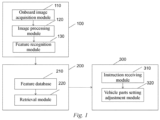
- FIG. 1 is a schematic diagram of the construction of an automatic adjustment system for a vehicle according to an embodiment of the invention.
- the automatic adjustment system for a vehicle comprises:
- the recognition and acquisition subsystem 100 is further configured to recognize features of the driver, a passenger in a passenger seat, and a passenger in a rear seat, and call corresponding vehicle setting parameters from the storage subsystem 200 according to the recognized features, and the vehicle setting adjustment subsystem 300 is further configured to automatically adjust the settings of a driver seat, the passenger seat, and the rear seat according to the vehicle setting parameters.
- the recognition and acquisition subsystem 100 comprises:
- the storage subsystem 200 comprises:
- the vehicle setting adjustment subsystem 300 comprises:
- FIG. 2 is a flowchart representing an automatic adjustment method for a vehicle according to an embodiment of the invention.
- the automatic adjustment method for a vehicle comprises the steps as follows: in step S100, a vehicle c1 of a vehicle owner u1 issues a request for an energy courier service when the electric quantity of the vehicle is insufficient.
- an energy courier f1 takes an order, and the energy courier f1 is authorized to use the vehicle based on the request for an energy courier service, for example, using the settings such as a vehicle seat and a rearview mirror; and in step S300, a storage subsystem 200 preloads vehicle setting parameters corresponding to the energy courier fl, while personalized vehicle setting parameters of the vehicle owner ul are cached.
- step S400 the energy courier f1 picks up the vehicle c1 for power replenishment, the recognition and acquisition subsystem 100 recognizes a feature p2 of the energy courier, comprising, but not limited to, a biological feature (for example, a facial feature, an iris, a fingerprint, etc.), and also a feature p2 of the energy courier that is imported from other systems or acquired offline and then uploaded.
- a biological feature for example, a facial feature, an iris, a fingerprint, etc.
- step S500 the feature p2 of the energy courier and data indicating that the type of an object is Energy courier are read, the retrieval module 220 searches the feature database 210 for a record with the highest degree of matching with time and feature value and returns the record, and if there is a vehicle setting parameter corresponding to the feature p2 of the energy courier in the feature database 210, the process proceeds to step S600, and the process proceeds to step S800 if not.
- Table 1 below shows an example of the feature data stored in the feature database 210 and the vehicle setting parameters corresponding to the feature data.
- Table 1 Feature number Type of service Type of object Time Feature value Vehicle setting PA001 Power replenishment Energy courier At night Facial feature Angle of rearview mirror, inclination angle of seat, temperature of air conditioner Height Weight Ambient temperature ... ... PA002 Designated driving Vehicle owner Antemeridiem Facial feature Inclination angle of seat ... ...
- step S600 if there is a corresponding vehicle setting parameter in the storage subsystem 200, the vehicle setting adjustment subsystem 300 reads the corresponding vehicle setting parameter p2.
- step S700 the vehicle setting adjustment subsystem 300 automatically adjusts the settings of the vehicle, such as a vehicle seat, a rearview mirror, and an air conditioner, for the energy courier f1.
- the vehicle such as a vehicle seat, a rearview mirror, and an air conditioner, for the energy courier f1.
- step S800 where the settings of the vehicle fail to be returned by means of the above-mentioned request, the vehicle setting adjustment subsystem 300 creates a feature record indicating that the type of an object is Energy courier fl, and a vehicle setting parameter.
- step S900 changes in the setting that are made by the energy courier during the service are stored in the storage subsystem 200.
- the vehicle setting adjustment subsystem 300 detects that the vehicle is not returned by the vehicle owner (that is, the feature p2 of the energy courier f1 does not match the previously cached feature p1 of the vehicle owner), and the vehicle setting adjustment subsystem 300 automatically restores the settings of the vehicle seat, rearview mirror, air conditioner, etc. for the vehicle owner according to the personalized vehicle setting parameters of the vehicle owner ul that are cached before pick-up of the vehicle.
- user features and a vehicle setting information library may be opened to other trusted users of the system for automatic recommendation or adjustment of the settings of the vehicle, such as the settings of the seat, the rearview mirror and the temperature of the air conditioner.
- the same setting may also be applied to the setting of user household equipment (for example, the setting of the temperature of a vehicle air conditioner may be applied to the setting of the temperature of a household air conditioner, so does the setting of a seat).
- the recognition of the user features not only comprises the recognition of features of the driver, but also may comprise the recognition of real-time postures of the passengers in the passenger seat and the rear seat, and the recording of their habits.
- the settings of the vehicle may also comprise dynamic adjustment of the passenger seat and the rear seat (for example, an automatic adjustment to an appropriate position is triggered when an infant in the rear seat needs comfort from his/her mother in the front seat).
- the above-mentioned feature data and the settings of the vehicle may be used for big data analysis, evaluation of the service of the energy courier, etc., and may also be used to arrive at a relationship between the vehicle setting and driving quality, for final use in improving the driving quality or quality of service, lowering the vehicle accident rate, etc.
- the particularity of an energy courier service that is not considered in a conventional automatic vehicle setting adjustment scheme can be considered, such as an authorization process when an energy courier uses a vehicle, and an automatic recovery process when the energy courier returns the vehicle.
- the energy courier may pass the authentication of a vehicle of a user and drive the vehicle for power replenishment.
- the influence, on the user, of the behavior of the courier changing the settings of the user vehicle is considered. Therefore, in the invention, features are recognized to form appropriate vehicle settings so as to form a feature library for automatic setting of the vehicle, thereby reducing or eliminating any influence on the user.
- a conventional onboard computer system usually only records historical settings of the current account, and adjusts or restores the settings according to different accounts, and also, for the sake of privacy, this part of data cannot be shared, and it can be hardly optimized.
- features are recognized to form appropriate vehicle settings, so that the system can share data among different account systems, which is independent of the privacy of a specific user.
- an automatic adjustment range for the settings of the vehicle is expanded not only to the settings related to the vehicle owner, but also can be used to enhance the experience of the secondary driver and passengers.
- the invention provides a computer-readable medium, which has a computer program stored thereon, characterized in that the computer program implements, when executed by a processor, the automatic adjustment method for a vehicle as described above.
- the invention provides a computer device, which comprises a memory, a processor, and a computer program stored on the memory and executable on the processor, characterized in that the computer program implements, when executed by the processor, the steps of the automatic adjustment method for a vehicle as described above.
- a magnetic recording device there is a magnetic recording device, an optical disc, a magneto-optical recording medium, a semiconductor memory, etc.
- the magnetic recording device there is an HDD, an FD, a magnetic tape, etc.
- the optical disc there is a DVD (Digital Versatile Disc), a DVD-RAM, a CD-ROM, a CD-R (Recordable)/RW (ReWritable), and the like.
- the magneto-optical recording device there is an MO (Magneto Optical disk), etc.
Landscapes
- Engineering & Computer Science (AREA)
- Mechanical Engineering (AREA)
- Aviation & Aerospace Engineering (AREA)
- Transportation (AREA)
- Seats For Vehicles (AREA)
- Electric Propulsion And Braking For Vehicles (AREA)
- Management, Administration, Business Operations System, And Electronic Commerce (AREA)
- Control Of Driving Devices And Active Controlling Of Vehicle (AREA)
Description
- The invention relates to vehicle control technologies, and in particular to an automatic adjustment system and method for a vehicle.
- With the continuous popularization of new energy vehicles, the problems of difficulty in charging and a long charging time will become increasingly apparent, and the overall solution of energy courier is intended to propose a mode of an energy courier taking an order to replenish power of the new energy vehicles on behalf of a user, in order to bring an excellent power replenishment experience to users of the new energy vehicles. In US patent application
US2014/282931 , a management system for authenticating a user and customizing a user profile has been disclosed. The system as disclosed includes a control module configured to authenticate an administrator via an administrator identification. The control module may receive a user identification distinct from the administrator identification, receive a set of selected features associated with the user and create a profile including the user identification and the set of selected features. Once the profile is created, the control module may apply the profile associated with the user identification in response to authenticating a user based on the user identification. Moreover,PCT publication WO2015/042005 has disclosed a system for a vehicle including a user identification subsystem operable to detect a user and an interactive display subsystem operable to generate output for display on a vehicle window in response to detection of the user. The system also includes a control subsystem operable to enable a user to control at least one vehicle function through the interactive display subsystem. - However, due to physical features, driving habits, and other factors of the energy courier, it is often necessary to adjust the settings of the vehicle during pick-up and returning of the vehicle in the energy courier service, for convenience of driving. When a subsequent user discovers, during pick-up of the vehicle, that the original settings (such as those of a seat, an air conditioner and a rearview mirror) of the vehicle were changed, he/she needs to readjust the settings, which results in a very poor user experience.
- In view of the above-mentioned problems, the invention is intended to provide an automatic adjustment system and method for a vehicle, which are capable of automatically adjusting settings of the vehicle according to user features.
- Further, the invention is intended to provide an automatic adjustment system and method for a vehicle, which make it possible to automatically adjust settings of the vehicle according to recognized features (including the recognition of a body feature, of a facial feature, of an iris feature, etc.) during pick-up of a vehicle by an energy courier or a user.
- The subject-matter of the present invention is defined by the features of the independent claims. Further preferred embodiments of the present invention are defined in the dependent claims. Moreover, the present disclosure further discloses an automatic adjustment system for a vehicle, which does not fall within the scope of protection of the present invention, which is characterized by comprising:
- a recognition and acquisition subsystem configured to recognize and acquire feature data of a driver and/or a passenger in a vehicle;
- a storage subsystem configured to store and retrieve the feature data and vehicle setting parameters corresponding to the feature data; and
- a vehicle setting adjustment subsystem configured to automatically adjust settings of the vehicle according to the vehicle setting parameters that are stored in the storage subsystem and that correspond to the feature data recognized by the recognition and acquisition subsystem.
- Optionally, the storage subsystem is further configured to store the latest vehicle setting parameters set by an energy courier during current driving of the vehicle.
- Optionally, the vehicle setting adjustment subsystem is configured to restore, when an energy courier completes battery charging of the vehicle and returns the vehicle back to a vehicle owner, the settings of the vehicle according to the vehicle setting parameters before the battery charging.
- Optionally, the recognition and acquisition subsystem is further configured to recognize features of the driver, a passenger in a passenger seat, and a passenger in a rear seat, and call corresponding vehicle setting parameters from the storage subsystem according to the recognized features, and the vehicle setting adjustment subsystem is further configured to automatically adjust the settings of a driver seat, the passenger seat, and the rear seat according to the vehicle setting parameters.
- Optionally, the storage subsystem comprises:
- a feature database configured to store the feature data and the vehicle setting parameters corresponding to the feature data; and
- a retrieval module configured to establish an index and implement retrieval to output the corresponding vehicle settings.
- Optionally, the vehicle setting adjustment subsystem comprises:
- an instruction receiving module configured to receive the vehicle setting parameters from the storage subsystem; and
- a vehicle parts setting adjustment module configured to set various parts of the vehicle according to the vehicle setting parameters.
- Optionally, the recognition and acquisition subsystem comprises:
- an onboard image acquisition module configured to acquire features of the driver, a passenger in a passenger seat, and a passenger in a rear seat;
- an image processing module configured to perform data processing on the features acquired by the onboard image acquisition module; and
- a feature recognition module configured to recognize the features on which the image processing module performs data processing.
- The invention provides an automatic adjustment method for a vehicle, which is characterized by being implemented by means of a recognition and acquisition subsystem, a storage subsystem, and a vehicle setting adjustment subsystem, wherein the method comprises the following steps:
- a service request step of issuing, by a vehicle owner, a request for an energy courier service;
- a service authorization step of authorizing, based on the request for an energy courier service, an energy courier to use a vehicle;
- a feature value preloading step of preloading, by the storage subsystem, vehicle setting parameters corresponding to the energy courier;
- an object recognition step of recognizing features of the energy courier and determining whether there are vehicle setting parameters corresponding to the features, by the recognition and acquisition subsystem; and
- an automatic vehicle adjustment step of automatically adjusting, if there are corresponding vehicle setting parameters in the storage subsystem, settings of the vehicle according to the vehicle setting parameters, and adjusting, if there is no corresponding vehicle setting parameter in the storage subsystem, the settings of the vehicle according to the latest vehicle setting parameters set by the energy courier during current driving of the vehicle, by the vehicle setting adjustment subsystem.
- Optionally, after the automatic adjustment of a vehicle, the method further comprises:
a parameter storage step of storing, by the storage subsystem, the latest vehicle setting parameters set by the energy courier during current driving of the vehicle. - Optionally, after the automatic adjustment of a vehicle, the method further comprises:
a vehicle setting restoration step of restoring, by the vehicle setting adjustment subsystem and when the energy courier completes battery charging of the vehicle and returns the vehicle to a vehicle owner, the settings of the vehicle according to the vehicle setting parameters before the battery charging or swapping. - Optionally, the method further comprises:
an additional vehicle setting step of recognizing, by the recognition and acquisition subsystem, features of a passenger in a passenger seat or in a rear seat and calling corresponding vehicle setting parameters from the storage subsystem according to the recognized features, and automatically adjusting, by the vehicle setting adjustment subsystem, the setting of the passenger seat or the rear seat according to the vehicle setting parameters. - The invention provides a computer-readable medium, which has a computer program stored thereon, characterized in that the computer program implements, when executed by a processor, the automatic adjustment method for a vehicle as described above.
- The invention provides a computer device, which comprises a memory, a processor, and a computer program stored on the memory and executable on the processor, characterized in that the computer program implements, when executed by the processor, the steps of the automatic adjustment method for a vehicle as described above.
- As described above, in the automatic adjustment system and method for a vehicle according to the invention, the particularity of an energy courier service that is not considered in a conventional automatic vehicle setting adjustment scheme can be considered, such as an authorization process when an energy courier uses a vehicle, and an automatic recovery process when the energy courier returns the vehicle. In the invention, the influence, on the user, of the behavior of the courier changing the settings of the user vehicle is considered. Therefore, in the invention, features are recognized to form appropriate vehicle settings so as to form a feature library for automatic setting of the vehicle, thereby reducing or eliminating any influence, on the user, of the energy courier using the vehicle.
-
-
FIG. 1 is a schematic diagram of the construction of an automatic adjustment system for a vehicle according to an embodiment of the invention. -
FIG. 2 is a flowchart representing an automatic adjustment method for a vehicle according to an embodiment of the invention. - A plurality of embodiments of the invention are introduced below and are intended to provide a basic understanding of the invention. They are not intended to confirm key or decisive elements of the invention or limit the scope of protection.
-
FIG. 1 is a schematic diagram of the construction of an automatic adjustment system for a vehicle according to an embodiment of the invention. - As shown in
FIG. 1 , the automatic adjustment system for a vehicle according to the invention comprises: - a recognition and
acquisition subsystem 100 configured to recognize and acquire feature data of a driver and/or a passenger in a vehicle; - a
storage subsystem 200 configured to store and retrieve the feature data and vehicle setting parameters corresponding to the feature data; and - a vehicle
setting adjustment subsystem 300 configured to automatically adjust settings of the vehicle according to the vehicle setting parameters in thestorage subsystem 200 that correspond to the feature data recognized by the recognition andacquisition subsystem 100. - The recognition and
acquisition subsystem 100 is further configured to recognize features of the driver, a passenger in a passenger seat, and a passenger in a rear seat, and call corresponding vehicle setting parameters from thestorage subsystem 200 according to the recognized features, and the vehiclesetting adjustment subsystem 300 is further configured to automatically adjust the settings of a driver seat, the passenger seat, and the rear seat according to the vehicle setting parameters. - The recognition and
acquisition subsystem 100 comprises: - an onboard
image acquisition module 110 configured to acquire features of the driver, a passenger in a passenger seat, and a passenger in a rear seat; - an
image processing module 120 configured to perform data processing on the features acquired by the onboardimage acquisition module 110; and - a
feature recognition module 130 configured to recognize the features on which theimage processing module 120 performs data processing. - The
storage subsystem 200 comprises: - a
feature database 210 configured to store the feature data and the vehicle setting parameters corresponding to the feature data; and - a
retrieval module 220 configured to establish an index and implement retrieval to output the corresponding vehicle settings. - The vehicle
setting adjustment subsystem 300 comprises: - an
instruction receiving module 310 configured to receive the vehicle setting parameters from the storage subsystem; and - a vehicle parts setting
adjustment module 320 configured to set various parts of the vehicle according to the vehicle setting parameters. -
FIG. 2 is a flowchart representing an automatic adjustment method for a vehicle according to an embodiment of the invention. - As shown in
FIG. 2 , the automatic adjustment method for a vehicle according to an embodiment of the invention comprises the steps as follows:
in step S100, a vehicle c1 of a vehicle owner u1 issues a request for an energy courier service when the electric quantity of the vehicle is insufficient. - In step S200, an energy courier f1 takes an order, and the energy courier f1 is authorized to use the vehicle based on the request for an energy courier service, for example, using the settings such as a vehicle seat and a rearview mirror; and
in step S300, astorage subsystem 200 preloads vehicle setting parameters corresponding to the energy courier fl, while personalized vehicle setting parameters of the vehicle owner ul are cached. - In step S400, the energy courier f1 picks up the vehicle c1 for power replenishment, the recognition and
acquisition subsystem 100 recognizes a feature p2 of the energy courier, comprising, but not limited to, a biological feature (for example, a facial feature, an iris, a fingerprint, etc.), and also a feature p2 of the energy courier that is imported from other systems or acquired offline and then uploaded. - In step S500, the feature p2 of the energy courier and data indicating that the type of an object is Energy courier are read, the
retrieval module 220 searches thefeature database 210 for a record with the highest degree of matching with time and feature value and returns the record, and if there is a vehicle setting parameter corresponding to the feature p2 of the energy courier in thefeature database 210, the process proceeds to step S600, and the process proceeds to step S800 if not. Table 1 below shows an example of the feature data stored in thefeature database 210 and the vehicle setting parameters corresponding to the feature data.Table 1 Feature number Type of service Type of object Time Feature value Vehicle setting PA001 Power replenishment Energy courier At night Facial feature Angle of rearview mirror, inclination angle of seat, temperature of air conditioner Height Weight Ambient temperature ... ... PA002 Designated driving Vehicle owner Antemeridiem Facial feature Inclination angle of seat ... ... - In step S600, if there is a corresponding vehicle setting parameter in the
storage subsystem 200, the vehicle settingadjustment subsystem 300 reads the corresponding vehicle setting parameter p2. - In step S700, the vehicle setting
adjustment subsystem 300 automatically adjusts the settings of the vehicle, such as a vehicle seat, a rearview mirror, and an air conditioner, for the energy courier f1. - In step S800, where the settings of the vehicle fail to be returned by means of the above-mentioned request, the vehicle setting
adjustment subsystem 300 creates a feature record indicating that the type of an object is Energy courier fl, and a vehicle setting parameter. - In step S900, changes in the setting that are made by the energy courier during the service are stored in the
storage subsystem 200. - After the above-mentioned steps, in a preferred manner, when the energy courier f1 returns the vehicle after completion of the service, the vehicle setting
adjustment subsystem 300 detects that the vehicle is not returned by the vehicle owner (that is, the feature p2 of the energy courier f1 does not match the previously cached feature p1 of the vehicle owner), and the vehicle settingadjustment subsystem 300 automatically restores the settings of the vehicle seat, rearview mirror, air conditioner, etc. for the vehicle owner according to the personalized vehicle setting parameters of the vehicle owner ul that are cached before pick-up of the vehicle. - Next, some variant embodiments of the automatic adjustment system and method for a vehicle according to the invention will be described.
- In the above-mentioned automatic adjustment system and method for a vehicle according to the invention, user features and a vehicle setting information library may be opened to other trusted users of the system for automatic recommendation or adjustment of the settings of the vehicle, such as the settings of the seat, the rearview mirror and the temperature of the air conditioner. Certainly, the same setting may also be applied to the setting of user household equipment (for example, the setting of the temperature of a vehicle air conditioner may be applied to the setting of the temperature of a household air conditioner, so does the setting of a seat).
- In the above-mentioned automatic adjustment system and method for a vehicle according to the invention, the recognition of the user features not only comprises the recognition of features of the driver, but also may comprise the recognition of real-time postures of the passengers in the passenger seat and the rear seat, and the recording of their habits. The settings of the vehicle may also comprise dynamic adjustment of the passenger seat and the rear seat (for example, an automatic adjustment to an appropriate position is triggered when an infant in the rear seat needs comfort from his/her mother in the front seat).
- Furthermore, the above-mentioned feature data and the settings of the vehicle may be used for big data analysis, evaluation of the service of the energy courier, etc., and may also be used to arrive at a relationship between the vehicle setting and driving quality, for final use in improving the driving quality or quality of service, lowering the vehicle accident rate, etc.
- As described above, in the automatic adjustment system and method for a vehicle according to the invention, the particularity of an energy courier service that is not considered in a conventional automatic vehicle setting adjustment scheme can be considered, such as an authorization process when an energy courier uses a vehicle, and an automatic recovery process when the energy courier returns the vehicle.
- Moreover, the energy courier may pass the authentication of a vehicle of a user and drive the vehicle for power replenishment. In the invention, the influence, on the user, of the behavior of the courier changing the settings of the user vehicle is considered. Therefore, in the invention, features are recognized to form appropriate vehicle settings so as to form a feature library for automatic setting of the vehicle, thereby reducing or eliminating any influence on the user.
- In addition, a conventional onboard computer system usually only records historical settings of the current account, and adjusts or restores the settings according to different accounts, and also, for the sake of privacy, this part of data cannot be shared, and it can be hardly optimized. In the invention, features are recognized to form appropriate vehicle settings, so that the system can share data among different account systems, which is independent of the privacy of a specific user. At the same time, an automatic adjustment range for the settings of the vehicle is expanded not only to the settings related to the vehicle owner, but also can be used to enhance the experience of the secondary driver and passengers.
- Moreover, the invention provides a computer-readable medium, which has a computer program stored thereon, characterized in that the computer program implements, when executed by a processor, the automatic adjustment method for a vehicle as described above.
- Moreover, the invention provides a computer device, which comprises a memory, a processor, and a computer program stored on the memory and executable on the processor, characterized in that the computer program implements, when executed by the processor, the steps of the automatic adjustment method for a vehicle as described above.
- For the computer-readable medium, there is a magnetic recording device, an optical disc, a magneto-optical recording medium, a semiconductor memory, etc. For the magnetic recording device, there is an HDD, an FD, a magnetic tape, etc. For the optical disc, there is a DVD (Digital Versatile Disc), a DVD-RAM, a CD-ROM, a CD-R (Recordable)/RW (ReWritable), and the like. For the magneto-optical recording device, there is an MO (Magneto Optical disk), etc.
- The examples above mainly describe the automatic adjustment system and method for a vehicle according to the invention. Although only some specific implementations of the invention are described, a person of ordinary skill in the art should understand that the invention may be implemented in multiple other forms without departing from the essence and scope of the invention. Accordingly, the presented examples and implementations are considered to be illustrative rather than restrictive, and the invention may encompass various modifications and replacements without departing from the scope of the invention that are defined by the appended claims.
Claims (6)
- An automatic adjustment method for a vehicle, being implemented by means of a recognition and acquisition subsystem, a storage subsystem, and a vehicle setting adjustment subsystem, wherein the method comprises the following steps:a service request step (S100) of issuing, by a vehicle owner, a request for an energy courier service;a service authorization step (S200) of authorizing, based on the request for an energy courier service, an energy courier to use a vehicle;a feature value preloading step (S300) of preloading, by the storage subsystem, vehicle setting parameters corresponding to the energy courier;characterized in that the method further comprising:an object recognition step (S400) of recognizing features of the energy courier and determining whether there are vehicle setting parameters corresponding to the features, by the recognition and acquisition subsystem; andan automatic vehicle adjustment step (S700) of automatically adjusting, if there are corresponding vehicle setting parameters in the storage subsystem, settings of the vehicle according to the vehicle setting parameters, and adjusting, if there is no corresponding vehicle setting parameter in the storage subsystem, the settings of the vehicle according to the latest vehicle setting parameters set by the energy courier during current driving of the vehicle, by the vehicle setting adjustment subsystem.
- The automatic adjustment method for a vehicle according to claim 1, characterized in that after the automatic adjustment of a vehicle, the method further comprises:
a parameter storage step (S900) of storing, by the storage subsystem, the latest vehicle setting parameters set by the energy courier during current driving of the vehicle. - The automatic adjustment method for a vehicle according to claim 1, characterized in that
after the automatic adjustment of a vehicle, the method further comprises:
a vehicle setting restoration step of restoring, by the vehicle setting adjustment subsystem and when the energy courier completes battery charging of the vehicle and returns the vehicle to a vehicle owner, the settings of the vehicle according to the vehicle setting parameters before the battery charging or swapping. - The automatic adjustment method for a vehicle according to claim 1, characterized by further comprising:
an additional vehicle setting step of recognizing, by the recognition and acquisition subsystem, features of a passenger in a passenger seat or in a rear seat and calling corresponding vehicle setting parameters from the storage subsystem according to the recognized features, and automatically adjusting, by the vehicle setting adjustment subsystem, the setting of the passenger seat or the rear seat according to the vehicle setting parameters. - A computer-readable medium having a computer program stored thereon, characterized in that the computer program implements, when executed by a processor, an automatic adjustment method for a vehicle according to any one of claims 1 to 4.
- A computer device, comprising a memory, a processor, and a computer program stored on the memory and executable on the processor, characterized in that the computer program implements, when executed by the processor, the steps of the automatic adjustment method for a vehicle according to any one of claims 1 to 4.
Applications Claiming Priority (2)
| Application Number | Priority Date | Filing Date | Title |
|---|---|---|---|
| CN201810025679.8A CN108189788B (en) | 2018-01-11 | 2018-01-11 | Vehicle automatic adjustment system and vehicle automatic adjustment method |
| PCT/CN2018/091604 WO2019136928A1 (en) | 2018-01-11 | 2018-06-15 | Automatic adjustment system and method for vehicle |
Publications (3)
| Publication Number | Publication Date |
|---|---|
| EP3738838A1 EP3738838A1 (en) | 2020-11-18 |
| EP3738838A4 EP3738838A4 (en) | 2021-10-13 |
| EP3738838B1 true EP3738838B1 (en) | 2025-04-30 |
Family
ID=62588992
Family Applications (1)
| Application Number | Title | Priority Date | Filing Date |
|---|---|---|---|
| EP18900314.8A Active EP3738838B1 (en) | 2018-01-11 | 2018-06-15 | Automatic adjustment system and method for vehicle |
Country Status (3)
| Country | Link |
|---|---|
| EP (1) | EP3738838B1 (en) |
| CN (1) | CN108189788B (en) |
| WO (1) | WO2019136928A1 (en) |
Families Citing this family (4)
| Publication number | Priority date | Publication date | Assignee | Title |
|---|---|---|---|---|
| CN111204301A (en) * | 2020-01-21 | 2020-05-29 | 恒大新能源汽车科技(广东)有限公司 | Riding safety control method and electronic equipment |
| CN114714856A (en) * | 2022-04-21 | 2022-07-08 | 上海飞龙新能源汽车部件有限公司 | Intelligent control method for automobile air conditioner |
| WO2024150657A1 (en) * | 2023-01-12 | 2024-07-18 | 住友電気工業株式会社 | Vehicle-mounted device, driving assistance system, server, and computer program |
| CN116176374A (en) * | 2023-02-03 | 2023-05-30 | 中国第一汽车股份有限公司 | Vehicle seat adjustment method, vehicle seat adjustment system and vehicle thereof |
Family Cites Families (10)
| Publication number | Priority date | Publication date | Assignee | Title |
|---|---|---|---|---|
| JP4317861B2 (en) * | 2006-08-31 | 2009-08-19 | 株式会社東海理化電機製作所 | Hybrid vehicle travel mode setting device |
| DE102008040236A1 (en) * | 2008-07-08 | 2010-01-14 | Robert Bosch Gmbh | Use of a personal, electronic identification document for the activation of functions in a vehicle |
| DE102012223304A1 (en) * | 2012-12-14 | 2014-06-18 | Continental Automotive Gmbh | System for selectively opening a vehicle |
| US9275208B2 (en) * | 2013-03-18 | 2016-03-01 | Ford Global Technologies, Llc | System for vehicular biometric access and personalization |
| CN203376858U (en) * | 2013-07-29 | 2014-01-01 | 江苏物联网研究发展中心 | Intelligent vehicle personalization system based on NFC (near field communication) |
| US9340155B2 (en) * | 2013-09-17 | 2016-05-17 | Toyota Motor Sales, U.S.A., Inc. | Interactive vehicle window display system with user identification |
| CN105480178B (en) * | 2014-10-09 | 2020-05-15 | 深圳富泰宏精密工业有限公司 | System and method for automatically adjusting automobile settings |
| CN105235615B (en) * | 2015-10-27 | 2018-01-23 | 浙江吉利控股集团有限公司 | A kind of vehicle control system based on recognition of face |
| US9972153B2 (en) * | 2015-12-15 | 2018-05-15 | General Motors Llc | Authenticating a vehicle user |
| CN106302713A (en) * | 2016-08-12 | 2017-01-04 | 深圳市元征科技股份有限公司 | Vehicle temporary authorization method and system |
-
2018
- 2018-01-11 CN CN201810025679.8A patent/CN108189788B/en active Active
- 2018-06-15 EP EP18900314.8A patent/EP3738838B1/en active Active
- 2018-06-15 WO PCT/CN2018/091604 patent/WO2019136928A1/en not_active Ceased
Also Published As
| Publication number | Publication date |
|---|---|
| CN108189788A (en) | 2018-06-22 |
| CN108189788B (en) | 2021-07-06 |
| EP3738838A1 (en) | 2020-11-18 |
| WO2019136928A1 (en) | 2019-07-18 |
| EP3738838A4 (en) | 2021-10-13 |
Similar Documents
| Publication | Publication Date | Title |
|---|---|---|
| EP3738838B1 (en) | Automatic adjustment system and method for vehicle | |
| CN110588551A (en) | Feature recognition-based automatic adjustment method and automatic adjustment device for user vehicle personalization | |
| US9663112B2 (en) | Adaptive driver identification fusion | |
| CN104816694B (en) | One kind is driven condition intelligent adjusting apparatus and method | |
| CN113799698A (en) | Method, device and equipment for adjusting interior rearview mirror and storage medium | |
| US20120148117A1 (en) | System and method for facial identification | |
| KR20160108362A (en) | Vehicle mirror adjustment | |
| CN105522970A (en) | Method of selecting mirrors for adjustment | |
| US12036921B2 (en) | Vehicle and controlling method using iris authentication | |
| US20210319214A1 (en) | Adjustment of vehicle mechanism based on sensor input | |
| CN114212011A (en) | Intelligent seat adjusting method and system | |
| CN110247915B (en) | Vehicle-mounted system multi-account management method and device of vehicle | |
| CN113365201B (en) | Sound effect adjusting method and device, electronic equipment and storage medium | |
| CN115273489B (en) | Vehicle body color adjustment method, device, system and storage medium | |
| CN114074607A (en) | Rearview mirror adjusting method and device and vehicle | |
| CN117994834A (en) | A method for entering full cabin face information, electronic device and storage medium | |
| CN210941661U (en) | Automatic adjustment device and system for vehicle-mounted individuation of user based on feature recognition | |
| US20070043493A1 (en) | Regulating method for a motor vehicle seat | |
| CN113954748A (en) | Intelligent adjusting method for self-adaptive identification electronic interior rearview mirror | |
| CN110381024A (en) | A kind of user authen method and device | |
| JP2006205923A (en) | Image authentication device for vehicle | |
| CN116160979A (en) | Vehicle control method, device, vehicle and computer readable storage medium | |
| EP4402022B1 (en) | System and method for applying vehicle settings | |
| CN115071514A (en) | Vehicle and adjusting system for vehicle setting | |
| EP4629204A1 (en) | Unlocking system, method implemented in an electronic system, computer program product and non-transitory information storage medium |
Legal Events
| Date | Code | Title | Description |
|---|---|---|---|
| STAA | Information on the status of an ep patent application or granted ep patent |
Free format text: STATUS: THE INTERNATIONAL PUBLICATION HAS BEEN MADE |
|
| PUAI | Public reference made under article 153(3) epc to a published international application that has entered the european phase |
Free format text: ORIGINAL CODE: 0009012 |
|
| STAA | Information on the status of an ep patent application or granted ep patent |
Free format text: STATUS: REQUEST FOR EXAMINATION WAS MADE |
|
| 17P | Request for examination filed |
Effective date: 20200811 |
|
| AK | Designated contracting states |
Kind code of ref document: A1 Designated state(s): AL AT BE BG CH CY CZ DE DK EE ES FI FR GB GR HR HU IE IS IT LI LT LU LV MC MK MT NL NO PL PT RO RS SE SI SK SM TR |
|
| AX | Request for extension of the european patent |
Extension state: BA ME |
|
| RIN1 | Information on inventor provided before grant (corrected) |
Inventor name: DONG, XIAOXU Inventor name: YANG, LEIJUN |
|
| DAV | Request for validation of the european patent (deleted) | ||
| DAX | Request for extension of the european patent (deleted) | ||
| A4 | Supplementary search report drawn up and despatched |
Effective date: 20210913 |
|
| RIC1 | Information provided on ipc code assigned before grant |
Ipc: B60N 2/02 20060101ALI20210908BHEP Ipc: B60R 25/25 20130101ALI20210908BHEP Ipc: B60R 16/037 20060101AFI20210908BHEP |
|
| GRAP | Despatch of communication of intention to grant a patent |
Free format text: ORIGINAL CODE: EPIDOSNIGR1 |
|
| STAA | Information on the status of an ep patent application or granted ep patent |
Free format text: STATUS: GRANT OF PATENT IS INTENDED |
|
| INTG | Intention to grant announced |
Effective date: 20241205 |
|
| GRAS | Grant fee paid |
Free format text: ORIGINAL CODE: EPIDOSNIGR3 |
|
| GRAA | (expected) grant |
Free format text: ORIGINAL CODE: 0009210 |
|
| STAA | Information on the status of an ep patent application or granted ep patent |
Free format text: STATUS: THE PATENT HAS BEEN GRANTED |
|
| AK | Designated contracting states |
Kind code of ref document: B1 Designated state(s): AL AT BE BG CH CY CZ DE DK EE ES FI FR GB GR HR HU IE IS IT LI LT LU LV MC MK MT NL NO PL PT RO RS SE SI SK SM TR |
|
| REG | Reference to a national code |
Ref country code: CH Ref legal event code: EP Ref country code: GB Ref legal event code: FG4D |
|
| REG | Reference to a national code |
Ref country code: IE Ref legal event code: FG4D |
|
| REG | Reference to a national code |
Ref country code: DE Ref legal event code: R096 Ref document number: 602018081626 Country of ref document: DE |
|
| PGFP | Annual fee paid to national office [announced via postgrant information from national office to epo] |
Ref country code: DE Payment date: 20250618 Year of fee payment: 8 |
|
| PGFP | Annual fee paid to national office [announced via postgrant information from national office to epo] |
Ref country code: GB Payment date: 20250618 Year of fee payment: 8 |
|
| PGFP | Annual fee paid to national office [announced via postgrant information from national office to epo] |
Ref country code: FR Payment date: 20250626 Year of fee payment: 8 |
|
| REG | Reference to a national code |
Ref country code: NL Ref legal event code: MP Effective date: 20250430 |
|
| REG | Reference to a national code |
Ref country code: AT Ref legal event code: MK05 Ref document number: 1789768 Country of ref document: AT Kind code of ref document: T Effective date: 20250430 |
|
| PG25 | Lapsed in a contracting state [announced via postgrant information from national office to epo] |
Ref country code: PT Free format text: LAPSE BECAUSE OF FAILURE TO SUBMIT A TRANSLATION OF THE DESCRIPTION OR TO PAY THE FEE WITHIN THE PRESCRIBED TIME-LIMIT Effective date: 20250901 Ref country code: ES Free format text: LAPSE BECAUSE OF FAILURE TO SUBMIT A TRANSLATION OF THE DESCRIPTION OR TO PAY THE FEE WITHIN THE PRESCRIBED TIME-LIMIT Effective date: 20250430 Ref country code: FI Free format text: LAPSE BECAUSE OF FAILURE TO SUBMIT A TRANSLATION OF THE DESCRIPTION OR TO PAY THE FEE WITHIN THE PRESCRIBED TIME-LIMIT Effective date: 20250430 |
|
| REG | Reference to a national code |
Ref country code: LT Ref legal event code: MG9D |
|
| PG25 | Lapsed in a contracting state [announced via postgrant information from national office to epo] |
Ref country code: NO Free format text: LAPSE BECAUSE OF FAILURE TO SUBMIT A TRANSLATION OF THE DESCRIPTION OR TO PAY THE FEE WITHIN THE PRESCRIBED TIME-LIMIT Effective date: 20250730 Ref country code: GR Free format text: LAPSE BECAUSE OF FAILURE TO SUBMIT A TRANSLATION OF THE DESCRIPTION OR TO PAY THE FEE WITHIN THE PRESCRIBED TIME-LIMIT Effective date: 20250731 |
|
| PG25 | Lapsed in a contracting state [announced via postgrant information from national office to epo] |
Ref country code: PL Free format text: LAPSE BECAUSE OF FAILURE TO SUBMIT A TRANSLATION OF THE DESCRIPTION OR TO PAY THE FEE WITHIN THE PRESCRIBED TIME-LIMIT Effective date: 20250430 Ref country code: NL Free format text: LAPSE BECAUSE OF FAILURE TO SUBMIT A TRANSLATION OF THE DESCRIPTION OR TO PAY THE FEE WITHIN THE PRESCRIBED TIME-LIMIT Effective date: 20250430 |
|
| PG25 | Lapsed in a contracting state [announced via postgrant information from national office to epo] |
Ref country code: BG Free format text: LAPSE BECAUSE OF FAILURE TO SUBMIT A TRANSLATION OF THE DESCRIPTION OR TO PAY THE FEE WITHIN THE PRESCRIBED TIME-LIMIT Effective date: 20250430 |
|
| PG25 | Lapsed in a contracting state [announced via postgrant information from national office to epo] |
Ref country code: HR Free format text: LAPSE BECAUSE OF FAILURE TO SUBMIT A TRANSLATION OF THE DESCRIPTION OR TO PAY THE FEE WITHIN THE PRESCRIBED TIME-LIMIT Effective date: 20250430 |
|
| PG25 | Lapsed in a contracting state [announced via postgrant information from national office to epo] |
Ref country code: AT Free format text: LAPSE BECAUSE OF FAILURE TO SUBMIT A TRANSLATION OF THE DESCRIPTION OR TO PAY THE FEE WITHIN THE PRESCRIBED TIME-LIMIT Effective date: 20250430 |
|
| PG25 | Lapsed in a contracting state [announced via postgrant information from national office to epo] |
Ref country code: RS Free format text: LAPSE BECAUSE OF FAILURE TO SUBMIT A TRANSLATION OF THE DESCRIPTION OR TO PAY THE FEE WITHIN THE PRESCRIBED TIME-LIMIT Effective date: 20250731 |
|
| PG25 | Lapsed in a contracting state [announced via postgrant information from national office to epo] |
Ref country code: IS Free format text: LAPSE BECAUSE OF FAILURE TO SUBMIT A TRANSLATION OF THE DESCRIPTION OR TO PAY THE FEE WITHIN THE PRESCRIBED TIME-LIMIT Effective date: 20250830 |
|
| PG25 | Lapsed in a contracting state [announced via postgrant information from national office to epo] |
Ref country code: LV Free format text: LAPSE BECAUSE OF FAILURE TO SUBMIT A TRANSLATION OF THE DESCRIPTION OR TO PAY THE FEE WITHIN THE PRESCRIBED TIME-LIMIT Effective date: 20250430 |
|
| PG25 | Lapsed in a contracting state [announced via postgrant information from national office to epo] |
Ref country code: SM Free format text: LAPSE BECAUSE OF FAILURE TO SUBMIT A TRANSLATION OF THE DESCRIPTION OR TO PAY THE FEE WITHIN THE PRESCRIBED TIME-LIMIT Effective date: 20250430 Ref country code: DK Free format text: LAPSE BECAUSE OF FAILURE TO SUBMIT A TRANSLATION OF THE DESCRIPTION OR TO PAY THE FEE WITHIN THE PRESCRIBED TIME-LIMIT Effective date: 20250430 |
|
| PG25 | Lapsed in a contracting state [announced via postgrant information from national office to epo] |
Ref country code: CZ Free format text: LAPSE BECAUSE OF FAILURE TO SUBMIT A TRANSLATION OF THE DESCRIPTION OR TO PAY THE FEE WITHIN THE PRESCRIBED TIME-LIMIT Effective date: 20250430 |
|
| PG25 | Lapsed in a contracting state [announced via postgrant information from national office to epo] |
Ref country code: EE Free format text: LAPSE BECAUSE OF FAILURE TO SUBMIT A TRANSLATION OF THE DESCRIPTION OR TO PAY THE FEE WITHIN THE PRESCRIBED TIME-LIMIT Effective date: 20250430 |
|
| PG25 | Lapsed in a contracting state [announced via postgrant information from national office to epo] |
Ref country code: RO Free format text: LAPSE BECAUSE OF FAILURE TO SUBMIT A TRANSLATION OF THE DESCRIPTION OR TO PAY THE FEE WITHIN THE PRESCRIBED TIME-LIMIT Effective date: 20250430 Ref country code: SK Free format text: LAPSE BECAUSE OF FAILURE TO SUBMIT A TRANSLATION OF THE DESCRIPTION OR TO PAY THE FEE WITHIN THE PRESCRIBED TIME-LIMIT Effective date: 20250430 |
|
| REG | Reference to a national code |
Ref country code: CH Ref legal event code: H13 Free format text: ST27 STATUS EVENT CODE: U-0-0-H10-H13 (AS PROVIDED BY THE NATIONAL OFFICE) Effective date: 20260127 |
|
| PG25 | Lapsed in a contracting state [announced via postgrant information from national office to epo] |
Ref country code: IT Free format text: LAPSE BECAUSE OF FAILURE TO SUBMIT A TRANSLATION OF THE DESCRIPTION OR TO PAY THE FEE WITHIN THE PRESCRIBED TIME-LIMIT Effective date: 20250430 |
|
| PG25 | Lapsed in a contracting state [announced via postgrant information from national office to epo] |
Ref country code: MC Free format text: LAPSE BECAUSE OF FAILURE TO SUBMIT A TRANSLATION OF THE DESCRIPTION OR TO PAY THE FEE WITHIN THE PRESCRIBED TIME-LIMIT Effective date: 20250430 |
|
| REG | Reference to a national code |
Ref country code: DE Ref legal event code: R097 Ref document number: 602018081626 Country of ref document: DE |
|
| PG25 | Lapsed in a contracting state [announced via postgrant information from national office to epo] |
Ref country code: LU Free format text: LAPSE BECAUSE OF NON-PAYMENT OF DUE FEES Effective date: 20250615 |
|
| REG | Reference to a national code |
Ref country code: BE Ref legal event code: MM Effective date: 20250630 |
|
| PLBE | No opposition filed within time limit |
Free format text: ORIGINAL CODE: 0009261 |
|
| STAA | Information on the status of an ep patent application or granted ep patent |
Free format text: STATUS: NO OPPOSITION FILED WITHIN TIME LIMIT |
|
| REG | Reference to a national code |
Ref country code: CH Ref legal event code: L10 Free format text: ST27 STATUS EVENT CODE: U-0-0-L10-L00 (AS PROVIDED BY THE NATIONAL OFFICE) Effective date: 20260311 |
|
| 26N | No opposition filed |
Effective date: 20260202 |
|
| PG25 | Lapsed in a contracting state [announced via postgrant information from national office to epo] |
Ref country code: IE Free format text: LAPSE BECAUSE OF NON-PAYMENT OF DUE FEES Effective date: 20250615 |
|
| PG25 | Lapsed in a contracting state [announced via postgrant information from national office to epo] |
Ref country code: BE Free format text: LAPSE BECAUSE OF NON-PAYMENT OF DUE FEES Effective date: 20250630 |
|
| PG25 | Lapsed in a contracting state [announced via postgrant information from national office to epo] |
Ref country code: CH Free format text: LAPSE BECAUSE OF NON-PAYMENT OF DUE FEES Effective date: 20250630 |