EP3738566A1 - Diaper for low-weight infants - Google Patents
Diaper for low-weight infants Download PDFInfo
- Publication number
- EP3738566A1 EP3738566A1 EP19761566.9A EP19761566A EP3738566A1 EP 3738566 A1 EP3738566 A1 EP 3738566A1 EP 19761566 A EP19761566 A EP 19761566A EP 3738566 A1 EP3738566 A1 EP 3738566A1
- Authority
- EP
- European Patent Office
- Prior art keywords
- exterior sheet
- marker
- low
- belt
- belt members
- Prior art date
- Legal status (The legal status is an assumption and is not a legal conclusion. Google has not performed a legal analysis and makes no representation as to the accuracy of the status listed.)
- Granted
Links
Images





Classifications
-
- A—HUMAN NECESSITIES
- A61—MEDICAL OR VETERINARY SCIENCE; HYGIENE
- A61F—FILTERS IMPLANTABLE INTO BLOOD VESSELS; PROSTHESES; DEVICES PROVIDING PATENCY TO, OR PREVENTING COLLAPSING OF, TUBULAR STRUCTURES OF THE BODY, e.g. STENTS; ORTHOPAEDIC, NURSING OR CONTRACEPTIVE DEVICES; FOMENTATION; TREATMENT OR PROTECTION OF EYES OR EARS; BANDAGES, DRESSINGS OR ABSORBENT PADS; FIRST-AID KITS
- A61F13/00—Bandages or dressings; Absorbent pads
- A61F13/15—Absorbent pads, e.g. sanitary towels, swabs or tampons for external or internal application to the body; Supporting or fastening means therefor; Tampon applicators
- A61F13/56—Supporting or fastening means
- A61F13/5622—Supporting or fastening means specially adapted for diapers or the like
- A61F13/5633—Supporting or fastening means specially adapted for diapers or the like open type diaper
-
- A—HUMAN NECESSITIES
- A61—MEDICAL OR VETERINARY SCIENCE; HYGIENE
- A61F—FILTERS IMPLANTABLE INTO BLOOD VESSELS; PROSTHESES; DEVICES PROVIDING PATENCY TO, OR PREVENTING COLLAPSING OF, TUBULAR STRUCTURES OF THE BODY, e.g. STENTS; ORTHOPAEDIC, NURSING OR CONTRACEPTIVE DEVICES; FOMENTATION; TREATMENT OR PROTECTION OF EYES OR EARS; BANDAGES, DRESSINGS OR ABSORBENT PADS; FIRST-AID KITS
- A61F13/00—Bandages or dressings; Absorbent pads
- A61F13/15—Absorbent pads, e.g. sanitary towels, swabs or tampons for external or internal application to the body; Supporting or fastening means therefor; Tampon applicators
- A61F13/51—Absorbent pads, e.g. sanitary towels, swabs or tampons for external or internal application to the body; Supporting or fastening means therefor; Tampon applicators characterised by the outer layers of the pads
- A61F13/511—Topsheet, i.e. the permeable cover or layer facing the skin
- A61F13/513—Topsheet, i.e. the permeable cover or layer facing the skin characterised by its function or properties, e.g. stretchability, breathability, rewet, visual effect; having areas of different permeability
- A61F13/51394—Topsheet, i.e. the permeable cover or layer facing the skin characterised by its function or properties, e.g. stretchability, breathability, rewet, visual effect; having areas of different permeability creating a visual effect, e.g. having a printed or coloured topsheet, printed or coloured sub-layer but being visible from the topsheet, other than embossing for purposes of bonding, wicking, acquisition, leakage-prevention
-
- A—HUMAN NECESSITIES
- A61—MEDICAL OR VETERINARY SCIENCE; HYGIENE
- A61F—FILTERS IMPLANTABLE INTO BLOOD VESSELS; PROSTHESES; DEVICES PROVIDING PATENCY TO, OR PREVENTING COLLAPSING OF, TUBULAR STRUCTURES OF THE BODY, e.g. STENTS; ORTHOPAEDIC, NURSING OR CONTRACEPTIVE DEVICES; FOMENTATION; TREATMENT OR PROTECTION OF EYES OR EARS; BANDAGES, DRESSINGS OR ABSORBENT PADS; FIRST-AID KITS
- A61F13/00—Bandages or dressings; Absorbent pads
- A61F13/15—Absorbent pads, e.g. sanitary towels, swabs or tampons for external or internal application to the body; Supporting or fastening means therefor; Tampon applicators
- A61F13/45—Absorbent pads, e.g. sanitary towels, swabs or tampons for external or internal application to the body; Supporting or fastening means therefor; Tampon applicators characterised by the shape
- A61F13/49—Absorbent pads, e.g. sanitary towels, swabs or tampons for external or internal application to the body; Supporting or fastening means therefor; Tampon applicators characterised by the shape specially adapted to be worn around the waist, e.g. diapers or nappies
-
- A—HUMAN NECESSITIES
- A61—MEDICAL OR VETERINARY SCIENCE; HYGIENE
- A61F—FILTERS IMPLANTABLE INTO BLOOD VESSELS; PROSTHESES; DEVICES PROVIDING PATENCY TO, OR PREVENTING COLLAPSING OF, TUBULAR STRUCTURES OF THE BODY, e.g. STENTS; ORTHOPAEDIC, NURSING OR CONTRACEPTIVE DEVICES; FOMENTATION; TREATMENT OR PROTECTION OF EYES OR EARS; BANDAGES, DRESSINGS OR ABSORBENT PADS; FIRST-AID KITS
- A61F13/00—Bandages or dressings; Absorbent pads
- A61F13/15—Absorbent pads, e.g. sanitary towels, swabs or tampons for external or internal application to the body; Supporting or fastening means therefor; Tampon applicators
- A61F13/51—Absorbent pads, e.g. sanitary towels, swabs or tampons for external or internal application to the body; Supporting or fastening means therefor; Tampon applicators characterised by the outer layers of the pads
-
- A—HUMAN NECESSITIES
- A61—MEDICAL OR VETERINARY SCIENCE; HYGIENE
- A61F—FILTERS IMPLANTABLE INTO BLOOD VESSELS; PROSTHESES; DEVICES PROVIDING PATENCY TO, OR PREVENTING COLLAPSING OF, TUBULAR STRUCTURES OF THE BODY, e.g. STENTS; ORTHOPAEDIC, NURSING OR CONTRACEPTIVE DEVICES; FOMENTATION; TREATMENT OR PROTECTION OF EYES OR EARS; BANDAGES, DRESSINGS OR ABSORBENT PADS; FIRST-AID KITS
- A61F13/00—Bandages or dressings; Absorbent pads
- A61F13/15—Absorbent pads, e.g. sanitary towels, swabs or tampons for external or internal application to the body; Supporting or fastening means therefor; Tampon applicators
- A61F13/56—Supporting or fastening means
-
- A—HUMAN NECESSITIES
- A61—MEDICAL OR VETERINARY SCIENCE; HYGIENE
- A61F—FILTERS IMPLANTABLE INTO BLOOD VESSELS; PROSTHESES; DEVICES PROVIDING PATENCY TO, OR PREVENTING COLLAPSING OF, TUBULAR STRUCTURES OF THE BODY, e.g. STENTS; ORTHOPAEDIC, NURSING OR CONTRACEPTIVE DEVICES; FOMENTATION; TREATMENT OR PROTECTION OF EYES OR EARS; BANDAGES, DRESSINGS OR ABSORBENT PADS; FIRST-AID KITS
- A61F13/00—Bandages or dressings; Absorbent pads
- A61F13/15—Absorbent pads, e.g. sanitary towels, swabs or tampons for external or internal application to the body; Supporting or fastening means therefor; Tampon applicators
- A61F13/56—Supporting or fastening means
- A61F13/5622—Supporting or fastening means specially adapted for diapers or the like
-
- A—HUMAN NECESSITIES
- A61—MEDICAL OR VETERINARY SCIENCE; HYGIENE
- A61F—FILTERS IMPLANTABLE INTO BLOOD VESSELS; PROSTHESES; DEVICES PROVIDING PATENCY TO, OR PREVENTING COLLAPSING OF, TUBULAR STRUCTURES OF THE BODY, e.g. STENTS; ORTHOPAEDIC, NURSING OR CONTRACEPTIVE DEVICES; FOMENTATION; TREATMENT OR PROTECTION OF EYES OR EARS; BANDAGES, DRESSINGS OR ABSORBENT PADS; FIRST-AID KITS
- A61F13/00—Bandages or dressings; Absorbent pads
- A61F13/15—Absorbent pads, e.g. sanitary towels, swabs or tampons for external or internal application to the body; Supporting or fastening means therefor; Tampon applicators
- A61F13/56—Supporting or fastening means
- A61F13/62—Mechanical fastening means ; Fabric strip fastener elements, e.g. hook and loop
-
- A—HUMAN NECESSITIES
- A61—MEDICAL OR VETERINARY SCIENCE; HYGIENE
- A61F—FILTERS IMPLANTABLE INTO BLOOD VESSELS; PROSTHESES; DEVICES PROVIDING PATENCY TO, OR PREVENTING COLLAPSING OF, TUBULAR STRUCTURES OF THE BODY, e.g. STENTS; ORTHOPAEDIC, NURSING OR CONTRACEPTIVE DEVICES; FOMENTATION; TREATMENT OR PROTECTION OF EYES OR EARS; BANDAGES, DRESSINGS OR ABSORBENT PADS; FIRST-AID KITS
- A61F13/00—Bandages or dressings; Absorbent pads
- A61F13/15—Absorbent pads, e.g. sanitary towels, swabs or tampons for external or internal application to the body; Supporting or fastening means therefor; Tampon applicators
- A61F13/45—Absorbent pads, e.g. sanitary towels, swabs or tampons for external or internal application to the body; Supporting or fastening means therefor; Tampon applicators characterised by the shape
- A61F13/49—Absorbent pads, e.g. sanitary towels, swabs or tampons for external or internal application to the body; Supporting or fastening means therefor; Tampon applicators characterised by the shape specially adapted to be worn around the waist, e.g. diapers or nappies
- A61F13/49007—Form-fitting, self-adjusting disposable diapers
- A61F13/49009—Form-fitting, self-adjusting disposable diapers with elastic means
- A61F13/49017—Form-fitting, self-adjusting disposable diapers with elastic means the elastic means being located at the crotch region
-
- A—HUMAN NECESSITIES
- A61—MEDICAL OR VETERINARY SCIENCE; HYGIENE
- A61F—FILTERS IMPLANTABLE INTO BLOOD VESSELS; PROSTHESES; DEVICES PROVIDING PATENCY TO, OR PREVENTING COLLAPSING OF, TUBULAR STRUCTURES OF THE BODY, e.g. STENTS; ORTHOPAEDIC, NURSING OR CONTRACEPTIVE DEVICES; FOMENTATION; TREATMENT OR PROTECTION OF EYES OR EARS; BANDAGES, DRESSINGS OR ABSORBENT PADS; FIRST-AID KITS
- A61F13/00—Bandages or dressings; Absorbent pads
- A61F13/15—Absorbent pads, e.g. sanitary towels, swabs or tampons for external or internal application to the body; Supporting or fastening means therefor; Tampon applicators
- A61F13/84—Accessories, not otherwise provided for, for absorbent pads
- A61F2013/8497—Accessories, not otherwise provided for, for absorbent pads having decorations or indicia means
Definitions
- the present invention relates to a low-weight infant diaper.
- Patent Document 1 discloses an adult incontinence product that includes a clothing shell (hereinafter “main body portion”), which includes an absorbent core, and a pair of strap members (hereinafter “belt members”).
- Fasteners e.g., hook members
- attachment pads e.g., loop members
- the front end portions of the belt members can be detachably engaged with the front waist portion of the main body portion
- the back end portions of the belt members can be detachably engaged with the back waist portion of the main body portion.
- Low-weight infants who are born with a low body weight, sometimes sleep in a prone posture.
- there is a concept of "minimal handling" in which it is desirable to have as little contact with a low-weight infant's body as possible.
- the belt members can be easily detached regardless of the posture of the low-weight infant, and the low-weight infant's diaper can be easily replaced with as little contact with their body as possible.
- Patent Document 1 Japanese Patent Application Publication No. H6-218009
- attachment pads are provided on the main body portion in correspondence with the fasteners (hereinafter "locking members") of the belt members as in Patent Document 1, the attachment pads commensurately raise the stiffness of the main body portion and may irritate the low-weight infant's delicate skin.
- the attachment pads are not provided on the main body portion, and that the locking members of the belt members can be directly engaged with the non-skin-side surface (i.e., the exterior sheet) of the main body portion.
- an aspect of the present invention is to provide a low-weight infant diaper that can suppress irritation of a low-weight infant's skin while also being able to be replaced smoothly.
- a main aspect of the present invention for achieving the above-described aspect is a low-weight infant diaper including:
- the present invention it is possible to provide a low-weight infant diaper that can suppress irritation of a low-weight infant's skin while also being able to be replaced smoothly.
- a low-weight infant diaper including:
- the locking members are directly locked to the exterior sheet, thus preventing an increase in the stiffness of the exterior sheet and making it possible to suppress irritation of the low-weight infant's skin.
- the belt members can be locked at appropriate positions on the exterior sheet based on the marker, and therefore the diaper can be replaced smoothly.
- a plurality of the markers includes
- the belt members can be locked at appropriate positions on both the first side and the second side in the longitudinal direction of the exterior sheet.
- the first marker is not exposed, thus suppressing the case where the marker impairs the overall design of the diaper. Because the second marker is exposed, the user (nurse or the like) can easily recognize the marker.
- the amount of misalignment between the first marker and the second marker in the longitudinal direction of the exterior sheet is small, thus allowing the user to easily recognize that the two markers both indicate lock positions for the belt members.
- a plurality of the markers are symmetric in terms of shape and arrangement position with respect to a center line that bisects the exterior sheet in a transverse direction of the exterior sheet.
- the pair of belt members can be locked in a balanced manner.
- the user can easily recognize that the belt members can be attached and detached in alignment with the markers.
- the belt members can be easily locked at appropriate positions in the transverse direction of the exterior sheet.
- the diaper can be easily put on in a state where the belt members have been locked at appropriate positions in the transverse direction of the exterior sheet.
- the one-side marker and the other-side marker are arranged outward in the transverse direction of the exterior sheet with respect to the absorbent body.
- the belt members are less likely to be locked at uneven portions at the side ends of the absorbent body, thus making it possible to suppress detachment of the belt members caused by such unevenness.
- the marker is shaped as a straight line that is elongated in a transverse direction of the exterior sheet.
- the ends extending along the longitudinal direction of the belt members can be easily aligned with the markers.
- the belt members can be easily locked at an appropriate position in the longitudinal direction of the exterior sheet.
- the diaper can be easily put on in a state where the belt members have been locked at an appropriate position in the longitudinal direction of the exterior sheet.
- the markers and the design marks are less likely to be confused with each other, and the markers can be recognized easily.
- the marker has an overlap portion that is overlapped in a longitudinal direction of the exterior sheet with an end portion that is of the absorbent body and that is located in the longitudinal direction of the exterior sheet.
- portions that include the absorbent body are fixed to (in close contact with) the low-weight infant's body by the belt members, and gaps are less likely to be formed between the diaper and the low-weight infant's body, making it possible to the leakage of excrement.
- the marker has a portion that indicates a plurality of lock positions for one of the belt members.
- the belt members can be locked at appropriate positions in accordance with characteristics of the low-weight infant's body shape.
- a low-weight infant diaper of the present embodiment is a diaper for use by infants whose body weight is 3000 grams or lower, and particularly lower than 2500 grams.
- FIG. 1 is a plan view of the skin side of a low-weight infant diaper 1 (hereinafter, also called the "diaper") in an unfolded and stretched state.
- FIG. 2A is a cross-sectional view along a line A-A shown in in FIG. 1
- FIG. 2B is a cross-sectional view along a line B-B shown in FIG. 1 .
- the stretched state of the diaper 1 is a state in which the diaper 1 has been stretched to the extent that wrinkles are substantially no longer visible, and is a state in which the diaper 1 has been stretched such that the dimensions of constituent members (e.g., a later-described top sheet 3) of the diaper 1 match or are close to the dimensions of the members on their own.
- the diaper 1 has a product-longitudinal direction and a product-width direction that are orthogonal to each other, and includes a main body portion 10 and a pair of belt members 20. As shown in FIG. 2A , the direction in which constituent members of the diaper 1 are overlaid on each other will be called the thickness direction. With respect to the thickness direction, the side that comes into contact with the wearer is the skin side, and the opposite side is the non-skin side.
- the diaper 1 also includes a first waist portion 1A, a crotch portion 1B, and a second waist portion 1C that are arranged side-by-side in the product-longitudinal direction.
- the main body portion 10 includes an absorbent body 2 that absorbs excreted fluid, a liquid-permeable top sheet 3 arranged on the skin side with respect to the absorbent body 2, a liquid-impermeable leak-proof sheet 4 arranged on the non-skin side with respect to the absorbent body 2, an exterior sheet 5 arranged on the non-skin side with respect to the leak-proof sheet 4, and a pair of side sheets 6 provided at the two side portions of the top sheet 3 in the product-width direction.
- the absorbent body 2 examples include: an absorbent body obtained by shaping liquid-absorbent fibers, such as pulp fibers containing a superabsorbent polymer (so-called SAP), into a predetermined shape; and an SAP sheet obtained by affixing an SAP layer to a hydrophilic sheet.
- the surface of the absorbent body 2 may be constituted by a core-wrapping sheet made of liquid-permeable tissue paper or nonwoven fabric.
- the planar shape of the main body portion 10, that is to say the planar shape of the exterior sheet 5, is rectangular, and the main body portion 10 and the exterior sheet 5 have a longitudinal direction and a transverse direction that are orthogonal to each other.
- the longitudinal direction of the main body portion 10 and the exterior sheet 5 correspond to the product-longitudinal direction of the diaper 1
- the transverse direction of the main body portion 10 and the exterior sheet 5 correspond to the product-width direction of the diaper 1.
- the longitudinal direction of the exterior sheet 5 will also be called the product-longitudinal direction
- the transverse direction of the exterior sheet 5 will also be called the product-width direction.
- a barrier cuff portion 7 is provided in each of two side portions of the diaper 1 in the product-width direction.
- a portion of the side sheet 6 rises to the skin side due to a barrier-cuff-portion elastic member 8 (see FIG. 2B ) that stretches and contracts in the product-longitudinal direction.
- leg elastic members 9 that stretch and contract in the product-longitudinal direction are provided in each of two side portions of the diaper 1 in the product-width direction, and the diaper 1 thus fits around the wearer's legs.
- the belt members 20 each include a rectangular base member 21 and two locking members 22 (22A and 22B) that are attached to the same surface (skin-side surface) of the base member 21.
- the locking members 22A and 22B are respectively attached to a first-side end portion of the base member 21 on one side in the longitudinal direction of the belt member 20, and a second-side end portion on an other side in the longitudinal direction.
- the belt member 20 can be detachably locked to the non-skin-side surface of the exterior sheet 5 due to the locking members 22.
- the locking members 22 are hook members of a hook-and-loop fastener
- the exterior sheet 5 is a nonwoven fabric sheet.
- the diaper 1 of the present embodiment which is for low-weight infants, has a product length (dimension when the diaper 1 is stretched in the product-longitudinal direction so as to eliminate wrinkles) of approximately 170 to 330 mm.
- the product length is 310 mm in the case of a body weight lower than 2500 g, 270 mm in the case of a body weight lower than 1500 g, and 230 mm in the case of a body weight lower than 1000 g.
- the waist dimension of the diaper 1 is approximately 160 to 295 mm.
- the waist dimension is the dimension in the case where the product-width-direction outward end portion of one belt member 20 has been aligned with the product-width-direction inward end portion of the other belt member 20, and the diaper 1 has been stretched in the product-width direction so as to eliminate wrinkles.
- the waist dimension is 273.5 mm in the case of a body weight lower than 2500 g, and 220 mm in the case of a body weight lower than 1500 g.
- FIG. 3 is an illustrative diagram of a posture unique to low-weight infants.
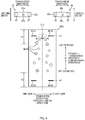
- FIG. 4 is an illustrative diagram of non-skin-side surfaces of the pair of belt members 20 and the main body portion 10.
- the belt members 20 each include the locking members 22 on one (first) side and the other (second) side in the longitudinal direction. For this reason, the user can separate the belt members 20 from the main body portion 10 as shown in FIG. 4 , and can attach the belt members 20 to the main body portion 10 as shown in FIG. 1 .
- the locking members 22A of the belt members 20 are locked to the non-skin-side surface of the exterior sheet 5 in the first waist portion 1A, for example.
- the longitudinal direction of the belt members 20 is aligned with the product-width direction of the diaper 1
- the transverse direction of the belt members 20 is aligned with the product-longitudinal direction of the diaper 1.
- the portions of the pair of belt members 20 that extend from the exterior sheet 5 are locked in an overlapping state.
- the portions of the pair of belt members 20 that extend from the exterior sheet 5 are locked in an overlapping state.
- the locking members 22 can also be locked to the non-skin-side surfaces of the belt members 20 (base members 21).
- the non-skin-side surfaces of the base members 21 may be constituted by nonwoven fabric.
- low-weight infants often maintain a prone posture in which their back curves in a C shape and their legs are sharply bent in an M shape.
- minimal handling in which it is desirable to have as little contact as possible with a low-weight infant's body. For this reason, when the diaper 1 is replaced, there are cases where the low-weight infant is kept in the prone posture instead of being turned faced up when replacing the diaper 1.
- the belt members are non-detachably fixed to a part of the waist portion that is in contact with the wearer's back side. For this reason, when an ordinary tape-type diaper is used with a low-weight infant in the prone posture, it is necessary to place one hand under the low-weight infant's stomach in order to lock or detach the belt members. In this case, replacement of the diaper 1 is not easy. In particular, in the case where a low-weight infant has been placed in an incubator, a nurse or the like needs to insert their arms through the window of the incubator and perform the task in a small space, thus making replacement of the diaper 1 even more difficult.
- both the first-side end portions and the second-side end portions of the belt members 20 in the longitudinal direction can be detached from the main body portion 10.
- the locking and detachment of the belt members 20 can be performed on the back side of the low-weight infant in the prone posture. More specifically, in a state of the diaper 1 in which the belt members 20 are locked to the non-skin-side surface of the part of the waist portion that comes into contact with the low-weight infant's stomach region, the diaper 1 is passed between the low-weight infant's leg when in the prone posture, and then the diaper 1 is folded, thereafter making it possible to lock the belt members 20 on the back side of the low-weight infant.
- the burden placed on the nurse or the like can be mitigated, and the diaper 1 can be replaced smoothly. Also, regardless of which posture the low-weight infant is in, the diaper 1 can be replaced with as little change to the low-weight infant's posture as possible, and therefore the burden placed on the low-weight infant can also be mitigated.
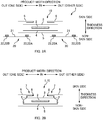
- FIG. 5A is an illustrative diagram of a marker 30 on the belt member 20.
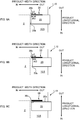
- FIGS. 5B , 6A to 6C , and 7 are diagrams showing a state where the belt member 20 has been locked to the main body portion 10 based on the marker 30.
- Members for locking of the locking members 22 of the belt members 20 are not provided separately from the exterior sheet 5 in the diaper 1 of the present embodiment, and the locking members 22 of the belt members 20 are directly locked to the non-skin-side surface of the exterior sheet 5. For this reason, the stiffness of the main body portion 10 does not increase due to the provision of such loop members, and it is possible to suppress irritation of the low-weight infant's skin.
- the unfolded diaper 1 is placed underneath the low-weight infant who is in the supine or prone posture, and at this time, the side of the diaper 1 where the belt members 20 are locked (the first waist portion 1A side in FIG. 1 ) is normally arranged at the front. For this reason, the belt members 20 sometimes become caught on the sheets or the like and become detached from the main body portion 10. In such cases as well, the nurse or the like will lock the belt members 20 to positions that they think are appropriate on the exterior sheet 5.
- the diaper 1 of the present embodiment is provided with markers 30 that indicate locking positions for the belt members 20 on the non-skin-side surface of the exterior sheet 5.
- the markers 30 are visible from the non-skin-side surface side of the exterior sheet 5 (i.e., from the outside of the diaper 1).
- the markers 30 are printed on the non-skin-side surface of the leak-proof sheet 4, and the markers 30 can be seen through the exterior sheet 5.
- the nurse or the like can lock to the belt members 20 at appropriate positions on the exterior sheet 5 based on the markers 30. For this reason, the nurse or the like can smoothly replace the diaper 1 without repeatedly adjusting the positions of the belt members 20 and then locking them, and the burden placed on the nurse or the like can be mitigated. It is also possible to reduce the number of times that the diaper 1 is placed or pulled from under the low-weight infant, and irritation of the low-weight infant's skin can be suppressed.
- markers 30 on the diaper 1, even a family member who has less experience with replacement of a low-weight infant diaper than a nurse can lock the belt members 20 at appropriate positions on the exterior sheet 5 based on the markers 30.
- the markers 30 are not limited to be provided on the leak-proof sheet 4, and may be printed on the non-skin-side surface of the absorbent body 2, the exterior sheet 5, or the like. Also, if the diaper 1 has design marks 40 (see FIG. 4 ), the markers 30 may be printed along with the design marks 40 in the step for printing the design marks 40. Also, the markers 30 are not limited to being formed by printing (dying), and may be formed by an embossed pattern (recessions) that are visible from the non-skin-side surface side of the exterior sheet 5.
- the markers 30 of the present embodiment include four markers 31 to 34 arranged in end portions with respect to the product-width direction and the product-longitudinal direction.
- the markers 30 (31 to 34) are straight and elongated in the product-width direction (thin rectangles). For this reason, as shown in FIG. 5B , lengthwise ends 20a of the belt member 20 (ends 20a extending along the longitudinal direction of the belt member 20) can be aligned with the longitudinal direction of the marker 30. This makes it easier to lock the belt member 20 to the exterior sheet 5 in alignment with the marker 30.
- the markers 30 can also be used as register marks. Register marks are used when detecting the positions of the design marks 40 (see FIG. 4 ) of the diaper 1 in the manufacturing line of the diaper 1. For example, material conveying is controlled based on the register marks such that a member such as the absorbent body 2 is placed at an appropriate product-longitudinal-direction position on the member on which the design marks 40 have been printed (e.g., the leak-proof sheet 4). If the markers 30 are used as register marks, the number of marks other than the decorative design marks 40 is lower than in the case where register marks are provided separately from the markers 30 for example, and diaper 1 has a higher freedom of design.
- the one-side markers 31 and 33 which are arranged on the one side in the product-width direction, indicate the lock position for one of the two belt members 20, and the other-side markers 32 and 34, which are arranged on the other side in the product-width direction, indicate the lock position for the other one of the two belt members 20.
- a space S extending in the product-width direction is provided between the one-side marker 31 and the other-side marker 32, and between the one-side marker 33 and the other-side marker 34.
- the nurse or the like who is looking at the markers 30 can intuitively recognize that the markers 30 are indicating lock positions for the pair of belt members 20. Accordingly, the belt members 20 can be easily locked based on the markers 30.
- the one-side markers 31 and 33 and the other-side markers 32 and 34 are symmetric in terms of shape and arrangement position with respect to a center line CL1 that bisects the exterior sheet 5 in the transverse direction thereof.
- CL1 center line that bisects the exterior sheet 5 in the transverse direction thereof.
- the above-described configuration desirably pertains to the unfolded and stretched state of the main body portion 10.
- the symmetric positions are not required to be in perfect symmetry, and the present invention also encompasses cases of deviation within the range of manufacturing error.
- the one-side markers 31 and 33 and the other-side markers 32 and 34 are all straight, and with respect to the product-width direction, a length L1 from the center line CL1 to the ends of the one-side markers 31 and 33 is equivalent to a length L2 from the center line CL1 to the ends of the other-side markers 32 and 34.
- the pair of belt members 20 can be locked in a balanced manner in the product-width direction. Accordingly, it is possible to prevent problems such as one of the belt members 20 extending too much or too little from the exterior sheet 5, and consequently the diaper 1 can be put on easily. Also, by looking at the two markers in each pair (31 and 32, 33 and 34) arranged symmetrically in the product-width direction, the nurse or the like can more intuitively recognize that the markers 30 indicate lock positions for the pair of belt members 20.
- the main body portion 10 and the absorbent body 2 of the diaper 1 have shapes that are symmetric with respect to the product-longitudinal direction.
- the first waist portion 1A can be arranged on the front side or the back side of the low-weight infant.
- the diaper 1 can be put on in either direction with respect to the front and back.
- the belt members 20 may be locked to the first waist portion 1A side, or the belt members 20 may be locked to the second waist portion 1B side.
- the markers 31 and 32 are arranged on the first side in the product-longitudinal direction
- the markers 33 and 34 are arranged on the second side in the product-longitudinal direction. Accordingly, the nurse or the like can lock the belt members 20 at appropriate positions on both the first side (the first waist portion 1A side) and the second side (the second waist portion 1B side) in the longitudinal direction of the exterior sheet 5.
- the diaper 1 in the state where the belt member 20 is locked to the exterior sheet 5, the diaper 1 has a position p1 which is a product-longitudinal-direction position where the outward end 20a of the belt member 20 is to be located.
- the outward end 20a of the belt member 20 will also be called the upper end
- the inward end 20c of the belt member 20 will also be called the lower end
- an outward end 30a of the marker 30 will also be called the upper end
- an inward end 30c of the marker 30 will also be called the lower end.
- the position p1 at which the upper end 20a of the belt member 20 is to be located is a position at which certain problems do not occur such as the lock position of the belt member 20 being too high (too close to the waist side) such that the leg opening of the diaper 1 is too large and allows leakage. It is also a position at which other problems do not occur such as the lock position of the belt member 20 being too low (too close to the crotch side) such that the belt member 20 presses against the low-weight infant's legs.
- the belt member 20 is likely to be locked such that the upper end 20a of the belt member 20 is aligned with the marker 30.
- the marker 30 is arranged at the position p1 where the upper end 20a of the belt member 20 is to be located.
- the center of the marker 30 in the product-longitudinal direction is located at the position p1. Accordingly, the belt member 20 is likely to be locked at an appropriate position on the exterior sheet 5 in the product-longitudinal direction based on the marker 30.
- any portion of the marker 30 is located at the position p1, and for example, the upper end 30a or the lower end 30c of the marker 30 may be located at the position p1.
- the diaper 1 in the case where the diaper 1 is sold in the state where the markers 30 are located at the position p1 and the belt members 20 are locked to the main body portion 10, the diaper 1 satisfies the following conditions immediately after being removed from the packaging.
- the upper end 20a of the belt member 20 is located closer to the marker 30 than the lower end 20c is.
- a length L3 from the upper end 30a of the marker 30 to the upper end 20a of the belt member 20 is shorter than a length L4 from the upper end 30a of the marker 30 to the lower end 20c of the belt member 20.
- the marker 30 has a portion 301 that extends along the upper end 20a of the belt member 20.
- the marker 30 and the upper end 20a of the belt member 20 are approximately parallel with each other.
- approximately parallel refers to the case where the angle formed by the marker 30 and the upper end 20a of the belt member 20 is 45 degrees or less, for example.
- the diaper 1 is likely to be put on the low-weight infant in the state where the belt members 20 are locked at appropriate positions on the exterior sheet 5 in the product-longitudinal direction.
- the markers 30 each have a portion that is exposed from the belt member 20 (e.g., the solid black portion in FIG. 5B ). Accordingly, upon looking at the diaper 1 immediately after removal from the packaging, the nurse or the like can recognize that the upper ends 20a of the belt members 20 are aligned with the markers 30. Note that the markers 30 may be partially covered by the belt members 20 as shown in FIG. 5B , or the markers 30 may be completely exposed from the belt members 20 as shown in FIG. 6C .
- the present invention is not limited to the above configurations, and the marker 30 may be arranged at the position where the lower end 20c of the belt member 20 is to be located.
- the design marks 40 are formed inward (on the central side) in the product-longitudinal direction with respect to the markers 30. In other words, it is desirable that the design marks 40 are provided between the markers 31 and 32 on the first side and the markers 33 and 34 on the second side in the product-longitudinal direction.
- the markers 30 and the design marks 40 are not likely to be confused with each other, and the nurse or the like can easily recognize the markers 30.
- the markers 30 are arranged at the position p1 where the upper ends 20a of the belt members 20 are to be located, the markers 30 are arranged at relatively outward positions in the product-longitudinal direction. For this reason, the design marks 40 can be provided over a wider range in the product-longitudinal direction, and the freedom of design of the diaper 1 improves.
- the markers 30 each have a portion (e.g., 302 in FIG. 5A ) that is overlapped in the product-longitudinal direction with a product-longitudinal-direction end portion of the absorbent body 2. More preferably, the marker 30 is arranged at a position overlapped in the product-longitudinal direction with a product-longitudinal-direction end 2a of the absorbent body 2.
- the belt members 20 are likely to be locked at positions in the product-longitudinal-direction end portions of the absorbent body 2. For this reason, portions of the main body portion 10 that include the absorbent body 2 are fixed to (in close contact with) the low-weight infant's body by the belt members 20, and gaps are not likely to be formed between the diaper 1 and the low-weight infant's body, making it possible to suppress the leakage of excrement.
- the product-longitudinal-direction end portion of the absorbent body 2 there is a portion extending over the range of a length L5 in the case of the diaper 1 in the unfolded and stretched state shown in FIG. 1 ; the length L5 being 1/6 of the total length of the absorbent body 2, from the end 2a of the absorbent body 2 in the product-longitudinal direction.
- the diaper 1 in the state where the belt member 20 is locked to the exterior sheet 5, the diaper 1 has a position p2 and a position p3: the position p2 is a product-width-direction position where the inward end portion of the belt member 20 is to be located, and a position p3 is a product-width-direction position where an inward end 20b of the belt member 20 is to be located.
- positions p2 and p3 are positions where certain problems do not occur such as the lock position of the belt member 20 being too inward in the product-width direction such that the portion of the belt member 20 extending from the exterior sheet 5 is too short. They are also positions at which other problems do not occur such as the lock position of the belt member 20 being too outward in the product-width direction such that the surface area of the portion of the locking member 22 locked to the exterior sheet 5 is too small and the belt member 20 becomes detached from the main body portion 10.
- the belt members 20 are in general likely to be locked such that the inward end portions (inward ends 20b) of the belt members 20 are aligned with the inward end portions (inward ends 30b) of the markers 30 in the product-width direction.
- the inward end portion of the marker 30 in the product-width direction is arranged at the position p2. More preferably, the inward end 20b of the marker 30 in the product-width direction is arranged at the position p3. Accordingly, the belt members 20 are likely to be locked at appropriate positions on the exterior sheet 5 in the product-width direction.
- the diaper 1 in the case where the diaper 1 is sold in the state where the belt members 20 are locked to the main body portion 10 such that the product-width-direction inward end portions of the markers 30 are arranged at the positions p2, the diaper 1 satisfies the following immediately after removal from the packaging.
- the inward end portion of each of the markers 30 has a portion 303 that is overlapped in the product-width direction with the inward end portion of the corresponding belt member 20.
- the diaper 1 is likely to be put on the low-weight infant in the state where the belt members 20 are locked at appropriate positions on the exterior sheet 5 in the product-width direction.
- the inward end 20b of the belt member 20 may be matched with the inward end 30b of the marker 30 as shown in FIG. 5B , may be located inward in the product-width direction with respect to the inward end 30b of the marker 30 as shown in FIG. 6A , or may be located outward in the product-width direction with respect to the inward end 30b of the marker 30 as shown in FIG. 6B .
- the marker 30 has a portion that is exposed from the belt member 20. Accordingly, upon looking at the diaper 1 immediately after removal from the packaging, the nurse or the like can recognize that the inward end portions of the belt members 20 are to be aligned with the inward end portions of the markers 30 in the product-width direction.
- the product-width-direction inward end portion of the marker 30 there is a portion extending over the range of 1/4 the length of the marker 30 from the inward end portion 30b of the marker 30. Also, as an example of the product-width-direction inward end portion of the belt member 20, there is a portion extending over the range from the inward end 20b of the belt member 20 to the position of the inward-side locking member 22A.
- the markers 30 are arranged outward with respect to the absorbent body 2 as shown in FIG. 5A .
- the belt members 20 are likely to be locked at positions outward in the product-width direction with respect to the absorbent body 2. This makes it possible to prevent the case where the belt members 20 are locked at uneven portions at the side ends 2b of the absorbent body 2 such that the belt members 20 can easily become detached. It is also possible to prevent the belt members 20 from being unnecessarily long.
- FIGS. 8A to 8C are illustrative diagrams of forms of the diaper 1 during packaging.
- the diaper 1 may be in any of the following forms during packaging. Specifically, the diaper 1 may be packaged in the state where the pair of belt members 20 are locked to the non-skin-side surface of the exterior sheet 5 such that the longitudinal direction of the belt members 20 is aligned with the transverse direction of the exterior sheet 5, or multiple diapers 1 may be wrapped in the same packaging in the state where the belt members 20 are separate from the main body portion 10, or the diaper 1 may be wrapped in an individual package in the state where the belt members 20 are separate from the main body portion 10.
- the following illustrates an example of a method used in the case of packaging in the state where the belt members 20 are locked to the exterior sheet 5.
- outward portions of the belt members 20 in the product-width direction are folded inward at folding positions FL1.
- the main body portion 10 is folded one time at a folding position FL2 at approximately at the center of the main body portion 10 in the product-longitudinal direction.
- the portions of the belt members 20 that were folded inward in the product-width direction are thus located between portions of the folded main body portion 10 (absorbent body 2), that is to say on the skin-side surfaces of the main body portion 10.
- the diaper 1 is then packaged in this state ( FIGS. 8B and 8C ).
- the markers 33 and 34 on the side where the belt members 20 are not locked are exposed and not covered by the belt members 20.
- the markers 31 and 32 on the side where the belt members 20 are locked are entirely covered by the pair of belt members 20.
- the markers 31 and 32 on one waist portion side are not exposed, thus suppressing the case where these markers 30 impair the overall design of the diaper 1. Also, the markers 33 and 34 on the other waist portion side are exposed, and therefore these markers 30 can be easily recognized by the nurse or the like.
- the present invention is not limited to the above configuration, and the markers 31 and 32 on the side where the belt members 20 are locked may be exposed.
- the size of a portion 305A (portions shown in solid black) of the one-side marker 31 that is exposed from one of the two belt members 20 is different from the size of a portion 305B of the other-side marker 32 that is exposed from the other belt member 20. Accordingly, the nurse or the like can easily recognize that the belt members 20 can be removably attached in alignment with the markers 30.
- the ends 5a and 5b of the folded exterior sheet 5 are not aligned with each other in the product-longitudinal direction; and as the exterior sheet 5 is viewed from the non-skin side, the marker 31 (32) on the one waist portion side and the marker 33 (34) on the other waist portion side have an overlap portion 304 overlapped in the direction in which the folded exterior sheet 5 is overlaid on itself (the thickness direction of the diaper 1).
- the amount of misalignment in the product-longitudinal direction between the markers 31 and 32 on the one waist portion side and the markers 33 and 34 on the other waist portion side is small. Accordingly, the nurse or the like can easily recognize that the two markers (31 and 32, 33 and 34) are both lock positions for the belt members 20.
- the diaper 1 is folded at the for-packaging folding position FL2.
- the distance from the folding position FL2 to the marker 31 (32) on the first waist portion side approximately matches the distance from the folding position FL2 to the marker 33 (34) on the second waist portion side. Accordingly, regardless of which markers the belt members 20 are aligned with when locked, the positions of the belt members 20 relative to the low-weight infant are appropriate.
- FIGS. 9A to 9C are illustrative diagrams of markers 35 to 37 according to variations.
- a marker 35 may be shaped as a straight line that extends continuous from one side of the exterior sheet 5 to the other side. In this case, each pair of belt members 20 is aligned with one marker 35 when being locked.
- markers 36 may be shaped as a right-angled corners. In this case, the corners of the belt members 20 can be aligned with the markers 36.
- the markers may have portions that indicate multiple lock positions for a single belt member 20. Accordingly, the nurse or the like can lock the belt members 20 at appropriate positions in accordance with characteristics of the low-weight infant's body shape.
- straight lines 371 to 376 that extend in the product-width direction are arranged with gaps therebetween in the product-longitudinal direction
- straight lines 377 to 379 that extend in the product-longitudinal direction are arranged with gaps therebetween in the product-width direction.
- the belt member 20 can be aligned with a portion of the marker on the inward side in the product-longitudinal direction (e.g., 375 or 376), whereas if the low-weight infant has wide legs, the belt member 20 can be aligned with a portion of the marker on the outward side in the product-longitudinal direction (e.g., 371 or 372).
- the belt member 20 can be aligned with a portion of the marker on the inward side in the product-width direction (e.g., 377), whereas if the low-weight infant has a wide waist, the belt member 20 can be aligned with a portion of the marker on the outward side in the product-width direction (e.g., 379).
- FIG. 10 is a plan view of a low-weight infant diaper 50 according to a variation in an unfolded and stretched state as viewed from the skin side.
- the main body portion 10 (exterior sheet 5) of the low-weight infant diaper 1 is rectangular in the embodiment described above ( FIG. 1 ), there is no limitation to this.
- a main body portion 51 of the low-weight infant diaper 50 may have a central band-shaped region 50D located at the center in the product-width direction, and side flaps 50E located on the sides thereof.
- the side flaps 50E are formed extending over a first waist portion 50A, a crotch portion 50B, and a second waist portion 50C.
- the length of the side flaps 50E in the product-width direction in the crotch portion 50B is smaller than the length of the side flaps 50E in the product-width direction in the first waist portion 50A and the second waist portion 50C.
Landscapes
- Health & Medical Sciences (AREA)
- Engineering & Computer Science (AREA)
- Life Sciences & Earth Sciences (AREA)
- Biomedical Technology (AREA)
- Heart & Thoracic Surgery (AREA)
- Vascular Medicine (AREA)
- Epidemiology (AREA)
- Animal Behavior & Ethology (AREA)
- General Health & Medical Sciences (AREA)
- Public Health (AREA)
- Veterinary Medicine (AREA)
- Mechanical Engineering (AREA)
- Absorbent Articles And Supports Therefor (AREA)
Abstract
Description
- The present invention relates to a low-weight infant diaper.
-
Patent Document 1 discloses an adult incontinence product that includes a clothing shell (hereinafter "main body portion"), which includes an absorbent core, and a pair of strap members (hereinafter "belt members"). Fasteners (e.g., hook members) are provided on the front end portions and the back end portions of the belt members, and attachment pads (e.g., loop members) are provided on the front waist portion and the back waist portion of the main body portion. Accordingly, the front end portions of the belt members can be detachably engaged with the front waist portion of the main body portion, and the back end portions of the belt members can be detachably engaged with the back waist portion of the main body portion. - Low-weight infants, who are born with a low body weight, sometimes sleep in a prone posture. In the case of low-weight infants, there is a concept of "minimal handling" in which it is desirable to have as little contact with a low-weight infant's body as possible. In view of this, it is desirable for a diaper for low-weight infants to employ the belt members of
Patent Document 1. In this case, the belt members can be easily detached regardless of the posture of the low-weight infant, and the low-weight infant's diaper can be easily replaced with as little contact with their body as possible. - [Patent Document 1] Japanese Patent Application Publication No.
H6-218009 - However, if attachment pads are provided on the main body portion in correspondence with the fasteners (hereinafter "locking members") of the belt members as in
Patent Document 1, the attachment pads commensurately raise the stiffness of the main body portion and may irritate the low-weight infant's delicate skin. In view of this, it is desirable that attachment pads are not provided on the main body portion, and that the locking members of the belt members can be directly engaged with the non-skin-side surface (i.e., the exterior sheet) of the main body portion. - However, in this case, it is difficult to know which positions on the exterior sheet are the positions where the belt members are intended to be locked. For this reason, when a nurse or the like puts such a diaper on a low-weight infant by locking the belt members to positions on the exterior sheet that they think are appropriate, problems are likely to occur if the positions where the belt members are locked are not appropriate, such as the belt members being too short, and the belt members pressing against the low-weight infant's legs. If the belt members are detached and re-locked each time such a case occurs, diaper replacement becomes time-consuming.
- In view of this, and an aspect of the present invention is to provide a low-weight infant diaper that can suppress irritation of a low-weight infant's skin while also being able to be replaced smoothly.
- A main aspect of the present invention for achieving the above-described aspect is a low-weight infant diaper including:
- an absorbent body;
- an exterior sheet arranged on a non-skin side with respect to the absorbent body;
- a pair of belt members,
- the pair of belt members each including:
- a locking member on a one side in a longitudinal direction of the belt member and
- a locking member on an other side in the longitudinal direction of the belt member,
- the pair of belt members being capable of being locked to a non-skin-side surface of the exterior sheet with use of the locking members; and
- the pair of belt members each including:
- a marker that indicates a lock position for one or more of the belt members on the non-skin-side surface of the exterior sheet,
the marker being visible from a non-skin-side surface side of the exterior sheet. - Features of the present invention other than the above will become clear by reading the description of the present specification with reference to the accompanying drawings.
- According to the present invention, it is possible to provide a low-weight infant diaper that can suppress irritation of a low-weight infant's skin while also being able to be replaced smoothly.
-
-
FIG. 1 is a plan view of a skin side of a low-weight infant diaper 1 in an unfolded and stretched state. -
FIG. 2A is a cross-sectional view along a line A-A shown in inFIG. 1 , andFIG. 2B is a cross-sectional view along a line B-B shown inFIG. 1 . -
FIG. 3 is an illustrative diagram of a posture unique to low-weight infants. -
FIG. 4 is an illustrative diagram of non-skin-side surfaces of a pair ofbelt members 20 and amain body portion 10. -
FIG. 5A is an illustrative diagram of amarker 30 on thebelt member 20, andFIG. 5B is a diagram showing a state where thebelt member 20 has been locked to themain body portion 10 based on themarker 30. -
FIG. 6A to 6C are diagrams showing a state where thebelt member 20 has been locked to themain body portion 10 based on themarker 30. -
FIG. 7 is a diagram showing a state where thebelt members 20 have been locked to themain body portion 10 based on themarkers 30. -
FIGS. 8A to 8C are illustrative diagrams of forms of thediaper 1 during packaging. -
FIGS. 9A to 9C are illustrative diagrams ofmarkers 35 to 37 according to variations. -
FIG. 10 is a plan view of a low-weight infant diaper 50 according to a variation in an unfolded and stretched state as viewed from a skin side. - At least the following matters will become clear with the description of this specification and the attached drawings.
- A low-weight infant diaper including:
- an absorbent body;
- an exterior sheet arranged on a non-skin side with respect to the absorbent body;
- a pair of belt members,
- the pair of belt members each including:
- a locking member on a one side in a longitudinal direction of the belt member and
- a locking member on an other side in the longitudinal direction of the belt member,
- the pair of belt members being capable of being locked to a non-skin-side surface of the exterior sheet with use of the locking members; and
- the pair of belt members each including:
- a marker that indicates a lock position for one or more of the belt members on the non-skin-side surface of the exterior sheet,
the marker being visible from a non-skin-side surface side of the exterior sheet. - According to this low-weight infant diaper, the locking members are directly locked to the exterior sheet, thus preventing an increase in the stiffness of the exterior sheet and making it possible to suppress irritation of the low-weight infant's skin. Also, the belt members can be locked at appropriate positions on the exterior sheet based on the marker, and therefore the diaper can be replaced smoothly.
- In such a low-weight infant diaper,
a plurality of the markers includes - a first marker arranged on a first side in a longitudinal direction of the exterior sheet and
- a second marker arranged on a second side in the longitudinal direction of the exterior sheet.
- According to this low-weight infant diaper, the belt members can be locked at appropriate positions on both the first side and the second side in the longitudinal direction of the exterior sheet.
- In such a low-weight infant diaper,
- the pair of belt members are locked to the non-skin-side surface of the exterior sheet such that the longitudinal direction of the belt members is aligned with a transverse direction of the exterior sheet,
- the pair of belt members cover an entirety of the first marker, and
- outward portions of the belt members in the transverse direction of the exterior sheet are folded inward, and are located between portions of the absorbent body in a state where the absorbent body has been folded in the longitudinal direction of the exterior sheet.
- According to this low-weight infant diaper, the first marker is not exposed, thus suppressing the case where the marker impairs the overall design of the diaper. Because the second marker is exposed, the user (nurse or the like) can easily recognize the marker.
- In such a low-weight infant diaper,
- in a state where the exterior sheet has been folded in the longitudinal direction of the exterior sheet,
two ends of the exterior sheet are not aligned with each other, and - the first marker and the second marker have an overlapping portion overlapped in a direction in which portions of the folded exterior sheet are overlaid, as the exterior sheet is viewed from the non-skin side.
- According to this low-weight infant diaper, the amount of misalignment between the first marker and the second marker in the longitudinal direction of the exterior sheet is small, thus allowing the user to easily recognize that the two markers both indicate lock positions for the belt members.
- In such a low-weight infant diaper,
a plurality of the markers are symmetric in terms of shape and arrangement position with respect to a center line that bisects the exterior sheet in a transverse direction of the exterior sheet. - According to this low-weight infant diaper, the pair of belt members can be locked in a balanced manner.
- In such a low-weight infant diaper,
- a plurality of the markers includes
- a one-side marker indicating a lock position for one belt member out of the pair of belt members and
- an other-side marker indicating a lock position for an other belt member out of the pair of belt members, and
- the one-side marker and the other-side marker are arranged with a space in the transverse direction of the exterior sheet.
- According to this low-weight infant diaper, it is easy to recognize the lock positions for the belt members in the transverse direction of the exterior sheet.
- In such a low-weight infant diaper,
- the pair of belt members are locked to the non-skin-side surface of the exterior sheet such that the longitudinal direction of the belt members is aligned with a transverse direction of the exterior sheet, and
- the size of a portion of the one-side marker that is exposed from the one belt member is different from the size of a portion of the other-side marker that is exposed from the other belt member.
- According to this low-weight infant diaper, the user can easily recognize that the belt members can be attached and detached in alignment with the markers.
- In such a low-weight infant diaper,
- concerning an inward end portion that is of each of the belt members and that is located inward in the transverse direction of the exterior sheet,
the low-weight infant diaper has a position where the inward end portion is to be located when the belt member has been locked to the exterior sheet, - concerning an inward end portion that is of the one-side marker and that is located inward in the transverse direction of the exterior sheet,
the inward end portion of the one-side marker is arranged at the position where the inward end portion of the one belt member are to be located, and - concerning an inward end portion that is of the other-side marker and that is located inward in the transverse direction of the exterior sheet,
the inward end portion of the other-side marker is arranged at the position where the inward end portion of the other belt member are to be located. - According to this low-weight infant diaper, the belt members can be easily locked at appropriate positions in the transverse direction of the exterior sheet.
- In such a low-weight infant diaper,
- the pair of belt members are locked to the non-skin-side surface of the exterior sheet such that the longitudinal direction of the belt members is aligned with a transverse direction of the exterior sheet,
- the inward end portion of the one-side marker has an overlap portion that is overlapped in the transverse direction of the exterior sheet with the inward end portion of the one belt member, and
- the inward end portion of the other-side marker has an overlap portion that is overlapped in the transverse direction of the exterior sheet with the inward end portion of the other belt member.
- According to this low-weight infant diaper, the diaper can be easily put on in a state where the belt members have been locked at appropriate positions in the transverse direction of the exterior sheet.
- In such a low-weight infant diaper,
the one-side marker and the other-side marker are arranged outward in the transverse direction of the exterior sheet with respect to the absorbent body. - According to this low-weight infant diaper, the belt members are less likely to be locked at uneven portions at the side ends of the absorbent body, thus making it possible to suppress detachment of the belt members caused by such unevenness.
- In such a low-weight infant diaper,
the marker is shaped as a straight line that is elongated in a transverse direction of the exterior sheet. - According to this low-weight infant diaper, the ends extending along the longitudinal direction of the belt members can be easily aligned with the markers.
- In such a low-weight infant diaper,
concerning an outward end that is of each of the belt members and that is located outward in a longitudinal direction of the exterior sheet, - the low-weight infant diaper has a position where the outward end is to be located when the belt member has been locked to the exterior sheet, and
- the marker is arranged at the position where the outward end of the belt member is to be located.
- According to this low-weight infant diaper, the belt members can be easily locked at an appropriate position in the longitudinal direction of the exterior sheet.
- In such a low-weight infant diaper,
- the pair of belt members are locked to the non-skin-side surface of the exterior sheet such that the longitudinal direction of the belt members is aligned with a transverse direction of the exterior sheet,
- the outward end of the belt member is located closer to the marker in the longitudinal direction of the exterior sheet than inward end of the belt member is, and
- the marker has a portion that extends along the outward end of the belt member.
- According to this low-weight infant diaper, the diaper can be easily put on in a state where the belt members have been locked at an appropriate position in the longitudinal direction of the exterior sheet.
- In such a low-weight infant diaper,
- a design mark is provided on a central side in the longitudinal direction of the exterior sheet with respect to the marker, and
- the design mark is visible from the non-skin-side surface side of the exterior sheet.
- According to this low-weight infant diaper, the markers and the design marks are less likely to be confused with each other, and the markers can be recognized easily.
- In such a low-weight infant diaper,
the marker has an overlap portion that is overlapped in a longitudinal direction of the exterior sheet with an end portion that is of the absorbent body and that is located in the longitudinal direction of the exterior sheet. - According to this low-weight infant diaper, portions that include the absorbent body are fixed to (in close contact with) the low-weight infant's body by the belt members, and gaps are less likely to be formed between the diaper and the low-weight infant's body, making it possible to the leakage of excrement.
- In such a low-weight infant diaper,
the marker has a portion that indicates a plurality of lock positions for one of the belt members. - According to this low-weight infant diaper, the belt members can be locked at appropriate positions in accordance with characteristics of the low-weight infant's body shape.
- A low-weight infant diaper of the present embodiment is a diaper for use by infants whose body weight is 3000 grams or lower, and particularly lower than 2500 grams.
-
FIG. 1 is a plan view of the skin side of a low-weight infant diaper 1 (hereinafter, also called the "diaper") in an unfolded and stretched state.FIG. 2A is a cross-sectional view along a line A-A shown in inFIG. 1 , andFIG. 2B is a cross-sectional view along a line B-B shown inFIG. 1 . Note that the stretched state of thediaper 1 is a state in which thediaper 1 has been stretched to the extent that wrinkles are substantially no longer visible, and is a state in which thediaper 1 has been stretched such that the dimensions of constituent members (e.g., a later-described top sheet 3) of thediaper 1 match or are close to the dimensions of the members on their own. - The
diaper 1 has a product-longitudinal direction and a product-width direction that are orthogonal to each other, and includes amain body portion 10 and a pair ofbelt members 20. As shown inFIG. 2A , the direction in which constituent members of thediaper 1 are overlaid on each other will be called the thickness direction. With respect to the thickness direction, the side that comes into contact with the wearer is the skin side, and the opposite side is the non-skin side. Thediaper 1 also includes afirst waist portion 1A, acrotch portion 1B, and asecond waist portion 1C that are arranged side-by-side in the product-longitudinal direction. - As shown in
FIGS. 2A and the like, themain body portion 10 includes anabsorbent body 2 that absorbs excreted fluid, a liquid-permeabletop sheet 3 arranged on the skin side with respect to theabsorbent body 2, a liquid-impermeable leak-proof sheet 4 arranged on the non-skin side with respect to theabsorbent body 2, anexterior sheet 5 arranged on the non-skin side with respect to the leak-proof sheet 4, and a pair ofside sheets 6 provided at the two side portions of thetop sheet 3 in the product-width direction. - Examples of the
absorbent body 2 include: an absorbent body obtained by shaping liquid-absorbent fibers, such as pulp fibers containing a superabsorbent polymer (so-called SAP), into a predetermined shape; and an SAP sheet obtained by affixing an SAP layer to a hydrophilic sheet. The surface of theabsorbent body 2 may be constituted by a core-wrapping sheet made of liquid-permeable tissue paper or nonwoven fabric. - The planar shape of the
main body portion 10, that is to say the planar shape of theexterior sheet 5, is rectangular, and themain body portion 10 and theexterior sheet 5 have a longitudinal direction and a transverse direction that are orthogonal to each other. The longitudinal direction of themain body portion 10 and theexterior sheet 5 correspond to the product-longitudinal direction of thediaper 1, and the transverse direction of themain body portion 10 and theexterior sheet 5 correspond to the product-width direction of thediaper 1. In the following description, the longitudinal direction of theexterior sheet 5 will also be called the product-longitudinal direction, and the transverse direction of theexterior sheet 5 will also be called the product-width direction. - A
barrier cuff portion 7 is provided in each of two side portions of thediaper 1 in the product-width direction. In each of thebarrier cuff portions 7, a portion of theside sheet 6 rises to the skin side due to a barrier-cuff-portion elastic member 8 (seeFIG. 2B ) that stretches and contracts in the product-longitudinal direction. Also, legelastic members 9 that stretch and contract in the product-longitudinal direction are provided in each of two side portions of thediaper 1 in the product-width direction, and thediaper 1 thus fits around the wearer's legs. - The
belt members 20 each include arectangular base member 21 and two locking members 22 (22A and 22B) that are attached to the same surface (skin-side surface) of thebase member 21. The locking members 22A and 22B are respectively attached to a first-side end portion of thebase member 21 on one side in the longitudinal direction of thebelt member 20, and a second-side end portion on an other side in the longitudinal direction. - The
belt member 20 can be detachably locked to the non-skin-side surface of theexterior sheet 5 due to the lockingmembers 22. As one example, the lockingmembers 22 are hook members of a hook-and-loop fastener, and theexterior sheet 5 is a nonwoven fabric sheet. - Also, it is desirable that the
diaper 1 of the present embodiment, which is for low-weight infants, has a product length (dimension when thediaper 1 is stretched in the product-longitudinal direction so as to eliminate wrinkles) of approximately 170 to 330 mm. For example, it is desirable that the product length is 310 mm in the case of a body weight lower than 2500 g, 270 mm in the case of a body weight lower than 1500 g, and 230 mm in the case of a body weight lower than 1000 g. - Also, it is desirable that the waist dimension of the
diaper 1 is approximately 160 to 295 mm. The waist dimension is the dimension in the case where the product-width-direction outward end portion of onebelt member 20 has been aligned with the product-width-direction inward end portion of theother belt member 20, and thediaper 1 has been stretched in the product-width direction so as to eliminate wrinkles. For example, it is desirable that the waist dimension is 273.5 mm in the case of a body weight lower than 2500 g, and 220 mm in the case of a body weight lower than 1500 g. -
FIG. 3 is an illustrative diagram of a posture unique to low-weight infants.FIG. 4 is an illustrative diagram of non-skin-side surfaces of the pair ofbelt members 20 and themain body portion 10. - As previously described, the
belt members 20 each include the lockingmembers 22 on one (first) side and the other (second) side in the longitudinal direction. For this reason, the user can separate thebelt members 20 from themain body portion 10 as shown inFIG. 4 , and can attach thebelt members 20 to themain body portion 10 as shown inFIG. 1 . - When the
diaper 1 is to be put on, as shown inFIG. 1 , the locking members 22A of thebelt members 20 are locked to the non-skin-side surface of theexterior sheet 5 in thefirst waist portion 1A, for example. Specifically, the longitudinal direction of thebelt members 20 is aligned with the product-width direction of thediaper 1, and the transverse direction of thebelt members 20 is aligned with the product-longitudinal direction of thediaper 1. - The user then folds the
diaper 1, which is in the state shown inFIG. 1 , at approximately the center in the product-longitudinal direction arranging it in accordance with the wearer. The portions of thebelt members 20 that extend outward from theexterior sheet 5 in the product-width direction are then folded inward in the product-width direction by the user. Lastly, the user locks the locking members 22B of thebelt members 20 to the non-skin-side surface of theexterior sheet 5 in thesecond waist portion 1C for example, thus fixing the position of thediaper 1 relative to the low-weight infant. - Note that because low-weight infants have a small waist, there are cases where the portions of the pair of
belt members 20 that extend from theexterior sheet 5 are locked in an overlapping state. In other words, there are cases where one of the twobelt members 20 is locked to the non-skin-side surface of theexterior sheet 5, and theother belt member 20 is locked to the non-skin-side surface of the onebelt member 20. For this reason, it is preferable that the lockingmembers 22 can also be locked to the non-skin-side surfaces of the belt members 20 (base members 21). For example, the non-skin-side surfaces of thebase members 21 may be constituted by nonwoven fabric. - Also, as shown in
FIG. 3 , low-weight infants often maintain a prone posture in which their back curves in a C shape and their legs are sharply bent in an M shape. In the case of low-weight infants, there is a concept of "minimal handling" in which it is desirable to have as little contact as possible with a low-weight infant's body. For this reason, when thediaper 1 is replaced, there are cases where the low-weight infant is kept in the prone posture instead of being turned faced up when replacing thediaper 1. - With an ordinary tape-type diaper, the belt members are non-detachably fixed to a part of the waist portion that is in contact with the wearer's back side. For this reason, when an ordinary tape-type diaper is used with a low-weight infant in the prone posture, it is necessary to place one hand under the low-weight infant's stomach in order to lock or detach the belt members. In this case, replacement of the
diaper 1 is not easy. In particular, in the case where a low-weight infant has been placed in an incubator, a nurse or the like needs to insert their arms through the window of the incubator and perform the task in a small space, thus making replacement of thediaper 1 even more difficult. - In contrast, with the
diaper 1 of the present embodiment, both the first-side end portions and the second-side end portions of thebelt members 20 in the longitudinal direction can be detached from themain body portion 10. For this reason, the locking and detachment of thebelt members 20 can be performed on the back side of the low-weight infant in the prone posture. More specifically, in a state of thediaper 1 in which thebelt members 20 are locked to the non-skin-side surface of the part of the waist portion that comes into contact with the low-weight infant's stomach region, thediaper 1 is passed between the low-weight infant's leg when in the prone posture, and then thediaper 1 is folded, thereafter making it possible to lock thebelt members 20 on the back side of the low-weight infant. - Accordingly, the burden placed on the nurse or the like can be mitigated, and the
diaper 1 can be replaced smoothly. Also, regardless of which posture the low-weight infant is in, thediaper 1 can be replaced with as little change to the low-weight infant's posture as possible, and therefore the burden placed on the low-weight infant can also be mitigated. -
FIG. 5A is an illustrative diagram of amarker 30 on thebelt member 20.FIGS. 5B ,6A to 6C , and7 are diagrams showing a state where thebelt member 20 has been locked to themain body portion 10 based on themarker 30. - Members for locking of the locking
members 22 of the belt members 20 (e.g., hook-and-loop fastener type loop members) are not provided separately from theexterior sheet 5 in thediaper 1 of the present embodiment, and the lockingmembers 22 of thebelt members 20 are directly locked to the non-skin-side surface of theexterior sheet 5. For this reason, the stiffness of themain body portion 10 does not increase due to the provision of such loop members, and it is possible to suppress irritation of the low-weight infant's skin. - However, in the case where loop members are not provided, it is difficult to know the positions where the
belt members 20 are to be locked on theexterior sheet 5. For example, as shown inFIG. 4 , if thediaper 1 is sold in the state where thebelt members 20 are not attached to themain body portion 10, the nurse or the like who is to replace thediaper 1 will lock thebelt members 20 to positions that they think are appropriate on theexterior sheet 5. - Also, when the
diaper 1 is put on, the unfoldeddiaper 1 is placed underneath the low-weight infant who is in the supine or prone posture, and at this time, the side of thediaper 1 where thebelt members 20 are locked (thefirst waist portion 1A side inFIG. 1 ) is normally arranged at the front. For this reason, thebelt members 20 sometimes become caught on the sheets or the like and become detached from themain body portion 10. In such cases as well, the nurse or the like will lock thebelt members 20 to positions that they think are appropriate on theexterior sheet 5. - However, if the
belt members 20 are locked at unsuitable positions, problems occur such as thebelt members 20 being too short, and thebelt members 20 pressing against the low-weight infant's legs. In such a case, the nurse or the like pulls thediaper 1 out from under the low-weight infant, re-locks thebelt members 20 to theexterior sheet 5, and then placesdiaper 1 underneath the low-weight infant again. Repeating such operations makes the replacement of thediaper 1 time-consuming. - In view of this, the
diaper 1 of the present embodiment is provided withmarkers 30 that indicate locking positions for thebelt members 20 on the non-skin-side surface of theexterior sheet 5. Themarkers 30 are visible from the non-skin-side surface side of the exterior sheet 5 (i.e., from the outside of the diaper 1). In the present embodiment, themarkers 30 are printed on the non-skin-side surface of the leak-proof sheet 4, and themarkers 30 can be seen through theexterior sheet 5. - Accordingly, even if the
belt members 20 have been separated from themain body portion 10, the nurse or the like can lock to thebelt members 20 at appropriate positions on theexterior sheet 5 based on themarkers 30. For this reason, the nurse or the like can smoothly replace thediaper 1 without repeatedly adjusting the positions of thebelt members 20 and then locking them, and the burden placed on the nurse or the like can be mitigated. It is also possible to reduce the number of times that thediaper 1 is placed or pulled from under the low-weight infant, and irritation of the low-weight infant's skin can be suppressed. - Also, due to the provision of the
markers 30 on thediaper 1, even a family member who has less experience with replacement of a low-weight infant diaper than a nurse can lock thebelt members 20 at appropriate positions on theexterior sheet 5 based on themarkers 30. - Note that the
markers 30 are not limited to be provided on the leak-proof sheet 4, and may be printed on the non-skin-side surface of theabsorbent body 2, theexterior sheet 5, or the like. Also, if thediaper 1 has design marks 40 (seeFIG. 4 ), themarkers 30 may be printed along with the design marks 40 in the step for printing the design marks 40. Also, themarkers 30 are not limited to being formed by printing (dying), and may be formed by an embossed pattern (recessions) that are visible from the non-skin-side surface side of theexterior sheet 5. - The
markers 30 of the present embodiment include four markers 31 to 34 arranged in end portions with respect to the product-width direction and the product-longitudinal direction. The markers 30 (31 to 34) are straight and elongated in the product-width direction (thin rectangles). For this reason, as shown inFIG. 5B , lengthwise ends 20a of the belt member 20 (ends 20a extending along the longitudinal direction of the belt member 20) can be aligned with the longitudinal direction of themarker 30. This makes it easier to lock thebelt member 20 to theexterior sheet 5 in alignment with themarker 30. - Also, if the
markers 30 are straight and elongated in the product-width direction, themarkers 30 can also be used as register marks. Register marks are used when detecting the positions of the design marks 40 (seeFIG. 4 ) of thediaper 1 in the manufacturing line of thediaper 1. For example, material conveying is controlled based on the register marks such that a member such as theabsorbent body 2 is placed at an appropriate product-longitudinal-direction position on the member on which the design marks 40 have been printed (e.g., the leak-proof sheet 4). If themarkers 30 are used as register marks, the number of marks other than the decorative design marks 40 is lower than in the case where register marks are provided separately from themarkers 30 for example, anddiaper 1 has a higher freedom of design. - Also, among the four markers 31 to 34, the one-side markers 31 and 33, which are arranged on the one side in the product-width direction, indicate the lock position for one of the two
belt members 20, and the other-side markers 32 and 34, which are arranged on the other side in the product-width direction, indicate the lock position for the other one of the twobelt members 20. Also, a space S extending in the product-width direction is provided between the one-side marker 31 and the other-side marker 32, and between the one-side marker 33 and the other-side marker 34. - This thus facilitates recognition of the lock positions for the
belt members 20 in the product-width direction. Also, due to the two markers in each pair (31 and 32, 33 and 34) being arranged side-by-side in the product-width direction, the nurse or the like who is looking at themarkers 30 can intuitively recognize that themarkers 30 are indicating lock positions for the pair ofbelt members 20. Accordingly, thebelt members 20 can be easily locked based on themarkers 30. - Also, as shown in
FIG. 4 , it is desirable that the one-side markers 31 and 33 and the other-side markers 32 and 34 are symmetric in terms of shape and arrangement position with respect to a center line CL1 that bisects theexterior sheet 5 in the transverse direction thereof. Note that the above-described configuration desirably pertains to the unfolded and stretched state of themain body portion 10. Also, the symmetric positions are not required to be in perfect symmetry, and the present invention also encompasses cases of deviation within the range of manufacturing error. - In the present embodiment, the one-side markers 31 and 33 and the other-side markers 32 and 34 are all straight, and with respect to the product-width direction, a length L1 from the center line CL1 to the ends of the one-side markers 31 and 33 is equivalent to a length L2 from the center line CL1 to the ends of the other-side markers 32 and 34.
- For this reason, based on the
markers 30, the pair ofbelt members 20 can be locked in a balanced manner in the product-width direction. Accordingly, it is possible to prevent problems such as one of thebelt members 20 extending too much or too little from theexterior sheet 5, and consequently thediaper 1 can be put on easily. Also, by looking at the two markers in each pair (31 and 32, 33 and 34) arranged symmetrically in the product-width direction, the nurse or the like can more intuitively recognize that themarkers 30 indicate lock positions for the pair ofbelt members 20. - Also, as shown in
FIG. 1 , themain body portion 10 and theabsorbent body 2 of thediaper 1 according to the present embodiment have shapes that are symmetric with respect to the product-longitudinal direction. For this reason, thefirst waist portion 1A can be arranged on the front side or the back side of the low-weight infant. In other words, thediaper 1 can be put on in either direction with respect to the front and back. In this case, when thediaper 1 is placed under the low-weight infant, thebelt members 20 may be locked to thefirst waist portion 1A side, or thebelt members 20 may be locked to thesecond waist portion 1B side. - In view of this, in the
diaper 1 of the present embodiment, the markers 31 and 32 (first markers) are arranged on the first side in the product-longitudinal direction, and the markers 33 and 34 (second markers) are arranged on the second side in the product-longitudinal direction. Accordingly, the nurse or the like can lock thebelt members 20 at appropriate positions on both the first side (thefirst waist portion 1A side) and the second side (thesecond waist portion 1B side) in the longitudinal direction of theexterior sheet 5. - Also, as shown in
FIG. 5B , in the state where thebelt member 20 is locked to theexterior sheet 5, thediaper 1 has a position p1 which is a product-longitudinal-direction position where theoutward end 20a of thebelt member 20 is to be located. In the following description, with respect to the product-longitudinal direction, theoutward end 20a of thebelt member 20 will also be called the upper end, theinward end 20c of thebelt member 20 will also be called the lower end, anoutward end 30a of themarker 30 will also be called the upper end, and aninward end 30c of themarker 30 will also be called the lower end. - The position p1 at which the
upper end 20a of thebelt member 20 is to be located is a position at which certain problems do not occur such as the lock position of thebelt member 20 being too high (too close to the waist side) such that the leg opening of thediaper 1 is too large and allows leakage. It is also a position at which other problems do not occur such as the lock position of thebelt member 20 being too low (too close to the crotch side) such that thebelt member 20 presses against the low-weight infant's legs. - In the case where the
marker 30 is straight and elongated in the product-width direction, thebelt member 20 is likely to be locked such that theupper end 20a of thebelt member 20 is aligned with themarker 30. For this reason, it is preferable that themarker 30 is arranged at the position p1 where theupper end 20a of thebelt member 20 is to be located. In the present embodiment, the center of themarker 30 in the product-longitudinal direction is located at the position p1. Accordingly, thebelt member 20 is likely to be locked at an appropriate position on theexterior sheet 5 in the product-longitudinal direction based on themarker 30. - Note that it is sufficient that any portion of the
marker 30 is located at the position p1, and for example, theupper end 30a or thelower end 30c of themarker 30 may be located at the position p1. - Also, it is preferable that in the case where the
diaper 1 is sold in the state where themarkers 30 are located at the position p1 and thebelt members 20 are locked to themain body portion 10, thediaper 1 satisfies the following conditions immediately after being removed from the packaging. - First, with respect to the product-longitudinal direction, the
upper end 20a of thebelt member 20 is located closer to themarker 30 than thelower end 20c is. For example, as shown inFIG. 5B , with respect to the product-longitudinal direction, it is desirable that a length L3 from theupper end 30a of themarker 30 to theupper end 20a of thebelt member 20 is shorter than a length L4 from theupper end 30a of themarker 30 to thelower end 20c of thebelt member 20. - Second, as shown in
FIG. 5B , themarker 30 has aportion 301 that extends along theupper end 20a of thebelt member 20. In other words, it is desirable that themarker 30 and theupper end 20a of thebelt member 20 are approximately parallel with each other. The term "approximately parallel" refers to the case where the angle formed by themarker 30 and theupper end 20a of thebelt member 20 is 45 degrees or less, for example. - Accordingly, the
diaper 1 is likely to be put on the low-weight infant in the state where thebelt members 20 are locked at appropriate positions on theexterior sheet 5 in the product-longitudinal direction. - Furthermore, it is preferable that the
markers 30 each have a portion that is exposed from the belt member 20 (e.g., the solid black portion inFIG. 5B ). Accordingly, upon looking at thediaper 1 immediately after removal from the packaging, the nurse or the like can recognize that the upper ends 20a of thebelt members 20 are aligned with themarkers 30. Note that themarkers 30 may be partially covered by thebelt members 20 as shown inFIG. 5B , or themarkers 30 may be completely exposed from thebelt members 20 as shown inFIG. 6C . - Note that the present invention is not limited to the above configurations, and the
marker 30 may be arranged at the position where thelower end 20c of thebelt member 20 is to be located. - Also, in the case where the
diaper 1 has the decorative design marks 40 that are visible from the non-skin-side surface side of the exterior sheet 5 (seeFIG. 4 ), it is desirable that the design marks 40 are formed inward (on the central side) in the product-longitudinal direction with respect to themarkers 30. In other words, it is desirable that the design marks 40 are provided between the markers 31 and 32 on the first side and the markers 33 and 34 on the second side in the product-longitudinal direction. - Accordingly, the
markers 30 and the design marks 40 are not likely to be confused with each other, and the nurse or the like can easily recognize themarkers 30. Note that although not shown, it is desirable that text indicating the size, the product name, or the like is also provided inward in the product-longitudinal direction with respect to themarkers 30. - Also, as previously described, in the case where the
markers 30 are arranged at the position p1 where the upper ends 20a of thebelt members 20 are to be located, themarkers 30 are arranged at relatively outward positions in the product-longitudinal direction. For this reason, the design marks 40 can be provided over a wider range in the product-longitudinal direction, and the freedom of design of thediaper 1 improves. - Also, it is preferable that the
markers 30 each have a portion (e.g., 302 inFIG. 5A ) that is overlapped in the product-longitudinal direction with a product-longitudinal-direction end portion of theabsorbent body 2. More preferably, themarker 30 is arranged at a position overlapped in the product-longitudinal direction with a product-longitudinal-direction end 2a of theabsorbent body 2. - In these cases, the
belt members 20 are likely to be locked at positions in the product-longitudinal-direction end portions of theabsorbent body 2. For this reason, portions of themain body portion 10 that include theabsorbent body 2 are fixed to (in close contact with) the low-weight infant's body by thebelt members 20, and gaps are not likely to be formed between thediaper 1 and the low-weight infant's body, making it possible to suppress the leakage of excrement. - As an example of the product-longitudinal-direction end portion of the
absorbent body 2, there is a portion extending over the range of a length L5 in the case of thediaper 1 in the unfolded and stretched state shown inFIG. 1 ; the length L5 being 1/6 of the total length of theabsorbent body 2, from theend 2a of theabsorbent body 2 in the product-longitudinal direction. - Also, as shown in
FIG. 5B , in the state where thebelt member 20 is locked to theexterior sheet 5, thediaper 1 has a position p2 and a position p3: the position p2 is a product-width-direction position where the inward end portion of thebelt member 20 is to be located, and a position p3 is a product-width-direction position where aninward end 20b of thebelt member 20 is to be located. - These positions p2 and p3 are positions where certain problems do not occur such as the lock position of the
belt member 20 being too inward in the product-width direction such that the portion of thebelt member 20 extending from theexterior sheet 5 is too short. They are also positions at which other problems do not occur such as the lock position of thebelt member 20 being too outward in the product-width direction such that the surface area of the portion of the lockingmember 22 locked to theexterior sheet 5 is too small and thebelt member 20 becomes detached from themain body portion 10. - As shown in
FIG. 4 and the like, in the case where the one-side markers 31 and 33 are respectively spaced in the product-width direction from the other-side markers 32 and 34, thebelt members 20 are in general likely to be locked such that the inward end portions (inward ends 20b) of thebelt members 20 are aligned with the inward end portions (inward ends 30b) of themarkers 30 in the product-width direction. - For this reason, as shown in
FIG. 5A , it is desirable that the inward end portion of themarker 30 in the product-width direction is arranged at the position p2. More preferably, theinward end 20b of themarker 30 in the product-width direction is arranged at the position p3. Accordingly, thebelt members 20 are likely to be locked at appropriate positions on theexterior sheet 5 in the product-width direction. - Also, it is preferable that in the case where the
diaper 1 is sold in the state where thebelt members 20 are locked to themain body portion 10 such that the product-width-direction inward end portions of themarkers 30 are arranged at the positions p2, thediaper 1 satisfies the following immediately after removal from the packaging. Specifically, the inward end portion of each of themarkers 30 has aportion 303 that is overlapped in the product-width direction with the inward end portion of thecorresponding belt member 20. - Accordingly, the
diaper 1 is likely to be put on the low-weight infant in the state where thebelt members 20 are locked at appropriate positions on theexterior sheet 5 in the product-width direction. Note that theinward end 20b of thebelt member 20 may be matched with theinward end 30b of themarker 30 as shown inFIG. 5B , may be located inward in the product-width direction with respect to theinward end 30b of themarker 30 as shown inFIG. 6A , or may be located outward in the product-width direction with respect to theinward end 30b of themarker 30 as shown inFIG. 6B . - Furthermore, it is preferable that the
marker 30 has a portion that is exposed from thebelt member 20. Accordingly, upon looking at thediaper 1 immediately after removal from the packaging, the nurse or the like can recognize that the inward end portions of thebelt members 20 are to be aligned with the inward end portions of themarkers 30 in the product-width direction. - As an example of the product-width-direction inward end portion of the
marker 30, there is a portion extending over the range of 1/4 the length of themarker 30 from theinward end portion 30b of themarker 30. Also, as an example of the product-width-direction inward end portion of thebelt member 20, there is a portion extending over the range from theinward end 20b of thebelt member 20 to the position of the inward-side locking member 22A. - Also, in the case where the one-side markers 31 and 33 are respectively spaced in the product-width direction from the other-side markers 32 and 34, it is preferable that the
markers 30 are arranged outward with respect to theabsorbent body 2 as shown inFIG. 5A . - Accordingly, the
belt members 20 are likely to be locked at positions outward in the product-width direction with respect to theabsorbent body 2. This makes it possible to prevent the case where thebelt members 20 are locked at uneven portions at the side ends 2b of theabsorbent body 2 such that thebelt members 20 can easily become detached. It is also possible to prevent thebelt members 20 from being unnecessarily long. -
FIGS. 8A to 8C are illustrative diagrams of forms of thediaper 1 during packaging. Thediaper 1 may be in any of the following forms during packaging. Specifically, thediaper 1 may be packaged in the state where the pair ofbelt members 20 are locked to the non-skin-side surface of theexterior sheet 5 such that the longitudinal direction of thebelt members 20 is aligned with the transverse direction of theexterior sheet 5, ormultiple diapers 1 may be wrapped in the same packaging in the state where thebelt members 20 are separate from themain body portion 10, or thediaper 1 may be wrapped in an individual package in the state where thebelt members 20 are separate from themain body portion 10. - The following illustrates an example of a method used in the case of packaging in the state where the
belt members 20 are locked to theexterior sheet 5. First, as shown inFIG. 8A , outward portions of thebelt members 20 in the product-width direction are folded inward at folding positions FL1. Then themain body portion 10 is folded one time at a folding position FL2 at approximately at the center of themain body portion 10 in the product-longitudinal direction. The portions of thebelt members 20 that were folded inward in the product-width direction are thus located between portions of the folded main body portion 10 (absorbent body 2), that is to say on the skin-side surfaces of themain body portion 10. Thediaper 1 is then packaged in this state (FIGS. 8B and 8C ). - In this case, as shown in
FIG. 8B , the markers 33 and 34 on the side where thebelt members 20 are not locked (e.g., thesecond waist portion 1C side) are exposed and not covered by thebelt members 20. For this reason, as shown inFIG. 8C , it is preferable that the markers 31 and 32 on the side where thebelt members 20 are locked (e.g., thefirst waist portion 1A side) are entirely covered by the pair ofbelt members 20. - Accordingly, the markers 31 and 32 on one waist portion side are not exposed, thus suppressing the case where these
markers 30 impair the overall design of thediaper 1. Also, the markers 33 and 34 on the other waist portion side are exposed, and therefore thesemarkers 30 can be easily recognized by the nurse or the like. - Note that the present invention is not limited to the above configuration, and the markers 31 and 32 on the side where the
belt members 20 are locked may be exposed. In this case, as shown inFIG. 7 , it is desirable that the size of aportion 305A (portions shown in solid black) of the one-side marker 31 that is exposed from one of the twobelt members 20 is different from the size of aportion 305B of the other-side marker 32 that is exposed from theother belt member 20. Accordingly, the nurse or the like can easily recognize that thebelt members 20 can be removably attached in alignment with themarkers 30. - Also, as shown in
FIG. 8B , the following configuration is desirable: theends exterior sheet 5 are not aligned with each other in the product-longitudinal direction; and as theexterior sheet 5 is viewed from the non-skin side, the marker 31 (32) on the one waist portion side and the marker 33 (34) on the other waist portion side have anoverlap portion 304 overlapped in the direction in which the foldedexterior sheet 5 is overlaid on itself (the thickness direction of the diaper 1). - Specifically, it is desirable that the amount of misalignment in the product-longitudinal direction between the markers 31 and 32 on the one waist portion side and the markers 33 and 34 on the other waist portion side is small. Accordingly, the nurse or the like can easily recognize that the two markers (31 and 32, 33 and 34) are both lock positions for the
belt members 20. - There are cases where, when putting the
diaper 1 on a low-weight infant, thediaper 1 is folded at the for-packaging folding position FL2. In such a case as well, according to the above configuration, the distance from the folding position FL2 to the marker 31 (32) on the first waist portion side approximately matches the distance from the folding position FL2 to the marker 33 (34) on the second waist portion side. Accordingly, regardless of which markers thebelt members 20 are aligned with when locked, the positions of thebelt members 20 relative to the low-weight infant are appropriate. -
FIGS. 9A to 9C are illustrative diagrams ofmarkers 35 to 37 according to variations. - For example, as shown in
FIG. 9A , amarker 35 may be shaped as a straight line that extends continuous from one side of theexterior sheet 5 to the other side. In this case, each pair ofbelt members 20 is aligned with onemarker 35 when being locked. - As another example, as shown in
FIG. 9B ,markers 36 may be shaped as a right-angled corners. In this case, the corners of thebelt members 20 can be aligned with themarkers 36. - Also, the markers may have portions that indicate multiple lock positions for a
single belt member 20. Accordingly, the nurse or the like can lock thebelt members 20 at appropriate positions in accordance with characteristics of the low-weight infant's body shape. - For example, in the case of a
marker 37 shown inFIG. 9C ,straight lines 371 to 376 that extend in the product-width direction are arranged with gaps therebetween in the product-longitudinal direction, andstraight lines 377 to 379 that extend in the product-longitudinal direction are arranged with gaps therebetween in the product-width direction. Accordingly, if the low-weight infant has thin legs, thebelt member 20 can be aligned with a portion of the marker on the inward side in the product-longitudinal direction (e.g., 375 or 376), whereas if the low-weight infant has wide legs, thebelt member 20 can be aligned with a portion of the marker on the outward side in the product-longitudinal direction (e.g., 371 or 372). Also, if the low-weight infant has a thin waist, thebelt member 20 can be aligned with a portion of the marker on the inward side in the product-width direction (e.g., 377), whereas if the low-weight infant has a wide waist, thebelt member 20 can be aligned with a portion of the marker on the outward side in the product-width direction (e.g., 379). -
FIG. 10 is a plan view of a low-weight infant diaper 50 according to a variation in an unfolded and stretched state as viewed from the skin side. Although the main body portion 10 (exterior sheet 5) of the low-weight infant diaper 1 is rectangular in the embodiment described above (FIG. 1 ), there is no limitation to this. For example, as shown inFIG. 10 , amain body portion 51 of the low-weight infant diaper 50 may have a central band-shapedregion 50D located at the center in the product-width direction, andside flaps 50E located on the sides thereof. The side flaps 50E are formed extending over afirst waist portion 50A, acrotch portion 50B, and asecond waist portion 50C. The length of the side flaps 50E in the product-width direction in thecrotch portion 50B is smaller than the length of the side flaps 50E in the product-width direction in thefirst waist portion 50A and thesecond waist portion 50C. - Although the embodiment of the present disclosure has been described hereinabove, the above embodiment of the present disclosure is simply to facilitate understanding of the present disclosure and are not in any way to be construed as limiting the present disclosure. The present disclosure may variously be changed or altered without departing from its gist and encompass equivalents thereof.
-
- 1, 50 diaper (low-weight infant diaper)
- 2 absorbent body, 3 top sheet, 4 leak-proof sheet,
- 5 exterior sheet, 6 side sheet,
- 7 barrier cuff portion, 8 barrier-cuff-portion elastic member,
- 9 leg elastic member, 10 main body portion,
- 20 belt member, 21 base member, 22 locking member,
- 30, 35-37 marker,
- 31 marker (first marker, first-side marker),
- 32 marker (first marker, second-side marker),
- 33 marker (second marker, first-side marker),
- 34 marker (second marker, second-side marker),
- 40 design mark
Claims (16)
- A low-weight infant diaper comprising:an absorbent body;an exterior sheet arranged on a non-skin side with respect to the absorbent body;a pair of belt members,the pair of belt members each including:a locking member on a one side in a longitudinal direction of the belt member anda locking member on an other side in the longitudinal direction of the belt member,the pair of belt members being capable of being locked to a non-skin-side surface of the exterior sheet with use of the locking members; anda marker that indicates a lock position for one or more of the belt members on the non-skin-side surface of the exterior sheet,
the marker being visible from a non-skin-side surface side of the exterior sheet. - The low-weight infant diaper according to claim 1, wherein
a plurality of the markers includesa first marker arranged on a first side in a longitudinal direction of the exterior sheet anda second marker arranged on a second side in the longitudinal direction of the exterior sheet. - The low-weight infant diaper according to claim 2, whereinthe pair of belt members are locked to the non-skin-side surface of the exterior sheet such that the longitudinal direction of the belt members is aligned with a transverse direction of the exterior sheet,the pair of belt members cover an entirety of the first marker, andoutward portions of the belt members in the transverse direction of the exterior sheet are folded inward, and are located between portions of the absorbent body in a state where the absorbent body has been folded in the longitudinal direction of the exterior sheet.
- The low-weight infant diaper according to claim 2 or 3, whereinin a state where the exterior sheet has been folded in the longitudinal direction of the exterior sheet,
two ends of the exterior sheet are not aligned with each other, andthe first marker and the second marker have an overlapping portion overlapped in a direction in which portions of the folded exterior sheet are overlaid, as the exterior sheet is viewed from the non-skin side. - The low-weight infant diaper according to any one of claims 1 to 4, wherein
a plurality of the markers are symmetric in terms of shape and arrangement position with respect to a center line that bisects the exterior sheet in a transverse direction of the exterior sheet. - The low-weight infant diaper according to claim 5, whereina plurality of the markers includesa one-side marker indicating a lock position for one belt member out of the pair of belt members andan other-side marker indicating a lock position for an other belt member out of the pair of belt members, andthe one-side marker and the other-side marker are arranged with a space in the transverse direction of the exterior sheet.
- The low-weight infant diaper according to claim 6, wherein
the pair of belt members are locked to the non-skin-side surface of the exterior sheet such that the longitudinal direction of the belt members is aligned with a transverse direction of the exterior sheet, and
the size of a portion of the one-side marker that is exposed from the one belt member is different from the size of a portion of the other-side marker that is exposed from the other belt member. - The low-weight infant diaper according to claim 6 or 7, whereinconcerning an inward end portion that is of each of the belt members and that is located inward in the transverse direction of the exterior sheet,
the low-weight infant diaper has a position where the inward end portion is to be located when the belt member has been locked to the exterior sheet,concerning an inward end portion that is of the one-side marker and that is located inward in the transverse direction of the exterior sheet,
the inward end portion of the one-side marker is arranged at the position where the inward end portion of the one belt member are to be located, andconcerning an inward end portion that is of the other-side marker and that is located inward in the transverse direction of the exterior sheet,
the inward end portion of the other-side marker is arranged at the position where the inward end portion of the other belt member are to be located. - The low-weight infant diaper according to claim 8, whereinthe pair of belt members are locked to the non-skin-side surface of the exterior sheet such that the longitudinal direction of the belt members is aligned with a transverse direction of the exterior sheet,the inward end portion of the one-side marker has an overlap portion that is overlapped in the transverse direction of the exterior sheet with the inward end portion of the one belt member, andthe inward end portion of the other-side marker has an overlap portion that is overlapped in the transverse direction of the exterior sheet with the inward end portion of the other belt member.
- The low-weight infant diaper according to any one of claims 6 to 9, wherein
the one-side marker and the other-side marker are arranged outward in the transverse direction of the exterior sheet with respect to the absorbent body. - The low-weight infant diaper according to any one of claims 1 to 10, wherein
the marker is shaped as a straight line that is elongated in a transverse direction of the exterior sheet. - The low-weight infant diaper according to claim 11, whereinconcerning an outward end that is of each of the belt members and that is located outward in a longitudinal direction of the exterior sheet,
the low-weight infant diaper has a position where the outward end is to be located when the belt member has been locked to the exterior sheet, andthe marker is arranged at the position where the outward end of the belt member is to be located. - The low-weight infant diaper according to claim 12, whereinthe pair of belt members are locked to the non-skin-side surface of the exterior sheet such that the longitudinal direction of the belt members is aligned with a transverse direction of the exterior sheet,the outward end of the belt member is located closer to the marker in the longitudinal direction of the exterior sheet than inward end of the belt member is, andthe marker has a portion that extends along the outward end of the belt member.
- The low-weight infant diaper according to claim 12 or 13, whereina design mark is provided on a central side in the longitudinal direction of the exterior sheet with respect to the marker, andthe design mark is visible from the non-skin-side surface side of the exterior sheet.
- The low-weight infant diaper according to any one of claims 1 to 14, wherein
the marker has an overlap portion that is overlapped in a longitudinal direction of the exterior sheet with an end portion that is of the absorbent body and that is located in the longitudinal direction of the exterior sheet. - The low-weight infant diaper according to any one of claims 1 to 15, wherein
the marker has a portion that indicates a plurality of lock positions for one of the belt members.
Applications Claiming Priority (2)
| Application Number | Priority Date | Filing Date | Title |
|---|---|---|---|
| JP2018035687A JP6600025B2 (en) | 2018-02-28 | 2018-02-28 | Diapers for low weight children |
| PCT/JP2019/000393 WO2019167435A1 (en) | 2018-02-28 | 2019-01-09 | Diaper for low-weight infants |
Publications (3)
| Publication Number | Publication Date |
|---|---|
| EP3738566A1 true EP3738566A1 (en) | 2020-11-18 |
| EP3738566A4 EP3738566A4 (en) | 2021-03-31 |
| EP3738566B1 EP3738566B1 (en) | 2024-02-21 |
Family
ID=67805077
Family Applications (1)
| Application Number | Title | Priority Date | Filing Date |
|---|---|---|---|
| EP19761566.9A Active EP3738566B1 (en) | 2018-02-28 | 2019-01-09 | Low-weight infant diaper |
Country Status (6)
| Country | Link |
|---|---|
| US (1) | US20200390620A1 (en) |
| EP (1) | EP3738566B1 (en) |
| JP (1) | JP6600025B2 (en) |
| CN (1) | CN111818888B (en) |
| TW (1) | TWI752279B (en) |
| WO (1) | WO2019167435A1 (en) |
Families Citing this family (5)
| Publication number | Priority date | Publication date | Assignee | Title |
|---|---|---|---|---|
| JP6585751B2 (en) * | 2018-02-26 | 2019-10-02 | ユニ・チャーム株式会社 | Diapers for low weight children |
| JP7433862B2 (en) * | 2019-11-27 | 2024-02-20 | ユニ・チャーム株式会社 | Expandable disposable diaper for low birth weight infants weighing less than 3000 grams |
| JP6880157B1 (en) * | 2019-11-27 | 2021-06-02 | ユニ・チャーム株式会社 | Disposable diapers |
| JP7725188B2 (en) | 2020-06-19 | 2025-08-19 | ユニ・チャーム株式会社 | absorbent articles |
| JP7515162B2 (en) * | 2020-07-06 | 2024-07-12 | Dsgジャパン株式会社 | Pants-type wearable items |
Family Cites Families (17)
| Publication number | Priority date | Publication date | Assignee | Title |
|---|---|---|---|---|
| KR970009710B1 (en) * | 1992-12-30 | 1997-06-17 | 킴벌리-클라크 코포레이션 | Garment attachment system |
| US5374262A (en) * | 1992-12-30 | 1994-12-20 | Kimberly-Clark Corporation | Adjustable garment attachment system |
| ZA9610142B (en) * | 1995-12-27 | 1997-06-23 | Kimberly Clark Co | Absorbent article fastening system and its method of manufacture |
| JP3059442U (en) * | 1998-11-30 | 1999-07-09 | 株式会社瑞光 | Disposable pants |
| US20020111596A1 (en) * | 2001-02-15 | 2002-08-15 | Fletcher Amy L. | Garment having removable side panels |
| JP2003290286A (en) * | 2002-03-29 | 2003-10-14 | Daio Paper Corp | Disposable diaper |
| JP2004089614A (en) * | 2002-09-04 | 2004-03-25 | Daio Paper Corp | Disposable diaper |
| SE0303068D0 (en) * | 2003-11-20 | 2003-11-20 | Sca Hygiene Prod Ab | Absorbent articles for newborns |
| JP4279190B2 (en) * | 2004-04-19 | 2009-06-17 | 大王製紙株式会社 | Disposable diapers |
| US20060058772A1 (en) * | 2004-09-10 | 2006-03-16 | Hamzeh Karami | Absorbent article having a loopless fastening system |
| US7654994B2 (en) * | 2004-09-28 | 2010-02-02 | Kimberly-Clark Worldwide, Inc. | Indicia for a garment with a dual fastening system |
| US20120029457A1 (en) * | 2010-07-27 | 2012-02-02 | Beth Goldman Mason | Absorbent Articles Bearing Graphics Visually Coordinated To Clothing |
| CN201920997U (en) * | 2010-10-21 | 2011-08-10 | 蔡博安 | Paper diaper with improved buckling structure |
| JP5956182B2 (en) * | 2012-02-24 | 2016-07-27 | 大王製紙株式会社 | Tape type disposable diaper and method of manufacturing and attaching fastening tape |
| JP6400945B2 (en) * | 2014-05-27 | 2018-10-03 | ユニ・チャーム株式会社 | Deployable disposable diapers for low weight children under 3000 grams |
| JP5690966B1 (en) * | 2014-07-25 | 2015-03-25 | ユニ・チャーム株式会社 | Unfoldable disposable diapers |
| JP5934815B1 (en) * | 2015-01-30 | 2016-06-15 | ユニ・チャーム株式会社 | Unfoldable disposable diapers |
-
2018
- 2018-02-28 JP JP2018035687A patent/JP6600025B2/en active Active
- 2018-11-15 TW TW107140515A patent/TWI752279B/en active
-
2019
- 2019-01-09 CN CN201980015671.6A patent/CN111818888B/en active Active
- 2019-01-09 WO PCT/JP2019/000393 patent/WO2019167435A1/en not_active Ceased
- 2019-01-09 EP EP19761566.9A patent/EP3738566B1/en active Active
-
2020
- 2020-08-28 US US17/006,102 patent/US20200390620A1/en not_active Abandoned
Also Published As
| Publication number | Publication date |
|---|---|
| CN111818888B (en) | 2022-06-07 |
| WO2019167435A1 (en) | 2019-09-06 |
| EP3738566B1 (en) | 2024-02-21 |
| US20200390620A1 (en) | 2020-12-17 |
| TWI752279B (en) | 2022-01-11 |
| TW201936142A (en) | 2019-09-16 |
| JP6600025B2 (en) | 2019-10-30 |
| EP3738566A4 (en) | 2021-03-31 |
| CN111818888A (en) | 2020-10-23 |
| JP2019150121A (en) | 2019-09-12 |
Similar Documents
| Publication | Publication Date | Title |
|---|---|---|
| EP3738566B1 (en) | Low-weight infant diaper | |
| AU2015265236B2 (en) | Disposable diaper | |
| JP5690966B1 (en) | Unfoldable disposable diapers | |
| CN104822348A (en) | disposable diapers | |
| US8419702B2 (en) | Disposable diaper provided with tape fastener | |
| CN104812348B (en) | Disposable diaper | |
| KR102225481B1 (en) | Absorptive article | |
| JP6275027B2 (en) | Unfoldable disposable diapers | |
| JP6622959B2 (en) | Unfoldable disposable diapers | |
| JP2019217385A (en) | Diaper for low-weight infant | |
| JP3343199B2 (en) | Disposable diapers | |
| JP6275026B2 (en) | Unfoldable disposable diapers | |
| EP3738564B1 (en) | Low-weight infant diaper | |
| US8377026B2 (en) | Absorbent wearing article and method for making the same | |
| CN109906067B (en) | Belt type diaper | |
| CN217611739U (en) | Belt-type absorbent article | |
| EP3738565B1 (en) | Low-weight infant diaper | |
| WO2024004417A1 (en) | Diaper | |
| EP3510984B1 (en) | Disposable diaper | |
| JP7524445B1 (en) | Pants-type absorbent article | |
| JP3249836U (en) | Absorbent article and shorts to which it is attached | |
| CN114667123B (en) | Disposable diaper | |
| CN122055121A (en) | Absorbent article | |
| CN121925243A (en) | Absorbent article and absorbent article set | |
| JP7034716B2 (en) | Disposable diapers for low weight children |
Legal Events
| Date | Code | Title | Description |
|---|---|---|---|
| STAA | Information on the status of an ep patent application or granted ep patent |
Free format text: STATUS: THE INTERNATIONAL PUBLICATION HAS BEEN MADE |
|
| PUAI | Public reference made under article 153(3) epc to a published international application that has entered the european phase |
Free format text: ORIGINAL CODE: 0009012 |
|
| STAA | Information on the status of an ep patent application or granted ep patent |
Free format text: STATUS: REQUEST FOR EXAMINATION WAS MADE |
|
| 17P | Request for examination filed |
Effective date: 20200812 |
|
| AK | Designated contracting states |
Kind code of ref document: A1 Designated state(s): AL AT BE BG CH CY CZ DE DK EE ES FI FR GB GR HR HU IE IS IT LI LT LU LV MC MK MT NL NO PL PT RO RS SE SI SK SM TR |
|
| AX | Request for extension of the european patent |
Extension state: BA ME |
|
| A4 | Supplementary search report drawn up and despatched |
Effective date: 20210302 |
|
| RIC1 | Information provided on ipc code assigned before grant |
Ipc: A61F 13/56 20060101AFI20210224BHEP Ipc: A61F 13/49 20060101ALI20210224BHEP Ipc: A61F 13/513 20060101ALI20210224BHEP Ipc: A61F 13/62 20060101ALI20210224BHEP |
|
| DAV | Request for validation of the european patent (deleted) | ||
| DAX | Request for extension of the european patent (deleted) | ||
| STAA | Information on the status of an ep patent application or granted ep patent |
Free format text: STATUS: EXAMINATION IS IN PROGRESS |
|
| 17Q | First examination report despatched |
Effective date: 20220407 |
|
| GRAP | Despatch of communication of intention to grant a patent |
Free format text: ORIGINAL CODE: EPIDOSNIGR1 |
|
| STAA | Information on the status of an ep patent application or granted ep patent |
Free format text: STATUS: GRANT OF PATENT IS INTENDED |
|
| INTG | Intention to grant announced |
Effective date: 20231031 |
|
| GRAS | Grant fee paid |
Free format text: ORIGINAL CODE: EPIDOSNIGR3 |
|
| GRAA | (expected) grant |
Free format text: ORIGINAL CODE: 0009210 |
|
| STAA | Information on the status of an ep patent application or granted ep patent |
Free format text: STATUS: THE PATENT HAS BEEN GRANTED |
|
| AK | Designated contracting states |
Kind code of ref document: B1 Designated state(s): AL AT BE BG CH CY CZ DE DK EE ES FI FR GB GR HR HU IE IS IT LI LT LU LV MC MK MT NL NO PL PT RO RS SE SI SK SM TR |
|
| REG | Reference to a national code |
Ref country code: GB Ref legal event code: FG4D |
|
| REG | Reference to a national code |
Ref country code: CH Ref legal event code: EP |
|
| REG | Reference to a national code |
Ref country code: IE Ref legal event code: FG4D |
|
| REG | Reference to a national code |
Ref country code: DE Ref legal event code: R096 Ref document number: 602019046932 Country of ref document: DE |
|
| REG | Reference to a national code |
Ref country code: SE Ref legal event code: TRGR |
|
| REG | Reference to a national code |
Ref country code: LT Ref legal event code: MG9D |
|
| REG | Reference to a national code |
Ref country code: NL Ref legal event code: MP Effective date: 20240221 |
|
| PG25 | Lapsed in a contracting state [announced via postgrant information from national office to epo] |
Ref country code: IS Free format text: LAPSE BECAUSE OF FAILURE TO SUBMIT A TRANSLATION OF THE DESCRIPTION OR TO PAY THE FEE WITHIN THE PRESCRIBED TIME-LIMIT Effective date: 20240621 |
|
| PG25 | Lapsed in a contracting state [announced via postgrant information from national office to epo] |
Ref country code: LT Free format text: LAPSE BECAUSE OF FAILURE TO SUBMIT A TRANSLATION OF THE DESCRIPTION OR TO PAY THE FEE WITHIN THE PRESCRIBED TIME-LIMIT Effective date: 20240221 |
|
| PG25 | Lapsed in a contracting state [announced via postgrant information from national office to epo] |
Ref country code: GR Free format text: LAPSE BECAUSE OF FAILURE TO SUBMIT A TRANSLATION OF THE DESCRIPTION OR TO PAY THE FEE WITHIN THE PRESCRIBED TIME-LIMIT Effective date: 20240522 |
|
| REG | Reference to a national code |
Ref country code: AT Ref legal event code: MK05 Ref document number: 1658477 Country of ref document: AT Kind code of ref document: T Effective date: 20240221 |
|
| PG25 | Lapsed in a contracting state [announced via postgrant information from national office to epo] |
Ref country code: RS Free format text: LAPSE BECAUSE OF FAILURE TO SUBMIT A TRANSLATION OF THE DESCRIPTION OR TO PAY THE FEE WITHIN THE PRESCRIBED TIME-LIMIT Effective date: 20240521 Ref country code: NL Free format text: LAPSE BECAUSE OF FAILURE TO SUBMIT A TRANSLATION OF THE DESCRIPTION OR TO PAY THE FEE WITHIN THE PRESCRIBED TIME-LIMIT Effective date: 20240221 Ref country code: HR Free format text: LAPSE BECAUSE OF FAILURE TO SUBMIT A TRANSLATION OF THE DESCRIPTION OR TO PAY THE FEE WITHIN THE PRESCRIBED TIME-LIMIT Effective date: 20240221 |
|
| PG25 | Lapsed in a contracting state [announced via postgrant information from national office to epo] |
Ref country code: ES Free format text: LAPSE BECAUSE OF FAILURE TO SUBMIT A TRANSLATION OF THE DESCRIPTION OR TO PAY THE FEE WITHIN THE PRESCRIBED TIME-LIMIT Effective date: 20240221 |
|
| PG25 | Lapsed in a contracting state [announced via postgrant information from national office to epo] |
Ref country code: AT Free format text: LAPSE BECAUSE OF FAILURE TO SUBMIT A TRANSLATION OF THE DESCRIPTION OR TO PAY THE FEE WITHIN THE PRESCRIBED TIME-LIMIT Effective date: 20240221 |
|
| PG25 | Lapsed in a contracting state [announced via postgrant information from national office to epo] |
Ref country code: RS Free format text: LAPSE BECAUSE OF FAILURE TO SUBMIT A TRANSLATION OF THE DESCRIPTION OR TO PAY THE FEE WITHIN THE PRESCRIBED TIME-LIMIT Effective date: 20240521 Ref country code: NO Free format text: LAPSE BECAUSE OF FAILURE TO SUBMIT A TRANSLATION OF THE DESCRIPTION OR TO PAY THE FEE WITHIN THE PRESCRIBED TIME-LIMIT Effective date: 20240521 Ref country code: NL Free format text: LAPSE BECAUSE OF FAILURE TO SUBMIT A TRANSLATION OF THE DESCRIPTION OR TO PAY THE FEE WITHIN THE PRESCRIBED TIME-LIMIT Effective date: 20240221 Ref country code: LT Free format text: LAPSE BECAUSE OF FAILURE TO SUBMIT A TRANSLATION OF THE DESCRIPTION OR TO PAY THE FEE WITHIN THE PRESCRIBED TIME-LIMIT Effective date: 20240221 Ref country code: IS Free format text: LAPSE BECAUSE OF FAILURE TO SUBMIT A TRANSLATION OF THE DESCRIPTION OR TO PAY THE FEE WITHIN THE PRESCRIBED TIME-LIMIT Effective date: 20240621 Ref country code: HR Free format text: LAPSE BECAUSE OF FAILURE TO SUBMIT A TRANSLATION OF THE DESCRIPTION OR TO PAY THE FEE WITHIN THE PRESCRIBED TIME-LIMIT Effective date: 20240221 Ref country code: GR Free format text: LAPSE BECAUSE OF FAILURE TO SUBMIT A TRANSLATION OF THE DESCRIPTION OR TO PAY THE FEE WITHIN THE PRESCRIBED TIME-LIMIT Effective date: 20240522 Ref country code: FI Free format text: LAPSE BECAUSE OF FAILURE TO SUBMIT A TRANSLATION OF THE DESCRIPTION OR TO PAY THE FEE WITHIN THE PRESCRIBED TIME-LIMIT Effective date: 20240221 Ref country code: ES Free format text: LAPSE BECAUSE OF FAILURE TO SUBMIT A TRANSLATION OF THE DESCRIPTION OR TO PAY THE FEE WITHIN THE PRESCRIBED TIME-LIMIT Effective date: 20240221 Ref country code: BG Free format text: LAPSE BECAUSE OF FAILURE TO SUBMIT A TRANSLATION OF THE DESCRIPTION OR TO PAY THE FEE WITHIN THE PRESCRIBED TIME-LIMIT Effective date: 20240221 Ref country code: AT Free format text: LAPSE BECAUSE OF FAILURE TO SUBMIT A TRANSLATION OF THE DESCRIPTION OR TO PAY THE FEE WITHIN THE PRESCRIBED TIME-LIMIT Effective date: 20240221 |
|
| PG25 | Lapsed in a contracting state [announced via postgrant information from national office to epo] |
Ref country code: PL Free format text: LAPSE BECAUSE OF FAILURE TO SUBMIT A TRANSLATION OF THE DESCRIPTION OR TO PAY THE FEE WITHIN THE PRESCRIBED TIME-LIMIT Effective date: 20240221 Ref country code: PT Free format text: LAPSE BECAUSE OF FAILURE TO SUBMIT A TRANSLATION OF THE DESCRIPTION OR TO PAY THE FEE WITHIN THE PRESCRIBED TIME-LIMIT Effective date: 20240621 |
|
| PG25 | Lapsed in a contracting state [announced via postgrant information from national office to epo] |
Ref country code: PT Free format text: LAPSE BECAUSE OF FAILURE TO SUBMIT A TRANSLATION OF THE DESCRIPTION OR TO PAY THE FEE WITHIN THE PRESCRIBED TIME-LIMIT Effective date: 20240621 Ref country code: PL Free format text: LAPSE BECAUSE OF FAILURE TO SUBMIT A TRANSLATION OF THE DESCRIPTION OR TO PAY THE FEE WITHIN THE PRESCRIBED TIME-LIMIT Effective date: 20240221 Ref country code: LV Free format text: LAPSE BECAUSE OF FAILURE TO SUBMIT A TRANSLATION OF THE DESCRIPTION OR TO PAY THE FEE WITHIN THE PRESCRIBED TIME-LIMIT Effective date: 20240221 |
|
| PG25 | Lapsed in a contracting state [announced via postgrant information from national office to epo] |
Ref country code: DK Free format text: LAPSE BECAUSE OF FAILURE TO SUBMIT A TRANSLATION OF THE DESCRIPTION OR TO PAY THE FEE WITHIN THE PRESCRIBED TIME-LIMIT Effective date: 20240221 |
|
| PG25 | Lapsed in a contracting state [announced via postgrant information from national office to epo] |
Ref country code: SM Free format text: LAPSE BECAUSE OF FAILURE TO SUBMIT A TRANSLATION OF THE DESCRIPTION OR TO PAY THE FEE WITHIN THE PRESCRIBED TIME-LIMIT Effective date: 20240221 |
|
| PG25 | Lapsed in a contracting state [announced via postgrant information from national office to epo] |
Ref country code: CZ Free format text: LAPSE BECAUSE OF FAILURE TO SUBMIT A TRANSLATION OF THE DESCRIPTION OR TO PAY THE FEE WITHIN THE PRESCRIBED TIME-LIMIT Effective date: 20240221 Ref country code: EE Free format text: LAPSE BECAUSE OF FAILURE TO SUBMIT A TRANSLATION OF THE DESCRIPTION OR TO PAY THE FEE WITHIN THE PRESCRIBED TIME-LIMIT Effective date: 20240221 |
|
| PG25 | Lapsed in a contracting state [announced via postgrant information from national office to epo] |
Ref country code: SK Free format text: LAPSE BECAUSE OF FAILURE TO SUBMIT A TRANSLATION OF THE DESCRIPTION OR TO PAY THE FEE WITHIN THE PRESCRIBED TIME-LIMIT Effective date: 20240221 |
|
| PG25 | Lapsed in a contracting state [announced via postgrant information from national office to epo] |
Ref country code: SM Free format text: LAPSE BECAUSE OF FAILURE TO SUBMIT A TRANSLATION OF THE DESCRIPTION OR TO PAY THE FEE WITHIN THE PRESCRIBED TIME-LIMIT Effective date: 20240221 Ref country code: SK Free format text: LAPSE BECAUSE OF FAILURE TO SUBMIT A TRANSLATION OF THE DESCRIPTION OR TO PAY THE FEE WITHIN THE PRESCRIBED TIME-LIMIT Effective date: 20240221 Ref country code: RO Free format text: LAPSE BECAUSE OF FAILURE TO SUBMIT A TRANSLATION OF THE DESCRIPTION OR TO PAY THE FEE WITHIN THE PRESCRIBED TIME-LIMIT Effective date: 20240221 Ref country code: EE Free format text: LAPSE BECAUSE OF FAILURE TO SUBMIT A TRANSLATION OF THE DESCRIPTION OR TO PAY THE FEE WITHIN THE PRESCRIBED TIME-LIMIT Effective date: 20240221 Ref country code: DK Free format text: LAPSE BECAUSE OF FAILURE TO SUBMIT A TRANSLATION OF THE DESCRIPTION OR TO PAY THE FEE WITHIN THE PRESCRIBED TIME-LIMIT Effective date: 20240221 Ref country code: CZ Free format text: LAPSE BECAUSE OF FAILURE TO SUBMIT A TRANSLATION OF THE DESCRIPTION OR TO PAY THE FEE WITHIN THE PRESCRIBED TIME-LIMIT Effective date: 20240221 |
|
| REG | Reference to a national code |
Ref country code: DE Ref legal event code: R097 Ref document number: 602019046932 Country of ref document: DE |
|
| PG25 | Lapsed in a contracting state [announced via postgrant information from national office to epo] |
Ref country code: IT Free format text: LAPSE BECAUSE OF FAILURE TO SUBMIT A TRANSLATION OF THE DESCRIPTION OR TO PAY THE FEE WITHIN THE PRESCRIBED TIME-LIMIT Effective date: 20240221 |
|
| PLBE | No opposition filed within time limit |
Free format text: ORIGINAL CODE: 0009261 |
|
| STAA | Information on the status of an ep patent application or granted ep patent |
Free format text: STATUS: NO OPPOSITION FILED WITHIN TIME LIMIT |
|
| PG25 | Lapsed in a contracting state [announced via postgrant information from national office to epo] |
Ref country code: IT Free format text: LAPSE BECAUSE OF FAILURE TO SUBMIT A TRANSLATION OF THE DESCRIPTION OR TO PAY THE FEE WITHIN THE PRESCRIBED TIME-LIMIT Effective date: 20240221 |
|
| 26N | No opposition filed |
Effective date: 20241122 |
|
| PG25 | Lapsed in a contracting state [announced via postgrant information from national office to epo] |
Ref country code: SI Free format text: LAPSE BECAUSE OF FAILURE TO SUBMIT A TRANSLATION OF THE DESCRIPTION OR TO PAY THE FEE WITHIN THE PRESCRIBED TIME-LIMIT Effective date: 20240221 |
|
| REG | Reference to a national code |
Ref country code: CH Ref legal event code: PL |
|
| PG25 | Lapsed in a contracting state [announced via postgrant information from national office to epo] |
Ref country code: MC Free format text: LAPSE BECAUSE OF FAILURE TO SUBMIT A TRANSLATION OF THE DESCRIPTION OR TO PAY THE FEE WITHIN THE PRESCRIBED TIME-LIMIT Effective date: 20240221 Ref country code: LU Free format text: LAPSE BECAUSE OF NON-PAYMENT OF DUE FEES Effective date: 20250109 |
|
| GBPC | Gb: european patent ceased through non-payment of renewal fee |
Effective date: 20250109 |
|
| PG25 | Lapsed in a contracting state [announced via postgrant information from national office to epo] |
Ref country code: GB Free format text: LAPSE BECAUSE OF NON-PAYMENT OF DUE FEES Effective date: 20250109 Ref country code: BE Free format text: LAPSE BECAUSE OF NON-PAYMENT OF DUE FEES Effective date: 20250131 |
|
| PG25 | Lapsed in a contracting state [announced via postgrant information from national office to epo] |
Ref country code: CH Free format text: LAPSE BECAUSE OF NON-PAYMENT OF DUE FEES Effective date: 20250131 |
|
| REG | Reference to a national code |
Ref country code: BE Ref legal event code: MM Effective date: 20250131 |
|
| PGFP | Annual fee paid to national office [announced via postgrant information from national office to epo] |
Ref country code: FR Payment date: 20251128 Year of fee payment: 8 |
|
| PGFP | Annual fee paid to national office [announced via postgrant information from national office to epo] |
Ref country code: SE Payment date: 20251210 Year of fee payment: 8 |
|
| PG25 | Lapsed in a contracting state [announced via postgrant information from national office to epo] |
Ref country code: IE Free format text: LAPSE BECAUSE OF NON-PAYMENT OF DUE FEES Effective date: 20250109 |
|
| PGFP | Annual fee paid to national office [announced via postgrant information from national office to epo] |
Ref country code: DE Payment date: 20251203 Year of fee payment: 8 |
|
| PG25 | Lapsed in a contracting state [announced via postgrant information from national office to epo] |
Ref country code: CY Free format text: LAPSE BECAUSE OF FAILURE TO SUBMIT A TRANSLATION OF THE DESCRIPTION OR TO PAY THE FEE WITHIN THE PRESCRIBED TIME-LIMIT Effective date: 20240221 |
|
| PG25 | Lapsed in a contracting state [announced via postgrant information from national office to epo] |
Ref country code: TR Free format text: LAPSE BECAUSE OF FAILURE TO SUBMIT A TRANSLATION OF THE DESCRIPTION OR TO PAY THE FEE WITHIN THE PRESCRIBED TIME-LIMIT Effective date: 20240221 |